Technology has neverbeen so human.
Explore what’s humanly possible with Artificial Intelligence.
publicis.sapient.com
Virtual assistants look set to get
a loud voice in helping customers
MACHINES ARE LEARNING
AND READY FOR BUSINESS
HAVING CHATBOTS
IN BUSINESS LIFE
ON THE ROAD TO
DRIVERLESS CARS
INVESTMENT GUIDE TO
AI MARKET MATURITY
Strong investment opportunities can
arise in the global stock markets
Artificial intelligence is no longer a geeky research project
The self-driving car market is
forecast to accelerate by 2020
03 05 10 17
ARTIFICIAL INTELLIGENCE
FOR BUSINESS
26 / 07 / 2016
INDEPENDENT PUBLICATION BY #0390
raconteur.net
COMMERCIAL FEATURE
FUTURE CONSUMERAPPLICATIONS OF AI
WHERE AI STARTUP FOUNDERS SEE APPLICATIONS IN FIVE YEARS
25%+
of households
in developed
countries will
use virtual
assistants
by 2019
Source: Gartner
T
he digital virtual assistant
or VA is shaping up to be-
come a cornerstone of the
post-app world. “In the
not-too-distant future, users will no
longer have to contend with multi-
ple apps; instead they will literally
talk to digital personal assistants
such as Apple’s Siri, Amazon’s Al-
exa or Google Assistant,” says Mark
O’Neill, research director at Gartner.
Gartner predicts that by 2019 at
least a quarter of households in devel-
oped countries will use VAs. And as
they become more popular, they are
evolving to reflect users’ preferences
and incorporate new technology.
VAs are personalised cross-plat-
form devices that work with
third-party services to respond in-
stantly to a user’s requests, which
could include online searching, pur-
chasing, monitoring and controlling
connected devices, and facilitating
professional tasks and interactions.
This type of artificial intelligence
or AI-powered assistant provides
genuine user-centricity as its nat-
ural language processing (NLP)
and machine-learning capabilities
mean its responses reflect user pref-
erences in real time and evolve with
each interaction.
While some businesses provide
their own VAs, others make their
services and data available on main-
stream platforms. For example, you
can use Siri or Alexa to call an Uber.
So-called conversational com-
merce offers instant consumer grat-
ification and instant revenue for
businesses. And there are parallel
advantages within the enterprise as
instant responses to queries improve
productivity and job satisfaction.
A significant development in the
VA market is the voice-only inter-
face which started on smartphones
– Siri, Cortana and Facebook Mes-
senger’s M.
Next-generation VAs are moving
on from apps. At TechCrunch Dis-
rupt, Siri’s co-creator Dag Kittlaus
gave the first public demo of Viv,
which replaces apps by using NLP
and dynamic program generation
to write new software in real time in
response to each natural language
command.
Unlike Siri, Viv can deal with
follow-up questions. This is an
example of what Harrick Vin, vice
president and chief scientist at
Tata Consultancy Services, and in-
ventor of ignio, an AI engine which
converts IT operations into intel-
ligent software, describes as “ser-
vice-as-a-software”.
The internet of things, ranging
from connected appliances and
smart environments to cars and
smart cities, has accelerated use of
the standalone intelligent speaker.
Amazon’s Echo has sold some three
million units and there are plans to
ship another ten million. Like Siri
and Cortana, Echo’s virtual assistant
Alexa uses a voice-only interface.
In May, Google announced Goog-
le Home, an Alexa rival that will tie
in with Google’s services and plat-
forms, including Google Assistant,
which unlike Siri adds context to
conversations.
The voice interface facilitates
multi-tasking. “Voice enables un-
believably simple interactions with
technology and customers love the
convenience of being able to listen
to music using only their voice, set-
ting alarms and asking for informa-
tion when their hands are busy, lis-
tening to the news in the morning as
they get ready for work, and so much
more,” according to a spokesperson
from Amazon Alexa.
Businesses recognise the poten-
tial of gateway VAs that interface
with multiple services and stan-
dalone VAs that complete specific
tasks. One example is x.ai’s Amy
Ingram, which works with Google
Calendar, Office 365 and Outlook.
com to schedule meetings “near-
ly autonomously”, says found-
er and chief executive Dennis
Mortensen. Users copy amy@x.ai
into an e-mail and the VA liaises
with the other party via natural
language e-mails.
The VA is encroaching into main-
stream enterprise technology. Micro-
soft added its voice-activated digital
assistant Cortana to the Windows 10
operating system. Dave Coplin, chief
envisioning officer at Microsoft UK,
refers to “conversation-as-a-plat-
form”. He says: “VAs’ interconnected
capability focused on human out-
comes will be massively powerful
within organisations.
“Cortana works across all my de-
vices. She knows my schedule, so
she lets me know when I need to
leave one meeting to get to my next
appointment. Potentially, she could
suggest flights and hotels as soon as
I add a trip to my schedule, and con-
nect me with colleagues working on
relevant topics.”
Apple announced at its Worldwide
Developers Conference that Siri will
be coming to desktop and laptop
computers, enabling users to search
for photos, documents and music
via voice commands, and switch
seamlessly between Apple devices.
For example, Apple Watch users will
be able to log in to their Macs with-
out a password.
Google recently launched Spring-
board, its digital assistant for enter-
prisecustomers,which“helpsyoufind
the right information that you need
at the moment that you need it”, ac-
VIRTUAL ASSISTANTS
JOANNA GOODMAN
cording to Prabhakar Raghavan, vice
president of engineering for Google
Apps. “It searches quickly and easily
across all your information in Google
Apps and… assists you throughout
your workday by proactively providing
usefulandactionableinformationand
recommendations,” he says.
Although voice is not always the
appropriate interface, Echo is proof
that people engage with online ser-
vices without a screen. Amazon Al-
exa is building prototypes with mul-
tiple verticals and industries.
Kate Boeckman and Jennifer Sin-
gh, of Thomson Reuters’ applied
innovation group, are working on
integrating billable hours track-
ing for lawyers, as an extension of
their existing voice-activated app
via the Eikon platform and access
to publishing content, into the Al-
exa platform.
Dave Cox, head of innovation at
M&C Saatchi, believes that VA take-
up by business will be driven by add-
ed value. “A lot of our lives will be
managed by VAs because business-
es will realise infinite economies of
scale. Gradually, bots will take over
straightforward tasks and, when we
look back in ten years’ time, we will
realise that half the stuff we’ve del-
egated to machines used to be done
by people,” he says.
At Microsoft, Mr Coplin says the
main challenges are around asking
the right questions, as well as trust
and control. This could include
how far personalisation can go be-
fore the “uncanny valley” phenom-
enon – disengagement with things
that appear nearly human – kicks
in, particularly in relation to busi-
ness applications.
x.ai’s success suggests that auto-
mation is becoming more accept-
able in a business context. But Ms
Singh at Thomson Reuters believes
VAs are limited because they are
not yet able to engage in continuous
dialogue. Microsoft’s Tay incident
earlier this year, when the AI chat-
bot released controversial tweets on
Twitter and was taken offline, illus-
trates that VAs need to be positioned
carefully so they learn from appro-
priate interactions.
Mr Cox offers another, more
philosophical, dilemma. He
points out: “There is something
satisfying about completing a
technical task perfectly, but those
logical tasks are exactly the ones
that will be easy for businesses to
hand over to VAs.”
Source: TechEmergence 2016
So-called
conversational
commerce offers
instant consumer
gratification and
instant revenue for
businesses
Get used to chatbots
in your business life
They may still be a novelty, but virtual assistants look set to become
labour-saving, revenue-generating additions to UK organisations
Share this article online via
raconteur.net
x.ai
Virtual agents/
chatbots
Smart objects/
environments
Physical embodiment
Natural language
processing
Personalisation
of user experience
Process automation
Many/undecided
Other
37%
20%
11%
11%
6%
6%
3%
6%
ARTIFICIAL INTELLIGENCE FOR BUSINESS raconteur.net
04 RACONTEUR RACONTEUR raconteur.net 05
ARTIFICIAL INTELLIGENCE FOR BUSINESS
26 / 07 / 2016 26 / 07 / 2016
Offices of
x.ai, which has
developed a
virtual assistant
compatible with
major time-
management
apps to schedule
meetings nearly
autonomously
RACONTEUR raconteur.net 2
XXXX
xx xx xxxx
Q&A: MAKING
AI WORK FOR
YOUR BUSINESS
Lawrence Flynn, chief executive of
Artificial Solutions, the software company
behind Teneo, a natural language
development and analytics platform, tells
how it is transforming the way businesses
use artificial intelligence
Why do businesses need
conversational, artificially
intelligent technologies?
Artificial intelligence, or AI, is
fast becoming a business-critical factor
for enterprises. It strengthens faltering
customer relationships through closer
engagement and realises revenue
opportunitiesthatmightotherwisehave
been missed.
A key capability in any AI application
is the ability to exhibit humanlike
intelligence by holding a natural
conversation, one in which the
application can understand, predict and
respond appropriatelyto the user.
The launch of Siri was the first step
in this revolution and the near-constant
stream of intelligent conversational
devices launched since then has only
heightened the consumer desire
for more. Customers are already
demanding an enhanced, more
intelligent experience from their utility
providers, telcos, banks and retailers.
This trend will become so compelling
thatby2020conversationalapplications
will usurp even web technology’s
meteoric rise to business-critical status.
What is Teneo and why did
you build it?
Teneo is a platform that
allows companies to create artificially
intelligent applications that interact
with users in a natural and realistic way.
Importantly for businesses, it
delivers sophisticated capability
without the need for extensive
development effort and time
because Teneo automates many
of the processes that make
developing these applications so
resource intensive.
With Teneo, customers can talk
to their technology just as if it
was another human and receive
an intelligent response. Teneo
remembers past conversations
and is able to veer off to discuss
a different issue, then use its
memory to return to the original
topic. Unlike many humans, it also
remembers a user’s preferences
from one interaction to the next.
Think of how many different ways
there are to ask to book a train
ticket to Edinburgh. Teneo’s natural
language interaction technology
allows it to understand all possible
phrasing of the same basic question
and then act accordingly, even
predicting the next move. Customer:
“I fancy going to Scotland for
Hogmanay.”Teneo:“I’llcheckthetrain
times to Edinburgh this New Year.”
How is Teneo being used?
Teneo is already used
in millions of natural language
conversations annually. It is deployed
by our customers, partners and
developer community across 26
countries and in 35 languages.
Enterprises such as Vodafone, Shell,
Telenor and DHL are using Teneo to
enhance their customer experience.
Why build a platform rather
than an off-the-shelf solution?
We wanted to put the power
of AI-based systems in the hands
of businesses. There are thousands
of use-cases for Teneo; by a bank
to discuss account transactions,
by a utility company to pay bills
and change personal information,
or by a manufacturer to interact
with an internet of things device.
Each company has a unique culture
and a different way of doing
things. Teneo makes it possible to
build AI experiences tailored to
each of them.
But this is only part of the story.
Once companies start using Teneo,
Secondly, we offer a unique
proposition to our clients. We don’t
try to compete with them for their
conversational data. Many of the
tech giants that offer alternatives
harvest the data in order to use the
information for their own benefit.
But we believe it’s vital companies
own their data themselves.
To help maximise its hidden
potential, we provide the tools to
mine what is a huge treasure trove
of unstructured, first-person, “voice
of the customer” data. It’s like
being able to listen in to every sales
assistant conversation and every
customer support agent interaction
with customers, understanding their
intentions, actions and behaviours.
Imagine knowing exactly what was
the last thing your customer said
before they purchased?
This information can then be used
to optimise, not just the conversation,
butbusinessprocesses,producttrends
and hidden growth opportunities.
What is the future for AI?
We predict that in the next
18 months, those customer-facing
businesses that want to survive the
digital transformation into AI will
rush to have user-friendly, effective
natural language interfaces.
In the longer term, this will
develop into a more complex
ecosystem where different
interfaces are able to interact with
each other to provide a seamless
experience for the customer. To
do that enterprises will need a
technology that’s fast and easy
to use, and simultaneously works
across devices and operating
systems, in any language.
And this is exactly the vision that
Teneo is delivering now.
For more information please visit
www.artificial-solutions.com
COMMERCIAL FEATURE
By 2020 conversational
applications will usurp even web
technology’s meteoric rise to
business-critical status
ShellcreateddigitalassistantsEmma
andEthantoadvisecustomersonthe
technicalaspectsofitslubricantsbusiness.
Theassistantsknowthedetailsoftensof
thousandsofuniqueShellproductsand
specifications,andcananswerawiderangeof
queriesandtechnicalinformationrequests,
fromsuitabilityforaparticularvehicle,engine
anduse,toperformancebenefits.
InitiallylaunchedintheUKandUS,
theapplicationisnowavailableinseveral
languages,includingcomplexonessuchas
RussianandChinese.
Shellsaythetechnologyhasalready
reducedtheactivitytoitscallcentreby
40percent.Italsoenablesthemtosupply
consistentandlegallyaccurateanswers
acrossthemanydifferentmarketsand
regulatoryenvironments.Thefeedback
toShell’sTeneo-basedapplicationshas
beenimpressive,with99percentofuser
expectationsmet.
CASE STUDY: SHELL
theyseethe difference it can make in
other areas of the business. Teneo’s
flexibility means they can define
their own use-cases and develop as
many additional applications as they
want to, reusing much of an original
build and delivering an even greater
return on investment.
Historically, creating these
sophisticated interfaces has
required specialist skills, significant
resources and a great deal of time.
Teneo changes this by eliminating
the need for specialist linguistic
skill sets. For example, its advanced
machine-learning capabilities
automatically write the complex
underlying language code and
algorithms that simulate the way a
human thinks.
How can companies use the
data Teneo-based applications create?
It is a virtuous circle. Every
single conversation a customer has
with a Teneo-based application is
automatically logged. Teneo then
uses other AI techniques to train
itself automatically to improve its
performance,usetheinformationinreal
time to personalise the conversation
and understand the mindset of the
customer as never before.
5.
COMMERCIAL FEATURE
FUTURE CONSUMERAPPLICATIONS OF AI
WHERE AI STARTUP FOUNDERS SEE APPLICATIONS IN FIVE YEARS
25%+
of households
in developed
countries will
use virtual
assistants
by 2019
Source: Gartner
T
he digital virtual assistant
or VA is shaping up to be-
come a cornerstone of the
post-app world. “In the
not-too-distant future, users will no
longer have to contend with multi-
ple apps; instead they will literally
talk to digital personal assistants
such as Apple’s Siri, Amazon’s Al-
exa or Google Assistant,” says Mark
O’Neill, research director at Gartner.
Gartner predicts that by 2019 at
least a quarter of households in devel-
oped countries will use VAs. And as
they become more popular, they are
evolving to reflect users’ preferences
and incorporate new technology.
VAs are personalised cross-plat-
form devices that work with
third-party services to respond in-
stantly to a user’s requests, which
could include online searching, pur-
chasing, monitoring and controlling
connected devices, and facilitating
professional tasks and interactions.
This type of artificial intelligence
or AI-powered assistant provides
genuine user-centricity as its nat-
ural language processing (NLP)
and machine-learning capabilities
mean its responses reflect user pref-
erences in real time and evolve with
each interaction.
While some businesses provide
their own VAs, others make their
services and data available on main-
stream platforms. For example, you
can use Siri or Alexa to call an Uber.
So-called conversational com-
merce offers instant consumer grat-
ification and instant revenue for
businesses. And there are parallel
advantages within the enterprise as
instant responses to queries improve
productivity and job satisfaction.
A significant development in the
VA market is the voice-only inter-
face which started on smartphones
– Siri, Cortana and Facebook Mes-
senger’s M.
Next-generation VAs are moving
on from apps. At TechCrunch Dis-
rupt, Siri’s co-creator Dag Kittlaus
gave the first public demo of Viv,
which replaces apps by using NLP
and dynamic program generation
to write new software in real time in
response to each natural language
command.
Unlike Siri, Viv can deal with
follow-up questions. This is an
example of what Harrick Vin, vice
president and chief scientist at
Tata Consultancy Services, and in-
ventor of ignio, an AI engine which
converts IT operations into intel-
ligent software, describes as “ser-
vice-as-a-software”.
The internet of things, ranging
from connected appliances and
smart environments to cars and
smart cities, has accelerated use of
the standalone intelligent speaker.
Amazon’s Echo has sold some three
million units and there are plans to
ship another ten million. Like Siri
and Cortana, Echo’s virtual assistant
Alexa uses a voice-only interface.
In May, Google announced Goog-
le Home, an Alexa rival that will tie
in with Google’s services and plat-
forms, including Google Assistant,
which unlike Siri adds context to
conversations.
The voice interface facilitates
multi-tasking. “Voice enables un-
believably simple interactions with
technology and customers love the
convenience of being able to listen
to music using only their voice, set-
ting alarms and asking for informa-
tion when their hands are busy, lis-
tening to the news in the morning as
they get ready for work, and so much
more,” according to a spokesperson
from Amazon Alexa.
Businesses recognise the poten-
tial of gateway VAs that interface
with multiple services and stan-
dalone VAs that complete specific
tasks. One example is x.ai’s Amy
Ingram, which works with Google
Calendar, Office 365 and Outlook.
com to schedule meetings “near-
ly autonomously”, says found-
er and chief executive Dennis
Mortensen. Users copy amy@x.ai
into an e-mail and the VA liaises
with the other party via natural
language e-mails.
The VA is encroaching into main-
stream enterprise technology. Micro-
soft added its voice-activated digital
assistant Cortana to the Windows 10
operating system. Dave Coplin, chief
envisioning officer at Microsoft UK,
refers to “conversation-as-a-plat-
form”. He says: “VAs’ interconnected
capability focused on human out-
comes will be massively powerful
within organisations.
“Cortana works across all my de-
vices. She knows my schedule, so
she lets me know when I need to
leave one meeting to get to my next
appointment. Potentially, she could
suggest flights and hotels as soon as
I add a trip to my schedule, and con-
nect me with colleagues working on
relevant topics.”
Apple announced at its Worldwide
Developers Conference that Siri will
be coming to desktop and laptop
computers, enabling users to search
for photos, documents and music
via voice commands, and switch
seamlessly between Apple devices.
For example, Apple Watch users will
be able to log in to their Macs with-
out a password.
Google recently launched Spring-
board, its digital assistant for enter-
prisecustomers,which“helpsyoufind
the right information that you need
at the moment that you need it”, ac-
VIRTUAL ASSISTANTS
JOANNA GOODMAN
cording to Prabhakar Raghavan, vice
president of engineering for Google
Apps. “It searches quickly and easily
across all your information in Google
Apps and… assists you throughout
your workday by proactively providing
usefulandactionableinformationand
recommendations,” he says.
Although voice is not always the
appropriate interface, Echo is proof
that people engage with online ser-
vices without a screen. Amazon Al-
exa is building prototypes with mul-
tiple verticals and industries.
Kate Boeckman and Jennifer Sin-
gh, of Thomson Reuters’ applied
innovation group, are working on
integrating billable hours track-
ing for lawyers, as an extension of
their existing voice-activated app
via the Eikon platform and access
to publishing content, into the Al-
exa platform.
Dave Cox, head of innovation at
M&C Saatchi, believes that VA take-
up by business will be driven by add-
ed value. “A lot of our lives will be
managed by VAs because business-
es will realise infinite economies of
scale. Gradually, bots will take over
straightforward tasks and, when we
look back in ten years’ time, we will
realise that half the stuff we’ve del-
egated to machines used to be done
by people,” he says.
At Microsoft, Mr Coplin says the
main challenges are around asking
the right questions, as well as trust
and control. This could include
how far personalisation can go be-
fore the “uncanny valley” phenom-
enon – disengagement with things
that appear nearly human – kicks
in, particularly in relation to busi-
ness applications.
x.ai’s success suggests that auto-
mation is becoming more accept-
able in a business context. But Ms
Singh at Thomson Reuters believes
VAs are limited because they are
not yet able to engage in continuous
dialogue. Microsoft’s Tay incident
earlier this year, when the AI chat-
bot released controversial tweets on
Twitter and was taken offline, illus-
trates that VAs need to be positioned
carefully so they learn from appro-
priate interactions.
Mr Cox offers another, more
philosophical, dilemma. He
points out: “There is something
satisfying about completing a
technical task perfectly, but those
logical tasks are exactly the ones
that will be easy for businesses to
hand over to VAs.”
Source: TechEmergence 2016
So-called
conversational
commerce offers
instant consumer
gratification and
instant revenue for
businesses
Get used to chatbots
in your business life
They may still be a novelty, but virtual assistants look set to become
labour-saving, revenue-generating additions to UK organisations
Share this article online via
raconteur.net
x.ai
Virtual agents/
chatbots
Smart objects/
environments
Physical embodiment
Natural language
processing
Personalisation
of user experience
Process automation
Many/undecided
Other
37%
20%
11%
11%
6%
6%
3%
6%
ARTIFICIAL INTELLIGENCE FOR BUSINESS raconteur.net
04 RACONTEUR RACONTEUR raconteur.net 05
ARTIFICIAL INTELLIGENCE FOR BUSINESS
26 / 07 / 2016 26 / 07 / 2016
Offices of
x.ai, which has
developed a
virtual assistant
compatible with
major time-
management
apps to schedule
meetings nearly
autonomously
RACONTEUR raconteur.net 2
XXXX
xx xx xxxx
Q&A: MAKING
AI WORK FOR
YOUR BUSINESS
Lawrence Flynn, chief executive of
Artificial Solutions, the software company
behind Teneo, a natural language
development and analytics platform, tells
how it is transforming the way businesses
use artificial intelligence
Why do businesses need
conversational, artificially
intelligent technologies?
Artificial intelligence, or AI, is
fast becoming a business-critical factor
for enterprises. It strengthens faltering
customer relationships through closer
engagement and realises revenue
opportunitiesthatmightotherwisehave
been missed.
A key capability in any AI application
is the ability to exhibit humanlike
intelligence by holding a natural
conversation, one in which the
application can understand, predict and
respond appropriatelyto the user.
The launch of Siri was the first step
in this revolution and the near-constant
stream of intelligent conversational
devices launched since then has only
heightened the consumer desire
for more. Customers are already
demanding an enhanced, more
intelligent experience from their utility
providers, telcos, banks and retailers.
This trend will become so compelling
thatby2020conversationalapplications
will usurp even web technology’s
meteoric rise to business-critical status.
What is Teneo and why did
you build it?
Teneo is a platform that
allows companies to create artificially
intelligent applications that interact
with users in a natural and realistic way.
Importantly for businesses, it
delivers sophisticated capability
without the need for extensive
development effort and time
because Teneo automates many
of the processes that make
developing these applications so
resource intensive.
With Teneo, customers can talk
to their technology just as if it
was another human and receive
an intelligent response. Teneo
remembers past conversations
and is able to veer off to discuss
a different issue, then use its
memory to return to the original
topic. Unlike many humans, it also
remembers a user’s preferences
from one interaction to the next.
Think of how many different ways
there are to ask to book a train
ticket to Edinburgh. Teneo’s natural
language interaction technology
allows it to understand all possible
phrasing of the same basic question
and then act accordingly, even
predicting the next move. Customer:
“I fancy going to Scotland for
Hogmanay.”Teneo:“I’llcheckthetrain
times to Edinburgh this New Year.”
How is Teneo being used?
Teneo is already used
in millions of natural language
conversations annually. It is deployed
by our customers, partners and
developer community across 26
countries and in 35 languages.
Enterprises such as Vodafone, Shell,
Telenor and DHL are using Teneo to
enhance their customer experience.
Why build a platform rather
than an off-the-shelf solution?
We wanted to put the power
of AI-based systems in the hands
of businesses. There are thousands
of use-cases for Teneo; by a bank
to discuss account transactions,
by a utility company to pay bills
and change personal information,
or by a manufacturer to interact
with an internet of things device.
Each company has a unique culture
and a different way of doing
things. Teneo makes it possible to
build AI experiences tailored to
each of them.
But this is only part of the story.
Once companies start using Teneo,
Secondly, we offer a unique
proposition to our clients. We don’t
try to compete with them for their
conversational data. Many of the
tech giants that offer alternatives
harvest the data in order to use the
information for their own benefit.
But we believe it’s vital companies
own their data themselves.
To help maximise its hidden
potential, we provide the tools to
mine what is a huge treasure trove
of unstructured, first-person, “voice
of the customer” data. It’s like
being able to listen in to every sales
assistant conversation and every
customer support agent interaction
with customers, understanding their
intentions, actions and behaviours.
Imagine knowing exactly what was
the last thing your customer said
before they purchased?
This information can then be used
to optimise, not just the conversation,
butbusinessprocesses,producttrends
and hidden growth opportunities.
What is the future for AI?
We predict that in the next
18 months, those customer-facing
businesses that want to survive the
digital transformation into AI will
rush to have user-friendly, effective
natural language interfaces.
In the longer term, this will
develop into a more complex
ecosystem where different
interfaces are able to interact with
each other to provide a seamless
experience for the customer. To
do that enterprises will need a
technology that’s fast and easy
to use, and simultaneously works
across devices and operating
systems, in any language.
And this is exactly the vision that
Teneo is delivering now.
For more information please visit
www.artificial-solutions.com
COMMERCIAL FEATURE
By 2020 conversational
applications will usurp even web
technology’s meteoric rise to
business-critical status
ShellcreateddigitalassistantsEmma
andEthantoadvisecustomersonthe
technicalaspectsofitslubricantsbusiness.
Theassistantsknowthedetailsoftensof
thousandsofuniqueShellproductsand
specifications,andcananswerawiderangeof
queriesandtechnicalinformationrequests,
fromsuitabilityforaparticularvehicle,engine
anduse,toperformancebenefits.
InitiallylaunchedintheUKandUS,
theapplicationisnowavailableinseveral
languages,includingcomplexonessuchas
RussianandChinese.
Shellsaythetechnologyhasalready
reducedtheactivitytoitscallcentreby
40percent.Italsoenablesthemtosupply
consistentandlegallyaccurateanswers
acrossthemanydifferentmarketsand
regulatoryenvironments.Thefeedback
toShell’sTeneo-basedapplicationshas
beenimpressive,with99percentofuser
expectationsmet.
CASE STUDY: SHELL
theyseethe difference it can make in
other areas of the business. Teneo’s
flexibility means they can define
their own use-cases and develop as
many additional applications as they
want to, reusing much of an original
build and delivering an even greater
return on investment.
Historically, creating these
sophisticated interfaces has
required specialist skills, significant
resources and a great deal of time.
Teneo changes this by eliminating
the need for specialist linguistic
skill sets. For example, its advanced
machine-learning capabilities
automatically write the complex
underlying language code and
algorithms that simulate the way a
human thinks.
How can companies use the
data Teneo-based applications create?
It is a virtuous circle. Every
single conversation a customer has
with a Teneo-based application is
automatically logged. Teneo then
uses other AI techniques to train
itself automatically to improve its
performance,usetheinformationinreal
time to personalise the conversation
and understand the mindset of the
customer as never before.
6.
Getting 24-hour
service
Quick answersto
simple questions
Getting an
instant response
Convenience
for you
Ease of
communication
Ability to easily
register a complaint
Efficient complaint
resolution
A good customer
experience
Quick answers to
complex questions
Getting detailed/
expert answers
Friendliness and
approachability
18%
18%
18%
14%
9%
28%
37%
50%
51%
64%
68%
ARTIFICIAL INTELLIGENCE FOR BUSINESS raconteur.net
06 RACONTEUR RACONTEUR raconteur.net 07
ARTIFICIAL INTELLIGENCE FOR BUSINESS
26 / 07 / 2016 26 / 07 / 2016
Change The Game With Chatbots
Intelligent Customer Solutions for the Modern Enterprise
inbenta.com
+ Understands Natural Language & Customer Questions
+ Available for your Facebook Messenger, Skype and website
+ Reduces support costs and increases customer delight
“By implementing a digital
workforce of software robots,
organisations can ensure that
work is done around the clock,
eliminate human error, reduce
human dependency to drive
revenue and ensure an ‘always-
on’ service for customers,” says
Gajen Kandiah, executive vice
president of business process
services at technology consulting
and services firm Cognizant.
Mr Kandiah doesn’t believe
it means the end of human
interaction. “Businesses that are
embracing these technologies
are capturing more data,
improving processes and generally
empowering workers to be more
effective at their jobs,” he says.
“Having more customer data
at employees’ fingertips and
being able to share it across
the business can allow them to
respond to customer queries
directly and more quickly without
having to ask colleagues across
different departments.”
Research into chatbots from
social media experts at myclever
has found that 68 per cent of
consumers like the idea of the
24-hour service provided by bots.
When told about the benefits,
consumers in the research
regarded chatbots as the key-
holders to speed, unlocking
immediacy and convenience in
online services.
But Verint Systems’ Peter
Wilson says: “At this stage, a
principal benefit of AI is to
field many of the more one-
dimensional inquires, such as
balance checking and password
changing, via virtual assistants,
in-store virtual helpdesks and
automated chat.”
Mr Wilson believes that
human customer service
offering will remain integral as
many customers will still value
the personal touch for more
complex or personal issues.
“AI will allow businesses to
prioritise these interactions and
empower customer service
agents to focus on responding
in a timely and appropriate
manner, helping to forge closer
relationships and promoting
loyalty,” he says.
IS THIS THE END OF THE CALL CENTRE?
‘Human’ bots are chatting up customers
Artificial intelligence, although embedded in a computer driven by clever software, can nevertheless connect
with consumers on a personal level and, through management efficiencies, enhance customer service
K
PMG and the Consumer
Goods Forum have just
released research reveal-
ing that retail and manu-
facturing executives are investing
significantly in smarter analytics
and technologies.
According to the research, usage
of techniques such as predictive an-
alytics, customer path to purchase
analytics and artificial intelligence
(AI) are expected to double over the
next two years to 59 per cent, 54 per
cent and 43 per cent respectively.
It’s no surprise why. We expect the
human touch and if we haven’t got
the human touch, we expect imme-
diacy and accuracy.
According to the Institute of Cus-
tomer Service Customer of the Future
report, by 2025 customers will have
a much lower tolerance threshold
for mistakes, errors or technology
problems and consumer power will
play a more prominent role in influ-
encing an organisation’s reputation
and success. And AI plays a key role
in this.
“AI may, on the surface, seem a
daunting prospect, but in truth the
technology presents a great deal of
opportunity to help upskill work-
ers and improve the worker expe-
rience,” says Justin Anderson, Eu-
rope, Middle East and Africa general
manager at Appirio.
“For businesses, the implementa-
tion of AI should act as an extension
to the current consumer-grade tech-
nology which is already finding its
way into the business. The introduc-
tion of AI will allow workers to free up
their time to take on more creative,
strategic roles such as focusing on
engagement and innovative leader-
ship, things that will, at least in some
sense, always require a human touch.
“AI systems aren’t here to cre-
ate havoc in the way which hor-
ror-meets-science-fiction films
would have us believe; they’re here
to shepherd us into the next age of
work for both human and machine.”
Some software works by using
natural language processing to
enable computers to understand
words and meaning accurately
in real time. Rant & Rave, for ex-
ample, is a customer engagement
technology currently powering the
customer service of more than half
of the FTSE. Rant & Rave’s technol-
ogy involves fast feedback, ana-
lysing customer feedback in real
time, through the use of a so-called
sentiment engine, which accounts
for things like sarcasm, idioms and
emoticons, but flags ambiguities for
human attention.
Banking group Swedbank has in-
troduced its own Nuance Nina, an
AI-driven virtual assistant, which
delivers human-like conversation-
al customer service. The bank says
Nuance Nina has helped it improve
the customer experience, including
a 78 per cent first-contact resolution
within the initial three months and
a hit rate of eight out of ten ques-
tions answered.
Swedbank’s research found that
89 per cent of consumers want to
engage in conversation with virtual
assistants to find information quick-
ly, instead of searching through web
pages or a mobile app on their own.
“When we talk about AI, one of
the biggest misconceptions is the
idea that it involves a sentient and
conversational machine or soft-
ware,” says Stephen Parker, chief
executive of digital engagement
specialist Parker Software. AI can
be anything from simple software
analysing sentiment to artificially
augmented intelligence.
“In customer service, there’s been
a trend recently of using chatbots
to deliver pre-determined messag-
es to customer inquiries, removing
humans from the equation,” says
Mr Parker. “This seems like a simple
solution and it is, though it isn’t the
most effective one. In order for com-
panies to make a connection with
customers that truly matters, there
needs to be a different use of artifi-
cial resources.
“For example, if a customer spends
a lot of time on the customer service
page of a website, it is highly likely
they have a problem, query or com-
plaint. Using reverse IP look-up,
companies can identify these indi-
viduals and use automation soft-
ware to notify the right member of
the customer service team, while
also using intelligent analysis to
cross-reference with any inbound
messages the customer may previ-
ously have sent.”
Use of intelligent software like this
can enhance the customer service
experience without being intrusive.
Software such as Trax is trans-
forming in-store analytics by giv-
ing manufacturers visual access to
stores. Trax offers AI to consumer
goods manufac-
turers, such as
Coca-Cola and
Heineken, to un-
derstand better
how products are
performing on the
supermarket shelf,
and ultimately
improve in-store
execution and
consumer engage-
ment. Trax ena-
bles retailers to
check that promo-
tions are running correctly, items
are not out of stock and are in the
right position.
Retail management software
company Retail Pro International
is using AI to recommend relevant
products to customers. Performing
a kiosk function, the system draws
upon three key data sets to provide
relevant recommendations both at
the time of purchase and when cus-
tomers speak to a store associate.
Chief executive Kerry Lemos ex-
plains: “These recommendations
can be made based on three key
CUSTOMER CENTRICITY
HAZEL DAVIS
metrics – customer purchase be-
haviour, associated products and
like purchases from other consum-
ers. The system can begin recom-
mending options to a consumer
much in the way a store associate
would be doing with direct interac-
tion and engagement.
“We can begin to see a migration
where an AI system in a kiosk envi-
ronment serves as a store concierge
to the consumer, giving them the
freedom to explore and buy at their
comfort of engagement. Doing oth-
erwise would require a lot of time
and research on the part of the store
personnel and likely leave the con-
sumer with a perception that the
retailer doesn’t, or worse cannot,
understand their needs and likes.”
However, for any AI to automate
accurate responses and serve cus-
tomers most effectively, it must have
access to the right pools of informa-
tion and data.
Peter Wilson, strategic consultant
at analytics company Verint Sys-
tems, says: “If a
customer profile is
incomplete, it lim-
its the AI machine’s
ability to manage
customer interac-
tions successfully.
This can be chal-
lenging as many
businesses strug-
gle to aggregate
and house their
data effectively.”
Mr Wilson says
t r a n s p a r e n c y
around the collection and use of
data will be key for brands to cap-
italise on the power of AI. “Global
research conducted by Verint found
that UK consumers are more com-
fortable sharing data with their
banks and financial service provid-
ers than other suppliers, so it’s not
surprising banks are the front run-
ners in implementing AI technolo-
gies,” he says.
Danny Bagge, IBM’s retail indus-
try director, says machine learning
is industry-changing. “A fashion re-
tailer might have six or so high-level
Share this article online via
raconteur.net
Use of intelligent
software can
enhance the
customer service
experience without
being intrusive
segments and a number of seasons.
That’s a low number of ranges, but
they have armies of people doing
detailed and complex work. Imagine
if I could give you a personalised
range,” he says.
Machines can learn about styles,
materials and cuts, related products
and weather, resulting in an individ-
ually tailored offer.
Mr Bagge adds: “The bar on per-
sonalisation just gets higher, but
where it really gets interesting
is in the product area. Personal-
isation has been heralded as the
thing that helps retailers get back
to personal service. You have to
be a big player with a lot of data to
do this, but understanding your
product in fantastic detail gives
you an equal chance to offer great
customer service.”
CONSUMERS’ EXPECTED BENEFITS FROM CHATBOTS
Source: myclever Agency 2016
Swedbank’s
Nuance Nina
is an AI-driven
virtual assistant
delivering human-
like conversational
customer service Getty
Images
CUSTOMERS’ PREFERRED METHOD OF COMMUNICATING WITH A BUSINESS
Source: myclever Agency 2016
37%
E-MAIL
15%
WEBSITE
17%
FACE TO FACE
12%
CONTACT CENTRE
9%
WEB CHAT
6%
MOBILE
3%
SOCIAL
MEDIA
2%
LETTER/
FAX
COMMERCIAL FEATURE
RACONTEUR raconteur.net 2
XXXX
xx xx xxxx
I
n a world where customers can
researchproductsandcompareprices
online, buy from any company in the
world and influence other shoppers via
social media – which ForresterResearch
has termed the “age of the customer” –
businesses must compete on the quality
of the service they provide.
“Truly understanding what the
consumer is saying and rapidly
responding is becoming more and
more critical to business survival –
artificial intelligence (AI) is key to
success in this,” says Catherine Havasi,
chief executive of Luminoso.
Not becoming customer-centric
has real consequences. Research
conducted this year by Accenture
reveals that 52 per cent of consumers
have switched to another company in
the past year due to poor customer
service. Once these customers have
left, they’re usually gone forever;
68 per cent of customers who have
switched say they will not return.
The customer experience industry
is changing to reflect this new reality.
While companies could previously
get away with sporadically collecting
and analysing consumer data, real-
time analysis is now a necessity.
Companies are increasingly turning
to artificial intelligence and
natural language processing tools
to track and address feedback,
making it easier for instantaneous
understanding and reaction.
Luminoso, a text analysis company,
uses AI in conjunction with natural
language processing and machine
learning to help its clients understand
not just the words customers are using,
but also their underlying sentiment and
intent. The software works, simply, by
turning language into mathematical
vectors using ConceptNet, an open-
source semantic knowledge base
created at MIT Media Labs. ConceptNet
is part of the AI backbone that teaches
computers to “think” like humans.
This semantic application of AI
encases the words and phrases that
people use, and the common-sense
relationships between them. This
enables computers to understand
accurately and automatically human
language and, critically, to learn new
words like slang, acronyms and industry-
specific terms from the context in
which those words appear.
By incorporating AI, the time needed
to analyse customer data with a high
degree of accuracy has shortened
considerably, especially compared with
SHINING A LIGHT
ON CUSTOMER
EXPERIENCE WITH AI
The key to business success is changing as consumers gain power
and influence
legacy systems that rely on keyword
searches and Boolean queries.
In one instance, Luminoso worked
withanindustry-leadingdesignsoftware
company to analyse its live chat data.
Luminoso’s software surfaced a small,
but growing, subset of complaints.
These complaints took many forms,
including “empty cart”, “can’t check
out” and “products disappear”.
Due to the AI capabilities of its
software, Luminoso identified these
complaints as symptoms of the same
root issue, namely a technical bug with
the company’s online payment system
that was causing customers’ online
shopping carts to empty when they
tried to pay.
Luminoso was able to drill down a
step further and determine that this
problem was isolated to European
customers. While the company worked
on a comprehensive solution, its
customer success team acted quickly
to notify European customers about
how to navigate the issue. This swift
action prevented $11.5 million (£8.7
million) in lost sales.
Another Luminoso client, a leading
office supplies retailer, provided
rewards in exchange for used supplies.
Luminoso’s software began picking up
numerous complaints regarding this
reward programme. Chat logs revealed
many customers were confused about
the details of the incentive and were
frustrated after trying to exchange
supplies that did not qualify for a
reward. The retailer was able to take
steps immediately to clarify directions
on how the programme worked.
Quick responses like this matter.
As these clients found, rapidly
analysing and taking action on
customer feedback can both improve
customer satisfaction and prevent
lost revenue. Gartner reports that
while 95 per cent of companies
surveyed collect customer feedback,
only a tiny 10 per cent actually
implement improvements based on
insights from this data.
As Ms Havasi concludes: “If
companiesaretomaketheshifttowards
becoming truly customer centric, they
need to work on not only capturing, but
also understanding and responding to
customerfeedback.”
For more information please visit
www.luminoso.com
COMMERCIAL FEATURE
Truly understanding
what the consumer
is saying and rapidly
responding is becoming
more and more critical
to business survival –
artificial intelligence is
key to success in this
Getty
Images
7.
Getting 24-hour
service
Quick answersto
simple questions
Getting an
instant response
Convenience
for you
Ease of
communication
Ability to easily
register a complaint
Efficient complaint
resolution
A good customer
experience
Quick answers to
complex questions
Getting detailed/
expert answers
Friendliness and
approachability
18%
18%
18%
14%
9%
28%
37%
50%
51%
64%
68%
ARTIFICIAL INTELLIGENCE FOR BUSINESS raconteur.net
06 RACONTEUR RACONTEUR raconteur.net 07
ARTIFICIAL INTELLIGENCE FOR BUSINESS
26 / 07 / 2016 26 / 07 / 2016
Change The Game With Chatbots
Intelligent Customer Solutions for the Modern Enterprise
inbenta.com
+ Understands Natural Language & Customer Questions
+ Available for your Facebook Messenger, Skype and website
+ Reduces support costs and increases customer delight
“By implementing a digital
workforce of software robots,
organisations can ensure that
work is done around the clock,
eliminate human error, reduce
human dependency to drive
revenue and ensure an ‘always-
on’ service for customers,” says
Gajen Kandiah, executive vice
president of business process
services at technology consulting
and services firm Cognizant.
Mr Kandiah doesn’t believe
it means the end of human
interaction. “Businesses that are
embracing these technologies
are capturing more data,
improving processes and generally
empowering workers to be more
effective at their jobs,” he says.
“Having more customer data
at employees’ fingertips and
being able to share it across
the business can allow them to
respond to customer queries
directly and more quickly without
having to ask colleagues across
different departments.”
Research into chatbots from
social media experts at myclever
has found that 68 per cent of
consumers like the idea of the
24-hour service provided by bots.
When told about the benefits,
consumers in the research
regarded chatbots as the key-
holders to speed, unlocking
immediacy and convenience in
online services.
But Verint Systems’ Peter
Wilson says: “At this stage, a
principal benefit of AI is to
field many of the more one-
dimensional inquires, such as
balance checking and password
changing, via virtual assistants,
in-store virtual helpdesks and
automated chat.”
Mr Wilson believes that
human customer service
offering will remain integral as
many customers will still value
the personal touch for more
complex or personal issues.
“AI will allow businesses to
prioritise these interactions and
empower customer service
agents to focus on responding
in a timely and appropriate
manner, helping to forge closer
relationships and promoting
loyalty,” he says.
IS THIS THE END OF THE CALL CENTRE?
‘Human’ bots are chatting up customers
Artificial intelligence, although embedded in a computer driven by clever software, can nevertheless connect
with consumers on a personal level and, through management efficiencies, enhance customer service
K
PMG and the Consumer
Goods Forum have just
released research reveal-
ing that retail and manu-
facturing executives are investing
significantly in smarter analytics
and technologies.
According to the research, usage
of techniques such as predictive an-
alytics, customer path to purchase
analytics and artificial intelligence
(AI) are expected to double over the
next two years to 59 per cent, 54 per
cent and 43 per cent respectively.
It’s no surprise why. We expect the
human touch and if we haven’t got
the human touch, we expect imme-
diacy and accuracy.
According to the Institute of Cus-
tomer Service Customer of the Future
report, by 2025 customers will have
a much lower tolerance threshold
for mistakes, errors or technology
problems and consumer power will
play a more prominent role in influ-
encing an organisation’s reputation
and success. And AI plays a key role
in this.
“AI may, on the surface, seem a
daunting prospect, but in truth the
technology presents a great deal of
opportunity to help upskill work-
ers and improve the worker expe-
rience,” says Justin Anderson, Eu-
rope, Middle East and Africa general
manager at Appirio.
“For businesses, the implementa-
tion of AI should act as an extension
to the current consumer-grade tech-
nology which is already finding its
way into the business. The introduc-
tion of AI will allow workers to free up
their time to take on more creative,
strategic roles such as focusing on
engagement and innovative leader-
ship, things that will, at least in some
sense, always require a human touch.
“AI systems aren’t here to cre-
ate havoc in the way which hor-
ror-meets-science-fiction films
would have us believe; they’re here
to shepherd us into the next age of
work for both human and machine.”
Some software works by using
natural language processing to
enable computers to understand
words and meaning accurately
in real time. Rant & Rave, for ex-
ample, is a customer engagement
technology currently powering the
customer service of more than half
of the FTSE. Rant & Rave’s technol-
ogy involves fast feedback, ana-
lysing customer feedback in real
time, through the use of a so-called
sentiment engine, which accounts
for things like sarcasm, idioms and
emoticons, but flags ambiguities for
human attention.
Banking group Swedbank has in-
troduced its own Nuance Nina, an
AI-driven virtual assistant, which
delivers human-like conversation-
al customer service. The bank says
Nuance Nina has helped it improve
the customer experience, including
a 78 per cent first-contact resolution
within the initial three months and
a hit rate of eight out of ten ques-
tions answered.
Swedbank’s research found that
89 per cent of consumers want to
engage in conversation with virtual
assistants to find information quick-
ly, instead of searching through web
pages or a mobile app on their own.
“When we talk about AI, one of
the biggest misconceptions is the
idea that it involves a sentient and
conversational machine or soft-
ware,” says Stephen Parker, chief
executive of digital engagement
specialist Parker Software. AI can
be anything from simple software
analysing sentiment to artificially
augmented intelligence.
“In customer service, there’s been
a trend recently of using chatbots
to deliver pre-determined messag-
es to customer inquiries, removing
humans from the equation,” says
Mr Parker. “This seems like a simple
solution and it is, though it isn’t the
most effective one. In order for com-
panies to make a connection with
customers that truly matters, there
needs to be a different use of artifi-
cial resources.
“For example, if a customer spends
a lot of time on the customer service
page of a website, it is highly likely
they have a problem, query or com-
plaint. Using reverse IP look-up,
companies can identify these indi-
viduals and use automation soft-
ware to notify the right member of
the customer service team, while
also using intelligent analysis to
cross-reference with any inbound
messages the customer may previ-
ously have sent.”
Use of intelligent software like this
can enhance the customer service
experience without being intrusive.
Software such as Trax is trans-
forming in-store analytics by giv-
ing manufacturers visual access to
stores. Trax offers AI to consumer
goods manufac-
turers, such as
Coca-Cola and
Heineken, to un-
derstand better
how products are
performing on the
supermarket shelf,
and ultimately
improve in-store
execution and
consumer engage-
ment. Trax ena-
bles retailers to
check that promo-
tions are running correctly, items
are not out of stock and are in the
right position.
Retail management software
company Retail Pro International
is using AI to recommend relevant
products to customers. Performing
a kiosk function, the system draws
upon three key data sets to provide
relevant recommendations both at
the time of purchase and when cus-
tomers speak to a store associate.
Chief executive Kerry Lemos ex-
plains: “These recommendations
can be made based on three key
CUSTOMER CENTRICITY
HAZEL DAVIS
metrics – customer purchase be-
haviour, associated products and
like purchases from other consum-
ers. The system can begin recom-
mending options to a consumer
much in the way a store associate
would be doing with direct interac-
tion and engagement.
“We can begin to see a migration
where an AI system in a kiosk envi-
ronment serves as a store concierge
to the consumer, giving them the
freedom to explore and buy at their
comfort of engagement. Doing oth-
erwise would require a lot of time
and research on the part of the store
personnel and likely leave the con-
sumer with a perception that the
retailer doesn’t, or worse cannot,
understand their needs and likes.”
However, for any AI to automate
accurate responses and serve cus-
tomers most effectively, it must have
access to the right pools of informa-
tion and data.
Peter Wilson, strategic consultant
at analytics company Verint Sys-
tems, says: “If a
customer profile is
incomplete, it lim-
its the AI machine’s
ability to manage
customer interac-
tions successfully.
This can be chal-
lenging as many
businesses strug-
gle to aggregate
and house their
data effectively.”
Mr Wilson says
t r a n s p a r e n c y
around the collection and use of
data will be key for brands to cap-
italise on the power of AI. “Global
research conducted by Verint found
that UK consumers are more com-
fortable sharing data with their
banks and financial service provid-
ers than other suppliers, so it’s not
surprising banks are the front run-
ners in implementing AI technolo-
gies,” he says.
Danny Bagge, IBM’s retail indus-
try director, says machine learning
is industry-changing. “A fashion re-
tailer might have six or so high-level
Share this article online via
raconteur.net
Use of intelligent
software can
enhance the
customer service
experience without
being intrusive
segments and a number of seasons.
That’s a low number of ranges, but
they have armies of people doing
detailed and complex work. Imagine
if I could give you a personalised
range,” he says.
Machines can learn about styles,
materials and cuts, related products
and weather, resulting in an individ-
ually tailored offer.
Mr Bagge adds: “The bar on per-
sonalisation just gets higher, but
where it really gets interesting
is in the product area. Personal-
isation has been heralded as the
thing that helps retailers get back
to personal service. You have to
be a big player with a lot of data to
do this, but understanding your
product in fantastic detail gives
you an equal chance to offer great
customer service.”
CONSUMERS’ EXPECTED BENEFITS FROM CHATBOTS
Source: myclever Agency 2016
Swedbank’s
Nuance Nina
is an AI-driven
virtual assistant
delivering human-
like conversational
customer service Getty
Images
CUSTOMERS’ PREFERRED METHOD OF COMMUNICATING WITH A BUSINESS
Source: myclever Agency 2016
37%
E-MAIL
15%
WEBSITE
17%
FACE TO FACE
12%
CONTACT CENTRE
9%
WEB CHAT
6%
MOBILE
3%
SOCIAL
MEDIA
2%
LETTER/
FAX
COMMERCIAL FEATURE
RACONTEUR raconteur.net 2
XXXX
xx xx xxxx
I
n a world where customers can
researchproductsandcompareprices
online, buy from any company in the
world and influence other shoppers via
social media – which ForresterResearch
has termed the “age of the customer” –
businesses must compete on the quality
of the service they provide.
“Truly understanding what the
consumer is saying and rapidly
responding is becoming more and
more critical to business survival –
artificial intelligence (AI) is key to
success in this,” says Catherine Havasi,
chief executive of Luminoso.
Not becoming customer-centric
has real consequences. Research
conducted this year by Accenture
reveals that 52 per cent of consumers
have switched to another company in
the past year due to poor customer
service. Once these customers have
left, they’re usually gone forever;
68 per cent of customers who have
switched say they will not return.
The customer experience industry
is changing to reflect this new reality.
While companies could previously
get away with sporadically collecting
and analysing consumer data, real-
time analysis is now a necessity.
Companies are increasingly turning
to artificial intelligence and
natural language processing tools
to track and address feedback,
making it easier for instantaneous
understanding and reaction.
Luminoso, a text analysis company,
uses AI in conjunction with natural
language processing and machine
learning to help its clients understand
not just the words customers are using,
but also their underlying sentiment and
intent. The software works, simply, by
turning language into mathematical
vectors using ConceptNet, an open-
source semantic knowledge base
created at MIT Media Labs. ConceptNet
is part of the AI backbone that teaches
computers to “think” like humans.
This semantic application of AI
encases the words and phrases that
people use, and the common-sense
relationships between them. This
enables computers to understand
accurately and automatically human
language and, critically, to learn new
words like slang, acronyms and industry-
specific terms from the context in
which those words appear.
By incorporating AI, the time needed
to analyse customer data with a high
degree of accuracy has shortened
considerably, especially compared with
SHINING A LIGHT
ON CUSTOMER
EXPERIENCE WITH AI
The key to business success is changing as consumers gain power
and influence
legacy systems that rely on keyword
searches and Boolean queries.
In one instance, Luminoso worked
withanindustry-leadingdesignsoftware
company to analyse its live chat data.
Luminoso’s software surfaced a small,
but growing, subset of complaints.
These complaints took many forms,
including “empty cart”, “can’t check
out” and “products disappear”.
Due to the AI capabilities of its
software, Luminoso identified these
complaints as symptoms of the same
root issue, namely a technical bug with
the company’s online payment system
that was causing customers’ online
shopping carts to empty when they
tried to pay.
Luminoso was able to drill down a
step further and determine that this
problem was isolated to European
customers. While the company worked
on a comprehensive solution, its
customer success team acted quickly
to notify European customers about
how to navigate the issue. This swift
action prevented $11.5 million (£8.7
million) in lost sales.
Another Luminoso client, a leading
office supplies retailer, provided
rewards in exchange for used supplies.
Luminoso’s software began picking up
numerous complaints regarding this
reward programme. Chat logs revealed
many customers were confused about
the details of the incentive and were
frustrated after trying to exchange
supplies that did not qualify for a
reward. The retailer was able to take
steps immediately to clarify directions
on how the programme worked.
Quick responses like this matter.
As these clients found, rapidly
analysing and taking action on
customer feedback can both improve
customer satisfaction and prevent
lost revenue. Gartner reports that
while 95 per cent of companies
surveyed collect customer feedback,
only a tiny 10 per cent actually
implement improvements based on
insights from this data.
As Ms Havasi concludes: “If
companiesaretomaketheshifttowards
becoming truly customer centric, they
need to work on not only capturing, but
also understanding and responding to
customerfeedback.”
For more information please visit
www.luminoso.com
COMMERCIAL FEATURE
Truly understanding
what the consumer
is saying and rapidly
responding is becoming
more and more critical
to business survival –
artificial intelligence is
key to success in this
Getty
Images
8.
Top-down strategy tobring in AI tech
Introduction of artificial intelligence will transform business, but must be championed by the C-suite to
reassure staff and customers alike that it is an opportunity, not a threat
B
usiness is on the brink of
an automation revolution
as artificial intelligence or
AI transforms the way we
work. AI powers virtual assistants
from Apple’s Siri to Amazon’s Alexa
and is the essential ingredient al-
lowing Netflix to recommend films.
AI systems such as IBM Watson are
transforming the way banks and in-
surers assess risks, rewards and in-
vestments, and are helping doctors
to analyse data about patients.
But the birth of AI is proving chal-
lenging for many organisations.
It raises some complex questions
about how the use of AI technology
will change the way companies do
business. Which areas will be affect-
ed? What are the first steps to take
when integrating this technology
and who should take them?
Some companies are starting to
experiment with AI while others are
unsure of the next steps to take. Josh
Sutton, global head of the AI practice
at consultancy Publicis.Sapient, gives
the example of two global banks. At
one, a senior executive told him the
organisationislayingthefoundations
for deploying cognitive computing,
an AI technology which uses machine
learning to teach computers to mimic
human ways of thinking and under-
take human tasks. The bank is ready
to start experimenting with this to
find ways of driving down costs and
serving clients.
But at a second global bank, the
board of directors views AI with
anxiety. They recognise the organi-
sation is way behind in AI, but strug-
gle to decide which executives in the
business should lead the implemen-
tation of the technology.
Mr Sutton says this paralysis oc-
curs because AI does not fit neatly
into any specific area of respon-
sibility; it is not exclusively for
the chief information officer, the
chief marketing officer or even the
chief operating officer. Rather, it
needs to be part of an overall busi-
ness transformation driven from
the top down.
“AI needs to become something
on the CEO’s radar – it is not ac-
tivity that lives within one of the
traditional silos of an organisa-
tion, any more than being digital
is something that lives with the
chief information officer,” says Mr
Sutton. AI needs to be approached
at a strategic level, he adds, as
something that will transform the
whole business.
Forward-thinking companies are
handing responsibility for imple-
menting AI to senior members of
staff such as the chief innovation
officer, who will evangelise for the
technology across the business.
More conservative businesses are
bringing in management consult-
ants to create a strategic plan and
help implement it.
There is a sense of urgency to this.
The lesson of recent years is that
businesses need to disrupt them-
selves before a technology startup
or innovation comes along and dis-
rupts their industry from the out-
side, says Paul Chong, director of
Watson Group for Europe, the Mid-
dle East and Africa at IBM.
Mr Chong says some companies
are looking at implementing IBM
Watson’s AI capabilities through
a “competency centre” approach,
where they create a structure for
working out how AI will affect dif-
ferent areas of the business.
IBM Watson is working with one
global company which has put AI
implementation under the remit of
the chief technology officer, who is
managing the competency centre.
This starts by laying out a vision
of how AI will broadly transform
the organisation. Then a series of
seminars and events run across the
business to work with employees
on how it will impact different de-
partments. The idea is to create a
hub of expertise in AI across many
different areas of the business,
though this knowledge doesn’t
need to be highly technical.
BOARDROOM
DAVID BENADY
“You don’t necessarily need ma-
chine-learning experts, but you
need to know how these types of
technologies can be applied. We’ve
trained people to understand what
makes a really good application
of Watson or AI and what is not so
good, what is applicable for today
and for the future when the technol-
ogy has advanced,” says Mr Chong.
Meanwhile, Frank Palermo, execu-
tive vice president of global solutions
at technology consultancy Virtusa,
says executives need to know which
jobs can be delegated to AI and which
ones will always need the human
touch. The technology is developing
from “weak AI” focused on narrow,
mundane tasks to “strong-AI” appli-
cationsthatusesentienceandapplied
intelligence. This will transform the
way enterprises manage their soft-
ware. Strong AI will go beyond mere-
ly supporting employees working on
customer relationship management
and other software tasks; AI will start
doing a part of those jobs.
Mr Palermo believes that every
task now undertaken by humans
will have the opportunity for AI in-
put. “I’m a big fan of assistive tech-
nology, human plus machine is re-
ally where the benefits come from
rather than machines replacing
man or man fighting against ma-
chines. It is the combination of the
two that will become really power-
ful,” he says. The future for AI will
lie in how the technology interacts
and co-operates with humans, rath-
er than replacing them, he adds.
Boards of directors will need to
work hard to explain the benefits
of AI to employees and customers.
Otherwise they could face a back-
lash against the technology as the
hysteria about AI’s threat to jobs
and customer service reaches fe-
ver pitch.
Share this article online via
raconteur.net
When Deep Knowledge
Ventures (DKV), a venture
capitalist firm based in Hong
Kong, announced it was
appointing a robot to its board
of directors, it made headlines
around the world.
This may have been little
more than a public relations
stunt, but it also raised some
serious questions about the role
of artificial intelligence (AI) in
boardroom decision-making.
DKV, which invests in
companies focused on
age-related diseases and
regenerative medicine, said
the algorithm, called Vital,
would make investment
decisions by analysing large
amounts of data. It would get
to vote on whether to make
an investment, just like other
members of the board.
Observers quickly
dismissed the move as a
bid for publicity, claiming it
would be incompatible with
Hong Kong regulations as
board members need to
be accountable for their
decisions and bear liability for
any losses.
But the announcement
played into the idea that
computers could one day
assume human responsibilities
and take part in corporate
decision-making.
The appointment of Vital
raises the question of how
much power should be
delegated to AI. Algorithms
are already tasked to make
investment decisions on
stock markets. However,
while Vital and every
other algorithm may make
recommendations, ultimately
the decision on whether to
follow them is a question of
human agency.
APPOINTING A ROBOT TO THE BOARD
REASONS WHY COMPANIES CURRENTLY USE
ARTIFICIAL INTELLIGENCE
Source: Narrative Science 2015
COMMERCIAL FEATURE
48.5%
Automated
communications
that give firms
data they can use
to make effective
business decisions
13.6%
Automated
communications
that give
consumers data
they can use to
make effective
decisions
6.1%
Automation
that eliminates
manual and
repetitive tasks
4.6%
Monitoring and
alerts about
the health of
the business
4.6%
Automated
data-driven
reporting
19.6%
All of the above
3%
Other
RACONTEUR raconteur.net 2
XXXX
xx xx xxxx
COMMERCIAL FEATURE
ARTIFICIAL INTELLIGENCE: A DIGITAL
TRANSFORMATION ACCELERATOR
Nearly every industry in the world has been disrupted by digital technology, says Josh Sutton, global head of data analytics
and artificial intelligence at Publicis.Sapient
A
recent survey by Russell
Reynolds Associates of
more than 2,000 C-level
executives across 15 industries
found that roughly 50 per cent
expect their industry to be
moderately or massively disrupted
by digital in the next 12 months.
The question being asked by chief
executives around the world is not if
digital disruption will occur, but what
it means for their business. Perhaps
more importantly, organisations are
considering how they can leverage
digital transformation to advance
their competitive position and
improve performance. Increasingly,
it has become apparent that
artificial intelligence (AI) may very
well hold part of the answer to
those questions.
For the past 15 years, drivers of
digital transformation have come in
the form of information accessibility,
initially by way of the internet and
subsequently via mobile devices,
principally smartphones.
The most recent wave of
transformation is enabled by
information insight, providing
consumers with products and
services that meet their needs
when and where they need them. To
provide such products and services
requires the ability to collect and
analyse vast amounts of structured
and unstructured data, and to use
those insights to inform business
decisions and take action in real time.
Moreover, it requires the ability to
fuse together multiple technologies
and strategic solutions. The
successful companies of tomorrow
will be those that use this
information insight to provide their
customers with an experience which
is personal to them and delivered on
their terms. Furthermore, they will
harness information insight from
the outside in, from the perspective
of their customers, as opposed to
inside out, via traditional divisional
and product silos.
There are three primary ways that
AI is being used by market leaders
to accelerate customer-centric
experience design and achieve
digital transformation – insight
generation, customer engagement
and business acceleration.
Insight generation involves
extracting meaningful and
actionable intelligence from ever-
increasing quantities of available
raw data. With the amount of
information in the world nearly
doubling each year, it is no surprise
that data complexity is the top
challenge standing in the way of
digital transformation, according
to preliminary results from a study
by FORTUNE Knowledge Group
and Publicis.Sapient.
One of the fastest growing uses
of AI is to “listen” to all customer
communications, both directly with a
company and about that company in
the market at large, ranging from call
centre conversations to chat sessions
and even social media activity.
AI tools are able to perform
what no single human or even
team of people could hope to do;
they can read, review and analyse
vast quantities of disparate data,
providing insight into how customers
feel about a company’s products or
services and why they feel the way
they do. Luminoso, an AI company
with its roots in MIT’s Media Lab, has
built a robust business performing
precisely this task.
Customer engagement has long
been the Holy Grail for marketing and
customer relationship management
programmes. Today, AI is radically
enhancing the personalisation
of information that fuels such
engagement. Nowhere is this more
evident than in AI’s next big thing –
chatbots and virtual assistants.
Chatbots are software programs
that use messaging as an interface
through which companies can help
their customers answer questions,
find information and offer
personalised content. They are
ideally suited to a mobile platform
and have been made significantly
more powerful by advances in
machine learning and natural
language processing.
Multiple companies, such as Viv,
Facebook and Nuance, are providing
frameworks and turn-key solutions
in this space, allowing for services as
diverse as media content distribution
to customer service support and
customised marketing campaigns.
While the technology advances are
exciting and bode well for business
application, successful use cases will
be grounded in a strong user-centred
design process, leveraging the input
of business and marketing experts as
well as those of the IT division.
Business acceleration refers to
how companies use AI to expedite
knowledge-based activities to
improve efficiency and performance.
Examples range from hospitals
finding potential patients for
drug trials to financial institutions
creating investment strategies for
their investors.
While these types of activities
are often viewed as opportunities
to reduce costs through the
automation of internal processes,
they also should be considered in
terms of their ability to transform
the customer experience.
For example, if a bank can use
AI to reduce the time it takes to
approve a loan, it not only reduces
its own costs, but also provides an
improved customer experience.
As a result, when AI tools such as
Watson from IBM and Cyc from
Cycorp are deployed, market
leaders ensure they leverage the
technologies with both cost-
cutting and customer satisfaction
in mind.
Market leaders are seeking
practical applications to leverage
AI in their pursuit of digital
transformation. As a result, the
AI industry is growing at a rate of
56 per cent annually, according to
Tractica, and 25 per cent of jobs
are expected to be impacted by AI
technologies by as soon as 2019,
according to Forrester.
This rate of change, particularly
in consumer-centric industries,
is unprecedented and requires a
paradigm shift in how companies
can reimagine their technological
capabilities and organisational
structure to engage better with
their customers.
True digital transformation
requires more than simply the
application of the latest and
greatest technology. It requires
a customer-centric, outside-in
perspective to enable the design
of digital solutions that drive
customer loyalty, engagement,
consumption and satisfaction.
Artificial intelligence will be the
key to providing the tools, insight
and acceleration that enable
tomorrow’s market leaders to
thrive in this environment.
For more information please visit
publicis.sapient.com
Market leaders are seeking practical
applications to leverage artificial
intelligence in their pursuit of
digital transformation
50%
25%
56%
of C-level
executives expect
their industry to
be disrupted by
digital in the next
12 months
annual growth of
the AI industry
of jobs are
expected to be
impacted by AI
technologies as
soon as 2019
Source: Tractica
Source: Forrester
Source: Russell
Reynolds Associates
ARTIFICIAL INTELLIGENCE FOR BUSINESS raconteur.net
08 RACONTEUR RACONTEUR raconteur.net 09
ARTIFICIAL INTELLIGENCE FOR BUSINESS
26 / 07 / 2016 26 / 07 / 2016
AI needs to
become something
on the CEO’s
radar – it is not
activity that lives
within one of the
traditional silos of
an organisation
9.
Top-down strategy tobring in AI tech
Introduction of artificial intelligence will transform business, but must be championed by the C-suite to
reassure staff and customers alike that it is an opportunity, not a threat
B
usiness is on the brink of
an automation revolution
as artificial intelligence or
AI transforms the way we
work. AI powers virtual assistants
from Apple’s Siri to Amazon’s Alexa
and is the essential ingredient al-
lowing Netflix to recommend films.
AI systems such as IBM Watson are
transforming the way banks and in-
surers assess risks, rewards and in-
vestments, and are helping doctors
to analyse data about patients.
But the birth of AI is proving chal-
lenging for many organisations.
It raises some complex questions
about how the use of AI technology
will change the way companies do
business. Which areas will be affect-
ed? What are the first steps to take
when integrating this technology
and who should take them?
Some companies are starting to
experiment with AI while others are
unsure of the next steps to take. Josh
Sutton, global head of the AI practice
at consultancy Publicis.Sapient, gives
the example of two global banks. At
one, a senior executive told him the
organisationislayingthefoundations
for deploying cognitive computing,
an AI technology which uses machine
learning to teach computers to mimic
human ways of thinking and under-
take human tasks. The bank is ready
to start experimenting with this to
find ways of driving down costs and
serving clients.
But at a second global bank, the
board of directors views AI with
anxiety. They recognise the organi-
sation is way behind in AI, but strug-
gle to decide which executives in the
business should lead the implemen-
tation of the technology.
Mr Sutton says this paralysis oc-
curs because AI does not fit neatly
into any specific area of respon-
sibility; it is not exclusively for
the chief information officer, the
chief marketing officer or even the
chief operating officer. Rather, it
needs to be part of an overall busi-
ness transformation driven from
the top down.
“AI needs to become something
on the CEO’s radar – it is not ac-
tivity that lives within one of the
traditional silos of an organisa-
tion, any more than being digital
is something that lives with the
chief information officer,” says Mr
Sutton. AI needs to be approached
at a strategic level, he adds, as
something that will transform the
whole business.
Forward-thinking companies are
handing responsibility for imple-
menting AI to senior members of
staff such as the chief innovation
officer, who will evangelise for the
technology across the business.
More conservative businesses are
bringing in management consult-
ants to create a strategic plan and
help implement it.
There is a sense of urgency to this.
The lesson of recent years is that
businesses need to disrupt them-
selves before a technology startup
or innovation comes along and dis-
rupts their industry from the out-
side, says Paul Chong, director of
Watson Group for Europe, the Mid-
dle East and Africa at IBM.
Mr Chong says some companies
are looking at implementing IBM
Watson’s AI capabilities through
a “competency centre” approach,
where they create a structure for
working out how AI will affect dif-
ferent areas of the business.
IBM Watson is working with one
global company which has put AI
implementation under the remit of
the chief technology officer, who is
managing the competency centre.
This starts by laying out a vision
of how AI will broadly transform
the organisation. Then a series of
seminars and events run across the
business to work with employees
on how it will impact different de-
partments. The idea is to create a
hub of expertise in AI across many
different areas of the business,
though this knowledge doesn’t
need to be highly technical.
BOARDROOM
DAVID BENADY
“You don’t necessarily need ma-
chine-learning experts, but you
need to know how these types of
technologies can be applied. We’ve
trained people to understand what
makes a really good application
of Watson or AI and what is not so
good, what is applicable for today
and for the future when the technol-
ogy has advanced,” says Mr Chong.
Meanwhile, Frank Palermo, execu-
tive vice president of global solutions
at technology consultancy Virtusa,
says executives need to know which
jobs can be delegated to AI and which
ones will always need the human
touch. The technology is developing
from “weak AI” focused on narrow,
mundane tasks to “strong-AI” appli-
cationsthatusesentienceandapplied
intelligence. This will transform the
way enterprises manage their soft-
ware. Strong AI will go beyond mere-
ly supporting employees working on
customer relationship management
and other software tasks; AI will start
doing a part of those jobs.
Mr Palermo believes that every
task now undertaken by humans
will have the opportunity for AI in-
put. “I’m a big fan of assistive tech-
nology, human plus machine is re-
ally where the benefits come from
rather than machines replacing
man or man fighting against ma-
chines. It is the combination of the
two that will become really power-
ful,” he says. The future for AI will
lie in how the technology interacts
and co-operates with humans, rath-
er than replacing them, he adds.
Boards of directors will need to
work hard to explain the benefits
of AI to employees and customers.
Otherwise they could face a back-
lash against the technology as the
hysteria about AI’s threat to jobs
and customer service reaches fe-
ver pitch.
Share this article online via
raconteur.net
When Deep Knowledge
Ventures (DKV), a venture
capitalist firm based in Hong
Kong, announced it was
appointing a robot to its board
of directors, it made headlines
around the world.
This may have been little
more than a public relations
stunt, but it also raised some
serious questions about the role
of artificial intelligence (AI) in
boardroom decision-making.
DKV, which invests in
companies focused on
age-related diseases and
regenerative medicine, said
the algorithm, called Vital,
would make investment
decisions by analysing large
amounts of data. It would get
to vote on whether to make
an investment, just like other
members of the board.
Observers quickly
dismissed the move as a
bid for publicity, claiming it
would be incompatible with
Hong Kong regulations as
board members need to
be accountable for their
decisions and bear liability for
any losses.
But the announcement
played into the idea that
computers could one day
assume human responsibilities
and take part in corporate
decision-making.
The appointment of Vital
raises the question of how
much power should be
delegated to AI. Algorithms
are already tasked to make
investment decisions on
stock markets. However,
while Vital and every
other algorithm may make
recommendations, ultimately
the decision on whether to
follow them is a question of
human agency.
APPOINTING A ROBOT TO THE BOARD
REASONS WHY COMPANIES CURRENTLY USE
ARTIFICIAL INTELLIGENCE
Source: Narrative Science 2015
COMMERCIAL FEATURE
48.5%
Automated
communications
that give firms
data they can use
to make effective
business decisions
13.6%
Automated
communications
that give
consumers data
they can use to
make effective
decisions
6.1%
Automation
that eliminates
manual and
repetitive tasks
4.6%
Monitoring and
alerts about
the health of
the business
4.6%
Automated
data-driven
reporting
19.6%
All of the above
3%
Other
RACONTEUR raconteur.net 2
XXXX
xx xx xxxx
COMMERCIAL FEATURE
ARTIFICIAL INTELLIGENCE: A DIGITAL
TRANSFORMATION ACCELERATOR
Nearly every industry in the world has been disrupted by digital technology, says Josh Sutton, global head of data analytics
and artificial intelligence at Publicis.Sapient
A
recent survey by Russell
Reynolds Associates of
more than 2,000 C-level
executives across 15 industries
found that roughly 50 per cent
expect their industry to be
moderately or massively disrupted
by digital in the next 12 months.
The question being asked by chief
executives around the world is not if
digital disruption will occur, but what
it means for their business. Perhaps
more importantly, organisations are
considering how they can leverage
digital transformation to advance
their competitive position and
improve performance. Increasingly,
it has become apparent that
artificial intelligence (AI) may very
well hold part of the answer to
those questions.
For the past 15 years, drivers of
digital transformation have come in
the form of information accessibility,
initially by way of the internet and
subsequently via mobile devices,
principally smartphones.
The most recent wave of
transformation is enabled by
information insight, providing
consumers with products and
services that meet their needs
when and where they need them. To
provide such products and services
requires the ability to collect and
analyse vast amounts of structured
and unstructured data, and to use
those insights to inform business
decisions and take action in real time.
Moreover, it requires the ability to
fuse together multiple technologies
and strategic solutions. The
successful companies of tomorrow
will be those that use this
information insight to provide their
customers with an experience which
is personal to them and delivered on
their terms. Furthermore, they will
harness information insight from
the outside in, from the perspective
of their customers, as opposed to
inside out, via traditional divisional
and product silos.
There are three primary ways that
AI is being used by market leaders
to accelerate customer-centric
experience design and achieve
digital transformation – insight
generation, customer engagement
and business acceleration.
Insight generation involves
extracting meaningful and
actionable intelligence from ever-
increasing quantities of available
raw data. With the amount of
information in the world nearly
doubling each year, it is no surprise
that data complexity is the top
challenge standing in the way of
digital transformation, according
to preliminary results from a study
by FORTUNE Knowledge Group
and Publicis.Sapient.
One of the fastest growing uses
of AI is to “listen” to all customer
communications, both directly with a
company and about that company in
the market at large, ranging from call
centre conversations to chat sessions
and even social media activity.
AI tools are able to perform
what no single human or even
team of people could hope to do;
they can read, review and analyse
vast quantities of disparate data,
providing insight into how customers
feel about a company’s products or
services and why they feel the way
they do. Luminoso, an AI company
with its roots in MIT’s Media Lab, has
built a robust business performing
precisely this task.
Customer engagement has long
been the Holy Grail for marketing and
customer relationship management
programmes. Today, AI is radically
enhancing the personalisation
of information that fuels such
engagement. Nowhere is this more
evident than in AI’s next big thing –
chatbots and virtual assistants.
Chatbots are software programs
that use messaging as an interface
through which companies can help
their customers answer questions,
find information and offer
personalised content. They are
ideally suited to a mobile platform
and have been made significantly
more powerful by advances in
machine learning and natural
language processing.
Multiple companies, such as Viv,
Facebook and Nuance, are providing
frameworks and turn-key solutions
in this space, allowing for services as
diverse as media content distribution
to customer service support and
customised marketing campaigns.
While the technology advances are
exciting and bode well for business
application, successful use cases will
be grounded in a strong user-centred
design process, leveraging the input
of business and marketing experts as
well as those of the IT division.
Business acceleration refers to
how companies use AI to expedite
knowledge-based activities to
improve efficiency and performance.
Examples range from hospitals
finding potential patients for
drug trials to financial institutions
creating investment strategies for
their investors.
While these types of activities
are often viewed as opportunities
to reduce costs through the
automation of internal processes,
they also should be considered in
terms of their ability to transform
the customer experience.
For example, if a bank can use
AI to reduce the time it takes to
approve a loan, it not only reduces
its own costs, but also provides an
improved customer experience.
As a result, when AI tools such as
Watson from IBM and Cyc from
Cycorp are deployed, market
leaders ensure they leverage the
technologies with both cost-
cutting and customer satisfaction
in mind.
Market leaders are seeking
practical applications to leverage
AI in their pursuit of digital
transformation. As a result, the
AI industry is growing at a rate of
56 per cent annually, according to
Tractica, and 25 per cent of jobs
are expected to be impacted by AI
technologies by as soon as 2019,
according to Forrester.
This rate of change, particularly
in consumer-centric industries,
is unprecedented and requires a
paradigm shift in how companies
can reimagine their technological
capabilities and organisational
structure to engage better with
their customers.
True digital transformation
requires more than simply the
application of the latest and
greatest technology. It requires
a customer-centric, outside-in
perspective to enable the design
of digital solutions that drive
customer loyalty, engagement,
consumption and satisfaction.
Artificial intelligence will be the
key to providing the tools, insight
and acceleration that enable
tomorrow’s market leaders to
thrive in this environment.
For more information please visit
publicis.sapient.com
Market leaders are seeking practical
applications to leverage artificial
intelligence in their pursuit of
digital transformation
50%
25%
56%
of C-level
executives expect
their industry to
be disrupted by
digital in the next
12 months
annual growth of
the AI industry
of jobs are
expected to be
impacted by AI
technologies as
soon as 2019
Source: Tractica
Source: Forrester
Source: Russell
Reynolds Associates
ARTIFICIAL INTELLIGENCE FOR BUSINESS raconteur.net
08 RACONTEUR RACONTEUR raconteur.net 09
ARTIFICIAL INTELLIGENCE FOR BUSINESS
26 / 07 / 2016 26 / 07 / 2016
AI needs to
become something
on the CEO’s
radar – it is not
activity that lives
within one of the
traditional silos of
an organisation
10.
$70bn
estimated size ofAI-
based analytics market
by 2020, up from $8.2
billion in 2013
Source: IDC
Up to
$1.9trn
potential positive
impact to the global
economy from
driverless cars by 2025
Source: McKinsey
China
is the largest buyer of
industrial robots and now
makes up 25 per cent
of the global market,
forecast to rise to 38 per
cent by 2018
Source: IFR
10x
increase in US military
spending on unmanned aerial
vehicles between 2000
and 2016 to $2.9 billion,
Source: US Department
of Defense
$2.2trn
of assets could be managed
by robo-advisers by 2020,
up from $255 billion in 2018
Source: AT Kearney/
MyPrivateBanking/KPMG/
McKinsey
90-115bn
hours spent performing
household tasks could
be saved a year in
developing markets by
2025, equal to cost-savings
of $200-500 billion
Source: McKinsey
570k
robo-surgery procedures
were performed in 2014,
compared with 1,000
in 2000
Source: Intuitive Surgical
$16.3bn
estimated size of the
global agribot market
by 2020, up from $817
million in 2013
Source: WinterGreen
A guide to AI market maturity and how to buy into stocks
Robo-advisers can tell you which stocks to buy, but if you want to move into robot stocks you will need a cautious eye, although strong investment opportunities do arise in the global markets
INVESTMENT AND ADOPTION
DAN BARNES
T
his Christmas you could
acquire a car laden with
artificial intelligence
(AI). It may only be a few
inches long – AI startup Anki does
not make them full size – but it’s
the direction of travel for the con-
sumer market.
“We shouldn’t underestimate
how common AI systems already
are in our lives,” says Sarbjit Na-
hal, head of thematic investing
at Bank of America Merrill Lynch
Global Research.
Boris Sofman, one of the
co-founders and chief executive
of Anki, adds: “I believe we are
now at the inflection point of re-
alising AI’s true potential, which
will greatly impact many of the
biggest and most entrenched in-
dustries, just as we’re seeing with
entertainment and transporta-
tion industries today.”
As the use of
this technology
grows, so poten-
tially does the
commercial suc-
cess of its devel-
opers. However,
investors need to
understand exact-
ly what they are
getting when they
buy into stocks of
firms that offer AI
technology. The
starting point is to
understand what
we mean by artifi-
cial intelligence.
Back in 1980,
John Searle, Slusser professor of
philosophy at the University of
California, Berkeley, split AI into
two categories: strong AI, mean-
ing a truly conscious mind; and
weak AI, which replicates the ac-
tion of the mind without under-
standing.
Professor Searle argued that
digital technology could only
develop weak AI. He said the for-
mer was impossible for digital
computers to develop and that
the commercial AI technology on
offer today falls into the weak-AI
category. Despite the moniker,
this is powerful technology.
“The difference is akin to the
way a child learns multiplication
by rote, allowing them to give
the right answer to a multiplica-
tion question without, at first,
understanding why,” says Profes-
sor Mark Bishop, director of the
Tungsten Centre for Intelligent
Data Analytics at Goldsmiths Col-
lege, University of London. “Most
people perceive that over time the
majority of tasks humans do are
vulnerable to being mechanised
[using weak AI].”
Voice recognition, visual recog-
nition and the reading of emotion
all require weak AI to function.
From a practical point of view
these tools are specialist rather
than being a general intelligence
which can be adapted to differ-
ent tasks. For the investor, this
impacts where a firm has com-
mercial opportunity. A self-driv-
ing car will not suddenly become
sentient and begin to solve com-
plex medical questions; the de-
velopers must have a particular
market in which the technology
can be applied.
The use cases of systems them-
selves fall into specific niches,
which are incredibly varied.
Hardware manufacturers that
provide graphical processor units
and other pieces that are neces-
sary to deliver AI systems are one
possible investment case.
A research report published by
Bank of America Merrill Lynch
Global Research
last November
noted eight key
businesses that
could serve as
entry points for
investors want-
ing exposure to
AI stocks. These
included the tech-
nology provid-
ers themselves,
aerospace and
defence, notably
drones, automo-
tive and transport
stocks, financials,
healthcare, indus-
trials, domestic
services, agriculture and mining.
The breadth of investment cas-
es is, therefore, considerable. A
dynamic that investors need to
consider is the maturity of these
systems. Firms are now able to
put AI in a working environment
with confidence so investors can
get a clearer view of a business’s
offering and assess its potential
as a stock to invest in.
A confluence of factors have
led to a sudden rise in the growth
of AI technologies, which al-
low for greater innovation and
experimentation, says Profes-
sor Andrew Moore, dean of the
School of Computer Science at
Carnegie Mellon University in
Pittsburgh, Pennsylvania.
“To help restaurants under-
stand whether their customers
are enjoying themselves, you can
put in a system that measures
smiles and face creases,” he says.
“Four years ago that was science
fiction, now you can put that to-
gether pretty much using open
source software.”
An example visible to the public
has been the rise of AI personal
assistants. Apple’s Siri, Amazon’s
Echo and Microsoft’s Cortana are
all downloadable or built in to de-
vices and make smart interpreta-
tions of what the user is saying.
“We are entering a world where
some companies have a pretty
good road map for the next five to
ten years so there is an investment
opportunity, but there will also be
a profound period of disruption;
some companies are just waking
up to the fact that customer in-
teraction will be very different by
2019,” says Professor Moore.
The large digital firms and es-
tablished technology providers
are leading the charge in devel-
oping technology. In a February
2015 report, entitled The real
consequences of artificial intelli-
gence, Goldman Sachs found that
the greatest number of AI-relat-
ed patents filed with the United
States Patent and Trademark Of-
fice were by IBM, followed by Mi-
crosoft, then private individuals
and Google.
“When you look at everything
behind the investments made and
the patents filed, those numbers
have increased and there is a rela-
tively small number of companies
coming to dominate the space,
including traditional American
technology firms as well as sever-
al Japanese IT companies,” says
Mr Nahal.
Firms that operate in the online
environment are able to expose
their tools to a greater number
of users and thereby help their
systems to learn allowing some
firms to extend their position
as leaders.
“The more users that are in-
volved, the smarter a machine can
get,” Mr Nahal says. “The smart-
er it gets the more users you will
have. So there is a compounding
or network effect which does very
well for the tech companies that
are involved in this space.”
He gives the example of service
robots where growth has been
far quicker than the market had
anticipated. “It has already gone
beyond the levels expected of
2020,” he says.
The issue of control over AI will
mean device manufacturers that
can aggregate control over mul-
tiple AIs with a single interface
will get an advantage and po-
tentially disintermediate other
firms offering AI.
“The way that shakes out will de-
termine who the winners and los-
ers are during this period in the
market,” says Professor Moore.
Share this article online via
raconteur.net
There are also unusual dynam-
ics in the technology business,
such as open source technology,
which can change the capacity of
new firms to rise up and develop
new systems, in some cases un-
dermining existing value and in
other cases creating it.
Anki’s development of AI-en-
abled toy racing cars and robot
companion Cozmo will not come
purely from internal develop-
ments, says Mr Sofman, and will
also contribute to wider sector
growth.
“We certainly don’t think this
is something that we can or
should do alone, which is one of
the reasons we are planning to
release the Cozmo [platform de-
velopment information] in the
near future, to empower academ-
ics, researchers, developers and
aspiring roboticists to use this
incredibly capable platform for
both research and entertainment
applications,” he says.
The adoption of open source and
information-sharing in the AI
sphere may well mean the growth
of the sector can be far greater
than is predicted even now.
ARTIFICIAL INTELLIGENCE STATISTICS, BY SECTOR
TOP INVESTORS IN ARTIFICIAL INTELLIGENCE, BY NUMBER OF INVESTMENTS
ARTIFICIAL INTELLIGENCE ANNUAL FUNDING ($M) VENTURE FUNDING IN ARTIFICIAL INTELLIGENCE
MOST USED ARTIFICIAL INTELLIGENCE ENTERPRISE SOLUTIONS
Source: Venture Scanner 2016
Source: Venture Scanner 2016
Source: Narrative Science 2015
Source: Venture Scanner 2016
A
c
c
e
l
N
e
w
E
n
t
e
r
p
r
i
s
e
A
s
s
o
c
i
a
t
e
s
K
h
o
s
l
a
V
e
n
t
u
r
e
s
5
0
0
S
t
a
r
t
u
p
s
I
n
t
e
l
C
a
p
i
t
a
l
W
a
y
r
a
T
e
c
h
s
t
a
r
s
Y
C
o
m
b
i
n
a
t
o
r
F
i
r
s
t
R
o
u
n
d
G
E
V
e
n
t
u
r
e
s
C
R
V
S
V
A
n
g
e
l
R
E
V
G
V
S
o
f
t
B
a
n
k
P
l
u
g
a
n
d
P
l
a
y
F
o
u
n
d
e
r
s
F
u
n
d
A
M
E
C
l
o
u
d
V
e
n
t
u
r
e
s
H
o
r
i
z
o
n
s
V
e
n
t
u
r
e
s
T
w
o
S
i
g
m
a
V
e
n
t
u
r
e
s
B
l
o
o
m
b
e
r
g
B
e
t
a
A
n
d
r
e
e
s
s
e
n
H
o
r
o
w
i
t
z
M
a
d
r
o
n
a
V
e
n
t
u
r
e
G
r
o
u
p
F
e
l
i
c
i
s
V
e
n
t
u
r
e
s
D
r
a
p
e
r
F
i
s
h
e
r
J
u
r
v
e
t
s
o
n
(
D
F
J
)
D
a
t
a
C
o
l
l
e
c
t
i
v
e
G
o
l
d
m
a
n
S
a
c
h
s
S
e
q
u
o
i
a
C
a
p
i
t
a
l
B
e
s
s
e
m
e
r
V
e
n
t
u
r
e
P
a
r
t
n
e
r
s
L
i
g
h
t
s
p
e
e
d
V
e
n
t
u
r
e
P
a
r
t
n
e
r
s
29
20
18 17 16 15 15
15 14
12
11 11 11 10 10 10 10 10 10 9 9 9 9 9 8 8 8 8 8 8
TOP HOLDERS OF ARTIFICIAL INTELLIGENCE PATENTS
Source: iRunway 2015
Fujitsu
IBM
NEC
Microsoft
Siemens
Hitachi
Sony
Toshiba
NTT
Mitsubishi
Intertrust
Technologies
Panasonic
Son Y S
Samsung
Furukawa
88
93
85
70
70
65
63
63
63
48
45
45
39
36
31
Deep learning/machine
learning (applications)
Natural language
processing (general)
Deep learning/machine
learning (general)
Computer vision/image
recognition (general)
Smart robots
Computer vision/image
recognition (applications)
Virtual personal assistants
Gesture control
Natural language processing
(speech recognition)
Recommendation engines
and collaborative filtering
Context aware computing
Video automatic content
recognition
Speech-to-speech translation
CATEGORY
313
TOTAL FUNDING ($M)
0 100 200 300 400 500 600 700 800 1,000
900
2,696
161
DEAL COUNT
148
132
80
120
98
42
66
33
15
15
2,000
1,750
1,500
1,250
1,000
500
750
250
0
2006 2007 2008 2009 2010 2011 2012 2013 2014 2015 2016
funding as of
June 2016
$974m
4%
5%
5% 8%
8%
15%
24%
32%
Voice recognition and response
Machine-learning
Virtual personal
assistants
System for
decisions
support
Automated responding/
communications
Analytics
applications
Robotics
All of
the above
ARTIFICIAL INTELLIGENCE
:
M
a
c
h
i
n
e
l
e
a
r
n
i
n
g
,
d
e
e
p
l
e
a
r
n
i
n
g
,
n
a
t
u
r
a
l
u
s
e
r
i
n
t
e
r
f
a
c
e
s
INDUSTRAL: Automation, in
d
u
s
t
r
i
a
l
i
n
t
e
r
n
e
t
,
r
o
b
o
t
s
AUTOMOBILES/TRANSPO
R
T
:
S
e
l
f
-
d
r
i
v
i
n
g
o
r
a
u
t
o
n
o
m
o
u
s
v
e
h
i
c
l
e
s
H
EALTHCARE: Medical rob
o
t
s
a
n
d
c
o
m
p
u
t
e
r
-
a
s
s
i
s
t
e
d
s
u
r
g
e
r
y
,
t
e
l
e
h
e
a
l
t
h
,
c
a
r
e
b
o
t
s
,
b
i
o
n
i
c
s
SERVICE: Carebots, compa
n
i
o
n
s
,
d
o
m
e
s
t
i
c
,
e
d
u
c
a
t
i
o
n
,
e
n
t
e
r
t
a
i
n
m
e
n
t
,
p
e
r
s
o
n
a
l
,
t
r
a
n
s
p
o
r
t
,
s
e
c
u
r
i
t
y
AGRICULTURE: Agribots, d
r
o
n
e
s
a
n
d
u
n
m
a
n
n
e
d
a
e
r
i
a
l
v
e
h
i
c
l
e
s
,
p
r
e
c
i
s
i
o
n
a
g
r
i
c
u
l
t
u
r
e
AEROSPACE/DEFENCE: Un
m
a
n
n
e
d
s
y
s
t
e
m
s
,
m
i
l
i
t
a
r
y
a
n
d
c
o
m
m
e
r
c
i
a
l
d
r
o
n
e
s
,
r
o
b
o
t
s
FINANCE: Robo-advisers, r
o
b
o
-
a
n
a
l
y
s
t
s
,
a
u
t
o
m
a
t
e
d
t
r
a
d
i
n
g
s
y
s
t
e
m
s
ARTIFICIAL INTELLIGENCE FOR BUSINESS raconteur.net
10 RACONTEUR RACONTEUR raconteur.net 11
ARTIFICIAL INTELLIGENCE FOR BUSINESS
26 / 07 / 2016 26 / 07 / 2016
Firms are now
able to put AI
in a working
environment with
confidence so
investors can get
a clearer view of a
business’s offering
and assess its
potential
11.
$70bn
estimated size ofAI-
based analytics market
by 2020, up from $8.2
billion in 2013
Source: IDC
Up to
$1.9trn
potential positive
impact to the global
economy from
driverless cars by 2025
Source: McKinsey
China
is the largest buyer of
industrial robots and now
makes up 25 per cent
of the global market,
forecast to rise to 38 per
cent by 2018
Source: IFR
10x
increase in US military
spending on unmanned aerial
vehicles between 2000
and 2016 to $2.9 billion,
Source: US Department
of Defense
$2.2trn
of assets could be managed
by robo-advisers by 2020,
up from $255 billion in 2018
Source: AT Kearney/
MyPrivateBanking/KPMG/
McKinsey
90-115bn
hours spent performing
household tasks could
be saved a year in
developing markets by
2025, equal to cost-savings
of $200-500 billion
Source: McKinsey
570k
robo-surgery procedures
were performed in 2014,
compared with 1,000
in 2000
Source: Intuitive Surgical
$16.3bn
estimated size of the
global agribot market
by 2020, up from $817
million in 2013
Source: WinterGreen
A guide to AI market maturity and how to buy into stocks
Robo-advisers can tell you which stocks to buy, but if you want to move into robot stocks you will need a cautious eye, although strong investment opportunities do arise in the global markets
INVESTMENT AND ADOPTION
DAN BARNES
T
his Christmas you could
acquire a car laden with
artificial intelligence
(AI). It may only be a few
inches long – AI startup Anki does
not make them full size – but it’s
the direction of travel for the con-
sumer market.
“We shouldn’t underestimate
how common AI systems already
are in our lives,” says Sarbjit Na-
hal, head of thematic investing
at Bank of America Merrill Lynch
Global Research.
Boris Sofman, one of the
co-founders and chief executive
of Anki, adds: “I believe we are
now at the inflection point of re-
alising AI’s true potential, which
will greatly impact many of the
biggest and most entrenched in-
dustries, just as we’re seeing with
entertainment and transporta-
tion industries today.”
As the use of
this technology
grows, so poten-
tially does the
commercial suc-
cess of its devel-
opers. However,
investors need to
understand exact-
ly what they are
getting when they
buy into stocks of
firms that offer AI
technology. The
starting point is to
understand what
we mean by artifi-
cial intelligence.
Back in 1980,
John Searle, Slusser professor of
philosophy at the University of
California, Berkeley, split AI into
two categories: strong AI, mean-
ing a truly conscious mind; and
weak AI, which replicates the ac-
tion of the mind without under-
standing.
Professor Searle argued that
digital technology could only
develop weak AI. He said the for-
mer was impossible for digital
computers to develop and that
the commercial AI technology on
offer today falls into the weak-AI
category. Despite the moniker,
this is powerful technology.
“The difference is akin to the
way a child learns multiplication
by rote, allowing them to give
the right answer to a multiplica-
tion question without, at first,
understanding why,” says Profes-
sor Mark Bishop, director of the
Tungsten Centre for Intelligent
Data Analytics at Goldsmiths Col-
lege, University of London. “Most
people perceive that over time the
majority of tasks humans do are
vulnerable to being mechanised
[using weak AI].”
Voice recognition, visual recog-
nition and the reading of emotion
all require weak AI to function.
From a practical point of view
these tools are specialist rather
than being a general intelligence
which can be adapted to differ-
ent tasks. For the investor, this
impacts where a firm has com-
mercial opportunity. A self-driv-
ing car will not suddenly become
sentient and begin to solve com-
plex medical questions; the de-
velopers must have a particular
market in which the technology
can be applied.
The use cases of systems them-
selves fall into specific niches,
which are incredibly varied.
Hardware manufacturers that
provide graphical processor units
and other pieces that are neces-
sary to deliver AI systems are one
possible investment case.
A research report published by
Bank of America Merrill Lynch
Global Research
last November
noted eight key
businesses that
could serve as
entry points for
investors want-
ing exposure to
AI stocks. These
included the tech-
nology provid-
ers themselves,
aerospace and
defence, notably
drones, automo-
tive and transport
stocks, financials,
healthcare, indus-
trials, domestic
services, agriculture and mining.
The breadth of investment cas-
es is, therefore, considerable. A
dynamic that investors need to
consider is the maturity of these
systems. Firms are now able to
put AI in a working environment
with confidence so investors can
get a clearer view of a business’s
offering and assess its potential
as a stock to invest in.
A confluence of factors have
led to a sudden rise in the growth
of AI technologies, which al-
low for greater innovation and
experimentation, says Profes-
sor Andrew Moore, dean of the
School of Computer Science at
Carnegie Mellon University in
Pittsburgh, Pennsylvania.
“To help restaurants under-
stand whether their customers
are enjoying themselves, you can
put in a system that measures
smiles and face creases,” he says.
“Four years ago that was science
fiction, now you can put that to-
gether pretty much using open
source software.”
An example visible to the public
has been the rise of AI personal
assistants. Apple’s Siri, Amazon’s
Echo and Microsoft’s Cortana are
all downloadable or built in to de-
vices and make smart interpreta-
tions of what the user is saying.
“We are entering a world where
some companies have a pretty
good road map for the next five to
ten years so there is an investment
opportunity, but there will also be
a profound period of disruption;
some companies are just waking
up to the fact that customer in-
teraction will be very different by
2019,” says Professor Moore.
The large digital firms and es-
tablished technology providers
are leading the charge in devel-
oping technology. In a February
2015 report, entitled The real
consequences of artificial intelli-
gence, Goldman Sachs found that
the greatest number of AI-relat-
ed patents filed with the United
States Patent and Trademark Of-
fice were by IBM, followed by Mi-
crosoft, then private individuals
and Google.
“When you look at everything
behind the investments made and
the patents filed, those numbers
have increased and there is a rela-
tively small number of companies
coming to dominate the space,
including traditional American
technology firms as well as sever-
al Japanese IT companies,” says
Mr Nahal.
Firms that operate in the online
environment are able to expose
their tools to a greater number
of users and thereby help their
systems to learn allowing some
firms to extend their position
as leaders.
“The more users that are in-
volved, the smarter a machine can
get,” Mr Nahal says. “The smart-
er it gets the more users you will
have. So there is a compounding
or network effect which does very
well for the tech companies that
are involved in this space.”
He gives the example of service
robots where growth has been
far quicker than the market had
anticipated. “It has already gone
beyond the levels expected of
2020,” he says.
The issue of control over AI will
mean device manufacturers that
can aggregate control over mul-
tiple AIs with a single interface
will get an advantage and po-
tentially disintermediate other
firms offering AI.
“The way that shakes out will de-
termine who the winners and los-
ers are during this period in the
market,” says Professor Moore.
Share this article online via
raconteur.net
There are also unusual dynam-
ics in the technology business,
such as open source technology,
which can change the capacity of
new firms to rise up and develop
new systems, in some cases un-
dermining existing value and in
other cases creating it.
Anki’s development of AI-en-
abled toy racing cars and robot
companion Cozmo will not come
purely from internal develop-
ments, says Mr Sofman, and will
also contribute to wider sector
growth.
“We certainly don’t think this
is something that we can or
should do alone, which is one of
the reasons we are planning to
release the Cozmo [platform de-
velopment information] in the
near future, to empower academ-
ics, researchers, developers and
aspiring roboticists to use this
incredibly capable platform for
both research and entertainment
applications,” he says.
The adoption of open source and
information-sharing in the AI
sphere may well mean the growth
of the sector can be far greater
than is predicted even now.
ARTIFICIAL INTELLIGENCE STATISTICS, BY SECTOR
TOP INVESTORS IN ARTIFICIAL INTELLIGENCE, BY NUMBER OF INVESTMENTS
ARTIFICIAL INTELLIGENCE ANNUAL FUNDING ($M) VENTURE FUNDING IN ARTIFICIAL INTELLIGENCE
MOST USED ARTIFICIAL INTELLIGENCE ENTERPRISE SOLUTIONS
Source: Venture Scanner 2016
Source: Venture Scanner 2016
Source: Narrative Science 2015
Source: Venture Scanner 2016
A
c
c
e
l
N
e
w
E
n
t
e
r
p
r
i
s
e
A
s
s
o
c
i
a
t
e
s
K
h
o
s
l
a
V
e
n
t
u
r
e
s
5
0
0
S
t
a
r
t
u
p
s
I
n
t
e
l
C
a
p
i
t
a
l
W
a
y
r
a
T
e
c
h
s
t
a
r
s
Y
C
o
m
b
i
n
a
t
o
r
F
i
r
s
t
R
o
u
n
d
G
E
V
e
n
t
u
r
e
s
C
R
V
S
V
A
n
g
e
l
R
E
V
G
V
S
o
f
t
B
a
n
k
P
l
u
g
a
n
d
P
l
a
y
F
o
u
n
d
e
r
s
F
u
n
d
A
M
E
C
l
o
u
d
V
e
n
t
u
r
e
s
H
o
r
i
z
o
n
s
V
e
n
t
u
r
e
s
T
w
o
S
i
g
m
a
V
e
n
t
u
r
e
s
B
l
o
o
m
b
e
r
g
B
e
t
a
A
n
d
r
e
e
s
s
e
n
H
o
r
o
w
i
t
z
M
a
d
r
o
n
a
V
e
n
t
u
r
e
G
r
o
u
p
F
e
l
i
c
i
s
V
e
n
t
u
r
e
s
D
r
a
p
e
r
F
i
s
h
e
r
J
u
r
v
e
t
s
o
n
(
D
F
J
)
D
a
t
a
C
o
l
l
e
c
t
i
v
e
G
o
l
d
m
a
n
S
a
c
h
s
S
e
q
u
o
i
a
C
a
p
i
t
a
l
B
e
s
s
e
m
e
r
V
e
n
t
u
r
e
P
a
r
t
n
e
r
s
L
i
g
h
t
s
p
e
e
d
V
e
n
t
u
r
e
P
a
r
t
n
e
r
s
29
20
18 17 16 15 15
15 14
12
11 11 11 10 10 10 10 10 10 9 9 9 9 9 8 8 8 8 8 8
TOP HOLDERS OF ARTIFICIAL INTELLIGENCE PATENTS
Source: iRunway 2015
Fujitsu
IBM
NEC
Microsoft
Siemens
Hitachi
Sony
Toshiba
NTT
Mitsubishi
Intertrust
Technologies
Panasonic
Son Y S
Samsung
Furukawa
88
93
85
70
70
65
63
63
63
48
45
45
39
36
31
Deep learning/machine
learning (applications)
Natural language
processing (general)
Deep learning/machine
learning (general)
Computer vision/image
recognition (general)
Smart robots
Computer vision/image
recognition (applications)
Virtual personal assistants
Gesture control
Natural language processing
(speech recognition)
Recommendation engines
and collaborative filtering
Context aware computing
Video automatic content
recognition
Speech-to-speech translation
CATEGORY
313
TOTAL FUNDING ($M)
0 100 200 300 400 500 600 700 800 1,000
900
2,696
161
DEAL COUNT
148
132
80
120
98
42
66
33
15
15
2,000
1,750
1,500
1,250
1,000
500
750
250
0
2006 2007 2008 2009 2010 2011 2012 2013 2014 2015 2016
funding as of
June 2016
$974m
4%
5%
5% 8%
8%
15%
24%
32%
Voice recognition and response
Machine-learning
Virtual personal
assistants
System for
decisions
support
Automated responding/
communications
Analytics
applications
Robotics
All of
the above
ARTIFICIAL INTELLIGENCE
:
M
a
c
h
i
n
e
l
e
a
r
n
i
n
g
,
d
e
e
p
l
e
a
r
n
i
n
g
,
n
a
t
u
r
a
l
u
s
e
r
i
n
t
e
r
f
a
c
e
s
INDUSTRAL: Automation, in
d
u
s
t
r
i
a
l
i
n
t
e
r
n
e
t
,
r
o
b
o
t
s
AUTOMOBILES/TRANSPO
R
T
:
S
e
l
f
-
d
r
i
v
i
n
g
o
r
a
u
t
o
n
o
m
o
u
s
v
e
h
i
c
l
e
s
H
EALTHCARE: Medical rob
o
t
s
a
n
d
c
o
m
p
u
t
e
r
-
a
s
s
i
s
t
e
d
s
u
r
g
e
r
y
,
t
e
l
e
h
e
a
l
t
h
,
c
a
r
e
b
o
t
s
,
b
i
o
n
i
c
s
SERVICE: Carebots, compa
n
i
o
n
s
,
d
o
m
e
s
t
i
c
,
e
d
u
c
a
t
i
o
n
,
e
n
t
e
r
t
a
i
n
m
e
n
t
,
p
e
r
s
o
n
a
l
,
t
r
a
n
s
p
o
r
t
,
s
e
c
u
r
i
t
y
AGRICULTURE: Agribots, d
r
o
n
e
s
a
n
d
u
n
m
a
n
n
e
d
a
e
r
i
a
l
v
e
h
i
c
l
e
s
,
p
r
e
c
i
s
i
o
n
a
g
r
i
c
u
l
t
u
r
e
AEROSPACE/DEFENCE: Un
m
a
n
n
e
d
s
y
s
t
e
m
s
,
m
i
l
i
t
a
r
y
a
n
d
c
o
m
m
e
r
c
i
a
l
d
r
o
n
e
s
,
r
o
b
o
t
s
FINANCE: Robo-advisers, r
o
b
o
-
a
n
a
l
y
s
t
s
,
a
u
t
o
m
a
t
e
d
t
r
a
d
i
n
g
s
y
s
t
e
m
s
ARTIFICIAL INTELLIGENCE FOR BUSINESS raconteur.net
10 RACONTEUR RACONTEUR raconteur.net 11
ARTIFICIAL INTELLIGENCE FOR BUSINESS
26 / 07 / 2016 26 / 07 / 2016
Firms are now
able to put AI
in a working
environment with
confidence so
investors can get
a clearer view of a
business’s offering
and assess its
potential
12.
Viruses,
worms,
trojans
Malware
Denial of
service
Botnets
Web-
based
attacks
Malicious
code
Stolen
devices
Phishing
and social
engineering
Malicious
insiders
100
90
80
70
60
50
40
30
20
10
0
ARTIFICIALINTELLIGENCE FOR BUSINESS raconteur.net
12 RACONTEUR RACONTEUR raconteur.net 13
ARTIFICIAL INTELLIGENCE FOR BUSINESS
26 / 07 / 2016 26 / 07 / 2016
SHARE OF COMPANIES THAT EXPERIENCED CYBER ATTACKS (%)
SURVEY OF SELECTED COMPANIES OVER A FOUR-WEEK PERIOD IN 2015
“Watson will learn to understand
the context and connection be-
tween things like a security cam-
paign, threat actor, target and inci-
dent,” Mr Borrett says. “This leads
to cognitive systems not only un-
derstanding the language and con-
nections, but learning from them
and offering knowledge and sug-
gested defence actions to security
professionals.”
It all sounds pretty straightfor-
ward, so why has it taken so long
to come to the rescue of businesses
under attack from the cyber-crime
threat? The truth is that AI-driven
solutions have had to wait for a per-
fect storm of four technological ad-
vances all blowing together.
“The most powerful results are
likely to come where cheap high-
speed processing capacity, data
analytics that enables inferences to
be drawn even from unstructured
data, neural machine learning and
the availability of large data sets
of relevant digitised information
to work on can be harnessed to-
gether,” says Professor Sir David
Omand, former director of GCHQ
(Government Communications
Headquarters) and now senior ad-
viser to Paladin Capital.
He thinks this puts GCHQ in a
good position at the eye of the AI
Machine learning
as applied to
computer security
focuses on
prediction based
on thousands of
properties learnt
from earlier data
Share this article online via
raconteur.net
known attacks, as well as new, pre-
viously unknown attacks, including
those not yet written or conceived,
are detectable. “This is the power of
predictive machine-learning tech-
nologies to predict the future,” says
Mr Webb.
Neither he nor Cylance are alone
in this belief. Guy Caspi, chief ex-
ecutive at DeepInstinct, is also a
deep-learning evangelist. “Deep
neural networks are the first fam-
ily of algorithms within machine
learning that do not require man-
ual feature engineering,” he ex-
plains. “Instead they learn on their
own to identify the object on which
they are trained by processing and
learning the high-level features
from raw data.”
When applied to cyber security,
the deep-learning core engine is
trained to learn, without any hu-
man intervention, whether a file is
malicious or legitimate. “The re-
sult of this independent learning
is highly accurate detection – over
99.9 per cent of both substantial
and slightly modified malicious
code,” says Mr Caspi.
Martin Borrett, an IBM distin-
guished engineer and chief tech-
nology officer of IBM Security
Europe, thinks the IBM Watson
system shows just what these
AI-driven solutions are capable of.
Watson is a cognitive computing
system that learns at scale, reasons
with purpose and interacts with
humans naturally. It is taught, not
programmed, and understands not
only the language of security, but
the context in which it sits.
storm. “Ninety five per cent of the
cyber attacks on the UK detected
by the intelligence community
in the last six months came from
the collection and analysis of bulk
data,” he says.
“Right now GCHQ is monitoring
cyber threats from high-end adver-
saries against 450 companies across
the UK aerospace, defence, energy,
water, finance, transport and tele-
coms sectors.”
If malware, for example, can be
detected with the assistance of AI
at warp speed, then it may be pos-
sible to block the attack, including
the deployment of active defences
and the ability to reconfigure ICT
systems in the light of an attack.
“Just like the human immune sys-
tem in the face of a hostile virus,”
says Sir David.
Martin Sweeney, chief executive
at Ravelin, which is a UK special-
ist combining machine learning
with graphing networks and be-
havioural analytics to help busi-
nesses with fraud detection secu-
rity, sees AI-driven solutions as
our immediate future.
“Current automated systems, in
fraud at least, fall down because
they try to mirror human decision-
ing – if X transaction originated in Y
location with Z purchase price then
decline,” he explains. “These rules-
based approaches require constant
gardening and fail to allow the ma-
chines themselves to learn.”
Mr Sweeney is sure that in the
coming months the AI models will
improve and the detection rates
along with them. The main change,
he insists, will be “the comfort that
merchants feel in moving their
fraud management from a largely
human process to a largely auto-
mated one”.
Source: Ponemon Institute/Hewlett-Packard 2015
AI could rescue a failing cyber security sector
As cyber criminals wage a seemingly relentless and damaging online war, which they appear to be winning, machine
learning and artificial intelligence could be the best defence
T
he EMC global Data Protec-
tion Index revealed 22 per
cent of UK businesses have
suffered data loss in the
last year. This comes at an estimated
average cost of £920,000 to breached
organisations. Cyber crime will
likely cost the global economy £335
billion this year alone, according to
the World Economic Forum’s Global
Risks Report 2016.
Meanwhile, the Hamilton Place
Strategies’ report, Cybercrime Costs
More Than You Think, estimates
the median cost of cyber crime has
increased by nearly 200 per cent
in the last five years and is likely to
continue growing, while Juniper
Research predicts the overall cost of
data breaches will rise by £1.58 tril-
lion up to 2019.
It’s obvious the bad guys are
winning and something needs to
change. That change could well
come in the shape of solutions driv-
en by artificial intelligence or AI.
What do security experts actually
mean when they talk about AI? “In
the context of cyber security solu-
tions, artificial intelligence means
the use of machine-learning tech-
niques to enable computers to learn
from the data in a similar way to hu-
mans,” says Eldar Tuvey, co-founder
and chief executive at mobile securi-
ty vendor Wandera.
A formal branch of AI and compu-
tational learning theory, machine
learning focuses on building sys-
tems that learn directly from the
data they are fed, so they effective-
ly program themselves in order to
make predictions.
Industry verticals, such as
healthcare, insurance, finance and
high-frequency trading, have ap-
plied machine-learning principles
to analyse large volumes of data and
drive autonomous decision-making.
Now cyber security is catching up.
“Machine learning as applied
to computer security focuses on
CYBER SECURITY
DAVEY WINDER
prediction based on thousands of
properties learnt from earlier data,
whereas current techniques, such
as signatures, heuristics and be-
haviour-monitoring, rely on sim-
plistic, easily evaded data points,”
says Lloyd Webb, director of sales
engineering in Europe, the Middle
East and Africa with AI security
vendor Cylance.
The key differentiator of this tech-
nology is that both old, previously
How important is it for artificial
intelligence (AI) and humans
to work together to monitor
cyber risk, and can such a hybrid
approach provide better results
than either humans or AI alone?
“In practical terms, AI eliminates
human errors,” says Cylance’s
Lloyd Webb. “Machines don’t get
tired, they don’t need tea or smoke
breaks, they tirelessly continue
to operate at levels of scale and
performance that will always
outclass human beings.”
As savage as that sounds, he
has a point; humans have neither
the brainpower nor the physical
endurance to keep up with
the overwhelming volume and
sophistication of modern threats.
Yet, for now at least, most
security industry experts agree
that we cannot eliminate humans
from the AI security spectrum.
For a start, as Dr Kevin Curran,
reader in computer science at
Ulster University, points out:
“Most practical AI-driven cyber
security approaches are a hybrid
approach. IT managers must
prepare their IT ecosystems for
machine learning by capturing,
aggregating and normalising
relevant data beforehand.”
That’s before the machines
have even been allowed near
the data, let alone produced
their threat predictions. Once
you reach that stage, there’s
the critical role of humans in
determining how accurate the
analysis has been.
As Chemring Technology’s
Daniel Driver concludes: “The AI
component provides the support,
analogous to the productivity of
a team over an individual, offering
indications and suggestions which
can be accepted or rejected
by the user.”
It is likely, he adds, that a
collaborative approach will
be taken in the foreseeable
future between artificial
intelligence and humans with
the AI component effectively
becoming one of the team.
HYBRID AI: UNLEASHING THE SECURITY CYBORG
MIT’s Computer
Science and
Artificial
Intelligence
Laboratory has
developed an AI
system that can
detect 85 per cent
of cyber attacks
with high accuracy
Shutterstock
13.
Viruses,
worms,
trojans
Malware
Denial of
service
Botnets
Web-
based
attacks
Malicious
code
Stolen
devices
Phishing
and social
engineering
Malicious
insiders
100
90
80
70
60
50
40
30
20
10
0
ARTIFICIALINTELLIGENCE FOR BUSINESS raconteur.net
12 RACONTEUR RACONTEUR raconteur.net 13
ARTIFICIAL INTELLIGENCE FOR BUSINESS
26 / 07 / 2016 26 / 07 / 2016
SHARE OF COMPANIES THAT EXPERIENCED CYBER ATTACKS (%)
SURVEY OF SELECTED COMPANIES OVER A FOUR-WEEK PERIOD IN 2015
“Watson will learn to understand
the context and connection be-
tween things like a security cam-
paign, threat actor, target and inci-
dent,” Mr Borrett says. “This leads
to cognitive systems not only un-
derstanding the language and con-
nections, but learning from them
and offering knowledge and sug-
gested defence actions to security
professionals.”
It all sounds pretty straightfor-
ward, so why has it taken so long
to come to the rescue of businesses
under attack from the cyber-crime
threat? The truth is that AI-driven
solutions have had to wait for a per-
fect storm of four technological ad-
vances all blowing together.
“The most powerful results are
likely to come where cheap high-
speed processing capacity, data
analytics that enables inferences to
be drawn even from unstructured
data, neural machine learning and
the availability of large data sets
of relevant digitised information
to work on can be harnessed to-
gether,” says Professor Sir David
Omand, former director of GCHQ
(Government Communications
Headquarters) and now senior ad-
viser to Paladin Capital.
He thinks this puts GCHQ in a
good position at the eye of the AI
Machine learning
as applied to
computer security
focuses on
prediction based
on thousands of
properties learnt
from earlier data
Share this article online via
raconteur.net
known attacks, as well as new, pre-
viously unknown attacks, including
those not yet written or conceived,
are detectable. “This is the power of
predictive machine-learning tech-
nologies to predict the future,” says
Mr Webb.
Neither he nor Cylance are alone
in this belief. Guy Caspi, chief ex-
ecutive at DeepInstinct, is also a
deep-learning evangelist. “Deep
neural networks are the first fam-
ily of algorithms within machine
learning that do not require man-
ual feature engineering,” he ex-
plains. “Instead they learn on their
own to identify the object on which
they are trained by processing and
learning the high-level features
from raw data.”
When applied to cyber security,
the deep-learning core engine is
trained to learn, without any hu-
man intervention, whether a file is
malicious or legitimate. “The re-
sult of this independent learning
is highly accurate detection – over
99.9 per cent of both substantial
and slightly modified malicious
code,” says Mr Caspi.
Martin Borrett, an IBM distin-
guished engineer and chief tech-
nology officer of IBM Security
Europe, thinks the IBM Watson
system shows just what these
AI-driven solutions are capable of.
Watson is a cognitive computing
system that learns at scale, reasons
with purpose and interacts with
humans naturally. It is taught, not
programmed, and understands not
only the language of security, but
the context in which it sits.
storm. “Ninety five per cent of the
cyber attacks on the UK detected
by the intelligence community
in the last six months came from
the collection and analysis of bulk
data,” he says.
“Right now GCHQ is monitoring
cyber threats from high-end adver-
saries against 450 companies across
the UK aerospace, defence, energy,
water, finance, transport and tele-
coms sectors.”
If malware, for example, can be
detected with the assistance of AI
at warp speed, then it may be pos-
sible to block the attack, including
the deployment of active defences
and the ability to reconfigure ICT
systems in the light of an attack.
“Just like the human immune sys-
tem in the face of a hostile virus,”
says Sir David.
Martin Sweeney, chief executive
at Ravelin, which is a UK special-
ist combining machine learning
with graphing networks and be-
havioural analytics to help busi-
nesses with fraud detection secu-
rity, sees AI-driven solutions as
our immediate future.
“Current automated systems, in
fraud at least, fall down because
they try to mirror human decision-
ing – if X transaction originated in Y
location with Z purchase price then
decline,” he explains. “These rules-
based approaches require constant
gardening and fail to allow the ma-
chines themselves to learn.”
Mr Sweeney is sure that in the
coming months the AI models will
improve and the detection rates
along with them. The main change,
he insists, will be “the comfort that
merchants feel in moving their
fraud management from a largely
human process to a largely auto-
mated one”.
Source: Ponemon Institute/Hewlett-Packard 2015
AI could rescue a failing cyber security sector
As cyber criminals wage a seemingly relentless and damaging online war, which they appear to be winning, machine
learning and artificial intelligence could be the best defence
T
he EMC global Data Protec-
tion Index revealed 22 per
cent of UK businesses have
suffered data loss in the
last year. This comes at an estimated
average cost of £920,000 to breached
organisations. Cyber crime will
likely cost the global economy £335
billion this year alone, according to
the World Economic Forum’s Global
Risks Report 2016.
Meanwhile, the Hamilton Place
Strategies’ report, Cybercrime Costs
More Than You Think, estimates
the median cost of cyber crime has
increased by nearly 200 per cent
in the last five years and is likely to
continue growing, while Juniper
Research predicts the overall cost of
data breaches will rise by £1.58 tril-
lion up to 2019.
It’s obvious the bad guys are
winning and something needs to
change. That change could well
come in the shape of solutions driv-
en by artificial intelligence or AI.
What do security experts actually
mean when they talk about AI? “In
the context of cyber security solu-
tions, artificial intelligence means
the use of machine-learning tech-
niques to enable computers to learn
from the data in a similar way to hu-
mans,” says Eldar Tuvey, co-founder
and chief executive at mobile securi-
ty vendor Wandera.
A formal branch of AI and compu-
tational learning theory, machine
learning focuses on building sys-
tems that learn directly from the
data they are fed, so they effective-
ly program themselves in order to
make predictions.
Industry verticals, such as
healthcare, insurance, finance and
high-frequency trading, have ap-
plied machine-learning principles
to analyse large volumes of data and
drive autonomous decision-making.
Now cyber security is catching up.
“Machine learning as applied
to computer security focuses on
CYBER SECURITY
DAVEY WINDER
prediction based on thousands of
properties learnt from earlier data,
whereas current techniques, such
as signatures, heuristics and be-
haviour-monitoring, rely on sim-
plistic, easily evaded data points,”
says Lloyd Webb, director of sales
engineering in Europe, the Middle
East and Africa with AI security
vendor Cylance.
The key differentiator of this tech-
nology is that both old, previously
How important is it for artificial
intelligence (AI) and humans
to work together to monitor
cyber risk, and can such a hybrid
approach provide better results
than either humans or AI alone?
“In practical terms, AI eliminates
human errors,” says Cylance’s
Lloyd Webb. “Machines don’t get
tired, they don’t need tea or smoke
breaks, they tirelessly continue
to operate at levels of scale and
performance that will always
outclass human beings.”
As savage as that sounds, he
has a point; humans have neither
the brainpower nor the physical
endurance to keep up with
the overwhelming volume and
sophistication of modern threats.
Yet, for now at least, most
security industry experts agree
that we cannot eliminate humans
from the AI security spectrum.
For a start, as Dr Kevin Curran,
reader in computer science at
Ulster University, points out:
“Most practical AI-driven cyber
security approaches are a hybrid
approach. IT managers must
prepare their IT ecosystems for
machine learning by capturing,
aggregating and normalising
relevant data beforehand.”
That’s before the machines
have even been allowed near
the data, let alone produced
their threat predictions. Once
you reach that stage, there’s
the critical role of humans in
determining how accurate the
analysis has been.
As Chemring Technology’s
Daniel Driver concludes: “The AI
component provides the support,
analogous to the productivity of
a team over an individual, offering
indications and suggestions which
can be accepted or rejected
by the user.”
It is likely, he adds, that a
collaborative approach will
be taken in the foreseeable
future between artificial
intelligence and humans with
the AI component effectively
becoming one of the team.
HYBRID AI: UNLEASHING THE SECURITY CYBORG
MIT’s Computer
Science and
Artificial
Intelligence
Laboratory has
developed an AI
system that can
detect 85 per cent
of cyber attacks
with high accuracy
Shutterstock
14.
raconteur.net 2
XXXX
C
aesars Entertainment,the
owner of casinos, hotels and
golf courses, was experiencing
the challenge faced by many
companies. Its marketing programme,
albeit successful, needed a boost.
“We were achieving open rates on
par with industry averages, but knew
we could do even better. It was a matter
of figuring out how,” says Chris Jenner,
vice president of e-mail marketing, in a
recentwebinaroncustomerexperience.
To get help, he approached Persado, a
fast-growing, cutting-edge cognitive
content platform for marketers.
“Marketers, especiallyones like Chris,
whoarechargedwithaddressingmillions
of consumers at a time, are all looking
for ways to provide personally relevant
content that drives engagement, at
scale,” says Lawrence Whittle, Persado’s
chief revenue officer.
Persado works on the basis
that emotion is key to inspiring
engagement in marketing. It has the
world’s largest database of more
than one million tagged emotional
and motivational words, phrases and
images, collected over several years
and scored against response data
from over 40 billion impressions.
Its sophisticated software, what it
calls “cognitive content generation”,
uses machine learning and natural
language processing, along with a vast
database of marketing performance
metrics, to predict which message
A MARKETER’S BEST BET:
COGNITIVE CONTENT
THAT INSPIRES ACTION
Emotion is the key to improving consumer engagement and inspiring
action. Now, thanks to cognitive content, in other words “smart” or
machine-intelligent content, scaling the production of the right words,
phrases and images to elicit emotional connection is easier than ever
permutations will have the highest
potential for success, unique to each
touchpoint, including e-mails, landing
pages, social media, mobile and
display advertising.
Persado’s database has a huge array
of options in which to express emotions
coupled with hundreds of thousands
of offer and discount descriptions. The
results are analysed and the system
generates the best messages. It then
creates a visual representation of the
message performance and the most
powerful content.
After working with Persado, Caesars
Entertainment’s Mr Jenner saw his
e-mail open rate jump by 24 per cent
and his click-through rate increase by a
significant 46 per cent.
“We produced a 19 per cent open
rate, but Persado came in with a 30
per cent open rate. I became a believer.
Besides improved e-mail open rates, our
click-through rate grew as well. That’s
because, as soon as we identified the
rightemotionallanguagetouseforeach
audience, recipients began to recognise
ourcontent as valuable,” says MrJenner.
Powered by cognitive computing
technologies, the platform eliminates
therandomprocessesbehindtraditional
message creation, while also taking
brand voice into account.
Persado, whose clients include
more than 80 global brands, such
as American Express, Citi, eBay and
Microsoft, has earned its clients a
combined $1 billion in incremental
revenuein2015.Itsuniquetechnology
is helping more and more companies
scale their ability to engage with their
customers better with relevance
and speed, expand this expertise
across marketing teams and have an
immediate impact on their top lines.
“There are an increasing number
of solutions in the marketplace that
claim some kind of smart or cognitive
technology”, says Mr Whittle. “When
assessingtherightpartner,corporations
should ask: how credible are these
vendors in terms of proof points? How
easy is the technology to implement?
Are the results they deliver marginal or
are uplifts significant and sustainable?
“Solutions that can help companies
generate fast and substantial return on
investment, but have minimal impact on
resourcesorITwilladvancetheadoption
of cognitive computing technology”.
ForCaesarsEntertainment,Persado’s
cognitive content was a bet that has
paid off handsomely.
For more information please visit
persado.com
PERSADO’S WHEEL OF EMOTIONS
COMMERCIAL FEATURE
800%
difference
between the
best and worst-
performing
e-mail marketing
messages
1m+
tagged words
and phrases on
the Persado
database
68.4%
click uplift
Quiet
C
h
a
l
l
e
n
g
e
Anxiety
Urgency
Curiosity
Encouragement
Celebration
G
r
a
t
i
t
u
d
e
In
t
im
a
c
y
G
ui
lt
Lu
ck
E
x
c
i
t
e
m
e
n
t
Achievem
ent
Exclusivity
Desirability
Singularity
Gratification
F
a
s
c
i
n
a
t
i
o
n
S
a
f
e
t
y
Relief
Quiet
Positive
Negative
Quiet
ARTIFICIAL INTELLIGENCE FOR BUSINESS raconteur.net
14 RACONTEUR RACONTEUR raconteur.net 15
ARTIFICIAL INTELLIGENCE FOR BUSINESS
26 / 07 / 2016 26 / 07 / 2016
COMMERCIAL FEATURE
Now it’s all hail t he march of the algorithms
Artificial intelligence is impacting the fina ncial services sector more than most, with sophisticated algorithmic
trading, posing a serious challenge for tra ders and regulators alike
D
emand for non-equity
trading algorithms serv-
ing institutional asset
managers and retail in-
vestors is expanding the preva-
lence of artificial intelligence in the
world’s financial markets.
A recent report by Thomson Reu-
ters estimates that algorithmic trad-
ing systems now handle 75 per cent
of the volume of global trades world-
wide and this figure is predicted, by
those in the industry, to grow steadi-
ly. The reasons are three-fold.
Firstly, while the institutional
market has enjoyed a large variety of
“algos” serving the equity markets
to date, other areas such as futures
are still witnessing huge product de-
mand and innovation as a result.
Secondly, regulations affecting the
institutional investment market,
such as the European Union Markets
in Financial Instruments Directive
II or MiFID II, are pushing for great-
er automation of trades in some as-
set classes which traditionally were
not executed electronically.
The fixed income market is a prime
example and negotiations between
industry groups are ongoing as to
how practical a fully automated fixed
income could really be, given the
magnitude of the required shift from
telephone to electronic trading.
Thirdly, the retail trading market
continues to expand worldwide,
which is opening up algorithmic
trading to a whole new group and
further increasing demand for the
technological advancement.
Ralph Achkar, product director
for capital markets at trading infra-
structure group Colt, says algo-trad-
ing demand has shifted considera-
bly over the past three decades from
a focus on speed to a focus on an in-
creased number of variables.
He explains: “We’ve seen a move
away from pure access needs. Ini-
tially the move was towards a focus
on low latency, but more recently [it
has been] to a deterministic environ-
ment, and now participants are look-
ing for the ability to chase short-lived
opportunities across different ven-
ues, asset classes and geographies.
“This is directly correlated to the
increasing sophistication of algo-
rithmic trading. Initially people were
looking for simply the fastest access
to markets, then the ability to control
their low-latency connections better,
and into the future traders will need
to look across asset classes and geog-
raphies as the world becomes smaller
and events in one trading centre are
rapidly felt in another.”
A recent report from the US Com-
modityFuturesTradingCommission
found that algorithmic trading sys-
tems were responsible for nearly 80
per cent of foreign exchange futures
trading volume, 67 per cent of inter-
est rate futures volume, 62 per cent
of equity futures volume, 47 per cent
of metals and energy futures volume,
and 38 per cent of agricultural prod-
uct futures volume between October
2012 and October 2014.
And it’s not just volumes that are
being impacted by the development
of new algorithms. Sell-side firms
that take on counterparty risk are
now using algos to ensure they set
the right level of risk and fully un-
derstand their exposure.
Jilali Azzouz, a quantitative trad-
er at Ayondo Markets, explains: “Our
risk model is now using algorithms to
provide momentum metrics on our ex-
posure at every point in time and deci-
sionsthatwerehumandriveninthere-
centpastarenowtakenbycomputers.
“Algorithms, especially those fo-
cusing on risk management, as op-
posed to discretionary trading, are
able to simulate thousands of risk
scenarios within a second. I believe
every buy-side algorithm should
have a strong risk management al-
gorithm running in parallel with
the trading algorithm. A more effi-
cient risk management leads to less
‘crazy’ behaviours on the market
and hence will bring more stability,
although I’m not against volatility.”
The development of the algo-
rithms is only part of the story.
Businesses such as Ayondo Markets
have recognised the importance of
machine learning, where the algos
learn from their mistakes to ensure
their statistics are likely to be more
accurate. This is also an approach
being adopted by some investment
management houses, employing
risk premia or smart beta strategies.
According to Mr Azzouz, there have
been improvements in back-test-
ing, execution and liquidity. “With
back-testing improvements, they
now take into account slippage fac-
tors and margin requirements. The
empirical issue with algorithmic
trading, related to the way they run
back-tests, is the fact they tend to ig-
nore the liquidity available,” he says.
“It’s still difficult to assess what was
the liquidity at a specific point in time
inthepast,butnowtradingalgorithms
are written to assess the best liquidity
providers at the time of execution.”
However, as machine learning
becomes more sophisticated and
gives birth to the next generation
of algos, market experts are warn-
ing regulators will need to keep
pace to prevent major accidental
market movements.
Tony Virdi, head of banking and
financial services in the UK and Ire-
land at fintech consultancy group
Cognizant, says: “As machine learn-
ing improves, further growth of al-
gorithmic trading is expected. The
important factor, however, that reg-
ulators will watch is market integri-
ty and equality to ensure non-algo-
rithmic trading firms that compete
against others employing automat-
ed solutions do not play in an une-
ven competitive market.”
The difficulty for global regulators
is the pace of change is so rapid and
regulation should not stifle innova-
tion. Adam Jones, senior consultant
at financial software group Altus
Consulting, believes that the regula-
tion of AI engines operating within
financial services more widely, and
trading specifically, will require a
sea change of regulatory thought.
He says: “If you thought it was a
challenge trying to regulate bad be-
haviour out of a group of misguided
bankers or financial advisers, try reg-
ulating something which is smarter
than you and quicker than you.
“Day in day out, firms in the UK
are grappling with the various rule
books and guidelines published by
the regulator. We might soon wit-
ness artificial intelligence engines
devouring these rule books, and
feeding back on the contradictions
and inconsistencies within them.
“The regulator and the govern-
ment need to be in a position to
provide sensible and proportionate
guidance to regulation for these
firms, and to do so in a way which
FINANCIAL SERVICES
JOE McGRATH
still manages to protect the UK re-
tail investor and the UK economy.”
Mr Jones’ thoughts are shared by
many. Cognizant’s Mr Virdi cites the
ongoing saga of MiFID II, which al-
ready addresses automated trading.
“Among other things, this states
that firms should have controls in
place to make sure trading systems
are resilient and have capacity, pre-
venting them sending orders which
are incorrect or inaccurate. Future
regulation will need to define the set
of controls appropriately,” he says.
“In Germany, where high-fre-
quency trading (HFT) is a licensed
activity, fees are imposed on those
who make ‘excessive use’ of HFT on
exchanges, known as the excessive
system usage fee.
“Overall, the biggest challenge
comes when HFT presents new risks
which wouldn’t exist otherwise, such
as flash crashes. It is therefore impor-
tant that regulators are well versed in
the operation of algorithms and have
the flexibility to be able to engage
new legislation where required.”
So with technology advancement
moving at such speed, should those
working in banking, trading and
financial services more broadly be
concerned for their jobs?
Simon Smith, director of UK op-
erations at trading group FXPro
says this is a complex question that
goes beyond the evolution of arti-
ficial intelligence. “The landscape
is changing and not only because
of algo trading. Banks used to em-
ploy technical analysts to spew out
loads of charts and levels. I only
know one remaining now of my
contacts,” he says.
Colt’s Mr Achkar says the in-
creasing focus on technology is
nothing new and the evolution of
markets has been happening for
decades. “It’s also in part due to
the drive from regulators to in-
crease transparency and there’s
clear pressure on participants who
have been resistive to this techno-
logical change.
“Historically, it was the traders’ re-
lationships that stalled technological
progress in these areas, but cost and
regulatory pressures are making this
position untenable. This does not
mean that all roles in a trade life cycle
will be automated or that there will
be no role for human relationships.
Rather the change will focus human
intervention on some parts of a trade
life cycle versus others.
“We expect some recycling of kno-
whow to occur, as well as a change in
the amount of human intervention
in certain asset classes, which are
being pushed to an electronic model
over the next three to five years.”
Share this article online via
raconteur.net
As machine
learning becomes
more sophisticated
and gives birth to
the next generation
of algos, market
experts are warning
regulators will
need to keep pace
to prevent major
accidental market
movements
ALGORITHMIC TRADING SYSTEM (ATS) USAGE IN TRADING
IN THE TWO YEARS TO OCTOBER 2014, ATSs WERE PRESENT IN:
Source: Commodity Futures Trading Commission 2015
Numerai, a hedge fund using
crowdsourced artificial
intelligence (AI) to make equity
price predictions, is aiming to
“solve the stock market”, writes
Benjamin Chiou.
Founded by South African
mathematician Richard Craib,
Numerai created the world’s
first encrypted data-science
tournament for equity price
predictions in December last
year and has since received
more than 2.7 billion estimates
from data scientists all over
the globe.
The concept, technology
aside, is relatively simple:
data scientists and computer
programmers are able
to download encrypted
financial data, build their own
algorithms through machine
learning, and anonymously
upload their price predictions.
Numerai then uses the best
models to trade on the stock
market and the winning
contributors are rewarded with
a portion of the profits,
paid in bitcoins.
While experts largely
estimate AI will surpass human
intelligence by 2040, Mr Craib
believes this could happen in
the stock market sooner. “I
think it’s really untenable to
think that, long term, humans
will be better than AIs at
predicting the future of an
equity in 100-dimensional
feature space,” he says.
“I think we are already at
the point where nearly every
hedge fund in the world has a
huge data-science component.
Even value investors use
sophisticated filters to screen
investment ideas. But investors
using rules of thumb learnt in
finance textbooks rather than
strategies learnt from data are
going to lose badly.”
Does this spell the end of
the stock market analyst? Not
just yet, according to Mr Craib.
He says machine learning is
only able to improve with large
amounts of training data and
human-generated earnings
estimates provide them with
just that. “I think it will take
some time for human analysis
to go away, but synthesising
the collective human analysis
is already the domain of
machines,” he adds.
The fundamental reason for
using AI in the stock market
is to improve efficiency.
“However, the cost of efficient
markets right now is that
there is a lot of human capital
locked up in hedge funds,” he
says. “The promise of artificial
intelligence in finance is total
efficiency and the freeing up
of human capital to advance
other fields or do whatever
they want.”
FUTURE OF THE STOCK MARKET
80%
Foreign
exchange
futures
volumes
67%
Interest
rate futures
volumes
62%
Equity
futures
volumes
38%
Agricultural
futures
volumes
47%
Metals
and energy
product
volumes
Getty
Images
15.
raconteur.net 2
XXXX
C
aesars Entertainment,the
owner of casinos, hotels and
golf courses, was experiencing
the challenge faced by many
companies. Its marketing programme,
albeit successful, needed a boost.
“We were achieving open rates on
par with industry averages, but knew
we could do even better. It was a matter
of figuring out how,” says Chris Jenner,
vice president of e-mail marketing, in a
recentwebinaroncustomerexperience.
To get help, he approached Persado, a
fast-growing, cutting-edge cognitive
content platform for marketers.
“Marketers, especiallyones like Chris,
whoarechargedwithaddressingmillions
of consumers at a time, are all looking
for ways to provide personally relevant
content that drives engagement, at
scale,” says Lawrence Whittle, Persado’s
chief revenue officer.
Persado works on the basis
that emotion is key to inspiring
engagement in marketing. It has the
world’s largest database of more
than one million tagged emotional
and motivational words, phrases and
images, collected over several years
and scored against response data
from over 40 billion impressions.
Its sophisticated software, what it
calls “cognitive content generation”,
uses machine learning and natural
language processing, along with a vast
database of marketing performance
metrics, to predict which message
A MARKETER’S BEST BET:
COGNITIVE CONTENT
THAT INSPIRES ACTION
Emotion is the key to improving consumer engagement and inspiring
action. Now, thanks to cognitive content, in other words “smart” or
machine-intelligent content, scaling the production of the right words,
phrases and images to elicit emotional connection is easier than ever
permutations will have the highest
potential for success, unique to each
touchpoint, including e-mails, landing
pages, social media, mobile and
display advertising.
Persado’s database has a huge array
of options in which to express emotions
coupled with hundreds of thousands
of offer and discount descriptions. The
results are analysed and the system
generates the best messages. It then
creates a visual representation of the
message performance and the most
powerful content.
After working with Persado, Caesars
Entertainment’s Mr Jenner saw his
e-mail open rate jump by 24 per cent
and his click-through rate increase by a
significant 46 per cent.
“We produced a 19 per cent open
rate, but Persado came in with a 30
per cent open rate. I became a believer.
Besides improved e-mail open rates, our
click-through rate grew as well. That’s
because, as soon as we identified the
rightemotionallanguagetouseforeach
audience, recipients began to recognise
ourcontent as valuable,” says MrJenner.
Powered by cognitive computing
technologies, the platform eliminates
therandomprocessesbehindtraditional
message creation, while also taking
brand voice into account.
Persado, whose clients include
more than 80 global brands, such
as American Express, Citi, eBay and
Microsoft, has earned its clients a
combined $1 billion in incremental
revenuein2015.Itsuniquetechnology
is helping more and more companies
scale their ability to engage with their
customers better with relevance
and speed, expand this expertise
across marketing teams and have an
immediate impact on their top lines.
“There are an increasing number
of solutions in the marketplace that
claim some kind of smart or cognitive
technology”, says Mr Whittle. “When
assessingtherightpartner,corporations
should ask: how credible are these
vendors in terms of proof points? How
easy is the technology to implement?
Are the results they deliver marginal or
are uplifts significant and sustainable?
“Solutions that can help companies
generate fast and substantial return on
investment, but have minimal impact on
resourcesorITwilladvancetheadoption
of cognitive computing technology”.
ForCaesarsEntertainment,Persado’s
cognitive content was a bet that has
paid off handsomely.
For more information please visit
persado.com
PERSADO’S WHEEL OF EMOTIONS
COMMERCIAL FEATURE
800%
difference
between the
best and worst-
performing
e-mail marketing
messages
1m+
tagged words
and phrases on
the Persado
database
68.4%
click uplift
Quiet
C
h
a
l
l
e
n
g
e
Anxiety
Urgency
Curiosity
Encouragement
Celebration
G
r
a
t
i
t
u
d
e
In
t
im
a
c
y
G
ui
lt
Lu
ck
E
x
c
i
t
e
m
e
n
t
Achievem
ent
Exclusivity
Desirability
Singularity
Gratification
F
a
s
c
i
n
a
t
i
o
n
S
a
f
e
t
y
Relief
Quiet
Positive
Negative
Quiet
ARTIFICIAL INTELLIGENCE FOR BUSINESS raconteur.net
14 RACONTEUR RACONTEUR raconteur.net 15
ARTIFICIAL INTELLIGENCE FOR BUSINESS
26 / 07 / 2016 26 / 07 / 2016
COMMERCIAL FEATURE
Now it’s all hail t he march of the algorithms
Artificial intelligence is impacting the fina ncial services sector more than most, with sophisticated algorithmic
trading, posing a serious challenge for tra ders and regulators alike
D
emand for non-equity
trading algorithms serv-
ing institutional asset
managers and retail in-
vestors is expanding the preva-
lence of artificial intelligence in the
world’s financial markets.
A recent report by Thomson Reu-
ters estimates that algorithmic trad-
ing systems now handle 75 per cent
of the volume of global trades world-
wide and this figure is predicted, by
those in the industry, to grow steadi-
ly. The reasons are three-fold.
Firstly, while the institutional
market has enjoyed a large variety of
“algos” serving the equity markets
to date, other areas such as futures
are still witnessing huge product de-
mand and innovation as a result.
Secondly, regulations affecting the
institutional investment market,
such as the European Union Markets
in Financial Instruments Directive
II or MiFID II, are pushing for great-
er automation of trades in some as-
set classes which traditionally were
not executed electronically.
The fixed income market is a prime
example and negotiations between
industry groups are ongoing as to
how practical a fully automated fixed
income could really be, given the
magnitude of the required shift from
telephone to electronic trading.
Thirdly, the retail trading market
continues to expand worldwide,
which is opening up algorithmic
trading to a whole new group and
further increasing demand for the
technological advancement.
Ralph Achkar, product director
for capital markets at trading infra-
structure group Colt, says algo-trad-
ing demand has shifted considera-
bly over the past three decades from
a focus on speed to a focus on an in-
creased number of variables.
He explains: “We’ve seen a move
away from pure access needs. Ini-
tially the move was towards a focus
on low latency, but more recently [it
has been] to a deterministic environ-
ment, and now participants are look-
ing for the ability to chase short-lived
opportunities across different ven-
ues, asset classes and geographies.
“This is directly correlated to the
increasing sophistication of algo-
rithmic trading. Initially people were
looking for simply the fastest access
to markets, then the ability to control
their low-latency connections better,
and into the future traders will need
to look across asset classes and geog-
raphies as the world becomes smaller
and events in one trading centre are
rapidly felt in another.”
A recent report from the US Com-
modityFuturesTradingCommission
found that algorithmic trading sys-
tems were responsible for nearly 80
per cent of foreign exchange futures
trading volume, 67 per cent of inter-
est rate futures volume, 62 per cent
of equity futures volume, 47 per cent
of metals and energy futures volume,
and 38 per cent of agricultural prod-
uct futures volume between October
2012 and October 2014.
And it’s not just volumes that are
being impacted by the development
of new algorithms. Sell-side firms
that take on counterparty risk are
now using algos to ensure they set
the right level of risk and fully un-
derstand their exposure.
Jilali Azzouz, a quantitative trad-
er at Ayondo Markets, explains: “Our
risk model is now using algorithms to
provide momentum metrics on our ex-
posure at every point in time and deci-
sionsthatwerehumandriveninthere-
centpastarenowtakenbycomputers.
“Algorithms, especially those fo-
cusing on risk management, as op-
posed to discretionary trading, are
able to simulate thousands of risk
scenarios within a second. I believe
every buy-side algorithm should
have a strong risk management al-
gorithm running in parallel with
the trading algorithm. A more effi-
cient risk management leads to less
‘crazy’ behaviours on the market
and hence will bring more stability,
although I’m not against volatility.”
The development of the algo-
rithms is only part of the story.
Businesses such as Ayondo Markets
have recognised the importance of
machine learning, where the algos
learn from their mistakes to ensure
their statistics are likely to be more
accurate. This is also an approach
being adopted by some investment
management houses, employing
risk premia or smart beta strategies.
According to Mr Azzouz, there have
been improvements in back-test-
ing, execution and liquidity. “With
back-testing improvements, they
now take into account slippage fac-
tors and margin requirements. The
empirical issue with algorithmic
trading, related to the way they run
back-tests, is the fact they tend to ig-
nore the liquidity available,” he says.
“It’s still difficult to assess what was
the liquidity at a specific point in time
inthepast,butnowtradingalgorithms
are written to assess the best liquidity
providers at the time of execution.”
However, as machine learning
becomes more sophisticated and
gives birth to the next generation
of algos, market experts are warn-
ing regulators will need to keep
pace to prevent major accidental
market movements.
Tony Virdi, head of banking and
financial services in the UK and Ire-
land at fintech consultancy group
Cognizant, says: “As machine learn-
ing improves, further growth of al-
gorithmic trading is expected. The
important factor, however, that reg-
ulators will watch is market integri-
ty and equality to ensure non-algo-
rithmic trading firms that compete
against others employing automat-
ed solutions do not play in an une-
ven competitive market.”
The difficulty for global regulators
is the pace of change is so rapid and
regulation should not stifle innova-
tion. Adam Jones, senior consultant
at financial software group Altus
Consulting, believes that the regula-
tion of AI engines operating within
financial services more widely, and
trading specifically, will require a
sea change of regulatory thought.
He says: “If you thought it was a
challenge trying to regulate bad be-
haviour out of a group of misguided
bankers or financial advisers, try reg-
ulating something which is smarter
than you and quicker than you.
“Day in day out, firms in the UK
are grappling with the various rule
books and guidelines published by
the regulator. We might soon wit-
ness artificial intelligence engines
devouring these rule books, and
feeding back on the contradictions
and inconsistencies within them.
“The regulator and the govern-
ment need to be in a position to
provide sensible and proportionate
guidance to regulation for these
firms, and to do so in a way which
FINANCIAL SERVICES
JOE McGRATH
still manages to protect the UK re-
tail investor and the UK economy.”
Mr Jones’ thoughts are shared by
many. Cognizant’s Mr Virdi cites the
ongoing saga of MiFID II, which al-
ready addresses automated trading.
“Among other things, this states
that firms should have controls in
place to make sure trading systems
are resilient and have capacity, pre-
venting them sending orders which
are incorrect or inaccurate. Future
regulation will need to define the set
of controls appropriately,” he says.
“In Germany, where high-fre-
quency trading (HFT) is a licensed
activity, fees are imposed on those
who make ‘excessive use’ of HFT on
exchanges, known as the excessive
system usage fee.
“Overall, the biggest challenge
comes when HFT presents new risks
which wouldn’t exist otherwise, such
as flash crashes. It is therefore impor-
tant that regulators are well versed in
the operation of algorithms and have
the flexibility to be able to engage
new legislation where required.”
So with technology advancement
moving at such speed, should those
working in banking, trading and
financial services more broadly be
concerned for their jobs?
Simon Smith, director of UK op-
erations at trading group FXPro
says this is a complex question that
goes beyond the evolution of arti-
ficial intelligence. “The landscape
is changing and not only because
of algo trading. Banks used to em-
ploy technical analysts to spew out
loads of charts and levels. I only
know one remaining now of my
contacts,” he says.
Colt’s Mr Achkar says the in-
creasing focus on technology is
nothing new and the evolution of
markets has been happening for
decades. “It’s also in part due to
the drive from regulators to in-
crease transparency and there’s
clear pressure on participants who
have been resistive to this techno-
logical change.
“Historically, it was the traders’ re-
lationships that stalled technological
progress in these areas, but cost and
regulatory pressures are making this
position untenable. This does not
mean that all roles in a trade life cycle
will be automated or that there will
be no role for human relationships.
Rather the change will focus human
intervention on some parts of a trade
life cycle versus others.
“We expect some recycling of kno-
whow to occur, as well as a change in
the amount of human intervention
in certain asset classes, which are
being pushed to an electronic model
over the next three to five years.”
Share this article online via
raconteur.net
As machine
learning becomes
more sophisticated
and gives birth to
the next generation
of algos, market
experts are warning
regulators will
need to keep pace
to prevent major
accidental market
movements
ALGORITHMIC TRADING SYSTEM (ATS) USAGE IN TRADING
IN THE TWO YEARS TO OCTOBER 2014, ATSs WERE PRESENT IN:
Source: Commodity Futures Trading Commission 2015
Numerai, a hedge fund using
crowdsourced artificial
intelligence (AI) to make equity
price predictions, is aiming to
“solve the stock market”, writes
Benjamin Chiou.
Founded by South African
mathematician Richard Craib,
Numerai created the world’s
first encrypted data-science
tournament for equity price
predictions in December last
year and has since received
more than 2.7 billion estimates
from data scientists all over
the globe.
The concept, technology
aside, is relatively simple:
data scientists and computer
programmers are able
to download encrypted
financial data, build their own
algorithms through machine
learning, and anonymously
upload their price predictions.
Numerai then uses the best
models to trade on the stock
market and the winning
contributors are rewarded with
a portion of the profits,
paid in bitcoins.
While experts largely
estimate AI will surpass human
intelligence by 2040, Mr Craib
believes this could happen in
the stock market sooner. “I
think it’s really untenable to
think that, long term, humans
will be better than AIs at
predicting the future of an
equity in 100-dimensional
feature space,” he says.
“I think we are already at
the point where nearly every
hedge fund in the world has a
huge data-science component.
Even value investors use
sophisticated filters to screen
investment ideas. But investors
using rules of thumb learnt in
finance textbooks rather than
strategies learnt from data are
going to lose badly.”
Does this spell the end of
the stock market analyst? Not
just yet, according to Mr Craib.
He says machine learning is
only able to improve with large
amounts of training data and
human-generated earnings
estimates provide them with
just that. “I think it will take
some time for human analysis
to go away, but synthesising
the collective human analysis
is already the domain of
machines,” he adds.
The fundamental reason for
using AI in the stock market
is to improve efficiency.
“However, the cost of efficient
markets right now is that
there is a lot of human capital
locked up in hedge funds,” he
says. “The promise of artificial
intelligence in finance is total
efficiency and the freeing up
of human capital to advance
other fields or do whatever
they want.”
FUTURE OF THE STOCK MARKET
80%
Foreign
exchange
futures
volumes
67%
Interest
rate futures
volumes
62%
Equity
futures
volumes
38%
Agricultural
futures
volumes
47%
Metals
and energy
product
volumes
Getty
Images
16.
ARTIFICIAL INTELLIGENCE FORBUSINESS raconteur.net
16 RACONTEUR RACONTEUR raconteur.net 17
ARTIFICIAL INTELLIGENCE FOR BUSINESS
26 / 07 / 2016 26 / 07 / 2016
INDIA
CHINA
COMMERCIAL FEATURE
T
he first known fatal acci-
dent caused by a self-driv-
ing car occurred on May
7 when a Tesla Model S in
Autopilot mode crashed into a trac-
tor-trailer crossing a Florida highway.
Investigations are under way into
whether the Tesla Model S’s semi-au-
tonomous system was to blame.
Mobileye, the technology com-
pany behind Autopilot, offered
some clarification. “This incident
involved a laterally crossing vehi-
cle, which current-generation AEB
(autonomous emergency braking)
systems are not designed to actuate
upon,” they said.
This was not the first reported
accident caused by a self-driving
car. On February 14, a Google au-
tonomous vehicle collided with a
bus while merging into traffic. For-
tunately, this was a low-speed colli-
sion with no casualties.
As a result of the two incidents,
Google has refined its software to rec-
ognisethatbusesarelesslikelytoyield
to traffic and from 2018 Mobileye sys-
tems will include lateral-turn-across-
path (LTAP) detection capabilities.
This highlights one of the main ad-
vantages of autonomous cars – they
collectandtransmitdatainrealtime,
so the entire fleet can be improved as
a result of the data related to any and
every incident involving a driverless
vehicle. And they can also react to
weather and traffic conditions.
The latest BI Intelligence report an-
ticipates that there will be ten million
self-driving cars on the road by 2020.
The market for driverless cars is ex-
pected to top £100 billion by 2021.
Connected cars with internet
access, links to other connected
objects and assistive technolo-
gies include Tesla’s semi-auton-
omous Model S. Chief executive
Elon Musk anticipates producing
a fully driverless car within two
years. Google’s cars cover more
than 10,000 autonomous miles
per week.
Mainstream car manufacturers
are working on autonomous capabil-
ity. In May, Fiat Chrysler confirmed
a deal with Google to increase its
fleet of self-driving cars. BMW re-
cently teamed up with Intel and Mo-
bileye, which also provides BMW’s
collision avoidance systems, to work
on the BMW iNEXT, BMW’s first
fully autonomous car. And in 2017
Nissan’s popular Qashqai will be
equipped to drive autonomously on
motorways and dual carriageways.
Last year, PSA Peugeot Citroën’s
prototype travelled 360 miles on a
motorway from Paris to Bordeaux
entirely in autonomous mode. Volvo
will start testing its driverless cars on
public roads around London in 2017.
The fact that the UK did not ratify
the European Union convention on
road traffic that requires vehicles to
have a driver has enabled the gov-
ernment to fund driverless car tri-
als via its £100-million Intelligent
Mobility Fund.
Professor Paul Newman, who leads
Oxford University’s Mobile Robot-
ics Group, is co-founder of Oxbotica,
which provides the autonomous con-
trol system for two of the UK’s govern-
ment-backed driverless car projects.
Its Selenium autonomy system pow-
ers eight shuttle vehicles, which are
being demonstrated in Greenwich
as part of the GATEway project. It
will also power 40 LUTZ Pathfinder
pods carrying members of the public
around urban and pedestrianised ar-
eas in Milton Keynes and Coventry.
Regulation needs to catch up with
technology, particularly around acci-
dent liability. The Modern Transport
Bill will include changes to domestic
road traffic legislation and facilitate
newtypesofmotorinsuranceproducts.
Peter Allchorne, a partner in DAC
Beachcroft’s motor services division,
explains that motor insurance will
need to encompass traditional liabil-
ity when the driver is in control and
product liability when the vehicle is
operating in autonomous mode.
Volvo has confirmed it will accept
liability where it can be demonstrated
that an accident occurred as a result
of a defect in one of its vehicles while
operating in driverless mode. “One
can envisage evidential disputes as to
whether a vehicle was defective and/or
operating in autonomous mode at the
point of collision,” says Mr Allchorne.
Barriers to adoption include road
infrastructure. Autonomous vehi-
cles will need to interact with street
furniture and respond to potential
hazards. Oxbotica is working with
insurer XL Catlin. “We expect there
to be fewer accidents,” says Profes-
sor Newman. “Autonomous and
semi-autonomous vehicles share
data. So the audit can be between
the vehicle, the insurer and all the
other vehicles the insurer covers.
Insurers will be able to identify what
causes accidents and manufactur-
ers will be able to respond.”
Although in theory fewer acci-
dents would reduce claims and
premiums, the saving could be
offset by higher repair costs due to
the complexity of driverless cars.
Furthermore, the risk will shift
from the driver to the manufactur-
er. Insurance brokers Adrian Flux
recently launched the UK’s first
driverless car insurance policy and
13 motor insurers formed the Auto-
mated Driving Insurance Group.
Andrew Joint, a partner at Kemp
Little, believes the law has to de-
cide whether to give artificial in-
telligence a legal status because it
is replacing the person driving the
vehicle and how much responsibili-
SELF-DRIVING CARS
JOANNA GOODMAN
ty to place on the manufacturer. “It’s
about reclassifying what we mean
by driver,” he says.
Perhaps reluctance to place their
trust in an algorithm explains why
people agree that driverless cars are
safer, but don’t feel safe in them. A
KPMG report for the Society of Motor
Manufactures and Traders claims
that by 2030 autonomous cars will
have saved 2,500 lives by preventing
25,000 serious accidents. However,
more than half of 4,000 respond-
ents to a What Car? survey felt un-
safe or very unsafe travelling in a
fully autonomous vehicle.
Kevin Chesters, chief strategy of-
ficer at advertising and marketing
agency Ogilvy & Mather, observes
that most people have no issues
about being a passenger in autono-
mous transportation such as Lon-
don’s Docklands Light Railway,
being driven by someone else, or re-
lying on satnav or park assist. “The
challenge is psychology rather than
technology,” he says.
Tom Roberts, managing director
at Tribal Worldwide London, be-
lieves the confusion will be resolved
during the transition to driverless
cars. “Rather than building systems
that are designed around how hu-
mans drive, we need to reimagine
the driving experience. Driverless
technology isn’t there yet; for exam-
ple, LIDAR machine vision does not
work well in bad weather,” he says.
We may buy into autonomous
cars, but will we buy them? A
long-term consideration is the po-
tential disruption to automotive
manufacturing of combining au-
tonomous transportation with the
sharing economy.
Dave Leggett, editor of just-auto,
a website that analyses industry
trends and emerging technologies,
concludes: “Car manufacturers
would like customers to carry on
buying cars on three-year cycles and
taking out finance. However, car
sharing firms like Zipcar and ride-
share operations like Uber are al-
ready disrupting the market.”
We’re on the road to
fully driverless cars
The self-driving car market is forecast to accelerate towards the
end of the decade, but public confidence remains in the slow lane
Share this article online via
raconteur.net
26.1%
believe the biggest
benefit will be
a reduction in the
number of accidents
20.7%
believe their
road rage
will decrease
71.8%
feel it would have
a positive impact
on everyday
commuting
21.2%
think the automotive
sector would have the
most to gain from robotics
in the next ten years
56.4%
believe robots
will be driving cars
in the next
25 years
UK CONSUMER
ATTITUDES
TO DRIVERLESS
CARS
GLOBAL CONSUMER VIEWS OF DRIVERLESS CARS
PERCENTAGE OF RESPONDENTS WHO ARE LIKELY/UNLIKELY TO TRY
A DRIVERLESS CAR
Source: World Economic Forum 2015
Volvo will start
testing its
driverless cars
on public roads
around London
in 2017
Tesla’s Model S
vehicle, equipped
with Autopilot
technology,
during a test drive
on a highway in
Amsterdam
0 10 20 30 40 50 60
US
UK
Very likely
Likely
Neutral
Unlikely
Very unlikely
Source: Opinion Matters/EPSRC UK-RAS Network 2016
RACONTEUR raconteur.net 2
XXXX
xx xx xxxx
AT LAST AI FOR
ENTERPRISE IT
Amid all the noise and excitement about
artificial intelligence, the world’s first
cognitive computing system for enterprise IT
is providing companies with practical benefits
that can revolutionise their operations
A
rtificial intelligence (AI) has
grabbedtheattentionofscience
writers and commentators.
“How brainy networks will remake our
world,” announced last month’s issue
of Scientific American magazine. Voice
commands on smartphones, chess-
playing computers and driverless cars
have offered the public a fascinating
early insight into AI.
Companies and their IT directors,
though, are looking to AI to offer
more important and tangible benefits.
Currently most are simply employing
static automation technology, usually as
a wayof reducing headcounts and costs,
and without any cognitive capabilities.
At the same time, IT directors are
finding themselves overwhelmed with
the number of IT management tools
availabletothem.Manycanonlyhandle
their own particular technology silos,
be theydatabases, storage, hypervisors
or service management.
Even when these tools are provided
by a single software vendor, very
often they are not integrated and
therefore offer very little contextual
understanding of the infrastructure as
a whole. IT infrastructure consists of
interrelated systems.
Not only this, but IT administrators
often receive too many alerts because
of the sensitivity of the alert setting.
Which they should address and which
they can safely ignore is not obvious.
Now, however, a growing number
of forward-thinking and open-minded
IT executives are discovering a new
enterprise AI solution that can address
these problems and even revolutionise
their operations. As a result they are
enjoying greater benefits and seeing
improved productivity.
Digitate, a Tata Consultancy Services
venture, launched a product called
ignio™ last year. As the world’s first
cognitive system for enterprise IT,
ignio understands how applications are
related to all underlying infrastructure
components. This new solution
automaticallycaptures and creates afull
blueprint of the entire infrastructure. It
canthenusethiscontextualinformation
about the business to make decisions
and perform tasks.
“What clients like is that ignio has
a pre-built knowledge base,” says Dr
Harrick Vin, head of Digitate. “These
are based on the IT applications and
infrastructure expertise that Digitate
has gained by studying thousands
send out multiple alerts. Over time,
IT administrators will simply learn to
ignore them and this could be risky.
But ignio establishes a normal state
where it knows to expect this spike. If
it detects an anomaly hidden within the
weekly spikes, it will then trigger the
necessary alerts.”
Once it has done this, ignio can
identify the cause of the anomaly
within minutes and use its cognitive
engine to identify the root cause
of the problem. It already knows
how each specific infrastructure
component is interrelated to multiple
applications that are relying on
this component. Having identified
the cause, ignio provides the IT
administratorwith a recommendation
on how to resolve the issue.
Once they’re confident about
ignio’s ability to identity errors and to
provide the correct recommendation
on error resolution, IT administrators
usually allow ignio to take action
autonomously. Even so, the solution
always logs the relevant information in
the IT department’s records, ensuring
that enterprises have all the tracking
necessary for regulatory compliance.
And, when ignio doesn’t know how
to fix a problem, it will learn the
corrective actions from the IT person
who resolves it.
Agile, cost effective and, above all,
easy to apply, ignio is set to change
the way IT professionals view AI. Dr
Vin concludes: “There’s so much noise
around AI at the moment, but ignio is
focussed on practical solutions, and is
about helping companies to streamline
their systems and deliver for their
customers now and in the future.”
For more information please visit
www.digitate.com
COMMERCIAL FEATURE
With their digital portfolio expanding
in recent years, the IT team at
Nationwide Building Society last
September chose ignio as a solution
for delivering intelligent automation
to reduce operational risks and
simultaneously improve efficiency
and responsiveness.
As the world’s largest building
society, Nationwide delivers a wide
range of products to its customers, and
recognises the importance of deploying
new services rapidly and increasing the
resilience of its digital solutions.
“In recent years, as our business
has grown and new services have been
introduced, our back-end systems have
become evermore complex,” says Mike
Pighills, head of service integration
and transition at Nationwide Building
Society. “ignio will help us to simplify
the management of these systems,
giving us greater efficiency and
control over critical aspects of our IT.”
IMPROVING EFFICIENCY, REDUCING RISKS:
NATIONWIDE BUILDING SOCIETY
As the world’s first
cognitive system for
enterprise IT, ignio
understands how
applications are related
to all underlying
infrastructure
components
of customers of Tata Consultancy
Services over many years. They’re now
made immediately available in ignio
and this means that it can be effective
in just six weeks, much faster than
most cognitive systems. As a result
customers can see a much faster
return on investment.”
Importantly ignio can integrate and
pull data from existing management
tools to correlate all information into
a single place. IT administrators can
continue to leverage their existing tool
sets as ignio is able to establish what is
relevant using its cognitive engine.
“ignio can collate large quantities
of data through various systems and
provide IT administrators with easily
actionable information.Then either our
solution handles the problem or, having
presented administrators with the
data, it will allow them to take action
themselves,” says Dr Vin.
Another part of the appeal of ignio
to companies is that it establishes a
normal state of the entire environment
after profiling and learning about the
infrastructure over a period of time.
This allows it to eliminate the false
positives that are often associated with
disparate management tools.
“For example, it might be normal
for an organisation to see a spike for a
varietyofreasonsintheirinfrastructure
workload at the beginning of the
week,” says Dr Vin. “Most existing
tools would see that as a problem and
RIGHT
Dr Harrick Vin
Head of Digitate
ENTERPRISE TECHNOLOGY & TOOLS PLUMBING
SECURITY
MANAGER
NETWORK
CONSOLES
EVENT
MONITORING
CMDB
ITSM
LAYER OF INTELLIGENCE
BUSINESS
CONTEXT-AWARE
LEARN
CONTINUOUSLY
DERIVE INSIGHTS
AND DRIVE SMART
DECISIONS
ACT
INTELLIGENTLY
ENTERPRISE IT
Getty
Images
17.
ARTIFICIAL INTELLIGENCE FORBUSINESS raconteur.net
16 RACONTEUR RACONTEUR raconteur.net 17
ARTIFICIAL INTELLIGENCE FOR BUSINESS
26 / 07 / 2016 26 / 07 / 2016
INDIA
CHINA
COMMERCIAL FEATURE
T
he first known fatal acci-
dent caused by a self-driv-
ing car occurred on May
7 when a Tesla Model S in
Autopilot mode crashed into a trac-
tor-trailer crossing a Florida highway.
Investigations are under way into
whether the Tesla Model S’s semi-au-
tonomous system was to blame.
Mobileye, the technology com-
pany behind Autopilot, offered
some clarification. “This incident
involved a laterally crossing vehi-
cle, which current-generation AEB
(autonomous emergency braking)
systems are not designed to actuate
upon,” they said.
This was not the first reported
accident caused by a self-driving
car. On February 14, a Google au-
tonomous vehicle collided with a
bus while merging into traffic. For-
tunately, this was a low-speed colli-
sion with no casualties.
As a result of the two incidents,
Google has refined its software to rec-
ognisethatbusesarelesslikelytoyield
to traffic and from 2018 Mobileye sys-
tems will include lateral-turn-across-
path (LTAP) detection capabilities.
This highlights one of the main ad-
vantages of autonomous cars – they
collectandtransmitdatainrealtime,
so the entire fleet can be improved as
a result of the data related to any and
every incident involving a driverless
vehicle. And they can also react to
weather and traffic conditions.
The latest BI Intelligence report an-
ticipates that there will be ten million
self-driving cars on the road by 2020.
The market for driverless cars is ex-
pected to top £100 billion by 2021.
Connected cars with internet
access, links to other connected
objects and assistive technolo-
gies include Tesla’s semi-auton-
omous Model S. Chief executive
Elon Musk anticipates producing
a fully driverless car within two
years. Google’s cars cover more
than 10,000 autonomous miles
per week.
Mainstream car manufacturers
are working on autonomous capabil-
ity. In May, Fiat Chrysler confirmed
a deal with Google to increase its
fleet of self-driving cars. BMW re-
cently teamed up with Intel and Mo-
bileye, which also provides BMW’s
collision avoidance systems, to work
on the BMW iNEXT, BMW’s first
fully autonomous car. And in 2017
Nissan’s popular Qashqai will be
equipped to drive autonomously on
motorways and dual carriageways.
Last year, PSA Peugeot Citroën’s
prototype travelled 360 miles on a
motorway from Paris to Bordeaux
entirely in autonomous mode. Volvo
will start testing its driverless cars on
public roads around London in 2017.
The fact that the UK did not ratify
the European Union convention on
road traffic that requires vehicles to
have a driver has enabled the gov-
ernment to fund driverless car tri-
als via its £100-million Intelligent
Mobility Fund.
Professor Paul Newman, who leads
Oxford University’s Mobile Robot-
ics Group, is co-founder of Oxbotica,
which provides the autonomous con-
trol system for two of the UK’s govern-
ment-backed driverless car projects.
Its Selenium autonomy system pow-
ers eight shuttle vehicles, which are
being demonstrated in Greenwich
as part of the GATEway project. It
will also power 40 LUTZ Pathfinder
pods carrying members of the public
around urban and pedestrianised ar-
eas in Milton Keynes and Coventry.
Regulation needs to catch up with
technology, particularly around acci-
dent liability. The Modern Transport
Bill will include changes to domestic
road traffic legislation and facilitate
newtypesofmotorinsuranceproducts.
Peter Allchorne, a partner in DAC
Beachcroft’s motor services division,
explains that motor insurance will
need to encompass traditional liabil-
ity when the driver is in control and
product liability when the vehicle is
operating in autonomous mode.
Volvo has confirmed it will accept
liability where it can be demonstrated
that an accident occurred as a result
of a defect in one of its vehicles while
operating in driverless mode. “One
can envisage evidential disputes as to
whether a vehicle was defective and/or
operating in autonomous mode at the
point of collision,” says Mr Allchorne.
Barriers to adoption include road
infrastructure. Autonomous vehi-
cles will need to interact with street
furniture and respond to potential
hazards. Oxbotica is working with
insurer XL Catlin. “We expect there
to be fewer accidents,” says Profes-
sor Newman. “Autonomous and
semi-autonomous vehicles share
data. So the audit can be between
the vehicle, the insurer and all the
other vehicles the insurer covers.
Insurers will be able to identify what
causes accidents and manufactur-
ers will be able to respond.”
Although in theory fewer acci-
dents would reduce claims and
premiums, the saving could be
offset by higher repair costs due to
the complexity of driverless cars.
Furthermore, the risk will shift
from the driver to the manufactur-
er. Insurance brokers Adrian Flux
recently launched the UK’s first
driverless car insurance policy and
13 motor insurers formed the Auto-
mated Driving Insurance Group.
Andrew Joint, a partner at Kemp
Little, believes the law has to de-
cide whether to give artificial in-
telligence a legal status because it
is replacing the person driving the
vehicle and how much responsibili-
SELF-DRIVING CARS
JOANNA GOODMAN
ty to place on the manufacturer. “It’s
about reclassifying what we mean
by driver,” he says.
Perhaps reluctance to place their
trust in an algorithm explains why
people agree that driverless cars are
safer, but don’t feel safe in them. A
KPMG report for the Society of Motor
Manufactures and Traders claims
that by 2030 autonomous cars will
have saved 2,500 lives by preventing
25,000 serious accidents. However,
more than half of 4,000 respond-
ents to a What Car? survey felt un-
safe or very unsafe travelling in a
fully autonomous vehicle.
Kevin Chesters, chief strategy of-
ficer at advertising and marketing
agency Ogilvy & Mather, observes
that most people have no issues
about being a passenger in autono-
mous transportation such as Lon-
don’s Docklands Light Railway,
being driven by someone else, or re-
lying on satnav or park assist. “The
challenge is psychology rather than
technology,” he says.
Tom Roberts, managing director
at Tribal Worldwide London, be-
lieves the confusion will be resolved
during the transition to driverless
cars. “Rather than building systems
that are designed around how hu-
mans drive, we need to reimagine
the driving experience. Driverless
technology isn’t there yet; for exam-
ple, LIDAR machine vision does not
work well in bad weather,” he says.
We may buy into autonomous
cars, but will we buy them? A
long-term consideration is the po-
tential disruption to automotive
manufacturing of combining au-
tonomous transportation with the
sharing economy.
Dave Leggett, editor of just-auto,
a website that analyses industry
trends and emerging technologies,
concludes: “Car manufacturers
would like customers to carry on
buying cars on three-year cycles and
taking out finance. However, car
sharing firms like Zipcar and ride-
share operations like Uber are al-
ready disrupting the market.”
We’re on the road to
fully driverless cars
The self-driving car market is forecast to accelerate towards the
end of the decade, but public confidence remains in the slow lane
Share this article online via
raconteur.net
26.1%
believe the biggest
benefit will be
a reduction in the
number of accidents
20.7%
believe their
road rage
will decrease
71.8%
feel it would have
a positive impact
on everyday
commuting
21.2%
think the automotive
sector would have the
most to gain from robotics
in the next ten years
56.4%
believe robots
will be driving cars
in the next
25 years
UK CONSUMER
ATTITUDES
TO DRIVERLESS
CARS
GLOBAL CONSUMER VIEWS OF DRIVERLESS CARS
PERCENTAGE OF RESPONDENTS WHO ARE LIKELY/UNLIKELY TO TRY
A DRIVERLESS CAR
Source: World Economic Forum 2015
Volvo will start
testing its
driverless cars
on public roads
around London
in 2017
Tesla’s Model S
vehicle, equipped
with Autopilot
technology,
during a test drive
on a highway in
Amsterdam
0 10 20 30 40 50 60
US
UK
Very likely
Likely
Neutral
Unlikely
Very unlikely
Source: Opinion Matters/EPSRC UK-RAS Network 2016
RACONTEUR raconteur.net 2
XXXX
xx xx xxxx
AT LAST AI FOR
ENTERPRISE IT
Amid all the noise and excitement about
artificial intelligence, the world’s first
cognitive computing system for enterprise IT
is providing companies with practical benefits
that can revolutionise their operations
A
rtificial intelligence (AI) has
grabbedtheattentionofscience
writers and commentators.
“How brainy networks will remake our
world,” announced last month’s issue
of Scientific American magazine. Voice
commands on smartphones, chess-
playing computers and driverless cars
have offered the public a fascinating
early insight into AI.
Companies and their IT directors,
though, are looking to AI to offer
more important and tangible benefits.
Currently most are simply employing
static automation technology, usually as
a wayof reducing headcounts and costs,
and without any cognitive capabilities.
At the same time, IT directors are
finding themselves overwhelmed with
the number of IT management tools
availabletothem.Manycanonlyhandle
their own particular technology silos,
be theydatabases, storage, hypervisors
or service management.
Even when these tools are provided
by a single software vendor, very
often they are not integrated and
therefore offer very little contextual
understanding of the infrastructure as
a whole. IT infrastructure consists of
interrelated systems.
Not only this, but IT administrators
often receive too many alerts because
of the sensitivity of the alert setting.
Which they should address and which
they can safely ignore is not obvious.
Now, however, a growing number
of forward-thinking and open-minded
IT executives are discovering a new
enterprise AI solution that can address
these problems and even revolutionise
their operations. As a result they are
enjoying greater benefits and seeing
improved productivity.
Digitate, a Tata Consultancy Services
venture, launched a product called
ignio™ last year. As the world’s first
cognitive system for enterprise IT,
ignio understands how applications are
related to all underlying infrastructure
components. This new solution
automaticallycaptures and creates afull
blueprint of the entire infrastructure. It
canthenusethiscontextualinformation
about the business to make decisions
and perform tasks.
“What clients like is that ignio has
a pre-built knowledge base,” says Dr
Harrick Vin, head of Digitate. “These
are based on the IT applications and
infrastructure expertise that Digitate
has gained by studying thousands
send out multiple alerts. Over time,
IT administrators will simply learn to
ignore them and this could be risky.
But ignio establishes a normal state
where it knows to expect this spike. If
it detects an anomaly hidden within the
weekly spikes, it will then trigger the
necessary alerts.”
Once it has done this, ignio can
identify the cause of the anomaly
within minutes and use its cognitive
engine to identify the root cause
of the problem. It already knows
how each specific infrastructure
component is interrelated to multiple
applications that are relying on
this component. Having identified
the cause, ignio provides the IT
administratorwith a recommendation
on how to resolve the issue.
Once they’re confident about
ignio’s ability to identity errors and to
provide the correct recommendation
on error resolution, IT administrators
usually allow ignio to take action
autonomously. Even so, the solution
always logs the relevant information in
the IT department’s records, ensuring
that enterprises have all the tracking
necessary for regulatory compliance.
And, when ignio doesn’t know how
to fix a problem, it will learn the
corrective actions from the IT person
who resolves it.
Agile, cost effective and, above all,
easy to apply, ignio is set to change
the way IT professionals view AI. Dr
Vin concludes: “There’s so much noise
around AI at the moment, but ignio is
focussed on practical solutions, and is
about helping companies to streamline
their systems and deliver for their
customers now and in the future.”
For more information please visit
www.digitate.com
COMMERCIAL FEATURE
With their digital portfolio expanding
in recent years, the IT team at
Nationwide Building Society last
September chose ignio as a solution
for delivering intelligent automation
to reduce operational risks and
simultaneously improve efficiency
and responsiveness.
As the world’s largest building
society, Nationwide delivers a wide
range of products to its customers, and
recognises the importance of deploying
new services rapidly and increasing the
resilience of its digital solutions.
“In recent years, as our business
has grown and new services have been
introduced, our back-end systems have
become evermore complex,” says Mike
Pighills, head of service integration
and transition at Nationwide Building
Society. “ignio will help us to simplify
the management of these systems,
giving us greater efficiency and
control over critical aspects of our IT.”
IMPROVING EFFICIENCY, REDUCING RISKS:
NATIONWIDE BUILDING SOCIETY
As the world’s first
cognitive system for
enterprise IT, ignio
understands how
applications are related
to all underlying
infrastructure
components
of customers of Tata Consultancy
Services over many years. They’re now
made immediately available in ignio
and this means that it can be effective
in just six weeks, much faster than
most cognitive systems. As a result
customers can see a much faster
return on investment.”
Importantly ignio can integrate and
pull data from existing management
tools to correlate all information into
a single place. IT administrators can
continue to leverage their existing tool
sets as ignio is able to establish what is
relevant using its cognitive engine.
“ignio can collate large quantities
of data through various systems and
provide IT administrators with easily
actionable information.Then either our
solution handles the problem or, having
presented administrators with the
data, it will allow them to take action
themselves,” says Dr Vin.
Another part of the appeal of ignio
to companies is that it establishes a
normal state of the entire environment
after profiling and learning about the
infrastructure over a period of time.
This allows it to eliminate the false
positives that are often associated with
disparate management tools.
“For example, it might be normal
for an organisation to see a spike for a
varietyofreasonsintheirinfrastructure
workload at the beginning of the
week,” says Dr Vin. “Most existing
tools would see that as a problem and
RIGHT
Dr Harrick Vin
Head of Digitate
ENTERPRISE TECHNOLOGY & TOOLS PLUMBING
SECURITY
MANAGER
NETWORK
CONSOLES
EVENT
MONITORING
CMDB
ITSM
LAYER OF INTELLIGENCE
BUSINESS
CONTEXT-AWARE
LEARN
CONTINUOUSLY
DERIVE INSIGHTS
AND DRIVE SMART
DECISIONS
ACT
INTELLIGENTLY
ENTERPRISE IT
Getty
Images
18.
ARTIFICIAL INTELLIGENCE FORBUSINESS raconteur.net
18 RACONTEUR RACONTEUR raconteur.net 19
ARTIFICIAL INTELLIGENCE FOR BUSINESS
26 / 07 / 2016 26 / 07 / 2016
PELLENTESQUE VULPUTATE ID LIGULA
AI APPS SET TO CHANGE HEALTHCARE
01BABYLON
£7.99 per month subscription
service that has attracted
300,000 users checking
symptoms with a bank of
100 GPs and is about to
demonstrate its diagnostic
capabilities. It reduced waiting
times by a week and resolved
79 per cent of consultations in
a pilot scheme with an Essex GP
surgery. Its aim is to connect
a person’s health data – from
genome imprint to daily steps
– to create a matrix to provide
early warnings and expert
advice in real time.
02GOOGLE DEEPMIND
The internet giant promises
much from its dedicated
healthcare division and the first
app, Streams, is supplying blood
test results instantly to clinicians
to help the treatment of kidney
patients. A trial at the Royal
Free Hospital, London, enabled
doctors to intervene rapidly
and improve the care of more
than 50 per cent of patients at
risk of kidney failure. It is also
developing the Hark system
that improves hospital
medical efficiency.
03ALIVECOR
A £65 smartphone heart
monitor that can detect
abnormal rhythms when a
person places two fingers on
an electrode for 30 seconds.
The device, which works on
the same principles as an
electrocardiogram, provides
results that can be transmitted
direct to a doctor. It has been
hailed as a game-changer in
detecting atrial fibrillation,
which affects 1.8 million people
in the UK and is a major cause
of stroke.
04MEDYMATCH
A decision-making tool used in
hospital emergency departments
that uses machine learning to
interrogate a well of data, from
patient information, disease
records, diagnosis history
and imaging results, to help
physicians reach informed
decisions under extreme
pressure. It is being trialed in
stroke departments where
fast, on-the-spot diagnoses are
critical to saving brain function.
“With actionable insights, so they
can perform the right treatment
immediately, this effective acute
treatment prevents years of
chronic-condition care,” the
company says.
veloped by surgeon and former
health minister Lord Darzi, of
Imperial College Healthcare NHS
Trust, London, which smoothes
out communications across
busy hospital wards. A pilot at St
Mary’s Hospital, London, found
that medical staff responded 37
per cent faster when alerted by the
app than by pagers.
IBM is continuing to build the
capabilities of its Watson sys-
tem that aims to have the world’s
health knowledge at the mercy of
its superfast pro-
cessors. Barely
a month goes by
without Watson
rolling out demon-
strations of how its
machines outper-
form humans at
virtually anything
from playing word
games to diag-
nosing nuanced
strains of cancer.
The mechanics
are in place, but the
public still needs to
learn to trust computers and have
confidence their records will remain
private.
Bleddyn Rees, digital health con-
sultant at Osborne Clarke, also cau-
tions that, although the NHS is data
rich, a lot of work needs to be done to
collate it into meaningful data sets.
“There is a wealth of clinical
data stretching back 48 years,
but the analysis of it and the
conclusions that can be drawn
from it are poor,” he says. “We are
making massively insufficient
use of it compared to financial
Doctors and nurses will work with AI
Medical artificial intelligence could save the NHS from a looming shortfall of £20 billion and the demands
of an ageing population, with 30 per cent over the age of 60 by 2039
H
ealthcare is a numbers
game and the figures are
running wild. Every in-
dicator shows the creak-
ing NHS cannot cope with rising de-
mand and dwindling resources.
But the relentless gloom over hos-
pital waiting lists, budgetary short-
falls and demographic time bombs
is being challenged by a fresh ap-
proach that could revolutionise per-
sonal and national health.
A wave of innovation driven by
artificial intelligence (AI) is being
hailed as both a saviour of tradition-
al healthcare and the dawn of a new
era in the public’s engagement with
their own health.
“Healthcare is one of the highest
cost areas for all modern econo-
mies, which makes it ripe for AI
as providers look for efficiency to
care for patients,” says Dan Hous-
man, chief technology officer at
ConvergeHEALTH by Deloitte.
“Healthcare is complex as an in-
dustry and is generating vast
volumes of data from imaging,
genomics, sensors, daily care and
scientific research.
“AI can generate insights from this
data that people can’t easily do, so
again it makes healthcare a good fit
for the technology.”
We all worry about the over-
stretched NHS’s ability to treat our
ailments, but imagine if your body
could be monitored like a Formula
1 car with every subtle change an-
alysed for optimum performance.
The dream is a reality.
McLaren, the FI team with Fernan-
do Alonso and Jenson Button in the
driving seats, has turned its formi-
dable technical skills on healthcare
to raise the prospect of future gener-
ations being able to respond swiftly
to health fluctuations to minimise
GP or hospital visits.
McLaren’s race team deals with
more than a billion pieces of data
from more than 200 sensors on both
its cars over a grand prix weekend.
Tweaking performance is the dif-
ference between a podium or an
also-ran finish, and now the same
skills and techniques are being used
by its Applied Technologies division
to improve health outcomes.
It has joined forces with phar-
maceutical giant GSK on clinical
trials to monitor recovering stroke
and motor neurone disease pa-
tients by using a discreet patch
positioned on the neck to transmit
activity readings.
Dr Ali Parsa, the pioneering health
guru behind Babylon, the online
service that fuses clinical expertise
with the latest technology to pro-
vide symptom checks and increas-
ingly diagnostics, says: “There is
not an area in our lives where AI is
not already doing a big job – it is all
around us.
“Using AI will free up doctors and
nurse time. There are so many com-
binations that no human brain can
compute all of them and that is why
one in eight of NHS diagnoses are
wrong. It is not that the doctors are
bad, it is just that it is mathematical-
ly impossible to configure all these
in your head.
“Simple stuff will be done much
better by machines, but then hu-
mans will be able to do the treat-
ment – the surgery, the care –
more effectively and with more
time for empathy.”
The statistics underscore his
point: there are 10,000 known hu-
man diseases and the British Na-
tional Formulary, the Royal Phar-
maceutical Society’s pharmacology
reference book, runs to 1,349 pages
of detailed information from asth-
ma to zinc adhesive tape.
Dr Parsa champions AI for its
potency to process a forest of data
into clear medical guidance with
man and machine working in har-
mony. The revolutionary gains
will come by AI interrogating the
deep wells of medical information
to devise disease prevention pro-
tocols to reduce the burdens from
crippling conditions such as obesi-
ty, which costs the UK around £10
billion a year.
Investment is pouring into
healthcare AI with Babylon secur-
ing £17.3 million funding and the
Network Locum startup, which
matches doctors with temporary
vacancies, just announcing it has
won £5.3 million in backing from
BGF Ventures.
The NHS is certainly keen to
take advantage with its chief exec-
utive Simon Stevens proclaiming
that smartphones are “one of the
most powerful diagnostic tools
available”. NHS funding is being
reformed to allow hospitals and
GPs to apply for reimbursement
for apps and devices on an ap-
proved list.
NHS England’s Small Business Re-
search Initiative awarded £42 mil-
lion of funds for NHS innovations
in 2015 which have the potential to
save £1.5 billion.
The honeypot is also attracting
the big players Google and IBM.
Google’s DeepMind project pledg-
es to build technology tools that
will support the NHS so it can con-
tinue to be free at the point of use.
Its first visible effort is a collabo-
ration with London’s Royal Free
Hospital to develop an app for
speedier recognition of acute kid-
ney injury, which causes 40,000
deaths a year.
DeepMind is also working with
the smartphone app Hark, de-
HEALTHCARE
DANNY BUCKLAND
services. Where is the equiva-
lent of a Bloomberg or Reuters in
healthcare?”
Harnessing computing and ana-
lytic skills from other industries is
a tantalising prospect for the NHS
which can be slow to adopt change,
Mr Rees adds.
“The disruption will come from
outside healthcare, and the exciting
part is how the combination of wear-
ables, data, modern systems and the
predictive analytics will work,” he
says. “People are now getting used
to their car telling
them when it needs
a service, and the
same approach
with people could
have a huge impact
on individuals and
patient groups.
“Whatever can fa-
cilitate this needs
to be adopted at
pace. Governments
cannot afford to
say we will do this
in five or ten years’
time – the prob-
lems are here today.”
Manish Tandon, executive vice
president at global IT consulting
firm Infosys Public Services, says:
“Big data on its own is not a solu-
tion; it requires AI and automation
to make personalised healthcare
more sustainable, scalable and
cost effective.
“AI based on knowledge man-
agement and machine learning
can be applied to curate infor-
mation, automatically learn from
it, and recommend outcomes
that amplify capabilities of the
Share this article online via
raconteur.net
Governments
cannot afford
to say we will do
this in five or ten
years’ time – the
problems are
here today
entire organisation. Automated
processes reduce dependency on
care-givers and can more quickly
help introduce the model of per-
sonalised care that is the future
of healthcare.”
The landscape of health is be-
ing redrawn, but for many GPs
there are major concerns about a
computer’s ability to see through
the fog of symptoms and related
personal information. Computers
deal in empirical data; patients
are driven by feelings, concep-
tions, personality – traits that
are less readily factored into da-
ta-driven guidance.
Dr Sarah Jarvis, a practising
GP, health educator and medical
broadcaster, believes AI has a place
in the future of healthcare, but not
at the exclusion of the doctor-pa-
tient relationship.
“A machine cannot read subtle
facial expressions and pick up on
non-verbal cues, the sort of be-
haviour that gets doctors’ radar
on alert,” she says. “One of my col-
leagues describes it as ‘not smelling
right’ and AI cannot tell when some-
thing doesn’t smell right.”
The rise of AI devices could also
put an added strain on services as
they will be forced to insure their
diagnoses by advising a check with
a doctor, Dr Jarvis adds.
GLOBAL MEDICAL AUTOMATION MARKET FORECAST ($BN)
Source: WHO/FDA/NIH Journals/Grand View Research 2016
01
02
01
570,000
robo-surgery
procedures were
performed in 2014,
up from 1,000 in
2000, according to
Intuitive Surgical
02
Babylon is an
AI-based app using
speech recognition
to check patients’
symptoms and
connect them
with GPs
GEORGIOS KIPOUROS
DANIEL PITCHFORD
ROBERT WOOLLIAMS
The AI Summit editorial team
AI is here and it’s already
transforming many in-
dustries, with business
gearing up for the fourth industrial
revolution. In the past 12 months
we have seen demand for AI in the
enterprise increase exponentially,
with the world’s largest companies
investing well over half a billion dol-
lars into AI-centric research.
Indeed, some of the biggest
recent success stories in AI have
been practical applications in spe-
cific industry sectors. AI Business
researched FTSE 100 and Fortune
500 organisations in the first half
of 2016 and found 32 per cent are
already implementing some form
of AI, with 75 per cent investing in
machine and deep-learning appli-
cations, 45 per cent in natural lan-
guage processing and 15 per cent in
image recognition technologies.
With the increase in AI uptake
across the enterprise landscape,
there have been many new oppor-
tunities for technology providers
from emerging startups through to
long-standing giants such as Micro-
soft, Google, TCS and IBM.
According to Microsoft’s chief
envisioning officer Dave Coplin:
“AI is at the heart of the company’s
vision,” having recently announced
Microsoft Cognitive Services, a
new collection of intelligence and
knowledge APIs (application pro-
gramming interfaces).
IBM Watson, IBM’s versatile and
market-leading cognitive platform,
has found wide application, par-
ticularly in healthcare diagnostics.
IBM Watson’s European director
Paul Chong frequently underlines
that in the next ten years our profes-
sional lives will be inexorably influ-
enced by AI and cognitive systems.
All industries are set to be impact-
ed by AI technologies in a variety of
different ways, but some are already
seeing strong results and promising
return on investment with early
adoption. Among FTSE 100 and For-
tune 500 organisations, AI Business
identified transport, financial ser-
vices and retail as the sectors with
the strongest uptake of AI at this
stage, with 87 per cent, 68 per cent
and 53 per cent respectively.
In addition, logistics, legal,
healthcare and manufacturing
are investing heavily in AI, many
in joint projects that also make
the most of advances in robotics
and automation.
The progress of Google’s self-driv-
ing car has been a mainstay of AI
newsinthetransportandautomotive
sector. But many other major man-
ufacturers are now investing in
this space – Toyota, Bosch, Ford,
MercedesandAuditonamebutafew.
AI work in the sector is not re-
stricted to the roads. Phillip Easter,
director of mobile apps and weara-
bles at American Airlines, hails AI
as “the next golden age”. British
Airways’ owner IAG is also invest-
ing heavily in the field, recently
winning Best Innovation in AI at
The AIconics Awards.
The financial services sector has
seen some of the most significant
developments; banking, insurance,
professional services, private equity
and asset management are gearing
up to greater efficiency parameters,
improved customer service platforms
and enhanced risk management.
Nationwide Building Society
have implemented Tata Consul-
tancy Services’ ignio platform to
transform IT services for the com-
pany. RBS’s intelligent assistant
Luvo recently made headlines in
digital customer support. KPMG
have partnered with IBM Watson
to assess masses of structured and
unstructured audit data cognitive-
ly. Looking ahead, PwC’s lead of
transformation and innovation Mi-
chael Rendell says: “AI will become
part of the firm’s DNA.”
In the retail sector, Amazon has
been using machine-learning algo-
rithms to recommend products for
years, and US companies including
Kohl’s and Walmart are investing
heavily in predicting what their
shoppers want.
Tailoring advertising and market-
ing to each individual customer is
also an area where AI offers a com-
petitive advantage. David Harris,
senior vice president of IT at Burb-
erry, says the company is currently
formulating their own AI strategy,
with chatbots in service functions
and insights from pattern recog-
nition firmly on the agenda for the
immediate future.
The legal sector is expecting a
profound impact, with many law
firms saying that within ten years
new attorneys and paralegals could
be replaced by AI technologies.
Last September in the UK, Berwin
Leighton Paisner implemented
RAVN Systems’ Applied Cognitive
Engine. In the US in May, Baker-
Hostetler announced they had
employed their first robot lawyer,
built by Silicon Valley startup ROSS
Intelligence and powered by IBM
Watson. America’s largest law firm
by revenue, Latham & Watkins, is
test driving new IBM Watson-based
applications, including cognitive
and predictive coding technologies.
While a number of initiatives are
already delivering results, busi-
ness and technology leaders largely
agree we are only at the beginning
of what is expected to be a signif-
icant departure from business as
usual. Indeed, Josh Sutton, head of
AI for Publicis.Sapient, speaks of a
paradigm shift, a systemic change
based on AI helping to expand
what’s humanly possible.
AI Business found that FTSE100
and Fortune 500 organisations are
planning to invest a combined $25
billion in developing and imple-
menting AI technologies over the
next three years alone. Not surpris-
ingly, 82 per cent of our respondents
told us they are looking to imple-
ment some form of AI in the next 12
to 18 months. The Bank of America
projects a $95-billion growth for in-
telligent machines over the next five
years and Forrester predicts that 25
per cent of jobs will be impacted by
AI in some way by 2019.
But the statistics will not look
after themselves – it’s down to the
business leaders, developers and
consumers alike to bear them out.
Now is the time to get involved
with AI, secure a competitive edge
and transform produc-
tivity throughout your
organisation.
Get involved with AI - now
Ahead of the second AI Summit, which takes place
in San Francisco on September 28 and 29, business
leaders are urged to embrace artificial intelligence
and transform productivity
OPINION COLUMN
Business and
technology leaders
largely agree we
are only at the
beginning of what
is expected to
be a significant
departure from
business as usual
60
50
40
30
20
10
0
2016 2017 2018 2019 2020 2021 2022 2023 2024
80
70
37.4 40.9 44.9 49.2 54 59.4 65.3 72 79.4
Medical logistic and training
Lab and pharmacy
Therapeutic
Diagnostic and monitoring
TOTAL
Shutterstock
ARTIFICIAL INTELLIGENCE FORBUSINESS raconteur.net
20 RACONTEUR
26 / 07 / 2016
Enfield Council in North London serves a population of over 300,000 residents who, per
month, make 100,000 visits to its website and 55,000 telephone calls to the council.
Demand for service is growing fast while UK local government funding has been slashed.
Like many public sector bodies worldwide, Enfield’s council quite literally has to do more
with less.
The council’s response has been to hire its first digital employee. Her name is Amelia.
Amelia is a cognitive agent created by IPsoft. She communicates in multiple languages,
can read and understand training materials designed for her human colleagues, learns by
observing interaction between those colleagues and customers and even senses emotions.
Enfield Council will be the first local government in Europe to use such a cognitive agent to
provide services to its residents. It’s unlikely to be the last.
Amelia is being deployed not just to stretch
limited resources but to improve service. “Banks
and businesses are now available 24/7 digitally,”
says James Rolfe, Director of Finance, Resources
and Customer Services, Enfield Council. “Councils
can’t stick to a 9 to 5 schedule. The council will
be looking at how Amelia can guide people swiftly
to the information they need, 24 hours a day, 365
days a year.”
Enfield Council provides a complex web of
services to residents, all of which are documented
on the council’s website. But residents often
abandon the site and revert to calling instead,
which means it takes longer to help them. Initially,
Amelia will provide links, forms and contacts
in response to questions like “How do I find out whether I qualify for housing benefit?” or
“How do I register my children for school?” In later iterations, Amelia will be integrated into
council systems that will allow her to help residents actually apply for housing benefit or
register their children for school. Amelia is also aware of her own limitations. If she cannot
address an issue herself, she will escalate it to a human colleague, who can then dedicate
time to answering more complex queries.
With the rise of powerful cognitive platforms such as Amelia, government organisations
can completely reimagine how frontline public services are delivered. By automating high-
volume operations, they can transform the customer experience and unlock the full creative
potential of their people. Public sector employees will be shifted away from mundane tasks
to tackle the more important and complex issues affecting citizens. The public sector
exists to serve the people. Now its digital employees will too.
A cognitive agent is helping Londoners access
public services in Enfield Council
ipsoft.com
Augment your workforce with digital labor
Amelia
transforms
customer
experience
“Amelia will be
integrated into council
systems that will allow
her to help residents
actually apply for
housing benefit or
register their children
for school”

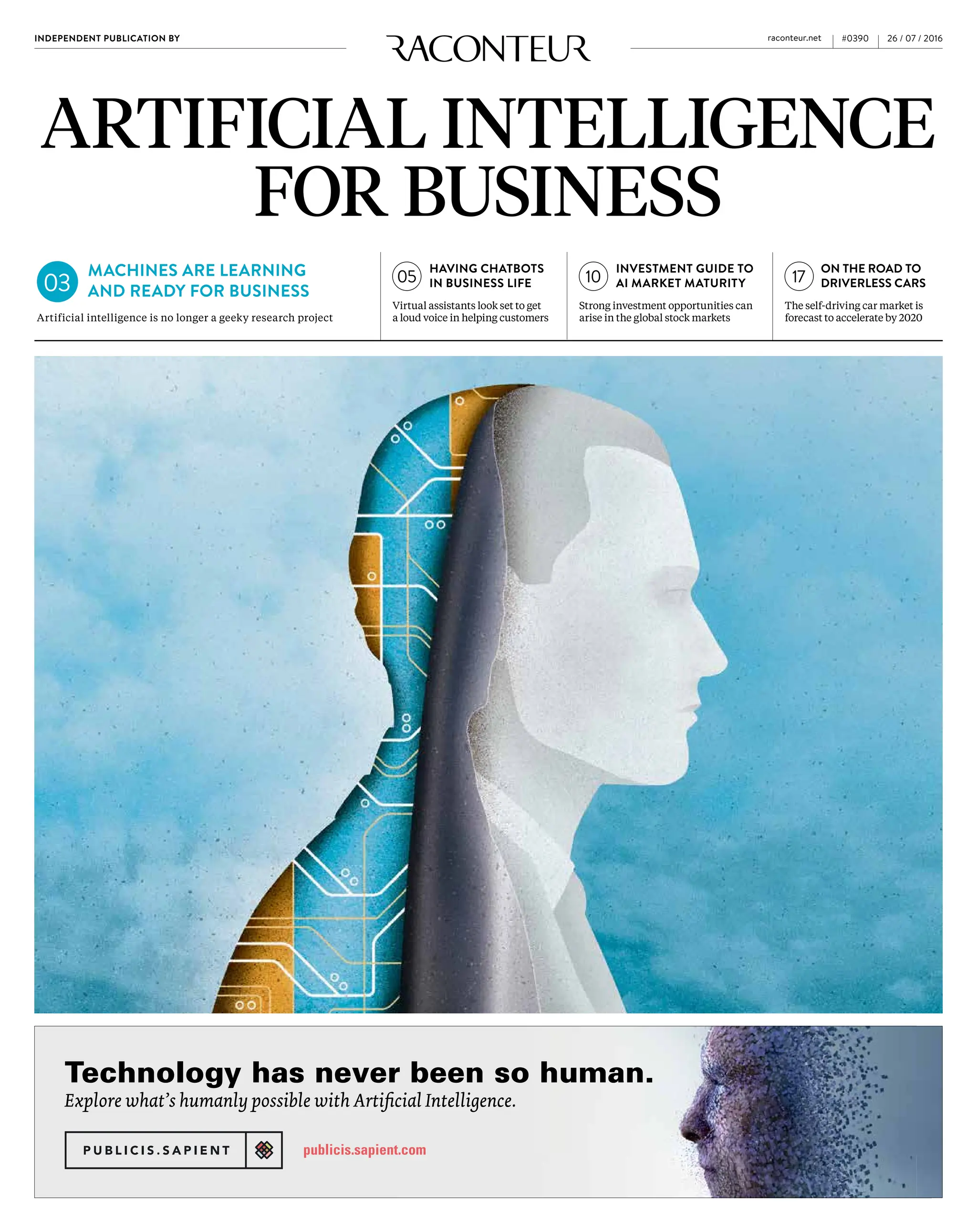
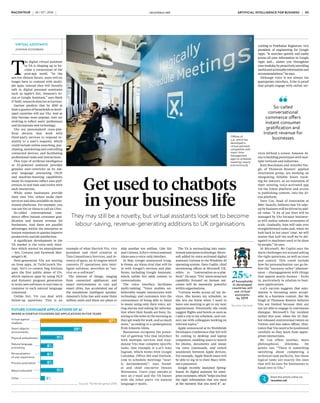
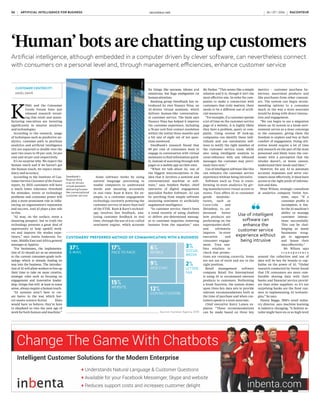
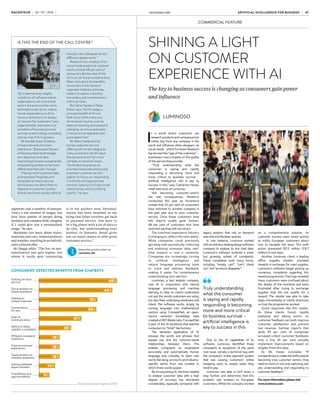
![$70bn
estimated size of AI-
based analytics market
by 2020, up from $8.2
billion in 2013
Source: IDC
Up to
$1.9trn
potential positive
impact to the global
economy from
driverless cars by 2025
Source: McKinsey
China
is the largest buyer of
industrial robots and now
makes up 25 per cent
of the global market,
forecast to rise to 38 per
cent by 2018
Source: IFR
10x
increase in US military
spending on unmanned aerial
vehicles between 2000
and 2016 to $2.9 billion,
Source: US Department
of Defense
$2.2trn
of assets could be managed
by robo-advisers by 2020,
up from $255 billion in 2018
Source: AT Kearney/
MyPrivateBanking/KPMG/
McKinsey
90-115bn
hours spent performing
household tasks could
be saved a year in
developing markets by
2025, equal to cost-savings
of $200-500 billion
Source: McKinsey
570k
robo-surgery procedures
were performed in 2014,
compared with 1,000
in 2000
Source: Intuitive Surgical
$16.3bn
estimated size of the
global agribot market
by 2020, up from $817
million in 2013
Source: WinterGreen
A guide to AI market maturity and how to buy into stocks
Robo-advisers can tell you which stocks to buy, but if you want to move into robot stocks you will need a cautious eye, although strong investment opportunities do arise in the global markets
INVESTMENT AND ADOPTION
DAN BARNES
T
his Christmas you could
acquire a car laden with
artificial intelligence
(AI). It may only be a few
inches long – AI startup Anki does
not make them full size – but it’s
the direction of travel for the con-
sumer market.
“We shouldn’t underestimate
how common AI systems already
are in our lives,” says Sarbjit Na-
hal, head of thematic investing
at Bank of America Merrill Lynch
Global Research.
Boris Sofman, one of the
co-founders and chief executive
of Anki, adds: “I believe we are
now at the inflection point of re-
alising AI’s true potential, which
will greatly impact many of the
biggest and most entrenched in-
dustries, just as we’re seeing with
entertainment and transporta-
tion industries today.”
As the use of
this technology
grows, so poten-
tially does the
commercial suc-
cess of its devel-
opers. However,
investors need to
understand exact-
ly what they are
getting when they
buy into stocks of
firms that offer AI
technology. The
starting point is to
understand what
we mean by artifi-
cial intelligence.
Back in 1980,
John Searle, Slusser professor of
philosophy at the University of
California, Berkeley, split AI into
two categories: strong AI, mean-
ing a truly conscious mind; and
weak AI, which replicates the ac-
tion of the mind without under-
standing.
Professor Searle argued that
digital technology could only
develop weak AI. He said the for-
mer was impossible for digital
computers to develop and that
the commercial AI technology on
offer today falls into the weak-AI
category. Despite the moniker,
this is powerful technology.
“The difference is akin to the
way a child learns multiplication
by rote, allowing them to give
the right answer to a multiplica-
tion question without, at first,
understanding why,” says Profes-
sor Mark Bishop, director of the
Tungsten Centre for Intelligent
Data Analytics at Goldsmiths Col-
lege, University of London. “Most
people perceive that over time the
majority of tasks humans do are
vulnerable to being mechanised
[using weak AI].”
Voice recognition, visual recog-
nition and the reading of emotion
all require weak AI to function.
From a practical point of view
these tools are specialist rather
than being a general intelligence
which can be adapted to differ-
ent tasks. For the investor, this
impacts where a firm has com-
mercial opportunity. A self-driv-
ing car will not suddenly become
sentient and begin to solve com-
plex medical questions; the de-
velopers must have a particular
market in which the technology
can be applied.
The use cases of systems them-
selves fall into specific niches,
which are incredibly varied.
Hardware manufacturers that
provide graphical processor units
and other pieces that are neces-
sary to deliver AI systems are one
possible investment case.
A research report published by
Bank of America Merrill Lynch
Global Research
last November
noted eight key
businesses that
could serve as
entry points for
investors want-
ing exposure to
AI stocks. These
included the tech-
nology provid-
ers themselves,
aerospace and
defence, notably
drones, automo-
tive and transport
stocks, financials,
healthcare, indus-
trials, domestic
services, agriculture and mining.
The breadth of investment cas-
es is, therefore, considerable. A
dynamic that investors need to
consider is the maturity of these
systems. Firms are now able to
put AI in a working environment
with confidence so investors can
get a clearer view of a business’s
offering and assess its potential
as a stock to invest in.
A confluence of factors have
led to a sudden rise in the growth
of AI technologies, which al-
low for greater innovation and
experimentation, says Profes-
sor Andrew Moore, dean of the
School of Computer Science at
Carnegie Mellon University in
Pittsburgh, Pennsylvania.
“To help restaurants under-
stand whether their customers
are enjoying themselves, you can
put in a system that measures
smiles and face creases,” he says.
“Four years ago that was science
fiction, now you can put that to-
gether pretty much using open
source software.”
An example visible to the public
has been the rise of AI personal
assistants. Apple’s Siri, Amazon’s
Echo and Microsoft’s Cortana are
all downloadable or built in to de-
vices and make smart interpreta-
tions of what the user is saying.
“We are entering a world where
some companies have a pretty
good road map for the next five to
ten years so there is an investment
opportunity, but there will also be
a profound period of disruption;
some companies are just waking
up to the fact that customer in-
teraction will be very different by
2019,” says Professor Moore.
The large digital firms and es-
tablished technology providers
are leading the charge in devel-
oping technology. In a February
2015 report, entitled The real
consequences of artificial intelli-
gence, Goldman Sachs found that
the greatest number of AI-relat-
ed patents filed with the United
States Patent and Trademark Of-
fice were by IBM, followed by Mi-
crosoft, then private individuals
and Google.
“When you look at everything
behind the investments made and
the patents filed, those numbers
have increased and there is a rela-
tively small number of companies
coming to dominate the space,
including traditional American
technology firms as well as sever-
al Japanese IT companies,” says
Mr Nahal.
Firms that operate in the online
environment are able to expose
their tools to a greater number
of users and thereby help their
systems to learn allowing some
firms to extend their position
as leaders.
“The more users that are in-
volved, the smarter a machine can
get,” Mr Nahal says. “The smart-
er it gets the more users you will
have. So there is a compounding
or network effect which does very
well for the tech companies that
are involved in this space.”
He gives the example of service
robots where growth has been
far quicker than the market had
anticipated. “It has already gone
beyond the levels expected of
2020,” he says.
The issue of control over AI will
mean device manufacturers that
can aggregate control over mul-
tiple AIs with a single interface
will get an advantage and po-
tentially disintermediate other
firms offering AI.
“The way that shakes out will de-
termine who the winners and los-
ers are during this period in the
market,” says Professor Moore.
Share this article online via
raconteur.net
There are also unusual dynam-
ics in the technology business,
such as open source technology,
which can change the capacity of
new firms to rise up and develop
new systems, in some cases un-
dermining existing value and in
other cases creating it.
Anki’s development of AI-en-
abled toy racing cars and robot
companion Cozmo will not come
purely from internal develop-
ments, says Mr Sofman, and will
also contribute to wider sector
growth.
“We certainly don’t think this
is something that we can or
should do alone, which is one of
the reasons we are planning to
release the Cozmo [platform de-
velopment information] in the
near future, to empower academ-
ics, researchers, developers and
aspiring roboticists to use this
incredibly capable platform for
both research and entertainment
applications,” he says.
The adoption of open source and
information-sharing in the AI
sphere may well mean the growth
of the sector can be far greater
than is predicted even now.
ARTIFICIAL INTELLIGENCE STATISTICS, BY SECTOR
TOP INVESTORS IN ARTIFICIAL INTELLIGENCE, BY NUMBER OF INVESTMENTS
ARTIFICIAL INTELLIGENCE ANNUAL FUNDING ($M) VENTURE FUNDING IN ARTIFICIAL INTELLIGENCE
MOST USED ARTIFICIAL INTELLIGENCE ENTERPRISE SOLUTIONS
Source: Venture Scanner 2016
Source: Venture Scanner 2016
Source: Narrative Science 2015
Source: Venture Scanner 2016
A
c
c
e
l
N
e
w
E
n
t
e
r
p
r
i
s
e
A
s
s
o
c
i
a
t
e
s
K
h
o
s
l
a
V
e
n
t
u
r
e
s
5
0
0
S
t
a
r
t
u
p
s
I
n
t
e
l
C
a
p
i
t
a
l
W
a
y
r
a
T
e
c
h
s
t
a
r
s
Y
C
o
m
b
i
n
a
t
o
r
F
i
r
s
t
R
o
u
n
d
G
E
V
e
n
t
u
r
e
s
C
R
V
S
V
A
n
g
e
l
R
E
V
G
V
S
o
f
t
B
a
n
k
P
l
u
g
a
n
d
P
l
a
y
F
o
u
n
d
e
r
s
F
u
n
d
A
M
E
C
l
o
u
d
V
e
n
t
u
r
e
s
H
o
r
i
z
o
n
s
V
e
n
t
u
r
e
s
T
w
o
S
i
g
m
a
V
e
n
t
u
r
e
s
B
l
o
o
m
b
e
r
g
B
e
t
a
A
n
d
r
e
e
s
s
e
n
H
o
r
o
w
i
t
z
M
a
d
r
o
n
a
V
e
n
t
u
r
e
G
r
o
u
p
F
e
l
i
c
i
s
V
e
n
t
u
r
e
s
D
r
a
p
e
r
F
i
s
h
e
r
J
u
r
v
e
t
s
o
n
(
D
F
J
)
D
a
t
a
C
o
l
l
e
c
t
i
v
e
G
o
l
d
m
a
n
S
a
c
h
s
S
e
q
u
o
i
a
C
a
p
i
t
a
l
B
e
s
s
e
m
e
r
V
e
n
t
u
r
e
P
a
r
t
n
e
r
s
L
i
g
h
t
s
p
e
e
d
V
e
n
t
u
r
e
P
a
r
t
n
e
r
s
29
20
18 17 16 15 15
15 14
12
11 11 11 10 10 10 10 10 10 9 9 9 9 9 8 8 8 8 8 8
TOP HOLDERS OF ARTIFICIAL INTELLIGENCE PATENTS
Source: iRunway 2015
Fujitsu
IBM
NEC
Microsoft
Siemens
Hitachi
Sony
Toshiba
NTT
Mitsubishi
Intertrust
Technologies
Panasonic
Son Y S
Samsung
Furukawa
88
93
85
70
70
65
63
63
63
48
45
45
39
36
31
Deep learning/machine
learning (applications)
Natural language
processing (general)
Deep learning/machine
learning (general)
Computer vision/image
recognition (general)
Smart robots
Computer vision/image
recognition (applications)
Virtual personal assistants
Gesture control
Natural language processing
(speech recognition)
Recommendation engines
and collaborative filtering
Context aware computing
Video automatic content
recognition
Speech-to-speech translation
CATEGORY
313
TOTAL FUNDING ($M)
0 100 200 300 400 500 600 700 800 1,000
900
2,696
161
DEAL COUNT
148
132
80
120
98
42
66
33
15
15
2,000
1,750
1,500
1,250
1,000
500
750
250
0
2006 2007 2008 2009 2010 2011 2012 2013 2014 2015 2016
funding as of
June 2016
$974m
4%
5%
5% 8%
8%
15%
24%
32%
Voice recognition and response
Machine-learning
Virtual personal
assistants
System for
decisions
support
Automated responding/
communications
Analytics
applications
Robotics
All of
the above
ARTIFICIAL INTELLIGENCE
:
M
a
c
h
i
n
e
l
e
a
r
n
i
n
g
,
d
e
e
p
l
e
a
r
n
i
n
g
,
n
a
t
u
r
a
l
u
s
e
r
i
n
t
e
r
f
a
c
e
s
INDUSTRAL: Automation, in
d
u
s
t
r
i
a
l
i
n
t
e
r
n
e
t
,
r
o
b
o
t
s
AUTOMOBILES/TRANSPO
R
T
:
S
e
l
f
-
d
r
i
v
i
n
g
o
r
a
u
t
o
n
o
m
o
u
s
v
e
h
i
c
l
e
s
H
EALTHCARE: Medical rob
o
t
s
a
n
d
c
o
m
p
u
t
e
r
-
a
s
s
i
s
t
e
d
s
u
r
g
e
r
y
,
t
e
l
e
h
e
a
l
t
h
,
c
a
r
e
b
o
t
s
,
b
i
o
n
i
c
s
SERVICE: Carebots, compa
n
i
o
n
s
,
d
o
m
e
s
t
i
c
,
e
d
u
c
a
t
i
o
n
,
e
n
t
e
r
t
a
i
n
m
e
n
t
,
p
e
r
s
o
n
a
l
,
t
r
a
n
s
p
o
r
t
,
s
e
c
u
r
i
t
y
AGRICULTURE: Agribots, d
r
o
n
e
s
a
n
d
u
n
m
a
n
n
e
d
a
e
r
i
a
l
v
e
h
i
c
l
e
s
,
p
r
e
c
i
s
i
o
n
a
g
r
i
c
u
l
t
u
r
e
AEROSPACE/DEFENCE: Un
m
a
n
n
e
d
s
y
s
t
e
m
s
,
m
i
l
i
t
a
r
y
a
n
d
c
o
m
m
e
r
c
i
a
l
d
r
o
n
e
s
,
r
o
b
o
t
s
FINANCE: Robo-advisers, r
o
b
o
-
a
n
a
l
y
s
t
s
,
a
u
t
o
m
a
t
e
d
t
r
a
d
i
n
g
s
y
s
t
e
m
s
ARTIFICIAL INTELLIGENCE FOR BUSINESS raconteur.net
10 RACONTEUR RACONTEUR raconteur.net 11
ARTIFICIAL INTELLIGENCE FOR BUSINESS
26 / 07 / 2016 26 / 07 / 2016
Firms are now
able to put AI
in a working
environment with
confidence so
investors can get
a clearer view of a
business’s offering
and assess its
potential](https://image.slidesharecdn.com/artificial-intelligence-for-business-250923175606-e184005b/85/artificial-intelligence-for-business-pdf-10-320.jpg)
![$70bn
estimated size of AI-
based analytics market
by 2020, up from $8.2
billion in 2013
Source: IDC
Up to
$1.9trn
potential positive
impact to the global
economy from
driverless cars by 2025
Source: McKinsey
China
is the largest buyer of
industrial robots and now
makes up 25 per cent
of the global market,
forecast to rise to 38 per
cent by 2018
Source: IFR
10x
increase in US military
spending on unmanned aerial
vehicles between 2000
and 2016 to $2.9 billion,
Source: US Department
of Defense
$2.2trn
of assets could be managed
by robo-advisers by 2020,
up from $255 billion in 2018
Source: AT Kearney/
MyPrivateBanking/KPMG/
McKinsey
90-115bn
hours spent performing
household tasks could
be saved a year in
developing markets by
2025, equal to cost-savings
of $200-500 billion
Source: McKinsey
570k
robo-surgery procedures
were performed in 2014,
compared with 1,000
in 2000
Source: Intuitive Surgical
$16.3bn
estimated size of the
global agribot market
by 2020, up from $817
million in 2013
Source: WinterGreen
A guide to AI market maturity and how to buy into stocks
Robo-advisers can tell you which stocks to buy, but if you want to move into robot stocks you will need a cautious eye, although strong investment opportunities do arise in the global markets
INVESTMENT AND ADOPTION
DAN BARNES
T
his Christmas you could
acquire a car laden with
artificial intelligence
(AI). It may only be a few
inches long – AI startup Anki does
not make them full size – but it’s
the direction of travel for the con-
sumer market.
“We shouldn’t underestimate
how common AI systems already
are in our lives,” says Sarbjit Na-
hal, head of thematic investing
at Bank of America Merrill Lynch
Global Research.
Boris Sofman, one of the
co-founders and chief executive
of Anki, adds: “I believe we are
now at the inflection point of re-
alising AI’s true potential, which
will greatly impact many of the
biggest and most entrenched in-
dustries, just as we’re seeing with
entertainment and transporta-
tion industries today.”
As the use of
this technology
grows, so poten-
tially does the
commercial suc-
cess of its devel-
opers. However,
investors need to
understand exact-
ly what they are
getting when they
buy into stocks of
firms that offer AI
technology. The
starting point is to
understand what
we mean by artifi-
cial intelligence.
Back in 1980,
John Searle, Slusser professor of
philosophy at the University of
California, Berkeley, split AI into
two categories: strong AI, mean-
ing a truly conscious mind; and
weak AI, which replicates the ac-
tion of the mind without under-
standing.
Professor Searle argued that
digital technology could only
develop weak AI. He said the for-
mer was impossible for digital
computers to develop and that
the commercial AI technology on
offer today falls into the weak-AI
category. Despite the moniker,
this is powerful technology.
“The difference is akin to the
way a child learns multiplication
by rote, allowing them to give
the right answer to a multiplica-
tion question without, at first,
understanding why,” says Profes-
sor Mark Bishop, director of the
Tungsten Centre for Intelligent
Data Analytics at Goldsmiths Col-
lege, University of London. “Most
people perceive that over time the
majority of tasks humans do are
vulnerable to being mechanised
[using weak AI].”
Voice recognition, visual recog-
nition and the reading of emotion
all require weak AI to function.
From a practical point of view
these tools are specialist rather
than being a general intelligence
which can be adapted to differ-
ent tasks. For the investor, this
impacts where a firm has com-
mercial opportunity. A self-driv-
ing car will not suddenly become
sentient and begin to solve com-
plex medical questions; the de-
velopers must have a particular
market in which the technology
can be applied.
The use cases of systems them-
selves fall into specific niches,
which are incredibly varied.
Hardware manufacturers that
provide graphical processor units
and other pieces that are neces-
sary to deliver AI systems are one
possible investment case.
A research report published by
Bank of America Merrill Lynch
Global Research
last November
noted eight key
businesses that
could serve as
entry points for
investors want-
ing exposure to
AI stocks. These
included the tech-
nology provid-
ers themselves,
aerospace and
defence, notably
drones, automo-
tive and transport
stocks, financials,
healthcare, indus-
trials, domestic
services, agriculture and mining.
The breadth of investment cas-
es is, therefore, considerable. A
dynamic that investors need to
consider is the maturity of these
systems. Firms are now able to
put AI in a working environment
with confidence so investors can
get a clearer view of a business’s
offering and assess its potential
as a stock to invest in.
A confluence of factors have
led to a sudden rise in the growth
of AI technologies, which al-
low for greater innovation and
experimentation, says Profes-
sor Andrew Moore, dean of the
School of Computer Science at
Carnegie Mellon University in
Pittsburgh, Pennsylvania.
“To help restaurants under-
stand whether their customers
are enjoying themselves, you can
put in a system that measures
smiles and face creases,” he says.
“Four years ago that was science
fiction, now you can put that to-
gether pretty much using open
source software.”
An example visible to the public
has been the rise of AI personal
assistants. Apple’s Siri, Amazon’s
Echo and Microsoft’s Cortana are
all downloadable or built in to de-
vices and make smart interpreta-
tions of what the user is saying.
“We are entering a world where
some companies have a pretty
good road map for the next five to
ten years so there is an investment
opportunity, but there will also be
a profound period of disruption;
some companies are just waking
up to the fact that customer in-
teraction will be very different by
2019,” says Professor Moore.
The large digital firms and es-
tablished technology providers
are leading the charge in devel-
oping technology. In a February
2015 report, entitled The real
consequences of artificial intelli-
gence, Goldman Sachs found that
the greatest number of AI-relat-
ed patents filed with the United
States Patent and Trademark Of-
fice were by IBM, followed by Mi-
crosoft, then private individuals
and Google.
“When you look at everything
behind the investments made and
the patents filed, those numbers
have increased and there is a rela-
tively small number of companies
coming to dominate the space,
including traditional American
technology firms as well as sever-
al Japanese IT companies,” says
Mr Nahal.
Firms that operate in the online
environment are able to expose
their tools to a greater number
of users and thereby help their
systems to learn allowing some
firms to extend their position
as leaders.
“The more users that are in-
volved, the smarter a machine can
get,” Mr Nahal says. “The smart-
er it gets the more users you will
have. So there is a compounding
or network effect which does very
well for the tech companies that
are involved in this space.”
He gives the example of service
robots where growth has been
far quicker than the market had
anticipated. “It has already gone
beyond the levels expected of
2020,” he says.
The issue of control over AI will
mean device manufacturers that
can aggregate control over mul-
tiple AIs with a single interface
will get an advantage and po-
tentially disintermediate other
firms offering AI.
“The way that shakes out will de-
termine who the winners and los-
ers are during this period in the
market,” says Professor Moore.
Share this article online via
raconteur.net
There are also unusual dynam-
ics in the technology business,
such as open source technology,
which can change the capacity of
new firms to rise up and develop
new systems, in some cases un-
dermining existing value and in
other cases creating it.
Anki’s development of AI-en-
abled toy racing cars and robot
companion Cozmo will not come
purely from internal develop-
ments, says Mr Sofman, and will
also contribute to wider sector
growth.
“We certainly don’t think this
is something that we can or
should do alone, which is one of
the reasons we are planning to
release the Cozmo [platform de-
velopment information] in the
near future, to empower academ-
ics, researchers, developers and
aspiring roboticists to use this
incredibly capable platform for
both research and entertainment
applications,” he says.
The adoption of open source and
information-sharing in the AI
sphere may well mean the growth
of the sector can be far greater
than is predicted even now.
ARTIFICIAL INTELLIGENCE STATISTICS, BY SECTOR
TOP INVESTORS IN ARTIFICIAL INTELLIGENCE, BY NUMBER OF INVESTMENTS
ARTIFICIAL INTELLIGENCE ANNUAL FUNDING ($M) VENTURE FUNDING IN ARTIFICIAL INTELLIGENCE
MOST USED ARTIFICIAL INTELLIGENCE ENTERPRISE SOLUTIONS
Source: Venture Scanner 2016
Source: Venture Scanner 2016
Source: Narrative Science 2015
Source: Venture Scanner 2016
A
c
c
e
l
N
e
w
E
n
t
e
r
p
r
i
s
e
A
s
s
o
c
i
a
t
e
s
K
h
o
s
l
a
V
e
n
t
u
r
e
s
5
0
0
S
t
a
r
t
u
p
s
I
n
t
e
l
C
a
p
i
t
a
l
W
a
y
r
a
T
e
c
h
s
t
a
r
s
Y
C
o
m
b
i
n
a
t
o
r
F
i
r
s
t
R
o
u
n
d
G
E
V
e
n
t
u
r
e
s
C
R
V
S
V
A
n
g
e
l
R
E
V
G
V
S
o
f
t
B
a
n
k
P
l
u
g
a
n
d
P
l
a
y
F
o
u
n
d
e
r
s
F
u
n
d
A
M
E
C
l
o
u
d
V
e
n
t
u
r
e
s
H
o
r
i
z
o
n
s
V
e
n
t
u
r
e
s
T
w
o
S
i
g
m
a
V
e
n
t
u
r
e
s
B
l
o
o
m
b
e
r
g
B
e
t
a
A
n
d
r
e
e
s
s
e
n
H
o
r
o
w
i
t
z
M
a
d
r
o
n
a
V
e
n
t
u
r
e
G
r
o
u
p
F
e
l
i
c
i
s
V
e
n
t
u
r
e
s
D
r
a
p
e
r
F
i
s
h
e
r
J
u
r
v
e
t
s
o
n
(
D
F
J
)
D
a
t
a
C
o
l
l
e
c
t
i
v
e
G
o
l
d
m
a
n
S
a
c
h
s
S
e
q
u
o
i
a
C
a
p
i
t
a
l
B
e
s
s
e
m
e
r
V
e
n
t
u
r
e
P
a
r
t
n
e
r
s
L
i
g
h
t
s
p
e
e
d
V
e
n
t
u
r
e
P
a
r
t
n
e
r
s
29
20
18 17 16 15 15
15 14
12
11 11 11 10 10 10 10 10 10 9 9 9 9 9 8 8 8 8 8 8
TOP HOLDERS OF ARTIFICIAL INTELLIGENCE PATENTS
Source: iRunway 2015
Fujitsu
IBM
NEC
Microsoft
Siemens
Hitachi
Sony
Toshiba
NTT
Mitsubishi
Intertrust
Technologies
Panasonic
Son Y S
Samsung
Furukawa
88
93
85
70
70
65
63
63
63
48
45
45
39
36
31
Deep learning/machine
learning (applications)
Natural language
processing (general)
Deep learning/machine
learning (general)
Computer vision/image
recognition (general)
Smart robots
Computer vision/image
recognition (applications)
Virtual personal assistants
Gesture control
Natural language processing
(speech recognition)
Recommendation engines
and collaborative filtering
Context aware computing
Video automatic content
recognition
Speech-to-speech translation
CATEGORY
313
TOTAL FUNDING ($M)
0 100 200 300 400 500 600 700 800 1,000
900
2,696
161
DEAL COUNT
148
132
80
120
98
42
66
33
15
15
2,000
1,750
1,500
1,250
1,000
500
750
250
0
2006 2007 2008 2009 2010 2011 2012 2013 2014 2015 2016
funding as of
June 2016
$974m
4%
5%
5% 8%
8%
15%
24%
32%
Voice recognition and response
Machine-learning
Virtual personal
assistants
System for
decisions
support
Automated responding/
communications
Analytics
applications
Robotics
All of
the above
ARTIFICIAL INTELLIGENCE
:
M
a
c
h
i
n
e
l
e
a
r
n
i
n
g
,
d
e
e
p
l
e
a
r
n
i
n
g
,
n
a
t
u
r
a
l
u
s
e
r
i
n
t
e
r
f
a
c
e
s
INDUSTRAL: Automation, in
d
u
s
t
r
i
a
l
i
n
t
e
r
n
e
t
,
r
o
b
o
t
s
AUTOMOBILES/TRANSPO
R
T
:
S
e
l
f
-
d
r
i
v
i
n
g
o
r
a
u
t
o
n
o
m
o
u
s
v
e
h
i
c
l
e
s
H
EALTHCARE: Medical rob
o
t
s
a
n
d
c
o
m
p
u
t
e
r
-
a
s
s
i
s
t
e
d
s
u
r
g
e
r
y
,
t
e
l
e
h
e
a
l
t
h
,
c
a
r
e
b
o
t
s
,
b
i
o
n
i
c
s
SERVICE: Carebots, compa
n
i
o
n
s
,
d
o
m
e
s
t
i
c
,
e
d
u
c
a
t
i
o
n
,
e
n
t
e
r
t
a
i
n
m
e
n
t
,
p
e
r
s
o
n
a
l
,
t
r
a
n
s
p
o
r
t
,
s
e
c
u
r
i
t
y
AGRICULTURE: Agribots, d
r
o
n
e
s
a
n
d
u
n
m
a
n
n
e
d
a
e
r
i
a
l
v
e
h
i
c
l
e
s
,
p
r
e
c
i
s
i
o
n
a
g
r
i
c
u
l
t
u
r
e
AEROSPACE/DEFENCE: Un
m
a
n
n
e
d
s
y
s
t
e
m
s
,
m
i
l
i
t
a
r
y
a
n
d
c
o
m
m
e
r
c
i
a
l
d
r
o
n
e
s
,
r
o
b
o
t
s
FINANCE: Robo-advisers, r
o
b
o
-
a
n
a
l
y
s
t
s
,
a
u
t
o
m
a
t
e
d
t
r
a
d
i
n
g
s
y
s
t
e
m
s
ARTIFICIAL INTELLIGENCE FOR BUSINESS raconteur.net
10 RACONTEUR RACONTEUR raconteur.net 11
ARTIFICIAL INTELLIGENCE FOR BUSINESS
26 / 07 / 2016 26 / 07 / 2016
Firms are now
able to put AI
in a working
environment with
confidence so
investors can get
a clearer view of a
business’s offering
and assess its
potential](https://image.slidesharecdn.com/artificial-intelligence-for-business-250923175606-e184005b/85/artificial-intelligence-for-business-pdf-11-320.jpg)
![raconteur.net 2
XXXX
C
aesars Entertainment, the
owner of casinos, hotels and
golf courses, was experiencing
the challenge faced by many
companies. Its marketing programme,
albeit successful, needed a boost.
“We were achieving open rates on
par with industry averages, but knew
we could do even better. It was a matter
of figuring out how,” says Chris Jenner,
vice president of e-mail marketing, in a
recentwebinaroncustomerexperience.
To get help, he approached Persado, a
fast-growing, cutting-edge cognitive
content platform for marketers.
“Marketers, especiallyones like Chris,
whoarechargedwithaddressingmillions
of consumers at a time, are all looking
for ways to provide personally relevant
content that drives engagement, at
scale,” says Lawrence Whittle, Persado’s
chief revenue officer.
Persado works on the basis
that emotion is key to inspiring
engagement in marketing. It has the
world’s largest database of more
than one million tagged emotional
and motivational words, phrases and
images, collected over several years
and scored against response data
from over 40 billion impressions.
Its sophisticated software, what it
calls “cognitive content generation”,
uses machine learning and natural
language processing, along with a vast
database of marketing performance
metrics, to predict which message
A MARKETER’S BEST BET:
COGNITIVE CONTENT
THAT INSPIRES ACTION
Emotion is the key to improving consumer engagement and inspiring
action. Now, thanks to cognitive content, in other words “smart” or
machine-intelligent content, scaling the production of the right words,
phrases and images to elicit emotional connection is easier than ever
permutations will have the highest
potential for success, unique to each
touchpoint, including e-mails, landing
pages, social media, mobile and
display advertising.
Persado’s database has a huge array
of options in which to express emotions
coupled with hundreds of thousands
of offer and discount descriptions. The
results are analysed and the system
generates the best messages. It then
creates a visual representation of the
message performance and the most
powerful content.
After working with Persado, Caesars
Entertainment’s Mr Jenner saw his
e-mail open rate jump by 24 per cent
and his click-through rate increase by a
significant 46 per cent.
“We produced a 19 per cent open
rate, but Persado came in with a 30
per cent open rate. I became a believer.
Besides improved e-mail open rates, our
click-through rate grew as well. That’s
because, as soon as we identified the
rightemotionallanguagetouseforeach
audience, recipients began to recognise
ourcontent as valuable,” says MrJenner.
Powered by cognitive computing
technologies, the platform eliminates
therandomprocessesbehindtraditional
message creation, while also taking
brand voice into account.
Persado, whose clients include
more than 80 global brands, such
as American Express, Citi, eBay and
Microsoft, has earned its clients a
combined $1 billion in incremental
revenuein2015.Itsuniquetechnology
is helping more and more companies
scale their ability to engage with their
customers better with relevance
and speed, expand this expertise
across marketing teams and have an
immediate impact on their top lines.
“There are an increasing number
of solutions in the marketplace that
claim some kind of smart or cognitive
technology”, says Mr Whittle. “When
assessingtherightpartner,corporations
should ask: how credible are these
vendors in terms of proof points? How
easy is the technology to implement?
Are the results they deliver marginal or
are uplifts significant and sustainable?
“Solutions that can help companies
generate fast and substantial return on
investment, but have minimal impact on
resourcesorITwilladvancetheadoption
of cognitive computing technology”.
ForCaesarsEntertainment,Persado’s
cognitive content was a bet that has
paid off handsomely.
For more information please visit
persado.com
PERSADO’S WHEEL OF EMOTIONS
COMMERCIAL FEATURE
800%
difference
between the
best and worst-
performing
e-mail marketing
messages
1m+
tagged words
and phrases on
the Persado
database
68.4%
click uplift
Quiet
C
h
a
l
l
e
n
g
e
Anxiety
Urgency
Curiosity
Encouragement
Celebration
G
r
a
t
i
t
u
d
e
In
t
im
a
c
y
G
ui
lt
Lu
ck
E
x
c
i
t
e
m
e
n
t
Achievem
ent
Exclusivity
Desirability
Singularity
Gratification
F
a
s
c
i
n
a
t
i
o
n
S
a
f
e
t
y
Relief
Quiet
Positive
Negative
Quiet
ARTIFICIAL INTELLIGENCE FOR BUSINESS raconteur.net
14 RACONTEUR RACONTEUR raconteur.net 15
ARTIFICIAL INTELLIGENCE FOR BUSINESS
26 / 07 / 2016 26 / 07 / 2016
COMMERCIAL FEATURE
Now it’s all hail t he march of the algorithms
Artificial intelligence is impacting the fina ncial services sector more than most, with sophisticated algorithmic
trading, posing a serious challenge for tra ders and regulators alike
D
emand for non-equity
trading algorithms serv-
ing institutional asset
managers and retail in-
vestors is expanding the preva-
lence of artificial intelligence in the
world’s financial markets.
A recent report by Thomson Reu-
ters estimates that algorithmic trad-
ing systems now handle 75 per cent
of the volume of global trades world-
wide and this figure is predicted, by
those in the industry, to grow steadi-
ly. The reasons are three-fold.
Firstly, while the institutional
market has enjoyed a large variety of
“algos” serving the equity markets
to date, other areas such as futures
are still witnessing huge product de-
mand and innovation as a result.
Secondly, regulations affecting the
institutional investment market,
such as the European Union Markets
in Financial Instruments Directive
II or MiFID II, are pushing for great-
er automation of trades in some as-
set classes which traditionally were
not executed electronically.
The fixed income market is a prime
example and negotiations between
industry groups are ongoing as to
how practical a fully automated fixed
income could really be, given the
magnitude of the required shift from
telephone to electronic trading.
Thirdly, the retail trading market
continues to expand worldwide,
which is opening up algorithmic
trading to a whole new group and
further increasing demand for the
technological advancement.
Ralph Achkar, product director
for capital markets at trading infra-
structure group Colt, says algo-trad-
ing demand has shifted considera-
bly over the past three decades from
a focus on speed to a focus on an in-
creased number of variables.
He explains: “We’ve seen a move
away from pure access needs. Ini-
tially the move was towards a focus
on low latency, but more recently [it
has been] to a deterministic environ-
ment, and now participants are look-
ing for the ability to chase short-lived
opportunities across different ven-
ues, asset classes and geographies.
“This is directly correlated to the
increasing sophistication of algo-
rithmic trading. Initially people were
looking for simply the fastest access
to markets, then the ability to control
their low-latency connections better,
and into the future traders will need
to look across asset classes and geog-
raphies as the world becomes smaller
and events in one trading centre are
rapidly felt in another.”
A recent report from the US Com-
modityFuturesTradingCommission
found that algorithmic trading sys-
tems were responsible for nearly 80
per cent of foreign exchange futures
trading volume, 67 per cent of inter-
est rate futures volume, 62 per cent
of equity futures volume, 47 per cent
of metals and energy futures volume,
and 38 per cent of agricultural prod-
uct futures volume between October
2012 and October 2014.
And it’s not just volumes that are
being impacted by the development
of new algorithms. Sell-side firms
that take on counterparty risk are
now using algos to ensure they set
the right level of risk and fully un-
derstand their exposure.
Jilali Azzouz, a quantitative trad-
er at Ayondo Markets, explains: “Our
risk model is now using algorithms to
provide momentum metrics on our ex-
posure at every point in time and deci-
sionsthatwerehumandriveninthere-
centpastarenowtakenbycomputers.
“Algorithms, especially those fo-
cusing on risk management, as op-
posed to discretionary trading, are
able to simulate thousands of risk
scenarios within a second. I believe
every buy-side algorithm should
have a strong risk management al-
gorithm running in parallel with
the trading algorithm. A more effi-
cient risk management leads to less
‘crazy’ behaviours on the market
and hence will bring more stability,
although I’m not against volatility.”
The development of the algo-
rithms is only part of the story.
Businesses such as Ayondo Markets
have recognised the importance of
machine learning, where the algos
learn from their mistakes to ensure
their statistics are likely to be more
accurate. This is also an approach
being adopted by some investment
management houses, employing
risk premia or smart beta strategies.
According to Mr Azzouz, there have
been improvements in back-test-
ing, execution and liquidity. “With
back-testing improvements, they
now take into account slippage fac-
tors and margin requirements. The
empirical issue with algorithmic
trading, related to the way they run
back-tests, is the fact they tend to ig-
nore the liquidity available,” he says.
“It’s still difficult to assess what was
the liquidity at a specific point in time
inthepast,butnowtradingalgorithms
are written to assess the best liquidity
providers at the time of execution.”
However, as machine learning
becomes more sophisticated and
gives birth to the next generation
of algos, market experts are warn-
ing regulators will need to keep
pace to prevent major accidental
market movements.
Tony Virdi, head of banking and
financial services in the UK and Ire-
land at fintech consultancy group
Cognizant, says: “As machine learn-
ing improves, further growth of al-
gorithmic trading is expected. The
important factor, however, that reg-
ulators will watch is market integri-
ty and equality to ensure non-algo-
rithmic trading firms that compete
against others employing automat-
ed solutions do not play in an une-
ven competitive market.”
The difficulty for global regulators
is the pace of change is so rapid and
regulation should not stifle innova-
tion. Adam Jones, senior consultant
at financial software group Altus
Consulting, believes that the regula-
tion of AI engines operating within
financial services more widely, and
trading specifically, will require a
sea change of regulatory thought.
He says: “If you thought it was a
challenge trying to regulate bad be-
haviour out of a group of misguided
bankers or financial advisers, try reg-
ulating something which is smarter
than you and quicker than you.
“Day in day out, firms in the UK
are grappling with the various rule
books and guidelines published by
the regulator. We might soon wit-
ness artificial intelligence engines
devouring these rule books, and
feeding back on the contradictions
and inconsistencies within them.
“The regulator and the govern-
ment need to be in a position to
provide sensible and proportionate
guidance to regulation for these
firms, and to do so in a way which
FINANCIAL SERVICES
JOE McGRATH
still manages to protect the UK re-
tail investor and the UK economy.”
Mr Jones’ thoughts are shared by
many. Cognizant’s Mr Virdi cites the
ongoing saga of MiFID II, which al-
ready addresses automated trading.
“Among other things, this states
that firms should have controls in
place to make sure trading systems
are resilient and have capacity, pre-
venting them sending orders which
are incorrect or inaccurate. Future
regulation will need to define the set
of controls appropriately,” he says.
“In Germany, where high-fre-
quency trading (HFT) is a licensed
activity, fees are imposed on those
who make ‘excessive use’ of HFT on
exchanges, known as the excessive
system usage fee.
“Overall, the biggest challenge
comes when HFT presents new risks
which wouldn’t exist otherwise, such
as flash crashes. It is therefore impor-
tant that regulators are well versed in
the operation of algorithms and have
the flexibility to be able to engage
new legislation where required.”
So with technology advancement
moving at such speed, should those
working in banking, trading and
financial services more broadly be
concerned for their jobs?
Simon Smith, director of UK op-
erations at trading group FXPro
says this is a complex question that
goes beyond the evolution of arti-
ficial intelligence. “The landscape
is changing and not only because
of algo trading. Banks used to em-
ploy technical analysts to spew out
loads of charts and levels. I only
know one remaining now of my
contacts,” he says.
Colt’s Mr Achkar says the in-
creasing focus on technology is
nothing new and the evolution of
markets has been happening for
decades. “It’s also in part due to
the drive from regulators to in-
crease transparency and there’s
clear pressure on participants who
have been resistive to this techno-
logical change.
“Historically, it was the traders’ re-
lationships that stalled technological
progress in these areas, but cost and
regulatory pressures are making this
position untenable. This does not
mean that all roles in a trade life cycle
will be automated or that there will
be no role for human relationships.
Rather the change will focus human
intervention on some parts of a trade
life cycle versus others.
“We expect some recycling of kno-
whow to occur, as well as a change in
the amount of human intervention
in certain asset classes, which are
being pushed to an electronic model
over the next three to five years.”
Share this article online via
raconteur.net
As machine
learning becomes
more sophisticated
and gives birth to
the next generation
of algos, market
experts are warning
regulators will
need to keep pace
to prevent major
accidental market
movements
ALGORITHMIC TRADING SYSTEM (ATS) USAGE IN TRADING
IN THE TWO YEARS TO OCTOBER 2014, ATSs WERE PRESENT IN:
Source: Commodity Futures Trading Commission 2015
Numerai, a hedge fund using
crowdsourced artificial
intelligence (AI) to make equity
price predictions, is aiming to
“solve the stock market”, writes
Benjamin Chiou.
Founded by South African
mathematician Richard Craib,
Numerai created the world’s
first encrypted data-science
tournament for equity price
predictions in December last
year and has since received
more than 2.7 billion estimates
from data scientists all over
the globe.
The concept, technology
aside, is relatively simple:
data scientists and computer
programmers are able
to download encrypted
financial data, build their own
algorithms through machine
learning, and anonymously
upload their price predictions.
Numerai then uses the best
models to trade on the stock
market and the winning
contributors are rewarded with
a portion of the profits,
paid in bitcoins.
While experts largely
estimate AI will surpass human
intelligence by 2040, Mr Craib
believes this could happen in
the stock market sooner. “I
think it’s really untenable to
think that, long term, humans
will be better than AIs at
predicting the future of an
equity in 100-dimensional
feature space,” he says.
“I think we are already at
the point where nearly every
hedge fund in the world has a
huge data-science component.
Even value investors use
sophisticated filters to screen
investment ideas. But investors
using rules of thumb learnt in
finance textbooks rather than
strategies learnt from data are
going to lose badly.”
Does this spell the end of
the stock market analyst? Not
just yet, according to Mr Craib.
He says machine learning is
only able to improve with large
amounts of training data and
human-generated earnings
estimates provide them with
just that. “I think it will take
some time for human analysis
to go away, but synthesising
the collective human analysis
is already the domain of
machines,” he adds.
The fundamental reason for
using AI in the stock market
is to improve efficiency.
“However, the cost of efficient
markets right now is that
there is a lot of human capital
locked up in hedge funds,” he
says. “The promise of artificial
intelligence in finance is total
efficiency and the freeing up
of human capital to advance
other fields or do whatever
they want.”
FUTURE OF THE STOCK MARKET
80%
Foreign
exchange
futures
volumes
67%
Interest
rate futures
volumes
62%
Equity
futures
volumes
38%
Agricultural
futures
volumes
47%
Metals
and energy
product
volumes
Getty
Images](https://image.slidesharecdn.com/artificial-intelligence-for-business-250923175606-e184005b/85/artificial-intelligence-for-business-pdf-14-320.jpg)
![raconteur.net 2
XXXX
C
aesars Entertainment, the
owner of casinos, hotels and
golf courses, was experiencing
the challenge faced by many
companies. Its marketing programme,
albeit successful, needed a boost.
“We were achieving open rates on
par with industry averages, but knew
we could do even better. It was a matter
of figuring out how,” says Chris Jenner,
vice president of e-mail marketing, in a
recentwebinaroncustomerexperience.
To get help, he approached Persado, a
fast-growing, cutting-edge cognitive
content platform for marketers.
“Marketers, especiallyones like Chris,
whoarechargedwithaddressingmillions
of consumers at a time, are all looking
for ways to provide personally relevant
content that drives engagement, at
scale,” says Lawrence Whittle, Persado’s
chief revenue officer.
Persado works on the basis
that emotion is key to inspiring
engagement in marketing. It has the
world’s largest database of more
than one million tagged emotional
and motivational words, phrases and
images, collected over several years
and scored against response data
from over 40 billion impressions.
Its sophisticated software, what it
calls “cognitive content generation”,
uses machine learning and natural
language processing, along with a vast
database of marketing performance
metrics, to predict which message
A MARKETER’S BEST BET:
COGNITIVE CONTENT
THAT INSPIRES ACTION
Emotion is the key to improving consumer engagement and inspiring
action. Now, thanks to cognitive content, in other words “smart” or
machine-intelligent content, scaling the production of the right words,
phrases and images to elicit emotional connection is easier than ever
permutations will have the highest
potential for success, unique to each
touchpoint, including e-mails, landing
pages, social media, mobile and
display advertising.
Persado’s database has a huge array
of options in which to express emotions
coupled with hundreds of thousands
of offer and discount descriptions. The
results are analysed and the system
generates the best messages. It then
creates a visual representation of the
message performance and the most
powerful content.
After working with Persado, Caesars
Entertainment’s Mr Jenner saw his
e-mail open rate jump by 24 per cent
and his click-through rate increase by a
significant 46 per cent.
“We produced a 19 per cent open
rate, but Persado came in with a 30
per cent open rate. I became a believer.
Besides improved e-mail open rates, our
click-through rate grew as well. That’s
because, as soon as we identified the
rightemotionallanguagetouseforeach
audience, recipients began to recognise
ourcontent as valuable,” says MrJenner.
Powered by cognitive computing
technologies, the platform eliminates
therandomprocessesbehindtraditional
message creation, while also taking
brand voice into account.
Persado, whose clients include
more than 80 global brands, such
as American Express, Citi, eBay and
Microsoft, has earned its clients a
combined $1 billion in incremental
revenuein2015.Itsuniquetechnology
is helping more and more companies
scale their ability to engage with their
customers better with relevance
and speed, expand this expertise
across marketing teams and have an
immediate impact on their top lines.
“There are an increasing number
of solutions in the marketplace that
claim some kind of smart or cognitive
technology”, says Mr Whittle. “When
assessingtherightpartner,corporations
should ask: how credible are these
vendors in terms of proof points? How
easy is the technology to implement?
Are the results they deliver marginal or
are uplifts significant and sustainable?
“Solutions that can help companies
generate fast and substantial return on
investment, but have minimal impact on
resourcesorITwilladvancetheadoption
of cognitive computing technology”.
ForCaesarsEntertainment,Persado’s
cognitive content was a bet that has
paid off handsomely.
For more information please visit
persado.com
PERSADO’S WHEEL OF EMOTIONS
COMMERCIAL FEATURE
800%
difference
between the
best and worst-
performing
e-mail marketing
messages
1m+
tagged words
and phrases on
the Persado
database
68.4%
click uplift
Quiet
C
h
a
l
l
e
n
g
e
Anxiety
Urgency
Curiosity
Encouragement
Celebration
G
r
a
t
i
t
u
d
e
In
t
im
a
c
y
G
ui
lt
Lu
ck
E
x
c
i
t
e
m
e
n
t
Achievem
ent
Exclusivity
Desirability
Singularity
Gratification
F
a
s
c
i
n
a
t
i
o
n
S
a
f
e
t
y
Relief
Quiet
Positive
Negative
Quiet
ARTIFICIAL INTELLIGENCE FOR BUSINESS raconteur.net
14 RACONTEUR RACONTEUR raconteur.net 15
ARTIFICIAL INTELLIGENCE FOR BUSINESS
26 / 07 / 2016 26 / 07 / 2016
COMMERCIAL FEATURE
Now it’s all hail t he march of the algorithms
Artificial intelligence is impacting the fina ncial services sector more than most, with sophisticated algorithmic
trading, posing a serious challenge for tra ders and regulators alike
D
emand for non-equity
trading algorithms serv-
ing institutional asset
managers and retail in-
vestors is expanding the preva-
lence of artificial intelligence in the
world’s financial markets.
A recent report by Thomson Reu-
ters estimates that algorithmic trad-
ing systems now handle 75 per cent
of the volume of global trades world-
wide and this figure is predicted, by
those in the industry, to grow steadi-
ly. The reasons are three-fold.
Firstly, while the institutional
market has enjoyed a large variety of
“algos” serving the equity markets
to date, other areas such as futures
are still witnessing huge product de-
mand and innovation as a result.
Secondly, regulations affecting the
institutional investment market,
such as the European Union Markets
in Financial Instruments Directive
II or MiFID II, are pushing for great-
er automation of trades in some as-
set classes which traditionally were
not executed electronically.
The fixed income market is a prime
example and negotiations between
industry groups are ongoing as to
how practical a fully automated fixed
income could really be, given the
magnitude of the required shift from
telephone to electronic trading.
Thirdly, the retail trading market
continues to expand worldwide,
which is opening up algorithmic
trading to a whole new group and
further increasing demand for the
technological advancement.
Ralph Achkar, product director
for capital markets at trading infra-
structure group Colt, says algo-trad-
ing demand has shifted considera-
bly over the past three decades from
a focus on speed to a focus on an in-
creased number of variables.
He explains: “We’ve seen a move
away from pure access needs. Ini-
tially the move was towards a focus
on low latency, but more recently [it
has been] to a deterministic environ-
ment, and now participants are look-
ing for the ability to chase short-lived
opportunities across different ven-
ues, asset classes and geographies.
“This is directly correlated to the
increasing sophistication of algo-
rithmic trading. Initially people were
looking for simply the fastest access
to markets, then the ability to control
their low-latency connections better,
and into the future traders will need
to look across asset classes and geog-
raphies as the world becomes smaller
and events in one trading centre are
rapidly felt in another.”
A recent report from the US Com-
modityFuturesTradingCommission
found that algorithmic trading sys-
tems were responsible for nearly 80
per cent of foreign exchange futures
trading volume, 67 per cent of inter-
est rate futures volume, 62 per cent
of equity futures volume, 47 per cent
of metals and energy futures volume,
and 38 per cent of agricultural prod-
uct futures volume between October
2012 and October 2014.
And it’s not just volumes that are
being impacted by the development
of new algorithms. Sell-side firms
that take on counterparty risk are
now using algos to ensure they set
the right level of risk and fully un-
derstand their exposure.
Jilali Azzouz, a quantitative trad-
er at Ayondo Markets, explains: “Our
risk model is now using algorithms to
provide momentum metrics on our ex-
posure at every point in time and deci-
sionsthatwerehumandriveninthere-
centpastarenowtakenbycomputers.
“Algorithms, especially those fo-
cusing on risk management, as op-
posed to discretionary trading, are
able to simulate thousands of risk
scenarios within a second. I believe
every buy-side algorithm should
have a strong risk management al-
gorithm running in parallel with
the trading algorithm. A more effi-
cient risk management leads to less
‘crazy’ behaviours on the market
and hence will bring more stability,
although I’m not against volatility.”
The development of the algo-
rithms is only part of the story.
Businesses such as Ayondo Markets
have recognised the importance of
machine learning, where the algos
learn from their mistakes to ensure
their statistics are likely to be more
accurate. This is also an approach
being adopted by some investment
management houses, employing
risk premia or smart beta strategies.
According to Mr Azzouz, there have
been improvements in back-test-
ing, execution and liquidity. “With
back-testing improvements, they
now take into account slippage fac-
tors and margin requirements. The
empirical issue with algorithmic
trading, related to the way they run
back-tests, is the fact they tend to ig-
nore the liquidity available,” he says.
“It’s still difficult to assess what was
the liquidity at a specific point in time
inthepast,butnowtradingalgorithms
are written to assess the best liquidity
providers at the time of execution.”
However, as machine learning
becomes more sophisticated and
gives birth to the next generation
of algos, market experts are warn-
ing regulators will need to keep
pace to prevent major accidental
market movements.
Tony Virdi, head of banking and
financial services in the UK and Ire-
land at fintech consultancy group
Cognizant, says: “As machine learn-
ing improves, further growth of al-
gorithmic trading is expected. The
important factor, however, that reg-
ulators will watch is market integri-
ty and equality to ensure non-algo-
rithmic trading firms that compete
against others employing automat-
ed solutions do not play in an une-
ven competitive market.”
The difficulty for global regulators
is the pace of change is so rapid and
regulation should not stifle innova-
tion. Adam Jones, senior consultant
at financial software group Altus
Consulting, believes that the regula-
tion of AI engines operating within
financial services more widely, and
trading specifically, will require a
sea change of regulatory thought.
He says: “If you thought it was a
challenge trying to regulate bad be-
haviour out of a group of misguided
bankers or financial advisers, try reg-
ulating something which is smarter
than you and quicker than you.
“Day in day out, firms in the UK
are grappling with the various rule
books and guidelines published by
the regulator. We might soon wit-
ness artificial intelligence engines
devouring these rule books, and
feeding back on the contradictions
and inconsistencies within them.
“The regulator and the govern-
ment need to be in a position to
provide sensible and proportionate
guidance to regulation for these
firms, and to do so in a way which
FINANCIAL SERVICES
JOE McGRATH
still manages to protect the UK re-
tail investor and the UK economy.”
Mr Jones’ thoughts are shared by
many. Cognizant’s Mr Virdi cites the
ongoing saga of MiFID II, which al-
ready addresses automated trading.
“Among other things, this states
that firms should have controls in
place to make sure trading systems
are resilient and have capacity, pre-
venting them sending orders which
are incorrect or inaccurate. Future
regulation will need to define the set
of controls appropriately,” he says.
“In Germany, where high-fre-
quency trading (HFT) is a licensed
activity, fees are imposed on those
who make ‘excessive use’ of HFT on
exchanges, known as the excessive
system usage fee.
“Overall, the biggest challenge
comes when HFT presents new risks
which wouldn’t exist otherwise, such
as flash crashes. It is therefore impor-
tant that regulators are well versed in
the operation of algorithms and have
the flexibility to be able to engage
new legislation where required.”
So with technology advancement
moving at such speed, should those
working in banking, trading and
financial services more broadly be
concerned for their jobs?
Simon Smith, director of UK op-
erations at trading group FXPro
says this is a complex question that
goes beyond the evolution of arti-
ficial intelligence. “The landscape
is changing and not only because
of algo trading. Banks used to em-
ploy technical analysts to spew out
loads of charts and levels. I only
know one remaining now of my
contacts,” he says.
Colt’s Mr Achkar says the in-
creasing focus on technology is
nothing new and the evolution of
markets has been happening for
decades. “It’s also in part due to
the drive from regulators to in-
crease transparency and there’s
clear pressure on participants who
have been resistive to this techno-
logical change.
“Historically, it was the traders’ re-
lationships that stalled technological
progress in these areas, but cost and
regulatory pressures are making this
position untenable. This does not
mean that all roles in a trade life cycle
will be automated or that there will
be no role for human relationships.
Rather the change will focus human
intervention on some parts of a trade
life cycle versus others.
“We expect some recycling of kno-
whow to occur, as well as a change in
the amount of human intervention
in certain asset classes, which are
being pushed to an electronic model
over the next three to five years.”
Share this article online via
raconteur.net
As machine
learning becomes
more sophisticated
and gives birth to
the next generation
of algos, market
experts are warning
regulators will
need to keep pace
to prevent major
accidental market
movements
ALGORITHMIC TRADING SYSTEM (ATS) USAGE IN TRADING
IN THE TWO YEARS TO OCTOBER 2014, ATSs WERE PRESENT IN:
Source: Commodity Futures Trading Commission 2015
Numerai, a hedge fund using
crowdsourced artificial
intelligence (AI) to make equity
price predictions, is aiming to
“solve the stock market”, writes
Benjamin Chiou.
Founded by South African
mathematician Richard Craib,
Numerai created the world’s
first encrypted data-science
tournament for equity price
predictions in December last
year and has since received
more than 2.7 billion estimates
from data scientists all over
the globe.
The concept, technology
aside, is relatively simple:
data scientists and computer
programmers are able
to download encrypted
financial data, build their own
algorithms through machine
learning, and anonymously
upload their price predictions.
Numerai then uses the best
models to trade on the stock
market and the winning
contributors are rewarded with
a portion of the profits,
paid in bitcoins.
While experts largely
estimate AI will surpass human
intelligence by 2040, Mr Craib
believes this could happen in
the stock market sooner. “I
think it’s really untenable to
think that, long term, humans
will be better than AIs at
predicting the future of an
equity in 100-dimensional
feature space,” he says.
“I think we are already at
the point where nearly every
hedge fund in the world has a
huge data-science component.
Even value investors use
sophisticated filters to screen
investment ideas. But investors
using rules of thumb learnt in
finance textbooks rather than
strategies learnt from data are
going to lose badly.”
Does this spell the end of
the stock market analyst? Not
just yet, according to Mr Craib.
He says machine learning is
only able to improve with large
amounts of training data and
human-generated earnings
estimates provide them with
just that. “I think it will take
some time for human analysis
to go away, but synthesising
the collective human analysis
is already the domain of
machines,” he adds.
The fundamental reason for
using AI in the stock market
is to improve efficiency.
“However, the cost of efficient
markets right now is that
there is a lot of human capital
locked up in hedge funds,” he
says. “The promise of artificial
intelligence in finance is total
efficiency and the freeing up
of human capital to advance
other fields or do whatever
they want.”
FUTURE OF THE STOCK MARKET
80%
Foreign
exchange
futures
volumes
67%
Interest
rate futures
volumes
62%
Equity
futures
volumes
38%
Agricultural
futures
volumes
47%
Metals
and energy
product
volumes
Getty
Images](https://image.slidesharecdn.com/artificial-intelligence-for-business-250923175606-e184005b/85/artificial-intelligence-for-business-pdf-15-320.jpg)
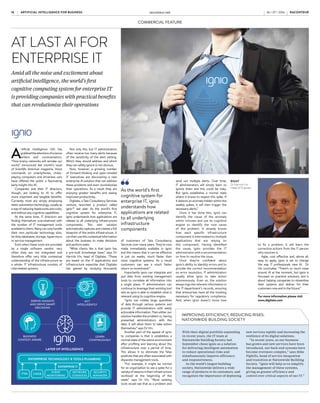
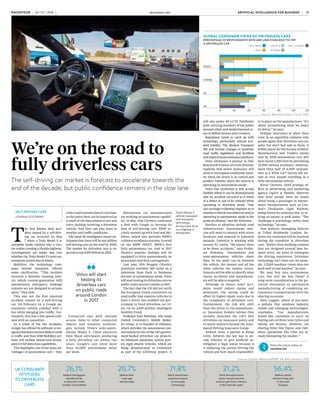
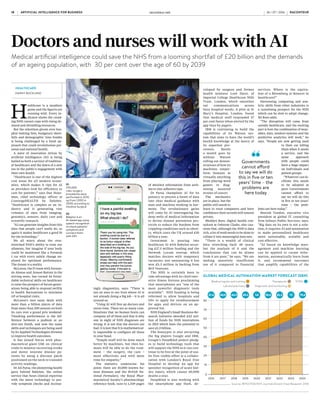
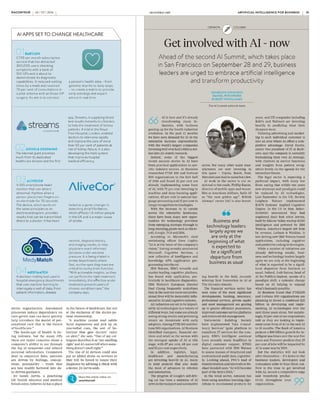
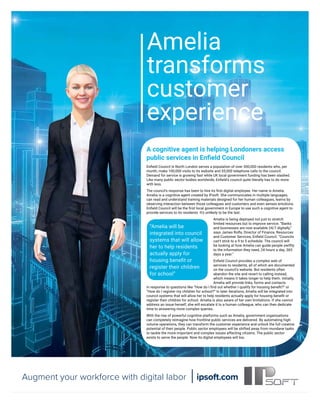


![[REPORT PREVIEW] AI in the Enterprise](https://cdn.slidesharecdn.com/ss_thumbnails/altimeteraiintheenterpriseslideshare-180612153634-thumbnail.jpg?width=640&height=640&fit=bounds)


