Artificial
Intelligence
(AI)
Prepared by:
Rawan Hashim
Business Administration
SABFS, Sudan
Contents
Introduction to Artificial Intelligence.
The types of Artificial Intelligence.
Its applications in real life.
The role of AI in the administrative field.
Pros and cons of AI.
An introduction to AI:
What do we mean by Artificial Intelligence?
*Artificial Intelligence(AI) is the study of how to
make computers perform tasks that humans
consider difficult through the creation of
intelligent agents.
The founding father of AI, Alan Turing, defined it
as: “It’s the science and engineering of
making intelligent machines, especially
intelligent computer programs.”
*They have the ability to sense, reason,
engage, learn & solve problems.
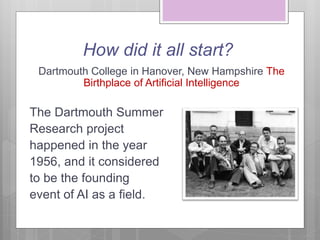
How did it all start?
Dartmouth College in Hanover, New Hampshire The
Birthplace of Artificial Intelligence
The Dartmouth Summer
Research project
happened in the year
1956, and it considered
to be the founding
event of AI as a field.
What does Artificial
Intelligence include?
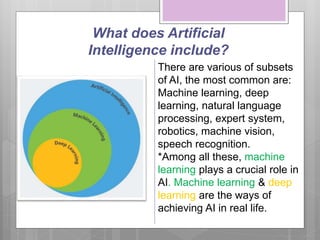
There are various of subsets
of AI, the most common are:
Machine learning, deep
learning, natural language
processing, expert system,
robotics, machine vision,
speech recognition.
*Among all these, machine
learning plays a crucial role in
AI. Machine learning & deep
learning are the ways of
achieving AI in real life.
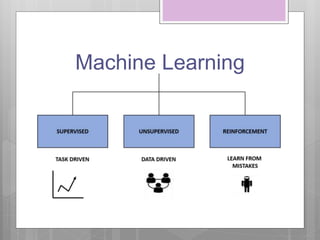
Machine Learning
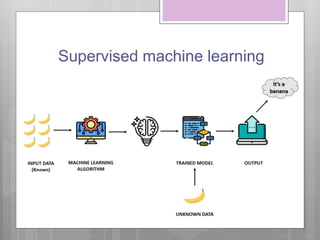
Supervised machine learning
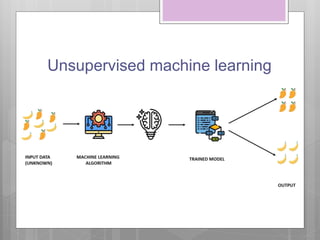
Unsupervised machine learning
Deep learning
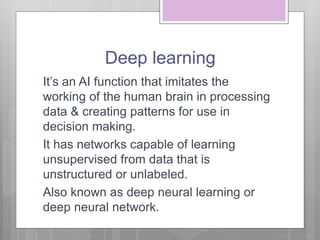
It’s an AI function that imitates the
working of the human brain in processing
data & creating patterns for use in
decision making.
It has networks capable of learning
unsupervised from data that is
unstructured or unlabeled.
Also known as deep neural learning or
deep neural network.
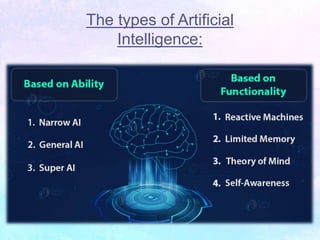
The types of Artificial
Intelligence:
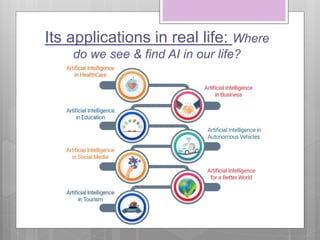
Its applications in real life: Where
do we see & find AI in our life?
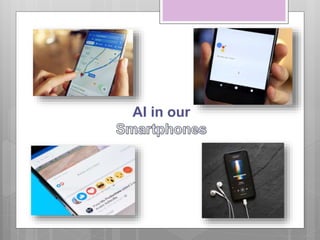
AI in our
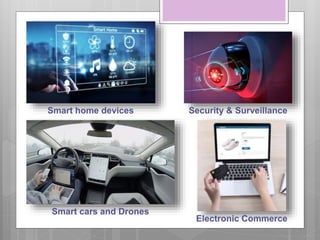
Security & Surveillance
Smart home devices
Electronic Commerce
Smart cars and Drones
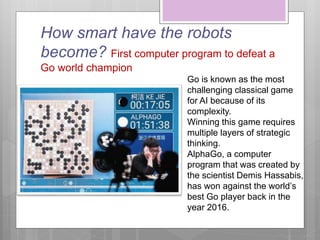
How smart have the robots
become? First computer program to defeat a
Go world champion
Go is known as the most
challenging classical game
for AI because of its
complexity.
Winning this game requires
multiple layers of strategic
thinking.
AlphaGo, a computer
program that was created by
the scientist Demis Hassabis,
has won against the world’s
best Go player back in the
year 2016.
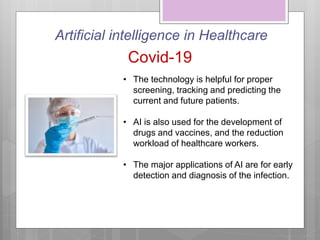
Artificial intelligence in Healthcare
• The technology is helpful for proper
screening, tracking and predicting the
current and future patients.
• AI is also used for the development of
drugs and vaccines, and the reduction
workload of healthcare workers.
• The major applications of AI are for early
detection and diagnosis of the infection.
Covid-19
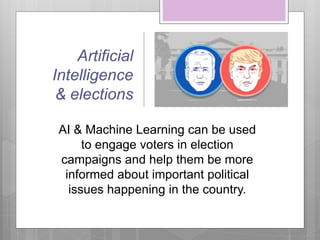
Artificial
Intelligence
& elections
AI & Machine Learning can be used
to engage voters in election
campaigns and help them be more
informed about important political
issues happening in the country.
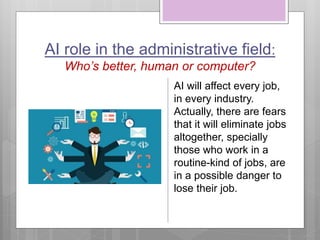
AI role in the administrative field:
Who’s better, human or computer?
AI will affect every job,
in every industry.
Actually, there are fears
that it will eliminate jobs
altogether, specially
those who work in a
routine-kind of jobs, are
in a possible danger to
lose their job.
Now that AI is replacing managers in
many administrative tasks, their roles are
focused on soft over hard skills.
An survey found that workers believe
robots are better than their managers at
providing unbiased information,
maintaining work schedules, problem-
solving & budget management. While
managers are better at empathy,
coaching & creating work culture.
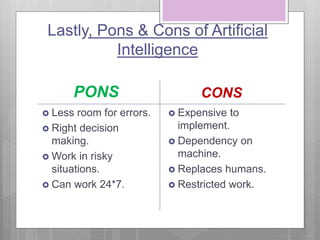
Lastly, Pons & Cons of Artificial
Intelligence
PONS
 Less room for errors.
 Right decision
making.
 Work in risky
situations.
 Can work 24*7.
CONS
 Expensive to
implement.
 Dependency on
machine.
 Replaces humans.
 Restricted work.
End of
lecture,

Artificial Intelligence (AI).pptx

  • 1.
  • 3.
    Contents Introduction to ArtificialIntelligence. The types of Artificial Intelligence. Its applications in real life. The role of AI in the administrative field. Pros and cons of AI.
  • 4.
    An introduction toAI: What do we mean by Artificial Intelligence? *Artificial Intelligence(AI) is the study of how to make computers perform tasks that humans consider difficult through the creation of intelligent agents. The founding father of AI, Alan Turing, defined it as: “It’s the science and engineering of making intelligent machines, especially intelligent computer programs.” *They have the ability to sense, reason, engage, learn & solve problems.
  • 5.
    How did itall start? Dartmouth College in Hanover, New Hampshire The Birthplace of Artificial Intelligence The Dartmouth Summer Research project happened in the year 1956, and it considered to be the founding event of AI as a field.
  • 6.
    What does Artificial Intelligenceinclude? There are various of subsets of AI, the most common are: Machine learning, deep learning, natural language processing, expert system, robotics, machine vision, speech recognition. *Among all these, machine learning plays a crucial role in AI. Machine learning & deep learning are the ways of achieving AI in real life.
  • 7.
  • 8.
  • 9.
  • 10.
    Deep learning It’s anAI function that imitates the working of the human brain in processing data & creating patterns for use in decision making. It has networks capable of learning unsupervised from data that is unstructured or unlabeled. Also known as deep neural learning or deep neural network.
  • 11.
    The types ofArtificial Intelligence:
  • 12.
    Its applications inreal life: Where do we see & find AI in our life?
  • 13.
  • 14.
    Security & Surveillance Smarthome devices Electronic Commerce Smart cars and Drones
  • 15.
    How smart havethe robots become? First computer program to defeat a Go world champion Go is known as the most challenging classical game for AI because of its complexity. Winning this game requires multiple layers of strategic thinking. AlphaGo, a computer program that was created by the scientist Demis Hassabis, has won against the world’s best Go player back in the year 2016.
  • 16.
    Artificial intelligence inHealthcare • The technology is helpful for proper screening, tracking and predicting the current and future patients. • AI is also used for the development of drugs and vaccines, and the reduction workload of healthcare workers. • The major applications of AI are for early detection and diagnosis of the infection. Covid-19
  • 18.
    Artificial Intelligence & elections AI &Machine Learning can be used to engage voters in election campaigns and help them be more informed about important political issues happening in the country.
  • 19.
    AI role inthe administrative field: Who’s better, human or computer? AI will affect every job, in every industry. Actually, there are fears that it will eliminate jobs altogether, specially those who work in a routine-kind of jobs, are in a possible danger to lose their job.
  • 20.
    Now that AIis replacing managers in many administrative tasks, their roles are focused on soft over hard skills. An survey found that workers believe robots are better than their managers at providing unbiased information, maintaining work schedules, problem- solving & budget management. While managers are better at empathy, coaching & creating work culture.
  • 21.
    Lastly, Pons &Cons of Artificial Intelligence PONS  Less room for errors.  Right decision making.  Work in risky situations.  Can work 24*7. CONS  Expensive to implement.  Dependency on machine.  Replaces humans.  Restricted work.
  • 22.