The Big 3 Agile Certifications,
PMI-ACP Certification and
Agile practice guide
Abdelrahman Elsheikh Seedahmed
M.sc, PMOC,CBAP, PMP, RMP, ACP, PMI-SP,EVM,
CPRE, MCITP, MCTS, OCP, OCA, ITIL v3, CTFL,
ISO20000, ISO27002
Agenda
• The Big 3 Agile Certifications
• PMI-ACP Certification
• Agile practice guide
The Big 3 Agile Certifications
• There are 3 major certification bodies
today, and a growing number of smaller
ones.
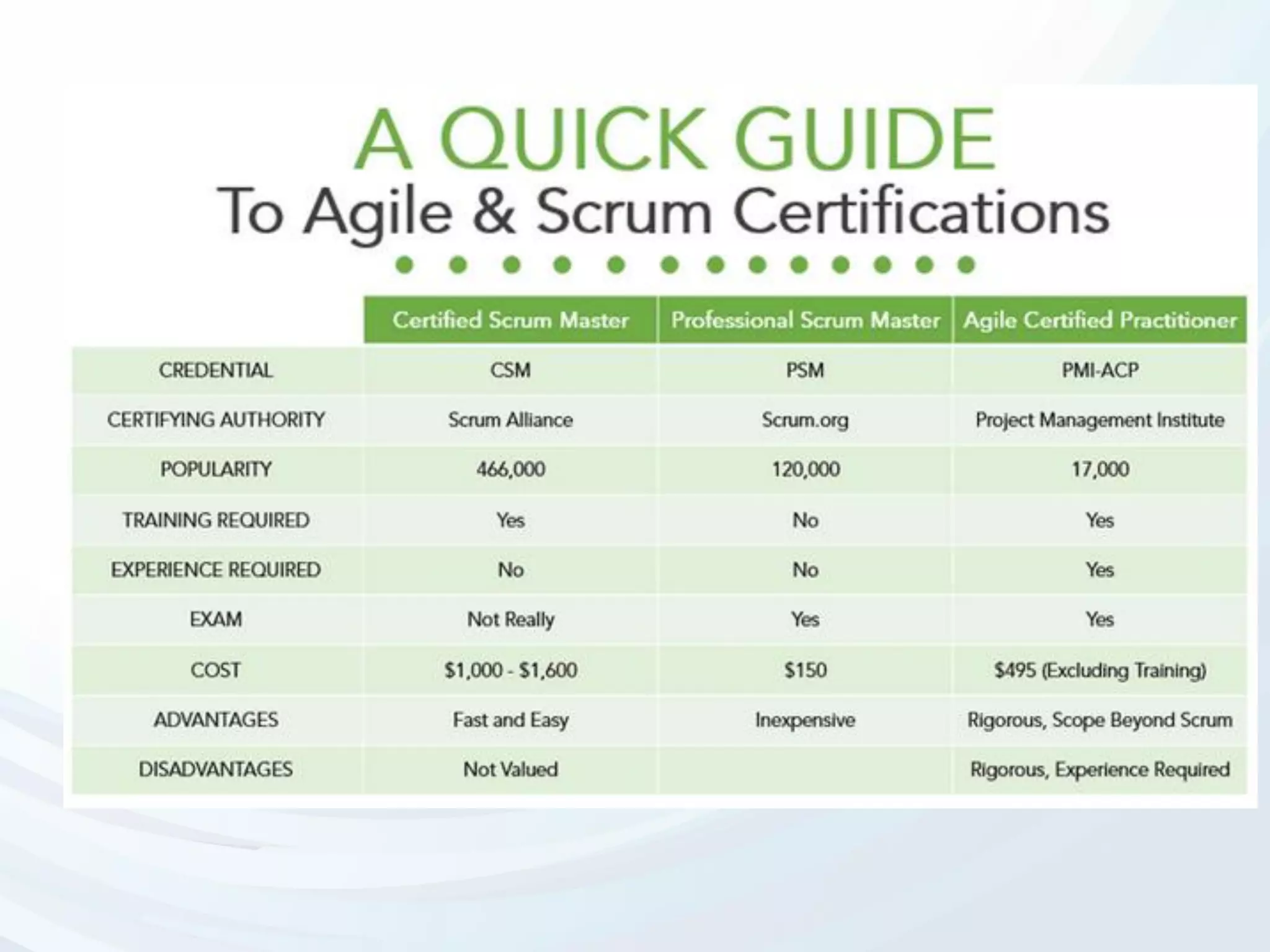
#1 Scrum Alliance - Certified Scrum Master
(CSM)
• The Scrum Alliance is one of the oldest
and most popular certifications in Scrum.
• Founded in 2002, they have nearly a half
million current certificate holders for the
Certified Scrum Master or CSM
designation.
#1 Scrum Alliance - Certified Scrum
Master (CSM)
• Achieving the CSM is really easy, you simply need
to take a 2 or 3 day class from someone that has
been qualified as a Certified Scrum Trainer
(CST) by the Scrum Alliance.
• CSM training courses run on average between
$1,000 and $1,500 per person.
• After the class there is a 35 question, online test
that is pretty easy to pass.
• So the CSM is pretty easy to get and many people
have done exactly that.
#2 - Scrum.org - Professional Scrum Master
(PSM)
• Scrum.org was founded in 2009 by Ken
Schwaber, one of the co-creators of
Scrum and a co-founder of the Scrum
Alliance.
• Rather than simply requiring people to
take training, Scrum.org focuses on
testing people to make sure that they
have the knowledge.
#2 - Scrum.org - Professional Scrum Master
(PSM)
• By testing, I mean standard assessments of knowledge of
Scrum and the application of that.
• The assessment for the Professional Scrum Master or PSM
designation is 80 questions.
• The assessment costs $150 and allows you one attempt.
• To pass, you need to get a score of 85% or higher within 60
minutes.
• So technically it is an open book assessment but practically
speaking you need to master the material in order to pass.
#3 - Project Management Institute - Agile Certified
Practitioner (PMI-ACP)
• The Project Management Institute is no
stranger to the recurring revenue streams
created by certifications, with over 760,000
project management professional (PMPs).
• In 2012, PMI introduced the PMI Agile
Certified Professional (PMI-ACP) certification
and as of earlier this year, there were over
16,000 people holding the PMI-ACP
credential.
#3 - Project Management Institute - Agile Certified
Practitioner (PMI-ACP)
• The PMI-ACP is slightly different from the
previous Scrum certifications in that it
covers all of Agile, rather than being only
focused on Scrum.
• So you will be expected to know Kanban,
EXtreme Programming and Lean
Software Development in addition to
Scrum.
Agenda
• The Big 3 Agile Certifications
• PMI-ACP Certification
• Agile practice guide
Why the PMI-ACP Certification Is
Important
• First, it comes from PMI, an entity that is
well known and trusted by organizations
and their hiring managers for their
credential standards.
Why the PMI-ACP Certification Is
Important
• Second, the PMI-ACP exam is created by
agile experts for agile practitioners, and it
is not tied to a single agile methodology.
Why the PMI-ACP Certification Is
Important
• As a result, the PMI-ACP certification is well
positioned to become the new standard
for agile professionals.
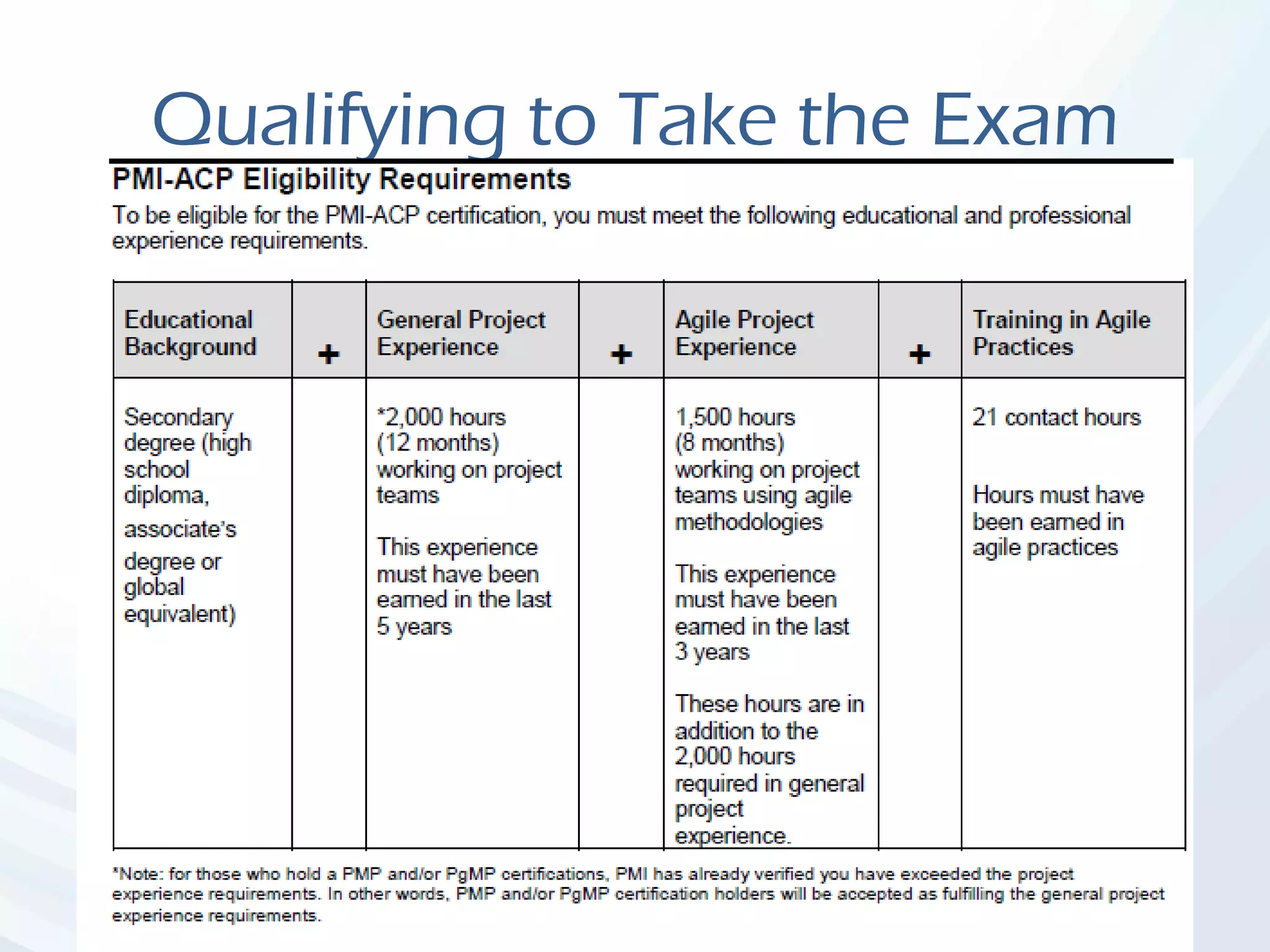
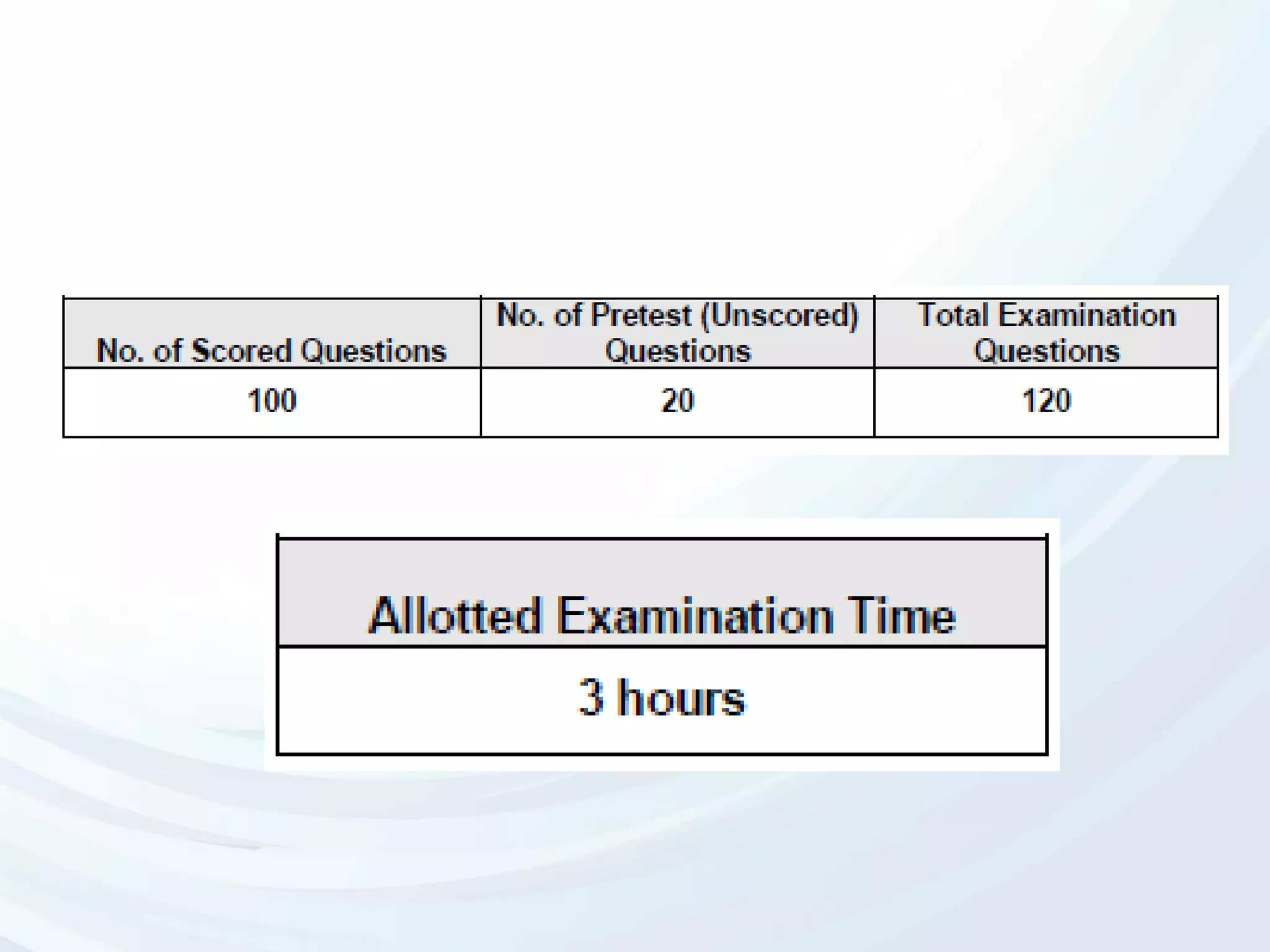
Qualifying to Take the Exam
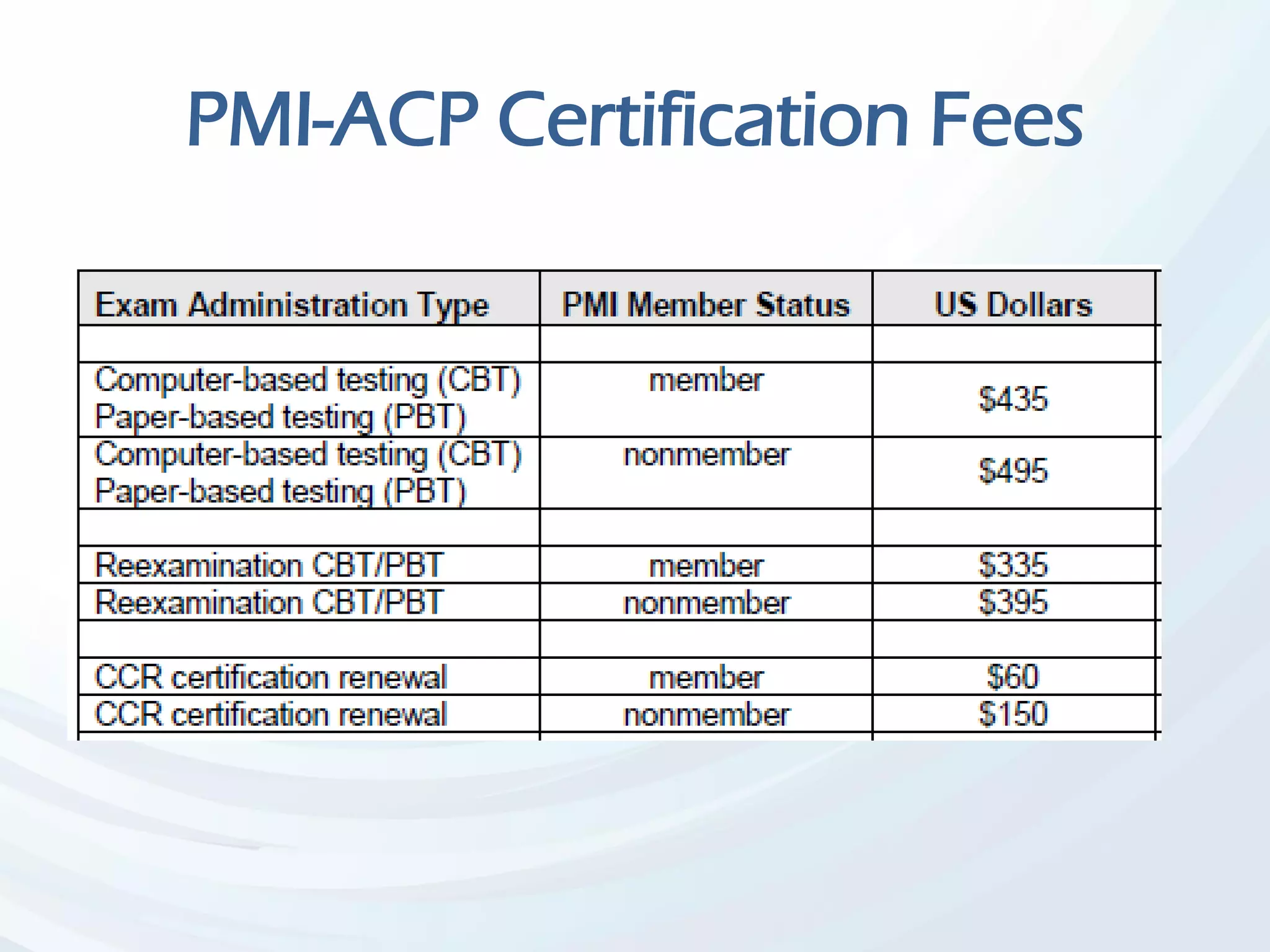
PMI-ACP Certification Fees
Exam Content
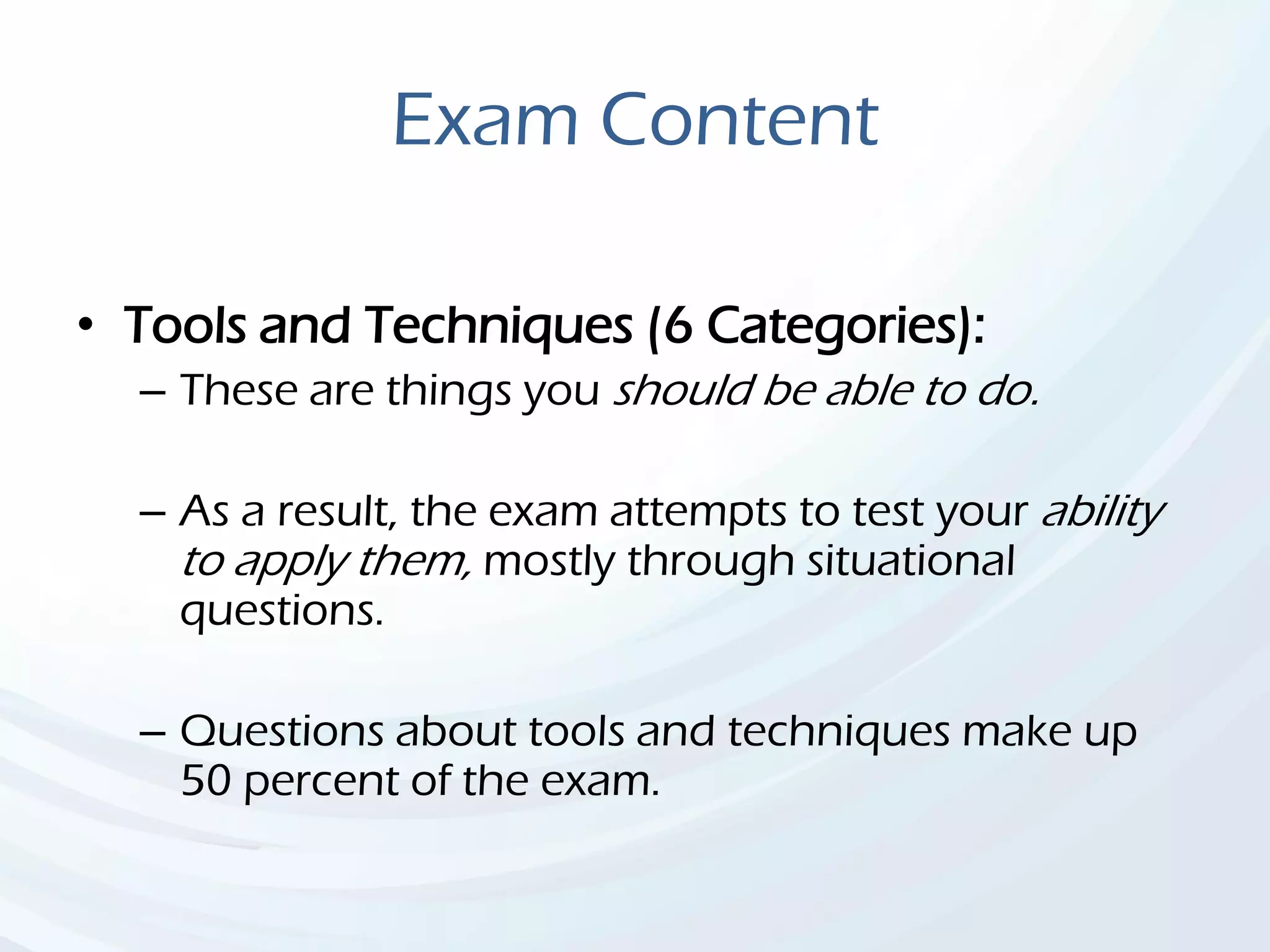
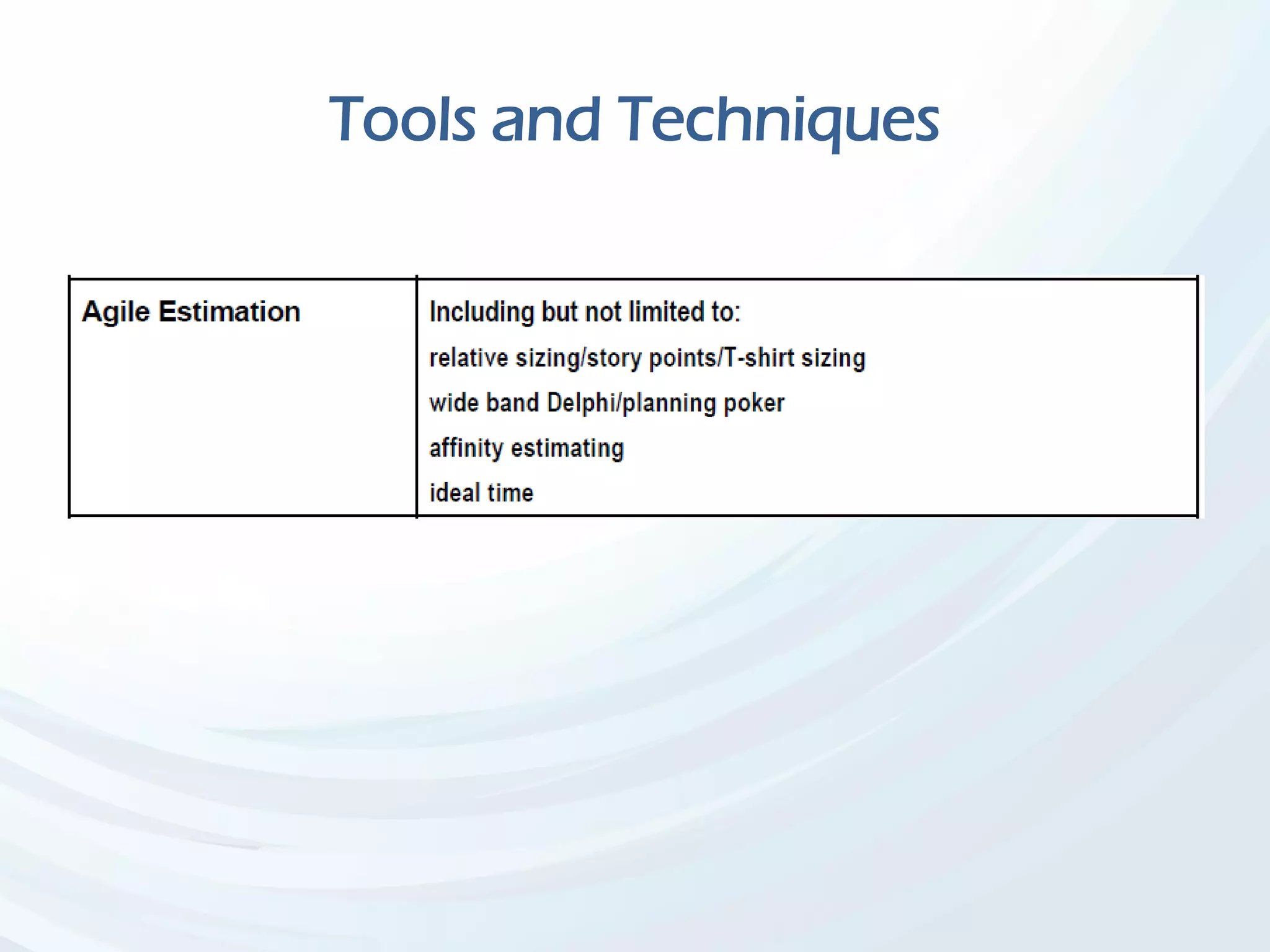
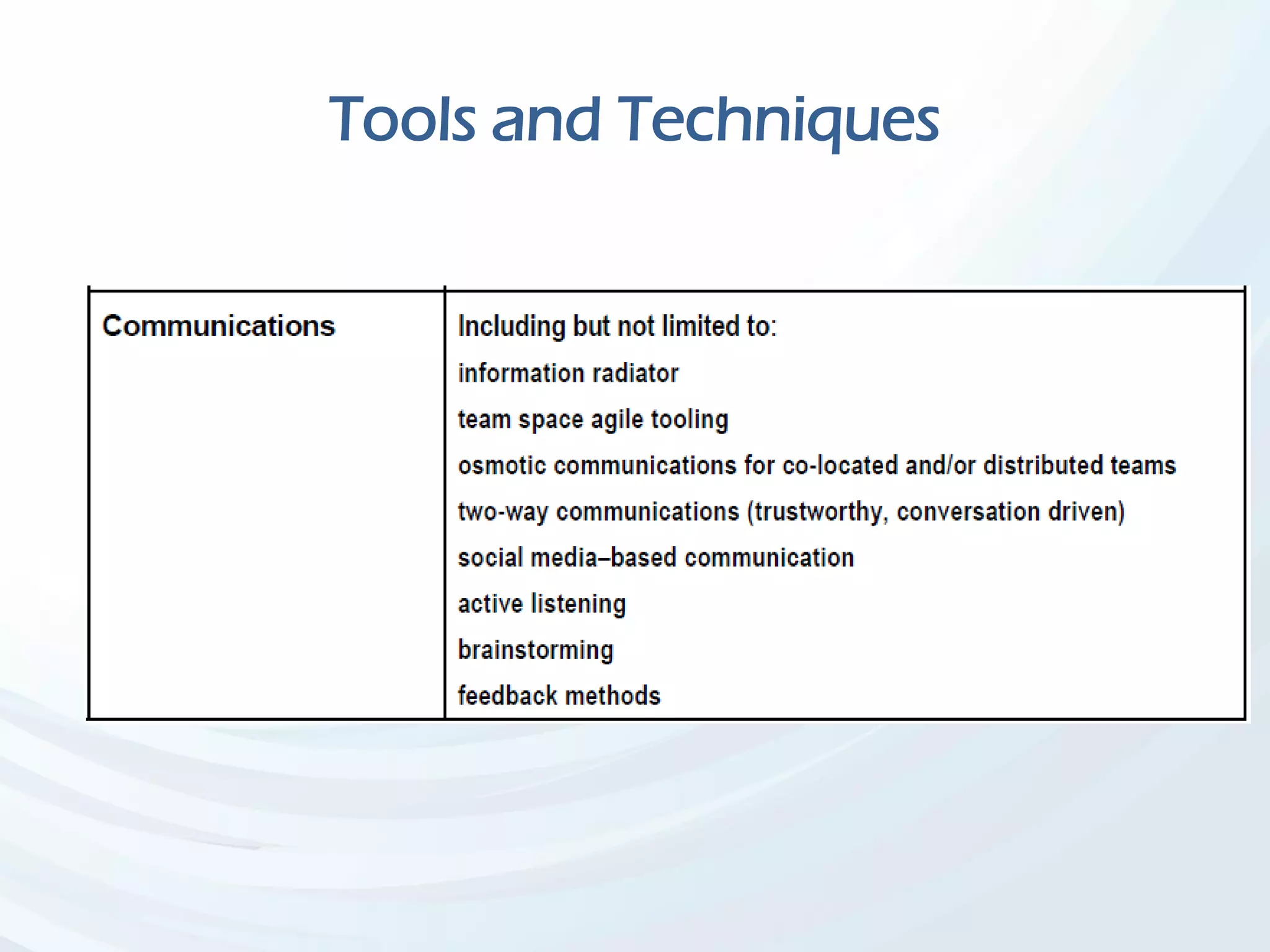
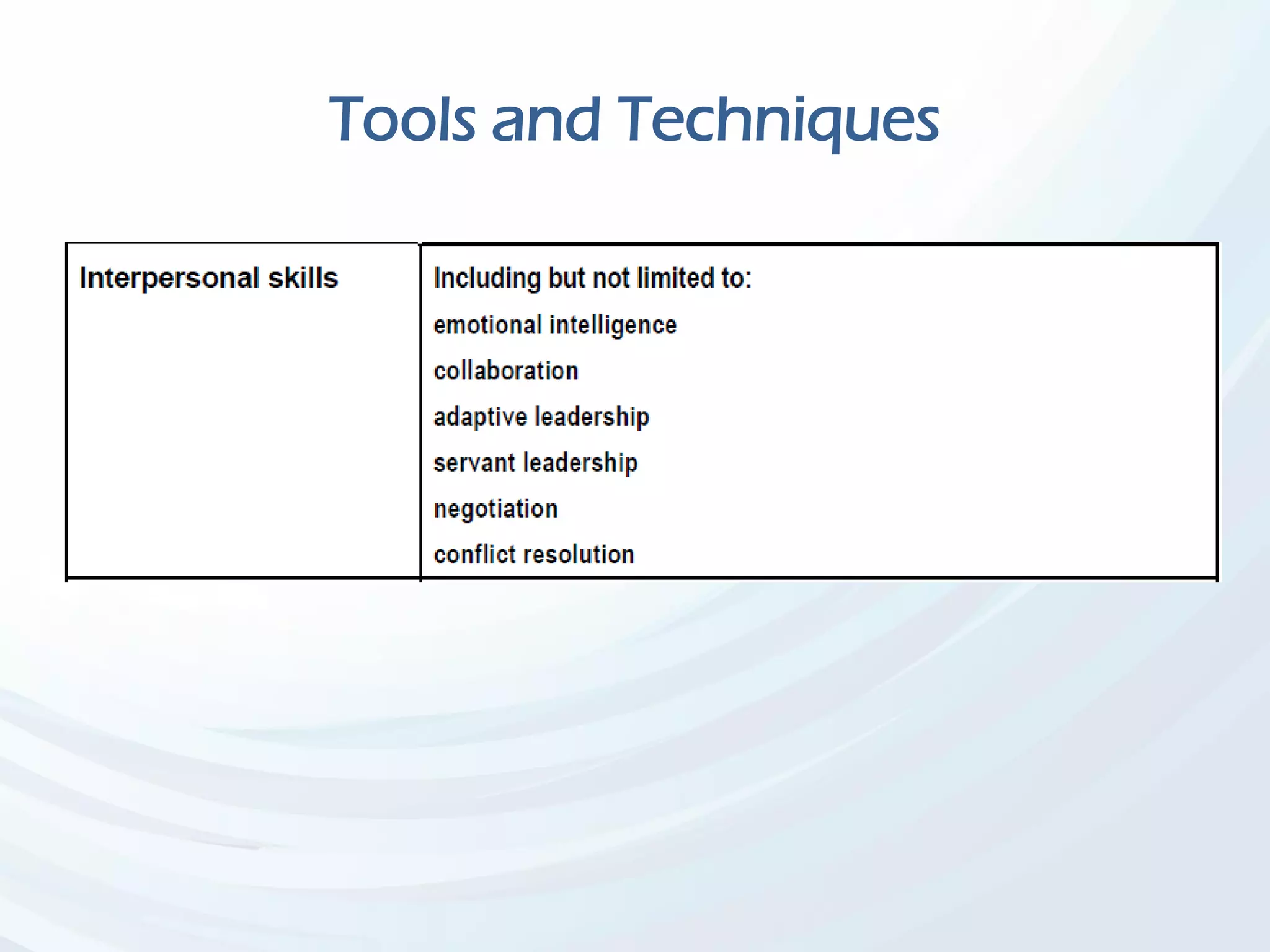
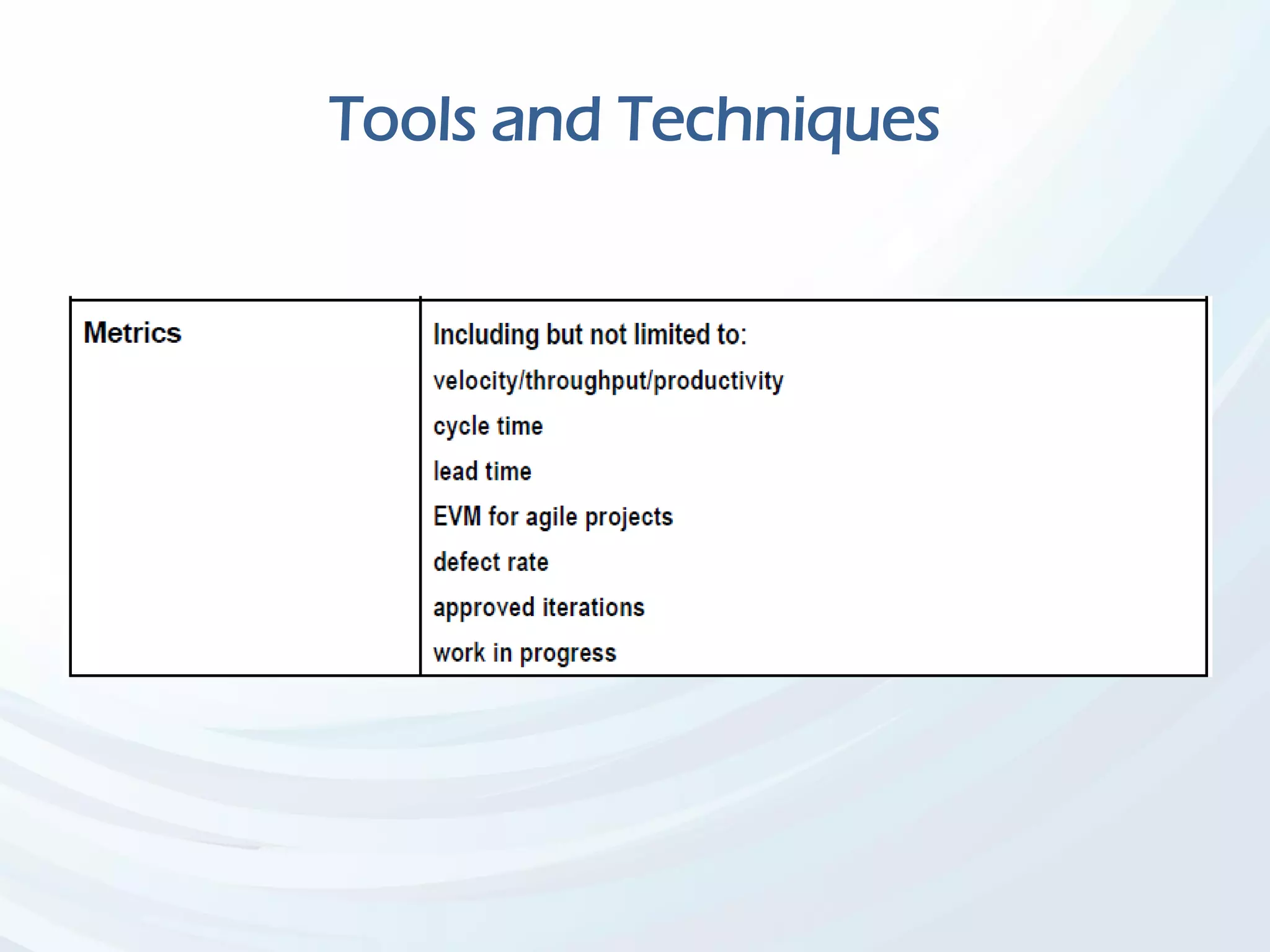
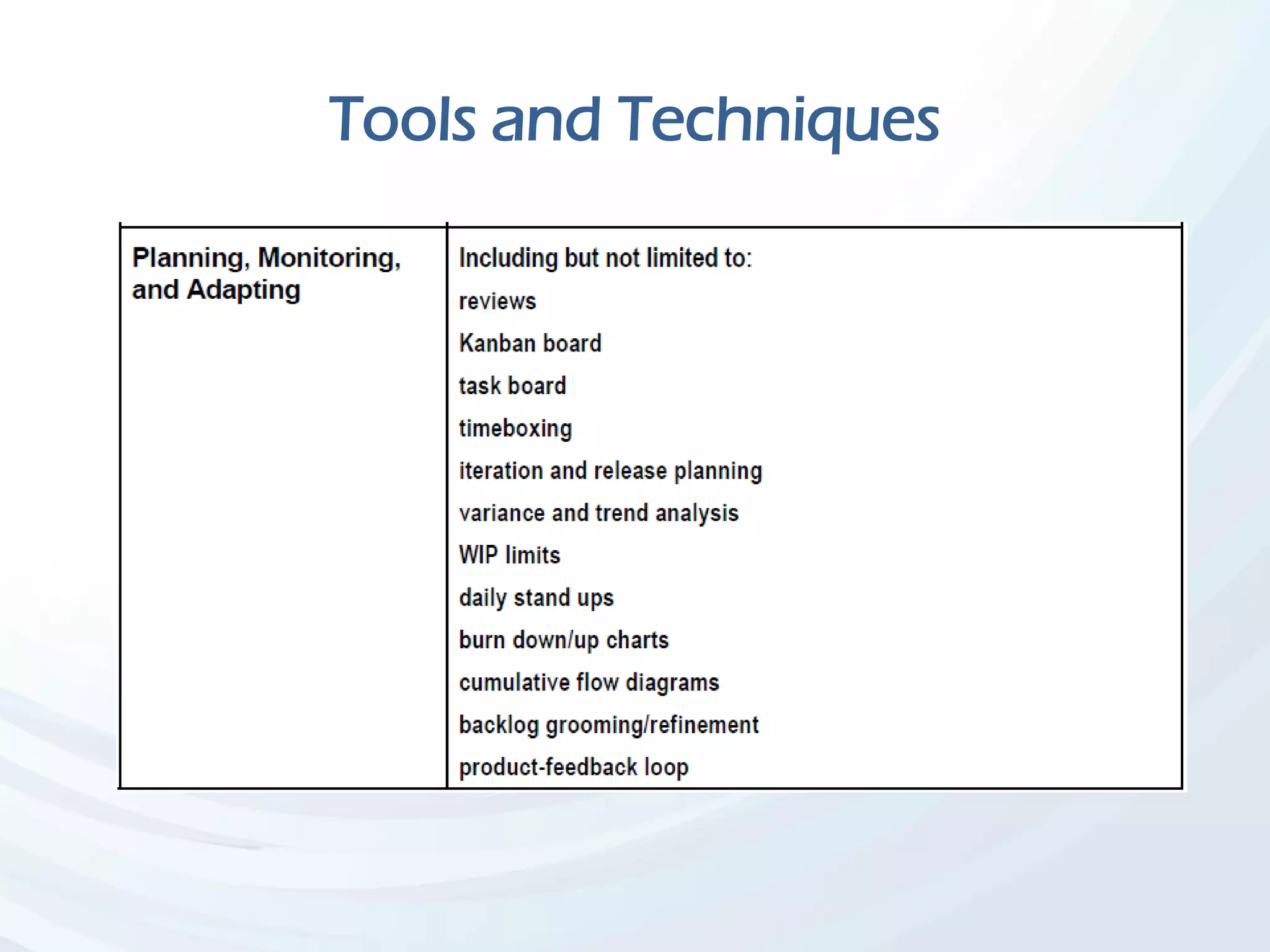
• Tools and Techniques (6 Categories):
– These are things you should be able to do.
– As a result, the exam attempts to test your ability
to apply them, mostly through situational
questions.
– Questions about tools and techniques make up
50 percent of the exam.
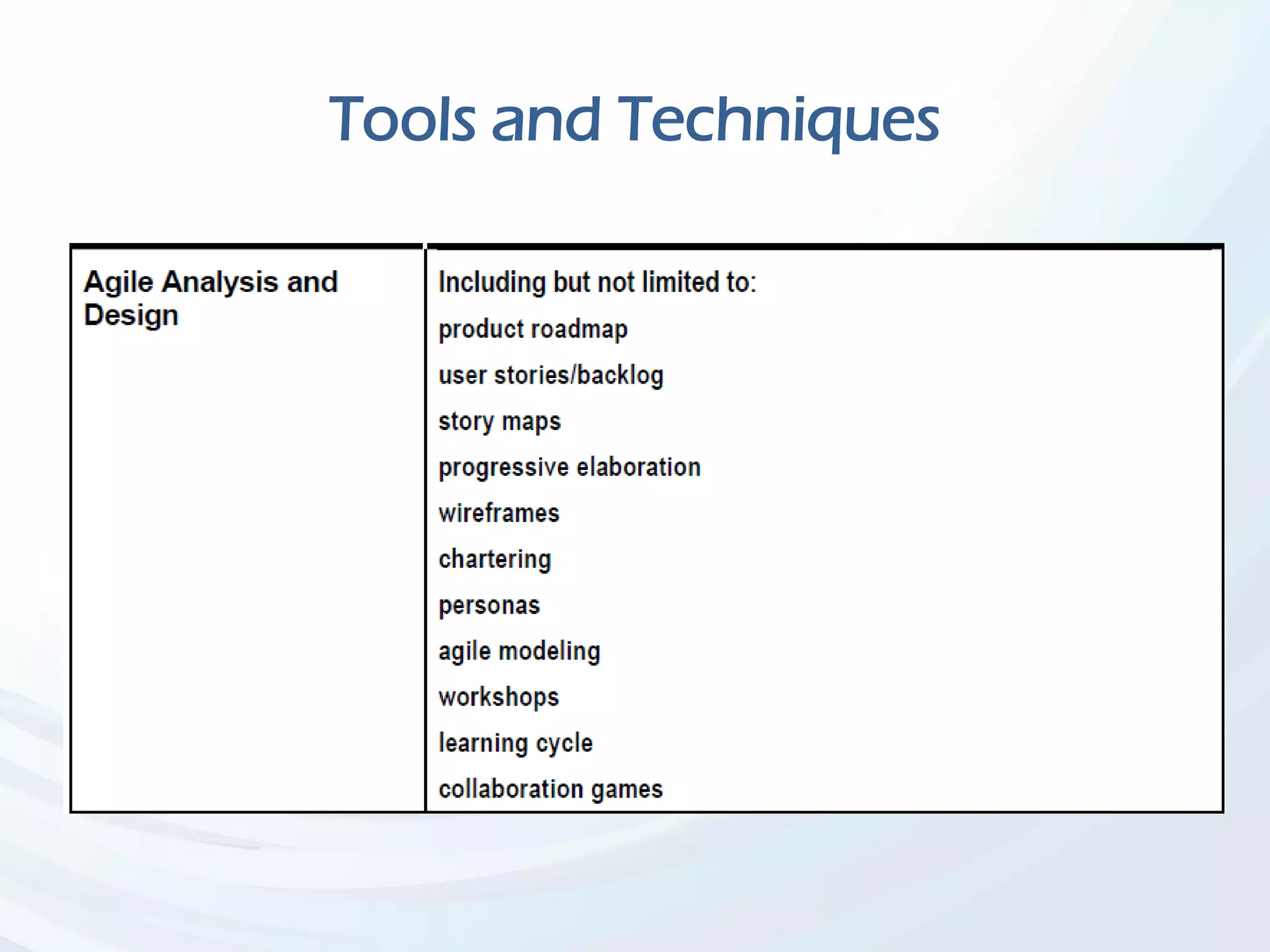
Tools and Techniques
Exam Content and Domain
Breakdown
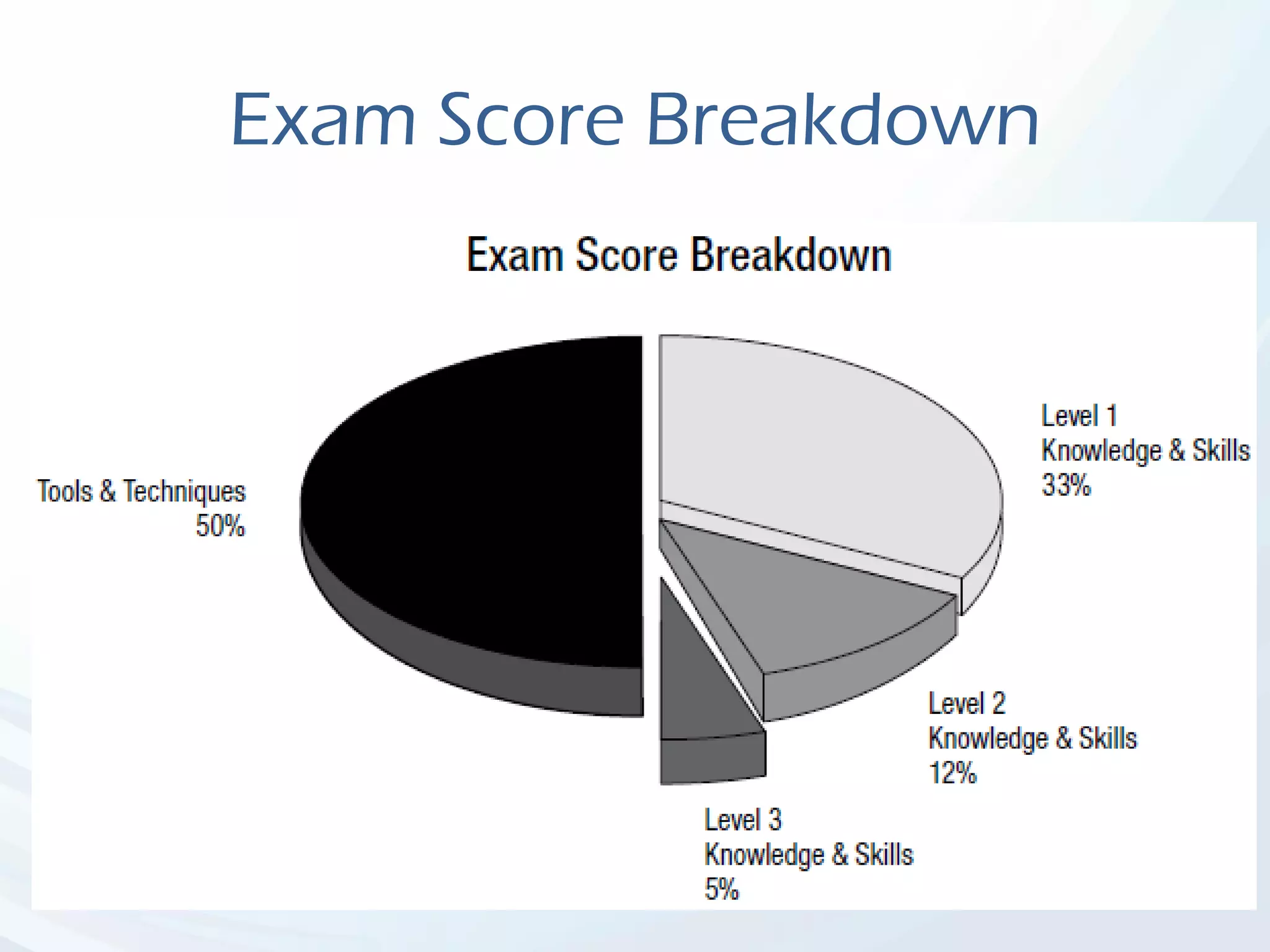
• As noted earlier, 50 percent of the marks
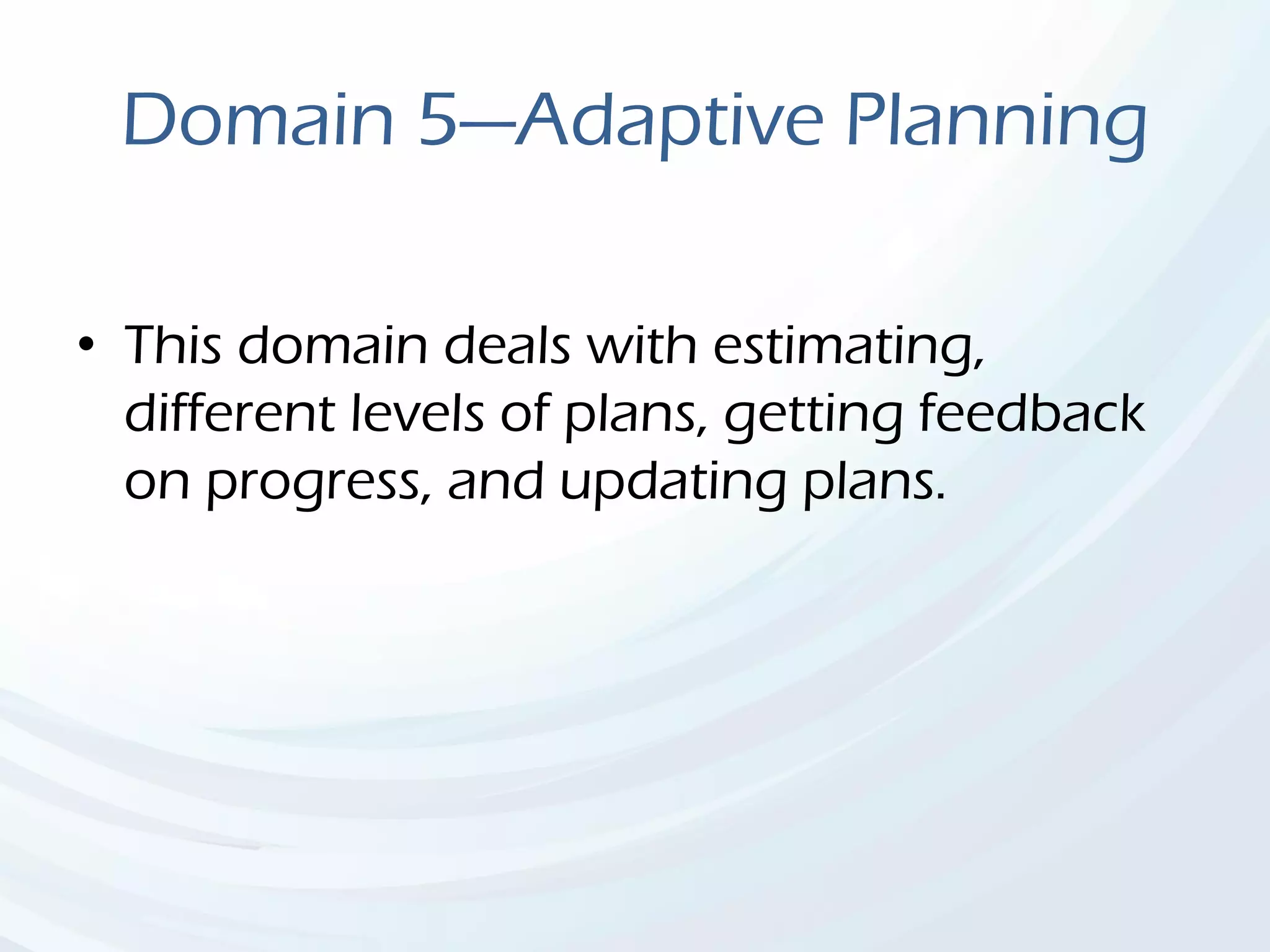
on the exam are awarded for tools and
techniques questions and 50 percent are
awarded for knowledge and skills
questions.
Exam Content
• Knowledge and Skills (3 Levels):
– These are things you should know.
– Therefore, the exam attempts to test your
recall of them.
– Questions about knowledge and skills make
up the remaining 50 percent of the exam.
The knowledge and skills
Breakdown
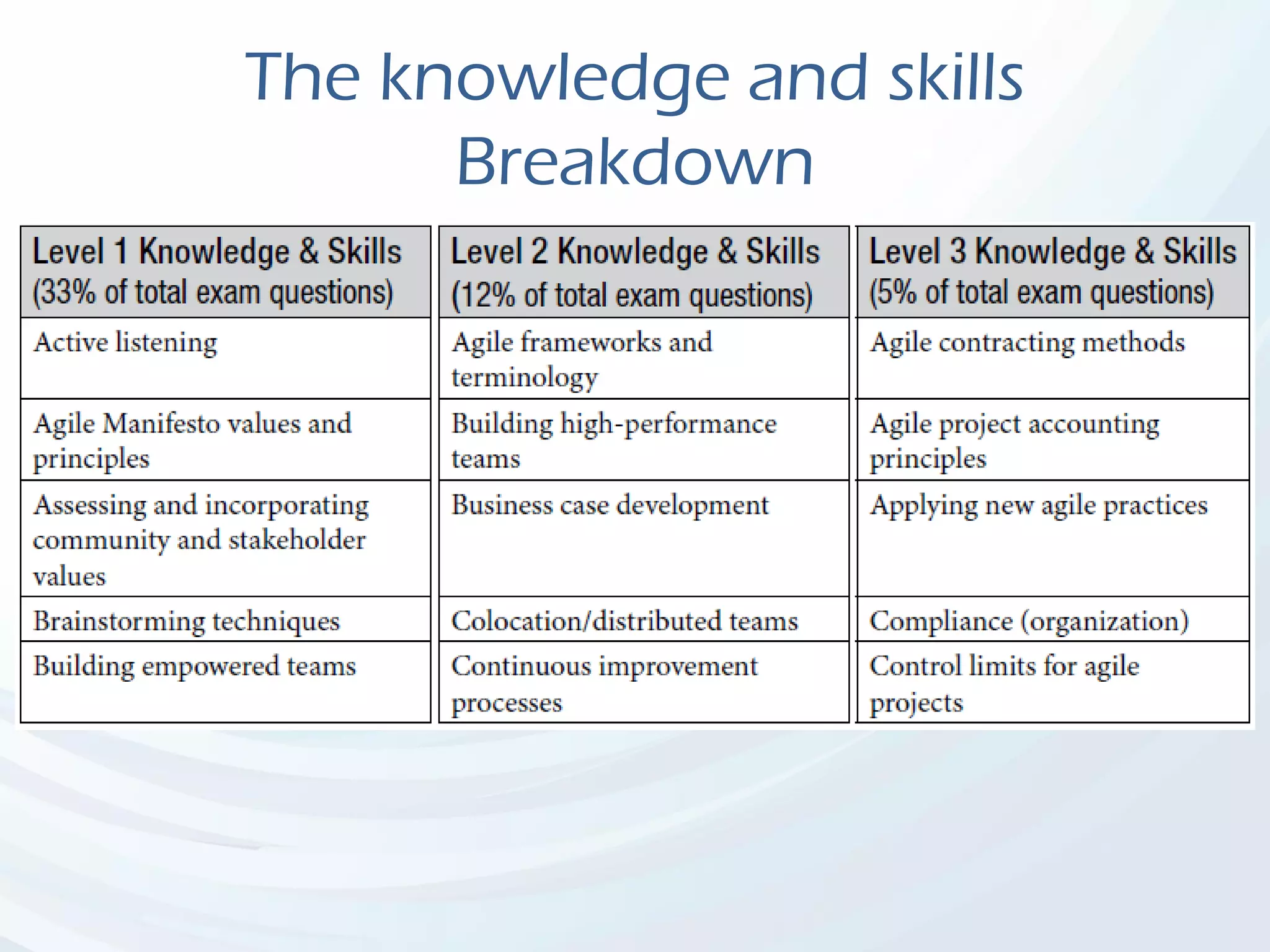
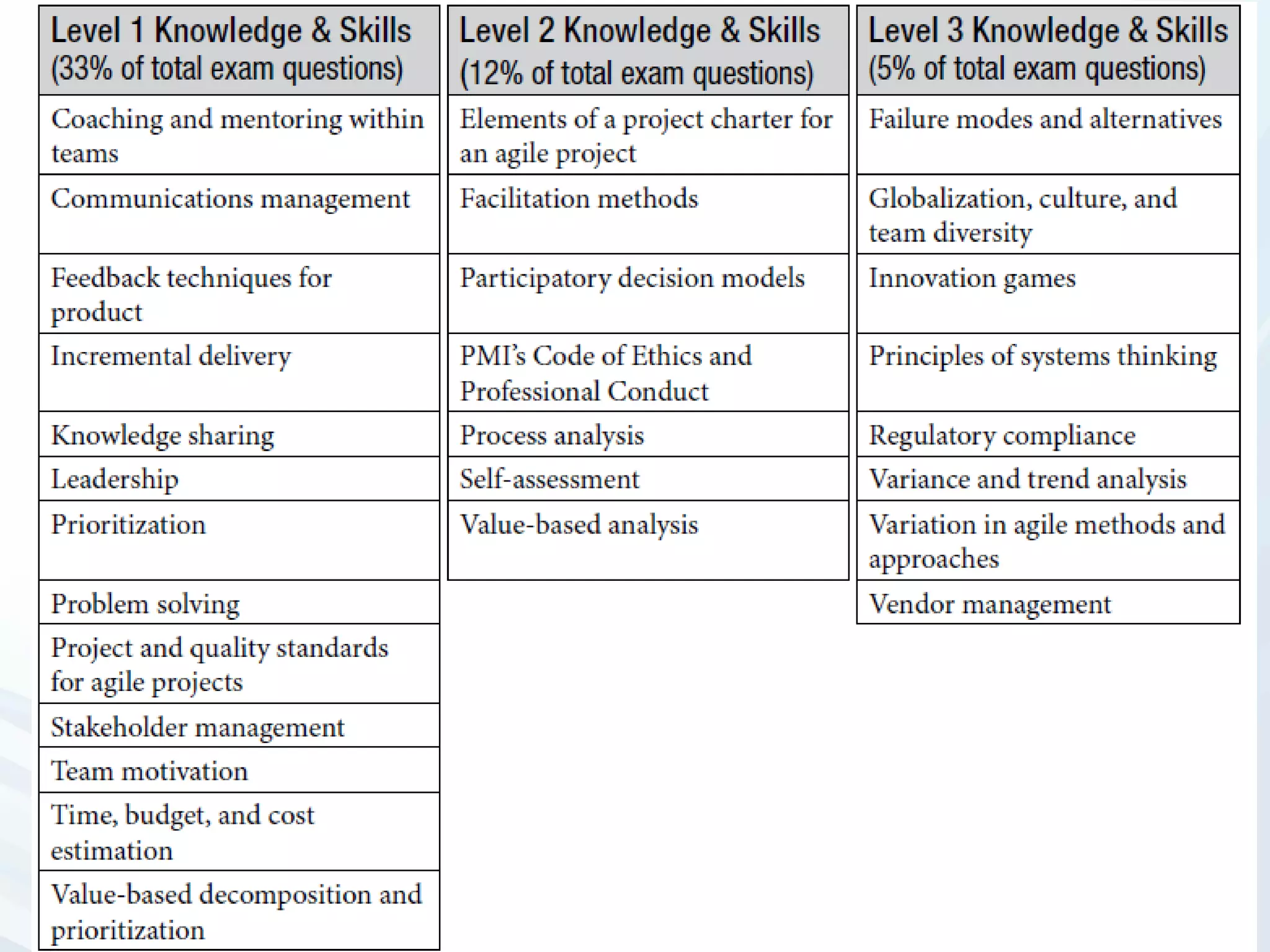
• The knowledge and skills section is further broken
down into three tiers:
• Level 1:
– There are 18 knowledge and skills in level 1.
– These are deemed the most important to know.
– Therefore, 33 percent of the overall exam questions
will test you on these topics.
The knowledge and skills
Breakdown
• Level 2:
– There are 12 knowledge and skills in level 2.
– Questions about these knowledge and skills
make up 12 percent of the exam.
The knowledge and skills
Breakdown
• Level 3:
– There are 13 knowledge and skills in level 3.
– These are given the least amount of emphasis
on the exam, making up just 5 percent of the
total exam questions.
The knowledge and skills
Breakdown
Exam Score Breakdown
Exam Content
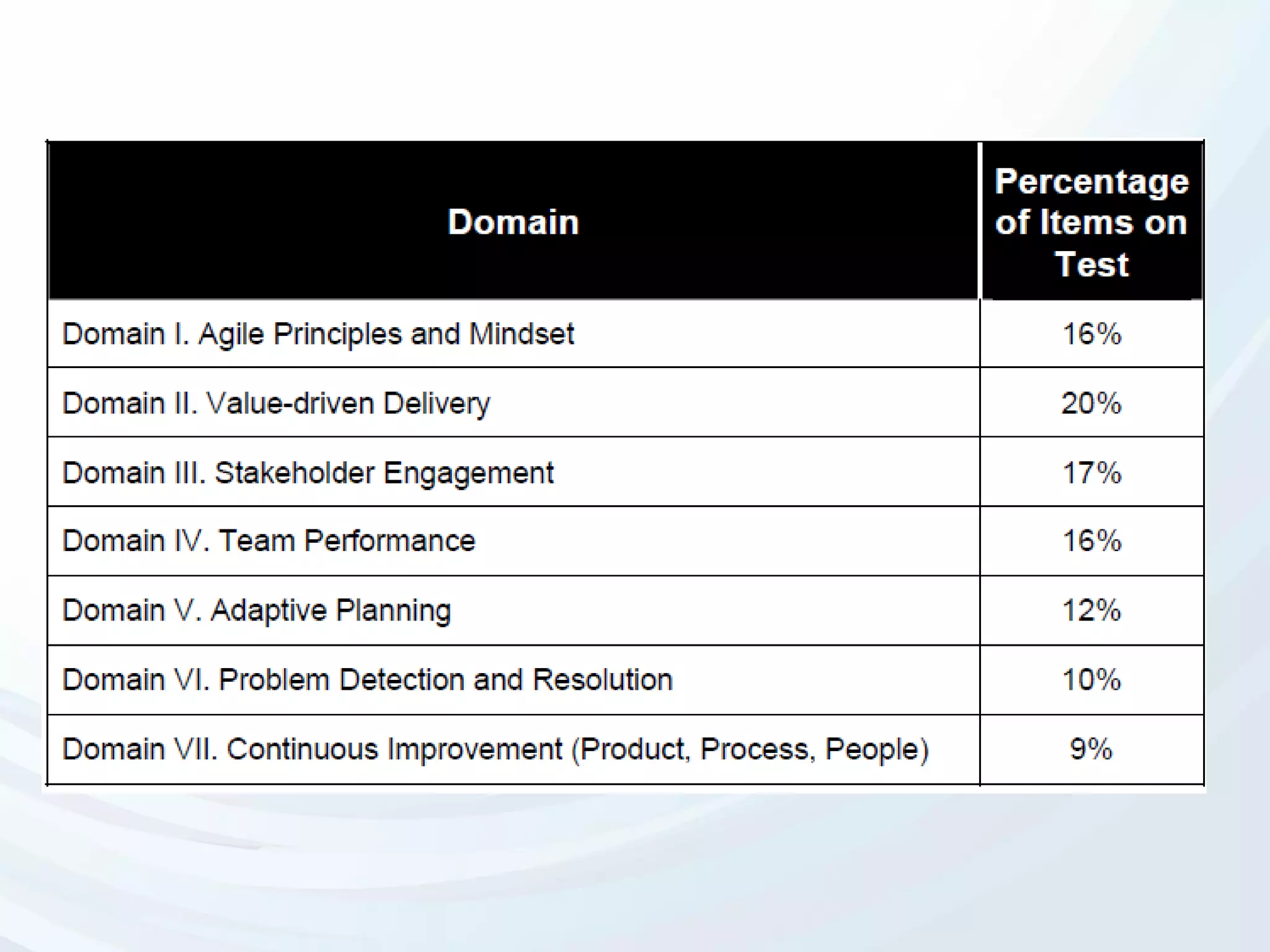
• Domains (7 Groups):
– The exam content outline defines Seven groupings or
clusters of tools and techniques and knowledge and
skills.
– While you will not be specifically tested on the
domains, these groupings define how PMI intends the
topics to be understood and taught.
– The domains are useful uniting bonds.
Domain 1— Agile Principles and
Mindset
• This domain focuses on Explore, embrace,
and apply agile principles and mindset
within the context of the project team and
organization.
Domain 2—Value-Driven Delivery
• This domain focuses on maximizing
business value through prioritization,
iterative delivery, and risk management.
Domain 3—Stakeholder
Engagement
• This domain deals with understanding
stakeholder needs, getting them involved,
and keeping them informed.
Domain 4—Boosting Team
Performance Practices
• This domain links team-related topics,
including forming teams, empowering
them, building team commitment, and
promoting collaboration.
Domain 5—Adaptive Planning
• This domain deals with estimating,
different levels of plans, getting feedback
on progress, and updating plans.
Domain 6—Problem Detection and
Resolution
• This domain is concerned with
encouraging whole team tracking and
resolution of risks.
Domain 7—Continuous
Improvement (Product, Processes,
People)
• The final domain deals with how to
improve the process via retrospectives
and experiments.
References
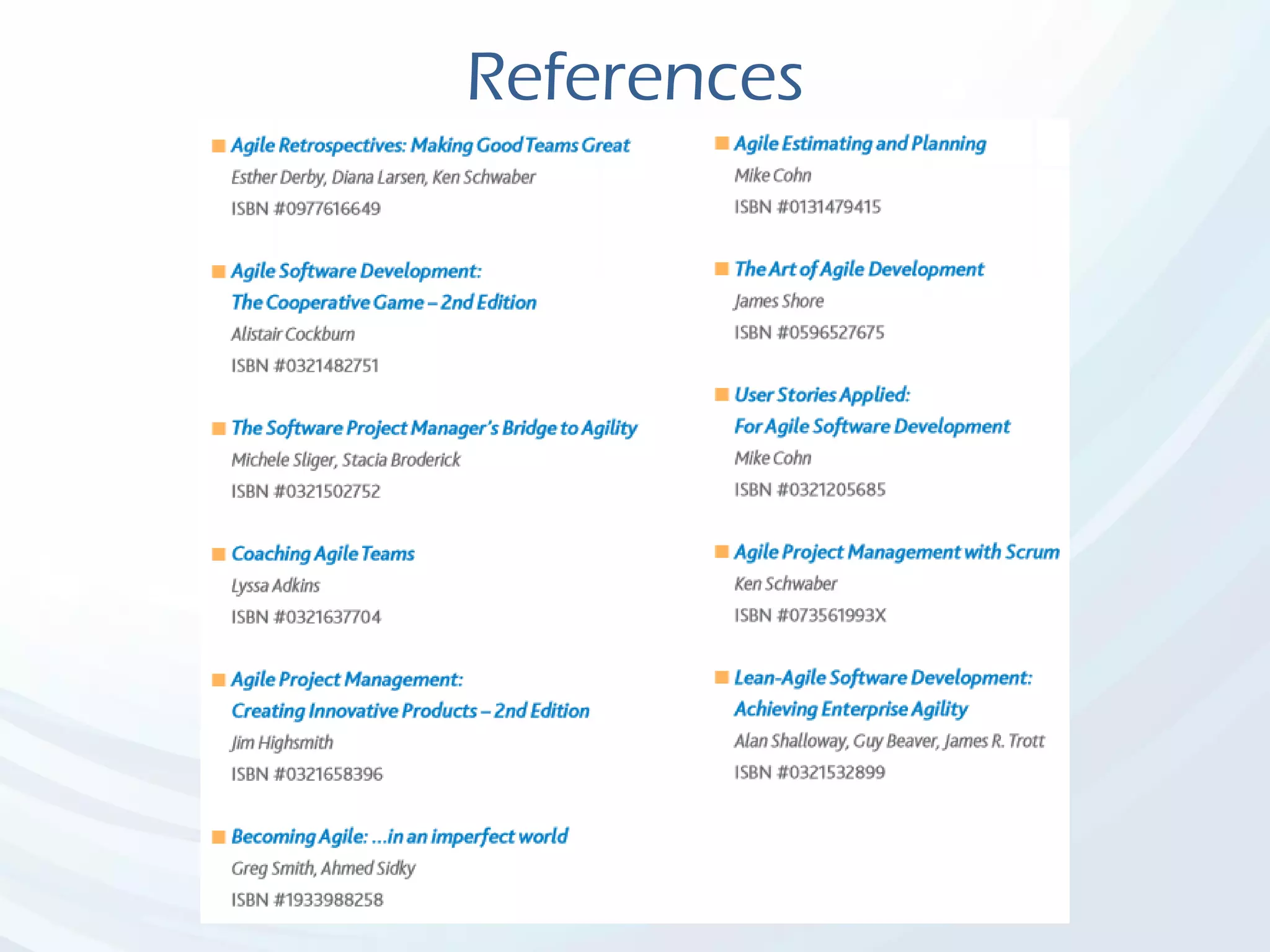
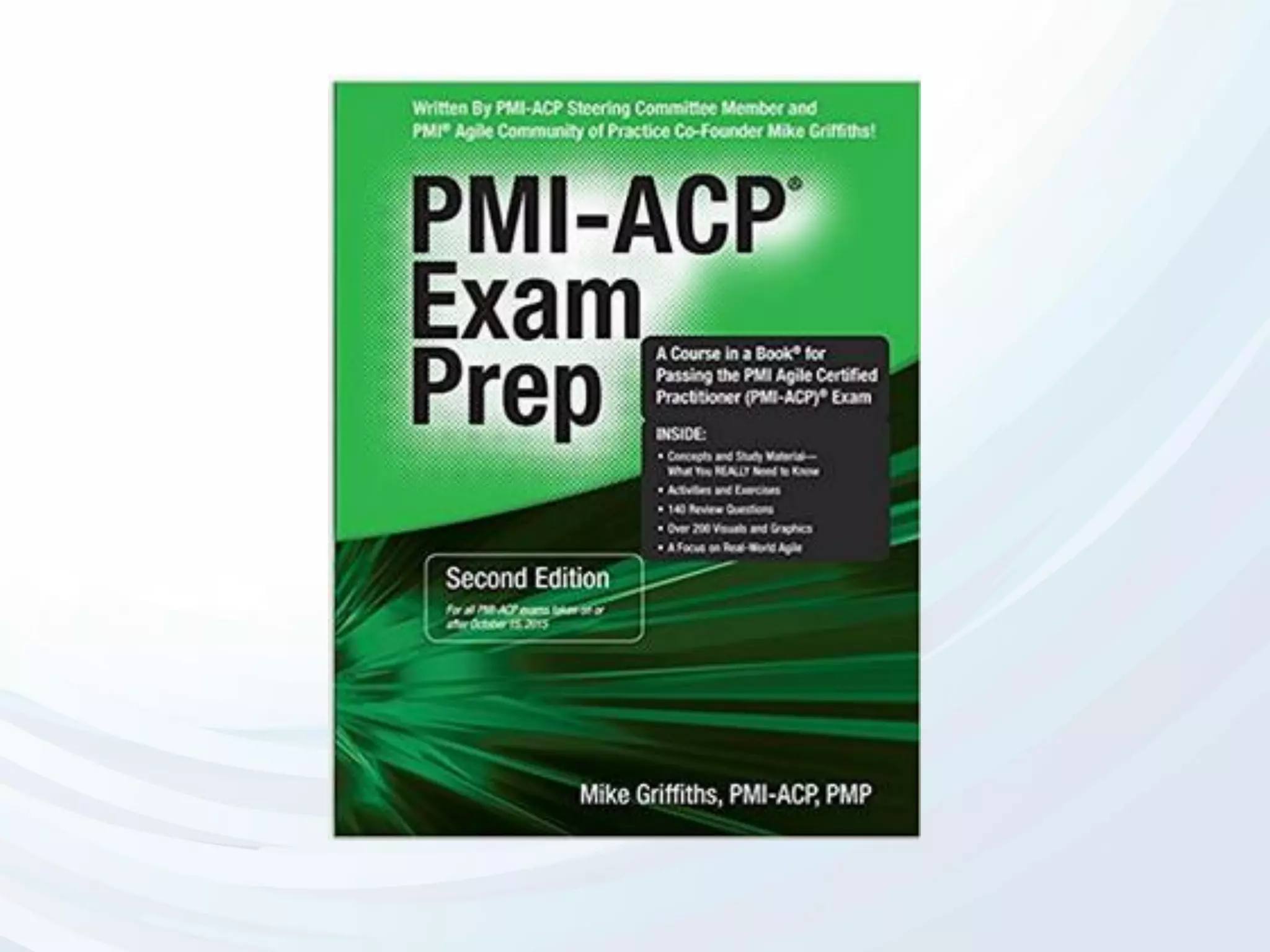
The PMI-ACP® Exam Prep,
Second Edition
• The PMI-ACP® Exam Prep, Second Edition:
• A Course in a Book for Passing the PMI
Agile Certified Practitioner (PMI-ACP®)
Exam by Mike Griffiths is considered by
many PMI-ACP® Exam takers as the
“official textbook of PMI-ACP® Exam”.
The PMI-ACP® Exam Prep,
Second Edition
• Mike Griffiths is the author who has the most profound
knowledge of the PMI-ACP® Exam unfound on the
market.
• In fact, he was one of the member of the PMI-ACP®
Steering Committee (the body that conceived and laid
out the structure and format of the PMI-ACP® Exam!).
• You will be assured of learning some first-hand “insider’s”
information on the PMI-ACP® Exam. Currently, he is also
a PMI-ACP® himself.
Agenda
• The Big 3 Agile Certifications
• PMI-ACP Certification
• Agile practice guide
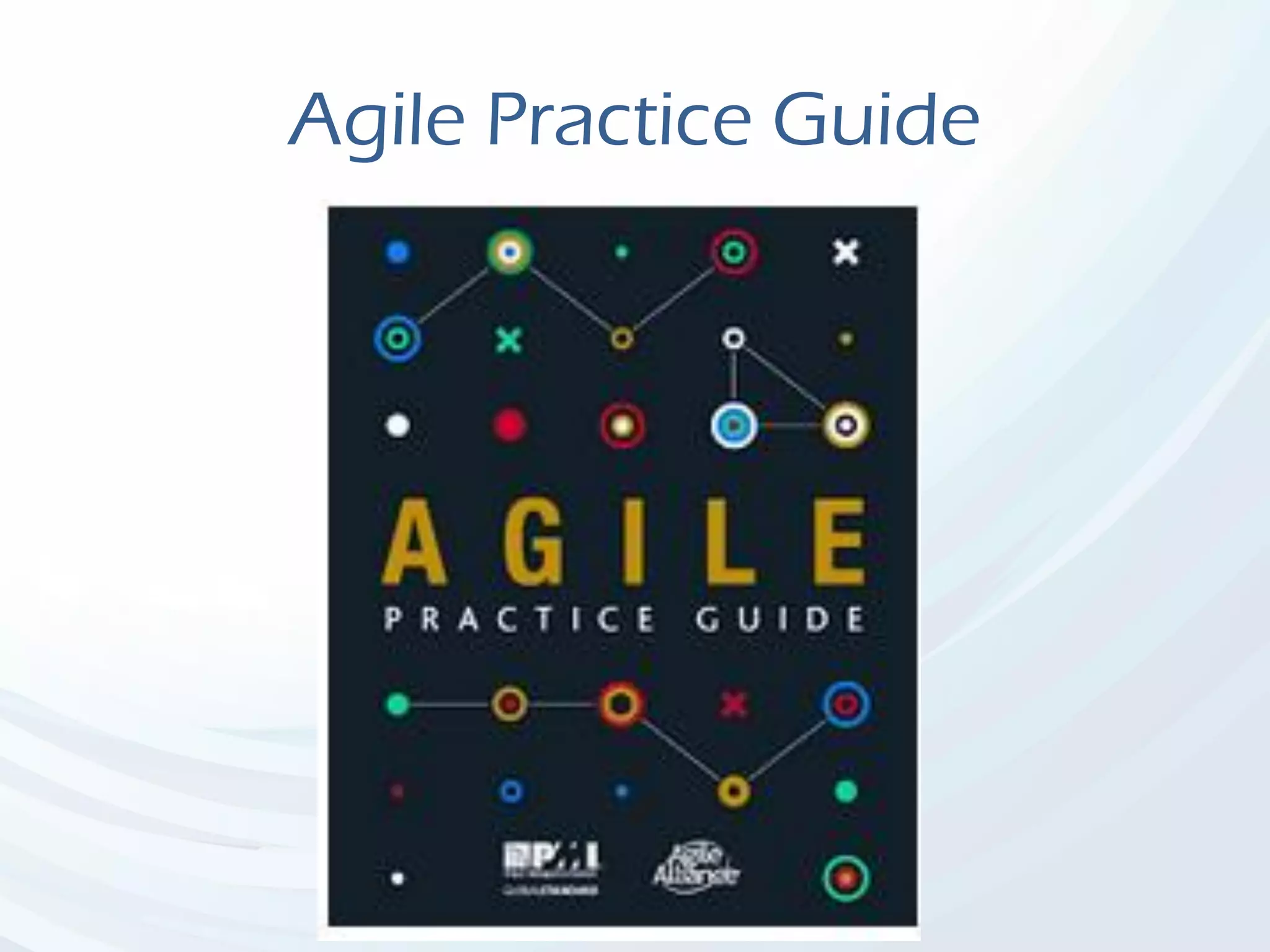
Agile Practice Guide
Agile practice guide
• On 6th September 2017, PMI has release
Agile Practice Guide.
• Though the book does not cover all the exam
contents, gives a good starting point for the
PMI-ACP exam.
• Following are the sections of the book:
Introduction
• Introduction to the Document
An Introduction to Agile
• When and why we need to apply adaptive life cycle.
• It also talks about Agile Mind set (Agile Manifesto
mindset, values, and principles).
• It also covers the concepts of definable and high-
uncertainty work.
• It shows the correlation between lean, the Kanban
Method, and agile approaches.
Life Cycle Selection
• It explores the factors in selecting project life
cycle.
• It discusses various Life Cycles like Adaptive
Predictive, Incremental, Iterative, and Hybrid.
• This section also addresses suitability filters,
tailoring guidelines, and common
combinations of approaches.
Implementing Agile: Creating an
Agile Environment
• It primarily talks about how project manager role
gets changes in the Agile environment.
• The primary emphasis is on servant leadership and
team composition.
• It also discusses facilitator role, cross-functional
team, need of 'T' shaped professionals.
Implementing Agile: Delivering an
Agile environment
• It introduces many topics in summary form
like the retrospective, backlog refinement,
Sprint Review Demos, etc.
• This section includes information on how
to organize teams and common practices
that teams can use to deliver value on a
regular basis.
Organizational Considerations for
Project Agility
• It touches upon how we change the culture to support
Agility.
• This chapter also talks about contracts and procurements.
• It also focuses on various scaling frameworks.
• This chapter gives good detail of Agile PMO.
• This section explores key organizational factors that impact
the use of agile approaches, such as culture, readiness,
business practices, and the role of a PMO.
Call for Action and Appendixes
• It gives you an invite to raise your
feedbacks.
• The call to action requests input for
continuous improvement of this practice
guide.
In summary
• This guide does not provide in-depth
knowledge of Agile.
• But, yes, it gives a fair idea about how a
Project Manager can move towards
Agility.
Good Things in the Agile Practice Guide
• Overall, it is good to see a document that
begins to attempt to wrap it's arm around
Agile.
• It is great that it covers not only Scrum,
but XP, Kanban, Lean and other
frameworks
Good Things in the Agile Practice Guide
• There is a focus on the Agile Principles, in addition to the
Values of the Agile Manifesto that are commonly mentioned.
• The idea of the Agile Mindset.
• Servant Leadership is a big and important topic in Agile
circles.
• In the appendix, Annex A3, the document includes an
overview of Agile and Lean Frameworks which was helpful.
• The Glossary of Terms is pretty comprehensive
Not Good Things in the Agile Practice Guide
• Earned value in Agile projects - PMI seems
to have some weird fascination with
Earned Value and they've included it in
this Agile Guide.
• I completely disagree, and I wish those EV
proponents would just drop it.
Not Good Things in the Agile Practice Guide
• Incremental and Iterative Development -
This is a minor point but I don't think
anyone treats these as separate
development approaches anymore.
• I know they are different, but most people
just do both together and don't talk about
it.
Not Good Things in the Agile Practice Guide
• Hybrid approaches - The description of
hybrid was confusing, as was the mixing
and matching of hybrid approaches.
• And personally, I don't think hybrid
approaches are effective and I wish people
would stop using them .
Not Good Things in the Agile Practice Guide
• Agile described as a subset of Lean - This is
a minor point, but, there is a diagram in
this book that shows Agile as being a
subset of Lean,
• with Scrum as a subset of Agile - I always
thought of Agile as the child or offspring
of Lean, not necessarily a subset.
Not Good Things in the Agile Practice Guide
• Project-Centric Focus: The idea that
everything is a project may not always be
helpful.
Not Good Things in the Agile Practice Guide
• Number of pages - This document is pretty big for the amount
of material it is covering.
• It only looks thin when compared to the PMBOK.
• I would encourage PMI to try to keep this document as lean as
possible (perhaps removing Earned Value and some of the
other things I mention above).
• The Scrum guide is a terse 17 pages and describes the Scrum
framework in it's entirety! Let's not create another 800 page
PMBOK - that wouldn't be very Agile.
Agile certificates,  PMI -ACP and Agile practice guide

Agile certificates, PMI -ACP and Agile practice guide

  • 1.
    The Big 3Agile Certifications, PMI-ACP Certification and Agile practice guide Abdelrahman Elsheikh Seedahmed M.sc, PMOC,CBAP, PMP, RMP, ACP, PMI-SP,EVM, CPRE, MCITP, MCTS, OCP, OCA, ITIL v3, CTFL, ISO20000, ISO27002
  • 2.
    Agenda • The Big3 Agile Certifications • PMI-ACP Certification • Agile practice guide
  • 4.
    The Big 3Agile Certifications • There are 3 major certification bodies today, and a growing number of smaller ones.
  • 5.
    #1 Scrum Alliance- Certified Scrum Master (CSM) • The Scrum Alliance is one of the oldest and most popular certifications in Scrum. • Founded in 2002, they have nearly a half million current certificate holders for the Certified Scrum Master or CSM designation.
  • 6.
    #1 Scrum Alliance- Certified Scrum Master (CSM) • Achieving the CSM is really easy, you simply need to take a 2 or 3 day class from someone that has been qualified as a Certified Scrum Trainer (CST) by the Scrum Alliance. • CSM training courses run on average between $1,000 and $1,500 per person. • After the class there is a 35 question, online test that is pretty easy to pass. • So the CSM is pretty easy to get and many people have done exactly that.
  • 7.
    #2 - Scrum.org- Professional Scrum Master (PSM) • Scrum.org was founded in 2009 by Ken Schwaber, one of the co-creators of Scrum and a co-founder of the Scrum Alliance. • Rather than simply requiring people to take training, Scrum.org focuses on testing people to make sure that they have the knowledge.
  • 8.
    #2 - Scrum.org- Professional Scrum Master (PSM) • By testing, I mean standard assessments of knowledge of Scrum and the application of that. • The assessment for the Professional Scrum Master or PSM designation is 80 questions. • The assessment costs $150 and allows you one attempt. • To pass, you need to get a score of 85% or higher within 60 minutes. • So technically it is an open book assessment but practically speaking you need to master the material in order to pass.
  • 9.
    #3 - ProjectManagement Institute - Agile Certified Practitioner (PMI-ACP) • The Project Management Institute is no stranger to the recurring revenue streams created by certifications, with over 760,000 project management professional (PMPs). • In 2012, PMI introduced the PMI Agile Certified Professional (PMI-ACP) certification and as of earlier this year, there were over 16,000 people holding the PMI-ACP credential.
  • 10.
    #3 - ProjectManagement Institute - Agile Certified Practitioner (PMI-ACP) • The PMI-ACP is slightly different from the previous Scrum certifications in that it covers all of Agile, rather than being only focused on Scrum. • So you will be expected to know Kanban, EXtreme Programming and Lean Software Development in addition to Scrum.
  • 11.
    Agenda • The Big3 Agile Certifications • PMI-ACP Certification • Agile practice guide
  • 12.
    Why the PMI-ACPCertification Is Important • First, it comes from PMI, an entity that is well known and trusted by organizations and their hiring managers for their credential standards.
  • 13.
    Why the PMI-ACPCertification Is Important • Second, the PMI-ACP exam is created by agile experts for agile practitioners, and it is not tied to a single agile methodology.
  • 14.
    Why the PMI-ACPCertification Is Important • As a result, the PMI-ACP certification is well positioned to become the new standard for agile professionals.
  • 15.
  • 17.
  • 19.
    Exam Content • Toolsand Techniques (6 Categories): – These are things you should be able to do. – As a result, the exam attempts to test your ability to apply them, mostly through situational questions. – Questions about tools and techniques make up 50 percent of the exam.
  • 20.
  • 21.
  • 22.
  • 23.
  • 24.
  • 25.
  • 26.
    Exam Content andDomain Breakdown • As noted earlier, 50 percent of the marks on the exam are awarded for tools and techniques questions and 50 percent are awarded for knowledge and skills questions.
  • 27.
    Exam Content • Knowledgeand Skills (3 Levels): – These are things you should know. – Therefore, the exam attempts to test your recall of them. – Questions about knowledge and skills make up the remaining 50 percent of the exam.
  • 28.
    The knowledge andskills Breakdown • The knowledge and skills section is further broken down into three tiers: • Level 1: – There are 18 knowledge and skills in level 1. – These are deemed the most important to know. – Therefore, 33 percent of the overall exam questions will test you on these topics.
  • 29.
    The knowledge andskills Breakdown • Level 2: – There are 12 knowledge and skills in level 2. – Questions about these knowledge and skills make up 12 percent of the exam.
  • 30.
    The knowledge andskills Breakdown • Level 3: – There are 13 knowledge and skills in level 3. – These are given the least amount of emphasis on the exam, making up just 5 percent of the total exam questions.
  • 31.
    The knowledge andskills Breakdown
  • 33.
  • 34.
    Exam Content • Domains(7 Groups): – The exam content outline defines Seven groupings or clusters of tools and techniques and knowledge and skills. – While you will not be specifically tested on the domains, these groupings define how PMI intends the topics to be understood and taught. – The domains are useful uniting bonds.
  • 36.
    Domain 1— AgilePrinciples and Mindset • This domain focuses on Explore, embrace, and apply agile principles and mindset within the context of the project team and organization.
  • 37.
    Domain 2—Value-Driven Delivery •This domain focuses on maximizing business value through prioritization, iterative delivery, and risk management.
  • 38.
    Domain 3—Stakeholder Engagement • Thisdomain deals with understanding stakeholder needs, getting them involved, and keeping them informed.
  • 39.
    Domain 4—Boosting Team PerformancePractices • This domain links team-related topics, including forming teams, empowering them, building team commitment, and promoting collaboration.
  • 40.
    Domain 5—Adaptive Planning •This domain deals with estimating, different levels of plans, getting feedback on progress, and updating plans.
  • 41.
    Domain 6—Problem Detectionand Resolution • This domain is concerned with encouraging whole team tracking and resolution of risks.
  • 42.
    Domain 7—Continuous Improvement (Product,Processes, People) • The final domain deals with how to improve the process via retrospectives and experiments.
  • 43.
  • 45.
    The PMI-ACP® ExamPrep, Second Edition • The PMI-ACP® Exam Prep, Second Edition: • A Course in a Book for Passing the PMI Agile Certified Practitioner (PMI-ACP®) Exam by Mike Griffiths is considered by many PMI-ACP® Exam takers as the “official textbook of PMI-ACP® Exam”.
  • 46.
    The PMI-ACP® ExamPrep, Second Edition • Mike Griffiths is the author who has the most profound knowledge of the PMI-ACP® Exam unfound on the market. • In fact, he was one of the member of the PMI-ACP® Steering Committee (the body that conceived and laid out the structure and format of the PMI-ACP® Exam!). • You will be assured of learning some first-hand “insider’s” information on the PMI-ACP® Exam. Currently, he is also a PMI-ACP® himself.
  • 47.
    Agenda • The Big3 Agile Certifications • PMI-ACP Certification • Agile practice guide
  • 48.
  • 49.
    Agile practice guide •On 6th September 2017, PMI has release Agile Practice Guide. • Though the book does not cover all the exam contents, gives a good starting point for the PMI-ACP exam. • Following are the sections of the book:
  • 50.
  • 51.
    An Introduction toAgile • When and why we need to apply adaptive life cycle. • It also talks about Agile Mind set (Agile Manifesto mindset, values, and principles). • It also covers the concepts of definable and high- uncertainty work. • It shows the correlation between lean, the Kanban Method, and agile approaches.
  • 52.
    Life Cycle Selection •It explores the factors in selecting project life cycle. • It discusses various Life Cycles like Adaptive Predictive, Incremental, Iterative, and Hybrid. • This section also addresses suitability filters, tailoring guidelines, and common combinations of approaches.
  • 53.
    Implementing Agile: Creatingan Agile Environment • It primarily talks about how project manager role gets changes in the Agile environment. • The primary emphasis is on servant leadership and team composition. • It also discusses facilitator role, cross-functional team, need of 'T' shaped professionals.
  • 54.
    Implementing Agile: Deliveringan Agile environment • It introduces many topics in summary form like the retrospective, backlog refinement, Sprint Review Demos, etc. • This section includes information on how to organize teams and common practices that teams can use to deliver value on a regular basis.
  • 55.
    Organizational Considerations for ProjectAgility • It touches upon how we change the culture to support Agility. • This chapter also talks about contracts and procurements. • It also focuses on various scaling frameworks. • This chapter gives good detail of Agile PMO. • This section explores key organizational factors that impact the use of agile approaches, such as culture, readiness, business practices, and the role of a PMO.
  • 56.
    Call for Actionand Appendixes • It gives you an invite to raise your feedbacks. • The call to action requests input for continuous improvement of this practice guide.
  • 57.
    In summary • Thisguide does not provide in-depth knowledge of Agile. • But, yes, it gives a fair idea about how a Project Manager can move towards Agility.
  • 58.
    Good Things inthe Agile Practice Guide • Overall, it is good to see a document that begins to attempt to wrap it's arm around Agile. • It is great that it covers not only Scrum, but XP, Kanban, Lean and other frameworks
  • 59.
    Good Things inthe Agile Practice Guide • There is a focus on the Agile Principles, in addition to the Values of the Agile Manifesto that are commonly mentioned. • The idea of the Agile Mindset. • Servant Leadership is a big and important topic in Agile circles. • In the appendix, Annex A3, the document includes an overview of Agile and Lean Frameworks which was helpful. • The Glossary of Terms is pretty comprehensive
  • 60.
    Not Good Thingsin the Agile Practice Guide • Earned value in Agile projects - PMI seems to have some weird fascination with Earned Value and they've included it in this Agile Guide. • I completely disagree, and I wish those EV proponents would just drop it.
  • 61.
    Not Good Thingsin the Agile Practice Guide • Incremental and Iterative Development - This is a minor point but I don't think anyone treats these as separate development approaches anymore. • I know they are different, but most people just do both together and don't talk about it.
  • 62.
    Not Good Thingsin the Agile Practice Guide • Hybrid approaches - The description of hybrid was confusing, as was the mixing and matching of hybrid approaches. • And personally, I don't think hybrid approaches are effective and I wish people would stop using them .
  • 63.
    Not Good Thingsin the Agile Practice Guide • Agile described as a subset of Lean - This is a minor point, but, there is a diagram in this book that shows Agile as being a subset of Lean, • with Scrum as a subset of Agile - I always thought of Agile as the child or offspring of Lean, not necessarily a subset.
  • 64.
    Not Good Thingsin the Agile Practice Guide • Project-Centric Focus: The idea that everything is a project may not always be helpful.
  • 65.
    Not Good Thingsin the Agile Practice Guide • Number of pages - This document is pretty big for the amount of material it is covering. • It only looks thin when compared to the PMBOK. • I would encourage PMI to try to keep this document as lean as possible (perhaps removing Earned Value and some of the other things I mention above). • The Scrum guide is a terse 17 pages and describes the Scrum framework in it's entirety! Let's not create another 800 page PMBOK - that wouldn't be very Agile.