Presented by :
YashwanthS K
Reg no:461CS23061
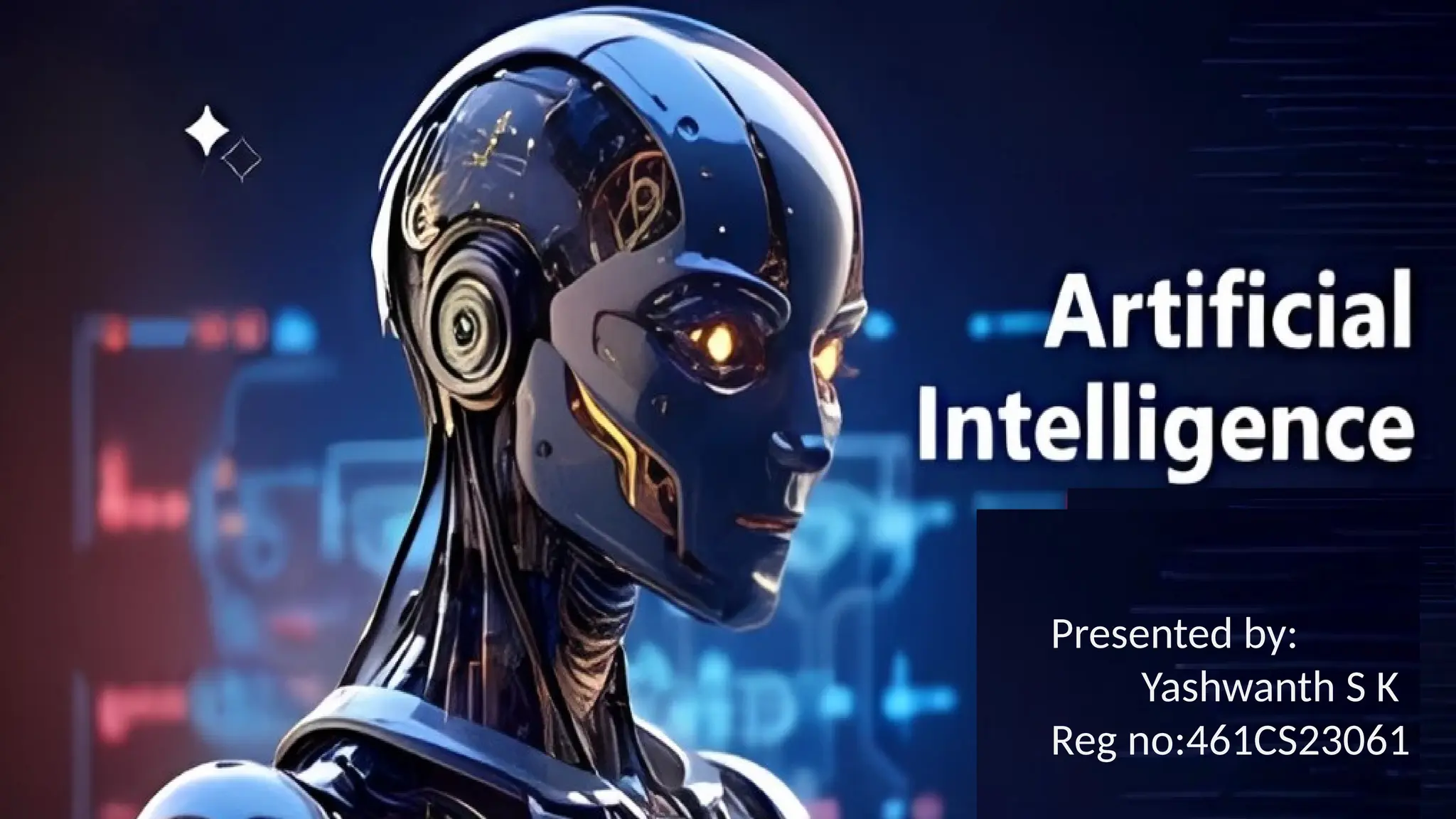
Artificial
Intelligence
Presented by:
Yashwanth S K
Reg no:461CS23061
2.
Artificial Intelligence (AI)refers to the ability
of machines or computer systems to perform
tasks that normally require human
intelligence. These tasks include learning
from experience, reasoning, problem-solving,
understanding language, and making
decisions.
What is
Ai
3.
Types of AI
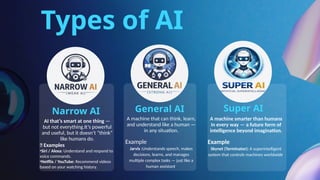
NarrowAI
AI that’s smart at one thing —
but not everything.It’s powerful
and useful, but it doesn’t “think”
like humans do.
🔹 Examples
•Siri / Alexa: Understand and respond to
voice commands.
•Netflix / YouTube: Recommend videos
based on your watching history.
General AI
A machine that can think, learn,
and understand like a human —
in any situation.
Example
Jarvis :Understands speech, makes
decisions, learns, and manages
multiple complex tasks — just like a
human assistant.
Super AI
A machine smarter than humans
in every way — a future form of
intelligence beyond imagination.
Example
Skynet (Terminator): A superintelligent
system that controls machines worldwide.
4.
Common Applications
Machine Learning
MachineLearning is the process by which systems
analyze data, find patterns, and make decisions with
minimal human intervention..
•Common Applications
•Image Recognition (e.g., Face detection in photos)
•Speech Recognition (e.g., Siri, Google Assistant)
•Recommendation Systems (e.g., Netflix, YouTube)
5.
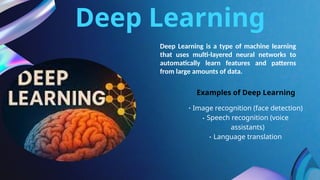
Deep Learning
Deep Learningis a type of machine learning
that uses multi-layered neural networks to
automatically learn features and patterns
from large amounts of data.
Examples of Deep Learning
Image recognition (face detection)
Speech recognition (voice
assistants)
Language translation
.
.
.
6.
Understanding
Language
Understanding Language meansenabling
computers to read, interpret, and respond
to human language — just like people do.
This area of Artificial Intelligence is called
Natural Language Processing (NLP).
🔹 Example
•You say: “Set an alarm for 7 AM.”
→ AI understands this as a command and sets the
alarm.
•You ask: “What’s the weather like today?”
→ AI recognizes this as a question and gives a weather
report.
7.
Driving Innovation
Driving Innovationmeans using AI technologies
to create new ideas, products, and solutions
that transform industries and improve everyday
life.
.
•Transportation: Self-driving vehicles and smart traffic
management.
•Education: Personalized learning tools and AI tutors.
Examples of Innovation with AI
8.
Revolutionizin
g Medicine
AI inmedicine uses advanced algorithms and data analysis to
detect diseases, assist doctors, and improve healthcare
outcomes with greater speed and precision.
Examples
•IBM Watson Health: Helps doctors analyze medical
data.
•Google DeepMind: Detects eye diseases and cancer
early.
•AI Wearables: Track heart rate, sleep, and fitness in
real time.
9.
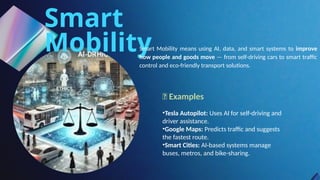
Smart
Mobility
Smart Mobility meansusing AI, data, and smart systems to improve
how people and goods move — from self-driving cars to smart traffic
control and eco-friendly transport solutions.
🔹 Examples
•Tesla Autopilot: Uses AI for self-driving and
driver assistance.
•Google Maps: Predicts traffic and suggests
the fastest route.
•Smart Cities: AI-based systems manage
buses, metros, and bike-sharing.
10.
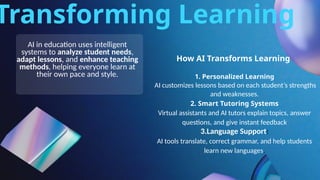
Transforming Learning
How AITransforms Learning
AI in education uses intelligent
systems to analyze student needs,
adapt lessons, and enhance teaching
methods, helping everyone learn at
their own pace and style. 1. Personalized Learning
AI customizes lessons based on each student’s strengths
and weaknesses.
2. Smart Tutoring Systems
Virtual assistants and AI tutors explain topics, answer
questions, and give instant feedback
3.Language Support:
AI tools translate, correct grammar, and help students
learn new languages.
11.
Endless
Possibilities
Artificial Intelligence isshaping a world full of limitless
opportunities — where creativity, technology, and human
intelligence come together to make the impossible possible.
🔹 Examples
•AI in Space: Helps scientists explore other planets.
•AI in Climate Research: Predicts weather patterns and
natural disasters.
•AI in Creativity: Tools like DALL·E and ChatGPT inspire
new forms of art and writing
12.
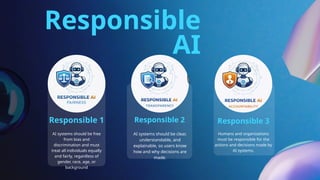
Responsible
AI
Responsible 1
AI systemsshould be free
from bias and
discrimination and must
treat all individuals equally
and fairly, regardless of
gender, race, age, or
background
Responsible 2
AI systems should be clear,
understandable, and
explainable, so users know
how and why decisions are
made.
Responsible 3
Humans and organizations
must be responsible for the
actions and decisions made by
AI systems.




![Download Chimera Tool Setup V42.47.0924 [Latest Version]](https://cdn.slidesharecdn.com/ss_thumbnails/artificialintelligence4-250505221011-8e660a4e-thumbnail.jpg?width=640&height=640&fit=bounds)


