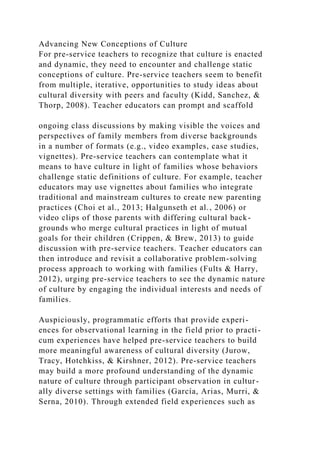
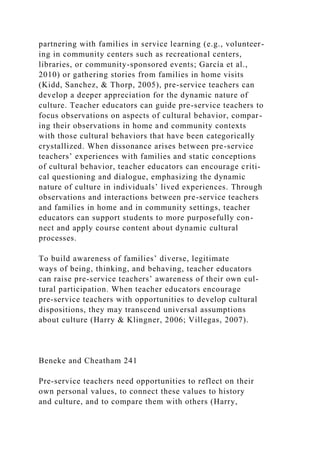
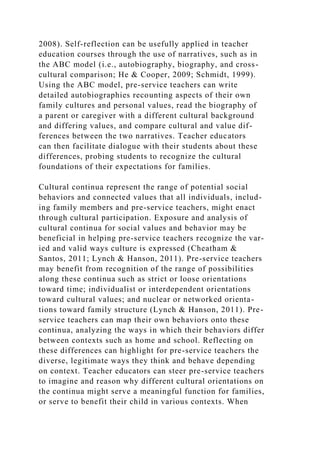
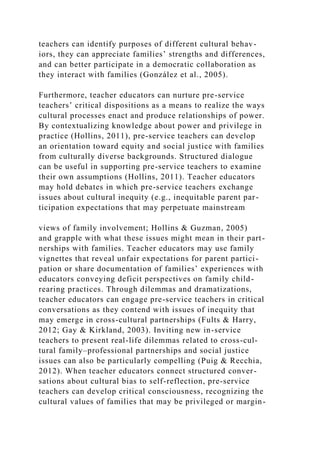
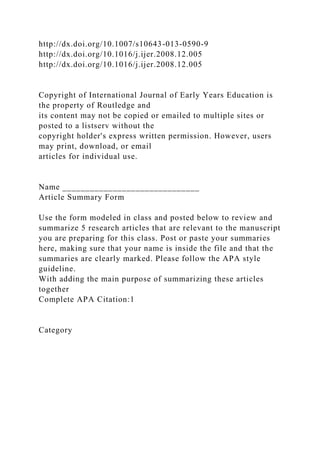
Article Summary Form
Complete APA Citation:
Egbert, J., & Jessup, L. (1996, September). Analytic and
systemic analyses of computer-supported language learning
environments. TESL-EJ, 2(2), 1-24. http://tesl-
ej.org/ej06/a1.html.
Purpose: The purpose of my paper is to establish what kinds of
tasks are effective for CALL classrooms.
Category
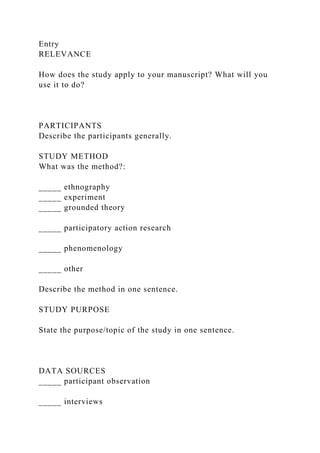
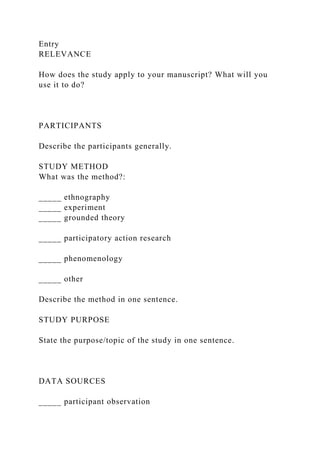
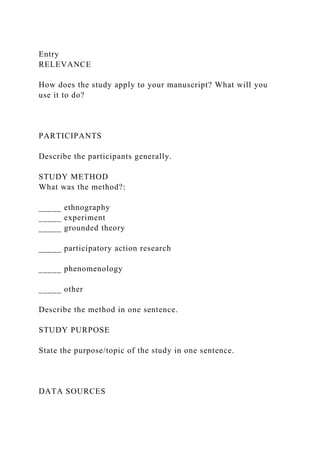
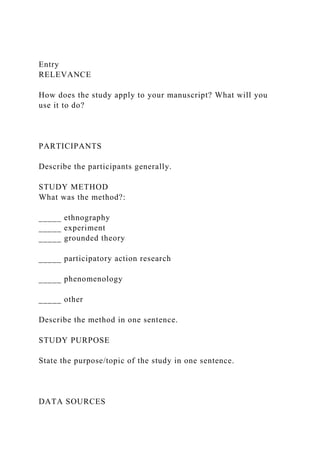
Entry
RELEVANCE
How does the study apply to your manuscript? What will you
use it to do?
This study provides some conditions that tasks should meet to
be effective. I will use it to show what past research has found
and what the gaps are.
PARTICIPANTS
Describe the participants generally.
102 ELL adults in community college.
STUDY METHOD
What was the method?:
_____ ethnography
__X___ experiment
_____ grounded theory
_____ participatory action research
_____ phenomenology
_____ other
Describe the method in one sentence.
The author used two groups (traditional and cooperative) and
gave each an intervention using computers. Analyses included
small-space analysis (multi-dimensional scaling) and
MANOVA.
STUDY PURPOSE
State the purpose/topic of the study in one sentence.
To uncover patterns of students’ perceptions in the 2
environments based on eight constructs
DATA SOURCES
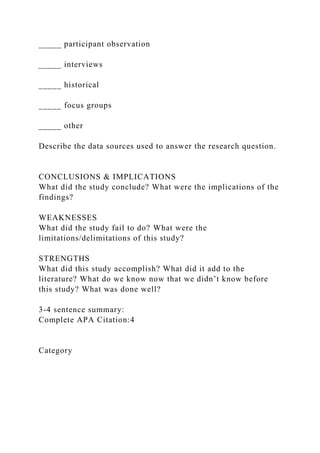
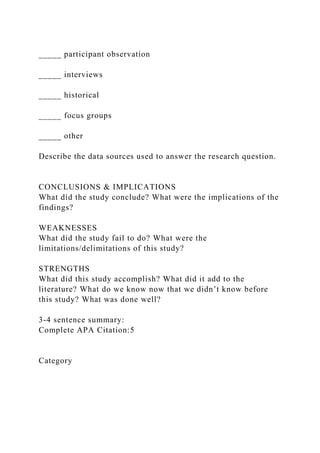
_____ participant observation
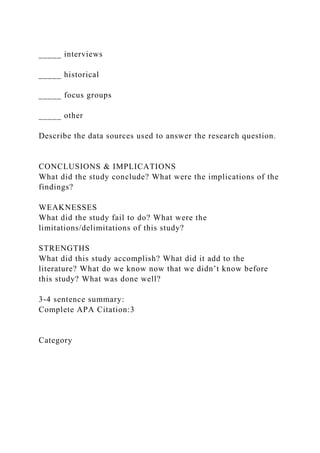
_____ interviews
_____ historical
_____ focus groups
__X___ other
Describe the data sources used to answer the research question.
Pre/post survey
CONCLUSIONS & IMPLICATIONS
What did the study conclude? What were the implications of the
findings?
Groups may have process losses during tasks, control can be
interpreted in various ways, it’s the students’ perceptions of the
task elements that may matter more, previous computer use may
matter to their interest in tasks, interest was central to student
outcomes.
WEAKNESSES
What did the study fail to do? What were the
limitations/delimitations of this study?
Self report only, didn’t check whether students perceived the
actual constructs or understood them, the difference in the tasks
didn’t seem to make a difference so there were no real outcomes
STRENGTHS
What did this study accomplish? What did it add to the
literature? What do we know now that we didn’t know before
this study? What was done well?
New methodology in CALL (MDS) and theory that can be
tested.
3-4 sentence summary:
In a seminal study, Egbert and Jessup (1996) explored students’
perceptions of two tasks, one drill-based and one
content/culture-based. Using multi-dimensional scaling, they
used a pretest/post test design to ask 102 community-college
ELL students about their perceptions of 8 constructs of the
tasks. Results included that student interest, based on how
useful the task content and process was, might be a major factor
in how they perceived the tasks. The authors note that further
research should be done to explore how student interest can be
integrated into tasks.
Egbert and Jessup’s (1996) study with community college ELLs
used multi-dimensional scaling to find patterns in students’
responses to a survey about two tasks. Their findings suggest
that student perceptions of tasks may not be the same as
teachers and task designers for a variety of reasons, and that
more specific data on student group work in tasks is needed.
One study that does address tasks in the English language
classroom is Egbert and Jessup (1996). The researchers
explored two different tasks based on 8 constructs of learning
environment conditions. Although their study did not result in
definitive findings about effective CALL tasks, the theoretical
framework used can be useful in future research that explores
CALL tasks. Therefore, this framework has been adopted for the
current study.
Assignments View Feedback
Feedback for 4-2 Final Project Milestone Two: Applying
Storytelling Themes
Submission Feedback
Rubric Name: ENG 510 Final Project Milestone Two Rubric
Score
92.5 / 100 - A
Feedback Date
Feb 23, 2020 5:47 PM
Assignment
4-2 Final Project Milestone Two: Applying Storytelling Themes
SP
Sandy:
You wrote an engaging scene that had me glued to my screen
from the onset. The emo!on feels authen!c
and the dialogue is intelligently and believably paced.
Addi!onally your classic and contemporary
jus!fica!ons showcased your self-awareness regarding the
conscious tac!cs and decisions you made as
well as your ra!onale for having chosen those pieces. Nice work
here.
Be well and have fun.
--S
Submission ID Submission(s) Turni!n® Similarity Date
Submi"ed
10163466 MIlestone 2.docx (11.5 KB) 0 % Feb 17, 2020 10:35
PM
https://learn.snhu.edu/d2l/lms/dropbox/user/folders_List.d2l?ou
=344913
javascript:void(0)
https://learn.snhu.edu/d2l/le/dropbox/344913/turnitin/747262/su
bmission/10163466/13316908/RetrieveOriginalityReport
https://learn.snhu.edu/d2l/common/viewFile.d2lfile/Database/M
TMzMTY5MDg/MIlestone%202.docx?ou=344913
Done
Creative Work (The Crisis)
Cast:
A woman in her late thirties (Carlotta)
Her son (Domingo)
The woman’s father (Papi)
Fletcher (Head of CIA)
Receptionist at CIA
Carlotta is in the middle of her hot pursuit to unravel the recent
fatal shooting of her sister-a detective working with the CIA.
Amid the pain of the loss of her sister, she has to deal with
taking care of an ailing bed-ridden father who is too sick to be
told that her bread winner daughter is no more lest he die out of
shock. On the other side, Domingo, Carlotta’s son, is unable to
go back to college due to financial crisis occasioned by the
demise of his aunt.
A seemingly distressed Carlota storms into an office building
after staying in the lift for what seems to be an eternity.
Carlota: Is he in? I need to speak to him as a matter of urgency.
Receptionist at CIA: Who?
Carlota: Fletcher, the head of CIA. I know he is in there. I’m
going in.
Receptionist: Just a moment madam. Appointment?
Carlota: (Now even more agitated) What? Are you kidding me?
Wasn’t she your colleague? Do you not care about Selina? It
doesn’t trouble you that her killers are on the loose and you, the
CIA are sitting on your damn asses? I’m going in.
Fletcher: Good morning Carlota. How may I help you?
Carlota: You can’t help me. Since you can’t find the killers of
my sister, I’m here to help you instead. I know who killed
Selina. It’s that weird boyfriend of hers. I knew it right then.
I’ve always had the feeling. The writing is on the wall!
Fletcher: Slow down Carlota. That’s a sensational accusation.
His alibi checked. Remember?!
Carlota: No! Doesn’t make sense at all. He had the motive. He
is a drug dealer. Took advantage of Selina but she finally saw
him for who he really is, a drug lord! You know I’m right
Fletcher.
Fletcher: Even if you are, the evidence does not support your
theory. Unfortunate. I know you are hurting but let us do our
job. We owe it to Selina as CIA and as our former colleague.
Carlota: (Amid tears) Hurting is an understatement of what I’m
going through…what my family is going through. Haven’t you
seen my father in that bed? I can’t even tell him Selina is no
more. At least when I tell him, it might hurt less if I also told
him that the killer was behind bars.
Back at Carlota’s home…
Domingo: Any breakthroughs mum? Am I going back to school?
Carlota: I’m sorry Domingo. I’m so sorry.
Domingo: It’s okay mum. We’ll be fine. As instructed, I haven’t
told Papi a word about it.
Carlota: Good. Hang on in there, you’ll be back to school once
the CIA sign off on your aunt’s benefits. Just a matter of time.
Phone rings…
Carlota: Carlota speaking…
Fletcher: This is Fletcher. Got news for you. You need to come
to the office right away.
Carlota: Right away. Thanks.
At the office…
Carlota: Finally!
Fletcher: Yes, a breakthrough finally. But it doesn’t look good.
Good news is we have proved motive for her boyfriend to want
to kill her and we have a witness that is willing to testify to the
fact that he ordered and payed for the hit on Selina. Bad news is
that we can’t take him down without soiling the reputation of
your sister. She was an accomplice to some of his dirty
business, intentionally or not, we don’t know. Either way, she’s
cooked.
Carlota: Oh my God. This can’t be real. What now?
Fletcher: I shouldn’t do this, but for Selina I’d bend the
rules…we take him down, he goes down with your sister’s great
reputation of service and with it the financial benefits due to
her.
Carlota: Oh no! What now?
Fletcher: You tell me. I want you to decide. It’s the reason I
wanted you here in person.
Justification
A. I would have my character (Carlota) grow into a character
that chooses compromise rather than justice or revenge. In light
of the financial distress occasioned by her sister’s demise,
coupled by an ailing father and an out of school son, letting her
killer go to protect the name of her sister and consequently open
the gates to the benefits would be the better option.
B. I used the third person point of view because it allowed me
the opportunity to look at the situation from a bird’s eye view. I
went for the view because it helped me narrate a story without
emotional bias.
C. I would definitely employ this point again in my future
works. I like the liberty and freedom that comes with the third
person point of view as it offers me the opportunity to create
my characters.
D. I just finished reading William Shakespeare’s classic ‘The
Merchant of Venice’. In his play, Shakespeare employs the third
person point of view in telling the woes that befall Antonio
following his defaulted loan given by Shylock. The author’s
choice of point of view offers him the liberty to explore the
intrigues surrounding business and cultural life in Venice.
E. The contemporary text I’m currently reading is ‘Become a
Better You’ by Joel Osteen. In this literature, the author
employs the second person point of view. Through this, the
book is able to live to its expectation of being the voice that
addresses the reader to show him/her how to become the best
version of themselves.
JAS I
2001, Vol. 26, No. 4, 270-280
copyright. 20011 by
TFhe Association for Persons with Severe Handicicaps
A Deweyan Plerslpect'ive on Democracy
and Inquilry 'in thle F'Ieldl ofI
Speclal iEducat'ion
Sc)t Danorth
University f Miss ttri-S t [ouis
On whlat basis do siec38al edicators wi-k i iig ti tl-e
area of severe discabi1lties maike deciseiioins" f7iis article
provides an exploration of the practice of social incquirv
in professional work theat drawns froni the clein-icriatc
ethics (f John Dewey. Dewev ienphasizies thi aeed fior
kn-towledge to contribute to the dailx'Y c/u lei of fos"ifier-
ing equialty in lirhunian interactions and relationships. His
philosophv suppor ts the /ree developmnciit of itiailiv
formis of social in7q iirv anad the c ditivaton- of a pluralist'ic
dialogue valuiing dlivese perspectoves. This ariticle con7-
cludes wit/ tia descriiption ovf adlisorv work witfin tie
sel f-advocacv movenient 7as an example of Dewevxcee de-
11oc 'ticv in acti.oi
DESCRI1PTORS: Johbn Dwey, special education,
denmocrcvc
For every wav of life that fails in its democracv
limits the conitacts, exchanges, the commumica-
tions, the interactions bv which experience is
steadied while it is also enlarged anid enriched ...
the task of demi ocracy is forever that of ci eatiton ot
a freer an-d more humane experience in which all
share ancd all contribute. (Dewevy 1993, p. 245)
SpeciaL ecdlucatioin practitioniers make many decisions
every day. Some come in rapid-fire moition, an almost
intuitive series of quick reactioas anidst the deluge of
numerous classrooma demr ands. Some comie msire
slowly, occaurring in brief excxhanges between col-
leanues, discussions about problems, options, dead
ends, and hopefully solutions. Others come very slowlv,
dragging through long meetings itvolxving policies and
rules, in volving aEiput fro m and discussion across m-any
parties with varied perspectives and values. What all of
these decision-makino situations have in comrmon is the
requirem ent that professionals handle a complex situ-
ation that may be vie wed fiom i-nany perspectives in
Address all correspondence asd requests for reprints to
Scot Daniforth, College of Education, 8001 Niatural Bridge
Road, St. Louis, MO 63121-4499. F. asi: scotIurnal.edu
such a wav as to precipitate worthwhile action. Somne-
how the professional iimust solrt thriough the inforimation
and the perspectives onr the problem in o6ider to stand
firmly eniough on ani answer to take a step ftorwarcd to
do somiiethina worth doinrg.
But decision making occurs not mereliv in. a piece-
meal fashion. as if otne's choices and actions in one
moment have nio relevant connection to the circum-
stance that precedes or follows. We should view pro-
fessionl I decision makikig thi ough a less microanalytic
lens, tocusineg not onix on the process of thought and
choice within a specific moment, but on the broader
sense of social purpose that encompasses and unites a
profession a4s manr actions. We may- conceptualize
profession-ial decisioni makling as a broad and deep
stream of eitacted purpose and intent, an oni-going h tu-
man etfort of a distinctlv moral nature. But how does a
professional do this" On xwhat basis does one consider
information, input, options, alternatives, and perspec-
tives On wxhat basis does one make the many impor-
tant decisions?
Traditionally, many resear hers have adIvised pirofes-
sionals to listen-E to tthe adsvice of ouLtr special eduication
knowledge base. For mIani (btit obviousil not all) is-
sues, there is a social scietnce research literature that can
be hiahly informative to practitio-ners. We researchers
often bemnow-i the so-calledi -research-to-practice gap,"
the way that research findings tenid to grow old on ye-
lowving pages rather than actively inform the practices
of teachers.
In the past, because of the positiVist roots of mi6ost
special education research (Skrtic, 1991 1996; foi cur-
rent status of positivist roots, see Kauffman & Brigham.
1999), it was nIot uncommorn fto researilhers to clam
that professionals should viexw research as preseriptive,
to sonme extent dictating specific kinds of professional
action This xway of viewing research helct that social
scientists had methods of creatinig kinowledge that al-
lowed us to (a) accurately lmap the biological acnd psy-
chocagical dimensions of specific disabilitv condi-
tions,9 and (b) authoritatively discern between erfec-
tive (.xwh at w oirks") and ineffective ("what doesn't
work,") professional practices and programs. In the lat-
ter case, this claimi took the form of attemi pts to "sci-
270
Dcemocracy andi Inquiry
entifically validate" professioinal practiies (Danforth.
1 999).
As the field of disability research has muatured over
the past two decades, many special educators have
gradually be/come uncon vinced that the idea that a
single approach to research is superior and theref ore
should be entrusted with prescribing professional ac-
tion (D'anforth, 19)7; Heshusius, 1988, 198)a, 1989b;
Kliewer & Drake, 1998; Patton, I998; Poplin, 1987,
1988; Skrtic, 1991. 1996). Certainly, the area of severe
dLisabilities has been a leader in opening minds to the
divergent voices and nondominant forrms of knowledge.
In an era of cultural critique and the proliferation of
research methods and phileosophies, special educators
have moved inTcreasingly toward honoring the conmplex-
ity and uncertain ground of professioial decisions.
As a contrast to the historically prior goal of acdhering
to the findings of a particular brand of science, an al-
ternative is to suggest that professioinal decisions he
made in light of a worthwhile goal for community and
humanity, an orienitation to soeial ethics. If our profes-
sional mission is to bring benefit and hope to students
considered to hlave disabilities and their families, it fol-
lows that we exa'mine and take actioni amidst challeng-
ing situ'ttions in the light of a serious concern for the
ethics of social and commu nal living.
Ackn-owledging the priority of social ethics in profes-
sioinal work allows us to recast our decision making in a
broa'der light, incquiring how a given professional actilon
might contribute to a social ethics of communal livi'ng
that supports the developlment of peace, equality, and
social justice. Cast in this way, the highly focused ques-
tioni of a single professional deeision is iinseparable fronm
broater ethical and political conversations about how
we-professionals' families, iidividuals with disabili-
ties, and others-might co-construct -the good life and
the good society (Gouinlock, 1994, p. Xi)" together.
In recent years. mnany speciail eduLcators have claimed
that the most hbopeful and useful tradition of social eth-
ics available resides within the de'mocratic traditio is of
the American heritage (Danforth, 1999; Edgar, 1998;
Lipsky & Gartner, 1996; Skrtic, 1996). Edgar (199<, p.
163) hhas described democracy as a commoni cultural
niarrative within the American tradition that provides
tremendoes hope aind guidance for "how people of di-
verse hackgrounds, talents, and personal ncarratives can
live together in peace and justice." A deAmocratic ethics
of communal living might provide not a narrow "one
best way"' within which all should walk, but a multifac-
eted and inclusive conceptuIal and practical umbrella, a
social vision that accepts the diversity' of the many cul-
tural traditions and human variations that make up this
country and1 our schools, seeking the dcaily creation of
social equality and individual dignity within our profes-
sionial work.
The recent turin to a democratic ethics among special
educators echoes siimilar conceptual developments in
the nascent field of disability studies (Charlton, 1998;
Davis, 1997; Hahn, 1983, 1985, 1987; Linton. 1998;
Linton, Mllo, & O'Neill, 1995; Thoinson, 1995). Dis-
ability studies is a multi-disciplinary field of inquiry that
discards the traditional psychological and m edical em-
phiasis onI functional limitations. Working within or
drawing from the humanities, disability studies scholars
generally frame disa'bilitv within a minority group
model that focuses on the social, econoinic. and politi-
cal factors that limit the participation of individuals
with disabilities in many aspects of society. The goal is
not so much the treatnment of itidividual deficits in bio-
physical or cognitive functioniing, but rather the fuller
developmeient of inclusive denocratic communities that
welcome and support persons of widely varied abilities,
behavioral styl'es, and ph'sical iforms.
These democratic genres of disability scholarship in-
form us that an; thoughtful inquiry concerning profes-
sion'al work nmust be embedded within a broader dis-
cussion of social and commiunal ethics, of how people of
diverse abilities and bodily forms may live, learn, and
work together in acn ethical nmanner. In this essay, I turn
to the democratic philosophy of John Dewey as a
source of wisdonm and guidan'ce. Dewey is ideal counsel
because he spent a career spanning seven decades ex-
amining issues concerning philosophy of: sience, the
c )nnectioni betwee'n knowledge and practice, and the
contributions of inquiry to democratic life.
In this article, we will explore John Dewey's philoso-
phy of democratic ethics as a wav of understanding the
role of so:cial inquiry in the practical dlecisions made
each day by special educators and other service profes-
sionals. From that Dewevan perspective, this paper will
outline a broad understanding of how the practice of
social inquiry might contrihute to the work of profes-
sionals and the well-being of students and their fanmilies
within the daily tasks of demeocratic living.
The Aristocratic Ideal and the
Democratic Ideal
Every autocratic and a'uthoritarian scheme of so-
cial action rests on a belief that the needed intel-
ligence is confined to a superior few, who ... are
endowed with the ability an d right to control the
conduct of others; laying down principles a nd rules
anct directing the vays in which they are carried
out. (Dewey, 1994, p. 266)
In 1 888, while still a young professor at the Univer-
sity of Michigan, John Dewey published a paper that
f'oreshadowed much of the philosophical work he
would cdo over the next six centuries. In "The Ethics of
Democracy." Dewey used the term "democracy"' not in
reference to a form of government but as "can ethical
conception ... a form of moral and spiritual associa-
tion" (Dewey, 1993, p. 59). To explain his concept of
271
22)anforth
democracy as a practical, daily ethics of human inter-
action and communal living, Dewey contrasted: "the
aristocratic ideal" with "the democratic ideal."' A]-
though each ideal believes strongly that people should
live together in an orderly and peaceful fashion, the two
ideals differ greatly in explaining hbow that peaceful co-
existence should be created, organized, and main-
taimied.
The aristocratic ideal is based on Plato's notion of the
small group of philosopher-kings whose keein insight
and superior understanding provides a beacon of light
and authoritative direction for the proper activities of
all in the community. The multitude, the masses of
common community members, are assumed to be un-
able to understand what is best for theemselves and
therefore must turnt to a small group of highly educated
and intelligent leaders to find their proper place andi
activities in society.
The few best, the aristoi; these know and are fitted
for rule: but they are to rule niot in their own in-
terests but in that of society as a whole. and there-
fore, in that of every individual in society. They do
not bear rule over the others; they show thenm what
they can best do, and g-u6ide them in doing it.
(Dewey, 1993, p. 60)
The aristoi, the aristocracy who provide a benevolent
and paternal form of leadership, base their right to lead
on the claim, of superior knowledge. T'hey are "fitted
for rule" because they "know"; they knowxv what is best
in a way that common persons unidoubtedly could not.
Therefore, the prescriptions for the orderly and peace-
ful society, including the planis for how each individual
shall fit within the larger whole, are crafted by the :few
and kindly setnt down to the masses who await and
require direction.
Despite the benevolent gentleness of this aristocratic
model, Dewey rejects it in, favor of the democratic
ideal. In his words, the aristocratic ideal has historically
"failed because . . . the practical consequence of giving
the fewv wise ard good power is that they cease to be
wise and good. They become ignorant of the nieeds and
requirements of the manivy they leave the many outside
the pale with no real share in the commonwealth"
(Dewey, 1.993. pp. 60-6I). Later in his career, Dewey
would fully critique the assertion that a group of thinik-
ers could claim to hold a higher, greater form of knowl-
edge (Dewey, 1920, 1929) . At this early point, he con-
centrates on the political and social implications of such
a hierarchy of knoowledge. The lopsided distribution of
power creates a social chasm between the elite aind the
masses. The elite end up losing touch with the experi-
ences, perspectives, and needs of the masses,. wvile the
masses live in a society whose governan ce they do: nzot
share. "A class of experts is inevitably so removed. fro(m
common interests as to becoime a class xvith private
interests and private knowledge, whiich in social nmatters
is no knowledge at all" (Dewev. 1927, p. 20)7). The very
reason for the appointment of the elite experts to the
post ol leadership. the superior knowxledge of that
group concerning the well-being of all, fails within the
social divisioni and inequalitv of the arrangement.
Dewey offers the democratic ideal as the pronmising
and j1ust alternative. He explains that the democratic
ideal involves an ethical understanding of the relation-
ship between the inidividual anbd the community. In-
stead of viewitng the individual and the larger society in
opposition, Dewey's democratic ethics maintains that
the well-beine of the commuinity and the development
of individuals operate in reciprocal tandem. The goal of
the demnocratic society is to assenmble communities of
equality and social support such that the free expres-
sion and full development of the individuality of each
citizen is a paramount concern. The task of the inidi-
vidual withtin the democracy is to contribute his or her
unique talents and effort to the daily interactions and
activities that construct and further the communitv of
fireedom and equality.
At the heart of this is Dewey's belief in the complete
dignitv and universal humaniity of every individual. At
the bottom of it all, beneath our impressions of the
characteristics, abilities, or social importance of any one
person, ties no wav cf distinguishing the value of one
person from the value of aniother. In true humanistic
style. he calls us to understand all persons as equal in
worth. Dewey states: "It means that in every person
there lives an infinite and universal possibility; that of
being a king anid priest" (Dewey, 1993, p. 63). Aristoe-
racy casts indiividuals inito social roles based upon two
classes of value: the knowing and the unknowing, the
powerful and the powerless. A democratic ideal, ac-
cording to Dewey, holds that no matter how we might
feel or think about an individual, our practical axiom in
all our actions is that a basic equality, dignity, aind pos-
sibility inheres to each person.
Coupled with this understanding of the individtual is
Dewey's ethical concept of democratic living within a
commrnunity. He introdtuces this philosophy in his 1888
paper and extends it in his marny works through the
nanny years (Dewey, 1916, 1920, 1925, -1927. 1929, 1930.
1939; (Gouintlock, 1994; Westbrook, 1991; Ryan, 1995).
Three notable tlhemes recur in his writings on demo-
cratic comnmnunity: (a) the creation of equality in mun-
dane. daily activity; (b) the need for ani equal, inclusive
dialogue amiiong the diversity of community members;
anid (c) the role of free, cooperative, practical inquiry in
a democracy. In the sections to follow, I will explain
eacGh of these, concluding with the Deweyan urnder-
standiing of how a social inquiry enacting values of free-
don; cooperation, and practicality can serve and fortify
a democracy. Ihis will present a notion of inquiry to the
field of special education (and the broader professional.
commumnty) as a philosophy of social knowledge that
272
offfers promise and hope to those who seek to contrib-
ute to democratic ways of living.
The Daly, Communal aking of Equality
"Equa'lity . . . is not a natural possession but is a fruit
of the community... " (Dewey, 1927, p. 151). One
could call Dewey's understa'ding of democratic com-
munity an -over-the-side-fence" brand of associated
living, a philosophy of social ethics that describes equal-
ity not as an antecedent given but as a relational mode
created and recreated in the face-to-face conversations
and interaetions of common folk. Two neighbors lean
against the fence that divides their properties. each
standii g at the edge of her oxwn individuality, the par-
tial weight of each set in equal proportion against op-
posite sides if that common fence. As the neighbors
lean, they talk about interests and con.cerns that are
inevitably shared by persons who live side by side. It is
in that brief or extended discussion, tlat mundane so-
cial exchange that occurs daily in side yards, market-
places. houses of worship, and schools, where the
equality of persons can be made and rem-ade. In this
sense, equality thrives not within abstract state'ments of
pre-existing or natural rights, but through the actions
taken each day by eitizens who carry on this `icommon
narrative" (Edgar, 1998, p. 162) called demoeratic liv-
ing. Equality resides not in the areater knowledge or
worcis of elites, but in the associated conduct of plain
folks who are muddling through as best as they can.
Elaboirating on the way Dew'ey frames the politi-s of
society in terms of a practical ethics of human interac-
tion and relationship, Kerr (1996) invites us to create
cooperative, civi' spaces that foster "nurturance." She
niotes that the act of nurturing rings of words like
"love," "ciring," and "fully listening." Yet she hesitates
to allow those well-known words and ideas aboct sup-
portive reiationships to encapsulate her notion of "nur-
turance." It is all this, of course, but it is something
more. Kerr then invites us to engage in a little thought
experiment as a way of explaining her demoeratie-
relational idea.
What would it be like for you, Kerr asks us to imag-
ine, if your experienee of the world was completely
unrecognized, unnoticed, and unvalicdated by those
around yion'? What if the way y/ou felt, thought, or
viewed the events of your existence found no acknowl-
edgment or reception among other persons?
That is, when you feet pain, no one will ackniowl-
edge your discomfort. When you feel ebullient, 'io
one will smile back. When yot grieve, no one will
acknowledge your loss. When you report what you
experience an reading a poem, no one will ac-
knowled e your report, much less your experiene'.
Others talk only of their own experiences and the
facts of matters. (Kerr, 1996, pp. 41-42)
-u1q-u:y 273
To live without ainyone giving validation to your expe-
rienice of the world wonlld be the purest form of isola-
tion.
The tragedy of this isolation is not only the experi-
ence o'f anguish at lyving without relational validation
and support. Kerr explains that living in a state of cor-
plete social invisibility leads one to lose sight of oneself,
to lose a sense of one's iwn identity. An individual
comes to know himself or herself through the experi-
en ce of having feeliings, thoughts, and perspective rec-
ognized and even valued by others. To exist with no
such mirroring back of one's experienlce from other
persons strips one's biographv of weight, substance, and
legitimacy. It is to walk on sand without leaving a foot-
print. Indeed, as Kerr (1996, p. 42) concludes, "Your
self, your soul, is lost."
In Deweyan style, Kerr tells us that the difficult task
of creating a demicratic society amounts to multiple,
cooperative efforts to nlake social spaces where "nur-
turance" is possible, where individuals may construct
worthwhile selves throutgh the mutual acknowledgment
and validation of one another's experiences. In a demo-
cratic community, we craft opportunities, civic spaces,
where the personal stories of each may be equallv
heard (e.g., Coles, 1989). "Social spaces, civic spaces, a
safe, shared place to play with life as one actually ex-
periences it; a place whbere others recognize, acknowl-
edge, respect one's experiences-the self requires these
and is constituted in them" (Kerr, 1996, p. 47). 'The
practical activitv of demo cratic living amoutnts to imag-
ining, arranging for, supporting, and furthering the cul-
tivation of social opportunities where vxaluable selves
can be made.
Kerr warns us of the difficulty of doing this. The
structures and social habits of corporations, institutioins,
and helping professions tend to work against nur-
turance. Often the formalized procedures of profes-
sional helpers preclude the informal, relational acts of
nurturancee the co-construction of meaning in trustful
interaction. The experienices, perspectives, and bio-
graphic stories of disadvantaged groups are often de-
valued, ignored, and sileneed. Often they are destoried
by the very professionals v'ho seek to help.
What is needed, Kerr claims, are not armies of pro-
fessionals devising formal, depersonalized interven-
tions targeted at fixing up disordered lives. but 'messy,
labor-intensive work and ... thoughtful listlening by
persons who are willing and able to be curious about
the lives of others and to make the experiences of oth-
ers an integral part of their own stornes" (Kerr, :1996, p.
63). What is needed by professionals and nonprof-es-
sionals alike is a demoeratic ethic that actively trusts
and supports the priority of supportive, nurturing rela-
tionships. Respect, equality, and the nourishment of
self can occur in a civic society where social o(pportu-
nities for mutual and equal sharing, hearinig, atnd telling
abound.
T1-set----T --]f - _:_lir
l}WI1ltJWl a;y
274 Dan
"Till the Great Society is coniverted into the Gr-eat
Communitv, the puablic will rem-ain in eclipse. C'omll
munieationi alone can create a Gireat Community"
(Dewey, 1.927, p. 142). The Deweyan picture of demo-
cratic living depenids oni processes of open and tree
communication. It views the community as a m-iosaic
multiplicity of dynamice social spaces where the plurality
of diverse views and perspectives are inivitedi atnd ac-
cepted. A sh-ared culture of equality and frceedom is
created in the dialogue of varied, disparate, and eveni
opposinig voices.
TFhe goal of public dialogue is not conformity, not a
uniformity of opin-ion or belief, T'he gyoal is not to get
everyonie to read from the same page, ch-ant the same
syllables, buy into the same theory, engage in. the samne
practices, in fact, to Dewey, conformity only occurs
wheni democratic dialogue is halted, wvhen discussion is
stagn-ated. "Conformity is the name of the absen-ce of
vital interplay; the arrest and benumbinig of commiuni-
cation' (Dewey, 1930, pp. 85-86). The only consensus
required by dem'ocracy is the general agreemenit to ac-
cept differences of belief in order to maintain the civil
space of dialogue. What is shared is the valuinig of the
equal opportunity to speak one's mind, to contribute
what one can to the community, to offer forth wordis
arising Ifrom onie's experience anid cultutral background,
Conlformity of th ought and action are anathema to ani
inclusive civic dialogue.
The purpose of this inclusive and diverse dialogue is
moral. What citizens discuss, ei-ther directly or indi-
rectly, through the specific issues an-d dilemmas that fill
the daily conversationis fall unider the general. moral
heiadingT of "How shall xve all live together? I-ow shall
we bring about peace and justice?" There are no cer-
tainties or absolutes regarding the outcomae of the
moral dialogue (for it can always go this way or thiat).
The distinctly moral dimensioni is en,acted not in the
surety of the results, but within, the cooperative process
of inclusive conversation. itself. Freedoma of speech, the
equal hearing of diverse perspectives, th-e common. mu-
tu-ally trusting sh-aring of the dialogue itself make for a
social process of uniquely moral substance.
Essential to this process of discussion is the attitude
of critique (see Patton, 1998). thre vigilanit axvareness of
and opposition to the on-going prevalence Of SOCia,l in-
equalities within the m-undane structures and habits of
groups, organizations, professions, anid the capitalist
marketplace. Dewey did not simiply paint a niaive and
idealized picture of an egalitarian and just comrmunity
thiat could be spread like vanilla frosting over a politi-
cally tainited cake-a happy tale to coiver up the miany
embattled, unjust social realities of American life. H-e
was fully aware of the pervasive tendency of political
power to tilt civic conversations and arrangements in)
the favor of privileged groups. Onie reason hei con-tina-
foirthi
ously championied the need for marginalized groups to
participate fully in all aspects of Amierican society was
his awareness that these groups often bring an ohr
wise unnoticed critique of the status quo. of the as-
sumed *fairness of doing butsiness as usual (sce West-
brook, 1991:. Ryan, 1995). A truly inclusive dialogue
allows for the unique perspectives of the disempowered
to conitribute critique of the customary practices of
dominanit groups, thereby providing f'or opportunities
for th e cor'rection of those' habituial practices anid the
greater equalization of power.
Inquiry: Free, Practical, Cooperative
John Dewey was one of the m-tost promineint and in-
fluential supporters of th-e developmnent of the new,, so-
cial sciences in the first half of the 20th cenitury. That
said. it would be an error for a niaive readier to dub th-is
philosopher as a "~positivist" or "objectivist" based oni
reading, a Dewey passage concerning the need for social
researchers to adapt the approaches of the natur al sci-
ences to the problems of the social world. He undoubt-
edly champioined the moral utility of social science (in-
cluding positivist or objectivist ap'proaches) in address-
ing the wide ranige of problems facing the public in thec
-modern era: however, a broad anid full reading of his
works in the areas of epistemology, social science, and(
ethics yields a complex vision of social inquiry that goes
far beyond thei limited scope, purpose, and mnethods of
aniy sinigle tiradition of research, In Dewrve, we see the
philosophical forerunner to the cuirrently developing
mosaic of multiple research miethods-quanititative and
qualitaitivc anid widely varied epistemologies (Dewey,
1916, 1920, 1925, 1927. 1929, 1930. 1939; Gouinlock,
1994, Westbrook, 1991: Ryan. 1995).
Dcewcv nevecr saw social scientists as ani elite group
hiaving access to a greater form of knowledge than is
available to the commoner. a "knowing" group that
should prescribe policy anid actioni to) the masses. As
Dewe-y scholar James Gouinlock explain-s.
Scienice is conceived as an instrument of hiuman
liberation anid enrichment. Dexwey abhors the no-
tion of having scientists rule communities:, anid h-e
never advocatcd anything so authoritarian (and
logTically absurd) as making the "right" hiuman
chioice folioxving deductively f"romi scientific piropo-
sitions. (CGouinlock. 1994,1 P. xxxiii)
Dewey held no illusion that natural or social science
could somehow allow humians to coireetly or near-
correctly represent the social worldi, whether that symi-
bolic representation occurs in numbers (quantitative)
or words (quialitative). He therefore did not see re-
searchers as leading the way in prescribinig actions to
professionals or layper-sons. Instead, be viewved social
science researchers as the crucial providers of in-
formed, r-ational opinions to the putblic on specific areas
Democracy and Inqiuilry
of expertise, creating well-reasoned statenents about
particular issues beyond the expertise or interest of the
layperson.
What Dewey envisioined for social inquiry was the
applica tio n of specific attitudes and forms of thought-
ope'n-mindedn ess, reflection, critique, flexibility, ex-
perimentation, imagination, foresight--to the conscious
contelRt of' one's experieince (see C'ampbell, 1993;
Dewey, 13925, 1927, 1993). The purpose of inquiry is the
further development of a democratic community of the
nature outlined abhove. The next three sectionis of this
paper will explain how Dewey viewed inquir y as free,
cooperative, and prac tical.
Free Inquiry
It may seem od d to many researc hers that inquiry be
described as "free." To those who work their wav
through graduate courses in educational or psychologi-
cal researclh methods, an inevitable lesson is that a re-
searcher cannot just do whatever he or she wants. Are
there not rules and p)rocedures to be followed? Dewey
would agree and disagree in the same moment. Let me
elaborate on this tension.
Dewey w)uld agree that not all humnan activity can
be called social inquiryv In addition, inevitably, groups
of researchers of various types who work oin certain
kinds of issues will create proe sses and procedures for
doing research within their field. Researchers in a givern
area te'nd to construct norins concerni i-g researchl pro-
cesses. In their nost unyielding and rigid form, these
norms might be treated as "rules."
But, to Dewey, we cannot claim that otne set of re-
search procedures or practices (or rules) atlows persons
to grasp the deep truths of social reality better thaDs
other approaches. To the contrary, the im'aginative and
iinnovative character of inquiry requires a critical open-
mindedness that extends no t only to the iumatn activi-
ties urnder investigation, but includes the beliefs and
actions of the investigators. Even the "researc n meth-
ods" and the supporting theories must be in dou bt, in
flux, utnder critical examination for purposes of re-
construction to new circumstan'ces arnd problemns.
For Deweey, solidifying those practices and theories
into 'rules" that preclude alteration and innovation
squashes inquiry beneath the hardenini of custom and
tradition.
Dewey would advise researchers to take only mo-
mentary and provisionaI satisfaction from the correct-
ness of their methods or findings in order to maintain
the exploratory attitude and demoeratic goals of in-
quiry. In a sense, once a group of researchers are con-
vinced they have found the best way of doing research,
the way holding claims to truth that carsnot be denied,
then they have disco ntinued their exploration of human
experience. Dewey would say that thev have stoppe'd
doing research,. He warned repeatedly against taking
comfort in the inertia a'nd complacency of tradition, the
way that the customary practices of the past can be-
corne enshrined and defended to the detriment of cre-
ativity, exploration, and the daily fostering of demo-
cratic living.
It is as true of the history of modern science as it is
of the hist ry of painting or music that its advances
have been initiated by in dividuals who freed themi-
selves from the bonds of tradition aind custom
when'ever they found the latter hamppering and in-
quiry their own p'owers of refiction, observation,
and construction. (Dewey, 1994, p. 262)
His goal for social inquiry was not the standardization
of socially authorized methods, but the continuous, cre-
ative cultivation of a wide range of inquiring practices
from a diversity of perspectives.
Social inquiry, in this sense, is a 'quality of an atti-
tude' (Dewey, 1993, p. 55), a mental stance of opei-
mindedness and vigilance in the exploration of human
experie'nce. It is "better understood as a meintality for
approaching and dealing with problems than a protocol
for setting out in advance our responses to possible
coniditions. It offers . . . no guarantees of success"
(Campbell, .1993, p. 18, italics original). The goal of this
attitude is the utilization of human experience as an
experimerntal crucible, an opportunsity to generate ideas
that may guide one toward social action. Often this
mieans quuestioning habituat or customary ways of view-
ing or thinking about social situations and problems in
order to create new opportunities for action in serviee
to a democratic way of living.
The focus of this attitude (called both "scientific' and
"experimental" by DeweyT) is the construction of
knowledge that attends to specific problems and con-
texts in order to create conceptual anci practical support
for ethical problem-solving in a given situation.
The inquisitive attitude depends on two pre mises:
First, that those concepts, gen-eral principles,
theories, and dialectical developments be shaped
and tested as tools of inquiry.
Secondly, that policies and proposals for action
be treated as working hypotheses, not as programs
to be rigidly adhered to and executed. They . .. will
be entertain ed subject to constant and well-
equipped observation of the consequences that en-
tail when acted upon, and subject to flexible and
ready revision inl the light of observed conse-
quences.... (Dewey, 1994, p. 259)
In the first point, Dewey explains that the verv methods
used within social inquiry are subject to examinination,
critique, and revision. They are formed and refornied
within the practice of research and reflection. He fol-
lows with a se'cond premise that views research findings
as temporary, provisional knowledge that are modified,
276
revised, and overturned by those who utilize the knowl-
edge. To Dewey, the bottom-line value of the knovl-
edge does not rely on the correctness of thfe research
methods (reliability, vaiidity. etc.), but resides in the
usefuliness of the knowledge for specific persons in spe-
cific situations. As such, the final. authority on kntoxvl-
edge is always the practitioner who may choose to ac-
cept it as guidance, revise it to suit particular purposes.
or reject it as irrelevant to the circumstances.
Here we see that Dewey does not make our custom-
ary, sharp distinetion betwveen "knowledge-makers"
(researchers) and "knowledge-users" (practitioners).
We tend to view the researchers as making knowledge
and the practitioners as usinlg that knowledge in prac-
tice. Dewey democratizes research itself by viexving in-
quiry as a form of social initelligence that can be pro-
duced and used by virtually all persons. This radical
extensioni of the menrtalities of social inquiry, a plural-
ization and even deprofessionalizationi of social science.
is an example of how Dewey blurs thee boundaries be-
tween the democratic goals of free speech and free in-
quiry. To Dewey, a democracy requires not only free
communication among diverse opinions, but open ac-
cess to tools aid habits of inquiry that respects the
ability of the commion person to inivestigate a social
situation and offer possible solutions. Democracy "'will
have its consummation when free, social inquiry is in-
dissolubly wedded to the art of full and moving com-
munication" (Dewevy, 127, p. 1-84). The de mocratic
dialogue is enriched and given moral substance by not
only the diversity of voices, but the inclusion of miLul-
tiple ways of knowing (epistemologies) and describing
social phenomena.
This raises the question, are social science research,
as many special educators tend to think about it, and
inquiry, as "quality of an attitude" (Dewey, 1993. p. 55),
different thingas? Or are the one in the same? tUndoubt-
ed,ly. Dewey blurs the lines betweetn the two, yet he
does make some cdistinctions. For Dewey, the formal
research concducted bv trained specialists in a field such
as psychology or special education is ideally a highly
focused, specific example of the attitude a nd practice of
inquiry. All that I am describing inquiry as within this
article is eniacted in the xvork of the best researchers. In
this sense, research is an enactmient of iniquiry xithin a
social science tradition. The difference between the two
lies in the concentrated and specialized nature of the
research methods and subject miiatter uneder scientific
examination. Social science research shines a concen-
trated, narrowly gauged light oni highly specific con-
cerns. whereas inquiry as a miode of intellectual vigi-
lance and openniess shared among commun-iity members
casts a broader light of common interest. Dewey
viewed social science as providing vell-reasonecd advice
freely distributed to the lay community. That larger
community then continues the on-going venture of in-
quiry by including this information within the larger
D3antforth
mix of factor-s anid perspectives put forth in tthe demo-
cratic dialogue seeking the common good (Dewey.
1927, 1994). Just as a comrmlnunity building a new town
hall would consult experts in the areas of architecture5
engineering, and construction5 a community providing
services for persons with severe disabilities wxould be
seek the counsel of researchers and knowledgeable spe-
cialists. In addition, however. Dewey would have that
community conisult the persons and families receivinig
throse services to find out how they can best be sup-
ported (Gouinlock, 1994).
Within the context of our contemporary special edu-
cation struggles over differing philosophies and ap-
proaches to research and knowledge. Dewey is simul-
tanreouslv tiraditional and radical. To traditional special
education and psychological researchers who tend to
view their wxork as incremental in nature. building
gradually within a progressive history toward more pre-
cise laminations of the truth, Dewev (19935 1994) would
offer support and encouragement. Although not con-
curring with the epistemology of the objectivist tradi-
tions, he would support the continued social utility of
quantitative methods of analysis. Similarly, he would
fully support and encourage the continued pursuit and
maoral purpose of the various interpretive, qualitative,
and historical traditions.
Yet Dewey (1993. .1994) would vigorously critique
researchers wearing either stripes or spots to avoid han-
dling or packaging knoxwledge in such a way as to sub-
vert or subdue the niecessary democratic dialogue of the
broader comnmunity%. It is crucial that research from the
social sciences, scholarship from the humanities, and
various forms of professional expertise be produced.
expressed, and critiqued within ain ethic of democracy,
within a conversation that places the equalitv and well-
being of the community and com-imunity members as
the highest ideal. Knowledge of any sort is rendered
subordinate to ancd in service to democracy, and not
vice versa.
Practical Inquiry
actioni is at the heart of ideas . " (Dewey.,
1994, p. 132). Dewey's blurring of the social roles of
"knowledge-makers" (researchers) and "knowledge-
users" (practitioners) is intentional, uniting our coimi-
mon ideas otf research" and 'practice" unider a broad
notion. of living with an inquisitive attitude, with a
mentality of explorationl and reflection. His under-
standmng of the relationship between knowledge and
the piractical affairs of persons in everyday life is typical
of the American pragmatist philosophers. C harles
Pierce, William James, and recent neo-pragmatists
Richard Rorty and Cornel West (see Danforth, 1999:
Marcell. 1 974; Murphy. 1990: West, 1989). The pragma-
tists evaluate the xvorth of an idea (theory. belief, state-
ment of fact) in termis of the practical utility and ethical
Democracy and Inquiry
implications of allowving that idea to guide one's ac-
tions. Simply put, "If one buys this idea, what can one
do with it and where will it get one in efforts to con-
tribute to democratic living."
A practical knowledge is a temporary, provisional
belief about the way things are and how one might act
in order to create improvement. We would broadly de-
fine "'improvement" as a modification that better culti-
vates and furthers a democratic ethics of community
and interpersonal relationship, creating opportunities
f r the fulfillment of Kerr's "nurturan ce' through so-
cial arrangement and interpersonal sharing. In th-is way,
thought and action are unified.
A Deweyan approach for the practitioner involves
continuous reflection and self-interrogation, asking
oneself a cycle of questions about belief and actioin:
1. How do my actions contribute to the making of
democratic community?
2. How do my actions detract from the making of
democratic community?
3. What beliefs do I currently hold (about myself., my
students, their families, the curriculum, and so on)
that support my acting in ways that detract from
the making of democratic communtity?
4. How can I revise those beliefs so that they support
m'y acting in more democratic ways?
5. What specific new actions might I now take given
my revised beliefs?
The goal of self-questioning (or questioning with a col-
league) is one of developing what Coles (1989) calls the
"lmoral imagination," the intellectual and practical re-
sources for using personal experience to the expansion
of self and the improvement of community.
Notable examples of this process occur within
teacher action research, a form of (primarily) qualita-
tive inquiry utilized by teachers to understand specific
problem situations and rec-onceptualize them in ways
that -reate opportunities for social action (Elliott, 1991;
Cochran-Smith & Lytle, 1993; Hubbard & Power, 1993;
Kincheloe, 1991; Rogers, Noblit, & Ferrell, 1990). In
addition, this kind of deep questioning o-curs in reflec-
tive teaching processes whe'n a professional draws from
academiic theories and personal experien ce to fashion
and refashion a situational, personal theory that drives
innovative action (Ross, Cornett, & MeCutcheon,
1992).
Cooperative Inquiry
Cooperative inquiry produces knowledge that is both
practical and social, uniting persons froni various strata
and segments of society in efforts to build community,
solve problems, and further democratic relations. "Ex-
perts" and "nonexperts" cone together to address im-
portant issues, construteing knowledge of personal sig-
nificancce and social utility. Such efforts create the in-
formal, self-educating organizations and groups that
are necessary to the task of cultivating opportunities for
equality amidst the prevalent andI numerous forms of
social injustice that occur in American society (Camp-
bell, 1993).
Meyer, Park, Grenot-Scheyer, Schwartz, and Harry
(1998) describe cooperative inquiry as participatory re-
search, a multi-methodological approach that unites the
traditionally distinct researchers. practitioners, and re-
search participan ts in a comn on effort to answer ques-
tionis of practical salience. An acute awareness to cul-
tural differences and hierarchies as well as the politics
of knowlvedge highlight their approach. The overall goal
is to bring together university personnel trained in re-
search methods with those persons whom the new
knowledge will most personally concern-school work-
ers, community members, family members, and stu-
dents-in a collaborative effort to use social science
techniques to bring about knowledge supporting social
change on the local level. Meyer et al. (1998) sum up
this participatory research process in five central action
goals:
* Involving coinstituent groups, the people affected
by our work, at every stage of decision-making in
research, from deciding what to study to how to
interpret findings
* Supporting community members as research par-
ticipants in roles such as observers in schools and
c immunities as well as collaborators on specific
action research projects emerging from specific
concerns, interests, and ideas of a community,
school, classroom and inquiry
* Recasting the traditional advisory group from the
passive role of listening to project or school "show
and tell" stories to involving them in our work so
that they are an integral part of what we do
o Becoming, as "university types," connected to
schools and communities in new ways that al-
though labor intensive and not for everyone, are
better suited to truly understanding not only the
data but the circumstances that produ ced those
data
* Reflecting the crucial impact that cultural diversity
and demographic realities have on how we do re-
search: who is in the best position to do that re-
search; and how to ensure that our interpretations
are valid; and for which communities and under
which circumstances.... (p. 18)
The goal of conducting a social investigation into lived
situations to produce useful knowle-dge is wed to an
enacted valuing of social equality within the relational
dynamics of the research process. Knowledge construc-
tion and community-building are conjoined in action.
277
278 ~~~~~~~~~~~~~~Danfotirh
Conclusion: Self-Advocacy Advisi~nga
Brieflyl, in concltision, I xwill desciibe oine example of
professional decision making anid actionf that embodies
the Deweyan approach to demoicratic coinmtinitv. In-
creasingly, we find disability service professionals t ak -
ing the role of advisors to self-advocacy organizations,
thereby' embracing the democratic ideal in two specific
wavs: in terms of the social goals oif the miovement anid
in the egalitarian m-anner in wvhichi advisois contribute
to tne cooperative work of advocacy groups. 'I'he ptur-
P,-)os of examining the wvork of professionals ser-ving as
self-advocacy group advisors is to provide onie illtistra-
tioni of Dewey'"s dem-ocratic ethos in action, not to) in-
dicate that all professionals must enagage in a specific
activity ini order to cultivate dlemocracy.
'Ike self-advocacy movementi' is an on-going effort toi
expand anid enrich democracy by reversing the histori-
cal trendis of incarceration anid stigmatization for min(i
vi'dtials with cognitive disabilities. It is a grass roots
effort to ctiltivate equality and dignity in the lives of
persons who had been previotisl, xcviewel its lesser- cit-
zens. In the tradition of the wiomen's movemient and the
civil rights miovemient, the self advocacey movem-ent in-
volves the downitroddeni, dlevaltiedl and banishedi in
teaching the rest of society politicaml andi mtoral lessons
about human valuationt and equnalityx
In 1974, eight residenits and ex-r-esidients of ani Or-
egon institution for persons "wvith mnental retardation"
met hin a grotip hfome toi start a small revolution. 'i'hev
formied the first self-advocacy, group wit kini thei United
States. Thi-is wvas the birth of what is now called People
First, an, interniational alliance of thiousanids of persons
with cognitive dlisabilities. Later. Self-Advocates Be-
cominig Empoweredi and othier similar groups fbrined.
Self-advocacy groups nosy operate in countries around
wvorld, including the Unitedi States. C'anada, Eniglanid,
Auistralia, and Japan (Dybwadl & Bersani, 1996:1 Felka,
1997; Ward & Meyer, 1999: Williams & Shoultz, 1982).
One of the cenitral tenets of the self--advocacy moi(ve-
ment is that persons with disabilities shoiuld have miuch.-
greater control over the services they receive than the
professioiials ori mamnage ment bureaucracies. As self-
advocate Michael Kennedy says. "We lon"t vwanit our
lives controlled by systems and people who work for
themi" (Kennieds & Shoultz, 1996. p. 28). 'Ibhis shift in
the arena of dlisabilitv politics often challenges thei ex-
pertise anid authomitv of professionals to make dlecisionis
thiat imi-pact ithe lives of ser-ved persons (Beckwith,
1996). The very individuals who hiave traditionally beenl
thec subjects to be measured anf-d classified by psycho-
logical researchi, the population.s to be documented,
treated, modified, andi placedt are asking (or demiand-
ing) toi sit. at the head of the decision-making table.
Those h-istorically asstmmied to, be lacking the initellectual
competence necessary to author their own lives are
seeking self-control and asking to live as equal citizens
with in the democratic community.
Many professionals who view the self-advocacy
m-ovement as a cultural shift toward the formation of
more egal itaraian and incluisive comnmun ity' have takeni
roles as advisors to local chapters of People First and
Self-Advocates Becoming Empowered.T1h e decisioni to
take this r-ole and the many decisions an-d actionis taken
within this adivisory role exemplify the Dcweyant demo-
cratic impulse. Ideally,, advisors are not leaders withini
th-e self-advoicacy gyroups. Advisors are typically unpaid
voluniteers selected bv the group (Shoultz, 1994). They
play a background, support role. They attend meetings
andt offer adlvice, opinions, or information on an as-
needied basis. Also, they are a resource of knowledge
about ser-vice delivery systems, rules, and laws. T'hey
are a conduit to otheri sources of informationi, including
the knowledgTe developedl by researchiers, professionals,
and policy makers (Cone, 1997:, Shoultz. 1994).
'Ino the extent that professionials stich as special edlu-
cators are educated to critically read research, and to
the dlegree required withiin thc various situations faced
by the self idvocacy group, advisors miay draw guid-
anice from the disabilitv research literature. That guid-
aiice takies plaice in light of the self-defined nieeds and
priorities of the self-advocates who comprise the group.
In specific instances, as needed, advisors may benefit
i'rom consulting ctirrent disability research. I-or ex-
amiple, self-adv ocates frequently' seek ways to arrangee
for- commiuniitv living opportuniities. Self-advocates arc
likelv to) find that the cuirrenft research knowledge on
conmmunity initegration (e.g., C(ihernets. 1995; Klein.,
1992; Ra cino, Walker, O'C'onnor, & Taylor. 1993) pro-
vidles helpful information for discussion andt use within
the self advocacy group.
Although the advisor typically brings a fair degree of
knoxvledge to the group, Shouiltz (1994) explainis th-at
the advisor tinst strike a careful balance in order to be
supportive and helpful while refusing to take the lead.
Flow does onie providle wise counsel while allowing
ami-ple space and opportuniity for the self-empowerment
of labeled personi-s?
The advisor role can be tricky', because its purpose
is to help members gain power over their own lives
and their owni miovement. If the advisor does too
little. nothing miay happen wvithin thie group, btit if
the adivisor- tries to lead or control the group, the
miembers may find it difficult to learn or exercise
their capabilities. A good advisor believes ftillv in
the potential of people with developmnental dis-
abilities, incltidinig th-ose xvith severe disabilities.
Mem-bers may experienice their advisor as one of
the only people in thieir lives wvho believes in. their
abilitv to groxv, to make decisionis, solve problems,
become leaders, and contribtite to conmtiunities.
(p. 26)
278
Democracv anid Inquiry
Shoultz's description of the advisor role echoes Dew-
ey's emphasis on the interpersonal challenge of creating
equality in the everyday interactions of neighbors, coil-
leagues, and friends. Equality, in this sense, is a social
achievemenit brought about through the careful coop-
eration of individuals who remain ever mindful of is-
sues of power and equity.
When handled well, the advisor's role is one of pa-
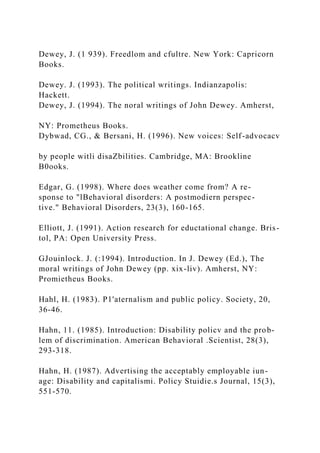
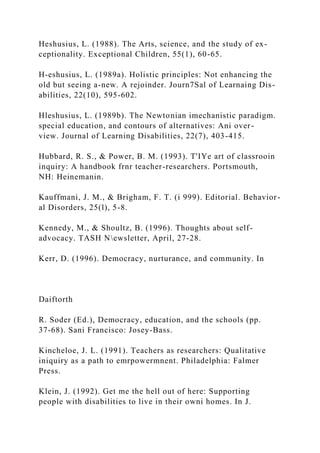
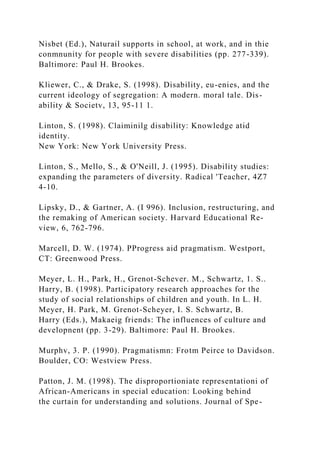
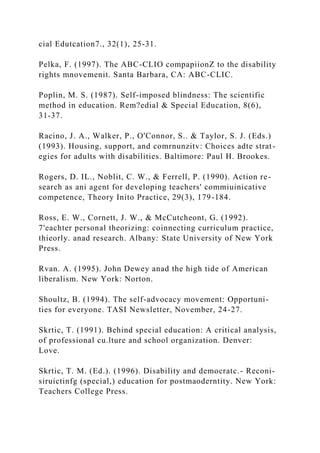
tient and trustworthy accompaniment, traveling side-
by-side with self-advocates, listening to their stories of
being bruised and contained by systems ostensibly de-
signed to bring them benefits. Crafting equal relation-
ships with oppressed individuals is assumed each day to
have a larger moral value, embodying the first steady
but small step toward the development of a targer com-
munity of equality. Acdvisors who bring a background
of professional training and experience, including edu-
cational experienrce with formal social science research
on disabilities, are in a unique position to embody the
mental habit of inquiry within the context of nurturing
and deep relationships.
To return to the words of Donna Kerr (1996, p. 63),
advisors are offered the opportunity to eclipse the com-
mon standardization and detachment of professional
activity in favor of engaging in "messy, labor-intenisive
work . . . thoughtiul listening by persons who are willing
and able to be curious about the lives of others and to
make the experiences of others an integral part of their
own stories." The opportunity of eqtuality occurring
within this co-constructed relational space, within this
social movement seeking the cultural redress of oppres-
sive circumstances, takes place in the interpersonal
muddiness of mingled personal stories. Labeled ancd un-
labeled personis alike can lean on one another, crafting
valuable selves in the act of sharing, inquiring deeply
and openly about the practicalities and choices all along
the way.
eferences
Beckwith, R.-M. (1996). "'rhe bruises are on the inside"l: An
advisor's perspective. In G. Dybwad & H1. Bersani (Eds.),
New voices: Selftadvocacy by people with disabilities. (pp.
240-242.) Camibridge MA: Brookline Books.
Campbell, J. (1993). Democracy as cooperative inquiry. In J. J.
Stuhr (Ed.). Philosophy and. the reconstruction aTft culture:
Pragmiatic essays after Dewey. (pp. 17-35). Albany, NY:
State tUniversity of New York Pr-ess.
Charlton, J. (1998). NothiiPqg aboIut ufs without us: Disabilitv
(ppression5 anId empowerment. Berkeley. CA: UIniversity of
California Press.
Chernets, G. ( 1995). Innovation in the way people with dis-
abilities can be supported to live and participate in commLu-
riity life. In L. Nadel & D. Rosenthial (Eds.), Dowvn syn-
drotne: Iiving and leari-ling in the community (pp. 256-262).
New York: Wiley-Liss, tnc.
C'ochran-Smnith. M4.. & Lytle, S. L. (1993). Inside/outside:
Teacher research anid knowledge. New York: 1'eachiers Col-
lege Press.
Coles, R. (I 989). 7he call ot stories: Teachaing andt the
mnorail
ihagination. Boston: 1-oughton Mifflin.
279
Cone, A. A. (1997). The beat goes on: Lessons iearned from
the rhythms of the self-advocacv movement. Men.ttal Retar-
dation, 35(2), 144-146.
Danforth, S. (in press). A pragmatic evaluation of three mod-
els of disability in special education. Journal oJtPhlysical and
Developinental Disabilities.
Danforth, S. (1997). On what basis hope? Modern progress
and postmodern alternatives, Mental Retardation, 35(2), 93-
106.
Danforth, S. (1999). Pragmatism and the scientific validation
of professional practices in American special education.
Disability and Society, 14(6), 733-751.
Danforth, S. (2000). Resistance theories: Exploring the politics
of misbehavior. Multiple Voices fOr Ethnically Diverse
Learners, 13-29.
Davis, L. J. (1 997). Thie disability studies reader. New York:
Routledge.
Dewey, John (1916). Democracy and education. New York:
Macmillan.
Dewey, J. (1920). Reconstruection in philosophy. New York: H.
Holt.
Dewey, J. (1925). E-xperience anfd n ratuire. Chicago: Open
Court.
Dewey, J. (1927). 7he public and its problems. Denver: Swal-
low.
Dewey, J. (1929). Thl.e quest for certainty: A stuiy of the rela-
tion of knowled,ge and action. New York: Minton, Balch.
I)ewev, J. (1930). Individualism, old atnd new. New York: Min-
ton, Balch.
Dewey, J. (1 939). Freedlom and cfultre. New York: Capricorn
Books.
Dewey. J. (1993). The political writings. Indianzapolis:
Hackett.
Dewey, J. (1994). The noral writings of John Dewey. Amherst,
NY: Prometheus Books.
Dybwad, CG., & Bersani, H. (1996). New voices: Self-advocacv
by people witli disaZbilities. Cambridge, MA: Brookline
B0ooks.
Edgar, G. (1998). Where does weather come from? A re-
sponse to "lBehavioral disorders: A postmodiern perspec-
tive." Behavioral Disorders, 23(3), 160-165.
Elliott, J. (1991). Action research for eductational change. Bris-
tol, PA: Open University Press.
GJouinlock. J. (:1994). Introduction. In J. Dewey (Ed.), The
moral writings of John Dewey (pp. xix-liv). Amherst, NY:
Promietheus Books.
Hahl, H. (1983). P1'aternalism and public policy. Society, 20,
36-46.
Hahn, 11. (1985). Introduction: Disability policv and the prob-
lem of discrimination. American Behavioral .Scientist, 28(3),
293-318.
Hahn, H. (1987). Advertising the acceptably employable iun-
age: Disability and capitalismi. Policy Stuidie.s Journal, 15(3),
551-570.
Heshusius, L. (1988). The Arts, science, and the study of ex-
ceptionality. Exceptional Children, 55(1), 60-65.
H-eshusius, L. (1989a). Holistic principles: Not enhancing the
old but seeing a-new. A rejoinder. Journ7Sal of Learnaing Dis-
abilities, 22(10), 595-602.
Hleshusius, L. (1989b). The Newtonian imechanistic paradigm.
special education, and contours of alternatives: Ani over-
view. Journal of Learning Disabilities, 22(7), 403-415.
Hubbard, R. S., & Power, B. M. (1993). T'IYe art of classrooin
inquiry: A handbook frnr teacher-researchers. Portsmouth,
NH: Heinemanin.
Kauffmani, J. M., & Brigham, F. T. (i 999). Editorial. Behavior-
al Disorders, 25(l), 5-8.
Kennedy, M., & Shoultz, B. (1996). Thoughts about self-
advocacy. TASH Newsletter, April, 27-28.
Kerr, D. (1996). Democracy, nurturance, and community. In
Daiftorth
R. Soder (Ed.), Democracy, education, and the schools (pp.
37-68). Sani Francisco: Josey-Bass.
Kincheloe, J. L. (1991). Teachers as researchers: Qualitative
iniquiry as a path to emrpowermnent. Philadelphia: Falmer
Press.
Klein, J. (1992). Get me the hell out of here: Supporting
people with disabilities to live in their owni homes. In J.
Nisbet (Ed.), Naturail supports in school, at work, and in thie
conmnunity for people with severe disabilities (pp. 277-339).
Baltimore: Paul H. Brookes.
Kliewer, C., & Drake, S. (1998). Disability, eu-enies, and the
current ideology of segregation: A modern. moral tale. Dis-
ability & Societv, 13, 95-11 1.
Linton, S. (1998). Claiminilg disability: Knowledge atid
identity.
New York: New York University Press.
Linton, S., Mello, S., & O'Neill, J. (1995). Disability studies:
expanding the parameters of diversity. Radical 'Teacher, 4Z7
4-10.
Lipsky, D., & Gartner, A. (I 996). Inclusion, restructuring, and
the remaking of American society. Harvard Educational Re-
view, 6, 762-796.
Marcell, D. W. (1974). PProgress aid pragmatism. Westport,
CT: Greenwood Press.
Meyer, L. H., Park, H., Grenot-Schever. M., Schwartz, 1. S..
Harry, B. (1998). Participatory research approaches for the
study of social relationships of children and youth. In L. H.
Meyer, H. Park, M. Grenot-Scheyer, I. S. Schwartz, B.
Harry (Eds.), Makaeig friends: The influences of culture and
developnent (pp. 3-29). Baltimore: Paul H. Brookes.
Murphv, 3. P. (1990). Pragmatismn: Frotm Peirce to Davidson.
Boulder, CO: Westview Press.
Patton, J. M. (1998). The disproportioniate representationi of
African-Americans in special education: Looking behind
the curtain for understanding and solutions. Journal of Spe-
cial Edutcation7., 32(1), 25-31.
Pelka, F. (1997). The ABC-CLIO compapiionZ to the disability
rights mnovemenit. Santa Barbara, CA: ABC-CLIC.
Poplin, M. S. (1987). Self-imposed blindness: The scientific
method in education. Rem?edial & Special Education, 8(6),
31-37.
Racino, J. A., Walker, P., O'Connor, S.. & Taylor, S. J. (Eds.)
(1993). Housing, support, and comrnunzitv: Choices adte strat-
egies for adults with disabilities. Baltimore: Paul H. Brookes.
Rogers, D. IL., Noblit, C. W., & Ferrell, P. (1990). Action re-
search as ani agent for developing teachers' commiuinicative
competence, Theory Inito Practice, 29(3), 179-184.
Ross, E. W., Cornett, J. W., & McCutcheont, G. (1992).
7'eachter personal theorizing: coinnecting curriculum practice,
thieorly. anad research. Albany: State University of New York
Press.
Rvan. A. (1995). John Dewey anad the high tide of American
liberalism. New York: Norton.
Shoultz, B. (1994). The self-advocacy movement: Opportuni-
ties for everyone. TASI Newsletter, November, 24-27.
Skrtic, T. (1991). Behind special education: A critical analysis,
of professional cu.lture and school organization. Denver:
Love.
Skrtic, T. M. (Ed.). (1996). Disability and democratc.- Reconi-
siruictinfg (special,) education for postmaoderntity. New York:
Teachers College Press.
Skrtic, T. M., Sailor, W., & Gee K. (1996). Voice, collabora-
tion, and in,clusion: Democratic themes in educational and
social reform initiatives. Remedial & Special Education,
17(3), 142-157.
Thoimson, R. G. (1995). Integrating disabilitv studies in the
existing curriculuimi: 'The exam-aple of 'womien and literature'
at Howard University. Radical Teacher, 47, 15-21.
Ward, M. J., & Meyer. R. N. (1999). Self-determiniation for
people with developmental disabilities and autism. Focus on1
Autismia anid Other Develo,pmenrtal Disorders, 14(3), 133-
139.
West. C_ (1989). The American evasiont of philosophy: a gene-
alogy of pragmatism. Madison, WI: University of Wiscoinsin
Press.
Westbrook, R. B. (1991). John Dewey aind Ameriican demiioc-
racy. Ithaca, NY: Cornell University Press.
Williams. P., & Shoultz, B. (I 982). W1,e carn speak ftlr
ourselves.
London: Souvenir Press.
Article received: May 25, 201Q0
Final acceptance: November 3, 2000
Editor in Charge: George Singer
COPYRIGHT INFORMATION
TITLE: A Deweyan perspective on democracy and inquiry in the
field of specialeducation
SOURCE: The Journal of the Association for Persons with
Severe
Handicaps 26 no4 Wint 2001
WN: 0134902089005
The magazine publisher is the copyright holder of this article
and it
is reproduced with permission. Further reproduction of this
article in
violation of the copyright is prohibited..
Copyright 1982-2002 The H.W. Wilson Company. All rights
reserved.
Stone, Sayman, Carrero, & Lusk 3
Thoughts on Dewey’s Democracy
and (Special) Education
Jennifer P. Stone & Donna M. Sayman
Wichita State University
Kelly Carrero
Texas A&M University-Commerce
Mandy E. Lusk
Clayton State University
Journal of Thought, Fall-Winter 2016
Rationale
It seems almost incredible to us, for example, that things which
we know
very well could have escaped recognition in past ages.
—John Dewey (1916, p. 21)
Equality is not sameness. In special education, all aspects of
educa-
tion and access are framed with the understanding that what is
fair is
not necessarily equal. In an age of heightened awareness of civil
rights
for many marginalized groups of people, our culture confuses
“equality”
with “equity.” Equality never guarantees, nor should it, that all
will be
equal. As Garrison (2012) posited, “equality is the antithesis of
same-
ness…Democratic moral equality celebrates incommensurably
unique,
one-time-only qualitative individuality” (p. 370).
The centennial of Dewey’s (1916) classic Democracy and
Education
reminds scholars about the love Dewey brought to the field of
educa-
tion, and by inference, special education. This anniversary leads
to
the contemplation of the issues of promise in education through
social
justice, and how differently special education practices would
look if
Dewey were alive today. The authors imagine Dewey’s voice
echoing
through the century was resounding clearly with the promise of
a true
democratic education for all children. This article
conceptualizes special
education in relation to Dewey’s vision of democratic education
and how
that would be framed in Democracy and Education.
It is the goal of this article to postulate how Dewey would have
Hibah Alharbi
Hibah Alharbi
Hibah Alharbi
Hibah Alharbi
Hibah Alharbi
Hibah Alharbi
Thoughts on Dewey’s Democracy and (Special) Education4
imagined an education system had he the knowledge available
today.
This conceptual argument was directed by the question: What
would
Dewey say about modern inclusionary practices of students with
special
needs in a regular education classroom? The authors posit that
an ex-
amination of the current American education system through
Dewey’s
gaze would reveal that special education, as conceptualized
under IDEA
(2004), would not exist if Dewey had been born a few decades
later.
The authors further postulate that education and educator
prepara-
tion would include a focus on all children regardless of
difference, and
educators would differentiate based on each student’s strengths
and
needs had one of the seminal works in our field been able to
incorporate
the knowledge and understanding of children with
exceptionalities
available in this day and age. The authors agree with Danforth’s
(2008)
premise that Dewey would view disability as a social construct
and that
what disables a person is not an innate difference, but the way
society
interprets difference as aberrant. This paper seeks to illuminate
Dew-
eyan philosophy and its effect on special education by
addressing these
major topics: (a) the current state of American (special)
education; (b)
Dewey and inclusion; and (c) philosophy in special education
The Current State of American (Special) Education
At the beginning of the 20th century, people with severe
exception-
alities were not educated in public schools and few were raised
by their
families. It was customary for these individuals to be
recommended by
the family physician for institutionalization at a very young age.
These
people were shielded from society and society was shielded
from them.
It is not surprising that Dewey did not refer to people with
exceptionali-
ties in any uncertain, or more historically representative, terms
in his
pivotal work, Democracy and Education (1916). That does not
preclude
the idea that Dewey’s ideas are not directly relevant and
applicable to
the structure of today’s inclusive schools.
In fact, Baglieri and Shapiro (2012, p.67) stated that they are
not
“feeble minded” was the general consensus and terminology of
the early
20th century. In light of these policies and practices, Dewey
himself was
not shaped by experiences with people with exceptionalities. He
was
shielded from this population. Dewey’s own Pedagogic Creed
(1897) did
not take into consideration the psychological and sociological
needs of
students with exceptionalities. By revisiting Democracy and
Educa-
tion with a critical lens, the authors postulate how Dewey would
have
envisioned inclusive school practices such as co-teaching,
differentiated
instruction, and Universal Design for Learning (UDL).
Hibah Alharbi
Hibah Alharbi
Hibah Alharbi
WHY
Hibah Alharbi
Hibah Alharbi
‫مهمه‬ ‫قطه‬ ‫�ن‬
Hibah Alharbi
Hibah Alharbi
Hibah Alharbi
Stone, Sayman, Carrero, & Lusk 5
Situated in Deweyan philosophy through this uniquely
interpretive
lens, Dewey’s Pedagogic Creed would have one believe schools
are in a
unique situation to mimic society and help children understand
their
places therein (Dewey, 1897). Historically, when special
education ser-
vices in public schools were organized for individuals with
significant
exceptionalities (e.g., low functioning autism, medically fragile,
severe
cognitive impairments), they were separate, as mirrored in
society. This
was accomplished through an emphasis of difference and deficit
which
was clearly exemplified as these students were often educated in
sepa-
rate buildings or classrooms rarely were allowed to interact with
their
normally functioning peers (Raymond, 2011).
Analyzing Democracy and Education (1916) through Dewey’s
descrip-
tion of democratic schooling led to a unique perspective of how
embed-
ded, dichotomous thinking about education practices maintains
and
perpetuates a normalizing system of general versus special
education.
This denies social justice for all students, contradicting the
democratic
principles of an American education. Ashby (2012) noted, “The
separation
between general and special education is neither natural nor
inevitable”
(p. 98). If traditional teacher preparation programs do not
sufficiently
prepare general education teachers to reach the diverse students
they
will have in their classrooms, it only serves to embed a dual
education-
track mindset in the American system of schooling. Because
society has
become more inclusive and Dewey (1897) would have school
primarily
be a social institution representing present life, a major
paradigm shift
in teacher preparation programs is critical for ushering in true
social
justice and democratic education for all students.
If teacher preparation programs could effectively equip all
future
educators to (a) recognize characteristics of exceptionalities, (b)
differ-
entiate curriculum for diverse learners, and (c) effectively
implement a
positive behavior support system, dual-track systems of special
educa-
tion versus general education could be eliminated. Instead,
American
schools could offer a truly democratic education based on a
bedrock of
social justice by allowing true equal opportunity for all
students. More
than at any other time in American education, general educators
need
to accommodate instruction thereby allowing equitable
education for a
wide range of students in their classrooms.
The responsibility for training these educators belongs to
teacher
preparation programs. Dewey (1897) believed in the power of
connecting
the purpose of schooling directly to the individual’s needs (the
psychologi-
cal) and then to the social interaction in order to give learning
purpose.
Later, Dewey (1916) envisioned learning as an interactive
process where
new knowledge builds on prior knowledge within that social
interaction.
Hibah Alharbi
Hibah Alharbi
Hibah Alharbi
Hibah Alharbi
Hibah Alharbi
Thoughts on Dewey’s Democracy and (Special) Education6
Viewed through this critical lens, those with (dis)abilities have
greater
autonomy and an equal voice to express their experiences, thus
allowing
them equal power in their education (Gallagher, 2004). In what
Garri-
son (2012) described as “creative democracy” (p. 369)
education should
provide students with the ability to be critical thinkers and
challenge
social constructs that corrupt and separate people. Current
teacher
preparation paradigms negate the legacies of hope promised
through
decades of reform and policy since Brown v. Board of
Education and
the Individuals with Disabilities Education Act (IDEA, 2004).
This dual
educational track in schools actually entrenches segregated
thoughts in
educating typically developing students apart from those with
differ-
ences. In response to troubling data about the post-school
outcomes for
individuals with disabilities, various reforms efforts are being
proffered
to ameliorate the issue (Naraian & Oyler, 2014).
Teacher preparation programs have, historically, equipped
educators
for separate areas of teaching: general or special education
(King-Sears,
Carran, Dammann, & Arter, 2012). The problem is that teachers
in
general education are often insufficiently trained to
differentiate either
the curriculum or the classroom environment for students with
varying
levels of academic or behavioral needs. Lack of preparation to
accom-
modate the curriculum, classroom environment, and behavior
may lead
to the teacher incorrectly recommending students with
differences for
special education testing rather than providing needed
interventions
(Gehrke & Cocchiarella, 2013). Dewey (1897) saw that the
school was
the center of social progress, but in order for this to be
achieved, it was
necessary to endow the educator with the tools necessary to
perform
the tasks required. The proper teacher preparation, in this case,
is what
is needed at this time in society where diversity means
understanding
the needs of all children in a classroom.
Dewey and Inclusion
Inclusion as a Necessity of Life
Beings who are born not only unaware of, but quite indifferent
to, the
aims and habits of the social group have to be rendered
cognizant of
them and actively interested. Education, and education alone,
spans
the gap. (Dewey, 1916, p.6)
The authors imagine Dewey would stress that students with
excep-
tionalities cannot learn on their own, that they would need
support to
understand the world into which they have been born. Inclusion,
at its
basest form, exists as a matter of placement or educational
setting in
Hibah Alharbi
Hibah Alharbi
Stone, Sayman, Carrero, & Lusk 7
which children with exceptionalities are enrolled in programs
that are
designed for typically developing children. In this version of an
inclusive
classroom, the children with exceptionalities have the ability to
interact
with their nondisabled peers. Recent developments in
educational policy
and best practice call for inclusion of students of all ability
levels to be
educated in the same setting to the maximum extent possible or
appro-
priate (U.S. Department of Education, 2015 a). There are
dichotomous
viewpoints as to the extent to which this setting should be
implemented
with Fuchs and Fuchs (1998) on one side believing there should
be a
continuum of services from special homes to full time general
education
placements, to Stainback and Stainback (1984 ) on another side
who
believe that full inclusion in the general setting is the only true
option.
An initial look at Democracy and Education (1916) would
suggest that
Dewey may have supported this idea of inclusion as he notes
that the
“very process of living together educates” (Dewey, p. 9).
Though tension exists about the degree of implementation, this
minimal definition of inclusion is in accordance with the natural
and
least restrictive environment provision in the Individuals with
Disabili-
ties Education Improvement Act (U.S. Department of Education,
2015 a)
protecting the right of individuals with disabilities to be
educated to the
maximum extent appropriate among their same aged
nondisabled peers.
This is an additive approach to special education, and some are
of the
opinion that inclusion is an ongoing process; that practice of
this sort
will lead to further marginalization of children with disabilities.
Dewey
(1916) showed similar concerns in that he saw the formalization
of the
schooling process and focus on imparting information as
detracting from
the benefits of socialization and formations of social
dispositions vital
to experiencing life with meaning.
Inclusion as a Social Function
A second, and widely accepted, definition in the field sees
inclusion
not just as a setting, but as a purposeful way to help a child
with dis-
abilities to become part of the community in which they live
and society
in general . Proponents of this definition of inclusion argue that
it is
not enough to merely put a child with disabilities in an
environment
designed for typically abled children, but one must work to
ensure the
child’s participation in activities and development of
relationships. The
term should convey that children with disabilities are an
integral part
of their classrooms, accepted by their classmates, and desired
by their
friends. The focus on the social experience of children with
disabilities in
general education environments is a noted paradigm shift in the
field of
both sociology and special education. Again, Dewey’s (1916)
Democracy
Hibah Alharbi
Hibah Alharbi
Thoughts on Dewey’s Democracy and (Special) Education8
and Education grows its definition and philosophy of education
as more
than a system set up to train the immature members of society
in the
process of desirable thought, but instead as a means to allow
children
to know what it means to be members of a tribe. Dewey
contends that
through group membership, each member can share successes
and
failures; thereby, developing a culture of concern for your
fellow man or
classmate. This principle runs through each fiber of special
education
legislation and best practices. Finally, this principle seeks to
not only
serve the students with disabilities, but also their same-aged,
typically
developing peers.
Inclusion as Direction
Still a third interpretation of inclusion takes instruction beyond
that which is directed solely towards the students with special
needs,
but instead it is a pedagogy designed to be accessible by all
students
from its inception . Inclusive pedagogy (Florian & Black-
Hawkins, 2011)
supports the achievement of all children in the classroom. It
allows
an opportunity for students “to have the same ideas about the
things
which others have, to be like-minded with them, and thus to be
really
members of a social group” (Dewey, p. 35). An inclusive
classroom, in this
sense, is characterized by universal accessibility of both
environment
and curriculum. The general curriculum does not need to be
modified
to meet the needs of students with disabilities; it is already
accessible
by design. Florian and Black-Hawkins (2011) describe current
and
outdated additive inclusionary practice as the “process of
providing for
all by differentiating for some” (p. 826). Jordan et al (2009)
found that
meeting the needs of all students on individual levels is good
practice
and will serve to benefit all students in inclusive classrooms,
both those
who have disabilities and those who are typically developing.
As a matter of importance, Dewey (1916) noted the natural or
native
impulses of children do not always coincide with what is
expected of them
in society. It is necessary to consider, in today’s inclusive
environments,
that experiencing joint and shared situations leads to a different
kind of
socialization. By implementing inclusive pedagogy such as that
proposed
by Florian and Black-Hawkins (2011) early and throughout
school set-
tings, students will have the exposure to the kind of moral and
social
dispositions towards individuals with exceptionalities that will
influence
their own mental dispositions. As students experience
environments
that are designed with everyone in mind, it will become more
apparent
that people with exceptionalities are not oddities or targets.
They are
typical members of society, and it is important that children
learn how
to work with, be around, and be friends with people of all
abilities. Hav-
Hibah Alharbi
Hibah Alharbi
Stone, Sayman, Carrero, & Lusk 9
ing teachers and educators who practice inclusive pedagogies
will help
to serve as models in this endeavor. Dewey theorized, “Social
control of
individuals rests upon the instinctive tendency of individuals to
imitate
or copy the actions of others. The latter serve as models”
(Dewey, p. 3 9),
and this can be directly applied to the direction of inclusive
education
in the present day.
The Democratic Concept in Inclusion
The school, as an entity, is a place of natural diversity. Dewey
(1897,
1916) wrote that the school needed to be a direct reflection of
the com-
munity in which it is placed. In addition, Dewey strongly
suggested that
no part of this community or society should be ignored. An
advocate for
inclusion without knowing it, Dewey spoke negatively about the
effects
of isolation on any given population. Further noting “an alert
and ex-
panding mental life depends upon an enlarging range of contact
with...
the sphere of social contacts” (Dewey, 1916, p. 93 ). Therefore,
we live in
a society of diversity. Meaning, all persons in our society are
different,
and finding respect for these differences make us better
practitioners.
There are various categories that make students diverse.
Categories
of diversity may include: (a) ethnicity, (b) socioeconomic
status, (c) spiri-
tual and religious beliefs, (d) sexual orientation, (e) intellectual
ability
levels, and (f) geographical regions. Some subgroups also may
include
educational background, occupation, and even levels of parent’s
income.
Smith (2012) labeled these categories as visible (e.g., race,
gender) and
invisible (e.g., spiritual and religious beliefs, sexual
preferences) diversity
and encouraged educators to celebrate the differences of the
diversity
to promote democracy in our society. The democratic ideal
would have
these groups come together to share common interests and use
the rec-
ognition of those interests to gain more social control.
Additionally, and
more relevant to the topic of inclusive education, Dewey (1916)
would
see freer interaction between people with exceptionalities and
other
students as a product of diversification and a change in social
habit.
Together, this intentional readjustment to the educational
system and
its resulting effects are what Dewey would characterize as a
“democrati-
cally constituted society” (Dewey, 1916, p. 93 ).
Specifically related to students with various ability levels,
Dewey
(1916) passionately believed that all students should be
provided an
option to learn. He stresses the relation of Platonic Educational
Phi-
losophy as a function of individualization in education (e.g.
discovering
and developing personal capacities), a tenant inclusive
educators feel
strongly about. Still, Dewey identifies that Plato failed to
acknowledge
the uniqueness of individuals outside of class structures.
Specifically,
Hibah Alharbi
Thoughts on Dewey’s Democracy and (Special) Education10
Dewey mentions the need to recognize active tendencies and
capabili-
ties in relation to diversity. When revisiting Democracy and
Education
with a critical lens, it is this kind of progressive statement that
lends
itself to direct application of inclusive philosophy. Dewey
suggested
“the two points selected by which to measure the worth of a
form of
social life are the extent in which the interests of a group are
shared by
all its members, and the fullness and freedom with which it
interacts
with other groups” (Dewey, 1916, p.106). Furthermore, Dewey
stated
that all citizens must share in the productivity of the society and
this
production is learned in the educational setting. Dewey does not
leave
students with exceptionalities out of this equation, rather, he
strongly
advises educators to work together to build all persons’
strengths.
Interest and Discipline
Due to the inclusive nature of today’s education system, it is
no
longer appropriate to train teachers in basic pedagogy and
delivery of
content; teachers must be able to identify and subsequently
prepare
interventions, accommodations, and inclusive environments for
students
who are at risk for failure or who have identified
exceptionalities. This
new invaluable set of skills often requires some formal
professional de-
velopment or training in special education (Valli & Rennert-
Ariev, 2000;
Blanton, Putagh, & Boveda, 2014). Similar to Dewey’s
contention that
the organism must regenerate and adapt to its environment,
interdisci-
plinary work emerges as a consequence of evolving industry and
science
(Newell, 2001). Colleges of teacher education have been forced
to consider
creative solutions to the discipline specific nature of higher
education
institutions in order to meet federal regulations on teacher
training
and quality. Specifically, NCLB (U.S. Department of Education,
2015b)
required that teachers be highly qualified. For special education
teachers,
particularly those teaching in secondary settings, state
interpretation
often resulted in requiring state certifications in both special
education
and a core academic area (i.e., a general education teacher
certification;
Blanton & Pugach, 2007). Consequently, traditional special
education
teacher preparation programs in higher education have had to
respond
to state mandates using non-traditional, or creative, measures.
The disciplinary take on teacher education is partially brought
on
by prior social conditions. As the students with exceptionalities
were
isolated, so was their instruction, and instructors of students
with excep-
tionalities received separate training. Dewey (1916) saw the
integration
of disciplinary instruction as a challenge to overcome, but it
seems that
colleges of education are in good position to find success in the
endeavor.
Dewey (1916) predicted,
Hibah Alharbi
Stone, Sayman, Carrero, & Lusk 11
. . . persons whose interests have been enlarged and intelligence
trained
by dealing with things and facts in active occupations having a
pur-
pose (whether in play or work) will be those most likely to
escape the
alternatives of an academic and aloof knowledge and a hard,
narrow,
and merely ‘practical’ practice. (p. 147)
Experience and Thinking/The Nature of Method
Dewey (1938) revisited his philosophy briefly to describe the
experi-
ence of the progressive schools. Continuing to view Deweyan
philosophy
through a critical lens, the authors noted that Dewey found an
urgency
to include a philosophy of experience in addition to the focus on
current
disciplinary methods. One common attempt at breaking
disciplinary
tradition in teacher education is to offer pre-service teachers
training in
collaborative or dual certification programs (i.e., preparation
for certifi-
cation in both general and special education; Blanton & Pugach,
2007;
Blanton & Pugach, 2011; Pugach, Blanton, & Correra, 2011),
thus giving
them more real experiences in inclusive and special education
settings
prior to joining the teaching profession. In order to develop
teacher
certification programs resulting in effective preparation in both
general
and special education teaching practices, diverse areas of
expertise are
necessary (Blanton & Pugach, 2007). Blending two traditionally
different
perspectives (i.e., general and special education teacher
preparation) can
prove challenging, yet provides an ideal environment for
utilizing the
co-teaching model (York-Barr, Bacharach, Salk, Frank, &
Beniek, 2004).
The most obvious co-teaching stage to be included in dual
certification
programs is co-programming or co-planning.
Co-programming. Faculty in teacher preparation programs have
to navigate multiple governing and accrediting bodies in order
to meet
national, state, university, college, and departmental
regulations. Fur-
thermore, regulations for general education and special
education teacher
preparation programs often differ quite significantly, causing
faculty to
employ creative solutions (Blanton & Pugach, 2011).
Faculty representing each group must meet the accreditation
stan-
dards of their respective national specialized professional
associations
(SPA) in order to then prepare a proposed dual certification
program to
meet Council for the Accreditation of Educator Preparation
standards
and, consequently, be eligible for national accreditation and
recognition. In
addition to co-programming to meet national SPA requirements,
involved
faculty also must consider teacher competencies and guidelines
for each
respective discipline as outlined in their state department of
education.
All of this must be completed while adhering to strict guidelines
as to
the number of credit hours allowed in a program offering per
university
Thoughts on Dewey’s Democracy and (Special) Education12
regulations. Theoretical and practical synergy must emerge as
pedagogi-
cal priorities are discussed and agreed upon. Consequently,
agreements
require creative problem-solving and programmatic concessions
from
both disciplines and multiple administrations. Time, planning,
reflection,
concessions, and diligence are necessary components to
preparing a dual
certification program planning team. It should be noted that
through
this critical lens, Dewey (1938) predicted the difficulty of such
a feat as
to change the static structure of our current teacher education
system
when he noted that pushing schools in a positive direction in
terms of
selecting appropriate methods is required but is a “slow and
arduous”
(p. 30) process.
Modeling. Dewey contended that learning in a community with
others enriches the learning experience. In addition to co-
planning that
occurs as a result of the increased need for dual certification
programs in
teacher education, using co-teaching as a modeling strategy in
teacher
preparation programs is also highly effective (Bacharach, Heck,
&
Dahlberg, 2008; Patel & Herick, 2010). Pre-service teachers
report they
believe they will be expected to participate in co-teaching teams
when
they enter the P-12 classroom (Bacharach, Heck, & Dahlberg,
2008).
Observing faculty negotiate conflict and collaboratively present
content
and experiences provides a model of teaching and
professionalism for
the pre-service teacher to reflect upon when entering the
profession.
Conclusion: Deweyan Philosophy in Special Education
Researchers suggest that of the six million students with
disabili-
ties served in special education, almost 80% spend the majority
of their
day in a regular education classroom (U.S. Department of
Education,
2012b). Gehrke and Cocchiarella (2013) noted that as a result of
trends
pushing for inclusive classrooms, general education teachers
must be
prepared to teach students in a variety of contexts and from a
variety
of backgrounds and abilities. General education teachers must
demon-
strate the ability to improve student learning for all students.
Inclusive
education practices are necessary for social justice to become a
reality
for all students (Artiles, Harris-Murri, & Rostenberg, 2006). As
Obia-
kor (2011) suggested, social justice is at the heart of inclusion
because
it stands in opposition to exclusion. Public education is one of
the few
arenas in American society where the hope of equity and the
prospects
of societal advancement may be realized by all of our children.
It is the
proving ground for optimism and the opportunity for all
students to
become productive members of society.
As stated at the beginning of the article, the authors posited
that
Stone, Sayman, Carrero, & Lusk 13
Dewey (1897, 1916, & 1938) would embrace all children in an
inclusive
education system that never delineates normal from different.
More-
over, had Dewey been born a few decades later, education and
educator
preparation would include a focus on all children regardless of
difference,
and educators would differentiate based on each student’s
strengths
and needs. Certainly, hints of an inclusionary education are
shadowed
throughout his inspirational work, Democracy and Education.
One can
easily see how Chapter Eight of Democracy and Education,
“Aims in
Education,” provides a template for the modern Individualized
Educa-
tion Plan (IEP) used in special education. Furthermore, when
Dewey
revisited his philosophy of education in Experience and
Education (1938),
he suggested, “only when development in a particular line
conduces to
continuing growth does it answer to the criterion of education
as growing”
(p. 36). As inclusive environments are not only educative to the
psycho-
logical selves of students with exceptionalities, these
environments are
also continuously educative to the sociological selves of all
students. The
authors believe that today’s principles and ideals of special
education
meet Dewey’s (1938) criteria for a growing educative process.
Dewey (1938) also noted that while experiences have the
opportunity
to be educative, as inclusion is meant to be, there is also the
opportunity
for experiences to be mis-educative. The greatest difficulty for
achiev-
ing full inclusion for students with disabilities is the lack of
training
received by regular educators in their teacher preparation
programs.
Traditional teacher preparation programs usually require the
completion
of 120 credits within a four year undergraduate program. The
majority
of programs offer one sole course covering a vast range of
topics such
as: recognizing the characteristics of students with learning or
behavior
differences, recognizing the legal requirements concerning
special edu-
cation, and identifying which modifications to make in the
classroom.
Researchers discovered that teacher preparation programs
struggle to
allocate sufficient time to additional courses regarding the
education of
those needing a differentiated curriculum, providing positive
behavioral
supports, or understanding the Response to Intervention (RtI)
model of
intervention (Bowlin, 2012; Forlin, 2010; Gehrke &
Cocchiarella, 2013;
Obiakor, 2011).
Courses in teacher preparation programs focusing on
characteristics
of learners with difference or differentiation of curriculum are
commonly
taught separately from other core education courses and by
faculty in the
special education department, rather than demonstrating for
students a
truly inclusive view of education whereby the topics would be
integrated
throughout coursework and co-taught by faculty members. This
leads
to perpetuating stereotypes which embed the notion of a
dichotomous
Thoughts on Dewey’s Democracy and (Special) Education14
education system for those in regular and/or special education.
Collabo-
ration in university classrooms then is viewed as a theory rather
than
a pragmatic model of learning. Teachers then go into their first
years of
teaching and discover they are responsible for the education of
students
with exceptionalities who are included in the general education
setting.
Dewey (1938) would have seen this as a lack in continuity of
experience.
As “every experience influences in some degree the objective
conditions
under which further experiences are had” (p.36). It is
troublesome, to say
the least, that teacher preparation programs could be setting
new teach-
ers up for negative and outdated perceptions of special
education.
The authors feel strongly that Dewey (1897, 1916, & 1938)
would
agree: there should not be a dichotomous education track in
traditional
K-12 education nor in teacher education programs. Instead, as
clearly
evident in Democracy and Education, there should be one
system where
educators have the ability to differentiate for all learners. This
would be
a natural consequence of their similar experiences in higher
education
teacher education, and thus truly ensure social justice and an
equitable
and democratic education for all children.
References
Artiles, A. J., Harris-Murri, N., & Rostenberg, D. (2006).
Inclusion as social justice:
Critical notes on discourses, assumptions, and the road ahead.
Theory into
Practice, 45 (3), 260-268, doi: 10.1207/s15430421tip4503_8
Ashby, C. (2012). Disability studies and inclusive teacher
preparation: A socially
just path for teacher education. Research & Practice for Persons
with Severe
Disabilities, 37 (2), 89-99.
Bacharach, N., Heck, T. W., & Dahlberg, K. (2008). Co-
teaching in higher educa-
tion. Journal of College Teaching & Learning, 5 (3), 9-16.
Baglieri, S., & Shapiro, A. (2012). Disability studies and the
inclusive classroom.
New York, NY: Routledge Press.
Belk, J. (2005). Inclusion in early childhood programs: A
kaleidoscope of diversity.
National Forum of Special Education Journal, 16 (1), 1-6.
Blanton, L. P., & Pugach, M. C. (2007, June). Collaborative
programs in general
and special teacher education: An action guide for higher
education and state
policy makers. Washington, DC: Council of Chief State School
Officers.
Blanton, L. P., & Pugach, M. C. (2011). Using a classification
system to probe the
meaning of dual licensure in general and special education.
Teacher Education
and Special Education, 34(3), 219-234. doi:
10.1177/0888406411404569
Blanton, L. P., Pugach, M. C., & Boveda, M. (2014). Teacher
education reform
initiatives and special education: Convergence, divergence, and
missed op-
portunities (Document No. LS-3). Retrieved from University of
Florida, Col-
laboration for Effective Educator, Development, Accountability,
and Reform
Center website: http://ceedar.education.ufl.edu/tools/literature-
syntheses/
Bowlin, T. M. (2012). Inclusion and collaboration: Impact of
preservice teachers’
Stone, Sayman, Carrero, & Lusk 15
experiences on their knowledge, attitudes, and perceived sense
of efficacy.
Ph.D. dissertation. University of Tennessee, 2012.
http://trace.tennessee.
edu/utk_graddiss/1272
Buysse, V., & Wesley, P. W. (1999). Quality of early childhood
programs in inclusive
and noninclusive settings. Exceptional Children, 65(3), 301-
314.
Cross, A. F., Traub, E. K., Hutter-Pishgahi, L., & Shelton, G.
(2004). Elements
of successful inclusion for children with significant disabilities.
Topics in
Early Childhood Special Education, 24(3), 169-183.
Danforth, S. (2008) Contributions of John Dewey to an
educational philosophy
of intellectual disability. Educational Theory, 58(1), 45-62.
Dewey, J. (1916/1944). Democracy and education: An
introduction to the philoso-
phy of education. New York, NY: The Free Press.
Dewey, J. (1938/2015). Experience and education. New York,
NY: The Free
Press.
Dewey, J., & Small, A. (1897). My pedagogic creed. New York,
NY: E. L. Kellogg
& Co.
Florian, L., & Black-Hawkins, K. (2011). Exploring inclusive
pedagogy. British
Educational Research Journal, 37(5), 813-828. doi:
10.1080/01411926.201
0.501096
Florian, L., & Linklater, H. (2010). Preparing teachers for
inclusive education:
Using inclusive pedagogy to enhance teaching and learning ofr
all. Cambridge
Jounal of Education, 40(4), 369-386. doi:
10.1080/0305764X.2010.526588
Florian, L., Young, C., & Rouse, M. (2010). Preparing teachers
for inclusive and
diverse educational environments: Studying curricular reform in
an initial
teacher education course. International Journal of Inclusive
Education,
14(4), 709-722. doi: 10.1080/13603111003778536
Forlin, C. (2010). Reframing teacher education for inclusion. In
C. Forlin (Ed.),
Teacher education for inclusion: Changing paradigms and
innovative ap-
proaches (pp. 3-12). New York, NY: Routledge Press.
Fuchs, D., & Fuchs, L. (1998). Competing visions for educating
students with
disabilities: Inclusion versus full inclusion. Childhood
Education, 74(5),
309-316.
Gallagher, D. (2004). The importance of constructivism and
constructivist peda-
gogy for disability studies in education. Disability Studies
Quarterly, 24(2).
Retrieved from: http://dsq-sds.org/article/view/489/666
Garrison, J. (2012). Individuality, equality, and creative
democracy-the task
before us. American Journal of Education, 118(3), 369-379.
Gehrke, P. S., & Cocciarella, M. (2013). Preservice special and
general educa-
tors’ knowledge of inclusion. Teacher Education and Special
Education,
36(3), 204-216.
Individuals with Disabilities Education Act, Public Law 108-
446, 108th Con-
gress. (2004).
Jordan, A., Schwartz, E., & McGhie-Richmond, D. (2009).
Preparing teachers
for inclusive classrooms. Teaching and Teacher Education, 25,
535-542. doi:
10.1016/j.tate.2009.02.010
Kasa-Hendrickson, C., & Kluth, P. (2005). “We have to start
with inclusion and
Thoughts on Dewey’s Democracy and (Special) Education16
work it out as we go”: Purposeful inclusion for non-verbal
students with
autism. International Journal of Whole Schooling, 2(1), 2-14.
King-Sears, M. E., Carran, D. T., Dammann, S. N., & Arter, P.
S. (2012) Multi-
site analyses of special education and general education student
teachers’
skill ratings for working with students with disabilities. Teacher
Education
Quarterly, 39(2), 131-149.
Leatherman, J. M. (2007). “I just see all children as children”:
Teachers’ percep-
tions about inclusion. The Qualitative Report, 12(4), 594-611.
Naraian, S., & Oyler, C. (2014). Professional development for
special education
reform: Rearticulating the experiences of urban educators.
Urban Educa-
tion, 49(5) 499–527.
Newell, W. H. (2001). A theory of interdisciplinary studies.
Issues in Integrative
Studies, 19, 1-25.
Nind, M., Flewitt, R., & Payler, J. (2010). The social experience
of early childhood
for children with learning disabilities: inclusion, competence
and agency.
British Journal of Sociology of Education, 31(6), 653-670. doi:
10.1080/01
425692.2010.515113
Obiakor, F. (2011). Maximizing access, equity, and inclusion in
general and special
education. The Journal of International Association of Special
Education,
12(1), 10-16
Odom, S. L. (2000). Preschool inclusion: what we know and
where we go from
here. Topics in Early Childhood Special Education, 20(1), 20-
27.
Odom, S. L., Buysse, V., & Soukakou, E. (2011). Inclusion for
young children with
disabilities: A quarter century of research perspectives. Journal
of Early
Intervention, 33(4), 344-356. doi: 10.1177/1053815111430094
Patel, N. H., & Herick, D. (2010). Collaborating in higher
education: Improving
pedagogical practice. Scholarlypartnershipsedu, 5(2), Article 7.
Pugach, M. C., Blanton, L. P., & Correa, V. I. (2011). A
historical perspective on
the role of collaboration in teacher education reform: Making
good on the
promise of teaching all students. Teacher Education and Special
Education,
34(3), 183-200. doi: 10.1177/0888406411406141
Rafferty, Y., Boettcher, C., & Griffin, K. W. (2001). Benefits
and risks of reverse
inclusion for preschoolers with and without disabilities:
parents’ perspec-
tives. Journal of Early Intervention, 24(4), 266-286.
Raymond, E. B. (2011). Learners with mild disabilities: A
characteristics approach
(4th ed.). Upper Saddle River, N.J.: Pearson.
Soukakou, E. P. (2011). Measuring quality in inclusive
preschool classrooms:
Development and validations of the Inclusive Classroom Profile
(ICP). Early
Childhood Research Quarterly, in press. doi:
10.1016/j.ecresq.2011.12.003
Souto-Manning, M., & Mitchell, C. (2010). The role of action
research in fostering
culturally-responsive practices in a preschool classroom. Early
Childhood
Education Journal, 37 (4), 269-277. doi: 10.1007/s10643-009-
0345-9
Stainback, W., & Stainback, S. (1984). A rationale for the
merger of special and
regular education. Exceptional Children, 51(2), 102-111.
Smith, T. (2012). Broadening our definition of diversity.
Liberal Education,
98 (2), 6-13.
U.S. Department of Education. (2015a). Building the legacy:
IDEA 2004. Retrieved
Stone, Sayman, Carrero, & Lusk 17
from: http://idea.ed.gov/explore/home
U.S. Department of Education. (2015b). Elementary and
Secondary Education
Act (ESEA). Retrieved from: http://www.ed.gov/esea
Valli, L., & Rennert-Ariev, P. L. (2000). Identifying consensus
in teacher education
reform documents: A proposed framework and action
implications. Journal
of Teacher Education, 51(5), 5-17.
doi:10.1177/002248710005100102
York-Barr, J., Bacharach, N., Salk, J., Frank, J., & Beniek, B.
(2004). Team teach-
ing in teacher education: General and special education faculty
experiences
and perspectives. Issues in Teacher Education, 13, 73-94.
Young, B., Simpson, R. L., Myles, B. S., & Kamps, D. M.
(1997). An examination of
paraprofessional involvement in supporting inclusion of
students with autism.
Focus on Autism and Other Developmental Disabilities, 12(1),
31-38.
Copyright of Journal of Thought is the property of Caddo Gap
Press and its content may not
be copied or emailed to multiple sites or posted to a listserv
without the copyright holder's
express written permission. However, users may print,
download, or email articles for
individual use.
Topics in Early Childhood Special Education
2016, Vol. 35(4) 234 –244
© Hammill Institute on Disabilities 2015
Reprints and permissions:
sagepub.com/journalsPermissions.nav
DOI: 10.1177/0271121415581611
tecse.sagepub.com
Article
In early childhood (EC), early intervention (EI), and early
childhood special education (ECSE), developing partner-
ships between professionals and families is at the heart of
quality education for young children. Family–professional
partnerships can be defined as interdependent relationships
between practitioners and families that are built on trust,
honesty, and shared responsibility (Brotherson et al., 2010).
By recognizing and affirming each other’s expertise, compe-
tencies, and capacity for decision making, families and pro-
fessionals can create sustainable, reciprocal partnerships
(Barrera, Corso, & Macpherson, 2003; Turnbull, Turnbull,
Erwin, Soodak, & Shogren, 2015). Not only can family–
professional partnerships support young children’s early
learning and future academic success (Bruner, Agnamba,
Calderon, & Simons, 2013; Halgunseth, Peterson, Stark, &
Moodie, 2009), they can also strengthen parental self-efficacy
and teacher responsiveness (Dunst, Hamby, & Brookfield,
2007; Fults & Harry, 2012). Furthermore, EC/EI/ECSE pro-
grams are mandated to facilitate parent participation with
families of children with disabilities (Individuals With
Disabilities Act, 2004). Accordingly, pre-service teachers
need support and practice to embody the posture and facility
for partnering with families.
Yet developing partnerships can be challenging for prac-
titioners, particularly with families from diverse cultural
and linguistic backgrounds (Cheatham & Jimenez-Silva,
2012; Cheatham & Santos, 2011; Harry, 2008; Lupi &
Tong, 2001). A long history of families’ exclusion from edu-
cation programs and previous experiences with professional
insensitivity toward diversity can trigger mistrust for fami-
lies from culturally and linguistically diverse backgrounds
(Harry, 2008). Differences in conversational norms and
expectations may cause communication difficulties (Howard
& Lipinoga, 2010). The sociocultural values and social
behavior of families and practitioners can be incongruous
(Chen & Rubin, 2011), leading to misunderstandings
(Rothstein-Fisch, Trumbull, & Garcia, 2009). Furthermore,
families may have unequal access to institutional power and
curricular knowledge (Cheatham & Jimenez-Silva, 2012;
Cheatham & Santos, 2011; Hollins, 2011). For example,
families from low socioeconomic backgrounds may pas-
sively participate during parent–teacher conferences due to
parents’ lack of knowledge about mainstream views of child
581611TECXXX10.1177/0271121415581611Topics in Early
Childhood Special Education XX(X)Beneke and Cheatham
research-article2015
1University of Kansas, Lawrence, USA
Corresponding Author:
Margaret R. Beneke, Department of Special Education, School
of
Education, University of Kansas, 1122 West Campus Rd.,
Lawrence, KS
66045, USA.
Email: [email protected]
Inclusive, Democratic Family–
Professional Partnerships:
(Re)Conceptualizing Culture and
Language in Teacher Preparation
Margaret R. Beneke, MAT1 and Gregory A. Cheatham, PhD1
Abstract
Family–professional partnerships are vital to the provision of
appropriate and effective special education services for
young children. Despite the recognized need, teacher educators
in early childhood and early childhood special education
have faced challenges in preparing their students to partner with
families from diverse cultural and linguistic backgrounds.
In this article, we assert that for pre-service early
childhood/early childhood special education teachers to prepare
for
cross-cultural family–professional partnerships, teacher
educators can take a democratic, inclusive perspective and
address
conceptualizations of culture and language. To this end, we first
explain meanings of inclusive education and democratic
partnerships. We then focus on conceptualizations of culture
and language in developing cross-cultural partnerships.
Finally, we provide recommendations to prepare pre-service
teachers to form more democratic and inclusive cross-
cultural partnerships with families from culturally and
linguistically diverse backgrounds.
Keywords
family–professional partnerships, teacher preparation, cultural
diversity, linguistic diversity, inclusive education, democracy
mailto:[email protected]
http://crossmark.crossref.org/dialog/?doi=10.1177%2F02711214
15581611&domain=pdf&date_stamp=2015-04-23
Beneke and Cheatham 235
development, parents’ low confidence in their parenting
skills, and teachers’ unwillingness to give up control
(Cheatham & Ostrosky, 2011). These differences in access
to institutional knowledge and power can contribute to
challenging interactions and miscommunication, and may
influence practitioners to develop implicit, deficit views of
families (Halgunseth et al., 2009; Hanson & Lynch, 2010;
Harry, 2008).
Despite the recognized need, teacher educators in EC/
EI/ECSE have faced challenges in preparing students to
partner with families from diverse cultural and linguistic
backgrounds (Banerjee & Luckner, 2014; Fults & Harry,
2012; Hansuvadha, 2009). Building on the definition of
“family–professional partnerships,” above, we use the
term “cross-cultural partnerships” to describe future prac-
titioners’ positive relationships with families from diverse
backgrounds. Given the opportunity and achievement dis-
parities for young children from culturally, racially, ethni-
cally, linguistically, and economically diverse backgrounds
in the United States, an emphasis on cross-cultural fam-
ily–professional partnerships in teacher preparation can
better support an increasingly diverse population of young
children and families in the United States (Bodur, 2012;
Brotherson et al., 2010). When teachers and families do
not establish strong cross-cultural partnerships, young
children from diverse backgrounds may have fewer oppor-
tunities for success in EC/EI/ECSE programs (Janus &
Duku, 2007). By attending to conceptions of culture and
language in partnering with families, teacher educators
have the potential to positively influence the success of
young children from diverse, historically underserved
backgrounds. Unquestionably, preparing pre-service
teachers to navigate and meaningfully engage with family
members from culturally and linguistically diverse back-
grounds is essential.
In this article, we assert that to meet the needs of young
children and families from diverse backgrounds, teacher
educators can take an inclusive, democratic perspective in
preparing pre-service teachers to form cross-cultural fam-
ily–professional partnerships. From an inclusive and demo-
cratic perspective, attention to the ways in which pre-service
teachers understand culture and language is warranted. To
this end, we discuss (a) meanings of inclusive education
and democratic partnerships, (b) culture and language in
developing cross-cultural partnerships, and (c) recommen-
dations to prepare pre-service teachers to form more demo-
cratic and inclusive partnerships with families from
culturally and linguistically diverse backgrounds.
Inclusive and Democratic Family–
Professional Partnerships
Two approaches for preparing pre-service teachers to cross-
culturally partner with families will be discussed here. First,
Artiles and Kozleski (2007) offered an expanded definition
of “inclusion,” a term that typically and exclusively refers
to inclusion of children with disabilities. Instead, they sug-
gest that inclusive education means cultivating an equitable
learning community in which all children and families are
regarded as valuable members. Conceptualized as a legiti-
mizing space for multiple and diverse ways of being, Artiles
and Kozleski assert that inclusive education consists of
developing and advancing practices to be inclusive and
equitable for those individuals from historically marginal-
ized groups (i.e., groups who have experienced historical
discrimination based on ethnicity, race, language, culture,
socioeconomic status, gender, religion, etc.). Inclusive edu-
cation, then, is a dynamic and flexible process that involves
constant attention, reflection, and action toward under-
standing how historically marginalized populations of chil-
dren and families can more equitably participate in
educational processes and communities (Artiles, Kozleski,
& Waitoller, 2011). An inclusive education approach can be
embraced to support positive and meaningful partnerships
with families.
Second, John Dewey’s 20th-century ideals of family–
professional partnership remain relevant to the 21st-century
challenges of social inequity and educational discrimination
(Dzur, 2004; Fischer, 2004; Skrtic, 2013; Sullivan, 2005).
In true democratic family–professional partnerships, Dewey
explained that professionals and citizens share responsibil-
ity through mutually beneficial alliances (Dzur, 2004;
Sullivan, 2005). Deference to professional expertise can be
debilitating for citizens (i.e., families), particularly those
from historically marginalized backgrounds (Dzur, 2004;
Fischer, 2004). When teachers and families are positioned
in expert–client relationships, families’ perspectives or wis-
dom may be overlooked. Instead, educators can deconstruct
and reconstruct expectations for family–professional part-
nerships to be more democratic and equitable, transforming
the role of educator from expert to facilitator (Dzur, 2004;
Fischer, 2004; Skrtic, 2013; Sullivan, 2005). A democratic
approach to cross-cultural family–professional partnerships
(e.g., engaging families in problem solving, critical think-
ing, collaboration) can empower families from historically
marginalized backgrounds. Educators can help families to
identify strengths, goals, and problems, setting the demo-
cratic agenda in the interest of the common good. Educators
can then apply specialized knowledge to address these
shared goals (Fischer, 2004). In these reciprocal relation-
ships of positive interdependence, expertise is both shared
and advanced (Skrtic, 2013).
In the context of EC/EI/ECSE teacher education, we tie
Artiles et al.’s (2011) view of inclusive education with con-
temporary Deweyan approaches to democratic partnership
(Dzur, 2004; Skrtic, 2013) to examine conceptualizations of
culture and language in preparing pre-service teachers to
facilitate cross-cultural family–professional partnerships.
236 Topics in Early Childhood Special Education 35(4)
Pre-service teachers’ inconsistent and sometimes paradoxi-
cal understandings of culture and language may negatively
affect cross-cultural partnerships with families. To encour-
age inclusive, democratic family–professional partnerships,
teacher educators can provide pre-service teachers with
opportunities to explore and critically reflect on conceptual-
izations of culture and language. Furthermore, teacher edu-
cators can support pre-service teachers to examine who is
recognized and accounted for in definitions of culture and
language, with particular attention to democratic participa-
tion of families from historically marginalized groups.
Conceptualizations of Culture
and Language: Contradictions and
Clarifications
As families in EC/EI/ECSE programs become increasingly
diverse and the population of practitioners remains rela-
tively homogeneous, practitioners and families may be
positioned on opposite sides of a widening sociocultural
divide. A value for inclusion and democracy in EC/EI/
ECSE means calling attention to the implicit and explicit
processes that create inequity for families from culturally
diverse backgrounds. Although teacher educators may
emphasize aspects of culture and language in their courses
and practicum experiences, pre-service teachers’ surface
and/or static understandings of culture and language can
lead to strained cross-cultural relationships. When pre-ser-
vice teachers overlook the dynamic, varied, and value-
laden nature of culture and language, they may limit
families’ capacities to develop successful cross-cultural
partnerships.
Challenges and Changes in Conceptualizing
Culture
In this section, we look critically at conventional conceptu-
alizations of culture, offering new ways to conceptualize
culture that may yield more inclusive, democratic family–
professional partnerships (see Table 1). Subsequently, we
will draw on these new conceptualizations of culture to
offer recommendations for teacher educators.
Old way: Conceptualizing culture as fixed and static. First, the
conceptualization of culture as static can create challenges
for pre-service teachers to cross-culturally partner. To sup-
port pre-service teachers in recognizing cultural differ-
ences, some teacher preparation programs define culture in
terms of specific, categorical attributes that may be shared
by groups of people (Lubienski, 2003). For example, cross-
cultural studies both in and outside the United States have
demonstrated that some racial or ethnic groups value
authoritarian versus authoritative parenting styles (Dwairy
et al., 2006; Lim & Lim, 2004; Querido, Warner, & Eyberg,
2002; Varela et al., 2004). Although teacher educators may
elucidate these particular cultural behaviors to demonstrate
cultural variation and to challenge pre-service teachers’ cul-
tural expectations (Oyler, 2011), these efforts may uninten-
tionally perpetuate stereotypes and/or misunderstandings of
culture.
Based on a static understanding of culture, teacher can-
didates may anticipate homogeneity in behavior and think-
ing for all children and families from a particular racial or
ethnic group (Hollins, 2011). They may expect children or
families to act or identify in a particular way, based only on
perceptions of ethnicity or race (Sleeter, 2012). When cul-
ture is defined by specific, observable behaviors attribut-
able to individuals’ ethnic background, pre-service teachers
may oversimplify culture’s significance and assume indi-
viduals from particular groups can be characterized by a
fixed set of traits (Lubienski, 2003). Ultimately, allowing
teacher candidates to assume children and families from
specific social groups (i.e., racial or ethnic groups) possess
a static set of characteristics can distort the role of culture in
the lives of children and families (Rueda & Stillman, 2012).
New way: Conceptualizing culture as dynamic. Conversely, an
inclusive, democratic conceptualization recognizes the
dynamic nature of culture. Individuals engage in multiple
overlapping cultural communities, which shift and change
over time (Gutiérrez, Ali, & Henríquez, 2010; Rogoff,
2003). Sociocultural scholars recognize that culture is more
than a set of static attributes; culture is a dynamic process
that transforms through human activity (Rueda & Stillman,
2012). Although cross-cultural research can demonstrate
cultural differences among groups of people at a single
point in time, these definitions of culture are likely to evolve
and may have little relation to individual family members
with whom early educators partner. As individuals partici-
pate in cultural activities, their attitudes and beliefs are
altered through their participation. Cultural communities
simultaneously change because of individuals’ participation
(Rogoff, 2003).
Table 1. Conceptualizations of Culture.
Old way New way
Culture can be defined by
static, fixed traits
Cultural behaviors and ideas
evolve through dynamic
activity
Universal cultural norms exist There are many diverse,
legitimate ways of thinking,
behaving, and being
Mainstream cultural processes
represent unbiased
ideologies and produce
equitable relationships
Mainstream cultural processes
represent privileged
ideologies and produce
inequitable relationships
Beneke and Cheatham 237
With considerable increases in immigration and intercul-
tural families in the United States, cultural hybridization is
more likely to occur. For example, studies of immigrant
families in the United States found families were integrat-
ing traditional and mainstream cultures to create new par-
enting practices (Choi, Kim, Pekelnicky, & Kim, 2013;
Halgunseth, Ispa, & Rudy, 2006). In addition, researchers
have found that parents with differing cultural backgrounds
may merge cultural practices in light of mutual goals for
their children (Crippen, & Brew, 2013). Parents from vari-
ous cultural backgrounds may negotiate culturally defined
gender roles (e.g., father works from home while mother
pursues graduate studies), abandon traditional disciplinary
practices in light of a new cultural context (e.g., replacing
corporal punishment with more authoritative parenting
style), or maintain customary parenting practices (e.g., co-
sleeping with young children). By engaging in ongoing dia-
logue about each family’s particular parenting practices,
attending to the values and beliefs that undergird these prac-
tices, and recognizing that each family may adjust parenting
practices over time and across contexts, pre-service teach-
ers can be inclusive, democratic partners. Conceptualizing
culture as a dynamic activity can support pre-service teach-
ers to get to know individual families and resist cultural
stereotypes.
Old way: Conceptualizing cultural norms as universal. A second
aspect of conceptualizing culture that can create challenges
in developing cross-cultural partnerships is the assumption
that universal cultural norms do and should exist. Children
learn to communicate and behave by participating in the
social contexts congruent with their home and community
environments (Pumariega & Joshi, 2010). Thus, the tools a
child has available for social interaction are likely based on
their experiences outside school. Researchers have demon-
strated the positive and legitimate use of social behaviors
that are not positively recognized in the United States (e.g.,
aggression, compliance, self-control, withdrawal; Chen,
2011; Han & Thomas, 2010). These social behaviors may be
valued, practiced, and even purposefully taught by families,
but are unlikely to be valued in EC/EI/ECSE programs.
In EC/EI/ECSE, practitioner expectations for social behav-
ior and social competence in the United States are often based
on mainstream European American middle class culture (e.g.,
self-expression, active exploration, leadership; Chen, 2011;
Han & Thomas, 2010; Smith-Maddox & Solórzano, 2002).
Incongruence between expectations at home and school can
create cultural conflict (Milner, 2010). Pre-service teachers
may lack experience working in diverse populations and may
implicitly expect children and families to meet mainstream
expectations based on their own cultural frames of reference
(Hollins, 2011; Nieto, 2005; Saluja, Early, & Clifford, 2002).
When a child’s legitimate attempts to socially engage do not
align with mainstream expectations, the child may be
negatively evaluated by the educator, leading to inappropriate
referral to special education (Harry & Klingner, 2006; Salend,
Barrick-Duhaney, & Montgomery, 2002). Moreover, by judg-
ing the social practices of children against a single, universal
conceptualization of cultural norms, pre-service teachers can
uphold mainstream expectations and child development
expertise, discounting cultural values of families from histori-
cally marginalized backgrounds.
New way: Conceptualizing cultural norms as diverse and legiti-
mate. To prepare teachers for inclusive, democratic part-
nerships with diverse families, pre-service teachers can
benefit from understanding the nuanced, varied nature of
culture. Cultural meanings are mediated and transformed
by individual histories, ideologies, and contexts (Waitoller
& Kozleski, 2013). When culture is defined as locally con-
structed and unevenly expressed, pre-service teachers are
less likely to draw inaccurate inferences about families
based on faulty universal definitions of cultural behavior
(Lubienski, 2003; Oyler, 2011; Rueda & Stillman, 2012).
Acknowledging the active and multifaceted role of all indi-
viduals in cultural activity can provide space for pre-service
teachers to recognize the cultural nature of their own expec-
tations and validate those of diverse families (Cochran-
Smith, 2004).
Taking an inclusive, democratic perspective of culture
means that teacher educators emphasize the multiple, legiti-
mate ways in which practitioners and families think and
behave. For example, pre-service teachers may assume that
independent living is a goal that all families have for their
children. Yet leaving the home may not be a culturally nor-
mative goal for families that value interdependence with
extended family (Harry, Rueda, & Kalyanpur, 1999).
Understanding the variability of cultural meanings may
encourage pre-service teachers to inquire into the cultural
resources and processes that individual families from
diverse backgrounds draw on within and across EC/EI/
ECSE settings. When pre-service teachers can acknowl-
edge the plurality of culturally valuable social expressions,
they can be more inclusive and democratic partners with
families.
Old way: Conceptualizing culture as an unbiased phenome-
non. A conceptualization of culture as an unbiased, equita-
ble social phenomenon can strain family–professional
partnerships. In addition to not realizing their own partici-
pation in culture, pre-service teachers may not be aware that
mainstream educational practices can perpetuate oppres-
sion and social inequities, upholding the view that main-
stream cultural processes represent unbiased ideologies and
produce neutral relationships. If pre-service teachers have
been socialized into a culture of privilege, their perspective
may be further reinforced by mainstream ideologies and
prevailing practices with children and families in schools
238 Topics in Early Childhood Special Education 35(4)
(Hollins, 2011). When pre-service teachers interpret cul-
tural differences as impartial or neutral distinctions, they
may fail to recognize the oppressive nature of cultural pro-
cess and can create inequitable hierarchy of power and
expertise between families and teachers.
Pre-service teachers’ mainstream cultural beliefs about
child-rearing practices and parent involvement can add to
deficit views of children and families from historically
underserved groups and uphold the status quo. For instance,
educators may associate features such as single parenthood
or large family size with deficit perspectives of family func-
tioning without regard for the family’s parenting skills and
value for early education (Harry, Klingner, & Hart, 2005).
Without regard for the diverse ways families may intend to
contribute, pre-service teachers may limit or exclude fami-
lies from diverse backgrounds (Harry, 2008).Without atten-
tion to the value-laden nature of cultural expectations,
educators may use a privileged lens, thereby perceiving
children as having behavior challenges and blaming behav-
ioral differences on family dysfunction (Fults & Harry,
2012; Ladson-Billings, 2006). When pre-service teachers
view these mainstream ideologies as neutral and unbiased,
they may disempower families from historically marginal-
ized backgrounds.
New way: Conceptualizing culture processes as producing ineq -
uities. To be inclusive and democratic, pre-service teachers
need to recognize that cultural processes are never neutral,
but enmeshed in hierarchical relationships of power and
privilege. Accordingly, teacher educators can support pre-
service teachers in critically questioning dominant cultural
values and practices that may relegate families from histori-
cally marginalized backgrounds to a subordinate position
(Hollins, 2011). This includes studying the culturally con-
structed, sociohistorically ordered nature of expectations
for parent and child participation in EC and ECSE settings.
Reconceptualizing culture in terms of power relationships
can help pre-service teachers to reflect on the potentially
inequitable nature of their own and institutional practices,
shifting blame away from families (Bodur, 2012).
When educators can understand and appreciate each
family’s unique strengths, power relations are more equita-
bly leveled, and teachers can better participate in a demo-
cratic collaboration (González, Moll, & Amanti, 2005).
Pre-service teachers can recognize that deficit perspectives
of families from historically marginalized groups exist, and
that these families may be guarded in their interactions
based on a history of exclusion in schools (Harry et al.,
2005). By doing so, pre-service teachers can begin to ana-
lyze the ways in which their own cultural participation
plays a role in cross-cultural relationships of power and
expertise. Understanding the ways in which culture is
defined and enacted can help pre-service teachers to be
inclusive of cultural differences and to take a democratic
approach to partnering with families from historically mar-
ginalized groups.
Limitations and Resolutions in Conceptualizing
Language
The ways in which language is conceptualized in teacher
education can also create challenges for inclusive, demo-
cratic family–professional partnerships (see Table 2). In this
section, we examine and explicate conceptualizations of
language that support inclusive, democratic family–profes-
sional partnerships.
Old way: Conceptualizing language use as universal. First, pre-
service teachers’ expectation that conversational norms are
universal can impede development of cross-cultural, family–
professional partnerships. Importantly, the majority of pre-
service teachers are monolingual English speakers (Cho &
DeCastro-Ambrosetti, 2005; Lucas, Villegas, & Freedson-
Gonzalez, 2008), and standard English is often favored in
educational settings (Ayers, 2014). Based on universal con-
ceptualization of conversation, pre-service teachers in EC/EI/
ECSE may implicitly expect families to mirror their own
uses of language in conversation. Yet families who speak
non-standard dialects of English, or for whom English is a
second language, may draw on diverse participation struc-
tures and linguistic codes during dialogue. For example,
some families may value indirect communication by making
subtle suggestions, avoiding confrontation, and hinting at
disagreement (Cheatham & Santos, 2011). Other families
may feel comfortable sharing control of conversation with
multiple speakers, allowing interruptions (Philips, 2009).
When teachers use direct communication and expect
families to use these, or when teachers rely on conversa-
tional agendas (e.g., formal conference reports), teachers
may face challenges in effectively communicating with
these families. Although miscommunication may result
from practitioners misreading various communication
details and interactional patterns (Delpit, 2006), pre-service
teachers who lack experience with cross-cultural communi-
cation may not be aware of families’ advocacy attempts, or
may respond by dismissing aspects of families’ diverse lin-
guistic repertoires (Cheatham & Jimenez-Silva, 2012).
Furthermore, pre-service teachers may inadvertently make
Table 2. Conceptualizations of Language.
Old way New way
Universal conversational
norms exist
People use language in
diverse and legitimate ways
Language acts as a
decontextualized, power-
free mode of communication
Language enacts and
produces relations of
power in context
Beneke and Cheatham 239
negative assumptions about families (e.g., family as rude,
uninterested) based on the ways they talk, which may result
in fewer services for children and their families. When pre-
service teachers assume that language use in conversation
has universal characteristics that align with their own lan-
guage use and expectations, misunderstandings and inequi-
table relationships with families are likely to occur.
New way: Conceptualizing language use as diverse and legiti-
mate. To engage in inclusive, democratic conversation,
pre-service teachers need to be familiar with the multiple,
legitimate language uses. Rules of speaking are learned in
social and cultural contexts (Lupi & Tong, 2001). Language
practices are developed, transformed, and mediated by par-
ticipation in language communities (Gutiérrez et al., 2010).
Based on varied experiences with language, families and
practitioners may draw on differing conversational norms
to enact roles, dispositions, and cultures (Cheatham, & San-
tos, 2011). Importantly, no one dialect, linguistic code, or
participation structure is inherently superior (Godley,
Sweetland, Wheeler, Minnici, & Carpenter, 2006; Philips,
2009; Wodak, 2012). Conversational norms for being polite,
taking turns, and changing conversational topics vary and
can be equally valuable and effective (Adger, Wolfram, &
Christian, 2007). Yet the use of English as a second lan-
guage and non-standard English has historically been de-
valued by teachers and schools (Beneke & Cheatham, 2015;
Gutiérrez et al., 2010; Philips, 2009).
Pre-service teachers can benefit from an awareness of
these pre-existing attitudes toward language. Furthermore,
attention to the pragmatic, semantic, and contextualized
nature of language use can support pre-service teachers to
acknowledge the many valid uses of non-standard language
and strengths of bilingual speakers. When teacher educators
resist a universal conception of language, pre-service teach-
ers may reflect on how their own linguistic styles, practices,
and assumptions influence family–professional partner-
ships. Recognition of the diverse, legitimate uses of lan-
guage can support pre-service teachers to more inclusively
and democratically communicate with families from diverse
backgrounds.
Old way: Conceptualizing language as decontextualized and
power-free. Second, conceptualizing language as a neutral,
power-free mode of communication can impede teachers’
development of cross-cultural family–professional partner-
ships. In preparing EC/EI/ECSE teachers to cross-culturally
partner, definitions of language are often reduced to the
decontextualized, technical functions of communication.
Teacher educators may encourage pre-service teachers to
develop and universally apply specific, formulaic commu-
nication skills such as active listening, paraphrasing, or
questioning. Although these techniques are a useful start,
they neglect attention to the ways power relationships are
socially and historically constructed between speakers, and
are not likely to be effective with every family. For exam-
ple, because of the hierarchy between institutions and fami-
lies, some families from lower socioeconomic status may
be convinced that their views of child development are not
legitimate, and may be less willing to share insights with
teachers (Cheatham & Ostrosky, 2011). Indeed, these chal-
lenging interactions may reinforce pre-service teachers’
pre-existing stereotypes about families from historically
marginalized backgrounds (Fults & Harry, 2012), triggering
them to lower expectations, reduce efforts to partner with
families, and revert to a posture of professional dominance
(Harry et al., 2005).
In addition, if educators only rely on a set of prescribed
communication skills, they may unintentionally preclude
opportunities to acknowledge families’ communicative
efforts, obstructing opportunities for families to offer strate-
gies, share stories, or impart wisdom about their own chil-
dren. For instance, during parent–teacher conferences, EC
teachers may give families parenting advice without regard
to whether the advice was warranted or wanted (Cheatham
& Ostrosky, 2011). Drawing on the institutional conversa-
tional structure of the conference agenda, teachers’ interpre-
tation and evaluation of the child’s competencies construct
their institutional identity as professional expert, simultane-
ously constructing the family as acquiescent consumer of
evaluation and advice. When families who speak non-stan-
dard English dialects or for whom English is a second lan-
guage have unequal access to the meanings and significance
of common procedures in EC/EI/ECSE programs, asym-
metrical power relationships may be exacerbated (Cheatham
& Jimenez-Silva, 2012). When families do not respond to
mechanistic communication methods, teachers maintain
conversational and decision-making power, constructing
families as passive recipients of knowledge (Cheatham &
Jimenez-Silva, 2012). Pre-service teachers may uninten-
tionally create conversational barriers for families from his-
torically marginalized backgrounds, simultaneously
instantiating these families as “incompetent” or “incapable”
of collaboration. Thus, operating on neutral, power-free
definitions of language use can limit the capacities of fami-
lies from diverse backgrounds to engage in inclusive, dem-
ocratic dialogue with teachers.
New way: Conceptualizing language and power relationships in
context. Alternatively, educators can expand conceptualiza-
tions of language to recognize both the oppressive and
emancipatory ways that language can construct relation-
ships of power. Scholars of discourse view language as
more than a set of neutral linguistic symbols used to com-
municate; through talk, speakers socially enact and con-
struct identities, meanings, and the social world (Gee, 2008;
Heritage & Clayman, 2010). As pre-service teachers con-
ceptualize language, they can benefit from exploration of
240 Topics in Early Childhood Special Education 35(4)
how individual speakers socially construct power relation-
ships and are socially constructed by power relationships.
Because practitioners, as representatives of educational
institutions, may have greater access to relevant conversa-
tional tools in EC/EI/ECSE settings, asymmetrical power
relationships can be constructed between families and edu-
cators (Delpit, 2006; Howard & Lipinoga, 2010; Turnbull
et al., 2015). Teacher educators can support pre-service
teachers to move beyond technical communication strate-
gies, to acknowledge the strengths and resources of each
family in conversation.
When families from historically marginalized back-
grounds have equitable opportunities to contribute to con-
versation, they are socially constructed as competent and
valuable partners. For example, during parent–teacher con-
ferences, when teachers build on families’ knowledge of
children and EC, recognize families’ strengths and priorities,
and respond to families’ suggestions, families can also con-
struct an identity as expert (e.g., expert regarding their child,
their family, their community). From an inclusive, demo-
cratic perspective, when pre-service teachers are aware of
the power dynamics constructed through talk, and respond
to the details of families’ communication in context, they
can transpose the role of “expert” by sharing expertise with
families. Understanding the dynamic, diverse, and value-
laden nature of language is critical for pre-service teachers
to cross-culturally partner with families.
Recommendations for Inclusive,
Democratic Partnerships
We have outlined both old and new conceptions of culture
and language that merit teacher educators’ focus from an
inclusive, democratic perspective (see Tables 1 and 2). By
intentionally embracing more thorough conceptions of cul-
ture and language, teacher educators have the potential to
influence pre-service teachers’ ability to collaborate with
families from diverse backgrounds, resulting in meaningful
cross-cultural family–professional partnerships (Rueda &
Stillman, 2012). In this section, we identify promising prac-
tices for EC/EI/ECSE teacher educators to address cultural
and linguistic aspects of cross-cultural family–professional
partnerships. Ultimately, we contend that a focus on inclu-
sive, democratic family partnerships can better support
young children and families from diverse backgrounds.
Advancing New Conceptions of Culture
For pre-service teachers to recognize that culture is enacted
and dynamic, they need to encounter and challenge static
conceptions of culture. Pre-service teachers seem to benefit
from multiple, iterative, opportunities to study ideas about
cultural diversity with peers and faculty (Kidd, Sanchez, &
Thorp, 2008). Teacher educators can prompt and scaffold
ongoing class discussions by making visible the voices and
perspectives of family members from diverse backgrounds
in a number of formats (e.g., video examples, case studies,
vignettes). Pre-service teachers can contemplate what it
means to have culture in light of families whose behaviors
challenge static definitions of culture. For example, teacher
educators may use vignettes about families who integrate
traditional and mainstream cultures to create new parenting
practices (Choi et al., 2013; Halgunseth et al., 2006) or
video clips of those parents with differing cultural back-
grounds who merge cultural practices in light of mutual
goals for their children (Crippen, & Brew, 2013) to guide
discussion with pre-service teachers. Teacher educators can
then introduce and revisit a collaborative problem-solving
process approach to working with families (Fults & Harry,
2012), urging pre-service teachers to see the dynamic nature
of culture by engaging the individual interests and needs of
families.
Auspiciously, programmatic efforts that provide experi-
ences for observational learning in the field prior to practi-
cum experiences have helped pre-service teachers to build
more meaningful awareness of cultural diversity (Jurow,
Tracy, Hotchkiss, & Kirshner, 2012). Pre-service teachers
may build a more profound understanding of the dynamic
nature of culture through participant observation in cultur-
ally diverse settings with families (García, Arias, Murri, &
Serna, 2010). Through extended field experiences such as
partnering with families in service learning (e.g., volunteer-
ing in community centers such as recreational centers,
libraries, or community-sponsored events; García et al.,
2010) or gathering stories from families in home visits
(Kidd, Sanchez, & Thorp, 2005), pre-service teachers can
develop a deeper appreciation for the dynamic nature of
culture. Teacher educators can guide pre-service teachers to
focus observations on aspects of cultural behavior, compar-
ing their observations in home and community contexts
with those cultural behaviors that have been categorically
crystallized. When dissonance arises between pre-service
teachers’ experiences with families and static conceptions
of cultural behavior, teacher educators can encourage criti-
cal questioning and dialogue, emphasizing the dynamic
nature of culture in individuals’ lived experiences. Through
observations and interactions between pre-service teachers
and families in home and in community settings, teacher
educators can support students to more purposefully con-
nect and apply course content about dynamic cultural
processes.
To build awareness of families’ diverse, legitimate
ways of being, thinking, and behaving, teacher educators
can raise pre-service teachers’ awareness of their own cul-
tural participation. When teacher educators encourage
pre-service teachers with opportunities to develop cultural
dispositions, they may transcend universal assumptions
about culture (Harry & Klingner, 2006; Villegas, 2007).
Beneke and Cheatham 241
Pre-service teachers need opportunities to reflect on their
own personal values, to connect these values to history
and culture, and to compare them with others (Harry,
2008). Self-reflection can be usefully applied in teacher
education courses through the use of narratives, such as in
the ABC model (i.e., autobiography, biography, and cross-
cultural comparison; He & Cooper, 2009; Schmidt, 1999).
Using the ABC model, pre-service teachers can write
detailed autobiographies recounting aspects of their own
family cultures and personal values, read the biography of
a parent or caregiver with a different cultural background
and differing values, and compare cultural and value dif-
ferences between the two narratives. Teacher educators
can then facilitate dialogue with their students about these
differences, probing students to recognize the cultural
foundations of their expectations for families.
Cultural continua represent the range of potential social
behaviors and connected values that all individuals, includ-
ing family members and pre-service teachers, might enact
through cultural participation. Exposure and analysis of
cultural continua for social values and behavior may be
beneficial in helping pre-service teachers recognize the var-
ied and valid ways culture is expressed (Cheatham &
Santos, 2011; Lynch & Hanson, 2011). Pre-service teachers
may benefit from recognition of the range of possibilities
along these continua such as strict or loose orientations
toward time; individualist or interdependent orientations
toward cultural values; and nuclear or networked orienta-
tions toward family structure (Lynch & Hanson, 2011). Pre-
service teachers can map their own behaviors onto these
continua, analyzing the ways in which their behaviors differ
between contexts such as home and school. Reflecting on
these differences can highlight for pre-service teachers the
diverse, legitimate ways they think and behave depending
on context. Teacher educators can steer pre-service teachers
to imagine and reason why different cultural orientations on
the continua might serve a meaningful function for families,
or serve to benefit their child in various contexts. When
teachers can identify purposes of different cultural behav-
iors, they can appreciate families’ strengths and differences,
and can better participate in a democratic collaboration as
they interact with families (González et al., 2005).
Furthermore, teacher educators can nurture pre-service
teachers’ critical dispositions as a means to realize the ways
cultural processes enact and produce relationships of power.
By contextualizing knowledge about power and privilege in
practice (Hollins, 2011), pre-service teachers can develop
an orientation toward equity and social justice with families
from culturally diverse backgrounds. Structured dialogue
can be useful in supporting pre-service teachers to examine
their own assumptions (Hollins, 2011). Teacher educators
may hold debates in which pre-service teachers exchange
issues about cultural inequity (e.g., inequitable parent par-
ticipation expectations that may perpetuate mainstream
views of family involvement; Hollins & Guzman, 2005)
and grapple with what these issues might mean in their part-
nerships with families. Teacher educators may use family
vignettes that reveal unfair expectations for parent partici-
pation or share documentation of families’ experiences with
educators conveying deficit perspectives on family child-
rearing practices. Through dilemmas and dramatizations,
teacher educators can engage pre-service teachers in critical
conversations as they contend with issues of inequity that
may emerge in cross-cultural partnerships (Fults & Harry,
2012; Gay & Kirkland, 2003). Inviting new in-service
teachers to present real-life dilemmas related to cross-cul-
tural family–professional partnerships and social justice
issues can also be particularly compelling (Puig & Recchia,
2012). When teacher educators connect structured conver-
sations about cultural bias to self-reflection, pre-service
teachers can develop critical consciousness, recognizing the
cultural values of families that may be privileged or margin-
alized. Practicing this critical stance can be beneficial for
pre-service teachers in advocating for inclusive, democratic
cross-cultural partnerships with families.
Constructing New Meanings Through Language
Teacher educators can take a number of actions toward
strengthening pre-service teachers’ understanding of the
diverse, legitimate uses of language. When pre-service
teachers reflect on their own language use, they may be
more aware of pre-existing attitudes toward language. To
help pre-service teachers form linguistic self-awareness,
teacher educators can allow time for reflection on personal
interaction styles by debriefing conversational efforts and
behaviors following course discussions (Gay & Kirkland,
2003; Lupi & Tong, 2001). Providing pre-service teachers
with experiences to step outside their linguistic comfort
zone can also be beneficial in understanding the diverse and
legitimate ways language is used. Role-playing conversa-
tions with families from linguistically diverse backgrounds
may help pre-service teachers recognize dominant commu-
nication patterns (Harry, 2008; Keengwe, 2010). Semester-
long assignments (e.g., home visits, interviews) in which
pre-service teachers interact and partner with families from
linguistically diverse backgrounds can be especially rich in
raising linguistic awareness (García et al., 2010; Keengwe,
2010). Given family consent, pre-service teachers can video
or audio record and analyze a conversation. Teacher educa-
tors can then guide their EC/EI/ECSE students to attend to
families’ subtle facial expressions, use interviewing tech-
niques to clarify understanding, and provide wait time in
conversation during their interactions with families; pre-
service teachers can identify linguistic processes, which
contribute to pragmatic inferences about family attitudes
and characteristics (Cheatham & Santos, 2011). Pre-service
teachers can gain insights into the linguistic resources that
242 Topics in Early Childhood Special Education 35(4)
families bring to partnerships when they can see their own
linguistic resources and their uses in context. Interacting
with families from linguistically diverse backgrounds can
support pre-service teachers to build awareness and practice
strategies needed for inclusive, democratic dialogue with
diverse families.
In addition, when teacher educators cultivate experi-
ences for pre-service teachers to examine their own linguis-
tic behaviors and assumptions, they open spaces for
pre-service teachers to critically look at the oppressive ways
in which language can function. For instance, teacher can-
didates can analyze the discourses and dominant linguistic
values that play out in educational arenas (Ayers, 2014).
Acknowledging the dominant use of standard English and
English as a first language in EC/EI/ECSE programs in con-
trast to language use at home and community can help
teachers self-reflect on linguistic advantage and disadvan-
tage that may influence their communication with linguisti-
cally diverse families (Delpit, 2006). Case studies or
vignettes that highlight the ways in which individual fami-
lies have been marginalized based on differences in lan-
guage use may help pre-service teachers to brainstorm ways
to inclusively reach out to individual families.
Furthermore, looking at expert discourses and power
structures in conversation can encourage pre-service teach-
ers to take an inclusive, democratic stance toward cross-
cultural partnership. Teacher educators can emphasize that
pre-service teachers should assume the role of learner, as
opposed to expert, when conversing with family from
diverse backgrounds (Cheatham & Ostrosky, 2011).
Critically comparing conversation transcripts of educators
and English-speaking families with the conversations of
educators and families for whom English is a second lan-
guage may help pre-service teachers identify missed oppor-
tunities for inclusive, democratic partnerships (Cheatham &
Jimenez-Silva, 2012; Cheatham & Ostrosky, 2011). Finally,
pre-service teachers may also benefit from studying models
and examples of successful dialogue with families from
diverse backgrounds (Gay & Kirkland, 2003). Concretely
demonstrating the principles of inclusive, democratic part-
nerships can help pre-service teachers understand the prac-
tical possibilities of equitable interactions with families.
Close inspection of language use in context can familiarize
pre-service teachers with more inclusive, democratic ways
of using language.
Conclusion
Pre-service teachers face complex challenges in cross-cul-
turally partnering with families. Taking an inclusive, demo-
cratic approach can support more successful partnerships
between pre-service teachers and families from diverse
backgrounds. As pre-service teachers prepare for EC/EI/
ECSE settings, teacher education programs can promote the
skills teacher candidates need to facilitate cross-cultural
family partnerships. To this end, teacher educators can
embrace more thorough conceptualizations of culture and
language. By doing so, teacher educators have the potential
to influence pre-service teachers’ ability to collaborate with
families from diverse backgrounds, resulting in meaningful
cross-cultural family–professional partnerships.
Declaration of Conflicting Interests
The author(s) declared no potential conflicts of interest with
respect to the research, authorship, and/or publication of this
article.
Funding
The author(s) received no financial support for the research,
authorship, and/or publication of this article.
References
Adger, C. T., Wolfram, W., & Christian, D. (2007). Dialects in
schools and communities. Mahwah, NJ: Lawrence Erlbaum.
Artiles, A. J., & Kozleski, E. B. (2007). Beyond convictions:
Interrogating culture, history, and power in inclusive educa-
tion. Language Arts, 84, 357–360.
Artiles, A. J., Kozleski, E. B., & Waitoller, F. R. (Eds.). (2011).
Inclusive education: Examining equity on five continents.
Cambridge, MA: Harvard University.
Ayers, R. (2014). Crossing borders: The role of discourse
diversity
in multicultural education. Multicultural Education Review,
6, 53–79.
Banerjee, R., & Luckner, J. (2014). Training needs of early
child-
hood professionals who work with children and families who
are culturally and linguistically diverse. Infants & Young
Children, 27, 43–59.
Barrera, I., Corso, R. M., & Macpherson, D. (2003). Skilled dia-
logue: Strategies for responding to cultural diversity in early
childhood. Baltimore, MD: Paul H. Brookes.
Beneke, M., & Cheatham, G. A. (2015). Speaking up for
African
American English: Equity and inclusion in early child-
hood settings. Early Childhood Education Journal, 43(2),
127–134.
Bodur, Y. (2012). Impact of course and fieldwork on
multicultural
beliefs and attitudes. The Educational Forum, 76, 41–56.
Brotherson, M. J., Summers, J. A., Naig, L. A., Kyzar, K.,
Friend,
A., Epley, P., . . . Turnbull, A. P. (2010). Partnership patterns:
Addressing emotional needs in early intervention. Topics in
Early Childhood Special Education, 30, 32–45.
Bruner, C., Agnamba, L. A., Calderon, M., & Simons, K. A.
(2013).
Families know best. Retrieved from http://www.buildinitia-
tive.org/Portals/0/Uploads/Documents/FamilyKnowsBest.pdf
Cheatham, G. A., & Jimenez-Silva, M. (2012). Partnering with
Latino families during kindergarten transition: Lessons
learned from a parent–teacher conference. Childhood
Education, 88, 177–184.
Cheatham, G. A., & Ostrosky, M. M. (2011). Whose expertise?
An
analysis of advice giving in early childhood parent–teacher
conferences. Journal of Research in Childhood Education,
25, 24–44.
http://www.buildinitiative.org/Portals/0/Uploads/Documents/Fa
milyKnowsBest.pdf
http://www.buildinitiative.org/Portals/0/Uploads/Documents/Fa
milyKnowsBest.pdf
Beneke and Cheatham 243
Cheatham, G. A., & Santos, R. M. (2011). Collaborating with
families from diverse cultural and linguistic backgrounds:
Considering time and communication orientations. Young
Children, 66, 76–84.
Chen, X. (2011). Culture and children’s socioemotional
function-
ing: A contextual-developmental perspective. In X. Chen &
K. H. Rubin (Eds.), Socioemotional development in cultural
context (pp. 29–52). New York, NY: Guilford Press.
Chen, X., & Rubin, K. H. (Eds.). (2011). Socioemotional
develop-
ment in cultural context. New York, NY: Guilford Press.
Cho, G., & DeCastro-Ambrosetti, D. (2005). Is ignorance bliss?
Pre-service teachers’ attitudes toward multicultural educa-
tion. The High School Journal, 89, 24–28.
Choi, Y., Kim, Y. S., Pekelnicky, D. D., & Kim, H. J. (2013).
Preservation and modification of culture in family socializa-
tion: Development of parenting measures for Korean immigrant
families. Asian American Journal of Psychology, 4, 143–154.
Cochran-Smith, M. (2004). Color blindness and basket making.
In M. Cochran-Smith (Ed.), Walking the road: Race, diver-
sity, and social justice in teacher education (pp. 46–64). New
York, NY: Teachers College Press.
Crippen, C., & Brew, L. (2013). Strategies of cultural adaption
in intercultural parenting. The Family Journal, 21, 263–271.
Delpit, L. D. (2006). The politics of teaching literate discourse.
In L. D. Delpit (Ed.), Other people’s children (2nd ed., pp.
152–166). New York, NY: The New Press.
Dunst, C. J., Hamby, D. W., & Brookfield, J. (2007). Modeling
the
effects of early childhood intervention variables on parent and
family well-being. Journal of Applied Quantitative Methods,
2, 268–288.
Dwairy, M., Achoui, M., Abouserie, R., Farah, A., Sakhleh, A.
A.,
Fayad, M., & Khan, H. K. (2006). Parenting styles in Arab
societies: A first cross-regional research study. Journal of
Cross-Cultural Psychology, 37, 230–247.
Dzur, A. W. (2004). Democratic professionalism: Sharing
author-
ity in civic life. The Good Society, 13, 6–14.
Fischer, F. (2004). Professional expertise in a deliberative
democ-
racy: Facilitating participatory inquiry. The Good Society, 13,
21–27.
Fults, R. M., & Harry, B. (2012). Family centeredness and
diver-
sity in early childhood teacher training programs. Teacher
Education and Special Education, 35, 27–48.
García, E., Arias, M. B., Murri, N. J. H., & Serna, C. (2010).
Developing responsive teachers: A challenge for a demo-
graphic reality. Journal of Teacher Education, 61, 132–142.
Gay, G., & Kirkland, K. (2003). Developing cultural critical
con-
sciousness and self-reflection in preservice teacher education.
Theory Into practice, 42, 181–187.
Gee, J. P. (2008). Social linguistics and literacies: Ideology in
dis-
courses (3rd ed.). New York, NY: Routledge.
Godley, A. J., Sweetland, J., Wheeler, R. S., Minnici, A., &
Carpenter, B. D. (2006). Preparing teachers for dialectically
diverse classrooms. Educational Researcher, 35, 30–37.
González, N., Moll, L. C., & Amanti, C. (Eds.). (2005). Funds
of
knowledge: Theorizing practices in households, communities,
and classrooms. New York, NY: Routledge.
Gutiérrez, K. D., Ali, A., & Henríquez, C. (2010). Syncretism
and
hybridity: Schooling, language, and race and students from
non-dominant communities. In M. W. Apple, S. J. Ball, &
L. A. Gandin (Eds.), The Routledge international handbook
of the sociology of education (pp. 358–369). New York, NY:
Routledge.
Halgunseth, L. C., Ispa, J. M., & Rudy, D. (2006). Parental con-
trol in Latino families: An integrated review of the literature.
Child Development, 77, 1282–1297.
Halgunseth, L. C., Peterson, A., Stark, D., & Moodie, S. (2009).
Family engagement, diverse families and early childhood
education programs: An integrated review of the litera-
ture. Retrieved from http://www.naeyc.org/files/naeyc/file/
research/FamEngage.pdf
Han, H. S., & Thomas, M. S. (2010). No child misunderstood:
Enhancing early childhood teachers’ multicultural respon-
siveness to the social competence of diverse children. Early
Childhood Education Journal, 37, 469–476.
Hanson, M. J., & Lynch, E. W. (2010). Working with fami-
lies from diverse backgrounds. In R. A. McWilliam (Ed.),
Working with families of young children with special needs
(pp. 147–174). New York, NY: Guilford Press.
Hansuvadha, N. (2009). Compromise in collaborating with fami-
lies: Perspectives of beginning special education teachers.
Journal of Early Childhood Teacher Education, 30, 346–362.
Harry, B. (2008). Collaboration with culturally and
linguistically
diverse families: Ideal versus reality. Exceptional Children,
74, 372–388.
Harry, B., & Klingner, J. K. (2006). Why are so many minority
students in special education? Understanding race and dis-
ability in schools. New York, NY: Teachers College Press.
Harry, B., Klingner, J. K., & Hart, J. (2005). African American
families under fire: Ethnographic views of family strengths.
Remedial and Special Education, 26, 101–112.
Harry, B., Rueda, R., & Kalyanpur, M. (1999). Cultural
reciproc-
ity in sociocultural perspective: Adapting the normalization
principle for family collaboration. Exceptional Children, 66,
123–136.
He, Y., & Cooper, J. E. (2009). The ABCs for preservice
teacher
cultural competency development. Teacher Education, 20,
305–322.
Heritage, J., & Clayman, S. (2010). Talk in action: Interactions,
identities, and institutions. Oxford, UK: Blackwell.
Hollins, E. R. (2011). The meaning of culture in learning to
teach:
The power of socialization and identity formation. In A. F.
Ball & C. A. Tyson (Eds.), Studying diversity in teacher edu-
cation (pp. 105–130). Lanham, MD: Rowman & Littlefield.
Hollins, E. R., & Guzman, M. T. (2005). Research on preparing
teachers for diverse populations. In M. Cochran-Smith & K.
M. Zeichner (Eds.), Studying teacher education: The report
of the AERA panel on research and teacher education (pp.
477–548). Mahwah, NJ: Lawrence Erlbaum.
Howard, K. M., & Lipinoga, S. (2010). Closing down open-
ings: Pretextuality and misunderstanding in parent–teacher
conferences with Mexican immigrant families. Language &
Communication, 30, 33–47.
Individuals With Disabilities Education Act, 20 U.S.C. § 1401.
(2004).
Janus, M., & Duku, E. (2007). The school entry gap:
Socioeconomic,
family, and health factors associated with children’s school
readiness to learn. Early Education and Development, 18,
375–403.
http://www.naeyc.org/files/naeyc/file/research/FamEngage.pdf
244 Topics in Early Childhood Special Education 35(4)
Jurow, A. S., Tracy, R., Hotchkiss, J. S., & Kirshner, B. (2012).
Designing for the future: How the learning sciences can
inform the trajectories of pre-service teachers. Journal of
Teacher Education, 63, 147–160.
Keengwe, J. (2010). Fostering cross cultural competence in pre-
service teachers through multicultural education experiences.
Early Childhood Education Journal, 38, 197–204.
Kidd, J. K., Sánchez, S. Y., & Thorp, E. K. (2005). Cracking
the
challenge of changing dispositions: Changing hearts and
minds through stories, narratives, and direct cultural interac-
tions. Journal of Early Childhood Teacher Education, 26,
347–359.
Kidd, J. K., Sanchez, S. Y., & Thorp, E. K. (2008). Defining
moments: Developing culturally responsive practices in
early childhood preservice teachers. Teaching and Teacher
Education, 24, 316–329.
Ladson-Billings, G. (2006). It’s not the culture of poverty, it’s
the poverty of culture: The problem with teacher education.
Anthropology & Education Quarterly, 37, 104–109.
Lim, S. L., & Lim, B. K. (2004). Parenting style and child out-
comes in Chinese and immigrant Chinese families—current
findings and cross-cultural considerations in conceptualiza-
tion and research. Marriage & Family Review, 35, 21–43.
Lubienski, S. T. (2003). Celebrating diversity and denying dis-
parities: A critical assessment. Educational Researcher, 32,
30–38.
Lucas, T., Villegas, A. M., & Freedson-Gonzalez, M. (2008).
Linguistically responsive teacher education: Preparing class-
room teachers to teach English language learners. Journal of
Teacher Education, 59, 361–373.
Lupi, M. L., & Tong, V. M. (2001). Reflecting on personal
inter-
action style to promote successful cross-cultural school–home
partnerships. Preventing School Failure, 45, 162–166.
Lynch, E. W., & Hanson, M. J. (2011). Developing cross-
cultural
competence: A guide for working with young children and
their families (4th ed.). Baltimore, MD: Paul H. Brookes.
Milner, H. R. (2010). What does teacher education have to do
with teaching? Implications for diversity studies. Journal of
Teacher Education, 61, 118–131.
Nieto, S. (2005). Schools for a new majority: The role of
teacher
education in hard times. The New Educator, 1, 27–43.
Oyler, C. (2011). Teacher preparation for inclusive and criti-
cal (special) education. Teacher Education and Special
Education, 34, 201–218.
Philips, S. U. (2009). Participant structures and communicative
competence: Warm Springs children in community and class-
room. In A. Duranti (Ed.), Linguistic anthropology: A reader
(2nd ed., pp. 329–342). Malden, MA: Blackwell.
Puig, V. I., & Recchia, S. L. (2012). Urban advocates for young
children with special needs: First-year early childhood teach-
ers enacting social justice. The New Educator, 8, 258–277.
Pumariega, A. J., & Joshi, S. V. (2010). Culture and develop-
ment in children and youth. Child and Adolescent Psychiatric
Clinics of North America, 19, 661–680.
Querido, J. G., Warner, T. D., & Eyberg, S. M. (2002).
Parenting
styles and child behavior in African American families of
preschool children. Journal of Clinical Child & Adolescent
Psychology, 31, 272–277.
Rogoff, B. (2003). The cultural nature of human development.
New York, NY: Oxford University Press.
Rothstein-Fisch, C., Trumbull, E., & Garcia, S. G. (2009).
Making
the implicit explicit: Supporting teachers to bridge cultures.
Early Childhood Research Quarterly, 24, 474–486.
Rueda, R., & Stillman, J. (2012). The 21st century teacher: A
cul-
tural perspective. Journal of Teacher Education, 63, 245–253.
Salend, S. J., Barrick-Duhaney, L. M. G., & Montgomery, W.
(2002). A comprehensive approach to identifying and address-
ing issues of disproportionate representation. Remedial and
Special Education, 23, 289–299.
Saluja, G., Early, D. M., & Clifford, R. M. (2002).
Demographic
characteristics of early childhood teachers and structural ele-
ments of early care and education in the United States. Early
Childhood Research & Practice, 4, 1–20.
Schmidt, P. (1999). Know thyself and understand others.
Language
Arts, 76, 332–340.
Skrtic, T. M. (2013). The civic professional in Deweyan democ-
racy. Borderlands, 2, 1–16.
Sleeter, C. E. (2012). Confronting the marginalization of cultur-
ally responsive pedagogy. Urban Education, 47, 562–584.
Smith-Maddox, R., & Solórzano, D. G. (2002). Using critical
race
theory, Paulo Freire’s problem-posing method, and case study
research to confront race and racism in education. Qualitative
Inquiry, 8, 66–84.
Sullivan, W. M. (2005). Work and integrity: The crisis and
promise
of professionalism in America. San Francisco, CA: Jossey-Bass.
Turnbull, A., Turnbull, R., Erwin, E., Soodak, L., & Shogren,
K.
(2015). Families, professionals, and exceptionality: Positive
outcomes through partnerships and trust (7th ed.). Upper
Saddle River, NJ: Pearson.
Varela, R. E., Vernberg, E. M., Sanchez-Sosa, J. J., Riveros, A.,
Mitchell, M., & Mashunkashey, J. (2004). Parenting style of
Mexican, Mexican American, and Caucasian–non-Hispanic
families: Social context and cultural influences. Journal of
Family Psychology, 18, 651–657.
Villegas, A. M. (2007). Dispositions in teacher education: A
look
at social justice. Journal of Teacher Education, 58, 370–380.
Waitoller, F. R., & Kozleski, E. B. (2013). Understanding and
dismantling barriers for partnerships for inclusive education:
A cultural historical activity theory perspective. International
Journal of Whole Schooling, 9, 23–42.
Wodak, R. (2012). Language, power, and identity. Language
Teaching, 45, 215–233.
International Journal of Education
ISSN 1948-5476
2013, Vol. 5, No. 4
www.macrothink.org/ije 190
Educational Justice, Transformative Leadership
Practices, and Special Needs Students
Gregory Minton1 & M. Alayne Sullivan2,*
1 Redlands Unified School District, USA
2 University of Redlands, 1200 East Colton Ave., Redlands,
CA, 92373, USA
*Corresponding author: E-mail: [email protected]
Received: July 20, 2013 Accepted: December 11, 2013
Published: December 23, 2013
doi:10.5296/ije.v5i4.4820 URL:
http://dx.doi.org/10.5296/ije.v5i4.4820
Abstract
This mixed methods study investigated the extent to which
transformative leadership (TL)
practices of school administrators were considered with
particular regard to special needs
students in various public schools in Southern California. 26
purposefully selected school
administrators rated the extent to which they employed a range
of elements deemed
prototypic of transformative leadership as derived from
foundational texts of social and
educational justice scholarship. Results of a quantitative survey
questionnaire indicate a
strong validation of a specific range of TL attitudes and
behaviors, while qualitative interview
data yields inclusive practice themes emphasized as important
for working with special needs
students. The study presents important realizations for male
and female, and culturally
diverse administrators as well as teachers who work with
special needs students. As
importantly, the survey generated for this study is an important
measurement instrument for
future research into transformative leadership values and
practices.
Keywords: transformative leadership; educational justice;
special needs students; equity
International Journal of Education
ISSN 1948-5476
2013, Vol. 5, No. 4
www.macrothink.org/ije 191
1. Background and Literature Review
Taking the broad perspective, social and educational justice is
an ontological construct and a
series of reality-based acts that must be conceived from two
perspectives. The first is a stance
of ideological belief, an epistemological certainty of a
worldview holding that we must offer
fair and good educational chances for all students – we believe
this and act to build such a
world. The second point of view is pragmatic; it is action based,
asserting that this is not the
case for vast numbers of students. This level of realization
prompts us to effect changes for
the better good of vast numbers of students whose school lives
are characterized by “savage
inequalities” that make them the “shame of a nation” (Kozol,
1991; 2005). We now briefly
explore the conceptual underpinnings of our theoretical belief in
social and educational
justice and the nuances of established work that aims to
transform these inequalities, all the
while keeping in mind the leaders of special needs students who
emerge as central to the
research being reported.
A considerable body of work has established core principles and
practices of educational
justice and transformative leadership. Brown (2006) presents
research focused on preparing
educational leaders to be reflective about political and
emancipatory activism; her work is
driven by frames of adult and transformative learning theory (as
per Mezirow, 1997) with
research findings suggesting that practitioner attitudes can be
shaped toward socially just
educational practices and beliefs. Shields (2004; 2013) posits
that transformative educational
leaders are called on not only to facilitate academic
achievement for all students but to create
contexts that nourish the “strong relationships [that] are at the
heart of educational equity”
(2004, p. 110). Kose (2011) looks at the principal’s role in
developing transformative school
visions; essential to this reality are the coordinated elements of
building a shared mission,
transformative hiring practices, and curriculum development.
Nagda, Gurin, and Lopez (2003)
uncovered core essences of engaged learning – they speak of
citizenship, public democracy,
and critical inquiry, lending a pivotal voice to the argument that
understanding the
perspectives of others’ social issues leads us toward a
transformed democracy. Many others
join this chorus of voices, arguing that we can work to enact
social justice within schools
through exemplary leadership that helps us see the necessity for
change and “helps us make
the realities of change happen” (Theoharis, 2007, p. 222).
Kose’s empirically-based
transformative framework (2009), Darling-Hammmond’s (2002)
emphasis on learning to
teach for social justice, and Dantley and Tillman’s (2005)
perspective on moral
transformative leadership lead us toward a realization of the
multiple voices urging a
transformed educational world for students and their leaders
(Quantz, Rogers, and Dantley,
1991; Weiner, 2003). The path of inquiry undertaken in this
article focuses on how these
conceptualizations and pragmatics are undertaken by
educational leaders effecting
transformative changes for special needs students.
Our belief structure is informed by critical theorists and radical
educators. Some keystone
thoughts are set by Giroux (1983) who argued that
transformative school practices go
hand-in-hand with the work of building/reforming a democratic
society, particularly for those
in oppressed circumstances. Giroux helps us see the historical
trajectory of this intention in
his explanations about the rejection of orthodox Marxism,
critique of capitalism, and ideas
International Journal of Education
ISSN 1948-5476
2013, Vol. 5, No. 4
www.macrothink.org/ije 192
about domination (2009). We must resist delving too deeply
here, stating simply that his
overview of such ideas leads us directly to an appreciation of
related intentions with such
educators as Freire (1970), Gramsci (1971) and Foucault (1980).
Friere speaks of an
oppressive education that is dehumanizing, reducing students to
docile, uncritical and passive
“marginals” who are indoctrinated within a “banking system”
that oppresses them. By
contrast, he writes of a liberating education, one that engages
students in acts of dialogic
consciousness – of people reflecting on their lives in the world
in order to transform them.
Not unrelated, it was through Gramsci that the term “cultural
hegemony” gained popularity as
a term denoting the power of a capitalist state to keep its
workers contained; he worked
intensely to establish the rights of workers to be educated and
he sought such advantages for
them in the local contexts of his native Italy. In league,
Foucault’s writings critiqued social
institutions and have become fundamental to educational
discourse that champions the rights
of those often at the fringes of institutional norms of society.
These simple characterizations
establish the rudiments of a thought structure that inspires the
current work of transformative
educators influenced by their formative endeavors. It is to some
of this work that we turn now,
before drawing the radius of this review to a focus on
transformative leaders of special needs
students.
All students need leadership that fights for their fair shot at the
advantages of a broad-based
education. Many who are deprived of this fullness – who are
edged out of an emancipatory
education (Friere, 1970) or access to critical literacy (Shor,
1996) or a solid reading and
writing curriculum (Au & Raphael, 2000) – need voiced
representation from school leaders
who will challenge, critique and otherwise counter the structure
of oppression that deny such
opportunities for them especially when they cannot articulate or
perhaps even realize such
disadvantages for themselves. But the work of leaders of special
needs students is perhaps
ever more necessary for it may often be these students who can
least serve as their own
advocates. Quite often, as well, minority students are
disproportionately represented within
special needs populations (Hosp & Reschly, 2004) and thus
those who work on their behalf
realize that they are addressing a complex interplay of cultural,
ability, language, and
academic variables. The explicitly political work of
transformative leaders working with
special needs populations is multifaceted, challenging and often
overlooked.
Special needs students have much in common with many other
segments of the school
population who are disadvantaged in terms of academic
achievement (Katsiyannis, Zhang,
Ryan & Jones, 2007; O'Donnell, & White, 2005; Dantley &
Tillman, 2006), cultural
inclusion within the norms and values of a “mainstream” school
population and curriculum
(Delpit, 1988; Marshall & Oliva, 2006; Cooper, 2009; Brooks,
Jean-Marie, Normore, &
Hodgkins, 2007; and Riehl, 2000) and effective leadership for
their distinct needs (Theoharis,
2007; Theoharis & Causton-Theoharis, 2008). Advancing
democratic ideals for all students is
fundamental to the vision of a just society as Dewey (1916) so
convincingly articulated.
McLaren (2009) follows in these footsteps in writing about
hegemonic practices that deny
full participation and access to the rights of a democratically
fair education; he says,
“hegemony refers to the moral and intellectual leadership of a
dominant class over a
subordinate class … through the general winning of consent of
the subordinate class” (p. 67).
International Journal of Education
ISSN 1948-5476
2013, Vol. 5, No. 4
www.macrothink.org/ije 193
For those who administrate programs for special needs students,
these ideas are all the more
potent.
School leaders are expected to produce high levels of student
achievement and schools have
placed special needs students into separate programs which have
been inadequate in serving
their academic needs and have marginalized them from the rest
of the student population
(Katsiyannis, Zhang, Ryan, & Jones, 2007; McKenzie et al,
2008; Solórozano, 2008). Despite
this trend, transformative leaders have successfully challenged
traditional school systems
through such practices as inclusion and, in doing so better
serving special needs students
(Brooks, Jean-Marie, Normore & Hodgkins, 2007; Theoharis,
2007; Theoharis &
Causton-Theoharis, 2008). However, they have accomplished
this largely on their own
initiative; for although theorists have discussed transformative
leadership at a conceptual
level, research focusing on its instruction and practice for
special needs leadership has been
scant. The force of NCLB (2002) has contributed to tracking
special needs students, placing
them in separate English language learner and special education
programs, retaining them,
and decreasing their high school graduation rates (Katsiyannis,
Zhang, Ryan, & Jones, 2007;
Solórozano, 2008). Aronowitz (2004) has added that schools
have relegated special needs
learners to the bottom rungs of the educational system through
punishment and disciplinary
procedures. It is reasonable to hope that transformative leaders
would address these issues in
new ways; ways that better meet the needs of these students.
As has been mentioned, the focal direction of this work is
toward presentation of an analytic
profile of survey and interview responses of leaders who are
actively mindful of
transformative leadership qualities in their work with special
needs students. Heading in
this direction we now want to more pointedly highlight some of
these constructs and thereby
prefigure the twenty-item survey and interview questions, the
stems of which contain the
prototypic features of transformative leadership. We present
such core elements with
italicized verb phrases leading readers to proceed to our
methodology segment with a focal
awareness of the grounding features of transformative
leadership as they are embedded in the
quantitative survey and qualitative interview items. A review of
the literature led us toward a
tripartite and relational organization of such leadership features
- as firstly Dialogic Change
Processes, secondly Revisioning & Restructuring Acts, and
thirdly Relational Dynamics.
In terms of Dialogic Change Processes, Bennis and Nanus
(1985) speak of how school
leaders discuss their school vision with a range of relevant
stakeholders; such a leadership
approach is applied by many others (Kose, 2009; Riehl, 2000;
Ishimaru, 2013). In a related
way, Burns (1978) writes that transformative school leaders
support school personnel,
enabling them to work together for the common good of the
school. The work of Theoharis &
O’Toole, 2011 and Kose, 20011 stands alongside this emphasis.
Further, West (1999)
emphasizes that transformative school leaders critically self
reflect and are mindful of the
racial, social and cultural forms of oppression that exit within
and outside the school. In this
vein McKenzie et al. (2008) asserted that those studying
leadership must develop a critical
consciousness to uncover discriminatory practices such as
racism, classism, sexism, and
heterosexism.
International Journal of Education
ISSN 1948-5476
2013, Vol. 5, No. 4
www.macrothink.org/ije 194
In delineating the categorical focus on Revisioning &
Restructuring Acts, we reference the
work of Dyson (2003) who referred to public intellectuals as
“paid pests” who disrupt
inequitable practices by asking questions and challenging those
who advocate for their
continued practice. Cochran-Smith (2006) stressed the need to
expose the misconceptions
related to social and educational justice in school settings,
while investigating issues relating
to equity and inequity. Cochran-Smith’s work urges us toward
challenging the abuse of
power and privilege in school systems. Cooper (2009) indicated
that transformative leaders
need to systematically analyze school systems and confront
inequities regarding race, class,
gender, and ability. Lynch and Baker (2005) and Giroux (1997)
insist that such work must
entail active application practices while McKenzie et al. (2008)
claim that leaders must
become social activists who restructure their schools to make
them more inclusive in design.
Bates (2005) called for schools to redistribute resources and
give students access to the
materials they need; redistribution relates to the inequalities
either in wealth, opportunity, or
services that have been present in school systems (as did Rawls,
1971; and North, 2008).
O’Donnell & White (2005) have asserted that school leaders
must be a resource provider, and
build relationships with various stakeholders, including parents,
teachers, and district officials.
Most of those cited include active support of high expectations
for all students. Further, to
counteract over-representation of minority students in special
needs programs and allow for
full inclusion, school leaders have needed to apply
transformative models that deal with both
individual and systemic issues (Artiles, Harris-Murri, and
Rostenberg, 2006).
As many have no doubt observed, Dialogic Change Processes
and Revisioning and
Restructuring Acts entail many related variables, as would be
expected. Transformative
change processes, after all, underlie and support acts of revision
and restructuring. Equally
critical to transformative leadership effectiveness is the third
element of Relational Dynamics
that many of the same scholars and researchers aver as
fundamental. For example, Burns
(1978) wrote that transformative leaders need to act in a moral
capacity by elevating their
followers and, in turn, being elevated by them. Starratt (1991)
suggested that leaders base
their practices on the ethics of care, justice, and critique.
McCarthy (2005) spoke of the
“practiced reflexivity” of leaders who consciously take
responsibility for their actions and
realize that these have a profound impact on the school
community; the work of Mezirow
(1997), Dirkx (2001), and Cranton (2002) follows this line of
emphasis. Rodriguez,
Murakami-Ramahalo, and Ruff (2009) added that leaders who
adopt inclusive strategies
helped to fulfill the moral obligations of their schools. And
Anyon (2005) suggested that
school practices have needed to go beyond curriculum,
assessment and pedagogy at the
macro and micro level, to ameliorate both the systemic
problems affecting the educational
system and society as a whole. Along these lines Brooks, Jean-
Marie, Normore, and
Hodgkins (2007) supported Riehl’s (2000) thesis about school
leaders acting as bridge people
within an educational setting. Such work calls for a spirit of
dedication that builds
communicative relationships with their stakeholders, and makes
partnerships with such
agencies as schools, colleges, businesses, and social services.
Such care entails what some
have termed transformative public intellectualism (Giroux,
1997; West, 1999, Dyson, 2003;
Cochran-Smith, 2006) in which school personnel engaged in
critical dialogue regarding
certain systemic issues and then collectively devised a course of
action.
International Journal of Education
ISSN 1948-5476
2013, Vol. 5, No. 4
www.macrothink.org/ije 195
Altogether considered, this review of the scholarship related to
transformative leadership
gains an applied perspective through the surveys and interviews
conducted with
administrators of special-needs programs in Southern
California. The administrators were
interviewed through the survey that was generated on the basis
of the many strands of
theoretical, research-based and practical work referred to
herein. Having set much of that
work forth here, we now present core components of the
methods through which our study
was conducted.
2. Methodology
The overall methodological design for this study relied on a
mixed methods approach using
both quantitative (surveys) and qualitative (audio interviews)
tools. A sample population of
school leaders responsible for special education programs at the
elementary and secondary
level rated a list of items describing the characteristics of their
work with special needs
students; these leaders included assistant principals, principals,
district office directors, and
special education teachers. Their rating of these items
determined the extent of their
inclination towards these practices. This characterization offers
a broad sketch of the study;
further details flesh out how the leaders were selected, how the
survey was generated, and
how the interview processes were conducted.
Creswell (2007) has defined qualitative research as a process of
inquiry that explores a social
or human problem conducted in a natural setting. Qualitative
researchers have attempted to
make sense of phenomena in terms of the meanings people bring
to them through the studied
use and collection of case studies, personal experiences, and
interviews (Denzin & Lincoln,
2005). Our natural settings were the school sites where
purposefully selected participants
engaged us through surveys and interviews regarding their
views on transformative
leadership and how these apply to special education students.
All participants responded to a
survey derived from the research on transformative leadership
practices. Our goal was to
determine the extent to which principals and other school
leaders apply transformative
leadership practices in connection with special needs students at
the elementary and
secondary level. Related to that was an intention to engage
willing participants in interviews
that might help us gain a more nuanced view of how and why
such practices were valued and
applied. We also wondered if gender and/or culturally diversity
might have varyingly
influenced transformative leadership insights and practices.
3. Participants
A purposeful sampling strategy was used to select participants
for the first phase of the study
(Creswell, 2007). These were individuals whose role as school
administrators fit the criteria
of the research - those who work with special-needs students
and who were engaged in
transformative leadership practices. The participants for the
first part of the study (i.e.
administration of the survey) were 26 elementary and secondary
school administrators from
various school sites in one particular school district in Southern
California, each with at least
International Journal of Education
ISSN 1948-5476
2013, Vol. 5, No. 4
www.macrothink.org/ije 196
five years of experience at the administrative level and who
were actively involved in
positions of leadership connected to special education programs
and students. The
respondents, ranging in age from 39-61, were made up of 10
males and 16 females
representing a variety of leadership positions, including two
special education teachers, five
secondary assistant principals, seven elementary school
administrators, nine secondary school
principals, one elementary school principal, and two district
office directors. All had graduate
degrees; 10 self-identified as White, four as African American,
11 as Hispanic/Latino, and
one as multi-ethnic.
In the first part of the study, the participants responded to a
web-based survey through Survey
Monkey. On the survey were 20 items, each ranked on an 8-
point Likert scale, ranging from 0
(not at all characteristic of work related to special needs
students) to 7 (distinctively
characteristic of work related to special needs students) based
on transformative leadership
practices as found in the literature (and previously reviewed).
For the second part of the study,
four candidates volunteered to be interviewed; these included an
elementary administrator, an
elementary school principal, a middle school administrator, and
a high school assistant
principal. Both the principal and elementary administrators
were females; the principal
identified herself as White and the elementary administrator as
Hispanic/Latino (non-White)
on the survey. The middle school administrator and the high
school assistant principal were
both male and identified themselves as Hispanic/Latino (non-
White). A total of four
interviews were held with the participants at specific meeting
sites throughout the school
district. The participants were presented with a set of 10
questions derived from the research
on transformative leadership practices (see Table 1 in the
Methods section). Each interview
was approximately 1-2 hours in duration.
4. Design of the Measures
In designing the survey on transformative leadership, prototype
analysis was used.
Researchers have used prototypes to identify such abstract ideas
as emotion, love, and anger
for example. People familiar with such concepts may not be
able to define them in clear and
denotative terms but recognize characteristics of the concepts
when they are being exhibited
or when they are presented with behavioral or other dimensions
of these ideas (Hofsess &
Tracey, 2009; Horowitz and Turan, 2008). For example, love
includes a willingness to be
with another person; intimacy is demonstrated by a change in
mood observed by one who is
close to another. It has been typical for researchers to first
gather information from experts in
the field about what characteristics they believe represent the
concept being studied. They
have derived a list of key statements from their responses and
then placed these in survey
form for other participants to rate (Fehr, 2004).
In designing this study, in lieu of querying experts in the field,
the key practices of
transformative leadership came directly from an exhaustive
review of the theoretical and
research literature on social and educational justice. The
researcher delineated the core
elements of this review in a survey format for school
administrators to rate, constituting the
first part of the study. In the second part of the study, the
questions for the interviews were
International Journal of Education
ISSN 1948-5476
2013, Vol. 5, No. 4
www.macrothink.org/ije 197
derived from these same core precepts. These tables are
presented in the results section of this
article.
5. Data Collection and Analysis
The surveys and audio-taped interviews were collected over a
period of 8 weeks. The surveys
were completed electronically, and forwarded to the researcher
who then contacted those
participants who had indicated a willingness to be interviewed.
Their interview responses
were transcribed and analyzed for themes and patterns through a
qualitative case study
analysis. Key words and phrases were highlighted, color-coded,
then organized in a set of
tables for further analysis. The data from the interviews was
examined in connection with
core transformative leadership practices and its relevance to
supporting special needs students.
The higher the items were rated on the survey for the first part
of the study, the more
characteristic they were of transformative school leaders
working with special needs learners.
6. Results
The table below presents the survey items presented to
administrators and also shows the
extent to which these core leadership elements are engaged.
Further it can be seen that
principals are distinguished from “other school administrators”.
Both groups indicate strong
inclinations toward the survey items. Once again, these survey
items are derived form a
prototypic analysis of core leadership elements are revealed
from the literature. This table
also provides the quantitative data analysis.
Table 1: Group Statistics – Principals Versus Other
Administrators
Principals
(N=9)
Other Administrators
(N=17)
Survey Items M SD M SD
1. To what extent do you discuss with school
personnel your school vision in connection with
special needs students?
5.89 1.54 4.94 1.78
2. To what extent do you work together with school
personnel to improve the functioning of the school
and its programs for special needs students?
6.11 1.45 5.76 1.35
3. To what extent do you engage in critical
self-reflection regarding the requirements of
special needs students?
6.11 1.36 5.76 1.39
4. To what extent do you critically analyze the racial,
social, and cultural forms of oppression that may
exist at your school in connection with special
needs students?
6.00 2.00 4.88 1.41
5. To what extent do you ensure that school 6.33 1.41 6.12 1.22
International Journal of Education
ISSN 1948-5476
2013, Vol. 5, No. 4
www.macrothink.org/ije 198
personnel treat special needs students fairly?
6. To what extent do you investigate issues regarding
equity and inequity in connection with special
needs students?
5.44 2.46 5.29 2.05
7. To what extent do you build relationships with
various stakeholders to promote student
achievement in connection with special needs
students?
6.22 1.39 6.18 1.33
8. To what extent do you assist in developing and
implementing programs that help to make schools
more inclusive for special needs students?
6.55 0.53 5.75 1.61
9. To what extent do you assume the role of being a
resource provider in connection with special needs
students?
5.33 2.06 5.59 1.84
10. To what extent do you assume the role of being an
instructional resource for special needs students?
5.75 1.58 5.71 1.26
Table 1, continued
Principals
(N=9)
Other Administrators
(N=17)
Survey Items M SD M SD
11. To what extent do you assume the role of being a
communicator for special needs students?
5.78 1.64 5.82 1.29
12. To what extent do you assume the role of being a
visible presence in the school in connection with
special needs students?
6.22 1.56 6.19 1.22
13. To what extent do you assist in implementing
teaching methods and strategies for special needs
students?
6.22 0.83 6.00 1.41
14. To what extent do you develop school programs
that enhance special needs students' personal,
cultural and sociopolitical knowledge?
5.00 2.24 5.24 1.25
15. To what extent do you investigate the impact of
curriculum and assessment on the achievement of
special needs students?
5.89 1.45 5.47 1.59
16. To what extent do you make partnerships with
such agencies as schools, colleges, businesses, and
social services in connection with special needs
students?
5.56 1.74 4.35 1.84
17. To what extent do you reflect on how special
needs students are socialized within a school
setting?
6.00 1.41 5.24 1.30
18. To what extent do you challenge the abuse of 4.89 2.20 3.35
2.55
International Journal of Education
ISSN 1948-5476
2013, Vol. 5, No. 4
www.macrothink.org/ije 199
power and privilege in school systems in
connection with special needs students?
19. To what extent do you encourage individual
achievement and serving the public good in
connection with special needs students?
5.67 1.50 5.29 1.31
20. To what extent do you feel that school programs
should focus on liberation, democracy, equality,
and justice in connection with special needs
students?
5.44 1.74 4.71 1.31
Though there are differences between the two groups of
administrators in the extent to which
the survey items are rated, these differences are not statistically
significant. The pattern that
emerges from this data shows that principals rate the items
somewhat more highly than do
other administrators. This pattern is consistent except for items
14, 11, and 9; in these
instances the “other” administrators rate such item slightly more
highly than do principals but,
again, the strength of the difference is not statistically
significant.
7. Qualitative Data Analysis
This next section will now describe the qualitative data that was
collected for this study in the
form of interviews conducted at various school sites in the same
school district. The
researcher decided that a follow-up to the survey from a select
number of participants might
yield further insights and provide more depth to the study. As
was discussed in the
quantitative data analysis section, some school leaders may
have differing levels of
sensitivity and transformative leadership inclination than others
based on their positions of
leadership (principals and other administrators). The questions
for the interviews were
derived and summarized from the items listed on the survey,
mirroring the practices that were
outlined in the literature. For example, the first question which
asks, “What are your major
roles as a school administrator at your particular site [and] does
your role have particular
relevance for special needs students?” resembles items 9
through 12 on the survey which ask
“In connection with special needs students, to what extent do
you assume the role of being a
resource provider, an instructional resource, a communicator, a
visible presence in the
school?” This was done to give the participants an opportunity
to elaborate upon these items.
Having the responses of this select group provides us a clearer
understanding of the
prototypical behaviors that transformative school leaders
engage in when supporting their
special needs learners.
Four out of the 26 participants who completed the survey agreed
to be interviewed and
provided their contact information. These included an
elementary administrator (similar to an
assistant school principal), an elementary school principal, a
middle school administrator
(also an assistant school principal), and a high school assistant
principal. Both the principal
and elementary administrators were females; the principal
identified herself as White and the
elementary administrator as Hispanic/Latino (non-White) on the
survey. The middle school
administrator and the high school assistant principal were both
male and identified
International Journal of Education
ISSN 1948-5476
2013, Vol. 5, No. 4
www.macrothink.org/ije 200
themselves as Hispanic/Latino (non-White).
The following table outlines the questions that were asked of
these administrators:
1. a) What are your major roles as a school administrator at
your particular site?
b) Does your role have particular relevance for special needs
students?
2. What do you see as the ideal classroom-learning environment
for special needs students?
What elements should be evident?
3. How do you work together with your school personnel to
ensure the educational progress
of special needs students on a regular basis?
4. What message do you communicate to your staff about how
special needs students
should be treated?
5. What are your views on equity and inequity in regards to
special needs students?
6. How do you work and communicate with your various
stakeholders in the school
community (parents, teachers, school board members, district
officials, etc.) in regard to the
educational needs of special needs students?
7. What are your views on inclusion (mainstreaming of students
with special needs in
regular education classes) and is this being implemented for
special needs students?
8. In your role as a school leader, how important is it, in your
opinion, to closely examine
and shape curriculum and assessment in regards to the
educational needs of special needs
students?
9. What partnerships have you made with various outside
agencies to support student
achievement and growth for special needs students?
10. How do you balance your role as an educational leader
while, at the same time,
investigate issues that pertain to meeting the academic needs of
special needs students?
After the interviews were completed, the researcher carefully
listened to the responses and
transcribed them word for word, including the introduction and
the questions, for each set of
interviews. These were numbered from one to three, starting
with the elementary
administrator (Interview #1, abbreviated “EA” in the
transcribed responses), then the
elementary school principal and middle school administrator
(Interview #2, abbreviated “EP”
and “MSA” respectively), and, finally, the high school assistant
principal (Interview #3,
abbreviated “HSAP”).
To organize the data in the most effective way possible, the
researcher analyzed the data
searching for emerging themes and patterns. This approach
allows the researcher to manage,
describe, classify, and represent information in a way that
makes it easier for both the reader
and the researcher to understand and interpret it (Creswell,
2007). It also enables the
researcher to create codes based on certain key phrases or words
that the participants use in
each of their responses and determine particular themes or
patterns that emerge from them.
International Journal of Education
ISSN 1948-5476
2013, Vol. 5, No. 4
www.macrothink.org/ije 201
From these, the researcher can provide descriptions of patterns
or themes representing the
authentic voices of the participants, and present an in-depth
analysis of the data given using
tables for greater emphasis. This approach also helps the
researcher to draw relevant
conclusions in relation to the research question and provide a
thorough interpretation of the
qualitative data as given.
Once the transcriptions were completed, the researcher read
these thoroughly and looked for
words and phrases that were repeated often, indicating
sensitivity to transformative leadership
practices in connection with special needs students. These key
words and phrases were put in
boldface. Next, particular sections of the responses containing
these words and phrases were
highlighted using color codes to differentiate them. For
example, if the interviewee
mentioned anything about “intervention,” their response was
highlighted in yellow,
incorporating the word in boldface. This was the same with
other words and phrases such as
“response to intervention,” “communication,” “professional
learning communities,” “special
needs students,” “equity/accommodations,”
“mainstreaming/inclusion,” “community,” and
“compliance,” using several other colors. This enabled the
researcher to see if any various
themes emerged in the data relating to transformative leadership
practices that school leaders
employed when supporting special needs students.
A summary of these repeated words, phrases and statements
appear in Table 2. These are
categorized as “themes;” the statements are shown as “sample
statements.” After examining
interviews 1, 2, and 3 in sequence, both the labels and sample
statements roughly appear in
the order of responses that the administrators provided for each
question. Each speaker is
identified with their specific response using the abbreviations as
previously described. The
design of this table is intended to give readers a “flavor” for the
responses provided in terms
of what transformative leadership practices these leaders engage
in when supporting their
special needs students.
Table 2: Interview Themes and Sample Statements
Themes Sample Statements
Importance of
Intervention Team
Meetings (ITM)
and intervention
EA: “I oversee the intervention team meetings which is the
beginning part of when we
start to see when students have needs.”
EP: “This particular year, we started our intervention team
meeting process. It had
been in previous years a student study team and I felt it was
important that we reach out
to all students so that none of them are left without what they
need to reach their
potential . . .”
HSAP: “. . . and that’s why we all work with the teachers is to
have patience or find
intervention instead of just sending them out of the class and try
to suspend them and
do interventions, call a counselor, call parents, and set up a
meeting . . .”
Importance of
using Response to
Intervention (RtI)
EP: “. . .if we feel it’s necessary for either using the RtI model
to identify or using
assessment to see if the child qualifies for special education and
I feel my role in that
whole process is being the facilitator . . .”
International Journal of Education
ISSN 1948-5476
2013, Vol. 5, No. 4
www.macrothink.org/ije 202
to support student
success
EP: “. . .the response to intervention . . . having them
understand the unique needs of
all students if they are going to go to special education or not.
Every child has unique
needs and we need to look at that . . .”
Importance of
communication
among
stakeholders
EA: “. . .if all the correct things are at play everybody is
communicating and the staff is
working as a team, for example, the administrators with the
special education teacher
with the special education program and the regular classroom
teachers, if that’s the case,
then equity is obtainable . . .”
MSA: “We’re in the process of making a plan so that we can
communicate to teachers
what is the process and making sure that they understand there
are instructional
strategies that they can use to help those students who are
having difficulties who are at
risk . . .”
The value of
Professional
Learning
Communities
(PLCs) to ensure
collaboration
among teachers
EP: “. . .making sure that we’re having professional learning
communities meetings.
I have right now, on a weekly basis, in which teachers are
looking at data to make sure
that the children who are having difficulty have access to the
curriculum at their level.”
EP: “. . .meeting with the teachers and their PLCs, finding out
what they feel their
essential standards are and then the pre- and post-tests for each
of those essential
standards and then assisting the teachers in making sure that the
children that are having
difficulties [are getting help]”
Administrative
strategies for
meeting the needs
of special
education/needs
students
EA: “ . . .that . . . we are meeting the goals at the district level,
here at the site level,
attending board meetings, listening, looking again in regards to
special needs
students . . .”
MSA: “. . .I have meetings with the special education teachers
and address concerns;
also . . . try to be proactive in dealing with parent issues in
regards to students receiving
the best possible education. . .”
HSAP: “. . .making sure that the teacher is also checking for
understanding, have proper
lesson plans that are geared to special education students, that
they’re deconstructing
the standards and word vocabulary for special education
students’ understanding. . . “
International Journal of Education
ISSN 1948-5476
2013, Vol. 5, No. 4
www.macrothink.org/ije 203
Table 2, continued
Themes Sample Statements
Promoting equity
through
accommodations
and access to
resources
EA: “The message I think that our principal that I follow in
regards to what his message
is that they are our students. They are students just like
everybody else, they are
treated just like everybody else . . . they should be treated, they
need to be treated with
equity.”
HSAP: “But they have access to all books, transportation,
materials, access to buildings,
calculators, and educational materials. They also have . . . they
are able to be in
classrooms with regular education teachers if they can . . . if
their disability allows them
to. We’re very proactive in making sure that equity is insured.”
Promoting a sense
of belonging of
special needs
students among
the general
student population
through
mainstreaming
EA: “. . . I was a second year teacher and I took it as an
opportunity to be a part of
mainstreaming an autistic young girl in my classroom. It was
an opportunity for me
as a classroom teacher and to see the process and be a part of
the process and learn what
it’s about, work and support parents that really want to
mainstream their child so that
they can be a part of a regular classroom. . .”
MSA: “. . .I like to see the student work and I see, okay, if it’s a
special day class
student, at what point can we start mainstreaming them into the
regular education class,
so they are learning to be with the mainstream.”
Promoting a
community of
learners
MSA: “ . . .In my school, one of the things that I found is the
most essential is
establishing a relationship with my different staff members
because we try to do the
same thing as create a community where the kids are learning
but the nitty-gritty is that
relationship that you have with individual students. . .”
EP: “You know, a lot of times the parents come back and say
“Thank you so much.”
That totally steers them in a totally different direction than they
thought they would ever
go and now they have knowledge, now they’re being educated,
now they’re involved in
another community in which they’re getting support. . .”
Ensuring
compliance with
legal requirements
EP: “Being in compliance as well. My special education
teacher and I talk a lot about
the legal issues and making sure that we are in compliance, not
just with what is right,
but what is legally correct . . . Just doing right by the students
by making sure you’re in
compliance.”
HSAP: “. . .everybody is in compliance with the special needs,
the services for the
students, and providing any support I can for teachers for their
students at the district or
state level, more even at the state level.”
Key: EA – Elementary Administrator; EP – Elementary
Principal; MSA – Middle School Administrator; HSAP
– High School Assistant Principal
International Journal of Education
ISSN 1948-5476
2013, Vol. 5, No. 4
www.macrothink.org/ije 204
Upon close examination of the coded themes and sample
statements, we can see that the
school leaders’ responses were related to supporting special
needs students in a variety of
areas where they felt these students were experiencing the
greatest challenges. These
included classes (intervention), unique needs (Response to
Intervention - RtI), forms of
instruction (communication), access to the curriculum
(Professional Learning Communities -
PLCs), teacher and parent concerns (special needs students),
school access
(equity/accommodations), regular education classes
(mainstreaming/inclusion), teacher
connection (community), and services (compliance). Sample
statements from the
administrators illustrated the themes that emerged and are
presented in Table 2. For instance,
in the area of interventions, the high school assistant principal
mentioned that
“. . . we all work with the teachers . . . to have patience or
find intervention instead of just
sending [special needs students] out of the class and try to
suspend them and do interventions,
call a counselor, call parents and set up a meeting . . .” In
regards to RtI, the elementary
principal remarked, “ . . . response to intervention [allows us to]
understand the unique needs
of all students if they are going to go to special education or
not. Every child has unique
needs and we need to look at that. . . .” For communication, the
middle school administrator
said, “We’re in the process of making a plan so that we can
communicate to teachers . . .
there are instructional strategies that they can use to help those
students who are having
difficulties who are at risk. . . .” Finally, the elementary
administrator said about
mainstreaming, “. . . [when] I was a second year teacher [I
mainstreamed] an autistic young
girl in my classroom. It was an opportunity for me as a
classroom teacher [to] be a part of the
process and learn what it’s about . . . so that [special needs
children] can be a part of a regular
classroom. . . .”
We may surmise from these various examples that
transformative leaders, regardless of their
position, share similar levels of sensitivity and inclination to
transformative leadership
practices when it comes to meeting the academic and social
needs of special needs students to
ensure their success in school. We might also remark that many
of the responses for each of
the numbered labels relate specifically to the inclusion of
special needs students at both the
elementary and secondary level. For instance, the elementary
principal spoke about the
intervention team meeting process (Theme 1) which helped to “.
. . reach out to all students
so that none of them are left without what they need to reach
their potential. . . .” The
elementary administrator spoke about communication (Theme
3), stating that if, “. . .
everybody is communicating and the staff is working as a team,
for example, the
administrators with the special education teacher . . . and the
regular classroom teachers . . .
then equity is obtainable.” The principal also discussed the role
of PLCs (Theme 4) in which
“. . . teachers are looking at data to make sure that the children
who are having difficulty have
access to the curriculum at their level.”
Other statements containing such words and phrases as “special
needs students,” “access,”
“mainstreaming,” and “community” also relate to how
transformative school leaders have
attempted to accommodate their special needs learners through
inclusive practices. For
example, the middle school assistant principal said in reference
to special needs students
International Journal of Education
ISSN 1948-5476
2013, Vol. 5, No. 4
www.macrothink.org/ije 205
(Theme 5) “. . . I have meetings with the special education
teachers and address concerns . . .
in regards to students receiving the best possible education. . .
.” For access (Theme 6), the
high school assistant principal mentioned, “. . . [the special
needs students] have access to all
books, transportation, materials, access to buildings,
calculators, educational materials.
They . . . are able to be in classrooms with regular education
teachers if . . . their disability
allows them to.” The middle school administrator pointed out
for mainstreaming (Theme 7)
that, “. . . I like to see the student work and I see . . . at what
point can we start mainstreaming
them into the regular education class. . . .” Finally, in the area
of community (Theme 8), the
middle school administrator said, “. . . my different staff
members [and I] create a community
where the kids are learning but the nitty-gritty is that
relationship that you have with
individual students. . . .”
When comparing responses between the interview subjects, the
principal and the elementary
administrator shared some similar comments in the categories of
communication, PLCs,
equity/accommodations, and special needs students. Both
believed that communication
between the school staff and special education teachers in
conjunction with the site
administrators was essential. For example, the elementary
principal said, “We are all there to
support that child and make sure that communication with the
parent . . . with administration,
with the school staff, with the special education teacher . . . and
making sure that it’s a
continuing process.” The elementary administrator explained, “.
. . if everybody is
communicating and the staff is working as a team, for example,
the administrators with the
special education teacher . . . and the regular classroom teachers
. . . then equity is
obtainable.”
They also spoke about how as administrators they worked with
their respective staffs through
professional learning communities to ensure that they were all
supporting special needs
students. The principal remarked “. . . we’re having professional
learning communities
meetings . . . in which teachers are looking at data to make sure
that the children who are
having difficulty have access to the curriculum at their level.”
The elementary administrator
said, “We have what are called professional learning
communities almost weekly and our . . .
RSP teacher . . . is constantly communicating with teachers at
different grade levels because
she has students across the spectrum. . . .” In the area of equity,
they remarked that special
needs students needed to be “treated fairly [and] with respect”
(principal) or “with equity”
(elementary administrator), regardless of their disabilities, and
how important it was to
understand and meet their unique needs as effectively as
possible.
When comparing the middle school administrator’s responses
with those of the high school
assistant principal, the former provided more details for six out
of nine categories than the
latter. These comprised of mainstreaming/inclusion,
equity/accommodations, RtI,
communication, community, and special needs students. The
high school assistant principal
omitted key statements in the areas of RtI, PLCs, and
community. For the first two categories
regarding mainstreaming and equity, the middle school
administrator described how
necessary it was that teachers provide accommodations using
appropriate instructional
strategies so that special needs students could be more
successful in the regular education
program. He added that if teachers are “. . . not making
accommodations for this one child,
International Journal of Education
ISSN 1948-5476
2013, Vol. 5, No. 4
www.macrothink.org/ije 206
how are [they] making accommodations for those who are
regular education students and
who have academic skills at the average level . . . ?” The high
school assistant principal gave
few specifics in these areas, saying that special needs students
had access to learning
materials as well as transportation and could be included in the
regular education program as
much as their disability allowed, but nothing further.
The middle school assistant principal also discussed the
importance of using the RtI model
and how teachers needed to use a variety of instructional
strategies with children who learn
differently. He also stressed the importance of creating a
community among the school
personnel so that they were invested in their students’ learning
to the fullest extent possible,
stating, “. . . the nitty-gritty is that relationship that you have
with individual students . . . with
staff members to help those individual students.” The high
school assistant principal spoke
about interventions replacing the need for discipline where
other individuals such as the
parents or the counselor could be involved to help a particular
student having difficulty in
school. He added that his role as an administrator was “to
overlook all of those programs”
regarding special needs students and that the “proper policies
and procedures of special
education needs for our children” were communicated to all
school personnel. He also
wanted to make sure that “the teacher is also checking for
understanding, have proper lesson
plans that are geared to special education students,” but no
information in the areas of RtI or
community.
Both secondary school administrators believed that
communication was essential between the
regular and special education teachers and that the proper
policies and procedures regarding
the IEP process were understood and followed. The middle
school assistant principal felt
strongly about how school personnel viewed special needs
students and that it was more than
just having a set of procedures but “about the human quality,
the human understanding; it’s
about a philosophy . . .” when working with these students. The
high school assistant
principal spoke about compliance and “providing any support I
can for teachers for their
students at the district or state level.” Analyzing these
comments further, it would appear that
the middle school administrator may have more of an
inclination to transformative leadership
practices than his high school counterpart. This may be
especially true given his comments
about the way school personnel should view their special needs
learners which show a greater
degree of sensitivity. Also, he stressed the need for
accommodations, not only for special
needs students but also those who are unidentified in regular
education classes that could
benefit from a variety of instructional strategies.
Comparing the responses at both the elementary and secondary
level, the elementary
principal addressed all of the issues in explicit detail, ranging
from mainstreaming all the way
to special needs students. The one area that was incidental and
did not relate to inclusion was
in the community category regarding her efforts in assisting
special needs students who were
placed in the emotionally and severely disturbed program. She
stated that she “[worked] with
the parent so that they could go to the parent trainings . . . That
was a huge community effort
with the school, with the teacher, making sure that the parents
knew what was out there. . . .”
Given her role as a principal, it could be posited that she
assumed more responsibility in these
areas than did the other school leaders who had more limited
roles at their respective school
International Journal of Education
ISSN 1948-5476
2013, Vol. 5, No. 4
www.macrothink.org/ije 207
sites. The middle school administrator was the only participant
who addressed the issue of
accommodations, not only for special needs students, but those
in the regular education
program which he felt would allow both groups of students to
be academically successful. All
four participants stressed the need for school personnel to
communicate with one another
when working with special needs students, regardless of their
disability or placement.
Professional learning communities seem to play a greater role at
the elementary level than at
the secondary level. Whereas the secondary school
administrators made no mention of these,
the elementary school leaders felt that they were vital in
addressing the needs of special needs
learners and ensuring that they were making academic progress.
The elementary principal
remarked that she and her staff “. . . [made] sure that the
children who are having difficulty
have access to the curriculum at their level.” PLCs seemed to
also facilitate more
communication among school personnel where, according to the
elementary administrator,
the staff and the special education teacher met weekly and
ensured that interventions were in
place to help the students improve academically. Yet, regardless
of their various positions or
levels, each expressed a deep commitment to helping special
needs students and making sure
that they were treated fairly, whether it was through
intervention, mainstreaming, or RtI
practices among others. They wanted their school personnel to
understand the importance of
working closely with their students and using different
strategies to ensure their needs were
being met at a variety of levels. This sense of commitment
resonates strongly with inclusion
and the principles of transformative leadership as reported in
the literature.
8. Alignment of Quantitative and Qualitative Data
Based on these findings, we can say that there is a strong
relationship between the
quantitative and qualitative data in regards to the prototypical
behaviors of school leaders and
their inclination towards transformative leadership practices in
connection with special needs
students. There are some variations between principals and
other administrators, males and
females, and Whites and non-Whites, in terms of their relative
inclinations to transformative
leadership practices in some areas. This is evident in the area of
inclusion where female
school leaders were more strongly inclined than male
administrators as shown in both sets of
data. However, because there is very little statistical
significance in the quantitative data from
the surveys and the qualitative statements of the school leaders
in the interviews generally
indicate that they share the same amount of sensitivity to these
practices, we can say, perhaps,
that there are hardly any differences among different groups of
school leaders when engaging
in transformative leadership practices in regards to special
needs students. They all share the
same dedication to meeting the needs of this population in a
variety of areas at both the
elementary and secondary level.
In light of this conclusion, there may be some issues regarding
the amount and type of data
that was collected for this study. Though the quantitative data
represented a variety of school
leaders at both the elementary and secondary level in the
district, totaling a sample size of 26
participants, only four of the 26 asked to be interviewed as a
follow-up to the survey. Among
these four, there were no secondary school principals and no
males who classified themselves
International Journal of Education
ISSN 1948-5476
2013, Vol. 5, No. 4
www.macrothink.org/ije 208
as Whites. Many of the conclusions that the researcher has made
are based primarily on the
quantitative data in conjunction with the qualitative. Without
the views of these individuals
represented in the qualitative data, it is difficult to show how
strong their inclination is to
transformative leadership practices compared to those who
participated in the interviews. If
more participants from the original sample had volunteered to
be interviewed, including
secondary school principals and White males, this would have
yielded results strengthening
the conclusions drawn from the data.
In addition, there may have been some bias on the part of the
researcher when choosing
sample statements from the interviews to describe themes that
emerged from analysis of the
transcribed interviews as described earlier. However, based on
how the researcher designed,
collected, and analyzed both sets of data, the results are fairly
consistent in illustrating the
prototypical behaviors of school leaders and their inclination
towards transformative
leadership practices when working with special needs students
at both elementary and
secondary schools. If the researcher decides to conduct a
follow-up study, these issues will
be addressed and rectified to either reinforce or challenge the
results derived from this current
study.
References
Anyon, J. (2005). Radical possibilities: Public policy, urban
education, and a new social
movement. New York: Routledge.
Aronowitz, S. (2004). Against Schooling: Education and social
class. Social Text, 22(2),
13-35.
Artiles, A., Harris-Murri, N., & Rostenberg, D. (2006).
Inclusion as social justice: Critical
notes on discourses, assumptions, and the road ahead. Theory
into Practice, 45(3),
260-268.
Au, K., & Raphael, T. (2000). Equity and literacy in the next
millennium. Reading Research
Quarterly, 35, 170-188.
Bates, R. (2005). Educational administration and social justice.
Education, citizenship and
social justice, 1(2), 141-156.
Bennis, W., & Nanus, B. (1985) Leaders, the strategies for
taking charge. New York: Harper
and Row.
Brooks, J., Jean-Marie, G., Normore, A., & Hodgkins, D.
(2007). Distributed leadership for
social justice: Exploring how influence and equity are stretched
over an urban high
school. Journal of School Leadership, 17(4), 378-408.
Brown, K. (2006). Leadership for social justice and equity:
Evaluating a transformative
framework and andragogy. Education Administration Quarterly,
42, 700-745.
http://dx.doi.org/10.1177/001316X06290650.
International Journal of Education
ISSN 1948-5476
2013, Vol. 5, No. 4
www.macrothink.org/ije 209
Burns, J. (1978). Leadership. New York: Harper and Row.
Cochran-Smith, M. (2006). Teacher education and the need for
public intellectuals. The New
Educator, 2, 181-206.
Cooper, C. (2009). Performing cultural work in demographically
changing schools:
Implications for expanding transformative leadership
frameworks. Educational
Administration Quarterly, 45(5), 694-724.
Cranton, P. (2002). Teaching for transformation. New
Directions for Adult Learning and
continuing education, 93, 63-71.
Cresswell, J. (2007). Qualitative inquiry & research design:
Choosing among five traditions.
Thousand Oaks, CA: Sage Publications.
Dantley, M., & Tillman, L. C. (2006). Social justice and moral
transformative leadership. In
C. Marshall & M. Olivia (Eds.), Leadership for social justice:
Making revolutions in
education. New York: Pearson.
Darling-Hammond, L. (2002). Learning to teach for social
justice. New York: Teachers
College Press.
Delpit, L. (1988). The silenced dialogue: Power and pedagogy
in educating other people’s
children. Harvard Educational Review, 58, 280-298.
Denzin, N., & Lincoln, Y. (2005). The discipline and practice of
qualitative research. In N.
Denzin & Y. Lincoln (Eds.), The sage handbook of qualitative
research (3rd edition).
Thousands Oaks, CA: Sage.
Dewey, J. (1916). Democracy and education. New York: The
MacMillan Company.
Dirkx, J. (2001). The power of feelings: Emotion, imagination,
and the construction of
meaning in adult learning. New directions for Adult Learning
and Continuing Education,
89, 63-72.
Dyson, M. (2003). Open mike: Reflections on Philosophy, race,
sex, culture and religion.
New York: Civitas Books.
Fehr, B. (2004). Intimacy expectations in same sex friendships:
A prototype
interaction-pattern model. Journal of Personality and Social
Psychology, 86(2),
265-284.
Foucault, M. (1980). Power and knowledge: Selected interview
and other writings. New
York: Pantheon.
Freire, P. (1970). Pedagogy of the oppressed. New York:
Continuum.
Giroux, H. (1983). Theory and resistance in education: A
pedagogy for the opposition.
Westport: Bergin & Garvey.
Giroux, H. (1997). Pedagogy and the politics of hope: Theory,
culture and schooling.
International Journal of Education
ISSN 1948-5476
2013, Vol. 5, No. 4
www.macrothink.org/ije 210
Boulder, CO: Westview Press.
Giroux, H. (2009). Critical theory and educational practice. In
A. Darder, M. Baltodano, & R.
Torres (Eds.), The critical pedagogy reader. New York:
Routledge.
Gramsci, A. (1971). Selections from prison notebooks. New
York: International Publishers.
Hofsess, C., & Tracey, T. (2010). Countertransference as a
prototype: The development of a
measure. Journal of Counseling Psychology, 57(1), 52-67.
Horowitz, L., & Turan, B. (2008). Prototypes and personal
templates: Collective wisdom and
individual differences. Psychological Review, 115(4), 1054-
1068.
Hosp, J., & Reschly, D. (2004). Disproportionate representation
of minority students in
special education: Academic, demographic, and economic
predictors. Exceptional
Children, 70(2), 185-199.
Ishimarus, A. (2013). From heroes to organizers: Principals and
education organizing in
urban school reform. Educational Administration Quarterly,
49(1), 3-51.
http://dx.doi.org/10.1177/0013161X12448250
Katsiyannis, A., Zhang, D., Ryan, J., & Jones, J. (2007). High
Stakes testing and students
with disabilities: Challenges and promises. Journal of Disability
Policy Studies, 18(3),
160-167.
Kose, B. (2009). The principal’s role in professional
development for social justice: An
empirically-based transformative framework. Urban Education,
44, 628-663.
http://dx.doi.org/10.1177/0042085908322707
Kose, B. (2011). Developing a transformative school vision:
Lessons from peer nominated
principals. Education and Urban Society, 43(2), 119-136.
Kozol, J. (1991). Savage inequalities: Children in America’s
Schools. New York: Crown
Publishers.
Kozol, J. (2005). The shame of the nation: The restoration of
apartheid schooling in America.
New York: Crown Publishing
Lunch, K., & Baker, J. (2005). Equality in education: An
equality of condition perspective.
Theory and Research in Education, 3(2), 131-164.
Marshall, C., & Oliva, M. (2006). Leadership for social justice:
making revolutions in
education. New York: Pearson.
McKenzie, K., Christman, D., Hernandez, F., Fierro, E., Capper,
C., Dantley, M., Gonzalez,
M., Cambron-McCabe, N., & Scheurich, J. (2008). From the
field: A proposal for
educating leaders for social justice. Educational Administration
Quarterly, 44(1),
111-138.
McLaren, P. (2009). Critical pedagogy: A look at the major
concepts. In A. Darder, M.
Baltodano & R. Torres (Eds.), The critical pedagogy reader.
New York: Routledge.
International Journal of Education
ISSN 1948-5476
2013, Vol. 5, No. 4
www.macrothink.org/ije 211
Mezirow, J. (1997). Transformative Learning: Theory to
practice. New Directions for Adult
and Continuing Education, 74, 5-12.
Nagda, R., Gurin, P., & Lopez, G. (2003). Transformative
pedagogy for democracy and
social justice. Race Ethnicity and Education, 6(2), 166-191.
North, C. E. (2008). “What Is All This Talk about ‘Social
Justice’? Mapping the Terrain of
Education’s Latest Catchphrase.” Teachers College Record,
110(6), 1182-1206.
O’Donnell, R., & White, G. (2005). Within the accountability
era: Principal’s instructional
leadership behaviors and student achievement. NASSP Bulletin,
89(645), 56-71.
Quantz, R., Rogers, J., & Dantley, M. (1991). Rethinking
transformative leadership: Towards
democratic reform of schools. Journal of Education, 173(3), 96-
118.
Rawls, J. (1971). A theory of justice. Cambridge: Harvard
University Press.
Riehl, C. (2000). The principal’s role in creating inclusive
schools for diverse students: A
review of normative, empirical and critical literature on the
practice of educational
administration. Review of Educational Research, 70(1), 55-81.
Rodriguez, M., Murakami-Ramalho, E., & Ruff, W. (2009).
Leading with heart: urban
elementary principals as advocates for students. Educational
Considerations, 36(2),
8-13.
Shields, M. (2004). Dialogic leadership for social justice:
Overcoming pathologies of silence.
Educational Administration Quarterly 40, 109-132.
http://dx.doi.org/10.1177/0013161X03258963.
Shields, M. (2013). Transformative leadership in education:
Equitable change in an
uncertain and complex world. New York: Routledge.
Shor, I. (1996). When students have power: Negotiating
authority in a critical pedagogy.
University of Chicago Press.
Starratt, R. (1991). Building an ethical school: A theory for
practice in leadership.
Educational Administration Quarterly, 27(2), 185-202
Theoharis, G., & Causton-Theoharis, J. (2008). Oppressors or
Emancipators: Critical
dispositions for preparing inclusive school leaders. Equity and
Excellence in Education,
41(2), 230-246.
Theoharis, G., & O’Toole, J. (2011). Leading inclusive ELL:
Social justice leadership for
English language learners. Educational Administration
Quarterly, 47(4), 647-688.
http://dx.doi.org/10.1177/0013161X11401616
Theoharis, G. (2007). Social justice educational leaders and
resistance: Toward a theory of
social justice leadership. Educational Administration Quarterly,
43, 221-258.
http://dx.doi.org/10.1177/0013161X06293717
West, C. (1999). The Cornel West reader. New York: Civitas.
International Journal of Education
ISSN 1948-5476
2013, Vol. 5, No. 4
www.macrothink.org/ije 212
Copyright Disclaimer
Copyright reserved by the author(s).
This article is an open-access article distributed under the terms
and conditions of the
Creative Commons Attribution license
(http://creativecommons.org/licenses/by/3.0/).
Democracy, caring and competence: values perspectives in
ECEC
curricula in the Nordic countries
Johanna Einarsdottira*, Anna-Maija Purolab, Eva Marianne
Johanssonc, Stig Broströmd
and Anette Emilsone
aSchool of Education, University of Iceland, Reykjavik,
Iceland; bFaculty of Education, University
of Oulu, Oulu, Finland; cFaculty of Arts and Education,
Department of Early Childhood
Education, University of Stavanger, Stavanger, Norway;
dDepartment of Education, Aarhus
University, Copenhagen, Denmark; eFaculty of Social Sciences,
Department of Education,
Linnaeus University, Kalmar, Sweden
(Received 8 June 2014; accepted 25 September 2014)
The aim of the study is to explore how Nordic Early Childhood
Education and Care
policies frame values education in preschools with a special
focus on the values of
democracy, caring and competence. The study is part of a larger
Nordic project, Values
education in Nordic preschools: Basis of education for
tomorrow, the aim of which is
to explore values education from various perspectives, policy
levels, institutional levels
and personal levels. The study applies Habermas’s theoretical
ideas of communicative
actions, lifeworld, and the system. Here the focus is on the
system level, namely, values
in national curriculum guidelines that serve as the basis of
pedagogical practices in
preschools in the Nordic countries. Thematic research analysis
described by Braun and
Clarke inspired the qualitative analysis of the documents. In
addition, a quantitative
language-based approach was applied to the study. Keywords
related with democratic,
caring and competence values were selected. The findings
reveal different dimensions
and meanings of the three value fields, such as democracy as
being and/or becoming;
care as fulfilment of basic needs and an ethical relationship; and
competence values as
learning for sociality and academic skills.
Keywords: democracy; ECEC curricula; Nordic countries
Introduction
This study explores how Nordic early childhood educational
policies frame values
education in preschools. The study is part of a larger Nordic
project, Values education in
Nordic preschools: Basis of education for tomorrow, the aim of
which is to explore values
education from various perspectives, policy levels, institutional
levels and personal levels.
We define values as principles that guide human actions and by
which actions are judged to
be good or desirable (Halstead and Taylor 2000). Values
education as a concept refers to
educational practices through which children are assumed to
learn values as well as norms
and skills grounded in those values (Halstead and Taylor 2000;
Thornberg 2008).
On a global scale, the shared cultural heritage and ideological
basis of the Nordic
countries have often been highlighted (Eydal and Rostgaard
2011; Wagner and Einarsdóttir
2008). It has been proposed that two central aspects define
Nordic childhoods: the Nordic
*Corresponding author. Email: [email protected]
International Journal of Early Years Education, 2015
Vol. 23, No. 1, 97–114,
http://dx.doi.org/10.1080/09669760.2014.970521
© 2014 Taylor & Francis
mailto:[email protected]
http://dx.doi.org/10.1080/09669760.2014.970521
welfare model and pervasive child-centeredness. Within the
Nordic welfare model, a high
priority is given to the values of social inclusion, according to
which every citizen should
have equal opportunities to participate in society (Kristjánsson
2006). Accordingly, the idea
of universal ECEC services is embedded in Nordic educational
policies (Karila 2012). The
Nordic ideal of child-centeredness includes the following tenets
concerning the good
childhood: the naturalness of childhood, equality and
egalitarianism, democracy, freedom,
emancipation, warm and cooperative social relationships and
solidarity with Nordicness
(see Wagner and Einarsdóttir 2008; Wagner 2006).
These Nordic ideals have shaped the approaches and practices
of ECEC in the Nordic
countries. Two distinct approaches to early childhood education
and care were identified in
the OECD reviews of early childhood education and care in 20
countries (OECD 2001,
2006) and are also described in detail in a recent Nordic study
(Vallberg Roth 2013), the
early education approach and the social pedagogy approach. The
early education approach
generally results in a more centralising and academic strategy
towards curriculum content
and methodology, while the social pedagogy tradition remains
more local, child-centred
and holistic. Whereas the first approach is related to most
European countries, the social
pedagogy approach has been identified as the so-called Nordic
Model.
Earlier, the Nordic Model emphasised, to a large extent, play
and children’s own
activities. There are, however, indications that this might be
changing as individual plans
and standardised assessments seem to become increasingly
popular in Nordic ECEC
contexts (Haug 2013; Karila 2012). Recently, a new emergent
paradigm in early
childhood education and care has also been introduced.
Departing from a traditional
perspective of social pedagogy, the concepts of care, upbringing
and teaching have been
merged into a critical framework oriented towards education to
democracy (Broström
2006a, 2012). Such approaches are in accordance with early
childhood education and
care policies adopted in the Nordic countries (Pramling
Samuelsson and Sheridan 2003).
Regardless of the basis notions of common Nordic values, we
know relatively little
about how these values are articulated in Nordic ECEC policies,
or how values are
communicated and prioritised in the daily lives of the children
in Nordic preschools.
Recent research literature also highlights the different political,
geographic and economic
histories of the Nordic countries and challenges to take
variations into account when
analysing ECEC policies (Karila 2012). The aim of the present
study is to gain an
understanding about values education in the context of Nordic
preschools as constructed
in central policy documents from the Nordic countries.
Theoretical approach
This study is part of a larger project that, ontologically, applies
Jürgen Habermas’s social
philosophical perspective and the way he views the world from
a double perspective, that
is, as both lifeworld and system perspective. Lifeworld refers to
the meaningful context
that helps people to understand and interpret their
environments. The system perspective
refers to those aspects of society that have been disconnected
from people’s immediate
cultural contexts and that follow a more-independent,
objectified logic, for example,
economics, administration and partly politics. These two
concepts are used to show
different perspectives of society (Habermas 1995). While the
lifeworld is related to an
inside perspective, that is, the participant’s point of view, the
system relates to an outside
perspective, that is, the spectator’s point of view (Fritzén 1998).
In this study, we take the spectator’s point of view and explore
values in national
curriculum guidelines. This means that these documents are
formulated within the system
98 J. Einarsdottir et al.
and are directed by political decisions and laws to guarantee a
particular upbringing and
maintaining of order in the name of society. In this way,
practitioners in preschools are
expected to represent society’s interests, and their commission
is to mediate specific
values. From a system perspective, values education might be
understood as an effective
‘forming’ or shaping of the child in a given direction, a
direction that is outlined and
formulated as goals in curricular guidelines. It is also
reasonable to propose that curricular
guidelines (the system) not only advocate a reproduction of
specific values but might also
contribute to new experiences that can reconstruct ideas
concerning values.
The system perspective of values education in this study aims to
highlight societal
directed goals for values and values education in Nordic
preschools focused on both
commonalities and variations among the Nordic countries.
Previous research
Although values constitute a central part of education, values
education remains one of
the most neglected areas. While there is a strong focus on the
subject areas and academic
learning, there is a tendency to overlook values in both
curricula and educational practice
(Bae 2009; Biesta 2010; Østrem et al. 2009). However,
preschools serve as a societal
platform where values are communicated both consciously and
unconsciously in
everyday pedagogical practices (Emilson and Johansson 2009;
Johansson 2011a).
Strangely enough, systematic and conscious values education in
early childhood
education has been vague and has only recently been addressed
in research. Emilson
and Johansson (2009) focused on values education in Sweden,
and in their study, they
found that preschool children are met with caring, democratic
and disciplinary values.
Recently, Nordic researchers have carried out studies related to
the value of
democracy with a special interest on the perspective of
children’s rights and a focus on
children’s participation and influence, through which children
can construct power for
self-determination and solidarity (Bae 2009; Broström 2006b,
2012; Einarsdottir 2005,
2010; Emilson 2007, 2008; Jensen 2013; Puroila, Estola, and
Syrjälä 2012). The findings
have shown that children’s opportunities for participation and
influence seem to be rather
limited and depend on a variety of dimensions, such as
practitioners’ attitudes,
communication between children and practitioners, institutional
practices and cultural
routines of preschools (Emilson 2007).
Nordic researchers have pointed out that practitioners in early
education consist
mainly of women who base their work on values of care
(Broström and Hansen 2010;
Dahlberg and Moss 2005). Hence, it is expected that preschool
teachers create a caring,
affirming and nurturing ethos (Gannerud and Rönnerman 2006).
Studies have shown that
educational practices hold values such as children’s care for
each other, showing others
compassion, sharing emotional intentions and giving comfort
(Broström 2006a; Emilson
2008; Hansen 2013; Johansson 2007; Thronton and Goldstein
2006). During the last
decade, Nordic preschools have been moving towards
combining care and education
(Johansson and Pramling Samuelsson 2001; Broström 2006a).
The values of competencies, which concern ideas and aims for
what and how children
learn, have been more visible during the last decade. There has
been a move towards a
more-structured preschool education. Furthermore, an
increasing number of tools for
management have been implemented, for example, educational
standards, language
testing and quality report in order to evaluate the quality of the
educational activities
(Jensen 2012). As an example, in Denmark, the Ministry of
Finance has developed
International Journal of Early Years Education 99
universal ECEC quality indicators to inspire and assist
municipalities concerning the
mandatory quality assurance of preschool services
(Finansministeriet 2009).
Studies focusing on values in early childhood education policy
documents are limited.
Alvestad and Pramling Samuelsson’s (1999) study on
Norwegian and Swedish curricula
showed many similarities between those and also variations
according to the value
perspective. While the Norwegian plan was built upon a
Christian orientation, the
Swedish plan was built upon a more democratic perspective. A
similar analysis was
conducted by Soler and Miller (2003) focusing on the way
visions for early childhood
were expressed through curricula from England, New Zealand
(Te Whàriki) and Reggio
Emilia. Although the comparison did not focus on the value
dimension, interesting
differences were found. The English Foundation Stage
Curriculum was narrowly focused
on children’s preparation for school, whereas the values in the
Te Whàriki curriculum
were related to cultural diversity and biculturalism, and the
Reggio Emilia curriculum
emphasised the child as an active partner with his or her own
rights. Another comparison
of the Danish curriculum and the Te Whàriki curriculum pointed
out the distinct focus on
democracy in the Danish curricula as opposed to the vague
formulation of democracy in
the Te Whàriki (Broström 2013).
Values in early childhood education are mentioned in
international policy documents,
which endorse several important values. In 1990, the policy
document Education for All
(UNESCO 1990), which was endorsed by most governments,
highlighted the value of
reducing gender disparities. Starting Strong 2 (OECD 2006)
alerted educators about a
purely market system which ‘moves away from the principle of
universality in education,
that is, of providing equal opportunity for all children within a
universal system in which
values of citizenship are inculcated, and a democratic and
multicultural mixing of children
is practiced’ (118). The report mentioned democratic values
several times and explicitly
framed the Nordic tradition focusing on democracy: ‘Centre
goals are to support child
development and learning and provide experience of democratic
values’ (143).
Research questions
Previous research has identified several value fields connected
with early childhood
education policies and practices, such as security, caring,
democracy, discipline, self-
enhancement and competence (e.g., Broström 2012; Einarsdottir
2008; Emilson 2008;
Emilson and Johansson 2009; Fugelsnes, Röthle, and Johansson
2013; Johansson 2011a,
2011b). However, studies on early childhood educational policy
documents are scarce,
and the value dimension has been overlooked. This study will
add to previous studies on
values education in early childhood education by examining the
underlying values in
educational policy documents for Nordic preschools. A closer
look will be taken at three
value fields within the curriculum documents: the values of
democracy, caring and
competence. These values have been chosen because they have
been identified in
previous research as important values in educational practice
and as part of the Nordic
ideal. Democratic values are seen as directed towards children’s
rights and their
possibilities to participate in and influence a community. Values
of care are reflected by
concern for the well-being of others. The values of competence
concern ideas and aims
for what and how children learn.
The following research questions guide the inquiry:
In relation to young children, how are values of democracy,
caring and competence
constructed in Nordic early childhood education policy
documents?
100 J. Einarsdottir et al.
How do the documents illustrate children’s rights and
responsibilities in the community of
preschool?
How do the documents portray caring between children and
other people?
What kind of competencies and learning processes do the
documents emphasise?
Method
The aim of the study was to examine how the values of
democracy, caring and
competence in relation to children were constructed in the
documents. Both qualitative
and quantitative methods were used in the analysis. Thematic
research analysis described
by Braun and Clarke (2006) inspired the qualitative analysis of
the documents. Thematic
analysis is characterised by flexibility and involves searching
across a data-set to identify,
analyse and report patterns. A theme captures important aspects
of the data in relation to
the research questions and represents some level of meaning
within the data-set. An
inductive analysis was also employed, that is, the themes
identified were strongly linked
to the data and the coding (Braun and Clarke 2006, 82–83).
The thematic analysis was carried out in separate but
interrelated steps. Thus, the
process was not a linear one of simply moving from one phase
to the next. Rather, it was
a recursive process, where the researchers went back and forth
as needed throughout the
phases (Braun and Clarke 2006). First, documents and texts that
provided insights into
the public policies of early childhood education were selected.
Relevant documents
varied slightly among the Nordic countries. However, because
national curriculum
guidelines for early childhood education were available in every
country, they were used
in all cases. Table 1 illustrates the material that was analysed.
The second step was reading and rereading the documents in
order to become familiar
with the data. Researchers in each of the Nordic countries read
the documents produced
by their own countries and, at the same time, took notes and
jotted down ideas for coding.
Tables with three columns were then created for each value
field: first column for
excerpts from the documents, second for themes and the third
for interpretations. During
the third step, the texts were systematically examined from the
perspectives of
democracy, caring and competence. A paragraph was used as a
unit of analysis.
Paragraphs that mentioned at least one of the three value fields
and were related to
children were copied and saved in the table.
The fourth step was to read through the paragraphs and produce
initial codes to
capture various themes through which the values of democracy,
caring and competence
were constructed in the texts. In the fifth step, different codes
were sorted and combined
Table 1. Analysed documents.
Denmark Executive order on daycare act (2011); Executive
order on themes and aims in
curriculum (2003). Copenhagen: Ministry of Social Affairs
Finland National Curriculum Guidelines on Early Childhood
Education and Care in
Finland (2003/2005, translation 2004).Helsinki: Stakes
Iceland National Curriculum Guidelinesfor Preschool (2011,
translation 2012). Reykjavik:
Ministry of Culture and Education
Norway Framework Plan for the Content and Tasks of
Kindergartens (2006/2011). Oslo:
Norwegian Ministry of Education and Research
Sweden Curriculum for preschool ([1998] 2011). Stockholm:
The Swedish National
Agency for Education
International Journal of Early Years Education 101
into themes that were listed in the next column of the table. In
the third column, the
researchers made their initial interpretations and listed
discrepancies and tensions
appearing in the texts. Each researcher then prepared summaries
including direct quotes
based on the data analysis and interpretation in their tables. The
sixth step entailed
reflecting on the national-level findings within a Nordic
framework in order to deepen the
understanding of the values of democracy, caring and
competence constructed in the
curriculum texts in the Nordic countries.
In addition to a thematic analysis of the documents, a
quantitative language-based
approach was applied to the study. According to Hyatt (2005),
the use of language,
including the choice of words, plays an active role in
constructing, understanding and
representing reality. Laugharne and Baird (2009) suggest that
the quantitative analysis of
keywords provides a potential means of analysing educational
policies: ‘Although words
are not absolute and can usually be interpreted in several ways,
frequencies of reference
and reference gaps tell us something about not only policy, but
also the context in which
policy is created’ (238). Inspired by these ideas, keywords
related to democratic, caring
and competence values were selected. Moreover, several
additional words were chosen
that were relevant to our research questions, such as words
connected to different learning
areas and values education. The researchers from each of the
Nordic countries examined
their country’s curriculum guidelines and counted the selected
words using the word-
search feature of MS Word. Both the frequencies of the words
and the proportion of the
words in relation to the total number of words in each document
were identified. The
national-level findings were compared and interpreted within
the Nordic framework.
Findings
The study reveals that democracy, caring and competence are
embedded as value fields in
the educational policies of all the Nordic countries. Table 2
shows the frequencies and the
proportion of the keywords in the Nordic curriculum guidelines.
Thus, the policies guide actors within ECEC to provide young
children with an
environment that is based on democratic principles, is caring
and facilitates children’s
learning. However, the value fields of democracy, caring and
competence comprise
multiple dimensions and meanings, and there are also variations
among the Nordic
countries.
Democracy
How the values of democracy are articulated varies among the
Nordic curriculum
guidelines. In the Danish, Icelandic, Norwegian and Swedish
curriculum frameworks,
democracy is explicitly defined as one of the fundamental
pillars that the guidelines are
based on, and thus, the term is used frequently throughout the
documents. The Finnish
curriculum guidelines are unique in that they do not use the
term democracy. However,
basic notions of democracy, such as children’s participation and
influence, are stressed in
all the documents and form a foundation for pedagogical
practice. The Swedish
guidelines say, for instance:
Each child should have the opportunity of forming their own
opinion and making choices in
the light of their personal circumstances. Full participation and
belief in their own ability
should thus be established and grow. (Sweden: Curriculum for
preschool [1998] 2011, 4)
102 J. Einarsdottir et al.
T
ab
le
2.
F
re
qu
en
ci
es
an
d
pr
op
or
ti
on
of
ke
yw
or
ds
co
nn
ec
te
d
w
it
h
th
e
va
lu
e
fi
el
ds
of
de
m
oc
ra
cy
,
ca
ri
ng
an
d
co
m
pe
te
nc
e.
V
al
ue
fi
el
ds
D
en
m
ar
k
F
in
la
nd
Ic
el
an
d
N
or
w
ay
S
w
ed
en
D
em
oc
ra
cy
(k
ey
w
or
ds
:
de
m
oc
ra
cy
,
ri
gh
ts
,
pa
rt
ic
ip
at
io
n,
so
li
da
ri
ty
,
eq
ua
li
ty
,
in
fl
ue
nc
e
an
d
re
sp
on
si
bi
li
ty
)
21
(0
.2
9%
)
38
(0
.3
6%
)
15
7
(0
.8
7%
)
14
4
(0
.9
2%
)
70
(1
.4
1%
)
C
ar
in
g
(k
ey
w
or
ds
:
ca
ri
ng
,
w
el
l-
be
in
g,
em
pa
th
y,
re
sp
ec
t
an
d
pr
ot
ec
ti
on
)
13
(0
.1
8%
)
10
3
(0
.9
8%
)
65
(0
.3
7%
)
13
0
(0
.8
3%
)
28
(0
.5
7%
)
C
om
pe
te
nc
e
(k
ey
w
or
ds
:
co
m
pe
te
nc
e,
le
ar
ni
ng
,
de
ve
lo
pm
en
t,
gr
ow
th
,
pl
ay
an
d
fo
rm
at
io
n/
bi
ld
un
g)
82
(1
.1
2%
)
21
9
(2
.0
8%
)
23
9
(1
.3
3%
)
42
3
(2
.6
9%
)
15
9
(3
.2
1%
)
T
ot
al
nu
m
be
r
of
w
or
ds
73
17
10
,5
04
17
,9
09
15
,7
27
49
51
International Journal of Early Years Education 103
Democratic values are presented as the responsibility of the
institutions. That is, the
preschools and the preschool educators are responsible for
providing the children with an
environment and opportunity to exercise and understand
democracy. The focus is on
teaching or developing democracy where the emphasis is on the
future. That is, the
children are viewed as future decision-makers, and the goal is to
teach children to act as
competent members of democratic communities:
Gradual build-up of autonomy aims to help children grow up
into adults who are able to take
care of themselves and their close people and to make decisions
and choices concerning their
own life. (Finland: National Curriculum Guidelines on Early
Childhood Education and Care
in Finland, 2003/2005, translation 2004, 14)
The focus is also on lived democracy, where the meaningful
context of here and now is
emphasised. That is, what can be done in everyday life in
preschool to promote
democracy?
Democratic preschool practices are based on equality, diversity,
shared responsibility,
solidarity, and acceptance of different views … Preschool is a
place where emphasis is to
be put on values and practices on which democratic society is
based. (Iceland: National
Curriculum Guidelines for Preschool, 2011, translation 2012,
35)
Preschool should give children co-determination, joint
responsibility and understanding of
democracy. (Denmark: Ministry of Social Affairs, 2011, 2)
The democratic value field in the curriculum guidelines is
presented for both the
collective and the individual. Democracy is expressed as a
characteristic of a preschool
community. Collective issues have to do with enhancing
cooperation and equality
between individuals, appreciating diversity and respecting
others.
Democratic preschool practices are based on equality, diversity,
shared responsibility,
solidarity, and acceptance of different views. At preschool,
children are to feel that they
are part of a group and a community where justice and respect
characterize relations.
(Iceland: National Curriculum Guidelines for Preschool, 2011,
translation 2012, 35)
The activities of the preschool should be carried out
democratically and thus provide the
foundation for a growing responsibility and interest on the part
of children to actively
participate in society. (Sweden: Curriculum for preschool
[1998] 2011, 3)
The individual aspect of democracy, on the other hand, has to
do with the individual’s
rights to have a choice, to participate and to influence
decisions, as well as the
individual’s responsibilities. All the documents place children’s
rights in a prominent
position. Children are viewed as ‘rights holders’ who have
rights that educators in the
preschool should respect. Participation and influence are
dominant rights. Children are
presented as active participants, competent to influence the
planning and evaluation of
pedagogical practice by taking initiatives and making decisions:
Children can participate in planning the spaces and equipment
as part of the implementation
of various content areas and themes. (Finland: National
Curriculum Guidelines on Early
Childhood Education and Care in Finland, 2003/2005,
translation 2004, 17)
Explicit responsibilities required of the individual child in
relation to the community are
rare in the documents. The Norwegian curriculum, however,
describes responsibility
104 J. Einarsdottir et al.
developing step by step and the children gradually taking
greater responsibility for
themselves and the group:
Kindergartens shall offer children an environment that is
characterised by joy, hum-our,
creativity and consideration for the group. Good care enhances
the ability of children to
develop self-confidence, confidence in others, good
relationships, and to gradually take
greater responsibility for themselves and the group. (Norway:
Framework Plan for the
Content and Tasks of Kindergartens, 2006/2011, 10)
Care
Providing children with care is enunciated as an important
institutional function of
preschool in all the Nordic preschool curriculum guidelines:
In cooperation with parents, preschools should give children
care which supports their
comprehensive development and self-esteem and contributes to
children’s good and healthy
childhood. (Denmark: Ministry of Social Affairs, 2011, 2)
Care in the curriculum guidelines is often connected to the
fulfilment of children’s basic
needs, the purpose of which is to promote children’s physical
and emotional health,
nutrition, movement and rest. Care is also attributed as
important for children’s learning
and development. In the Norwegian curriculum plan, care is
stated as a prerequisite for
learning, and it is said that learning must be connected to care.
Care, learning, play and
formation are dimensions that must be intertwined:
Care has an intrinsic value. Care is closely related to
upbringing, health and security, and is
also an important requisite for the development, learning of
children. (Norway: Framework
Plan for the Content and Tasks of Kindergartens, 2006/2011,
25)
Moreover, care is addressed as an ethical and emotional
relationship between the child
and other people within the community. According to the
curriculum guidelines, it is the
preschool educator’s responsibility and obligation to provide
the children with care, and it
is one of the rights of children to experience care. For instance,
the Finnish curriculum
states that the child’s well-being is fostered by warm and stable
relationships and the
sense of togetherness and belonging to a peer group. The
curriculum challenges educators
to be empathetic, committed and sensitive, to react to children’s
feelings and needs, and
to listen to children:
At an early age, children need an educator who is regularly
nearby and knows their
individual way of communicating. The educator reacts
empathetically when the child
initiates contact, thus encouraging the child to interact.
(Finland: National Curriculum
Guidelines on Early Childhood Education and Care in Finland,
2003/2005, translation
2004, 17)
In addition, children should learn and develop compassion for
other people, and they
should experience receiving compassion from others. In the
Norwegian curriculum, care
is referred to as ‘both the relationship between staff and
children and to the care children
show to each other’ (27). The Icelandic and Swedish curricula
also state:
In everyday preschool activities, the emphasis should be on
caring, consideration and mutual
assistance for everyone. When the occasion arises, solidarity
and compassion for other
people should be discussed. Respect for uniqueness and the
opinions of every individual
International Journal of Early Years Education 105
should be respected and children encouraged in their daily
relations. (Iceland: National
Curriculum Guidelines for Preschool, 2011, translation 2012,
35)
Preschool should aim to develop the child’s sense of empathy
and concern for others, as well
as an openness and respect for differences in people’s views and
ways of life. (Sweden:
Curriculum for preschool [1998] 2011, 3)
Competences
Words related to competence values, such as development and
learning, are frequently
used in all of the Nordic curricula. When the curriculum
guidelines were analysed with
the aim of identifying the competencies that they articulate as
important, many
commonalities were evident. Social competence is highly valued
and prioritised, and
sociality is frequently mentioned in all the curricula. Social
competence is about
interacting and cooperating with others, participating in the
community and understand-
ing social situations and processes. Furthermore, it is about
solidarity, empathy and being
able to appreciate and understand the perspectives of others.
The Norwegian framework describes social competence in terms
of interacting in a
positive manner:
Social competence is about interacting with other people in a
positive manner in different
situations. This competence is expressed and learned by
children through interaction with
each other and with adults. It is reflected in children’s abilities
to show initiative and to
maintain friendships. Understanding social situations and
processes and acquiring social
competence require experience of and participation in the
community. Social competence is
constantly developed through actions and experiences. (Norway:
Framework Plan for the
Content and Tasks of Kindergartens, 2006/2011, 30)
Social competence is learned through everyday interactions, and
the community is
regarded as important. Although the curricula put the
community and the group in the
forefront, they do not lose sight of the development of self-
concept in the individual child.
Socio-emotional factors related to the individual, such as
development of self-esteem,
self-image and self-confidence, are also mentioned:
The preschool should give children support to develop a
positive picture of themselves as
learning and creative individuals. (Sweden: Curriculum for
preschool [1998] 2011, 6)
Learning areas or content areas of the preschool are described
in the curriculum texts,
and an emphasis is placed on integration and meeting the
interests of individual children.
In addition to social competences and developing self-concept,
all the curricula list are as
follows:
. Language, literacy and communication competence
. Health, physical and emotional well-being
. Nature, environment and science
. Mathematical concepts: numbers, signs, patterns, etc.
. Culture
. Creativity and the arts
From the perspective of values education, it is interesting that
there are variations in how
ethical and religious content areas are addressed in the
curricula. In the Norwegian and
the Finnish curricula, there is a section on ethics, religions and
philosophy. The
106 J. Einarsdottir et al.
quantitative analysis reveals, however, that words such as
‘ethics’ and ‘religion’ do not
get high frequencies of use in any of the curricula, and in the
Danish curriculum, they are
not used at all. In terms of religion, the Norwegian and
Icelandic curricula mention
Christianity, whereas the Finnish, Danish and Swedish curricula
do not. For instance, the
Finnish curriculum emphasises the parents’ choices and
preferences in children’s religion
education:
The content of the religious-philosophical orientation is agreed
on with each child’s parents
in drawing up the individual ECEC plan. (Finland: National
Curriculum Guidelines on Early
Childhood Education and Care in Finland, 2003/2005,
translation 2004, 26)
The knowledge formation strived for in the curricula is
described in the curricula not only
as content areas (the ‘what’ aspect) but also as children’s
learning processes (the ‘how’
aspect). Words such as play, creativity and expression are more
frequently mentioned in
all of the curricula than words expressing so-called academic
learning (literacy, letters,
mathematical concepts and numbers). Learning through play is
emphasised in all the
curriculum guidelines. Play is described as inseparable from
childhood and natural to
children. The Swedish curriculum states, for instance:
Play is important for the child’s development and learning.
Conscious use of play to promote
the development and learning of each individual child should
always be present in preschool
activities. (Sweden: Curriculum for preschool [1998] 2011, 6)
The Icelandic curriculum similarly states that through play
children learn from each other
and from the adults who support their play:
In play, children can develop and experiment with its ideas and
gain new understanding and
knowledge. In play questions arise and children solve problems
on their own terms. In play
cognitive and artistic factors are strengthened. Play requires
varied use of language,
movement, social communication and emotional relations. Play
may stimulate children’s
creativity and their desire to learn and acquire knowledge
(Iceland: National Curriculum
Guidelines for Preschool, 2011, translation 2012, 37)
Children’s learning through interaction with peers and the
preschool staff are also
described in the other curricula:
Through interaction with each other they [children] form the
foundation for learning and
social competence. (Norway: Framework Plan for the Content
and Tasks of Kindergartens,
2006/2011, 32)
The educational personnel shall support, lead and challenge
children’s learning, in which
they are co-constructers. Learning happens through spontaneous
experiences and play, and
when adults create and support situations in which children get
opportunities for renewal,
absorption, change and stimulation. (Denmark: Ministry of
Social Affairs, 2003, 1)
A holistic view of children’s learning is presented, and learning
is understood as an active
process characterised by children’s own activities, exploration
and initiatives. The Finnish
guidelines say, for instance:
Children are naturally curious, wanting to learn new things, to
redo and repeat. They learn in
a holistic way. They practice and learn various skills, and when
encountering new things,
they make use of all their senses in the process of learning.
Interacting with the environment
and people, children combine things and situations with their
own experiences, feelings and
International Journal of Early Years Education 107
conceptual structures. They learn best when active and
interested. When they act in a
meaningful and relevant way, they can experience the joy of
learning and feelings of success.
(Finland: National Curriculum Guidelines on Early Childhood
Education and Care in
Finland, 2003/2005, translation 2004, 17)
All the curricula are open and give much leeway to the
preschool professionals to decide
on the methods they choose to utilise in order to achieve the
curricular goals.
Discussion
The aim of this study was to investigate how the values of
democracy, caring and
competence are constructed in Nordic early childhood policy
documents. The study
contributes to early childhood education research by revealing
different dimensions and
meanings of the three value fields. Here these dimensions are
discussed in terms of
Democracy as being and/or becoming, care as fulfilment of
basic needs and an ethical
relationship and competence values as learning for sociality and
academic skills. Finally,
we discuss the values, constructed in the curricula, from a
system perspective with
reference to Habermas’s theory as well as the methodological
limitations of the study.
Democracy as being and/or becoming
The findings indicate an emphasis on democracy as a
fundamental value. Democracy is
explicitly described in all the Nordic curricula, apart from the
Finnish document where
the concept of democracy is not included. Meanings of
democracy are embedded in the
Finnish curriculum, however, in terms of children’s rights and
participation. The reason
for this difference can be that the Finnish curriculum is older
than the other Nordic ones.
In the past few years, discussion on children’s rights and
participation has increased both
in Finnish society and in early childhood education research
(e.g., Karila 2012; Puroila,
Estola, and Syrjälä 2012; Venninen et al. 2014). Yet, this
Nordic study calls for further
research and discussion on democratic values in Finnish early
childhood education.
Different and even contradictory dimensions of democracy
appear in the Nordic
curricula. On the one hand, democracy refers to teachers’
responsibility for teaching and
developing democratic values. The emphasis is on the future
and implies a perspective of
the child as becoming democratic. On the other hand,
democracy can be viewed as lived
and refers to the meaningful context here and now (Korsgaard
2013). In these
descriptions, the child appears as a democratic being. This
indicates a societal ambition
to not only allow children to experience democracy here and
now but also to educate
children to become democratic citizens.
Tensions can also be noted between children as active
participants, influencing
decisions and taking part in planning and evaluating their
education, and educational
values emphasising staffs’ evaluations of whether children have
attained particular
learning objectives. For instance, in Denmark, all three-year-old
preschool children are
offered to take a language test. In the Norwegian framework,
children’s participatory
rights are, on the one hand, highlighted as obligatory, but, on
the other hand, teachers are
to interpret and decide when and how children can be given
such rights. Thus, the rights
are, according to the curricula, conditional on children’s
maturity, age and ability.
Other dimensions of democracy concern the relationship
between the individual and
the collective. From the individual viewpoint, democracy refers
to children’s personal
rights and opportunities to make their own choices, participate
and influence everyday
108 J. Einarsdottir et al.
practice, while the collective is connected to the preschool
community, cooperation and
diversity. The latter indicates a societal concern to address the
individual child as part of a
group and involve not only his or her own rights but also his or
her responsibilities to
others. However, responsibilities are seldom explicitly
described in the documents, apart
from the Norwegian curriculum where responsibilities for self
and others are thought to
grow out of caring relationships. A recent study by Emilson and
Johansson (forthcoming)
identifies a shift in the understanding and practice of democracy
in Nordic ECEC
institutions. The definition of democracy appears to shift from
individual rights towards a
more collectively oriented perspective of democracy. The neo-
liberal view connected with
autonomy and individual freedom has recently been both
discussed and questioned as an
instrumental way of defining democracy. This has been
followed by a new tendency to
relate democracy to shared life with others (Emilson and
Johansson, forthcoming).
Care as the fulfilment of basic needs and as an ethical
relationship
The quantitative analysis shows that words related to care
dominate in the Finnish
curriculum compared with the curricula in the other Nordic
countries. In all the
documents, however, the responsibility for creating caring
relationships is highlighted
and explicitly described as the adults’ responsibility. These
findings are in line with
previous studies on the Nordic ECEC. A recent Norwegian
study shows that care appears
to be the most prioritised value by practitioners and is more
often communicated towards
the individual child, rather than as a value of importance for the
child community
(Johansson et al. 2014). Other Nordic studies have also shown
care as an important value
in early childhood education (Estola 2003; Gannerud and
Rönnerman 2006; Johansson
et al. 2014).
This study reveals that dimensions of care are connected not
only to the fulfilment of
children’s basic needs but also to an ethical and emotional
relationship between
individuals. Both basic care and caring relationships are viewed
as prerequisites for
children’s well-being and development in the Nordic curricula.
Moreover, care is stressed
as an important value for children’s learning, emphasising that
preschool activity is based
not only on childcare but also on learning. This is congruent
with Johansson and
Pramling Samuelsson (2001), who find it impossible to
distinguish between the concepts
of care and education. The study thus challenges broadening the
view of caring beyond
basic care activities to a holistic approach of education that is
based on the relational
moral (see Estola 2003). In view of the relational moral, caring
values underscore the
need to take into account other people; to foster interpersonal
relationships, emotions and
attitudes; and to encounter others in a situation-by-situation
basis (Estola 2003).
Competence values: learning for sociality and academic skills
Competence values are highly prioritised and are the most
frequently emerging values in
all Nordic curricula. The competence values concern both a how
aspect and a what aspect
of children’s learning and development. The how aspect seems
to be open and flexible in
all Nordic curricula. The educational process is based on the
view of children as active
and competent as well as developing and learning in a lifelong
perspective. The children
are not interpreted as competent enough to deal with the world
on their own, but rather
are viewed as active co-constructors in their everyday lives.
What children should learn in preschool is related to the
contents of competence
values (the what aspect). The tendency to place academic
competences in the forefront of
International Journal of Early Years Education 109
ECEC curriculum has been discussed by several researchers in
the field (e.g., Broström
2012). The focus on skills and outcomes early in children’s
lives is also often related to
public management and a culture of measurement (Biesta 2010;
Broström 2012; Karila
2012). In this study, the content areas appear quite similar in
the different Nordic
curricula. Instead of focusing on academic skills, the Nordic
curricula bring to the
forefront values related to children’s evolving social
competence and self-concept.
Only the Norwegian curriculum mentions the overarching
concept of formation
(bildung/danning), covering and extending the concepts of
learning, play and care. The
definition of formation in the Norwegian curriculum appears,
however, both general and
vague, and does not explicitly relate to the traditional ways of
defining the concept (see,
for example, Klafki 1998). Yet, it is interesting to find such a
concept in a curriculum for
young children, and it could indicate alternative ways to look
upon values education for
young children. Formation may, for example, prioritise
children’s learning (understand-
ing) of values in a broad and holistic way and be intertwined
with critical thinking and
reflection (Broström 2014).
It is also interesting to note that ethics, religion and philosophy
are addressed as a
particular content area in the Norwegian and the Finnish
curricula but not in the other
countries’ curricula. This might be for historical and societal
reasons, where, for example,
Christian values may be taken for granted as part of the
Norwegian culture. Such values
are often talked about as cultural rather than religious values.
Nevertheless, the study is in
line with previous studies, revealing an emphasis on the other
subject areas at the expense
of values (see Bae 2009; Biesta 2010; Østrem et al. 2009).
Values in policy documents from a system perspective
From a system perspective, the fostering of values can be
understood as an effective
forming of children in a given direction. In this study, we have
illustrated how this
direction is outlined in the different Nordic curricula. Thus,
presented values are
formulated within the system and belong, according to
Habermas (1995), to goal-
oriented logic. The goals work as a societal guaranty to provide
children with equal
opportunities to quality education. In the educational systems,
the practitioners of ECEC
represent the society, with a task of instilling societally
accepted values to children. From
the perspective of the system, the practitioners’ actions should
be goal-oriented, which in
this context means to teach and foster young children
effectively with a starting point in
the curriculum. According to Habermas (1995), goal-oriented
rationality is connected to
strategic action. Studies have shown that strategically acting
teachers may objectify
children, and educational processes may become formal and
disciplined (e.g., Emilson
2007; Emilson and Johansson 2009; Fugelsnes, Röthle, and
Johansson 2013). These
previous studies also show that discipline, obedience and
adaptation are encouraged
values in preschools.
Discipline and/or strategic action are, however, not
recommended in the Nordic
curricula. Instead, there are similarities in concordance with a
lifeworld perspective
(Habermas 1995), where the child is described as an active and
competent co-constructor.
Values of care and community appear to be important in all the
Nordic curricula even
though the dominance may differ. Respect is frequently
described simply as the child’s
right to care and to influence. It appears that (at least) two
discourses may be prominent
in the curricula – one where children are viewed as subjects and
rights holders here and
now, and another where children are viewed as objects for
learning for the future.
110 J. Einarsdottir et al.
Limitations of the study: challenges of doing cross-cultural
research
The study offers insights into the similarities and differences in
the values embedded in
Nordic early childhood curricula. The methodological
limitations of the study, however,
need to be acknowledged. In the quantitative analysis, several
keywords were selected in
relation to each value field in focus. Although the frequencies
and reference gaps can tell
something about the policies and the contexts, the words should
not be viewed as
absolute, as they can be interpreted in different ways (Laugharn
and Baird 2009). The
meanings of the curriculum texts are constructed not only
through the choice of words but
also through how these words are used in different contexts.
The conceptual and
linguistic equivalence appears as one of the methodological
challenges of the present
study, as it has likewise been considered as one of the basic
problems in cross-cultural
and comparative research in general. As Osborn (2004) notes,
concepts are more or less
culturally specific, and there can be particular terms that have
no counterparts in all
cultures. In this study, the analysis focused on the translated
versions of the curricula
rather than on the original curriculum texts. However, it cannot
be ensured that the
literally equivalent words have the same meanings in different
Nordic countries.
Therefore, the findings of the study are suggestive and call for
further research.
Funding
This study is created with financial support from the NordForsk
research programme ‘Education for
Tomorrow’ (project no. 53381). The Finnish part is also funded
by the Academy of Finland (project
no. 264370).
References
Alvestad, M., and I. Pramling Samuelsson. 1999. “A
Comparison of the National Preschool
Curricula in Norway and Sweden.” Early Childhood Research
and Practice 1 (2). http://ecrp.
uiuc.edu/v1n2/alvestad.html.
Bae, B. 2009. “Children’s Right to Participate – Challenges in
Everyday Interactions.” European Early
Childhood Education Research Journal 17 (3): 391–406.
doi:10.1080/13502930903101594.
Biesta, G. J. J. 2010. Good Education in an Age of
Measurement: Ethics, Politics, Democracy.
Boulder, CO: Paradigm Publishers.
Braun, V., and V. Clarke. 2006. “Using Thematic Analysis in
Psychology.” Qualitative Research in
Psychology 3 (2): 77–101. doi:10.1191/1478088706qp063oa.
Broström, S. 2006a. “Care and Education: Towards a New
Paradigm in Early Childhood
Education.” Child and Youth Care Forum 35 (5–6): 391–409.
Broström, S. 2006b. “Children’s Perspectives on Their
Childhood Experiences.” In Nordic
Childhoods and Early Education. Philosophy, Research, Policy
and Practice in Denmark,
Finland, Iceland, Norway and Sweden, edited by J. Einarsdottir
and J. T. Wagner, 223–255.
Greenwich, CT: Information Age Publishing.
Broström, S. 2012. “Curriculum in Preschool. Adjustment or a
Possible Liberation?” Nordisk
Barnehageforskning 5 (7): 1–14.
Broström, S. 2013. “Understanding Te Whâriki from a Danish
Perspective.” In Aotearoa New
Zealand’s Early Childhood Curriculum Document in Theory and
Practice, edited by J. Nutall,
240–258. Wellington: New Zealand Council for Educational
Research.
Broström, S. 2014. “Veien mot en barnehagedidaktik? [The
Road towards a Preschool Didaktik].”
In Barnehagedidaktikk. En dynamisk og flerfaglig tilnærming
[Preschool Didaktik. A Dynamic
and Interdisciplinary Approach], edited by S. Broström, M. A.
Latnes, and T. Lafton, 27–45.
Oslo: Akademikaforlaget.
Broström, S., and O. H. Hansen. 2010. “Care and Education in
Danish Crèche.” International
Journal of Early Childhood 42 (2): 87–100.
International Journal of Early Years Education 111
http://ecrp.uiuc.edu/v1n2/alvestad.html
http://dx.doi.org/10.1080/13502930903101594
http://dx.doi.org/10.1191/1478088706qp063oa
Dahlberg, G., and P. Moss. 2005. Ethics and Politics in Early
Childhood Education. New York:
Routledge Falmer.
Einarsdottir, J. 2005. “We can Decide What to Play! Children’s
Perception of Quality in an
Icelandic Playschool.” Early Education and Development 16
(4): 469–488. doi:10.1207/
s15566935eed1604_7.
Einarsdottir, J. 2008. “Children’s and Parents’ Perspectives on
the Purposes of Playschool in
Iceland. International Journal of Educational Research 47 (5):
265–269.
Einarsdottir, J. 2010. “Children’s Experiences of the First Year
of Primary School.” European Early
Childhood Education Research Journal 18 (2): 163–180.
doi:10.1080/13502931003784370.
Emilson, A. 2007. “Young Children’s Influence in Preschool.”
International Journal of Early
Childhood 39 (1): 11–38. doi:10.1007/BF03165946.
Emilson, A. 2008. Detönskvärda barnet. Fostranuttryckt i
vardagligakommunikationshandlin-
gar mellan lärareoch barn i förskolan [The Desirable Child.
Fostering of Values Expressed
in Everyday Interactions between Teachers and Children in
Preschool]. Göteborg: Acta
Universitatis Gothoburgensis.
Emilson, A., and E. Johansson. 2009. “Communicated Values in
Teacher and Toddler Interactions
in Preschool.” In Participatory Learning and the Early Years,
edited by D. Berthelsen, J.
Brownlee, and E. Johansson, 61–77. New York: Routledge and
Taylor & Francis Group.
Emilson, A., and E. Johansson. Forthcoming. “Values in Nordic
Early Childhood Education –
Democracy and the Child’s Perspective.” In International
Handbook on Early Childhood
Education and Development, edited by M. Fleer and B. van
Oers. Dordrecht: Springer.
Estola, E. 2003. In the Language of the Mother – Re-storying
the Relational Moral in Teachers’
Stories. Acta Universitatis Ouluensis E62. Oulu: University of
Oulu.
Eydal, G., and T. Rostgaard. 2011. “Gender Equality Revisited
– Changes in Nordic Child Care
Policies in the 2000s.” Social Policy and Administration 45 (2):
161–179. doi:10.1111/j.1467-
9515.2010.00762.x.
Finansministeriet. 2009. Om projektfagligekvalitetsoplysninger
på dagtilbudsområdet [On Project
Quality Information in the Day-care Sector].
http://www.fm.dk/Arbejdsomraader/Offentlig%
20modernisering/Kvalitet%20og%20styring/Faglige%20kvalitet
soplysninger/~/media/Files/Off
entlig%20modernisering/Kvalitetsreformen/Projektbeskrivelse%
20paa%20dagtilbudsomraadet.ashx
Fritzén, L. 1998. Den pedagogiska praktikens janusansikte. Om
detkommunikativahandlandetsdi-
daktiskavillkorochkonsekvenser [Pedagogical Practice – The
Face of Janus. The Didactic
Conditions and Consequences of Communicative Action]. Lund:
Lund University Press.
Fugelsnes, K., M. Röthle, and E. Johansson. 2013. “Values at
Stake in Interplay between Toddlers
and Teachers.” In Varied Perspectives on Play and Learning,
edited by O. F. Lillemyr, S.
Dockett and B. Perry, 109–126. Charlotte, NC: Information Age
Publishing.
Gannerud, E., and K. Rönnerman. 2006. Innehåll och innebörd i
lärares arbeite i förskola och
skola. Enfallstudieurgenusperspektiv [Content in Teacher’s
Work in Preschool and School. A
Case Study with Equality Perspective]. Göteborg: Acta
Universitatis Gothoburgensis, p. 246.
Habermas, J. 1995. Kommunikativthandlande. Texteromspråk,
rationalitetochsamhälle [Commun-
icative Action. Texts about Language, Rationality and Society].
Göteborg: Daidalos.
Halstead, J. M., and M. J. Taylor. 2000. “Learning and Teaching
about Values: A Review of Recent
Research.” Cambridge Journal of Education 30 (2): 169–202.
doi:10.1080/713657146.
Hansen, O. H. 2013. Detvedviomvuggestuen som læringsmiljø
[What We Know about Crèche as
Learning Environment]. Frederikshavn: Dafolo.
Haug, P. 2013. “From Indifference to Invasion: The
Relationship from a Norwegian Perspective.”
In Early Childhood and Compulsory Education:
Reconceptualising the Relationship, edited by
P. Moss, 112–130. New York: Routledge.
Hyatt, D. 2005. “A Critical Literacy Frame for UK Secondary
Education Contexts.” English in
Education 39 (1): 43–59. doi:10.1111/j.1754-
8845.2005.tb00609.x.
Jensen, A. S. 2012. “Didaktik i dagtilbud og indskoling.
Tomodtræk til detmålbarebørneliv [Two
Countermoves against the Measurable Childhood].” In Cursiv.
Didaktikogsocialiseringidagin-
stitution og skole [Cursiv. Special Issue on Curriculum and
Socialization in Preschool and
School Start], edited by N. F. Poulsen, 31–46. Copenhagen:
Department of Education, Aarhus
University.
Jensen, A. S. 2013. “Didaktik on Postmodernism’s Doorstep.”
Doctoral dissertation. Copenhagen:
Aarhus University.
112 J. Einarsdottir et al.
http://dx.doi.org/10.1207/s15566935eed1604_7
http://dx.doi.org/10.1080/13502931003784370
http://dx.doi.org/10.1007/BF03165946
http://dx.doi.org/10.1111/j.1467-9515.2010.00762.x
http://www.fm.dk/Arbejdsomraader/Offentlig%20modernisering
/Kvalitet%20og%20styring/Faglige%20kvalitetsoplysninger/~/m
edia/Files/Offentlig%20modernisering/Kvalitetsreformen/Projek
tbeskrivelse%20paa%20dagtilbudsomraadet.ashx
http://www.fm.dk/Arbejdsomraader/Offentlig%20modernisering
/Kvalitet%20og%20styring/Faglige%20kvalitetsoplysninger/~/m
edia/Files/Offentlig%20modernisering/Kvalitetsreformen/Projek
tbeskrivelse%20paa%20dagtilbudsomraadet.ashx
http://www.fm.dk/Arbejdsomraader/Offentlig%20modernisering
/Kvalitet%20og%20styring/Faglige%20kvalitetsoplysninger/~/m
edia/Files/Offentlig%20modernisering/Kvalitetsreformen/Projek
tbeskrivelse%20paa%20dagtilbudsomraadet.ashx
http://dx.doi.org/10.1080/713657146
http://dx.doi.org/10.1111/j.1754-8845.2005.tb00609.x
Johansson, E. 2007. “Etiska överenskommelser i förskolebarns
världar [Moral Agreements in
Preschool Children’s Worlds].” Göteborg Studies in Educational
Sciences No. 251. Göteborg:
Acta Universitatis Gothoburgensis.
Johansson, E. 2011a. “Moral Discoveries and Learning in
Preschool.” In Educational Encounters:
Nordic Studies in Early Childhood Didactics, edited by N.
Pramling and I. Pramling
Samuelsson, 127–139. Dordrecht: Springer Science + Business
Media.
Johansson, E. 2011b. “Investigating Morality in Toddler’s
Worlds.” In Educational Research with
our Youngest: Voices of Infants and Toddlers, edited by E.
Johansson and J. White, 127–140.
Dordrecht: Springer Science + Business Media.
Johansson, E., K. Fugelsnes, E. I. Mørkeseth, M. Röthle, B.
Tofteland, and B. Zachrisen. 2014.
Verdier i barnehagen:Mellomideal og realiteter. Et utviklings-
og forskningsprosjekt [Values in
Preschool: Ideals and Reality. A Developmental and Research
Project]. Rapporter fra
Universitetet i Stavanger, No 43 [Report from University of
Stavanger, No 43]. Stavanger:
Universitetet i Stavanger.
Johansson, E., and P. Pramling Samuelsson. 2001. Omsorg. En
central aspekt av förskolepedago-
gikken. Exemplet måltiden. [Care. A Central Aspect of
Preschool Education. The Meal as
Example]. Pedagogisk Forskning i Sverige 6 (2): 81–101.
Karila, K. 2012. “A Nordic Perspective on Early Childhood
Education and Care Policy.” European
Journal of Education 47 (4): 584–595. doi:10.1111/ejed.12007.
Klafki, W. 1998. “Characteristics of Critical-constructive
Didaktik.” In Didaktik and/or Curriculum.
An International Dialogue, edited by B. B. Gundem and S.
Hopmann, 307–330. Frankfurt a.
M.: Lang Lang.
Korsgaard, O. 2013. Demokrati i pædagogikken [Democracy in
education]. Leksikon for det 21.
århundrede. http://www.leksikon.org/art.php?n=5227.
Kristjánsson, B. 2006. “The Making of Nordic Childhoods.” In
Nordic Childhoods and Early
Education, edited by J. Einarsdottir and J. T. Wagner, 13–42.
Greenwich, CT: Information Age
Publishing.
Laugharne, J., and A. Baird. 2009. “National Conversations in
the UK: Using a Language-based
Approach to Interpret Three Key Education Policy Documents
(2001–2007) from England,
Scotland and Wales.” Cambridge Journal of Education 39 (2):
223–240. doi:10.1080/
03057640902902278.
OECD. 2001. Starting Strong: Early Education and Care. Paris:
OECD.
OECD. 2006. Starting Strong II: Early Childhood Education and
Care. Paris: OECD.
Osborn, M. 2004. “New Methodologies for Comparative
Research? Establishing ‘Constants’ and
‘Contexts’ in Educational Experience.” Oxford Review of
Education 30 (2): 265–285. doi:10.1080/
0305498042000215566.
Østrem, S., H. Bjar, L. R. Føsker, H. D. Hogsnes, S.
Nordtømme, and K. Tholin. 2009. Alle teller
mer. EnvurderingavhvordanRammeplan for
barnehagensinholdogoppgaverblirinnført, brugt og
erfart [Everyone is Counting More. An Evaluation of How the
Framework Plan Is
Implemented, Used, and Experienced]. Tønsberg: Høgskoleni
Vestfold.
Pramling Samuelsson, I., and S. Sheridan. 2003.
Delaktighetsomvärderingochpedagogik [Participa-
tion as Value and Pedagogy].” PedagogiskforskningiSverige 8
(1–2): 70–84.
Puroila, A.-M., E. Estola, and L. Syrjälä. 2012. “Having,
Loving, and Being: Children’s Narrated
Well-being in Finnish Day Care Centres. Special Issue: Early
Child Care and Education in
Finland.” Early Child Development and Care 182 (3–4): 345–
362.
Soler, J., and J. Miller. 2003. “The Struggle for Early
Childhood Curricula: A Comparison of the
English Foundation Stage Curriculum, TeWhäriki and Reggio
Emilia.” International Journal of
Early Years Education 11 (1): 57–68.
doi:10.1080/0966976032000066091.
Thornberg, R. 2008. “Values Education as the Daily Fostering
of School Rules.” Research in
Education 80 (1): 52–62. doi:10.7227/RIE.80.5.
Thronton, C. D., and L. Goldstein. 2006. “Feminist Issues in
Early Childhood Scholarship.” In
Handbook of Research on the Education of Young Children,
edited by B. Spodek and O. N.
Saracho, 515–531. Mahwah, NJ: Lawrence Erlbaum Associates.
UNESCO. 1990. World Declaration on Education for All and
Framework for Action to Meet Basic
Learning Needs. New York: UNESCO.
Vallberg Roth, A.-C. 2013. Nordisk
komparativanalysavriktlinjerförkvalitetochinnehålliförskola
[Nordic Comparative Analysis of Guidelines for Quality and
Content in Early Childhood
Education]. Oslo: Nordiska Ministerrådet.
International Journal of Early Years Education 113
http://dx.doi.org/10.1111/ejed.12007
http://www.leksikon.org/art.php?n=5227
http://dx.doi.org/10.1080/03057640902902278
http://dx.doi.org/10.1080/0305498042000215566
http://dx.doi.org/10.1080/0966976032000066091
http://dx.doi.org/10.7227/RIE.80.5
Venninen, T., J. Leinonen, L. Lipponen, and M. Ojala. 2014.
“Supporting Children’s Participation
in Finnish Child Care Centers.” Early Childhood Education
Journal 42 (3): 211–218.
doi:10.1007/s10643-013-0590-9.
Wagner, J. T. 2006. “An Outsider’s Perspective: Childhoods and
Early Education in the Nordic
Countries.” In Nordic Childhoods and Early Education, edited
by J. Einarsdottir and J. T.
Wagner, 280–306. Greenwich, CT: Information Age Publishing.
Wagner, J. T., and J. Einarsdóttir. 2008. “The Good Childhood:
Nordic Ideals and Educational
Practice.” International Journal of Educational Research 47 (5):
265–269. doi:10.1016/j.
ijer.2008.12.005.
114 J. Einarsdottir et al.
http://dx.doi.org/10.1007/s10643-013-0590-9
http://dx.doi.org/10.1016/j.ijer.2008.12.005
Copyright of International Journal of Early Years Education is
the property of Routledge and
its content may not be copied or emailed to multiple sites or
posted to a listserv without the
copyright holder's express written permission. However, users
may print, download, or email
articles for individual use.
Name ______________________________
Article Summary Form
Use the form modeled in class and posted below to review and
summarize 5 research articles that are relevant to the manuscript
you are preparing for this class. Post or paste your summaries
here, making sure that your name is inside the file and that the
summaries are clearly marked. Please follow the APA style
guideline.
With adding the main purpose of summarizing these articles
together
Complete APA Citation:1
Category
Entry
RELEVANCE
How does the study apply to your manuscript? What will you
use it to do?
PARTICIPANTS
Describe the participants generally.
STUDY METHOD
What was the method?:
_____ ethnography
_____ experiment
_____ grounded theory
_____ participatory action research
_____ phenomenology
_____ other
Describe the method in one sentence.
STUDY PURPOSE
State the purpose/topic of the study in one sentence.
DATA SOURCES
_____ participant observation
_____ interviews
_____ historical
_____ focus groups
_____ other
Describe the data sources used to answer the research question.
CONCLUSIONS & IMPLICATIONS
What did the study conclude? What were the implications of the
findings?
WEAKNESSES
What did the study fail to do? What were the
limitations/delimitations of this study?
STRENGTHS
What did this study accomplish? What did it add to the
literature? What do we know now that we didn’t know before
this study? What was done well?
3-4 sentence summary:
Complete APA Citation: 2
Category
Entry
RELEVANCE
How does the study apply to your manuscript? What will you
use it to do?
PARTICIPANTS
Describe the participants generally.
STUDY METHOD
What was the method?:
_____ ethnography
_____ experiment
_____ grounded theory
_____ participatory action research
_____ phenomenology
_____ other
Describe the method in one sentence.
STUDY PURPOSE
State the purpose/topic of the study in one sentence.
DATA SOURCES
_____ participant observation
_____ interviews
_____ historical
_____ focus groups
_____ other
Describe the data sources used to answer the research question.
CONCLUSIONS & IMPLICATIONS
What did the study conclude? What were the implications of the
findings?
WEAKNESSES
What did the study fail to do? What were the
limitations/delimitations of this study?
STRENGTHS
What did this study accomplish? What did it add to the
literature? What do we know now that we didn’t know before
this study? What was done well?
3-4 sentence summary:
Complete APA Citation:3
Category
Entry
RELEVANCE
How does the study apply to your manuscript? What will you
use it to do?
PARTICIPANTS
Describe the participants generally.
STUDY METHOD
What was the method?:
_____ ethnography
_____ experiment
_____ grounded theory
_____ participatory action research
_____ phenomenology
_____ other
Describe the method in one sentence.
STUDY PURPOSE
State the purpose/topic of the study in one sentence.
DATA SOURCES
_____ participant observation
_____ interviews
_____ historical
_____ focus groups
_____ other
Describe the data sources used to answer the research question.
CONCLUSIONS & IMPLICATIONS
What did the study conclude? What were the implications of the
findings?
WEAKNESSES
What did the study fail to do? What were the
limitations/delimitations of this study?
STRENGTHS
What did this study accomplish? What did it add to the
literature? What do we know now that we didn’t know before
this study? What was done well?
3-4 sentence summary:
Complete APA Citation:4
Category
Entry
RELEVANCE
How does the study apply to your manuscript? What will you
use it to do?
PARTICIPANTS
Describe the participants generally.
STUDY METHOD
What was the method?:
_____ ethnography
_____ experiment
_____ grounded theory
_____ participatory action research
_____ phenomenology
_____ other
Describe the method in one sentence.
STUDY PURPOSE
State the purpose/topic of the study in one sentence.
DATA SOURCES
_____ participant observation
_____ interviews
_____ historical
_____ focus groups
_____ other
Describe the data sources used to answer the research question.
CONCLUSIONS & IMPLICATIONS
What did the study conclude? What were the implications of the
findings?
WEAKNESSES
What did the study fail to do? What were the
limitations/delimitations of this study?
STRENGTHS
What did this study accomplish? What did it add to the
literature? What do we know now that we didn’t know before
this study? What was done well?
3-4 sentence summary:
Complete APA Citation:5
Category
Entry
RELEVANCE
How does the study apply to your manuscript? What will you
use it to do?
PARTICIPANTS
Describe the participants generally.
STUDY METHOD
What was the method?:
_____ ethnography
_____ experiment
_____ grounded theory
_____ participatory action research
_____ phenomenology
_____ other
Describe the method in one sentence.
STUDY PURPOSE
State the purpose/topic of the study in one sentence.
DATA SOURCES
_____ participant observation
_____ interviews
_____ historical
_____ focus groups
_____ other
Describe the data sources used to answer the research question.
CONCLUSIONS & IMPLICATIONS
What did the study conclude? What were the implications of the
findings?
WEAKNESSES
What did the study fail to do? What were the
limitations/delimitations of this study?
STRENGTHS
What did this study accomplish? What did it add to the
literature? What do we know now that we didn’t know before
this study? What was done well?
3-4 sentence summary:

Article Summary FormComplete APA CitationEgbert, J., & Je.docx

  • 1.
    Article Summary Form CompleteAPA Citation: Egbert, J., & Jessup, L. (1996, September). Analytic and systemic analyses of computer-supported language learning environments. TESL-EJ, 2(2), 1-24. http://tesl- ej.org/ej06/a1.html. Purpose: The purpose of my paper is to establish what kinds of tasks are effective for CALL classrooms. Category Entry RELEVANCE How does the study apply to your manuscript? What will you use it to do? This study provides some conditions that tasks should meet to be effective. I will use it to show what past research has found and what the gaps are. PARTICIPANTS Describe the participants generally. 102 ELL adults in community college. STUDY METHOD What was the method?:
  • 2.
    _____ ethnography __X___ experiment _____grounded theory _____ participatory action research _____ phenomenology _____ other Describe the method in one sentence. The author used two groups (traditional and cooperative) and gave each an intervention using computers. Analyses included small-space analysis (multi-dimensional scaling) and MANOVA. STUDY PURPOSE State the purpose/topic of the study in one sentence. To uncover patterns of students’ perceptions in the 2 environments based on eight constructs DATA SOURCES _____ participant observation _____ interviews _____ historical _____ focus groups __X___ other Describe the data sources used to answer the research question.
  • 3.
    Pre/post survey CONCLUSIONS &IMPLICATIONS What did the study conclude? What were the implications of the findings? Groups may have process losses during tasks, control can be interpreted in various ways, it’s the students’ perceptions of the task elements that may matter more, previous computer use may matter to their interest in tasks, interest was central to student outcomes. WEAKNESSES What did the study fail to do? What were the limitations/delimitations of this study? Self report only, didn’t check whether students perceived the actual constructs or understood them, the difference in the tasks didn’t seem to make a difference so there were no real outcomes STRENGTHS What did this study accomplish? What did it add to the literature? What do we know now that we didn’t know before this study? What was done well? New methodology in CALL (MDS) and theory that can be tested. 3-4 sentence summary: In a seminal study, Egbert and Jessup (1996) explored students’ perceptions of two tasks, one drill-based and one content/culture-based. Using multi-dimensional scaling, they used a pretest/post test design to ask 102 community-college ELL students about their perceptions of 8 constructs of the tasks. Results included that student interest, based on how useful the task content and process was, might be a major factor in how they perceived the tasks. The authors note that further research should be done to explore how student interest can be integrated into tasks.
  • 4.
    Egbert and Jessup’s(1996) study with community college ELLs used multi-dimensional scaling to find patterns in students’ responses to a survey about two tasks. Their findings suggest that student perceptions of tasks may not be the same as teachers and task designers for a variety of reasons, and that more specific data on student group work in tasks is needed. One study that does address tasks in the English language classroom is Egbert and Jessup (1996). The researchers explored two different tasks based on 8 constructs of learning environment conditions. Although their study did not result in definitive findings about effective CALL tasks, the theoretical framework used can be useful in future research that explores CALL tasks. Therefore, this framework has been adopted for the current study. Assignments View Feedback Feedback for 4-2 Final Project Milestone Two: Applying Storytelling Themes Submission Feedback Rubric Name: ENG 510 Final Project Milestone Two Rubric Score 92.5 / 100 - A Feedback Date Feb 23, 2020 5:47 PM Assignment
  • 5.
    4-2 Final ProjectMilestone Two: Applying Storytelling Themes SP Sandy: You wrote an engaging scene that had me glued to my screen from the onset. The emo!on feels authen!c and the dialogue is intelligently and believably paced. Addi!onally your classic and contemporary jus!fica!ons showcased your self-awareness regarding the conscious tac!cs and decisions you made as well as your ra!onale for having chosen those pieces. Nice work here. Be well and have fun. --S Submission ID Submission(s) Turni!n® Similarity Date Submi"ed 10163466 MIlestone 2.docx (11.5 KB) 0 % Feb 17, 2020 10:35 PM https://learn.snhu.edu/d2l/lms/dropbox/user/folders_List.d2l?ou =344913 javascript:void(0) https://learn.snhu.edu/d2l/le/dropbox/344913/turnitin/747262/su bmission/10163466/13316908/RetrieveOriginalityReport https://learn.snhu.edu/d2l/common/viewFile.d2lfile/Database/M TMzMTY5MDg/MIlestone%202.docx?ou=344913 Done
  • 6.
    Creative Work (TheCrisis) Cast: A woman in her late thirties (Carlotta) Her son (Domingo) The woman’s father (Papi) Fletcher (Head of CIA) Receptionist at CIA Carlotta is in the middle of her hot pursuit to unravel the recent fatal shooting of her sister-a detective working with the CIA. Amid the pain of the loss of her sister, she has to deal with taking care of an ailing bed-ridden father who is too sick to be told that her bread winner daughter is no more lest he die out of shock. On the other side, Domingo, Carlotta’s son, is unable to go back to college due to financial crisis occasioned by the demise of his aunt. A seemingly distressed Carlota storms into an office building after staying in the lift for what seems to be an eternity. Carlota: Is he in? I need to speak to him as a matter of urgency. Receptionist at CIA: Who? Carlota: Fletcher, the head of CIA. I know he is in there. I’m going in. Receptionist: Just a moment madam. Appointment? Carlota: (Now even more agitated) What? Are you kidding me? Wasn’t she your colleague? Do you not care about Selina? It doesn’t trouble you that her killers are on the loose and you, the CIA are sitting on your damn asses? I’m going in. Fletcher: Good morning Carlota. How may I help you? Carlota: You can’t help me. Since you can’t find the killers of my sister, I’m here to help you instead. I know who killed Selina. It’s that weird boyfriend of hers. I knew it right then. I’ve always had the feeling. The writing is on the wall! Fletcher: Slow down Carlota. That’s a sensational accusation. His alibi checked. Remember?! Carlota: No! Doesn’t make sense at all. He had the motive. He
  • 7.
    is a drugdealer. Took advantage of Selina but she finally saw him for who he really is, a drug lord! You know I’m right Fletcher. Fletcher: Even if you are, the evidence does not support your theory. Unfortunate. I know you are hurting but let us do our job. We owe it to Selina as CIA and as our former colleague. Carlota: (Amid tears) Hurting is an understatement of what I’m going through…what my family is going through. Haven’t you seen my father in that bed? I can’t even tell him Selina is no more. At least when I tell him, it might hurt less if I also told him that the killer was behind bars. Back at Carlota’s home… Domingo: Any breakthroughs mum? Am I going back to school? Carlota: I’m sorry Domingo. I’m so sorry. Domingo: It’s okay mum. We’ll be fine. As instructed, I haven’t told Papi a word about it. Carlota: Good. Hang on in there, you’ll be back to school once the CIA sign off on your aunt’s benefits. Just a matter of time. Phone rings… Carlota: Carlota speaking… Fletcher: This is Fletcher. Got news for you. You need to come to the office right away. Carlota: Right away. Thanks. At the office… Carlota: Finally! Fletcher: Yes, a breakthrough finally. But it doesn’t look good. Good news is we have proved motive for her boyfriend to want to kill her and we have a witness that is willing to testify to the fact that he ordered and payed for the hit on Selina. Bad news is that we can’t take him down without soiling the reputation of your sister. She was an accomplice to some of his dirty business, intentionally or not, we don’t know. Either way, she’s cooked. Carlota: Oh my God. This can’t be real. What now? Fletcher: I shouldn’t do this, but for Selina I’d bend the rules…we take him down, he goes down with your sister’s great
  • 8.
    reputation of serviceand with it the financial benefits due to her. Carlota: Oh no! What now? Fletcher: You tell me. I want you to decide. It’s the reason I wanted you here in person. Justification A. I would have my character (Carlota) grow into a character that chooses compromise rather than justice or revenge. In light of the financial distress occasioned by her sister’s demise, coupled by an ailing father and an out of school son, letting her killer go to protect the name of her sister and consequently open the gates to the benefits would be the better option. B. I used the third person point of view because it allowed me the opportunity to look at the situation from a bird’s eye view. I went for the view because it helped me narrate a story without emotional bias. C. I would definitely employ this point again in my future works. I like the liberty and freedom that comes with the third person point of view as it offers me the opportunity to create my characters. D. I just finished reading William Shakespeare’s classic ‘The Merchant of Venice’. In his play, Shakespeare employs the third person point of view in telling the woes that befall Antonio following his defaulted loan given by Shylock. The author’s choice of point of view offers him the liberty to explore the intrigues surrounding business and cultural life in Venice. E. The contemporary text I’m currently reading is ‘Become a Better You’ by Joel Osteen. In this literature, the author employs the second person point of view. Through this, the book is able to live to its expectation of being the voice that addresses the reader to show him/her how to become the best version of themselves.
  • 9.
    JAS I 2001, Vol.26, No. 4, 270-280 copyright. 20011 by TFhe Association for Persons with Severe Handicicaps A Deweyan Plerslpect'ive on Democracy and Inquilry 'in thle F'Ieldl ofI Speclal iEducat'ion Sc)t Danorth University f Miss ttri-S t [ouis On whlat basis do siec38al edicators wi-k i iig ti tl-e area of severe discabi1lties maike deciseiioins" f7iis article provides an exploration of the practice of social incquirv in professional work theat drawns froni the clein-icriatc ethics (f John Dewey. Dewev ienphasizies thi aeed fior kn-towledge to contribute to the dailx'Y c/u lei of fos"ifier- ing equialty in lirhunian interactions and relationships. His philosophv suppor ts the /ree developmnciit of itiailiv formis of social in7q iirv anad the c ditivaton- of a pluralist'ic dialogue valuiing dlivese perspectoves. This ariticle con7- cludes wit/ tia descriiption ovf adlisorv work witfin tie sel f-advocacv movenient 7as an example of Dewevxcee de- 11oc 'ticv in acti.oi DESCRI1PTORS: Johbn Dwey, special education, denmocrcvc For every wav of life that fails in its democracv
  • 10.
    limits the conitacts,exchanges, the commumica- tions, the interactions bv which experience is steadied while it is also enlarged anid enriched ... the task of demi ocracy is forever that of ci eatiton ot a freer an-d more humane experience in which all share ancd all contribute. (Dewevy 1993, p. 245) SpeciaL ecdlucatioin practitioniers make many decisions every day. Some come in rapid-fire moition, an almost intuitive series of quick reactioas anidst the deluge of numerous classrooma demr ands. Some comie msire slowly, occaurring in brief excxhanges between col- leanues, discussions about problems, options, dead ends, and hopefully solutions. Others come very slowlv, dragging through long meetings itvolxving policies and rules, in volving aEiput fro m and discussion across m-any parties with varied perspectives and values. What all of these decision-makino situations have in comrmon is the requirem ent that professionals handle a complex situ- ation that may be vie wed fiom i-nany perspectives in Address all correspondence asd requests for reprints to Scot Daniforth, College of Education, 8001 Niatural Bridge Road, St. Louis, MO 63121-4499. F. asi: scotIurnal.edu such a wav as to precipitate worthwhile action. Somne- how the professional iimust solrt thriough the inforimation and the perspectives onr the problem in o6ider to stand firmly eniough on ani answer to take a step ftorwarcd to do somiiethina worth doinrg.
  • 11.
    But decision makingoccurs not mereliv in. a piece- meal fashion. as if otne's choices and actions in one moment have nio relevant connection to the circum- stance that precedes or follows. We should view pro- fessionl I decision makikig thi ough a less microanalytic lens, tocusineg not onix on the process of thought and choice within a specific moment, but on the broader sense of social purpose that encompasses and unites a profession a4s manr actions. We may- conceptualize profession-ial decisioni makling as a broad and deep stream of eitacted purpose and intent, an oni-going h tu- man etfort of a distinctlv moral nature. But how does a professional do this" On xwhat basis does one consider information, input, options, alternatives, and perspec- tives On wxhat basis does one make the many impor- tant decisions? Traditionally, many resear hers have adIvised pirofes- sionals to listen-E to tthe adsvice of ouLtr special eduication knowledge base. For mIani (btit obviousil not all) is- sues, there is a social scietnce research literature that can be hiahly informative to practitio-ners. We researchers often bemnow-i the so-calledi -research-to-practice gap," the way that research findings tenid to grow old on ye- lowving pages rather than actively inform the practices of teachers. In the past, because of the positiVist roots of mi6ost special education research (Skrtic, 1991 1996; foi cur- rent status of positivist roots, see Kauffman & Brigham. 1999), it was nIot uncommorn fto researilhers to clam that professionals should viexw research as preseriptive, to sonme extent dictating specific kinds of professional action This xway of viewing research helct that social scientists had methods of creatinig kinowledge that al- lowed us to (a) accurately lmap the biological acnd psy-
  • 12.
    chocagical dimensions ofspecific disabilitv condi- tions,9 and (b) authoritatively discern between erfec- tive (.xwh at w oirks") and ineffective ("what doesn't work,") professional practices and programs. In the lat- ter case, this claimi took the form of attemi pts to "sci- 270 Dcemocracy andi Inquiry entifically validate" professioinal practiies (Danforth. 1 999). As the field of disability research has muatured over the past two decades, many special educators have gradually be/come uncon vinced that the idea that a single approach to research is superior and theref ore should be entrusted with prescribing professional ac- tion (D'anforth, 19)7; Heshusius, 1988, 198)a, 1989b; Kliewer & Drake, 1998; Patton, I998; Poplin, 1987, 1988; Skrtic, 1991. 1996). Certainly, the area of severe dLisabilities has been a leader in opening minds to the divergent voices and nondominant forrms of knowledge. In an era of cultural critique and the proliferation of research methods and phileosophies, special educators have moved inTcreasingly toward honoring the conmplex- ity and uncertain ground of professioial decisions. As a contrast to the historically prior goal of acdhering to the findings of a particular brand of science, an al- ternative is to suggest that professioinal decisions he made in light of a worthwhile goal for community and humanity, an orienitation to soeial ethics. If our profes- sional mission is to bring benefit and hope to students
  • 13.
    considered to hlavedisabilities and their families, it fol- lows that we exa'mine and take actioni amidst challeng- ing situ'ttions in the light of a serious concern for the ethics of social and commu nal living. Ackn-owledging the priority of social ethics in profes- sioinal work allows us to recast our decision making in a broa'der light, incquiring how a given professional actilon might contribute to a social ethics of communal livi'ng that supports the developlment of peace, equality, and social justice. Cast in this way, the highly focused ques- tioni of a single professional deeision is iinseparable fronm broater ethical and political conversations about how we-professionals' families, iidividuals with disabili- ties, and others-might co-construct -the good life and the good society (Gouinlock, 1994, p. Xi)" together. In recent years. mnany speciail eduLcators have claimed that the most hbopeful and useful tradition of social eth- ics available resides within the de'mocratic traditio is of the American heritage (Danforth, 1999; Edgar, 1998; Lipsky & Gartner, 1996; Skrtic, 1996). Edgar (199<, p. 163) hhas described democracy as a commoni cultural niarrative within the American tradition that provides tremendoes hope aind guidance for "how people of di- verse hackgrounds, talents, and personal ncarratives can live together in peace and justice." A deAmocratic ethics of communal living might provide not a narrow "one best way"' within which all should walk, but a multifac- eted and inclusive conceptuIal and practical umbrella, a social vision that accepts the diversity' of the many cul- tural traditions and human variations that make up this country and1 our schools, seeking the dcaily creation of social equality and individual dignity within our profes- sionial work.
  • 14.
    The recent turinto a democratic ethics among special educators echoes siimilar conceptual developments in the nascent field of disability studies (Charlton, 1998; Davis, 1997; Hahn, 1983, 1985, 1987; Linton. 1998; Linton, Mllo, & O'Neill, 1995; Thoinson, 1995). Dis- ability studies is a multi-disciplinary field of inquiry that discards the traditional psychological and m edical em- phiasis onI functional limitations. Working within or drawing from the humanities, disability studies scholars generally frame disa'bilitv within a minority group model that focuses on the social, econoinic. and politi- cal factors that limit the participation of individuals with disabilities in many aspects of society. The goal is not so much the treatnment of itidividual deficits in bio- physical or cognitive functioniing, but rather the fuller developmeient of inclusive denocratic communities that welcome and support persons of widely varied abilities, behavioral styl'es, and ph'sical iforms. These democratic genres of disability scholarship in- form us that an; thoughtful inquiry concerning profes- sion'al work nmust be embedded within a broader dis- cussion of social and commiunal ethics, of how people of diverse abilities and bodily forms may live, learn, and work together in acn ethical nmanner. In this essay, I turn to the democratic philosophy of John Dewey as a source of wisdonm and guidan'ce. Dewey is ideal counsel because he spent a career spanning seven decades ex- amining issues concerning philosophy of: sience, the c )nnectioni betwee'n knowledge and practice, and the contributions of inquiry to democratic life. In this article, we will explore John Dewey's philoso- phy of democratic ethics as a wav of understanding the role of so:cial inquiry in the practical dlecisions made
  • 15.
    each day byspecial educators and other service profes- sionals. From that Dewevan perspective, this paper will outline a broad understanding of how the practice of social inquiry might contrihute to the work of profes- sionals and the well-being of students and their fanmilies within the daily tasks of demeocratic living. The Aristocratic Ideal and the Democratic Ideal Every autocratic and a'uthoritarian scheme of so- cial action rests on a belief that the needed intel- ligence is confined to a superior few, who ... are endowed with the ability an d right to control the conduct of others; laying down principles a nd rules anct directing the vays in which they are carried out. (Dewey, 1994, p. 266) In 1 888, while still a young professor at the Univer- sity of Michigan, John Dewey published a paper that f'oreshadowed much of the philosophical work he would cdo over the next six centuries. In "The Ethics of Democracy." Dewey used the term "democracy"' not in reference to a form of government but as "can ethical conception ... a form of moral and spiritual associa- tion" (Dewey, 1993, p. 59). To explain his concept of 271 22)anforth democracy as a practical, daily ethics of human inter- action and communal living, Dewey contrasted: "the
  • 16.
    aristocratic ideal" with"the democratic ideal."' A]- though each ideal believes strongly that people should live together in an orderly and peaceful fashion, the two ideals differ greatly in explaining hbow that peaceful co- existence should be created, organized, and main- taimied. The aristocratic ideal is based on Plato's notion of the small group of philosopher-kings whose keein insight and superior understanding provides a beacon of light and authoritative direction for the proper activities of all in the community. The multitude, the masses of common community members, are assumed to be un- able to understand what is best for theemselves and therefore must turnt to a small group of highly educated and intelligent leaders to find their proper place andi activities in society. The few best, the aristoi; these know and are fitted for rule: but they are to rule niot in their own in- terests but in that of society as a whole. and there- fore, in that of every individual in society. They do not bear rule over the others; they show thenm what they can best do, and g-u6ide them in doing it. (Dewey, 1993, p. 60) The aristoi, the aristocracy who provide a benevolent and paternal form of leadership, base their right to lead on the claim, of superior knowledge. T'hey are "fitted for rule" because they "know"; they knowxv what is best in a way that common persons unidoubtedly could not. Therefore, the prescriptions for the orderly and peace- ful society, including the planis for how each individual shall fit within the larger whole, are crafted by the :few and kindly setnt down to the masses who await and require direction.
  • 17.
    Despite the benevolentgentleness of this aristocratic model, Dewey rejects it in, favor of the democratic ideal. In his words, the aristocratic ideal has historically "failed because . . . the practical consequence of giving the fewv wise ard good power is that they cease to be wise and good. They become ignorant of the nieeds and requirements of the manivy they leave the many outside the pale with no real share in the commonwealth" (Dewey, 1.993. pp. 60-6I). Later in his career, Dewey would fully critique the assertion that a group of thinik- ers could claim to hold a higher, greater form of knowl- edge (Dewey, 1920, 1929) . At this early point, he con- centrates on the political and social implications of such a hierarchy of knoowledge. The lopsided distribution of power creates a social chasm between the elite aind the masses. The elite end up losing touch with the experi- ences, perspectives, and needs of the masses,. wvile the masses live in a society whose governan ce they do: nzot share. "A class of experts is inevitably so removed. fro(m common interests as to becoime a class xvith private interests and private knowledge, whiich in social nmatters is no knowledge at all" (Dewev. 1927, p. 20)7). The very reason for the appointment of the elite experts to the post ol leadership. the superior knowxledge of that group concerning the well-being of all, fails within the social divisioni and inequalitv of the arrangement. Dewey offers the democratic ideal as the pronmising and j1ust alternative. He explains that the democratic ideal involves an ethical understanding of the relation- ship between the inidividual anbd the community. In- stead of viewitng the individual and the larger society in opposition, Dewey's democratic ethics maintains that the well-beine of the commuinity and the development
  • 18.
    of individuals operatein reciprocal tandem. The goal of the demnocratic society is to assenmble communities of equality and social support such that the free expres- sion and full development of the individuality of each citizen is a paramount concern. The task of the inidi- vidual withtin the democracy is to contribute his or her unique talents and effort to the daily interactions and activities that construct and further the communitv of fireedom and equality. At the heart of this is Dewey's belief in the complete dignitv and universal humaniity of every individual. At the bottom of it all, beneath our impressions of the characteristics, abilities, or social importance of any one person, ties no wav cf distinguishing the value of one person from the value of aniother. In true humanistic style. he calls us to understand all persons as equal in worth. Dewey states: "It means that in every person there lives an infinite and universal possibility; that of being a king anid priest" (Dewey, 1993, p. 63). Aristoe- racy casts indiividuals inito social roles based upon two classes of value: the knowing and the unknowing, the powerful and the powerless. A democratic ideal, ac- cording to Dewey, holds that no matter how we might feel or think about an individual, our practical axiom in all our actions is that a basic equality, dignity, aind pos- sibility inheres to each person. Coupled with this understanding of the individtual is Dewey's ethical concept of democratic living within a commrnunity. He introdtuces this philosophy in his 1888 paper and extends it in his marny works through the nanny years (Dewey, 1916, 1920, 1925, -1927. 1929, 1930. 1939; (Gouintlock, 1994; Westbrook, 1991; Ryan, 1995). Three notable tlhemes recur in his writings on demo- cratic comnmnunity: (a) the creation of equality in mun-
  • 19.
    dane. daily activity;(b) the need for ani equal, inclusive dialogue amiiong the diversity of community members; anid (c) the role of free, cooperative, practical inquiry in a democracy. In the sections to follow, I will explain eacGh of these, concluding with the Deweyan urnder- standiing of how a social inquiry enacting values of free- don; cooperation, and practicality can serve and fortify a democracy. Ihis will present a notion of inquiry to the field of special education (and the broader professional. commumnty) as a philosophy of social knowledge that 272 offfers promise and hope to those who seek to contrib- ute to democratic ways of living. The Daly, Communal aking of Equality "Equa'lity . . . is not a natural possession but is a fruit of the community... " (Dewey, 1927, p. 151). One could call Dewey's understa'ding of democratic com- munity an -over-the-side-fence" brand of associated living, a philosophy of social ethics that describes equal- ity not as an antecedent given but as a relational mode created and recreated in the face-to-face conversations and interaetions of common folk. Two neighbors lean against the fence that divides their properties. each standii g at the edge of her oxwn individuality, the par- tial weight of each set in equal proportion against op- posite sides if that common fence. As the neighbors lean, they talk about interests and con.cerns that are inevitably shared by persons who live side by side. It is in that brief or extended discussion, tlat mundane so- cial exchange that occurs daily in side yards, market-
  • 20.
    places. houses ofworship, and schools, where the equality of persons can be made and rem-ade. In this sense, equality thrives not within abstract state'ments of pre-existing or natural rights, but through the actions taken each day by eitizens who carry on this `icommon narrative" (Edgar, 1998, p. 162) called demoeratic liv- ing. Equality resides not in the areater knowledge or worcis of elites, but in the associated conduct of plain folks who are muddling through as best as they can. Elaboirating on the way Dew'ey frames the politi-s of society in terms of a practical ethics of human interac- tion and relationship, Kerr (1996) invites us to create cooperative, civi' spaces that foster "nurturance." She niotes that the act of nurturing rings of words like "love," "ciring," and "fully listening." Yet she hesitates to allow those well-known words and ideas aboct sup- portive reiationships to encapsulate her notion of "nur- turance." It is all this, of course, but it is something more. Kerr then invites us to engage in a little thought experiment as a way of explaining her demoeratie- relational idea. What would it be like for you, Kerr asks us to imag- ine, if your experienee of the world was completely unrecognized, unnoticed, and unvalicdated by those around yion'? What if the way y/ou felt, thought, or viewed the events of your existence found no acknowl- edgment or reception among other persons? That is, when you feet pain, no one will ackniowl- edge your discomfort. When you feel ebullient, 'io one will smile back. When yot grieve, no one will acknowledge your loss. When you report what you experience an reading a poem, no one will ac- knowled e your report, much less your experiene'.
  • 21.
    Others talk onlyof their own experiences and the facts of matters. (Kerr, 1996, pp. 41-42) -u1q-u:y 273 To live without ainyone giving validation to your expe- rienice of the world wonlld be the purest form of isola- tion. The tragedy of this isolation is not only the experi- ence o'f anguish at lyving without relational validation and support. Kerr explains that living in a state of cor- plete social invisibility leads one to lose sight of oneself, to lose a sense of one's iwn identity. An individual comes to know himself or herself through the experi- en ce of having feeliings, thoughts, and perspective rec- ognized and even valued by others. To exist with no such mirroring back of one's experienlce from other persons strips one's biographv of weight, substance, and legitimacy. It is to walk on sand without leaving a foot- print. Indeed, as Kerr (1996, p. 42) concludes, "Your self, your soul, is lost." In Deweyan style, Kerr tells us that the difficult task of creating a demicratic society amounts to multiple, cooperative efforts to nlake social spaces where "nur- turance" is possible, where individuals may construct worthwhile selves throutgh the mutual acknowledgment and validation of one another's experiences. In a demo- cratic community, we craft opportunities, civic spaces, where the personal stories of each may be equallv heard (e.g., Coles, 1989). "Social spaces, civic spaces, a safe, shared place to play with life as one actually ex- periences it; a place whbere others recognize, acknowl- edge, respect one's experiences-the self requires these and is constituted in them" (Kerr, 1996, p. 47). 'The
  • 22.
    practical activitv ofdemo cratic living amoutnts to imag- ining, arranging for, supporting, and furthering the cul- tivation of social opportunities where vxaluable selves can be made. Kerr warns us of the difficulty of doing this. The structures and social habits of corporations, institutioins, and helping professions tend to work against nur- turance. Often the formalized procedures of profes- sional helpers preclude the informal, relational acts of nurturancee the co-construction of meaning in trustful interaction. The experienices, perspectives, and bio- graphic stories of disadvantaged groups are often de- valued, ignored, and sileneed. Often they are destoried by the very professionals v'ho seek to help. What is needed, Kerr claims, are not armies of pro- fessionals devising formal, depersonalized interven- tions targeted at fixing up disordered lives. but 'messy, labor-intensive work and ... thoughtful listlening by persons who are willing and able to be curious about the lives of others and to make the experiences of oth- ers an integral part of their own stornes" (Kerr, :1996, p. 63). What is needed by professionals and nonprof-es- sionals alike is a demoeratic ethic that actively trusts and supports the priority of supportive, nurturing rela- tionships. Respect, equality, and the nourishment of self can occur in a civic society where social o(pportu- nities for mutual and equal sharing, hearinig, atnd telling abound. T1-set----T --]f - _:_lir l}WI1ltJWl a;y
  • 23.
    274 Dan "Till theGreat Society is coniverted into the Gr-eat Communitv, the puablic will rem-ain in eclipse. C'omll munieationi alone can create a Gireat Community" (Dewey, 1.927, p. 142). The Deweyan picture of demo- cratic living depenids oni processes of open and tree communication. It views the community as a m-iosaic multiplicity of dynamice social spaces where the plurality of diverse views and perspectives are inivitedi atnd ac- cepted. A sh-ared culture of equality and frceedom is created in the dialogue of varied, disparate, and eveni opposinig voices. TFhe goal of public dialogue is not conformity, not a uniformity of opin-ion or belief, T'he gyoal is not to get everyonie to read from the same page, ch-ant the same syllables, buy into the same theory, engage in. the samne practices, in fact, to Dewey, conformity only occurs wheni democratic dialogue is halted, wvhen discussion is stagn-ated. "Conformity is the name of the absen-ce of vital interplay; the arrest and benumbinig of commiuni- cation' (Dewey, 1930, pp. 85-86). The only consensus required by dem'ocracy is the general agreemenit to ac- cept differences of belief in order to maintain the civil space of dialogue. What is shared is the valuinig of the equal opportunity to speak one's mind, to contribute what one can to the community, to offer forth wordis arising Ifrom onie's experience anid cultutral background, Conlformity of th ought and action are anathema to ani inclusive civic dialogue. The purpose of this inclusive and diverse dialogue is moral. What citizens discuss, ei-ther directly or indi- rectly, through the specific issues an-d dilemmas that fill the daily conversationis fall unider the general. moral
  • 24.
    heiadingT of "Howshall xve all live together? I-ow shall we bring about peace and justice?" There are no cer- tainties or absolutes regarding the outcomae of the moral dialogue (for it can always go this way or thiat). The distinctly moral dimensioni is en,acted not in the surety of the results, but within, the cooperative process of inclusive conversation. itself. Freedoma of speech, the equal hearing of diverse perspectives, th-e common. mu- tu-ally trusting sh-aring of the dialogue itself make for a social process of uniquely moral substance. Essential to this process of discussion is the attitude of critique (see Patton, 1998). thre vigilanit axvareness of and opposition to the on-going prevalence Of SOCia,l in- equalities within the m-undane structures and habits of groups, organizations, professions, anid the capitalist marketplace. Dewey did not simiply paint a niaive and idealized picture of an egalitarian and just comrmunity thiat could be spread like vanilla frosting over a politi- cally tainited cake-a happy tale to coiver up the miany embattled, unjust social realities of American life. H-e was fully aware of the pervasive tendency of political power to tilt civic conversations and arrangements in) the favor of privileged groups. Onie reason hei con-tina- foirthi ously championied the need for marginalized groups to participate fully in all aspects of Amierican society was his awareness that these groups often bring an ohr wise unnoticed critique of the status quo. of the as- sumed *fairness of doing butsiness as usual (sce West- brook, 1991:. Ryan, 1995). A truly inclusive dialogue allows for the unique perspectives of the disempowered to conitribute critique of the customary practices of dominanit groups, thereby providing f'or opportunities
  • 25.
    for th ecor'rection of those' habituial practices anid the greater equalization of power. Inquiry: Free, Practical, Cooperative John Dewey was one of the m-tost promineint and in- fluential supporters of th-e developmnent of the new,, so- cial sciences in the first half of the 20th cenitury. That said. it would be an error for a niaive readier to dub th-is philosopher as a "~positivist" or "objectivist" based oni reading, a Dewey passage concerning the need for social researchers to adapt the approaches of the natur al sci- ences to the problems of the social world. He undoubt- edly champioined the moral utility of social science (in- cluding positivist or objectivist ap'proaches) in address- ing the wide ranige of problems facing the public in thec -modern era: however, a broad anid full reading of his works in the areas of epistemology, social science, and( ethics yields a complex vision of social inquiry that goes far beyond thei limited scope, purpose, and mnethods of aniy sinigle tiradition of research, In Dewrve, we see the philosophical forerunner to the cuirrently developing mosaic of multiple research miethods-quanititative and qualitaitivc anid widely varied epistemologies (Dewey, 1916, 1920, 1925, 1927. 1929, 1930. 1939; Gouinlock, 1994, Westbrook, 1991: Ryan. 1995). Dcewcv nevecr saw social scientists as ani elite group hiaving access to a greater form of knowledge than is available to the commoner. a "knowing" group that should prescribe policy anid actioni to) the masses. As Dewe-y scholar James Gouinlock explain-s. Scienice is conceived as an instrument of hiuman liberation anid enrichment. Dexwey abhors the no-
  • 26.
    tion of havingscientists rule communities:, anid h-e never advocatcd anything so authoritarian (and logTically absurd) as making the "right" hiuman chioice folioxving deductively f"romi scientific piropo- sitions. (CGouinlock. 1994,1 P. xxxiii) Dewey held no illusion that natural or social science could somehow allow humians to coireetly or near- correctly represent the social worldi, whether that symi- bolic representation occurs in numbers (quantitative) or words (quialitative). He therefore did not see re- searchers as leading the way in prescribinig actions to professionals or layper-sons. Instead, be viewved social science researchers as the crucial providers of in- formed, r-ational opinions to the putblic on specific areas Democracy and Inqiuilry of expertise, creating well-reasoned statenents about particular issues beyond the expertise or interest of the layperson. What Dewey envisioined for social inquiry was the applica tio n of specific attitudes and forms of thought- ope'n-mindedn ess, reflection, critique, flexibility, ex- perimentation, imagination, foresight--to the conscious contelRt of' one's experieince (see C'ampbell, 1993; Dewey, 13925, 1927, 1993). The purpose of inquiry is the further development of a democratic community of the nature outlined abhove. The next three sectionis of this paper will explain how Dewey viewed inquir y as free, cooperative, and prac tical. Free Inquiry
  • 27.
    It may seemod d to many researc hers that inquiry be described as "free." To those who work their wav through graduate courses in educational or psychologi- cal researclh methods, an inevitable lesson is that a re- searcher cannot just do whatever he or she wants. Are there not rules and p)rocedures to be followed? Dewey would agree and disagree in the same moment. Let me elaborate on this tension. Dewey w)uld agree that not all humnan activity can be called social inquiryv In addition, inevitably, groups of researchers of various types who work oin certain kinds of issues will create proe sses and procedures for doing research within their field. Researchers in a givern area te'nd to construct norins concerni i-g researchl pro- cesses. In their nost unyielding and rigid form, these norms might be treated as "rules." But, to Dewey, we cannot claim that otne set of re- search procedures or practices (or rules) atlows persons to grasp the deep truths of social reality better thaDs other approaches. To the contrary, the im'aginative and iinnovative character of inquiry requires a critical open- mindedness that extends no t only to the iumatn activi- ties urnder investigation, but includes the beliefs and actions of the investigators. Even the "researc n meth- ods" and the supporting theories must be in dou bt, in flux, utnder critical examination for purposes of re- construction to new circumstan'ces arnd problemns. For Deweey, solidifying those practices and theories into 'rules" that preclude alteration and innovation squashes inquiry beneath the hardenini of custom and tradition. Dewey would advise researchers to take only mo-
  • 28.
    mentary and provisionaIsatisfaction from the correct- ness of their methods or findings in order to maintain the exploratory attitude and demoeratic goals of in- quiry. In a sense, once a group of researchers are con- vinced they have found the best way of doing research, the way holding claims to truth that carsnot be denied, then they have disco ntinued their exploration of human experience. Dewey would say that thev have stoppe'd doing research,. He warned repeatedly against taking comfort in the inertia a'nd complacency of tradition, the way that the customary practices of the past can be- corne enshrined and defended to the detriment of cre- ativity, exploration, and the daily fostering of demo- cratic living. It is as true of the history of modern science as it is of the hist ry of painting or music that its advances have been initiated by in dividuals who freed themi- selves from the bonds of tradition aind custom when'ever they found the latter hamppering and in- quiry their own p'owers of refiction, observation, and construction. (Dewey, 1994, p. 262) His goal for social inquiry was not the standardization of socially authorized methods, but the continuous, cre- ative cultivation of a wide range of inquiring practices from a diversity of perspectives. Social inquiry, in this sense, is a 'quality of an atti- tude' (Dewey, 1993, p. 55), a mental stance of opei- mindedness and vigilance in the exploration of human experie'nce. It is "better understood as a meintality for approaching and dealing with problems than a protocol for setting out in advance our responses to possible coniditions. It offers . . . no guarantees of success"
  • 29.
    (Campbell, .1993, p.18, italics original). The goal of this attitude is the utilization of human experience as an experimerntal crucible, an opportunsity to generate ideas that may guide one toward social action. Often this mieans quuestioning habituat or customary ways of view- ing or thinking about social situations and problems in order to create new opportunities for action in serviee to a democratic way of living. The focus of this attitude (called both "scientific' and "experimental" by DeweyT) is the construction of knowledge that attends to specific problems and con- texts in order to create conceptual anci practical support for ethical problem-solving in a given situation. The inquisitive attitude depends on two pre mises: First, that those concepts, gen-eral principles, theories, and dialectical developments be shaped and tested as tools of inquiry. Secondly, that policies and proposals for action be treated as working hypotheses, not as programs to be rigidly adhered to and executed. They . .. will be entertain ed subject to constant and well- equipped observation of the consequences that en- tail when acted upon, and subject to flexible and ready revision inl the light of observed conse- quences.... (Dewey, 1994, p. 259) In the first point, Dewey explains that the verv methods used within social inquiry are subject to examinination, critique, and revision. They are formed and refornied within the practice of research and reflection. He fol- lows with a se'cond premise that views research findings as temporary, provisional knowledge that are modified,
  • 30.
    276 revised, and overturnedby those who utilize the knowl- edge. To Dewey, the bottom-line value of the knovl- edge does not rely on the correctness of thfe research methods (reliability, vaiidity. etc.), but resides in the usefuliness of the knowledge for specific persons in spe- cific situations. As such, the final. authority on kntoxvl- edge is always the practitioner who may choose to ac- cept it as guidance, revise it to suit particular purposes. or reject it as irrelevant to the circumstances. Here we see that Dewey does not make our custom- ary, sharp distinetion betwveen "knowledge-makers" (researchers) and "knowledge-users" (practitioners). We tend to view the researchers as making knowledge and the practitioners as usinlg that knowledge in prac- tice. Dewey democratizes research itself by viexving in- quiry as a form of social initelligence that can be pro- duced and used by virtually all persons. This radical extensioni of the menrtalities of social inquiry, a plural- ization and even deprofessionalizationi of social science. is an example of how Dewey blurs thee boundaries be- tween the democratic goals of free speech and free in- quiry. To Dewey, a democracy requires not only free communication among diverse opinions, but open ac- cess to tools aid habits of inquiry that respects the ability of the commion person to inivestigate a social situation and offer possible solutions. Democracy "'will have its consummation when free, social inquiry is in- dissolubly wedded to the art of full and moving com- munication" (Dewevy, 127, p. 1-84). The de mocratic dialogue is enriched and given moral substance by not
  • 31.
    only the diversityof voices, but the inclusion of miLul- tiple ways of knowing (epistemologies) and describing social phenomena. This raises the question, are social science research, as many special educators tend to think about it, and inquiry, as "quality of an attitude" (Dewey, 1993. p. 55), different thingas? Or are the one in the same? tUndoubt- ed,ly. Dewey blurs the lines betweetn the two, yet he does make some cdistinctions. For Dewey, the formal research concducted bv trained specialists in a field such as psychology or special education is ideally a highly focused, specific example of the attitude a nd practice of inquiry. All that I am describing inquiry as within this article is eniacted in the xvork of the best researchers. In this sense, research is an enactmient of iniquiry xithin a social science tradition. The difference between the two lies in the concentrated and specialized nature of the research methods and subject miiatter uneder scientific examination. Social science research shines a concen- trated, narrowly gauged light oni highly specific con- cerns. whereas inquiry as a miode of intellectual vigi- lance and openniess shared among commun-iity members casts a broader light of common interest. Dewey viewed social science as providing vell-reasonecd advice freely distributed to the lay community. That larger community then continues the on-going venture of in- quiry by including this information within the larger D3antforth mix of factor-s anid perspectives put forth in tthe demo- cratic dialogue seeking the common good (Dewey. 1927, 1994). Just as a comrmlnunity building a new town hall would consult experts in the areas of architecture5 engineering, and construction5 a community providing
  • 32.
    services for personswith severe disabilities wxould be seek the counsel of researchers and knowledgeable spe- cialists. In addition, however. Dewey would have that community conisult the persons and families receivinig throse services to find out how they can best be sup- ported (Gouinlock, 1994). Within the context of our contemporary special edu- cation struggles over differing philosophies and ap- proaches to research and knowledge. Dewey is simul- tanreouslv tiraditional and radical. To traditional special education and psychological researchers who tend to view their wxork as incremental in nature. building gradually within a progressive history toward more pre- cise laminations of the truth, Dewev (19935 1994) would offer support and encouragement. Although not con- curring with the epistemology of the objectivist tradi- tions, he would support the continued social utility of quantitative methods of analysis. Similarly, he would fully support and encourage the continued pursuit and maoral purpose of the various interpretive, qualitative, and historical traditions. Yet Dewey (1993. .1994) would vigorously critique researchers wearing either stripes or spots to avoid han- dling or packaging knoxwledge in such a way as to sub- vert or subdue the niecessary democratic dialogue of the broader comnmunity%. It is crucial that research from the social sciences, scholarship from the humanities, and various forms of professional expertise be produced. expressed, and critiqued within ain ethic of democracy, within a conversation that places the equalitv and well- being of the community and com-imunity members as the highest ideal. Knowledge of any sort is rendered subordinate to ancd in service to democracy, and not vice versa.
  • 33.
    Practical Inquiry actioni isat the heart of ideas . " (Dewey., 1994, p. 132). Dewey's blurring of the social roles of "knowledge-makers" (researchers) and "knowledge- users" (practitioners) is intentional, uniting our coimi- mon ideas otf research" and 'practice" unider a broad notion. of living with an inquisitive attitude, with a mentality of explorationl and reflection. His under- standmng of the relationship between knowledge and the piractical affairs of persons in everyday life is typical of the American pragmatist philosophers. C harles Pierce, William James, and recent neo-pragmatists Richard Rorty and Cornel West (see Danforth, 1999: Marcell. 1 974; Murphy. 1990: West, 1989). The pragma- tists evaluate the xvorth of an idea (theory. belief, state- ment of fact) in termis of the practical utility and ethical Democracy and Inquiry implications of allowving that idea to guide one's ac- tions. Simply put, "If one buys this idea, what can one do with it and where will it get one in efforts to con- tribute to democratic living." A practical knowledge is a temporary, provisional belief about the way things are and how one might act in order to create improvement. We would broadly de- fine "'improvement" as a modification that better culti- vates and furthers a democratic ethics of community and interpersonal relationship, creating opportunities f r the fulfillment of Kerr's "nurturan ce' through so- cial arrangement and interpersonal sharing. In th-is way,
  • 34.
    thought and actionare unified. A Deweyan approach for the practitioner involves continuous reflection and self-interrogation, asking oneself a cycle of questions about belief and actioin: 1. How do my actions contribute to the making of democratic community? 2. How do my actions detract from the making of democratic community? 3. What beliefs do I currently hold (about myself., my students, their families, the curriculum, and so on) that support my acting in ways that detract from the making of democratic communtity? 4. How can I revise those beliefs so that they support m'y acting in more democratic ways? 5. What specific new actions might I now take given my revised beliefs? The goal of self-questioning (or questioning with a col- league) is one of developing what Coles (1989) calls the "lmoral imagination," the intellectual and practical re- sources for using personal experience to the expansion of self and the improvement of community. Notable examples of this process occur within teacher action research, a form of (primarily) qualita- tive inquiry utilized by teachers to understand specific problem situations and rec-onceptualize them in ways that -reate opportunities for social action (Elliott, 1991; Cochran-Smith & Lytle, 1993; Hubbard & Power, 1993; Kincheloe, 1991; Rogers, Noblit, & Ferrell, 1990). In
  • 35.
    addition, this kindof deep questioning o-curs in reflec- tive teaching processes whe'n a professional draws from academiic theories and personal experien ce to fashion and refashion a situational, personal theory that drives innovative action (Ross, Cornett, & MeCutcheon, 1992). Cooperative Inquiry Cooperative inquiry produces knowledge that is both practical and social, uniting persons froni various strata and segments of society in efforts to build community, solve problems, and further democratic relations. "Ex- perts" and "nonexperts" cone together to address im- portant issues, construteing knowledge of personal sig- nificancce and social utility. Such efforts create the in- formal, self-educating organizations and groups that are necessary to the task of cultivating opportunities for equality amidst the prevalent andI numerous forms of social injustice that occur in American society (Camp- bell, 1993). Meyer, Park, Grenot-Scheyer, Schwartz, and Harry (1998) describe cooperative inquiry as participatory re- search, a multi-methodological approach that unites the traditionally distinct researchers. practitioners, and re- search participan ts in a comn on effort to answer ques- tionis of practical salience. An acute awareness to cul- tural differences and hierarchies as well as the politics of knowlvedge highlight their approach. The overall goal is to bring together university personnel trained in re- search methods with those persons whom the new knowledge will most personally concern-school work- ers, community members, family members, and stu- dents-in a collaborative effort to use social science
  • 36.
    techniques to bringabout knowledge supporting social change on the local level. Meyer et al. (1998) sum up this participatory research process in five central action goals: * Involving coinstituent groups, the people affected by our work, at every stage of decision-making in research, from deciding what to study to how to interpret findings * Supporting community members as research par- ticipants in roles such as observers in schools and c immunities as well as collaborators on specific action research projects emerging from specific concerns, interests, and ideas of a community, school, classroom and inquiry * Recasting the traditional advisory group from the passive role of listening to project or school "show and tell" stories to involving them in our work so that they are an integral part of what we do o Becoming, as "university types," connected to schools and communities in new ways that al- though labor intensive and not for everyone, are better suited to truly understanding not only the data but the circumstances that produ ced those data * Reflecting the crucial impact that cultural diversity and demographic realities have on how we do re- search: who is in the best position to do that re- search; and how to ensure that our interpretations are valid; and for which communities and under which circumstances.... (p. 18)
  • 37.
    The goal ofconducting a social investigation into lived situations to produce useful knowle-dge is wed to an enacted valuing of social equality within the relational dynamics of the research process. Knowledge construc- tion and community-building are conjoined in action. 277 278 ~~~~~~~~~~~~~~Danfotirh Conclusion: Self-Advocacy Advisi~nga Brieflyl, in concltision, I xwill desciibe oine example of professional decision making anid actionf that embodies the Deweyan approach to demoicratic coinmtinitv. In- creasingly, we find disability service professionals t ak - ing the role of advisors to self-advocacy organizations, thereby' embracing the democratic ideal in two specific wavs: in terms of the social goals oif the miovement anid in the egalitarian m-anner in wvhichi advisois contribute to tne cooperative work of advocacy groups. 'I'he ptur- P,-)os of examining the wvork of professionals ser-ving as self-advocacy group advisors is to provide onie illtistra- tioni of Dewey'"s dem-ocratic ethos in action, not to) in- dicate that all professionals must enagage in a specific activity ini order to cultivate dlemocracy. 'Ike self-advocacy movementi' is an on-going effort toi expand anid enrich democracy by reversing the histori- cal trendis of incarceration anid stigmatization for min(i vi'dtials with cognitive disabilities. It is a grass roots effort to ctiltivate equality and dignity in the lives of persons who had been previotisl, xcviewel its lesser- cit-
  • 38.
    zens. In thetradition of the wiomen's movemient and the civil rights miovemient, the self advocacey movem-ent in- volves the downitroddeni, dlevaltiedl and banishedi in teaching the rest of society politicaml andi mtoral lessons about human valuationt and equnalityx In 1974, eight residenits and ex-r-esidients of ani Or- egon institution for persons "wvith mnental retardation" met hin a grotip hfome toi start a small revolution. 'i'hev formied the first self-advocacy, group wit kini thei United States. Thi-is wvas the birth of what is now called People First, an, interniational alliance of thiousanids of persons with cognitive dlisabilities. Later. Self-Advocates Be- cominig Empoweredi and othier similar groups fbrined. Self-advocacy groups nosy operate in countries around wvorld, including the Unitedi States. C'anada, Eniglanid, Auistralia, and Japan (Dybwadl & Bersani, 1996:1 Felka, 1997; Ward & Meyer, 1999: Williams & Shoultz, 1982). One of the cenitral tenets of the self--advocacy moi(ve- ment is that persons with disabilities shoiuld have miuch.- greater control over the services they receive than the professioiials ori mamnage ment bureaucracies. As self- advocate Michael Kennedy says. "We lon"t vwanit our lives controlled by systems and people who work for themi" (Kennieds & Shoultz, 1996. p. 28). 'Ibhis shift in the arena of dlisabilitv politics often challenges thei ex- pertise anid authomitv of professionals to make dlecisionis thiat imi-pact ithe lives of ser-ved persons (Beckwith, 1996). The very individuals who hiave traditionally beenl thec subjects to be measured anf-d classified by psycho- logical researchi, the population.s to be documented, treated, modified, andi placedt are asking (or demiand- ing) toi sit. at the head of the decision-making table. Those h-istorically asstmmied to, be lacking the initellectual competence necessary to author their own lives are
  • 39.
    seeking self-control andasking to live as equal citizens with in the democratic community. Many professionals who view the self-advocacy m-ovement as a cultural shift toward the formation of more egal itaraian and incluisive comnmun ity' have takeni roles as advisors to local chapters of People First and Self-Advocates Becoming Empowered.T1h e decisioni to take this r-ole and the many decisions an-d actionis taken within this adivisory role exemplify the Dcweyant demo- cratic impulse. Ideally,, advisors are not leaders withini th-e self-advoicacy gyroups. Advisors are typically unpaid voluniteers selected bv the group (Shoultz, 1994). They play a background, support role. They attend meetings andt offer adlvice, opinions, or information on an as- needied basis. Also, they are a resource of knowledge about ser-vice delivery systems, rules, and laws. T'hey are a conduit to otheri sources of informationi, including the knowledgTe developedl by researchiers, professionals, and policy makers (Cone, 1997:, Shoultz. 1994). 'Ino the extent that professionials stich as special edlu- cators are educated to critically read research, and to the dlegree required withiin thc various situations faced by the self idvocacy group, advisors miay draw guid- anice from the disabilitv research literature. That guid- aiice takies plaice in light of the self-defined nieeds and priorities of the self-advocates who comprise the group. In specific instances, as needed, advisors may benefit i'rom consulting ctirrent disability research. I-or ex- amiple, self-adv ocates frequently' seek ways to arrangee for- commiuniitv living opportuniities. Self-advocates arc likelv to) find that the cuirrenft research knowledge on conmmunity initegration (e.g., C(ihernets. 1995; Klein., 1992; Ra cino, Walker, O'C'onnor, & Taylor. 1993) pro-
  • 40.
    vidles helpful informationfor discussion andt use within the self advocacy group. Although the advisor typically brings a fair degree of knoxvledge to the group, Shouiltz (1994) explainis th-at the advisor tinst strike a careful balance in order to be supportive and helpful while refusing to take the lead. Flow does onie providle wise counsel while allowing ami-ple space and opportuniity for the self-empowerment of labeled personi-s? The advisor role can be tricky', because its purpose is to help members gain power over their own lives and their owni miovement. If the advisor does too little. nothing miay happen wvithin thie group, btit if the adivisor- tries to lead or control the group, the miembers may find it difficult to learn or exercise their capabilities. A good advisor believes ftillv in the potential of people with developmnental dis- abilities, incltidinig th-ose xvith severe disabilities. Mem-bers may experienice their advisor as one of the only people in thieir lives wvho believes in. their abilitv to groxv, to make decisionis, solve problems, become leaders, and contribtite to conmtiunities. (p. 26) 278 Democracv anid Inquiry Shoultz's description of the advisor role echoes Dew- ey's emphasis on the interpersonal challenge of creating equality in the everyday interactions of neighbors, coil- leagues, and friends. Equality, in this sense, is a social
  • 41.
    achievemenit brought aboutthrough the careful coop- eration of individuals who remain ever mindful of is- sues of power and equity. When handled well, the advisor's role is one of pa- tient and trustworthy accompaniment, traveling side- by-side with self-advocates, listening to their stories of being bruised and contained by systems ostensibly de- signed to bring them benefits. Crafting equal relation- ships with oppressed individuals is assumed each day to have a larger moral value, embodying the first steady but small step toward the development of a targer com- munity of equality. Acdvisors who bring a background of professional training and experience, including edu- cational experienrce with formal social science research on disabilities, are in a unique position to embody the mental habit of inquiry within the context of nurturing and deep relationships. To return to the words of Donna Kerr (1996, p. 63), advisors are offered the opportunity to eclipse the com- mon standardization and detachment of professional activity in favor of engaging in "messy, labor-intenisive work . . . thoughtiul listening by persons who are willing and able to be curious about the lives of others and to make the experiences of others an integral part of their own stories." The opportunity of eqtuality occurring within this co-constructed relational space, within this social movement seeking the cultural redress of oppres- sive circumstances, takes place in the interpersonal muddiness of mingled personal stories. Labeled ancd un- labeled personis alike can lean on one another, crafting valuable selves in the act of sharing, inquiring deeply and openly about the practicalities and choices all along the way.
  • 42.
    eferences Beckwith, R.-M. (1996)."'rhe bruises are on the inside"l: An advisor's perspective. In G. Dybwad & H1. Bersani (Eds.), New voices: Selftadvocacy by people with disabilities. (pp. 240-242.) Camibridge MA: Brookline Books. Campbell, J. (1993). Democracy as cooperative inquiry. In J. J. Stuhr (Ed.). Philosophy and. the reconstruction aTft culture: Pragmiatic essays after Dewey. (pp. 17-35). Albany, NY: State tUniversity of New York Pr-ess. Charlton, J. (1998). NothiiPqg aboIut ufs without us: Disabilitv (ppression5 anId empowerment. Berkeley. CA: UIniversity of California Press. Chernets, G. ( 1995). Innovation in the way people with dis- abilities can be supported to live and participate in commLu- riity life. In L. Nadel & D. Rosenthial (Eds.), Dowvn syn- drotne: Iiving and leari-ling in the community (pp. 256-262). New York: Wiley-Liss, tnc. C'ochran-Smnith. M4.. & Lytle, S. L. (1993). Inside/outside: Teacher research anid knowledge. New York: 1'eachiers Col- lege Press. Coles, R. (I 989). 7he call ot stories: Teachaing andt the mnorail ihagination. Boston: 1-oughton Mifflin. 279 Cone, A. A. (1997). The beat goes on: Lessons iearned from the rhythms of the self-advocacv movement. Men.ttal Retar- dation, 35(2), 144-146.
  • 43.
    Danforth, S. (inpress). A pragmatic evaluation of three mod- els of disability in special education. Journal oJtPhlysical and Developinental Disabilities. Danforth, S. (1997). On what basis hope? Modern progress and postmodern alternatives, Mental Retardation, 35(2), 93- 106. Danforth, S. (1999). Pragmatism and the scientific validation of professional practices in American special education. Disability and Society, 14(6), 733-751. Danforth, S. (2000). Resistance theories: Exploring the politics of misbehavior. Multiple Voices fOr Ethnically Diverse Learners, 13-29. Davis, L. J. (1 997). Thie disability studies reader. New York: Routledge. Dewey, John (1916). Democracy and education. New York: Macmillan. Dewey, J. (1920). Reconstruection in philosophy. New York: H. Holt. Dewey, J. (1925). E-xperience anfd n ratuire. Chicago: Open Court. Dewey, J. (1927). 7he public and its problems. Denver: Swal- low. Dewey, J. (1929). Thl.e quest for certainty: A stuiy of the rela- tion of knowled,ge and action. New York: Minton, Balch. I)ewev, J. (1930). Individualism, old atnd new. New York: Min- ton, Balch.
  • 44.
    Dewey, J. (1939). Freedlom and cfultre. New York: Capricorn Books. Dewey. J. (1993). The political writings. Indianzapolis: Hackett. Dewey, J. (1994). The noral writings of John Dewey. Amherst, NY: Prometheus Books. Dybwad, CG., & Bersani, H. (1996). New voices: Self-advocacv by people witli disaZbilities. Cambridge, MA: Brookline B0ooks. Edgar, G. (1998). Where does weather come from? A re- sponse to "lBehavioral disorders: A postmodiern perspec- tive." Behavioral Disorders, 23(3), 160-165. Elliott, J. (1991). Action research for eductational change. Bris- tol, PA: Open University Press. GJouinlock. J. (:1994). Introduction. In J. Dewey (Ed.), The moral writings of John Dewey (pp. xix-liv). Amherst, NY: Promietheus Books. Hahl, H. (1983). P1'aternalism and public policy. Society, 20, 36-46. Hahn, 11. (1985). Introduction: Disability policv and the prob- lem of discrimination. American Behavioral .Scientist, 28(3), 293-318. Hahn, H. (1987). Advertising the acceptably employable iun- age: Disability and capitalismi. Policy Stuidie.s Journal, 15(3), 551-570.
  • 45.
    Heshusius, L. (1988).The Arts, science, and the study of ex- ceptionality. Exceptional Children, 55(1), 60-65. H-eshusius, L. (1989a). Holistic principles: Not enhancing the old but seeing a-new. A rejoinder. Journ7Sal of Learnaing Dis- abilities, 22(10), 595-602. Hleshusius, L. (1989b). The Newtonian imechanistic paradigm. special education, and contours of alternatives: Ani over- view. Journal of Learning Disabilities, 22(7), 403-415. Hubbard, R. S., & Power, B. M. (1993). T'IYe art of classrooin inquiry: A handbook frnr teacher-researchers. Portsmouth, NH: Heinemanin. Kauffmani, J. M., & Brigham, F. T. (i 999). Editorial. Behavior- al Disorders, 25(l), 5-8. Kennedy, M., & Shoultz, B. (1996). Thoughts about self- advocacy. TASH Newsletter, April, 27-28. Kerr, D. (1996). Democracy, nurturance, and community. In Daiftorth R. Soder (Ed.), Democracy, education, and the schools (pp. 37-68). Sani Francisco: Josey-Bass. Kincheloe, J. L. (1991). Teachers as researchers: Qualitative iniquiry as a path to emrpowermnent. Philadelphia: Falmer Press. Klein, J. (1992). Get me the hell out of here: Supporting people with disabilities to live in their owni homes. In J.
  • 46.
    Nisbet (Ed.), Naturailsupports in school, at work, and in thie conmnunity for people with severe disabilities (pp. 277-339). Baltimore: Paul H. Brookes. Kliewer, C., & Drake, S. (1998). Disability, eu-enies, and the current ideology of segregation: A modern. moral tale. Dis- ability & Societv, 13, 95-11 1. Linton, S. (1998). Claiminilg disability: Knowledge atid identity. New York: New York University Press. Linton, S., Mello, S., & O'Neill, J. (1995). Disability studies: expanding the parameters of diversity. Radical 'Teacher, 4Z7 4-10. Lipsky, D., & Gartner, A. (I 996). Inclusion, restructuring, and the remaking of American society. Harvard Educational Re- view, 6, 762-796. Marcell, D. W. (1974). PProgress aid pragmatism. Westport, CT: Greenwood Press. Meyer, L. H., Park, H., Grenot-Schever. M., Schwartz, 1. S.. Harry, B. (1998). Participatory research approaches for the study of social relationships of children and youth. In L. H. Meyer, H. Park, M. Grenot-Scheyer, I. S. Schwartz, B. Harry (Eds.), Makaeig friends: The influences of culture and developnent (pp. 3-29). Baltimore: Paul H. Brookes. Murphv, 3. P. (1990). Pragmatismn: Frotm Peirce to Davidson. Boulder, CO: Westview Press. Patton, J. M. (1998). The disproportioniate representationi of African-Americans in special education: Looking behind the curtain for understanding and solutions. Journal of Spe-
  • 47.
    cial Edutcation7., 32(1),25-31. Pelka, F. (1997). The ABC-CLIO compapiionZ to the disability rights mnovemenit. Santa Barbara, CA: ABC-CLIC. Poplin, M. S. (1987). Self-imposed blindness: The scientific method in education. Rem?edial & Special Education, 8(6), 31-37. Racino, J. A., Walker, P., O'Connor, S.. & Taylor, S. J. (Eds.) (1993). Housing, support, and comrnunzitv: Choices adte strat- egies for adults with disabilities. Baltimore: Paul H. Brookes. Rogers, D. IL., Noblit, C. W., & Ferrell, P. (1990). Action re- search as ani agent for developing teachers' commiuinicative competence, Theory Inito Practice, 29(3), 179-184. Ross, E. W., Cornett, J. W., & McCutcheont, G. (1992). 7'eachter personal theorizing: coinnecting curriculum practice, thieorly. anad research. Albany: State University of New York Press. Rvan. A. (1995). John Dewey anad the high tide of American liberalism. New York: Norton. Shoultz, B. (1994). The self-advocacy movement: Opportuni- ties for everyone. TASI Newsletter, November, 24-27. Skrtic, T. (1991). Behind special education: A critical analysis, of professional cu.lture and school organization. Denver: Love. Skrtic, T. M. (Ed.). (1996). Disability and democratc.- Reconi- siruictinfg (special,) education for postmaoderntity. New York: Teachers College Press.
  • 48.
    Skrtic, T. M.,Sailor, W., & Gee K. (1996). Voice, collabora- tion, and in,clusion: Democratic themes in educational and social reform initiatives. Remedial & Special Education, 17(3), 142-157. Thoimson, R. G. (1995). Integrating disabilitv studies in the existing curriculuimi: 'The exam-aple of 'womien and literature' at Howard University. Radical Teacher, 47, 15-21. Ward, M. J., & Meyer. R. N. (1999). Self-determiniation for people with developmental disabilities and autism. Focus on1 Autismia anid Other Develo,pmenrtal Disorders, 14(3), 133- 139. West. C_ (1989). The American evasiont of philosophy: a gene- alogy of pragmatism. Madison, WI: University of Wiscoinsin Press. Westbrook, R. B. (1991). John Dewey aind Ameriican demiioc- racy. Ithaca, NY: Cornell University Press. Williams. P., & Shoultz, B. (I 982). W1,e carn speak ftlr ourselves. London: Souvenir Press. Article received: May 25, 201Q0 Final acceptance: November 3, 2000 Editor in Charge: George Singer COPYRIGHT INFORMATION TITLE: A Deweyan perspective on democracy and inquiry in the field of specialeducation
  • 49.
    SOURCE: The Journalof the Association for Persons with Severe Handicaps 26 no4 Wint 2001 WN: 0134902089005 The magazine publisher is the copyright holder of this article and it is reproduced with permission. Further reproduction of this article in violation of the copyright is prohibited.. Copyright 1982-2002 The H.W. Wilson Company. All rights reserved. Stone, Sayman, Carrero, & Lusk 3 Thoughts on Dewey’s Democracy and (Special) Education Jennifer P. Stone & Donna M. Sayman Wichita State University Kelly Carrero Texas A&M University-Commerce Mandy E. Lusk Clayton State University Journal of Thought, Fall-Winter 2016 Rationale It seems almost incredible to us, for example, that things which
  • 50.
    we know very wellcould have escaped recognition in past ages. —John Dewey (1916, p. 21) Equality is not sameness. In special education, all aspects of educa- tion and access are framed with the understanding that what is fair is not necessarily equal. In an age of heightened awareness of civil rights for many marginalized groups of people, our culture confuses “equality” with “equity.” Equality never guarantees, nor should it, that all will be equal. As Garrison (2012) posited, “equality is the antithesis of same- ness…Democratic moral equality celebrates incommensurably unique, one-time-only qualitative individuality” (p. 370). The centennial of Dewey’s (1916) classic Democracy and Education reminds scholars about the love Dewey brought to the field of educa- tion, and by inference, special education. This anniversary leads to the contemplation of the issues of promise in education through social justice, and how differently special education practices would look if Dewey were alive today. The authors imagine Dewey’s voice echoing through the century was resounding clearly with the promise of a true democratic education for all children. This article conceptualizes special
  • 51.
    education in relationto Dewey’s vision of democratic education and how that would be framed in Democracy and Education. It is the goal of this article to postulate how Dewey would have Hibah Alharbi Hibah Alharbi Hibah Alharbi Hibah Alharbi Hibah Alharbi Hibah Alharbi Thoughts on Dewey’s Democracy and (Special) Education4 imagined an education system had he the knowledge available today. This conceptual argument was directed by the question: What would Dewey say about modern inclusionary practices of students with special needs in a regular education classroom? The authors posit that an ex- amination of the current American education system through
  • 52.
    Dewey’s gaze would revealthat special education, as conceptualized under IDEA (2004), would not exist if Dewey had been born a few decades later. The authors further postulate that education and educator prepara- tion would include a focus on all children regardless of difference, and educators would differentiate based on each student’s strengths and needs had one of the seminal works in our field been able to incorporate the knowledge and understanding of children with exceptionalities available in this day and age. The authors agree with Danforth’s (2008) premise that Dewey would view disability as a social construct and that what disables a person is not an innate difference, but the way society interprets difference as aberrant. This paper seeks to illuminate Dew- eyan philosophy and its effect on special education by addressing these major topics: (a) the current state of American (special) education; (b) Dewey and inclusion; and (c) philosophy in special education The Current State of American (Special) Education At the beginning of the 20th century, people with severe exception- alities were not educated in public schools and few were raised by their families. It was customary for these individuals to be recommended by
  • 53.
    the family physicianfor institutionalization at a very young age. These people were shielded from society and society was shielded from them. It is not surprising that Dewey did not refer to people with exceptionali- ties in any uncertain, or more historically representative, terms in his pivotal work, Democracy and Education (1916). That does not preclude the idea that Dewey’s ideas are not directly relevant and applicable to the structure of today’s inclusive schools. In fact, Baglieri and Shapiro (2012, p.67) stated that they are not “feeble minded” was the general consensus and terminology of the early 20th century. In light of these policies and practices, Dewey himself was not shaped by experiences with people with exceptionalities. He was shielded from this population. Dewey’s own Pedagogic Creed (1897) did not take into consideration the psychological and sociological needs of students with exceptionalities. By revisiting Democracy and Educa- tion with a critical lens, the authors postulate how Dewey would have envisioned inclusive school practices such as co-teaching, differentiated instruction, and Universal Design for Learning (UDL). Hibah Alharbi
  • 54.
    Hibah Alharbi Hibah Alharbi WHY HibahAlharbi Hibah Alharbi ‫مهمه‬ ‫قطه‬ ‫�ن‬ Hibah Alharbi Hibah Alharbi Hibah Alharbi Stone, Sayman, Carrero, & Lusk 5 Situated in Deweyan philosophy through this uniquely interpretive lens, Dewey’s Pedagogic Creed would have one believe schools are in a unique situation to mimic society and help children understand their places therein (Dewey, 1897). Historically, when special education ser- vices in public schools were organized for individuals with significant exceptionalities (e.g., low functioning autism, medically fragile,
  • 55.
    severe cognitive impairments), theywere separate, as mirrored in society. This was accomplished through an emphasis of difference and deficit which was clearly exemplified as these students were often educated in sepa- rate buildings or classrooms rarely were allowed to interact with their normally functioning peers (Raymond, 2011). Analyzing Democracy and Education (1916) through Dewey’s descrip- tion of democratic schooling led to a unique perspective of how embed- ded, dichotomous thinking about education practices maintains and perpetuates a normalizing system of general versus special education. This denies social justice for all students, contradicting the democratic principles of an American education. Ashby (2012) noted, “The separation between general and special education is neither natural nor inevitable” (p. 98). If traditional teacher preparation programs do not sufficiently prepare general education teachers to reach the diverse students they will have in their classrooms, it only serves to embed a dual education- track mindset in the American system of schooling. Because society has become more inclusive and Dewey (1897) would have school primarily be a social institution representing present life, a major paradigm shift
  • 56.
    in teacher preparationprograms is critical for ushering in true social justice and democratic education for all students. If teacher preparation programs could effectively equip all future educators to (a) recognize characteristics of exceptionalities, (b) differ- entiate curriculum for diverse learners, and (c) effectively implement a positive behavior support system, dual-track systems of special educa- tion versus general education could be eliminated. Instead, American schools could offer a truly democratic education based on a bedrock of social justice by allowing true equal opportunity for all students. More than at any other time in American education, general educators need to accommodate instruction thereby allowing equitable education for a wide range of students in their classrooms. The responsibility for training these educators belongs to teacher preparation programs. Dewey (1897) believed in the power of connecting the purpose of schooling directly to the individual’s needs (the psychologi- cal) and then to the social interaction in order to give learning purpose. Later, Dewey (1916) envisioned learning as an interactive process where new knowledge builds on prior knowledge within that social interaction.
  • 57.
    Hibah Alharbi Hibah Alharbi HibahAlharbi Hibah Alharbi Hibah Alharbi Thoughts on Dewey’s Democracy and (Special) Education6 Viewed through this critical lens, those with (dis)abilities have greater autonomy and an equal voice to express their experiences, thus allowing them equal power in their education (Gallagher, 2004). In what Garri- son (2012) described as “creative democracy” (p. 369) education should provide students with the ability to be critical thinkers and challenge social constructs that corrupt and separate people. Current teacher preparation paradigms negate the legacies of hope promised through decades of reform and policy since Brown v. Board of Education and the Individuals with Disabilities Education Act (IDEA, 2004). This dual
  • 58.
    educational track inschools actually entrenches segregated thoughts in educating typically developing students apart from those with differ- ences. In response to troubling data about the post-school outcomes for individuals with disabilities, various reforms efforts are being proffered to ameliorate the issue (Naraian & Oyler, 2014). Teacher preparation programs have, historically, equipped educators for separate areas of teaching: general or special education (King-Sears, Carran, Dammann, & Arter, 2012). The problem is that teachers in general education are often insufficiently trained to differentiate either the curriculum or the classroom environment for students with varying levels of academic or behavioral needs. Lack of preparation to accom- modate the curriculum, classroom environment, and behavior may lead to the teacher incorrectly recommending students with differences for special education testing rather than providing needed interventions (Gehrke & Cocchiarella, 2013). Dewey (1897) saw that the school was the center of social progress, but in order for this to be achieved, it was necessary to endow the educator with the tools necessary to perform the tasks required. The proper teacher preparation, in this case, is what is needed at this time in society where diversity means
  • 59.
    understanding the needs ofall children in a classroom. Dewey and Inclusion Inclusion as a Necessity of Life Beings who are born not only unaware of, but quite indifferent to, the aims and habits of the social group have to be rendered cognizant of them and actively interested. Education, and education alone, spans the gap. (Dewey, 1916, p.6) The authors imagine Dewey would stress that students with excep- tionalities cannot learn on their own, that they would need support to understand the world into which they have been born. Inclusion, at its basest form, exists as a matter of placement or educational setting in Hibah Alharbi Hibah Alharbi Stone, Sayman, Carrero, & Lusk 7 which children with exceptionalities are enrolled in programs that are designed for typically developing children. In this version of an
  • 60.
    inclusive classroom, the childrenwith exceptionalities have the ability to interact with their nondisabled peers. Recent developments in educational policy and best practice call for inclusion of students of all ability levels to be educated in the same setting to the maximum extent possible or appro- priate (U.S. Department of Education, 2015 a). There are dichotomous viewpoints as to the extent to which this setting should be implemented with Fuchs and Fuchs (1998) on one side believing there should be a continuum of services from special homes to full time general education placements, to Stainback and Stainback (1984 ) on another side who believe that full inclusion in the general setting is the only true option. An initial look at Democracy and Education (1916) would suggest that Dewey may have supported this idea of inclusion as he notes that the “very process of living together educates” (Dewey, p. 9). Though tension exists about the degree of implementation, this minimal definition of inclusion is in accordance with the natural and least restrictive environment provision in the Individuals with Disabili- ties Education Improvement Act (U.S. Department of Education, 2015 a) protecting the right of individuals with disabilities to be educated to the maximum extent appropriate among their same aged
  • 61.
    nondisabled peers. This isan additive approach to special education, and some are of the opinion that inclusion is an ongoing process; that practice of this sort will lead to further marginalization of children with disabilities. Dewey (1916) showed similar concerns in that he saw the formalization of the schooling process and focus on imparting information as detracting from the benefits of socialization and formations of social dispositions vital to experiencing life with meaning. Inclusion as a Social Function A second, and widely accepted, definition in the field sees inclusion not just as a setting, but as a purposeful way to help a child with dis- abilities to become part of the community in which they live and society in general . Proponents of this definition of inclusion argue that it is not enough to merely put a child with disabilities in an environment designed for typically abled children, but one must work to ensure the child’s participation in activities and development of relationships. The term should convey that children with disabilities are an integral part of their classrooms, accepted by their classmates, and desired by their friends. The focus on the social experience of children with disabilities in
  • 62.
    general education environmentsis a noted paradigm shift in the field of both sociology and special education. Again, Dewey’s (1916) Democracy Hibah Alharbi Hibah Alharbi Thoughts on Dewey’s Democracy and (Special) Education8 and Education grows its definition and philosophy of education as more than a system set up to train the immature members of society in the process of desirable thought, but instead as a means to allow children to know what it means to be members of a tribe. Dewey contends that through group membership, each member can share successes and failures; thereby, developing a culture of concern for your fellow man or classmate. This principle runs through each fiber of special education legislation and best practices. Finally, this principle seeks to not only serve the students with disabilities, but also their same-aged, typically developing peers. Inclusion as Direction
  • 63.
    Still a thirdinterpretation of inclusion takes instruction beyond that which is directed solely towards the students with special needs, but instead it is a pedagogy designed to be accessible by all students from its inception . Inclusive pedagogy (Florian & Black- Hawkins, 2011) supports the achievement of all children in the classroom. It allows an opportunity for students “to have the same ideas about the things which others have, to be like-minded with them, and thus to be really members of a social group” (Dewey, p. 35). An inclusive classroom, in this sense, is characterized by universal accessibility of both environment and curriculum. The general curriculum does not need to be modified to meet the needs of students with disabilities; it is already accessible by design. Florian and Black-Hawkins (2011) describe current and outdated additive inclusionary practice as the “process of providing for all by differentiating for some” (p. 826). Jordan et al (2009) found that meeting the needs of all students on individual levels is good practice and will serve to benefit all students in inclusive classrooms, both those who have disabilities and those who are typically developing. As a matter of importance, Dewey (1916) noted the natural or native impulses of children do not always coincide with what is expected of them
  • 64.
    in society. Itis necessary to consider, in today’s inclusive environments, that experiencing joint and shared situations leads to a different kind of socialization. By implementing inclusive pedagogy such as that proposed by Florian and Black-Hawkins (2011) early and throughout school set- tings, students will have the exposure to the kind of moral and social dispositions towards individuals with exceptionalities that will influence their own mental dispositions. As students experience environments that are designed with everyone in mind, it will become more apparent that people with exceptionalities are not oddities or targets. They are typical members of society, and it is important that children learn how to work with, be around, and be friends with people of all abilities. Hav- Hibah Alharbi Hibah Alharbi Stone, Sayman, Carrero, & Lusk 9 ing teachers and educators who practice inclusive pedagogies will help to serve as models in this endeavor. Dewey theorized, “Social
  • 65.
    control of individuals restsupon the instinctive tendency of individuals to imitate or copy the actions of others. The latter serve as models” (Dewey, p. 3 9), and this can be directly applied to the direction of inclusive education in the present day. The Democratic Concept in Inclusion The school, as an entity, is a place of natural diversity. Dewey (1897, 1916) wrote that the school needed to be a direct reflection of the com- munity in which it is placed. In addition, Dewey strongly suggested that no part of this community or society should be ignored. An advocate for inclusion without knowing it, Dewey spoke negatively about the effects of isolation on any given population. Further noting “an alert and ex- panding mental life depends upon an enlarging range of contact with... the sphere of social contacts” (Dewey, 1916, p. 93 ). Therefore, we live in a society of diversity. Meaning, all persons in our society are different, and finding respect for these differences make us better practitioners. There are various categories that make students diverse. Categories of diversity may include: (a) ethnicity, (b) socioeconomic status, (c) spiri- tual and religious beliefs, (d) sexual orientation, (e) intellectual ability
  • 66.
    levels, and (f)geographical regions. Some subgroups also may include educational background, occupation, and even levels of parent’s income. Smith (2012) labeled these categories as visible (e.g., race, gender) and invisible (e.g., spiritual and religious beliefs, sexual preferences) diversity and encouraged educators to celebrate the differences of the diversity to promote democracy in our society. The democratic ideal would have these groups come together to share common interests and use the rec- ognition of those interests to gain more social control. Additionally, and more relevant to the topic of inclusive education, Dewey (1916) would see freer interaction between people with exceptionalities and other students as a product of diversification and a change in social habit. Together, this intentional readjustment to the educational system and its resulting effects are what Dewey would characterize as a “democrati- cally constituted society” (Dewey, 1916, p. 93 ). Specifically related to students with various ability levels, Dewey (1916) passionately believed that all students should be provided an option to learn. He stresses the relation of Platonic Educational Phi- losophy as a function of individualization in education (e.g. discovering and developing personal capacities), a tenant inclusive
  • 67.
    educators feel strongly about.Still, Dewey identifies that Plato failed to acknowledge the uniqueness of individuals outside of class structures. Specifically, Hibah Alharbi Thoughts on Dewey’s Democracy and (Special) Education10 Dewey mentions the need to recognize active tendencies and capabili- ties in relation to diversity. When revisiting Democracy and Education with a critical lens, it is this kind of progressive statement that lends itself to direct application of inclusive philosophy. Dewey suggested “the two points selected by which to measure the worth of a form of social life are the extent in which the interests of a group are shared by all its members, and the fullness and freedom with which it interacts with other groups” (Dewey, 1916, p.106). Furthermore, Dewey stated that all citizens must share in the productivity of the society and this production is learned in the educational setting. Dewey does not leave students with exceptionalities out of this equation, rather, he strongly advises educators to work together to build all persons’
  • 68.
    strengths. Interest and Discipline Dueto the inclusive nature of today’s education system, it is no longer appropriate to train teachers in basic pedagogy and delivery of content; teachers must be able to identify and subsequently prepare interventions, accommodations, and inclusive environments for students who are at risk for failure or who have identified exceptionalities. This new invaluable set of skills often requires some formal professional de- velopment or training in special education (Valli & Rennert- Ariev, 2000; Blanton, Putagh, & Boveda, 2014). Similar to Dewey’s contention that the organism must regenerate and adapt to its environment, interdisci- plinary work emerges as a consequence of evolving industry and science (Newell, 2001). Colleges of teacher education have been forced to consider creative solutions to the discipline specific nature of higher education institutions in order to meet federal regulations on teacher training and quality. Specifically, NCLB (U.S. Department of Education, 2015b) required that teachers be highly qualified. For special education teachers, particularly those teaching in secondary settings, state interpretation often resulted in requiring state certifications in both special
  • 69.
    education and a coreacademic area (i.e., a general education teacher certification; Blanton & Pugach, 2007). Consequently, traditional special education teacher preparation programs in higher education have had to respond to state mandates using non-traditional, or creative, measures. The disciplinary take on teacher education is partially brought on by prior social conditions. As the students with exceptionalities were isolated, so was their instruction, and instructors of students with excep- tionalities received separate training. Dewey (1916) saw the integration of disciplinary instruction as a challenge to overcome, but it seems that colleges of education are in good position to find success in the endeavor. Dewey (1916) predicted, Hibah Alharbi Stone, Sayman, Carrero, & Lusk 11 . . . persons whose interests have been enlarged and intelligence trained by dealing with things and facts in active occupations having a pur- pose (whether in play or work) will be those most likely to escape the alternatives of an academic and aloof knowledge and a hard,
  • 70.
    narrow, and merely ‘practical’practice. (p. 147) Experience and Thinking/The Nature of Method Dewey (1938) revisited his philosophy briefly to describe the experi- ence of the progressive schools. Continuing to view Deweyan philosophy through a critical lens, the authors noted that Dewey found an urgency to include a philosophy of experience in addition to the focus on current disciplinary methods. One common attempt at breaking disciplinary tradition in teacher education is to offer pre-service teachers training in collaborative or dual certification programs (i.e., preparation for certifi- cation in both general and special education; Blanton & Pugach, 2007; Blanton & Pugach, 2011; Pugach, Blanton, & Correra, 2011), thus giving them more real experiences in inclusive and special education settings prior to joining the teaching profession. In order to develop teacher certification programs resulting in effective preparation in both general and special education teaching practices, diverse areas of expertise are necessary (Blanton & Pugach, 2007). Blending two traditionally different perspectives (i.e., general and special education teacher preparation) can prove challenging, yet provides an ideal environment for utilizing the
  • 71.
    co-teaching model (York-Barr,Bacharach, Salk, Frank, & Beniek, 2004). The most obvious co-teaching stage to be included in dual certification programs is co-programming or co-planning. Co-programming. Faculty in teacher preparation programs have to navigate multiple governing and accrediting bodies in order to meet national, state, university, college, and departmental regulations. Fur- thermore, regulations for general education and special education teacher preparation programs often differ quite significantly, causing faculty to employ creative solutions (Blanton & Pugach, 2011). Faculty representing each group must meet the accreditation stan- dards of their respective national specialized professional associations (SPA) in order to then prepare a proposed dual certification program to meet Council for the Accreditation of Educator Preparation standards and, consequently, be eligible for national accreditation and recognition. In addition to co-programming to meet national SPA requirements, involved faculty also must consider teacher competencies and guidelines for each respective discipline as outlined in their state department of education. All of this must be completed while adhering to strict guidelines as to the number of credit hours allowed in a program offering per university
  • 72.
    Thoughts on Dewey’sDemocracy and (Special) Education12 regulations. Theoretical and practical synergy must emerge as pedagogi- cal priorities are discussed and agreed upon. Consequently, agreements require creative problem-solving and programmatic concessions from both disciplines and multiple administrations. Time, planning, reflection, concessions, and diligence are necessary components to preparing a dual certification program planning team. It should be noted that through this critical lens, Dewey (1938) predicted the difficulty of such a feat as to change the static structure of our current teacher education system when he noted that pushing schools in a positive direction in terms of selecting appropriate methods is required but is a “slow and arduous” (p. 30) process. Modeling. Dewey contended that learning in a community with others enriches the learning experience. In addition to co- planning that occurs as a result of the increased need for dual certification programs in teacher education, using co-teaching as a modeling strategy in teacher preparation programs is also highly effective (Bacharach, Heck, &
  • 73.
    Dahlberg, 2008; Patel& Herick, 2010). Pre-service teachers report they believe they will be expected to participate in co-teaching teams when they enter the P-12 classroom (Bacharach, Heck, & Dahlberg, 2008). Observing faculty negotiate conflict and collaboratively present content and experiences provides a model of teaching and professionalism for the pre-service teacher to reflect upon when entering the profession. Conclusion: Deweyan Philosophy in Special Education Researchers suggest that of the six million students with disabili- ties served in special education, almost 80% spend the majority of their day in a regular education classroom (U.S. Department of Education, 2012b). Gehrke and Cocchiarella (2013) noted that as a result of trends pushing for inclusive classrooms, general education teachers must be prepared to teach students in a variety of contexts and from a variety of backgrounds and abilities. General education teachers must demon- strate the ability to improve student learning for all students. Inclusive education practices are necessary for social justice to become a reality for all students (Artiles, Harris-Murri, & Rostenberg, 2006). As Obia- kor (2011) suggested, social justice is at the heart of inclusion because
  • 74.
    it stands inopposition to exclusion. Public education is one of the few arenas in American society where the hope of equity and the prospects of societal advancement may be realized by all of our children. It is the proving ground for optimism and the opportunity for all students to become productive members of society. As stated at the beginning of the article, the authors posited that Stone, Sayman, Carrero, & Lusk 13 Dewey (1897, 1916, & 1938) would embrace all children in an inclusive education system that never delineates normal from different. More- over, had Dewey been born a few decades later, education and educator preparation would include a focus on all children regardless of difference, and educators would differentiate based on each student’s strengths and needs. Certainly, hints of an inclusionary education are shadowed throughout his inspirational work, Democracy and Education. One can easily see how Chapter Eight of Democracy and Education, “Aims in Education,” provides a template for the modern Individualized Educa- tion Plan (IEP) used in special education. Furthermore, when Dewey
  • 75.
    revisited his philosophyof education in Experience and Education (1938), he suggested, “only when development in a particular line conduces to continuing growth does it answer to the criterion of education as growing” (p. 36). As inclusive environments are not only educative to the psycho- logical selves of students with exceptionalities, these environments are also continuously educative to the sociological selves of all students. The authors believe that today’s principles and ideals of special education meet Dewey’s (1938) criteria for a growing educative process. Dewey (1938) also noted that while experiences have the opportunity to be educative, as inclusion is meant to be, there is also the opportunity for experiences to be mis-educative. The greatest difficulty for achiev- ing full inclusion for students with disabilities is the lack of training received by regular educators in their teacher preparation programs. Traditional teacher preparation programs usually require the completion of 120 credits within a four year undergraduate program. The majority of programs offer one sole course covering a vast range of topics such as: recognizing the characteristics of students with learning or behavior differences, recognizing the legal requirements concerning special edu- cation, and identifying which modifications to make in the
  • 76.
    classroom. Researchers discovered thatteacher preparation programs struggle to allocate sufficient time to additional courses regarding the education of those needing a differentiated curriculum, providing positive behavioral supports, or understanding the Response to Intervention (RtI) model of intervention (Bowlin, 2012; Forlin, 2010; Gehrke & Cocchiarella, 2013; Obiakor, 2011). Courses in teacher preparation programs focusing on characteristics of learners with difference or differentiation of curriculum are commonly taught separately from other core education courses and by faculty in the special education department, rather than demonstrating for students a truly inclusive view of education whereby the topics would be integrated throughout coursework and co-taught by faculty members. This leads to perpetuating stereotypes which embed the notion of a dichotomous Thoughts on Dewey’s Democracy and (Special) Education14 education system for those in regular and/or special education. Collabo- ration in university classrooms then is viewed as a theory rather than a pragmatic model of learning. Teachers then go into their first
  • 77.
    years of teaching anddiscover they are responsible for the education of students with exceptionalities who are included in the general education setting. Dewey (1938) would have seen this as a lack in continuity of experience. As “every experience influences in some degree the objective conditions under which further experiences are had” (p.36). It is troublesome, to say the least, that teacher preparation programs could be setting new teach- ers up for negative and outdated perceptions of special education. The authors feel strongly that Dewey (1897, 1916, & 1938) would agree: there should not be a dichotomous education track in traditional K-12 education nor in teacher education programs. Instead, as clearly evident in Democracy and Education, there should be one system where educators have the ability to differentiate for all learners. This would be a natural consequence of their similar experiences in higher education teacher education, and thus truly ensure social justice and an equitable and democratic education for all children. References Artiles, A. J., Harris-Murri, N., & Rostenberg, D. (2006). Inclusion as social justice: Critical notes on discourses, assumptions, and the road ahead.
  • 78.
    Theory into Practice, 45(3), 260-268, doi: 10.1207/s15430421tip4503_8 Ashby, C. (2012). Disability studies and inclusive teacher preparation: A socially just path for teacher education. Research & Practice for Persons with Severe Disabilities, 37 (2), 89-99. Bacharach, N., Heck, T. W., & Dahlberg, K. (2008). Co- teaching in higher educa- tion. Journal of College Teaching & Learning, 5 (3), 9-16. Baglieri, S., & Shapiro, A. (2012). Disability studies and the inclusive classroom. New York, NY: Routledge Press. Belk, J. (2005). Inclusion in early childhood programs: A kaleidoscope of diversity. National Forum of Special Education Journal, 16 (1), 1-6. Blanton, L. P., & Pugach, M. C. (2007, June). Collaborative programs in general and special teacher education: An action guide for higher education and state policy makers. Washington, DC: Council of Chief State School Officers. Blanton, L. P., & Pugach, M. C. (2011). Using a classification system to probe the meaning of dual licensure in general and special education. Teacher Education and Special Education, 34(3), 219-234. doi: 10.1177/0888406411404569 Blanton, L. P., Pugach, M. C., & Boveda, M. (2014). Teacher
  • 79.
    education reform initiatives andspecial education: Convergence, divergence, and missed op- portunities (Document No. LS-3). Retrieved from University of Florida, Col- laboration for Effective Educator, Development, Accountability, and Reform Center website: http://ceedar.education.ufl.edu/tools/literature- syntheses/ Bowlin, T. M. (2012). Inclusion and collaboration: Impact of preservice teachers’ Stone, Sayman, Carrero, & Lusk 15 experiences on their knowledge, attitudes, and perceived sense of efficacy. Ph.D. dissertation. University of Tennessee, 2012. http://trace.tennessee. edu/utk_graddiss/1272 Buysse, V., & Wesley, P. W. (1999). Quality of early childhood programs in inclusive and noninclusive settings. Exceptional Children, 65(3), 301- 314. Cross, A. F., Traub, E. K., Hutter-Pishgahi, L., & Shelton, G. (2004). Elements of successful inclusion for children with significant disabilities. Topics in Early Childhood Special Education, 24(3), 169-183. Danforth, S. (2008) Contributions of John Dewey to an educational philosophy
  • 80.
    of intellectual disability.Educational Theory, 58(1), 45-62. Dewey, J. (1916/1944). Democracy and education: An introduction to the philoso- phy of education. New York, NY: The Free Press. Dewey, J. (1938/2015). Experience and education. New York, NY: The Free Press. Dewey, J., & Small, A. (1897). My pedagogic creed. New York, NY: E. L. Kellogg & Co. Florian, L., & Black-Hawkins, K. (2011). Exploring inclusive pedagogy. British Educational Research Journal, 37(5), 813-828. doi: 10.1080/01411926.201 0.501096 Florian, L., & Linklater, H. (2010). Preparing teachers for inclusive education: Using inclusive pedagogy to enhance teaching and learning ofr all. Cambridge Jounal of Education, 40(4), 369-386. doi: 10.1080/0305764X.2010.526588 Florian, L., Young, C., & Rouse, M. (2010). Preparing teachers for inclusive and diverse educational environments: Studying curricular reform in an initial teacher education course. International Journal of Inclusive Education, 14(4), 709-722. doi: 10.1080/13603111003778536 Forlin, C. (2010). Reframing teacher education for inclusion. In
  • 81.
    C. Forlin (Ed.), Teachereducation for inclusion: Changing paradigms and innovative ap- proaches (pp. 3-12). New York, NY: Routledge Press. Fuchs, D., & Fuchs, L. (1998). Competing visions for educating students with disabilities: Inclusion versus full inclusion. Childhood Education, 74(5), 309-316. Gallagher, D. (2004). The importance of constructivism and constructivist peda- gogy for disability studies in education. Disability Studies Quarterly, 24(2). Retrieved from: http://dsq-sds.org/article/view/489/666 Garrison, J. (2012). Individuality, equality, and creative democracy-the task before us. American Journal of Education, 118(3), 369-379. Gehrke, P. S., & Cocciarella, M. (2013). Preservice special and general educa- tors’ knowledge of inclusion. Teacher Education and Special Education, 36(3), 204-216. Individuals with Disabilities Education Act, Public Law 108- 446, 108th Con- gress. (2004). Jordan, A., Schwartz, E., & McGhie-Richmond, D. (2009). Preparing teachers for inclusive classrooms. Teaching and Teacher Education, 25, 535-542. doi: 10.1016/j.tate.2009.02.010
  • 82.
    Kasa-Hendrickson, C., &Kluth, P. (2005). “We have to start with inclusion and Thoughts on Dewey’s Democracy and (Special) Education16 work it out as we go”: Purposeful inclusion for non-verbal students with autism. International Journal of Whole Schooling, 2(1), 2-14. King-Sears, M. E., Carran, D. T., Dammann, S. N., & Arter, P. S. (2012) Multi- site analyses of special education and general education student teachers’ skill ratings for working with students with disabilities. Teacher Education Quarterly, 39(2), 131-149. Leatherman, J. M. (2007). “I just see all children as children”: Teachers’ percep- tions about inclusion. The Qualitative Report, 12(4), 594-611. Naraian, S., & Oyler, C. (2014). Professional development for special education reform: Rearticulating the experiences of urban educators. Urban Educa- tion, 49(5) 499–527. Newell, W. H. (2001). A theory of interdisciplinary studies. Issues in Integrative Studies, 19, 1-25. Nind, M., Flewitt, R., & Payler, J. (2010). The social experience of early childhood
  • 83.
    for children withlearning disabilities: inclusion, competence and agency. British Journal of Sociology of Education, 31(6), 653-670. doi: 10.1080/01 425692.2010.515113 Obiakor, F. (2011). Maximizing access, equity, and inclusion in general and special education. The Journal of International Association of Special Education, 12(1), 10-16 Odom, S. L. (2000). Preschool inclusion: what we know and where we go from here. Topics in Early Childhood Special Education, 20(1), 20- 27. Odom, S. L., Buysse, V., & Soukakou, E. (2011). Inclusion for young children with disabilities: A quarter century of research perspectives. Journal of Early Intervention, 33(4), 344-356. doi: 10.1177/1053815111430094 Patel, N. H., & Herick, D. (2010). Collaborating in higher education: Improving pedagogical practice. Scholarlypartnershipsedu, 5(2), Article 7. Pugach, M. C., Blanton, L. P., & Correa, V. I. (2011). A historical perspective on the role of collaboration in teacher education reform: Making good on the promise of teaching all students. Teacher Education and Special Education, 34(3), 183-200. doi: 10.1177/0888406411406141 Rafferty, Y., Boettcher, C., & Griffin, K. W. (2001). Benefits
  • 84.
    and risks ofreverse inclusion for preschoolers with and without disabilities: parents’ perspec- tives. Journal of Early Intervention, 24(4), 266-286. Raymond, E. B. (2011). Learners with mild disabilities: A characteristics approach (4th ed.). Upper Saddle River, N.J.: Pearson. Soukakou, E. P. (2011). Measuring quality in inclusive preschool classrooms: Development and validations of the Inclusive Classroom Profile (ICP). Early Childhood Research Quarterly, in press. doi: 10.1016/j.ecresq.2011.12.003 Souto-Manning, M., & Mitchell, C. (2010). The role of action research in fostering culturally-responsive practices in a preschool classroom. Early Childhood Education Journal, 37 (4), 269-277. doi: 10.1007/s10643-009- 0345-9 Stainback, W., & Stainback, S. (1984). A rationale for the merger of special and regular education. Exceptional Children, 51(2), 102-111. Smith, T. (2012). Broadening our definition of diversity. Liberal Education, 98 (2), 6-13. U.S. Department of Education. (2015a). Building the legacy: IDEA 2004. Retrieved
  • 85.
    Stone, Sayman, Carrero,& Lusk 17 from: http://idea.ed.gov/explore/home U.S. Department of Education. (2015b). Elementary and Secondary Education Act (ESEA). Retrieved from: http://www.ed.gov/esea Valli, L., & Rennert-Ariev, P. L. (2000). Identifying consensus in teacher education reform documents: A proposed framework and action implications. Journal of Teacher Education, 51(5), 5-17. doi:10.1177/002248710005100102 York-Barr, J., Bacharach, N., Salk, J., Frank, J., & Beniek, B. (2004). Team teach- ing in teacher education: General and special education faculty experiences and perspectives. Issues in Teacher Education, 13, 73-94. Young, B., Simpson, R. L., Myles, B. S., & Kamps, D. M. (1997). An examination of paraprofessional involvement in supporting inclusion of students with autism. Focus on Autism and Other Developmental Disabilities, 12(1), 31-38. Copyright of Journal of Thought is the property of Caddo Gap Press and its content may not be copied or emailed to multiple sites or posted to a listserv without the copyright holder's express written permission. However, users may print, download, or email articles for
  • 86.
    individual use. Topics inEarly Childhood Special Education 2016, Vol. 35(4) 234 –244 © Hammill Institute on Disabilities 2015 Reprints and permissions: sagepub.com/journalsPermissions.nav DOI: 10.1177/0271121415581611 tecse.sagepub.com Article In early childhood (EC), early intervention (EI), and early childhood special education (ECSE), developing partner- ships between professionals and families is at the heart of quality education for young children. Family–professional partnerships can be defined as interdependent relationships between practitioners and families that are built on trust, honesty, and shared responsibility (Brotherson et al., 2010). By recognizing and affirming each other’s expertise, compe- tencies, and capacity for decision making, families and pro- fessionals can create sustainable, reciprocal partnerships (Barrera, Corso, & Macpherson, 2003; Turnbull, Turnbull, Erwin, Soodak, & Shogren, 2015). Not only can family– professional partnerships support young children’s early learning and future academic success (Bruner, Agnamba, Calderon, & Simons, 2013; Halgunseth, Peterson, Stark, & Moodie, 2009), they can also strengthen parental self-efficacy and teacher responsiveness (Dunst, Hamby, & Brookfield, 2007; Fults & Harry, 2012). Furthermore, EC/EI/ECSE pro- grams are mandated to facilitate parent participation with families of children with disabilities (Individuals With Disabilities Act, 2004). Accordingly, pre-service teachers
  • 87.
    need support andpractice to embody the posture and facility for partnering with families. Yet developing partnerships can be challenging for prac- titioners, particularly with families from diverse cultural and linguistic backgrounds (Cheatham & Jimenez-Silva, 2012; Cheatham & Santos, 2011; Harry, 2008; Lupi & Tong, 2001). A long history of families’ exclusion from edu- cation programs and previous experiences with professional insensitivity toward diversity can trigger mistrust for fami- lies from culturally and linguistically diverse backgrounds (Harry, 2008). Differences in conversational norms and expectations may cause communication difficulties (Howard & Lipinoga, 2010). The sociocultural values and social behavior of families and practitioners can be incongruous (Chen & Rubin, 2011), leading to misunderstandings (Rothstein-Fisch, Trumbull, & Garcia, 2009). Furthermore, families may have unequal access to institutional power and curricular knowledge (Cheatham & Jimenez-Silva, 2012; Cheatham & Santos, 2011; Hollins, 2011). For example, families from low socioeconomic backgrounds may pas- sively participate during parent–teacher conferences due to parents’ lack of knowledge about mainstream views of child 581611TECXXX10.1177/0271121415581611Topics in Early Childhood Special Education XX(X)Beneke and Cheatham research-article2015 1University of Kansas, Lawrence, USA Corresponding Author: Margaret R. Beneke, Department of Special Education, School of Education, University of Kansas, 1122 West Campus Rd., Lawrence, KS
  • 88.
    66045, USA. Email: [emailprotected] Inclusive, Democratic Family– Professional Partnerships: (Re)Conceptualizing Culture and Language in Teacher Preparation Margaret R. Beneke, MAT1 and Gregory A. Cheatham, PhD1 Abstract Family–professional partnerships are vital to the provision of appropriate and effective special education services for young children. Despite the recognized need, teacher educators in early childhood and early childhood special education have faced challenges in preparing their students to partner with families from diverse cultural and linguistic backgrounds. In this article, we assert that for pre-service early childhood/early childhood special education teachers to prepare for cross-cultural family–professional partnerships, teacher educators can take a democratic, inclusive perspective and address conceptualizations of culture and language. To this end, we first explain meanings of inclusive education and democratic partnerships. We then focus on conceptualizations of culture and language in developing cross-cultural partnerships. Finally, we provide recommendations to prepare pre-service teachers to form more democratic and inclusive cross- cultural partnerships with families from culturally and linguistically diverse backgrounds. Keywords family–professional partnerships, teacher preparation, cultural diversity, linguistic diversity, inclusive education, democracy mailto:[email protected]
  • 89.
    http://crossmark.crossref.org/dialog/?doi=10.1177%2F02711214 15581611&domain=pdf&date_stamp=2015-04-23 Beneke and Cheatham235 development, parents’ low confidence in their parenting skills, and teachers’ unwillingness to give up control (Cheatham & Ostrosky, 2011). These differences in access to institutional knowledge and power can contribute to challenging interactions and miscommunication, and may influence practitioners to develop implicit, deficit views of families (Halgunseth et al., 2009; Hanson & Lynch, 2010; Harry, 2008). Despite the recognized need, teacher educators in EC/ EI/ECSE have faced challenges in preparing students to partner with families from diverse cultural and linguistic backgrounds (Banerjee & Luckner, 2014; Fults & Harry, 2012; Hansuvadha, 2009). Building on the definition of “family–professional partnerships,” above, we use the term “cross-cultural partnerships” to describe future prac- titioners’ positive relationships with families from diverse backgrounds. Given the opportunity and achievement dis- parities for young children from culturally, racially, ethni- cally, linguistically, and economically diverse backgrounds in the United States, an emphasis on cross-cultural fam- ily–professional partnerships in teacher preparation can better support an increasingly diverse population of young children and families in the United States (Bodur, 2012; Brotherson et al., 2010). When teachers and families do not establish strong cross-cultural partnerships, young children from diverse backgrounds may have fewer oppor- tunities for success in EC/EI/ECSE programs (Janus & Duku, 2007). By attending to conceptions of culture and language in partnering with families, teacher educators
  • 90.
    have the potentialto positively influence the success of young children from diverse, historically underserved backgrounds. Unquestionably, preparing pre-service teachers to navigate and meaningfully engage with family members from culturally and linguistically diverse back- grounds is essential. In this article, we assert that to meet the needs of young children and families from diverse backgrounds, teacher educators can take an inclusive, democratic perspective in preparing pre-service teachers to form cross-cultural fam- ily–professional partnerships. From an inclusive and demo- cratic perspective, attention to the ways in which pre-service teachers understand culture and language is warranted. To this end, we discuss (a) meanings of inclusive education and democratic partnerships, (b) culture and language in developing cross-cultural partnerships, and (c) recommen- dations to prepare pre-service teachers to form more demo- cratic and inclusive partnerships with families from culturally and linguistically diverse backgrounds. Inclusive and Democratic Family– Professional Partnerships Two approaches for preparing pre-service teachers to cross- culturally partner with families will be discussed here. First, Artiles and Kozleski (2007) offered an expanded definition of “inclusion,” a term that typically and exclusively refers to inclusion of children with disabilities. Instead, they sug- gest that inclusive education means cultivating an equitable learning community in which all children and families are regarded as valuable members. Conceptualized as a legiti- mizing space for multiple and diverse ways of being, Artiles and Kozleski assert that inclusive education consists of developing and advancing practices to be inclusive and equitable for those individuals from historically marginal-
  • 91.
    ized groups (i.e.,groups who have experienced historical discrimination based on ethnicity, race, language, culture, socioeconomic status, gender, religion, etc.). Inclusive edu- cation, then, is a dynamic and flexible process that involves constant attention, reflection, and action toward under- standing how historically marginalized populations of chil- dren and families can more equitably participate in educational processes and communities (Artiles, Kozleski, & Waitoller, 2011). An inclusive education approach can be embraced to support positive and meaningful partnerships with families. Second, John Dewey’s 20th-century ideals of family– professional partnership remain relevant to the 21st-century challenges of social inequity and educational discrimination (Dzur, 2004; Fischer, 2004; Skrtic, 2013; Sullivan, 2005). In true democratic family–professional partnerships, Dewey explained that professionals and citizens share responsibil- ity through mutually beneficial alliances (Dzur, 2004; Sullivan, 2005). Deference to professional expertise can be debilitating for citizens (i.e., families), particularly those from historically marginalized backgrounds (Dzur, 2004; Fischer, 2004). When teachers and families are positioned in expert–client relationships, families’ perspectives or wis- dom may be overlooked. Instead, educators can deconstruct and reconstruct expectations for family–professional part- nerships to be more democratic and equitable, transforming the role of educator from expert to facilitator (Dzur, 2004; Fischer, 2004; Skrtic, 2013; Sullivan, 2005). A democratic approach to cross-cultural family–professional partnerships (e.g., engaging families in problem solving, critical think- ing, collaboration) can empower families from historically marginalized backgrounds. Educators can help families to identify strengths, goals, and problems, setting the demo- cratic agenda in the interest of the common good. Educators can then apply specialized knowledge to address these
  • 92.
    shared goals (Fischer,2004). In these reciprocal relation- ships of positive interdependence, expertise is both shared and advanced (Skrtic, 2013). In the context of EC/EI/ECSE teacher education, we tie Artiles et al.’s (2011) view of inclusive education with con- temporary Deweyan approaches to democratic partnership (Dzur, 2004; Skrtic, 2013) to examine conceptualizations of culture and language in preparing pre-service teachers to facilitate cross-cultural family–professional partnerships. 236 Topics in Early Childhood Special Education 35(4) Pre-service teachers’ inconsistent and sometimes paradoxi- cal understandings of culture and language may negatively affect cross-cultural partnerships with families. To encour- age inclusive, democratic family–professional partnerships, teacher educators can provide pre-service teachers with opportunities to explore and critically reflect on conceptual- izations of culture and language. Furthermore, teacher edu- cators can support pre-service teachers to examine who is recognized and accounted for in definitions of culture and language, with particular attention to democratic participa- tion of families from historically marginalized groups. Conceptualizations of Culture and Language: Contradictions and Clarifications As families in EC/EI/ECSE programs become increasingly diverse and the population of practitioners remains rela- tively homogeneous, practitioners and families may be positioned on opposite sides of a widening sociocultural divide. A value for inclusion and democracy in EC/EI/ ECSE means calling attention to the implicit and explicit
  • 93.
    processes that createinequity for families from culturally diverse backgrounds. Although teacher educators may emphasize aspects of culture and language in their courses and practicum experiences, pre-service teachers’ surface and/or static understandings of culture and language can lead to strained cross-cultural relationships. When pre-ser- vice teachers overlook the dynamic, varied, and value- laden nature of culture and language, they may limit families’ capacities to develop successful cross-cultural partnerships. Challenges and Changes in Conceptualizing Culture In this section, we look critically at conventional conceptu- alizations of culture, offering new ways to conceptualize culture that may yield more inclusive, democratic family– professional partnerships (see Table 1). Subsequently, we will draw on these new conceptualizations of culture to offer recommendations for teacher educators. Old way: Conceptualizing culture as fixed and static. First, the conceptualization of culture as static can create challenges for pre-service teachers to cross-culturally partner. To sup- port pre-service teachers in recognizing cultural differ- ences, some teacher preparation programs define culture in terms of specific, categorical attributes that may be shared by groups of people (Lubienski, 2003). For example, cross- cultural studies both in and outside the United States have demonstrated that some racial or ethnic groups value authoritarian versus authoritative parenting styles (Dwairy et al., 2006; Lim & Lim, 2004; Querido, Warner, & Eyberg, 2002; Varela et al., 2004). Although teacher educators may elucidate these particular cultural behaviors to demonstrate cultural variation and to challenge pre-service teachers’ cul- tural expectations (Oyler, 2011), these efforts may uninten-
  • 94.
    tionally perpetuate stereotypesand/or misunderstandings of culture. Based on a static understanding of culture, teacher can- didates may anticipate homogeneity in behavior and think- ing for all children and families from a particular racial or ethnic group (Hollins, 2011). They may expect children or families to act or identify in a particular way, based only on perceptions of ethnicity or race (Sleeter, 2012). When cul- ture is defined by specific, observable behaviors attribut- able to individuals’ ethnic background, pre-service teachers may oversimplify culture’s significance and assume indi- viduals from particular groups can be characterized by a fixed set of traits (Lubienski, 2003). Ultimately, allowing teacher candidates to assume children and families from specific social groups (i.e., racial or ethnic groups) possess a static set of characteristics can distort the role of culture in the lives of children and families (Rueda & Stillman, 2012). New way: Conceptualizing culture as dynamic. Conversely, an inclusive, democratic conceptualization recognizes the dynamic nature of culture. Individuals engage in multiple overlapping cultural communities, which shift and change over time (Gutiérrez, Ali, & Henríquez, 2010; Rogoff, 2003). Sociocultural scholars recognize that culture is more than a set of static attributes; culture is a dynamic process that transforms through human activity (Rueda & Stillman, 2012). Although cross-cultural research can demonstrate cultural differences among groups of people at a single point in time, these definitions of culture are likely to evolve and may have little relation to individual family members with whom early educators partner. As individuals partici- pate in cultural activities, their attitudes and beliefs are altered through their participation. Cultural communities simultaneously change because of individuals’ participation (Rogoff, 2003).
  • 95.
    Table 1. Conceptualizationsof Culture. Old way New way Culture can be defined by static, fixed traits Cultural behaviors and ideas evolve through dynamic activity Universal cultural norms exist There are many diverse, legitimate ways of thinking, behaving, and being Mainstream cultural processes represent unbiased ideologies and produce equitable relationships Mainstream cultural processes represent privileged ideologies and produce inequitable relationships Beneke and Cheatham 237 With considerable increases in immigration and intercul- tural families in the United States, cultural hybridization is more likely to occur. For example, studies of immigrant families in the United States found families were integrat- ing traditional and mainstream cultures to create new par- enting practices (Choi, Kim, Pekelnicky, & Kim, 2013;
  • 96.
    Halgunseth, Ispa, &Rudy, 2006). In addition, researchers have found that parents with differing cultural backgrounds may merge cultural practices in light of mutual goals for their children (Crippen, & Brew, 2013). Parents from vari- ous cultural backgrounds may negotiate culturally defined gender roles (e.g., father works from home while mother pursues graduate studies), abandon traditional disciplinary practices in light of a new cultural context (e.g., replacing corporal punishment with more authoritative parenting style), or maintain customary parenting practices (e.g., co- sleeping with young children). By engaging in ongoing dia- logue about each family’s particular parenting practices, attending to the values and beliefs that undergird these prac- tices, and recognizing that each family may adjust parenting practices over time and across contexts, pre-service teach- ers can be inclusive, democratic partners. Conceptualizing culture as a dynamic activity can support pre-service teach- ers to get to know individual families and resist cultural stereotypes. Old way: Conceptualizing cultural norms as universal. A second aspect of conceptualizing culture that can create challenges in developing cross-cultural partnerships is the assumption that universal cultural norms do and should exist. Children learn to communicate and behave by participating in the social contexts congruent with their home and community environments (Pumariega & Joshi, 2010). Thus, the tools a child has available for social interaction are likely based on their experiences outside school. Researchers have demon- strated the positive and legitimate use of social behaviors that are not positively recognized in the United States (e.g., aggression, compliance, self-control, withdrawal; Chen, 2011; Han & Thomas, 2010). These social behaviors may be valued, practiced, and even purposefully taught by families, but are unlikely to be valued in EC/EI/ECSE programs.
  • 97.
    In EC/EI/ECSE, practitionerexpectations for social behav- ior and social competence in the United States are often based on mainstream European American middle class culture (e.g., self-expression, active exploration, leadership; Chen, 2011; Han & Thomas, 2010; Smith-Maddox & Solórzano, 2002). Incongruence between expectations at home and school can create cultural conflict (Milner, 2010). Pre-service teachers may lack experience working in diverse populations and may implicitly expect children and families to meet mainstream expectations based on their own cultural frames of reference (Hollins, 2011; Nieto, 2005; Saluja, Early, & Clifford, 2002). When a child’s legitimate attempts to socially engage do not align with mainstream expectations, the child may be negatively evaluated by the educator, leading to inappropriate referral to special education (Harry & Klingner, 2006; Salend, Barrick-Duhaney, & Montgomery, 2002). Moreover, by judg- ing the social practices of children against a single, universal conceptualization of cultural norms, pre-service teachers can uphold mainstream expectations and child development expertise, discounting cultural values of families from histori- cally marginalized backgrounds. New way: Conceptualizing cultural norms as diverse and legiti- mate. To prepare teachers for inclusive, democratic part- nerships with diverse families, pre-service teachers can benefit from understanding the nuanced, varied nature of culture. Cultural meanings are mediated and transformed by individual histories, ideologies, and contexts (Waitoller & Kozleski, 2013). When culture is defined as locally con- structed and unevenly expressed, pre-service teachers are less likely to draw inaccurate inferences about families based on faulty universal definitions of cultural behavior (Lubienski, 2003; Oyler, 2011; Rueda & Stillman, 2012). Acknowledging the active and multifaceted role of all indi- viduals in cultural activity can provide space for pre-service
  • 98.
    teachers to recognizethe cultural nature of their own expec- tations and validate those of diverse families (Cochran- Smith, 2004). Taking an inclusive, democratic perspective of culture means that teacher educators emphasize the multiple, legiti- mate ways in which practitioners and families think and behave. For example, pre-service teachers may assume that independent living is a goal that all families have for their children. Yet leaving the home may not be a culturally nor- mative goal for families that value interdependence with extended family (Harry, Rueda, & Kalyanpur, 1999). Understanding the variability of cultural meanings may encourage pre-service teachers to inquire into the cultural resources and processes that individual families from diverse backgrounds draw on within and across EC/EI/ ECSE settings. When pre-service teachers can acknowl- edge the plurality of culturally valuable social expressions, they can be more inclusive and democratic partners with families. Old way: Conceptualizing culture as an unbiased phenome- non. A conceptualization of culture as an unbiased, equita- ble social phenomenon can strain family–professional partnerships. In addition to not realizing their own partici- pation in culture, pre-service teachers may not be aware that mainstream educational practices can perpetuate oppres- sion and social inequities, upholding the view that main- stream cultural processes represent unbiased ideologies and produce neutral relationships. If pre-service teachers have been socialized into a culture of privilege, their perspective may be further reinforced by mainstream ideologies and prevailing practices with children and families in schools
  • 99.
    238 Topics inEarly Childhood Special Education 35(4) (Hollins, 2011). When pre-service teachers interpret cul- tural differences as impartial or neutral distinctions, they may fail to recognize the oppressive nature of cultural pro- cess and can create inequitable hierarchy of power and expertise between families and teachers. Pre-service teachers’ mainstream cultural beliefs about child-rearing practices and parent involvement can add to deficit views of children and families from historically underserved groups and uphold the status quo. For instance, educators may associate features such as single parenthood or large family size with deficit perspectives of family func- tioning without regard for the family’s parenting skills and value for early education (Harry, Klingner, & Hart, 2005). Without regard for the diverse ways families may intend to contribute, pre-service teachers may limit or exclude fami- lies from diverse backgrounds (Harry, 2008).Without atten- tion to the value-laden nature of cultural expectations, educators may use a privileged lens, thereby perceiving children as having behavior challenges and blaming behav- ioral differences on family dysfunction (Fults & Harry, 2012; Ladson-Billings, 2006). When pre-service teachers view these mainstream ideologies as neutral and unbiased, they may disempower families from historically marginal- ized backgrounds. New way: Conceptualizing culture processes as producing ineq - uities. To be inclusive and democratic, pre-service teachers need to recognize that cultural processes are never neutral, but enmeshed in hierarchical relationships of power and privilege. Accordingly, teacher educators can support pre- service teachers in critically questioning dominant cultural values and practices that may relegate families from histori- cally marginalized backgrounds to a subordinate position
  • 100.
    (Hollins, 2011). Thisincludes studying the culturally con- structed, sociohistorically ordered nature of expectations for parent and child participation in EC and ECSE settings. Reconceptualizing culture in terms of power relationships can help pre-service teachers to reflect on the potentially inequitable nature of their own and institutional practices, shifting blame away from families (Bodur, 2012). When educators can understand and appreciate each family’s unique strengths, power relations are more equita- bly leveled, and teachers can better participate in a demo- cratic collaboration (González, Moll, & Amanti, 2005). Pre-service teachers can recognize that deficit perspectives of families from historically marginalized groups exist, and that these families may be guarded in their interactions based on a history of exclusion in schools (Harry et al., 2005). By doing so, pre-service teachers can begin to ana- lyze the ways in which their own cultural participation plays a role in cross-cultural relationships of power and expertise. Understanding the ways in which culture is defined and enacted can help pre-service teachers to be inclusive of cultural differences and to take a democratic approach to partnering with families from historically mar- ginalized groups. Limitations and Resolutions in Conceptualizing Language The ways in which language is conceptualized in teacher education can also create challenges for inclusive, demo- cratic family–professional partnerships (see Table 2). In this section, we examine and explicate conceptualizations of language that support inclusive, democratic family–profes- sional partnerships. Old way: Conceptualizing language use as universal. First, pre-
  • 101.
    service teachers’ expectationthat conversational norms are universal can impede development of cross-cultural, family– professional partnerships. Importantly, the majority of pre- service teachers are monolingual English speakers (Cho & DeCastro-Ambrosetti, 2005; Lucas, Villegas, & Freedson- Gonzalez, 2008), and standard English is often favored in educational settings (Ayers, 2014). Based on universal con- ceptualization of conversation, pre-service teachers in EC/EI/ ECSE may implicitly expect families to mirror their own uses of language in conversation. Yet families who speak non-standard dialects of English, or for whom English is a second language, may draw on diverse participation struc- tures and linguistic codes during dialogue. For example, some families may value indirect communication by making subtle suggestions, avoiding confrontation, and hinting at disagreement (Cheatham & Santos, 2011). Other families may feel comfortable sharing control of conversation with multiple speakers, allowing interruptions (Philips, 2009). When teachers use direct communication and expect families to use these, or when teachers rely on conversa- tional agendas (e.g., formal conference reports), teachers may face challenges in effectively communicating with these families. Although miscommunication may result from practitioners misreading various communication details and interactional patterns (Delpit, 2006), pre-service teachers who lack experience with cross-cultural communi- cation may not be aware of families’ advocacy attempts, or may respond by dismissing aspects of families’ diverse lin- guistic repertoires (Cheatham & Jimenez-Silva, 2012). Furthermore, pre-service teachers may inadvertently make Table 2. Conceptualizations of Language. Old way New way
  • 102.
    Universal conversational norms exist Peopleuse language in diverse and legitimate ways Language acts as a decontextualized, power- free mode of communication Language enacts and produces relations of power in context Beneke and Cheatham 239 negative assumptions about families (e.g., family as rude, uninterested) based on the ways they talk, which may result in fewer services for children and their families. When pre- service teachers assume that language use in conversation has universal characteristics that align with their own lan- guage use and expectations, misunderstandings and inequi- table relationships with families are likely to occur. New way: Conceptualizing language use as diverse and legiti- mate. To engage in inclusive, democratic conversation, pre-service teachers need to be familiar with the multiple, legitimate language uses. Rules of speaking are learned in social and cultural contexts (Lupi & Tong, 2001). Language practices are developed, transformed, and mediated by par- ticipation in language communities (Gutiérrez et al., 2010). Based on varied experiences with language, families and practitioners may draw on differing conversational norms to enact roles, dispositions, and cultures (Cheatham, & San-
  • 103.
    tos, 2011). Importantly,no one dialect, linguistic code, or participation structure is inherently superior (Godley, Sweetland, Wheeler, Minnici, & Carpenter, 2006; Philips, 2009; Wodak, 2012). Conversational norms for being polite, taking turns, and changing conversational topics vary and can be equally valuable and effective (Adger, Wolfram, & Christian, 2007). Yet the use of English as a second lan- guage and non-standard English has historically been de- valued by teachers and schools (Beneke & Cheatham, 2015; Gutiérrez et al., 2010; Philips, 2009). Pre-service teachers can benefit from an awareness of these pre-existing attitudes toward language. Furthermore, attention to the pragmatic, semantic, and contextualized nature of language use can support pre-service teachers to acknowledge the many valid uses of non-standard language and strengths of bilingual speakers. When teacher educators resist a universal conception of language, pre-service teach- ers may reflect on how their own linguistic styles, practices, and assumptions influence family–professional partner- ships. Recognition of the diverse, legitimate uses of lan- guage can support pre-service teachers to more inclusively and democratically communicate with families from diverse backgrounds. Old way: Conceptualizing language as decontextualized and power-free. Second, conceptualizing language as a neutral, power-free mode of communication can impede teachers’ development of cross-cultural family–professional partner- ships. In preparing EC/EI/ECSE teachers to cross-culturally partner, definitions of language are often reduced to the decontextualized, technical functions of communication. Teacher educators may encourage pre-service teachers to develop and universally apply specific, formulaic commu- nication skills such as active listening, paraphrasing, or questioning. Although these techniques are a useful start,
  • 104.
    they neglect attentionto the ways power relationships are socially and historically constructed between speakers, and are not likely to be effective with every family. For exam- ple, because of the hierarchy between institutions and fami- lies, some families from lower socioeconomic status may be convinced that their views of child development are not legitimate, and may be less willing to share insights with teachers (Cheatham & Ostrosky, 2011). Indeed, these chal- lenging interactions may reinforce pre-service teachers’ pre-existing stereotypes about families from historically marginalized backgrounds (Fults & Harry, 2012), triggering them to lower expectations, reduce efforts to partner with families, and revert to a posture of professional dominance (Harry et al., 2005). In addition, if educators only rely on a set of prescribed communication skills, they may unintentionally preclude opportunities to acknowledge families’ communicative efforts, obstructing opportunities for families to offer strate- gies, share stories, or impart wisdom about their own chil- dren. For instance, during parent–teacher conferences, EC teachers may give families parenting advice without regard to whether the advice was warranted or wanted (Cheatham & Ostrosky, 2011). Drawing on the institutional conversa- tional structure of the conference agenda, teachers’ interpre- tation and evaluation of the child’s competencies construct their institutional identity as professional expert, simultane- ously constructing the family as acquiescent consumer of evaluation and advice. When families who speak non-stan- dard English dialects or for whom English is a second lan- guage have unequal access to the meanings and significance of common procedures in EC/EI/ECSE programs, asym- metrical power relationships may be exacerbated (Cheatham & Jimenez-Silva, 2012). When families do not respond to mechanistic communication methods, teachers maintain
  • 105.
    conversational and decision-makingpower, constructing families as passive recipients of knowledge (Cheatham & Jimenez-Silva, 2012). Pre-service teachers may uninten- tionally create conversational barriers for families from his- torically marginalized backgrounds, simultaneously instantiating these families as “incompetent” or “incapable” of collaboration. Thus, operating on neutral, power-free definitions of language use can limit the capacities of fami- lies from diverse backgrounds to engage in inclusive, dem- ocratic dialogue with teachers. New way: Conceptualizing language and power relationships in context. Alternatively, educators can expand conceptualiza- tions of language to recognize both the oppressive and emancipatory ways that language can construct relation- ships of power. Scholars of discourse view language as more than a set of neutral linguistic symbols used to com- municate; through talk, speakers socially enact and con- struct identities, meanings, and the social world (Gee, 2008; Heritage & Clayman, 2010). As pre-service teachers con- ceptualize language, they can benefit from exploration of 240 Topics in Early Childhood Special Education 35(4) how individual speakers socially construct power relation- ships and are socially constructed by power relationships. Because practitioners, as representatives of educational institutions, may have greater access to relevant conversa- tional tools in EC/EI/ECSE settings, asymmetrical power relationships can be constructed between families and edu- cators (Delpit, 2006; Howard & Lipinoga, 2010; Turnbull et al., 2015). Teacher educators can support pre-service teachers to move beyond technical communication strate- gies, to acknowledge the strengths and resources of each
  • 106.
    family in conversation. Whenfamilies from historically marginalized back- grounds have equitable opportunities to contribute to con- versation, they are socially constructed as competent and valuable partners. For example, during parent–teacher con- ferences, when teachers build on families’ knowledge of children and EC, recognize families’ strengths and priorities, and respond to families’ suggestions, families can also con- struct an identity as expert (e.g., expert regarding their child, their family, their community). From an inclusive, demo- cratic perspective, when pre-service teachers are aware of the power dynamics constructed through talk, and respond to the details of families’ communication in context, they can transpose the role of “expert” by sharing expertise with families. Understanding the dynamic, diverse, and value- laden nature of language is critical for pre-service teachers to cross-culturally partner with families. Recommendations for Inclusive, Democratic Partnerships We have outlined both old and new conceptions of culture and language that merit teacher educators’ focus from an inclusive, democratic perspective (see Tables 1 and 2). By intentionally embracing more thorough conceptions of cul- ture and language, teacher educators have the potential to influence pre-service teachers’ ability to collaborate with families from diverse backgrounds, resulting in meaningful cross-cultural family–professional partnerships (Rueda & Stillman, 2012). In this section, we identify promising prac- tices for EC/EI/ECSE teacher educators to address cultural and linguistic aspects of cross-cultural family–professional partnerships. Ultimately, we contend that a focus on inclu- sive, democratic family partnerships can better support young children and families from diverse backgrounds.
  • 107.
    Advancing New Conceptionsof Culture For pre-service teachers to recognize that culture is enacted and dynamic, they need to encounter and challenge static conceptions of culture. Pre-service teachers seem to benefit from multiple, iterative, opportunities to study ideas about cultural diversity with peers and faculty (Kidd, Sanchez, & Thorp, 2008). Teacher educators can prompt and scaffold ongoing class discussions by making visible the voices and perspectives of family members from diverse backgrounds in a number of formats (e.g., video examples, case studies, vignettes). Pre-service teachers can contemplate what it means to have culture in light of families whose behaviors challenge static definitions of culture. For example, teacher educators may use vignettes about families who integrate traditional and mainstream cultures to create new parenting practices (Choi et al., 2013; Halgunseth et al., 2006) or video clips of those parents with differing cultural back- grounds who merge cultural practices in light of mutual goals for their children (Crippen, & Brew, 2013) to guide discussion with pre-service teachers. Teacher educators can then introduce and revisit a collaborative problem-solving process approach to working with families (Fults & Harry, 2012), urging pre-service teachers to see the dynamic nature of culture by engaging the individual interests and needs of families. Auspiciously, programmatic efforts that provide experi- ences for observational learning in the field prior to practi- cum experiences have helped pre-service teachers to build more meaningful awareness of cultural diversity (Jurow, Tracy, Hotchkiss, & Kirshner, 2012). Pre-service teachers may build a more profound understanding of the dynamic nature of culture through participant observation in cultur- ally diverse settings with families (García, Arias, Murri, & Serna, 2010). Through extended field experiences such as
  • 108.
    partnering with familiesin service learning (e.g., volunteer- ing in community centers such as recreational centers, libraries, or community-sponsored events; García et al., 2010) or gathering stories from families in home visits (Kidd, Sanchez, & Thorp, 2005), pre-service teachers can develop a deeper appreciation for the dynamic nature of culture. Teacher educators can guide pre-service teachers to focus observations on aspects of cultural behavior, compar- ing their observations in home and community contexts with those cultural behaviors that have been categorically crystallized. When dissonance arises between pre-service teachers’ experiences with families and static conceptions of cultural behavior, teacher educators can encourage criti- cal questioning and dialogue, emphasizing the dynamic nature of culture in individuals’ lived experiences. Through observations and interactions between pre-service teachers and families in home and in community settings, teacher educators can support students to more purposefully con- nect and apply course content about dynamic cultural processes. To build awareness of families’ diverse, legitimate ways of being, thinking, and behaving, teacher educators can raise pre-service teachers’ awareness of their own cul- tural participation. When teacher educators encourage pre-service teachers with opportunities to develop cultural dispositions, they may transcend universal assumptions about culture (Harry & Klingner, 2006; Villegas, 2007). Beneke and Cheatham 241 Pre-service teachers need opportunities to reflect on their own personal values, to connect these values to history and culture, and to compare them with others (Harry,
  • 109.
    2008). Self-reflection canbe usefully applied in teacher education courses through the use of narratives, such as in the ABC model (i.e., autobiography, biography, and cross- cultural comparison; He & Cooper, 2009; Schmidt, 1999). Using the ABC model, pre-service teachers can write detailed autobiographies recounting aspects of their own family cultures and personal values, read the biography of a parent or caregiver with a different cultural background and differing values, and compare cultural and value dif- ferences between the two narratives. Teacher educators can then facilitate dialogue with their students about these differences, probing students to recognize the cultural foundations of their expectations for families. Cultural continua represent the range of potential social behaviors and connected values that all individuals, includ- ing family members and pre-service teachers, might enact through cultural participation. Exposure and analysis of cultural continua for social values and behavior may be beneficial in helping pre-service teachers recognize the var- ied and valid ways culture is expressed (Cheatham & Santos, 2011; Lynch & Hanson, 2011). Pre-service teachers may benefit from recognition of the range of possibilities along these continua such as strict or loose orientations toward time; individualist or interdependent orientations toward cultural values; and nuclear or networked orienta- tions toward family structure (Lynch & Hanson, 2011). Pre- service teachers can map their own behaviors onto these continua, analyzing the ways in which their behaviors differ between contexts such as home and school. Reflecting on these differences can highlight for pre-service teachers the diverse, legitimate ways they think and behave depending on context. Teacher educators can steer pre-service teachers to imagine and reason why different cultural orientations on the continua might serve a meaningful function for families, or serve to benefit their child in various contexts. When
  • 110.
    teachers can identifypurposes of different cultural behav- iors, they can appreciate families’ strengths and differences, and can better participate in a democratic collaboration as they interact with families (González et al., 2005). Furthermore, teacher educators can nurture pre-service teachers’ critical dispositions as a means to realize the ways cultural processes enact and produce relationships of power. By contextualizing knowledge about power and privilege in practice (Hollins, 2011), pre-service teachers can develop an orientation toward equity and social justice with families from culturally diverse backgrounds. Structured dialogue can be useful in supporting pre-service teachers to examine their own assumptions (Hollins, 2011). Teacher educators may hold debates in which pre-service teachers exchange issues about cultural inequity (e.g., inequitable parent par- ticipation expectations that may perpetuate mainstream views of family involvement; Hollins & Guzman, 2005) and grapple with what these issues might mean in their part- nerships with families. Teacher educators may use family vignettes that reveal unfair expectations for parent partici- pation or share documentation of families’ experiences with educators conveying deficit perspectives on family child- rearing practices. Through dilemmas and dramatizations, teacher educators can engage pre-service teachers in critical conversations as they contend with issues of inequity that may emerge in cross-cultural partnerships (Fults & Harry, 2012; Gay & Kirkland, 2003). Inviting new in-service teachers to present real-life dilemmas related to cross-cul- tural family–professional partnerships and social justice issues can also be particularly compelling (Puig & Recchia, 2012). When teacher educators connect structured conver- sations about cultural bias to self-reflection, pre-service teachers can develop critical consciousness, recognizing the cultural values of families that may be privileged or margin-
  • 111.
    alized. Practicing thiscritical stance can be beneficial for pre-service teachers in advocating for inclusive, democratic cross-cultural partnerships with families. Constructing New Meanings Through Language Teacher educators can take a number of actions toward strengthening pre-service teachers’ understanding of the diverse, legitimate uses of language. When pre-service teachers reflect on their own language use, they may be more aware of pre-existing attitudes toward language. To help pre-service teachers form linguistic self-awareness, teacher educators can allow time for reflection on personal interaction styles by debriefing conversational efforts and behaviors following course discussions (Gay & Kirkland, 2003; Lupi & Tong, 2001). Providing pre-service teachers with experiences to step outside their linguistic comfort zone can also be beneficial in understanding the diverse and legitimate ways language is used. Role-playing conversa- tions with families from linguistically diverse backgrounds may help pre-service teachers recognize dominant commu- nication patterns (Harry, 2008; Keengwe, 2010). Semester- long assignments (e.g., home visits, interviews) in which pre-service teachers interact and partner with families from linguistically diverse backgrounds can be especially rich in raising linguistic awareness (García et al., 2010; Keengwe, 2010). Given family consent, pre-service teachers can video or audio record and analyze a conversation. Teacher educa- tors can then guide their EC/EI/ECSE students to attend to families’ subtle facial expressions, use interviewing tech- niques to clarify understanding, and provide wait time in conversation during their interactions with families; pre- service teachers can identify linguistic processes, which contribute to pragmatic inferences about family attitudes and characteristics (Cheatham & Santos, 2011). Pre-service teachers can gain insights into the linguistic resources that
  • 112.
    242 Topics inEarly Childhood Special Education 35(4) families bring to partnerships when they can see their own linguistic resources and their uses in context. Interacting with families from linguistically diverse backgrounds can support pre-service teachers to build awareness and practice strategies needed for inclusive, democratic dialogue with diverse families. In addition, when teacher educators cultivate experi- ences for pre-service teachers to examine their own linguis- tic behaviors and assumptions, they open spaces for pre-service teachers to critically look at the oppressive ways in which language can function. For instance, teacher can- didates can analyze the discourses and dominant linguistic values that play out in educational arenas (Ayers, 2014). Acknowledging the dominant use of standard English and English as a first language in EC/EI/ECSE programs in con- trast to language use at home and community can help teachers self-reflect on linguistic advantage and disadvan- tage that may influence their communication with linguisti- cally diverse families (Delpit, 2006). Case studies or vignettes that highlight the ways in which individual fami- lies have been marginalized based on differences in lan- guage use may help pre-service teachers to brainstorm ways to inclusively reach out to individual families. Furthermore, looking at expert discourses and power structures in conversation can encourage pre-service teach- ers to take an inclusive, democratic stance toward cross- cultural partnership. Teacher educators can emphasize that pre-service teachers should assume the role of learner, as opposed to expert, when conversing with family from diverse backgrounds (Cheatham & Ostrosky, 2011).
  • 113.
    Critically comparing conversationtranscripts of educators and English-speaking families with the conversations of educators and families for whom English is a second lan- guage may help pre-service teachers identify missed oppor- tunities for inclusive, democratic partnerships (Cheatham & Jimenez-Silva, 2012; Cheatham & Ostrosky, 2011). Finally, pre-service teachers may also benefit from studying models and examples of successful dialogue with families from diverse backgrounds (Gay & Kirkland, 2003). Concretely demonstrating the principles of inclusive, democratic part- nerships can help pre-service teachers understand the prac- tical possibilities of equitable interactions with families. Close inspection of language use in context can familiarize pre-service teachers with more inclusive, democratic ways of using language. Conclusion Pre-service teachers face complex challenges in cross-cul- turally partnering with families. Taking an inclusive, demo- cratic approach can support more successful partnerships between pre-service teachers and families from diverse backgrounds. As pre-service teachers prepare for EC/EI/ ECSE settings, teacher education programs can promote the skills teacher candidates need to facilitate cross-cultural family partnerships. To this end, teacher educators can embrace more thorough conceptualizations of culture and language. By doing so, teacher educators have the potential to influence pre-service teachers’ ability to collaborate with families from diverse backgrounds, resulting in meaningful cross-cultural family–professional partnerships. Declaration of Conflicting Interests The author(s) declared no potential conflicts of interest with respect to the research, authorship, and/or publication of this article.
  • 114.
    Funding The author(s) receivedno financial support for the research, authorship, and/or publication of this article. References Adger, C. T., Wolfram, W., & Christian, D. (2007). Dialects in schools and communities. Mahwah, NJ: Lawrence Erlbaum. Artiles, A. J., & Kozleski, E. B. (2007). Beyond convictions: Interrogating culture, history, and power in inclusive educa- tion. Language Arts, 84, 357–360. Artiles, A. J., Kozleski, E. B., & Waitoller, F. R. (Eds.). (2011). Inclusive education: Examining equity on five continents. Cambridge, MA: Harvard University. Ayers, R. (2014). Crossing borders: The role of discourse diversity in multicultural education. Multicultural Education Review, 6, 53–79. Banerjee, R., & Luckner, J. (2014). Training needs of early child- hood professionals who work with children and families who are culturally and linguistically diverse. Infants & Young Children, 27, 43–59. Barrera, I., Corso, R. M., & Macpherson, D. (2003). Skilled dia- logue: Strategies for responding to cultural diversity in early childhood. Baltimore, MD: Paul H. Brookes. Beneke, M., & Cheatham, G. A. (2015). Speaking up for African American English: Equity and inclusion in early child-
  • 115.
    hood settings. EarlyChildhood Education Journal, 43(2), 127–134. Bodur, Y. (2012). Impact of course and fieldwork on multicultural beliefs and attitudes. The Educational Forum, 76, 41–56. Brotherson, M. J., Summers, J. A., Naig, L. A., Kyzar, K., Friend, A., Epley, P., . . . Turnbull, A. P. (2010). Partnership patterns: Addressing emotional needs in early intervention. Topics in Early Childhood Special Education, 30, 32–45. Bruner, C., Agnamba, L. A., Calderon, M., & Simons, K. A. (2013). Families know best. Retrieved from http://www.buildinitia- tive.org/Portals/0/Uploads/Documents/FamilyKnowsBest.pdf Cheatham, G. A., & Jimenez-Silva, M. (2012). Partnering with Latino families during kindergarten transition: Lessons learned from a parent–teacher conference. Childhood Education, 88, 177–184. Cheatham, G. A., & Ostrosky, M. M. (2011). Whose expertise? An analysis of advice giving in early childhood parent–teacher conferences. Journal of Research in Childhood Education, 25, 24–44. http://www.buildinitiative.org/Portals/0/Uploads/Documents/Fa milyKnowsBest.pdf http://www.buildinitiative.org/Portals/0/Uploads/Documents/Fa milyKnowsBest.pdf Beneke and Cheatham 243
  • 116.
    Cheatham, G. A.,& Santos, R. M. (2011). Collaborating with families from diverse cultural and linguistic backgrounds: Considering time and communication orientations. Young Children, 66, 76–84. Chen, X. (2011). Culture and children’s socioemotional function- ing: A contextual-developmental perspective. In X. Chen & K. H. Rubin (Eds.), Socioemotional development in cultural context (pp. 29–52). New York, NY: Guilford Press. Chen, X., & Rubin, K. H. (Eds.). (2011). Socioemotional develop- ment in cultural context. New York, NY: Guilford Press. Cho, G., & DeCastro-Ambrosetti, D. (2005). Is ignorance bliss? Pre-service teachers’ attitudes toward multicultural educa- tion. The High School Journal, 89, 24–28. Choi, Y., Kim, Y. S., Pekelnicky, D. D., & Kim, H. J. (2013). Preservation and modification of culture in family socializa- tion: Development of parenting measures for Korean immigrant families. Asian American Journal of Psychology, 4, 143–154. Cochran-Smith, M. (2004). Color blindness and basket making. In M. Cochran-Smith (Ed.), Walking the road: Race, diver- sity, and social justice in teacher education (pp. 46–64). New York, NY: Teachers College Press. Crippen, C., & Brew, L. (2013). Strategies of cultural adaption in intercultural parenting. The Family Journal, 21, 263–271. Delpit, L. D. (2006). The politics of teaching literate discourse. In L. D. Delpit (Ed.), Other people’s children (2nd ed., pp. 152–166). New York, NY: The New Press.
  • 117.
    Dunst, C. J.,Hamby, D. W., & Brookfield, J. (2007). Modeling the effects of early childhood intervention variables on parent and family well-being. Journal of Applied Quantitative Methods, 2, 268–288. Dwairy, M., Achoui, M., Abouserie, R., Farah, A., Sakhleh, A. A., Fayad, M., & Khan, H. K. (2006). Parenting styles in Arab societies: A first cross-regional research study. Journal of Cross-Cultural Psychology, 37, 230–247. Dzur, A. W. (2004). Democratic professionalism: Sharing author- ity in civic life. The Good Society, 13, 6–14. Fischer, F. (2004). Professional expertise in a deliberative democ- racy: Facilitating participatory inquiry. The Good Society, 13, 21–27. Fults, R. M., & Harry, B. (2012). Family centeredness and diver- sity in early childhood teacher training programs. Teacher Education and Special Education, 35, 27–48. García, E., Arias, M. B., Murri, N. J. H., & Serna, C. (2010). Developing responsive teachers: A challenge for a demo- graphic reality. Journal of Teacher Education, 61, 132–142. Gay, G., & Kirkland, K. (2003). Developing cultural critical con- sciousness and self-reflection in preservice teacher education. Theory Into practice, 42, 181–187.
  • 118.
    Gee, J. P.(2008). Social linguistics and literacies: Ideology in dis- courses (3rd ed.). New York, NY: Routledge. Godley, A. J., Sweetland, J., Wheeler, R. S., Minnici, A., & Carpenter, B. D. (2006). Preparing teachers for dialectically diverse classrooms. Educational Researcher, 35, 30–37. González, N., Moll, L. C., & Amanti, C. (Eds.). (2005). Funds of knowledge: Theorizing practices in households, communities, and classrooms. New York, NY: Routledge. Gutiérrez, K. D., Ali, A., & Henríquez, C. (2010). Syncretism and hybridity: Schooling, language, and race and students from non-dominant communities. In M. W. Apple, S. J. Ball, & L. A. Gandin (Eds.), The Routledge international handbook of the sociology of education (pp. 358–369). New York, NY: Routledge. Halgunseth, L. C., Ispa, J. M., & Rudy, D. (2006). Parental con- trol in Latino families: An integrated review of the literature. Child Development, 77, 1282–1297. Halgunseth, L. C., Peterson, A., Stark, D., & Moodie, S. (2009). Family engagement, diverse families and early childhood education programs: An integrated review of the litera- ture. Retrieved from http://www.naeyc.org/files/naeyc/file/ research/FamEngage.pdf Han, H. S., & Thomas, M. S. (2010). No child misunderstood: Enhancing early childhood teachers’ multicultural respon- siveness to the social competence of diverse children. Early Childhood Education Journal, 37, 469–476.
  • 119.
    Hanson, M. J.,& Lynch, E. W. (2010). Working with fami- lies from diverse backgrounds. In R. A. McWilliam (Ed.), Working with families of young children with special needs (pp. 147–174). New York, NY: Guilford Press. Hansuvadha, N. (2009). Compromise in collaborating with fami- lies: Perspectives of beginning special education teachers. Journal of Early Childhood Teacher Education, 30, 346–362. Harry, B. (2008). Collaboration with culturally and linguistically diverse families: Ideal versus reality. Exceptional Children, 74, 372–388. Harry, B., & Klingner, J. K. (2006). Why are so many minority students in special education? Understanding race and dis- ability in schools. New York, NY: Teachers College Press. Harry, B., Klingner, J. K., & Hart, J. (2005). African American families under fire: Ethnographic views of family strengths. Remedial and Special Education, 26, 101–112. Harry, B., Rueda, R., & Kalyanpur, M. (1999). Cultural reciproc- ity in sociocultural perspective: Adapting the normalization principle for family collaboration. Exceptional Children, 66, 123–136. He, Y., & Cooper, J. E. (2009). The ABCs for preservice teacher cultural competency development. Teacher Education, 20, 305–322. Heritage, J., & Clayman, S. (2010). Talk in action: Interactions, identities, and institutions. Oxford, UK: Blackwell.
  • 120.
    Hollins, E. R.(2011). The meaning of culture in learning to teach: The power of socialization and identity formation. In A. F. Ball & C. A. Tyson (Eds.), Studying diversity in teacher edu- cation (pp. 105–130). Lanham, MD: Rowman & Littlefield. Hollins, E. R., & Guzman, M. T. (2005). Research on preparing teachers for diverse populations. In M. Cochran-Smith & K. M. Zeichner (Eds.), Studying teacher education: The report of the AERA panel on research and teacher education (pp. 477–548). Mahwah, NJ: Lawrence Erlbaum. Howard, K. M., & Lipinoga, S. (2010). Closing down open- ings: Pretextuality and misunderstanding in parent–teacher conferences with Mexican immigrant families. Language & Communication, 30, 33–47. Individuals With Disabilities Education Act, 20 U.S.C. § 1401. (2004). Janus, M., & Duku, E. (2007). The school entry gap: Socioeconomic, family, and health factors associated with children’s school readiness to learn. Early Education and Development, 18, 375–403. http://www.naeyc.org/files/naeyc/file/research/FamEngage.pdf http://www.naeyc.org/files/naeyc/file/research/FamEngage.pdf 244 Topics in Early Childhood Special Education 35(4) Jurow, A. S., Tracy, R., Hotchkiss, J. S., & Kirshner, B. (2012). Designing for the future: How the learning sciences can inform the trajectories of pre-service teachers. Journal of
  • 121.
    Teacher Education, 63,147–160. Keengwe, J. (2010). Fostering cross cultural competence in pre- service teachers through multicultural education experiences. Early Childhood Education Journal, 38, 197–204. Kidd, J. K., Sánchez, S. Y., & Thorp, E. K. (2005). Cracking the challenge of changing dispositions: Changing hearts and minds through stories, narratives, and direct cultural interac- tions. Journal of Early Childhood Teacher Education, 26, 347–359. Kidd, J. K., Sanchez, S. Y., & Thorp, E. K. (2008). Defining moments: Developing culturally responsive practices in early childhood preservice teachers. Teaching and Teacher Education, 24, 316–329. Ladson-Billings, G. (2006). It’s not the culture of poverty, it’s the poverty of culture: The problem with teacher education. Anthropology & Education Quarterly, 37, 104–109. Lim, S. L., & Lim, B. K. (2004). Parenting style and child out- comes in Chinese and immigrant Chinese families—current findings and cross-cultural considerations in conceptualiza- tion and research. Marriage & Family Review, 35, 21–43. Lubienski, S. T. (2003). Celebrating diversity and denying dis- parities: A critical assessment. Educational Researcher, 32, 30–38. Lucas, T., Villegas, A. M., & Freedson-Gonzalez, M. (2008). Linguistically responsive teacher education: Preparing class- room teachers to teach English language learners. Journal of Teacher Education, 59, 361–373.
  • 122.
    Lupi, M. L.,& Tong, V. M. (2001). Reflecting on personal inter- action style to promote successful cross-cultural school–home partnerships. Preventing School Failure, 45, 162–166. Lynch, E. W., & Hanson, M. J. (2011). Developing cross- cultural competence: A guide for working with young children and their families (4th ed.). Baltimore, MD: Paul H. Brookes. Milner, H. R. (2010). What does teacher education have to do with teaching? Implications for diversity studies. Journal of Teacher Education, 61, 118–131. Nieto, S. (2005). Schools for a new majority: The role of teacher education in hard times. The New Educator, 1, 27–43. Oyler, C. (2011). Teacher preparation for inclusive and criti- cal (special) education. Teacher Education and Special Education, 34, 201–218. Philips, S. U. (2009). Participant structures and communicative competence: Warm Springs children in community and class- room. In A. Duranti (Ed.), Linguistic anthropology: A reader (2nd ed., pp. 329–342). Malden, MA: Blackwell. Puig, V. I., & Recchia, S. L. (2012). Urban advocates for young children with special needs: First-year early childhood teach- ers enacting social justice. The New Educator, 8, 258–277. Pumariega, A. J., & Joshi, S. V. (2010). Culture and develop- ment in children and youth. Child and Adolescent Psychiatric Clinics of North America, 19, 661–680. Querido, J. G., Warner, T. D., & Eyberg, S. M. (2002).
  • 123.
    Parenting styles and childbehavior in African American families of preschool children. Journal of Clinical Child & Adolescent Psychology, 31, 272–277. Rogoff, B. (2003). The cultural nature of human development. New York, NY: Oxford University Press. Rothstein-Fisch, C., Trumbull, E., & Garcia, S. G. (2009). Making the implicit explicit: Supporting teachers to bridge cultures. Early Childhood Research Quarterly, 24, 474–486. Rueda, R., & Stillman, J. (2012). The 21st century teacher: A cul- tural perspective. Journal of Teacher Education, 63, 245–253. Salend, S. J., Barrick-Duhaney, L. M. G., & Montgomery, W. (2002). A comprehensive approach to identifying and address- ing issues of disproportionate representation. Remedial and Special Education, 23, 289–299. Saluja, G., Early, D. M., & Clifford, R. M. (2002). Demographic characteristics of early childhood teachers and structural ele- ments of early care and education in the United States. Early Childhood Research & Practice, 4, 1–20. Schmidt, P. (1999). Know thyself and understand others. Language Arts, 76, 332–340. Skrtic, T. M. (2013). The civic professional in Deweyan democ- racy. Borderlands, 2, 1–16. Sleeter, C. E. (2012). Confronting the marginalization of cultur-
  • 124.
    ally responsive pedagogy.Urban Education, 47, 562–584. Smith-Maddox, R., & Solórzano, D. G. (2002). Using critical race theory, Paulo Freire’s problem-posing method, and case study research to confront race and racism in education. Qualitative Inquiry, 8, 66–84. Sullivan, W. M. (2005). Work and integrity: The crisis and promise of professionalism in America. San Francisco, CA: Jossey-Bass. Turnbull, A., Turnbull, R., Erwin, E., Soodak, L., & Shogren, K. (2015). Families, professionals, and exceptionality: Positive outcomes through partnerships and trust (7th ed.). Upper Saddle River, NJ: Pearson. Varela, R. E., Vernberg, E. M., Sanchez-Sosa, J. J., Riveros, A., Mitchell, M., & Mashunkashey, J. (2004). Parenting style of Mexican, Mexican American, and Caucasian–non-Hispanic families: Social context and cultural influences. Journal of Family Psychology, 18, 651–657. Villegas, A. M. (2007). Dispositions in teacher education: A look at social justice. Journal of Teacher Education, 58, 370–380. Waitoller, F. R., & Kozleski, E. B. (2013). Understanding and dismantling barriers for partnerships for inclusive education: A cultural historical activity theory perspective. International Journal of Whole Schooling, 9, 23–42. Wodak, R. (2012). Language, power, and identity. Language Teaching, 45, 215–233.
  • 125.
    International Journal ofEducation ISSN 1948-5476 2013, Vol. 5, No. 4 www.macrothink.org/ije 190 Educational Justice, Transformative Leadership Practices, and Special Needs Students Gregory Minton1 & M. Alayne Sullivan2,* 1 Redlands Unified School District, USA 2 University of Redlands, 1200 East Colton Ave., Redlands, CA, 92373, USA *Corresponding author: E-mail: [email protected] Received: July 20, 2013 Accepted: December 11, 2013 Published: December 23, 2013 doi:10.5296/ije.v5i4.4820 URL: http://dx.doi.org/10.5296/ije.v5i4.4820 Abstract This mixed methods study investigated the extent to which transformative leadership (TL) practices of school administrators were considered with particular regard to special needs students in various public schools in Southern California. 26 purposefully selected school
  • 126.
    administrators rated theextent to which they employed a range of elements deemed prototypic of transformative leadership as derived from foundational texts of social and educational justice scholarship. Results of a quantitative survey questionnaire indicate a strong validation of a specific range of TL attitudes and behaviors, while qualitative interview data yields inclusive practice themes emphasized as important for working with special needs students. The study presents important realizations for male and female, and culturally diverse administrators as well as teachers who work with special needs students. As importantly, the survey generated for this study is an important measurement instrument for future research into transformative leadership values and practices. Keywords: transformative leadership; educational justice; special needs students; equity International Journal of Education ISSN 1948-5476 2013, Vol. 5, No. 4 www.macrothink.org/ije 191 1. Background and Literature Review
  • 127.
    Taking the broadperspective, social and educational justice is an ontological construct and a series of reality-based acts that must be conceived from two perspectives. The first is a stance of ideological belief, an epistemological certainty of a worldview holding that we must offer fair and good educational chances for all students – we believe this and act to build such a world. The second point of view is pragmatic; it is action based, asserting that this is not the case for vast numbers of students. This level of realization prompts us to effect changes for the better good of vast numbers of students whose school lives are characterized by “savage inequalities” that make them the “shame of a nation” (Kozol, 1991; 2005). We now briefly explore the conceptual underpinnings of our theoretical belief in social and educational justice and the nuances of established work that aims to transform these inequalities, all the while keeping in mind the leaders of special needs students who emerge as central to the research being reported. A considerable body of work has established core principles and practices of educational justice and transformative leadership. Brown (2006) presents research focused on preparing educational leaders to be reflective about political and emancipatory activism; her work is driven by frames of adult and transformative learning theory (as per Mezirow, 1997) with research findings suggesting that practitioner attitudes can be shaped toward socially just educational practices and beliefs. Shields (2004; 2013) posits that transformative educational
  • 128.
    leaders are calledon not only to facilitate academic achievement for all students but to create contexts that nourish the “strong relationships [that] are at the heart of educational equity” (2004, p. 110). Kose (2011) looks at the principal’s role in developing transformative school visions; essential to this reality are the coordinated elements of building a shared mission, transformative hiring practices, and curriculum development. Nagda, Gurin, and Lopez (2003) uncovered core essences of engaged learning – they speak of citizenship, public democracy, and critical inquiry, lending a pivotal voice to the argument that understanding the perspectives of others’ social issues leads us toward a transformed democracy. Many others join this chorus of voices, arguing that we can work to enact social justice within schools through exemplary leadership that helps us see the necessity for change and “helps us make the realities of change happen” (Theoharis, 2007, p. 222). Kose’s empirically-based transformative framework (2009), Darling-Hammmond’s (2002) emphasis on learning to teach for social justice, and Dantley and Tillman’s (2005) perspective on moral transformative leadership lead us toward a realization of the multiple voices urging a transformed educational world for students and their leaders (Quantz, Rogers, and Dantley, 1991; Weiner, 2003). The path of inquiry undertaken in this article focuses on how these conceptualizations and pragmatics are undertaken by educational leaders effecting transformative changes for special needs students.
  • 129.
    Our belief structureis informed by critical theorists and radical educators. Some keystone thoughts are set by Giroux (1983) who argued that transformative school practices go hand-in-hand with the work of building/reforming a democratic society, particularly for those in oppressed circumstances. Giroux helps us see the historical trajectory of this intention in his explanations about the rejection of orthodox Marxism, critique of capitalism, and ideas International Journal of Education ISSN 1948-5476 2013, Vol. 5, No. 4 www.macrothink.org/ije 192 about domination (2009). We must resist delving too deeply here, stating simply that his overview of such ideas leads us directly to an appreciation of related intentions with such educators as Freire (1970), Gramsci (1971) and Foucault (1980). Friere speaks of an oppressive education that is dehumanizing, reducing students to docile, uncritical and passive “marginals” who are indoctrinated within a “banking system” that oppresses them. By contrast, he writes of a liberating education, one that engages students in acts of dialogic consciousness – of people reflecting on their lives in the world in order to transform them. Not unrelated, it was through Gramsci that the term “cultural hegemony” gained popularity as
  • 130.
    a term denotingthe power of a capitalist state to keep its workers contained; he worked intensely to establish the rights of workers to be educated and he sought such advantages for them in the local contexts of his native Italy. In league, Foucault’s writings critiqued social institutions and have become fundamental to educational discourse that champions the rights of those often at the fringes of institutional norms of society. These simple characterizations establish the rudiments of a thought structure that inspires the current work of transformative educators influenced by their formative endeavors. It is to some of this work that we turn now, before drawing the radius of this review to a focus on transformative leaders of special needs students. All students need leadership that fights for their fair shot at the advantages of a broad-based education. Many who are deprived of this fullness – who are edged out of an emancipatory education (Friere, 1970) or access to critical literacy (Shor, 1996) or a solid reading and writing curriculum (Au & Raphael, 2000) – need voiced representation from school leaders who will challenge, critique and otherwise counter the structure of oppression that deny such opportunities for them especially when they cannot articulate or perhaps even realize such disadvantages for themselves. But the work of leaders of special needs students is perhaps ever more necessary for it may often be these students who can least serve as their own advocates. Quite often, as well, minority students are disproportionately represented within
  • 131.
    special needs populations(Hosp & Reschly, 2004) and thus those who work on their behalf realize that they are addressing a complex interplay of cultural, ability, language, and academic variables. The explicitly political work of transformative leaders working with special needs populations is multifaceted, challenging and often overlooked. Special needs students have much in common with many other segments of the school population who are disadvantaged in terms of academic achievement (Katsiyannis, Zhang, Ryan & Jones, 2007; O'Donnell, & White, 2005; Dantley & Tillman, 2006), cultural inclusion within the norms and values of a “mainstream” school population and curriculum (Delpit, 1988; Marshall & Oliva, 2006; Cooper, 2009; Brooks, Jean-Marie, Normore, & Hodgkins, 2007; and Riehl, 2000) and effective leadership for their distinct needs (Theoharis, 2007; Theoharis & Causton-Theoharis, 2008). Advancing democratic ideals for all students is fundamental to the vision of a just society as Dewey (1916) so convincingly articulated. McLaren (2009) follows in these footsteps in writing about hegemonic practices that deny full participation and access to the rights of a democratically fair education; he says, “hegemony refers to the moral and intellectual leadership of a dominant class over a subordinate class … through the general winning of consent of the subordinate class” (p. 67).
  • 132.
    International Journal ofEducation ISSN 1948-5476 2013, Vol. 5, No. 4 www.macrothink.org/ije 193 For those who administrate programs for special needs students, these ideas are all the more potent. School leaders are expected to produce high levels of student achievement and schools have placed special needs students into separate programs which have been inadequate in serving their academic needs and have marginalized them from the rest of the student population (Katsiyannis, Zhang, Ryan, & Jones, 2007; McKenzie et al, 2008; Solórozano, 2008). Despite this trend, transformative leaders have successfully challenged traditional school systems through such practices as inclusion and, in doing so better serving special needs students (Brooks, Jean-Marie, Normore & Hodgkins, 2007; Theoharis, 2007; Theoharis & Causton-Theoharis, 2008). However, they have accomplished this largely on their own initiative; for although theorists have discussed transformative leadership at a conceptual level, research focusing on its instruction and practice for special needs leadership has been scant. The force of NCLB (2002) has contributed to tracking special needs students, placing them in separate English language learner and special education programs, retaining them, and decreasing their high school graduation rates (Katsiyannis,
  • 133.
    Zhang, Ryan, &Jones, 2007; Solórozano, 2008). Aronowitz (2004) has added that schools have relegated special needs learners to the bottom rungs of the educational system through punishment and disciplinary procedures. It is reasonable to hope that transformative leaders would address these issues in new ways; ways that better meet the needs of these students. As has been mentioned, the focal direction of this work is toward presentation of an analytic profile of survey and interview responses of leaders who are actively mindful of transformative leadership qualities in their work with special needs students. Heading in this direction we now want to more pointedly highlight some of these constructs and thereby prefigure the twenty-item survey and interview questions, the stems of which contain the prototypic features of transformative leadership. We present such core elements with italicized verb phrases leading readers to proceed to our methodology segment with a focal awareness of the grounding features of transformative leadership as they are embedded in the quantitative survey and qualitative interview items. A review of the literature led us toward a tripartite and relational organization of such leadership features - as firstly Dialogic Change Processes, secondly Revisioning & Restructuring Acts, and thirdly Relational Dynamics. In terms of Dialogic Change Processes, Bennis and Nanus (1985) speak of how school leaders discuss their school vision with a range of relevant stakeholders; such a leadership
  • 134.
    approach is appliedby many others (Kose, 2009; Riehl, 2000; Ishimaru, 2013). In a related way, Burns (1978) writes that transformative school leaders support school personnel, enabling them to work together for the common good of the school. The work of Theoharis & O’Toole, 2011 and Kose, 20011 stands alongside this emphasis. Further, West (1999) emphasizes that transformative school leaders critically self reflect and are mindful of the racial, social and cultural forms of oppression that exit within and outside the school. In this vein McKenzie et al. (2008) asserted that those studying leadership must develop a critical consciousness to uncover discriminatory practices such as racism, classism, sexism, and heterosexism. International Journal of Education ISSN 1948-5476 2013, Vol. 5, No. 4 www.macrothink.org/ije 194 In delineating the categorical focus on Revisioning & Restructuring Acts, we reference the work of Dyson (2003) who referred to public intellectuals as “paid pests” who disrupt inequitable practices by asking questions and challenging those who advocate for their continued practice. Cochran-Smith (2006) stressed the need to expose the misconceptions related to social and educational justice in school settings,
  • 135.
    while investigating issuesrelating to equity and inequity. Cochran-Smith’s work urges us toward challenging the abuse of power and privilege in school systems. Cooper (2009) indicated that transformative leaders need to systematically analyze school systems and confront inequities regarding race, class, gender, and ability. Lynch and Baker (2005) and Giroux (1997) insist that such work must entail active application practices while McKenzie et al. (2008) claim that leaders must become social activists who restructure their schools to make them more inclusive in design. Bates (2005) called for schools to redistribute resources and give students access to the materials they need; redistribution relates to the inequalities either in wealth, opportunity, or services that have been present in school systems (as did Rawls, 1971; and North, 2008). O’Donnell & White (2005) have asserted that school leaders must be a resource provider, and build relationships with various stakeholders, including parents, teachers, and district officials. Most of those cited include active support of high expectations for all students. Further, to counteract over-representation of minority students in special needs programs and allow for full inclusion, school leaders have needed to apply transformative models that deal with both individual and systemic issues (Artiles, Harris-Murri, and Rostenberg, 2006). As many have no doubt observed, Dialogic Change Processes and Revisioning and Restructuring Acts entail many related variables, as would be expected. Transformative
  • 136.
    change processes, afterall, underlie and support acts of revision and restructuring. Equally critical to transformative leadership effectiveness is the third element of Relational Dynamics that many of the same scholars and researchers aver as fundamental. For example, Burns (1978) wrote that transformative leaders need to act in a moral capacity by elevating their followers and, in turn, being elevated by them. Starratt (1991) suggested that leaders base their practices on the ethics of care, justice, and critique. McCarthy (2005) spoke of the “practiced reflexivity” of leaders who consciously take responsibility for their actions and realize that these have a profound impact on the school community; the work of Mezirow (1997), Dirkx (2001), and Cranton (2002) follows this line of emphasis. Rodriguez, Murakami-Ramahalo, and Ruff (2009) added that leaders who adopt inclusive strategies helped to fulfill the moral obligations of their schools. And Anyon (2005) suggested that school practices have needed to go beyond curriculum, assessment and pedagogy at the macro and micro level, to ameliorate both the systemic problems affecting the educational system and society as a whole. Along these lines Brooks, Jean- Marie, Normore, and Hodgkins (2007) supported Riehl’s (2000) thesis about school leaders acting as bridge people within an educational setting. Such work calls for a spirit of dedication that builds communicative relationships with their stakeholders, and makes partnerships with such agencies as schools, colleges, businesses, and social services. Such care entails what some
  • 137.
    have termed transformativepublic intellectualism (Giroux, 1997; West, 1999, Dyson, 2003; Cochran-Smith, 2006) in which school personnel engaged in critical dialogue regarding certain systemic issues and then collectively devised a course of action. International Journal of Education ISSN 1948-5476 2013, Vol. 5, No. 4 www.macrothink.org/ije 195 Altogether considered, this review of the scholarship related to transformative leadership gains an applied perspective through the surveys and interviews conducted with administrators of special-needs programs in Southern California. The administrators were interviewed through the survey that was generated on the basis of the many strands of theoretical, research-based and practical work referred to herein. Having set much of that work forth here, we now present core components of the methods through which our study was conducted. 2. Methodology The overall methodological design for this study relied on a mixed methods approach using both quantitative (surveys) and qualitative (audio interviews)
  • 138.
    tools. A samplepopulation of school leaders responsible for special education programs at the elementary and secondary level rated a list of items describing the characteristics of their work with special needs students; these leaders included assistant principals, principals, district office directors, and special education teachers. Their rating of these items determined the extent of their inclination towards these practices. This characterization offers a broad sketch of the study; further details flesh out how the leaders were selected, how the survey was generated, and how the interview processes were conducted. Creswell (2007) has defined qualitative research as a process of inquiry that explores a social or human problem conducted in a natural setting. Qualitative researchers have attempted to make sense of phenomena in terms of the meanings people bring to them through the studied use and collection of case studies, personal experiences, and interviews (Denzin & Lincoln, 2005). Our natural settings were the school sites where purposefully selected participants engaged us through surveys and interviews regarding their views on transformative leadership and how these apply to special education students. All participants responded to a survey derived from the research on transformative leadership practices. Our goal was to determine the extent to which principals and other school leaders apply transformative leadership practices in connection with special needs students at the elementary and secondary level. Related to that was an intention to engage
  • 139.
    willing participants ininterviews that might help us gain a more nuanced view of how and why such practices were valued and applied. We also wondered if gender and/or culturally diversity might have varyingly influenced transformative leadership insights and practices. 3. Participants A purposeful sampling strategy was used to select participants for the first phase of the study (Creswell, 2007). These were individuals whose role as school administrators fit the criteria of the research - those who work with special-needs students and who were engaged in transformative leadership practices. The participants for the first part of the study (i.e. administration of the survey) were 26 elementary and secondary school administrators from various school sites in one particular school district in Southern California, each with at least International Journal of Education ISSN 1948-5476 2013, Vol. 5, No. 4 www.macrothink.org/ije 196 five years of experience at the administrative level and who were actively involved in positions of leadership connected to special education programs and students. The
  • 140.
    respondents, ranging inage from 39-61, were made up of 10 males and 16 females representing a variety of leadership positions, including two special education teachers, five secondary assistant principals, seven elementary school administrators, nine secondary school principals, one elementary school principal, and two district office directors. All had graduate degrees; 10 self-identified as White, four as African American, 11 as Hispanic/Latino, and one as multi-ethnic. In the first part of the study, the participants responded to a web-based survey through Survey Monkey. On the survey were 20 items, each ranked on an 8- point Likert scale, ranging from 0 (not at all characteristic of work related to special needs students) to 7 (distinctively characteristic of work related to special needs students) based on transformative leadership practices as found in the literature (and previously reviewed). For the second part of the study, four candidates volunteered to be interviewed; these included an elementary administrator, an elementary school principal, a middle school administrator, and a high school assistant principal. Both the principal and elementary administrators were females; the principal identified herself as White and the elementary administrator as Hispanic/Latino (non-White) on the survey. The middle school administrator and the high school assistant principal were both male and identified themselves as Hispanic/Latino (non- White). A total of four interviews were held with the participants at specific meeting sites throughout the school
  • 141.
    district. The participantswere presented with a set of 10 questions derived from the research on transformative leadership practices (see Table 1 in the Methods section). Each interview was approximately 1-2 hours in duration. 4. Design of the Measures In designing the survey on transformative leadership, prototype analysis was used. Researchers have used prototypes to identify such abstract ideas as emotion, love, and anger for example. People familiar with such concepts may not be able to define them in clear and denotative terms but recognize characteristics of the concepts when they are being exhibited or when they are presented with behavioral or other dimensions of these ideas (Hofsess & Tracey, 2009; Horowitz and Turan, 2008). For example, love includes a willingness to be with another person; intimacy is demonstrated by a change in mood observed by one who is close to another. It has been typical for researchers to first gather information from experts in the field about what characteristics they believe represent the concept being studied. They have derived a list of key statements from their responses and then placed these in survey form for other participants to rate (Fehr, 2004). In designing this study, in lieu of querying experts in the field, the key practices of transformative leadership came directly from an exhaustive review of the theoretical and research literature on social and educational justice. The
  • 142.
    researcher delineated thecore elements of this review in a survey format for school administrators to rate, constituting the first part of the study. In the second part of the study, the questions for the interviews were International Journal of Education ISSN 1948-5476 2013, Vol. 5, No. 4 www.macrothink.org/ije 197 derived from these same core precepts. These tables are presented in the results section of this article. 5. Data Collection and Analysis The surveys and audio-taped interviews were collected over a period of 8 weeks. The surveys were completed electronically, and forwarded to the researcher who then contacted those participants who had indicated a willingness to be interviewed. Their interview responses were transcribed and analyzed for themes and patterns through a qualitative case study analysis. Key words and phrases were highlighted, color-coded, then organized in a set of tables for further analysis. The data from the interviews was examined in connection with core transformative leadership practices and its relevance to supporting special needs students.
  • 143.
    The higher theitems were rated on the survey for the first part of the study, the more characteristic they were of transformative school leaders working with special needs learners. 6. Results The table below presents the survey items presented to administrators and also shows the extent to which these core leadership elements are engaged. Further it can be seen that principals are distinguished from “other school administrators”. Both groups indicate strong inclinations toward the survey items. Once again, these survey items are derived form a prototypic analysis of core leadership elements are revealed from the literature. This table also provides the quantitative data analysis. Table 1: Group Statistics – Principals Versus Other Administrators Principals (N=9) Other Administrators (N=17) Survey Items M SD M SD 1. To what extent do you discuss with school personnel your school vision in connection with special needs students?
  • 144.
    5.89 1.54 4.941.78 2. To what extent do you work together with school personnel to improve the functioning of the school and its programs for special needs students? 6.11 1.45 5.76 1.35 3. To what extent do you engage in critical self-reflection regarding the requirements of special needs students? 6.11 1.36 5.76 1.39 4. To what extent do you critically analyze the racial, social, and cultural forms of oppression that may exist at your school in connection with special needs students? 6.00 2.00 4.88 1.41 5. To what extent do you ensure that school 6.33 1.41 6.12 1.22 International Journal of Education ISSN 1948-5476 2013, Vol. 5, No. 4 www.macrothink.org/ije 198 personnel treat special needs students fairly? 6. To what extent do you investigate issues regarding equity and inequity in connection with special
  • 145.
    needs students? 5.44 2.465.29 2.05 7. To what extent do you build relationships with various stakeholders to promote student achievement in connection with special needs students? 6.22 1.39 6.18 1.33 8. To what extent do you assist in developing and implementing programs that help to make schools more inclusive for special needs students? 6.55 0.53 5.75 1.61 9. To what extent do you assume the role of being a resource provider in connection with special needs students? 5.33 2.06 5.59 1.84 10. To what extent do you assume the role of being an instructional resource for special needs students? 5.75 1.58 5.71 1.26 Table 1, continued Principals (N=9) Other Administrators (N=17)
  • 146.
    Survey Items MSD M SD 11. To what extent do you assume the role of being a communicator for special needs students? 5.78 1.64 5.82 1.29 12. To what extent do you assume the role of being a visible presence in the school in connection with special needs students? 6.22 1.56 6.19 1.22 13. To what extent do you assist in implementing teaching methods and strategies for special needs students? 6.22 0.83 6.00 1.41 14. To what extent do you develop school programs that enhance special needs students' personal, cultural and sociopolitical knowledge? 5.00 2.24 5.24 1.25 15. To what extent do you investigate the impact of curriculum and assessment on the achievement of special needs students? 5.89 1.45 5.47 1.59 16. To what extent do you make partnerships with such agencies as schools, colleges, businesses, and social services in connection with special needs students? 5.56 1.74 4.35 1.84
  • 147.
    17. To whatextent do you reflect on how special needs students are socialized within a school setting? 6.00 1.41 5.24 1.30 18. To what extent do you challenge the abuse of 4.89 2.20 3.35 2.55 International Journal of Education ISSN 1948-5476 2013, Vol. 5, No. 4 www.macrothink.org/ije 199 power and privilege in school systems in connection with special needs students? 19. To what extent do you encourage individual achievement and serving the public good in connection with special needs students? 5.67 1.50 5.29 1.31 20. To what extent do you feel that school programs should focus on liberation, democracy, equality, and justice in connection with special needs students? 5.44 1.74 4.71 1.31 Though there are differences between the two groups of
  • 148.
    administrators in theextent to which the survey items are rated, these differences are not statistically significant. The pattern that emerges from this data shows that principals rate the items somewhat more highly than do other administrators. This pattern is consistent except for items 14, 11, and 9; in these instances the “other” administrators rate such item slightly more highly than do principals but, again, the strength of the difference is not statistically significant. 7. Qualitative Data Analysis This next section will now describe the qualitative data that was collected for this study in the form of interviews conducted at various school sites in the same school district. The researcher decided that a follow-up to the survey from a select number of participants might yield further insights and provide more depth to the study. As was discussed in the quantitative data analysis section, some school leaders may have differing levels of sensitivity and transformative leadership inclination than others based on their positions of leadership (principals and other administrators). The questions for the interviews were derived and summarized from the items listed on the survey, mirroring the practices that were outlined in the literature. For example, the first question which asks, “What are your major roles as a school administrator at your particular site [and] does your role have particular relevance for special needs students?” resembles items 9
  • 149.
    through 12 onthe survey which ask “In connection with special needs students, to what extent do you assume the role of being a resource provider, an instructional resource, a communicator, a visible presence in the school?” This was done to give the participants an opportunity to elaborate upon these items. Having the responses of this select group provides us a clearer understanding of the prototypical behaviors that transformative school leaders engage in when supporting their special needs learners. Four out of the 26 participants who completed the survey agreed to be interviewed and provided their contact information. These included an elementary administrator (similar to an assistant school principal), an elementary school principal, a middle school administrator (also an assistant school principal), and a high school assistant principal. Both the principal and elementary administrators were females; the principal identified herself as White and the elementary administrator as Hispanic/Latino (non-White) on the survey. The middle school administrator and the high school assistant principal were both male and identified International Journal of Education ISSN 1948-5476 2013, Vol. 5, No. 4 www.macrothink.org/ije 200
  • 150.
    themselves as Hispanic/Latino(non-White). The following table outlines the questions that were asked of these administrators: 1. a) What are your major roles as a school administrator at your particular site? b) Does your role have particular relevance for special needs students? 2. What do you see as the ideal classroom-learning environment for special needs students? What elements should be evident? 3. How do you work together with your school personnel to ensure the educational progress of special needs students on a regular basis? 4. What message do you communicate to your staff about how special needs students should be treated? 5. What are your views on equity and inequity in regards to special needs students? 6. How do you work and communicate with your various stakeholders in the school community (parents, teachers, school board members, district officials, etc.) in regard to the educational needs of special needs students? 7. What are your views on inclusion (mainstreaming of students with special needs in regular education classes) and is this being implemented for
  • 151.
    special needs students? 8.In your role as a school leader, how important is it, in your opinion, to closely examine and shape curriculum and assessment in regards to the educational needs of special needs students? 9. What partnerships have you made with various outside agencies to support student achievement and growth for special needs students? 10. How do you balance your role as an educational leader while, at the same time, investigate issues that pertain to meeting the academic needs of special needs students? After the interviews were completed, the researcher carefully listened to the responses and transcribed them word for word, including the introduction and the questions, for each set of interviews. These were numbered from one to three, starting with the elementary administrator (Interview #1, abbreviated “EA” in the transcribed responses), then the elementary school principal and middle school administrator (Interview #2, abbreviated “EP” and “MSA” respectively), and, finally, the high school assistant principal (Interview #3, abbreviated “HSAP”). To organize the data in the most effective way possible, the researcher analyzed the data searching for emerging themes and patterns. This approach allows the researcher to manage, describe, classify, and represent information in a way that
  • 152.
    makes it easierfor both the reader and the researcher to understand and interpret it (Creswell, 2007). It also enables the researcher to create codes based on certain key phrases or words that the participants use in each of their responses and determine particular themes or patterns that emerge from them. International Journal of Education ISSN 1948-5476 2013, Vol. 5, No. 4 www.macrothink.org/ije 201 From these, the researcher can provide descriptions of patterns or themes representing the authentic voices of the participants, and present an in-depth analysis of the data given using tables for greater emphasis. This approach also helps the researcher to draw relevant conclusions in relation to the research question and provide a thorough interpretation of the qualitative data as given. Once the transcriptions were completed, the researcher read these thoroughly and looked for words and phrases that were repeated often, indicating sensitivity to transformative leadership practices in connection with special needs students. These key words and phrases were put in boldface. Next, particular sections of the responses containing these words and phrases were highlighted using color codes to differentiate them. For
  • 153.
    example, if theinterviewee mentioned anything about “intervention,” their response was highlighted in yellow, incorporating the word in boldface. This was the same with other words and phrases such as “response to intervention,” “communication,” “professional learning communities,” “special needs students,” “equity/accommodations,” “mainstreaming/inclusion,” “community,” and “compliance,” using several other colors. This enabled the researcher to see if any various themes emerged in the data relating to transformative leadership practices that school leaders employed when supporting special needs students. A summary of these repeated words, phrases and statements appear in Table 2. These are categorized as “themes;” the statements are shown as “sample statements.” After examining interviews 1, 2, and 3 in sequence, both the labels and sample statements roughly appear in the order of responses that the administrators provided for each question. Each speaker is identified with their specific response using the abbreviations as previously described. The design of this table is intended to give readers a “flavor” for the responses provided in terms of what transformative leadership practices these leaders engage in when supporting their special needs students. Table 2: Interview Themes and Sample Statements Themes Sample Statements Importance of
  • 154.
    Intervention Team Meetings (ITM) andintervention EA: “I oversee the intervention team meetings which is the beginning part of when we start to see when students have needs.” EP: “This particular year, we started our intervention team meeting process. It had been in previous years a student study team and I felt it was important that we reach out to all students so that none of them are left without what they need to reach their potential . . .” HSAP: “. . . and that’s why we all work with the teachers is to have patience or find intervention instead of just sending them out of the class and try to suspend them and do interventions, call a counselor, call parents, and set up a meeting . . .” Importance of using Response to Intervention (RtI) EP: “. . .if we feel it’s necessary for either using the RtI model to identify or using assessment to see if the child qualifies for special education and I feel my role in that whole process is being the facilitator . . .” International Journal of Education
  • 155.
    ISSN 1948-5476 2013, Vol.5, No. 4 www.macrothink.org/ije 202 to support student success EP: “. . .the response to intervention . . . having them understand the unique needs of all students if they are going to go to special education or not. Every child has unique needs and we need to look at that . . .” Importance of communication among stakeholders EA: “. . .if all the correct things are at play everybody is communicating and the staff is working as a team, for example, the administrators with the special education teacher with the special education program and the regular classroom teachers, if that’s the case, then equity is obtainable . . .” MSA: “We’re in the process of making a plan so that we can communicate to teachers what is the process and making sure that they understand there are instructional strategies that they can use to help those students who are having difficulties who are at risk . . .”
  • 156.
    The value of Professional Learning Communities (PLCs)to ensure collaboration among teachers EP: “. . .making sure that we’re having professional learning communities meetings. I have right now, on a weekly basis, in which teachers are looking at data to make sure that the children who are having difficulty have access to the curriculum at their level.” EP: “. . .meeting with the teachers and their PLCs, finding out what they feel their essential standards are and then the pre- and post-tests for each of those essential standards and then assisting the teachers in making sure that the children that are having difficulties [are getting help]” Administrative strategies for meeting the needs of special education/needs students EA: “ . . .that . . . we are meeting the goals at the district level, here at the site level, attending board meetings, listening, looking again in regards to special needs students . . .”
  • 157.
    MSA: “. ..I have meetings with the special education teachers and address concerns; also . . . try to be proactive in dealing with parent issues in regards to students receiving the best possible education. . .” HSAP: “. . .making sure that the teacher is also checking for understanding, have proper lesson plans that are geared to special education students, that they’re deconstructing the standards and word vocabulary for special education students’ understanding. . . “ International Journal of Education ISSN 1948-5476 2013, Vol. 5, No. 4 www.macrothink.org/ije 203 Table 2, continued Themes Sample Statements Promoting equity through accommodations and access to resources EA: “The message I think that our principal that I follow in regards to what his message is that they are our students. They are students just like everybody else, they are
  • 158.
    treated just likeeverybody else . . . they should be treated, they need to be treated with equity.” HSAP: “But they have access to all books, transportation, materials, access to buildings, calculators, and educational materials. They also have . . . they are able to be in classrooms with regular education teachers if they can . . . if their disability allows them to. We’re very proactive in making sure that equity is insured.” Promoting a sense of belonging of special needs students among the general student population through mainstreaming EA: “. . . I was a second year teacher and I took it as an opportunity to be a part of mainstreaming an autistic young girl in my classroom. It was an opportunity for me as a classroom teacher and to see the process and be a part of the process and learn what it’s about, work and support parents that really want to mainstream their child so that they can be a part of a regular classroom. . .” MSA: “. . .I like to see the student work and I see, okay, if it’s a special day class student, at what point can we start mainstreaming them into the regular education class, so they are learning to be with the mainstream.”
  • 159.
    Promoting a community of learners MSA:“ . . .In my school, one of the things that I found is the most essential is establishing a relationship with my different staff members because we try to do the same thing as create a community where the kids are learning but the nitty-gritty is that relationship that you have with individual students. . .” EP: “You know, a lot of times the parents come back and say “Thank you so much.” That totally steers them in a totally different direction than they thought they would ever go and now they have knowledge, now they’re being educated, now they’re involved in another community in which they’re getting support. . .” Ensuring compliance with legal requirements EP: “Being in compliance as well. My special education teacher and I talk a lot about the legal issues and making sure that we are in compliance, not just with what is right, but what is legally correct . . . Just doing right by the students by making sure you’re in compliance.” HSAP: “. . .everybody is in compliance with the special needs, the services for the students, and providing any support I can for teachers for their
  • 160.
    students at thedistrict or state level, more even at the state level.” Key: EA – Elementary Administrator; EP – Elementary Principal; MSA – Middle School Administrator; HSAP – High School Assistant Principal International Journal of Education ISSN 1948-5476 2013, Vol. 5, No. 4 www.macrothink.org/ije 204 Upon close examination of the coded themes and sample statements, we can see that the school leaders’ responses were related to supporting special needs students in a variety of areas where they felt these students were experiencing the greatest challenges. These included classes (intervention), unique needs (Response to Intervention - RtI), forms of instruction (communication), access to the curriculum (Professional Learning Communities - PLCs), teacher and parent concerns (special needs students), school access (equity/accommodations), regular education classes (mainstreaming/inclusion), teacher connection (community), and services (compliance). Sample statements from the administrators illustrated the themes that emerged and are presented in Table 2. For instance, in the area of interventions, the high school assistant principal mentioned that
  • 161.
    “. . .we all work with the teachers . . . to have patience or find intervention instead of just sending [special needs students] out of the class and try to suspend them and do interventions, call a counselor, call parents and set up a meeting . . .” In regards to RtI, the elementary principal remarked, “ . . . response to intervention [allows us to] understand the unique needs of all students if they are going to go to special education or not. Every child has unique needs and we need to look at that. . . .” For communication, the middle school administrator said, “We’re in the process of making a plan so that we can communicate to teachers . . . there are instructional strategies that they can use to help those students who are having difficulties who are at risk. . . .” Finally, the elementary administrator said about mainstreaming, “. . . [when] I was a second year teacher [I mainstreamed] an autistic young girl in my classroom. It was an opportunity for me as a classroom teacher [to] be a part of the process and learn what it’s about . . . so that [special needs children] can be a part of a regular classroom. . . .” We may surmise from these various examples that transformative leaders, regardless of their position, share similar levels of sensitivity and inclination to transformative leadership practices when it comes to meeting the academic and social needs of special needs students to ensure their success in school. We might also remark that many of the responses for each of the numbered labels relate specifically to the inclusion of
  • 162.
    special needs studentsat both the elementary and secondary level. For instance, the elementary principal spoke about the intervention team meeting process (Theme 1) which helped to “. . . reach out to all students so that none of them are left without what they need to reach their potential. . . .” The elementary administrator spoke about communication (Theme 3), stating that if, “. . . everybody is communicating and the staff is working as a team, for example, the administrators with the special education teacher . . . and the regular classroom teachers . . . then equity is obtainable.” The principal also discussed the role of PLCs (Theme 4) in which “. . . teachers are looking at data to make sure that the children who are having difficulty have access to the curriculum at their level.” Other statements containing such words and phrases as “special needs students,” “access,” “mainstreaming,” and “community” also relate to how transformative school leaders have attempted to accommodate their special needs learners through inclusive practices. For example, the middle school assistant principal said in reference to special needs students International Journal of Education ISSN 1948-5476 2013, Vol. 5, No. 4 www.macrothink.org/ije 205
  • 163.
    (Theme 5) “.. . I have meetings with the special education teachers and address concerns . . . in regards to students receiving the best possible education. . . .” For access (Theme 6), the high school assistant principal mentioned, “. . . [the special needs students] have access to all books, transportation, materials, access to buildings, calculators, educational materials. They . . . are able to be in classrooms with regular education teachers if . . . their disability allows them to.” The middle school administrator pointed out for mainstreaming (Theme 7) that, “. . . I like to see the student work and I see . . . at what point can we start mainstreaming them into the regular education class. . . .” Finally, in the area of community (Theme 8), the middle school administrator said, “. . . my different staff members [and I] create a community where the kids are learning but the nitty-gritty is that relationship that you have with individual students. . . .” When comparing responses between the interview subjects, the principal and the elementary administrator shared some similar comments in the categories of communication, PLCs, equity/accommodations, and special needs students. Both believed that communication between the school staff and special education teachers in conjunction with the site administrators was essential. For example, the elementary principal said, “We are all there to support that child and make sure that communication with the parent . . . with administration, with the school staff, with the special education teacher . . . and
  • 164.
    making sure thatit’s a continuing process.” The elementary administrator explained, “. . . if everybody is communicating and the staff is working as a team, for example, the administrators with the special education teacher . . . and the regular classroom teachers . . . then equity is obtainable.” They also spoke about how as administrators they worked with their respective staffs through professional learning communities to ensure that they were all supporting special needs students. The principal remarked “. . . we’re having professional learning communities meetings . . . in which teachers are looking at data to make sure that the children who are having difficulty have access to the curriculum at their level.” The elementary administrator said, “We have what are called professional learning communities almost weekly and our . . . RSP teacher . . . is constantly communicating with teachers at different grade levels because she has students across the spectrum. . . .” In the area of equity, they remarked that special needs students needed to be “treated fairly [and] with respect” (principal) or “with equity” (elementary administrator), regardless of their disabilities, and how important it was to understand and meet their unique needs as effectively as possible. When comparing the middle school administrator’s responses with those of the high school assistant principal, the former provided more details for six out of nine categories than the
  • 165.
    latter. These comprisedof mainstreaming/inclusion, equity/accommodations, RtI, communication, community, and special needs students. The high school assistant principal omitted key statements in the areas of RtI, PLCs, and community. For the first two categories regarding mainstreaming and equity, the middle school administrator described how necessary it was that teachers provide accommodations using appropriate instructional strategies so that special needs students could be more successful in the regular education program. He added that if teachers are “. . . not making accommodations for this one child, International Journal of Education ISSN 1948-5476 2013, Vol. 5, No. 4 www.macrothink.org/ije 206 how are [they] making accommodations for those who are regular education students and who have academic skills at the average level . . . ?” The high school assistant principal gave few specifics in these areas, saying that special needs students had access to learning materials as well as transportation and could be included in the regular education program as much as their disability allowed, but nothing further. The middle school assistant principal also discussed the importance of using the RtI model
  • 166.
    and how teachersneeded to use a variety of instructional strategies with children who learn differently. He also stressed the importance of creating a community among the school personnel so that they were invested in their students’ learning to the fullest extent possible, stating, “. . . the nitty-gritty is that relationship that you have with individual students . . . with staff members to help those individual students.” The high school assistant principal spoke about interventions replacing the need for discipline where other individuals such as the parents or the counselor could be involved to help a particular student having difficulty in school. He added that his role as an administrator was “to overlook all of those programs” regarding special needs students and that the “proper policies and procedures of special education needs for our children” were communicated to all school personnel. He also wanted to make sure that “the teacher is also checking for understanding, have proper lesson plans that are geared to special education students,” but no information in the areas of RtI or community. Both secondary school administrators believed that communication was essential between the regular and special education teachers and that the proper policies and procedures regarding the IEP process were understood and followed. The middle school assistant principal felt strongly about how school personnel viewed special needs students and that it was more than just having a set of procedures but “about the human quality, the human understanding; it’s
  • 167.
    about a philosophy. . .” when working with these students. The high school assistant principal spoke about compliance and “providing any support I can for teachers for their students at the district or state level.” Analyzing these comments further, it would appear that the middle school administrator may have more of an inclination to transformative leadership practices than his high school counterpart. This may be especially true given his comments about the way school personnel should view their special needs learners which show a greater degree of sensitivity. Also, he stressed the need for accommodations, not only for special needs students but also those who are unidentified in regular education classes that could benefit from a variety of instructional strategies. Comparing the responses at both the elementary and secondary level, the elementary principal addressed all of the issues in explicit detail, ranging from mainstreaming all the way to special needs students. The one area that was incidental and did not relate to inclusion was in the community category regarding her efforts in assisting special needs students who were placed in the emotionally and severely disturbed program. She stated that she “[worked] with the parent so that they could go to the parent trainings . . . That was a huge community effort with the school, with the teacher, making sure that the parents knew what was out there. . . .” Given her role as a principal, it could be posited that she assumed more responsibility in these areas than did the other school leaders who had more limited roles at their respective school
  • 168.
    International Journal ofEducation ISSN 1948-5476 2013, Vol. 5, No. 4 www.macrothink.org/ije 207 sites. The middle school administrator was the only participant who addressed the issue of accommodations, not only for special needs students, but those in the regular education program which he felt would allow both groups of students to be academically successful. All four participants stressed the need for school personnel to communicate with one another when working with special needs students, regardless of their disability or placement. Professional learning communities seem to play a greater role at the elementary level than at the secondary level. Whereas the secondary school administrators made no mention of these, the elementary school leaders felt that they were vital in addressing the needs of special needs learners and ensuring that they were making academic progress. The elementary principal remarked that she and her staff “. . . [made] sure that the children who are having difficulty have access to the curriculum at their level.” PLCs seemed to also facilitate more communication among school personnel where, according to the elementary administrator, the staff and the special education teacher met weekly and
  • 169.
    ensured that interventionswere in place to help the students improve academically. Yet, regardless of their various positions or levels, each expressed a deep commitment to helping special needs students and making sure that they were treated fairly, whether it was through intervention, mainstreaming, or RtI practices among others. They wanted their school personnel to understand the importance of working closely with their students and using different strategies to ensure their needs were being met at a variety of levels. This sense of commitment resonates strongly with inclusion and the principles of transformative leadership as reported in the literature. 8. Alignment of Quantitative and Qualitative Data Based on these findings, we can say that there is a strong relationship between the quantitative and qualitative data in regards to the prototypical behaviors of school leaders and their inclination towards transformative leadership practices in connection with special needs students. There are some variations between principals and other administrators, males and females, and Whites and non-Whites, in terms of their relative inclinations to transformative leadership practices in some areas. This is evident in the area of inclusion where female school leaders were more strongly inclined than male administrators as shown in both sets of data. However, because there is very little statistical significance in the quantitative data from the surveys and the qualitative statements of the school leaders
  • 170.
    in the interviewsgenerally indicate that they share the same amount of sensitivity to these practices, we can say, perhaps, that there are hardly any differences among different groups of school leaders when engaging in transformative leadership practices in regards to special needs students. They all share the same dedication to meeting the needs of this population in a variety of areas at both the elementary and secondary level. In light of this conclusion, there may be some issues regarding the amount and type of data that was collected for this study. Though the quantitative data represented a variety of school leaders at both the elementary and secondary level in the district, totaling a sample size of 26 participants, only four of the 26 asked to be interviewed as a follow-up to the survey. Among these four, there were no secondary school principals and no males who classified themselves International Journal of Education ISSN 1948-5476 2013, Vol. 5, No. 4 www.macrothink.org/ije 208 as Whites. Many of the conclusions that the researcher has made are based primarily on the quantitative data in conjunction with the qualitative. Without the views of these individuals represented in the qualitative data, it is difficult to show how
  • 171.
    strong their inclinationis to transformative leadership practices compared to those who participated in the interviews. If more participants from the original sample had volunteered to be interviewed, including secondary school principals and White males, this would have yielded results strengthening the conclusions drawn from the data. In addition, there may have been some bias on the part of the researcher when choosing sample statements from the interviews to describe themes that emerged from analysis of the transcribed interviews as described earlier. However, based on how the researcher designed, collected, and analyzed both sets of data, the results are fairly consistent in illustrating the prototypical behaviors of school leaders and their inclination towards transformative leadership practices when working with special needs students at both elementary and secondary schools. If the researcher decides to conduct a follow-up study, these issues will be addressed and rectified to either reinforce or challenge the results derived from this current study. References Anyon, J. (2005). Radical possibilities: Public policy, urban education, and a new social movement. New York: Routledge. Aronowitz, S. (2004). Against Schooling: Education and social class. Social Text, 22(2),
  • 172.
    13-35. Artiles, A., Harris-Murri,N., & Rostenberg, D. (2006). Inclusion as social justice: Critical notes on discourses, assumptions, and the road ahead. Theory into Practice, 45(3), 260-268. Au, K., & Raphael, T. (2000). Equity and literacy in the next millennium. Reading Research Quarterly, 35, 170-188. Bates, R. (2005). Educational administration and social justice. Education, citizenship and social justice, 1(2), 141-156. Bennis, W., & Nanus, B. (1985) Leaders, the strategies for taking charge. New York: Harper and Row. Brooks, J., Jean-Marie, G., Normore, A., & Hodgkins, D. (2007). Distributed leadership for social justice: Exploring how influence and equity are stretched over an urban high school. Journal of School Leadership, 17(4), 378-408. Brown, K. (2006). Leadership for social justice and equity: Evaluating a transformative framework and andragogy. Education Administration Quarterly, 42, 700-745. http://dx.doi.org/10.1177/001316X06290650. International Journal of Education ISSN 1948-5476
  • 173.
    2013, Vol. 5,No. 4 www.macrothink.org/ije 209 Burns, J. (1978). Leadership. New York: Harper and Row. Cochran-Smith, M. (2006). Teacher education and the need for public intellectuals. The New Educator, 2, 181-206. Cooper, C. (2009). Performing cultural work in demographically changing schools: Implications for expanding transformative leadership frameworks. Educational Administration Quarterly, 45(5), 694-724. Cranton, P. (2002). Teaching for transformation. New Directions for Adult Learning and continuing education, 93, 63-71. Cresswell, J. (2007). Qualitative inquiry & research design: Choosing among five traditions. Thousand Oaks, CA: Sage Publications. Dantley, M., & Tillman, L. C. (2006). Social justice and moral transformative leadership. In C. Marshall & M. Olivia (Eds.), Leadership for social justice: Making revolutions in education. New York: Pearson. Darling-Hammond, L. (2002). Learning to teach for social justice. New York: Teachers College Press. Delpit, L. (1988). The silenced dialogue: Power and pedagogy
  • 174.
    in educating otherpeople’s children. Harvard Educational Review, 58, 280-298. Denzin, N., & Lincoln, Y. (2005). The discipline and practice of qualitative research. In N. Denzin & Y. Lincoln (Eds.), The sage handbook of qualitative research (3rd edition). Thousands Oaks, CA: Sage. Dewey, J. (1916). Democracy and education. New York: The MacMillan Company. Dirkx, J. (2001). The power of feelings: Emotion, imagination, and the construction of meaning in adult learning. New directions for Adult Learning and Continuing Education, 89, 63-72. Dyson, M. (2003). Open mike: Reflections on Philosophy, race, sex, culture and religion. New York: Civitas Books. Fehr, B. (2004). Intimacy expectations in same sex friendships: A prototype interaction-pattern model. Journal of Personality and Social Psychology, 86(2), 265-284. Foucault, M. (1980). Power and knowledge: Selected interview and other writings. New York: Pantheon. Freire, P. (1970). Pedagogy of the oppressed. New York: Continuum. Giroux, H. (1983). Theory and resistance in education: A
  • 175.
    pedagogy for theopposition. Westport: Bergin & Garvey. Giroux, H. (1997). Pedagogy and the politics of hope: Theory, culture and schooling. International Journal of Education ISSN 1948-5476 2013, Vol. 5, No. 4 www.macrothink.org/ije 210 Boulder, CO: Westview Press. Giroux, H. (2009). Critical theory and educational practice. In A. Darder, M. Baltodano, & R. Torres (Eds.), The critical pedagogy reader. New York: Routledge. Gramsci, A. (1971). Selections from prison notebooks. New York: International Publishers. Hofsess, C., & Tracey, T. (2010). Countertransference as a prototype: The development of a measure. Journal of Counseling Psychology, 57(1), 52-67. Horowitz, L., & Turan, B. (2008). Prototypes and personal templates: Collective wisdom and individual differences. Psychological Review, 115(4), 1054- 1068. Hosp, J., & Reschly, D. (2004). Disproportionate representation of minority students in
  • 176.
    special education: Academic,demographic, and economic predictors. Exceptional Children, 70(2), 185-199. Ishimarus, A. (2013). From heroes to organizers: Principals and education organizing in urban school reform. Educational Administration Quarterly, 49(1), 3-51. http://dx.doi.org/10.1177/0013161X12448250 Katsiyannis, A., Zhang, D., Ryan, J., & Jones, J. (2007). High Stakes testing and students with disabilities: Challenges and promises. Journal of Disability Policy Studies, 18(3), 160-167. Kose, B. (2009). The principal’s role in professional development for social justice: An empirically-based transformative framework. Urban Education, 44, 628-663. http://dx.doi.org/10.1177/0042085908322707 Kose, B. (2011). Developing a transformative school vision: Lessons from peer nominated principals. Education and Urban Society, 43(2), 119-136. Kozol, J. (1991). Savage inequalities: Children in America’s Schools. New York: Crown Publishers. Kozol, J. (2005). The shame of the nation: The restoration of apartheid schooling in America. New York: Crown Publishing Lunch, K., & Baker, J. (2005). Equality in education: An equality of condition perspective.
  • 177.
    Theory and Researchin Education, 3(2), 131-164. Marshall, C., & Oliva, M. (2006). Leadership for social justice: making revolutions in education. New York: Pearson. McKenzie, K., Christman, D., Hernandez, F., Fierro, E., Capper, C., Dantley, M., Gonzalez, M., Cambron-McCabe, N., & Scheurich, J. (2008). From the field: A proposal for educating leaders for social justice. Educational Administration Quarterly, 44(1), 111-138. McLaren, P. (2009). Critical pedagogy: A look at the major concepts. In A. Darder, M. Baltodano & R. Torres (Eds.), The critical pedagogy reader. New York: Routledge. International Journal of Education ISSN 1948-5476 2013, Vol. 5, No. 4 www.macrothink.org/ije 211 Mezirow, J. (1997). Transformative Learning: Theory to practice. New Directions for Adult and Continuing Education, 74, 5-12. Nagda, R., Gurin, P., & Lopez, G. (2003). Transformative pedagogy for democracy and social justice. Race Ethnicity and Education, 6(2), 166-191.
  • 178.
    North, C. E.(2008). “What Is All This Talk about ‘Social Justice’? Mapping the Terrain of Education’s Latest Catchphrase.” Teachers College Record, 110(6), 1182-1206. O’Donnell, R., & White, G. (2005). Within the accountability era: Principal’s instructional leadership behaviors and student achievement. NASSP Bulletin, 89(645), 56-71. Quantz, R., Rogers, J., & Dantley, M. (1991). Rethinking transformative leadership: Towards democratic reform of schools. Journal of Education, 173(3), 96- 118. Rawls, J. (1971). A theory of justice. Cambridge: Harvard University Press. Riehl, C. (2000). The principal’s role in creating inclusive schools for diverse students: A review of normative, empirical and critical literature on the practice of educational administration. Review of Educational Research, 70(1), 55-81. Rodriguez, M., Murakami-Ramalho, E., & Ruff, W. (2009). Leading with heart: urban elementary principals as advocates for students. Educational Considerations, 36(2), 8-13. Shields, M. (2004). Dialogic leadership for social justice: Overcoming pathologies of silence. Educational Administration Quarterly 40, 109-132. http://dx.doi.org/10.1177/0013161X03258963. Shields, M. (2013). Transformative leadership in education:
  • 179.
    Equitable change inan uncertain and complex world. New York: Routledge. Shor, I. (1996). When students have power: Negotiating authority in a critical pedagogy. University of Chicago Press. Starratt, R. (1991). Building an ethical school: A theory for practice in leadership. Educational Administration Quarterly, 27(2), 185-202 Theoharis, G., & Causton-Theoharis, J. (2008). Oppressors or Emancipators: Critical dispositions for preparing inclusive school leaders. Equity and Excellence in Education, 41(2), 230-246. Theoharis, G., & O’Toole, J. (2011). Leading inclusive ELL: Social justice leadership for English language learners. Educational Administration Quarterly, 47(4), 647-688. http://dx.doi.org/10.1177/0013161X11401616 Theoharis, G. (2007). Social justice educational leaders and resistance: Toward a theory of social justice leadership. Educational Administration Quarterly, 43, 221-258. http://dx.doi.org/10.1177/0013161X06293717 West, C. (1999). The Cornel West reader. New York: Civitas. International Journal of Education ISSN 1948-5476
  • 180.
    2013, Vol. 5,No. 4 www.macrothink.org/ije 212 Copyright Disclaimer Copyright reserved by the author(s). This article is an open-access article distributed under the terms and conditions of the Creative Commons Attribution license (http://creativecommons.org/licenses/by/3.0/). Democracy, caring and competence: values perspectives in ECEC curricula in the Nordic countries Johanna Einarsdottira*, Anna-Maija Purolab, Eva Marianne Johanssonc, Stig Broströmd and Anette Emilsone aSchool of Education, University of Iceland, Reykjavik, Iceland; bFaculty of Education, University of Oulu, Oulu, Finland; cFaculty of Arts and Education, Department of Early Childhood Education, University of Stavanger, Stavanger, Norway; dDepartment of Education, Aarhus University, Copenhagen, Denmark; eFaculty of Social Sciences, Department of Education, Linnaeus University, Kalmar, Sweden (Received 8 June 2014; accepted 25 September 2014)
  • 181.
    The aim ofthe study is to explore how Nordic Early Childhood Education and Care policies frame values education in preschools with a special focus on the values of democracy, caring and competence. The study is part of a larger Nordic project, Values education in Nordic preschools: Basis of education for tomorrow, the aim of which is to explore values education from various perspectives, policy levels, institutional levels and personal levels. The study applies Habermas’s theoretical ideas of communicative actions, lifeworld, and the system. Here the focus is on the system level, namely, values in national curriculum guidelines that serve as the basis of pedagogical practices in preschools in the Nordic countries. Thematic research analysis described by Braun and Clarke inspired the qualitative analysis of the documents. In addition, a quantitative language-based approach was applied to the study. Keywords related with democratic, caring and competence values were selected. The findings reveal different dimensions and meanings of the three value fields, such as democracy as being and/or becoming; care as fulfilment of basic needs and an ethical relationship; and competence values as learning for sociality and academic skills. Keywords: democracy; ECEC curricula; Nordic countries Introduction This study explores how Nordic early childhood educational
  • 182.
    policies frame values educationin preschools. The study is part of a larger Nordic project, Values education in Nordic preschools: Basis of education for tomorrow, the aim of which is to explore values education from various perspectives, policy levels, institutional levels and personal levels. We define values as principles that guide human actions and by which actions are judged to be good or desirable (Halstead and Taylor 2000). Values education as a concept refers to educational practices through which children are assumed to learn values as well as norms and skills grounded in those values (Halstead and Taylor 2000; Thornberg 2008). On a global scale, the shared cultural heritage and ideological basis of the Nordic countries have often been highlighted (Eydal and Rostgaard 2011; Wagner and Einarsdóttir 2008). It has been proposed that two central aspects define Nordic childhoods: the Nordic *Corresponding author. Email: [email protected] International Journal of Early Years Education, 2015 Vol. 23, No. 1, 97–114, http://dx.doi.org/10.1080/09669760.2014.970521 © 2014 Taylor & Francis mailto:[email protected] http://dx.doi.org/10.1080/09669760.2014.970521 welfare model and pervasive child-centeredness. Within the Nordic welfare model, a high
  • 183.
    priority is givento the values of social inclusion, according to which every citizen should have equal opportunities to participate in society (Kristjánsson 2006). Accordingly, the idea of universal ECEC services is embedded in Nordic educational policies (Karila 2012). The Nordic ideal of child-centeredness includes the following tenets concerning the good childhood: the naturalness of childhood, equality and egalitarianism, democracy, freedom, emancipation, warm and cooperative social relationships and solidarity with Nordicness (see Wagner and Einarsdóttir 2008; Wagner 2006). These Nordic ideals have shaped the approaches and practices of ECEC in the Nordic countries. Two distinct approaches to early childhood education and care were identified in the OECD reviews of early childhood education and care in 20 countries (OECD 2001, 2006) and are also described in detail in a recent Nordic study (Vallberg Roth 2013), the early education approach and the social pedagogy approach. The early education approach generally results in a more centralising and academic strategy towards curriculum content and methodology, while the social pedagogy tradition remains more local, child-centred and holistic. Whereas the first approach is related to most European countries, the social pedagogy approach has been identified as the so-called Nordic Model. Earlier, the Nordic Model emphasised, to a large extent, play and children’s own activities. There are, however, indications that this might be
  • 184.
    changing as individualplans and standardised assessments seem to become increasingly popular in Nordic ECEC contexts (Haug 2013; Karila 2012). Recently, a new emergent paradigm in early childhood education and care has also been introduced. Departing from a traditional perspective of social pedagogy, the concepts of care, upbringing and teaching have been merged into a critical framework oriented towards education to democracy (Broström 2006a, 2012). Such approaches are in accordance with early childhood education and care policies adopted in the Nordic countries (Pramling Samuelsson and Sheridan 2003). Regardless of the basis notions of common Nordic values, we know relatively little about how these values are articulated in Nordic ECEC policies, or how values are communicated and prioritised in the daily lives of the children in Nordic preschools. Recent research literature also highlights the different political, geographic and economic histories of the Nordic countries and challenges to take variations into account when analysing ECEC policies (Karila 2012). The aim of the present study is to gain an understanding about values education in the context of Nordic preschools as constructed in central policy documents from the Nordic countries. Theoretical approach This study is part of a larger project that, ontologically, applies Jürgen Habermas’s social
  • 185.
    philosophical perspective andthe way he views the world from a double perspective, that is, as both lifeworld and system perspective. Lifeworld refers to the meaningful context that helps people to understand and interpret their environments. The system perspective refers to those aspects of society that have been disconnected from people’s immediate cultural contexts and that follow a more-independent, objectified logic, for example, economics, administration and partly politics. These two concepts are used to show different perspectives of society (Habermas 1995). While the lifeworld is related to an inside perspective, that is, the participant’s point of view, the system relates to an outside perspective, that is, the spectator’s point of view (Fritzén 1998). In this study, we take the spectator’s point of view and explore values in national curriculum guidelines. This means that these documents are formulated within the system 98 J. Einarsdottir et al. and are directed by political decisions and laws to guarantee a particular upbringing and maintaining of order in the name of society. In this way, practitioners in preschools are expected to represent society’s interests, and their commission is to mediate specific values. From a system perspective, values education might be understood as an effective ‘forming’ or shaping of the child in a given direction, a
  • 186.
    direction that isoutlined and formulated as goals in curricular guidelines. It is also reasonable to propose that curricular guidelines (the system) not only advocate a reproduction of specific values but might also contribute to new experiences that can reconstruct ideas concerning values. The system perspective of values education in this study aims to highlight societal directed goals for values and values education in Nordic preschools focused on both commonalities and variations among the Nordic countries. Previous research Although values constitute a central part of education, values education remains one of the most neglected areas. While there is a strong focus on the subject areas and academic learning, there is a tendency to overlook values in both curricula and educational practice (Bae 2009; Biesta 2010; Østrem et al. 2009). However, preschools serve as a societal platform where values are communicated both consciously and unconsciously in everyday pedagogical practices (Emilson and Johansson 2009; Johansson 2011a). Strangely enough, systematic and conscious values education in early childhood education has been vague and has only recently been addressed in research. Emilson and Johansson (2009) focused on values education in Sweden, and in their study, they found that preschool children are met with caring, democratic and disciplinary values.
  • 187.
    Recently, Nordic researchershave carried out studies related to the value of democracy with a special interest on the perspective of children’s rights and a focus on children’s participation and influence, through which children can construct power for self-determination and solidarity (Bae 2009; Broström 2006b, 2012; Einarsdottir 2005, 2010; Emilson 2007, 2008; Jensen 2013; Puroila, Estola, and Syrjälä 2012). The findings have shown that children’s opportunities for participation and influence seem to be rather limited and depend on a variety of dimensions, such as practitioners’ attitudes, communication between children and practitioners, institutional practices and cultural routines of preschools (Emilson 2007). Nordic researchers have pointed out that practitioners in early education consist mainly of women who base their work on values of care (Broström and Hansen 2010; Dahlberg and Moss 2005). Hence, it is expected that preschool teachers create a caring, affirming and nurturing ethos (Gannerud and Rönnerman 2006). Studies have shown that educational practices hold values such as children’s care for each other, showing others compassion, sharing emotional intentions and giving comfort (Broström 2006a; Emilson 2008; Hansen 2013; Johansson 2007; Thronton and Goldstein 2006). During the last decade, Nordic preschools have been moving towards combining care and education (Johansson and Pramling Samuelsson 2001; Broström 2006a).
  • 188.
    The values ofcompetencies, which concern ideas and aims for what and how children learn, have been more visible during the last decade. There has been a move towards a more-structured preschool education. Furthermore, an increasing number of tools for management have been implemented, for example, educational standards, language testing and quality report in order to evaluate the quality of the educational activities (Jensen 2012). As an example, in Denmark, the Ministry of Finance has developed International Journal of Early Years Education 99 universal ECEC quality indicators to inspire and assist municipalities concerning the mandatory quality assurance of preschool services (Finansministeriet 2009). Studies focusing on values in early childhood education policy documents are limited. Alvestad and Pramling Samuelsson’s (1999) study on Norwegian and Swedish curricula showed many similarities between those and also variations according to the value perspective. While the Norwegian plan was built upon a Christian orientation, the Swedish plan was built upon a more democratic perspective. A similar analysis was conducted by Soler and Miller (2003) focusing on the way visions for early childhood were expressed through curricula from England, New Zealand
  • 189.
    (Te Whàriki) andReggio Emilia. Although the comparison did not focus on the value dimension, interesting differences were found. The English Foundation Stage Curriculum was narrowly focused on children’s preparation for school, whereas the values in the Te Whàriki curriculum were related to cultural diversity and biculturalism, and the Reggio Emilia curriculum emphasised the child as an active partner with his or her own rights. Another comparison of the Danish curriculum and the Te Whàriki curriculum pointed out the distinct focus on democracy in the Danish curricula as opposed to the vague formulation of democracy in the Te Whàriki (Broström 2013). Values in early childhood education are mentioned in international policy documents, which endorse several important values. In 1990, the policy document Education for All (UNESCO 1990), which was endorsed by most governments, highlighted the value of reducing gender disparities. Starting Strong 2 (OECD 2006) alerted educators about a purely market system which ‘moves away from the principle of universality in education, that is, of providing equal opportunity for all children within a universal system in which values of citizenship are inculcated, and a democratic and multicultural mixing of children is practiced’ (118). The report mentioned democratic values several times and explicitly framed the Nordic tradition focusing on democracy: ‘Centre goals are to support child development and learning and provide experience of democratic
  • 190.
    values’ (143). Research questions Previousresearch has identified several value fields connected with early childhood education policies and practices, such as security, caring, democracy, discipline, self- enhancement and competence (e.g., Broström 2012; Einarsdottir 2008; Emilson 2008; Emilson and Johansson 2009; Fugelsnes, Röthle, and Johansson 2013; Johansson 2011a, 2011b). However, studies on early childhood educational policy documents are scarce, and the value dimension has been overlooked. This study will add to previous studies on values education in early childhood education by examining the underlying values in educational policy documents for Nordic preschools. A closer look will be taken at three value fields within the curriculum documents: the values of democracy, caring and competence. These values have been chosen because they have been identified in previous research as important values in educational practice and as part of the Nordic ideal. Democratic values are seen as directed towards children’s rights and their possibilities to participate in and influence a community. Values of care are reflected by concern for the well-being of others. The values of competence concern ideas and aims for what and how children learn. The following research questions guide the inquiry:
  • 191.
    In relation toyoung children, how are values of democracy, caring and competence constructed in Nordic early childhood education policy documents? 100 J. Einarsdottir et al. How do the documents illustrate children’s rights and responsibilities in the community of preschool? How do the documents portray caring between children and other people? What kind of competencies and learning processes do the documents emphasise? Method The aim of the study was to examine how the values of democracy, caring and competence in relation to children were constructed in the documents. Both qualitative and quantitative methods were used in the analysis. Thematic research analysis described by Braun and Clarke (2006) inspired the qualitative analysis of the documents. Thematic analysis is characterised by flexibility and involves searching across a data-set to identify, analyse and report patterns. A theme captures important aspects of the data in relation to the research questions and represents some level of meaning within the data-set. An inductive analysis was also employed, that is, the themes identified were strongly linked to the data and the coding (Braun and Clarke 2006, 82–83).
  • 192.
    The thematic analysiswas carried out in separate but interrelated steps. Thus, the process was not a linear one of simply moving from one phase to the next. Rather, it was a recursive process, where the researchers went back and forth as needed throughout the phases (Braun and Clarke 2006). First, documents and texts that provided insights into the public policies of early childhood education were selected. Relevant documents varied slightly among the Nordic countries. However, because national curriculum guidelines for early childhood education were available in every country, they were used in all cases. Table 1 illustrates the material that was analysed. The second step was reading and rereading the documents in order to become familiar with the data. Researchers in each of the Nordic countries read the documents produced by their own countries and, at the same time, took notes and jotted down ideas for coding. Tables with three columns were then created for each value field: first column for excerpts from the documents, second for themes and the third for interpretations. During the third step, the texts were systematically examined from the perspectives of democracy, caring and competence. A paragraph was used as a unit of analysis. Paragraphs that mentioned at least one of the three value fields and were related to children were copied and saved in the table. The fourth step was to read through the paragraphs and produce
  • 193.
    initial codes to capturevarious themes through which the values of democracy, caring and competence were constructed in the texts. In the fifth step, different codes were sorted and combined Table 1. Analysed documents. Denmark Executive order on daycare act (2011); Executive order on themes and aims in curriculum (2003). Copenhagen: Ministry of Social Affairs Finland National Curriculum Guidelines on Early Childhood Education and Care in Finland (2003/2005, translation 2004).Helsinki: Stakes Iceland National Curriculum Guidelinesfor Preschool (2011, translation 2012). Reykjavik: Ministry of Culture and Education Norway Framework Plan for the Content and Tasks of Kindergartens (2006/2011). Oslo: Norwegian Ministry of Education and Research Sweden Curriculum for preschool ([1998] 2011). Stockholm: The Swedish National Agency for Education International Journal of Early Years Education 101 into themes that were listed in the next column of the table. In the third column, the researchers made their initial interpretations and listed discrepancies and tensions
  • 194.
    appearing in thetexts. Each researcher then prepared summaries including direct quotes based on the data analysis and interpretation in their tables. The sixth step entailed reflecting on the national-level findings within a Nordic framework in order to deepen the understanding of the values of democracy, caring and competence constructed in the curriculum texts in the Nordic countries. In addition to a thematic analysis of the documents, a quantitative language-based approach was applied to the study. According to Hyatt (2005), the use of language, including the choice of words, plays an active role in constructing, understanding and representing reality. Laugharne and Baird (2009) suggest that the quantitative analysis of keywords provides a potential means of analysing educational policies: ‘Although words are not absolute and can usually be interpreted in several ways, frequencies of reference and reference gaps tell us something about not only policy, but also the context in which policy is created’ (238). Inspired by these ideas, keywords related to democratic, caring and competence values were selected. Moreover, several additional words were chosen that were relevant to our research questions, such as words connected to different learning areas and values education. The researchers from each of the Nordic countries examined their country’s curriculum guidelines and counted the selected words using the word- search feature of MS Word. Both the frequencies of the words and the proportion of the
  • 195.
    words in relationto the total number of words in each document were identified. The national-level findings were compared and interpreted within the Nordic framework. Findings The study reveals that democracy, caring and competence are embedded as value fields in the educational policies of all the Nordic countries. Table 2 shows the frequencies and the proportion of the keywords in the Nordic curriculum guidelines. Thus, the policies guide actors within ECEC to provide young children with an environment that is based on democratic principles, is caring and facilitates children’s learning. However, the value fields of democracy, caring and competence comprise multiple dimensions and meanings, and there are also variations among the Nordic countries. Democracy How the values of democracy are articulated varies among the Nordic curriculum guidelines. In the Danish, Icelandic, Norwegian and Swedish curriculum frameworks, democracy is explicitly defined as one of the fundamental pillars that the guidelines are based on, and thus, the term is used frequently throughout the documents. The Finnish curriculum guidelines are unique in that they do not use the term democracy. However, basic notions of democracy, such as children’s participation and
  • 196.
    influence, are stressedin all the documents and form a foundation for pedagogical practice. The Swedish guidelines say, for instance: Each child should have the opportunity of forming their own opinion and making choices in the light of their personal circumstances. Full participation and belief in their own ability should thus be established and grow. (Sweden: Curriculum for preschool [1998] 2011, 4) 102 J. Einarsdottir et al. T ab le 2. F re qu en ci es an d pr op or ti on
  • 197.
  • 198.
  • 199.
  • 200.
  • 201.
  • 202.
  • 203.
  • 204.
  • 205.
  • 206.
  • 207.
    27 49 51 International Journal ofEarly Years Education 103 Democratic values are presented as the responsibility of the institutions. That is, the preschools and the preschool educators are responsible for providing the children with an environment and opportunity to exercise and understand democracy. The focus is on teaching or developing democracy where the emphasis is on the future. That is, the children are viewed as future decision-makers, and the goal is to teach children to act as competent members of democratic communities: Gradual build-up of autonomy aims to help children grow up into adults who are able to take care of themselves and their close people and to make decisions and choices concerning their own life. (Finland: National Curriculum Guidelines on Early Childhood Education and Care in Finland, 2003/2005, translation 2004, 14) The focus is also on lived democracy, where the meaningful context of here and now is emphasised. That is, what can be done in everyday life in preschool to promote democracy? Democratic preschool practices are based on equality, diversity,
  • 208.
    shared responsibility, solidarity, andacceptance of different views … Preschool is a place where emphasis is to be put on values and practices on which democratic society is based. (Iceland: National Curriculum Guidelines for Preschool, 2011, translation 2012, 35) Preschool should give children co-determination, joint responsibility and understanding of democracy. (Denmark: Ministry of Social Affairs, 2011, 2) The democratic value field in the curriculum guidelines is presented for both the collective and the individual. Democracy is expressed as a characteristic of a preschool community. Collective issues have to do with enhancing cooperation and equality between individuals, appreciating diversity and respecting others. Democratic preschool practices are based on equality, diversity, shared responsibility, solidarity, and acceptance of different views. At preschool, children are to feel that they are part of a group and a community where justice and respect characterize relations. (Iceland: National Curriculum Guidelines for Preschool, 2011, translation 2012, 35) The activities of the preschool should be carried out democratically and thus provide the foundation for a growing responsibility and interest on the part of children to actively participate in society. (Sweden: Curriculum for preschool [1998] 2011, 3) The individual aspect of democracy, on the other hand, has to
  • 209.
    do with theindividual’s rights to have a choice, to participate and to influence decisions, as well as the individual’s responsibilities. All the documents place children’s rights in a prominent position. Children are viewed as ‘rights holders’ who have rights that educators in the preschool should respect. Participation and influence are dominant rights. Children are presented as active participants, competent to influence the planning and evaluation of pedagogical practice by taking initiatives and making decisions: Children can participate in planning the spaces and equipment as part of the implementation of various content areas and themes. (Finland: National Curriculum Guidelines on Early Childhood Education and Care in Finland, 2003/2005, translation 2004, 17) Explicit responsibilities required of the individual child in relation to the community are rare in the documents. The Norwegian curriculum, however, describes responsibility 104 J. Einarsdottir et al. developing step by step and the children gradually taking greater responsibility for themselves and the group: Kindergartens shall offer children an environment that is characterised by joy, hum-our, creativity and consideration for the group. Good care enhances
  • 210.
    the ability ofchildren to develop self-confidence, confidence in others, good relationships, and to gradually take greater responsibility for themselves and the group. (Norway: Framework Plan for the Content and Tasks of Kindergartens, 2006/2011, 10) Care Providing children with care is enunciated as an important institutional function of preschool in all the Nordic preschool curriculum guidelines: In cooperation with parents, preschools should give children care which supports their comprehensive development and self-esteem and contributes to children’s good and healthy childhood. (Denmark: Ministry of Social Affairs, 2011, 2) Care in the curriculum guidelines is often connected to the fulfilment of children’s basic needs, the purpose of which is to promote children’s physical and emotional health, nutrition, movement and rest. Care is also attributed as important for children’s learning and development. In the Norwegian curriculum plan, care is stated as a prerequisite for learning, and it is said that learning must be connected to care. Care, learning, play and formation are dimensions that must be intertwined: Care has an intrinsic value. Care is closely related to upbringing, health and security, and is also an important requisite for the development, learning of children. (Norway: Framework Plan for the Content and Tasks of Kindergartens, 2006/2011,
  • 211.
    25) Moreover, care isaddressed as an ethical and emotional relationship between the child and other people within the community. According to the curriculum guidelines, it is the preschool educator’s responsibility and obligation to provide the children with care, and it is one of the rights of children to experience care. For instance, the Finnish curriculum states that the child’s well-being is fostered by warm and stable relationships and the sense of togetherness and belonging to a peer group. The curriculum challenges educators to be empathetic, committed and sensitive, to react to children’s feelings and needs, and to listen to children: At an early age, children need an educator who is regularly nearby and knows their individual way of communicating. The educator reacts empathetically when the child initiates contact, thus encouraging the child to interact. (Finland: National Curriculum Guidelines on Early Childhood Education and Care in Finland, 2003/2005, translation 2004, 17) In addition, children should learn and develop compassion for other people, and they should experience receiving compassion from others. In the Norwegian curriculum, care is referred to as ‘both the relationship between staff and children and to the care children show to each other’ (27). The Icelandic and Swedish curricula also state:
  • 212.
    In everyday preschoolactivities, the emphasis should be on caring, consideration and mutual assistance for everyone. When the occasion arises, solidarity and compassion for other people should be discussed. Respect for uniqueness and the opinions of every individual International Journal of Early Years Education 105 should be respected and children encouraged in their daily relations. (Iceland: National Curriculum Guidelines for Preschool, 2011, translation 2012, 35) Preschool should aim to develop the child’s sense of empathy and concern for others, as well as an openness and respect for differences in people’s views and ways of life. (Sweden: Curriculum for preschool [1998] 2011, 3) Competences Words related to competence values, such as development and learning, are frequently used in all of the Nordic curricula. When the curriculum guidelines were analysed with the aim of identifying the competencies that they articulate as important, many commonalities were evident. Social competence is highly valued and prioritised, and sociality is frequently mentioned in all the curricula. Social competence is about interacting and cooperating with others, participating in the community and understand-
  • 213.
    ing social situationsand processes. Furthermore, it is about solidarity, empathy and being able to appreciate and understand the perspectives of others. The Norwegian framework describes social competence in terms of interacting in a positive manner: Social competence is about interacting with other people in a positive manner in different situations. This competence is expressed and learned by children through interaction with each other and with adults. It is reflected in children’s abilities to show initiative and to maintain friendships. Understanding social situations and processes and acquiring social competence require experience of and participation in the community. Social competence is constantly developed through actions and experiences. (Norway: Framework Plan for the Content and Tasks of Kindergartens, 2006/2011, 30) Social competence is learned through everyday interactions, and the community is regarded as important. Although the curricula put the community and the group in the forefront, they do not lose sight of the development of self- concept in the individual child. Socio-emotional factors related to the individual, such as development of self-esteem, self-image and self-confidence, are also mentioned: The preschool should give children support to develop a positive picture of themselves as learning and creative individuals. (Sweden: Curriculum for preschool [1998] 2011, 6)
  • 214.
    Learning areas orcontent areas of the preschool are described in the curriculum texts, and an emphasis is placed on integration and meeting the interests of individual children. In addition to social competences and developing self-concept, all the curricula list are as follows: . Language, literacy and communication competence . Health, physical and emotional well-being . Nature, environment and science . Mathematical concepts: numbers, signs, patterns, etc. . Culture . Creativity and the arts From the perspective of values education, it is interesting that there are variations in how ethical and religious content areas are addressed in the curricula. In the Norwegian and the Finnish curricula, there is a section on ethics, religions and philosophy. The 106 J. Einarsdottir et al. quantitative analysis reveals, however, that words such as ‘ethics’ and ‘religion’ do not get high frequencies of use in any of the curricula, and in the Danish curriculum, they are
  • 215.
    not used atall. In terms of religion, the Norwegian and Icelandic curricula mention Christianity, whereas the Finnish, Danish and Swedish curricula do not. For instance, the Finnish curriculum emphasises the parents’ choices and preferences in children’s religion education: The content of the religious-philosophical orientation is agreed on with each child’s parents in drawing up the individual ECEC plan. (Finland: National Curriculum Guidelines on Early Childhood Education and Care in Finland, 2003/2005, translation 2004, 26) The knowledge formation strived for in the curricula is described in the curricula not only as content areas (the ‘what’ aspect) but also as children’s learning processes (the ‘how’ aspect). Words such as play, creativity and expression are more frequently mentioned in all of the curricula than words expressing so-called academic learning (literacy, letters, mathematical concepts and numbers). Learning through play is emphasised in all the curriculum guidelines. Play is described as inseparable from childhood and natural to children. The Swedish curriculum states, for instance: Play is important for the child’s development and learning. Conscious use of play to promote the development and learning of each individual child should always be present in preschool activities. (Sweden: Curriculum for preschool [1998] 2011, 6) The Icelandic curriculum similarly states that through play
  • 216.
    children learn fromeach other and from the adults who support their play: In play, children can develop and experiment with its ideas and gain new understanding and knowledge. In play questions arise and children solve problems on their own terms. In play cognitive and artistic factors are strengthened. Play requires varied use of language, movement, social communication and emotional relations. Play may stimulate children’s creativity and their desire to learn and acquire knowledge (Iceland: National Curriculum Guidelines for Preschool, 2011, translation 2012, 37) Children’s learning through interaction with peers and the preschool staff are also described in the other curricula: Through interaction with each other they [children] form the foundation for learning and social competence. (Norway: Framework Plan for the Content and Tasks of Kindergartens, 2006/2011, 32) The educational personnel shall support, lead and challenge children’s learning, in which they are co-constructers. Learning happens through spontaneous experiences and play, and when adults create and support situations in which children get opportunities for renewal, absorption, change and stimulation. (Denmark: Ministry of Social Affairs, 2003, 1) A holistic view of children’s learning is presented, and learning is understood as an active process characterised by children’s own activities, exploration
  • 217.
    and initiatives. TheFinnish guidelines say, for instance: Children are naturally curious, wanting to learn new things, to redo and repeat. They learn in a holistic way. They practice and learn various skills, and when encountering new things, they make use of all their senses in the process of learning. Interacting with the environment and people, children combine things and situations with their own experiences, feelings and International Journal of Early Years Education 107 conceptual structures. They learn best when active and interested. When they act in a meaningful and relevant way, they can experience the joy of learning and feelings of success. (Finland: National Curriculum Guidelines on Early Childhood Education and Care in Finland, 2003/2005, translation 2004, 17) All the curricula are open and give much leeway to the preschool professionals to decide on the methods they choose to utilise in order to achieve the curricular goals. Discussion The aim of this study was to investigate how the values of democracy, caring and competence are constructed in Nordic early childhood policy documents. The study contributes to early childhood education research by revealing
  • 218.
    different dimensions and meaningsof the three value fields. Here these dimensions are discussed in terms of Democracy as being and/or becoming, care as fulfilment of basic needs and an ethical relationship and competence values as learning for sociality and academic skills. Finally, we discuss the values, constructed in the curricula, from a system perspective with reference to Habermas’s theory as well as the methodological limitations of the study. Democracy as being and/or becoming The findings indicate an emphasis on democracy as a fundamental value. Democracy is explicitly described in all the Nordic curricula, apart from the Finnish document where the concept of democracy is not included. Meanings of democracy are embedded in the Finnish curriculum, however, in terms of children’s rights and participation. The reason for this difference can be that the Finnish curriculum is older than the other Nordic ones. In the past few years, discussion on children’s rights and participation has increased both in Finnish society and in early childhood education research (e.g., Karila 2012; Puroila, Estola, and Syrjälä 2012; Venninen et al. 2014). Yet, this Nordic study calls for further research and discussion on democratic values in Finnish early childhood education. Different and even contradictory dimensions of democracy appear in the Nordic curricula. On the one hand, democracy refers to teachers’
  • 219.
    responsibility for teachingand developing democratic values. The emphasis is on the future and implies a perspective of the child as becoming democratic. On the other hand, democracy can be viewed as lived and refers to the meaningful context here and now (Korsgaard 2013). In these descriptions, the child appears as a democratic being. This indicates a societal ambition to not only allow children to experience democracy here and now but also to educate children to become democratic citizens. Tensions can also be noted between children as active participants, influencing decisions and taking part in planning and evaluating their education, and educational values emphasising staffs’ evaluations of whether children have attained particular learning objectives. For instance, in Denmark, all three-year-old preschool children are offered to take a language test. In the Norwegian framework, children’s participatory rights are, on the one hand, highlighted as obligatory, but, on the other hand, teachers are to interpret and decide when and how children can be given such rights. Thus, the rights are, according to the curricula, conditional on children’s maturity, age and ability. Other dimensions of democracy concern the relationship between the individual and the collective. From the individual viewpoint, democracy refers to children’s personal rights and opportunities to make their own choices, participate and influence everyday
  • 220.
    108 J. Einarsdottiret al. practice, while the collective is connected to the preschool community, cooperation and diversity. The latter indicates a societal concern to address the individual child as part of a group and involve not only his or her own rights but also his or her responsibilities to others. However, responsibilities are seldom explicitly described in the documents, apart from the Norwegian curriculum where responsibilities for self and others are thought to grow out of caring relationships. A recent study by Emilson and Johansson (forthcoming) identifies a shift in the understanding and practice of democracy in Nordic ECEC institutions. The definition of democracy appears to shift from individual rights towards a more collectively oriented perspective of democracy. The neo- liberal view connected with autonomy and individual freedom has recently been both discussed and questioned as an instrumental way of defining democracy. This has been followed by a new tendency to relate democracy to shared life with others (Emilson and Johansson, forthcoming). Care as the fulfilment of basic needs and as an ethical relationship The quantitative analysis shows that words related to care dominate in the Finnish curriculum compared with the curricula in the other Nordic
  • 221.
    countries. In allthe documents, however, the responsibility for creating caring relationships is highlighted and explicitly described as the adults’ responsibility. These findings are in line with previous studies on the Nordic ECEC. A recent Norwegian study shows that care appears to be the most prioritised value by practitioners and is more often communicated towards the individual child, rather than as a value of importance for the child community (Johansson et al. 2014). Other Nordic studies have also shown care as an important value in early childhood education (Estola 2003; Gannerud and Rönnerman 2006; Johansson et al. 2014). This study reveals that dimensions of care are connected not only to the fulfilment of children’s basic needs but also to an ethical and emotional relationship between individuals. Both basic care and caring relationships are viewed as prerequisites for children’s well-being and development in the Nordic curricula. Moreover, care is stressed as an important value for children’s learning, emphasising that preschool activity is based not only on childcare but also on learning. This is congruent with Johansson and Pramling Samuelsson (2001), who find it impossible to distinguish between the concepts of care and education. The study thus challenges broadening the view of caring beyond basic care activities to a holistic approach of education that is based on the relational moral (see Estola 2003). In view of the relational moral, caring
  • 222.
    values underscore the needto take into account other people; to foster interpersonal relationships, emotions and attitudes; and to encounter others in a situation-by-situation basis (Estola 2003). Competence values: learning for sociality and academic skills Competence values are highly prioritised and are the most frequently emerging values in all Nordic curricula. The competence values concern both a how aspect and a what aspect of children’s learning and development. The how aspect seems to be open and flexible in all Nordic curricula. The educational process is based on the view of children as active and competent as well as developing and learning in a lifelong perspective. The children are not interpreted as competent enough to deal with the world on their own, but rather are viewed as active co-constructors in their everyday lives. What children should learn in preschool is related to the contents of competence values (the what aspect). The tendency to place academic competences in the forefront of International Journal of Early Years Education 109 ECEC curriculum has been discussed by several researchers in the field (e.g., Broström 2012). The focus on skills and outcomes early in children’s lives is also often related to public management and a culture of measurement (Biesta 2010;
  • 223.
    Broström 2012; Karila 2012).In this study, the content areas appear quite similar in the different Nordic curricula. Instead of focusing on academic skills, the Nordic curricula bring to the forefront values related to children’s evolving social competence and self-concept. Only the Norwegian curriculum mentions the overarching concept of formation (bildung/danning), covering and extending the concepts of learning, play and care. The definition of formation in the Norwegian curriculum appears, however, both general and vague, and does not explicitly relate to the traditional ways of defining the concept (see, for example, Klafki 1998). Yet, it is interesting to find such a concept in a curriculum for young children, and it could indicate alternative ways to look upon values education for young children. Formation may, for example, prioritise children’s learning (understand- ing) of values in a broad and holistic way and be intertwined with critical thinking and reflection (Broström 2014). It is also interesting to note that ethics, religion and philosophy are addressed as a particular content area in the Norwegian and the Finnish curricula but not in the other countries’ curricula. This might be for historical and societal reasons, where, for example, Christian values may be taken for granted as part of the Norwegian culture. Such values are often talked about as cultural rather than religious values. Nevertheless, the study is in
  • 224.
    line with previousstudies, revealing an emphasis on the other subject areas at the expense of values (see Bae 2009; Biesta 2010; Østrem et al. 2009). Values in policy documents from a system perspective From a system perspective, the fostering of values can be understood as an effective forming of children in a given direction. In this study, we have illustrated how this direction is outlined in the different Nordic curricula. Thus, presented values are formulated within the system and belong, according to Habermas (1995), to goal- oriented logic. The goals work as a societal guaranty to provide children with equal opportunities to quality education. In the educational systems, the practitioners of ECEC represent the society, with a task of instilling societally accepted values to children. From the perspective of the system, the practitioners’ actions should be goal-oriented, which in this context means to teach and foster young children effectively with a starting point in the curriculum. According to Habermas (1995), goal-oriented rationality is connected to strategic action. Studies have shown that strategically acting teachers may objectify children, and educational processes may become formal and disciplined (e.g., Emilson 2007; Emilson and Johansson 2009; Fugelsnes, Röthle, and Johansson 2013). These previous studies also show that discipline, obedience and adaptation are encouraged values in preschools.
  • 225.
    Discipline and/or strategicaction are, however, not recommended in the Nordic curricula. Instead, there are similarities in concordance with a lifeworld perspective (Habermas 1995), where the child is described as an active and competent co-constructor. Values of care and community appear to be important in all the Nordic curricula even though the dominance may differ. Respect is frequently described simply as the child’s right to care and to influence. It appears that (at least) two discourses may be prominent in the curricula – one where children are viewed as subjects and rights holders here and now, and another where children are viewed as objects for learning for the future. 110 J. Einarsdottir et al. Limitations of the study: challenges of doing cross-cultural research The study offers insights into the similarities and differences in the values embedded in Nordic early childhood curricula. The methodological limitations of the study, however, need to be acknowledged. In the quantitative analysis, several keywords were selected in relation to each value field in focus. Although the frequencies and reference gaps can tell something about the policies and the contexts, the words should not be viewed as absolute, as they can be interpreted in different ways (Laugharn and Baird 2009). The
  • 226.
    meanings of thecurriculum texts are constructed not only through the choice of words but also through how these words are used in different contexts. The conceptual and linguistic equivalence appears as one of the methodological challenges of the present study, as it has likewise been considered as one of the basic problems in cross-cultural and comparative research in general. As Osborn (2004) notes, concepts are more or less culturally specific, and there can be particular terms that have no counterparts in all cultures. In this study, the analysis focused on the translated versions of the curricula rather than on the original curriculum texts. However, it cannot be ensured that the literally equivalent words have the same meanings in different Nordic countries. Therefore, the findings of the study are suggestive and call for further research. Funding This study is created with financial support from the NordForsk research programme ‘Education for Tomorrow’ (project no. 53381). The Finnish part is also funded by the Academy of Finland (project no. 264370). References Alvestad, M., and I. Pramling Samuelsson. 1999. “A Comparison of the National Preschool Curricula in Norway and Sweden.” Early Childhood Research and Practice 1 (2). http://ecrp. uiuc.edu/v1n2/alvestad.html.
  • 227.
    Bae, B. 2009.“Children’s Right to Participate – Challenges in Everyday Interactions.” European Early Childhood Education Research Journal 17 (3): 391–406. doi:10.1080/13502930903101594. Biesta, G. J. J. 2010. Good Education in an Age of Measurement: Ethics, Politics, Democracy. Boulder, CO: Paradigm Publishers. Braun, V., and V. Clarke. 2006. “Using Thematic Analysis in Psychology.” Qualitative Research in Psychology 3 (2): 77–101. doi:10.1191/1478088706qp063oa. Broström, S. 2006a. “Care and Education: Towards a New Paradigm in Early Childhood Education.” Child and Youth Care Forum 35 (5–6): 391–409. Broström, S. 2006b. “Children’s Perspectives on Their Childhood Experiences.” In Nordic Childhoods and Early Education. Philosophy, Research, Policy and Practice in Denmark, Finland, Iceland, Norway and Sweden, edited by J. Einarsdottir and J. T. Wagner, 223–255. Greenwich, CT: Information Age Publishing. Broström, S. 2012. “Curriculum in Preschool. Adjustment or a Possible Liberation?” Nordisk Barnehageforskning 5 (7): 1–14. Broström, S. 2013. “Understanding Te Whâriki from a Danish Perspective.” In Aotearoa New Zealand’s Early Childhood Curriculum Document in Theory and Practice, edited by J. Nutall, 240–258. Wellington: New Zealand Council for Educational Research.
  • 228.
    Broström, S. 2014.“Veien mot en barnehagedidaktik? [The Road towards a Preschool Didaktik].” In Barnehagedidaktikk. En dynamisk og flerfaglig tilnærming [Preschool Didaktik. A Dynamic and Interdisciplinary Approach], edited by S. Broström, M. A. Latnes, and T. Lafton, 27–45. Oslo: Akademikaforlaget. Broström, S., and O. H. Hansen. 2010. “Care and Education in Danish Crèche.” International Journal of Early Childhood 42 (2): 87–100. International Journal of Early Years Education 111 http://ecrp.uiuc.edu/v1n2/alvestad.html http://ecrp.uiuc.edu/v1n2/alvestad.html http://dx.doi.org/10.1080/13502930903101594 http://dx.doi.org/10.1191/1478088706qp063oa Dahlberg, G., and P. Moss. 2005. Ethics and Politics in Early Childhood Education. New York: Routledge Falmer. Einarsdottir, J. 2005. “We can Decide What to Play! Children’s Perception of Quality in an Icelandic Playschool.” Early Education and Development 16 (4): 469–488. doi:10.1207/ s15566935eed1604_7. Einarsdottir, J. 2008. “Children’s and Parents’ Perspectives on the Purposes of Playschool in Iceland. International Journal of Educational Research 47 (5): 265–269. Einarsdottir, J. 2010. “Children’s Experiences of the First Year
  • 229.
    of Primary School.”European Early Childhood Education Research Journal 18 (2): 163–180. doi:10.1080/13502931003784370. Emilson, A. 2007. “Young Children’s Influence in Preschool.” International Journal of Early Childhood 39 (1): 11–38. doi:10.1007/BF03165946. Emilson, A. 2008. Detönskvärda barnet. Fostranuttryckt i vardagligakommunikationshandlin- gar mellan lärareoch barn i förskolan [The Desirable Child. Fostering of Values Expressed in Everyday Interactions between Teachers and Children in Preschool]. Göteborg: Acta Universitatis Gothoburgensis. Emilson, A., and E. Johansson. 2009. “Communicated Values in Teacher and Toddler Interactions in Preschool.” In Participatory Learning and the Early Years, edited by D. Berthelsen, J. Brownlee, and E. Johansson, 61–77. New York: Routledge and Taylor & Francis Group. Emilson, A., and E. Johansson. Forthcoming. “Values in Nordic Early Childhood Education – Democracy and the Child’s Perspective.” In International Handbook on Early Childhood Education and Development, edited by M. Fleer and B. van Oers. Dordrecht: Springer. Estola, E. 2003. In the Language of the Mother – Re-storying the Relational Moral in Teachers’ Stories. Acta Universitatis Ouluensis E62. Oulu: University of Oulu. Eydal, G., and T. Rostgaard. 2011. “Gender Equality Revisited
  • 230.
    – Changes inNordic Child Care Policies in the 2000s.” Social Policy and Administration 45 (2): 161–179. doi:10.1111/j.1467- 9515.2010.00762.x. Finansministeriet. 2009. Om projektfagligekvalitetsoplysninger på dagtilbudsområdet [On Project Quality Information in the Day-care Sector]. http://www.fm.dk/Arbejdsomraader/Offentlig% 20modernisering/Kvalitet%20og%20styring/Faglige%20kvalitet soplysninger/~/media/Files/Off entlig%20modernisering/Kvalitetsreformen/Projektbeskrivelse% 20paa%20dagtilbudsomraadet.ashx Fritzén, L. 1998. Den pedagogiska praktikens janusansikte. Om detkommunikativahandlandetsdi- daktiskavillkorochkonsekvenser [Pedagogical Practice – The Face of Janus. The Didactic Conditions and Consequences of Communicative Action]. Lund: Lund University Press. Fugelsnes, K., M. Röthle, and E. Johansson. 2013. “Values at Stake in Interplay between Toddlers and Teachers.” In Varied Perspectives on Play and Learning, edited by O. F. Lillemyr, S. Dockett and B. Perry, 109–126. Charlotte, NC: Information Age Publishing. Gannerud, E., and K. Rönnerman. 2006. Innehåll och innebörd i lärares arbeite i förskola och skola. Enfallstudieurgenusperspektiv [Content in Teacher’s Work in Preschool and School. A Case Study with Equality Perspective]. Göteborg: Acta Universitatis Gothoburgensis, p. 246. Habermas, J. 1995. Kommunikativthandlande. Texteromspråk,
  • 231.
    rationalitetochsamhälle [Commun- icative Action.Texts about Language, Rationality and Society]. Göteborg: Daidalos. Halstead, J. M., and M. J. Taylor. 2000. “Learning and Teaching about Values: A Review of Recent Research.” Cambridge Journal of Education 30 (2): 169–202. doi:10.1080/713657146. Hansen, O. H. 2013. Detvedviomvuggestuen som læringsmiljø [What We Know about Crèche as Learning Environment]. Frederikshavn: Dafolo. Haug, P. 2013. “From Indifference to Invasion: The Relationship from a Norwegian Perspective.” In Early Childhood and Compulsory Education: Reconceptualising the Relationship, edited by P. Moss, 112–130. New York: Routledge. Hyatt, D. 2005. “A Critical Literacy Frame for UK Secondary Education Contexts.” English in Education 39 (1): 43–59. doi:10.1111/j.1754- 8845.2005.tb00609.x. Jensen, A. S. 2012. “Didaktik i dagtilbud og indskoling. Tomodtræk til detmålbarebørneliv [Two Countermoves against the Measurable Childhood].” In Cursiv. Didaktikogsocialiseringidagin- stitution og skole [Cursiv. Special Issue on Curriculum and Socialization in Preschool and School Start], edited by N. F. Poulsen, 31–46. Copenhagen: Department of Education, Aarhus University. Jensen, A. S. 2013. “Didaktik on Postmodernism’s Doorstep.” Doctoral dissertation. Copenhagen:
  • 232.
    Aarhus University. 112 J.Einarsdottir et al. http://dx.doi.org/10.1207/s15566935eed1604_7 http://dx.doi.org/10.1207/s15566935eed1604_7 http://dx.doi.org/10.1080/13502931003784370 http://dx.doi.org/10.1007/BF03165946 http://dx.doi.org/10.1111/j.1467-9515.2010.00762.x http://dx.doi.org/10.1111/j.1467-9515.2010.00762.x http://www.fm.dk/Arbejdsomraader/Offentlig%20modernisering /Kvalitet%20og%20styring/Faglige%20kvalitetsoplysninger/~/m edia/Files/Offentlig%20modernisering/Kvalitetsreformen/Projek tbeskrivelse%20paa%20dagtilbudsomraadet.ashx http://www.fm.dk/Arbejdsomraader/Offentlig%20modernisering /Kvalitet%20og%20styring/Faglige%20kvalitetsoplysninger/~/m edia/Files/Offentlig%20modernisering/Kvalitetsreformen/Projek tbeskrivelse%20paa%20dagtilbudsomraadet.ashx http://www.fm.dk/Arbejdsomraader/Offentlig%20modernisering /Kvalitet%20og%20styring/Faglige%20kvalitetsoplysninger/~/m edia/Files/Offentlig%20modernisering/Kvalitetsreformen/Projek tbeskrivelse%20paa%20dagtilbudsomraadet.ashx http://dx.doi.org/10.1080/713657146 http://dx.doi.org/10.1111/j.1754-8845.2005.tb00609.x Johansson, E. 2007. “Etiska överenskommelser i förskolebarns världar [Moral Agreements in Preschool Children’s Worlds].” Göteborg Studies in Educational Sciences No. 251. Göteborg: Acta Universitatis Gothoburgensis. Johansson, E. 2011a. “Moral Discoveries and Learning in Preschool.” In Educational Encounters: Nordic Studies in Early Childhood Didactics, edited by N. Pramling and I. Pramling
  • 233.
    Samuelsson, 127–139. Dordrecht:Springer Science + Business Media. Johansson, E. 2011b. “Investigating Morality in Toddler’s Worlds.” In Educational Research with our Youngest: Voices of Infants and Toddlers, edited by E. Johansson and J. White, 127–140. Dordrecht: Springer Science + Business Media. Johansson, E., K. Fugelsnes, E. I. Mørkeseth, M. Röthle, B. Tofteland, and B. Zachrisen. 2014. Verdier i barnehagen:Mellomideal og realiteter. Et utviklings- og forskningsprosjekt [Values in Preschool: Ideals and Reality. A Developmental and Research Project]. Rapporter fra Universitetet i Stavanger, No 43 [Report from University of Stavanger, No 43]. Stavanger: Universitetet i Stavanger. Johansson, E., and P. Pramling Samuelsson. 2001. Omsorg. En central aspekt av förskolepedago- gikken. Exemplet måltiden. [Care. A Central Aspect of Preschool Education. The Meal as Example]. Pedagogisk Forskning i Sverige 6 (2): 81–101. Karila, K. 2012. “A Nordic Perspective on Early Childhood Education and Care Policy.” European Journal of Education 47 (4): 584–595. doi:10.1111/ejed.12007. Klafki, W. 1998. “Characteristics of Critical-constructive Didaktik.” In Didaktik and/or Curriculum. An International Dialogue, edited by B. B. Gundem and S. Hopmann, 307–330. Frankfurt a. M.: Lang Lang. Korsgaard, O. 2013. Demokrati i pædagogikken [Democracy in
  • 234.
    education]. Leksikon fordet 21. århundrede. http://www.leksikon.org/art.php?n=5227. Kristjánsson, B. 2006. “The Making of Nordic Childhoods.” In Nordic Childhoods and Early Education, edited by J. Einarsdottir and J. T. Wagner, 13–42. Greenwich, CT: Information Age Publishing. Laugharne, J., and A. Baird. 2009. “National Conversations in the UK: Using a Language-based Approach to Interpret Three Key Education Policy Documents (2001–2007) from England, Scotland and Wales.” Cambridge Journal of Education 39 (2): 223–240. doi:10.1080/ 03057640902902278. OECD. 2001. Starting Strong: Early Education and Care. Paris: OECD. OECD. 2006. Starting Strong II: Early Childhood Education and Care. Paris: OECD. Osborn, M. 2004. “New Methodologies for Comparative Research? Establishing ‘Constants’ and ‘Contexts’ in Educational Experience.” Oxford Review of Education 30 (2): 265–285. doi:10.1080/ 0305498042000215566. Østrem, S., H. Bjar, L. R. Føsker, H. D. Hogsnes, S. Nordtømme, and K. Tholin. 2009. Alle teller mer. EnvurderingavhvordanRammeplan for barnehagensinholdogoppgaverblirinnført, brugt og erfart [Everyone is Counting More. An Evaluation of How the Framework Plan Is Implemented, Used, and Experienced]. Tønsberg: Høgskoleni Vestfold.
  • 235.
    Pramling Samuelsson, I.,and S. Sheridan. 2003. Delaktighetsomvärderingochpedagogik [Participa- tion as Value and Pedagogy].” PedagogiskforskningiSverige 8 (1–2): 70–84. Puroila, A.-M., E. Estola, and L. Syrjälä. 2012. “Having, Loving, and Being: Children’s Narrated Well-being in Finnish Day Care Centres. Special Issue: Early Child Care and Education in Finland.” Early Child Development and Care 182 (3–4): 345– 362. Soler, J., and J. Miller. 2003. “The Struggle for Early Childhood Curricula: A Comparison of the English Foundation Stage Curriculum, TeWhäriki and Reggio Emilia.” International Journal of Early Years Education 11 (1): 57–68. doi:10.1080/0966976032000066091. Thornberg, R. 2008. “Values Education as the Daily Fostering of School Rules.” Research in Education 80 (1): 52–62. doi:10.7227/RIE.80.5. Thronton, C. D., and L. Goldstein. 2006. “Feminist Issues in Early Childhood Scholarship.” In Handbook of Research on the Education of Young Children, edited by B. Spodek and O. N. Saracho, 515–531. Mahwah, NJ: Lawrence Erlbaum Associates. UNESCO. 1990. World Declaration on Education for All and Framework for Action to Meet Basic Learning Needs. New York: UNESCO. Vallberg Roth, A.-C. 2013. Nordisk komparativanalysavriktlinjerförkvalitetochinnehålliförskola
  • 236.
    [Nordic Comparative Analysisof Guidelines for Quality and Content in Early Childhood Education]. Oslo: Nordiska Ministerrådet. International Journal of Early Years Education 113 http://dx.doi.org/10.1111/ejed.12007 http://www.leksikon.org/art.php?n=5227 http://dx.doi.org/10.1080/03057640902902278 http://dx.doi.org/10.1080/03057640902902278 http://dx.doi.org/10.1080/0305498042000215566 http://dx.doi.org/10.1080/0305498042000215566 http://dx.doi.org/10.1080/0966976032000066091 http://dx.doi.org/10.7227/RIE.80.5 Venninen, T., J. Leinonen, L. Lipponen, and M. Ojala. 2014. “Supporting Children’s Participation in Finnish Child Care Centers.” Early Childhood Education Journal 42 (3): 211–218. doi:10.1007/s10643-013-0590-9. Wagner, J. T. 2006. “An Outsider’s Perspective: Childhoods and Early Education in the Nordic Countries.” In Nordic Childhoods and Early Education, edited by J. Einarsdottir and J. T. Wagner, 280–306. Greenwich, CT: Information Age Publishing. Wagner, J. T., and J. Einarsdóttir. 2008. “The Good Childhood: Nordic Ideals and Educational Practice.” International Journal of Educational Research 47 (5): 265–269. doi:10.1016/j. ijer.2008.12.005. 114 J. Einarsdottir et al.
  • 237.
    http://dx.doi.org/10.1007/s10643-013-0590-9 http://dx.doi.org/10.1016/j.ijer.2008.12.005 http://dx.doi.org/10.1016/j.ijer.2008.12.005 Copyright of InternationalJournal of Early Years Education is the property of Routledge and its content may not be copied or emailed to multiple sites or posted to a listserv without the copyright holder's express written permission. However, users may print, download, or email articles for individual use. Name ______________________________ Article Summary Form Use the form modeled in class and posted below to review and summarize 5 research articles that are relevant to the manuscript you are preparing for this class. Post or paste your summaries here, making sure that your name is inside the file and that the summaries are clearly marked. Please follow the APA style guideline. With adding the main purpose of summarizing these articles together Complete APA Citation:1 Category
  • 238.
    Entry RELEVANCE How does thestudy apply to your manuscript? What will you use it to do? PARTICIPANTS Describe the participants generally. STUDY METHOD What was the method?: _____ ethnography _____ experiment _____ grounded theory _____ participatory action research _____ phenomenology _____ other Describe the method in one sentence. STUDY PURPOSE State the purpose/topic of the study in one sentence. DATA SOURCES _____ participant observation _____ interviews
  • 239.
    _____ historical _____ focusgroups _____ other Describe the data sources used to answer the research question. CONCLUSIONS & IMPLICATIONS What did the study conclude? What were the implications of the findings? WEAKNESSES What did the study fail to do? What were the limitations/delimitations of this study? STRENGTHS What did this study accomplish? What did it add to the literature? What do we know now that we didn’t know before this study? What was done well? 3-4 sentence summary: Complete APA Citation: 2 Category
  • 240.
    Entry RELEVANCE How does thestudy apply to your manuscript? What will you use it to do? PARTICIPANTS Describe the participants generally. STUDY METHOD What was the method?: _____ ethnography _____ experiment _____ grounded theory _____ participatory action research _____ phenomenology _____ other Describe the method in one sentence. STUDY PURPOSE State the purpose/topic of the study in one sentence. DATA SOURCES _____ participant observation
  • 241.
    _____ interviews _____ historical _____focus groups _____ other Describe the data sources used to answer the research question. CONCLUSIONS & IMPLICATIONS What did the study conclude? What were the implications of the findings? WEAKNESSES What did the study fail to do? What were the limitations/delimitations of this study? STRENGTHS What did this study accomplish? What did it add to the literature? What do we know now that we didn’t know before this study? What was done well? 3-4 sentence summary: Complete APA Citation:3 Category
  • 242.
    Entry RELEVANCE How does thestudy apply to your manuscript? What will you use it to do? PARTICIPANTS Describe the participants generally. STUDY METHOD What was the method?: _____ ethnography _____ experiment _____ grounded theory _____ participatory action research _____ phenomenology _____ other Describe the method in one sentence. STUDY PURPOSE State the purpose/topic of the study in one sentence. DATA SOURCES
  • 243.
    _____ participant observation _____interviews _____ historical _____ focus groups _____ other Describe the data sources used to answer the research question. CONCLUSIONS & IMPLICATIONS What did the study conclude? What were the implications of the findings? WEAKNESSES What did the study fail to do? What were the limitations/delimitations of this study? STRENGTHS What did this study accomplish? What did it add to the literature? What do we know now that we didn’t know before this study? What was done well? 3-4 sentence summary: Complete APA Citation:4 Category
  • 244.
    Entry RELEVANCE How does thestudy apply to your manuscript? What will you use it to do? PARTICIPANTS Describe the participants generally. STUDY METHOD What was the method?: _____ ethnography _____ experiment _____ grounded theory _____ participatory action research _____ phenomenology _____ other Describe the method in one sentence. STUDY PURPOSE State the purpose/topic of the study in one sentence. DATA SOURCES
  • 245.
    _____ participant observation _____interviews _____ historical _____ focus groups _____ other Describe the data sources used to answer the research question. CONCLUSIONS & IMPLICATIONS What did the study conclude? What were the implications of the findings? WEAKNESSES What did the study fail to do? What were the limitations/delimitations of this study? STRENGTHS What did this study accomplish? What did it add to the literature? What do we know now that we didn’t know before this study? What was done well? 3-4 sentence summary: Complete APA Citation:5 Category
  • 246.
    Entry RELEVANCE How does thestudy apply to your manuscript? What will you use it to do? PARTICIPANTS Describe the participants generally. STUDY METHOD What was the method?: _____ ethnography _____ experiment _____ grounded theory _____ participatory action research _____ phenomenology _____ other Describe the method in one sentence. STUDY PURPOSE State the purpose/topic of the study in one sentence.
  • 247.
    DATA SOURCES _____ participantobservation _____ interviews _____ historical _____ focus groups _____ other Describe the data sources used to answer the research question. CONCLUSIONS & IMPLICATIONS What did the study conclude? What were the implications of the findings? WEAKNESSES What did the study fail to do? What were the limitations/delimitations of this study? STRENGTHS What did this study accomplish? What did it add to the literature? What do we know now that we didn’t know before this study? What was done well? 3-4 sentence summary: