GEOGRAPHY
MANIPUR
Made by:- Kajal Sahani
Prachi Nagar
Class:- 10th D
Submitted to:- Mrs. Mini mam
Mrs. Bhanu mam
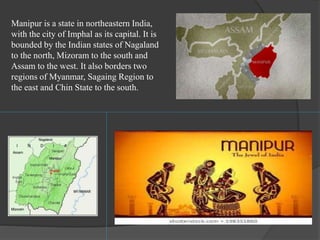
Manipur is a state in northeastern India,
with the city of Imphal as its capital. It is
bounded by the Indian states of Nagaland
to the north, Mizoram to the south and
Assam to the west. It also borders two
regions of Myanmar, Sagaing Region to
the east and Chin State to the south.
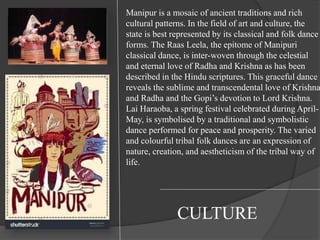
Manipur is a mosaic of ancient traditions and rich
cultural patterns. In the field of art and culture, the
state is best represented by its classical and folk dance
forms. The Raas Leela, the epitome of Manipuri
classical dance, is inter-woven through the celestial
and eternal love of Radha and Krishna as has been
described in the Hindu scriptures. This graceful dance
reveals the sublime and transcendental love of Krishna
and Radha and the Gopi’s devotion to Lord Krishna.
Lai Haraoba, a spring festival celebrated during April-
May, is symbolised by a traditional and symbolistic
dance performed for peace and prosperity. The varied
and colourful tribal folk dances are an expression of
nature, creation, and aestheticism of the tribal way of
life.
CULTURE
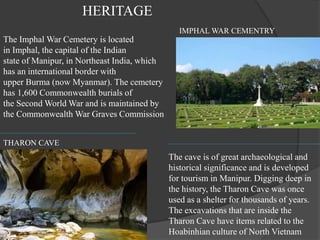
THARON CAVE
IMPHAL WAR CEMENTRY
The Imphal War Cemetery is located
in Imphal, the capital of the Indian
state of Manipur, in Northeast India, which
has an international border with
upper Burma (now Myanmar). The cemetery
has 1,600 Commonwealth burials of
the Second World War and is maintained by
the Commonwealth War Graves Commission
The cave is of great archaeological and
historical significance and is developed
for tourism in Manipur. Digging deep in
the history, the Tharon Cave was once
used as a shelter for thousands of years.
The excavations that are inside the
Tharon Cave have items related to the
Hoabinhian culture of North Vietnam
HERITAGE
TOURIST SITES
Loktak Lake is the largest freshwater
lake in North East India as well as the
largest natural freshwater lake in the
whole country. It is famous for the
phumdis floating over it. The lake is
located at Moirang in Manipur state,
India
The Manipur State Museum, situated in
Imphal, is one of the most popular museums in
the state. It was inaugurated in 1969 by the
then Prime Minister of India, Indira Gandhi,
and has ever since remained one of the most
prominent museums of the state alongside
being a very popular tourist destination as well
LOKTAK LAKE
MANIPUR STATE MUSEUM
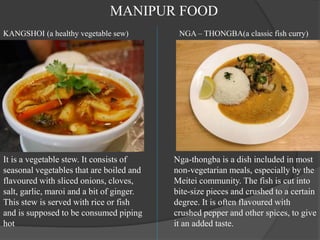
It is a vegetable stew. It consists of
seasonal vegetables that are boiled and
flavoured with sliced onions, cloves,
salt, garlic, maroi and a bit of ginger.
This stew is served with rice or fish
and is supposed to be consumed piping
hot
Nga-thongba is a dish included in most
non-vegetarian meals, especially by the
Meitei community. The fish is cut into
bite-size pieces and crushed to a certain
degree. It is often flavoured with
crushed pepper and other spices, to give
it an added taste.
NGA – THONGBA(a classic fish curry)
KANGSHOI (a healthy vegetable sew)
MANIPUR FOOD

Art integrated project geography nice project .pptx

  • 1.
    GEOGRAPHY MANIPUR Made by:- KajalSahani Prachi Nagar Class:- 10th D Submitted to:- Mrs. Mini mam Mrs. Bhanu mam
  • 2.
    Manipur is astate in northeastern India, with the city of Imphal as its capital. It is bounded by the Indian states of Nagaland to the north, Mizoram to the south and Assam to the west. It also borders two regions of Myanmar, Sagaing Region to the east and Chin State to the south.
  • 3.
    Manipur is amosaic of ancient traditions and rich cultural patterns. In the field of art and culture, the state is best represented by its classical and folk dance forms. The Raas Leela, the epitome of Manipuri classical dance, is inter-woven through the celestial and eternal love of Radha and Krishna as has been described in the Hindu scriptures. This graceful dance reveals the sublime and transcendental love of Krishna and Radha and the Gopi’s devotion to Lord Krishna. Lai Haraoba, a spring festival celebrated during April- May, is symbolised by a traditional and symbolistic dance performed for peace and prosperity. The varied and colourful tribal folk dances are an expression of nature, creation, and aestheticism of the tribal way of life. CULTURE
  • 4.
    THARON CAVE IMPHAL WARCEMENTRY The Imphal War Cemetery is located in Imphal, the capital of the Indian state of Manipur, in Northeast India, which has an international border with upper Burma (now Myanmar). The cemetery has 1,600 Commonwealth burials of the Second World War and is maintained by the Commonwealth War Graves Commission The cave is of great archaeological and historical significance and is developed for tourism in Manipur. Digging deep in the history, the Tharon Cave was once used as a shelter for thousands of years. The excavations that are inside the Tharon Cave have items related to the Hoabinhian culture of North Vietnam HERITAGE
  • 5.
    TOURIST SITES Loktak Lakeis the largest freshwater lake in North East India as well as the largest natural freshwater lake in the whole country. It is famous for the phumdis floating over it. The lake is located at Moirang in Manipur state, India The Manipur State Museum, situated in Imphal, is one of the most popular museums in the state. It was inaugurated in 1969 by the then Prime Minister of India, Indira Gandhi, and has ever since remained one of the most prominent museums of the state alongside being a very popular tourist destination as well LOKTAK LAKE MANIPUR STATE MUSEUM
  • 6.
    It is avegetable stew. It consists of seasonal vegetables that are boiled and flavoured with sliced onions, cloves, salt, garlic, maroi and a bit of ginger. This stew is served with rice or fish and is supposed to be consumed piping hot Nga-thongba is a dish included in most non-vegetarian meals, especially by the Meitei community. The fish is cut into bite-size pieces and crushed to a certain degree. It is often flavoured with crushed pepper and other spices, to give it an added taste. NGA – THONGBA(a classic fish curry) KANGSHOI (a healthy vegetable sew) MANIPUR FOOD