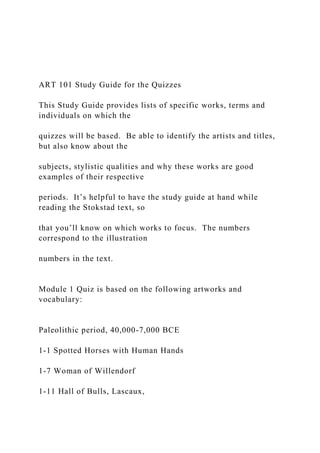
ART 101 Study Guide for the Quizzes
This Study Guide provides lists of specific works, terms and
individuals on which the
quizzes will be based. Be able to identify the artists and titles,
but also know about the
subjects, stylistic qualities and why these works are good
examples of their respective
periods. It’s helpful to have the study guide at hand while
reading the Stokstad text, so
that you’ll know on which works to focus. The numbers
correspond to the illustration
numbers in the text.
Module 1 Quiz is based on the following artworks and
vocabulary:
Paleolithic period, 40,000-7,000 BCE
1-1 Spotted Horses with Human Hands
1-7 Woman of Willendorf
1-11 Hall of Bulls, Lascaux,
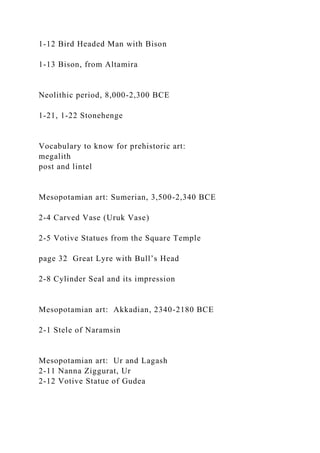
1-12 Bird Headed Man with Bison
1-13 Bison, from Altamira
Neolithic period, 8,000-2,300 BCE
1-21, 1-22 Stonehenge
Vocabulary to know for prehistoric art:
megalith
post and lintel
Mesopotamian art: Sumerian, 3,500-2,340 BCE
2-4 Carved Vase (Uruk Vase)
2-5 Votive Statues from the Square Temple
page 32 Great Lyre with Bull’s Head
2-8 Cylinder Seal and its impression
Mesopotamian art: Akkadian, 2340-2180 BCE
2-1 Stele of Naramsin
Mesopotamian art: Ur and Lagash
2-11 Nanna Ziggurat, Ur
2-12 Votive Statue of Gudea
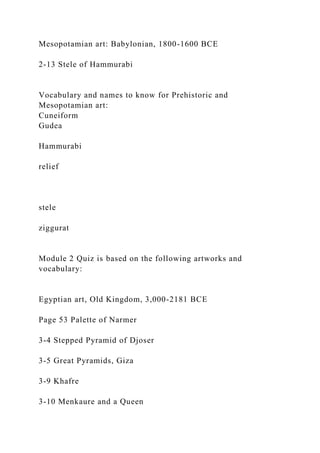
Mesopotamian art: Babylonian, 1800-1600 BCE
2-13 Stele of Hammurabi
Vocabulary and names to know for Prehistoric and
Mesopotamian art:
Cuneiform
Gudea
Hammurabi
relief
stele
ziggurat
Module 2 Quiz is based on the following artworks and
vocabulary:
Egyptian art, Old Kingdom, 3,000-2181 BCE
Page 53 Palette of Narmer
3-4 Stepped Pyramid of Djoser
3-5 Great Pyramids, Giza
3-9 Khafre
3-10 Menkaure and a Queen
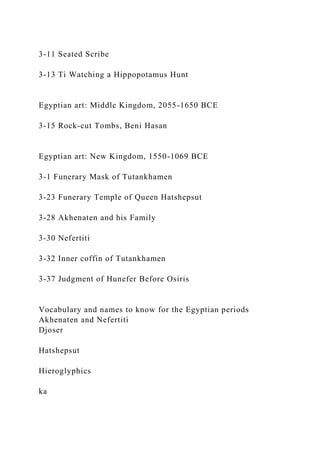
3-11 Seated Scribe
3-13 Ti Watching a Hippopotamus Hunt
Egyptian art: Middle Kingdom, 2055-1650 BCE
3-15 Rock-cut Tombs, Beni Hasan
Egyptian art: New Kingdom, 1550-1069 BCE
3-1 Funerary Mask of Tutankhamen
3-23 Funerary Temple of Queen Hatshepsut
3-28 Akhenaten and his Family
3-30 Nefertiti
3-32 Inner coffin of Tutankhamen
3-37 Judgment of Hunefer Before Osiris
Vocabulary and names to know for the Egyptian periods
Akhenaten and Nefertiti
Djoser
Hatshepsut
Hieroglyphics
ka
mastaba
Menkaure, Khafre and Khufu
Narmer
sarcophagus
Tutankhamen
Module 3 Quiz is based on the following artworks and
vocabulary:
Aegean art: Minoan, 3,000-1,375 BCE
4-5 Reconstruction of the Palace of Knossos
4-7 Bull Leaping
4-9 Harvester Vase
4-11 Octopus Flask
4-13 Vapheio cup
Aegean art: Mycenaean, 3,000-1,000 BCE
4-16, 4-17 Citadel, Mycenae, with Lion Gate
4-21 “Mask of Agamemnon”
4-22 Dagger Blade with Lion Hunt
4-23 to 4-25 Treasury of Atreus
Vocabulary to know for the Aegean cultures:
corbelling
fresco kamares
ware relieving
triangle tholos
Greek vase painting
5-2 Funerary vase (krater) from the Dipylon Cemetery, Athens,
an example of the Geometric style
5-4 Olpe, from Corinth
an example of the Orientalizing style
5-1 Exekias, Ajax and Achilles Playing a Game (amphora)
an example of Black figure style
page 122 Euphronios and Euxitheos, Death of Sarpedon (krater),
an example of Red Figure style
Greek Archaic period, sculpture and architecture, 620-480 BCE
5-9A, 5-9B Temple of Hera I
5-13 to 5-15 Pediment from the Temple of Aphaia, Aegina, and
two warriors
5-18 Standing Youth (Kouros)
5-20 Anavysos Kouros
5-21 Peplos Kore
Vocabulary for Archaic Greek art:
amphora
kore
kouros
krator
olpe
Module 4 Quiz is based on the following artworks and
vocabulary:
Greek Classical period, 480-323 BCE
5-30 Warrior
5-37 Kallikrates and Iktinos, Parthenon, Athens
5-38 sculpture from east pediment of the Parthenon
5-41 Young Women and Men, Parthenon frieze detail
5-43 Polykleitos, Spear Bearer (Doryphoros)
5-45, 5-46 Porch of the Maidens, Erechtheion, Athens
5-47 Nike Adjusting her Sandal
5-53 Praxiteles(?), Hermes and the Infant Dionysos
5-54 Praxiteles, Aphrodite of Knidos
5-55 Lysippos, The Man Scraping Himself (Apoxyomenos)
5-57 Battle of Issos
Greek Hellenistic period, 323-31 BCE
Page 151 Theater at Epidauros
5-63, 5-64 Altar from Pergamon, Athena Attacking the Giants
5-65 Laocoon and his Sons
5-66 Nike of Samothrace
5-67 Old Woman
5-68 Aphrodite of Melos (Venus de Milo)
Vocabulary and names to know for Classical and Hellenistic
Greece:
architrave
caryatid cella
(naos) column
capital
contrapposto
Corinthian column
Doric column
frieze
Ionic column
pediment
Iktinos and Kallikrates
Pheidias
Polyklietos
Praxiteles
Lysippos
Alexander the Great
Module 5 Quiz is based on the following artworks and
vocabulary
Roman period, 509 BCE – 330 CE
6-15 Patrician Carrying Portrait Busts of Two Ancestors
6-16 Pont du Gard, Nimes
6-18 Augustus of Primaporta
6-19, 6-21 Ara Pacis Augustae, Imperial Procession
6-29 Initiation Rites of the Cult of Bacchus
6-30 Cityscape
6-35, 6-36 Arch of Titus, Spoils from the Temple of Jerusalem
6-37, 6-38 Colosseum, Rome
6-48 to 6-51 Pantheon, Rome
6-56 Equestrian Statue to Marcus Aurelius
6-59 Caracalla
6-65, 6-66 Arch of Constantine and its reliefs
6-67, 6-68A-B Basilica of Maxentius and Constantine
Vocabulary and names to know for Roman art:
apse
arcade arch
Augustus
barrel vault
basilica
chiaroscuro
clerestory
coffers
Constantine
groin vault
nave
triumphal arch
Module 6 Quiz is based on the following artworks and
vocabulary:
Judaic and Early Christian art, 1
st
through 6
th
Centuries
7-3, 7-4 Synagogue from Dura-Europas, Syria, with The
Crossing of the Red Sea
7-8 Good Shepherd, Orants, and Story of Jonah, catacomb
ceiling
7-12 Church of Santa Sabina, Rome
7-10, 7-11 reconstruction of Old Saint Peters
7-14A-B, 17-15 Church of Santa Costanza, Rome
7-17 Sarcophagus of Constantia
7-18 Sarcophagus of Junius Bassus
7-21 Good Shepherd mosaic
Vocabulary for Judaic and Early Christian art
ambulatory
apse
catacombs
mosaics
narthex
nave
transept
Module 7 Quiz is based on the following artworks and
vocabulary:
Byzantine art, begins in the 5
th
Century
8-2 to 8-4 Church of Hagia Sophia, Istanbul
8-5, 8-6 Church of San Vitale, Ravenna
8-7 Christ Enthroned
8-8 Emperor Justinian and Attendants, San Vitale
8-9 Empress Theodora and Attendants, San Vitale
8-21 Christ Panokrator
8-22 Crucifixion
Early Islamic art, 610-10
th
Century
9-3A-B, 9-4 Dome of the Rock, Jerusalem
9-6 to 9-9 Great Mosque, Cordoba
Vocabulary for Byzantine and Early Islamic art:
Justinian
Theodora
pendentives
Muhammad
Qur’an
mosque
mihrab
Module 8 Quiz is based on the following artworks and
vocabulary:
Romanesque period, 1050-1150
16-4, 16-5 Cathedral of Saint James, Santiago de Compostela
16-21, 16-22 South Portal, Church of Saint Pierre, Moissac
page 496 Last Judgment tympanum, Cathedral of Saint-Lazare,
Autun
16-27 Virgin and Child
page 501 Bayeux Tapestry
16-34 St. Matthew, from the Codex Colbertinus
Gothic period, 1150-1400
Know about Abbot Suger, and how he initiated Gothic
architecture with Abbey Church
of Saint-Denis.
17-4 to 17-6, 17-8, 17-9, 17-10 Chartres Cathedral, its
sculpture and glass
17-14 Annunciation and Visitation, Reims Cathedral
17-21 Queen Blanche of Castile and Louis IX, from a
Moralized Bible
Vocabulary and names to know:
Abbot Suger
ambulatory
archivolts
choir
flying buttress
gallery
jamb statues
narthex
ribbed vault
rose window
tracery
transept
triforium
tympanum
Creating a Culture of Empowerment and
Accountability at St. Martin de Porres High
School (A)
Case
Author: Liz Livingston Howard, Sachin Waikar & Gail Berger
Online Pub Date: March 06, 2016 | Original Pub. Date: 2011
Subject: Organizational Behavior, Organizational Culture,
Change Leadership
Level: Basic | Type: Direct case | Length: 2444 words
Copyright: © 2010 Kellogg School of Management at
Northwestern University
Organization: St. Martin de Porres High School | Organization
size: Medium
Region: United States of America | State:
Industry: Education
Originally Published in:
Howard, L. L., Waiker, S., & Berger, G. (2011). Creating a
Culture of Empowerment and
Accountability at St. Martin de Porres High School (A). 5-410-
755(A). Evanston, IL: Kellogg
School of Management, Northwestern University.
Publisher: Kellogg School of Management
DOI: http://dx.doi.org/10.4135/9781473971455 | Online ISBN:
9781473971455
javascript:void(0);
javascript:void(0);
javascript:void(0);
javascript:%20void(0);
http://dx.doi.org/10.4135/9781473971455
© 2010 Kellogg School of Management at Northwestern
University
This case was prepared for inclusion in SAGE Business Cases
primarily as a basis for
classroom discussion or self-study, and is not meant to illustrate
either effective or ineffective
management styles. Nothing herein shall be deemed to be an
endorsement of any kind. This
case is for scholarly, educational, or personal use only within
your university, and cannot be
forwarded outside the university or used for other commercial
purposes. 2018 SAGE
Publications Ltd. All Rights Reserved.
This content may only be distributed for use within Southern
New Hampshire Univ.
http://dx.doi.org/10.4135/9781473971455
SAGE SAGE Business Cases
© 2010 Kellogg School of Management at Northwestern
University
Creating a Culture of Empowerment and Accountability at St.
Martin
de Porres High School (A)Page 2 of 7
http://dx.doi.org/10.4135/9781473971455
Abstract
Change is hard for all but perhaps more difficult for school
leaders and other nonprofit
organizations. The role that culture plays in a mission-driven
organization can often be
an impediment to change. This case uses a unique education
institution, St. Martin de
Porres School of the Cristo Rey Network, to illustrate the
importance of culture in
implementing change. It demonstrates how leaders can
articulate a vision and create
a strategy to change an organization and move toward success.
The case focuses on
the leadership team of Principal Mike Odiotti and Assistant
Principal Judy Seiberlich
and how they used cultural change as the key driver to school
success. That success
was defined by improved academic performance, greater
accountability for students,
teachers and staff and stronger empowerment of constituents. It
includes an overview
of how the school's leadership team used data to drive decision
making. This case is
ideal for MBA students, executives in nonprofit management or
school leadership and
can be used to illustrate change management, nonprofit
leadership, culture change,
mission-driven strategy or school leadership. It addresses
critical issues that
organizations face and provides tools and tactics that can be
applied to mission-driven
enterprises.
Case
“So where do we start?”
Mike Odiotti and Judy Seiberlich asked each other this question
simultaneously as they sat in
the small administrative office of St. Martin de Porres High
School in Waukegan, Illinois. It was
July 2008, and the pair had just begun their new positions as the
school's principal (Odiotti)
and assistant principal (Seiberlich).
By all accounts, the new administrators had their work cut out
for them. St. Martin de Porres
(SMdP), based on the Cristo Rey model of funding high school
education with corporate
internships, had opened in August 2004. In its first four years,
SMdP had already had two
presidents and two principals before Odiotti and Seiberlich
arrived. Moreover, the new
administrators had inherited a status quo that included
challenges related to students (nearly
2,400 instances of tardiness in the previous year and 26 percent
of the senior class failing to
graduate on time in 2008); teachers (a tendency to place most of
the blame for poor
performance on students); and the administration (a limited
focus on empowerment and
accountability for both students and teachers).
Recent survey results suggested that only a minority of SMdP's
teachers believed that school
policies were administered fairly and consistently or that the
school had an organization-wide
philosophy about the learning process. Partly as a result,
teacher turnover had consistently
been higher than ideal. It was clear to Odiotti and Seiberlich
that they had to change major
aspects of SMdP to promote its progress and, ultimately, its
survival. What was less clear was
exactly how to make the right set of mutually reinforcing
changes to SMdP's practices and
policies. Reminding themselves of their commitment to
improving students' lives by creating a
learning organization, Odiotti and Seiberlich considered where
to start.
SMdP Background
SAGE SAGE Business Cases
© 2010 Kellogg School of Management at Northwestern
University
Creating a Culture of Empowerment and Accountability at St.
Martin
de Porres High School (A)Page 3 of 7
Plans for SMdP began in 2001, when an advisory committee
received a grant to undertake a
feasibility study for establishing a Cristo Rey model high school
to serve the area.1 The
decision to open the school in Waukegan, a community forty
miles north of Chicago, was
made in January 2003. It was to be part of the Cristo Rey
Network, a group of twenty-four
high schools across the United States that “provide a quality,
Catholic, college preparatory
education to urban young people who live in communities with
limited educational options.”2
The Cristo Rey model included the idea that students work at
corporate internships to help
fund their high school education.
SMdP's board of trustees was established in May 2003 with
twenty-seven members
representing religious organizations, educators, business
professionals, and other leaders
from the community. The board hired the first president in
August 2003. Student enrollment
exceeded one hundred students by June 2004, and SMdP's
opening ceremonies were held
on August 23, 2004.
SMdP's mission statement emphasized student development
through education and work
experience:
St. Martin de Porres High School, a Catholic, coeducational
college preparatory
school, is located in Waukegan, Illinois. The school is
committed to academic
excellence made affordable for young people of limited options
through each student's
participation in the Hire4Ed (Corporate Internship) Program. St.
Martin de Porres High
School, a member of the Cristo Rey Network, strives to develop
the full potential of
each student in an atmosphere of mutual respect for the
religious and cultural
heritage of every individual.
SMdP also strove to uphold three standards for students: to be
prepared for work, prepared
for college, and committed to community justice and peace.
When Odiotti and Seiberlich
arrived, SMdP's student body was approximately 80 percent
Latino and 15 percent African-
American, with about 75 percent of the student body qualifying
for free or reduced lunch, in
keeping with the school's mission of serving young people of
limited options. Organizationally,
SMdP's principal reported to the president, who in turn reported
to the board.
Before They Came to St. Martin de Porres
Mike Odiotti and Judy Seiberlich brought to SMdP rich
experience from multiple learning
organizations and communities in need.
Odiotti (known as “Mr. O” to SMdP students) earned a B.S. in
finance from Boston College's
Carroll School of Management in 1996, followed by a M.Ed. in
curriculum and instruction—
with an emphasis on leadership—from the college's Lynch
School of Education in 1998. From
2004 to 2007 he worked as an assistant principal in the Boston
Public Schools system under
the guidance of Elliot Stern. Odiotti's leadership style was
heavily influenced by Stern, who
became a professor at Harvard's Graduate School of Education.
As a fellow for leadership
expert Ron Heifetz, Stern introduced Odiotti to Heifetz's models
and tactics, central to which
was the idea of generating and sustaining adaptive change
within organizations. Odiotti
sought to implement this theme at SMdP. Most who met Odiotti
immediately noted his ability
to engage quickly and his thoughtful, no-nonsense approach.
Seiberlich (known to SMdP students as “Sister Judy”) said,
“I've been in high school my whole
SAGE SAGE Business Cases
© 2010 Kellogg School of Management at Northwestern
University
Creating a Culture of Empowerment and Accountability at St.
Martin
de Porres High School (A)Page 4 of 7
life”; she had started teaching in 1964, then moved into
administration in the 1980s, always at
the high-school level. Seiberlich focused much of her career on
serving underprivileged
children, including those at Chicago's inner-city schools. “My
leadership style comes out of
the struggles we've had in my community since the 1960s,” she
said, “especially the idea of
how to build a global community centered on peace and
justice.” Seiberlich first came into
contact with SMdP through the Sinsinawa Dominicans, the
religious order to which she
belonged. The group asked her to serve on SMdP's board; she
agreed, and ultimately
decided to seek a leadership role with the school. Seiberlich's
strong focus on community-
building was clear in her warm and caring demeanor.
Odiotti and Seiberlich interviewed for the position of SMdP
principal in early 2008. Both were
asked whether they would consider working as assistant
principal for the school. “Absolutely
not,” Odiotti answered. “I'd actually prefer to be assistant
principal,” Seiberlich said. Both
began their official positions with SMdP in summer 2008,
though Odiotti had been
volunteering at the school since January of that year.
The Status Quo
As a first step to understanding the challenges they faced,
Odiotti and Seiberlich collected
quantitative and qualitative data through school records, one-
on-one teacher interviews, and
paper-based student and teacher surveys. The patterns these and
subsequent observations
revealed suggested that the new administrators faced many
issues.
Student-Related Issues
Multiple indicators pointed to challenges related to SMdP's
student body. During the previous
year, the school's 211 students tallied among them 2,390
“tardies,” or late arrivals at school—
an average of more than ten tardies per student. The school's
credit-retrieval system, or the
way students made up failed classes, was another indication of
trouble. When Odiotti and
Seiberlich first started, there was a backlog of credits that
needed to be made up; many
seniors were missing class credits they should have completed
as freshmen. Compounding
the problem was the students' attitude toward credit retrieval.
They were to complete make-up
coursework using an interactive online system (NovaNet), but
they tended not to take the
sessions seriously, dawdling or even failing to show up for
them. The credit-retrieval problem
contributed to a large number of students failing to graduate on
time. Almost a quarter of the
class of 2008—ten of forty-two students—did not complete their
academic requirements in
time to graduate.
Non-academic issues plagued the school as well. Physical
fights, while not routine events,
were not uncommon. “On my first day here, there was a fist
fight in the hall,” said SMdP's
counselor and social worker, who had been with the school
since its inception. Similarly, there
was an overall dearth of respect for teachers and classmates. For
instance, students who
forgot their electronic keycards that opened their classroom's
main entry doors tended to
hammer on the doors and nearby windows to be let in,
disrupting multiple classrooms.
Students also often caused disruptions by entering classrooms
through side—rather than
main—doors.
Several factors helped account for the situation at SMdP. One
underlying element was what
Odiotti and Seiberlich called a “middle-school mentality”
among the students. Specifically,
they thought the juniors and seniors, many of whom had
transferred to SMdP from other area
high schools, had brought difficult attitudes and behaviors to
the school, making them less-
SAGE SAGE Business Cases
© 2010 Kellogg School of Management at Northwestern
University
Creating a Culture of Empowerment and Accountability at St.
Martin
de Porres High School (A)Page 5 of 7
than-ideal role models for the younger students. “There was a
funny edge to the classrooms; I
got a ‘jangling’ feeling when I observed the classes,” Seiberlich
said. “It felt much more like a
junior high than a high school.” One English teacher
corroborated this feeling: “When I got
here two years ago, some students were begging for strong
academics, but others wanted to
promote a very non-academic atmosphere and make it difficult
for their classmates to
succeed.”
Teacher-Related Issues
Teacher attitudes exacerbated students' performance issues.
According to the campus
minister and theology teacher, in the past teachers “always
made it about the students,
saying, ‘They’re not doing what they should be doing,’” partly
to absolve themselves. With
regard to the credit-retrieval system, supervising teachers
tended to “baby” the students by
providing answers to the online tests or letting them avoid
working on the make-up material at
all, according to a SMdP science and math teacher. Moreover,
teachers tended to be resistant
to observation and other forms of evaluation. A resource teacher
noted that when she was
asked to assess teacher performance in 2007, she experienced
“an incredible amount of
pushback” from colleagues. “They saw me as a threat,” she
recalled. A teacher who had been
evaluated agreed, saying, “There was no explanation for it. So it
felt like a spy coming in.”
Such patterns contributed to poor student and teacher
performance and to an increased need
for summer school and other remedial efforts.
The faculty survey Odiotti and Seiberlich conducted illuminated
teachers' negative
perceptions in key areas, including the administration of school
policies and the presence of a
school-wide philosophy concerning the learning process (see
Exhibit 1). Most teachers also
endorsed the idea that SMdP as an organization needed to
“decide who we are and whom we
can serve,” and expressed the hope that the new leadership
would provide “visual presence.”
Not surprisingly, teacher turnover was high when Odiotti and
Seiberlich joined the school.
SMdP had eleven teachers in 2004, its first year of operation.
Each year after that, the school
was forced to replace four or five teachers; when Odiotti and
Seiberlich came on board in
2008, six new teachers started with them.
Administration-Related Issues
The previous principal had come to SMdP to help create an
atmosphere for learning and had
recognized the challenge of the ethnic, racial, and academic
diversity of the student body.
She worked with the groups of students, encouraging them to
know and respect each other,
which led to a safer and more welcoming atmosphere. She also
recognized that the students
needed greater clarity regarding expectations and disciplinary
consequences. Some staff
members went too far in their efforts to support students,
whereas others believed that
students needed to be more accountable for their actions and
performance. That principal
unfortunately left the school after only a short time.
In sum, there was no shortage of goodwill at SMdP, but few
good structures, systems, or
solutions. “We were a Cristo Rey school in terms of high
standards,” one teacher said, “but
offered very little to help students meet the standards.” She
added, “There were lots of Band-
Aid solutions. We weren't providing the scaffolding our
students needed.” That is not to say
that SMdP administrators were not aware of the challenges or
thoughtful in their approach
before Odiotti and Seiberlich arrived. Both new administrators
noted that the dean of
students, who had been hired by the previous principal, was
keen on changing the school's
SAGE SAGE Business Cases
© 2010 Kellogg School of Management at Northwestern
University
Creating a Culture of Empowerment and Accountability at St.
Martin
de Porres High School (A)Page 6 of 7
1.
2.
3.
4.
culture in a measured way. “He was smart about people and
leadership and was all about
conversations,” Seiberlich said. “He asked, ‘What’s best for the
school? How can we make it
work?'” The dean of students brought to SMdP more than
twenty years in corporate human
resources work, including many years of experience at Allstate.
He recalled, “When I joined
SMdP, I was called the dean of discipline, which wasn't
necessarily accurate. My challenge
was not to just sit back and wait for someone to call me about a
student-related problem.”
Odiotti and Seiberlich agreed that although the dean's intentions
were positive, his influence
was weakened because his role had not been defined broadly
enough.
All of these problems and patterns contributed to a general
perception among outsiders of
SMdP as an “alternative” school. Worse, insiders shared the
sentiment; many students
embraced a negative attitude toward academics—and one
another. For example, one teacher
noted, “Students were called ‘smart’ in a mocking way.” She
recalled a 2007 incident
representative of students’ perceptions: “We had taken the kids
on a field trip to the Adler
Planetarium, where they met students from other schools. When
one of those kids expressed
unfamiliarity with SMdP, one of our students said, ‘It’s a school
for poor kids.’”
The Challenge Ahead
Through their initial research and observations, Odiotti and
Seiberlich knew they faced
challenges in every dimension of the school they were to lead:
students, teachers, and
administration. Based on their backgrounds and philosophies as
educators and leaders, they
were committed to overhauling SMdP's culture to build a true
learning organization. They
faced many questions: Where to start? How could they rally
SMdP's stakeholders around a
new learning philosophy and set of policies and practices? How
would the stakeholders
respond to the many changes they envisioned?
One of the only answers Odiotti and Seiberlich already had was
their response to a simple
question: When should they start making changes? Now.
Discussion Questions
How would you describe the culture at SMdP before the arrival
of Odiotti and
Seiberlich?
Was the school's culture aligned with its mission?
Given the situation, what specific challenges did Odiotti and
Seiberlich face? How are
these challenges related?
What would you do if you were Odiotti and Seiberlich? How
would you “fix” SMdP?
Where would you start if you wanted to build a new culture?
How would you integrate
the different elements of your solution?
Notes and References
1. H i s t o r i c a l a n d m i s s i o n i n f o r m a t i o n f r o
m t h e S M d P w e b s i t e ,
http://www.smdpwaukegan.org/about/history.htm (accessed
June 16, 2010).
2. Cristo Rey Network website,
http://www.cristoreynetwork.org/about/index.shtml (accessed
June 16, 2010).
http://dx.doi.org/10.4135/9781473971455
SAGE SAGE Business Cases
© 2010 Kellogg School of Management at Northwestern
University
Creating a Culture of Empowerment and Accountability at St.
Martin
de Porres High School (A)Page 7 of 7
http://www.smdpwaukegan.org/about/history.htm
http://www.cristoreynetwork.org/about/index.shtml
http://dx.doi.org/10.4135/9781473971455
MGT 510: Final Project Guidelines and Rubric
Overview
In this final project, you will analyze the case study “Creating a
Culture of Empowerment and Accountability at St. Martin de
Porres High School” and develop an
evaluative response paper. The case is an account of how St.
Martin de Porres High School (SMdP) was transformed from a
school plagued with student failure
and high teacher turnover into a true learning organization
carrying out its mission of serving “young people of limited
options.” Your response paper will assess
the strengths and weaknesses of the organization and propose
solutions and strategies for transforming the organizational
culture.
The paper should be 13–15 pages and adhere to APA standards.
This assessment will measure student competency with respect
to the following course outcomes:
communication strategies for their strength in fostering
organizational cultures of customer
service
diversity, enterprise, and brand stewardship through effective
verbal and written presentations
employee talent, facilitate high-performance teams, and align
well with the organizational
culture
ions for complex organizational
conflict scenarios that align with organizational goals and
culture and reflect systems-level
decision-making
support for employees and maintain alignment to the values,
mission, culture, and goals of
organizations
organizational cultures that reflect the values of an organization
and are consistent with one’s
ethical framework
Prompt
Your presentation should answer the following prompt: What
are strengths and the weaknesses of the organization in its
approach to realizing its mission of
serving “young people of limited options”? How can SMdP
create and maintain an appropriate and effective organizational
culture?
Specifically, the following critical elements must be included:
o To what extent is the mission statement transparent to internal
and external stakeholders? To what extent is the mission
statement cogent,
meaningful, and “customer-oriented” (in this case, think of the
students and larger community as the customers)?
o What are the strengths and weaknesses of the culture? Assess
the specific issues around each of the following: team
performance,
empowerment, and autonomy.
o What are the essential management and operational
approaches? What are some of the basic organizational
assumptions around morale and
motivation?
o How is the organizational culture misaligned to the mission
statement? To what extent are students, teachers, and
administrators being held
accountable to the mission statement?
o To what extent are there signs of a toxic culture at SMdP?
o To what extent are there ethical issues facing administration,
teachers, and students at SMdP?
o What should be the major objectives of the remediation plan?
(Note: The overarching goal of the plan must be to address the
misalignment of
the organizational culture to the mission statement.)
o What should be the specific tactics employed to create an
appropriate and effective organizational culture? These could
include organizational
restructuring efforts, replacing individuals, revisiting the
mission statement of the organization, and so forth.
o Provide example artifacts of organizational culture that would
promote the actualization of the mission statement.
o What are the potential challenges of implementing the
solutions? These could include the mindsets of the stakeholders
and their willingness to
take part in the change. How can these challenges be addressed?
o What should the communication and training plans be for
effectively supporting and empowering administration, teachers,
and students
through the transition?
o How can one ensure that the solutions are implemented in an
ethical manner?
o What are some key factors, both internal and external, that
could be used to determine whether the solutions are effective?
How can the
organization’s performance against the objectives be measured
and verified?
o Works cited should be in APA format.
Final Paper Rubric
Critical Elements Exemplary Proficient Needs Improvement Not
Evident Value
Evaluation: Mission
Statement
Meets “Proficient” criteria and
uses specific examples to
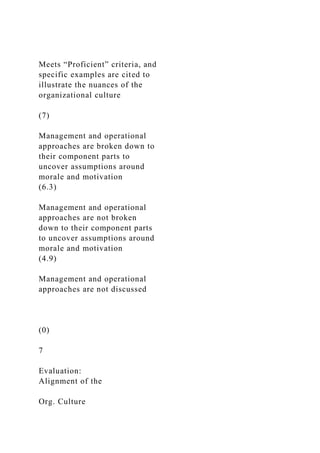
substantiate claims and
communicate nuance
(13)
Mission statement is evaluated
with respect to its transparency,
cogency, meaning, and
customer orientation
(11.7)
Mission statement is not
comprehensively evaluated
with respect to its transparency,
cogency, meaning, and
customer orientation
(9.1)
Mission statement is not
evaluated or is erroneous
(0)
13
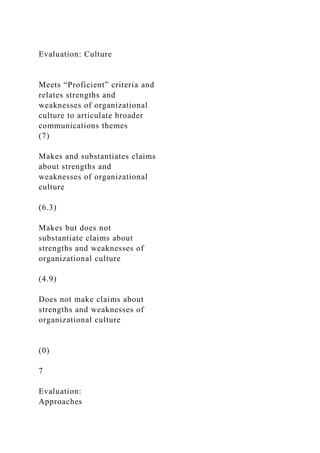
Evaluation: Culture
Meets “Proficient” criteria and
relates strengths and
weaknesses of organizational
culture to articulate broader
communications themes
(7)
Makes and substantiates claims
about strengths and
weaknesses of organizational
culture
(6.3)
Makes but does not
substantiate claims about
strengths and weaknesses of
organizational culture
(4.9)
Does not make claims about
strengths and weaknesses of
organizational culture
(0)
7
Evaluation:
Approaches
Meets “Proficient” criteria, and
specific examples are cited to
illustrate the nuances of the
organizational culture
(7)
Management and operational
approaches are broken down to
their component parts to
uncover assumptions around
morale and motivation
(6.3)
Management and operational
approaches are not broken
down to their component parts
to uncover assumptions around
morale and motivation
(4.9)
Management and operational
approaches are not discussed
(0)
7
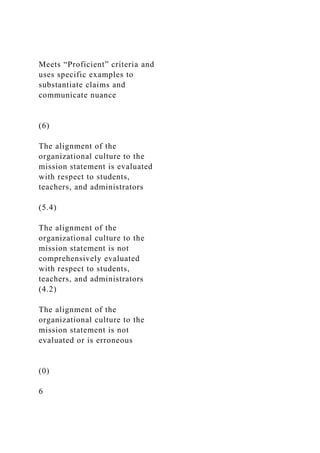
Evaluation:
Alignment of the
Org. Culture
Meets “Proficient” criteria and
uses specific examples to
substantiate claims and
communicate nuance
(6)
The alignment of the
organizational culture to the
mission statement is evaluated
with respect to students,
teachers, and administrators
(5.4)
The alignment of the
organizational culture to the
mission statement is not
comprehensively evaluated
with respect to students,
teachers, and administrators
(4.2)
The alignment of the
organizational culture to the
mission statement is not
evaluated or is erroneous
(0)
6
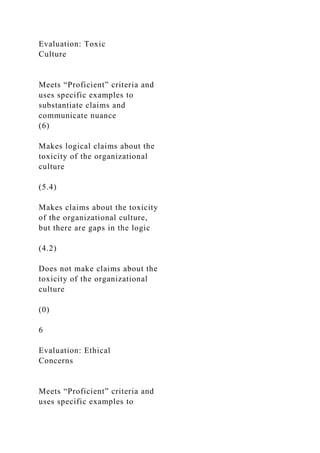
Evaluation: Toxic
Culture
Meets “Proficient” criteria and
uses specific examples to
substantiate claims and
communicate nuance
(6)
Makes logical claims about the
toxicity of the organizational
culture
(5.4)
Makes claims about the toxicity
of the organizational culture,
but there are gaps in the logic
(4.2)
Does not make claims about the
toxicity of the organizational
culture
(0)
6
Evaluation: Ethical
Concerns
Meets “Proficient” criteria and
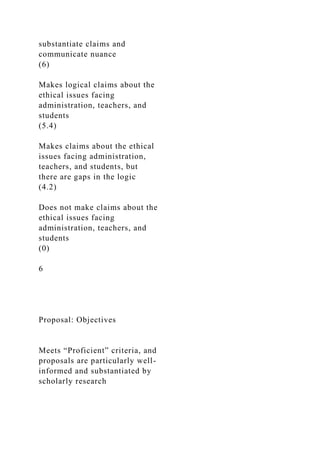
uses specific examples to
substantiate claims and
communicate nuance
(6)
Makes logical claims about the
ethical issues facing
administration, teachers, and
students
(5.4)
Makes claims about the ethical
issues facing administration,
teachers, and students, but
there are gaps in the logic
(4.2)
Does not make claims about the
ethical issues facing
administration, teachers, and
students
(0)
6
Proposal: Objectives
Meets “Proficient” criteria, and
proposals are particularly well-
informed and substantiated by
scholarly research
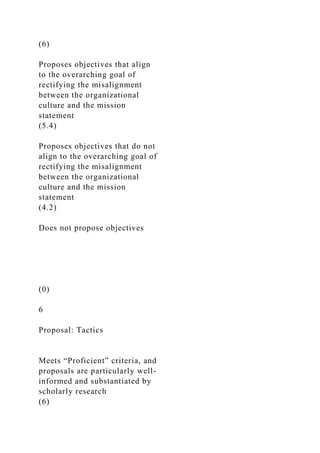
(6)
Proposes objectives that align
to the overarching goal of
rectifying the misalignment
between the organizational
culture and the mission
statement
(5.4)
Proposes objectives that do not
align to the overarching goal of
rectifying the misalignment
between the organizational
culture and the mission
statement
(4.2)
Does not propose objectives
(0)
6
Proposal: Tactics
Meets “Proficient” criteria, and
proposals are particularly well-
informed and substantiated by
scholarly research
(6)
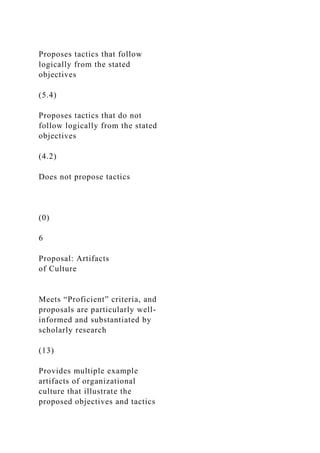
Proposes tactics that follow
logically from the stated
objectives
(5.4)
Proposes tactics that do not
follow logically from the stated
objectives
(4.2)
Does not propose tactics
(0)
6
Proposal: Artifacts
of Culture
Meets “Proficient” criteria, and
proposals are particularly well-
informed and substantiated by
scholarly research
(13)
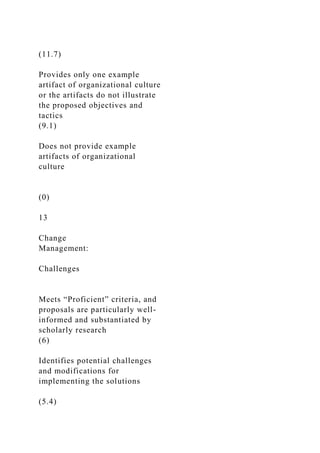
Provides multiple example
artifacts of organizational
culture that illustrate the
proposed objectives and tactics
(11.7)
Provides only one example
artifact of organizational culture
or the artifacts do not illustrate
the proposed objectives and
tactics
(9.1)
Does not provide example
artifacts of organizational
culture
(0)
13
Change
Management:
Challenges
Meets “Proficient” criteria, and
proposals are particularly well-
informed and substantiated by
scholarly research
(6)
Identifies potential challenges
and modifications for
implementing the solutions
(5.4)
Identifies potential challenges,
but does not propose
modifications
(4.2)
Does not identify potential
challenges
(0)
6
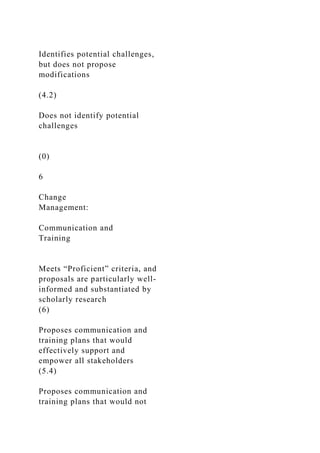
Change
Management:
Communication and
Training
Meets “Proficient” criteria, and
proposals are particularly well-
informed and substantiated by
scholarly research
(6)
Proposes communication and
training plans that would
effectively support and
empower all stakeholders
(5.4)
Proposes communication and
training plans that would not
effectively support and
empower all stakeholders
(4.2)
Does not propose
communication and training
plans
(0)
6
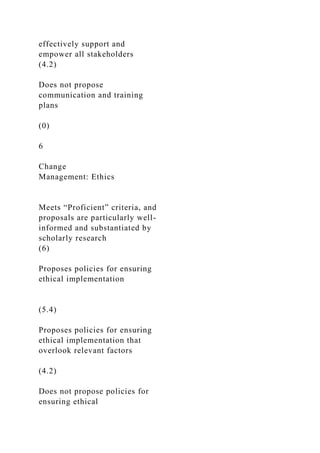
Change
Management: Ethics
Meets “Proficient” criteria, and
proposals are particularly well-
informed and substantiated by
scholarly research
(6)
Proposes policies for ensuring
ethical implementation
(5.4)
Proposes policies for ensuring
ethical implementation that
overlook relevant factors
(4.2)
Does not propose policies for
ensuring ethical
implementation
(0)
6
Change
Management:
Measurement
Meets “Proficient” criteria, and
proposals are particularly well-
informed and substantiated by
scholarly research
(6)
Includes metrics for measuring
the effectiveness of the
organization’s performance
against the plan objectives
(5.4)
Includes metrics for measuring
the effectiveness of the
organization’s performance, but
they are misaligned to the plan
objectives
(4.2)
Does not include metrics for
measuring the effectiveness of
the organization’s performance
(0)
6
Articulation of
Response
Submission is properly cited
and free of errors related to
grammar, spelling, syntax, and
organization and is presented in
a professional and easy-to-read
format
(6)
Submission has no major errors
related to citations, grammar,
spelling, syntax, or organization
(5.4)
Submission has major errors
related to citations, grammar,
spelling, syntax, or organization
that negatively impact
readability and articulation of
main ideas
(4.2)
Submission has critical errors
related to citations, grammar,
spelling, syntax, or organization
that prevent understanding
(0)
6
Earned Total
Comments:
100%
#777221 Topic: Final Project Outline
Number of Pages: 3 (Double Spaced)
Number of sources: 2
Writing Style: APA
Type of document: Essay
Academic Level:Undergraduate
Category: Art
Order Instructions:
First review the Final Project Guidelines and Rubric document.
Review the case study "Creating a Culture of Empowerment and
Accountability at St. Martin de Porres High School (A)" by Liz
Livingston Howard, Sachin Waikar, and Gail Berger.
Develop a short 2–3-page paper that will cover the main areas
of the final project:
Evaluate the Organization's Culture
Propose
Solution
s
Propose Change Management Strategies
This assignment will be graded pass/fail. If you turn in your
topic in the way prescribed in the guidelines, you will earn full
points. The purpose of this assignment is for you to receive
feedback from your instructor and incorporate it into your final
project.
ART 101 Study Guide for the Quizzes  This Study Guide prov.docx

ART 101 Study Guide for the Quizzes This Study Guide prov.docx

  • 1.
    ART 101 StudyGuide for the Quizzes This Study Guide provides lists of specific works, terms and individuals on which the quizzes will be based. Be able to identify the artists and titles, but also know about the subjects, stylistic qualities and why these works are good examples of their respective periods. It’s helpful to have the study guide at hand while reading the Stokstad text, so that you’ll know on which works to focus. The numbers correspond to the illustration numbers in the text. Module 1 Quiz is based on the following artworks and vocabulary: Paleolithic period, 40,000-7,000 BCE 1-1 Spotted Horses with Human Hands 1-7 Woman of Willendorf 1-11 Hall of Bulls, Lascaux,
  • 2.
    1-12 Bird HeadedMan with Bison 1-13 Bison, from Altamira Neolithic period, 8,000-2,300 BCE 1-21, 1-22 Stonehenge Vocabulary to know for prehistoric art: megalith post and lintel Mesopotamian art: Sumerian, 3,500-2,340 BCE 2-4 Carved Vase (Uruk Vase) 2-5 Votive Statues from the Square Temple page 32 Great Lyre with Bull’s Head 2-8 Cylinder Seal and its impression Mesopotamian art: Akkadian, 2340-2180 BCE 2-1 Stele of Naramsin Mesopotamian art: Ur and Lagash 2-11 Nanna Ziggurat, Ur 2-12 Votive Statue of Gudea
  • 3.
    Mesopotamian art: Babylonian,1800-1600 BCE 2-13 Stele of Hammurabi Vocabulary and names to know for Prehistoric and Mesopotamian art: Cuneiform Gudea Hammurabi relief stele ziggurat Module 2 Quiz is based on the following artworks and vocabulary: Egyptian art, Old Kingdom, 3,000-2181 BCE Page 53 Palette of Narmer 3-4 Stepped Pyramid of Djoser 3-5 Great Pyramids, Giza 3-9 Khafre 3-10 Menkaure and a Queen
  • 4.
    3-11 Seated Scribe 3-13Ti Watching a Hippopotamus Hunt Egyptian art: Middle Kingdom, 2055-1650 BCE 3-15 Rock-cut Tombs, Beni Hasan Egyptian art: New Kingdom, 1550-1069 BCE 3-1 Funerary Mask of Tutankhamen 3-23 Funerary Temple of Queen Hatshepsut 3-28 Akhenaten and his Family 3-30 Nefertiti 3-32 Inner coffin of Tutankhamen 3-37 Judgment of Hunefer Before Osiris Vocabulary and names to know for the Egyptian periods Akhenaten and Nefertiti Djoser Hatshepsut Hieroglyphics ka
  • 5.
    mastaba Menkaure, Khafre andKhufu Narmer sarcophagus Tutankhamen Module 3 Quiz is based on the following artworks and vocabulary: Aegean art: Minoan, 3,000-1,375 BCE 4-5 Reconstruction of the Palace of Knossos 4-7 Bull Leaping 4-9 Harvester Vase 4-11 Octopus Flask 4-13 Vapheio cup Aegean art: Mycenaean, 3,000-1,000 BCE 4-16, 4-17 Citadel, Mycenae, with Lion Gate 4-21 “Mask of Agamemnon” 4-22 Dagger Blade with Lion Hunt
  • 6.
    4-23 to 4-25Treasury of Atreus Vocabulary to know for the Aegean cultures: corbelling fresco kamares ware relieving triangle tholos Greek vase painting 5-2 Funerary vase (krater) from the Dipylon Cemetery, Athens, an example of the Geometric style 5-4 Olpe, from Corinth an example of the Orientalizing style 5-1 Exekias, Ajax and Achilles Playing a Game (amphora) an example of Black figure style page 122 Euphronios and Euxitheos, Death of Sarpedon (krater), an example of Red Figure style Greek Archaic period, sculpture and architecture, 620-480 BCE 5-9A, 5-9B Temple of Hera I 5-13 to 5-15 Pediment from the Temple of Aphaia, Aegina, and
  • 7.
    two warriors 5-18 StandingYouth (Kouros) 5-20 Anavysos Kouros 5-21 Peplos Kore Vocabulary for Archaic Greek art: amphora kore kouros krator olpe Module 4 Quiz is based on the following artworks and vocabulary: Greek Classical period, 480-323 BCE 5-30 Warrior 5-37 Kallikrates and Iktinos, Parthenon, Athens 5-38 sculpture from east pediment of the Parthenon 5-41 Young Women and Men, Parthenon frieze detail 5-43 Polykleitos, Spear Bearer (Doryphoros)
  • 8.
    5-45, 5-46 Porchof the Maidens, Erechtheion, Athens 5-47 Nike Adjusting her Sandal 5-53 Praxiteles(?), Hermes and the Infant Dionysos 5-54 Praxiteles, Aphrodite of Knidos 5-55 Lysippos, The Man Scraping Himself (Apoxyomenos) 5-57 Battle of Issos Greek Hellenistic period, 323-31 BCE Page 151 Theater at Epidauros 5-63, 5-64 Altar from Pergamon, Athena Attacking the Giants 5-65 Laocoon and his Sons 5-66 Nike of Samothrace 5-67 Old Woman 5-68 Aphrodite of Melos (Venus de Milo) Vocabulary and names to know for Classical and Hellenistic Greece: architrave caryatid cella (naos) column
  • 9.
    capital contrapposto Corinthian column Doric column frieze Ioniccolumn pediment Iktinos and Kallikrates Pheidias Polyklietos Praxiteles Lysippos Alexander the Great Module 5 Quiz is based on the following artworks and vocabulary Roman period, 509 BCE – 330 CE 6-15 Patrician Carrying Portrait Busts of Two Ancestors
  • 10.
    6-16 Pont duGard, Nimes 6-18 Augustus of Primaporta 6-19, 6-21 Ara Pacis Augustae, Imperial Procession 6-29 Initiation Rites of the Cult of Bacchus 6-30 Cityscape 6-35, 6-36 Arch of Titus, Spoils from the Temple of Jerusalem 6-37, 6-38 Colosseum, Rome 6-48 to 6-51 Pantheon, Rome 6-56 Equestrian Statue to Marcus Aurelius 6-59 Caracalla 6-65, 6-66 Arch of Constantine and its reliefs 6-67, 6-68A-B Basilica of Maxentius and Constantine Vocabulary and names to know for Roman art: apse arcade arch Augustus barrel vault
  • 11.
    basilica chiaroscuro clerestory coffers Constantine groin vault nave triumphal arch Module6 Quiz is based on the following artworks and vocabulary: Judaic and Early Christian art, 1 st through 6 th Centuries 7-3, 7-4 Synagogue from Dura-Europas, Syria, with The Crossing of the Red Sea 7-8 Good Shepherd, Orants, and Story of Jonah, catacomb ceiling 7-12 Church of Santa Sabina, Rome
  • 12.
    7-10, 7-11 reconstructionof Old Saint Peters 7-14A-B, 17-15 Church of Santa Costanza, Rome 7-17 Sarcophagus of Constantia 7-18 Sarcophagus of Junius Bassus 7-21 Good Shepherd mosaic Vocabulary for Judaic and Early Christian art ambulatory apse catacombs mosaics narthex nave transept Module 7 Quiz is based on the following artworks and vocabulary: Byzantine art, begins in the 5 th Century
  • 13.
    8-2 to 8-4Church of Hagia Sophia, Istanbul 8-5, 8-6 Church of San Vitale, Ravenna 8-7 Christ Enthroned 8-8 Emperor Justinian and Attendants, San Vitale 8-9 Empress Theodora and Attendants, San Vitale 8-21 Christ Panokrator 8-22 Crucifixion Early Islamic art, 610-10 th Century 9-3A-B, 9-4 Dome of the Rock, Jerusalem 9-6 to 9-9 Great Mosque, Cordoba Vocabulary for Byzantine and Early Islamic art: Justinian Theodora pendentives Muhammad Qur’an
  • 14.
    mosque mihrab Module 8 Quizis based on the following artworks and vocabulary: Romanesque period, 1050-1150 16-4, 16-5 Cathedral of Saint James, Santiago de Compostela 16-21, 16-22 South Portal, Church of Saint Pierre, Moissac page 496 Last Judgment tympanum, Cathedral of Saint-Lazare, Autun 16-27 Virgin and Child page 501 Bayeux Tapestry 16-34 St. Matthew, from the Codex Colbertinus Gothic period, 1150-1400 Know about Abbot Suger, and how he initiated Gothic architecture with Abbey Church of Saint-Denis. 17-4 to 17-6, 17-8, 17-9, 17-10 Chartres Cathedral, its sculpture and glass 17-14 Annunciation and Visitation, Reims Cathedral
  • 15.
    17-21 Queen Blancheof Castile and Louis IX, from a Moralized Bible Vocabulary and names to know: Abbot Suger ambulatory archivolts choir flying buttress gallery jamb statues narthex ribbed vault rose window tracery transept triforium tympanum
  • 16.
    Creating a Cultureof Empowerment and Accountability at St. Martin de Porres High School (A) Case Author: Liz Livingston Howard, Sachin Waikar & Gail Berger Online Pub Date: March 06, 2016 | Original Pub. Date: 2011 Subject: Organizational Behavior, Organizational Culture, Change Leadership Level: Basic | Type: Direct case | Length: 2444 words Copyright: © 2010 Kellogg School of Management at Northwestern University Organization: St. Martin de Porres High School | Organization size: Medium Region: United States of America | State: Industry: Education Originally Published in: Howard, L. L., Waiker, S., & Berger, G. (2011). Creating a Culture of Empowerment and
  • 17.
    Accountability at St.Martin de Porres High School (A). 5-410- 755(A). Evanston, IL: Kellogg School of Management, Northwestern University. Publisher: Kellogg School of Management DOI: http://dx.doi.org/10.4135/9781473971455 | Online ISBN: 9781473971455 javascript:void(0); javascript:void(0); javascript:void(0); javascript:%20void(0); javascript:%20void(0); javascript:%20void(0); javascript:%20void(0); http://dx.doi.org/10.4135/9781473971455 © 2010 Kellogg School of Management at Northwestern University This case was prepared for inclusion in SAGE Business Cases primarily as a basis for classroom discussion or self-study, and is not meant to illustrate either effective or ineffective management styles. Nothing herein shall be deemed to be an endorsement of any kind. This case is for scholarly, educational, or personal use only within your university, and cannot be forwarded outside the university or used for other commercial purposes. 2018 SAGE Publications Ltd. All Rights Reserved. This content may only be distributed for use within Southern
  • 18.
    New Hampshire Univ. http://dx.doi.org/10.4135/9781473971455 SAGESAGE Business Cases © 2010 Kellogg School of Management at Northwestern University Creating a Culture of Empowerment and Accountability at St. Martin de Porres High School (A)Page 2 of 7 http://dx.doi.org/10.4135/9781473971455 Abstract Change is hard for all but perhaps more difficult for school leaders and other nonprofit organizations. The role that culture plays in a mission-driven organization can often be an impediment to change. This case uses a unique education institution, St. Martin de Porres School of the Cristo Rey Network, to illustrate the importance of culture in implementing change. It demonstrates how leaders can articulate a vision and create a strategy to change an organization and move toward success. The case focuses on the leadership team of Principal Mike Odiotti and Assistant Principal Judy Seiberlich and how they used cultural change as the key driver to school success. That success was defined by improved academic performance, greater accountability for students, teachers and staff and stronger empowerment of constituents. It includes an overview
  • 19.
    of how theschool's leadership team used data to drive decision making. This case is ideal for MBA students, executives in nonprofit management or school leadership and can be used to illustrate change management, nonprofit leadership, culture change, mission-driven strategy or school leadership. It addresses critical issues that organizations face and provides tools and tactics that can be applied to mission-driven enterprises. Case “So where do we start?” Mike Odiotti and Judy Seiberlich asked each other this question simultaneously as they sat in the small administrative office of St. Martin de Porres High School in Waukegan, Illinois. It was July 2008, and the pair had just begun their new positions as the school's principal (Odiotti) and assistant principal (Seiberlich). By all accounts, the new administrators had their work cut out for them. St. Martin de Porres (SMdP), based on the Cristo Rey model of funding high school education with corporate internships, had opened in August 2004. In its first four years, SMdP had already had two presidents and two principals before Odiotti and Seiberlich arrived. Moreover, the new administrators had inherited a status quo that included challenges related to students (nearly 2,400 instances of tardiness in the previous year and 26 percent of the senior class failing to
  • 20.
    graduate on timein 2008); teachers (a tendency to place most of the blame for poor performance on students); and the administration (a limited focus on empowerment and accountability for both students and teachers). Recent survey results suggested that only a minority of SMdP's teachers believed that school policies were administered fairly and consistently or that the school had an organization-wide philosophy about the learning process. Partly as a result, teacher turnover had consistently been higher than ideal. It was clear to Odiotti and Seiberlich that they had to change major aspects of SMdP to promote its progress and, ultimately, its survival. What was less clear was exactly how to make the right set of mutually reinforcing changes to SMdP's practices and policies. Reminding themselves of their commitment to improving students' lives by creating a learning organization, Odiotti and Seiberlich considered where to start. SMdP Background SAGE SAGE Business Cases © 2010 Kellogg School of Management at Northwestern University Creating a Culture of Empowerment and Accountability at St. Martin de Porres High School (A)Page 3 of 7 Plans for SMdP began in 2001, when an advisory committee
  • 21.
    received a grantto undertake a feasibility study for establishing a Cristo Rey model high school to serve the area.1 The decision to open the school in Waukegan, a community forty miles north of Chicago, was made in January 2003. It was to be part of the Cristo Rey Network, a group of twenty-four high schools across the United States that “provide a quality, Catholic, college preparatory education to urban young people who live in communities with limited educational options.”2 The Cristo Rey model included the idea that students work at corporate internships to help fund their high school education. SMdP's board of trustees was established in May 2003 with twenty-seven members representing religious organizations, educators, business professionals, and other leaders from the community. The board hired the first president in August 2003. Student enrollment exceeded one hundred students by June 2004, and SMdP's opening ceremonies were held on August 23, 2004. SMdP's mission statement emphasized student development through education and work experience: St. Martin de Porres High School, a Catholic, coeducational college preparatory school, is located in Waukegan, Illinois. The school is committed to academic
  • 22.
    excellence made affordablefor young people of limited options through each student's participation in the Hire4Ed (Corporate Internship) Program. St. Martin de Porres High School, a member of the Cristo Rey Network, strives to develop the full potential of each student in an atmosphere of mutual respect for the religious and cultural heritage of every individual. SMdP also strove to uphold three standards for students: to be prepared for work, prepared for college, and committed to community justice and peace. When Odiotti and Seiberlich arrived, SMdP's student body was approximately 80 percent Latino and 15 percent African- American, with about 75 percent of the student body qualifying for free or reduced lunch, in keeping with the school's mission of serving young people of limited options. Organizationally, SMdP's principal reported to the president, who in turn reported to the board. Before They Came to St. Martin de Porres Mike Odiotti and Judy Seiberlich brought to SMdP rich experience from multiple learning organizations and communities in need. Odiotti (known as “Mr. O” to SMdP students) earned a B.S. in finance from Boston College's Carroll School of Management in 1996, followed by a M.Ed. in curriculum and instruction— with an emphasis on leadership—from the college's Lynch School of Education in 1998. From 2004 to 2007 he worked as an assistant principal in the Boston
  • 23.
    Public Schools systemunder the guidance of Elliot Stern. Odiotti's leadership style was heavily influenced by Stern, who became a professor at Harvard's Graduate School of Education. As a fellow for leadership expert Ron Heifetz, Stern introduced Odiotti to Heifetz's models and tactics, central to which was the idea of generating and sustaining adaptive change within organizations. Odiotti sought to implement this theme at SMdP. Most who met Odiotti immediately noted his ability to engage quickly and his thoughtful, no-nonsense approach. Seiberlich (known to SMdP students as “Sister Judy”) said, “I've been in high school my whole SAGE SAGE Business Cases © 2010 Kellogg School of Management at Northwestern University Creating a Culture of Empowerment and Accountability at St. Martin de Porres High School (A)Page 4 of 7 life”; she had started teaching in 1964, then moved into administration in the 1980s, always at the high-school level. Seiberlich focused much of her career on serving underprivileged children, including those at Chicago's inner-city schools. “My leadership style comes out of the struggles we've had in my community since the 1960s,” she said, “especially the idea of how to build a global community centered on peace and justice.” Seiberlich first came into
  • 24.
    contact with SMdPthrough the Sinsinawa Dominicans, the religious order to which she belonged. The group asked her to serve on SMdP's board; she agreed, and ultimately decided to seek a leadership role with the school. Seiberlich's strong focus on community- building was clear in her warm and caring demeanor. Odiotti and Seiberlich interviewed for the position of SMdP principal in early 2008. Both were asked whether they would consider working as assistant principal for the school. “Absolutely not,” Odiotti answered. “I'd actually prefer to be assistant principal,” Seiberlich said. Both began their official positions with SMdP in summer 2008, though Odiotti had been volunteering at the school since January of that year. The Status Quo As a first step to understanding the challenges they faced, Odiotti and Seiberlich collected quantitative and qualitative data through school records, one- on-one teacher interviews, and paper-based student and teacher surveys. The patterns these and subsequent observations revealed suggested that the new administrators faced many issues. Student-Related Issues Multiple indicators pointed to challenges related to SMdP's student body. During the previous year, the school's 211 students tallied among them 2,390 “tardies,” or late arrivals at school— an average of more than ten tardies per student. The school's
  • 25.
    credit-retrieval system, orthe way students made up failed classes, was another indication of trouble. When Odiotti and Seiberlich first started, there was a backlog of credits that needed to be made up; many seniors were missing class credits they should have completed as freshmen. Compounding the problem was the students' attitude toward credit retrieval. They were to complete make-up coursework using an interactive online system (NovaNet), but they tended not to take the sessions seriously, dawdling or even failing to show up for them. The credit-retrieval problem contributed to a large number of students failing to graduate on time. Almost a quarter of the class of 2008—ten of forty-two students—did not complete their academic requirements in time to graduate. Non-academic issues plagued the school as well. Physical fights, while not routine events, were not uncommon. “On my first day here, there was a fist fight in the hall,” said SMdP's counselor and social worker, who had been with the school since its inception. Similarly, there was an overall dearth of respect for teachers and classmates. For instance, students who forgot their electronic keycards that opened their classroom's main entry doors tended to hammer on the doors and nearby windows to be let in, disrupting multiple classrooms. Students also often caused disruptions by entering classrooms through side—rather than main—doors. Several factors helped account for the situation at SMdP. One
  • 26.
    underlying element waswhat Odiotti and Seiberlich called a “middle-school mentality” among the students. Specifically, they thought the juniors and seniors, many of whom had transferred to SMdP from other area high schools, had brought difficult attitudes and behaviors to the school, making them less- SAGE SAGE Business Cases © 2010 Kellogg School of Management at Northwestern University Creating a Culture of Empowerment and Accountability at St. Martin de Porres High School (A)Page 5 of 7 than-ideal role models for the younger students. “There was a funny edge to the classrooms; I got a ‘jangling’ feeling when I observed the classes,” Seiberlich said. “It felt much more like a junior high than a high school.” One English teacher corroborated this feeling: “When I got here two years ago, some students were begging for strong academics, but others wanted to promote a very non-academic atmosphere and make it difficult for their classmates to succeed.” Teacher-Related Issues Teacher attitudes exacerbated students' performance issues. According to the campus minister and theology teacher, in the past teachers “always made it about the students,
  • 27.
    saying, ‘They’re notdoing what they should be doing,’” partly to absolve themselves. With regard to the credit-retrieval system, supervising teachers tended to “baby” the students by providing answers to the online tests or letting them avoid working on the make-up material at all, according to a SMdP science and math teacher. Moreover, teachers tended to be resistant to observation and other forms of evaluation. A resource teacher noted that when she was asked to assess teacher performance in 2007, she experienced “an incredible amount of pushback” from colleagues. “They saw me as a threat,” she recalled. A teacher who had been evaluated agreed, saying, “There was no explanation for it. So it felt like a spy coming in.” Such patterns contributed to poor student and teacher performance and to an increased need for summer school and other remedial efforts. The faculty survey Odiotti and Seiberlich conducted illuminated teachers' negative perceptions in key areas, including the administration of school policies and the presence of a school-wide philosophy concerning the learning process (see Exhibit 1). Most teachers also endorsed the idea that SMdP as an organization needed to “decide who we are and whom we can serve,” and expressed the hope that the new leadership would provide “visual presence.” Not surprisingly, teacher turnover was high when Odiotti and Seiberlich joined the school. SMdP had eleven teachers in 2004, its first year of operation. Each year after that, the school was forced to replace four or five teachers; when Odiotti and Seiberlich came on board in
  • 28.
    2008, six newteachers started with them. Administration-Related Issues The previous principal had come to SMdP to help create an atmosphere for learning and had recognized the challenge of the ethnic, racial, and academic diversity of the student body. She worked with the groups of students, encouraging them to know and respect each other, which led to a safer and more welcoming atmosphere. She also recognized that the students needed greater clarity regarding expectations and disciplinary consequences. Some staff members went too far in their efforts to support students, whereas others believed that students needed to be more accountable for their actions and performance. That principal unfortunately left the school after only a short time. In sum, there was no shortage of goodwill at SMdP, but few good structures, systems, or solutions. “We were a Cristo Rey school in terms of high standards,” one teacher said, “but offered very little to help students meet the standards.” She added, “There were lots of Band- Aid solutions. We weren't providing the scaffolding our students needed.” That is not to say that SMdP administrators were not aware of the challenges or thoughtful in their approach before Odiotti and Seiberlich arrived. Both new administrators noted that the dean of students, who had been hired by the previous principal, was keen on changing the school's SAGE SAGE Business Cases
  • 29.
    © 2010 KelloggSchool of Management at Northwestern University Creating a Culture of Empowerment and Accountability at St. Martin de Porres High School (A)Page 6 of 7 1. 2. 3. 4. culture in a measured way. “He was smart about people and leadership and was all about conversations,” Seiberlich said. “He asked, ‘What’s best for the school? How can we make it work?'” The dean of students brought to SMdP more than twenty years in corporate human resources work, including many years of experience at Allstate. He recalled, “When I joined SMdP, I was called the dean of discipline, which wasn't necessarily accurate. My challenge was not to just sit back and wait for someone to call me about a student-related problem.” Odiotti and Seiberlich agreed that although the dean's intentions were positive, his influence was weakened because his role had not been defined broadly enough. All of these problems and patterns contributed to a general perception among outsiders of SMdP as an “alternative” school. Worse, insiders shared the
  • 30.
    sentiment; many students embraceda negative attitude toward academics—and one another. For example, one teacher noted, “Students were called ‘smart’ in a mocking way.” She recalled a 2007 incident representative of students’ perceptions: “We had taken the kids on a field trip to the Adler Planetarium, where they met students from other schools. When one of those kids expressed unfamiliarity with SMdP, one of our students said, ‘It’s a school for poor kids.’” The Challenge Ahead Through their initial research and observations, Odiotti and Seiberlich knew they faced challenges in every dimension of the school they were to lead: students, teachers, and administration. Based on their backgrounds and philosophies as educators and leaders, they were committed to overhauling SMdP's culture to build a true learning organization. They faced many questions: Where to start? How could they rally SMdP's stakeholders around a new learning philosophy and set of policies and practices? How would the stakeholders respond to the many changes they envisioned? One of the only answers Odiotti and Seiberlich already had was their response to a simple question: When should they start making changes? Now. Discussion Questions How would you describe the culture at SMdP before the arrival of Odiotti and
  • 31.
    Seiberlich? Was the school'sculture aligned with its mission? Given the situation, what specific challenges did Odiotti and Seiberlich face? How are these challenges related? What would you do if you were Odiotti and Seiberlich? How would you “fix” SMdP? Where would you start if you wanted to build a new culture? How would you integrate the different elements of your solution? Notes and References 1. H i s t o r i c a l a n d m i s s i o n i n f o r m a t i o n f r o m t h e S M d P w e b s i t e , http://www.smdpwaukegan.org/about/history.htm (accessed June 16, 2010). 2. Cristo Rey Network website, http://www.cristoreynetwork.org/about/index.shtml (accessed June 16, 2010). http://dx.doi.org/10.4135/9781473971455 SAGE SAGE Business Cases © 2010 Kellogg School of Management at Northwestern University Creating a Culture of Empowerment and Accountability at St. Martin de Porres High School (A)Page 7 of 7 http://www.smdpwaukegan.org/about/history.htm http://www.cristoreynetwork.org/about/index.shtml http://dx.doi.org/10.4135/9781473971455
  • 32.
    MGT 510: FinalProject Guidelines and Rubric Overview In this final project, you will analyze the case study “Creating a Culture of Empowerment and Accountability at St. Martin de Porres High School” and develop an evaluative response paper. The case is an account of how St. Martin de Porres High School (SMdP) was transformed from a school plagued with student failure and high teacher turnover into a true learning organization carrying out its mission of serving “young people of limited options.” Your response paper will assess the strengths and weaknesses of the organization and propose solutions and strategies for transforming the organizational culture. The paper should be 13–15 pages and adhere to APA standards. This assessment will measure student competency with respect to the following course outcomes: communication strategies for their strength in fostering organizational cultures of customer service diversity, enterprise, and brand stewardship through effective verbal and written presentations
  • 33.
    employee talent, facilitatehigh-performance teams, and align well with the organizational culture ions for complex organizational conflict scenarios that align with organizational goals and culture and reflect systems-level decision-making support for employees and maintain alignment to the values, mission, culture, and goals of organizations organizational cultures that reflect the values of an organization and are consistent with one’s ethical framework Prompt Your presentation should answer the following prompt: What are strengths and the weaknesses of the organization in its approach to realizing its mission of serving “young people of limited options”? How can SMdP create and maintain an appropriate and effective organizational culture? Specifically, the following critical elements must be included: o To what extent is the mission statement transparent to internal and external stakeholders? To what extent is the mission statement cogent,
  • 34.
    meaningful, and “customer-oriented”(in this case, think of the students and larger community as the customers)? o What are the strengths and weaknesses of the culture? Assess the specific issues around each of the following: team performance, empowerment, and autonomy. o What are the essential management and operational approaches? What are some of the basic organizational assumptions around morale and motivation? o How is the organizational culture misaligned to the mission statement? To what extent are students, teachers, and administrators being held accountable to the mission statement? o To what extent are there signs of a toxic culture at SMdP? o To what extent are there ethical issues facing administration, teachers, and students at SMdP? o What should be the major objectives of the remediation plan? (Note: The overarching goal of the plan must be to address the misalignment of the organizational culture to the mission statement.) o What should be the specific tactics employed to create an appropriate and effective organizational culture? These could include organizational
  • 35.
    restructuring efforts, replacingindividuals, revisiting the mission statement of the organization, and so forth. o Provide example artifacts of organizational culture that would promote the actualization of the mission statement. o What are the potential challenges of implementing the solutions? These could include the mindsets of the stakeholders and their willingness to take part in the change. How can these challenges be addressed? o What should the communication and training plans be for effectively supporting and empowering administration, teachers, and students through the transition? o How can one ensure that the solutions are implemented in an ethical manner? o What are some key factors, both internal and external, that could be used to determine whether the solutions are effective? How can the organization’s performance against the objectives be measured and verified? o Works cited should be in APA format. Final Paper Rubric
  • 36.
    Critical Elements ExemplaryProficient Needs Improvement Not Evident Value Evaluation: Mission Statement Meets “Proficient” criteria and uses specific examples to substantiate claims and communicate nuance (13) Mission statement is evaluated with respect to its transparency, cogency, meaning, and customer orientation (11.7) Mission statement is not comprehensively evaluated with respect to its transparency, cogency, meaning, and customer orientation (9.1) Mission statement is not evaluated or is erroneous (0) 13
  • 37.
    Evaluation: Culture Meets “Proficient”criteria and relates strengths and weaknesses of organizational culture to articulate broader communications themes (7) Makes and substantiates claims about strengths and weaknesses of organizational culture (6.3) Makes but does not substantiate claims about strengths and weaknesses of organizational culture (4.9) Does not make claims about strengths and weaknesses of organizational culture (0) 7 Evaluation: Approaches
  • 38.
    Meets “Proficient” criteria,and specific examples are cited to illustrate the nuances of the organizational culture (7) Management and operational approaches are broken down to their component parts to uncover assumptions around morale and motivation (6.3) Management and operational approaches are not broken down to their component parts to uncover assumptions around morale and motivation (4.9) Management and operational approaches are not discussed (0) 7 Evaluation: Alignment of the Org. Culture
  • 39.
    Meets “Proficient” criteriaand uses specific examples to substantiate claims and communicate nuance (6) The alignment of the organizational culture to the mission statement is evaluated with respect to students, teachers, and administrators (5.4) The alignment of the organizational culture to the mission statement is not comprehensively evaluated with respect to students, teachers, and administrators (4.2) The alignment of the organizational culture to the mission statement is not evaluated or is erroneous (0) 6
  • 40.
    Evaluation: Toxic Culture Meets “Proficient”criteria and uses specific examples to substantiate claims and communicate nuance (6) Makes logical claims about the toxicity of the organizational culture (5.4) Makes claims about the toxicity of the organizational culture, but there are gaps in the logic (4.2) Does not make claims about the toxicity of the organizational culture (0) 6 Evaluation: Ethical Concerns Meets “Proficient” criteria and uses specific examples to
  • 41.
    substantiate claims and communicatenuance (6) Makes logical claims about the ethical issues facing administration, teachers, and students (5.4) Makes claims about the ethical issues facing administration, teachers, and students, but there are gaps in the logic (4.2) Does not make claims about the ethical issues facing administration, teachers, and students (0) 6 Proposal: Objectives Meets “Proficient” criteria, and proposals are particularly well- informed and substantiated by scholarly research
  • 42.
    (6) Proposes objectives thatalign to the overarching goal of rectifying the misalignment between the organizational culture and the mission statement (5.4) Proposes objectives that do not align to the overarching goal of rectifying the misalignment between the organizational culture and the mission statement (4.2) Does not propose objectives (0) 6 Proposal: Tactics Meets “Proficient” criteria, and proposals are particularly well- informed and substantiated by scholarly research (6)
  • 43.
    Proposes tactics thatfollow logically from the stated objectives (5.4) Proposes tactics that do not follow logically from the stated objectives (4.2) Does not propose tactics (0) 6 Proposal: Artifacts of Culture Meets “Proficient” criteria, and proposals are particularly well- informed and substantiated by scholarly research (13) Provides multiple example artifacts of organizational culture that illustrate the proposed objectives and tactics
  • 44.
    (11.7) Provides only oneexample artifact of organizational culture or the artifacts do not illustrate the proposed objectives and tactics (9.1) Does not provide example artifacts of organizational culture (0) 13 Change Management: Challenges Meets “Proficient” criteria, and proposals are particularly well- informed and substantiated by scholarly research (6) Identifies potential challenges and modifications for implementing the solutions (5.4)
  • 45.
    Identifies potential challenges, butdoes not propose modifications (4.2) Does not identify potential challenges (0) 6 Change Management: Communication and Training Meets “Proficient” criteria, and proposals are particularly well- informed and substantiated by scholarly research (6) Proposes communication and training plans that would effectively support and empower all stakeholders (5.4) Proposes communication and training plans that would not
  • 46.
    effectively support and empowerall stakeholders (4.2) Does not propose communication and training plans (0) 6 Change Management: Ethics Meets “Proficient” criteria, and proposals are particularly well- informed and substantiated by scholarly research (6) Proposes policies for ensuring ethical implementation (5.4) Proposes policies for ensuring ethical implementation that overlook relevant factors (4.2) Does not propose policies for ensuring ethical
  • 47.
    implementation (0) 6 Change Management: Measurement Meets “Proficient” criteria,and proposals are particularly well- informed and substantiated by scholarly research (6) Includes metrics for measuring the effectiveness of the organization’s performance against the plan objectives (5.4) Includes metrics for measuring the effectiveness of the organization’s performance, but they are misaligned to the plan objectives (4.2) Does not include metrics for measuring the effectiveness of the organization’s performance
  • 48.
    (0) 6 Articulation of Response Submission isproperly cited and free of errors related to grammar, spelling, syntax, and organization and is presented in a professional and easy-to-read format (6) Submission has no major errors related to citations, grammar, spelling, syntax, or organization (5.4) Submission has major errors related to citations, grammar, spelling, syntax, or organization that negatively impact readability and articulation of main ideas (4.2) Submission has critical errors
  • 49.
    related to citations,grammar, spelling, syntax, or organization that prevent understanding (0) 6 Earned Total Comments: 100% #777221 Topic: Final Project Outline Number of Pages: 3 (Double Spaced) Number of sources: 2 Writing Style: APA Type of document: Essay Academic Level:Undergraduate Category: Art Order Instructions: First review the Final Project Guidelines and Rubric document.
  • 50.
    Review the casestudy "Creating a Culture of Empowerment and Accountability at St. Martin de Porres High School (A)" by Liz Livingston Howard, Sachin Waikar, and Gail Berger. Develop a short 2–3-page paper that will cover the main areas of the final project: Evaluate the Organization's Culture Propose Solution s Propose Change Management Strategies This assignment will be graded pass/fail. If you turn in your topic in the way prescribed in the guidelines, you will earn full points. The purpose of this assignment is for you to receive feedback from your instructor and incorporate it into your final project.