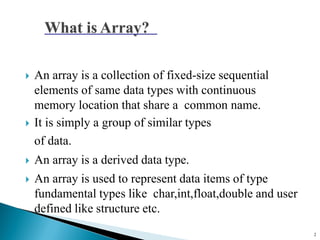
An arrayis a collection of fixed-size sequential
elements of same data types with continuous
memory location that share a common name.
It is simply a group of similar types
of data.
An array is a derived data type.
An array is used to represent data items of type
fundamental types like char,int,float,double and user
defined like structure etc.
2
3.
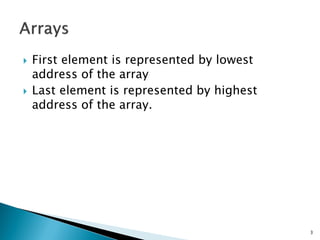
First elementis represented by lowest
address of the array
Last element is represented by highest
address of the array.
3
4.
4
For Example :
1.List of employees in an organization.
2. Test scores of a class of students.
3. List of customers and their telephone numbers.
4. List of students in the college.
For Example, to represent 100 students in college , can be
written as
student [100]
Here student is a array name and [100] is called index or
subscript.
6
A variable whichrepresent the list of items using only one
index (subscript) is called one-dimensional array.
For Example , if we want to represent a set of five numbers
say(35,40,20,57,19), by an array variable number, then
number is declared as follows
int number [5] ;
7.
7
The computer storethese numbers as shown below :
number [0]
number [1]
number [2]
number [3]
number [4]
The values can be assigned to the array as follows :
number [0] = 35;
number [1] = 40;
number [2] = 20;
number [3] = 57;
number [4] = 19;
8.
8
The general formof array declaration is :
Data_type array_name[size];
Here the Data_type specifies the type of elements
contained in the array, such as int, float, or char.
And the size indicates the maximum numbers of elements
that can be stored inside the array.
The size should be either a numeric constant or a symbolic
constant.
9.
9
For example :
intgroup [10] ;
Here int is Data_type, group is a variable name i.e.
array_name , 10 is a size of array and the subscripts
(index) is start from 0 to 9.
The first address i.e. group[0] is called base address of
the array..
10.
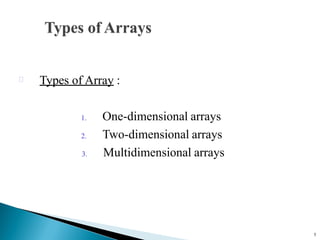
An array canbe stored in following stages :
1. At compile time
2. At run time
Compile time initialization :In compile time initialization,
the array is initialized when they are declared.
The general form of initialization of array is
Data_type array-name[size] ={ list_of_values};
The list of values are separated by commas.
10
11.
11
Example :
int number[3]= {4,5,9};
Here array, number of size 3 and
assign 4 to first element(number[0]),
5 is assign with second element(number[1])
and 9 is assign with third element(number[2]).
If the number of values in the list is less than the number of
elements, then only that many elements will be intialized. The
remaining elements will be set to zero automatically.
12.
12
Example :
int number[] = {1,2,3,4}; // size will be 4
The character array can be initialized as follows :
char name[ ] =
{„j‟,‟o‟,‟h‟,‟n‟,‟0‟};
The character array can also be initialized as follows : char
name[ ] = “john”;
13.
13
In run timeinitialization, the array is explicitly initialize at run
time. This concept generally used for initializing large arrays.
Example:
for(i=0; i < 100; i++)
{
if( i < 50)
sum[i] = 0.0;
else
sum[i] = 1.0;
}
Here first 50 elements of the array sum are initialized to 0 and
the remaining 50 elements are initialized to 1 at run time
14.
Program toread 5 numbers from user and print it.
#include<stdio.h>
#include<conio.h>
void main()
{
int num[5],i;
clrscr();
printf(“Enter five numbers”);
for(i=0;i<5;i++)
{
scanf(“%d”,&num[i]);
}
14
15.
Printf(“ nNumbers are:”);
for( i=0;i<5;i++)
{
printf(“nnum[i]=%d”,i, num[i]);
}
getch();
}
Output: Enter five numbers 10 20 30 40 50
Numbers are :
num[0]=10
Num[1]=20
num[2]=30
num[3]=40
num[4]=50
15
16.
Program toread n numbers from user and print it.
#include<stdio.h>
#include<conio.h>
void main()
{
int num[5],I,n;
clrscr();
printf(“Enter the value of n”);
scanf(“%d”,&n);
printf(“nEnter %d elements:”,n);
for(i=0;i<n;i++)
{
scanf(“%d”,&num[i]);
}
16
17.
Printf(“ nNumbers are:”);
for( i=0;i<n;i++)
{
printf(“nnum[i]=%d”,i, num[i]);
}
getch();
}
Output: Enter the value of n 5
Enter 3 numbers 10 20 30
Numbers are :
num[0]=10
Num[1]=20
num[2]=30
17
18.
18
A variable whichrepresent the list of items using two index
(subscript) is called two-dimensional array.
In Two dimensional arrays, the data is stored in rows and
columns format and generally known as matrix.
For example:
int table[2][3];
19.
19
The general formof two dimensional array declaration is :
Data_type array-name[row_size][column_size];
Here the Data_type specifies the type of elements
contained in the array, such as int, float, or char.
array_name is a valid C identifier.
The size should be either a numeric constant or a
symbolic constant.
20.
20
The general formof initializing two-dimensional array is :
Data_type array-name[row_size][column_size] = {listof values};
Example :
int table[2][3] = {0,0,0,1,1,1};
Here the elements of first row initializes to zero and the
elements of second row initializes to one.
This above statement can be written as :
int table[2][3] = {{0,0,0}, {1,1,1}};
In two-dimensional array the row_size can be omitted.
21.
21
Example :
int table[][3] = {{0,0,0}, {1,1,1}};
If the values are missing in an initializer, they are
automatically set.
Example :
int table[2][3] = {1,1,2};
Here first row initialize to 1,1 and 2, and second row
initialize to 0,0 and 0 automatically.
22.
22
In Two dimensionalarrays, the data is stored in rows and
columns format.
For example:
int table[2][3] = {1,2,3,4,5,6};
The memory layout of above example :
table[0][0] = 1;
table[0][1] = 2
table[0][2] = 3;
table[1][0] = 4;
table[1][1] = 5;
table[1][2] = 6;
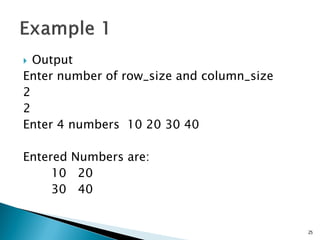
Output
Enter numberof row_size and column_size
2
2
Enter 4 numbers 10 20 30 40
Entered Numbers are:
10 20
30 40
25
26.
26
A variable whichrepresent the list of items using more than two
index (subscript) is called multi-dimensional array.
The general form of multi dimensional array is :
type array-name[s1][s2][s3]…….[sn];
27.
27
Where S isthe size. Some examples are :
int survey[3][5][6];
float table[5][4][5][3];
Here survey is a three-dimensional array And table is a four-
dimensional array.
28.
28
Using pointers foraccessing arrays.
Passing arrays as function parameters.
Arrays as members of structures.
Using structure type data as array elements.
Arrays as dynamic data structures.
Manipulating character arrays and strings.

![4
For Example :
1. List of employees in an organization.
2. Test scores of a class of students.
3. List of customers and their telephone numbers.
4. List of students in the college.
For Example, to represent 100 students in college , can be
written as
student [100]
Here student is a array name and [100] is called index or
subscript.](https://image.slidesharecdn.com/arrays-251213183918-590eb270/85/ARRAYS-AS-DATA-STRUCTURES-IN-C-PROGRAMMING-4-320.jpg)
![6
A variable which represent the list of items using only one
index (subscript) is called one-dimensional array.
For Example , if we want to represent a set of five numbers
say(35,40,20,57,19), by an array variable number, then
number is declared as follows
int number [5] ;](https://image.slidesharecdn.com/arrays-251213183918-590eb270/85/ARRAYS-AS-DATA-STRUCTURES-IN-C-PROGRAMMING-6-320.jpg)
![7
The computer store these numbers as shown below :
number [0]
number [1]
number [2]
number [3]
number [4]
The values can be assigned to the array as follows :
number [0] = 35;
number [1] = 40;
number [2] = 20;
number [3] = 57;
number [4] = 19;](https://image.slidesharecdn.com/arrays-251213183918-590eb270/85/ARRAYS-AS-DATA-STRUCTURES-IN-C-PROGRAMMING-7-320.jpg)
![8
The general form of array declaration is :
Data_type array_name[size];
Here the Data_type specifies the type of elements
contained in the array, such as int, float, or char.
And the size indicates the maximum numbers of elements
that can be stored inside the array.
The size should be either a numeric constant or a symbolic
constant.](https://image.slidesharecdn.com/arrays-251213183918-590eb270/85/ARRAYS-AS-DATA-STRUCTURES-IN-C-PROGRAMMING-8-320.jpg)
![9
For example :
int group [10] ;
Here int is Data_type, group is a variable name i.e.
array_name , 10 is a size of array and the subscripts
(index) is start from 0 to 9.
The first address i.e. group[0] is called base address of
the array..](https://image.slidesharecdn.com/arrays-251213183918-590eb270/85/ARRAYS-AS-DATA-STRUCTURES-IN-C-PROGRAMMING-9-320.jpg)
![An array can be stored in following stages :
1. At compile time
2. At run time
Compile time initialization :In compile time initialization,
the array is initialized when they are declared.
The general form of initialization of array is
Data_type array-name[size] ={ list_of_values};
The list of values are separated by commas.
10](https://image.slidesharecdn.com/arrays-251213183918-590eb270/85/ARRAYS-AS-DATA-STRUCTURES-IN-C-PROGRAMMING-10-320.jpg)
![11
Example :
int number[3] = {4,5,9};
Here array, number of size 3 and
assign 4 to first element(number[0]),
5 is assign with second element(number[1])
and 9 is assign with third element(number[2]).
If the number of values in the list is less than the number of
elements, then only that many elements will be intialized. The
remaining elements will be set to zero automatically.](https://image.slidesharecdn.com/arrays-251213183918-590eb270/85/ARRAYS-AS-DATA-STRUCTURES-IN-C-PROGRAMMING-11-320.jpg)
![12
Example :
int number[ ] = {1,2,3,4}; // size will be 4
The character array can be initialized as follows :
char name[ ] =
{„j‟,‟o‟,‟h‟,‟n‟,‟0‟};
The character array can also be initialized as follows : char
name[ ] = “john”;](https://image.slidesharecdn.com/arrays-251213183918-590eb270/85/ARRAYS-AS-DATA-STRUCTURES-IN-C-PROGRAMMING-12-320.jpg)
![13
In run time initialization, the array is explicitly initialize at run
time. This concept generally used for initializing large arrays.
Example:
for(i=0; i < 100; i++)
{
if( i < 50)
sum[i] = 0.0;
else
sum[i] = 1.0;
}
Here first 50 elements of the array sum are initialized to 0 and
the remaining 50 elements are initialized to 1 at run time](https://image.slidesharecdn.com/arrays-251213183918-590eb270/85/ARRAYS-AS-DATA-STRUCTURES-IN-C-PROGRAMMING-13-320.jpg)
![ Program to read 5 numbers from user and print it.
#include<stdio.h>
#include<conio.h>
void main()
{
int num[5],i;
clrscr();
printf(“Enter five numbers”);
for(i=0;i<5;i++)
{
scanf(“%d”,&num[i]);
}
14](https://image.slidesharecdn.com/arrays-251213183918-590eb270/85/ARRAYS-AS-DATA-STRUCTURES-IN-C-PROGRAMMING-14-320.jpg)
![Printf(“ nNumbers are :”);
for( i=0;i<5;i++)
{
printf(“nnum[i]=%d”,i, num[i]);
}
getch();
}
Output: Enter five numbers 10 20 30 40 50
Numbers are :
num[0]=10
Num[1]=20
num[2]=30
num[3]=40
num[4]=50
15](https://image.slidesharecdn.com/arrays-251213183918-590eb270/85/ARRAYS-AS-DATA-STRUCTURES-IN-C-PROGRAMMING-15-320.jpg)
![ Program to read n numbers from user and print it.
#include<stdio.h>
#include<conio.h>
void main()
{
int num[5],I,n;
clrscr();
printf(“Enter the value of n”);
scanf(“%d”,&n);
printf(“nEnter %d elements:”,n);
for(i=0;i<n;i++)
{
scanf(“%d”,&num[i]);
}
16](https://image.slidesharecdn.com/arrays-251213183918-590eb270/85/ARRAYS-AS-DATA-STRUCTURES-IN-C-PROGRAMMING-16-320.jpg)
![Printf(“ nNumbers are :”);
for( i=0;i<n;i++)
{
printf(“nnum[i]=%d”,i, num[i]);
}
getch();
}
Output: Enter the value of n 5
Enter 3 numbers 10 20 30
Numbers are :
num[0]=10
Num[1]=20
num[2]=30
17](https://image.slidesharecdn.com/arrays-251213183918-590eb270/85/ARRAYS-AS-DATA-STRUCTURES-IN-C-PROGRAMMING-17-320.jpg)
![18
A variable which represent the list of items using two index
(subscript) is called two-dimensional array.
In Two dimensional arrays, the data is stored in rows and
columns format and generally known as matrix.
For example:
int table[2][3];](https://image.slidesharecdn.com/arrays-251213183918-590eb270/85/ARRAYS-AS-DATA-STRUCTURES-IN-C-PROGRAMMING-18-320.jpg)
![19
The general form of two dimensional array declaration is :
Data_type array-name[row_size][column_size];
Here the Data_type specifies the type of elements
contained in the array, such as int, float, or char.
array_name is a valid C identifier.
The size should be either a numeric constant or a
symbolic constant.](https://image.slidesharecdn.com/arrays-251213183918-590eb270/85/ARRAYS-AS-DATA-STRUCTURES-IN-C-PROGRAMMING-19-320.jpg)
![20
The general form of initializing two-dimensional array is :
Data_type array-name[row_size][column_size] = {listof values};
Example :
int table[2][3] = {0,0,0,1,1,1};
Here the elements of first row initializes to zero and the
elements of second row initializes to one.
This above statement can be written as :
int table[2][3] = {{0,0,0}, {1,1,1}};
In two-dimensional array the row_size can be omitted.](https://image.slidesharecdn.com/arrays-251213183918-590eb270/85/ARRAYS-AS-DATA-STRUCTURES-IN-C-PROGRAMMING-20-320.jpg)
![21
Example :
int table[ ][3] = {{0,0,0}, {1,1,1}};
If the values are missing in an initializer, they are
automatically set.
Example :
int table[2][3] = {1,1,2};
Here first row initialize to 1,1 and 2, and second row
initialize to 0,0 and 0 automatically.](https://image.slidesharecdn.com/arrays-251213183918-590eb270/85/ARRAYS-AS-DATA-STRUCTURES-IN-C-PROGRAMMING-21-320.jpg)
![22
In Two dimensional arrays, the data is stored in rows and
columns format.
For example:
int table[2][3] = {1,2,3,4,5,6};
The memory layout of above example :
table[0][0] = 1;
table[0][1] = 2
table[0][2] = 3;
table[1][0] = 4;
table[1][1] = 5;
table[1][2] = 6;](https://image.slidesharecdn.com/arrays-251213183918-590eb270/85/ARRAYS-AS-DATA-STRUCTURES-IN-C-PROGRAMMING-22-320.jpg)
![#include<stdio.h>
#include<conio.h>
void main()
{
int a[3][3],i,j,r,c;
clrscr();
printf("Enter number of row_size and column_size");
scanf("%d%d",&r,&c);
printf("nEnter %d numbers",r*c);
for(i=0;i<r;i++)
{
for(j=0;j<c;j++)
{
23](https://image.slidesharecdn.com/arrays-251213183918-590eb270/85/ARRAYS-AS-DATA-STRUCTURES-IN-C-PROGRAMMING-23-320.jpg)
![scanf("%d",&a[i][j]);
}
}
printf("nEntered numbers are:n");
for(i=0;i<r;i++)
{
for(j=0;j<c;j++)
{
printf("%5d",a[i][j]);
}
printf("n");
}
getch();
}
24](https://image.slidesharecdn.com/arrays-251213183918-590eb270/85/ARRAYS-AS-DATA-STRUCTURES-IN-C-PROGRAMMING-24-320.jpg)
![26
A variable which represent the list of items using more than two
index (subscript) is called multi-dimensional array.
The general form of multi dimensional array is :
type array-name[s1][s2][s3]…….[sn];](https://image.slidesharecdn.com/arrays-251213183918-590eb270/85/ARRAYS-AS-DATA-STRUCTURES-IN-C-PROGRAMMING-26-320.jpg)
![27
Where S is the size. Some examples are :
int survey[3][5][6];
float table[5][4][5][3];
Here survey is a three-dimensional array And table is a four-
dimensional array.](https://image.slidesharecdn.com/arrays-251213183918-590eb270/85/ARRAYS-AS-DATA-STRUCTURES-IN-C-PROGRAMMING-27-320.jpg)