ARO 4140
Rocket Propulsion
In-SpaceRocket Engines
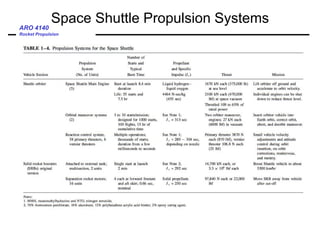
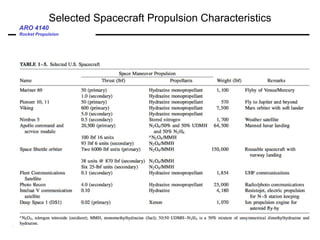
• Smaller Thrust Rocket Engines
– 1 to 200 lbf
– Used for orbit change/adjust
– Large space vehicle attitude control
• Low Thrust Engines
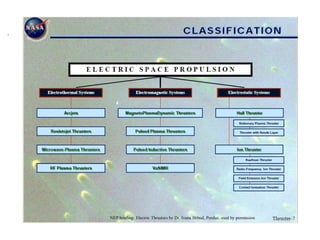
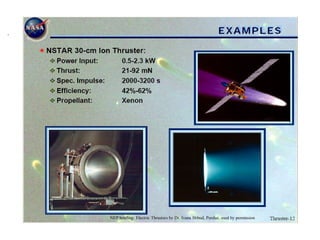
– Electric Propulsion (usually less than 1 N)
– Used for long term orbit change or attitude adjust
• Micro or Nano Thrust Engines
– Can be used for station keeping on a cube sat
– Electric propulsion has application here
3
4.
ARO 4140
Rocket Propulsion
4
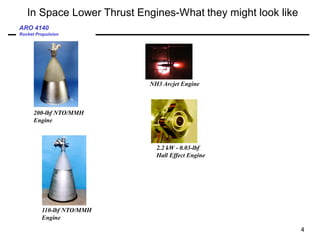
200-lbfNTO/MMH
Engine
110-lbf NTO/MMH
Engine
In Space Lower Thrust Engines-What they might look like
NH3 Arcjet Engine
2.2 kW - 0.03-lbf
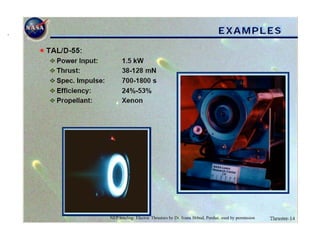
Hall Effect Engine
5.
ARO 4140
Rocket Propulsion
5
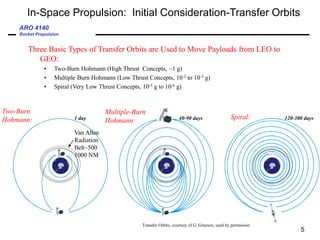
In-SpacePropulsion: Initial Consideration-Transfer Orbits
Three Basic Types of Transfer Orbits are Used to Move Payloads from LEO to
GEO:
• Two-Burn Hohmann (High Thrust Concepts, ~1 g)
• Multiple Burn Hohmann (Low Thrust Concepts, 10-2 to 10-3 g)
• Spiral (Very Low Thrust Concepts, 10-5 g to 10-6 g)
Two-Burn
Hohmann:
Multiple-Burn
Hohmann: Spiral:
1 day 40-90 days 120-300 days
Van Allen
Radiation
Belt~500
1000 NM
Transfer Orbits, courtesy of G. Grayson, used by permission
ARO 4140
Rocket Propulsion
11
AdvancedPropulsion Engines
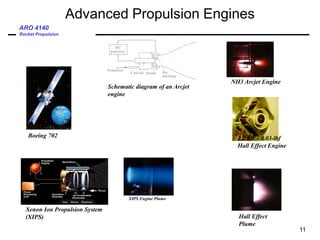
NH3 Arcjet Engine
Boeing 702
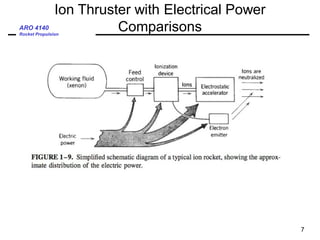
Xenon Ion Propulsion System
(XIPS)
2.2 kW - 0.03-lbf
Hall Effect Engine
Hall Effect
Plume
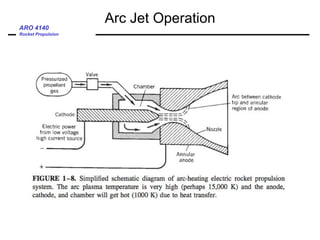
Schematic diagram of an Arcjet
engine
XIPS Engine Plume
ARO 4140
Rocket Propulsion
16
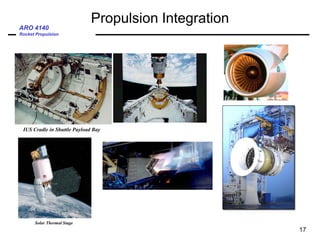
PropulsionIntegration
• Propulsion Integration involves all aspects of the
propulsion device required to integrate it into the
vehicle
• Structure
• Electrical and Hydraulic Power
• Controls
• Main computer commands and data
• Local controller commands and data
• Fuel Supplies
• Aerodynamic inlets and exhausts