TEACHING
DEMONSTRATION
PREPARED BY: CARESTIA , JOEL REY P.
LPT.
ARNIS
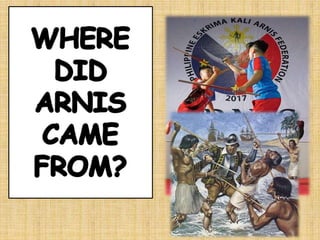
• Arnis, also known as Kali or Eskrima/Escrima, is the
national martial art of the Philippines.
• Arnis comes from arnés, Old Spanish for "armor"
(harness is an archaic English term for armor, which
comes from the same roots as the Spanish term). It is
said to derive from the armor costumes used in Moro-
moro stage plays where actors fought mock battles using
wooden swords.
• It was developed by the indigenous people of the
Philippines who used an assorted range of weaponry for
combat and for self defense.
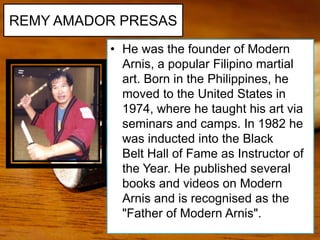
REMY AMADOR PRESAS
• He was the founder of Modern
Arnis, a popular Filipino martial
art. Born in the Philippines, he
moved to the United States in
1974, where he taught his art via
seminars and camps. In 1982 he
was inducted into the Black
Belt Hall of Fame as Instructor of
the Year. He published several
books and videos on Modern
Arnis and is recognised as the
"Father of Modern Arnis".
And there are many
Strikes, Techniques ,
Stances and Weapons
of Arnis. But today we
will tackle first the
fundamentals the
“12 basic strikes”
which is;
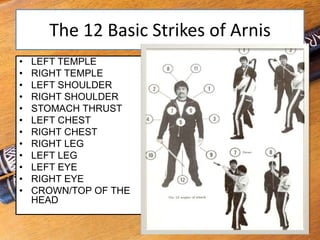
The 12 Basic Strikes of Arnis
• LEFT TEMPLE
• RIGHT TEMPLE
• LEFT SHOULDER
• RIGHT SHOULDER
• STOMACH THRUST
• LEFT CHEST
• RIGHT CHEST
• RIGHT LEG
• LEFT LEG
• LEFT EYE
• RIGHT EYE
• CROWN/TOP OF THE
HEAD
I want you to group
yourselves into 3
groups and perform the
12 Basic Strikes of
Arnis. I’ll give you
10mins to practice.
What is the 6th strike?
LEFT CHEST
What is the 1st strike?
LEFT TEMPLE
What is the 4th strike?
RIGHT SHOULDER
What is the 12th strike?
CROWN/TOP OF THE
HEAD
What is the 9th strike?
LEFT LEG
- Get ¼ sheet of paper and answer this
questions:
1. Name all the 12 basic strikes of Arnis
(24 points )
2. What is our Philippine National Sport?
(3 points )
3. Who is the founder of Modern Arnis?
(3 points )
- Watch a video in YOUTUBE and go search for
“12 Basic Strikes in Arnis with Footwork and Stances”
for you be able to learn in advance for our next
lesson.

ARNIS.pptx

  • 1.
  • 14.
    ARNIS • Arnis, alsoknown as Kali or Eskrima/Escrima, is the national martial art of the Philippines. • Arnis comes from arnés, Old Spanish for "armor" (harness is an archaic English term for armor, which comes from the same roots as the Spanish term). It is said to derive from the armor costumes used in Moro- moro stage plays where actors fought mock battles using wooden swords. • It was developed by the indigenous people of the Philippines who used an assorted range of weaponry for combat and for self defense.
  • 15.
    REMY AMADOR PRESAS •He was the founder of Modern Arnis, a popular Filipino martial art. Born in the Philippines, he moved to the United States in 1974, where he taught his art via seminars and camps. In 1982 he was inducted into the Black Belt Hall of Fame as Instructor of the Year. He published several books and videos on Modern Arnis and is recognised as the "Father of Modern Arnis".
  • 16.
    And there aremany Strikes, Techniques , Stances and Weapons of Arnis. But today we will tackle first the fundamentals the “12 basic strikes” which is;
  • 17.
    The 12 BasicStrikes of Arnis • LEFT TEMPLE • RIGHT TEMPLE • LEFT SHOULDER • RIGHT SHOULDER • STOMACH THRUST • LEFT CHEST • RIGHT CHEST • RIGHT LEG • LEFT LEG • LEFT EYE • RIGHT EYE • CROWN/TOP OF THE HEAD
  • 18.
    I want youto group yourselves into 3 groups and perform the 12 Basic Strikes of Arnis. I’ll give you 10mins to practice.
  • 19.
    What is the6th strike? LEFT CHEST
  • 20.
    What is the1st strike? LEFT TEMPLE
  • 21.
    What is the4th strike? RIGHT SHOULDER
  • 22.
    What is the12th strike? CROWN/TOP OF THE HEAD
  • 23.
    What is the9th strike? LEFT LEG
  • 24.
    - Get ¼sheet of paper and answer this questions: 1. Name all the 12 basic strikes of Arnis (24 points ) 2. What is our Philippine National Sport? (3 points ) 3. Who is the founder of Modern Arnis? (3 points )
  • 25.
    - Watch avideo in YOUTUBE and go search for “12 Basic Strikes in Arnis with Footwork and Stances” for you be able to learn in advance for our next lesson.