Computer Architecture
RISC-V – Arithmetic Logical and Shift Instructions
Lecture 2
2
2
Agenda
● Introduction to RISC-V Instruction Set
● RISC-V Assembly Language
○ Arithmetic Instructions
○ Logical and Shift Instructions
● Demo: Venus Software
RISC-V - Arithmetic, Logical and Shift Instructions
3
3
Agenda
● Introduction to RISC-V Instruction Set
● RISC-V Assembly Language
○ Arithmetic Instructions
○ Logical and Shift Instructions
● Demo: Venus Software
RISC-V - Arithmetic, Logical and Shift Instructions
4
4
What is an instruction set?
• The vocabulary of commands understood by a given architecture
• Set of instructions a particular architecture uses
• Like ADD A, B etc. for our simple microprocessor!
• Examples
• MIPS (a RISC architecture) Instruction Set
• Designed in 1980s
• The Intel x86 (a CISC architecture) Instruction Set
• Originated in 1970s
• RISC-V Instruction Set
• Developed in 2010 at UC Berkeley
• Has much similarity with MIPS
• Open-source and very popular
RISC-V - Arithmetic, Logical and Shift Instructions
5
5
Instruction Set Architectures
• Early trend in ISA designs – more and more instructions to do elaborate
operations
• VAX architecture had an instruction to multiply polynomials!
• RISC philosophy (Cocke IBM, Patterson, Hennessy, 1980s) – Reduced
Instruction Set Computing
• Keep the instruction set small and simple
• Let software do complicated operations by composing simpler ones
• A simpler CPU is easier to iterate on (allowing for faster development),
and can generally be made faster than a complex CPU (we’re often
limited by the slowest instruction we decide to implement)
RISC-V - Arithmetic, Logical and Shift Instructions
6
6
Overiew of a Computing System
• A RISC-V system (or any CPU in general) is composed of two main parts:
• The CPU, which is responsible for computing
• Main memory, which is responsible for long-term data storage
• The CPU is designed to be extremely fast, often completing one instruction every nanosecond or
faster
• Note: Light travels 30 cm in 1 nanosecond. In other words, it takes longer for light to travel
from one end of my laptop to the other, than it does for a CPU to finish one instruction.
• Going to main memory often takes hundreds or even thousands of times longer.
• The CPU can store a small amount of memory, through components called registers.
RISC-V - Arithmetic, Logical and Shift Instructions
7
7
Registers in RISC-V Architecture
• 32 Registers for Integer Operands
• Numbered x0 to x31
• x0 is hardwired to 0 = constant 0 value!
• Register size is 32-bit (word) in 32-bit architectures and 64-bit
(doubleword) in 64-bit architectures!
• 32 Registers for Floating Point Operands
• Numbered f0 to f31
• Different registers have different functions!
• But most are general-purpose!
• We will cover their specific functions in discussion about RISC-V
assembly language!
RISC-V - Arithmetic, Logical and Shift Instructions
8
8
Agenda
● Introduction to RISC-V Instruction Set
● RISC-V Assembly Language
○ Arithmetic Instructions
○ Logical and Shift Instructions
● Demo: Venus Software
RISC-V - Arithmetic, Logical and Shift Instructions
9
9
Instructions
• Each line of RISC-V code is a single instruction, which executes a
simple operation on registers.
• Instructions are generally written in the format
• <instruction name> <destination register> <operands>
• Ex. “add x5 x6 x7” means “Add the values stored in x6 and x7,
and store the result in x5”
• Commas can be added between registers (“add x5, x6, x7”), but
this is optional.
RISC-V - Arithmetic, Logical and Shift Instructions
10
10
Classes of Instructions
• Arithmetic
• Example
• add x5, x6, x7
• Logical and Shift
• Examples
• xor x5, x6, x7
• srl x5, x6, x7
• Data Transfer
• Example
• lw x5, 40(x6) # load word
• sw x7, 0(x2) # load doubleword (in 64-bit architecture)!
• Program Control / Branch
• Example
• beq x1, x2, loop
• jal x1, target
RISC-V - Arithmetic, Logical and Shift Instructions
Most Instructions have three operands / fields …
12
12
Agenda
● Introduction to RISC-V Instruction Set
● RISC-V Assembly Language
○ Arithmetic Instructions
○ Logical and Shift Instructions
● Demo: Venus Software
RISC-V - Arithmetic, Logical and Shift Instructions
13
13
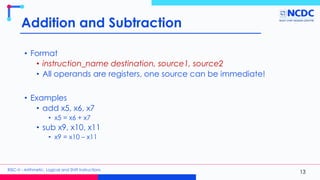
Addition and Subtraction
• Format
• instruction_name destination, source1, source2
• All operands are registers, one source can be immediate!
• Examples
• add x5, x6, x7
• x5 = x6 + x7
• sub x9, x10, x11
• x9 = x10 – x11
RISC-V - Arithmetic, Logical and Shift Instructions
14
14
Exercise …
• Convert the following C-language statement into RISC-V assembly
• f = (g + h) – (i + j)
• Assume f, g, h, i, j are assigned to x19, x20, x21, x22 and x23
• Use x5 and x6 as temporary registers!
• Solution
• Note: We could also have written this as f = g + h - i - j; which allows us to compute this
without any temporary registers. A smart compiler may write code this way instead.
RISC-V - Arithmetic, Logical and Shift Instructions
add x5, x20, x21 # register x5 contains g + h
add x6, x22, x23 # register x6 contains i + j
sub x19, x5, x6 # f gets x5 – x6, which is (g + h) − (i + j)
Comments
15
15
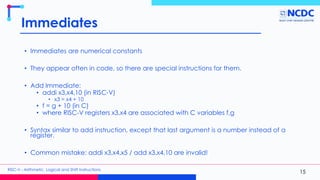
Immediates
• Immediates are numerical constants
• They appear often in code, so there are special instructions for them.
• Add Immediate:
• addi x3,x4,10 (in RISC-V)
• x3 = x4 + 10
• f = g + 10 (in C)
• where RISC-V registers x3,x4 are associated with C variables f,g
• Syntax similar to add instruction, except that last argument is a number instead of a
register.
• Common mistake: addi x3,x4,x5 / add x3,x4,10 are invalid!
RISC-V - Arithmetic, Logical and Shift Instructions
16
16
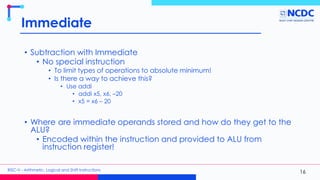
Immediate
• Subtraction with Immediate
• No special instruction
• To limit types of operations to absolute minimum!
• Is there a way to achieve this?
• Use addi
• addi x5, x6, –20
• x5 = x6 – 20
• Where are immediate operands stored and how do they get to the
ALU?
• Encoded within the instruction and provided to ALU from
instruction register!
RISC-V - Arithmetic, Logical and Shift Instructions
17
17
Agenda
● Introduction to RISC-V Instruction Set
● RISC-V Assembly Language
○ Arithmetic Instructions
○ Logical and Shift Instructions
● Demo: Venus Software
RISC-V - Arithmetic, Logical and Shift Instructions
18
18
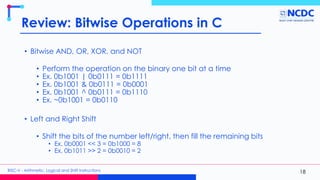
Review: Bitwise Operations in C
• Bitwise AND, OR, XOR, and NOT
• Perform the operation on the binary one bit at a time
• Ex. 0b1001 | 0b0111 = 0b1111
• Ex. 0b1001 & 0b0111 = 0b0001
• Ex. 0b1001 ^ 0b0111 = 0b1110
• Ex. ~0b1001 = 0b0110
• Left and Right Shift
• Shift the bits of the number left/right, then fill the remaining bits
• Ex. 0b0001 << 3 = 0b1000 = 8
• Ex. 0b1011 >> 2 = 0b0010 = 2
RISC-V - Arithmetic, Logical and Shift Instructions
19
19
Review: Bitwise Operations in C
• Shifts have numerical equivalents in math
• Left Shift by n -> Multiply by 2n
• Right Shift by n -> (Floor) Divide by 2n
• For left shifts, we always fill the new bits with 0s
• For right shifts, dividing an unsigned number should fill the bits with 0s
• But right-shifting a signed number shouldn't fill with 0s always
• Ex. 0b1000 0010 = -126 in 8 bits. If we right-shift by 1 and fill with 0s,
we get 0b0100 0001 = 65. But if we right-shift by 1 and fill with the
sign bit, we get 0b1100 0001 = -63 = -126/2
RISC-V - Arithmetic, Logical and Shift Instructions
20
20
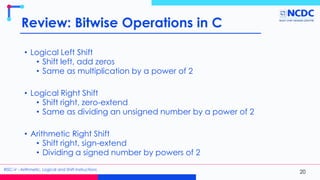
Review: Bitwise Operations in C
• Logical Left Shift
• Shift left, add zeros
• Same as multiplication by a power of 2
• Logical Right Shift
• Shift right, zero-extend
• Same as dividing an unsigned number by a power of 2
• Arithmetic Right Shift
• Shift right, sign-extend
• Dividing a signed number by powers of 2
RISC-V - Arithmetic, Logical and Shift Instructions
21
21
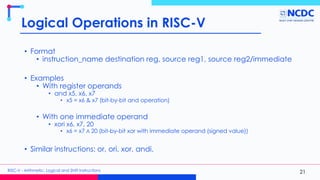
Logical Operations in RISC-V
• Format
• instruction_name destination reg, source reg1, source reg2/immediate
• Examples
• With register operands
• and x5, x6, x7
• x5 = x6 & x7 (bit-by-bit and operation)
• With one immediate operand
• xori x6, x7, 20
• x6 = x7 ∧ 20 (bit-by-bit xor with immediate operand (signed value))
• Similar instructions: or, ori, xor, andi.
RISC-V - Arithmetic, Logical and Shift Instructions
22
22
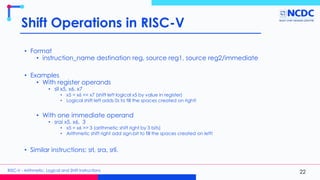
Shift Operations in RISC-V
• Format
• instruction_name destination reg, source reg1, source reg2/immediate
• Examples
• With register operands
• sll x5, x6, x7
• x5 = x6 << x7 (shift left logical x5 by value in register)
• Logical shift left adds 0s to fill the spaces created on right!
• With one immediate operand
• srai x5, x6, 3
• x5 = x6 >> 3 (arithmetic shift right by 3 bits)
• Arithmetic shift right add sign-bit to fill the spaces created on left!
• Similar instructions: srl, sra, srli.
RISC-V - Arithmetic, Logical and Shift Instructions
23
23
Pseudoinstructions
• Instructions that are more readable and assembler understands but are not part of the
Instruction Set
• Examples
• li x9, 123 # load immediate value 123 into register x9
• li is not part of RISC-V ISA
• Which instruction achieves the above?
• addi x9, x0, 123 # register x9 gets register x0 + 123
• mv x10, x11 # register x10 gets register x11
• Equivalent Instruction?
• add x10, x0, x11
• nop
• Equivalent is addi x0, x0, 0!
RISC-V - Arithmetic, Logical and Shift Instructions
24
24
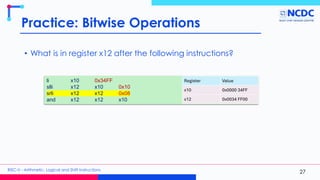
Practice: Bitwise Operations
• What is in register x12 after the following instructions?
RISC-V - Arithmetic, Logical and Shift Instructions
li x10 0x34FF
slli x12 x10 0x10
srli x12 x12 0x08
and x12 x12 x10
Register Value
x10 0x0000 0000
x12 0x0000 0000
25
25
Practice: Bitwise Operations
• What is in register x12 after the following instructions?
RISC-V - Arithmetic, Logical and Shift Instructions
li x10 0x34FF
slli x12 x10 0x10
srli x12 x12 0x08
and x12 x12 x10
Register Value
x10 0x0000 34FF
x12 0x0000 0000
26
26
Practice: Bitwise Operations
• What is in register x12 after the following instructions?
RISC-V - Arithmetic, Logical and Shift Instructions
li x10 0x34FF
slli x12 x10 0x10
srli x12 x12 0x08
and x12 x12 x10
Register Value
x10 0x0000 34FF
x12 0x34FF 0000
27
27
Practice: Bitwise Operations
• What is in register x12 after the following instructions?
RISC-V - Arithmetic, Logical and Shift Instructions
li x10 0x34FF
slli x12 x10 0x10
srli x12 x12 0x08
and x12 x12 x10
Register Value
x10 0x0000 34FF
x12 0x0034 FF00
28
28
Practice: Bitwise Operations
• What is in register x12 after the following instructions?
RISC-V - Arithmetic, Logical and Shift Instructions
li x10 0x34FF
slli x12 x10 0x10
srli x12 x12 0x08
and x12 x12 x10
Register Value
x10 0x0000 34FF
x12 0x0000 3400
29
29
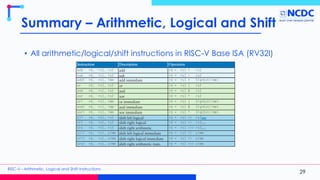
Summary – Arithmetic, Logical and Shift
• All arithmetic/logical/shift instructions in RISC-V Base ISA (RV32I)
RISC-V - Arithmetic, Logical and Shift Instructions
30
30
Operations that are not in RISC-V!
• There's a few notable omissions in this list:
• Bitwise NOT
• Exists as a pseudoinstruction!
• not x5, x5
• Can be run by doing a bitwise XOR with 0xFFFF FFFF = -1
• xori x5, x5, -1
• Negate – 2’s complement
• Exists as a pseudoinstruction
• neg x10, x10
• Equivalent instruction?
• sub x10, x0, x10
RISC-V - Arithmetic, Logical and Shift Instructions
31
31
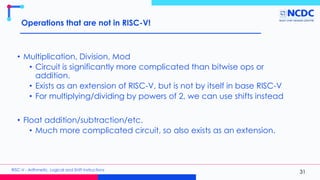
Operations that are not in RISC-V!
• Multiplication, Division, Mod
• Circuit is significantly more complicated than bitwise ops or
addition.
• Exists as an extension of RISC-V, but is not by itself in base RISC-V
• For multiplying/dividing by powers of 2, we can use shifts instead
• Float addition/subtraction/etc.
• Much more complicated circuit, so also exists as an extension.
RISC-V - Arithmetic, Logical and Shift Instructions
32
32
Agenda
● Introduction to RISC-V Instruction Set
● RISC-V Assembly Language
○ Arithmetic Instructions
○ Logical and Shift Instructions
● Demo: Venus Software
RISC-V - Arithmetic, Logical and Shift Instructions
RISC-V Assembly Language Simulator
Venus: https://venus.cs61c.org/
RARS: https://github.com/TheThirdOne/rars
33
34
34
Assignment
• Task 1
• Using RISC-V add / addi / sub instructions, implement 1’s complement
(NOT) of a value in x5 register
• i.e., if x5 = 0xFFFFFFFF, after 1’s complement x5 = 0x00000000
• Task 2
• Write a RISC-V assembly code that creates a 32-bit constant value
0x12345678 and places it in x5
• Task 3
• Write a RISC-V code that tests whether a number in x5 register is even
or odd. The result is indicated in x10 such that x10 is 0 if the number is
even and 1 if number is odd
RISC-V - Arithmetic, Logical and Shift Instructions
35
35
Assignment
• Task 4
• Write a RISC-V assembly code that toggles a specific bit of x5 with the
bit number to be toggled been specified in x10
• Task 5
• Write a RISC-V assembly code that checks if there are even number of
1’s in value specified in register x5 or odd number of 1’s. If there are
even number of 1’s in x5, set x10 to 0 otherwise set x10 to 1.
• Task 6
• Write a RISC-V assembly code that selects one of the 4 bytes from a
register x5 and places the resulting byte (with 0 extension) in x10. The
byte number (0,1,2 or 3) is specified in x6.
RISC-V - Arithmetic, Logical and Shift Instructions
36
36
Assignment
• Task 7
• Write a RISC-V assembly code that selects one of the 4 bytes
from a register x5 and places the resulting byte (with sign
extension) in x10. The byte number (0,1, 2 or 3) is specified in x6.
• Task 8
• Write a RISC-V assembly code that compares x5 and x6 and sets
x10 to 1 if x5 is greater (signed comparison) than x6.
• Do this without using slt (set less than) instruction which achieves the same
thing!
RISC-V - Arithmetic, Logical and Shift Instructions
Thank You

Arithmetic, Logical and Shift Instructions.pdf

  • 1.
    Computer Architecture RISC-V –Arithmetic Logical and Shift Instructions Lecture 2
  • 2.
    2 2 Agenda ● Introduction toRISC-V Instruction Set ● RISC-V Assembly Language ○ Arithmetic Instructions ○ Logical and Shift Instructions ● Demo: Venus Software RISC-V - Arithmetic, Logical and Shift Instructions
  • 3.
    3 3 Agenda ● Introduction toRISC-V Instruction Set ● RISC-V Assembly Language ○ Arithmetic Instructions ○ Logical and Shift Instructions ● Demo: Venus Software RISC-V - Arithmetic, Logical and Shift Instructions
  • 4.
    4 4 What is aninstruction set? • The vocabulary of commands understood by a given architecture • Set of instructions a particular architecture uses • Like ADD A, B etc. for our simple microprocessor! • Examples • MIPS (a RISC architecture) Instruction Set • Designed in 1980s • The Intel x86 (a CISC architecture) Instruction Set • Originated in 1970s • RISC-V Instruction Set • Developed in 2010 at UC Berkeley • Has much similarity with MIPS • Open-source and very popular RISC-V - Arithmetic, Logical and Shift Instructions
  • 5.
    5 5 Instruction Set Architectures •Early trend in ISA designs – more and more instructions to do elaborate operations • VAX architecture had an instruction to multiply polynomials! • RISC philosophy (Cocke IBM, Patterson, Hennessy, 1980s) – Reduced Instruction Set Computing • Keep the instruction set small and simple • Let software do complicated operations by composing simpler ones • A simpler CPU is easier to iterate on (allowing for faster development), and can generally be made faster than a complex CPU (we’re often limited by the slowest instruction we decide to implement) RISC-V - Arithmetic, Logical and Shift Instructions
  • 6.
    6 6 Overiew of aComputing System • A RISC-V system (or any CPU in general) is composed of two main parts: • The CPU, which is responsible for computing • Main memory, which is responsible for long-term data storage • The CPU is designed to be extremely fast, often completing one instruction every nanosecond or faster • Note: Light travels 30 cm in 1 nanosecond. In other words, it takes longer for light to travel from one end of my laptop to the other, than it does for a CPU to finish one instruction. • Going to main memory often takes hundreds or even thousands of times longer. • The CPU can store a small amount of memory, through components called registers. RISC-V - Arithmetic, Logical and Shift Instructions
  • 7.
    7 7 Registers in RISC-VArchitecture • 32 Registers for Integer Operands • Numbered x0 to x31 • x0 is hardwired to 0 = constant 0 value! • Register size is 32-bit (word) in 32-bit architectures and 64-bit (doubleword) in 64-bit architectures! • 32 Registers for Floating Point Operands • Numbered f0 to f31 • Different registers have different functions! • But most are general-purpose! • We will cover their specific functions in discussion about RISC-V assembly language! RISC-V - Arithmetic, Logical and Shift Instructions
  • 8.
    8 8 Agenda ● Introduction toRISC-V Instruction Set ● RISC-V Assembly Language ○ Arithmetic Instructions ○ Logical and Shift Instructions ● Demo: Venus Software RISC-V - Arithmetic, Logical and Shift Instructions
  • 9.
    9 9 Instructions • Each lineof RISC-V code is a single instruction, which executes a simple operation on registers. • Instructions are generally written in the format • <instruction name> <destination register> <operands> • Ex. “add x5 x6 x7” means “Add the values stored in x6 and x7, and store the result in x5” • Commas can be added between registers (“add x5, x6, x7”), but this is optional. RISC-V - Arithmetic, Logical and Shift Instructions
  • 10.
    10 10 Classes of Instructions •Arithmetic • Example • add x5, x6, x7 • Logical and Shift • Examples • xor x5, x6, x7 • srl x5, x6, x7 • Data Transfer • Example • lw x5, 40(x6) # load word • sw x7, 0(x2) # load doubleword (in 64-bit architecture)! • Program Control / Branch • Example • beq x1, x2, loop • jal x1, target RISC-V - Arithmetic, Logical and Shift Instructions
  • 11.
    Most Instructions havethree operands / fields …
  • 12.
    12 12 Agenda ● Introduction toRISC-V Instruction Set ● RISC-V Assembly Language ○ Arithmetic Instructions ○ Logical and Shift Instructions ● Demo: Venus Software RISC-V - Arithmetic, Logical and Shift Instructions
  • 13.
    13 13 Addition and Subtraction •Format • instruction_name destination, source1, source2 • All operands are registers, one source can be immediate! • Examples • add x5, x6, x7 • x5 = x6 + x7 • sub x9, x10, x11 • x9 = x10 – x11 RISC-V - Arithmetic, Logical and Shift Instructions
  • 14.
    14 14 Exercise … • Convertthe following C-language statement into RISC-V assembly • f = (g + h) – (i + j) • Assume f, g, h, i, j are assigned to x19, x20, x21, x22 and x23 • Use x5 and x6 as temporary registers! • Solution • Note: We could also have written this as f = g + h - i - j; which allows us to compute this without any temporary registers. A smart compiler may write code this way instead. RISC-V - Arithmetic, Logical and Shift Instructions add x5, x20, x21 # register x5 contains g + h add x6, x22, x23 # register x6 contains i + j sub x19, x5, x6 # f gets x5 – x6, which is (g + h) − (i + j) Comments
  • 15.
    15 15 Immediates • Immediates arenumerical constants • They appear often in code, so there are special instructions for them. • Add Immediate: • addi x3,x4,10 (in RISC-V) • x3 = x4 + 10 • f = g + 10 (in C) • where RISC-V registers x3,x4 are associated with C variables f,g • Syntax similar to add instruction, except that last argument is a number instead of a register. • Common mistake: addi x3,x4,x5 / add x3,x4,10 are invalid! RISC-V - Arithmetic, Logical and Shift Instructions
  • 16.
    16 16 Immediate • Subtraction withImmediate • No special instruction • To limit types of operations to absolute minimum! • Is there a way to achieve this? • Use addi • addi x5, x6, –20 • x5 = x6 – 20 • Where are immediate operands stored and how do they get to the ALU? • Encoded within the instruction and provided to ALU from instruction register! RISC-V - Arithmetic, Logical and Shift Instructions
  • 17.
    17 17 Agenda ● Introduction toRISC-V Instruction Set ● RISC-V Assembly Language ○ Arithmetic Instructions ○ Logical and Shift Instructions ● Demo: Venus Software RISC-V - Arithmetic, Logical and Shift Instructions
  • 18.
    18 18 Review: Bitwise Operationsin C • Bitwise AND, OR, XOR, and NOT • Perform the operation on the binary one bit at a time • Ex. 0b1001 | 0b0111 = 0b1111 • Ex. 0b1001 & 0b0111 = 0b0001 • Ex. 0b1001 ^ 0b0111 = 0b1110 • Ex. ~0b1001 = 0b0110 • Left and Right Shift • Shift the bits of the number left/right, then fill the remaining bits • Ex. 0b0001 << 3 = 0b1000 = 8 • Ex. 0b1011 >> 2 = 0b0010 = 2 RISC-V - Arithmetic, Logical and Shift Instructions
  • 19.
    19 19 Review: Bitwise Operationsin C • Shifts have numerical equivalents in math • Left Shift by n -> Multiply by 2n • Right Shift by n -> (Floor) Divide by 2n • For left shifts, we always fill the new bits with 0s • For right shifts, dividing an unsigned number should fill the bits with 0s • But right-shifting a signed number shouldn't fill with 0s always • Ex. 0b1000 0010 = -126 in 8 bits. If we right-shift by 1 and fill with 0s, we get 0b0100 0001 = 65. But if we right-shift by 1 and fill with the sign bit, we get 0b1100 0001 = -63 = -126/2 RISC-V - Arithmetic, Logical and Shift Instructions
  • 20.
    20 20 Review: Bitwise Operationsin C • Logical Left Shift • Shift left, add zeros • Same as multiplication by a power of 2 • Logical Right Shift • Shift right, zero-extend • Same as dividing an unsigned number by a power of 2 • Arithmetic Right Shift • Shift right, sign-extend • Dividing a signed number by powers of 2 RISC-V - Arithmetic, Logical and Shift Instructions
  • 21.
    21 21 Logical Operations inRISC-V • Format • instruction_name destination reg, source reg1, source reg2/immediate • Examples • With register operands • and x5, x6, x7 • x5 = x6 & x7 (bit-by-bit and operation) • With one immediate operand • xori x6, x7, 20 • x6 = x7 ∧ 20 (bit-by-bit xor with immediate operand (signed value)) • Similar instructions: or, ori, xor, andi. RISC-V - Arithmetic, Logical and Shift Instructions
  • 22.
    22 22 Shift Operations inRISC-V • Format • instruction_name destination reg, source reg1, source reg2/immediate • Examples • With register operands • sll x5, x6, x7 • x5 = x6 << x7 (shift left logical x5 by value in register) • Logical shift left adds 0s to fill the spaces created on right! • With one immediate operand • srai x5, x6, 3 • x5 = x6 >> 3 (arithmetic shift right by 3 bits) • Arithmetic shift right add sign-bit to fill the spaces created on left! • Similar instructions: srl, sra, srli. RISC-V - Arithmetic, Logical and Shift Instructions
  • 23.
    23 23 Pseudoinstructions • Instructions thatare more readable and assembler understands but are not part of the Instruction Set • Examples • li x9, 123 # load immediate value 123 into register x9 • li is not part of RISC-V ISA • Which instruction achieves the above? • addi x9, x0, 123 # register x9 gets register x0 + 123 • mv x10, x11 # register x10 gets register x11 • Equivalent Instruction? • add x10, x0, x11 • nop • Equivalent is addi x0, x0, 0! RISC-V - Arithmetic, Logical and Shift Instructions
  • 24.
    24 24 Practice: Bitwise Operations •What is in register x12 after the following instructions? RISC-V - Arithmetic, Logical and Shift Instructions li x10 0x34FF slli x12 x10 0x10 srli x12 x12 0x08 and x12 x12 x10 Register Value x10 0x0000 0000 x12 0x0000 0000
  • 25.
    25 25 Practice: Bitwise Operations •What is in register x12 after the following instructions? RISC-V - Arithmetic, Logical and Shift Instructions li x10 0x34FF slli x12 x10 0x10 srli x12 x12 0x08 and x12 x12 x10 Register Value x10 0x0000 34FF x12 0x0000 0000
  • 26.
    26 26 Practice: Bitwise Operations •What is in register x12 after the following instructions? RISC-V - Arithmetic, Logical and Shift Instructions li x10 0x34FF slli x12 x10 0x10 srli x12 x12 0x08 and x12 x12 x10 Register Value x10 0x0000 34FF x12 0x34FF 0000
  • 27.
    27 27 Practice: Bitwise Operations •What is in register x12 after the following instructions? RISC-V - Arithmetic, Logical and Shift Instructions li x10 0x34FF slli x12 x10 0x10 srli x12 x12 0x08 and x12 x12 x10 Register Value x10 0x0000 34FF x12 0x0034 FF00
  • 28.
    28 28 Practice: Bitwise Operations •What is in register x12 after the following instructions? RISC-V - Arithmetic, Logical and Shift Instructions li x10 0x34FF slli x12 x10 0x10 srli x12 x12 0x08 and x12 x12 x10 Register Value x10 0x0000 34FF x12 0x0000 3400
  • 29.
    29 29 Summary – Arithmetic,Logical and Shift • All arithmetic/logical/shift instructions in RISC-V Base ISA (RV32I) RISC-V - Arithmetic, Logical and Shift Instructions
  • 30.
    30 30 Operations that arenot in RISC-V! • There's a few notable omissions in this list: • Bitwise NOT • Exists as a pseudoinstruction! • not x5, x5 • Can be run by doing a bitwise XOR with 0xFFFF FFFF = -1 • xori x5, x5, -1 • Negate – 2’s complement • Exists as a pseudoinstruction • neg x10, x10 • Equivalent instruction? • sub x10, x0, x10 RISC-V - Arithmetic, Logical and Shift Instructions
  • 31.
    31 31 Operations that arenot in RISC-V! • Multiplication, Division, Mod • Circuit is significantly more complicated than bitwise ops or addition. • Exists as an extension of RISC-V, but is not by itself in base RISC-V • For multiplying/dividing by powers of 2, we can use shifts instead • Float addition/subtraction/etc. • Much more complicated circuit, so also exists as an extension. RISC-V - Arithmetic, Logical and Shift Instructions
  • 32.
    32 32 Agenda ● Introduction toRISC-V Instruction Set ● RISC-V Assembly Language ○ Arithmetic Instructions ○ Logical and Shift Instructions ● Demo: Venus Software RISC-V - Arithmetic, Logical and Shift Instructions
  • 33.
    RISC-V Assembly LanguageSimulator Venus: https://venus.cs61c.org/ RARS: https://github.com/TheThirdOne/rars 33
  • 34.
    34 34 Assignment • Task 1 •Using RISC-V add / addi / sub instructions, implement 1’s complement (NOT) of a value in x5 register • i.e., if x5 = 0xFFFFFFFF, after 1’s complement x5 = 0x00000000 • Task 2 • Write a RISC-V assembly code that creates a 32-bit constant value 0x12345678 and places it in x5 • Task 3 • Write a RISC-V code that tests whether a number in x5 register is even or odd. The result is indicated in x10 such that x10 is 0 if the number is even and 1 if number is odd RISC-V - Arithmetic, Logical and Shift Instructions
  • 35.
    35 35 Assignment • Task 4 •Write a RISC-V assembly code that toggles a specific bit of x5 with the bit number to be toggled been specified in x10 • Task 5 • Write a RISC-V assembly code that checks if there are even number of 1’s in value specified in register x5 or odd number of 1’s. If there are even number of 1’s in x5, set x10 to 0 otherwise set x10 to 1. • Task 6 • Write a RISC-V assembly code that selects one of the 4 bytes from a register x5 and places the resulting byte (with 0 extension) in x10. The byte number (0,1,2 or 3) is specified in x6. RISC-V - Arithmetic, Logical and Shift Instructions
  • 36.
    36 36 Assignment • Task 7 •Write a RISC-V assembly code that selects one of the 4 bytes from a register x5 and places the resulting byte (with sign extension) in x10. The byte number (0,1, 2 or 3) is specified in x6. • Task 8 • Write a RISC-V assembly code that compares x5 and x6 and sets x10 to 1 if x5 is greater (signed comparison) than x6. • Do this without using slt (set less than) instruction which achieves the same thing! RISC-V - Arithmetic, Logical and Shift Instructions
  • 37.