THE HISTORY OF ART: PART II
Professor Will Adams • wadams5@valenciacollege.edu
Online • Downtown Campus
Research Project Instructions
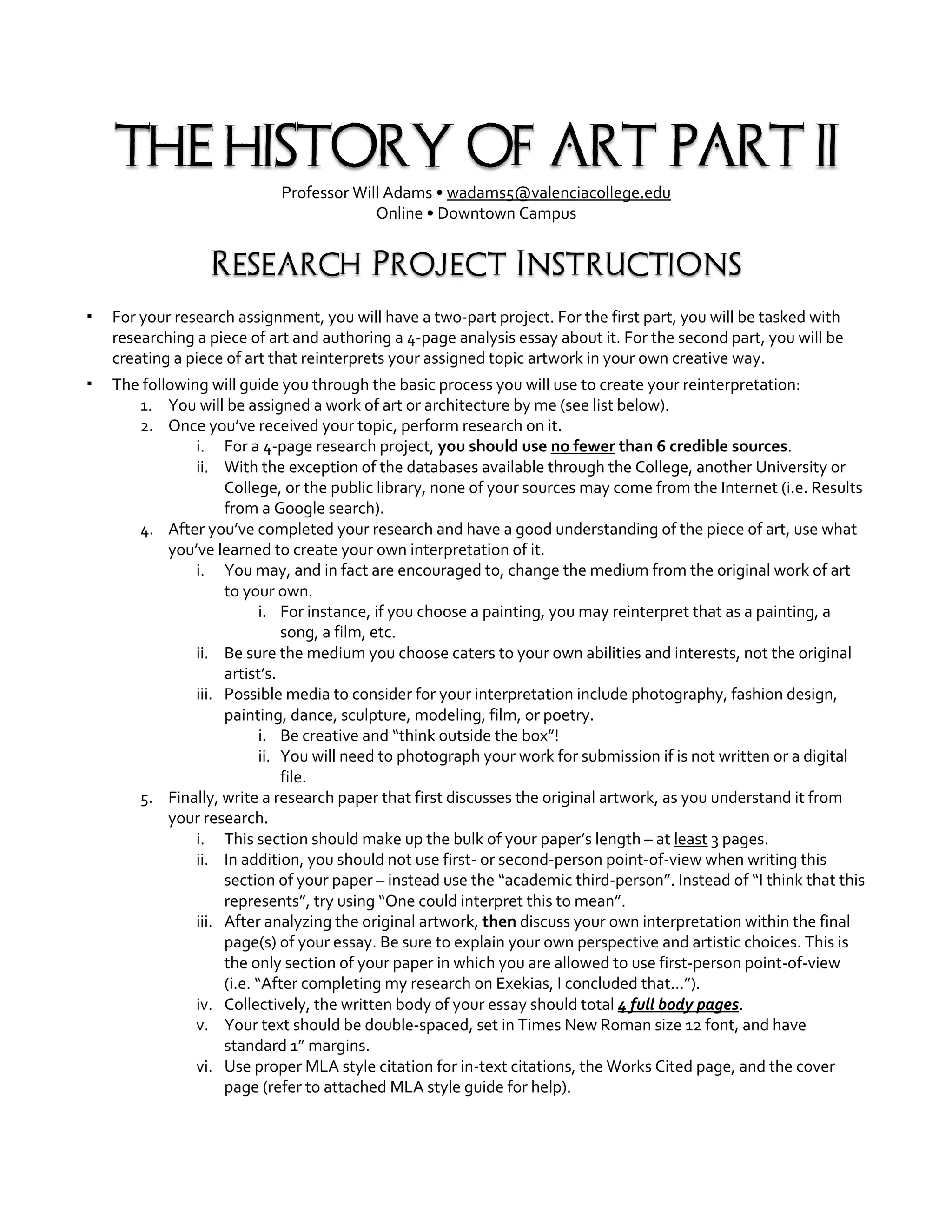
▪ For your research assignment, you will have a two-part project. For the first part, you will be tasked with
researching a piece of art and authoring a 4-page analysis essay about it. For the second part, you will be
creating a piece of art that reinterprets your assigned topic artwork in your own creative way.
▪ The following will guide you through the basic process you will use to create your reinterpretation:
1. You will be assigned a work of art or architecture by me (see list below).
2. Once you’ve received your topic, perform research on it.
i. For a 4-page research project, you should use no fewer than 6 credible sources.
ii. With the exception of the databases available through the College, another University or
College, or the public library, none of your sources may come from the Internet (i.e. Results
from a Google search).
4. After you’ve completed your research and have a good understanding of the piece of art, use what
you’ve learned to create your own interpretation of it.
i. You may, and in fact are encouraged to, change the medium from the original work of art
to your own.
i. For instance, if you choose a painting, you may reinterpret that as a painting, a
song, a film, etc.
ii. Be sure the medium you choose caters to your own abilities and interests, not the original
artist’s.
iii. Possible media to consider for your interpretation include photography, fashion design,
painting, dance, sculpture, modeling, film, or poetry.
i. Be creative and “think outside the box”!
ii. You will need to photograph your work for submission if is not written or a digital
file.
5. Finally, write a research paper that first discusses the original artwork, as you understand it from
your research.
i. This section should make up the bulk of your paper’s length – at least 3 pages.
ii. In addition, you should not use first- or second-person point-of-view when writing this
section of your paper – instead use the “academic third-person”. Instead of “I think that this
represents”, try using “One could interpret this to mean”.
iii. After analyzing the original artwork, then discuss your own interpretation within the final
page(s) of your essay. Be sure to explain your own perspective and artistic choices. This is
the only section of your paper in which you are allowed to use first-person point-of-view
(i.e. “After completing my research on Exekias, I concluded that…”).
iv. Collectively, the written body of your essay should total 4 full body pages.
v. Your text should be double-spaced, set in Times New Roman size 12 font, and have
standard 1” margins.
vi. Use proper MLA style citation for in-text citations, the Works Cited page, and the cover
page (refer to attached MLA style guide for help).
6. One draft may be turned in for instructor feedback by July 12th
– this must be done via email at
wadams5@valenciacollege.edu.
7. Both the artistic and the written components of your project are due in on Sunday, July 26th
.
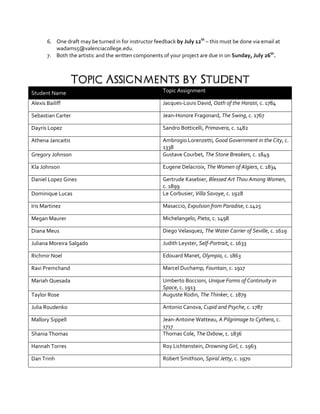
Topic Assignments by Student
Student Name Topic Assignment
Alexis Bailiff Jacques-Louis David, Oath of the Horatii, c. 1784
Sebastian Carter Jean-Honore Fragonard, The Swing, c. 1767
Dayris Lopez Sandro Botticelli, Primavera, c. 1482
Athena Jancaitis Ambrogio Lorenzetti, Good Government in the City, c.
1338
Gregory Johnson Gustave Courbet, The Stone Breakers, c. 1849
Kla Johnson Eugene Delacroix, The Women of Algiers, c. 1834
Daniel Lopez Gines Gertrude Kasebier, Blessed Art Thou Among Women,
c. 1899
Dominique Lucas Le Corbusier, Villa Savoye, c. 1928
Iris Martinez Masaccio, Expulsion from Paradise, c.1425
Megan Maurer Michelangelo, Pieta, c. 1498
Diana Meus Diego Velasquez, The Water Carrier of Seville, c. 1619
Juliana Moreira Salgado Judith Leyster, Self-Portrait, c. 1633
Richmir Noel Edouard Manet, Olympia, c. 1863
Ravi Premchand Marcel Duchamp, Fountain, c. 1917
Mariah Quesada Umberto Boccioni, Unique Forms of Continuity in
Space, c. 1913
Taylor Rose Auguste Rodin, The Thinker, c. 1879
Julia Roudenko Antonio Canova, Cupid and Psyche, c. 1787
Mallory Sippell Jean-Antoine Watteau, A Pilgrimage to Cythera, c.
1717
Shania Thomas Thomas Cole, The Oxbow, c. 1836
Hannah Torres Roy Lichtenstein, Drowning Girl, c. 1963
Dan Trinh Robert Smithson, Spiral Jetty, c. 1970
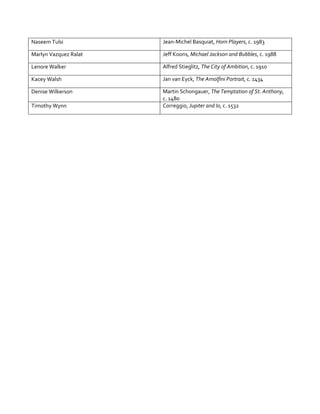
Naseem Tulsi Jean-Michel Basquiat, Horn Players, c. 1983
Marlyn Vazquez Ralat Jeff Koons, Michael Jackson and Bubbles, c. 1988
Lenore Walker Alfred Stieglitz, The City of Ambition, c. 1910
Kacey Walsh Jan van Eyck, The Arnolfini Portrait, c. 1434
Denise Wilkerson Martin Schongauer, The Temptation of St. Anthony,
c. 1480
Timothy Wynn Correggio, Jupiter and Io, c. 1532

Arh2051 fa2020 research project instructions section 1

  • 1.
    THE HISTORY OFART: PART II Professor Will Adams • wadams5@valenciacollege.edu Online • Downtown Campus Research Project Instructions ▪ For your research assignment, you will have a two-part project. For the first part, you will be tasked with researching a piece of art and authoring a 4-page analysis essay about it. For the second part, you will be creating a piece of art that reinterprets your assigned topic artwork in your own creative way. ▪ The following will guide you through the basic process you will use to create your reinterpretation: 1. You will be assigned a work of art or architecture by me (see list below). 2. Once you’ve received your topic, perform research on it. i. For a 4-page research project, you should use no fewer than 6 credible sources. ii. With the exception of the databases available through the College, another University or College, or the public library, none of your sources may come from the Internet (i.e. Results from a Google search). 4. After you’ve completed your research and have a good understanding of the piece of art, use what you’ve learned to create your own interpretation of it. i. You may, and in fact are encouraged to, change the medium from the original work of art to your own. i. For instance, if you choose a painting, you may reinterpret that as a painting, a song, a film, etc. ii. Be sure the medium you choose caters to your own abilities and interests, not the original artist’s. iii. Possible media to consider for your interpretation include photography, fashion design, painting, dance, sculpture, modeling, film, or poetry. i. Be creative and “think outside the box”! ii. You will need to photograph your work for submission if is not written or a digital file. 5. Finally, write a research paper that first discusses the original artwork, as you understand it from your research. i. This section should make up the bulk of your paper’s length – at least 3 pages. ii. In addition, you should not use first- or second-person point-of-view when writing this section of your paper – instead use the “academic third-person”. Instead of “I think that this represents”, try using “One could interpret this to mean”. iii. After analyzing the original artwork, then discuss your own interpretation within the final page(s) of your essay. Be sure to explain your own perspective and artistic choices. This is the only section of your paper in which you are allowed to use first-person point-of-view (i.e. “After completing my research on Exekias, I concluded that…”). iv. Collectively, the written body of your essay should total 4 full body pages. v. Your text should be double-spaced, set in Times New Roman size 12 font, and have standard 1” margins. vi. Use proper MLA style citation for in-text citations, the Works Cited page, and the cover page (refer to attached MLA style guide for help).
  • 2.
    6. One draftmay be turned in for instructor feedback by July 12th – this must be done via email at wadams5@valenciacollege.edu. 7. Both the artistic and the written components of your project are due in on Sunday, July 26th . Topic Assignments by Student Student Name Topic Assignment Alexis Bailiff Jacques-Louis David, Oath of the Horatii, c. 1784 Sebastian Carter Jean-Honore Fragonard, The Swing, c. 1767 Dayris Lopez Sandro Botticelli, Primavera, c. 1482 Athena Jancaitis Ambrogio Lorenzetti, Good Government in the City, c. 1338 Gregory Johnson Gustave Courbet, The Stone Breakers, c. 1849 Kla Johnson Eugene Delacroix, The Women of Algiers, c. 1834 Daniel Lopez Gines Gertrude Kasebier, Blessed Art Thou Among Women, c. 1899 Dominique Lucas Le Corbusier, Villa Savoye, c. 1928 Iris Martinez Masaccio, Expulsion from Paradise, c.1425 Megan Maurer Michelangelo, Pieta, c. 1498 Diana Meus Diego Velasquez, The Water Carrier of Seville, c. 1619 Juliana Moreira Salgado Judith Leyster, Self-Portrait, c. 1633 Richmir Noel Edouard Manet, Olympia, c. 1863 Ravi Premchand Marcel Duchamp, Fountain, c. 1917 Mariah Quesada Umberto Boccioni, Unique Forms of Continuity in Space, c. 1913 Taylor Rose Auguste Rodin, The Thinker, c. 1879 Julia Roudenko Antonio Canova, Cupid and Psyche, c. 1787 Mallory Sippell Jean-Antoine Watteau, A Pilgrimage to Cythera, c. 1717 Shania Thomas Thomas Cole, The Oxbow, c. 1836 Hannah Torres Roy Lichtenstein, Drowning Girl, c. 1963 Dan Trinh Robert Smithson, Spiral Jetty, c. 1970
  • 3.
    Naseem Tulsi Jean-MichelBasquiat, Horn Players, c. 1983 Marlyn Vazquez Ralat Jeff Koons, Michael Jackson and Bubbles, c. 1988 Lenore Walker Alfred Stieglitz, The City of Ambition, c. 1910 Kacey Walsh Jan van Eyck, The Arnolfini Portrait, c. 1434 Denise Wilkerson Martin Schongauer, The Temptation of St. Anthony, c. 1480 Timothy Wynn Correggio, Jupiter and Io, c. 1532