JCOMM Observation Programmes Support Centre – Argo Information Centre September 2015
Argo Status
Argo TC, M. Belbeoch
JCOMM Observation Programmes Support Centre – Argo Information Centre September 2015
Indicators (Core Argo)
Category Indicator Method Target Note
STATUS Activity 108% Nb Active units
vs target
3200 3473/3918
Intensity 89% Nb Deployed
over last 12
months vs target
800 ? for the
core array
715/1027units
Density 56% % of 6x6
well sampled
Certainly not
100 %
To refine metric
DATA Delivery 90%, 95% Nb of platforms
distributing data
vs registered
GTS , GDACs
100%, 100%
3520/ 3918,
3749/ 3918
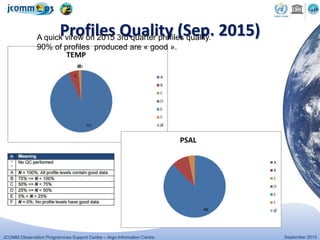
Quality 93%, 88% % Profile with
« good » data
TEMP, PSAL
3rd Quarter
DM Processing 70% Ratio DM/DM
Eligible
100% As of
01/10/2015
Timeliness 89% (GTS)
81% (GDACs)
Nb Obs. < 24h vs
Total Obs.
100%, 100% September
Delays 7h, 25h (GTS)
11h, 35h (GDACs)
Median , Average
Delay
24h September
INSTRUMENTATION Reliability 85% Average age of
latest dead floats
1500 days 1281 days
3rd quarter
Half-life 91% % surviving 750
days
100% 901/985
Deployed
[T-1115;T-750]
JCOMM Observation Programmes Support Centre – Argo Information Centre September 2015
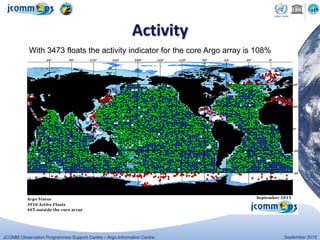
Activity
With 3473 floats the activity indicator for the core Argo array is 108%
JCOMM Observation Programmes Support Centre – Argo Information Centre September 2015
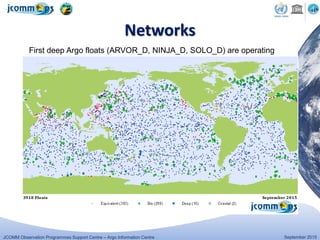
Networks
First deep Argo floats (ARVOR_D, NINJA_D, SOLO_D) are operating
JCOMM Observation Programmes Support Centre – Argo Information Centre September 2015
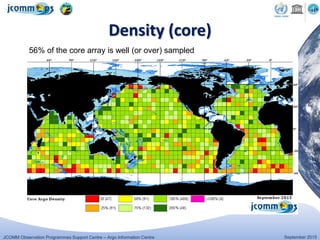
Density (core)
56% of the core array is well (or over) sampled
JCOMM Observation Programmes Support Centre – Argo Information Centre September 2015
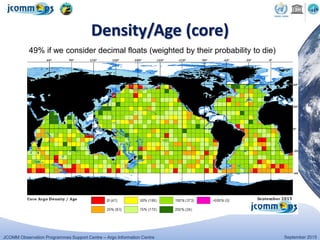
Density/Age (core)
49% if we consider decimal floats (weighted by their probability to die)
JCOMM Observation Programmes Support Centre – Argo Information Centre September 2015
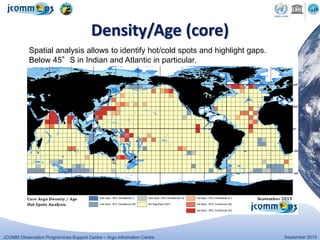
Density/Age (core)
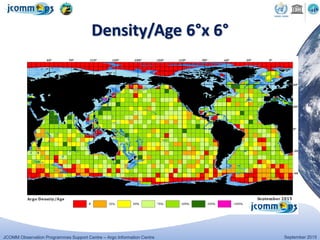
Spatial analysis allows to identify hot/cold spots and highlight gaps.
Below 45°S in Indian and Atlantic in particular.
JCOMM Observation Programmes Support Centre – Argo Information Centre September 2015
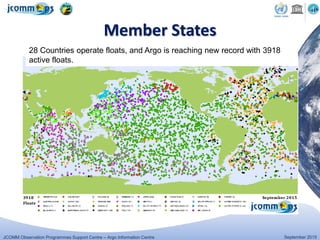
Member States
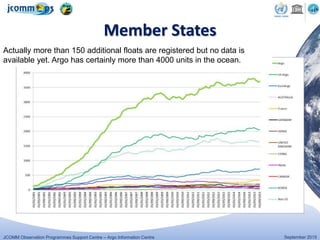
28 Countries operate floats, and Argo is reaching new record with 3918
active floats.
JCOMM Observation Programmes Support Centre – Argo Information Centre September 2015
Member States
Actually more than 150 additional floats are registered but no data is
available yet. Argo has certainly more than 4000 units in the ocean.
JCOMM Observation Programmes Support Centre – Argo Information Centre September 2015
Member States (zoom)
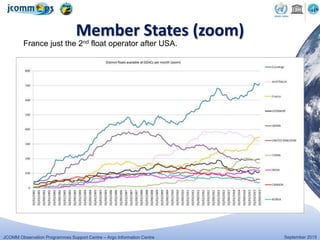
France just the 2nd float operator after USA.
JCOMM Observation Programmes Support Centre – Argo Information Centre September 2015
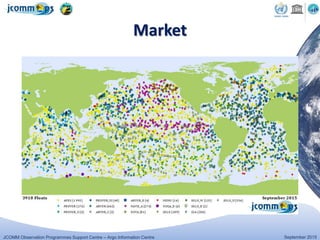
Market
JCOMM Observation Programmes Support Centre – Argo Information Centre September 2015
Market
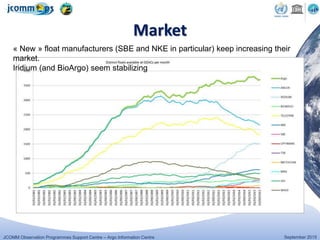
« New » float manufacturers (SBE and NKE in particular) keep increasing their
market.
Iridium (and BioArgo) seem stabilizing
JCOMM Observation Programmes Support Centre – Argo Information Centre September 2015
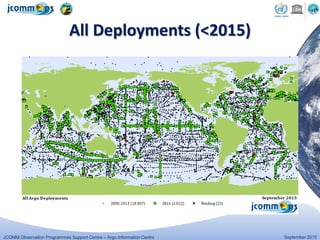
All Deployments (<2015)
JCOMM Observation Programmes Support Centre – Argo Information Centre September 2015
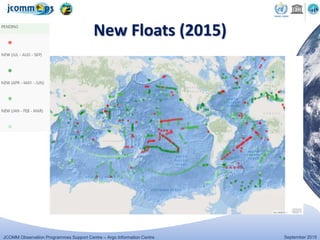
New Floats (2015)
JCOMM Observation Programmes Support Centre – Argo Information Centre September 2015
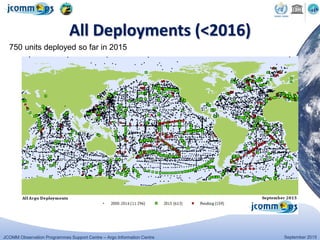
All Deployments (<2016)
750 units deployed so far in 2015
JCOMM Observation Programmes Support Centre – Argo Information Centre September 2015
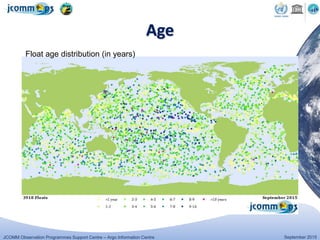
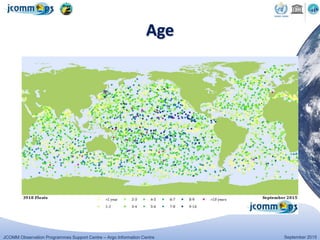
Age
Float age distribution (in years)
JCOMM Observation Programmes Support Centre – Argo Information Centre September 2015
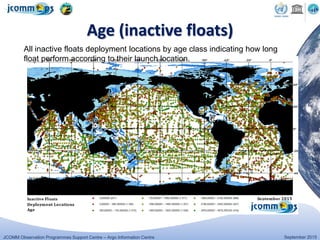
Age (inactive floats)
All inactive floats deployment locations by age class indicating how long
float perform according to their launch location.
JCOMM Observation Programmes Support Centre – Argo Information Centre September 2015
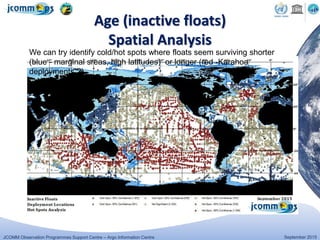
Age (inactive floats)
Spatial Analysis
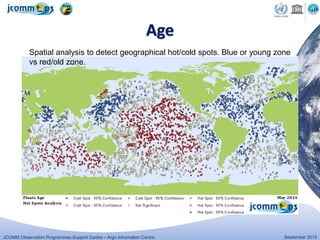
We can try identify cold/hot spots where floats seem surviving shorter
(blue - marginal sreas, high latitudes) or longer (red -Karahoa
deployments ?)
JCOMM Observation Programmes Support Centre – Argo Information Centre September 2015
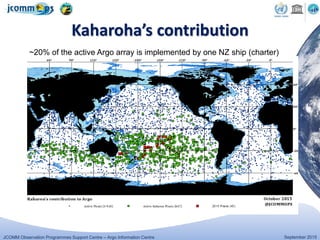
Kaharoha’s contribution
~20% of the active Argo array is implemented by one NZ ship (charter)
JCOMM Observation Programmes Support Centre – Argo Information Centre September 2015
Age
JCOMM Observation Programmes Support Centre – Argo Information Centre September 2015
Age
Spatial analysis to detect geographical hot/cold spots. Blue or young zone
vs red/old zone.
JCOMM Observation Programmes Support Centre – Argo Information Centre September 2015
Density (SIO)
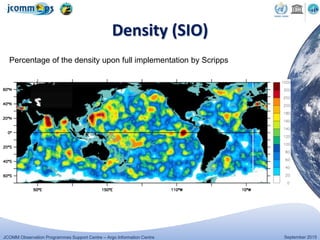
Percentage of the density upon full implementation by Scripps
JCOMM Observation Programmes Support Centre – Argo Information Centre September 2015
Density 6° x 6°
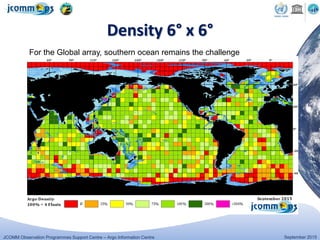
For the Global array, southern ocean remains the challenge
JCOMM Observation Programmes Support Centre – Argo Information Centre September 2015
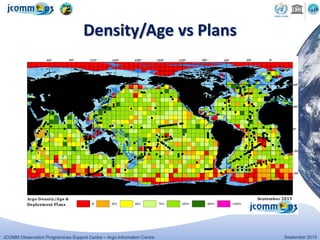
Density/Age 6°x 6°
JCOMM Observation Programmes Support Centre – Argo Information Centre September 2015
Density/Age vs Plans
JCOMM Observation Programmes Support Centre – Argo Information Centre September 2015
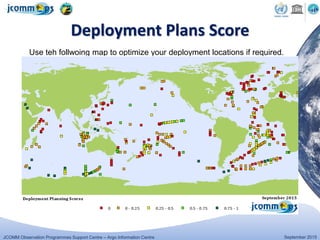
Deployment Plans Score
Use teh follwoing map to optimize your deployment locations if required.
JCOMM Observation Programmes Support Centre – Argo Information Centre September 2015
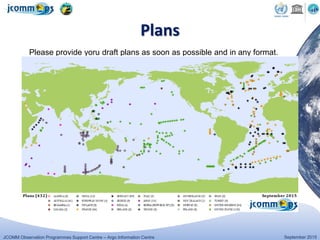
Plans
Please provide yoru draft plans as soon as possible and in any format.
Standrda JCOMMOPS txt format is gradually used by all programmes:
ID (any);WMO (if exists);LAT;LON;DATE;SHIP;CRUISE
JCOMM Observation Programmes Support Centre – Argo Information Centre September 2015
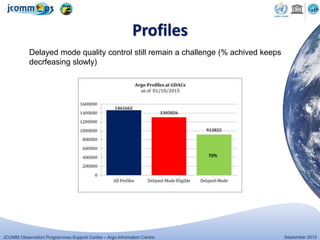
Profiles
Delayed mode quality control still remain a challenge (% achived keeps
decrfeasing slowly)
JCOMM Observation Programmes Support Centre – Argo Information Centre September 2015
Profiles Quality (Sep. 2015)A quick virew on 2015 3rd quarter profiles quality.
90% of profiles produced are « good ».
JCOMM Observation Programmes Support Centre – Argo Information Centre September 2015
Delays GTS
JCOMM Observation Programmes Support Centre – Argo Information Centre September 2015
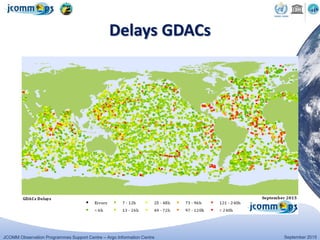
Delays GDACs
JCOMM Observation Programmes Support Centre – Argo Information Centre September 2015
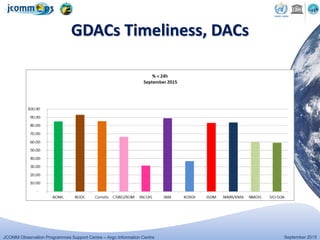
GDACs Timeliness, DACs
JCOMM Observation Programmes Support Centre – Argo Information Centre September 2015
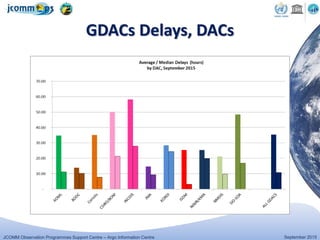
GDACs Delays, DACs
JCOMM Observation Programmes Support Centre – Argo Information Centre September 2015
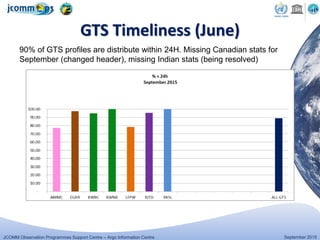
GTS Timeliness (June)
90% of GTS profiles are distribute within 24H. Missing Canadian stats for
September (changed header), missing Indian stats (being resolved)
JCOMM Observation Programmes Support Centre – Argo Information Centre September 2015
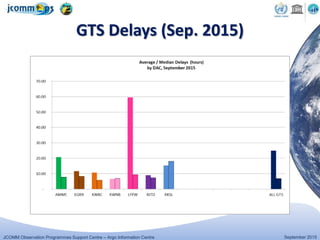
GTS Delays (Sep. 2015)
JCOMM Observation Programmes Support Centre – Argo Information Centre September 2015
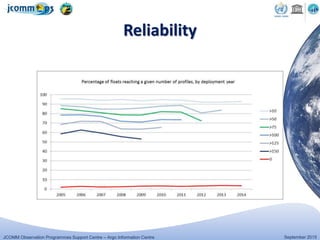
Reliability
JCOMM Observation Programmes Support Centre – Argo Information Centre September 2015
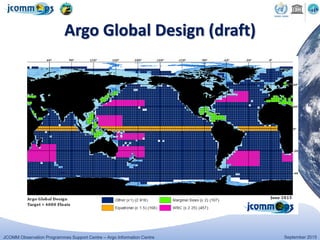
Argo Global Design (draft)
JCOMM Observation Programmes Support Centre – Argo Information Centre September 2015
Links
• Report
• ftp.jcommops.org/Argo/Doc/2015-09-AIC.xlsx
• ftp.jcommops.org/Argo/Doc/2015-09-AIC.pdf
• Maps
• http://argo.jcommops.org/maps
• ftp.jcommops.org/Argo/maps/LATEST/
• News
• http://www.twitter.com/jcommops

Argo Status Report - 2015/09

  • 1.
    JCOMM Observation ProgrammesSupport Centre – Argo Information Centre September 2015 Argo Status Argo TC, M. Belbeoch
  • 2.
    JCOMM Observation ProgrammesSupport Centre – Argo Information Centre September 2015 Indicators (Core Argo) Category Indicator Method Target Note STATUS Activity 108% Nb Active units vs target 3200 3473/3918 Intensity 89% Nb Deployed over last 12 months vs target 800 ? for the core array 715/1027units Density 56% % of 6x6 well sampled Certainly not 100 % To refine metric DATA Delivery 90%, 95% Nb of platforms distributing data vs registered GTS , GDACs 100%, 100% 3520/ 3918, 3749/ 3918 Quality 93%, 88% % Profile with « good » data TEMP, PSAL 3rd Quarter DM Processing 70% Ratio DM/DM Eligible 100% As of 01/10/2015 Timeliness 89% (GTS) 81% (GDACs) Nb Obs. < 24h vs Total Obs. 100%, 100% September Delays 7h, 25h (GTS) 11h, 35h (GDACs) Median , Average Delay 24h September INSTRUMENTATION Reliability 85% Average age of latest dead floats 1500 days 1281 days 3rd quarter Half-life 91% % surviving 750 days 100% 901/985 Deployed [T-1115;T-750]
  • 3.
    JCOMM Observation ProgrammesSupport Centre – Argo Information Centre September 2015 Activity With 3473 floats the activity indicator for the core Argo array is 108%
  • 4.
    JCOMM Observation ProgrammesSupport Centre – Argo Information Centre September 2015 Networks First deep Argo floats (ARVOR_D, NINJA_D, SOLO_D) are operating
  • 5.
    JCOMM Observation ProgrammesSupport Centre – Argo Information Centre September 2015 Density (core) 56% of the core array is well (or over) sampled
  • 6.
    JCOMM Observation ProgrammesSupport Centre – Argo Information Centre September 2015 Density/Age (core) 49% if we consider decimal floats (weighted by their probability to die)
  • 7.
    JCOMM Observation ProgrammesSupport Centre – Argo Information Centre September 2015 Density/Age (core) Spatial analysis allows to identify hot/cold spots and highlight gaps. Below 45°S in Indian and Atlantic in particular.
  • 8.
    JCOMM Observation ProgrammesSupport Centre – Argo Information Centre September 2015 Member States 28 Countries operate floats, and Argo is reaching new record with 3918 active floats.
  • 9.
    JCOMM Observation ProgrammesSupport Centre – Argo Information Centre September 2015 Member States Actually more than 150 additional floats are registered but no data is available yet. Argo has certainly more than 4000 units in the ocean.
  • 10.
    JCOMM Observation ProgrammesSupport Centre – Argo Information Centre September 2015 Member States (zoom) France just the 2nd float operator after USA.
  • 11.
    JCOMM Observation ProgrammesSupport Centre – Argo Information Centre September 2015 Market
  • 12.
    JCOMM Observation ProgrammesSupport Centre – Argo Information Centre September 2015 Market « New » float manufacturers (SBE and NKE in particular) keep increasing their market. Iridium (and BioArgo) seem stabilizing
  • 13.
    JCOMM Observation ProgrammesSupport Centre – Argo Information Centre September 2015 All Deployments (<2015)
  • 14.
    JCOMM Observation ProgrammesSupport Centre – Argo Information Centre September 2015 New Floats (2015)
  • 15.
    JCOMM Observation ProgrammesSupport Centre – Argo Information Centre September 2015 All Deployments (<2016) 750 units deployed so far in 2015
  • 16.
    JCOMM Observation ProgrammesSupport Centre – Argo Information Centre September 2015 Age Float age distribution (in years)
  • 17.
    JCOMM Observation ProgrammesSupport Centre – Argo Information Centre September 2015 Age (inactive floats) All inactive floats deployment locations by age class indicating how long float perform according to their launch location.
  • 18.
    JCOMM Observation ProgrammesSupport Centre – Argo Information Centre September 2015 Age (inactive floats) Spatial Analysis We can try identify cold/hot spots where floats seem surviving shorter (blue - marginal sreas, high latitudes) or longer (red -Karahoa deployments ?)
  • 19.
    JCOMM Observation ProgrammesSupport Centre – Argo Information Centre September 2015 Kaharoha’s contribution ~20% of the active Argo array is implemented by one NZ ship (charter)
  • 20.
    JCOMM Observation ProgrammesSupport Centre – Argo Information Centre September 2015 Age
  • 21.
    JCOMM Observation ProgrammesSupport Centre – Argo Information Centre September 2015 Age Spatial analysis to detect geographical hot/cold spots. Blue or young zone vs red/old zone.
  • 22.
    JCOMM Observation ProgrammesSupport Centre – Argo Information Centre September 2015 Density (SIO) Percentage of the density upon full implementation by Scripps
  • 23.
    JCOMM Observation ProgrammesSupport Centre – Argo Information Centre September 2015 Density 6° x 6° For the Global array, southern ocean remains the challenge
  • 24.
    JCOMM Observation ProgrammesSupport Centre – Argo Information Centre September 2015 Density/Age 6°x 6°
  • 25.
    JCOMM Observation ProgrammesSupport Centre – Argo Information Centre September 2015 Density/Age vs Plans
  • 26.
    JCOMM Observation ProgrammesSupport Centre – Argo Information Centre September 2015 Deployment Plans Score Use teh follwoing map to optimize your deployment locations if required.
  • 27.
    JCOMM Observation ProgrammesSupport Centre – Argo Information Centre September 2015 Plans Please provide yoru draft plans as soon as possible and in any format. Standrda JCOMMOPS txt format is gradually used by all programmes: ID (any);WMO (if exists);LAT;LON;DATE;SHIP;CRUISE
  • 28.
    JCOMM Observation ProgrammesSupport Centre – Argo Information Centre September 2015 Profiles Delayed mode quality control still remain a challenge (% achived keeps decrfeasing slowly)
  • 29.
    JCOMM Observation ProgrammesSupport Centre – Argo Information Centre September 2015 Profiles Quality (Sep. 2015)A quick virew on 2015 3rd quarter profiles quality. 90% of profiles produced are « good ».
  • 30.
    JCOMM Observation ProgrammesSupport Centre – Argo Information Centre September 2015 Delays GTS
  • 31.
    JCOMM Observation ProgrammesSupport Centre – Argo Information Centre September 2015 Delays GDACs
  • 32.
    JCOMM Observation ProgrammesSupport Centre – Argo Information Centre September 2015 GDACs Timeliness, DACs
  • 33.
    JCOMM Observation ProgrammesSupport Centre – Argo Information Centre September 2015 GDACs Delays, DACs
  • 34.
    JCOMM Observation ProgrammesSupport Centre – Argo Information Centre September 2015 GTS Timeliness (June) 90% of GTS profiles are distribute within 24H. Missing Canadian stats for September (changed header), missing Indian stats (being resolved)
  • 35.
    JCOMM Observation ProgrammesSupport Centre – Argo Information Centre September 2015 GTS Delays (Sep. 2015)
  • 36.
    JCOMM Observation ProgrammesSupport Centre – Argo Information Centre September 2015 Reliability
  • 37.
    JCOMM Observation ProgrammesSupport Centre – Argo Information Centre September 2015 Argo Global Design (draft)
  • 38.
    JCOMM Observation ProgrammesSupport Centre – Argo Information Centre September 2015 Links • Report • ftp.jcommops.org/Argo/Doc/2015-09-AIC.xlsx • ftp.jcommops.org/Argo/Doc/2015-09-AIC.pdf • Maps • http://argo.jcommops.org/maps • ftp.jcommops.org/Argo/maps/LATEST/ • News • http://www.twitter.com/jcommops

Editor's Notes

  • #10 Note that last point of the graph is the status of GDACs calculated between 01/06/2015 and 01/07/2015
  • #32 May: median: 10h, average: 35h June:median:10h , average: 22