1
Are established democracies less vulnerable to Internet censorship than authoritarian
regimes? The social media test
Archie L. Dick
Lilian I. Oyieke
Theo J.D. Bothma
archie.dick@up.ac.za, lilian.ingutia-oyieke@up.ac.za, theo.bothma@up.ac.za
Department of Information Science
University of Pretoria, Private Bag X20, Hatfield, 0028, South Africa
Abstract
David Cameron’s announcement during the 2011 riots across cities in the United Kingdom to
consider shutting down social media shocked the international information community. It
raises questions of how far below the surface of the world’s established democracies
censorship lies, and how freedom of access to information and freedom of expression
(FAIFE) bodies should respond. Social media are used in this article to test how firmly
entrenched intellectual freedom is in established democracies through a comparison with
countries with an authoritarian track record. The method is to evaluate the use of social media
in recent protests in a sample of established democracies and authoritarian regimes, and to
compare differences and similarities in government responses. The article concludes with
recommendations for IFLA’s FAIFE Committee.
2
1. Introduction
On Thursday 11 August 2011, the United Kingdom’s (UK) prime minister David Cameron
shocked the international community with a call for a clampdown on social media . He told
parliament that Facebook, Twitter and Blackberry’s Research in Motion (Rim) should take
greater responsibility for the content posted on their networks. He went on to warn that the
government would ban people from social networks who were suspected of inciting violence
(Halliday & Garside, 2011). A spokesperson for Facebook quickly responded by assuring the
government that they had already taken measures to remove credible threats, and that
millions of people across the UK used Facebook positively to let friends and family know
that they were safe. More combatively, a London law firm information technology specialist
argued that government emergency measures to stop protestors from communicating on
social media would require legislation, and worse still that they would threaten free speech.
Cameron’s proposed measures would, he claimed, tilt the balance between free speech and
state security toward the latter. More critically, they would render hypocritical any request by
the UK to authoritarian regimes not to turn off their own networks (Halliday & Garside,
2011).
This flashpoint in the UK riots raises several questions related to issues of freedom of access
to information and freedom of expression (FAIFE) more generally, and to the role of social
media more specifically. Was Cameron’s outburst the emotional response of an embattled
leader trying to restore law and order? Was it an attempt to demonstrate the united resolve of
a newly-elected coalition government to deal decisively with social upheaval? Did this
sentiment represent just a section of parliament? The latter question is quickly answered by
the support of the parliamentary opposition to rein in the social media. The shadow culture
secretary was quoted as saying: “Free speech is central to our democracy but so is public
safety and security. We support the government’s decision to undertake a review of whether
measures are necessary to prevent the abuse of social media by those who organise and
participate in criminal activities” (Halliday & Garside 2011: 2). Quite apart from the failure
to separate criminal activities from genuine protest in this statement is the indication of solid
and undivided support across party lines in the UK to curb social media (Clayton, 2011;
Coursey, 2011). Even more worrying is that the technology to shut down social media
already exists in the jamming devices that can block wireless transmissions, and they are
being used in some cases (Howard, Agarwal & Hussain, 2011; O'Doherty, 2012).
3
It becomes necessary then to question the fragility of intellectual freedom in established
democracies, and their vulnerability to censorship. Without a firmly-entrenched culture of
intellectual freedom, how can an established democracy claim the moral high ground when it
tries to convince an authoritarian state about the perils of censorship? The widespread use of
social media in protest across the world has disturbed the simple distinctions between “free”
and “unfree” labels, and they are testing the strength and tenacity of intellectual freedom in
established democracies just as earlier forms of communication have in the past (Howard,
Agarwal & Hussain, 2011). On the other hand, the social media test can help to shore up and
consolidate intellectual freedom by identifying new forms of vigilance that are necessary to
guard against new patterns of censorship. One of the ways of achieving this is to test the
vulnerability of intellectual freedom by asking how similarly or differently established
democracies and authoritarian states respond to social media activism.
2. Democratic states
Democracy is widely regarded by political philosophers as an essentially contested term.
Definitions vary depending on social, moral or political agenda, and in this article democracy
will be limited to its application in a political regime (Lane & Ersson, 2003). According to
Schmitter and Karl (1991), democracies depend upon the presence of rulers who occupy
specialized authority roles and who give legitimate commands to others. What distinguish
democratic rulers from non-democratic ones are the norms that condition how the former
come to power, and the practices that hold them accountable for their actions. In a narrower
sense, democratic rule encompasses the making of collective norms and choices that are
binding on the society and backed by state coercion.
Robert Dahl (1990) has offered the most generally accepted "procedural minimal" conditions
for modern political democracy, namely: citizens have a right to express themselves without
the danger of severe punishment on political matters broadly defined; citizens have a right to
seek out alternative sources of information, and; alternative sources of information should
exist and be protected by law. Citizens are the most distinctive element of democracies. A
citizen’s right to participate actively in public life and affairs of the state is one of the marks
of democracy. All regimes have rulers and a public realm, but only to the extent that they are
democratic do they have citizens.
4
Modern democracy offers a variety of competitive processes and channels for the expression
of interests and values collectively or individually. It is important to recognize that these do
not define points along a single continuum of improving performance, but a matrix of
potential combinations that are differently democratic. Governments or organizations will
claim that they democratic, but democracy does not possess the quality of absoluteness. It
should rather be understood as a way of social compromise, with the aim of guaranteeing a
relatively fair political life (Han & Dong, 2006). The key elements of a democratic state are
consensus, participation, and access.
2.1 Consensus
Deliberative democracy stresses the good quality of communication in reaching consensus
(Porta, 2009; Dahlberg, 2011). Consensus plays a key role as decisions are reached by
convincing others of one’s argument, and all citizens may not agree on the substantive goals
of political action or on the role of the state. In the social media landscape, the Internet offers
fast and complete circulation of information in order to allow for the construction of
processes based upon consensus, giving everyone the chance to intervene and express their
views and opinions. The consensus model has been used and preferred by many global
justice movements (Porta, 2009).
2.2 Participation
Participation refers to involvement in the public sphere. For Habermas (1989), participation
in the public sphere is necessary to foster and sustain democracy. All citizens may not take an
active and equal part in politics but it must be legally possible for them to do so. The Internet
offers citizens the opportunity to encounter and engage with a huge diversity of positions,
thus extending the public sphere. In other words, the arenas of public discourse have become
global and virtual (Dahlberg, 2011). The public sphere is now more challenging to both
authoritarian and democratic states. The social media are fuelling a fast-spreading dissent
culture of the digital publics, which are seen as a fundamental component of social
movements (Drache & Froese, 2008; Dahlberg, 2011).
2.3 Access
According to Brants (1996), freedom from state interference means two things. First, that
there should be no government action to prohibit a publication before it appears. Second, that
it includes the individual’s right of freedom expression. This creates an obligation for
5
democratic states to enable freedom of expression and diversity of ideas as prerequisites for
democratic discourse (Dahlberg, 2011). This involves the right of access to channels of
communication (Brants, 1996; Dahlberg, 2011). The fundamental conditions for effective
access are: freedom and opportunity to speak out; autonomy over media access opportunities;
access to the Internet for all on equal terms; and and a guarantee of continuity of the universal
service performed by the telecommunications operators. Easy global access to email and
social media allows politically alienated groups to communicate with like-minded or
sympathetic audiences, and promotes alternative media for dissenting voices.
The elements of consensus, participation, and access are present in established democracies
and are either absent or severely diminished in authoritarian states. Additionally, and more
important for the purposes of this article, established democracies have acquired these
elements over a long period of struggle and have been stable environments for their
entrenchment. These factors also distinguish established democracies from young or new
democracies.
3. Authoritarian states
Authoritarian states can be based on simple repression or be legitimised by religion, secular
ideology, or tradition (Brouwer, 2008). The ruler dominates the government and the state
without having to share powers (Jackson & Rosberg, 1982). Civil liberties like freedom of
expression, organization, and demonstration, are usually absent in authoritarian states.
Electoral rights and other human rights are often abused, and in many uprisings these
constitute some of the significant demands of protesters (Joseph, 2011; Shirky, 2011).
Autocracy is a form of authoritarianism. At its extreme, it as the ability of the ruler to impose
his will upon his state and society. At its minimum, autocracy is above the law and a law unto
itself, making specific laws but not controlled by them (Fairbank & Goldman, 2006).
In China, for example, autocratic rulers have displayed the following characteristics:
• Pervasiveness of authority (the Chinese emperor had the final word in every aspect of
life);
• Politicization of all aspects of life from dress to manners to books, etc.; and
• Monopoly of power through refusal to allow rival authorities to emerge (Andrew &
Rapp, 2000).
6
Autocratic rulers establish their supremacy by whatever means possible to protect their
power. The past few years were characterised by popular revolts aimed at overthrowing
autocratic regimes. Thousands of citizens in various countries used Facebook, Twitter,
YouTube and other social media to demand political change, as these examples show.
Under the authoritarian rule of President Ilham Aliyev, Azerbaijani youth activists and
opposition politicians turned to the Internet and social media as new tools for
democratization. They used social media networks to evade government control and
crackdowns, and to employ the benefits of new technologies to bring much-needed change to
the country. However, Azerbaijani experience shows that reality is more complex than simply
equating social media with political revolution (Pearce & Kendzior, 2012). Bloggers have
been tracked down and arrested to serve as deterrent to others.
Social media have also been used to expose political scandals in authoritarian regimes. In
Russia, the social media challenged the long-held view that scandals only occur in liberal
democracies (Markovits & Silverstein, 1988). In 2009 and 2010 videos of two separate cases
were uploaded on YouTube to show corruption in the police force. Although both cases dealt
with the very sensitive topic of police misconduct and corruption, the whistle blower later
refused to cooperate (Toepfl, 2011). Exposing political scandals can be paradoxical. On the
one hand, this can improve democratic accountability by generating large amounts of
information. On the other hand, it may cause political alienation and rarely provide definitive
resolutions.
3.1 Social media and dissent in authoritarian states
For civil society actors around the world, digital media and online social networking
applications have changed the way in which dissent is organized. Social movement leaders
use social media to organize collective action in a global setting (Deibert, 2008). In the past,
authoritarian states easily controlled broadcast media during political crises by destroying
newsprint supplies, seizing radio and television stations, and blocking phone calls. It is more
difficult to control digital media, but there have been occasions in which states have disabled
significant portions of their national information infrastructure (Howard, Agarwal & Hussain,
2011).The rise of online political activism raises awareness and the interest of those already
participating in off-line civic movements (Norris, 2001). Rahimi argues that much online
political activism, especially the mobilization of dissent under authoritarian regimes, is
7
dynamic and porous (Rahimi, 2011). Through spontaneous and creative interaction,
individuals can carve out new domains of communication through which dissent can be
articulated and enacted in diverse ways (Gibson, Lusoli & Ward, 2005; Rahimi, 2011). Some
examples show how new domains of communication circumvent blocked social media.
During the last week of January 2011, Hosni Mubarak’s attempt to shut down the Internet in
Egypt failed dismally when a small group of tech-savvy students and the civil dissidents
organized satellite phone and dial-up links to Israel and Europe to link them with the rest of
the world (Howard, Agarwal & Hussain, 2011). Following a rigged election June 2009, the
Iranian government shut down the internet to curb communication among the protesters. The
citizens used social media via their mobile phones to coordinate movements and get images
and news to the international community (Christensen, 2011). After the post-election
violence in Kenya in 2008, the Minister for Internal Security, John Michuki, ordered a ban on
all live broadcasts. During the news black-out, many Kenyans turned to the use of Short
Message Services (SMS) and mobile phones to communicate and circumvent the black-out.
Social media, especially blogging, were used by the citizens as a way to get involved
(Mäkinen & Kuira, 2008).
These examples raise the wider issue of Internet censorship and Internet freedom in
democratic and authoritarian states as a context for understanding social media activism.
4. The State, Internet Censorship, and Internet Freedom
Censorship can be defined as the act or system of practice suppressing, limiting, or deleting
objectionable or any other form of speech (Deibert, 2008). Although all political regimes
exercise some form of censorship, established democracies have distinguished themselves
from authoritarian states by limiting censorship and expanding freedom of expression. The
Internet is seen as a technological fortification of free speech, and many governments have
established Internet governance as a counter-measure to free speech through the Internet.
Internet governance generally refers to policy and technical coordination issues related to the
exchange of information over the Internet. There are many options for creating taxonomies of
Internet governance functions (Deibert, 2008). They include Internet protocol design, and
the coordination of critical Internet resources, which historically have not been the exclusive
purview of governments but of new transnational institutional forms (DeNardis, 2010).
Government control of the Internet cuts out the very heart of its democratic ambitions. If the
8
government can filter information that is posted and read on the Internet, it can effectively
stifle online organization and criticism (Howard, Agarwal & Hussain, 2011). It is especially
disturbing that while the governments that maintain Internet censorship operations are mostly
authoritarian, democratic states like South Korea have not been exempt (Fish, 2009; Howard,
Agarwal & Hussain, 2011).
There are two forces that influence access, circulation and expression. One is the
democratization of knowledge and the multiplication of sources and voices offered by the
internet (social media). Another is the deliberate and outrageous instances of falsified
national intelligence shielded from scrutiny (Green, 2000). Examples are found even in
established democracies such as the USA and UK. In the USA, it was reported that there is
media control of photographs of returning military coffins as well as controlled press
briefings of the same (Boler, 2008). There is also legislation such as the ‘Patriot Act’ to
silence the dissent. Censorship clearly includes established democracies.
On 15th
February 2011, U.S. Secretary of State Hillary Rodham Clinton gave a speech
entitled “Internet Rights and Wrongs: Choices & Challenges in a Networked World”. She
reaffirmed America’s commitment to “Internet freedom” as an increasingly vital element of
its foreign policy (Clinton, 2011). In her words, Internet freedom is “about ensuring that the
Internet remains a space where activities of all kinds can take place, from grand, ground-
breaking, historic campaigns to the small, ordinary acts that people engage in every day.”
Simply put, the Internet is essential to the exercise of free speech and civil liberties in a
networked society (Sinnreich, Graham & Trammell, 2011). Recent political developments
around the world support this argument. Although the Internet has been a platform for
political speech and social action virtually since its inception, digital communications
platforms have become an increasingly central component of resistance movements and other
organized social action over the past five years. Consequently, it is an increasingly popular
target for repression, censorship, and surveillance (Davis, 2010; Freelon, 2010; Hanson, et
al., 2010; Kaplan & Haenlein, 2010; Sen, et al., 2010; Talbot, 2010; Christensen, 2011;
Makdisi & Elbadawi, 2011; Obar, Zube & Lampe, 2011).
As Clinton herself observed, social and mobile media were important tools for both
organizing and publicizing the massive anti-regime protests in Iran in 2009 and Egypt in
2011, which led to government-imposed Internet shutdowns in both cases, and contributed to
9
the ousting of Egypt’s President Hosni Mubarak. The list of examples is long and includes
countries ranging from China to Tunisia to Myanmar, where political resistance and
repression have moved from streets and cafés to mobile phones and laptops. Governments
have devoted ever-increasing resources to controlling and policing the flow of digital
communications within and outside of their borders (Sinnreich, Graham & Trammell, 2011).
Progressive uses of the Internet include the dissemination of documents, software that can be
downloaded, and information about potential resources, events, and problems pertaining to
action. Countless groups use the social media landscape for their own political interests and
agendas. For activists in the developing world, the Internet allows affordable access to
sympathetic counterparts abroad without the need to obtain a visa. The Internet has
transformed from a system that is primarily oriented towards information provision into one
that is more oriented towards communication, user-generated content, data sharing, and
community building (Fuchs, 2011). It has replaced the 20th century media model of few
producers speaking to the masses with a user-generated model of many producers speaking to
each other (Fish, 2009).
In this way, it connects people, easily provides information on social issues, and generates
personalized and more detailed news. These features have given citizens the capacity to
initiate national debates. Some governments are wary of the sheer quantity of content
generated by the American infotainment machine. They argue that freedom of expression is
an unaffordable luxury. Singapore, for example, imposed strict restraints on Internet sites
with political, religious, or pornographic content (Rodan, 1998). It also requires all local
Internet access providers to be registered and to screen out ‘objectionable’ content. As the
country's Minister of Information and Threats, George Yeo defended censorship as a
symbolic way to maintain awareness of what is socially acceptable (Rodan, 1998).
The Internet and social media have offered almost instantaneous transmission of news,
reports, and video footage (Green, 2000). As a result, the Chinese government, starting with
the Tiananmen Square incident in 1989, has been wary about the use of the Internet by
dissident groups both inside and outside of China. During the events of June 1989, the
Communist leadership were particularly stung by students’ use of emails and faxes and by the
China Net newsgroup based at Stanford University in the USA. Conservatives in the
Communist Party feared that the Internet represented a technology that was simply a weapon
of US domination (Green, 2000).
10
Another example is the impeachment trial of Philippine President Joseph Estrada on 17
January 2001 when loyalists in the Philippine Congress voted to set aside key evidence
against him. Less than two hours after the decision was announced, thousands of Filipinos,
angry that their corrupt president might be let off the hook, converged on Epifanio de los
Santos Avenue, a major crossroads in Manila. The protest was arranged, in part, by
forwarded text messages reading "Go 2 EDSA. Wear blk." The crowd swelled quickly, and in
the next few days, more than a million people arrived, choking traffic in downtown Manila
(Shirky, 2011).
Internet censorship raises special problems for democracies that have not developed mature
traditions to protect political expression. In established democracies such as the USA, the
protections originally afforded to print journalism and more basic forms of expression have
been extended to the Internet, although there are still restrictions. The Council of Europe has
banned online hate speech, but subversive and political expression are vigorously protected
(Fish, 2009). The Internet’s democratizing potential has been lauded for its impact upon
social movements and the public sphere (Zhao, 2006; Stachura, 2010). The 'Battle of Seattle'
in 1999 (Shah, 2001) and the Arab uprisings in 2011 (Sadiki, 2000; Casilli & Tubaro, 2011;
Cottle, 2011; Joseph, 2011) are two examples that illustrate how the Internet shapes social
movements, and organizes them. The Arab uprisings have since been referred to as the
Twitter and Facebook revolutions resulting from social media activism.
5. Social Media Activism
The social media landscape is a form of citizens’ democracy involving the political right of
freedom of access to information and the exchange of information. The social media
landscape entails platforms such as microblogs, Livecasts, and other variants of social
networks. Recent events in Iran, Egypt, Tunisia, Libya, and Yemen, and in other locations
such as Moldova, Georgia, Palestine, and China have stimulated discussions on the uses of
social media for the purposes of political dissent and activist organization, as well as their
effects on democratic and authoritarian states (Christensen, 2011).
Social media such as Twitter and Facebook, operating with user-created content, have
become dominant and popular (Shippert, 2009; Ho, 2010; Forrestal, 2011; Fuchs, 2011).
Ordinary citizens can direct public debate by putting text or video on any of the social media
11
platforms hoping that their contribution catches the attention of the Internet masses. The
social media are used in many social movements across the globe. Authoritarian states can no
longer guarantee a ‘safe’ environment by controlling the newspapers, radio and television
stations because the social media are beyond their control and manipulation (Abbott, 2001).
Even in countries with extreme control measures such as Iran and China, citizens have
managed to use social media to highlight important issues and events.
5.1 Social media in democratic and authoritarian states
Democracy in social media is apparent through Tactical Media (TM). TM is defined as
critical usage and theorisation of media practices that draw on all forms of media for
achieving specific goals and promoting potentially subversive issues. TM is about diverse
responses to changing contexts (Meikle, 2002; Coyer, Dowmunt & Fountain, 2007; Renzi,
2008). It emerged in 1992 and emphasizes the use of new technologies (Meikle, 2002). TM
manifests in social media platforms including microblogs such Twitter and Facebook, and
YouTube (video microblog).
5.1.1 Microblogs
Microblogs are social networking platforms that focus on data sharing, communication,
community, and co-production (Drache & Froese, 2008; Aharony, 2010). Recent trends in
microblogs indicate that a blog is created every minute. Bloggers are referred to as ‘citizen
journalists’ (Allan & Thorsen, 2009; Levinson, 2009; Greer & McLaughlin, 2010). This
points to the idea of collective productivity, where information is produced and shared
through microblogs such as Facebook and Twitter (Aharony, 2010).
Citizens in both democratic and authoritarian states use microblogs. In authoritarian states,
microblogs link activist communities engaging in public debates in global settings. Hence,
‘global citizens’ can be found on Twitter or Facebook, using the Internet as the tool with
which to communicate (Drache & Froese, 2008). For some, global citizenship is a state of
mind, but for others it is about the political and social activism of loose-knit coalitions
representing global participatory democracy (Schattle, 2008). Joining public activism is easy
since there is no membership requirement other than to lend your voice to what you believe
in. Democratic states rely on dissent to encourage understanding and productive disagreement
in order to renew and strengthen democratic values (Drache & Froese, 2008).
12
5.1.2 Twitter
Twitter, which is the most popular microblogging service, was launched on 13 July 2006 and
has grown significantly since its launch (Java, et al., 2007). One in five Internet users now
uses Twitter. According to the Pew Internet Report (2012), thirteen percent of online adults
use Twitter, and half of Twitter’s users access the service on a cell phone. Twitter allows its
users to disseminate whatever information they please to the whole world through instant
publication (Han, 2011). Twitter users can post short updates online (up to 140 characters for
each post, including spaces). To use Twitter, one opens an account free-of-charge. Other
people may follow your content to see your posts. Twitter posts are known as tweets.
Accounts can be made public or private (Fox, Zickuhr & Smith, 2009; Zhao & Rosson,
2009; Forrestal, 2011).
Twitter’s potential value for any community is that it acts as a starting point for wider
conversation because it sparks interaction. In the social media landscape, Twitter has been
used to highlight and track important events in authoritarian states. In the the case of Iran’s
fraudulent presidential elections in June 2009, the ‘supreme leader’ blacked out media
reporting, and all cell phones and other communication channels were blocked. The Iranian
authorities used Twitter to propagate misleading information, forgetting that every tweet is
checked for accuracy. The misleading information was discovered and denounced by Twitter
(Levinson, 2009). American presidential candidates John Edwards and Barack Obama
integrated Twitter into their campaigns in 2008 (Aharony, 2010). Both used the platform to
keep their Twitter followers abreast of their upcoming appearances. News organizations such
as the BBC and CNN also use Twitter to share breaking stories.
Overall, Twitter is a great way to remind people about events as well as to share information.
Twitter is invaluable for creating social networks in authoritarian states, but it has also been
responsible for reporting events and breaking news for the purposes of dissent in democratic
states (Han, 2011).
5.1.3 Facebook
Facebook allows global citizens to broadcast to all their friends that they support a certain
political idea or social cause. Most cell phone users connect to Facebook at their own
13
discretion. According to Levinson (2009), Facebook friends are real-time knowledge
resources and offer valuable information.
The power of Facebook campaigns is evident in the street protests that rocked Yemen,
Jordan, Algeria, Bahrain, Libya, and many Arab countries. In Egypt, it was a Facebook-
driven protest on 25 January 2011 that grew into a massive mobilization of protesters and that
forced President Hosni Mubarak from office (Christensen, 2011; Lynch, 2011). The Arab
uprisings have overturned established views of authoritarian tenacity and the resilience of
Arab authoritarian states.
5.1.4 YouTube
The power of YouTube manifests in both established democracies and authoritarian states.
YouTube relies on millions of video clips in real-time about otherwise untold stories.
Amateur video clips are able to depict the power of individuals. ‘Global citizens’ have used
mobile technology to upload pictures/images of undemocratic events onto YouTube. The
public has become aware of YouTube as a resource for democracy. In some instances,
YouTube has usurped television’s role as a herald of public news through real-time and
instant updates of events as they unfold. Television cannot capture many significant events
that happen, but ‘global citizens’ have made it possible for such events to be viewed on
YouTube. YouTube is not only continuously accessible and free to users, but it is also free to
producers.
In spite of government efforts to silence dissent, some YouTube images have evoked mixed
reactions from ‘global citizens’. Examples of images include:
• The Abu Ghraib torture and prisoner abuse in Iraq 2004, showing photographs taken
by a US Army reservist. He was among eleven military officers court-marshalled;
• Saddam Hussein’s execution which was not supposed to be a public event; and
• A video clip of George Allen (a US senator who lost his re-election bid in 2008)
calling a questioner at a public event “macaca”, which is a racial nickname
(Levinson, 2009).
More positively, in June 2007 YouTube was used to popularize the American presidential
candidate Barack Obama through the video “Obama Girl”. It received more than 2.3 million
14
viewers in its premier month, and Obama later won the US presidential elections (Levinson,
2009).
It is apparent from all the examples listed so far in this article that ordinary citizens have used
the social media to become more directly involved in fighting Internet censorship, and have
tested their effects in established democracies and authoritarian regimes. There is a
compelling reason to delve more deeply into the track records of these states to ascertain how
well-insulated against Internet censorship and how firmly entrenched intellectual freedom are
in established democracies. In other words, the social media test requires a more rigorous
application in established democracies. This can be achieved through a comparison with
authoritarian regimes.
6. Methodology
Twelve countries, representing all five continents and distributed across the democratic-
authoritarian continuum, are profiled in individual templates in respect of:
• the type of government, and rank in the 2011 Democracy Index;
• population size in 2011;
• the estimated number of social media users in 2011;
• Internet penetration in 2011;
• social media activism using Facebook, Twitter, and Youtube;
• incidents of social media activism and censorship;
• technical and legislative controls; and
• recent trends.
The countries are located in Africa (Libya and South Africa), Asia (Australia, China,
Myanmar, Pakistan, and Singapore), Europe (Finland, Turkey, and the UK), South America
(Chile) and North America (the USA). They represent both established democracies and
authoritarian regimes but because there are differences within these two broad categories, the
identification of the type of government and ranking is drawn from The Economist
Intelligence Unit’s Index of Democracy 2011.
This index identifies four categories, namely: full democracies; flawed democracies; hybrid
regimes; and authoritarian regimes. Full democracies are countries with basic political
freedoms and civil liberties that are underpinned by a democratic political culture.
15
In full democracies, the media are independent and diverse, and there is an effective system
of checks and balances with an independent judiciary. Flawed democracies have free and
fair elections, and basic civil liberties are respected despite infringements on media.
Weaknesses include problems in governance, an underdeveloped political culture, and low
levels of political participation.
In hybrid regimes, irregularities prevent elections from being both free and fair. There is
government pressure on opposition parties and candidates, and the weaknesses in flawed
democracies are more serious in hybrid regimes. Civil society is weak, and there is
harassment of and pressure on journalists, while the judiciary is not independent.
Authoritarian regimes have no political pluralism. Many countries in this category are
dictatorships. Elections, if they do occur, are not free and fair and the media are either state-
owned or controlled by groups connected to the ruling regime. Criticism of the government is
repressed and censorship is pervasive.
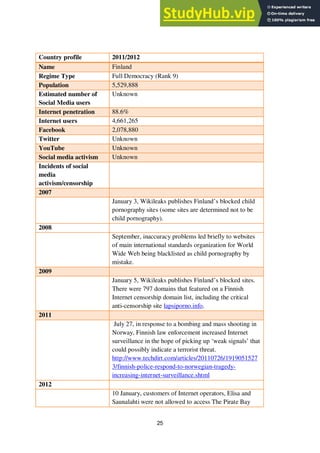
Each country is described in terms of population size in 2011, the estimated number of social
media users in 2011, and Internet penetration in 2011 to show the most recent use of social
media by ordinary citizens. Facebook, Twitter, and YouTube were selected because of their
widespread use by political activists during protests and social unrest, and because they have
been the main targets for government clampdowns on the social media. Incidents of social
media activism are listed for each country, and have been drawn primarily (but not
exclusively) from the following sources:
• Reporters Without Borders;
• Open Net Initiative;
• Freedom of Connection, Freedom of Expression;
• Global Voices Online; and
• The Guardian.
Only the years (over the past five years) when there was significant use of the social media in
activism and protest, and acts of government censorship, have been identified for each
country. The incidents are listed in chronological order to track patterns of action and
reaction implicating social media use by activists and governments. The list of incidents is
not comprehensive, but provides an overview of tendencies within the specific countries. The
16
section on technical and legislative controls evinces attempts by government officials to use
sophisticated technological mechanisms and oppressive laws to increase censorship, as well
as the counter-efforts by activists to defend and expand freedom of access to information and
freedom of expression. The recent trends section summarizes the directions in which
countries have moved towards either rising levels of Internet censorship or towards greater
intellectual freedom. These categories of data will be used to analyse and assess differences
and similarities between established democracies and authoritarian regimes.
17
Country profile 2011/2012
Name Australia
Political Type Full Democracy (Rank 6)
Population 21,766,711
Estimated number of
Social Media users
9,800,000
Internet penetration 89.8%
Internet users 19,554,832
Facebook 10,721,020
Twitter 1,800,000
YouTube 11,000,000 UAVs
Social media activism Government officials have become wary of social media
activists and, in one instance, the Australian Federal Police
and the federal Attorney-General’s Department contracted a
private intelligence company to monitor activist websites,
blogs, Facebook and Twitter and to provide warning and
analysis of protest activity.
http://www.dareoutloud.com/2012/02/magnetic-force-of-
social-media-narcissism-vs-activism/
Incidents of social media
activism/censorship
2007
June 6, Flickr image servers were blocked.
December 31, the Australian Government announced the
mandatory filtering of inappropriate material at ISP level with
an opt-out option. http://www.abc.net.au/news/2007-12-
31/conroy-announces-mandatory-internet-filters-to/999946
2009
February 12, Internet filtering trial with 6 ISPs began.
March, the whistle-blowing site Wikileaks was added to a
blacklist of banned URLs.
http://www.zeropaid.com/news/10002/australia_internet_filter
ing_trial_to_begin_with_6_isps/
March 19, Australia's Web blacklist leaked. The secretive
Internet filter blacklist is held by the communications
watchdog ACMA, revealing that the government has
understated the amount of banned Web pages by more than
1,000.
18
http://www.networkworld.com/news/2009/031909-australias-
web-blacklist.html?hpg1=bn
April 24, the government and a number of German ISPs
signed an agreement to maintain and enforce a ‘blacklist’ of
banned web sites.
http://www.zeropaid.com/news/86047/germany-forces-isps-
to-agree-to-web-filtering/
2010
January 20, Australian citizens turn their websites black
including Twitter and Facebook in a protest against the
government's proposed Internet filter.
http://www.news.com.au/technology/internet-filter-protesters-
set-to-fade-websites-to-black-on-australia-day/story-e6frfro0-
1225821477370
2011
July, voluntary blocking commenced although official plans
for monitoring and blocking are still on hold.
Technical and legislative
controls
Besides ISP-level content filtering, the government has sought
approval for its mandatory national Web filtering system and
has persuaded Internet service providers to create a voluntary
system. Domain names and URLs are blocked by identifying
and collating online content for censoring. In this way, ISPs
are compelled to remove the content concerned.
Those opposing the voluntary programme suggest that site
access, while blocked directly, can be accessed through URL
changes, aggregation websites and/or peer-to-peer sites, such
as Forums or blogs.
http://enterprisefeatures.com/2011/09/australian-internet-
censorship-where-does-it-currently-stand/
Recent trends Internet censorship efforts cost 2.7 million dollars per year,
but so far have produced minimal positive outcomes. Filtering
software has proved ineffective, and much time is spent
dealing with complaints filed by websites ‘wrongfully
removed’. There is still uncertainty about what will be
officially mandated for Internet content seen in the country.
19
Country profile 2011/2012
Name Chile
Political Type Flawed Democracy (Rank 35)
Population 16,888,760
Estimated number of
Social Media users
25,900,000
Estimated internet
penetration
59.2%
Internet users 10,000,000
Facebook 7,695,680
Twitter 871,022
YouTube N/A
Social media activism
Twitter In Chile, students have protested against the privatisation of the
education system, and the activist Camilla Vallejo has led more
than 300,000 Twitter users to quickly initiate a cacerolazos (a
form of dictatorship-era protest where people walk the streets
banging on pots and pans).
http://www.nytimes.com/2012/01/29/opinion/sunday/student-
protests-rile-chile.html?pagewanted=all
http://www.theecosocialist.com/1/post/2011/8/no-more-shock-
doctrine-in-chile-millions-protestgeneral-strike-looms-and-
student-leader-emerges.html
Incidents of social media
activism/censorship
2010
January 27, more than 90 earthquakes resulted in tsunamis
around the Pacific Ocean, hitting several Chilean seaports and
towns. Internet users communicated with their cell phones and
computers, and news agencies around the world relied on social
networks to collect information from victims. Twitter was the
most valuable and popular tool.
http://carlosqc.blogspot.com/2010/03/role-of-social-media-and-
internet.html
August, citizens used social media to help in demonstrations
against HydroAysén in Santiago, and to learn the details of the
project and where the dams were to be built.
http://en.rsf.org/chile-citizen-activism-challenges-17-08-
2011,40799.html
2011 November, there were cyber-attacks on three news websites,
impacting dialogue between the government and the student-
20
led protest movement. The news websites, La Otra Voz and
Puro Periodismo, were hacked at around the same time.
http://en.rsf.org/chile-three-news-websites-hacked-10-11-
2011,41375.html
Technical and legislative
controls
There is a bill proposing to punish individuals who use the
Internet to disseminate contents that are offensive to morals,
public order or ‘proper customs’. This bill gives wide
discretionary powers to a judge to decide if a given behaviour is
against what is understood to be ‘morally correct’, and if it
belongs to the realm of the private or in the public interest or
what is against ‘proper customs’. But one way to circumvent
this is that the law only applies if the server that hosts given
content is in the territory of Chile.
A fine example is ‘The Black Book of Chilean Justice’, which
was banned. But everyone soon read everything in the book
when it was made available on the Internet, in a server
physically located abroad. The domain name of this server was
a ‘.com’ and not a ‘.cl’, which removed the jurisdiction of
Chilean law.
http://www.isoc.org/inet2000/cdproceedings/8k/8k_4.htm#types
Recent trends
Students have scored some political victories, thanks in part to
their use of social media. The government’s 2012 budget has a
$350 million increase for higher education, and promises
scholarships for qualifying students from families up to the 60th
percentile in household income. The trend is therefore towards
more effective resistance to government policies that fail to
recognise social inequalities.
21
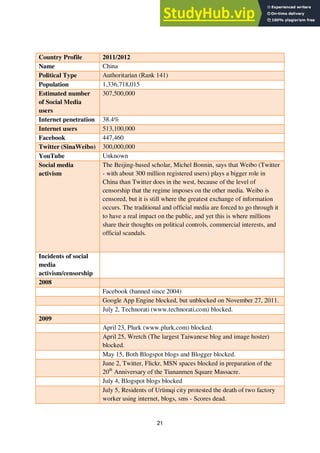
Country Profile 2011/2012
Name China
Political Type Authoritarian (Rank 141)
Population 1,336,718,015
Estimated number
of Social Media
users
307,500,000
Internet penetration 38.4%
Internet users 513,100,000
Facebook 447,460
Twitter (SinaWeibo) 300,000,000
YouTube Unknown
Social media
activism
The Beijing-based scholar, Michel Bonnin, says that Weibo (Twitter
- with about 300 million registered users) plays a bigger role in
China than Twitter does in the west, because of the level of
censorship that the regime imposes on the other media. Weibo is
censored, but it is still where the greatest exchange of information
occurs. The traditional and official media are forced to go through it
to have a real impact on the public, and yet this is where millions
share their thoughts on political controls, commercial interests, and
official scandals.
Incidents of social
media
activism/censorship
2008
Facebook (banned since 2004)
Google App Engine blocked, but unblocked on November 27, 2011.
July 2, Technorati (www.technorati.com) blocked.
2009
April 23, Plurk (www.plurk.com) blocked.
April 25, Wretch (The largest Taiwanese blog and image hoster)
blocked.
May 15, Both Blogspot blogs and Blogger blocked.
June 2, Twitter, Flickr, MSN spaces blocked in preparation of the
20th
Anniversary of the Tiananmen Square Massacre.
July 4, Blogspot blogs blocked
July 5, Residents of Urümqi city protested the death of two factory
worker using internet, blogs, sms - Scores dead.
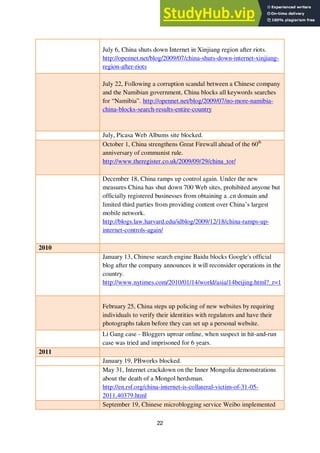
22
July 6, China shuts down Internet in Xinjiang region after riots.
http://opennet.net/blog/2009/07/china-shuts-down-internet-xinjiang-
region-after-riots
July 22, Following a corruption scandal between a Chinese company
and the Namibian government, China blocks all keywords searches
for “Namibia”. http://opennet.net/blog/2009/07/no-more-namibia-
china-blocks-search-results-entire-country
July, Picasa Web Albums site blocked.
October 1, China strengthens Great Firewall ahead of the 60th
anniversary of communist rule.
http://www.theregister.co.uk/2009/09/29/china_tor/
December 18, China ramps up control again. Under the new
measures China has shut down 700 Web sites, prohibited anyone but
officially registered businesses from obtaining a .cn domain and
limited third parties from providing content over China’s largest
mobile network.
http://blogs.law.harvard.edu/idblog/2009/12/18/china-ramps-up-
internet-controls-again/
2010
January 13, Chinese search engine Baidu blocks Google's official
blog after the company announces it will reconsider operations in the
country.
http://www.nytimes.com/2010/01/14/world/asia/14beijing.html?_r=1
February 25, China steps up policing of new websites by requiring
individuals to verify their identities with regulators and have their
photographs taken before they can set up a personal website.
Li Gang case - Bloggers uproar online, when suspect in hit-and-run
case was tried and imprisoned for 6 years.
2011
January 19, PBworks blocked.
May 31, Internet crackdown on the Inner Mongolia demonstrations
about the death of a Mongol herdsman.
http://en.rsf.org/china-internet-is-collateral-victim-of-31-05-
2011,40379.html
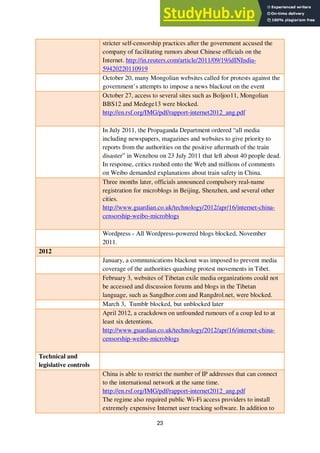
September 19, Chinese microblogging service Weibo implemented
23
stricter self-censorship practices after the government accused the
company of facilitating rumors about Chinese officials on the
Internet. http://in.reuters.com/article/2011/09/19/idINIndia-
59420220110919
October 20, many Mongolian websites called for protests against the
government’s attempts to impose a news blackout on the event
October 27, access to several sites such as Boljoo11, Mongolian
BBS12 and Medege13 were blocked.
http://en.rsf.org/IMG/pdf/rapport-internet2012_ang.pdf
In July 2011, the Propaganda Department ordered “all media
including newspapers, magazines and websites to give priority to
reports from the authorities on the positive aftermath of the train
disaster” in Wenzhou on 23 July 2011 that left about 40 people dead.
In response, critics rushed onto the Web and millions of comments
on Weibo demanded explanations about train safety in China.
Three months later, officials announced compulsory real-name
registration for microblogs in Beijing, Shenzhen, and several other
cities.
http://www.guardian.co.uk/technology/2012/apr/16/internet-china-
censorship-weibo-microblogs
Wordpress - All Wordpress-powered blogs blocked, November
2011.
2012
January, a communications blackout was imposed to prevent media
coverage of the authorities quashing protest movements in Tibet.
February 3, websites of Tibetan exile media organizations could not
be accessed and discussion forums and blogs in the Tibetan
language, such as Sangdhor.com and Rangdrol.net, were blocked.
March 3, Tumblr blocked, but unblocked later
April 2012, a crackdown on unfounded rumours of a coup led to at
least six detentions.
http://www.guardian.co.uk/technology/2012/apr/16/internet-china-
censorship-weibo-microblogs
Technical and
legislative controls
China is able to restrict the number of IP addresses that can connect
to the international network at the same time.
http://en.rsf.org/IMG/pdf/rapport-internet2012_ang.pdf
The regime also required public Wi-Fi access providers to install
extremely expensive Internet user tracking software. In addition to
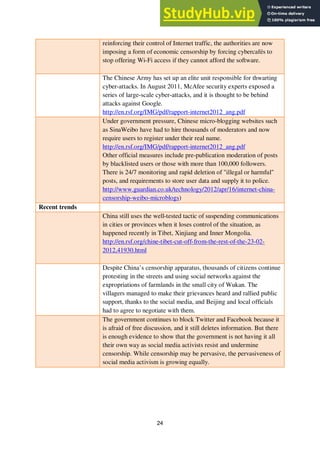
24
reinforcing their control of Internet traffic, the authorities are now
imposing a form of economic censorship by forcing cybercafés to
stop offering Wi-Fi access if they cannot afford the software.
The Chinese Army has set up an elite unit responsible for thwarting
cyber-attacks. In August 2011, McAfee security experts exposed a
series of large-scale cyber-attacks, and it is thought to be behind
attacks against Google.
http://en.rsf.org/IMG/pdf/rapport-internet2012_ang.pdf
Under government pressure, Chinese micro-blogging websites such
as SinaWeibo have had to hire thousands of moderators and now
require users to register under their real name.
http://en.rsf.org/IMG/pdf/rapport-internet2012_ang.pdf
Other official measures include pre-publication moderation of posts
by blacklisted users or those with more than 100,000 followers.
There is 24/7 monitoring and rapid deletion of "illegal or harmful"
posts, and requirements to store user data and supply it to police.
http://www.guardian.co.uk/technology/2012/apr/16/internet-china-
censorship-weibo-microblogs)
Recent trends
China still uses the well-tested tactic of suspending communications
in cities or provinces when it loses control of the situation, as
happened recently in Tibet, Xinjiang and Inner Mongolia.
http://en.rsf.org/chine-tibet-cut-off-from-the-rest-of-the-23-02-
2012,41930.html
Despite China’s censorship apparatus, thousands of citizens continue
protesting in the streets and using social networks against the
expropriations of farmlands in the small city of Wukan. The
villagers managed to make their grievances heard and rallied public
support, thanks to the social media, and Beijing and local officials
had to agree to negotiate with them.
The government continues to block Twitter and Facebook because it
is afraid of free discussion, and it still deletes information. But there
is enough evidence to show that the government is not having it all
their own way as social media activists resist and undermine
censorship. While censorship may be pervasive, the pervasiveness of
social media activism is growing equally.
25
Country profile 2011/2012
Name Finland
Regime Type Full Democracy (Rank 9)
Population 5,529,888
Estimated number of
Social Media users
Unknown
Internet penetration 88.6%
Internet users 4,661,265
Facebook 2,078,880
Twitter Unknown
YouTube Unknown
Social media activism Unknown
Incidents of social
media
activism/censorship
2007
January 3, Wikileaks publishes Finland’s blocked child
pornography sites (some sites are determined not to be
child pornography).
2008
September, inaccuracy problems led briefly to websites
of main international standards organization for World
Wide Web being blacklisted as child pornography by
mistake.
2009
January 5, Wikileaks publishes Finland’s blocked sites.
There were 797 domains that featured on a Finnish
Internet censorship domain list, including the critical
anti-censorship site lapsiporno.info.
2011
July 27, in response to a bombing and mass shooting in
Norway, Finnish law enforcement increased Internet
surveillance in the hope of picking up ‘weak signals’ that
could possibly indicate a terrorist threat.
http://www.techdirt.com/articles/20110726/1919051527
3/finnish-police-respond-to-norwegian-tragedy-
increasing-internet-surveillance.shtml
2012
10 January, customers of Internet operators, Elisa and
Saunalahti were not allowed to access The Pirate Bay
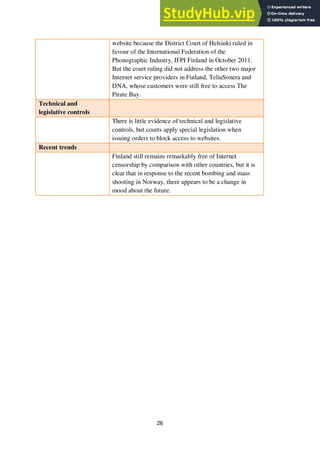
26
website because the District Court of Helsinki ruled in
favour of the International Federation of the
Phonographic Industry, IFPI Finland in October 2011.
But the court ruling did not address the other two major
Internet service providers in Finland, TeliaSonera and
DNA, whose customers were still free to access The
Pirate Bay.
Technical and
legislative controls
There is little evidence of technical and legislative
controls, but courts apply special legislation when
issuing orders to block access to websites.
Recent trends
Finland still remains remarkably free of Internet
censorship by comparison with other countries, but it is
clear that in response to the recent bombing and mass
shooting in Norway, there appears to be a change in
mood about the future.
27
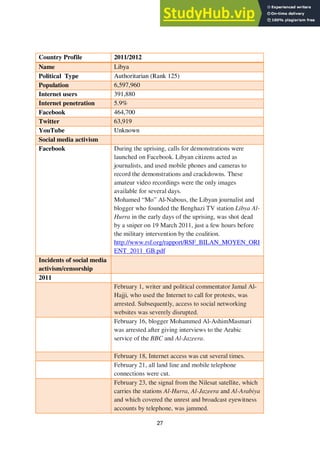
Country Profile 2011/2012
Name Libya
Political Type Authoritarian (Rank 125)
Population 6,597,960
Internet users 391,880
Internet penetration 5.9%
Facebook 464,700
Twitter 63,919
YouTube Unknown
Social media activism
Facebook During the uprising, calls for demonstrations were
launched on Facebook. Libyan citizens acted as
journalists, and used mobile phones and cameras to
record the demonstrations and crackdowns. These
amateur video recordings were the only images
available for several days.
Mohamed “Mo” Al-Nabous, the Libyan journalist and
blogger who founded the Benghazi TV station Libya Al-
Hurra in the early days of the uprising, was shot dead
by a sniper on 19 March 2011, just a few hours before
the military intervention by the coalition.
http://www.rsf.org/rapport/RSF_BILAN_MOYEN_ORI
ENT_2011_GB.pdf
Incidents of social media
activism/censorship
2011
February 1, writer and political commentator Jamal Al-
Hajji, who used the Internet to call for protests, was
arrested. Subsequently, access to social networking
websites was severely disrupted.
February 16, blogger Mohammed Al-AshimMasmari
was arrested after giving interviews to the Arabic
service of the BBC and Al-Jazeera.
February 18, Internet access was cut several times.
February 21, all land line and mobile telephone
connections were cut.
February 23, the signal from the Nilesat satellite, which
carries the stations Al-Hurra, Al-Jazeera and Al-Arabiya
and which covered the unrest and broadcast eyewitness
accounts by telephone, was jammed.
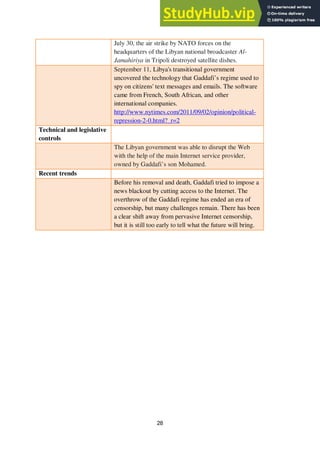
28
July 30, the air strike by NATO forces on the
headquarters of the Libyan national broadcaster Al-
Jamahiriya in Tripoli destroyed satellite dishes.
September 11, Libya's transitional government
uncovered the technology that Gaddafi’s regime used to
spy on citizens' text messages and emails. The software
came from French, South African, and other
international companies.
http://www.nytimes.com/2011/09/02/opinion/political-
repression-2-0.html?_r=2
Technical and legislative
controls
The Libyan government was able to disrupt the Web
with the help of the main Internet service provider,
owned by Gaddafi’s son Mohamed.
Recent trends
Before his removal and death, Gaddafi tried to impose a
news blackout by cutting access to the Internet. The
overthrow of the Gaddafi regime has ended an era of
censorship, but many challenges remain. There has been
a clear shift away from pervasive Internet censorship,
but it is still too early to tell what the future will bring.
29
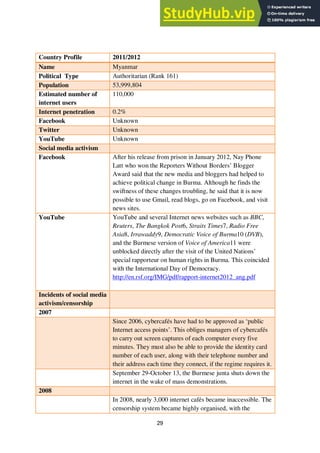
Country Profile 2011/2012
Name Myanmar
Political Type Authoritarian (Rank 161)
Population 53,999,804
Estimated number of
internet users
110,000
Internet penetration 0.2%
Facebook Unknown
Twitter Unknown
YouTube Unknown
Social media activism
Facebook After his release from prison in January 2012, Nay Phone
Latt who won the Reporters Without Borders’ Blogger
Award said that the new media and bloggers had helped to
achieve political change in Burma. Although he finds the
swiftness of these changes troubling, he said that it is now
possible to use Gmail, read blogs, go on Facebook, and visit
news sites.
YouTube YouTube and several Internet news websites such as BBC,
Reuters, The Bangkok Post6, Straits Times7, Radio Free
Asia8, Irrawaddy9, Democratic Voice of Burma10 (DVB),
and the Burmese version of Voice of America11 were
unblocked directly after the visit of the United Nations’
special rapporteur on human rights in Burma. This coincided
with the International Day of Democracy.
http://en.rsf.org/IMG/pdf/rapport-internet2012_ang.pdf
Incidents of social media
activism/censorship
2007
Since 2006, cybercafés have had to be approved as ‘public
Internet access points’. This obliges managers of cybercafés
to carry out screen captures of each computer every five
minutes. They must also be able to provide the identity card
number of each user, along with their telephone number and
their address each time they connect, if the regime requires it.
September 29-October 13, the Burmese junta shuts down the
internet in the wake of mass demonstrations.
2008
In 2008, nearly 3,000 internet cafés became inaccessible. The
censorship system became highly organised, with the
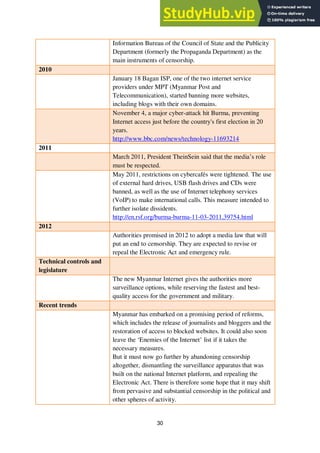
30
Information Bureau of the Council of State and the Publicity
Department (formerly the Propaganda Department) as the
main instruments of censorship.
2010
January 18 Bagan ISP, one of the two internet service
providers under MPT (Myanmar Post and
Telecommunication), started banning more websites,
including blogs with their own domains.
November 4, a major cyber-attack hit Burma, preventing
Internet access just before the country's first election in 20
years.
http://www.bbc.com/news/technology-11693214
2011
March 2011, President TheinSein said that the media’s role
must be respected.
May 2011, restrictions on cybercafés were tightened. The use
of external hard drives, USB flash drives and CDs were
banned, as well as the use of Internet telephony services
(VoIP) to make international calls. This measure intended to
further isolate dissidents.
http://en.rsf.org/burma-burma-11-03-2011,39754.html
2012
Authorities promised in 2012 to adopt a media law that will
put an end to censorship. They are expected to revise or
repeal the Electronic Act and emergency rule.
Technical controls and
legislature
The new Myanmar Internet gives the authorities more
surveillance options, while reserving the fastest and best-
quality access for the government and military.
Recent trends
Myanmar has embarked on a promising period of reforms,
which includes the release of journalists and bloggers and the
restoration of access to blocked websites. It could also soon
leave the ‘Enemies of the Internet’ list if it takes the
necessary measures.
But it must now go further by abandoning censorship
altogether, dismantling the surveillance apparatus that was
built on the national Internet platform, and repealing the
Electronic Act. There is therefore some hope that it may shift
from pervasive and substantial censorship in the political and
other spheres of activity.
31
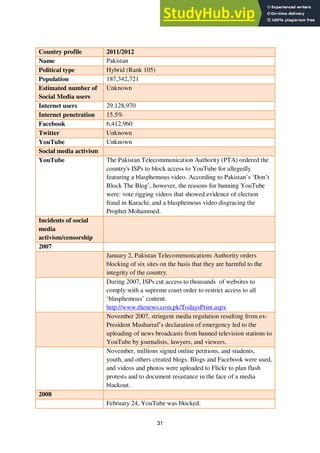
Country profile 2011/2012
Name Pakistan
Political type Hybrid (Rank 105)
Population 187,342,721
Estimated number of
Social Media users
Unknown
Internet users 29,128,970
Internet penetration 15.5%
Facebook 6,412,960
Twitter Unknown
YouTube Unknown
Social media activism
YouTube The Pakistan Telecommunication Authority (PTA) ordered the
country's ISPs to block access to YouTube for allegedly
featuring a blasphemous video. According to Pakistan’s ‘Don’t
Block The Blog’, however, the reasons for banning YouTube
were: vote rigging videos that showed evidence of election
fraud in Karachi; and a blasphemous video disgracing the
Prophet Mohammed.
Incidents of social
media
activism/censorship
2007
January 2, Pakistan Telecommunications Authority orders
blocking of six sites on the basis that they are harmful to the
integrity of the country.
During 2007, ISPs cut access to thousands of websites to
comply with a supreme court order to restrict access to all
‘blasphemous’ content.
http://www.thenews.com.pk/TodaysPrint.aspx
November 2007, stringent media regulation resulting from ex-
President Musharraf’s declaration of emergency led to the
uploading of news broadcasts from banned television stations to
YouTube by journalists, lawyers, and viewers.
November, millions signed online petitions, and students,
youth, and others created blogs. Blogs and Facebook were used,
and videos and photos were uploaded to Flickr to plan flash
protests and to document resistance in the face of a media
blackout.
2008
February 24, YouTube was blocked.
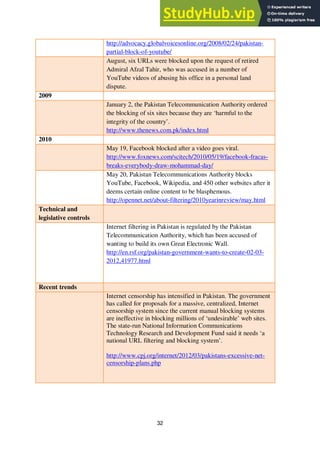
32
http://advocacy.globalvoicesonline.org/2008/02/24/pakistan-
partial-block-of-youtube/
August, six URLs were blocked upon the request of retired
Admiral Afzal Tahir, who was accused in a number of
YouTube videos of abusing his office in a personal land
dispute.
2009
January 2, the Pakistan Telecommunication Authority ordered
the blocking of six sites because they are ‘harmful to the
integrity of the country’.
http://www.thenews.com.pk/index.html
2010
May 19, Facebook blocked after a video goes viral.
http://www.foxnews.com/scitech/2010/05/19/facebook-fracas-
breaks-everybody-draw-mohammad-day/
May 20, Pakistan Telecommunications Authority blocks
YouTube, Facebook, Wikipedia, and 450 other websites after it
deems certain online content to be blasphemous.
http://opennet.net/about-filtering/2010yearinreview/may.html
Technical and
legislative controls
Internet filtering in Pakistan is regulated by the Pakistan
Telecommunication Authority, which has been accused of
wanting to build its own Great Electronic Wall.
http://en.rsf.org/pakistan-government-wants-to-create-02-03-
2012,41977.html
Recent trends
Internet censorship has intensified in Pakistan. The government
has called for proposals for a massive, centralized, Internet
censorship system since the current manual blocking systems
are ineffective in blocking millions of ‘undesirable’ web sites.
The state-run National Information Communications
Technology Research and Development Fund said it needs ‘a
national URL filtering and blocking system’.
http://www.cpj.org/internet/2012/03/pakistans-excessive-net-
censorship-plans.php
33
Country Profile 2011/2012
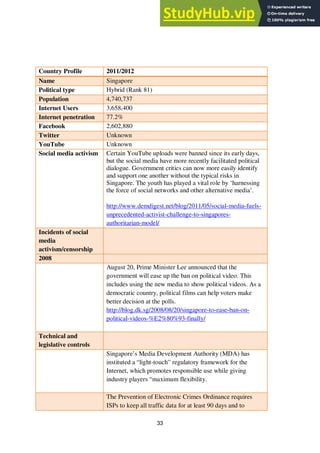
Name Singapore
Political type Hybrid (Rank 81)
Population 4,740,737
Internet Users 3,658,400
Internet penetration 77.2%
Facebook 2,602,880
Twitter Unknown
YouTube Unknown
Social media activism Certain YouTube uploads were banned since its early days,
but the social media have more recently facilitated political
dialogue. Government critics can now more easily identify
and support one another without the typical risks in
Singapore. The youth has played a vital role by ‘harnessing
the force of social networks and other alternative media’.
http://www.demdigest.net/blog/2011/05/social-media-fuels-
unprecedented-activist-challenge-to-singapores-
authoritarian-model/
Incidents of social
media
activism/censorship
2008
August 20, Prime Minister Lee announced that the
government will ease up the ban on political video. This
includes using the new media to show political videos. As a
democratic country, political films can help voters make
better decision at the polls.
http://blog.dk.sg/2008/08/20/singapore-to-ease-ban-on-
political-videos-%E2%80%93-finally/
Technical and
legislative controls
Singapore’s Media Development Authority (MDA) has
instituted a “light-touch” regulatory framework for the
Internet, which promotes responsible use while giving
industry players “maximum flexibility.
The Prevention of Electronic Crimes Ordinance requires
ISPs to keep all traffic data for at least 90 days and to
34
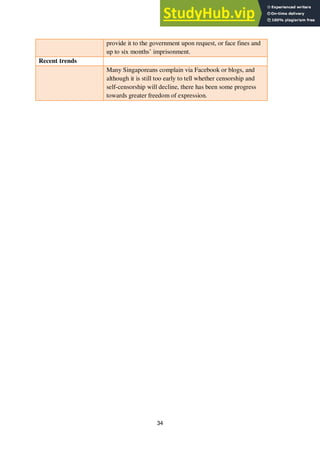
provide it to the government upon request, or face fines and
up to six months’ imprisonment.
Recent trends
Many Singaporeans complain via Facebook or blogs, and
although it is still too early to tell whether censorship and
self-censorship will decline, there has been some progress
towards greater freedom of expression.
35
Country Profile 2011/2012
Name South Africa
Regime Type Flawed Democracy (Rank 28)
Population 49,004,031
Estimated number of Social Media
users
Unknown
Internet users 6,800,000
Internet penetration 13.9%
Facebook 4,954,280
Twitter 1,400,000
YouTube Unknown
Social media activism South Africa’s controversial Protection of
Information Bill, also called the ‘Secrecy Bill’ has
been the target of social media protest. Four of the
top 10 trending topics on Twitter related to the bill.
In November 2011, Facebook and Twitter changed
their avatars to a simple black image to show
support for “Black Tuesday” in sympathy with
protests against the Bill outside the ANC’s
Johannesburg headquarters and Parliament in Cape
Town.
YouTube is the fourth most popular website,
Facebook is the second most popular site, and
Twitter comes in at number seven. All of them
have been involved in social media protests against
the ‘Secrecy Bill’. The specific incidents are listed
below.
http://memeburn.com/2011/11/south-africans-take-
to-social-media-for-black-tuesday-in-protest-to-
‘secrecy-bill’/
http://www.kas.de/medienafrika/en/publications/29
931/
Incidents of social media
activism/censorship
2010
19 July, objections against the Protection of
Information Bill, similar to apartheid-era secrecy
laws.
23 July, the Media Institute of Southern Africa
states that the Protection of Information Bill would
36
mean that the State would decide what information
is confidential and what is not. Journalist found
guilty of infringement could face 25 years
imprisonment.
16 August, the Committee to Protect Journalists
condemn a proposed Media Appeals Tribunal, and
the arrest of a Sunday Times journalist for
publishing a critical review of the police in South
Africa.
2011
15 June, IFEX requests organisations to oppose the
Secrecy Bill
1 July, a commentator points out that a Protection
of Information Law will keep information out of
the public domain and could lead to the
marginalisation of society
22 November, The Bill is passed by the National
Assembly.
Technical and legislative controls
The Protection of Information Bill was passed in
2011, after what many South Africans regarded as
a sham process of public consultation.
Recent trends
As South Africa faces the possibility of a return to
apartheid-style censorship under the guise of a
Protection of Information Law, there is every
possibility that the social media will undermine it
in the same ways that grassroots and alternative
media did so during apartheid. The social media
may make the imposition of a veil of secrecy in
South Africa impossible.
http://www.kas.de/medien-
afrika/en/publications/29931/
37
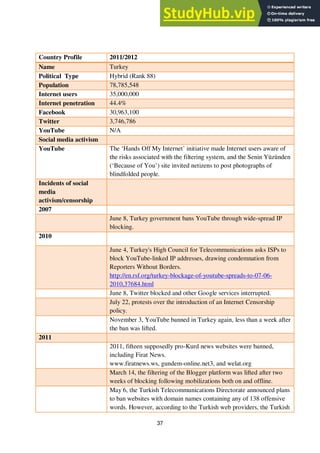
Country Profile 2011/2012
Name Turkey
Political Type Hybrid (Rank 88)
Population 78,785,548
Internet users 35,000,000
Internet penetration 44.4%
Facebook 30,963,100
Twitter 3,746,786
YouTube N/A
Social media activism
YouTube The ‘Hands Off My Internet’ initiative made Internet users aware of
the risks associated with the filtering system, and the Senin Yüzünden
(‘Because of You’) site invited netizens to post photographs of
blindfolded people.
Incidents of social
media
activism/censorship
2007
June 8, Turkey government bans YouTube through wide-spread IP
blocking.
2010
June 4, Turkey's High Council for Telecommunications asks ISPs to
block YouTube-linked IP addresses, drawing condemnation from
Reporters Without Borders.
http://en.rsf.org/turkey-blockage-of-youtube-spreads-to-07-06-
2010,37684.html
June 8, Twitter blocked and other Google services interrupted.
July 22, protests over the introduction of an Internet Censorship
policy.
November 3, YouTube banned in Turkey again, less than a week after
the ban was lifted.
2011
2011, fifteen supposedly pro-Kurd news websites were banned,
including Firat News.
www.firatnews.ws, gundem-online.net3, and welat.org
March 14, the filtering of the Blogger platform was lifted after two
weeks of blocking following mobilizations both on and offline.
May 6, the Turkish Telecommunications Directorate announced plans
to ban websites with domain names containing any of 138 offensive
words. However, according to the Turkish web providers, the Turkish
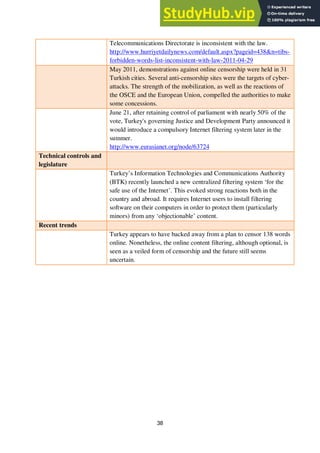
38
Telecommunications Directorate is inconsistent with the law.
http://www.hurriyetdailynews.com/default.aspx?pageid=438&n=tibs-
forbidden-words-list-inconsistent-with-law-2011-04-29
May 2011, demonstrations against online censorship were held in 31
Turkish cities. Several anti-censorship sites were the targets of cyber-
attacks. The strength of the mobilization, as well as the reactions of
the OSCE and the European Union, compelled the authorities to make
some concessions.
June 21, after retaining control of parliament with nearly 50% of the
vote, Turkey's governing Justice and Development Party announced it
would introduce a compulsory Internet filtering system later in the
summer.
http://www.eurasianet.org/node/63724
Technical controls and
legislature
Turkey’s Information Technologies and Communications Authority
(BTK) recently launched a new centralized filtering system ‘for the
safe use of the Internet’. This evoked strong reactions both in the
country and abroad. It requires Internet users to install filtering
software on their computers in order to protect them (particularly
minors) from any ‘objectionable’ content.
Recent trends
Turkey appears to have backed away from a plan to censor 138 words
online. Nonetheless, the online content filtering, although optional, is
seen as a veiled form of censorship and the future still seems
uncertain.
39
Country profile 2011/2012
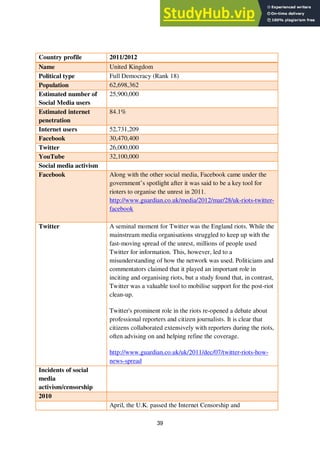
Name United Kingdom
Political type Full Democracy (Rank 18)
Population 62,698,362
Estimated number of
Social Media users
25,900,000
Estimated internet
penetration
84.1%
Internet users 52,731,209
Facebook 30,470,400
Twitter 26,000,000
YouTube 32,100,000
Social media activism
Facebook Along with the other social media, Facebook came under the
government’s spotlight after it was said to be a key tool for
rioters to organise the unrest in 2011.
http://www.guardian.co.uk/media/2012/mar/28/uk-riots-twitter-
facebook
Twitter A seminal moment for Twitter was the England riots. While the
mainstream media organisations struggled to keep up with the
fast-moving spread of the unrest, millions of people used
Twitter for information. This, however, led to a
misunderstanding of how the network was used. Politicians and
commentators claimed that it played an important role in
inciting and organising riots, but a study found that, in contrast,
Twitter was a valuable tool to mobilise support for the post-riot
clean-up.
Twitter's prominent role in the riots re-opened a debate about
professional reporters and citizen journalists. It is clear that
citizens collaborated extensively with reporters during the riots,
often advising on and helping refine the coverage.
http://www.guardian.co.uk/uk/2011/dec/07/twitter-riots-how-
news-spread
Incidents of social
media
activism/censorship
2010
April, the U.K. passed the Internet Censorship and
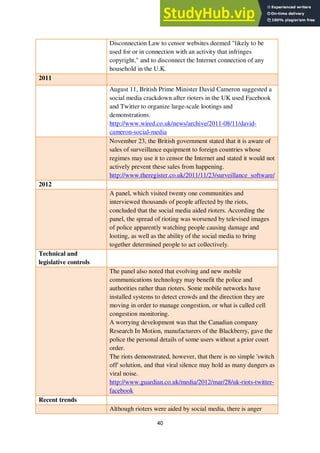
40
Disconnection Law to censor websites deemed "likely to be
used for or in connection with an activity that infringes
copyright," and to disconnect the Internet connection of any
household in the U.K.
2011
August 11, British Prime Minister David Cameron suggested a
social media crackdown after rioters in the UK used Facebook
and Twitter to organize large-scale lootings and
demonstrations.
http://www.wired.co.uk/news/archive/2011-08/11/david-
cameron-social-media
November 23, the British government stated that it is aware of
sales of surveillance equipment to foreign countries whose
regimes may use it to censor the Internet and stated it would not
actively prevent these sales from happening.
http://www.theregister.co.uk/2011/11/23/surveillance_software/
2012
A panel, which visited twenty one communities and
interviewed thousands of people affected by the riots,
concluded that the social media aided rioters. According the
panel, the spread of rioting was worsened by televised images
of police apparently watching people causing damage and
looting, as well as the ability of the social media to bring
together determined people to act collectively.
Technical and
legislative controls
The panel also noted that evolving and new mobile
communications technology may benefit the police and
authorities rather than rioters. Some mobile networks have
installed systems to detect crowds and the direction they are
moving in order to manage congestion, or what is called cell
congestion monitoring.
A worrying development was that the Canadian company
Research In Motion, manufacturers of the Blackberry, gave the
police the personal details of some users without a prior court
order.
The riots demonstrated, however, that there is no simple 'switch
off' solution, and that viral silence may hold as many dangers as
viral noise.
http://www.guardian.co.uk/media/2012/mar/28/uk-riots-twitter-
facebook
Recent trends
Although rioters were aided by social media, there is anger
41
about plans to shut down websites such as Twitter and
Facebook. Since the UK pledged support for the open use of
social media during uprisings across the Middle East, it would
be problematic to shut them down for uprisings at home.
42
Country profile 2011/2012
Name United States of America
Political type Full Democracy (Rank 19)
Population 347,394,870
Estimated number of
Social Media users
Unknown
Internet users 245,203,319
Internet penetration 78.3%
Facebook 157,418,920
Twitter Unknown
YouTube Unknown
Social media activism
Twitter Twitter has been used by activists to post messages to help
other protesters at events such as the G-20 summit, and
several others. The police have used Twitter to look for
‘evidence of federal and anti-rioting law violations’, as in the
case of a New York social worker who was found with
computers and police scanners while using Twitter. FBI
agents executed a search warrant at his home in Jackson
Heights, Queens, New York (Moynihan, 2009).
Incidents of social media
activism/censorship
2009
October, during the ‘Group of 20’ summit in Pittsburgh,
Pennsylvania about 200 arrests were made during
demonstrations.
2010
September 27, federal law enforcement and national security
officials are preparing to seek sweeping new regulations for
the Internet, arguing that their ability to wiretap criminal and
terrorism suspects is “going dark” as people increasingly
communicate online instead of by telephone.
http://www.nytimes.com/2010/09/27/us/27wiretap.html?_r=3
2011
February 7, U.S. seeks veto powers over new domain names.
The Obama administration wants the power for it and other
governments to veto future top-level domain names, raising
questions about free expression and the role of states in
shaping the Internet. http://news.cnet.com/8301-31921_3-
20030809-281.html#ixzz1DIBIEiDi
43
February 2011, there was a series of public employee
protests against proposed legislation which would weaken
the power of labour unions.
July 13, a blog post by Adbusters proposed a peaceful
occupation of Wall Street to protest corporate influence on
democracy, the lack of legal consequences for those who
brought about the global crisis of monetary insolvency, and
an increasing disparity in wealth.
October 15, Facebook was also used to coordinate protests
across the country. At some protests there were a few
hundred in number, and at others there were hundreds of
thousands. There were 100 arrests made in Boston, 90 in
New York, 175 in Chicago, 50 in Phoenix, 19 in Sacramento,
20 in Raleigh, and 24 in Denver.
December 19, amid heated debates and the uproar
surrounding the controversial Stop Online Piracy Act,
Congress postponed its vote. Fears are growing that the law
aimed at fighting copyright infringement will ultimately lead
to censorship.
http://rt.com/news/sopa-congress-vote-postponed-113/
Technical and legislative
controls
The Stop Online Piracy Act (SOPA) and Protect IP Act
(PIPA) threaten to sacrifice Internet freedom for the sake of
copyright protection.
Recent trends Many Internet users in the United States, as in other Western
countries, cut their teeth with the Occupy Wall Street
movement. Many of them took to the streets to protest
against repressive legislation, and a 24-hour blackout was
observed by many websites, including Wikipedia, that would
be affected.
http://en.rsf.org/etats-unis-blackout-sopa-17-01-
2012,41695.html
44
7. Discussion
The data can be analysed in several ways, but this article asks whether established
democracies are less vulnerable to Internet censorship than authoritarian states. More
specifically, the focus is on how the use of social media in protest across the world has
blurred ‘free’ and ‘unfree’ labels. Just as earlier forms of communication have tested the
strength and tenacity of intellectual freedom in established democracies, social media are
doing so today and revealing their vulnerability to Internet censorship.
According to the description provided in section 2.3, established democracies have been
stable over a longer period. It is therefore unsurprising that the 2011 Democracy Index
identifies Australia, Finland, the UK, and the USA as full democracies. South Africa and
Chile are not established democracies because of their relative youthfulness and, perhaps also
unsurprisingly, they are identified in the 2011 Democracy Index as flawed democracies. The
established democracies under the spotlight in this discussion are therefore primarily
Australia, Finland, the UK, and the USA. References to Chile and South Africa are useful,
however, in terms of the lessons they can learn along with the established democracies.
7.1 Social media activism
Across many of the countries there is a pattern of contradiction between the actual use of
social media in protest actions and the government’s claim of how they were used. An
example is the blocking of access to YouTube in Pakistan for allegedly showing a
blasphemous video, whereas the actual reason was that election fraud was exposed. More
relevant is that in an established democracy like the UK, Facebook and Twitter came under
government scrutiny for suspicion of fomenting the unrest in 2011, whereas a study showed
instead that the social media were used to a far greater extent to mobilise support to clean up
after the riots.
This is not to say that activists did not use the social media during protests, but that, as in the
case of the USA, the police also used the social media to track violations of anti-rioting law.
In China, both activists and authorities used Weibo in order to impact the public because this
is where millions share their thoughts on the good and bad in society. So, although Weibo is
censored from time to time, it is still where the greatest exchange of information occurs.
Another feature of social media use is international collaboration, and the borrowing of
strategies by both government officials and activists. The Australian government, for
45
example, signed an agreement with German ISPs in 2009 to enforce a blacklist of banned
websites. In 2011, on the other hand, South African social media activists drew on the
Australian citizens’ experience of turning Twitter and Facebook websites black in protest
against Internet filtering by doing the same to protest the controversial ‘Secrecy Bill’. More
intriguingly, several American companies have provided technology to China, Iran, Bahrain,
Saudi Arabia, Kuwait, the United Arab Emirates, and Qatar to block websites. (See
http://www.smh.com.au/technology/technology-news/fighting-chinas-golden-shield-cisco-
sued-over-jailing-and-torture-of--dissidents-20110816-1ivkv.html;
http://online.wsj.com/article/SB10001424052748704438104576219190417124226.html.)
As with other media, therefore, the social media are used both to wield power and to check
the abuses of power. The established democracies are not significantly different from the way
flawed democracies and authoritarian regimes are responding to social media activism.
7.2 Incidents of social media activism/censorship
The number of incidents of activism and censorship involving the social media over about a
five-year period reveal patterns of stricter or more relaxed censorship across the continuum of
political types of government. They show both directional shifts and the similarities or
differences in the kinds of action and reaction.
While there may be more incidents documented for the hybrid and authoritarian regimes, the
number of incidents for full and flawed democracies are not significantly fewer. A
noteworthy feature is the sharp increase in the number of incidents in the past two years
(2010-2011) in some of the established democracies. The riots in the UK and the ‘Occupy
Wall Street’ movement in the USA are good examples not only of the increase in incidents of
social media activism, but of the growth of Internet censorship and the kind of government
reactions in those countries and other democracies. Tougher legislation, calls from across the
party political spectrum to curb or shut down the social media, and the rise in number of
actual censorship actions such as banning, blocking, filtering, blacklisting, and cyber-attacks
in the democracies of Australia, the UK, the USA, Chile, South Africa, and Finland show
more similarities than differences from authoritarian regimes.
The growth in the number of actual incidents and threats of Internet censorship in established
democracies have not only strengthened the perception of their similarity with less
democratic governments, but has also weakened their claim to the moral high ground.
46
7.3 Technical and legislative controls
Recent legislation and the preparation of new legislation to censor and regulatory frameworks
to self-censor the social media are clear indications of the vulnerability of established
democracies to regress in their freedom of access to information and freedom of expression.
Alongside legislative controls are the technical mechanisms sought and used to clampdown
on the use of the social media for political purposes. Some examples of these controls among
both the full and flawed democracies include Australia’s mandatory national web-filtering
system, Finland’s increased Internet surveillance for terrorist threats, the UK’s Internet
Censorship and Disconnection Law, the USA’s Stop Online Piracy Act and Protect
Intellectual Property Act, South Africa’s Protection of Information Bill, and Chile’s Internet
bill.
These laws and regulations are not very different in intent and scope to legislation in
authoritarian regimes, such as Singapore’s Internet regulatory framework, Myanmar’s
Electronic Act, Pakistan’s Internet filtering, and China’s range of regulatory mechanisms.
The similarities in technical control are also striking. Internet filtering, blocking domain
names and URLs, crowd monitoring systems, cyber-attacks, jamming devices, and
surveillance mechanisms feature across the entire sample of countries. While the justification
for the use of these technical controls may be expected in authoritarian regimes, it is their use
in established democracies that are cause for concern.
7.4 Recent trends
Along the full democracy-to-authoritarian regime continuum, country rankings have not been
static. Some countries improved their rankings in the 2011 Democracy Index, while others
have regressed. Some of the reasons for downward movements include the introduction of
tougher surveillance and other censorship mechanisms. The UK and the USA are at the
bottom end of the full democracy category while there has been some progress in Latin
American democratisation.
More specifically, from 2010 to 2011 for the full and established democracies, Australia
remained unchanged at 6th
position, Finland slipped from 7th
to 9th
position, the UK improved
from 19th
to 18th
position, and the USA dropped from 17th
to 19th
position. For the flawed
democracies, Chile dropped from 34th
to 35th
position, and South Africa improved from 30th
to 28th
position. For the hybrid regimes, Pakistan dropped from 104th
to 105th
position,
Singapore improved from 82nd
to 81st
position, and Turkey climbed from 89th
to 88th
position.
47
For the authoritarian regimes, China regressed from 136th
to 141st
position, Libya improved
from 158th
to 125th
position, and Myanmar climbed from 163rd
to 161st
position.
The improvements among the countries outside the established democracies are encouraging,
while the regression in two of the four established democracies is worrying. Also of concern
is that despite South Africa’s improvement, there is growing concern about media freedom.
South Africa is an example of a new democracy that is struggling to resist a return to
apartheid-style censorship, just eighteen years after its first democratic elections. The
encouraging recent trend, however, is that older activists still remember the role of alternative
media in the liberation struggle, and are turning to the social media to fight for freedom of
access to information and freedom of expression.
In the established democracies of Australia, Finland, the UK, and the USA, the pressure of
their ‘free’ status and their long-standing traditions of intellectual freedom curb their use of
strong-arm tactics to deal with the social media. Drastic steps to censor or shut down the
social media will reflect poorly on their moral standing to advise authoritarian regimes not to
do so. Nonetheless, a more oppressive political climate is emerging that threatens to
undermine that status and those traditions, and that could drive them further down the
Democracy Index rankings in the future.
8. Conclusion
There is clear evidence from the social media test that the established democracies of
Australia, Finland, the UK, and the USA are not less vulnerable to Internet censorship than
authoritarian regimes. It may be argued that they are actually more vulnerable since they have
much at stake, and because the globalisation of threats like terrorism, climate change, and
economic austerity following the global economic crisis in 2008-2009 have elicited the kinds
of actions that are stripping away some layers of media freedom. Reactions from established
democracies to the ‘Occupy movement’ and Wikileaks, coupled with the erosion of media
freedoms, will require transnational solidarities using the social media to defend Internet
freedom. The established democracies analysed in this article have not performed well in the
past couple of years, and some have regressed in the Democracy Index rankings. Their
responses to social media activism have not differed significantly from the responses of
authoritarian regimes. Sustained and active vigilance is urged upon all established
democracies for the sake of freedom of access and freedom of expression worldwide.
48
9. Recommendations
In the light of these findings, the IFLA’s FAIFE Committee should:
• Extend this type of investigation to other established democracies and authoritarian
regimes regionally, and even globally;
• Add Internet censorship as a special focus of any future FAIFE World Reports;
• Call on all library associations to join other Internet freedom bodies in fighting
attempts to shut down social media in their countries and worldwide;
• Monitor especially the censorship of social media in hybrid and authoritarian regimes
with library associations that are members of IFLA, with a view to assisting them
with anti-censorship strategies;
• Arrange IFLA pre-conference seminars or IFLA conference sessions dealing with all
aspects of the censorship of social media; and
• Update the Internet manifesto, and all other FAIFE relevant learning materials for
future workshops.
49
References
Abbott, J. P. (2001). Democracy@internet.asia? The challenges to the emancipatory potential
of the net: Lessons from China and Malaysia. Third World Quarterly, 22(1), 99-114.
Aharony, N. (2010). Twitter Use in Libraries: An Exploratory Analysis. Journal of Web
Librarianship, 4(4), 333-350.
Allan, S., & Thorsen, E. (2009). Citizen journalism : global perspectives. New York: Peter
Lang.
Andrew, A. M., & Rapp, J. A. (2000). Autocracy and China's rebel founding emperors :
comparing Chairman Mao and Ming Taizu. Lanham, MD: Rowan & Littlefield
Publishers.
Boler, M. (2008). Introduction. In M. Boler (Ed.), Digital media and democracy tactics in
hard times (pp. 1-50). Cambridge, Mass.: MIT Press.
Bornoe, N., & Barkhuus, L. (2010). Video microblogging: your 12 seconds of fame. Paper
presented at the Proceedings of the 28th of the international conference extended
abstracts on Human factors in computing systems.
Brants, K. (1996). Policing Democracy: Communication Freedom in the Age of Internet.
Javnost-The Public, 3(1).
Brouwer, M. (2008). Governance and innovation : a historical view. London; New York:
Routledge.
Casilli, A. A., & Tubaro, P. (2011). Why Net Censorship in Times of Political Unrest Results
in More Violent Uprisings: A Social Simulation Experiment on the UK Riots. SSRN
eLibrary.
Christensen, C. (2011). Twitter Revolutions? Addressing Social Media and Dissent. The
Communication Review, 14(3), 155-157.
Clayton, N. (2011). U.K. Citizens Support Social Media Shutdown During Civil Disorder.
TechEurope. Retrieved from http://blogs.wsj.com/tech-europe/2011/11/09/u-k-
citizens-support-social-media-shutdown-during-civil-disorder.
Clinton, H. (2010, January, 21). Remarks on Internet freedom. Washington, DC. Retrieved
from http://www.state.gov/secretary/rm/2010/01/135519.htm.
Cottle, S. (2011). Media and the Arab uprisings of 2011: Research notes. Journalism, 12(5),
647-659.
50
Coursey, D. (2011, Survey: Brits back social media shutdown during unrest. Retrieved from
http://www.techsecuritytoday.com/index.php/our-contributors/david-
coursey/entry/survey-brits-back-social-media-shutdown-during-unrest.
Coyer, K., Dowmunt, T., & Fountain, A. (2007). The alternative media handbook. New
York: Routledge.
Crick, B. R. (2002). Democracy : a very short introduction. New York: Oxford University
Press.
Dahl, R. A. (1990). After the revolution?: authority in a good society (2nd ed.). New Haven:
Yale University Press.
Dahlberg, L. (2011). Re-constructing digital democracy: An outline of four 'positions'. New
Media & Society, 13(6), 855-872.
Davis, A. (2010). New media and fat democracy: the paradox of online participation1. New
Media & Society, 12(5), 745-761.
Deibert, R. (2008). Black code redux: censorship, surveillance, and the militarization of
cyberspace. In M. Boler (Ed.), Digital media and democracy: tactics in hard times
(pp. 137-164). Cambridge, Mass. : MIT Press.
DeNardis, L. (2010). The Emerging Field of Internet Governance. Yale Information Society
Project Working Paper Series 1-21. Retrieved from http://ssrn.com/paper=1678343
Drache, D., & Froese, M. D. (2008). Defiant publics : the unprecedented reach of the global
citizen. Cambridge, UK: Polity.
Dutton, W. H. et al. (2011). Freedom of connection, freedom of expression: the changing
legal and regulatory ecology shaping the Internet. Paris: UNESCO.
Economist Intelligence Unit (2010). Democracy index 2010: democracy in retreat. London:
Economist Intelligence Unit.
Economist Intelligence Unit (2011). Democracy index 2011: democracy under stress.
London: Economist Intelligence Unit.
Fairbank, J. K., & Goldman, M. (2006). China: a new history. Cambridge, Mass.: Belknap
Press of Harvard University Press.
Fayette, A.( 2010 July 22). Turkish citizens take to the streets over internet freedoms.
Retrieved from http://opennet.net/blog/2010/07/turkish-citizens-take-to-the-streets-
over-internet-freedoms.
Fish, E. S. (2009). Is Internet Censorship Compatible with Democracy?: Legal Restrictions of
Online Speech in South Korea. Asia-Pacific Journal on Human Rights and the Law,
2, 43-96.
51
Forrestal, V. (2011). Making Twitter Work: A Guide for the Uninitiated, the Skeptical, and
the Pragmatic. Reference Librarian, 52(1-2), 146-151.
Fox, S., Zickuhr, K., & Smith, A. (2009). Twitter and Status Updating, Fall 2009: Pew
Internet & American Life Project.
Freelon, D. G. (2010). Analyzing online political discussion using three models of democratic
communication. New Media & Society, 12(7), 1172-1190.
Fuchs, C. (2011). Web 2.0, Prosumption, and Surveillance. Surveillance & Society, 8(3), 288-
309.
Gibson, R. K., Lusoli, W., & Ward, S. (2005). Online participation in the UK: testing a
‘contextualised’ model of Internet effects. The British Journal of Politics &
International Relations, 7(4), 561-583.
Green, S. (2000). The pen, the sword and the networked computer. World Today, 56(3), 13-
15.
Greer, C., & McLaughlin, E. (2010). We Predict a Riot?: Public Order Policing, New Media
Environments and the Rise of the Citizen Journalist. British Journal of Criminology,
50(6), 1041-1059.
Habermas, J. (1989). The structural transformation of the public sphere : an inquiry into a
category of bourgeois society. Cambridge, Mass.: MIT Press.
Halliday, J., & Garside, J. (2011). Rioting leads to Cameron call for social media clampdown.
The Guardian. Retrieved from http://www.guardian.co.uk/uk/2011/aug/11/cameron-
call-social-media-clampdown.
Hamdi, S. (2010 June 8). Turkey blocks YouTube, inadvertently blocks Google services.
Retrieved from http://opennet.net/blog/2010/06/turkey-blocks-youtube-inadvertently-
blocks-google-services.
Han, S. (2011). Web 2.0. New York: Routledge.
Han, Z., & Dong, L. (2006). Democracy as a Way to Social Compromise. Frontiers of
Philosophy in China, 1(1), 1-5.
Hanson, G.et al. (2010). The 2008 Presidential campaign: political synicism in the age of
Facebook, MySpace, and YouTube. Mass Communication and Society, 13(5), 584-
607.
Ho, V. (2010). The Web Evolves. Information Management, 20(6), 5.
Howard, P. N., Agarwal, S. D., & Hussain, M. M. (2011). When do States disconnect their
digital networks? Regime responses to the political uses of social media. The
Communication Review, 14(3), 216-232.
52
Jackson, R. H., & Rosberg, C. G. (1982). Personal rule in Black Africa : prince, autocrat,
prophet, tyrant. Berkeley: University of California Press.
Java, A., Song, X., Finin, T., & Tseng, B. (2007). Why we twitter: understanding
microblogging usage and communities. Paper presented at the Proceedings of the 9th
WebKDD and 1st SNA-KDD 2007 workshop on Web mining and social network
analysis, San Jose, California.
Joseph, S. (2011). Social media, human rights and political change. International and
Comparative Law Review 35(1), 145-188.
Kaplan, A. M., & Haenlein, M. (2010). Users of the world, unite! The challenges and
opportunities of social media. Business Horizons, 53(1), 59-68.
Lane, J. E., & Ersson, S. O. (2003). Democracy: a comparative approach. New York:
Routledge.
Levinson, P. (2009). New new media. Boston: Allyn & Bacon.
Lynch, M. (2011). After Egypt: The limits and promise of online challenges to the
authoritarian Arab state. Perspectives on Politics, 9(02), 301-310.
Makdisi, S. A., & Elbadawi, I. (2011). Democracy in the Arab world : explaining the deficit.
London; New York: Routledge.
Mäkinen, M., & Kuira, M. W. (2008). Social media and postelection crisis in Kenya. The
International Journal of Press/Politics, 13(3), 328-335.
Markovits, A. S., & Silverstein, M. (Eds.). (1988). The Politics of Scandal Power and
Process in Liberal Democracies.
Meikle, G. (2002). Future active : media activism and the Internet. New York: Routledge.
Ngak, C. (2011). Occupy Wall Street users social media to spread nationwide. CBS.
Retrieved from http://www.cbsnews.com/8301-501465_162-20117291-501465.html.
Norris, P. (2001). Digital divide : civic engagement, information poverty, and the Internet
worldwide. New York: Cambridge University Press.
O'Doherty, T. (2012). The end of social media. PolicyMic: The next generation news and
politics. Retrieved from http://www.policymic.com/articles/1443/the-end-of-social-
media.
Obar, J. A., Zube, P., & Lampe, C. (2011). Advocacy 2.0: An analysis of how advocacy
groups in the United States perceive and use social media as tools for facilitating civic
engagement and collective action. SSRN eLibrary. Retrieved from
http://ssrn.com/paper=1956352.
53
Pearce, K. E., & Kendzior, S. (2012). Networked authoritarianism and social media in
Azerbaijan. Journal of Communication, 62(2), 283-298.
Pew Internet Report. (2012). Pew Internet & American Life Project. Retrieved from
Available at: http://www.pewinternet.org/Reports/2012/Twitter-and-status-
updating.aspx.
Porta, D. d. (2009). Consensus in movements. In D. d. Porta (Ed.), Democracy in social
movements (pp. 73-126). Basingstoke: Palgrave Macmillan.
Rahimi, B. (2011). The agonistic social media: cyberspace in the formation of dissent and
consolidation of state power in postelection Iran. The Communication Review, 14(3),
158-178.
Renzi, A. (2008). The space of tactical media. In M. Boler (Ed.), Tactics in Hard Times:
Practices and Spaces of New Media (pp. 71-100). Cambridge, Mass. : MIT Press.
Rodan, G. (1998). The Internet and political control in Singapore. Political Science
Quarterly, 113(1), 63-89.
Sadiki, L. (2000). Popular uprisings and Arab democratization. International Journal of
Middle East Studies, 32(1), 71-95.
Schattle, H. (2008). The practices of global citizenship. Lanham: Rowman & Littlefield Pub.
Schmitter, P., & Karl, T. (1991). What democracy is . . . And is not. Journal of Democracy,
2(3), 75-88.
Sen, P., Spyridakis, I., Amtmann, S., & Lee, C. P. (2010). Using social media for social
activism. Paper presented at the Proceedings of the 16th ACM international
conference on Supporting group work.
Shah, A. (2001). WTO protests in Seattle 1999. Retrieved from
http://www.globalissues.org/article/46/wto-protests-in-seattle-1999
Shippert, L. C. (2009). Thinking about technology and change, or, "what do you mean it's
already over?". PNLA Quarterly, 73(2), 4-26.
Shirky, C. (2011). The political power of social media. Foreign Affairs, 90(1), 28.
Sinnreich, A., Graham, N., & Trammell, A. (2011). Weaving a new 'Net: A mesh-based
solution for democratizing networked communications. The Information Society,
27(5), 336-345.
Stachura, K. (2010). Sociability and its correlates in the digital age. New social practices
around the Internet. International Sociological Association.
Talbot, D. (2010). China's Internet Paradox. Technology Review, 113, 62-67.
54
Toepfl, F. (2011). Managing public outrage: power, scandal, and new media in contemporary
Russia. New Media & Society, 13(8), 1301-1319.
Warf, B., & Grimes, J. (1997). Counterhegemonic discourses and the Internet. Geographical
Review, 87(2), 259-274.
York, J. (2010, November 3 ). Turkey: "Unbanning" of YouTube short-lived indeed.
Retrieved from http://opennet.net/blog/2010/11/ youtube-unbanning-turkey-short-lived-
indeed.
Zhao, D., & Rosson, M. B. (2009). How and why people Twitter: the role that micro-
blogging plays in informal communication at work. Paper presented at the
Proceedings of the ACM 2009 international conference on Supporting group work.
Zhao, S. (2006). The Internet and the Transformation of the Reality of Everyday Life:
Toward a New Analytic Stance in Sociology. Sociological Inquiry, 76(4), 458-474.

Are Established Democracies Less Vulnerable To Internet

  • 1.
    1 Are established democraciesless vulnerable to Internet censorship than authoritarian regimes? The social media test Archie L. Dick Lilian I. Oyieke Theo J.D. Bothma archie.dick@up.ac.za, lilian.ingutia-oyieke@up.ac.za, theo.bothma@up.ac.za Department of Information Science University of Pretoria, Private Bag X20, Hatfield, 0028, South Africa Abstract David Cameron’s announcement during the 2011 riots across cities in the United Kingdom to consider shutting down social media shocked the international information community. It raises questions of how far below the surface of the world’s established democracies censorship lies, and how freedom of access to information and freedom of expression (FAIFE) bodies should respond. Social media are used in this article to test how firmly entrenched intellectual freedom is in established democracies through a comparison with countries with an authoritarian track record. The method is to evaluate the use of social media in recent protests in a sample of established democracies and authoritarian regimes, and to compare differences and similarities in government responses. The article concludes with recommendations for IFLA’s FAIFE Committee.
  • 2.
    2 1. Introduction On Thursday11 August 2011, the United Kingdom’s (UK) prime minister David Cameron shocked the international community with a call for a clampdown on social media . He told parliament that Facebook, Twitter and Blackberry’s Research in Motion (Rim) should take greater responsibility for the content posted on their networks. He went on to warn that the government would ban people from social networks who were suspected of inciting violence (Halliday & Garside, 2011). A spokesperson for Facebook quickly responded by assuring the government that they had already taken measures to remove credible threats, and that millions of people across the UK used Facebook positively to let friends and family know that they were safe. More combatively, a London law firm information technology specialist argued that government emergency measures to stop protestors from communicating on social media would require legislation, and worse still that they would threaten free speech. Cameron’s proposed measures would, he claimed, tilt the balance between free speech and state security toward the latter. More critically, they would render hypocritical any request by the UK to authoritarian regimes not to turn off their own networks (Halliday & Garside, 2011). This flashpoint in the UK riots raises several questions related to issues of freedom of access to information and freedom of expression (FAIFE) more generally, and to the role of social media more specifically. Was Cameron’s outburst the emotional response of an embattled leader trying to restore law and order? Was it an attempt to demonstrate the united resolve of a newly-elected coalition government to deal decisively with social upheaval? Did this sentiment represent just a section of parliament? The latter question is quickly answered by the support of the parliamentary opposition to rein in the social media. The shadow culture secretary was quoted as saying: “Free speech is central to our democracy but so is public safety and security. We support the government’s decision to undertake a review of whether measures are necessary to prevent the abuse of social media by those who organise and participate in criminal activities” (Halliday & Garside 2011: 2). Quite apart from the failure to separate criminal activities from genuine protest in this statement is the indication of solid and undivided support across party lines in the UK to curb social media (Clayton, 2011; Coursey, 2011). Even more worrying is that the technology to shut down social media already exists in the jamming devices that can block wireless transmissions, and they are being used in some cases (Howard, Agarwal & Hussain, 2011; O'Doherty, 2012).
  • 3.
    3 It becomes necessarythen to question the fragility of intellectual freedom in established democracies, and their vulnerability to censorship. Without a firmly-entrenched culture of intellectual freedom, how can an established democracy claim the moral high ground when it tries to convince an authoritarian state about the perils of censorship? The widespread use of social media in protest across the world has disturbed the simple distinctions between “free” and “unfree” labels, and they are testing the strength and tenacity of intellectual freedom in established democracies just as earlier forms of communication have in the past (Howard, Agarwal & Hussain, 2011). On the other hand, the social media test can help to shore up and consolidate intellectual freedom by identifying new forms of vigilance that are necessary to guard against new patterns of censorship. One of the ways of achieving this is to test the vulnerability of intellectual freedom by asking how similarly or differently established democracies and authoritarian states respond to social media activism. 2. Democratic states Democracy is widely regarded by political philosophers as an essentially contested term. Definitions vary depending on social, moral or political agenda, and in this article democracy will be limited to its application in a political regime (Lane & Ersson, 2003). According to Schmitter and Karl (1991), democracies depend upon the presence of rulers who occupy specialized authority roles and who give legitimate commands to others. What distinguish democratic rulers from non-democratic ones are the norms that condition how the former come to power, and the practices that hold them accountable for their actions. In a narrower sense, democratic rule encompasses the making of collective norms and choices that are binding on the society and backed by state coercion. Robert Dahl (1990) has offered the most generally accepted "procedural minimal" conditions for modern political democracy, namely: citizens have a right to express themselves without the danger of severe punishment on political matters broadly defined; citizens have a right to seek out alternative sources of information, and; alternative sources of information should exist and be protected by law. Citizens are the most distinctive element of democracies. A citizen’s right to participate actively in public life and affairs of the state is one of the marks of democracy. All regimes have rulers and a public realm, but only to the extent that they are democratic do they have citizens.
  • 4.
    4 Modern democracy offersa variety of competitive processes and channels for the expression of interests and values collectively or individually. It is important to recognize that these do not define points along a single continuum of improving performance, but a matrix of potential combinations that are differently democratic. Governments or organizations will claim that they democratic, but democracy does not possess the quality of absoluteness. It should rather be understood as a way of social compromise, with the aim of guaranteeing a relatively fair political life (Han & Dong, 2006). The key elements of a democratic state are consensus, participation, and access. 2.1 Consensus Deliberative democracy stresses the good quality of communication in reaching consensus (Porta, 2009; Dahlberg, 2011). Consensus plays a key role as decisions are reached by convincing others of one’s argument, and all citizens may not agree on the substantive goals of political action or on the role of the state. In the social media landscape, the Internet offers fast and complete circulation of information in order to allow for the construction of processes based upon consensus, giving everyone the chance to intervene and express their views and opinions. The consensus model has been used and preferred by many global justice movements (Porta, 2009). 2.2 Participation Participation refers to involvement in the public sphere. For Habermas (1989), participation in the public sphere is necessary to foster and sustain democracy. All citizens may not take an active and equal part in politics but it must be legally possible for them to do so. The Internet offers citizens the opportunity to encounter and engage with a huge diversity of positions, thus extending the public sphere. In other words, the arenas of public discourse have become global and virtual (Dahlberg, 2011). The public sphere is now more challenging to both authoritarian and democratic states. The social media are fuelling a fast-spreading dissent culture of the digital publics, which are seen as a fundamental component of social movements (Drache & Froese, 2008; Dahlberg, 2011). 2.3 Access According to Brants (1996), freedom from state interference means two things. First, that there should be no government action to prohibit a publication before it appears. Second, that it includes the individual’s right of freedom expression. This creates an obligation for
  • 5.
    5 democratic states toenable freedom of expression and diversity of ideas as prerequisites for democratic discourse (Dahlberg, 2011). This involves the right of access to channels of communication (Brants, 1996; Dahlberg, 2011). The fundamental conditions for effective access are: freedom and opportunity to speak out; autonomy over media access opportunities; access to the Internet for all on equal terms; and and a guarantee of continuity of the universal service performed by the telecommunications operators. Easy global access to email and social media allows politically alienated groups to communicate with like-minded or sympathetic audiences, and promotes alternative media for dissenting voices. The elements of consensus, participation, and access are present in established democracies and are either absent or severely diminished in authoritarian states. Additionally, and more important for the purposes of this article, established democracies have acquired these elements over a long period of struggle and have been stable environments for their entrenchment. These factors also distinguish established democracies from young or new democracies. 3. Authoritarian states Authoritarian states can be based on simple repression or be legitimised by religion, secular ideology, or tradition (Brouwer, 2008). The ruler dominates the government and the state without having to share powers (Jackson & Rosberg, 1982). Civil liberties like freedom of expression, organization, and demonstration, are usually absent in authoritarian states. Electoral rights and other human rights are often abused, and in many uprisings these constitute some of the significant demands of protesters (Joseph, 2011; Shirky, 2011). Autocracy is a form of authoritarianism. At its extreme, it as the ability of the ruler to impose his will upon his state and society. At its minimum, autocracy is above the law and a law unto itself, making specific laws but not controlled by them (Fairbank & Goldman, 2006). In China, for example, autocratic rulers have displayed the following characteristics: • Pervasiveness of authority (the Chinese emperor had the final word in every aspect of life); • Politicization of all aspects of life from dress to manners to books, etc.; and • Monopoly of power through refusal to allow rival authorities to emerge (Andrew & Rapp, 2000).
  • 6.
    6 Autocratic rulers establishtheir supremacy by whatever means possible to protect their power. The past few years were characterised by popular revolts aimed at overthrowing autocratic regimes. Thousands of citizens in various countries used Facebook, Twitter, YouTube and other social media to demand political change, as these examples show. Under the authoritarian rule of President Ilham Aliyev, Azerbaijani youth activists and opposition politicians turned to the Internet and social media as new tools for democratization. They used social media networks to evade government control and crackdowns, and to employ the benefits of new technologies to bring much-needed change to the country. However, Azerbaijani experience shows that reality is more complex than simply equating social media with political revolution (Pearce & Kendzior, 2012). Bloggers have been tracked down and arrested to serve as deterrent to others. Social media have also been used to expose political scandals in authoritarian regimes. In Russia, the social media challenged the long-held view that scandals only occur in liberal democracies (Markovits & Silverstein, 1988). In 2009 and 2010 videos of two separate cases were uploaded on YouTube to show corruption in the police force. Although both cases dealt with the very sensitive topic of police misconduct and corruption, the whistle blower later refused to cooperate (Toepfl, 2011). Exposing political scandals can be paradoxical. On the one hand, this can improve democratic accountability by generating large amounts of information. On the other hand, it may cause political alienation and rarely provide definitive resolutions. 3.1 Social media and dissent in authoritarian states For civil society actors around the world, digital media and online social networking applications have changed the way in which dissent is organized. Social movement leaders use social media to organize collective action in a global setting (Deibert, 2008). In the past, authoritarian states easily controlled broadcast media during political crises by destroying newsprint supplies, seizing radio and television stations, and blocking phone calls. It is more difficult to control digital media, but there have been occasions in which states have disabled significant portions of their national information infrastructure (Howard, Agarwal & Hussain, 2011).The rise of online political activism raises awareness and the interest of those already participating in off-line civic movements (Norris, 2001). Rahimi argues that much online political activism, especially the mobilization of dissent under authoritarian regimes, is
  • 7.
    7 dynamic and porous(Rahimi, 2011). Through spontaneous and creative interaction, individuals can carve out new domains of communication through which dissent can be articulated and enacted in diverse ways (Gibson, Lusoli & Ward, 2005; Rahimi, 2011). Some examples show how new domains of communication circumvent blocked social media. During the last week of January 2011, Hosni Mubarak’s attempt to shut down the Internet in Egypt failed dismally when a small group of tech-savvy students and the civil dissidents organized satellite phone and dial-up links to Israel and Europe to link them with the rest of the world (Howard, Agarwal & Hussain, 2011). Following a rigged election June 2009, the Iranian government shut down the internet to curb communication among the protesters. The citizens used social media via their mobile phones to coordinate movements and get images and news to the international community (Christensen, 2011). After the post-election violence in Kenya in 2008, the Minister for Internal Security, John Michuki, ordered a ban on all live broadcasts. During the news black-out, many Kenyans turned to the use of Short Message Services (SMS) and mobile phones to communicate and circumvent the black-out. Social media, especially blogging, were used by the citizens as a way to get involved (Mäkinen & Kuira, 2008). These examples raise the wider issue of Internet censorship and Internet freedom in democratic and authoritarian states as a context for understanding social media activism. 4. The State, Internet Censorship, and Internet Freedom Censorship can be defined as the act or system of practice suppressing, limiting, or deleting objectionable or any other form of speech (Deibert, 2008). Although all political regimes exercise some form of censorship, established democracies have distinguished themselves from authoritarian states by limiting censorship and expanding freedom of expression. The Internet is seen as a technological fortification of free speech, and many governments have established Internet governance as a counter-measure to free speech through the Internet. Internet governance generally refers to policy and technical coordination issues related to the exchange of information over the Internet. There are many options for creating taxonomies of Internet governance functions (Deibert, 2008). They include Internet protocol design, and the coordination of critical Internet resources, which historically have not been the exclusive purview of governments but of new transnational institutional forms (DeNardis, 2010). Government control of the Internet cuts out the very heart of its democratic ambitions. If the
  • 8.
    8 government can filterinformation that is posted and read on the Internet, it can effectively stifle online organization and criticism (Howard, Agarwal & Hussain, 2011). It is especially disturbing that while the governments that maintain Internet censorship operations are mostly authoritarian, democratic states like South Korea have not been exempt (Fish, 2009; Howard, Agarwal & Hussain, 2011). There are two forces that influence access, circulation and expression. One is the democratization of knowledge and the multiplication of sources and voices offered by the internet (social media). Another is the deliberate and outrageous instances of falsified national intelligence shielded from scrutiny (Green, 2000). Examples are found even in established democracies such as the USA and UK. In the USA, it was reported that there is media control of photographs of returning military coffins as well as controlled press briefings of the same (Boler, 2008). There is also legislation such as the ‘Patriot Act’ to silence the dissent. Censorship clearly includes established democracies. On 15th February 2011, U.S. Secretary of State Hillary Rodham Clinton gave a speech entitled “Internet Rights and Wrongs: Choices & Challenges in a Networked World”. She reaffirmed America’s commitment to “Internet freedom” as an increasingly vital element of its foreign policy (Clinton, 2011). In her words, Internet freedom is “about ensuring that the Internet remains a space where activities of all kinds can take place, from grand, ground- breaking, historic campaigns to the small, ordinary acts that people engage in every day.” Simply put, the Internet is essential to the exercise of free speech and civil liberties in a networked society (Sinnreich, Graham & Trammell, 2011). Recent political developments around the world support this argument. Although the Internet has been a platform for political speech and social action virtually since its inception, digital communications platforms have become an increasingly central component of resistance movements and other organized social action over the past five years. Consequently, it is an increasingly popular target for repression, censorship, and surveillance (Davis, 2010; Freelon, 2010; Hanson, et al., 2010; Kaplan & Haenlein, 2010; Sen, et al., 2010; Talbot, 2010; Christensen, 2011; Makdisi & Elbadawi, 2011; Obar, Zube & Lampe, 2011). As Clinton herself observed, social and mobile media were important tools for both organizing and publicizing the massive anti-regime protests in Iran in 2009 and Egypt in 2011, which led to government-imposed Internet shutdowns in both cases, and contributed to
  • 9.
    9 the ousting ofEgypt’s President Hosni Mubarak. The list of examples is long and includes countries ranging from China to Tunisia to Myanmar, where political resistance and repression have moved from streets and cafés to mobile phones and laptops. Governments have devoted ever-increasing resources to controlling and policing the flow of digital communications within and outside of their borders (Sinnreich, Graham & Trammell, 2011). Progressive uses of the Internet include the dissemination of documents, software that can be downloaded, and information about potential resources, events, and problems pertaining to action. Countless groups use the social media landscape for their own political interests and agendas. For activists in the developing world, the Internet allows affordable access to sympathetic counterparts abroad without the need to obtain a visa. The Internet has transformed from a system that is primarily oriented towards information provision into one that is more oriented towards communication, user-generated content, data sharing, and community building (Fuchs, 2011). It has replaced the 20th century media model of few producers speaking to the masses with a user-generated model of many producers speaking to each other (Fish, 2009). In this way, it connects people, easily provides information on social issues, and generates personalized and more detailed news. These features have given citizens the capacity to initiate national debates. Some governments are wary of the sheer quantity of content generated by the American infotainment machine. They argue that freedom of expression is an unaffordable luxury. Singapore, for example, imposed strict restraints on Internet sites with political, religious, or pornographic content (Rodan, 1998). It also requires all local Internet access providers to be registered and to screen out ‘objectionable’ content. As the country's Minister of Information and Threats, George Yeo defended censorship as a symbolic way to maintain awareness of what is socially acceptable (Rodan, 1998). The Internet and social media have offered almost instantaneous transmission of news, reports, and video footage (Green, 2000). As a result, the Chinese government, starting with the Tiananmen Square incident in 1989, has been wary about the use of the Internet by dissident groups both inside and outside of China. During the events of June 1989, the Communist leadership were particularly stung by students’ use of emails and faxes and by the China Net newsgroup based at Stanford University in the USA. Conservatives in the Communist Party feared that the Internet represented a technology that was simply a weapon of US domination (Green, 2000).
  • 10.
    10 Another example isthe impeachment trial of Philippine President Joseph Estrada on 17 January 2001 when loyalists in the Philippine Congress voted to set aside key evidence against him. Less than two hours after the decision was announced, thousands of Filipinos, angry that their corrupt president might be let off the hook, converged on Epifanio de los Santos Avenue, a major crossroads in Manila. The protest was arranged, in part, by forwarded text messages reading "Go 2 EDSA. Wear blk." The crowd swelled quickly, and in the next few days, more than a million people arrived, choking traffic in downtown Manila (Shirky, 2011). Internet censorship raises special problems for democracies that have not developed mature traditions to protect political expression. In established democracies such as the USA, the protections originally afforded to print journalism and more basic forms of expression have been extended to the Internet, although there are still restrictions. The Council of Europe has banned online hate speech, but subversive and political expression are vigorously protected (Fish, 2009). The Internet’s democratizing potential has been lauded for its impact upon social movements and the public sphere (Zhao, 2006; Stachura, 2010). The 'Battle of Seattle' in 1999 (Shah, 2001) and the Arab uprisings in 2011 (Sadiki, 2000; Casilli & Tubaro, 2011; Cottle, 2011; Joseph, 2011) are two examples that illustrate how the Internet shapes social movements, and organizes them. The Arab uprisings have since been referred to as the Twitter and Facebook revolutions resulting from social media activism. 5. Social Media Activism The social media landscape is a form of citizens’ democracy involving the political right of freedom of access to information and the exchange of information. The social media landscape entails platforms such as microblogs, Livecasts, and other variants of social networks. Recent events in Iran, Egypt, Tunisia, Libya, and Yemen, and in other locations such as Moldova, Georgia, Palestine, and China have stimulated discussions on the uses of social media for the purposes of political dissent and activist organization, as well as their effects on democratic and authoritarian states (Christensen, 2011). Social media such as Twitter and Facebook, operating with user-created content, have become dominant and popular (Shippert, 2009; Ho, 2010; Forrestal, 2011; Fuchs, 2011). Ordinary citizens can direct public debate by putting text or video on any of the social media
  • 11.
    11 platforms hoping thattheir contribution catches the attention of the Internet masses. The social media are used in many social movements across the globe. Authoritarian states can no longer guarantee a ‘safe’ environment by controlling the newspapers, radio and television stations because the social media are beyond their control and manipulation (Abbott, 2001). Even in countries with extreme control measures such as Iran and China, citizens have managed to use social media to highlight important issues and events. 5.1 Social media in democratic and authoritarian states Democracy in social media is apparent through Tactical Media (TM). TM is defined as critical usage and theorisation of media practices that draw on all forms of media for achieving specific goals and promoting potentially subversive issues. TM is about diverse responses to changing contexts (Meikle, 2002; Coyer, Dowmunt & Fountain, 2007; Renzi, 2008). It emerged in 1992 and emphasizes the use of new technologies (Meikle, 2002). TM manifests in social media platforms including microblogs such Twitter and Facebook, and YouTube (video microblog). 5.1.1 Microblogs Microblogs are social networking platforms that focus on data sharing, communication, community, and co-production (Drache & Froese, 2008; Aharony, 2010). Recent trends in microblogs indicate that a blog is created every minute. Bloggers are referred to as ‘citizen journalists’ (Allan & Thorsen, 2009; Levinson, 2009; Greer & McLaughlin, 2010). This points to the idea of collective productivity, where information is produced and shared through microblogs such as Facebook and Twitter (Aharony, 2010). Citizens in both democratic and authoritarian states use microblogs. In authoritarian states, microblogs link activist communities engaging in public debates in global settings. Hence, ‘global citizens’ can be found on Twitter or Facebook, using the Internet as the tool with which to communicate (Drache & Froese, 2008). For some, global citizenship is a state of mind, but for others it is about the political and social activism of loose-knit coalitions representing global participatory democracy (Schattle, 2008). Joining public activism is easy since there is no membership requirement other than to lend your voice to what you believe in. Democratic states rely on dissent to encourage understanding and productive disagreement in order to renew and strengthen democratic values (Drache & Froese, 2008).
  • 12.
    12 5.1.2 Twitter Twitter, whichis the most popular microblogging service, was launched on 13 July 2006 and has grown significantly since its launch (Java, et al., 2007). One in five Internet users now uses Twitter. According to the Pew Internet Report (2012), thirteen percent of online adults use Twitter, and half of Twitter’s users access the service on a cell phone. Twitter allows its users to disseminate whatever information they please to the whole world through instant publication (Han, 2011). Twitter users can post short updates online (up to 140 characters for each post, including spaces). To use Twitter, one opens an account free-of-charge. Other people may follow your content to see your posts. Twitter posts are known as tweets. Accounts can be made public or private (Fox, Zickuhr & Smith, 2009; Zhao & Rosson, 2009; Forrestal, 2011). Twitter’s potential value for any community is that it acts as a starting point for wider conversation because it sparks interaction. In the social media landscape, Twitter has been used to highlight and track important events in authoritarian states. In the the case of Iran’s fraudulent presidential elections in June 2009, the ‘supreme leader’ blacked out media reporting, and all cell phones and other communication channels were blocked. The Iranian authorities used Twitter to propagate misleading information, forgetting that every tweet is checked for accuracy. The misleading information was discovered and denounced by Twitter (Levinson, 2009). American presidential candidates John Edwards and Barack Obama integrated Twitter into their campaigns in 2008 (Aharony, 2010). Both used the platform to keep their Twitter followers abreast of their upcoming appearances. News organizations such as the BBC and CNN also use Twitter to share breaking stories. Overall, Twitter is a great way to remind people about events as well as to share information. Twitter is invaluable for creating social networks in authoritarian states, but it has also been responsible for reporting events and breaking news for the purposes of dissent in democratic states (Han, 2011). 5.1.3 Facebook Facebook allows global citizens to broadcast to all their friends that they support a certain political idea or social cause. Most cell phone users connect to Facebook at their own
  • 13.
    13 discretion. According toLevinson (2009), Facebook friends are real-time knowledge resources and offer valuable information. The power of Facebook campaigns is evident in the street protests that rocked Yemen, Jordan, Algeria, Bahrain, Libya, and many Arab countries. In Egypt, it was a Facebook- driven protest on 25 January 2011 that grew into a massive mobilization of protesters and that forced President Hosni Mubarak from office (Christensen, 2011; Lynch, 2011). The Arab uprisings have overturned established views of authoritarian tenacity and the resilience of Arab authoritarian states. 5.1.4 YouTube The power of YouTube manifests in both established democracies and authoritarian states. YouTube relies on millions of video clips in real-time about otherwise untold stories. Amateur video clips are able to depict the power of individuals. ‘Global citizens’ have used mobile technology to upload pictures/images of undemocratic events onto YouTube. The public has become aware of YouTube as a resource for democracy. In some instances, YouTube has usurped television’s role as a herald of public news through real-time and instant updates of events as they unfold. Television cannot capture many significant events that happen, but ‘global citizens’ have made it possible for such events to be viewed on YouTube. YouTube is not only continuously accessible and free to users, but it is also free to producers. In spite of government efforts to silence dissent, some YouTube images have evoked mixed reactions from ‘global citizens’. Examples of images include: • The Abu Ghraib torture and prisoner abuse in Iraq 2004, showing photographs taken by a US Army reservist. He was among eleven military officers court-marshalled; • Saddam Hussein’s execution which was not supposed to be a public event; and • A video clip of George Allen (a US senator who lost his re-election bid in 2008) calling a questioner at a public event “macaca”, which is a racial nickname (Levinson, 2009). More positively, in June 2007 YouTube was used to popularize the American presidential candidate Barack Obama through the video “Obama Girl”. It received more than 2.3 million
  • 14.
    14 viewers in itspremier month, and Obama later won the US presidential elections (Levinson, 2009). It is apparent from all the examples listed so far in this article that ordinary citizens have used the social media to become more directly involved in fighting Internet censorship, and have tested their effects in established democracies and authoritarian regimes. There is a compelling reason to delve more deeply into the track records of these states to ascertain how well-insulated against Internet censorship and how firmly entrenched intellectual freedom are in established democracies. In other words, the social media test requires a more rigorous application in established democracies. This can be achieved through a comparison with authoritarian regimes. 6. Methodology Twelve countries, representing all five continents and distributed across the democratic- authoritarian continuum, are profiled in individual templates in respect of: • the type of government, and rank in the 2011 Democracy Index; • population size in 2011; • the estimated number of social media users in 2011; • Internet penetration in 2011; • social media activism using Facebook, Twitter, and Youtube; • incidents of social media activism and censorship; • technical and legislative controls; and • recent trends. The countries are located in Africa (Libya and South Africa), Asia (Australia, China, Myanmar, Pakistan, and Singapore), Europe (Finland, Turkey, and the UK), South America (Chile) and North America (the USA). They represent both established democracies and authoritarian regimes but because there are differences within these two broad categories, the identification of the type of government and ranking is drawn from The Economist Intelligence Unit’s Index of Democracy 2011. This index identifies four categories, namely: full democracies; flawed democracies; hybrid regimes; and authoritarian regimes. Full democracies are countries with basic political freedoms and civil liberties that are underpinned by a democratic political culture.
  • 15.
    15 In full democracies,the media are independent and diverse, and there is an effective system of checks and balances with an independent judiciary. Flawed democracies have free and fair elections, and basic civil liberties are respected despite infringements on media. Weaknesses include problems in governance, an underdeveloped political culture, and low levels of political participation. In hybrid regimes, irregularities prevent elections from being both free and fair. There is government pressure on opposition parties and candidates, and the weaknesses in flawed democracies are more serious in hybrid regimes. Civil society is weak, and there is harassment of and pressure on journalists, while the judiciary is not independent. Authoritarian regimes have no political pluralism. Many countries in this category are dictatorships. Elections, if they do occur, are not free and fair and the media are either state- owned or controlled by groups connected to the ruling regime. Criticism of the government is repressed and censorship is pervasive. Each country is described in terms of population size in 2011, the estimated number of social media users in 2011, and Internet penetration in 2011 to show the most recent use of social media by ordinary citizens. Facebook, Twitter, and YouTube were selected because of their widespread use by political activists during protests and social unrest, and because they have been the main targets for government clampdowns on the social media. Incidents of social media activism are listed for each country, and have been drawn primarily (but not exclusively) from the following sources: • Reporters Without Borders; • Open Net Initiative; • Freedom of Connection, Freedom of Expression; • Global Voices Online; and • The Guardian. Only the years (over the past five years) when there was significant use of the social media in activism and protest, and acts of government censorship, have been identified for each country. The incidents are listed in chronological order to track patterns of action and reaction implicating social media use by activists and governments. The list of incidents is not comprehensive, but provides an overview of tendencies within the specific countries. The
  • 16.
    16 section on technicaland legislative controls evinces attempts by government officials to use sophisticated technological mechanisms and oppressive laws to increase censorship, as well as the counter-efforts by activists to defend and expand freedom of access to information and freedom of expression. The recent trends section summarizes the directions in which countries have moved towards either rising levels of Internet censorship or towards greater intellectual freedom. These categories of data will be used to analyse and assess differences and similarities between established democracies and authoritarian regimes.
  • 17.
    17 Country profile 2011/2012 NameAustralia Political Type Full Democracy (Rank 6) Population 21,766,711 Estimated number of Social Media users 9,800,000 Internet penetration 89.8% Internet users 19,554,832 Facebook 10,721,020 Twitter 1,800,000 YouTube 11,000,000 UAVs Social media activism Government officials have become wary of social media activists and, in one instance, the Australian Federal Police and the federal Attorney-General’s Department contracted a private intelligence company to monitor activist websites, blogs, Facebook and Twitter and to provide warning and analysis of protest activity. http://www.dareoutloud.com/2012/02/magnetic-force-of- social-media-narcissism-vs-activism/ Incidents of social media activism/censorship 2007 June 6, Flickr image servers were blocked. December 31, the Australian Government announced the mandatory filtering of inappropriate material at ISP level with an opt-out option. http://www.abc.net.au/news/2007-12- 31/conroy-announces-mandatory-internet-filters-to/999946 2009 February 12, Internet filtering trial with 6 ISPs began. March, the whistle-blowing site Wikileaks was added to a blacklist of banned URLs. http://www.zeropaid.com/news/10002/australia_internet_filter ing_trial_to_begin_with_6_isps/ March 19, Australia's Web blacklist leaked. The secretive Internet filter blacklist is held by the communications watchdog ACMA, revealing that the government has understated the amount of banned Web pages by more than 1,000.
  • 18.
    18 http://www.networkworld.com/news/2009/031909-australias- web-blacklist.html?hpg1=bn April 24, thegovernment and a number of German ISPs signed an agreement to maintain and enforce a ‘blacklist’ of banned web sites. http://www.zeropaid.com/news/86047/germany-forces-isps- to-agree-to-web-filtering/ 2010 January 20, Australian citizens turn their websites black including Twitter and Facebook in a protest against the government's proposed Internet filter. http://www.news.com.au/technology/internet-filter-protesters- set-to-fade-websites-to-black-on-australia-day/story-e6frfro0- 1225821477370 2011 July, voluntary blocking commenced although official plans for monitoring and blocking are still on hold. Technical and legislative controls Besides ISP-level content filtering, the government has sought approval for its mandatory national Web filtering system and has persuaded Internet service providers to create a voluntary system. Domain names and URLs are blocked by identifying and collating online content for censoring. In this way, ISPs are compelled to remove the content concerned. Those opposing the voluntary programme suggest that site access, while blocked directly, can be accessed through URL changes, aggregation websites and/or peer-to-peer sites, such as Forums or blogs. http://enterprisefeatures.com/2011/09/australian-internet- censorship-where-does-it-currently-stand/ Recent trends Internet censorship efforts cost 2.7 million dollars per year, but so far have produced minimal positive outcomes. Filtering software has proved ineffective, and much time is spent dealing with complaints filed by websites ‘wrongfully removed’. There is still uncertainty about what will be officially mandated for Internet content seen in the country.
  • 19.
    19 Country profile 2011/2012 NameChile Political Type Flawed Democracy (Rank 35) Population 16,888,760 Estimated number of Social Media users 25,900,000 Estimated internet penetration 59.2% Internet users 10,000,000 Facebook 7,695,680 Twitter 871,022 YouTube N/A Social media activism Twitter In Chile, students have protested against the privatisation of the education system, and the activist Camilla Vallejo has led more than 300,000 Twitter users to quickly initiate a cacerolazos (a form of dictatorship-era protest where people walk the streets banging on pots and pans). http://www.nytimes.com/2012/01/29/opinion/sunday/student- protests-rile-chile.html?pagewanted=all http://www.theecosocialist.com/1/post/2011/8/no-more-shock- doctrine-in-chile-millions-protestgeneral-strike-looms-and- student-leader-emerges.html Incidents of social media activism/censorship 2010 January 27, more than 90 earthquakes resulted in tsunamis around the Pacific Ocean, hitting several Chilean seaports and towns. Internet users communicated with their cell phones and computers, and news agencies around the world relied on social networks to collect information from victims. Twitter was the most valuable and popular tool. http://carlosqc.blogspot.com/2010/03/role-of-social-media-and- internet.html August, citizens used social media to help in demonstrations against HydroAysén in Santiago, and to learn the details of the project and where the dams were to be built. http://en.rsf.org/chile-citizen-activism-challenges-17-08- 2011,40799.html 2011 November, there were cyber-attacks on three news websites, impacting dialogue between the government and the student-
  • 20.
    20 led protest movement.The news websites, La Otra Voz and Puro Periodismo, were hacked at around the same time. http://en.rsf.org/chile-three-news-websites-hacked-10-11- 2011,41375.html Technical and legislative controls There is a bill proposing to punish individuals who use the Internet to disseminate contents that are offensive to morals, public order or ‘proper customs’. This bill gives wide discretionary powers to a judge to decide if a given behaviour is against what is understood to be ‘morally correct’, and if it belongs to the realm of the private or in the public interest or what is against ‘proper customs’. But one way to circumvent this is that the law only applies if the server that hosts given content is in the territory of Chile. A fine example is ‘The Black Book of Chilean Justice’, which was banned. But everyone soon read everything in the book when it was made available on the Internet, in a server physically located abroad. The domain name of this server was a ‘.com’ and not a ‘.cl’, which removed the jurisdiction of Chilean law. http://www.isoc.org/inet2000/cdproceedings/8k/8k_4.htm#types Recent trends Students have scored some political victories, thanks in part to their use of social media. The government’s 2012 budget has a $350 million increase for higher education, and promises scholarships for qualifying students from families up to the 60th percentile in household income. The trend is therefore towards more effective resistance to government policies that fail to recognise social inequalities.
  • 21.
    21 Country Profile 2011/2012 NameChina Political Type Authoritarian (Rank 141) Population 1,336,718,015 Estimated number of Social Media users 307,500,000 Internet penetration 38.4% Internet users 513,100,000 Facebook 447,460 Twitter (SinaWeibo) 300,000,000 YouTube Unknown Social media activism The Beijing-based scholar, Michel Bonnin, says that Weibo (Twitter - with about 300 million registered users) plays a bigger role in China than Twitter does in the west, because of the level of censorship that the regime imposes on the other media. Weibo is censored, but it is still where the greatest exchange of information occurs. The traditional and official media are forced to go through it to have a real impact on the public, and yet this is where millions share their thoughts on political controls, commercial interests, and official scandals. Incidents of social media activism/censorship 2008 Facebook (banned since 2004) Google App Engine blocked, but unblocked on November 27, 2011. July 2, Technorati (www.technorati.com) blocked. 2009 April 23, Plurk (www.plurk.com) blocked. April 25, Wretch (The largest Taiwanese blog and image hoster) blocked. May 15, Both Blogspot blogs and Blogger blocked. June 2, Twitter, Flickr, MSN spaces blocked in preparation of the 20th Anniversary of the Tiananmen Square Massacre. July 4, Blogspot blogs blocked July 5, Residents of Urümqi city protested the death of two factory worker using internet, blogs, sms - Scores dead.
  • 22.
    22 July 6, Chinashuts down Internet in Xinjiang region after riots. http://opennet.net/blog/2009/07/china-shuts-down-internet-xinjiang- region-after-riots July 22, Following a corruption scandal between a Chinese company and the Namibian government, China blocks all keywords searches for “Namibia”. http://opennet.net/blog/2009/07/no-more-namibia- china-blocks-search-results-entire-country July, Picasa Web Albums site blocked. October 1, China strengthens Great Firewall ahead of the 60th anniversary of communist rule. http://www.theregister.co.uk/2009/09/29/china_tor/ December 18, China ramps up control again. Under the new measures China has shut down 700 Web sites, prohibited anyone but officially registered businesses from obtaining a .cn domain and limited third parties from providing content over China’s largest mobile network. http://blogs.law.harvard.edu/idblog/2009/12/18/china-ramps-up- internet-controls-again/ 2010 January 13, Chinese search engine Baidu blocks Google's official blog after the company announces it will reconsider operations in the country. http://www.nytimes.com/2010/01/14/world/asia/14beijing.html?_r=1 February 25, China steps up policing of new websites by requiring individuals to verify their identities with regulators and have their photographs taken before they can set up a personal website. Li Gang case - Bloggers uproar online, when suspect in hit-and-run case was tried and imprisoned for 6 years. 2011 January 19, PBworks blocked. May 31, Internet crackdown on the Inner Mongolia demonstrations about the death of a Mongol herdsman. http://en.rsf.org/china-internet-is-collateral-victim-of-31-05- 2011,40379.html September 19, Chinese microblogging service Weibo implemented
  • 23.
    23 stricter self-censorship practicesafter the government accused the company of facilitating rumors about Chinese officials on the Internet. http://in.reuters.com/article/2011/09/19/idINIndia- 59420220110919 October 20, many Mongolian websites called for protests against the government’s attempts to impose a news blackout on the event October 27, access to several sites such as Boljoo11, Mongolian BBS12 and Medege13 were blocked. http://en.rsf.org/IMG/pdf/rapport-internet2012_ang.pdf In July 2011, the Propaganda Department ordered “all media including newspapers, magazines and websites to give priority to reports from the authorities on the positive aftermath of the train disaster” in Wenzhou on 23 July 2011 that left about 40 people dead. In response, critics rushed onto the Web and millions of comments on Weibo demanded explanations about train safety in China. Three months later, officials announced compulsory real-name registration for microblogs in Beijing, Shenzhen, and several other cities. http://www.guardian.co.uk/technology/2012/apr/16/internet-china- censorship-weibo-microblogs Wordpress - All Wordpress-powered blogs blocked, November 2011. 2012 January, a communications blackout was imposed to prevent media coverage of the authorities quashing protest movements in Tibet. February 3, websites of Tibetan exile media organizations could not be accessed and discussion forums and blogs in the Tibetan language, such as Sangdhor.com and Rangdrol.net, were blocked. March 3, Tumblr blocked, but unblocked later April 2012, a crackdown on unfounded rumours of a coup led to at least six detentions. http://www.guardian.co.uk/technology/2012/apr/16/internet-china- censorship-weibo-microblogs Technical and legislative controls China is able to restrict the number of IP addresses that can connect to the international network at the same time. http://en.rsf.org/IMG/pdf/rapport-internet2012_ang.pdf The regime also required public Wi-Fi access providers to install extremely expensive Internet user tracking software. In addition to
  • 24.
    24 reinforcing their controlof Internet traffic, the authorities are now imposing a form of economic censorship by forcing cybercafés to stop offering Wi-Fi access if they cannot afford the software. The Chinese Army has set up an elite unit responsible for thwarting cyber-attacks. In August 2011, McAfee security experts exposed a series of large-scale cyber-attacks, and it is thought to be behind attacks against Google. http://en.rsf.org/IMG/pdf/rapport-internet2012_ang.pdf Under government pressure, Chinese micro-blogging websites such as SinaWeibo have had to hire thousands of moderators and now require users to register under their real name. http://en.rsf.org/IMG/pdf/rapport-internet2012_ang.pdf Other official measures include pre-publication moderation of posts by blacklisted users or those with more than 100,000 followers. There is 24/7 monitoring and rapid deletion of "illegal or harmful" posts, and requirements to store user data and supply it to police. http://www.guardian.co.uk/technology/2012/apr/16/internet-china- censorship-weibo-microblogs) Recent trends China still uses the well-tested tactic of suspending communications in cities or provinces when it loses control of the situation, as happened recently in Tibet, Xinjiang and Inner Mongolia. http://en.rsf.org/chine-tibet-cut-off-from-the-rest-of-the-23-02- 2012,41930.html Despite China’s censorship apparatus, thousands of citizens continue protesting in the streets and using social networks against the expropriations of farmlands in the small city of Wukan. The villagers managed to make their grievances heard and rallied public support, thanks to the social media, and Beijing and local officials had to agree to negotiate with them. The government continues to block Twitter and Facebook because it is afraid of free discussion, and it still deletes information. But there is enough evidence to show that the government is not having it all their own way as social media activists resist and undermine censorship. While censorship may be pervasive, the pervasiveness of social media activism is growing equally.
  • 25.
    25 Country profile 2011/2012 NameFinland Regime Type Full Democracy (Rank 9) Population 5,529,888 Estimated number of Social Media users Unknown Internet penetration 88.6% Internet users 4,661,265 Facebook 2,078,880 Twitter Unknown YouTube Unknown Social media activism Unknown Incidents of social media activism/censorship 2007 January 3, Wikileaks publishes Finland’s blocked child pornography sites (some sites are determined not to be child pornography). 2008 September, inaccuracy problems led briefly to websites of main international standards organization for World Wide Web being blacklisted as child pornography by mistake. 2009 January 5, Wikileaks publishes Finland’s blocked sites. There were 797 domains that featured on a Finnish Internet censorship domain list, including the critical anti-censorship site lapsiporno.info. 2011 July 27, in response to a bombing and mass shooting in Norway, Finnish law enforcement increased Internet surveillance in the hope of picking up ‘weak signals’ that could possibly indicate a terrorist threat. http://www.techdirt.com/articles/20110726/1919051527 3/finnish-police-respond-to-norwegian-tragedy- increasing-internet-surveillance.shtml 2012 10 January, customers of Internet operators, Elisa and Saunalahti were not allowed to access The Pirate Bay
  • 26.
    26 website because theDistrict Court of Helsinki ruled in favour of the International Federation of the Phonographic Industry, IFPI Finland in October 2011. But the court ruling did not address the other two major Internet service providers in Finland, TeliaSonera and DNA, whose customers were still free to access The Pirate Bay. Technical and legislative controls There is little evidence of technical and legislative controls, but courts apply special legislation when issuing orders to block access to websites. Recent trends Finland still remains remarkably free of Internet censorship by comparison with other countries, but it is clear that in response to the recent bombing and mass shooting in Norway, there appears to be a change in mood about the future.
  • 27.
    27 Country Profile 2011/2012 NameLibya Political Type Authoritarian (Rank 125) Population 6,597,960 Internet users 391,880 Internet penetration 5.9% Facebook 464,700 Twitter 63,919 YouTube Unknown Social media activism Facebook During the uprising, calls for demonstrations were launched on Facebook. Libyan citizens acted as journalists, and used mobile phones and cameras to record the demonstrations and crackdowns. These amateur video recordings were the only images available for several days. Mohamed “Mo” Al-Nabous, the Libyan journalist and blogger who founded the Benghazi TV station Libya Al- Hurra in the early days of the uprising, was shot dead by a sniper on 19 March 2011, just a few hours before the military intervention by the coalition. http://www.rsf.org/rapport/RSF_BILAN_MOYEN_ORI ENT_2011_GB.pdf Incidents of social media activism/censorship 2011 February 1, writer and political commentator Jamal Al- Hajji, who used the Internet to call for protests, was arrested. Subsequently, access to social networking websites was severely disrupted. February 16, blogger Mohammed Al-AshimMasmari was arrested after giving interviews to the Arabic service of the BBC and Al-Jazeera. February 18, Internet access was cut several times. February 21, all land line and mobile telephone connections were cut. February 23, the signal from the Nilesat satellite, which carries the stations Al-Hurra, Al-Jazeera and Al-Arabiya and which covered the unrest and broadcast eyewitness accounts by telephone, was jammed.
  • 28.
    28 July 30, theair strike by NATO forces on the headquarters of the Libyan national broadcaster Al- Jamahiriya in Tripoli destroyed satellite dishes. September 11, Libya's transitional government uncovered the technology that Gaddafi’s regime used to spy on citizens' text messages and emails. The software came from French, South African, and other international companies. http://www.nytimes.com/2011/09/02/opinion/political- repression-2-0.html?_r=2 Technical and legislative controls The Libyan government was able to disrupt the Web with the help of the main Internet service provider, owned by Gaddafi’s son Mohamed. Recent trends Before his removal and death, Gaddafi tried to impose a news blackout by cutting access to the Internet. The overthrow of the Gaddafi regime has ended an era of censorship, but many challenges remain. There has been a clear shift away from pervasive Internet censorship, but it is still too early to tell what the future will bring.
  • 29.
    29 Country Profile 2011/2012 NameMyanmar Political Type Authoritarian (Rank 161) Population 53,999,804 Estimated number of internet users 110,000 Internet penetration 0.2% Facebook Unknown Twitter Unknown YouTube Unknown Social media activism Facebook After his release from prison in January 2012, Nay Phone Latt who won the Reporters Without Borders’ Blogger Award said that the new media and bloggers had helped to achieve political change in Burma. Although he finds the swiftness of these changes troubling, he said that it is now possible to use Gmail, read blogs, go on Facebook, and visit news sites. YouTube YouTube and several Internet news websites such as BBC, Reuters, The Bangkok Post6, Straits Times7, Radio Free Asia8, Irrawaddy9, Democratic Voice of Burma10 (DVB), and the Burmese version of Voice of America11 were unblocked directly after the visit of the United Nations’ special rapporteur on human rights in Burma. This coincided with the International Day of Democracy. http://en.rsf.org/IMG/pdf/rapport-internet2012_ang.pdf Incidents of social media activism/censorship 2007 Since 2006, cybercafés have had to be approved as ‘public Internet access points’. This obliges managers of cybercafés to carry out screen captures of each computer every five minutes. They must also be able to provide the identity card number of each user, along with their telephone number and their address each time they connect, if the regime requires it. September 29-October 13, the Burmese junta shuts down the internet in the wake of mass demonstrations. 2008 In 2008, nearly 3,000 internet cafés became inaccessible. The censorship system became highly organised, with the
  • 30.
    30 Information Bureau ofthe Council of State and the Publicity Department (formerly the Propaganda Department) as the main instruments of censorship. 2010 January 18 Bagan ISP, one of the two internet service providers under MPT (Myanmar Post and Telecommunication), started banning more websites, including blogs with their own domains. November 4, a major cyber-attack hit Burma, preventing Internet access just before the country's first election in 20 years. http://www.bbc.com/news/technology-11693214 2011 March 2011, President TheinSein said that the media’s role must be respected. May 2011, restrictions on cybercafés were tightened. The use of external hard drives, USB flash drives and CDs were banned, as well as the use of Internet telephony services (VoIP) to make international calls. This measure intended to further isolate dissidents. http://en.rsf.org/burma-burma-11-03-2011,39754.html 2012 Authorities promised in 2012 to adopt a media law that will put an end to censorship. They are expected to revise or repeal the Electronic Act and emergency rule. Technical controls and legislature The new Myanmar Internet gives the authorities more surveillance options, while reserving the fastest and best- quality access for the government and military. Recent trends Myanmar has embarked on a promising period of reforms, which includes the release of journalists and bloggers and the restoration of access to blocked websites. It could also soon leave the ‘Enemies of the Internet’ list if it takes the necessary measures. But it must now go further by abandoning censorship altogether, dismantling the surveillance apparatus that was built on the national Internet platform, and repealing the Electronic Act. There is therefore some hope that it may shift from pervasive and substantial censorship in the political and other spheres of activity.
  • 31.
    31 Country profile 2011/2012 NamePakistan Political type Hybrid (Rank 105) Population 187,342,721 Estimated number of Social Media users Unknown Internet users 29,128,970 Internet penetration 15.5% Facebook 6,412,960 Twitter Unknown YouTube Unknown Social media activism YouTube The Pakistan Telecommunication Authority (PTA) ordered the country's ISPs to block access to YouTube for allegedly featuring a blasphemous video. According to Pakistan’s ‘Don’t Block The Blog’, however, the reasons for banning YouTube were: vote rigging videos that showed evidence of election fraud in Karachi; and a blasphemous video disgracing the Prophet Mohammed. Incidents of social media activism/censorship 2007 January 2, Pakistan Telecommunications Authority orders blocking of six sites on the basis that they are harmful to the integrity of the country. During 2007, ISPs cut access to thousands of websites to comply with a supreme court order to restrict access to all ‘blasphemous’ content. http://www.thenews.com.pk/TodaysPrint.aspx November 2007, stringent media regulation resulting from ex- President Musharraf’s declaration of emergency led to the uploading of news broadcasts from banned television stations to YouTube by journalists, lawyers, and viewers. November, millions signed online petitions, and students, youth, and others created blogs. Blogs and Facebook were used, and videos and photos were uploaded to Flickr to plan flash protests and to document resistance in the face of a media blackout. 2008 February 24, YouTube was blocked.
  • 32.
    32 http://advocacy.globalvoicesonline.org/2008/02/24/pakistan- partial-block-of-youtube/ August, six URLswere blocked upon the request of retired Admiral Afzal Tahir, who was accused in a number of YouTube videos of abusing his office in a personal land dispute. 2009 January 2, the Pakistan Telecommunication Authority ordered the blocking of six sites because they are ‘harmful to the integrity of the country’. http://www.thenews.com.pk/index.html 2010 May 19, Facebook blocked after a video goes viral. http://www.foxnews.com/scitech/2010/05/19/facebook-fracas- breaks-everybody-draw-mohammad-day/ May 20, Pakistan Telecommunications Authority blocks YouTube, Facebook, Wikipedia, and 450 other websites after it deems certain online content to be blasphemous. http://opennet.net/about-filtering/2010yearinreview/may.html Technical and legislative controls Internet filtering in Pakistan is regulated by the Pakistan Telecommunication Authority, which has been accused of wanting to build its own Great Electronic Wall. http://en.rsf.org/pakistan-government-wants-to-create-02-03- 2012,41977.html Recent trends Internet censorship has intensified in Pakistan. The government has called for proposals for a massive, centralized, Internet censorship system since the current manual blocking systems are ineffective in blocking millions of ‘undesirable’ web sites. The state-run National Information Communications Technology Research and Development Fund said it needs ‘a national URL filtering and blocking system’. http://www.cpj.org/internet/2012/03/pakistans-excessive-net- censorship-plans.php
  • 33.
    33 Country Profile 2011/2012 NameSingapore Political type Hybrid (Rank 81) Population 4,740,737 Internet Users 3,658,400 Internet penetration 77.2% Facebook 2,602,880 Twitter Unknown YouTube Unknown Social media activism Certain YouTube uploads were banned since its early days, but the social media have more recently facilitated political dialogue. Government critics can now more easily identify and support one another without the typical risks in Singapore. The youth has played a vital role by ‘harnessing the force of social networks and other alternative media’. http://www.demdigest.net/blog/2011/05/social-media-fuels- unprecedented-activist-challenge-to-singapores- authoritarian-model/ Incidents of social media activism/censorship 2008 August 20, Prime Minister Lee announced that the government will ease up the ban on political video. This includes using the new media to show political videos. As a democratic country, political films can help voters make better decision at the polls. http://blog.dk.sg/2008/08/20/singapore-to-ease-ban-on- political-videos-%E2%80%93-finally/ Technical and legislative controls Singapore’s Media Development Authority (MDA) has instituted a “light-touch” regulatory framework for the Internet, which promotes responsible use while giving industry players “maximum flexibility. The Prevention of Electronic Crimes Ordinance requires ISPs to keep all traffic data for at least 90 days and to
  • 34.
    34 provide it tothe government upon request, or face fines and up to six months’ imprisonment. Recent trends Many Singaporeans complain via Facebook or blogs, and although it is still too early to tell whether censorship and self-censorship will decline, there has been some progress towards greater freedom of expression.
  • 35.
    35 Country Profile 2011/2012 NameSouth Africa Regime Type Flawed Democracy (Rank 28) Population 49,004,031 Estimated number of Social Media users Unknown Internet users 6,800,000 Internet penetration 13.9% Facebook 4,954,280 Twitter 1,400,000 YouTube Unknown Social media activism South Africa’s controversial Protection of Information Bill, also called the ‘Secrecy Bill’ has been the target of social media protest. Four of the top 10 trending topics on Twitter related to the bill. In November 2011, Facebook and Twitter changed their avatars to a simple black image to show support for “Black Tuesday” in sympathy with protests against the Bill outside the ANC’s Johannesburg headquarters and Parliament in Cape Town. YouTube is the fourth most popular website, Facebook is the second most popular site, and Twitter comes in at number seven. All of them have been involved in social media protests against the ‘Secrecy Bill’. The specific incidents are listed below. http://memeburn.com/2011/11/south-africans-take- to-social-media-for-black-tuesday-in-protest-to- ‘secrecy-bill’/ http://www.kas.de/medienafrika/en/publications/29 931/ Incidents of social media activism/censorship 2010 19 July, objections against the Protection of Information Bill, similar to apartheid-era secrecy laws. 23 July, the Media Institute of Southern Africa states that the Protection of Information Bill would
  • 36.
    36 mean that theState would decide what information is confidential and what is not. Journalist found guilty of infringement could face 25 years imprisonment. 16 August, the Committee to Protect Journalists condemn a proposed Media Appeals Tribunal, and the arrest of a Sunday Times journalist for publishing a critical review of the police in South Africa. 2011 15 June, IFEX requests organisations to oppose the Secrecy Bill 1 July, a commentator points out that a Protection of Information Law will keep information out of the public domain and could lead to the marginalisation of society 22 November, The Bill is passed by the National Assembly. Technical and legislative controls The Protection of Information Bill was passed in 2011, after what many South Africans regarded as a sham process of public consultation. Recent trends As South Africa faces the possibility of a return to apartheid-style censorship under the guise of a Protection of Information Law, there is every possibility that the social media will undermine it in the same ways that grassroots and alternative media did so during apartheid. The social media may make the imposition of a veil of secrecy in South Africa impossible. http://www.kas.de/medien- afrika/en/publications/29931/
  • 37.
    37 Country Profile 2011/2012 NameTurkey Political Type Hybrid (Rank 88) Population 78,785,548 Internet users 35,000,000 Internet penetration 44.4% Facebook 30,963,100 Twitter 3,746,786 YouTube N/A Social media activism YouTube The ‘Hands Off My Internet’ initiative made Internet users aware of the risks associated with the filtering system, and the Senin Yüzünden (‘Because of You’) site invited netizens to post photographs of blindfolded people. Incidents of social media activism/censorship 2007 June 8, Turkey government bans YouTube through wide-spread IP blocking. 2010 June 4, Turkey's High Council for Telecommunications asks ISPs to block YouTube-linked IP addresses, drawing condemnation from Reporters Without Borders. http://en.rsf.org/turkey-blockage-of-youtube-spreads-to-07-06- 2010,37684.html June 8, Twitter blocked and other Google services interrupted. July 22, protests over the introduction of an Internet Censorship policy. November 3, YouTube banned in Turkey again, less than a week after the ban was lifted. 2011 2011, fifteen supposedly pro-Kurd news websites were banned, including Firat News. www.firatnews.ws, gundem-online.net3, and welat.org March 14, the filtering of the Blogger platform was lifted after two weeks of blocking following mobilizations both on and offline. May 6, the Turkish Telecommunications Directorate announced plans to ban websites with domain names containing any of 138 offensive words. However, according to the Turkish web providers, the Turkish
  • 38.
    38 Telecommunications Directorate isinconsistent with the law. http://www.hurriyetdailynews.com/default.aspx?pageid=438&n=tibs- forbidden-words-list-inconsistent-with-law-2011-04-29 May 2011, demonstrations against online censorship were held in 31 Turkish cities. Several anti-censorship sites were the targets of cyber- attacks. The strength of the mobilization, as well as the reactions of the OSCE and the European Union, compelled the authorities to make some concessions. June 21, after retaining control of parliament with nearly 50% of the vote, Turkey's governing Justice and Development Party announced it would introduce a compulsory Internet filtering system later in the summer. http://www.eurasianet.org/node/63724 Technical controls and legislature Turkey’s Information Technologies and Communications Authority (BTK) recently launched a new centralized filtering system ‘for the safe use of the Internet’. This evoked strong reactions both in the country and abroad. It requires Internet users to install filtering software on their computers in order to protect them (particularly minors) from any ‘objectionable’ content. Recent trends Turkey appears to have backed away from a plan to censor 138 words online. Nonetheless, the online content filtering, although optional, is seen as a veiled form of censorship and the future still seems uncertain.
  • 39.
    39 Country profile 2011/2012 NameUnited Kingdom Political type Full Democracy (Rank 18) Population 62,698,362 Estimated number of Social Media users 25,900,000 Estimated internet penetration 84.1% Internet users 52,731,209 Facebook 30,470,400 Twitter 26,000,000 YouTube 32,100,000 Social media activism Facebook Along with the other social media, Facebook came under the government’s spotlight after it was said to be a key tool for rioters to organise the unrest in 2011. http://www.guardian.co.uk/media/2012/mar/28/uk-riots-twitter- facebook Twitter A seminal moment for Twitter was the England riots. While the mainstream media organisations struggled to keep up with the fast-moving spread of the unrest, millions of people used Twitter for information. This, however, led to a misunderstanding of how the network was used. Politicians and commentators claimed that it played an important role in inciting and organising riots, but a study found that, in contrast, Twitter was a valuable tool to mobilise support for the post-riot clean-up. Twitter's prominent role in the riots re-opened a debate about professional reporters and citizen journalists. It is clear that citizens collaborated extensively with reporters during the riots, often advising on and helping refine the coverage. http://www.guardian.co.uk/uk/2011/dec/07/twitter-riots-how- news-spread Incidents of social media activism/censorship 2010 April, the U.K. passed the Internet Censorship and
  • 40.
    40 Disconnection Law tocensor websites deemed "likely to be used for or in connection with an activity that infringes copyright," and to disconnect the Internet connection of any household in the U.K. 2011 August 11, British Prime Minister David Cameron suggested a social media crackdown after rioters in the UK used Facebook and Twitter to organize large-scale lootings and demonstrations. http://www.wired.co.uk/news/archive/2011-08/11/david- cameron-social-media November 23, the British government stated that it is aware of sales of surveillance equipment to foreign countries whose regimes may use it to censor the Internet and stated it would not actively prevent these sales from happening. http://www.theregister.co.uk/2011/11/23/surveillance_software/ 2012 A panel, which visited twenty one communities and interviewed thousands of people affected by the riots, concluded that the social media aided rioters. According the panel, the spread of rioting was worsened by televised images of police apparently watching people causing damage and looting, as well as the ability of the social media to bring together determined people to act collectively. Technical and legislative controls The panel also noted that evolving and new mobile communications technology may benefit the police and authorities rather than rioters. Some mobile networks have installed systems to detect crowds and the direction they are moving in order to manage congestion, or what is called cell congestion monitoring. A worrying development was that the Canadian company Research In Motion, manufacturers of the Blackberry, gave the police the personal details of some users without a prior court order. The riots demonstrated, however, that there is no simple 'switch off' solution, and that viral silence may hold as many dangers as viral noise. http://www.guardian.co.uk/media/2012/mar/28/uk-riots-twitter- facebook Recent trends Although rioters were aided by social media, there is anger
  • 41.
    41 about plans toshut down websites such as Twitter and Facebook. Since the UK pledged support for the open use of social media during uprisings across the Middle East, it would be problematic to shut them down for uprisings at home.
  • 42.
    42 Country profile 2011/2012 NameUnited States of America Political type Full Democracy (Rank 19) Population 347,394,870 Estimated number of Social Media users Unknown Internet users 245,203,319 Internet penetration 78.3% Facebook 157,418,920 Twitter Unknown YouTube Unknown Social media activism Twitter Twitter has been used by activists to post messages to help other protesters at events such as the G-20 summit, and several others. The police have used Twitter to look for ‘evidence of federal and anti-rioting law violations’, as in the case of a New York social worker who was found with computers and police scanners while using Twitter. FBI agents executed a search warrant at his home in Jackson Heights, Queens, New York (Moynihan, 2009). Incidents of social media activism/censorship 2009 October, during the ‘Group of 20’ summit in Pittsburgh, Pennsylvania about 200 arrests were made during demonstrations. 2010 September 27, federal law enforcement and national security officials are preparing to seek sweeping new regulations for the Internet, arguing that their ability to wiretap criminal and terrorism suspects is “going dark” as people increasingly communicate online instead of by telephone. http://www.nytimes.com/2010/09/27/us/27wiretap.html?_r=3 2011 February 7, U.S. seeks veto powers over new domain names. The Obama administration wants the power for it and other governments to veto future top-level domain names, raising questions about free expression and the role of states in shaping the Internet. http://news.cnet.com/8301-31921_3- 20030809-281.html#ixzz1DIBIEiDi
  • 43.
    43 February 2011, therewas a series of public employee protests against proposed legislation which would weaken the power of labour unions. July 13, a blog post by Adbusters proposed a peaceful occupation of Wall Street to protest corporate influence on democracy, the lack of legal consequences for those who brought about the global crisis of monetary insolvency, and an increasing disparity in wealth. October 15, Facebook was also used to coordinate protests across the country. At some protests there were a few hundred in number, and at others there were hundreds of thousands. There were 100 arrests made in Boston, 90 in New York, 175 in Chicago, 50 in Phoenix, 19 in Sacramento, 20 in Raleigh, and 24 in Denver. December 19, amid heated debates and the uproar surrounding the controversial Stop Online Piracy Act, Congress postponed its vote. Fears are growing that the law aimed at fighting copyright infringement will ultimately lead to censorship. http://rt.com/news/sopa-congress-vote-postponed-113/ Technical and legislative controls The Stop Online Piracy Act (SOPA) and Protect IP Act (PIPA) threaten to sacrifice Internet freedom for the sake of copyright protection. Recent trends Many Internet users in the United States, as in other Western countries, cut their teeth with the Occupy Wall Street movement. Many of them took to the streets to protest against repressive legislation, and a 24-hour blackout was observed by many websites, including Wikipedia, that would be affected. http://en.rsf.org/etats-unis-blackout-sopa-17-01- 2012,41695.html
  • 44.
    44 7. Discussion The datacan be analysed in several ways, but this article asks whether established democracies are less vulnerable to Internet censorship than authoritarian states. More specifically, the focus is on how the use of social media in protest across the world has blurred ‘free’ and ‘unfree’ labels. Just as earlier forms of communication have tested the strength and tenacity of intellectual freedom in established democracies, social media are doing so today and revealing their vulnerability to Internet censorship. According to the description provided in section 2.3, established democracies have been stable over a longer period. It is therefore unsurprising that the 2011 Democracy Index identifies Australia, Finland, the UK, and the USA as full democracies. South Africa and Chile are not established democracies because of their relative youthfulness and, perhaps also unsurprisingly, they are identified in the 2011 Democracy Index as flawed democracies. The established democracies under the spotlight in this discussion are therefore primarily Australia, Finland, the UK, and the USA. References to Chile and South Africa are useful, however, in terms of the lessons they can learn along with the established democracies. 7.1 Social media activism Across many of the countries there is a pattern of contradiction between the actual use of social media in protest actions and the government’s claim of how they were used. An example is the blocking of access to YouTube in Pakistan for allegedly showing a blasphemous video, whereas the actual reason was that election fraud was exposed. More relevant is that in an established democracy like the UK, Facebook and Twitter came under government scrutiny for suspicion of fomenting the unrest in 2011, whereas a study showed instead that the social media were used to a far greater extent to mobilise support to clean up after the riots. This is not to say that activists did not use the social media during protests, but that, as in the case of the USA, the police also used the social media to track violations of anti-rioting law. In China, both activists and authorities used Weibo in order to impact the public because this is where millions share their thoughts on the good and bad in society. So, although Weibo is censored from time to time, it is still where the greatest exchange of information occurs. Another feature of social media use is international collaboration, and the borrowing of strategies by both government officials and activists. The Australian government, for
  • 45.
    45 example, signed anagreement with German ISPs in 2009 to enforce a blacklist of banned websites. In 2011, on the other hand, South African social media activists drew on the Australian citizens’ experience of turning Twitter and Facebook websites black in protest against Internet filtering by doing the same to protest the controversial ‘Secrecy Bill’. More intriguingly, several American companies have provided technology to China, Iran, Bahrain, Saudi Arabia, Kuwait, the United Arab Emirates, and Qatar to block websites. (See http://www.smh.com.au/technology/technology-news/fighting-chinas-golden-shield-cisco- sued-over-jailing-and-torture-of--dissidents-20110816-1ivkv.html; http://online.wsj.com/article/SB10001424052748704438104576219190417124226.html.) As with other media, therefore, the social media are used both to wield power and to check the abuses of power. The established democracies are not significantly different from the way flawed democracies and authoritarian regimes are responding to social media activism. 7.2 Incidents of social media activism/censorship The number of incidents of activism and censorship involving the social media over about a five-year period reveal patterns of stricter or more relaxed censorship across the continuum of political types of government. They show both directional shifts and the similarities or differences in the kinds of action and reaction. While there may be more incidents documented for the hybrid and authoritarian regimes, the number of incidents for full and flawed democracies are not significantly fewer. A noteworthy feature is the sharp increase in the number of incidents in the past two years (2010-2011) in some of the established democracies. The riots in the UK and the ‘Occupy Wall Street’ movement in the USA are good examples not only of the increase in incidents of social media activism, but of the growth of Internet censorship and the kind of government reactions in those countries and other democracies. Tougher legislation, calls from across the party political spectrum to curb or shut down the social media, and the rise in number of actual censorship actions such as banning, blocking, filtering, blacklisting, and cyber-attacks in the democracies of Australia, the UK, the USA, Chile, South Africa, and Finland show more similarities than differences from authoritarian regimes. The growth in the number of actual incidents and threats of Internet censorship in established democracies have not only strengthened the perception of their similarity with less democratic governments, but has also weakened their claim to the moral high ground.
  • 46.
    46 7.3 Technical andlegislative controls Recent legislation and the preparation of new legislation to censor and regulatory frameworks to self-censor the social media are clear indications of the vulnerability of established democracies to regress in their freedom of access to information and freedom of expression. Alongside legislative controls are the technical mechanisms sought and used to clampdown on the use of the social media for political purposes. Some examples of these controls among both the full and flawed democracies include Australia’s mandatory national web-filtering system, Finland’s increased Internet surveillance for terrorist threats, the UK’s Internet Censorship and Disconnection Law, the USA’s Stop Online Piracy Act and Protect Intellectual Property Act, South Africa’s Protection of Information Bill, and Chile’s Internet bill. These laws and regulations are not very different in intent and scope to legislation in authoritarian regimes, such as Singapore’s Internet regulatory framework, Myanmar’s Electronic Act, Pakistan’s Internet filtering, and China’s range of regulatory mechanisms. The similarities in technical control are also striking. Internet filtering, blocking domain names and URLs, crowd monitoring systems, cyber-attacks, jamming devices, and surveillance mechanisms feature across the entire sample of countries. While the justification for the use of these technical controls may be expected in authoritarian regimes, it is their use in established democracies that are cause for concern. 7.4 Recent trends Along the full democracy-to-authoritarian regime continuum, country rankings have not been static. Some countries improved their rankings in the 2011 Democracy Index, while others have regressed. Some of the reasons for downward movements include the introduction of tougher surveillance and other censorship mechanisms. The UK and the USA are at the bottom end of the full democracy category while there has been some progress in Latin American democratisation. More specifically, from 2010 to 2011 for the full and established democracies, Australia remained unchanged at 6th position, Finland slipped from 7th to 9th position, the UK improved from 19th to 18th position, and the USA dropped from 17th to 19th position. For the flawed democracies, Chile dropped from 34th to 35th position, and South Africa improved from 30th to 28th position. For the hybrid regimes, Pakistan dropped from 104th to 105th position, Singapore improved from 82nd to 81st position, and Turkey climbed from 89th to 88th position.
  • 47.
    47 For the authoritarianregimes, China regressed from 136th to 141st position, Libya improved from 158th to 125th position, and Myanmar climbed from 163rd to 161st position. The improvements among the countries outside the established democracies are encouraging, while the regression in two of the four established democracies is worrying. Also of concern is that despite South Africa’s improvement, there is growing concern about media freedom. South Africa is an example of a new democracy that is struggling to resist a return to apartheid-style censorship, just eighteen years after its first democratic elections. The encouraging recent trend, however, is that older activists still remember the role of alternative media in the liberation struggle, and are turning to the social media to fight for freedom of access to information and freedom of expression. In the established democracies of Australia, Finland, the UK, and the USA, the pressure of their ‘free’ status and their long-standing traditions of intellectual freedom curb their use of strong-arm tactics to deal with the social media. Drastic steps to censor or shut down the social media will reflect poorly on their moral standing to advise authoritarian regimes not to do so. Nonetheless, a more oppressive political climate is emerging that threatens to undermine that status and those traditions, and that could drive them further down the Democracy Index rankings in the future. 8. Conclusion There is clear evidence from the social media test that the established democracies of Australia, Finland, the UK, and the USA are not less vulnerable to Internet censorship than authoritarian regimes. It may be argued that they are actually more vulnerable since they have much at stake, and because the globalisation of threats like terrorism, climate change, and economic austerity following the global economic crisis in 2008-2009 have elicited the kinds of actions that are stripping away some layers of media freedom. Reactions from established democracies to the ‘Occupy movement’ and Wikileaks, coupled with the erosion of media freedoms, will require transnational solidarities using the social media to defend Internet freedom. The established democracies analysed in this article have not performed well in the past couple of years, and some have regressed in the Democracy Index rankings. Their responses to social media activism have not differed significantly from the responses of authoritarian regimes. Sustained and active vigilance is urged upon all established democracies for the sake of freedom of access and freedom of expression worldwide.
  • 48.
    48 9. Recommendations In thelight of these findings, the IFLA’s FAIFE Committee should: • Extend this type of investigation to other established democracies and authoritarian regimes regionally, and even globally; • Add Internet censorship as a special focus of any future FAIFE World Reports; • Call on all library associations to join other Internet freedom bodies in fighting attempts to shut down social media in their countries and worldwide; • Monitor especially the censorship of social media in hybrid and authoritarian regimes with library associations that are members of IFLA, with a view to assisting them with anti-censorship strategies; • Arrange IFLA pre-conference seminars or IFLA conference sessions dealing with all aspects of the censorship of social media; and • Update the Internet manifesto, and all other FAIFE relevant learning materials for future workshops.
  • 49.
    49 References Abbott, J. P.(2001). Democracy@internet.asia? The challenges to the emancipatory potential of the net: Lessons from China and Malaysia. Third World Quarterly, 22(1), 99-114. Aharony, N. (2010). Twitter Use in Libraries: An Exploratory Analysis. Journal of Web Librarianship, 4(4), 333-350. Allan, S., & Thorsen, E. (2009). Citizen journalism : global perspectives. New York: Peter Lang. Andrew, A. M., & Rapp, J. A. (2000). Autocracy and China's rebel founding emperors : comparing Chairman Mao and Ming Taizu. Lanham, MD: Rowan & Littlefield Publishers. Boler, M. (2008). Introduction. In M. Boler (Ed.), Digital media and democracy tactics in hard times (pp. 1-50). Cambridge, Mass.: MIT Press. Bornoe, N., & Barkhuus, L. (2010). Video microblogging: your 12 seconds of fame. Paper presented at the Proceedings of the 28th of the international conference extended abstracts on Human factors in computing systems. Brants, K. (1996). Policing Democracy: Communication Freedom in the Age of Internet. Javnost-The Public, 3(1). Brouwer, M. (2008). Governance and innovation : a historical view. London; New York: Routledge. Casilli, A. A., & Tubaro, P. (2011). Why Net Censorship in Times of Political Unrest Results in More Violent Uprisings: A Social Simulation Experiment on the UK Riots. SSRN eLibrary. Christensen, C. (2011). Twitter Revolutions? Addressing Social Media and Dissent. The Communication Review, 14(3), 155-157. Clayton, N. (2011). U.K. Citizens Support Social Media Shutdown During Civil Disorder. TechEurope. Retrieved from http://blogs.wsj.com/tech-europe/2011/11/09/u-k- citizens-support-social-media-shutdown-during-civil-disorder. Clinton, H. (2010, January, 21). Remarks on Internet freedom. Washington, DC. Retrieved from http://www.state.gov/secretary/rm/2010/01/135519.htm. Cottle, S. (2011). Media and the Arab uprisings of 2011: Research notes. Journalism, 12(5), 647-659.
  • 50.
    50 Coursey, D. (2011,Survey: Brits back social media shutdown during unrest. Retrieved from http://www.techsecuritytoday.com/index.php/our-contributors/david- coursey/entry/survey-brits-back-social-media-shutdown-during-unrest. Coyer, K., Dowmunt, T., & Fountain, A. (2007). The alternative media handbook. New York: Routledge. Crick, B. R. (2002). Democracy : a very short introduction. New York: Oxford University Press. Dahl, R. A. (1990). After the revolution?: authority in a good society (2nd ed.). New Haven: Yale University Press. Dahlberg, L. (2011). Re-constructing digital democracy: An outline of four 'positions'. New Media & Society, 13(6), 855-872. Davis, A. (2010). New media and fat democracy: the paradox of online participation1. New Media & Society, 12(5), 745-761. Deibert, R. (2008). Black code redux: censorship, surveillance, and the militarization of cyberspace. In M. Boler (Ed.), Digital media and democracy: tactics in hard times (pp. 137-164). Cambridge, Mass. : MIT Press. DeNardis, L. (2010). The Emerging Field of Internet Governance. Yale Information Society Project Working Paper Series 1-21. Retrieved from http://ssrn.com/paper=1678343 Drache, D., & Froese, M. D. (2008). Defiant publics : the unprecedented reach of the global citizen. Cambridge, UK: Polity. Dutton, W. H. et al. (2011). Freedom of connection, freedom of expression: the changing legal and regulatory ecology shaping the Internet. Paris: UNESCO. Economist Intelligence Unit (2010). Democracy index 2010: democracy in retreat. London: Economist Intelligence Unit. Economist Intelligence Unit (2011). Democracy index 2011: democracy under stress. London: Economist Intelligence Unit. Fairbank, J. K., & Goldman, M. (2006). China: a new history. Cambridge, Mass.: Belknap Press of Harvard University Press. Fayette, A.( 2010 July 22). Turkish citizens take to the streets over internet freedoms. Retrieved from http://opennet.net/blog/2010/07/turkish-citizens-take-to-the-streets- over-internet-freedoms. Fish, E. S. (2009). Is Internet Censorship Compatible with Democracy?: Legal Restrictions of Online Speech in South Korea. Asia-Pacific Journal on Human Rights and the Law, 2, 43-96.
  • 51.
    51 Forrestal, V. (2011).Making Twitter Work: A Guide for the Uninitiated, the Skeptical, and the Pragmatic. Reference Librarian, 52(1-2), 146-151. Fox, S., Zickuhr, K., & Smith, A. (2009). Twitter and Status Updating, Fall 2009: Pew Internet & American Life Project. Freelon, D. G. (2010). Analyzing online political discussion using three models of democratic communication. New Media & Society, 12(7), 1172-1190. Fuchs, C. (2011). Web 2.0, Prosumption, and Surveillance. Surveillance & Society, 8(3), 288- 309. Gibson, R. K., Lusoli, W., & Ward, S. (2005). Online participation in the UK: testing a ‘contextualised’ model of Internet effects. The British Journal of Politics & International Relations, 7(4), 561-583. Green, S. (2000). The pen, the sword and the networked computer. World Today, 56(3), 13- 15. Greer, C., & McLaughlin, E. (2010). We Predict a Riot?: Public Order Policing, New Media Environments and the Rise of the Citizen Journalist. British Journal of Criminology, 50(6), 1041-1059. Habermas, J. (1989). The structural transformation of the public sphere : an inquiry into a category of bourgeois society. Cambridge, Mass.: MIT Press. Halliday, J., & Garside, J. (2011). Rioting leads to Cameron call for social media clampdown. The Guardian. Retrieved from http://www.guardian.co.uk/uk/2011/aug/11/cameron- call-social-media-clampdown. Hamdi, S. (2010 June 8). Turkey blocks YouTube, inadvertently blocks Google services. Retrieved from http://opennet.net/blog/2010/06/turkey-blocks-youtube-inadvertently- blocks-google-services. Han, S. (2011). Web 2.0. New York: Routledge. Han, Z., & Dong, L. (2006). Democracy as a Way to Social Compromise. Frontiers of Philosophy in China, 1(1), 1-5. Hanson, G.et al. (2010). The 2008 Presidential campaign: political synicism in the age of Facebook, MySpace, and YouTube. Mass Communication and Society, 13(5), 584- 607. Ho, V. (2010). The Web Evolves. Information Management, 20(6), 5. Howard, P. N., Agarwal, S. D., & Hussain, M. M. (2011). When do States disconnect their digital networks? Regime responses to the political uses of social media. The Communication Review, 14(3), 216-232.
  • 52.
    52 Jackson, R. H.,& Rosberg, C. G. (1982). Personal rule in Black Africa : prince, autocrat, prophet, tyrant. Berkeley: University of California Press. Java, A., Song, X., Finin, T., & Tseng, B. (2007). Why we twitter: understanding microblogging usage and communities. Paper presented at the Proceedings of the 9th WebKDD and 1st SNA-KDD 2007 workshop on Web mining and social network analysis, San Jose, California. Joseph, S. (2011). Social media, human rights and political change. International and Comparative Law Review 35(1), 145-188. Kaplan, A. M., & Haenlein, M. (2010). Users of the world, unite! The challenges and opportunities of social media. Business Horizons, 53(1), 59-68. Lane, J. E., & Ersson, S. O. (2003). Democracy: a comparative approach. New York: Routledge. Levinson, P. (2009). New new media. Boston: Allyn & Bacon. Lynch, M. (2011). After Egypt: The limits and promise of online challenges to the authoritarian Arab state. Perspectives on Politics, 9(02), 301-310. Makdisi, S. A., & Elbadawi, I. (2011). Democracy in the Arab world : explaining the deficit. London; New York: Routledge. Mäkinen, M., & Kuira, M. W. (2008). Social media and postelection crisis in Kenya. The International Journal of Press/Politics, 13(3), 328-335. Markovits, A. S., & Silverstein, M. (Eds.). (1988). The Politics of Scandal Power and Process in Liberal Democracies. Meikle, G. (2002). Future active : media activism and the Internet. New York: Routledge. Ngak, C. (2011). Occupy Wall Street users social media to spread nationwide. CBS. Retrieved from http://www.cbsnews.com/8301-501465_162-20117291-501465.html. Norris, P. (2001). Digital divide : civic engagement, information poverty, and the Internet worldwide. New York: Cambridge University Press. O'Doherty, T. (2012). The end of social media. PolicyMic: The next generation news and politics. Retrieved from http://www.policymic.com/articles/1443/the-end-of-social- media. Obar, J. A., Zube, P., & Lampe, C. (2011). Advocacy 2.0: An analysis of how advocacy groups in the United States perceive and use social media as tools for facilitating civic engagement and collective action. SSRN eLibrary. Retrieved from http://ssrn.com/paper=1956352.
  • 53.
    53 Pearce, K. E.,& Kendzior, S. (2012). Networked authoritarianism and social media in Azerbaijan. Journal of Communication, 62(2), 283-298. Pew Internet Report. (2012). Pew Internet & American Life Project. Retrieved from Available at: http://www.pewinternet.org/Reports/2012/Twitter-and-status- updating.aspx. Porta, D. d. (2009). Consensus in movements. In D. d. Porta (Ed.), Democracy in social movements (pp. 73-126). Basingstoke: Palgrave Macmillan. Rahimi, B. (2011). The agonistic social media: cyberspace in the formation of dissent and consolidation of state power in postelection Iran. The Communication Review, 14(3), 158-178. Renzi, A. (2008). The space of tactical media. In M. Boler (Ed.), Tactics in Hard Times: Practices and Spaces of New Media (pp. 71-100). Cambridge, Mass. : MIT Press. Rodan, G. (1998). The Internet and political control in Singapore. Political Science Quarterly, 113(1), 63-89. Sadiki, L. (2000). Popular uprisings and Arab democratization. International Journal of Middle East Studies, 32(1), 71-95. Schattle, H. (2008). The practices of global citizenship. Lanham: Rowman & Littlefield Pub. Schmitter, P., & Karl, T. (1991). What democracy is . . . And is not. Journal of Democracy, 2(3), 75-88. Sen, P., Spyridakis, I., Amtmann, S., & Lee, C. P. (2010). Using social media for social activism. Paper presented at the Proceedings of the 16th ACM international conference on Supporting group work. Shah, A. (2001). WTO protests in Seattle 1999. Retrieved from http://www.globalissues.org/article/46/wto-protests-in-seattle-1999 Shippert, L. C. (2009). Thinking about technology and change, or, "what do you mean it's already over?". PNLA Quarterly, 73(2), 4-26. Shirky, C. (2011). The political power of social media. Foreign Affairs, 90(1), 28. Sinnreich, A., Graham, N., & Trammell, A. (2011). Weaving a new 'Net: A mesh-based solution for democratizing networked communications. The Information Society, 27(5), 336-345. Stachura, K. (2010). Sociability and its correlates in the digital age. New social practices around the Internet. International Sociological Association. Talbot, D. (2010). China's Internet Paradox. Technology Review, 113, 62-67.
  • 54.
    54 Toepfl, F. (2011).Managing public outrage: power, scandal, and new media in contemporary Russia. New Media & Society, 13(8), 1301-1319. Warf, B., & Grimes, J. (1997). Counterhegemonic discourses and the Internet. Geographical Review, 87(2), 259-274. York, J. (2010, November 3 ). Turkey: "Unbanning" of YouTube short-lived indeed. Retrieved from http://opennet.net/blog/2010/11/ youtube-unbanning-turkey-short-lived- indeed. Zhao, D., & Rosson, M. B. (2009). How and why people Twitter: the role that micro- blogging plays in informal communication at work. Paper presented at the Proceedings of the ACM 2009 international conference on Supporting group work. Zhao, S. (2006). The Internet and the Transformation of the Reality of Everyday Life: Toward a New Analytic Stance in Sociology. Sociological Inquiry, 76(4), 458-474.