Nursing & Midwifery Education
Department
Reflective Learning
Session
Disclosures
• This activity is an Accredited Group Learning Activity Category 1 as defined by the Ministry of Public
Health’s Department of healthcare Professions-Accreditation Section and is approved for a maximum of
XX hours.
• All individuals in a position to control content (SPC, Nurse Planer, content expert, presenters, faculty,
authors, and content reviewers) disclosed no relevant relationships with any commercial organization to
influence the content of this activity. (No COI to be disclosed)
• The scientific planning committee has reviewed all disclosed financial relationships of speakers,
moderators, facilitators and/or authors in advance of this CPD activity and has implemented procedures
to manage any potential or real conflicts of interest.
• This activity is held without receiving any financial or in-kind support
• The activity will be recorded as an evidence for learners’ interaction in online synchronous activity.
• Evidence of participation will be done as follows:
– Each person must join the session separately
– Kindly type your name and corporation number at the beginning of the session in “Chat”
– Keep the video option open. Only close the microphone
– Screenshots will be taken as an evidence for online synchronous activity at the beginning, in
between at regular intervals and at the end.
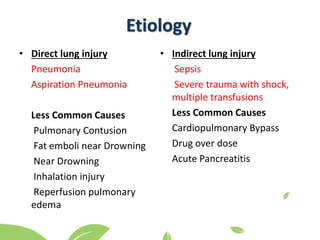
– The facilitator will track attendance record (sign in /out)
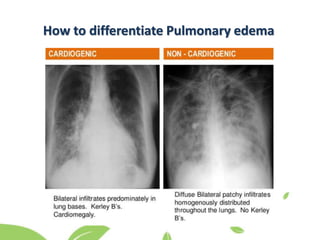
• To successfully complete the activity Learners must
– attend the entire activity
– complete the participant feedback tool.
– please list any additional requirements for successful completion
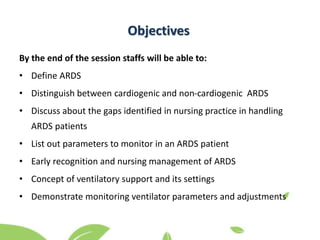
By the end of the session staffs will be able to:
• Define ARDS
• Distinguish between cardiogenic and non-cardiogenic ARDS
• Discuss about the gaps identified in nursing practice in handling
ARDS patients
• List out parameters to monitor in an ARDS patient
• Early recognition and nursing management of ARDS
• Concept of ventilatory support and its settings
• Demonstrate monitoring ventilator parameters and adjustments
Objectives
Case scenario
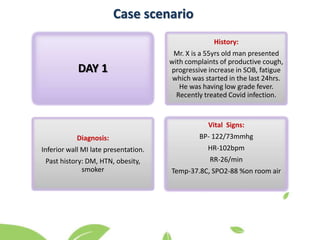
History:
Mr. X is a 55yrs old man presented
with complaints of productive cough,
progressive increase in SOB, fatigue
which was started in the last 24hrs.
He was having low grade fever.
Recently treated Covid infection.
Diagnosis:
Inferior wall MI late presentation.
Past history: DM, HTN, obesity,
smoker
Vital Signs:
BP- 122/73mmhg
HR-102bpm
RR-26/min
Temp-37.8C, SPO2-88 %on room air
DAY 1
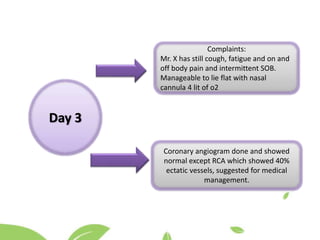
Day 3
Complaints:
Mr. X has still cough, fatigue and on and
off body pain and intermittent SOB.
Manageable to lie flat with nasal
cannula 4 lit of o2
Coronary angiogram done and showed
normal except RCA which showed 40%
ectatic vessels, suggested for medical
management.
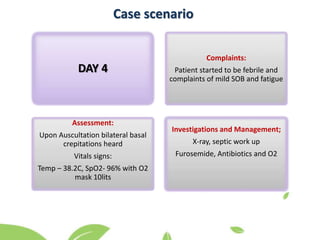
Case scenario
Complaints:
Patient started to be febrile and
complaints of mild SOB and fatigue
Assessment:
Upon Auscultation bilateral basal
crepitations heard
Vitals signs:
Temp – 38.2C, SpO2- 96% with O2
mask 10lits
Investigations and Management;
X-ray, septic work up
Furosemide, Antibiotics and O2
DAY 4
Case scenario
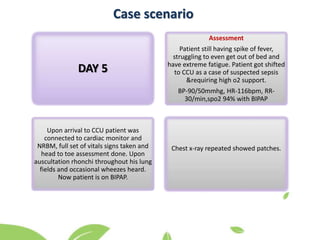
Assessment
Patient still having spike of fever,
struggling to even get out of bed and
have extreme fatigue. Patient got shifted
to CCU as a case of suspected sepsis
&requiring high o2 support.
BP-90/50mmhg, HR-116bpm, RR-
30/min,spo2 94% with BIPAP
Upon arrival to CCU patient was
connected to cardiac monitor and
NRBM, full set of vitals signs taken and
head to toe assessment done. Upon
auscultation rhonchi throughout his lung
fields and occasional wheezes heard.
Now patient is on BIPAP.
Chest x-ray repeated showed patches.
DAY 5
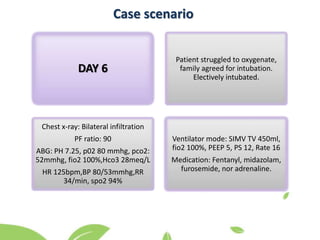
Case scenario
Patient struggled to oxygenate,
family agreed for intubation.
Electively intubated.
Chest x-ray: Bilateral infiltration
PF ratio: 90
ABG: PH 7.25, p02 80 mmhg, pco2:
52mmhg, fio2 100%,Hco3 28meq/L
HR 125bpm,BP 80/53mmhg,RR
34/min, spo2 94%
Ventilator mode: SIMV TV 450ml,
fio2 100%, PEEP 5, PS 12, Rate 16
Medication: Fentanyl, midazolam,
furosemide, nor adrenaline.
DAY 6
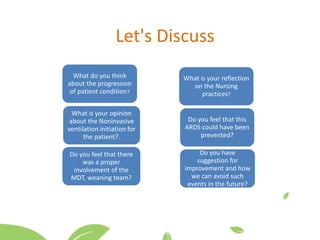
Let's Discuss
What do you think
about the progression
of patient condition?
What is your opinion
about the Noninvasive
ventilation initiation for
the patient?.
Do you feel that there
was a proper
involvement of the
MDT, weaning team?
What is your reflection
on the Nursing
practices?
Do you feel that this
ARDS could have been
prevented?
Do you have
suggestion for
improvement and how
we can avoid such
events in the future?
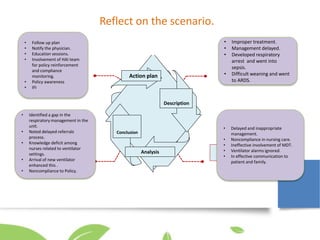
Action plan
Description
Analysis
Conclusion
Reflect on the scenario.
• Improper treatment.
• Management delayed.
• Developed respiratory
arrest and went into
sepsis.
• Difficult weaning and went
to ARDS.
• Delayed and inappropriate
management.
• Noncompliance in nursing care.
• Ineffective involvement of MDT.
• Ventilator alarms ignored.
• In effective communication to
patient and family.
• Identified a gap in the
respiratory management in the
unit.
• Noted delayed referrals
process.
• Knowledge deficit among
nurses related to ventilator
settings.
• Arrival of new ventilator
enhanced this .
• Noncompliance to Policy.
• Follow up plan
• Notify the physician.
• Education sessions.
• Involvement of HAI team
for policy reinforcement
and compliance
monitoring.
• Policy awareness
• IFI
Do you aware these terms?
ARDS or NCPE
DEFINITION
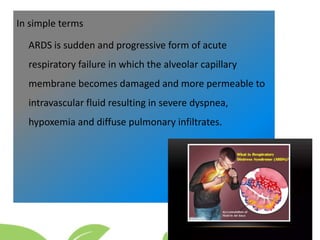
In simple terms
ARDS is sudden and progressive form of acute
respiratory failure in which the alveolar capillary
membrane becomes damaged and more permeable to
intravascular fluid resulting in severe dyspnea,
hypoxemia and diffuse pulmonary infiltrates.
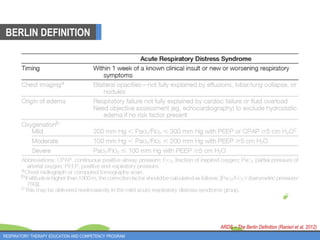
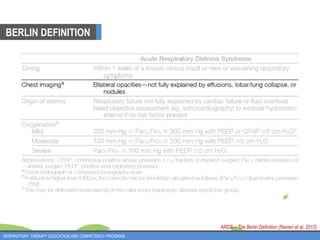
ARDS – The Berlin Definition (Ranieri et al, 2012)
RESPIRATORY THERAPY EDUCATION AND COMPETENCY PROGRAM
BERLIN DEFINITION
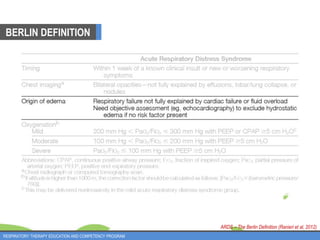
ARDS – The Berlin Definition (Ranieri et al, 2012)
RESPIRATORY THERAPY EDUCATION AND COMPETENCY PROGRAM
BERLIN DEFINITION
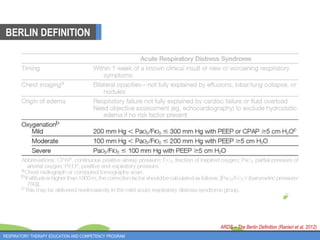
ARDS – The Berlin Definition (Ranieri et al, 2012)
RESPIRATORY THERAPY EDUCATION AND COMPETENCY PROGRAM
BERLIN DEFINITION
ARDS – The Berlin Definition (Ranieri et al, 2012)
RESPIRATORY THERAPY EDUCATION AND COMPETENCY PROGRAM
BERLIN DEFINITION
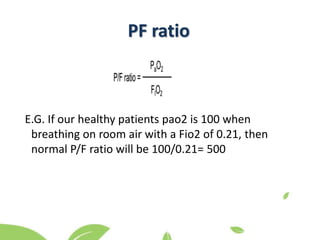
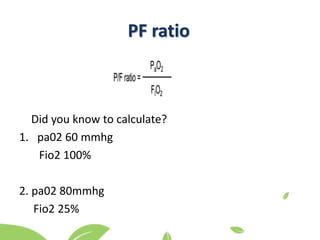
E.G. If our healthy patients pao2 is 100 when
breathing on room air with a Fio2 of 0.21, then
normal P/F ratio will be 100/0.21= 500
PF ratio
Did you know to calculate?
1. pa02 60 mmhg
Fio2 100%
2. pa02 80mmhg
Fio2 25%
PF ratio
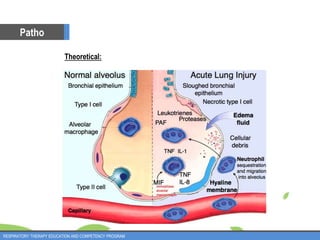
Patho
RESPIRATORY THERAPY EDUCATION AND COMPETENCY PROGRAM
Theoretical:
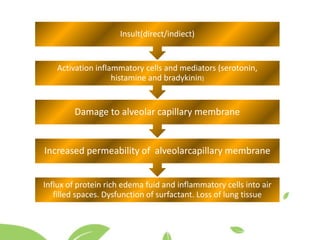
Influx of protein rich edema fuid and inflammatory cells into air
filled spaces. Dysfunction of surfactant. Loss of lung tissue
Increased permeability of alveolarcapillary membrane
Damage to alveolar capillary membrane
Activation inflammatory cells and mediators (serotonin,
histamine and bradykinin)
Insult(direct/indiect)
• Direct lung injury
Pneumonia
Aspiration Pneumonia
Less Common Causes
Pulmonary Contusion
Fat emboli near Drowning
Near Drowning
Inhalation injury
Reperfusion pulmonary
edema
• Indirect lung injury
Sepsis
Severe trauma with shock,
multiple transfusions
Less Common Causes
Cardiopulmonary Bypass
Drug over dose
Acute Pancreatitis
Etiology
How to differentiate Pulmonary edema
 Fluid management
 Hemodynamic management
Dietary management
 Prone positioning
Pharmacological
• Steroids
• Neuromuscular agents
• Sedation
ECMO
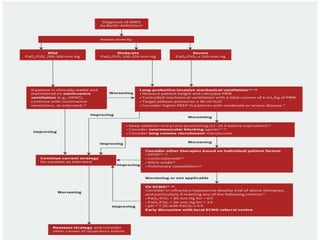
Management of ARDS
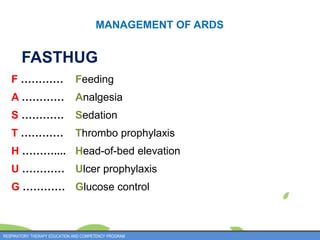
F ………… Feeding
A ………… Analgesia
S ………… Sedation
T ………… Thrombo prophylaxis
H ……….... Head-of-bed elevation
U ………… Ulcer prophylaxis
G ………… Glucose control
FASTHUG
MANAGEMENT OF ARDS
RESPIRATORY THERAPY EDUCATION AND COMPETENCY PROGRAM
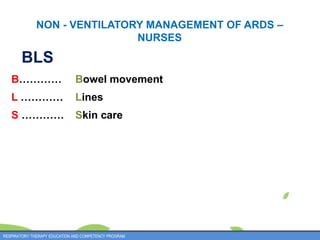
B………… Bowel movement
L ………… Lines
S ………… Skin care
BLS
NON - VENTILATORY MANAGEMENT OF ARDS –
NURSES
RESPIRATORY THERAPY EDUCATION AND COMPETENCY PROGRAM
Follow Up Plans
• Notify with managers deficit in our units
• Compliance in Nursing Care.
• Involve MDT early.
• Special attention to Ventilator alarms.
• Policy awareness to all staff.
• Conduct a training session on ventilator
parameters.
• IFI
References
• Adeani,I.Febriani,R. (2020).Using GIBBS Reflective cycle in making reflections of literature analysis. Research gate.
Volume6(2):139-148. Available from:
https://www.researchgate.net/publication/343599316_Using_GIBBS'_reflective_cycle_in_making_reflections_of_literary_an
alysis. [Accessed On 17 December 2022].
• Heart Hospital nursing educators and experienced colleagues in CCU.
• Ajibowo, A . Kolawole, O. Sadia, H.Amedu,O.Chaudary,H.Hussaini,H.Hambolu,E.Khan,T.Kauser,H.Khan,A. ( 2022) A
Comprehensive Review of the Management of Acute Respiratory Distress Syndrome. Cureus 14(10): e30669.Available from:
https://www.cureus.com/articles/105730-a-comprehensive-review-of-the-management-of-acute-respiratory-distress-
syndrome [Accessed On 19 December 2022].
• HMC Intranet Clinical guidelines. Prone Positioning in Severe Acute Respiratory Distress Syndrome (ARDS) in Intensive Care
Unit (ICU)CG1014.Available from:
https://itawasol.hamad.qa/EN/SiteSearch/Pages/results.aspx?k=PRONING#k=PRONE:~:text=https%3A//itawasol.hamad.qa/K
nowledgeCenterDocuments/Clinical%20Guidelines/Hamad%20General%20Hospital/CG%2010146%20Prone%20Positioning%
20in%20Severe%20Acute%20Respiratory%20Distress%20Syndrome%20(ARDS)%20in%20Intensive%20Care%20Unit%20(ICU).
pdf [Accessed On 18 December 2022].
• HMC Intranet Clinical Policy. Care Of mechanically Ventilated Patients. CL6011.Available from:
https://itawasol.hamad.qa/EN/How%20We%20Work/HMC-Policies/CP/Manuals/Pages/Clinical-Policy-Manual-(CL).aspx
[Accessed On 18 December 2022].
ARDS final PPT.pptx

ARDS final PPT.pptx

  • 1.
    Nursing & MidwiferyEducation Department Reflective Learning Session
  • 2.
    Disclosures • This activityis an Accredited Group Learning Activity Category 1 as defined by the Ministry of Public Health’s Department of healthcare Professions-Accreditation Section and is approved for a maximum of XX hours. • All individuals in a position to control content (SPC, Nurse Planer, content expert, presenters, faculty, authors, and content reviewers) disclosed no relevant relationships with any commercial organization to influence the content of this activity. (No COI to be disclosed) • The scientific planning committee has reviewed all disclosed financial relationships of speakers, moderators, facilitators and/or authors in advance of this CPD activity and has implemented procedures to manage any potential or real conflicts of interest. • This activity is held without receiving any financial or in-kind support • The activity will be recorded as an evidence for learners’ interaction in online synchronous activity. • Evidence of participation will be done as follows: – Each person must join the session separately – Kindly type your name and corporation number at the beginning of the session in “Chat” – Keep the video option open. Only close the microphone – Screenshots will be taken as an evidence for online synchronous activity at the beginning, in between at regular intervals and at the end. – The facilitator will track attendance record (sign in /out) • To successfully complete the activity Learners must – attend the entire activity – complete the participant feedback tool. – please list any additional requirements for successful completion
  • 3.
    By the endof the session staffs will be able to: • Define ARDS • Distinguish between cardiogenic and non-cardiogenic ARDS • Discuss about the gaps identified in nursing practice in handling ARDS patients • List out parameters to monitor in an ARDS patient • Early recognition and nursing management of ARDS • Concept of ventilatory support and its settings • Demonstrate monitoring ventilator parameters and adjustments Objectives
  • 4.
    Case scenario History: Mr. Xis a 55yrs old man presented with complaints of productive cough, progressive increase in SOB, fatigue which was started in the last 24hrs. He was having low grade fever. Recently treated Covid infection. Diagnosis: Inferior wall MI late presentation. Past history: DM, HTN, obesity, smoker Vital Signs: BP- 122/73mmhg HR-102bpm RR-26/min Temp-37.8C, SPO2-88 %on room air DAY 1
  • 5.
    Day 3 Complaints: Mr. Xhas still cough, fatigue and on and off body pain and intermittent SOB. Manageable to lie flat with nasal cannula 4 lit of o2 Coronary angiogram done and showed normal except RCA which showed 40% ectatic vessels, suggested for medical management.
  • 6.
    Case scenario Complaints: Patient startedto be febrile and complaints of mild SOB and fatigue Assessment: Upon Auscultation bilateral basal crepitations heard Vitals signs: Temp – 38.2C, SpO2- 96% with O2 mask 10lits Investigations and Management; X-ray, septic work up Furosemide, Antibiotics and O2 DAY 4
  • 7.
    Case scenario Assessment Patient stillhaving spike of fever, struggling to even get out of bed and have extreme fatigue. Patient got shifted to CCU as a case of suspected sepsis &requiring high o2 support. BP-90/50mmhg, HR-116bpm, RR- 30/min,spo2 94% with BIPAP Upon arrival to CCU patient was connected to cardiac monitor and NRBM, full set of vitals signs taken and head to toe assessment done. Upon auscultation rhonchi throughout his lung fields and occasional wheezes heard. Now patient is on BIPAP. Chest x-ray repeated showed patches. DAY 5
  • 8.
    Case scenario Patient struggledto oxygenate, family agreed for intubation. Electively intubated. Chest x-ray: Bilateral infiltration PF ratio: 90 ABG: PH 7.25, p02 80 mmhg, pco2: 52mmhg, fio2 100%,Hco3 28meq/L HR 125bpm,BP 80/53mmhg,RR 34/min, spo2 94% Ventilator mode: SIMV TV 450ml, fio2 100%, PEEP 5, PS 12, Rate 16 Medication: Fentanyl, midazolam, furosemide, nor adrenaline. DAY 6
  • 9.
    Let's Discuss What doyou think about the progression of patient condition? What is your opinion about the Noninvasive ventilation initiation for the patient?. Do you feel that there was a proper involvement of the MDT, weaning team? What is your reflection on the Nursing practices? Do you feel that this ARDS could have been prevented? Do you have suggestion for improvement and how we can avoid such events in the future?
  • 10.
    Action plan Description Analysis Conclusion Reflect onthe scenario. • Improper treatment. • Management delayed. • Developed respiratory arrest and went into sepsis. • Difficult weaning and went to ARDS. • Delayed and inappropriate management. • Noncompliance in nursing care. • Ineffective involvement of MDT. • Ventilator alarms ignored. • In effective communication to patient and family. • Identified a gap in the respiratory management in the unit. • Noted delayed referrals process. • Knowledge deficit among nurses related to ventilator settings. • Arrival of new ventilator enhanced this . • Noncompliance to Policy. • Follow up plan • Notify the physician. • Education sessions. • Involvement of HAI team for policy reinforcement and compliance monitoring. • Policy awareness • IFI
  • 11.
    Do you awarethese terms? ARDS or NCPE DEFINITION
  • 12.
    In simple terms ARDSis sudden and progressive form of acute respiratory failure in which the alveolar capillary membrane becomes damaged and more permeable to intravascular fluid resulting in severe dyspnea, hypoxemia and diffuse pulmonary infiltrates.
  • 13.
    ARDS – TheBerlin Definition (Ranieri et al, 2012) RESPIRATORY THERAPY EDUCATION AND COMPETENCY PROGRAM BERLIN DEFINITION
  • 14.
    ARDS – TheBerlin Definition (Ranieri et al, 2012) RESPIRATORY THERAPY EDUCATION AND COMPETENCY PROGRAM BERLIN DEFINITION
  • 15.
    ARDS – TheBerlin Definition (Ranieri et al, 2012) RESPIRATORY THERAPY EDUCATION AND COMPETENCY PROGRAM BERLIN DEFINITION
  • 16.
    ARDS – TheBerlin Definition (Ranieri et al, 2012) RESPIRATORY THERAPY EDUCATION AND COMPETENCY PROGRAM BERLIN DEFINITION
  • 17.
    E.G. If ourhealthy patients pao2 is 100 when breathing on room air with a Fio2 of 0.21, then normal P/F ratio will be 100/0.21= 500 PF ratio
  • 18.
    Did you knowto calculate? 1. pa02 60 mmhg Fio2 100% 2. pa02 80mmhg Fio2 25% PF ratio
  • 20.
    Patho RESPIRATORY THERAPY EDUCATIONAND COMPETENCY PROGRAM Theoretical:
  • 21.
    Influx of proteinrich edema fuid and inflammatory cells into air filled spaces. Dysfunction of surfactant. Loss of lung tissue Increased permeability of alveolarcapillary membrane Damage to alveolar capillary membrane Activation inflammatory cells and mediators (serotonin, histamine and bradykinin) Insult(direct/indiect)
  • 22.
    • Direct lunginjury Pneumonia Aspiration Pneumonia Less Common Causes Pulmonary Contusion Fat emboli near Drowning Near Drowning Inhalation injury Reperfusion pulmonary edema • Indirect lung injury Sepsis Severe trauma with shock, multiple transfusions Less Common Causes Cardiopulmonary Bypass Drug over dose Acute Pancreatitis Etiology
  • 23.
    How to differentiatePulmonary edema
  • 24.
     Fluid management Hemodynamic management Dietary management  Prone positioning Pharmacological • Steroids • Neuromuscular agents • Sedation ECMO Management of ARDS
  • 25.
    F ………… Feeding A………… Analgesia S ………… Sedation T ………… Thrombo prophylaxis H ……….... Head-of-bed elevation U ………… Ulcer prophylaxis G ………… Glucose control FASTHUG MANAGEMENT OF ARDS RESPIRATORY THERAPY EDUCATION AND COMPETENCY PROGRAM
  • 26.
    B………… Bowel movement L………… Lines S ………… Skin care BLS NON - VENTILATORY MANAGEMENT OF ARDS – NURSES RESPIRATORY THERAPY EDUCATION AND COMPETENCY PROGRAM
  • 27.
    Follow Up Plans •Notify with managers deficit in our units • Compliance in Nursing Care. • Involve MDT early. • Special attention to Ventilator alarms. • Policy awareness to all staff. • Conduct a training session on ventilator parameters. • IFI
  • 29.
    References • Adeani,I.Febriani,R. (2020).UsingGIBBS Reflective cycle in making reflections of literature analysis. Research gate. Volume6(2):139-148. Available from: https://www.researchgate.net/publication/343599316_Using_GIBBS'_reflective_cycle_in_making_reflections_of_literary_an alysis. [Accessed On 17 December 2022]. • Heart Hospital nursing educators and experienced colleagues in CCU. • Ajibowo, A . Kolawole, O. Sadia, H.Amedu,O.Chaudary,H.Hussaini,H.Hambolu,E.Khan,T.Kauser,H.Khan,A. ( 2022) A Comprehensive Review of the Management of Acute Respiratory Distress Syndrome. Cureus 14(10): e30669.Available from: https://www.cureus.com/articles/105730-a-comprehensive-review-of-the-management-of-acute-respiratory-distress- syndrome [Accessed On 19 December 2022]. • HMC Intranet Clinical guidelines. Prone Positioning in Severe Acute Respiratory Distress Syndrome (ARDS) in Intensive Care Unit (ICU)CG1014.Available from: https://itawasol.hamad.qa/EN/SiteSearch/Pages/results.aspx?k=PRONING#k=PRONE:~:text=https%3A//itawasol.hamad.qa/K nowledgeCenterDocuments/Clinical%20Guidelines/Hamad%20General%20Hospital/CG%2010146%20Prone%20Positioning% 20in%20Severe%20Acute%20Respiratory%20Distress%20Syndrome%20(ARDS)%20in%20Intensive%20Care%20Unit%20(ICU). pdf [Accessed On 18 December 2022]. • HMC Intranet Clinical Policy. Care Of mechanically Ventilated Patients. CL6011.Available from: https://itawasol.hamad.qa/EN/How%20We%20Work/HMC-Policies/CP/Manuals/Pages/Clinical-Policy-Manual-(CL).aspx [Accessed On 18 December 2022].

Editor's Notes

  • #11 Notes to presenter: What did you think at first? What obstacles did you encounter along the way? How did you overcome those obstacles? What images can you add to support your process? This SmartArt allows you add images and text to help outline your process. If a picture is worth a thousand words, then pictures and words should help you communicate this reflection on learning perfectly! You can always click on Insert>SmartArt to change this graphic or select the graphic and click on the Design contextual menu to change the colors. Feel free to use more than one slide to reflect upon your process. It also helps to add some video of your process.