DESIGNING DOORS
FOR YOUR BUILDING
A handbook for architects
2
TABLE OF CONTENTS
WELCOME TO THE HANDBOOK ..............................................................	 4
HOW TO USE THIS HANDBOOK ..............................................................	6
HOW WE MEET YOUR NEEDS AT EACH KEY STEP ...................................	8
OPTIMIZING PEOPLE FLOW IN YOUR BUILDING ......................................	9
UNDERSTANDING THE UNIQUE REQUIREMENTS OF DIFFERNT.......................
BUILDING TYPES ..................................................................................	11
MEDICAL BUILDINGS ............................................................................	 12
OFFICE BUILDINGS .............................................................................	 14
RETAIL BUILDINGS ...............................................................................	 16
INFRASTRUCTURE BUILDINGS .............................................................	 17
HOTELS ................................................................................................	 18
RESIDENTIAL BUILDINGS .....................................................................	 19
THE KONE BUILDING DOOR OFFERING ..................................................	 20
KONE REVOLVING DOORS .....................................................................	 21
KONE SLIDING DOORS ..........................................................................	 22
KONE SWING DOOR OPERATORS ...........................................................	 23
KONE GLIDING DOORS ..........................................................................	 24
KONE HERMETIC DOORS .......................................................................	 25
KONE TURNSTILES ................................................................................	 26
KONE SECTIONAL OVERHEAD DOORS ...................................................	 27
KONE HIGH-SPEED DOORS ...................................................................	 28
KONE ROLLER SHUTTERS AND GRILLES .................................................	 29
A DEDICATED PARTNER ........................................................................	 30
AWARD-WINNING DESIGN .....................................................................	31
SUSTAINABILITY ..................................................................................	 32
SAFETY AND MAINTENANCE .................................................................	33
APPENDIX ............................................................................................	 34
2
33
4
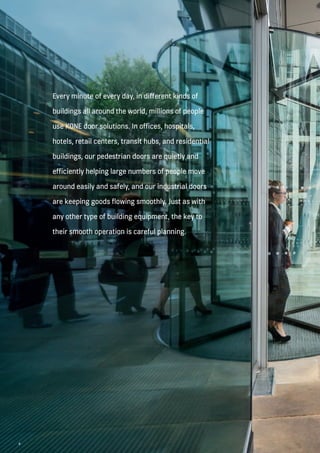
Every minute of every day, in different kinds of
buildings all around the world, millions of people
use KONE door solutions. In offices, hospitals,
hotels, retail centers, transit hubs, and residential
buildings, our pedestrian doors are quietly and
efficiently helping large numbers of people move
around easily and safely, and our industrial doors
are keeping goods flowing smoothly. Just as with
any other type of building equipment, the key to
their smooth operation is careful planning.
4
5
WELCOME TO THE
HANDBOOK
Dear reader,
We aim to provide our customers with a performance edge by
offering the best user experience in the rapidly developing urban
environment. Our innovative people flow solutions help people
and goods move within and between buildings smoothly, safely,
comfortably, and without waiting.
Doors provide the first and last impression of any building, and
our solutions make sure that these impressions are always positive.
They also serve many purposes beyond just providing access for
people and goods and acting as a design feature – including
insulation, fire protection, access control, and contamination
prevention. Furthermore, they can incorporate features that
support goals such as energy efficiency. Our doors work in
harmony with the wider KONE offering – including elevators,
escalators, and turnstiles, as well as intelligent solutions for
access and destination control, communication, and equipment
monitoring. This means KONE can provide everything you need
for your people flow needs. Together, our solutions ensure that,
whatever your building type, the people and goods flow will be
safe, secure, and smooth.
This handbook is intended to be a clear, easy-to-understand
introduction to the main process stages, from initial planning
to choosing the right door solutions for your project. It will help
you to select the correct solution for each specific application,
recommend ways to optimize people flow, and introduce essential
door-related requirements for specific building types. It also briefly
introduces our door offering and points you to the wealth of useful
information and handy tools available on our website, KONE.com.
Should you have any further questions, your local KONE representative
will be happy to help.
Sincerely,
Antti Ruutu
Head of Doors Business
KONE
5
6
HOW TO USE
THIS HANDBOOK
This handbook is intended to give you a taster of what
to consider when planning people and goods flow
solutions for your projects.
The initial sections deal with the issues you need to
consider during planning, solution selection, and
specification in order to optimize people flow within
your building. This is broken down by building type
to make it easier for you to find what you’re looking for.
The later sections cover our different types of door
solutions and their main features, as well as the
relevant safety standards to consider in relation to
building doors. For product-specific information,
check the product segment matrix on page 11,
where you can quickly check which KONE products
we recommend for different building types.
Finally, there is a brief overview of the support we can
provide for every stage of the equipment life cycle,
from planning and installation to maintenance and
modernization.
The latest information about KONE door solutions
and the rest of our offering – including elevators,
escalators and autowalks, People Flow Intelligence
solutions, and our tailored maintenance and
modernization services – can be found on our website,
kone.com. If you are using a printed copy of this
handbook, it’s also where you can download the latest
version. The digital version includes the most up-to-
date information on our products and services.
6
77
8
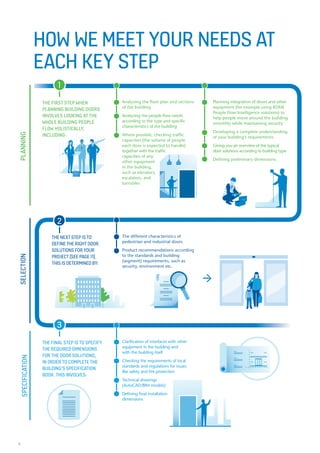
HOW WE MEET YOUR NEEDS AT
EACH KEY STEP
THE FINAL STEP IS TO SPECIFY
THE REQUIRED DIMENSIONS
FOR THE DOOR SOLUTIONS,
IN ORDER TO COMPLETE THE
BUILDING’S SPECIFICATION
BOOK. THIS INVOLVES:
THE NEXT STEP IS TO
DEFINE THE RIGHT DOOR
SOLUTIONS FOR YOUR
PROJECT (SEE PAGE 11).
THIS IS DETERMINED BY:
PLANNINGSELECTIONSPECIFICATION
Analyzing the floor plan and sections
of the building
Analyzing the people flow needs
according to the type and specific
characteristics of the building
Where possible, checking traffic
capacities (the volume of people
each door is expected to handle)
together with the traffic
capacities of any
other equipment
in the building,
such as elevators,
escalators, and
turnstiles
Clarification of interfaces with other
equipment in the building and
with the building itself
Checking the requirements of local
standards and regulations for issues
like safety and fire protection
Technical drawings
(AutoCAD/BIM models)
Defining final installation
dimensions
The different characteristics of
pedestrian and industrial doors
Product recommendations according
to the standards and building
(segment) requirements, such as
security, environment etc.
1
3
2
Planning integration of doors and other
equipment (for example using KONE
People Flow Intelligence solutions) to
help people move around the building
smoothly while maintaining security
Developing a complete understanding
of your building’s requirements
Giving you an overview of the typical
door solutions according to building type
Defining preliminary dimensions
1
THE FIRST STEP WHEN
PLANNING BUILDING DOORS
INVOLVES LOOKING AT THE
WHOLE BUILDING PEOPLE
FLOW HOLISTICALLY,
INCLUDING:
9
PEOPLE AND
GOODS
Focusing on the movement
of both individuals and
larger crowds of people, as
well as goods
PROCESSES
Understanding how the
building as a whole is used
throughout its life cycle
PERFORMANCE &
APPLICATION
Understanding our
customers’ challenges
and offering the most
appropriate solutions for
them and their end users
OPTIMIZING PEOPLE FLOW
IN YOUR BUILDING
People flow is all about how people move within and between buildings, and in an increasingly urbanized
world where city populations are rising rapidly, it’s more important than ever. KONE door solutions are
an integral part of our vision to offer the best people flow experience by helping people move around
smoothly, safely, comfortably, and without waiting while ensuring high-quality accessibility for all.
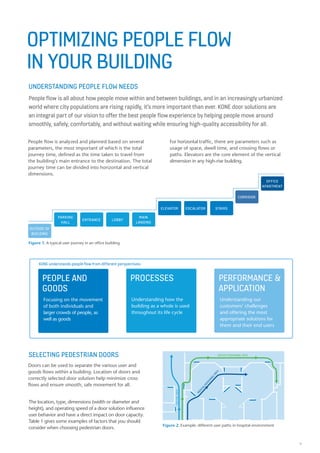
Figure 1. A typical user journey in an office building
Figure 2. Example: different user paths in hospital environment
People flow is analyzed and planned based on several
parameters, the most important of which is the total
journey time, defined as the time taken to travel from
the building’s main entrance to the destination. The total
journey time can be divided into horizontal and vertical
dimensions.
Doors can be used to separate the various user and
goods flows within a building. Location of doors and
correctly selected door solution help minimize cross
flows and ensure smooth, safe movement for all.
For horizontal traffic, there are parameters such as
usage of space, dwell time, and crossing flows or
paths. Elevators are the core element of the vertical
dimension in any high-rise building.
OUTSIDE OF
BUILDING
OFFICE
APARTMENT
PARKING
HALL
ENTRANCE LOBBY
MAIN
LANDING
ELEVATOR ESCALATOR STAIRS
CORRIDOR
UNDERSTANDING PEOPLE FLOW NEEDS
SELECTING PEDESTRIAN DOORS SERVICE PERSONNEL PATH
MEDICALPERSONNELPATH
VISITORPATH
KONE understands people flow from different perspectives:
The location, type, dimensions (width or diameter and
height), and operating speed of a door solution influence
user behavior and have a direct impact on door capacity.
Table 1 gives some examples of factors that you should
consider when choosing pedestrian doors.
10
SELECTING INDUSTRIAL DOORS
Industrial doors vary in terms of space needed for
installation, their construction materials, insulation
and sound properties, opening and closing speed
and required accessories. The most common types
of industrial doors are sectional overhead doors,
roller shutters, grilles, and high-speed doors.
When planning a building that will include industrial
doors, it is essential that you take into account the
following parameters as early as possible in the design
process:
n Is the door external one or for internal application?
n Maximum size of the opening (width, height)
n Heat transmission (U-value: W/m2K)
n Air leakage or air permeability
n Air infiltration, which is dependent on the opening
and closing speed (m/s)
n Power consumption (stand-by power, W)
n Draft-prevention needs
n Headroom
n Door installation depth
n Environment (doors equal and over 2500 mm
require equipment for working at height)
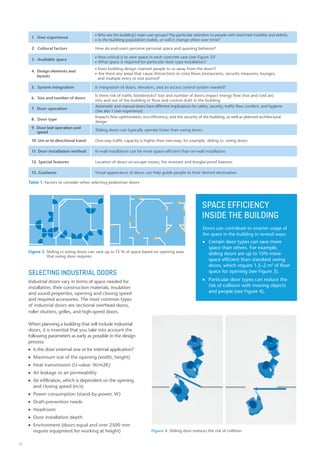
Figure 3. Sliding vs swing doors can save up to 15 % of space based on opening area
that swing door requires
1. User experience
n Who are the building’s main user groups? Pay particular attention to people with restricted mobility and elderly.
n Is the building population stable, or will it change often over time?
2. Cultural factors How do end-users perceive personal space and queuing behavior?
3. Available space
n How critical is to save space in each concrete case (see Figure 3)?
n What space is required for particular door type installation?
4. Design elements and
layouts
n Does building design channel people to or away from the doors?
n Are there any areas that cause distractions or cross flows (restaurants, security measures, lounges,
and multiple entry or exit points)?
5. System integration Is integration of doors, elevators, and an access control system needed?
6. Size and number of doors
Is there risk of traffic bottlenecks? Size and number of doors impact energy flow (hot and cold air)
into and out of the building or floor and control draft in the building
7. Door operation
Automatic and manual doors have different implications for safety, security, traffic flow, comfort, and hygiene
(See also 1.User experience)
8. Door type
Impacts flow optimization, eco-efficiency, and the security of the building, as well as planned architectural
design
9. Door leaf operation and
speed
Sliding doors can typically operate faster than swing doors
10. Uni or bi-directional travel One-way traffic capacity is higher than two-way; for example, sliding vs. swing doors
11. Door installation method In-wall installation can be more space-efficient than on-wall installation
12. Special features Location of doors on escape routes; fire resistant and burglar-proof features
13. Guidance Visual appearance of doors can help guide people to their desired destination
Table 1. Factors to consider when selecting pedestrian doors
SPACE EFFICIENCY
INSIDE THE BUILDING
Doors can contribute to smarter usage of
the space in the building in several ways:
n Certain door types can save more
space than others. For example,
sliding doors are up to 15% more
space efficient than standard swing
doors, which require 1.5–2 m2
of floor
space for opening (see Figure 3).
n Particular door types can reduce the
risk of collision with moving objects
and people (see Figure 4).
Figure 4. Sliding door reduces the risk of collision
11
area
Gym and well-being facilities
UNDERSTANDING THE UNIQUE
REQUIREMENTS OF DIFFERENT
BUILDING TYPES
Although building types can be loosely categorized into medical, office, infrastructure, residential, retail,
educational/leisure and hotel segments each and every building has its own unique people flow transportation
requirements. The following sections of this handbook will take you through the key requirements to consider
when selecting door solutions for different types of buildings.
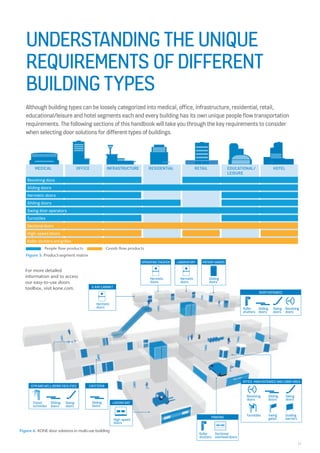
Figure 5. Product-segment matrix
For more detailed
information and to access
our easy-to-use doors
toolbox, visit kone.com.
MEDICAL OFFICE EDUCATIONAL/
LEISURE
HOTELRESIDENTIAL RETAILINFRASTRUCTURE
Sliding doors
Hermetic doors
Gliding doors
Swing door operators
Turnstiles
Sectionaldoors
High-speed doors
Roller shutters and grilles
People flow products Goods flow products
Revolving doos
Figure 6. KONE door solutions in multi-use building
Sliding
doors
Swing
doors
Turnstiles Swing
gates
Guiding
barriers
Revolving
doors
PARKING
Roller
shutters
Sectional
overhead doors
Hermetic
doors
Tripod
turnstiles
Sliding
doors
Swing
doors
Sliding
doors
High-speed
doors
Gliding
doors
Hermetic
doors
Hermetic
doors
Roller
shutters
Sliding
doors
Swing
doors
Revolving
doors
SHOP ENTRANCE
OFFICE.MAINENTRANCEANDLOBBYAREA
PATIENT WARDSOPERATINGTHEATER
X-RAY CABINET
LOADING BAY
CAFETERIAGYM AND WELL-BEING FACILITIES
LABORATORY
12
MEDICAL BUILDINGS
Medical buildings have a diverse range of requirements when it comes to door solutions, with hygiene and
operational efficiency being critically important. From the main entrance and other public spaces like cafeterias,
to specialist areas like loading bays, patient wards, and operating theatres, medical buildings typically feature
a wide range of different door solutions.
From the end-users’ perspective,
medical buildings have defined
flows of people that need to be
separated by building design;
doors play an important role
in this separation:
n	 Polyclinic patients
n	 Hospital patients staying
	 for more than 24 hours
n	Staff
n	 Patients’ visitors
n	 Housekeeping personnel
	 (e.g. canteen staff, cleaners)
The primary goal is to maintain
high hygiene level by preventing
contamination and the transfer of
bacteria and viruses (for example,
through compartmentalization and
securing the building areas).
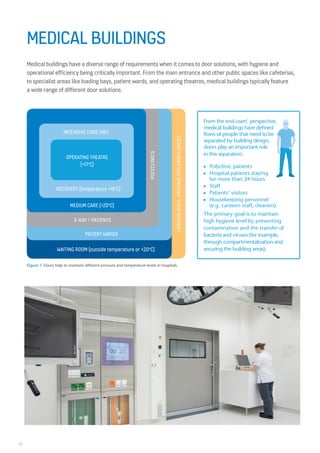
Figure 7. Doors help to maintain different pressure and temperature levels in hospitals.
WAITING ROOM (outside temperature or +20o
C)
X-RAY / PATIENTS
POLYCLINICS
LOADINGBAYS,PARKINGFORAMBULANCES
MEDIUM CARE (+20o
C)
RECOVERY (temperature +19o
C)
OPERATING THEATRE
(+17o
C)
INTENSIVE CARE UNIT
PATIENT WARDS
13
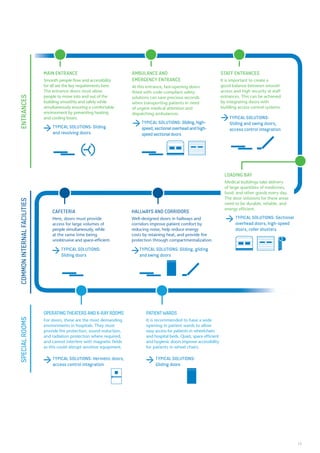
MAIN ENTRANCE
Smooth people flow and accessibility
for all are the key requirements here.
The entrance doors must allow
people to move into and out of the
building smoothly and safely while
simultaneously ensuring a comfortable
environment by preventing heating
and cooling losses.
CAFETERIA
Here, doors must provide
access for large volumes of
people simultaneously, while
at the same time being
unobtrusive and space-efficient.
LOADING BAY
Medical buildings take delivery
of large quantities of medicines,
food, and other goods every day.
The door solutions for these areas
need to be durable, reliable, and
energy efficient.
HALLWAYS AND CORRIDORS
Well-designed doors in hallways and
corridors improve patient comfort by
reducing noise, help reduce energy
costs by retaining heat, and provide fire
protection through compartmentalization.
PATIENT WARDS
It is recommended to have a wide
opening in patient wards to allow
easy access for patients in wheelchairs
and hospital beds. Quiet, space efficient
and hygienic doors improve accessibility
for patients in wheel chairs.
OPERATING THEATERS AND X-RAY ROOMS
For doors, these are the most demanding
environments in hospitals. They must
provide fire protection, sound reduction,
and radiation protection where required,
and cannot interfere with magnetic fields
as this could disrupt sensitive equipment.
AMBULANCE AND
EMERGENCY ENTRANCE
At this entrance, fast-opening doors
fitted with code-compliant safety
solutions can save precious seconds
when transporting patients in need
of urgent medical attention and
dispatching ambulances.
STAFF ENTRANCES
It is important to create a
good balance between smooth
access and high security at staff
entrances. This can be achieved
by integrating doors with
building access control systems.
ENTRANCESCOMMONINTERNALFACILITIESSPECIALROOMS
TYPICAL SOLUTIONS: Sliding
and revolving doors
TYPICAL SOLUTIONS: Sliding, high-
speed, sectional overhead and high-
speed sectional doors
TYPICAL SOLUTIONS:
Sliding doors
TYPICAL SOLUTIONS: Sliding, gliding
and swing doors
TYPICAL SOLUTIONS: Sectional
overhead doors, high-speed
doors, roller shutters
TYPICAL SOLUTIONS:
Sliding and swing doors,
access control integration
TYPICAL SOLUTIONS: Hermetic doors,
access control integration
TYPICAL SOLUTIONS:
Gliding doors
14
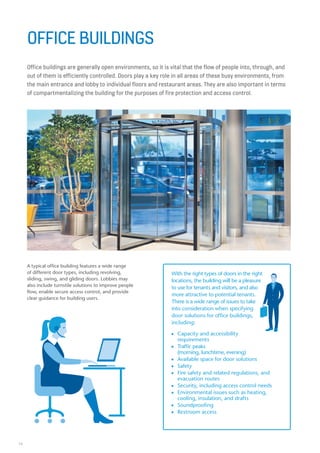
Office buildings are generally open environments, so it is vital that the flow of people into, through, and
out of them is efficiently controlled. Doors play a key role in all areas of these busy environments, from
the main entrance and lobby to individual floors and restaurant areas. They are also important in terms
of compartmentalizing the building for the purposes of fire protection and access control.
OFFICE BUILDINGS
A typical office building features a wide range
of different door types, including revolving,
sliding, swing, and gliding doors. Lobbies may
also include turnstile solutions to improve people
flow, enable secure access control, and provide
clear guidance for building users.
With the right types of doors in the right
locations, the building will be a pleasure
to use for tenants and visitors, and also
more attractive to potential tenants.
There is a wide range of issues to take
into consideration when specifying
door solutions for office buildings,
including:
n Capacity and accessibility
requirements
n Traffic peaks
(morning, lunchtime, evening)
n Available space for door solutions
n Safety
n Fire safety and related regulations, and
evacuation routes
n Security, including access control needs
n Environmental issues such as heating,
cooling, insulation, and drafts
n Soundproofing
n Restroom access
15
KONE PEOPLE FLOW
INTELLIGENCE
KONE People Flow Intelligence is a comprehensive
and flexible suite of solutions for access control,
destination guidance, information communication,
and equipment monitoring. Based on our industry-
leading technology and world-class visual design,
these solutions ensure smoother, smarter people
flow, enable efficient building management, and
add real value to a property. They are scalable,
third-party compatible, and can be customized
for new or existing buildings. We can also assess
the current state of the building and, based on
the results, propose the optimal solution to make
the building smarter. Together with turnstiles,
People Flow Intelligence add value to the lobby by
integrating access and destination control into a
single, easy-to-use solution.
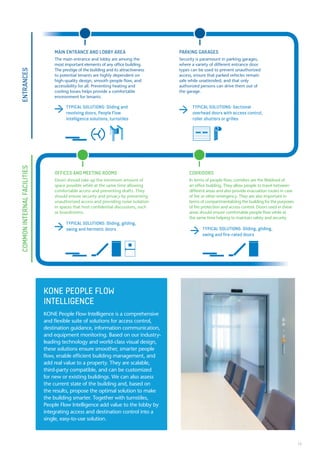
MAIN ENTRANCE AND LOBBY AREA
The main entrance and lobby are among the
most important elements of any office building.
The prestige of the building and its attractiveness
to potential tenants are highly dependent on
high-quality design, smooth people flow, and
accessibility for all. Preventing heating and
cooling losses helps provide a comfortable
environment for tenants.
OFFICES AND MEETING ROOMS
Doors should take up the minimum amount of
space possible while at the same time allowing
comfortable access and preventing drafts. They
should ensure security and privacy by preventing
unauthorized access and providing noise isolation
in spaces that host confidential discussions, such
as boardrooms.
CORRIDORS
In terms of people flow, corridors are the lifeblood of
an office building. They allow people to travel between
different areas and also provide evacuation routes in case
of fire or other emergency. They are also important in
terms of compartmentalizing the building for the purposes
of fire protection and access control. Doors used in these
areas should ensure comfortable people flow while at
the same time helping to maintain safety and security
PARKING GARAGES
Security is paramount in parking garages,
where a variety of different entrance door
types can be used to prevent unauthorized
access, ensure that parked vehicles remain
safe while unattended, and that only
authorized persons can drive them out of
the garage.
COMMONINTERNALFACILITIESENTRANCES
TYPICAL SOLUTIONS: Sliding and
revolving doors, People Flow
Intelligence solutions, turnstiles
TYPICAL SOLUTIONS: Sectional
overhead doors with access control,
roller shutters or grilles
TYPICAL SOLUTIONS: Sliding, gliding,
swing and hermetic doors TYPICAL SOLUTIONS: Sliding, gliding,
swing and fire-rated doors
16
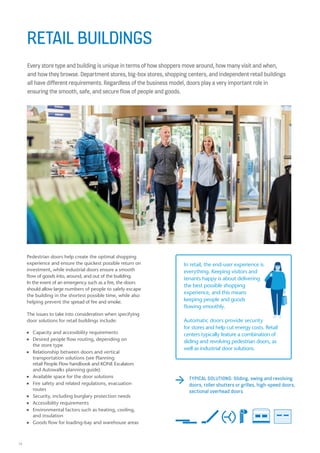
RETAIL BUILDINGS
Every store type and building is unique in terms of how shoppers move around, how many visit and when,
and how they browse. Department stores, big-box stores, shopping centers, and independent retail buildings
all have different requirements. Regardless of the business model, doors play a very important role in
ensuring the smooth, safe, and secure flow of people and goods.
The issues to take into consideration when specifying
door solutions for retail buildings include:
n Capacity and accessibility requirements
n Desired people flow routing, depending on
the store type
n Relationship between doors and vertical
transportation solutions (see Planning
retail People Flow handbook and KONE Escalators
and Autowalks planning guide)
n Available space for the door solutions
n Fire safety and related regulations, evacuation
routes
n Security, including burglary protection needs
n Accessibility requirements
n Environmental factors such as heating, cooling,
and insulation
n Goods flow for loading-bay and warehouse areas
Pedestrian doors help create the optimal shopping
experience and ensure the quickest possible return on
investment, while industrial doors ensure a smooth
flow of goods into, around, and out of the building.
In the event of an emergency such as a fire, the doors
should allow large numbers of people to safely escape
the building in the shortest possible time, while also
helping prevent the spread of fire and smoke.
In retail, the end-user experience is
everything. Keeping visitors and
tenants happy is about delivering
the best possible shopping
experience, and this means
keeping people and goods
flowing smoothly.
Automatic doors provide security
for stores and help cut energy costs. Retail
centers typically feature a combination of
sliding and revolving pedestrian doors, as
well as industrial door solutions.
TYPICAL SOLUTIONS: Sliding, swing and revolving
doors, roller shutters or grilles, high-speed doors,
sectional overhead doors
17
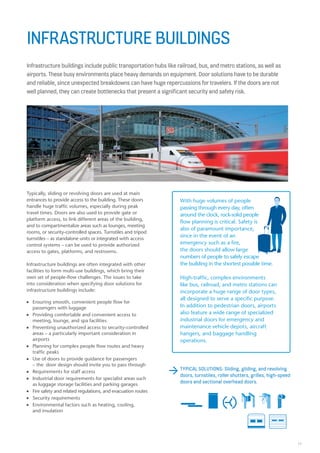
INFRASTRUCTURE BUILDINGS
Typically, sliding or revolving doors are used at main
entrances to provide access to the building. These doors
handle huge traffic volumes, especially during peak
travel times. Doors are also used to provide gate or
platform access, to link different areas of the building,
and to compartmentalize areas such as lounges, meeting
rooms, or security-controlled spaces. Turnstiles and tripod
turnstiles – as standalone units or integrated with access
control systems – can be used to provide authorized
access to gates, platforms, and restrooms.
Infrastructure buildings are often integrated with other
facilities to form multi-use buildings, which bring their
own set of people-flow challenges. The issues to take
into consideration when specifying door solutions for
infrastructure buildings include:
n Ensuring smooth, convenient people flow for
passengers with luggage
n Providing comfortable and convenient access to
meeting, lounge, and spa facilities
n Preventing unauthorized access to security-controlled
areas – a particularly important consideration in
airports
n Planning for complex people flow routes and heavy
traffic peaks
n Use of doors to provide guidance for passengers
– the door design should invite you to pass through
n Requirements for staff access
n Industrial door requirements for specialist areas such
as luggage storage facilities and parking garages
n Fire safety and related regulations, and evacuation routes
n Security requirements
n Environmental factors such as heating, cooling,
and insulation
Infrastructure buildings include public transportation hubs like railroad, bus, and metro stations, as well as
airports. These busy environments place heavy demands on equipment. Door solutions have to be durable
and reliable, since unexpected breakdowns can have huge repercussions for travelers. If the doors are not
well planned, they can create bottlenecks that present a significant security and safety risk.
With huge volumes of people
passing through every day, often
around the clock, rock-solid people
flow planning is critical. Safety is
also of paramount importance,
since in the event of an
emergency such as a fire,
the doors should allow large
numbers of people to safely escape
the building in the shortest possible time.
High-traffic, complex environments
like bus, railroad, and metro stations can
incorporate a huge range of door types,
all designed to serve a specific purpose.
In addition to pedestrian doors, airports
also feature a wide range of specialized
industrial doors for emergency and
maintenance vehicle depots, aircraft
hangers, and baggage handling
operations.
TYPICAL SOLUTIONS: Sliding, gliding, and revolving
doors, turnstiles, roller shutters, grilles, high-speed
doors and sectional overhead doors.
18
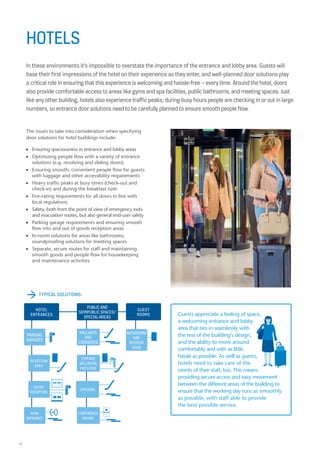
HOTELS
In these environments it’s impossible to overstate the importance of the entrance and lobby area. Guests will
base their first impressions of the hotel on their experience as they enter, and well-planned door solutions play
a critical role in ensuring that this experience is welcoming and hassle-free – every time. Around the hotel, doors
also provide comfortable access to areas like gyms and spa facilities, public bathrooms, and meeting spaces. Just
like any other building, hotels also experience traffic peaks; during busy hours people are checking in or out in large
numbers, so entrance door solutions need to be carefully planned to ensure smooth people flow.
The issues to take into consideration when specifying
door solutions for hotel buildings include:
n Ensuring spaciousness in entrance and lobby areas
n Optimizing people flow with a variety of entrance
solutions (e.g. revolving and sliding doors)
n Ensuring smooth, convenient people flow for guests
with luggage and other accessibility requirements
n Heavy traffic peaks at busy times (check-out and
check-in) and during the breakfast rush
n Fire-rating requirements for all doors in line with
local regulations
n Safety, both from the point of view of emergency exits
and evacuation routes, but also general end-user safety
n Parking garage requirements and ensuring smooth
flow into and out of goods reception areas
n In-room solutions for areas like bathrooms;
soundproofing solutions for meeting spaces
n Separate, secure routes for staff and maintaining
smooth goods and people flow for housekeeping
and maintenance activities
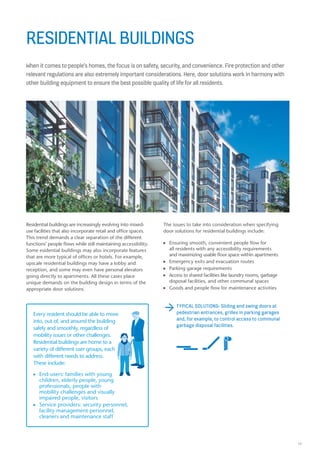
TYPICAL SOLUTIONS:
Guests appreciate a feeling of space,
a welcoming entrance and lobby
area that ties in seamlessly with
the rest of the building’s design,
and the ability to move around
comfortably and with as little
hassle as possible. As well as guests,
hotels need to take care of the
needs of their staff, too. This means
providing secure access and easy movement
between the different areas of the building to
ensure that the working day runs as smoothly
as possible, with staff able to provide
the best possible service.
HALLWAYS
AND
CORRIDORS
PARKING
GARAGES
BATHROOMS
AND
INTERIOR
DOOS
GYM AND
WELLBEING
FACILITIES
CATERING
CONFERENCE
ROOMS
RESEPTION
AREA
GOODS
RECEPTION
MAIN
ENTRANCE
HOTEL
ENTRANCES
PUBLIC AND
SEMIPUBLIC SPACES/
SPECIAL AREAS
GUEST
ROOMS
19
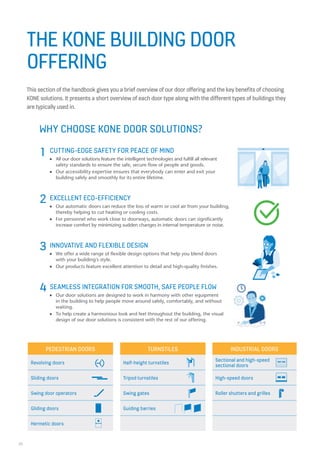
RESIDENTIAL BUILDINGS
When it comes to people’s homes, the focus is on safety, security, and convenience. Fire protection and other
relevant regulations are also extremely important considerations. Here, door solutions work in harmony with
other building equipment to ensure the best possible quality of life for all residents.
The issues to take into consideration when specifying
door solutions for residential buildings include:
n Ensuring smooth, convenient people flow for
all residents with any accessibility requirements
and maximizing usable floor space within apartments
n Emergency exits and evacuation routes
n Parking garage requirements
n Access to shared facilities like laundry rooms, garbage
disposal facilities, and other communal spaces
n Goods and people flow for maintenance activities
Residential buildings are increasingly evolving into mixed-
use facilities that also incorporate retail and office spaces.
This trend demands a clear separation of the different
functions’ people flows while still maintaining accessibility.
Some esidential buildings may also incorporate features
that are more typical of offices or hotels. For example,
upscale residential buildings may have a lobby and
reception, and some may even have personal elevators
going directly to apartments. All these cases place
unique demands on the building design in terms of the
appropriate door solutions.
TYPICAL SOLUTIONS: Sliding and swing doors at
pedestrian entrances, grilles in parking garages
and, for example, to control access to communal
garbage disposal facilities.
Every resident should be able to move
into, out of, and around the building
safely and smoothly, regardless of
mobility issues or other challenges.
Residential buildings are home to a
variety of different user groups, each
with different needs to address.
These include:
n End-users: families with young
children, elderly people, young
professionals, people with
mobility challenges and visually
impaired people, visitors
n Service providers: security personnel,
facility management personnel,
cleaners and maintenance staff
20
TURNSTILES
Half-height turnstiles
Tripod turnstiles
Swing gates
Guiding barries
INDUSTRIAL DOORS
Sectional and high-speed
sectional doors
High-speed doors
Roller shutters and grilles
PEDESTRIAN DOORS
Revolving doors
Sliding doors
Swing door operators
Gliding doors
Hermetic doors
THE KONE BUILDING DOOR
OFFERING
This section of the handbook gives you a brief overview of our door offering and the key benefits of choosing
KONE solutions. It presents a short overview of each door type along with the different types of buildings they
are typically used in.
CUTTING-EDGE SAFETY FOR PEACE OF MIND
n All our door solutions feature the intelligent technologies and fulfill all relevant
safety standards to ensure the safe, secure flow of people and goods.
n Our accessibility expertise ensures that everybody can enter and exit your
building safely and smoothly for its entire lifetime.
EXCELLENT ECO-EFFICIENCY
n Our automatic doors can reduce the loss of warm or cool air from your building,
thereby helping to cut heating or cooling costs.
n For personnel who work close to doorways, automatic doors can significantly
increase comfort by minimizing sudden changes in internal temperature or noise.
INNOVATIVE AND FLEXIBLE DESIGN
n We offer a wide range of flexible design options that help you blend doors
with your building’s style.
n Our products feature excellent attention to detail and high-quality finishes.
SEAMLESS INTEGRATION FOR SMOOTH, SAFE PEOPLE FLOW
n Our door solutions are designed to work in harmony with other equipment
in the building to help people move around safely, comfortably, and without
waiting.
n To help create a harmonious look and feel throughout the building, the visual
design of our door solutions is consistent with the rest of our offering.
WHY CHOOSE KONE DOOR SOLUTIONS?
1
2
3
4
21
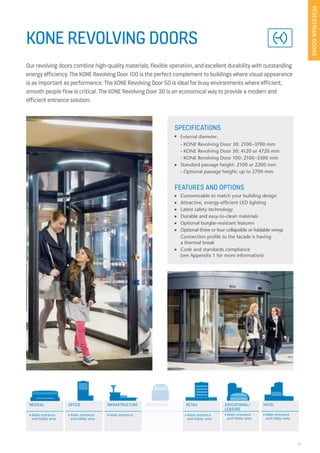
KONE REVOLVING DOORS
Our revolving doors combine high-quality materials, flexible operation, and excellent durability with outstanding
energy efficiency. The KONE Revolving Door 100 is the perfect complement to buildings where visual appearance
is as important as performance. The KONE Revolving Door 50 is ideal for busy environments where efficient,
smooth people flow is critical. The KONE Revolving Door 30 is an economical way to provide a modern and
efficient entrance solution.
SPECIFICATIONS
n External diameter:
- KONE Revolving Door 30: 2100–3700 mm
- KONE Revolving Door 50: 4120 or 4720 mm
- KONE Revolving Door 100: 2100–3300 mm
n Standard passage height: 2100 or 2200 mm
- Optional passage height: up to 2700 mm
FEATURES AND OPTIONS
n Customizable to match your building design
n Attractive, energy-efficient LED lighting
n Latest safety technology
n Durable and easy-to-clean materials
n Optional burglar-resistant features
n Optional three or four collapsible or foldable wings
Connection profile to the facade is having
a thermal break
n Code and standards compliance
(see Appendix 1 for more information)
PEDESTRIANDOORS
MEDICAL OFFICE EDUCATIONAL/
LEASURE
HOTELRESIDENTIAL RETAILINFRASTRUCTURE
n Main entrance
and lobby area
n Main entrance
and lobby area
n Main entrance n Main entrance
and lobby area
n Main entrance
and lobby area
n Main entrance
and lobby area
RESIDENTIAL
22
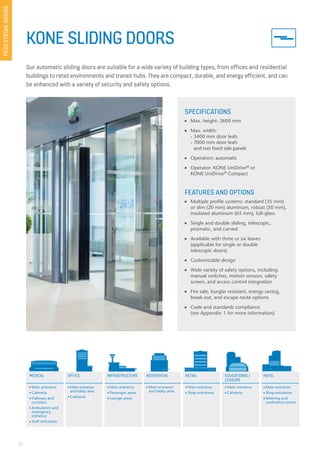
KONE SLIDING DOORS
Our automatic sliding doors are suitable for a wide variety of building types, from offices and residential
buildings to retail environments and transit hubs. They are compact, durable, and energy efficient, and can
be enhanced with a variety of security and safety options.
SPECIFICATIONS
n Max. height: 2600 mm
n Max. width:
- 3400 mm door leafs
- 7000 mm door leafs
and two fixed side panels
n Operation: automatic
n Operator: KONE UniDrive® or
KONE UniDrive® Compact
FEATURES AND OPTIONS
n Multiple profile systems: standard (35 mm)
or slim (20 mm) aluminum, robust (50 mm),
insulated aluminum (65 mm), full-glass
n Single and double sliding, telescopic,
prismatic, and curved
n Available with three or six leaves
(applicable for single or double
telescopic doors)
n Customizable design
n Wide variety of safety options, including
manual switches, motion sensors, safety
screen, and access control integration
n Fire safe, burglar resistant, energy saving,
break out, and escape route options
n Code and standards compliance
(see Appendix 1 for more information)
PEDESTRIANDOORS
MEDICAL OFFICE EDUCATIONAL/
LEASURE
HOTELRESIDENTIAL RETAILINFRASTRUCTURE
n Main entrance
n Cafereria
n Hallways and
corridors
n Ambulance and
emergency
entrance
n Staff entrances
n Main entrance
and lobby area
n Cafeteria
n Main entrance
n Passenger areas
n Lounge areas
n Main entrance
and lobby area
n Main entrance
n Cafeteria
n Main entrance
n Shop entrances
n Main entrance
n Shop entrances
n Meeting and
conference rooms
23
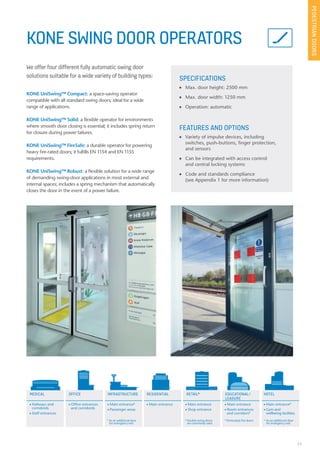
KONE SWING DOOR OPERATORS
We offer four different fully automatic swing door
solutions suitable for a wide variety of building types: SPECIFICATIONS
n Max. door height: 2500 mm
n Max. door width: 1250 mm
n Operation: automatic
FEATURES AND OPTIONS
n Variety of impulse devices, including
switches, push-buttons, finger protection,
and sensors
n Can be integrated with access control
and central locking systems
n Code and standards compliance
(see Appendix 1 for more information)
KONE UniSwing™ Compact: a space-saving operator
compatible with all standard swing doors; ideal for a wide
range of applications.
KONE UniSwing™ Solid: a flexible operator for environments
where smooth door closing is essential; it includes spring return
for closure during power failures.
KONE UniSwing™ FireSafe: a durable operator for powering
heavy fire-rated doors; it fulfills EN 1154 and EN 1155
requirements.
KONE UniSwing™ Robust: a flexible solution for a wide range
of demanding swing-door applications in most external and
internal spaces; includes a spring mechanism that automatically
closes the door in the event of a power failure.
PEDESTRIANDOORS
MEDICAL OFFICE EDUCATIONAL/
LEASURE
HOTELRESIDENTIAL RETAIL*INFRASTRUCTURE
n Hallways and
corridords
n Staff entrances
n Office entrances
and corridords
n Main entrance*
n Passenger areas
n Main entrance n Main entrance
n Shop entrance
n Main entrance
n Room entrances
and corridors*
n Main entrance*
n Gym and
wellbeing facilities
* As an additional door
for emergency exit
* Double swing doors
are commonly used
* Particularly fire doors * As an additional door
for emergency exit
24
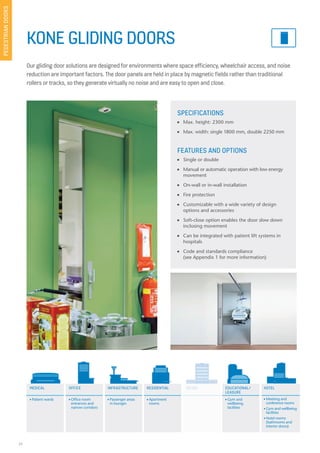
KONE GLIDING DOORS
Our gliding door solutions are designed for environments where space efficiency, wheelchair access, and noise
reduction are important factors. The door panels are held in place by magnetic fields rather than traditional
rollers or tracks, so they generate virtually no noise and are easy to open and close.
SPECIFICATIONS
n Max. height: 2300 mm
n Max. width: single 1800 mm, double 2250 mm
FEATURES AND OPTIONS
n Single or double
n Manual or automatic operation with low energy
movement
n On-wall or in-wall installation
n Fire protection
n Customizable with a wide variety of design
options and accessories
n Soft-close option enables the door slow down
inclosing movement
n Can be integrated with patient lift systems in
hospitals
n Code and standards compliance
(see Appendix 1 for more information)
MEDICAL OFFICE EDUCATIONAL/
LEASURE
HOTELRESIDENTIAL RETAILINFRASTRUCTURE
n Patient wards n Office room
entrances and
narrow corridors
n Passenger areas
in lounges
n Apartment
rooms
n Gym and
wellbeing
facilities
n Meeting and
conference rooms
n Gym and wellbeing
facilities
n Hotel rooms
(bathrooms and
interior doors)
PEDESTRIANDOORS
RETAIL
25
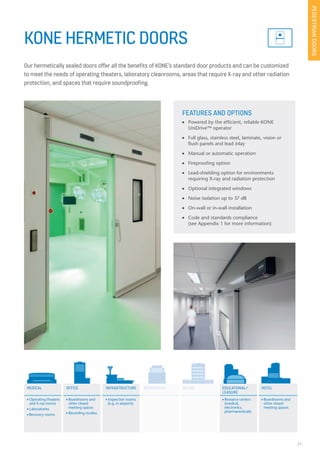
KONE HERMETIC DOORS
Our hermetically sealed doors offer all the benefits of KONE’s standard door products and can be customized
to meet the needs of operating theaters, laboratory cleanrooms, areas that require X-ray and other radiation
protection, and spaces that require soundproofing.
FEATURES AND OPTIONS
n Powered by the efficient, reliable KONE
UniDrive™ operator
n Full glass, stainless steel, laminate, vision or
flush panels and lead inlay
n Manual or automatic operation
n Fireproofing option
n Lead-shielding option for environments
requiring X-ray and radiation protection
n Optional integrated windows
n Noise isolation up to 37 dB
n On-wall or in-wall installation
n Code and standards compliance
(see Appendix 1 for more information)
n Operating theaters
and X-ray rooms
n Laboratories
n Recovery rooms
n Boardrooms and
other closed
meeting spaces
n Recording studios
n Boardrooms and
other closed
meeting spaces
n Researce centers
(medical,
electronics,
pharmaceuticals)
n Inspection rooms
(e.g. in airports)
MEDICAL OFFICE HOTELRESIDENTIAL RETAILINFRASTRUCTURE EDUCATIONAL/
LEASURE
PEDESTRIANDOORS
RESIDENTIAL RETAIL
26
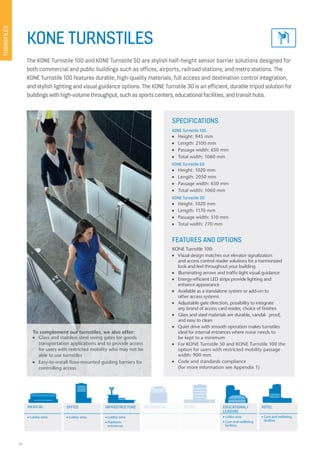
KONE TURNSTILES
The KONE Turnstile 100 and KONE Turnstile 50 are stylish half-height sensor barrier solutions designed for
both commercial and public buildings such as offices, airports, railroad stations, and metro stations. The
KONE Turnstile 100 features durable, high-quality materials, full access and destination control integration,
and stylish lighting and visual guidance options. The KONE Turnstile 30 is an efficient, durable tripod solution for
buildings with high-volume throughput, such as sports centers, educational facilities, and transit hubs.
SPECIFICATIONS
KONE Turnstile 100
n Height: 945 mm
n Length: 2100 mm
n Passage width: 650 mm
n Total width: 1060 mm
KONE Turnstile 50
n Height: 1020 mm
n Length: 2050 mm
n Passage width: 650 mm
n Total width: 1060 mm
KONE Turnstile 30
n Height: 1020 mm
n Length: 1170 mm
n Passage width: 510 mm
n Total width: 770 mm
FEATURES AND OPTIONS
KONE Turnstile 100:
n Visual design matches our elevator signalization
and access control reader solutions for a harmonized
look and feel throughout your building
n Illuminating arrows and traffic-light visual guidance
n Energy-efficient LED strips provide lighting and
enhance appearance
n Available as a standalone system or add-on to
other access systems
n Adjustable gate direction, possibility to integrate
any brand of access card reader, choice of finishes
n Glass and steel materials are durable, vandal- proof,
and easy to clean
n Quiet drive with smooth operation makes turnstiles
ideal for internal entrances where noise needs to
be kept to a minimum
n For KONE Turnstile 50 and KONE Turnstile 100 the
option for users with restricted mobility passage
width: 900 mm
n Code and standards compliance
(for more information see Appendix 1)
To complement our turnstiles, we also offer:
n Glass and stainless steel swing gates for goods
transportation applications and to provide access
for users with restricted mobility who may not be
able to use turnstiles
n Easy-to-install floor-mounted guiding barriers for
controlling access
TURNSTILES
MEDICAL OFFICE EDUCATIONAL/
LEASURE
HOTELRESIDENTIAL RETAILINFRASTRUCTURE
n Lobby area n Lobby area n Lobby area
n Platform
entrances
n Gym and wellbeing
facilities
n Lobby area
n Gym and wellbeing
facilities
RESIDENTIAL RETAIL
27
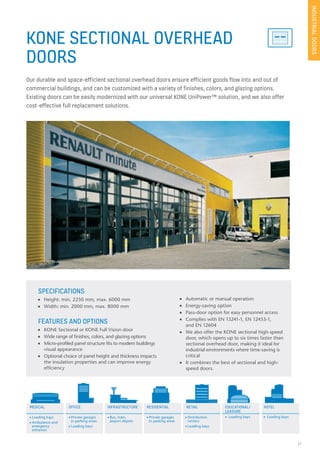
KONE SECTIONAL OVERHEAD
DOORS
Our durable and space-efficient sectional overhead doors ensure efficient goods flow into and out of
commercial buildings, and can be customized with a variety of finishes, colors, and glazing options.
Existing doors can be easily modernized with our universal KONE UniPower™ solution, and we also offer
cost-effective full replacement solutions.
SPECIFICATIONS
n Height: min. 2250 mm, max. 6000 mm
n Width: min. 2000 mm, max. 8000 mm
FEATURES AND OPTIONS
n KONE Sectional or KONE Full Vision door
n Wide range of finishes, colors, and glazing options
n Micro-profiled panel structure fits to modern buildings
visual appearance
n Optional choice of panel height and thickness impacts
the insulation properties and can improve energy
efficiency
INDUSTRIALDOORS
MEDICAL OFFICE EDUCATIONAL/
LEASURE
HOTELRESIDENTIAL RETAILINFRASTRUCTURE
n Loading bays
n Ambulance and
emergency
entrances
n Private garages
in parking areas
n Loading bays
n Bus, train,
airport depots
n Private garages
in parking areas
n Distribution
centers
n Loading bays
n Loading baysn Loading bays
n Automatic or manual operation
n Energy-saving option
n Pass-door option for easy personnel access
n Complies with EN 13241-1, EN 12453-1,
and EN 12604
n We also offer the KONE sectional high-speed
door, which opens up to six times faster than
sectional overhead door, making it ideal for
industrial environments where time-saving is
critical
n It combines the best of sectional and high-
speed doors.
28
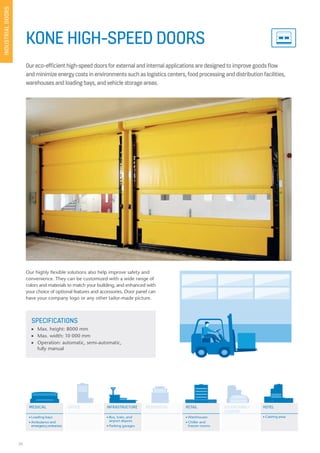
KONE HIGH-SPEED DOORS
Our eco-efficient high-speed doors for external and internal applications are designed to improve goods flow
and minimize energy costs in environments such as logistics centers, food processing and distribution facilities,
warehouses and loading bays, and vehicle storage areas.
SPECIFICATIONS
n Max. height: 8000 mm
n Max. width: 10 000 mm
n Operation: automatic, semi-automatic,
fully manual
Our highly flexible solutions also help improve safety and
convenience. They can be customized with a wide range of
colors and materials to match your building, and enhanced with
your choice of optional features and accessories. Door panel can
have your company logo or any other tailor-made picture.
MEDICAL OFFICE EDUCATIONAL/
LEASURE
HOTELRESIDENTIAL RETAILINFRASTRUCTURE
n Loading bays
n Ambulance and
emergencyentrances
n Bus, train, and
airport depots
n Parking garages
n Warehouses
n Chiller and
freezer rooms
n Catering areas
RESIDENTIALOFFICE EDUCATIONAL/
LEASURE
INDUSTRIALDOORS
29
Grilles
MEDICAL OFFICE EDUCATIONAL/
LEASURE
HOTELRESIDENTIAL RETAILINFRASTRUCTURE
n Parking garages n Parking garages n Parking garages n Parking garages n Shop entrances
n Parking garages
n Parking garagesn Parking garages
KONE ROLLER SHUTTERS
AND GRILLES
Roller shutters are ideal for high and wide door openings due to their space-saving roller technology and
hard-wearing curtain. They meet the product and safety requirements (EN 13241-1) with respect
to mechanical characteristics, heat and noise insulation, wind resistance, and watertightness. The flexible
shutter is stable and can be installed in a variety of door openings. KONE grilles are the perfect solution when
you need good ventilation and theft protection.
SPECIFICATIONS
Roller shutters
- Width: 1000 - 18 000* mm
- Height: 1000 - 12 000 mm
Grilles
- Width: 1000 - 18 000* mm
- Height: 1000 - 8000 mm
FEATURES AND OPTIONS
Roller shutter solutions:
n Roller Shutter Easy has a simple, robust,
and compact design, and is quick to install.
n Roller Shutter ThermoTeck has a high-grade
galvanized steel finish with a transparent
protective topcoat, this makes the shutter
robust and provides excellent heat insulation.
n Roller Shutter Fire Proof consists of double-
skinned 1 mm galvanized steel sections filled
with mineral wool. It has been tested in
accordance with STN EN 13501-2:2005 and
certified for EW30, EW45, EW60, E30, and E60
fire resistance classes.
Grille solutions:
n Straight honeycomb, plain aluminum profiles
with galvanized bottom bracket and consoles,
and primer-coated winding shaft.
Roller shutter
Grilles
* Upon request
INDUSTRIALDOORS
30
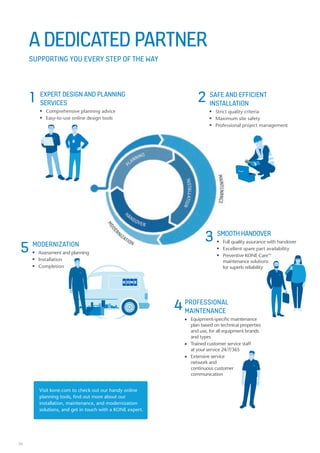
EXPERT DESIGN AND PLANNING
SERVICES
n	 Comprehensive planning advice
n 	 Easy-to-use online design tools
1 2
A DEDICATED PARTNER
SUPPORTING YOU EVERY STEP OF THE WAY
MODERNIZATION
n	 Assessment and planning
n	Installation
n	Completion
PROFESSIONAL
MAINTENANCE
n	 Equipment-specific maintenance 		
	 plan based on technical properties 		
	 and use, for all equipment brands 		
	 and types
n	 Trained customer service staff
	 at your service 24/7/365
n	 Extensive service
	 network and 				
	 continuous customer
	communication
4
5
SAFE AND EFFICIENT
INSTALLATION
n 	 Strict quality criteria
n 	 Maximum site safety
n 	 Professional project management
Visit kone.com to check out our handy online
planning tools, find out more about our
installation, maintenance, and modernization
solutions, and get in touch with a KONE expert.
3 SMOOTH HANDOVER
n 	 Full quality assurance with handover
n 	 Excellent spare part availability
n 	 Preventive KONE Care™
	 maintenance solutions
	 for superb reliability
31
AWARD-WINNING DESIGN
n	 Automatic building door solutions can be customized
	 to meet the needs of any property, with a wide range 		
	 of available materials, finishes, components, and colors
n	 Components harmoniously match as they have been
	 designed to work together
n	 Use of hygienic materials and automation, such as 		
	 elbow push buttons, to decrease contamination risk 	
	 in special applications
n	 Glass and high-end material options, for example,
	 in offices and hotels, enable a consistent, stylish 		
	 look and feel throughout the building
n	 Expert design tools and services: BIM models,
	 Doors Toolbox, CAD drawings
n	 Capability to do special projects demanding 		
	 matching high-level design requirements and 		
	 respecting the historical heritage
n	 Solutions to meet accessibility requirements
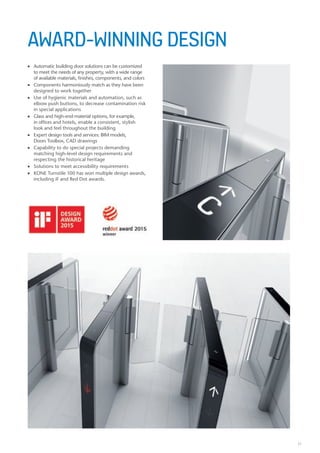
n	 KONE Turnstile 100 has won multiple design awards,
	 including iF and Red Dot awards.
32
SUSTAINABILITY
We are dedicated to continuously improving the environmental performance of our doors business. Our
engineering and manufacturing units are ISO 9001 quality management system and ISO 14001 environmental
management system certified. KONE doors are designed and built to take the environment into account,
with low noise and low energy consumption. We ensure the reliability of your door equipment and prevent
breakdowns through our preventive maintenance services. Breakdowns can have a negative impact on the
environment as doors that are not operating correctly may result in heating or cooling losses from the building.
.
We can provide Environmental Product
Declarations (EPDs) for our pedestrian
products. We conduct life cycle analysis
to provide information for our EPDs in
order to increase the transparency of
the manufacturing process and support
continuous product improvement.
We follow Global Warming Potential
(GWP) and other environmental
performance indicators in our
manufacturing process. Also we analyze
structure of materials, including the
amount of recycled materials. Below is
an example of the material structurefor
KONE Hermetic Door 30.
STEEL
ALUMINUM
COPPER/BRASS
PLASTICS
SEALANTS/RUBBER
WOOD/PULP
ELECTRONICS
Figure 8. Material structure example for KONE Hermetic Door 30
33
				.
SAFETY AND MAINTENANCE
To KONE, safety means much more than just conforming with local laws and norms – it’s our number-one
priority. KONE door maintenance detects issues before problems arise, reducing hazards and helping
to prevent accidents. By making sure that automatic doors are used and maintained properly, you can
maximize operational efficiencies in your building while ensuring safe and secure access for all.
PROPER USE OF EQUIPMENT
BOOSTS SAFETY
According to the European Working
Equipment directive (89/654 and 655/EEC)
and the harmonized safety in use standard
for pedestrian door sets (EN 16005) as well
as respective standard for industrial doors
EN 13241 (see the whole list of standards in
Appendix 1) the owner of the equipment
is responsible for the safety for users. You
can facilitate safe and trouble-free access for
everyone and ensure a longer life for your
equipment by taking care that doors are used
and maintained correctly. Proper operation
also saves money by eliminating service calls.
Building staff should therefore be well
informed about the correct use of automatic
doors and also be able to instruct users if they
spot unsafe behavior.
DID YOU KNOW?
■■ KONE provides maintenance
	 for doors 365 days of the year.
	 The KONE Care Center is 			
	 available 24/7 to provide door 		
	 maintenance and repair services.
■■ You can easily get a clear an accurate 	
	 review of the condition of your 		
	 automatic doors by ordering a
	 KONE Care for Life assessment.


Service for
500,000doors.
And for the millions of people
who use them.
SYSTEMS TO ENSURE
SAFETY
We work to ensure that every piece of equipment
we maintain complies with the latest standards
and meets the highest levels of safety in the
industry. The safety of automatic doors depends
largely on the standards and norms that were in
effect at the time of installation. In recent years
a number of harmonized standards have
been introduced for pedestrian and industrial
automated building doors. These focus on
improving safety and performance through better
design and on-going professional maintenance.
Fortunately, older equipment can be modernized
to meet these new standards. With regular
maintenance you can increase safety while also
maximizing the lifetime of door equipment.
The current regulations require professional,
regular maintenance for automatic doors.
34
KONE doors are compliant with the latest European Standards, including:
1.	 EN 13241-1:2003 + A1:2011: Industrial, commercial and garage doors and gates
	 – Product standard – Part 1: Products without fire resistance or smoke control 		
	characteristics
2.	 EN 12635:2002 + A1:2008: Industrial, commercial and garage doors and gates
	 – Installation and use
3.	 EN 12453 and 12445: 2000: Industrial, commercial and garage doors and gates
	 – Safety in use for power operated doors
4.	 EN 12604:2000: Industrial, commercial and garage doors and gates – Mechanical 		
	aspects
5.	 EN 12978:2007 + A1:2009: Industrial, commercial and garage doors and gates
	 – Safety devices for power operated doors and gates – Requirements and test methods
6.	 EN 13849-1:2006: Safety of machinery – Safety-related parts of control systems
7.	 EN 1398:2009: Dock levelers – Safety requirements
8.	 EN 16034:2014: Pedestrian doorsets, industrial, commercial, garage doors and windows 	
	 – Product standard, performance characteristics – Fire resistance and/or 			
	 smoke control characteristics
9.	 EN 16005:2012: Power operated pedestrian door sets – Safety in use – Requirements
	 and test methods
10.	EN 16361:2013: Power operated pedestrian doors – Product standard, performance 		
	 characteristics; Pedestrian doorsets, other than swing type, initially designed for 		
	 installation with power operation without resistance to fire and smoke leakage 		
	characteristics
11.	EN 60204-1: Safety of machinery – Electrical equipment of machines
	 – Part 1: General requirements
12.	EN 61000-6-2: Electromagnetic compatibility (EMC) - Part 6-2: Generic standards
	 – Immunity for industrial environments
13.	EN 61000-6-3: Electromagnetic compatibility (EMC) – Part 6-3: Generic standards
	 – Emission standard for residential, commercial and light-industrial environments
14.	EN 60335-1: Household and similar electrical appliances – Safety – Part 1: General 		
	requirements
15.	EN 16304: 2014: Pedestrian doorsets, industrial, commercial, garage doors and openable 	
	 windows – Product standard, performance characteristics – Fire resisting and/or smoke 	
	 control characteristics	
16.	2006/42/EC: Machine Directive
APPENDIX 1
STANDARDS COMPLIENCE
35
YOUR NOTES
8173
This publication is for general informational purposes only and we reserve the right at any time to alter the product design and specifications. No statement this publication contains shall
be construed as a warranty or condition, express or implied, as to any product, its fitness for any particular purpose, merchantability, quality or representation of the terms of any purchase
agreement. Minor differences between printed and actual colors may exist. KONE MonoSpace®
, KONE EcoDisc®
, KONE Care®
and People Flow®
are registered trademarks of KONE Corporation.
Copyright © 2016 KONE Corporation.
KONE Corporation
www.kone.com
KONE provides innovative and eco-efficient
solutions for elevators, escalators, automatic
building doors and the systems that integrate
them with today’s intelligent buildings.
We support our customers every step of the way;
from design, manufacturing and installation
to maintenance and modernization. KONE
is a global leader in helping our customers
manage the smooth flow of people and
goods throughout their buildings.
Our commitment to customers is present in
all KONE solutions. This makes us a reliable
partner throughout the life cycle of the building.
We challenge the conventional wisdom of
the industry. We are fast, flexible, and we have
a well-deserved reputation as a technology leader,
with such innovations as KONE MonoSpace®,
KONE NanoSpace™ and KONE UltraRope®.
KONE employs close to 50,000 dedicated
experts to serve you globally and locally.

Architects Handbook

  • 1.
    DESIGNING DOORS FOR YOURBUILDING A handbook for architects
  • 2.
    2 TABLE OF CONTENTS WELCOMETO THE HANDBOOK .............................................................. 4 HOW TO USE THIS HANDBOOK .............................................................. 6 HOW WE MEET YOUR NEEDS AT EACH KEY STEP ................................... 8 OPTIMIZING PEOPLE FLOW IN YOUR BUILDING ...................................... 9 UNDERSTANDING THE UNIQUE REQUIREMENTS OF DIFFERNT....................... BUILDING TYPES .................................................................................. 11 MEDICAL BUILDINGS ............................................................................ 12 OFFICE BUILDINGS ............................................................................. 14 RETAIL BUILDINGS ............................................................................... 16 INFRASTRUCTURE BUILDINGS ............................................................. 17 HOTELS ................................................................................................ 18 RESIDENTIAL BUILDINGS ..................................................................... 19 THE KONE BUILDING DOOR OFFERING .................................................. 20 KONE REVOLVING DOORS ..................................................................... 21 KONE SLIDING DOORS .......................................................................... 22 KONE SWING DOOR OPERATORS ........................................................... 23 KONE GLIDING DOORS .......................................................................... 24 KONE HERMETIC DOORS ....................................................................... 25 KONE TURNSTILES ................................................................................ 26 KONE SECTIONAL OVERHEAD DOORS ................................................... 27 KONE HIGH-SPEED DOORS ................................................................... 28 KONE ROLLER SHUTTERS AND GRILLES ................................................. 29 A DEDICATED PARTNER ........................................................................ 30 AWARD-WINNING DESIGN ..................................................................... 31 SUSTAINABILITY .................................................................................. 32 SAFETY AND MAINTENANCE ................................................................. 33 APPENDIX ............................................................................................ 34 2
  • 3.
  • 4.
    4 Every minute ofevery day, in different kinds of buildings all around the world, millions of people use KONE door solutions. In offices, hospitals, hotels, retail centers, transit hubs, and residential buildings, our pedestrian doors are quietly and efficiently helping large numbers of people move around easily and safely, and our industrial doors are keeping goods flowing smoothly. Just as with any other type of building equipment, the key to their smooth operation is careful planning. 4
  • 5.
    5 WELCOME TO THE HANDBOOK Dearreader, We aim to provide our customers with a performance edge by offering the best user experience in the rapidly developing urban environment. Our innovative people flow solutions help people and goods move within and between buildings smoothly, safely, comfortably, and without waiting. Doors provide the first and last impression of any building, and our solutions make sure that these impressions are always positive. They also serve many purposes beyond just providing access for people and goods and acting as a design feature – including insulation, fire protection, access control, and contamination prevention. Furthermore, they can incorporate features that support goals such as energy efficiency. Our doors work in harmony with the wider KONE offering – including elevators, escalators, and turnstiles, as well as intelligent solutions for access and destination control, communication, and equipment monitoring. This means KONE can provide everything you need for your people flow needs. Together, our solutions ensure that, whatever your building type, the people and goods flow will be safe, secure, and smooth. This handbook is intended to be a clear, easy-to-understand introduction to the main process stages, from initial planning to choosing the right door solutions for your project. It will help you to select the correct solution for each specific application, recommend ways to optimize people flow, and introduce essential door-related requirements for specific building types. It also briefly introduces our door offering and points you to the wealth of useful information and handy tools available on our website, KONE.com. Should you have any further questions, your local KONE representative will be happy to help. Sincerely, Antti Ruutu Head of Doors Business KONE 5
  • 6.
    6 HOW TO USE THISHANDBOOK This handbook is intended to give you a taster of what to consider when planning people and goods flow solutions for your projects. The initial sections deal with the issues you need to consider during planning, solution selection, and specification in order to optimize people flow within your building. This is broken down by building type to make it easier for you to find what you’re looking for. The later sections cover our different types of door solutions and their main features, as well as the relevant safety standards to consider in relation to building doors. For product-specific information, check the product segment matrix on page 11, where you can quickly check which KONE products we recommend for different building types. Finally, there is a brief overview of the support we can provide for every stage of the equipment life cycle, from planning and installation to maintenance and modernization. The latest information about KONE door solutions and the rest of our offering – including elevators, escalators and autowalks, People Flow Intelligence solutions, and our tailored maintenance and modernization services – can be found on our website, kone.com. If you are using a printed copy of this handbook, it’s also where you can download the latest version. The digital version includes the most up-to- date information on our products and services. 6
  • 7.
  • 8.
    8 HOW WE MEETYOUR NEEDS AT EACH KEY STEP THE FINAL STEP IS TO SPECIFY THE REQUIRED DIMENSIONS FOR THE DOOR SOLUTIONS, IN ORDER TO COMPLETE THE BUILDING’S SPECIFICATION BOOK. THIS INVOLVES: THE NEXT STEP IS TO DEFINE THE RIGHT DOOR SOLUTIONS FOR YOUR PROJECT (SEE PAGE 11). THIS IS DETERMINED BY: PLANNINGSELECTIONSPECIFICATION Analyzing the floor plan and sections of the building Analyzing the people flow needs according to the type and specific characteristics of the building Where possible, checking traffic capacities (the volume of people each door is expected to handle) together with the traffic capacities of any other equipment in the building, such as elevators, escalators, and turnstiles Clarification of interfaces with other equipment in the building and with the building itself Checking the requirements of local standards and regulations for issues like safety and fire protection Technical drawings (AutoCAD/BIM models) Defining final installation dimensions The different characteristics of pedestrian and industrial doors Product recommendations according to the standards and building (segment) requirements, such as security, environment etc. 1 3 2 Planning integration of doors and other equipment (for example using KONE People Flow Intelligence solutions) to help people move around the building smoothly while maintaining security Developing a complete understanding of your building’s requirements Giving you an overview of the typical door solutions according to building type Defining preliminary dimensions 1 THE FIRST STEP WHEN PLANNING BUILDING DOORS INVOLVES LOOKING AT THE WHOLE BUILDING PEOPLE FLOW HOLISTICALLY, INCLUDING:
  • 9.
    9 PEOPLE AND GOODS Focusing onthe movement of both individuals and larger crowds of people, as well as goods PROCESSES Understanding how the building as a whole is used throughout its life cycle PERFORMANCE & APPLICATION Understanding our customers’ challenges and offering the most appropriate solutions for them and their end users OPTIMIZING PEOPLE FLOW IN YOUR BUILDING People flow is all about how people move within and between buildings, and in an increasingly urbanized world where city populations are rising rapidly, it’s more important than ever. KONE door solutions are an integral part of our vision to offer the best people flow experience by helping people move around smoothly, safely, comfortably, and without waiting while ensuring high-quality accessibility for all. Figure 1. A typical user journey in an office building Figure 2. Example: different user paths in hospital environment People flow is analyzed and planned based on several parameters, the most important of which is the total journey time, defined as the time taken to travel from the building’s main entrance to the destination. The total journey time can be divided into horizontal and vertical dimensions. Doors can be used to separate the various user and goods flows within a building. Location of doors and correctly selected door solution help minimize cross flows and ensure smooth, safe movement for all. For horizontal traffic, there are parameters such as usage of space, dwell time, and crossing flows or paths. Elevators are the core element of the vertical dimension in any high-rise building. OUTSIDE OF BUILDING OFFICE APARTMENT PARKING HALL ENTRANCE LOBBY MAIN LANDING ELEVATOR ESCALATOR STAIRS CORRIDOR UNDERSTANDING PEOPLE FLOW NEEDS SELECTING PEDESTRIAN DOORS SERVICE PERSONNEL PATH MEDICALPERSONNELPATH VISITORPATH KONE understands people flow from different perspectives: The location, type, dimensions (width or diameter and height), and operating speed of a door solution influence user behavior and have a direct impact on door capacity. Table 1 gives some examples of factors that you should consider when choosing pedestrian doors.
  • 10.
    10 SELECTING INDUSTRIAL DOORS Industrialdoors vary in terms of space needed for installation, their construction materials, insulation and sound properties, opening and closing speed and required accessories. The most common types of industrial doors are sectional overhead doors, roller shutters, grilles, and high-speed doors. When planning a building that will include industrial doors, it is essential that you take into account the following parameters as early as possible in the design process: n Is the door external one or for internal application? n Maximum size of the opening (width, height) n Heat transmission (U-value: W/m2K) n Air leakage or air permeability n Air infiltration, which is dependent on the opening and closing speed (m/s) n Power consumption (stand-by power, W) n Draft-prevention needs n Headroom n Door installation depth n Environment (doors equal and over 2500 mm require equipment for working at height) Figure 3. Sliding vs swing doors can save up to 15 % of space based on opening area that swing door requires 1. User experience n Who are the building’s main user groups? Pay particular attention to people with restricted mobility and elderly. n Is the building population stable, or will it change often over time? 2. Cultural factors How do end-users perceive personal space and queuing behavior? 3. Available space n How critical is to save space in each concrete case (see Figure 3)? n What space is required for particular door type installation? 4. Design elements and layouts n Does building design channel people to or away from the doors? n Are there any areas that cause distractions or cross flows (restaurants, security measures, lounges, and multiple entry or exit points)? 5. System integration Is integration of doors, elevators, and an access control system needed? 6. Size and number of doors Is there risk of traffic bottlenecks? Size and number of doors impact energy flow (hot and cold air) into and out of the building or floor and control draft in the building 7. Door operation Automatic and manual doors have different implications for safety, security, traffic flow, comfort, and hygiene (See also 1.User experience) 8. Door type Impacts flow optimization, eco-efficiency, and the security of the building, as well as planned architectural design 9. Door leaf operation and speed Sliding doors can typically operate faster than swing doors 10. Uni or bi-directional travel One-way traffic capacity is higher than two-way; for example, sliding vs. swing doors 11. Door installation method In-wall installation can be more space-efficient than on-wall installation 12. Special features Location of doors on escape routes; fire resistant and burglar-proof features 13. Guidance Visual appearance of doors can help guide people to their desired destination Table 1. Factors to consider when selecting pedestrian doors SPACE EFFICIENCY INSIDE THE BUILDING Doors can contribute to smarter usage of the space in the building in several ways: n Certain door types can save more space than others. For example, sliding doors are up to 15% more space efficient than standard swing doors, which require 1.5–2 m2 of floor space for opening (see Figure 3). n Particular door types can reduce the risk of collision with moving objects and people (see Figure 4). Figure 4. Sliding door reduces the risk of collision
  • 11.
    11 area Gym and well-beingfacilities UNDERSTANDING THE UNIQUE REQUIREMENTS OF DIFFERENT BUILDING TYPES Although building types can be loosely categorized into medical, office, infrastructure, residential, retail, educational/leisure and hotel segments each and every building has its own unique people flow transportation requirements. The following sections of this handbook will take you through the key requirements to consider when selecting door solutions for different types of buildings. Figure 5. Product-segment matrix For more detailed information and to access our easy-to-use doors toolbox, visit kone.com. MEDICAL OFFICE EDUCATIONAL/ LEISURE HOTELRESIDENTIAL RETAILINFRASTRUCTURE Sliding doors Hermetic doors Gliding doors Swing door operators Turnstiles Sectionaldoors High-speed doors Roller shutters and grilles People flow products Goods flow products Revolving doos Figure 6. KONE door solutions in multi-use building Sliding doors Swing doors Turnstiles Swing gates Guiding barriers Revolving doors PARKING Roller shutters Sectional overhead doors Hermetic doors Tripod turnstiles Sliding doors Swing doors Sliding doors High-speed doors Gliding doors Hermetic doors Hermetic doors Roller shutters Sliding doors Swing doors Revolving doors SHOP ENTRANCE OFFICE.MAINENTRANCEANDLOBBYAREA PATIENT WARDSOPERATINGTHEATER X-RAY CABINET LOADING BAY CAFETERIAGYM AND WELL-BEING FACILITIES LABORATORY
  • 12.
    12 MEDICAL BUILDINGS Medical buildingshave a diverse range of requirements when it comes to door solutions, with hygiene and operational efficiency being critically important. From the main entrance and other public spaces like cafeterias, to specialist areas like loading bays, patient wards, and operating theatres, medical buildings typically feature a wide range of different door solutions. From the end-users’ perspective, medical buildings have defined flows of people that need to be separated by building design; doors play an important role in this separation: n Polyclinic patients n Hospital patients staying for more than 24 hours n Staff n Patients’ visitors n Housekeeping personnel (e.g. canteen staff, cleaners) The primary goal is to maintain high hygiene level by preventing contamination and the transfer of bacteria and viruses (for example, through compartmentalization and securing the building areas). Figure 7. Doors help to maintain different pressure and temperature levels in hospitals. WAITING ROOM (outside temperature or +20o C) X-RAY / PATIENTS POLYCLINICS LOADINGBAYS,PARKINGFORAMBULANCES MEDIUM CARE (+20o C) RECOVERY (temperature +19o C) OPERATING THEATRE (+17o C) INTENSIVE CARE UNIT PATIENT WARDS
  • 13.
    13 MAIN ENTRANCE Smooth peopleflow and accessibility for all are the key requirements here. The entrance doors must allow people to move into and out of the building smoothly and safely while simultaneously ensuring a comfortable environment by preventing heating and cooling losses. CAFETERIA Here, doors must provide access for large volumes of people simultaneously, while at the same time being unobtrusive and space-efficient. LOADING BAY Medical buildings take delivery of large quantities of medicines, food, and other goods every day. The door solutions for these areas need to be durable, reliable, and energy efficient. HALLWAYS AND CORRIDORS Well-designed doors in hallways and corridors improve patient comfort by reducing noise, help reduce energy costs by retaining heat, and provide fire protection through compartmentalization. PATIENT WARDS It is recommended to have a wide opening in patient wards to allow easy access for patients in wheelchairs and hospital beds. Quiet, space efficient and hygienic doors improve accessibility for patients in wheel chairs. OPERATING THEATERS AND X-RAY ROOMS For doors, these are the most demanding environments in hospitals. They must provide fire protection, sound reduction, and radiation protection where required, and cannot interfere with magnetic fields as this could disrupt sensitive equipment. AMBULANCE AND EMERGENCY ENTRANCE At this entrance, fast-opening doors fitted with code-compliant safety solutions can save precious seconds when transporting patients in need of urgent medical attention and dispatching ambulances. STAFF ENTRANCES It is important to create a good balance between smooth access and high security at staff entrances. This can be achieved by integrating doors with building access control systems. ENTRANCESCOMMONINTERNALFACILITIESSPECIALROOMS TYPICAL SOLUTIONS: Sliding and revolving doors TYPICAL SOLUTIONS: Sliding, high- speed, sectional overhead and high- speed sectional doors TYPICAL SOLUTIONS: Sliding doors TYPICAL SOLUTIONS: Sliding, gliding and swing doors TYPICAL SOLUTIONS: Sectional overhead doors, high-speed doors, roller shutters TYPICAL SOLUTIONS: Sliding and swing doors, access control integration TYPICAL SOLUTIONS: Hermetic doors, access control integration TYPICAL SOLUTIONS: Gliding doors
  • 14.
    14 Office buildings aregenerally open environments, so it is vital that the flow of people into, through, and out of them is efficiently controlled. Doors play a key role in all areas of these busy environments, from the main entrance and lobby to individual floors and restaurant areas. They are also important in terms of compartmentalizing the building for the purposes of fire protection and access control. OFFICE BUILDINGS A typical office building features a wide range of different door types, including revolving, sliding, swing, and gliding doors. Lobbies may also include turnstile solutions to improve people flow, enable secure access control, and provide clear guidance for building users. With the right types of doors in the right locations, the building will be a pleasure to use for tenants and visitors, and also more attractive to potential tenants. There is a wide range of issues to take into consideration when specifying door solutions for office buildings, including: n Capacity and accessibility requirements n Traffic peaks (morning, lunchtime, evening) n Available space for door solutions n Safety n Fire safety and related regulations, and evacuation routes n Security, including access control needs n Environmental issues such as heating, cooling, insulation, and drafts n Soundproofing n Restroom access
  • 15.
    15 KONE PEOPLE FLOW INTELLIGENCE KONEPeople Flow Intelligence is a comprehensive and flexible suite of solutions for access control, destination guidance, information communication, and equipment monitoring. Based on our industry- leading technology and world-class visual design, these solutions ensure smoother, smarter people flow, enable efficient building management, and add real value to a property. They are scalable, third-party compatible, and can be customized for new or existing buildings. We can also assess the current state of the building and, based on the results, propose the optimal solution to make the building smarter. Together with turnstiles, People Flow Intelligence add value to the lobby by integrating access and destination control into a single, easy-to-use solution. MAIN ENTRANCE AND LOBBY AREA The main entrance and lobby are among the most important elements of any office building. The prestige of the building and its attractiveness to potential tenants are highly dependent on high-quality design, smooth people flow, and accessibility for all. Preventing heating and cooling losses helps provide a comfortable environment for tenants. OFFICES AND MEETING ROOMS Doors should take up the minimum amount of space possible while at the same time allowing comfortable access and preventing drafts. They should ensure security and privacy by preventing unauthorized access and providing noise isolation in spaces that host confidential discussions, such as boardrooms. CORRIDORS In terms of people flow, corridors are the lifeblood of an office building. They allow people to travel between different areas and also provide evacuation routes in case of fire or other emergency. They are also important in terms of compartmentalizing the building for the purposes of fire protection and access control. Doors used in these areas should ensure comfortable people flow while at the same time helping to maintain safety and security PARKING GARAGES Security is paramount in parking garages, where a variety of different entrance door types can be used to prevent unauthorized access, ensure that parked vehicles remain safe while unattended, and that only authorized persons can drive them out of the garage. COMMONINTERNALFACILITIESENTRANCES TYPICAL SOLUTIONS: Sliding and revolving doors, People Flow Intelligence solutions, turnstiles TYPICAL SOLUTIONS: Sectional overhead doors with access control, roller shutters or grilles TYPICAL SOLUTIONS: Sliding, gliding, swing and hermetic doors TYPICAL SOLUTIONS: Sliding, gliding, swing and fire-rated doors
  • 16.
    16 RETAIL BUILDINGS Every storetype and building is unique in terms of how shoppers move around, how many visit and when, and how they browse. Department stores, big-box stores, shopping centers, and independent retail buildings all have different requirements. Regardless of the business model, doors play a very important role in ensuring the smooth, safe, and secure flow of people and goods. The issues to take into consideration when specifying door solutions for retail buildings include: n Capacity and accessibility requirements n Desired people flow routing, depending on the store type n Relationship between doors and vertical transportation solutions (see Planning retail People Flow handbook and KONE Escalators and Autowalks planning guide) n Available space for the door solutions n Fire safety and related regulations, evacuation routes n Security, including burglary protection needs n Accessibility requirements n Environmental factors such as heating, cooling, and insulation n Goods flow for loading-bay and warehouse areas Pedestrian doors help create the optimal shopping experience and ensure the quickest possible return on investment, while industrial doors ensure a smooth flow of goods into, around, and out of the building. In the event of an emergency such as a fire, the doors should allow large numbers of people to safely escape the building in the shortest possible time, while also helping prevent the spread of fire and smoke. In retail, the end-user experience is everything. Keeping visitors and tenants happy is about delivering the best possible shopping experience, and this means keeping people and goods flowing smoothly. Automatic doors provide security for stores and help cut energy costs. Retail centers typically feature a combination of sliding and revolving pedestrian doors, as well as industrial door solutions. TYPICAL SOLUTIONS: Sliding, swing and revolving doors, roller shutters or grilles, high-speed doors, sectional overhead doors
  • 17.
    17 INFRASTRUCTURE BUILDINGS Typically, slidingor revolving doors are used at main entrances to provide access to the building. These doors handle huge traffic volumes, especially during peak travel times. Doors are also used to provide gate or platform access, to link different areas of the building, and to compartmentalize areas such as lounges, meeting rooms, or security-controlled spaces. Turnstiles and tripod turnstiles – as standalone units or integrated with access control systems – can be used to provide authorized access to gates, platforms, and restrooms. Infrastructure buildings are often integrated with other facilities to form multi-use buildings, which bring their own set of people-flow challenges. The issues to take into consideration when specifying door solutions for infrastructure buildings include: n Ensuring smooth, convenient people flow for passengers with luggage n Providing comfortable and convenient access to meeting, lounge, and spa facilities n Preventing unauthorized access to security-controlled areas – a particularly important consideration in airports n Planning for complex people flow routes and heavy traffic peaks n Use of doors to provide guidance for passengers – the door design should invite you to pass through n Requirements for staff access n Industrial door requirements for specialist areas such as luggage storage facilities and parking garages n Fire safety and related regulations, and evacuation routes n Security requirements n Environmental factors such as heating, cooling, and insulation Infrastructure buildings include public transportation hubs like railroad, bus, and metro stations, as well as airports. These busy environments place heavy demands on equipment. Door solutions have to be durable and reliable, since unexpected breakdowns can have huge repercussions for travelers. If the doors are not well planned, they can create bottlenecks that present a significant security and safety risk. With huge volumes of people passing through every day, often around the clock, rock-solid people flow planning is critical. Safety is also of paramount importance, since in the event of an emergency such as a fire, the doors should allow large numbers of people to safely escape the building in the shortest possible time. High-traffic, complex environments like bus, railroad, and metro stations can incorporate a huge range of door types, all designed to serve a specific purpose. In addition to pedestrian doors, airports also feature a wide range of specialized industrial doors for emergency and maintenance vehicle depots, aircraft hangers, and baggage handling operations. TYPICAL SOLUTIONS: Sliding, gliding, and revolving doors, turnstiles, roller shutters, grilles, high-speed doors and sectional overhead doors.
  • 18.
    18 HOTELS In these environmentsit’s impossible to overstate the importance of the entrance and lobby area. Guests will base their first impressions of the hotel on their experience as they enter, and well-planned door solutions play a critical role in ensuring that this experience is welcoming and hassle-free – every time. Around the hotel, doors also provide comfortable access to areas like gyms and spa facilities, public bathrooms, and meeting spaces. Just like any other building, hotels also experience traffic peaks; during busy hours people are checking in or out in large numbers, so entrance door solutions need to be carefully planned to ensure smooth people flow. The issues to take into consideration when specifying door solutions for hotel buildings include: n Ensuring spaciousness in entrance and lobby areas n Optimizing people flow with a variety of entrance solutions (e.g. revolving and sliding doors) n Ensuring smooth, convenient people flow for guests with luggage and other accessibility requirements n Heavy traffic peaks at busy times (check-out and check-in) and during the breakfast rush n Fire-rating requirements for all doors in line with local regulations n Safety, both from the point of view of emergency exits and evacuation routes, but also general end-user safety n Parking garage requirements and ensuring smooth flow into and out of goods reception areas n In-room solutions for areas like bathrooms; soundproofing solutions for meeting spaces n Separate, secure routes for staff and maintaining smooth goods and people flow for housekeeping and maintenance activities TYPICAL SOLUTIONS: Guests appreciate a feeling of space, a welcoming entrance and lobby area that ties in seamlessly with the rest of the building’s design, and the ability to move around comfortably and with as little hassle as possible. As well as guests, hotels need to take care of the needs of their staff, too. This means providing secure access and easy movement between the different areas of the building to ensure that the working day runs as smoothly as possible, with staff able to provide the best possible service. HALLWAYS AND CORRIDORS PARKING GARAGES BATHROOMS AND INTERIOR DOOS GYM AND WELLBEING FACILITIES CATERING CONFERENCE ROOMS RESEPTION AREA GOODS RECEPTION MAIN ENTRANCE HOTEL ENTRANCES PUBLIC AND SEMIPUBLIC SPACES/ SPECIAL AREAS GUEST ROOMS
  • 19.
    19 RESIDENTIAL BUILDINGS When itcomes to people’s homes, the focus is on safety, security, and convenience. Fire protection and other relevant regulations are also extremely important considerations. Here, door solutions work in harmony with other building equipment to ensure the best possible quality of life for all residents. The issues to take into consideration when specifying door solutions for residential buildings include: n Ensuring smooth, convenient people flow for all residents with any accessibility requirements and maximizing usable floor space within apartments n Emergency exits and evacuation routes n Parking garage requirements n Access to shared facilities like laundry rooms, garbage disposal facilities, and other communal spaces n Goods and people flow for maintenance activities Residential buildings are increasingly evolving into mixed- use facilities that also incorporate retail and office spaces. This trend demands a clear separation of the different functions’ people flows while still maintaining accessibility. Some esidential buildings may also incorporate features that are more typical of offices or hotels. For example, upscale residential buildings may have a lobby and reception, and some may even have personal elevators going directly to apartments. All these cases place unique demands on the building design in terms of the appropriate door solutions. TYPICAL SOLUTIONS: Sliding and swing doors at pedestrian entrances, grilles in parking garages and, for example, to control access to communal garbage disposal facilities. Every resident should be able to move into, out of, and around the building safely and smoothly, regardless of mobility issues or other challenges. Residential buildings are home to a variety of different user groups, each with different needs to address. These include: n End-users: families with young children, elderly people, young professionals, people with mobility challenges and visually impaired people, visitors n Service providers: security personnel, facility management personnel, cleaners and maintenance staff
  • 20.
    20 TURNSTILES Half-height turnstiles Tripod turnstiles Swinggates Guiding barries INDUSTRIAL DOORS Sectional and high-speed sectional doors High-speed doors Roller shutters and grilles PEDESTRIAN DOORS Revolving doors Sliding doors Swing door operators Gliding doors Hermetic doors THE KONE BUILDING DOOR OFFERING This section of the handbook gives you a brief overview of our door offering and the key benefits of choosing KONE solutions. It presents a short overview of each door type along with the different types of buildings they are typically used in. CUTTING-EDGE SAFETY FOR PEACE OF MIND n All our door solutions feature the intelligent technologies and fulfill all relevant safety standards to ensure the safe, secure flow of people and goods. n Our accessibility expertise ensures that everybody can enter and exit your building safely and smoothly for its entire lifetime. EXCELLENT ECO-EFFICIENCY n Our automatic doors can reduce the loss of warm or cool air from your building, thereby helping to cut heating or cooling costs. n For personnel who work close to doorways, automatic doors can significantly increase comfort by minimizing sudden changes in internal temperature or noise. INNOVATIVE AND FLEXIBLE DESIGN n We offer a wide range of flexible design options that help you blend doors with your building’s style. n Our products feature excellent attention to detail and high-quality finishes. SEAMLESS INTEGRATION FOR SMOOTH, SAFE PEOPLE FLOW n Our door solutions are designed to work in harmony with other equipment in the building to help people move around safely, comfortably, and without waiting. n To help create a harmonious look and feel throughout the building, the visual design of our door solutions is consistent with the rest of our offering. WHY CHOOSE KONE DOOR SOLUTIONS? 1 2 3 4
  • 21.
    21 KONE REVOLVING DOORS Ourrevolving doors combine high-quality materials, flexible operation, and excellent durability with outstanding energy efficiency. The KONE Revolving Door 100 is the perfect complement to buildings where visual appearance is as important as performance. The KONE Revolving Door 50 is ideal for busy environments where efficient, smooth people flow is critical. The KONE Revolving Door 30 is an economical way to provide a modern and efficient entrance solution. SPECIFICATIONS n External diameter: - KONE Revolving Door 30: 2100–3700 mm - KONE Revolving Door 50: 4120 or 4720 mm - KONE Revolving Door 100: 2100–3300 mm n Standard passage height: 2100 or 2200 mm - Optional passage height: up to 2700 mm FEATURES AND OPTIONS n Customizable to match your building design n Attractive, energy-efficient LED lighting n Latest safety technology n Durable and easy-to-clean materials n Optional burglar-resistant features n Optional three or four collapsible or foldable wings Connection profile to the facade is having a thermal break n Code and standards compliance (see Appendix 1 for more information) PEDESTRIANDOORS MEDICAL OFFICE EDUCATIONAL/ LEASURE HOTELRESIDENTIAL RETAILINFRASTRUCTURE n Main entrance and lobby area n Main entrance and lobby area n Main entrance n Main entrance and lobby area n Main entrance and lobby area n Main entrance and lobby area RESIDENTIAL
  • 22.
    22 KONE SLIDING DOORS Ourautomatic sliding doors are suitable for a wide variety of building types, from offices and residential buildings to retail environments and transit hubs. They are compact, durable, and energy efficient, and can be enhanced with a variety of security and safety options. SPECIFICATIONS n Max. height: 2600 mm n Max. width: - 3400 mm door leafs - 7000 mm door leafs and two fixed side panels n Operation: automatic n Operator: KONE UniDrive® or KONE UniDrive® Compact FEATURES AND OPTIONS n Multiple profile systems: standard (35 mm) or slim (20 mm) aluminum, robust (50 mm), insulated aluminum (65 mm), full-glass n Single and double sliding, telescopic, prismatic, and curved n Available with three or six leaves (applicable for single or double telescopic doors) n Customizable design n Wide variety of safety options, including manual switches, motion sensors, safety screen, and access control integration n Fire safe, burglar resistant, energy saving, break out, and escape route options n Code and standards compliance (see Appendix 1 for more information) PEDESTRIANDOORS MEDICAL OFFICE EDUCATIONAL/ LEASURE HOTELRESIDENTIAL RETAILINFRASTRUCTURE n Main entrance n Cafereria n Hallways and corridors n Ambulance and emergency entrance n Staff entrances n Main entrance and lobby area n Cafeteria n Main entrance n Passenger areas n Lounge areas n Main entrance and lobby area n Main entrance n Cafeteria n Main entrance n Shop entrances n Main entrance n Shop entrances n Meeting and conference rooms
  • 23.
    23 KONE SWING DOOROPERATORS We offer four different fully automatic swing door solutions suitable for a wide variety of building types: SPECIFICATIONS n Max. door height: 2500 mm n Max. door width: 1250 mm n Operation: automatic FEATURES AND OPTIONS n Variety of impulse devices, including switches, push-buttons, finger protection, and sensors n Can be integrated with access control and central locking systems n Code and standards compliance (see Appendix 1 for more information) KONE UniSwing™ Compact: a space-saving operator compatible with all standard swing doors; ideal for a wide range of applications. KONE UniSwing™ Solid: a flexible operator for environments where smooth door closing is essential; it includes spring return for closure during power failures. KONE UniSwing™ FireSafe: a durable operator for powering heavy fire-rated doors; it fulfills EN 1154 and EN 1155 requirements. KONE UniSwing™ Robust: a flexible solution for a wide range of demanding swing-door applications in most external and internal spaces; includes a spring mechanism that automatically closes the door in the event of a power failure. PEDESTRIANDOORS MEDICAL OFFICE EDUCATIONAL/ LEASURE HOTELRESIDENTIAL RETAIL*INFRASTRUCTURE n Hallways and corridords n Staff entrances n Office entrances and corridords n Main entrance* n Passenger areas n Main entrance n Main entrance n Shop entrance n Main entrance n Room entrances and corridors* n Main entrance* n Gym and wellbeing facilities * As an additional door for emergency exit * Double swing doors are commonly used * Particularly fire doors * As an additional door for emergency exit
  • 24.
    24 KONE GLIDING DOORS Ourgliding door solutions are designed for environments where space efficiency, wheelchair access, and noise reduction are important factors. The door panels are held in place by magnetic fields rather than traditional rollers or tracks, so they generate virtually no noise and are easy to open and close. SPECIFICATIONS n Max. height: 2300 mm n Max. width: single 1800 mm, double 2250 mm FEATURES AND OPTIONS n Single or double n Manual or automatic operation with low energy movement n On-wall or in-wall installation n Fire protection n Customizable with a wide variety of design options and accessories n Soft-close option enables the door slow down inclosing movement n Can be integrated with patient lift systems in hospitals n Code and standards compliance (see Appendix 1 for more information) MEDICAL OFFICE EDUCATIONAL/ LEASURE HOTELRESIDENTIAL RETAILINFRASTRUCTURE n Patient wards n Office room entrances and narrow corridors n Passenger areas in lounges n Apartment rooms n Gym and wellbeing facilities n Meeting and conference rooms n Gym and wellbeing facilities n Hotel rooms (bathrooms and interior doors) PEDESTRIANDOORS RETAIL
  • 25.
    25 KONE HERMETIC DOORS Ourhermetically sealed doors offer all the benefits of KONE’s standard door products and can be customized to meet the needs of operating theaters, laboratory cleanrooms, areas that require X-ray and other radiation protection, and spaces that require soundproofing. FEATURES AND OPTIONS n Powered by the efficient, reliable KONE UniDrive™ operator n Full glass, stainless steel, laminate, vision or flush panels and lead inlay n Manual or automatic operation n Fireproofing option n Lead-shielding option for environments requiring X-ray and radiation protection n Optional integrated windows n Noise isolation up to 37 dB n On-wall or in-wall installation n Code and standards compliance (see Appendix 1 for more information) n Operating theaters and X-ray rooms n Laboratories n Recovery rooms n Boardrooms and other closed meeting spaces n Recording studios n Boardrooms and other closed meeting spaces n Researce centers (medical, electronics, pharmaceuticals) n Inspection rooms (e.g. in airports) MEDICAL OFFICE HOTELRESIDENTIAL RETAILINFRASTRUCTURE EDUCATIONAL/ LEASURE PEDESTRIANDOORS RESIDENTIAL RETAIL
  • 26.
    26 KONE TURNSTILES The KONETurnstile 100 and KONE Turnstile 50 are stylish half-height sensor barrier solutions designed for both commercial and public buildings such as offices, airports, railroad stations, and metro stations. The KONE Turnstile 100 features durable, high-quality materials, full access and destination control integration, and stylish lighting and visual guidance options. The KONE Turnstile 30 is an efficient, durable tripod solution for buildings with high-volume throughput, such as sports centers, educational facilities, and transit hubs. SPECIFICATIONS KONE Turnstile 100 n Height: 945 mm n Length: 2100 mm n Passage width: 650 mm n Total width: 1060 mm KONE Turnstile 50 n Height: 1020 mm n Length: 2050 mm n Passage width: 650 mm n Total width: 1060 mm KONE Turnstile 30 n Height: 1020 mm n Length: 1170 mm n Passage width: 510 mm n Total width: 770 mm FEATURES AND OPTIONS KONE Turnstile 100: n Visual design matches our elevator signalization and access control reader solutions for a harmonized look and feel throughout your building n Illuminating arrows and traffic-light visual guidance n Energy-efficient LED strips provide lighting and enhance appearance n Available as a standalone system or add-on to other access systems n Adjustable gate direction, possibility to integrate any brand of access card reader, choice of finishes n Glass and steel materials are durable, vandal- proof, and easy to clean n Quiet drive with smooth operation makes turnstiles ideal for internal entrances where noise needs to be kept to a minimum n For KONE Turnstile 50 and KONE Turnstile 100 the option for users with restricted mobility passage width: 900 mm n Code and standards compliance (for more information see Appendix 1) To complement our turnstiles, we also offer: n Glass and stainless steel swing gates for goods transportation applications and to provide access for users with restricted mobility who may not be able to use turnstiles n Easy-to-install floor-mounted guiding barriers for controlling access TURNSTILES MEDICAL OFFICE EDUCATIONAL/ LEASURE HOTELRESIDENTIAL RETAILINFRASTRUCTURE n Lobby area n Lobby area n Lobby area n Platform entrances n Gym and wellbeing facilities n Lobby area n Gym and wellbeing facilities RESIDENTIAL RETAIL
  • 27.
    27 KONE SECTIONAL OVERHEAD DOORS Ourdurable and space-efficient sectional overhead doors ensure efficient goods flow into and out of commercial buildings, and can be customized with a variety of finishes, colors, and glazing options. Existing doors can be easily modernized with our universal KONE UniPower™ solution, and we also offer cost-effective full replacement solutions. SPECIFICATIONS n Height: min. 2250 mm, max. 6000 mm n Width: min. 2000 mm, max. 8000 mm FEATURES AND OPTIONS n KONE Sectional or KONE Full Vision door n Wide range of finishes, colors, and glazing options n Micro-profiled panel structure fits to modern buildings visual appearance n Optional choice of panel height and thickness impacts the insulation properties and can improve energy efficiency INDUSTRIALDOORS MEDICAL OFFICE EDUCATIONAL/ LEASURE HOTELRESIDENTIAL RETAILINFRASTRUCTURE n Loading bays n Ambulance and emergency entrances n Private garages in parking areas n Loading bays n Bus, train, airport depots n Private garages in parking areas n Distribution centers n Loading bays n Loading baysn Loading bays n Automatic or manual operation n Energy-saving option n Pass-door option for easy personnel access n Complies with EN 13241-1, EN 12453-1, and EN 12604 n We also offer the KONE sectional high-speed door, which opens up to six times faster than sectional overhead door, making it ideal for industrial environments where time-saving is critical n It combines the best of sectional and high- speed doors.
  • 28.
    28 KONE HIGH-SPEED DOORS Oureco-efficient high-speed doors for external and internal applications are designed to improve goods flow and minimize energy costs in environments such as logistics centers, food processing and distribution facilities, warehouses and loading bays, and vehicle storage areas. SPECIFICATIONS n Max. height: 8000 mm n Max. width: 10 000 mm n Operation: automatic, semi-automatic, fully manual Our highly flexible solutions also help improve safety and convenience. They can be customized with a wide range of colors and materials to match your building, and enhanced with your choice of optional features and accessories. Door panel can have your company logo or any other tailor-made picture. MEDICAL OFFICE EDUCATIONAL/ LEASURE HOTELRESIDENTIAL RETAILINFRASTRUCTURE n Loading bays n Ambulance and emergencyentrances n Bus, train, and airport depots n Parking garages n Warehouses n Chiller and freezer rooms n Catering areas RESIDENTIALOFFICE EDUCATIONAL/ LEASURE INDUSTRIALDOORS
  • 29.
    29 Grilles MEDICAL OFFICE EDUCATIONAL/ LEASURE HOTELRESIDENTIALRETAILINFRASTRUCTURE n Parking garages n Parking garages n Parking garages n Parking garages n Shop entrances n Parking garages n Parking garagesn Parking garages KONE ROLLER SHUTTERS AND GRILLES Roller shutters are ideal for high and wide door openings due to their space-saving roller technology and hard-wearing curtain. They meet the product and safety requirements (EN 13241-1) with respect to mechanical characteristics, heat and noise insulation, wind resistance, and watertightness. The flexible shutter is stable and can be installed in a variety of door openings. KONE grilles are the perfect solution when you need good ventilation and theft protection. SPECIFICATIONS Roller shutters - Width: 1000 - 18 000* mm - Height: 1000 - 12 000 mm Grilles - Width: 1000 - 18 000* mm - Height: 1000 - 8000 mm FEATURES AND OPTIONS Roller shutter solutions: n Roller Shutter Easy has a simple, robust, and compact design, and is quick to install. n Roller Shutter ThermoTeck has a high-grade galvanized steel finish with a transparent protective topcoat, this makes the shutter robust and provides excellent heat insulation. n Roller Shutter Fire Proof consists of double- skinned 1 mm galvanized steel sections filled with mineral wool. It has been tested in accordance with STN EN 13501-2:2005 and certified for EW30, EW45, EW60, E30, and E60 fire resistance classes. Grille solutions: n Straight honeycomb, plain aluminum profiles with galvanized bottom bracket and consoles, and primer-coated winding shaft. Roller shutter Grilles * Upon request INDUSTRIALDOORS
  • 30.
    30 EXPERT DESIGN ANDPLANNING SERVICES n Comprehensive planning advice n Easy-to-use online design tools 1 2 A DEDICATED PARTNER SUPPORTING YOU EVERY STEP OF THE WAY MODERNIZATION n Assessment and planning n Installation n Completion PROFESSIONAL MAINTENANCE n Equipment-specific maintenance plan based on technical properties and use, for all equipment brands and types n Trained customer service staff at your service 24/7/365 n Extensive service network and continuous customer communication 4 5 SAFE AND EFFICIENT INSTALLATION n Strict quality criteria n Maximum site safety n Professional project management Visit kone.com to check out our handy online planning tools, find out more about our installation, maintenance, and modernization solutions, and get in touch with a KONE expert. 3 SMOOTH HANDOVER n Full quality assurance with handover n Excellent spare part availability n Preventive KONE Care™ maintenance solutions for superb reliability
  • 31.
    31 AWARD-WINNING DESIGN n Automaticbuilding door solutions can be customized to meet the needs of any property, with a wide range of available materials, finishes, components, and colors n Components harmoniously match as they have been designed to work together n Use of hygienic materials and automation, such as elbow push buttons, to decrease contamination risk in special applications n Glass and high-end material options, for example, in offices and hotels, enable a consistent, stylish look and feel throughout the building n Expert design tools and services: BIM models, Doors Toolbox, CAD drawings n Capability to do special projects demanding matching high-level design requirements and respecting the historical heritage n Solutions to meet accessibility requirements n KONE Turnstile 100 has won multiple design awards, including iF and Red Dot awards.
  • 32.
    32 SUSTAINABILITY We are dedicatedto continuously improving the environmental performance of our doors business. Our engineering and manufacturing units are ISO 9001 quality management system and ISO 14001 environmental management system certified. KONE doors are designed and built to take the environment into account, with low noise and low energy consumption. We ensure the reliability of your door equipment and prevent breakdowns through our preventive maintenance services. Breakdowns can have a negative impact on the environment as doors that are not operating correctly may result in heating or cooling losses from the building. . We can provide Environmental Product Declarations (EPDs) for our pedestrian products. We conduct life cycle analysis to provide information for our EPDs in order to increase the transparency of the manufacturing process and support continuous product improvement. We follow Global Warming Potential (GWP) and other environmental performance indicators in our manufacturing process. Also we analyze structure of materials, including the amount of recycled materials. Below is an example of the material structurefor KONE Hermetic Door 30. STEEL ALUMINUM COPPER/BRASS PLASTICS SEALANTS/RUBBER WOOD/PULP ELECTRONICS Figure 8. Material structure example for KONE Hermetic Door 30
  • 33.
    33 . SAFETY AND MAINTENANCE ToKONE, safety means much more than just conforming with local laws and norms – it’s our number-one priority. KONE door maintenance detects issues before problems arise, reducing hazards and helping to prevent accidents. By making sure that automatic doors are used and maintained properly, you can maximize operational efficiencies in your building while ensuring safe and secure access for all. PROPER USE OF EQUIPMENT BOOSTS SAFETY According to the European Working Equipment directive (89/654 and 655/EEC) and the harmonized safety in use standard for pedestrian door sets (EN 16005) as well as respective standard for industrial doors EN 13241 (see the whole list of standards in Appendix 1) the owner of the equipment is responsible for the safety for users. You can facilitate safe and trouble-free access for everyone and ensure a longer life for your equipment by taking care that doors are used and maintained correctly. Proper operation also saves money by eliminating service calls. Building staff should therefore be well informed about the correct use of automatic doors and also be able to instruct users if they spot unsafe behavior. DID YOU KNOW? ■■ KONE provides maintenance for doors 365 days of the year. The KONE Care Center is available 24/7 to provide door maintenance and repair services. ■■ You can easily get a clear an accurate review of the condition of your automatic doors by ordering a KONE Care for Life assessment. Service for 500,000doors. And for the millions of people who use them. SYSTEMS TO ENSURE SAFETY We work to ensure that every piece of equipment we maintain complies with the latest standards and meets the highest levels of safety in the industry. The safety of automatic doors depends largely on the standards and norms that were in effect at the time of installation. In recent years a number of harmonized standards have been introduced for pedestrian and industrial automated building doors. These focus on improving safety and performance through better design and on-going professional maintenance. Fortunately, older equipment can be modernized to meet these new standards. With regular maintenance you can increase safety while also maximizing the lifetime of door equipment. The current regulations require professional, regular maintenance for automatic doors.
  • 34.
    34 KONE doors arecompliant with the latest European Standards, including: 1. EN 13241-1:2003 + A1:2011: Industrial, commercial and garage doors and gates – Product standard – Part 1: Products without fire resistance or smoke control characteristics 2. EN 12635:2002 + A1:2008: Industrial, commercial and garage doors and gates – Installation and use 3. EN 12453 and 12445: 2000: Industrial, commercial and garage doors and gates – Safety in use for power operated doors 4. EN 12604:2000: Industrial, commercial and garage doors and gates – Mechanical aspects 5. EN 12978:2007 + A1:2009: Industrial, commercial and garage doors and gates – Safety devices for power operated doors and gates – Requirements and test methods 6. EN 13849-1:2006: Safety of machinery – Safety-related parts of control systems 7. EN 1398:2009: Dock levelers – Safety requirements 8. EN 16034:2014: Pedestrian doorsets, industrial, commercial, garage doors and windows – Product standard, performance characteristics – Fire resistance and/or smoke control characteristics 9. EN 16005:2012: Power operated pedestrian door sets – Safety in use – Requirements and test methods 10. EN 16361:2013: Power operated pedestrian doors – Product standard, performance characteristics; Pedestrian doorsets, other than swing type, initially designed for installation with power operation without resistance to fire and smoke leakage characteristics 11. EN 60204-1: Safety of machinery – Electrical equipment of machines – Part 1: General requirements 12. EN 61000-6-2: Electromagnetic compatibility (EMC) - Part 6-2: Generic standards – Immunity for industrial environments 13. EN 61000-6-3: Electromagnetic compatibility (EMC) – Part 6-3: Generic standards – Emission standard for residential, commercial and light-industrial environments 14. EN 60335-1: Household and similar electrical appliances – Safety – Part 1: General requirements 15. EN 16304: 2014: Pedestrian doorsets, industrial, commercial, garage doors and openable windows – Product standard, performance characteristics – Fire resisting and/or smoke control characteristics 16. 2006/42/EC: Machine Directive APPENDIX 1 STANDARDS COMPLIENCE
  • 35.
  • 36.
    8173 This publication isfor general informational purposes only and we reserve the right at any time to alter the product design and specifications. No statement this publication contains shall be construed as a warranty or condition, express or implied, as to any product, its fitness for any particular purpose, merchantability, quality or representation of the terms of any purchase agreement. Minor differences between printed and actual colors may exist. KONE MonoSpace® , KONE EcoDisc® , KONE Care® and People Flow® are registered trademarks of KONE Corporation. Copyright © 2016 KONE Corporation. KONE Corporation www.kone.com KONE provides innovative and eco-efficient solutions for elevators, escalators, automatic building doors and the systems that integrate them with today’s intelligent buildings. We support our customers every step of the way; from design, manufacturing and installation to maintenance and modernization. KONE is a global leader in helping our customers manage the smooth flow of people and goods throughout their buildings. Our commitment to customers is present in all KONE solutions. This makes us a reliable partner throughout the life cycle of the building. We challenge the conventional wisdom of the industry. We are fast, flexible, and we have a well-deserved reputation as a technology leader, with such innovations as KONE MonoSpace®, KONE NanoSpace™ and KONE UltraRope®. KONE employs close to 50,000 dedicated experts to serve you globally and locally.