ARC WELDING ROBOTS
Presented by
NAME : S.ARUNKUMAR
YEAR : IV YEAR
DEPARTMENT : MECHANICAL ENGINEERING
COLLEGE : SUDHARASAN ENGG COLLEGE
INTRODUCTION
Robot Welding is a process of joining different materials.
The large bulk of materials that are welded are metals and
their alloys although welding is also applied to the joining of
other materials such as thermoplastics.
Welding joins different metals or alloys with help of a
number of processes in which heat is supplied either
electrically or by means of a gas torch.
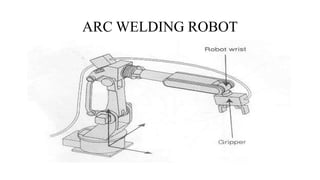
ARC WELDING ROBOT
WORKING
Robot welding means welding that is performed and controlled by
robotic equipment. In general equipment for automatic arc welding is
designed differently from that used for manual arc welding.
 Automatic arc welding normally involves high duty cycles, and the
welding equipment must be able to operate under those conditions. In
addition, the equipment components must have the necessary features
and controls to interface with the main control system.
A special kind of electrical power is required to make an arc weld.
The special power is provided by a welding machine, also known as a
power source.
All arc welding processes use an arc welding gun or torch to transmit
welding current from a welding cable to the electrode. They also
provide for shielding the weld area from the atmosphere
The nozzle of the torch is close to the arc and will gradually pick up
spatter. A torch cleaner (normally automatic) is often used in robot arc
welding systems to remove the spatter.
 All of the continous electrode wire arc processes require an electrode
feeder to feed the consumable electrode wire into the arc.
Welding fixtures and workpiece manipulators hold and position parts
to ensure precise welding by the robot.
The productivity of the robot welding cell is speeded up by having an
automatically rotating or switching fixture, so that the operator can be
fixing one set of parts while the robot is welding another.
To be able to guarantee that the electrode tip and the tool frame are
accurately known with respect to each other.
 The calibration process of the TCP (Tool Center Point) is important.
An automatic TCP calibration device facilitates this time consuming
task.
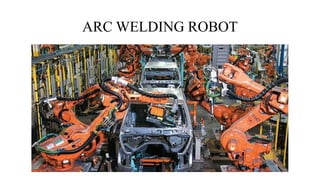
ARC WELDING ROBOT
IMPORTANCE ARC WELDING ROBOT
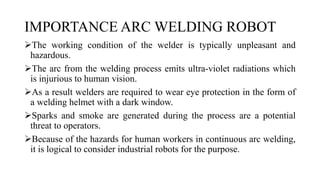
The working condition of the welder is typically unpleasant and
hazardous.
The arc from the welding process emits ultra-violet radiations which
is injurious to human vision.
As a result welders are required to wear eye protection in the form of
a welding helmet with a dark window.
Sparks and smoke are generated during the process are a potential
threat to operators.
Because of the hazards for human workers in continuous arc welding,
it is logical to consider industrial robots for the purpose.
FEATURES OF ARC ROBOT WELDING
Work volume and degrees of freedom
Motion control system
Precision of motion
Programming
Interface with other system
ADVANTAGES
Greater quality of product
Improved saftey and quality-of-work life
Higher productivity
DISADVANTAGES
The variation in the dimensions of the parts in a batch production job.
This type of dimensional variations means that the arc-welding path to
be followed will change slightly from part to part.
The variations in the edges and surfaces to be welded together. Instead
of being straight and regular, the edges are typically irregular.
CONCLUSION
A substantial opportunity exists in the technology of robotics to
relieve people from boring, repetitive, hazardous and unpleasant work
in all forms of a human labor.
There is a social value as well as a commercial value in pursuing this
opportunity. The commercial value of robotics is obvious.
Properly applied, robots can accomplish routine, undesirable work
better than humans at a lower cost.
Not only will robotics improve our standard of living, it will also
improve our standard of life.

ARC WELDING ROBOT

  • 1.
    ARC WELDING ROBOTS Presentedby NAME : S.ARUNKUMAR YEAR : IV YEAR DEPARTMENT : MECHANICAL ENGINEERING COLLEGE : SUDHARASAN ENGG COLLEGE
  • 2.
    INTRODUCTION Robot Welding isa process of joining different materials. The large bulk of materials that are welded are metals and their alloys although welding is also applied to the joining of other materials such as thermoplastics. Welding joins different metals or alloys with help of a number of processes in which heat is supplied either electrically or by means of a gas torch.
  • 3.
  • 4.
    WORKING Robot welding meanswelding that is performed and controlled by robotic equipment. In general equipment for automatic arc welding is designed differently from that used for manual arc welding.  Automatic arc welding normally involves high duty cycles, and the welding equipment must be able to operate under those conditions. In addition, the equipment components must have the necessary features and controls to interface with the main control system. A special kind of electrical power is required to make an arc weld. The special power is provided by a welding machine, also known as a power source.
  • 5.
    All arc weldingprocesses use an arc welding gun or torch to transmit welding current from a welding cable to the electrode. They also provide for shielding the weld area from the atmosphere The nozzle of the torch is close to the arc and will gradually pick up spatter. A torch cleaner (normally automatic) is often used in robot arc welding systems to remove the spatter.  All of the continous electrode wire arc processes require an electrode feeder to feed the consumable electrode wire into the arc. Welding fixtures and workpiece manipulators hold and position parts to ensure precise welding by the robot.
  • 6.
    The productivity ofthe robot welding cell is speeded up by having an automatically rotating or switching fixture, so that the operator can be fixing one set of parts while the robot is welding another. To be able to guarantee that the electrode tip and the tool frame are accurately known with respect to each other.  The calibration process of the TCP (Tool Center Point) is important. An automatic TCP calibration device facilitates this time consuming task.
  • 7.
  • 8.
    IMPORTANCE ARC WELDINGROBOT The working condition of the welder is typically unpleasant and hazardous. The arc from the welding process emits ultra-violet radiations which is injurious to human vision. As a result welders are required to wear eye protection in the form of a welding helmet with a dark window. Sparks and smoke are generated during the process are a potential threat to operators. Because of the hazards for human workers in continuous arc welding, it is logical to consider industrial robots for the purpose.
  • 9.
    FEATURES OF ARCROBOT WELDING Work volume and degrees of freedom Motion control system Precision of motion Programming Interface with other system
  • 10.
    ADVANTAGES Greater quality ofproduct Improved saftey and quality-of-work life Higher productivity
  • 11.
    DISADVANTAGES The variation inthe dimensions of the parts in a batch production job. This type of dimensional variations means that the arc-welding path to be followed will change slightly from part to part. The variations in the edges and surfaces to be welded together. Instead of being straight and regular, the edges are typically irregular.
  • 12.
    CONCLUSION A substantial opportunityexists in the technology of robotics to relieve people from boring, repetitive, hazardous and unpleasant work in all forms of a human labor. There is a social value as well as a commercial value in pursuing this opportunity. The commercial value of robotics is obvious. Properly applied, robots can accomplish routine, undesirable work better than humans at a lower cost. Not only will robotics improve our standard of living, it will also improve our standard of life.