Industrial Robotics
The Heart of Modern
Manufacturing
Yahya M. Hamad
Automated Manufacturing Engineering Department
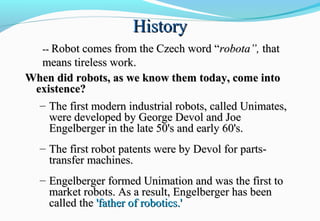
HistoryHistory
When did robots, as we know them today, come intoWhen did robots, as we know them today, come into
existence?existence?
– The first modern industrial robots, called Unimates,The first modern industrial robots, called Unimates,
were developed by George Devol and Joewere developed by George Devol and Joe
Engelberger in the late 50's and early 60's.Engelberger in the late 50's and early 60's.
– The first robot patents were by Devol for parts-The first robot patents were by Devol for parts-
transfer machines.transfer machines.
– Engelberger formed Unimation and was the first toEngelberger formed Unimation and was the first to
market robots. As a result, Engelberger has beenmarket robots. As a result, Engelberger has been
called thecalled the 'father of robotics.''father of robotics.'
---- Robot comes from the Czech word “Robot comes from the Czech word “robota”,robota”, thatthat
means tireless work.means tireless work.
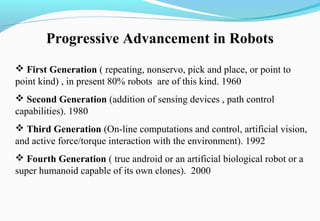
Progressive Advancement in Robots
 First Generation ( repeating, nonservo, pick and place, or point to
point kind) , in present 80% robots are of this kind. 1960
 Second Generation (addition of sensing devices , path control
capabilities). 1980
 Third Generation (On-line computations and control, artificial vision,
and active force/torque interaction with the environment). 1992
 Fourth Generation ( true android or an artificial biological robot or a
super humanoid capable of its own clones). 2000
“A robot is a reprogrammable, multifunctional manipulator
designed to move material, parts, tools, or special devices
through variable programmed motions for the performance
of a variety of tasks”
Robot Institute of America (RIA)
Industrial Robots Definition
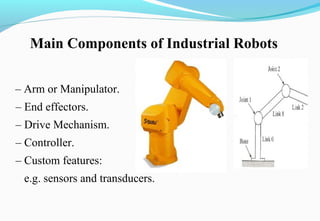
– Arm or Manipulator.
– End effectors.
– Drive Mechanism.
– Controller.
– Custom features:
e.g. sensors and transducers.
Main Components of Industrial Robots
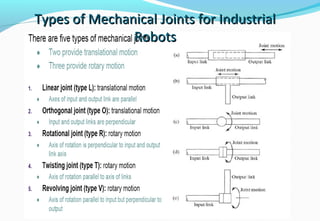
Types of Mechanical Joints for IndustrialTypes of Mechanical Joints for Industrial
RobotsRobots
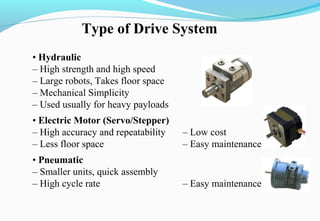
• Hydraulic
– High strength and high speed
– Large robots, Takes floor space
– Mechanical Simplicity
– Used usually for heavy payloads
• Electric Motor (Servo/Stepper)
– High accuracy and repeatability – Low cost
– Less floor space – Easy maintenance
• Pneumatic
– Smaller units, quick assembly
– High cycle rate – Easy maintenance
Type of Drive System
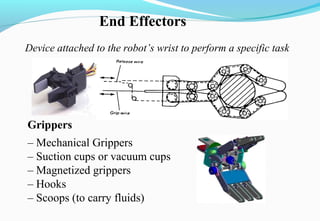
End Effectors
Grippers
– Mechanical Grippers
– Suction cups or vacuum cups
– Magnetized grippers
– Hooks
– Scoops (to carry fluids)
Device attached to the robot’s wrist to perform a specific task
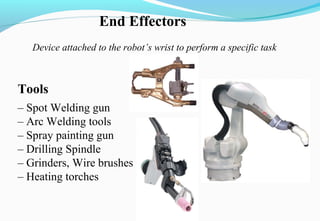
Tools
– Spot Welding gun
– Arc Welding tools
– Spray painting gun
– Drilling Spindle
– Grinders, Wire brushes
– Heating torches
End Effectors
Device attached to the robot’s wrist to perform a specific task
Motion Control Methods
– Point to point control
• a sequence of discrete points
• spot welding, pick-and-place, loading & unloading
– Continuous path control
• follow a prescribed path, controlled-path motion
• Spray painting, Arc welding, Gluing
Sensors in robotics
Types of sensors :
– Tactile sensors (touch sensors, force sensors)
– Proximity and range sensors (optical sensors, acoustical
sensors, electromagnetic sensors)
– Miscellaneous sensors (transducers and sensors which sense
variables such temperature, pressure, fluid flow, thermocouples,
voice sensors)
– Machine vision systems
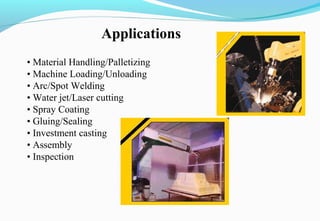
• Material Handling/Palletizing
• Machine Loading/Unloading
• Arc/Spot Welding
• Water jet/Laser cutting
• Spray Coating
• Gluing/Sealing
• Investment casting
• Assembly
• Inspection
Applications
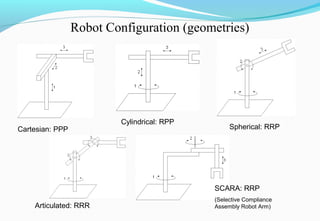
Robot Configuration (geometries)
Cartesian: PPP
Cylindrical: RPP
Spherical: RRP
SCARA: RRP
(Selective Compliance
Assembly Robot Arm)Articulated: RRR
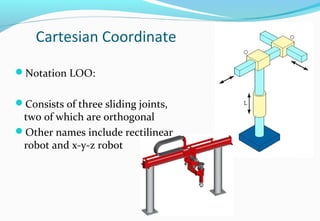
Cartesian Coordinate
Notation LOO:
Consists of three sliding joints,
two of which are orthogonal
Other names include rectilinear
robot and x-y-z robot
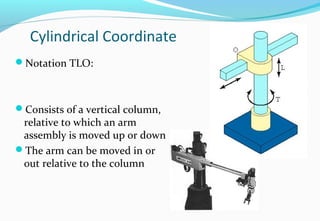
Cylindrical Coordinate
Notation TLO:
Consists of a vertical column,
relative to which an arm
assembly is moved up or down
The arm can be moved in or
out relative to the column
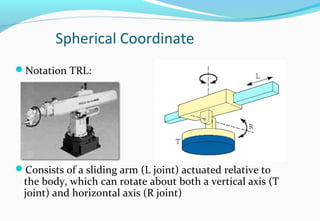
Spherical Coordinate
Notation TRL:
Consists of a sliding arm (L joint) actuated relative to
the body, which can rotate about both a vertical axis (T
joint) and horizontal axis (R joint)
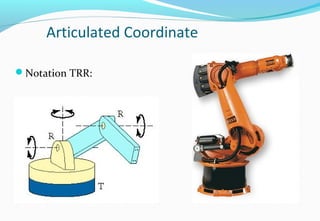
Articulated Coordinate
Notation TRR:
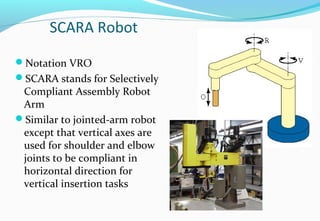
SCARA Robot
Notation VRO
SCARA stands for Selectively
Compliant Assembly Robot
Arm
Similar to jointed-arm robot
except that vertical axes are
used for shoulder and elbow
joints to be compliant in
horizontal direction for
vertical insertion tasks
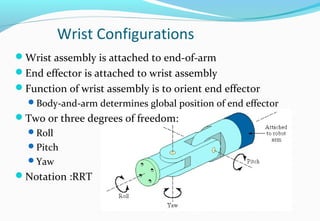
Wrist Configurations
Wrist assembly is attached to end-of-arm
End effector is attached to wrist assembly
Function of wrist assembly is to orient end effector
Body-and-arm determines global position of end effector
Two or three degrees of freedom:
Roll
Pitch
Yaw
Notation :RRT
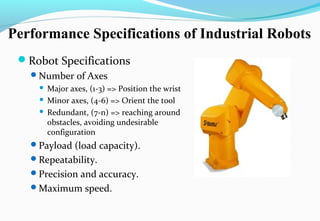
Performance Specifications of Industrial Robots
Robot Specifications
Number of Axes
 Major axes, (1-3) => Position the wrist
 Minor axes, (4-6) => Orient the tool
 Redundant, (7-n) => reaching around
obstacles, avoiding undesirable
configuration
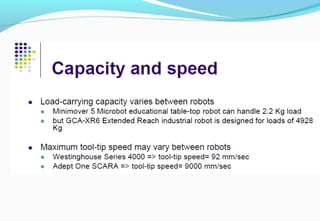
Payload (load capacity).
Repeatability.
Precision and accuracy.
Maximum speed.
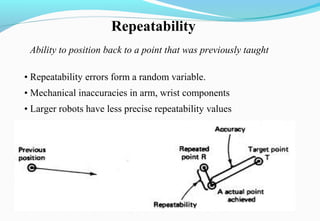
• Repeatability errors form a random variable.
• Mechanical inaccuracies in arm, wrist components
• Larger robots have less precise repeatability values
Repeatability
Ability to position back to a point that was previously taught
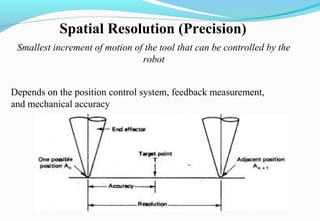
Depends on the position control system, feedback measurement,
and mechanical accuracy
Spatial Resolution (Precision)
Smallest increment of motion of the tool that can be controlled by the
robot
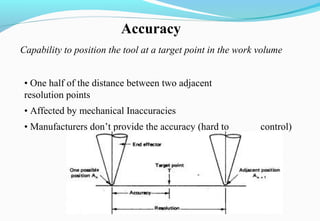
• One half of the distance between two adjacent
resolution points
• Affected by mechanical Inaccuracies
• Manufacturers don’t provide the accuracy (hard to control)
Accuracy
Capability to position the tool at a target point in the work volume
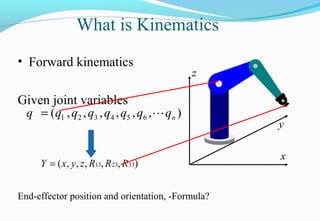
What is Kinematics
• Forward kinematics
Given joint variables
End-effector position and orientation, -Formula?
),,,,,,( 654321 nqqqqqqqq =
),,,,,( 332313 RRRzyxY =
x
y
z
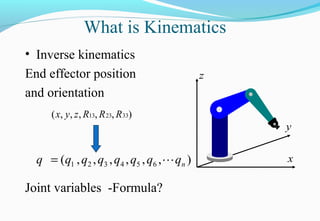
What is Kinematics
• Inverse kinematics
End effector position
and orientation
Joint variables -Formula?
),,,,,,( 654321 nqqqqqqqq =
),,,,,( 332313 RRRzyx
x
y
z
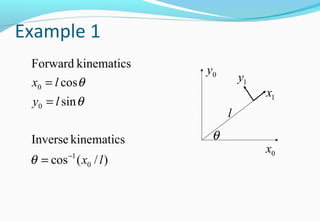
Example 1
0x
0y
1x
1y
)/(cos
kinematicsInverse
sin
cos
kinematicsForward
0
1
0
0
lx
ly
lx
−
=
=
=
θ
θ
θ
θ
l
Robot Applications (Configurations/Characteristics)
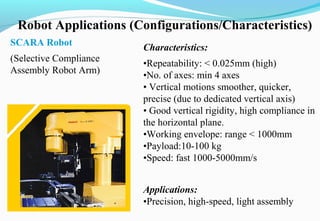
SCARA Robot
(Selective Compliance
Assembly Robot Arm)
Characteristics:
•Repeatability: < 0.025mm (high)
•No. of axes: min 4 axes
• Vertical motions smoother, quicker,
precise (due to dedicated vertical axis)
• Good vertical rigidity, high compliance in
the horizontal plane.
•Working envelope: range < 1000mm
•Payload:10-100 kg
•Speed: fast 1000-5000mm/s
Applications:
•Precision, high-speed, light assembly
Robot Applications (Configurations/Characteristics)
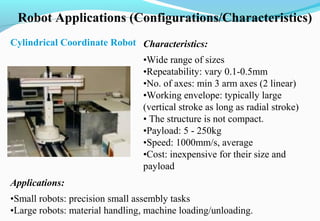
Cylindrical Coordinate Robot Characteristics:
•Wide range of sizes
•Repeatability: vary 0.1-0.5mm
•No. of axes: min 3 arm axes (2 linear)
•Working envelope: typically large
(vertical stroke as long as radial stroke)
• The structure is not compact.
•Payload: 5 - 250kg
•Speed: 1000mm/s, average
•Cost: inexpensive for their size and
payload
Applications:
•Small robots: precision small assembly tasks
•Large robots: material handling, machine loading/unloading.
Robot Applications (Configurations/Characteristics)
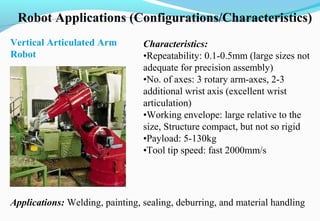
Vertical Articulated Arm
Robot
Characteristics:
•Repeatability: 0.1-0.5mm (large sizes not
adequate for precision assembly)
•No. of axes: 3 rotary arm-axes, 2-3
additional wrist axis (excellent wrist
articulation)
•Working envelope: large relative to the
size, Structure compact, but not so rigid
•Payload: 5-130kg
•Tool tip speed: fast 2000mm/s
Applications: Welding, painting, sealing, deburring, and material handling
Robot Applications (Configurations/Characteristics)
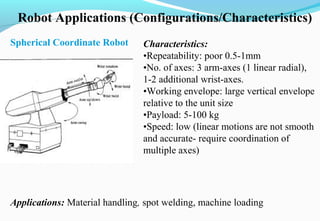
Spherical Coordinate Robot Characteristics:
•Repeatability: poor 0.5-1mm
•No. of axes: 3 arm-axes (1 linear radial),
1-2 additional wrist-axes.
•Working envelope: large vertical envelope
relative to the unit size
•Payload: 5-100 kg
•Speed: low (linear motions are not smooth
and accurate- require coordination of
multiple axes)
Applications: Material handling, spot welding, machine loading
Robot Applications (Configurations/Characteristics)
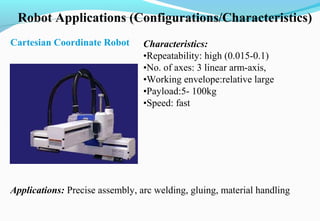
Cartesian Coordinate Robot Characteristics:
•Repeatability: high (0.015-0.1)
•No. of axes: 3 linear arm-axis,
•Working envelope:relative large
•Payload:5- 100kg
•Speed: fast
Applications: Precise assembly, arc welding, gluing, material handling
Robot Applications (Configurations/Characteristics)
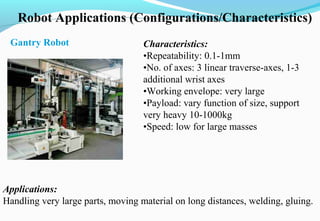
Gantry Robot Characteristics:
•Repeatability: 0.1-1mm
•No. of axes: 3 linear traverse-axes, 1-3
additional wrist axes
•Working envelope: very large
•Payload: vary function of size, support
very heavy 10-1000kg
•Speed: low for large masses
Applications:
Handling very large parts, moving material on long distances, welding, gluing.
The Advantages of Industrial Robots
• Competitive AdvantageCompetitive Advantage
– Robots can do some things more efficiently and quickerRobots can do some things more efficiently and quicker
than humans.than humans.
• MechanicalMechanical
– Robots never get sick or need to rest, so they can work 24Robots never get sick or need to rest, so they can work 24
hours a day, 7 days a week.hours a day, 7 days a week.
– Greater output per hour with consistent qualityGreater output per hour with consistent quality
– Continuous precision in repetitive operation.Continuous precision in repetitive operation.
Limitations of RoboticsLimitations of Robotics
Today's robots:Today's robots:
• Are not creative or innovativeAre not creative or innovative
• Can not think independentlyCan not think independently
• Can not make complicated decisionsCan not make complicated decisions
• Can not learn from mistakesCan not learn from mistakes
• Can not adapt quickly to changes in theirCan not adapt quickly to changes in their
surroundingssurroundings
Every successful business must depend on realEvery successful business must depend on real
people for these abilities.people for these abilities.
Thank you!

Robots

  • 1.
    Industrial Robotics The Heartof Modern Manufacturing Yahya M. Hamad Automated Manufacturing Engineering Department
  • 2.
    HistoryHistory When did robots,as we know them today, come intoWhen did robots, as we know them today, come into existence?existence? – The first modern industrial robots, called Unimates,The first modern industrial robots, called Unimates, were developed by George Devol and Joewere developed by George Devol and Joe Engelberger in the late 50's and early 60's.Engelberger in the late 50's and early 60's. – The first robot patents were by Devol for parts-The first robot patents were by Devol for parts- transfer machines.transfer machines. – Engelberger formed Unimation and was the first toEngelberger formed Unimation and was the first to market robots. As a result, Engelberger has beenmarket robots. As a result, Engelberger has been called thecalled the 'father of robotics.''father of robotics.' ---- Robot comes from the Czech word “Robot comes from the Czech word “robota”,robota”, thatthat means tireless work.means tireless work.
  • 3.
    Progressive Advancement inRobots  First Generation ( repeating, nonservo, pick and place, or point to point kind) , in present 80% robots are of this kind. 1960  Second Generation (addition of sensing devices , path control capabilities). 1980  Third Generation (On-line computations and control, artificial vision, and active force/torque interaction with the environment). 1992  Fourth Generation ( true android or an artificial biological robot or a super humanoid capable of its own clones). 2000
  • 4.
    “A robot isa reprogrammable, multifunctional manipulator designed to move material, parts, tools, or special devices through variable programmed motions for the performance of a variety of tasks” Robot Institute of America (RIA) Industrial Robots Definition
  • 5.
    – Arm orManipulator. – End effectors. – Drive Mechanism. – Controller. – Custom features: e.g. sensors and transducers. Main Components of Industrial Robots
  • 6.
    Types of MechanicalJoints for IndustrialTypes of Mechanical Joints for Industrial RobotsRobots
  • 7.
    • Hydraulic – Highstrength and high speed – Large robots, Takes floor space – Mechanical Simplicity – Used usually for heavy payloads • Electric Motor (Servo/Stepper) – High accuracy and repeatability – Low cost – Less floor space – Easy maintenance • Pneumatic – Smaller units, quick assembly – High cycle rate – Easy maintenance Type of Drive System
  • 8.
    End Effectors Grippers – MechanicalGrippers – Suction cups or vacuum cups – Magnetized grippers – Hooks – Scoops (to carry fluids) Device attached to the robot’s wrist to perform a specific task
  • 9.
    Tools – Spot Weldinggun – Arc Welding tools – Spray painting gun – Drilling Spindle – Grinders, Wire brushes – Heating torches End Effectors Device attached to the robot’s wrist to perform a specific task
  • 10.
    Motion Control Methods –Point to point control • a sequence of discrete points • spot welding, pick-and-place, loading & unloading – Continuous path control • follow a prescribed path, controlled-path motion • Spray painting, Arc welding, Gluing
  • 11.
    Sensors in robotics Typesof sensors : – Tactile sensors (touch sensors, force sensors) – Proximity and range sensors (optical sensors, acoustical sensors, electromagnetic sensors) – Miscellaneous sensors (transducers and sensors which sense variables such temperature, pressure, fluid flow, thermocouples, voice sensors) – Machine vision systems
  • 12.
    • Material Handling/Palletizing •Machine Loading/Unloading • Arc/Spot Welding • Water jet/Laser cutting • Spray Coating • Gluing/Sealing • Investment casting • Assembly • Inspection Applications
  • 13.
    Robot Configuration (geometries) Cartesian:PPP Cylindrical: RPP Spherical: RRP SCARA: RRP (Selective Compliance Assembly Robot Arm)Articulated: RRR
  • 14.
    Cartesian Coordinate Notation LOO: Consistsof three sliding joints, two of which are orthogonal Other names include rectilinear robot and x-y-z robot
  • 15.
    Cylindrical Coordinate Notation TLO: Consistsof a vertical column, relative to which an arm assembly is moved up or down The arm can be moved in or out relative to the column
  • 16.
    Spherical Coordinate Notation TRL: Consistsof a sliding arm (L joint) actuated relative to the body, which can rotate about both a vertical axis (T joint) and horizontal axis (R joint)
  • 17.
  • 18.
    SCARA Robot Notation VRO SCARAstands for Selectively Compliant Assembly Robot Arm Similar to jointed-arm robot except that vertical axes are used for shoulder and elbow joints to be compliant in horizontal direction for vertical insertion tasks
  • 19.
    Wrist Configurations Wrist assemblyis attached to end-of-arm End effector is attached to wrist assembly Function of wrist assembly is to orient end effector Body-and-arm determines global position of end effector Two or three degrees of freedom: Roll Pitch Yaw Notation :RRT
  • 20.
    Performance Specifications ofIndustrial Robots Robot Specifications Number of Axes  Major axes, (1-3) => Position the wrist  Minor axes, (4-6) => Orient the tool  Redundant, (7-n) => reaching around obstacles, avoiding undesirable configuration Payload (load capacity). Repeatability. Precision and accuracy. Maximum speed.
  • 22.
    • Repeatability errorsform a random variable. • Mechanical inaccuracies in arm, wrist components • Larger robots have less precise repeatability values Repeatability Ability to position back to a point that was previously taught
  • 23.
    Depends on theposition control system, feedback measurement, and mechanical accuracy Spatial Resolution (Precision) Smallest increment of motion of the tool that can be controlled by the robot
  • 24.
    • One halfof the distance between two adjacent resolution points • Affected by mechanical Inaccuracies • Manufacturers don’t provide the accuracy (hard to control) Accuracy Capability to position the tool at a target point in the work volume
  • 25.
    What is Kinematics •Forward kinematics Given joint variables End-effector position and orientation, -Formula? ),,,,,,( 654321 nqqqqqqqq = ),,,,,( 332313 RRRzyxY = x y z
  • 26.
    What is Kinematics •Inverse kinematics End effector position and orientation Joint variables -Formula? ),,,,,,( 654321 nqqqqqqqq = ),,,,,( 332313 RRRzyx x y z
  • 27.
  • 28.
    Robot Applications (Configurations/Characteristics) SCARARobot (Selective Compliance Assembly Robot Arm) Characteristics: •Repeatability: < 0.025mm (high) •No. of axes: min 4 axes • Vertical motions smoother, quicker, precise (due to dedicated vertical axis) • Good vertical rigidity, high compliance in the horizontal plane. •Working envelope: range < 1000mm •Payload:10-100 kg •Speed: fast 1000-5000mm/s Applications: •Precision, high-speed, light assembly
  • 29.
    Robot Applications (Configurations/Characteristics) CylindricalCoordinate Robot Characteristics: •Wide range of sizes •Repeatability: vary 0.1-0.5mm •No. of axes: min 3 arm axes (2 linear) •Working envelope: typically large (vertical stroke as long as radial stroke) • The structure is not compact. •Payload: 5 - 250kg •Speed: 1000mm/s, average •Cost: inexpensive for their size and payload Applications: •Small robots: precision small assembly tasks •Large robots: material handling, machine loading/unloading.
  • 30.
    Robot Applications (Configurations/Characteristics) VerticalArticulated Arm Robot Characteristics: •Repeatability: 0.1-0.5mm (large sizes not adequate for precision assembly) •No. of axes: 3 rotary arm-axes, 2-3 additional wrist axis (excellent wrist articulation) •Working envelope: large relative to the size, Structure compact, but not so rigid •Payload: 5-130kg •Tool tip speed: fast 2000mm/s Applications: Welding, painting, sealing, deburring, and material handling
  • 31.
    Robot Applications (Configurations/Characteristics) SphericalCoordinate Robot Characteristics: •Repeatability: poor 0.5-1mm •No. of axes: 3 arm-axes (1 linear radial), 1-2 additional wrist-axes. •Working envelope: large vertical envelope relative to the unit size •Payload: 5-100 kg •Speed: low (linear motions are not smooth and accurate- require coordination of multiple axes) Applications: Material handling, spot welding, machine loading
  • 32.
    Robot Applications (Configurations/Characteristics) CartesianCoordinate Robot Characteristics: •Repeatability: high (0.015-0.1) •No. of axes: 3 linear arm-axis, •Working envelope:relative large •Payload:5- 100kg •Speed: fast Applications: Precise assembly, arc welding, gluing, material handling
  • 33.
    Robot Applications (Configurations/Characteristics) GantryRobot Characteristics: •Repeatability: 0.1-1mm •No. of axes: 3 linear traverse-axes, 1-3 additional wrist axes •Working envelope: very large •Payload: vary function of size, support very heavy 10-1000kg •Speed: low for large masses Applications: Handling very large parts, moving material on long distances, welding, gluing.
  • 34.
    The Advantages ofIndustrial Robots • Competitive AdvantageCompetitive Advantage – Robots can do some things more efficiently and quickerRobots can do some things more efficiently and quicker than humans.than humans. • MechanicalMechanical – Robots never get sick or need to rest, so they can work 24Robots never get sick or need to rest, so they can work 24 hours a day, 7 days a week.hours a day, 7 days a week. – Greater output per hour with consistent qualityGreater output per hour with consistent quality – Continuous precision in repetitive operation.Continuous precision in repetitive operation.
  • 35.
    Limitations of RoboticsLimitationsof Robotics Today's robots:Today's robots: • Are not creative or innovativeAre not creative or innovative • Can not think independentlyCan not think independently • Can not make complicated decisionsCan not make complicated decisions • Can not learn from mistakesCan not learn from mistakes • Can not adapt quickly to changes in theirCan not adapt quickly to changes in their surroundingssurroundings Every successful business must depend on realEvery successful business must depend on real people for these abilities.people for these abilities.
  • 36.