By:-
Rohtash kumar
What is Automation ?
 Automation or automatic control, is the use of
various control systems for operating equipment such
as machinery, processes in factories switching on
telephone networks, steering and stabilization of
ships.
 Beginning in 1920’s – riveting to welding.
 Shipbuilding, aeroplanes construction, army
personnel manufacturing in world war-2 (1939-1945)
 The real impetus for accelerated m/c and
automation in 1950’s.
Why Automation ??
 To Improve productivity.
 Shortage of skilled labours.
 To reduce labour fatigue.
 Health issues.
 Safety requirement.
 To handle job in hazardous environment.
Welding Operation Sequence
1) Assembling of parts-By jigs, Fixtures & tack welding.
2) Present the assembled parts to the welding head or
vice versa.
3) Initiation of welding-
• By striking the arc for fusion welding
• By bringing electrodes in contact with the work and
switching on the current for resistance welding.
4) Create relative movement b/w welding head & work
to attain desired welding speed.
5) Control of welding variables.
6) Stop welding.
7) Shift the welding head to the position wherefrom the
next welding cycle is initiated.
8) Remove the complete work. This can be done before or
after repositioning the welding head or both
operations may be carried out simultaneously.
Different Techniques for doing Welding-
Manual Welding
Semi automatic Welding
Automatic Welding
Automated Welding (Flexible Welding System)
Adaptive Methods in conjunction with automatic or
automated welding system
Remote Welding
Robotic Welding
Manual Welding:-
 Almost manually i.e. all operations done by hand.
 Some mechanical assistance can be used to
accomplish ‘relative motion b/w the welding head
and the work’ (stag -4 ).
 Mechanical Manipulator is used to move the w/p
at approximately right speed for welding.
Ex.- Gravity motor.
 This types of operation is used in SMAW, GTAW,
Oxy-fuel gas welding and Plasma arc welding.
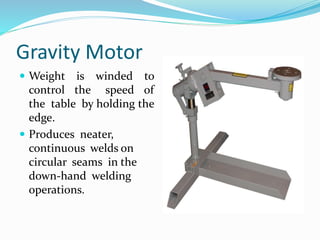
Gravity Motor
 Weight is winded to
control the speed of
the table by holding the
edge.
 Produces neater,
continuous welds on
circular seams in the
down-hand welding
operations.
Semi automatic Welding
Welding variables are controlled automatically eg.
• Wire feed speed in GMAW
• Duration of current in resistance welding with a
gun welder.
 Stage 4 is done manually, but mechanical means
like conveyor belt or work manipulator may be
employed.
 Stage 3 & 6 ‘initiation and stoppage of operation’
carried out automatically by means of “single on-
off switch”.
 Use- GMAW & FCAW (mostly) and in GTAW, SAW,
ESW(rarely).
Automatic Welding
 At least stage 4 & 5 are done automatically.
 Stages 1,2,7 and 8 are carried out by hand or
initiated manually.
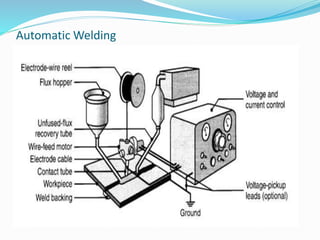
 Usually a single switch working through a
sequencing device operates the controls for power
and consumables like wire & gas.
 Ex.- Gravity welding is classified as a portable
automatic welding method.
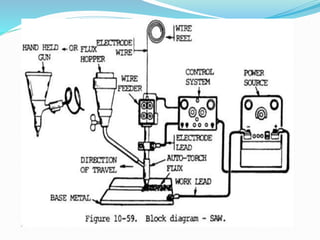
 Use: SAW, ESW (mostly) and in GTAW, GMAW,
FCAW and Plasma arc welding (Limited extent).
Automatic Welding
Automated Welding
 All eight processes are done without the
adjustment of controls by a welding operator.
 Benefits:-
 Operator needn’t continuously monitor the
operation.
 Productivity and quality are better than automatic
welding.
 Less operator fatigue.
 Uses: SAW, GMAW, FCAW (mostly) and GTAW, PAW,
ESW (limited extent)
Automatic v/s Automated welding
Automatic Automated
 Involve elaborate dedicated
fixturing with tooling, work
holding devices, accurate part
location & orientation.
 Involve welding arc movement
devices with predetermined
sequences of welding
parameter changes & timers to
accomplish the weld joint.
 Was developed & is being
used at a high level of
efficiency in high volume
Industries.
 Maintains production
schedules.
 Reduces the cost of parts
welded.
 Program replaces the complex
fixturing & sequencing devices.
 Utilises a progrem coupled to a
welding arc travel device of
extreme capabilities instead of
elaborate fixtures.
 Arc motion device’s movement
in H, V, T, L, R directions.
 Provides same time saving
precision as automatic, yet can
be applied to small & single lot
production.
 Quick change capabilities, can
accommodate the changes in
product without the necessity
of redesigning & reworking of the
expansive fixtures.
Continue..
Automatic
 Disadvantage-
 High initial cost of
the welding machine.
 Need to keep the
automatic welding
equipments all the
time.
 Problems with lower
volume production
(large fixtures,
continuous operations
etc.)
Automated
 In short this is
automation with
flexibility and will
reduce to a minimum
the tooling and fixtures
required.
 Complex parts for
small lot productions.
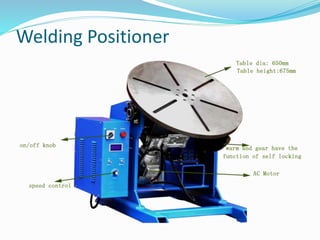
Welding Positioner
Adaptive controls:
 Why adaptive controls??
 To keep the welding head moving exactly along the
joint path and to achieve welds of desired quality.
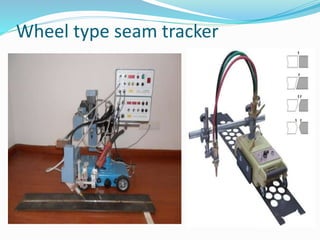
 Main Aim- ‘Seam tracking and quality controls’. Ex.-
i. Mechanical follower- for horizontal and vertical
path not for curved path.
ii. Electro-mechanical devices
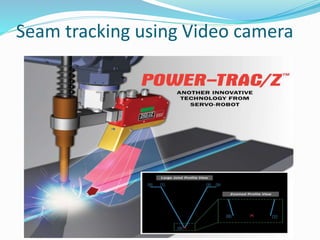
iii. Optical types- Video camera (2D or 3D images)
iv. Laser beam- latest method but problems with
welding heat, sharp corners and smoke.
Wheel type seam tracker
Seam tracking using Video camera
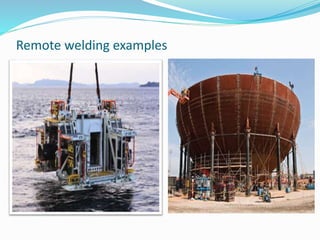
Remote Welding
 Remote welding is similar to automated welding.
 Uses:
a. In nuclear power plant.
b. Where human can’t be present due to dangerious
(hosulle) atmosphere.
c. Radio chemical processing plant.
d. Plugging of leaking heat-exchanger tubes in
nuclear power plant.
e. Pipe weld joints in radio-active atmosphere.
Remote welding examples
Remote welding V/s Automated Welding:-
Remote Welding Automated welding
 Operator needn’t to present
at welding spot . Can be done
behind the curtains also.
 Involves maintenance
operations where each weld
may be different from
previous one.
 When remote welding is used
for similar weld it becomes
automated welding.
 Same ,Operator needn’t to
present at welding spot (some
meter away).
 This is designed for making
the same identical weld time
after time
Robotic Welding
 Basically a part of Automated welding, but all
technology is available here.
 At its simplest a robot is a manipulator that can be
programmed at will at present or future (bcz it has
memory).
 The manipulator is driven by actuators like electric
motors and is controlled by a computer.
 Welding Robot has 5-6 linear and rotational axes to do
different tasks.
 Most exciting technique.
 Alternative for performing monotonous and fatiguing
tasks.
 A cost effective solution to many welding tasks.
 Robots have flexibility they differ from fixed
automation which is dedicated to only one task.
Limitation of Robotic Welding-
 Where tolerance of pre-welding process are not
tight enough or where components can’t be
adequately clamped during welding.
 Where exotic materials area to be welded or where
access is severely limited.
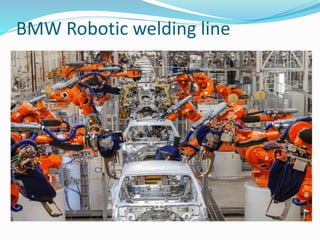
BMW Robotic welding line
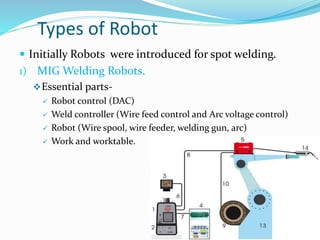
Types of Robot
 Initially Robots were introduced for spot welding.
1) MIG Welding Robots.
Essential parts-
 Robot control (DAC)
 Weld controller (Wire feed control and Arc voltage control)
 Robot (Wire spool, wire feeder, welding gun, arc)
 Work and worktable.
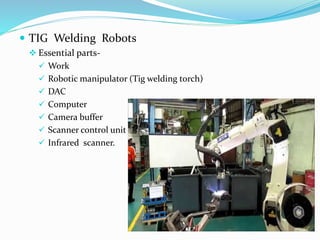
 TIG Welding Robots
 Essential parts-
 Work
 Robotic manipulator (Tig welding torch)
 DAC
 Computer
 Camera buffer
 Scanner control unit
 Infrared scanner.
Functions of TIG Welding Robot
 To held welding torch precisely in position.
 To feed filler wire into the joint.
 To handle welding gun.
• Laser -vision based Robot
 For Arc welding when the parts to be welded exhibit great
irregularities.
 Very sensitive.
Robot costs-
 Cost of an Arc Welding robot system may vary b/w 25-30 lac.
 Service life: 10-20 Years
 Under normal robot cost recovers in 2-3 years.
 Average Robot operates about 3 months work time b/w
breakdowns.
Precautions in Use of Robots
 Robot is a machine and work according the program
give it.
 Robot closely emulate the skills of a human being, only
when environment doesn’t change.
 The Greatest strength of robot is that it can ignore
heat, light, radiation etc.
 The greatest weakness of robot is that it has no inherent
reaction that we humans have to our surrounding.
 Robot can be considered as a blind, deaf & dumb
automation that only responds to given signals.
 Fail safe-Robot can breakdown in unexpected ways so
precautions must be taken to protect surrounding
people and processes.
 There should be provision for manual override in
emergency situations.
 Advantages:-
 Cost reduction.
 Increased productivity.
 Consistent accuracy.
 Minimum wastage of time & materials.
 Stabilized labour charge; No work, No pay.
 Solution of skilled labours.
 Not necessary to use when welding can be done by
conventional methods (too programming).
 Batch productions.
 Work-piece shouldn’t be too large or too small(thin)
Eg. Wire or very big assembly.
Selection of Welding System
 Assessment based on profit, quality & number of
skilled operators required.
 For short run, ordinary jobs should be handled by
manual welding processes.
 When product quality and productivity are to be
improved in manual welding then simple
positioners or manipulators can be employed.
Semi-automatic GMAW- used in
 Short run all position welding
 Structure fabrication.
Automatic TIG Welding-used in
 Welding of tubes to tube plate,
 Peripheral joint on pipes.
Automatic SAW-used in
 Ship hulls, where high ductility of welds is the desired aim
 In downhand Welding.
Automatic welding with fixtures-used in
 When work geometry doesn’t change over a long period of time.
Automated Welding-used in
 Batch production-in conjunction with positoners & manipulaters.
 Automobile Industry.
 Welding of coated steel involving dirty or hazardous environment.
 Eg. Galvanized steel.
Remote Welding-used in
 Nuclear industry.
 Where humans can’t be exposed to the radio-active environment
for long period of time.
References:
 Welding Engineering & Technology, RS Parmar
 https://en.wikipedia.org/wiki/welding
 Google Images/welding
Thank You !!
Any inquries ??

Presentation on Automation in Welding

  • 1.
  • 2.
    What is Automation?  Automation or automatic control, is the use of various control systems for operating equipment such as machinery, processes in factories switching on telephone networks, steering and stabilization of ships.  Beginning in 1920’s – riveting to welding.  Shipbuilding, aeroplanes construction, army personnel manufacturing in world war-2 (1939-1945)  The real impetus for accelerated m/c and automation in 1950’s.
  • 3.
    Why Automation ?? To Improve productivity.  Shortage of skilled labours.  To reduce labour fatigue.  Health issues.  Safety requirement.  To handle job in hazardous environment.
  • 4.
    Welding Operation Sequence 1)Assembling of parts-By jigs, Fixtures & tack welding. 2) Present the assembled parts to the welding head or vice versa. 3) Initiation of welding- • By striking the arc for fusion welding • By bringing electrodes in contact with the work and switching on the current for resistance welding. 4) Create relative movement b/w welding head & work to attain desired welding speed. 5) Control of welding variables. 6) Stop welding. 7) Shift the welding head to the position wherefrom the next welding cycle is initiated. 8) Remove the complete work. This can be done before or after repositioning the welding head or both operations may be carried out simultaneously.
  • 5.
    Different Techniques fordoing Welding- Manual Welding Semi automatic Welding Automatic Welding Automated Welding (Flexible Welding System) Adaptive Methods in conjunction with automatic or automated welding system Remote Welding Robotic Welding
  • 6.
    Manual Welding:-  Almostmanually i.e. all operations done by hand.  Some mechanical assistance can be used to accomplish ‘relative motion b/w the welding head and the work’ (stag -4 ).  Mechanical Manipulator is used to move the w/p at approximately right speed for welding. Ex.- Gravity motor.  This types of operation is used in SMAW, GTAW, Oxy-fuel gas welding and Plasma arc welding.
  • 7.
    Gravity Motor  Weightis winded to control the speed of the table by holding the edge.  Produces neater, continuous welds on circular seams in the down-hand welding operations.
  • 8.
    Semi automatic Welding Weldingvariables are controlled automatically eg. • Wire feed speed in GMAW • Duration of current in resistance welding with a gun welder.  Stage 4 is done manually, but mechanical means like conveyor belt or work manipulator may be employed.  Stage 3 & 6 ‘initiation and stoppage of operation’ carried out automatically by means of “single on- off switch”.  Use- GMAW & FCAW (mostly) and in GTAW, SAW, ESW(rarely).
  • 9.
    Automatic Welding  Atleast stage 4 & 5 are done automatically.  Stages 1,2,7 and 8 are carried out by hand or initiated manually.  Usually a single switch working through a sequencing device operates the controls for power and consumables like wire & gas.  Ex.- Gravity welding is classified as a portable automatic welding method.  Use: SAW, ESW (mostly) and in GTAW, GMAW, FCAW and Plasma arc welding (Limited extent).
  • 10.
  • 12.
    Automated Welding  Alleight processes are done without the adjustment of controls by a welding operator.  Benefits:-  Operator needn’t continuously monitor the operation.  Productivity and quality are better than automatic welding.  Less operator fatigue.  Uses: SAW, GMAW, FCAW (mostly) and GTAW, PAW, ESW (limited extent)
  • 13.
    Automatic v/s Automatedwelding Automatic Automated  Involve elaborate dedicated fixturing with tooling, work holding devices, accurate part location & orientation.  Involve welding arc movement devices with predetermined sequences of welding parameter changes & timers to accomplish the weld joint.  Was developed & is being used at a high level of efficiency in high volume Industries.  Maintains production schedules.  Reduces the cost of parts welded.  Program replaces the complex fixturing & sequencing devices.  Utilises a progrem coupled to a welding arc travel device of extreme capabilities instead of elaborate fixtures.  Arc motion device’s movement in H, V, T, L, R directions.  Provides same time saving precision as automatic, yet can be applied to small & single lot production.  Quick change capabilities, can accommodate the changes in product without the necessity of redesigning & reworking of the expansive fixtures.
  • 14.
    Continue.. Automatic  Disadvantage-  Highinitial cost of the welding machine.  Need to keep the automatic welding equipments all the time.  Problems with lower volume production (large fixtures, continuous operations etc.) Automated  In short this is automation with flexibility and will reduce to a minimum the tooling and fixtures required.  Complex parts for small lot productions.
  • 15.
  • 16.
    Adaptive controls:  Whyadaptive controls??  To keep the welding head moving exactly along the joint path and to achieve welds of desired quality.  Main Aim- ‘Seam tracking and quality controls’. Ex.- i. Mechanical follower- for horizontal and vertical path not for curved path. ii. Electro-mechanical devices iii. Optical types- Video camera (2D or 3D images) iv. Laser beam- latest method but problems with welding heat, sharp corners and smoke.
  • 17.
  • 18.
    Seam tracking usingVideo camera
  • 19.
    Remote Welding  Remotewelding is similar to automated welding.  Uses: a. In nuclear power plant. b. Where human can’t be present due to dangerious (hosulle) atmosphere. c. Radio chemical processing plant. d. Plugging of leaking heat-exchanger tubes in nuclear power plant. e. Pipe weld joints in radio-active atmosphere.
  • 20.
  • 21.
    Remote welding V/sAutomated Welding:- Remote Welding Automated welding  Operator needn’t to present at welding spot . Can be done behind the curtains also.  Involves maintenance operations where each weld may be different from previous one.  When remote welding is used for similar weld it becomes automated welding.  Same ,Operator needn’t to present at welding spot (some meter away).  This is designed for making the same identical weld time after time
  • 22.
    Robotic Welding  Basicallya part of Automated welding, but all technology is available here.  At its simplest a robot is a manipulator that can be programmed at will at present or future (bcz it has memory).  The manipulator is driven by actuators like electric motors and is controlled by a computer.  Welding Robot has 5-6 linear and rotational axes to do different tasks.  Most exciting technique.  Alternative for performing monotonous and fatiguing tasks.  A cost effective solution to many welding tasks.  Robots have flexibility they differ from fixed automation which is dedicated to only one task.
  • 23.
    Limitation of RoboticWelding-  Where tolerance of pre-welding process are not tight enough or where components can’t be adequately clamped during welding.  Where exotic materials area to be welded or where access is severely limited.
  • 24.
  • 25.
    Types of Robot Initially Robots were introduced for spot welding. 1) MIG Welding Robots. Essential parts-  Robot control (DAC)  Weld controller (Wire feed control and Arc voltage control)  Robot (Wire spool, wire feeder, welding gun, arc)  Work and worktable.
  • 26.
     TIG WeldingRobots  Essential parts-  Work  Robotic manipulator (Tig welding torch)  DAC  Computer  Camera buffer  Scanner control unit  Infrared scanner.
  • 27.
    Functions of TIGWelding Robot  To held welding torch precisely in position.  To feed filler wire into the joint.  To handle welding gun. • Laser -vision based Robot  For Arc welding when the parts to be welded exhibit great irregularities.  Very sensitive. Robot costs-  Cost of an Arc Welding robot system may vary b/w 25-30 lac.  Service life: 10-20 Years  Under normal robot cost recovers in 2-3 years.  Average Robot operates about 3 months work time b/w breakdowns.
  • 28.
    Precautions in Useof Robots  Robot is a machine and work according the program give it.  Robot closely emulate the skills of a human being, only when environment doesn’t change.  The Greatest strength of robot is that it can ignore heat, light, radiation etc.  The greatest weakness of robot is that it has no inherent reaction that we humans have to our surrounding.  Robot can be considered as a blind, deaf & dumb automation that only responds to given signals.  Fail safe-Robot can breakdown in unexpected ways so precautions must be taken to protect surrounding people and processes.  There should be provision for manual override in emergency situations.
  • 29.
     Advantages:-  Costreduction.  Increased productivity.  Consistent accuracy.  Minimum wastage of time & materials.  Stabilized labour charge; No work, No pay.  Solution of skilled labours.  Not necessary to use when welding can be done by conventional methods (too programming).  Batch productions.  Work-piece shouldn’t be too large or too small(thin) Eg. Wire or very big assembly.
  • 30.
    Selection of WeldingSystem  Assessment based on profit, quality & number of skilled operators required.  For short run, ordinary jobs should be handled by manual welding processes.  When product quality and productivity are to be improved in manual welding then simple positioners or manipulators can be employed.
  • 31.
    Semi-automatic GMAW- usedin  Short run all position welding  Structure fabrication. Automatic TIG Welding-used in  Welding of tubes to tube plate,  Peripheral joint on pipes. Automatic SAW-used in  Ship hulls, where high ductility of welds is the desired aim  In downhand Welding. Automatic welding with fixtures-used in  When work geometry doesn’t change over a long period of time. Automated Welding-used in  Batch production-in conjunction with positoners & manipulaters.  Automobile Industry.  Welding of coated steel involving dirty or hazardous environment.  Eg. Galvanized steel. Remote Welding-used in  Nuclear industry.  Where humans can’t be exposed to the radio-active environment for long period of time.
  • 32.
    References:  Welding Engineering& Technology, RS Parmar  https://en.wikipedia.org/wiki/welding  Google Images/welding
  • 33.
    Thank You !! Anyinquries ??