Choose Immersive Studio for expert AR VR MR solutions. Reliable, custom, and scalable immersive technologies to captivate your audience. Call us today!
immersivestudio.co.uk
Applications
Process
Increased Efficiency
Automation
Process
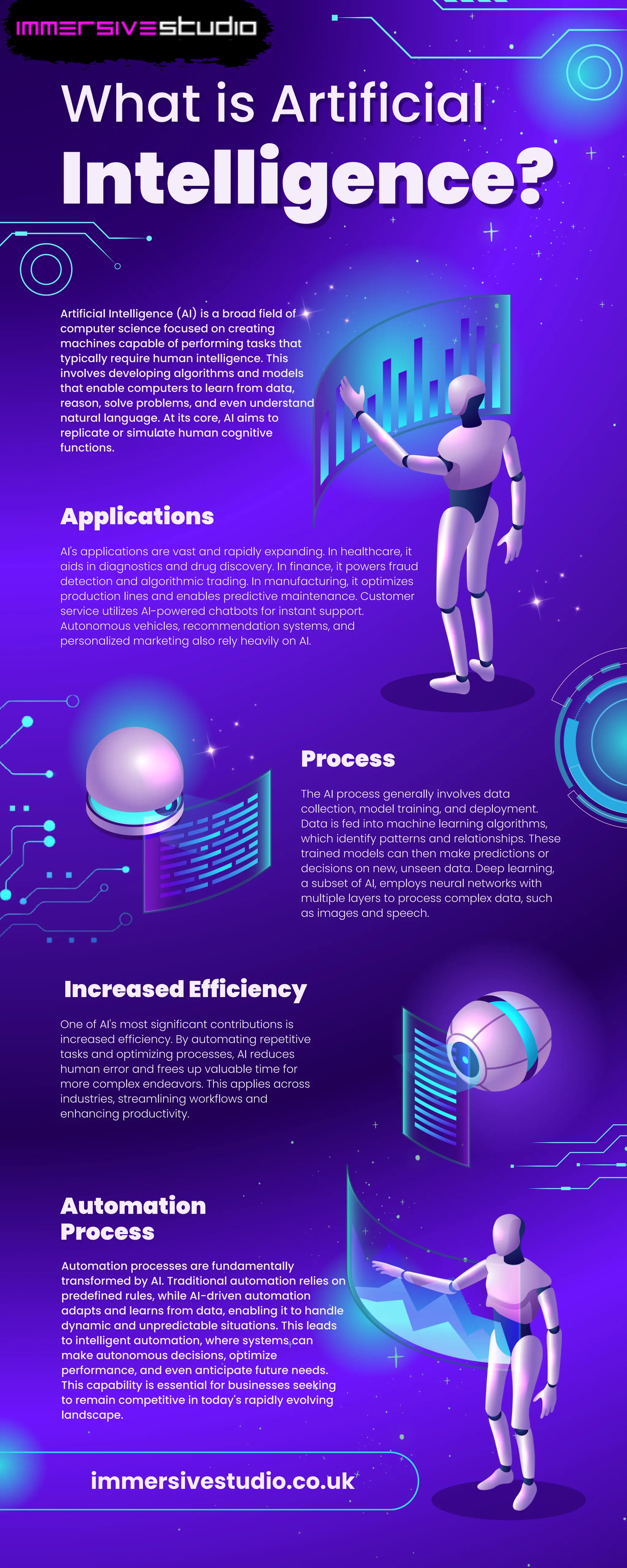
Artificial Intelligence(AI) is a broad field of
computer science focused on creating
machines capable of performing tasks that
typically require human intelligence. This
involves developing algorithms and models
that enable computers to learn from data,
reason, solve problems, and even understand
natural language. At its core, AI aims to
replicate or simulate human cognitive
functions.
AI's applications are vast and rapidly expanding. In healthcare, it
aids in diagnostics and drug discovery. In finance, it powers fraud
detection and algorithmic trading. In manufacturing, it optimizes
production lines and enables predictive maintenance. Customer
service utilizes AI-powered chatbots for instant support.
Autonomous vehicles, recommendation systems, and
personalized marketing also rely heavily on AI.
The AI process generally involves data
collection, model training, and deployment.
Data is fed into machine learning algorithms,
which identify patterns and relationships. These
trained models can then make predictions or
decisions on new, unseen data. Deep learning,
a subset of AI, employs neural networks with
multiple layers to process complex data, such
as images and speech.
One of AI's most significant contributions is
increased efficiency. By automating repetitive
tasks and optimizing processes, AI reduces
human error and frees up valuable time for
more complex endeavors. This applies across
industries, streamlining workflows and
enhancing productivity.
Automation processes are fundamentally
transformed by AI. Traditional automation relies on
predefined rules, while AI-driven automation
adapts and learns from data, enabling it to handle
dynamic and unpredictable situations. This leads
to intelligent automation, where systems can
make autonomous decisions, optimize
performance, and even anticipate future needs.
This capability is essential for businesses seeking
to remain competitive in today's rapidly evolving
landscape.


![DecSoft App Builder 2021.23 with Crack Download [Latest]](https://cdn.slidesharecdn.com/ss_thumbnails/artificialintelligence16-250528112548-d1f92611-thumbnail.jpg?width=640&height=640&fit=bounds)
![Enigma Recovery Professional 3.6.2 Crack + License Key [Latest]](https://cdn.slidesharecdn.com/ss_thumbnails/artificialintelligence16-250529072145-a1b53fea-thumbnail.jpg?width=640&height=640&fit=bounds)

![iSkysoft Data Recovery 5.0.1.3 Crack + Serial Key [2025]](https://cdn.slidesharecdn.com/ss_thumbnails/artificialintelligence22-250528111409-7bb27b53-thumbnail.jpg?width=640&height=640&fit=bounds)

![Directory Lister Pro 2.42 Enterprise + Crack Download [Latest]](https://cdn.slidesharecdn.com/ss_thumbnails/artificialintelligence22-250528124124-08bcb9e9-thumbnail.jpg?width=640&height=640&fit=bounds)
![GridinSoft Anti-Malware 4.1.74 Crack + Activation Code [Latest]](https://cdn.slidesharecdn.com/ss_thumbnails/artificialintelligence22-250529091117-4735c160-thumbnail.jpg?width=640&height=640&fit=bounds)


