Department of CSE- Data Science
1
Module-2
Data sufficiency
Data Sufficiency
 Data Sufficiency means candidates need to find whether the given data which is
the statement(s) is/are sufficient to find the answer or not.
 Data Sufficiency-type questions are designed to test the candidate's ability to
relate given information to reach a conclusion.
Types of Data Sufficiency
1. Blood Relation
 In this type of data sufficiency, relation between 2 people will be asked and candidates need to
find the statement(s) in which data is sufficient to find the relation or the correct answer.
2. Order & Ranking
 In this type of data sufficiency, data on order of people or their ranking will be provided and
candidates will need to find statement(s) in which data is sufficient to find the correct answer.
3. Direction & Distance
 In this type of data sufficiency, data on direction of people or points and the distance travelled
by a person or distance between the points will be given and candidates will need to find the
statement(s) in which data is sufficient to find the direction or distance between the points.
4. Coding Decoding
• In this type of data sufficiency, words or letters will be coded and candidates will need to find
the statement(s) in which data is sufficient to find the logic applied to decide the code.
5. Seating Arrangement
 In this type of data sufficiency, data on arrangement of people will be provided and
candidates will need to find the statement(s) in which data is sufficient to find the correct
answer. Seating Arrangements are of two types such as Linear Arrangement and Circular
Arrangement. In Linear Arrangement, people will be arranged or seated in one or multiple
rows. In Circular Arrangement, people will be arranged or seated around a circular table.
6. Floor Puzzle
• In this type of data sufficiency, data on people living on different floors of either same or
different buildings will be given and candidates will need to find the statement(s) in which
data is sufficient to find the correct answer.
7. Scheduling
• In this type of data sufficiency, data based on months, years or date will be given and
candidates need to decide whether the data provided in the statements is sufficient or not.
5
How to Solve Question-Based on Data Sufficiency – Know all Tips and Tricks
• Tip # 1: In Data Sufficiency, candidates only need to check whether the data
provided is sufficient or not to find the answer. Therefore, do not waste time in
finding the final answer.
• Tip # 2: Data Sufficiency problems appear to be difficult at first because of the
complicated directions, but once you get familiar with these directions, you will
find these problems easy to solve. Never assume anything by yourself.
• Tip # 3: Always read the question carefully and identify the specific information
required to answer the question. Read the statements carefully and understand
them and then finally analyze the statements and try to eliminate some answer
choices. This will help you increase your chances of gaining points by guessing
the answer.
6
Problems on Blood Relation
1. Pointing to a lady, Rahul said “She is the wife of my mother’s father’s only
grandchild”. How is that related to Rahul?
a) Sister
b) Aunt
c) Wife
d) None of the above
• Solution: If we draw the family tree then we can clearly see that here Rahul’s mother’s
father means Rahul’s grandfather. Rahul’s grandfather has only one grandchild who is
a male as the lady is that person’s wife. So, the grandchild is Rahul himself and the
lady should be the wife of Rahul. Therefore, the correct answer here would be “Wife”
7
Problems on Order & Ranking
In a row of students, John is 8th from the left end, and Mary is 12th from the
right end. Calculate the total number of students in the row.
A) 18
B) 19
C) 20
D) 21
Answer:
C) 19
Explanation (using Tip #2):
Total number of students = Rank from left + Rank from right - 1
Total number of students = 8 + 12 - 1
Total number of students = 19
• This means there are 19 students in the row.
8
Problems on Direction & Distance
1. On evening at 4 PM, Seeta and Reema are sitting in a garden facing each other. If
Reema’s shadow falls behind her, which direction is Seeta facing?
Solution: If we draw directions according to the given information we get, In the
evening the Sun is in the West. Hence, the shadow falls on the East. Since,
Reema’s shadow falls behind her. It implies that Reema is facing the West side.
As Seeta and Reema are facing each other, So Seeta will face East.
9
Problems on Coding Decoding
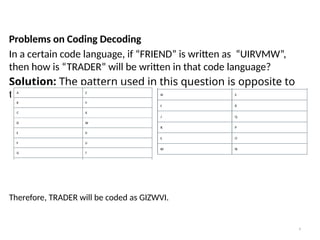
In a certain code language, if “FRIEND” is written as “UIRVMW”,
then how is “TRADER” will be written in that code language?
Solution: The pattern used in this question is opposite to
that letter such as
Therefore, TRADER will be coded as GIZWVI.
10
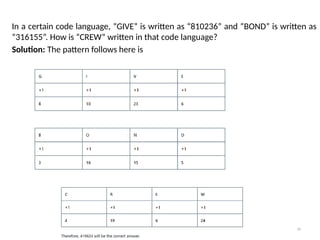
In a certain code language, “GIVE” is written as “810236” and “BOND” is written as
“316155”. How is “CREW” written in that code language?
Solution: The pattern follows here is
11
Problems on Seating Arrangement
Direction: Study the following information and answer the given questions.
Directions: Eight persons A, B, C, D, E, F, G and H are sitting in a line and an equal
number of persons are facing north and south direction. Not more than two
consecutive adjacent persons face in the same direction. Persons at extreme ends
face in the same direction.
A sits third to the right of D, who sits immediate right of H. H faces north direction.
Two people sit between A and E. D does not sit at the extreme end. B sits immediate
right of C and both face south direction. B and A are not adjacent to each other. G
does not face south.
If row-1 people sit in alphabetical order starting from the left end then who will face
S?
ACCREDITATION OF HIGHER EDUCATION INSTITUTIONS BY
NAAC
12
Solution:
1. D is facing the person who is sitting 2nd to the right of the person who
faces C.
2. B is sitting to the left of D.
3. P is sitting 2nd to the right of S.
4. Neither P nor S sit at any of the extreme ends of the row.
5. R sits second to the left of T.
6. T sits at one of the extreme ends but doesn’t face C.
7. E is not an immediate neighbor of D.
• Using statement 7, Case 1.B will be eliminated.
• A sits to the left of E.
• D will face S if persons of Row 1 are arranged according to alphabetical
order. So the correct answer is D.
13
Problems on Floor Puzzle
Question 1:
Direction: Study the following information carefully and answer the given question.
There are eight people A, B, C, D, E, F, G, and H sitting around a circular table facing
towards the centre (not necessarily in the same order). C is sitting second to the
right of G. E is sitting immediately to the left of A who is facing C. D is sitting
between A and G, B is sitting fourth to the left of G who is sitting immediately to the
left of H. Who is sitting fifth to the right of H?
• Solution: According to the statement:
1. C is sitting second to the right of G
2. A who is facing C.
3. E is sitting immediate left of A.
4. D is sitting between A and G.
5. G is immediate left of H.
6. B is sitting fourth to the left of G.
• So, A is sitting fifth to the right of H.
14
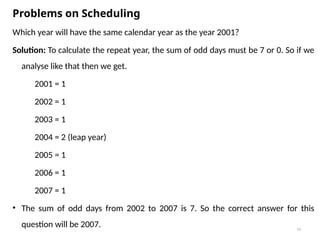
Problems on Scheduling
Which year will have the same calendar year as the year 2001?
Solution: To calculate the repeat year, the sum of odd days must be 7 or 0. So if we
analyse like that then we get.
2001 = 1
2002 = 1
2003 = 1
2004 = 2 (leap year)
2005 = 1
2006 = 1
2007 = 1
• The sum of odd days from 2002 to 2007 is 7. So the correct answer for this
question will be 2007.

Aptitude Training Module-2_Data Suffciency.pptx

  • 1.
    Department of CSE-Data Science 1 Module-2 Data sufficiency
  • 2.
    Data Sufficiency  DataSufficiency means candidates need to find whether the given data which is the statement(s) is/are sufficient to find the answer or not.  Data Sufficiency-type questions are designed to test the candidate's ability to relate given information to reach a conclusion.
  • 3.
    Types of DataSufficiency 1. Blood Relation  In this type of data sufficiency, relation between 2 people will be asked and candidates need to find the statement(s) in which data is sufficient to find the relation or the correct answer. 2. Order & Ranking  In this type of data sufficiency, data on order of people or their ranking will be provided and candidates will need to find statement(s) in which data is sufficient to find the correct answer. 3. Direction & Distance  In this type of data sufficiency, data on direction of people or points and the distance travelled by a person or distance between the points will be given and candidates will need to find the statement(s) in which data is sufficient to find the direction or distance between the points. 4. Coding Decoding • In this type of data sufficiency, words or letters will be coded and candidates will need to find the statement(s) in which data is sufficient to find the logic applied to decide the code.
  • 4.
    5. Seating Arrangement In this type of data sufficiency, data on arrangement of people will be provided and candidates will need to find the statement(s) in which data is sufficient to find the correct answer. Seating Arrangements are of two types such as Linear Arrangement and Circular Arrangement. In Linear Arrangement, people will be arranged or seated in one or multiple rows. In Circular Arrangement, people will be arranged or seated around a circular table. 6. Floor Puzzle • In this type of data sufficiency, data on people living on different floors of either same or different buildings will be given and candidates will need to find the statement(s) in which data is sufficient to find the correct answer. 7. Scheduling • In this type of data sufficiency, data based on months, years or date will be given and candidates need to decide whether the data provided in the statements is sufficient or not.
  • 5.
    5 How to SolveQuestion-Based on Data Sufficiency – Know all Tips and Tricks • Tip # 1: In Data Sufficiency, candidates only need to check whether the data provided is sufficient or not to find the answer. Therefore, do not waste time in finding the final answer. • Tip # 2: Data Sufficiency problems appear to be difficult at first because of the complicated directions, but once you get familiar with these directions, you will find these problems easy to solve. Never assume anything by yourself. • Tip # 3: Always read the question carefully and identify the specific information required to answer the question. Read the statements carefully and understand them and then finally analyze the statements and try to eliminate some answer choices. This will help you increase your chances of gaining points by guessing the answer.
  • 6.
    6 Problems on BloodRelation 1. Pointing to a lady, Rahul said “She is the wife of my mother’s father’s only grandchild”. How is that related to Rahul? a) Sister b) Aunt c) Wife d) None of the above • Solution: If we draw the family tree then we can clearly see that here Rahul’s mother’s father means Rahul’s grandfather. Rahul’s grandfather has only one grandchild who is a male as the lady is that person’s wife. So, the grandchild is Rahul himself and the lady should be the wife of Rahul. Therefore, the correct answer here would be “Wife”
  • 7.
    7 Problems on Order& Ranking In a row of students, John is 8th from the left end, and Mary is 12th from the right end. Calculate the total number of students in the row. A) 18 B) 19 C) 20 D) 21 Answer: C) 19 Explanation (using Tip #2): Total number of students = Rank from left + Rank from right - 1 Total number of students = 8 + 12 - 1 Total number of students = 19 • This means there are 19 students in the row.
  • 8.
    8 Problems on Direction& Distance 1. On evening at 4 PM, Seeta and Reema are sitting in a garden facing each other. If Reema’s shadow falls behind her, which direction is Seeta facing? Solution: If we draw directions according to the given information we get, In the evening the Sun is in the West. Hence, the shadow falls on the East. Since, Reema’s shadow falls behind her. It implies that Reema is facing the West side. As Seeta and Reema are facing each other, So Seeta will face East.
  • 9.
    9 Problems on CodingDecoding In a certain code language, if “FRIEND” is written as “UIRVMW”, then how is “TRADER” will be written in that code language? Solution: The pattern used in this question is opposite to that letter such as Therefore, TRADER will be coded as GIZWVI.
  • 10.
    10 In a certaincode language, “GIVE” is written as “810236” and “BOND” is written as “316155”. How is “CREW” written in that code language? Solution: The pattern follows here is
  • 11.
    11 Problems on SeatingArrangement Direction: Study the following information and answer the given questions. Directions: Eight persons A, B, C, D, E, F, G and H are sitting in a line and an equal number of persons are facing north and south direction. Not more than two consecutive adjacent persons face in the same direction. Persons at extreme ends face in the same direction. A sits third to the right of D, who sits immediate right of H. H faces north direction. Two people sit between A and E. D does not sit at the extreme end. B sits immediate right of C and both face south direction. B and A are not adjacent to each other. G does not face south. If row-1 people sit in alphabetical order starting from the left end then who will face S?
  • 12.
    ACCREDITATION OF HIGHEREDUCATION INSTITUTIONS BY NAAC 12 Solution: 1. D is facing the person who is sitting 2nd to the right of the person who faces C. 2. B is sitting to the left of D. 3. P is sitting 2nd to the right of S. 4. Neither P nor S sit at any of the extreme ends of the row. 5. R sits second to the left of T. 6. T sits at one of the extreme ends but doesn’t face C. 7. E is not an immediate neighbor of D. • Using statement 7, Case 1.B will be eliminated. • A sits to the left of E. • D will face S if persons of Row 1 are arranged according to alphabetical order. So the correct answer is D.
  • 13.
    13 Problems on FloorPuzzle Question 1: Direction: Study the following information carefully and answer the given question. There are eight people A, B, C, D, E, F, G, and H sitting around a circular table facing towards the centre (not necessarily in the same order). C is sitting second to the right of G. E is sitting immediately to the left of A who is facing C. D is sitting between A and G, B is sitting fourth to the left of G who is sitting immediately to the left of H. Who is sitting fifth to the right of H? • Solution: According to the statement: 1. C is sitting second to the right of G 2. A who is facing C. 3. E is sitting immediate left of A. 4. D is sitting between A and G. 5. G is immediate left of H. 6. B is sitting fourth to the left of G. • So, A is sitting fifth to the right of H.
  • 14.
    14 Problems on Scheduling Whichyear will have the same calendar year as the year 2001? Solution: To calculate the repeat year, the sum of odd days must be 7 or 0. So if we analyse like that then we get. 2001 = 1 2002 = 1 2003 = 1 2004 = 2 (leap year) 2005 = 1 2006 = 1 2007 = 1 • The sum of odd days from 2002 to 2007 is 7. So the correct answer for this question will be 2007.