Approach to connective
tissue disorders
DR.RAJKUMAR PANJALA
DNB FINAL YEAR RESIDENT
• Rheumatology is a strongly clinical discipline that
mainly depends on pattern recognition .
• Primary symptoms:
• Pain
• Joint stiffness
• Swelling
• Limitation of motion
• Weakness
• Fatigue
• Loss of function
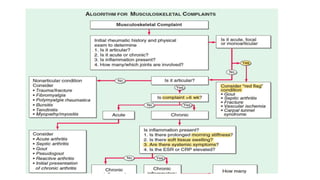
• Initial rheumatic history and physical examination to determine
1.is it articular?
2.is it acute or chronic ?
3.is inflammation is present ?
4.how many /which joint are involved ?
• Key question to approach the disease.
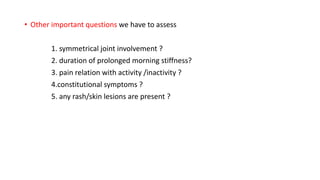
• Other important questions we have to assess
1. symmetrical joint involvement ?
2. duration of prolonged morning stiffness?
3. pain relation with activity /inactivity ?
4.constitutional symptoms ?
5. any rash/skin lesions are present ?
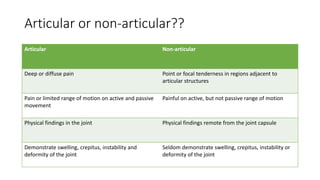
Articular or non-articular??
Articular Non-articular
Deep or diffuse pain Point or focal tenderness in regions adjacent to
articular structures
Pain or limited range of motion on active and passive
movement
Painful on active, but not passive range of motion
Physical findings in the joint Physical findings remote from the joint capsule
Demonstrate swelling, crepitus, instability and
deformity of the joint
Seldom demonstrate swelling, crepitus, instability or
deformity of the joint
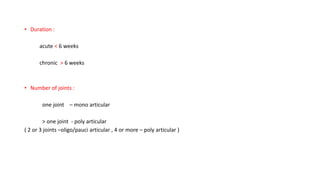
• Duration :
acute < 6 weeks
chronic > 6 weeks
• Number of joints :
one joint – mono articular
> one joint - poly articular
( 2 or 3 joints –oligo/pauci articular , 4 or more – poly articular )
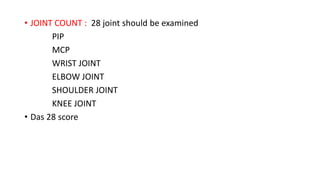
• JOINT COUNT : 28 joint should be examined
PIP
MCP
WRIST JOINT
ELBOW JOINT
SHOULDER JOINT
KNEE JOINT
• Das 28 score
• Inflammation of joints :
1. acute inflammation : clinical features
‘red ,hot ,tender ,swollen ,loss of function “
true in acute inflammatory arthritis
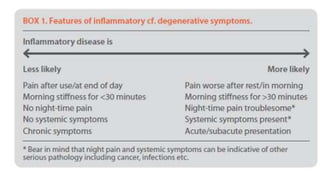
2. chronic inflammation :
mainly by -clinical history ( 60 to 80 % diagnostic information )
- 15 to 30 % physical exam
- 5 to 15% investigations
inactivity worsens the symptoms ( Early morning stiffness)
activity improves the symptoms (gentle exercises )
Inflammation…..
• Joint examinations: warm, soft swelling ,tender on pressure
• Investigations : markers of inflammation
increased – ESR,CRP, Platelet count ,serum globulins ,ALP
decreased - Hb , serum albumin
Polyarthritis :
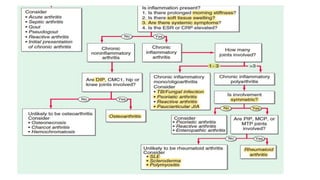
• chronic inflammatory –
RA
mimics of RA ( SLE ,SJOGRENS , GPA , SARCOIDOSIS ,
Scleroderma )
• Chronic non inflammatory –
osteoarthritis
hemophilic joint .
• Acute inflammatory polyarthritis –
• post viral- parvovirus B19, rubella, hepatitis A,B,C, HIV, Chikungunya
• infective endocarditis
• RA fever
• Bacterial- gonococci / meningococci/ Chlamydia
Monoarthritis :
• Chronic inflammatory :
SpA
Infections
• Chronic non inflammatory :
hemophilic joint
• Acute inflammatory :
gout
pseudo gout
TB
Septic arthritis
acute arthritis
• Acute non inflammatory : hemophilic joint
Patterns of inflammatory arthritis :
1. only peripheral arthritis :
both upper and lower segment of body affected
a. symmetrical : RA , mimics of RA
b. asymmetrical : SpA , occasional peripheral SpA
2. primarily below waist asymmetrical large joint arthritis :
peripheral SpA
3. mainly spinal diseases with or without peripheral arthritis :
axial SpA
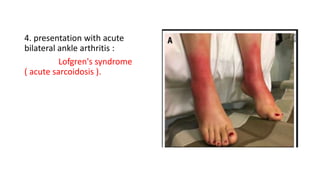
4. presentation with acute
bilateral ankle arthritis :
Lofgren's syndrome
( acute sarcoidosis ).
• Inflammations in the joint :
1.immunoinflammation
2.crystals
3.septic arthritis
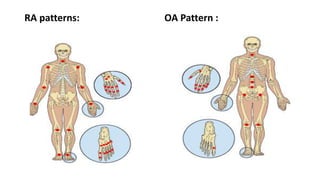
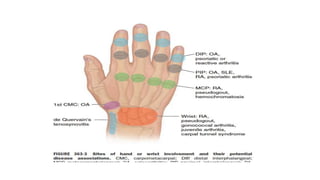
RA patterns: OA Pattern :
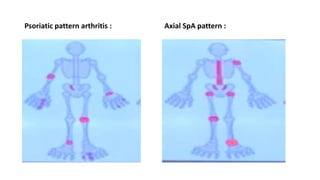
Psoriatic pattern arthritis : Axial SpA pattern :
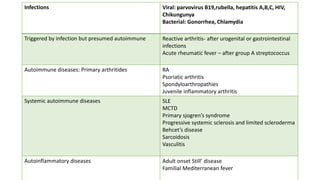
Infections Viral: parvovirus B19,rubella, hepatitis A,B,C, HIV,
Chikungunya
Bacterial: Gonorrhea, Chlamydia
Triggered by infection but presumed autoimmune Reactive arthritis- after urogenital or gastrointestinal
infections
Acute rheumatic fever – after group A streptococcus
Autoimmune diseases: Primary arthritides RA
Psoriatic arthritis
Spondyloarthropathies
Juvenile inflammatory arthritis
Systemic autoimmune diseases SLE
MCTD
Primary sjogren’s syndrome
Progressive systemic sclerosis and limited scleroderma
Behcet’s disease
Sarcoidosis
Vasculitis
Autoinflammatory diseases Adult onset Still’ disease
Familial Mediterranean fever
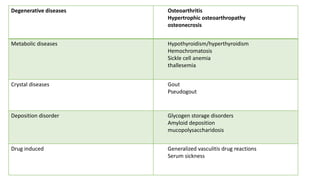
Degenerative diseases Osteoarthritis
Hypertrophic osteoarthropathy
osteonecrosis
Metabolic diseases Hypothyroidism/hyperthyroidism
Hemochromatosis
Sickle cell anemia
thallesemia
Crystal diseases Gout
Pseudogout
Deposition disorder Glycogen storage disorders
Amyloid deposition
mucopolysaccharidosis
Drug induced Generalized vasculitis drug reactions
Serum sickness
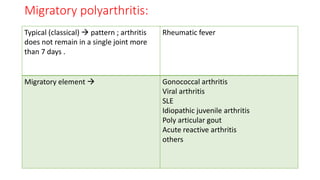
Migratory polyarthritis:
Typical (classical)  pattern ; arthritis
does not remain in a single joint more
than 7 days .
Rheumatic fever
Migratory element  Gonococcal arthritis
Viral arthritis
SLE
Idiopathic juvenile arthritis
Poly articular gout
Acute reactive arthritis
others
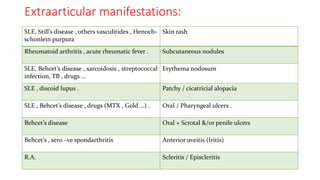
SLE, Still’s disease , others vasculitides , Henoch-
schonlein purpura
Skin rash
Rheumatoid arthritis , acute rheumatic fever . Subcutaneous nodules
SLE, Behcet’s disease , sarcoidosis , streptococcal
infection, TB , drugs …
Erythema nodosum
SLE , discoid lupus . Patchy / cicatricial alopacia
SLE , Behcet’s disease , drugs (MTX , Gold …) . Oral / Pharyngeal ulcers .
Behcet’s disease Oral + Scrotal &/or penile ulcers
Behcet’s , sero –ve spondarthritis Anterior uveitis (Iritis)
R.A. Scleritis / Episcleritis
Extraarticular manifestations:
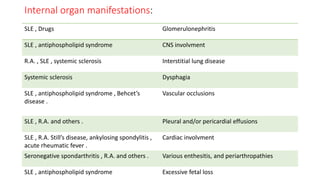
Internal organ manifestations:
SLE , Drugs Glomerulonephritis
SLE , antiphospholipid syndrome CNS involvment
R.A. , SLE , systemic sclerosis Interstitial lung disease
Systemic sclerosis Dysphagia
SLE , antiphospholipid syndrome , Behcet’s
disease .
Vascular occlusions
SLE , R.A. and others . Pleural and/or pericardial effusions
SLE , R.A. Still’s disease, ankylosing spondylitis ,
acute rheumatic fever .
Cardiac involvment
Seronegative spondarthritis , R.A. and others . Various enthesitis, and periarthropathies
SLE , antiphospholipid syndrome Excessive fetal loss
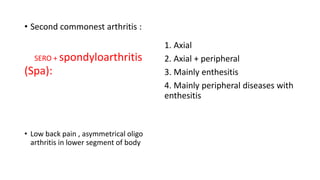
• Second commonest arthritis :
SERO + spondyloarthritis
(Spa):
• Low back pain , asymmetrical oligo
arthritis in lower segment of body
1. Axial
2. Axial + peripheral
3. Mainly enthesitis
4. Mainly peripheral diseases with
enthesitis
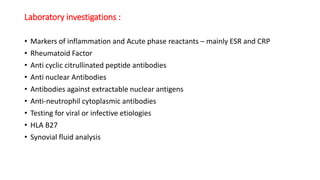
Laboratory investigations :
• Markers of inflammation and Acute phase reactants – mainly ESR and CRP
• Rheumatoid Factor
• Anti cyclic citrullinated peptide antibodies
• Anti nuclear Antibodies
• Antibodies against extractable nuclear antigens
• Anti-neutrophil cytoplasmic antibodies
• Testing for viral or infective etiologies
• HLA B27
• Synovial fluid analysis
Diagnostic lab test??
None
• Laboratory tests need to be interpreted in the proper clinical context
keeping in mind pre-test probability of the disease and work in a
“probabilistic” process of diagnosis.
ESR
• Recommended technique- Westergren technique by International Committee for
Standardization in Hematology
• Upper limits of Normal- 15 mm/hr for males and 20 mm/hr for females
• Upper limit of normal ESR:
In men: Age in years/2
In women: 10 plus age in years/2
Does elevated ESR equal inflammation?
NO
• ESR is influenced by several factors
• Plasma proteins like fibrinogen- Pregnancy, diabetes, end stage renal disease,
heart disease have elevated ESR
• RBC factors- microcytosis, polycythemia and abnormally shaped RBCs lower
ESR
• Elevated in Obesity
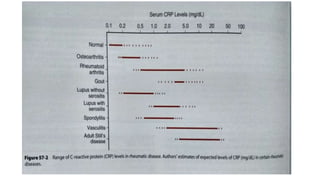
C-Reactive protein
• Identified first in 1930 as a protein that could bind C polysaccharide of
streptococcus pneumoniae cell wall
• After acute inflammatory stimulus ,concentrations increase rapidly and peak at 2
to 3 days at levels that reflect extent of tissue injury
• Most healthy adults have levels less than 0.3 mg/dl
• Techniques available- immunoassays and laser nephelometry
• Marked Elevation of CRP ( >10mg/dl)
• Acute bacterial infection
• Major trauma
• Systemic vasculitis
• Moderate elevation ( 1 to 10 mg/dl)
• Myocardia infarction
• Malignancies
• Pancreatitis
• Mucosal infections
• Most systemic autoimmune diseases
• Rheumatoid arthritis
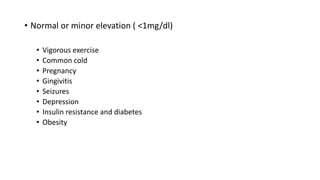
• Normal or minor elevation ( <1mg/dl)
• Vigorous exercise
• Common cold
• Pregnancy
• Gingivitis
• Seizures
• Depression
• Insulin resistance and diabetes
• Obesity
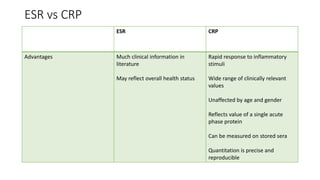
ESR vs CRP
ESR CRP
Advantages Much clinical information in
literature
May reflect overall health status
Rapid response to inflammatory
stimuli
Wide range of clinically relevant
values
Unaffected by age and gender
Reflects value of a single acute
phase protein
Can be measured on stored sera
Quantitation is precise and
reproducible
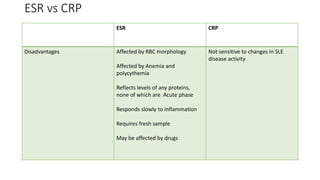
ESR vs CRP
ESR CRP
Disadvantages Affected by RBC morphology
Affected by Anemia and
polycythemia
Reflects levels of any proteins,
none of which are Acute phase
Responds slowly to inflammation
Requires fresh sample
May be affected by drugs
Not sensitive to changes in SLE
disease activity
Rheumatoid factor:
• Autoantibodies that recognize Fc portion of IgG
• Earliest assays ( Rose- Waaler agglutination test) were developed in 1940s
• May be positive in up to 1% of normal young adults and up to 5% of those more
than 70 years of age
• Sensitivity and specificity range from 50%-90%
• PRETEST PROBABILITY OF RA IS VERY IMPORTANT IN INTERPRETING RF
POSITIVITY.
• Methodologies
• Radio-immunoassays
• ELISA
• Nephelometry
• Reference range – less than 15 IU/mL or less than 1:16
• High titres indicate severe disease
Does RF positive means Rheumatoid
Arthritis?
NO
Other causes of RF positivity
• Normal individuals
• SLE
• Polymyositis
• Tuberculosis
• Syphilis
• Viral hepatitis
• Infectious mononucleosis
• Influenza
Anti-cyclic citrullinated peptide antibodies
• Citrulllinated Proteins are now considered to be at the core of pathogenesis in RA
• Most assays use Filaggerin as the antigen
• Anti CCP 3rd generation assays have sensitivity of 82.9% and specificity of 93-
94%
• CCP is basically a lab construct to detect Anti citrullinated Protein antibodies
Anti-cyclic citrullinated protein antibodies…
• Aim to detect antibodies against a multiplicity of citrullinated proteins considered
to be targets involved in pathogenesis of RA
• ACPAs are slightly more sensitive as compared to Anti- CCPs being positive in
approx 10% of Anti- CCP negative patients.
• May be detected in preclinical RA
Clinical relevance of anti-CCP/CPA
• High specificity for RA
• Predictor for development of RA
• More than 90% patients of undifferentiated arthritis with Anti-CCP positive
develop RA within 3 years
• Predict more severe and disease course
• Associated with RA- related ILD and cardiovascular disease
Which test to order RF or Anti CCP?
BOTH
• Combined testing for RF and Anti- CCP is the current standard-
specificity reaches 100% however sensitivity may be lowered
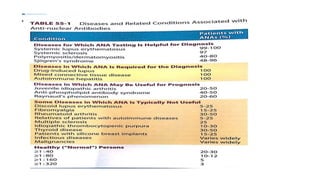
Anti-Nuclear Antibodies
• Wide diversity of autoantibodies directed against multiple intra-cellular antigens
consisting of nuclear specificities such as DNA or small nuclear RNPs
• First described in 1948
• Evolved from clinical pathologic observations to be tools in the study of cellular
biochemical processes
Which method to use?
• Immunofluorescence is the Gold standard
• ELISA has lower accuracy
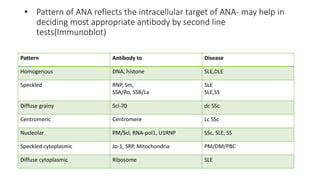
• Pattern of ANA reflects the intracellular target of ANA- may help in
deciding most appropriate antibody by second line
tests(Immunoblot)
Pattern Antibody to Disease
Homogenous DNA, histone SLE,DLE
Speckled RNP, Sm,
SSA/Ro, SSB/La
SLE
SLE,SS
Diffuse grainy Scl-70 dc SSc
Centromeric Centromere Lc SSc
Nucleolar PM/Scl, RNA-pol1, U1RNP SSc, SLE, SS
Speckled cytoplasmic Jo-1, SRP, Mitochondria PM/DM/PBC
Diffuse cytoplasmic Ribosome SLE
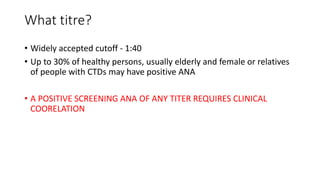
What titre?
• Widely accepted cutoff - 1:40
• Up to 30% of healthy persons, usually elderly and female or relatives
of people with CTDs may have positive ANA
• A POSITIVE SCREENING ANA OF ANY TITER REQUIRES CLINICAL
COORELATION
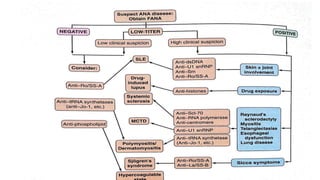
What after ANA is positive and significant??
• Test for Anti-extractable nuclear antigen antibodies depending on
clinical scenario
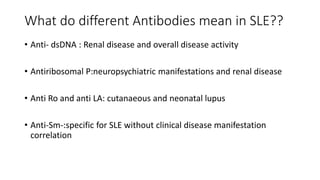
What do different Antibodies mean in SLE??
• Anti- dsDNA : Renal disease and overall disease activity
• Antiribosomal P:neuropsychiatric manifestations and renal disease
• Anti Ro and anti LA: cutanaeous and neonatal lupus
• Anti-Sm-:specific for SLE without clinical disease manifestation
correlation
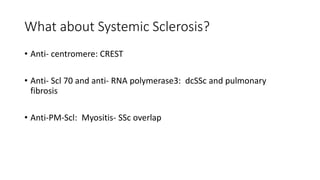
What about Systemic Sclerosis?
• Anti- centromere: CREST
• Anti- Scl 70 and anti- RNA polymerase3: dcSSc and pulmonary
fibrosis
• Anti-PM-Scl: Myositis- SSc overlap
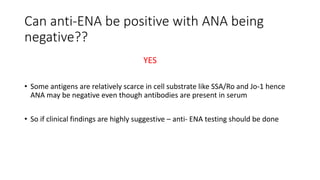
Can anti-ENA be positive with ANA being
negative??
YES
• Some antigens are relatively scarce in cell substrate like SSA/Ro and Jo-1 hence
ANA may be negative even though antibodies are present in serum
• So if clinical findings are highly suggestive – anti- ENA testing should be done
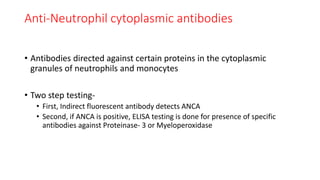
Anti-Neutrophil cytoplasmic antibodies
• Antibodies directed against certain proteins in the cytoplasmic
granules of neutrophils and monocytes
• Two step testing-
• First, Indirect fluorescent antibody detects ANCA
• Second, if ANCA is positive, ELISA testing is done for presence of specific
antibodies against Proteinase- 3 or Myeloperoxidase
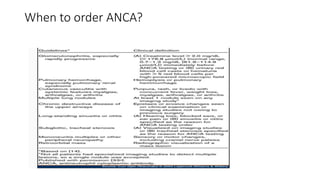
When to order ANCA?
C- ANCA
• diffuse,granular cytoplasmic staining pattern observed by
immunofluorescence microscopy.
• Proteinase-3 is the major c-ANCA
• Reference range: Absent or titer less than 1:120
How to Interpret c-ANCA?
• In proper clinical context, c-ANCA is 98% sensitive and specific for
Granulomatosis with polyangiitis
• In patients with limited disease, with atypical presentation- sensitivity
drops to 60%
• In patients with positive c-ANCA- level of titer elevation DOES NOT
indicate activity of disease
P- ANCA
• Localized perinuclear or nuclear staining pattern
• Major target antigen is Myeloperoxidase
• Other targets like elastase, cathepsin G, Lactoferrin etc are not
convincingly associated with vasculitis
What does positive p-ANCA mean?
• p-ANCA pattern on immunoflorescent microscopy is always followed
by ELISA for antibodies against myeloperoxidase as other antigens can
give p-ANCA positive but are not clinically significant
• Anti-myeloperoxidase antibodies are positive in 75% of patients with
Microscopic polyangiitis and 48% of those with eosinophilic
granulomatosis with polyangiitis
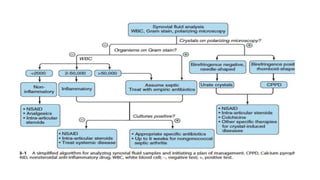
Synovial fluid analysis
• Useful mainly in ACUTE MONOARTHRITIS
• Synovial biopsy may be useful in PERSISTENT MONOARTHRITIS
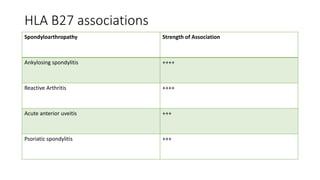
HLA B27
• Associated with spondylo-arthropathies
• HLA B27positive itself does not mean disease Can be positive in up
to 7 % of general healthy population
• Present with higher frequency in associated conditions, up to 50-90%
prevalence
HLA B27 associations
Spondyloarthropathy Strength of Association
Ankylosing spondylitis ++++
Reactive Arthritis ++++
Acute anterior uveitis +++
Psoriatic spondylitis +++
Use of imaging
• Modalities available
• Radiography
• Ultrasonography
• CT scanning
• MRI
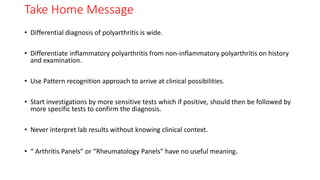
Take Home Message
• Differential diagnosis of polyarthritis is wide.
• Differentiate inflammatory polyarthritis from non-inflammatory polyarthritis on history
and examination.
• Use Pattern recognition approach to arrive at clinical possibilities.
• Start investigations by more sensitive tests which if positive, should then be followed by
more specific tests to confirm the diagnosis.
• Never interpret lab results without knowing clinical context.
• “ Arthritis Panels” or “Rheumatology Panels” have no useful meaning.
THANK YOU

Approach to connective tissue disorders .pptx

  • 1.
    Approach to connective tissuedisorders DR.RAJKUMAR PANJALA DNB FINAL YEAR RESIDENT
  • 2.
    • Rheumatology isa strongly clinical discipline that mainly depends on pattern recognition .
  • 3.
    • Primary symptoms: •Pain • Joint stiffness • Swelling • Limitation of motion • Weakness • Fatigue • Loss of function
  • 4.
    • Initial rheumatichistory and physical examination to determine 1.is it articular? 2.is it acute or chronic ? 3.is inflammation is present ? 4.how many /which joint are involved ? • Key question to approach the disease.
  • 5.
    • Other importantquestions we have to assess 1. symmetrical joint involvement ? 2. duration of prolonged morning stiffness? 3. pain relation with activity /inactivity ? 4.constitutional symptoms ? 5. any rash/skin lesions are present ?
  • 6.
    Articular or non-articular?? ArticularNon-articular Deep or diffuse pain Point or focal tenderness in regions adjacent to articular structures Pain or limited range of motion on active and passive movement Painful on active, but not passive range of motion Physical findings in the joint Physical findings remote from the joint capsule Demonstrate swelling, crepitus, instability and deformity of the joint Seldom demonstrate swelling, crepitus, instability or deformity of the joint
  • 7.
    • Duration : acute< 6 weeks chronic > 6 weeks • Number of joints : one joint – mono articular > one joint - poly articular ( 2 or 3 joints –oligo/pauci articular , 4 or more – poly articular )
  • 8.
    • JOINT COUNT: 28 joint should be examined PIP MCP WRIST JOINT ELBOW JOINT SHOULDER JOINT KNEE JOINT • Das 28 score
  • 9.
    • Inflammation ofjoints : 1. acute inflammation : clinical features ‘red ,hot ,tender ,swollen ,loss of function “ true in acute inflammatory arthritis
  • 10.
    2. chronic inflammation: mainly by -clinical history ( 60 to 80 % diagnostic information ) - 15 to 30 % physical exam - 5 to 15% investigations inactivity worsens the symptoms ( Early morning stiffness) activity improves the symptoms (gentle exercises )
  • 12.
    Inflammation….. • Joint examinations:warm, soft swelling ,tender on pressure • Investigations : markers of inflammation increased – ESR,CRP, Platelet count ,serum globulins ,ALP decreased - Hb , serum albumin
  • 13.
    Polyarthritis : • chronicinflammatory – RA mimics of RA ( SLE ,SJOGRENS , GPA , SARCOIDOSIS , Scleroderma ) • Chronic non inflammatory – osteoarthritis hemophilic joint .
  • 14.
    • Acute inflammatorypolyarthritis – • post viral- parvovirus B19, rubella, hepatitis A,B,C, HIV, Chikungunya • infective endocarditis • RA fever • Bacterial- gonococci / meningococci/ Chlamydia
  • 15.
    Monoarthritis : • Chronicinflammatory : SpA Infections • Chronic non inflammatory : hemophilic joint • Acute inflammatory : gout pseudo gout TB Septic arthritis acute arthritis • Acute non inflammatory : hemophilic joint
  • 16.
    Patterns of inflammatoryarthritis : 1. only peripheral arthritis : both upper and lower segment of body affected a. symmetrical : RA , mimics of RA b. asymmetrical : SpA , occasional peripheral SpA 2. primarily below waist asymmetrical large joint arthritis : peripheral SpA 3. mainly spinal diseases with or without peripheral arthritis : axial SpA
  • 17.
    4. presentation withacute bilateral ankle arthritis : Lofgren's syndrome ( acute sarcoidosis ).
  • 18.
    • Inflammations inthe joint : 1.immunoinflammation 2.crystals 3.septic arthritis
  • 19.
    RA patterns: OAPattern :
  • 20.
    Psoriatic pattern arthritis: Axial SpA pattern :
  • 22.
    Infections Viral: parvovirusB19,rubella, hepatitis A,B,C, HIV, Chikungunya Bacterial: Gonorrhea, Chlamydia Triggered by infection but presumed autoimmune Reactive arthritis- after urogenital or gastrointestinal infections Acute rheumatic fever – after group A streptococcus Autoimmune diseases: Primary arthritides RA Psoriatic arthritis Spondyloarthropathies Juvenile inflammatory arthritis Systemic autoimmune diseases SLE MCTD Primary sjogren’s syndrome Progressive systemic sclerosis and limited scleroderma Behcet’s disease Sarcoidosis Vasculitis Autoinflammatory diseases Adult onset Still’ disease Familial Mediterranean fever
  • 23.
    Degenerative diseases Osteoarthritis Hypertrophicosteoarthropathy osteonecrosis Metabolic diseases Hypothyroidism/hyperthyroidism Hemochromatosis Sickle cell anemia thallesemia Crystal diseases Gout Pseudogout Deposition disorder Glycogen storage disorders Amyloid deposition mucopolysaccharidosis Drug induced Generalized vasculitis drug reactions Serum sickness
  • 25.
    Migratory polyarthritis: Typical (classical) pattern ; arthritis does not remain in a single joint more than 7 days . Rheumatic fever Migratory element  Gonococcal arthritis Viral arthritis SLE Idiopathic juvenile arthritis Poly articular gout Acute reactive arthritis others
  • 26.
    SLE, Still’s disease, others vasculitides , Henoch- schonlein purpura Skin rash Rheumatoid arthritis , acute rheumatic fever . Subcutaneous nodules SLE, Behcet’s disease , sarcoidosis , streptococcal infection, TB , drugs … Erythema nodosum SLE , discoid lupus . Patchy / cicatricial alopacia SLE , Behcet’s disease , drugs (MTX , Gold …) . Oral / Pharyngeal ulcers . Behcet’s disease Oral + Scrotal &/or penile ulcers Behcet’s , sero –ve spondarthritis Anterior uveitis (Iritis) R.A. Scleritis / Episcleritis Extraarticular manifestations:
  • 27.
    Internal organ manifestations: SLE, Drugs Glomerulonephritis SLE , antiphospholipid syndrome CNS involvment R.A. , SLE , systemic sclerosis Interstitial lung disease Systemic sclerosis Dysphagia SLE , antiphospholipid syndrome , Behcet’s disease . Vascular occlusions SLE , R.A. and others . Pleural and/or pericardial effusions SLE , R.A. Still’s disease, ankylosing spondylitis , acute rheumatic fever . Cardiac involvment Seronegative spondarthritis , R.A. and others . Various enthesitis, and periarthropathies SLE , antiphospholipid syndrome Excessive fetal loss
  • 28.
    • Second commonestarthritis : SERO + spondyloarthritis (Spa): • Low back pain , asymmetrical oligo arthritis in lower segment of body 1. Axial 2. Axial + peripheral 3. Mainly enthesitis 4. Mainly peripheral diseases with enthesitis
  • 31.
    Laboratory investigations : •Markers of inflammation and Acute phase reactants – mainly ESR and CRP • Rheumatoid Factor • Anti cyclic citrullinated peptide antibodies • Anti nuclear Antibodies • Antibodies against extractable nuclear antigens • Anti-neutrophil cytoplasmic antibodies • Testing for viral or infective etiologies • HLA B27 • Synovial fluid analysis
  • 32.
  • 33.
    • Laboratory testsneed to be interpreted in the proper clinical context keeping in mind pre-test probability of the disease and work in a “probabilistic” process of diagnosis.
  • 34.
    ESR • Recommended technique-Westergren technique by International Committee for Standardization in Hematology • Upper limits of Normal- 15 mm/hr for males and 20 mm/hr for females • Upper limit of normal ESR: In men: Age in years/2 In women: 10 plus age in years/2
  • 35.
    Does elevated ESRequal inflammation? NO
  • 36.
    • ESR isinfluenced by several factors • Plasma proteins like fibrinogen- Pregnancy, diabetes, end stage renal disease, heart disease have elevated ESR • RBC factors- microcytosis, polycythemia and abnormally shaped RBCs lower ESR • Elevated in Obesity
  • 37.
    C-Reactive protein • Identifiedfirst in 1930 as a protein that could bind C polysaccharide of streptococcus pneumoniae cell wall • After acute inflammatory stimulus ,concentrations increase rapidly and peak at 2 to 3 days at levels that reflect extent of tissue injury • Most healthy adults have levels less than 0.3 mg/dl • Techniques available- immunoassays and laser nephelometry
  • 38.
    • Marked Elevationof CRP ( >10mg/dl) • Acute bacterial infection • Major trauma • Systemic vasculitis
  • 39.
    • Moderate elevation( 1 to 10 mg/dl) • Myocardia infarction • Malignancies • Pancreatitis • Mucosal infections • Most systemic autoimmune diseases • Rheumatoid arthritis
  • 40.
    • Normal orminor elevation ( <1mg/dl) • Vigorous exercise • Common cold • Pregnancy • Gingivitis • Seizures • Depression • Insulin resistance and diabetes • Obesity
  • 42.
    ESR vs CRP ESRCRP Advantages Much clinical information in literature May reflect overall health status Rapid response to inflammatory stimuli Wide range of clinically relevant values Unaffected by age and gender Reflects value of a single acute phase protein Can be measured on stored sera Quantitation is precise and reproducible
  • 43.
    ESR vs CRP ESRCRP Disadvantages Affected by RBC morphology Affected by Anemia and polycythemia Reflects levels of any proteins, none of which are Acute phase Responds slowly to inflammation Requires fresh sample May be affected by drugs Not sensitive to changes in SLE disease activity
  • 44.
    Rheumatoid factor: • Autoantibodiesthat recognize Fc portion of IgG • Earliest assays ( Rose- Waaler agglutination test) were developed in 1940s • May be positive in up to 1% of normal young adults and up to 5% of those more than 70 years of age • Sensitivity and specificity range from 50%-90% • PRETEST PROBABILITY OF RA IS VERY IMPORTANT IN INTERPRETING RF POSITIVITY.
  • 45.
    • Methodologies • Radio-immunoassays •ELISA • Nephelometry • Reference range – less than 15 IU/mL or less than 1:16 • High titres indicate severe disease
  • 46.
    Does RF positivemeans Rheumatoid Arthritis? NO
  • 47.
    Other causes ofRF positivity • Normal individuals • SLE • Polymyositis • Tuberculosis • Syphilis • Viral hepatitis • Infectious mononucleosis • Influenza
  • 48.
    Anti-cyclic citrullinated peptideantibodies • Citrulllinated Proteins are now considered to be at the core of pathogenesis in RA • Most assays use Filaggerin as the antigen • Anti CCP 3rd generation assays have sensitivity of 82.9% and specificity of 93- 94% • CCP is basically a lab construct to detect Anti citrullinated Protein antibodies
  • 49.
    Anti-cyclic citrullinated proteinantibodies… • Aim to detect antibodies against a multiplicity of citrullinated proteins considered to be targets involved in pathogenesis of RA • ACPAs are slightly more sensitive as compared to Anti- CCPs being positive in approx 10% of Anti- CCP negative patients. • May be detected in preclinical RA
  • 50.
    Clinical relevance ofanti-CCP/CPA • High specificity for RA • Predictor for development of RA • More than 90% patients of undifferentiated arthritis with Anti-CCP positive develop RA within 3 years • Predict more severe and disease course • Associated with RA- related ILD and cardiovascular disease
  • 51.
    Which test toorder RF or Anti CCP? BOTH
  • 52.
    • Combined testingfor RF and Anti- CCP is the current standard- specificity reaches 100% however sensitivity may be lowered
  • 53.
    Anti-Nuclear Antibodies • Widediversity of autoantibodies directed against multiple intra-cellular antigens consisting of nuclear specificities such as DNA or small nuclear RNPs • First described in 1948 • Evolved from clinical pathologic observations to be tools in the study of cellular biochemical processes
  • 55.
    Which method touse? • Immunofluorescence is the Gold standard • ELISA has lower accuracy
  • 56.
    • Pattern ofANA reflects the intracellular target of ANA- may help in deciding most appropriate antibody by second line tests(Immunoblot) Pattern Antibody to Disease Homogenous DNA, histone SLE,DLE Speckled RNP, Sm, SSA/Ro, SSB/La SLE SLE,SS Diffuse grainy Scl-70 dc SSc Centromeric Centromere Lc SSc Nucleolar PM/Scl, RNA-pol1, U1RNP SSc, SLE, SS Speckled cytoplasmic Jo-1, SRP, Mitochondria PM/DM/PBC Diffuse cytoplasmic Ribosome SLE
  • 57.
    What titre? • Widelyaccepted cutoff - 1:40 • Up to 30% of healthy persons, usually elderly and female or relatives of people with CTDs may have positive ANA • A POSITIVE SCREENING ANA OF ANY TITER REQUIRES CLINICAL COORELATION
  • 58.
    What after ANAis positive and significant?? • Test for Anti-extractable nuclear antigen antibodies depending on clinical scenario
  • 60.
    What do differentAntibodies mean in SLE?? • Anti- dsDNA : Renal disease and overall disease activity • Antiribosomal P:neuropsychiatric manifestations and renal disease • Anti Ro and anti LA: cutanaeous and neonatal lupus • Anti-Sm-:specific for SLE without clinical disease manifestation correlation
  • 61.
    What about SystemicSclerosis? • Anti- centromere: CREST • Anti- Scl 70 and anti- RNA polymerase3: dcSSc and pulmonary fibrosis • Anti-PM-Scl: Myositis- SSc overlap
  • 62.
    Can anti-ENA bepositive with ANA being negative?? YES • Some antigens are relatively scarce in cell substrate like SSA/Ro and Jo-1 hence ANA may be negative even though antibodies are present in serum • So if clinical findings are highly suggestive – anti- ENA testing should be done
  • 63.
    Anti-Neutrophil cytoplasmic antibodies •Antibodies directed against certain proteins in the cytoplasmic granules of neutrophils and monocytes • Two step testing- • First, Indirect fluorescent antibody detects ANCA • Second, if ANCA is positive, ELISA testing is done for presence of specific antibodies against Proteinase- 3 or Myeloperoxidase
  • 64.
  • 65.
    C- ANCA • diffuse,granularcytoplasmic staining pattern observed by immunofluorescence microscopy. • Proteinase-3 is the major c-ANCA • Reference range: Absent or titer less than 1:120
  • 66.
    How to Interpretc-ANCA? • In proper clinical context, c-ANCA is 98% sensitive and specific for Granulomatosis with polyangiitis • In patients with limited disease, with atypical presentation- sensitivity drops to 60% • In patients with positive c-ANCA- level of titer elevation DOES NOT indicate activity of disease
  • 67.
    P- ANCA • Localizedperinuclear or nuclear staining pattern • Major target antigen is Myeloperoxidase • Other targets like elastase, cathepsin G, Lactoferrin etc are not convincingly associated with vasculitis
  • 68.
    What does positivep-ANCA mean? • p-ANCA pattern on immunoflorescent microscopy is always followed by ELISA for antibodies against myeloperoxidase as other antigens can give p-ANCA positive but are not clinically significant • Anti-myeloperoxidase antibodies are positive in 75% of patients with Microscopic polyangiitis and 48% of those with eosinophilic granulomatosis with polyangiitis
  • 69.
    Synovial fluid analysis •Useful mainly in ACUTE MONOARTHRITIS • Synovial biopsy may be useful in PERSISTENT MONOARTHRITIS
  • 71.
    HLA B27 • Associatedwith spondylo-arthropathies • HLA B27positive itself does not mean disease Can be positive in up to 7 % of general healthy population • Present with higher frequency in associated conditions, up to 50-90% prevalence
  • 72.
    HLA B27 associations SpondyloarthropathyStrength of Association Ankylosing spondylitis ++++ Reactive Arthritis ++++ Acute anterior uveitis +++ Psoriatic spondylitis +++
  • 73.
    Use of imaging •Modalities available • Radiography • Ultrasonography • CT scanning • MRI
  • 75.
    Take Home Message •Differential diagnosis of polyarthritis is wide. • Differentiate inflammatory polyarthritis from non-inflammatory polyarthritis on history and examination. • Use Pattern recognition approach to arrive at clinical possibilities. • Start investigations by more sensitive tests which if positive, should then be followed by more specific tests to confirm the diagnosis. • Never interpret lab results without knowing clinical context. • “ Arthritis Panels” or “Rheumatology Panels” have no useful meaning.
  • 76.