Decimal Numbers: BigIdeas
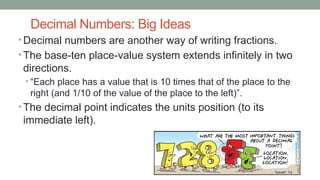
• Decimal numbers are another way of writing fractions.
• The base-ten place-value system extends infinitely in two
directions.
• “Each place has a value that is 10 times that of the place to the
right (and 1/10 of the value of the place to the left)”.
• The decimal point indicates the units position (to its
immediate left).
Meredith Mathematics and Science Institutes Summer 2015
3.
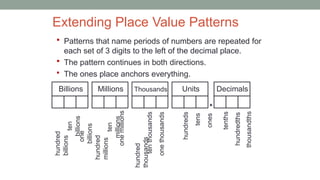
Patterns thatname periods of numbers are repeated for
each set of 3 digits to the left of the decimal place.
The pattern continues in both directions.
The ones place anchors everything.
Billions Millions Thousands Units Decimals
Extending Place Value Patterns
tenths
hundredths
thousandths
hundred
millions
one
millions
ten
millions
hundred
thousands
ten
thousands
one
thousands
hundreds
tens
ones
ten
billions
hundred
billions
one
billions
4.
Decimals Related toFractions
• Decimals and fractions should not be taught in
isolation from each other.
• Students can learn decimals as a natural extension of
what they understand about base ten and fractions.
• Develop understanding of how the base-ten system
extends to include numbers less than one.
• If children have a basic understanding of
fractions, then introducing decimals essentially
involves introducing a new notation for familiar
numbers.
Meredith Mathematics and Science Institutes Summer 2015
5.
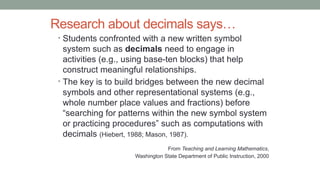
Research about decimalssays…
• Students confronted with a new written symbol
system such as decimals need to engage in
activities (e.g., using base-ten blocks) that help
construct meaningful relationships.
• The key is to build bridges between the new decimal
symbols and other representational systems (e.g.,
whole number place values and fractions) before
“searching for patterns within the new symbol system
or practicing procedures” such as computations with
decimals (Hiebert, 1988; Mason, 1987).
From Teaching and Learning Mathematics,
Washington State Department of Public Instruction, 2000
Meredith Mathematics and Science Institutes Summer 2015
6.
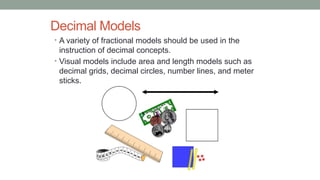
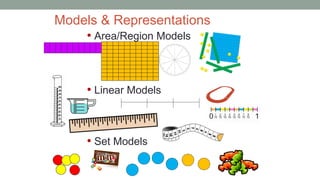
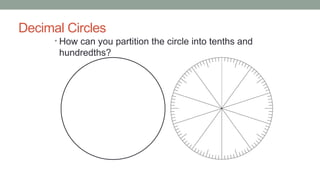
Decimal Models
• Avariety of fractional models should be used in the
instruction of decimal concepts.
• Visual models include area and length models such as
decimal grids, decimal circles, number lines, and meter
sticks.
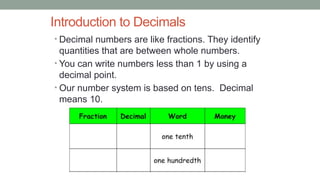
Introduction to Decimals
•Decimal numbers are like fractions. They identify
quantities that are between whole numbers.
• You can write numbers less than 1 by using a
decimal point.
• Our number system is based on tens. Decimal
means 10.
11.
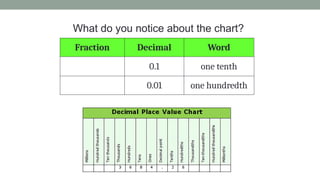
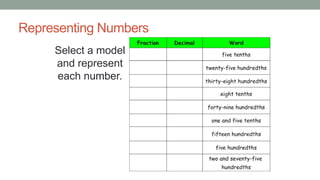
What do younotice about the chart?
Fraction Decimal Word
0.1 one tenth
0.01 one hundredth
12.
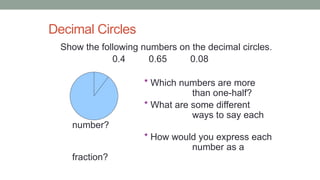
Decimal Circles
Show thefollowing numbers on the decimal circles.
0.4 0.65 0.08
* Which numbers are more
than one-half?
* What are some different
ways to say each
number?
* How would you express each
number as a
fraction?
13.
Decimal Circles
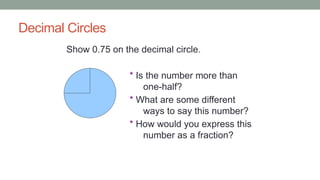
Show 0.75on the decimal circle.
* Is the number more than
one-half?
* What are some different
ways to say this number?
* How would you express this
number as a fraction?
14.
Decimal Circles
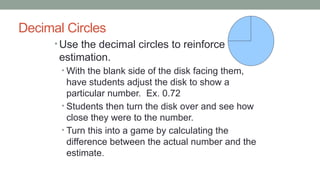
• Usethe decimal circles to reinforce
estimation.
• With the blank side of the disk facing them,
have students adjust the disk to show a
particular number. Ex. 0.72
• Students then turn the disk over and see how
close they were to the number.
• Turn this into a game by calculating the
difference between the actual number and the
estimate.
Decimal Grids/Squares
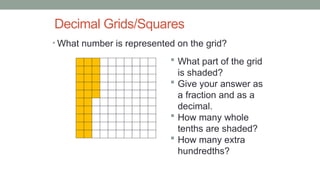
• Whatnumber is represented on the grid?
What part of the grid
is shaded?
Give your answer as
a fraction and as a
decimal.
How many whole
tenths are shaded?
How many extra
hundredths?
17.
Decimal Grids/Squares
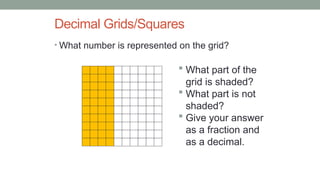
• Whatnumber is represented on the grid?
What part of the
grid is shaded?
What part is not
shaded?
Give your answer
as a fraction and
as a decimal.
18.
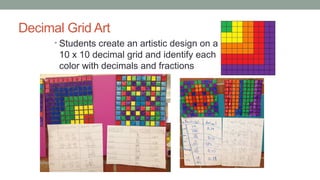
Decimal Grid Art
•Students create an artistic design on a
10 x 10 decimal grid and identify each
color with decimals and fractions
19.
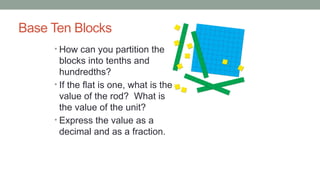
Base Ten Blocks
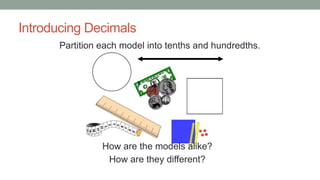
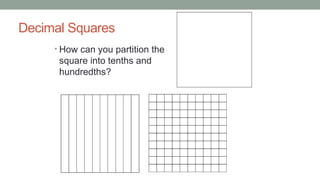
•How can you partition the
blocks into tenths and
hundredths?
• If the flat is one, what is the
value of the rod? What is
the value of the unit?
• Express the value as a
decimal and as a fraction.
20.
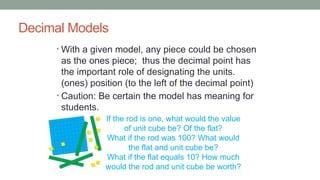
Decimal Models
• Witha given model, any piece could be chosen
as the ones piece; thus the decimal point has
the important role of designating the units.
(ones) position (to the left of the decimal point)
• Caution: Be certain the model has meaning for
students.
If the rod is one, what would the value
of unit cube be? Of the flat?
What if the rod was 100? What would
the flat and unit cube be?
What if the flat equals 10? How much
would the rod and unit cube be worth?
21.
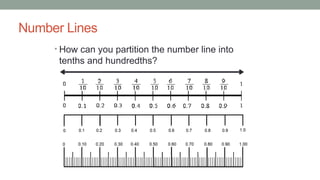
Number Lines
• Howcan you partition the number line into
tenths and hundredths?
22.
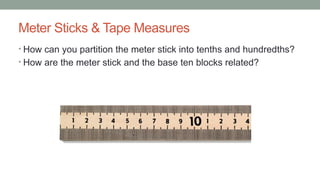
Meter Sticks &Tape Measures
• How can you partition the meter stick into tenths and hundredths?
• How are the meter stick and the base ten blocks related?
23.
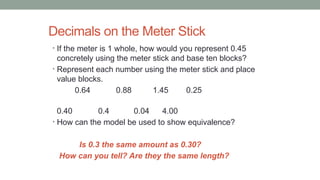
Decimals on theMeter Stick
• If the meter is 1 whole, how would you represent 0.45
concretely using the meter stick and base ten blocks?
• Represent each number using the meter stick and place
value blocks.
0.64 0.88 1.45 0.25
0.40 0.4 0.04 4.00
• How can the model be used to show equivalence?
Is 0.3 the same amount as 0.30?
How can you tell? Are they the same length?
24.
Money as aModel
While money can be written in decimal notation, and children can
relate decimal numbers to their understanding of money, it is not
recommended as a model, but as an application.
Why do you think this is the case?
How can we use money as an application for decimals?
Representing Numbers withTenth Strings
• Give each student a meter stick and a piece of
string that is exactly a meter in length. Have them
mark off each tenth using a sharpie. They can
also mark the hundredths for the first tenth.
• Ask students to use the string to place their finger
on various numbers. Ex. Mark .95 of a meter.
Mark .32, .5, .81, etc.
• Use this activity to reinforce decimal numbers
are part of a whole, strengthen
estimation skills, and compare
decimals.
27.
Decimals in theReal World
In what real world situations
do we use decimals?
Complete a decimal hunt to find examples of
where decimals are used in the world.
Decimal Experiences
Bring decimalsinto the students’ world by:
Time:
• Use stop watches to help students understand decimal
numbers less than one second. Have students try to start
and stop the stopwatch as fast as they can. Write
numbers on board and compare.
• Have students run short distances outside and compare
times on the board. How do the decimal numbers help?
What do they mean?
Distance:
• Have students try to hit a target and measure within a
tenth of a meter to see who was closest. You may have to
measure to the nearest hundredth to break ties. (Targets
can be hula hoops or pieces of paper. Objects can be
bean bags tossed, Frisbees thrown, golf balls putted, etc.)
30.
Fraction/Decimal Connection
Decimals allowus to represent
fractional quantities using our
base ten number system.
Tasks and multiple representations help
students connect fractions and decimals and
see how they represent the same concepts.
31.
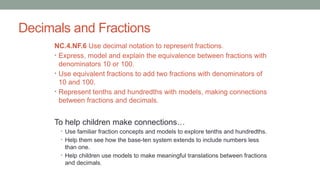
Decimals and Fractions
NC.4.NF.6Use decimal notation to represent fractions.
• Express, model and explain the equivalence between fractions with
denominators 10 or 100.
• Use equivalent fractions to add two fractions with denominators of
10 and 100.
• Represent tenths and hundredths with models, making connections
between fractions and decimals.
To help children make connections…
• Use familiar fraction concepts and models to explore tenths and hundredths.
• Help them see how the base-ten system extends to include numbers less
than one.
• Help children use models to make meaningful translations between fractions
and decimals.
32.
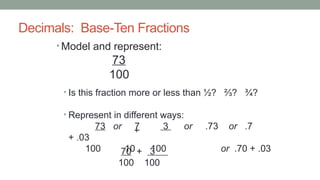
Decimals: Base-Ten Fractions
•Model and represent:
73
100
• Is this fraction more or less than ½? ⅔? ¾?
• Represent in different ways:
73 or 7 3 or .73 or .7
+ .03
100 10 100 or .70 + .03
+
70 + 3
100 100
33.
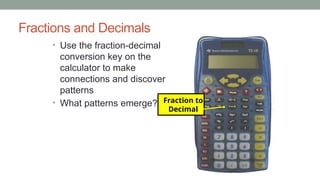
Fractions and Decimals
•Use the fraction-decimal
conversion key on the
calculator to make
connections and discover
patterns
• What patterns emerge? Fraction to
Decimal
34.
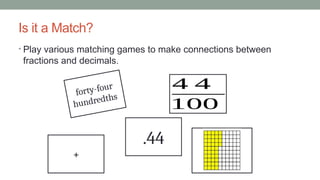
Is it aMatch?
• Play various matching games to make connections between
fractions and decimals.
forty-four
hundredths
.44
4 4
100
+
35.
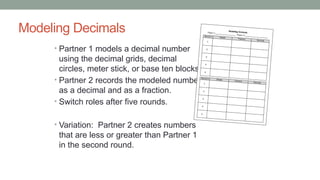
Modeling Decimals
• Partner1 models a decimal number
using the decimal grids, decimal
circles, meter stick, or base ten blocks.
• Partner 2 records the modeled number
as a decimal and as a fraction.
• Switch roles after five rounds.
• Variation: Partner 2 creates numbers
that are less or greater than Partner 1
in the second round.
36.
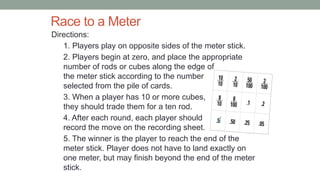
Race to aMeter
Directions:
1. Players play on opposite sides of the meter stick.
2. Players begin at zero, and place the appropriate
number of rods or cubes along the edge of
the meter stick according to the number
selected from the pile of cards.
3. When a player has 10 or more cubes,
they should trade them for a ten rod.
4. After each round, each player should
record the move on the recording sheet.
5. The winner is the player to reach the end of the
meter stick. Player does not have to land exactly on
one meter, but may finish beyond the end of the meter
stick.
37.
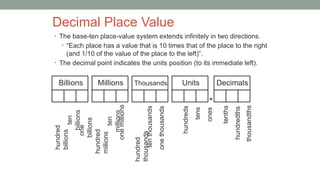
• The base-tenplace-value system extends infinitely in two directions.
• “Each place has a value that is 10 times that of the place to the right
(and 1/10 of the value of the place to the left)”.
• The decimal point indicates the units position (to its immediate left).
Billions Millions Thousands Units Decimals
tenths
hundredths
thousandths
hundred
millions
one
millions
ten
millions
hundred
thousands
ten
thousands
one
thousands
hundreds
tens
ones
Decimal Place Value
ten
billions
hundred
billions
one
billions
38.
Decimal Place Value
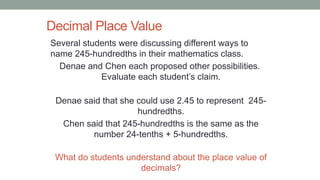
Severalstudents were discussing different ways to
name 245-hundredths in their mathematics class.
Denae and Chen each proposed other possibilities.
Evaluate each student’s claim.
Denae said that she could use 2.45 to represent 245-
hundredths.
Chen said that 245-hundredths is the same as the
number 24-tenths + 5-hundredths.
What do students understand about the place value of
decimals?
39.
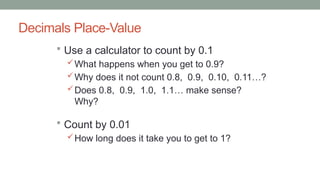
Decimals Place-Value
Usea calculator to count by 0.1
What happens when you get to 0.9?
Why does it not count 0.8, 0.9, 0.10, 0.11…?
Does 0.8, 0.9, 1.0, 1.1… make sense?
Why?
Count by 0.01
How long does it take you to get to 1?
40.
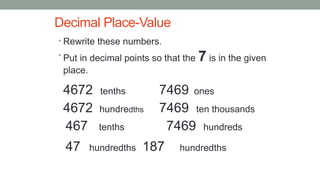
Decimal Place-Value
• Rewritethese numbers.
• Put in decimal points so that the 7 is in the given
place.
4672 tenths 7469 ones
4672 hundredths 7469 ten thousands
467 tenths 7469 hundreds
47 hundredths 187 hundredths
41.
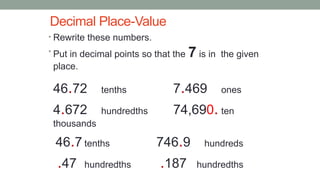
Decimal Place-Value
• Rewritethese numbers.
• Put in decimal points so that the 7 is in the given
place.
46.72 tenths 7.469 ones
4.672 hundredths 74,690. ten
thousands
46.7 tenths 746.9 hundreds
.47 hundredths .187 hundredths
42.
Decimal Place-Value
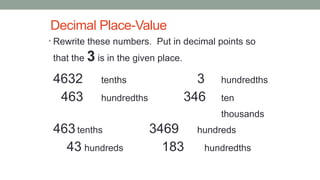
• Rewritethese numbers. Put in decimal points so
that the 3 is in the given place.
4632 tenths 3 hundredths
463 hundredths 346 ten
thousands
463tenths 3469 hundreds
43 hundreds 183 hundredths
43.
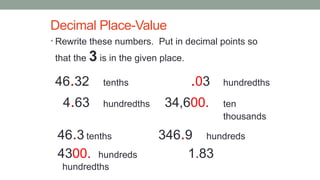
Decimal Place-Value
• Rewritethese numbers. Put in decimal points so
that the 3 is in the given place.
46.32 tenths .03 hundredths
4.63 hundredths 34,600. ten
thousands
46.3 tenths 346.9 hundreds
4300. hundreds 1.83
hundredths
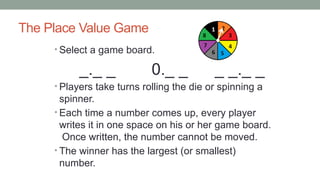
The Place ValueGame
• Select a game board.
_._ _ 0._ _ _ _._ _
• Players take turns rolling the die or spinning a
spinner.
• Each time a number comes up, every player
writes it in one space on his or her game board.
Once written, the number cannot be moved.
• The winner has the largest (or smallest)
number.
46.
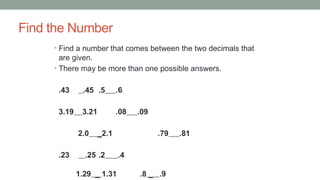
Find the Number
•Find a number that comes between the two decimals that
are given.
• There may be more than one possible answers.
.43 .45 .5 .6
3.19 3.21 .08 .09
2.0 _2.1 .79 .81
.23 .25 .2 .4
1.29 _ 1.31 .8 _ .9
47.
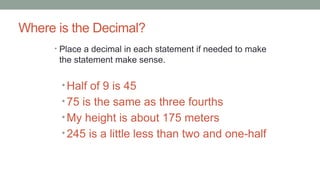
Where is theDecimal?
• Place a decimal in each statement if needed to make
the statement make sense.
• Half of 9 is 45
• 75 is the same as three fourths
• My height is about 175 meters
• 245 is a little less than two and one-half
48.
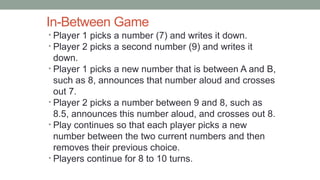
In-Between Game
• Player1 picks a number (7) and writes it down.
• Player 2 picks a second number (9) and writes it
down.
• Player 1 picks a new number that is between A and B,
such as 8, announces that number aloud and crosses
out 7.
• Player 2 picks a number between 9 and 8, such as
8.5, announces this number aloud, and crosses out 8.
• Play continues so that each player picks a new
number between the two current numbers and then
removes their previous choice.
• Players continue for 8 to 10 turns.
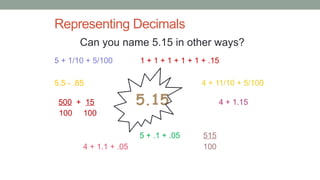
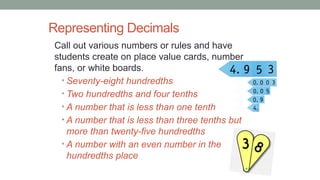
Representing Decimals
Call outvarious numbers or rules and have
students create on place value cards, number
fans, or white boards.
• Seventy-eight hundredths
• Two hundredths and four tenths
• A number that is less than one tenth
• A number that is less than three tenths but
more than twenty-five hundredths
• A number with an even number in the
hundredths place
51.
Comparing Decimals
NC.4.NF.7 Comparetwo decimals to hundredths by reasoning about
their size. Recognize that comparisons are valid only when the two
decimals refer to the same whole. Record the results of
comparisons with the symbols >, =, or >, and justify the conclusions,
e.g., by using a visual model.
What are the best ways to introduce students to the
comparison of decimals?
52.
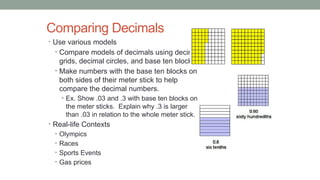
Comparing Decimals
• Usevarious models
• Compare models of decimals using decimal
grids, decimal circles, and base ten blocks.
• Make numbers with the base ten blocks on
both sides of their meter stick to help
compare the decimal numbers.
• Ex. Show .03 and .3 with base ten blocks on
the meter sticks. Explain why .3 is larger
than .03 in relation to the whole meter stick.
• Real-life Contexts
• Olympics
• Races
• Sports Events
• Gas prices
53.
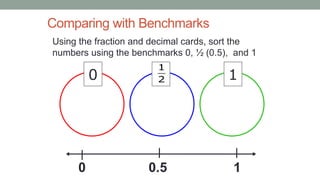
Comparing with Benchmarks
Usingthe fraction and decimal cards, sort the
numbers using the benchmarks 0, ½ (0.5), and 1
2
1
0 0.5 1
0 1
54.
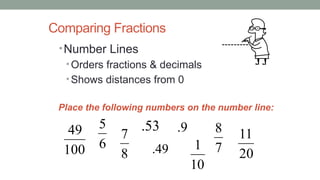
Comparing Fractions
•Number Lines
•Orders fractions & decimals
• Shows distances from 0
Place the following numbers on the number line:
10
1
100
49 53
.
6
5
8
7
7
8
20
11
9
.
49
.
55.
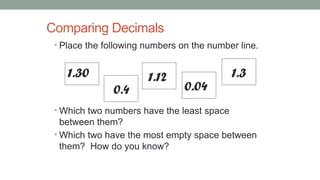
Comparing Decimals
• Placethe following numbers on the number line.
• Which two numbers have the least space
between them?
• Which two have the most empty space between
them? How do you know?
0.04
0.4
1.12
1.30 1.3
56.
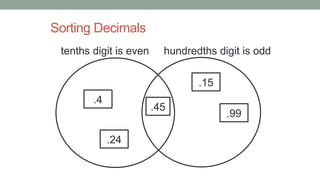
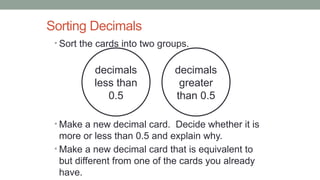
Sorting Decimals
• Sortthe cards into two groups.
• Make a new decimal card. Decide whether it is
more or less than 0.5 and explain why.
• Make a new decimal card that is equivalent to
but different from one of the cards you already
have.
decimals
less than
0.5
decimals
greater
than 0.5
57.
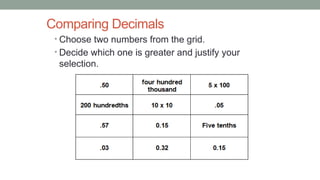
Comparing Decimals
• Choosetwo numbers from the grid.
• Decide which one is greater and justify your
selection.
58.
Comparing Decimals
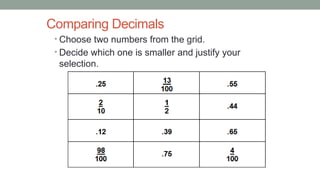
• Choosetwo numbers from the grid.
• Decide which one is smaller and justify your
selection.
59.
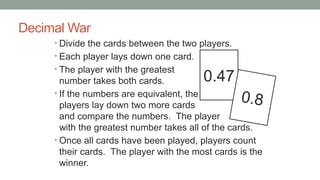
Decimal War
• Dividethe cards between the two players.
• Each player lays down one card.
• The player with the greatest
number takes both cards.
• If the numbers are equivalent, the
players lay down two more cards
and compare the numbers. The player
with the greatest number takes all of the cards.
• Once all cards have been played, players count
their cards. The player with the most cards is the
winner.
0.47
0.8
Editor's Notes
#2 Go over these ideas quickly.
Bullet 1: “If children have a basic understanding of fractions, then introducing decimals essentially involves introducing a new notation for familiar numbers.” Empson and Levi, Extending Children’s Mathematics: Fractions and Decimals, Heinemann, 2011.
Bullet 2: The value of a digit is determined by the digit itself and by its position in the number.
Important point:
With a given model, any piece could be chosen as the ones piece; thus the decimal point has the important role of designating the units (ones) position (to the left of the decimal point).
#11 (each place is ten times the next place to the right, just as with whole numbers; numbers get smaller as the place value moves to the right)
#39 The calculator is a good tool for helping children see patterns in consecutive numbers. Ask the questions under bullet one. Do children know why the count is not .9, .10, .11? What models and experiences will help them understand that? If you have time, have the participants count by 0.01 (and 0.001) to 1 on the calculator and see how long it takes.
#40 This activity provides a good assessment of a child’s understanding of decimal place value. See handout page 52 for more of this kind of activity.
#42 This activity provides a good assessment of a child’s understanding of decimal place value. Ask: For which of the numbers would zeroes need to be added to put the 3 in the given place?
See the next slide for solutions.
#43 This slide shows the solutions to the previous slide.
Note where one or more zeros have to be added to put the 3 in the given position. See handout page 14 for more of this kind of activity.
#46 Have participants suggest numbers that are between each pair of decimal fractions. Discuss strategies. How would a number line help children do this kind of activity? A similar activity is in the handout, page 52.
#47 A part of number sense is knowing when numbers make sense in a context. Statements like these in which children place a decimal to make them sensible help children relate their place value understandings to real life situations. See handout page 51 for an activity like this one.
#55 This is a good assessment question. Have the participants put these numbers in order, then answer the questions. 1.3 and 1.30 are the closest because they are equivalent and represent the same spot on the number line. 0.4 and 1.12 would have the most space between them because there is more than .7 between them and no more than slightly less than .4 between any other two numbers (0.4 and 0.04 have 0.36 between them.