Cloud Computing
Introduction toCloud Computing
Presented by
Name- Gaytri Pandit
Enrollment Number: 2450214780
&
Name: Aditya Kumar
Enrollment No: 2450488477
MCA- NEW 2nd
Year
2.
Agenda
• What isCloud Computing ?
Different perspectives
Properties and characteristics
Benefits from cloud computing
• Service and deployment models
Three service models
Four deployment models
Cloud Disclaimers
• Talkfrom Oracle CEO Larry Ellison
We’ve redefined Cloud Computing to include everything that we
already do. I don’t understand what we would do differently other
than change the wording of some of our ads.
• Talk from Rich Stallman
It's stupidity. It's worse than stupidity: it's a marketing hype
campaign. Somebody is saying this is inevitable – and whenever you
hear somebody saying that, it's very likely to be a set of businesses
campaigning to make it true.
5.
Cloud Definitions
• Definitionfrom NIST(National Institute of Standards and Technology)
Cloud computing is a model for enabling convenient, on-demand
network access to a shared pool of configurable computing resources
(e.g., networks, servers, storage, applications, and services) that can be
rapidly provisioned and released with minimal management effort or
service provider interaction.
This cloud model promotes availability and is composed of five
essential characteristics, three service models, and four deployment
models.
• Definition from NIST(National Institute of Standards and Technology)
Cloud computing is a model for enabling convenient, on-demand
network access to a shared pool of configurable computing
resources (e.g., networks, servers, storage, applications, and services)
that can be rapidly provisioned and released with minimal
management effort or service provider interaction.
This cloud model promotes availability and is composed of five
essential characteristics, three service models, and four deployment
models.
6.
Cloud Definitions
• Definitionfrom Wikipedia
Cloud computing is Internet-based computing, whereby shared
resources, software, and information are provided to computers and
other devices on demand, like the electricity grid.
Cloud computing is a style of computing in which dynamically
scalable and often virtualized resources are provided as a service over
the Internet.
• Definition from Wikipedia
Cloud computing is Internet-based computing, whereby shared
resources, software, and information are provided to computers
and other devices on demand, like the electricity grid.
Cloud computing is a style of computing in which dynamically
scalable and often virtualized resources are provided as a service
over the Internet.
7.
Cloud Definitions
• Definitionfrom Whatis.com
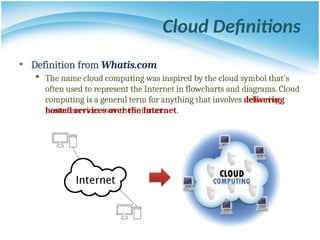
The name cloud computing was inspired by the cloud symbol that's
often used to represent the Internet in flowcharts and diagrams. Cloud
computing is a general term for anything that involves delivering
hosted services over the Internet.
• Definition from Whatis.com
The name cloud computing was inspired by the cloud symbol that's
often used to represent the Internet in flowcharts and diagrams. Cloud
computing is a general term for anything that involves delivering
hosted services over the Internet.
8.
• Definition fromBerkeley
Cloud Computing refers to both the applications delivered as services
over the Internet and the hardware and systems software in the
datacenters that provide those services.
The services themselves have long been referred to as Software as a
Service (SaaS), so we use that term. The datacenter hardware and
software is what we will call a
Cloud.
When a Cloud is made available
in a pay-as-you-go manner to the
public…… The service being sold is
Utility Computing.
• Definition from Berkeley
Cloud Computing refers to both the applications delivered as
services over the Internet and the hardware and systems software
in the datacenters that provide those services.
The services themselves have long been referred to as Software as a
Service (SaaS), so we use that term. The datacenter hardware and
software is what we will call a
Cloud.
When a Cloud is made available
in a pay-as-you-go manner to the
public…… The service being sold is
Utility Computing.
Cloud Definitions
9.
Cloud Definitions
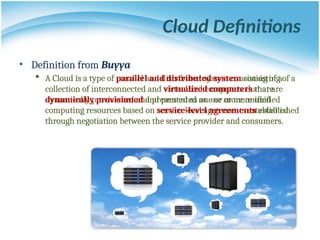
• Definitionfrom Buyya
A Cloud is a type of parallel and distributed system consisting of a
collection of interconnected and virtualized computers that are
dynamically provisioned and presented as one or more unified
computing resources based on service-level agreements established
through negotiation between the service provider and consumers.
• Definition from Buyya
A Cloud is a type of parallel and distributed system consisting of a
collection of interconnected and virtualized computers that are
dynamically provisioned and presented as one or more unified
computing resources based on service-level agreements established
through negotiation between the service provider and consumers.
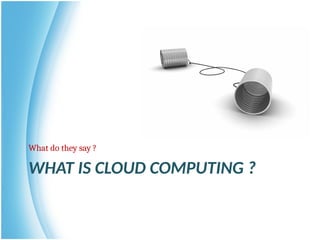
WHAT IS CLOUDCOMPUTING ?
Properties and characteristics
12.
In Our HumbleOpinion
• Cloud computing is a paradigm of computing, a new way of
thinking about IT industry but not any specific technology.
Central ideas
• Utility Computing
• SOA - Service Oriented Architecture
• SLA - Service Level Agreement
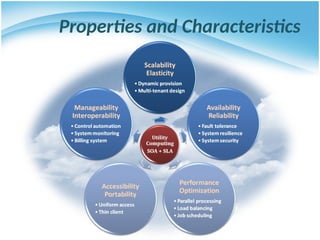
Properties and characteristics
• High scalability and elasticity
• High availability and reliability
• High manageability and interoperability
• High accessibility and portability
• High performance and optimization
Enabling techniques
• Hardware virtualization
• Parallelized and distributed computing
• Web service
Central Ideas
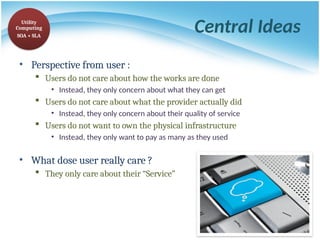
• Perspectivefrom user :
Users do not care about how the works are done
• Instead, they only concern about what they can get
Users do not care about what the provider actually did
• Instead, they only concern about their quality of service
Users do not want to own the physical infrastructure
• Instead, they only want to pay as many as they used
• What dose user really care ?
They only care about their “Service”
Utility
Computing
SOA + SLA
16.
Utility Computing
• Oneservice provisioning model
Service provider makes computing resources and
infrastructure management available to the
customer as needed, and charges them for
specific usage rather than a flat rate.
Like other types of on-demand computing , the
utility model seeks to maximize the efficient use
of resources and/or minimize associated costs.
Utility
Computing
SOA + SLA
17.
What Is Service?
•Service is what you connect together using Web Services.
• Service is the endpoint of a connection.
• Functionalities of service :
A service should be well-defined
A service should be self-contained
A service should not depend on the context or state of other services.
Utility
Computing
SOA + SLA
18.
What Is WebService?
• Definition :
Web service is self-describing and stateless modules that perform
discrete units of work and are available over the network
Web service providers offer APIs that enable developers to exploit
functionality over the Internet, rather than delivering full-blown
applications
• Web Services Description Language (WSDL) :
Expressed in XML which include both data type and messages
Four types of operations :
• One-way - Messages sent without a reply required
• Request & response - Sending and replying messages
• Solicit response - A request for a response
• Notification - Messages sent to multiple receivers
Utility
Computing
SOA + SLA
19.
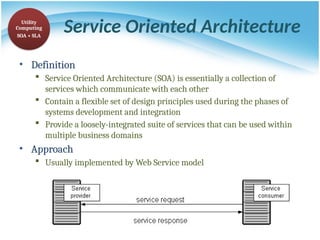
Service Oriented Architecture
•Definition
Service Oriented Architecture (SOA) is essentially a collection of
services which communicate with each other
Contain a flexible set of design principles used during the phases of
systems development and integration
Provide a loosely-integrated suite of services that can be used within
multiple business domains
• Approach
Usually implemented by Web Service model
Utility
Computing
SOA + SLA
20.
Quality Of Service
•Original definition
Quality of Service (QoS) is a set of technologies for managing network
traffic in a cost effective manner to enhance user experiences for
home and enterprise environments.
• Now QoS becomes to a broad term
that is used following areas :
Customer care evaluations
Technological evaluations
Utility
Computing
SOA + SLA



![Lecture-1-Introduction-to-Cloud-Computing[1].pptx](https://cdn.slidesharecdn.com/ss_thumbnails/lecture-1-introduction-to-cloud-computing1-250912135118-0aeba1e5-thumbnail.jpg?width=640&height=640&fit=bounds)


