APOLLO 12 Mission
NOV 14, 1969 - Nov 24, 1969
Anshul Kumar Sahoo
CONTENT
1. Mission Objective
2. Apollo 12 Crew
3. Mission Baclground
4. Landing site
5. Return to Earth
6. Gallery
7. Reference
MISSION OBJECTIVE Apollo 12 aimed to demonstrate the ability to land at a
specific location on the lunar surface. In this case, the
targeted site was near the Surveyor III spacecraft, which
had landed on the Moon in April 1967
APOLLO 12 CREW
Portrait of the prime crew of the
Apollo 12 lunar landing mission. Left
to right, are Charles Conrad Jr.,
Richard F. Gordon Jr., and Alan L.
Bean.
APOLLO 12 CREW
Charles Conrad Jr.
Commander
Mission Insignia
APOLLO 12 CREW
Richard F. Gordon Jr.
Command Module Pilot
Mission Insignia
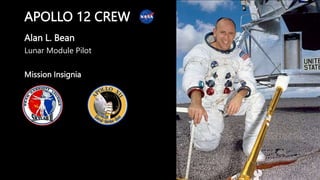
APOLLO 12 CREW
Alan L. Bean
Lunar Module Pilot
Mission Insignia
MISSION BACKGROUND
MISSION BACKGROUND
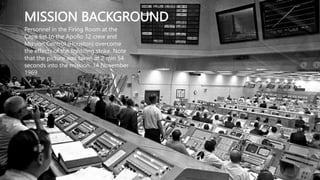
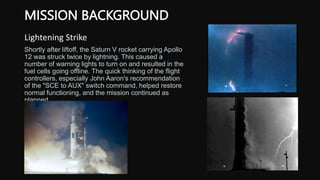
Personnel in the Firing Room at the
Cape list to the Apollo 12 crew and
Mission Control (Houston) overcome
the effects of the lightning strike. Note
that the picture was taken at 2 min 54
seconds into the mission. 14 November
1969
On November 14, 1969, Apollo 12
launched from Florida on a mission
to the Moon.
MISSION BACKGROUND
MISSION BACKGROUND
Lightening Strike
Shortly after liftoff, the Saturn V rocket carrying Apollo
12 was struck twice by lightning. This caused a
number of warning lights to turn on and resulted in the
fuel cells going offline. The quick thinking of the flight
controllers, especially John Aaron's recommendation
of the "SCE to AUX" switch command, helped restore
normal functioning, and the mission continued as
planned.
MISSION BACKGROUND
Precision Landing
Apollo 12 demonstrated a
precision landing, aiming for a
spot close to the Surveyor III
spacecraft, which had landed
on the Moon in April 1967.
Conrad and Bean succeeded
in landing within walking
distance (about 200 meters) of
Surveyor III. This was an
impressive demonstration of
NASA's ability to target
landing sites.
MISSION BACKGROUND
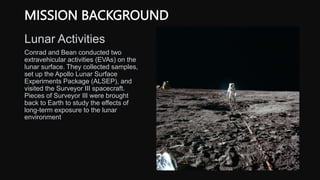
Lunar Activities
Conrad and Bean conducted two
extravehicular activities (EVAs) on the
lunar surface. They collected samples,
set up the Apollo Lunar Surface
Experiments Package (ALSEP), and
visited the Surveyor III spacecraft.
Pieces of Surveyor III were brought
back to Earth to study the effects of
long-term exposure to the lunar
environment
MISSION BACKGROUND
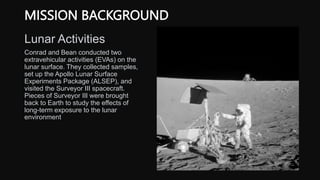
Lunar Activities
Conrad and Bean conducted two
extravehicular activities (EVAs) on the
lunar surface. They collected samples,
set up the Apollo Lunar Surface
Experiments Package (ALSEP), and
visited the Surveyor III spacecraft.
Pieces of Surveyor III were brought
back to Earth to study the effects of
long-term exposure to the lunar
environment
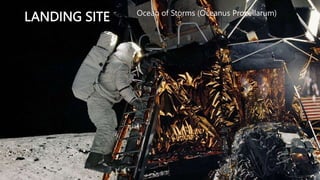
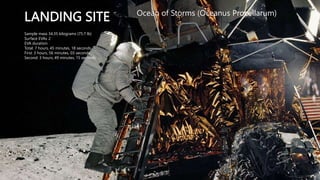
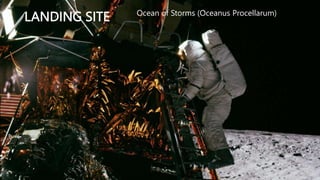
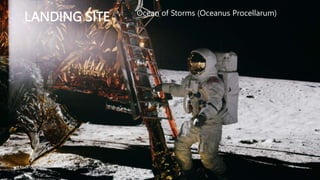
LANDING SITE Ocean of Storms (Oceanus Procellarum)
Sample mass 34.35 kilograms (75.7 lb)
Surface EVAs 2
EVA duration
Total: 7 hours, 45 minutes, 18 seconds
First: 3 hours, 56 minutes, 03 seconds
Second: 3 hours, 49 minutes, 15 seconds
LANDING SITE Ocean of Storms (Oceanus Procellarum)
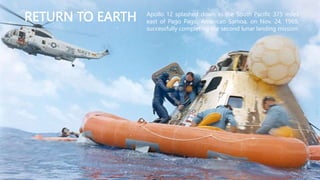
RETURN TO EARTH Apollo 12 splashed down in the South Pacific 375 miles
east of Pago Pago, American Samoa, on Nov. 24, 1969,
successfully completing the second lunar landing mission.
GALLERY
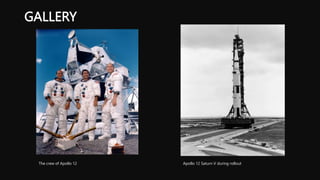
The crew of Apollo 12 Apollo 12 Saturn V during rollout
GALLERY
Apollo 12 crew walkout
Apollo 12 crew disembarks transfer van at the pa
GALLERY
Apollo 12 lifts off under a heavily overcast sky
Technicians in the Firing Room listen to Apollo 12 and Mission Control overcome
lightning-induced electrical problems
GALLERY
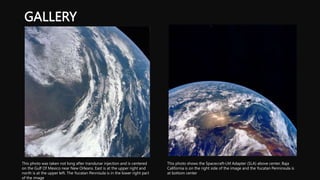
This photo was taken not long after translunar injection and is centered
on the Gulf Of Mexico near New Orleans. East is at the upper right and
north is at the upper left. The Yucatan Pennisula is in the lower right part
of the image
This photo shows the Spacecraft-LM Adapter (SLA) above center. Baja
California is on the right side of the image and the Yucatan Penninsula is
at bottom center
GALLERY
Craters 285 / 287 / Tsiolkovsky
view from CM "Yankee Clipper" of Lunar Module "Intrepid" over craters
Ptolemaeus, Herschel & LaLande C
GALLERY
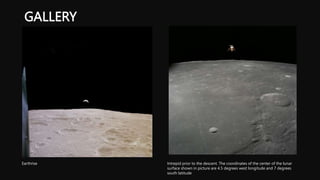
Earthrise Intrepid prior to the descent. The coordinates of the center of the lunar
surface shown in picture are 4.5 degrees west longitude and 7 degrees
south latitude
GALLERY
Crater II / Earth
Copernicus-Rheinhold
GALLERY
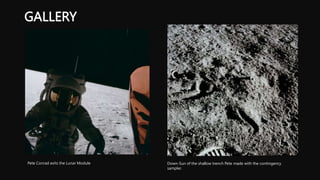
Pete Conrad exits the Lunar Module Down-Sun of the shallow trench Pete made with the contingency
sampler.
GALLERY
Al Bean is about halfway down the ladder, with his right foot on the
fourth rung up
Alan Bean steps onto the Moon
GALLERY
Pete Conrad's photograph of Alan Bean taking a picture of the SWC
and Pete
Down-Sun view. The larger of the two mounds that Pete and Al will
investigate after deploying the ALSEP is visible at the right side just
below the local horizon.
GALLERY
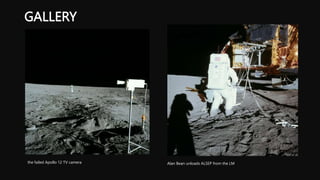
Alan Bean unloads ALSEP from the LM
the failed Apollo 12 TV camera
GALLERY
Lunar Surface
pan frame near LM / S-band ant. / flag / TV camera
GALLERY
lunar surface mound mound
GALLERY
he U.S. flag is on the right and the trail of footprints Al made when he
went out to deploy the SWC starts at the lower right.
Al has placed the RTG package on the ground
GALLERY
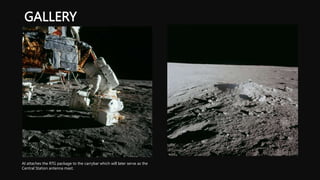
Al attaches the RTG package to the carrybar which will later serve as the
Central Station antenna mast.
GALLERY
Astronaut Pete Conrad and the U.S. flag
Command/Service Module viewed from LM
GALLERY
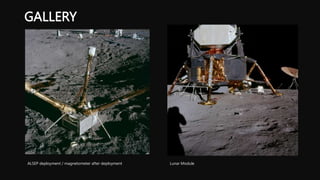
Lunar Module
ALSEP deployment / magnetometer after deployment
GALLERY
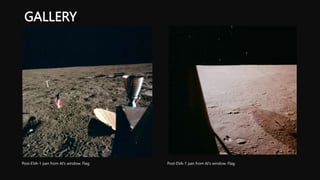
Post-EVA-1 pan from Al's window. Flag Post-EVA-1 pan from Al's window. Flag
GALLERY
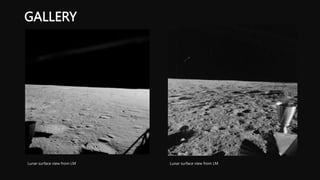
Lunar surface view from LM
GALLERY
Lunar surface view from LM
GALLERY
View under LM / MESA and fuel cask
Lunar surface view from LM
GALLERY
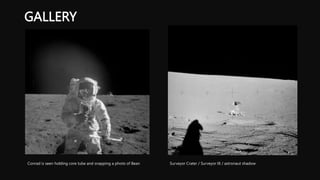
Surveyor Crater / Surveyor III / astronaut shadow
Conrad is seen holding core tube and snapping a photo of Bean
GALLERY
Pete Conrad at the Surveyor III craft / LM in b.g.
Surveyor III
GALLERY
Core sampler / hand tool kit
Bench Crater
GALLERY
Surveyor III and the LM. The TV camera is the vertical cylinder to the
right of the solar-panel mast and the scoop can be seen extended out to
the right
Frame from Pete's Triple Crater pan. View of the eastern wall of Head
Crater with the LM in the background and Al moving from right to left in
the foreground
GALLERY
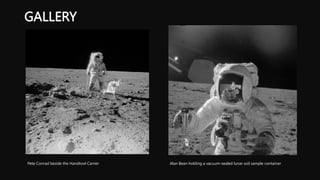
Alan Bean holding a vacuum-sealed lunar soil sample container
Pete Conrad beside the Handtool Carrier
GALLERY
Crater Copernicus viewed from lunar orbit
The Earth eclipses the Sun during the transearth journey
GALLERY
Earrthrise View of Marius Crater from lunar orbit.
GALLERY
view of Apollo 12 crew members aboard life raft during recovery operations
Apollo 12 CM nears splashdown
GALLERY
Crater Copernicus viewed
from lunar orbit
GALLERY
Apollo 12 astronauts l-r
Conrad, Gordon and Bean
inside mobile quarantine
facility aboard USS Hornet.
REFERENCE
• https://www.lpi.usra.edu/
• https://history.nasa.gov/alsj/a12/images12.html#Surv3
• https://apolloarchive.com/apollo_gallery.html
Apollo 12 Mission

Apollo 12 Mission

  • 1.
    APOLLO 12 Mission NOV14, 1969 - Nov 24, 1969 Anshul Kumar Sahoo
  • 2.
    CONTENT 1. Mission Objective 2.Apollo 12 Crew 3. Mission Baclground 4. Landing site 5. Return to Earth 6. Gallery 7. Reference
  • 3.
    MISSION OBJECTIVE Apollo12 aimed to demonstrate the ability to land at a specific location on the lunar surface. In this case, the targeted site was near the Surveyor III spacecraft, which had landed on the Moon in April 1967
  • 4.
    APOLLO 12 CREW Portraitof the prime crew of the Apollo 12 lunar landing mission. Left to right, are Charles Conrad Jr., Richard F. Gordon Jr., and Alan L. Bean.
  • 5.
    APOLLO 12 CREW CharlesConrad Jr. Commander Mission Insignia
  • 6.
    APOLLO 12 CREW RichardF. Gordon Jr. Command Module Pilot Mission Insignia
  • 7.
    APOLLO 12 CREW AlanL. Bean Lunar Module Pilot Mission Insignia
  • 8.
  • 9.
    MISSION BACKGROUND Personnel inthe Firing Room at the Cape list to the Apollo 12 crew and Mission Control (Houston) overcome the effects of the lightning strike. Note that the picture was taken at 2 min 54 seconds into the mission. 14 November 1969
  • 10.
    On November 14,1969, Apollo 12 launched from Florida on a mission to the Moon. MISSION BACKGROUND
  • 11.
    MISSION BACKGROUND Lightening Strike Shortlyafter liftoff, the Saturn V rocket carrying Apollo 12 was struck twice by lightning. This caused a number of warning lights to turn on and resulted in the fuel cells going offline. The quick thinking of the flight controllers, especially John Aaron's recommendation of the "SCE to AUX" switch command, helped restore normal functioning, and the mission continued as planned.
  • 12.
    MISSION BACKGROUND Precision Landing Apollo12 demonstrated a precision landing, aiming for a spot close to the Surveyor III spacecraft, which had landed on the Moon in April 1967. Conrad and Bean succeeded in landing within walking distance (about 200 meters) of Surveyor III. This was an impressive demonstration of NASA's ability to target landing sites.
  • 13.
    MISSION BACKGROUND Lunar Activities Conradand Bean conducted two extravehicular activities (EVAs) on the lunar surface. They collected samples, set up the Apollo Lunar Surface Experiments Package (ALSEP), and visited the Surveyor III spacecraft. Pieces of Surveyor III were brought back to Earth to study the effects of long-term exposure to the lunar environment
  • 14.
    MISSION BACKGROUND Lunar Activities Conradand Bean conducted two extravehicular activities (EVAs) on the lunar surface. They collected samples, set up the Apollo Lunar Surface Experiments Package (ALSEP), and visited the Surveyor III spacecraft. Pieces of Surveyor III were brought back to Earth to study the effects of long-term exposure to the lunar environment
  • 15.
    LANDING SITE Oceanof Storms (Oceanus Procellarum)
  • 16.
    LANDING SITE Oceanof Storms (Oceanus Procellarum) Sample mass 34.35 kilograms (75.7 lb) Surface EVAs 2 EVA duration Total: 7 hours, 45 minutes, 18 seconds First: 3 hours, 56 minutes, 03 seconds Second: 3 hours, 49 minutes, 15 seconds
  • 17.
    LANDING SITE Oceanof Storms (Oceanus Procellarum)
  • 18.
    LANDING SITE Oceanof Storms (Oceanus Procellarum)
  • 19.
    LANDING SITE Oceanof Storms (Oceanus Procellarum)
  • 20.
    LANDING SITE Oceanof Storms (Oceanus Procellarum)
  • 21.
    LANDING SITE Oceanof Storms (Oceanus Procellarum)
  • 22.
    RETURN TO EARTHApollo 12 splashed down in the South Pacific 375 miles east of Pago Pago, American Samoa, on Nov. 24, 1969, successfully completing the second lunar landing mission.
  • 23.
    GALLERY The crew ofApollo 12 Apollo 12 Saturn V during rollout
  • 24.
    GALLERY Apollo 12 crewwalkout Apollo 12 crew disembarks transfer van at the pa
  • 25.
    GALLERY Apollo 12 liftsoff under a heavily overcast sky Technicians in the Firing Room listen to Apollo 12 and Mission Control overcome lightning-induced electrical problems
  • 26.
    GALLERY This photo wastaken not long after translunar injection and is centered on the Gulf Of Mexico near New Orleans. East is at the upper right and north is at the upper left. The Yucatan Pennisula is in the lower right part of the image This photo shows the Spacecraft-LM Adapter (SLA) above center. Baja California is on the right side of the image and the Yucatan Penninsula is at bottom center
  • 27.
    GALLERY Craters 285 /287 / Tsiolkovsky view from CM "Yankee Clipper" of Lunar Module "Intrepid" over craters Ptolemaeus, Herschel & LaLande C
  • 28.
    GALLERY Earthrise Intrepid priorto the descent. The coordinates of the center of the lunar surface shown in picture are 4.5 degrees west longitude and 7 degrees south latitude
  • 29.
    GALLERY Crater II /Earth Copernicus-Rheinhold
  • 30.
    GALLERY Pete Conrad exitsthe Lunar Module Down-Sun of the shallow trench Pete made with the contingency sampler.
  • 31.
    GALLERY Al Bean isabout halfway down the ladder, with his right foot on the fourth rung up Alan Bean steps onto the Moon
  • 32.
    GALLERY Pete Conrad's photographof Alan Bean taking a picture of the SWC and Pete Down-Sun view. The larger of the two mounds that Pete and Al will investigate after deploying the ALSEP is visible at the right side just below the local horizon.
  • 33.
    GALLERY Alan Bean unloadsALSEP from the LM the failed Apollo 12 TV camera
  • 34.
    GALLERY Lunar Surface pan framenear LM / S-band ant. / flag / TV camera
  • 35.
  • 36.
    GALLERY he U.S. flagis on the right and the trail of footprints Al made when he went out to deploy the SWC starts at the lower right. Al has placed the RTG package on the ground
  • 37.
    GALLERY Al attaches theRTG package to the carrybar which will later serve as the Central Station antenna mast.
  • 38.
    GALLERY Astronaut Pete Conradand the U.S. flag Command/Service Module viewed from LM
  • 39.
    GALLERY Lunar Module ALSEP deployment/ magnetometer after deployment
  • 40.
    GALLERY Post-EVA-1 pan fromAl's window. Flag Post-EVA-1 pan from Al's window. Flag
  • 41.
    GALLERY Lunar surface viewfrom LM Lunar surface view from LM
  • 42.
    GALLERY Lunar surface viewfrom LM Lunar surface view from LM
  • 43.
    GALLERY View under LM/ MESA and fuel cask Lunar surface view from LM
  • 44.
    GALLERY Surveyor Crater /Surveyor III / astronaut shadow Conrad is seen holding core tube and snapping a photo of Bean
  • 45.
    GALLERY Pete Conrad atthe Surveyor III craft / LM in b.g. Surveyor III
  • 46.
    GALLERY Core sampler /hand tool kit Bench Crater
  • 47.
    GALLERY Surveyor III andthe LM. The TV camera is the vertical cylinder to the right of the solar-panel mast and the scoop can be seen extended out to the right Frame from Pete's Triple Crater pan. View of the eastern wall of Head Crater with the LM in the background and Al moving from right to left in the foreground
  • 48.
    GALLERY Alan Bean holdinga vacuum-sealed lunar soil sample container Pete Conrad beside the Handtool Carrier
  • 49.
    GALLERY Crater Copernicus viewedfrom lunar orbit The Earth eclipses the Sun during the transearth journey
  • 50.
    GALLERY Earrthrise View ofMarius Crater from lunar orbit.
  • 51.
    GALLERY view of Apollo12 crew members aboard life raft during recovery operations Apollo 12 CM nears splashdown
  • 52.
  • 53.
    GALLERY Apollo 12 astronautsl-r Conrad, Gordon and Bean inside mobile quarantine facility aboard USS Hornet.
  • 54.