
www.edureka.co/advanced-predictive-modelling-in-r
View Advanced Predictive Modelling with R course details at www.edureka.co/advanced-predictive-modelling-in-r
Advanced Predictive Modelling with R
For Queries:
Post on Twitter @edurekaIN: #askEdureka
Post on Facebook /edurekaIN
For more details please contact us:
US : 1800 275 9730 (toll free)
INDIA : +91 88808 62004
Email Us : sales@edureka.co
Slide 2 www.edureka.co/advanced-predictive-modelling-in-r
At the end of this module, you will be able to understand:
 Introduction to Predictive Modeling
 Beyond OLS: How real life data-set looks like!
 Decoding Forecasting
 How to handle real life dataset: Two examples
 How to Build Models in R: Example
 Forecasting techniques and Plots
Objectives
Slide 3 www.edureka.co/advanced-predictive-modelling-in-r
a <- ts(1:20, frequency = 12, start = c(2011, 3))
print(a)
## Jan Feb Mar Apr May Jun Jul Aug Sep Oct Nov Dec
## 2011 1 2 3 4 5 6 7 8 9 10
## 2012 11 12 13 14 15 16 17 18 19 20
str(a)
## Time-Series [1:20] from 2011 to 2013: 1 2 3 4 5 6 7 8 9 10 ...
attributes(a)
## $tsp
## [1] 2011.167 2012.750 12.000
##
## $class
## [1] "ts"
Creating a Simple TimeSeries
Slide 4 www.edureka.co/advanced-predictive-modelling-in-r
str(AirPassengers)
## Time-Series [1:144] from 1949 to 1961: 112 118 132 129 121 135 148 148
136 119 ...
summary(AirPassengers)
## Min. 1st Qu. Median Mean 3rd Qu. Max.
## 104.0 180.0 265.5 280.3 360.5 622.0
AirPassengers Case
Slide 5 www.edureka.co/advanced-predictive-modelling-in-r
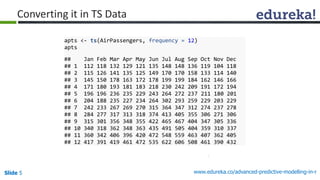
apts <- ts(AirPassengers, frequency = 12)
apts
## Jan Feb Mar Apr May Jun Jul Aug Sep Oct Nov Dec
## 1 112 118 132 129 121 135 148 148 136 119 104 118
## 2 115 126 141 135 125 149 170 170 158 133 114 140
## 3 145 150 178 163 172 178 199 199 184 162 146 166
## 4 171 180 193 181 183 218 230 242 209 191 172 194
## 5 196 196 236 235 229 243 264 272 237 211 180 201
## 6 204 188 235 227 234 264 302 293 259 229 203 229
## 7 242 233 267 269 270 315 364 347 312 274 237 278
## 8 284 277 317 313 318 374 413 405 355 306 271 306
## 9 315 301 356 348 355 422 465 467 404 347 305 336
## 10 340 318 362 348 363 435 491 505 404 359 310 337
## 11 360 342 406 396 420 472 548 559 463 407 362 405
## 12 417 391 419 461 472 535 622 606 508 461 390 432
Converting it in TS Data
Slide 6 www.edureka.co/advanced-predictive-modelling-in-r
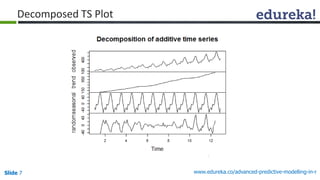
Decomposing the TS
f <- decompose(apts)
> names(f) [1] "x" "seasonal" "trend" "random" "figure" "type"
plot(f$figure, type = "b") # seasonal figures
Slide 7 www.edureka.co/advanced-predictive-modelling-in-r
Decomposed TS Plot
Slide 8 www.edureka.co/advanced-predictive-modelling-in-r
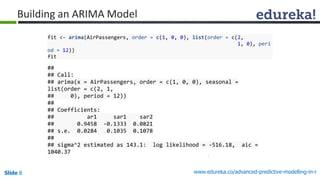
Building an ARIMA Model
fit <- arima(AirPassengers, order = c(1, 0, 0), list(order = c(2,
1, 0), peri
od = 12))
fit
##
## Call:
## arima(x = AirPassengers, order = c(1, 0, 0), seasonal =
list(order = c(2, 1,
## 0), period = 12))
##
## Coefficients:
## ar1 sar1 sar2
## 0.9458 -0.1333 0.0821
## s.e. 0.0284 0.1035 0.1078
##
## sigma^2 estimated as 143.1: log likelihood = -516.18, aic =
1040.37
Slide 9 www.edureka.co/advanced-predictive-modelling-in-r
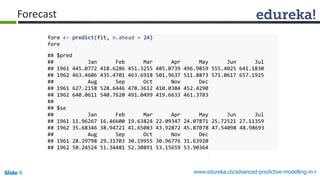
Forecast
fore <- predict(fit, n.ahead = 24)
fore
## $pred
## Jan Feb Mar Apr May Jun Jul
## 1961 445.0772 418.6286 451.3255 485.0739 496.9859 555.4025 641.1830
## 1962 463.4606 435.4701 463.6918 501.9637 511.8873 571.0617 657.1925
## Aug Sep Oct Nov Dec
## 1961 627.2158 528.6446 478.3612 410.0384 452.4290
## 1962 640.0611 540.7620 491.0499 419.6633 461.3783
##
## $se
## Jan Feb Mar Apr May Jun Jul
## 1961 11.96267 16.46600 19.63824 22.09347 24.07871 25.72521 27.11359
## 1962 35.68346 38.94721 41.65083 43.92872 45.87078 47.54098 48.98693
## Aug Sep Oct Nov Dec
## 1961 28.29798 29.31703 30.19955 30.96776 31.63920
## 1962 50.24524 51.34481 52.30891 53.15659 53.90364
Slide 10 www.edureka.co/advanced-predictive-modelling-in-r
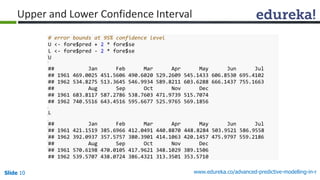
Upper and Lower Confidence Interval
fore <- predict(fit, n.ahead = 24)
fore
## $pred
## Jan Feb Mar Apr May Jun Jul
## 1961 445.0772 418.6286 451.3255 485.0739 496.9859 555.4025 641.1830
## 1962 463.4606 435.4701 463.6918 501.9637 511.8873 571.0617 657.1925
## Aug Sep Oct Nov Dec
## 1961 627.2158 528.6446 478.3612 410.0384 452.4290
## 1962 640.0611 540.7620 491.0499 419.6633 461.3783
##
## $se
## Jan Feb Mar Apr May Jun Jul
## 1961 11.96267 16.46600 19.63824 22.09347 24.07871 25.72521 27.11359
## 1962 35.68346 38.94721 41.65083 43.92872 45.87078 47.54098 48.98693
## Aug Sep Oct Nov Dec
## 1961 28.29798 29.31703 30.19955 30.96776 31.63920
## 1962 50.24524 51.34481 52.30891 53.15659 53.90364
# error bounds at 95% confidence level
U <- fore$pred + 2 * fore$se
L <- fore$pred - 2 * fore$se
U
## Jan Feb Mar Apr May Jun Jul
## 1961 469.0025 451.5606 490.6020 529.2609 545.1433 606.8530 695.4102
## 1962 534.8275 513.3645 546.9934 589.8211 603.6288 666.1437 755.1663
## Aug Sep Oct Nov Dec
## 1961 683.8117 587.2786 538.7603 471.9739 515.7074
## 1962 740.5516 643.4516 595.6677 525.9765 569.1856
L
## Jan Feb Mar Apr May Jun Jul
## 1961 421.1519 385.6966 412.0491 440.8870 448.8284 503.9521 586.9558
## 1962 392.0937 357.5757 380.3901 414.1063 420.1457 475.9797 559.2186
## Aug Sep Oct Nov Dec
## 1961 570.6198 470.0105 417.9621 348.1029 389.1506
## 1962 539.5707 438.0724 386.4321 313.3501 353.5710
Slide 11 www.edureka.co/advanced-predictive-modelling-in-r
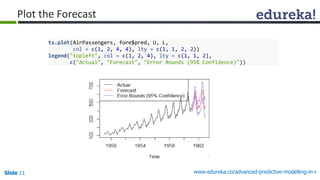
Plot the Forecast
ts.plot(AirPassengers, fore$pred, U, L,
col = c(1, 2, 4, 4), lty = c(1, 1, 2, 2))
legend("topleft", col = c(1, 2, 4), lty = c(1, 1, 2),
c("Actual", "Forecast", "Error Bounds (95% Confidence)"))
Slide 12 www.edureka.co/advanced-predictive-modelling-in-r
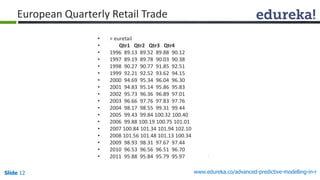
European Quarterly Retail Trade
• > euretail
• Qtr1 Qtr2 Qtr3 Qtr4
• 1996 89.13 89.52 89.88 90.12
• 1997 89.19 89.78 90.03 90.38
• 1998 90.27 90.77 91.85 92.51
• 1999 92.21 92.52 93.62 94.15
• 2000 94.69 95.34 96.04 96.30
• 2001 94.83 95.14 95.86 95.83
• 2002 95.73 96.36 96.89 97.01
• 2003 96.66 97.76 97.83 97.76
• 2004 98.17 98.55 99.31 99.44
• 2005 99.43 99.84 100.32 100.40
• 2006 99.88 100.19 100.75 101.01
• 2007 100.84 101.34 101.94 102.10
• 2008 101.56 101.48 101.13 100.34
• 2009 98.93 98.31 97.67 97.44
• 2010 96.53 96.56 96.51 96.70
• 2011 95.88 95.84 95.79 95.97
Slide 13 www.edureka.co/advanced-predictive-modelling-in-r
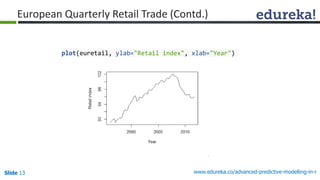
European Quarterly Retail Trade (Contd.)
plot(euretail, ylab="Retail index", xlab="Year")
Slide 14 www.edureka.co/advanced-predictive-modelling-in-r
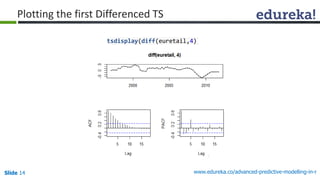
Plotting the first Differenced TS
tsdisplay(diff(euretail,4))
Slide 15 www.edureka.co/advanced-predictive-modelling-in-r
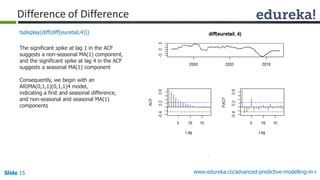
Difference of Difference
tsdisplay(diff(diff(euretail,4)))
The significant spike at lag 1 in the ACF
suggests a non-seasonal MA(1) component,
and the significant spike at lag 4 in the ACF
suggests a seasonal MA(1) component
Consequently, we begin with an
ARIMA(0,1,1)(0,1,1)4 model,
indicating a first and seasonal difference,
and non-seasonal and seasonal MA(1)
components
Slide 16 www.edureka.co/advanced-predictive-modelling-in-r
Fitting a Model
fit <- Arima(euretail, order=c(0,1,1), seasonal=c(0,1,1))
fit
## Series: euretail
## ARIMA(0,1,1)(0,1,1)[4]
##
## Coefficients:
## ma1 sma1
## 0.2901 -0.6909
## s.e. 0.1118 0.1197
##
## sigma^2 estimated as 0.1812: log likelihood=-34.68
## AIC=75.36 AICc=75.79 BIC=81.59
Slide 17 www.edureka.co/advanced-predictive-modelling-in-r
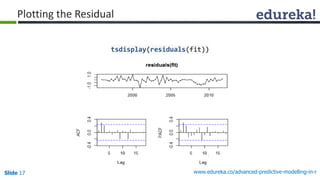
Plotting the Residual
tsdisplay(residuals(fit))
Slide 18 www.edureka.co/advanced-predictive-modelling-in-r
Lets Tweak the Model
### Lets tweak the Model and try
fit3 <- Arima(euretail, order=c(0,1,3), seasonal=c(0,1,1))
fit3
## Series: euretail
## ARIMA(0,1,3)(0,1,1)[4]
##
## Coefficients:
## ma1 ma2 ma3 sma1
## 0.2625 0.3697 0.4194 -0.6615
## s.e. 0.1239 0.1260 0.1296 0.1555
##
## sigma^2 estimated as 0.1451: log likelihood=-28.7
## AIC=67.4 AICc=68.53 BIC=77.78
Slide 19 www.edureka.co/advanced-predictive-modelling-in-r
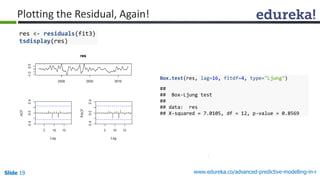
Plotting the Residual, Again!
res <- residuals(fit3)
tsdisplay(res)
Box.test(res, lag=16, fitdf=4, type="Ljung")
##
## Box-Ljung test
##
## data: res
## X-squared = 7.0105, df = 12, p-value = 0.8569
Slide 20 www.edureka.co/advanced-predictive-modelling-in-r
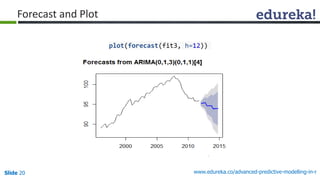
Forecast and Plot
plot(forecast(fit3, h=12))
Slide 21 www.edureka.co/advanced-predictive-modelling-in-r
Can R Do It Automatically For Us??
auto.arima(euretail)
## Series: euretail
## ARIMA(1,1,1)(0,1,1)[4]
##
## Coefficients:
## ar1 ma1 sma1
## 0.8828 -0.5208 -0.9704
## s.e. 0.1424 0.1755 0.6792
##
## sigma^2 estimated as 0.1411: log likelihood=-30.19
## AIC=68.37 AICc=69.11 BIC=76.68
auto.arima(euretail, stepwise=FALSE, approximation=FALSE)
## Series: euretail
## ARIMA(0,1,3)(0,1,1)[4]
##
## Coefficients:
## ma1 ma2 ma3 sma1
## 0.2625 0.3697 0.4194 -0.6615
## s.e. 0.1239 0.1260 0.1296 0.1555
##
## sigma^2 estimated as 0.1451: log likelihood=-28.7
## AIC=67.4 AICc=68.53 BIC=77.78
Slide 22 www.edureka.co/advanced-predictive-modelling-in-r
Final Model
fit4<-auto.arima(euretail, stepwise=FALSE, approximation=FALSE)
fit4
## Series: euretail
## ARIMA(0,1,3)(0,1,1)[4]
##
## Coefficients:
## ma1 ma2 ma3 sma1
## 0.2625 0.3697 0.4194 -0.6615
## s.e. 0.1239 0.1260 0.1296 0.1555
##
## sigma^2 estimated as 0.1451: log likelihood=-28.7
## AIC=67.4 AICc=68.53 BIC=77.78
res4 <- residuals(fit4)
tsdisplay(res4)
Slide 23 www.edureka.co/advanced-predictive-modelling-in-r
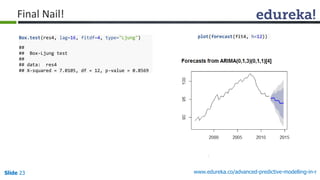
Final Nail!
Box.test(res4, lag=16, fitdf=4, type="Ljung")
##
## Box-Ljung test
##
## data: res4
## X-squared = 7.0105, df = 12, p-value = 0.8569
plot(forecast(fit4, h=12))
Slide 24 www.edureka.co/advanced-predictive-modelling-in-r
DIY: Corticosteroid Drug Sales in Australia
 We will try to forecast monthly corticosteroid drug sales in Australia
 These are known as H02 drugs under the Anatomical Therapeutical Chemical classification scheme
fit <- auto.arima(h02, lambda=0, d=0, D=1, max.order=9,stepwise=FALSE, approximation=FALSE)
tsdisplay(residuals(fit))
Box.test(residuals(fit), lag=36, fitdf=8, type="Ljung")
fit <- Arima(h02, order=c(3,0,1), seasonal=c(0,1,2), lambda=0)
plot(forecast(fit), ylab="H02 sales (million scripts)", xlab="Year")
Slide 25 www.edureka.co/advanced-predictive-modelling-in-r
 Module 1
» Basic Statistics in R
 Module 2
» Ordinary Least Square Regression 1
 Module 3
» Ordinary Least Square Regression 2
 Module 4
» Ordinary Least Square Regression 3
 Module 5
» Logistic Regression 1
 Module 6
» Logistic Regression 2
 Module 7
» Logistic Regression 3
 Module 8
» Imputation
Course Topics
 Module 9
» Forecasting 1
 Module 10
» Forecasting 2
 Module 11
» Forecasting 3
 Module 12
» Survival Analysis
 Module 13
» Data Mining and Regression
 Module 14
» Big Picture
 Module 15
» Project - Implementation
 Module 16
» Project - Presentation
Slide 26 www.edureka.co/advanced-predictive-modelling-in-r
LIVE Online Class
Class Recording in LMS
24/7 Post Class Support
Module Wise Quiz
Project Work
Verifiable Certificate
How it Works
Slide 27 www.edureka.co/advanced-predictive-modelling-in-r

Webinar: The Whys and Hows of Predictive Modelling

  • 1.
    www.edureka.co/advanced-predictive-modelling-in-r View Advanced PredictiveModelling with R course details at www.edureka.co/advanced-predictive-modelling-in-r Advanced Predictive Modelling with R For Queries: Post on Twitter @edurekaIN: #askEdureka Post on Facebook /edurekaIN For more details please contact us: US : 1800 275 9730 (toll free) INDIA : +91 88808 62004 Email Us : sales@edureka.co
  • 2.
    Slide 2 www.edureka.co/advanced-predictive-modelling-in-r Atthe end of this module, you will be able to understand:  Introduction to Predictive Modeling  Beyond OLS: How real life data-set looks like!  Decoding Forecasting  How to handle real life dataset: Two examples  How to Build Models in R: Example  Forecasting techniques and Plots Objectives
  • 3.
    Slide 3 www.edureka.co/advanced-predictive-modelling-in-r a<- ts(1:20, frequency = 12, start = c(2011, 3)) print(a) ## Jan Feb Mar Apr May Jun Jul Aug Sep Oct Nov Dec ## 2011 1 2 3 4 5 6 7 8 9 10 ## 2012 11 12 13 14 15 16 17 18 19 20 str(a) ## Time-Series [1:20] from 2011 to 2013: 1 2 3 4 5 6 7 8 9 10 ... attributes(a) ## $tsp ## [1] 2011.167 2012.750 12.000 ## ## $class ## [1] "ts" Creating a Simple TimeSeries
  • 4.
    Slide 4 www.edureka.co/advanced-predictive-modelling-in-r str(AirPassengers) ##Time-Series [1:144] from 1949 to 1961: 112 118 132 129 121 135 148 148 136 119 ... summary(AirPassengers) ## Min. 1st Qu. Median Mean 3rd Qu. Max. ## 104.0 180.0 265.5 280.3 360.5 622.0 AirPassengers Case
  • 5.
    Slide 5 www.edureka.co/advanced-predictive-modelling-in-r apts<- ts(AirPassengers, frequency = 12) apts ## Jan Feb Mar Apr May Jun Jul Aug Sep Oct Nov Dec ## 1 112 118 132 129 121 135 148 148 136 119 104 118 ## 2 115 126 141 135 125 149 170 170 158 133 114 140 ## 3 145 150 178 163 172 178 199 199 184 162 146 166 ## 4 171 180 193 181 183 218 230 242 209 191 172 194 ## 5 196 196 236 235 229 243 264 272 237 211 180 201 ## 6 204 188 235 227 234 264 302 293 259 229 203 229 ## 7 242 233 267 269 270 315 364 347 312 274 237 278 ## 8 284 277 317 313 318 374 413 405 355 306 271 306 ## 9 315 301 356 348 355 422 465 467 404 347 305 336 ## 10 340 318 362 348 363 435 491 505 404 359 310 337 ## 11 360 342 406 396 420 472 548 559 463 407 362 405 ## 12 417 391 419 461 472 535 622 606 508 461 390 432 Converting it in TS Data
  • 6.
    Slide 6 www.edureka.co/advanced-predictive-modelling-in-r Decomposingthe TS f <- decompose(apts) > names(f) [1] "x" "seasonal" "trend" "random" "figure" "type" plot(f$figure, type = "b") # seasonal figures
  • 7.
  • 8.
    Slide 8 www.edureka.co/advanced-predictive-modelling-in-r Buildingan ARIMA Model fit <- arima(AirPassengers, order = c(1, 0, 0), list(order = c(2, 1, 0), peri od = 12)) fit ## ## Call: ## arima(x = AirPassengers, order = c(1, 0, 0), seasonal = list(order = c(2, 1, ## 0), period = 12)) ## ## Coefficients: ## ar1 sar1 sar2 ## 0.9458 -0.1333 0.0821 ## s.e. 0.0284 0.1035 0.1078 ## ## sigma^2 estimated as 143.1: log likelihood = -516.18, aic = 1040.37
  • 9.
    Slide 9 www.edureka.co/advanced-predictive-modelling-in-r Forecast fore<- predict(fit, n.ahead = 24) fore ## $pred ## Jan Feb Mar Apr May Jun Jul ## 1961 445.0772 418.6286 451.3255 485.0739 496.9859 555.4025 641.1830 ## 1962 463.4606 435.4701 463.6918 501.9637 511.8873 571.0617 657.1925 ## Aug Sep Oct Nov Dec ## 1961 627.2158 528.6446 478.3612 410.0384 452.4290 ## 1962 640.0611 540.7620 491.0499 419.6633 461.3783 ## ## $se ## Jan Feb Mar Apr May Jun Jul ## 1961 11.96267 16.46600 19.63824 22.09347 24.07871 25.72521 27.11359 ## 1962 35.68346 38.94721 41.65083 43.92872 45.87078 47.54098 48.98693 ## Aug Sep Oct Nov Dec ## 1961 28.29798 29.31703 30.19955 30.96776 31.63920 ## 1962 50.24524 51.34481 52.30891 53.15659 53.90364
  • 10.
    Slide 10 www.edureka.co/advanced-predictive-modelling-in-r Upperand Lower Confidence Interval fore <- predict(fit, n.ahead = 24) fore ## $pred ## Jan Feb Mar Apr May Jun Jul ## 1961 445.0772 418.6286 451.3255 485.0739 496.9859 555.4025 641.1830 ## 1962 463.4606 435.4701 463.6918 501.9637 511.8873 571.0617 657.1925 ## Aug Sep Oct Nov Dec ## 1961 627.2158 528.6446 478.3612 410.0384 452.4290 ## 1962 640.0611 540.7620 491.0499 419.6633 461.3783 ## ## $se ## Jan Feb Mar Apr May Jun Jul ## 1961 11.96267 16.46600 19.63824 22.09347 24.07871 25.72521 27.11359 ## 1962 35.68346 38.94721 41.65083 43.92872 45.87078 47.54098 48.98693 ## Aug Sep Oct Nov Dec ## 1961 28.29798 29.31703 30.19955 30.96776 31.63920 ## 1962 50.24524 51.34481 52.30891 53.15659 53.90364 # error bounds at 95% confidence level U <- fore$pred + 2 * fore$se L <- fore$pred - 2 * fore$se U ## Jan Feb Mar Apr May Jun Jul ## 1961 469.0025 451.5606 490.6020 529.2609 545.1433 606.8530 695.4102 ## 1962 534.8275 513.3645 546.9934 589.8211 603.6288 666.1437 755.1663 ## Aug Sep Oct Nov Dec ## 1961 683.8117 587.2786 538.7603 471.9739 515.7074 ## 1962 740.5516 643.4516 595.6677 525.9765 569.1856 L ## Jan Feb Mar Apr May Jun Jul ## 1961 421.1519 385.6966 412.0491 440.8870 448.8284 503.9521 586.9558 ## 1962 392.0937 357.5757 380.3901 414.1063 420.1457 475.9797 559.2186 ## Aug Sep Oct Nov Dec ## 1961 570.6198 470.0105 417.9621 348.1029 389.1506 ## 1962 539.5707 438.0724 386.4321 313.3501 353.5710
  • 11.
    Slide 11 www.edureka.co/advanced-predictive-modelling-in-r Plotthe Forecast ts.plot(AirPassengers, fore$pred, U, L, col = c(1, 2, 4, 4), lty = c(1, 1, 2, 2)) legend("topleft", col = c(1, 2, 4), lty = c(1, 1, 2), c("Actual", "Forecast", "Error Bounds (95% Confidence)"))
  • 12.
    Slide 12 www.edureka.co/advanced-predictive-modelling-in-r EuropeanQuarterly Retail Trade • > euretail • Qtr1 Qtr2 Qtr3 Qtr4 • 1996 89.13 89.52 89.88 90.12 • 1997 89.19 89.78 90.03 90.38 • 1998 90.27 90.77 91.85 92.51 • 1999 92.21 92.52 93.62 94.15 • 2000 94.69 95.34 96.04 96.30 • 2001 94.83 95.14 95.86 95.83 • 2002 95.73 96.36 96.89 97.01 • 2003 96.66 97.76 97.83 97.76 • 2004 98.17 98.55 99.31 99.44 • 2005 99.43 99.84 100.32 100.40 • 2006 99.88 100.19 100.75 101.01 • 2007 100.84 101.34 101.94 102.10 • 2008 101.56 101.48 101.13 100.34 • 2009 98.93 98.31 97.67 97.44 • 2010 96.53 96.56 96.51 96.70 • 2011 95.88 95.84 95.79 95.97
  • 13.
    Slide 13 www.edureka.co/advanced-predictive-modelling-in-r EuropeanQuarterly Retail Trade (Contd.) plot(euretail, ylab="Retail index", xlab="Year")
  • 14.
    Slide 14 www.edureka.co/advanced-predictive-modelling-in-r Plottingthe first Differenced TS tsdisplay(diff(euretail,4))
  • 15.
    Slide 15 www.edureka.co/advanced-predictive-modelling-in-r Differenceof Difference tsdisplay(diff(diff(euretail,4))) The significant spike at lag 1 in the ACF suggests a non-seasonal MA(1) component, and the significant spike at lag 4 in the ACF suggests a seasonal MA(1) component Consequently, we begin with an ARIMA(0,1,1)(0,1,1)4 model, indicating a first and seasonal difference, and non-seasonal and seasonal MA(1) components
  • 16.
    Slide 16 www.edureka.co/advanced-predictive-modelling-in-r Fittinga Model fit <- Arima(euretail, order=c(0,1,1), seasonal=c(0,1,1)) fit ## Series: euretail ## ARIMA(0,1,1)(0,1,1)[4] ## ## Coefficients: ## ma1 sma1 ## 0.2901 -0.6909 ## s.e. 0.1118 0.1197 ## ## sigma^2 estimated as 0.1812: log likelihood=-34.68 ## AIC=75.36 AICc=75.79 BIC=81.59
  • 17.
  • 18.
    Slide 18 www.edureka.co/advanced-predictive-modelling-in-r LetsTweak the Model ### Lets tweak the Model and try fit3 <- Arima(euretail, order=c(0,1,3), seasonal=c(0,1,1)) fit3 ## Series: euretail ## ARIMA(0,1,3)(0,1,1)[4] ## ## Coefficients: ## ma1 ma2 ma3 sma1 ## 0.2625 0.3697 0.4194 -0.6615 ## s.e. 0.1239 0.1260 0.1296 0.1555 ## ## sigma^2 estimated as 0.1451: log likelihood=-28.7 ## AIC=67.4 AICc=68.53 BIC=77.78
  • 19.
    Slide 19 www.edureka.co/advanced-predictive-modelling-in-r Plottingthe Residual, Again! res <- residuals(fit3) tsdisplay(res) Box.test(res, lag=16, fitdf=4, type="Ljung") ## ## Box-Ljung test ## ## data: res ## X-squared = 7.0105, df = 12, p-value = 0.8569
  • 20.
  • 21.
    Slide 21 www.edureka.co/advanced-predictive-modelling-in-r CanR Do It Automatically For Us?? auto.arima(euretail) ## Series: euretail ## ARIMA(1,1,1)(0,1,1)[4] ## ## Coefficients: ## ar1 ma1 sma1 ## 0.8828 -0.5208 -0.9704 ## s.e. 0.1424 0.1755 0.6792 ## ## sigma^2 estimated as 0.1411: log likelihood=-30.19 ## AIC=68.37 AICc=69.11 BIC=76.68 auto.arima(euretail, stepwise=FALSE, approximation=FALSE) ## Series: euretail ## ARIMA(0,1,3)(0,1,1)[4] ## ## Coefficients: ## ma1 ma2 ma3 sma1 ## 0.2625 0.3697 0.4194 -0.6615 ## s.e. 0.1239 0.1260 0.1296 0.1555 ## ## sigma^2 estimated as 0.1451: log likelihood=-28.7 ## AIC=67.4 AICc=68.53 BIC=77.78
  • 22.
    Slide 22 www.edureka.co/advanced-predictive-modelling-in-r FinalModel fit4<-auto.arima(euretail, stepwise=FALSE, approximation=FALSE) fit4 ## Series: euretail ## ARIMA(0,1,3)(0,1,1)[4] ## ## Coefficients: ## ma1 ma2 ma3 sma1 ## 0.2625 0.3697 0.4194 -0.6615 ## s.e. 0.1239 0.1260 0.1296 0.1555 ## ## sigma^2 estimated as 0.1451: log likelihood=-28.7 ## AIC=67.4 AICc=68.53 BIC=77.78 res4 <- residuals(fit4) tsdisplay(res4)
  • 23.
    Slide 23 www.edureka.co/advanced-predictive-modelling-in-r FinalNail! Box.test(res4, lag=16, fitdf=4, type="Ljung") ## ## Box-Ljung test ## ## data: res4 ## X-squared = 7.0105, df = 12, p-value = 0.8569 plot(forecast(fit4, h=12))
  • 24.
    Slide 24 www.edureka.co/advanced-predictive-modelling-in-r DIY:Corticosteroid Drug Sales in Australia  We will try to forecast monthly corticosteroid drug sales in Australia  These are known as H02 drugs under the Anatomical Therapeutical Chemical classification scheme fit <- auto.arima(h02, lambda=0, d=0, D=1, max.order=9,stepwise=FALSE, approximation=FALSE) tsdisplay(residuals(fit)) Box.test(residuals(fit), lag=36, fitdf=8, type="Ljung") fit <- Arima(h02, order=c(3,0,1), seasonal=c(0,1,2), lambda=0) plot(forecast(fit), ylab="H02 sales (million scripts)", xlab="Year")
  • 25.
    Slide 25 www.edureka.co/advanced-predictive-modelling-in-r Module 1 » Basic Statistics in R  Module 2 » Ordinary Least Square Regression 1  Module 3 » Ordinary Least Square Regression 2  Module 4 » Ordinary Least Square Regression 3  Module 5 » Logistic Regression 1  Module 6 » Logistic Regression 2  Module 7 » Logistic Regression 3  Module 8 » Imputation Course Topics  Module 9 » Forecasting 1  Module 10 » Forecasting 2  Module 11 » Forecasting 3  Module 12 » Survival Analysis  Module 13 » Data Mining and Regression  Module 14 » Big Picture  Module 15 » Project - Implementation  Module 16 » Project - Presentation
  • 26.
    Slide 26 www.edureka.co/advanced-predictive-modelling-in-r LIVEOnline Class Class Recording in LMS 24/7 Post Class Support Module Wise Quiz Project Work Verifiable Certificate How it Works
  • 27.