Apache Web Services in the
 Real World, an E-Science
       Perspective
            Srinath Perera
        Architect, WSO2 Inc.
  Member, Apache Software Foundation
     Lanka Software Foundation
Outline
●   Linked Environment for Atmospheric
    Discovery Project (LEAD), the Use Case.
●   LEAD Architecture, using SOA to build a
    Large Scale E-Science Project.
●   History: LEAD and Apache Web Service
    Projects.
●   Apache as a Sustainability Model for
    Academic Projects.
E-Science
●   Continuation of High Performance Computing,
    Parallel Computing, and Grid.
●   Cyber-infrastructures to support Scientific
    Research.
●   Build around “Computation” as the third Pillar of
    Science (along with Analysis and
    Experimentation).
●   Characterized by wide range of computing (CPU
    minutes to CPU years) and Data (few KB to Pbs
    of data) requirements.
●   Based on Real life usecases.
Reality is Harder than Fiction
●   E-Science joins Theory with Real life data
●   Real Life Applications often go beyond our
    experiences.
    ●   Most Weather models are calculated much less
        than ideal resolutions, otherwise a 24 hour forecast
        takes more than 24 hours !!!
    ●   Physics Usecases (e.g. Large Hadron Collider),
        Telescopes, Genome Analysis generate Tera bytes
        of data in days if not hours, and moving a 1TB
        takes hours even in a 10 GB networks of TeraGrid.
●   Scale, Geographical Distribution of resources,
    Heterogeneity makes these usecases Complex.
Linked Environments for
Atmospheric Discovery (LEAD)
●   U.S. NSF funded, 10+ Universities, 11M $, 5
    Years.
●   Used for U.S. National Weather forecasts by
    NOAA.
●   Presented to U.S. Congress as an example to
    justify Scientific research spendings by U.S.
    NSF.
●   Have brought the state of the art forecasting
    capabilities to wider audience ranging from
    hardcore scientists to high schools students.
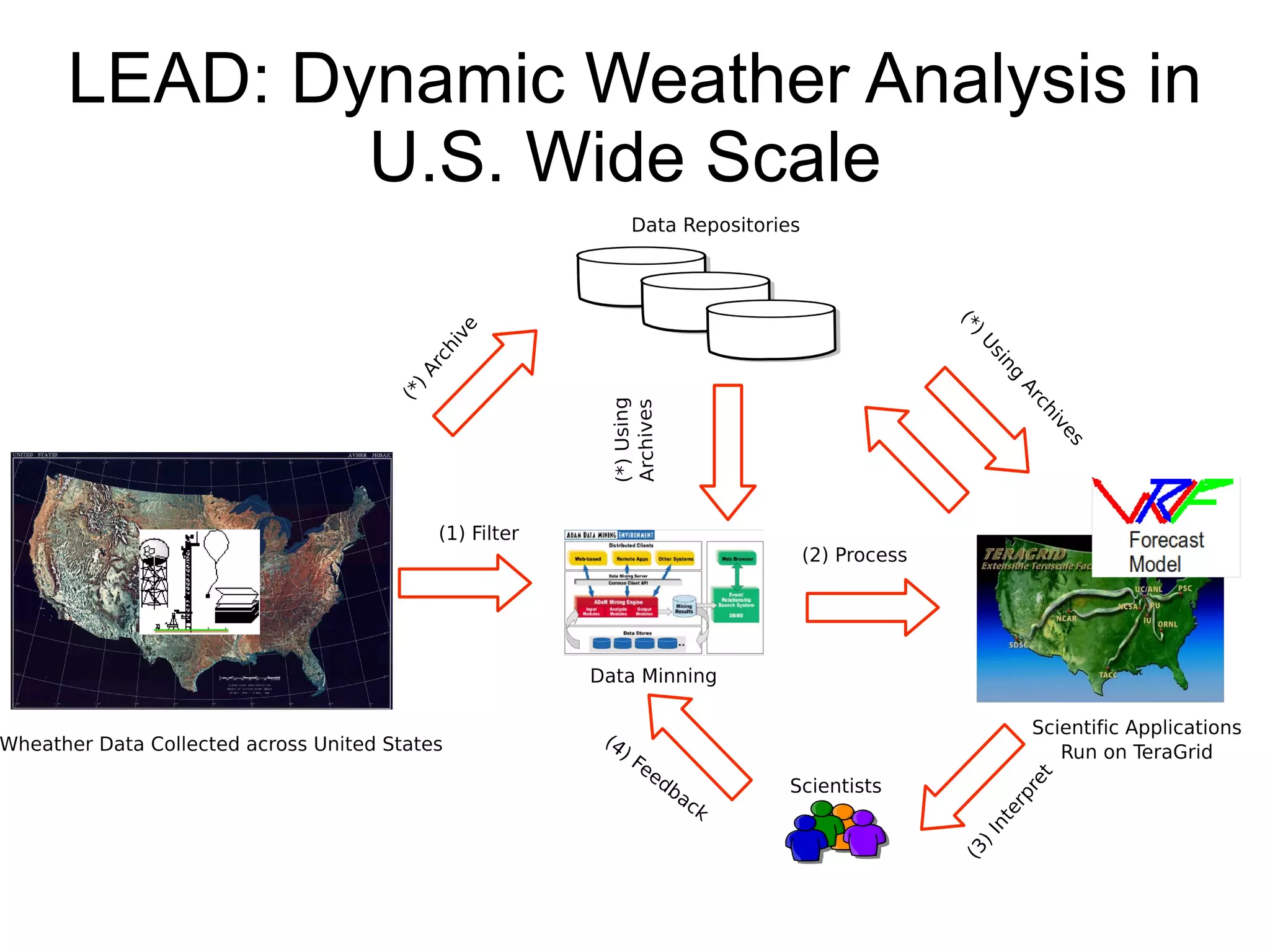
LEAD: Dynamic Weather Analysis in
        U.S. Wide Scale
Why is it Hard?
●   Geographically Distributed Sensors, Computing Power,
    Storage, and Expertise.
●   Handling Failures and Recovery
●   Long Running Jobs (> 1 Hour).
●   Large Scale Jobs (10-1000+ processors).
●   Large Sized Data (KBs to GB of data).
●   Need to serve many Parallel Users.
●   Usage Spikes.
LEAD as an Example
●   Assume a Hurricane developed, and 1000
    scientists across U.S. come to LEAD portal to
    run forecasts.
●   Lets assume,
    ●   Each user run 3 workflows.
    ●   Each Workflow has 6 services, generates about 300
        notifications, moves 50 100MB files, generates 50
        100MB files, and runs for one hour.
    ●   Each Service needs 5 CPUs Hours .
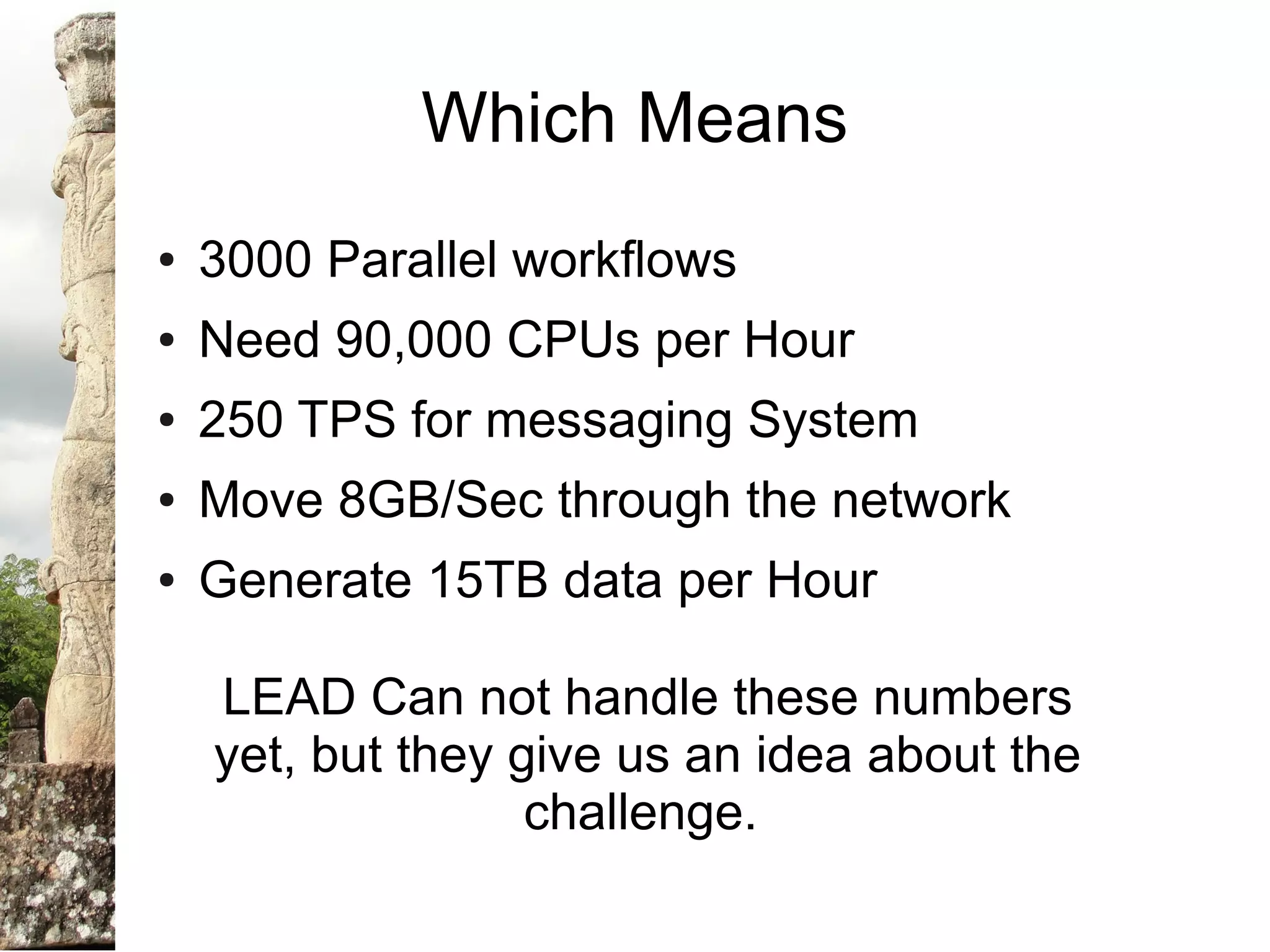
Which Means
●   3000 Parallel workflows
●   Need 90,000 CPUs per Hour
●   250 TPS for messaging System
●   Move 8GB/Sec through the network
●   Generate 15TB data per Hour

    LEAD Can not handle these numbers
    yet, but they give us an idea about the
                   challenge.
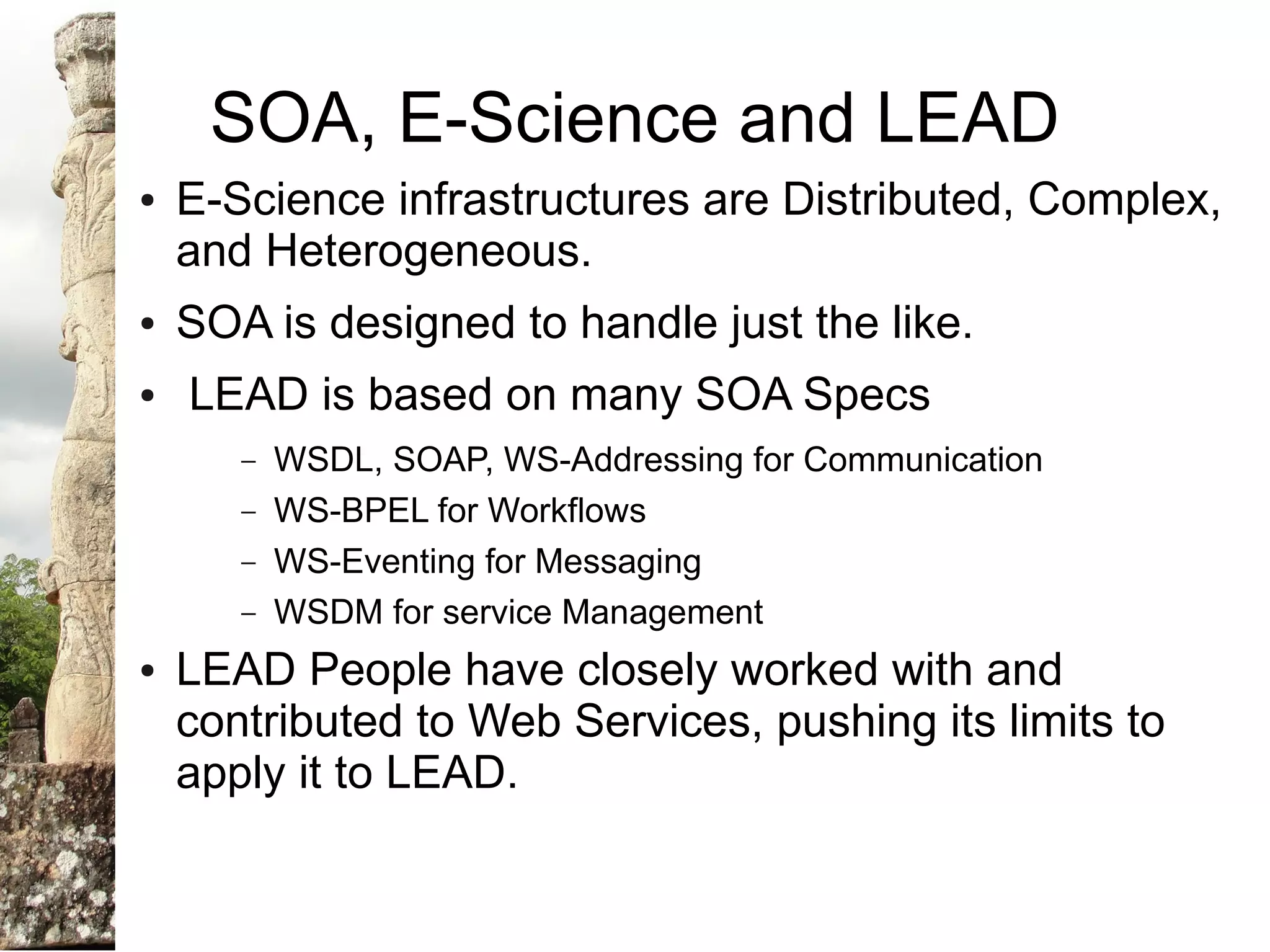
SOA, E-Science and LEAD
●   E-Science infrastructures are Distributed, Complex,
    and Heterogeneous.
●   SOA is designed to handle just the like.
●   LEAD is based on many SOA Specs
       –   WSDL, SOAP, WS-Addressing for Communication
       –   WS-BPEL for Workflows
       –   WS-Eventing for Messaging
       –   WSDM for service Management
●   LEAD People have closely worked with and
    contributed to Web Services, pushing its limits to
    apply it to LEAD.
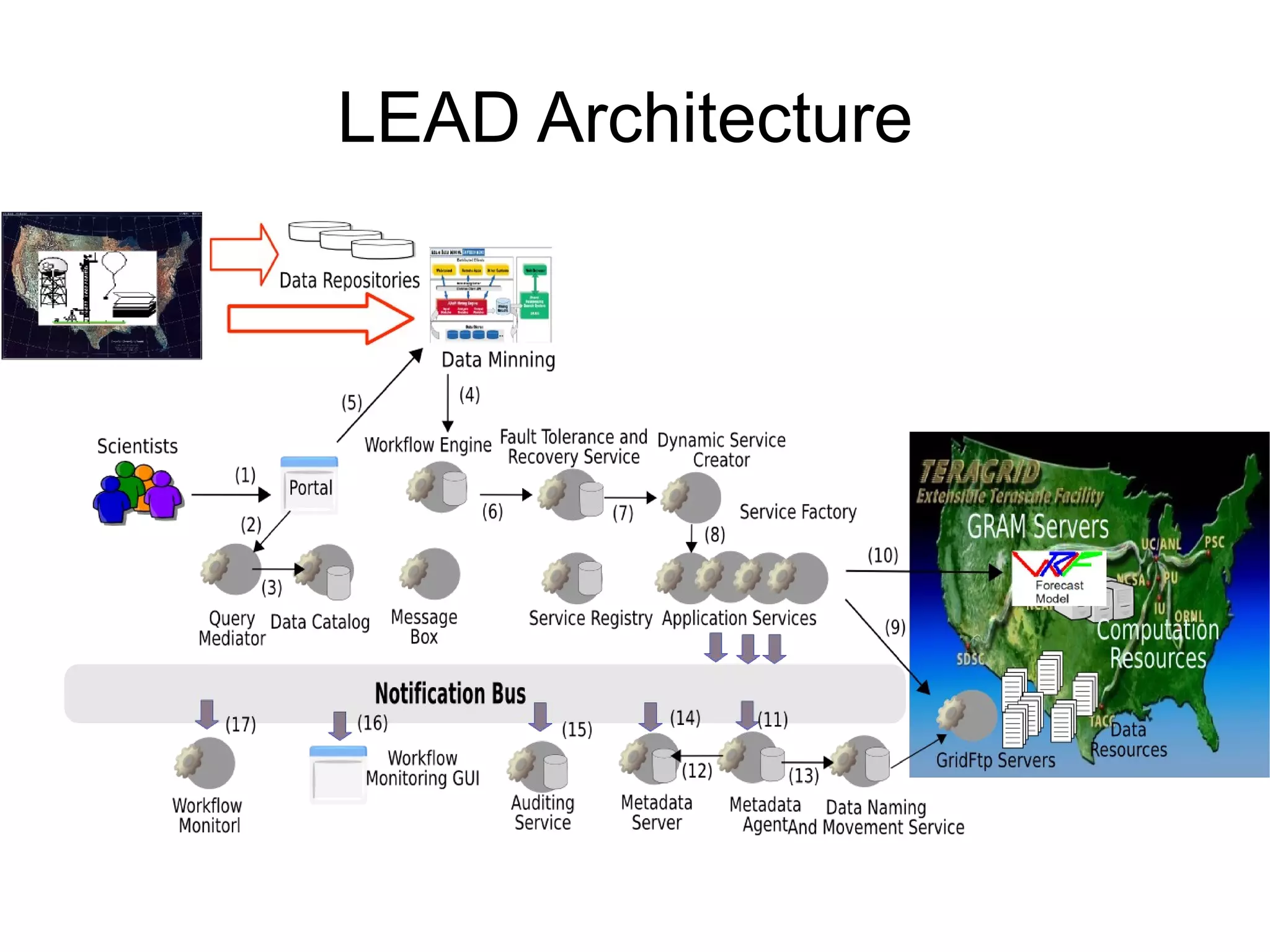
LEAD Architecture
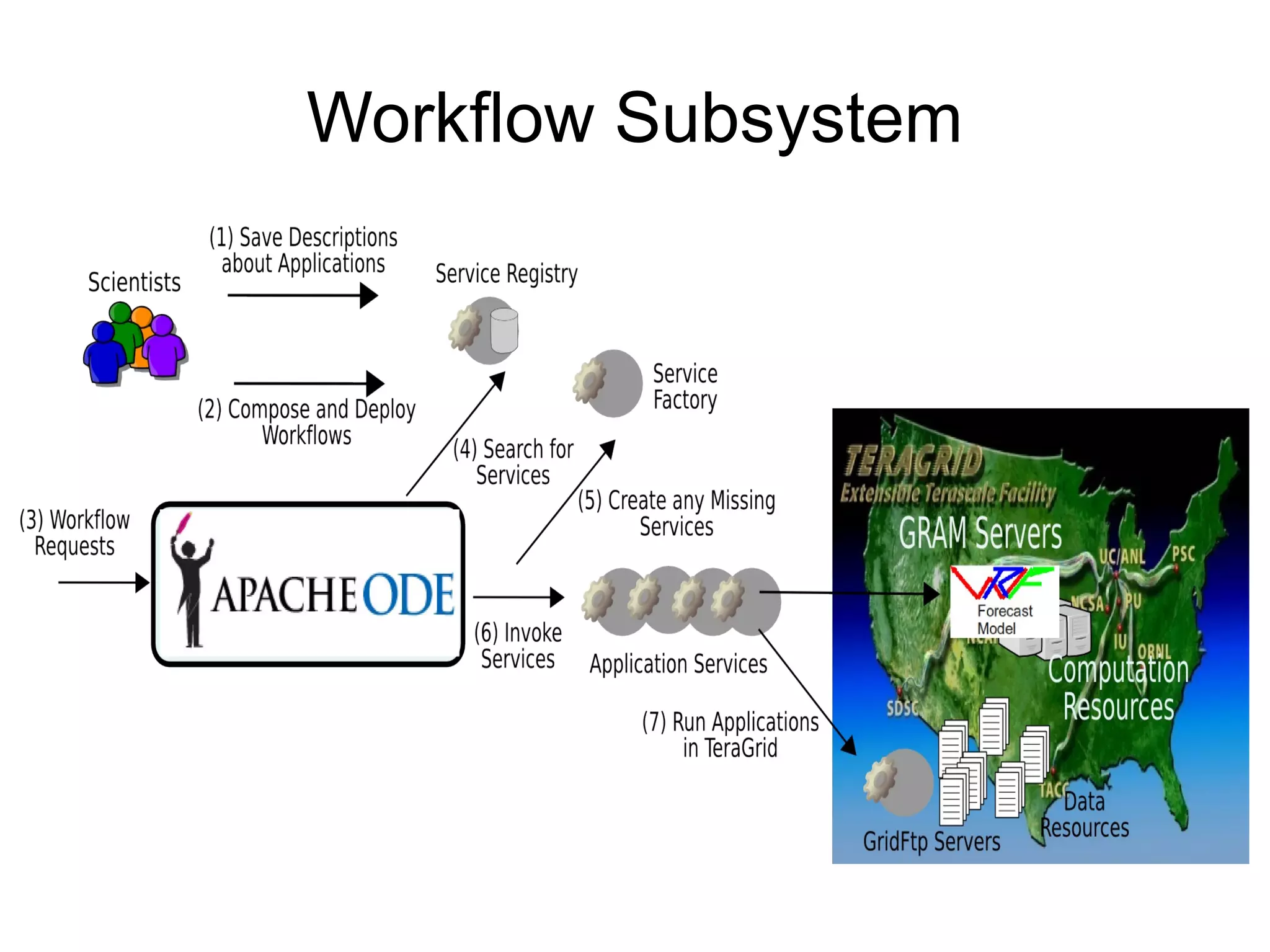
Workflow Subsystem
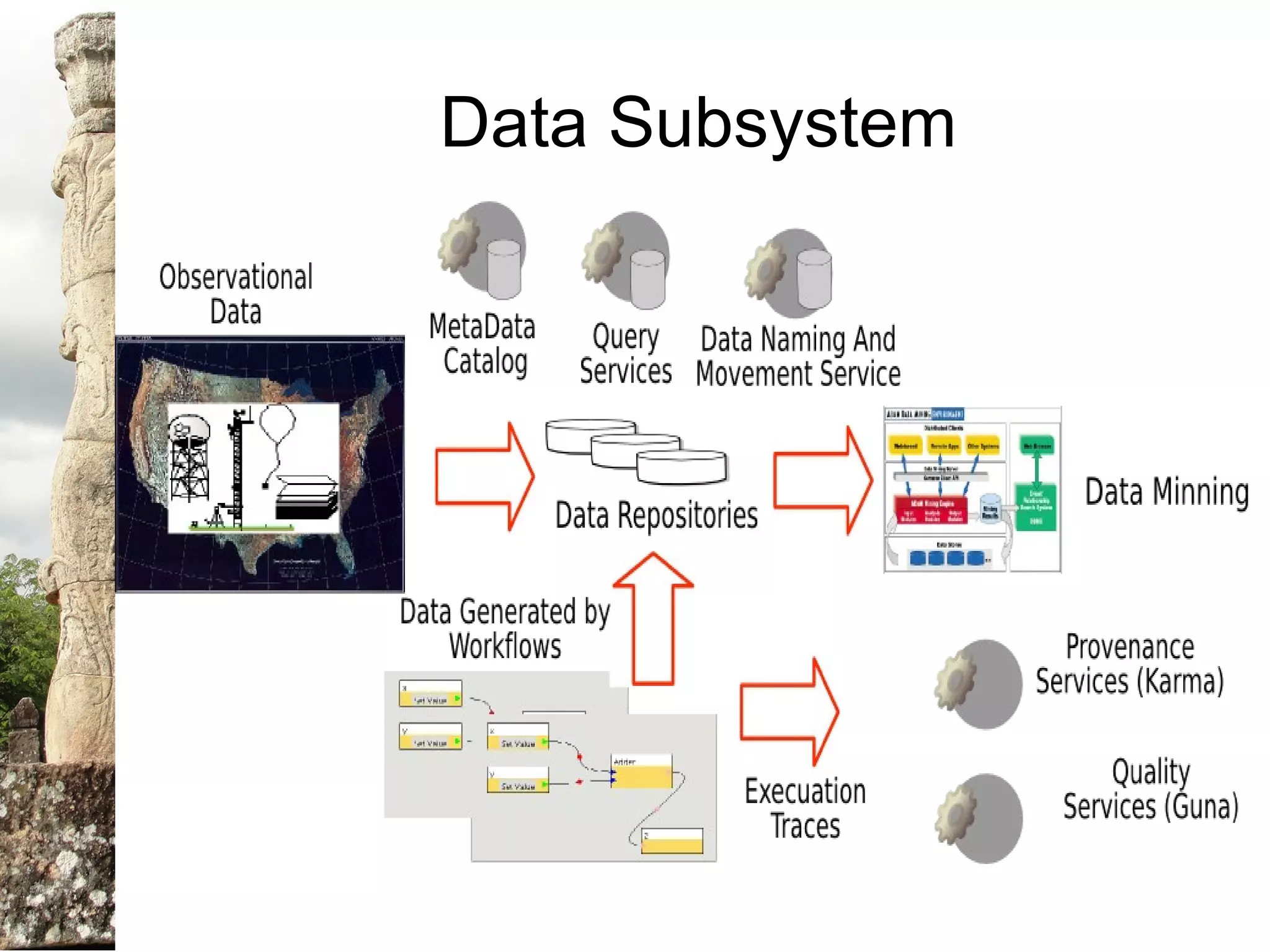
Data Subsystem
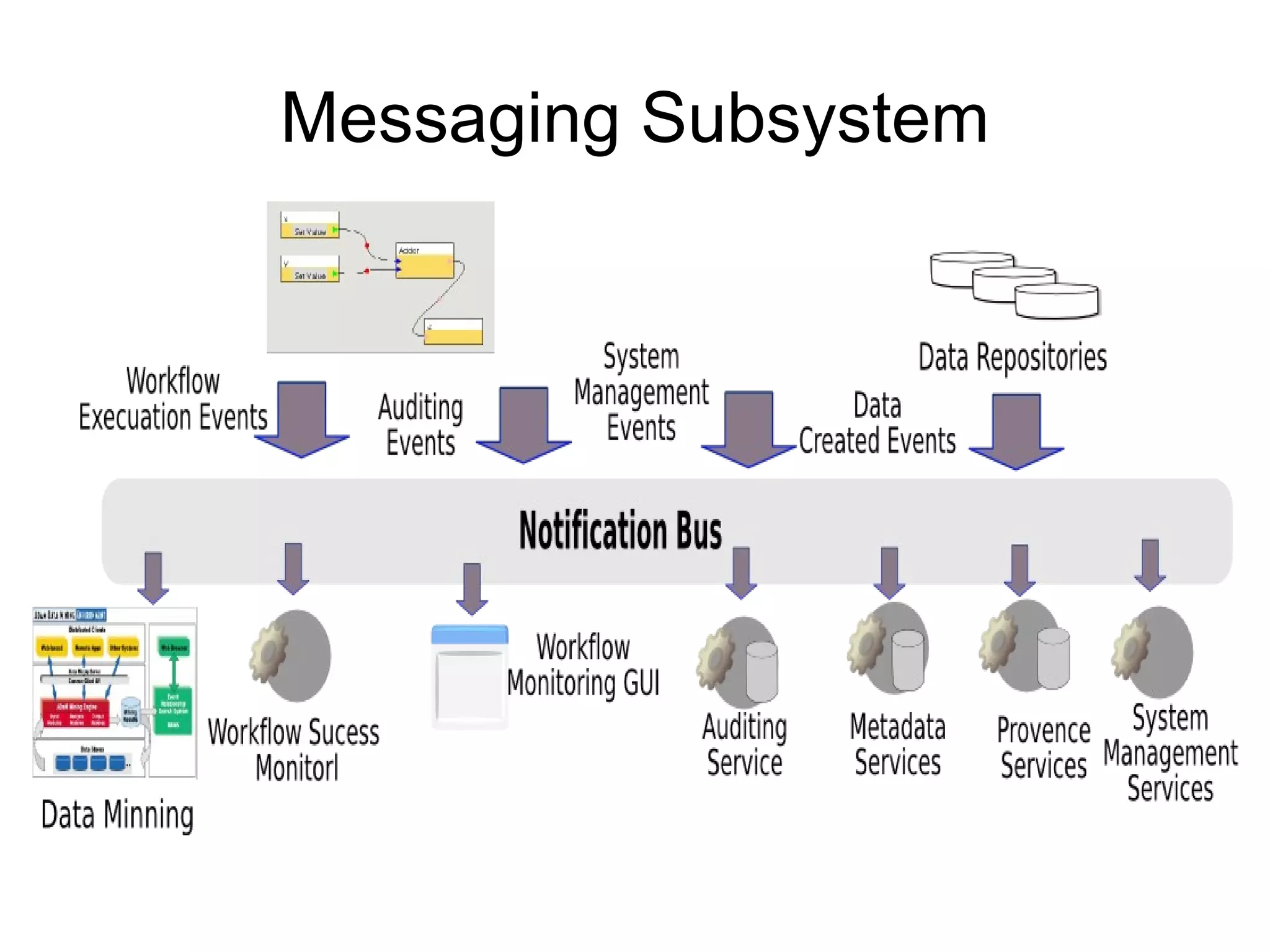
Messaging Subsystem
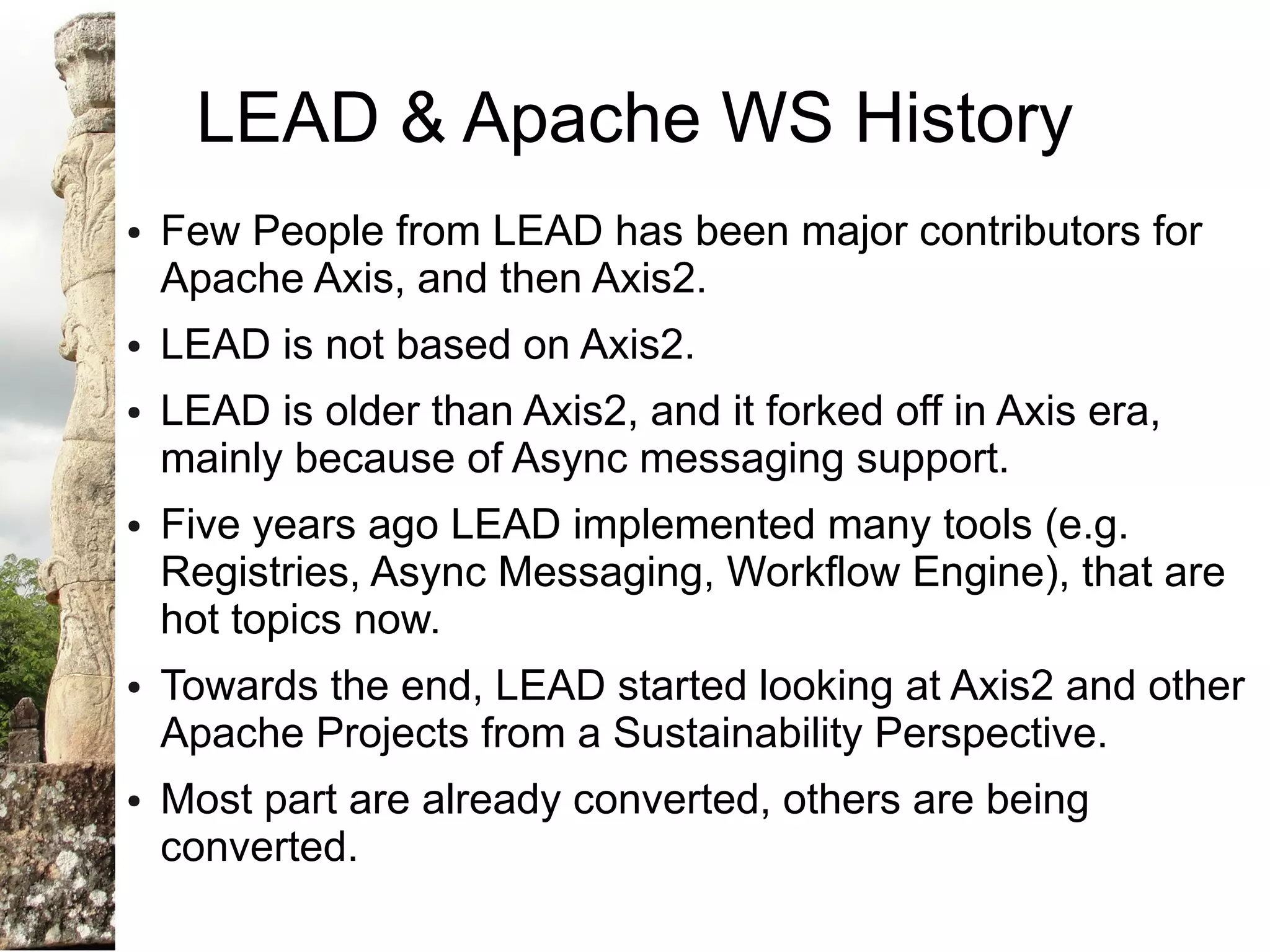
LEAD & Apache WS History
●   Few People from LEAD has been major contributors for
    Apache Axis, and then Axis2.
●   LEAD is not based on Axis2.
●   LEAD is older than Axis2, and it forked off in Axis era,
    mainly because of Async messaging support.
●   Five years ago LEAD implemented many tools (e.g.
    Registries, Async Messaging, Workflow Engine), that are
    hot topics now.
●   Towards the end, LEAD started looking at Axis2 and other
    Apache Projects from a Sustainability Perspective.
●   Most part are already converted, others are being
    converted.
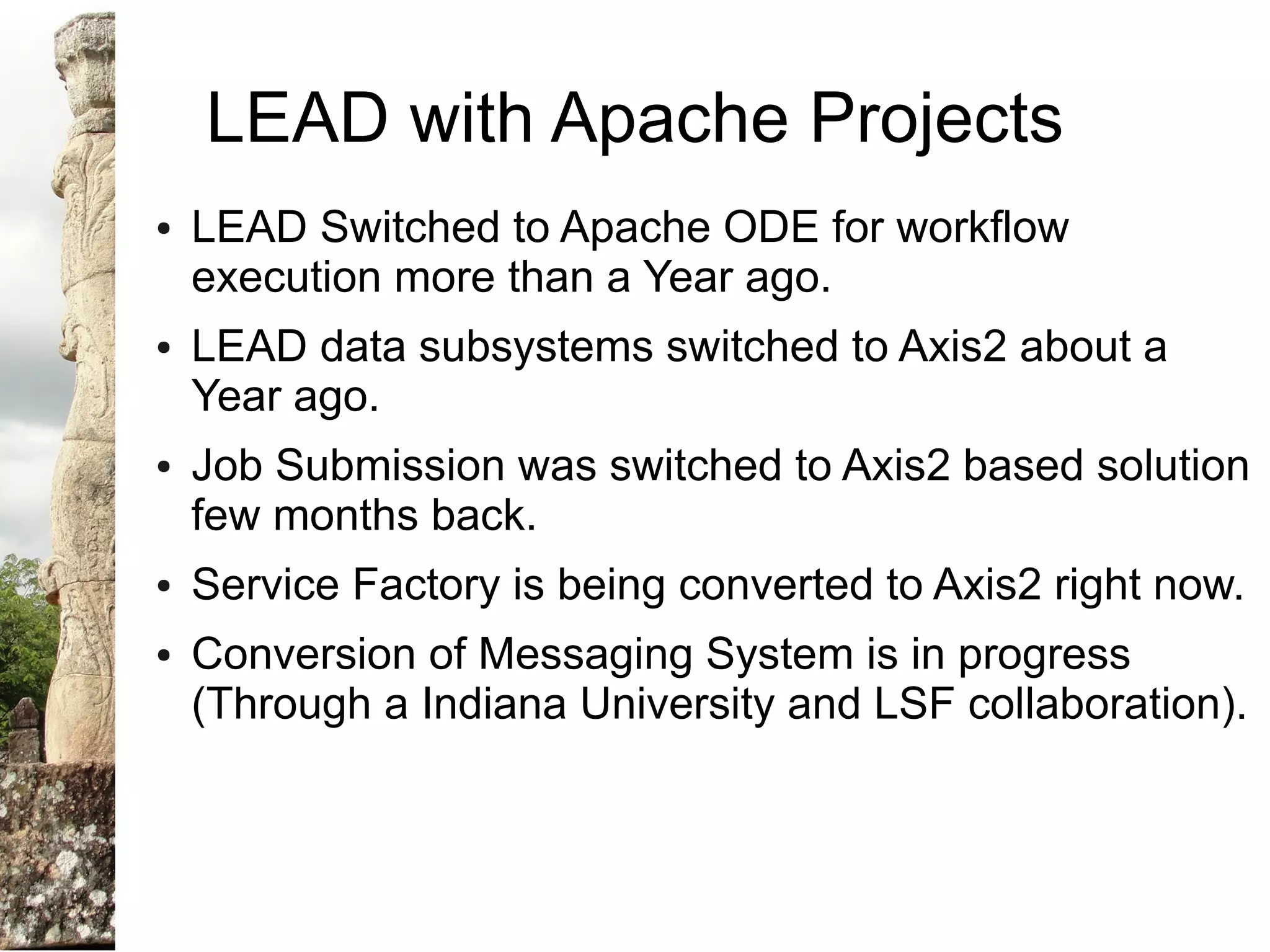
LEAD with Apache Projects
●   LEAD Switched to Apache ODE for workflow
    execution more than a Year ago.
●   LEAD data subsystems switched to Axis2 about a
    Year ago.
●   Job Submission was switched to Axis2 based solution
    few months back.
●   Service Factory is being converted to Axis2 right now.
●   Conversion of Messaging System is in progress
    (Through a Indiana University and LSF collaboration).
Apache as a Sustainability model
         for Research projects
●   Industry values “People”, we (opensource) value “Code”, and
    Academia values “Ideas”.
●   Most NSF Grants, now, ask for a Sustainability Model as part
    of Proposals.
●   One option is a commercial spin off
●   Doing it in a opensource way, building a community and users
    around a project is also a potential Solution.
●   Many Challenges: ownership, need to renounce control, active
    engagement of the community are the key.
    ●   “Source Open” is not good enough!!
    ●   “Dump and Run” does not work either.
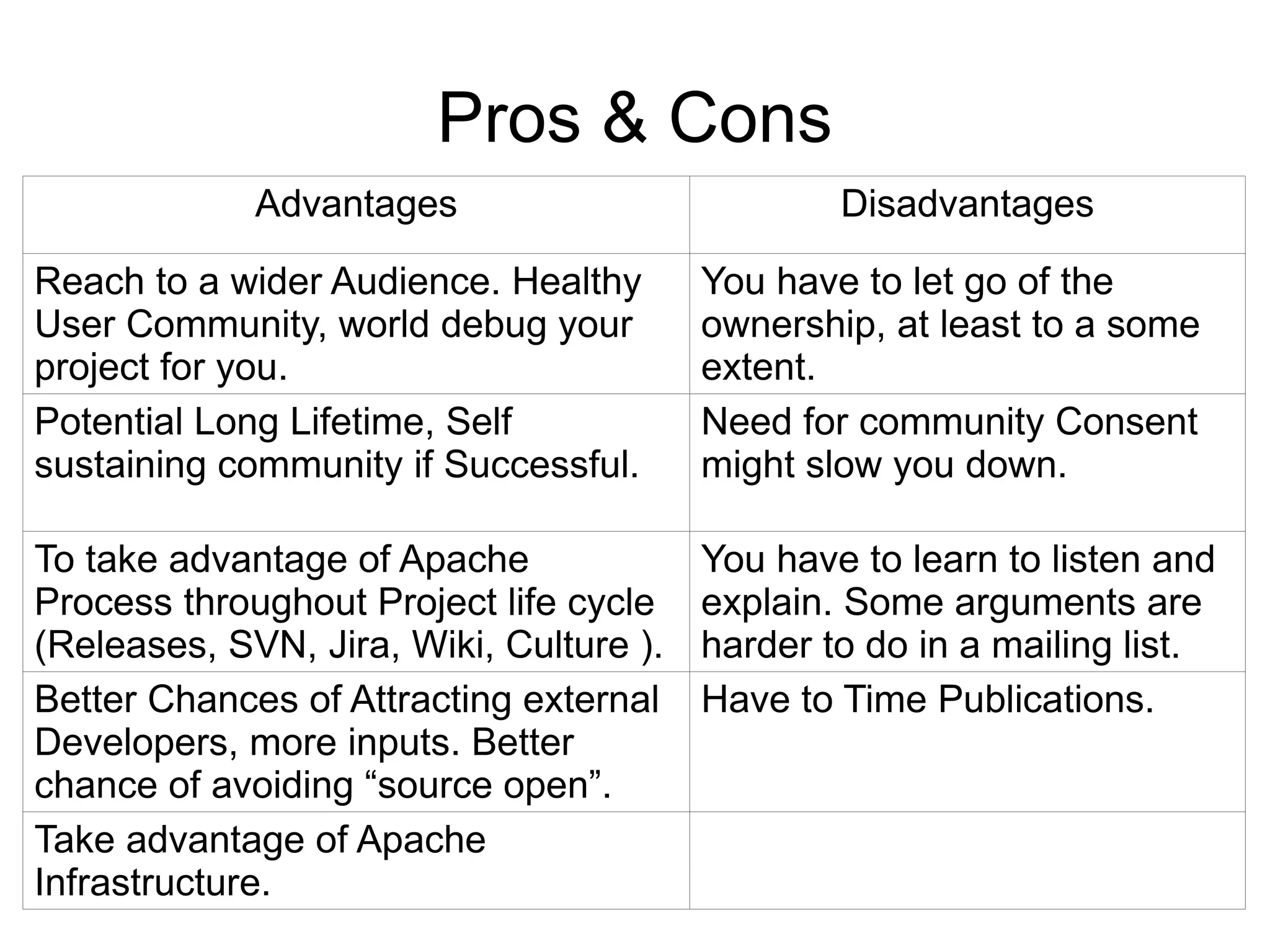
Pros & Cons
             Advantages                          Disadvantages

Reach to a wider Audience. Healthy       You have to let go of the
User Community, world debug your         ownership, at least to a some
project for you.                         extent.
Potential Long Lifetime, Self            Need for community Consent
sustaining community if Successful.      might slow you down.

To take advantage of Apache              You have to learn to listen and
Process throughout Project life cycle    explain. Some arguments are
(Releases, SVN, Jira, Wiki, Culture ).   harder to do in a mailing list.
Better Chances of Attracting external    Have to Time Publications.
Developers, more inputs. Better
chance of avoiding “source open”.
Take advantage of Apache
Infrastructure.
Conclusion
●   Wanted to share a Real Life, Large-Scale SOA
    Usecase
●   Wanted to show LEAD-Apache interactions as
    a real Life Case Study of interactions between
    Apache and an Academic Project.
●   Wanted to Showcase Apache as a
    Sustainability Mechanism, if it is done right.
Questions?

Apache Web Services in the Real World, an E-Science Perspective

  • 1.
    Apache Web Servicesin the Real World, an E-Science Perspective Srinath Perera Architect, WSO2 Inc. Member, Apache Software Foundation Lanka Software Foundation
  • 2.
    Outline ● Linked Environment for Atmospheric Discovery Project (LEAD), the Use Case. ● LEAD Architecture, using SOA to build a Large Scale E-Science Project. ● History: LEAD and Apache Web Service Projects. ● Apache as a Sustainability Model for Academic Projects.
  • 3.
    E-Science ● Continuation of High Performance Computing, Parallel Computing, and Grid. ● Cyber-infrastructures to support Scientific Research. ● Build around “Computation” as the third Pillar of Science (along with Analysis and Experimentation). ● Characterized by wide range of computing (CPU minutes to CPU years) and Data (few KB to Pbs of data) requirements. ● Based on Real life usecases.
  • 4.
    Reality is Harderthan Fiction ● E-Science joins Theory with Real life data ● Real Life Applications often go beyond our experiences. ● Most Weather models are calculated much less than ideal resolutions, otherwise a 24 hour forecast takes more than 24 hours !!! ● Physics Usecases (e.g. Large Hadron Collider), Telescopes, Genome Analysis generate Tera bytes of data in days if not hours, and moving a 1TB takes hours even in a 10 GB networks of TeraGrid. ● Scale, Geographical Distribution of resources, Heterogeneity makes these usecases Complex.
  • 5.
    Linked Environments for AtmosphericDiscovery (LEAD) ● U.S. NSF funded, 10+ Universities, 11M $, 5 Years. ● Used for U.S. National Weather forecasts by NOAA. ● Presented to U.S. Congress as an example to justify Scientific research spendings by U.S. NSF. ● Have brought the state of the art forecasting capabilities to wider audience ranging from hardcore scientists to high schools students.
  • 6.
    LEAD: Dynamic WeatherAnalysis in U.S. Wide Scale
  • 7.
    Why is itHard? ● Geographically Distributed Sensors, Computing Power, Storage, and Expertise. ● Handling Failures and Recovery ● Long Running Jobs (> 1 Hour). ● Large Scale Jobs (10-1000+ processors). ● Large Sized Data (KBs to GB of data). ● Need to serve many Parallel Users. ● Usage Spikes.
  • 8.
    LEAD as anExample ● Assume a Hurricane developed, and 1000 scientists across U.S. come to LEAD portal to run forecasts. ● Lets assume, ● Each user run 3 workflows. ● Each Workflow has 6 services, generates about 300 notifications, moves 50 100MB files, generates 50 100MB files, and runs for one hour. ● Each Service needs 5 CPUs Hours .
  • 9.
    Which Means ● 3000 Parallel workflows ● Need 90,000 CPUs per Hour ● 250 TPS for messaging System ● Move 8GB/Sec through the network ● Generate 15TB data per Hour LEAD Can not handle these numbers yet, but they give us an idea about the challenge.
  • 10.
    SOA, E-Science andLEAD ● E-Science infrastructures are Distributed, Complex, and Heterogeneous. ● SOA is designed to handle just the like. ● LEAD is based on many SOA Specs – WSDL, SOAP, WS-Addressing for Communication – WS-BPEL for Workflows – WS-Eventing for Messaging – WSDM for service Management ● LEAD People have closely worked with and contributed to Web Services, pushing its limits to apply it to LEAD.
  • 11.
  • 12.
  • 13.
  • 14.
  • 15.
    LEAD & ApacheWS History ● Few People from LEAD has been major contributors for Apache Axis, and then Axis2. ● LEAD is not based on Axis2. ● LEAD is older than Axis2, and it forked off in Axis era, mainly because of Async messaging support. ● Five years ago LEAD implemented many tools (e.g. Registries, Async Messaging, Workflow Engine), that are hot topics now. ● Towards the end, LEAD started looking at Axis2 and other Apache Projects from a Sustainability Perspective. ● Most part are already converted, others are being converted.
  • 16.
    LEAD with ApacheProjects ● LEAD Switched to Apache ODE for workflow execution more than a Year ago. ● LEAD data subsystems switched to Axis2 about a Year ago. ● Job Submission was switched to Axis2 based solution few months back. ● Service Factory is being converted to Axis2 right now. ● Conversion of Messaging System is in progress (Through a Indiana University and LSF collaboration).
  • 17.
    Apache as aSustainability model for Research projects ● Industry values “People”, we (opensource) value “Code”, and Academia values “Ideas”. ● Most NSF Grants, now, ask for a Sustainability Model as part of Proposals. ● One option is a commercial spin off ● Doing it in a opensource way, building a community and users around a project is also a potential Solution. ● Many Challenges: ownership, need to renounce control, active engagement of the community are the key. ● “Source Open” is not good enough!! ● “Dump and Run” does not work either.
  • 18.
    Pros & Cons Advantages Disadvantages Reach to a wider Audience. Healthy You have to let go of the User Community, world debug your ownership, at least to a some project for you. extent. Potential Long Lifetime, Self Need for community Consent sustaining community if Successful. might slow you down. To take advantage of Apache You have to learn to listen and Process throughout Project life cycle explain. Some arguments are (Releases, SVN, Jira, Wiki, Culture ). harder to do in a mailing list. Better Chances of Attracting external Have to Time Publications. Developers, more inputs. Better chance of avoiding “source open”. Take advantage of Apache Infrastructure.
  • 19.
    Conclusion ● Wanted to share a Real Life, Large-Scale SOA Usecase ● Wanted to show LEAD-Apache interactions as a real Life Case Study of interactions between Apache and an Academic Project. ● Wanted to Showcase Apache as a Sustainability Mechanism, if it is done right.
  • 20.