Melbourne / April 2015
Introducing DataFrames
R on Spark
Large Scale Machine Learning
Speakers
Ned Shawa
Mark Moloney
Dr. Zhen He
Agenda
• Apache Spark 1.3 Overview 6:15 – 6:30 (Ned)
• DataFrames for Apache Spark 6:30 – 7:00 (Ned)
• R on Apache Spark 7:00 – 7:30 (Mark)
• Large Scale Machine Learning on Spark 7:30 – 8:15 (Zhen)
News
• Hadoop + Strata
• Jobs
• Meetup Update
• Personal Announcement
• Call for Contribution
Contributions so far…..
• Mark with R on Spark, Scala 101
• Tim with Building Spark on IDEs
• Con with building Spark with Gradle
• More?
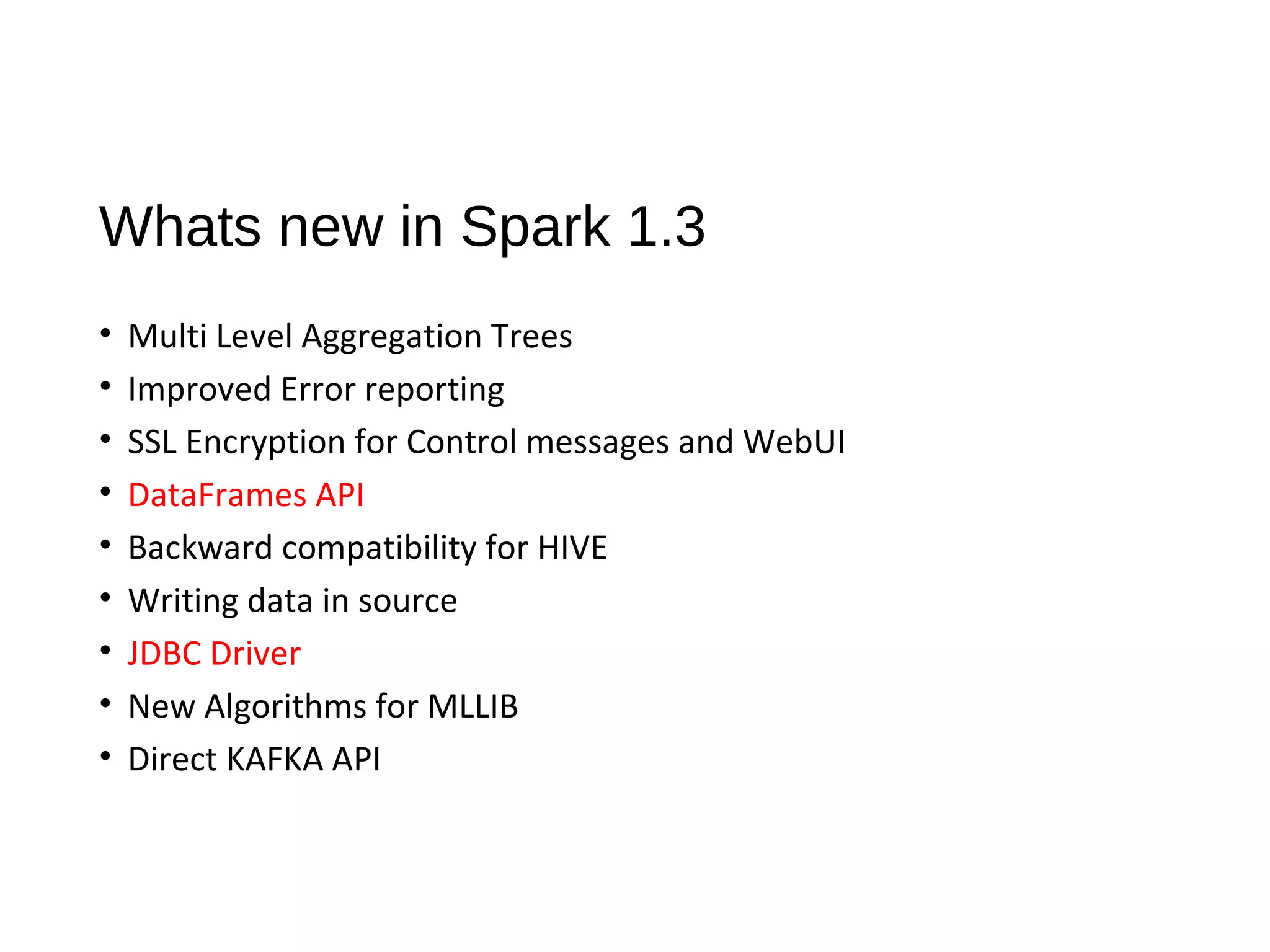
Whats new in Spark 1.3
• Multi Level Aggregation Trees
• Improved Error reporting
• SSL Encryption for Control messages and WebUI
• DataFrames API
• Backward compatibility for HIVE
• Writing data in source
• JDBC Driver
• New Algorithms for MLLIB
• Direct KAFKA API
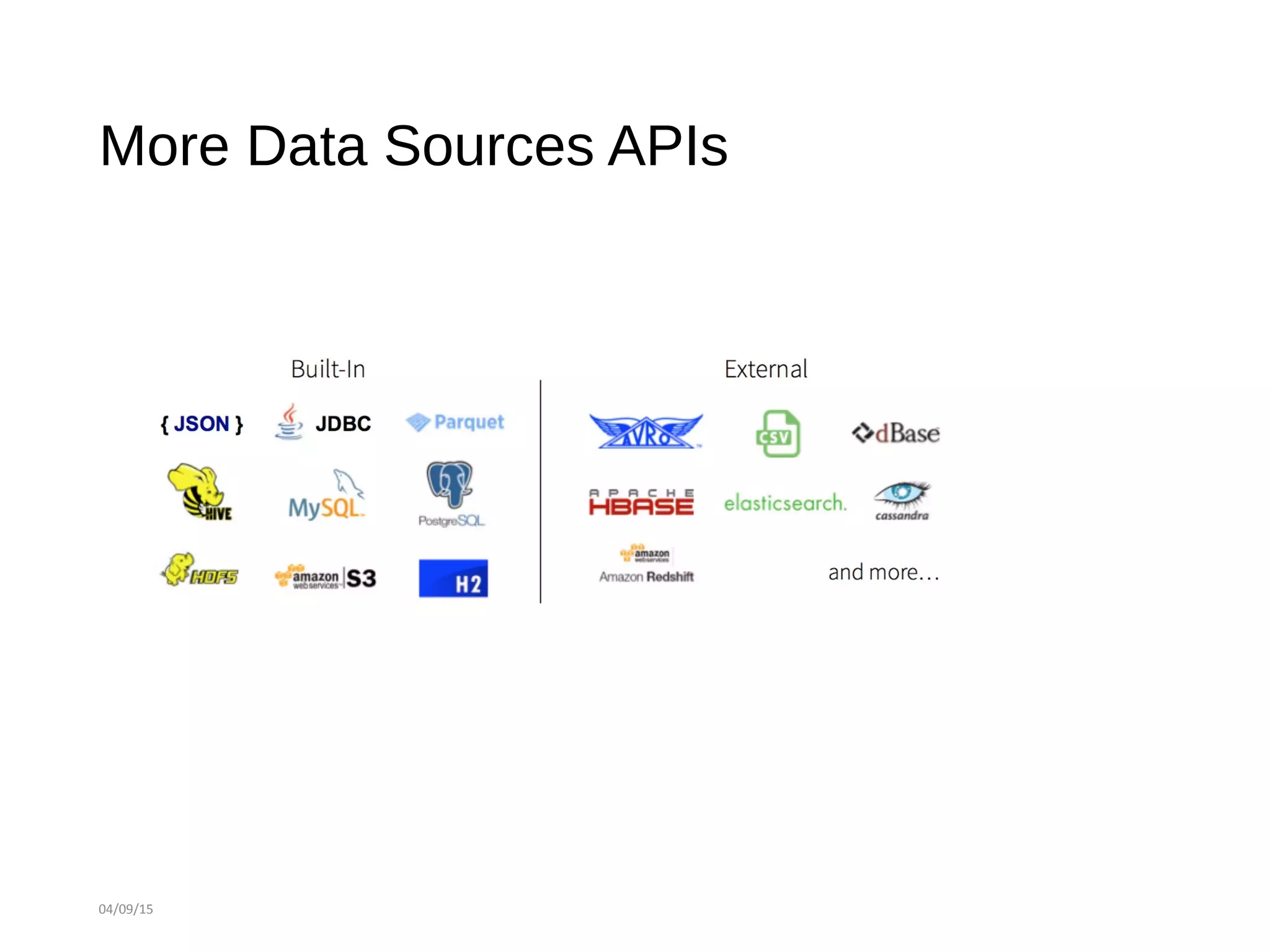
More Data Sources APIs
04/13/15
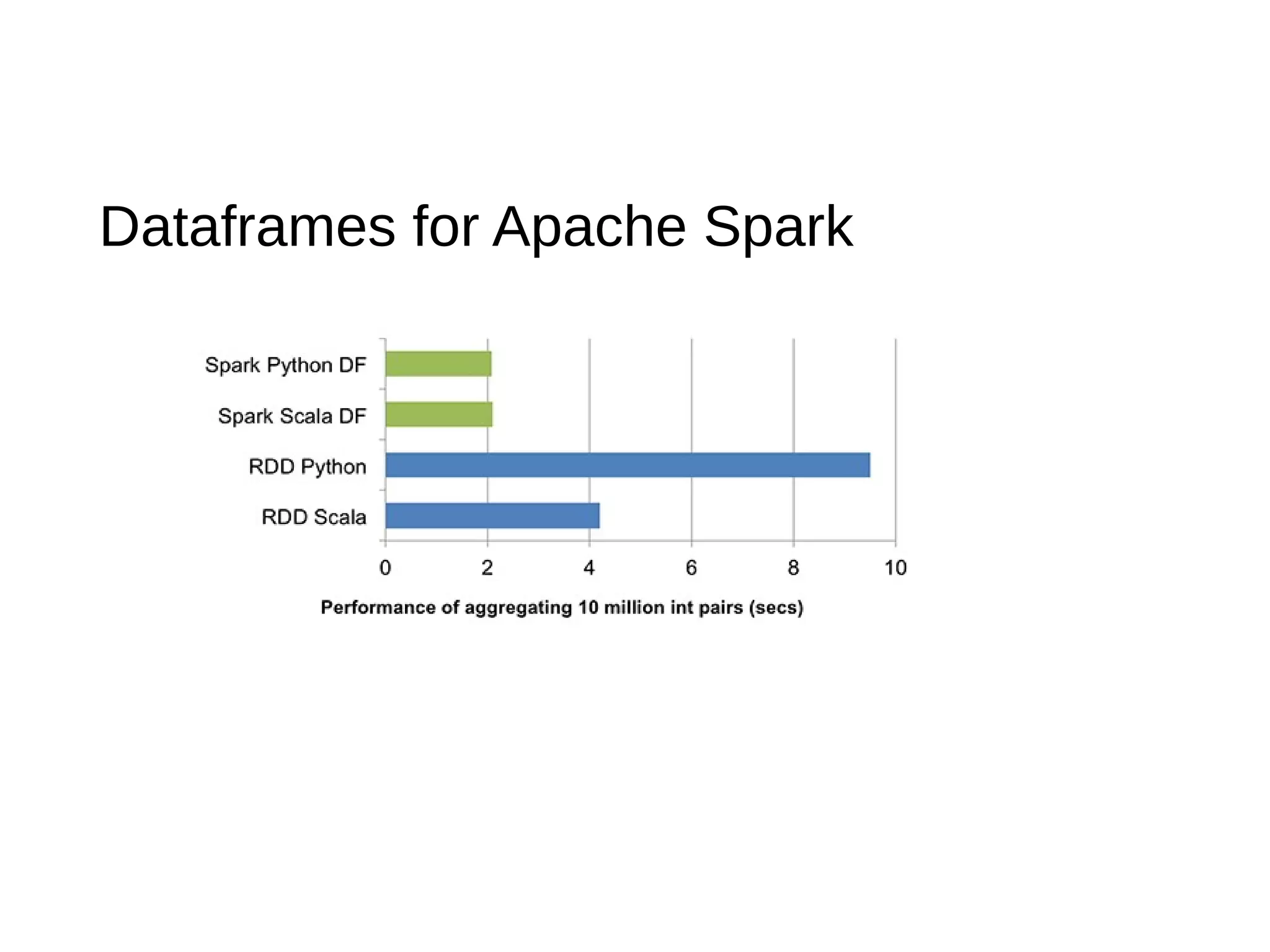
What are DataFrames?
• Distributed Collection of Data organized in Columns
• Equivalent to Tables in Databases or DataFrame in R/PYTHON
• Much richer optimization than any other implementation of DF
• Can be constructed from a wide variety of sources and APIs
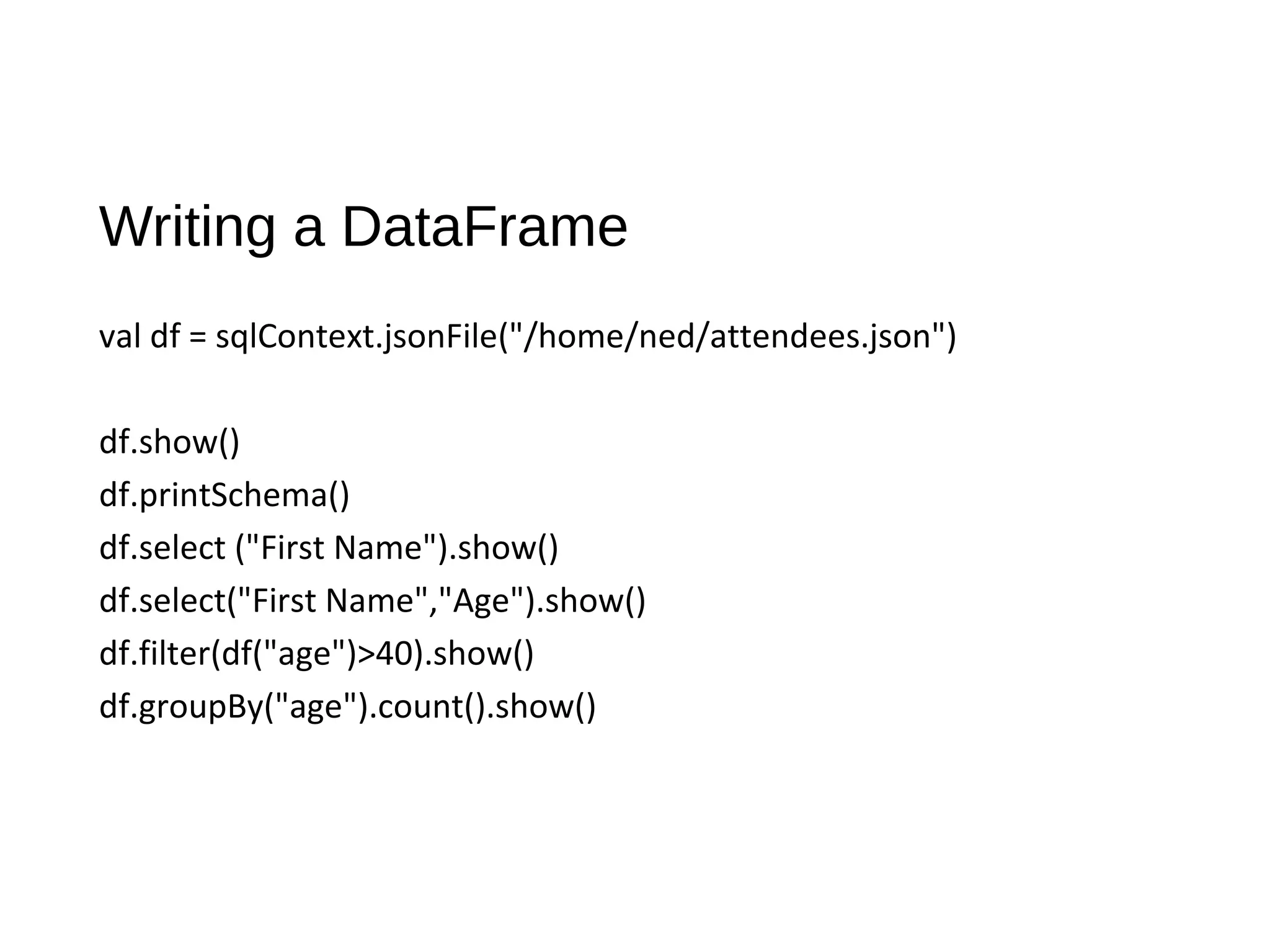
Writing a DataFrame
val df = sqlContext.jsonFile("/home/ned/attendees.json")
df.show()
df.printSchema()
df.select ("First Name").show()
df.select("First Name","Age").show()
df.filter(df("age")>40).show()
df.groupBy("age").count().show()
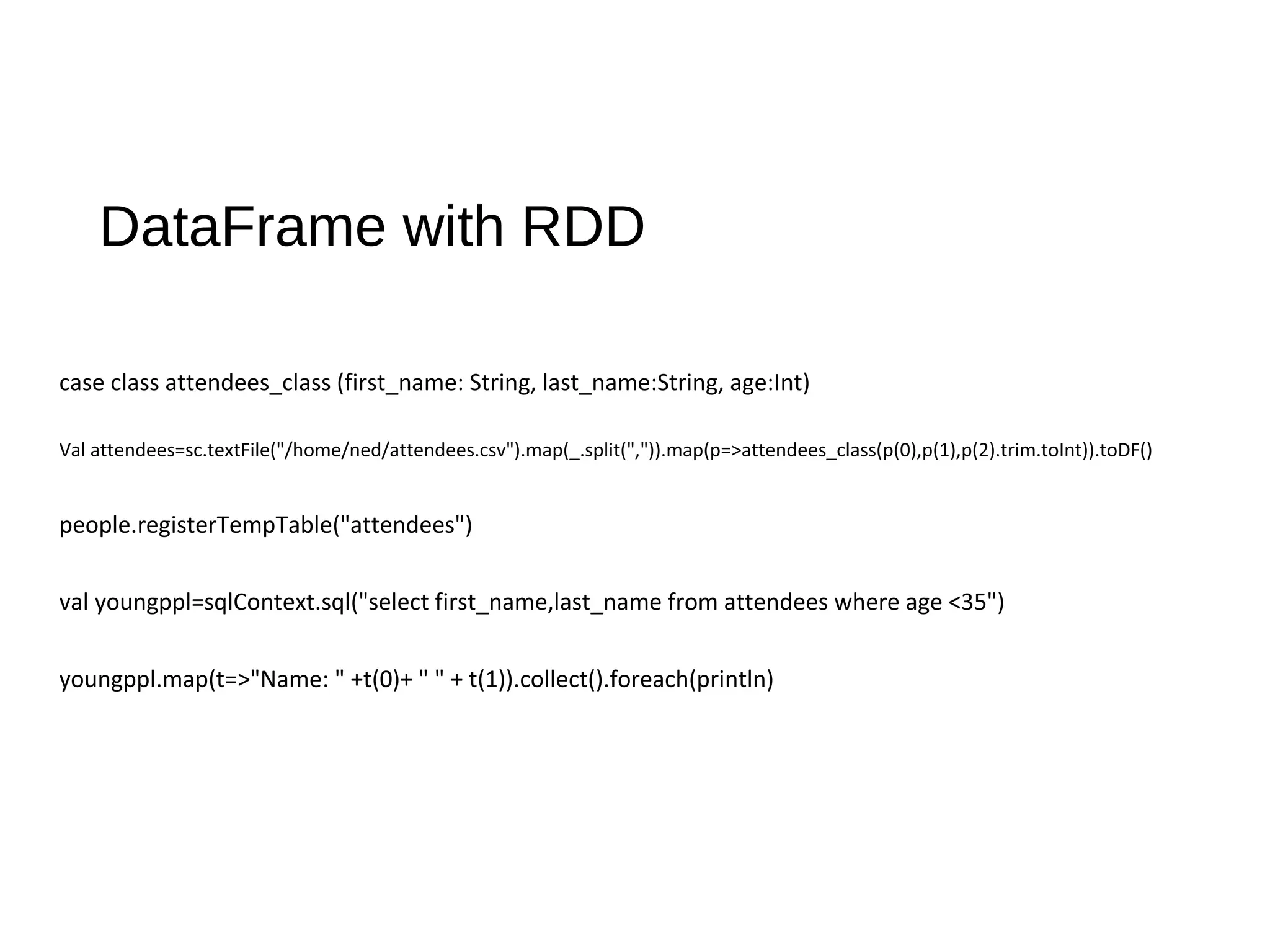
DataFrame with RDD
case class attendees_class (first_name: String, last_name:String, age:Int)
Val attendees=sc.textFile("/home/ned/attendees.csv").map(_.split(",")).map(p=>attendees_class(p(0),p(1),p(2).trim.toInt)).toDF()
people.registerTempTable("attendees")
val youngppl=sqlContext.sql("select first_name,last_name from attendees where age <35")
youngppl.map(t=>"Name: " +t(0)+ " " + t(1)).collect().foreach(println)
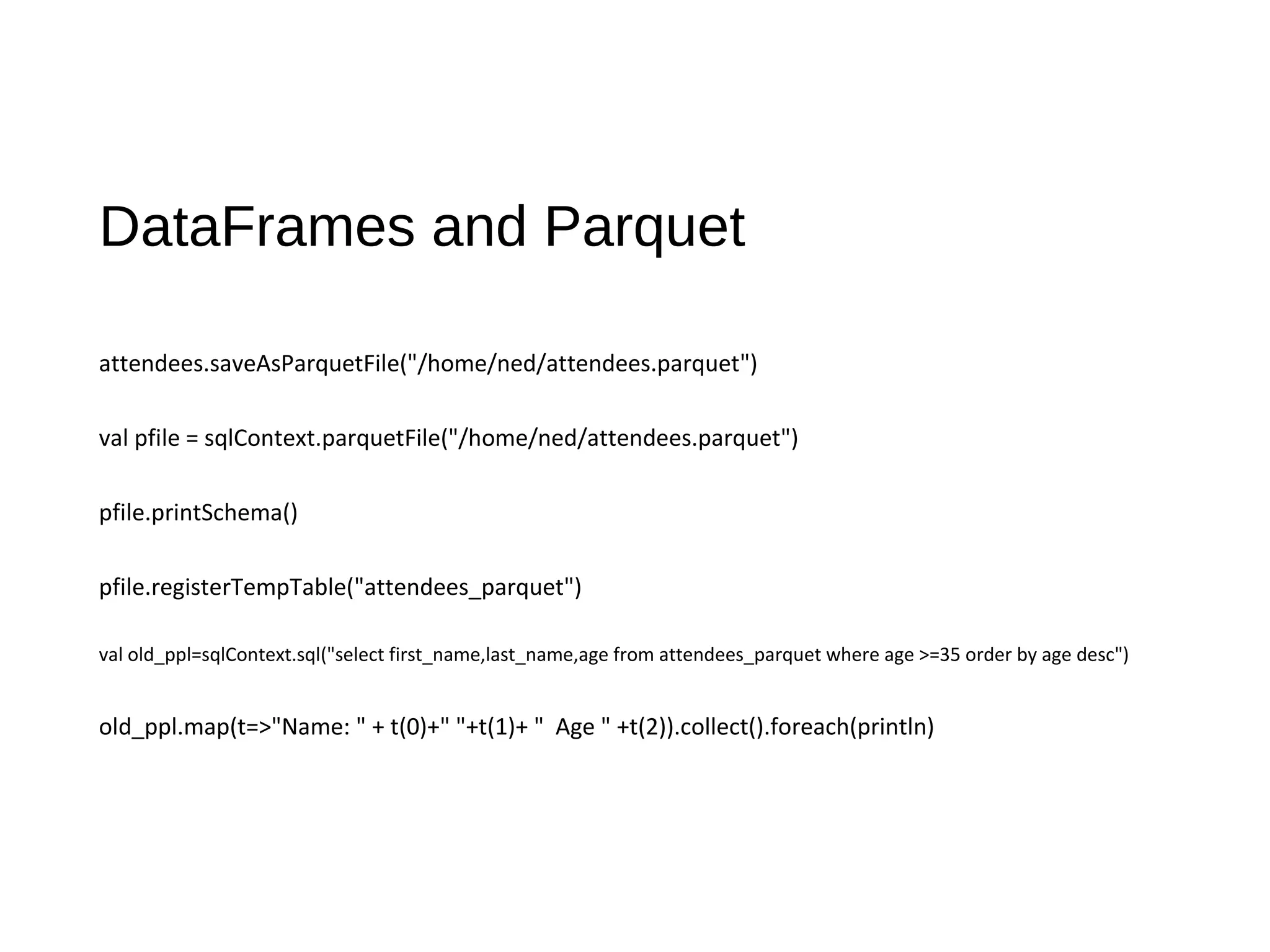
DataFrames and Parquet
attendees.saveAsParquetFile("/home/ned/attendees.parquet")
val pfile = sqlContext.parquetFile("/home/ned/attendees.parquet")
pfile.printSchema()
pfile.registerTempTable("attendees_parquet")
val old_ppl=sqlContext.sql("select first_name,last_name,age from attendees_parquet where age >=35 order by age desc")
old_ppl.map(t=>"Name: " + t(0)+" "+t(1)+ " Age " +t(2)).collect().foreach(println)
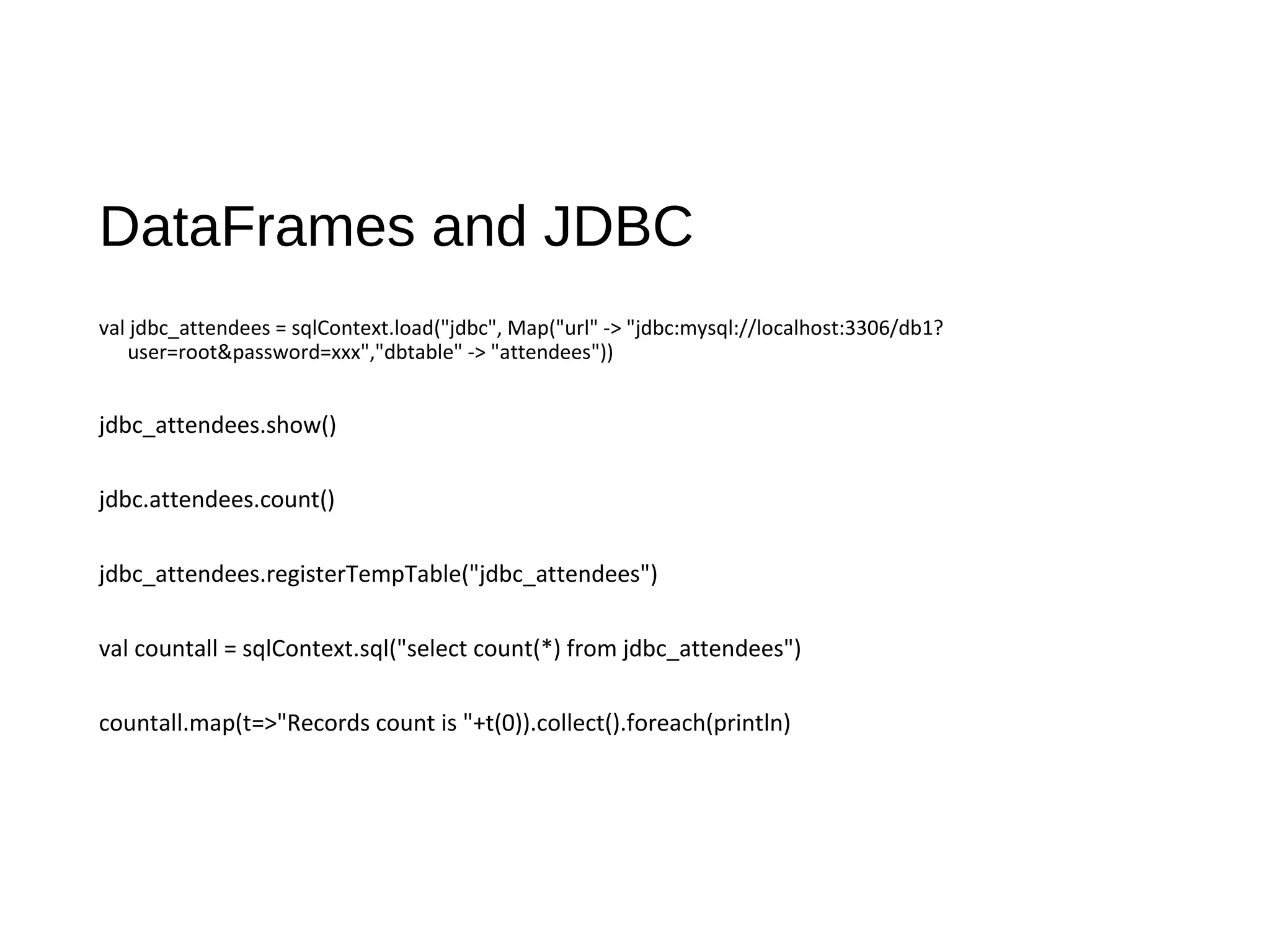
DataFrames and JDBC
val jdbc_attendees = sqlContext.load("jdbc", Map("url" -> "jdbc:mysql://localhost:3306/db1?
user=root&password=xxx","dbtable" -> "attendees"))
jdbc_attendees.show()
jdbc.attendees.count()
jdbc_attendees.registerTempTable("jdbc_attendees")
val countall = sqlContext.sql("select count(*) from jdbc_attendees")
countall.map(t=>"Records count is "+t(0)).collect().foreach(println)
Dataframes for Apache Spark
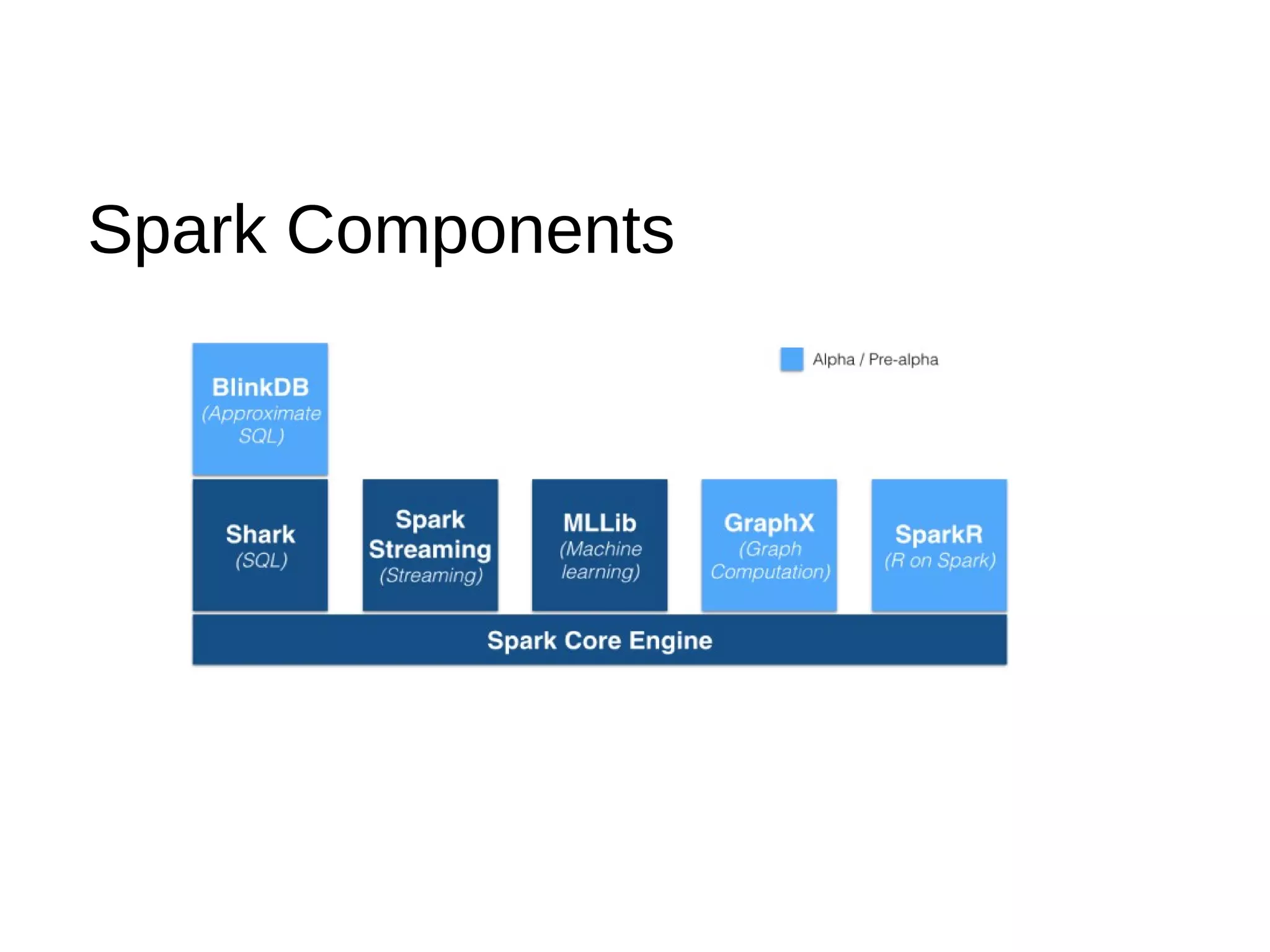
Spark Components
Introduction to SparkR
Mark Moloney
April 2015
https://github.com/markmo/sparkr-meetup-sparkr-demo
R
• A language that targets statistical and general data analysis
• A package for nearly everything in this space
• Great for exploratory analysis – rapid statistics and plots
• Single threaded
• Datasets limited to memoryTool Selection Primary Analytic Tool
18%
15%
Cost is important
A
B
E
Ease-of-use
& interface
Ability to
write one’s
Everything is important
Data miners are a diverse group who are looking for
different things from their data mining tools. They report
using multiple tools to meet their analytic needs, and
even the most popular tool is identified as their primary
tool by just 24% of data miners. Over the years, R and
Rapid Miner have shown substantial increases.
Cluster analysis* reveals that, in their tool-selection
preferences, data miners fall into 5 groups. The primary
dimensions that distinguish them are price sensitivity and
code-writing / interface / ease-of-use preferences.
2013 Rexer Analytics Survey of 1,259 analytics professionals from 75 countries.
Spark
• An evolutionary step up from Map-Reduce programming on Hadoop
• Do more with less work
• Simpler API than Map-Reduce. Apply functional transforms to datasets. The
framework takes care of distribution of work across multiple machines.
• Can cache interim results in memory, which speeds up iterative procedures
SparkR
• An R API to Spark’s RDDs (Resilient Distributed Datasets)
• Work with massive datasets in R
• Works on top of YARN or Mesos
• Interactively run jobs on a cluster from the R shell
• Exposes the RDD API of Spark as distributed lists in R
• Packages and ships variables in the closure to each node
• Use includePackage to include third-party packages on
other nodes
• Currently only suports R lists and vectors. Data frame
support is in the works.
map / lapply
mapPartitions / lapplyPartition
groupByKey
reduceByKey
sampleRDD
collect
cache
textFile
parallelize
broadcast
includePackage
How does it work
• The R executable must be installed on each node
• Work is sent to a Spark Executor (Java) on each node
• Some overhead in starting R interpreter – looking at background process as in PySpark
R
Java
Spark
Context
Java
Spark
Context
Java Native Interface (JNI)
using rJava
Local JVM
Local Machine Remote Machine
Remote Machine
Spark
Executor
Spark
Executor
Spark
Executor
Spark
Executor
R
R
tasks
tasks
broadcast vars, packages
Send R environment of vars used
Uses R save() function to serialize closure
Roadmap
• Feature-complete DataFrame API
• MLLib integration
DataFrame Methods
•Filter
– filter(df, df$col1 > 0)
•Sort
– sortDF(df, asc(df$col1), desc(df$col2))
•Join
– join(df1, df2, df1$col1 == df2$col2, "right_outer")
•GroupBy
– groupBy(df, df$col1)
•Agg
– agg(groupDF, sum(groupDF$col2), max(groupDF$col3))
Demos
Document Similarity Example
• Collection of inaugural speeches of US presidents
• Using Shingles and Jaccard similarity
– A k-shingle for a document is a sequence of k characters that appear in the document
– Example: k = 2; doc = abcab. Set of 2-shingles = {ab, bc, ca}
– Intuitively, documents that are similar will have many shingles in common
– Robust to small changes, e.g. reordering a paragraph only affects the 2k chingles that cross
paragraph boundaries
– Jaccard similarity is intersection / union
k = 6
doc1: “The cat sat”
doc2: “The cat ate”
‘The ca’
‘he cat’
‘e cat ‘
‘ cat s’
‘cat sa’
‘at sat’
‘ cat a’
‘cat at’
‘at ate’
doc1
1
1
1
1
1
1
0
0
0
doc2
1
1
1
0
0
0
1
1
1
characteristic matrix:
too large in real-world problems
therefore use minhashing
Machine Learning Example
Digit Classification (MNIST database)
Digit(Classification:(MNIST(
Digits consist of 784 pixel values
Training set: 60,000 images; Test set: 10,000
Citations
• http://amplab-extras.github.io/SparkR-pkg/ - main site
• http://ampcamp.berkeley.edu/5/exercises/sparkr.html - hands-on exercises
• http://spark-summit.org/2014/talk/sparkr-interactive-r-programs-at-scale-2 - MNIST example
• https://github.com/kiendang/sparkr-naivebayes-example - how to integrate with MLLib now
• https://github.com/cafreeman/Demo_SparkR - New API
24
Spark Machine Learning
Experiences
Speaker: Zhen He
25
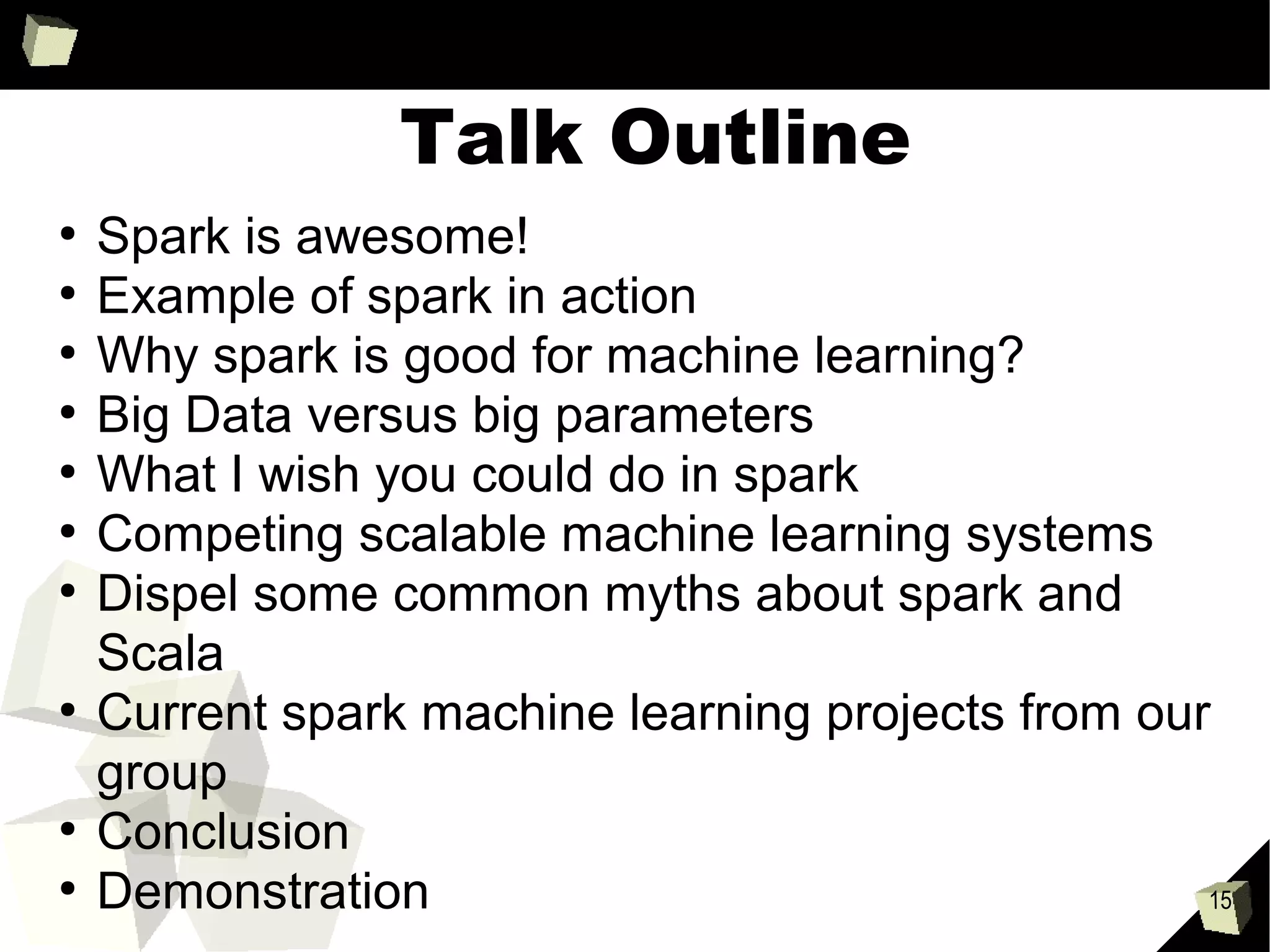
Talk Outline
●
Spark is awesome!
●
Example of spark in action
●
Why spark is good for machine learning?
●
Big Data versus big parameters
●
What I wish you could do in spark
●
Competing scalable machine learning systems
●
Dispel some common myths about spark and
Scala
●
Current spark machine learning projects from our
group
●
Conclusion
●
Demonstration
26
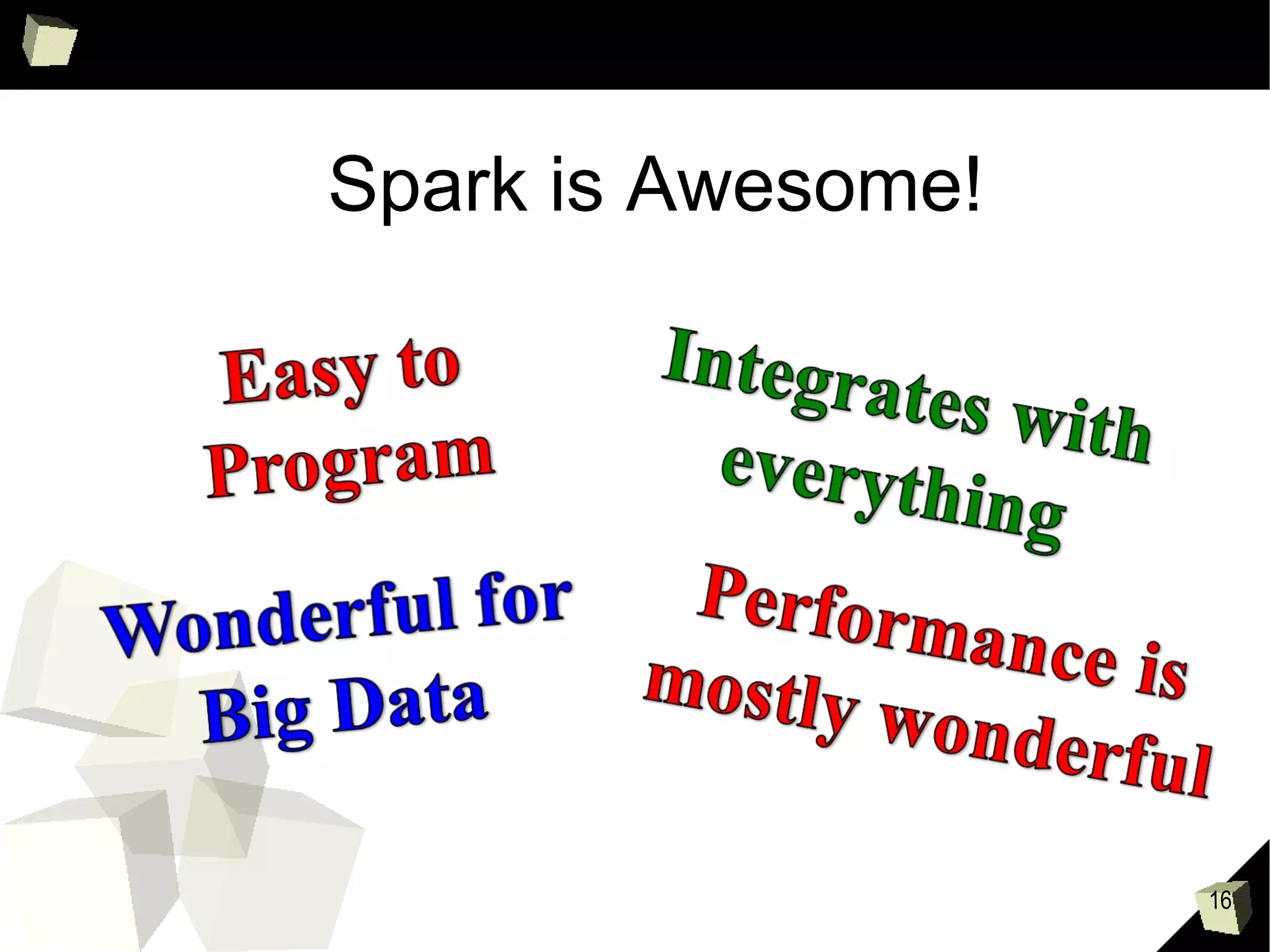
Spark is Awesome!
27
Focus of Talk is on
Performance
28
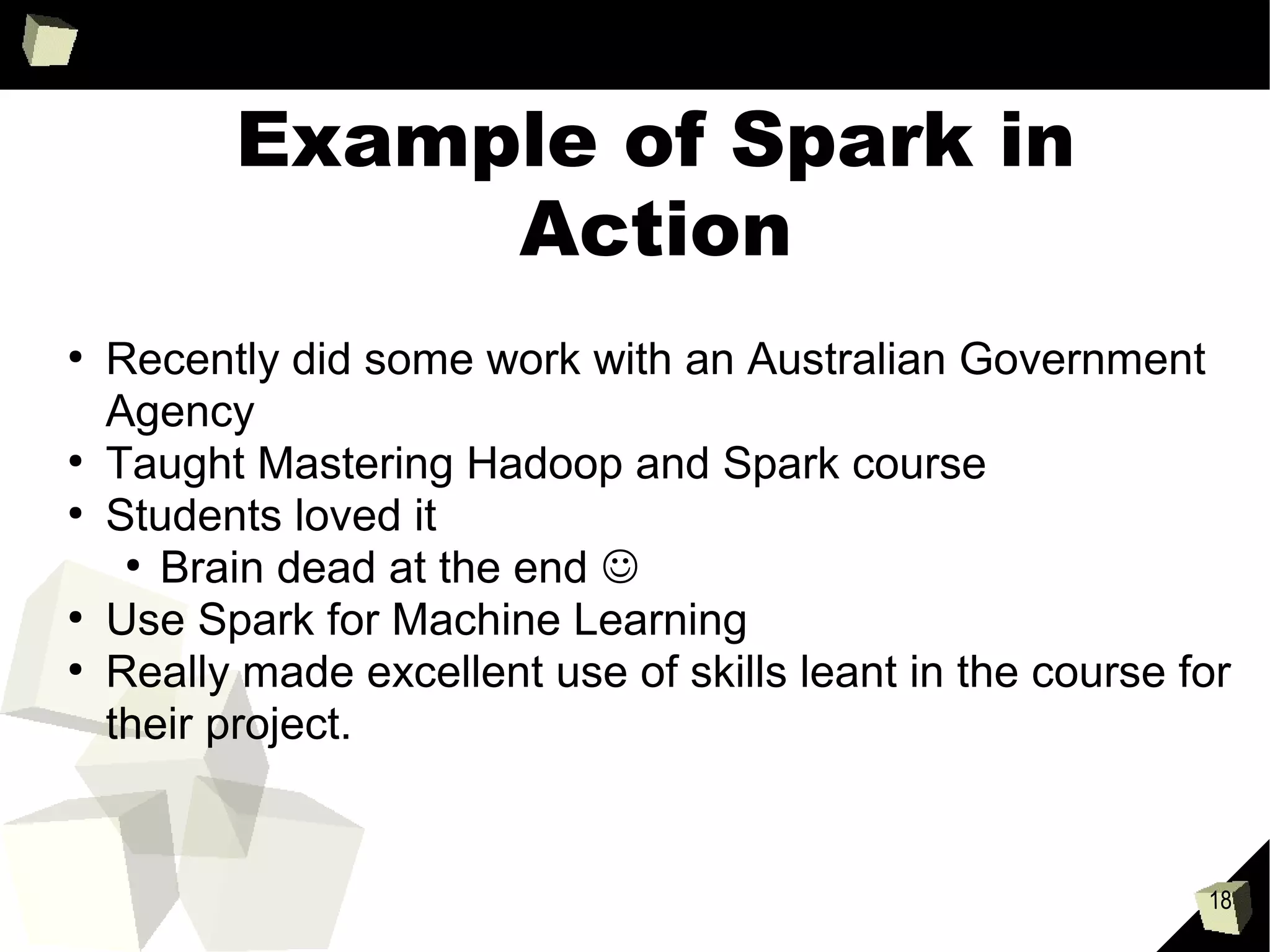
Example of Spark in
Action
●
Recently did some work with an Australian Government
Agency
●
Taught Mastering Hadoop and Spark course
●
Students loved it
●
Brain dead at the end 
●
Use Spark for Machine Learning
●
Really made excellent use of skills leant in the course for
their project.
29
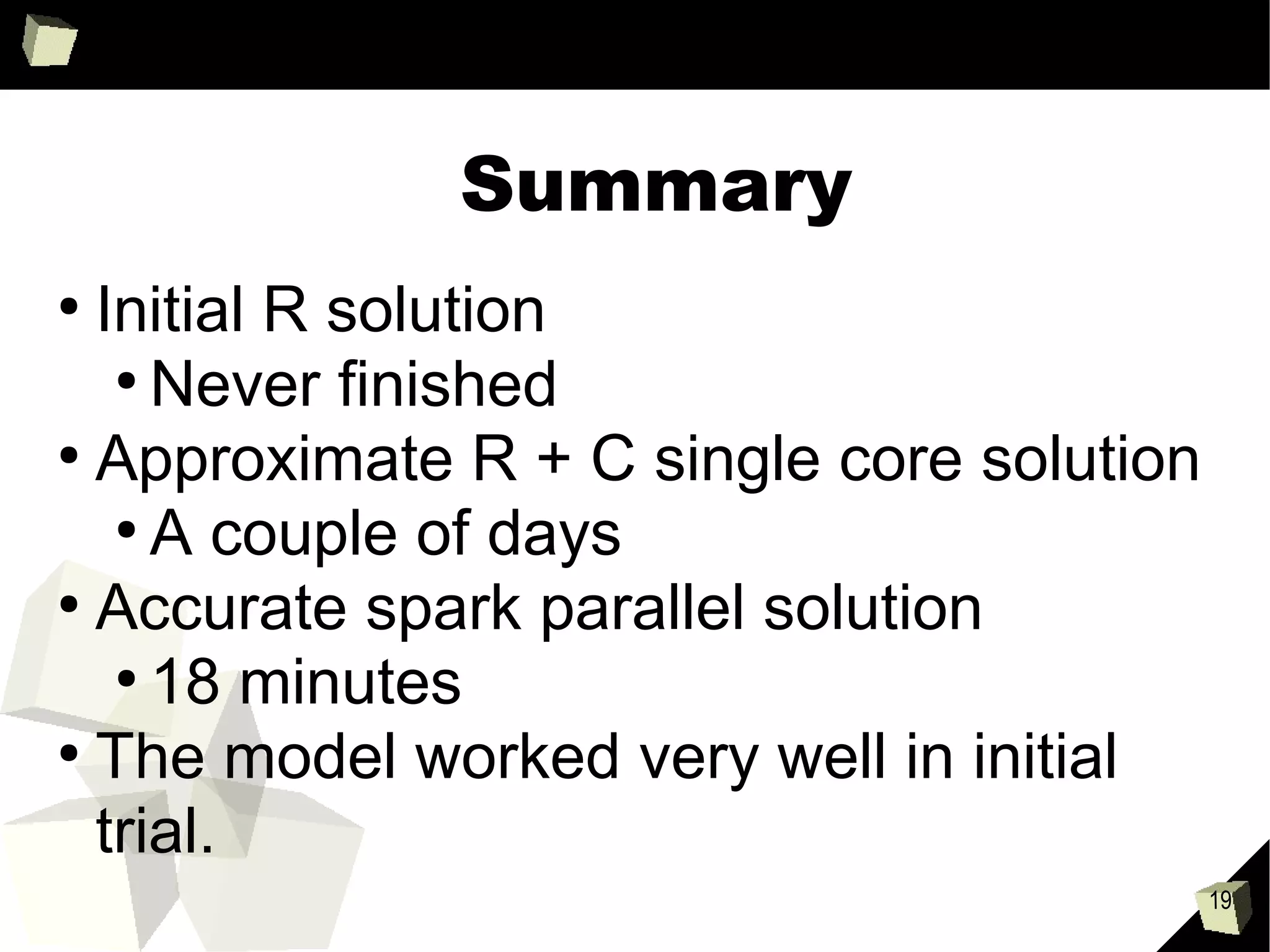
Summary
●
Initial R solution
●
Never finished
●
Approximate R + C single core solution
●
A couple of days
●
Accurate spark parallel solution
●
18 minutes
●
The model worked very well in initial
trial.
30
Lessons Learnt
●
First reduce complexity of problem
●
Pre and post processing performance is
very important
●
Spark is excellent for both the modeling
and the pre and post processing
31
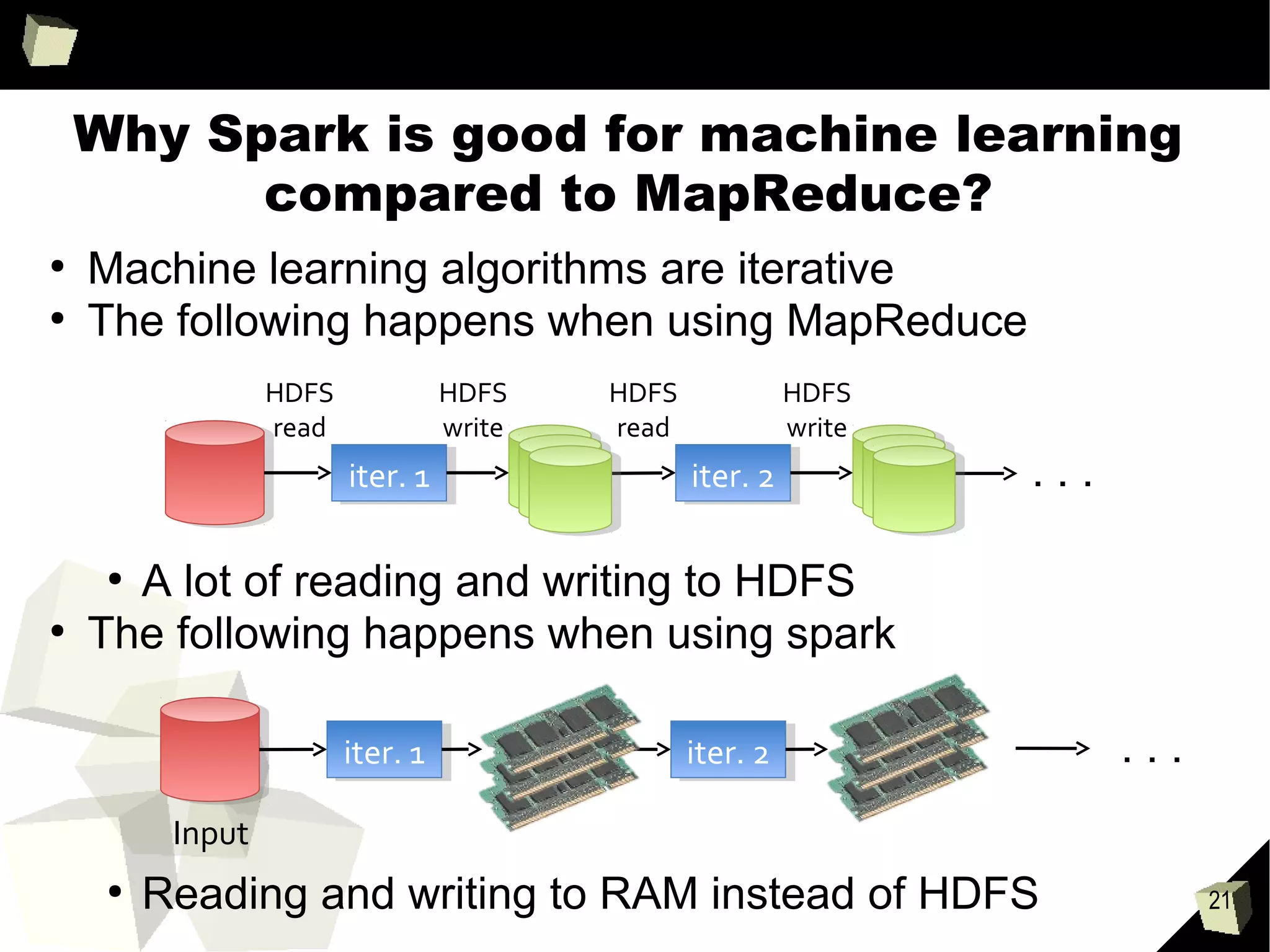
Why Spark is good for machine learning
compared to MapReduce?
●
Machine learning algorithms are iterative
●
The following happens when using MapReduce
●
A lot of reading and writing to HDFS
●
The following happens when using spark
●
Reading and writing to RAM instead of HDFS
iter. 1iter. 1 iter. 2iter. 2 . . .
HDFS
read
HDFS
write
HDFS
read
HDFS
write
iter. 1iter. 1 iter. 2iter. 2 . . .
Input
32
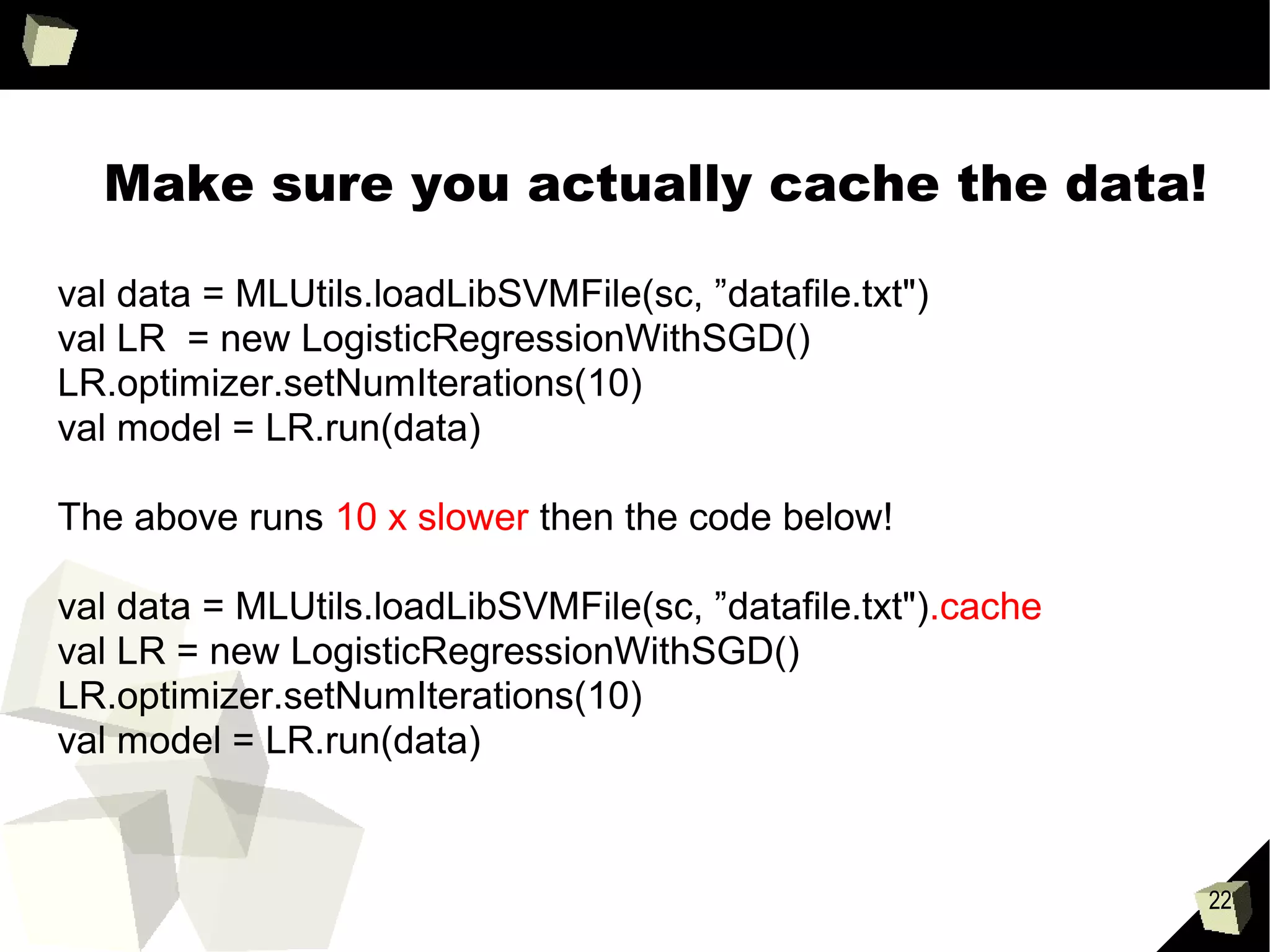
Make sure you actually cache the data!
val data = MLUtils.loadLibSVMFile(sc, ”datafile.txt")
val LR = new LogisticRegressionWithSGD()
LR.optimizer.setNumIterations(10)
val model = LR.run(data)
The above runs 10 x slower then the code below!
val data = MLUtils.loadLibSVMFile(sc, ”datafile.txt").cache
val LR = new LogisticRegressionWithSGD()
LR.optimizer.setNumIterations(10)
val model = LR.run(data)
33
Big Data versus Big
Parameters
●
Spark is great at doing machine learning on Big Data as
long as the size of the parameters is small.
●
Big parameters is hard for Spark to handle efficiently.
34
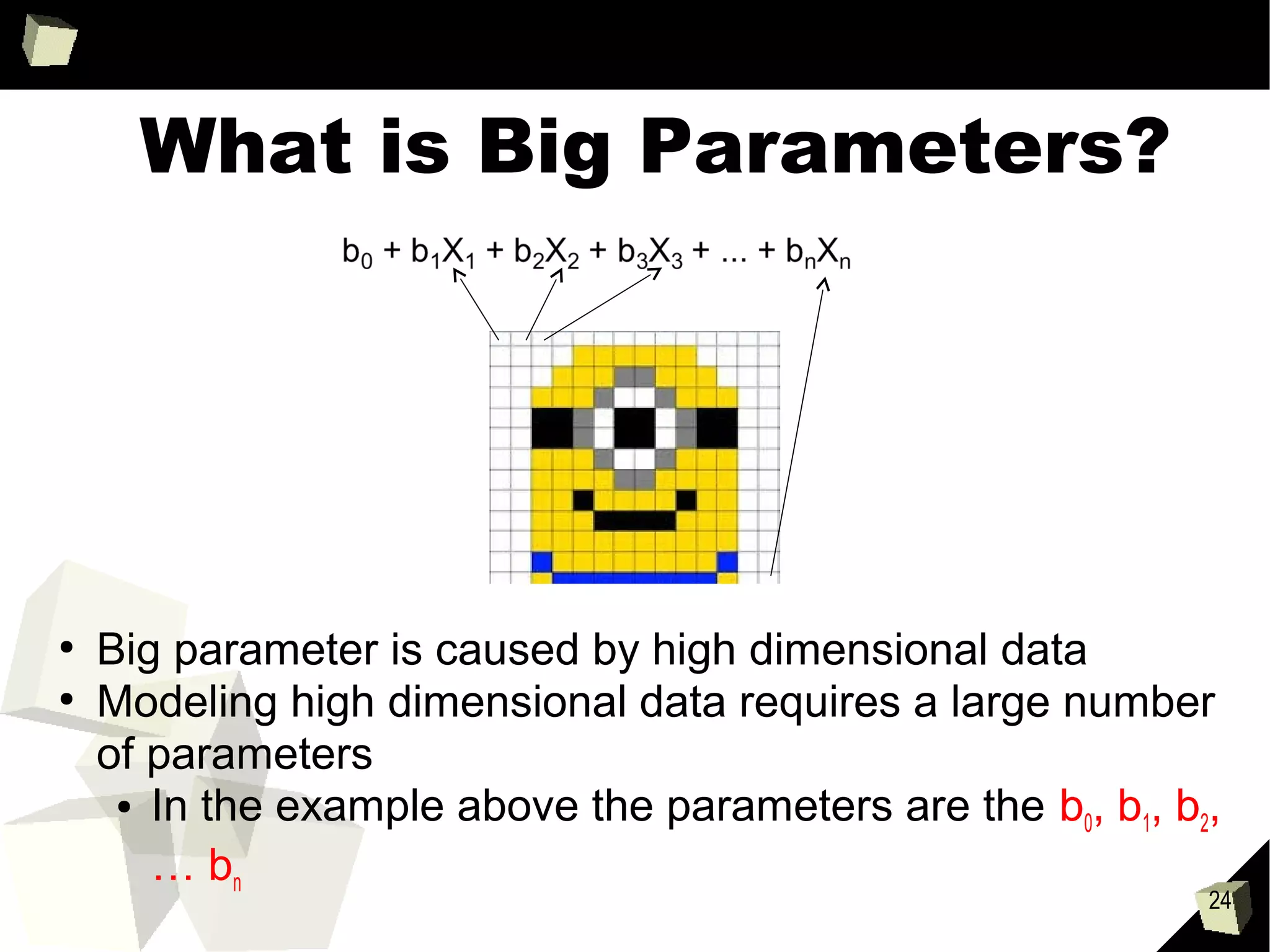
What is Big Parameters?
●
Big parameter is caused by high dimensional data
●
Modeling high dimensional data requires a large number
of parameters
● In the example above the parameters are the b0, b1, b2,
… bn
35
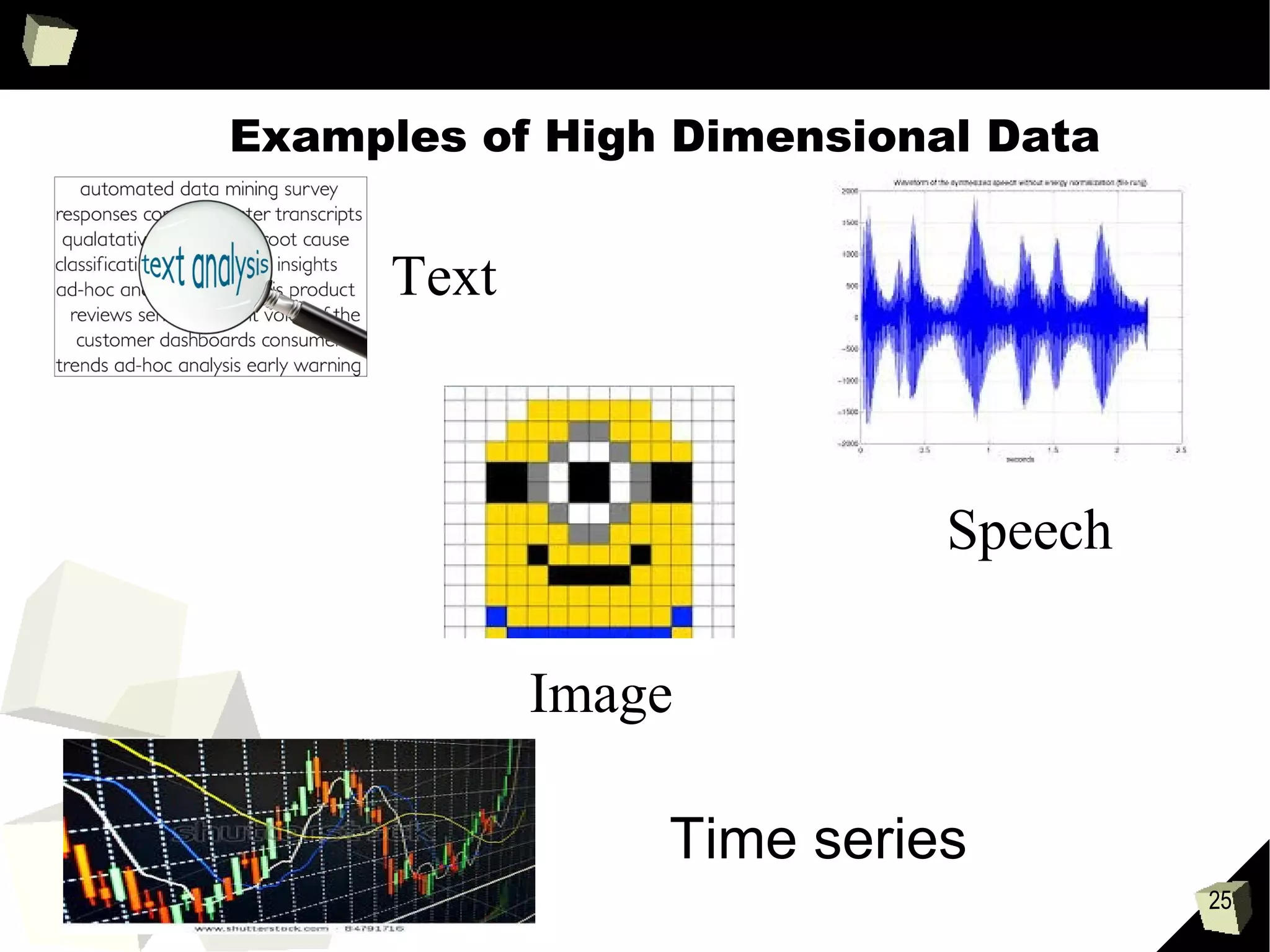
Examples of High Dimensional Data
Time series
Text
Image
Speech
36
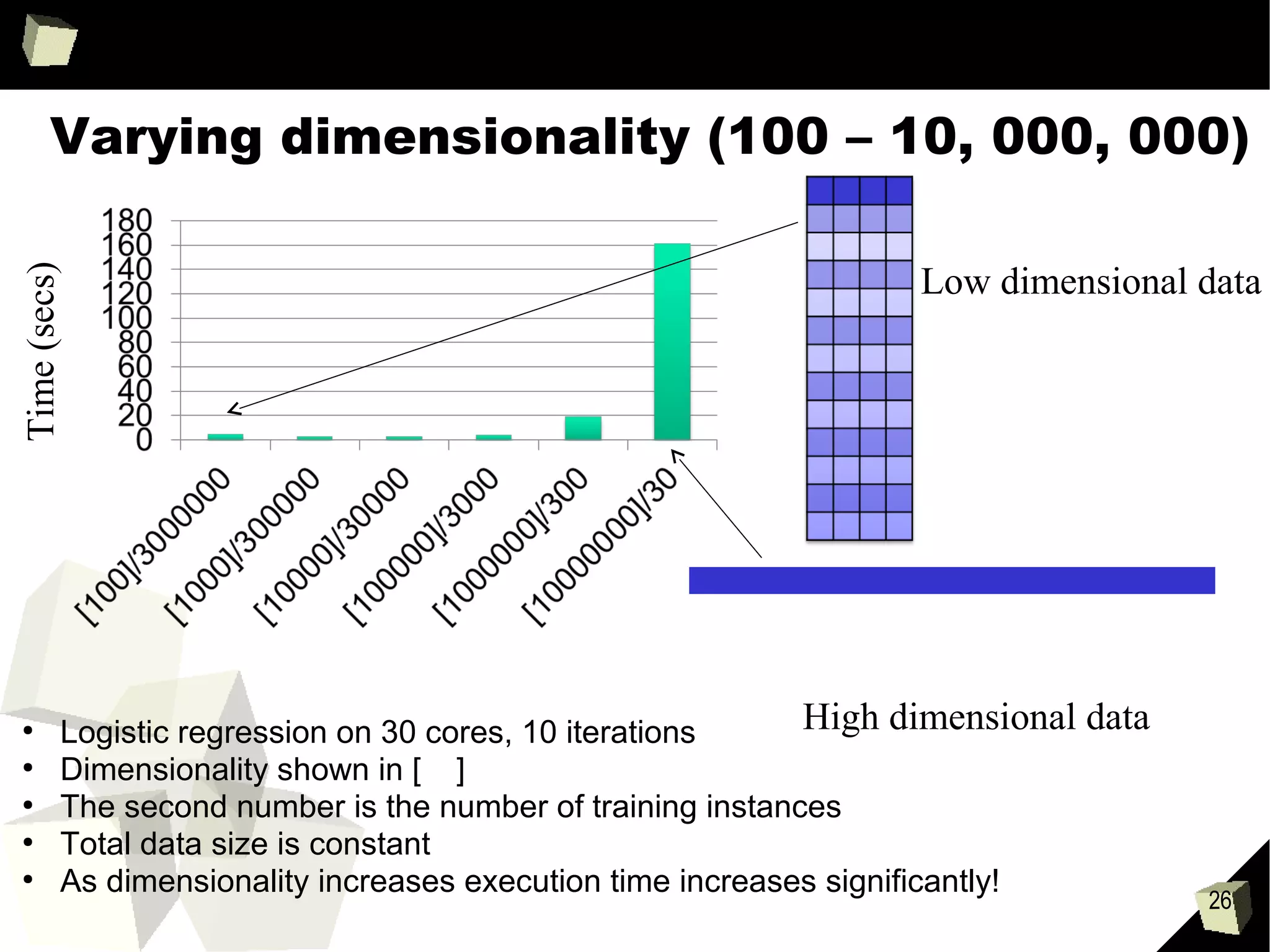
Varying dimensionality (100 – 10, 000, 000)
●
Logistic regression on 30 cores, 10 iterations
●
Dimensionality shown in [ ]
●
The second number is the number of training instances
●
Total data size is constant
●
As dimensionality increases execution time increases significantly!
Time(secs)
Low dimensional data
High dimensional data
37
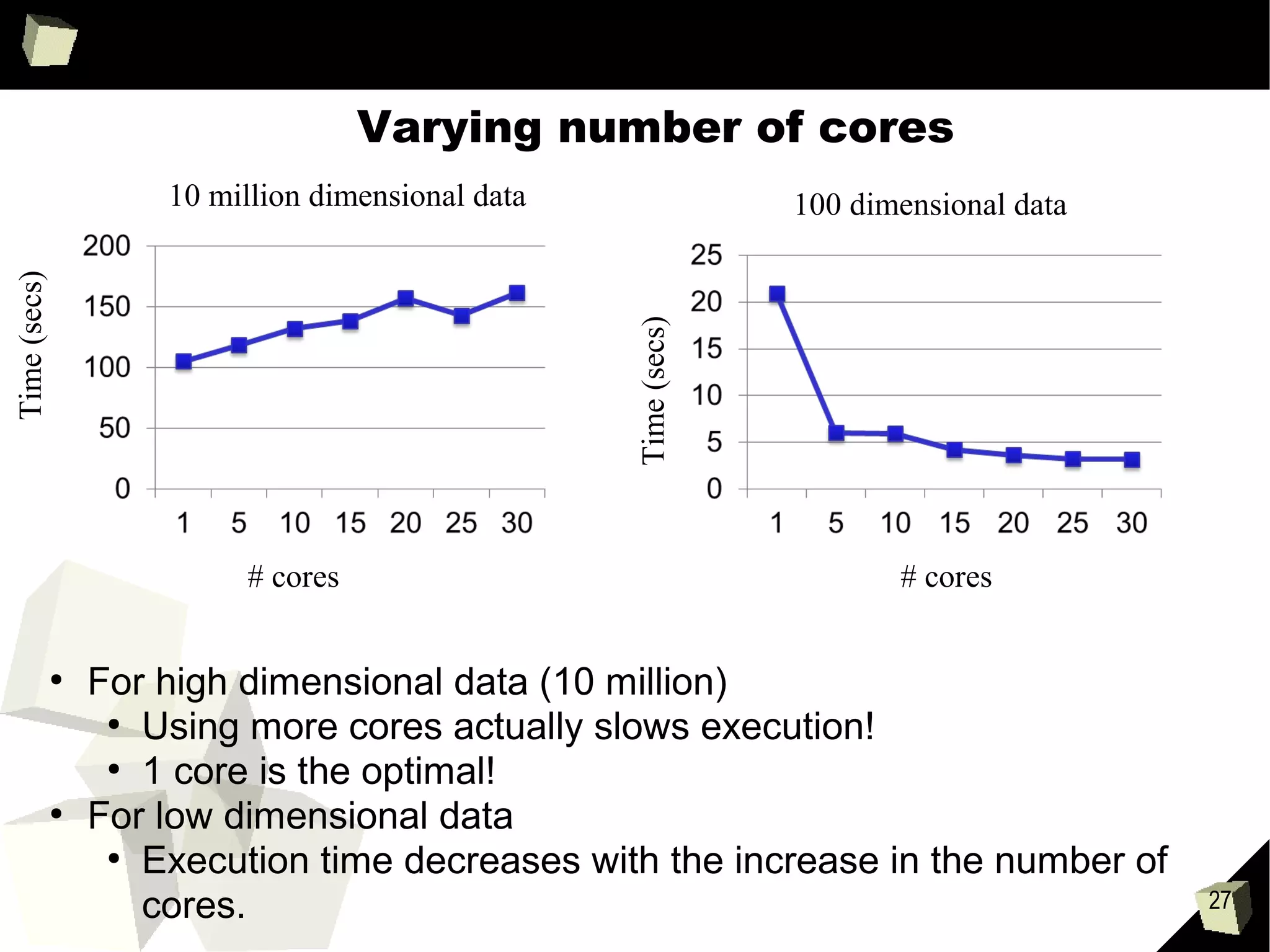
Varying number of cores
●
For high dimensional data (10 million)
●
Using more cores actually slows execution!
●
1 core is the optimal!
●
For low dimensional data
●
Execution time decreases with the increase in the number of
cores.
Time(secs)
# cores
10 million dimensional data
# cores
Time(secs)
100 dimensional data
38
Why is big parameters /
high dimensional data so
hard for spark?
39
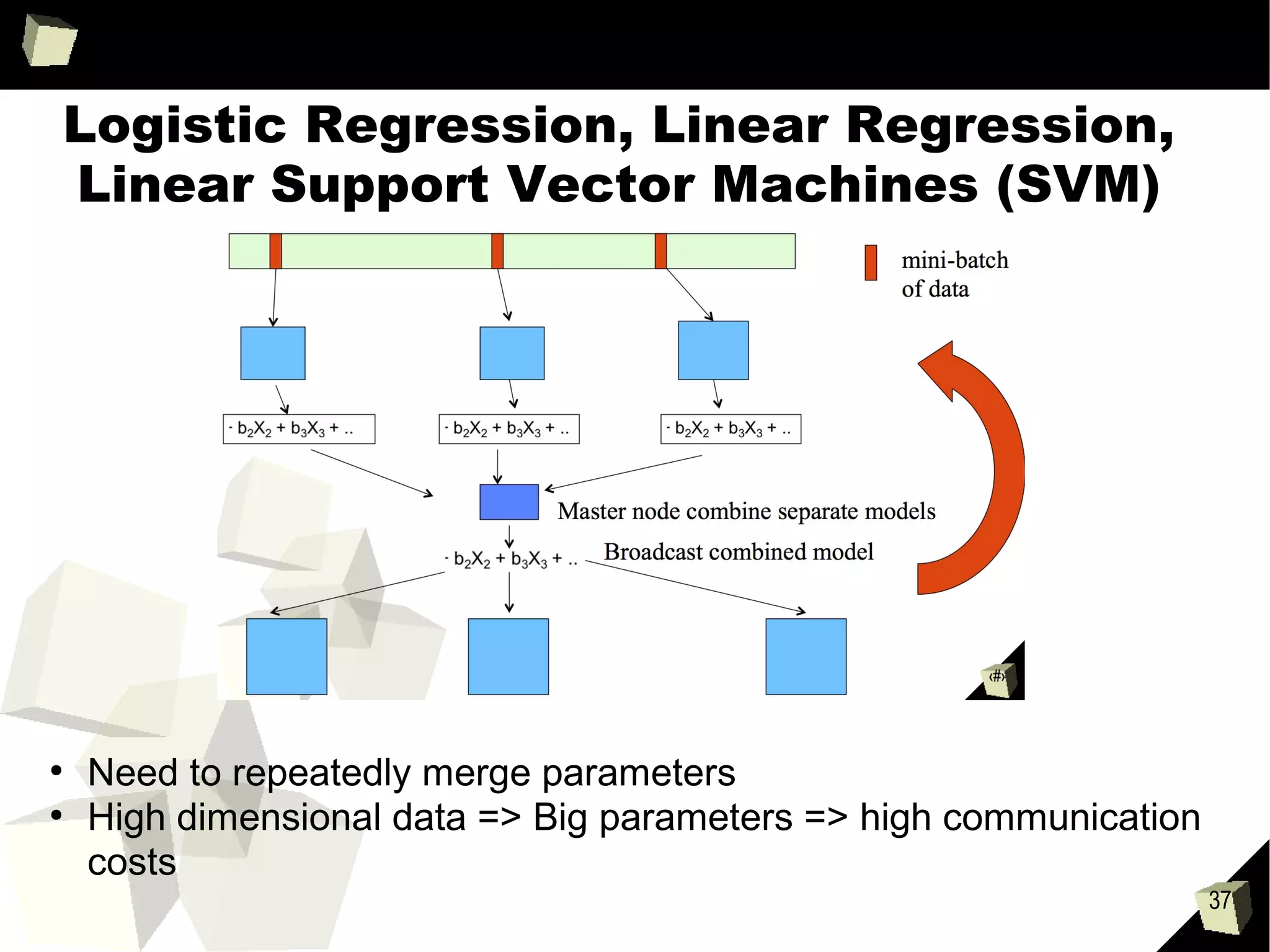
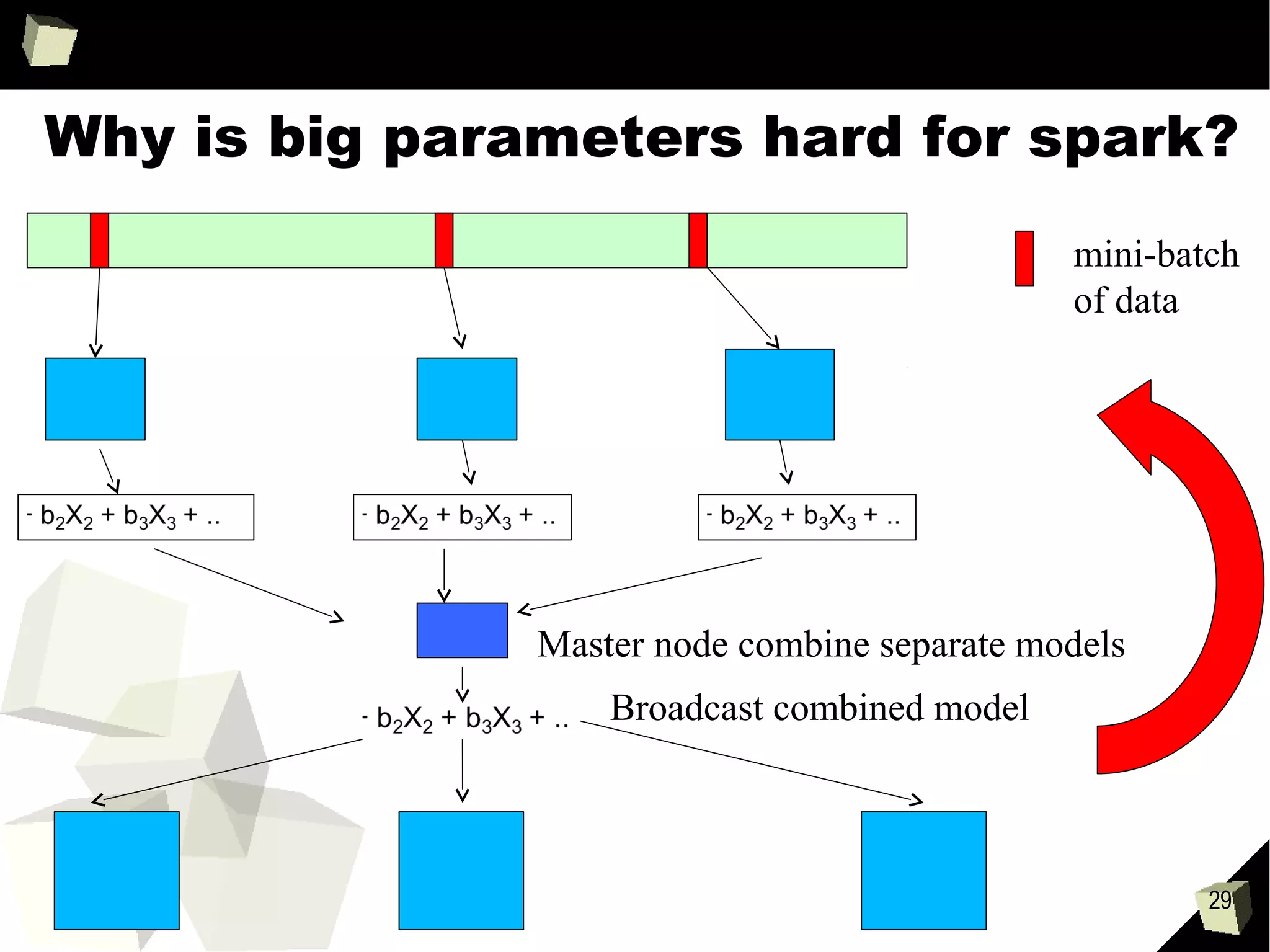
Why is big parameters hard for spark?
mini-batch
of data
Master node combine separate models
Broadcast combined model
40
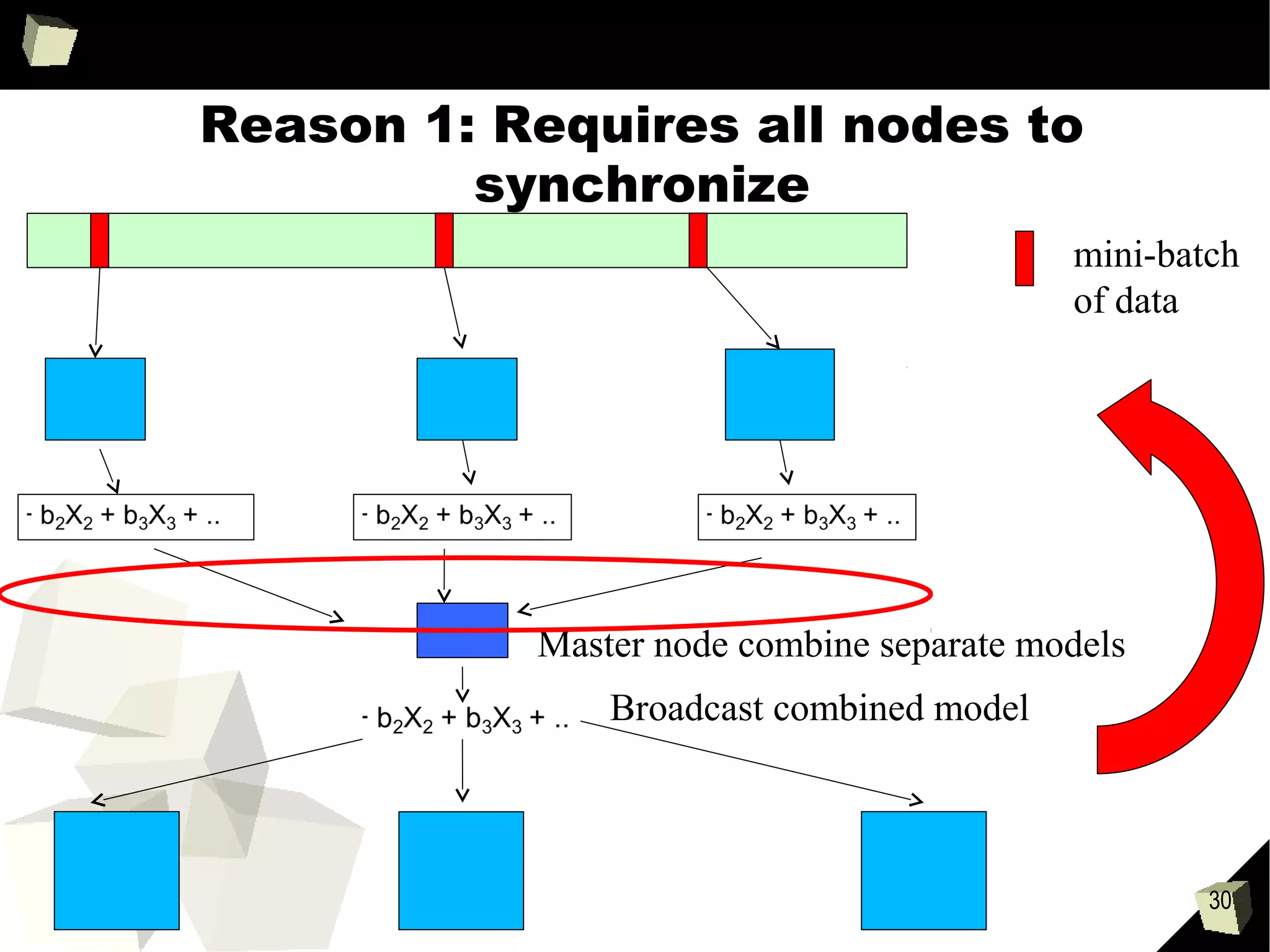
Reason 1: Requires all nodes to
synchronize
mini-batch
of data
Master node combine separate models
Broadcast combined model
41
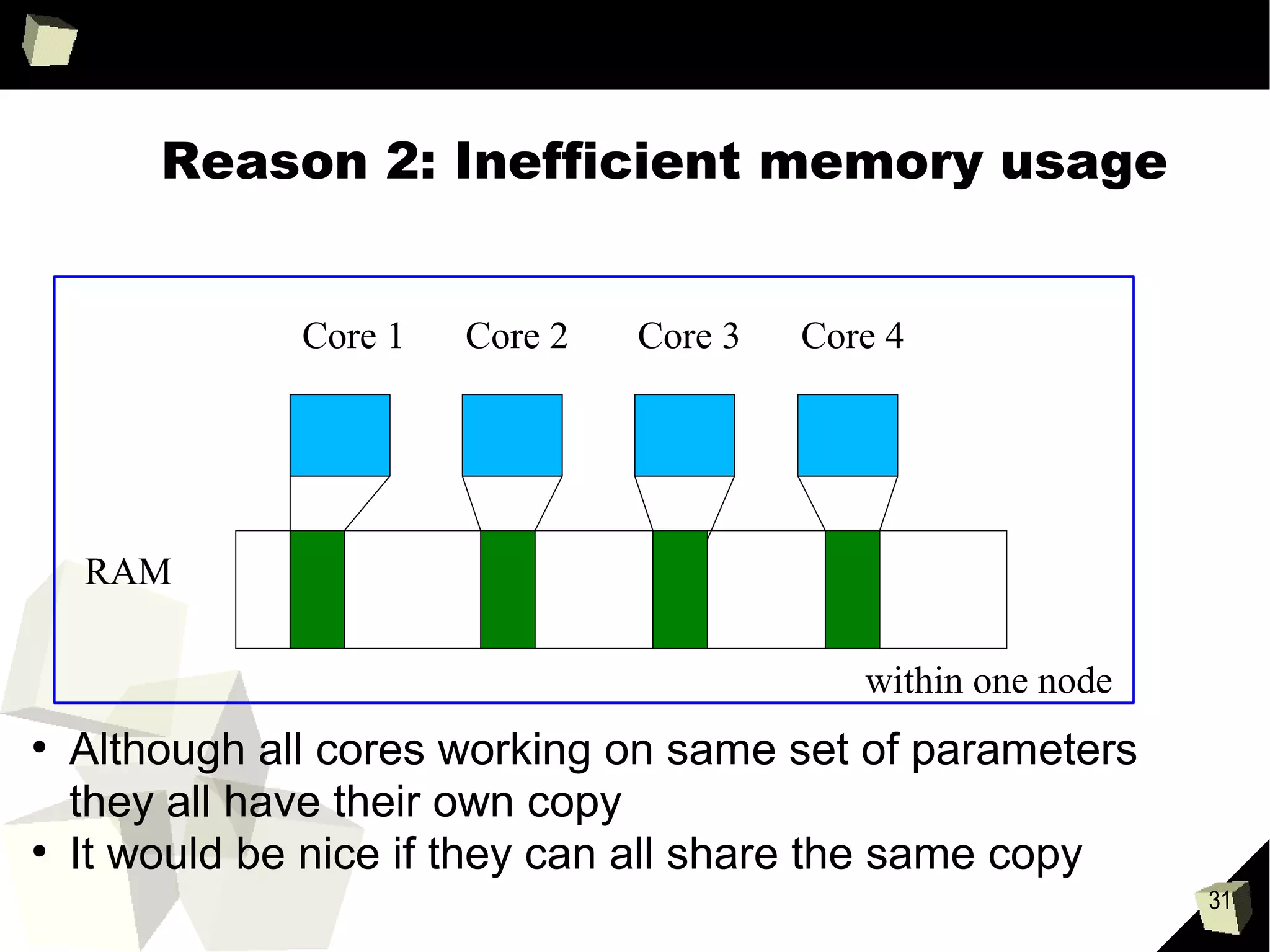
Reason 2: Inefficient memory usage
●
Although all cores working on same set of parameters
they all have their own copy
●
It would be nice if they can all share the same copy
RAM
Core 1 Core 2 Core 3 Core 4
within one node
42
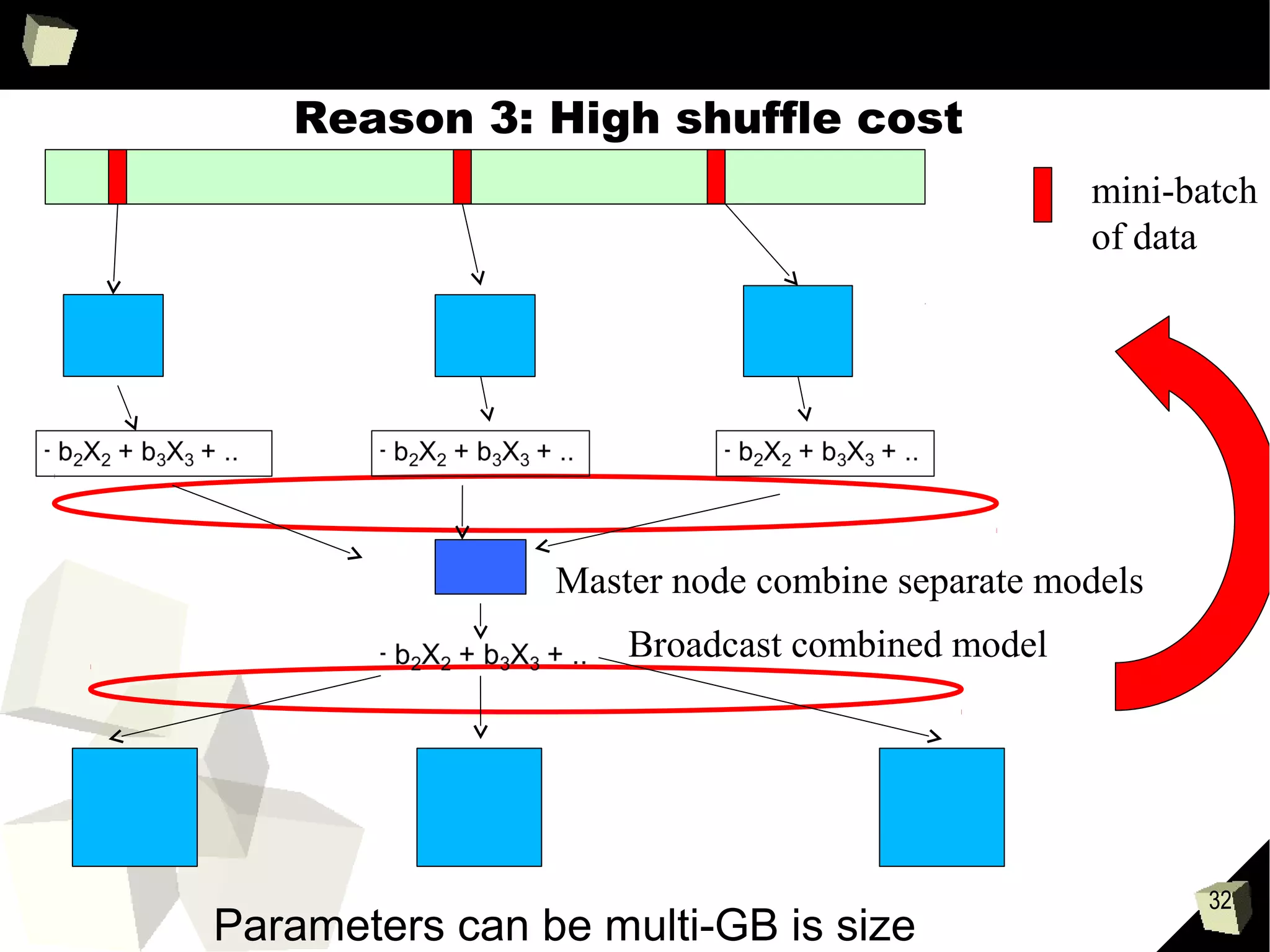
Parameters can be multi-GB is size
Reason 3: High shuffle cost
mini-batch
of data
Master node combine separate models
Broadcast combined model
43
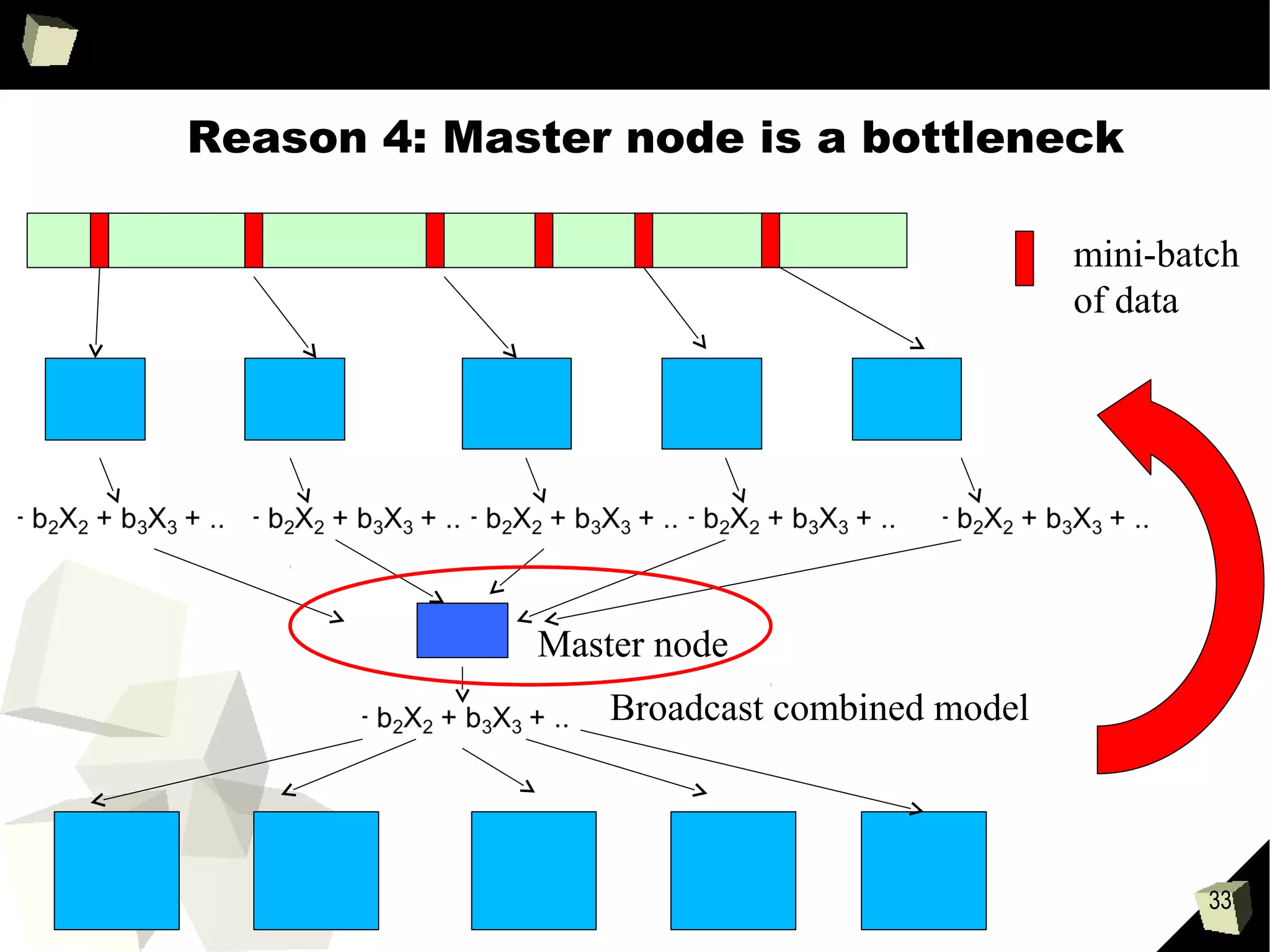
Reason 4: Master node is a bottleneck
mini-batch
of data
Master node
Broadcast combined model
44
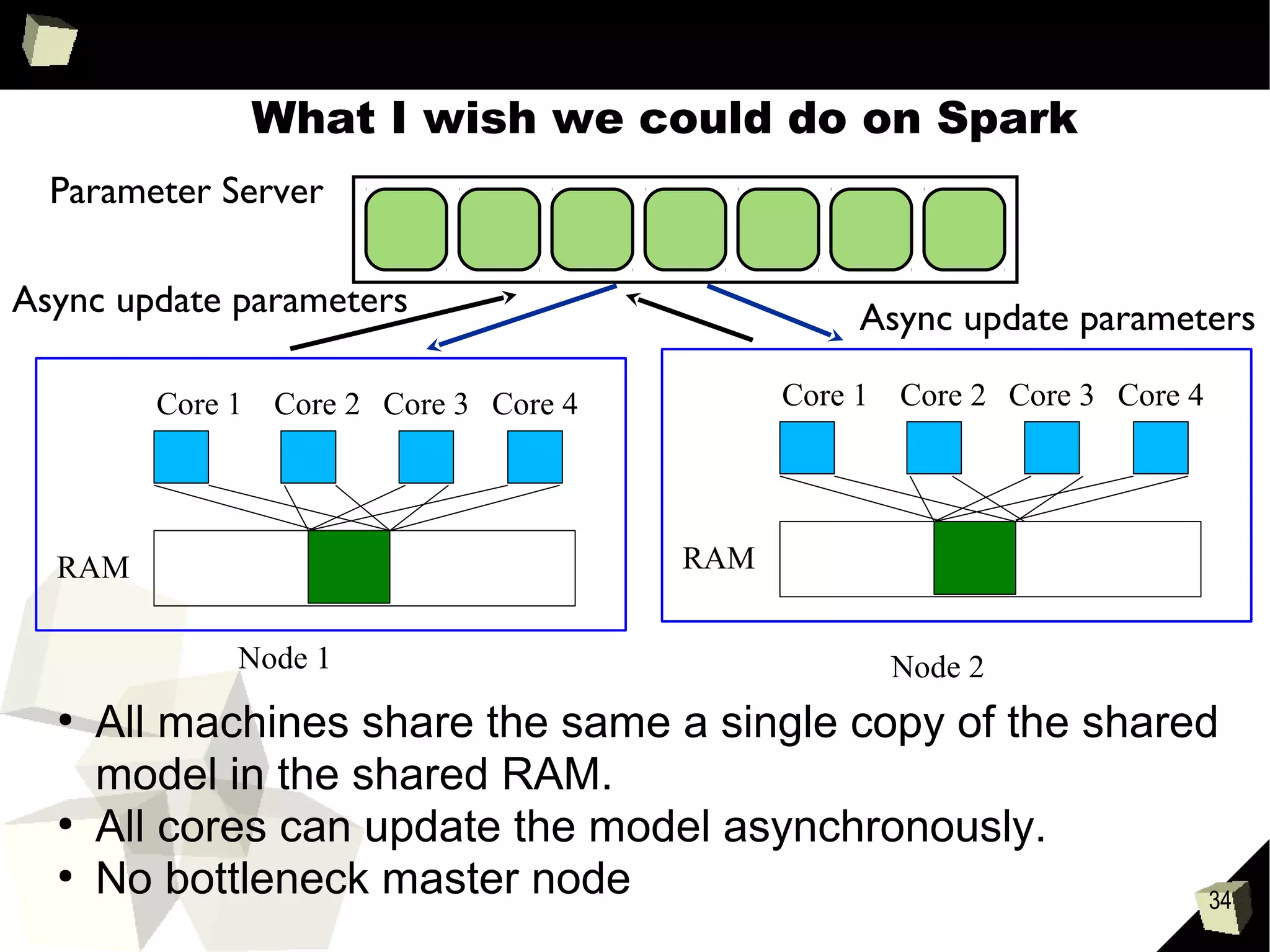
What I wish we could do on Spark
●
All machines share the same a single copy of the shared
model in the shared RAM.
●
All cores can update the model asynchronously.
●
No bottleneck master node
RAM
Core 1 Core 2 Core 3 Core 4
RAM
Core 1 Core 2 Core 3 Core 4
Node 1 Node 2
Parameter Server
Async update parameters Async update parameters
45
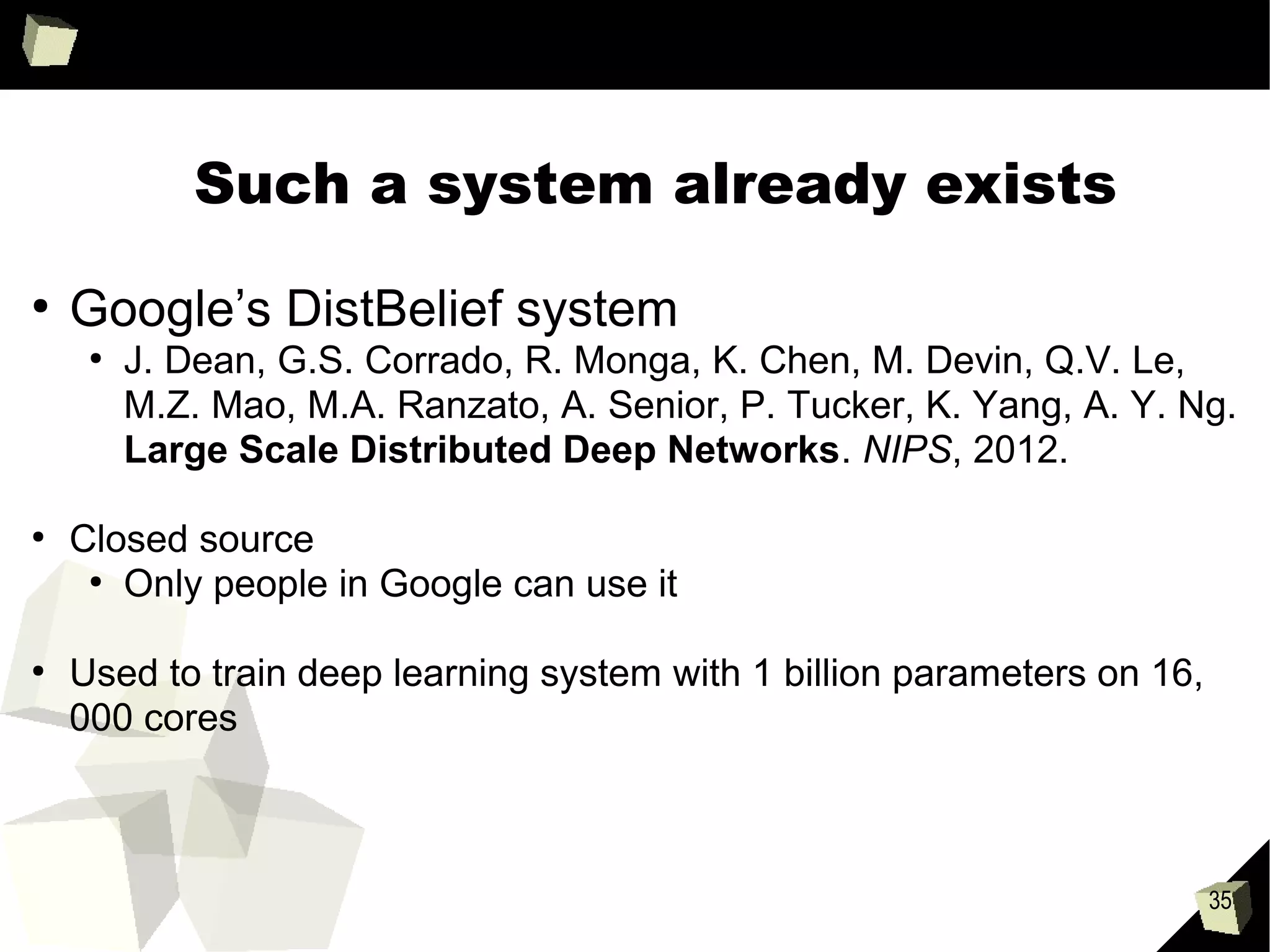
Such a system already exists
●
Google’s DistBelief system
●
J. Dean, G.S. Corrado, R. Monga, K. Chen, M. Devin, Q.V. Le,
M.Z. Mao, M.A. Ranzato, A. Senior, P. Tucker, K. Yang, A. Y. Ng.
Large Scale Distributed Deep Networks. NIPS, 2012.
●
Closed source
●
Only people in Google can use it
●
Used to train deep learning system with 1 billion parameters on 16,
000 cores
46
Comparison of some key machine
learning algorithms in Spark
●
Linear Models
●
Logistic regression
●
Linear regression
●
Support vector machines
●
Linear kernel
●
Random forest
47
Logistic Regression, Linear Regression,
Linear Support Vector Machines (SVM)
●
Need to repeatedly merge parameters
●
High dimensional data => Big parameters => high communication
costs
48
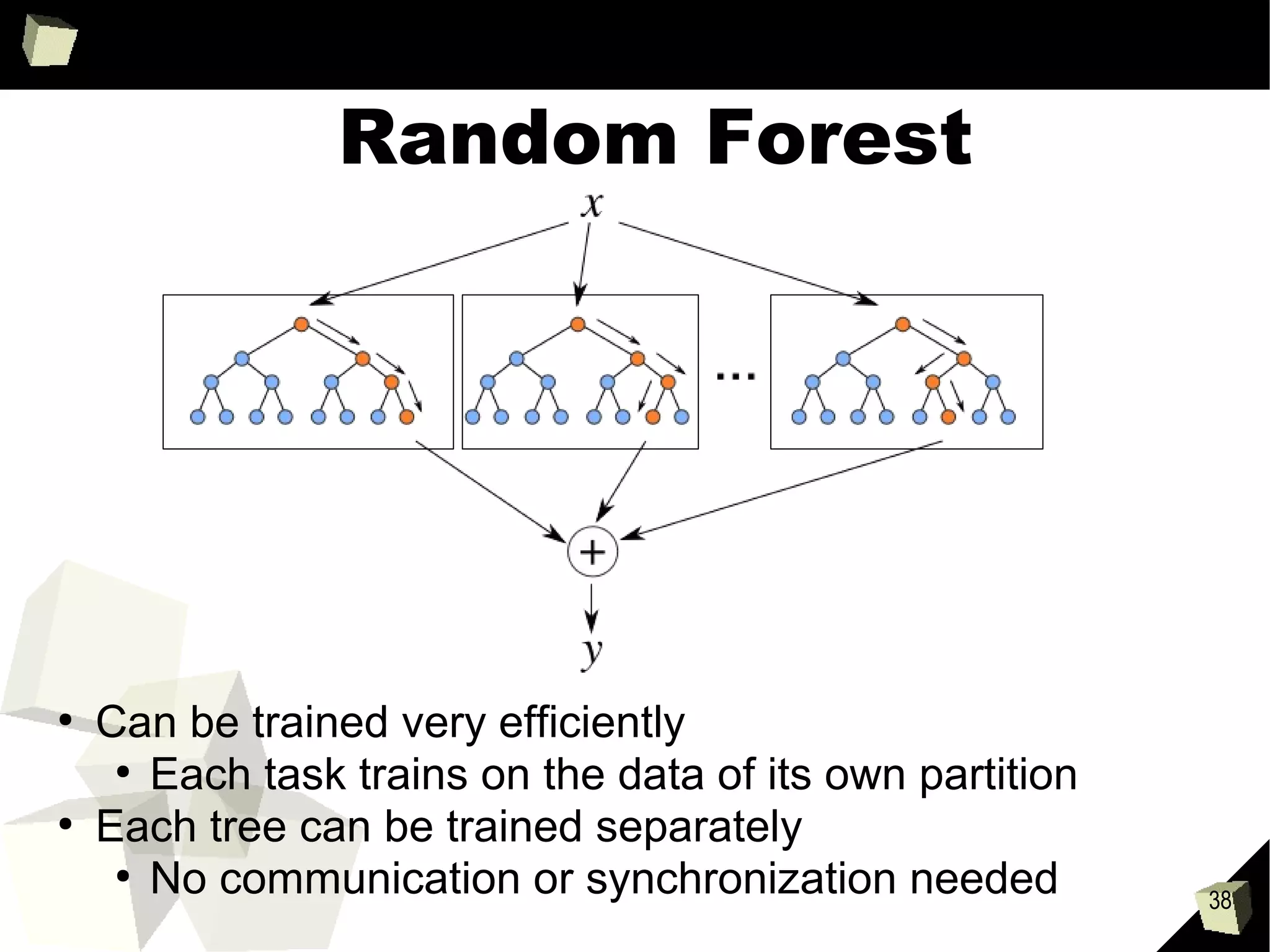
Random Forest
●
Can be trained very efficiently
●
Each task trains on the data of its own partition
●
Each tree can be trained separately
●
No communication or synchronization needed
49
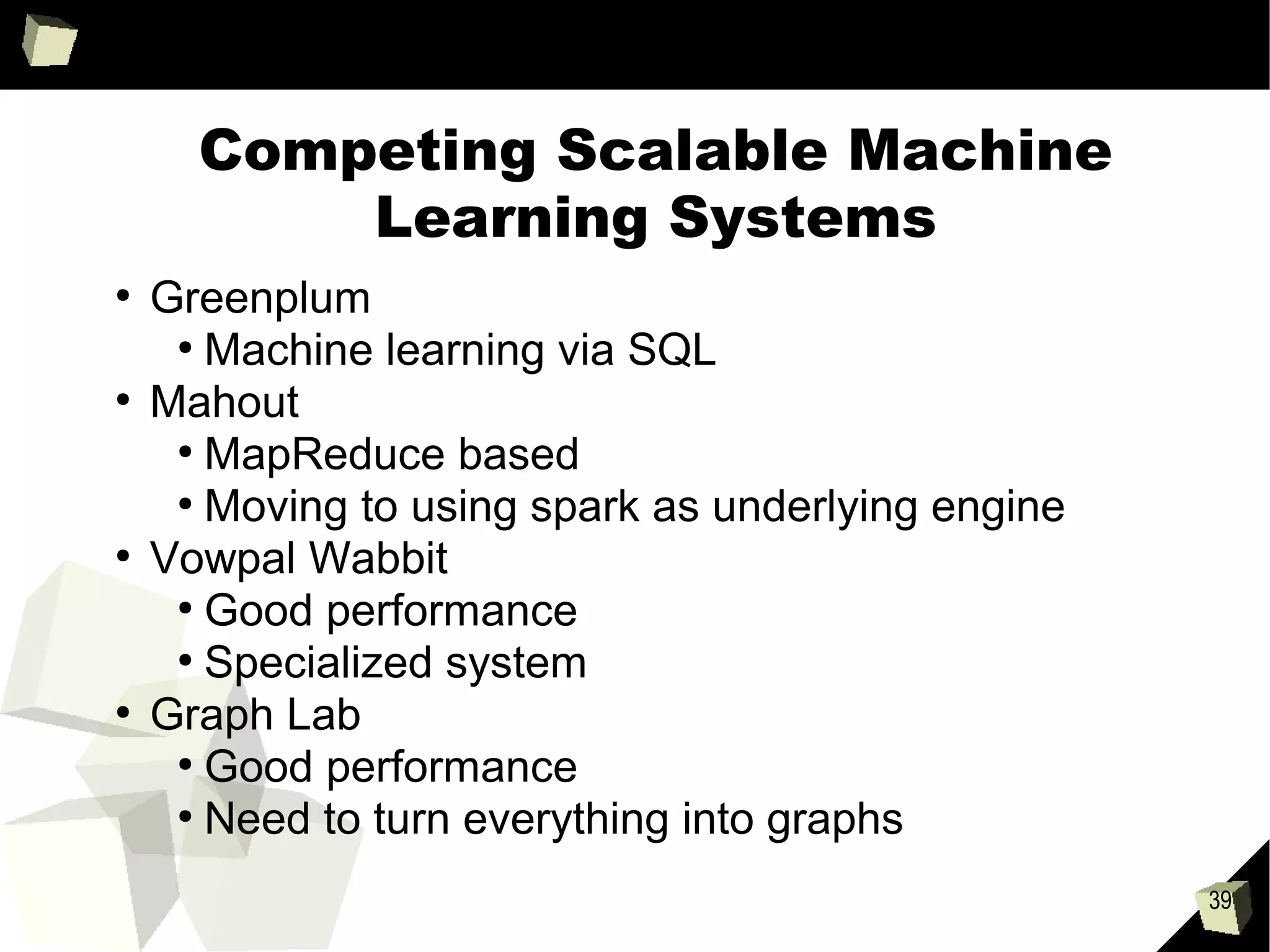
Competing Scalable Machine
Learning Systems
●
Greenplum
●
Machine learning via SQL
●
Mahout
●
MapReduce based
●
Moving to using spark as underlying engine
●
Vowpal Wabbit
●
Good performance
●
Specialized system
●
Graph Lab
●
Good performance
●
Need to turn everything into graphs
50
Spark Misconceptions
51
Common Misconception: Spark is
only good if data fits in RAM
●
From inception Spark was designed to be a
general execution engine that works both in-
memory and on-disk
●
Almost all operators perform external operations
when data does not fit in RAM.
●
Spark breaks large-scale sort record
52
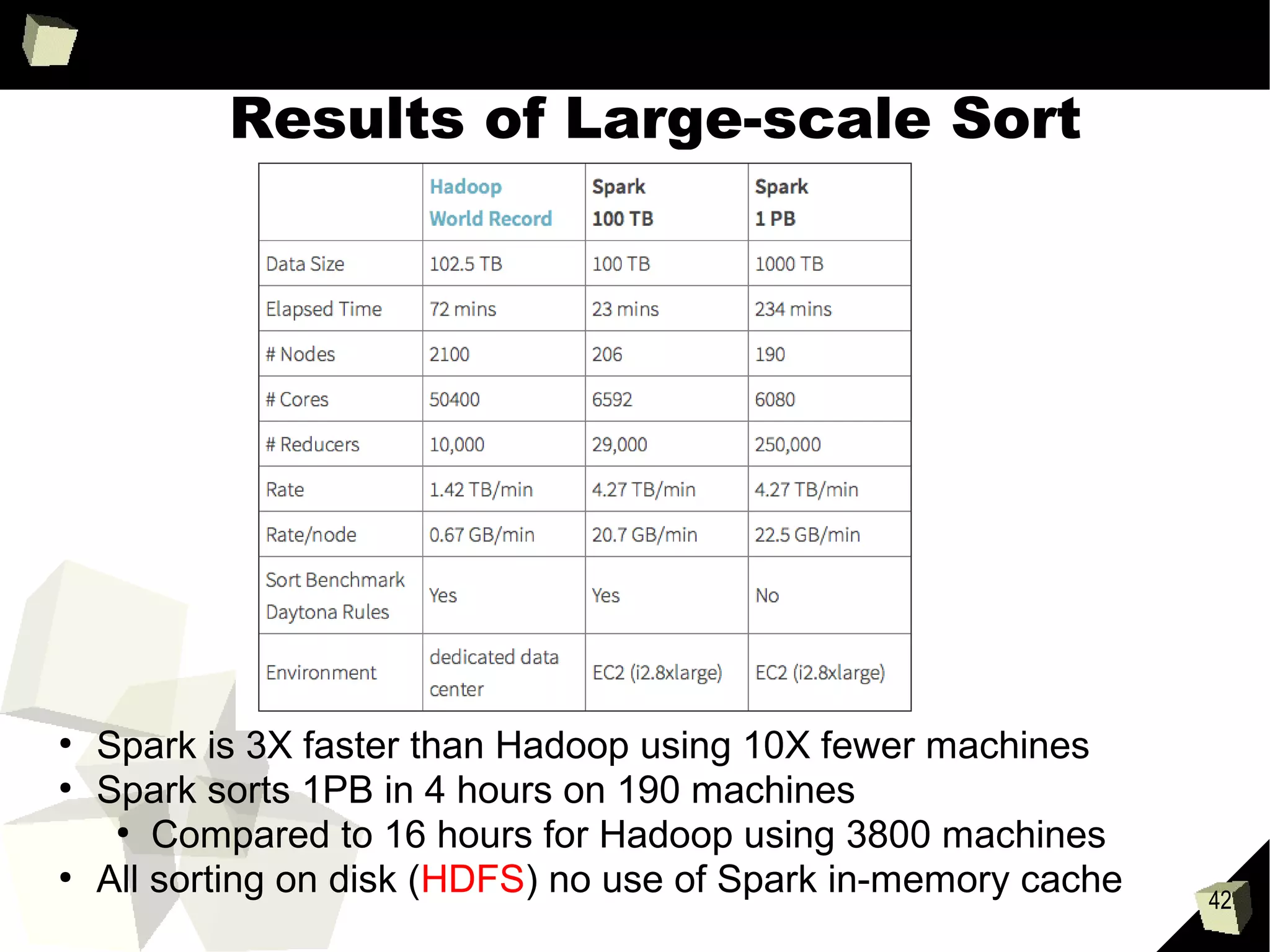
Results of Large-scale Sort
●
Spark is 3X faster than Hadoop using 10X fewer machines
●
Spark sorts 1PB in 4 hours on 190 machines
●
Compared to 16 hours for Hadoop using 3800 machines
●
All sorting on disk (HDFS) no use of Spark in-memory cache
53
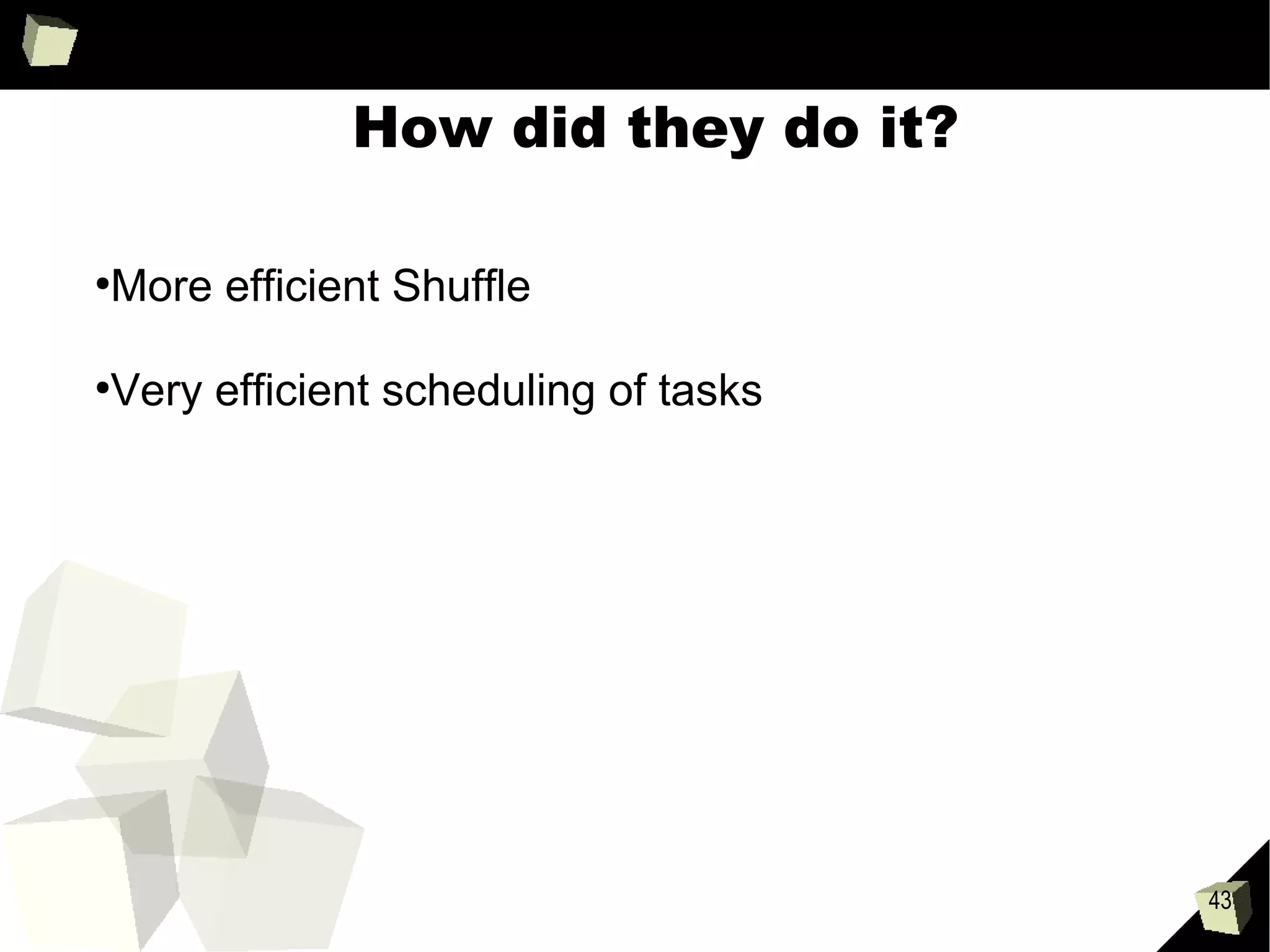
How did they do it?
●
More efficient Shuffle
●
Very efficient scheduling of tasks
54
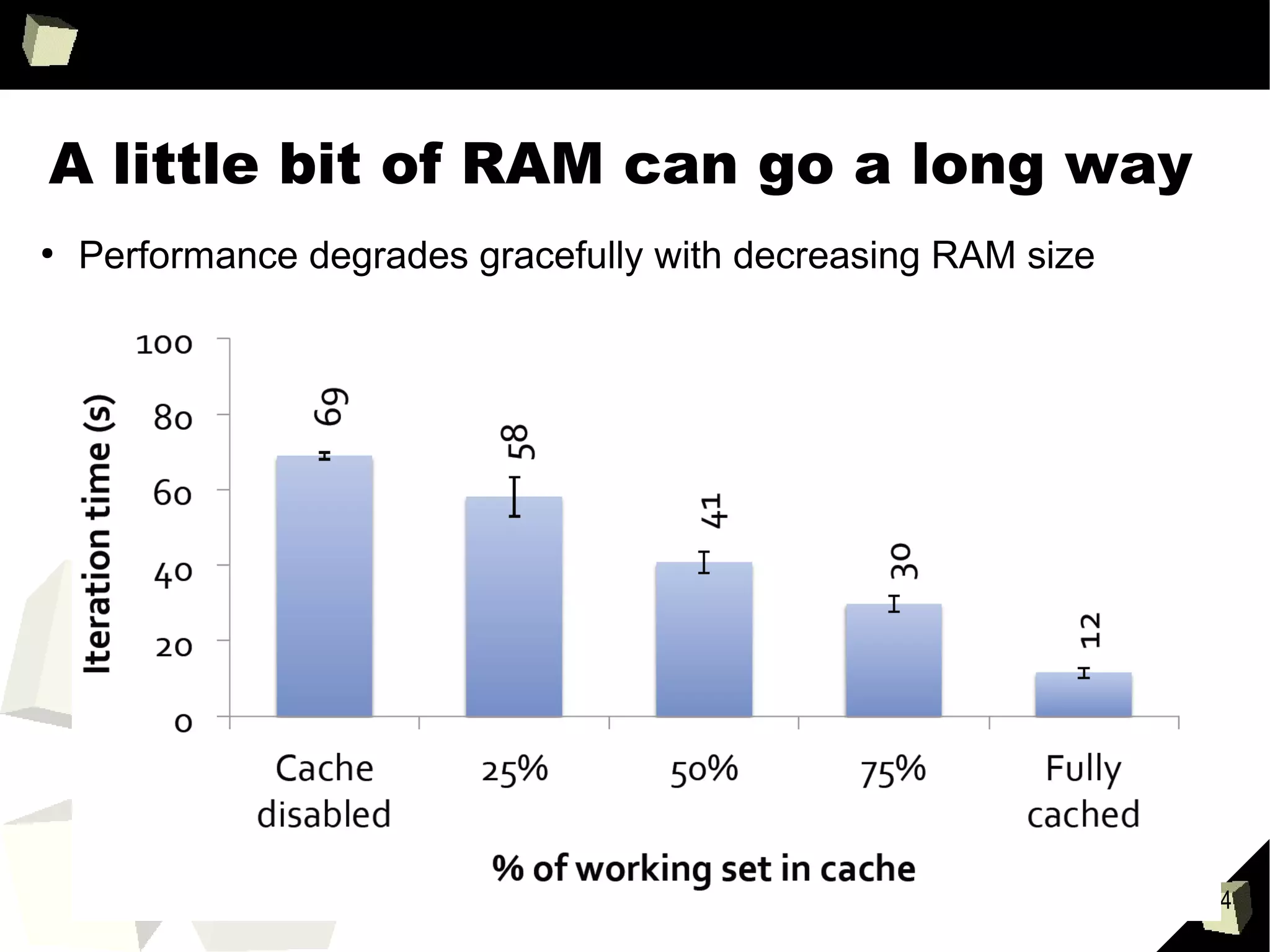
A little bit of RAM can go a long way
●
Performance degrades gracefully with decreasing RAM size
55
A little bit of RAM can go a
long way
●
Just cache the small parts of the data that you will use again
●
Use filter and projection to reduce the amount that is cached.
●
Spark SQL stores data compressed in columns
●
Fast compression/decompression
●
Column-stores have been proven to be way better than row-
stores for analytics
●
100x better
●
For normal Spark code (non-SparkSQL), you can store data
serialized and compressed in RAM.
●
RAM is cheap now days
●
Aggregate RAM on large cluster can be very large
56
Common Misconceptions
●
I need to learn a new language Scala
●
Scala is easy to learn
●
Can program in Java and Python
●
Distributed Dataframes
●
SparkR
●
I have to rewrite all my code
●
Spark will run MapReduce code unmodified
●
Spark SQL runs HiveQL
57
Some Real Problems
●
Scala allocates a lot of objects
●
High GC overhead
●
The nice functional scala code is much slower than
writing C-styled while loops
●
For example:
●
val y = x.map(x => x * x)
●
is slower than
●
var i = 0
●
while (i < x.length) {
y(i) = x(i) * x(i)
i += 1
}
58
Our Work
59
Spark API Examples
●
Almost no good examples on the Spark API calls.
●
Matthias and I have written examples for over 110 Spark
API calls
●
http://homepage.cs.latrobe.edu.au/zhe/ZhenHeSparkRDDAPIEx
amples.html
●
Great reference
●
Currently over 33, 000 hits
●
Often top Google page returned when searching spark
API calls
60
Deep Learning on Spark
●
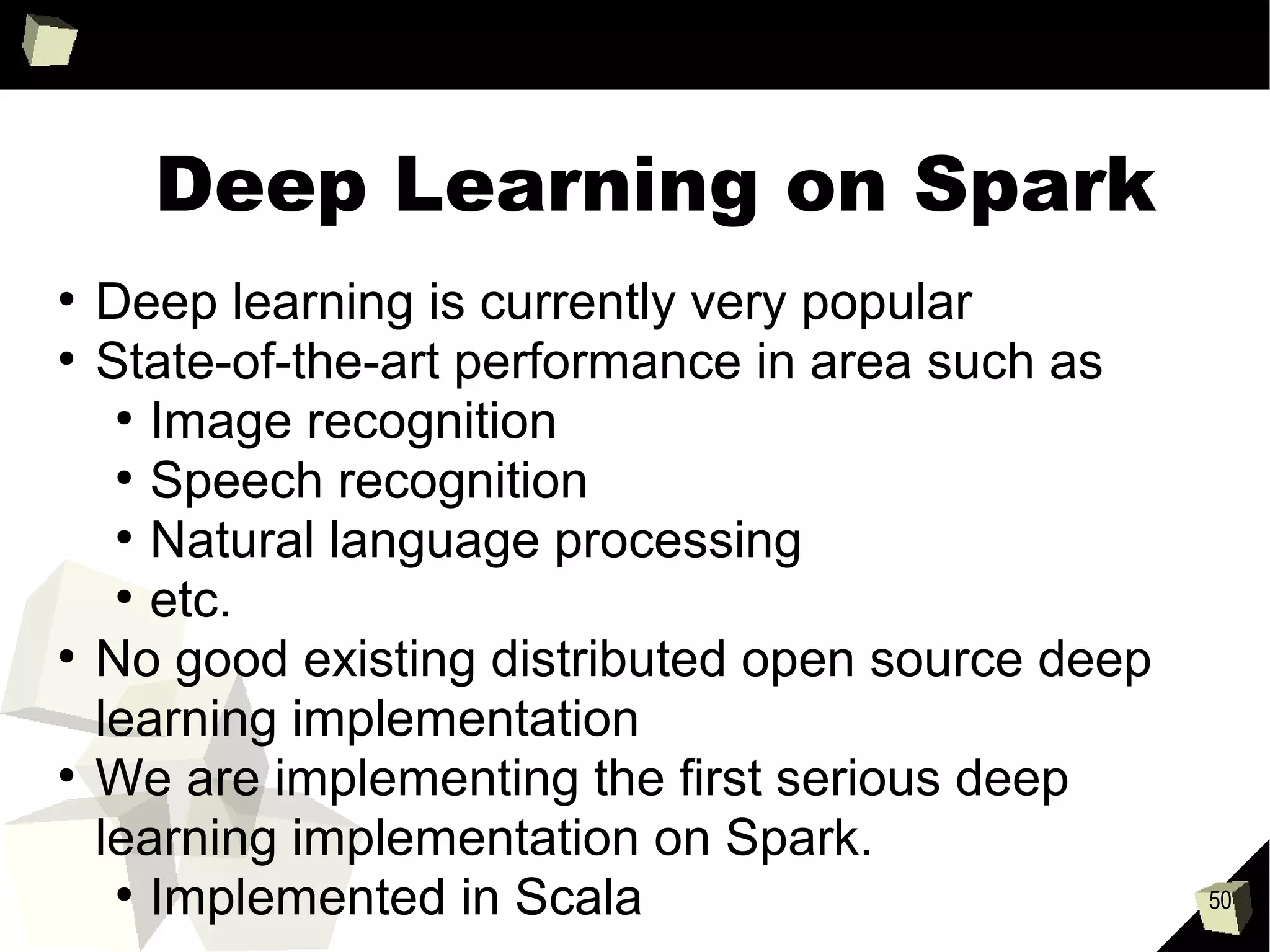
Deep learning is currently very popular
●
State-of-the-art performance in area such as
●
Image recognition
●
Speech recognition
●
Natural language processing
●
etc.
●
No good existing distributed open source deep
learning implementation
●
We are implementing the first serious deep
learning implementation on Spark.
●
Implemented in Scala
61
Features of our Open Source Spark
Deep Learning System
●
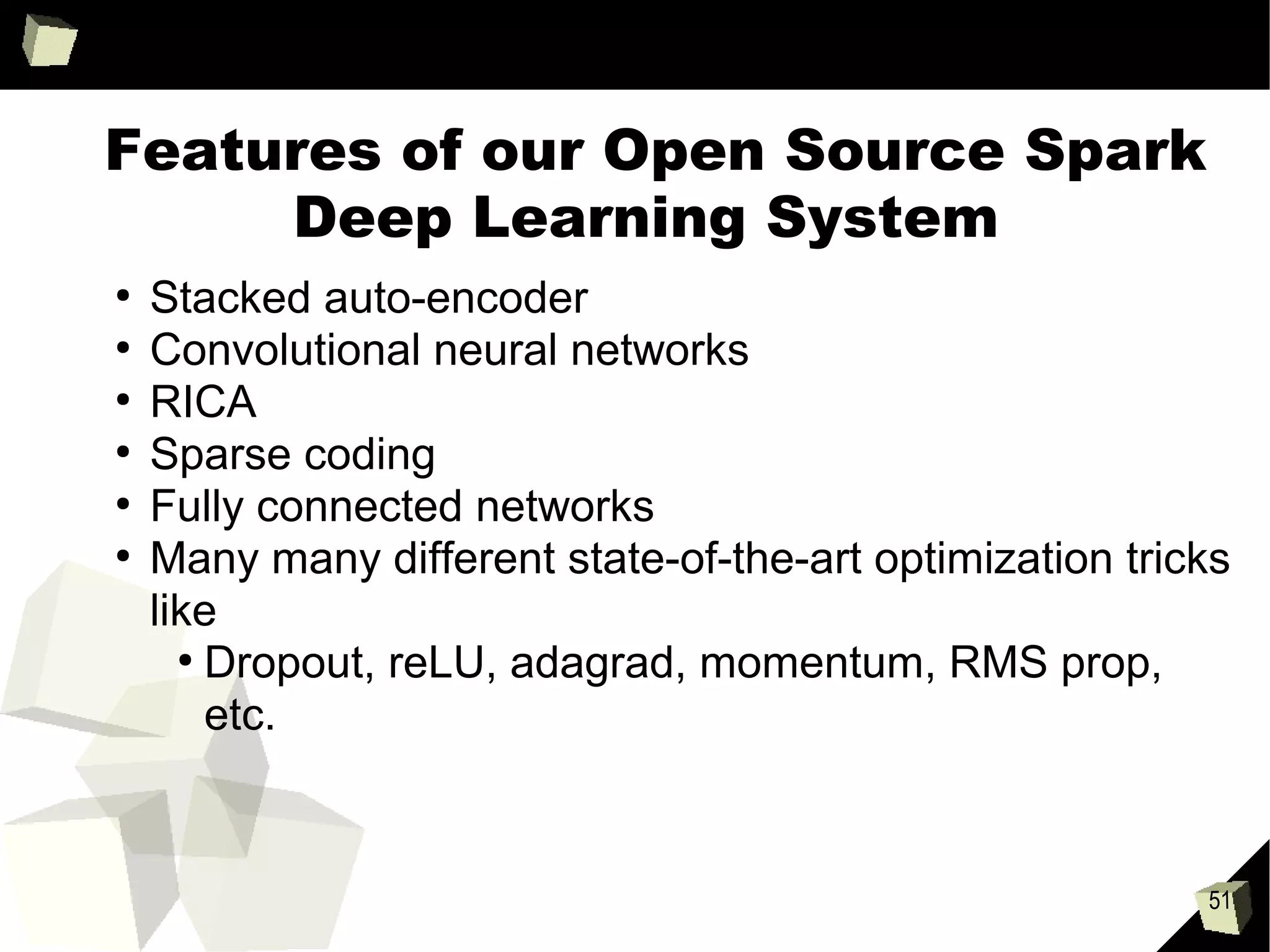
Stacked auto-encoder
●
Convolutional neural networks
●
RICA
●
Sparse coding
●
Fully connected networks
●
Many many different state-of-the-art optimization tricks
like
●
Dropout, reLU, adagrad, momentum, RMS prop,
etc.
62
Other Current Projects
●
Zendesk
●
Australian institute of sports
●
Precision agriculture
●
More welcome
63
Mastering Big Data Analytics with
Hadoop Course
●
3 day course on Hadoop and Spark
●
Only pre-requisite is Java programming experience
●
More than 35 programming exercises
●
Contents
●
Hadoop and MapReduce
●
Hive
●
Hadoop 2 ecosystem
●
Storm, Yarn, Giraph
●
Spark and Scala
●
Spark on Amazon
64
Recruiting PhD Students
●
We have a lot of real world projects to do.
●
A lot of projects from industry
●
Zendesk
●
Australian Institute of Sports
●
Precision agriculture
●
UXC Professional Solutions
●
More welcome
●
We need to expand our research group.
●
Topics:
●
Text mining
●
Time series mining
●
Reinforcement learning combined with deep learning
●
Video mining
●
etc.
65
Conclusion
●
Spark is best open source software for distributed
machine learning on Big Data
●
Be careful of using spark for high dimensional
data
●
Random forest does not suffer from
performance penalty
●
Spark programming using Scala is great for ease
of use
●
Spark is good even if data does not fit in RAM
66
Demonstration
R versus Spark Fight!
67
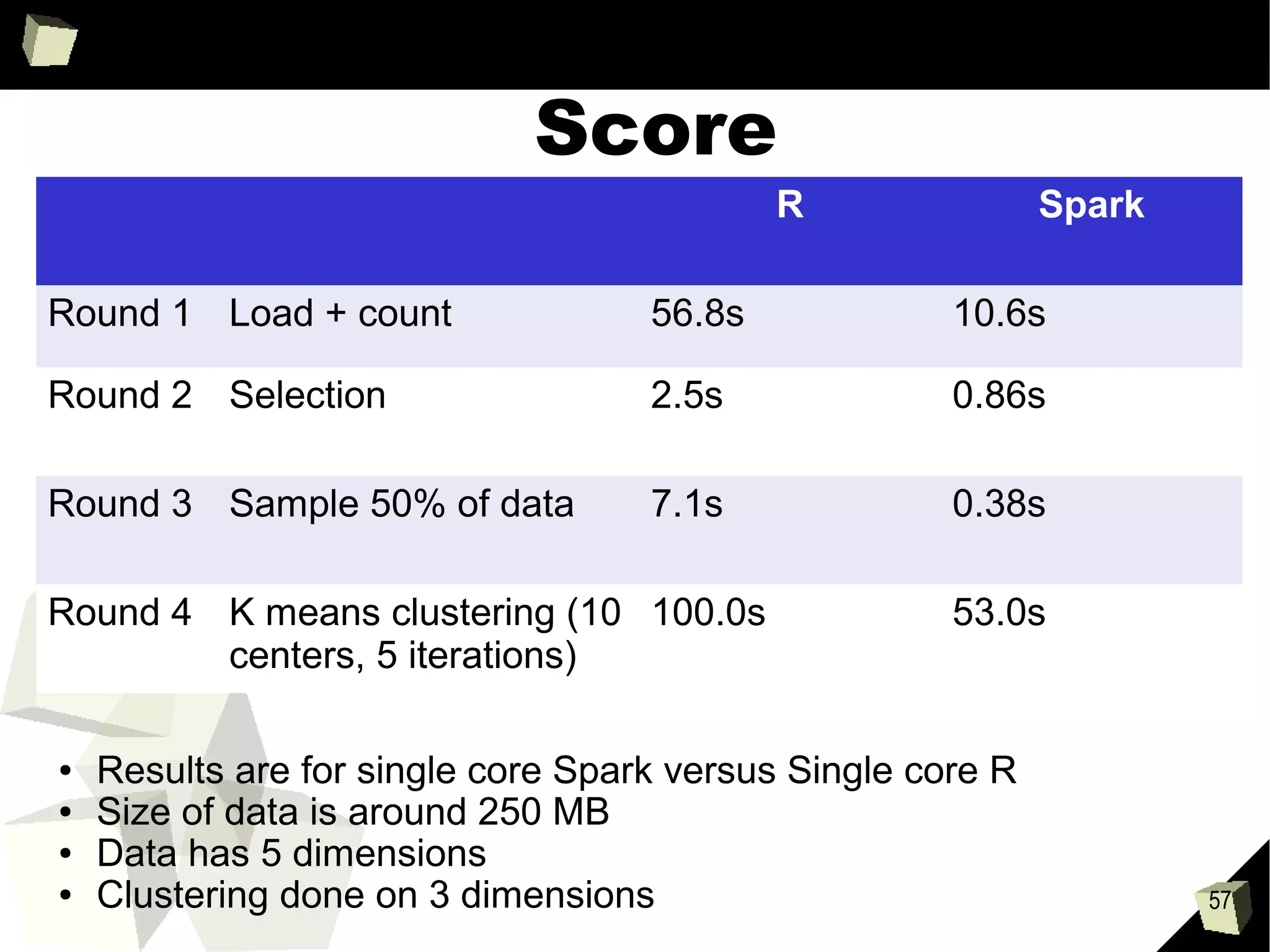
Score
R Spark
Round 1 Load + count 56.8s 10.6s
Round 2 Selection 2.5s 0.86s
Round 3 Sample 50% of data 7.1s 0.38s
Round 4 K means clustering (10
centers, 5 iterations)
100.0s 53.0s
● Results are for single core Spark versus Single core R
● Size of data is around 250 MB
● Data has 5 dimensions
● Clustering done on 3 dimensions
68
Questions?
● Name: Zhen He
● Email Address: z.he@latrobe.edu.au

Apache spark-melbourne-april-2015-meetup

  • 1.
    Melbourne / April2015 Introducing DataFrames R on Spark Large Scale Machine Learning Speakers Ned Shawa Mark Moloney Dr. Zhen He
  • 2.
    Agenda • Apache Spark1.3 Overview 6:15 – 6:30 (Ned) • DataFrames for Apache Spark 6:30 – 7:00 (Ned) • R on Apache Spark 7:00 – 7:30 (Mark) • Large Scale Machine Learning on Spark 7:30 – 8:15 (Zhen)
  • 3.
    News • Hadoop +Strata • Jobs • Meetup Update • Personal Announcement • Call for Contribution
  • 4.
    Contributions so far….. •Mark with R on Spark, Scala 101 • Tim with Building Spark on IDEs • Con with building Spark with Gradle • More?
  • 5.
    Whats new inSpark 1.3 • Multi Level Aggregation Trees • Improved Error reporting • SSL Encryption for Control messages and WebUI • DataFrames API • Backward compatibility for HIVE • Writing data in source • JDBC Driver • New Algorithms for MLLIB • Direct KAFKA API
  • 6.
    More Data SourcesAPIs 04/13/15
  • 7.
    What are DataFrames? •Distributed Collection of Data organized in Columns • Equivalent to Tables in Databases or DataFrame in R/PYTHON • Much richer optimization than any other implementation of DF • Can be constructed from a wide variety of sources and APIs
  • 8.
    Writing a DataFrame valdf = sqlContext.jsonFile("/home/ned/attendees.json") df.show() df.printSchema() df.select ("First Name").show() df.select("First Name","Age").show() df.filter(df("age")>40).show() df.groupBy("age").count().show()
  • 9.
    DataFrame with RDD caseclass attendees_class (first_name: String, last_name:String, age:Int) Val attendees=sc.textFile("/home/ned/attendees.csv").map(_.split(",")).map(p=>attendees_class(p(0),p(1),p(2).trim.toInt)).toDF() people.registerTempTable("attendees") val youngppl=sqlContext.sql("select first_name,last_name from attendees where age <35") youngppl.map(t=>"Name: " +t(0)+ " " + t(1)).collect().foreach(println)
  • 10.
    DataFrames and Parquet attendees.saveAsParquetFile("/home/ned/attendees.parquet") valpfile = sqlContext.parquetFile("/home/ned/attendees.parquet") pfile.printSchema() pfile.registerTempTable("attendees_parquet") val old_ppl=sqlContext.sql("select first_name,last_name,age from attendees_parquet where age >=35 order by age desc") old_ppl.map(t=>"Name: " + t(0)+" "+t(1)+ " Age " +t(2)).collect().foreach(println)
  • 11.
    DataFrames and JDBC valjdbc_attendees = sqlContext.load("jdbc", Map("url" -> "jdbc:mysql://localhost:3306/db1? user=root&password=xxx","dbtable" -> "attendees")) jdbc_attendees.show() jdbc.attendees.count() jdbc_attendees.registerTempTable("jdbc_attendees") val countall = sqlContext.sql("select count(*) from jdbc_attendees") countall.map(t=>"Records count is "+t(0)).collect().foreach(println)
  • 12.
  • 13.
  • 14.
    Introduction to SparkR MarkMoloney April 2015 https://github.com/markmo/sparkr-meetup-sparkr-demo
  • 15.
    R • A languagethat targets statistical and general data analysis • A package for nearly everything in this space • Great for exploratory analysis – rapid statistics and plots • Single threaded • Datasets limited to memoryTool Selection Primary Analytic Tool 18% 15% Cost is important A B E Ease-of-use & interface Ability to write one’s Everything is important Data miners are a diverse group who are looking for different things from their data mining tools. They report using multiple tools to meet their analytic needs, and even the most popular tool is identified as their primary tool by just 24% of data miners. Over the years, R and Rapid Miner have shown substantial increases. Cluster analysis* reveals that, in their tool-selection preferences, data miners fall into 5 groups. The primary dimensions that distinguish them are price sensitivity and code-writing / interface / ease-of-use preferences. 2013 Rexer Analytics Survey of 1,259 analytics professionals from 75 countries.
  • 16.
    Spark • An evolutionarystep up from Map-Reduce programming on Hadoop • Do more with less work • Simpler API than Map-Reduce. Apply functional transforms to datasets. The framework takes care of distribution of work across multiple machines. • Can cache interim results in memory, which speeds up iterative procedures
  • 17.
    SparkR • An RAPI to Spark’s RDDs (Resilient Distributed Datasets) • Work with massive datasets in R • Works on top of YARN or Mesos • Interactively run jobs on a cluster from the R shell • Exposes the RDD API of Spark as distributed lists in R • Packages and ships variables in the closure to each node • Use includePackage to include third-party packages on other nodes • Currently only suports R lists and vectors. Data frame support is in the works. map / lapply mapPartitions / lapplyPartition groupByKey reduceByKey sampleRDD collect cache textFile parallelize broadcast includePackage
  • 18.
    How does itwork • The R executable must be installed on each node • Work is sent to a Spark Executor (Java) on each node • Some overhead in starting R interpreter – looking at background process as in PySpark R Java Spark Context Java Spark Context Java Native Interface (JNI) using rJava Local JVM Local Machine Remote Machine Remote Machine Spark Executor Spark Executor Spark Executor Spark Executor R R tasks tasks broadcast vars, packages broadcast vars, packages Send R environment of vars used Uses R save() function to serialize closure
  • 19.
    Roadmap • Feature-complete DataFrameAPI • MLLib integration DataFrame Methods •Filter – filter(df, df$col1 > 0) •Sort – sortDF(df, asc(df$col1), desc(df$col2)) •Join – join(df1, df2, df1$col1 == df2$col2, "right_outer") •GroupBy – groupBy(df, df$col1) •Agg – agg(groupDF, sum(groupDF$col2), max(groupDF$col3))
  • 20.
  • 21.
    Document Similarity Example •Collection of inaugural speeches of US presidents • Using Shingles and Jaccard similarity – A k-shingle for a document is a sequence of k characters that appear in the document – Example: k = 2; doc = abcab. Set of 2-shingles = {ab, bc, ca} – Intuitively, documents that are similar will have many shingles in common – Robust to small changes, e.g. reordering a paragraph only affects the 2k chingles that cross paragraph boundaries – Jaccard similarity is intersection / union k = 6 doc1: “The cat sat” doc2: “The cat ate” ‘The ca’ ‘he cat’ ‘e cat ‘ ‘ cat s’ ‘cat sa’ ‘at sat’ ‘ cat a’ ‘cat at’ ‘at ate’ doc1 1 1 1 1 1 1 0 0 0 doc2 1 1 1 0 0 0 1 1 1 characteristic matrix: too large in real-world problems therefore use minhashing
  • 22.
    Machine Learning Example DigitClassification (MNIST database) Digit(Classification:(MNIST( Digits consist of 784 pixel values Training set: 60,000 images; Test set: 10,000
  • 23.
    Citations • http://amplab-extras.github.io/SparkR-pkg/ -main site • http://ampcamp.berkeley.edu/5/exercises/sparkr.html - hands-on exercises • http://spark-summit.org/2014/talk/sparkr-interactive-r-programs-at-scale-2 - MNIST example • https://github.com/kiendang/sparkr-naivebayes-example - how to integrate with MLLib now • https://github.com/cafreeman/Demo_SparkR - New API
  • 24.
  • 25.
    25 Talk Outline ● Spark isawesome! ● Example of spark in action ● Why spark is good for machine learning? ● Big Data versus big parameters ● What I wish you could do in spark ● Competing scalable machine learning systems ● Dispel some common myths about spark and Scala ● Current spark machine learning projects from our group ● Conclusion ● Demonstration
  • 26.
  • 27.
    27 Focus of Talkis on Performance
  • 28.
    28 Example of Sparkin Action ● Recently did some work with an Australian Government Agency ● Taught Mastering Hadoop and Spark course ● Students loved it ● Brain dead at the end  ● Use Spark for Machine Learning ● Really made excellent use of skills leant in the course for their project.
  • 29.
    29 Summary ● Initial R solution ● Neverfinished ● Approximate R + C single core solution ● A couple of days ● Accurate spark parallel solution ● 18 minutes ● The model worked very well in initial trial.
  • 30.
    30 Lessons Learnt ● First reducecomplexity of problem ● Pre and post processing performance is very important ● Spark is excellent for both the modeling and the pre and post processing
  • 31.
    31 Why Spark isgood for machine learning compared to MapReduce? ● Machine learning algorithms are iterative ● The following happens when using MapReduce ● A lot of reading and writing to HDFS ● The following happens when using spark ● Reading and writing to RAM instead of HDFS iter. 1iter. 1 iter. 2iter. 2 . . . HDFS read HDFS write HDFS read HDFS write iter. 1iter. 1 iter. 2iter. 2 . . . Input
  • 32.
    32 Make sure youactually cache the data! val data = MLUtils.loadLibSVMFile(sc, ”datafile.txt") val LR = new LogisticRegressionWithSGD() LR.optimizer.setNumIterations(10) val model = LR.run(data) The above runs 10 x slower then the code below! val data = MLUtils.loadLibSVMFile(sc, ”datafile.txt").cache val LR = new LogisticRegressionWithSGD() LR.optimizer.setNumIterations(10) val model = LR.run(data)
  • 33.
    33 Big Data versusBig Parameters ● Spark is great at doing machine learning on Big Data as long as the size of the parameters is small. ● Big parameters is hard for Spark to handle efficiently.
  • 34.
    34 What is BigParameters? ● Big parameter is caused by high dimensional data ● Modeling high dimensional data requires a large number of parameters ● In the example above the parameters are the b0, b1, b2, … bn
  • 35.
    35 Examples of HighDimensional Data Time series Text Image Speech
  • 36.
    36 Varying dimensionality (100– 10, 000, 000) ● Logistic regression on 30 cores, 10 iterations ● Dimensionality shown in [ ] ● The second number is the number of training instances ● Total data size is constant ● As dimensionality increases execution time increases significantly! Time(secs) Low dimensional data High dimensional data
  • 37.
    37 Varying number ofcores ● For high dimensional data (10 million) ● Using more cores actually slows execution! ● 1 core is the optimal! ● For low dimensional data ● Execution time decreases with the increase in the number of cores. Time(secs) # cores 10 million dimensional data # cores Time(secs) 100 dimensional data
  • 38.
    38 Why is bigparameters / high dimensional data so hard for spark?
  • 39.
    39 Why is bigparameters hard for spark? mini-batch of data Master node combine separate models Broadcast combined model
  • 40.
    40 Reason 1: Requiresall nodes to synchronize mini-batch of data Master node combine separate models Broadcast combined model
  • 41.
    41 Reason 2: Inefficientmemory usage ● Although all cores working on same set of parameters they all have their own copy ● It would be nice if they can all share the same copy RAM Core 1 Core 2 Core 3 Core 4 within one node
  • 42.
    42 Parameters can bemulti-GB is size Reason 3: High shuffle cost mini-batch of data Master node combine separate models Broadcast combined model
  • 43.
    43 Reason 4: Masternode is a bottleneck mini-batch of data Master node Broadcast combined model
  • 44.
    44 What I wishwe could do on Spark ● All machines share the same a single copy of the shared model in the shared RAM. ● All cores can update the model asynchronously. ● No bottleneck master node RAM Core 1 Core 2 Core 3 Core 4 RAM Core 1 Core 2 Core 3 Core 4 Node 1 Node 2 Parameter Server Async update parameters Async update parameters
  • 45.
    45 Such a systemalready exists ● Google’s DistBelief system ● J. Dean, G.S. Corrado, R. Monga, K. Chen, M. Devin, Q.V. Le, M.Z. Mao, M.A. Ranzato, A. Senior, P. Tucker, K. Yang, A. Y. Ng. Large Scale Distributed Deep Networks. NIPS, 2012. ● Closed source ● Only people in Google can use it ● Used to train deep learning system with 1 billion parameters on 16, 000 cores
  • 46.
    46 Comparison of somekey machine learning algorithms in Spark ● Linear Models ● Logistic regression ● Linear regression ● Support vector machines ● Linear kernel ● Random forest
  • 47.
    47 Logistic Regression, LinearRegression, Linear Support Vector Machines (SVM) ● Need to repeatedly merge parameters ● High dimensional data => Big parameters => high communication costs
  • 48.
    48 Random Forest ● Can betrained very efficiently ● Each task trains on the data of its own partition ● Each tree can be trained separately ● No communication or synchronization needed
  • 49.
    49 Competing Scalable Machine LearningSystems ● Greenplum ● Machine learning via SQL ● Mahout ● MapReduce based ● Moving to using spark as underlying engine ● Vowpal Wabbit ● Good performance ● Specialized system ● Graph Lab ● Good performance ● Need to turn everything into graphs
  • 50.
  • 51.
    51 Common Misconception: Sparkis only good if data fits in RAM ● From inception Spark was designed to be a general execution engine that works both in- memory and on-disk ● Almost all operators perform external operations when data does not fit in RAM. ● Spark breaks large-scale sort record
  • 52.
    52 Results of Large-scaleSort ● Spark is 3X faster than Hadoop using 10X fewer machines ● Spark sorts 1PB in 4 hours on 190 machines ● Compared to 16 hours for Hadoop using 3800 machines ● All sorting on disk (HDFS) no use of Spark in-memory cache
  • 53.
    53 How did theydo it? ● More efficient Shuffle ● Very efficient scheduling of tasks
  • 54.
    54 A little bitof RAM can go a long way ● Performance degrades gracefully with decreasing RAM size
  • 55.
    55 A little bitof RAM can go a long way ● Just cache the small parts of the data that you will use again ● Use filter and projection to reduce the amount that is cached. ● Spark SQL stores data compressed in columns ● Fast compression/decompression ● Column-stores have been proven to be way better than row- stores for analytics ● 100x better ● For normal Spark code (non-SparkSQL), you can store data serialized and compressed in RAM. ● RAM is cheap now days ● Aggregate RAM on large cluster can be very large
  • 56.
    56 Common Misconceptions ● I needto learn a new language Scala ● Scala is easy to learn ● Can program in Java and Python ● Distributed Dataframes ● SparkR ● I have to rewrite all my code ● Spark will run MapReduce code unmodified ● Spark SQL runs HiveQL
  • 57.
    57 Some Real Problems ● Scalaallocates a lot of objects ● High GC overhead ● The nice functional scala code is much slower than writing C-styled while loops ● For example: ● val y = x.map(x => x * x) ● is slower than ● var i = 0 ● while (i < x.length) { y(i) = x(i) * x(i) i += 1 }
  • 58.
  • 59.
    59 Spark API Examples ● Almostno good examples on the Spark API calls. ● Matthias and I have written examples for over 110 Spark API calls ● http://homepage.cs.latrobe.edu.au/zhe/ZhenHeSparkRDDAPIEx amples.html ● Great reference ● Currently over 33, 000 hits ● Often top Google page returned when searching spark API calls
  • 60.
    60 Deep Learning onSpark ● Deep learning is currently very popular ● State-of-the-art performance in area such as ● Image recognition ● Speech recognition ● Natural language processing ● etc. ● No good existing distributed open source deep learning implementation ● We are implementing the first serious deep learning implementation on Spark. ● Implemented in Scala
  • 61.
    61 Features of ourOpen Source Spark Deep Learning System ● Stacked auto-encoder ● Convolutional neural networks ● RICA ● Sparse coding ● Fully connected networks ● Many many different state-of-the-art optimization tricks like ● Dropout, reLU, adagrad, momentum, RMS prop, etc.
  • 62.
    62 Other Current Projects ● Zendesk ● Australianinstitute of sports ● Precision agriculture ● More welcome
  • 63.
    63 Mastering Big DataAnalytics with Hadoop Course ● 3 day course on Hadoop and Spark ● Only pre-requisite is Java programming experience ● More than 35 programming exercises ● Contents ● Hadoop and MapReduce ● Hive ● Hadoop 2 ecosystem ● Storm, Yarn, Giraph ● Spark and Scala ● Spark on Amazon
  • 64.
    64 Recruiting PhD Students ● Wehave a lot of real world projects to do. ● A lot of projects from industry ● Zendesk ● Australian Institute of Sports ● Precision agriculture ● UXC Professional Solutions ● More welcome ● We need to expand our research group. ● Topics: ● Text mining ● Time series mining ● Reinforcement learning combined with deep learning ● Video mining ● etc.
  • 65.
    65 Conclusion ● Spark is bestopen source software for distributed machine learning on Big Data ● Be careful of using spark for high dimensional data ● Random forest does not suffer from performance penalty ● Spark programming using Scala is great for ease of use ● Spark is good even if data does not fit in RAM
  • 66.
  • 67.
    67 Score R Spark Round 1Load + count 56.8s 10.6s Round 2 Selection 2.5s 0.86s Round 3 Sample 50% of data 7.1s 0.38s Round 4 K means clustering (10 centers, 5 iterations) 100.0s 53.0s ● Results are for single core Spark versus Single core R ● Size of data is around 250 MB ● Data has 5 dimensions ● Clustering done on 3 dimensions
  • 68.
    68 Questions? ● Name: ZhenHe ● Email Address: z.he@latrobe.edu.au

Editor's Notes

  • #23 Mixed National Institute of Standards and Technology database