OVERVIEW
Vadim Bichutskiy
@vybstat
Interface Symposium
June 11, 2015
Licensed under: Creative Commons Attribution-NonCommercial-NoDerivatives 4.0 International License
WHO AM I
• Computational and Data Sciences, PhD Candidate, George Mason
• Independent Data Science Consultant
• MS/BS Computer Science, MS Statistics
• NOT a Spark expert (yet!)
ACKNOWLEDGEMENTS
• Much of this talk is inspired by SparkCamp at Strata HadoopWorld, San
Jose, CA, February 2015 licensed under: Creative Commons
Attribution-NonCommercial-NoDerivatives 4.0 International License
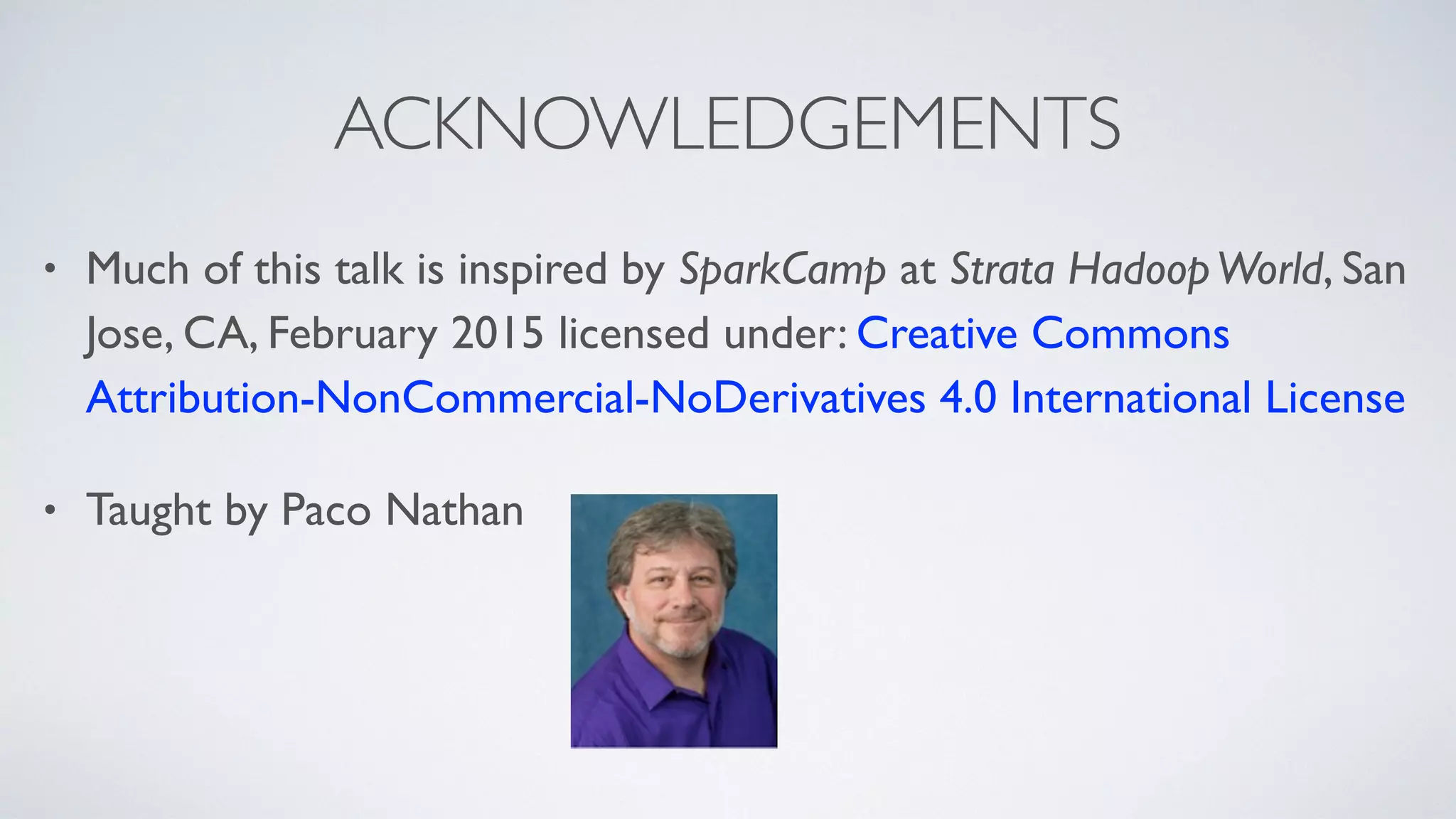
• Taught by Paco Nathan
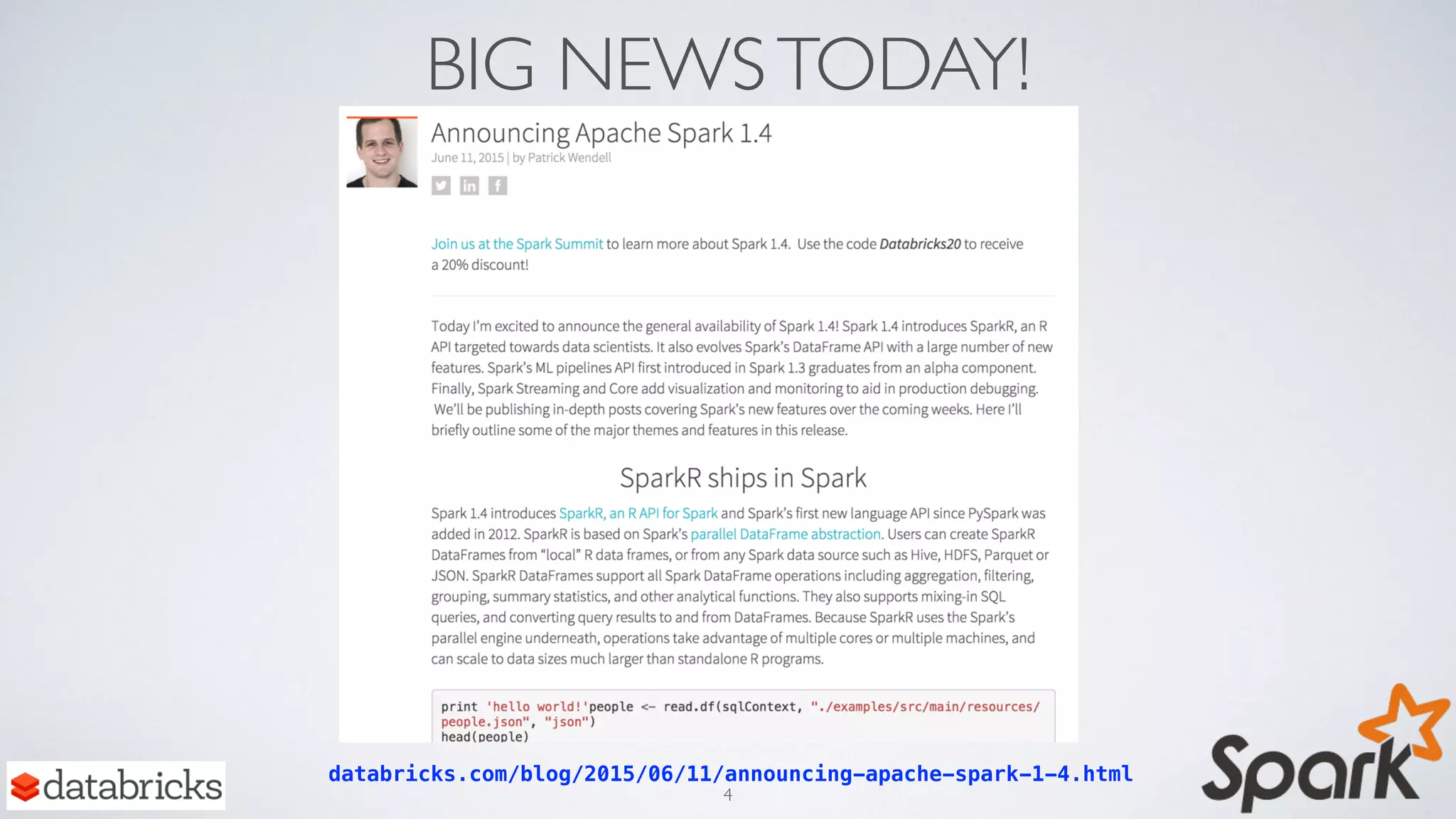
BIG NEWSTODAY!
databricks.com/blog/2015/06/11/announcing-apache-spark-1-4.html
4
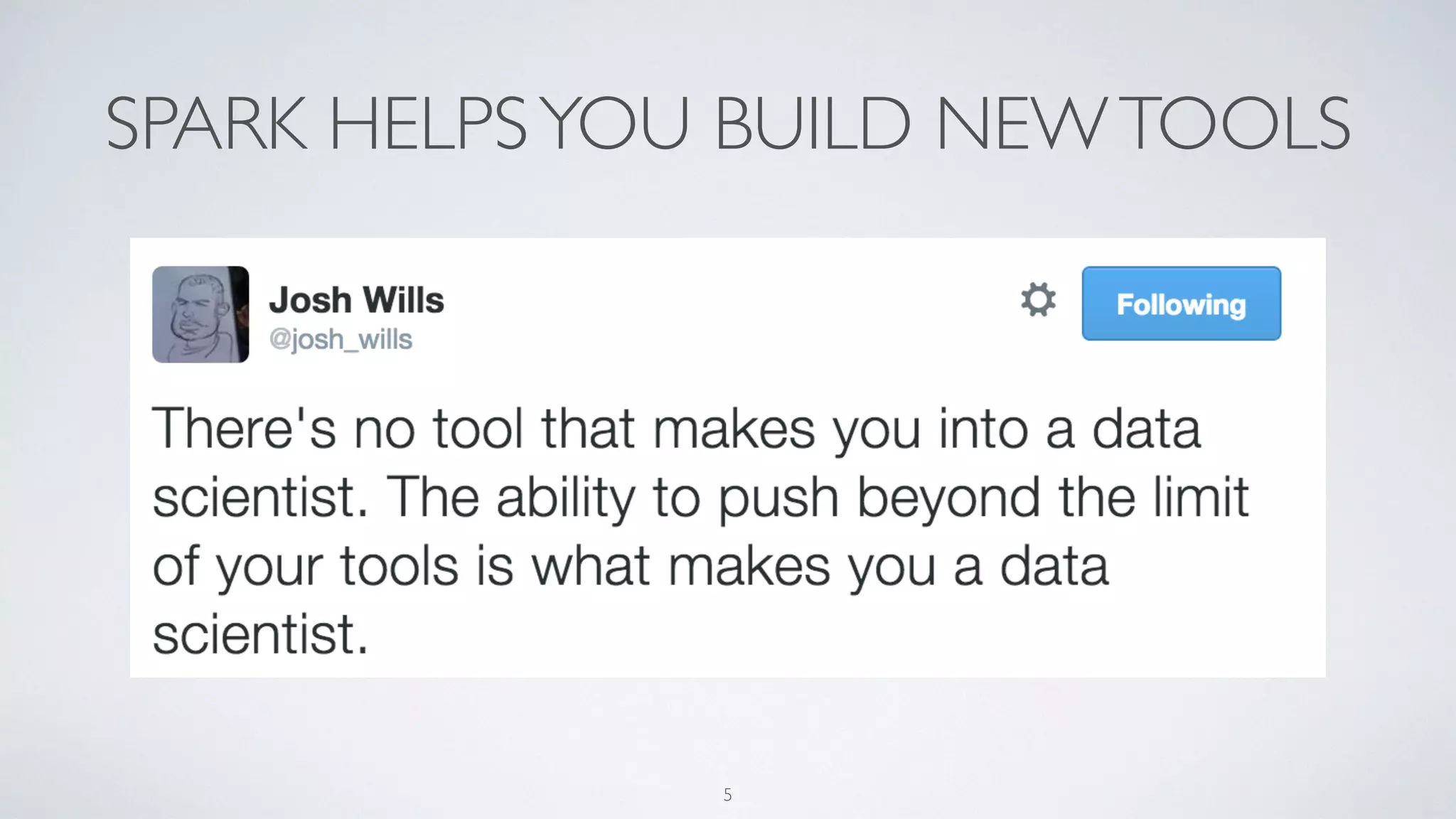
SPARK HELPSYOU BUILD NEWTOOLS
5
THISTALK…
• Part I: Big Data:A Brief History
• Part II: A Tour of Spark
• Part III: Spark Concepts
6
PART I:
BIG DATA:A BRIEF HISTORY
7
• Web, e-commerce, marketing, other data explosion
• Work no longer fits on a single machine
• Move to horizontal scale-out on clusters of commodity hardware
• Machine learning, indexing, graph processing use cases at scale
DOT COM BUBBLE: 1994-2001
8
GAME CHANGE: C. 2002-2004
Google File System
research.google.com/archive/gfs.html
MapReduce: Simplified Data Processing on Large Clusters
research.google.com/archive/mapreduce.html
9
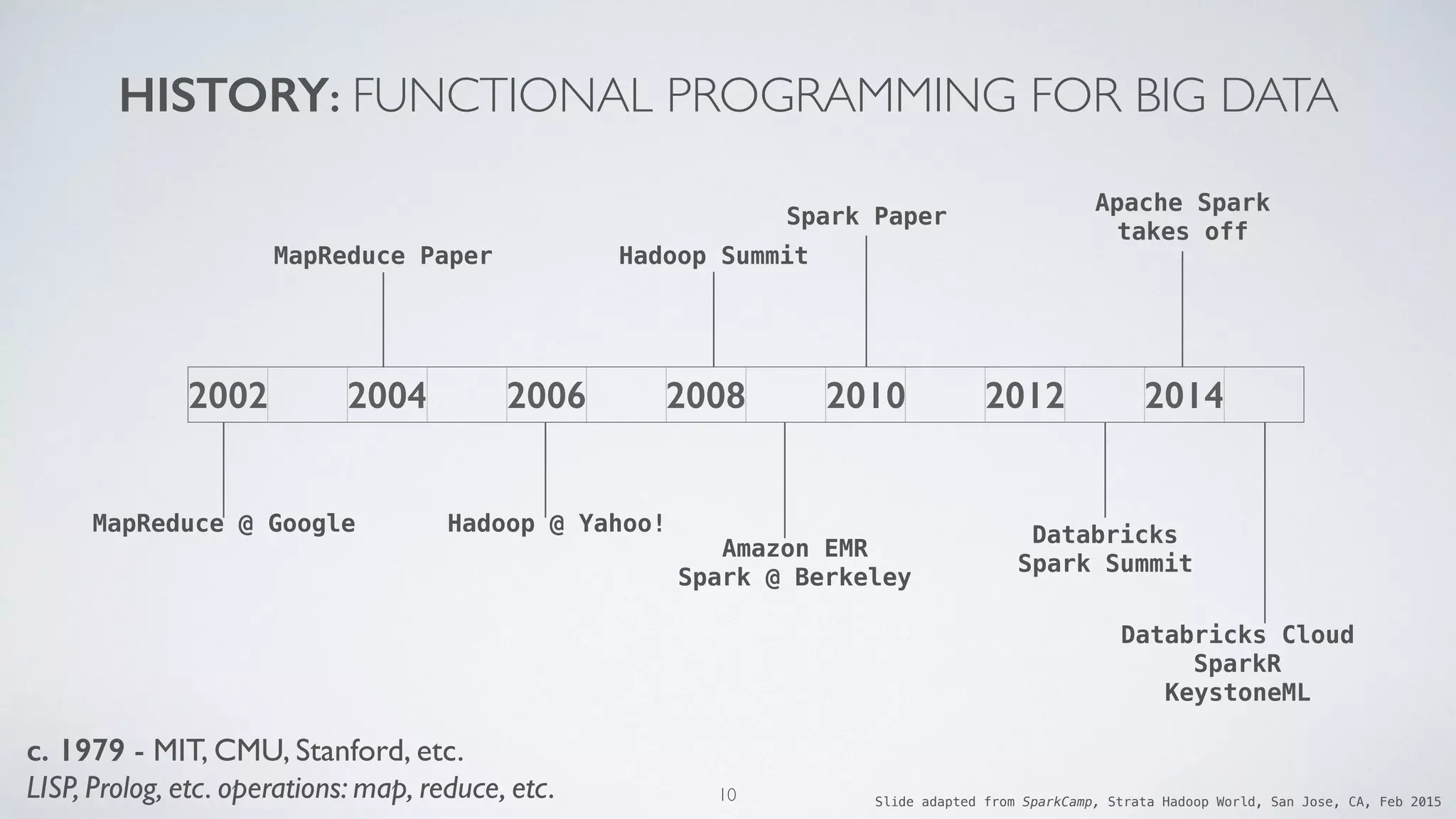
HISTORY: FUNCTIONAL PROGRAMMING FOR BIG DATA
2002 2004 2006 2008 2010 2012 2014
MapReduce @ Google
MapReduce Paper
Hadoop @ Yahoo!
Hadoop Summit
Amazon EMR
Spark @ Berkeley
Spark Paper
Databricks
Spark Summit
Apache Spark
takes off
Databricks Cloud
SparkR
KeystoneML
c. 1979 - MIT, CMU, Stanford, etc.
LISP, Prolog, etc. operations: map, reduce, etc. Slide adapted from SparkCamp, Strata Hadoop World, San Jose, CA, Feb 201510
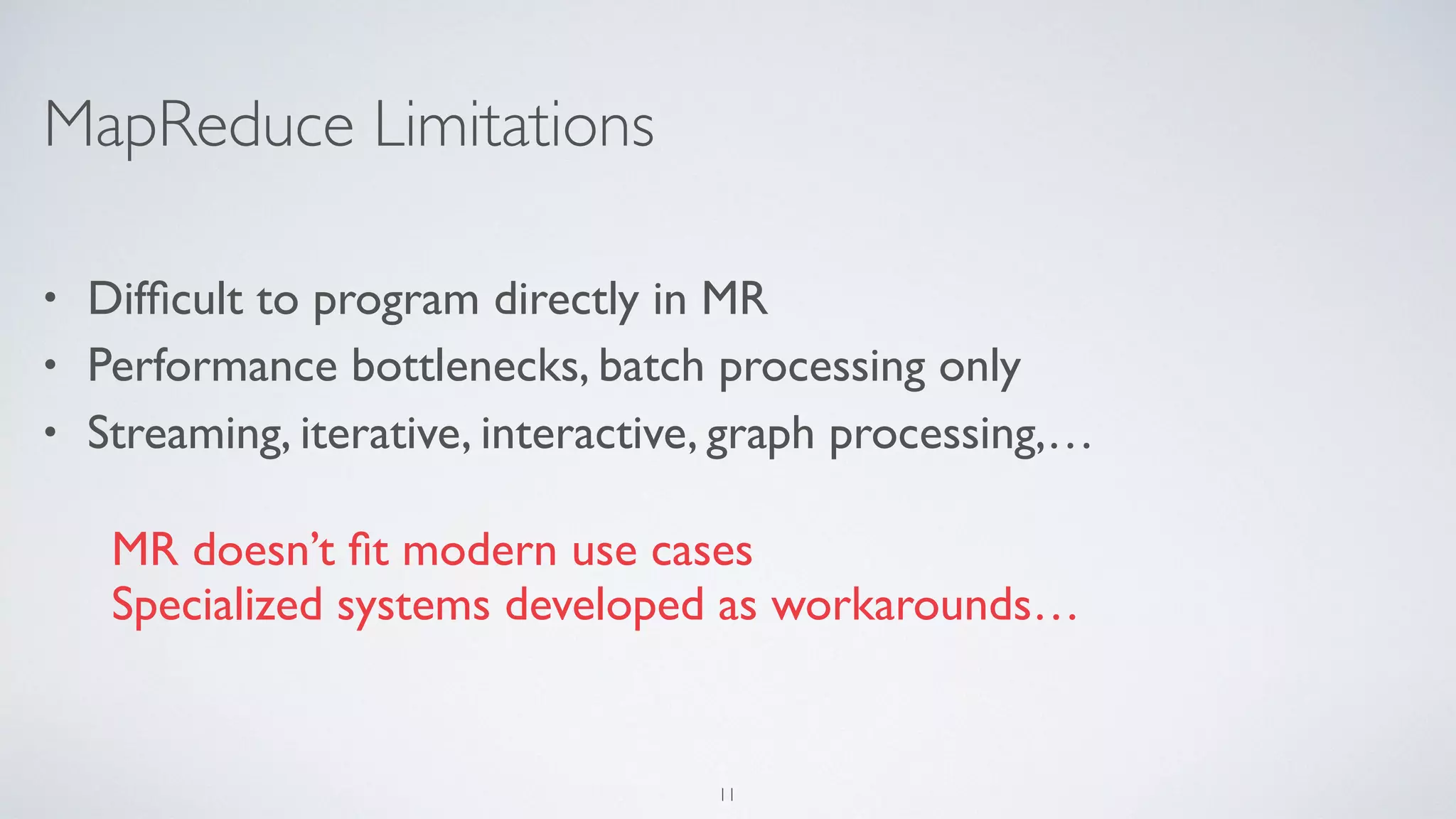
MapReduce Limitations
• Difficult to program directly in MR
• Performance bottlenecks, batch processing only
• Streaming, iterative, interactive, graph processing,…
MR doesn’t fit modern use cases
Specialized systems developed as workarounds…
11
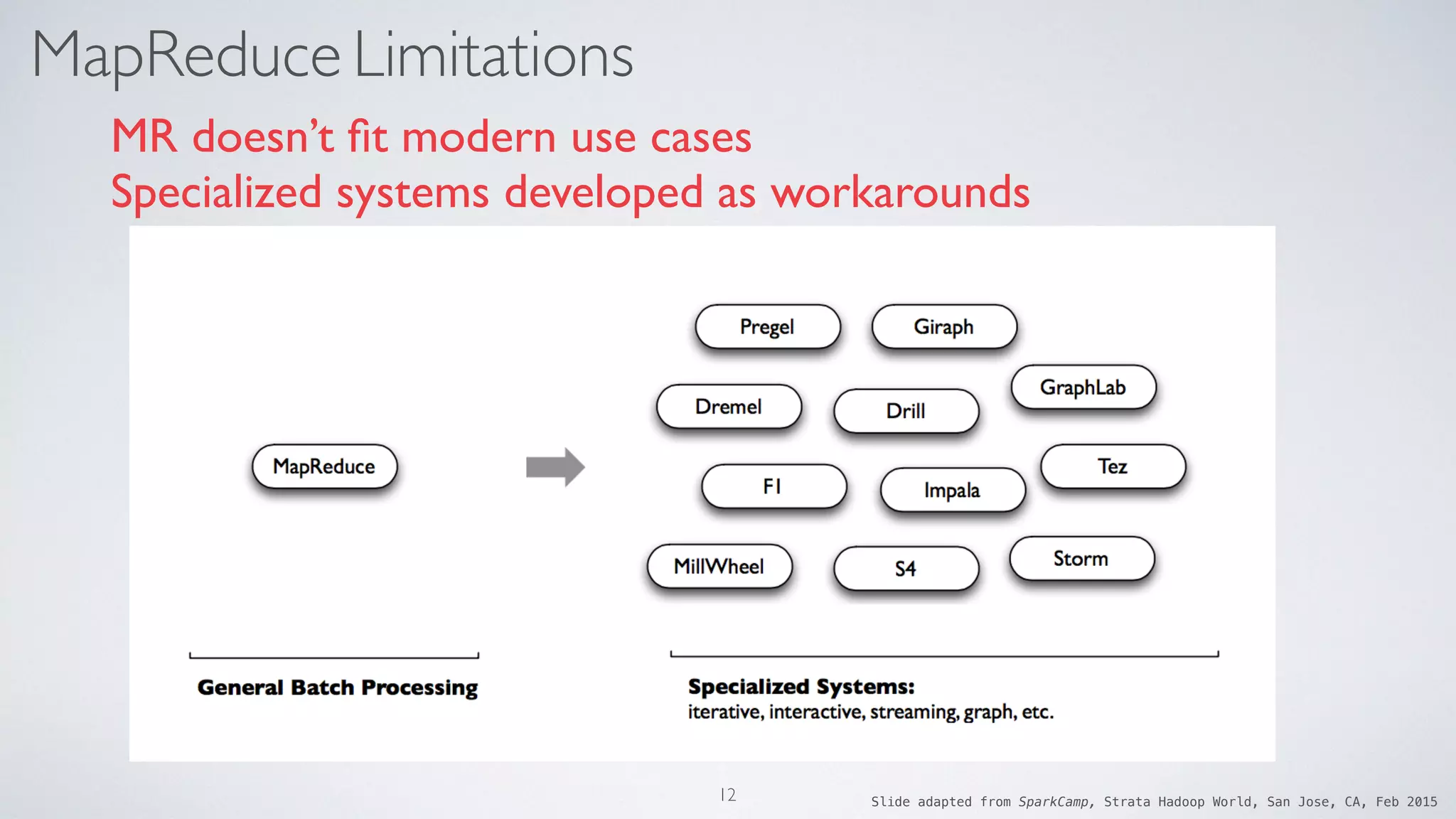
MapReduce Limitations
MR doesn’t fit modern use cases
Specialized systems developed as workarounds
Slide adapted from SparkCamp, Strata Hadoop World, San Jose, CA, Feb 201512
PART II:
APACHE SPARK TOTHE RESCUE…
13
Apache Spark
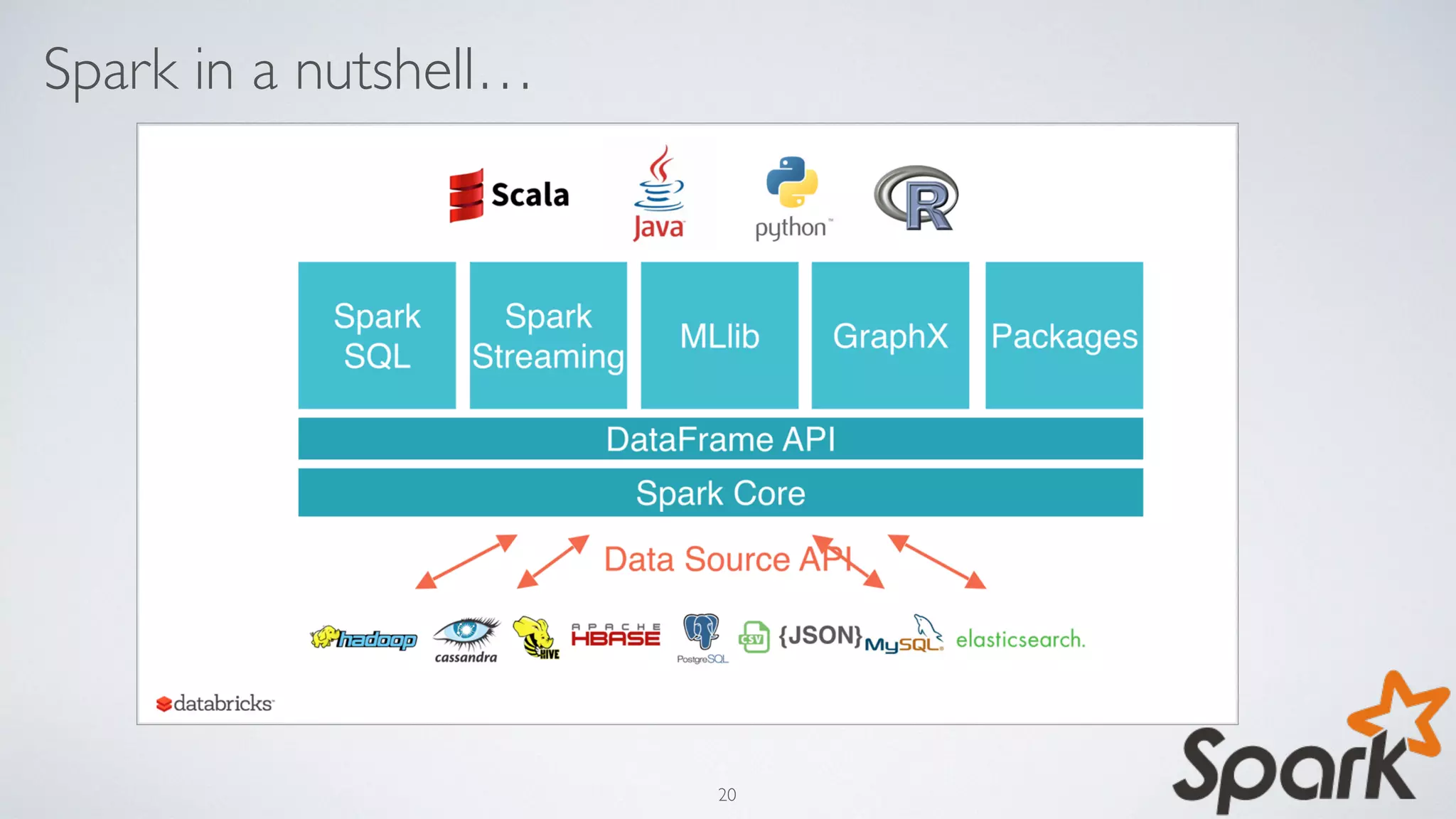
• Fast, unified, large-scale data processing engine for modern workflows
• Batch, streaming, iterative, interactive
• SQL, ML, graph processing
• Developed in ’09 at UC Berkeley AMPLab, open sourced in ’10
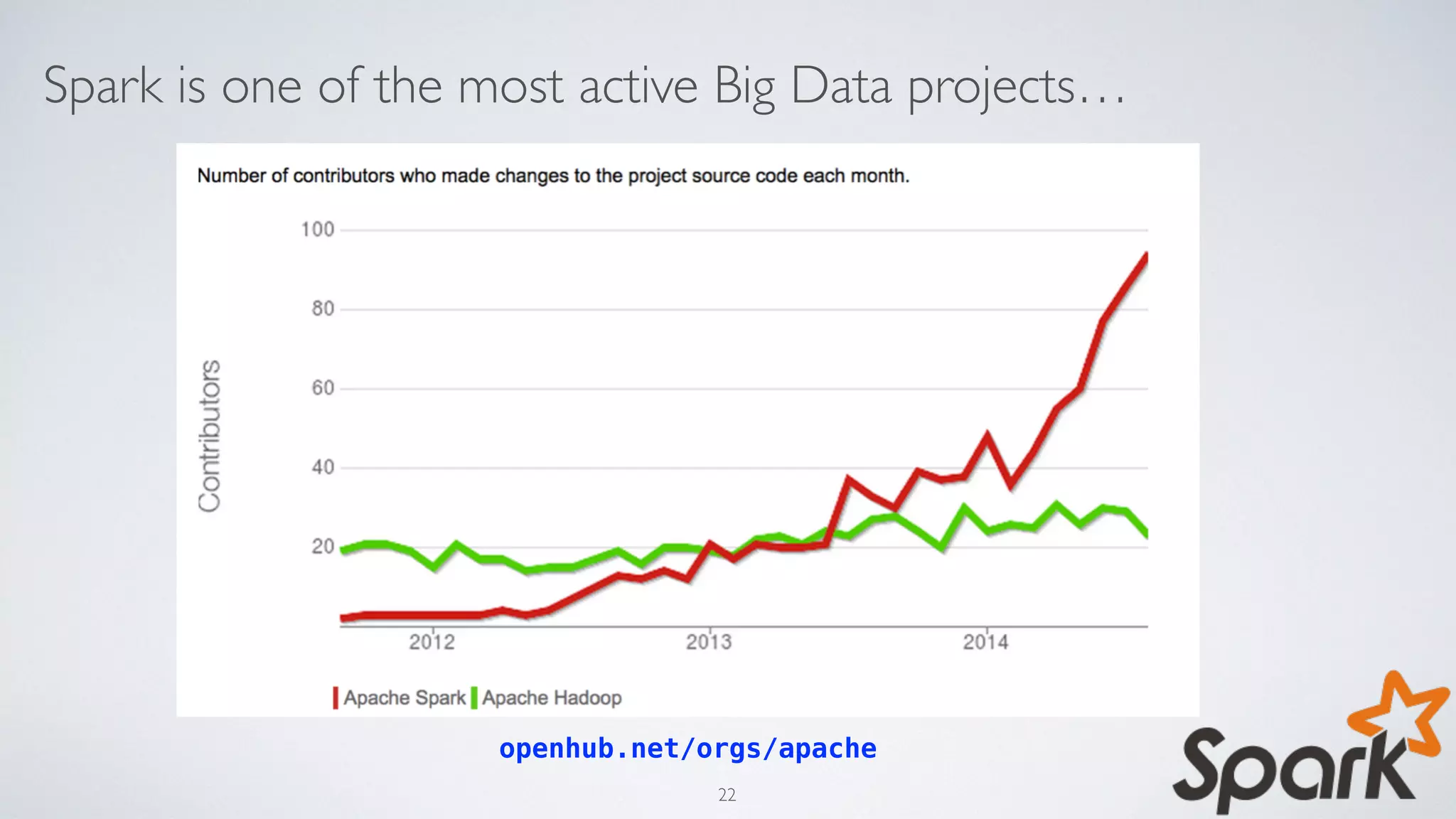
• Spark is one of the largest Big Data OSS projects
“Organizations that are looking at big data challenges –

including collection, ETL, storage, exploration and analytics –

should consider Spark for its in-memory performance and

the breadth of its model. It supports advanced analytics

solutions on Hadoop clusters, including the iterative model

required for machine learning and graph analysis.”
Gartner, Advanced Analytics and Data Science (2014)
14
Apache Spark
Spark’s goal was to generalize MapReduce, supporting
modern use cases within same engine!
15
Spark Research
Spark: Cluster Computer withWorking Sets
http://people.csail.mit.edu/matei/papers/2010/hotcloud_spark.pdf
Resilient Distributed Datasets:A Fault-Tolerant Abstraction for
In-Memory Cluster Computing
https://www.usenix.org/system/files/conference/nsdi12/nsdi12-final138.pdf
16
Spark: Key Points
• Same engine for batch, streaming and interactive workloads
• Scala, Java, Python, and (soon) R APIs
• Programming at a higher level of abstraction
• More general than MR
17
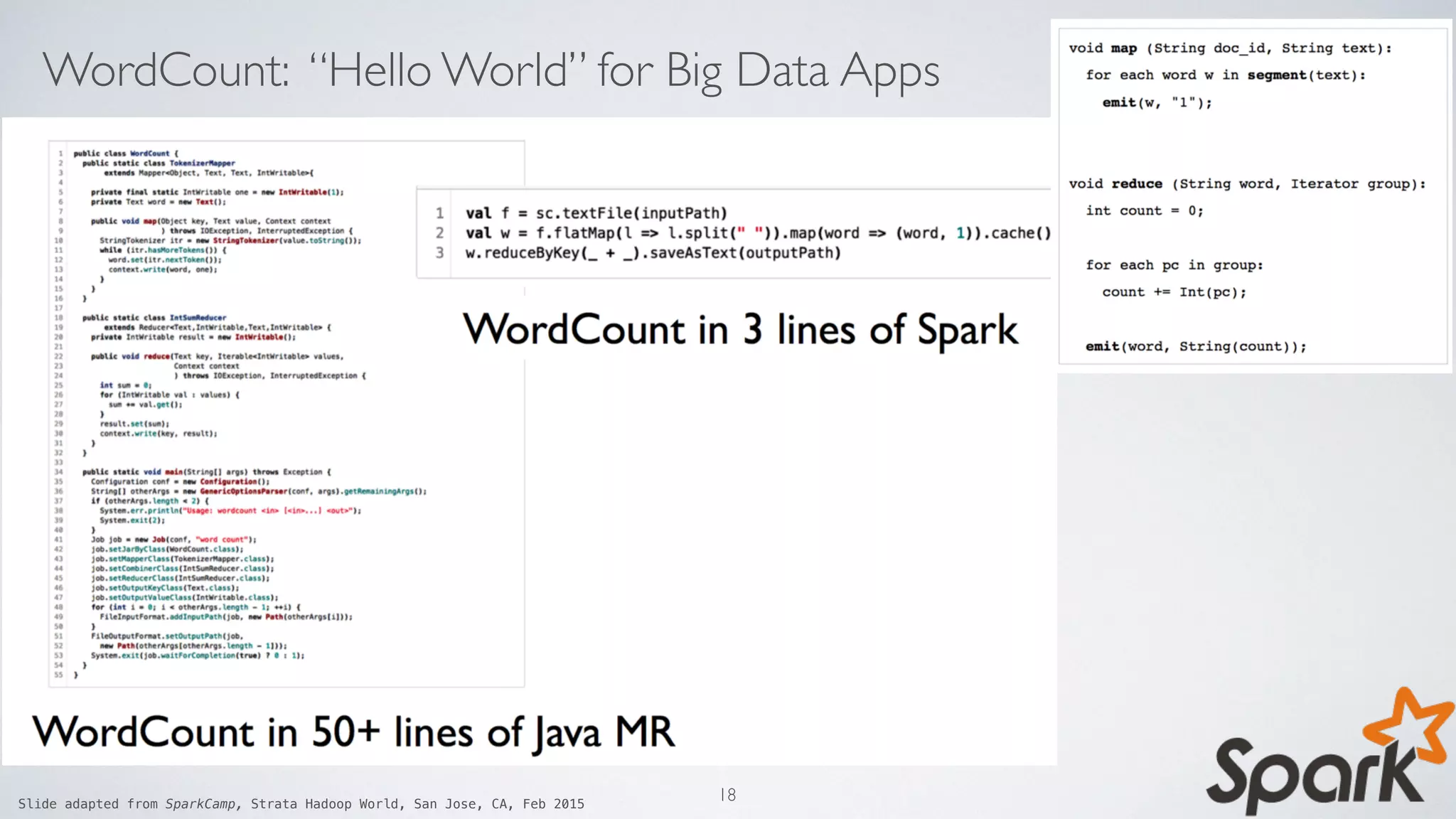
WordCount: “Hello World” for Big Data Apps
Slide adapted from SparkCamp, Strata Hadoop World, San Jose, CA, Feb 2015
18
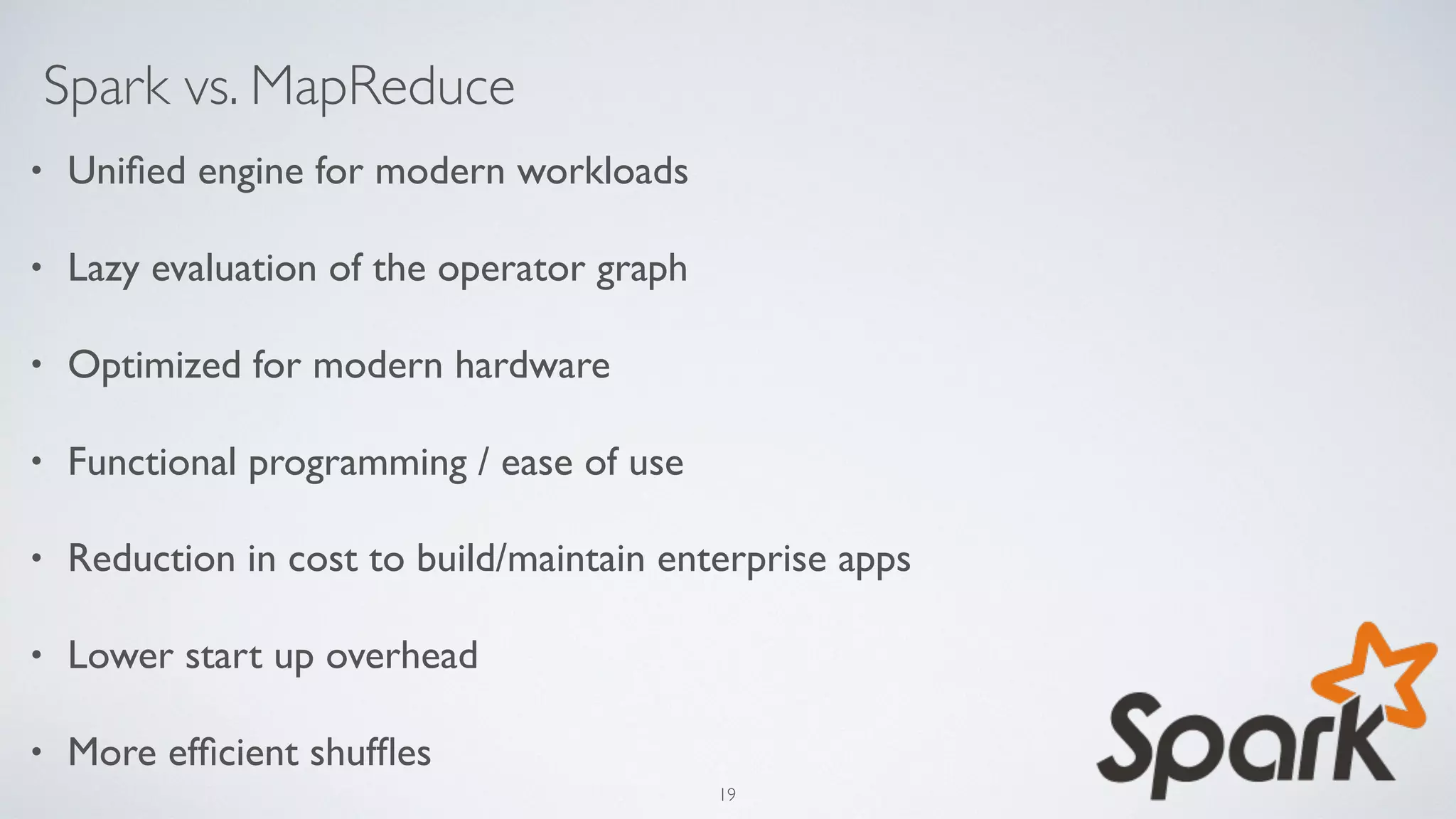
Spark vs. MapReduce
• Unified engine for modern workloads
• Lazy evaluation of the operator graph
• Optimized for modern hardware
• Functional programming / ease of use
• Reduction in cost to build/maintain enterprise apps
• Lower start up overhead
• More efficient shuffles
19
Spark in a nutshell…
20
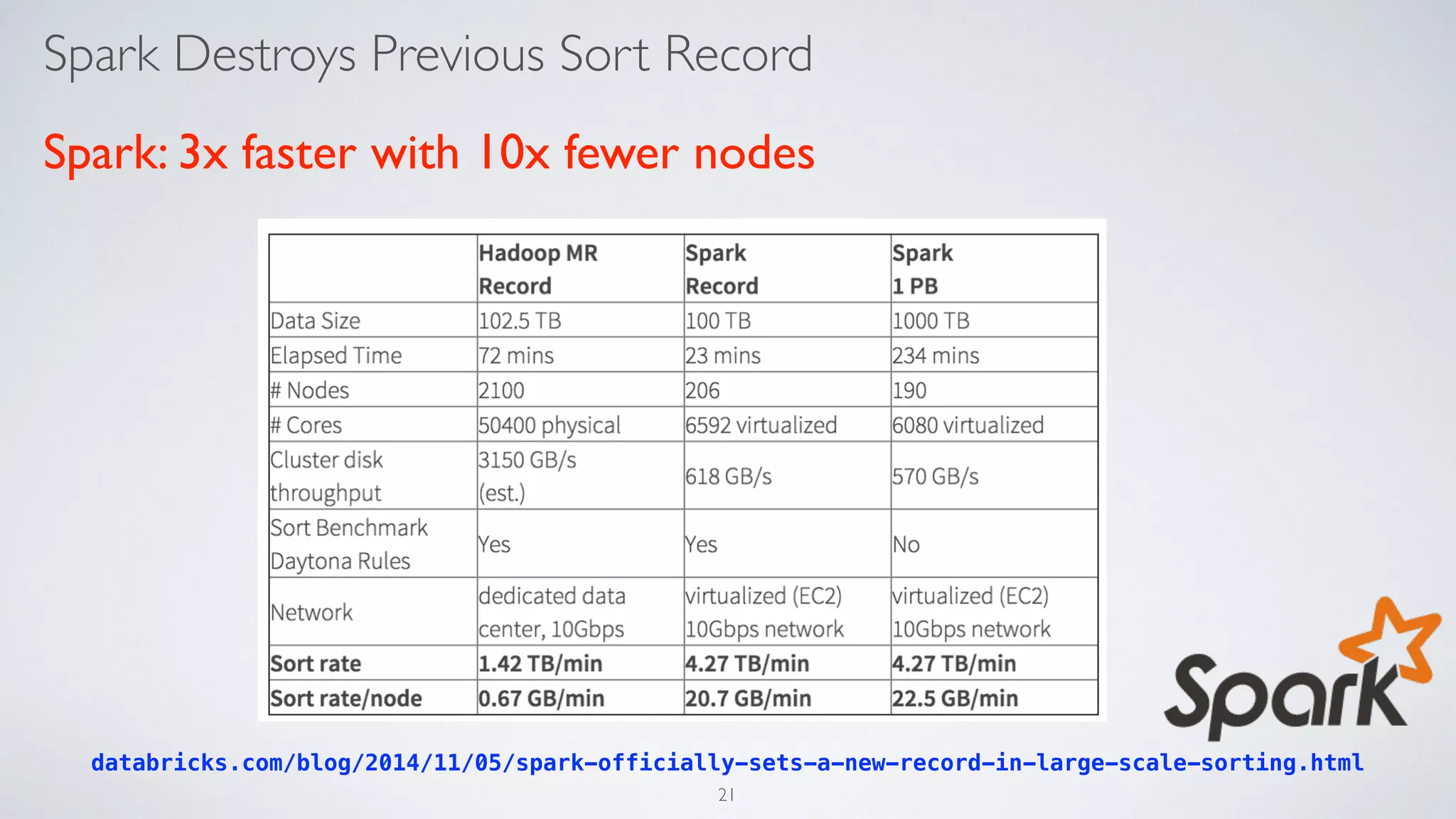
Spark Destroys Previous Sort Record
Spark: 3x faster with 10x fewer nodes
databricks.com/blog/2014/11/05/spark-officially-sets-a-new-record-in-large-scale-sorting.html
21
Spark is one of the most active Big Data projects…
openhub.net/orgs/apache
22
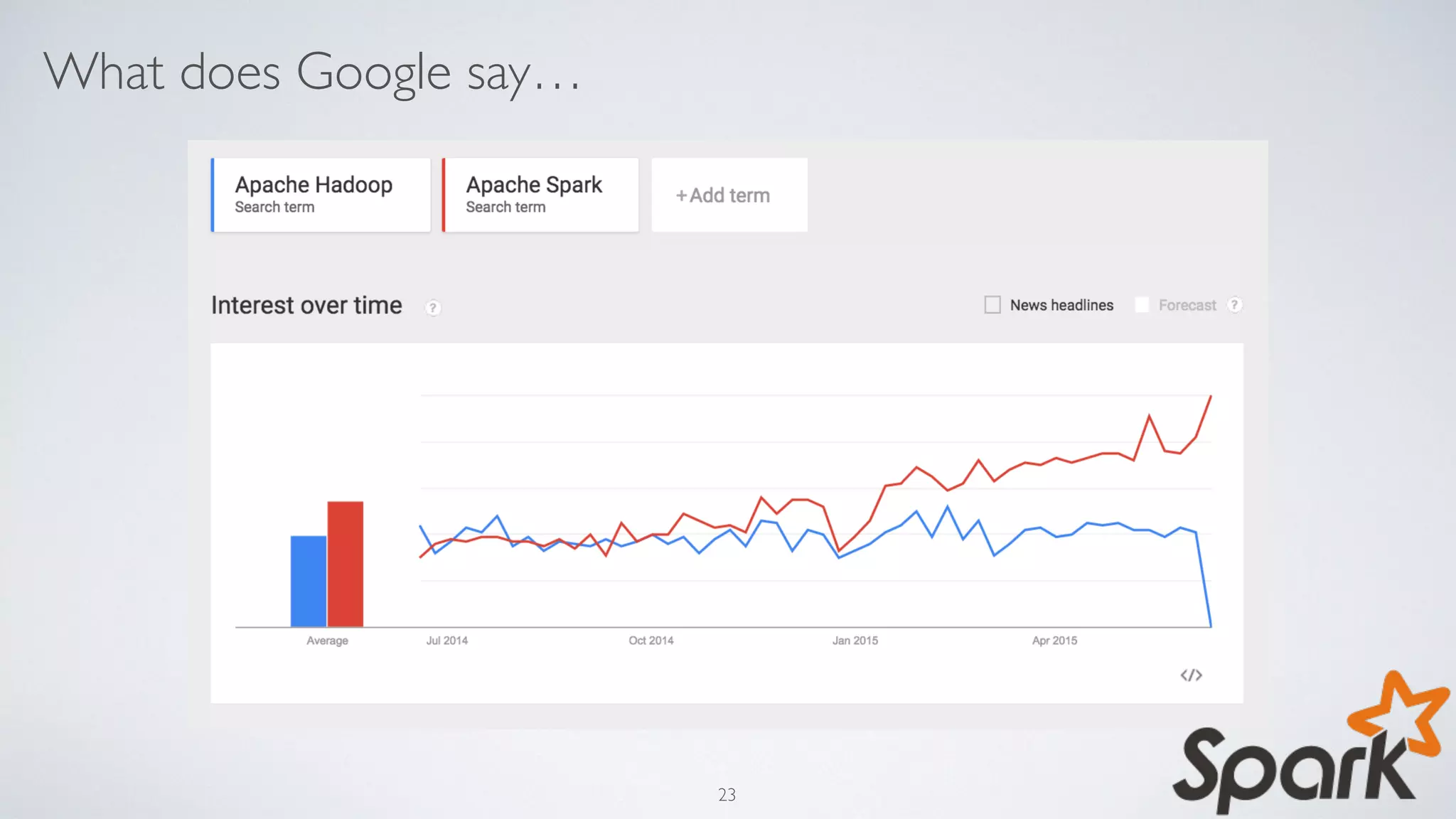
What does Google say…
23
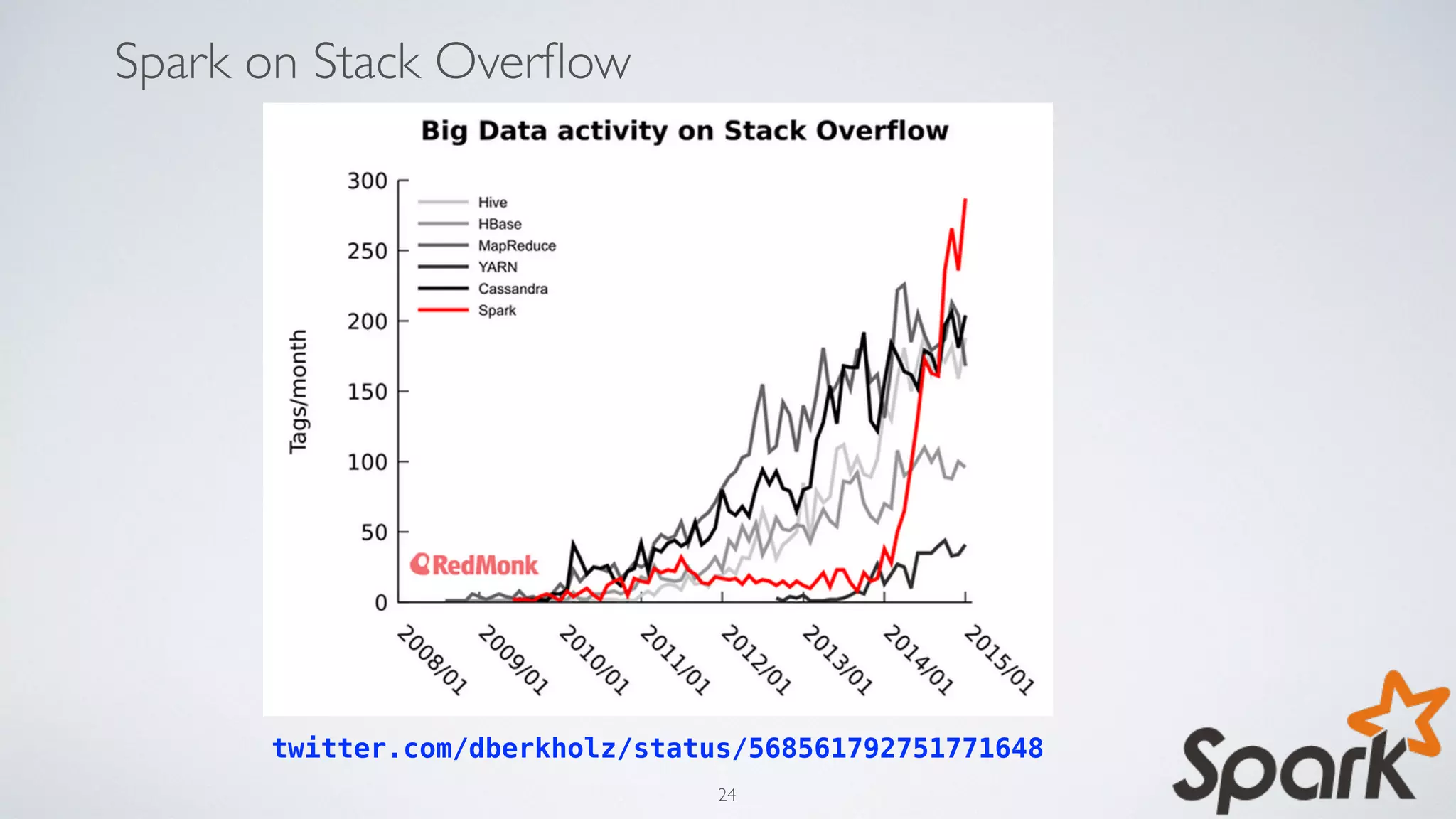
Spark on Stack Overflow
twitter.com/dberkholz/status/568561792751771648
24
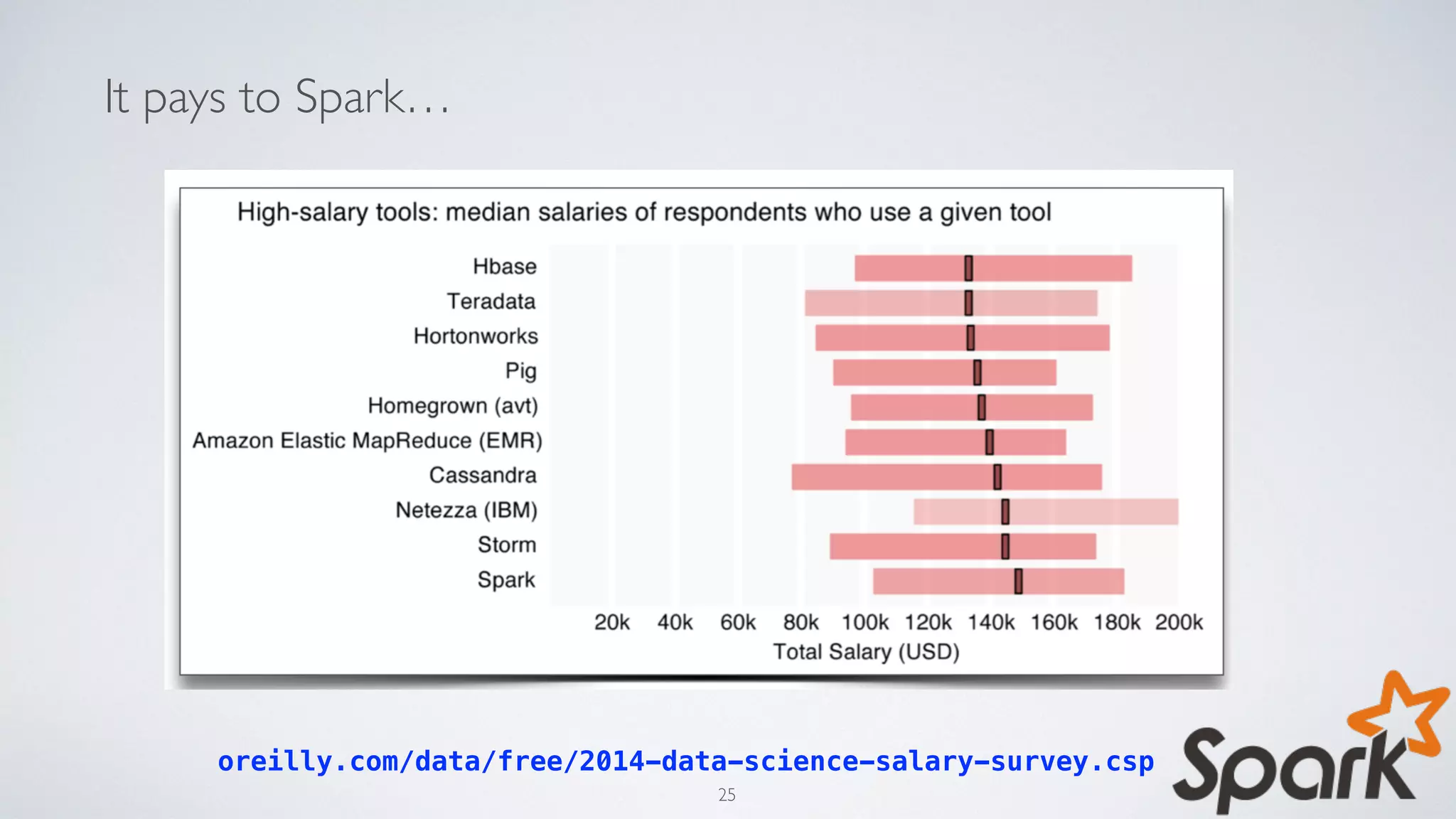
It pays to Spark…
oreilly.com/data/free/2014-data-science-salary-survey.csp
25
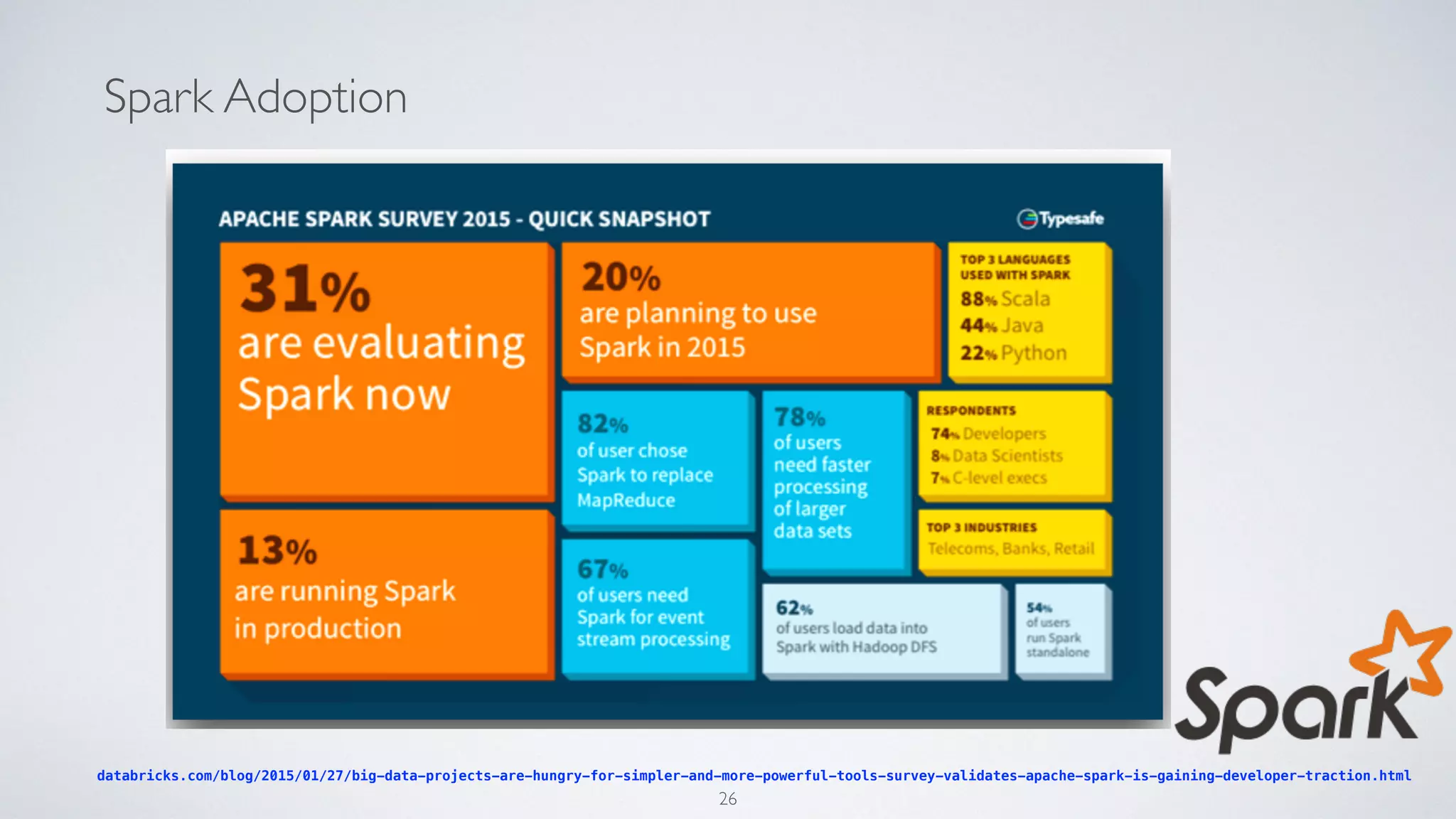
Spark Adoption
databricks.com/blog/2015/01/27/big-data-projects-are-hungry-for-simpler-and-more-powerful-tools-survey-validates-apache-spark-is-gaining-developer-traction.html
26
PART III:
APACHE SPARK CONCEPTS…
27
Resilient Distributed Datasets (RDDs)
• Spark’s main abstraction - a fault-tolerant collection of elements that can be
operated on in parallel
• Two ways to create RDDs:
I. Parallelized collections
val data = Array(1, 2, 3, 4, 5)

data: Array[Int] = Array(1, 2, 3, 4, 5)

val distData = sc.parallelize(data)

distData: org.apache.spark.rdd.RDD[Int] = ParallelCollectionRDD[24970]
II. External Datasets
lines = sc.textFile(“s3n://error-logs/error-log.txt”) 
.map(lambda x: x.split("t"))
28
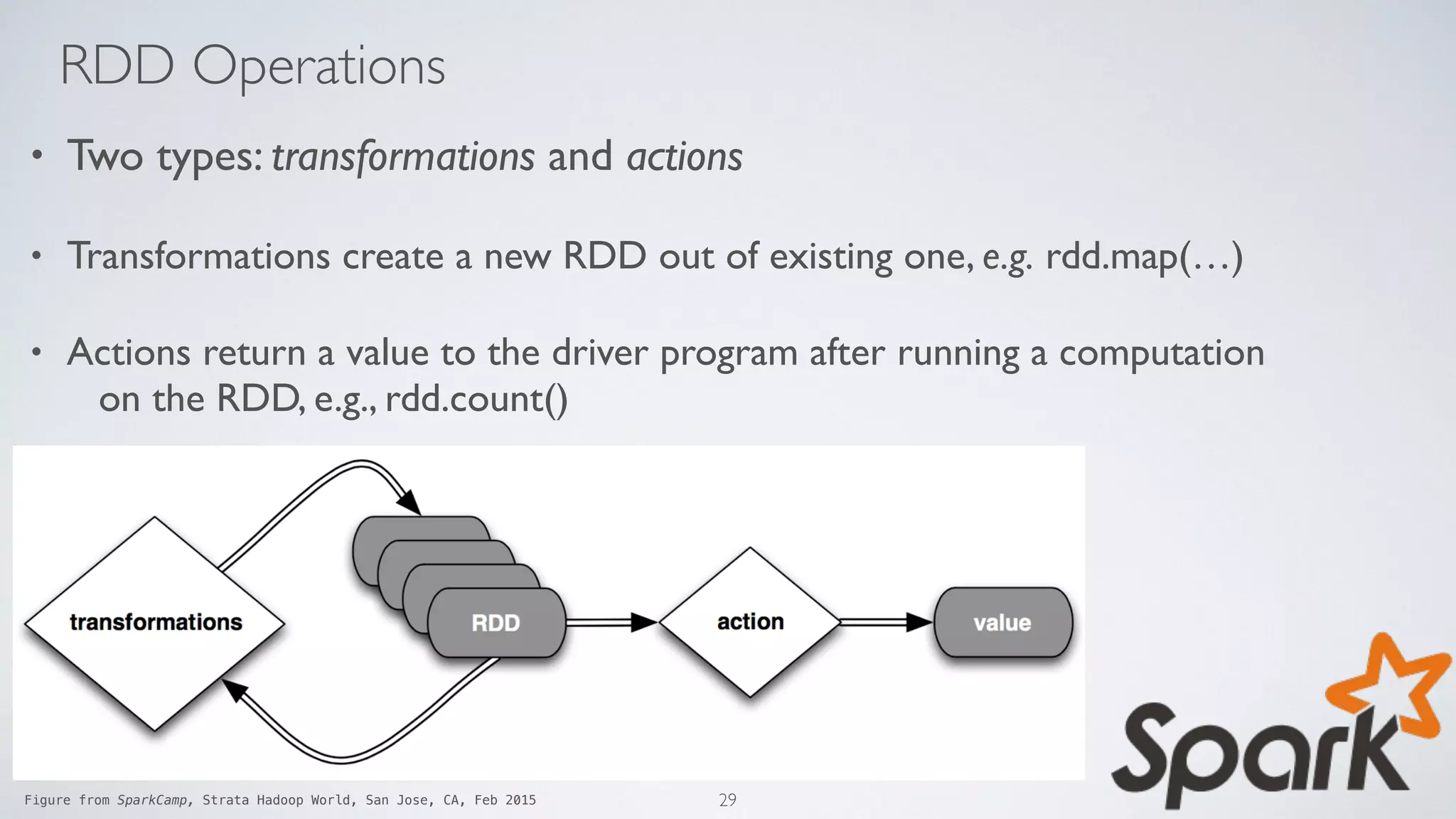
RDD Operations
• Two types: transformations and actions
• Transformations create a new RDD out of existing one, e.g. rdd.map(…)
• Actions return a value to the driver program after running a computation
on the RDD, e.g., rdd.count()
Figure from SparkCamp, Strata Hadoop World, San Jose, CA, Feb 2015 29
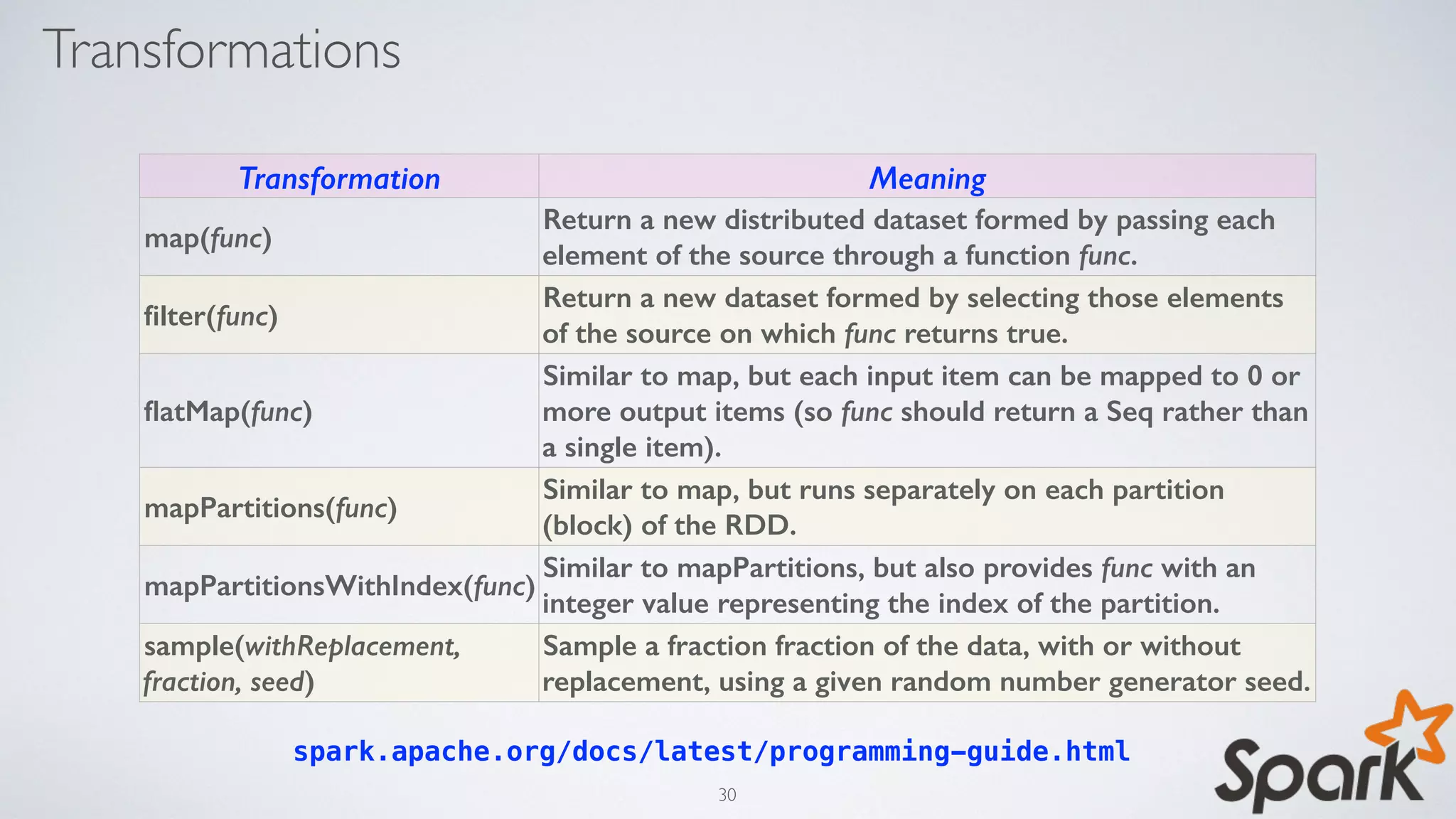
Transformations
spark.apache.org/docs/latest/programming-guide.html
Transformation Meaning
map(func)
Return a new distributed dataset formed by passing each
element of the source through a function func.
filter(func)
Return a new dataset formed by selecting those elements
of the source on which func returns true.
flatMap(func)
Similar to map, but each input item can be mapped to 0 or
more output items (so func should return a Seq rather than
a single item).
mapPartitions(func)
Similar to map, but runs separately on each partition
(block) of the RDD.
mapPartitionsWithIndex(func)
Similar to mapPartitions, but also provides func with an
integer value representing the index of the partition.
sample(withReplacement,
fraction, seed)
Sample a fraction fraction of the data, with or without
replacement, using a given random number generator seed.
30
Transformations
spark.apache.org/docs/latest/programming-guide.html
Transformation Meaning
union(otherDataset)
Return a new dataset that contains the union of the elements in
the source dataset and the argument.
intersection(otherDataset)
Return a new RDD that contains the intersection of elements in
the source dataset and the argument.
distinct([numTasks]))
Return a new dataset that contains the distinct elements of the
source dataset.
groupByKey([numTasks])
When called on a dataset of (K, V) pairs, returns a dataset of (K,
Iterable<V>) pairs.
reduceByKey(func,
[numTasks])
When called on a dataset of (K, V) pairs, returns a dataset of (K,
V) pairs where the values for each key are aggregated using the
given reduce function func.
sortByKey([ascending],
[numTasks])
When called on a dataset of (K, V) pairs where K implements
Ordered, returns a dataset of (K, V) pairs sorted by keys in
ascending or descending order
31
Transformations
spark.apache.org/docs/latest/programming-guide.html
Transformation Meaning
join(otherDataset, [numTasks])
When called on datasets of type (K, V) and (K, W), returns a
dataset of (K, (V, W)) with all pairs of elements for each key.
cogroup(otherDataset,
[numTasks])
When called on datasets of type (K, V) and (K, W), returns a
dataset of (K, (Iterable<V>, Iterable<W>)) tuples.
cartesian(otherDataset)
When called on datasets of types T and U, returns a dataset of
(T, U) pairs (all pairs of elements).
pipe(command, [envVars])
Pipe each partition of the RDD through a shell command. RDD
elements are written to the process's stdin and lines output to
its stdout are returned as an RDD of strings.
coalesce(numPartitions)
Decrease the number of partitions in the RDD to numPartitions.
Useful for running operations more efficiently after filtering
down a large dataset.
32
Ex:Transformations
Python
>>> x = ['hello world', 'how are you enjoying the conference']
>>> rdd = sc.parallelize(x)
>>> rdd.filter(lambda x: 'hello' in x).collect()
['hello world']
>>> rdd.map(lambda x: x.split(" ")).collect()
[['hello', 'world'], ['how', 'are', 'you', 'enjoying', 'the', 'conference']]
>>> rdd.flatMap(lambda x: x.split(" ")).collect()
['hello', 'world', 'how', 'are', 'you', 'enjoying', 'the', 'conference']
33
Ex:Transformations
Scala
scala> val x = Array(“hello world”, “how are you enjoying the conference”)
scala> val rdd = sc.parallelize(x)
scala> rdd.filter(x => x contains "hello").collect()
res15: Array[String] = Array(hello world)
scala> rdd.map(x => x.split(" ")).collect()
res19: Array[Array[String]] = Array(Array(hello, world),
Array(how, are, you, enjoying, the, conference))
scala> rdd.flatMap(x => x.split(" ")).collect()
res20: Array[String] = Array(hello, world, how, are, you, enjoying,
the, conference)
34
Actions
spark.apache.org/docs/latest/programming-guide.html
Action Meaning
reduce(func)
Aggregate the elements of the dataset using a function func (which
takes two arguments and returns one), func should be commutative
and associative so it can be computed correctly in parallel.
collect()
Return all elements of the dataset as array at the driver program.
Usually useful after a filter or other operation that returns
sufficiently small data.
count() Return the number of elements in the dataset.
first() Return the first element of the dataset (similar to take(1)).
take(n) Return an array with the first n elements of the dataset.
takeSample(withReplacement,
num, [seed])
Return an array with a random sample of num elements of the
dataset, with or without replacement, with optional random
number generator seed.
takeOrdered(n, [ordering])
Return the first n elements of the RDD using either their natural
order or a custom comparator.
35
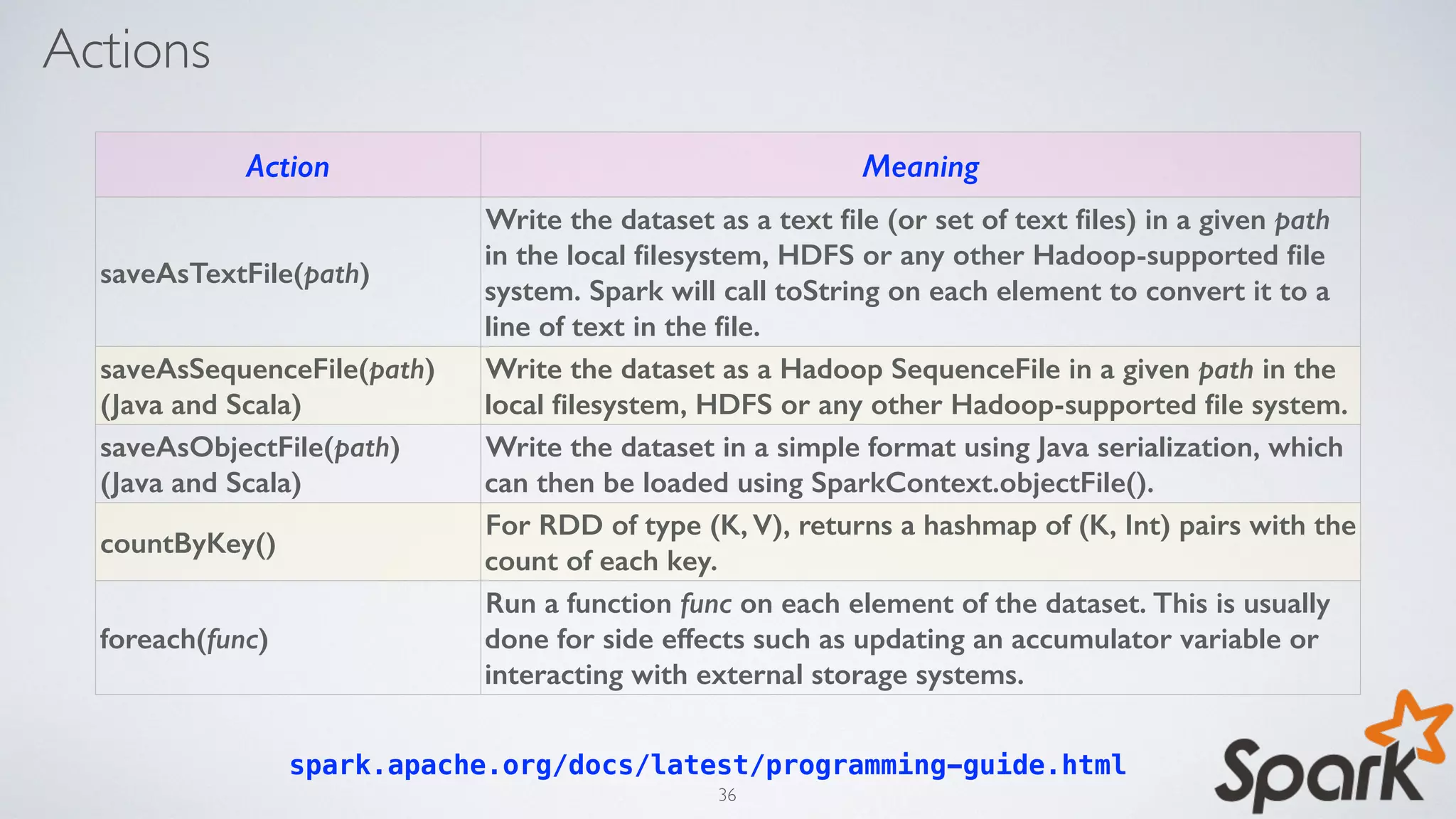
Actions
spark.apache.org/docs/latest/programming-guide.html
Action Meaning
saveAsTextFile(path)
Write the dataset as a text file (or set of text files) in a given path
in the local filesystem, HDFS or any other Hadoop-supported file
system. Spark will call toString on each element to convert it to a
line of text in the file.
saveAsSequenceFile(path)
(Java and Scala)
Write the dataset as a Hadoop SequenceFile in a given path in the
local filesystem, HDFS or any other Hadoop-supported file system.
saveAsObjectFile(path)
(Java and Scala)
Write the dataset in a simple format using Java serialization, which
can then be loaded using SparkContext.objectFile().
countByKey()
For RDD of type (K, V), returns a hashmap of (K, Int) pairs with the
count of each key.
foreach(func)
Run a function func on each element of the dataset. This is usually
done for side effects such as updating an accumulator variable or
interacting with external storage systems.
36
Ex:Actions
Python
>>> x = [“hello world", "hello there", "hello again”]
>>> rdd = sc.parallelize(x)
>>> wordsCounts = rdd.flatMap(lamdba x: x.split(" “)).map(lambda w: (w, 1)) 
.reduceByKey(add)
>>> wordCounts.saveAsTextFile("/Users/vb/wordcounts")
>>> wordCounts.collect()
[(again,1), (hello,3), (world,1), (there,1)]
>>> from operator import add
37
Ex:Actions
Scala
scala> val x = Array("hello world", "hello there", "hello again")
scala> val rdd = sc.parallelize(x)
scala> val wordsCounts = rdd.flatMap(x => x.split(" ")).map(word => (word, 1)) 
.reduceByKey(_ + _)
scala> wordCounts.saveAsTextFile("/Users/vb/wordcounts")
scala> wordCounts.collect()
res43: Array[(String, Int)] = Array((again,1), (hello,3), (world,1), (there,1))
38
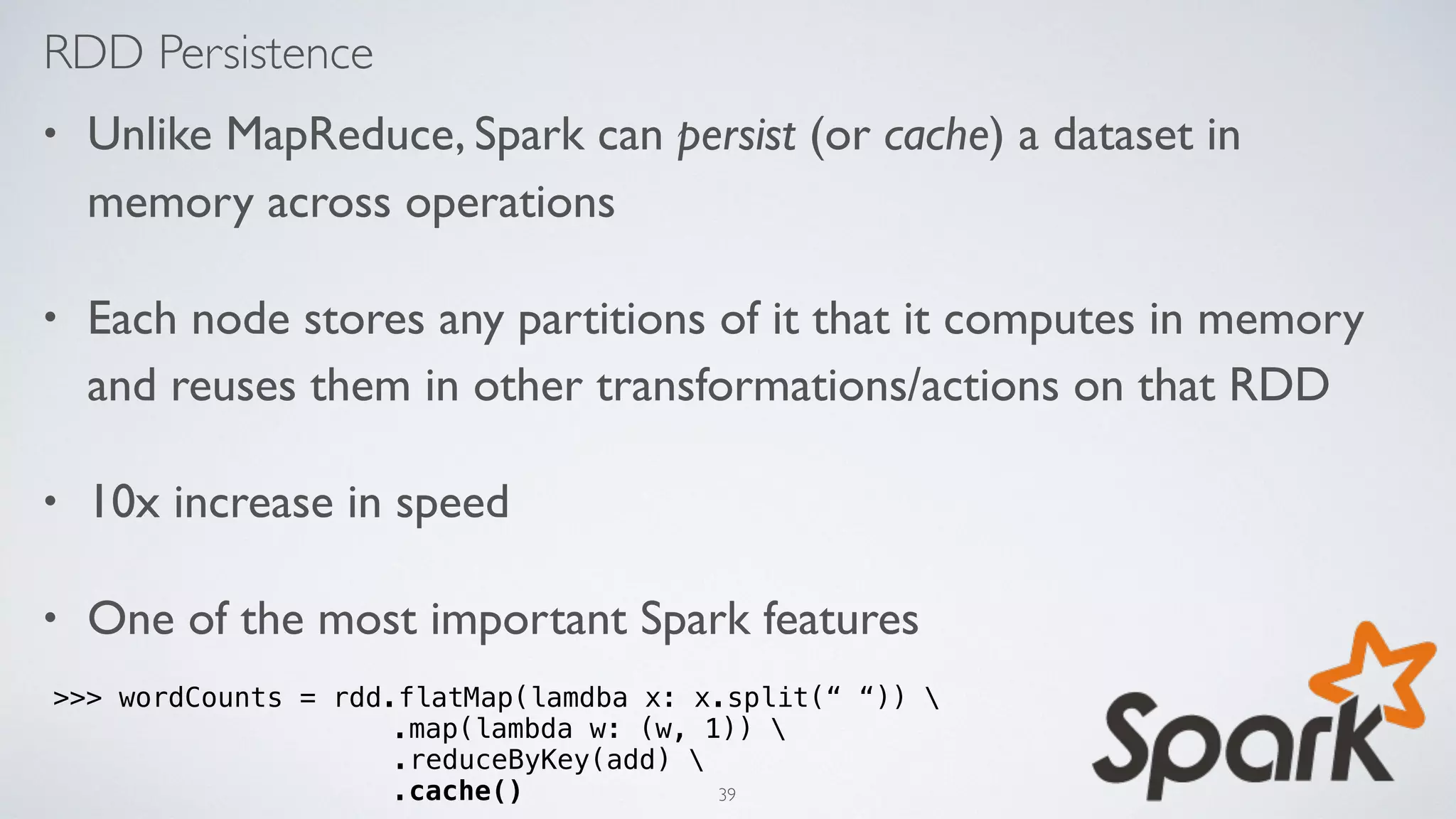
RDD Persistence
• Unlike MapReduce, Spark can persist (or cache) a dataset in
memory across operations
• Each node stores any partitions of it that it computes in memory
and reuses them in other transformations/actions on that RDD
• 10x increase in speed
• One of the most important Spark features
>>> wordCounts = rdd.flatMap(lamdba x: x.split(“ “)) 
.map(lambda w: (w, 1)) 
.reduceByKey(add) 
.cache() 39
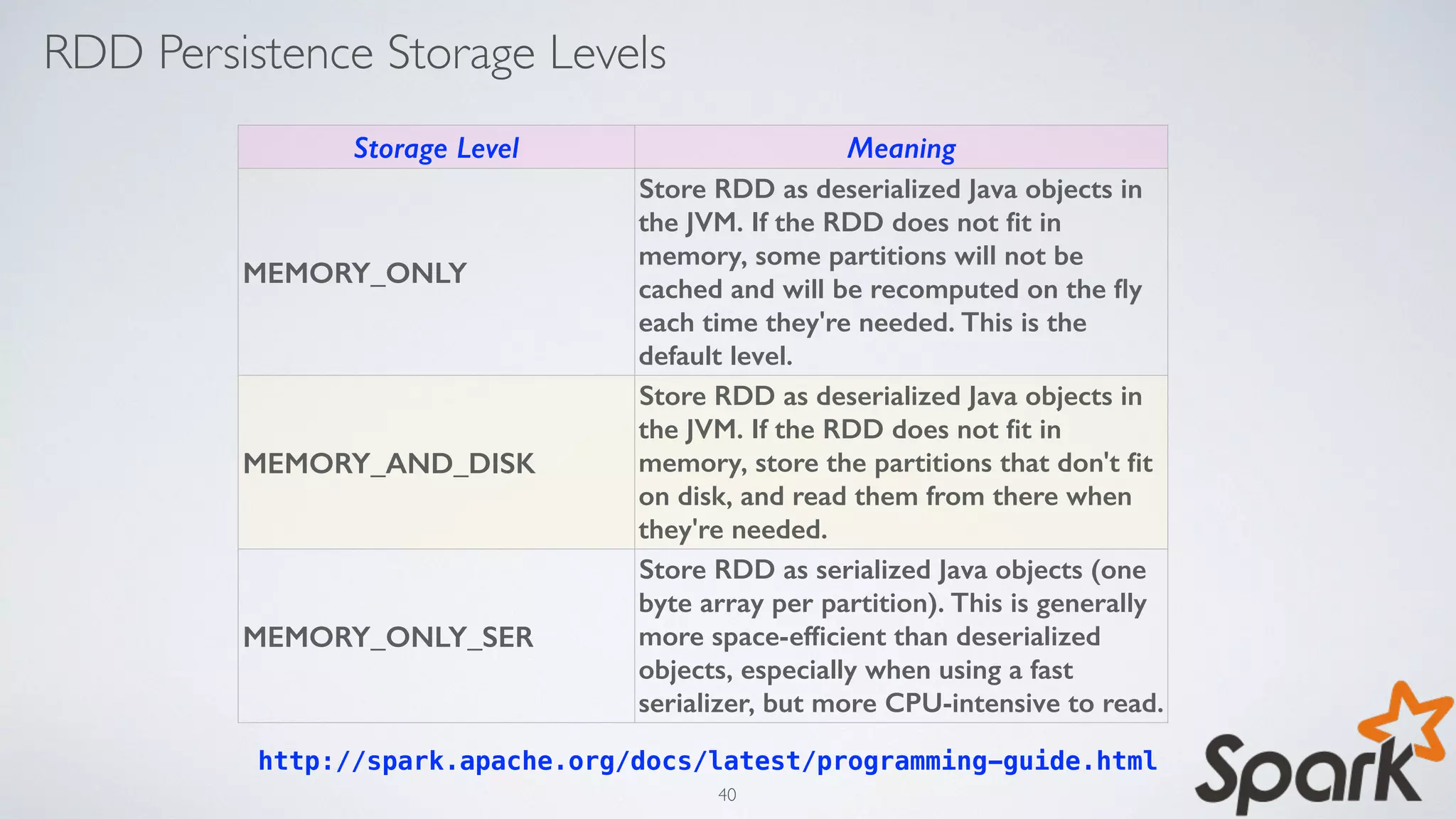
RDD Persistence Storage Levels
Storage Level Meaning
MEMORY_ONLY
Store RDD as deserialized Java objects in
the JVM. If the RDD does not fit in
memory, some partitions will not be
cached and will be recomputed on the fly
each time they're needed. This is the
default level.
MEMORY_AND_DISK
Store RDD as deserialized Java objects in
the JVM. If the RDD does not fit in
memory, store the partitions that don't fit
on disk, and read them from there when
they're needed.
MEMORY_ONLY_SER
Store RDD as serialized Java objects (one
byte array per partition). This is generally
more space-efficient than deserialized
objects, especially when using a fast
serializer, but more CPU-intensive to read.
http://spark.apache.org/docs/latest/programming-guide.html
40
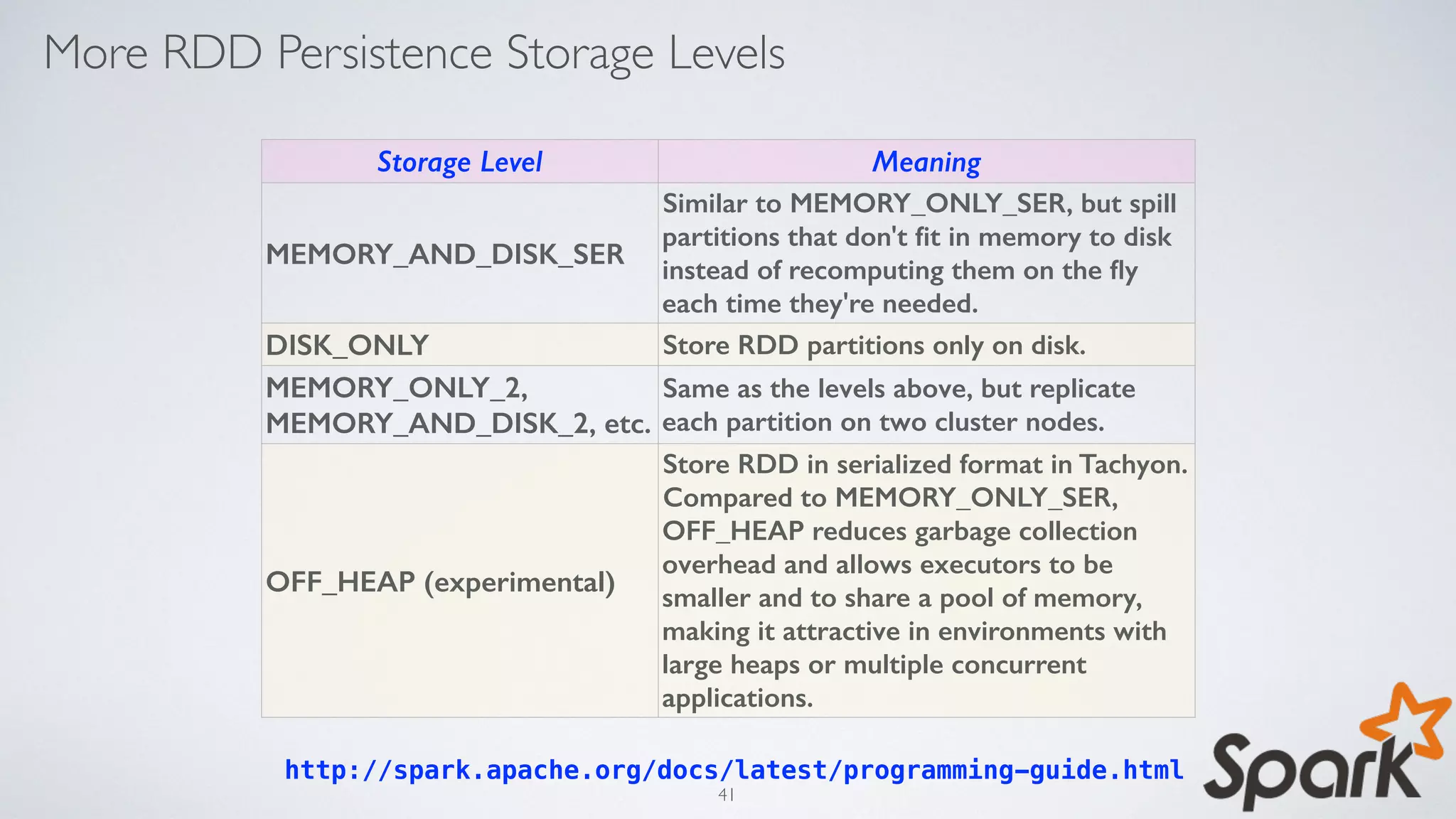
More RDD Persistence Storage Levels
Storage Level Meaning
MEMORY_AND_DISK_SER
Similar to MEMORY_ONLY_SER, but spill
partitions that don't fit in memory to disk
instead of recomputing them on the fly
each time they're needed.
DISK_ONLY Store RDD partitions only on disk.
MEMORY_ONLY_2,
MEMORY_AND_DISK_2, etc.
Same as the levels above, but replicate
each partition on two cluster nodes.
OFF_HEAP (experimental)
Store RDD in serialized format in Tachyon.
Compared to MEMORY_ONLY_SER,
OFF_HEAP reduces garbage collection
overhead and allows executors to be
smaller and to share a pool of memory,
making it attractive in environments with
large heaps or multiple concurrent
applications.
http://spark.apache.org/docs/latest/programming-guide.html
41
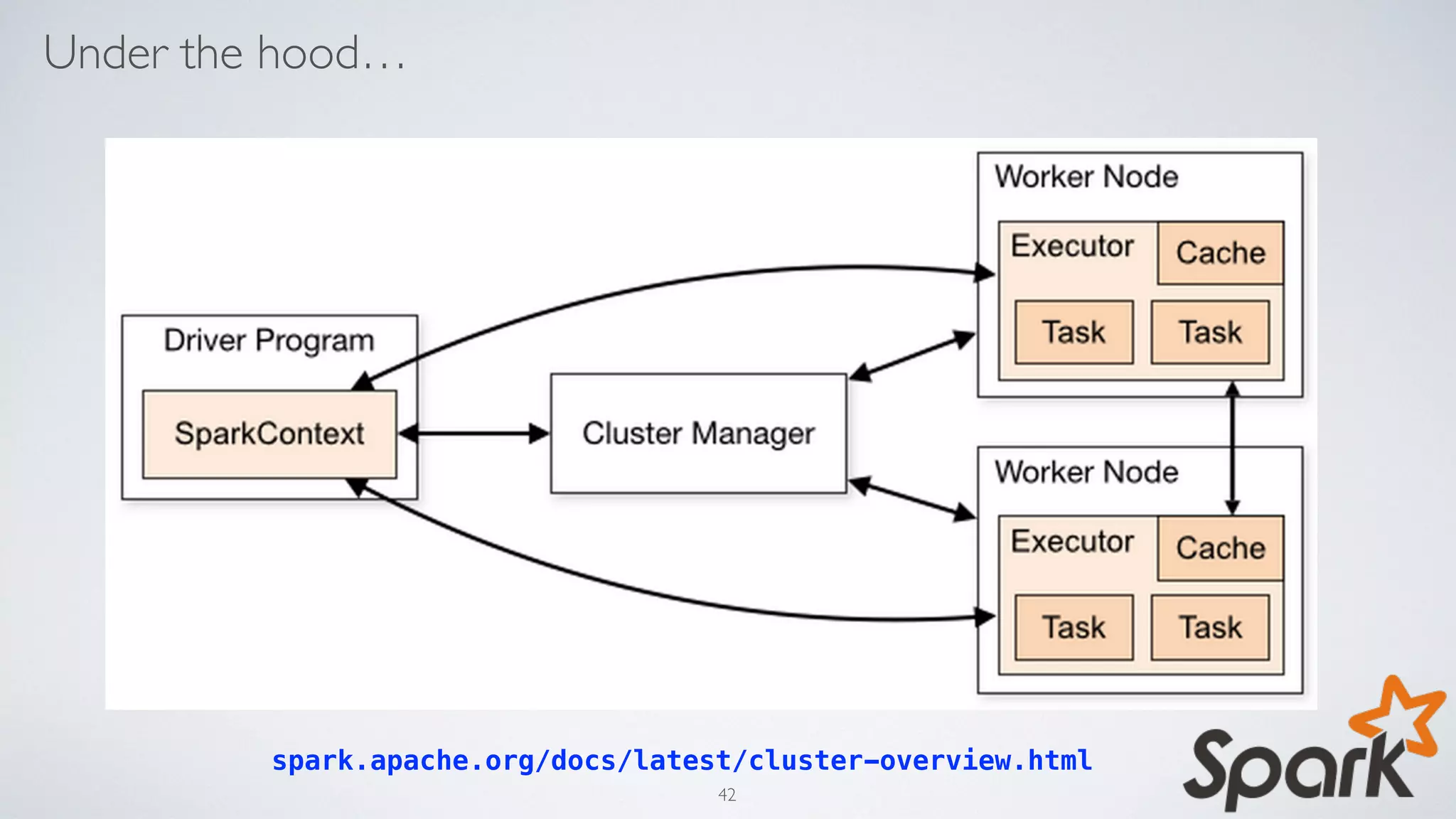
Under the hood…
spark.apache.org/docs/latest/cluster-overview.html
42
And so much more…
• DataFrames and SQL
• Spark Streaming
• MLlib
• GraphX
spark.apache.org/docs/latest/
43

Apache Spark Overview

  • 1.
    OVERVIEW Vadim Bichutskiy @vybstat Interface Symposium June11, 2015 Licensed under: Creative Commons Attribution-NonCommercial-NoDerivatives 4.0 International License
  • 2.
    WHO AM I •Computational and Data Sciences, PhD Candidate, George Mason • Independent Data Science Consultant • MS/BS Computer Science, MS Statistics • NOT a Spark expert (yet!)
  • 3.
    ACKNOWLEDGEMENTS • Much ofthis talk is inspired by SparkCamp at Strata HadoopWorld, San Jose, CA, February 2015 licensed under: Creative Commons Attribution-NonCommercial-NoDerivatives 4.0 International License • Taught by Paco Nathan
  • 4.
  • 5.
  • 6.
    THISTALK… • Part I:Big Data:A Brief History • Part II: A Tour of Spark • Part III: Spark Concepts 6
  • 7.
    PART I: BIG DATA:ABRIEF HISTORY 7
  • 8.
    • Web, e-commerce,marketing, other data explosion • Work no longer fits on a single machine • Move to horizontal scale-out on clusters of commodity hardware • Machine learning, indexing, graph processing use cases at scale DOT COM BUBBLE: 1994-2001 8
  • 9.
    GAME CHANGE: C.2002-2004 Google File System research.google.com/archive/gfs.html MapReduce: Simplified Data Processing on Large Clusters research.google.com/archive/mapreduce.html 9
  • 10.
    HISTORY: FUNCTIONAL PROGRAMMINGFOR BIG DATA 2002 2004 2006 2008 2010 2012 2014 MapReduce @ Google MapReduce Paper Hadoop @ Yahoo! Hadoop Summit Amazon EMR Spark @ Berkeley Spark Paper Databricks Spark Summit Apache Spark takes off Databricks Cloud SparkR KeystoneML c. 1979 - MIT, CMU, Stanford, etc. LISP, Prolog, etc. operations: map, reduce, etc. Slide adapted from SparkCamp, Strata Hadoop World, San Jose, CA, Feb 201510
  • 11.
    MapReduce Limitations • Difficultto program directly in MR • Performance bottlenecks, batch processing only • Streaming, iterative, interactive, graph processing,… MR doesn’t fit modern use cases Specialized systems developed as workarounds… 11
  • 12.
    MapReduce Limitations MR doesn’tfit modern use cases Specialized systems developed as workarounds Slide adapted from SparkCamp, Strata Hadoop World, San Jose, CA, Feb 201512
  • 13.
    PART II: APACHE SPARKTOTHE RESCUE… 13
  • 14.
    Apache Spark • Fast,unified, large-scale data processing engine for modern workflows • Batch, streaming, iterative, interactive • SQL, ML, graph processing • Developed in ’09 at UC Berkeley AMPLab, open sourced in ’10 • Spark is one of the largest Big Data OSS projects “Organizations that are looking at big data challenges –
 including collection, ETL, storage, exploration and analytics –
 should consider Spark for its in-memory performance and
 the breadth of its model. It supports advanced analytics
 solutions on Hadoop clusters, including the iterative model
 required for machine learning and graph analysis.” Gartner, Advanced Analytics and Data Science (2014) 14
  • 15.
    Apache Spark Spark’s goalwas to generalize MapReduce, supporting modern use cases within same engine! 15
  • 16.
    Spark Research Spark: ClusterComputer withWorking Sets http://people.csail.mit.edu/matei/papers/2010/hotcloud_spark.pdf Resilient Distributed Datasets:A Fault-Tolerant Abstraction for In-Memory Cluster Computing https://www.usenix.org/system/files/conference/nsdi12/nsdi12-final138.pdf 16
  • 17.
    Spark: Key Points •Same engine for batch, streaming and interactive workloads • Scala, Java, Python, and (soon) R APIs • Programming at a higher level of abstraction • More general than MR 17
  • 18.
    WordCount: “Hello World”for Big Data Apps Slide adapted from SparkCamp, Strata Hadoop World, San Jose, CA, Feb 2015 18
  • 19.
    Spark vs. MapReduce •Unified engine for modern workloads • Lazy evaluation of the operator graph • Optimized for modern hardware • Functional programming / ease of use • Reduction in cost to build/maintain enterprise apps • Lower start up overhead • More efficient shuffles 19
  • 20.
    Spark in anutshell… 20
  • 21.
    Spark Destroys PreviousSort Record Spark: 3x faster with 10x fewer nodes databricks.com/blog/2014/11/05/spark-officially-sets-a-new-record-in-large-scale-sorting.html 21
  • 22.
    Spark is oneof the most active Big Data projects… openhub.net/orgs/apache 22
  • 23.
  • 24.
    Spark on StackOverflow twitter.com/dberkholz/status/568561792751771648 24
  • 25.
    It pays toSpark… oreilly.com/data/free/2014-data-science-salary-survey.csp 25
  • 26.
  • 27.
    PART III: APACHE SPARKCONCEPTS… 27
  • 28.
    Resilient Distributed Datasets(RDDs) • Spark’s main abstraction - a fault-tolerant collection of elements that can be operated on in parallel • Two ways to create RDDs: I. Parallelized collections val data = Array(1, 2, 3, 4, 5)
 data: Array[Int] = Array(1, 2, 3, 4, 5)
 val distData = sc.parallelize(data)
 distData: org.apache.spark.rdd.RDD[Int] = ParallelCollectionRDD[24970] II. External Datasets lines = sc.textFile(“s3n://error-logs/error-log.txt”) .map(lambda x: x.split("t")) 28
  • 29.
    RDD Operations • Twotypes: transformations and actions • Transformations create a new RDD out of existing one, e.g. rdd.map(…) • Actions return a value to the driver program after running a computation on the RDD, e.g., rdd.count() Figure from SparkCamp, Strata Hadoop World, San Jose, CA, Feb 2015 29
  • 30.
    Transformations spark.apache.org/docs/latest/programming-guide.html Transformation Meaning map(func) Return anew distributed dataset formed by passing each element of the source through a function func. filter(func) Return a new dataset formed by selecting those elements of the source on which func returns true. flatMap(func) Similar to map, but each input item can be mapped to 0 or more output items (so func should return a Seq rather than a single item). mapPartitions(func) Similar to map, but runs separately on each partition (block) of the RDD. mapPartitionsWithIndex(func) Similar to mapPartitions, but also provides func with an integer value representing the index of the partition. sample(withReplacement, fraction, seed) Sample a fraction fraction of the data, with or without replacement, using a given random number generator seed. 30
  • 31.
    Transformations spark.apache.org/docs/latest/programming-guide.html Transformation Meaning union(otherDataset) Return anew dataset that contains the union of the elements in the source dataset and the argument. intersection(otherDataset) Return a new RDD that contains the intersection of elements in the source dataset and the argument. distinct([numTasks])) Return a new dataset that contains the distinct elements of the source dataset. groupByKey([numTasks]) When called on a dataset of (K, V) pairs, returns a dataset of (K, Iterable<V>) pairs. reduceByKey(func, [numTasks]) When called on a dataset of (K, V) pairs, returns a dataset of (K, V) pairs where the values for each key are aggregated using the given reduce function func. sortByKey([ascending], [numTasks]) When called on a dataset of (K, V) pairs where K implements Ordered, returns a dataset of (K, V) pairs sorted by keys in ascending or descending order 31
  • 32.
    Transformations spark.apache.org/docs/latest/programming-guide.html Transformation Meaning join(otherDataset, [numTasks]) Whencalled on datasets of type (K, V) and (K, W), returns a dataset of (K, (V, W)) with all pairs of elements for each key. cogroup(otherDataset, [numTasks]) When called on datasets of type (K, V) and (K, W), returns a dataset of (K, (Iterable<V>, Iterable<W>)) tuples. cartesian(otherDataset) When called on datasets of types T and U, returns a dataset of (T, U) pairs (all pairs of elements). pipe(command, [envVars]) Pipe each partition of the RDD through a shell command. RDD elements are written to the process's stdin and lines output to its stdout are returned as an RDD of strings. coalesce(numPartitions) Decrease the number of partitions in the RDD to numPartitions. Useful for running operations more efficiently after filtering down a large dataset. 32
  • 33.
    Ex:Transformations Python >>> x =['hello world', 'how are you enjoying the conference'] >>> rdd = sc.parallelize(x) >>> rdd.filter(lambda x: 'hello' in x).collect() ['hello world'] >>> rdd.map(lambda x: x.split(" ")).collect() [['hello', 'world'], ['how', 'are', 'you', 'enjoying', 'the', 'conference']] >>> rdd.flatMap(lambda x: x.split(" ")).collect() ['hello', 'world', 'how', 'are', 'you', 'enjoying', 'the', 'conference'] 33
  • 34.
    Ex:Transformations Scala scala> val x= Array(“hello world”, “how are you enjoying the conference”) scala> val rdd = sc.parallelize(x) scala> rdd.filter(x => x contains "hello").collect() res15: Array[String] = Array(hello world) scala> rdd.map(x => x.split(" ")).collect() res19: Array[Array[String]] = Array(Array(hello, world), Array(how, are, you, enjoying, the, conference)) scala> rdd.flatMap(x => x.split(" ")).collect() res20: Array[String] = Array(hello, world, how, are, you, enjoying, the, conference) 34
  • 35.
    Actions spark.apache.org/docs/latest/programming-guide.html Action Meaning reduce(func) Aggregate theelements of the dataset using a function func (which takes two arguments and returns one), func should be commutative and associative so it can be computed correctly in parallel. collect() Return all elements of the dataset as array at the driver program. Usually useful after a filter or other operation that returns sufficiently small data. count() Return the number of elements in the dataset. first() Return the first element of the dataset (similar to take(1)). take(n) Return an array with the first n elements of the dataset. takeSample(withReplacement, num, [seed]) Return an array with a random sample of num elements of the dataset, with or without replacement, with optional random number generator seed. takeOrdered(n, [ordering]) Return the first n elements of the RDD using either their natural order or a custom comparator. 35
  • 36.
    Actions spark.apache.org/docs/latest/programming-guide.html Action Meaning saveAsTextFile(path) Write thedataset as a text file (or set of text files) in a given path in the local filesystem, HDFS or any other Hadoop-supported file system. Spark will call toString on each element to convert it to a line of text in the file. saveAsSequenceFile(path) (Java and Scala) Write the dataset as a Hadoop SequenceFile in a given path in the local filesystem, HDFS or any other Hadoop-supported file system. saveAsObjectFile(path) (Java and Scala) Write the dataset in a simple format using Java serialization, which can then be loaded using SparkContext.objectFile(). countByKey() For RDD of type (K, V), returns a hashmap of (K, Int) pairs with the count of each key. foreach(func) Run a function func on each element of the dataset. This is usually done for side effects such as updating an accumulator variable or interacting with external storage systems. 36
  • 37.
    Ex:Actions Python >>> x =[“hello world", "hello there", "hello again”] >>> rdd = sc.parallelize(x) >>> wordsCounts = rdd.flatMap(lamdba x: x.split(" “)).map(lambda w: (w, 1)) .reduceByKey(add) >>> wordCounts.saveAsTextFile("/Users/vb/wordcounts") >>> wordCounts.collect() [(again,1), (hello,3), (world,1), (there,1)] >>> from operator import add 37
  • 38.
    Ex:Actions Scala scala> val x= Array("hello world", "hello there", "hello again") scala> val rdd = sc.parallelize(x) scala> val wordsCounts = rdd.flatMap(x => x.split(" ")).map(word => (word, 1)) .reduceByKey(_ + _) scala> wordCounts.saveAsTextFile("/Users/vb/wordcounts") scala> wordCounts.collect() res43: Array[(String, Int)] = Array((again,1), (hello,3), (world,1), (there,1)) 38
  • 39.
    RDD Persistence • UnlikeMapReduce, Spark can persist (or cache) a dataset in memory across operations • Each node stores any partitions of it that it computes in memory and reuses them in other transformations/actions on that RDD • 10x increase in speed • One of the most important Spark features >>> wordCounts = rdd.flatMap(lamdba x: x.split(“ “)) .map(lambda w: (w, 1)) .reduceByKey(add) .cache() 39
  • 40.
    RDD Persistence StorageLevels Storage Level Meaning MEMORY_ONLY Store RDD as deserialized Java objects in the JVM. If the RDD does not fit in memory, some partitions will not be cached and will be recomputed on the fly each time they're needed. This is the default level. MEMORY_AND_DISK Store RDD as deserialized Java objects in the JVM. If the RDD does not fit in memory, store the partitions that don't fit on disk, and read them from there when they're needed. MEMORY_ONLY_SER Store RDD as serialized Java objects (one byte array per partition). This is generally more space-efficient than deserialized objects, especially when using a fast serializer, but more CPU-intensive to read. http://spark.apache.org/docs/latest/programming-guide.html 40
  • 41.
    More RDD PersistenceStorage Levels Storage Level Meaning MEMORY_AND_DISK_SER Similar to MEMORY_ONLY_SER, but spill partitions that don't fit in memory to disk instead of recomputing them on the fly each time they're needed. DISK_ONLY Store RDD partitions only on disk. MEMORY_ONLY_2, MEMORY_AND_DISK_2, etc. Same as the levels above, but replicate each partition on two cluster nodes. OFF_HEAP (experimental) Store RDD in serialized format in Tachyon. Compared to MEMORY_ONLY_SER, OFF_HEAP reduces garbage collection overhead and allows executors to be smaller and to share a pool of memory, making it attractive in environments with large heaps or multiple concurrent applications. http://spark.apache.org/docs/latest/programming-guide.html 41
  • 42.
  • 43.
    And so muchmore… • DataFrames and SQL • Spark Streaming • MLlib • GraphX spark.apache.org/docs/latest/ 43