OWASP T
op 10for LLM v1.0
|
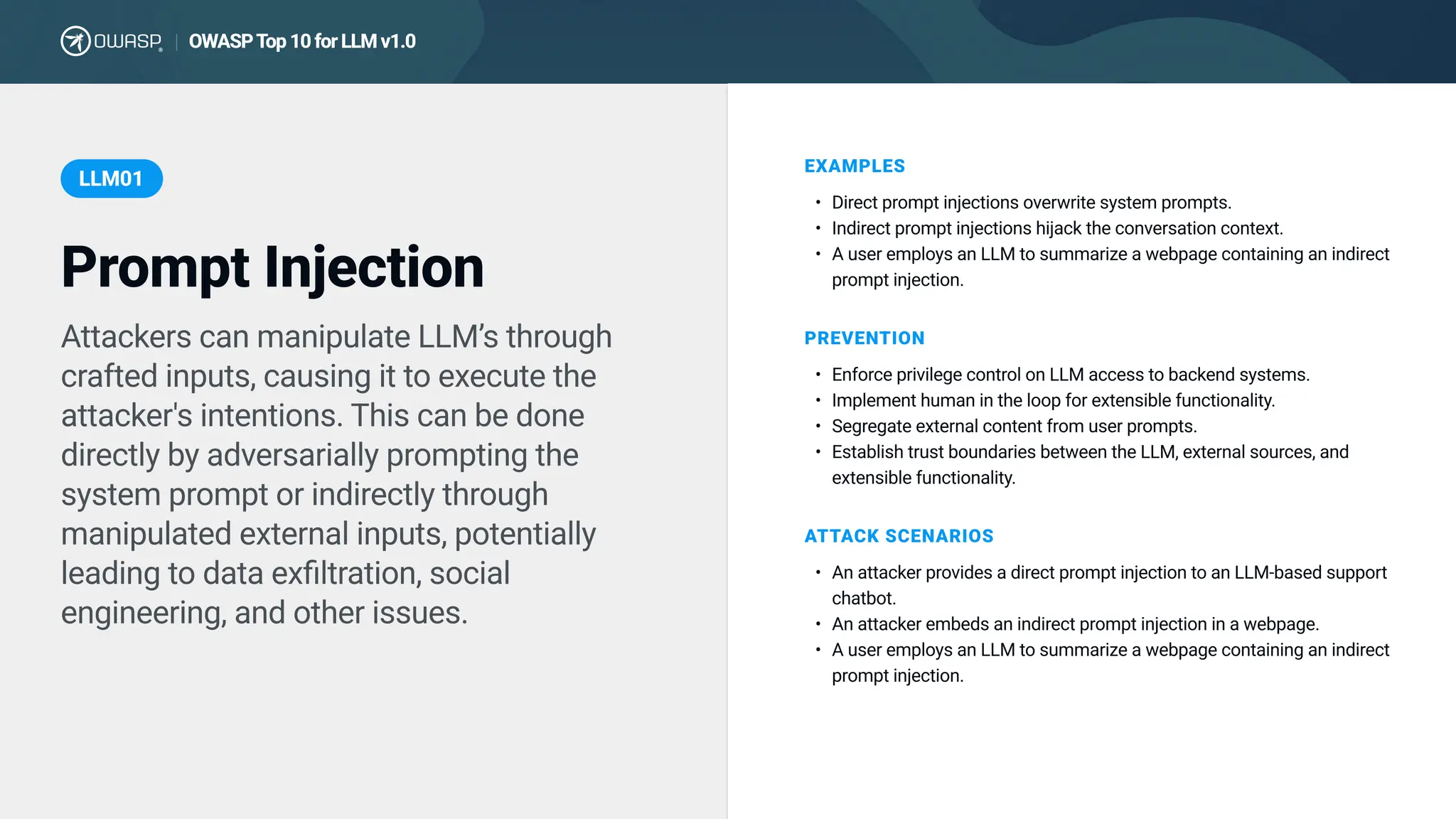
Attackers can manipulate LLM’s through
crafted inputs, causing it to execute the
attacker's intentions. This can be done
directly by adversarially prompting the
system prompt or indirectly through
manipulated external inputs, potentially
leading to data exfiltration, social
engineering, and other issues.
EXAMPLES
Direct prompt injections overwrite system prompts
Indirect prompt injections hijack the conversation context
A user employs an LLM to summarize a webpage containing an indirect
prompt injection.
PREVENTION
Enforce privilege control on LLM access to backend systems
Implement human in the loop for extensible functionality
Segregate external content from user prompts
Establish trust boundaries between the LLM, external sources, and
extensible functionality.
ATTACK SCENARIOS
An attacker provides a direct prompt injection to an LLM-based support
chatbot
An attacker embeds an indirect prompt injection in a webpage
A user employs an LLM to summarize a webpage containing an indirect
prompt injection.
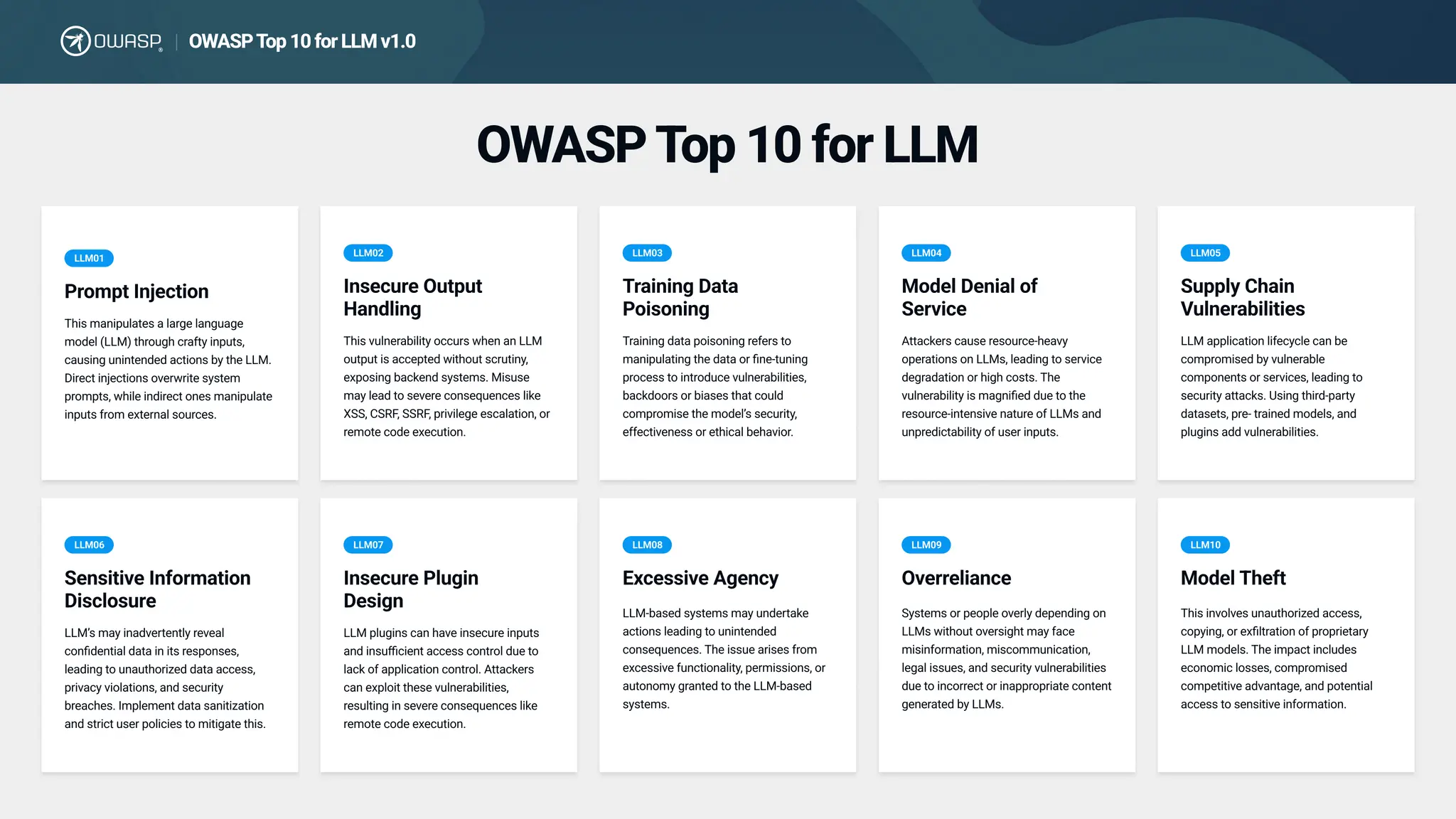
Prompt Injection
LLM01
4.
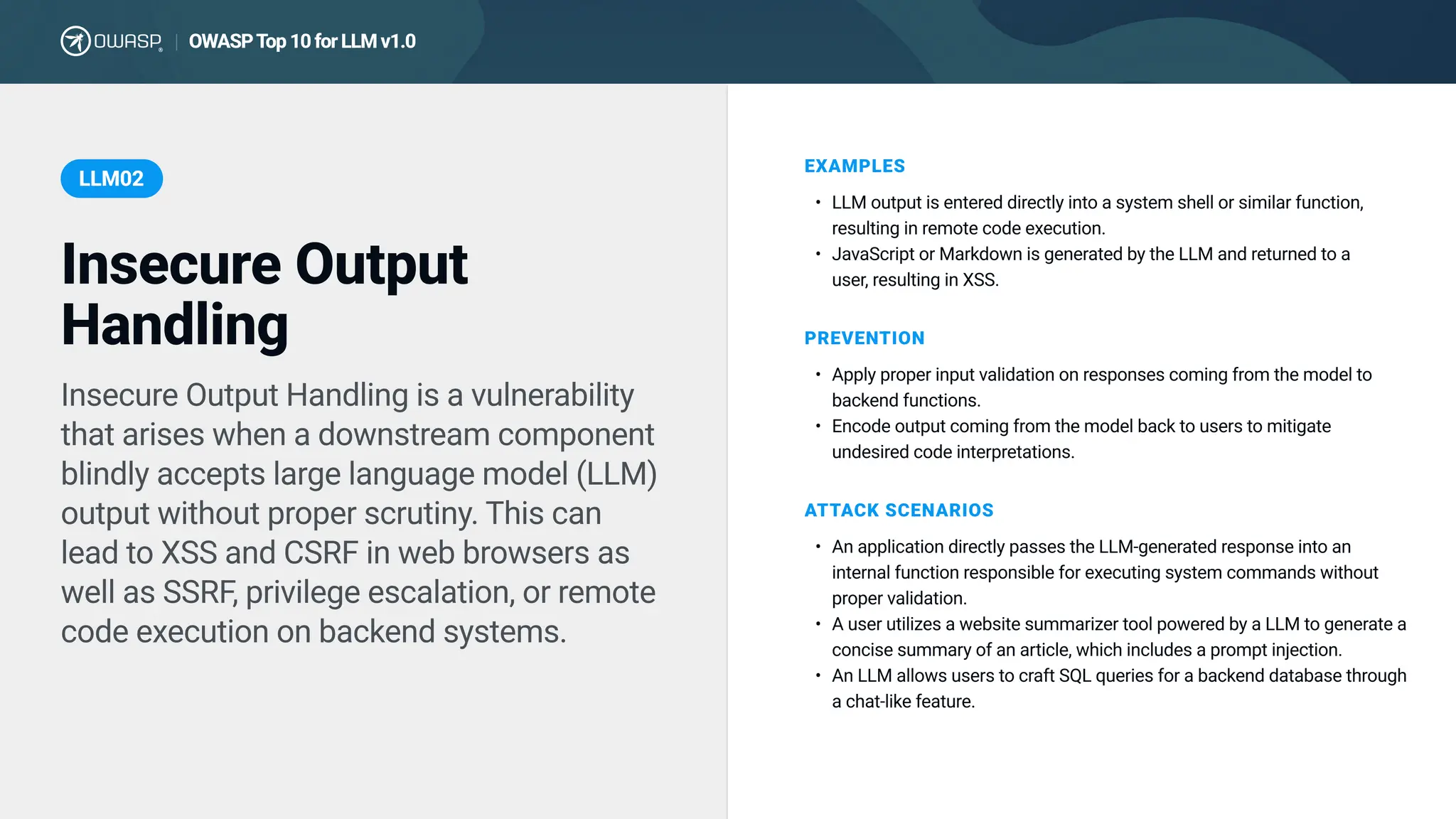
Insecure Output Handlingis a vulnerability
that arises when a downstream component
blindly accepts large language model (LLM)
output without proper scrutiny. This can
lead to XSS and CSRF in web browsers as
well as SSRF, privilege escalation, or remote
code execution on backend systems.
EXAMPLES
LLM output is entered directly into a system shell or similar function,
resulting in remote code execution
JavaScript or Markdown is generated by the LLM and returned to a
user, resulting in XSS.
PREVENTION
Apply proper input validation on responses coming from the model to
backend functions
Encode output coming from the model back to users to mitigate
undesired code interpretations.
ATTACK SCENARIOS
An application directly passes the LLM-generated response into an
internal function responsible for executing system commands without
proper validation
A user utilizes a website summarizer tool powered by a LLM to generate a
concise summary of an article, which includes a prompt injection
An LLM allows users to craft SQL queries for a backend database through
a chat-like feature.
Insecure Output
Handling
LLM02
OWASPTop10forLLMv1.0
|
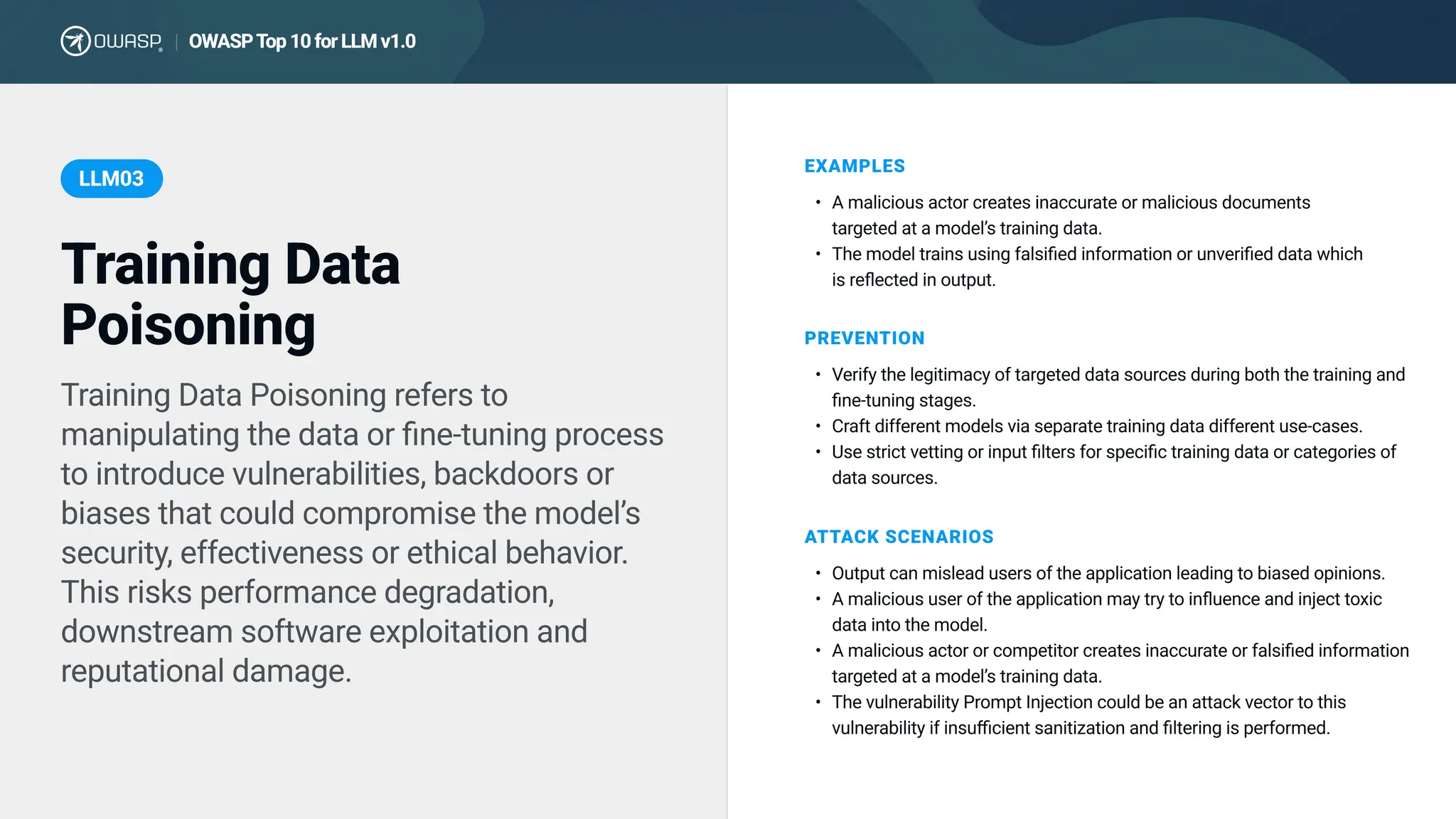
5.
Training Data Poisoningrefers to
manipulating the data or fine-tuning process
to introduce vulnerabilities, backdoors or
biases that could compromise the model’s
security, effectiveness or ethical behavior.
This risks performance degradation,
downstream software exploitation and
reputational damage.
EXAMPLES
A malicious actor creates inaccurate or malicious documents
targeted at a model’s training data
The model trains using falsified information or unverified data which
is reflected in output.
PREVENTION
Verify the legitimacy of targeted data sources during both the training and
fine-tuning stages
Craft different models via separate training data different use-cases
Use strict vetting or input filters for specific training data or categories of
data sources.
ATTACK SCENARIOS
Output can mislead users of the application leading to biased opinions
A malicious user of the application may try to influence and inject toxic
data into the model
A malicious actor or competitor creates inaccurate or falsified information
targeted at a model’s training data
The vulnerability Prompt Injection could be an attack vector to this
vulnerability if insufficient sanitization and filtering is performed.
Training Data
Poisoning
LLM03
OWASP T
op 10 for LLM v1.0
|
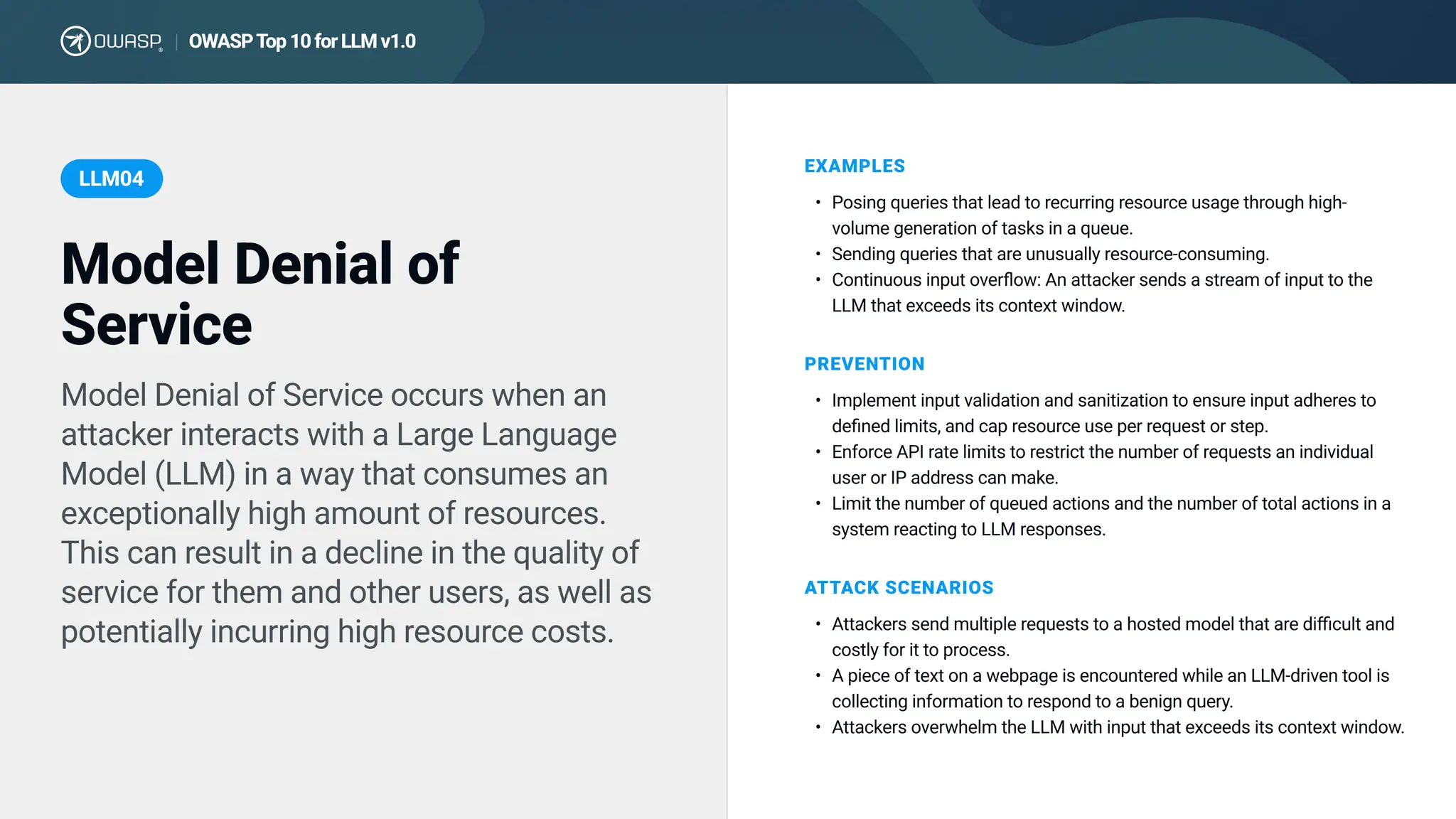
6.
Model Denial ofService occurs when an
attacker interacts with a Large Language
Model (LLM) in a way that consumes an
exceptionally high amount of resources.
This can result in a decline in the quality of
service for them and other users, as well as
potentially incurring high resource costs.
EXAMPLES
Posing queries that lead to recurring resource usage through high-
volume generation of tasks in a queue
Sending queries that are unusually resource-consuming
Continuous input overflow: An attacker sends a stream of input to the
LLM that exceeds its context window.
PREVENTION
Implement input validation and sanitization to ensure input adheres to
defined limits, and cap resource use per request or step
Enforce API rate limits to restrict the number of requests an individual
user or IP address can make
Limit the number of queued actions and the number of total actions in a
system reacting to LLM responses.
AT TACK SCEN ARIOS
Attackers send multiple requests to a hosted model that are difficult and
costly for it to process
A piece of text on a webpage is encountered while an LLM-driven tool is
collecting information to respond to a benign query
Attackers overwhelm the LLM with input that exceeds its context window.
Model Denial of
Service
LLM04
OWASP T
op 10 for LLM v1.0
|
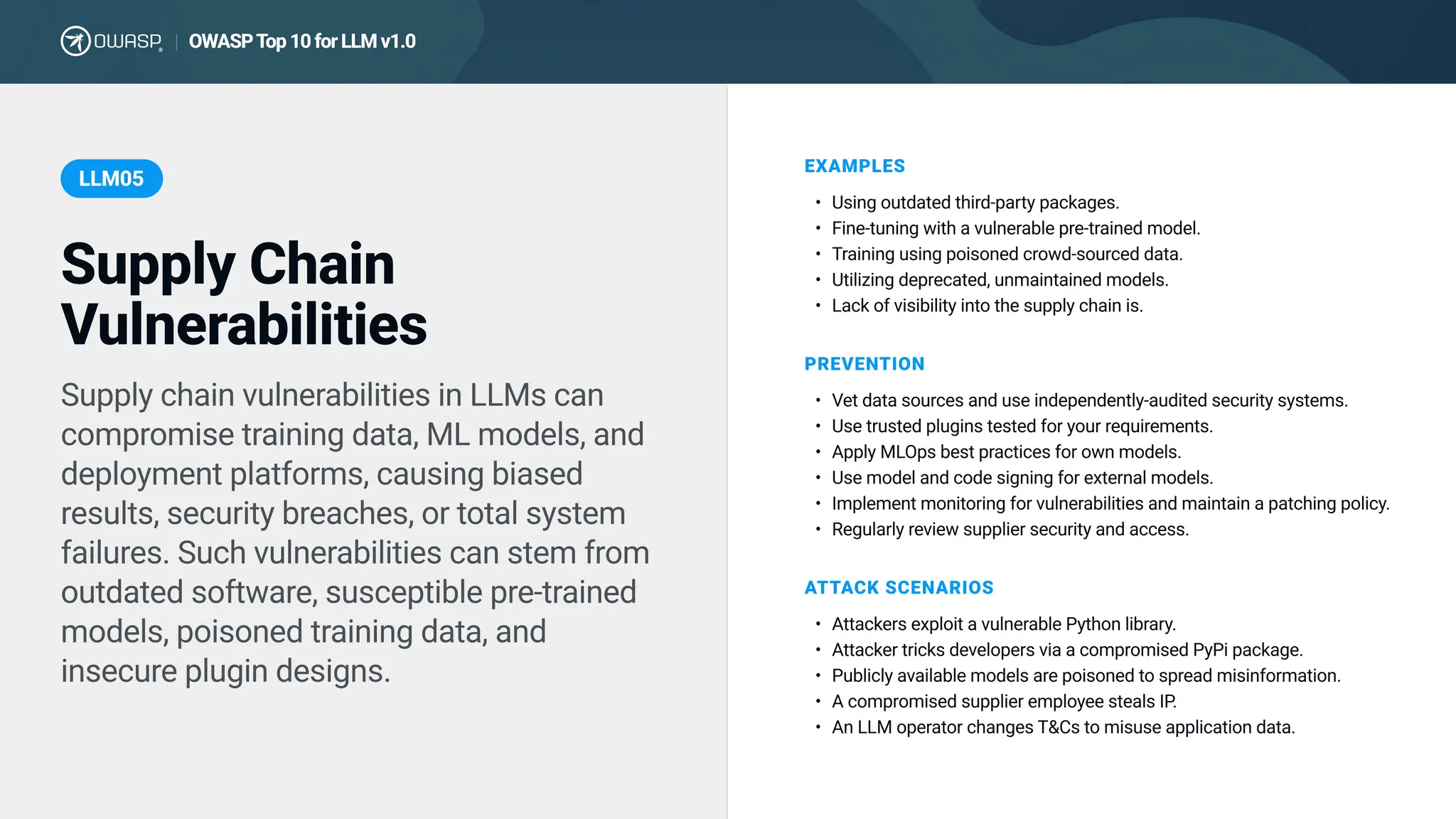
7.
Supply chain vulnerabilitiesin LLMs can
compromise training data, ML models, and
deployment platforms, causing biased
results, security breaches, or total system
failures. Such vulnerabilities can stem from
outdated software, susceptible pre-trained
models, poisoned training data, and
insecure plugin designs.
EXAMPLES
Using outdated third-party packages
Fine-tuning with a vulnerable pre-trained model
Training using poisoned crowd-sourced data
Utilizing deprecated, unmaintained models
Lack of visibility into the supply chain is.
PREVENTION
Vet data sources and use independently-audited security systems
Use trusted plugins tested for your requirements
Apply MLOps best practices for own models
Use model and code signing for external models
Implement monitoring for vulnerabilities and maintain a patching policy
Regularly review supplier security and access.
ATTACK SCENARIOS
Attackers exploit a vulnerable Python library
Attacker tricks developers via a compromised PyPi package
Publicly available models are poisoned to spread misinformation
A compromised supplier employee steals IP
An LLM operator changes T&Cs to misuse application data.
Supply Chain
Vulnerabilities
LLM05
OWASP T
op 10 for LLM v1.0
|
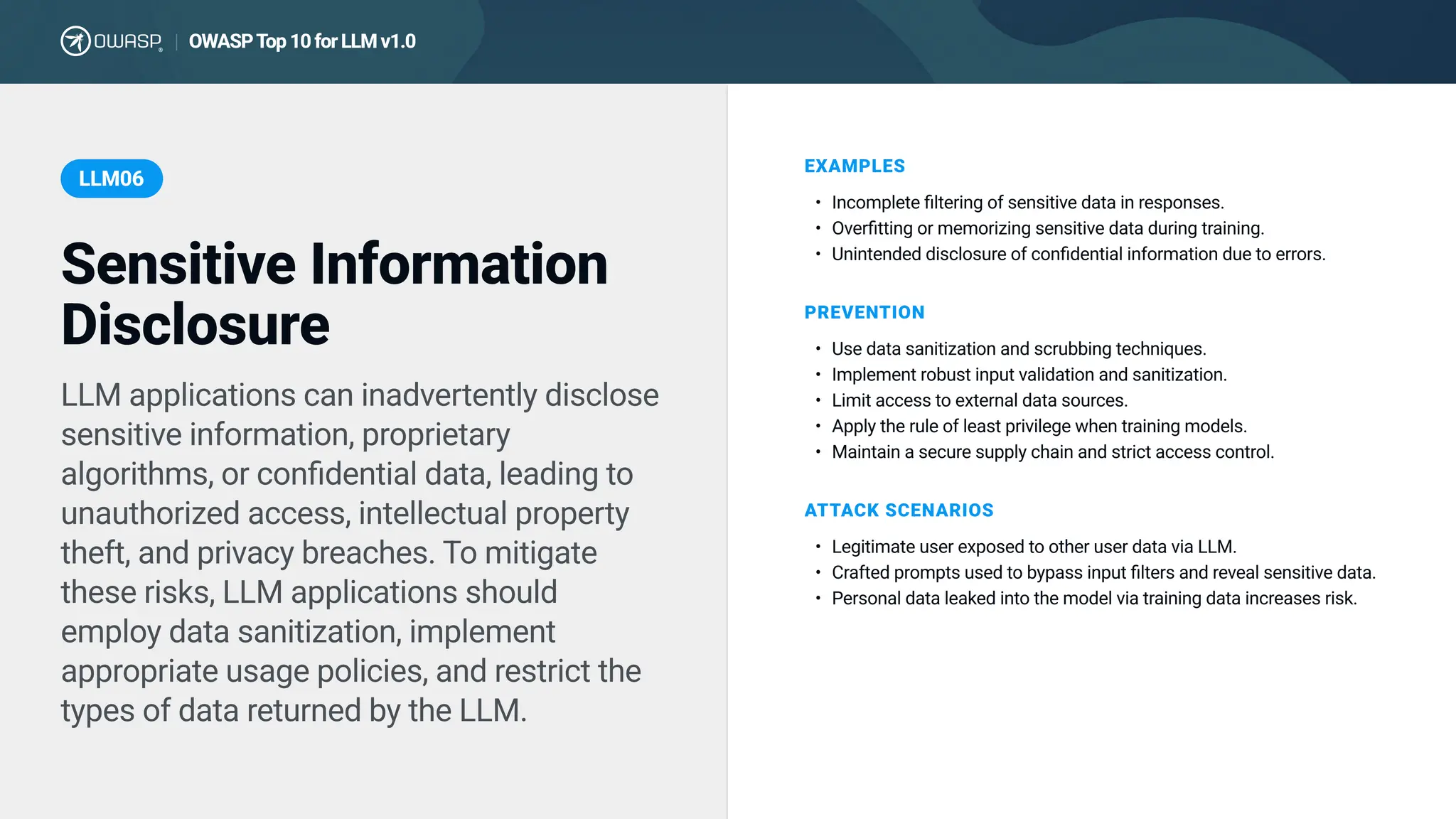
8.
LLM applications caninadvertently disclose
sensitive information, proprietary
algorithms, or confidential data, leading to
unauthorized access, intellectual property
theft, and privacy breaches. To mitigate
these risks, LLM applications should
employ data sanitization, implement
appropriate usage policies, and restrict the
types of data returned by the LLM.
EXAMPLES
Incomplete filtering of sensitive data in responses
Overfitting or memorizing sensitive data during training
Unintended disclosure of confidential information due to errors.
PREVENTION
Use data sanitization and scrubbing techniques
Implement robust input validation and sanitization
Limit access to external data sources
Apply the rule of least privilege when training models
Maintain a secure supply chain and strict access control.
ATTACK SCENARIOS
Legitimate user exposed to other user data via LLM
Crafted prompts used to bypass input filters and reveal sensitive data
Personal data leaked into the model via training data increases risk.
Sensitive Information
Disclosure
LLM06
OWASPTop10forLLMv1.0
|
9.
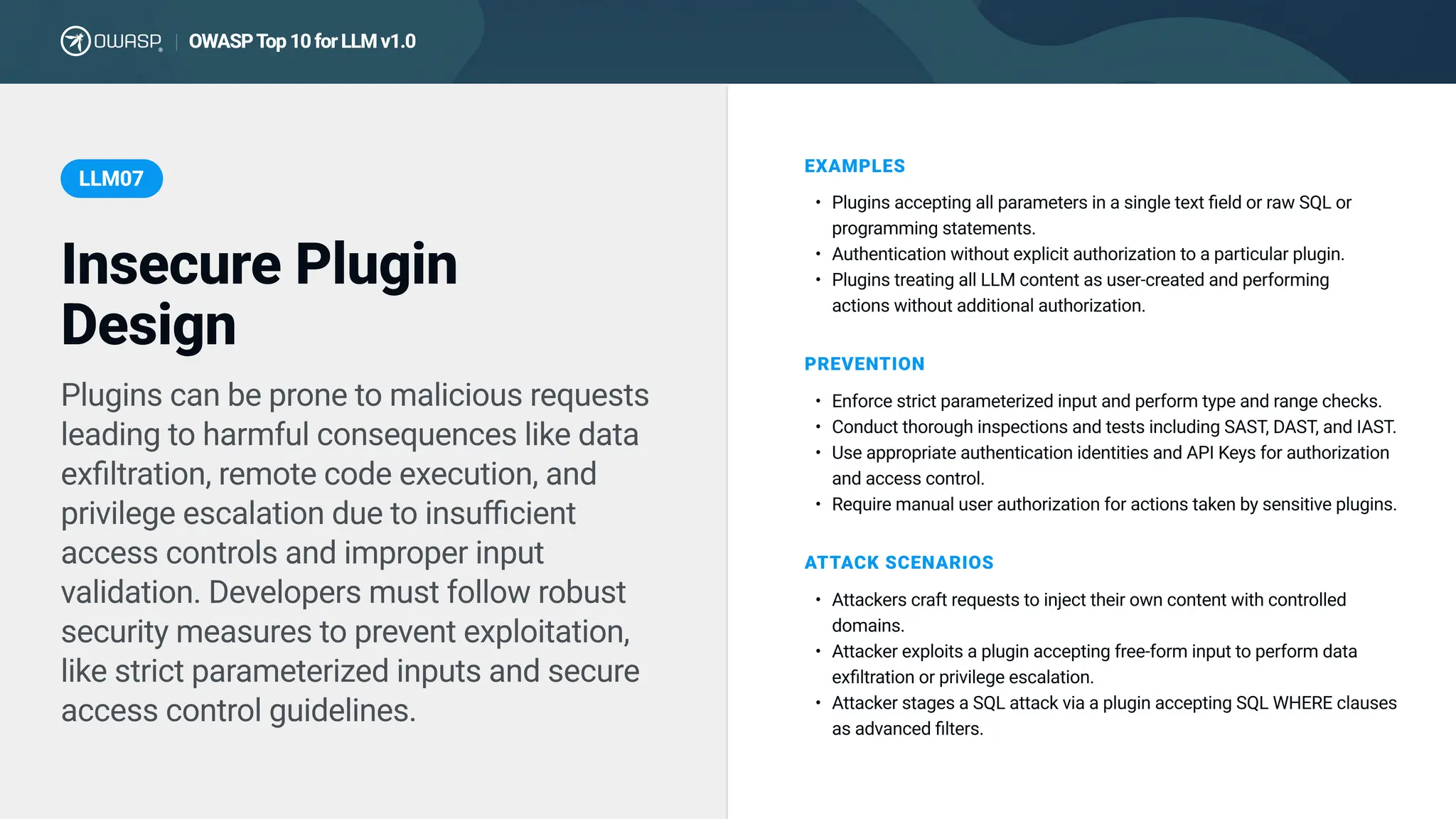
Plugins can beprone to malicious requests
leading to harmful consequences like data
exfiltration, remote code execution, and
privilege escalation due to insufficient
access controls and improper input
validation. Developers must follow robust
security measures to prevent exploitation,
like strict parameterized inputs and secure
access control guidelines.
EXAMPLES
Plugins accepting all parameters in a single text field or raw SQL or
programming statements
Authentication without explicit authorization to a particular plugin
Plugins treating all LLM content as user-created and performing
actions without additional authorization.
PREVENTION
Enforce strict parameterized input and perform type and range checks
Conduct thorough inspections and tests including SAST, DAST, and IAST
Use appropriate authentication identities and API Keys for authorization
and access control
Require manual user authorization for actions taken by sensitive plugins.
ATTACK SCENARIOS
Attackers craft requests to inject their own content with controlled
domains
Attacker exploits a plugin accepting free-form input to perform data
exfiltration or privilege escalation
Attacker stages a SQL attack via a plugin accepting SQL WHERE clauses
as advanced filters.
Insecure Plugin
Design
LLM07
OWASPTop 10 for LLM v1.0
|
10.
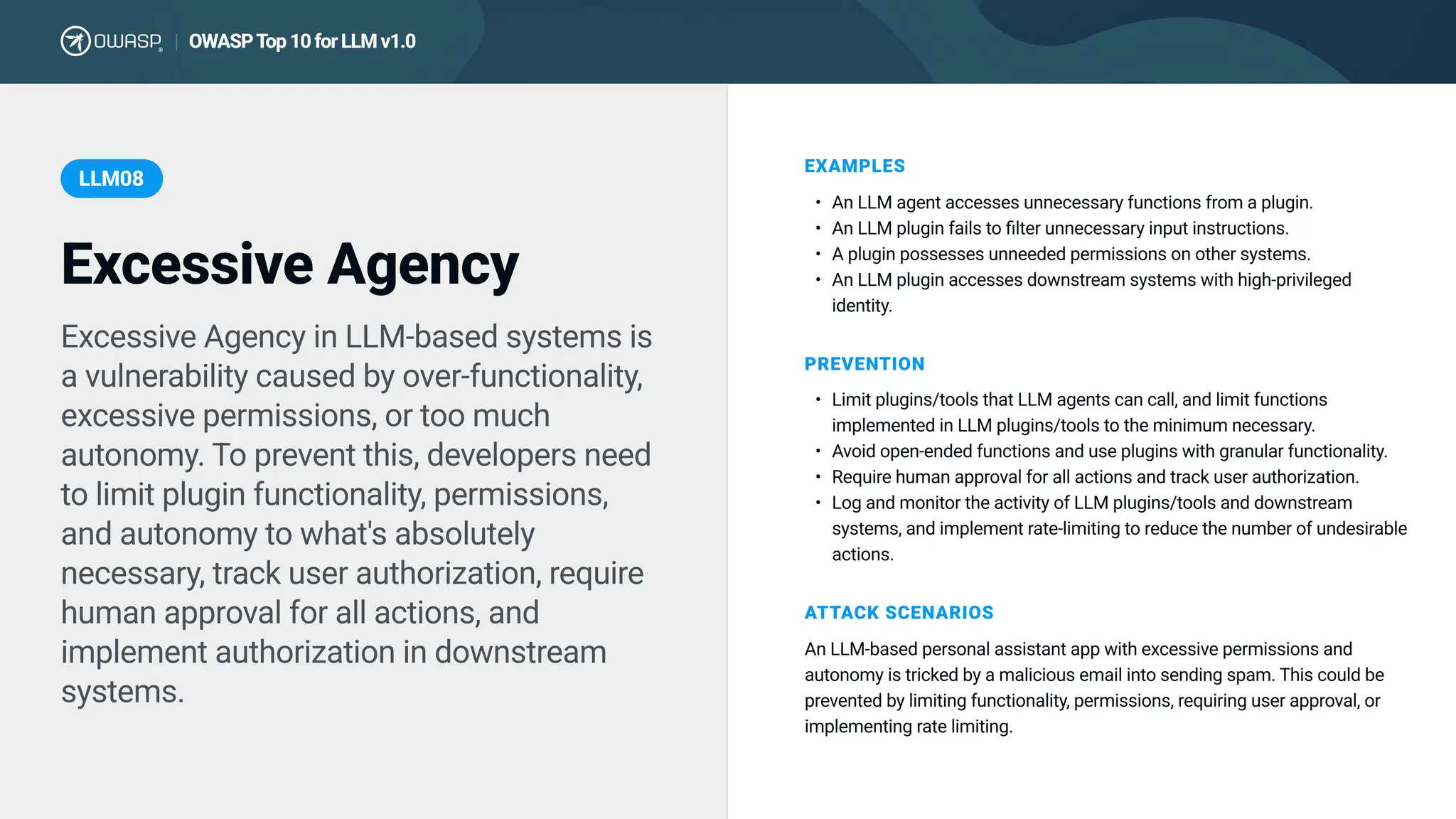
Excessive Agency inLLM-based systems is
a vulnerability caused by over-functionality,
excessive permissions, or too much
autonomy. To prevent this, developers need
to limit plugin functionality, permissions,
and autonomy to what's absolutely
necessary, track user authorization, require
human approval for all actions, and
implement authorization in downstream
systems.
EXAMPLES
An LLM agent accesses unnecessary functions from a plugin
An LLM plugin fails to filter unnecessary input instructions
A plugin possesses unneeded permissions on other systems
An LLM plugin accesses downstream systems with high-privileged
identity.
PREVENTION
ATTACK SCENARIOS
An LLM-based personal assistant app with excessive permissions and
autonomy is tricked by a malicious email into sending spam. This could be
prevented by limiting functionality, permissions, requiring user approval, or
implementing rate limiting.
Excessive Agency
LLM08
OWASPTop10forLLMv1.0
|
Limit plugins/tools that LLM agents can call, and limit functions
implemented in LLM plugins/tools to the minimum necessary
Avoid open-ended functions and use plugins with granular functionality
Require human approval for all actions and track user authorization
Log and monitor the activity of LLM plugins/tools and downstream
systems, and implement rate-limiting to reduce the number of undesirable
actions.
11.
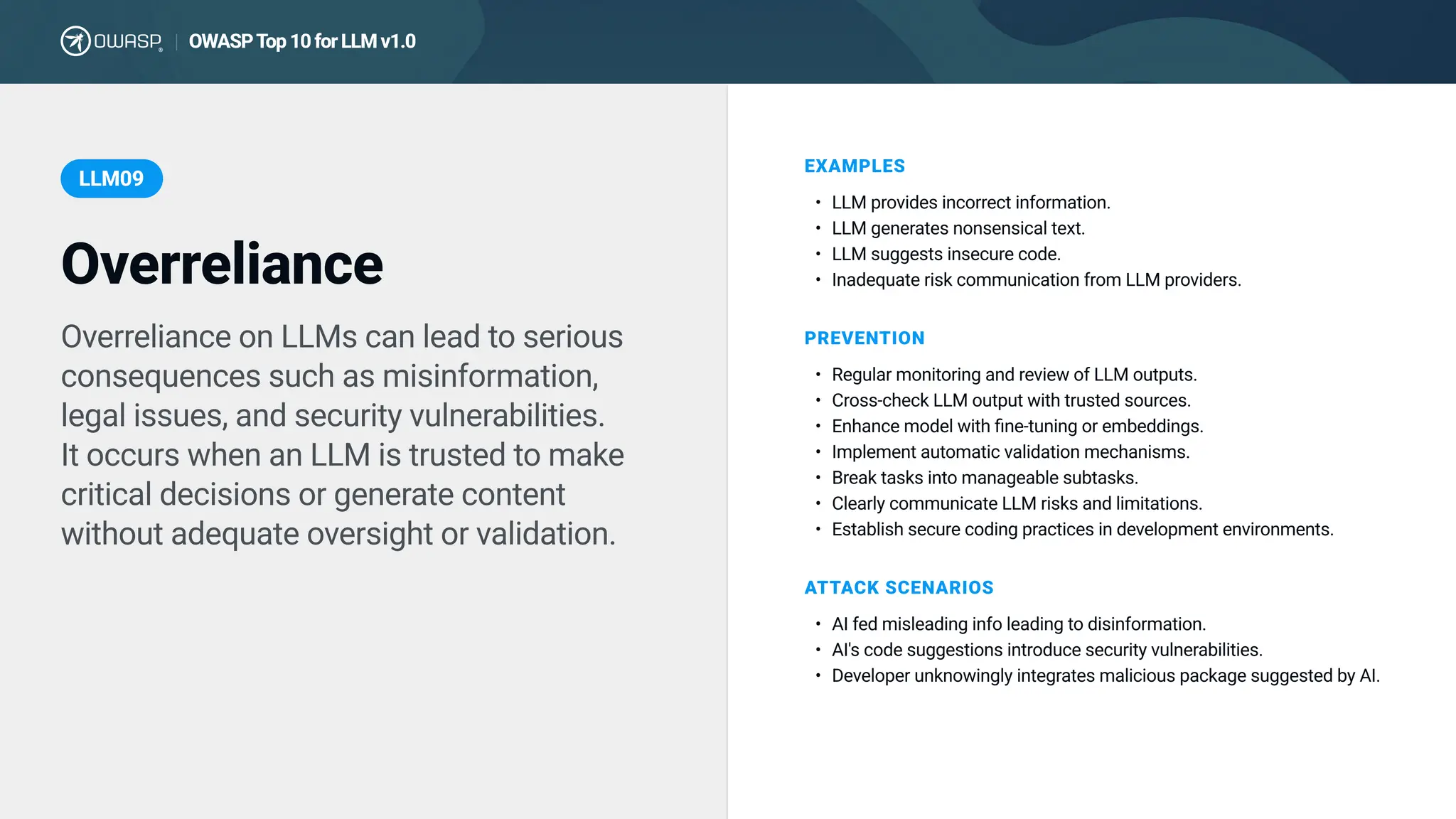
Overreliance on LLMscan lead to serious
consequences such as misinformation,
legal issues, and security vulnerabilities.
It occurs when an LLM is trusted to make
critical decisions or generate content
without adequate oversight or validation.
EXAMPLES
LLM provides incorrect information
LLM generates nonsensical text
LLM suggests insecure code
Inadequate risk communication from LLM providers.
PREVENTION
Regular monitoring and review of LLM outputs
Cross-check LLM output with trusted sources
Enhance model with fine-tuning or embeddings
Implement automatic validation mechanisms
Break tasks into manageable subtasks
Clearly communicate LLM risks and limitations
Establish secure coding practices in development environments.
Overreliance
LLM09
ATTACK SCENARIOS
AI fed misleading info leading to disinformation
AI's code suggestions introduce security vulnerabilities
Developer unknowingly integrates malicious package suggested by AI.
OWASPTop10forLLMv1.0
|
12.
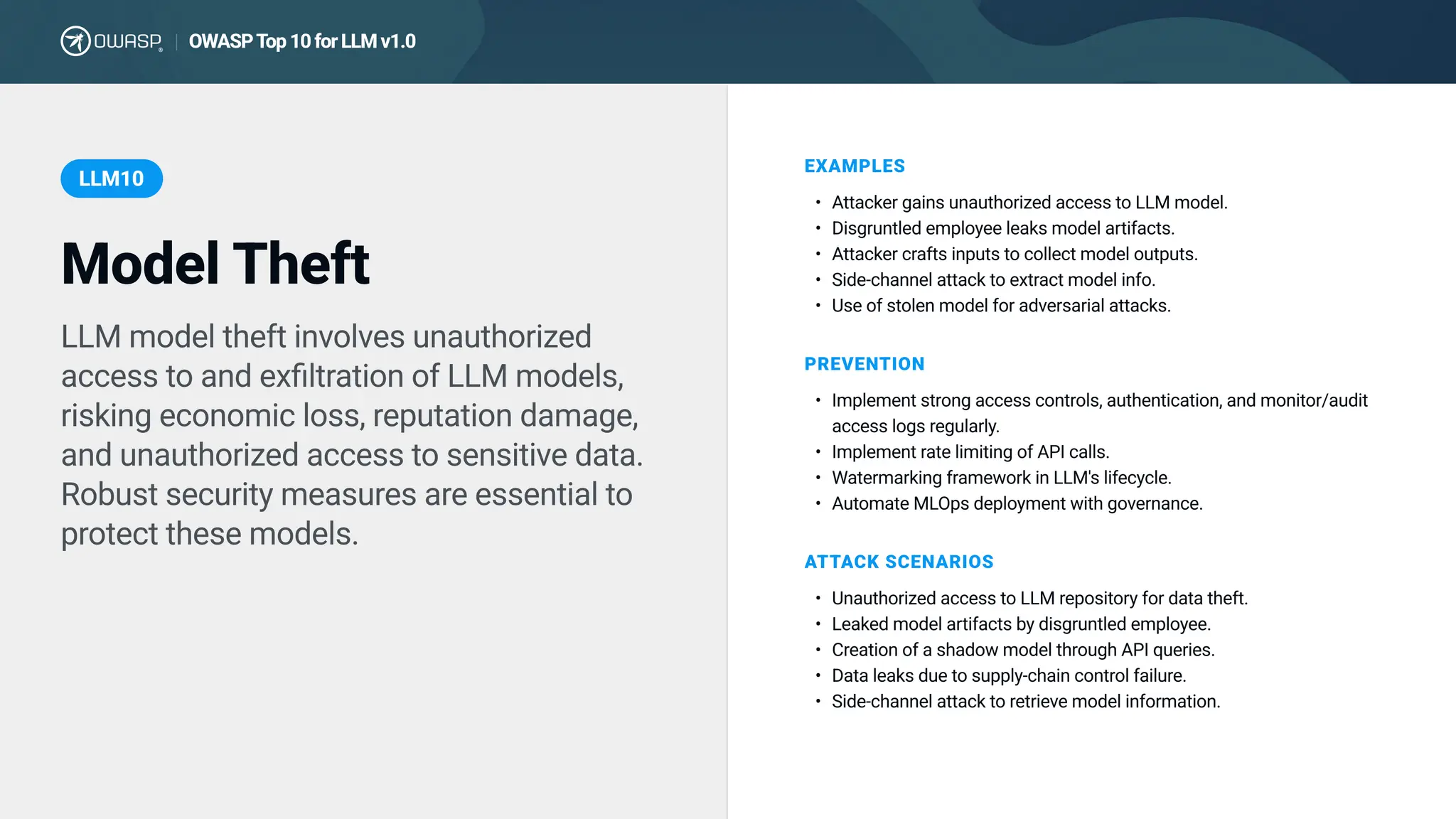
LLM model theftinvolves unauthorized
access to and exfiltration of LLM models,
risking economic loss, reputation damage,
and unauthorized access to sensitive data.
Robust security measures are essential to
protect these models.
EXAMPLES
Attacker gains unauthorized access to LLM model
Disgruntled employee leaks model artifacts
Attacker crafts inputs to collect model outputs
Side-channel attack to extract model info
Use of stolen model for adversarial attacks.
PREVENTION
Implement strong access controls, authentication, and monitor/audit
access logs regularly
Implement rate limiting of API calls
Watermarking framework in LLM's lifecycle
Automate MLOps deployment with governance.
ATTACK SCENARIOS
Unauthorized access to LLM repository for data theft
Leaked model artifacts by disgruntled employee
Creation of a shadow model through API queries
Data leaks due to supply-chain control failure
Side-channel attack to retrieve model information.
Model Theft
LLM10
OWASPTop 10 for LLM v1.0
|
13.
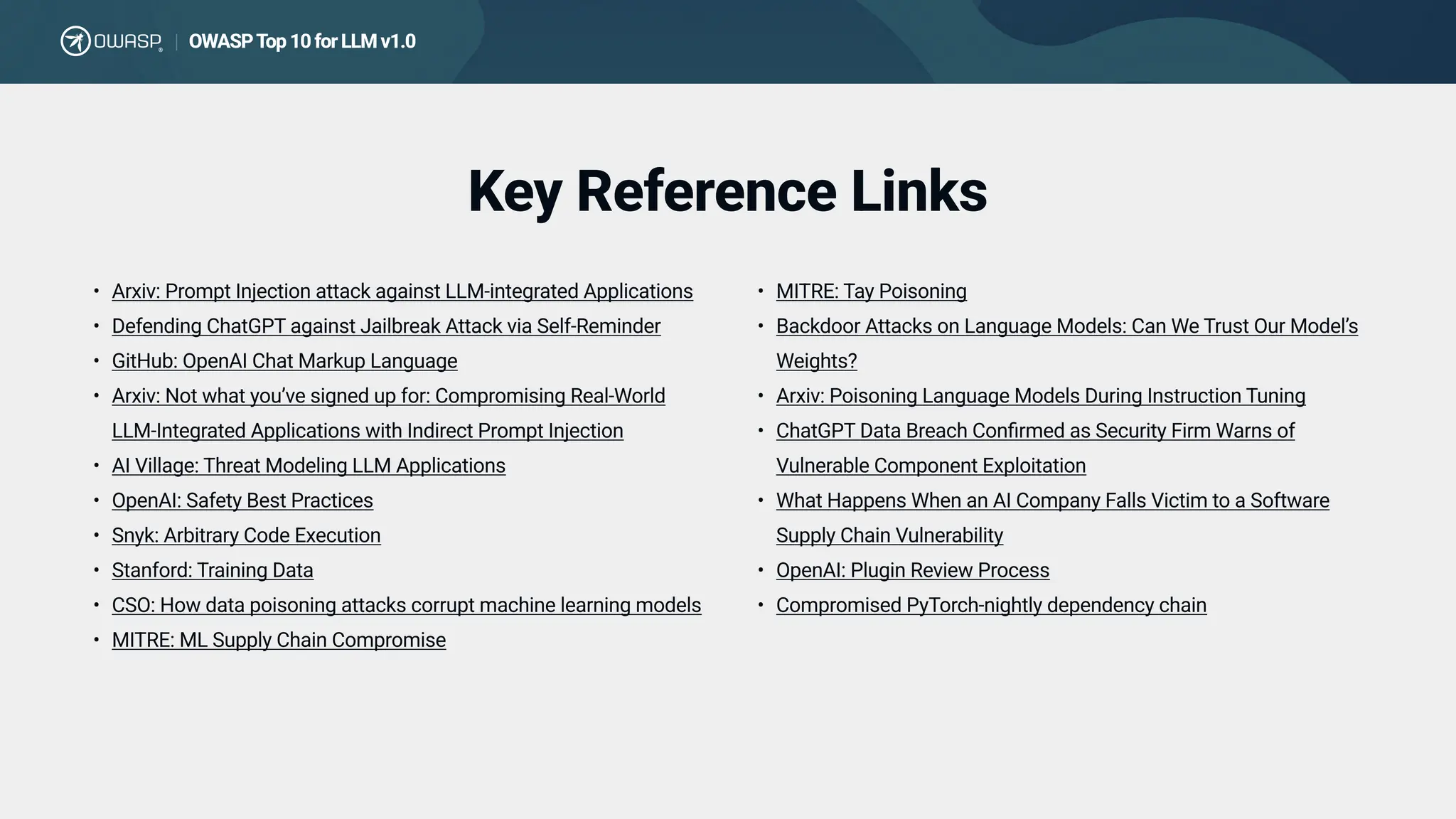
Key Reference Links
Arxiv:Prompt Injection attack against LLM-integrated Application
Defending ChatGPT against Jailbreak Attack via Self-Reminde
GitHub: OpenAI Chat Markup Languag
Arxiv: Not what you’ve signed up for: Compromising Real-World
LLM-Integrated Applications with Indirect Prompt Injectio
AI Village: Threat Modeling LLM Application
OpenAI: Safety Best Practice
Snyk: Arbitrary Code Executio
Stanford: Training Dat
CSO: How data poisoning attacks corrupt machine learning model
MITRE: ML Supply Chain Compromise
MITRE: Tay Poisonin
Backdoor Attacks on Language Models: Can We Trust Our Model’s
Weights
Arxiv: Poisoning Language Models During Instruction Tunin
ChatGPT Data Breach Confirmed as Security Firm Warns of
Vulnerable Component Exploitatio
What Happens When an AI Company Falls Victim to a Software
Supply Chain Vulnerabilit
OpenAI: Plugin Review Proces
Compromised PyTorch-nightly dependency chain
OWASPTop10forLLMv1.0
|


![OWASP TOP 10 LLM - Hands-on Workshop [Stefano Amorelli - Tallinn BSides 2023]](https://cdn.slidesharecdn.com/ss_thumbnails/owasptop10llm-230923185034-4b466b67-thumbnail.jpg?width=640&height=640&fit=bounds)


![[DSC Europe 25] Nikolay Burlutskiy - Best Practices for Building Enterprise M...](https://cdn.slidesharecdn.com/ss_thumbnails/uirvaiuvq8y1w8hzd9tx-7-251212103249-2619edb4-thumbnail.jpg?width=640&height=640&fit=bounds)
![[DSC Europe 25] Branko Urosevic -Rethinking Financial Talent: Integrating Cod...](https://cdn.slidesharecdn.com/ss_thumbnails/8jjrus8ttko6qj64f58f-3-251212103250-642c6374-thumbnail.jpg?width=640&height=640&fit=bounds)

![[DSC Europe 25] Milan Zdravkovic - The road less traveled in District Heating...](https://cdn.slidesharecdn.com/ss_thumbnails/nfaboniqwsz4ucyctnmy-2-milan-zdravkovic-dsc2025-the-road-less-traveled-in-district-heating-operation-251208151905-f56388a5-thumbnail.jpg?width=640&height=640&fit=bounds)

![[DSC Europe 25] Milan Sekuloski - Data, Defence, and Development: Cybersecuri...](https://cdn.slidesharecdn.com/ss_thumbnails/dfrkwwx4qly6atqpbl4z-4-251209104645-c3d4b0ca-thumbnail.jpg?width=640&height=640&fit=bounds)
![[DSC Europe 25] Jon Dajci - Bridging TradFi and DeFi: Building the Future of ...](https://cdn.slidesharecdn.com/ss_thumbnails/fqmhfvlbqhkihjvqvhmu-7-251211083849-6af7e325-thumbnail.jpg?width=640&height=640&fit=bounds)
![[DSC Europe 25] Dobrica Cosic - Savings by the Second: How Dynamic Pricing an...](https://cdn.slidesharecdn.com/ss_thumbnails/znp09f3smtqz3w2sq6wn-1-dobrica-cosic-savings-by-the-second-how-dynamic-pricing-and-smart-data-are-bu-251208151905-26e6f41e-thumbnail.jpg?width=640&height=640&fit=bounds)

![[DSC Europe 25] Dragana Ilic - AI for Big Data in Astronomy.pptx](https://cdn.slidesharecdn.com/ss_thumbnails/8palya86qaatvjhva1ms-2-dragana-ilic-ai-ilic-251208151906-652b819c-thumbnail.jpg?width=640&height=640&fit=bounds)
![[DSC Europe 25] Aleksandra Dragicevic - AI-Boosted Research in Healthcare: Fr...](https://cdn.slidesharecdn.com/ss_thumbnails/iqwngszurf2r7pi1lnnj-4-aleksandra-dragicevic-ad-dsc-europe-conference-20-251208151905-37c3238a-thumbnail.jpg?width=640&height=640&fit=bounds)
![[DSC Europe 25] Hans Kleinsman - The Compliance Gearbox: How Tax Tech Mediate...](https://cdn.slidesharecdn.com/ss_thumbnails/dxdytie1toel0hr90bjs-2-251212103250-174fdbe7-thumbnail.jpg?width=640&height=640&fit=bounds)