Norman M. Wade
The Lightning Press
SMARTbook
Guide to FM 3-0
Operations (2008) & the
Six Warfighting Functions
4th Revised Edition
FM 3-0 Operations
(2008 Edition)
Intelligence
Warfighting Function
Movement & Maneuver
Warfighting Function
Sustainment
Warfighting Function
Fires
Warfighting Function
Command & Control
Warfighting Function
Protection
Warfighting Function
THE
updated&expanded
FM 2-0
FM 3-0
FM 4-0
FM 6-0
& more!
ArmyOperations&Doctrine
Sam
ple
Guide to FM 3-0 Operations (2008)
& the Six Warfighting Functions
SMARTbook
The Lightning Press
Norman M. Wade
THE
ArmyOperations&Doctrine
4th Revised Edition
Sam
ple
The Army Operations &
Doctrine SMARTbook
The Lightning Press
2227 Arrowhead Blvd.
Lakeland, FL 33813
24-hour Voicemail/Fax/Order: 1-800-997-8827
E-mail: SMARTbooks@TheLightningPress.com
www.TheLightningPress.com
Guide to FM 3-0 Operations (2008)
& the Six Warfighting Functions
The Army Operations & Doctrine SMARTbook is the re-titled fourth revised edition of The
Operations SMARTbook because we’ve UPDATED & EXPANDED the content to incorpo-
rate the new 2008 version of FM 3-0 Operations PLUS each of the six warfighting functions
(formerly “battlefield operating systems”).
Copyright © 2008 Norman M. Wade
ISBN: 978-0-9742486-7-7
All Rights Reserved
No part of this book may be reproduced or utilized in any form or other means, electronic
or mechanical, including photocopying, recording or by any information storage and
retrieval systems, without permission in writing by the publisher. Inquiries should be ad-
dressed to The Lightning Press.
Notice of Liability
The information in this SMARTbook and quick reference guide is distributed on an “As Is”
basis, without warranty. While every precaution has been taken to ensure the reliability
and accuracy of all data and contents, neither the author nor The Lightning Press shall
have any liability to any person or entity with respect to liability, loss, or damage caused di-
rectly or indirectly by the contents of this book. If there is a discrepancy, refer to the source
document. This SMARTbook does not contain classified or sensitive information restricted
from public release.
“The views presented in this publication are those of the author and do not necessarily
represent the views of the Department of Defense or its components.”
SMARTbook is a trademark of The Lightning Press.
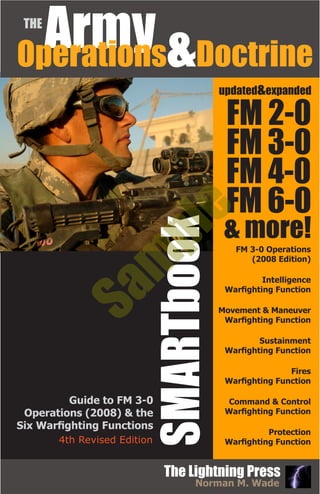
About our cover photo: Army Image by Staff Sgt. James L. Harper Jr, October 12, 2005.
A paratrooper from Company B, 2nd Battalion, 325th Airborne Infantry Regiment, 82nd
Airborne Division scans nearby buildings for enemy presence in Tal Afar, Iraq. This photo
appeared on www.army.mil.
Printed and bound in the United States of America.
Sam
ple
Introduction-1
Guide to FM 3-0 Operations (2008)
and the Six Warfighting Functions
The Army Operations & Doctrine SMARTbook is the re-titled fourth revised edition of
The Operations SMARTbook because we’ve UPDATED & EXPANDED the content
to incorporate the new 2008 version of FM 3-0 Operations PLUS each of the six
warfighting functions (formerly “battlefield operating systems”).
The 2008 edition of FM 3-0, the first update since the attacks on 9/11, is the fifteenth
edition of the Army’s capstone operations manual. FM 3-0 shapes all Army doctrine,
while influencing the Army’s organization, training, materiel, leadership and educa-
tion, and Soldier concerns.
The doctrine recognizes that current conflicts defy solution by military means alone
and that landpower, while critical, is only part of each campaign. Full spectrum oper-
ations—simultaneous offensive, defensive, and stability or civil support operations—
is the primary theme of FM 3-0. An offensive mindset—the predisposition to seize,
retain, and exploit the initiative to positively change the situation—makes combat
power decisive. FM 3-0 recognizes that the Army’s primary purpose is deterrence,
and should deterrence fail, decisively winning the Nation’s wars by fighting within an
interdependent joint team.
Replacing “battlefield operating systems (BOSs),” the six “warfighting functions,” mul-
tiplied by leadership and complemented by information, now define the elements of
combat power—movement and maneuver, intelligence, fires, sustainment, command
and control, and protection.
SMARTbooks - The Essentials of Warfighting!
The Army Operations & Doctrine SMARTbook represents the keystone title of our
series of military reference SMARTbooks. Recognized as the doctrinal reference
standard by military professionals around the world, SMARTbooks are designed with
all levels of officers, warrants and noncommissioned officers in mind.
Editor’s Notes
The Army Operations & Doctrine SMARTbook
SMARTbooks can be used as quick reference guides during actual tactical combat
operations, as study guides at military education and professional development
courses, and as lesson plans and checklists in support of training. Serving a genera-
tion of warfighters, military reference SMARTbooks have become “mission-essential”
around the world. See the last page of this publication for complete details!
SMARTregister for Updates
Keep your SMARTbooks up-to-date! The Lightning Press will provide e-mail
notification of updates, revisions and changes to our SMARTbooks. Users can
register their SMARTbooks online at www.TheLightningPress.com. Updates and
their prices will be announced by e-mail as significant changes or revised editions
are published.
Sam
ple
2-References
References
The Army Operations & Doctrine SMARTbook
The following references were used to compile The Army Operations & Doctrine SMART-
book. All references are available to the general public and designated as “approved for
public release; distribution is unlimited.” The Army Operations & Doctrine SMARTbook
does not contain classified or sensitive material restricted from public release.
Field Manuals
FM 1-02 21 Sep 2004 Operational Terms and Graphics
FM 2-0 17 May 2004 Intelligence
FM 3-0 27 Feb 2008 Operations
FMI 3-0.1 28 Jan 2008 The Modular Force
FM 3-09.21 22 Mar 2001 FA Battalion Operations
FM 3-11 10 Mar 2003 Multiservice Tactics, Techniques, and Procedures
for Nuclear, Biological, and Chemical Defense
Operations
FM 3-11.3 2 Feb 2006 Multiservice Tactics, Techniques, and Procedures
for Chemical, Biological, Radiological, and
Nuclear Contamination Avoidance
FM 3-13 28 Nov 2003 Information Operations: Doctrine, Tactics,
Techniques, and Procedures
FM 3-34 2 Jan 2004 Engineer Operations
FMI 3-35 15 Jun 2007 Army Deployment and Redeployment
FM 3-52 1 Aug 2002 Army Airspace Cmd & Control in a Combat Zone
FM 3-90 4 July 2001 Tactics
FM 34-8-2 1 May 1998 Intelligence Officer’s Handbook
FM 34-130 8 Jul 1994 Intelligence Preparation of the Battlefield
FM 4-0 29 Aug 2003 Combat Service Support
FM 4-01.011 31 Oct 2002 Unit Movement Operations
FM 4-02 13 Feb 2003 Force Health Protection in a Global Environment
FM 44-8 1 Jun 1999 Combined Arms for Air Defense
FM 44-100 15 Jun 2000 US Army Air and Missile Defense Operations
FMI 5-0.1 31 Mar 2006 The Operations Process
FM 5-102 14 Mar 1985 Countermobility
FM 5-103 10 Jun 1985 Survivability
FM 6-0 11 Aug 2003 Mission Command: Command and Control of
Army Forces
FM 6-02.45 (chg 1) 7 May 2008 Signal Support to Theater Operations
FM 6-20 17 May 1988 Fire Support in the Airland Battle
FM 6-20-10 8 May 1996 The Targeting Process
FM 6-20-40 5 Jan 1990 TTP for Fire Support for Brigade Operations
Sam
ple
Table of Contents-1
Table of Contents
I. The Operational Environment .....................................................1-1
I. Instability and Persistent Conflict.....................................................................1-1
II. Influences on the Operational Environment....................................................1-1
III. The Changing Nature of the Threat...............................................................1-4
IV. Operational and Mission Variables ................................................................1-6
A. Operational Variables (PMESII-PT) ..........................................................1-6
B. Mission Variables......................................................................................1-6
V. Unified Action..................................................................................................1-6
A. Campaigns and Joint Operations............................................................1-10
B. Joint Interdependence ............................................................................1-10
C. Interagency Coordination and Cooperation with Other Organizations ...1-12
D. Civilian Organizations.............................................................................1-12
E. Multinational Operations .........................................................................1-12
VI. Soldiers .......................................................................................................1-13
VII. The Nature of Land Operations..................................................................1-16
VII. Law of War and Rules of Engagement.......................................................1-18
II. The Continuum of Operations..................................................1-19
I. The Spectrum of Conflict ...............................................................................1-19
II. Operational Themes .....................................................................................1-20
A. Peacetime Military Engagement .............................................................1-22
B. Limited Intervention.................................................................................1-24
C. Peace Operations...................................................................................1-26
D. Irregular Warfare.....................................................................................1-27
E. Major Combat Operations.......................................................................1-30
III. Full Spectrum Operations........................................................1-31
I. The Operational Concept...............................................................................1-31
A. Initiative...................................................................................................1-32
B. Simultaneity and Synchronization...........................................................1-33
C. Lethal and Nonlethal Actions ..................................................................1-34
D. Mission Command..................................................................................1-34
II. The Elements of Full Spectrum Operations..................................................1-36
A. Offensive Operations ..............................................................................1-36
B. Defensive Operations .............................................................................1-36
C. Stability Operations.................................................................................1-36
D. Civil Support Operations.........................................................................1-36
III. Combining the Elements of Full Spectrum Operations................................1-46
IV. Combat Power ..........................................................................1-49
I. The Elements of Combat Power....................................................................1-49
II. Leadership....................................................................................................1-50
III. Information...................................................................................................1-51
IV. The Warfighting Functions...........................................................................1-52
V. Combined Arms............................................................................................1-54
Chap1Chap1
FM 3-0 Operations
(2008 Edition)
The Army Operations & Doctrine SMARTbook
Sam
ple
2-Table of Contents
A. Complementary and Reinforcing Capabilities.........................................1-54
B. Unified Action..........................................................................................1-54
C. Force Tailoring and Task Organization ...................................................1-54
D. Mutual Support .......................................................................................1-55
V. Command and Control (C2)......................................................1-57
I. Exercise of Command and Control................................................................1-57
II. Battle Command...........................................................................................1-58
A. Understand .............................................................................................1-60
B. Visualize..................................................................................................1-60
C. Describe..................................................................................................1-64
D. Direct ......................................................................................................1-66
III. Control .........................................................................................................1-68
A. Control Measures....................................................................................1-68
B. Area of Operations..................................................................................1-69
C. Common Operational Picture .................................................................1-70
IV. The Operations Process..............................................................................1-71
V. Principles of War and Operations (Visualize) ...............................................1-74
VI. Operational Art.........................................................................1-75
I. The Levels of War..........................................................................................1-75
II. Applying Operational Art ...............................................................................1-78
III. The Elements of Operational Design...........................................................1-79
A. Framing the Problem ..............................................................................1-80
B. Formulating the Design...........................................................................1-82
C. Refining the Design ................................................................................1-83
VII. Information Superiority ..........................................................1-91
I. Information Superiority and Full Spectrum Operations..................................1-91
II. Army Information Tasks ................................................................................1-92
A. Information Engagement.........................................................................1-93
B. Command and Control Warfare..............................................................1-93
C. Information Protection.............................................................................1-96
D. Operations Security ................................................................................1-97
E. Military Deception ...................................................................................1-97
III. Intelligence, Surveillance, and Reconnaissance (ISR)................................1-98
IV. Knowledge and Information Management...................................................1-98
VIII. Strategic and Operational Reach........................................1-101
I. Strategic Reach ...........................................................................................1-101
A. Operational Maneuver from Strategic Distance....................................1-101
B. Expeditionary Campaigns.....................................................................1-102
C. Expeditionary Army Forces...................................................................1-103
D. Force Projection....................................................................................1-104
E. Entry Operations...................................................................................1-105
II. Basing.........................................................................................................1-106
A. Intermediate Staging Bases..................................................................1-106
B. Lodgements ..........................................................................................1-107
C. Forward Operating Bases.....................................................................1-107
III. Operational Reach.....................................................................................1-108
FM 3-0: Summary of Major Changes .........................................1-109
I. New Army Terms..........................................................................................1-109
II. Modified Army Definitions ...........................................................................1-109
III. Rescinded Army Definitions.......................................................................1-109
IV. Major Doctrinal Changes in FM 3-0...........................................................1-110
V. The Role of Doctrine................................................................................... 1-111
Sam
ple
Table of Contents-3
Chap2Chap2
Movement & Maneuver Warfighting Function Overview .............2-1
Future Combat Systems (FCS) ..........................................................................2-2
I. The Army Modular Force .............................................................2-3
I. Transformation to a Modular Force..................................................................2-3
II. Division Echelon and Above ...........................................................................2-4
A. Division .....................................................................................................2-4
B. Theater Army Headquarters Commands ..................................................2-6
C. Theater-Level Formations.........................................................................2-7
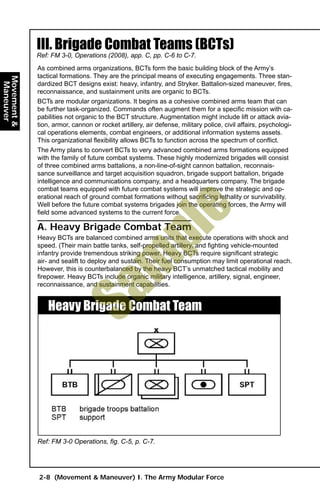
II. Brigade Combat Teams (BCTs) ......................................................................2-8
A. Heavy Brigade Combat Team...................................................................2-8
B. Infantry Brigade Combat Team .................................................................2-9
C. Stryker Brigade Combat Team..................................................................2-9
IV. Modular Support Brigades...........................................................................2-10
A. Battlefield Surveillance Brigade ..............................................................2-10
B. Fires Brigade...........................................................................................2-11
C. Combat Aviation Brigade ........................................................................2-12
D. Sustainment Brigade ..............................................................................2-13
E. Maneuver Enhanced Brigade .................................................................2-13
F. Functional Brigades.................................................................................2-14
II. Tactical Mission Tasks (FM 3-90) .............................................2-15
I. Tactics............................................................................................................2-15
II. The Science and Art of Tactics .....................................................................2-16
III. Tactical Mission Tasks .................................................................................2-17
A. Effects on Enemy Forces........................................................................2-18
B. Actions by Friendly Forces......................................................................2-19
C. Mission Symbols.....................................................................................2-20
III. Mobility and Countermobility..................................................2-21
I. Engineer Battlespace Functions....................................................................2-21
A. Combat Engineering ...............................................................................2-22
- Key Fundamentals of Combat Engineering.....................................2-23
1. Mobility...............................................................................................2-22
- Aspects of Mobility...........................................................................2-24
2. Countermobility..................................................................................2-26
3. Survivability........................................................................................2-26
B. Geospatial Engineering...........................................................................2-27
C. General Engineering...............................................................................2-27
II. Obstacle Planning.........................................................................................2-28
III. Operational Considerations .........................................................................2-30
IV. Force Projection.......................................................................2-31
I. Force Projection Processes...........................................................................2-31
II. Deployment...................................................................................................2-32
- Deployment Principles.........................................................................2-33
A. Deployment Phases................................................................................2-34
B. Deployment Planning..............................................................................2-36
- Unit Movement Dates ..........................................................................2-37
III. Army Force Generation (ARFORGEN)........................................................2-38
Movement & Maneuver
Warfighting Function
Sam
ple
4-Table of Contents
Chap3Chap3
Intelligence Warfighting Function Overview.................................3-1
I. The Role of Intelligence...................................................................................3-1
II. Categories of Intelligence ...............................................................................3-2
A. Indications and Warnings (I&W) ...............................................................3-2
B. Current Intelligence...................................................................................3-2
C. General Military Intelligence (GMI) ...........................................................3-3
D. Target Intelligence.....................................................................................3-3
E. Scientific and Technical Intelligence (S&TI)..............................................3-3
F. Counterintelligence (CI).............................................................................3-3
III. Intelligence Process.......................................................................................3-4
A. Plan...........................................................................................................3-4
B. Prepare .....................................................................................................3-4
C. Collect.......................................................................................................3-4
D. Process.....................................................................................................3-4
E. Produce.....................................................................................................3-5
IV. Intelligence Community .................................................................................3-6
I. Intelligence in the Operational Environment .............................3-7
I. Intelligence Tasks ............................................................................................3-7
A. Support to Situational Understanding .......................................................3-7
- Intelligence Preparation of the Battlefield ..............................................3-9
B. Support to Strategic Responsiveness.....................................................3-10
C. Conduct Intelligence, Surveillance, and Reconnaissance......................3-11
D. Provide Intelligence Support to Effects...................................................3-12
II. Intelligence Disciplines .................................................................................3-14
A. All-Source Intelligence ............................................................................3-14
B. Human Intelligence (HUMINT)................................................................3-14
C. Imagery Intelligence (IMINT) ..................................................................3-14
D. Signals Intelligence (SIGINT) .................................................................3-14
E. Measurement and Signatures Intelligence (MASINT).............................3-14
F. Technical Intelligence (TECHINT) ...........................................................3-14
G. Counterintelligence (CI)..........................................................................3-14
II. Security Operations ..................................................................3-15
I. Forms of Security Operations........................................................................3-15
A. Screen.....................................................................................................3-15
B. Guard......................................................................................................3-18
C. Cover ......................................................................................................3-18
D. Area Security ..........................................................................................3-20
E. Local Security .........................................................................................3-20
* Combat Outposts......................................................................................3-20
II. Fundamentals of Security Operations ..........................................................3-17
III. Reconnaissance Operations ...................................................3-21
I. Forms of Reconnaissance.............................................................................3-21
- Typical ISR Assets Available................................................................3-23
A. Route Reconnaissance...........................................................................3-22
B. Zone Reconnaissance ............................................................................3-22
C. Area Reconnaissance.............................................................................3-24
D. Reconnaissance in Force .......................................................................3-24
II. Reconnaissance Fundamentals ...................................................................3-25
Intelligence
Warfighting Function
Sam
ple
Table of Contents-5
Fires Warfighting Function Overview............................................4-1
I. Basic Fire Support Tasks.................................................................................4-1
A. Support Forces in Combat........................................................................4-1
B. Support the Battle Plan.............................................................................4-2
C. Synchronize the Fire Support System ......................................................4-3
D. Sustain the Fire Support System..............................................................4-3
II. Fire Support Tactical Missions........................................................................4-4
III. Fundamentals of Organization.......................................................................4-5
IV. Effects............................................................................................................4-6
V. Fire Support Responsibilities..........................................................................4-7
A. Fire Support at Echelons Above Corps.....................................................4-7
B. Fire Support Organizations at Corps and Division....................................4-7
C. Fire Support at Brigade and Battalion.......................................................4-8
D. Fire Support at Company..........................................................................4-8
I. Targeting (D3A).............................................................................4-9
I. Decide..............................................................................................................4-9
IPB and Mission Analysis ..............................................................................4-9
Target Value Analysis (TVA) and Wargaming................................................4-9
A. High-Payoff Target List (HPTL)...............................................................4-10
B. Intelligence Collection Plan.....................................................................4-12
C. Target Selection Standards (TSS) ..........................................................4-12
D. Attack Guidance Matrix (AGM) ...............................................................4-14
1. Harassing Fire....................................................................................4-14
2. Suppressive Fire................................................................................4-14
3. Neutralization Fire..............................................................................4-14
4. Destructive Fire..................................................................................4-14
II. Detect ...........................................................................................................4-16
III. Deliver..........................................................................................................4-17
A. Tactical Decisions ...................................................................................4-17
B. Technical Decisions ................................................................................4-18
IV. Assess .........................................................................................................4-19
A. Battle Damage Assessment (BDA).........................................................4-19
B. Munitions Effects Assessment (MEA).....................................................4-19
C. Reattack Recommendation ....................................................................4-20
II. Fire Support Systems ...............................................................4-21
I. Field Artillery ..................................................................................................4-21
II. Mortars..........................................................................................................4-22
III. Naval Gunfire...............................................................................................4-23
IV. Tactical Air....................................................................................................4-24
V. Army Aviation................................................................................................4-25
VI. Electronic Warfare.......................................................................................4-27
III. Fire Support Terms & Graphics ..............................................4-29
I. Fire Planning Terms.......................................................................................4-29
II. Permissive Measures ...................................................................................4-30
III. Restrictive Measures ...................................................................................4-31
IV. Zones...........................................................................................................4-32
Fires
Warfighting Function
Chap4Chap4
Sam
ple
6-Table of Contents
Chap5Chap5
Sustainment Warfighting Function Overview...............................5-1
I. Sustainment Subfunctions...............................................................................5-1
II. Strategic-Level Roles......................................................................................5-2
A. Industrial Base ..........................................................................................5-2
B. Dept of Defense and Defense Agencies...................................................5-3
C. Dept of Army and Strategic-Level Commands..........................................5-3
D. Supported Geographic Combatant Commands........................................5-6
E. Subordinate Joint Force Commands ........................................................5-6
II. Operational-Level Roles .................................................................................5-7
A. Army Service Component Command (ASCC) ..........................................5-7
B. Multifunctional and Specialized Commands .............................................5-7
III. Tactical Level Roles.......................................................................................5-8
CSS Characteristics ......................................................................................5-4
I. Logistics......................................................................................5-11
I. Supply and Field Services .............................................................................5-11
A. The Supply System.................................................................................5-11
B. Classes of Supply ...................................................................................5-12
C. Field Services .........................................................................................5-12
Supply Terms...............................................................................................5-15
II. Transportation Support .................................................................................5-16
A. Strategic Transportation..........................................................................5-16
B. Operational and Tactical Transportation .................................................5-17
C. Movement Control ..................................................................................5-17
D. Terminal Operations................................................................................5-18
E. Mode Operations ....................................................................................5-19
III. Ordnance (Maintenance) Support ...............................................................5-20
A. Maintenance Support Across the Levels of War.....................................5-20
B. Maintenance Principles...........................................................................5-21
C. Maintenance Support Levels ..................................................................5-22
D. Aviation Maintenance..............................................................................5-23
E. Repair Parts Support ..............................................................................5-23
F. Explosive Ordnance Disposal (EOD) ......................................................5-24
G. Ammunition.............................................................................................5-24
- Ammunition Support Activities .............................................................5-25
Distribution-Based CSS....................................................................................5-26
II. Personnel Services ...................................................................5-27
I. Human Resource Support .............................................................................5-27
II. Financial Management Operations...............................................................5-27
III. Legal Support to Operations........................................................................5-28
IV. Religious Support ........................................................................................5-29
V. Band Support................................................................................................5-30
III. Health Service Support (HSS) .................................................5-31
I. HSS Across the Levels of War.......................................................................5-31
II. Principles of HSS..........................................................................................5-33
III. Levels of Care..............................................................................................5-34
Sustainment
Warfighting Function
Sam
ple
Table of Contents-7
Chap6Chap6
Command & Control
Warfighting Function
Command & Control Warfighting Function Overview .................6-1
I. Relationship Between Command & Control ....................................................6-2
A. Command .................................................................................................6-3
B. Control ......................................................................................................6-3
II. Environment of Command & Control..............................................................6-4
A. Human Dimension ....................................................................................6-4
B. Uncertainty................................................................................................6-4
C. Time..........................................................................................................6-8
D. Detailed Command...................................................................................6-8
III. Mission Command.........................................................................................6-8
Relevant Information (RI)....................................................................................6-6
I. The Command & Control System ...............................................6-9
I. Command & Control Functions........................................................................6-9
II. The OODA Cycle ..........................................................................................6-10
III. Location .......................................................................................................6-12
IV. Design and Organization Characteristics ....................................................6-12
V. Principles of Organization.............................................................................6-14
VI. Continuity of Command & Control...............................................................6-15
VII. INFOSYS and Information Management....................................................6-16
II. Command Posts (CPs)..............................................................6-17
I. Types of CPs .................................................................................................6-18
II. CP Survivability and Effectiveness Considerations ......................................6-20
III. Command and Support Relationships ...................................6-21
I. Chain of Command........................................................................................6-21
A. Combatant Commands...........................................................................6-22
B. Joint Task Forces and Service Components...........................................6-23
II. Other Relationships ......................................................................................6-23
III. Regulatory Authorities..................................................................................6-23
IV. Joint Command Relationships.....................................................................6-25
A. Combatant Command (Command Authority) (COCOM).........................6-24
B. Operational Control (OPCON) ................................................................6-24
C. Tactical Control (TACON) .......................................................................6-24
D. Support ...................................................................................................6-24
V. Army Command and Support Relationships.................................................6-26
A. Army Command Relationships................................................................6-26
B. Army Support Relationships....................................................................6-27
VI. Administrative Control .................................................................................6-28
IV. Army Airspace Command and Control (A2C2)......................6-29
Theater-Air-Ground System (TAGS).................................................................6-29
I. Key Documents .............................................................................................6-29
II. Airspace Control Measures...........................................................................6-30
III. Key Positions and Responsibilities..............................................................6-32
Sam
ple
8-Table of Contents
Chap7Chap7
Protection
Protection Warfighting Function Overview...................................7-1
I. Protection.........................................................................................................7-1
- Vulnerability Assessments ..........................................................................7-1
- Estimate of the Situation for a Security Assessment...................................7-2
II. Force Health Protection..................................................................................7-4
III. Field Discipline...............................................................................................7-4
I. Air and Missile Defense Operations ...........................................7-5
I. Types of Air Defense........................................................................................7-5
II. Standard Tactical Missions .............................................................................7-6
III. Air Defense Warnings (ADW) ........................................................................7-6
IV. Evaluate the Air Threat ..................................................................................7-7
V. ADA Employment Guidelines, Principles, and Priorities.................................7-8
VI. Weapons Control Status (WCS)..................................................................7-10
VII. Air Defense Operational Terms and Graphics............................................7-10
II. Chemical, Biological, Radiological & Nuclear (CBRN) Ops ..7-11
I. Policy .............................................................................................................7-11
II. CBRN Defense .............................................................................................7-12
- Threat Attacks......................................................................................7-13
- Threat Environment .............................................................................7-14
A. Fundamentals of CBRN Defense............................................................7-16
B. Sense, Shape, Shield and Sustain .........................................................7-17
III. Contamination Avoidance............................................................................7-18
A. Tenets of Contamination Avoidance........................................................7-18
B. Principles of Avoidance...........................................................................7-19
IV. Vulnerability Reduction................................................................................7-20
III. Operations Security (OPSEC) .................................................7-21
I. The Operations Security Process..................................................................7-22
II. OPSEC Planning ..........................................................................................7-24
IV. Composite Risk Management (CRM)......................................7-25
I. Composite Risk Management Steps .............................................................7-27
II. Application to Other Functional Areas...........................................................7-28
Warfighting Function
Index ....................................................................... Index-1 to Index-4
Index
Order Form..........................................................................(last page)
Military SMARTbooks
Sam
ple
(FM 3-0) I. The Operational Environment 1-1
Operations
(FM3-0)
Ref: FM 3-0, Operations (2008), chap. 1.
Military operations occur within a complex framework of environmental factors that
shape their nature and affect their outcomes. This requires a broad understanding
of the strategic and operational environment and their relevance to each mission.
This includes the characteristics of the particular operational environment to each
mission and how aspects of the environment become essential elements in shap-
ing how Army forces conduct operations. This chapter discusses the operational
environment as the basis for understanding the Army’s doctrine for the conduct of
land operations. It addresses these operations, emphasizing the Army’s expedition-
ary and campaign qualities and the integral role of Army forces in unified actions—
joint, interagency, and multinational undertakings that execute campaigns and major
operations.
I. Instability and Persistent Conflict
Operational environments are a composite of the conditions, circumstances, and
influences that affect the employment of capabilities and bear on the decisions of the
commander (JP 3-0). While they include all enemy, adversary, friendly, and neutral
systems across the spectrum of conflict, they also include an understanding of the
physical environment, the state of governance, technology, local resources, and
the culture of the local population. This doctrine pertains in an era of complex local,
regional, and global change leading to both opportunities and risks. This risk compo-
nent of this change manifests in certain trends that drive instability and a continuing
state of persistent conflict. Some important trends that will affect ground force opera-
tions in an era of persistent conflict include:
• Globalization
• Technology
• Demographic changes
• Urbanization
• Resource demand
• Climate change and natural disasters
• Proliferation of weapons of mass destruction and effects
• Failed or failing states
Note: See following pages (pp. 1-2 to 1-3) for a discussion of these trends.
II. Influences on the Operational
Environment
The driving forces, trends, and variables discussed above create a solid framework
upon which to build a picture of the conditions that will shape an era of persistent
conflict. Science and technology, information technology, transportation technology,
the acceleration of the global economic community, and the rise of a networked
society will all impact the operational environment. The international nature of com-
mercial and academic efforts will also have dramatic impacts. The complexity of the
operational environment will guarantee that future operations will occur across the
spectrum of conflict.
Environment
I. The OperationalChap1Chap1
Sam
ple
1-2 (FM 3-0) I. The Operational Environment
Operations
(FM3-0)
Ref: FM 3-0, Operations (2008), pp. 1-2 to 1-3. See also p. 1-1.
Trends in the Operational Environment
Operational environments are a composite of the conditions, circumstances, and influ-
ences that affect the employment of capabilities and bear on the decisions of the com-
mander (JP 3-0). While they include all enemy, adversary, friendly, and neutral systems
across the spectrum of conflict, they also include an understanding of the physical
environment, the state of governance, technology, local resources, and the culture of the
local population. This doctrine pertains in an era of complex local, regional, and global
change leading to both opportunities and risks. This risk component of this change mani-
fests in certain trends that drive instability and a continuing state of persistent conflict.
Some important trends that will affect ground force operations in an era of persistent
conflict include:
1. Globalization
This will continue to affect global prosperity positively but is also believed to export terror
worldwide. Interdependent economies have enabled great wealth. The benefits of this
wealth remain concentrated in the hands of a few while the risks of failure are borne by
many. This unequal distribution of wealth often creates “have” and “have-not” condi-
tions that can spawn conflict. This dichotomy is evident between developed nations
in the northern hemisphere and developing nations to their south and in the southern
hemisphere. By 2015, experts project that up to 2.8 billion people—almost exclusively
in economic “have-not” areas in developing nations—will live below the poverty level.
These people are more vulnerable to recruitment by extremist groups.
2. Technology
Technology will be another double-edged sword. Often, innovations that improve the
quality of life and livelihood are also used by adversaries to destroy those lives. It would
seem as though technology is an asymmetric advantage of developed nations. They
have greater access to research facilities to develop and innovate. Technology also gives
nations access to the industrial base. These nations can then mass-produce advanced
products and widely distribute them at relatively low costs. The low cost of products, their
user-friendly design, and their availability in a global economy makes advanced technol-
ogy accessible to unstable states as well as extremist organizations. The revolution and
proliferation of benefits derived from integrating multidisciplinary nano- and bio-technolo-
gies and smart materials potentially promises to improve living conditions. .
3. Demographic Changes
Population growth in the developing world will increase opportunities for instability,
radicalism, and extremism. Populations of some less-developed countries will almost
double by 2020, most notably in Africa, the Middle East, and South and Southeast Asia.
The “youth bulge” created by this growth will be vulnerable to antigovernment and radical
ideologies, worsening governance challenges. Middle class populations will grow as well.
They will demand improved quality-of-life benefits and more resources to go with their
increased wealth. The middle class population of India already exceeds the entire popu-
lation of the United States. Inability or inequity to distribute wealth will intensify tensions
between haves and have-nots. It will likely escalate calls for changes in how to share
wealth globally.
4. Urbanization
Urbanization will characterize well over half the world’s population by 2015. By 2030, up
to 60 percent will be urban-dwellers. Many cities are already huge; 15 have populations
in excess of 10 million. Eight of the megacities lie near known geological fault lines that
threaten natural disaster. These megacities increasingly assume the significance of na-
Sam
ple
(FM 3-0) I. The Operational Environment 1-3
Operations
(FM3-0)
tion states, posing similar governance and security concerns. Their urban growth is much
more pronounced in developing regions where states are already more prone to failure.
Organized crime and extremist ideological and cultural enclaves will flourish in urban ter-
rain, overwhelming and supplanting local governance apparatus. Chronic unemployment,
over-crowding, pollution, uneven resource distribution, and poor sanitation, health, and
other basic services will add to population dissatisfaction and increase the destructive
allure of radical ideologies.
5. Resource Demand
Demand for energy, water, and food for growing populations will increase competition
and, potentially, conflict. Resources—especially water, gas, and oil—are finite. By 2030,
energy consumption will probably exceed production. Current sources, investment, and
development of alternatives will not bridge the gap, according to the best estimates. A
shift to cleaner fuels such as natural gas will find about 60 percent of known reserves
concentrated in Russia, Iran, and Qatar. Demand for water doubles every 20 years. By
2015, 40 percent of the world’s population will live in “water-stressed” countries, increas-
ing the potential for competition over a resource that has already led to conflict in the
past.
6. Climate Change and Natural Disasters
This will compound already difficult conditions in developing countries. They will cause
humanitarian crises, driving regionally destabilizing population migrations and raising
potential for epidemic diseases. Desertification is occurring at nearly 50–70 thousand
square miles per year. Over 15 million people die each year from communicable dis-
eases; these numbers may grow exponentially as urban densities increase. Increased
consumption of resources, especially in densely populated areas, will increase air, water,
land, and potentially even space pollution. Depletion of resources will also compound this
problem. Depletion reduces natural replenishment sources as well as intensifies the ef-
fects of natural disasters, having increasingly greater impacts on more densely populated
areas.
7. Proliferation of Weapons of Mass Destruction and Effects
This will increase the potential for catastrophic attacks. These attacks will be destabiliz-
ing globally and undercut the confidence that spurs economic development. The threat
of the use of weapons of mass destruction is as real as it is deadly. Over 1,100 identified
terrorist organizations exist. Some of them, most notably Al Qaeda, actively seek weap-
ons of mass destruction. In nuclear proliferation, there were 662 reported incidents of
unauthorized activities surrounding nuclear and radioactive materials since 1993. These
involved quantities of enriched uranium from military and civilian reactors in excess
of 3,700 tons, enough to produce thousands of nuclear weapons. Additionally, some
nuclear nations are sharing technology as a means to earn money and secure influence.
For small countries and terrorist organizations, biological weapons convey a similar
status as nuclear weapons.
8. Failed or Failing States
Governments of nation states are facing increasingly greater challenges in providing
effective support to their growing populations. Security, economic prosperity, basic ser-
vices, and access to resources strain systems designed in an industrial age. Additionally,
these governments are unprepared to increase openness intellectually or culturally to
deal with an information age. Compounding this inability to adapt, state governments find
themselves pitted against those that have made the shift and are already exploiting it to
gain support of local populaces. These adversaries can include criminal organizations,
extremist networks, private corporate enterprises, and increasingly powerful megacities.
Stability will be paramount, not the form of governance. The problem of failed or failing
states can result in the formation of safe havens in which adversaries can thrive.
Sam
ple
1-4 (FM 3-0) I. The Operational Environment
Operations
(FM3-0)
In essence, the operational environment of the future will still be an arena in which
bloodshed is the immediate result of hostilities between antagonists. It will also be
an arena in which operational goals are attained or lost not only by the use of highly
lethal force but also by how quickly a state of stability can be established and main-
tained. The operational environment will remain a dirty, frightening, physically and
emotionally draining one in which death and destruction result from environmental
conditions creating humanitarian crisis as well as conflict itself. Due to the extremely
high lethality and range of advanced weapons systems, and the tendency of adver-
saries to operate among the population, the risk to combatants and noncombatants
will be much greater.
All adversaries, state or non-state, regardless of technological or military capability,
can be expected to use the full range of options, including every political, economic,
informational, and military measure at their disposal. In addition, the operational en-
vironment will expand to areas historically immune to battle, including the continental
United States and the territory of multinational partners, especially urban areas. In
fact, the operational environment will probably include areas not defined by geog-
raphy, such as cyberspace. Computer network attacks will span borders and will be
able to hit anywhere, anytime. With the exception of cyberspace, all operations will
be conducted “among the people” and outcomes will be measured in terms of effects
on populations.
The operational environment will be extremely fluid, with continually changing coali-
tions, alliances, partnerships, and actors. Interagency and joint operations will be
required to deal with this wide and intricate range of players occupying the environ-
ment. International news organizations, using new information and communications
technologies, will no longer have to depend on states to gain access to the area of
operations and will greatly influence how operations are viewed.
Finally, complex cultural, demographic, and physical environmental factors will be
present, adding to the fog of war. Such factors include humanitarian crises, ethnic
and religious differences, and complex and urban terrain, which often become major
centers of gravity and a haven for potential threats. The operational environment will
be interconnected, dynamic, and extremely volatile.
III. The Changing Nature of the Threat
States, nations, transnational actors, and non-state entities will continue to chal-
lenge and redefine the global distribution of power, the concept of sovereignty, and
the nature of warfare. Threats are nation states, organizations, people, groups,
conditions, or natural phenomena able to damage or destroy life, vital resources, or
institutions. Preparing for and managing these threats requires employing all instru-
ments of national power—diplomatic, informational, military, and economic. Threats
may be described through a range of four major categories or challenges: traditional,
irregular, catastrophic, and disruptive. While helpful in describing the threats the
Army is likely to face, these categories do not define the nature of the adversary. In
fact, adversaries may use any and all of these challenges in combination to achieve
the desired effect against the United States.
Future conflicts are much more likely to be fought “among the people” instead of
“around the people.” This fundamentally alters the manner in which Soldiers can ap-
ply force to achieve success in a conflict. Enemies will increasingly seek populations
within which to hide as protection against the proven attack and detection means
of U.S. forces, in preparation for attacks against communities, as refuge from U.S.
strikes against their bases, and to draw resources. War remains a battle of wills—a
contest for dominance over people. The essential struggle of the future conflict will
take place in areas in which people are concentrated and will require U.S. security
dominance to extend across the population.
Note: See facing page (1-5) for a listing of threat categories.
Sam
ple
(FM 3-0) I. The Operational Environment 1-5
Operations
(FM3-0)
1. Traditional
Traditional threats emerge from states employing recognized military capabilities and
forces in understood forms of military competition and conflict. In the past, the United
States optimized its forces for this challenge. The United States currently possesses
the world’s preeminent conventional and nuclear forces, but this status is not guaran-
teed. Many nations maintain powerful conventional forces, and not all are friendly to
the United States. Some of these potentially hostile powers possess weapons of mass
destruction. Although these powers may not actively seek armed confrontation and will
actively avoid U.S. military strength, their activities can provoke regional conflicts that
threaten U.S. interests. Deterrence therefore remains the first aim of the joint force.
2. Irregular
Irregular threats are those posed by an opponent employing unconventional, asym-
metric methods and means to counter traditional U.S. advantages. A weaker enemy
often uses irregular warfare to exhaust the U.S. collective will through protracted
conflict. Irregular warfare includes such means as terrorism, insurgency, and guerrilla
warfare. Economic, political, informational, and cultural initiatives usually accompany
and may even be the chief means of irregular attacks on U.S. influence.
3. Catastrophic
Catastrophic threats involve the acquisition, possession, and use of nuclear, biological,
chemical, and radiological weapons, also called weapons of mass destruction and ef-
fects. Possession of these weapons gives an enemy the potential to inflict sudden and
catastrophic effects. The proliferation of related technology has made this threat more
likely than in the past.
4. Disruptive
Disruptive threats involve an enemy using new technologies that reduce U.S. advan-
tages in key operational domains. Disruptive threats involve developing and using
breakthrough technologies to negate current U.S. advantages in key operational
domains.
By combining traditional, disruptive, catastrophic, and irregular capabilities, adver-
saries will seek to create advantageous conditions by quickly changing the nature
of the conflict and moving to employ capabilities for which the United States is least
prepared.
Ref: FM 3-0 Operations (2008), p. 1-4.
Nature of the Threat (Categories)
Traditional1
Irregular2
Disruptive4
Catastrophic3
Ref: FM 3-0, Operations, p. 1-4.
Nature of the Threat
Sam
ple
1-6 (FM 3-0) I. The Operational Environment
Operations
(FM3-0)
IV. Operational and Mission Variables
The operational environment includes physical areas—the air, land, maritime, and
space domains. It also includes the information that shapes the operational environ-
ment as well as enemy, adversary, friendly, and neutral systems relevant to that
joint operation. The operational environment for each campaign or major operation
is different, and it evolves as each campaign or operation progresses. Army forces
use operational variables to understand and analyze the broad environment in which
they are conducting operations. They use mission variables to focus analysis on
specific elements of the environment that apply to their mission.
A. Operational Variables
Military planners describe the operational environment in terms of operational vari-
ables. Operational variables are those broad aspects of the environment, both mili-
tary and nonmilitary, that may differ from one operational area to another and affect
campaigns and major operations. Operational variables describe not only the military
aspects of an operational environment but also the population’s influence on it. Joint
planners analyze the operational environment in terms of six interrelated operational
variables: political, military, economic, social, information, and infrastructure. To
these variables Army doctrine adds two more: physical environment and time. As a
set, these operational variables are often abbreviated as PMESII-PT.
Note: See pp. 1-8 to 1-9 for complete listing and discussion of operational variables.
B. Mission Variables
The operational variables are directly relevant to campaign planning; however, they
may be too broad for tactical planning. That does not mean that they are not valu-
able at the tactical level; they are fundamental to developing an understanding of the
operational environment necessary to plan at any level, in any situation. The degree
to which each operational variable provides useful information depends on the situ-
ation and echelon. For example, social and economic variables often receive close
analysis as part of enemy and civil considerations at brigade and higher levels. They
may affect the training and preparation of small units. However, they may not be rel-
evant to a small-unit leader’s mission analysis. That leader may only be concerned
with such questions as “Who is the tribal leader for this village?” “Is the electrical
generator working?” “Does the enemy have antitank missiles?”
Note: See pp. 1-62 to 1-63 for complete listing and discussion of mission variables
(METT-TC)
V. Unified Action
Unified action is the synchronization, coordination, and/or integration of the activities
of governmental and nongovernmental entities with military operations to achieve
unity of effort (JP 1). It involves the application of all instruments of national power,
including actions of other government agencies and multinational military and non-
military organizations. Combatant commanders play a pivotal role in unifying actions;
however, subordinate commanders also integrate and synchronize their operations
directly with the activities and operations of other military forces and nonmilitary
organizations in their area of operations. Department of Defense and other govern-
ment agencies often refer to the unified action environment as joint, interagency,
intergovernmental, and multinational.
Unified action includes joint integration. Joint integration extends the principle of
combined arms to operations conducted by two or more Service components.
Sam
ple
(FM 3-0) I. The Operational Environment 1-7
Operations
(FM3-0)
Ref: FM 3-0, Operations (2008), p. 1-9.
Mission Variables
Operational variables are directly relevant to campaign planning; however, they may
be too broad for tactical planning. That does not mean that they are not valuable at the
tactical level; they are fundamental to developing an understanding of the operational
environment necessary to plan at any level, in any situation.
Upon receipt of a warning order or mission, Army tactical leaders narrow their focus to
six mission variables. Mission variables are those aspects of the operational environ-
ment that directly affect a mission. They outline the situation as it applies a specific
Army unit. The mission variables are mission, enemy, terrain and weather, troops and
support available, time available and civil considerations (METT-TC). These are the
categories of relevant information used for mission analysis. Army leaders use the
mission variables to synthesize operational variables and tactical-level information
with local knowledge about conditions relevant to their mission.
Note: See pp. 1-62 to 1-63 for a listing of the factors of METT-TC.
Categories of People
(in the Operational Area)
Army forces interact with people at many levels. In general, the people in any opera-
tional area can be categorized as enemies, adversaries, supporters, and neutrals. One
reason land operations are complex is that all four categories are intermixed, often
with no easy means to distinguish one from another. They are defined as—
Enemy
An enemy is a party identified as hostile against which the use of force is authorized.
An enemy is also called a combatant and is treated as such under the law of war.
Adversary
An adversary is a party acknowledged as potentially hostile to a friendly party and
against which the use of force may be envisaged (JP 3-0). Adversaries include mem-
bers of the local populace who sympathize with the enemy.
Supporter
A supporter is a party who sympathizes with friendly forces and who may or may not
provide material assistance to them.
Neutral
A neutral is a party identified as neither supporting nor opposing friendly or enemy
forces.
Incorporating the analysis of the operational variables into METT-TC emphasizes
the operational environment’s human aspects. This emphasis is most obvious in civil
considerations, but it affects the other METT-TC variables as well. Incorporating hu-
man factors into mission analysis requires critical thinking, collaboration, continuous
learning, and adaptation. It also requires analyzing local and regional perceptions.
Many factors influence perceptions of the enemy, adversaries, supporters, and neu-
trals—
• Beliefs
• Perceived objectives and motivation
• Communications media
• Personal experience
• Language
• Culture
• Geography
• History
• Education
Sam
ple
1-8 (FM 3-0) I. The Operational Environment
Operations
(FM3-0)
Ref: FM 3-0, Operations (2008), pp. 1-5 to 1-9.
Operational Variables (PMESII-PT)
Military planners describe the opera-
tional environment in terms of operational
variables. Operational variables are those
broad aspects of the environment, both
military and nonmilitary, that may differ
from one operational area to another and
affect campaigns and major operations.
Operational variables describe not only
the military aspects of an operational
environment but also the population’s
influence on it. Joint planners analyze the
operational environment in terms of six
interrelated operational variables: politi-
cal, military, economic, social, information,
and infrastructure (PMESII-PT).
P - Political
The political variable describes the distri-
bution of responsibility and power at all
levels of governance. Political structures
and processes enjoy varying degrees of
legitimacy with populations from the local
through international levels. Formally
constituted authorities and informal or
covert political powers strongly influence
events. Political leaders can use ideas,
beliefs, actions, and violence to enhance
their power and control over people,
territory, and resources. Many sources of
political motivation exist. These may in-
clude charismatic leadership; indigenous
security institutions; and religious, ethnic,
or economic communities. Political op-
position groups or parties also affect the
situation. Each may deal differently with
U.S. or multinational forces.
Understanding political implications
requires analyzing all relevant part-
nerships—political, economic, military,
religious, and cultural. This analysis
captures the presence and significance of
external organizations and other groups.
These include groups united by a com-
mon cause. Examples are private security
organizations, transnational corporations,
and nongovernmental organizations that
provide humanitarian assistance.
The political variable includes the U.S.
domestic political environment.
M - Military
The military variable includes the military
capabilities of all armed forces in a given
operational environment. For many states,
an army is the military force primarily
responsible for maintaining internal and
external security. Paramilitary organizations
and guerrilla forces may influence friendly
and hostile military forces. Militaries of other
states not directly involved in a conflict
may also affect them. Therefore, analysis
should include the relationship of regional
land forces to the other variables. Military
analysis examines the capabilities of enemy,
adversary, host-nation, and multinational
military organizations.
E - Economic
The economic variable encompasses
individual and group behaviors related to
producing, distributing, and consuming
resources.
While the world economy is becoming inter-
dependent, local economies differ. These
differences significantly influence political
choices, including individuals’ decisions to
support or subvert the existing order. Many
factors create incentives or disincentives for
individuals and groups to change the eco-
nomic status quo. Thus, indicators measur-
ing potential benefits or costs of changing
the political-economic order may enhance
understanding the social and behavioral
dynamics of friendly, adversary, and neutral
entities.
S - Social
The social variable describes societies
within an operational environment. A society
is a population whose members are subject
to the same political authority, occupy a
common territory, have a common culture,
and share a sense of identity. Societies are
not monolithic. They include diverse social
structures. Social structure refers to the
relations among groups of persons within
a system of groups. It includes institutions,
organizations, networks, and similar groups.
Sam
ple
(FM 3-0) I. The Operational Environment 1-9
Operations
(FM3-0)
Culture comprises shared beliefs, values,
customs, behaviors, and artifacts that so-
ciety members use to cope with their world
and with one another. Societies usually
have a dominant culture but may have many
secondary cultures. Different societies may
share similar cultures, but societal attributes
change over time.
Social networks, social status and related
norms, and roles that support and enable
individuals and leaders require analysis.
This analysis should also address societies
outside the operational area whose actions,
opinions, or political influence can affect the
mission.
I - Information
Joint doctrine defines the information
environment as the aggregate of individu-
als, organizations, and systems that collect,
process, disseminate, or act on informa-
tion (JP 3-13). The environment shaped
by information includes leaders, decision
makers, individuals, and organizations. The
global community’s access and use of data,
media, and knowledge systems occurs in
the information shaped by the operational
environment. Commanders use information
engagement to shape the operational envi-
ronment as part of their operations.
Media representatives significantly influence
the information that shapes the operational
environment. Broadcast and Internet media
sources can rapidly disseminate competing
views of military operations worldwide. Ad-
versaries often seek to further their aims by
controlling and manipulating how audiences
at all levels perceive a situation’s content
and context. Media coverage influences
U.S. political decision-making, popular opin-
ion, and multinational sensitivities.
Complex telecommunications networks now
provide much of the globe with a vast web of
communications capabilities. Observers and
adversaries have unprecedented access to
multiple information sources. They often at-
tempt to influence opinion by providing their
own interpretation of events. Televised news
and propaganda reach many people. How-
ever, in developing countries, information
still may flow by less sophisticated means
such as messengers and graffiti.
I - Infrastructure
Infrastructure comprises the basic facili-
ties, services, and installations needed
for a society’s functioning. Degrading
infrastructure affects the entire operational
environment. Infrastructure also includes
technological sophistication—the ability
to conduct research and development
and apply the results to civil and military
purposes.
Not all segments of society view infra-
structure in the same way. Improvements
viewed by some as beneficial may not be
perceived as such by all. One community
may perceive certain improvements as
favoring other communities at its expense.
Effective information engagement is nec-
essary to address such concerns. Actions
affecting infrastructure require a thorough
analysis of possible effects.
P - Physical Environment
The physical environment includes the
geography and man-made structures in
the operational area. The enemy under-
stands that less complex and open terrain
often exposes their military weaknesses.
Therefore, they may try to counteract
U.S. military advantages by operating in
urban or other complex terrain and during
adverse weather conditions.
T - Time
Time is a significant consideration in
military operations. Analyzing it as an
operational variable focuses on how an
operation’s duration might help or hinder
each side. This has implications at every
planning level. An enemy with limited
military capability usually views protracted
conflict as advantageous to them. They
avoid battles and only engage when
conditions are overwhelmingly in their
favor. This is a strategy of exhaustion. The
enemy concentrates on surviving and in-
flicting friendly and civilian casualties over
time. Although the military balance may
not change, this creates opportunities to
affect the way domestic and international
audiences view the conflict. Conversely, a
hostile power may attempt to mass effects
and achieve decisive results in a short
period.
Sam
ple
1-10 (FM 3-0) I. The Operational Environment
Operations
(FM3-0)
A. Campaigns and Joint Operations
Joint planning integrates military power with other instruments of national power to
achieve the desired military end state. (The end state is the set of required condi-
tions that defines achievement of the commander’s objectives [JP 3-0].) This plan-
ning connects the strategic end state to campaign design and ultimately to tactical
missions. Joint force commanders use campaigns and joint operations to translate
their operational-level actions into strategic results. A campaign is a series of related
major operations aimed at achieving strategic and operational objectives within a
given time and space (JP 5-0).
Campaigns are always joint operations
Campaigns exploit the advantages of interdependent Service capabilities through
unified action. Coordinated, synchronized, and integrated action is necessary to re-
establish civil authority after joint operations end, even when combat is not required.
Effective joint and Army operations require all echelons to perform extensive collab-
orative planning and understand joint interdependence.
B. Joint Interdependence
Joint interdependence is the purposeful reliance by one Service’s forces on another
Service’s capabilities to maximize the complementary and reinforcing effects of both.
Army forces operate as part of an interdependent joint force. Joint capabilities make
Army forces more effective than they would be otherwise. Combinations of joint
capabilities defeat enemy forces by shattering their ability to operate as a coherent,
effective whole. Acting with other instruments of national power, joint forces also
work to reduce the level of violence and establish security.
Note: See facing page (p. 1-11) for a listing of area of joint interdependence.
Army Capabilities
The other Services rely on Army forces to complement their capabilities:
1. Security and control of terrain, people, and resources including—
• Governance over an area or region
• Protection of key infrastructure and facilities from ground threats
2. Land-based ballistic missile defense, including defense against cruise missiles
and counterrocket, counterartillery, and countermortar capabilities.
3. Chemical, biological, radiological, and nuclear operations.
4. Support to interagency reconstruction efforts and provision of essential services to
an affected population.
5. Denial of sanctuary through ground maneuver, enabling attack from the air.
6. Discriminate force application within populated areas.
7. Inland sustainment of bases and of forces operating from those bases.
8. Land operations against enemy air and sea bases.
9. Detainee and enemy prisoner of war operations.
10. Intelligence support. Joint forces also rely on Army forces for support and ser-
vices as designated in—
• Title 10, U.S. Code
• Other applicable U.S. laws
• Department of Defense implementation directives and instructions
• Inter-Service agreements
• Multinational agreements
• Other applicable authorities and Federal regulations
• This support and other support directed by combatant commanders are broadly
defined as “Army support to other Services”
Sam
ple
(FM 3-0) I. The Operational Environment 1-11
Operations
(FM3-0)
Ref: FM 3-0, Operations (2008), pp. 1-11 to 1-15.
Areas of Joint Interdependence
Joint interdependence is the purposeful reliance by one Service’s forces on another
Service’s capabilities to maximize the complementary and reinforcing effects of both.
Army forces operate as part of an interdependent joint force. Combinations of joint
capabilities defeat enemy forces by shattering their ability to operate as a coherent,
effective whole. Acting with other instruments of national power, joint forces also work
to reduce the level of violence and establish security. The following lists areas of joint
interdependence that directly enhance Army operations.
1. Joint command and control. Integrated capabilities that—
• Gain information superiority through improved, fully synchronized, integrated
intelligence, surveillance, and reconnaissance; knowledge management; and
information management
• Share a common operational picture
• Improve the ability of joint force and Service component commanders to conduct
operations
2. Joint intelligence. Integrated processes that—
• Reduce unnecessary redundancies in collection asset tasking through integrated
intelligence, surveillance, and reconnaissance
• Increase processing and analytic capability
• Facilitate collaborative analysis
• Provide global intelligence production and dissemination
• Provide intelligence products that enhance situational understanding by describ-
ing and assessing the operational environment
3. Joint information operations capabilities. Integrated capabilities, including—
• Special technical operations
• Electronic warfare platforms and personnel
• Reachback to strategic assets
4. Joint fires. Integrated fire control networks that allow joint forces to deliver coordi-
nated fires from two or more Service components.
5. Joint air operations. Air and Naval forces able to—
• Maneuver aircraft to positions of advantage over the enemy beyond the reach of
land forces
• Gain and maintain air superiority that extends the joint force’s area of influence
by providing freedom from attack as well as freedom to attack
• Support operational and tactical maneuver with lethal and nonlethal fires
6. Joint air and missile defense. A comprehensive joint protection umbrella that—
• Begins with security of ports of debarkation
• Enables uninterrupted force flow against diverse anti-access threats
• Extends air and missile defense to multinational partners
7. Joint force projection. Strategic and operational lift capabilities and automated
planning processes to facilitate strategic responsiveness and operational agility.
8. Joint sustainment. Deliberate, mutual reliance by each Service component on the
sustainment capabilities of two or more Service components. It can reduce redundan-
cies or increase the robustness of operations without sacrificing effectiveness.
9. Joint space operations. Access to national imagery, communications, satellite,
and navigation capabilities that enhance situational awareness and support under-
standing of the operational environment.
Sam
ple
1-16 (FM 3-0) I. The Operational Environment
Operations
(FM3-0)
Ref: FM 3-0, Operations (2008), pp. 1-17 to 1-18.
VII. The Nature of Land Operations
Landpower
Modern conflict occurs in many domains; however, landpower normally solidifies the
outcome, even when it is not the decisive instrument. Landpower is the ability—by threat,
force, or occupation—to gain, sustain, and exploit control over land, resources, and
people. Landpower includes the ability to—
• Impose the Nation’s will on an enemy, by force if necessary
• Establish and maintain a stable environment that sets the conditions for political
and economic development
Address the consequences of catastrophic events—both natural and man-made—to
restore infrastructure and reestablish basic civil services.
Support and provide a base from which joint forces can influence and dominate the air
and maritime domains of an operational environment.
Several attributes of the land environment affect the application of landpower. These
include—
• The requirement to deploy and employ Army forces rapidly
• The requirement for Army forces to operate for protracted periods
• The nature of close combat
• Uncertainty, chance, friction, and complexity
A. Close Combat
Only on land do combatants come face-to-face with one another. Thus, the capability to
prevail in close combat is indispensable and unique to land operations. It underlies most
Army efforts in peace and war. Close combat is warfare carried out on land in a direct-fire
fight, supported by direct, indirect, and air-delivered fires. Distances between combat-
ants may vary from several thousand meters to hand-to-hand fighting. Close combat is
required when other means fail to drive enemy forces from their positions. In that case,
Army forces close with them and destroy or capture them. The outcome of battles and
engagements depends on Army forces’ ability to prevail in close combat. No other form
of combat requires as much of Soldiers as it does.
Close combat is frequent in urban operations. An urban operation is a military operation
conducted where man-made construction and high population density are the dominant
features. The complexity of urban terrain and density of noncombatants reduce the
effectiveness of advanced sensors and long-range and air-delivered weapons. Thus, a
weaker enemy often attempts to negate Army advantages by engaging Army forces in
urban environments. Operations in large, densely populated areas require special con-
siderations. From a planning perspective, commanders view cities as both topographic
features and dynamic entities containing hostile forces, local populations, and infrastruc-
ture.
Note: JP 3-06 and FM 3-06 address these and other aspects of urban operations.
B. Uncertainty, Chance, and Friction
Uncertainty, chance, and friction have always characterized warfare. On land, they are
commonplace. Many factors inherent in land combat combine to complicate the situation.
These include—
• Adverse weather
• Chaos and confusion of battle
Sam
ple
(FM 3-0) I. The Operational Environment 1-17
Operations
(FM3-0)
• Complexity
• Lack of accurate intelligence
• Errors in understanding or planning
• Fatigue
• Misunderstanding among multinational partners
• An adaptive and lethal enemy
• Difficult terrain
• Personality clashes
• Civilian population
Chance further complicates land operations. Things such as weather and other unfore-
seen events are beyond the control of a commander. For example, in December 1989,
an ice storm at Fort Bragg, North Carolina, delayed deployment of some elements of
the force invading Panama in Operation Just Cause. In addition to chance occurrences,
enemy commanders have their own objectives and time schedules. These often lead to
unforeseen encounters. Both enemy and friendly actions often produce unintended con-
sequences, further complicating a situation, but they may lead to opportunities as well.
Several factors can reduce the effects of uncertainty, chance, and friction. Good leader-
ship, flexible organizations, and dependable technology can lessen uncertainty. Timely,
accurate intelligence may reduce the factors affected by chance. And a simple plan com-
bined with continuous coordination might moderate the effects of friction. However, even
when operations are going well, commanders make decisions based on incomplete,
inaccurate, and contradictory information under adverse conditions.
Determination is one means of overcoming friction; experience is another. High morale,
sound organization, an effective command and control system, and well-practiced drills
all help forces overcome adversity. Uncertainty, chance, and friction also affect the
enemy, so commanders should look forward and exploit all opportunities. Understanding
the operational environment, effective decisions, and flexibility in spite of adversity are
essential to achieving tactical, operational, and strategic success.
C. Complexity
Future operational environments will be complex. While this does not necessarily equal
a more dangerous environment, Soldiers can expect to deal with more complicated
situations than ever before. The nature of land operations has expanded from a nearly
exclusive focus on lethal combat with other armies to a complicated mixture of lethal and
nonlethal actions directed at enemies, adversaries, and the local population, itself often
a complicated mix. The enemy often follows no rules, while Army forces apply U.S. laws
and international conventions to every conflict. The operational environment is saturated
with information, with almost universal access to telecommunications and the Internet.
The media will be ubiquitous. Action and message can no longer be separate aspects of
operations because perception is so important to success. False reports, propaganda,
rumors, lies, and inaccuracies spread globally faster than military authorities can correct
or counter them, forcing Soldiers to deal with the consequences. Senior commanders
and political leaders share tactical information in real time. Army forces work with and
around a bewildering array of agencies and organizations—government, intergovern-
mental, nongovernmental, and commercial—and usually within a multinational military
framework. American armed forces are the most advanced in the world. They have
access to joint capabilities from the lowest echelons equaling unmatched combat power
but at a cost in simplicity. Army forces will fight and operate in complex terrain and in
cyberspace. These and many other factors increase the complexity of operations and
stress every dimension of the Army’s capabilities, especially the strength and depth of
Army leaders.
Sam
ple
1-18 (FM 3-0) I. The Operational Environment
Operations
(FM3-0)
Ref: FM 3-0, Operations (2008), pp. 1-19 to 1-20.
VIII. Law of War and Rules of Engagement
Commanders at all levels ensure their Soldiers operate in accordance with the law of
war. The law of war [also called the law of armed conflict] is that part of international
law that regulates the conduct of armed hostilities (JP 1-02). It is the customary and
treaty law applicable to the conduct of warfare on land and to relationships between
belligerents and neutral states. The law of war includes treaties and international
agreements to which the United States is a party as well as applicable customary
international law. The purposes of the law of war are to—
• Protect both combatants and noncombatants from unnecessary suffering
• Safeguard certain fundamental human rights of persons who become prisoners
of war, the wounded and sick, and civilians
• Make the transition to peace easier
Note: FM 27-10 contains doctrine on the law of war.
Rules of Engagement
Rules of engagement are directives issued to guide United States forces on the use of
force during various operations. These directives may take the form of execute orders,
deployment orders, memoranda of agreement, or plans (JP 1-02). Rules of engage-
ment always recognize a Soldier’s inherent right of self-defense. Properly developed
rules of engagement are clear, fit the situation, reviewed for legal sufficiency, and
included in training.
The disciplined and informed application of lethal and nonlethal force is a critical con-
tributor to successful Army operations and strategic success. All warfare, but especially
irregular warfare, challenges the morals and ethics of Soldiers. An enemy may feel no
compulsion to respect international conventions and indeed may commit atrocities with
the aim of provoking retaliation in kind. Any loss of discipline on the part of Soldiers is
then distorted and exploited in propaganda and magnified through the media.
The ethical challenge rests heavily on small-unit leaders who maintain discipline and
ensure that the conduct of Soldiers remains within ethical and moral boundaries. There
are compelling reasons for this. First, humane treatment of detainees encourages
enemy surrender and thereby reduces friendly losses. Conversely, nothing emboldens
enemy resistance like the belief that U.S. forces will kill or torture prisoners. Second,
humane treatment of noncombatants reduces their antagonism toward U.S. forces and
may lead to valuable intelligence. Third, leaders make decisions in action fraught with
consequences.
The Soldier’s Rules
The Soldier’s Rules in AR 350-1 distill the essence of the law of war. They outline the
ethical and lawful conduct required of Soldiers in operations:
• Soldiers fight only enemy combatants
• Soldiers do not harm enemies who surrender. They disarm them and turn them
over to their superior.
• Soldiers do not kill or torture enemy prisoners of war
• Soldiers collect and care for the wounded, whether friend or foe
• Soldiers do not attack medical personnel, facilities, or equipment
• Soldiers destroy no more than the mission requires
• Soldiers treat civilians humanely
• Soldiers do not steal. Soldiers respect private property and possessions.
• Soldiers should do their best to prevent violations of the law of war
• Soldiers report all violations of the law of war to their superior
Sam
ple
(FM 3-0) II. The Continuum of Operations 1-19
Operations
(FM3-0)
Ref: FM 3-0, Operations (2008), chap. 2.
The continuum of operations frames the application of land power. It includes the
spectrum of conflict and the operational themes. The spectrum of conflict is an
ascending scale of violence ranging from stable peace to general war. Operational
themes give commanders a way to characterize the dominant major operation
underway in an area of operations. The themes also provide overlapping categories
for grouping types of operations from the land force perspective. The continuum
of operations thus links the operational environment with the Army’s operational
concept—full spectrum operations.
I. The Spectrum of Conflict
The spectrum of conflict is the backdrop for Army operations. It places levels of
violence on an ascending scale marked by graduated steps. The spectrum of conflict
spans from stable peace to general war. It includes intermediate levels of unstable
peace and insurgency. In practice, violent conflict does not proceed smoothly from
unstable peace through insurgency to general war and back again. Rather, general
war and insurgencies often spark additional violence within a region, creating broad
areas of instability that threaten U.S. vital interests. Additionally, the level of violence
may jump from one point on the spectrum to another. For example, unstable peace
may erupt into general war, or general war may end abruptly in unstable peace.
Therefore, the four levels are not an exclusive set. Nonetheless, the spectrum of
conflict provides a tool to understand and visualize the level of violence and the cor-
responding role of the military in resolving a conflict.
The Spectrum of Conflict
Ref: FM 3-0 Operations, fig. 2-1, p. 2-1.
Note: See following page (p. 1-21) for more detailed discussion of the spectrum of
conflict.
Army Forces and the Spectrum of Conflict
Army forces operate anywhere on the spectrum of conflict. In each case, achiev-
ing the end state requires reducing the violence level and creating conditions that
advance U.S. national strategic goals. Commanders conduct a series of operations
intended to establish conditions conducive to a stable peace. Some situations re-
quire applying massive force in major combat operations to eliminate a threat; others
involve applying military power to reduce an insurgency to a size the host-nation
forces can defeat. The goal at any point is to move conditions to a lower level of vio-
lence; however, avoiding intermediate levels is desirable. When this is not possible,
commanders seek to move the situation through them to stable peace as quickly as
possible.
of Operations
II. The ContinuumChap1Chap1
Sam
ple
1-28 (FM 3-0) II. The Continuum of Operations
Operations
(FM3-0)
Ref: FM 3-0, Operations (2008), pp. 2-10 to 2-13.
Irregular Warfare
1. Foreign Internal Defense (FID)
Foreign internal defense is the participation by civilian and military agencies of a govern-
ment in any of the action programs taken by another government or other designated
organization to free and protect its society from subversion, lawlessness, and insurgency
(JP 3-05). The categories of foreign internal defense operations are indirect support and
direct support.
• Indirect Support. Indirect support emphasizes host-nation self-sufficiency. It builds
strong national infrastructures through economic and military capabilities. Examples
include security assistance programs, multinational exercises, and exchange pro-
grams. Indirect support reinforces host-nation legitimacy and primacy in addressing
internal problems by keeping U.S. military assistance inconspicuous.
• Direct Support. Direct support uses U.S. forces to assist the host-nation civilian
populace or military forces directly. Direct support includes operational planning as-
sistance, civil affairs activities, intelligence and communications sharing, logistics,
and training of local military forces. It may also involve limited combat operations,
usually in self-defense.
Note: JP 3-07.1 and FM 3-05.202 contain doctrine for foreign internal defense. See also
The Small Unit Tactics SMARTbook.
2. Support to Insurgency
Army forces may support insurgencies against regimes that threaten U.S. interests. Nor-
mally Army special operations forces provide the primary U.S. land forces. These forces’
training, organization, and regional focus make them well suited for these operations.
Conventional Army forces that support insurgencies provide logistic and training support
but normally do not conduct offensive or defensive operations.
3. Counterinsurgency
Counterinsurgency is those military, paramilitary, political, economic, psychological, and
civic actions taken by a government to defeat insurgency (JP 1-02). In counterinsur-
gency, host-nation forces and their partners operate to defeat armed resistance, reduce
passive opposition, and establish or reestablish the host-nation government’s legitimacy.
Counterinsurgency is the dominant joint operation in Operations Iraqi Freedom and
Enduring Freedom.
Note: FM 3-24 discusses counterinsurgency.
Insurgents try to persuade the populace to accept the insurgents’ goals or force political
change. When persuasion does not work, insurgents use other methods to achieve their
goals. These may include intimidation, sabotage and subversion, propaganda, terror,
and military pressure. Sometimes insurgents attempt to organize the populace into a
mass movement. At a minimum, they aim to make effective host-nation governance
impossible. Some insurgencies are transnational. Other situations involve multiple
insurgencies underway in an area at the same time. Counterinsurgency becomes more
complex in these situations.
While each insurgency is unique, similarities among them exist. Insurgencies are more
likely to occur in states with a lack of national cohesion or with weak, inefficient, un-
stable, or unpopular governments. Internal conflicts may be racial, cultural, religious, or
ideological. Additional factors, such as corruption and external agitation, may also fuel an
insurgency. Successful insurgencies develop a unifying leadership and organization and
an attractive vision of the future. Usually only insurgencies able to attract widespread,
popular support pose a real threat to state authority.
Sam
ple
(FM 3-0) II. The Continuum of Operations 1-29
Operations
(FM3-0)
Most operations in counterinsurgencies occur at the small-unit level—squad, platoon,
or company. However, larger operations also occur, and a consistent, long-range plan
is essential to defeat an insurgency. Commanders carefully assess the negative effects
of violence on the populace. Strict adherence to the rules of engagement is essential.
Operations should reflect and promote the host-nation government’s authority. This
undermines insurgent attempts to establish an alternative authority. It also reduces the
tendency of the population to view the units conducting counterinsurgency as an occupy-
ing force.
Larger units, such as brigades and divisions, provide direction and consistency to Army
operations in their areas of operations and mass resources and forces to make opera-
tions more effective. They also respond to any threat large enough to imperil the smaller
units distributed throughout the area of operations. Lower echelons can then operate
across larger areas (against rural insurgencies) or among greater populations (against
urban insurgencies).
4. Combating Terrorism
Combating terrorism is actions, including antiterrorism (defensive measures taken to
reduce vulnerability to terrorist acts) and counterterrorism (offensive measures taken to
prevent, deter, and respond to terrorism), taken to oppose terrorism throughout the entire
threat spectrum (JP 3-07.2). Terrorism is the calculated use of unlawful violence or threat
of unlawful violence to inculcate fear; [these acts are] intended to coerce or to intimidate
governments or societies in the pursuit of goals that are generally political, religious,
or ideological (JP 3-07.2). An enemy who cannot defeat conventional Army forces may
resort to terrorism. Terrorist attacks can create disproportionate effects on conventional
forces. Their effect on societies can be even greater. Terrorist tactics may range from
individual assassinations to employing weapons of mass destruction.
• Counterterrorism. Counterterrorism is operations that include the offensive
measures taken to prevent, deter, preempt, and respond to terrorism (JP 3-05).
Counterterrorism actions include strikes and raids against terrorist organizations
and facilities outside the United States and its territories. Although counterterrorism
is a specified mission for selected special operations forces, conventional Army
forces may also contribute. Commanders who employ conventional forces against
terrorists are conducting offensive operations, not counterterrorism operations.
• Antiterrorism. Antiterrorism is defensive measures used to reduce the vulnerability
of individuals and property to terrorist acts, to include limited response and contain-
ment by local military and civilian forces. It is a protection task. All forces consider
antiterrorism during all operations. Commanders take the security measures neces-
sary to accomplish the mission and protect their forces against terrorism. They
make every reasonable effort to minimize their forces’ vulnerability to violence and
hostage taking. Note: JP 3-07.2 contains doctrine for antiterrorism.
5. Unconventional Warfare
Unconventional warfare is a broad spectrum of military and paramilitary operations,
normally of long duration, predominantly conducted through, with, or by indigenous
or surrogate forces who are organized, trained, equipped, supported, and directed in
varying degrees by an external source. It includes, but is not limited to, guerrilla warfare,
subversion, sabotage, intelligence activities, and unconventional assisted recovery (JP
3-05). Within the U.S. military, conduct of unconventional warfare is a highly specialized
special operations force mission. Special operations forces may conduct unconventional
warfare as part of a separate operation or within a campaign. During Operation Enduring
Freedom, special operations forces and other government agencies conducted uncon-
ventional warfare within the joint campaign to topple the Taliban regime.
Note: JP 3-05 contains doctrine on unconventional warfare conducted by Army special
operations forces.
Sam
ple
1-36 (FM 3-0) III. Full Spectrum Operations
Operations
(FM3-0)
Full spectrum operations require simultaneous combinations of four elements—offense,
defense, and stability or civil support.
A. Offensive Operations
Offensive operations are combat operations conducted to defeat and destroy enemy
forces and seize terrain,
resources, and population
centers. They impose the
commander’s will on the
enemy. In combat operations,
the offense is the decisive
element of full spectrum
operations. Against a capable,
adaptive enemy, the offense
is the most direct and sure
means of seizing, retaining,
and exploiting the initiative
to achieve decisive results.
Executing offensive opera-
tions compels the enemy to
react, creating or revealing
weaknesses that the attacking
force can exploit. Successful
offensive operations place
tremendous pressure on
defenders, creating a cycle
of deterioration that can lead
to their disintegration.
Note: For discussion of
offensive operations, see
pp. 1-38 to 1-39.
B. Defensive
Operations
Defensive operations are
combat operations conducted
to defeat an enemy attack,
gain time, economize forces,
and develop conditions favor-
able for offensive or stability
operations. The defense alone normally cannot achieve a decision. However, it can cre-
ate conditions for a counteroffensive operation that lets Army forces regain the initiative.
Defensive operations can also establish a shield behind which stability operations can
progress. Defensive operations counter enemy offensive operations. They defeat attacks,
destroying as much of the attacking enemy as possible. They also preserve control over
land, resources, and populations. Defensive operations retain terrain, guard populations,
and protect critical capabilities against enemy attacks. They can be used to gain time and
economize forces so offensive tasks can be executed elsewhere.
Note: For discussion of defensive operations, see pp. 1-40 to 1-41.
Defensive Operations
Primary Tasks
• Mobile defense
• Area defense
• Retrograde
Purposes
• Deter or defeat enemy offensive operations
• Gain time
• Achieve economy of force
• Retain key terrain
• Protect the populace, critical assets and
infrastructure
• Develop intelligence
II. The Elements of Full Spectrum Operations
Ref: FM 3-0, Operations (2008), pp. 3-7 to 3-18 and fig. 3-2.
Offensive Operations
Primary Tasks
• Movement to contact
• Attack
• Exploitation
• Pursuit
Purposes
• Dislocate, isolate, disrupt and destroy enemy forces
• Seize key terrain
• Deprive the enemy of resources
• Develop intelligence
• Deceive and divert the enemy
• Create a secure environment for stability operations
Sam
ple
(FM 3-0) III. Full Spectrum Operations 1-37
Operations
(FM3-0)
C. Stability Operations
Stability operations encompass various military missions, tasks, and activities conducted
outside the United States in coordination with other instruments of national power to
maintain or reestablish a safe and secure environment, provide essential governmental
services, emergency infrastructure reconstruction, and humanitarian relief (JP 3-0).
Stability operations can be conducted in support of a host nation or interim government
or as part of an occupation when no government exists. Stability operations involve
both coercive and constructive military actions. They help to establish a safe and secure
environment and facilitate reconciliation among local or regional adversaries. Stability
operations can also help
establish political, legal,
social, and economic
institutions and support the
transition to legitimate local
governance. It is essential
that stability operations
maintain the initiative
by pursing objectives
that resolve the causes
of instability. Stability
operations cannot succeed
if they react only to enemy
initiatives.
Note: For discussion of
stability operations, see
pp. 1-42 to 1-43.
D. Civil Support
Operations
Civil support is Depart-
ment of Defense support
to U.S. civil authorities for
domestic emergencies, and
for designated law enforce-
ment and other activities
(JP 1-02). Civil support
includes operations that
address the consequences
of natural or man-made
disasters, accidents, terror-
ist attacks, and incidents
within the United States
and its territories. Army
forces conduct civil support operations when the size and scope of events exceed the
capabilities or capacities of domestic civilian agencies. The Army National Guard is
usually the first military force to respond on behalf of state authorities. In this capacity,
it functions under authority of Title 32, U.S. Code, or while serving on state active duty.
The National Guard is suited to conduct these missions; however, the scope and level of
destruction may require states to request assistance from Federal authorities.
Note: For discussion of civil support operations, see pp. 1-44 to 1-45. When published,
FM 3-28 will discuss civil operations in detail.
Civil Support Operations
Primary Tasks
• Provide support in response to disaster or terrorist
attack
• Support civil law enforcement
• Provide other support as required
Purposes
• Save lives
• Restore essential services
• Maintain or restore law and order
• Protect infrastructure and property
• Maintain or restore local government
• Shape the environment for interagency success
Stability Operations
Primary Tasks
• Civil security
• Civil control
• Restore essential services
• Support to governance
• Support to economic and infrastructure development
Purposes
• Provide a secure environment
• Secure land areas
• Meet the critical needs of the populace
• Gain support for host-nation government
• Shape the environment for interagency and
host-nation success
Sam
ple
1-38 (FM 3-0) III. Full Spectrum Operations
Operations
(FM3-0)
Offensive operations are combat operations conducted to defeat and destroy enemy
forces and seize terrain, resources, and population centers. They impose the command-
er’s will on the enemy. In combat operations, the offense is the decisive element of full
spectrum operations. Against a capable, adaptive enemy, the offense is the most direct
and sure means of seizing, retaining, and exploiting the initiative to achieve decisive
results. Executing offensive operations compels the enemy to react, creating or revealing
weaknesses that the attacking force can exploit. Successful offensive operations place
tremendous pressure on defenders, creating a cycle of deterioration that can lead to their
disintegration.
Note: For more detailed discussion of offensive operations, see The Small Unit Tactics
SMARTbook.
Primary Offensive Tasks
At the operational level, offensive operations defeat enemy forces that control impor-
tant areas or contest the host-nation government’s authority. The joint force conducts
operations throughout the depth of its operational area. Army forces attack using
ground and air maneuver to achieve objectives that conclude the campaign or move it
to a subsequent phase. In expeditionary campaigns and major operations, operational
maneuver includes deploying land forces to positions that facilitate joint force offensive
action. Operational-level offensives in counterinsurgency may be conducted to eliminate
insurgent sanctuaries. Counterinsurgencies usually combine offensive and stability tasks
to achieve decisive results.
In offensive operations, a force often transitions from one offensive task to another
without pausing. For example, an attack can lead to exploitation and then pursuit, or to
exploitation followed by another attack as enemy forces rally. Army forces perform the
following primary offensive tasks.
1. Movement to Contact
A movement to contact develops the situation and establishes or regains contact. It also
creates favorable conditions for subsequent tactical actions. Forces executing this task
seek to make contact with the smallest friendly force feasible. On contact, the command-
er has five options: attack, defend, bypass, delay, or withdraw. Movements to contact
include search and attack and cordon and search operations.
2. Attack
An attack destroys or defeats enemy forces, seizes and secures terrain, or both. Attacks
require maneuver supported by direct and indirect fires. They may be either decisive or
shaping operations. Attacks may be hasty or deliberate, depending on the time available
for planning and preparation. Commanders execute hasty attacks when the situation
calls for immediate action with available forces and minimal preparation. They conduct
deliberate attacks when there is more time to plan and prepare. Success depends on
skillfully massing the effects of all the elements of combat power.
3. Exploitation
Exploitation rapidly follows a successful attack and disorganizes the enemy in depth.
Exploitations seek to expand an attack to the point where enemy forces have no alterna-
tives but to surrender or flee. Commanders of exploiting forces receive the greatest pos-
sible latitude to accomplish their missions. They act with great aggressiveness, initiative,
and boldness. Exploitations may be local or major. Local exploitations take advantage of
tactical opportunities, foreseen or unforeseen. Division and higher headquarters normally
conduct major exploitations using mobile forces to transform tactical success into a
pursuit.
A. Offensive Operations
Ref: FM 3-0, Operations (2008), pp. 3-7 to 3-10. See also p. 1-36.
Sam
ple
(FM 3-0) III. Full Spectrum Operations 1-39
Operations
(FM3-0)
4. Pursuit
A pursuit is designed to catch or cut off a hostile force attempting to escape with the aim
of destroying it. Pursuits often follow successful exploitations. However they can develop
at any point when enemy forces are beginning to disintegrate or disengage. Pursuits oc-
cur when the enemy fails to organize a defense and attempts to disengage. If it becomes
apparent that enemy resistance has broken down entirely and enemy forces are fleeing,
a force can transition to a pursuit from any type of offensive or defensive operation.
Pursuits require speed and decentralized control.
Purposes of Offensive Operations
Seizing, retaining, and exploiting the initiative is the essence of the offense. Offensive
operations seek to throw enemy forces off balance, overwhelm their capabilities, disrupt
their defenses, and ensure their defeat or destruction by synchronizing and applying
all of the elements of combat power. An offensive ends when it destroys or defeats the
enemy, reaches a limit of advance, or approaches culmination. Army forces conclude an
offense in one of four ways: consolidating gains through stability operations, resuming
the attack, transitioning to the defense, or preparing for future operations.
Army forces conduct offensive operations for the following purposes:
1. Dislocate, Isolate, Disrupt, and Destroy Enemy Forces
Well-executed offensive operations dislocate, isolate, disrupt, and destroy enemy forces.
If destruction is not feasible, offensive operations compel enemy forces to retreat. Of-
fensive maneuver seeks to place the enemy at a positional disadvantage. This allows
friendly forces to mass overwhelming effects while defeating parts of the enemy force
in detail before the enemy can escape or be reinforced. When required, friendly forces
close with and destroy the enemy in close combat. Ultimately, the enemy surrenders,
retreats in disorder, or is eliminated altogether.
2. Seize Key Terrain
Offensive maneuver may seize terrain that provides the attacker with a decisive advan-
tage. The enemy either retreats or risks defeat or destruction. If enemy forces retreat or
attempt to retake the key terrain, they are exposed to fires and further friendly maneuver.
3. Deprive the Enemy of Resources
At the operational level, offensive operations may seize control of major population cen-
ters, seats of government, production facilities, and transportation infrastructure. Losing
these resources greatly reduces the enemy’s ability to resist. In some cases, Army forces
secure population centers or infrastructure and prevent irregular forces from using them
as a base or benefitting from the resources that they generate.
4. Develop Intelligence
Enemy deception, concealment, and security may prevent friendly forces from gaining
necessary intelligence. Some offensive operations are conducted to develop the situation
and discover the enemy’s intent, disposition, and capabilities.
5. Deceive and Divert the Enemy
Offensive operations distract enemy ISR. They may cause the enemy to shift reserves
away from the friendly decisive operation.
6. Create a Secure Environment for Stability Operations
Stability operations cannot occur if significant enemy forces directly threaten or attack the
local populace. Offensive operations destroy or isolate the enemy so stability operations
can proceed. Offensive operations against insurgents help keep them off balance. These
actions may force insurgents to defend their bases, thus keeping them from attacking.
Sam
ple
(FM 3-0) IV. Combat Power 1-49
Operations
(FM3-0)
Ref: FM 3-0, Operations (2008), chap. 4.
Chapter four of FM 3-0 discusses the nature of combat power and how Army
forces use the war fighting functions to generate combat power. The eight
elements of combat power include the six war fighting functions—movement
and maneuver, intelligence, fires, sustainment, command and control, and
protection—multiplied by leadership and complemented by information. Com-
manders use combined arms to increase the effects of combat power through
complementary and reinforcing capabilities. Army forces achieve combined
arms through force tailoring, task organization, and mutual support.
I. The Elements of Combat Power
Full spectrum operations require continuously generating and applying
combat power, often for extended periods. Combat power is the total means
of destructive, constructive, and information capabilities that a military unit/
formation can apply at a given time. Army forces generate combat power by
converting potential into effective action.
Commanders conceptualize capabilities in terms of combat power. There are
eight elements of combat power. These are leadership, information, move-
ment and maneuver, intelligence, fires, sustainment, command and control,
and protection. Leadership and information are applied through, and multiply
the effects of, the other six elements of combat power. These six—movement
and maneuver, intelligence, fires, sustainment, command and control, and
protection—are collectively described as the war fighting functions. Com-
manders apply combat power through the war fighting functions using leader-
ship and information.
The Elements of Combat Power
Ref: FM 3-0 Operations, fig. 4-1, p. 4-1.
Power
IV. CombatChap1Chap1
Sam
ple
1-52 (FM 3-0) IV. Combat Power
Operations
(FM3-0)
IV. The Warfighting Functions
Ref: FM 3-0, Operations (2008), pp. 4-3 to 4-7.
A. Movement and
Maneuver
The movement and maneuver warfighting
function is the related tasks and systems
that move forces to achieve a position
of advantage in relation to the enemy.
Direct fire is inherent in maneuver, as is
close combat. The function includes tasks
associated with force projection related
to gaining a positional advantage over an
enemy. One example is moving forces to
execute a large-scale air or airborne as-
sault. Another is deploying forces to inter-
mediate staging bases in preparation for
an offensive. Maneuver is the employment
of forces in the operational area through
movement in combination with fires to
achieve a position of advantage in respect
to the enemy in order to accomplish the
mission (JP 3-0). Maneuver is the means
by which commanders mass the effects of
combat power to achieve surprise, shock,
and momentum. Movement is necessary
to disperse and displace the force as a
whole or in part when maneuvering. Both
tactical and operational maneuver require
logistic support.
The movement and maneuver warfighting
function does not include administrative
movements of personnel and materiel.
These movements fall under the sustain-
ment warfighting function.
Note: See chap. 2, pp. 2-1 to 2-38.
B. Intelligence
The intelligence warfighting function is the
related tasks and systems that facilitate un-
derstanding of the operational environment,
enemy, terrain, and civil considerations. It
includes tasks associated with intelligence,
surveillance, and reconnaissance (ISR)
operations, and is driven by the commander.
Intelligence is more than just collection. It is
a continuous process that involves analyzing
information from all sources and conducting
operations to develop the situation.
Note: See chap. 3, pp. 3-1 to 3-26.
C. Fires
The fires warfighting function is the related
tasks and systems that provide collective
and coordinated use of Army indirect fires,
joint fires, and command and control war-
fare, including non-lethal fires, through the
targeting process. It includes tasks associ-
ated with integrating and synchronizing the
effects of these types of fires and command
and control warfare—including non-lethal
fires—with the effects of other warfighting
functions. These are integrated into the
concept of operations during planning and
adjusted based on the targeting guidance.
Fires normally contribute to the overall effect
of maneuver but commanders may use
them separately for the decisive operation
and shaping operations.
Note: See chap. 4, pp. 4-1 to 4-32.
Commanders use the warfighting functions to help them exercise battle command. A
warfighting function is a group of tasks and systems (people, organizations, information,
and processes) united by a common purpose that commanders use to accomplish mis-
sions and training objectives. Decisive, shaping, and sustaining operations combine all
the warfighting functions to generate combat power. No warfighting function is exclusively
decisive, shaping, or sustaining. The Army’s warfighting functions are fundamentally
linked to the joint functions. They also parallel those of the Marine Corps.
Warfighting Functions
Movement and Maneuver
Intelligence
Fires
Sustainment
Command and Control
Protection
Sam
ple
(FM 3-0) IV. Combat Power 1-53
Operations
(FM3-0)
D. Sustainment
The sustainment warfighting function is the
related tasks and systems that provide sup-
port and services to ensure freedom of ac-
tion, extend operational reach, and prolong
endurance. The endurance of Army forces
is primarily a function of their sustainment.
Sustainment determines the depth and
duration of Army operations. It is essential
to retaining and exploiting the initiative.
Sustainment is the provision of the logistics,
personnel services, and health service
support necessary to maintain operations
until mission accomplishment. Internment,
resettlement, and detainee operations fall
under the sustainment warfighting function
and include elements of all three major sub
functions.
Note: See chap. 5, pp. 5-1 to 5-34.
1. Logistics
Logistics is the science of planning and
carrying out the movement and mainte-
nance of forces. In its most comprehensive
sense, those aspects of military operations
that deal with: a. design and development,
acquisition, storage, movement, distribution,
maintenance, evacuation, and disposition
of materiel; b. movement, evacuation, and
hospitalization of personnel; c. acquisition or
construction, maintenance, operation, and
disposition of facilities; and d. acquisition or
furnishing of services (JP 1-02). Logistics
integrates strategic, operational, and tactical
support of deployed forces while scheduling
the mobilization and deployment of addi-
tional forces and materiel.
2. Personnel Services
Personnel services are those sustainment
functions related to Soldiers’ welfare, readi-
ness, and quality of life. Personnel services
complement logistics by planning for and
coordinating efforts that provide and sustain
personnel.
3. Health Service Support
Health service support consists of all sup-
port and services performed, provided, and
arranged by the Army Medical Department.
It promotes, improves, conserves, or re-
stores the mental and physical well-being of
Soldiers and, as directed, other personnel.
E. Command and Control
The command and control warfighting
function is the related tasks and systems
that support commanders in exercising
authority and direction. It includes those
tasks associated with acquiring friendly in-
formation, managing relevant information,
and directing and leading subordinates.
Through command and control, com-
manders integrate all warfighting functions
to accomplish the mission.
The command and control warfighting
function is the primary integrator of infor-
mation tasks associated with information
superiority. Army leaders use information
tasks to shape the operational environ-
ment throughout the operations process.
During operations against an enemy, they
degrade the enemy’s ability to do the
same.
Note: See chap. 6, pp. 6-1 to 6-32.
F. Protection
The protection warfighting function is the
related tasks and systems that preserve
the force so the commander can apply
maximum combat power. Preserving the
force includes protecting personnel (com-
batants and noncombatants), physical as-
sets, and information of the United States
and multinational military and civilian
partners. The protection warfighting func-
tion facilitates the commander’s ability to
maintain the force’s integrity and combat
power. Protection determines the degree
to which potential threats can disrupt op-
erations and counters or mitigates those
threats. Emphasis on protection increases
during preparation and continues through-
out execution. Protection is a continuing
activity; it integrates all protection capabili-
ties to safeguard bases, secure routes,
and protect forces.
The protection warfighting function
includes force health protection. Force
health protection includes all measures to
promote, improve, or conserve the mental
and physical well-being of Soldiers. These
measures enable a healthy and fit force,
prevent injury and illness, and protect the
force from health hazards.
Note: See chap. 7, pp. 7-1 to 7-28.
Sam
ple
1-62 (FM 3-0) V. Command and Control
Operations
(FM3-0)
Mission Variables: The Factors of METT-TC
Ref: FM 3-0, Operations (2008), pp. 5-5 to 5-7.
M - Mission
The mission is the task, together with the purpose, that clearly indicates the action to
be taken and the reason therefore (NOTE: JP 1-02). Commanders analyze a mission
in terms of specified tasks, implied tasks, and the commander’s intent two echelons up.
They also consider the missions of adjacent units to understand their relative contribu-
tions to the decisive operation. Results of that analysis yield the essential tasks that—
with the purpose of the operation—clearly specify the actions required. This analysis also
produces the unit’s mission statement—a short description of the task and purpose that
clearly indicates the action to be taken and the reason for doing so. It contains the ele-
ments of who, what, when, where, and why. Mission command requires that command-
ers clearly communicate—and subordinates understand—the purpose for conducting an
operation or a task.
When assigning missions, commanders ensure each subordinate’s mission supports the
decisive operation and the higher commander’s intent. They identify the purpose for each
task assigned, nesting unit missions with one another and with the decisive operation.
(Note: FM 5-0 discusses nesting.) Under mission command, commanders articulate each
subordinate’s mission in terms that foster the greatest possible freedom of action.
E - Enemy
The second variable to consider is the enemy. Relevant information regarding the enemy
may include the following:
• Dispositions (including organization, strength, location, and mobility)
• Doctrine (or known execution patterns)
• Personal habits and idiosyncrasies
• Equipment, capabilities, and vulnerabilities
• Probable courses of action
This analysis includes not only the known enemy but also other threats to mission suc-
cess. These include threats posed by multiple adversaries with a wide array of political,
economic, religious, and personal motivations.
To visualize threat capabilities and vulnerabilities, commanders require detailed, timely,
and accurate intelligence. Of all relevant information, intelligence is the most uncertain.
Commanders use ISR to collect the most important threat-related information and pro-
cess it into intelligence. The intelligence officer synchronizes ISR. The operations officer
integrates ISR through the operations process.
T - Terrain and Weather
Terrain and weather are natural conditions that profoundly influence operations. Terrain
and weather are neutral; they favor neither side unless one is more familiar with—or bet-
ter prepared to operate in—the physical environment. Terrain includes natural features
(such as rivers and mountains) and man-made features (such as cities, airfields, and
bridges). Terrain directly affects the selection of objectives and the location, movement,
and control of forces. It also influences protective measures and the effectiveness of
weapons and other systems. Effective use of terrain reduces the effects of enemy fires,
increases the effects of friendly fires, and facilitates surprise. Terrain appreciation—the
ability to predict its impact on operations—is an important skill for every leader. For tacti-
cal operations, terrain is analyzed using the five military aspects of terrain, expressed in
the memory aid, OAKOC: Observation and fields of fire, Avenues of approach, Key and
decisive terrain, Obstacles, Cover and concealment.
Sam
ple
(FM 3-0) V. Command and Control 1-63
Operations
(FM3-0)
Climate and weather affect all operations. Climate is the prevailing pattern of tempera-
ture, wind velocity, and precipitation in a specific area measured over a period of years.
Climate is a more predictable phenomenon than weather. It is also better suited to
operational-level analysis. Planners typically focus analysis on how climate affects large-
scale operations over a geographically diverse area. In contrast, weather describes the
conditions of temperature, wind velocity, precipitation, and visibility at a specific place
and time. It is more applicable to tactical analysis, where its effect on operations is
limited in scale and duration.
T - Troops and Support Available
The fourth mission variable is the number, type, capabilities, and condition of available
friendly troops and support. These include resources from joint, interagency, multination-
al, host-nation, commercial (via contracting), and private organizations. It also includes
support provided by civilians. Commanders and staffs maintain information on friendly
forces two echelons down. They track subordinate readiness—including training, main-
tenance, logistics, and morale. When assigning or allocating troops to subordinates,
commanders consider differences in mobility, protection, firepower, equipment, morale,
experience, leadership, and training.
Commanders consider available troops and support when determining the resources re-
quired to accomplish a mission—a troop-to-task analysis. If commanders determine they
lack sufficient resources, they request additional support. When the resources needed
to execute simultaneous operations are not available, commanders execute sequential
operations.
T- Time Available
Time is critical to all operations. Controlling and exploiting it is central to initiative, tempo,
and momentum. By exploiting time, commanders can exert constant pressure, control
the relative speed of decisions and actions, and exhaust enemy forces. Upon receipt of
a mission, commanders assess the time available for planning, preparing, and execut-
ing it. This includes the time required to assemble, deploy, and maneuver units to where
they can best mass the effects of combat power. Commanders also consider how much
time they can give subordinates to plan and prepare their own operations. Parallel and
collaborative planning can help optimize available time. At the operational level, plan-
ners consider longer spans of time from the friendly, enemy, and civilian perspectives.
Commanders also relate time to the enemy and conditions. As part of this analysis, com-
manders consider time in two contexts: First, they estimate the time available to friendly
forces to accomplish the mission relative to enemy efforts to defeat them. Second, they
consider the time needed to accomplish their objectives or to change current conditions
into those of the desired end state. Analyzing the time available helps commanders
determine how quickly and how far in advance to plan operations.
C - Civil Considerations
Understanding the operational environment requires understanding civil considerations.
Civil considerations reflect how the man-made infrastructure, civilian institutions, and
attitudes and activities of the civilian leaders, populations, and organizations within an
area of operations influence the conduct of military operations (FM 6-0). Command-
ers and staffs analyze civil considerations in terms of the categories expressed in the
memory aid ASCOPE: Areas, Structures, Capabilities, Organizations, People, Events.
Civil considerations help commanders develop an understanding of the social, political,
and cultural variables within the area of operations and how these affect the mission.
Understanding the relationship between military operations and civilians, culture, and
society is critical to conducting full spectrum operations. (Note: FM 3-05.40 contains
additional information.) These considerations relate directly to the effects of the other
instruments of national power. They provide a vital link between actions of forces inter-
acting with the local populace and the desired end state.
Sam
ple
(FM 3-0) VI. Operational Art 1-75
Operations
(FM3-0)
Ref: FM 3-0, Operations (2008), chap. 6.
Military operations require integrating creative vision across the levels of war.
Military art pervades operations at all echelons. Although military art tran-
scends the levels of war, operational art is distinct. Operational art is the appli-
cation of creative imagination by commanders and staffs—supported by their
skill, knowledge, and experience—to design strategies, campaigns, and major
operations and organize and employ military forces. Operational art integrates
ends, ways, and means across the levels of war (JP 3-0). It is applied only at
the operational level.
Operational art reflects an intuitive understanding of the operational environ-
ment and the approach necessary to establish conditions for lasting suc-
cess. In visualizing a campaign or major operation, operational commanders
determine which conditions satisfy the President’s strategic guidance; taken
together, these conditions become the end state. Commanders devise and
execute plans that complement the actions of the other instruments of na-
tional power in a focused, unified effort. To this end, operational commanders
draw on experience, knowledge, education, intellect, intuition, and creativity.
I. The Levels of War
The levels of war define and clarify the relationship between strategy,
operational approach, and tactical actions. The levels have no finite limits or
boundaries. They correlate to specific levels of responsibility and planning.
They help organize thought and approaches to a problem. The levels clearly
distinguish between headquarters and the specific responsibilities and actions
performed at each echelon. Despite advances in technology, digital informa-
tion sharing, and the increased visibility of tactical actions, the levels of war
remain useful. Decisions at one level always affect other levels.
A string of tactical victories does not guarantee success at the operational
and strategic levels. Tactical success, while required to set operational
conditions, must be tied to attaining the strategic end state. Wars are won
at the operational and strategic levels; yet without tactical success, a major
operation cannot achieve the desired end state. Commanders overcome this
tension through open and continuous dialog, a thorough understanding of
the situation across the levels of war, and a shared vision that integrates and
synchronizes actions among the echelons of command.
Individuals, crews, and small units act at the tactical level. At times, their
actions may produce strategic or operational effects. However, this does not
mean these elements are acting at the strategic or operational level. Actions
are not strategic unless they contribute directly to achieving the strategic end
state. Similarly, actions are considered operational only if they are directly
related to operational movement or the sequencing of battles and engage-
ments. The level at which an action occurs is determined by the perspective
of the echelon in terms of planning, preparation, and execution.
Note: See following pages (1-76 to 1-77) for a listing and discussion of the
levels of war.
VI. Operational Art
Chap1Chap1
Sam
ple
1-94 (FM 3-0) VII. Information Superiority
Operations
(FM3-0)
Information Engagement (Areas)
Ref: FM 3-0, Operations (2008), pp. 7-3 to 7-5.
Soldiers’ actions are the most powerful component of information engagement. Visible
actions coordinated with carefully chosen truthful words influence audiences more than
either does alone. Local and regional audiences as well as adversaries compare the
friendly force’s message with its actions. People measure what they see and what they
experience against the commander’s messages. Consistency contributes to the success
of friendly operations. Conversely, if actions and messages are inconsistent, friendly
forces lose credibility. Loss of credibility makes land forces vulnerable to enemy and
adversary actions and places Army forces at a disadvantage. Synchronizing information
engagement with the overall operation ensures the messages are consistent with the
force’s actions and actions amplify the credibility of those messages.
1. Leader and Soldier Engagement
Face-to-face interaction by leaders and Soldiers strongly influences the perceptions of
the local populace. Carried out with discipline and professionalism, day-to-day interaction
of Soldiers with the local populace among whom they operate has positive effects. Such
interaction amplifies positive actions, counters enemy propaganda, and increases good
will and support for the friendly mission. Likewise, meetings conducted by leaders with
key communicators, civilian leaders, or others whose perceptions, decisions, and actions
will affect mission accomplishment can be critical to mission success. These meetings
provide the most convincing venue for conveying positive information, assuaging fears,
and refuting rumors, lies, and misinformation. Conducted with detailed preparation and
planning, both activities often prove crucial in garnering local support for Army opera-
tions, providing an opportunity for persuasion, and reducing friction and mistrust.
2. Public Affairs
Public affairs is a commander’s responsibility to execute public information, command
information, and community engagement directed toward both the external and internal
publics with interest in the Department of Defense.
Public affairs proactively informs and educates internal and external publics through
public information, command information, and direct community engagement. Although
all information engagement activities are completely truthful, public affairs is unique. It
has a statutory responsibility to factually and accurately inform various publics without
intent to propagandize or manipulate public opinion. Specifically, public affairs facilitates
the commander’s obligation to support informed U.S. citizenry, U.S. Government deci-
sion makers, and as operational requirements may dictate, non-U.S. audiences. Effective
information engagement requires particular attention to clearly demarking this unique
role of public affairs by protecting its credibility. This requires care and consideration
when synchronizing public affairs with other information engagement activities. Public
affairs and other information engagement tasks must be synchronized to ensure consis-
tency, command credibility, and operations security. The public affairs staff performs the
following:
• Advising and counseling the commander concerning public affairs
• Public affairs planning
• Media facilitation
• Public affairs training
• Community engagement
• Communication strategies
The public affairs staff requires augmentation to provide full support during protracted
operations. Note: JP 3-61, AR 360-1, and FMs 46-1 and 3-61.1 govern public affairs.
Sam
ple
(FM 3-0) VII. Information Superiority 1-95
Operations
(FM3-0)
3. Psychological Operations
Psychological operations are planned operations to convey selected information and
indicators to foreign audiences to influence their emotions, motives, objective reasoning,
and ultimately the behavior of foreign governments, organizations, groups, and individu-
als. The purpose of psychological operations is to induce or reinforce foreign attitudes
and behavior favorable to the originator’s objectives (JP 1-02). Commanders focus
psychological operations efforts toward adversaries, their supporters, and their potential
supporters. They may integrate these capabilities into the operations process through
information engagement and the targeting process. Psychological operations units may
also be task-organized with maneuver forces.
4. Combat Camera
Combat camera is the acquisition and utilization of still and motion imagery in support of
combat, information, humanitarian, special force, intelligence, reconnaissance, engineer-
ing, legal, public affairs, and other operations involving the Military Services (JP 3-61).
Combat camera generates still and video imagery in support of military operations. Com-
bat camera units provide powerful documentary tools that support leader and Soldier
engagement, psychological operations, and public affairs. For example, combat camera
units can prepare products documenting Army tactical successes that counter enemy
propaganda claiming the opposite.
5. Strategic Communication and Defense Support to Public
Diplomacy
Strategic communication is focused United States Government efforts to understand and
engage key audiences to create, strengthen, or preserve conditions favorable for the
advancement of United States Government interests, policies, and objectives through the
use of coordinated programs, plans, themes, messages, and products synchronized with
the actions of all instruments of national power (JP 5-0). Strategic communication com-
prises an important part of the U.S. Government’s information arsenal. The government
communicates themes and messages based on fundamental positions enumerated in
the U.S. Constitution and further developed in U.S. policy. While U.S. leaders communi-
cate some of this information directly through policy and directives, they also shape the
environment by providing access and information to the media.
Defense support to public diplomacy is those activities and measures taken by the
Department of Defense components to support and facilitate public diplomacy efforts of
the United States Government (JP 3-13). Defense support to public diplomacy is a key
military role in supporting the U.S. Government’s strategic communication program. It
includes peacetime military engagement activities conducted as part of combatant com-
manders’ theater security cooperation plans.
The Army implements strategic communication and defense support to public diplomacy
while applying focused efforts to understand and engage key audiences. Such actions
promote awareness, understanding, commitment, and action in support of the Army and
its operations.
Responsibilities for Information Engagement
Commanders incorporate information engagement into full spectrum operations to
impose their will on the operational environment. This requires commanders to be
culturally astute; well-informed on the local political, social, and economic situations; and
committed to leading the information engagement effort. Commanders direct multiple
information engagement capabilities at those who affect or are affected by their opera-
tions. Commanders integrate information engagement into the operations process from
inception, nesting information engagement activities with the intent of higher headquar-
ters and with any applicable strategic communications guidance. Planning and detailed
coordination normally occurs in the information engagement cell.
Sam
ple
Movement and Maneuver 2-1
Movement&
Ref: FM 3-0, Operations (2008), chap. 4 and FMI 3-0.1, The Modular Force.
The movement and maneuver warfighting function is the related tasks and sys-
tems that move forces to achieve a position of advantage in relation to the enemy.
Direct fire is inherent in maneuver, as is close combat. The function includes tasks
associated with force projection related to gaining a positional advantage over an
enemy. One example is moving forces to execute a large-scale air or airborne as-
sault. Another is deploying forces to intermediate staging bases in preparation for
an offensive. Maneuver is the employment of forces in the operational area through
movement in combination with fires to achieve a position of advantage in respect to
the enemy in order to accomplish the mission (JP 3-0). Maneuver is the means by
which commanders mass the effects of combat power to achieve surprise, shock,
and momentum. Effective maneuver requires close coordination with fires. Move-
ment is necessary to disperse and displace the force as a whole or in part when
maneuvering. Both tactical and operational maneuver require logistic support. The
movement and maneuver warfighting function includes the following tasks:
• Deploy (see pp. 2-31 to 2-38)
• Move
• Maneuver
• Employ direct fires
• Occupy an area
• Conduct mobility and countermobility operations (see pp. 2-21 to 2-30)
• Employ battlefield obscuration
The movement and maneuver warfighting function does not include administrative
movements of personnel and materiel. These movements fall under the sustainment
warfighting function.
Note: FM 3-90, Tactics discusses maneuver and tactical movement. See also The
Small Unit Tactics SMARTbook.
Since Operation Desert Storm in 1991, and most recently following the attacks of
9/11, Army and joint forces have deployed repeatedly for conventional and irregular
warfare, and on missions as different as noncombatant evacuation, peacekeeping,
and homeland security. Wartime missions and circumstances have forced the Army
to adapt to enemies and conditions pragmatically, changing old arrangements deci-
sively and quickly. Strategic adjustments after the Cold War—new opponents, new
liabilities, new opportunities—and the need to accommodate constant technological
developments would have required the armed forces to change to remain effective.
In less than a decade, the U.S. military has evolved dramatically and transformed
operations from loosely linked, Service-dominated operations into fully integrated,
interdependent campaigns.
In the past, operations were broadly classified as continental, maritime, aerospace,
or unconventional. Today’s joint operations are unified actions employing all instru-
ments of national power throughout a complex, interconnected, and increasingly
global operational environment encompassing the air, land, maritime, and space
domains, and the information environment. The influence of other government
agencies on campaigns is greater now than in the past. Increasingly, this integration
of joint operations also occurs at the tactical level, increasing the effectiveness of
battalions and brigades.
Warfighting Function
Movement & ManeuverChap2Chap2
Sam
ple
2-8 (Movement & Maneuver) I. The Army Modular Force
Movement&
Maneuver
Ref: FM 3-0, Operations (2008), app. C, pp. C-6 to C-7.
III. Brigade Combat Teams (BCTs)
As combined arms organizations, BCTs form the basic building block of the Army’s
tactical formations. They are the principal means of executing engagements. Three stan-
dardized BCT designs exist: heavy, infantry, and Stryker. Battalion-sized maneuver, fires,
reconnaissance, and sustainment units are organic to BCTs.
BCTs are modular organizations. It begins as a cohesive combined arms team that can
be further task-organized. Commands often augment them for a specific mission with ca-
pabilities not organic to the BCT structure. Augmentation might include lift or attack avia-
tion, armor, cannon or rocket artillery, air defense, military police, civil affairs, psychologi-
cal operations elements, combat engineers, or additional information systems assets.
This organizational flexibility allows BCTs to function across the spectrum of conflict.
The Army plans to convert BCTs to very advanced combined arms formations equipped
with the family of future combat systems. These highly modernized brigades will consist
of three combined arms battalions, a non-line-of-sight cannon battalion, reconnais-
sance surveillance and target acquisition squadron, brigade support battalion, brigade
intelligence and communications company, and a headquarters company. The brigade
combat teams equipped with future combat systems will improve the strategic and op-
erational reach of ground combat formations without sacrificing lethality or survivability.
Well before the future combat systems brigades join the operating forces, the Army will
field some advanced systems to the current force.
A. Heavy Brigade Combat Team
Heavy BCTs are balanced combined arms units that execute operations with shock and
speed. (Their main battle tanks, self-propelled artillery, and fighting vehicle-mounted
infantry provide tremendous striking power. Heavy BCTs require significant strategic
air- and sealift to deploy and sustain. Their fuel consumption may limit operational reach.
However, this is counterbalanced by the heavy BCT’s unmatched tactical mobility and
firepower. Heavy BCTs include organic military intelligence, artillery, signal, engineer,
reconnaissance, and sustainment capabilities.
Heavy Brigade Combat Team
Ref: FM 3-0 Operations, fig. C-5, p. C-7.
Sam
ple
(Movement & Maneuver) I. The Army Modular Force 2-9
Movement&
Maneuver
C. Stryker Brigade Combat Team
The Stryker BCT balances combined arms capabilities with strategic and intra-theater
mobility. Designed around the Stryker wheeled armored combat system in several vari-
ants, the Stryker BCT has considerable operational reach. It is more deployable than the
heavy BCT and has greater tactical mobility, protection, and firepower than the infantry
BCT. Stryker BCTs have excellent dismounted capability. The Stryker BCT includes
military intelligence, signal, engineer, antitank, artillery, reconnaissance, and sustainment
elements. This design lets Stryker BCTs commit combined arms elements down to com-
pany level in urban and other complex terrain against a wide range of opponents.
B. Infantry Brigade Combat Team
The infantry BCT requires less strategic lift than other BCTs. When supported with intra-
theater airlift, infantry BCTs have theater wide operational reach. The infantry Soldier is
the centerpiece of the infantry BCT. Organic antitank, military intelligence, artillery, signal,
engineer, reconnaissance, and sustainment elements allow the infantry BCT commander
to employ the force in combined arms formations. Infantry BCTs work best for operations
in close terrain and densely populated areas. They are easier to sustain than the other
BCTs. Selected infantry BCTs include special-purpose capabilities for airborne or air as-
sault operations.
Infantry Brigade Combat Team
Ref: FM 3-0 Operations, fig. C-6, p. C-7.
Stryker Brigade Combat Team
Ref: FM 3-0 Operations, fig. C-7, p. C-7.
Sam
ple
(Movement & Maneuver) IV. Force Projection 2-31
Movement&
Maneuver
Ref: FMI 3-35, Army Deployment and Redeployment (supercedes FM 100-17, FM
100-17-3, FM 100-17-5, and FM 3-35.4), chap. 1. See also pp. 1-104 to 1-108. For
additional information, see The Combat Service Support & Deployment SMARTbook.
The Army is transforming in an environment characterized by a wider spec-
trum of potential contingencies, increased uncertainty, and a more complex
range of operational conditions. The situation demands swift action by the
United States; consequently, key components of the Army transformation
plan focus on improving strategic responsiveness and deployability. While the
transformation effort is ongoing, the Army must retain its ability to respond
strategically and to provide forces that are organized and equipped for global
operations. Through rapid strategic response, the geographic combatant
commander immediately begins to neutralize the early advantages of the ad-
versary. This race against time to establish a dominant, employable, complete
spectrum military capability in the theater of operations is aimed at tipping the
balance from defense to offense. Providing the capability to seize the initiative
is a critical factor in the ultimate success of any joint contingency operation.
Force projection is the military element of national power that systemically
and rapidly moves military forces in response to requirements across the
spectrum of conflict. It is a demonstrated ability to of the joint team, must be
ready for global force projection with an appropriate mix of combat forces,
support units, and sustainment units. Moreover, the world situation demands
that the Army project its power at an unprecedented pace.
I. Force Projection Processes
Force projection encompasses a range of processes including mobilization,
deployment, employment, sustainment, and redeployment. These processes
have overlapping timelines, are continuous, and can repeat throughout an
operation. Force projection operations are inherently joint and require detailed
planning and synchronization. Decisions made early in the process directly
impact the success of the campaign.
Chap2Chap2
Projection
IV. Force
Mobilization1
Deployment2
Sustainment4
Employment3
Redeployment5
Ref: FMI 3-35, Army Deployment and Redeployment.
Force Projection Processes
Sam
ple
2-32 (Movement & Maneuver) IV. Force Projection
Movement&
Maneuver
1. Mobilization
Mobilization is the process of assembling and organizing resources to support na-
tional objectives in time of war and other emergencies. Mobilization includes bringing
all or part of the industrial base and the Armed Forces of the United States to the
necessary state of readiness to meet the requirements of the contingency.
2. Deployment
Deployment is the movement of forces to an operational area in response to an
order.
3. Employment
Employment prescribes how to apply force and/or forces to attain specified national
strategic objectives. Employment concepts are developed by the combatant com-
mands (COCOM) and their component commands during the planning process.
Employment encompasses a wide array of operations—including but not limited
to—entry operations, decisive operations, and post-conflict operations.
4. Sustainment
Sustainment is the provision of personnel, logistics, and other support necessary to
maintain and prolong operations or combat until successful accomplishment or revi-
sion of the mission or national objective.
5. Redeployment
Redeployment involves the return of forces to home station or demobilization station.
Each force projection activity influences the other. Deployment and employment
cannot be planned successfully without the others. The operational speed and
tempo reflect the ability of the deployment pipeline to deliver combat power where
and when the joint force commander requires it. A disruption in the deployment will
inevitably affect employment.
II. Deployment
Deployment encompasses all activities from origin or home station through destina-
tion, including predeployment events, as well as intra-continental United States,
inter-theater, and intra-theater movement legs. This combination of dynamic actions
supports the combatant commander’s concept of operations for employment of the
force.
The employment concept is the starting point for deployment planning. Proper plan-
ning establishes what, where, and when forces are needed and sets the stage for a
successful deployment. Consequently, how the COCOM intends to employ forces
is the basis for orchestrating the deployment structure. All deployment possibilities
must be examined as they dramatically influence employment planning. Deployment
directly impacts the timing and amount of combat power delivered to achieve the
COCOM’s desired effects.
Note: See pp. 2-24 to 2-35 for listing and discussion of the four distinct but
interrelated deployment phases
The Deployment Process
A deploying unit undergoes a series of transformations during their movement to an
area of operations (AO). Initially at its home station, personnel and equipment are
separated in preparation for movement by different strategic lift modes—typically
personnel via airlift and equipment by surface. Both personnel and equipment may
arrive at different ports of debarkation and come together again as a combat-ready
Sam
ple
(Intel) I. Intelligence in the Operational Environment 3-7
Intelligence
Ref: FM 2-0, Intelligence, chap. 1.
I. Intelligence in the
Operational Environment
A. Support To Situational Understanding
This task centers on providing information and intelligence to the commander, which
facilitates his achieving understanding of the enemy and the environment. It supports
the command’s ability to make sound decisions. Support to situational understanding
comprises four subtasks:
• Perform intelligence preparation of the battlefield (IPB)
• Perform situation development
• Provide intelligence support to FP
• Conduct police intelligence operations
Intelligence Tailored to Commander’s Needs
Ref: FM 2-0 Operations, fig. 1-1, p. 1-3.
Intelligence
Tasks
Commander's
Focus
Commander's
Decisions
Support to Situational Understanding
Perform IPB
Perform Situation Development
Provide Intelligence Support to Force
Protection
Conduct Police Intelligence Operations
Plan a mission
Execute the operation
Secure the force
Which COA will I implement?
Which enemy actions are
expected?
Support to Strategic Responsiveness
Perform I&W
Ensure Intelligence Readiness
Conduct Area Studies of
ForeignCountries
Support Sensitive Site Exploitation
Orient on contingencies Should I increase the unit’s
level of readiness?Should I
implement the OPLAN?
Conduct Intelligence, Surveillance,and
Reconnaissance
Perform Intelligence Synchronization
Perform ISR Integration
Conduct Tactical Reconnaissance
Conduct Surveillance
Plan the mission
Prepare
Execute
Assess
Which DPs, HPTs, etc., are
linked to the enemy actions?
Are the assets available and in
position to collect on the
DPs,HPTs, etc.?
Have the assets been
repositioned for contingency
mission?
Provide Intelligence Support to Effects
Provide Intelligence Support
toTargeting
Provide Intelligence Support to IO
Provide Intelligence Support to Combat
Assessment
Destroy/suppress/neutraliz
e targets
Reposition intelligence or
attack assets.
Is my fire (lethal or non-lethal)
and maneuver effective?
Should I refire the same
targets?
I. Intelligence Tasks
The personnel and organizations within the Intelligence BOS conduct four primary
intelligence tasks that facilitate the commander’s visualization and understanding
of the threat and the battlespace. These tasks are interactive and often take place
simultaneously.
Note: Refer to FM 7-15 for the complete subordinate task listing.
Chap3Chap3
Sam
ple
(Intel) I. Intelligence in the Operational Environment 3-9
Intelligence
Intelligence Preparation of the Battlefield
Ref: 34-130, Intelligence Preparation of the Battlefield, pp. 2-1 to 2-54. See The
Battle Staff SMARTbook for complete discussion of IPB.
Intelligence Preparation of the Battlefield (IPB) is a systematic, continuous process
of analyzing the threat and the environment. IPB supports staff estimates and the
decision-making process. It helps commanders apply and maximize their combat
power at the critical point in time and space on the battlefield. The doctrinal prin-
ciples of IPB are sound and can be applied to all situations at all levels. However, the
tactics, techniques, and procedures (TTP) of applying IPB may vary according to the
mission, enemy, terrain, troops, and time available (METT-TC) situation.
IPB Process
Define the Battlefield EnvironmentI
Describe the Battlefield’s EffectsII
Determine Threat Courses of Action (COAs)IV
Evaluate the ThreatIII
I. Define the Battlefield Environment
Defining the battlefield environment includes identifying characteristics that influence
friendly and threat operations. It helps determine the area of interest (AI) and identi-
fies gaps in intelligence.
II. Describe the Battlefield’s Effects
Describing the battlefield’s effects involves evaluating all aspects of the environ-
ment. These include the effects of terrain, weather, and some civil considerations in
the AO. Describing the battlefield’s effects identifies constraints on potential friendly
COAs and may reveal implied tasks. It also identifies opportunities the battlefield
environment presents, such as avenues of approach and engagement areas.
III. Evaluate the Threat
Evaluating the threat involves analyzing intelligence to determine how adversaries
normally organize for combat and conduct operations under similar circumstances.
This step results in a doctrinal template that depicts how the threat operates when
unconstrained by effects of the environment.
IV. Determine Threat Courses of Action
Using the results of the previous steps, the intelligence officer determines possible
threat COAs, expressed as SITTEMPs. The results of the initial IPB are the modified
combined obstacle overlay (MCOO), enemy SITTEMPs, and high value target list
(HVTL). The intelligence officer, with staff assistance, develops initial event templates
from the SITTEMPs. Event templates help identify where specific enemy activities
may occur, the most likely enemy COA, and the most dangerous enemy COA. Ad-
ditionally, IPB identifies high-value targets (HVTs) as a part of the targeting process.
Sam
ple
Fires 4-1
Fires
Ref: FM 3-0, Operations (2008), chap. 4 and FM 6-20, Fire Support in the Airland
Battle, chap. 2 and chap. 3.
The fires warfighting function is the related tasks and systems that provide collec-
tive and coordinated use of Army indirect fires, joint fires, and command and control
warfare, including nonlethal fires, through the targeting process. It includes tasks
associated with integrating and synchronizing the effects of these types of fires and
command and control warfare—including nonlethal fires—with the effects of other
warfighting functions. These are integrated into the concept of operations during
planning and adjusted based on the targeting guidance. Fires normally contribute
to the overall effect of maneuver but commanders may use them separately for the
decisive operation and shaping operations. The fires warfighting function includes
the following tasks:
• Decide surface targets (see pp. 4-9 to 4-15)
• Detect and locate surface targets (see pp. 4-16 to 4-19)
• Provide fire support (see pp. 4-21 to 4-28)
• Assess effectiveness (see pp. 4-19 to 4-20)
• Integrate command and control warfare, including nonlethal fires (Note: FM 3-0
para. 7-23 through 7-30 discuss command and control warfare; see pp. 1-93 to
1-96. When revised, FM 3-13 will address command and control warfare.)
I. Basic Fire Support Tasks
Chap4Chap4
Warfighting Function
Fires
A. Support Forces in Contact
The commander must provide responsive fire support (from available air, ground,
and sea resources) that protects and ensures freedom of maneuver to forces in
contact with the enemy in deep, close, and rear operations. The process by which
this support is provided includes the actions discussed below.
Fire Support Tasks
Ref: FM 6-20, chap. 3.
Support Forces in ContactA
Support the Battle PlanB
Sustain the Fire Support SystemD
Synchronize the Fire Support SystemC
Sam
ple
(Fires) I. Targeting (D3A) 4-13
Fires
D3A Targeting Checklist
I. Decide
Do the commander’s planning guidance
and intent contain enough detail to enable
the targeting team to determine:
- HVTs to nominate as HPTs?
- Desired effects on each HPT?
- When to attack each HPT?
- Any restrictions or constraints?
- Which HPTs require BDA?
What targeting assets (organic, attached,
supporting) are available to detect and
attach HPTs?
What detect, deliver, and assess support
is needed from higher HQ?
When must requests to higher HQ be
submitted to obtain support when reqd?
Have target tracking responsibilities been
established?
Are systems in place to handoff the de-
tected targets to assets that are capable
of tracking them?
What detect, deliver, and assess support
is required from subordinate units; when
is it required?
What detect, deliver, and assess support
requests have been received from subor-
dinate units?
Has the AGM been synchronized with the
DST and the maneuver and FS plans?
Are all commands using a common datum
for locations? If not, are procedures in
place to correct differences in data?
II. Detect
Does collection plan focus on PIR HPTs?
What accuracy, timeliness, and validity
standards (TSS) are in effect for detection
and delivery systems?
Are all TA systems fully employed?
Have backup TA systems been identified
for HPTs?
Have responsibilities been assigned to the
appropriate unit and/or agency for detect-
ing each HPT?
Are HPTs being tracked?
Have verification procedures using
backup systems been established?
Are TA and BDA requirements distributed
properly among systems that can accom-
plish both?
III. Deliver
Have communications links been estab-
lished between detection systems, the
decisionmaker, and delivery systems?
Have responsibilities been assigned for
attacking each HPT?
Has a backup attack system been identi-
fied for each critical HPT? (The primary
system may not be available at the time
the HPT is verified.)
Have FSCMs or AGMs and clearance
procedures been established to facilitate
target engagement?
Have O/O FSCMs or AGMs been estab-
lished to facilitate future and transition
operations?
Have fratricide situations been identified;
have procedures been established to
positively control each situation?
Have responsibilities been assigned to
the appropriate unit or agency for track-
ing specific HPTs and providing BDA on
specified HPTs?
What are the procedures to update the
HPTL and synchronize the AGM and DST
if it becomes necessary to change the
scheme of maneuver and FS as the situa-
tion changes?
IV. Assess
Are the collection assets linked to specific
HPTs still available?
Have the collection asset managers been
notified of the attack of a target requiring
assessment?
Have assessment asset managers been
updated as to the actual target location?
Has all the coordination for the assess-
ment mission, particularly airborne assets,
been accomplished?
What is the status of BDA collection?
Has the info from the msn been delivered
to the appropriate agency for evaluation?
Has the tgt team reviewed the results of
the attack to determine restrike rqmts?
Has the target intelligence gathered from
the assessment been incorporated into
the overall enemy situation development?
Ref: FM 34-8-2, fig. F-3, pp. F-3 to F-5.
Sam
ple
(Sustainment) I. Logistics 5-11
Sustainment
Ref: FM 4-0, Combat Service Support (2003).
Chap5Chap5
I. Logistics
Logistics is the science of planning and carrying out the movement and maintenance
of forces. In its most comprehensive sense, those aspects of military operations that
deal with: a. design and development, acquisition, storage, movement, distribution,
maintenance, evacuation, and disposition of materiel; b. movement, evacuation, and
hospitalization of personnel; c. acquisition or construction, maintenance, operation,
and disposition of facilities; and d. acquisition or furnishing of services (JP 1-02).
Although joint doctrine defines it as science, logistics involves both military art and
science. Knowing when and how to accept risk, prioritizing myriad requirements,
and balancing limited resources all require military art. Logistics integrates strategic,
operational, and tactical support of deployed forces while scheduling the mobilization
and deployment of additional forces and materiel. Logistics includes—
• Maintenance
• Transportation
• Supply
• Field services
• Distribution
• Contracting
• General engineering support
I. Supply and Field Services
Ref: FM 4-0 Combat Service Support, chap. 6.
Supply and services consist of wide-ranging functions that extend from determining
requirements at the strategic level to delivering items and services to the user at the
tactical level. Supply involves acquiring, managing, receiving, storing, and issuing
all classes of supply except class VIII. Field services involve feeding, clothing, and
providing personnel services to soldiers. It consists of clothing exchange, laundry
and shower support, textile repair, mortuary affairs, preparation for aerial delivery,
food services, billeting, and sanitation.
A. The Supply System
The supply system spans all levels of war. The following is a discussion of the con-
siderations at each level.
1. Strategic Considerations
At the strategic level, supply activity focuses on determining realistic, supportable
resource requirements; acquiring, packaging, managing, and positioning supplies;
and coordinating moving materiel into the theater base and staging areas. Effective
supply and field services planning and execution supports strategic and operational
commanders in planning campaigns and, subsequently, ensuring operational and
tactical commanders are able to execute their warfighting mission with confidence
that the combat service support (CSS) community can support them.
Critical considerations include determining stockpiling requirements and supply
production capabilities. CSS personnel preposition supplies in overseas regions
(primarily where forward-presence forces locate) for initial support. They preposition
certain critical supplies as well as unit equipment afloat to provide flexible support
Sustainment:
Sam
ple
(Sustainment) I. Logistics 5-13
Sustainment
Ref: FM 4-0, Combat Service Support, table 6-1, p. 6-4.
The Army divides supply into ten classes for administrative and management purposes.
Subsistence, gratuitous health and comfort items
Clothing, individual equipment, tentage,
organizational tool sets and kits, hand tools,
administrative and housekeeping supplies and
equipment
Petroleum fuels, lubricants, hydraulic and
insulating oils, preservatives, liquids & gases,
bulk chemical products, coolants, deicer and an-
tifreeze compounds, components and additives
of petroleum products, and coal
Construction materials including installed equip-
ment, and all fortification and barrier materials
Ammunition of all types, bombs, explosives,
mines, fuzes, detonators, pyrotechnics, missiles,
rockets, propellants, and other associated items
Personal demand items such as health and
hygiene products, writing materials, snack food,
beverages, cigarettes, batteries, and cameras
(nonmilitary sales items)
Major end items such as launchers, tanks, mo-
bile machine shops, and vehicles
Medical material, including repair parts peculiar
to medical equipment
Material to support nonmilitary programs such
as agriculture and economic development (not
included in Classes I through IX)
Water, maps, salvage, and captured material
Class I
Class II
Class III
Class IV
Class V
Class VI
Class VII
Class VIII
Class IX
Class X
Classes of Supply
Sam
ple
Command and Control 6-1
Command
andControl
Ref: FM 3-0, Operations (2008), chap. 5 and FM 6-0, Mission Command. See also
The Battle Staff SMARTbook for detailed discussion on battle command, military
decisionmaking and the operations process.
The command and control warfighting function is the related tasks and systems that
support commanders in exercising authority and direction. It includes those tasks
associated with acquiring friendly information, managing relevant information, and
directing and leading subordinates. Through command and control, commanders
integrate all warfighting functions to accomplish the mission. The command and
control warfighting function includes the following tasks:
• Execute the operations process (see pp. 1-71 to 1-73)
• Conduct command post operations (see pp. 6-17 to 6-20)
• Integrate the information superiority contributors—the Army information tasks,
ISR, knowledge management, and information management (see pp. 1-91 to
1-100)
• Conduct information engagement (see pp. 1-94 to 1-95)
• Conduct civil affairs activities
• Integrate airspace command and control (see pp. 6-29 to 6-32)
• Execute command programs
The command and control warfighting function is the primary integrator of informa-
tion tasks associated with information superiority. Army leaders use information tasks
to shape the operational environment throughout the operations process. During
operations against an enemy, they degrade the enemy’s ability to do the same.
Note: See pp. 1-57 to 1-74 for discussion on command and control from FM 3-0,
Operations. Only material from FM 6-0 not covered in FM 3-0 is presented in this
section.
Nature of Command and Control
To exercise effective command and control (C2), commanders must first understand
its nature. This includes its definition, its importance and purpose, the relationship
between command and control within C2, the components of C2, and how the com-
mander’s C2 system supports the commander. Commanders perform command and
control functions through a command and control system. This definition leads to
several conclusions:
• The focus of C2 is the commander. Commanders assess the situation, make
decisions, and direct actions.
• The goal of C2 is mission accomplishment. The main criterion of success for
C2 is how it contributes to achieving that goal. Other criteria may include posi-
tioning the force for future operations and using resources effectively.
• C2 is directed toward forces—combat, combat support, and combat service
support. Said another way, forces are the object of C2.
• Commanders exercise authority and direction over forces by establishing com-
mand or support relationships
Chap6Chap6
Warfighting Function
Command and Control
Sam
ple
6-6 Command and Control
Command
andControl
Relevant information is also placed into four categories based on how it is used:
1. COP-Related Information
RI used to create the COP is COP-related information. The C2 system collects RI—
friendly, enemy, and environmental—and uses it to create the COP. Commanders base
their situational understanding on the COP. Staffs base their running estimates on the
COP. Commanders base their decisionmaking on their situational understanding, using
the COP and recommendations from staff running estimates. COP-related information is
grouped into the major subject categories of METT-TC.
Information systems (INFOSYS) now available provide commanders at all levels with
near real-time RI on the current situation in the form of the COP. The COP is derived
from data, information, and knowledge common to all echelons. The commander and
staff tailor their display for resolution and content appropriate to their echelon of com-
mand and the mission.
2. Execution Information
Execution information is information that directs, initiates, or regulates action, conduct,
or procedure. It provides a means for communicating a clearly understood vision of an
operation and its desired outcome that guides subordinates as they carry out decisions.
The source of execution information is the commander’s decisions. Execution informa-
tion takes many forms: including, orders, plans, directives, memorandums, and regula-
tions. Orders, including fragmentary orders (FRAGOs) and warning orders (WARNOs),
and plans constitute the primary means of communicating execution information.
3. Exceptional Information
Exceptional information is information that would have answered one of the command-
er’s critical information requirements if the requirement for it had been foreseen and
stated as one of the commander’s critical information requirements. It is treated as an
answer to one of the CCIR and reported to the commander immediately by any method
available. Exceptional information is—
• Unexpected, unplanned, and situation-dependent.
• An immediate priority for command and staff action. The commander and staff
must address exceptional information before the operation can continue.
• Extremely time-sensitive in terms of decisionmaking; there can be no delays in
transmission.
• Transmitted directly to the commander as quickly as possible by whatever means
are immediately available.
• Applicable to both the friendly and enemy situations.
Exceptional information results from an unexpected extraordinary event, such as an
unforeseen opportunity for success or an early warning of an unforeseen threat. By its
nature, identifying exceptional information relies on the initiative of subordinate com-
manders and the staff. Unlike information that answers CCIR, exceptional information
is neither published nor explicitly stated. That is because the requirement for it was not
identified beforehand or the situation that produced it is completely unanticipated. There-
fore, tactically and technically competent subordinates and staffs must recognize it as
vital. This requires the commander and subordinate commanders to share an accurate
situational understanding. It also requires subordinates to thoroughly understand the
commander’s intent.
Relevant Information (RI)
Ref: FM 6-0, Mission Command, app. B. See also p. 1-100.
Sam
ple
Command and Control 6-7
Command
andControl
4. Essential Elements Of Friendly Information
Essential elements of friendly information are the critical aspects of a friendly operation
that, if known by the enemy, would subsequently compromise, lead to failure, or limit suc-
cess of the operation, and therefore must be protected from enemy detection (FM 3-13).
EEFI answer the question, How can I (the commander) prevent the enemy force from
seeing me?
Commanders designate EEFI and transmit them to their staffs and subordinates. When
established, EEFI have a priority on a level with CCIR. Identification of EEFI is the first
action in the operations security (OPSEC) process, which commanders use to determine
measures to protect this information (OPSEC measures). (See FM 3-13.) EEFI state
the friendly force information that, if compromised to the enemy, would place mission
accomplishment in jeopardy. EEFI are often key factors in designing military deception
operations. They form the basis for some security operations.
EEFI are neither IRs nor part of the CCIR. EEFI establish information to protect, not in-
formation to obtain. Friendly forces must take all necessary measures to ensure that this
information does not fall into enemy hands. However, commanders may determine that
they need to know whether one or more of the EEFI have been compromised or that the
enemy is collecting against a designated EEFI. In those cases, commanders may des-
ignate that question as one of their CCIR, which generates PIR or FFIR. For example, a
commander may determine that if the enemy discovers the location and movement of the
friendly reserve, the operation is at risk. In this case, the location and movement of the
friendly reserve are EEFI. The commander designates determining whether the enemy
has discovered the location and movement of the friendly reserve as one of the CCIR.
That CCIR, in turn, generates PIR and FFIR to support staff actions that determine
whether the information has been compromised.
Relevant Information Quality Criteria
Because sources of information are imperfect and susceptible to distortion and decep-
tion, IM includes carefully assessing information quality. The following criteria, listed in
relative order of importance, help do this:
1. Accuracy
The extent to which the information conveys the true situation, the degree to which it is
fact.
2. Timeliness
The extent to which the information still reflects reality. Timely information is not over-
taken by events.
3. Usability
The extent to which the information is easily understood or displayed in a format that im-
mediately conveys the meaning.
4. Completeness
The extent to which the information contains all necessary components.
5. Precision
The extent to which the information has the required level of detail, no more and no less.
6. Reliability
The extent to which the information is trustworthy, uncorrupted, and undistorted. The
following priorities apply:
• Incomplete or imprecise information is better than no information
• Untimely or unusable information is the same as no information
• Irrelevant or inaccurate information is worse than no information
Sam
ple
6-10 (C2) I. Command & Control System
Command
andControl
II. The OODA Cycle
Ref: FM 6-0, Mission Command, app. A.
During operations, commanders first observe the situation—that is, they collect informa-
tion. They learn about the status of their own forces, the environment, and the enemy
through intelligence, surveillance, reconnaissance, information systems (INFOSYS), and
reports from other headquarters. Sometimes they actively seek information; sometimes
the command and control (C2) system disseminates it to them.
Having observed the situation, commanders next orient to it by achieving situational
understanding based on the common operational picture (COP) and staff running
estimates. During this activity, commanders develop their commander’s visualization
based on their situational understanding. However, this orientation is rooted in what
the commander believes to be the current reality of the area of interest. Since these
sources of information are all imperfect and may be manipulated by enemies (creating
fog), a commander’s perception of reality will inevitably differ from absolute reality. Thus,
commanders constantly strive to validate their commander’s visualization. At the same
time, they recognize the inherent uncertainty in their commander’s visualization and the
advantages to gain by increasing the enemy’s level of uncertainty. Employing informa-
tion operations is one way to do this. The outcome of successful orientation is improved
situational understanding.
The OODA cycle describes the basic sequence that occurs when commanders make
decisions. This concept relies heavily on extensive research into adversarial “decision-
action” cycles in aerial combat. Certain conclusions from the OODA cycle apply to any
two-sided conflict, whether between individuals in hand-to-hand combat or large military
formations. Used to describe command and control of land forces, however, it vastly
simplifies an extremely complicated process. Nevertheless, it can be used to show how
command and control works. It emphasizes the importance of the commander as the
decisionmaker—the crucial element in command and control.
OODA Cycle
Ref: FM 6-0, Mission Command, fig. A-1, p. A-1.
Observe
Decide
OrientOrient
Sam
ple
(C2) I. Command & Control System 6-11
Command
andControl
Based on their orientation, commanders make a deliberate or hasty plan, deciding what
to do and how to do it. The decisionmaking will be intuitive or analytic, depending on the
situation. Commanders put their decision into action by disseminating it through execu-
tion information—orders or plans—supervising to ensure proper execution, and assess-
ing results through feedback from the COP and staff running estimates. This assessment
returns them to the observation activity. Having acted, changed the situation, and caused
the enemy to react, they observe the enemy’s reaction and their own forces’ actions, and
begin the cycle again.
The OODA cycle is continuous, rather than sequential: all its activities occur simultane-
ously. Commanders collect information, assess, and make decisions while subordinate
commanders execute actions. All commanders, at all levels on all sides, engage in the
cycle simultaneously throughout an operation. Actions taken as a result of these cycles
continuously change the situation in the area of operations.
The OODA cycle accurately portrays C2 as a continuous process. It demonstrates that
the antagonist who can consistently and effectively cycle through the process faster—
that is, maintain a higher tempo—gains an ever-increasing advantage with each cycle.
With each cycle, the slower antagonist falls further and further behind becoming increas-
ingly unable to cope with the deteriorating situation. With each cycle, the slower antago-
nist’s actions become less relevant to the true situation. His C2 deteriorates because his
decisions become less and less appropriate, either in substance or in timeliness.
The important lesson of the OODA cycle is to generate tempo by shortening the time
needed to plan, prepare, and execute. It is not absolute speed that matters, but speed
relative to the enemy: the aim is to be faster than the enemy. Commanders can achieve
this by interfering with the enemy’s C2 as well as streamlining their own C2. The speed
advantage does not necessarily have to be a great one: a small advantage exploited re-
peatedly can quickly lead to decisive results. The ability and desire to generate a higher
tempo does not mean commanders should act when the situation calls for waiting. The
aim is meaningful—not merely rapid—action. A decision to act is meaningful only if that
act has a significant effect on the enemy. Rapid but ineffectual actions accomplish noth-
ing.
There is one caveat to applying the OODA cycle directly to land operations. The OODA
cycle was developed to explain air combat between fighter aircraft, not land operations.
When pilots decide to initiate action, they directly maneuver their aircraft. In compari-
son, land force commanders do not directly initiate actions; they issue directions to
subordinate commanders, each of whom performs the OODA cycle. In land operations,
commanders at each level must execute the OODA cycle before the force as a whole
responds to an order from the overall force commander.
The OODA cycle is especially appropriate to decisionmaking during execution. The
continuous cycle of see first, understand first, act first, and finish decisively reflects the
OODA cycle and focuses on the specific requirements of modern operations. “See first”
equates to the “observe” activity but emphasizes accomplishing it before the enemy
does. Similarly, “understand first” equates to “orient,” again emphasizing the need to
accomplish it before the enemy. Collaboration, discussion, and sharing of knowledge re-
lated to the COP are means of doing this. Orienting includes understanding the intent of
enemies and others who attempt to shape friendly operations to their benefit or friendly
disadvantage. “Act first” includes both the “decide” and “act” activities, as acting requires
decisions, whether analytic or intuitive, to guide actions. The commander, through the
C2 system, synchronizes and integrates the battlefield operating systems as well as
directing execution within the higher commander’s intent. Finally, “finish decisively” cor-
responds to the “act” activity. It emphasizes applying relentless pressure, following up
and exploiting initial blows, and exercising subordinates’ initiative.
Sam
ple
(C2) II. Command Posts 6-17
Command
andControl
Ref: FMI 5-0.1, The Operations Process, chap. 2 and FM 6-0, Mission Command,
pp. 5-27.
A command post is a unit headquarters where the commander and staff perform
their activities (FM 6-0). CPs are the principal facilities commanders use to control
operations. Each facility is a CP, regardless of whether the commander is present.
When necessary, commanders personally control the battle from other locations. In
all cases, the commander alone exercises command, whether in the CP or else-
where.
Commanders organize CPs to meet changing situations and the requirements of
different operations. CPs help commanders control operations by coordinating
and synchronizing the warfighting functions (WFFs). Activities common to all CPs
include—
• Maintaining running estimates and the common operational picture
• Information management
• Developing and disseminating orders
• Controlling operations
• Assessing operations
• Coordinating with higher, lower, and adjacent units
• CP administration (displacing, providing security, organizing for operations, and
maintaining continuity of operations)
I. Types of Command Posts
The number and types of CPs of a given headquarters vary by echelon.
II. Command
Posts (CPs)
Chap6Chap6
Modular Command Posts
Ref: FMI 5-0.1, The Operations Process, table 2-1, p. 2-4.
Combined
Arms
Battalion
Brigade
Combat Team
Division Corps
Army Service
Component
Command
Command Group Command Group
Mobile Command
Group
Mobile Command
Group
Mobile Command
Group
TAC CP TAC CP
TAC CP
(2 per division)
TAC CP
Operational
Command Post
Main CP Main CP Main CP Main CP Main CP
Combat Trains CP
Field Trains CP or
Support Area CP
Sam
ple
(C2) IV. Army Airspace Command and Control 6-29
Command
andControl
Ref: FM 3-52, Army Airspace Command and Control in a Combat Zone, chap. 1.
Command & Control
IV. Army Airspace
All commanders must have a fundamental understanding of joint airspace control in
a combat zone, the Theater Air-Ground System, and the key personnel and docu-
ments pertaining to airspace control.
Theater-Air-Ground System (TAGS)
The TAGS is not a formal system in itself but rather the sum of the component
air-ground systems operating in the theater. It applies to all theater operations
to include air, ground, maritime, and amphibious operations and combines each
service’s airspace management system that supports the JFC. The A2C2 system
is the airspace management component of the Army Air-Ground System (AAGS),
which is a subsystem of the TAGS. FM 3-52.2 discusses multiservice procedures for
TAGS. The TAGS also integrates the Air Force Theater Air Control System (TACS),
the Navy Tactical Air Control System (NTACS), and the Marine Air Command and
Control System (MACCS).
I. Key Documents
There are several documents critical to planning for and executing airspace control:
1. Airspace Control Plan (ACP)
The ACP is developed by the ACA and approved by the JFC. It summarizes the
JFC’s guidance on airspace control, defines the joint force airspace control organiza-
tion, and outlines the airspace control process. See JP 3-52 for more details.
2. Airspace Control Order (ACO)
The ACO is developed from the airspace control plan. It directs the use of joint air-
space and details the approved requests for airspace control measures. The ACO is
published on a cyclical basis, depending on the theater. Normally, the ACA publishes
and distributes it daily. It may be part of the ATO or a stand-alone document. It may
be a perpetual document with published ongoing updates. While the airspace control
plan provides general guidance on airspace control, the order institutes airspace
control procedures for specified periods. The ACO contains modifications to the ACP
guidance and procedures, and it activates or deactivates procedural control mea-
sures. The ACO lists, but is not limited to, ACMs and procedures used on or over the
area of operations. It may include FSCMs and standing operating procedures.
3. Air Tasking Order (ATO)
The ATO is a detailed order developed by the JFACC that describes and directs the
overall air operation. This order provides the details for individual sorties to include
targets, mission timing, weapons loads, air refueling data, call signs, and special
instructions (SPINS). The SPINS are free text formats included as part of the ATO.
They contain essential information that highlights, modifies, or supplements data
contained in other portions of the ATO. Developing and executing the ATO is a con-
tinuous dynamic process. JP 3-56.1 and FM 3-52.2 detail this process.
4. Air Defense Plan
The AADC—with the support and coordination of the service and functional
commanders—develops, integrates, and distributes the JFC-approved air defense
plan. Because air defense and airspace control and management are inherently
related areas, the air defense plan and the ACP should be developed together to
avoid conflicts.
Chap6Chap6
Sam
ple
6-30 (C2) IV. Army Airspace Command and Control
Command
andControl
Methods of airspace control range from positive control of all air assets in an airspace
control area to procedural control of air assets, or a combination of both.
Positive Control
Positive control relies on positive identification, tracking, and direction of aircraft within
the airspace control area. It uses electronic means such as radar; sensors; identification,
friend or foe (IFF) systems; selective identification feature (SIF) capabilities; digital data
links; and other elements of the intelligence system and C2 network structures.
Procedural Control
Procedural control relies on a combination of mutually agreed and promulgated orders
and procedures. These may include comprehensive AD identification procedures and
ROE, aircraft identification maneuvers, fire support coordinating measures (FSCMs),
and airspace control measures (ACMs). Service, joint, and multinational capabilities and
requirements determine which method, or which elements of each method, that airspace
control plans and systems use. Airspace control measures provide a variety of proce-
dural measures of controlling airspace users and airspace.
1. Air Control Point (ACP)
An easily identifiable point on the terrain or an electronic navigational aid used to provide
necessary control during air movement. ACPs are generally designated at each point
where the flight route or air corridor makes a definite change in direction and at any other
point deemed necessary for timing or control of the operation.
2. Air Corridor
A restricted air route of travel specified for use by friendly aircraft and established to pre-
vent friendly aircraft from being fired on by friendly forces. (Army) — Used to deconflict
artillery firing positions with aviation traffic, including unmanned aerial vehicles.
3. Communications Checkpoint (CCP)
An air control point that requires serial leaders to report either to the aviation mission
commander or the terminal control facility.
4. Downed Aircrew Pickup Point
A point to where aviators will attempt to evade and escape to be recovered by friendly
forces.
Ref: FM 3-52, Army Airspace Command and Control in a Combat Zone, chap 4.
II. Airspace Control Measures
Airspace Control Measures
XX
XX
XX
XX
XXX
Airspace
Control Area
HIDACZ
HIDACZ
ROZ
HIDACZ
LLTR
LLTR
When established, airspace
control measures accomplish
one or more of the following:
Reserve airspace for
specific airspace users
Restrict actions of
airspace users
Control actions of specific
airspace users
Require airspace users to
accomplish specific
actions
Sam
ple
(C2) IV. Army Airspace Command and Control 6-31
Command
andControl
5. High Density Airspace Control Zone (HIDACZ)
Airspace designated in an airspace control plan or airspace control order, in which there
is a concentrated employment of numerous and varied weapons and airspace users. A
high-density airspace control zone has defined dimensions, which usually coincide with
geographical features or navigational aids. Access to a high-density airspace control
zone is normally controlled by the maneuver commander. The maneuver commander
can also direct a more restrictive weapons status within the high-density airspace con-
trol zone.
6. Low-Level Transit Route (LLTR)
A temporary corridor of defined dimensions established in the forward area to minimize
the risk to friendly a/c from friendly ADA or ground forces.
7. Minimum-Risk Route (MRR)
A temporary corridor of defined dimensions recommended for use by high-speed, fixed-
wing aircraft that presents the minimum known hazards to low-flying aircraft transiting
the combat zone.
8. Restricted Operations Zone (ROZ)
A volume of airspace of defined dimensions designated for a specific mission. Entry into
that zone is authorized only by the originating headquarters.
9. Standard Use Army Aircraft Flight Route (SAAFR)
Routes established below the coordinating altitude to facilitate the movement of Army
aviation assets. Routes are normally located in the corps through brigade rear areas of
operation and do not require approval by the airspace control authority.
Air Corridor
Low-Level
Transit Route
(LLTR)
Standard Use Army
Aircraft Flight Route
(SAAFR)
Downed Aircraft
Pickup Point
Restricted Operating
Zone (ROZ)
High Density Airspace
Control Zone (HIDACZ)
Communications
Checkpoint (CCP)
Minimum-
Risk Route
(MRR)
Air Control Point
(ACP)
Sam
ple
Protection 7-1
Protection
Ref: FM 3-0, Operations (2008), chap. 4 and FM 4-02, Force Health Protection in a
Global Environment, app. H.
The protection warfighting function is the related tasks and systems that preserve
the force so the commander can apply maximum combat power. Preserving the
force includes protecting personnel (combatants and noncombatants), physical
assets, and information of the United States and multinational military and civilian
partners. The protection warfighting function facilitates the commander’s abil-
ity to maintain the force’s integrity and combat power. Protection determines the
degree to which potential threats can disrupt operations and counters or mitigates
those threats. Emphasis on protection increases during preparation and continues
throughout execution. Protection is a continuing activity; it integrates all protection
capabilities to safeguard bases, secure routes, and protect forces. The protection
warfighting function includes the following tasks:
• Air and missile defense (see pp. 7-5 to 7-10)
• Personnel recovery
• Information protection (See also p. 1-96. Information protection is to be ad-
dressed in further detail in FM 3-13, when revised)
• Fratricide avoidance
• Operational area security
• Antiterrorism (see pp. 1-27 to 1-29)
• Survivability (see p. 2-26)
• Force health protection (see p. 7-4)
• Chemical, biological, radiological, and nuclear operations (see pp. 7-11 to 7-20)
• Safety (see composite risk management, pp. 7-25 to 7-28)
• Operations security (see pp. 7-21 to 7-24)
• Explosive ordnance disposal (see p. 5-24)
I. Protection
Protection consists of those actions taken to prevent or mitigate hostile actions
against DOD personnel (to include family members), resources, facilities, and critical
information. Force protection does not include actions to defeat the enemy or protect
from accidents, weather, and disease. It includes air, space, and missile defense;
NBC defense; antiterrorism; defensive information operations; and security for op-
erational forces and resources.
Vulnerability Assessments
Vulnerability assessments are essential to force protection planning. They provide
the commander a tool to determine potential vulnerability of a unit. The assessment
primarily focuses on the functions or activities vulnerable to attack by identified
threats and critical to success of the mission. There are two types of vulnerability
assessments: internal and external. Each vulnerability assessment should consider,
at a minimum, the following:
• Criticality assessment of facilities and resources
• Unit security procedures
Warfighting Function
ProtectionChap7Chap7
Sam
ple
Index-1
Index
A
Administrative Control, 6-28
Adversary, 1-7
Agreement, 1-12
Air and Missile Defense
Operations, 7-5
Air Threat, 7-7
Airspace Control Authority
(ACA), 6-32
Airspace Control Measures,
6-30
Alliance, 1-12
Ammunition, 5-24
Area Defense, 1-40, 7-5
Area of Influence, 1-61
Area of Interest, 1-61
Area of Operations, 1-69
Area Reconnaissance, 3-24
Area Security, 3-20
Area Support Group (ASG),
5-7
ARFOR, 6-21
Arms Control, 1-24
Army Airspace Command
and Control (A2C2), 6-29
Army Force Generation (AR-
FORGEN), 2-38
Army Service Component
Command (ASCC), 5-7,
6-21
Assault Command Post, 6-20
Assess, 4-19
Attack Guidance Matrix
(AGM), 4-14
Attack, 1-38
Authority, 6-3
Available Force Pool, 2-38
Aviation Maintenance, 5-23
Aviation, 4-25
B
Band Support, 5-30
Basing, 1-106
Battle Command, 1-58
Battle, 1-77
Belt Defense, 7-6
Breeching, 2-24
Brigade Combat Teams
(BCTs), 2-8
C
Campaign, 1-10, 1-77
Centers of Gravity, 1-81
Chain of Command, 6-21
Chemical, Biological, Radio-
logical & Nuclear (CBRN)
Operations, 7-11
Civil Control, 1-42
Civil Law Enforcement, 1-44
Civil Security, 1-42
Civil Support Operations,
1-36
Civilian Organizations, 1-12
Classes of Supply, 5-12
Close Combat, 1-16
Coalition, 1-12
Combat Assessment, 3-13,
4-20
Combat Camera, 1-95
Combat Engineering, 2-22
Combat Outposts, 3-20
Combat Power, 1-49
Combatant Command
(Command Authority)
(COCOM), 6-22, 6-24
Combating Terrorism, 1-29
Combined Arms, 1-54
Command, 6-3
Command and Control (C2),
1-57, 6-2
Command and Control War-
fare, 1-93
Command and Control Warf-
ighting Function, 6-1
Command and Support Rela-
tionships, 6-21
Command Posts (CPs), 6-17
Commander’s Critical In-
formation Requirements
(CCIR), 1-64
Commander’s Intent, 1-66
Commander’s Visualization,
1-61
Common Operational Pic-
ture, 1-70
Complementary and Rein-
forcing Capabilities, 1-54
Composite Risk Manage-
ment (CRM), 7-25
Computer Network Defense,
1-97
Concept of the Operation,
1-66
Configured Loads, 5-26
Conflict Prevention, 1-26
Consequence Management,
1-25
Contamination Avoidance,
7-18
Continuum of Operations,
1-19
Control Measures, 1-68
Control, 1-68, 1-85, 6-3
Coordinating Authority, 6-25
Counterdrug Activities, 1-24
Counterinsurgency, 1-28
Counterintelligence, 3-3
Countermine Activities, 2-24
Countermobility, 2-21, 2-26
Counterpreparation, 4-29
Cover, 3-18
Culmination, 1-90
D
Decide, Detect, Deliver, As-
sess (D3A), 4-9
Decisionmaking, 6-3
Decisive Operations, 1-67
Decisive Points, 1-82
Defeat Mechanisms, 1-84
Defense Support to Public
Diplomacy, 1-95
Defensive Operations, 1-36
Demographic Changes, 1-2
Deployment, 2-32
Depth, 1-87
Index
The Army Operations & Doctrine SMARTbook
Sam
ple
Index-2
Index
Describe, 1-64
Direct Approach, 1-82
Direct, 1-66
Disaster Response, 1-44
Disintegrate, 1-84
Disruptive Threats, 1-5
Distribution-Based CSS, 5-26
Division, 2-4
Doctrine, 1-111
Downed Aircrew Pickup
Point, 6-31
E
Earliest Arrival Date (EAD),
2-37
Economic and Infrastructure
Development, 1-43
Economy of Force, 1-41,
1-74
Effects, 4-6
Electronic Warfare, 1-96,
4-27
Elements of Full Spectrum
Operations, 1-36
Elements of Operational
Design, 1-79
End State, 1-81
Enemy, 1-7
Engineer Functions, 2-21
Entry Operations, 1-105
Essential Elements of Friend-
ly Information (EEFI),
1-65, 7-22
Essential Services, 1-42,
1-45
Expeditionary Army Forces,
1-103
Expeditionary, 1-15, 1-102
Exploitation, 1-38
Explosive Ordnance Disposal
(EOD), 5-24, 7-1
Exterior Lines, 1-88
F
Failed or Failing States, 1-3
Field Artillery, 4-21
Field Discipline, 7-4
Field Manual 3-0 Operations,
1-1
Field Services, 5-12
Final Protective Fires, 4-29
Financial Management
Operations, 5-27
Fires Brigade, 2-11
Fires Warfighting Function,
1-52, 4-1
Force Health Protection, 7-4
Force Projection, 1-104,
2-31
Force Tailoring, 1-54
Forcible Entry, 1-105
Foreign Humanitarian As-
sistance, 1-25
Foreign Internal Defense
(FID), 1-28
Formulating the Design,
1-82
Fort-to-Port, 2-34
Forward Operating Bases,
1-107
Framing the Problem, 1-80
Free Fire Area (FFA), 4-30
Full Spectrum Operations,
1-31
Functional Brigades, 2-14
Future Combat Systems
(FCS), 2-2
G
General Engineering, 2-27
General War, 1-21
Geospatial Engineering,
2-27
Globalization, 1-2
Guard, 3-18
H
Hazards, 7-27
Health Service Support
(HSS), 5-31
Heavy Brigade Combat
Team, 2-8
High-Payoff Target List
(HPTL), 4-10
Homeland Defense, 1-45
Homeland Security, 1-45
Human Dimension, 6-4
Human Resource Support,
5-27
I
Indirect Approach, 1-82
Industrial Base, 5-2
Infantry Brigade Combat
Team, 2-9
Influence, 1-85
Information, 1-9, 1-51
Information Assurance, 1-96
Information Engagement,
1-93, 1-94
Information Protection, 1-96
Information Superiority, 1-91
Information Tasks, 1-92
INFOSYS, 6-16
Initial Commander’s Intent,
1-64
Initiative, 1-32
Instability and Persistent
Conflict, 1-1
Insurgency, 1-21
Intelligence Preparation of
the Battlefield (IPB), 3-9
Intelligence Warfighting
Function, 1-52, 3-1
Intelligence, Surveillance,
and Reconnaissance
(ISR), 1-98, 3-11
Interagency Coordination,
1-12
Interior Lines, 1-88
Intermediate Staging Bases,
1-106
Irregular Threats, 1-5
Irregular Warfare, 1-27
Isolate, 1-84
J
Joint Combined Exchange
Training (JCET), 1-24
Joint Interdependence, 1-10
Joint Operations, 1-10
Joint Planning, 1-73
Joint Task Forces, 6-23
K
Key Terrain, 1-39, 1-41
Knowledge and Information
Management, 1-98
Sam
ple
Index-3
Index
L
Land Operations, 1-16
Landpower, 1-16
Law of War, 1-18
Leadership, 1-50, 6-3
Legal Support, 5-28
Legitimacy, 1-74
Lethal Actions, 1-35
Levels of Care, 5-34
Levels of War, 1-75
Limited Intervention, 1-24
Lines of Effort, 1-83, 1-88
Lines of Operation, 1-83,
1-88
Lodgments, 1-107
Logistics, 1-53, 5-11
M
Main Command Post, 6-19
Main Effort, 1-67
Maintenance Support, 5-20
Major Combat Operations,
1-30
Major Operation, 1-77
Maneuver Enhanced Bri-
gade, 2-13
Maneuver, 1-74
Mass, 1-74
Measures of Effectiveness,
1-72
Measures of Performance,
1-72
Medical Command (MED-
COM), 5-10
METT-TC, 1-61, 1-62
Military Deception, 1-97
Military Decisionmaking Pro-
cess (MDMP), 1-73
Military Strategy, 1-76
Missile Defense Operations,
7-5
Mission Command, 1-34, 6-8
Mission Variables (METT-
TC), 1-6, 1-61, 1-62
Mobile Defense, 1-40
Mobility, 2-21, 2-22
Mode Operations, 5-19
Modular Force, 2-3
Modular Support Brigades,
2-10
Momentum, 1-86
Mortars, 4-22
Movement & Maneuver
Warfighting Function,
1-52, 2-1
Movement Control, 5-17
Movement to Contact, 1-38
Multifunctional Commands,
5-7
Multinational Operations,
1-12
Multinational Training Events
and Exercises, 1-22
Mutual Support, 1-55
N
Natural Disasters, 1-3
Naval Gunfire, 4-23
Neutral, 1-7
Noncombatant Evacuation
Operations (NEO), 1-25
Nonlethal Actions, 1-34
Nuclear, Biological, Chemi-
cal (NBC), 7-12
O
Objective, 1-74
Obstacle Planning, 2-28
Offensive Cover, 3-19
Offensive Operations, 1-36,
1-74
OODA Cycle, 6-10
Operational and Mission
Variables, 1-6
Operational Approach, 1-82
Operational Art, 1-48, 1-75,
1-77, 1-78
Operational Concept, 1-31
Operational Control (OP-
CON), 6-24
Operational Environment,
1-1
Operational Level, 1-77
Operational Maneuver,
1-101
Operational Pauses, 1-86
Operational Reach, 1-83,
1-101, 1-108
Operational Themes, 1-20
Operational Variables
(PMESII-PT), 1-6
Operations Process, 1-71
Operations Security
(OPSEC), 1-97, 7-21
Orders, 1-66
Ordnance (Maintenance)
Support, 5-20
P
Peace Operations, 1-26
Peacetime Military Engage-
ment, 1-22
Permissive Measures, 4-30
Persistent Conflict, 1-1
Perseverance, 1-74
Personnel Services, 1-53,
5-27
Phasing, 1-87
Physical Attack, 1-93
Physical Damage Assess-
ment, 4-20
Planning Guidance, 1-64
Plans and Orders, 1-66
Point Defense, 7-6
Political, 1-8
Populace, 1-43
Port-to-Port, 2-35
Predeployment Activities,
2-34
Principles of War and Opera-
tions (Visualize), 1-74
Priority Targets, 4-29
Proliferation, 1-3
Protection Warfighting Func-
tion, 1-53, 1-86, 7-1
Psychological Operations,
1-95
Public Affairs, 1-94
Pursuit, 1-38
R
Raid, 1-25
Ready Force Pool, 2-38
Ready-to-Load Date (RLD),
2-37
Rear Command Post, 6-19
Reception, Staging, Onward
Movement, and Integra-
tion (RSOI), 1-108, 2-35
Reconnaissance Operations,
3-21
Recovery Operations, 1-24
Sam
ple
Index-4
Index
Refining the Design, 1-83
Regulatory Authorities, 6-23
Reinforcing (R), 4-5
Relevant Information (RI),
6-6, 1-100
Religious Support, 5-29
Repair Parts Support, 5-23
Reset and Train Pool, 2-28
Restricted Operations Zone
(ROZ), 6-31
Restrictive Fire Area (RFA),
4-31
Restrictive Fire Line (RFL),
4-31
Restrictive Measures, 4-31
Retrograde, 1-40
Risk, 1-90
Route Reconnaissance, 3-22
Rules of Engagement, 1-18
S
Sanction Enforcement, 1-25
Screen, 3-15
Security Assistance, 1-24
Security Operations, 3-15,
3-17
Security, 1-74
Sense, Shape, Shield and
Sustain, 7-17
Service Components, 6-23
Shape, 7-17
Shaping Operations, 1-67
Shield, 7-17
Simplicity, 1-74
Simultaneity, 1-87
Situational Awareness, 1-99
Social, 1-8
Soldier’s Rules, 1-18
Soldiers, 1-13
Specialized Commands, 5-7
Spectrum of Conflict, 1-19
Speed and Violence, 1-34
Stability Mechanisms, 1-84
Stability Operations, 1-36
Stable Peace, 1-21
Strategic Communication,
1-95
Strategic Level, 1-76
Strategic Reach, 1-101
Strategic Transportation,
5-16
Strategy, 1-76
Strike, 1-25
Strong Points, 2-26
Stryker Brigade Combat
Team, 2-9
Subordinate Joint Force
Commands, 5-6
Supply and Field Services,
5-11
Support Relationships, 6-27
Support, 1-85, 6-24
Supported Geographic
Combatant Commands,
5-6
Supporter, 1-7
Supporting Distance, 1-55
Supporting Range, 1-55
Suppressive Fire, 4-6, 4-15
Surprise, 1-74
Surveillance, 3-12
Survivability, 2-26
Sustain, 7-17
Sustaining Operations, 1-67
Sustainment Brigade, 2-13
Sustainment Warfighting
Function, 1-53, 5-1
Synchronization, 1-33
T
Tactical Air, 4-24
Tactical Art, 1-48
Tactical Command Post,
6-18
Tactical Control (TACON),
6-24
Tactical Level, 1-77
Tactical Mission Tasks, 2-15,
2-17
Tactics, 1-77, 2-15
Tactics, Techniques, Prin-
ciples (TTPs), 1-112
Target Selection Standards
(TSS), 4-12
Target System Assessment,
4-20
Targeting (D3A), 4-9
Targets of Opportunity, 4-18
Task Organization, 1-54
Tempo, 1-86
Terminal Operations, 5-18
Terrorism, 1-29
Theater Storage Area (TSA),
5-25
Threat Categories, 1-5
Theater-Air-Ground System
(TAGS), 6-29
Theater-Level Formations,
2-7
Threat Attacks, 7-13
Threat Environment, 7-14
Time-Definite Delivery (TDD),
5-26
Traditional Threats, 1-5
Training Events and Exer-
cises, 1-22
Training, 1-14
Transitions, 1-87
Transportation Support, 5-16
Troop Leading Procedures,
1-73
U
Uncertainty, 1-16, 1-34, 6-4
Unconventional Warfare,
1-29
Understand, 1-60
Unified Action, 1-6, 1-54
Unit Basic Load (UBL), 5-15
Unit Movement Dates, 2-37
Unity of Command, 1-74
Unopposed Entry, 1-105
Unstable Peace, 1-21
Urbanization, 1-2
V
Velocity Management (VM)
5-26
Visualize, 1-60
Vulnerability Assessments,
7-1
Vulnerability Reduction, 7-20
W
Warfighting Functions, 1-52
Weapons Control Status
(WCS), 7-10
Z
Zone Reconnaissance, 3-22
Zones, 4-32
Sam
ple
MilitarySMARTbooks
SMARTbooks - The Essentials of Warfighting! Recognized as a doctrinal refer-
ence standard by military professionals around the world, SMARTbooks are de-
signed with all levels of Soldiers, Sailors, Airmen, Marines and Civilians in mind.
The Essentials of Warfighting
SMARTbooks can be used as quick reference guides during actual tactical
combat operations, as lesson plans in support of training exercises and as study
guides at military education and professional development courses. Serving a
generation of warfighters, military reference SMARTbooks have become
“mission-essential” around the world:
• Military education and professional development courses/schools: officer
and noncommissioned officer basic and advanced courses, NCO Academy,
Command & General Staff College (CGSC), Intermediate Level Education (ILE),
Joint Forces Staff College (JFSC), War College, West Point and ROTC
• National Training Center (NTC), Joint Readiness Training Center (JRTC)
and Battle Command Training Program (BCTP)
• Active, Reserve and Guard units across the full-spectrum of operations
• Global War on Terrorism operations in Iraq, Afghanistan and the Asia-Pacific
• Combatant Command (COCOM) and JTF Headquarters around the world
• Allied, coalition and multinational partner support and training to include
NATO, Iraq and the Afghanistan National Army
www.TheLightningPress.comwww.TheLightningPress.com
Sam
ple
SMARTpurchase!www.TheLightningPress.com
View, download samples and purchase SMARTbooks online at:
www.TheLightningPress.com. Register your SMARTbooks to
receive email notification of SMARTupdates, new titles & revisions!
24-hour Voicemail/Fax/Order:
Record or fax your order toll-free at 1-800-997-8827
www.TheLightningPress.com
Mail, Check & Money Order:
2227 Arrowhead Blvd., Lakeland, FL 33813
Web: www.TheLightningPress.com
E-mail: SMARTbooks@TheLightningPress.com
The Joint Forces Operations &
Doctrine SMARTbook (2nd Rev. Ed.)
Guide to Joint, Multinational
& Interagency Operations
Logistician’s SMARTbook (2nd Rev. Ed.)
Warfighter’s Guide to Logistics, Personnel
The Sustainment & Multifunctional
Services, & Health Services Support
Guide to FM 3-0 Operations
The Army Operations & Doctrine
& the Six Warfighting Functions
SMARTbook (4th Rev. Ed.)
The Stability, Peace &
Counterinsurgency SMARTbook
Nontraditional Approaches in a
Dynamic Security Environment
Guide to Designing, Planning &
The Battle Staff SMARTbook
Conducting Military Operations
(3rd Rev. Ed.)
Leader’s Reference Guide to
The Small Unit Tactics SMARTbook
Conducting Tactical Operations
(First Edition)
Military Leadership & Training
The Leader’s SMARTbook (3rd Rev. Ed.)
for Full Spectrum Operations
With Change 1 (FM 7-0 SMARTupdate)
Guide to Designing, Planning &
The Naval Operations &
Conducting Maritime Operations
Planning SMARTbook
Sam
ple
The Lightning Press
2227 Arrowhead Blvd
Lakeland, FL 33813
24-hour Voicemail/Fax/Order:
1-800-997-8827
www.TheLightningPress.com
Step-by-step visual
approach
Step-by-step approach
makes military doctrine
and reference as easy as
1-2-3. Dozens of charts
and diagrams show you
exactly what you need to
know.
Comprehensive quick
reference guide
Look up what you need
and then get straight to
work. SMARTbooks
are written from the
warfighter’s perspective,
concentrating at the
tactical & operational
levels of war. Compiled
directly from the latest
U.S. Army publications;
complete doctrinal
references are provided
for documentation.
Straightforward
Written in simple lan-
guage that gets straight
to the point. Thousands
of pages were condensed
to provide concise
information in a single
SMARTbook.
Portability means
accessibility
Taking the place of
multiple field manuals and
publications, SMARTbooks
fit easily into a leader’s
bag, the back of a ruck-
sack, or even the cargo
pocket of ACU’s.
SMARTregistration
Keep your SMARTbook
up-to-date with e-mail
notification of updates
and doctrinal changes.
Register online at: www.
TheLightningPress.com
of Warfighting
The EssentialsSMARTbooks
Guide to FM 3-0 Operations &
the Six Warfighting Functions
The Army Operations & Doctrine SMARTbook is
the re-titled fourth revised edition of The Operations
SMARTbook because we’ve UPDATED & EXPANDED the
content to incorporate the new 2008 version of FM 3-0
Operations PLUS each of the six warfighting functions
(formerly “battlefield operating systems”).
The 2008 edition of FM 3-0, the first update since
the attacks on 9/11, is the fifteenth edition of the Army’s
capstone operations manual. FM 3-0 shapes all Army
doctrine, while influencing the Army’s organization,
training, materiel, leadership and education, and Soldier
concerns.
The doctrine recognizes that current conflicts defy solu-
tion by military means alone and that landpower, while
critical, is only part of each campaign. Full spectrum op-
erations—simultaneous offensive, defensive, and stability
or civil support operations—is the primary theme of FM
3-0. An offensive mindset—the predisposition to seize,
retain, and exploit the initiative to positively change the
situation—makes combat power decisive. FM 3-0 recog-
nizes that the Army’s primary purpose is deterrence, and
should deterrence fail, decisively winning the Nation’s
wars by fighting within an interdependent joint team.
Replacing “battlefield operating systems (BOSs),” the
six “warfighting functions,” multiplied by leadership and
complemented by information, now define the elements
of combat power—movement and maneuver, intel-
ligence, fires, sustainment, command and control, and
protection.
For use in tactical units and
professional development courses
Sam
ple

Aods4 sample

  • 1.
    Norman M. Wade TheLightning Press SMARTbook Guide to FM 3-0 Operations (2008) & the Six Warfighting Functions 4th Revised Edition FM 3-0 Operations (2008 Edition) Intelligence Warfighting Function Movement & Maneuver Warfighting Function Sustainment Warfighting Function Fires Warfighting Function Command & Control Warfighting Function Protection Warfighting Function THE updated&expanded FM 2-0 FM 3-0 FM 4-0 FM 6-0 & more! ArmyOperations&Doctrine Sam ple
  • 2.
    Guide to FM3-0 Operations (2008) & the Six Warfighting Functions SMARTbook The Lightning Press Norman M. Wade THE ArmyOperations&Doctrine 4th Revised Edition Sam ple
  • 3.
    The Army Operations& Doctrine SMARTbook The Lightning Press 2227 Arrowhead Blvd. Lakeland, FL 33813 24-hour Voicemail/Fax/Order: 1-800-997-8827 E-mail: SMARTbooks@TheLightningPress.com www.TheLightningPress.com Guide to FM 3-0 Operations (2008) & the Six Warfighting Functions The Army Operations & Doctrine SMARTbook is the re-titled fourth revised edition of The Operations SMARTbook because we’ve UPDATED & EXPANDED the content to incorpo- rate the new 2008 version of FM 3-0 Operations PLUS each of the six warfighting functions (formerly “battlefield operating systems”). Copyright © 2008 Norman M. Wade ISBN: 978-0-9742486-7-7 All Rights Reserved No part of this book may be reproduced or utilized in any form or other means, electronic or mechanical, including photocopying, recording or by any information storage and retrieval systems, without permission in writing by the publisher. Inquiries should be ad- dressed to The Lightning Press. Notice of Liability The information in this SMARTbook and quick reference guide is distributed on an “As Is” basis, without warranty. While every precaution has been taken to ensure the reliability and accuracy of all data and contents, neither the author nor The Lightning Press shall have any liability to any person or entity with respect to liability, loss, or damage caused di- rectly or indirectly by the contents of this book. If there is a discrepancy, refer to the source document. This SMARTbook does not contain classified or sensitive information restricted from public release. “The views presented in this publication are those of the author and do not necessarily represent the views of the Department of Defense or its components.” SMARTbook is a trademark of The Lightning Press. About our cover photo: Army Image by Staff Sgt. James L. Harper Jr, October 12, 2005. A paratrooper from Company B, 2nd Battalion, 325th Airborne Infantry Regiment, 82nd Airborne Division scans nearby buildings for enemy presence in Tal Afar, Iraq. This photo appeared on www.army.mil. Printed and bound in the United States of America. Sam ple
  • 4.
    Introduction-1 Guide to FM3-0 Operations (2008) and the Six Warfighting Functions The Army Operations & Doctrine SMARTbook is the re-titled fourth revised edition of The Operations SMARTbook because we’ve UPDATED & EXPANDED the content to incorporate the new 2008 version of FM 3-0 Operations PLUS each of the six warfighting functions (formerly “battlefield operating systems”). The 2008 edition of FM 3-0, the first update since the attacks on 9/11, is the fifteenth edition of the Army’s capstone operations manual. FM 3-0 shapes all Army doctrine, while influencing the Army’s organization, training, materiel, leadership and educa- tion, and Soldier concerns. The doctrine recognizes that current conflicts defy solution by military means alone and that landpower, while critical, is only part of each campaign. Full spectrum oper- ations—simultaneous offensive, defensive, and stability or civil support operations— is the primary theme of FM 3-0. An offensive mindset—the predisposition to seize, retain, and exploit the initiative to positively change the situation—makes combat power decisive. FM 3-0 recognizes that the Army’s primary purpose is deterrence, and should deterrence fail, decisively winning the Nation’s wars by fighting within an interdependent joint team. Replacing “battlefield operating systems (BOSs),” the six “warfighting functions,” mul- tiplied by leadership and complemented by information, now define the elements of combat power—movement and maneuver, intelligence, fires, sustainment, command and control, and protection. SMARTbooks - The Essentials of Warfighting! The Army Operations & Doctrine SMARTbook represents the keystone title of our series of military reference SMARTbooks. Recognized as the doctrinal reference standard by military professionals around the world, SMARTbooks are designed with all levels of officers, warrants and noncommissioned officers in mind. Editor’s Notes The Army Operations & Doctrine SMARTbook SMARTbooks can be used as quick reference guides during actual tactical combat operations, as study guides at military education and professional development courses, and as lesson plans and checklists in support of training. Serving a genera- tion of warfighters, military reference SMARTbooks have become “mission-essential” around the world. See the last page of this publication for complete details! SMARTregister for Updates Keep your SMARTbooks up-to-date! The Lightning Press will provide e-mail notification of updates, revisions and changes to our SMARTbooks. Users can register their SMARTbooks online at www.TheLightningPress.com. Updates and their prices will be announced by e-mail as significant changes or revised editions are published. Sam ple
  • 5.
    2-References References The Army Operations& Doctrine SMARTbook The following references were used to compile The Army Operations & Doctrine SMART- book. All references are available to the general public and designated as “approved for public release; distribution is unlimited.” The Army Operations & Doctrine SMARTbook does not contain classified or sensitive material restricted from public release. Field Manuals FM 1-02 21 Sep 2004 Operational Terms and Graphics FM 2-0 17 May 2004 Intelligence FM 3-0 27 Feb 2008 Operations FMI 3-0.1 28 Jan 2008 The Modular Force FM 3-09.21 22 Mar 2001 FA Battalion Operations FM 3-11 10 Mar 2003 Multiservice Tactics, Techniques, and Procedures for Nuclear, Biological, and Chemical Defense Operations FM 3-11.3 2 Feb 2006 Multiservice Tactics, Techniques, and Procedures for Chemical, Biological, Radiological, and Nuclear Contamination Avoidance FM 3-13 28 Nov 2003 Information Operations: Doctrine, Tactics, Techniques, and Procedures FM 3-34 2 Jan 2004 Engineer Operations FMI 3-35 15 Jun 2007 Army Deployment and Redeployment FM 3-52 1 Aug 2002 Army Airspace Cmd & Control in a Combat Zone FM 3-90 4 July 2001 Tactics FM 34-8-2 1 May 1998 Intelligence Officer’s Handbook FM 34-130 8 Jul 1994 Intelligence Preparation of the Battlefield FM 4-0 29 Aug 2003 Combat Service Support FM 4-01.011 31 Oct 2002 Unit Movement Operations FM 4-02 13 Feb 2003 Force Health Protection in a Global Environment FM 44-8 1 Jun 1999 Combined Arms for Air Defense FM 44-100 15 Jun 2000 US Army Air and Missile Defense Operations FMI 5-0.1 31 Mar 2006 The Operations Process FM 5-102 14 Mar 1985 Countermobility FM 5-103 10 Jun 1985 Survivability FM 6-0 11 Aug 2003 Mission Command: Command and Control of Army Forces FM 6-02.45 (chg 1) 7 May 2008 Signal Support to Theater Operations FM 6-20 17 May 1988 Fire Support in the Airland Battle FM 6-20-10 8 May 1996 The Targeting Process FM 6-20-40 5 Jan 1990 TTP for Fire Support for Brigade Operations Sam ple
  • 6.
    Table of Contents-1 Tableof Contents I. The Operational Environment .....................................................1-1 I. Instability and Persistent Conflict.....................................................................1-1 II. Influences on the Operational Environment....................................................1-1 III. The Changing Nature of the Threat...............................................................1-4 IV. Operational and Mission Variables ................................................................1-6 A. Operational Variables (PMESII-PT) ..........................................................1-6 B. Mission Variables......................................................................................1-6 V. Unified Action..................................................................................................1-6 A. Campaigns and Joint Operations............................................................1-10 B. Joint Interdependence ............................................................................1-10 C. Interagency Coordination and Cooperation with Other Organizations ...1-12 D. Civilian Organizations.............................................................................1-12 E. Multinational Operations .........................................................................1-12 VI. Soldiers .......................................................................................................1-13 VII. The Nature of Land Operations..................................................................1-16 VII. Law of War and Rules of Engagement.......................................................1-18 II. The Continuum of Operations..................................................1-19 I. The Spectrum of Conflict ...............................................................................1-19 II. Operational Themes .....................................................................................1-20 A. Peacetime Military Engagement .............................................................1-22 B. Limited Intervention.................................................................................1-24 C. Peace Operations...................................................................................1-26 D. Irregular Warfare.....................................................................................1-27 E. Major Combat Operations.......................................................................1-30 III. Full Spectrum Operations........................................................1-31 I. The Operational Concept...............................................................................1-31 A. Initiative...................................................................................................1-32 B. Simultaneity and Synchronization...........................................................1-33 C. Lethal and Nonlethal Actions ..................................................................1-34 D. Mission Command..................................................................................1-34 II. The Elements of Full Spectrum Operations..................................................1-36 A. Offensive Operations ..............................................................................1-36 B. Defensive Operations .............................................................................1-36 C. Stability Operations.................................................................................1-36 D. Civil Support Operations.........................................................................1-36 III. Combining the Elements of Full Spectrum Operations................................1-46 IV. Combat Power ..........................................................................1-49 I. The Elements of Combat Power....................................................................1-49 II. Leadership....................................................................................................1-50 III. Information...................................................................................................1-51 IV. The Warfighting Functions...........................................................................1-52 V. Combined Arms............................................................................................1-54 Chap1Chap1 FM 3-0 Operations (2008 Edition) The Army Operations & Doctrine SMARTbook Sam ple
  • 7.
    2-Table of Contents A.Complementary and Reinforcing Capabilities.........................................1-54 B. Unified Action..........................................................................................1-54 C. Force Tailoring and Task Organization ...................................................1-54 D. Mutual Support .......................................................................................1-55 V. Command and Control (C2)......................................................1-57 I. Exercise of Command and Control................................................................1-57 II. Battle Command...........................................................................................1-58 A. Understand .............................................................................................1-60 B. Visualize..................................................................................................1-60 C. Describe..................................................................................................1-64 D. Direct ......................................................................................................1-66 III. Control .........................................................................................................1-68 A. Control Measures....................................................................................1-68 B. Area of Operations..................................................................................1-69 C. Common Operational Picture .................................................................1-70 IV. The Operations Process..............................................................................1-71 V. Principles of War and Operations (Visualize) ...............................................1-74 VI. Operational Art.........................................................................1-75 I. The Levels of War..........................................................................................1-75 II. Applying Operational Art ...............................................................................1-78 III. The Elements of Operational Design...........................................................1-79 A. Framing the Problem ..............................................................................1-80 B. Formulating the Design...........................................................................1-82 C. Refining the Design ................................................................................1-83 VII. Information Superiority ..........................................................1-91 I. Information Superiority and Full Spectrum Operations..................................1-91 II. Army Information Tasks ................................................................................1-92 A. Information Engagement.........................................................................1-93 B. Command and Control Warfare..............................................................1-93 C. Information Protection.............................................................................1-96 D. Operations Security ................................................................................1-97 E. Military Deception ...................................................................................1-97 III. Intelligence, Surveillance, and Reconnaissance (ISR)................................1-98 IV. Knowledge and Information Management...................................................1-98 VIII. Strategic and Operational Reach........................................1-101 I. Strategic Reach ...........................................................................................1-101 A. Operational Maneuver from Strategic Distance....................................1-101 B. Expeditionary Campaigns.....................................................................1-102 C. Expeditionary Army Forces...................................................................1-103 D. Force Projection....................................................................................1-104 E. Entry Operations...................................................................................1-105 II. Basing.........................................................................................................1-106 A. Intermediate Staging Bases..................................................................1-106 B. Lodgements ..........................................................................................1-107 C. Forward Operating Bases.....................................................................1-107 III. Operational Reach.....................................................................................1-108 FM 3-0: Summary of Major Changes .........................................1-109 I. New Army Terms..........................................................................................1-109 II. Modified Army Definitions ...........................................................................1-109 III. Rescinded Army Definitions.......................................................................1-109 IV. Major Doctrinal Changes in FM 3-0...........................................................1-110 V. The Role of Doctrine................................................................................... 1-111 Sam ple
  • 8.
    Table of Contents-3 Chap2Chap2 Movement& Maneuver Warfighting Function Overview .............2-1 Future Combat Systems (FCS) ..........................................................................2-2 I. The Army Modular Force .............................................................2-3 I. Transformation to a Modular Force..................................................................2-3 II. Division Echelon and Above ...........................................................................2-4 A. Division .....................................................................................................2-4 B. Theater Army Headquarters Commands ..................................................2-6 C. Theater-Level Formations.........................................................................2-7 II. Brigade Combat Teams (BCTs) ......................................................................2-8 A. Heavy Brigade Combat Team...................................................................2-8 B. Infantry Brigade Combat Team .................................................................2-9 C. Stryker Brigade Combat Team..................................................................2-9 IV. Modular Support Brigades...........................................................................2-10 A. Battlefield Surveillance Brigade ..............................................................2-10 B. Fires Brigade...........................................................................................2-11 C. Combat Aviation Brigade ........................................................................2-12 D. Sustainment Brigade ..............................................................................2-13 E. Maneuver Enhanced Brigade .................................................................2-13 F. Functional Brigades.................................................................................2-14 II. Tactical Mission Tasks (FM 3-90) .............................................2-15 I. Tactics............................................................................................................2-15 II. The Science and Art of Tactics .....................................................................2-16 III. Tactical Mission Tasks .................................................................................2-17 A. Effects on Enemy Forces........................................................................2-18 B. Actions by Friendly Forces......................................................................2-19 C. Mission Symbols.....................................................................................2-20 III. Mobility and Countermobility..................................................2-21 I. Engineer Battlespace Functions....................................................................2-21 A. Combat Engineering ...............................................................................2-22 - Key Fundamentals of Combat Engineering.....................................2-23 1. Mobility...............................................................................................2-22 - Aspects of Mobility...........................................................................2-24 2. Countermobility..................................................................................2-26 3. Survivability........................................................................................2-26 B. Geospatial Engineering...........................................................................2-27 C. General Engineering...............................................................................2-27 II. Obstacle Planning.........................................................................................2-28 III. Operational Considerations .........................................................................2-30 IV. Force Projection.......................................................................2-31 I. Force Projection Processes...........................................................................2-31 II. Deployment...................................................................................................2-32 - Deployment Principles.........................................................................2-33 A. Deployment Phases................................................................................2-34 B. Deployment Planning..............................................................................2-36 - Unit Movement Dates ..........................................................................2-37 III. Army Force Generation (ARFORGEN)........................................................2-38 Movement & Maneuver Warfighting Function Sam ple
  • 9.
    4-Table of Contents Chap3Chap3 IntelligenceWarfighting Function Overview.................................3-1 I. The Role of Intelligence...................................................................................3-1 II. Categories of Intelligence ...............................................................................3-2 A. Indications and Warnings (I&W) ...............................................................3-2 B. Current Intelligence...................................................................................3-2 C. General Military Intelligence (GMI) ...........................................................3-3 D. Target Intelligence.....................................................................................3-3 E. Scientific and Technical Intelligence (S&TI)..............................................3-3 F. Counterintelligence (CI).............................................................................3-3 III. Intelligence Process.......................................................................................3-4 A. Plan...........................................................................................................3-4 B. Prepare .....................................................................................................3-4 C. Collect.......................................................................................................3-4 D. Process.....................................................................................................3-4 E. Produce.....................................................................................................3-5 IV. Intelligence Community .................................................................................3-6 I. Intelligence in the Operational Environment .............................3-7 I. Intelligence Tasks ............................................................................................3-7 A. Support to Situational Understanding .......................................................3-7 - Intelligence Preparation of the Battlefield ..............................................3-9 B. Support to Strategic Responsiveness.....................................................3-10 C. Conduct Intelligence, Surveillance, and Reconnaissance......................3-11 D. Provide Intelligence Support to Effects...................................................3-12 II. Intelligence Disciplines .................................................................................3-14 A. All-Source Intelligence ............................................................................3-14 B. Human Intelligence (HUMINT)................................................................3-14 C. Imagery Intelligence (IMINT) ..................................................................3-14 D. Signals Intelligence (SIGINT) .................................................................3-14 E. Measurement and Signatures Intelligence (MASINT).............................3-14 F. Technical Intelligence (TECHINT) ...........................................................3-14 G. Counterintelligence (CI)..........................................................................3-14 II. Security Operations ..................................................................3-15 I. Forms of Security Operations........................................................................3-15 A. Screen.....................................................................................................3-15 B. Guard......................................................................................................3-18 C. Cover ......................................................................................................3-18 D. Area Security ..........................................................................................3-20 E. Local Security .........................................................................................3-20 * Combat Outposts......................................................................................3-20 II. Fundamentals of Security Operations ..........................................................3-17 III. Reconnaissance Operations ...................................................3-21 I. Forms of Reconnaissance.............................................................................3-21 - Typical ISR Assets Available................................................................3-23 A. Route Reconnaissance...........................................................................3-22 B. Zone Reconnaissance ............................................................................3-22 C. Area Reconnaissance.............................................................................3-24 D. Reconnaissance in Force .......................................................................3-24 II. Reconnaissance Fundamentals ...................................................................3-25 Intelligence Warfighting Function Sam ple
  • 10.
    Table of Contents-5 FiresWarfighting Function Overview............................................4-1 I. Basic Fire Support Tasks.................................................................................4-1 A. Support Forces in Combat........................................................................4-1 B. Support the Battle Plan.............................................................................4-2 C. Synchronize the Fire Support System ......................................................4-3 D. Sustain the Fire Support System..............................................................4-3 II. Fire Support Tactical Missions........................................................................4-4 III. Fundamentals of Organization.......................................................................4-5 IV. Effects............................................................................................................4-6 V. Fire Support Responsibilities..........................................................................4-7 A. Fire Support at Echelons Above Corps.....................................................4-7 B. Fire Support Organizations at Corps and Division....................................4-7 C. Fire Support at Brigade and Battalion.......................................................4-8 D. Fire Support at Company..........................................................................4-8 I. Targeting (D3A).............................................................................4-9 I. Decide..............................................................................................................4-9 IPB and Mission Analysis ..............................................................................4-9 Target Value Analysis (TVA) and Wargaming................................................4-9 A. High-Payoff Target List (HPTL)...............................................................4-10 B. Intelligence Collection Plan.....................................................................4-12 C. Target Selection Standards (TSS) ..........................................................4-12 D. Attack Guidance Matrix (AGM) ...............................................................4-14 1. Harassing Fire....................................................................................4-14 2. Suppressive Fire................................................................................4-14 3. Neutralization Fire..............................................................................4-14 4. Destructive Fire..................................................................................4-14 II. Detect ...........................................................................................................4-16 III. Deliver..........................................................................................................4-17 A. Tactical Decisions ...................................................................................4-17 B. Technical Decisions ................................................................................4-18 IV. Assess .........................................................................................................4-19 A. Battle Damage Assessment (BDA).........................................................4-19 B. Munitions Effects Assessment (MEA).....................................................4-19 C. Reattack Recommendation ....................................................................4-20 II. Fire Support Systems ...............................................................4-21 I. Field Artillery ..................................................................................................4-21 II. Mortars..........................................................................................................4-22 III. Naval Gunfire...............................................................................................4-23 IV. Tactical Air....................................................................................................4-24 V. Army Aviation................................................................................................4-25 VI. Electronic Warfare.......................................................................................4-27 III. Fire Support Terms & Graphics ..............................................4-29 I. Fire Planning Terms.......................................................................................4-29 II. Permissive Measures ...................................................................................4-30 III. Restrictive Measures ...................................................................................4-31 IV. Zones...........................................................................................................4-32 Fires Warfighting Function Chap4Chap4 Sam ple
  • 11.
    6-Table of Contents Chap5Chap5 SustainmentWarfighting Function Overview...............................5-1 I. Sustainment Subfunctions...............................................................................5-1 II. Strategic-Level Roles......................................................................................5-2 A. Industrial Base ..........................................................................................5-2 B. Dept of Defense and Defense Agencies...................................................5-3 C. Dept of Army and Strategic-Level Commands..........................................5-3 D. Supported Geographic Combatant Commands........................................5-6 E. Subordinate Joint Force Commands ........................................................5-6 II. Operational-Level Roles .................................................................................5-7 A. Army Service Component Command (ASCC) ..........................................5-7 B. Multifunctional and Specialized Commands .............................................5-7 III. Tactical Level Roles.......................................................................................5-8 CSS Characteristics ......................................................................................5-4 I. Logistics......................................................................................5-11 I. Supply and Field Services .............................................................................5-11 A. The Supply System.................................................................................5-11 B. Classes of Supply ...................................................................................5-12 C. Field Services .........................................................................................5-12 Supply Terms...............................................................................................5-15 II. Transportation Support .................................................................................5-16 A. Strategic Transportation..........................................................................5-16 B. Operational and Tactical Transportation .................................................5-17 C. Movement Control ..................................................................................5-17 D. Terminal Operations................................................................................5-18 E. Mode Operations ....................................................................................5-19 III. Ordnance (Maintenance) Support ...............................................................5-20 A. Maintenance Support Across the Levels of War.....................................5-20 B. Maintenance Principles...........................................................................5-21 C. Maintenance Support Levels ..................................................................5-22 D. Aviation Maintenance..............................................................................5-23 E. Repair Parts Support ..............................................................................5-23 F. Explosive Ordnance Disposal (EOD) ......................................................5-24 G. Ammunition.............................................................................................5-24 - Ammunition Support Activities .............................................................5-25 Distribution-Based CSS....................................................................................5-26 II. Personnel Services ...................................................................5-27 I. Human Resource Support .............................................................................5-27 II. Financial Management Operations...............................................................5-27 III. Legal Support to Operations........................................................................5-28 IV. Religious Support ........................................................................................5-29 V. Band Support................................................................................................5-30 III. Health Service Support (HSS) .................................................5-31 I. HSS Across the Levels of War.......................................................................5-31 II. Principles of HSS..........................................................................................5-33 III. Levels of Care..............................................................................................5-34 Sustainment Warfighting Function Sam ple
  • 12.
    Table of Contents-7 Chap6Chap6 Command& Control Warfighting Function Command & Control Warfighting Function Overview .................6-1 I. Relationship Between Command & Control ....................................................6-2 A. Command .................................................................................................6-3 B. Control ......................................................................................................6-3 II. Environment of Command & Control..............................................................6-4 A. Human Dimension ....................................................................................6-4 B. Uncertainty................................................................................................6-4 C. Time..........................................................................................................6-8 D. Detailed Command...................................................................................6-8 III. Mission Command.........................................................................................6-8 Relevant Information (RI)....................................................................................6-6 I. The Command & Control System ...............................................6-9 I. Command & Control Functions........................................................................6-9 II. The OODA Cycle ..........................................................................................6-10 III. Location .......................................................................................................6-12 IV. Design and Organization Characteristics ....................................................6-12 V. Principles of Organization.............................................................................6-14 VI. Continuity of Command & Control...............................................................6-15 VII. INFOSYS and Information Management....................................................6-16 II. Command Posts (CPs)..............................................................6-17 I. Types of CPs .................................................................................................6-18 II. CP Survivability and Effectiveness Considerations ......................................6-20 III. Command and Support Relationships ...................................6-21 I. Chain of Command........................................................................................6-21 A. Combatant Commands...........................................................................6-22 B. Joint Task Forces and Service Components...........................................6-23 II. Other Relationships ......................................................................................6-23 III. Regulatory Authorities..................................................................................6-23 IV. Joint Command Relationships.....................................................................6-25 A. Combatant Command (Command Authority) (COCOM).........................6-24 B. Operational Control (OPCON) ................................................................6-24 C. Tactical Control (TACON) .......................................................................6-24 D. Support ...................................................................................................6-24 V. Army Command and Support Relationships.................................................6-26 A. Army Command Relationships................................................................6-26 B. Army Support Relationships....................................................................6-27 VI. Administrative Control .................................................................................6-28 IV. Army Airspace Command and Control (A2C2)......................6-29 Theater-Air-Ground System (TAGS).................................................................6-29 I. Key Documents .............................................................................................6-29 II. Airspace Control Measures...........................................................................6-30 III. Key Positions and Responsibilities..............................................................6-32 Sam ple
  • 13.
    8-Table of Contents Chap7Chap7 Protection ProtectionWarfighting Function Overview...................................7-1 I. Protection.........................................................................................................7-1 - Vulnerability Assessments ..........................................................................7-1 - Estimate of the Situation for a Security Assessment...................................7-2 II. Force Health Protection..................................................................................7-4 III. Field Discipline...............................................................................................7-4 I. Air and Missile Defense Operations ...........................................7-5 I. Types of Air Defense........................................................................................7-5 II. Standard Tactical Missions .............................................................................7-6 III. Air Defense Warnings (ADW) ........................................................................7-6 IV. Evaluate the Air Threat ..................................................................................7-7 V. ADA Employment Guidelines, Principles, and Priorities.................................7-8 VI. Weapons Control Status (WCS)..................................................................7-10 VII. Air Defense Operational Terms and Graphics............................................7-10 II. Chemical, Biological, Radiological & Nuclear (CBRN) Ops ..7-11 I. Policy .............................................................................................................7-11 II. CBRN Defense .............................................................................................7-12 - Threat Attacks......................................................................................7-13 - Threat Environment .............................................................................7-14 A. Fundamentals of CBRN Defense............................................................7-16 B. Sense, Shape, Shield and Sustain .........................................................7-17 III. Contamination Avoidance............................................................................7-18 A. Tenets of Contamination Avoidance........................................................7-18 B. Principles of Avoidance...........................................................................7-19 IV. Vulnerability Reduction................................................................................7-20 III. Operations Security (OPSEC) .................................................7-21 I. The Operations Security Process..................................................................7-22 II. OPSEC Planning ..........................................................................................7-24 IV. Composite Risk Management (CRM)......................................7-25 I. Composite Risk Management Steps .............................................................7-27 II. Application to Other Functional Areas...........................................................7-28 Warfighting Function Index ....................................................................... Index-1 to Index-4 Index Order Form..........................................................................(last page) Military SMARTbooks Sam ple
  • 14.
    (FM 3-0) I.The Operational Environment 1-1 Operations (FM3-0) Ref: FM 3-0, Operations (2008), chap. 1. Military operations occur within a complex framework of environmental factors that shape their nature and affect their outcomes. This requires a broad understanding of the strategic and operational environment and their relevance to each mission. This includes the characteristics of the particular operational environment to each mission and how aspects of the environment become essential elements in shap- ing how Army forces conduct operations. This chapter discusses the operational environment as the basis for understanding the Army’s doctrine for the conduct of land operations. It addresses these operations, emphasizing the Army’s expedition- ary and campaign qualities and the integral role of Army forces in unified actions— joint, interagency, and multinational undertakings that execute campaigns and major operations. I. Instability and Persistent Conflict Operational environments are a composite of the conditions, circumstances, and influences that affect the employment of capabilities and bear on the decisions of the commander (JP 3-0). While they include all enemy, adversary, friendly, and neutral systems across the spectrum of conflict, they also include an understanding of the physical environment, the state of governance, technology, local resources, and the culture of the local population. This doctrine pertains in an era of complex local, regional, and global change leading to both opportunities and risks. This risk compo- nent of this change manifests in certain trends that drive instability and a continuing state of persistent conflict. Some important trends that will affect ground force opera- tions in an era of persistent conflict include: • Globalization • Technology • Demographic changes • Urbanization • Resource demand • Climate change and natural disasters • Proliferation of weapons of mass destruction and effects • Failed or failing states Note: See following pages (pp. 1-2 to 1-3) for a discussion of these trends. II. Influences on the Operational Environment The driving forces, trends, and variables discussed above create a solid framework upon which to build a picture of the conditions that will shape an era of persistent conflict. Science and technology, information technology, transportation technology, the acceleration of the global economic community, and the rise of a networked society will all impact the operational environment. The international nature of com- mercial and academic efforts will also have dramatic impacts. The complexity of the operational environment will guarantee that future operations will occur across the spectrum of conflict. Environment I. The OperationalChap1Chap1 Sam ple
  • 15.
    1-2 (FM 3-0)I. The Operational Environment Operations (FM3-0) Ref: FM 3-0, Operations (2008), pp. 1-2 to 1-3. See also p. 1-1. Trends in the Operational Environment Operational environments are a composite of the conditions, circumstances, and influ- ences that affect the employment of capabilities and bear on the decisions of the com- mander (JP 3-0). While they include all enemy, adversary, friendly, and neutral systems across the spectrum of conflict, they also include an understanding of the physical environment, the state of governance, technology, local resources, and the culture of the local population. This doctrine pertains in an era of complex local, regional, and global change leading to both opportunities and risks. This risk component of this change mani- fests in certain trends that drive instability and a continuing state of persistent conflict. Some important trends that will affect ground force operations in an era of persistent conflict include: 1. Globalization This will continue to affect global prosperity positively but is also believed to export terror worldwide. Interdependent economies have enabled great wealth. The benefits of this wealth remain concentrated in the hands of a few while the risks of failure are borne by many. This unequal distribution of wealth often creates “have” and “have-not” condi- tions that can spawn conflict. This dichotomy is evident between developed nations in the northern hemisphere and developing nations to their south and in the southern hemisphere. By 2015, experts project that up to 2.8 billion people—almost exclusively in economic “have-not” areas in developing nations—will live below the poverty level. These people are more vulnerable to recruitment by extremist groups. 2. Technology Technology will be another double-edged sword. Often, innovations that improve the quality of life and livelihood are also used by adversaries to destroy those lives. It would seem as though technology is an asymmetric advantage of developed nations. They have greater access to research facilities to develop and innovate. Technology also gives nations access to the industrial base. These nations can then mass-produce advanced products and widely distribute them at relatively low costs. The low cost of products, their user-friendly design, and their availability in a global economy makes advanced technol- ogy accessible to unstable states as well as extremist organizations. The revolution and proliferation of benefits derived from integrating multidisciplinary nano- and bio-technolo- gies and smart materials potentially promises to improve living conditions. . 3. Demographic Changes Population growth in the developing world will increase opportunities for instability, radicalism, and extremism. Populations of some less-developed countries will almost double by 2020, most notably in Africa, the Middle East, and South and Southeast Asia. The “youth bulge” created by this growth will be vulnerable to antigovernment and radical ideologies, worsening governance challenges. Middle class populations will grow as well. They will demand improved quality-of-life benefits and more resources to go with their increased wealth. The middle class population of India already exceeds the entire popu- lation of the United States. Inability or inequity to distribute wealth will intensify tensions between haves and have-nots. It will likely escalate calls for changes in how to share wealth globally. 4. Urbanization Urbanization will characterize well over half the world’s population by 2015. By 2030, up to 60 percent will be urban-dwellers. Many cities are already huge; 15 have populations in excess of 10 million. Eight of the megacities lie near known geological fault lines that threaten natural disaster. These megacities increasingly assume the significance of na- Sam ple
  • 16.
    (FM 3-0) I.The Operational Environment 1-3 Operations (FM3-0) tion states, posing similar governance and security concerns. Their urban growth is much more pronounced in developing regions where states are already more prone to failure. Organized crime and extremist ideological and cultural enclaves will flourish in urban ter- rain, overwhelming and supplanting local governance apparatus. Chronic unemployment, over-crowding, pollution, uneven resource distribution, and poor sanitation, health, and other basic services will add to population dissatisfaction and increase the destructive allure of radical ideologies. 5. Resource Demand Demand for energy, water, and food for growing populations will increase competition and, potentially, conflict. Resources—especially water, gas, and oil—are finite. By 2030, energy consumption will probably exceed production. Current sources, investment, and development of alternatives will not bridge the gap, according to the best estimates. A shift to cleaner fuels such as natural gas will find about 60 percent of known reserves concentrated in Russia, Iran, and Qatar. Demand for water doubles every 20 years. By 2015, 40 percent of the world’s population will live in “water-stressed” countries, increas- ing the potential for competition over a resource that has already led to conflict in the past. 6. Climate Change and Natural Disasters This will compound already difficult conditions in developing countries. They will cause humanitarian crises, driving regionally destabilizing population migrations and raising potential for epidemic diseases. Desertification is occurring at nearly 50–70 thousand square miles per year. Over 15 million people die each year from communicable dis- eases; these numbers may grow exponentially as urban densities increase. Increased consumption of resources, especially in densely populated areas, will increase air, water, land, and potentially even space pollution. Depletion of resources will also compound this problem. Depletion reduces natural replenishment sources as well as intensifies the ef- fects of natural disasters, having increasingly greater impacts on more densely populated areas. 7. Proliferation of Weapons of Mass Destruction and Effects This will increase the potential for catastrophic attacks. These attacks will be destabiliz- ing globally and undercut the confidence that spurs economic development. The threat of the use of weapons of mass destruction is as real as it is deadly. Over 1,100 identified terrorist organizations exist. Some of them, most notably Al Qaeda, actively seek weap- ons of mass destruction. In nuclear proliferation, there were 662 reported incidents of unauthorized activities surrounding nuclear and radioactive materials since 1993. These involved quantities of enriched uranium from military and civilian reactors in excess of 3,700 tons, enough to produce thousands of nuclear weapons. Additionally, some nuclear nations are sharing technology as a means to earn money and secure influence. For small countries and terrorist organizations, biological weapons convey a similar status as nuclear weapons. 8. Failed or Failing States Governments of nation states are facing increasingly greater challenges in providing effective support to their growing populations. Security, economic prosperity, basic ser- vices, and access to resources strain systems designed in an industrial age. Additionally, these governments are unprepared to increase openness intellectually or culturally to deal with an information age. Compounding this inability to adapt, state governments find themselves pitted against those that have made the shift and are already exploiting it to gain support of local populaces. These adversaries can include criminal organizations, extremist networks, private corporate enterprises, and increasingly powerful megacities. Stability will be paramount, not the form of governance. The problem of failed or failing states can result in the formation of safe havens in which adversaries can thrive. Sam ple
  • 17.
    1-4 (FM 3-0)I. The Operational Environment Operations (FM3-0) In essence, the operational environment of the future will still be an arena in which bloodshed is the immediate result of hostilities between antagonists. It will also be an arena in which operational goals are attained or lost not only by the use of highly lethal force but also by how quickly a state of stability can be established and main- tained. The operational environment will remain a dirty, frightening, physically and emotionally draining one in which death and destruction result from environmental conditions creating humanitarian crisis as well as conflict itself. Due to the extremely high lethality and range of advanced weapons systems, and the tendency of adver- saries to operate among the population, the risk to combatants and noncombatants will be much greater. All adversaries, state or non-state, regardless of technological or military capability, can be expected to use the full range of options, including every political, economic, informational, and military measure at their disposal. In addition, the operational en- vironment will expand to areas historically immune to battle, including the continental United States and the territory of multinational partners, especially urban areas. In fact, the operational environment will probably include areas not defined by geog- raphy, such as cyberspace. Computer network attacks will span borders and will be able to hit anywhere, anytime. With the exception of cyberspace, all operations will be conducted “among the people” and outcomes will be measured in terms of effects on populations. The operational environment will be extremely fluid, with continually changing coali- tions, alliances, partnerships, and actors. Interagency and joint operations will be required to deal with this wide and intricate range of players occupying the environ- ment. International news organizations, using new information and communications technologies, will no longer have to depend on states to gain access to the area of operations and will greatly influence how operations are viewed. Finally, complex cultural, demographic, and physical environmental factors will be present, adding to the fog of war. Such factors include humanitarian crises, ethnic and religious differences, and complex and urban terrain, which often become major centers of gravity and a haven for potential threats. The operational environment will be interconnected, dynamic, and extremely volatile. III. The Changing Nature of the Threat States, nations, transnational actors, and non-state entities will continue to chal- lenge and redefine the global distribution of power, the concept of sovereignty, and the nature of warfare. Threats are nation states, organizations, people, groups, conditions, or natural phenomena able to damage or destroy life, vital resources, or institutions. Preparing for and managing these threats requires employing all instru- ments of national power—diplomatic, informational, military, and economic. Threats may be described through a range of four major categories or challenges: traditional, irregular, catastrophic, and disruptive. While helpful in describing the threats the Army is likely to face, these categories do not define the nature of the adversary. In fact, adversaries may use any and all of these challenges in combination to achieve the desired effect against the United States. Future conflicts are much more likely to be fought “among the people” instead of “around the people.” This fundamentally alters the manner in which Soldiers can ap- ply force to achieve success in a conflict. Enemies will increasingly seek populations within which to hide as protection against the proven attack and detection means of U.S. forces, in preparation for attacks against communities, as refuge from U.S. strikes against their bases, and to draw resources. War remains a battle of wills—a contest for dominance over people. The essential struggle of the future conflict will take place in areas in which people are concentrated and will require U.S. security dominance to extend across the population. Note: See facing page (1-5) for a listing of threat categories. Sam ple
  • 18.
    (FM 3-0) I.The Operational Environment 1-5 Operations (FM3-0) 1. Traditional Traditional threats emerge from states employing recognized military capabilities and forces in understood forms of military competition and conflict. In the past, the United States optimized its forces for this challenge. The United States currently possesses the world’s preeminent conventional and nuclear forces, but this status is not guaran- teed. Many nations maintain powerful conventional forces, and not all are friendly to the United States. Some of these potentially hostile powers possess weapons of mass destruction. Although these powers may not actively seek armed confrontation and will actively avoid U.S. military strength, their activities can provoke regional conflicts that threaten U.S. interests. Deterrence therefore remains the first aim of the joint force. 2. Irregular Irregular threats are those posed by an opponent employing unconventional, asym- metric methods and means to counter traditional U.S. advantages. A weaker enemy often uses irregular warfare to exhaust the U.S. collective will through protracted conflict. Irregular warfare includes such means as terrorism, insurgency, and guerrilla warfare. Economic, political, informational, and cultural initiatives usually accompany and may even be the chief means of irregular attacks on U.S. influence. 3. Catastrophic Catastrophic threats involve the acquisition, possession, and use of nuclear, biological, chemical, and radiological weapons, also called weapons of mass destruction and ef- fects. Possession of these weapons gives an enemy the potential to inflict sudden and catastrophic effects. The proliferation of related technology has made this threat more likely than in the past. 4. Disruptive Disruptive threats involve an enemy using new technologies that reduce U.S. advan- tages in key operational domains. Disruptive threats involve developing and using breakthrough technologies to negate current U.S. advantages in key operational domains. By combining traditional, disruptive, catastrophic, and irregular capabilities, adver- saries will seek to create advantageous conditions by quickly changing the nature of the conflict and moving to employ capabilities for which the United States is least prepared. Ref: FM 3-0 Operations (2008), p. 1-4. Nature of the Threat (Categories) Traditional1 Irregular2 Disruptive4 Catastrophic3 Ref: FM 3-0, Operations, p. 1-4. Nature of the Threat Sam ple
  • 19.
    1-6 (FM 3-0)I. The Operational Environment Operations (FM3-0) IV. Operational and Mission Variables The operational environment includes physical areas—the air, land, maritime, and space domains. It also includes the information that shapes the operational environ- ment as well as enemy, adversary, friendly, and neutral systems relevant to that joint operation. The operational environment for each campaign or major operation is different, and it evolves as each campaign or operation progresses. Army forces use operational variables to understand and analyze the broad environment in which they are conducting operations. They use mission variables to focus analysis on specific elements of the environment that apply to their mission. A. Operational Variables Military planners describe the operational environment in terms of operational vari- ables. Operational variables are those broad aspects of the environment, both mili- tary and nonmilitary, that may differ from one operational area to another and affect campaigns and major operations. Operational variables describe not only the military aspects of an operational environment but also the population’s influence on it. Joint planners analyze the operational environment in terms of six interrelated operational variables: political, military, economic, social, information, and infrastructure. To these variables Army doctrine adds two more: physical environment and time. As a set, these operational variables are often abbreviated as PMESII-PT. Note: See pp. 1-8 to 1-9 for complete listing and discussion of operational variables. B. Mission Variables The operational variables are directly relevant to campaign planning; however, they may be too broad for tactical planning. That does not mean that they are not valu- able at the tactical level; they are fundamental to developing an understanding of the operational environment necessary to plan at any level, in any situation. The degree to which each operational variable provides useful information depends on the situ- ation and echelon. For example, social and economic variables often receive close analysis as part of enemy and civil considerations at brigade and higher levels. They may affect the training and preparation of small units. However, they may not be rel- evant to a small-unit leader’s mission analysis. That leader may only be concerned with such questions as “Who is the tribal leader for this village?” “Is the electrical generator working?” “Does the enemy have antitank missiles?” Note: See pp. 1-62 to 1-63 for complete listing and discussion of mission variables (METT-TC) V. Unified Action Unified action is the synchronization, coordination, and/or integration of the activities of governmental and nongovernmental entities with military operations to achieve unity of effort (JP 1). It involves the application of all instruments of national power, including actions of other government agencies and multinational military and non- military organizations. Combatant commanders play a pivotal role in unifying actions; however, subordinate commanders also integrate and synchronize their operations directly with the activities and operations of other military forces and nonmilitary organizations in their area of operations. Department of Defense and other govern- ment agencies often refer to the unified action environment as joint, interagency, intergovernmental, and multinational. Unified action includes joint integration. Joint integration extends the principle of combined arms to operations conducted by two or more Service components. Sam ple
  • 20.
    (FM 3-0) I.The Operational Environment 1-7 Operations (FM3-0) Ref: FM 3-0, Operations (2008), p. 1-9. Mission Variables Operational variables are directly relevant to campaign planning; however, they may be too broad for tactical planning. That does not mean that they are not valuable at the tactical level; they are fundamental to developing an understanding of the operational environment necessary to plan at any level, in any situation. Upon receipt of a warning order or mission, Army tactical leaders narrow their focus to six mission variables. Mission variables are those aspects of the operational environ- ment that directly affect a mission. They outline the situation as it applies a specific Army unit. The mission variables are mission, enemy, terrain and weather, troops and support available, time available and civil considerations (METT-TC). These are the categories of relevant information used for mission analysis. Army leaders use the mission variables to synthesize operational variables and tactical-level information with local knowledge about conditions relevant to their mission. Note: See pp. 1-62 to 1-63 for a listing of the factors of METT-TC. Categories of People (in the Operational Area) Army forces interact with people at many levels. In general, the people in any opera- tional area can be categorized as enemies, adversaries, supporters, and neutrals. One reason land operations are complex is that all four categories are intermixed, often with no easy means to distinguish one from another. They are defined as— Enemy An enemy is a party identified as hostile against which the use of force is authorized. An enemy is also called a combatant and is treated as such under the law of war. Adversary An adversary is a party acknowledged as potentially hostile to a friendly party and against which the use of force may be envisaged (JP 3-0). Adversaries include mem- bers of the local populace who sympathize with the enemy. Supporter A supporter is a party who sympathizes with friendly forces and who may or may not provide material assistance to them. Neutral A neutral is a party identified as neither supporting nor opposing friendly or enemy forces. Incorporating the analysis of the operational variables into METT-TC emphasizes the operational environment’s human aspects. This emphasis is most obvious in civil considerations, but it affects the other METT-TC variables as well. Incorporating hu- man factors into mission analysis requires critical thinking, collaboration, continuous learning, and adaptation. It also requires analyzing local and regional perceptions. Many factors influence perceptions of the enemy, adversaries, supporters, and neu- trals— • Beliefs • Perceived objectives and motivation • Communications media • Personal experience • Language • Culture • Geography • History • Education Sam ple
  • 21.
    1-8 (FM 3-0)I. The Operational Environment Operations (FM3-0) Ref: FM 3-0, Operations (2008), pp. 1-5 to 1-9. Operational Variables (PMESII-PT) Military planners describe the opera- tional environment in terms of operational variables. Operational variables are those broad aspects of the environment, both military and nonmilitary, that may differ from one operational area to another and affect campaigns and major operations. Operational variables describe not only the military aspects of an operational environment but also the population’s influence on it. Joint planners analyze the operational environment in terms of six interrelated operational variables: politi- cal, military, economic, social, information, and infrastructure (PMESII-PT). P - Political The political variable describes the distri- bution of responsibility and power at all levels of governance. Political structures and processes enjoy varying degrees of legitimacy with populations from the local through international levels. Formally constituted authorities and informal or covert political powers strongly influence events. Political leaders can use ideas, beliefs, actions, and violence to enhance their power and control over people, territory, and resources. Many sources of political motivation exist. These may in- clude charismatic leadership; indigenous security institutions; and religious, ethnic, or economic communities. Political op- position groups or parties also affect the situation. Each may deal differently with U.S. or multinational forces. Understanding political implications requires analyzing all relevant part- nerships—political, economic, military, religious, and cultural. This analysis captures the presence and significance of external organizations and other groups. These include groups united by a com- mon cause. Examples are private security organizations, transnational corporations, and nongovernmental organizations that provide humanitarian assistance. The political variable includes the U.S. domestic political environment. M - Military The military variable includes the military capabilities of all armed forces in a given operational environment. For many states, an army is the military force primarily responsible for maintaining internal and external security. Paramilitary organizations and guerrilla forces may influence friendly and hostile military forces. Militaries of other states not directly involved in a conflict may also affect them. Therefore, analysis should include the relationship of regional land forces to the other variables. Military analysis examines the capabilities of enemy, adversary, host-nation, and multinational military organizations. E - Economic The economic variable encompasses individual and group behaviors related to producing, distributing, and consuming resources. While the world economy is becoming inter- dependent, local economies differ. These differences significantly influence political choices, including individuals’ decisions to support or subvert the existing order. Many factors create incentives or disincentives for individuals and groups to change the eco- nomic status quo. Thus, indicators measur- ing potential benefits or costs of changing the political-economic order may enhance understanding the social and behavioral dynamics of friendly, adversary, and neutral entities. S - Social The social variable describes societies within an operational environment. A society is a population whose members are subject to the same political authority, occupy a common territory, have a common culture, and share a sense of identity. Societies are not monolithic. They include diverse social structures. Social structure refers to the relations among groups of persons within a system of groups. It includes institutions, organizations, networks, and similar groups. Sam ple
  • 22.
    (FM 3-0) I.The Operational Environment 1-9 Operations (FM3-0) Culture comprises shared beliefs, values, customs, behaviors, and artifacts that so- ciety members use to cope with their world and with one another. Societies usually have a dominant culture but may have many secondary cultures. Different societies may share similar cultures, but societal attributes change over time. Social networks, social status and related norms, and roles that support and enable individuals and leaders require analysis. This analysis should also address societies outside the operational area whose actions, opinions, or political influence can affect the mission. I - Information Joint doctrine defines the information environment as the aggregate of individu- als, organizations, and systems that collect, process, disseminate, or act on informa- tion (JP 3-13). The environment shaped by information includes leaders, decision makers, individuals, and organizations. The global community’s access and use of data, media, and knowledge systems occurs in the information shaped by the operational environment. Commanders use information engagement to shape the operational envi- ronment as part of their operations. Media representatives significantly influence the information that shapes the operational environment. Broadcast and Internet media sources can rapidly disseminate competing views of military operations worldwide. Ad- versaries often seek to further their aims by controlling and manipulating how audiences at all levels perceive a situation’s content and context. Media coverage influences U.S. political decision-making, popular opin- ion, and multinational sensitivities. Complex telecommunications networks now provide much of the globe with a vast web of communications capabilities. Observers and adversaries have unprecedented access to multiple information sources. They often at- tempt to influence opinion by providing their own interpretation of events. Televised news and propaganda reach many people. How- ever, in developing countries, information still may flow by less sophisticated means such as messengers and graffiti. I - Infrastructure Infrastructure comprises the basic facili- ties, services, and installations needed for a society’s functioning. Degrading infrastructure affects the entire operational environment. Infrastructure also includes technological sophistication—the ability to conduct research and development and apply the results to civil and military purposes. Not all segments of society view infra- structure in the same way. Improvements viewed by some as beneficial may not be perceived as such by all. One community may perceive certain improvements as favoring other communities at its expense. Effective information engagement is nec- essary to address such concerns. Actions affecting infrastructure require a thorough analysis of possible effects. P - Physical Environment The physical environment includes the geography and man-made structures in the operational area. The enemy under- stands that less complex and open terrain often exposes their military weaknesses. Therefore, they may try to counteract U.S. military advantages by operating in urban or other complex terrain and during adverse weather conditions. T - Time Time is a significant consideration in military operations. Analyzing it as an operational variable focuses on how an operation’s duration might help or hinder each side. This has implications at every planning level. An enemy with limited military capability usually views protracted conflict as advantageous to them. They avoid battles and only engage when conditions are overwhelmingly in their favor. This is a strategy of exhaustion. The enemy concentrates on surviving and in- flicting friendly and civilian casualties over time. Although the military balance may not change, this creates opportunities to affect the way domestic and international audiences view the conflict. Conversely, a hostile power may attempt to mass effects and achieve decisive results in a short period. Sam ple
  • 23.
    1-10 (FM 3-0)I. The Operational Environment Operations (FM3-0) A. Campaigns and Joint Operations Joint planning integrates military power with other instruments of national power to achieve the desired military end state. (The end state is the set of required condi- tions that defines achievement of the commander’s objectives [JP 3-0].) This plan- ning connects the strategic end state to campaign design and ultimately to tactical missions. Joint force commanders use campaigns and joint operations to translate their operational-level actions into strategic results. A campaign is a series of related major operations aimed at achieving strategic and operational objectives within a given time and space (JP 5-0). Campaigns are always joint operations Campaigns exploit the advantages of interdependent Service capabilities through unified action. Coordinated, synchronized, and integrated action is necessary to re- establish civil authority after joint operations end, even when combat is not required. Effective joint and Army operations require all echelons to perform extensive collab- orative planning and understand joint interdependence. B. Joint Interdependence Joint interdependence is the purposeful reliance by one Service’s forces on another Service’s capabilities to maximize the complementary and reinforcing effects of both. Army forces operate as part of an interdependent joint force. Joint capabilities make Army forces more effective than they would be otherwise. Combinations of joint capabilities defeat enemy forces by shattering their ability to operate as a coherent, effective whole. Acting with other instruments of national power, joint forces also work to reduce the level of violence and establish security. Note: See facing page (p. 1-11) for a listing of area of joint interdependence. Army Capabilities The other Services rely on Army forces to complement their capabilities: 1. Security and control of terrain, people, and resources including— • Governance over an area or region • Protection of key infrastructure and facilities from ground threats 2. Land-based ballistic missile defense, including defense against cruise missiles and counterrocket, counterartillery, and countermortar capabilities. 3. Chemical, biological, radiological, and nuclear operations. 4. Support to interagency reconstruction efforts and provision of essential services to an affected population. 5. Denial of sanctuary through ground maneuver, enabling attack from the air. 6. Discriminate force application within populated areas. 7. Inland sustainment of bases and of forces operating from those bases. 8. Land operations against enemy air and sea bases. 9. Detainee and enemy prisoner of war operations. 10. Intelligence support. Joint forces also rely on Army forces for support and ser- vices as designated in— • Title 10, U.S. Code • Other applicable U.S. laws • Department of Defense implementation directives and instructions • Inter-Service agreements • Multinational agreements • Other applicable authorities and Federal regulations • This support and other support directed by combatant commanders are broadly defined as “Army support to other Services” Sam ple
  • 24.
    (FM 3-0) I.The Operational Environment 1-11 Operations (FM3-0) Ref: FM 3-0, Operations (2008), pp. 1-11 to 1-15. Areas of Joint Interdependence Joint interdependence is the purposeful reliance by one Service’s forces on another Service’s capabilities to maximize the complementary and reinforcing effects of both. Army forces operate as part of an interdependent joint force. Combinations of joint capabilities defeat enemy forces by shattering their ability to operate as a coherent, effective whole. Acting with other instruments of national power, joint forces also work to reduce the level of violence and establish security. The following lists areas of joint interdependence that directly enhance Army operations. 1. Joint command and control. Integrated capabilities that— • Gain information superiority through improved, fully synchronized, integrated intelligence, surveillance, and reconnaissance; knowledge management; and information management • Share a common operational picture • Improve the ability of joint force and Service component commanders to conduct operations 2. Joint intelligence. Integrated processes that— • Reduce unnecessary redundancies in collection asset tasking through integrated intelligence, surveillance, and reconnaissance • Increase processing and analytic capability • Facilitate collaborative analysis • Provide global intelligence production and dissemination • Provide intelligence products that enhance situational understanding by describ- ing and assessing the operational environment 3. Joint information operations capabilities. Integrated capabilities, including— • Special technical operations • Electronic warfare platforms and personnel • Reachback to strategic assets 4. Joint fires. Integrated fire control networks that allow joint forces to deliver coordi- nated fires from two or more Service components. 5. Joint air operations. Air and Naval forces able to— • Maneuver aircraft to positions of advantage over the enemy beyond the reach of land forces • Gain and maintain air superiority that extends the joint force’s area of influence by providing freedom from attack as well as freedom to attack • Support operational and tactical maneuver with lethal and nonlethal fires 6. Joint air and missile defense. A comprehensive joint protection umbrella that— • Begins with security of ports of debarkation • Enables uninterrupted force flow against diverse anti-access threats • Extends air and missile defense to multinational partners 7. Joint force projection. Strategic and operational lift capabilities and automated planning processes to facilitate strategic responsiveness and operational agility. 8. Joint sustainment. Deliberate, mutual reliance by each Service component on the sustainment capabilities of two or more Service components. It can reduce redundan- cies or increase the robustness of operations without sacrificing effectiveness. 9. Joint space operations. Access to national imagery, communications, satellite, and navigation capabilities that enhance situational awareness and support under- standing of the operational environment. Sam ple
  • 25.
    1-16 (FM 3-0)I. The Operational Environment Operations (FM3-0) Ref: FM 3-0, Operations (2008), pp. 1-17 to 1-18. VII. The Nature of Land Operations Landpower Modern conflict occurs in many domains; however, landpower normally solidifies the outcome, even when it is not the decisive instrument. Landpower is the ability—by threat, force, or occupation—to gain, sustain, and exploit control over land, resources, and people. Landpower includes the ability to— • Impose the Nation’s will on an enemy, by force if necessary • Establish and maintain a stable environment that sets the conditions for political and economic development Address the consequences of catastrophic events—both natural and man-made—to restore infrastructure and reestablish basic civil services. Support and provide a base from which joint forces can influence and dominate the air and maritime domains of an operational environment. Several attributes of the land environment affect the application of landpower. These include— • The requirement to deploy and employ Army forces rapidly • The requirement for Army forces to operate for protracted periods • The nature of close combat • Uncertainty, chance, friction, and complexity A. Close Combat Only on land do combatants come face-to-face with one another. Thus, the capability to prevail in close combat is indispensable and unique to land operations. It underlies most Army efforts in peace and war. Close combat is warfare carried out on land in a direct-fire fight, supported by direct, indirect, and air-delivered fires. Distances between combat- ants may vary from several thousand meters to hand-to-hand fighting. Close combat is required when other means fail to drive enemy forces from their positions. In that case, Army forces close with them and destroy or capture them. The outcome of battles and engagements depends on Army forces’ ability to prevail in close combat. No other form of combat requires as much of Soldiers as it does. Close combat is frequent in urban operations. An urban operation is a military operation conducted where man-made construction and high population density are the dominant features. The complexity of urban terrain and density of noncombatants reduce the effectiveness of advanced sensors and long-range and air-delivered weapons. Thus, a weaker enemy often attempts to negate Army advantages by engaging Army forces in urban environments. Operations in large, densely populated areas require special con- siderations. From a planning perspective, commanders view cities as both topographic features and dynamic entities containing hostile forces, local populations, and infrastruc- ture. Note: JP 3-06 and FM 3-06 address these and other aspects of urban operations. B. Uncertainty, Chance, and Friction Uncertainty, chance, and friction have always characterized warfare. On land, they are commonplace. Many factors inherent in land combat combine to complicate the situation. These include— • Adverse weather • Chaos and confusion of battle Sam ple
  • 26.
    (FM 3-0) I.The Operational Environment 1-17 Operations (FM3-0) • Complexity • Lack of accurate intelligence • Errors in understanding or planning • Fatigue • Misunderstanding among multinational partners • An adaptive and lethal enemy • Difficult terrain • Personality clashes • Civilian population Chance further complicates land operations. Things such as weather and other unfore- seen events are beyond the control of a commander. For example, in December 1989, an ice storm at Fort Bragg, North Carolina, delayed deployment of some elements of the force invading Panama in Operation Just Cause. In addition to chance occurrences, enemy commanders have their own objectives and time schedules. These often lead to unforeseen encounters. Both enemy and friendly actions often produce unintended con- sequences, further complicating a situation, but they may lead to opportunities as well. Several factors can reduce the effects of uncertainty, chance, and friction. Good leader- ship, flexible organizations, and dependable technology can lessen uncertainty. Timely, accurate intelligence may reduce the factors affected by chance. And a simple plan com- bined with continuous coordination might moderate the effects of friction. However, even when operations are going well, commanders make decisions based on incomplete, inaccurate, and contradictory information under adverse conditions. Determination is one means of overcoming friction; experience is another. High morale, sound organization, an effective command and control system, and well-practiced drills all help forces overcome adversity. Uncertainty, chance, and friction also affect the enemy, so commanders should look forward and exploit all opportunities. Understanding the operational environment, effective decisions, and flexibility in spite of adversity are essential to achieving tactical, operational, and strategic success. C. Complexity Future operational environments will be complex. While this does not necessarily equal a more dangerous environment, Soldiers can expect to deal with more complicated situations than ever before. The nature of land operations has expanded from a nearly exclusive focus on lethal combat with other armies to a complicated mixture of lethal and nonlethal actions directed at enemies, adversaries, and the local population, itself often a complicated mix. The enemy often follows no rules, while Army forces apply U.S. laws and international conventions to every conflict. The operational environment is saturated with information, with almost universal access to telecommunications and the Internet. The media will be ubiquitous. Action and message can no longer be separate aspects of operations because perception is so important to success. False reports, propaganda, rumors, lies, and inaccuracies spread globally faster than military authorities can correct or counter them, forcing Soldiers to deal with the consequences. Senior commanders and political leaders share tactical information in real time. Army forces work with and around a bewildering array of agencies and organizations—government, intergovern- mental, nongovernmental, and commercial—and usually within a multinational military framework. American armed forces are the most advanced in the world. They have access to joint capabilities from the lowest echelons equaling unmatched combat power but at a cost in simplicity. Army forces will fight and operate in complex terrain and in cyberspace. These and many other factors increase the complexity of operations and stress every dimension of the Army’s capabilities, especially the strength and depth of Army leaders. Sam ple
  • 27.
    1-18 (FM 3-0)I. The Operational Environment Operations (FM3-0) Ref: FM 3-0, Operations (2008), pp. 1-19 to 1-20. VIII. Law of War and Rules of Engagement Commanders at all levels ensure their Soldiers operate in accordance with the law of war. The law of war [also called the law of armed conflict] is that part of international law that regulates the conduct of armed hostilities (JP 1-02). It is the customary and treaty law applicable to the conduct of warfare on land and to relationships between belligerents and neutral states. The law of war includes treaties and international agreements to which the United States is a party as well as applicable customary international law. The purposes of the law of war are to— • Protect both combatants and noncombatants from unnecessary suffering • Safeguard certain fundamental human rights of persons who become prisoners of war, the wounded and sick, and civilians • Make the transition to peace easier Note: FM 27-10 contains doctrine on the law of war. Rules of Engagement Rules of engagement are directives issued to guide United States forces on the use of force during various operations. These directives may take the form of execute orders, deployment orders, memoranda of agreement, or plans (JP 1-02). Rules of engage- ment always recognize a Soldier’s inherent right of self-defense. Properly developed rules of engagement are clear, fit the situation, reviewed for legal sufficiency, and included in training. The disciplined and informed application of lethal and nonlethal force is a critical con- tributor to successful Army operations and strategic success. All warfare, but especially irregular warfare, challenges the morals and ethics of Soldiers. An enemy may feel no compulsion to respect international conventions and indeed may commit atrocities with the aim of provoking retaliation in kind. Any loss of discipline on the part of Soldiers is then distorted and exploited in propaganda and magnified through the media. The ethical challenge rests heavily on small-unit leaders who maintain discipline and ensure that the conduct of Soldiers remains within ethical and moral boundaries. There are compelling reasons for this. First, humane treatment of detainees encourages enemy surrender and thereby reduces friendly losses. Conversely, nothing emboldens enemy resistance like the belief that U.S. forces will kill or torture prisoners. Second, humane treatment of noncombatants reduces their antagonism toward U.S. forces and may lead to valuable intelligence. Third, leaders make decisions in action fraught with consequences. The Soldier’s Rules The Soldier’s Rules in AR 350-1 distill the essence of the law of war. They outline the ethical and lawful conduct required of Soldiers in operations: • Soldiers fight only enemy combatants • Soldiers do not harm enemies who surrender. They disarm them and turn them over to their superior. • Soldiers do not kill or torture enemy prisoners of war • Soldiers collect and care for the wounded, whether friend or foe • Soldiers do not attack medical personnel, facilities, or equipment • Soldiers destroy no more than the mission requires • Soldiers treat civilians humanely • Soldiers do not steal. Soldiers respect private property and possessions. • Soldiers should do their best to prevent violations of the law of war • Soldiers report all violations of the law of war to their superior Sam ple
  • 28.
    (FM 3-0) II.The Continuum of Operations 1-19 Operations (FM3-0) Ref: FM 3-0, Operations (2008), chap. 2. The continuum of operations frames the application of land power. It includes the spectrum of conflict and the operational themes. The spectrum of conflict is an ascending scale of violence ranging from stable peace to general war. Operational themes give commanders a way to characterize the dominant major operation underway in an area of operations. The themes also provide overlapping categories for grouping types of operations from the land force perspective. The continuum of operations thus links the operational environment with the Army’s operational concept—full spectrum operations. I. The Spectrum of Conflict The spectrum of conflict is the backdrop for Army operations. It places levels of violence on an ascending scale marked by graduated steps. The spectrum of conflict spans from stable peace to general war. It includes intermediate levels of unstable peace and insurgency. In practice, violent conflict does not proceed smoothly from unstable peace through insurgency to general war and back again. Rather, general war and insurgencies often spark additional violence within a region, creating broad areas of instability that threaten U.S. vital interests. Additionally, the level of violence may jump from one point on the spectrum to another. For example, unstable peace may erupt into general war, or general war may end abruptly in unstable peace. Therefore, the four levels are not an exclusive set. Nonetheless, the spectrum of conflict provides a tool to understand and visualize the level of violence and the cor- responding role of the military in resolving a conflict. The Spectrum of Conflict Ref: FM 3-0 Operations, fig. 2-1, p. 2-1. Note: See following page (p. 1-21) for more detailed discussion of the spectrum of conflict. Army Forces and the Spectrum of Conflict Army forces operate anywhere on the spectrum of conflict. In each case, achiev- ing the end state requires reducing the violence level and creating conditions that advance U.S. national strategic goals. Commanders conduct a series of operations intended to establish conditions conducive to a stable peace. Some situations re- quire applying massive force in major combat operations to eliminate a threat; others involve applying military power to reduce an insurgency to a size the host-nation forces can defeat. The goal at any point is to move conditions to a lower level of vio- lence; however, avoiding intermediate levels is desirable. When this is not possible, commanders seek to move the situation through them to stable peace as quickly as possible. of Operations II. The ContinuumChap1Chap1 Sam ple
  • 29.
    1-28 (FM 3-0)II. The Continuum of Operations Operations (FM3-0) Ref: FM 3-0, Operations (2008), pp. 2-10 to 2-13. Irregular Warfare 1. Foreign Internal Defense (FID) Foreign internal defense is the participation by civilian and military agencies of a govern- ment in any of the action programs taken by another government or other designated organization to free and protect its society from subversion, lawlessness, and insurgency (JP 3-05). The categories of foreign internal defense operations are indirect support and direct support. • Indirect Support. Indirect support emphasizes host-nation self-sufficiency. It builds strong national infrastructures through economic and military capabilities. Examples include security assistance programs, multinational exercises, and exchange pro- grams. Indirect support reinforces host-nation legitimacy and primacy in addressing internal problems by keeping U.S. military assistance inconspicuous. • Direct Support. Direct support uses U.S. forces to assist the host-nation civilian populace or military forces directly. Direct support includes operational planning as- sistance, civil affairs activities, intelligence and communications sharing, logistics, and training of local military forces. It may also involve limited combat operations, usually in self-defense. Note: JP 3-07.1 and FM 3-05.202 contain doctrine for foreign internal defense. See also The Small Unit Tactics SMARTbook. 2. Support to Insurgency Army forces may support insurgencies against regimes that threaten U.S. interests. Nor- mally Army special operations forces provide the primary U.S. land forces. These forces’ training, organization, and regional focus make them well suited for these operations. Conventional Army forces that support insurgencies provide logistic and training support but normally do not conduct offensive or defensive operations. 3. Counterinsurgency Counterinsurgency is those military, paramilitary, political, economic, psychological, and civic actions taken by a government to defeat insurgency (JP 1-02). In counterinsur- gency, host-nation forces and their partners operate to defeat armed resistance, reduce passive opposition, and establish or reestablish the host-nation government’s legitimacy. Counterinsurgency is the dominant joint operation in Operations Iraqi Freedom and Enduring Freedom. Note: FM 3-24 discusses counterinsurgency. Insurgents try to persuade the populace to accept the insurgents’ goals or force political change. When persuasion does not work, insurgents use other methods to achieve their goals. These may include intimidation, sabotage and subversion, propaganda, terror, and military pressure. Sometimes insurgents attempt to organize the populace into a mass movement. At a minimum, they aim to make effective host-nation governance impossible. Some insurgencies are transnational. Other situations involve multiple insurgencies underway in an area at the same time. Counterinsurgency becomes more complex in these situations. While each insurgency is unique, similarities among them exist. Insurgencies are more likely to occur in states with a lack of national cohesion or with weak, inefficient, un- stable, or unpopular governments. Internal conflicts may be racial, cultural, religious, or ideological. Additional factors, such as corruption and external agitation, may also fuel an insurgency. Successful insurgencies develop a unifying leadership and organization and an attractive vision of the future. Usually only insurgencies able to attract widespread, popular support pose a real threat to state authority. Sam ple
  • 30.
    (FM 3-0) II.The Continuum of Operations 1-29 Operations (FM3-0) Most operations in counterinsurgencies occur at the small-unit level—squad, platoon, or company. However, larger operations also occur, and a consistent, long-range plan is essential to defeat an insurgency. Commanders carefully assess the negative effects of violence on the populace. Strict adherence to the rules of engagement is essential. Operations should reflect and promote the host-nation government’s authority. This undermines insurgent attempts to establish an alternative authority. It also reduces the tendency of the population to view the units conducting counterinsurgency as an occupy- ing force. Larger units, such as brigades and divisions, provide direction and consistency to Army operations in their areas of operations and mass resources and forces to make opera- tions more effective. They also respond to any threat large enough to imperil the smaller units distributed throughout the area of operations. Lower echelons can then operate across larger areas (against rural insurgencies) or among greater populations (against urban insurgencies). 4. Combating Terrorism Combating terrorism is actions, including antiterrorism (defensive measures taken to reduce vulnerability to terrorist acts) and counterterrorism (offensive measures taken to prevent, deter, and respond to terrorism), taken to oppose terrorism throughout the entire threat spectrum (JP 3-07.2). Terrorism is the calculated use of unlawful violence or threat of unlawful violence to inculcate fear; [these acts are] intended to coerce or to intimidate governments or societies in the pursuit of goals that are generally political, religious, or ideological (JP 3-07.2). An enemy who cannot defeat conventional Army forces may resort to terrorism. Terrorist attacks can create disproportionate effects on conventional forces. Their effect on societies can be even greater. Terrorist tactics may range from individual assassinations to employing weapons of mass destruction. • Counterterrorism. Counterterrorism is operations that include the offensive measures taken to prevent, deter, preempt, and respond to terrorism (JP 3-05). Counterterrorism actions include strikes and raids against terrorist organizations and facilities outside the United States and its territories. Although counterterrorism is a specified mission for selected special operations forces, conventional Army forces may also contribute. Commanders who employ conventional forces against terrorists are conducting offensive operations, not counterterrorism operations. • Antiterrorism. Antiterrorism is defensive measures used to reduce the vulnerability of individuals and property to terrorist acts, to include limited response and contain- ment by local military and civilian forces. It is a protection task. All forces consider antiterrorism during all operations. Commanders take the security measures neces- sary to accomplish the mission and protect their forces against terrorism. They make every reasonable effort to minimize their forces’ vulnerability to violence and hostage taking. Note: JP 3-07.2 contains doctrine for antiterrorism. 5. Unconventional Warfare Unconventional warfare is a broad spectrum of military and paramilitary operations, normally of long duration, predominantly conducted through, with, or by indigenous or surrogate forces who are organized, trained, equipped, supported, and directed in varying degrees by an external source. It includes, but is not limited to, guerrilla warfare, subversion, sabotage, intelligence activities, and unconventional assisted recovery (JP 3-05). Within the U.S. military, conduct of unconventional warfare is a highly specialized special operations force mission. Special operations forces may conduct unconventional warfare as part of a separate operation or within a campaign. During Operation Enduring Freedom, special operations forces and other government agencies conducted uncon- ventional warfare within the joint campaign to topple the Taliban regime. Note: JP 3-05 contains doctrine on unconventional warfare conducted by Army special operations forces. Sam ple
  • 31.
    1-36 (FM 3-0)III. Full Spectrum Operations Operations (FM3-0) Full spectrum operations require simultaneous combinations of four elements—offense, defense, and stability or civil support. A. Offensive Operations Offensive operations are combat operations conducted to defeat and destroy enemy forces and seize terrain, resources, and population centers. They impose the commander’s will on the enemy. In combat operations, the offense is the decisive element of full spectrum operations. Against a capable, adaptive enemy, the offense is the most direct and sure means of seizing, retaining, and exploiting the initiative to achieve decisive results. Executing offensive opera- tions compels the enemy to react, creating or revealing weaknesses that the attacking force can exploit. Successful offensive operations place tremendous pressure on defenders, creating a cycle of deterioration that can lead to their disintegration. Note: For discussion of offensive operations, see pp. 1-38 to 1-39. B. Defensive Operations Defensive operations are combat operations conducted to defeat an enemy attack, gain time, economize forces, and develop conditions favor- able for offensive or stability operations. The defense alone normally cannot achieve a decision. However, it can cre- ate conditions for a counteroffensive operation that lets Army forces regain the initiative. Defensive operations can also establish a shield behind which stability operations can progress. Defensive operations counter enemy offensive operations. They defeat attacks, destroying as much of the attacking enemy as possible. They also preserve control over land, resources, and populations. Defensive operations retain terrain, guard populations, and protect critical capabilities against enemy attacks. They can be used to gain time and economize forces so offensive tasks can be executed elsewhere. Note: For discussion of defensive operations, see pp. 1-40 to 1-41. Defensive Operations Primary Tasks • Mobile defense • Area defense • Retrograde Purposes • Deter or defeat enemy offensive operations • Gain time • Achieve economy of force • Retain key terrain • Protect the populace, critical assets and infrastructure • Develop intelligence II. The Elements of Full Spectrum Operations Ref: FM 3-0, Operations (2008), pp. 3-7 to 3-18 and fig. 3-2. Offensive Operations Primary Tasks • Movement to contact • Attack • Exploitation • Pursuit Purposes • Dislocate, isolate, disrupt and destroy enemy forces • Seize key terrain • Deprive the enemy of resources • Develop intelligence • Deceive and divert the enemy • Create a secure environment for stability operations Sam ple
  • 32.
    (FM 3-0) III.Full Spectrum Operations 1-37 Operations (FM3-0) C. Stability Operations Stability operations encompass various military missions, tasks, and activities conducted outside the United States in coordination with other instruments of national power to maintain or reestablish a safe and secure environment, provide essential governmental services, emergency infrastructure reconstruction, and humanitarian relief (JP 3-0). Stability operations can be conducted in support of a host nation or interim government or as part of an occupation when no government exists. Stability operations involve both coercive and constructive military actions. They help to establish a safe and secure environment and facilitate reconciliation among local or regional adversaries. Stability operations can also help establish political, legal, social, and economic institutions and support the transition to legitimate local governance. It is essential that stability operations maintain the initiative by pursing objectives that resolve the causes of instability. Stability operations cannot succeed if they react only to enemy initiatives. Note: For discussion of stability operations, see pp. 1-42 to 1-43. D. Civil Support Operations Civil support is Depart- ment of Defense support to U.S. civil authorities for domestic emergencies, and for designated law enforce- ment and other activities (JP 1-02). Civil support includes operations that address the consequences of natural or man-made disasters, accidents, terror- ist attacks, and incidents within the United States and its territories. Army forces conduct civil support operations when the size and scope of events exceed the capabilities or capacities of domestic civilian agencies. The Army National Guard is usually the first military force to respond on behalf of state authorities. In this capacity, it functions under authority of Title 32, U.S. Code, or while serving on state active duty. The National Guard is suited to conduct these missions; however, the scope and level of destruction may require states to request assistance from Federal authorities. Note: For discussion of civil support operations, see pp. 1-44 to 1-45. When published, FM 3-28 will discuss civil operations in detail. Civil Support Operations Primary Tasks • Provide support in response to disaster or terrorist attack • Support civil law enforcement • Provide other support as required Purposes • Save lives • Restore essential services • Maintain or restore law and order • Protect infrastructure and property • Maintain or restore local government • Shape the environment for interagency success Stability Operations Primary Tasks • Civil security • Civil control • Restore essential services • Support to governance • Support to economic and infrastructure development Purposes • Provide a secure environment • Secure land areas • Meet the critical needs of the populace • Gain support for host-nation government • Shape the environment for interagency and host-nation success Sam ple
  • 33.
    1-38 (FM 3-0)III. Full Spectrum Operations Operations (FM3-0) Offensive operations are combat operations conducted to defeat and destroy enemy forces and seize terrain, resources, and population centers. They impose the command- er’s will on the enemy. In combat operations, the offense is the decisive element of full spectrum operations. Against a capable, adaptive enemy, the offense is the most direct and sure means of seizing, retaining, and exploiting the initiative to achieve decisive results. Executing offensive operations compels the enemy to react, creating or revealing weaknesses that the attacking force can exploit. Successful offensive operations place tremendous pressure on defenders, creating a cycle of deterioration that can lead to their disintegration. Note: For more detailed discussion of offensive operations, see The Small Unit Tactics SMARTbook. Primary Offensive Tasks At the operational level, offensive operations defeat enemy forces that control impor- tant areas or contest the host-nation government’s authority. The joint force conducts operations throughout the depth of its operational area. Army forces attack using ground and air maneuver to achieve objectives that conclude the campaign or move it to a subsequent phase. In expeditionary campaigns and major operations, operational maneuver includes deploying land forces to positions that facilitate joint force offensive action. Operational-level offensives in counterinsurgency may be conducted to eliminate insurgent sanctuaries. Counterinsurgencies usually combine offensive and stability tasks to achieve decisive results. In offensive operations, a force often transitions from one offensive task to another without pausing. For example, an attack can lead to exploitation and then pursuit, or to exploitation followed by another attack as enemy forces rally. Army forces perform the following primary offensive tasks. 1. Movement to Contact A movement to contact develops the situation and establishes or regains contact. It also creates favorable conditions for subsequent tactical actions. Forces executing this task seek to make contact with the smallest friendly force feasible. On contact, the command- er has five options: attack, defend, bypass, delay, or withdraw. Movements to contact include search and attack and cordon and search operations. 2. Attack An attack destroys or defeats enemy forces, seizes and secures terrain, or both. Attacks require maneuver supported by direct and indirect fires. They may be either decisive or shaping operations. Attacks may be hasty or deliberate, depending on the time available for planning and preparation. Commanders execute hasty attacks when the situation calls for immediate action with available forces and minimal preparation. They conduct deliberate attacks when there is more time to plan and prepare. Success depends on skillfully massing the effects of all the elements of combat power. 3. Exploitation Exploitation rapidly follows a successful attack and disorganizes the enemy in depth. Exploitations seek to expand an attack to the point where enemy forces have no alterna- tives but to surrender or flee. Commanders of exploiting forces receive the greatest pos- sible latitude to accomplish their missions. They act with great aggressiveness, initiative, and boldness. Exploitations may be local or major. Local exploitations take advantage of tactical opportunities, foreseen or unforeseen. Division and higher headquarters normally conduct major exploitations using mobile forces to transform tactical success into a pursuit. A. Offensive Operations Ref: FM 3-0, Operations (2008), pp. 3-7 to 3-10. See also p. 1-36. Sam ple
  • 34.
    (FM 3-0) III.Full Spectrum Operations 1-39 Operations (FM3-0) 4. Pursuit A pursuit is designed to catch or cut off a hostile force attempting to escape with the aim of destroying it. Pursuits often follow successful exploitations. However they can develop at any point when enemy forces are beginning to disintegrate or disengage. Pursuits oc- cur when the enemy fails to organize a defense and attempts to disengage. If it becomes apparent that enemy resistance has broken down entirely and enemy forces are fleeing, a force can transition to a pursuit from any type of offensive or defensive operation. Pursuits require speed and decentralized control. Purposes of Offensive Operations Seizing, retaining, and exploiting the initiative is the essence of the offense. Offensive operations seek to throw enemy forces off balance, overwhelm their capabilities, disrupt their defenses, and ensure their defeat or destruction by synchronizing and applying all of the elements of combat power. An offensive ends when it destroys or defeats the enemy, reaches a limit of advance, or approaches culmination. Army forces conclude an offense in one of four ways: consolidating gains through stability operations, resuming the attack, transitioning to the defense, or preparing for future operations. Army forces conduct offensive operations for the following purposes: 1. Dislocate, Isolate, Disrupt, and Destroy Enemy Forces Well-executed offensive operations dislocate, isolate, disrupt, and destroy enemy forces. If destruction is not feasible, offensive operations compel enemy forces to retreat. Of- fensive maneuver seeks to place the enemy at a positional disadvantage. This allows friendly forces to mass overwhelming effects while defeating parts of the enemy force in detail before the enemy can escape or be reinforced. When required, friendly forces close with and destroy the enemy in close combat. Ultimately, the enemy surrenders, retreats in disorder, or is eliminated altogether. 2. Seize Key Terrain Offensive maneuver may seize terrain that provides the attacker with a decisive advan- tage. The enemy either retreats or risks defeat or destruction. If enemy forces retreat or attempt to retake the key terrain, they are exposed to fires and further friendly maneuver. 3. Deprive the Enemy of Resources At the operational level, offensive operations may seize control of major population cen- ters, seats of government, production facilities, and transportation infrastructure. Losing these resources greatly reduces the enemy’s ability to resist. In some cases, Army forces secure population centers or infrastructure and prevent irregular forces from using them as a base or benefitting from the resources that they generate. 4. Develop Intelligence Enemy deception, concealment, and security may prevent friendly forces from gaining necessary intelligence. Some offensive operations are conducted to develop the situation and discover the enemy’s intent, disposition, and capabilities. 5. Deceive and Divert the Enemy Offensive operations distract enemy ISR. They may cause the enemy to shift reserves away from the friendly decisive operation. 6. Create a Secure Environment for Stability Operations Stability operations cannot occur if significant enemy forces directly threaten or attack the local populace. Offensive operations destroy or isolate the enemy so stability operations can proceed. Offensive operations against insurgents help keep them off balance. These actions may force insurgents to defend their bases, thus keeping them from attacking. Sam ple
  • 35.
    (FM 3-0) IV.Combat Power 1-49 Operations (FM3-0) Ref: FM 3-0, Operations (2008), chap. 4. Chapter four of FM 3-0 discusses the nature of combat power and how Army forces use the war fighting functions to generate combat power. The eight elements of combat power include the six war fighting functions—movement and maneuver, intelligence, fires, sustainment, command and control, and protection—multiplied by leadership and complemented by information. Com- manders use combined arms to increase the effects of combat power through complementary and reinforcing capabilities. Army forces achieve combined arms through force tailoring, task organization, and mutual support. I. The Elements of Combat Power Full spectrum operations require continuously generating and applying combat power, often for extended periods. Combat power is the total means of destructive, constructive, and information capabilities that a military unit/ formation can apply at a given time. Army forces generate combat power by converting potential into effective action. Commanders conceptualize capabilities in terms of combat power. There are eight elements of combat power. These are leadership, information, move- ment and maneuver, intelligence, fires, sustainment, command and control, and protection. Leadership and information are applied through, and multiply the effects of, the other six elements of combat power. These six—movement and maneuver, intelligence, fires, sustainment, command and control, and protection—are collectively described as the war fighting functions. Com- manders apply combat power through the war fighting functions using leader- ship and information. The Elements of Combat Power Ref: FM 3-0 Operations, fig. 4-1, p. 4-1. Power IV. CombatChap1Chap1 Sam ple
  • 36.
    1-52 (FM 3-0)IV. Combat Power Operations (FM3-0) IV. The Warfighting Functions Ref: FM 3-0, Operations (2008), pp. 4-3 to 4-7. A. Movement and Maneuver The movement and maneuver warfighting function is the related tasks and systems that move forces to achieve a position of advantage in relation to the enemy. Direct fire is inherent in maneuver, as is close combat. The function includes tasks associated with force projection related to gaining a positional advantage over an enemy. One example is moving forces to execute a large-scale air or airborne as- sault. Another is deploying forces to inter- mediate staging bases in preparation for an offensive. Maneuver is the employment of forces in the operational area through movement in combination with fires to achieve a position of advantage in respect to the enemy in order to accomplish the mission (JP 3-0). Maneuver is the means by which commanders mass the effects of combat power to achieve surprise, shock, and momentum. Movement is necessary to disperse and displace the force as a whole or in part when maneuvering. Both tactical and operational maneuver require logistic support. The movement and maneuver warfighting function does not include administrative movements of personnel and materiel. These movements fall under the sustain- ment warfighting function. Note: See chap. 2, pp. 2-1 to 2-38. B. Intelligence The intelligence warfighting function is the related tasks and systems that facilitate un- derstanding of the operational environment, enemy, terrain, and civil considerations. It includes tasks associated with intelligence, surveillance, and reconnaissance (ISR) operations, and is driven by the commander. Intelligence is more than just collection. It is a continuous process that involves analyzing information from all sources and conducting operations to develop the situation. Note: See chap. 3, pp. 3-1 to 3-26. C. Fires The fires warfighting function is the related tasks and systems that provide collective and coordinated use of Army indirect fires, joint fires, and command and control war- fare, including non-lethal fires, through the targeting process. It includes tasks associ- ated with integrating and synchronizing the effects of these types of fires and command and control warfare—including non-lethal fires—with the effects of other warfighting functions. These are integrated into the concept of operations during planning and adjusted based on the targeting guidance. Fires normally contribute to the overall effect of maneuver but commanders may use them separately for the decisive operation and shaping operations. Note: See chap. 4, pp. 4-1 to 4-32. Commanders use the warfighting functions to help them exercise battle command. A warfighting function is a group of tasks and systems (people, organizations, information, and processes) united by a common purpose that commanders use to accomplish mis- sions and training objectives. Decisive, shaping, and sustaining operations combine all the warfighting functions to generate combat power. No warfighting function is exclusively decisive, shaping, or sustaining. The Army’s warfighting functions are fundamentally linked to the joint functions. They also parallel those of the Marine Corps. Warfighting Functions Movement and Maneuver Intelligence Fires Sustainment Command and Control Protection Sam ple
  • 37.
    (FM 3-0) IV.Combat Power 1-53 Operations (FM3-0) D. Sustainment The sustainment warfighting function is the related tasks and systems that provide sup- port and services to ensure freedom of ac- tion, extend operational reach, and prolong endurance. The endurance of Army forces is primarily a function of their sustainment. Sustainment determines the depth and duration of Army operations. It is essential to retaining and exploiting the initiative. Sustainment is the provision of the logistics, personnel services, and health service support necessary to maintain operations until mission accomplishment. Internment, resettlement, and detainee operations fall under the sustainment warfighting function and include elements of all three major sub functions. Note: See chap. 5, pp. 5-1 to 5-34. 1. Logistics Logistics is the science of planning and carrying out the movement and mainte- nance of forces. In its most comprehensive sense, those aspects of military operations that deal with: a. design and development, acquisition, storage, movement, distribution, maintenance, evacuation, and disposition of materiel; b. movement, evacuation, and hospitalization of personnel; c. acquisition or construction, maintenance, operation, and disposition of facilities; and d. acquisition or furnishing of services (JP 1-02). Logistics integrates strategic, operational, and tactical support of deployed forces while scheduling the mobilization and deployment of addi- tional forces and materiel. 2. Personnel Services Personnel services are those sustainment functions related to Soldiers’ welfare, readi- ness, and quality of life. Personnel services complement logistics by planning for and coordinating efforts that provide and sustain personnel. 3. Health Service Support Health service support consists of all sup- port and services performed, provided, and arranged by the Army Medical Department. It promotes, improves, conserves, or re- stores the mental and physical well-being of Soldiers and, as directed, other personnel. E. Command and Control The command and control warfighting function is the related tasks and systems that support commanders in exercising authority and direction. It includes those tasks associated with acquiring friendly in- formation, managing relevant information, and directing and leading subordinates. Through command and control, com- manders integrate all warfighting functions to accomplish the mission. The command and control warfighting function is the primary integrator of infor- mation tasks associated with information superiority. Army leaders use information tasks to shape the operational environ- ment throughout the operations process. During operations against an enemy, they degrade the enemy’s ability to do the same. Note: See chap. 6, pp. 6-1 to 6-32. F. Protection The protection warfighting function is the related tasks and systems that preserve the force so the commander can apply maximum combat power. Preserving the force includes protecting personnel (com- batants and noncombatants), physical as- sets, and information of the United States and multinational military and civilian partners. The protection warfighting func- tion facilitates the commander’s ability to maintain the force’s integrity and combat power. Protection determines the degree to which potential threats can disrupt op- erations and counters or mitigates those threats. Emphasis on protection increases during preparation and continues through- out execution. Protection is a continuing activity; it integrates all protection capabili- ties to safeguard bases, secure routes, and protect forces. The protection warfighting function includes force health protection. Force health protection includes all measures to promote, improve, or conserve the mental and physical well-being of Soldiers. These measures enable a healthy and fit force, prevent injury and illness, and protect the force from health hazards. Note: See chap. 7, pp. 7-1 to 7-28. Sam ple
  • 38.
    1-62 (FM 3-0)V. Command and Control Operations (FM3-0) Mission Variables: The Factors of METT-TC Ref: FM 3-0, Operations (2008), pp. 5-5 to 5-7. M - Mission The mission is the task, together with the purpose, that clearly indicates the action to be taken and the reason therefore (NOTE: JP 1-02). Commanders analyze a mission in terms of specified tasks, implied tasks, and the commander’s intent two echelons up. They also consider the missions of adjacent units to understand their relative contribu- tions to the decisive operation. Results of that analysis yield the essential tasks that— with the purpose of the operation—clearly specify the actions required. This analysis also produces the unit’s mission statement—a short description of the task and purpose that clearly indicates the action to be taken and the reason for doing so. It contains the ele- ments of who, what, when, where, and why. Mission command requires that command- ers clearly communicate—and subordinates understand—the purpose for conducting an operation or a task. When assigning missions, commanders ensure each subordinate’s mission supports the decisive operation and the higher commander’s intent. They identify the purpose for each task assigned, nesting unit missions with one another and with the decisive operation. (Note: FM 5-0 discusses nesting.) Under mission command, commanders articulate each subordinate’s mission in terms that foster the greatest possible freedom of action. E - Enemy The second variable to consider is the enemy. Relevant information regarding the enemy may include the following: • Dispositions (including organization, strength, location, and mobility) • Doctrine (or known execution patterns) • Personal habits and idiosyncrasies • Equipment, capabilities, and vulnerabilities • Probable courses of action This analysis includes not only the known enemy but also other threats to mission suc- cess. These include threats posed by multiple adversaries with a wide array of political, economic, religious, and personal motivations. To visualize threat capabilities and vulnerabilities, commanders require detailed, timely, and accurate intelligence. Of all relevant information, intelligence is the most uncertain. Commanders use ISR to collect the most important threat-related information and pro- cess it into intelligence. The intelligence officer synchronizes ISR. The operations officer integrates ISR through the operations process. T - Terrain and Weather Terrain and weather are natural conditions that profoundly influence operations. Terrain and weather are neutral; they favor neither side unless one is more familiar with—or bet- ter prepared to operate in—the physical environment. Terrain includes natural features (such as rivers and mountains) and man-made features (such as cities, airfields, and bridges). Terrain directly affects the selection of objectives and the location, movement, and control of forces. It also influences protective measures and the effectiveness of weapons and other systems. Effective use of terrain reduces the effects of enemy fires, increases the effects of friendly fires, and facilitates surprise. Terrain appreciation—the ability to predict its impact on operations—is an important skill for every leader. For tacti- cal operations, terrain is analyzed using the five military aspects of terrain, expressed in the memory aid, OAKOC: Observation and fields of fire, Avenues of approach, Key and decisive terrain, Obstacles, Cover and concealment. Sam ple
  • 39.
    (FM 3-0) V.Command and Control 1-63 Operations (FM3-0) Climate and weather affect all operations. Climate is the prevailing pattern of tempera- ture, wind velocity, and precipitation in a specific area measured over a period of years. Climate is a more predictable phenomenon than weather. It is also better suited to operational-level analysis. Planners typically focus analysis on how climate affects large- scale operations over a geographically diverse area. In contrast, weather describes the conditions of temperature, wind velocity, precipitation, and visibility at a specific place and time. It is more applicable to tactical analysis, where its effect on operations is limited in scale and duration. T - Troops and Support Available The fourth mission variable is the number, type, capabilities, and condition of available friendly troops and support. These include resources from joint, interagency, multination- al, host-nation, commercial (via contracting), and private organizations. It also includes support provided by civilians. Commanders and staffs maintain information on friendly forces two echelons down. They track subordinate readiness—including training, main- tenance, logistics, and morale. When assigning or allocating troops to subordinates, commanders consider differences in mobility, protection, firepower, equipment, morale, experience, leadership, and training. Commanders consider available troops and support when determining the resources re- quired to accomplish a mission—a troop-to-task analysis. If commanders determine they lack sufficient resources, they request additional support. When the resources needed to execute simultaneous operations are not available, commanders execute sequential operations. T- Time Available Time is critical to all operations. Controlling and exploiting it is central to initiative, tempo, and momentum. By exploiting time, commanders can exert constant pressure, control the relative speed of decisions and actions, and exhaust enemy forces. Upon receipt of a mission, commanders assess the time available for planning, preparing, and execut- ing it. This includes the time required to assemble, deploy, and maneuver units to where they can best mass the effects of combat power. Commanders also consider how much time they can give subordinates to plan and prepare their own operations. Parallel and collaborative planning can help optimize available time. At the operational level, plan- ners consider longer spans of time from the friendly, enemy, and civilian perspectives. Commanders also relate time to the enemy and conditions. As part of this analysis, com- manders consider time in two contexts: First, they estimate the time available to friendly forces to accomplish the mission relative to enemy efforts to defeat them. Second, they consider the time needed to accomplish their objectives or to change current conditions into those of the desired end state. Analyzing the time available helps commanders determine how quickly and how far in advance to plan operations. C - Civil Considerations Understanding the operational environment requires understanding civil considerations. Civil considerations reflect how the man-made infrastructure, civilian institutions, and attitudes and activities of the civilian leaders, populations, and organizations within an area of operations influence the conduct of military operations (FM 6-0). Command- ers and staffs analyze civil considerations in terms of the categories expressed in the memory aid ASCOPE: Areas, Structures, Capabilities, Organizations, People, Events. Civil considerations help commanders develop an understanding of the social, political, and cultural variables within the area of operations and how these affect the mission. Understanding the relationship between military operations and civilians, culture, and society is critical to conducting full spectrum operations. (Note: FM 3-05.40 contains additional information.) These considerations relate directly to the effects of the other instruments of national power. They provide a vital link between actions of forces inter- acting with the local populace and the desired end state. Sam ple
  • 40.
    (FM 3-0) VI.Operational Art 1-75 Operations (FM3-0) Ref: FM 3-0, Operations (2008), chap. 6. Military operations require integrating creative vision across the levels of war. Military art pervades operations at all echelons. Although military art tran- scends the levels of war, operational art is distinct. Operational art is the appli- cation of creative imagination by commanders and staffs—supported by their skill, knowledge, and experience—to design strategies, campaigns, and major operations and organize and employ military forces. Operational art integrates ends, ways, and means across the levels of war (JP 3-0). It is applied only at the operational level. Operational art reflects an intuitive understanding of the operational environ- ment and the approach necessary to establish conditions for lasting suc- cess. In visualizing a campaign or major operation, operational commanders determine which conditions satisfy the President’s strategic guidance; taken together, these conditions become the end state. Commanders devise and execute plans that complement the actions of the other instruments of na- tional power in a focused, unified effort. To this end, operational commanders draw on experience, knowledge, education, intellect, intuition, and creativity. I. The Levels of War The levels of war define and clarify the relationship between strategy, operational approach, and tactical actions. The levels have no finite limits or boundaries. They correlate to specific levels of responsibility and planning. They help organize thought and approaches to a problem. The levels clearly distinguish between headquarters and the specific responsibilities and actions performed at each echelon. Despite advances in technology, digital informa- tion sharing, and the increased visibility of tactical actions, the levels of war remain useful. Decisions at one level always affect other levels. A string of tactical victories does not guarantee success at the operational and strategic levels. Tactical success, while required to set operational conditions, must be tied to attaining the strategic end state. Wars are won at the operational and strategic levels; yet without tactical success, a major operation cannot achieve the desired end state. Commanders overcome this tension through open and continuous dialog, a thorough understanding of the situation across the levels of war, and a shared vision that integrates and synchronizes actions among the echelons of command. Individuals, crews, and small units act at the tactical level. At times, their actions may produce strategic or operational effects. However, this does not mean these elements are acting at the strategic or operational level. Actions are not strategic unless they contribute directly to achieving the strategic end state. Similarly, actions are considered operational only if they are directly related to operational movement or the sequencing of battles and engage- ments. The level at which an action occurs is determined by the perspective of the echelon in terms of planning, preparation, and execution. Note: See following pages (1-76 to 1-77) for a listing and discussion of the levels of war. VI. Operational Art Chap1Chap1 Sam ple
  • 41.
    1-94 (FM 3-0)VII. Information Superiority Operations (FM3-0) Information Engagement (Areas) Ref: FM 3-0, Operations (2008), pp. 7-3 to 7-5. Soldiers’ actions are the most powerful component of information engagement. Visible actions coordinated with carefully chosen truthful words influence audiences more than either does alone. Local and regional audiences as well as adversaries compare the friendly force’s message with its actions. People measure what they see and what they experience against the commander’s messages. Consistency contributes to the success of friendly operations. Conversely, if actions and messages are inconsistent, friendly forces lose credibility. Loss of credibility makes land forces vulnerable to enemy and adversary actions and places Army forces at a disadvantage. Synchronizing information engagement with the overall operation ensures the messages are consistent with the force’s actions and actions amplify the credibility of those messages. 1. Leader and Soldier Engagement Face-to-face interaction by leaders and Soldiers strongly influences the perceptions of the local populace. Carried out with discipline and professionalism, day-to-day interaction of Soldiers with the local populace among whom they operate has positive effects. Such interaction amplifies positive actions, counters enemy propaganda, and increases good will and support for the friendly mission. Likewise, meetings conducted by leaders with key communicators, civilian leaders, or others whose perceptions, decisions, and actions will affect mission accomplishment can be critical to mission success. These meetings provide the most convincing venue for conveying positive information, assuaging fears, and refuting rumors, lies, and misinformation. Conducted with detailed preparation and planning, both activities often prove crucial in garnering local support for Army opera- tions, providing an opportunity for persuasion, and reducing friction and mistrust. 2. Public Affairs Public affairs is a commander’s responsibility to execute public information, command information, and community engagement directed toward both the external and internal publics with interest in the Department of Defense. Public affairs proactively informs and educates internal and external publics through public information, command information, and direct community engagement. Although all information engagement activities are completely truthful, public affairs is unique. It has a statutory responsibility to factually and accurately inform various publics without intent to propagandize or manipulate public opinion. Specifically, public affairs facilitates the commander’s obligation to support informed U.S. citizenry, U.S. Government deci- sion makers, and as operational requirements may dictate, non-U.S. audiences. Effective information engagement requires particular attention to clearly demarking this unique role of public affairs by protecting its credibility. This requires care and consideration when synchronizing public affairs with other information engagement activities. Public affairs and other information engagement tasks must be synchronized to ensure consis- tency, command credibility, and operations security. The public affairs staff performs the following: • Advising and counseling the commander concerning public affairs • Public affairs planning • Media facilitation • Public affairs training • Community engagement • Communication strategies The public affairs staff requires augmentation to provide full support during protracted operations. Note: JP 3-61, AR 360-1, and FMs 46-1 and 3-61.1 govern public affairs. Sam ple
  • 42.
    (FM 3-0) VII.Information Superiority 1-95 Operations (FM3-0) 3. Psychological Operations Psychological operations are planned operations to convey selected information and indicators to foreign audiences to influence their emotions, motives, objective reasoning, and ultimately the behavior of foreign governments, organizations, groups, and individu- als. The purpose of psychological operations is to induce or reinforce foreign attitudes and behavior favorable to the originator’s objectives (JP 1-02). Commanders focus psychological operations efforts toward adversaries, their supporters, and their potential supporters. They may integrate these capabilities into the operations process through information engagement and the targeting process. Psychological operations units may also be task-organized with maneuver forces. 4. Combat Camera Combat camera is the acquisition and utilization of still and motion imagery in support of combat, information, humanitarian, special force, intelligence, reconnaissance, engineer- ing, legal, public affairs, and other operations involving the Military Services (JP 3-61). Combat camera generates still and video imagery in support of military operations. Com- bat camera units provide powerful documentary tools that support leader and Soldier engagement, psychological operations, and public affairs. For example, combat camera units can prepare products documenting Army tactical successes that counter enemy propaganda claiming the opposite. 5. Strategic Communication and Defense Support to Public Diplomacy Strategic communication is focused United States Government efforts to understand and engage key audiences to create, strengthen, or preserve conditions favorable for the advancement of United States Government interests, policies, and objectives through the use of coordinated programs, plans, themes, messages, and products synchronized with the actions of all instruments of national power (JP 5-0). Strategic communication com- prises an important part of the U.S. Government’s information arsenal. The government communicates themes and messages based on fundamental positions enumerated in the U.S. Constitution and further developed in U.S. policy. While U.S. leaders communi- cate some of this information directly through policy and directives, they also shape the environment by providing access and information to the media. Defense support to public diplomacy is those activities and measures taken by the Department of Defense components to support and facilitate public diplomacy efforts of the United States Government (JP 3-13). Defense support to public diplomacy is a key military role in supporting the U.S. Government’s strategic communication program. It includes peacetime military engagement activities conducted as part of combatant com- manders’ theater security cooperation plans. The Army implements strategic communication and defense support to public diplomacy while applying focused efforts to understand and engage key audiences. Such actions promote awareness, understanding, commitment, and action in support of the Army and its operations. Responsibilities for Information Engagement Commanders incorporate information engagement into full spectrum operations to impose their will on the operational environment. This requires commanders to be culturally astute; well-informed on the local political, social, and economic situations; and committed to leading the information engagement effort. Commanders direct multiple information engagement capabilities at those who affect or are affected by their opera- tions. Commanders integrate information engagement into the operations process from inception, nesting information engagement activities with the intent of higher headquar- ters and with any applicable strategic communications guidance. Planning and detailed coordination normally occurs in the information engagement cell. Sam ple
  • 43.
    Movement and Maneuver2-1 Movement& Ref: FM 3-0, Operations (2008), chap. 4 and FMI 3-0.1, The Modular Force. The movement and maneuver warfighting function is the related tasks and sys- tems that move forces to achieve a position of advantage in relation to the enemy. Direct fire is inherent in maneuver, as is close combat. The function includes tasks associated with force projection related to gaining a positional advantage over an enemy. One example is moving forces to execute a large-scale air or airborne as- sault. Another is deploying forces to intermediate staging bases in preparation for an offensive. Maneuver is the employment of forces in the operational area through movement in combination with fires to achieve a position of advantage in respect to the enemy in order to accomplish the mission (JP 3-0). Maneuver is the means by which commanders mass the effects of combat power to achieve surprise, shock, and momentum. Effective maneuver requires close coordination with fires. Move- ment is necessary to disperse and displace the force as a whole or in part when maneuvering. Both tactical and operational maneuver require logistic support. The movement and maneuver warfighting function includes the following tasks: • Deploy (see pp. 2-31 to 2-38) • Move • Maneuver • Employ direct fires • Occupy an area • Conduct mobility and countermobility operations (see pp. 2-21 to 2-30) • Employ battlefield obscuration The movement and maneuver warfighting function does not include administrative movements of personnel and materiel. These movements fall under the sustainment warfighting function. Note: FM 3-90, Tactics discusses maneuver and tactical movement. See also The Small Unit Tactics SMARTbook. Since Operation Desert Storm in 1991, and most recently following the attacks of 9/11, Army and joint forces have deployed repeatedly for conventional and irregular warfare, and on missions as different as noncombatant evacuation, peacekeeping, and homeland security. Wartime missions and circumstances have forced the Army to adapt to enemies and conditions pragmatically, changing old arrangements deci- sively and quickly. Strategic adjustments after the Cold War—new opponents, new liabilities, new opportunities—and the need to accommodate constant technological developments would have required the armed forces to change to remain effective. In less than a decade, the U.S. military has evolved dramatically and transformed operations from loosely linked, Service-dominated operations into fully integrated, interdependent campaigns. In the past, operations were broadly classified as continental, maritime, aerospace, or unconventional. Today’s joint operations are unified actions employing all instru- ments of national power throughout a complex, interconnected, and increasingly global operational environment encompassing the air, land, maritime, and space domains, and the information environment. The influence of other government agencies on campaigns is greater now than in the past. Increasingly, this integration of joint operations also occurs at the tactical level, increasing the effectiveness of battalions and brigades. Warfighting Function Movement & ManeuverChap2Chap2 Sam ple
  • 44.
    2-8 (Movement &Maneuver) I. The Army Modular Force Movement& Maneuver Ref: FM 3-0, Operations (2008), app. C, pp. C-6 to C-7. III. Brigade Combat Teams (BCTs) As combined arms organizations, BCTs form the basic building block of the Army’s tactical formations. They are the principal means of executing engagements. Three stan- dardized BCT designs exist: heavy, infantry, and Stryker. Battalion-sized maneuver, fires, reconnaissance, and sustainment units are organic to BCTs. BCTs are modular organizations. It begins as a cohesive combined arms team that can be further task-organized. Commands often augment them for a specific mission with ca- pabilities not organic to the BCT structure. Augmentation might include lift or attack avia- tion, armor, cannon or rocket artillery, air defense, military police, civil affairs, psychologi- cal operations elements, combat engineers, or additional information systems assets. This organizational flexibility allows BCTs to function across the spectrum of conflict. The Army plans to convert BCTs to very advanced combined arms formations equipped with the family of future combat systems. These highly modernized brigades will consist of three combined arms battalions, a non-line-of-sight cannon battalion, reconnais- sance surveillance and target acquisition squadron, brigade support battalion, brigade intelligence and communications company, and a headquarters company. The brigade combat teams equipped with future combat systems will improve the strategic and op- erational reach of ground combat formations without sacrificing lethality or survivability. Well before the future combat systems brigades join the operating forces, the Army will field some advanced systems to the current force. A. Heavy Brigade Combat Team Heavy BCTs are balanced combined arms units that execute operations with shock and speed. (Their main battle tanks, self-propelled artillery, and fighting vehicle-mounted infantry provide tremendous striking power. Heavy BCTs require significant strategic air- and sealift to deploy and sustain. Their fuel consumption may limit operational reach. However, this is counterbalanced by the heavy BCT’s unmatched tactical mobility and firepower. Heavy BCTs include organic military intelligence, artillery, signal, engineer, reconnaissance, and sustainment capabilities. Heavy Brigade Combat Team Ref: FM 3-0 Operations, fig. C-5, p. C-7. Sam ple
  • 45.
    (Movement & Maneuver)I. The Army Modular Force 2-9 Movement& Maneuver C. Stryker Brigade Combat Team The Stryker BCT balances combined arms capabilities with strategic and intra-theater mobility. Designed around the Stryker wheeled armored combat system in several vari- ants, the Stryker BCT has considerable operational reach. It is more deployable than the heavy BCT and has greater tactical mobility, protection, and firepower than the infantry BCT. Stryker BCTs have excellent dismounted capability. The Stryker BCT includes military intelligence, signal, engineer, antitank, artillery, reconnaissance, and sustainment elements. This design lets Stryker BCTs commit combined arms elements down to com- pany level in urban and other complex terrain against a wide range of opponents. B. Infantry Brigade Combat Team The infantry BCT requires less strategic lift than other BCTs. When supported with intra- theater airlift, infantry BCTs have theater wide operational reach. The infantry Soldier is the centerpiece of the infantry BCT. Organic antitank, military intelligence, artillery, signal, engineer, reconnaissance, and sustainment elements allow the infantry BCT commander to employ the force in combined arms formations. Infantry BCTs work best for operations in close terrain and densely populated areas. They are easier to sustain than the other BCTs. Selected infantry BCTs include special-purpose capabilities for airborne or air as- sault operations. Infantry Brigade Combat Team Ref: FM 3-0 Operations, fig. C-6, p. C-7. Stryker Brigade Combat Team Ref: FM 3-0 Operations, fig. C-7, p. C-7. Sam ple
  • 46.
    (Movement & Maneuver)IV. Force Projection 2-31 Movement& Maneuver Ref: FMI 3-35, Army Deployment and Redeployment (supercedes FM 100-17, FM 100-17-3, FM 100-17-5, and FM 3-35.4), chap. 1. See also pp. 1-104 to 1-108. For additional information, see The Combat Service Support & Deployment SMARTbook. The Army is transforming in an environment characterized by a wider spec- trum of potential contingencies, increased uncertainty, and a more complex range of operational conditions. The situation demands swift action by the United States; consequently, key components of the Army transformation plan focus on improving strategic responsiveness and deployability. While the transformation effort is ongoing, the Army must retain its ability to respond strategically and to provide forces that are organized and equipped for global operations. Through rapid strategic response, the geographic combatant commander immediately begins to neutralize the early advantages of the ad- versary. This race against time to establish a dominant, employable, complete spectrum military capability in the theater of operations is aimed at tipping the balance from defense to offense. Providing the capability to seize the initiative is a critical factor in the ultimate success of any joint contingency operation. Force projection is the military element of national power that systemically and rapidly moves military forces in response to requirements across the spectrum of conflict. It is a demonstrated ability to of the joint team, must be ready for global force projection with an appropriate mix of combat forces, support units, and sustainment units. Moreover, the world situation demands that the Army project its power at an unprecedented pace. I. Force Projection Processes Force projection encompasses a range of processes including mobilization, deployment, employment, sustainment, and redeployment. These processes have overlapping timelines, are continuous, and can repeat throughout an operation. Force projection operations are inherently joint and require detailed planning and synchronization. Decisions made early in the process directly impact the success of the campaign. Chap2Chap2 Projection IV. Force Mobilization1 Deployment2 Sustainment4 Employment3 Redeployment5 Ref: FMI 3-35, Army Deployment and Redeployment. Force Projection Processes Sam ple
  • 47.
    2-32 (Movement &Maneuver) IV. Force Projection Movement& Maneuver 1. Mobilization Mobilization is the process of assembling and organizing resources to support na- tional objectives in time of war and other emergencies. Mobilization includes bringing all or part of the industrial base and the Armed Forces of the United States to the necessary state of readiness to meet the requirements of the contingency. 2. Deployment Deployment is the movement of forces to an operational area in response to an order. 3. Employment Employment prescribes how to apply force and/or forces to attain specified national strategic objectives. Employment concepts are developed by the combatant com- mands (COCOM) and their component commands during the planning process. Employment encompasses a wide array of operations—including but not limited to—entry operations, decisive operations, and post-conflict operations. 4. Sustainment Sustainment is the provision of personnel, logistics, and other support necessary to maintain and prolong operations or combat until successful accomplishment or revi- sion of the mission or national objective. 5. Redeployment Redeployment involves the return of forces to home station or demobilization station. Each force projection activity influences the other. Deployment and employment cannot be planned successfully without the others. The operational speed and tempo reflect the ability of the deployment pipeline to deliver combat power where and when the joint force commander requires it. A disruption in the deployment will inevitably affect employment. II. Deployment Deployment encompasses all activities from origin or home station through destina- tion, including predeployment events, as well as intra-continental United States, inter-theater, and intra-theater movement legs. This combination of dynamic actions supports the combatant commander’s concept of operations for employment of the force. The employment concept is the starting point for deployment planning. Proper plan- ning establishes what, where, and when forces are needed and sets the stage for a successful deployment. Consequently, how the COCOM intends to employ forces is the basis for orchestrating the deployment structure. All deployment possibilities must be examined as they dramatically influence employment planning. Deployment directly impacts the timing and amount of combat power delivered to achieve the COCOM’s desired effects. Note: See pp. 2-24 to 2-35 for listing and discussion of the four distinct but interrelated deployment phases The Deployment Process A deploying unit undergoes a series of transformations during their movement to an area of operations (AO). Initially at its home station, personnel and equipment are separated in preparation for movement by different strategic lift modes—typically personnel via airlift and equipment by surface. Both personnel and equipment may arrive at different ports of debarkation and come together again as a combat-ready Sam ple
  • 48.
    (Intel) I. Intelligencein the Operational Environment 3-7 Intelligence Ref: FM 2-0, Intelligence, chap. 1. I. Intelligence in the Operational Environment A. Support To Situational Understanding This task centers on providing information and intelligence to the commander, which facilitates his achieving understanding of the enemy and the environment. It supports the command’s ability to make sound decisions. Support to situational understanding comprises four subtasks: • Perform intelligence preparation of the battlefield (IPB) • Perform situation development • Provide intelligence support to FP • Conduct police intelligence operations Intelligence Tailored to Commander’s Needs Ref: FM 2-0 Operations, fig. 1-1, p. 1-3. Intelligence Tasks Commander's Focus Commander's Decisions Support to Situational Understanding Perform IPB Perform Situation Development Provide Intelligence Support to Force Protection Conduct Police Intelligence Operations Plan a mission Execute the operation Secure the force Which COA will I implement? Which enemy actions are expected? Support to Strategic Responsiveness Perform I&W Ensure Intelligence Readiness Conduct Area Studies of ForeignCountries Support Sensitive Site Exploitation Orient on contingencies Should I increase the unit’s level of readiness?Should I implement the OPLAN? Conduct Intelligence, Surveillance,and Reconnaissance Perform Intelligence Synchronization Perform ISR Integration Conduct Tactical Reconnaissance Conduct Surveillance Plan the mission Prepare Execute Assess Which DPs, HPTs, etc., are linked to the enemy actions? Are the assets available and in position to collect on the DPs,HPTs, etc.? Have the assets been repositioned for contingency mission? Provide Intelligence Support to Effects Provide Intelligence Support toTargeting Provide Intelligence Support to IO Provide Intelligence Support to Combat Assessment Destroy/suppress/neutraliz e targets Reposition intelligence or attack assets. Is my fire (lethal or non-lethal) and maneuver effective? Should I refire the same targets? I. Intelligence Tasks The personnel and organizations within the Intelligence BOS conduct four primary intelligence tasks that facilitate the commander’s visualization and understanding of the threat and the battlespace. These tasks are interactive and often take place simultaneously. Note: Refer to FM 7-15 for the complete subordinate task listing. Chap3Chap3 Sam ple
  • 49.
    (Intel) I. Intelligencein the Operational Environment 3-9 Intelligence Intelligence Preparation of the Battlefield Ref: 34-130, Intelligence Preparation of the Battlefield, pp. 2-1 to 2-54. See The Battle Staff SMARTbook for complete discussion of IPB. Intelligence Preparation of the Battlefield (IPB) is a systematic, continuous process of analyzing the threat and the environment. IPB supports staff estimates and the decision-making process. It helps commanders apply and maximize their combat power at the critical point in time and space on the battlefield. The doctrinal prin- ciples of IPB are sound and can be applied to all situations at all levels. However, the tactics, techniques, and procedures (TTP) of applying IPB may vary according to the mission, enemy, terrain, troops, and time available (METT-TC) situation. IPB Process Define the Battlefield EnvironmentI Describe the Battlefield’s EffectsII Determine Threat Courses of Action (COAs)IV Evaluate the ThreatIII I. Define the Battlefield Environment Defining the battlefield environment includes identifying characteristics that influence friendly and threat operations. It helps determine the area of interest (AI) and identi- fies gaps in intelligence. II. Describe the Battlefield’s Effects Describing the battlefield’s effects involves evaluating all aspects of the environ- ment. These include the effects of terrain, weather, and some civil considerations in the AO. Describing the battlefield’s effects identifies constraints on potential friendly COAs and may reveal implied tasks. It also identifies opportunities the battlefield environment presents, such as avenues of approach and engagement areas. III. Evaluate the Threat Evaluating the threat involves analyzing intelligence to determine how adversaries normally organize for combat and conduct operations under similar circumstances. This step results in a doctrinal template that depicts how the threat operates when unconstrained by effects of the environment. IV. Determine Threat Courses of Action Using the results of the previous steps, the intelligence officer determines possible threat COAs, expressed as SITTEMPs. The results of the initial IPB are the modified combined obstacle overlay (MCOO), enemy SITTEMPs, and high value target list (HVTL). The intelligence officer, with staff assistance, develops initial event templates from the SITTEMPs. Event templates help identify where specific enemy activities may occur, the most likely enemy COA, and the most dangerous enemy COA. Ad- ditionally, IPB identifies high-value targets (HVTs) as a part of the targeting process. Sam ple
  • 50.
    Fires 4-1 Fires Ref: FM3-0, Operations (2008), chap. 4 and FM 6-20, Fire Support in the Airland Battle, chap. 2 and chap. 3. The fires warfighting function is the related tasks and systems that provide collec- tive and coordinated use of Army indirect fires, joint fires, and command and control warfare, including nonlethal fires, through the targeting process. It includes tasks associated with integrating and synchronizing the effects of these types of fires and command and control warfare—including nonlethal fires—with the effects of other warfighting functions. These are integrated into the concept of operations during planning and adjusted based on the targeting guidance. Fires normally contribute to the overall effect of maneuver but commanders may use them separately for the decisive operation and shaping operations. The fires warfighting function includes the following tasks: • Decide surface targets (see pp. 4-9 to 4-15) • Detect and locate surface targets (see pp. 4-16 to 4-19) • Provide fire support (see pp. 4-21 to 4-28) • Assess effectiveness (see pp. 4-19 to 4-20) • Integrate command and control warfare, including nonlethal fires (Note: FM 3-0 para. 7-23 through 7-30 discuss command and control warfare; see pp. 1-93 to 1-96. When revised, FM 3-13 will address command and control warfare.) I. Basic Fire Support Tasks Chap4Chap4 Warfighting Function Fires A. Support Forces in Contact The commander must provide responsive fire support (from available air, ground, and sea resources) that protects and ensures freedom of maneuver to forces in contact with the enemy in deep, close, and rear operations. The process by which this support is provided includes the actions discussed below. Fire Support Tasks Ref: FM 6-20, chap. 3. Support Forces in ContactA Support the Battle PlanB Sustain the Fire Support SystemD Synchronize the Fire Support SystemC Sam ple
  • 51.
    (Fires) I. Targeting(D3A) 4-13 Fires D3A Targeting Checklist I. Decide Do the commander’s planning guidance and intent contain enough detail to enable the targeting team to determine: - HVTs to nominate as HPTs? - Desired effects on each HPT? - When to attack each HPT? - Any restrictions or constraints? - Which HPTs require BDA? What targeting assets (organic, attached, supporting) are available to detect and attach HPTs? What detect, deliver, and assess support is needed from higher HQ? When must requests to higher HQ be submitted to obtain support when reqd? Have target tracking responsibilities been established? Are systems in place to handoff the de- tected targets to assets that are capable of tracking them? What detect, deliver, and assess support is required from subordinate units; when is it required? What detect, deliver, and assess support requests have been received from subor- dinate units? Has the AGM been synchronized with the DST and the maneuver and FS plans? Are all commands using a common datum for locations? If not, are procedures in place to correct differences in data? II. Detect Does collection plan focus on PIR HPTs? What accuracy, timeliness, and validity standards (TSS) are in effect for detection and delivery systems? Are all TA systems fully employed? Have backup TA systems been identified for HPTs? Have responsibilities been assigned to the appropriate unit and/or agency for detect- ing each HPT? Are HPTs being tracked? Have verification procedures using backup systems been established? Are TA and BDA requirements distributed properly among systems that can accom- plish both? III. Deliver Have communications links been estab- lished between detection systems, the decisionmaker, and delivery systems? Have responsibilities been assigned for attacking each HPT? Has a backup attack system been identi- fied for each critical HPT? (The primary system may not be available at the time the HPT is verified.) Have FSCMs or AGMs and clearance procedures been established to facilitate target engagement? Have O/O FSCMs or AGMs been estab- lished to facilitate future and transition operations? Have fratricide situations been identified; have procedures been established to positively control each situation? Have responsibilities been assigned to the appropriate unit or agency for track- ing specific HPTs and providing BDA on specified HPTs? What are the procedures to update the HPTL and synchronize the AGM and DST if it becomes necessary to change the scheme of maneuver and FS as the situa- tion changes? IV. Assess Are the collection assets linked to specific HPTs still available? Have the collection asset managers been notified of the attack of a target requiring assessment? Have assessment asset managers been updated as to the actual target location? Has all the coordination for the assess- ment mission, particularly airborne assets, been accomplished? What is the status of BDA collection? Has the info from the msn been delivered to the appropriate agency for evaluation? Has the tgt team reviewed the results of the attack to determine restrike rqmts? Has the target intelligence gathered from the assessment been incorporated into the overall enemy situation development? Ref: FM 34-8-2, fig. F-3, pp. F-3 to F-5. Sam ple
  • 52.
    (Sustainment) I. Logistics5-11 Sustainment Ref: FM 4-0, Combat Service Support (2003). Chap5Chap5 I. Logistics Logistics is the science of planning and carrying out the movement and maintenance of forces. In its most comprehensive sense, those aspects of military operations that deal with: a. design and development, acquisition, storage, movement, distribution, maintenance, evacuation, and disposition of materiel; b. movement, evacuation, and hospitalization of personnel; c. acquisition or construction, maintenance, operation, and disposition of facilities; and d. acquisition or furnishing of services (JP 1-02). Although joint doctrine defines it as science, logistics involves both military art and science. Knowing when and how to accept risk, prioritizing myriad requirements, and balancing limited resources all require military art. Logistics integrates strategic, operational, and tactical support of deployed forces while scheduling the mobilization and deployment of additional forces and materiel. Logistics includes— • Maintenance • Transportation • Supply • Field services • Distribution • Contracting • General engineering support I. Supply and Field Services Ref: FM 4-0 Combat Service Support, chap. 6. Supply and services consist of wide-ranging functions that extend from determining requirements at the strategic level to delivering items and services to the user at the tactical level. Supply involves acquiring, managing, receiving, storing, and issuing all classes of supply except class VIII. Field services involve feeding, clothing, and providing personnel services to soldiers. It consists of clothing exchange, laundry and shower support, textile repair, mortuary affairs, preparation for aerial delivery, food services, billeting, and sanitation. A. The Supply System The supply system spans all levels of war. The following is a discussion of the con- siderations at each level. 1. Strategic Considerations At the strategic level, supply activity focuses on determining realistic, supportable resource requirements; acquiring, packaging, managing, and positioning supplies; and coordinating moving materiel into the theater base and staging areas. Effective supply and field services planning and execution supports strategic and operational commanders in planning campaigns and, subsequently, ensuring operational and tactical commanders are able to execute their warfighting mission with confidence that the combat service support (CSS) community can support them. Critical considerations include determining stockpiling requirements and supply production capabilities. CSS personnel preposition supplies in overseas regions (primarily where forward-presence forces locate) for initial support. They preposition certain critical supplies as well as unit equipment afloat to provide flexible support Sustainment: Sam ple
  • 53.
    (Sustainment) I. Logistics5-13 Sustainment Ref: FM 4-0, Combat Service Support, table 6-1, p. 6-4. The Army divides supply into ten classes for administrative and management purposes. Subsistence, gratuitous health and comfort items Clothing, individual equipment, tentage, organizational tool sets and kits, hand tools, administrative and housekeeping supplies and equipment Petroleum fuels, lubricants, hydraulic and insulating oils, preservatives, liquids & gases, bulk chemical products, coolants, deicer and an- tifreeze compounds, components and additives of petroleum products, and coal Construction materials including installed equip- ment, and all fortification and barrier materials Ammunition of all types, bombs, explosives, mines, fuzes, detonators, pyrotechnics, missiles, rockets, propellants, and other associated items Personal demand items such as health and hygiene products, writing materials, snack food, beverages, cigarettes, batteries, and cameras (nonmilitary sales items) Major end items such as launchers, tanks, mo- bile machine shops, and vehicles Medical material, including repair parts peculiar to medical equipment Material to support nonmilitary programs such as agriculture and economic development (not included in Classes I through IX) Water, maps, salvage, and captured material Class I Class II Class III Class IV Class V Class VI Class VII Class VIII Class IX Class X Classes of Supply Sam ple
  • 54.
    Command and Control6-1 Command andControl Ref: FM 3-0, Operations (2008), chap. 5 and FM 6-0, Mission Command. See also The Battle Staff SMARTbook for detailed discussion on battle command, military decisionmaking and the operations process. The command and control warfighting function is the related tasks and systems that support commanders in exercising authority and direction. It includes those tasks associated with acquiring friendly information, managing relevant information, and directing and leading subordinates. Through command and control, commanders integrate all warfighting functions to accomplish the mission. The command and control warfighting function includes the following tasks: • Execute the operations process (see pp. 1-71 to 1-73) • Conduct command post operations (see pp. 6-17 to 6-20) • Integrate the information superiority contributors—the Army information tasks, ISR, knowledge management, and information management (see pp. 1-91 to 1-100) • Conduct information engagement (see pp. 1-94 to 1-95) • Conduct civil affairs activities • Integrate airspace command and control (see pp. 6-29 to 6-32) • Execute command programs The command and control warfighting function is the primary integrator of informa- tion tasks associated with information superiority. Army leaders use information tasks to shape the operational environment throughout the operations process. During operations against an enemy, they degrade the enemy’s ability to do the same. Note: See pp. 1-57 to 1-74 for discussion on command and control from FM 3-0, Operations. Only material from FM 6-0 not covered in FM 3-0 is presented in this section. Nature of Command and Control To exercise effective command and control (C2), commanders must first understand its nature. This includes its definition, its importance and purpose, the relationship between command and control within C2, the components of C2, and how the com- mander’s C2 system supports the commander. Commanders perform command and control functions through a command and control system. This definition leads to several conclusions: • The focus of C2 is the commander. Commanders assess the situation, make decisions, and direct actions. • The goal of C2 is mission accomplishment. The main criterion of success for C2 is how it contributes to achieving that goal. Other criteria may include posi- tioning the force for future operations and using resources effectively. • C2 is directed toward forces—combat, combat support, and combat service support. Said another way, forces are the object of C2. • Commanders exercise authority and direction over forces by establishing com- mand or support relationships Chap6Chap6 Warfighting Function Command and Control Sam ple
  • 55.
    6-6 Command andControl Command andControl Relevant information is also placed into four categories based on how it is used: 1. COP-Related Information RI used to create the COP is COP-related information. The C2 system collects RI— friendly, enemy, and environmental—and uses it to create the COP. Commanders base their situational understanding on the COP. Staffs base their running estimates on the COP. Commanders base their decisionmaking on their situational understanding, using the COP and recommendations from staff running estimates. COP-related information is grouped into the major subject categories of METT-TC. Information systems (INFOSYS) now available provide commanders at all levels with near real-time RI on the current situation in the form of the COP. The COP is derived from data, information, and knowledge common to all echelons. The commander and staff tailor their display for resolution and content appropriate to their echelon of com- mand and the mission. 2. Execution Information Execution information is information that directs, initiates, or regulates action, conduct, or procedure. It provides a means for communicating a clearly understood vision of an operation and its desired outcome that guides subordinates as they carry out decisions. The source of execution information is the commander’s decisions. Execution informa- tion takes many forms: including, orders, plans, directives, memorandums, and regula- tions. Orders, including fragmentary orders (FRAGOs) and warning orders (WARNOs), and plans constitute the primary means of communicating execution information. 3. Exceptional Information Exceptional information is information that would have answered one of the command- er’s critical information requirements if the requirement for it had been foreseen and stated as one of the commander’s critical information requirements. It is treated as an answer to one of the CCIR and reported to the commander immediately by any method available. Exceptional information is— • Unexpected, unplanned, and situation-dependent. • An immediate priority for command and staff action. The commander and staff must address exceptional information before the operation can continue. • Extremely time-sensitive in terms of decisionmaking; there can be no delays in transmission. • Transmitted directly to the commander as quickly as possible by whatever means are immediately available. • Applicable to both the friendly and enemy situations. Exceptional information results from an unexpected extraordinary event, such as an unforeseen opportunity for success or an early warning of an unforeseen threat. By its nature, identifying exceptional information relies on the initiative of subordinate com- manders and the staff. Unlike information that answers CCIR, exceptional information is neither published nor explicitly stated. That is because the requirement for it was not identified beforehand or the situation that produced it is completely unanticipated. There- fore, tactically and technically competent subordinates and staffs must recognize it as vital. This requires the commander and subordinate commanders to share an accurate situational understanding. It also requires subordinates to thoroughly understand the commander’s intent. Relevant Information (RI) Ref: FM 6-0, Mission Command, app. B. See also p. 1-100. Sam ple
  • 56.
    Command and Control6-7 Command andControl 4. Essential Elements Of Friendly Information Essential elements of friendly information are the critical aspects of a friendly operation that, if known by the enemy, would subsequently compromise, lead to failure, or limit suc- cess of the operation, and therefore must be protected from enemy detection (FM 3-13). EEFI answer the question, How can I (the commander) prevent the enemy force from seeing me? Commanders designate EEFI and transmit them to their staffs and subordinates. When established, EEFI have a priority on a level with CCIR. Identification of EEFI is the first action in the operations security (OPSEC) process, which commanders use to determine measures to protect this information (OPSEC measures). (See FM 3-13.) EEFI state the friendly force information that, if compromised to the enemy, would place mission accomplishment in jeopardy. EEFI are often key factors in designing military deception operations. They form the basis for some security operations. EEFI are neither IRs nor part of the CCIR. EEFI establish information to protect, not in- formation to obtain. Friendly forces must take all necessary measures to ensure that this information does not fall into enemy hands. However, commanders may determine that they need to know whether one or more of the EEFI have been compromised or that the enemy is collecting against a designated EEFI. In those cases, commanders may des- ignate that question as one of their CCIR, which generates PIR or FFIR. For example, a commander may determine that if the enemy discovers the location and movement of the friendly reserve, the operation is at risk. In this case, the location and movement of the friendly reserve are EEFI. The commander designates determining whether the enemy has discovered the location and movement of the friendly reserve as one of the CCIR. That CCIR, in turn, generates PIR and FFIR to support staff actions that determine whether the information has been compromised. Relevant Information Quality Criteria Because sources of information are imperfect and susceptible to distortion and decep- tion, IM includes carefully assessing information quality. The following criteria, listed in relative order of importance, help do this: 1. Accuracy The extent to which the information conveys the true situation, the degree to which it is fact. 2. Timeliness The extent to which the information still reflects reality. Timely information is not over- taken by events. 3. Usability The extent to which the information is easily understood or displayed in a format that im- mediately conveys the meaning. 4. Completeness The extent to which the information contains all necessary components. 5. Precision The extent to which the information has the required level of detail, no more and no less. 6. Reliability The extent to which the information is trustworthy, uncorrupted, and undistorted. The following priorities apply: • Incomplete or imprecise information is better than no information • Untimely or unusable information is the same as no information • Irrelevant or inaccurate information is worse than no information Sam ple
  • 57.
    6-10 (C2) I.Command & Control System Command andControl II. The OODA Cycle Ref: FM 6-0, Mission Command, app. A. During operations, commanders first observe the situation—that is, they collect informa- tion. They learn about the status of their own forces, the environment, and the enemy through intelligence, surveillance, reconnaissance, information systems (INFOSYS), and reports from other headquarters. Sometimes they actively seek information; sometimes the command and control (C2) system disseminates it to them. Having observed the situation, commanders next orient to it by achieving situational understanding based on the common operational picture (COP) and staff running estimates. During this activity, commanders develop their commander’s visualization based on their situational understanding. However, this orientation is rooted in what the commander believes to be the current reality of the area of interest. Since these sources of information are all imperfect and may be manipulated by enemies (creating fog), a commander’s perception of reality will inevitably differ from absolute reality. Thus, commanders constantly strive to validate their commander’s visualization. At the same time, they recognize the inherent uncertainty in their commander’s visualization and the advantages to gain by increasing the enemy’s level of uncertainty. Employing informa- tion operations is one way to do this. The outcome of successful orientation is improved situational understanding. The OODA cycle describes the basic sequence that occurs when commanders make decisions. This concept relies heavily on extensive research into adversarial “decision- action” cycles in aerial combat. Certain conclusions from the OODA cycle apply to any two-sided conflict, whether between individuals in hand-to-hand combat or large military formations. Used to describe command and control of land forces, however, it vastly simplifies an extremely complicated process. Nevertheless, it can be used to show how command and control works. It emphasizes the importance of the commander as the decisionmaker—the crucial element in command and control. OODA Cycle Ref: FM 6-0, Mission Command, fig. A-1, p. A-1. Observe Decide OrientOrient Sam ple
  • 58.
    (C2) I. Command& Control System 6-11 Command andControl Based on their orientation, commanders make a deliberate or hasty plan, deciding what to do and how to do it. The decisionmaking will be intuitive or analytic, depending on the situation. Commanders put their decision into action by disseminating it through execu- tion information—orders or plans—supervising to ensure proper execution, and assess- ing results through feedback from the COP and staff running estimates. This assessment returns them to the observation activity. Having acted, changed the situation, and caused the enemy to react, they observe the enemy’s reaction and their own forces’ actions, and begin the cycle again. The OODA cycle is continuous, rather than sequential: all its activities occur simultane- ously. Commanders collect information, assess, and make decisions while subordinate commanders execute actions. All commanders, at all levels on all sides, engage in the cycle simultaneously throughout an operation. Actions taken as a result of these cycles continuously change the situation in the area of operations. The OODA cycle accurately portrays C2 as a continuous process. It demonstrates that the antagonist who can consistently and effectively cycle through the process faster— that is, maintain a higher tempo—gains an ever-increasing advantage with each cycle. With each cycle, the slower antagonist falls further and further behind becoming increas- ingly unable to cope with the deteriorating situation. With each cycle, the slower antago- nist’s actions become less relevant to the true situation. His C2 deteriorates because his decisions become less and less appropriate, either in substance or in timeliness. The important lesson of the OODA cycle is to generate tempo by shortening the time needed to plan, prepare, and execute. It is not absolute speed that matters, but speed relative to the enemy: the aim is to be faster than the enemy. Commanders can achieve this by interfering with the enemy’s C2 as well as streamlining their own C2. The speed advantage does not necessarily have to be a great one: a small advantage exploited re- peatedly can quickly lead to decisive results. The ability and desire to generate a higher tempo does not mean commanders should act when the situation calls for waiting. The aim is meaningful—not merely rapid—action. A decision to act is meaningful only if that act has a significant effect on the enemy. Rapid but ineffectual actions accomplish noth- ing. There is one caveat to applying the OODA cycle directly to land operations. The OODA cycle was developed to explain air combat between fighter aircraft, not land operations. When pilots decide to initiate action, they directly maneuver their aircraft. In compari- son, land force commanders do not directly initiate actions; they issue directions to subordinate commanders, each of whom performs the OODA cycle. In land operations, commanders at each level must execute the OODA cycle before the force as a whole responds to an order from the overall force commander. The OODA cycle is especially appropriate to decisionmaking during execution. The continuous cycle of see first, understand first, act first, and finish decisively reflects the OODA cycle and focuses on the specific requirements of modern operations. “See first” equates to the “observe” activity but emphasizes accomplishing it before the enemy does. Similarly, “understand first” equates to “orient,” again emphasizing the need to accomplish it before the enemy. Collaboration, discussion, and sharing of knowledge re- lated to the COP are means of doing this. Orienting includes understanding the intent of enemies and others who attempt to shape friendly operations to their benefit or friendly disadvantage. “Act first” includes both the “decide” and “act” activities, as acting requires decisions, whether analytic or intuitive, to guide actions. The commander, through the C2 system, synchronizes and integrates the battlefield operating systems as well as directing execution within the higher commander’s intent. Finally, “finish decisively” cor- responds to the “act” activity. It emphasizes applying relentless pressure, following up and exploiting initial blows, and exercising subordinates’ initiative. Sam ple
  • 59.
    (C2) II. CommandPosts 6-17 Command andControl Ref: FMI 5-0.1, The Operations Process, chap. 2 and FM 6-0, Mission Command, pp. 5-27. A command post is a unit headquarters where the commander and staff perform their activities (FM 6-0). CPs are the principal facilities commanders use to control operations. Each facility is a CP, regardless of whether the commander is present. When necessary, commanders personally control the battle from other locations. In all cases, the commander alone exercises command, whether in the CP or else- where. Commanders organize CPs to meet changing situations and the requirements of different operations. CPs help commanders control operations by coordinating and synchronizing the warfighting functions (WFFs). Activities common to all CPs include— • Maintaining running estimates and the common operational picture • Information management • Developing and disseminating orders • Controlling operations • Assessing operations • Coordinating with higher, lower, and adjacent units • CP administration (displacing, providing security, organizing for operations, and maintaining continuity of operations) I. Types of Command Posts The number and types of CPs of a given headquarters vary by echelon. II. Command Posts (CPs) Chap6Chap6 Modular Command Posts Ref: FMI 5-0.1, The Operations Process, table 2-1, p. 2-4. Combined Arms Battalion Brigade Combat Team Division Corps Army Service Component Command Command Group Command Group Mobile Command Group Mobile Command Group Mobile Command Group TAC CP TAC CP TAC CP (2 per division) TAC CP Operational Command Post Main CP Main CP Main CP Main CP Main CP Combat Trains CP Field Trains CP or Support Area CP Sam ple
  • 60.
    (C2) IV. ArmyAirspace Command and Control 6-29 Command andControl Ref: FM 3-52, Army Airspace Command and Control in a Combat Zone, chap. 1. Command & Control IV. Army Airspace All commanders must have a fundamental understanding of joint airspace control in a combat zone, the Theater Air-Ground System, and the key personnel and docu- ments pertaining to airspace control. Theater-Air-Ground System (TAGS) The TAGS is not a formal system in itself but rather the sum of the component air-ground systems operating in the theater. It applies to all theater operations to include air, ground, maritime, and amphibious operations and combines each service’s airspace management system that supports the JFC. The A2C2 system is the airspace management component of the Army Air-Ground System (AAGS), which is a subsystem of the TAGS. FM 3-52.2 discusses multiservice procedures for TAGS. The TAGS also integrates the Air Force Theater Air Control System (TACS), the Navy Tactical Air Control System (NTACS), and the Marine Air Command and Control System (MACCS). I. Key Documents There are several documents critical to planning for and executing airspace control: 1. Airspace Control Plan (ACP) The ACP is developed by the ACA and approved by the JFC. It summarizes the JFC’s guidance on airspace control, defines the joint force airspace control organiza- tion, and outlines the airspace control process. See JP 3-52 for more details. 2. Airspace Control Order (ACO) The ACO is developed from the airspace control plan. It directs the use of joint air- space and details the approved requests for airspace control measures. The ACO is published on a cyclical basis, depending on the theater. Normally, the ACA publishes and distributes it daily. It may be part of the ATO or a stand-alone document. It may be a perpetual document with published ongoing updates. While the airspace control plan provides general guidance on airspace control, the order institutes airspace control procedures for specified periods. The ACO contains modifications to the ACP guidance and procedures, and it activates or deactivates procedural control mea- sures. The ACO lists, but is not limited to, ACMs and procedures used on or over the area of operations. It may include FSCMs and standing operating procedures. 3. Air Tasking Order (ATO) The ATO is a detailed order developed by the JFACC that describes and directs the overall air operation. This order provides the details for individual sorties to include targets, mission timing, weapons loads, air refueling data, call signs, and special instructions (SPINS). The SPINS are free text formats included as part of the ATO. They contain essential information that highlights, modifies, or supplements data contained in other portions of the ATO. Developing and executing the ATO is a con- tinuous dynamic process. JP 3-56.1 and FM 3-52.2 detail this process. 4. Air Defense Plan The AADC—with the support and coordination of the service and functional commanders—develops, integrates, and distributes the JFC-approved air defense plan. Because air defense and airspace control and management are inherently related areas, the air defense plan and the ACP should be developed together to avoid conflicts. Chap6Chap6 Sam ple
  • 61.
    6-30 (C2) IV.Army Airspace Command and Control Command andControl Methods of airspace control range from positive control of all air assets in an airspace control area to procedural control of air assets, or a combination of both. Positive Control Positive control relies on positive identification, tracking, and direction of aircraft within the airspace control area. It uses electronic means such as radar; sensors; identification, friend or foe (IFF) systems; selective identification feature (SIF) capabilities; digital data links; and other elements of the intelligence system and C2 network structures. Procedural Control Procedural control relies on a combination of mutually agreed and promulgated orders and procedures. These may include comprehensive AD identification procedures and ROE, aircraft identification maneuvers, fire support coordinating measures (FSCMs), and airspace control measures (ACMs). Service, joint, and multinational capabilities and requirements determine which method, or which elements of each method, that airspace control plans and systems use. Airspace control measures provide a variety of proce- dural measures of controlling airspace users and airspace. 1. Air Control Point (ACP) An easily identifiable point on the terrain or an electronic navigational aid used to provide necessary control during air movement. ACPs are generally designated at each point where the flight route or air corridor makes a definite change in direction and at any other point deemed necessary for timing or control of the operation. 2. Air Corridor A restricted air route of travel specified for use by friendly aircraft and established to pre- vent friendly aircraft from being fired on by friendly forces. (Army) — Used to deconflict artillery firing positions with aviation traffic, including unmanned aerial vehicles. 3. Communications Checkpoint (CCP) An air control point that requires serial leaders to report either to the aviation mission commander or the terminal control facility. 4. Downed Aircrew Pickup Point A point to where aviators will attempt to evade and escape to be recovered by friendly forces. Ref: FM 3-52, Army Airspace Command and Control in a Combat Zone, chap 4. II. Airspace Control Measures Airspace Control Measures XX XX XX XX XXX Airspace Control Area HIDACZ HIDACZ ROZ HIDACZ LLTR LLTR When established, airspace control measures accomplish one or more of the following: Reserve airspace for specific airspace users Restrict actions of airspace users Control actions of specific airspace users Require airspace users to accomplish specific actions Sam ple
  • 62.
    (C2) IV. ArmyAirspace Command and Control 6-31 Command andControl 5. High Density Airspace Control Zone (HIDACZ) Airspace designated in an airspace control plan or airspace control order, in which there is a concentrated employment of numerous and varied weapons and airspace users. A high-density airspace control zone has defined dimensions, which usually coincide with geographical features or navigational aids. Access to a high-density airspace control zone is normally controlled by the maneuver commander. The maneuver commander can also direct a more restrictive weapons status within the high-density airspace con- trol zone. 6. Low-Level Transit Route (LLTR) A temporary corridor of defined dimensions established in the forward area to minimize the risk to friendly a/c from friendly ADA or ground forces. 7. Minimum-Risk Route (MRR) A temporary corridor of defined dimensions recommended for use by high-speed, fixed- wing aircraft that presents the minimum known hazards to low-flying aircraft transiting the combat zone. 8. Restricted Operations Zone (ROZ) A volume of airspace of defined dimensions designated for a specific mission. Entry into that zone is authorized only by the originating headquarters. 9. Standard Use Army Aircraft Flight Route (SAAFR) Routes established below the coordinating altitude to facilitate the movement of Army aviation assets. Routes are normally located in the corps through brigade rear areas of operation and do not require approval by the airspace control authority. Air Corridor Low-Level Transit Route (LLTR) Standard Use Army Aircraft Flight Route (SAAFR) Downed Aircraft Pickup Point Restricted Operating Zone (ROZ) High Density Airspace Control Zone (HIDACZ) Communications Checkpoint (CCP) Minimum- Risk Route (MRR) Air Control Point (ACP) Sam ple
  • 63.
    Protection 7-1 Protection Ref: FM3-0, Operations (2008), chap. 4 and FM 4-02, Force Health Protection in a Global Environment, app. H. The protection warfighting function is the related tasks and systems that preserve the force so the commander can apply maximum combat power. Preserving the force includes protecting personnel (combatants and noncombatants), physical assets, and information of the United States and multinational military and civilian partners. The protection warfighting function facilitates the commander’s abil- ity to maintain the force’s integrity and combat power. Protection determines the degree to which potential threats can disrupt operations and counters or mitigates those threats. Emphasis on protection increases during preparation and continues throughout execution. Protection is a continuing activity; it integrates all protection capabilities to safeguard bases, secure routes, and protect forces. The protection warfighting function includes the following tasks: • Air and missile defense (see pp. 7-5 to 7-10) • Personnel recovery • Information protection (See also p. 1-96. Information protection is to be ad- dressed in further detail in FM 3-13, when revised) • Fratricide avoidance • Operational area security • Antiterrorism (see pp. 1-27 to 1-29) • Survivability (see p. 2-26) • Force health protection (see p. 7-4) • Chemical, biological, radiological, and nuclear operations (see pp. 7-11 to 7-20) • Safety (see composite risk management, pp. 7-25 to 7-28) • Operations security (see pp. 7-21 to 7-24) • Explosive ordnance disposal (see p. 5-24) I. Protection Protection consists of those actions taken to prevent or mitigate hostile actions against DOD personnel (to include family members), resources, facilities, and critical information. Force protection does not include actions to defeat the enemy or protect from accidents, weather, and disease. It includes air, space, and missile defense; NBC defense; antiterrorism; defensive information operations; and security for op- erational forces and resources. Vulnerability Assessments Vulnerability assessments are essential to force protection planning. They provide the commander a tool to determine potential vulnerability of a unit. The assessment primarily focuses on the functions or activities vulnerable to attack by identified threats and critical to success of the mission. There are two types of vulnerability assessments: internal and external. Each vulnerability assessment should consider, at a minimum, the following: • Criticality assessment of facilities and resources • Unit security procedures Warfighting Function ProtectionChap7Chap7 Sam ple
  • 64.
    Index-1 Index A Administrative Control, 6-28 Adversary,1-7 Agreement, 1-12 Air and Missile Defense Operations, 7-5 Air Threat, 7-7 Airspace Control Authority (ACA), 6-32 Airspace Control Measures, 6-30 Alliance, 1-12 Ammunition, 5-24 Area Defense, 1-40, 7-5 Area of Influence, 1-61 Area of Interest, 1-61 Area of Operations, 1-69 Area Reconnaissance, 3-24 Area Security, 3-20 Area Support Group (ASG), 5-7 ARFOR, 6-21 Arms Control, 1-24 Army Airspace Command and Control (A2C2), 6-29 Army Force Generation (AR- FORGEN), 2-38 Army Service Component Command (ASCC), 5-7, 6-21 Assault Command Post, 6-20 Assess, 4-19 Attack Guidance Matrix (AGM), 4-14 Attack, 1-38 Authority, 6-3 Available Force Pool, 2-38 Aviation Maintenance, 5-23 Aviation, 4-25 B Band Support, 5-30 Basing, 1-106 Battle Command, 1-58 Battle, 1-77 Belt Defense, 7-6 Breeching, 2-24 Brigade Combat Teams (BCTs), 2-8 C Campaign, 1-10, 1-77 Centers of Gravity, 1-81 Chain of Command, 6-21 Chemical, Biological, Radio- logical & Nuclear (CBRN) Operations, 7-11 Civil Control, 1-42 Civil Law Enforcement, 1-44 Civil Security, 1-42 Civil Support Operations, 1-36 Civilian Organizations, 1-12 Classes of Supply, 5-12 Close Combat, 1-16 Coalition, 1-12 Combat Assessment, 3-13, 4-20 Combat Camera, 1-95 Combat Engineering, 2-22 Combat Outposts, 3-20 Combat Power, 1-49 Combatant Command (Command Authority) (COCOM), 6-22, 6-24 Combating Terrorism, 1-29 Combined Arms, 1-54 Command, 6-3 Command and Control (C2), 1-57, 6-2 Command and Control War- fare, 1-93 Command and Control Warf- ighting Function, 6-1 Command and Support Rela- tionships, 6-21 Command Posts (CPs), 6-17 Commander’s Critical In- formation Requirements (CCIR), 1-64 Commander’s Intent, 1-66 Commander’s Visualization, 1-61 Common Operational Pic- ture, 1-70 Complementary and Rein- forcing Capabilities, 1-54 Composite Risk Manage- ment (CRM), 7-25 Computer Network Defense, 1-97 Concept of the Operation, 1-66 Configured Loads, 5-26 Conflict Prevention, 1-26 Consequence Management, 1-25 Contamination Avoidance, 7-18 Continuum of Operations, 1-19 Control Measures, 1-68 Control, 1-68, 1-85, 6-3 Coordinating Authority, 6-25 Counterdrug Activities, 1-24 Counterinsurgency, 1-28 Counterintelligence, 3-3 Countermine Activities, 2-24 Countermobility, 2-21, 2-26 Counterpreparation, 4-29 Cover, 3-18 Culmination, 1-90 D Decide, Detect, Deliver, As- sess (D3A), 4-9 Decisionmaking, 6-3 Decisive Operations, 1-67 Decisive Points, 1-82 Defeat Mechanisms, 1-84 Defense Support to Public Diplomacy, 1-95 Defensive Operations, 1-36 Demographic Changes, 1-2 Deployment, 2-32 Depth, 1-87 Index The Army Operations & Doctrine SMARTbook Sam ple
  • 65.
    Index-2 Index Describe, 1-64 Direct Approach,1-82 Direct, 1-66 Disaster Response, 1-44 Disintegrate, 1-84 Disruptive Threats, 1-5 Distribution-Based CSS, 5-26 Division, 2-4 Doctrine, 1-111 Downed Aircrew Pickup Point, 6-31 E Earliest Arrival Date (EAD), 2-37 Economic and Infrastructure Development, 1-43 Economy of Force, 1-41, 1-74 Effects, 4-6 Electronic Warfare, 1-96, 4-27 Elements of Full Spectrum Operations, 1-36 Elements of Operational Design, 1-79 End State, 1-81 Enemy, 1-7 Engineer Functions, 2-21 Entry Operations, 1-105 Essential Elements of Friend- ly Information (EEFI), 1-65, 7-22 Essential Services, 1-42, 1-45 Expeditionary Army Forces, 1-103 Expeditionary, 1-15, 1-102 Exploitation, 1-38 Explosive Ordnance Disposal (EOD), 5-24, 7-1 Exterior Lines, 1-88 F Failed or Failing States, 1-3 Field Artillery, 4-21 Field Discipline, 7-4 Field Manual 3-0 Operations, 1-1 Field Services, 5-12 Final Protective Fires, 4-29 Financial Management Operations, 5-27 Fires Brigade, 2-11 Fires Warfighting Function, 1-52, 4-1 Force Health Protection, 7-4 Force Projection, 1-104, 2-31 Force Tailoring, 1-54 Forcible Entry, 1-105 Foreign Humanitarian As- sistance, 1-25 Foreign Internal Defense (FID), 1-28 Formulating the Design, 1-82 Fort-to-Port, 2-34 Forward Operating Bases, 1-107 Framing the Problem, 1-80 Free Fire Area (FFA), 4-30 Full Spectrum Operations, 1-31 Functional Brigades, 2-14 Future Combat Systems (FCS), 2-2 G General Engineering, 2-27 General War, 1-21 Geospatial Engineering, 2-27 Globalization, 1-2 Guard, 3-18 H Hazards, 7-27 Health Service Support (HSS), 5-31 Heavy Brigade Combat Team, 2-8 High-Payoff Target List (HPTL), 4-10 Homeland Defense, 1-45 Homeland Security, 1-45 Human Dimension, 6-4 Human Resource Support, 5-27 I Indirect Approach, 1-82 Industrial Base, 5-2 Infantry Brigade Combat Team, 2-9 Influence, 1-85 Information, 1-9, 1-51 Information Assurance, 1-96 Information Engagement, 1-93, 1-94 Information Protection, 1-96 Information Superiority, 1-91 Information Tasks, 1-92 INFOSYS, 6-16 Initial Commander’s Intent, 1-64 Initiative, 1-32 Instability and Persistent Conflict, 1-1 Insurgency, 1-21 Intelligence Preparation of the Battlefield (IPB), 3-9 Intelligence Warfighting Function, 1-52, 3-1 Intelligence, Surveillance, and Reconnaissance (ISR), 1-98, 3-11 Interagency Coordination, 1-12 Interior Lines, 1-88 Intermediate Staging Bases, 1-106 Irregular Threats, 1-5 Irregular Warfare, 1-27 Isolate, 1-84 J Joint Combined Exchange Training (JCET), 1-24 Joint Interdependence, 1-10 Joint Operations, 1-10 Joint Planning, 1-73 Joint Task Forces, 6-23 K Key Terrain, 1-39, 1-41 Knowledge and Information Management, 1-98 Sam ple
  • 66.
    Index-3 Index L Land Operations, 1-16 Landpower,1-16 Law of War, 1-18 Leadership, 1-50, 6-3 Legal Support, 5-28 Legitimacy, 1-74 Lethal Actions, 1-35 Levels of Care, 5-34 Levels of War, 1-75 Limited Intervention, 1-24 Lines of Effort, 1-83, 1-88 Lines of Operation, 1-83, 1-88 Lodgments, 1-107 Logistics, 1-53, 5-11 M Main Command Post, 6-19 Main Effort, 1-67 Maintenance Support, 5-20 Major Combat Operations, 1-30 Major Operation, 1-77 Maneuver Enhanced Bri- gade, 2-13 Maneuver, 1-74 Mass, 1-74 Measures of Effectiveness, 1-72 Measures of Performance, 1-72 Medical Command (MED- COM), 5-10 METT-TC, 1-61, 1-62 Military Deception, 1-97 Military Decisionmaking Pro- cess (MDMP), 1-73 Military Strategy, 1-76 Missile Defense Operations, 7-5 Mission Command, 1-34, 6-8 Mission Variables (METT- TC), 1-6, 1-61, 1-62 Mobile Defense, 1-40 Mobility, 2-21, 2-22 Mode Operations, 5-19 Modular Force, 2-3 Modular Support Brigades, 2-10 Momentum, 1-86 Mortars, 4-22 Movement & Maneuver Warfighting Function, 1-52, 2-1 Movement Control, 5-17 Movement to Contact, 1-38 Multifunctional Commands, 5-7 Multinational Operations, 1-12 Multinational Training Events and Exercises, 1-22 Mutual Support, 1-55 N Natural Disasters, 1-3 Naval Gunfire, 4-23 Neutral, 1-7 Noncombatant Evacuation Operations (NEO), 1-25 Nonlethal Actions, 1-34 Nuclear, Biological, Chemi- cal (NBC), 7-12 O Objective, 1-74 Obstacle Planning, 2-28 Offensive Cover, 3-19 Offensive Operations, 1-36, 1-74 OODA Cycle, 6-10 Operational and Mission Variables, 1-6 Operational Approach, 1-82 Operational Art, 1-48, 1-75, 1-77, 1-78 Operational Concept, 1-31 Operational Control (OP- CON), 6-24 Operational Environment, 1-1 Operational Level, 1-77 Operational Maneuver, 1-101 Operational Pauses, 1-86 Operational Reach, 1-83, 1-101, 1-108 Operational Themes, 1-20 Operational Variables (PMESII-PT), 1-6 Operations Process, 1-71 Operations Security (OPSEC), 1-97, 7-21 Orders, 1-66 Ordnance (Maintenance) Support, 5-20 P Peace Operations, 1-26 Peacetime Military Engage- ment, 1-22 Permissive Measures, 4-30 Persistent Conflict, 1-1 Perseverance, 1-74 Personnel Services, 1-53, 5-27 Phasing, 1-87 Physical Attack, 1-93 Physical Damage Assess- ment, 4-20 Planning Guidance, 1-64 Plans and Orders, 1-66 Point Defense, 7-6 Political, 1-8 Populace, 1-43 Port-to-Port, 2-35 Predeployment Activities, 2-34 Principles of War and Opera- tions (Visualize), 1-74 Priority Targets, 4-29 Proliferation, 1-3 Protection Warfighting Func- tion, 1-53, 1-86, 7-1 Psychological Operations, 1-95 Public Affairs, 1-94 Pursuit, 1-38 R Raid, 1-25 Ready Force Pool, 2-38 Ready-to-Load Date (RLD), 2-37 Rear Command Post, 6-19 Reception, Staging, Onward Movement, and Integra- tion (RSOI), 1-108, 2-35 Reconnaissance Operations, 3-21 Recovery Operations, 1-24 Sam ple
  • 67.
    Index-4 Index Refining the Design,1-83 Regulatory Authorities, 6-23 Reinforcing (R), 4-5 Relevant Information (RI), 6-6, 1-100 Religious Support, 5-29 Repair Parts Support, 5-23 Reset and Train Pool, 2-28 Restricted Operations Zone (ROZ), 6-31 Restrictive Fire Area (RFA), 4-31 Restrictive Fire Line (RFL), 4-31 Restrictive Measures, 4-31 Retrograde, 1-40 Risk, 1-90 Route Reconnaissance, 3-22 Rules of Engagement, 1-18 S Sanction Enforcement, 1-25 Screen, 3-15 Security Assistance, 1-24 Security Operations, 3-15, 3-17 Security, 1-74 Sense, Shape, Shield and Sustain, 7-17 Service Components, 6-23 Shape, 7-17 Shaping Operations, 1-67 Shield, 7-17 Simplicity, 1-74 Simultaneity, 1-87 Situational Awareness, 1-99 Social, 1-8 Soldier’s Rules, 1-18 Soldiers, 1-13 Specialized Commands, 5-7 Spectrum of Conflict, 1-19 Speed and Violence, 1-34 Stability Mechanisms, 1-84 Stability Operations, 1-36 Stable Peace, 1-21 Strategic Communication, 1-95 Strategic Level, 1-76 Strategic Reach, 1-101 Strategic Transportation, 5-16 Strategy, 1-76 Strike, 1-25 Strong Points, 2-26 Stryker Brigade Combat Team, 2-9 Subordinate Joint Force Commands, 5-6 Supply and Field Services, 5-11 Support Relationships, 6-27 Support, 1-85, 6-24 Supported Geographic Combatant Commands, 5-6 Supporter, 1-7 Supporting Distance, 1-55 Supporting Range, 1-55 Suppressive Fire, 4-6, 4-15 Surprise, 1-74 Surveillance, 3-12 Survivability, 2-26 Sustain, 7-17 Sustaining Operations, 1-67 Sustainment Brigade, 2-13 Sustainment Warfighting Function, 1-53, 5-1 Synchronization, 1-33 T Tactical Air, 4-24 Tactical Art, 1-48 Tactical Command Post, 6-18 Tactical Control (TACON), 6-24 Tactical Level, 1-77 Tactical Mission Tasks, 2-15, 2-17 Tactics, 1-77, 2-15 Tactics, Techniques, Prin- ciples (TTPs), 1-112 Target Selection Standards (TSS), 4-12 Target System Assessment, 4-20 Targeting (D3A), 4-9 Targets of Opportunity, 4-18 Task Organization, 1-54 Tempo, 1-86 Terminal Operations, 5-18 Terrorism, 1-29 Theater Storage Area (TSA), 5-25 Threat Categories, 1-5 Theater-Air-Ground System (TAGS), 6-29 Theater-Level Formations, 2-7 Threat Attacks, 7-13 Threat Environment, 7-14 Time-Definite Delivery (TDD), 5-26 Traditional Threats, 1-5 Training Events and Exer- cises, 1-22 Training, 1-14 Transitions, 1-87 Transportation Support, 5-16 Troop Leading Procedures, 1-73 U Uncertainty, 1-16, 1-34, 6-4 Unconventional Warfare, 1-29 Understand, 1-60 Unified Action, 1-6, 1-54 Unit Basic Load (UBL), 5-15 Unit Movement Dates, 2-37 Unity of Command, 1-74 Unopposed Entry, 1-105 Unstable Peace, 1-21 Urbanization, 1-2 V Velocity Management (VM) 5-26 Visualize, 1-60 Vulnerability Assessments, 7-1 Vulnerability Reduction, 7-20 W Warfighting Functions, 1-52 Weapons Control Status (WCS), 7-10 Z Zone Reconnaissance, 3-22 Zones, 4-32 Sam ple
  • 68.
    MilitarySMARTbooks SMARTbooks - TheEssentials of Warfighting! Recognized as a doctrinal refer- ence standard by military professionals around the world, SMARTbooks are de- signed with all levels of Soldiers, Sailors, Airmen, Marines and Civilians in mind. The Essentials of Warfighting SMARTbooks can be used as quick reference guides during actual tactical combat operations, as lesson plans in support of training exercises and as study guides at military education and professional development courses. Serving a generation of warfighters, military reference SMARTbooks have become “mission-essential” around the world: • Military education and professional development courses/schools: officer and noncommissioned officer basic and advanced courses, NCO Academy, Command & General Staff College (CGSC), Intermediate Level Education (ILE), Joint Forces Staff College (JFSC), War College, West Point and ROTC • National Training Center (NTC), Joint Readiness Training Center (JRTC) and Battle Command Training Program (BCTP) • Active, Reserve and Guard units across the full-spectrum of operations • Global War on Terrorism operations in Iraq, Afghanistan and the Asia-Pacific • Combatant Command (COCOM) and JTF Headquarters around the world • Allied, coalition and multinational partner support and training to include NATO, Iraq and the Afghanistan National Army www.TheLightningPress.comwww.TheLightningPress.com Sam ple
  • 69.
    SMARTpurchase!www.TheLightningPress.com View, download samplesand purchase SMARTbooks online at: www.TheLightningPress.com. Register your SMARTbooks to receive email notification of SMARTupdates, new titles & revisions! 24-hour Voicemail/Fax/Order: Record or fax your order toll-free at 1-800-997-8827 www.TheLightningPress.com Mail, Check & Money Order: 2227 Arrowhead Blvd., Lakeland, FL 33813 Web: www.TheLightningPress.com E-mail: SMARTbooks@TheLightningPress.com The Joint Forces Operations & Doctrine SMARTbook (2nd Rev. Ed.) Guide to Joint, Multinational & Interagency Operations Logistician’s SMARTbook (2nd Rev. Ed.) Warfighter’s Guide to Logistics, Personnel The Sustainment & Multifunctional Services, & Health Services Support Guide to FM 3-0 Operations The Army Operations & Doctrine & the Six Warfighting Functions SMARTbook (4th Rev. Ed.) The Stability, Peace & Counterinsurgency SMARTbook Nontraditional Approaches in a Dynamic Security Environment Guide to Designing, Planning & The Battle Staff SMARTbook Conducting Military Operations (3rd Rev. Ed.) Leader’s Reference Guide to The Small Unit Tactics SMARTbook Conducting Tactical Operations (First Edition) Military Leadership & Training The Leader’s SMARTbook (3rd Rev. Ed.) for Full Spectrum Operations With Change 1 (FM 7-0 SMARTupdate) Guide to Designing, Planning & The Naval Operations & Conducting Maritime Operations Planning SMARTbook Sam ple
  • 70.
    The Lightning Press 2227Arrowhead Blvd Lakeland, FL 33813 24-hour Voicemail/Fax/Order: 1-800-997-8827 www.TheLightningPress.com Step-by-step visual approach Step-by-step approach makes military doctrine and reference as easy as 1-2-3. Dozens of charts and diagrams show you exactly what you need to know. Comprehensive quick reference guide Look up what you need and then get straight to work. SMARTbooks are written from the warfighter’s perspective, concentrating at the tactical & operational levels of war. Compiled directly from the latest U.S. Army publications; complete doctrinal references are provided for documentation. Straightforward Written in simple lan- guage that gets straight to the point. Thousands of pages were condensed to provide concise information in a single SMARTbook. Portability means accessibility Taking the place of multiple field manuals and publications, SMARTbooks fit easily into a leader’s bag, the back of a ruck- sack, or even the cargo pocket of ACU’s. SMARTregistration Keep your SMARTbook up-to-date with e-mail notification of updates and doctrinal changes. Register online at: www. TheLightningPress.com of Warfighting The EssentialsSMARTbooks Guide to FM 3-0 Operations & the Six Warfighting Functions The Army Operations & Doctrine SMARTbook is the re-titled fourth revised edition of The Operations SMARTbook because we’ve UPDATED & EXPANDED the content to incorporate the new 2008 version of FM 3-0 Operations PLUS each of the six warfighting functions (formerly “battlefield operating systems”). The 2008 edition of FM 3-0, the first update since the attacks on 9/11, is the fifteenth edition of the Army’s capstone operations manual. FM 3-0 shapes all Army doctrine, while influencing the Army’s organization, training, materiel, leadership and education, and Soldier concerns. The doctrine recognizes that current conflicts defy solu- tion by military means alone and that landpower, while critical, is only part of each campaign. Full spectrum op- erations—simultaneous offensive, defensive, and stability or civil support operations—is the primary theme of FM 3-0. An offensive mindset—the predisposition to seize, retain, and exploit the initiative to positively change the situation—makes combat power decisive. FM 3-0 recog- nizes that the Army’s primary purpose is deterrence, and should deterrence fail, decisively winning the Nation’s wars by fighting within an interdependent joint team. Replacing “battlefield operating systems (BOSs),” the six “warfighting functions,” multiplied by leadership and complemented by information, now define the elements of combat power—movement and maneuver, intel- ligence, fires, sustainment, command and control, and protection. For use in tactical units and professional development courses Sam ple