ANTI-CANCER
ANTI-CANCER
THERAPY
THERAPY
MONOCLONAL ANTIBODIES
BY: FIROUZEH KAMALI
BY: FIROUZEH KAMALI
Conventional Anti-Cancer Therapy
Chemotherapy: Imperfect

Systematic nature of cytoxicity

Agents lack intrinsic anti-tumor selectivity

Anti-proliferative mechanism on cells in cycle,
rather than specific toxicity directed towards
particular cancer cell

Host toxicity: treatment discontinued at dose
levels well below dose required to kill all
viable tumor cells
viable tumor cells
HISTORY
HISTORY
Emil von Behring in 1890

Discovered antibodies
Paul Ehrlich (16 years later)

Coined phrase, “magic bullets and poisoned arrows”:
use of antibodies to specifically target toxic
substances in pathogenic substances
Kohler and Milstein in 1975

Discovery of monoclonal antibodies (mAb) directed
against well-characterized antigens

Use of DNA bio-engineered technologies within last
25 years
25 years
Rationale
Rationale
mAb as efficient carriers for delivery of anti-
tumor agents
tumor agents

Enhanced vascular permeability of circulating
macromolecules for tumor tissue and subsequent
accumulation in solid tumors

Normal tissue: blood vessels have intact endothelial layer that
permits passage of small molecules but not entry of
macromolecules (like mAb)

Tumor tissue: blood vessels leaky, so small and large
molecules have access to malignant tissue
-tumor tissue generally do not have a lymphatic drainage
system; therefore, macromolecules are retained and can
accumulate in solid tumors
Patho-physiology of Tumor Tissue
Angiogenesis
Angiogenesis
Hypervasculature
Hypervasculature
Impaired lymphatic drainage
***Due to these characteristics, tumors can
be exploited for tumor-selective drug
delivery****
delivery****
Genetic Engineering
Genetic Engineering
Remove or modify effector functions of mAb: used to
avoid unwanted side effects
Use mAb in their natural, fragmented, chemically
modified, or recombinant forms
Use of phage display antibody libraries or transgenic
animals
animals

Identify animals that make desired antibodies

Animals must be immunized using the cellular antigens and
immunization procedures used to generate conventional
antibodies
antibodies

Perform cell fusions to generate clones and isolate stable
clones, making mAb
clones, making mAb

Most mAb used in the clinical setting were generated
in mice
in mice
Structure of Antibody
Presently, all intact therapeutic antibodies are murine
immunoglobulins of the IgG class

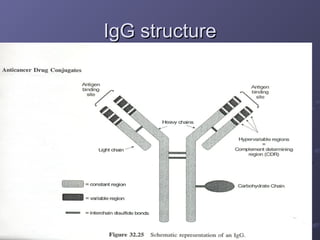
Murine immunoglobulin = glycoprotein that has a Y-shaped
structure: 2 identical polypeptide heavy chains and 2 identical
light chains linked by an S-S bond

Chimeric antibody = genetically engineered construct containing
a mouse Fab portion and a human Fc portion
3 main components
3 main components

Two identical Fabs (fragment-antigen binding site): the arms of
the Y
the Y

An Fc (for fragment crystallizable), the stem of the Y

Constant region responsible for triggering effector functions that
eliminate the antigen-associated cells

Constant region must be tailored to match requirements of the antibody
(depending on which antigen you want it to bind to)
IgG structure
IgG structure
3 MECHANISMS RESULTING IN
APOPTOSIS
APOPTOSIS
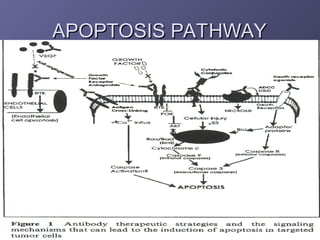
Antigen cross-linking
Activation of death receptors
Blockade of ligand-receptor growth or
survival pathways
survival pathways
1.
1. Antigen Cross-Linking
Antigen Cross-Linking
Target growth factor receptor

Antagonize ligand-receptor signaling

Growth-factor signaling mediated by the
receptor tyrosine kinase is inhibited

EGFR (epidermal growth factor receptor)

IGF-1R (insulin-like growth factor-1 receptor)

FGFR (fibroblast growth factor receptor)

PDGFR (platelet-derived growth factor receptor)

VEGFR (vascular endothelial growth factor)

Results in arrest of tumor cell growth
2.
2. Activation of death receptors
Activation of death receptors
Cross-link targeted surface antigens on
tumor cells and antibody agonists that
mimic ligand-mediated activation of
specific receptors
specific receptors

Response: intracellular Ca II ions increase

Activate caspase-3 and caspase-9 (involved
in cell apoptosis)
in cell apoptosis)
APOPTOSIS PATHWAY
APOPTOSIS PATHWAY
3.
3. Delivery of Cytotoxic Agents
Delivery of Cytotoxic Agents
Physically link antibodies to toxic
substances for delivery

Radio-immunoconjugates (aim of delivering
radiation directly to the tumor)

Toxin-immunoconjugates (deliver toxins
intracellularly)
intracellularly)

Antibody-directed enzyme pro-drug therapy
(ADEPT): localize enzymes to tumor cell
surfaces
surfaces
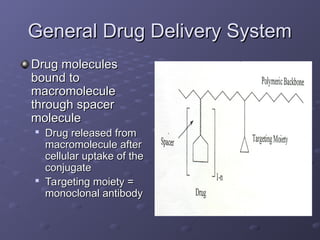
General Drug Delivery System
Drug molecules
Drug molecules
bound to
bound to
macromolecule
macromolecule
through spacer
through spacer
molecule
molecule

Drug released from
Drug released from
macromolecule after
macromolecule after
cellular uptake of the
conjugate
conjugate

Targeting moiety =
Targeting moiety =
monoclonal antibody
monoclonal antibody
TOXIN IMMUNOCONJUGATES
Cell surface antigen must internalize upon mAb binding
When drug is released, it interferes with protein
synthesis to induce apoptosis
3 methods to attach cytotoxic drug to variable regions of
mAb
mAb

a. Couple drug to lysine moieties in the mAb

b. Generation of aldehyde groups by oxidizing the carbohydrate
region and subsequent reaction with amino-containing drugs or
drug derivatives
drug derivatives

c. Couple drugs to sulfhydryl groups by selectively reducing the
interchain disulfides near the Fc region of the mAb
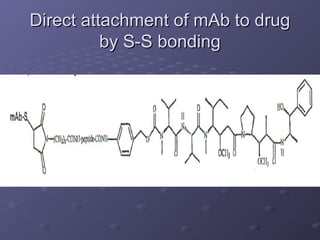
Direct attachment of mAb to drug
by S-S bonding
by S-S bonding
Immunoconjugate
Immunoconjugate
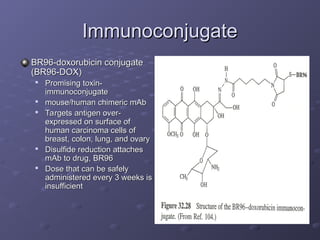
BR96-doxorubicin conjugate
(BR96-DOX)
(BR96-DOX)

Promising toxin-
Promising toxin-
immunoconjugate
immunoconjugate

mouse/human chimeric mAb

Targets antigen over-
expressed on surface of
human carcinoma cells of
breast, colon, lung, and ovary

Disulfide reduction attaches
mAb to drug, BR96
mAb to drug, BR96

Dose that can be safely
administered every 3 weeks is
insufficient
insufficient
Other examples of toxin-
immunoconjugates
immunoconjugates
KS1/4-MTX
KS1/4-MTX

Conjugate of methotrexate (MTX)

Coupling of MTX to the lysine moieties of the mAb

No significant clinical response
KS1/4-DAVLB
KS1/4-DAVLB

Conjugate of vinca alkaloid derivatives

Vinca alkaloid derivatives attached to amino groups of
lysine residues on KS1/4 mAb

No significant clinical response
Why are these toxin-
immunoconjugates unsuccessful?
Cause gastrointestinal toxicity
Inner regions of solid tumors poorly
vascularized and have low blood flow
(reduce amount of immunoconjugate
reaching these parts of the tumor)
Antigen expression is heterogenous on
tumor cells
tumor cells

Restricts the amount of cells that can be
effectively targeted by antibody conjugates
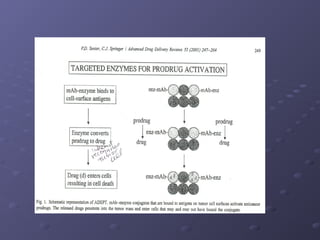
ADEPT ENZYMES (Antibody-
directed enzyme pro-drug therapy)
Chemically link the mAb to the enzyme of
interest; can also be a fusion protein produced
recombinantly with the antibody variable region
genes and the gene coding the enzyme
Convert subsequently administered anti-cancer
pro-drugs into active anti-tumor agents

Upon binding to targeted enzymes, it is converted into
active drug
active drug
Anti-growth factor mAb Therapy
Angiogenesis
Angiogenesis

Formation of nascent blood vessels
VEGF
VEGF

One of the most upregulated antigens in cancer

Protect endothelial cells from apoptosis via activation of PKC
pathways and upregulation of anti-apoptotic proteins such as
Bcl-2
Bcl-2

Activity mediated by tyrosine kinase receptors, VEGFR 1 and
VEGFR 2
VEGFR 2

Functions indirectly as survival factor for tumor cells
Inhibit VEGF signaling

Block the receptor
Block the receptor

Inhibits tumor growth and metastasis

Deprives tumors of nutrient-providing blood vessels
RITUXIMAB (Rituxan)
RITUXIMAB (Rituxan)
1
1st
st
therapeutic mAb approved by FDA in 1997

High-level expression of the gene encoding Rituximab was found

a mouse-chimeric mAb

Contains the human IgG1 and murine variable regions that target CD20
B-cell antigen
B-cell antigen
CD20 antigen function: cell cycle progression
Binding Rituximab to CD-20 causes: autophosphorylation, activation of
serine/tyrosine protein kinases, and induction of oncogene expression ---
induces apoptosis
induces apoptosis
Response rates of 50% to 70% in follicular lymphomas
Response rates of 90% to 100% when used in combination with
various chemotherpay procedures
Concluded that the dose of 4, once-weekly 375 mg/m squared IV
infusions of Rituximab was safe and effective in patients with
relapse or refractory B non-Hodgkin’s lymphoma
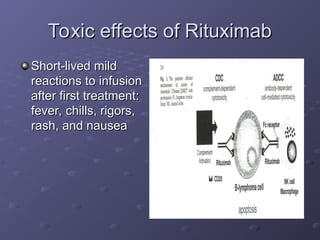
Toxic effects of Rituximab
Short-lived mild
Short-lived mild
reactions to infusion
after first treatment:
fever, chills, rigors,
rash, and nausea
rash, and nausea
Factors affecting pharmacokinetic
parameters
parameters
Circulating target antigens (which can lead to
rapid clearance)
rapid clearance)
Antigen-antibody internalization in cells (which
affect serum clearance and half-life)
Antibody size and domains with the Fc region

Fragments have shorter half-lives and more rapid
clearance rates than their full-sized immunoglobulins
FUTURE
FUTURE
Researchers hope to define the optimal
combinations of the use of mAb with
conventional chemotherapeutic agents
and with radiation therapy
Determine best therapy candidates and
expand clinical trials to other tumor types

ANTI-CANCER THERAPY understanding presentation

  • 1.
  • 2.
    Conventional Anti-Cancer Therapy ConventionalAnti-Cancer Therapy Chemotherapy: Imperfect Chemotherapy: Imperfect  Systematic nature of cytoxicity Systematic nature of cytoxicity  Agents lack intrinsic anti-tumor selectivity Agents lack intrinsic anti-tumor selectivity  Anti-proliferative mechanism on cells in cycle, Anti-proliferative mechanism on cells in cycle, rather than specific toxicity directed towards rather than specific toxicity directed towards particular cancer cell particular cancer cell  Host toxicity: treatment discontinued at dose Host toxicity: treatment discontinued at dose levels well below dose required to kill all levels well below dose required to kill all viable tumor cells viable tumor cells
  • 3.
    HISTORY HISTORY Emil von Behringin 1890 Emil von Behring in 1890  Discovered antibodies Discovered antibodies Paul Ehrlich (16 years later) Paul Ehrlich (16 years later)  Coined phrase, “magic bullets and poisoned arrows”: Coined phrase, “magic bullets and poisoned arrows”: use of antibodies to specifically target toxic use of antibodies to specifically target toxic substances in pathogenic substances substances in pathogenic substances Kohler and Milstein in 1975 Kohler and Milstein in 1975  Discovery of monoclonal antibodies (mAb) directed Discovery of monoclonal antibodies (mAb) directed against well-characterized antigens against well-characterized antigens  Use of DNA bio-engineered technologies within last Use of DNA bio-engineered technologies within last 25 years 25 years
  • 4.
    Rationale Rationale mAb as efficientcarriers for delivery of anti- mAb as efficient carriers for delivery of anti- tumor agents tumor agents  Enhanced vascular permeability of circulating Enhanced vascular permeability of circulating macromolecules for tumor tissue and subsequent macromolecules for tumor tissue and subsequent accumulation in solid tumors accumulation in solid tumors  Normal tissue: blood vessels have intact endothelial layer that Normal tissue: blood vessels have intact endothelial layer that permits passage of small molecules but not entry of permits passage of small molecules but not entry of macromolecules (like mAb) macromolecules (like mAb)  Tumor tissue: blood vessels leaky, so small and large Tumor tissue: blood vessels leaky, so small and large molecules have access to malignant tissue molecules have access to malignant tissue -tumor tissue generally do not have a lymphatic drainage -tumor tissue generally do not have a lymphatic drainage system; therefore, macromolecules are retained and can system; therefore, macromolecules are retained and can accumulate in solid tumors accumulate in solid tumors
  • 5.
    Patho-physiology of TumorTissue Patho-physiology of Tumor Tissue Angiogenesis Angiogenesis Hypervasculature Hypervasculature Impaired lymphatic drainage Impaired lymphatic drainage ***Due to these characteristics, tumors can ***Due to these characteristics, tumors can be exploited for tumor-selective drug be exploited for tumor-selective drug delivery**** delivery****
  • 6.
    Genetic Engineering Genetic Engineering Removeor modify effector functions of mAb: used to Remove or modify effector functions of mAb: used to avoid unwanted side effects avoid unwanted side effects Use mAb in their natural, fragmented, chemically Use mAb in their natural, fragmented, chemically modified, or recombinant forms modified, or recombinant forms Use of phage display antibody libraries or transgenic Use of phage display antibody libraries or transgenic animals animals  Identify animals that make desired antibodies Identify animals that make desired antibodies  Animals must be immunized using the cellular antigens and Animals must be immunized using the cellular antigens and immunization procedures used to generate conventional immunization procedures used to generate conventional antibodies antibodies  Perform cell fusions to generate clones and isolate stable Perform cell fusions to generate clones and isolate stable clones, making mAb clones, making mAb  Most mAb used in the clinical setting were generated Most mAb used in the clinical setting were generated in mice in mice
  • 7.
    Structure of Antibody Structureof Antibody Presently, all intact therapeutic antibodies are murine Presently, all intact therapeutic antibodies are murine immunoglobulins of the IgG class immunoglobulins of the IgG class  Murine immunoglobulin = glycoprotein that has a Y-shaped Murine immunoglobulin = glycoprotein that has a Y-shaped structure: 2 identical polypeptide heavy chains and 2 identical structure: 2 identical polypeptide heavy chains and 2 identical light chains linked by an S-S bond light chains linked by an S-S bond  Chimeric antibody = genetically engineered construct containing Chimeric antibody = genetically engineered construct containing a mouse Fab portion and a human Fc portion a mouse Fab portion and a human Fc portion 3 main components 3 main components  Two identical Fabs (fragment-antigen binding site): the arms of Two identical Fabs (fragment-antigen binding site): the arms of the Y the Y  An Fc (for fragment crystallizable), the stem of the Y An Fc (for fragment crystallizable), the stem of the Y  Constant region responsible for triggering effector functions that Constant region responsible for triggering effector functions that eliminate the antigen-associated cells eliminate the antigen-associated cells  Constant region must be tailored to match requirements of the antibody Constant region must be tailored to match requirements of the antibody (depending on which antigen you want it to bind to) (depending on which antigen you want it to bind to)
  • 8.
  • 9.
    3 MECHANISMS RESULTINGIN 3 MECHANISMS RESULTING IN APOPTOSIS APOPTOSIS Antigen cross-linking Antigen cross-linking Activation of death receptors Activation of death receptors Blockade of ligand-receptor growth or Blockade of ligand-receptor growth or survival pathways survival pathways
  • 10.
    1. 1. Antigen Cross-Linking AntigenCross-Linking Target growth factor receptor Target growth factor receptor  Antagonize ligand-receptor signaling Antagonize ligand-receptor signaling  Growth-factor signaling mediated by the Growth-factor signaling mediated by the receptor tyrosine kinase is inhibited receptor tyrosine kinase is inhibited  EGFR (epidermal growth factor receptor) EGFR (epidermal growth factor receptor)  IGF-1R (insulin-like growth factor-1 receptor) IGF-1R (insulin-like growth factor-1 receptor)  FGFR (fibroblast growth factor receptor) FGFR (fibroblast growth factor receptor)  PDGFR (platelet-derived growth factor receptor) PDGFR (platelet-derived growth factor receptor)  VEGFR (vascular endothelial growth factor) VEGFR (vascular endothelial growth factor)  Results in arrest of tumor cell growth Results in arrest of tumor cell growth
  • 11.
    2. 2. Activation ofdeath receptors Activation of death receptors Cross-link targeted surface antigens on Cross-link targeted surface antigens on tumor cells and antibody agonists that tumor cells and antibody agonists that mimic ligand-mediated activation of mimic ligand-mediated activation of specific receptors specific receptors  Response: intracellular Ca II ions increase Response: intracellular Ca II ions increase  Activate caspase-3 and caspase-9 (involved Activate caspase-3 and caspase-9 (involved in cell apoptosis) in cell apoptosis)
  • 12.
  • 13.
    3. 3. Delivery ofCytotoxic Agents Delivery of Cytotoxic Agents Physically link antibodies to toxic Physically link antibodies to toxic substances for delivery substances for delivery  Radio-immunoconjugates (aim of delivering Radio-immunoconjugates (aim of delivering radiation directly to the tumor) radiation directly to the tumor)  Toxin-immunoconjugates (deliver toxins Toxin-immunoconjugates (deliver toxins intracellularly) intracellularly)  Antibody-directed enzyme pro-drug therapy Antibody-directed enzyme pro-drug therapy (ADEPT): localize enzymes to tumor cell (ADEPT): localize enzymes to tumor cell surfaces surfaces
  • 14.
    General Drug DeliverySystem General Drug Delivery System Drug molecules Drug molecules bound to bound to macromolecule macromolecule through spacer through spacer molecule molecule  Drug released from Drug released from macromolecule after macromolecule after cellular uptake of the cellular uptake of the conjugate conjugate  Targeting moiety = Targeting moiety = monoclonal antibody monoclonal antibody
  • 15.
    TOXIN IMMUNOCONJUGATES TOXIN IMMUNOCONJUGATES Cellsurface antigen must internalize upon mAb binding Cell surface antigen must internalize upon mAb binding When drug is released, it interferes with protein When drug is released, it interferes with protein synthesis to induce apoptosis synthesis to induce apoptosis 3 methods to attach cytotoxic drug to variable regions of 3 methods to attach cytotoxic drug to variable regions of mAb mAb  a. Couple drug to lysine moieties in the mAb a. Couple drug to lysine moieties in the mAb  b. Generation of aldehyde groups by oxidizing the carbohydrate b. Generation of aldehyde groups by oxidizing the carbohydrate region and subsequent reaction with amino-containing drugs or region and subsequent reaction with amino-containing drugs or drug derivatives drug derivatives  c. Couple drugs to sulfhydryl groups by selectively reducing the c. Couple drugs to sulfhydryl groups by selectively reducing the interchain disulfides near the Fc region of the mAb interchain disulfides near the Fc region of the mAb
  • 16.
    Direct attachment ofmAb to drug Direct attachment of mAb to drug by S-S bonding by S-S bonding
  • 17.
    Immunoconjugate Immunoconjugate BR96-doxorubicin conjugate BR96-doxorubicin conjugate (BR96-DOX) (BR96-DOX)  Promisingtoxin- Promising toxin- immunoconjugate immunoconjugate  mouse/human chimeric mAb mouse/human chimeric mAb  Targets antigen over- Targets antigen over- expressed on surface of expressed on surface of human carcinoma cells of human carcinoma cells of breast, colon, lung, and ovary breast, colon, lung, and ovary  Disulfide reduction attaches Disulfide reduction attaches mAb to drug, BR96 mAb to drug, BR96  Dose that can be safely Dose that can be safely administered every 3 weeks is administered every 3 weeks is insufficient insufficient
  • 18.
    Other examples oftoxin- Other examples of toxin- immunoconjugates immunoconjugates KS1/4-MTX KS1/4-MTX  Conjugate of methotrexate (MTX) Conjugate of methotrexate (MTX)  Coupling of MTX to the lysine moieties of the mAb Coupling of MTX to the lysine moieties of the mAb  No significant clinical response No significant clinical response KS1/4-DAVLB KS1/4-DAVLB  Conjugate of vinca alkaloid derivatives Conjugate of vinca alkaloid derivatives  Vinca alkaloid derivatives attached to amino groups of Vinca alkaloid derivatives attached to amino groups of lysine residues on KS1/4 mAb lysine residues on KS1/4 mAb  No significant clinical response No significant clinical response
  • 19.
    Why are thesetoxin- Why are these toxin- immunoconjugates unsuccessful? immunoconjugates unsuccessful? Cause gastrointestinal toxicity Cause gastrointestinal toxicity Inner regions of solid tumors poorly Inner regions of solid tumors poorly vascularized and have low blood flow vascularized and have low blood flow (reduce amount of immunoconjugate (reduce amount of immunoconjugate reaching these parts of the tumor) reaching these parts of the tumor) Antigen expression is heterogenous on Antigen expression is heterogenous on tumor cells tumor cells  Restricts the amount of cells that can be Restricts the amount of cells that can be effectively targeted by antibody conjugates effectively targeted by antibody conjugates
  • 20.
    ADEPT ENZYMES (Antibody- ADEPTENZYMES (Antibody- directed enzyme pro-drug therapy) directed enzyme pro-drug therapy) Chemically link the mAb to the enzyme of Chemically link the mAb to the enzyme of interest; can also be a fusion protein produced interest; can also be a fusion protein produced recombinantly with the antibody variable region recombinantly with the antibody variable region genes and the gene coding the enzyme genes and the gene coding the enzyme Convert subsequently administered anti-cancer Convert subsequently administered anti-cancer pro-drugs into active anti-tumor agents pro-drugs into active anti-tumor agents  Upon binding to targeted enzymes, it is converted into Upon binding to targeted enzymes, it is converted into active drug active drug
  • 22.
    Anti-growth factor mAbTherapy Anti-growth factor mAb Therapy Angiogenesis Angiogenesis  Formation of nascent blood vessels Formation of nascent blood vessels VEGF VEGF  One of the most upregulated antigens in cancer One of the most upregulated antigens in cancer  Protect endothelial cells from apoptosis via activation of PKC Protect endothelial cells from apoptosis via activation of PKC pathways and upregulation of anti-apoptotic proteins such as pathways and upregulation of anti-apoptotic proteins such as Bcl-2 Bcl-2  Activity mediated by tyrosine kinase receptors, VEGFR 1 and Activity mediated by tyrosine kinase receptors, VEGFR 1 and VEGFR 2 VEGFR 2  Functions indirectly as survival factor for tumor cells Functions indirectly as survival factor for tumor cells Inhibit VEGF signaling Inhibit VEGF signaling  Block the receptor Block the receptor  Inhibits tumor growth and metastasis Inhibits tumor growth and metastasis  Deprives tumors of nutrient-providing blood vessels Deprives tumors of nutrient-providing blood vessels
  • 23.
    RITUXIMAB (Rituxan) RITUXIMAB (Rituxan) 1 1st st therapeuticmAb approved by FDA in 1997 therapeutic mAb approved by FDA in 1997  High-level expression of the gene encoding Rituximab was found High-level expression of the gene encoding Rituximab was found  a mouse-chimeric mAb a mouse-chimeric mAb  Contains the human IgG1 and murine variable regions that target CD20 Contains the human IgG1 and murine variable regions that target CD20 B-cell antigen B-cell antigen CD20 antigen function: cell cycle progression CD20 antigen function: cell cycle progression Binding Rituximab to CD-20 causes: autophosphorylation, activation of Binding Rituximab to CD-20 causes: autophosphorylation, activation of serine/tyrosine protein kinases, and induction of oncogene expression --- serine/tyrosine protein kinases, and induction of oncogene expression --- induces apoptosis induces apoptosis Response rates of 50% to 70% in follicular lymphomas Response rates of 50% to 70% in follicular lymphomas Response rates of 90% to 100% when used in combination with Response rates of 90% to 100% when used in combination with various chemotherpay procedures various chemotherpay procedures Concluded that the dose of 4, once-weekly 375 mg/m squared IV Concluded that the dose of 4, once-weekly 375 mg/m squared IV infusions of Rituximab was safe and effective in patients with infusions of Rituximab was safe and effective in patients with relapse or refractory B non-Hodgkin’s lymphoma relapse or refractory B non-Hodgkin’s lymphoma
  • 24.
    Toxic effects ofRituximab Toxic effects of Rituximab Short-lived mild Short-lived mild reactions to infusion reactions to infusion after first treatment: after first treatment: fever, chills, rigors, fever, chills, rigors, rash, and nausea rash, and nausea
  • 25.
    Factors affecting pharmacokinetic Factorsaffecting pharmacokinetic parameters parameters Circulating target antigens (which can lead to Circulating target antigens (which can lead to rapid clearance) rapid clearance) Antigen-antibody internalization in cells (which Antigen-antibody internalization in cells (which affect serum clearance and half-life) affect serum clearance and half-life) Antibody size and domains with the Fc region Antibody size and domains with the Fc region  Fragments have shorter half-lives and more rapid Fragments have shorter half-lives and more rapid clearance rates than their full-sized immunoglobulins clearance rates than their full-sized immunoglobulins
  • 26.
    FUTURE FUTURE Researchers hope todefine the optimal Researchers hope to define the optimal combinations of the use of mAb with combinations of the use of mAb with conventional chemotherapeutic agents conventional chemotherapeutic agents and with radiation therapy and with radiation therapy Determine best therapy candidates and Determine best therapy candidates and expand clinical trials to other tumor types expand clinical trials to other tumor types