ANSI Standards
Review
Prepared by Bill Hardy,TESCO
For North Carolina Electric Meter School
Thursday, June 29, 2017 at 8:00 a.m.
The Presenter
♦ Member of ANSI C12 since 2004
■ Voting member C12 Main, C12SC1, C12SC15,
C12SC16; C12SC29
● SC16 C12.20 (Vice-Chair)
● SC29 Field Testing (Chair)
● SC31 VA Measurement Standard (Chair)
● SC46 Electricity Metering 0.1. 0.2, 0.5 Accuracy
Classes for Measurement of Active, Apparent and
Reactive Power (Chair)
■ Author: Power Measurements Handbook
■ Contributing Author: Handbook of Electricity
Metering
Slide 2
ANSI
♦ American National Standard Institute, Inc.
■ Not a government agency
■ Standards do not have force of Law
■ All compliance is voluntary
■ ANSI doesn’t actually generate any standards
■ Each standard is controlled by an industry
organization as the “secretariat”
● For C12 NEMA (National Electrical Manufacturer’s
Association) is the secretariat
● Paul Orr is NEMA’s secretary of C12
Slide 3
ANSI
♦ American National Standard Institute, Inc.
■ NEMA organizes committees to propose and
review standards
■ Standards are republished approximately every 5
years
■ Standards codify consensus approaches in
common practice
■ Generally, they do not break new ground or deal
in controversial issues.
● This is changing. Can’t avoid issues any longer.
Slide 4
ANSI C12
♦ C12 Main Committee
■ General makeup has expanded slightly over last
few years
■ 34 voting members with representation from three
groups:
● 12 - Manufacturers: Meter, Socket, Test Equipment, etc.
● 13 - Users: Utilities
● 9 - General Interest: PUC, UL, IEEE, Consultants, etc.
■ Usually meets twice a year in conjunction with
EEI/AEIC
Slide 5
ANSI C12
♦ C12 Main Committee
■ Has final approval for all activities on any C12
family standard.
■ Establishes Subcommitties (SC) and Working
Groups (WG) to address various standards and
issues.
■ Meets twice a year in conjunction with EEI
Transmission, Distribution and Metering
Conference.
Slide 6
ANSI C12
♦ C12 Subcommittees
■ Various subcommittees have been organized to
review specific standards
■ This is where the work is really done.
■ Each operates slightly differently
■ Each meets on a schedule of its own choosing
■ Most meet at EEI Biannual Transmission,
Distribution and Metering Meetings
■ Communication WG meets more often and longer
■ Various subgroups meet frequently by
teleconference.
Slide 7
ANSI C12 – Sub-Committees
Sub-Committee Standards
C12 SC1 C12.1, C12.4, C12.5, C12.10
C12 SC15 C12.6, C12.7, C12.8, C12.9, C12.11
C12 SC16 C12.20
C12 SC17 C12.18, C12.19, C12.21, C12.22, C12.23, C12.26
C12 SC29 C12.29 Standard for Field Testing of Metering Sites
C12 SC31 C12.31 VA Measurement Standard
C12 SC46
C12.46 American National Standard for Electricity
Meters - 0.1, 0.2 and 0.5 Accuracy Classes for the
Measurement of Active, Apparent and Reactive Power
Slide 8
ANSI C12 SC 1
♦ C12.1 -2014 – Code for Electricity Metering
■ Published 6/30/2016
■ Changes in this Revision
●Vector diagrams for balanced voltages are defined
for common services.
●Various definitions have been updated.
●Bi-directional metering is added and tests updated
to include bidirectional measurements.
●Significant changes were made to the temperature
rise section based on TRINIWOG tests
Slide 9
ANSI C12 SC 1
♦ C12.1 – Code for Electricity Metering
■ Changes in this Revision (continued)
●Table 1b on maximum errors for reference
standards was added.
■ Tightened to 0.05% and 0.02%
●Accuracy Class 0.5 was added to the standard
●A new column was added to all tables with tighter
specs for AC 0.5
●Section 5 on Standards for New and In Service
Performance was completely rewritten
●Appendix D was rewritten and simplified
●A new Appendix F was added
Slide 10
ANSI C12 SC 1
♦ C12.1 – Code for Electricity Metering
■ Safety
●Work is under way to move the safety related
sections of C12.1 into C12.10
●C12 is coordinating efforts with UL and its work on
Subject 2735
♦ SC 1 is in the process of being broken into
two separate committees.
■ SC1 will focus on C12.1.
■ The new SC will focus on C12.10
Slide 11
ANSI C12 SC 1
♦ C12.10 – Physical Aspects of Watthour
Meters – Safety Standards
■ Published C12.10 – 2011
■ New revision ready for ballot
●Will add safety sections from C12.1
●New safety requirements in development
●Working with UL to achieve consistency with UL
2735C
●New meter forms with auxiliary power pins have
been added
Slide 12
ANSI C12 SC 1
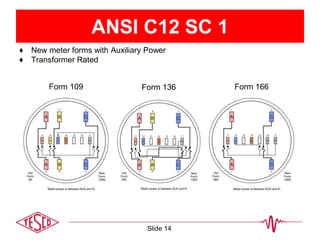
♦ New meter forms with Auxiliary Power
■ Seven new forms approved
Old Form New Form
AUX Power
Pin
AUX Neutral
Pin
3S 103S 6 5, 5A
9S 109S 14 17
12S 112S 6 5, 5A, 10
35S 135S 14 17
36S 136S 14 17
45S 145S 14 17
66S 166S 14 17
Slide 13
ANSI C12 SC 1
♦ New meter forms with Auxiliary Power
♦ Transformer Rated
Slide 14
Form 109 Form 136 Form 166
ANSI C12 SC 1
♦ New meter forms with Auxiliary Power
■ Transformer Rated
Slide 15
Form 135 Form 145
ANSI C12 SC 1
♦ New meter forms with Auxiliary Power
■ Self contained
Slide 16
Form 103 Form 112
ANSI C12 SC 15
• C12.6 – Marking and Arrangement of
Terminals for Phase-Shifting Devices used
in Metering
 Re-Published without change Sept 2012
• C12.7 – Requirements for Watthour Meter
Sockets
• Published – Feb 2015
Slide 17
ANSI C12 SC 15
• C12.8– Test Block and Cabinets for
Installation of Self contained “A” Base
Watthour Meters
 Published without change Dec 2012
• C12.9 – Test Switches and Plugs for
Transformer Rated Meters
 Extensive Revision just completed
 Specifications for test plugs added
 Published – March 2015
Slide 18
ANSI C12 SC 15
• C12.11– Instrument Transformers for
Revenue Metering, 10kBIL through 350
kBIL
 Revised to parallel C57.13
 Published – July 2014
Slide 19
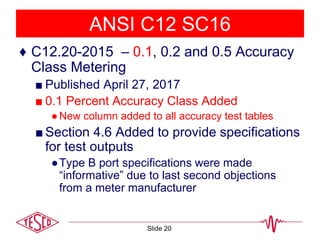
ANSI C12 SC16
♦ C12.20-2015 – 0.1, 0.2 and 0.5 Accuracy
Class Metering
■ Published April 27, 2017
■ 0.1 Percent Accuracy Class Added
●New column added to all accuracy test tables
■Section 4.6 Added to provide specifications
for test outputs
●Type B port specifications were made
“informative” due to last second objections
from a meter manufacturer
Slide 20
ANSI C12 SC16
♦ C12.20 – 0.1, 0.2 and 0.5 Accuracy Class
Metering
■ Tighter performance at reference conditions
was specified
■ Table 2 updated to make clear which forms
and applications are Blondel compliant.
■ Table 2A added to make clear which forms and
applications are NOT Blondel compliant
Slide 21
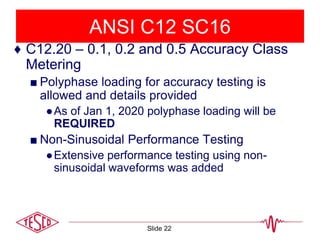
ANSI C12 SC16
♦ C12.20 – 0.1, 0.2 and 0.5 Accuracy Class
Metering
■ Polyphase loading for accuracy testing is
allowed and details provided
●As of Jan 1, 2020 polyphase loading will be
REQUIRED
■ Non-Sinusoidal Performance Testing
●Extensive performance testing using non-
sinusoidal waveforms was added
Slide 22
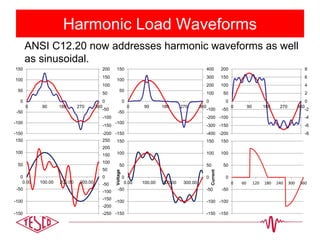
Harmonic Load Waveforms
ANSI C12.20 now addresses harmonic waveforms as well
as sinusoidal.
-400
-300
-200
-100
0
100
200
300
400
-150
-100
-50
0
50
100
150
0 90 180 270 360
-200
-150
-100
-50
0
50
100
150
200
-150
-100
-50
0
50
100
150
0 90 180 270 360
-8
-6
-4
-2
0
2
4
6
8
-200
-150
-100
-50
0
50
100
150
200
0 90 180 270 360
-150
-100
-50
0
50
100
150
0 60 120 180 240 300 360
-250
-200
-150
-100
-50
0
50
100
150
200
250
-150
-100
-50
0
50
100
150
0.00 100.00 200.00 300.00
-150
-100
-50
0
50
100
150
-150
-100
-50
0
50
100
150
0.00 100.00 200.00 300.00
Current
Voltage
ANSI C12 SC 17
♦ C12.18 – Protocol Specification for ANSI
Type 2 Optical Port
●Reaffirmed and published 3/16/2017
♦ C12.19 -2015– Utility Industry End Device
Data Tables
●Major additions in process.
♦ C12.21 – Protocol Specification for
Telephone Modem Communication
●Published 3/21/17
Slide 24
ANSI C12 SC29
Field Testing of Metering Installations
♦ Field Testing of Metering Accuracy
■ Nearly ready for publication
■ New approach to testing
●Perform the test in any of several approaches
●If test is within the specified window then it is
acceptable
Slide 25
ANSI C12 SC29
Field Testing of Metering Installations
Slide 26
Low Temperature Range
(LTR)
Tmin < T < 0°C where Tmin is the lowest operating temperature
certified by the manufacturer
Normal Temperature
Range (NTR)
0°C ≤ T ≤ 50°C Range over which performance is expected to
match the “Nominal” requirements
High Temperature Range
(HTR)
50°C < T < Tmax where Tmax is the highest operating temperature
certified by the manufacturer
Table 1 – Temperature ranges
Normal Harmonic
Distortion (NHD)
THD ≤ 30% Range over which harmonic distortion on
the voltage is expected to have no
significant effect.
High Harmonic
Distortion (HHD)
THD > 30% Range over which harmonic distortion on
the voltage may have an effect outside of
normal accuracy expectations.
Table 2 Voltage Quality (Harmonic content)
ANSI C12 SC29
Field Testing of Metering Installations
Slide 27
Current Class Low Current Normal Current
2 I < 0.025 0.025 ≤ I ≤ 2
10 I < 0.25 0.25 ≤ I ≤ 10
20 I < 0.25 0.25 ≤ I ≤ 20
100 I < 1.5 1.5 ≤ I ≤ 100
200 I < 3.0 3.0 ≤ I ≤ 200
320 I < 5.0 5.0 ≤ I ≤ 320
Table 3 – Current ranges by current class
Low Harmonic Content
(LHC)
THD ≤ 100% Range over which harmonic
distortion on the current is expected
to have no significant effect.
High Harmonic Content
(HHC)
THD > 100% Range over which harmonic
distortion on the current may have
an effect outside of normal accuracy
expectations.
Table 4 – Current ranges by harmonic content
ANSI C12 SC29
Field Testing of Metering Installations
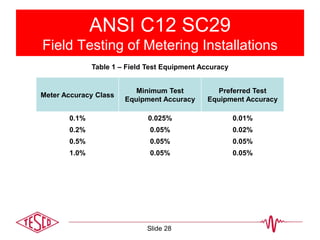
Slide 28
Meter Accuracy Class
Minimum Test
Equipment Accuracy
Preferred Test
Equipment Accuracy
0.1% 0.025% 0.01%
0.2% 0.05% 0.02%
0.5% 0.05% 0.05%
1.0% 0.05% 0.05%
Table 1 – Field Test Equipment Accuracy
ANSI C12 SC29
Field Testing of Metering Installations
Slide 29
Meter Accuracy
Class
Maximum
Expected Error
0.1% 0.25%
0.2% 0.5%
0.5% 1.0%
1.0% 2.0%
Table 2 – Expected Test Accuracy
ANSI C12 SC29
Field Testing of Metering Installations
♦ Issues still to be addressed
■ Field Testing of Current Transformers in the
Metering Circuit
●Ratio Testing
●Ratio Testing with Applied Burden
●Admittance Testing
■ Field Testing of Potential Transformers in
the Metering Circuit
●Ratio Testing
●Ratio Testing with Applied Burden
■ Validation of Wiring
Slide 30
ANSI C12.31
♦ At the moment there is no non-sinusoidal
definition for VA
♦ New ANSI Standard coming very soon
C12.31
Slide 31
New Definitions
RMS Voltage
Slide 32
Basic Definition
Time Domain
Frequency Domain
Waveform
New Definitions
RMS Current
Slide 33
Basic Definition
Time Domain
Frequency Domain
Waveform
New Definitions
Active Power
Slide 34
Basic Definition
Time Domain
Frequency Domain
New Definitions
Apparent Power
Slide 35
Basic Definition
Time Domain
Frequency Domain
ANSI C12.46
♦ New Sub-Committee to Develop a
Replacement for C12.1 and C12.20
■ Adopts the structure of OIML IR-46
■ Addresses 0.1, 0.2, and 0.5 Accuracy Classes
■ Addresses Active, Reactive, and Apparent
Energy
■ Will be biggest change to metering standards in
100 years
■ Review and editing of draft in process
■ Expected Publication 2020
Slide 36
Questions and Discussion
Slide 37
Bill Hardy, CTO
TESCO – The Eastern Specialty Company
Bristol, PA
865-279-1090 (cell)
215-785-2338 (office)
This presentation can also be found under Meter
Conferences and Schools on the TESCO website:
www.tesco-advent.com

ANSI Standards Review

  • 1.
    ANSI Standards Review Prepared byBill Hardy,TESCO For North Carolina Electric Meter School Thursday, June 29, 2017 at 8:00 a.m.
  • 2.
    The Presenter ♦ Memberof ANSI C12 since 2004 ■ Voting member C12 Main, C12SC1, C12SC15, C12SC16; C12SC29 ● SC16 C12.20 (Vice-Chair) ● SC29 Field Testing (Chair) ● SC31 VA Measurement Standard (Chair) ● SC46 Electricity Metering 0.1. 0.2, 0.5 Accuracy Classes for Measurement of Active, Apparent and Reactive Power (Chair) ■ Author: Power Measurements Handbook ■ Contributing Author: Handbook of Electricity Metering Slide 2
  • 3.
    ANSI ♦ American NationalStandard Institute, Inc. ■ Not a government agency ■ Standards do not have force of Law ■ All compliance is voluntary ■ ANSI doesn’t actually generate any standards ■ Each standard is controlled by an industry organization as the “secretariat” ● For C12 NEMA (National Electrical Manufacturer’s Association) is the secretariat ● Paul Orr is NEMA’s secretary of C12 Slide 3
  • 4.
    ANSI ♦ American NationalStandard Institute, Inc. ■ NEMA organizes committees to propose and review standards ■ Standards are republished approximately every 5 years ■ Standards codify consensus approaches in common practice ■ Generally, they do not break new ground or deal in controversial issues. ● This is changing. Can’t avoid issues any longer. Slide 4
  • 5.
    ANSI C12 ♦ C12Main Committee ■ General makeup has expanded slightly over last few years ■ 34 voting members with representation from three groups: ● 12 - Manufacturers: Meter, Socket, Test Equipment, etc. ● 13 - Users: Utilities ● 9 - General Interest: PUC, UL, IEEE, Consultants, etc. ■ Usually meets twice a year in conjunction with EEI/AEIC Slide 5
  • 6.
    ANSI C12 ♦ C12Main Committee ■ Has final approval for all activities on any C12 family standard. ■ Establishes Subcommitties (SC) and Working Groups (WG) to address various standards and issues. ■ Meets twice a year in conjunction with EEI Transmission, Distribution and Metering Conference. Slide 6
  • 7.
    ANSI C12 ♦ C12Subcommittees ■ Various subcommittees have been organized to review specific standards ■ This is where the work is really done. ■ Each operates slightly differently ■ Each meets on a schedule of its own choosing ■ Most meet at EEI Biannual Transmission, Distribution and Metering Meetings ■ Communication WG meets more often and longer ■ Various subgroups meet frequently by teleconference. Slide 7
  • 8.
    ANSI C12 –Sub-Committees Sub-Committee Standards C12 SC1 C12.1, C12.4, C12.5, C12.10 C12 SC15 C12.6, C12.7, C12.8, C12.9, C12.11 C12 SC16 C12.20 C12 SC17 C12.18, C12.19, C12.21, C12.22, C12.23, C12.26 C12 SC29 C12.29 Standard for Field Testing of Metering Sites C12 SC31 C12.31 VA Measurement Standard C12 SC46 C12.46 American National Standard for Electricity Meters - 0.1, 0.2 and 0.5 Accuracy Classes for the Measurement of Active, Apparent and Reactive Power Slide 8
  • 9.
    ANSI C12 SC1 ♦ C12.1 -2014 – Code for Electricity Metering ■ Published 6/30/2016 ■ Changes in this Revision ●Vector diagrams for balanced voltages are defined for common services. ●Various definitions have been updated. ●Bi-directional metering is added and tests updated to include bidirectional measurements. ●Significant changes were made to the temperature rise section based on TRINIWOG tests Slide 9
  • 10.
    ANSI C12 SC1 ♦ C12.1 – Code for Electricity Metering ■ Changes in this Revision (continued) ●Table 1b on maximum errors for reference standards was added. ■ Tightened to 0.05% and 0.02% ●Accuracy Class 0.5 was added to the standard ●A new column was added to all tables with tighter specs for AC 0.5 ●Section 5 on Standards for New and In Service Performance was completely rewritten ●Appendix D was rewritten and simplified ●A new Appendix F was added Slide 10
  • 11.
    ANSI C12 SC1 ♦ C12.1 – Code for Electricity Metering ■ Safety ●Work is under way to move the safety related sections of C12.1 into C12.10 ●C12 is coordinating efforts with UL and its work on Subject 2735 ♦ SC 1 is in the process of being broken into two separate committees. ■ SC1 will focus on C12.1. ■ The new SC will focus on C12.10 Slide 11
  • 12.
    ANSI C12 SC1 ♦ C12.10 – Physical Aspects of Watthour Meters – Safety Standards ■ Published C12.10 – 2011 ■ New revision ready for ballot ●Will add safety sections from C12.1 ●New safety requirements in development ●Working with UL to achieve consistency with UL 2735C ●New meter forms with auxiliary power pins have been added Slide 12
  • 13.
    ANSI C12 SC1 ♦ New meter forms with Auxiliary Power ■ Seven new forms approved Old Form New Form AUX Power Pin AUX Neutral Pin 3S 103S 6 5, 5A 9S 109S 14 17 12S 112S 6 5, 5A, 10 35S 135S 14 17 36S 136S 14 17 45S 145S 14 17 66S 166S 14 17 Slide 13
  • 14.
    ANSI C12 SC1 ♦ New meter forms with Auxiliary Power ♦ Transformer Rated Slide 14 Form 109 Form 136 Form 166
  • 15.
    ANSI C12 SC1 ♦ New meter forms with Auxiliary Power ■ Transformer Rated Slide 15 Form 135 Form 145
  • 16.
    ANSI C12 SC1 ♦ New meter forms with Auxiliary Power ■ Self contained Slide 16 Form 103 Form 112
  • 17.
    ANSI C12 SC15 • C12.6 – Marking and Arrangement of Terminals for Phase-Shifting Devices used in Metering  Re-Published without change Sept 2012 • C12.7 – Requirements for Watthour Meter Sockets • Published – Feb 2015 Slide 17
  • 18.
    ANSI C12 SC15 • C12.8– Test Block and Cabinets for Installation of Self contained “A” Base Watthour Meters  Published without change Dec 2012 • C12.9 – Test Switches and Plugs for Transformer Rated Meters  Extensive Revision just completed  Specifications for test plugs added  Published – March 2015 Slide 18
  • 19.
    ANSI C12 SC15 • C12.11– Instrument Transformers for Revenue Metering, 10kBIL through 350 kBIL  Revised to parallel C57.13  Published – July 2014 Slide 19
  • 20.
    ANSI C12 SC16 ♦C12.20-2015 – 0.1, 0.2 and 0.5 Accuracy Class Metering ■ Published April 27, 2017 ■ 0.1 Percent Accuracy Class Added ●New column added to all accuracy test tables ■Section 4.6 Added to provide specifications for test outputs ●Type B port specifications were made “informative” due to last second objections from a meter manufacturer Slide 20
  • 21.
    ANSI C12 SC16 ♦C12.20 – 0.1, 0.2 and 0.5 Accuracy Class Metering ■ Tighter performance at reference conditions was specified ■ Table 2 updated to make clear which forms and applications are Blondel compliant. ■ Table 2A added to make clear which forms and applications are NOT Blondel compliant Slide 21
  • 22.
    ANSI C12 SC16 ♦C12.20 – 0.1, 0.2 and 0.5 Accuracy Class Metering ■ Polyphase loading for accuracy testing is allowed and details provided ●As of Jan 1, 2020 polyphase loading will be REQUIRED ■ Non-Sinusoidal Performance Testing ●Extensive performance testing using non- sinusoidal waveforms was added Slide 22
  • 23.
    Harmonic Load Waveforms ANSIC12.20 now addresses harmonic waveforms as well as sinusoidal. -400 -300 -200 -100 0 100 200 300 400 -150 -100 -50 0 50 100 150 0 90 180 270 360 -200 -150 -100 -50 0 50 100 150 200 -150 -100 -50 0 50 100 150 0 90 180 270 360 -8 -6 -4 -2 0 2 4 6 8 -200 -150 -100 -50 0 50 100 150 200 0 90 180 270 360 -150 -100 -50 0 50 100 150 0 60 120 180 240 300 360 -250 -200 -150 -100 -50 0 50 100 150 200 250 -150 -100 -50 0 50 100 150 0.00 100.00 200.00 300.00 -150 -100 -50 0 50 100 150 -150 -100 -50 0 50 100 150 0.00 100.00 200.00 300.00 Current Voltage
  • 24.
    ANSI C12 SC17 ♦ C12.18 – Protocol Specification for ANSI Type 2 Optical Port ●Reaffirmed and published 3/16/2017 ♦ C12.19 -2015– Utility Industry End Device Data Tables ●Major additions in process. ♦ C12.21 – Protocol Specification for Telephone Modem Communication ●Published 3/21/17 Slide 24
  • 25.
    ANSI C12 SC29 FieldTesting of Metering Installations ♦ Field Testing of Metering Accuracy ■ Nearly ready for publication ■ New approach to testing ●Perform the test in any of several approaches ●If test is within the specified window then it is acceptable Slide 25
  • 26.
    ANSI C12 SC29 FieldTesting of Metering Installations Slide 26 Low Temperature Range (LTR) Tmin < T < 0°C where Tmin is the lowest operating temperature certified by the manufacturer Normal Temperature Range (NTR) 0°C ≤ T ≤ 50°C Range over which performance is expected to match the “Nominal” requirements High Temperature Range (HTR) 50°C < T < Tmax where Tmax is the highest operating temperature certified by the manufacturer Table 1 – Temperature ranges Normal Harmonic Distortion (NHD) THD ≤ 30% Range over which harmonic distortion on the voltage is expected to have no significant effect. High Harmonic Distortion (HHD) THD > 30% Range over which harmonic distortion on the voltage may have an effect outside of normal accuracy expectations. Table 2 Voltage Quality (Harmonic content)
  • 27.
    ANSI C12 SC29 FieldTesting of Metering Installations Slide 27 Current Class Low Current Normal Current 2 I < 0.025 0.025 ≤ I ≤ 2 10 I < 0.25 0.25 ≤ I ≤ 10 20 I < 0.25 0.25 ≤ I ≤ 20 100 I < 1.5 1.5 ≤ I ≤ 100 200 I < 3.0 3.0 ≤ I ≤ 200 320 I < 5.0 5.0 ≤ I ≤ 320 Table 3 – Current ranges by current class Low Harmonic Content (LHC) THD ≤ 100% Range over which harmonic distortion on the current is expected to have no significant effect. High Harmonic Content (HHC) THD > 100% Range over which harmonic distortion on the current may have an effect outside of normal accuracy expectations. Table 4 – Current ranges by harmonic content
  • 28.
    ANSI C12 SC29 FieldTesting of Metering Installations Slide 28 Meter Accuracy Class Minimum Test Equipment Accuracy Preferred Test Equipment Accuracy 0.1% 0.025% 0.01% 0.2% 0.05% 0.02% 0.5% 0.05% 0.05% 1.0% 0.05% 0.05% Table 1 – Field Test Equipment Accuracy
  • 29.
    ANSI C12 SC29 FieldTesting of Metering Installations Slide 29 Meter Accuracy Class Maximum Expected Error 0.1% 0.25% 0.2% 0.5% 0.5% 1.0% 1.0% 2.0% Table 2 – Expected Test Accuracy
  • 30.
    ANSI C12 SC29 FieldTesting of Metering Installations ♦ Issues still to be addressed ■ Field Testing of Current Transformers in the Metering Circuit ●Ratio Testing ●Ratio Testing with Applied Burden ●Admittance Testing ■ Field Testing of Potential Transformers in the Metering Circuit ●Ratio Testing ●Ratio Testing with Applied Burden ■ Validation of Wiring Slide 30
  • 31.
    ANSI C12.31 ♦ Atthe moment there is no non-sinusoidal definition for VA ♦ New ANSI Standard coming very soon C12.31 Slide 31
  • 32.
    New Definitions RMS Voltage Slide32 Basic Definition Time Domain Frequency Domain Waveform
  • 33.
    New Definitions RMS Current Slide33 Basic Definition Time Domain Frequency Domain Waveform
  • 34.
    New Definitions Active Power Slide34 Basic Definition Time Domain Frequency Domain
  • 35.
    New Definitions Apparent Power Slide35 Basic Definition Time Domain Frequency Domain
  • 36.
    ANSI C12.46 ♦ NewSub-Committee to Develop a Replacement for C12.1 and C12.20 ■ Adopts the structure of OIML IR-46 ■ Addresses 0.1, 0.2, and 0.5 Accuracy Classes ■ Addresses Active, Reactive, and Apparent Energy ■ Will be biggest change to metering standards in 100 years ■ Review and editing of draft in process ■ Expected Publication 2020 Slide 36
  • 37.
    Questions and Discussion Slide37 Bill Hardy, CTO TESCO – The Eastern Specialty Company Bristol, PA 865-279-1090 (cell) 215-785-2338 (office) This presentation can also be found under Meter Conferences and Schools on the TESCO website: www.tesco-advent.com