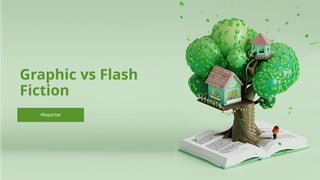
Graphic vs Flash
Fiction
•Reporter
Comparison of
Graphic and Flash
Fiction
03.
Overview of Graphic
Fiction
01.
Overview of Flash
Fiction
02.
The Role of Visual
Elements
04.
CONTENTS
Table of
Contents
Conclusion
06.
The Future of Graphic
and Flash Fiction
05.
Overview of Graphic
Fiction
01.
Definition and Characteristics
Graphic fiction is a literary form that combines text and visual
art to convey a story. It encompasses formats such as comic
books, graphic novels, and illustrated texts. This medium
allows for intricate storytelling where visuals play an important
role in narrative development.
What is Graphic Fiction?
Unique features of graphic fiction include the synergy of
images and words, sequential art, and a focus on visual
expression. This format often utilizes panels, speech bubbles,
and diverse artistic styles to enhance storytelling and engage
readers in a multi-dimensional experience.
Unique Features
Notable examples of graphic fiction include "Maus" by Art
Spiegelman, "Persepolis" by Marjane Satrapi, and "Watchmen"
by Alan Moore. Each of these works has pushed the
boundaries of storytelling, addressing complex themes
through innovative combinations of text and imagery.
Notable Examples
Narrative Techniques
Visual storytelling involves the use
of images to convey emotions and
plot points that words alone may
not capture. Techniques like
framing, perspective, and
symbolism enhance the narrative
depth and provide insights into
characters and settings.
Visual Storytelling
The use of colors and typography
in graphic fiction is crucial for
setting the mood and tone of the
story. Color palettes can evoke
emotions, while text styles can
highlight key dialogues or themes,
creating a dynamic reading
experience.
Use of Colors and Text
Reader engagement in graphic
fiction is heightened through
interactive visual elements and
narrative pacing. The juxtaposition
of images and text invites readers
to interpret meaning actively,
fostering a deeper connection with
the story.
Reader Engagement
Overview of Flash
Fiction
02.
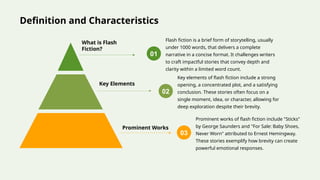
Definition and Characteristics
What is Flash
Fiction?
Flash fiction is a brief form of storytelling, usually
under 1000 words, that delivers a complete
narrative in a concise format. It challenges writers
to craft impactful stories that convey depth and
clarity within a limited word count.
01
Key Elements
Key elements of flash fiction include a strong
opening, a concentrated plot, and a satisfying
conclusion. These stories often focus on a
single moment, idea, or character, allowing for
deep exploration despite their brevity.
02
Prominent Works
Prominent works of flash fiction include "Sticks"
by George Saunders and "For Sale: Baby Shoes,
Never Worn" attributed to Ernest Hemingway.
These stories exemplify how brevity can create
powerful emotional responses.
03
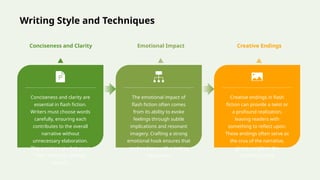
Writing Style and Techniques
Conciseness and clarity are
essential in flash fiction.
Writers must choose words
carefully, ensuring each
contributes to the overall
narrative without
unnecessary elaboration.
This precision is what gives
flash fiction its striking
impact.
The emotional impact of
flash fiction often comes
from its ability to evoke
feelings through subtle
implications and resonant
imagery. Crafting a strong
emotional hook ensures that
readers leave with a lasting
impression.
Creative endings in flash
fiction can provide a twist or
a profound realization,
leaving readers with
something to reflect upon.
These endings often serve as
the crux of the narrative,
giving weight to the
preceding story.
Conciseness and Clarity Emotional Impact Creative Endings
Comparison of
Graphic and Flash
Fiction
03.
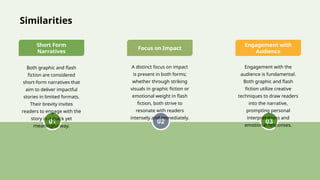
Similarities
01 02 03
Short Form
Narratives
Focus on Impact
Engagement with
Audience
Both graphic and flash
fiction are considered
short-form narratives that
aim to deliver impactful
stories in limited formats.
Their brevity invites
readers to engage with the
story in a quick yet
meaningful way.
A distinct focus on impact
is present in both forms;
whether through striking
visuals in graphic fiction or
emotional weight in flash
fiction, both strive to
resonate with readers
intensely and immediately.
Engagement with the
audience is fundamental.
Both graphic and flash
fiction utilize creative
techniques to draw readers
into the narrative,
prompting personal
interpretations and
emotional responses.
Differences
Storytelling Approaches
Storytelling approaches vary significantly; graphic fiction
leverages layout and art to enhance narrative depth, while flash
fiction focuses on brevity and poignant language to deliver
emotional resonance.
02
Medium of Expression
The primary difference lies in the medium; graphic fiction utilizes
images and visual storytelling, creating a unique experience
compared to flash fiction, which relies solely on written words to
convey its message.
01
Audience Experience
The audience experience differs with graphic fiction providing a
visually immersive journey, whereas flash fiction often invites
readers to engage intellectually with the text, contemplating its
meaning and implications.
03
The Role of Visual
Elements
04.
In Graphic Fiction
01 02 03
Importance of Artwork
Artwork is crucial in graphic
fiction, serving not only as
decoration but as an integral
part of the narrative. It helps to
convey emotions, develop
characters, and immerse the
reader in the story’s world.
Visual Metaphors
Visual metaphors enrich the
storytelling experience by
providing deeper layers of
meaning. Illustrations can
symbolize themes or emotions,
adding complexity and
prompting readers to think
critically about the narrative.
Integration of Text and
Images
The integration of text and
images is a defining aspect of
graphic fiction. Effective balance
between the two enhances
storytelling, ensuring that
neither overshadows the other,
creating a cohesive reading
experience.
In Flash Fiction
01
02
03
In flash fiction, imagery is created entirely through words.
Writers must paint vivid pictures and evoke sensory
experiences using descriptive language, enabling readers to
visualize the story in their minds.
Imagery through Words
Subtext plays an essential role in flash fiction, often relying on
subtleties that invite readers to infer deeper meanings. This
engagement allows for a richer exploration of themes and
emotions within the brief narrative.
Subtext and Inference
Evocative descriptions in flash fiction provide powerful imagery
in fewer words. The challenge lies in conveying details that
evoke strong emotions and create lasting impressions in a
condensed format.
Evocative Descriptions
The Future of
Graphic and Flash
Fiction
05.
Trends in Graphic Fiction
Digital Evolution
Digital evolution has
transformed graphic
fiction, enabling
creators to explore new
formats and reach
wider audiences
through online
platforms and digital
publishing. This shift
fosters
Expanding Genres
Expanding genres
within graphic fiction
has led to diverse
narratives
encompassing various
themes and styles,
ranging from
autobiographical works
to speculative fiction.
This diversification
Diverse Voices
The inclusion of diverse
voices in graphic fiction
enriches the
storytelling landscape.
Creators from various
backgrounds bring
unique perspectives,
broadening
representation and
fostering greater
Trends in Flash Fiction
Community Engagement
Community engagement
in flash fiction is
increasingly evident as
writers connect through
contests, workshops, and
literature festivals,
creating spaces for
sharing and discussing
short stories while
fostering a sense of
belonging among writers.
Platforms for
Expression
Emerging platforms for
expressing flash fiction,
such as social media and
online writing
communities, provide
opportunities for writers
to share their work easily.
This accessibility promotes
a vibrant culture of literary
experimentation and
collaboration.
Influence of Social
Media
The influence of social
media on flash fiction has
led to the rise of micro
storytelling, with platforms
allowing for rapid sharing
of concepts and
narratives. This trend
encourages brevity and
innovation in content
creation.
Conclusion
06.
Summary of Key Points
Key highlights of graphic fiction include its innovative use of visuals to
convey narratives, the seamless integration of art and text, and its
ability to address complex themes in an accessible format.
Highlights of Graphic Fiction
Highlights of flash fiction encompass its focus on brevity, the power of
concise storytelling, and the emotional depth achievable in just a few
words, making it a compelling form of literature.
Highlights of Flash Fiction
Final Thoughts
Importance of Both Forms
The importance of both graphic and flash fiction
lies in their distinct approaches to storytelling,
offering unique experiences that resonate with
varying audiences. Each form has its own
strengths that contribute to the literary landscape.
The Future of Storytelling
The future of storytelling is bright as graphic and
flash fiction evolve and adapt to emerging trends
and technologies. These forms are poised to
continue captivating audiences, encouraging
innovation and creativity in narrative expression.
•Thank you for
•watching.
Reporter

ANOTHER PRESENTATION_PPT_1741833882356.pptx

  • 1.
  • 2.
    Comparison of Graphic andFlash Fiction 03. Overview of Graphic Fiction 01. Overview of Flash Fiction 02. The Role of Visual Elements 04. CONTENTS Table of Contents Conclusion 06. The Future of Graphic and Flash Fiction 05.
  • 3.
  • 4.
    Definition and Characteristics Graphicfiction is a literary form that combines text and visual art to convey a story. It encompasses formats such as comic books, graphic novels, and illustrated texts. This medium allows for intricate storytelling where visuals play an important role in narrative development. What is Graphic Fiction? Unique features of graphic fiction include the synergy of images and words, sequential art, and a focus on visual expression. This format often utilizes panels, speech bubbles, and diverse artistic styles to enhance storytelling and engage readers in a multi-dimensional experience. Unique Features Notable examples of graphic fiction include "Maus" by Art Spiegelman, "Persepolis" by Marjane Satrapi, and "Watchmen" by Alan Moore. Each of these works has pushed the boundaries of storytelling, addressing complex themes through innovative combinations of text and imagery. Notable Examples
  • 5.
    Narrative Techniques Visual storytellinginvolves the use of images to convey emotions and plot points that words alone may not capture. Techniques like framing, perspective, and symbolism enhance the narrative depth and provide insights into characters and settings. Visual Storytelling The use of colors and typography in graphic fiction is crucial for setting the mood and tone of the story. Color palettes can evoke emotions, while text styles can highlight key dialogues or themes, creating a dynamic reading experience. Use of Colors and Text Reader engagement in graphic fiction is heightened through interactive visual elements and narrative pacing. The juxtaposition of images and text invites readers to interpret meaning actively, fostering a deeper connection with the story. Reader Engagement
  • 6.
  • 7.
    Definition and Characteristics Whatis Flash Fiction? Flash fiction is a brief form of storytelling, usually under 1000 words, that delivers a complete narrative in a concise format. It challenges writers to craft impactful stories that convey depth and clarity within a limited word count. 01 Key Elements Key elements of flash fiction include a strong opening, a concentrated plot, and a satisfying conclusion. These stories often focus on a single moment, idea, or character, allowing for deep exploration despite their brevity. 02 Prominent Works Prominent works of flash fiction include "Sticks" by George Saunders and "For Sale: Baby Shoes, Never Worn" attributed to Ernest Hemingway. These stories exemplify how brevity can create powerful emotional responses. 03
  • 8.
    Writing Style andTechniques Conciseness and clarity are essential in flash fiction. Writers must choose words carefully, ensuring each contributes to the overall narrative without unnecessary elaboration. This precision is what gives flash fiction its striking impact. The emotional impact of flash fiction often comes from its ability to evoke feelings through subtle implications and resonant imagery. Crafting a strong emotional hook ensures that readers leave with a lasting impression. Creative endings in flash fiction can provide a twist or a profound realization, leaving readers with something to reflect upon. These endings often serve as the crux of the narrative, giving weight to the preceding story. Conciseness and Clarity Emotional Impact Creative Endings
  • 9.
    Comparison of Graphic andFlash Fiction 03.
  • 10.
    Similarities 01 02 03 ShortForm Narratives Focus on Impact Engagement with Audience Both graphic and flash fiction are considered short-form narratives that aim to deliver impactful stories in limited formats. Their brevity invites readers to engage with the story in a quick yet meaningful way. A distinct focus on impact is present in both forms; whether through striking visuals in graphic fiction or emotional weight in flash fiction, both strive to resonate with readers intensely and immediately. Engagement with the audience is fundamental. Both graphic and flash fiction utilize creative techniques to draw readers into the narrative, prompting personal interpretations and emotional responses.
  • 11.
    Differences Storytelling Approaches Storytelling approachesvary significantly; graphic fiction leverages layout and art to enhance narrative depth, while flash fiction focuses on brevity and poignant language to deliver emotional resonance. 02 Medium of Expression The primary difference lies in the medium; graphic fiction utilizes images and visual storytelling, creating a unique experience compared to flash fiction, which relies solely on written words to convey its message. 01 Audience Experience The audience experience differs with graphic fiction providing a visually immersive journey, whereas flash fiction often invites readers to engage intellectually with the text, contemplating its meaning and implications. 03
  • 12.
    The Role ofVisual Elements 04.
  • 13.
    In Graphic Fiction 0102 03 Importance of Artwork Artwork is crucial in graphic fiction, serving not only as decoration but as an integral part of the narrative. It helps to convey emotions, develop characters, and immerse the reader in the story’s world. Visual Metaphors Visual metaphors enrich the storytelling experience by providing deeper layers of meaning. Illustrations can symbolize themes or emotions, adding complexity and prompting readers to think critically about the narrative. Integration of Text and Images The integration of text and images is a defining aspect of graphic fiction. Effective balance between the two enhances storytelling, ensuring that neither overshadows the other, creating a cohesive reading experience.
  • 14.
    In Flash Fiction 01 02 03 Inflash fiction, imagery is created entirely through words. Writers must paint vivid pictures and evoke sensory experiences using descriptive language, enabling readers to visualize the story in their minds. Imagery through Words Subtext plays an essential role in flash fiction, often relying on subtleties that invite readers to infer deeper meanings. This engagement allows for a richer exploration of themes and emotions within the brief narrative. Subtext and Inference Evocative descriptions in flash fiction provide powerful imagery in fewer words. The challenge lies in conveying details that evoke strong emotions and create lasting impressions in a condensed format. Evocative Descriptions
  • 15.
    The Future of Graphicand Flash Fiction 05.
  • 16.
    Trends in GraphicFiction Digital Evolution Digital evolution has transformed graphic fiction, enabling creators to explore new formats and reach wider audiences through online platforms and digital publishing. This shift fosters Expanding Genres Expanding genres within graphic fiction has led to diverse narratives encompassing various themes and styles, ranging from autobiographical works to speculative fiction. This diversification Diverse Voices The inclusion of diverse voices in graphic fiction enriches the storytelling landscape. Creators from various backgrounds bring unique perspectives, broadening representation and fostering greater
  • 17.
    Trends in FlashFiction Community Engagement Community engagement in flash fiction is increasingly evident as writers connect through contests, workshops, and literature festivals, creating spaces for sharing and discussing short stories while fostering a sense of belonging among writers. Platforms for Expression Emerging platforms for expressing flash fiction, such as social media and online writing communities, provide opportunities for writers to share their work easily. This accessibility promotes a vibrant culture of literary experimentation and collaboration. Influence of Social Media The influence of social media on flash fiction has led to the rise of micro storytelling, with platforms allowing for rapid sharing of concepts and narratives. This trend encourages brevity and innovation in content creation.
  • 18.
  • 19.
    Summary of KeyPoints Key highlights of graphic fiction include its innovative use of visuals to convey narratives, the seamless integration of art and text, and its ability to address complex themes in an accessible format. Highlights of Graphic Fiction Highlights of flash fiction encompass its focus on brevity, the power of concise storytelling, and the emotional depth achievable in just a few words, making it a compelling form of literature. Highlights of Flash Fiction
  • 20.
    Final Thoughts Importance ofBoth Forms The importance of both graphic and flash fiction lies in their distinct approaches to storytelling, offering unique experiences that resonate with varying audiences. Each form has its own strengths that contribute to the literary landscape. The Future of Storytelling The future of storytelling is bright as graphic and flash fiction evolve and adapt to emerging trends and technologies. These forms are poised to continue captivating audiences, encouraging innovation and creativity in narrative expression.
  • 21.