ANNUAL REPORT
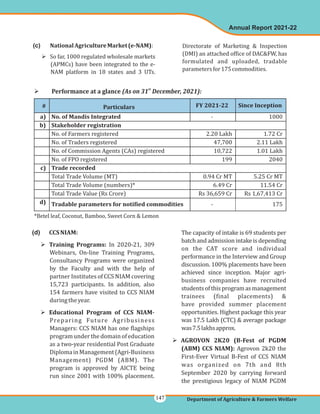
2021-22
Department of Agriculture & Farmers Welfare
Ministry of Agriculture & Farmers Welfare
Government of India
Krishi Bhawan, New Delhi-110 001
www.agricoop.nic.in
S. No. Page No.
Overview 1-11
and Organisational
Functions Structure 12-14
Directorate of Economics & Statistics (DES) 15-25
National e-Governance Plan in Agriculture (NeGP-A) 26-33
Mission for Integrated Development of Horticulture (MIDH) 34-52
National Beekeeping and Honey Mission (NBHM) /National Bee Board (NBB) 53-59
National Food Security Mission (NFSM) 60-67
National Food Security Mission (Oilseeds & Oilpalm) – NFSM (OS&OP) and National 68-75
Mission on Edible Oils-Oil Palm (NMEO-OP)
National Mission for Sustainable Agriculture (NMSA) & Pradhan Mantri
Krishi Sinchayee Yojana (PMKSY) 76-109
Pradhan Mantri KIsan SAmman Nidhi (PM-KISAN) 110-120
National Crop Insurance Programme (NCIP) 121-128
Agricultural Credit 129-130
Agricultural Marketing 131-156
Agriculture Trade Policy, Promotion and Logistics Development 157-165
Rashtriya Krishi Vikas Yojana (RKVY) 166-170
Drought Management 171-172
International Cooperation 173-181
Integrated Scheme on Agriculture Census & Statistics 182-183
Sub-Mission on Agricultural Extension (SMAE) 184-192
Sub-Mission on Seed and Planting Material (SMSP) 193-220
Sub Mission on Agricultural Mechanization (SMAM) 221-229
Sub-Mission on Plant Protection and Plant Quarantine (SMPPQ) 230-248
Gender Perspective in Agriculture 249-264
Summary of Audit Paras/Observations 265-269
Departmental Accounting Organization 270-278
1.
2.
3.
4.
5.
6.
7.
8.
9.
10.
11.
12.
13.
14.
15.
16.
17.
18.
19.
20.
21.
22.
23.
24.
25.
Annexures 279-303
Contents
Chapter
Chapter-1 OVERVIEW
1.1 Agriculture plays a vital role in India's
economy.54.6ofthetotalworkforceisengagedin
agriculture and allied sector activities (Census
2011) and accounts for 18.8% (First Advance
Estimates) of country's Gross Value Added (GVA)
fortheyear2021-22(atcurrentprices).Giventhe
importance of the agriculture sector, Government
of India has taken several steps for its
development in a sustainable manner. Steps have
beentakentoimprovetheincomeoffarmers.
1.2 LandUseStatistics
As per the Land Use Statistics 2018-19, the total
geographical area of the country is 328.7 million
hectares, of which 139.3 million hectares is the
reported net sown area and 197.3 million
hectares is the gross cropped area with a
cropping intensity of 141.6%. The net area sown
works out to be 42.4% of the total geographical
area. The net irrigated area is 71.6 million
hectares. The details of important parameters of
Land Use Statistics for the year 2018-19 are given
inthetablebelow.
Details of important parameters of Land Use Statistics for the year 2018-19
(thousand
hectares)
A) Classification of land
Reporting area for land utilisation statistics (1 to 9) 307787
1 Forests 72011
2 Area put to non-agricultural uses 27344
3 Barren & unculturable land 17168
4 Permanent pastures & other grazing lands 10376
5 Culturable Wasteland 12219
6 Land under Misc. tree Crops 3154
7 Fallow Land Other than Current Fallows 11633
8 Current Fallow 14531
9 Net Area Sown 139351
Agricultural Land (5+6+7+8+9) 180888
Cultivated Land (8+9) 153882
Cropping Intensity (% of Total cropped Area over Net Area
Sown)
141.6
B) Irrigated Area
1 Government Canals 16264
2 Private Canals 165
3 Total Canals (1+2) 16429
1
Implementation, the agriculture and allied
sectors contributed approximately 18.8 % of
India's GVA at current prices during 2021-22.
GVA of agriculture and allied sectors and its
shareintotalGVAofthecountryatcurrentprices
duringthelast6yearsisasfollows:
Table-1 Gross Value Added (GVA) of
Agriculture&AlliedSector
As per the First Advance Estimates of National
Income, 2021-22 released by National Statistical
Office (NSO), Ministry of Statistics & Programme
C) Area under crops
Total Foodgrains 126952
Total Cereals & Millets 99323
Rice 45416
Wheat 31588
Total Pulses 27629
Total Condiments and Spices 3973
Total Fruits & Vegetables 11303
Total Food Crops 148078
Total Oilseeds 27453
Sugarcane 5540
Cotton 9287
Total non food crops 49242
Total Cropped Area 197320
Soure: Directorate of Economics & Statistics, DA&FW
Gross Irrigated Area 102667
% of Gross Irrigated Area over Gross Cropped Area 52.03
% of Net Irrigated Area over Net Area Sown 51.35
4 Tanks 1668
5 Tubewells 34708
6 Other wells 11042
7 Other Sources 7707
Net Irrigated Area (3+4+5+6+7) 71554
(Rs. In Crore)
Items
Years
2016-17
2017-
18$
2018-19#
2019-
20@
2020-
21*
2021-
22**
GVA of
Agriculture and
Allied Sectors
2518662 2829826 3016277 3394033 3616523 3945411
Annual Report 2021-22
Department of Agriculture & Farmers Welfare 2
of the Economy and that in the GVA of agriculture
andalliedsectorsat2011-12basicpricesisgiven
below:
Table-2 GROWTH IN GVA OF AGRICULTURE
ANDALLIEDSECTORS
Growth (over the previous year) in the total GVA
(in percent)
Year
Total
Economy
Agriculture &
Allied Sector
Crops Livestock
Forestry
& Logging
Fishing
2016-17 8.0 6.8 5.3 10.0 5.5 10.4
2017-18$ 6.2 6.6 5.4 7.9 5.4 15.2
2018-19 # 5.9 2.6 -1.6 8.5 7.9 9.0
2019-20@ 4.1 4.3 4.0 7.0 0.3 1.0
2020-21* -6.2 3.6 Will be released on 31st January, 2022
2021-22** 8.6 3.9 Will be released in January, 2023
Source: National Statistical Office, MoSPI
$ Third Revised Estimates, # Second Revised Estimate, @ First Revised Estimates,
* As per Provisional Estimates of 2021
**As per First Advance Estimates of National Income, 2021-22 released on 7th, Jan 2022
Note:
per cent in 2015-16 to 15.9 per cent in 2019-20.
The percentage share of GCF of agriculture &
alliedsectortoGVAofAgriculture&AlliedSector
from 2015-16 to 2019-20 at 2011-12 basic
pricesisgivenintablebelow:
1.3 Capital Formation in Agriculture and
AlliedSectors
Gross Capital Formation (GCF) in agriculture
and allied sectors relative to GVA in this sector
has been showing a fluctuating trend from 14.7
Per cent to total
GVA
18.0 18.3 17.6 18.4 20.2 18.8
Source: National Statistical Office, MoSPI
$ Third Revised Estimates, # Second Revised Estimate, @ First Revised Estimates,
* As per Provisional Estimates of 2021
**As per First Advance Estimates of National Income, 2021-22 released on 7th, Jan 2022
Note:
Table 3: Gross Capital Formation (GCF) in Agriculture and Allied Sectors relative to Gross
Value Added (GVA ) at 2011 -12 basic prices
Year
GCF of
Agriculture &
Allied Sector
(Rs. In Crore)
GVA of
Agriculture &
Allied Sector
(Rs. In Crore)
GCF of Agriculture & Allied
Sector as percentage of GVA of
Agriculture & Allied Sector
(in %)
2015-16 237648 1616146 14.7
2016-17 267153 1726004 15.5
2017-18 272321 1840023 14.8
2018-19 294095 1887145 15.6
2019-20 312518 1968571 15.9
Source: National Statistical Office, Ministry of Statistics and Programme Implementation, released on 29 January, 2021
th
*: Third Revised Estimates; # : Second Revised Estimates; @ : First Revised Estimates
Annual Report 2021-22
Department of Agriculture & Farmers Welfare
3
excess/excess rainfall, 7 received normal rainfall
and 7 met subdivisions received deficient/large
deficientrainfall.
As per Fourth Advance Estimates for 2020-21,
total Foodgrain production in the country is
estimated at record 308.65 million tonnes which
is higher by 11.14 million tonnes than the
production of foodgrain during 2019-20.
Further,theproductionduring2020-21ishigher
by 29.77 million tonnes than the previous five
years' (2015-16 to 2019-20) average production
of foodgrain. Total production of Rice during
2020-21 is estimated at record 122.27 million
tonnes. It is higher by 9.83 million tonnes than
the last five years' average production of 112.44
million tonnes.Production of Wheat during
2020-21 is estimated at record 109.52 million
tonnes. It is higher by 9.10 million tonnes than
the average wheat production of 100.42 million
tonnes.
Total Pulses production during 2020-21 is
estimated at 25.72 million tonnes which is
1.5 ProductionScenario2020-21
NewInitiative
Development of Real Time Crop forecasting
(RTCF)
1.4 Rainfall2021-22
MonsoonRainfall(June–September)
cumulative rainfall
lower by 1%
Post-Monsoon(October-December)
29% higher
system has been initiated. Under the
project, an integrated portal is proposed to be
developed by integrating the diversity of data
sets and methodologies or harmonizing various
divisions/ organizations with the use of advance
digital technology. Monthly Crop Forecasts are
proposed to be released from the data collected
through the portal. A Task Force has been
constituted under the Co-chairmanship of ADG
(Statistics), DA&FW & Sr.ESA, DES for
development of the system in a time-bound
manner.
The in the country during
the monsoon season i.e. 01 June to 30
September, 2021 has been than the
Long Period Average (LPA). Rainfall in the four
broad geographical divisions of the country
during the above period has been higher than
LPA by 11% in South Peninsula, by 4% in Central
India but lower than LPA by 12% in East & North
East India and by 4% in North-West India. Out of
36 meteorological sub-divisions, 10 met
subdivisions in the country had received large
excess/excess rainfall, 20 met subdivisions
received normal rainfall and 6 met subdivisions
receiveddeficientrainfall.Outof694districtsfor
which rainfall data available, 37(5%) districts
receivedlargeexcessrainfall,139(20%)districts
received excess rainfall, 357(52%) districts
received normal rainfall, 153(22%) districts
received deficient rainfall and 8(1%) districts
receivedlargedeficientrainfall.
During the post-monsoon season (1 October to
10 November, 2021) country received rainfall
which was than the LPA. Out of 36
meteorological subdivisions, 22 received large
st th
st
th
Annual Report 2021-22
Department of Agriculture & Farmers Welfare 4
higher by 3.73 million tonnes than the last five
years' average production of 21.99 million
tonnes. Total Oilseeds production in the country
during 2020-21 is estimated at record 36.10
million tonnes which is higher by 2.88 million
tonnes than the production during 2019-20.
Further, the production of oilseeds during 2020-
21 is higher by 5.56 million tonnes than the
average oilseeds production of 30.55 million
tonnes.
Total production of Sugarcane in the country
during 2020-21 is estimated at 399.25 million
tonnes. The production of sugarcane during
2020-21 is higher by 37.18 million tonnes than
the average sugarcane production of 362.07
milliontonnes.ProductionofCottonisestimated
at 35.38 million bales (of 170 kg each) is higher
by 3.49 million bales than the average cotton
production. Production of Jute & Mesta is
estimatedat9.56millionbales(of180kgeach).
Table 4: Area, production and yield of major Crops
Crops Area (Lakh hectare) Production (Million Tonnes) Yield (kg/hectare)
2018-19 2019-20 2020-21* 2018-19 2019-20 2020-21* 2018-19 2019-20 2020-21*
Rice 441.56 436.62 450.67 116.48 118.87 122.27 2638 2722 2713
Wheat 293.19 313.57 316.15 103.60 107.86 109.52 3533 3440 3464
Nutri /
Coarse
cereals
221.46 239.88 238.28 43.06 47.75 51.15 1944 1991 2146
* 4th advance estimates @ Production in million bales of 170 kg each
# Production in million bales 180 Kg. each.
Sugarcane 50.61 46.03 48.57 405.42 370.50 399.25 80105 80497 82205
Cotton@ 126.14 134.77 130.07 28.04 36.07 35.38 378 455 462
Jute &
Mesta# 7.05 6.73 6.63 9.82 9.88 9.56 2508 2641 2595
Pulses 291.56 279.87 288.33 22.08 23.03 25.72 757 823 892
Foodgrains 1247.77 1269.95 1293.43 285.21 297.50 308.65 2286 2343 2386
Oilseeds 247.94 271.39 287.88 31.52 33.22 36.10 1271 1224 1254
Annual Report 2021-22
Department of Agriculture & Farmers Welfare
5
1.6 Production Scenario during Kharif
2021-22(asperFirstAdvanceEstimates)
The cumulative rainfall during this year's
southwest monsoon season upto 15th
September, 2021 has been 4% lower than Long
Period Average (LPA). The production of most of
the crops for the agricultural year 2021-22 has
been estimated higher or closer to their normal
production.
The total area coverage under kharif foodgrains
during 2021-22 is estimated at 714.41 lakh
hectares (as per 1 Advance Estimates). The area
coverage under nutri / coarse cereals is
estimated at 167.76 lakh hectares and under
pulses it is estimated at 135.19 lakh hectares.
The area under kharif oilseeds during 2021-22
(as per 1 Advance Estimates) is estimated at
194.19lakhhectares.
st
st
Annual Report 2021-22
Department of Agriculture & Farmers Welfare 6
A comparative position of production of food
grains, oilseeds, sugarcane and cotton during
2021-22 vis-à-vis Normal Average (2015-16 to
2019-20)isgivenbelow:
Table 5: Production in Kharif 2020-21 and Average (2015-16 to 2019-20)
(Million Tonnes)
Crop
2021-22
(1stAdvance
Estimates)
Average (2015-
16 to 2019-20)
Absolute
Difference
(2021-22
over average)
Percentage
Increase/decrease
(+)/(-) in 2021over
average
Foodgrains 150.50 137.79 12.71 9.22
Oilseeds 23.39 20.42 2.96 14.50
Sugarcane 419.25 362.07 57.18 15.79
Cotton@ 36.22 31.90 4.32 13.54
Jute& Mesta* 9.61 10.24 -0.63 -6.15
@ Production in million bales of 170 kg each. * Production in million bales of 180 kg each
As per First Advance Estimates for 2021-22
(Kharif Only), total foodgrain production in the
country is estimated at record 150.50 million
tonnes which is higher by 12.71 million tonnes
than the average foodgrain production of
previousfiveyears'(2015-16to2019-20).
Total production of kharif rice during 2021-22 is
estimated at 107.04 million tonnes. It is higher
by 9.21 million tonnes than the previous five
years' (2015-16 to 2019-20) average Kharif rice
production of 97.83 million tonnes. Production
of Kharif nutri /coarse cereals is estimated at
34.00 million tonnes which is higher by 2.11
million tonnes than the average production of
31.89 million tonnes. Total kharif pulses
production during 2021-22 is estimated at 9.45
million tonnes. It is higher by 1.39 million tonnes
than average pulses production of 8.06 million
tonnes.
Total kharif oilseeds production in the country
during 2021-22 is estimated at 23.39 million
tonnes which is higher by 2.96 million tonnes
than the average oilseeds production of 20.42
million tonnes. Total production of sugarcane in
the country during 2021-22 is estimated at
419.25 million tonnes. The production of
sugarcane during 2021-22 is higher by 57.18
million tonnes than the average sugarcane
production of 362.07 million tonnes. Production
ofcottonestimatedat36.22millionbales(of170
kg each) and production of Jute & Mesta
estimatedat9.61millionbales(of180kgeach).
The Government's price policy for major
agricultural commodities seeks to ensure
remunerative prices to the growers for their
produce with a view to encouraging higher
investment and production and to safeguard the
interest of consumers by making available
supplies at reasonable prices. Towards this end,
Government announces Minimum Support
Prices (MSPs) for twenty two (22) mandated
crops and Fair and Remunrative Prices (FRP) for
sugarcane at all India level
recommendations of the Commission for
Agricultural Costs & Prices (CACP) after
considering the views of concerned State
Governments and Central Ministries/
Departments. The 22 mandated crops include
14 Kharif crops viz. paddy, jowar, bajra, maize,
ragi, tur (arhar), moong, urad, groundnut,
soybean (yellow), sunflower seed, sesamum,
nigerseed, cotton and 6 Rabi crops viz. wheat,
barley,gram,masur(lentil),rapeseed&mustard,
1.7 MinimumSupportPrice
based on the
Annual Report 2021-22
Department of Agriculture & Farmers Welfare
7
safflower and two commercial crops viz. jute and
copra. In addition to that, MSP for toria and de-
husked coconut are also fixed on the basis of
MSPs of rapeseed & mustard and copra
respectively.
While recommending MSPs, CACP considers
important factors like cost of production, overall
demand-supply situation of various crops in
domestic and world markets, domestic and
international prices, inter-crop price parity,
terms of trade between agricultural and non-
agricultural sector, likely effect of price policy on
rest of the economy and a minimum of 50
percentasthemarginovercostofproduction.
The Union Budget for 2018-19 had announced
the pre-determined principle to keep MSPs at
levels of one and half times of the cost of
production. Accordingly, Government had
increasedMSPsforallmandatedKharif,Rabiand
other Commercial crops with a return of 1.5
times over all India weighted average cost of
productionfromyear2018-19onwards.
On the basis of above mentioned principle,
Government had increased the MSPs for all
mandated Kharif and Rabi crops for 2021-22
crop season on
.Thehighestabsoluteincrease
in MSP of Kharif crops over the previous year has
9 June, 2021 and 8
September,2021
th th
been recommended for sesamum (Rs. 452 per
quintal) followed by tur and urad (Rs. 300 per
quintal each). In case of groundnut and
nigerseed, there has been an increase of Rs 275
perquintalandRs235perquintalrespectivelyin
comparison to last year. The expected returns to
farmers over their cost of production are
estimated to be highest in case of bajra (85%)
followed by urad (65%) and tur (62%). For rest
of the crops, return to farmers over their cost of
productionisestimatedtobeatleast50%.
The highest absolute increase in MSP of Rabi
crops has been announced for lentil and
rapeseed/mustard (Rs. 400 per quintal each)
followed by gram (Rs. 130 per quintal) and
safflower (Rs. 114 per quintal). For barley and
wheat,anincreaseofRs.35perquintalandRs40
per quintal respectively has been announced.
The expected return to farmers over their cost of
production is estimated to be highest in case of
Wheat (100%) and rapeseed/mustard (100%),
followed by lentil (79%) and gram (74%), barley
(60%)andsafflower(50%).
Table showing Costs, MSPs and percent return
over cost for the year 2020-21 and 2021-22 is
givenasbelow:
Cost, MSP and percentage return over cost
*
(Rs.PerQuintal)
Sl. No.
Commodity 2020-21 2021-22
KHARIF CROPS Cost* MSP
% Return
over Cost
Cost* MSP
% Return
over Cost
1 PADDY(Common) 1245 1868 50 1293 1940 50
(Grade A) ^ 1888 1960
2 JOWAR (Hybrid) 1746 2620 50 1825 2738 50
(Maldandi) ^ 2640 2758
3 BAJRA 1175 2150 83 1213 2250 85
4 RAGI 2194 3295 50 2251 3377 50
5 MAIZE 1213 1850 53 1246 1870 50
Annual Report 2021-22
Department of Agriculture & Farmers Welfare 8
10 GROUNDNUT IN SHELL 3515 5275 50 3699 5550 50
11 SUNFLOWER SEED 3921 5885 50 4010 6015 50
12 SOYABEAN (yellow) 2587 3880 50 2633 3950 50
13 SESAMUM 4570 6855 50 4871 7307 50
14 NIGERSEED 4462 6695 50 4620 6930 50
RABI CROPS
1 WHEAT 960 1975 106 1008 2015 100
2 BARLEY 971 1600 65 1019 1635 60
3 GRAM 2866 5100 78 3004 5230 74
4 MASUR (LENTIL) 2864 5100 78 3079 5500 79
5 RAPESEED/MUSTARD 2415 4650 93 2523 5050 100
6 SAFFLOWER 3551 5327 50 3627 5441 50
6 ARHAR(Tur) 3796 6000 58 3886 6300 62
7 MOONG 4797 7196 50 4850 7275 50
8 URAD 3660 6000 64 3816 6300 65
9 COTTON (Medium
Staple)
3676 5515 50 3817 5726 50
(Long Staple) ^ 5825 6025
*
^
Refers to cost of Production A2+FL which
includes all paid out costs such as those incurred
on account of hired human labour, bullock
labour/machine labour, rent paid for leased in
land,expensesincurredonuseofmaterialinputs
like seeds, fertilizers, manures, irrigation
charges, depreciation on implements and farm
buildings, interest on working capital,
diesel/electricity for operation of pump sets etc.,
miscellaneous expenses and imputed value of
familylabour.
Cost data are not available for Paddy (Grade A),
Jower(Maldandi)andCotton(Longstaple).
Government constituted an Inter-ministerial
Committee in April, 2016 to examine issues
relating to “Doubling of Farmers Income” and
recommend strategies to achieve the same. The
Committee submitted its Report to the
1.8 Doubling of Farmers' Income (DFI):
Government in September, 2018 and thereafter,
anEmpoweredBodywassetupon23.01.2019to
monitor and review the progress as per these
recommendations. To achieve this, the
Committee has identified seven sources of
income growth viz., improvement in crop
productivity; improvement in livestock
productivity; resource use efficiency or savings
in the cost of production; increase in the
cropping intensity; diversification towards high
value crops; improvement in real prices received
by farmers; and shift from farm to non-farm
occupations.
The efforts of the Government of India are to
supplement the efforts of the State Governments
through various schemes/ programmes and
initiatives. These schemes/ programmes of the
Government of India are meant for the welfare of
farmers by increasing production, remunerative
Annual Report 2021-22
Department of Agriculture & Farmers Welfare
9
returns and augmentation of farmers' income.
The Government has adopted several
developmental programmes, schemes, reforms
and policies that focus on higher incomes for
farmers. All these policies & programmes are
being supportedbyhigherbudgetaryallocations
(from Rs. 21,933.50 crore during BE 2013-14 to
Rs. 1,23,017.57 crore during BE 2021-22), non-
budgetary financial resources by way of creating
Corpus Funds and supplementary income
transfers under PM-KISAN. MSP is being fixed at
a predetermined principle to keep it at the level
of one and half times of the cost of production.
Government has increased MSPs for all
mandated Kharif, Rabi and other Commercial
crops with a return of atleast 50% over all India
weightedaveragecostofproduction.
Besides, the latest major interventions include
the 'AtmaNirbhar Bharat – Agriculture' which
includes creation of 'Agricultural Infrastructure
Fund (AIF)' worth Rs. 1 lakh crores including Rs
500 crores for the Bee-Keeping initiative. In
addition to this several market reforms have
beenrolledout.Theseinclude:
a . M o d e l A P L M C ( P r o m o t i o n &
Facilitation)Act,2017
b. Establishment of 22,000 number of
Gramin Agriculture Markets (GrAMs)
asaggregationplatforms
c. Agri-Export Policy, that targets to
doubleagri-exportsby2022
d. Promotionof10,000FPOsby2024
The Government also created Corpus Funds for
thebenefitoffarmerssuchas:
a. MicroIrrigationFund–Rs.5,000crores
b. Agri-Marketing Fund to strengthen
eNAMandGrAMs–Rs.2,000crores
is the vision of new India announced by the
Hon'ble Prime Minister Shri Narendra Modi on
1.9 Atmanirbhar Bharat Abhiyaan (ABA)
May 12, 2020. In agriculture, ABA aims to
strengthen Infrastructure, Logistics, Capacity
Building etc. The components of the ABA for
DA&FWareasfollows–
- Central Sector Scheme of financing facility
under Agri Infrastructure Fund is operational
from the year 2020--21 to 2032-33 The aim is
creation of infrastructure at the farm gate. The
scheme shall provide a medium - long term debt
financing facility for investment in viable
projects for post-harvest management
Infrastructure and community farming assets
through interest subvention and financial
support. Underthescheme,Rs.1LakhCrorewill
be provided by banks and financial institutions
as loans to Primary Agricultural Credit Societies
(PACS), Marketing Cooperative Societies, Farmer
Producers Organizations (FPOs), Self Help
Group (SHG), Farmers, Joint Liability Groups
(JLG), Multipurpose Cooperative Societies, Agri-
entrepreneurs, Startups and Central/State
agency or Local Body sponsored Public Private
PartnershipProject,AgricultureProduceMarket
Committees (APMCs) (APMCs operated
regulated markets for agri allied sector produce
includingfisheries),StateAgencies,Nationaland
State level Federations of Cooperatives,
Federations of FPOs and Federations of Self Help
Groups(SHGs),etc.
All loans under this financing facility will have
interest subvention of 3% per annum up to a
limit of Rs. 2 crore. This subvention will be
available for a maximum period of 7 years.
Further, credit guarantee coverage will be
available for eligible borrowers from this
financing facility under Credit Guarantee Fund
Trust for Micro and Small Enterprises (CGTMSE)
scheme for a loan up to Rs. 2 crore. The fee for
thiscoveragewillbepaidbyGovernment.
The cap on lending rate of participation lending
entities will be 06 monthly MCLR plus 100 Basis
Point (floating) subject to maximum 9.00
1.9.1. Agriculture Infrastructure Fund (AIF)
.
Annual Report 2021-22
Department of Agriculture & Farmers Welfare 10
percent (Nine Percent per annum) for funding
under this scheme. This cap will be applicable on
the amount of loan covered under interest
subventioncomponent.
- Govt. of India has approved a
Central Sector this Scheme with total budget
outlay of Rs. 500.00 crores for 3 years(2020-21
to 2022-23)under Aatma Nirbhar Bharat
Announcement for overall promotion and
development of scientific beekeeping and to
achieve the goal of in the
country by implementing 3 Mini Missions
(MMs)-MM-I, MM-II & MM-III under which
thrust will be given on awareness, capacity
building/ trainings, focus on women
empowermentthroughbeekeeping,settingupof
re q u i s i te i n f ra s t r u c t u ra l fa c i l i t i e s ,
viz.;Integrated Beekeeping Development
Centres(IBDCs), Honeybees Disease Diagnostic
Labs, Setting/ upgradation of Honey Testing
labs, Beekeeping Equipment Manufacturing
Units, Custom Hiring Centres, Api therapy
Centres, Development of Quality Nucleus Stock
Centres&BeeBreeders,etc., Digitization/online
registration, etc. under MM-I, processing, value
addition, market support, etc. under MM-II and
R&D under MM-III. An amount of Rs. 145.00
crores has been allotted under NBHM, for the
year2021-22.
Government announces annual target for
1.9.2 The National Beekeeping and Honey
Mission (NBHM)
“Sweet Revolution”
1.10 AgricultureCredit
agriculture credit in the budget every year.
Agricultural credit flow has shown consistent
progress every year. The agriculture credit flow
target for the year 2020-21 was fixed at Rs.
15,00,000 crore and against this target the
achievement was Rs.15,75,398 crore. The
agriculture credit flow target for 2021-22 has
been fixed at Rs.16,50,000 crore and till 30
September, 2021 against this target a sum of
Rs.7,36,589.05crorehasbeendisbursed.
The Department implements the Interest
Subvention Scheme with a view to provide short
term Agril-loans to the farmer at concessional
rate of interest. Under the scheme, short term
crop loans upto Rs.3.00 lakh is available to
farmer engaged in Agriculture and other allied
activities at benchmark rate. Additional 3%
subvention is also given to the farmers for
prompt and timely repayment of loans; thus the
effective rate of interest comes down to 4% per
annum.
The Kisan Credit Card (KCC) Scheme was
introduced for issue of Kisan Credit Cards to
farmersonthebasisoftheirholdingsforuniform
adoption by the banks so that farmers may use
them to readily purchase agriculture inputs such
asseeds,fertilizers,pesticidesetc.anddrawcash
fortheirproductionneeds.
th
1.11 InterestSubventionScheme(ISS)
1.12 KisanCreditCard(KCC)
*****
Annual Report 2021-22
Department of Agriculture & Farmers Welfare
11
FUNCTIONS AND ORGANIZATIONAL
STRUCTURE
2.1 Structure:
2.2
(Annexure-2.1)
(Annexure-2.2)
(Annexure-2.3)
TheDepartmentofAgriculture
& Farmers Welfare (DA&FW) is one of the two
constituent Departments of the Ministry of
Agriculture & Farmers Welfare, and Department
of Agricultural Research and Education (DARE). A
separate Ministry namely, Ministry of
Cooperation, has been created from erstwhile
Department of Agriculture, Cooperation &
Farmers Welfare vide Cabinet Secretariat's
notification no. 2516 dated 06.07.2021 for
development of Multi-state Cooperatives and
providing them adequate support. Department of
Agriculture & Farmers Welfare is headed by
Agriculture & Farmers Welfare Minister and is
assisted by two Ministers of State. The Secretary
(A&FW) is the administrative head of the
Department. The Secretary is assisted by two
Additional Secretaries including one Financial
Adviser, 12 Joint Secretaries including Mission
Director (Mission on Integrated Development of
Horticulture) & Mission Director (National
Mission on Sustainable Agriculture), Horticulture
Commissioner, Trade Advisor, Horticulture
Statistics Advisor, Addl. Deputy Director General
and Deputy Director General. In addition,
Chairman of Commission for Agriculture Costs
and Prices (CACP) advises Department on pricing
policiesforselectedagriculturalcrops.
The DA&FW is organized into 28 divisions
and has five attached offices and
twenty-one subordinate offices
which are spread across the country for
coordination with state level agencies and
implementation of Central Sector Schemes in
their respective fields. Further, one Public Sector
Undertaking, seven autonomous bodies, and two
authorities are functioning
undertheadministrativecontrolofDepartment
2.3
2.4
2.5
2.6
Independent India @75: Self
ReliancewithIntegrity”.
2.7
Administrative Vigilance Unit (AVU)
functions in the Department under a Joint
Secretary, designated as Chief Vigilance Officer, to
ensure a transparent clean and corruption free
work environment through surveillance,
preventiveandpunitivemeasures.
Administrative Vigilance Unit under the
leadership of JS&CVO, is regularly monitoring all
the pending complaints/ Regular Disciplinary
Action cases in this Department and in attached,
subordinate and autonomous organizations by
way of regular review meetings and monthly
reports. 52 new cases were received during the
year. 42 cases were finalized during 2021.
Further, 12 public grievance cases have been
addressed/ finalized. 14 RTI cases were
processed within the prescribed time limit. 03
part time Vigilance Officers were appointed
duringtheyear.
Identification of sensitive posts in the
DA&FW has also been undertaken to enable
periodical rotation of staff posted in sensitive
posts. A List of Officers of Doubtful Integrity and
the Agreed List in consultation with CBI was also
finalized.
As per direction of CVC, Vigilance Awareness
Week,2021wasobservedfrom26 Octoberto1
November, 2021 in the Department. The theme
of the week was “
A Public Grievance Cell has been set up
and is fully functional in the Department of
Agriculture & Farmers Welfare under the Joint
Secretary (O&M/PG) who acts as Nodal
Appellate Authority of the Department and
Deputy Secretary has been nominated as nodal
officer for monitoring redressal of public
th st
Chapter-2
12
grievances received in the Department at
Headquarters. One Deputy Secretary has been
nominated as Staff Grievance Officer to deal with
grievances of the employees working in the
Department of Agriculture & Farmers Welfare
for this purpose. Similar arrangements have
been made at the level of all Attached and
Subordinate Offices and all organizations under
the administrative control of this Department in
order to ensure expeditious redressal of
grievances. During the year 2021-22 (from
01.04.2021 to 31.12.2021) 17345 public
grievance petitions/suggestions have been
receivedthroughCPGRAMSportaland8346cases
were carried forward from previous year, out of
25691 total cases, 25326 cases have been
disposed of and 365 cases were pending in this
Departmentason31 December,2021.
Citizens'/Clients' Charter of this
Department has been prepared as per the
instructions/guidelines of Cabinet Secretariat
and Department of Administrative Reforms and
Public Grievances. The Citizens'/Clients' Charter
is available on the website of the Department
( ).
During year 2021-22
(as on 31.12.2021). 4912 physical & online RTI
applications and 326 appeals seeking
information under the Right to Information Act,
2005 were received in RTI Cell and replies were
senttotheapplicantsintime.
This counter provides information in respect of
Department of Agriculture and Farmers Welfare.
Duringyear2021-22,variousvisitorsfromNGOs
as well as general public visited the counter to
obtain information. Numerous telephonic calls
werealsoreceivedinRTICellfromgeneralpublic
to obtain information pertaining to DA&FW,
MinistryofAgricultureandFarmersWelfare.
The
Department has an Official Language
st
2.8
2.9 Implementation of the Right to
Information Act, 2005:
2.10 Information and Facilitation Counter:
2.11 Progressive Use of Hindi:
www.agricoop.nic.in
Implementation Committee (OLIC), chaired by
the Joint Secretary (Administration), to monitor
the implementation of the Official Language
Policy of the Union and progressive use of Hindi
intheofficialworkoftheDepartment.Duringthe
year under report, quarterly meetings of the
Official Language Implementation Committee
wereheldregularly.
The Hindi Division continued to review
the position of the progressive use of Hindi in the
Department and subordinate offices regularly,
through quarterly progress reports and
inspections. Besides, officers of the Hindi
Division also participated in the meetings of the
Official Language Implementation Committees
of the Attached and Subordinate offices, etc., and
extended necessary guidance to them in the
implementation of Official Language Act and
Rules. In addition to this, 18 offices under the
control of this Department, wherein 80 per cent
of the officers and employees have acquired
working knowledgeofHindi,were notifiedin the
Gazette of India under Rule 10 (4) of the Official
LanguageRules,1976.
Every year, the Department nominates
clerks and stenographers for training in Hindi
shorthand and typing, under the Hindi teaching
Scheme of the Department of Official Language.
Five entries have been received under the
incentive scheme for noting/ drafting done
originallyinHindi.
With a view to create awareness regarding
the progressive use of Hindi in the official work
of the Department, a Hindi Fortnight was held
from the 14 -28 September, 2021. On this
occasion, the Hon'ble Agriculture and Farmers
Welfare Minister issued an appeal to all officers
and staff of the Department of Agriculture and
Farmers' Welfare to carry out more official work
in Hindi. During the Hindi Fortnight, various
Hindi Competitions such as essay writing, noting
and drafting Hindi spelling and grammar
Knowledge, Hindi dictation for MTS, and official
2.12
2.13
2.14
th th
Annual Report 2021-22
Department of Agriculture & Farmers Welfare
13
language and General Knowledge were
organized and interested officers and employees
participated in these competitions. Cash awards
and certificates of appreciation were given to the
winnersofthesecompetitions.
The Second Sub-Committee of the
Committee of Parliament on Official Language
conducted inspection of 01 office under the
control of the Department of Agriculture and
Farmers Welfare to review the position
regarding the progressive use of Hindi in official
work during the year. The officers of this
Department were also present in these
inspection meetings. In addition to this, 18
subordinate/attached offices have been
inspected by the officers of the Hindi Division of
the Department of Agriculture and Farmers
Welfare. Besides, Hindi Advisory Committee of
Department of Agriculture & Farmers Welfare
2.15
has been reconstituted on 07.10.2020 and after
thatameetinghasbeenorganizedon05.01.2021
under the Chairmanship of Hon'ble Agriculture
Minister.
:
Department of Agriculture & Farmers Welfare
con t in u ed it s en deavou r for st rict
implementation of the orders issued by the
Government of India from time to time,
regarding reservation in services for SCs, STs,
OBCs, minorities, ex-servicemen and physically
disabledpersons.
An Internal Complaints Committee
regarding prevention of sexual harassment of
women at their work place has been constituted
by the Department. This Committee is chaired by
aseniorladyofficeroftheDepartment.
2.16 Reservation for Scheduled Castes/
Scheduled Tribes /Other Backward Castes
2.17 Prevention of Harassment of Women
Employees:
*****
Annual Report 2021-22
Department of Agriculture & Farmers Welfare 14
DIRECTORATE OF ECONOMICS
& STATISTICS
Overview
3.1
3.2 MajorProgrammes/Activities
3.2.1 AgriculturalStatisticsDivision
Directorate of Economics & Statistics
(DES), an attached office of DA&FW, is mandated
to support work of the Ministry of Agriculture &
Farmers Welfare through quality data and
analysis towards appropriate policy formulation
and execution of schemes in the interest of
farmers and consumers. The Directorate is
mandated to build and maintain a strong data
base in partnership with the States on area,
production, yield of principal crops and cote of
production of mandated crops to arrive at
Minimum Support Price. DES collects price data
through its regional offices and regularly
analyses the same to identify trigger points for
policy intervention towards stable food prices.
DES is the knowledge bank of the Ministry that
places a large volume of data and information in
the public domain for multiple stakeholders and
carries out agro-economic research / studies in
the field of agriculture. In addition, the
Directorate coordinates with international
bodies such as the Food and Agriculture
Organization (FAO) on global effort to improve
agricultural statistics. It is responsible for
providing necessary data of the National
Statistical Office (NSO) for GDP compilation and
also meets international obligation related to
standardsofdatadissemination.
The Directorate of Economics & Statistics (DES),
under Department of Agriculture and Farmers'
Welfare, releases four Advance Estimates (AEs)
followed by Final Estimates of production of
major agricultural crops of the country. Each of
these five estimates is available state-wise and at
the national level for 28 major agricultural crops
including rice, wheat, coarse cereals, pulses,
oilseeds, sugarcane and Jute & Mesta. The First
Advance Estimates covering only kharif crops
are released in September, when kharif sowing is
generally over. The Second Advance Estimates
are normally released in February, the following
year when rabi sowing is also over. The Second
Advance Estimates cover kharif as well as rabi
crops. The Third Advance Estimates incorporate
revised data on area coverage for rabi crops and
better yield estimates of kharif crops. These are
released in April-May. The Fourth Advance
Estimates are released in July-August. By this
time fully firmed up data on area as well as yield
of kharif crops and rabi crops are expected to be
available with the states. Final Estimates are
released after about seven months of the release
of Fourth Advance Estimates i.e. in February of
the following year. This allows sufficient time to
State Governments to take into account even
delayed information while finalizing area and
yield estimates of various crops. While finalizing
all-India level estimates, the crop-wise data on
area, production and yield received from State
Governments are thoroughly scrutinized and
validated on the basis of information from
alternative sources such as remote sensing
technology based forecast from the Mahalanobis
National Crop Forecast Centre (MNCFC),
econometric modeling based crop forecast
provided by the Institute of Economic Growth
(IEG), inputs received from the weekly Crop
WeatherWatchGroup(CWWG)meetings,trends
in area, production and yield of crops during the
last 5 years, rainfall conditions and trends in
procurement and prices of respective
commodities.
Chapter-3
15
3.2.2 CostStudyDivision:
3.2.3 CommercialCropsDivision
The Cost Study Division is mainly responsible for
i m p l e m e n t a t i o n a n d m o n i to r i n g o f
Comprehensive Scheme for Studying the Cost of
Cultivation of Principal Crops in India and other
issuesrelatingtothisschemeincludinganswering
parliament questions, generating cost of
cultivation and production estimates and
providing to CACP for the purpose of arriving at
the recommendations of the Minimum Support
Prices(MSP)etc.Costofcultivationsurveysarean
important data source for decision making on
sectors of national importance. There are very
intensive surveys wherein data are collected on
the various inputs which are used for the
cultivationofcrop.
Commercial Crops Division examines the Price
Policy for Raw Jute and Copra. The division also
fixes the MSP of Toria by taking the average of
price differentials between Rapeseed/ Mustard
and Toria/Lahi Black in important markets for
thepreviousfiveyears.
§ For 2022 season the MSP has been fixed
at Rs.10590/-per quintal for Milling
Copra and Rs. 11000/- per quintal for
Ball Copra marking an increase of 2.8
percent over the last year's MSP for
Milling Copra and an increase of 3.8
percent over the last year's MSP for Ball
Copra. The MSP would yield returns of
51.85 percent for Milling Copra and
57.73 percent for Ball Copra over the
weighted average A2+ FL cost estimated
at Rs. 6974 per quintal for 2022 season.
The MSP of de-husked Coconut is fixed by
Horticulture Division, DA&FW based on
the MSP of FAO Variety of milling Copra.
The MSP of de-husked Coconut for 2021
season has been fixed at Rs.2,800/- per
quintal. The MSP of de-husked Coconut
for 2022 season yet to be fixed by
Horticulture Division, DA&FW. MSP
announced by the Government and
relative returns for milling copra, ball
copra and Jute are given below in Table
7,8andTable9respectively:
Table 7: MSP announced by the Government and relative Returns for Milling copra
Year MSP Announced
by the
Government (Rs.
per quintal)
Increase over the
previous year
A2+ FL MSP margins
over A2+FL
Cost %
Absolute %age
2018 7511 1011 15.6 5007 50
2019 9521 2010 26.8 6347 50
2020 9960 439 4.6 6639 50
2021 10335 375 3.8 6805 51.9
2022 10590 255 2.8 6974 51.85
Table 8: MSP announced by the Government and relative Returns for Ball copra
Year MSP Announced by
the Government
(Rs. per quintal)
Increase over the
previous year
A2+ FL MSP
margins
over A2+FL
Cost %
Absolute %age
2018 7750 965 14.2 5007 54.8
Annual Report 2021-22
Department of Agriculture & Farmers Welfare 16
Table 9: MSP announced by the Government and relative Returns for Jute
Year MSP Announced by
the Government
(Rs. per quintal)
Increase over the
previous year
A2+ FL MSP
margins
over A2+FL
Cost %
Absolute %age
2018-19 3700 200 5.7 2267 63.21
2019-20 3950 250 6.8 2535 55.8
2020-21 4225 275 7.0 2709 56
2021-22 4500 275 6.5 2832 58.9
§ The MSP of Toria of Fair Average quality
(FAQ) for 2021-22 season has been
fixedatRs5050/-perquintal.
The Division is involved in collection and
compilation of data relating to nine-fold
classification of land, irrigated area (source-wise
and crop-wise) and total area under crops for
States and UTs. The compiled data is brought out
in the Directorate's publications 'Land Use
Statistics' and 'Agricultural Statistics at a Glance'.
The compiled data on Land Use Statistics
(District wise and State-wise) from 1998-99
onwards are available on the website. The URL of
the website is /LUS.
Similarly, the district wise compiled data on
Area, Production and Yield (APY) from 1998-99
onwards are also available on the website. The
URL of the website is .
The Division also generates quarterly estimates
3.2.4 Special Data Dissemination Standards
(SDDS)Division
http://aps.dac.gov.in
http://aps.dac.gov.in/APY
of agricultural production for use in the
compilation of quarterly National Accounts by
the National Statistical Office. This activity was
undertaken in order to meet the obligations
concerning supply of data to the International
Monetary Fund. In the absence of direct data,
quarterly production is estimated by using the
estimates of Kharif and Rabi seasons in
conjunctionwiththecropcalendar.
Prices & Market Division provides market
intelligence to the Government and is involved in
collection, compilation and dissemination of
data/ information on prices - wholesale, retail,
farm harvest and international prices of
important agricultural commodities. Wholesale
prices of 176 selected agricultural commodities
from 719 market centers spread across the
country and retail prices of 46 food items from
87 market centers are collected and compiled on
weekly basis. Weekly wholesale prices (905
3.2.5 Price&MarketDivision
2019 9920 2170 28.0 6347 56.3
2020 10300 380 3.8 6639 55.1
2021 10600 300 2.9 6805 55.8
2022 11000 400 3.8 6974 57.73
For 2021-22 season the MSP for Raw Jute (TDN
equivalent to TD of old grade) has been fixed at
Rs. 4500/- per quintal marking an increase of 6.5
percent over the last year's MSP. The MSP would
3
5
yield returns of 58.9 percent over the weighted
average A2+ FL cost of production which is
estimated at Rs. 2832 per quintal for 2021-22
season.
Annual Report 2021-22
Department of Agriculture & Farmers Welfare
17
price quotations) of 109 agricultural
commodities from 237 markets centers spread
across the country are provided by this division
totheDepartment forthePromotionofIndustry
and Internal Trade (DPIIT), Ministry of
Commerce & Industry for the computation of
monthlyWholesalePricesIndex(WPI).
Details of Prices of Agricultural Commodities on Number of Items maintained by the
Directorate of Economics & Statistics
There are thirteen (13) field level Market
Intelligence Units (MIUs) located across India
reporting to this division which play major role in
data collection. A Working Group was constituted
for the revision of Base Year of WPI series (base
2011-12) under the chairmanship of Shri. Ramesh
Chand (Member, NITI Aayog). Based on the
recommendationofWorkinggroupfortherevision
of Base Year of WPI series (base 2011-12), 8 new
commodities namely Isabgol, Aloe vera, Menthol,
fennel seed , Methi seed , Moth(pulses), Mushroom
and watermelon have been added - which would
take the total number of commodities to 117, as
against 109 under existing series with base 2011-
12. Accordingly the numbers of quotations have
alsoincreasedfrom905to1289.
This Division also compiles data on farm harvest
prices of 35 principal crops from 30 States /
Union Territories. Two annual publications
“Agricultural Prices in India” and “Farm Harvest
Prices of Principal Crops in India” are brought
out by this division every year. Index of Terms of
Trade (TOT) between Agriculture and Non-
agricultural Sectors is also prepared on annual
basis as per the methodology recommended by
the Working Group headed by Prof. S. Mahendra
Dev, Director, Indira Gandhi Institute of
Development Research (IGIDR), Mumbai. This
Index is to be used as an input for price policy
formulation of agricultural crops by Commission
forAgriculturalCostsandPrices(CACP).
The Agricultural Market Information System
(AMIS), hosted by Food & Agriculture
Organisation of United Nations, is an inter-
Annual Report 2021-22
Department of Agriculture & Farmers Welfare 18
agency platform launched in 2011 by the G20
Ministers of Agriculture, to enhance food market
transparency and policy response for food
security. AMIS-FAO prepares Food Balance
Sheet, where data on inputs of production, food,
feed; seed use and trade of 4 agricultural
commodities, i.e. wheat, rice, maize and
soyabean are maintained globally. As per
government directive, Prices & Market Division
provides the required data to AMIS-FAO at
regularintervals.
International Agriculture Compilation (IAC)
Division is the nodal Division in DES for
providing inputs/comments on international
issues relating to agriculture economics and
statistics. The Division also brings out the
flagship publication of the Department, viz.
Agriculture Statistics at a Glance and Pocket
BookofAgricultureStatistics.
During 2021, IAC Division provided inputs and
comments on international issues relating to
food security & nutrition dealt by BRICS, G-20,
World Food Programme(WFP), Global Hunger
Index(GHI) etc. The Division also keeps track of
monthly Agriculture Trade data, EXIM policyand
FDI as well as recent developments (PTAs), Free
Trade Agreement (FTAs), GST in agriculture
commodities etc. In addition, the Division
published the latest 2020 issue of Agriculture
Statistics at a Glance and Pocket Book of
Agriculture Statistics. These publication are
available on the website
CFCC division is coordinating the
implementation of “Forecasting
Agricultural Output using Space, Agro-
M e t e o ro l o g y a n d L a n d B a s e d
Observations (FASAL)” scheme through
partner organizations i.e. MNCFC, IEG &
IMD. Under the FASAL scheme, Multiple-
3.2.6 International Agriculture &
CompilationDivision
3.2.7CropForecastingCoordinationCentre
http://eands.dacnet.
nic.in
·
in-season crop forecast is provided based
on Econometric models (13 crops) and
RemoteSensingmodels(8crops).
Besides, the division is also involved in
organization of weekly Crop Weather
Watch Group (CWWG) meeting every
Friday. Crop Weather Watch Group
(CWWG) in the Directorate of Economics
& Statistics is an inter-departmental
forum that undertakes weekly review of
progress of crop sowing, weather
conditions, reservoir levels, level of pest
and disease, seeds and fertilizer
availability, horticulture arrivals and
prices. The purpose is to facilitate timely
policy intervention and operational
support by the concerned subject matter
Divisions of the DAC&FW. IMD, CWC,
Crops, Fertilizer, Prices, Plant Protection,
Horticulture, Seeds etc. Departments/
Divisions give their inputs and
participate for the meeting. The CWWG
meeting is chaired by Principal Adviser,
DA&FW. The Key Points emerged from
the CWWG meeting submitted to the
Secretary on the same day. The CWWG
data and Minutes of CWWG meeting are
uploaded on the Directorate's website
every week. Crop Statement is also
prepared from the CWWG data and the
same is forwarded to different Ministries/
Departments.
The Coordination Division's main work is to
coordinate work between Department of
Agriculture&FarmersWelfare(DA&FW)andthe
Divisions of DES on all concerned subject
matters. Its main activities includes preparing
material for the Economic Survey i.e. Chapter
“Agriculture & Food Management” on behalf of
DA&FW, and routine matters wherein several
Divisions of DES and those of DA&FW are
involved, preparation of material for annual
report, providing information on budget related
·
3.2.8 CoordinationDivision
Annual Report 2021-22
Department of Agriculture & Farmers Welfare
19
matter under the scheme namely 'Integrated
Scheme of Agriculture Census, Economics and
Statistics', providing input on the Parliament
Questions assigned to various Divisions of
DA&FW, working as Public Grievance Cell and as
RTI Cell for the Directorate of Economics and
Statistics.
1. The Cost of Cultivation of principal crops in
India is being implemented in India since 1970-
71 as a Central Sector Plan Scheme. The main
objectives of the Scheme are to collect and
compile data on cost of cultivation and
production in respect of principal crops and to
generate crop-wise and State-wise cost of
cultivation and production estimates of
mandatedcrops.
2. Comprehensive cost statistics are
collected through 16 Agricultural/Central
Universities/Colleges in respect of Principal
crops centers located in different States; cost of
cultivation data is transmitted to the CACP so as
to enable them to recommend the MSPs of the
cropsunderbothKharifandRabiSeasons.
3. The cost estimates generated under the
Schemes are also used for research purpose and
policyformulationsbytheCentralMinistriesand
State Governments, Agricultural/General
Universities, Government/Non-government
Research Organizations, Individual researchers
(bothatdomesticandinternationallevels)etc.
4. The Scheme is implemented in 19 states
namely Andhra Pradesh, Assam, Bihar,
Chhattisgarh, Gujarat, Haryana, Himachal
Pradesh, Jharkhand, Karnataka, Kerala, Madhya
Pradesh, Maharashtra, Odisha, Punjab,
Rajasthan, Tamil Nadu, Telangana, Uttarpradesh
and West Bengal. The studies in the states except
the newly created States of Chhattisgarh,
3.3 Scheme Implemented by the Directorate
ofEconomicsandStatistics
(i) Comprehensive Scheme for studying Cost
ofCultivationofPrincipalCropsinIndia:
Jharkhand and Telangana are being undertaken
by the parent State's Agriculture Universities/
Colleges.
5. During the block period 2020-21 to
2022-23, the scheme covers 25 principal crops,
i.e.,paddy,wheat,jowar,bajra,maize,ragi,barley,
moong, urad, arhar, gram, lentil, groundnut,
rapeseed and mustard, nigerseed, safflower,
soybean, sunflower, sesamum, cotton, jute,
sugarcane, onion, potato, and coconut. The
combination of crops covered in each state (also
known as crop complex) varies from state to
state depending upon their importance in terms
of its relative contribution in the production of
therelevantcropatall-Indialevel.
6. The field data are collected on the basis of
Cost Accounting Method by the 16 State
ImplementingAgencies.UndertheScheme,daily
entries of debit/credit for expenditure/ income
are made in order to assess the total cost/benefit
incurred/accrued to each farmer. The field data
is collected through a detailed questionnaire
administered by Fieldsman through direct
interaction with the sample farmers of 10
selected farm holdings as per the sampling
design. These consist of 2 each from 5 different
size classes, viz., up to 1 hectare, 1-2 hectare, 2-4
hectare, 4-6 hectare and above 6 hectare allotted
toeachfieldman.
7. In the year 2020-21 (April-March), 221
cost estimates were generated and provided to
CACP. Out of these estimates, 52 for Rabi, 137 for
Kharif, 10 for Sugarcane and 22 for others were
generatedinrespectof25mandatedcrops.
Separate implementing Agencies
have been set up for the state of A.P. Chhatisgarh
and Jharkhand for carrying out the work of Cost
ofCultivationSchemesfromF.Y.2022-23.
Agro-Economic Research (AER) Scheme, a
New Initiative:
(ii)Agro-EconomicResearch(AER)Scheme
Backgroundofthescheme
Annual Report 2021-22
Department of Agriculture & Farmers Welfare 20
component of Central Sector Scheme “Integrated
Scheme on Agriculture Census, Economics and
Statistics” under the purview of Umbrella
Scheme“KrishonnatiYojana-GreenRevolution”.
(i) To study specified agro-economic
issuesatthemacroandmicrolevels;
(ii) To conduct continuous studies on
changes in the rural economy through periodic
surveysofselectedvillages;
iii) To conduct research on structural
changes and fundamental problems of
agriculturalandruraleconomy;and
(iv) To give technical advice to the Union and
State Governments on issues that may be
referredtothem.
TheAgro-EconomicResearch(AER)Schemewas
initiated in 1954-55 through a network of 15
AER Centres/Units. 12 Agro-Economic Research
Centres (AERCs) are located at Allahabad,
Bhagalpur, Chennai, Delhi, Jabalpur, Jorhat,
Ludhiana, Pune, Shimla, Vallabh-Vidyanagar,
Visva-Bharati and Waltair and 3 Agro-Economic
Research Units are located at IEG-Delhi, ISEC-
Bangalore and IIM-Ahmedabad. The scheme is
staff oriented and 100% funded through Grants-
in-Aid by Government of India, Ministry of
Agriculture & Farmers Welfare. These AER
Centres/Units are functioning under the
administrative control of their respective
University/Institute that conducts research and
evaluation studies yearly basis as per need of the
Government of India on Agricultural Economy
and Rural Development for meeting the needs of
theDepartmentofAgriculture&FarmersWelfare,
other Ministries/Departments which have a
bearing on the performance of the Agriculture
Sector for policy formulation and provide a feed
back for implementation of the various schemes.
The Centres also cater to studies and economic
The objectives of the AER scheme under
“Integrated Scheme on Agriculture Census,
EconomicsandStatistics”are:
analysis needed to the State Governments on
agriculturesectorandruraldevelopment.
was
set up in 1960 and is functioning under the
administrative control of Assam Agricultural
University, Jorhat for conducting studies on
various agricultural issues and problems of the
North-Eastern States. The scheme is staff
oriented and 100% funded through grants-in-
aid by Government of India, Ministry of
Agriculture&FarmersWelfare
On an average, annually 30 research studies are
conducted by these Units/Centres, which relates
to various economic problems in agriculture,
animal husbandry, water management, fisheries
& horticulture, food processing, rural
development, non-farm sector employment, etc.
During last five years (2016-17 to 2020-21) 150
studies have been completed on the following
importanttopics:
FarmersSuicides
Farmers Producers Organisation
(FPOs)
Sugarcane Transportation Cost and
HarvestingCost
NeemCoatedUrea
SoilHealthCard
KisanCallCentre
Pradhan Mantri Fasal Bima Yojana
(PMFBY)
NationalFoodSecurityMission(NFSM)
NationalHorticultureMission(NHM)
LivestockFeedandFodder
JhummingCultivation
Electronic- National Agricultural arket
(e-NAM)
Price support and trade in Pulses and
Oilseeds.
In the current financial year 2021-2022 till
Agro-Economic Research Centre, Jorhat
.
·
·
·
·
·
·
·
·
·
·
·
·
·
Annual Report 2021-22
Department of Agriculture & Farmers Welfare
21
December2021,21studieshavebeencompleted
bytheAERCentres/Units.
For the Current Financial Year 2021-2022 an
amount of Rs 3650.00 lakhs is allocated as
Budget Estimate(BE)(includingRs.350.00lakhs
for Northeast regions); out of which Rs.1580.00
lakhs has been released (including Rs.100.00
lakhs for Northeast regions) till date. Detail of
programs for North-East region is given in the
tablegivenbelow:
Table 10: PROGRAMMES OF NORTH-EASTERN STATES IN RESPECT OF AGRO - ECONOMIC
RESEARCH CENTRE – JORHAT
(Rs. in lakhs)
Name of Division: Agro-Economic Research Division
Schemes/
Program
Activities
Approved
Details of
Schemes/
Programs/
Activities taken up
Targets Achievements Funds Released Utilization
n
1 2 3 4 5 6
“Agro-
Economic
AER Centre,
Jorhat
There is
no fixed
Study completed by
AER Centre, Jorhat 2015-16 = 117.52
Note: (*) Fund released, expenditure and studies completed till 21st Oct., 2021
Research (AER)
Scheme” an
independent
component of
“Integrated
Scheme on
Agriculture
Census,
Economics and
Statistics” of
Central Sector
Plan Scheme
undertakes
research studies
on Agro-
Economic
Problems of
North Eastern
States
target. during the Financial
Year 2015-16, 2016-
17, 2017-18, 2018-
19, 2019-2020, 2020-
21 and 2021-2022
are given below:
Year Studies
Completed
2015-16 = 2
2016-17 = 2
2017-18 = 3
2018-19 = 0
2019-20 = 2
2020-21 = 1
2021-22 = 1
104.00
2016-17 =
122.61
2017-18 =
90.00
2018-19 =
138.00
2019-20 =
275.00
2020-21 =
151.00
2021-22 = 100.00*
118.10
119.66
142.88
214.28
161.54
79.06*
(iii) Planning, Management and Policy
Formulation
Inordertoassesstheimpactofchangesonthefarm
economy with focus on the state of Indian farmers,
Planning, Management and Policy Formulation, a
Central Sector Scheme, was formulated during
1998-99. This was designed with a view to
organizing conferences and seminars involving
eminent economists, agricultural scientists,
experts, etc. to conduct short term studies, engage
consultancy services for preparation of a new
decentralized strategy for development of crops,
animals, diary, poultry, irrigation, soil and water
conservation, etc. and to bring out papers/ reports
based on the recommendation received at these
workshops,seminars,conferencesetc.Fortheyear
2021-22, the Budget Estimate under the scheme is
Rs. 26 lakh and 1.37 lakh has been released up to
8.12.2021.
Annual Report 2021-22
Department of Agriculture & Farmers Welfare 22
(iv) ImprovementofAgriculturalStatistics
1. Timely Reporting Scheme (TRS):
2. Improvement of Crop Statistics (ICS):
Improvement of Agricultural Statistics The basic
objective of the Central Sector Scheme,
Improvement of Agricultural Statistics, is to
collect and improve agricultural statistics of
principal agricultural crops. The Scheme has
three components; (i) Timely Reporting Scheme
(TRS), (ii) Improvement of Crop Statistics (ICS)
and (iii) Establishment of an Agency for
Reporting of Agricultural Statistics (EARAS).
Since2007-08,theschemehasbeenconvertedto
Central Sector Scheme from Centrally Sponsored
Scheme with 100 percent funding by the Central
Government. The Component-wise details of the
schemeareasunder:-
The
objective of this component is to obtain
estimates of area under principal crops in each
season, with the breakup of area under
irrigated/unirrigated and traditional/high
yielding varieties of crops on the basis of random
sample of 20% of villages by a specific date.
These estimates are used for generating advance
estimates of production of principal crops. This
component is being implemented in 16 land
record States and Union Territories of Delhi,
ladakh,Jammu&KashmirandPuducherry.
Theobjectiveofthiscomponentistoimprovethe
quality of statistics on area and production of
crops through supervision and monitoring.
Under this component, a sample check of area
enumeration of 10,000 villages and
approximately 30,000 crop cutting experiments
at harvest stage are undertaken. These sample
checks are equally shared by the Central Agency
i.e. National Sample Survey Office; and the State
Agricultural Authorities. These checks
specifically relate to (a) Enumeration of crop-
wise area covered in the selected villages as
recorded by the Patwari; (b) Total Area under
eachcroprecordedinKhasraRegisterofvillages;
and (c) Supervision of Crop Cutting Experiments
at the harvest stage. The IAS scheme is being
implemented in 25 TRS/EARAS states and the
Union Territory of Delhi, ladakh, Jammu &
Kashmir and Puducherry. The performance of
the implementation of this component is also
being closely monitored through Quarterly and
SeasonalprogressReports.
This Component is being implemented in the
permanently settled States of Kerala, Orissa and
West Bengal and North Eastern States of
Nagaland, Sikkim, Arunachal Pradesh and
Tripura. Under the component, an agency has
been established in these states for generating
estimates of area and production of principal
crops and land use statistics, on the basis of
complete enumeration of 20% villages in each
year. The performance of the implementation of
the component is being closely monitored
throughQuarterlyandSeasonalprogressReports.
For the financial year 2021-22 under
Improvement of Agricultural Statistics Scheme
against total allocation of Rs. 151.33 Crores (BE),
Rs. 95.09 Crore have been released till 31
December,2021.
As the main objective of the scheme is to collect
and compile agricultural statistics and it is not a
welfare oriented scheme, no specific activity
either for women or for the North-eastern States
are undertaken under the scheme. However, in
North Eastern States (NES), the scheme is in
operation in Arunachal Pradesh, Assam,
Nagaland, Sikkim & Tripura. For the financial
year 2021-22, Rs. 5.60 Crore have been released
toNESundertheScheme(31 December,2021)
The FASAL scheme was approved as a Central
3. Establishment of an Agency for
Reporting of Agricultural Statistics (EARAS):
Activities Undertaken for Welfare of Women
andNorth-EasternStates:
(v) Forecasting Agricultural Output using
Space, Agro-Meteorology and Land Based
Observations(FASAL)
st
st
Annual Report 2021-22
Department of Agriculture & Farmers Welfare
23
Sector Plan Scheme of the Directorate of
Economics & Statistics, DAC&FW and is in
operation since August 2006. Partner
Organizations of the FASAL Scheme are India
Meteorological Department (IMD), New Delhi,
Institute of Economic Growth (IEG), New Delhi
and Space Application Centre (SAC),
Ahmedabad.ObjectiveoftheSchemeistoprovide
multiple-in-season forecast based on Agromet,
Econometric and Remote Sensing based
methodology. Multiple forecast of 11
major crops are envisaged at National/
State/District level depending on status of
technology available. MNCFC has been providing
Remote Sensing based forecasts in respect of 8
crops namely rice (Kharif & Rabi), rabi jowar, jute,
cotton, sugarcane, rapeseed, mustard and wheat.
Forecastofpulses(combined)isalsoprovided.
Role of India Meteorological Department (IMD)
has been limited to developing crop yield
forecasting models based on multiple
correlation and regression techniques in
collaboration with Agromet Field Units (AMFUs)
using both Statistical and Crop Growth
Simulation Models. Crop yield forecast of major
crops is issued at mid-season and pre-harvest
stage using agromet models during Kharif as
well as Rabi season for crops. Presently, IMD has
been providing crop yield forecast in respect of
rice, jute, cotton and sugarcane during Kharif
season and wheat, potato, mustard and sorghum
duringRabiseasontoMNCFCforthepreparation
of forecasts based on Remote Sensing. IMD is
working on simulation modeling of soybean, tur,
chickpeaandsorghum.
IEG is providing Econometric model based State
level / National level forecast of Area, Yield and
Production forecasts in respect of 13 crops on
monthlybasis TheCropsare:
Annual Report 2021-22
Department of Agriculture & Farmers Welfare 24
The Model used for forecasting takes into
account crop price (expected), substitute crop
price (expected), irrigation, lagged area, pre-
season rainfall, rainfall in sowing season at the
meteorological sub-divisions, temperature and
fertilizer price. The model is proposed to be
refined by incorporating additional parameters
suchasdataonreservoirs,soilmoisture
The objective is to validate the data on
production, yield and area obtained from the
States, so that forecast can be generated for use
informulatingpolicyinterventions,ifneedbe.
*****
Rice (Kharif & Rabi) Wheat
Maize Bajra Rabi Jowar
Jute Moong Gram
Rapeseed Mustard Urad
Groundnut Soyabean
Annual Report 2021-22
Department of Agriculture & Farmers Welfare
25
NATIONAL E-GOVERNANCE
PLAN IN AGRICULTURE (NEGP-A)
4.1 Overview
4.2Nationale-GovernancePlan–Agriculture
Ministry of Agriculture & Farmers' Welfare aims
to improve awareness, knowledge and efficiency
of farmers. A comprehensive ICT strategy has,
therefore, been developed not only to reach out
to farmers in an easy and better way to improve
efficiency but also for planning and monitoring
of schemes so that policy decisions can be taken
at a faster pace and farmers can be benefited
quickly. To empower different sections of rural
society,ICTstrategieshavebeendevised.
Ministry of Agriculture & Farmers' Welfare is
implementing National e-Governance Plan –
Agriculture (NeGP-A). Its aim is to achieve rapid
developmentinIndiathroughuseofInformation
& Communication Technology (ICT) for timely
access to agriculture related information for the
farmers. In agriculture, availability of real time
information at the right time is a continuous
challenge. Lack of information at the proper time
causes loss to farmers. NeGP-A aims to bridge
thisgapincommunicationbyusingtechnology.
National e-Governance Plan in Agriculture
(NeGPA) was initially launched in seven selected
States namely, Assam, Himachal Pradesh,
Jharkhand, Karnataka, Kerala, Madhya Pradesh
and Maharashtra, in the last quarter of 2010-11.
This Scheme has subsequently been extended in
the 2nd Phase to cover all the States and 7 UTs
from 2014-15. NeGP-A aims to achieve rapid
development in India through use the of
Information & Communication Technology (ICT)
for timely access to agriculture related
information for the farmers. Support was
rendered for buying hardware, software and
deployment of manpower for handling them
underthescheme.
However, realizing the significance of new digital
& emerging technologies, the Committee on
Doubling Farmers' Income (DFI) has
recommended further expanding and
augmenting of the digital agriculture initiatives
of Government of India. The report focused on
modern management of agriculture viz. Remote
Sensing; Geographical Information System; Data
Analytics and Cloud Computing; Artificial
Intelligence & Machine Learning; Internet of
Things; Robotics, Drones & Sensors and Block-
Chain.
In order to infuse modern information
technologies in the farm sector as recommended
by the DFI Committee, the NeGPA guidelines were
amended in 2020-21 and funds were released for
sanctioningprojectsforcustomization/shiftingof
web & mobile applications already developed by
the States to the platform to be developed using
digital /emerging technologies and involving use
of modern Information Technologies such as
Artificial Intelligence & Machine Learning, Block
ChainTechnology,InternetofThings,Roboticsetc.
Accordingly, pilots were sanctioned for 10 states
asbelow:–
S.No. State/UT Technology Funds released Rs.
in Lakh during
2020-21
(i) Arunachal
Pradesh
Resilient Supply Chain for identified Agricultural
Crops Leveraging Digitization
Rs. 81.00
Chapter-4
26
4.3 MKisan-Useofbasicmobiletelephony:
5.2 crore
Since the penetration of
in rural areas is around 18% only, mobile
telephonyisconsideredtobethealternateandthe
best option to deliver services to the farmers.
Mobile telephony has transformed the tenor of
ourlives.TheDepartmenthasdevelopedaportal-
mkisan(mkisan.gov.in), where around
farmers are registered and experts/scientists of
different departments like IMD, ICAR, State
Government, State Agriculture Universities send
information to farmers in 12 local languages on a
regularbasis.
smart phones with
internet
Information related to the weather such as
likelihood of rainfall, temperature, etc. enables
farmers to make informed decision in choice of
seed varieties and decide on timing of sowing
and harvesting. With market information,
farmers are better informed to sell produce,
prevailingmarketpricesandquantitydemanded
in the market. Thus, they can make informed
decisions to sell produce at the right price and at
the right time. This helps in reducing distress
sales by farmers due to market supply
fluctuations. SMSs have
been sent through mKisan since its inception in
2013.
More than 2462 crore
(iii) Meghalaya Development of web and mobile based "Crop Pest
Surveillance and Advisory Project
Rs. 62.883
(iv) Uttar Pradesh (i) Unmanned Aerial Vehicle for Agriculture
Applications, (ii) Hand Held Tool based Soil Health
Monitoring Integrated system and (iii) Automated
Fire Alert System for Crop Residue Burning in U.P.
Rs. 120.80
(v) Telangana (i) Crop Monitoring (ii) Automated irrigation
Systems (iii) Fertilizer Calculation
(iv) Automated Farm Operation (v) Traceability
from seeds to produce and (vi) Produce Grading
and Quality Assaying
Rs. 186.00
(vi) Odisha Creation of Farmer Database Rs. 178.398
(vii) Punjab (i) Development of Crop and Soil Digital Algorithms
for Crop Growth Monitoring, Crop Yield and Soil
Quality at Farm Level using Remote Sensing, GIS
and Machine Learning Techniques and (ii)
Precision irrigation in major cropping systems of
Punjab using artificial intelligence and sub-surface
drip system
Rs. 52.434
(viii) Assam e-project on ML based Crop Health Checkup for
paddy crops.
Rs.134.415
(ix) Andhra
Pradesh
Gap Analysis &proposed solution to overcome the
gaps in existing system in terms of integration
digital transformation & seamless process flow
Rs. 425.70
(x) Madhya
Pradesh
(i) Precision Farming and (ii) Ground water
Availability
Rs. 161.106
(ii) Bihar Digital Package of Practices for Major Crops and
Automation Technique in Irrigation in State Seed
Multiplication Farms
Rs. 353.56
Annual Report 2021-22
Department of Agriculture & Farmers Welfare
27
4.4 Farmers'portal( ):
www.farmer.gov.in
Farmers' Portal is a one stop shop for farmers
where a farmer can get relevant information on a
range of topics including seeds, fertilizer,
pesticides, credit, good practices, dealer
network, availability of inputs, agromet advisory
etc. This information can be drilled down
through the pictorial view of the Map of India
placedontheHomepageaswell.
Thiscentralizedrepositoryisthe back bone ofall
mobile apps and SMS advisories. This portal
provides information across all stages of crop
management right from sowing of seeds till post
harvesting. An important feature of this web
based portal is that one can drill down to the
block level and get information of the particular
block.
Annual Report 2021-22
Department of Agriculture & Farmers Welfare 28
4.5 DevelopmentofMobileApps:
Kisan Suvidha:
Spreading agriculture related information to
farmers in the poorest communities has been
made easier by proliferation of mobile phones.
Today, mobile apps and services are being
designed and released in different parts of the
world.Mobile apps help to fulfil the larger
objective of farmers' empowerment and
facilitates in dissemination of extension services
to address food security issues. Various mobile
apps have been developed for farmers. Details
areaslistedbelow:
It is an omnibus mobile app to
helpfarmersbyprovidingrelevantinformationto
them quickly. It has a simple interface and
provides information on critical parameters—
weather, input dealers, market price, plant
protection, expert advisories, Soil Health Card,
cold Stores & godowns, crop insurance. An
additional tab directly connects the farmer with
the Kisan Call Centre where agriculture experts
answer their queries. Unique features like
extreme weather alerts and market prices of
commodities in the nearest area and the
maximumpriceintheStateaswellasinIndiahave
been added to empower farmers in the best
possible manner. With the click of a button,
farmers can obtain all this information in hand
provided they have a smart phone and decent
internet connectivity. Total downloads:13,55,484
uptoNovember2020.
Development of Website and
Applications of the newly created
MinistryofCooperation.
Development of Production and Yield
Estimation Application for DES
Division.
Architecture and management of
development of ASRB Recruitment
System.
Managing development and
maintenance of 4 IT Applications of
PlantProtectionDivision.
Managing development of 4 IT
Applications of Farm Mechanization
Division.
15 schemes of the Department have
b e e n i d e n t i f i e d f o r D B T
implementation
14 schemes are already on-boarded
(linked with Centralised DBT portal of
DBTBharatMission).
Management Information System of
these schemes is linked with the Central
Agricultureportal(dbtdacfw.gov.in).
4.6 New application development in
2021-22byDigitalAgricultureDivision:
4.7 DBT implementation in schemes of
theDepartment
o
o
o
o
o
·
·
·
Annual Report 2021-22
Department of Agriculture & Farmers Welfare
29
Schemes on boarded on DBT
1 Agri Clinics and Agri Business Centres (ACABC) Scheme
2
Sub Mission on the Agriculture Mechanization (Two component – One Central Sector
and other Centrally Sponsored)
3 PradhanMantriKrishiSinchaiYojana
4 Mission for Integrated Development of Horticulture
5
Support to States for Extension Reforms ATMA Scheme (two components – one for
Farmers and other for Functi
onaries)
6 Sub-Mission on Seeds and Planting Material
7 Crop Insurance Scheme
8 National Mission on Oilseeds & Oil Palm (NMOOP)
9 Integrated Scheme on Agriculture Cooperation
10 National Food Security Mission (NFSM)
11 KrishiUnnatiYojana (KUY)
-MOVCDNER
12 NMSA-Rainfed Area Development
13 Interest Subsidy for Short term Credit to farmers
14 PM-KISAN
4.8 India Digital Ecosystem on Agriculture
(IDEA) under sub-theme India Ecosystem
Architecture2.0
IDEA has been envisaged with a Vision to build a
National Digital Agriculture Ecosystem, to
elevate Indian Agriculture Sector to higher levels
of efficiency and productivity, and to improve the
welfareandincomeoffarmers.
The objectives of National Digital Agriculture
Ecosystemareasfollows:
To enable the farmer to realize higher
income and better profitability through
access to right information at the right
time,andfrominnovativesolutions.
To enable better planning and execution
of policies, programs, and schemes of the
Central and State governments, and, also
of the private sector and Farmers
·
·
ProducerOrganizations(FPOs)
To enhance efficiencies in the usage of
resources including land, water, seeds,
fertilizers, pesticides, and farm machines
by providing easier access to information
andoptimizationsolutions.
To provide location-specific and
personalized extension services across
agriculture lifecycle, with simultaneous
protectionofprivacyofpersonaldata.
To build capacities across the gamut of
digital agriculture and precision
agriculture.
To promote adoption of standards for
interoperability and seamless exchange
of information across ecosystem, while
ensuring that the digital rights are
properlymanaged.
·
·
·
·
Annual Report 2021-22
Department of Agriculture & Farmers Welfare 30
·
·
·
To give a fillip to R&D and Innovations in
agriculture through access to high-
qualitydata.
To adopt the best principles of
cooperative federalism while working
with the states and union territories for
therealizationofthevisionofIDEA.
To formulate and leverage PPP
frameworks for realizing the 'power of
thedigital'.
Any large and complex system can only evolve
around a set of commonly agreed principles.
Multiple systems in the ecosystem can be
designed or redesigned to align with the
common principles to ensure interoperability-
by- design and conformance-by-design. The
Ministry of Electronics and IT, GoI in its ongoing
initiative on InDEA 2.0 has formulated a
comprehensive set of principles for guiding the
design of digital ecosystems. It addresses the
requirements of the Ministries, States and
Departments embarking on a holistic digital
initiative. The set of InDEA 2.0 principles is
proposed to be leveraged for designing the IDEA
Architecture. These principles are to be
considered for adoption by the Central and State
Governmentsasalsoalltheprivateentitiesofthe
agricultureecosystem.
Designing the architecture for an ecosystem is a
new concept. While Enterprise Architecture has
been well established globally, it is not so with
Ecosystem Architecture. The concepts like
National Public Digital Platform, National Open
Digital Ecosystem are emerging in India. A few
attempts are in the offing in this area – National
Digital Health Blueprint (NDHB)[6]and National
Digital Education Architecture (NDEAR) are
examples in point. InDEA is an ongoing effort of
the Ministry of Electronics and IT, GoI to create a
set of reference architecture patterns for
designing ecosystem architectures by various
MinistriesandStates.
InDEA 2.0 has proposed a set of Architectural
Patterns meant to be adopted by the Ministries
of GoI, State Governments or small
departments to design their own ecosystem
architectures. The IDEA Framework adopts the
Domain Architecture Pattern proposed by
InDEA 2.0 and customizes it to suit the needs of
the agriculture domain (ecosystem). InDEA
framework, Building Blocks are categorized
into three -depending on the degree to which
they are decentralized. These are defined
below:
s: A core building
block acts as the single-source-of- truth
at the national level or provides a
centralized functionality required for
interoperability. By virtue of their
critical and central nature, the core
building blocks are designed,
developed, and maintained by the
government.
A common
building block is a reusable functionality
or application with the key objective of
ensuring uniformity and / or to prevent
duplicative development work. Common
Building Blocks are developed and
hosted by the Ministry on a multi-tenant
framework and can be shared by the
States and other ecosystem entities
optionally.
A reference
buildingblockhasagenericfunctionality
which can be customized as needed. It is
developedbytheMinistryandthecodeis
published as open source for download
by the States or private sector
organizations.
a. Core Building Block
b. Common Building Blocks:
c. Reference Building Blocks:
Annual Report 2021-22
Department of Agriculture & Farmers Welfare
31
4.9 Federated Farmers Database —
AnotherNewInitiative
Another new initiative which has been
undertaken during the Covid-19 pandemic is
building of the first ever federated farmers
database at the national level. The data
pertaining to farmers, farm lands and related
areaswereindifferentsilosintheGovernmentof
India. These were publicly available but were not
coherentorusable.
Taking the PM-KISAN scheme (through which
government grants direct payments to farmers) as
a base, a database is built on Land records data,
integrating data from other schemes like PMFBY
(crop insurance scheme), Soil Health Cards, farm
machinery data and Kisan Credit Card data. These
were verified with the land record database,
another publicly available database. Thus, a
database with around 55 million farmers' data has
beenbuiltsofarandtheworkisongoing,despitethe
pandemicinduceddisruptionsintheprocess.Bythis
year end, it is hoped that a database of around 100-
120 million farmers would be ready. Data which is
available in other data silos of the government are
also slowly being integrated with this.
Once complete, this would the biggest and most
diverse database of farmers anywhere in the
world. Though in the current phase only farmers
who legally own the land as per the State's land
records are included, it is expected that the
database would cover other farmers as well may
be included those who are involved in allied
activities like animal husbandry, dairying, inland
fisheriesetc.
Another major initiative which has been recently
started is the engagement of leading Agritech,
Agriculture and Startup companies in India for
building PoCs (proof of concepts). In this
connection, GoI has entered into a partnership
with five companies: Microsoft, Amazon Web
Services, Agribazaar, Patanjali Organic Research
Institute, ESRI India, ITC, JIO, Ninjacart, NeML
and CISCO. These partnerships are through a
Memorandum of Understanding (MoU) which
willgoonforayearandonapro-bonobasis.
At the end of the MoU period, GoI would evaluate
the services and solutions developed by the
partners using the data and if these
services/solutions are found to be beneficial to
thefarmers,itwouldtakeupthebestservicesand
scale them up at the national level. Some of the
partners have also proposed linking up the
various startups that are nurtured by these
partners in the Agritech domain. Thus, this
enables the government to tap into the enormous
talent that is available with Indian startups and
4.10 Development of PoCs On Services And
SolutionsToTheFarmersBasedOnData
Annual Report 2021-22
Department of Agriculture & Farmers Welfare 32
2 ESRI India
Technologies
Limited
for Establishment & Launch of “Nation
Agriculture Geo Hub” and for using their
‘ArcGIS’ platform enabling a GIS layer over
Farmers’ Database.
02 Districts –
Chandauli (Uttar Pradesh)
Fatehpur (Uttar Pradesh)
3 Amazon Web
Services India
for digital services across the agri value chain
and creatin g an innovation ecosystem
around digital agriculture
4 Star Agribazaar
Technology Private
limited
for collaborating with Department of
Agriculture for a pilot project to promote
digital agriculture
03 districts –
Kota (Rajasthan)
Mathura (Uttar Pradesh)
Guna (Madhya Pradesh)
5 Patanjali Organic
Research Institute
Private Limited
for farm management and farmers service 03 districts –
Haridwar (Uttarakhand)
Hamirpur (Uttar Pradesh)
Morena (Madhya Pradesh)
6 JIO Platforms Ltd for taking up primary interv ention module,
i.e., advisory (basic as well as advanced)
service in first phase
02 districts –
Nashik (Maharashtra)
Jalna (Maharashtra)
7 ITC Limited for building a Customized ‘Site Specific Crop
Advisory’ service and Digitization of Dairy
Value Chain an d support Wheat crop
operations
02 districts –
Sehore (Madhya Pradesh)
Vidisha (Madhya Pradesh)
8 Cisco Commerce
India Pvt Ltd
for conceptualizing a Proof of Concept in
effective knowledge sharing between
farmers, administration, academia and
industry
02 districts –
Kaithal (Haryana)
Morena (Madhya Pradesh)
9 NCDEX e -Markets
Ltd (NeML)
for a digital marketplace to contribute
effectively towards increasing the income of
farmers and improve farm
efficiency/efficiency of the Agriculture sector
03 districts –
Nasik (Maharashtra)
Devangere (Karnataka) Guntur
(Andhra Pradesh)
10 Ninjacart – 63Ideas
Infolabs Pvt Ltd
for developing and hosting the Agri
Marketplace Platform
03 districts –
Indore (Madhya Pradesh)
Chhindwara (Madhya Pradesh)
Anand (Gujarat)
S No Name of the Partner Focus Area State / District
1 Microsoft India Pvt.
Ltd
for consolidating agri ecosystem across the
value chain (farm to fork) to empower the
farmer using Data Analytics in 100 villages.
10 districts -
(100 villages in Annexure)
Guntur (Andhra Pradesh)
West Godavari (Andhra Pradesh)
Mahesana (Gujarat)
Banas Kantha (Gujarat)
Amreli (Gujarat)
Kaithal (Haryana)
Chhindwara (Madhya Pradesh)
Morena (Madhya Pradesh)
Hathras (Uttar Pradesh)
Mainpuri (Uttar Pradesh)
MOUs in Various States
use their talents for benefiting our farmers. This
also envisages to improve the farms, in case these
services are successful and would give a fillip to
sustainablefarmpracticesacrossthecountry.
The Use cases will use algorithms that analyze
the past profile of the farmers with his track
record of crop insurance, procurement of
his/her crops by the government, remote
sensing data pertaining to the current crop, their
health and the expected harvest, and land
ownership details. This would cut down
enormous paper work and also reduces the cost
and time for the farmers as well as the banks or
otherfinancialinstitutions.
Annual Report 2021-22
Department of Agriculture & Farmers Welfare
*****
33
MISSION FOR INTEGRATED
DEVELOPMENT OF HORTICULTURE
(MIDH)
Overview
5.1
5.2 MajorSchemes–Objectives
5.3 Brief of schemes under MIDH is as
follows:
Mission for Integrated Development of
Horticulture (MIDH) is a Centrally Sponsored
Scheme for the holistic growth of the
horticulture sector covering fruits, vegetables,
root & tuber crops, mushrooms, spices, flowers,
aromaticplants,coconut,cashewandcocoa.
MIDH consists of 5 schemes on Horticulture viz.
(I) National Horticulture Mission (NHM), (ii)
Horticulture Mission for North East and
Himalayan States (HMNEH), (iii) National
Horticulture Board (NHB), (iv) Coconut
Development Board (CDB), (v) Central Institute
ofHorticulture(CIH),Nagaland.
Under MIDH, Government of India (GOI)
contributes 60%, of total outlay for
developmental programmes in all the States
except States in North East and Himalayas, 40%
share is contributed by State Governments. In
the case of North Eastern and Himalayan States,
GOI contributes 90%. In case of National
Horticulture Board (NHB), Coconut
Development Board (CDB), Central Institute for
Horticulture (CIH), Nagaland and the National
LevelAgencies(NLA),GOIcontributes100%.
The budget allocation of Rs. 2249.72 crore has
beenearmarkedforMIDHduring2021-22.Ason
31 December, 2021, funds to the tune of Rs.
525.59 crores have been released for
implementation of activities of MIDH i.e. Rs.
207.63 crore under NHM, Rs. 144.84 crore under
HMNEH, Rs. 80.14 crore under CDB, 83.66 crore
toNHBandRs.9.32croretoCIH,DCCD&DASD.
st
5.3.1 NationalHorticultureMission(NHM):
5.3.2 Horticulture Mission for North East
andHimalayanStates(HMNEH)
This Centrally Sponsored Scheme was launched
in the year 2005-06 and aims at the holistic
development of the horticulture sector by
ensuring forward and backward linkage through
a cluster approach with the active participation
of all stakeholders. A total of 384 districts in 18
States and 6 Union Territories were covered
under NHM. Sixteen (16) National Level
Agencies (NLAs) have also been included for
providing support for developmental efforts
whichrequireinputsatthenationallevel.
Supply of quality planting material through
establishment of nurseries and tissue culture
units, production and productivity improvement
programmes through area expansion and
rejuvenation, technology promotion, technology
dissemination, human resource development,
creation of infrastructure for post harvest
management and marketing in consonance with
thecomparativeadvantagesofeachState/region
and their diverse agro-climatic conditions are
majorinterventionsunderNHM.
The Department is implementing a Centrally
Sponsored Scheme - Horticulture Mission for
North East and Himalayan States (HMNEH)
earlier known as Technology Mission for
IntegratedDevelopmentofHorticultureinNorth
Eastern States since 2001-02. During the X Plan
(2003-04), the scheme was further extended to
three Himalayan States namely: Himachal
Pradesh, Jammu and Kashmir and Uttarakhand.
The Mission covers the entire spectrum of
horticulture, right from planting to consumption
with backward and forward linkages. With effect
from 2014-15, HMNEH scheme has been
Chapter-5
34
subsumedunderMIDH.
The National Horticulture Board (NHB) was set
up by the Government of India in 1984 as an
Autonomous organization under the
administrative control of Ministry of Agriculture
and Farmers Welfare and registered as a society
under Societies Registration Act with its
headquarters at Gurugram. Presently, NHB has
29 field offices located all over the country. The
broad aims and objectives of the Board are to
develop production clusters/hubs for integrated
Hi-tech commercial horticulture, development
of Post-harvest and cold chain infrastructure,
ensuring availability of quality planting material
and to promote adoption of new technologies/
tools/techniques for Hi-tech commercial
horticultureetc.
TheBoardisimplementingfollowingschemes:
1. Development of Commercial Horticulture
through Production and Post Harvest
ManagementofHorticultureCrops.
2. Capital Investment Subsidy for
Construction/ Expansion/ Modernization
of Cold Storages and Storages for
HorticultureProducts.
3. Technology Development and Transfer for
PromotionofHorticulture.
4. Market Information Service for
HorticultureCrops.
5. Horticulture Promotion Services/ Expert
Services and Strengthening Capability of
NHB.
CoconutDevelopmentBoard(CDB)isastatutory
body established by Govt. of India by an Act of
Parliament (Coconut Development Board Act
1979) and came into existence in January 1981.
The thrust areas of the Coconut Development
Board programmes under MIDH are production
5.3.3 NationalHorticultureBoard
5.3.4 CoconutDevelopmentBoard
and distribution of quality planting material,
expansion of area under coconut cultivation
especially in potential and non-traditional areas,
improving the productivity of coconut in major
coconut producing States, developing
technology in post-harvest processing and
marketing activities, product diversification and
by-product utilization of coconut for value
addition, dissemination of information and
capacitybuildinginthecoconutsector.
A.1. Production and Distribution of Quality
PlantingMaterials
(a) Demonstration cum-Seed Production
(DSP)Farm
(b)Establishment of Regional Coconut
Nurseries
(c) Establishment of Nucleus Coconut Seed
Garden
(d)Establishment of Small Coconut
Nursery
A.2. ExpansionofAreaunderCoconut
A.3. Integrated Farming for Productivity
Improvement
(a)LayingoutofDemonstrationPlots
(b)AidtoOrganicManureUnits
A.4. Technology Demonstration/Quality
TestingLab
A.5. Marketing, Market Intelligence
Services, Statistics and Strengthening
ofExportPromotionCouncil(EPC)
A.6. Information&InformationTechnology
A.7. Technical Service & Project
Management
B: TechnologyMissiononCoconut
The major programmes that are being
implementedbytheBoardare;
Annual Report 2021-22
Department of Agriculture & Farmers Welfare
35
C. Replanting & Rejuvenation of Old
CoconutGardens
D. CoconutPalmInsuranceScheme
E. KeraSurakshaInsuranceScheme
5.4 PhysicalandFinancialProgress
5.4.1 NationalHorticultureMission(NHM):
A. Physical Progress: The summary details of
progress achieved during 2021-22 are given at
Table1below:
Table 1: Progress under NHM
S. No. Components Unit Progress during 2021 -22 (as
on 31st December, 2021)
1 Area Expansion Ha. 59761
2 Rejuvenation Ha. 5973
3 Protected Cultivation Ha. 3434
4 Integrated Pest/ Nutrient Management Ha. 10476
5 Nurseries No. 5
6 Water Resources No. 591
7 Beekeeping No. 49163
8 Horticulture Mechanization No. 3883
9 Post Harvest Management
(i) Pack House No. 537
(ii) Cold Storage No. 18
(iii)Primary/mobile processing units No. 121
10 Rural Market No. -
Source: as per the data uploaded by the State Govt. on MIDH web portal
B. Financial Progress: During 2020-21, as on
31 March, 2021, funds to the tune of Rs. 831.32
crore have been released to States/UTs/NLAs for
implementing NHM scheme against BE of Rs.
1363.62 crore and RE of Rs 821.04 crore. During
2021-22,anamountofRs.1335.50crorehasbeen
allocatedforNHM,againstwhichanamountofRs.
207.63 crore has been released as on 31
December,2021.
st
st
5.4.2 Area, Production & Productivity of
HorticultureCrops
The comparative details of area, production and
productivityofvarioushorticulturecropsduring
2020-21(3rd Adv. Est) with reference to 2004-
05, viz. pre and post scenario are given in the
followingTable2.
Crop
Area Production Productivity
2004-
05
2019-
20
2020-
21*
2004-
05
2019-
20
2020-
21*
2004-
05
2019-
20
2020-
21*
Fruits 5049 6774 6914 50867 102080 103027 10.07 15.07 14.90
Vegetables 6744 10310 10966 101246 188284 197230 15.01 18.26 17.99
Table 2: Pre and Post NHM Scenario: Area, Production & Productivity
(Area: '000 Ha, Production: '000 MT, Productivity: MT/Ha)
Annual Report 2021-22
Department of Agriculture & Farmers Welfare 36
The wide and varied nature of the horticulture
sector covering fruits, vegetables, root and tuber
crops, flowers, aromatics and medicinal crops,
spices and plantation crops facilitates better
returns per unit of area, besides opportunities
fordiversificationinagriculture.
Horticulture crops cover an area of 27.59 Million
Hectare at present; it has registered an increase
of 32.17% as compared to 20.88 Million Hectare
in 2009-10. However, with a production of about
331.05 Million Tonnes, horticulture production
has witnessed an increase of about 48.39%
during the period 2009-10 to 2020-21 (3rd
Advance Estimates). The significant feature is
that there has been improvement of productivity
of horticulture crops which increased by about
12.25%duringthisperiod.
Area, Production & Productivity of Horticulture
cropsduringthepast11yearsaregiveninTable3.
Flowers 118 323 329 659 3000 2605 5.58 9.29 7.92
Aromatic
& Medicinal
crops
131 641 659 159 734 779 1.21 1.15 1.18
Plantation
crops
3147 4143 4190 9835 16116 16602 3.13 3.89 3.96
Spices 3150 4291 4528 4001 10137 10679 1.27 2.36 2.36
Others 106 172 120 125
Total 18445 26482 27586 166939 320471 331048 9.05 12.10 12.00
*3rd Advance Estimates of Horticulture Crops 2020-21-DA&FW
Table 3: Area, Production & Productivity of Horticulture crops
Area: Million Hectare, Production: Million Tonnes, Productivity: Tonnes/Hectare
Year Area Production Productivity
2009-10 20.88 223.09 10.69
2010-11 21.83 240.53 11.02
2011-12 23.24 257.28 11.07
2012-13 23.69 268.85 11.35
2013-14 24.20 277.35 11.46
2014-15 23.41 280.99 12.00
2015-16 24.47 286.19 11.69
2016-17 24.85 300.64 12.10
2017-18 25.24 310.67 12.31
2018-19 25.74 311.05 12.09
2019-20 26.48 320.47 12.10
2020-21(3rd Advance Estimates) 27.59 331.05 12.00
The area under fruit crops during 2020-21(3rd
Advance Estimate) is 6.91 MillionHectare, with a
total production of 103.03 Million Tonne. During
the Period 2009-10 to 2020-21(3rd Adv. Est.),
production of fruits increased by about 43.68%,
while the area increased by about 6.85%.
Comparative details of area, production and
productivityoffruitcropsaregiveninfigure1.
Annual Report 2021-22
Department of Agriculture & Farmers Welfare
37
Vegetables are an important crop in the
horticulture sector, occupying an area of 10.97
Million Hectare as per 2020-21 (3rd Advance
Estimates) with a total production of 197.23
Million Tonne with average productivity of 17.99
Tonnes/Hectare. In fact, vegetables constitute
about59.58%ofhorticultureproduction.During
the period 2009-10 to 2019-20 (3rd Advance
Estimates), area and production of vegetables
increased by 37.33% and 47.47% respectively.
The comparative details are depicted in the
Figure2.
Figure 1: Area, Production & Productivity of Fruits
India has also made remarkable advancements
inproductionofflowers,particularlycutflowers,
which have a high potential for exports.
Floriculture during 2020-21(3rd Advance
Estimates) covered an area of 0.33 Million
Hectare with a production of 2.61 Million Tonne
offlowers.
Annual Report 2021-22
Department of Agriculture & Farmers Welfare 38
India is the largest producer, consumer and
exporter of spices and spice products. The
total production of spices during 2020-21(3rd
Advance Estimates) was 10.68 Million Tonne
from an area of 4.53 Million Hectare.
5.4.3 Horticulture Mission for North East
andHimalayanStates(HMNEH)
A. PhysicalProgress
Table4 :
The summary details of progress achieved so far
under HMNEH during 2021-22 are given at
below
Table 4: Progress under HMNEH
S. No. Components Uni
t
Progress during 2020-21 (as
on 31st December, 2020)
1 Area Expansion Ha. 5654
2 Rejuvenation Ha. -
3 Protected Cultivation Ha. 18
4 Integrated Pest/Nutrient Management Ha. 10430
5 Nurseries No. -
6 Water Resources No. 18
7 Beekeeping No. -
8 Horticulture Mechanization No. 56
9 Post Harvest Management
(i) Pack House No. 210
(ii) Cold Storage No. -
(iii) Primary/Mobile Processing Units No. -
10 Rural Market No. -
Source: as per the data uploaded by State Govt. on MIDH web portal
B. FinancialProgress
5.4.4 NationalHorticultureBoard(NHB)
A. PhysicalProgress:
1. Development of Commercial
Horticulture through Production and
Post Harvest Management of Horticulture
Crops” for a better alternative to increase
During 2020-21, as on 31 March, 2020, funds to
the tune of Rs. 333.58 crore have been released
to States implementing HMNEH scheme against
BE of Rs.470.00 crore. During 2021-22, an
amountofRs.600.00crorehasbeenallocatedfor
North Eastern States and Himalayan
States(including PMDP), against which an
amount of Rs. 144.84 crore has been released as
on31 December,2021.
“
st
st
the income of farmers
1.1 Open Filed Cultivation
@
in which the
financial support in the form of back-ended
subsidy is provided for setting up units
relating to horticulture sector such as
production related projects, PHM viz. Pack
House, Ripening Chamber, Refer Van, Retail
Outlets, Pre-cooling units, Primary
processing etc. The brief of the scheme is as
under:-
- Credit linked
back-ended subsidy 40% of the total
project cost limited to Rs 30.00 lakh per
project in general area and @ 50% of project
cost limited to Rs. 37.50 lakh in NE Region
and Hilly States and Scheduled areas for
horticulture projects in open field condition
on project mode including component viz,
Annual Report 2021-22
Department of Agriculture & Farmers Welfare
39
planting material, plantation, irrigation,
fertigation, mechanization, GAP etc. for
projects covering area over 2.00 ha (5 Acres).
In case of NE Region, projects having area
over1Acreareeligible.
Credit
linked back-ended subsidy @ 50% of project
cost limited to Rs 56.00 lakh per project for
horticulture project in protected condition
on project mode including components viz
Green House, Shade net house, plastic
tunnels, planting material, plantation,
irrigation, fertigation, mechanization, etc for
project having area over 2500 sq meter. In
case of NE Region, projects having area over
1000sqmeterareeligible.
Integrated
PHMProjectsrelatingtoPackHouse,Ripening
Chamber, Refer Van, Retail Outlets, Pre-
cooling units, Primary processing etc. Credit
linked back-ended@35% of the project cost
limited to Rs. 50.75 lakh per project in general
area and 50% of project cost limited to Rs.
72.50 lakh per project in NE Region, Hilly
States and Scheduled areas for post-harvest
managementprojects/components.
Under the scheme, the Board sanctioned
during the current financial year
involving subsidy of
. The projects include Hi-Tech
cultivation of perennial fruit crops in open
field, vegetables & flowers in protected
cultivation, tissue culture units, mushroom
cultivation, establishment of pack house and
grading centers, ripening chambers, refer
van, retail outlets, pre-cooling units, primary
processingunits etc.
nder this scheme,
1.2 Protected Cover/ Cultivation -
1.3 Post Harvest Management-
Achievements
65
projects
(as on 31.12.2021) Rs.
1415.68 lakh
2. “Capital Investment Subsidy for
Construction/Expansion/Modernization
of Cold Storages and Storages for
Horticulture Products”, u
credit linked back-ended subsidy @35% of
the capital cost of the project in general areas
and 50% in case of North East, Hilly States &
Scheduled areas for Cold storage capacity
above 5000 MT and up to 10000 MT is
sanctioned for construction/ expansion/
modernization of cold storage and CA store.
IncaseofNERegion,thecapacityabove1000
MT are also eligible. Only those projects are
considered which are set up in conformity of
technical standards for energy efficiency and
environmental safety energy and multi
chambers.
Under the scheme, the Board sanctioned
of Cold Storages/CA Storages
involving subsidy of for
creation of capacity of during
the current financial
Under this scheme, the Board is also
providing grant-in-aid for popularization of
identified new technologies/tools/
techniques for commercialization and
adoptionthroughfollowingprogrammes:
(I) Setting up of block / mother plant and
rootstocknursery(Areaabove4ha).
(ii) Acquisition of technologies including
importofplantingmaterial.
(iii)Import of new machines and Tools for
horticulture.
(iv)Development&TransferofTechnology.
(v) LongDistanceTransportSolution.
(vi)Product Promotion and Market
DevelopmentServices-Horti-fairs.
(vii)Exposure visit of farmers (Outside
State).
Achievements
09
projects
Rs. 1954.91 lakh
68678.68 MT
year (as on
31.12.2021).
3. Technology Development and Transfer
forPromotionofHorticulture
Annual Report 2021-22
Department of Agriculture & Farmers Welfare 40
(viii)VisitAbroadforGovernmentOfficers.
(ix)Organization/ Participation in
Seminar/symposia/workshop for
developmentofhorticulture.
(x) Accreditation and Rating of Fruit Plant
Nurseries
Under this scheme, NHB has assisted
for Introduction of New
Technology, Visit of Progressive Farmers,
Horti.Sangam,Organization/Participationin
Seminars/ Symposia/ Exhibitions,
Technology Awareness, Mother Plant
Nurseries, etc. and released financial
assistance amounting to
during the current financial year in
During2021-22,anamountofRs.83.66crore
has been released (as on 31.12.2021) to NHB
againstaBEofRs.190.00crore.
This scheme deals with work of
computerization,developmentoftechnology
package, data feeding, information
dissemination through publicity, printed
literature local advertisements etc scheme
provides for engagement of outsourced staff
such as Senior Programmer, Programmer,
Data Entry Operators and horticulture
assistantasperneedatapprovedratesunder
TSGcomponentofMIDH.
Under this component, specialized studies
and surveys shall be carried and study/
surveyreportsshallbebroughtoutforuseby
targeted beneficiaries. In addition, technical
Achievements
09
projects
Rs. 2.89 lakh
(as on
31.12.2021)
FinancialProgress
4. Market Information Service for
HorticultureCrops
5. Horticulture Promotion Services/ Expert
Services and Strengthening Capability of
NHB
laboratories shall be set up or cause to be set
up and also provide technical services
includingadvisoryandconsultancyservices.
Following new initiatives were taken by the
National Horticulture Board during the year
underreport:-
Toaddressthechallengesandenhancetheglobal
competitiveness of the Indian horticulture
sector, the Ministry of Agriculture and Farmers'
Welfare, Government of India,launched the
Central Sector Programme namely, Cluster
Development Programme (CDP) on 31 May
2021to be implemented by the National
HorticultureBoard(NHB).
CDP aims to enable holistic growth and
development of identified horticulture clusters
to make them globally competitive and entrench
themintonationalandglobalvaluechains.
This programme is designed to leverage the
geographical specialization of horticulture
clusters and promote integrated and market-led
development of pre-production, production,
post-harvest, logistics, branding and marketing
activities. Ministry of Agriculture and Farmers'
Welfare identified fifty-five (55) horticulture
clusters and assumed that after successful
implementation of the programme in all the
clusters, the overall impact is envisaged to benefit
NewInitiatives
i) Horticulture Cluster Development
Programme
st
Annual Report 2021-22
Department of Agriculture & Farmers Welfare
41
around 1 million farmers leveraging a total
estimated investment of INR 10000 Cr and an
increaseinexportsofthetargetedcropsby20%.
Based on field visits and extensive feedback
received from various stakeholders of the value
chain, Operational Guideline for Horticulture
Cluster Development Programme has been
prepared and finalized. Further, it has been
decided to implement the Pilot Phase of
programme initially with shortlisted 12 clusters
and the programme will be scaled up to cover all
the 55 clusters based on the learning from the
pilotphase.
Union Minister of Agriculture and Farmers'
WelfareShriNarendraSinghTomarlaunchedthe
Operational Guideline for Horticulture Cluster
Development Programme virtually on 29
October,2021.
As per the implementation framework
stipulated in guideline, Cluster Development
Agency (CDA) has been appointed for each
identified cluster for undertaking the detailed
analysis on gaps and determining the scope for
innovative interventions in the clusters. Based
on the Cluster Gap Assessment Reports (CGARs)
submitted by CDAs of seven (07) clusters,
Request for Proposals (RFPs) for selection of
Implementing Agencies for Implementation of
Different Verticals under CDP for Mango crop in
two (2) clusters i.e., Kutch (Gujarat) and
Mahabubnagar (Telangana) have already been
published. RFPs from remaining clusters are
expectedtobepublishedshortly.
Inadequate availability of quality planting
material is one of the primary reason for low
productivity of various horticultural crops in
India. The Government of India is providing
financial assistance through its various schemes
for establishment of nurseries, their
accreditation and rating with an aim to establish
anetworkofqualitynurseriesacrossthecountry
th
ii) NationalNurseryPortal
for the purpose of propagation, multiplication
and distribution of quality planting material of
horticulturecropsinIndia.
A large number of nurseries for horticultural
crops have been established both in public and
private sector and several of them have been
accredited by various agencies, however,
information related to the location of nurseries,
their rating and availability of planting material
with them during any given period for various
crops and their varieties, is scattered and not
available at one place. As a result, there is little
access of information for farmers/growers and
otherstakeholdersinthisfield.
In order to overcome the above problem, the
Ministry of Agriculture and Farmers Welfare
through National Horticulture Board decided to
setupan' forNurseries
in India, enabling easy access to information on
availability of quality planting material in the
nearby localities for farmers/growers and other
stakeholders.
Throughthisportal,thenurseryownerswillable
toshowcasetheirprofilesandpostselloffersand
buyers of planting material can post enquiries
and view matching sell offers with feature of
virtual aggregation. The National Nursery Portal
has also been developed in important regional
languages,apartfromEnglishandHindiversions
for wider coverage of the farming community.
Apartfromthis,MobileAppsofNationalNursery
Portal for Registered Buyers and Nurseries both
OnlineDigitalPlatform'
Annual Report 2021-22
Department of Agriculture & Farmers Welfare 42
in “Android” and “IoS” platforms has also been
launched.
TheNationalNurseryPortalwaslaunchedbythe
Hon'ble Union Agriculture and Farmers Welfare
Minister on 13.4.2021.The newly developed
NHB's National Nursery Portal platform will
greatly help buyers to easily access Nurseries as
well as be aware of the availability, price
expectation, etc., of the quality planting material.
Similarly Nurseries will also getting exposed to
themarketdemands.
During the current
financial year, funds to the tune of Rs. 27.50 crore
has been released (as on 31.10.2021) to CDB
againstaBEofRs.110.00crore.
India being the largest
coconut producing country in the world
comprises 31.45% of global production. The
coconut palm provides food security and
livelihood opportunities to more than 12
million people in India. It is also a fiber-
yielding crop for more than 15,000 coir-
based industries which provides
employmenttonearly6lakhpeople.
The crop contributes around Rs. 307,498
million to the country's GDP and earns
export revenue of around Rs. 60,738 million.
There are 5 million coconut holdings in the
country and the average size of these
holdings is less than one hectare. As per the
B. Financial Progress:
5.4.5CoconutDevelopmentBoard(CDB)
A. Physical Progress:
all India second advance estimate for the
year 2020-21, the area and production of
coconut in the country is 2.17 million
hectares and 21,206.74 million nuts,
respectively. The four southern States of
Kerala, Tamil Nadu, Karnataka and Andhra
Pradesh accounted for 89.13% of the
coconut area and 90.04% of the coconut
production in the country. The annual
productivity of coconut at national level for
2020-21is9,687nutsperhectare.
During the year 2021-22 (upto 31.12.2021),
financial assistance for covering a fresh area
of 4078 ha under the 'Expansion of area
under coconut' and 91 ha demonstration
plots for productivity improvement.
Financial assistance also extended for
establishment of 6 new coconut nurseries
and a coconut nucleus seed garden. Under
theTechnologyMissiononCoconut,financial
assistance for establishment of 6 new
coconut processing units for value added
products like Virgin Coconut Oil, Activated
Carbon and Ball Copra, spray dried coconut
milk powder and an integrated unit for
dessicatedcoconutpowderandVCO.
During the current
financial year, funds to the tune of Rs. 80.14
crore has been released (as on 31.12.2021)
toCDBagainstaBEofRs.110.00crore.
Central Institute of Horticulture, Medziphema,
Nagaland has been engaged in the task of
planning, coordinating, supervising and
monitoring horticulture development activities.
The programmes are executed through capacity
building by training of trainers and farmers/
beneficiaries; on & off farm demonstration of
improved production technologies; production
and supply of quality planting material;
accreditation and certification of nurseries in NE
region; promotion of organic cultivation of
B. Financial Progress:
5.4.6 Central Institute of Horticulture (CIH ),
Nagaland
Annual Report 2021-22
Department of Agriculture & Farmers Welfare
43
horticultural crops; agri-business promotion
through exhibitions, seminars, workshops,
exposure trips, buyers & sellers meet; post
harvest management and value addition of
horticultural crops; skill development &
certificate courses in horticulture; transfer
of technology through method & result
demonstration, publication of folders, manuals,
leaflets and coordination with state horticulture
departments of NER and other National
organizations, NGOs, farmers' group and self-
help groups. The salient achievements are
summarizedbelow:
A total of more than 1239
farmers and officials have been provided
training through online mode on various
aspects of horticulture by the Institute such as
Cultivation of exotic vegetables, Production
technology of various horticulture crops, post
harvest management & value addition and
nurserymanagement&accreditation.
: A
total of 54905 nos. of rootstocks of Citrus,
mango, Cashew nut and guava have been
raised and 37450 Quality Planting materials
have been propagated & produced for Citrus,
Dragonfruit, Avocado, litchi, Cashewnut,
MangoandGuava.
I. Capacity building and training
programmes:
II. Production of quality planting material
III. Demonstration of improved production
technologies (on & off farm)
Post harvest management
V Marketing and agri-business promotion
iv.
: The Institute
has established demonstration plots of fruit
crops (Khasi Mandarin, Acid Lime, Pear,
Plum, Jamun, Guava, Avocado, Kiwi & Dragon
fruit), vegetables (Okra, French Bean, Chilli,
Indian bean, Cowpea, Bottlegourd, Cabbage,
Broccoli, Cauliflower, Pak choi, Knoll Khol,
Onion), seasonal flowers, Cultivation of
Capsicum, Tomato and Cucumber under
protected structures, oyster mushroom
production.
: Under post
harvest management, the Institute has
prepared oil less pickle, ginger candy,
strawberry jam, Peach RTS, raw mango
chutney, mango squash, pineapple squashes,
Carambolacandyetc.
:
Under Agri business promotion, the
Institute has organized Training on Basics
of DPR preparation and Entrepreneurship
Development for Ex-trainees and FPC
members; Market promotion programme
for organic pineapples from Nagaland with
Molsang FPC at Bungsang village, Dimapur,
Nagaland and Coordinated Market linkage
of organic pineapples of Nagaland to New
Delhi.
Annual Report 2021-22
Department of Agriculture & Farmers Welfare 44
C. Post harvest management & value addition
Preparation of mango chunda, litchi squash, mango squash & ginger candy
5.5 Directorate of Arecanut and Spices
Development,Calicut
The Directorate of Arecanut and Spices
Development (DASD) is a subordinate office
under Ministry of Agriculture & Farmers
Welfare,GovernmentofIndia,entrustedwiththe
responsibility of development of Spices,
Arecanut, Betel vine and Aromatic plants at
National level. The Directorate monitors the
development programmes implemented by the
statesinspicesunderMIDH.
I. Assessment of the developmental needs of
spices, Arecanut, aromatic plants, betel
vineetc.
ii. Monitoring of the schemes and
Coordinating State Departments, Research
Institutes, State Agri. Universities, traders,
5.5.1 The mandate of the Directorate is as
follows:
Annual Report 2021-22
Department of Agriculture & Farmers Welfare
45
exporters and other stakeholders to
address major issues confronting mandate
crops.
iii. Rendering technical assistance to State
Governments and other agencies on
commoditydevelopmentprogrammes.
iv. Collection and compilation of all the
statistics related to the mandate crops and
dissemination of the same to various
agencies.
v. Keeping liaison with the research institutes
and extension agencies and acting as a two-
waychannelinthetransferoftechnology.
vi. Undertaking the publicity and promotion
worksrelatingtothecommodities.
vii. Conduct Skill development training
programmesinagriculturesectortoenable
youth for self-employment, leading to
increase earnings and/or improved
workingconditions.
i. PlantingmaterialProductionprogramme.
ii. AccreditationofSpicenurseries.
iii. EstablishmentofFrontlinedemonstrations
iv. InnovativeProgrammes
v. Skilldevelopmenttraining
vi. TransferofTechnologyprogrammes
vii. Collection and Compilation of data related
tomandatecrops
viii. PromotionandPublicity.
During the year 2021-22, the Directorate had an
outlay of Rs. 12 crores for development and
promotion of spices, arecanut, aromatic crops
5.5.2 Programmes implemented by the
Directorate
.
5.5.3 Major Achievements of DASD during
2021-22
andbetelvineunderMIDH.
Following are the major achievements of the
Directoratein2021-22:-
The Directorate is directly involved in the
production and distribution of quality
plantingmaterialofhighyieldingvarietiesof
spices and technology transfer programmes
in association with State agricultural
Universities and Central Institutes across
the country. Planting material production
programmes worth Rs.7.38 crores was
implemented during the year. More than
1016 tonnes of seeds/rhizomes and 42
Lakhs of seedlings of various spices were
produced and distributed under this
programme. Under this component, an
exclusive programme for production of
nucleus planting material of Betelvine in
Bundelkhand region of Uttar Pradesh was
alsoimplementedduringtheyear.
DASD is engaged in accreditation of
nurseries to improve the quality of planting
material disbursed through various
nurseries across the nation. About 50
nurseries are recognised under DASD
accreditationprogrammetilldate.
Under the programme 'Upgradation of
spice nurseries', financial assistance was
given for improving the infrastructure
facilities of five spices nurseries
established at different State Agri
Universitiestomeetaccreditationnorms.
Nursery infrastructure facilities for spices
·
·
·
·
P l a n t i n g m a te r i a l p ro d u c t i o n
Programme
AccreditationofSpicenurseries
Upgradationofspicenurseries
E s t a b l i s h m e n t o f n u r s e r y
infrastructure, storage infrastructure
facilites
Annual Report 2021-22
Department of Agriculture & Farmers Welfare 46
are established at 2 different SAUs under
this programme, during 2021-22. Five seed
processing and storage infrastructure
facilities for spice crops were also
establishedinselectedcentres.
Skill based certificate trainings on selected
agri-based job roles are being provided to
unemployed rural youth. About 75 youth
were trained and certified under this
programmeduringtheyear.
Innovative technologies such as single bud
planting and protray method of nursery
rising in ginger and turmeric had been
promoted by the directorate. Special
programme on micro-rhizome derived
ginger seed production through tissue
culture technique has been undertaken in
association with SAUs to promote disease
freeseedmaterialinthesecrops.TheScaling
up programme for microrhizome
production in ginger was implemented
successfully through ten different
implementing centres of Kerala Agricultural
Universityduring2020-21&2021-22.
Established two distillation units for
extraction of aromatic plants /spices at
different centres to encourage small and
marginal farmers for extraction of essential
oil,processingandmarketing.
Around 5,000 farmers were given training
on different aspects of cultivation,
management, post harvest management
andprocessingofspicecrops.
o Cluster based demonstration on
·
·
·
·
Skilldevelopmenttrainings
Innovativeprogrammes
Webinar/ Seminars/ farmers training
programmes
Frontline demonstrations established
byDASDin2021-22.
pesticide free cumin production
through popularization of Good
Agricultural Practices (bio-agents and
b o t a n i c a l s f o r p l a n t h e a l t h
management) in association with
SDAU Jagudan at Undai (Bhabhar),
Varasada (Deodar) and Kolava (Vav)
clustersofBanaskanthadistrict.
o Demonstration on export oriented
organic turmeric production (high
curcumin varieties) and value addition
in a selected cluster of 25 ha area to
improvetherurallivelihood.
o Demonstrationonoptimumandefficient
drip irrigation technique in spices to
improve productivity and quality in
selectedSAUsandfarmersfields.
o Demonstrations on cultivation of
aromatic plants were established in 25
ha area of Chhattisgarh state, aiming at
the livelihood security of the tribal
population.
o Demonstrations on 'Intensive
cultivation of cinnamon as intercrop in
coconut gardens', 'EPN technology for
management of white grub in arecanut'
and 'Cultivation of Arecanut dwarf
hybrids', 'Arecanut fruit rot disease
management using Mandipropamid
fungicide', 'Integrated Management of
Inforescence dieback in Arecanut are
also being established in different
locations through farmer participatory
approach.
o Demonstration of disease-free ginger
seed production using microrhizomes
and IDM are being established at
multiple locations in association with
KeralaAgriculturalUniversity.
o 25 acre of farmer participatory
demonstration plots on intensive
Annual Report 2021-22
Department of Agriculture & Farmers Welfare
47
Cinnamon intercropping in coconut
gardens are established in association
with selected State Agricultural
Universities in Karnataka, Andra
Pradesh,MaharashtraandAndamans.
o Conducted fourteenth Annual Review
meeting of the MIDH programmes
implementedthroughtheDirectorateof
Arecanut and Spices Development in
2020-21, by using virtual platform
during June 2021. Dr. Suresh umar
alhotra, Agri & Horti Commissioner,
Govt of Idia, inaugurated the
programme and Principal investigators
of the scheme representing 48 State
Agri Universities/ ICAR institutes
participatedinthemeeting.
o The All-India estimates (2020-21
Estimate)arrived for 22 spices and
arecanut were submitted to the
Horticulture Statistics Division of
DA&FW for all India release along with
the estimates of other horticulture
crops. The same has been disseminated
to different National/State level
agencies engag in research and
planning.
o Published pices Statistics at a Glance
2021 a compendium of various
statistics on area, production,
productivity, export, import, prices
and value of output of various spices
producedinthecountry.
·
·
Monitoring of MIDH Scheme progress
throughreviewmeeting
Collection and compilation of data
relatedtospices
o Conducted quick Pepperurveyto find
out the likely production of pepper in
2021-22 before the commencement of
the harvesting season in the major
pepper growing centres in the States of
KarnatakaKeralaandTamilnadu.
a. Directorate published a quarterly
journl 'ndian Journal of Arecanut
Spices and Medicinal Plants'for the
dissemination of information on
various technologies related with
Arecanut,Spicesandmedicinalplants.
b. Publications in English/Hindi and
vernacular languages have been
releasedfortheevelopmentofspices.
c. Participated in National/State level
exhibitions/programmes in connection
with development of spices across the
country.
a. To create awareness regarding the
use of Hindi in official work, a
Hindi Pakhwadawas organised in
September 2021. During the event,
various Hindi competitions such as
noting and drafting, typing, technical
terminologies, essay writing and quiz
were organized and all the officers
and employees participated in these
competitions. Cash izes were given to
the winners of these competitions.
b. An online workshop on Official
Language policy of GOI was conducted
as a part of Hindi Pakhwada Samaroh
2021-22.
Publicityactivities
PromotionofHindiLanguage
Annual Report 2021-22
Department of Agriculture & Farmers Welfare 48
Input distribution in connection with FLD on organic pepper established at Assam
Photographs of DASD activities held in 2021-22
DASD accreditation team visiting spice nurseries at Karnataka for evaluation
Webinar on organic turmeric production held at Dr. PDKV Akola
Annual Report 2021-22
Department of Agriculture & Farmers Welfare
49
5.6 Directorate of Cashewnut and Cocoa
Development,Kochi
The Directorate of Cashewnut and Cocoa
Development (DCCD) functioning at Cochin is
the subordinate office of the Department of
Agriculture & Farmers Welfare of the Union
Ministry of Agriculture & Farmers Welfare. This
was established in the year 1966 for the
promotion of cashew cultivation in the country,
bifurcating the erstwhile Indian Central Spices
and Cashewnut Committee. The promotion of
Cocoa also was entrusted to this Directorate in
the year 1997.The Directorate formulate and
executethedevelopmentprogrammesofcashew
and cocoa in the country and monitor the
Dr. S. K. Malhotra, Agriculture commissioner addressing the delegates at DASD -MIDH
Annual Review Meeting
Union Minister of State for Agriculture and Farmers Welfare, Ms. Shoba Karandlaje
visiting the Directorate of Arecanut and Spices Development stall at
India International Trade Fair 2021, Pragati Maidan, New Delhi
Annual Report 2021-22
Department of Agriculture & Farmers Welfare 50
implementation of development programmes
formulated and executed by the State
Governments under Mission for Integrated
DevelopmentofHorticulture.TheDCCDalsoacts
as a nodal agency for accreditation of existing
cashew/cocoanurseriesandissuerecognition.
An area of 800 ha of cashew fresh planting
programme and 898 ha of second year
maintenance were achieved in the states of
Andhra Pradesh, Karnataka and Kerala
during the current financial year. Besides,
an area of 150 ha of cocoa fresh planting
rogramme and 150 ha of second year
maintenance were established exclusively
for tribal farmers. 1,60,000 Nos. cashew
grafts and 75000 cocoa hybrid seedlings
distributed to small and marginal farmers.
More than 3750 small and marginal
farmers were benefitd under the scheme, of
which more than 800 farmers were tribal
farmers.
An area of 1180 ha for fresh replanting and
an area of 1200 ha for second and third year
maintenance undertaken during the
currentfinancialear.
The DCCD acts as a nodal agency for
accreditation of existing cashew/cocoa
nurseries based on the guidelines prepared
by the DCCD and issue certificate of
accreditation. Forty cashew/cocoa
nurseries were ccredited for production
and distribution of good quality planting
materials.
The maximum financial assistance shall be
limited to Rs.20.00 lakhs @ 40% of the total
5.6.1 Briefabouttheschemewithobjectives
Newplantationdevelopmnt
Replantingofsenilecashewplantations
Accreditation of cashew / cocoa
nurseries
Nurseryprogrammes
·
·
·
·
project cost for small Model nursery and
Rs.7.50 lakhs @ 50% of the otal project cost
for small nursery. For upgradation of
nurseries, 50% of cost to private sector
subject to a maximum of Rs.5.00 lakh/
nursery.he establishment/ modernization
offivecashewnurseriesisinprogress.
This programme is intended to take up
intensive publicity measures for promotion
of cashew and Cocoa by dissemination of
latest productive technologies to the
farming community and other target
groups coming under the fold of cultivation,
processing, marking and export by
organizing District level seminar, fairs on
cashewandcocoainvariousstates.
The objective of the programme is to
provide an appropriate training to the
farmers in various aspects of cashew and
cocoa farming consisting of nursery
management, management of diseases,
canopy management, improved production
technologies, post-harvest nagement and
processing,dryingandstorage,preparation
ofprimaryandvalueaddedproducts.
New plantation of cashew in an area of 800
ha. is completed in the states of Andhra
Pradesh,KarnatakaandKerala.
An area of 150 ha. of cocoa was brought
under a new planting programme
exclusivelyfortribalfarmers.
1.60 lakh good quality cashew grafts were
distributed to farmers from DCCD
accreditednurseries.
75000 cocoa hybrid seedlings were
distributed to tribal farers as part of new
plantingprogramme.
·
·
·
·
·
·
Publicityforcroppromotion:
HRDprogramme
5.6.2Salientachievements-2021-22:
Annual Report 2021-22
Department of Agriculture & Farmers Welfare
51
Under replanting programme, fresh
planting has been done after removing
senile plantations with high yielding
varieties in an area of 1180 ha in the states
ofOdisha,TamilNadu,KarnatakaandGoa.
Three online traning programme on rganic
Production of Cashew rganic Production of
Cocoaand rocessing and Value addition in
Cocoaconducted nlinein association with
KAUand272farmersattendedthetraining.
National Steering Committee Meeting on
Cashew has been held on
under the Chairmanship of Shri. Sanjay
Agarwal (IAS, Secretary of the Department
of Agriculture and Farmers Welfare,
MinistryofAgriultureandFarmersWelfare,
GovernmentofIndia.
14th National Steering Committee on Cocoa
and Consultative Meet on Cocoa were
·
·
·
·
8 October 2021
h
organizedatGoaunderthechairmanshipof
Dr. S. K. Malhothra, Agriculture &
HorticultureCommissioner.
Under intensive transfer of technology
programmes, 30 district level seminars, 20
cashew apple utilization trainings and 10
cashewfielddayswillbeorganized.
National level training programme on
cashew was conducted to the field level
implementing officials of various
development departments wherein 78field
level officials have been attended including
NorthEasternstates
A stakeholders meeting on cashew was
organizedunderthechairmanshipofDr.S.K
Malhotra, griculture & Horticulture
Commissioner to develop a strategy in the
form of an actionable plan for next five
years.
·
·
·
Annual Report 2021-22
Department of Agriculture & Farmers Welfare
*****
52
NATIONAL BEEKEEPING AND
HONEY MISSION (NBHM)
/NATIONAL BEE BOARD (NBB)
6.1 Beekeeping:
6.2 Schemes of DA&FW for promotion of
Beekeeping:
National Beekeeping & Honey Mission
(NBHM):
“National Beekeeping &
Honey Mission (NBHM)”
“Sweet Revolution”
Beekeeping is an agro-based activity which is
being undertaken by farmers/ landless
labourers in rural area as a part of Integrated
Farming System (IFS). Beekeeping has been
useful in pollination of crops, thereby, increasing
income of the farmers/beekeepers by way of
increasing crop yield and providing honey and
otherhighvaluebeehiveproducts,viz.;beeswax,
bee pollen, propolis royal jelly, bee venom, etc.,
that serves as a source of livelihood for rural
poor. Diversified agro climatic conditions of
India provide great potential and opportunities
for beekeeping/ honey production and export of
Honey.
Govt. of India has approved a Central Sector
Scheme entitled
with total budget
outlay of Rs. 500.00 crores for 3 years(2020-21
to 2022-23)under Aatma Nirbhar Bharat
Announcement for overall promotion and
development of scientific beekeeping and to
achieve the goal of in the
country by implementing 3 Mini Missions
(MMs)-MM-I, MM-II & MM-III under which
thrust will be given on awareness, capacity
building / trainings, focus on women
empowermentthroughbeekeeping,settingupof
requisite infrastructural facilities, viz.;
Integrated Beekeeping Development Centres
(IBDCs), Honeybees Disease Diagnostic Labs,
Setting/ upgradation of Honey Testing labs,
Beekeeping Equipment Manufacturing Units,
Custom Hiring Centres, Api therapy Centres,
A.
Development of Quality Nucleus Stock Centres &
Bee Breeders, etc., Digitization/online
registration, etc. under MM-I, processing, value
addition, market support, etc. under MM-II and
R&D under MM-III. An amount of Rs. 145.00
crores has been allotted under NBHM, for the
year2021-22.
National Bee Board (NBB), a registered society
underSocietiesRegistrationActXXIof1860(19
July, 2000), was reconstituted under the
Chairmanship of Secretary (A&C) in June, 2006.
The main objective of NBB is overall
development & promotion of Scientific
Beekeeping in the country to increase the
productivity of crops through pollination and
increasethe Honeyproduction forincreasing the
income of the Beekeepers/ Farmers. NBB has
beendesignated/recognisedasNodalAgencyfor
overall development/promotion of scientific
beekeeping in the country. The scheme NBHM is
beingimplementedbyNBB.
Details of main activities implemented during
the year 2021-22 under NBHM, as on date, are
givenasunder:
project proposals of the State Govts./
Agencies/ Organizations/ Deptts./ ICAR/
CAUs/ SAUs, etc. for total assistance of
lakhs was approved by PAC
underNBHMbyNBB.
Madhukranti portal for online registration/
traceability system for source of Honey &
other beehive products have been launched
by Hon'ble Union Minister of Agriculture &
FarmersWelfare,GoIon07.04.2021.
NationalBeeBoard(NBB):
6.3 Main activities implemented by NBB
underNBHMduring2021-22:
12
Rs. 1444.45
th
·
·
Chapter-6
53
·
·
·
·
·
·
·
More than 11,000 Beekeepers/ Beekeeping
& Honey Societies/ Firms/ Companies with
17.00 lakhs honeybee colonies registered
with NBB and uploaded on
NBB in coordination with all the concerned
Ministries/ Deptts./ Organizations/ State
Govts./ Universities/ ICAR Institute/ KVKs,
KVIC, NAFED, NABARD, etc. has celebrated
“ ”byorganizing2days
National/ State Level Seminars/ Workshops
for creating awareness about importance of
bees/ honeybees in Agri/ Horti./ Human life,
etc., on 20 & 21 May, 2021 in which, among
others, beekeepers, processors, exporters,
traders,etc.participated.
16 Mini Honey Testing Labs have been
sanctioned under National Beekeeping &
Honey Mission (NBHM) in the states of Bihar
(1), Karnataka (3), Madhya Pradesh (1),
Maharashtra (1), Rajasthan (1), Jammu
&Kashmir (4), Uttar Pradesh (2) West
Bengal(2)andHimachalPradesh(1).
3 Regional/ Big Honey Testing Labs have
been sanctioned in Delhi, Gujarat and
KarnatakaStatesunderNBHM.
To boost the agricultural production
through pollination enhancement in crops
in sustainable manner in the country,
Department of Agriculture & Farmers
Welfare, GOI has decided to treat
.
The Regional Honey Testing lab at IARI, Pusa,
New Delhi has been launched by Hon'ble
Union Minister of Agri. & Farmers Affairs on
20.05.2021.
Orientation Workshops/ Video Conferences
for States/ UTs and other Stakeholders for 4
Regions (East, West, NE & West Regions) for
effective implementation of “Madhukranti”
^^e/kqØkfUriksVZYk**
uptoNovember,2021.
WorldBeeDay(WBD)
Beekeeping
/HoneybeesasanInputinAgriculture
th st
Portal for Developing Block Chain/
Traceability System for Source of Honey &
other Beehive Products have been organized
timetotime.
Meeting/ VC organised under Chairmanship
of Additional Secretary, DA&FW for
formation of 100 Honey Clusters and
beekeeping training in 60 State Agricultural
Universities(SAUs)on18.06.2021
13 Meetings with the States of Assam,
Meghalaya, Sikkim, Arunachal Pradesh,
Nagaland, Tripura, Manipur, Mizoram,
Kerala, Lakshadweep, Telangana, Karnataka,
Puducherry, Maharashtra, Andhra Pradesh,
Andaman & Nicobar and Gujarat - Dadra
Nagar Haveli, Daman Diu & Goa regarding
Madhukranti, Honey clusters under
NBHM, FPOs, etc. were organized under
Chairmanship of Addl. Secy. (AL), DA&FW
during 2021-22.
Bhoomi Pujan/ launching of Honey
Processing Plant & other infrastructural
facilities at Morena, MP done by Hon'ble
Union Minister of Agriculture & Farmers
Welfareon01.07.2021.
100 FPOs of Beekeepers/Honey Producers
have been allotted to TRIFED (14 nos.),
NAFED (60 nos.) and NDDB (26 nos.) in the
identified areas/ Districts/Clusters selected
by the National Bee Board (NBB) for
implementationofactivitiesunderNBHM.
An Online Workshop on "Promotion of
Beekeeping Sector in Southern Region” was
organized in collaboration with MANAGE
under the chairmanship of Addl. Secretary
(AL),DA&FWon03.09.2021.
A virtual workshop on “Promotion of
Beekeeping in North-East & Himalayan
Region” was organized by National Bee
Board (NBB) in collaboration with Central
·
·
·
·
·
·
Annual Report 2021-22
Department of Agriculture & Farmers Welfare 54
Institute of Horticulture (CIH), Nagaland
14.09.2021 under the Chairmanship of Addl.
Secretary (AL), DA&FW, M/o Agri. & Farmers
Welfare,GoI.
AMUL honey has been launched by Hon'ble
Minister of Agriculture & Farmers Welfare
and Hon'ble Minister of Fisheries, Animal
Husbandry and Dairying in the presence of
MoSs (Agriculture) on 28.09.2021 in
collaboration with Gujarat Cooperative Milk
Marketing Federation Ltd. (GCMMF) and
Banaskantha District Cooperative Milk
Federation,Gujarat.
Honey & other beehive product Processing
Lab sanctioned under NBHM at Kamrup,
Assam was inaugurated by Hon'ble Minister
of Agriculture & Farmers Welfare, GoI on
04.10.2021.
Beekeepers Summit has been organized on
11.11.2021 by Hon'ble Union Minister of
Agriculture & Farmers Welfare, Govt. of India
at IARI, Pusa, New Delhi. On this occasion,
Farmers' Hostel at CIH was also launched by
Hon'bleMinisterthroughvirtualmode.
Training Programme on pilot initiative for
Honey Cluster for beekeepers of Namsai
District of Arunachal Pradesh was organized
on26.11.2021throughvirtualmode.
7 Days within State Training on Scientific
beekeeping was organized by Tamil
Nadu Agricultural University (TNAU)
from 16.12.2021 to 22.12.2021 at TNAU,
Coimbatore, Tamil Nadu sanctioned under
NBHM.
The main achievements of NBB in beekeeping/
honey production during the last 7 years (2014-
15to2021-22)aresummarizedasunder:-
·
·
·
·
·
6.4 Main achievements of NBB in
beekeeping/ honey production, since its
inception in DA&FW/ during the last 7 years
(2014-15to2021-22)
·
·
·
·
·
·
·
Honeyproductionhasincreasedfrom80,530
Metric Tonnes (MTs) in 2014-15 to 1,25,000
Metric Tonnes in 2020-21
Export of honey has increased by
i.e. from 29,578MTs in 2014-15 to 59,999
MTsin2020-21.
Four training modules, viz.; (i) basic training
on beekeeping (ii) training on scientific
beekeeping (iii) training on post-harvest
management, processing, etc. & (iv) training
onproductionofhighvaluebeehiveproducts
viz.; royal jelly, pollen, propolis, bee venom,
bees wax, bee bread, etc. prepared &
circulated to all the stakeholders including
ICAR, SAUs, State Govts., KVIC, etc. for
trainingsinbeekeeping.
have been
trained in scientific beekeeping including
production of high value beehive products,
viz.; Bee Pollen, Propolis, Royal Jelly & Bee
Venom,etc.
have been developed for
multiplication/ production of
along with queens for
providing to the trained farmers/
beekeepers. Each Bee Breeder produces at
least2000beecolonieseveryyear.
Beekeepers/Beekeeping & Honey
Societies/Firms/Companies with
have been
registeredwithNBB.
as role model of
beekeeping have been commissioned, one
each in the States of Haryana, Delhi, Bihar,
Punjab, Madhya Pradesh, Uttar Pradesh,
Manipur, Uttarakhand, Jammu & Kashmir,
Tamil Nadu, Karnataka, Himachal Pradesh,
West Bengal, Tripura, Andhra Pradesh and
ArunachalPradesh.
(55.22%
increase).
102.85%,
>30,000 farmers/beekeepers
>30 Bee Breeders
quality
honeybee colonies
11,000
17.00
lakhs honeybee colonies
16 Integrated Beekeeping Development
Centres (IBDCs)
Annual Report 2021-22
Department of Agriculture & Farmers Welfare
55
·
·
·
·
·
·
·
·
·
35 of Quarterly Magazine
containing information on scientific
beekeeping and other related issues
published.
published & circulated to all State
Govts.&concernedAgencies/Stakeholders.
Projects for
on Cluster/
Area/ District development approach for
enhancing the crop productivity & income of
farmers/ beekeepers and generating
employment in rural areas formulated/
implemented.
Designed technical standards for food grade
plastic containers for storing honey, which
helped in minimizing the problem of
presenceofleadinhoney.
Prepared5yearsVisionDocumentforoverall
developmentofbeekeeping.
Requested Ministry of Finance and NABARD
for instructing the financial institutions for
financing beekeeping activities by providing
credit limits /Kisan Credit Cards etc. In
pursuance to this NABARD has already
directed all commercial banks to finance
beekeepingonprioritybasis.
Awareness created about role of honeybees/
beekeeping in pollination support of various
crops.
Beekeeping/honeybee has been recognized/
incorporated as an input in Agriculture
under various schemes of this Department
(RKVY,NFSM,MIDH,etc.).
Issues “Bee
World”
Advisories on Good Beekeeping Practices
(GBPs)
Integrated Development of
Scientific Beekeeping (IDSB)
Standards of Honey, Bees Wax & Royal
JellynotifiedbyFSSAI.
·
·
·
·
·
·
·
National Bee Board is also promoting
beekeeping and marketing of honey to
explore the possibilities for utilizing milk
routes/ NDDB's infrastructure/ cooperative
networkinthefield.
launched by Mother
Dairy under technical guidance/advice &
support of NBB and honey is being sold at
SafalOutletsinNCR.
officials/representatives/members/
farmers of Banas Dairy Union and Kolhapur
Dairy Cooperative trained in beekeeping by
NBB. Trained farmers/beekeepers started
beekeeping.
launched by Hon'ble
Minister on 10 December, 2016 at Palanpur,
Gujarat.
ParticipatedinvariousHorti/AgroExposand
disseminated information on scientific
beekeeping. Last years, NBB participated in
and
demonstrated world class State of the Art
technologies on scientific beekeeping for
which
Formulated National Beekeeping & Honey
Mission (NBHM)- a new central sector
scheme.
In pursuance to NBB,
under the
Chairmanship of Dr. Bibek Debroy, Chairman
EAC to PM, was constituted with seven
members, including ED,NBB to take lead in
promoting & coordinating activities involved
in Beekeeping Industry so that “
” in the Country may be
achieved.
Safal Brand of honey
150
Banas Brand of Honey
Krishi Unnati Mela, 2016 & 2018
NBB was awarded (First Award- in
2016) & appreciated by Hon'ble PM in
2018.
Beekeeping
Development Committee (BDC)
Sweet
/Golden Revolution
th
Annual Report 2021-22
Department of Agriculture & Farmers Welfare 56
Annual Report 2021-22
Department of Agriculture & Farmers Welfare
57
Launching of 'Amul Honey' by Shri Narendra Singh Tomar Ji, Hon'ble Union Minister of Agriculture &
Farmers Welfare in the presence of Shri Parshottam Rupala, Hon'ble Union Minister for Animal Husbandry,
Fisheries and Dairying on 28.09.2021 under National Beekeeping and Honey Mission (NBHM).
Inauguration of Honey & other beehive product Processing Lab by Hon'ble Minister of Agriculture
& Farmers Welfare, GoI at Kamrup, Assam on 04.10.2021 sanctioned under National
Beekeeping and Honey Mission (NBHM).
Annual Report 2021-22
Department of Agriculture & Farmers Welfare 58
Inauguration of Beekeepers Summit and Farmers' Hostel at Central Institute of
Horticulture (CIH), Nagaland by Hon'ble Union Minister of Agriculture & Farmers Welfare,
Govt. of India on 11.11.2021 at IARI, Pusa, New Delhi through virtual mode.
Annual Report 2021-22
Department of Agriculture & Farmers Welfare
*****
59
NATIONAL FOOD SECURITY MISSION
(NFSM)
Overview
7.1
7.2
National Food Security Mission was
launchedin2007-08toincreasetheproductionof
rice, wheat and pulses by 10,8 and 2 million
tonnes respectively by the end of the 11 Plan
through area expansion and productivity
enhancement; restoring soil fertility and
productivity; creating employment opportunities
and enhancing the farm level economy. The
Mission was continued during the 12 Plan with
new targets of additional production of 25 million
tonnes of foodgrains comprising of 10 million
tonnes of rice, 8 million tonnes of wheat, 4 million
tonnes of pulses and 3 million tonnes of coarse
cereals by the end of the 12 Plan. Beyond the 12
Plan (2017-18 to 2019-20), it was decided to
continue the programme with new targets to
achieve13milliontonnesofadditionalfoodgrains
production comprising of rice-5 million tonnes,
wheat-3 million tonnes, pulses-3 million tonnes
and nutri-cum-coarsecereals-2 million tonnes by
2019-20 with an additional objective to enhance
post-harvestvalueadditionatfarmgateforbetter
price realization to farmers through efficient
market linkages. The target during 2021-22 is for
additional1.7milliontonneofrice,1milliontonne
wheat, 1 million tonne pulses and 0.7million
tonnenutri-cum-coarsecerealsproduction.
The strategy of the Mission is to promote
and extend improved technologies of package of
practices of crops through various types of
demonstrations (FLDs/Cluster FLDs),
distribution of HYVs/ Hybrid seeds, production
of seeds, distribution of micro-nutrients/soil
ameliorants/ bio-fertilizers, plant protection
chemicals/bio-pesticides, improved resource
management tools/machineries/implements,
efficient water application devices, capacity
building of farmers and local initiatives; award
th
th
th th
for best performing states etc. From the year
2020-21, primary processing units/small
storage bins/flexibility interventions has been
addedasperlocalrequirement.
Currently, NFSM is being implemented in
identified districts of 28 states & 2 Union
Territories (UTs) viz. Jammu & Kashmir and
Ladakh in the country. NFSM-Rice in 193
districts of 24 states & UT of Jammu & Kashmir,
NFSM-Wheat in 124 districts of 10 states & 2 UTs
viz. Jammu & Kashmir and Ladakh, NFSM-Pulses
in 644 districts of 28 states & 2 UTs viz. Jammu &
Kashmir and Ladakh and NFSM-Coarse Cereals
in 269 districts of 26 states & 2 UTs viz. Jammu &
KashmirandLadakh.
NFSM-Nutri-Cereals is being implemented in
212 districts of 14 states. The North Eastern
States & Hilly States including UTs of Jammu &
Kashmir and Ladakh have been given flexibility
to implement the programme on nutri-cereals.
The Government has approved Crop
Development Programme on Cotton, Jute and
Sugarcane for enhancing the production and
productivity under National Food Security
Mission- Commercial Crops (NFSM-CC) w.e.f.
2014-15. Under this Scheme thrust has been
given on transfer of technologythrough frontline
demonstrations and training in order to extend
benefits to the farmers. NFSM-Commercial
Crops, cotton is implemented in 15 states, Jute in
9statesandsugarcanein13statesofthecountry.
A three-tier monitoring mechanism exists in
NFSM at National, State and District levels. At
National level, NFSM-General Council (GC)
under the chairmanship of the Union Minister of
Agriculture and Farmers Welfare was
constituted to oversee the implementation of
7.3
7.4Monitoring&EvaluationatNationallevel:
Chapter-7
60
NFSM and take policy decisions for mid-term
corrections. National Food Security Mission-
Executive Committee (NFSMEC) under the
chairmanship of Secretary (A&FW) periodically
review State Action Plans and the progress of the
programme of each state. National Level
Monitoring Teams (NLMTs) constituted for
monitoring of National Food Security Mission
activities.Eachteamiscomprisedofexpertsinthe
field of rice, wheat, pulses, coarse cereals and
nutri-cereals as per requirement and the
respective Directors of the Crop Development
Directorates of Ministry of Agriculture and
FarmersWelfareasCoordinator.Assuch,thereare
eight (8) National Level Monitoring Teams
(NLMTs).
At state level, the monitoring & review is
undertaken by the State Food Security Mission-
Executive Committee (SFSMEC) under the
Chairmanship of Chief Secretary. At district level,
the monitoring is undertaken by District Food
Security Mission- Executive Committee
(DFSMEC) under the chairmanship of District
Collector.
The Mid-Term Evaluation and the Impact
Evaluation study of NFSM for the 11 and 12
plans were conducted by independent agencies
to assess the impact of the programme in
increasing the production and productivity of
foodgrain crops. NITI Aayog has conducted an
evaluation study through Deloitte Touch
TohmatsuIndiaLLPfrom2017-18 to2019-20.
The evaluation report covered all the
aspectsoftheNFSMscheme.
The performance of NFSM during the above
said period was satisfactory in most of the
casesasperthereport.
The recommendations and way forward for
NFSM is for greater focus on pulses, nutri-
cereals and bio-fortified varieties which is
already being done and promoted under
NFSM.
Suggestions from any institutions/states
7.5
7.6
th th
•
•
•
•
responsible for increasing production and
productivity of food grain crops help in
refiningNFSM.
The programme is being
implemented on 60:40 sharing basis between
GovernmentofIndia(GOI)andstategovernment
in general states and 90:10 sharing basis for
North Eastern states, Hilly states, states and
100% for Union Territories. As per the
operational guidelines of NFSM, at least 30% of
allocation is made for women farmers, 33%
allocation of the fund is made for small and
marginal farmers. In accordance with the
decision of the Government of India regarding
implementation of Special Component Plan
(SCP) for Scheduled Castes and Tribal Sub-Plan
(TSP) for Scheduled Tribes, 16% of the total
allocation for SCP and 8% for TSP is earmarked.
However, States are allowed to make allocation
to SC/ST farmers in proportionate to their
populationintheStates/districts.
Recommended agronomic practices have been
encouraged through various demonstrations of
rice, wheat, pulses & nutri-cum-coarse cereals in
8.14lakhhaarea.Nearly,7.28lakhquintalsofhigh
yielding varieties/hybrids of rice, wheat, pulses
and nutri-cum-coarse Cereals have been
distributed,4.30lakhquintalsofseedsofpulses&
nutricerealshasbeenproduced,9.63lakhhaarea
has been treated with micronutrients, bio-
fertilizers, soil ameliorants/ (gypsum/lime/
others) and 11.47 lakh ha area has been covered
under Integrated Pest Management (IPM). Nearly
1.30 lakh numbers of improved farm machineries
including pumpset & mobile rain gun have been
distributed. 0.79 lakh ha area has been covered
under sprinkler system, 63.26 lakh meters water
carrying pipes have been distributed. About 9884
cropping system based trainings were conducted
forcapacitybuildingoffarmers.
taken for increasing
productionandproductivityof
7.7 Funding pattern:
7.8 Achievementduring2020-21:
7.9 New initiatives
pulses:-
Annual Report 2021-22
Department of Agriculture & Farmers Welfare
61
•
•
•
•
•
•
•
•
Breeder seed production of pulses was
introduced under NFSM - Pulses
programme.
150 Seed Hubs were created to produce
quality seeds of pulses to farmers across the
country through the ICAR-Indian Institute
of Pulses Research (IIPR), Kanpur and their
centres.
Supplying of Seed Mini kits of pulses not
older than 10 years free of the cost (100%
share)tothefarmers.
In addition to State Governments, the
ICAR/KVKs/SAUs are also involved in
conducting demonstrations on improved
latest package of practices of pulses. During
2021-22, a total of 50,000 numbers (one ha.
each) of cluster frontline demonstrations
have been sanctioned to 583 Krishi Vigyan
Kendras coming under 11 ATARIs of ICAR in
the country for demonstrating latest
technologies of pulses at farmers field. The
3350 numbers of (one ha. each) FLDs have
been sanctioned to different ICAR Institutes
on barley, pulses, maize, small millets, pearl
millet and sorghum crops during 2021-22
for demonstrating latest technologies at
farmersfield.
During 2021-22, around 25.00 lakh
numbers of seed mini kits of pulses have
been allocated to different states for Kharif,
Rabi & Summer seasons which is 427%
higherallocationoverprecedingyear.
15% allocation is earmarked under NFSM-
Pulses for production of quality seeds of
pulsesthroughStateGovernments.
The government created a buffer stock of
pulses to control fluctuation of prices of
pulses.
taken for increasing production
andproductivityof
Breederseedproductionofnutri-cereals.
New initiatives
Nutri-Cereals:
•
•
•
•
•
Creationofseedhubs.
Certifiedseedproduction.
Seedminikitsallocation.
EstablishmentofCentersofExcellence.
Publicityofnutri-cereals.
Realizing the health benefits of millets viz gluten
free, low fat and low carbohydrates, the efforts
have been made to increase production,
productivity and income of millet growers under
various schemes of the Central and State
Governments. In order to encourage production
andconsumptionofmillets,GovernmentofIndia
notified millets as Nutri-Cereals in April, 2018
which includes Sorghum (Jowar), Pearl Millet
(Bajra), Finger Millet (Ragi/Mandua), Minor
Millets i.e., Foxtail Millet (Kangani/Kakun),
Proso Millet (Cheena), Kodo Millet (Kodo),
Barnyard Millet (Sawa/Sanwa/ Jhangora), Little
Millet (Kutki) and two Pseudo Millets Buck-
wheat(Kuttu)andAmaranthus(Chaulai).
To create domestic and global demand and to
provide nutritional food to the people,
Government of India had proposed to United
Nations for declaring 2023 as International Year
of Millets (IYoM-2023). The proposal of India was
supported by 72 countries and United Nation's
General Assembly (UNGA) declared 2023 as
InternationalYearofMilletson5 March,2021.
The
TRFA is a sub-scheme of the National Food
Security Mission (NFSM) programme which
gives emphasis on land that remains under
utilized after harvesting of Kharif paddy crops.
The aim is to bring a change in the cropping
pattern during the Rabi season by introducing
appropriate varieties of pulses that can be
cultivated by using available moisture. It is being
implemented through a combination of
innovative technological interventions and
provision of essential agri-inputs including
7.10 InternationalYearofMillets-2023:
7.11 TargetingRiceFallowAreas(TRFA):
th
Annual Report 2021-22
Department of Agriculture & Farmers Welfare 62
extension services in 11 TRFA implementing
States of the country. Targeting Rice Fallow Area
Programmewasimplementedasasubschemeof
NFSM from 2017-18 in 6 states namely, Assam,
Bihar, Chhattisgarh, Jharkhand, Odisha and West
Bengal. However, this was extended to 5 new
states namely, Gujarat, Maharashtra, Madhya
Pradesh, Karnataka and Tamil Nadu during
2019-20. From 2017-18 to 2020-21, an area of
32.26 lakh ha was covered under rice fallow for
cultivation of pulses. During 2020-21, the TRFA
was implemented in 13680 villages of 102
districts in 11 states. The allocation of TRFA
during 2021-22 is Rs. 200.00 crore (central
share)for11states.
Theproduction
of food grain has increased substantially during
the XI Plan and XII Plan. The production during
2019-20toKharif2021-22isasunder:
7.12 Productionoffoodgrain:
Crops Rabi/Kharif 2019-20 2020-21(4th
Advance Estimates)
2021-22(1st
Advance Estimates)
Rice Kharif 102.28 104.41 107.04
Rabi 16.59 17.86 -
Total 118.87 122.27 107.04
Wheat Rabi 107.86 109.52 -
Pulses Kharif 7.92 8.69 9.45
Rabi 15.10 17.02 -
Total 23.03 25.72 9.45
Nutri/Coarse
Cereals
Kharif 33.61 36.46 34.00
Rabi 14.13 14.68 -
Total 47.75 51.15 34.00
Total
Foodgrains
Kharif 143.81 149.56 150.50
Rabi 153.69 159.08 -
Total 297.50 308.65 150.50
(in Million tonnes)
The paddy crop demonstrations fields at RSK, Hattikuni, Yadgir District of Karnataka
under NFSM scheme during 2021-22 is as under;
Annual Report 2021-22
Department of Agriculture & Farmers Welfare
63
Beneficiary farmers of Paddy Demonstrations under NFSM-Rice at RSK, Hattikuni, Yadgir
District of Karnataka during 2021-22;
Beneficiary farmers of farm implements distributed under NFSM during 2021-22 at
Basavan Bagewadi Block of Vijayapura District, Karnataka;
IPM inputs distributed to beneficiary farmers of Redgram/Arhar demonstration plot at
Kodekal Hobali, Shorapur Blcok, Yadgir District, Karnataka under NFSM during 2021-22;
Annual Report 2021-22
Department of Agriculture & Farmers Welfare 64
INM inputs distributed to beneficiary farmers of Cotton demonstration plot at Shorapur
Block, Yadgir District, Karnataka under NFSM during 2021-22;
Redgram/Arhar demonstration plot at Muddebihal Block, Vijayapura District, Karnataka
under NFSM during 2021-22;
Annual Report 2021-22
Department of Agriculture & Farmers Welfare
65
Visit of Hon’ble MoS (Agri& FW) Sushri Shobha Karandlaje to the Stall at India
International Trade Fair (IITF-2021) from 14th -27th November, 2021 at Pragati Maidan,
New Delhi showcasing efforts of DA&FW
The officials of Crops Division of DA&FW at the Millet Stall during India International
Trade Fair (IITF-2021) at Pragati Maidan, New Delhi.
Annual Report 2021-22
Department of Agriculture & Farmers Welfare 66
Showcasing various types of millets and their importance by officials of Crops Division of
DA&FW at the Millet Stall during India International Trade Fair (IITF -2021) at Pragati
Maidan, New Delhi.
*****
Annual Report 2021-22
Department of Agriculture & Farmers Welfare
67
NATIONAL FOOD SECURITY MISSION
(OILSEEDS & OILPALM) – NFSM
(OS&OP) AND NATIONAL MISSION
ON EDIBLE OILS-OIL PALM (NMEO-OP)
8.1 OverviewsofEdibleOilProduction:
India is heavily dependent on imports to meet its
edible oil requirements and is the largest
importer of vegetable oils in the world followed
by China and USA. Of all the imported edible oils,
share of palm oil is about 62% followed by
soybean oil with a share of 22% and sunflower
(15%). Import growth in respect of edible oils
during the last decades is about 174%. The
import figure of edible oils during 2020-21
reveals that India imported a total of 13.45
million tonnes of vegetable oils costing Rs.
81682 crore. The per capita consumption which
was 15.80 kg per person per annum in 2012-13
increased to 19.70 kg per person per annum in at
present. The consumption is around 19kg/
year/person during last five years. The year wise
domestic production and import of edible oils in
thecountryisgivenin(Table-1).
Domestic edible oil production has not been able
to keep pace with the growth in consumption.
During 2020-21 domestic production of edible
oils was 11.16 million tonnes from both primary
(Oilseeds) and secondary sources (Coconut, Oil
palm, Rice bran oil, Cotton seed oil and TBOs).
The year wise demand and supply of edible oil
during last five years in the country are given
below.
Year Total domestic
demand
Domestic
availability
Import Import (% ) of total
domestic demand
2015-16 23.48 8.63 14.85 63.24
2016-17 25.42 10.10 15.32 60.35
2017-18 24.97 10.38 14.59 58.43
2018.19 25.92 10.35 15.57 60.06
2019-20 24.07 10.65 13.42 55.75
2020-21 24.61 11.16 13.45 54.65
Table-1 Demand and Supply of Vegetable Oils in India Million tonne
*Directorate General of Commercial Intelligence & Statistics (Ministry of Commerce)
8.2 OverviewsofOilseedsProduction:
Oilseeds cultivation is undertaken across the
country in about 28.79 Million ha, largely under
rainfed areas covering 72% and producing
around 36.10 million tonnes of oilseeds. Nine
oilseeds are the major source of vegetable oil in
the country. Among nine major oilseeds Soybean
(36%), Groundnut (28%) and Rapeseed &
Mustard(28%),contributestomorethan90%of
total oilseeds production in the country.
However, in terms of vegetable oil production
Mustard, Groundnut, and Soybean contributes
28.57%,20.75%and18.50%respectively.
Rajasthan, Maharashtra, Madhya Pradesh, and
Gujarat are the major oilseeds producing states
contributing more than 76% of oilseeds
production in the country. During 2020-21, Area,
production and yield was 28.79 million ha, 36.10
million tonnes and 1254 kg/ha respectively. The
highesteverproductionofoilseedswasachieved
during2020-21.(Table-2)
Chapter-8
68
In view of the aforesaid background, Oilseeds
Division is mandated with the activities related
to increasing production and productivity of
oilseeds and area expansion under oil palm &
TBOs for increasing domestic availability of
edibleoils.
With effect from 2018-19, the NMOOP scheme
has been merged with National Food Security
Mission (NFSM) and is being implemented as
NFSM (OS&OP). This scheme comprises of three
sub-missions namely, NFSM-Oilseeds, NFSM-Oil
Palm and NFSM-TBOs. The scheme is being
implemented through the State Department of
Agriculture/ Horticulture in 27 States and 3 UTs.
The assistance under the various interventions
of the scheme is focusing to benefit the farmers
and has direct impact on increasing the farmers
income involved in oilseed and oil palm
cultivation. Most of the components are in the
ratio of 60:40 % (GoI: State) sharing laving for
general states and 90:10 % for North East and
hilly states. Few components are 100 % funded
byGOItoCentralagencies,ICAR,KVKs/SAUs.
I. To augment the availability of vegetable oils
and to reduce the import of edible oils by
increasing the production and productivity
of oilseeds from an average production of
8.3. On-goingScheme
8.3.1 National Food Security Mission
(Oilseeds&OilPalm)–NFSM(OS&OP)
8.3.2 OilseedsProductionTarget2021-22
33.42 million tonnes and productivity of
1236 kg/ha during 12 plan period to 38.40
million tonnes and yield of 1309 kg/ha, by
theendof2021-22.
ii. An area of 68.27 lakh ha-under Special
Programme on Rapeseed and Mustard,
during2021-22.
iii. An area of 31548 ha- under Oil Palm during
2021-22.
iv. An area of 2607 ha - under TBOs namely
Olive, Mahua, Kokum, Wild Apricot, Neem,
Jojoba, Karanja, Simaroba and Tung during
2021-22.
The strategies for enhancing the productivity
(and profitability) of oilseed based production
systemsarepreparedfortheannualoilseedsand
for oil palm in the country. The interventions/
strategies proposed in oilseeds are time tested
with scale neutrality that can be grounded for
enhancing the productivity of the oilseed based
production system with necessary institutional
support/ handholding. The proposed strategies
are categorized under three situations as
follows:
1. Horizontal (area expansion) and vertical
(productivity increase) expansion of
oilseedscrop.
2. Increasing seed production and
distributionofnewlyreleasedvarieties.
th
8.4. StrategiesofOilseedsProduction
Table-2 Area Production and yield of oilseed crops in India
Year Area ( Million ha) Production (Million
tonnes )
Yield
(Kg/ha)
2016-17 26.17 31.27 1194
2017-18 24.51 31.46 1284
2018-19 24.79 31.52 1271
2019-20 27.14 33.22 1224
2020-21* 28.79 36.10 1254
*4 advance estimate
th
Annual Report 2021-22
Department of Agriculture & Farmers Welfare
69
3. Low cost technologieswith highimpact on
productivityresultinginhigherincome.
4. Technologies with high impact that
involve reasonable investment with high
returnoninvestment(ROI),withemphasis
on eco-friendliness, high input use
efficiency,and
5. Strategies with emphasis on quality
improvement and value addition
leveraging technologies with a bearing on
the employment through skill/
entrepreneurshipdevelopment.
6. Strategies to increase additional area and
production of oilseeds through rice fallow,
intercroppingandcropdiversification.
The newer opportunities to explore non-
traditionalseasonsandregionsforcropsarealso
projected that have proven success for area
expansion and integration into major cropping
systems.
programme is being implemented in
27 states and 3 UTs comprising of 7 (seven)
Central seed producing agencies with Budgetary
Estimate(BE)ofRs.536crore.
The salient features of NFSM (OS) are given
below:
Under this Mission, financial assistance is being
provided for Seed Components (production &
distribution of certified seeds, seed hubs and
minikits,); Inputs (Plant Protection Equipments,
Bio-pesticides, Distribution of Micro-nutrients,
bio-fertilizers, improved farm implements,
pipes, sprinklers, seed storage bins, seed
treatment drums) and Transfer of Technology
through Block demonstrations, Frontline
Demonstrations (FLDs), Cluster Frontline
Demonstrations (CFLDs), farmers and extension
workers training etc. The scheme is being
8.5. Annual Action Plan of NFSM (OS)
during2021-22:
NFSM (OS)
8.5.1 NFSM-Oilseeds:
implemented through State Department of
Agriculture. NFSM-Oilseeds is also supporting
ICAR institutes for undertaking FLDs on oilseeds
crops and ICAR-KVKs for organizing cluster
demonstrationonoilseeds.
The major interventions targeted under oilseeds
programme during the year 2021-22 are as
follows:
A total of 2.06 lakh qtls of seed
productionofoilseedcrops.
More than 1.66 lakh qtls of certified seed
distribution.
2.17lakhhablockdemonstrations.
0.032 lakh ha Front Line Demostration
(FLD) &Cluster FLDs through ICAR and
KVKs.
2595farmers&officerstraining
Supply of soil ameliorants over an area of
4.64lakhha.
Supply of PP chemicals/ Bio-pesticides/
weedicides/ micronutrient over an area
of1.93lakhha.
Distributionof0.51lakhfarmimplements
andPPequipments.
Distribution of 4769 sprinklers and
45.63lakhmtwatercarryingpipes
35 oilseeds hubs have been establishment
with a target of producing 60825 qtls of
certified seeds through ICAR, SAUs and
KVKs
Oilseeds production of 36.10 million
tonnes has been achieved during 2020-
21 which is the highest during past four
years of implementation of the
programme.
The yield of 1254 kg/ha of oilseeds has
beenachievedduring2020-21.
·
·
·
·
·
·
·
·
·
·
·
·
Annual Report 2021-22
Department of Agriculture & Farmers Welfare 70
8.5.2 Seed production, Minikits and FLDs
during2021-22:
In order to encourage the adoption of newly
released varieties and improved agro-
techniques in oilseed crops support is provided
under NFSM-Oilseeds to Central Agencies viz.
NSC, KRIBHCO, HIL (include NFL), NAFED, NCCF,
IFFDC & KVSSL for procurement of breeder seed
(B/S), production of foundation seed (F/S) and
production certified seed (C/S), and supply of
seed minikits (Kharif/Rabi/Summer) during
2020-21. In addition, support is also provided
forconductofFrontLineDemonstrations(FLDs)
through ICAR/SAUs network. During Kharif-
2021 and Rabi 2021-22; A total of 2,64,904.95
qtls(breederseed)ofvariouscategoriesofseeds
(B/S,F/S,C/S) have been approved for
production. Seed minikits of oilseeds crops
totalling 17,93,036 nos. Kharif/Rabi during-
2021-22 and 8,33,201 were supplied during
Kharif-2021 Rabi 2021-22, through Central Seed
ProducingAgencies.
A total of 8017 FLDs on improved varieties and
agro-techniques of nine oilseeds crop
(Groundnut, Soybean, Castor, Niger, Sesame,
Rapeseed-Mustard, Linseed, Safflower, and
Sunflower) during Kharif-2021 and Rabi 2021-
22 respectively, were conducted through ICAR-
AICRP network. During Kharif/ Rabi/ Summer
2021-22 a total of 19632 cluster FLDs have been
planned through 613 KVKs of ICAR in different
states covering (Groundnut, Soybean, Rapeseed-
Mustard, Sunflower, Safflower, Linseed, Sesame,
Niger and Castor) Kharif / Rabi / Summer
2021-22 Oilseeds. 35 Oilseed Hubs have
establishment with a target of producing 60825
qtls. of certified seeds through ICAR, SAUs and
KVKs.
:
A new scheme namely TRFA was launched in 6
Eastern states viz., Assam, Bihar, Chhattisgarh,
Jharkhand, Odisha and West Bengal in 2016-17
for utilization of rice fallows for cultivation of
pulses and oilseeds. During 2019-20, 4 new
states namely Andhra Pradesh, Maharashtra,
Karnataka & Tamil Nadu have also been
included.
National Food Security Mission–Oil Palm
(NFSM-OP) is dedicated to oil palm area
expansionandproductivityenhancement.During
2020-21, NFSM-OP is being implemented in 12
states. Andhra Pradesh, Chhattisgarh, Gujarat,
Karnataka, Odisha, Tamil Nadu, Telangana,
Arunachal Pradesh, Assam, Mizoram, Manipur &
Nagalandaremajoroilpalmgrowingstates.
Under NFSM-Oilpalm, financial assistance are
being provided to the farmers @ 85% cost of the
planting material and @ 50% cost of the other
components like maintenance cost of new
plantations for four years, installation of drip-
irrigation systems, diesel/electric pump-sets,
8.5.3 Targeting Rice Fallow Areas (TRFA) in
sixEasternstatesandfourotherstate
8.5.4 NFSM-(OilPalm)
·
·
Year and Season wise oilseeds production target and achievement during 2014-15 to2020-21
Year Target Achievement
Kharif Rabi Total Kharif Rabi Total
2016-17 23.50 11.50 35.00 21.53 9.75 31.28
2017-18 25.40 10.10 35.50 21.01 10.45 31.46
2018-19 25.50 10.50 36.00 20.67 10.84 31.52
2019-20 25.84 10.26 36.10 22.25 10.97 33.22
2020-21* 26.06 10.42 36.48 24.03 12.07 36.10
* 4 Advance estimate, DES
th
Annual Report 2021-22
Department of Agriculture & Farmers Welfare
71
bore-well/water harvesting structures/ponds,
inputs for inter-cropping in oil palm (during
gestation period), construction of vermi-compost
unitsandpurchasingofmachinery&toolsetc.
R&D: 100% support is being provided to
Indian Institute of Oil Palm Research (IIOPR),
Pedavegi, Andhra Pradesh for Research &
Developmentonoilpalmforfollowingprojects:
Capacity building programs to extension
officials and farmers for oil palm production
technology(Old)
Dissemination of oil palm production
technology in vernacular languages through
digitalvideofilms(Old)
Design & development of oil palm crop
doctor in vernacular language for
disseminationoftechnology(Old)
Optimization of procedure for sprout
production and seed storage in oil palm for
indigenousseedgardens
Development of planting materials for high
oil yield by utilizing Elite Dura Mother Palms
inThodupuzha.
Enhancing profitability of oil palm farmers
through diagnostic advisory in Nutrient
Management
Additional area coverage of oil palm
plantationof22115ha.
About 98814 ha area under maintenance and
intercropping.
Coverageof3350haunderdripirrigation
Distribution of 786 pump sets & 419 bore
wells.
FarmersandOfficersTrainingto598nos.
All these developmental efforts have resulted in
area expansion under oil palm from 8585 ha in
·
Ø
Ø
Ø
Ø
Ø
Ø
Ø
Ø
Ø
Ø
Ø
Major interventions of NFSM-Oil palm during
2020-21areasfollows:
1991-92 to 3.70 lakh ha by the end of March
2021. Similarly, the Fresh Fruit Bunches (FFBs)
production and Crude Palm Oil (CPO) have
increased from 21,233 MT and 1,134 MT
respectively (1992-93) to 16.89 lakh MT and
2.72 lakh MT respectively during the year 2020-
21. At present, Andhra Pradesh, Telangana,
Karnataka, Tamil Nadu, Mizoram and Odisha are
majoroilpalmgrowingstates.
)
I. Assistance under NFSM-TBOs is provided to
promote various TBOs namely Simarouba,
Neem, Jojoba, Karanja, Mahua, Wild apricot,
Cheura, Kokum, Tung and Olive having
capability to grow and establish in varied
agro-climatic conditions as well in the waste
landofthecountry.
ii. The interventions under NFSM-TBOs are
integrated development of nurseries &
plantation on the wasteland, maintenance of
TBOsplantation, incentivesforundertaking
intercropping with TBOs, Research and
Development, distribution of pre-processing,
processing and oil extraction equipment,
training of farmers, training of extension
workersandlocalinitiatives/contingency.
iii. During 2021-22 NFSM-TBOs programme is
being implemented 8 states i.e Chhattisgarh,
Jammu & Kashmir, Maharashtra, Mizoram,
Rajasthan, Tamil Nadu, Tripura and Uttar
Pradesh with 2607 hatarget to cover
plantationareaofTBOs.
Recently, a new Centrally Sponsored Scheme
namely, National Mission on Edible Oil (NMEO)-
Oil Palm (NMEO-OP) has been launched by
Government to promote oil palm cultivation for
making the country Aatamnirbhar in edible oils
with special focus on North-Eastern States and
A&N Islands. The Mission will bring additional
area of 6.5 lakh ha under Oil Palm plantation with
8.5.5 NFSM-TreeBorneOilseeds(TBOs
8.5.6National Mission on Edible Oils-Oil Palm
(NMEO-OP):
Annual Report 2021-22
Department of Agriculture & Farmers Welfare 72
3.28 lakh ha in north-eastern states and 3.22 in
RestofIndiainnext5yearsfrom2021-22to2025-
26. Under NMEO-OP the cost will be shared as
60:40 between the Central and the State
Government for General states and 90:10 for NE
statesand100% forUTsandCentralAgencies.
The major focus of the Mission is to provide
Viability price of FFBs to the farmers linked with
assured procurement by the industry with
simple price fixing formula. Central government
will compensate farmers through viability gap
payment, if price paid by industry is below
viabilityprice.
The Government has assessed that a total area of
around 28 lakh hectares in the country and
around 9.62 lakh hectares for the North East
alone fit for oil palm cultivation. Out of the total
assessed area, only 3.69 lakh hectares is under
oil palm cultivation including NE states at
present only of which 1.8 lakh ha is fruiting area.
Hence there is a lot of potential for the growth of
oilpalminthecountry.
The Mission will result in increase the area of oil
palm by 6.5 lakh hectares by 2025-26 and 16.71
lakh ha by 2029-30. The current fruiting which is
1.89 lakh hectares will be increased to 2.80 lakh
hectares by 2025-26 and above 8.50 lakh
hectares by 2029-30. The expected FFBs
production will be 75.19 lakh tonnes by 2025-26
and 170.00 lakh tonnes by 2029-30. The CPO
production is expected to increase upto 28.11
lakhtonnesby2029-30.
The total estimated cost of the NMEO (Oil Palm) is
8844 crore GOI share 2196 crore state share,
and totalof 11,040croreincludingViabilityGap
funding with a cost of 1163 crore. (Rest of India-
1144 crore and 19.00 crore for NE states and
Andaman&NicobarIslandstill2025-26.
`
`
`
` `
`
NFSM-Oil Palm
Seed Garden
Plantation &
Maintenance for
4 years
Maintenance of Garden
Planting material
Oil Palm Mill
Drip
Irrigation Oil Palm Mill
Mizoram
Plantation
in NE states
Procurement of
FFBs by processors
Assistance for oil palm
promotion
Vermi compost
114
The Business Summit of the National Mission on Edible Oils-Oil Palm (NMEO-OP) for North-Eastern States
was held at Guwahati on 5 October 2021 to finalize action plan for Oil Palm cultivation in North-Eastern
States under the Chairmanship of Shri. Narendra Singh Tomar, Hon'ble Union Minister of Agriculture and
Farmers' Welfare. All the stake holders namely Central and State Government, Industry representative,
R&D Institutions, Progressive farmers and bankers participated in the Summit. The glimpse of the Summit
isasunder:
th
Annual Report 2021-22
Department of Agriculture & Farmers Welfare
73
Another Business Summit was held on 28th December 2021 at Hyderabad under the
Chairmanship of Hon’ble Agriculture Minister. The glimpse are under:
Annual Report 2021-22
Department of Agriculture & Farmers Welfare 74
8.6. BudgetaryEstimate(BE)andrelease:
During 2021-22, against the Budgetary
Allocation of Rs.536.00 crore an amount of Rs.
121.31 crore has been released to the
programme implementing states, Central
agenciesason08.12.2021.Theprogramme-wise
allocationandreleaseisgivenbelow:
(Rs. in crore)
8.7. Implementation of Direct Benefit
Transfer(DBT)–aninitiativeunderNMOOP:
8.8. Fundflow(%)underSCSPandTSP:
Notifications for implementation of Direct
Benefit Transfer (DBT) for NMOOP has been
published vide SO 1343(E) dated 24th April,
2017. NMOOP-DBT portal has been created to
facilitate the NMOOP implementing states for
updating the beneficiary details. The DBT-
NMOOP portal is used by the NMOOP
implementing states for uploading of the DBT
linked beneficiary details in the main NFSM DBT
Portal. As on 02.12.2020, 289442 no. of
beneficesareenrolledinDBTPortal.
The release of fund under NFSM (OS&OP)
programme is made to the states with category
wisebreak-upforSC/STandalsothereisaspecial
mention in the release letter that the funds
earmarked for SC/ST category cannot be diverted
forGeneralcategory.Evenwhileconveyingthere-
validation of previous year unspent balance of
fund to the states it has the specific mention of
category-wise (SC/ST) break-up of amount that is
tobeutilizedbythestate.
While conveying the Budgetary allocation for
AnnualActionPlantotheStates,30%ofallocation
has been earmarked for women beneficiaries/
farmers at the level of state Government
implementingtheNFSM(OS&OP)programme.
The department is also organizing Kisan Mela,
seminar, workshop, Brain storming session,
exhibition for mass awareness of NFSM (OS&OP)
programme and activities among the
stakeholders including farmers. The details of
Major Events Agriculture Fairs (Kisan mela)
during2018-19&2019-20areasfollow:
8.9Womenbeneficiaries:
8.10. Extensionactivities
S.No. NFSM (OS&OP) Allocation (2021-22) Release of fund
A. States 536.00
1.
i. NFSM-Oilseeds 62.42
ii. NFSM-TRFA 0.00
iii. NFSM- Special Programme R&M 0.00
Total
2 NFSM-Oil Palm 29.77
3 NFSM-TBOs 1.87
B. Central agencies/ R&D institutions 27.25
S.
No.
Event States Fund
Released
2018-19
1 National Seminar, On Road Map of vegetable oil production
by 2022” by ICAR- IIOR during 28-29 April, 2018 AP 18.00
2 Soya Kisan Meala at KVK, Betual, MP by JNKVV, Jabalpur on
20.09.2018
MP 4.00
3 Farmers Fair -cum Exhibition on Groundnut at ICAR-DGR,
Junagadh at 1st October, 2018
Gujarat 4.00
4 Mustard kisan mela ICAR-DRMR, Bharatpur, Rajasthan 02.02.2019 Rajasthan 4.00
2019-20
1 Farmers Fair-cum Exhibition on Groundnut 10.10.2019 Gujarat 4.50
2 Kisan mela by NSC 29.02.2020 Bihar 4.00
Annual Report 2021-22
Department of Agriculture & Farmers Welfare
*****
75
NATIONAL MISSION FOR SUSTAINABLE
AGRICULTURE (NMSA) &
PRADHAN MANTRI KRISHI
SINCHAYEE YOJANA (PMKSY)
9.1 Overview
A) CentrallySponsoredSchemes:
National Mission for Sustainable Agriculture
(NMSA) is one of the eight Missions outlined
undertheNationalActionPlanonClimateChange
(NAPCC) and aims at promoting sustainable
agriculture by devising appropriate adaptation
strategies/dimensions. During the 12th Five Year
Plan, these strategies / dimensions were
embedded and mainstreamed into Missions/
Progammes /Schemes of the Department of
Agriculture and Farmers Welfare (DA&FW)
through a process of restructuring and
convergence. NMSA as a programmatic
intervention made operational from the year
2014-15 aims at making agriculture more
productive, sustainable, remunerative and
climate resilient by promoting location specific
integrated / composite farming systems; soil and
moisture conservation measures; comprehensive
soil health management; efficient water
management practices and main streaming
rainfedtechnologies.
NMSA aims at promoting Sustainable
Agriculture through climate change adaptation
measures. The major thrust is enhancing
agriculture productivity especially in rainfed
areas focusing on integrated farming, soil health
management and synergizing resource
conservation. From the year 2018-19, NMSA is
being implemented as a sub-mission/sub-
umbrella scheme under the Umbrella Scheme of
'Green Revolution-Krishonnati Yojana'. The
Centrally Sponsored and Central Sector Schemes
ofNMSAareasunder:
RainfedAreaDevelopment(RAD)
SubMissiononAgroForestry(SMAF)
NationalBambooMission(NBM)
•
•
•
•
•
SoilHealthManagement(SHM)
ParamparagatKrishiVikasYojana(PKVY)
SoilandLandUseSurveyofIndia(SLUSI)
NationalRainfedAreaAuthority(NRAA)
Mission Organic Value Chain
Development in North Eastern Region
(MOVCDNER)
National Centre of Organic Farming
(NCOF)
Central Fertilizer Quality Control and
TrainingInstitute(CFQC&TI)
Food grain production in the country accrues
from approximately 139.18 million hectare of net
area sown. Of this, 69.48million hectares is net
irrigated and the remaining area of about 69.70
million hectares is under rainfed conditions (as
per Land Use Statistics at a Glance 2017-18).
Rainfed agriculture is complex, diverse and risk
prone characterized by low levels of productivity
and low input usage. Rainfed areas if managed
properly have the potential to contribute a larger
share in the overall production of food grains in
the country. In view of this, the Government of
India has accorded very high priority to the
holistic and sustainable development of rainfed
areas through efficient use of water management
atfarmlevelandappropriatefarmingsystemsetc.
In this context, the RFS division is implementing
the Per Drop More Crop Component of the
Pradhan Mantri Krishi Sinchayee Yojana (PMKSY-
PDMC) and Rainfed Area Development (RAD)
component of the National Mission for
Sustainable Agriculture (NMSA). Besides, a
dedicated Micro Irrigation Fund (MIF) has been
institutedwithNABARDwithacorpusofRs.5000
B) CentralSectorSchemes:
9.2 RainfedFarmingSystems
·
·
·
·
·
Chapter-9
76
crores for expanding coverage of Micro Irrigation
whichhasbeendoubledto10000crores.
Department of Agriculture &
Farmers' Welfare is implementing the Per Drop
More Crop component of the Pradhan Mantri
Krishi Sinchayee Yojana (PMKSY-PDMC), which is
operational from 2015-16 in the country. The
PMKSY- PDMC focuses on enhancing water use
efficiency at farm level through Micro Irrigation
viz Drip and Sprinkler Irrigation Systems. Besides
promoting Micro Irrigation, this component also
supports micro level water storage or water
conservation/management activities as Other
Interventions to supplement Micro Irrigation.
From 2015-16 to 2020-21, Central Assistance of
Rs. 14548 crore has been released to States for
implementation of PMKSY- PDMC. Further, Rs.
749.18 crore has been released during 2021-22
up to 12.11.2021. During 2015 to 2021, an area of
57.31 lakh ha has been covered in the country
under Micro Irrigation under PMKSY- PDMC and
an area of 2.07 lakh ha has been covered during
2021-22tillDecember2021.
:
Indicative costs are provided in the
9.2.1 Per Drop More Crop Component of
Pradhan Mantri Krishi Sinchayee Yojana
(PMKSY-PDMC)
Majoractivitiesduring2021-22:
Revision of Cost Norms revision
Ø
guidelinesonthebasisofwhichsubsidyis
calculated under PMKSY-PDMC. During
2021-22, indicative costs under PMKSY-
PDMC were revised by taking into
account the Wholesale Price Index (WPI)
to offset escalating cost thereby enabling
farmers to avail benefits from the
Scheme.
: 750 nos.
of extension activities and one webinar
for propagating the information on MI
systems and their various aspects were
conducted under PMKSY-PDMC during
Amrut Mahotsav in the current year in
various places in all states. Further, MI
technology demonstrations conducted
on Farmers' fields and various training
programmes/workshops/ exhibitions
were organized for Stakeholders/
Farmers/GovernmentOfficialsetc.
Besides, a one month (200 hours)
Agriculture Skill Council of India (ASCI)
training programme supported under
PMKSY-PDMC on “Micro-Irrigation
Technicians” was organized by Precision
Farming Development Centre, Samastipur,
Bihar during August-September, 2021
benefitting30nos.ofyouths.
Ø
Ø
Extension/outreach activity
Annual Report 2021-22
Department of Agriculture & Farmers Welfare
77
9.2.2 Micro Irrigation Fund (MIF):
9.2.3 Rainfed Area Development (RAD):
Union
Finance Minister in the Union Budget 2017-18
announced setting up of a dedicated Micro
Irrigation Fund (MIF) to be instituted with
NABARD with an initial corpus of Rs. 5000 crore.
The objective of the fund is to facilitate the States
in mobilizing resources for expanding coverage
of Micro Irrigation by taking up special and
innovative projects and also for incentivising
micro irrigation beyond the provisions available
under PMKSY-PDMC to encourage farmers to
install micro irrigation systems. The Steering
Committee of MIF & NABARD has approved
Grant of Loan of Rs 3970.17 crore to the
Governments of Andhra Pradesh, Tamil Nadu,
Haryana, Gujarat, West Bengal, Punjab and
Uttarakhand during 2020-21. NABARD has
released an amount of Rs. 2039.23crores to the
States of Tamil Nadu, Andhra Pradesh, Haryana,
Gujarat and Punjab. Interest Subvention by
Government of India under MIF of Rs. 43.87
crore has been released to NABARD till
quarter ending December, 2021. MIF has been
augmentedbyadditionalamountofRs.5000cr.
RAD is being implemented as a component of the
National Mission for Sustainable Agriculture
(NMSA) from the year 2014-15. RAD adopts an
area based approach for development and
conservation of natural resources through
promoting Integrated Farming Systems (IFS).
IFS focuses on multi cropping, rotational
cropping, inter-cropping and mixed cropping
practices with allied activities like horticulture,
livestock, fishery, apiculture etc. to enable
farmers not only in maximizing farm returns for
sustaining livelihood, but also to mitigate the
impact of drought, flood or other extreme
weather events. The benefits of IFS are as under:
(a) Increasing agricultural productivity of
rainfed areas in a sustainable manner by
adopting an appropriate farming system
based approach (b) To minimize the adverse
impact of possible crop failure due to drought,
flood or un-even rainfall distribution through
diversified and composite farming systems (c)
Enhancement of farmer's income and livelihood
support for reduction of poverty in rainfed areas.
The total area covered under NMSA-RAD since
inception upto 31 March, 2021 is 6.26 lakh ha.
During2021-22,anamountofRs.37.91crorehas
been released upto 31 December, 2021 to the
States for implementation of the programme.
st
st
Annual Report 2021-22
Department of Agriculture & Farmers Welfare 78
Since inception and upto 31 December, 2021, an
amountofRs.1472.64crorehasbeenreleasedto
StatesunderRAD.
The 'National Rainfed Area Authority' (NRAA)
was setup by Govt. of India as an expert body to
provide knowledge inputs regarding systematic
up-gradation and management of country's dry
land and rainfed agriculture. In the present
challenges of adverse impact of climate change,
growing intensities of extreme climatic events,
water scarcity, productivity decline of land etc.,
NRAA has a bigger role to play towards
institutionalandknowledgesupportinthefieldof
overall natural resource governance issues of the
country particularly in the rainfed ecosystem.
Accordingly, the Group of Secretaries(GoS)
constituted in 2015-16 to derive strategies and
innovative ideas for sustainable growth in
agricultural sector in one of its suggestion,
recommended strengthening of National Rainfed
Area Authority (NRAA) as a repository of
knowledgefordrylandagricultureandtofocuson
150 most vulnerable rainfed districts across the
country. In this context, NRAA has brought out a
report on prioritization of districts for
development planning in India based on
Composite Index Approach and identified 168
districts as high priorities considering various
parameters on natural resources and livelihood
indices. NRAA was allocated Rs. 3.48 crores
during2020-21.
NRAA is engaged in developing a National
Rainfed Agriculture Policy. Some of the major
activities undertaken during the year 2020-21
byNRAAare:
NRAA prepared drought proofing action
plans for 24 most critical drought prone
districts as identified by the Drought
Management Division of DA&FW in
consultation with the State Governments
of Rajasthan, Karnataka and Andhra
st
9.3 National Rainfed Area Authority
(NRAA):
•
Pradesh. Piloting of drought proofing
action plans have been taken up in 11
clusters of Andhra Pradesh, Karnataka
and Rajasthan with funding from RKVY-
RAFTAR under supervision of NRAA. As
recommended by GoS, draft development
plans for 16 districts from the high
priority ones have been prepared and
sharedwithstatesfortheirinputs.
FAO has approved a Technical Cooperation
Project “Efficient weather forecasting and
agro-advisory models for seasonal and
contingent planning of agriculture
operations to minimize risks associated in
agriculture, more particularly for rainfed
areas” for implementation under
supervisionofNRAA.
Department of Land Resourced (DoLR)
has identified NRAA as the knowledge
partner for the World Bank assisted
REWARD project, as the guidelines for
next generation watershed programmes
have been formulated by the authority.
This project envisages distilling lessons
from the state interventions and
synthesizing those to develop nationally
scalable technical standards on scientific
watershed development. NRAA will also
supervise the National Level Technical
Committee to provide technical support
to DoLR till the technical standards are
finalized.
The Common Wealth Scientific and
Industrial Research Organizations
(CSIRO), Australia in collaboration with
NRAA, WASSAN and RRA network is
implementing a project in the form of
series of workshops as a learning
course on "learning water resources
management in rainfed areas" over a
period of 3 years for Government or non-
government organizations involved in
·
·
·
Annual Report 2021-22
Department of Agriculture & Farmers Welfare
79
large outreach programmes in the state of
AndhraPradesh,OdishaandKarnataka.
NRAA is engaged with ICAR institutes,
state agricultural universities and other
national institutes to drive the research
agenda for rainfed agriculture and
capacity buildings of stake holders.
NRAA is also undertaking a study to
suggest vulnerability ranking of districts
across the country from the perspective
of risk coverage; identifying compatible
and non-compatible crops based on agro
ecology; and examining complications
witnessed in implementation of
agriculture insurance with suggestions
forreforms.
This Central Sector Scheme was created
under Non-Plan for conducting training and
capacity building including short orientation
courses for soil & water conservation, land
degradation, crop management, livelihood
support through off farm activities, agro forestry,
Integrated Farming System, Soil Health
Management and Climate Change Adaptation
and Mitigation in agriculture and allied sectors
which are essential for strengthening
capabilities of field functionaries. During the
year 2019-20, thirteen training courses in the
aforementioned areas have been conducted and
405 participants have been trained. Participants
for the above training courses include officials of
various State/UT governments, Central
Government Organisations, NGOs, leading
farmers, students & volunteers. During 2020-21,
thirteen training programmes were planned
with an outlay of Rs 60.00 lakh. However, no
training programme could be conducted due to
the prevailing COVID19 pandemic and training
centre were asked to organize virtual training
process.
·
9.4 Central Sector Scheme of Soil
Conservation Training Centre Damodar
Valley Corporation (DVC), Hazaribag (Non
Plan):
NaturalResourceManagement
9.5NationalBambooMission(NBM)
9.5.1Objectives:
The restructured National Bamboo Mission
(NBM)waslaunchedduring2018-19.
To increase the area under bamboo
plantation in non-forest Government and
private lands to supplement farm income
as well as fulfill quality raw material
requirementofindustry.
To improve post-harvest management
through establishment of innovative
primary processing units near the source
of production, primary treatment and
seasoning plants, preservation of
technologiesandmarketinfrastructure
To promote product development in the
bamboo sector though entrepreneurship
& business models at micro, small and
mediumlevels
To rejuvenate the ailing bamboo industry
asaglobalforcetoreckonwith
To promote skill development, capacity
building, awareness generation for
developmentofthebamboosector
To realign efforts to reduce dependency
on import of bamboo and bamboo
productsbywayofimprovedproductivity
and suitability of domestic raw material
for industry so as to enhance the income
ofprimaryproducers.
NBM focuses on development of the complete
value chain of the bamboo sector to link growers
with consumers starting from planting material,
plantation, creation of facilities for collection,
aggregation, processing marketing, micro, small
& medium enterprises, skill development and
brand building in a cluster approach mode. 10
major commercially important bamboo species
·
·
·
·
·
·
Annual Report 2021-22
Department of Agriculture & Farmers Welfare 80
namely
etc have been
identifiedsoastohavemarketreadyplantations.
The scheme is being implemented in non-forest
Government land or lands of private farmers in
the States where it has social, commercial and
economic advantage. The NBM implementing
States are Assam, Arunachal Pradesh, Manipur,
Meghalaya, Mizoram, Nagaland, Sikkim, Tripura,
Madhya Pradesh, Maharashtra, Chhattisgarh,
Odisha, Karnataka, Uttarakhand, Bihar,
Jharkhand, Andhra Pradesh, Telangana, Gujarat,
Tamil Nadu, Kerala, Uttar Pradesh and Himachal
Pradesh. The Union Territory of Jammu &
Kashmir has also been included under NBM in
theyear2020-21.
Bambusa tulda, B. bambos, B. balcooa, B.
cacharensis, B. polymorpha, B. nutans,
Dendrocalamusasper,D.hamiltonii,Thyrostachys
oliveri, Melocanna baccifera
9.5.2TechnicalSupportGroupsunderNBM
National Level Agencies called Bamboo
Technical Support Groups (BTSG) are there to
provide necessary technical support to the
Mission. The existing three BTSGs which are
providingservicestotheMission/Statesare:
Indian Council for Forestry Research &
Education (ICFRE), Dehradun,
Uttarakhand
Kerala Forest Research Institute (KFRI),
Peechi,Kerala
North East Cane and Bamboo
Development Council (NECBDC, erstwhile
Cane and Bamboo Technology Centre)
Guwahati,Assam
·
·
·
Financial Status (Rs. in Crores)
Year RE Release
2018-19 153.30 150.03
2019-20 87.00 84.51
2020-21 94.00 75.21
PhysicalProgress
During 2018-19 to 2021-22, an area of 23666 ha
was covered under bamboo plantation along
with creation of 72 bamboo treatment units, 372
product development / processing units and 96
infrastructure projects for promotion and
developmentofbamboomarkets.
Sr.
No. Components
Achievements
2018-19 2019-20 2020-21 2021-22 Total
1 Propagation and
Cultivation
Nursery (in nos.) 275 63 29 - 367
Plantation (in ha) 8069 10262 5335 - 23666
2 Promotion of bamboo treatment
and preservation (in nos.)
51 16 5 72
3 Product Development and
Processing (in nos.)
224 57 91 0 372
4 Promotion and Development of
Infrastructure for Bamboo Market
(in nos.)
56 31 9 - 96
Annual Report 2021-22
Department of Agriculture & Farmers Welfare
81
5 Development of tools, equipment &
machinery (in nos.)
18 510 1273 - 1801
6 Skill
Development and
awareness
campaign
Capacity Building
Training (in no.
of persons)
6115 3652 2191 - 11958
Workshop/
seminar/ trade
fairs/ exhibition
(in nos.)
143 66 13 - 222
7 Research & Development (in nos.) 152 76 8 - 236
9.5.3 Salient Activities of NBM during the
reportingperiod
·
·
·
Participant States and BTSGs are actively
being involved in the knowledge
upgradation of farmers for bamboo
cultivation. Details of bamboo
plantation under the scheme should be
publicly maintained for the ease of the
procurement by industry. Therefore, an
MIS module for the documentation of
Bamboo Plantations has been launched
in the nbm portal. Around 5000 ha of
plantation from 10 States has already
beenrecorded.
To monitor the progress of establishment
of agarbatti stick making units and make
available this information in public
domain, an MIS module for agarbatti
sticks has also been created by the
Mission in the nbm portal. As of now,
details of 19 agarbatti stick making units
from 5 States with an annual capacity of
2640 MT has been uploaded in the
module.
A two-day National Conference was
conducted titled National Consultation on
Opportunities and Challenges of Bamboo
in India on 25th & 26th February, 2021
with the cooperation of NITI Aayog &
Invest India. Eminent experts in various
fields attended the conference and gave
valuable suggestions. Knowledge sharing
and discussions were held on various
topic viz., Bamboo for AatmaNirbhar
Bharat, Promoting Exports and Global
Branding, Management of Nurseries and
Plantations, Innovations, Research &
Development, Skill Development, Access
to Institutional Credit, International
Cooperationetc.
An MoU was signed between the National
Bamboo Mission (NBM) and the
Handicrafts and Carpet Sector Skill
Council (HCSSC) on 26th February, 2021
with the objective of working in
collaboration on structural skill
development for the bamboo sector. The
aim is to devise a skill up gradation
program for youth and artisans in tune
with the guidelinesof the Ministryof Skill
Development and Entrepreneurship
(SDE) and National Skill Development
Agency (NSDA) which would impact
employability and entrepreneurship
skills with respect to the industry
requirement of quality and customer
satisfaction.
NBM with GeM launched a
- a dedicated bamboo
window on the Government e-
·
· “Green Gold
Collection”
Annual Report 2021-22
Department of Agriculture & Farmers Welfare 82
MarketplacePortalon3 June,2021.This
will facilitate a specialized marketing
model for bamboo products for purchase
by the government as well as private
consumers.AsofnowGeMhascreated79
bamboo product articles under 10 major
categories.
DA&FW approved the formation of 40
FPOs in the Bamboo sector under the
Central Sector Scheme 'Formation &
Promotion of 10,000 FPOs'. The
rd
·
Implementing Agencies (IAs) for the
purpose are (1) National Bank for
Agriculture and Rural Development
(NABARD), (2) National Agricultural
Cooperative Marketing Federation of
India (NAFED) and (3) North Eastern
Regional Agricultural Marketing
Corporation Limited (NERAMAC). The
details of the FPOs in the bamboo sector
areprovidedinthetable.
SL.NO NAFED NERAMAC NABARD TOTAL FPO Sector
1. ASSAM 13 5 - 18
Bamboo
(40)
2. MAHARASHTRA 7 - 6 13
3. ODISHA 3 - - 3
4. MADHYA PRADESH 6 - - 6
TOTAL 29 5 6 40
9.5.4 Formation of clusters for bamboo
sectordevelopment
In order to be aligned with the objective of a
cluster based development approach, NBM has
formed 23 clusters of farmers, artisans,
entrepreneursetcin9States.Theimplementation
of the NBM through clusters is leading to focused
developmentalactivitytocreateavibrantbamboo
economy. The list of clusters formed during the
year2020isasprovidedinthetable.
S.
No
Name of the
State
No. of
Clusters
Location of Clusters Status
1 Nagaland 3 1. VIRAZOUMA CLUSTER, Dimapur
Nagaland
Operational
2. NBRC CLUSTER, Dimapur,
Nagaland
3. TULI CLUSTER, Nagaland
2 Gujarat 1 1. Visdalia Cluster, Surat Opera
tional
3 Uttrakhand 1 1. Doon Cluster Operational
4 Maharashtra 6 1. Chandrapur Operational
2. Sindhudurg
3. Sakoli, Bhandara
4. Bhatgar-Sangavi, Bhor,Pune
5. Wadsa/Jimalgatta, Gadchiroli
6. Pauni, Nagpur
Annual Report 2021-22
Department of Agriculture & Farmers Welfare
83
9.5.5 Genderoutlook
Gadchiroli Agarbatti
Project (
Gadchiroli Agarbatti Project-“A Viable
WomenBasedRuralEnterpriseModel”.
9.6 Sub-MissiononAgroforestry(SMAF)
Women are equally encouraged to benefit from
the implementation of all components of the
National Bamboo Mission. States are advised to
earmark 30% of the allocated budget for women
beneficiaries / farmers under NBM. Most of the
states have taken initiatives to encourage
women in the Bamboo sector to improve their
economic status through generating
employment, establishment of primary
processing units, bamboo agarbatti units,
handicrafts etc. The Maharashtra Bamboo
Development Board has set an example through
the initiative of the
GAP) to improving the per capita
income of the people of the district; a majority
are women, and shared their success story titled
The Sub-Mission on Agroforestry has been
launched for the first time by the Government of
India in 2016-17 to encourage tree plantation on
farm land “ Har Medh Par Ped”, along with crops/
cropping system following the inception of the
National Agriforestry Policy 2014. The scheme is
being implemented in the States which have
liberalized transit regulations for selected tree
species. At present, scheme is being implemented
in 21 States namely Meghalaya, Mizoram,
Nagaland, Manipur, Andhra Pradesh, Bihar,
Chhattishgarh, Gujarat, Haryana, Himachal
Pradesh, Jharkhand, Karnataka, Kerala, Madhya
Pradesh, Maharashtra, Odisha, Punjab, Rajasthan,
TamilNadu,TelanganaandUttarPradeshandUTs
of Jammu & Kashmir and Ladakh. UT of Ladakh
was associated with the scheme during last FY
(2020-21)andtheStateofManipurisimplementing
theschemefromcurrentFY(2021-22).
Agroforestry helps in creating additional source of
income to the farmers and help in carbon
sequestration. Under the Mission, multipurpose
tree species with short, medium and long term
returns are encouraged, so that farmers may get
additionalincomeatregularintervals.Thesewould
includefruits,fodder,medicinal,timberspecies.
To encourage and expand tree plantation
infarmland
i.e.
The Sub-mission has the following broad
objectives:
·
5 Odisha 3 1. Mayurbhanj (Dist), Baripada Handed over to the
Directorate of Handicrafts
and Cottage Industries of
Odisha
2. Koraput (Dist), Jeypore
3. Sambalpur (Dist), Sambalpur
6 Karnataka 1 1. Livelihood Business Incubator for
Medar
Operational
7 Assam 1 1. Ampri, Kamrup Metro Operational
8 Tripura 5 1. Khash Chowmuhani, Nalchar
Block, Sepahijala District
Operational
2. Charilam (South), Karoimura,
Charilam R.D. Block
Operational
3. Jogendranagar
(Dattapara),Agartala, West Tripura
Operational
4. Bhagalpur, Narsingarh, Mohanpur
R.D.Block, West Tripura
Operational
5. Sarat Chowdhury Para, Simna,
Brahmakunda
Operational
9 Madhya Pradesh 2 1. Bhopal Cluster, Madhya Pradesh Operational
2. Satna(Sanora) Cluster, Madhya
Pradesh
Operational
Annual Report 2021-22
Department of Agriculture & Farmers Welfare 84
·
·
·
·
·
·
·
·
·
·
To ensure availability of quality planting
material
To popularise various Agroforestry
practices/models
To create database, information and
knowledge support in the area of
agroforestry.
To provide extension and capacity
buildingsupporttoagroforestrysector.
Agroforestry provides additional
income/savings opportunities for
farmersandwillalsoserveasacushionto
cropdamage.
Increase in tree cover through
Agroforestry leads to higher carbon
sequestration and compliment the
National initiatives on climate change
adaptationandmitigationefforts.
Trees grown in farm land helps in
enriching soil organic matter and
enhancing nutrient uptake of the crops
measurable under different time interval
(mid & end of the programme). This can
be periodically assessed from the soil
health status depicted on the soil health
cardtobeissuedtothefarmersfromtime
totime.
Contribute in availability of agroforestry
produce to meet the increasing demand
of raw materials for wood based
industries which will result in saving of
foreignexchangebeingusedforimportof
woodandwoodbasedproducts.
Development of information system and
databaseonagroforestry.
Income & livelihood generation of the
farmers.
Scheme is being implemented with funding
The implementation of the Sub-mission
resultedinthefollowingbenefits:
9.6.1 FundingPattern:
pattern of 60:40 between Centre and State Govt.
for all States excepting NE & Hilly states, where it
would be 90:10 and 100% in case of UTs &
NationalLevelAgencies.
For implementation of the programmes a
cumulative amount of has
been released to the States / Agencies since the
start of the programme from 2016-17 to 2021-
22(upto31.12.2021)
Under this scheme, an area of 1,38,917 Ha has
been brought under plantation, 808 nos. of
nurseries have been established and about
562.20 lakh trees have been planted during last
six year years (2016-17 to 2020-21) across 21
states and two UTs which are implementing
SMAF scheme. Around 1,92,933 nos of farmers
have been benefitted under the scheme. The
major species being planted include Santalum
album(Sandalwood/Chandan),Aeglemarmelos
(Bael), Azadirachta indica (Neem), Litsea
glutinosa (Bollygum), Poplar, Eucalyptus,
Dalbergia sissoo (Indian rosewood/ Shisham),
Terminaliaarjuna(Arjuna)etc.
Recently on 7 March, 2021 an MoU has been
signedbetweenDA&FW,MinistryofAgriculture&
Farmers Welfare and Central Silk Board (CSB),
Ministry of Textiles. The signing of this MoU is
aimed to incentivize the farmers to take up
sericulture based Agroforestry models thereby
contributing to Make in India and Make for the
World vision of our Hon'ble Prime Minister. This
linkage will add another dimension to
agroforestry for faster returns to the growers as
wellassupporttheproductionoftherangeofsilks
that India is famous for. Central Silk Board (CSB),
Ministry of Textiles, Govt. of India will act as
catalysttopromotetheAgroforestryinSilkSector.
National Mission on Sustainable Agriculture
9.6.2 FinancialProgress:
Rs.16533.46 lakh
9.6.3 PhysicalProgress:
9.6.4 Recentinitiatives:
9.6.5 ClimateChange
th
Annual Report 2021-22
Department of Agriculture & Farmers Welfare
85
(NMSA) is one of the Missions launched under
the National Action Plan on Climate Change
(NAPCC)in2008.TheMissionaimstoevolveand
implement strategies to make Indian agriculture
resilient to climate change. NMSA was approved
for three major components i.e. Rainfed Area
Development (RAD); On Farm Water
Management (OFWM); and Soil Health
Management (SHM). Subsequently, four new
programmeswereintroducedundertheambitof
NMSA namely Soil Health Card (SHC),
Paramparagat Krishi Vikas Yojana (PKVY),
Mission Organic Value Chain Development in
North Eastern Region (MOVCDNER) and Sub
Mission on Agroforestry (SMAF). During 2015-
16, Pradhan Mantri Krishi Sinchayee Yojana
(PMKSY) was operationalised wherein the
OFWM component of NMSA was subsumed
under the Per Drop More Crop (PDMC)
component of PMKSY. In addition to the
aforementioned programmes under NMSA, the
Restructured National Bamboo Mission (NBM)
was launched in April 2018. Details of these
schemes are mentioned in the writeups of the
respectiveProgramDivisions.
Many national and international developments
have taken place since the launch of NMSA. The
understandingontheimpactofclimatechangeon
Indian agriculture has improved and promising
adaptation and mitigation strategies have been
identified, which can help farmers to cope with
climate change. However, agriculture in India as
elsewhere globally continues to face challenges
posed by climate variability including aberrant
monsoons, heat waves, extreme weather events
and degradation of natural resources. Climate
resilience is being promoted through research &
technologies being developed by ICAR and
disseminated by programmatic interventions of
DA&FWandDAHDandDoF.
The NMSA Strategy document was revised for
the period 2018 to 2030 and has adopted an
integrated holistic approach focussing more on
vulnerable regions, deploying the best bet
technologies and practices for adaptation and
mitigation and empowering farmers through
capacity building and financial support.
Implementation strategies are designed with a
time frame up to 2030. Eleven key priority areas
have been identified for programmatic
interventions which can minimize the impact of
climate change and reduce risk. Each of
these priority areas has to be analysed in the
context of four functional areas, viz., Research
and Development, Technology Adoption,
Infrastructure and Capacity Building for
identifyingadaptationandmitigationmeasuresin
amulti-dimensionalandcrosssectoralmatrix
NMSA Strategy Document
(2018-2030)
Annual Report 2021-22
Department of Agriculture & Farmers Welfare 86
The programmatic interventions in these four
functional areas covering eleven priority items
will effectively address the adaptation and
mitigation needs of the complete value chain
from production to marketing in agriculture
andalliedsectors.
A Ministerial Dialogue of COP-26 for
Sustainable Agriculture Campaign was held on
15-09-2021 on a virtual platform wherein, the
dialogue was to Transform Agriculture & Food
Systems to become more sustainable, resilient,
nutritious and productive, in addition to a
technical dialogue along with case studies on
organicfarming.
As far as international commitments in the field
of climate change are concerned, the 3rd
Biennial Update Report (BUR) was submitted
during 2020-21 to the UNFCCC for the
fulfillment of international commitments on
NationallyDeterminedContributions(NDCs)as
per Paris agreement. Reductions in agricultural
sector emissions have been achieved in 2017-
18 and 2018-19 as a result of various initiatives
such as expansion of area under horticulture,
systemofriceintensification,neemcoatedurea,
direct seeded rice cultivation, solar pumps,
micro-irrigation, balanced feedstock and
bypassprotein.
Soil and Land Use Survey of India (SLUSI)
established in 1958 is an apex organization in
9.7 Soil and Land Use Survey of India
(SLUSI)
the country, which deals with Soil Survey and
Land Resource Mapping. It is a subordinate
office under INM Division, Department of
Agriculture and Farmers Welfare, Ministry of
AgricultureandFarmersWelfare.
The organization is mandate to carry out soil
survey of different intensities in order to
provide scientific database for developmental
programmes encompassing soil and water
conservation planning, watershed development,
scientific land use planning etc. The database
generation of the organization commensurate
with the requirement of soil and land use
information of various land-based development
programmes.
The organization is well-equipped with Remote
Sensing&GeographicInformationSystem(GIS)
laboratories for Image Analysis/On-screen
Image Interpretation along with modern
facilities of soil analysis and cartography
laboratories for acquisition of soil and land
information for the development and
management of digital spatial database. It
operates soil survey activities from
Headquarters at New Delhi through seven
centres located at Ahmedabad, Bengaluru,
Hyderabad, Kolkata, Nagpur, Noida and Ranchi.
SLUSI has also established a Remote Sensing
Cell(RSC)atNoidaforleveragingapplicationsof
advanced technologies in soil survey
programmes.
Annual Report 2021-22
Department of Agriculture & Farmers Welfare
87
The Physiography map and Soil map of Aspirational district Khammam, Telangana:
StatusofSoil&LandDatabase:
261.150 million ha
19.65 million ha
132 million ha
SoilHealthCardSchemeandPMKSY(AIBP)
Major Activities during 2021-22 (as on 31
December,2021)
Development of Detailed Soil Database in
SLUSI has generated database on soil & land
characteristics for priority categorization in
in catchment areas of
different river basin of the country. Similarly, the
institute has also accomplished detailed soil
survey database generation in
area in priority sub/micro watersheds,
Rainfed/Aspirational districts of various states
at 1:4,000 to 15,000 scale (Presently at 1:10,000
Scale) using cadastral maps/ Satellite Data /
Aerial photographs. Similarly, SLUSI has also
carried out Soil Resource Mapping (SRM) at
1:50,000 scale in area of areas in
281districtsofthecountry.
SLUSI provides technical support for monitoring
and evaluation of various national developmental
programmes namely Model Village Program on
.
st
•
41aspirationaldistricts:
11 districts
9 districts
SLUSIistakeupthetasktocarryoutDetailedSoil
Survey (DSS) to generate digital soil data base
and integrating the basic soil properties of
detailed soil data with Soil Fertility attributes to
prepare integrated Map of Villages in
aspirational districts. Till date, the institute has
completed the field work in i.e.
Narmada & Dahod (Gujarat), Washim
(Maharashtra), Khamman & Jayashankar
Bhupalpally (Telangana), Fatehpur (U.P),
Virudhnagar & Ramanathpuram (Tamilnadu),
Bolangir(Odisha),Dumka&Giridih(Jharkhand).
While the field work of i.e. Barwani
(MP), Sirohi (Rajasthan), Chatra (Jharkhand),
Chandauli, Chitrakoot, Sonbhadra (UP),
Dhenkanal, Kalahandi, Koraput (Odisha) has
been carried out. The work will be completed
during FY 2022-23. The work of DSS will provide
complete diagonals of soils for evaluating the
potential of soils and integrating it with soil
health card fertility status map of villages to
develop integrating soil maps for sustainable
cropproduction.
Annual Report 2021-22
Department of Agriculture & Farmers Welfare 88
SLUSI is also associated with the work of
preparation of Soil Fertility Maps from Soil
Health Card data in identified 6954 model
villagestoprovidespatialinformationtofarmers
about the status of nutrient availability. The
institute is preparing maps on digital / khasra
map of villages sourced from State Govt
department or through in-house digitization of
village map. The soil fertility maps developed
will be displayed in villages for spreading
awareness about SHC and motivate farmers to
use fertilizers judiciously. The work of
preparation of soil fertility mapping is being
accomplished in villages and the work of
remaining villages is under progress in
collaboration with State Agriculture department
andSHCdataprovidedbyNIC.
725
Photographs below are showing the field survey work , i.e. digging of soil profile
and studying of soil profile
Generation of Soil Fertility Maps under Soil Health Card (SHC) Scheme:
•
The village wise Soil Fertility Maps generated by SLUSI is as given below.
Annual Report 2021-22
Department of Agriculture & Farmers Welfare
89
• Pradhan Mantri Krishi Sinchai Yojana
(PMKSY)Mission:
SLUSI has been conducting the Detailed Soil
Survey, monitoring & collating information
on the preparation of crop plan for 99
irrigation projects under PMKSY mission. So
far,SLUSIhascompletedtheworkofdetailed
soil data base generation for development of
crop plan in 46 irrigation projects. Out of
these 46 projects, the report of
reportshasbeenpublished.
The soil map of the Command Area of Indramma
Flood Flow Canal Irrigation projects,
Karimnagar district, Telangana generated under
PMKSYisasgivenbelow:
36 project
• Preliminary & Detailed Soil Survey in
Project Area for Oil Seed Farm of
National Seeds Corporation covered
underGadaura, Gorkha, Jakhauna,
Piprahi, Rithora Khurd Villages of
Tehsil & District- Morena, Madhya
Pradesh State using RS-GIS & GPS
Techniques:
Soil and Land Use Survey of India (SLUSI), has
given the task of providing scientific and
actionable inputs, to streamline the work of
preparation of Detailed Project Report for
assessment of the status of soil, terrain and to
asses of extent of area allotted under the
project for taking up planned development
using Geographical Information System
Environment.
Accordingly, SLUSI with National Seeds
Corporation (NSC), Seeds Division, MoA&FW
carried out Detailed terrain and soil survey in
Morena district as part of a preliminary study.
The report provides the details of survey-
investigation and concept design following
watershed-based planning and obtaining
realistic estimate in reclamation of the area
allottedfordevelopment.
The report comprises of detailed account of
digital geospatial tools used in pre-field
interpretation of satellite data for assessing
terrain (topography), assessing extent of
project area in GIS and on field ground survey.
Similarly, the detail on soil type with full soil
profiling data of soil series identified and
mapped in project area has also been
summarized. The report also proposes the
model methodology and mini-microwatershed
based site-specific development plan for
brining gullied lands under culturable use
following watershed-based development
program The report will help in meeting the
long-feltneedsofallthefunctionariesinvolved.
.
Annual Report 2021-22
Department of Agriculture & Farmers Welfare 90
Soil Map & Land Use of Project Area Morena
Annual Report 2021-22
Department of Agriculture & Farmers Welfare
91
•
•
Seamless Database Generation in Rapid
ReconnaissanceSurvey(RRS)reports:
311 297
CollaborativeProjects:
Soil Resource Atlas of India
In order to facilitate users on requirement of
digital data on soils & land for characterizing the
Micro Watersheds in the country, the seamless
mosaicking of digital RRS database state wise
has been taken by the centres. All centres are
carrying out mosaicking of area under their
survey jurisdiction. Out of total 370 nos. of
reports (spatial & non-spatial), the database of
reports in respect of spatial data and
reports in respect of non-spatial data have been
generatedtillnow.
: MoU between
SLUSI & NRSC signed on 05 April, 2021 for
preparation of Soil Resource Atlas of India on
1:50000 scale. The harmonization of soil
information state wise completed by both SLUSI
& NRSC is being taken up through five joint
committees constituted region wise. Similarly,
SLUSI is taking up the field ground truthing &
mapping in 313 lakh ha area unsurveyed in 71
th
districts. The harmonization of SRM soil data
withNRSCisunderprocess.
: MoU between SLUSI &
NBSS&LUP (ICAR) signed on 27 September,
2021 for examination of soil profile & collection
of soil samples and laboratory analysis in GPS
locations provided in seven districts of
Bundelkhand region. As per MoU, ICAR-
NBSS&LUP will undertake Chitrakoot, Jalaun,
Banda, Lalitpur, Datia, Damoh & Sagar districts ,
while SLUSI (DA&FW) will undertake Jhansi,
Tikamgarh, Mahoba, Hamirpur, Chhattarpur,
Niwari and Panna districts of Bundelkhand.
SLUSI has completed soil sampling in selected
sites of allotted 7 districts and the field & lab
data handover to NBSS&LUP. As part of project,
SLUSI also shared the Microwatershed Layer of
14 districts and DSS data available to
NBSS&LUP for preparation of land resource
inventory of the region. The comprehensive
land use plans of Bundelkhand shall be
completed by 31 March, 2022.
Preparation of land resource inventory of
Bundelkhand region
th
st
Oil Physiography & Profile Study in Project Area Morena
Annual Report 2021-22
Department of Agriculture & Farmers Welfare 92
• ConsultancyProject:
Soil Resource Mapping on 1:50K for 7
districts of Manipur: The total cost of the
project is Rs. 31,36000/-. The project is funded
by North Eastern Space Applications Centre
(NESAC), Department of Space, Government of
India. The analysis of soil samples and
finalizationofsoilmapsisunderprogress.
• Publication
44
:
I. DetailedSoilSurvey: reports
II. SoilResourceMapping:01Report
III. MorenaProjectreport
IV. Rapid Reconnaissance Survey Seamless
databaseofTamilnaduState
V. CompendiumofUttarakhandState
Type of Survey Target (in lakh ha)
(FY 2021-22)
Achievement (in lakh ha)
upto 31.12.2021
Soil Resource Mapping (SRM) under Soil
Resource Atlas of India Project
313 266
Detailed Soil Survey (DSS) in aspirational
districts under Soil Health Card Scheme
23 8.57
• Physical Target for Soil Survey Work:
Annual Target for field ground truthing & interpretation:
•
•
•
•
RevenueGeneration
Rs.6,50,664/-
Rs.22,239/-
Digitization:
Estimates of the Activities to be carried out
fromJanuary,2022toMarch,2022:
PhysicalTargetforSoilSurveyWork
47 lakh ha
14.43 lakh ha
RRSSeamlessDatabaseGeneration:
:
Through Sale of Soil and Microwatershed
data:
Throughconsultancyproject:
Under digital India initiative, SLUSI has
completed the digitization of all its old
reports & maps in GIS. The work of checking
& geo-referencing of soil report data on
cadastralscaleisunderprogress.
:
The field ground truthing remaining area of
for Soil Resource Mapping under
Soil Resource Atlas of India Project and
of Detailed Soil Survey in
aspirational districts under Soil Health Card
SchemewillbecompletedbyMarch,2022.
The work for seamless mosaicking of digital
Rapid Reconnaissance Survey (RRS)
database comprises of mosaicking, edge
matching, correction of soil maps units of
reports etc. is under progress. The work of
digital RRS database generation for
remaining nos. of reports (spatial data) &
nos. of reports (non spatial data) is
targetedtobecompletedbyMarch,2021.
The work of preparation of soil fertility
mapping of remaining villages under model
village programs are under progress with
collaboration of State Agriculture
departmentonSHCdataprovidedbyNIC.
:
The harmonization of SRM soil data with
NRSCistobeinitiated.
Ministry of Agriculture and Framers Welfare,
Department of Agriculture & Farmers Welfare is
implementing INM & Organic Farming
component under National Mission for
59
73
Generation of Soil Fertility Maps under
SoilHealthCard(SHC)Scheme:
SoilResourceAtlasofIndia
9.8 INM&OrganicFarming:
•
•
Annual Report 2021-22
Department of Agriculture & Farmers Welfare
93
Sustainable Agriculture. The financial assistance
on various components as below is provided
underthesaidcomponents:
Setting up of mechanized Fruit/
vegetable market waste/ Agro waste
compostproductionunits.
SettingupofStateofartliquid/carrier.
Setting up of bio-fertilizer and Organic
fertilizer testing laboratory or
strengthening of existing laboratory
underFCO.
Promotion of Organic inputs on farmer's
field.
Support to research for development of
organic package of practices specific to
Stateandcroppingsystem.
Setting up of separate Organic
Agriculture Research and Teaching
Institute(againstspecificproposal).
Being committed to promote Organic Farming
with due emphasis on sustainable productivity,
food security and enhancement of soil health,
Government has launched two dedicated
schemes i.e. Paramparagat Krishi Vikas Yojana
(PKVY) and Mission Organic Value Chain
Development for North Eastern Region
(MOVCDNER) under the National Mission of
Sustainable Agriculture for promotion of
Organic farming in our country in 2015 to
encourage the farmer for adopting organic
farmingonclustermode.
The Central Fertilizer Quality Control & Training
Institute (Earlier-Central Fertilizer Control
Laboratory) was established during 4 Five Year
Plan (1971-72) as a subordinate office of the
Ministry of Agriculture & Farmers Welfare,
Departmentof Agriculture&FarmersWelfareto
undertake the Inspection and analysis of
·
·
·
·
·
·
9.8.1 Central Fertilizer Quality Control &
TrainingInstitute,Faridabad
th
indigenous and imported fertilizers,
standardization of Methods of analysis and
providing technical guidance to the State Govts.
onFertilizerQualityControl.
The activities of the laboratory were further
strengthened during successive Plan periods.
Further in view of the increasing importance of
fertilizerqualitycontrolandthrustontrainingto
State Enforcement Officers, the laboratory was
upgraded as an Institute and was renamed as
Central Fertilizer Quality Control & Training
Institute in 1982-83. Based on the activities, the
Institute was also recognized as a Scientific and
Technological Institute by the Department of
ScienceandTechnology(DST)in1982.During7
Plan, 3 Regional Laboratories of the Institute
werealsosetupatMumbai,KalyaniandChennai,
which started functioning from 1988-89 and
are called as Regional Fertilizer Control
Laboratories (RFCLs). The Institute as well as
Regional Laboratories have been notified as
Recognized Laboratory under clause 29 of
Fertiliser (Control) Order, 1985 for analysis of
samples throughout the country. The Fertiliser
Inspectors of Institute & R.F.C.Ls have been
notified as authorized Fertiliser Inspector under
clause 27 of FCO (1985) having jurisdiction
throughouttheCountry.
CFQC&TI as a Head quarter of all three Regional
Fertiliser Control Laboratories (RFCLs), it is
responsible to decide jurisdiction of all 04
Centres in view of drawal of imported fertilisers
& indigenous fertilisers and imparting the
training programmes to all the Agricultural
Enforcement Officers. Imparting trainings at
CFQC&TI and its RFCLs are mandatory as per
provisions of Fertiliser Control Order, 1985. The
Ministry has also assigned other quality control
work to check the quality of fertilizers, being
manufactured/imported/sold in the country.
Similarly, this year, the Ministry assigned the
th
Functional jurisdiction and role of
CFQC&TI/RFCLs:-
Annual Report 2021-22
Department of Agriculture & Farmers Welfare 94
special task to control the quality of
SSP/DAP/NPK(PhysicalMixture)fertilisers.
In view of training programmes and imported
fertilisers, the work has also been assigned
zonewise to RFCLs located at Chennai/
Mumbai/Kalyani. The RFCL, Chennai, having its
own land/building includes hostel facilities for
the trainees, is responsible to impart training
programme on Fertiliser Quality Control to the
officersofSouthernStatesaswellasfordrawalof
samples from all the ports located at Southern
States. The RFCL, Navi Mumbai, having its own
land/building includes hostel facilities for the
trainees, is responsible to impart training
programme on Fertiliser Quality Control to the
officers of Western States as well as for drawal of
samples from all the ports located at Western
States.
The RFCL, Kalyani (Kolkata) was established in
view of NE States, having its own land/building
includes hostel facilities for the trainees, is also
responsible to impart training programme on
Fertiliser Quality Control to the officers of
Eastern & North Eastern States as well as for
drawal of samples from all the ports located at
EasternStates.
Further,thetrainingprogrammesforalltheState
Fertiliser Analysts, Foreign Participants are
being organized at CFQC&TI, Faridabad. The
Institute is also organized training programme
for Agricultural Officers of the Northern States.
The Institute have 18 rooms with modern
facilities includes an Auditorium having capacity
ofmorethan100persons.
:-
The main objectives of the Institute are as
follows:-
(i) Drawal, inspection and analysis of both
indigenousandimportedfertilizers.
(ii) Imparting training on Fertiliser Quality
Control to State Fertilizer Inspectors and
Objectives
FertilizerAnalysts.
(iii) Imparting training on Fertiliser Quality
ControltoForeignparticipants.
(iv) Organization of training programme on
Fertiliser Quality Control to Fertiliser
DealersworkingintheStates.
(v) Standardization / Development of
methodsofanalysisoffertilizers.
(vi) Acting as a Referee Laboratory and
advisory body on matters related to
Fertilizer(Control)Order,1985andother
technicalmatters.
(vii) Preparation of technical literature in the
fieldofFertilizerQualityControl.
(viii) Carrying out studies in various fields of
FertilizerQualityControl.
:-
1. Effective implementation of the FCO is
the main responsibility of the State Government,
who has been given adequate powers for its
implementation including drawal of samples
from manufacturing units and retail outlets and
its analysis in the State Laboratories. However,
the Central Government also supplements their
activities through random inspection and
sampling by the Central Teams of the Institute
and Regional Laboratories from manufacturing
units and their retail points. The Central Teams
are randomly sent to manufacturing units and
their dealer in different States for inspection and
drawal of samples. The samples are analyzed at
Institute/ RFCLs and report sent to respective
Statefortakingfurtherfollowupaction.
I.
a. Analysis of fertilizer samples (both of
importedandindigenousfertilizers).
b. Inspection of imported fertilizers at
ports.
MainActivities&Achievements
QualityControlofFertilizers
Annual Report 2021-22
Department of Agriculture & Farmers Welfare
95
c. Inspection of Manufacturing units,
wholesale and retail dealers of the
countrythroughCentralTeams.
d. AnalysisofRefereefertilizersamples.
II.
a. Organization of training programmes for
State Enforcement Officers (i.e. for
Fertilizer Inspectors, Registering
Authorities, Analysts& Laboratory
Incharges.
b. Organization of Orientation Training
Courses (OTC) for Enforcement officers
atDistrictlevel.
c. Organization of training Courses for
FertilizerDealers(DTC)atStateLevel.
d. Organization of training programmes for
Foreign participants at Institute under
Training
ITEC/SCAAP/ARDO/COLOMBOPLANETC.
III.
TheInstitutedevelopednewmethodsofanalysis
of different new fertilizers for inclusion in the
FertilizerControlOrder,1985.
VI.
The Institute as a Member of Central Fertilizer
Committee and Central Bio-stimulants Committee
advicetheCentralGovernmentontechnicalaspects
of Fertilizer Control Order and also State
GovernmentsonFertilizerQualityControl.
VII.
:-
The Institute compiles half yearly/annual
progress report on Fertilizer Quality Control at
nationallevel.
DevelopmentofMethodsofAnalysis
AdvisoryActivities
Compilation of Half Yearly/Annual
Progress Reports of State Govts. on Fertilizer
QualityControl
3. Strength of CFQC&TI and its RFCLs as on 01.11.2021 :-
S.No. Group Sanctioned Strength Existing Strength
1. Group 'A' 15 10
2. Group 'B' 11 05
3. Group 'C' 47 29
Total 73 44*
4.
During 2021-22, the Institute has achieved 100%
oftargetsinrespectofallconsignmentdischarged
Target & Achievements during 2021-22
(Ason01.11.2021)
at various sea ports/terminals in the country for
inspection and analysis of fertilizer samples and
also achieved the assigned targets of various
trainingcourses.Thedetailsareasunder:-
* Actions are being taken to fill up the vacant posts.
S.
No.
Name of the item Target Achievement
1. No. of ships/containers covered and
sample analyzed
2500 3698*
(666 Non-Std.)
2. Refresher Training Courses for
FertiliserAnalysts & Fertiliser Inspectors
15** 08 (through VC)
3. Orientation Training Courses in States 10** 0
4. Dealers Training Programme in States 15** 0
Annual Report 2021-22
Department of Agriculture & Farmers Welfare 96
9.8.2 NationalCentreofOrganicFarming
a. LaunchedupdatedPGSwebportal
b. Newcertificationcategories:
c. RevisedInstitutionalstructure
d. Certificationprocess
·
·
·
·
·
·
·
·
·
Individualfarmers
Large area certification /Traditional
(Defaultareas)
Processing and handling up
packaginginretailpacks
Secretary DA&FW is the apex
controllingauthority
National Advisory Committee (NAC)
headed by AS, as policy making and
authorizing body for changes and
modifications
National Executive Committee (NEC)
headed by JS INM for all executive
decisions
Simplified documentation process,
no documents to be maintained at
grouplevel
Mandatory requirement for RCs to
physically verify the group, first in 12
months of registration and then once
in2years
Mandatory surveillance and
monitoring of RCs by the PGS
Secretariat and/or as directed by the
NEC
·
·
·
·
·
·
·
·
·
·
Defined elaborate sanctions
catalogue to deal with defaults and
appealprocedures
Defined labeling procedures in tune
withFoodlaws
Data uploading requirements
reduced to just 25%. Need for farm
historyforpast3yearsdeleted
Peer appraisals uploading on portal
reduced from individual farmer to
onesummarysheetforentiregroup
Introduction of processing, handling
and sale module for end to end
traceability. All stages to be
registeredontheportal
Provisions for actual yield uploading
and transaction certificates based on
actualyields
Each transaction to be done through
Transaction certificate and chain
maintainedtillthematerialispacked
infinalretailpacks.
All transactions and issue of
transaction certificate will be only
through JaivikKheti Portal for real
timetracking
Seamless integration of PGS Portal
withJaivikKhetiportal
Time restrictions for step-wise data
uploading
e. SimplificationinPGSPortal
5. Training Programme for Foreign
Participants
1** 0
6. Financial (Rs. in thousand) BE 108000.00 36950.00
Note: *The Institute analyzed additional 1359 samples of SSP/DAP/NPK (PM) as per special task
assigned by the Ministry.
** In-house training programme could not conducted due to COVID-19. However, 08 training
programmes for Fertiliser Inspectors/Fertiliser Analyst s have been conducted through VC.
Annual Report 2021-22
Department of Agriculture & Farmers Welfare
97
F. PresentstatusofPGS-Indiaprogress
65 (As per
revisedguidelines)
42732
1192003
914974
(Active)
766843Hectare
1. Revision / Modifications in FCO 1985
with reference to Biofertilizers and Organic
Fertilizers
·
·
·
·
·
·
·
·
·
·
Active Regional Councils:
Localgroups:
Farmers registered for certification:
(Approved)
Certificates generated:
Area under organic farming under
PGS:
Revision / Modification of Standards
and protocols of sampling and
testing of Biofertilizers and organic
fertilizers to remove inconsistencies
and report of subcommittee
submittedtoDA&FW.
Standard Operating Procedure has
been adopted in accordance with
FCO-1985 for disposal of samples
receivedintheN/RCOFfortesting.
Technical upgradation is underway
and application for NABL accredita-
tion of Regional Laboratories under
NCOF has been submitted
successfully.
Officers of the N/RCOF are
undergoing NABL Assessor training
course for Bio Fertilizer and Organic
Fertilizers.
Sample tested (January to December
2021)
167
203
(As on 31-12-2021 source :
https://pgsindia-ncof.gov.in/)
o
o
Biofertilizers:
OrganicFertilizers:
2. NationalSkillProgrammes
3. Training programmes (online and
offline).
·
·
·
·
·
·
In order to align the targeted
HRD programmes with National
Skill Qualification Framework,
Qualification Pack / NOS prepared by
NCOFhavebeenapprovedbyNCVT.
The QPs focus on Quality Control and
Standards for Organic Inputs,
Organic Certification through PGS-
India programme, Management of
biodegradable agro waste to improve
the microbial population and organic
carbon content in soils, Supply Chain
Management with use of JaivikKheti
portal and formation of FPO to
promote the market of organic
produce apart from other aspects of
organicfarming.
In wake of pandemic Covid 19, most
of the trainings of the NCOF have
been conducted in online mode
throughwebinarsetc.
During the year (From January 2021
toDecember2021):
59 One-Day online farmers
trainingprogrammes,
11 numbers of 7-Days online
training programmes (on pattern
of 30-days Certificate Course on
Organicfarming)and
27 Online training programmes
on PGS-India Certification
systems to various stakeholders
(i.e. farmers, Regional Councils,
Service providers and Zonal
Councils).
1 number of 7-days training
on analysis of Organic Fertilizers
Ø
Ø
Annual Report 2021-22
Department of Agriculture & Farmers Welfare 98
as per FCO - 1985 for state
agriculture government department
officers.
Biofech-2021 at Noida from 27-30
October2021.
India International Trade Fair by
ITPO at Pragati Maidan New Delhi-
2021from14 -28 November,2021.
Pre-Vibrant Gujrat Summit at Anand
Gujratfrom14-16December,2021.
Jaivik Kheti Kisan Mela at Amroha
(U.P.)on24 December,2021
2 Days workshop on PGS-India
organized by Assam State Rural
Livelihood Mission at Guwahati on
27 -28 December,2021.
4. Participation in exhibitions and trade
Fairs:
·
·
·
·
·
th th
th
th th
·
·
·
·
·
·
Agrovision-2021 organized at
Nagpur24 -27 December,2021.
12 Manuals / pamphlets (Hindi and
English)onOrganicfarmingandPGS-
IndiaCertification.
Translated version of Jaivik Kheti
Sahayak Pustika
in Bengali, Malayalam, Khasi and
Garu.
2 Organic Fertilizer News letter
(OFNL)
1Bio-fertilizerNewsletter(BFNL)
Journals/Magazines of National &
InternationalRepute
E-Office has been implemented at NCOF
and NCOF website updated during the year and
furtherupgradationisunderprogress.
th th
5. Publication:
6.
¼tSfod[ksrhlgk;diqfLrdk½
Virtual launching of upgraded PGS-India Web Portal
Annual Report 2021-22
Department of Agriculture & Farmers Welfare
99
Annual Report 2021-22
Department of Agriculture & Farmers Welfare 100
Virtual Interaction of Secretary, DA&FW on 4 May, 2021
with various stakeholders of Organic Industry.
th
Series of virtual Brainstorming sessions with various stakeholders of Organic Farming
Annual Report 2021-22
Department of Agriculture & Farmers Welfare
101
JS (INM) addressing in webinar on 'Interactive Session with Biofertilizer units and Notified Testing
Laboratories' held on 15th July 2021 at 3:00 p.m. to 5:00 p.m organized by NCOF, Ghaziabad
Annual Report 2021-22
Department of Agriculture & Farmers Welfare 102
Online and Offline training programmes organized by N/RCOF during the year
Annual Report 2021-22
Department of Agriculture & Farmers Welfare
103
Participation in various exhibitions and trade fairs by N/RCOF during the year
9.8.3 Paramparagat Krishi Vikas Yojana
(PKVY)
The PKVY Scheme is implemented in a cluster
mode with min. 20 ha size and states have been
asked to implement in cluster size of 1000 ha in
plain area and 500 ha in hilly area to facilitate
marketing of organic produce. All farmers are
eligible but within a group a farmer can avail
benefituptoamaximumof2ha.andthe
limit of assistance is Rs.50, 000 per hac., out of
which 62% i.e., Rs. 31,000 is given as incentives
to farmer for organic conversion, organic inputs,
on farm inputs, production infrastructure, etc.,
provided directly through DBT during the
conversionperiodof3years.
1. To promote natural resource based
integrated and climate resilient sustainable
farmingsystemsthatensureenhancementof
soil fertility, natural resource conservation,
on-farm nutrient recycling and minimize
dependenceoffarmersonexternalinputs;
2. To reduce cost of cultivation
thereby enhancing farmer's
net income.
3. To sustainably produce
chemical free healthy food for
humanconsumption.
4. To protect environment from hazardous
inorganic chemicals by adoption of eco-
Objectives
Annual Report 2021-22
Department of Agriculture & Farmers Welfare 104
friendly low-cost traditional techniques and
farmerfriendlytechnologies
5. To empower farmers through their own
.
institutional development in the form of
lusters and FPC/FPO to manage production,
processing,valueadditionandcertification;
Pattern of Assistance:
Component Rate/ha/ for
3 years
Cost per
cluster
of 20 ha Rs.
Total cost per
cluster of 1000
ha in lakh
Cluster formation and capacity
building
3000/ha 60,000/- 30.00
Deployment of manpower and
management of implementation
4500/ha 90,000/- 45.00
PGS Certification– Service
charges to RC and residue
analysis
2700/ha 12,000 6.00
Incentive to farmers as DBT or as
inputs
31,000/- per
ha
620,000 310.0
Marketing, packaging, space rent,
transportation
1500/ha 30,000 15.00
Value addition infrastructure 2,000/ha 40,000 20.00
Brand building, trade fairs,
publicity, marketing support
5300/ha 1,06,000 3.00
Total 50,000/ha 10,00,000 500.00 lakh
Funding Pattern:
Achievements
PKVY is a centrally sponsored
scheme with the funding pattern of 90:10 in hilly
states, 100% central share for UTs and for
remainingstatescentralandstateGovtshareina
ratio of 60:40. States had been advised to
earmark 30% budget allocation for women
farmer's/beneficiaries.
Total fund released under PKVY Scheme is
Rs1608.78 crore during the period 2015-16
to2020-21(ason15.01.2022).
·
·
·
·
Under PKVY Scheme 30,934 clusters (20 ha
each)formedsince2015-16.
6.19 lakh ha area covered and 15.47 lakh
farmershavebeenbenefitted.
A dedicated online web portal- www.
Jaivikkheti.in / has been created to
encourage, sale of organic products directly
by farmers to consumers farming by directly
connecting the consumers. On Jaivik-kheti
portal a total 5.50 lakh farmers have been
registered.
Annual Report 2021-22
Department of Agriculture & Farmers Welfare
105
·
·
·
Under Namami Gange Programme Rs 101.56
crore funds has been released for 6181
clustersand1.23lakhhaareacovered.
Various Brands have been developed under
PKVYScheme.
Business tie-ups have been formed with
various business groups for marketing of
organicproduce:
M/sAdaniGroup
M/sHomeBurps
PriyankAssociate
AdvanceCropCare(India)Pvt.Ltd.
PrasadNutrimentsPvt.Ltd.
AllSeasonFarmFresh,Jamshedpur
BPKP scheme, a sub-scheme of PKVY is aimed at
promoting traditional indigenous practices
which gives freedom to farmers from externally
purchased inputs and largely based on on-farm
biomass recycling with major stress on biomass
mulching, use of cow dung-urine formulations;
plant based preparations time to time working
for soil aeration and exclusion of all synthetic
chemicalinputsdirectlyorindirectly.
i. Deployment of manpower and
management cost for 1000 ha Block level
implementation of programme including
data management and uploading (@ Rs
4,500/hafor3years)
ii. Cluster formation and Capacity building
including exposure visits, and trainings of
field functionaries (@ Rs 3,000/ha for 3
years)
iii. PGS certification & Residue analysis (@
Rs2,700/hafor3years)
iv. Incentive to farmers as DBT (reduced
from31,000/hatoRs.2,000/ha)
Ø
Ø
Ø
Ø
Ø
Ø
1. BhartiyaPrakritikKrishiPaddhti(BPKP):
ComponentsofBPKP
PatternofAssistance:
Achievement:
2 LargeAreaCertification(LAC)
9.8.4 Individual and Small Farmers Group
Certification
9.8.5 Mission Organic Value Chain
Development for North Eastern Region
(MOVCDNER)
UnderBPKPthefinancial
assistancesprovidedfor3yearsisRs.12,200/ha.
Under BPKP (natural farming) a
fund of Rs. 4980.99 lakh has been released for an
area of 4.09 lakh ha. to 8 states namely Andhra
Pradesh, Chhattisgarh, Kerala, Himachal
Pradesh, Jharkhand, Odisha, Madhya Pradesh
and Tamil Nadu. In-principle approval has been
giventoUttarPradeshforarea38670ha.
Under PKVY, Government has initiated Large
Area Certification (LAC) programme since 2020-
21 to certify large traditional/default organic
areas such as hills, islands, tribal or desert belt
with no past history of GMO and agro chemical
uses. Farmers are provided assistance of Rs.
2700/ha for 3 years for LAC. 14,445 ha area
under Car Nicobar and Nancowry group of
islands in Union Territory of A & N Islands have
been certified. The entire cultivable land of 2700
ha area of Lakshadweep have been certified.
Union Territory of Ladakh had been released Rs.
11.475lakhforLACof5000haarea.
Individual and small organic farmers groups (5-
50 farmers) not covered under any Govt.
schemes may also get registered with State
Agriculture Department and nearby Regional
Council of PGS-India to certify their farm as
organic under PGS. Assistance of Rs. 2700/ha for
3 years is provided for PGS Certification (Cost of
Certification is directly reimbursed to RC of PGS-
India)
.
Annual Report 2021-22
Department of Agriculture & Farmers Welfare 106
For promotion of certified organic farming for
development of domestic and export market of
organicproduce,GovernmentofIndiahave
launched MOVCDNER schemes in North Eastern
States to help farmers to develop value chains of
production, processing, certification and
marketingthroughFPO/FPCformation.
The scheme aims at development of commodity
specific, concentrated, certified organic
production clusters in value chain mode to link
growers with consumers and to support the
development of entire value chain starting from
inputs, seeds, certification, to the creation of
facilities for collection, aggregation, processing,
marketing and brand building initiative. The
main focusofthe schemeison export ofproduce.
Objectives
The scheme was approved with an outlay of Rs.
400 crore for three years during the year 2015-
16. The scheme has completed two phases of
three years each and is now moving forward in
PhaseIII.
– Creation of
FPO/FPCs
– Support for
inputs, seeds, certification and commodity
specific production and setting up of
customhiringcenters
– Supporting
FPO/FPCs for setting up of collection and
aggregation centers, integrated processing
units, pack houses, transportation vehicles
andcoldchaincomponent
– M a r k e t f a c i l i t a t i o n ,
handholding, brand building, brand
promotionandcontractproduction
Components:
a. Institution Development
b. Value Chain Production
c. Value Chain Processing
d. Value Chain Marketing and Support
s e r v i c e s
Pattern of Assistance:
Components Rate for 3 years Total per cluster of 500 ha
/FPO
FPO formation 4075/farmer 20.37 lakh
Support for inputs to farmers 15000/ha 75.00 lakh
Seed supply 17500/ha 87.50 lakh
Custom Hiring centre 10 lakh/FPO
Training, handholding and certification 10,000/ha 10 lakh
Collection & aggregation centre 11.25 lakh/FPO 11.25 lakh/ FPO
Transport vehicle 6.0 lakh (50%
subsidy)
6.00 lakh/FPO
Integrated processing units 1-2 per state 600 lakh
Pack house, cold chain Need based 18.75 lakh
Marketing, branding, publicity, State Govt. 19.00 lakh/FPO
Project management 5% to states and 0.5% at national level
Post harvest component funding pattern
Components Proposed Rate Current rate in 14th
Commission
Integrated pack house (TFO of 50 lakh) 75% for
FPO
37.50 37.25 lakh
Refer van 75% for FPO (TFO 26 lakh) 19.50 18.75 lakh
Annual Report 2021-22
Department of Agriculture & Farmers Welfare
107
Cold room, chamber (TFO 25 lakh) 18.75 lakh 18.75 lakh
Minimal processing units (TFO 25 lakh) 18.75 No provision
Integrated processing Unit (TFO 800 lakh) 600 lakh 600 lakh
Funding Pattern:
Achievements:
MOVCDNER is a central sector
scheme with 100% central share. States had
been advised to earmark 30% budget allocation
forwomenfarmer's/beneficiaries
TotalfundsreleasedINR712.48crore
170 FPO/FPCs created covering 153116
farmersand155495haarea
242 Collection, Aggregation, Grading
units, Custom Hiring Centers, 26
processing and pack house entities
created under FPO/FPCs and private
ownership
93 transportation vehicles provided to
FPO/FPCs
7statesdevelopedtheirownbrands
.
·
·
·
·
·
·
·
·
·
·
Marketing facilitation of ginger, turmeric,
pineapple and king chilli have been major
success and FPCs have been supported
withbuybackagreements
The export of king chilli sauce, pineapple
(canned) and ginger flakes to UK, USA,
Australia, France and Swaziland have
alreadystarted
Industry mentorship model with
necessary infrastructure development
with3FPCs
Contract production of Ginger and
Turmeric with 100% buyback assurance
finalized with 3FPOs in Arunachal
PradeshwithParvataFoods
Contract cultivation of other high value
crops such as Perila, black thai ginger and
Calandulaflowersisunderprocess.
Annual Report 2021-22
Department of Agriculture & Farmers Welfare 108
National Project on Management of Soil
HealthandFertility
SoilHealthManagement(SHM)
Soil Health Management (SHM) is one of the
most important interventions under National
Mission for Sustainable Agriculture (NMSA).
SHM aims at promoting Integrated Nutrient
Management (INM) through judicious use of
chemical fertilizers including secondary and
micro nutrients in conjunction with organic
manures and bio-fertilizers for improving soil
health and its productivity; strengthening of soil
and fertilizer testing facilities to provide soil test
based recommendations to farmers for
improving soil fertility; up-gradation of skill and
knowledge of soil testing laboratory staff,
extension staff and farmers through training and
demonstrationsetc.
The components under Soil Health include
setting up of new static Soil Testing Laboratories
(STLs), setting up of new Mobile STLs, setting up
of Village Level STLs/ Mini STLs, strengthening
of existing Static/ Mobile STLs, setting up of new
Fertilizer Quality Control Laboratory (FQCL),
strengthening of FQCL, setting up of Bio-
fertilizer Production Units (BPU), strengthening
of BPU, setting up of Bio-fertilizer & Organic
Fertilizer Quality Control Laboratories (BOQCL),
strengthening of BOQCL, etc. Under the SHM
Scheme, the following activities were sanctioned
during2020-21:
·
·
·
69 New Static STLs, 5 New Mobile STLs,
59 New Mini STLs, 01 FQCL, 01 New
BOQCL & 4 Bio-fertilizer Production
Unitshavebeensanctionedforsettingup.
61 STLs & 29 FQCLs were sanctioned for
strengthening.
2,33,943 ha area were approved/
sanctioned for promotion/ distribution
ofMicronutrients.
“SoilHealthCard”waslaunchedon19 February,
2015 to provide Soil Health Cards to all the
farmers in the country. Soil Health Card provides
information to farmers on soil nutrient status of
their soil and recommendation on appropriate
dosage of nutrients to be applied for improving
soil health and its fertility. In order to motivate
farmers towards regular soil testing and
adoption of soil testing recommendations;
60,225 demonstrations and 46,993 farmer's
trainings were organized by States during 2020-
21:
Funds amounting to Rs. 8.23 lakh has been
released under Soil Health Card and no funds has
been released under Soil Health Management till
31 December, 2021. Comparison of funds
released during the current year (till December)
withthatofpreviousyearsisshownbelow.
SoilHealthCard(SHC)
FinancialStatus
th
st
Year 2014-15 2015-16 2016-17 2017-18 2018-19 2019-20 2020-21 2021-22 (As on
31.12.2021)
Amount under
Soil Health
Management
62.97 44.39 95.50 42.17 78.31 46.99 57.76 0.00
Amount under
Soil Health Card
23.89 96.44 133.66 152.77 237.40 112.44 142.18 8.23 (in lakh)
Total 86.87 140.83 229.16 194.94 315.71 159.43 199.94 8.23 (in lakh)
(Rs. in crore)
Annual Report 2021-22
Department of Agriculture & Farmers Welfare
*****
109
10.1 Overview
10.2 Pradhan Mantri Kisan Samman Nidhi
(PM-KISAN):
10.2.1SalientFeatures
Farmers' Welfare Division of this Department is
entrustedwiththeformulation,implementation,
monitoring and evaluation of two new Central
Sector Schemes of the Government, namely, the
Pradhan Mantri Kisan Samman Nidhi (PM-
KISAN) and the Pradhan Mantri Kisan Maan
DhanYojana(PM-KMY).
Theobjectiveoftheschemeistoaugment
the income of families of all land holding
farmers subject to certain exclusion
criteria relating to higher income status.
The Scheme was formally launched on
24 February,2019.
The scheme was originally started for
Small & Marginal Farmers (SMFs) only,
possessing a combined holding of upto 2
hectares of land, but later w.e.f.
01.04.2019 the Scheme was extended to
all farmers, irrespective of the size of
theirlandholdings.
TheSchemeaimstoprovideapaymentof
Rs. 6000/- per year to be transferred in
three equal installments of Rs. 2000/-
each, every four months directly into the
bank accounts of eligible landholding
farmerfamilies.
For effective implementation of the
Scheme, detailed Operational Guidelines
have been issued which are amended
from time-to-time as and when
considerednecessary.
The Scheme is being implemented online
·
·
·
·
·
th
through the Direct Benefit Transfer
(DBT) mode for which an exclusive web-
portal has been
created.
The identification of beneficiaries for the
Scheme is the sole responsibility of the
State/UT Governments which upload
their necessary details on the PM-KISAN
portal for enabling transfer of benefits to
them.
TheSchemeiseffectivefrom01.12.2018.
The cut-off date with regard to the
eligibility of farmers for the scheme is
01.02.2019.
The scheme aims to supplement the financial
needs of farmers to enable them to take care of
expenses related to agriculture and allied
activities as well as domestic needs. This would
also protect them from falling in the clutches of
moneylenders for meeting expenses and ensure
theircontinuanceinfarmingactivities.
All landholding farmer families across the
country having cultivable land, subject to certain
exclusion criteria relating to higher income
status are eligible for the benefit under the
scheme.
The following categories of farmers are not
eligibleforbenefitunderthescheme:
Allinstitutionallandholders;and
Farmer families in which one or more of
its members belong to the following
categories:
www.pmkisan.gov.in
(i)
(ii)
·
·
·
10.2.2 AimsandobjectiveoftheSchème
10.2.3 BeneficiariesoftheScheme
10.2.4Exclusioncriteria:
PRADHAN MANTRI KISAN SAMMAN NIDHI
(PM-KISAN)
Chapter-10
110
•
•
•
•
•
•
(iii)
Former and present holders of
Constitutionalposts
Former and present Ministers/ State
Ministers and former/present Members
of the Lok Sabha/ Rajya Sabha/ State
Legislative Assemblies/ State Legislative
Councils, former and present Mayors of
Municipal Corporations, former and
present Chairpersons of District
Panchayats.
All serving or retired officers and
employees of Central/ State Government
Ministries /Offices/ Departments and its
field units, Central or State PSEs and
Attached Offices /Autonomous
Institutions under Government as well
as regular employees of the Local Bodies
(Excluding Multi-Tasking Staff / Class
IV/GroupDemployees).
All superannuated/retired pensioners
whose monthly pension is Rs. 10,000/-
or more (Excluding Multi-Tasking Staff/
ClassIV/GroupDemployees)
All Persons who paid Income Tax in the
lastassessmentyear.
Professionals like doctors, engineers,
lawyers, chartered accountants and
architects registered with professional
bodies and carrying out professions by
undertakingpractice.
In case of new beneficiaries being
uploaded on the PM-KISAN Portal, all
land holding farmers' families who are
Non-resident Indians (NRIs) in terms of
the provisions of the Income Tax Act,
1961 shall be excluded from any benefit
undertheScheme.
The number of eligible land holding farmer
families has been estimated on the basis of
projections of the Agricultural Census 2015-16
data for the year 2018-19. The total number of
eligible beneficiaries has been estimated at 12.5
crore.
(i) A high level committee comprising of the
Union Ministers of Finance, Agriculture
andLandResourceshasbeenconstituted
for making necessary modifications in
the scheme within the overall financial
parameters of income support approved
by the Government for effective
implementation.
(ii) In some of the North-Eastern States, land
ownership is community based. In such
states, an alternate implementation
mechanism of eligibility will be
developed for the farmers and shall be
implemented with the approval of a High
LevelCommitteecomprisingofMinisters
of the Ministry of Development of North-
East Region (DoNER), Ministry of Rural
Development (Department of Land
Resources), Ministry of Agriculture &
Farmers' Welfare and the concerned
State Chief Minister or State nominated
Minister.
(iii)Special identification procedures have
been devised for the States of Manipur
and Nagaland in view of the community
basedlandownershipinthesestates.
(iv)Extension of benefit of the scheme to
forest dweller tribes: The Government
has decided to include tribals who have
been given 'Pattas' under the Scheduled
Tribes and Other Traditional Forest
Dwellers (Recognition of Forest Rights)
Act, 2006, subject to other eligibility
conditions.
Jharkhand does not have
updated land records, as for many
decades the mutation of land records on
the basis of succession have not been
recorded. Further, transfer of land is also
10.2.5 Mechanism of Implementation of the
Scheme
(v) Jharkhand:
Annual Report 2021-22
Department of Agriculture & Farmers Welfare
111
restricted in these areas. This posed a
difficulty in the implementation of the
SchemeinJharkhand.Therefore,withthe
approval of the HLC, the following
procedure shall be adopted for
identification of beneficiaries under the
PM-KISANSchemeinJharkhand–
The farmer shall be asked to submit
'Vanshavali' (Lineage) linked to the entry
of land record comprising his/her
ancestor's name giving a chart of
succession. This lineage chart shall be
submitted before the Gram Sabha for
calling objections. After approval of
the Gram Sabha, the village level/
circle level revenue officials will
verify and authenticate the Vanshavali
and possession of holding. This
authenticated list of farmers after due
verification of succession chart shall be
counter signed by the District Level
Revenue authority. Farmers' names,
subject to the exclusion criterion after
following the aforementioned process,
shall be uploaded on the PM-KISAN portal
along with other required details for
disbursement of benefit under the
Scheme.
(vi)ANationalLevelReviewCommitteeunder
the Chairmanship of Cabinet Secretary
with Secretaries of Department of
Economic Affairs, Agriculture, Land
Resources and Information Technology as
members has been constituted to review
and monitor implementation of the
Scheme.
(vii) The States shall prepare database of
eligible beneficiary landholder farmer
families in the villages capturing the
Name, Age, Gender, Category (SC/ ST),
Aadhaar Number (in case Aadhaar
Number has not been issued then
Aadhaar Enrollment Number together
with any other prescribed documents for
purposes of identification such as
Driving Licence, Voters' ID Card, NREGA
Job Card or any other identification
documents issued by Central/State/ UT
Governments or their authorities, etc.),
Bank Account Number and the Mobile
N u m b e r o f t h e b e n e f i c i a r i e s .
Responsibility of identifying the
landholder farmer family eligible for
benefit under the scheme shall be of the
State / UT Government. In case of
beneficiaries in States/UTs of Assam and
Meghalaya where Aadhaar number has
not been issued to most of the citizens,
Aadhaar number shall be collected for
those beneficiaries where it is available
and for others alternate prescribed
documents can be collected for identity
verification purposes. States/UTs shall
ensure that there is no duplication of the
payment transferred to eligible families.
Speedy reconciliation in case of
wrong/incomplete bank details of the
beneficiaryshouldbeensured.
(viii) Possession of Aadhaar number for
release of benefits under the Scheme was
optional for release of the 1st
Installment. It became mandatory for
release of the 2nd Installment except for
the States/UTs of Assam, Meghalaya and
J&K where Aadhaar penetration is
miniscule. Release of 3rd Installment
onwards w.e.f. 1 August, 2019 was to be
made only on the basis of Aadhaar
seeded database of all beneficiaries
except in respect of the States of Assam,
Meghalaya and UT of J&K and Ladakh
which remained exempted from this
requirement till 31.3.2021. However, this
deadline was relaxed by the Government
till 30 November, 2019. The mandatory
requirement of Aadhaar seeding of data
of beneficiaries is applicable for release
st
th
Annual Report 2021-22
Department of Agriculture & Farmers Welfare 112
of benefits for the 4-monthly periods
w.e.f.1 December,2019onwards.Incase
of beneficiaries in States/UTs of Assam
and Meghalaya where Aadhaar number
has not been issued to most of the
citizens, exemption has been given from
mandatory Aadhar seeding of data for
releaseofbenefittransfertill31.03.2022.
(ix) For the purpose of exclusion, States have
to take a self-declaration from the
beneficiaries. In the said self-declaration
taken by the States/UT Governments, an
undertaking should also be included
wherein the consent of the beneficiaries
should be taken for using the Aadhaar
numberforverificationofhiseligibilityfor
theschemewiththeconcernedagencies.
(x) The existing land-ownership system in
the concerned State/UT will be used for
identification of beneficiaries. Further,
State/UT Governments would also
expedite the progress of digitization of
the land records and linking the same
with Aadhaar as well as bank details of
thebeneficiaries.
(xi) The lists of eligible beneficiaries would
be published at the village level. Small
and Marginal Farmer families who are
eligiblebuthavebeenexcludedshouldbe
provided an opportunity to represent
theircase.
(xii) The beneficiaries, whose names are
uploaded on PM-Kisan Portal by the
State/UT Government in a particular 4-
month period / trimester,shall be
entitled to receive benefit for that
trimester and for further installments
pertaining to the subsequent trimesters
forthatfinancialyear.
There will be a stratified review/
st
10.2.6 Review, Monitoring and Grievance
RedressalMechanism
(i)
monitoring mechanism at the National,
State and District Level. At the National
level,the Review Committee will be
headed by the Cabinet Secretary. The
States shall notify the State and District
LevelReview/MonitoringCommittee.
The States shall also notify State and
District Level Grievance Redressal
Monitoring Committees for looking
into all the grievances related to
implementation of the scheme. Any
grievances or complaints which are
received should be disposed off on merit
preferablywithintwoweeks'time.
A Project Monitoring Unit (PMU) at the
Central level namely National Farmer
Welfare Programme Implementation
Society (NFWPIS) has been set
up in DA&FW. This PMU is tasked
with the responsibility of overall
monitoring of the scheme and is
headed by the Chief Executive Officer
(CEO). PMU also undertakes publicity
campaigns (Information, Education and
Communication-IEC).
EachState/UTGovernmenthasdesignated
a NodalDepartment forimplementation of
the scheme and coordinating with the
Central Government with regard to
implementation of the Income Support
Scheme.
On the lines of PMU at central level,
States/UTs may consider setting up
dedicated Project Monitoring Units at
State/UT Level. The administrative
charges payable to the States/UTs will be
provided by the Government of India
based on the volume of work and the
number of beneficiaries and other
(ii)
(i)
(ii)
(iii)
10.2.7 Setting up of Project Monitoring Unit
(PMU)
Annual Report 2021-22
Department of Agriculture & Farmers Welfare
113
related administrative expenses
including cost to be incurred for
procurement of stationery, field
verification, filling of prescribed formats,
their certification and its uploading as
well as incentive for field functionaries,
publicity,etc.
10.2.8 Releaseoffunds
As on 30-11-2021, an amount of around Rs.1.60
lakh crores has been disbursed and around11.60
crore beneficiaries have been given the financial
benefit under the scheme. The State-wise detail
of beneficiaries & fund released under the
schemeisatAnnexuregivenbelow:-
S No. States Beneficiary Total Amount (In Rs)
1 Andaman and Nicobar Islands 17,044 28,11,42,000
2 Andhra Pradesh 54,24,866 81,54,70,38,000
3 Arunachal Pradesh 93,904 1,22,84,34,000
4 Assam 27,57,350 31,47,77,66,000
5 Bihar 82,45,009 1,08,54,57,18,000
6 Chandigarh 458 68,42,000
7 Chhattisgarh 34,84,089 40,27,75,22,000
8 Delhi 15,247 21,58,96,000
9 Goa 11,108 14,10,82,000
10 Gujarat 61,36,713 91,51,35,64,000
11 Haryana 19,24,919 30,13,89,64,000
12 Himachal Pradesh 9,41,854 15,33,96,46,000
13 Jammu and Kashmir 11,89,336 17,29,57,20,000
14 Jharkhand 26,42,421 27,16,52,46,000
15 Karnataka 55,83,878 81,11,08,40,000
16 Kerala 36,74,049 57,11,70,26,000
17 Ladakh 18,220 13,73,84,000
18 Lakshadweep 1,911 1,24,16,000
19 Madhya Pradesh 87,88,869 1,17,22,24,64,000
20 Maharashtra 1,11,69,577 1,62,16,03,34,000
21 Manipur 5,07,608 4,40,80,18,000
22 Meghalaya 1,92,142 2,29,21,40,000
23 Mizoram 1,77,349 1,71,50,12,000
24 Nagaland 2,06,523 2,99,27,24,000
25 Odisha 39,19,159 52,05,30,48,000
26 Puducherry 11,129 17,44,10,000
27 Punjab 23,37,437 33,81,27,10,000
28 Rajasthan 75,42,152 1,06,56,75,16,000
29 Sikkim 10,038 10,81,48,000
30 Tamilnadu 45,64,113 66,57,92,20,000
31 Telangana 38,97,170 62,50,23,40,000
32 The Dadra and Nagra Haveli and Daman and Diu 14,705 8,24,78,000
33 Tripura 2,38,023 3,61,18,54,000
34 Uttar Pradesh 2,58,29,073 3,80,07,21,48,000
35 Uttarakhand 9,21,074 13,93,12,74,000
36 West Bengal 35,87,577 14,83,85,60,000
Total 11,60,76,094 16,08,80,16,80,000
ANNEXURE
Annual Report 2021-22
Department of Agriculture & Farmers Welfare 114
10.3 Pradhan Mantri Kisan Maan Dhan
Yojana(PM-KMY)
10.3.1Salientfeatures
(i)
(ii)
(iii)
(iv)
(v)
(vi)
(vii)
The Pradhan Mantri Kisan MaanDhan
Yojana (PM-KMY) is an old age pension
scheme for all land holding Small and
MarginalFarmers(SMFs)inthecountry.
The Scheme was formally launched on 12
September,2019.
The PM-KMY is a Central Sector Scheme
administered by the Department of
Agriculture & Farmers' Welfare, Ministry
of Agriculture & Farmers' Welfare,
Government of India in partnership with
the Life Insurance Corporation of
India(LIC).
The LIC shall be the Pension Fund Manager
andresponsibleforpensionpayout.
It is a voluntary and periodic contribution
based pension system meant for all land
holding Small and Marginal Farmers
(SMFs) throughout the country, subject to
theaforesaidexclusioncriteria.
The SMFs shall have the option to allow
payment of his/her voluntary contribution
to the Scheme from the financial benefits
received by them from the PM-KISAN
Schemedirectly.
The eligible SMFs who are desirous of using
their PM-KISAN benefit for contributing for
PM-KMY, will have to sign and submit an
enrolment-cum- auto-debit-mandate form
for giving their consent for auto-debiting
their bank accounts in which their PM-
KISAN benefits are credited, so that their
contributionsareautomaticallypaid;
th
(viii)
(ix)
(x)
(xi)
The eligible SMFs who are not beneficiaries
ofPM-KISANorwhohavenotgivenconsent
to allow payment from the benefit of PM-
KISAN shall submit an enrolment-cum-
auto-debit mandate form for giving their
consenttoauto-debitabankaccountwhich
is normally used by them for bank
transactions;
The Central Government through the
Department of Agriculture and Farmers'
Welfare shall also contribute an equal
amount as contributed by the eligible
subscriber, to the Pension Fund. Account of
such co-contributions shall be maintained
separately by the LIC and these co-
contributions along with fund earnings
from time to time shall be utilized for
pension payment on the date of vesting. Co-
contributions would not be paid to
subscribers in case of pre- mature exits. In
such a case, the co- contributions along
with fund earnings will be transferred back
tothePensionFund.
The State / UT Governments will have the
option of sharing the burden of individual
SMFbeneficiarycontribution.
Monthly contributions will fall due on the
same day every month as the enrolment
date. The beneficiaries may also choose an
option to pay their contributions on a
quarterly, 4-monthly or half-yearly basis.
Such contributions will fall due on the same
day of such period as the date of
enrollment;
The amount of the monthly contribution
shall range between Rs.55 to Rs.200 per
month depending upon the age of entry of
the farmers into the Scheme, as per the
followingcontributionchart:
(xii)
Annual Report 2021-22
Department of Agriculture & Farmers Welfare
115
(xiii) In case of death of the subscriber before the
vesting date, the spouse of the subscriber
shall have an option of continuing the
scheme by payment of remaining
contributions under the scheme, provided
she/he is not already an SMF beneficiary of
the scheme. The rate of contribution and
vesting date shall remain the same. Pension
accruals will be calculated as if the
subscriber were alive on the vesting date.
The same pension would be payable to the
spouse. Upon death of the spouse after the
vesting date, the pension corpus would be
transferredbacktothePensionFund.
(xiv)
(xv)
In case of death of the subscriber before the
vesting date, if the spouse does not exercise
the option of continuing under the scheme,
then the subscribers' contributions along
with fund interest earned or Savings Bank
Interest whichever is higher would be
payabletothespouseunderthescheme.
In case of death of the subscriber before the
vesting date, if there is no spouse, then the
subscribers' contributions along with fund
interest earned or Savings Bank Interest,
whicheverishigherwouldbepayabletothe
nominee/s under the scheme. The co-
Entry
Age
Superannuation
Age
Member’s
contribution
(Rs.)
Government’s
contribution
(Rs.)
Total contribution
(Rs.)
(1) (2) (3) (4) (5)
18 60 55 55 110
19 60 58 58 116
20 60 61 61 122
21 60 64 64 128
22 60 68 68 136
23 60 72 72 144
24 60 76 76 152
25 60 80 80 160
26 60 85 85 170
27 60 90 90 180
28 60 95 95 190
29 60 100 100 200
30 60 105 105 210
31 60 110 110 220
32 60 120 120 240
33 60 130 130 260
34 60 140 140 280
35 60 150 150 300
36 60 160 160 320
37 60 170 170 340
38 60 180 180 360
39 60 190 190 380
40 60 200 200 400
Annual Report 2021-22
Department of Agriculture & Farmers Welfare 116
contributions made by the Government
along with fund interest earned after
adjusting for difference between Savings
Bank Interest payable and fund interest
earned, if any will be credited back to the
PensionFundoftheGovernment.
If a subscriber dies after the date of vesting,
his/her spouse shall be entitled to receive
fifty per cent of the pension received by
such an eligible subscriber as Family
Pension, provided she/he is not already an
SMF beneficiary of the Scheme, and such
Family Pension shall be applicable only to
thespouse.
After death of the subscriber as well as of
his/her spouse, the corpus i.e. total
accumulated contributions made by the
subscriber and the Government shall be
creditedbacktothefund.
The Eligible SMFs desirous of joining the
scheme shall visit the nearest Common
Service Centre (CSC) along with his
Aadhaar card and bank passbook or
accountdetails.
The Village Level Entrepreneur (VLE)
present at the CSC shall complete the on-
lineregistrationprocessaftertakingdetails
of Aadhaar number, name, date of birth,
spouse and nominee particulars, mobile
number (optional), address and a few other
details.
The on-line registration process includes
capturing of bank account particulars and
completionofanauto-debitmandatetothe
bank account of the subscriber for debiting
the contribution amount to the
subscriber's bank account every month.
The demand will be made by the sponsor
bank/IDBIonbehalfoftheLICofIndia.
The data would be checked by the CSC
(xvi)
(xvii)
(xviii)
(xix)
(xx)
(xxi)
through manual verification of bank
particulars from supporting documents,
demographic authentications of Aadhaar,
etc.
The mobile number (optional) given by the
subscriber will be verified through an OTP
verificationprocess.
The subscriber will authenticate the data
in an on-line generated enrolment form by
puttinghis/hersignature.
The VLE will upload a scanned copy of the
signed enrolment-cum- debit mandate
form and thereafter enable his/her online
payment of initial contribution and give
himareceipt.
At this stage, the online registration
process would be complete and the system
would generate a Pradhan Mantri Kisan
Maan-Dhan(PM-KMY)Pension Card with a
unique Pension Account Number
prominentlyprintedonit.
Upon completion of the enrolment process
and payment of initial contribution, an
enrolment-cum-auto- debit-mandate form
for taking consent of farmers for auto-
debiting from their PM-KISAN benefits
through their bank accounts will be
generatedandsignedbythesubscriber.
The CSC-SPV decentralized office would
scan the signed enrolment-cum- auto-debit
mandate form and upload the same to the
CSC-SPVsystem.
Subsequent to this a pension card would
be generated and given to the subscriber as
proof of pension account having been
opened.
The CSC-SPV Centre would also return the
original enrolment-cum-auto- debit
mandate form to the subscriber to be
(xxii)
(xxiii)
(xxiv)
(xxv)
(xxvi)
(xxvii)
(xxviii)
(xxix)
Annual Report 2021-22
Department of Agriculture & Farmers Welfare
117
retainedbyhim.
Data of subscribers enrolled would be
transferred by CSC-SPV to LIC onT+1 (i.e.
thenextday)forfurtherprocess.
The CSCs would charge Rs.30/- per
beneficiary for enrolment for the above
services. The DA&FW would reimburse the
abovechargetoCSCforwhichitwouldraise
aconsolidatedinvoiceforthepurpose.
Eligible beneficiaries may alternatively
also enroll themselves by contacting
physically the State Nodal Officers (SNOs)
(or agencies designated by them) in their
respective districts. Eligible beneficiaries
may alternatively also enroll themselves
online through links provided on the
appropriateweb-sites.
The DA&FW will facilitate transfer of bulk
data of beneficiaries from the SNOs to the
CSC-SPV for the purpose of bulk enrolment
of SMFs and also cross-verification of PM-
KISANbeneficiariesregisteredatCSCs.
A subscriber who desires to change the
bank details or any other details which are
incorrect, will approach CSC or VLE along
with PM-KMY number, Aadhaar Card.
However, the date of birth of the Subscriber
cannot be changed at any time. The VLE at
CSC will validate the credentials of the
memberonthepaymentoftheamount/ fee
as prescribed by the Government from time
totime.
For effective implementation of the
Scheme, detailed Operational Guidelines
have been issued which may be amended
from time-to-time as and when considered
necessary.
There have been a series of interventions for
(xxx)
(xxxi)
(xxxii)
(xxxiii)
(xxxiv)
(xxxv)
10.3.2 AimsandobjectiveoftheSchème
incomeandpricesupportbytheGovernmentfor
farmers. However, there is a felt need to create a
social security net for farmers as old age may
result in loss of livelihood for many of them.
Farming requires hard work infields which
becomes difficult at an advanced age. The
problem is compounded in respect of small and
marginal farmers as they have minimal or no
savings to provide for old age. The Pradhan
Mantri Kisan Maan-Dhan Yojana (PM-KMY)
provides for an assured monthly pension of Rs.
3000/- to all land holding Small and Marginal
Farmers(SMFs), whether male or female, on
attaining the age of 60 years. Farmers falling
within the purview of the exclusion criteria are,
however,noteligibleforthebenefit.
All Small and Marginal Farmers (SMFs) in all
States and Union Territories of the country, who
are of the age of 18 years and above and upto the
age of 40 years, and who do not fall within the
purview of the exclusion criteria are eligible to
availthebenefitsofthisSchemebyjoiningit.
The following categories of farmers have been
broughtundertheexclusioncriteria:
SMFs covered under any other statutary
social security schemes such as National
Pension Scheme (NPS), Employees' State
I n s u ra n c e C o r p o ra t i o n S c h e m e ,
Employees'FundOrganizationSchemeetc.
Farmers who have opted for Pradhan
Mantri Shram Yogi MaanDhan Yojana (PM-
SYM) administered by the Ministry of
Labour&Employment
Farmers who have opted for Pradhan
Mantri Laghu Vyapari Maan-dhan Yojana
(PM-LVM) administered by the Ministry of
Labour&Employment
10.3.3 BeneficiariesoftheScheme
10.3.4Exclusioncriteria:
(i)
(ii)
(iii)
Annual Report 2021-22
Department of Agriculture & Farmers Welfare 118
(iv)
•
•
•
•
•
•
Further, the following categories of
beneficiaries of higher economic status
shall not be eligible for benefits under the
scheme:
Allinstitutionallandholders
Former and present holders of
constitutionalposts
Former and present Ministers/ State
Ministers and former/present Members
of the Lok Sabha/ Rajya Sabha/ State
Legislative Assemblies/ State Legislative
Councils,former and present Mayors of
Municipal Corporations, former and
present Chairpersons of District
Panchayats.
All serving or retired officers and
employees of the Central/ State
Government Ministries/ Offices/
Departments and their field units,
Central or State PSEs and Attached
offices/ Autonomous Institutions under
the Government as well as regular
employees of the Local Bodies
(Excluding Multi Tasking Staff / Class
IV/GroupDemployees)
All persons who paid Income Tax in the
lastassessmentyear.
Professionals like doctors, engineers,
lawyers, chartered accountant and
architects registered with Professional
bodies and carrying out professionby
undertakingpractice.
For the purpose of exclusion State/UT
Government can certify the eligibility of the
beneficiary based on self-declaration by the
beneficiaries. In case the beneficiary is not
available /does not reside in the village,
State/UT Governments may consider
certification based on a declaration by other
adult members of his/her family. In case of
incorrect self-declaration, beneficiary shall not
be eligible for financial benefit under the
Scheme.
The Common Service Centres (CSCs) under
theMinistryofElectronicsandInformation
Technology and the State Nodal Officers
(SNOs) (PM-KISAN) will be the enrolling
agencies.
The CSC will complete the on-line
registration process after taking details of
Aadhaar number, name, date of birth,
spouse and nominee particulars, mobile
number,addressandafewotherdetails.
The CSC will take an auto-debit mandate
for debiting contribution amount to the
subscriber'sbankaccounteverymonth.
The CSC will thereafter enable online
paymentofinitialcontributionandgivethe
subscriberareceipt.
The CSC will provide a PM-KISAN Maan-
Dhan Pension Card with a Pension Account
Numberprintedonit.
TheCSCswouldchargetheDA&FWRs.30/-
per beneficiary for enrolment for the above
services.
The data of SMF PM-Kisan beneficiaries
already available with the SNOs will also be
appropriatelyutilizedforenrolment.
The beneficiaries may choose an option to
pay their contributions on a monthly,
quarterly,4-monthlyorhalf-yearlybasis.
In case of failure of payment of
contribution by the subscriber he/she may
paytheoutstandinginstallments.
Late fee / interest may be charged for
defaultinpayment.
10.3.5 Mechanism of Implementation of the
Scheme
a)
b)
c)
d)
e)
f)
g)
h)
i)
j)
Annual Report 2021-22
Department of Agriculture & Farmers Welfare
119
k)
a)
b)
c)
d)
If contributions remain unpaid for a period
of six months, such account status would
be changed to 'dormant account'. The
subscriber will be allowed to regularize
contribution by paying the entire
outstandingdues,alongwithinterestatthe
rate as determined by the Government
fromtimetotime.
An Empowered Committee under the
Chairmanship of Cabinet Secretary with
Secretaries of Agriculture & Farmers'
Welfare,MeiTY,DepartmentofExpenditure,
Department of Financial Services and any
other Secretary concerned as members
shall review and monitor implementation
of the Scheme through appropriate
implementation strategies and to approve
any modifications in the Scheme within the
overall financial parameters of the Scheme
approved by the Cabinet, for effective
implementation.
The overall implementation of the Scheme
would be done by the Project Monitoring
Unit (PMU) namely National Farmer
Welfare Programme Implementation
Society (NFWPIS) setup for the PM- Kisan
Scheme at the Central level in the DA&FW.
The PMU shall also undertake a publicity
campaign (Information, Education and
Communication-IEC) for the Scheme and
alsoincurvariousadministrativeexpenses.
Each State/UT Government will designate
a Nodal Department for implementation of
the scheme and coordinating with the
Central Government with regard to
implementationoftheScheme.
A Grievance Redressal Cell shall be set up
both at State and District Levels accordingly
10.3.6 Review, Monitoring and Grievance
RedressalMechanism
with representation of State Nodal Officers,
State Level Bankers' Committee and
Regional Manager, LIC. Similarly, the
District Level shall have DLBC and LIC
Representatives along with District Level
GovernmentOfficers.
All disputes to the extent of and limited to
the transactions routed through the
National Automated Clearing House(NACH)
system should be routed by the banks
through the Dispute Management System
(DMS) provided by NPCI. The disputes so
raisedontheSponsorBankshallberesolved
within 30 days from the date of dispute. If
the Sponsor Bank fails to respond / resolve
the dispute within the agreed time line, the
disputed amount will be debited to the
settlement account of the Sponsor Bank
maintained with the Reserve Bank of
India(RBI).
Any disputes other than that detailed
above shall be resolved by LIC, the Sponsor
Bank and the Ministry without any liability
on the other participating stakeholders.
The process to be followed for dispute
resolutionisprovidedintheMoUs.
Any matter related to execution, grievance
redressal, dispute resolution etc. shall be
referred to the Joint Secretary (Farmers'
Welfare), Department of Agriculture and
Farmers'Welfare,MinistryofAgriculture&
Farmers' Welfare, Krishi Bhavan, New
Delhi–110001forredressal.
The PMU set up for PM-KISAN Scheme will also
takecareoftheimplementationofPM-KMY.
So far (as on
30-11-2021), 21,42,995 farmers have
registeredfortheScheme.
e)
f)
g)
10.3.7ProjectMonitoringUnit(PMU):
10.3.8 Farmers registered so far:
Annual Report 2021-22
Department of Agriculture & Farmers Welfare
*****
120
AgricultureInsurance
11.1 Keeping in view the risks involved in
agriculture and to insure the farming
community against various risks, the Ministry of
Agriculture & Farmers Welfare introduced a
crop insurance scheme in 1985 and thereafter
brought improvements in the erstwhile
scheme(s) from time to time based on the
experience gained and views of the
stakeholders, including States and farming
community etc. The insurance schemes
currently under implementation are the
Pradhan Mantri Fasal Bima Yojana (PMFBY) and
theRestructuredWeatherBasedCropInsurance
Scheme(RWBCIS).
Considering the farmers demands, the scheme
has been revamped in February 2020. Under
revamped scheme, participation is made
voluntary for all farmers, whereas earlier, it was
compulsoryforloaneefarmers.
The total funds released by Government of India
during last 5 years under various schemes for
cropinsuranceareasunder:
NATIONAL CROP INSURANCE
PROGRAMME (NCIP)
Plan/ Year Insurance Schemes Expenditure
2017-18 Pradhan Mantri Fasal Bima Yojana (PMFBY) and
Restructured Weather Based Crop Insurance
Scheme (RWBCIS)
9419.79
2018-19 - do - 11945.38
2019-20 - do - 12638.32
2020-21 -do- 14165.44
2021-22 - do- 9719.24
(Rs. crore)
as on 24.01.2022
11.2
11.2.1 Pradhan Mantri Fasal Bima Yojana
(PMFBY)
Brief details of the crop insurance
schemes being implemented in the country are
givenbelow:
After detailed discussions with various
stakeholders including State Governments,
representatives of farmer organizations,
Government of India had formulated the new
Crop Insurance Schemes viz. Pradhan Mantri
Fasal Bima Yojana (PMFBY), which is being
implemented in various States/Union
Territories of the country from Kharif 2016.
The Scheme is being implemented through 18
General Insurance Companies including 5
Government Sector Companies. Under PMFBY,
a uniform maximum premium of only 2% of the
sum insured is paid by farmers for Kharif crops
and 1.5% for Rabi crops. In case of annual
commercial and horticultural crops, the
maximumpremiumtobepaidbyfarmersisupto
5%.Thepremiumratestobepaidbyfarmersare
very low and the balance of actuarial premium is
being borne by the Government, to be shared
equally by the State & Central Government,
(except in North Eastern States where the
subsidy sharing pattern between Central and
Chapter-11
121
State Govt. is 90:10) to provide full insured
amount to the farmers against crop loss on
accountofnaturalcalamities.
Earlier, there was a provision of capping the
premium rate which resulted in low claims
being paid to farmers. This capping in earlier
schemes has now been removed. In PMFBY
farmers will get claim against full sum insured
without any reduction. Central Government has
rationalized the GoI subsidy sharing in the view
of high premium in select crops and areas and to
ensure a detailed analysis of the reasons leading
to high premium rates. This needs a detailed
examinationandnecessarycoursecorrectionby
the concerned State Government. Central
Subsidy for premium is capped up to 30% for
unirrigated & 25% for irrigated area/crops.
Districts with irrigated area more than 50%
(fromallsources)willbeconsideredasirrigated
districts. Further, the sum insured has been
equated to Scale of Finance/Notional Value of
thecrop.
Efforts are being made to make the scheme
technology driven with the primary objective to
reduce the delays in claim payment to farmers.
Capturing of CCEs data on smartphones/CCE
Agri App and its real-time transfer on the
National Crop Insurance Portal has been made
mandatory from Kharif 2017 to ensure
transparency and real time transfer of data.
Remote sensing will be used to rationalize the
number of Crop Cutting Experiments (CCEs) at
unit area level. 8 pilot studies on use of
innovative technology in CCEs have been
completed by the Department which are
coordinated by the Mahalanobis National Crop
Forecast Centre (MNCFC). A High-Power
Committee constituted in the Department of
Agriculture and Farmers Welfare has evaluated
the results of the 8 pilots and it has been decided
toscaleupandmainstreamtheoperationalizati-
on of these approaches/ techniques for paddy
cropin9Statesonthepilotbasis.
14 more pilot studies by the Government,
reputed international and national private
agencies on direct yield estimation at Gram
Panchayat level using technology have been
initiated during the year 2020 which are also
beingcoordinatedbytheMNCFC.
Under PMFBY, CCEs has increased manifold.
Every year around 70 lakh CCEs need to be
conducted to arrive at yield data within a short
harvesting window of 15-20 days is a
challenging task. Smart Sampling and Two Step
Yield Estimation has been adopted under
PMFBY implementation to rationalize and
reduce number of CCEs to be conducted. This
will ensure reduction in CCE numbers without
impacting quality of sampling and yield
estimation results. Further, new age technology
will be used to assess crop health using remote
sensingandsatelliteindices.
After evaluation of results obtained in pilot
studies for Smart Sampling Technique, and
Optimization of CCEs by the Expert Committee
the approaches are being implemented
operationally from Kharif 2019 in notified Rice
growing areas in Kharif season and Rabi
Sorghum, Rabi Rice, Mustard and Wheat in Rabi
season. Similarly, technology driven approaches
developed during pilot studies for GP level crop
yieldestimationinKharif2019andRabi2019-20
arebeingtestedover100Ricegrowingdistrictsin
Kharif 2020 season and 100 Rabi Rice and Wheat
growingdistrictsinRabi2020-21.
For effective implementation, an integrated
National Crop Insurance Portal (www.pmfby.
gov.in) has been developed to integrate all the
stakeholders on a single platform on a real time
basis. This has also enabled access to individual
Smart Sampling, Optimization of CCEs and
DirectYieldEstimationatGPLevel
Annual Report 2021-22
Department of Agriculture & Farmers Welfare 122
farmer-wise detailed data. Further, it has been
decided to obtain the Aadhar number of insured
farmers and details of land records for de-
duplication. In addition, Direct Transfer of
Benefits (Claims) to farmers account has been
initiatedfromKharif2018season.
Progressoftheschemeimplementation
The Scheme has completed 5 years of its
implementation. Details of coverage and claims
(as on 24.01.2022) are given in the following
table:
PMFBY & RWBCIS - All India Business Statistics Since Implementation as on 24.01.2022
Season/Year Farmer
Applications
Insured
(Lakh)
Area
Insured
(Lakh ha)
Sum Insured Farmers
Share in
Premium
Gross
Premium
Reported
Claims
Paid
Claims
Farmer
Applications
Benefitted
(Lakh)
Claim
Ratio
Rs. Crore
Kharif 2016 407.7 377.1 1,30,634 2,814 15,887 10,595 10,595 115.6 66.7%
Rabi 2016-17 176.0 188.5 72,247 1,271 5,811 6,212 6,212 41.0 106.9%
2016-17 Total 583.7 565.6 2,02,881 4,085 21,698 16,808 16,808 156.6 77.5%
Kharif 2017 357.3 329.5 1,24,580 2,800 18,273 18,154 18,151 147.1 99.3%
Rabi 2017-18 175.4 178.6 78,054 1,403 6,332 4,004 3,998 30.1 63.2%
2017-18 Total 532.7 508.1 2,02,634 4,203 24,605 22,158 22,149 177.2 90.1%
Kharif 2018 345.3 317.7 1,36,879 3,040 20,782 19,828 18,798 138.9 95.4%
Rabi 2018-19 232.5 207.1 92,651 1,650 8,268 9,527 9,464 85.7 115.2%
2018-19 Total 577.8 524.8 2,29,530 4,690 29,050 29,355 28,261 224.6 101.0%
Kharif 2019 431.4 334.7 1,44,208 3,052 23,709 21,403 20,440 186.7 90.3%
Rabi 2019-20 190.9 170.1 75,822 1,481 8,434 5,900 5,663 42.6 70.0%
2019-20 Total 622.4 504.8 2,20,030 4,532 32,143 27,302 26,103 229.3 84.9%
Upto 2019-20 2,316.5 2,103.5 8,55,076 17,510 1,07,496 95,623 93,322 787.6 89.0%
Kharif 2020 422.0 282.9 1,15,182 2,610 20,555 7,046 6,784 76.1 34.3%
Rabi 2020-21 193.9 167.0 82,378 1,411 11,006 4,386 4,092 37.4 39.9%
2020-21 Total* 615.9 449.8 1,97,560 4,021 31,561 11,432 10,875 113.5 36.2%
Kharif 2021 489.1 246.9 1,00,435 2,302 18,675 3,163 2,863 59.4 16.9%
Rabi 2021-22 170.2 81.7 39,232 745 6,178 - - - NA
2021-22 Total** 659.3 328.6 1,39,666 3,047 24,852 3,163 2,863 59.4 NA
Total 3,591.7 2,881.9 11,92,303 24,578 1,63,909 1,10,219 1,07,059 960.5 NA
* Kharif 2020 claims yet to be reported by Assam and Madhya Pradesh; Rabi 2020-21 claims under finalization;
** Kharif 2021 enrolment under finalization, yield-based claims yet to be initiated; Rabi 2021-22 enrolment under process;
Decline in coverage of farmer applicants in
2017-18 was due to deduplication by making
Aadhar mandatory and announcement of Debt
WaiverSchemebysomeStates.
The scheme was very well received by the
farming community as 27 States and UTs opted
for the scheme in one or more seasons. The
coverage in the first year of the scheme (2016-
17) was 30% of Gross Cropped Area (GCA). This
was the highest coverage in the history of crop
insurance in India. Further, voluntary
participation of non-loanee farmers has
increased substantially (more than 6 times) as
compared to earlier schemes and has reached
Annual Report 2021-22
Department of Agriculture & Farmers Welfare
123
37% of total coverage under the scheme in
2019-20. This has been a major achievement
under the scheme. To facilitate this, alternate
mechanisms for coverage of non-loanees
were put in place which included access
through Common Service Centres (CSCs) and
encouraging direct enrolment on the portal.
However, the scheme has been made voluntary
for all farmers including loanee famers from
Kharif2020season.
During 2016-17 about 584 lakh farmer
enrolments were provided crop insurance for a
sum of Rs. 2.03 lakh crore and during 2017-18
about533lakhfarmerenrolmentswereprovided
crop insurance for a sum of Rs. 2.02 lakh crore
under PMFBY & RWBCIS. There was some
decline in coverage in 2017-18 primarily in the
categoryofloaneefarmers.Theannouncementof
Debt Waiver Schemes in two big States namely,
Maharashtra and Uttar Pradesh made more than
36 lakh farmers in Kharif 2018 season who had
availedcroploan,ineligibleforthecropinsurance
as fresh loans were not drawn. At the same time,
Direct Benefit Transfer (DBT) was introduced by
the Government in April 2017, to help farmers
receive claims directly in their bank accounts,
whichmaderegistrationthroughAadharnumber
mandatory. This was a deliberate step by the
Government to weed out ghost /duplicate
beneficiaries and help genuine farmers through
Aadhar based verification and it resulted in
further decreasing the number of loanee farmers
underthescheme.
Coverage under the scheme has increased from
533 lakh farmer applicants in 2017-18 to 578
lakh applicants during 2018-19 and 615 lakh
farmer applicants during 2019-20,which is
despite the withdrawal of Bihar State from the
scheme from Kharif 2018 season and West
Bengal State Government from Kharif 2019
season. The State Governments of Andhra
Pradesh, Gujarat, Telangana and Jharkhand have
alsonotimplementedtheschemein2020.
In spite of overall good monsoon during the first
three years of implementation of PMFBY, the
claim ratio was about 77.5%, 90.1%, 100.9%
and 85.2% in 2016-17, 2017-18, 2018-19 and
2019-20respectively.
Moreover, the farmers in most affected States
received higher claims and the claim ratio was
high in these States. Claim ratio in year 2016-17
was – Tamil Nadu-311.3%, Karnataka-157.1%
and Andhra Pradesh-117.5%. Claim ratio was
higher in 2017-18 in the states of- Chhattisgarh
384.5%, Odisha- 221.9%, Haryana 198.2%,
Tamil Nadu 164% and Madhya Pradesh 126.1%.
Similarly, in 2018-19, States with higher claim
ratio were Andhra Pradesh-172.8%, Tamil Nadu
169.6%, Karnataka-160.8%, Chhattissgarh-
12.32%andJharkhand172.4%
Under PMFBY, benefits to the farmers are also
being provided through early payment of claims
directly into the bank accounts of the farmers.
There is more transparency in assessment of
crop losses and assessment of claims through
useoftechnologyetc.
Text SMS is being sent to all loanee farmers
whose mobile numbers have been entered on
the portal. Acknowledgement receipt is being
generated on the portal and made available to
banks. All farmers who are enrolling through
CSCs or directly on the crop insurance portal are
being provided physical receipt at the time of
enrolment. Acknowledgement receipt is being
provided to all loanee farmers from Kharif 2018
season.
The schemes' implementation is reviewed/
monitored constantly through weekly video
conferences, one to one meeting with the
stakeholders on a regular basis and the National
Level Monitoring Committee (NLMC). Learning
fromtheSchemeimplementationexperience,an
Review of Operational Guidelines of the
SchemeandissueofRevisedGuidelines
Annual Report 2021-22
Department of Agriculture & Farmers Welfare 124
extensive consultative exercise with all
implementing partners was made and
Operational Guidelines (OGs) of PMFBY/
RWBCIS were revised with effect from 1
October, 2018 from Rabi 2018-19 season and
are available on the National Crop Insurance
Portal i.e. https://pmfby.gov.in/guidelines for
useofstakeholdersunderthescheme.
Though scheme and revised Operational
Guidelines were made after detailed discussion
with various stakeholders viz. farmers, States,
insurance companies, financial institutions etc.
some points/issues like voluntary coverage of
non-loanee farmers, addressing challenges of
delay in release of state premium subsidy and
Crop Cutting data and leveraging technology for
smooth implementation etc. were identified as
critical issues in implementation of the scheme
during the first eight seasons. Thereafter, after
making detailed discussions, the PMFBY/
RWBCIS has been revamped with the following
changes to make the scheme more beneficial to
farmerswitheffectfromKharif2020:
To address the demand of farmers, the
scheme has been made voluntary for all
farmers. However, there is no change in
farmers'shareofpremium.
The premium subsidy sharing pattern
between Centre and North Eastern
States has been changed from 50 : 50 to
90:10. This has been done to allow more
States to notify the scheme and existing
States to notify more crops and areas to
facilitate greater coverage of farmers
under the scheme. For the remaining
States, the subsidy sharing pattern will
continueas50:50.
To address the issue of high premium
rate for few crops/areas due to adverse
selection, the requisite central share of
premium subsidy (90 : 10 for North
Eastern States and 50 : 50 for remaining
st
§
§
§
States) will be provided for areas/crops
havinggrosspremiumrateupto25%for
irrigated and up to 30% for un-irrigated
areas/crops.
States have to decide on these high-risk
crops/areas. They can remove these
crops from notification or notify these
crops/areas and bear the entire subsidy
over and above 25% for irrigated and
30% un-irrigated crops/areas. Central
Govt.willshareonlyupto25%or30%of
applicablepremiumasthecasemaybe.
Besides, alternate risk mitigation
measures will be explored for these
high-riskareas/crops.
Insurance companies will now be
selected by the States for 3 years in a go
instead of one year thereby increasing
their commitment and accountability to
thefarmers.
Option has been given to the States to
choose the notional value of average
yield or the Scale of Finance as sum
insured in the interest of the farming
community.
In view of the demand of many States,
option has been given to States to choose
additional risk covers besides shortfall
in yield-basedcover depending upon the
local weather challenges and
requirementsofthefarmers.
Insurance Companies to pay 12%
interest to farmers for delaying claim
payment beyond prescribed timelines.
Similarly, penalty of 12% interest per
month shall be levied on State
Government if failing to release state
share of premium subsidy within 3
months of requisition by concerned
Insurance Company. States delaying the
release of subsidy beyond stipulated
§
§
§
§
§
§
Annual Report 2021-22
Department of Agriculture & Farmers Welfare
125
timelines cannot participate in
upcomingseasons.
A two-step process of crop yield
estimation using weather and satellite
indicators etc. is adopted, which will
helpinearlyassessmentofloss.
Use of smart sampling technique
through satellite data for crop cutting
experiments by some states has shown
increased efficiency in implementation.
Thiswillnowbeuniversalized.
The delay by some States in submission
of crop yield data will now be suitably
addressedusingtechnologicalsolutions.
Provision has been made for earmarked
administrative expenses @ 3% for
strengthening infrastructure and
technology for better delivery of the
Scheme.
Working Group to examine Alternate Risk
management Mechanism under Pradhan Mantri
Fasal Bima Yojana has been constituted under
the Chairpersonship of CEO, PMFBY consisting
of Joint Secretary (Insurance), Department of
Financial Services, Joint Secretary (Public
Finance), Department of Expenditure, Principal
Secretary (Agriculture), State Governments of
Maharashtra, Madhya Pradesh, Rajasthan,
Gujarat, Assam, Tamil Nadu, Uttar Pradesh &
Odisha, CMD-Agriculture Insurance Company of
India Ltd. (AICL), CMD-GIC Re, Representatives
from IASRI & ISRO and Director- Mahalianobis
National Crops Forecast Centre. Later,
Department of Expenditure has expressed their
inability to be a member in this Working Group.
The first meeting of this Working Group has
recentlybeenheldon15.11.2021.
With the objective to provide coverage for those
§
§
§
§
11.2.2 Restructured Weather Based Crop
InsuranceScheme(RWBCIS)
crops for which there is no standard/approved
methodology for assessment of yield and to
overcome the shortcoming under erstwhile
NAIS, a pilot Weather Based Crop Insurance
Scheme (WBCIS) was launched in 20 States (as
announced in the Union Budget 2007-08).
However, WBCIS was implemented as a full-
fledged component scheme of the National Crop
Insurance Programme (NCIP) from Rabi 2013-
14 season to Rabi 2015-16. WBCIS intends to
provide insurance protection to the farmers
against adverse weather incidence, such as
deficit and excess rainfall, high or low
temperature, humidity etc. which are deemed to
impact crop production adversely. It has the
advantage to settle claims within the shortest
possible time. Under WBCIS, actuarial rates of
premiumwerecharged. Theschemehasfurther
been restructured on the basis of premium
structureandadministrativelinesofPMFBYand
is available in the country from Kharif 2016 as
RestructuredWBCIS.
All farmers whether sharecroppers, tenant
farmers including women farmers growing
crops in the areas notified by the concerned
State/UT Government are eligible for coverage
under the scheme and can insure themselves as
per provisions of the scheme. The coverage
under the scheme is subject to land records and
tenancy contract. Further, the Scheme is
demand driven. Since, the scheme has been
made voluntary for participation, all farmers
including woman farmers are eligible to enroll
under the scheme. There are no specific extra
benefits/provisions for women farmers under
the scheme. However, the Government is bound
to pay its share in premium subsidy for all the
farmers including women who take up crop
insurance.
The coverage of women farmers under PMFBY
has remained consistent since inception of the
CoverageofWomenFarmersunderPMFBY
Annual Report 2021-22
Department of Agriculture & Farmers Welfare 126
scheme. Over the last three seasons mainly, Rabi
18-19, Kharif 18 and Kharif 19, out of the total
coverageundertheschemeapproximately15%-
16% women farmers were enrolled under the
scheme every year. The State of Maharashtra has
achieved maximum enrolment of women
farmers, constituting almost 18%-19% of the
State's total farmer coverage. Insured area
owned by women farmers in the State of
Maharashtra is the highest among all
participating States since Kharif 18. Union
Territories and North East States have recorded
poorenrolmentofwomenovertheyears.
There has been 0.7% increase in the enrolment
of Loanee women farmers and a significant
increase in the enrolment of Non-Loanee
women farmers amounting to approximately
56% increase from Kharif 2018 to Kharif 2019
demonstrating favorable attitude among
womenfarmerstowardsPMFBY.
In addition, it is also informed that no Audit Para
ispendinginCreditIISection.
With a view to contribute to commemorate 75
years of India's independence under
“AzaadikaAmrit Mahotsav-India@75 campaign,
this department had planned to organize “Crop
Insurance Week” or “FasalBimaSaptaah” during
KharifandRabienrolmentseason.
The first Crop Insurance Week was celebrated
during the first week of July 2021 (1-7 July) for
Kharif season. An extensive IEC campaign was
conducted in all notified areas during the
campaign in coordination with all Stakeholders
viz.StateGovt.,InsuranceCompanies,Banksand
CSCs etc. For providing special focus in the low
enrolment areas, 75 districts having low
penetration of the crop insurance were
identified wherein preference was given to the
aspirationaldistricts.Dedicatedcampaignswith
AzaadikaAmrit Mahotsav-India@75
campaign
day-wise activities were planned and conducted
in these identified locations. The virtual
inauguration of the Crop Insurance Week was
done by Hon'ble Agriculture Minister, Shri
NarendraSinghTomarjion1stJuly2021.
On similar lines the 2nd Crop Insurance Week
was also celebrated from 1st Dec- 7th Dec 2021
tosupportongoingIECactivities.
ThekeyactivitiesplannedunderCropInsurance
Weekasunder:
Address/Message from State Agriculture
Minister to the farmers highlighting the
benefitsofPMFBY.
Audio-visual/ Radio – Spot campaign in
regional channels/ Regional DDK/ AIR
focusingonthekeymessagesofPMFBY.
Half hour special programme on PMFBY
by regional DD and AIR including
bites/clips in news bulletins, coverage of
various events organized by the State
Govt.
Press release in local language through
local newspapers including success
storiesofbeneficiaryfarmers.
Organize E-Kisansamvad with farmers
through Facebook live or any other
appropriatedigitalplatform.
Participation of District Magistrates/
Collectors and other officer bearers to
flagofftheIECvans.
Organization of Village wise special
campaign during the period in
association with Agricultural Technology
Management Agency (ATMA) functionaries,
Panchayati Raj Institutions (PRIs),Food
ProcessingOrganisations ( FPOs) and other
farmers organizations etc. District
ActivitiesbyStates/UTs:
·
·
·
·
·
·
·
Annual Report 2021-22
Department of Agriculture & Farmers Welfare
127
Agriculture Officers & Block Agricultural
Officersmaybeassignedtoimplementand
supervisethesecampaigns.
Special window for enrolment of farmers
may be organized during the period with
active participation of Banks, Primary
Agricultural Credit Societies( PACS), CSC,
Insurance Companies preferably nearer
totheresidenceoffarmers.
District/Block/Zila Panchayat/Gram
Panchayatlevelspecialprogrammes
Display of banners/posters at Govt.
Offices,Banks,PACS,CSCs,PRI,FPOsetc.
Day-wise plan / schedule of the
movement of IEC Vans in the block
carrying messages on PMFBY with
announcement and engaging farmers to
cleartheirdoubts
·
ActivitiesbyInsuranceCompanies:
·
·
·
Distribution of requisite number of
publicity materials including pamphlets
etc. to field offices of Govt. Offices, Banks,
PACS,CSCs,PRI,FPOsetc.
Tweeting and retweeting the various
events which are organized at National
level and the regional level, short
clip/bites of the beneficiary farmers,
dedicated hashtags and infographics and
tweets by influencers, including social
media posts/tweets of Hon'ble PM,
Union Ministers, Hon'ble Governors,
Chief Ministers, other ministers, and
dignitaries.
Use of hashtags #CropInsuranceWeek,
# A m r i t M a h o t s av, # I n d i a At 7 5 ,
# # #PMFBY in each
socialmediapost.
·
·
·
SocialMediaCampaign:
फसलबीमासप्ताह अमृतमहोत्सव
Annual Report 2021-22
Department of Agriculture & Farmers Welfare
*****
128
Overview
12.1
12.2 Policy initiatives for increasing the
flowofcredit
12.2.1 Agriculture Credit: Target and
Achievement
The Government has taken many policy
initiatives for strengthening of farm credit
delivery system for providing credit at lower
rates of interest to support the resource
requirements of the agricultural sector. The
emphasisofthesepolicieshasbeenonproviding
timely and adequate credit support to farmers
with particular focus on small and marginal
farmersandweakersectionsofsocietytoenable
themtoadoptmoderntechnologyandimproved
agricultural practices for increasing agricultural
production and productivity. The policy
essentially lays emphasis on augmenting credit
flow at the ground level through credit planning,
adoption of region specific strategies and
rationalization of lending policies and
procedures and bringing down the rate of
interestonfarmloan.
The Government has initiated several measures
to galvanize the institutional credit system to
make them more responsive to the needs of
farmers. Some of the important measures
initiatedinthisregardareasunder:-
Government sets target for agricultural credit
flow every year, which has increased consistently
over the years and it reached Rs. 15,75,398 crore
against the target of Rs. 15,00,000 crore during
2020-21. Target for the year 2020-21 has been
fixedatRs.16,50,000croreandtill30 September,
2021 against this target a sum of Rs.7,36,589.05
crorehasbeendisbursed.
th
12.2.2 InterestSubventionScheme
The Interest Subvention Scheme (ISS) was
launched in the year 2006-07 with a view to
provide concessional short term crop loans
includingloanavailedthroughKisanCreditCard
(KCC)tothefarmers.
ISS is available to farmers availing short term
agri loans upto Rs.3.00 lakh at an interest rate of
7% per annum for one year. The short term agri
loans include crop Husbandry, Animal
Husbandry, Dairying and Fisheries. Additional
3% subvention is also given to the farmers for
promptandtimelyrepaymentofloans;thesame
gets reduced to 4% per annum. The benefits of
ISS can be availed by farmers in allied activities
like Animal Husbandry and Fisheries and who
already possess KCC within the overall limit of
Rs.3.00 lakh. New KCC can be issued to Animal
Husbandry and Fisheries farmers with
provision of benefit of IS &PRI for loan amount
upto Rs.2.00 lakh per annum. Interest
subvention of 2% and prompt repayment
incentive of 3% on restructured crop loans to
farmers affected by severe natural calamities for
a maximum period of 5 years on the basis of
report of Inter-Ministerial Central Team (IMCT)
forgrantofNDRFassistanceandSub-Committee
of National Executive Committee (SC-NEC) is also
available. FurtherIS of@2%isavailabletoSmall
andMarginalFarmers(SMFs)havingKisanCredit
Card (KCC) on post harvest loans against
NegotiableWarehouseReceipts(NWRs)i.e.atthe
sameratesasapplicabletocroploansforaperiod
ofuptosixmonthspostharvest.
During the financial year 2020-21, the
Department released a sum of Rs. 17,789.72
AGRICULTURAL CREDIT
Chapter-12
129
crore to the implementing agencies i.e. Reserve
Bank of India (RBI) / National Bank for
Agriculture and Rural Development (NABARD),
as subsidy under Interest Subvention Scheme.
The Government has allocated a sum of Rs.
19,468.31 crore for the current financial
year for interest subsidy under the scheme. Out
of the current year budget, an amount of
Rs.8222.761crore has been released to
RBI/NABARD under the scheme. Details of
funds released during the last five years and
currentfinancialyearareasunder:
2016-17 2017-18 2018-19 2019-20 2020-21 2021-22
13,397.13 13,045.72 11,495.67 16218.75 17,789.72 8222.761**
( )
Rs. in Crore
** As on 20.01.2022
12.2.3 KisanCreditCardScheme(KCC)
KCC was introduced in 1998 to provide timely
credit to farmers to meet short term/long term
cultivation requirement, postharvest expenses,
consumption requirement etc. KCC is
implemented by Commercial Banks,
Cooperative Banks and Rural Regional Banks
(RRBs) under the overall guidance of
Department of Financial Services. Reserve Bank
of India had issued master circular on
implementation of KCC scheme followed by
moreinstructionsfromtimetotime.
This Ministry is actively involved in the
promotion of KCC scheme with a view to provide
easy access to concessional institutional credit
to farmers several steps have been taken to
simplify the procedure to have access to KCC.
The KCC scheme along with the benefit of IS &
PRI have been extended to farmers practicing
animal husbandry and fisheries, processing fee,
inspection, ledger folio charges and all other
service charges have been waived off for fresh
issue/renewal of KCC, collateral free agriculture
loan limit has been raised from Rs.1.00 lakh to
Rs.1.60 lakh, Standardised application form for
KCC has been designed for easy understanding
of farmers and a time limit of 14 days (from
receipt of farmer's application has been fixed)
toprovideKCCtoalleligiblefarmers.
Tobringthemaximumnumberoffarmersunder
KCC so that they can get loan at a cheaper rate
through the ISS scheme, the Government has
been running a campaign for saturation of KCC
to farmers since, February, 2019. The Govt
(DAC&FW and DFS) has further taken up the
task of covering 2.5 lakh crore PM KISAN
beneficiaries under KCC in a mission mode.
Since February, 2020, a renewed saturation
drive is being run to cover all left over PM KISAN
beneficiaries. As a result, in addition to existing
6.76 crore active KCCs holders, 2.70 crore (as on
10.12.2021) new KCCs have been sanctioned
since,February,2020.
Annual Report 2021-22
Department of Agriculture & Farmers Welfare
*****
130
13.1. Overview
13.2 MajorSchemes
The Government has been playing a pivotal role
in developing Agriculture Marketing system in
the country. Agricultural Marketing Division of
Department of Agriculture & Farmers' Welfare
(DA&FW) is entrusted to look after a gamut of
issues relating to agricultural marketing,
starting from conceptualization and
formulation of farmers oriented policies and
programmes to effective monitoring thereof for
properandefficient implementation.
Agriculture sector needs structured and
functional markets, preferably in the vicinity of
farmers, to drive growth, employment,
remunerative prices and economic prosperity in
rural areas of the country. Enabling mechanism
are also required to be put in place for
procurement of agricultural commodities
directly from farmers' field and to establish
effective linkage between the farm production,
the retail chain and food processing industries.
In order to remove restrictive and monopolistic
practices of present marketing system, reduce
the intermediaries in supply chain, reduce
wastagesbywayofpromotingintegratedsupply
and value chain and to benefit farmers through
access to global markets, reforms in agricultural
markets have to be perceived as an ongoing
process. Agriculture sector needs competitive
and well- functioning markets for farmers to sell
theirproduce.Thereisaneedtoenhanceprivate
sector investment in development of post-
harvest marketing infrastructure for which
various schemes are also implemented by Govt.
ofIndia.
Major schemes of Agri. Marketing Division
consists of Integrated Scheme for Agricultural
Marketing(ISAM)andCentralSectorSchemefor
Formation&Promotionofnew10,000FPOs.
ISAM consists of 06 sub-schemes viz.
Agricultural Marketing Infrastructure (AMI),
National Agriculture Market (e-NAM),
Marketing Research and Information Network
(MRIN), Strengthening of Agmark Grading
Facilities (SAGF), CCS-National Institute of
Agricultural Marketing (CCS NIAM), Venture
CapitalAssistance(VCA).
The sub schemes under ISAM namely
Agricultural Marketing Infrastructure (AMI),
Marketing Research and Information Network
(MRIN) and Strengthening of Agmark Grading
Facilities (SAGF) is implemented by the
Directorate of Marketing & Inspection (DMI), an
attachedofficeofDepartmentofAgricultureand
Farmers Welfare. Small Farmers Agri-business
Consortium (SFAC) implements the sub scheme
of e-NAM. CCS National Institute of Agricultural
Marketing (CCS-NIAM), provides training,
research and consultancy in agri-marketing
sector.
Central Sector Scheme for Formation &
Promotion of new 10,000 FPOs scheme is
implemented through various Implementing
Agencies. Presently 13 IAs have been approved
for formation and promotion of FPOs viz., Small
Farmers' Agri-Business Consortium (SFAC),
National Bank for Agriculture and Rural
Development (NABARD), National Cooperative
Development Corporation (NCDC), National
Agricultural Cooperative Marketing Federation
of India (NAFED), North Eastern Regional
13.3 Implementation structures and
stakeholders
AGRICULTURAL MARKETING
Chapter-13
131
Agricultural Marketing Corporation Limited
(NERAMAC), Tamil Nadu-Small Farmers Agri-
Business Consortium (TN-SFAC), Small Farmers
Agri-Business Consortium Haryana (SFACH),
Watershed Development Department (WDD)-
Karnataka, Foundation for Development of
Rural Value Chains (FDRVC)- Ministry of Rural
Development (MoRD), Gujarat Agro-Industries
Corporation Ltd. (GAICL), Uttar Pradesh
Diversified Agriculture Support Project
(UPDASP). Additional IAs for formation &
promotion of Beekeepers FPOs viz.Tribal Co-
Operative Marketing Development Federation
of India Limited (TRIFED) and National Dairy
DevelopmentBoard(NDDB).
To develop Agricultural Marketing
Infrastructure including storage infrastructure,
Ministry of Agriculture & Farmers Welfare is
implementing capital investment subsidy sub-
scheme “Agricultural Marketing Infrastructure
(AMI)” of Integrated Scheme for Agricultural
Marketing (ISAM). The erstwhile two schemes
viz. (i) Grameen Bhandaran Yojana (GBY)
implemented since 01.04.2001, and (ii) Scheme
for Strengthening/Development of Agricultural
Marketing Infrastructure, Grading &
Standardization (AMIGS) implemented since
20.10.2004 have been subsumed into one
scheme known as Agricultural Marketing
Infrastructure(AMI)w.e.f.01.04.2014.
TheAMIsub-schemeofISAMwassanctionedfor
the XII plan Period (2012- 17). The scheme had
been stopped after 05.08.2014 for new projects
of General category and after 31.12.2016 for
newprojectsofSC/ST/NERcategory.
The new operational guidelines 2018 of AMI
sub-scheme of ISAM effective from 22.10.2018
has been continued/extended for a period till
13.4 Integrated Scheme for Agricultural
Marketing(ISAM):
13.4.1 Agricultural Marketing Infrastruc-
ture(AMI):
31 March, 2021 or the date the recommenda-
tions of 15 Finance Commission come into
effect,withthefollowingobjectives:
To develop marketing infrastructure to
effectively handle and manage marketable
surpluses of agricultural and allied produce
including horticulture livestock, poultry,
fishery, bamboo, minor forest produce and
such like produce supportive to enhance
farmers'income.
To promote innovative and latest
technologies in post - harvest and
agriculturalmarketinginfrastructure.
To develop alternative & competitive
marketing channels for agricultural and
allied produce through incentivizing
private and cooperative sectors to make
investmentstherefor.
To benefit the farmers individually and
collectively through FPOs from farm level
processing and marketing of processed
produce along with promotion of small size
processingunits.
To promote creation of scientific storage
capacity for storing farm produce,
processed farm produce and agricultural
inputs etc. to reduce post-harvest &
handling losses, promote pledge financing
andmarketaccess.
To incentivize developing and upgrading of
Gramin Haats as GrAMs to make better
farmer-consumer market linkages and also
to assist in integration of GrAMs with e-
NAM portal so as to improve transparency
intradingandbetterpricediscovery.
To provide infrastructure facilities for
grading, standardization and quality
certification of agricultural and allied
produce with the objectives of (a) ensuring
produce quality based value realization to
st
th
I.
II.
III.
IV.
V.
VI.
VII.
Annual Report 2021-22
Department of Agriculture & Farmers Welfare 132
farmers, and (b) promoting pledge
financing,e-NWRSandfuturestrading.
To promote Integrated Value Chains
through minimal processing/value
addition to make the produce more
marketable, which includes washing,
sorting, cleaning, grading, waxing, ripening,
packaging, labeling etc., wherein the
productformisnotchanged.
To undertake publicity and awareness
campaign among the stakeholders
including farmers, agri. preneurs, market
functionaries of sub-scheme and on other
various aspects and functions of
agricultural marketing including grading,
standardization, quality certification,
regulation, reforms , e-trading, promoting
farmers facilitation centre for market
information&intelligencebyFPOsetc.
Under the AMI sub-scheme, there are two
components:(i)StorageInfrastructure,and
(ii) Marketing Infrastructure other than
storage. The main objective of the scheme is
to promote development of agricultural
marketing infrastructure including storage
infrastructure in the country. The scheme is
meant for holistic development of
agricultural value chain critically focusing
each linkage of post-harvest value chain.
AMI sub scheme is a back ended capital
subsidy scheme and subsidy provided on
capital cost of the project to develop
agricultural marketing infrastructure and
storage infrastructure including Infrastruc-
turefordevelopment/upgradationtoRural
Haats as Gramin Agricultural Market
(GrAMs),common facilitation centre for
FPOs, marketing infrastructures in market
yards, infrastructure for direct marketing,
mobile infrastructure for post-harvest
operations including reefer vans, Stand-
VIII.
IX.
Briefofthescheme
a)
alone cold storages up to 1000 MTs,
Integrated Value Chain (IVC) Projects up to
primaryprocessingstageetc.
The scheme is demand driven, credit linked
with provision of back- ended subsidy. The
scheme is also reform linked for non-
storage infrastructure projects of State/UT
agencies and allowed under the scheme for
those States/Union Territories that have
undertaken following reforms in their
respective APMC Acts (i) direct marketing;
(ii) contract farming; (iii) setting up of
wholesale market for agricultural and
allied produce in private and cooperative
sector, (iv) e-trading; (v) unified single
trading license valid across the State/UT,
and (vi) single point levy of market fee
acrosstheState/UT.
The provisions with admissible rate of
subsidy, subsidy pattern etc. under revised
operational guidelines of the scheme are as
follows:
Individuals, Group of farmers / growers,
FPOs/FPCs registered under respective
companies Act / cooperatives societies
Act / societies registration Act (with
minimum 50 number of farmer members);
Partnership / Proprietary firms, Companies,
Corporations; Non - Government Organiza-
tion (NGO), Self Help Group (SHG);
Cooperatives, Cooperative Marketing
Federation; Autonomous Bodies of the
Government, Local Bodies, Panchayat, State
agencies including State Government
Departments and autonomous organization
/ State owned corporations such as
Agricultural Produce Market Committees &
Marketing Boards, State Warehousing
Corporations, State Civil Supplies
Corporationsetc.
b)
c)
EligibleBeneficiariesundertheScheme:
§
Annual Report 2021-22
Department of Agriculture & Farmers Welfare
133
§
§
Subsidy pattern under the Scheme
i n c l u d i n g Wo m e n f a r m e r s a n d
entrepreneursareasfollows:
AMI Scheme is a back ended capital subsidy
scheme in which the rate of subsidy varies
from 25% to 33.33% based on the category
of eligible beneficiary and provided on the
capitalcostofthe project.
However in respect of women farmers/
entrepreneurs irrespective of the category, the
rate of subsidy admissible is 33.33%. The detail
ofsubsidypatternisasunder:
FOR INFRASTRUCTURE PROJECTS OTHER THAN STORAGE (NON - STORAGE )
INFRASTRUCTURE INCLUDING FARMER -CONSUMERS MARKET AND
DEVELELOPMENT AND UPGRADATION OF RURAL HAATS/RPMs into GrAMs
* Hilly area is a place at an altitude of more than 1,000 meters above mean sea level
** SC/ST Cooperatives to be certified by the concerned officer of the State Government
FOR STORAGE INFRASTRUCTURE PROJECTS:
Category Rate of Subsidy
(on capital cost)
Subsidy ceiling
50-1000 MT
in Rs./MT
More than1000
MT and up to
10,000
in Rs./MT
Maximum
Ceiling
(Rs. in lakhs)
A. North Eastern States,
Sikkim, UTs of Andaman
Nicobar and Lakshdweep
Islands, Hilly* areas
33.33% 1333.20 1333.20 133.20
B. In other Areas
1. Panchayats, Women,
Scheduled Caste (SC)/
Scheduled Tribe (ST)
entrepreneurs or their
cooperatives**/ Self-help
groups
33.33% 1166.55 1000.00 100.00
2. For all Other categories of
beneficiaries
25% 875/- 750/- 75.00
Category Rate of
Subsidy (on
capital cost)
Maximum
Subsidy Ceiling
(Rs. in lakhs)
A) North Eastern States, Sikkim,States of Uttara khand,
Himachal Pradesh, Jammu & Kashmir, UTs of Andaman &
Nicobar and Lakshadweep Islands, Hilly* and tribal areas
33.33% 30.00
B) In Other Areas
1. For Registered FPOs, Panchayati Raj Institutions,
Women farmers/entrepreneurs, Scheduled
Caste(SC)/Scheduled Tribe (ST) entrepreneurs and their
cooperatives**
33.33% 30.00
Annual Report 2021-22
Department of Agriculture & Farmers Welfare 134
Infrastructure for setting up of common
facilitation centre by FPOs/FPCs are eligible
underthescheme.
Further, infrastructure projects other than
storage (non-storage) Infrastructure including
farmer-consumers market and development
and up- gradation of rural haats/RPMs into
GrAMs)arealsoeligibleunderthescheme.
The detailed Operational Guidelines 2018 is
available at
i) Ministry of Agriculture & Farmers' Welfare,
Department of Agriculture & Farmers'
Welfare (DA&FW), has mandated Small
Farmers' Agribusiness Consortium (SFAC)
as the Lead Implementing Agency of e-
NationalAgricultureMarket(e-NAM).
National Agriculture Market is a pan-India
electronic trading (e-trading) portal which
seeks to network the existing physical
APMCs through a virtual platform to create
a unified national market for agricultural
commodities. e-NAM is a “virtual” market,
but it has a physical market (mandi) at the
back end. The Portal provides a single
window service for all APMC related
information and services. This includes:
commodity arrivals, quality & prices, buy &
sell offers, provision to respond to trade
offers and electronic payment settlement
directly into farmers' account, among other
services. While material flow (agricultural
produce) shall continue to happen through
https://dmi.gov.in/ Schemeamigs.
aspx
13.4.2NationalAgricultureMarket(e-NAM)
mandis, the online marketing portal
will reduce transaction costs, bridge
information asymmetry and help in
expandingthemarketaccessforfarmers.
Under the scheme a robust common e-market
platform has been set up and deployed in 1000
regulated wholesale markets in 18 States & 03
UnionTerritoriesbyMay2020.
Department of Agriculture & Farmers Welfare
grants onetime fixed cost subject to the
ceiling of lakhs per mandi for related
equipments / infrastructures. Initially Rs.30.00
lakhs per mandi was allotted as one time fixed
grant for computer hardwares, internet facilities,
assaying equipments. While, additional Rs.40.00
lakhs per mandi was sanctioned for creation of
facilities such as sorting, grading, cleaning and
packagingetcfurtherforbio-compostingunitper
mandiRs.5.00lakhswere allocated.
Besides providing free software to trade on e-
NAM platform, one-year ground support for
hand holding of the mandi staff is provided. In
addition, two trainings & awareness camps are
organised for the benefit of farmers, Farmer
Producer Organisations, traders, commission
agents&mandiofficialsbytheStrategicPartner.
NAM mandates 3 reforms in State APMC act as
apre-requisiteforjoiningthescheme:
Provision for e-auction/e-trading as a
modeofpricediscovery;
ii) SchemeDesign:
Rs.75.00
iii) Marketing Reforms Mandatory for
Joininge-NAM:
e-
i.
2. For all Other categories of
beneficiaries
25% 25.00
* Hilly area is a place at an altitude of more than 1,000 meters above mean sea level
** SC/ST Cooperatives to be certified by the concerned officer of the State Government
Mini Oil expeller for extraction of edible vegetable oil (as per FSSAI but without refining) from indigenous oilseeds
(viz. Mustard seed, Sesame seed, Ground nut, Linseed, Mahua, Safflower, Nigerseed Oil, Coconut, Almond and Olive
only) and Mini Dal mill for primary processing of pulses, which includes cleaning, grading, sorting, splitting,
packagingandlabellingforpromotingdirectmarketing,arealsoeligible.
Annual Report 2021-22
Department of Agriculture & Farmers Welfare
135
ii.
iii.
i.
ii.
iii.
iv.
Single point levy of market fee across the
state;and
Single trading license to be valid across
thestate.
Mainobjectivesoftheschemeare:
To integrate markets first at the level of
the States and eventually across the
country through a common online
market platform, to facilitate pan - India
tradeinagriculturalcommodities;
To streamline marketing / transaction
procedures and make them uniform
across all markets to promote efficient
functioningofthemarkets;
To promote better marketing opportuni-
ties for farmers / sellers through online
access to more buyers / markets, removal
of information asymmetry between
farmer and trader, better and real-time
price discovery based on actual demand
andsupplyofagri-commodities;
To establish quality assaying systems for
quality assurance to promote informed
biddingbybuyers;and
iv) Objectivesofe-NAM:
v. To promote stable prices and availability
ofqualityproducetoconsumers
i. Farmerscanaccessprevailingcommodity
prices information on e-NAM mobile
applicationpriortoevengoingtomandi.
ii. e-NAM facilitates direct trade between
buyers/ traders and farmers across the
country.
iii. Farmers may sell their produce in more
thanonemarket.
iv. Facility of pre-registration of lot is
available through mobile app., to
facilitate quick gate entry of the lot,
benefitingduringpeakseason.
v. Farmers can see live online bid for their
produce (lots) through e-NAM mobile
application.
vi. Details of final bid price of commodity to
farmersarereceivedthroughSMS.
vii. Prices are determined based on quality
assayedparameters.
viii. Online payment gateway is available for
transfer of bid value directly to bank
accountsoffarmers.
v) BenefitstoFarmers:
vi) e-NAM Process Flow
Annual Report 2021-22
Department of Agriculture & Farmers Welfare 136
vii)e-NAM coverage as on 31st December, 2021
viii) KeyFeaturesofe-NAM
Multilingualwebsiteandmobileapp:
Mobileapplication:
1.
2.
e-NAM Website and Mobile App are
multilingual i.e. are available in 12
languages (English, Hindi, Bengali,
Marathi, Gujarati, Tamil, Telugu, Punjabi,
Odiya,Dogri,MalayalamandKannada).
Mobile app of e-NAM is available for
Android and iOS and can be downloaded
from Google Play Store (play.google.
com)andAppleStore,respectively.
Facilities to Farmers on Mobile Application
are:
·
·
·
·
·
·
Multilingual(12languages)
Locate Mandis in nearby vicinity (100
km)alongwithroutemap
Price information of nearby e-NAM
mandis&non-eNAMmandis
AdvanceGateEntry
LotProgressTracking
SamplingandAssayingFacility
S. No State/ UT
Mandis
Integrated
States
1 ANDHRA PRADESH 33
2 CHHATTISGARH 14
3 GUJARAT 122
4 HARYANA 81
5 HIMACHAL PRADESH 19
6 JHARKHAND 19
7 KARNATAKA 2
8 KERALA 6
9 MADHYA PRADESH 80
10 MAHARASHTRA 118
11 ODISHA 41
12 PUNJAB 37
13 RAJASTHAN 144
14 TAMIL NADU 63
15 TELANGANA 57
16 UTTAR PRADESH 125
17 UTTARAKHAND 16
18 WEST BENGAL 18
Union Territory (UT)
19 CHANDIGARH 1
20 J&K 2
21 PUDUCHERRY 2
TOTAL 1000
Annual Report 2021-22
Department of Agriculture & Farmers Welfare
137
·
·
Online Payment Facility-RTGS/NEFT,
UPI,DebitCardandNetBanking
SMS Alert regarding Registration,
Updateofmobilenumber,FinalBidPrice
acceptance, Sale Agreement & Receipt of
Payment.
This feature enables a trader to choose
preferred lots from the displayed list of
lots available for auction. Once added
using 'Add to Shopping Cart', the trader
can bid on these selected lots easily and
savetime.
This feature has been created for traders
to apply for intra-state trade license via
e- NAM and complete necessary
documentarycompliance.
e-NAM facilitates direct online payment
from traders to farmers/FPOs. Online
payment can be done by the trader
through multiple modes i.e., Challan
(RTGS/NEFT). UPI, Debit Card and
Internet Banking. The payment is then
directly remitted into the bank account
ofthefarmerviaNEFT/RTGS/IFT.
This feature enables the trader to make
onlinepaymentofmultipleinvoiceswith
asinglepaymenttransaction.
Online Part Payment of invoice enables a
trader to help the farmer in case of any
immediate cash needs by allowing part
cash and part online payment to farmer.
This feature provides option of making
Partial Online Payment with Mandi Fee
orwithoutMandiFee.
3.
4.
5.
6.
7.
ShoppingCartFeature:
Unified Licensing System for Intra-
StateTrade
OnlinePayment
BunchingofMultipleInvoices
OnlinePartPaymentFeature
8.
9.
10.
11.
e-paymentIncentives/discounts
MISDashboard
Grievance Redressal Management
System(GRMS):
FPO&FarmgateModule:
To incentivize adoption of e-payment,
various State Governments may propose
incentives / discounts on digital
transactions. e-NAM application allows
for configuration of such discounts/
incentives via application administrator
oftheStatelogin.
MIS Dashboard provides insight into the
performance of each mandi in terms of
arrival and trade. This helps the Mandi
Board officials, State level officers to
compare the performance of trade
carried out in the mandis on daily,
weekly, monthly/quarterly and 'Year on
Year'Basis.
This system helps Mandi Secretary to
raise their software/technology issues
related to portal/ software and its
operations. It also enables tracking the
status of grievance and its redressal
online. Further, a toll-free number: 1800
270 0224 is also available for all
stakeholders to address complaints and
queriesregardinge-NAM.
FPO can directly sell their produce from
collection centers by uploading produce
details with picture/quality parameters
online, without the need to physically
bring the produce to the mandis,
provided the collection center is
declared as “deemed mandi” by
respective State Govt. / UT. Farmgate
module facilitates the farmers to upload
lot- wise details of their produce with
picture/qualityparametersandavailthe
bidding facility for trade on e-NAM,
without the need to physically bring the
producetothemandis.
Annual Report 2021-22
Department of Agriculture & Farmers Welfare 138
12.
13.
LogisticModule:
IntegrationofeNWRwithe-NAM
Logistic module of e-NAM enables
logisticsserviceproviderstocreatetheir
profile with details including Name of
the company, area of service, number of
vehicles available, base rate etc.
Logisticsmoduleiscurrentlyavailablein
the trader's dashboard enabling them to
choose and finalise logistics for
movementoftheirproduce.
Warehousing Development and
Regulatory Authority (WDRA)
accredited warehouses have been
integrated with e-NAM for trade of
Electronic Negotiable Warehouse
(eNWR). eNWR issued for deposited
stock by farmers at WDRA accredited
warehouse is translated to e-NAM as
tradable “lot”. The WDRA registered
warehouses are listed as 'notified
market area' or 'deemed mandi' hence,
Farmers do not have to bring the
produceatmandiphysically.
Interoperability with UMP platform of
ReMS (Karnataka) has been done to
establish SSO (Single Sign-On) between
e-NAM and ReMS (UMP). This enables
the traders of both platforms to access
moremarketsandcommodities.Traders
with respective login credentials can
freely navigate to the other platform,
without the need for separate login
credentialsfortheotherplatform.
Ason31 December2021, total2040FPOshave
been onboarded on e-NAM platform from 19
States/UTs.
The State-wise list of the FPOs registered on e-
NAMisasunder:
14. Interoperability between e-NAM and
UMP(ReMS)
ix) Onboarding Farmer Producer
Organization(FPO)one-NAMPlatform:
st
Sl. No Name of State FPOs onboarded on e-
NAM platform
1 Andhra Pradesh 172
2 Chhattisgarh 22
3 Gujarat 103
4 Haryana 238
5 Himachal Pradesh 52
6 Jharkhand 110
7 Kerala 5
8 Madhya Pradesh 99
9 Maharashtra 257
10 Odisha 180
11 Punjab 6
12 Rajasthan 177
13 Tamil Nadu 108
14 Telangana 58
15 Uttar Pradesh 240
16 Uttarakhand 43
17 West Bengal 167
Union Territory
18 Jammu & Kashmir 1
19 Puducherry 2
Grand Total 2040
Annual Report 2021-22
Department of Agriculture & Farmers Welfare
139
x) Progress and Achievements of e-NAM
Moduleslaunched:
IMDWeatherForecastforMandis
Real Time Price Dissemination
System
CooperativeModule
e-NAMDirectory
xi) Online training of stakeholders in e-
NAMmandis
a.
b.
c.
d.
Integration of Weather forecast
information from Indian Meteorological
Department (IMD) with e-NAM,
providing minimum & maximum
temperatures along with “current day”
forecast for e-NAM mandis and nearby
areas. This weather information will
help farmers in planning farm
operationsandmarketingdecisions.
'Market Information Page' designed as a
single source of information providing
farmers with the current price of the
commodities being traded in e-NAM
mandisoftherespectivestates.
Cooperative Trading module facilitates
Cooperatives to register themselves on
e-NAM and to trade their produce
directly from their collection centre /
warehouses without bringing the
producetotheAPMCs.
A directory with compiled information
on e-NAM processes and respective
mandiinformation.
Keeping in mind the challenges of public
gathering and following the norms of social
distancing, virtual e-NAM trainings were held
for the benefit of the stakeholders. In all, 1818
Online training sessions were conducted and
1,14,816 stakeholders were trained during
COVID-19 lockdown period. Trainings were
conducted via Video Conferencing in local
languagebytrainedsubjectmatterexperts.
xii) Inclusion of Banking Partners on e-
NAM
xiii) Integration with AGMARKNET, KISAN
S U V I D H A , K I SA N R AT H & U M A N G
PLATFORMS
xiv) PlatformofPlatforms
13.4.3 Marketing Research & Information
Network(MRIN)
SFAChasempaneledfive(5)banksassettlement
banksfore-NAM.Empanelmentwouldallowon-
boarding of Banks along with their payment
gateway for payment settlement process. This
would enable both farmers/FPOs and traders to
havesmoothonlinetransactions.
e-NAM portal has been successfully integrated
with e-portals like AGMARKNET, KISAN
SUVIDHA, KISAN RATH and UMANG. This would
facilitate mandi trade information and
resources, enabling stakeholders to make timely
decisions.
Development of e-NAM as Platform of Platforms
(PoP) which facilitates empanelment and
integration of service providers such as Trading,
Warehousing, Transportation, Quality Assaying
etc with e-NAM portal thereby, developing a
bigger digital ecosystem, enabling farmers to
add value to their produce and facilitate them
with ease of agriculture produce marketing. e-
NAM PoP is a step towards the concept of “one
nation,onemarket”whichwillenhancefarmers'
accessibility digitally to multiple numbers of
markets,buyersandvalue-addedservices.
Under the MRIN scheme an e-Governance portal
has been developed for connecting the farmers
to their markets “It is advantageous to have a
network down to the mandi level to begin with.
This can be progressively extended to villages
and household level. Presently, electronic
connectivity provided to 3356 markets in the
country. More than 300 commodities and 2000
varieties are reported on daily basis on
Annual Report 2021-22
Department of Agriculture & Farmers Welfare 140
agmarknet portal. However, more than 300
commodities and 2000 varieties are reported on
daily basis on agmarknet portal. This is one of
the largest Market Information System in the
worldandhavingrichestdatabaseavailable.
To establish a nation-wide information
network for speedy collection and
disseminationofmarketinformation.
To facilitate collection and dissemina-
tion of information for better price
realizationbythefarmers.
To sensitize and orient farmers to
respond to new challenges in agricultural
marketing by using Information and
CommunicationTechnology(ICT).
To improve efficiency in agricultural
marketing through regular training and
extension for reaching region-specific
farmersintheirownlanguage.
Linking of all important agricultural
marketsofthecountry.
Daily prices and arrivals of more than
300 commodities and 2000 varieties are
reportedontheportal.
Provision of financial support for
organizing training, research, awareness
and sensitization campaign to state govt.
organization.
Provision of financial incentive
@Rs.1000/- per month to the marketing
personnel for uploading data in the
portalformorethan20daysinamonth.
Latest mandi price information is disseminated
from the Agmarknet portal through Agmarknet
portal (http://agmarknet.gov.in), Kisan Suvidha
Objective:
AssistanceundertheScheme:-
DisseminationofMandiInformation:
·
·
·
·
·
·
·
·
App, UMANG App, DD Kisan Channel,Kisan Call
Centeretc.
a) Quality Control Division (QC Division) of
Directorate of Marketing & Inspection
(DMI) implements Agricultural Produce
(Grading and Marking) Act, 1937 (as
amended up to 1986) and other provisions
as mandated by Food Safety Standards
Regulations 2011 under Food Safety and
Standards Act 2006. The agricultural
produce are certified under AGMARK if
they conform to grade standards under
Agricultural Produce (Grading Marking)
Act, 1937 ,General Grading and Marking
Rules, 1988 (as amended up to 2009) and
specific commodity Rules notified by DMI,
Department of Agriculture and Farmers
Welfare, Ministry of Agriculture & Farmers
Welfare. These standards differentiate
between quality and 2-3 grades are
prescribed for each commodity. Agmark
standardsfor230agriculturalcommodities
have been notified so far under the
provisions of the APGM Act 1937 with an
aimtoprovidepremiumqualityproductsto
the consumers, graded raw materials to
processor/ manufacturers/ packers and
remunerative prices to the farmers. The
commodities are from group of vegetables,
cereals, pulses, oilseeds, vegetable oils,
ghee, spices, honey, creamery butter, wheat,
atta,besan,etc.
: Food
Safety and Standards (Prohibition and
Restriction on Sale) Regulations 2011 &
Food Safety and Standards (Packaging and
Labelling ) Regulations, 2011 have
prescribed compulsory Agmark
certification for Four (4) food products i.e.
Blended Edible Vegetable Oil, Fat Spread,
13.4.4. Strengthening of Agmark Grading
Facilities(SAGF):
b) Mandatory Agmark certification
Annual Report 2021-22
Department of Agriculture & Farmers Welfare
141
Ghee having less Reichert Meissl value
than that specified for the area where such
gheeissoldandlightblackpepper.
European Union has notified vide
commission regulation No 1580/2007
dated 21 December 2007, Agricultural
Marketing Adviser to the Government of
India as Official Authority and DMI as
Inspection Body for checks on conformity
of fresh fruits and vegetables for export to
Europe from India. In line to that
Directorate General of Foreign Trade
(DGFT) has notified DMI as inspection and
certification body for exports of fruits and
vegetables to EU countries. DMI has
approved 26 private commercial labs to
issue Certificate of Agmark Grading (CAG)
for fruits and vegetables (Green chillies,
Curry leaves, Okra, Grapes, Pomegranate
andOnionsetc)forexport.
The
Agmark certification scheme is implement-
ed by 11 Regional Offices, 27 Sub Offices, 11
Regional Agmark Laboratories and a
Central Agmark Laboratory through QC
divisionatHeadOfficeFaridabad.
In order to
fulfil Hon'ble Prime Minister's Digital
India dream, the application/approval
processes related to Agmark certification
was envisaged to make online and user
friendly from offline mode. The software
requirement specification (SRS) was
prepared to bring physical processes to
online mode with several modules. While
developing the online software, the
application forms were appropriately
reoriented to make online filing process
simple, fast, transparent, 24x7 and
paperless with a facility to upload scanned
/PDF documents. There is a provision of
online receipt of fees and e-signing at
c) Export:
d) Implementation & Monitoring:
e) Agmark online certification:
relevant stages in new online application.
On 26.09.2018, the then Hon'ble Union
Minister of Agriculture and Farmers
Welfare Shri Radha Mohan Singh has
launched the online software on
agmarkonline.dmi.gov.in web portal for
AgmarkCertification.
The software sends SMS/ emails to the
applicants/officers/users at relevant
stages.ThroughtheAgmarkonlinesystem,
certificate of authorisation (domestic),
permission of printing press, permission
of laboratories (domestic) and services
related to laboratory information
managementsystemareprovidedonline.
In compliance of the policy of Government to
minimize the regulatory compliances and for
ease of doing business, to minimize burden on
industry and to minimize human interface,
AGMARK certification procedure has been
simplified and all the action points/activities
identified for simplification in Phase-I (9 items)
and Phase-II (7 items) have been completed in
due time. Major identified and completed
activitiesare:
1. Renewal of Certificate of Authorization,
PrintingPresspermissionandCommercial
lab-filing of application: Only intimation to
DMI offices for intention to continue
required.
2. Printing Presses and Commercial
Laboratory(domestic)approval/renewal
Approval/Renewal with validity for 5 years
earlieritwasfor2years.
3. Inspection of labs for approval for
domestic /export grading required: No
Inspection is required if the lab is NABL
accredited/ISOcertified.
4. Requirementofgradingminimumquantity
during validity period of CA for renewal of
CAunderAgmarkisdispensedwith.
§
Annual Report 2021-22
Department of Agriculture & Farmers Welfare 142
5. Training of sponsored Chemists of CA
holders/commercial laboratories was
provided in physical mode which now
changedintoonlinemode.
6. Self generation of Agmark replica serial
numbers by CA holder instead of numbers
issued by DMI: Present physical system
changed in to Online Self generation model
byC.A.holdersthemselvesthroughAQCMS
software.
7. Sponsored Agmark chemists having
degree with 03 years experience in
requisite field be exempted from Agmark
training,earlierNosuchprovisionexisted.
8. Unique number for each CA holder in
Replica serial numbers: Running replica
serial numbers are more than 15 digits
which are issued to CA holders by the
concerned DMI office on the request of the
CA holders: Provision made in AQCMS
software for Online self generation of
Replica Serial Number by CA holders
themselves in which first 4 digits are
uniquetoeachCAholders.
Chaudhary Charan Singh National Institute of
Agricultural Marketing (CCS NIAM) is an
autonomous organization of the Ministry of
Agriculture and Farmers' Welfare, Government
of India. It was set up as a registered Society in
1988 to strengthen Agricultural Marketing in
India and South East Asian Countries. The
Institute is mandated to carry out academic
activities i.e. Training, Research, Consultancy,
Policy Advocacy, International Programs and
EducationinAgriculturalMarketing.
The Institute is playing a pivotal role in creating
awareness amongst farmers, farmers'
organizations, cooperatives, Agri-Business
13.4.5 CCS National Institute of Agricultural
Marketing(CSSNIAM)
Introduction
companies, Agri-Startups, Agripreneurs,
officials of Agricultural Marketing Departments,
allied Departments, building capacity of wide
range of other stakeholders, undertaking
research on contemporary Agricultural
Marketing issues, providing consultancy
services to decision makers in government,
cooperative and private sectors on Agricultural
Marketing, policy support to the Government
and Non-Governmental Organizations and
preparing techno- managers to serve Agri-
BusinesssectorthrougheducationPrograms.
Hon'ble Union Minister for Agriculture and
Farmers' Welfare, GoI is the President of the
Society. Hon'ble Minister of State for Agriculture
and Farmers' Welfare, GoI who is dealing with
the society is the Vice-President of the Society
Secretary, Department of Agriculture and
Farmers' Welfare, GoI is the Chairman of
Executive Committee. Standing Committee of
Academics of CCS NIAM guides the academic
activitiesoftheInstitute.DirectorGeneralofCCS
NIAMistheChairmanofthe Committee.
To undertake and promote the study of
Applied and Operational research in
problem areas of Agricultural Marketing
andtoactasanationallevelnodalpointfor
co-ordination of various research studies
and dissemination of technologies
relevant to Agricultural Marketing in the
country.
To impart training to personnel working at
various levels of organizations involved in
Agricultural Marketing activities such as
State Agricultural Marketing Boards
(SAMB), State Development Departments
like Agriculture, Horticulture, Animal
Husbandry, Fisheries, Forestry, Sericulture,
State Agricultural Universities, Co-
operative Marketing Societies, Commodity
Boards, Input Agencies, Progressive
ObjectivesofCCSNIAM
v
v
Annual Report 2021-22
Department of Agriculture & Farmers Welfare
143
FarmersandEntrepreneursetc.
To conduct research on long-term projects,
policyformulation;preparestatuspaperon
leading issues; case studies in specific
marketingproblems,processingindustries,
export management etc., which have a
directbearingonthenationaleconomy.
To offer consultancy services to State and
Central Departments, public-sector
undertakings, co-prepare Master Plans for
States, Export Institutions, Traders and
Farmers.
To develop human resources by providing
long - term structured courses in
Agricultural Marketing through Diploma/
Degreecourses.
To help State Government to generate self-
employment for educated youth by
exploringlocalpotentialresources.
To assist Government to formulate policies
on emerging issues in Agricultural
Marketing.
To cover wide information network in the
country in Agricultural Marketing for the
benefit of all concerned to evolve efficient,
innovative and competitive marketing
process.
Todevelopasa'CentreofExcellence;inthe
field of Agricultural Marketing by
establishing adequate networking with
Internationalorganizations.
SFACisimplementingaCentralSectorSchemeof
Venture Capital Assistance (VCA) to qualifying
projects, which promote linkages with farmers
for procurement of their produce as raw
material and provides employment in rural
areas. The Scheme is implemented through
banks & provides 26% of the promoters capital
or Rs.50.00 lakhs whichever is lower as soft loan
v
v
v
v
v
v
v
13.4.6 VentureCapitalAssistance(VCA)
totheagripreneurs.
The Government of India had launched the
Central Sector Scheme for “Formation and
Promotion of 10,000 Farmer Producer
Organizations (FPOs)” on 29 February, 2020
with the main focus on leveraging economies of
scaleinproductionandmarketingwithaviewto
enhance productivity through efficient, cost
effective and sustainable resource use for
ensuring sustainable income oriented farming,
thus helping in reduction of cost of farm
productionandincreaseinfarmers'income.The
scheme has a total budgetary outlay of Rs.6865
Crores.
Implementing agencies (IAs) have been
approved under the scheme for formation &
promotion of FPOs. FPOs are to be developed in
produce clusters, wherein agricultural and
horticultural produces are grown / cultivated
for leveraging economies of scale and improving
marketaccessformembers.
a) FPOs will be formed by Cluster Based
Business Organizations (CBBOs) and
handholding and professional support
will be provided for a period of five years
to make them economically sustainable.
The CBBOs will be supported with five
categories of specialists from the domain
ofCrophusbandry,Agri.marketing/Value
addition, and processing, Social
mobilization, and IT/ MIS in agriculture &
agriculturemarketing.
will be provided towards for salary of
staffs, registration of FPO, office rent and
utility charges, minor equipment cost,
travel&misc.expensesetc.
13.5 Central Sector Scheme for Formation
and Promotion of 10,000 Farmer Producer
Organizations(FPOs)
SalientfeaturesoftheScheme:
b) FPO Management Cost of Rs.18 lakh per
FPO
th
Annual Report 2021-22
Department of Agriculture & Farmers Welfare 144
c) Equity Grant
d) Credit Guarantee
e)
f) Training Support -
will be provided in the form
of matching grant upto Rs. 2,000 per
farmer member of FPO subject to
maximum limit of Rs.15.00 lakh fixed per
FPO.
cover per FPO will be
limited to the project loan of Rs.2.00 crore.
In case of project loan up to Rs.1 crore,
credit guarantee cover will be 85% of
bankable project loan with ceiling of Rs.
85.00 lakh; while in case of project loan
above Rs.1.00 crore and up to Rs.2.00
crore, credit guarantee cover will be 75%
of bankable project loan with a maximum
ceilingofRs.150.00lakh.
At national level, National Project
Management Agency (NPMA) will be
responsible for providing overall project
guidance, data maintenance through
integrated portal and information
management and monitoring. The NPMA
will be equipped with the technical team
with five categories of specialization in
Agriculture/Horticulture, Marketing and
Processing, Incubation Service, IT/MIS
and Law & Accounting to provide overall
guidanceatthenationallevel.
The Bankers Institute
of Rural Development (BIRD), Lucknow
promoted by NABARD is designated as
nodal training institution at national
level for FPOs promoted by NABARD and
SFAC and other allowed/designated
Implementing Agencies whether
incorporated under Part IX A of Companies
Act or registered under Co-operative
Societies Act. The BIRD will work in
partnership with other reputed
organisations like NIRD, MANAGE, NIAM,
NIFTEM, VAMNICOM and such other
national and regional institutions such as
IRMA, Anand and ASCI, Hyderabad, State
and Central Government Agriculture
Universities, National Level Skill
Development Universities, KVKs and
other National Level Management and
SkillDevelopmentInstitutionsetc.
g) DirectFinancialSupporttoFPOs:
FPOs will be provided financial assistance
upto Rs 18.00 lakh per FPO for a period of
03years.
In addition to this, provision has been
made for matching Equity Grant upto Rs.
2,000 per farmer member of FPO with a
limitofRs.15.00lakhperFPOand
A credit guarantee facility upto Rs. 2 crore
of project loan per FPO from eligible
lending institution to ensure institutional
creditaccessibilitytoFPOs.
h) Whileadoptingcluster-basedapproachfor
produce or produce mix, formation of
FPOs will also focus on “One District One
Product” approach for development of
product specialization, in case the focused
agriculture produce has been declared for
that district, to promote better processing,
marketing, branding & export by
FPOs.Further Agriculture value chain
organizations forming FPOs and
facilitating 60% of market linkages for
membersproduce.
:
Since the circulation of model APMC Act
in 2003, Division has been vigorously
pursuing with the States to adopt its
provisions. Many of the States made
cosmetic partial reforms leading to no
noticeable ground level development
excepting in few States like Maharashtra,
Gujarat, Karnataka, Rajasthan and
Madhya Pradesh, have not only amended
their marketing laws and put in place
·
·
·
13.6 Achievements:
a AgriMarketingReforms
( )
Ø
Annual Report 2021-22
Department of Agriculture & Farmers Welfare
145
conducive atmosphere but have also
madereformlinkednoticeableprogress.
In order to make model APMC Act, 2003
more holistic, comprehensive and
farmers friendly, Marketing Division in
consultation with NITI Aayog and States
formulated and released model Act “The -
-- State/ UT Agricultural Produce and
Livestock Marketing (Promotion &
Facilitation) Act, 2017”, popularly called
model APLM Act, in April, 2017. The
essenceofthemodelAPLMAct,2017isto
provide complete freedom to the
cultivators and livestock rearers to sell
theirproduce,livestockanditsproductto
the buyers and through the marketing
channel of their choice offering the better
bids. So far, States of Arunachal Pradesh,
Assam, Goa, Gujarat, Karnataka, Manipur,
Meghalaya, Tripura and Uttarakhand
have completely adopted the Model
APLM Act, 2017. States of Maharashtra,
Nagaland, Tamil Nadu and Uttar Pradesh
havealsoadoptedmodelAPLMAct,2017,
thoughnotfully.
De-regulation of marketing of Fruits &
Vegetables – Existing marketing system
of fruits & vegetables through network of
APMC markets is attributed towards high
post-harvest losses, long intermediation
in supply chain and low return to the
farmers. In order to address this issue,
Department has been advocating with
the States to provide complete freedom
to the farmers as well as buyers and
investors to invest in development of
marketinginfrastructureandsupplychain
outside the market yards so as to facilitate
emergence of various channels of
marketing. So far, States of Andhra
Pradesh, Arunachal Pradesh, Assam,
Chhattisgarh, Goa, Gujarat, Haryana,
Himachal Pradesh, Jharkhand, Karnataka,
Ø
Ø
Madhya Pradesh, Maharashtra, Manipur,
Meghalaya, Nagaland, Odisha, Rajasthan,
Tripura,UttarPradesh,Uttarakhand,West
BengalandNCTofDelhihaveadoptedthis
policy.
Considering the importance of integrating
farmers including fruits and vegetable
growers with agro-industries with the
objectives to mitigate market and price
uncertainties, reduce post-harvest losses
andcreateruralemployment,Department
formulatedandreleasedamodelAct;“The
--- State/ UT Agricultural Produce and
Livestock Contract Farming & Services
(Promotion & Facilitation) Act, 2018”. The
modelActnotonlyprovidesthefacilitative
eco-system for contract produce output
butalsoforservicesallalongtheagri.food
value chain starting from pre-harvest,
harvest and post- harvest including
marketing. Tamil Nadu and Odisha has
legislated “The Tamil Nadu Agricultural
Produce and Livestock Contract Farming
and Services (Promotion and Facilitation)
Act, 2019”, The Odisha Agricultural
Produce and Livestock Contract Farming
and Services (Promotion and Facilitation)
Act,2020respectivelywhereasPunjabhas
already enacted a separate contract
farmingAct.
Since inception of scheme up to
31.12.2021, a total number of 41,001
storage infrastructure projects
(Godowns), with storage capacity of 70.90
million MT were sanctioned under the
scheme and subsidy of Rs.3260.69 crore
has been released. Similarly, 18,909 other
marketing infrastructure projects have
also been sanctioned and subsidy of
Rs.1895crorehasbeenreleasedsofar.
Ø
Ø
(b) Agricultural Marketing Infrastructure
(AMI):
Annual Report 2021-22
Department of Agriculture & Farmers Welfare 146
(c) NationalAgricultureMarket(e-NAM):
So far, 1000 regulated wholesale markets
(APMCs) have been integrated to the e-
NAM platform in 18 states and 3 UTs.
Ø
Directorate of Marketing & Inspection
(DMI) an attached office of DAC&FW, has
formulated and uploaded, tradable
parametersfor175commodities.
# Particulars FY 2021-22 Since Inception
a) No. of Mandis Integrated - 1000
b) Stakeholder registration
No. of Farmers registered 2.20 Lakh 1.72 Cr
No. of Traders registered 47,700 2.11 Lakh
No. of Commission Agents (CAs) registered 10,722 1.01 Lakh
No. of FPO registered 199 2040
c) Trade recorded
Total Trade Volume (MT) 0.94 Cr MT 5.25 Cr MT
Total Trade Volume (numbers)* 6.49 Cr 11.54 Cr
Total Trade Value (Rs Crore) Rs 36,659 Cr Rs 1,67,413 Cr
d) Tradable parameters for notified commodities - 175
Ø Performance at a glance (As on 31 December, 2021):
st
*Betel leaf, Coconut, Bamboo, Sweet Corn & Lemon
(d) CCSNIAM:
Training Programs:
Educational Program of CCS NIAM
Ø
Ø
In 2020-21, 309
Webinars, On-line Training Programs,
Consultancy Programs were organized
by the Faculty and with the help of
partner Institutes of CCS NIAM covering
15,723 participants. In addition, also
154 farmers have visited to CCS NIAM
duringtheyear.
-
Preparing Future Agribusiness
Managers: CCS NIAM has one flagships
program under the domain of education
as a two-year residential Post Graduate
DiplomainManagement(Agri-Business
Management) PGDM (ABM). The
program is approved by AICTE being
run since 2001 with 100% placement.
The capacity of intake is 69 students per
batch and admission intake is depending
on the CAT score and individual
performance in the Interview and Group
discussion. 100% placements have been
achieved since inception. Major agri-
business companies have recruited
studentsofthisprogramasmanagement
trainees (final placements) &
have provided summer placement
opportunities. Highest package this year
was 17.5 Lakh (CTC) & average package
was7.5lakhsapprox.
Agrovon 2k20 the
First-Ever Virtual B-Fest of CCS NIAM
was organized on 7th and 8th
September 2020 by carrying forward
the prestigious legacy of NIAM PGDM
Ø AGROVON 2K20 (B-Fest of PGDM
(ABM) CCS NIAM):
Annual Report 2021-22
Department of Agriculture & Farmers Welfare
147
(ABM) 2017-19 Batch. The fest has seen
participation from premier B-Schools
like IIMA, IIMC, IIML, XLRI, IRMA,
NMIMS, and many more. Like every year,
Agrovon 2020 has gained entries from
national and International B-Schools
with a total of 2998 registrations. This
event was organized on virtual platform
andstreamedliveonYouTube.
CCS NIAM is working as a “Knowledge
Partner” for Ministry of Agriculture and
Farmers' Welfare, is assisting
Department of Agriculture, Farmers'
Welfare (DAC&FW) in smooth and
efficient Execution of RKVY- RAFTAAR
Scheme. Incubation programs are
offered by NABI i.e. Agripreneurship
Orientation Program (AOP-pre-seed
stage) and Startup Agri-Business
Incubation Program (SABIP- seed
stage) offering grant-in-aid support of
Rs.5 lakhs and Rs.25 lakhs respectively.
NIAM Agri-Business Incubator (NABI)
has incubated 115 startups in the last 2
years of incubation out of which 51
startup ideas (28 seed stage and 23
Ø RKVY RAFTAAR PROGRAMME OF CCS
NIAM: PROMOTING AGRI-STARTUPS:
pre-seed stages) were supported
with grant-in-aid from Ministry of
Agriculture and Farmers' Welfare of
Rs.5.31 Crore. NABI has successfully
disbursed fund amounting to Rs.175.40
lakhs to the recommended startups by
executing Memorandum of Agreement
(MoA) with all the recommended
startups and rest are in process. CCS
NIAM as “Knowledge Partner” provides
hand-holding support to 4 Partners R-
ABIs in 5 different states including Sri
Karan Narendra Agriculture University,
Jobner, Rajasthan, Bihar Agricultural
University, Sabour, Bhagalpur, Bihar,
National Rice Research Institute,
Cuttack, Odisha and IIT, Kharagpur,
WestBengal.
: SFAC has
assisted total 3227 agribusiness
projects and sanctioned/released
Venture Capital Assistance of Rs.915.39
crore generating private and
institutional investment of Rs.10726.76
Crore, which will provide an assured
market to 2.08 lakhs farmers for their
produce and create direct employment
for113325personsupto31.12.2021.
(e) Venture Capital Assistance
Plan Project Venture Capital
Assistance
(Rs. in crore)
Total Project
Cost
(Rs. in crore)
No. of
projects
X Plan (2002-2007) 23.86 262.51 103
XI Plan (2007-2012) 120.17 1461.03 409
XII Plan (2012-2017) 336.34 4062.09 1111
2017-2018 128.48 1385.30 460
2018-2019 130.35 1594.13 453
The performance of Venture Capital Assistance Scheme since inception to 2021-22 is as under:
Annual Report 2021-22
Department of Agriculture & Farmers Welfare 148
2019-2020 80.23 923.68 316
2020-2021 80.99 875.90 312
2021-2022 (up to
31.12.2021)
14.97 162.12 63
Total 915.39 10726.76 3227
(f) Central Sector Scheme for Formation
and Promotion of 10,000 Farmer Producer
Organizations(FPOs)
Ø
Ø
So far, 4965 FPO produce clusters have
been allocated to IAs which includes
FPO produce clusters on Area based
approach- “One Block One FPO”,
Organic FPO produce clusters, Oil seeds
FPO produce clusters, Bamboo FPO
produce clusters, Agro-forestry based
FPOs, Bee keepers FPOs, Special
Category FPOs with value chain
development. Total 1820 FPOs have
beenregisteredalloverIndia.
During the National Level Function,
matching equity grant amounting to Rs
14.04 crore was transferred directly to
the bank account of the eligible 351
FPOs thereby covering 1.24 Lakh
farmersacrossthecountry.
CBBOs have been empanelled by
respectiveImplementingAgencies.
As per scheme mandate, at national
level, National Project Management
Agency (NPMA) was engaged by SFAC
for providing overall project guidance,
data maintenance through integrated
portal/MIS, information management
andmonitoring.
Ø
Ø
13.7 Success Stories of Farmer Producer
Organizations promoted by SFAC
1. Vaam Agro Farmer Producer Company Limited
Scheme Promoted by SFAC under MIDH
Office Address 262, Bhatasana Vas, Village Vinzuvada, Taluka
Mandal,Dist Ahemadabad, Gujarat
Registration No.
Date of Registration
U01100GJ2019PTC109266
25th July 2019
Share Holder Farmers 500
Paid up share capital Rs. 10,00,000/-
Commodity Cumin, Pulses and Pomegranate
Business Activities Procurement and Processing of Agro Commodities
Licenses & Brand Seed, Pesticide, Fertilizers
CEO Details Mr. Ashish Patel, 9898524282
Financial Turnover FY 2019-20: Rs. 0.49 Lakh
FY 2020-21: Rs. 144.53 Lakh
Annual Report 2021-22
Department of Agriculture & Farmers Welfare
149
2. Surydeep Adivasi Pulse Producer Company Limited
Scheme Promoted by SFAC under NDP-NFSM
Office Address 35, Mukhya Faliyu, Galiba, Jagadiya, Bharuch-
393130,Gujarat
Registration No.
Date of Registration
U01210GJ2016PTC086146
18th February , 2015
Share Holder Farmers 595
Paid up share capital Rs. 2,78,730/-
Commodity Pigeon peas, green gram, gram, paddy and
cotton,Vegetables
Business Activities Input and output marketing, NPM pulses promotion,
primary grading, sorting and cleaning, linkages with
govt schemes.
Licenses & Brand APMC, GST, Pesticides
CEO Details Mr. Rajesh Vsava, 9099681741
Financial Turnover FY 2018-19: Rs. 47.56 Lakh
FY 2019-20: Rs. 59.39 Lakh
FY 2020-21: Rs. 102.63 Lakh
3. Naveen Kisan Producer Company Limited
Scheme Promoted by SFAC under VIUC programme
Office Address Harda colony Itaunja Bakshi ka talab Lucknow
226203
Registration No.
Date of Registration
U01403UP2015PTC070076
13th August, 2015
Share Holder Farmers 1034
Paid up share capital Rs. 5,37,200/-
Commodity Banana, Paddy, Potato, Tomato, Wheat
Business Activities Input activities: Seeds (Wheat, Paddy, Potato and
Vegetable and Banana sucker etc.), Non Pesticide
Management (NPM) inputs, Fertilizers etc.
Output activities: Banana, Potato, Mango and Okra
Licenses & Brand Seed, Pesticide, Fertilizers, Flowers
SaleBrand Name: Naveen Banana
CEO Details Mr. Rakesh Kumar, 9369897793
Financial Turnover FY 2019-20: Rs. 18.94 Lakh
FY 2020-21: Rs. 35.32 Lakh
Annual Report 2021-22
Department of Agriculture & Farmers Welfare 150
4. Warana River Farmers Producer Company Limited
Scheme Central Sector Scheme for Formation and
Promotion of10,000 FPOs
Office Address At Post Milkat No. 2255 Bus Stand Neyer, Tel-
Hatkanagle, Dist. Kolhapur, 4161121, Kolhapur,
Maharashtra
Registration No.
Date of Registration
U01100PN2021PTC200030
5th April, 2021
Share Holder Farmers 140
Paid up share capital Rs. 1.40 lakh
Commodity Soybean, Groundnut
Business Activities Sale of Soybean Seeds
CEO Details Shri Amar Gurav, 7507722750
Financial Turnover FY 2021-22: Rs. 77.50 lakh (as on date)
5. Nandura Krushi Vikas Farmer Producer Company Limited
Scheme Central Sector Scheme for Formation and Promotion
of 10,000 FPOs
Office Address S. No. 73/2, Near Mankar Welding, Jalgaon
Road,Taluka, Nandura, Buldhana,
Maharashtra, 443001
Registration No.
Date of Registration
U01100MH2021PTC358902
14th April, 2021
Share Holder Farmers 750
Paid up share capital Rs. 15.00 lakh
Commodity Oilseeds
Business Activities Spray Pump, Tarpaulin, Onion Seed, Red
GramProcurement
CEO Details Shri Sagar Hade, 9284313352
Financial Turnover FY 2021-22: Rs. 21.44 lakh (as on date)
Annual Report 2021-22
Department of Agriculture & Farmers Welfare
151
13.8 Meetings & Training conducted for e-NAM Stakeholders
13.8.1 Celebration of Bharat Ka Amrut Mahotsav – 12.04.2021 to 18.04.2021
Launch of e-NAM Directory, IMD Weather information Module, Cooperative Module and
Price Dissemination System by Hon'ble Union Minister of Agriculture & Farmers' Welfare,
Shri Narendra Tomar Ji. 12-18 April 2021 at Krishi Bhawan, New Delhi.
th
13.8.2 Digital India 6 Anniversary – 01.07.2021
th
Interaction of Hon'ble PM Shri Narendra ModiJi with e-NAM registered FPO
M/s Surya Farmer Producer Company – 01.07.2021
Annual Report 2021-22
Department of Agriculture & Farmers Welfare 152
13.8.3: Awareness program and field visit by Dr. Additional Secretary,
Ministry of Agriculture & Farmers Welfare, Government of India.
Abhilaksh Likhi,
Annual Report 2021-22
Department of Agriculture & Farmers Welfare
153
13.8.4 Eastern Region Conference on review of 10,000 FPOs scheme at Patna, Bihar
on 17.11.2021
a) Bihar Agriculture
M i n i s t e r S h .
Amarendra Pratap
Singh inaugurated
thesession.
b) Dr N Vijay Lakshmi,
Joint Secretary,
reviewed the progress
of the scheme
Annual Report 2021-22
Department of Agriculture & Farmers Welfare 154
13.8.5 On the occasion of transfer of PM- Kisan Samman Nidhi and Equity Grant,
Hon’ble PM interacted with FPOs- 1.01.2022.
Annual Report 2021-22
Department of Agriculture & Farmers Welfare
155
13.8.6 Performance review meeting of e-NAM States & Union Territories under the
Chairmanship of Smt. Ms. Neelkamal Darbari, Managing Director, SFAC – 21st &
22nd September, 2021
*******
Annual Report 2021-22
Department of Agriculture & Farmers Welfare 156
14.1 Overview
14.2India'sAgricultureTrade
14.2.1 Agri-Export:
Agriculture Trade Policy, Promotion and
Logistics Development Division of this
Department is entrusted with the responsibility
of making policy recommendations on export,
import and logistics development of agriculture
sector and formulation of strategy for boosting
international trade in Agri commodities. It is the
nodal Division of the Department for
coordinating/formulating responses on World
Trade Organization's (WTO) Agreement on
Agriculture (AoA), matters relating to
Preferential Trade Agreements (PTAs)/Free
TradeAgreements(FTAs)andagrologisticswith
the Department of Commerce (DoC), matters
relating to the modification in the Custom duty
and Goods and Services Tax (GST) on
agricultural commodities with the Department
ofRevenue(DoR).
Export of agricultural commodities has helped
producers to take advantage of wider
international market which, in turn, has
incentivized their domestic production. Crops
exported in large quantities viz. rice, sugar, and
spices have witnessed significant increase in
area coverage and growth rate of production.
India has emerged as a significant Agri-exporter
in crops likerice, spices, cotton, oil meal cake,
castor oil, coffee, cashew, tea, fresh vegetables
andsugar.
As per available WTO's Trade Statistical Review
(2021), the share of India's agricultural exports
and imports in the world agriculture trade in
2020 were 2.2% and 1.4%, respectively. India
was in the top 10 ranking of the global Agri
exporters.
Share of agricultural exports as a percentage of
agricultural GVA has increased from 7.45% in
2019-20to8.59%in2020-21(atcurrentprices).
During the same period, share of agricultural
imports as a percentage of agricultural GDP has
nominallydecreasedfrom4.34%to4.27%.
The share of agricultural exports in India's total
merchandise exports has increased from
11.40%in2019-20,to14.40%in2020-21.
As compared to previous year (2019-20), the
Agri and Allied exports in the year 2020-21
increased by 22.86% to Rs. 3,10,811.44 crores.
The increase in Agri and Allied exports during
2020-21 was primarily on account of increased
exports of commodities like Wheat (839.46%),
Vegetable Oils (268.44%), Other Cereals
(257.37%), Mollases (154.34%), Rice-other
than Basmati (146.92%), Oil meals (99.42%),
Cotton Raw Incld. waste (85.27), Sugar
(47.83%), Ayush and Herbal Products(31.78%)
and Spices (15.16%), which witnessed high
growth in the year 2020-21 as compared to
previoussameperiod.
Major destinations of exports for India's Agri
and Allied commodities were United States of
America, China, Bangladesh, United Arab
Emirates, Saudi Arabia, Iran, Vietnam,
Malaysia, Nepal, Indonesia, Hong Kong, Iraq,
Netherlands, United Kingdom, Japan, Sri Lanka
and Thailand.
AGRICULTURE TRADE POLICY, PROMOTION
AND LOGISTICS DEVELOPMENT
Chapter-14
157
The export of Agri-allied sector during last 5 years is as below:
Source: Department of Commerce, Government of India.
India’s top 10 agricultural export commodities (in terms of value) for the year 2016 -17 to
2020-21 are given in the Table -1 below:
S.
N
o
Commodity 2016-17 2017-18 2018-19 2019-20 2020-21
2021-22 till
November
2021
Qty Value Qty Value Qty Value Qty Value Qty Value Qty Value
1
MARINE
PRODUCTS
1185 39594 1432 47646 1672 47665 1329 47618 1168 44176 922 40033
2
RICE(OTHER
THAN BASMOTI)
6771 16930 8819 23437 7648 21171 5056 14400 13149 35557 10882 28932
3 RICE -BASMOTI 3985 21513 4057 26871 4415 32804 4455 31026 4630 29848 2402 15305
4 SPICES 1014 19111 1096 20085 1134 23218 1193 25642 1607 29529 996 19731
5 BUFFALO MEAT 1324 26161 1350 26035 1233 25091 1152 22661 1086 23460 764 16431
6 SUGAR 2544 8660 1758 5226 3990 9523 5799 13982 7518 20669 5409 16800
7
COTTON RAW
INCLD. WASTE
996 10907 1101 12200 1143 14628 658 7540 1214 13968 765 11339
8 OIL MEALS 2632 5410 3571 7043 4493 10557 2656 5861 4367 11689 1909 4661
9 CASTOR OIL 599 4522 697 6730 619 6170 594 6324 734 6802 513 6019
10 WHEAT 265 447 322 624 226 424 219 444 2154 4173 4114 8547
TOTAL AGRI &
ALLIED
EXPORTS
226652 251564 274571 252976 310811 230981
Table 1: India's Exports of Top-10 Agricultural Commodities
[Value in Rs. Crores, Quantity in '000' Tonnes]
Source: Department of Commerce, Government of India.
Annual Report 2021-22
Department of Agriculture & Farmers Welfare 158
14.2.2 Agri-Imports:
As compared to previous year (2019-20), the
Agri and allied imports in the year 2020-
21increased by 4.79% to Rs 154511.21 crore.
Increase in value of Agri and Allied imports
during 2020-21 were primarily on account of
increase in imports of Vegetables Oil (19.79%),
Fresh Fruits (11.51%), Pulses (16.79%), Sugar
(90.84%), Other Oil Seeds (41.73%), Cocoa
Products (10.21%), Marine Products (29.35%),
Cereal Preparations (20.29%), Fruits/Vegetable
S e e d s ( 2 4 . 4 7 % ) , Ay u s h a n d H e r b a l
Products(33.18%), Tea (60.29%),, etc. Similarly,
the total merchandise imports increased more
significantly, therefore the share of Agri and
Allied imports increased from 4.39 % in 2019-
20to5.30%in2020-21.
Major sources of import of India's Agri and
Allied commodities are Indonesia, Argentina,
Ukraine, Malaysia, United States of America,
Brazil, Canada, Afghanistan, Myanmar, Russian
Federation, Nepal, Tanzania, China, Singapore,
Vietnam, United Arab Emirates, Benin, Thailand,
SriLankaandBangladesh.
The import of agri-allied sector during last 5 years is as below:
Source: Department of Commerce, Government of India.
India's top 10 agriculture import commodities in terms of value for the year 2016-17 to 2020-21
given in the Table 2 below:
are
Table 2: India’s Imports of Top-10 Agricultural Commodities
[Value in Rs. Crores, Quantity in ‘000’ Tonnes
S.
N
o Commodity
2016-17 2017-18 2018-19 2019-20 2020-21
2021-22 till
November
2021
Qty Value Qty Value Qty Value Qty Value Qty Value Qty Value
1
VEGETABLE
OILS
14010 73048 15361 74996 15019 69024 14722 68558 13540 82123 9618 90531
2 FRESH FRUITS
1040 11241 995 12525 1124 13932 994 14137 1212 15765 938 11557
Annual Report 2021-22
Department of Agriculture & Farmers Welfare
159
3 PULSES
6609 28524 5608 18749 2528 8035 2898 10221 2466 11938 1808 11070
4 SPICES
240 5758 222 6385 241 7933 321 10187 344 8071 239 6150
5 CASHEW
774 9027 654 9134 840 11162 941 9026 834 7491 703 6681
6 SUGAR
2146 6869 2403 6036 1491 3175 1118 2473 1964 4720 282 955
7
ALCOHOLIC
BEVERAGES
- 3581 - 3876 - 4679 - 4644 - 4037 - 2786
8
COTTON RAW
INCLD. WASTE
499 6337 469 6307 299 4383 744 9371 231 2861 158 2674
9
MISC
PROCESSED
ITEMS
- 2116 - 2250 - 2560 - 2636 - 2266 - 2044
10
OTHER OIL
SEEDS
117 395 127 365 220 745 411 1528 507 2165 504 3131
TOTAL AGRI &
ALLIED
IMPORTS
164681 152061 137019 147446 154511 149585
Source: Department of Commerce, Government of India
Import share in 2020-21 (Top-10 Items) Export share in 2020-21 (Top
Source: Department of Commerce, Government of India
-10 Items)
Share (in value terms) of top 10 exported and
imported agricultural commodities during
2020-21. Agriculture sector posted positive
balance of payment like earlier years. The
import was dominated by single commodity
namelyvegetableoil.
14.3. EXIM Po licy o f Agricu lt ura l
Commodities:
14.3.1 EXPORT:
v At present, export of most of the
agricultural commodities (excluding allied
products) is free i.e. without any restriction.
Only export of Seeds is under restriction and
Mustard Oil is permitted for export only in
Annual Report 2021-22
Department of Agriculture & Farmers Welfare 160
branded consumer packs of upto 5 kgs with a
MinimumExportPrice(MEP)ofUSD900/MT.
In the agriculture sector, import of Peas,
Moong, Urad, Tur, refined palm oil,
potato and some seeds of vegetables/
spices/cereals/oilseeds, only are under
restriction and other commodities
(excluding allied products) are free for
import.
To protect the interest of domestic
growers/farmers and their livelihood
from cheap import of the commodity and
also to take care of consumer interest,
GoI notified some import restrictions in
consultation with Department of
Agriculture & Farmers Welfare,
Department of Commerce, Department
of Consumer Affairs, Department of Food
& Public Distribution and Department of
Revenueduring2019-20and2020-21:
Import policy of items under HS Code
15119010 (refined bleached
deodorised palm oil), 15119020
(refined bleached deodorised
palmoline) and 15119090(other)
were amended from 'Restricted' to
'Free'upto31.12.2021.
Minimum Import Price (MIP) has
been imposed on import of the
following items to check their cheap
imports.
MIP of Rs 500/kg on Pepper
(w.e.f.06 December,2017)
MIP of Rs 251/kg on Arecanut
(w.e.f.17 January,2017)
MIP of Rs 680/kg on Cashew
Kernel, Broken (w.e.f. 12 June,
2019)
14.3.2 IMPORT:
Detailsofrestriction:
v
v
ü
ü
·
·
·
th
th
th
·
·
·
MIP of Rs 720/kg on Cashew
Kernel, Whole (w.e.f. 12 June,
2019)
MIP of Rs 200/kg on Peas (w.e.f.
18 December,2019)
MIP of Rs150/kg on Desiccated
Coconut (w.e.f.08 January,
2020)
Free Import for Tur /Pigeon Peas,
Moong and Urad was extended up to
31st March 2022. Also, it was
p r o v i d e d t h a t t h e i m p o r t
consignments of these items with Bill
of Lading issued on or before 31st
March, 2022 shall be cleared by
Customsbefore30.06.2022.
DGFT vide Notification dated 9 July,
2020 has put port restriction on
import of “Cut Flowers” HS Code
0603, to encourage Indian
floriculture industry. The import
would be allowed through Chennai
airportonly.
To supplement the shortage of
production in Potato, Government of
India vide Notification dated 30th
Oct, 2020 allowed import of Potatoes
(HS code 0701 90 00) from Bhutan
withoutlicenseupto30 June,2022
T
xport
of Onion Seeds (HS Code 1209 91 30)
was prohibited w.e.f. 29 October,
2020.
th
th
t h
th
th
th
ü
ü
ü
ü
.
Onion and Onion Seeds: o ensure
availability to the consumers at
reasonable rates during the lean
season, the export of fresh/chilled
onion was prohibited w.e.f. 14 Sept,
2020. However, keeping the main
arrival season, the export of onion
become free from 1.1.2021 to protect
farmers' interest. Besides this, e
th
Annual Report 2021-22
Department of Agriculture & Farmers Welfare
161
ü
ü
ü
With a view to support Indian
Bamboo Industry, Department of
Revenue vide Notification No.
27/2020-Custom dated 09 June,
2020 has withdrawn the concessional
rate of 10% on import of Bamboo for
the manufacture of Agarbattis, and
levied a uniform rate of 25% on
importofBamboos[HS14011000].
Department of Revenue has revised
the Basic Customs Duty rates on
someagriitems(likeapple,edibleoil,
lentils, cotton, maize etc) with
i m p o s i t i o n o f A g r i c u l t u r e
Infrastructure and Development
Cess so that overall consumer does
not bear additional burden on most
oftheitems.
The import duty on edible oil was
reduced time to time to meet the
demand supply gap to keep a check
onedibleoilprices.
As per extant FDI Policy, 100% FDI is allowed in
th
14.4. Foreign Direct Investment (FDI)
PolicyinAgricultureSector:
thefollowingsectorthroughautomaticroute:
Floriculture, Horticulture, Cultivation
of Vegetables & Mushrooms under
controlledconditions;
Development and Production of seeds
andplantingmaterial;
Animal Husbandry (including breeding
of dogs), Pisciculture, Aquaculture,
Apicultureand
Services related to agro and allied
sectors
Further, in tea
sector including tea plantations, Coffee
plantations, Rubber plantations, Cardamom
plantations, Palm Oil plantations and Olive oil
treeplantationsthroughautomaticroute.
FDI in is also permitted up
to 51% through Government route in
agriculturalsectorwithsomeconditions.
The details of FDI inflows in agriculture sector
(Agriculture Service and Agriculture
Machinery) in India are given in the Table 3
below:
Ø
Ø
Ø
Ø
100% FDI is also permitted
Multi-Brand retail
Table 3: FDI Inflows in Agriculture Sector in India
Source: Department for Promotion of Industry and Internal Trade (DPIIT),
Year
Amount of FDI Inflows
(In Rs. Crore) (In US$ Million)
2014-15 796 130
2015-16 673 103
2016-17 618 92
2017-18 821.3 127.4
2018-19 664.7 93.9
2019-20 1040.64 148.04
2020-21 1983.87 266.84
2021-22(Up to Sep 21) 428.38 57.95
14.5 GoodsandServicesTax
GST envisages a single tax on supply of goods
and Services or both, by amalgamating all the
central indirect taxes (excise duty,
countervailing duty and service tax) and state
indirect taxes (VAT, luxury tax, entry tax, octroi,
etc).
Annual Report 2021-22
Department of Agriculture & Farmers Welfare 162
GST rates on most of the raw agricultural items
are at 0% (zero per cent). Apart from this, most
oftheagriculturalactivitiesandservicesarealso
exempted from imposition of GST. However, for
primary processed agriculture items, GST rate is
5% and for secondary/tertiary processed
products, the GST rate is 12%. On some farm
machinery/component and fertilizers, the GST
rateisintherangeof12-18%.
Considering the representations/inputs from
various stakeholders/firms/ associations/
farmers etc, this Division has been taking up GST
related issues with the GST council, Department
ofRevenue,MinistryofFinancefromtimetotime.
Free Trade Agreements/ Preferential Trade
Agreements/ Comprehensive Economic
Cooperation Agreements/ Comprehensive
Economic Partnership Agreements /
Comprehensive Economic Cooperation &
Partnership Agreements provide opportunities
for exports with the trading partners at
preferential duties. India has signed
agreements with number of regional trading
blocs/ countries namely, South Asia Free Trade
Area (SAFTA), Asia Pacific Trade Agreement
(APTA), Association of South East Asian Nations
(ASEAN), Afghanistan, MERCOSUR (trade block
of countries viz. Argentina, Brazil, Paraguay and
Uruguay), Japan, South Korea, Malaysia,
Singapore, Thailand, Bhutan, Nepal, Chile, and
SriLanka.
The trade agreement negotiations with
European Union, Thailand, BIMSTEC, Peru,
Israel, Iran, Mauritius, Australia, New Zealand,
Canada, UAE and Indonesia are also in various
stagesofdiscussion.
The Committee on
14.6. TradeAgreement:
14.6.1FTA/CECA/CEPA/CECPA
14.7 WTOMeetings/Notifications:
14.7.1 WTO Meeting:
Agriculture oversees the implementation of the
Agreement on Agriculture. Its key responsibility
is to monitor WTO member's compliance to
their commitments/obligations. The
committee, composed up of all WTO members,
usually meets three or four times a year. Officers
of Trade Division participate in the Meetings of
the Committee on Agriculture (CoA) at World
Trade Organisation in Geneva, Switzerland.
Issues related to India's Pulses Policy, short-
term loan, inputs subsidies and Minimum
Support Price (MSP) were responded in
coordination with Department of Commerce.
Officials will also participate in Ministerial
ConferenceinWTOin2021.
WTO Notifications: As part of India's
commitments to the WTO, India needs to notify
any new or modified domestic agricultural
supportmeasuresappliedbyIndiaduringayear
and this needs to be notified to the WTO on an
annual basis in the form of Domestic Support-1
and Domestic Support-2 Notifications. In this
regard, DA&FW has provided requisite inputs to
Department of Commerce for preparation and
filing of India's DS notification to WTO. The
filed/submitted notifications are available
online and can be assessed at the WTO website
.
Trade Policy Reviews under WTO:WTO
conducts Trade Policy Review of its members at
regular intervals with a view to reviewing
member country's trade policies and practices
under multilateral trade disciplines, to make an
assessment of compliance with country
obligations. India's last Trade Policy Review was
held in 2020. The review is an extensive exercise
requiring inter-ministerial coordination and
detailed preparation. The submission of report
isfollowedbydetailedquestionanswersessions
which require compilation of huge trade related
documents/data. DAC&FW is required to
furnished relevant inputs/information to
Department of Commerce for compilation and
forwarding to the WTO Secretariat as a part of
14.7.2
14.7.3
http://agims.wto.org/
Annual Report 2021-22
Department of Agriculture & Farmers Welfare
163
India'sTradePolicyReview(TPR)atWTO.
At the insistence of DA&FW, Agri-cells were
created, by Ministry of External Affairs, in 15
Indian Missions viz., Vietnam, USA, Bangladesh,
UAE, China, Saudi Arabia, Iran, Malaysia, Japan,
Nepal, Indonesia, Argentina, Singapore, Ukraine
and Brazil to help bring focus on agricultural
exports and optimize potential available in those
countries for Indian products. The Agri Cells also
compile information on demand supply of
various commodities in the host countries which
couldbeutilizedbytheexporters.
Product specific Export Promotion
Forums (EPF) for eight agri products i.e. Grapes,
Mango, Banana, Onion, Rice, Dairy Product,
Pomegranate and Floriculture have been
created by DOC under the aegis of APEDA at the
insistence of DA&FW. They will work on
promoting the export of identified potential
productsinafocussedmanner.
Each Export Promotion Forum is having
exporters of the related commodity as its
members along with official members from
DOC, DA&FW and MOFPI along with relevant
expert institutions and State Governments.
Presently, Chairman APEDA is the chairman of
each of these forums. The forums are required
to meet regularly to discuss / make
recommendations on issues pertaining to
export of the respective commodity and invite
experts etc. to the meeting for interaction, as
required. The Forums will constantly monitor
and identify/anticipate developments in the
14.8. Strengthening India's Agri Export
–CreationofAgri-Cellsinnationsabroad
14.9 ExportPromotionForum(EPF):
14.9.1
14.9.2
external/internal situation pertaining to the
production and export of their respective
commodity and recommend /intervene for
taking the necessary policy/ administrative
measures.
Trade Division has been regularly maintaining
commodity profiles of six prime agricultural
products viz. Rice, Wheat, Pulses, Vegetable
Edible Oils, Sugar and Cotton. The profile gives a
snapshot on the trends in production, export,
import, price movements and explains trade
policyinbriefforthecommodityconcerned.
In pursuance of the Honorable Prime Minister's
vision on Atma Nirbhar Bharat, several
initiatives have been undertaken by
Government of India. ODOP is one of such
initiative for which DPIIT is working with DGFT
and line ministries with the objective to identify
at least one product from each district of the
country having export potential and thus
converting each District into an export/
manufacturinghubbyaddressingbottlenecksin
the supply chain, supporting local farmers,
sellers and manufacturers to scale up the
production in the district and generate
employment in the districts. 707 products have
beenidentifiedinthisschemeforAgriandAllied
products. This will be a step forward to open
new market linkages and increase visibility in
both domestic and international markets for
these local products apart from ensuring last
mile connectivity which is in line with the PM's
call to make the export target of India reach USD
400 billion. A list of state-wise identified
agricultureproductsarelistedbelow:
14.10. CommodityProfile
14.11 OneDistrictOneProduct(ODOP)
S.No. State Name Product Name
1 Andhra Pradesh Tomato, Spices (Chilli and Turmeric), Banana, Mango, Onion,
Citrus.
2 Arunachal Pradesh Arecanut, Orange, Large Cardamom, Sesumum, Ginger,
Turmeric, Kiwi, Walnut, Pineapple, Apple.
Annual Report 2021-22
Department of Agriculture & Farmers Welfare 164
3 Assam Honey, Potato, Turmeric, Pineapple, Chilli, Ginger, Banana, Black
Rice, Arecanut, Mushroom, Mustard, Jackfruit
4 Bihar Makhana (Foxnut), Mango, Straberry, Katarni Rice, Chilly,
Jardalu Mango, Pea, Mentha, Litchi, Mushroom, Guava, Banana,
Pineapple, Tomato, Potato, Onion, Turmeric, Moringa.
5 Chhattisgarh Mango, Tea.
6 Goa Jackfruit
7 Gujarat Mainly processed agriculture items
8 Haryana Onion, Citrus Fruits, Amla, Guava,
Leafy Vegetables Potato, Tomato, Ginger, Carrot, Peas, Mango,
Cucurbits
9 Himachal Pradesh Turmeric, Apple, Mango, Peas and Vegetables,
Ginger and Garlic, Mushroom, Potato
10 Jammu And Kashmir Apple, Spices, Honey.
11 Jharkhand Tomato, Chilly, Honey, Mango, Guava, Jackfruit, Potato, Green
Chilly, Papaya
12 Karnataka Onion, Fig, Ginger, Turmeric, Tomato, Spices, Millets, Mango, Red
Gram, Guava, Banana, Chillies, Pineapple, Lemon.
13 Kerala Pineapple, Spices, Banana, Jackfruit, Tapioca
14 Ladakh Apricot.
15 Madhya Pradesh Orange, Mango, Tomato, Kodo -Kutki, Ginger, Guava, Banana,
Potato, Coriander, Green Pea, Chilli, Garlic, Aonla, Turmeric,
Onion.
16 Maharashtra Mandarin Orange, Pigeon Pea, Custard Apple, Guava, Banana,
Tomato, Onion, Sapota, Mango, Turmeric, Grapes,
17 Manipur Ginger, Pineapple, Banana, Kiwi, Orange, Bamboo Shoot,
Turmeric, Kachai Lemon, King Chilli, Coconut
18 Meghalaya Sohiong, Honey, Pineapple, Turmeric, Banana, Jackfruit, Ginger
19 Mizoram Mizo Chilli, Passion fruit, Turmeric, Pineapple, Turmeric, Mango,
Ginger
20 Nagaland Mainly processed agriculture items
21 Odisha Mainly processed agriculture items
22 Puducherry Mainly processed agriculture items
23 Punjab Honey, Kinnow, Chillies, Potato, Tomato, Litchi, Guava, Mango,
Onion, Peas, Pear
24 Rajasthan Onion, Rose, Mango, Garlic, Pomegranate, Wheat, Mango,
Kinnow, Isabgol, Tomato, Orange, Cumin, Sesame Seeds,
Coriander, Fenugreek, Guava, Fennel
25 Sikkim Large Cardamom, Ginger, Red cherry Pepper(Dalley Khorsani)
26 Tamilnadu Mainly processed agriculture items
27 Telangana Chillies, Mango, Jowar, Ragi, Minor Millets, Sweet orange,
Turmeric, Vegetables, Bamboo Chilli
28 Tripura Mainly processed agriculture items
29 Uttar Pradesh Chilli, Aonla, Mango, Banana, Lentil, Mint, Kala Namak Rice,
Onion, Guava, Tomato, Basil, Chicory, Mustard, Potato, Banana,
Asafoetida, Pea, Turmeric, Garlic, Honey
30 Uttrakhand Tejpata, Button Mushroom, Milky Mushroom, Malta
14.12 AuditPara
No audit para/observation is pending in
Agriculture Trade Policy, Promotion and
Logistics Development Division of this
Department
********
Annual Report 2021-22
Department of Agriculture & Farmers Welfare
165
15.1 Overview
Rashtriya Krishi Vikas Yojana (RKVY) was
launched as a flagship scheme of the
Department of Agriculture & Farmers' Welfare
(DA&FW) in 2007-2008 to incentivize States to
draw up comprehensive agriculture
development plans, taking into account agro-
climatic conditions, natural resources and
technology for ensuring more inclusive and
integrateddevelopmentofagricultureandallied
sectors. The scheme was implemented as a State
Plan Scheme till the end of the financial year
2013-14 and is being implemented as a CSS
(State Plan) scheme thereafter. In accordance
with the directions of the Ministry of Finance,
the funding pattern of the scheme from 2015-
16 onwards has been altered from 100%
funding by the Central Government to in the
ratio of 60:40 between the Centre and States
(90:10 for North-Eastern and Himalayan
States). However, funding pattern to UTs
continuedas100% bytheCentralGovernment.
The Scheme has been revamped as the Rashtriya
Krishi Vikas Yojana - Remunerative Approaches
for Agriculture and Allied Sector Rejuvenation
(RKVY-RAFTAAR) for implementation from
2017-18 with a major focus on pre & post-
harvest infrastructure, besides promoting agri-
entrepreneurship, innovations & value addition
with the approval of the Union Cabinet on
01.11.2017. A State Level Sanctioning
Committee (SLSC) constituted under the
Chairmanship of the Chief Secretary of the
concerned State/UT is empowered to approve
projects under the scheme. The State
Agriculture Department is the nodal
Department for implementation of the scheme
in the State. The scheme is available for the
entire spectrum of agriculture & allied sector
activities such as crop development,
horticulture, agricultural mechanization,
marketing, pre & post-harvest management,
animal husbandry, dairy development, fisheries,
extension,etc.
(I) To strengthen the efforts of farmers
through creation of pre and post-harvest
agricultural infrastructure that increases
access to quality inputs, storage, market
facilities etc. and enables farmers to make
informedchoices.
(ii) To provide autonomy, flexibility to States
to plan and execute schemes as per local/
farmers'needs.
(iii) To promote value chain addition linked
production models that will help farmers
increasetheirincomeaswellasencourage
production/productivity
(iv) To mitigate the risk of farmers with focus
on additional income generation activities
- integrated farming, mushroom
cultivation, bee keeping, aromatic plant
cultivation,floricultureetc.
(v) To attend to national priorities through
severalsub-schemes.
(vi) To empower youth through skill
development, innovation and agri-
entrepreneurship based agribusiness
modelsthatattractthemtoagriculture.
15.2.ObjectivesofRKVY-RAFTAARscheme
Theobjectivesoftheschemeare:
15.3 Funding pattern under RKVY-
RAFTAAR:
RASHTRIYA KRISHI VIKAS YOJANA
(RKVY)
Chapter-15
166
RKVY-RAFTAAR funds would be provided
totheStatesinthefollowingstreams:
(a) Regular RKVY-RAFTAAR - 70%of annual
outlayforthefollowingactivities:
(i) Infrastructure and assets - 50% (of
70%) of regular RKVY-RAFTAAR
outlay (20% for pre-harvest
infrastructure and 30% for post-
harvestinfrastructure)
(ii) Value addition linked production
(of 70%)
(iii) Flexi-funds - 20% (of 70%) of regular
RKVY-RAFTAAR outlay. States can use
this for supporting any projects as per
thelocalneeds.
(b) RKVY-RAFTAAR special sub-schemes as
per national priorities -20% of annual
outlay; and
(c) Innovation and agri-entrepreneur
development -10% of annual outlay
including2%foradministrativecosts.
District and State Agricultural Plans:
RKVY guidelines recognize the need for
convergence and integration of the various
programmes implemented at district / State
level through District Agriculture Plans (DAPs)
and State Agriculture Plans (SAPs). Revised
operational guidelines of RKVY also mandate
each State to prepare a State Agriculture
Infrastructure Development Programme
(SAIDP) in a similar manner to that of DAPs and
SAP for identifying a shelf of projects for RKVY -
RAFTAAR.
RKVY-RAFTAAR fund is provided to the
States/UTs as grant in aid. There is no physical
target set for any States at the Central level.
projects- 30% of regular
RKVY-RAFTAARoutlay
15.4.
15.5. Income/Production and Target/
Achievement
Projects under the scheme are approved and
implemented by the States in various
agriculture and allied sectors as per their
priorities and available resources to meet the
needs of farmers for the holistic development of
this sector. The state-wise allocation and release
of funds and the sector-wise cost of projects
approved by States under the scheme during the
last two years and current year are given
respectivelyatannexures-15.1&15.2.
also has provision for
implementing national priorities through
initiating special programmes as sub-schemes
without affecting the autonomy and flexibility of
States. Six sub-schemes with focused
interventions are being implemented during the
current financial year (ie, 2021-22) under
. The details of the sub-
schemes being implemented during the current
yearandtheirobjectivesaregivenasunder:
i.
his scheme was launched in 2013-14 to
promote technological innovation to
encourage farmers to choose crop
alternatives. The allocation for this
programme during 2018-19, 2019-20 &
2020-21 was Rs. 19.96 crore, Rs. 20 crore
and Rs.120 crore respectively. The
allocation for the programme for 2021-22
isRs.120crore.
ii. This
programme was initiated as a sub-
scheme of RKVY during 2016-17 for
enhancing soil fertility & productivity to
meet the demand for food grains in the
country. The allocation for this
programme for 2018-19, 2019-20
&2020-21 was Rs.20 crore, Rs.20 crore &
Rs.25 crore respectively. The allocation for
theprogrammefor2021-22isRs.30crore.
15.6 Implementationofsub-schemes
RKVY-RAFTAAR
RKVY-RAFTAAR
Crop Diversification Programme(CDP):
T
Reclamation of Problem Soil (RPS):
Annual Report 2021-22
Department of Agriculture & Farmers Welfare
167
iii. This scheme has been
initiated in 2017-18 with an allocation of
Rs.47.50 crore for solid and liquid waste
management in agriculture. The allocation
for the programme in 2018-19 was Rs.36
crore and Rs.55 crore each for 2019-20 &
2020-21. The allocation for the
programmefor2021-22isRs.40.00crore.
iv. This
programmewaslaunchedasasub-scheme
in 2018-19. An amount of Rs.50.62 crore
was earmarked for controlling Brucellosis
in female calves and strengthening of
veterinary infrastructure and mobile
veterinary clinics during 2018-19. An
amount of Rs.40 crore and Rs.20 crore
respectively were earmarked during
2019-20 and 2020-21 for the Rabies
control programme, mobile veterinary
units and glanders surveillance units
under this sub-scheme. The allocation for
this programme for 2021-22 is Rs.20.01
crore.
v. This
programmewaslaunchedasasub-scheme
during 2018-19 in order to augment area
and production of cashew in backward
districts including tribal districts of States
like Kerala, Karnataka, Andhra Pradesh,
Odisha and Maharashtra. The allocation
for this programme in 2018-19 was Rs.40
crore and for the year 2019-20 & 2020-21
was Rs.25 crore & Rs.20 crore respectively.
The allocation for this programme for
2021-22isRs.30crore.
vi.
This
programme was also initiated as a sub-
scheme in 2018-19 for drought proofing
of identified districts of Andhra Pradesh,
Karnataka and Rajasthan. The allocation
for this programme for 2018-19 was Rs.10
Swachh Bharat:
Animal Health & Disease Control:
Area Expansion of Cashew:
Pilot Intervention for Most Vulnerable
Drought Prone Area (NRAA):
crore and for the year 2019-20 & 2020-21
was Rs.5.40 crore & Rs.5.43 crore
respectively. The allocation for this
programmefor2021-22isRs.6.98crore.
A new progamme called
“Innovation and Agri-Entrepreneurship
Development” has been launched under
Rashtriya Krishi Vikas Yojana (RKVY-RAFTAAR)
in 2018-19 with the objective to promote
innovation and agripreneurship by providing
financial support and nurturing the incubation
ecosystem. Start-ups pertaining to agriculture
and allied sectors are being encouraged in order
to contribute directly and indirectly to
enhancing the income of farmers by providing
opportunities to them and to provide
employmenttoyouth.Inthisconnection,five(5)
Knowledge Partners (KPs) and twenty four (24)
Agribusiness Incubators (R-ABIs) have been
appointed by this Department to advise on
smooth and efficient execution of this
programmeinvariousStatesacrossthecountry.
So far, 646 startups operating in agriculture and
allied sectors have been selected for financial
assistance of Rs. 69.92 crore in instalments and
Rs. 33.94 crore has been released. These start-
ups were trained for two months at various
agribusinessincubationcentresi.eKPs&R-ABIs
beforeprovidingfinancialassistance.
Some of the success stories reported by the
States under RKVY scheme and by Agri business
Incubators under Agri-Entrepreneurship
ProgrammeofRKVYaregivenas
WinningwithWaysideMarketStalls
:Agriculture
Roads in sparsely populated, hilly and
inaccessible terrain in States like Arunachal
15.7. Innovation & Agri-Entrepreneurship
programme:
15.8.SuccessStories
under:
I. Title:
Category
Background&Objectives
Annual Report 2021-22
Department of Agriculture & Farmers Welfare 168
Pradesh can bring producers of vegetables and
fruits and consumers of urban areas together to
the advantage of both. Farmers, practicing
subsistence agriculture, can realize a better
price for their produce if, road side marketing
facilities are available. Urban consumers can
benefit by buying directly from farmers by
paying a reasonable price. Increasing awareness
about opportunities and capacity building of
farmers coupled with public investment in the
state has generated entrepreneurial zeal among
some hardworking farmers who are now
resorting to commercial production of
vegetables.However,limitedsurplusproduction
mostly from scattered production areas with
poor connectivity makes it difficult for a
majority of rural farmers or aggregators to bring
the produce to urban markets. The situation is
far worse for farmers in the case of perishable
fruitsandvegetables.
Selling of fruits and vegetables at the wayside of
major roads is a common phenomenon in hilly
areas, more particularly during the winter
harvesting season. The involvement of women is
anotablefeatureinsuchmarkets.
Department of Agriculture, Government of
Arunachal Pradesh with the objective to
augment production of vegetables and fruits,
decided to make a demand side intervention
under RKVY aimed to help numerous small
farmers who sell their limited produce mostly at
the wayside of roads. The intervention targeted
farmers of villages/areas with limited road
connectivity. It was envisioned that support to
growth of way side markets will encourage
aggregation by farmers themselves. These
markets will connect small farmers to
tourists/travelers if not traders thus leading to
better price realization. The sheds will protect
mostlywomenandoldfarmersfromadversityof
the weather during the trading period. The state
government further decided to earmark these
Intervention
way side market sheds exclusively for women
and old farmers. The endeavour is to encourage
direct selling to consumers thus ensuring
maximum price benefit to the farmers. The
demands for support under the project came
from local Panchayats who in turn volunteered
to donate community land for this purpose. The
project provided for investment on
infrastructure like tin roofed sheds with
concrete, elevated floor or wooden racks, etc.
The infrastructure constructed in each way side
market is largely semi permanent in nature and
will require expenditure on maintenance. State
Agriculture Department is exploring ways to
ensure recovery of maintenance cost which
includes nominal rent collection through
agriculture produce market committees. The
project was an instant success in terms of
infrastructure creation and engagement of
peopleandtheirinstitutions.Farmershavebeen
usingthenewsheds,totheiradvantage.
The markets in many places are increasingly
becoming points of aggregation and farmers
nowhavethedualoptionofbothsellingeitherto
consumers or to traders. People consider
wayside markets as a source of quality local
produce. This message has also been aptly
disseminatedtovisitingtouriststothestate.The
department is all set to engage more
stakeholders to ensure that the way side
marketsreceivethepromotiontheydeserve.
Outcome
II. Agri-Startup Success Story under the Agri-
entrepreneurship programme of RKVY
RAFTAAR
InnovativeSolarSolutionsforFarmers
Mr. Sangappa Basappa Sankanagouda, Founder
of SPACPT Pvt. Ltd. & Consultancy Centre, has
developed five innovations, viz., Push-type high-
clearance Solar Sprayer, Solar-operated Green
Fodder Hydroponic Machine, Solar operated high
tech Vertical Farming system, Power tiller
Annual Report 2021-22
Department of Agriculture & Farmers Welfare
169
tractors Equipments and Solar- operated
Flourmill-cum-Mixer as part of farm
mechanization solutions to support small and
marginalfarmers.
Mr. Sangappa Sankanagouda from Shiraguppi
village, Taluk, Jamakhandi, Bagalkot, District-
Karnataka graduated in Agricultural
Engineering from the University of Agricultural
Sciences,Raichur,Karnataka.
Being from a farming family he was aware of
agricultural problems and wanted to address
them with affordable solutions. With his
knowledge of electrical systems, mechanical
systems, solar energy, and engineering, he
developed affordable machinery in the sector to
address these problems and support small and
marginal farmers. With minimal resources Mr
Sangappa Sankanagouda came up with four
innovative solutions viz., a push type hi-
clearance solar sprayer for which he has filed a
patent, solar operated hydroponic machine,
power tiller tractor and solar operated high tech
farmingsystem.
main objective was to utilize the abundantly
available solar energy through technology
which would be useful for spraying, producing
His
fodder and also decrease operational cost and
water usage. His vision was to empower farmers
throughtechnologyinnovations.
Currently, sales are in Bagalkot, Bangalore,
Chikkamagaluru, Raichur, and Tamil Nadu. His
stakeholders include NGOs, Veterinary and
Agricultural Institutes. Till date, 110 farmers
have adopted the solar sprayer and 33 farmers
haveadoptedthehydroponicsystem.
Training has helped with business basics,
MANAGE has encouraged him with mentoring
support, promoted his ideas and motivated him.
Not just funding support to foster business
growth for his innovations but have also gained
immenseknowledgeandsupport.
His vision is to increase the production of solar
operated hydroponic units and High clearance
solar sprayer; other need-based low-cost
agricultural machinery, identify the farmers'
problems and provide solution-based
technologiesetc.
AreaofOperationandCoverage
Association with MANAGE and Key
Takeaways
VisionasanEntrepreneur
Annual Report 2021-22
Department of Agriculture & Farmers Welfare
*****
170
Overview
16.1
drought, hailstorm,
pest attack cold wave/frost
16.2
In accordance with the Government of
India (Allocation of Business) Rules,
Department of Agriculture and Farmers Welfare
(DA&FW) is mandated to coordinate relief
measures necessitated by
and . Spatial
distribution and quantum of rainfall during
South West Monsoon (June-September) mainly
determines the incidence of drought in the
country, as South West Monsoon (SWM)
accounts for more than 70% of annual rainfall.
DA&FWcloselymonitorsprogressofSWMinthe
country, in coordination with India
Meteorological Department (IMD), Ministry of
Earth Sciences, and keeps a watch over
deficient/largedeficientrainfallconditions.
State Governments initiate necessary
relief measures in the wake of natural calamities
from State Disaster Response Fund (SDRF),
which is readily available with them.
Contribution to SDRF is made by Central and
State Governments in the ratio of 3:1 for 18
General Category States namely, Andhra
Pradesh, Bihar, Chhattisgarh, Goa, Gujarat,
Haryana, Jharkhand, Karnataka, Kerala, Madhya
Pradesh, Maharashtra, Odisha, Punjab,
Rajasthan, Tamil Nadu, Telangana, Uttar
Pradesh and West Bengal and in the ratio of 9:1
for 10 Special Category States namely, North
Eastern States of Arunachal Pradesh, Assam,
Manipur, Meghalaya, Mizoram, Nagaland,
Sikkim and Tripura and hilly States of Himachal
Pradesh and Uttarakhand. Government of India
supplements the efforts of the State
Governments by providing requisite financial
and logistic support in the wake of natural
calamities. Additional financial assistance over
and above SDRF is considered from National
Disaster Response Fund (NDRF) for natural
calamities of severe nature, as per established
procedure and extant items and norms for
assistance from SDRF/NDRF. Allocation under
SDRF is made on the basis of recommendations
of the Finance Commission and allocation under
SDRFisforStateGovernmentsonly.
During the year 2021-22, the
GovernmentofHimachalPradeshhassubmitted
Memorandum seeking financial assistance from
NDRF in the wake of hailstorm that struck the
State during the period of April – May 2021.
Inter-Ministerial Central Team (IMCT) visited
the State to assess the loss/damage to crops etc.
and recommend appropriate financial
assistance from NDRF. The government of
Rajasthan has declareddrought Kharif2021and
submitted memorandum seeking financial
assistance from NDRF. IMCT has been
constituted to visit the State for assisting
loss/damage to crops and recommend
appropriatefinancialassistancefromNDRF.
DA&FW has reviewed and updated the
Crisis Management Plan (CMP) for Drought
during the current year i.e. 2021. The Plan
defines the roles and responsibilities of various
agencies involved in crisis management,
including media management during drought.
CMP, 2021 was circulated to all States/Union
Territories for preparation of State Crisis
ManagementPlan.
Central Research Institute for Dryland
Agriculture (CRIDA), under Indian Council of
Agricultural Research (ICAR), has developed
detailed district-wise contingency plans to
provide a broad advisory to farmers. These
16.3
16.4
16.5
DROUGHT MANAGEMENT
Chapter-16
171
contingency plans prescribe alternate strategies
in the event of climate variability by factoring in
crops/livestock/aquaculture practices/pattern,
soil characteristics, infrastructural facilities, etc.
These plans have been developed based on
certain simulated models for different weather
conditions like occurrence of flood, drought,
cyclone, cold wave/frost, etc. CRIDA has so far
prepared Contingency Plans for districts of
thecountry.
Every Ministry/Department is
mandated to prepare a Disaster Management
Plan under Sections 36/37 of the Disaster
650
16.6
Management (DM) Act, 2005. A National
Agriculture Disaster Management Plan
(NADMP)hasbeenpreparedbytheDepartment.
NADMP is designed as a practical guidance
document, a work agenda, and a roadmap to
include key aspects of Disaster Risk Reduction
(DRR) into the sustainable development agenda
of agriculture, especially for crop production,
sustainable land management and post-harvest
management. The plan seeks the synergy of
resources and efforts to holistically address
disaster risk reduction, climate change
adaptation, and sustainable development goals
relatedtotheagriculturesector.
Annual Report 2021-22
Department of Agriculture & Farmers Welfare
*****
172
17.1 Overview
17.1.1 Mandate and Nature of Work: The
mandate of International Cooperation Division is
to foster mutually beneficial partnerships with
other countries of the world in bilateral as well as
multilateral formats. Bilateral Agreements,
Memoranda of Understanding (MoUs), Protocols
and Work Plans with countries of strategic
interest are signed and implemented for
furthering cooperation in the field of Agriculture
& allied sectors in coordination with the Ministry
of External Affairs, other concerned ministries
anddepartmentsandtheIndianMissionsabroad.
The International Cooperation Division also
handles the work related to collaboration with
the Food & Agriculture Organization (FAO) and
World Food Programme (WFP) of the United
Nations, the Department of Agriculture &
Farmers Welfare being the Nodal Department in
India.
Minister (Agriculture), Embassy of India, Rome:
The Indian Ambassador to Italy, Rome is the
Permanent Representative of India to the FAO,
IFAD and WFP for the purpose of maintaining
liaison and coordination with these three Rome
Based Agencies (RBAs). Keeping in view the
specialized nature and the increasing volume of
interactions with the UN agencies and their
associated bodies, an agriculture wing headed
by an officer of the rank of Joint Secretary to the
Government of India with the designation of
Minister (Agriculture), EoI, Rome has been set
up as a subordinate office under the
administrative control of the DA&FW. The
Minister (Agriculture), EoI, Rome has been
designated as India's Alternate Permanent
Representative (APR) to the three Rome Based
Agencies. The Minister (Agriculture), EoI, Rome
represents India's interests, particularly in the
field of agriculture and allied sectors at the
meetingsofthethreeRomebasedUNAgencies.
Department of Agriculture and Farmers Welfare
has entered into 71 MoUs/MoCs/Agreements
with 66 countries in the field of agriculture. A
Memorandum of Understanding (MoU) with Fiji
was signed on 22.06.2021 for cooperation in
Agriculture sector. In addition to this, a three
year Work Programme in Agriculture (2021-
2023) on “Indo-Israel Development
Cooperation” was signed on 24.05.2021 with an
objective to bring the ongoing Centres of
Excellence (CoE) to the operational stage and to
establishnewCoEsinnewStates.
As a follow up to the various MOUs, meetings of
the following Joint Working Groups (JWGs)were
heldin2021:
17.2 BilateralCooperation
17.2.1 MoU/MoC/Agreements/Work Plans:
INTERNATIONAL COOPERATION
Sl. No Event and country Date Venue
1. 7th Indo
- German JWG meeting 02.03.2021 Through Video Conferencing
2. 6th Indo-Dutch JWG meeting 10.06.2021 Through Video conferencing
3. IBSA JWG meeting 31.08.2021 Through Video conferencing
Chapter-17
173
17.3 Cooperation with International
Organizations:
17.3.1 Food & Agriculture Organization
(FAO):
Major projects currently under
implementation in States with FAO's
assistance:
i. Technical Assistance for Development
of Sustainable Agricultural Value
Chains in Mizoram and Nagaland
ii. Scaling-up agroecology through
policy support and Farmer Field
Schools (FFS) on Zero Budget Natural
Farming:-
iii. Sustainable and resilient livelihood
options for rain-fed areas of India
FAO collaborates with India through provision
of trainings, consultancy services, equipments
and materials in the field of agriculture and
allied sectors under its Technical Cooperation
Programme (TCP). FAO, India has formulated a
Country Programming Framework (CPF) for
India for the period 2019-2022 in line with the
UN Sustainable Development Goals (SDGs)
within the framework of the United Nations
Sustainable Development Framework (UNSDF)
and the same has been agreed upon and signed
betweenFAOIndiaandtheGovernmentofIndia.
:- This
project is being implemented to
strengthen capacities of government
institutions and extension services to
support local communities in improved
jhum management, sustainable value
chain development, and exposure of
project staff to best agro-ecological
practices.
This project is being
implemented in the state of Andhra
Pradesh to strengthen methodologies
and capacities in agroecology to improve
farmer's livelihoods and ecosystem
resilience.
through improved integrated crop
livestock farming system:- p
iv. Time-critical measures to support the
sustainable management of the Fall
Army Worm (FAW) in India:-
v. Green-Ag: Transforming Indian
agriculture for global environmental
benefits and the conservation of
critical biodiversity and forest
landscapes:-
vi. Fostering Climate Resilient Upland
Farming Systems in the Northeast
(FOCUS) Project Mizoram:-
vii.Support Implementation of National
Agroforestry Policy by Enhancing
Tree Cover & Production of Wood
This roject
is being implemented in the states of
Rajasthan, Odisha & Maharashtra to
enhance resilience and sustainability of
livelihood options in rural rain-fed areas'
farmers through integrated crop
livestockfarmingsystem.
This
project is being implemented across
India to improve pest monitoring and
surveillance systems, enhance
awareness and capacities of farmers and
trainers and strengthen institutional
frameworks to contain the FAW spread
andmanageitsustainably.
The Green-Ag project aims
to catalyze transformative change for
India's agricultural sector to support
achievement of national and global
environmental benefits and conserve
critical biodiversity and forest landscape
in 5 States i.e. Mizoram, Rajasthan,
Uttarakhand,Odisha&MadhyaPradesh.
To enhance
Environmental sustainability and
profitabilityofthefarmingsystemsinhill
areas.
: - To
enhance the tree cover outside protected
forest land and strengthen the
sustainable production of wood and
Annual Report 2021-22
Department of Agriculture & Farmers Welfare 174
related products from the agricultural
landscape in Uttar Pradesh, Karnataka
(major States), Assam, Haryana,
Rajasthan (model for digital mapping of
areaunderagroforestry).
To improve capacity
of national stakeholders in the spices
value chains to improve the safety and
quality of Indian spices (Rajasthan,
Andhra Pradesh, Madhya Pradesh,
Gujarat).
- To support the National
Policy Workshop: Indian Agriculture
Towards2030(PANIndia).
:- To strengthen the national
monitoring and surveillance of
antimicrobial usage in animals and share
data with various stakeholders in true
spiritofOneHealth(PANIndia).
:- To
enable select states of India to
implement and monitor additional SDG
indicators under FAO custodianship and
produce a how-to guide for other states
in the country and other custodian
agencies to understand how to
undertake a similar innovative approach
in supporting states to compile SDG
indicators(PANIndia).
viii.Technical Assistance to strengthen
capacity of national stakeholders in
spice value chain:-
ix. TCPF: Support Transformative Policy
Pathways for Indian Agriculture
towards 2030:
x. Strengthening institutional capacity
in surveillance and monitoring
of antimicrobial resistance and
antimicrobialuseintheanimalhealth
sector
xi. TCPF: Assessment of Data Systems for
Food and Agriculture related SDG
Indicators in select States of India
xii.Technical support to develop
forecasting / predictive techniques to
assist vulnerable farmers and
planners at district and state level to
make informed decisions on crop
choices and plans for rainfed
agriculture
xiii.MTF: Strengthening spice value chain
in India and improving market access
through capacity building
xiv.Fostering Climate Resilient Upland
Farming Systems in the Northeast
(FOCUS)ProjectNagaland
xv. Support mitigation of Antimicrobial
Resistance (AMR) risk associated
with aquaculture in Asia
:- The proposed TCP
envisages developing forecasting/
predictive techniques and tools using
multiple data points and big data
analytics to aid vulnerable farmers and
planners to make informed decisions on
crop choices, particularly in rainfed
areas. The TCP proposes to train local
resource persons/rural extension
workers in utilizing the tool for
deploymentwithrainfedfarmers.
:- The
objective is to build the capacity of
stakeholders in the spices value chain to
improve the safety and quality of three
seed spices (cumin, fennel and
coriander) and black pepper in order to
increase market access (concerned
states are Rajasthan, Andhra Pradesh,
MadhyaPradesh,Gujarat).
:-Theoverall
objective of the FAO Technical Assistance
is to achieve enhanced environmental
sustainability and profitability of the
farmingsystemsinhillareas.
:- To enhance
knowledge, significantly strengthen
overall capacity and regulatory
framework at different levels for
effective monitoring and mitigation of
AMR risk associated with production of
2-3 key aquaculture commodities in the
Annual Report 2021-22
Department of Agriculture & Farmers Welfare
175
target countries (concerned states are
UttarPradesh,AndhraPradesh).
:- To use
cost-effective methods and digitization
of existing data sources to improve data
collection,useandaccess(PANIndia).
:- This project builds on
achievements of previous projects
supported by the Bilateral Trust Fund
between the German Federal Ministry of
FoodandAgriculture(BMEL)andFAO,in
order to scale up efforts to develop
capacities for nutrition sensitive food
systems(PANIndia).
i. 166th Session of FAO Member Council
was held virtually from 26 to 30 April
2021 which discussed the issues relating
to report of the Committees of Council on
Budget matters; COVID-19 situation and
impactonfoodsecurityetc.
ii. 42nd Session of FAO Conference was
held virtually from 14-18 June, 2021. A
recorded video speech of Shri Narendra
Singh Tomar, Hon'ble Minister, Ministry
of Agriculture and Farmers Welfare,
India,wasdeliveredinthesession.
Set up in 1963, the WFP seeks to provide
emergency feeding in places facing acute food
insecurity due to natural calamities and man-
made causes. WFP has presence in India since
1963, however its role has evolved over time
from providing direct food distribution to
xvi.Strengthened evidence-based
decision making and monitoring of
progress towards the Sustainable
Development Goals (SDGs) through
improved national capacities
xvii.Scaling-up Capacities for Nutrition
sensitive Agriculture and Food
Systems
Important FAO events/meetings:
17.3.2 WorldFoodProgramme(WFP):
providing technical support to the Government
of India in achieving food and nutrition security
guided by the SDG2. WFP collaborates with the
Government of India through the Country
Strategic Plans. The current Country Strategic
Plan (CSP:2019-2023)wasapprovedinthe2nd
Regular Session of the WFP Executive Board
Meeting in Rome during 26-29 November, 2018
followed by a Memorandum of Understanding
(MoU) between GoI and the UNWFP to
implementthesame.
The UN World Food Programme in India has
been instrumental in supporting the
Government of India in the National Policy on
rice fortification and its implementation in PDS,
MDM and ICDS. In addition, the model for local
production of nutritious fortified take home
rations by women's self help groups, which was
developed in Kerala, is being rolled out in Uttar
Pradesh, Odisha and Rajasthan. WFP has also
supported the national portability of the PDS
through the One Nation One Ration Card and has
introduced innovations such as the 'Annapurti'
which is an automated grain dispensing
machine which is linked to the Point of Sale
Device in fair price shops and will allow 24/7
access to grain entitlements by PDS
beneficiaries, especially migrants in urban
areas. WFP is also introducing mobile storage
units (500 MT capacity) as an alternative to the
'cover and plinth' mode which reduces post-
harvest losses. Their work with women's self-
help groups in partnership with the Mission
Shakti on value chain development and
marketing will result in women's empowerment
and increased income. WFP is working with the
Development Monitoring and Evaluation Office
(DMEO) of NITI Aayog to support national
evaluation capacity development. Besides, it is
also supporting the evaluation of key pilot
interventions to generate evidence around it.
WFP has also partnered with the Odisha Millet
Mission to promote millet production and
consumption and share best practices and has
Annual Report 2021-22
Department of Agriculture & Farmers Welfare 176
begun work around building climate resilience
capacity of government and smallholder
farmersinthestate.
The present share of Government of India
towards WFP Pledge Contribution is US $ 1.92
million for a biennium which is used to support
the WFP India Country Programme. Besides, GoI
makes an annual payment of Rs. 30 Lakh to
UNWFP Country Office towards their Local
OperatingCost(LOC).Indiawasamemberofthe
ExecutiveBoardin2020and2021.
India is a founder member of IFAD and a key
contributor among the member countries. IFAD
funds are derived from member contributions
(made in replenishment cycles), investment
incomes and special funds. Department of
Economic Affairs is the nodal department for
IFADinIndia.
Following projects in agriculture sector are
under implementation in different States with
assistancefromIFAD:
–
Implemented by the states of Mizoram
and Nagaland for a total project cost of
US$ 161.71 million (of which IFAD
financing is US$ 69.75 million), to reach
a total of 201,500 households. The
project aims to provide farmers with
better jhum cultivation practices that
will be both more productive and more
sustainable, thus creating an ecological
balance, enhancing resilience to climate
change, and raising farmers' incomes. It
also aims to assist jhumia households to
adopt alternative farming systems,
particularly settled farming, and
support improved market access and
17.3.3 International Fund for Agriculture
Development(IFAD)
1. Fostering Climate Resilient Upland
farming system in Northeast (FOCUS
Nagaland & Mizoram 2017-2024)
value chain development as farmers
move to more market-oriented
production.
– Implementedby the
Government of Andhra Pradesh with a
projectsizeofRs.1103Crore.Theoverall
goal of the project is to improve the
incomes and strengthen the drought
resilience of 165,000 farm households.
The development objective is to
strengthen the adaptive capacity and
productivity of agriculture in the rainfed
areasoffivedistrictsinsouthernAP.This
projectisscheduledtoclosein2022.
In
addition to the FAO, WFP and IFAD, the
Department of Agriculture & Farmers' Welfare
represents India in the following International
Organizations(Ios):
1. Trust Fund of FAO for Desert Locust in
EasternRegion.
2. Trust Fund for International Desert
Locust.
3. Organization for Economic Cooperation
&Development(OECD).
4. Asia and Pacific Coconut Community
(APCC).
5. Asia and Pacific Plant Protection
Commission(APPPC).
6. Global Crops Diversity Trust Fund
(GCDT)
National Institute of Plant Health
Management (NIPHM), Hyderabad has been
collaborating with United States Agency for
International Development (USAID) for training
purposesandcapacitybuildingprogrammes.The
National Institute of Agricultural Extension
Management (MANAGE) Hyderabad had
2. Andhra Pradesh Drought Mitigation
Project (APDMP)
17.3.4 Other International Organizations:
17.3.5 USAID:
Annual Report 2021-22
Department of Agriculture & Farmers Welfare
177
collaborated with USAID for implementation of
Feed The Future Indian Triangular Training
Programme (FTFITT), in which officials from 20
African and Asian countries were imparted
Advanced Agriculture Technology Training. 1144
Officials representing Afghanistan, Bangladesh,
Cambodia, Lao PDR, Sri Lanka, Nepal, Mongolia,
Myanmar, Vietnam countries from Asia and
Botswana, Democratic Republic of Congo, Ghana,
Kenya, Liberia, Malawi, Mozambique, Sudan,
Rwanda, Tanzania, Uganda countries of Africa
participated in this India-USAID Trilateral
CollaborativeProgramme.
India is a member of multilateral groupings such
as G-20 - a forum for global cooperation on
international economic and financial issues;
BRICS (Brazil, Russia, India, China and South
Africa); IBSA (India, Brazil and South Africa);
SCO (Shanghai Cooperation Organization);
SAARC (South Asian Association for Regional
Cooperation); ASEAN (Association of South East
Asian Nations); BIMSTEC (Bay of Bengal
Initiative for Multi-Sectoral Economic &
Technical Co-operation) etc. The Department of
Agriculture and Farmers' Welfare represents
India in all events related with agriculture and
alliedsectors.
were held virtually on 19-20 April 13-
14th July 2021 under Italian presidency,
wherein the Drafts of the G20
Agriculture Ministers Communiqué
werenegotiatedandfinalized.
was held on 17th-18th September 2021.
Shri Narendra Singh Tomar, Hon'ble
Minister for Agriculture and Farmers
Welfare participated through pre-
recorded speech. Hon'ble Agriculture
17.4 StrategicGroups:
ImportantG-20events/meetings:
i. G-20 Agriculture Deputies Meetings
ii. G-20 Agriculture Ministers' meeting
Minister touched upon the issues of
research as a driving force behind
sustainability and working together to
achievezerohungergoal.
The Shanghai Cooperation Organization (SCO),
is a Eurasian political, economic, and security
alliance. India officially joined SCO as a full
Member on 9 June, 2017 at a summit in Astana,
Kazakhstan.
were held virtually on 27.05.21
and 16.07.21. Issues on Food Security,
trans-boundry epitzoonotic diseases,
demonstration base of Agriculture,
Electronic Portal for Agriculture, Joint
Statement on Food Security, draft action
plan of ensuring food security were
discussed.
was
held virtually on 12th August, 2021. Shri
Narendra Singh Tomar, Hon'ble Minister
for Agriculture and Farmers Welfare
with other officers of the Ministry
participated in the meeting. Hon'ble
Agriculture Minister highlighted the
importance of millets in food, nutrition
and climate resilience. He called upon
member states to support celebration of
International Year of Millets 2023 for
their promotion for nutrition and
sustainableagriculture.
India held the Presidency of BRICS countries
during 2021. Under India's Presidency,
following events /meetings were organized by
Shanghai Cooperation Organization (SCO):
ImportantSCOevents/meetings:
i. Two meetings of the SCO Permanent
ExpertsWorkingGrouponAgriculture
(PEWG)
ii. 6th Meeting of ministers of the SCO
member states on agriculture
17.4.1 BRICS (Brazil, Russia, India, China,
SouthAfrica):
Annual Report 2021-22
Department of Agriculture & Farmers Welfare 178
the International Cooperation Division for
cooperation in Agriculture among BRICS
Countries:
The Meeting of BRICS
WorkingGrouponAgriculture,underthe
chairmanship of Shri Sanjay Agarwal,
Secretary, DA&FW was held virtually on
12-13 August 2021. The meeting had the
followingoutcomes:
a. In-depth discussion on the BRICS
Action Plan 2021- 2024 and
endorsement for adoption by the
BRICSAgricultureMinisters.
b. In-depth discussion & finalization of
the Draft Joint Declaration of the
11th Meeting of the BRICS Ministers
ofAgriculture.
The 11th Meeting of BRICS
Agriculture Ministers was held virtually
on 27th August 2021 under the
chairmanship of Shri Narendra Singh
Tomar, Hon'ble Minister of Agriculture &
Farmers Welfare, Govt. of India. The
Ministers of Agriculture from Brazil,
Russia, China and South Africa
deliberated virtually on the theme
“BRICS Partnership for Strengthening
Agro Biodiversity for Food and Nutrition
Security”. The Ministers agreed to make
the BRICS Agriculture Research Platform
(BARP) developed by India functional
and encourage research cooperation to
improve the use and application of
agricultural technologiesformeeting the
needs of producers and processors.
BARP will promote cooperation in the
areas of agricultural research, extension,
technology transfer, training and
capacity building. After the meeting a
Joint Declaration of the eleventh meeting
i. Meeting of BRICS Working Group on
Agriculture:
ii. 11th Meeting of BRICS Agriculture
Ministers:
of BRICS Agriculture Ministers covering
a wide range of focus areas for future
cooperation amongst BRICS countries
and the Action Plan for 2021-24 for
Agricultural cooperation among BRICS
countries, was adopted. The Action Plan
2021-2024 provides for enhanced
cooperation in the field of agriculture
amongst BRICS nations and focuses on
the themes of food security, welfare of
farmers, conservation of agro
biodiversity, resilience of food and
agricultural production systems,
promotion of digital agricultural
solutions which are integral to the
sustainabledevelopmentofagriculture.
India held the Presidency of IBSA countries
during 2021. Under India's Presidency, 7th
meeting of the IBSA Joint Working Group (JWG)
on Agriculture was held virtually on 31st August
2021 after a hiatus of more than 8 years. Indian,
Brazilian and the South African delegations
engaged in substantive discussions on the
concept note “IBSA Cooperation in Agriculture”,
prepared by India, suggesting areas of
cooperation amongst IBSA countries. The
delegations from Brazil and South Africa
appreciated the concept note. After detailed
discussions, the IBSA members agreed to
develop & enhance cooperation in Research &
Capacity Development Collaboration on
Soyabean, Wheat, Maize, ICT in Agriculture,
Climate Resilient Agriculture, Animal Health &
Animal Production including Poultry and Agro-
processing & Agro- business. It was also decided
to prepare an Action Plan as a blue print to take
thecooperationforwardintheagreedareas.
There are various projects in the agriculture
sector which are being implemented in different
StatesofIndiawiththehelpofexternalassistance
17.4.2 IBSA (India, Brazil, South Africa):
17.4.3 ExternalAssistance:
Annual Report 2021-22
Department of Agriculture & Farmers Welfare
179
provided by foreign agencies/countries such as
World Bank, International Fund for Agricultural
Development (IFAD), JICA, GEF, Asian
DevelopmentBank(ADB)etc.
:
Currently following projects in the agriculture
sector are being implemented by the State
governments with assistance from the World
BankthroughDEA:
1. Assam Agribusiness and Rural
TransformationProject;
2. National Agricultural Higher Education
Project(NAHEP);
3. National Rural Economic Transforma-
tionProject(nRLP-AF);
4. Himachal Pradesh Horticulture Develop-
mentProject;
5. MaharashtraProjectonClimateResilient
Agriculture;
6. Tamil Nadu Irrigated Agriculture
ModernizationProject;
7. Jharkhand Opportunities for Harnessing
RuralGrowthProject;
8. AP Integrated Irrigation & Agriculture
TransformationProject;
9. Tamil Nadu Rural Transformation
Project(TNRTP);
10. Odisha Integrated Irrigation Project for
ClimateResilientAgriculture;
11. Integrated Project for Source Sustaina-
bility & Climate Resilient Rain-fed
AgricultureinHimachalPradesh;
12. Maharashtra Agribusiness and Rural
TransformationProject;
13. Bihar Transformative Development
Project;
14. Uttarakhand Decentralized Watershed
DevelopmentProject-II.
17.4.4 World Bank Assisted Projects
17.4.5 Japan International Cooperation
Agency (JICA):
InternationalEvents:-
17.4.6 UN Food Systems Summit:
I. UN-Food Systems Pre-Summit -2021
ii. UN Food Systems Pre-Summit First
Himachal Pradesh Crop
Diversification Promotion Project is being
implementedwithsupportfromJICA.
In 2019, the
United Nations Secretary-General called for a
global summit on the future of food systems to
be organized in September 2021. The summit
was to be an inclusive engagement process to
deliver progress on all 17 UN Sustainable
Development Goals (SDGs) with five objectives
i.e. Ensure access to safe and nutritious food for
all; Shift to sustainable consumption patterns;
Boost nature-positive production; Advance
equitable livelihoods; and Build resilience to
vulnerabilities, shocks and stress. The Ministry
of Agriculture and Farmers Welfare constituted
an Interdisciplinary Group (IDG) under the
Chairmanship of Prof. Ramesh Chand, Member
NITI Aayog to facilitate cross-sectoral
consultations to prepare for India's participation
in the UN Food Systems Summit 2021. The
National Level Dialogue on Agri-Food Systems-
Advancing Equitable Livelihoods involving
diverse stakeholders was conducted on 12 April,
2021to seek inputs for preparing the country
paper for the Summit. Following major events
were organized by the UN Food Systems
Secretariat wherein the Department of
Agriculture and Farmers Welfare represented
India:
was held virtually on 26-28 July 2021
wherein Shri Narendra Singh Tomar,
Hon'ble Agriculture and Farmers
Welfare Minister led the 15 member
Indian delegation. The Hon'ble
Agriculture & Farmers Welfare Minister
presented India's position via a pre-
recordedspeech.
Annual Report 2021-22
Department of Agriculture & Farmers Welfare 180
Ministerial Roundtable
.
iii. UN Food Systems Pre-Summit Second
Ministerial Roundtable:-
“Strengthening Net Zero Food
:- Sushri
Shobha Karandlaje, Hon'ble Minister of
State for Agriculture and Farmer's
Welfare participated in this event on
27.07.21 and delivered her speech on
“Transforming Food Systems for
Achieving the SDGs: Rising to the
challenge”
Prof. Ramesh
Chand, Member, NITI Aayog participated
in this event 28.07.21 and delivered his
views on
Systems with the Rio-Conventions on
Bio Diversity, Climate Change and
Desertification.”
iv. FoodSystemsSummitwasheldon23rd
September, 2021 wherein Shri Narendra
Singh Tomar, Hon'ble Agriculture and
Farmers Welfare Ministers' participated
by sending a pre recorded Speech.
Hon'ble Agriculture Minister reassured
to ensure food security by promoting
sustainable agriculture, ending poverty
andhunger,andimprovingnutrition.
******
Annual Report 2021-22
Department of Agriculture & Farmers Welfare
181
18.1 Overview
The Agriculture Census Scheme is a component
of Integrated Scheme on Agriculture Census,
Economics and Statistics under which 100 per
cent financial assistance is provided to
States/UTs for payment of salaries, office
expenses, honoraria etc. Agriculture Census is
conducted in the country at five yearly intervals.
It aims at collecting information related to
structural characteristics of operational
holdings in the country. Periodic Census is the
main source of information on number, area and
other basic characteristics of operational
holdings such as land use, cropping pattern,
irrigation, tenancy status, input use etc. So far,
ten Agriculture Censuses have been conducted
since 1970-71 and preparatory activities for the
11 Agriculture Census 2020-21 have been
initiated.
The constituent activities of the Agriculture
Census Programme are carried out in three
distinct Phases which are statistically linked
together. The Agriculture Census data is
collected following a Census-cum-Sample
Survey approach, after completion of the
reference year. During Phase –I of the Census,
data on primary characteristics of operational
holdings, like number of holdings and area
operated by different size class (marginal, small,
semi-medium, medium and large), social groups
(SC, ST, Others), gender (male/female), types of
holding (individual, joint and institutional), etc.
is collected. The second Phase of the Census
collects data on detailed characteristics of
operationalholdingssuchas,landuse,irrigation
status,tenancyparticulars,croppingpatternetc.
Phase-III of Agriculture Census, (referred as
th
Input Survey) is conducted as a follow up survey
totheAgricultureCensus(referenceyearasnext
Agriculture year to that of the Agriculture
Census) to collect data on input use pattern of
operational holdings in the country. Time series
data generated through the Agriculture Census
provides valuable information on structural
changes that take place over time in agriculture
sector. The results of Agriculture Census are
published in the form of reports and are placed
on the website of the Department (
)forpublicuse.
The preparatory activities for the next
Agriculture Census 2020-21 have been initiated.
The Schedules for data collection along with
Instruction Manuals for all the three Phases of
Agriculture Census 2020-21 have been
distributed to all States/UTs. The fieldwork of
Phase-I of Agriculture Census 2020-21 which
was scheduled on July 2021 has been postponed
by a year to July 2022 due to Covid-19 pandemic.
The specialized agency to develop end-to-end
software for data collection/processing/
estimation/tabulation of the next Agriculture
Census2020-21hasalsobeenengaged.
collection
of data through hand-held devices like smart
phones/tablets, extraction of data from
computerized land records where land records
have been fully computerized and separate
reference year for each of the three Phase a
http://
agcensus.nic.in
18.2Activitiesunder takenduring2021-22
18.3 Way forward in the Forthcoming
AgricultureCensus2020-21
For compliance of survey timelines and to
ensure reliability & quality of data,
re
being planned in the Department for the
ensuing11 AgricultureCensus2020-21.
th
INTEGRATED SCHEME ON AGRICULTURE
CENSUS & STATISTICS
Chapter-18
182
18.4 Furnishing Information on Action Taken Note as per format of Department of
expenditureinAppendix-II:
Sl. No. Year No. of Paras/PA
reports on
which ATNs
have been
submitted to
PAC after
vetting by Audit
Details of the Paras/PA reports on which ATNs are
pending
No. of ATNs
not sent by
the Ministry
even for the
first time
No. of ATNs sent
but returned
with
observations and
Audit is awaiting
their
resubmission by
the Ministry
No. of ATNs
which have been
finally vetted by
audit but have
not been
submitted by the
Ministry to PAC
So far as Agriculture Census is concerned nothing is pending.
Annual Report 2021-22
Department of Agriculture & Farmers Welfare
*****
183
AgricultureExtension:
19.1Overview
19.2 Objectives and Achievement of Major
Schemes
19.2.1 SUPPORT TO STATE EXTENSION
PROGRAMMES FOR EXTENSION REFORMS
SCHEME(ATMASCHEME)
'Support to State Extension
Programmes for Extension Reforms (ATMA)'
The Sub Mission on Agricultural Extension
(SMAE) under Green Revolution –
is being implemented with an objective
to restructure and strengthen the agricultural
extension machinery with a judicious mix of
extensive physical outreach of personnel,
enhancementinqualitythroughdomainexperts
& regular capacity building, interactive methods
of information dissemination, Public Private
Partnership, pervasive & innovative use of
Information & Communication Technology
(ICT) / Mass Media, Federation of groups and
convergence of extension related efforts under
various Schemes and programmes of
GovernmentofIndiaandtheStateGovernments.
The SMAE aims to appropriately strengthen,
expandandupscaleexistingExtensionSchemes.
The ongoing Extension Schemes include the
Central Sector and Centrally Sponsored
Schemes being implemented by the Extension
Division/Directorate of Extension. Even in the
case of Central Sector Schemes which have been
subsumed within the Mission, a greater role has
been envisaged for the States through their
active involvement in planning, implementation
andmonitoring.
The Scheme
implemented since 2005 has now been included
Krishonnati
Yojana
as a Centrally Sponsored component of the Sub-
Mission on Agriculture Extension (SMAE) under
GreenRevolution–KrishonnatiYojana. Itisnow
under implementation in
of the country. The Scheme
promotes decentralized farmer-driven and
farmer accountable extension system through
an institutional arrangement for technology
dissemination in the form of an Agricultural
Technology Management Agency (ATMA) at
district level. Under the Scheme grants-in-aid is
released to states with an objective to support
StateGovernmentseffortsofrevitalizationofthe
extension system and making available the
latest agricultural technologies in different
thematic areas to increase agricultural
production through extension activities viz.
Farmers Training, Demonstrations, Exposure
Visits, Kisan Mela, Mobilization of Farmers
Groups and Setting up of Farm Schools. Through
these activities, latest agriculture technologies
aredisseminatedtofarmersofthecountry.
In order to promote key reforms under the
Scheme, ATMA Cafeteria 2018 continues to
support activities in line with the following
policyparameters:
of allocation on recurring
activities at district level is to be used
through non-governmental sector viz.
NGOs, Farmers' Organization (FOs),
Panchayati Raj Institutions (PRIs), para-
extension workers, agri-preneurs, input
suppliers,corporatesector,etc.
The
activities specified in the cafeteria are
broad enough to promote extension
691 districts of 28
States & 5 UTs
Multi-agency extension strategies:
Atleast 10%
Farming system approach:
·
·
SUB-MISSION ON AGRICULTURAL
EXTENSION (SMAE)
Chapter-19
184
delivery consistent with farming
systems approach and extension needs
emerging through Strategic Research
andExtensionPlan(SREP).
The cafeteria provides for group-based
extension and it has necessary allocation
for activities related to organizing and
supporting farmer groups. In order to
supplement these efforts, a provision for
rewards and incentives to the best
organized farmer groups has also been
provided.
The SREP and SEWP
would also be mechanisms for ensuring
convergence of all activities for
extension. At present, resources for
extension activities are being provided
under different Schemes of Centre/State
Governments. It is mandated that the
SEWP, submitted by the State
Governments for funding under the
Scheme shall explicitly specify the
activities to be supported from within
the resources of other ongoing Schemes
aswellasfromthisScheme.
It is
mandated that of resources
on programmes and activities are
utilized for women farmers and women
extensionfunctionaries.
Institutional arrangements viz. Inter
Departmental Working Group (IDWG)/
in 28 States and 5 UTs, ATMA Core
Committees – Governing Board (GB) &
ATMA Managing Committee in 691
Districts; Block Technology Team (BTT)
in 6092 Blocks & Block Farmer Advisory
Committees (BFACs) reconstituted in
5025 Blocks; District FACs have been
·
·
·
·
Farmer centric extension services:
Convergence:
Mainstreaming gender concerns:
atleast 30%
ImplementationStatus:
constituted in 537 districts and State
LevelFACsin20States.
SEWPs of 28 States/5 UTs have been
preparedandapprovedbasedonDistrict
Agriculture Action Plans of 691 ATMA
districts. Since the inception of the
Scheme in 2005-06 up to 31 December,
2021 has been to the tune of
against the
B.E. of Rs.860.40 crores, an amount of
to
the States up to 31 December, 2021 for
implementationoftheScheme
Physical performance of the Scheme
since its inception in 2005-06 (April
2005toDecember,2021)isasbelow:
Over 60263641 farmers including
14810130 farm women (24.58%)
have participated in farmer oriented
activities like Exposure Visits,
Trainings, Demonstrations, Farm
Schools&KisanMelas.
Over 329833 Commodity based
Farmer Interest Groups (CIGs)/ FIGs
have so far been mobilized under the
Scheme.
Over183435FarmSchoolshavebeen
organized on the fields of
outstandingfarmers.
Progress of implementation during
2021-22(uptoDecember,2021):
2223335 farmers including 518428
farm women (23.31%) have been
reportedly participated in farmer
oriented activities like exposure
visits, trainings, demonstrations &
kisanmelas.
13611CIGs/FIGs .
·
·
·
st
st
Rs.6302.85
crore released to States under the
scheme. During 2021-22,
Rs.296.89 crore has been released
.
organized
ü
ü
ü
ü
ü
Annual Report 2021-22
Department of Agriculture & Farmers Welfare
185
ü
ü
ü
12514FarmSchoolsorganized.
16105 specialists & functionaries
have been reported as deployed
underATMAuptoDecember,2021.
117485 Farmer Friends also
identifiedbythestates.
Over 12,60,000 farmers are
projected to be benefited in farmer
oriented extension activities like
Trainings, Exposure Visits,
Demonstration, Farm Schools and
KisanMelas.
4500 Farmers Interest Groups (FIGs)
areprojectedtobemobilized.
3000 numbers of Farm Schools are to
beset-upinthefieldoffarmers.
This Scheme is utilizing countrywide
infrastructure and networks of All India Radio
and Doordarshan and focusing dissemination of
latest farm practices through Radio and
Television networks. The Prasar Bharati, a
'National Public Service Broadcaster' is
implementing this Scheme. The objective of the
Scheme is to enhance and boost the Agriculture
Extension system in the present scenario. At
present the farmers need technology,
investment, better quality inputs, real time
information and most of all the latest know-how
for sustaining commercial and cost effective
sustainable agriculture. A major shift in the
methodology of delivering knowledge to the
farm has taken place. Radio and TV have the
advantage of reaching a wide audience at a very
lowcost.
Projections for the period January –
March,2022:
19.2.2 MASS MEDIA SUPPORT TO
AGRICULTURALEXTENSION
Telecast of Krishi Darshan Programmes on
·
o
o
o
Doordarshan:
Broadcast of Kisan Vani Programme on All
India Radio:
Telecast/ Broadcast of spots/ jingles
advisories under 'Free Commercial Time
(FCT)' on AIR and DD:
Under this Scheme, a 30 minute
programme is being telecast 5 days a week
through 01 National, 18 Regional Kendras of
Doordarshan. Similarly, 96 Rural FM Radio
Stations of all India Radio are being utilized to
broadcast 30 minutes of programme namely,
Kisan Vani (6 days a week) and 03 programmes
namely – Krishi Darshan (30 minutes), Hello
Kisan (60 minutes) and Choupal Charcha (30
minutes) (5 days a week) on DD Kisan – 24 hour
dedicated Channel for agriculture and farming
community. Aprogramme'KisanKiBaat',onthe
lines of Kisanvani is being broadcast from news
on AIR (Erstwhile FM Gold channel) Delhi, since
September2018.
Under this component, 96 FM/AM
stations of All India Radio are broadcasting 30-
minute programme six days a week from 6.30-
7.00 PM. Each station is broadcasting separate
programmeinrespectivedialects/languages.
In addition to above
regular programmes, the Free Commercial Time
(FCT) available under Krishi Darshan and
Kisanvani programme is being utilized for
dissemination of Advisories on Rabi / Kharif
season, Jingles on Cooperatives, spots on Kisan
Call Centers, Judicious use of fertilizers, safe use
of Pesticides, Machinery and Technology, Farm
School,NFSM,KisanCreditCardand Agri-Clinic
and Agri -Business Centers (ACABC), package of
practices available to the farmers under
National Food Security Mission (NFSM), and
otherimportantflagshipprogrammeslikeNeem
Coated urea, Pradhan Mantri Krishi Sinchai
Yojna, Crop Insurance Scheme, National
Agriculture Market, Soil Health Card, Bee
Keeping, NHM, Parampagat Krishi Vikas Yojana
and Organic Farming etc and contingency plan
developed by State Governments and emergent
issueslikeDrought,Floodetc.
Annual Report 2021-22
Department of Agriculture & Farmers Welfare 186
Focused Publicity & Awareness Campaign
through other media platforms:
'Focused Publicity & Awareness
Campaign'
Technical Support to DD Kisan Channel:
Support to Community Radio Stations (CRS)
Besides
above, the
which would cut across all the
Divisions of the Ministry was launched on July 5,
2010 to create awareness about the assistance
available under various Schemes of the
Department of Agriculture, Cooperation &
Farmers Welfare. This campaign continued
beinginanaesthetic,professionalandpolitically
neutralmanner.VideoSpotsandAudiospotsare
being broadcast/telecast through AIR, DD, Lok
Sabha TV and also on Private TV Channels. The
above spots are being broadcast/telecast
through AIR/DD and private national and
regional TV channels during news and
entertainment programmes. In addition to this,
Ministry is using various multimedia platforms
i.e. railway panels/ stations, bus panels,
exhibitions through Directorate of Field
Publicity, web based digital platforms,
hoardings etc. for media campaign on above
flagshipprogrammes.
Recently launched DD Kisan, a 24 hour
agriculture based channel is catering the
requirements of the farming community
inclusive of research updates, extension
advisories, market rates and weather updates
and is also utilized extensively under the
MMSAE fordisseminationofinformation.
:
To promote agriculture extension through mass
media at community level, the Ministry of
Agriculture & Farmers Welfare is also providing
support for setting up of Community Radio
Stations (CRS), which would make a major
contribution to agricultural extension by
utilizing the reach of radio transmitter and
disseminating information and knowledge,
produced locally and having relevance for a
specific area in local dialects/languages. As on
date, 8 CRS are operational in KVKs and NGOs
under this Scheme and broadcasting agriculture
programmes.
Awareness is also
created through print advertisements in leading
newspapers across the country. Besides, social
media platforms viz. Facebook, Twitter, Youtube
etc. are also being utilized. The national and
regional newspapers are being utilized based on
theircirculationfigures.
During
2021-22 (up to December, 2021), 4095
programmes were telecasted on DD and 22698
broadcasted through All India Radio During the
year 2021-22, out of Rs.190.60 crore (BE), an
amount of Rs.92.60 crore has been incurred
upto 31.12.2021 under Central Sector Scheme
'Mass Media Support to Agriculture Extension'
for Krishi Darshan and Kisan Vani Programmes
being implemented through Prasar Bharati
including 'Focused Publicity and Awareness
Campaign' through Radio/ TV /Print and other
outdoormediaplatforms.
1365 programmes are projected to be
telecast on Doordarshan and 7566 programmes
broadcastthroughAllIndiaRadio.
The AC&ABC Scheme is under implementation
since April, 2002. The Scheme aims at creating
gainful self-employment opportunities to
unemployed agricultural graduates, agricultural
diploma holders, and intermediate in
agriculture apart from science graduates with
post-graduation in agriculture related courses
for supporting agriculture development and
supplementing the efforts of public extension.
is the implementing
agency for training component under the
Scheme through a network of identified Nodal
Print Media/Social Media:
Physical and Financial Progress:-
Projections for the period January – March,
2022:
19.2.3 Establishment of the Agri-Clinics and
Agri-BusinessCentres(AC&ABC)
National Institute of Agricultural Extension
Management (MANAGE)
Annual Report 2021-22
Department of Agriculture & Farmers Welfare
187
Training Institutes (NTIs) in various states.
National Bank for Agriculture and Rural
Development is implementing
subsidy component under the Scheme on behalf
of Government of India and is monitoring credit
support to Agri-Clinics and Agri-Business
Centres through Commercial Banks. The credit
linked back-ended subsidy @ 36% of the Total
Financial Outlay (TFO) capital cost of the project
funded through bank loan is available under the
Scheme. This subsidy is 44% in respect of
candidates belonging to SC/ST, Women and all
categories of candidates from North-Eastern
and Hill States. Now, benefits of MUDRA Scheme
loans also are made available to the
entrepreneurs establishing agri-ventures under
theScheme.
The Scheme has been on-boarded with DBT
Bharat Mission on 18-04-2017 and Aadhaar
particulars have been made mandatory for
getting benefits under the Scheme. Online
process for training programme has been
rolled out on 01-01-2018 through the module
. Development of
software for complete online process for
subsidy is underway. Now benefits of Mudra
Loan Scheme have been extended for ACABC
Ventures. Provision of extension service to
farmers by these agri-preneurs has been made
a mandatory component of the Scheme.
Details of the Scheme may be seen at
.
So far, 78204 candidates have been trained and
32632agri-ventureshavebeenestablishedinthe
country during the period of implementation of
the Scheme upto December, 2021. Out of the
ventures established since inception, 3069 have
been subsidised as on December, 2021. During
the year 2021-22, starting from April, 3884
candidates have been trained, 1404 agri-
ventures have been established and 180
ventures were subsidized upto December,
2021.
(NABARD)
www.acabcmis.gov.in
www.agriclinics.net
Projections for the period January – March,
2022:
19.2.4KisanCallCenters(KCC)
'1800-180-1551'
a)
b)
1121 Number of Candidates is projected
tobetrained.
1099 Number of Ventures is projected to
beestablished.
The KCC Scheme was launched on 21 January
2004 to provide answer to farmers' queries on
agriculture and allied sectors through toll free
telephone lines. A country wide common eleven
digit number has been
allocated for KCC. The replies to the queries of
the farming community are being given in 22
local languages. KCCs operate from 21 locations
in the country covering all the Sates and UTs.
Calls are attended from 6.00 am to 10.00 pm on
all7daysofaweek.
In order to make farmers aware of this facility,
audio and videospots on Kisan CallCentres have
been broadcasts/telecast through All India
Radio, Doordarshan and channels. A Kisan
Knowledge Management system (KKMS) has
been created at the backend to capture details of
the farmers calling KCCs. Modified call
Escalation Matrix has also been put in place. If
the queries are not answered by FTA, it is
escalated to concerned Officer for replying the
query through KKMS interface within the given
timeframe.
The restructured Kisan Call Centre programme
hasmanygoodnumberofuniquefeaturesviz.all
in one PCs; 100% call recording; call barging;
voice mail service; customized IVRS; call
conferencing through the experts; feedback at
the end of each call; playing state specific
advisories during call wait time and SMS to
caller farmers giving a gist of answers given by
the KCC Farm Tele Advisor, CCTVs and Biometric
attendance system at each KCC location, PRI
lines with capacity to handle requisite number
st
Annual Report 2021-22
Department of Agriculture & Farmers Welfare 188
of incoming and outgoing lines, call holding time
less than 30 seconds. The farmer calling KCC can
also register for receiving SMSs from experts on
the subject area. With these modernized
facilities at each KCC location, there has been
encouragingresponsefromfarmers.
Since inception of the Scheme till December
2021 over 564.39 lakh calls have been
registered in the KCCs. During the current year
around 36.92 lakh calls have been received upto
December,2021.
Expected number of calls to be answered
fromKCCsare13,00,000.
DA&FW has strengthened a network of training
institutions in the country by supporting the
National Institute of Agricultural Extension
Management (MANAGE) at Hyderabad; four
Regional Extension Education Institutes (EEIs)
at the regional level and the State Agricultural
Management & Extension Training Institutes
(SAMETIs)attheStatelevel.
National Institute of Agricultural Extension
Management (MANAGE) is providing training
support to senior and middle level functionaries
of the State Governments. It is also providing
necessary support to the states in
implementation of Extension Reforms (ATMA)
Scheme. Against 200 training courses planned
for 2021-22, MANAGE has conducted 301
training programs during current year. Against
BE of Rs.19.79 crore, an amount of Rs.7.39 crore
has been released till December, 2021. The
implementation of self-financing professional
courses viz. two-year Post Graduate Program in
Agri-Business Management, one-year 'Post
Graduate Diploma in Agricultural Extension
Management'indistancelearningmodeandone
year Diploma in Agricultural Extension Services
Projections for the period January–March,
2022:
19.2.5 Human Resource Development (HRD)
Support
for Input Dealers (DAESI) by MANAGE
(organized on weekends/weekly holidays) are
beingcontinuedduringtheyear2021-22.
Four
Extension Education Institutes namely, Nilokheri
(Haryana), Hyderabad (Telangana), Anand
(Gujarat), Jorhat (Assam) are functioning at the
Regional Level. The objectives of EEIs are to
improve the skills and professional competence
of middle level extension field functionaries of
agriculture and allied departments of the
State/UTsintheareasof(a)ExtensionEducation;
(b) Extension Methodology; (c) Information and
Communication Technology; (d) Training
Methodology; (e) Communication; (f) Market led
Extension; etc. During 2021-22, a total of 220
training programmes have been planned, out of
which the EEIs have conducted 118 training
programmes with 4949 participants during
2021-22. Against the budget grant of Rs.20.49
crore an amount of Rs.5.54 crore has been
released to the EEIs during 2021-22 till
December,2021.
The projection of EEIs to conduct 112
training programs to train 2240 participants for
the period January-March, 2022 with total
expenditure of Rs. 1430.00 lakh upto March,
2022.
DAESI is of one year
(expanded to 48 weeks) regular course
launched in October, 2015 with an objective to
impart education in agriculture and other allied
areas to the Input Dealers so that they can
establish linkage to their business with
extension services, besides discharging
regulatory responsibilities enjoined on them.
This programme was earlier implemented
through MANAGE @Rs.20,000 per candidate in
self-financial mode in Andhra Pradesh,
Extension Education Institutes (EEIs):
Projections for the period January– March,
2022:
Diploma in Agricultural Extension Services
for Input Dealers (DAESI):
Annual Report 2021-22
Department of Agriculture & Farmers Welfare
189
Maharashtra, Tamil Nadu, Odisha, Jharkhand &
West Bengal. It has been decided to implement
DAESI programme across the country through
SAMETIs with involving Agribusiness
Companies, ATMAs, KVKs, Agricultural Colleges
& NGOs. So far 41713 input dealers have been
trained upto 2020-21. During 2021-22, 43
batches of DAESI programme have been
conducted and 1720 input dealers trained till
December,2021.
The projection of DAESI to conduct 257
training programs to train 10280 input dealers
from January-March 2022 with total
expenditure of Rs. 522.00 lakh upto March,
2022.
The National Gender Resource Centre in
Agriculture (NGRCA) of the Department of
Agriculture & Farmers Welfare established in
Extension Division supported under the Scheme
of Extension Support to Central Institutes/
Directorate of Extension. NGRCA reflects the
national commitment of empowerment of
women through 'strategy of mainstreaming and
agenda setting'. The Centre acts as a focal point
for convergence of all gender related activities
and issues in agriculture and allied sectors
within and outside DA&FW; addressing gender
dimension to agriculture policies and
programmes; rendering advocacy/ advisory
services to the States/UTs to internalize gender
specific interventions for bringing the farm
women in the mainstream of agriculture
development.
Being a Nodal Agency for Women in Agriculture
in DA&FW, Ministry of Agriculture & Farmers
Welfare; the Centre is actively involved in the
revision of guidelines of various beneficiary
oriented schemes/programmes of DA&FW to
ensure allocation of resources and flow of
Projections for the period January– March,
2022:
19.2.6 National Gender Resource Centre in
Agriculture(NGRCA)
benefits to the women farmers in proportion to
theirparticipationinagriculturalactivities.
The major activities undertaken by NGRCA
include:
Occasion of Mahila Kisan Diwas-2021- The
Department of Agriculture & Farmers Welfare
organized webinar on “Women in Agri-startups:
Creating Value with Supply Chain Management”
in the series of events for celebrating Mahila
Kisan Diwas 2021. This event was organized on
22.10.2021 through Video Conferencing under
the guidance of Hon'ble Union Agriculture
Minister Shri Narendara Singh Tomar and in the
august presence of Shri Kailash Choudhary,
Hon'ble Minister of State for Agriculture &
Farmers Welfare. The Hon'ble Minister released
e-book depicting Success Stories of 75
progressivewomenfarmersandagripreneursto
commemorate 75 years of "Azadi Ka Amrit
Mahotsav". The Senior and middle level
extension functionaries, women farmers and
agri-entrepreneurs and resource person from
various training institutes participated in the
event. The successful women entrepreneurs
from various States also said their views and
experiencesontheoccasion.
The Extension Division of DA&FW has been
organizing pre-seasonal Interfaces before
Kharif & Rabi every year involving Department
of Agriculture & Farmers Welfare (DA&FW) and
Indian Council of Agricultural Research (ICAR).
The effort is aimed at understanding the key
issues - both from Research and Development
perspective in agriculture and allied sectors and
evolving joint strategies to address those issues
in the coming Kharif/ Rabi season. The issues so
emerged warranting actions by States are then
flagged in the National Conference on
Agriculture for Kharif / Rabi and are discussed
threadbare with the States in respective
sessionstoavoidanygapintheiraddressal. The
PRE-SEASONALDA&FW-ICARINTERFACES:
Annual Report 2021-22
Department of Agriculture & Farmers Welfare 190
Interfaceprovidesaforumtodelvedeepintothe
emerging issues and finalizing specific
recommendations for subsequent crop season
and are also circulated to State Development
Departments, ICAR Institutes, KVKs and
concerned organizations for implementation of
recommendationsatfieldlevel.
The Pre-Kharif 2021 DA&FW-ICAR Interface
was organized on 20 April, 2021 and the group
recommendations of the said interface were
shared with senior officers of State Agriculture
Department.
The status of implementation of Schemes in the
NorthEasternRegionisasfollows:
th
PROGRAMMESOFNORTH-EASTERNSTATES:
S.No. Name of the State No. of ATMA Registered
1. Arunachal Pradesh 20
2. Assam 33
3. Manipur 09
4. Mizoram 08
5. Meghalaya 11
6. Nagaland 12
7. Sikkim 04
8. Tripura 08
Total: 105
a. Support to State Extension Programme for Extension Reforms
During the current financial year 2021-22,
Budget estimate of Rs.79.30 crore was
earmarked for North Eastern States for
implementing the Scheme whereas, an amount
of Rs.30.00 crore has been released to North
Eastern States – Arunachal Pradesh (Rs.6.00
crore), Assam (Rs.5.00 crore), Manipur (Rs.2.25
crore), Meghalaya (Rs.4.50 crore), Mizoram
(Rs.3.50 crore), Nagaland (Rs.6.35 crore),
Tripura (Rs.1.45 crore) and Sikkim (Rs.0.95
crore)tillDecember,2021.
b. Establishment of Agri-Clinics and Agri-
Business Centres (AC&ABC): Candidates
from North-Eastern States are entitled for an
additional benefit of 44% subsidy on the Total
Financial Outlay (TFO) as against to 36% for
General Category Candidates. Details of
candidates trained and venture established
fromsincetheinceptiontotillDecember,2021is
givenbelow:
S.No. State Candidates Trained Ventures Established
Since Inception Since Inception
1. Arunachal Pradesh 48 03
2. Assam 813 251
3. Manipur 505 128
4. Meghalaya 36 03
5. Mizoram 35 00
6. Nagaland 187 21
7. Sikkim 09 01
8. Tripura 06 01
Total 1639 408
Annual Report 2021-22
Department of Agriculture & Farmers Welfare
191
c. Kisan Call Centers (KCCs):
d. Extension Education Institute (EEI):
The KCC located
at Guwahati caters to the needs of Arunachal
Pradesh, Assam, Manipur and Nagaland; and
KCC located at Agartala caters to the needs of
Tripura, Mizoram and Meghalaya. For Sikkim,
the KCC is located at Kolkata (West Bengal).
Queries are replied in different languages
depending upon the area from where the query
is received. Since the beginning of Scheme, the
calls registered from various states of North-
Eastern Region upto December, 2021 are,
Arunachal Pradesh (12255), Assam (371017),
Manipur (35195), Meghalaya (19014), Mizoram
(9243), Nagaland (6154), Sikkim (19371) and
Tripura (55005). The calls registered from
thesestatesduringcurrentyearuptoDecember,
2021 are Arunachal Pradesh (453), Assam
(21130), Manipur (1052), Meghalaya (1331),
Mizoram (1100), Nagaland (679), Sikkim (438)
&Tripura(4163).
EEI
set up at Jorhat (Assam) in 1987 has been
providing training support at the regional level
to the middle level field functionaries of in 8
States of North Eastern Region and West Bengal.
During the year 2021-22, 24 courses have been
organized with 1234 participants trained till
December,2021.AnamountRs.224.71lakhshas
been released to EEI Jorhat during 2021-22 as
againstthebudgetestimateofRs.435.50lakhtill
December,2021.
The projection of EEI, Jorhat to conduct
08 training programs to train 160 participants
from January to March, 2022 with total
expenditure of Rs. 424.00 lakh upto March,
2022.
The
programmes under the Scheme are being
disseminated throughout the country including
NE region benefiting the farmers of the area. In
the NE Region the programmes are being
disseminated in regional languages & local
dialects through Six FM station and One
RegionalKendras.
Projections for the period January– March,
2022:
Mass Media Scheme in NE Region:
Annual Report 2021-22
Department of Agriculture & Farmers Welfare
*****
192
20.1 Overview
The mandate of Seeds Division is to promote
production and multiplication of quality seeds
of all crops so that the required quantities of
seedscanbemadeavailableintimetofarmersin
the country. Functions/ responsibilities
include:-
Formulation and implementation of
policy and programmes on quality seed
production.
To recommend proposals for import and
exportofseedsandplantingmaterial.
To supplement the efforts of States/
Union Territories in production and
distributionofcertified/qualityseeds.
To deal with matters relating to
Intellectual Property Rights in
Agriculture, Biodiversity, International
Treaty on Plant Genetic Resources for
Food and Agriculture, UPOV Convention,
Import/Exportofseeds.
MattersrelatingtoCentralPSU-National
SeedsCorporation.
•
•
•
•
•
•
•
Matters relating to Protection of Plant
Varieties & Farmers' Rights (PPV&FR)
Authority – an autonomous organization
and National Seeds Research & Training
Centre (NSRTC), Varanasi, Uttar
Pradesh–asubordinateoffice.
Matters relating to International Rice
Research Institute (IRRI) South Asia
Regional Centre (ISARC), Varanasi, Uttar
Pradesh.
Sub Mission on Seed and
Planting Material (SMSP) is under
implementation with the objective to
develop/strengthen the seed sector and to
enhance production and multiplication of high
yielding certified/ quality seeds of all
agricultural crops and making it available to
farmers at affordable prices and also place an
effective system for protection of plant varieties,
rights of farmers and plant breeders to
encourage development of new varieties of
plants. The existing components of the SMSP
schemeareasunder:
20.2 MajorSchemes–Objectives
(I) Sub-Mission on Seed and Planting
Material (SMSP):
SUB-MISSION ON SEED AND PLANTING
MATERIAL (SMSP)
Sl
no.
Intervention
i. Strengthening for seed quality control
ii. Strengthening of Grow OutTest(GOT) facilities
iii. Support to seed certification agencies
iv. Seed Village Programme
v. Certified seed production of oilseeds, pulses ,
fodder and green
manure crops through Seed Villages
vi. Seed processing facilities
Chapter-20
193
(ii) Production of Breeder, Foundation and
Certified/Quality Seeds: Seeds are the basic
and critical input for agricultural production.
The Indian Seeds programme recognizes three
generations of seeds, namely breeder,
foundation and certified seeds. The details of
production of breeder, foundation and certified
seedsfrom2011-12to2020-21areshowninthe
followingtable:-
vii. Seed storage facilities
viii. Transport subsidy on movement ofSeeds to NE States etc
ix. National Seed Reserve
x. Assistance for boosting seed production in the
private sector
xi. Support to Sub-Mission Directorand survey / studies
xii. PPV&FRA
YEAR Production/Availability of Seed (Metric Tonnes)
Breeder Seed
(Production)
Foundation Seed Certified /
Quality Seed
2011-12 12338 222681 3536200
2012-13 11020 161700 3285800
2013-14 8229 174307 3473130
2014-15 8621 157616 3517664
2015-16 9036 149542 3435248
2016-17 11071.44 220907 3802904
2017-18 10508.59 195415 4194111
2018-19 10426 180096 3988767
2019-20 9269.21 222504 4310095
2020-21 9115.62 241207.00 4836632.00
2021-22 8451.10(target) 213969 4988286.5
(iii) Strengthening of Seed Quality Control
Organizations (State Seed Certification
Agencies a nd S ta te S eed Testing
Laboratories):- The responsibility of execution
of various provisions of the Seeds Act, 1966 and
the Seeds (Control) Order, 1983 vested with
State Department of Agriculture. The Seed
Inspectors have been appointed under the Act
can inspect the premises of seed selling,
marketing, processing and seeds storage to
draw the samples for seeds testing to ensure
seeds standards as per the Indian Minimum
Seed Certification Standards, 2013. Appropriate
action/legal proceedings may initiate against
the offenders selling sub-standard seeds as per
the provisions of the Seeds Act/Rules and Seed
(Control) Order. These Inspectors are also
authorized to stop the sale of sub-standard
seeds and to seize their stocks. Seed Inspectors
have also been provided with powers of
enforcement under the Environment
(Protection) Act, 1986 to regulate the quality of
Genetically Modified (GM) crops and also
control /curb the sale of unapproved GM event
ofothercrops.
The export /import of
seeds has increased with rationalization and
(iv) Policy on Export/Import of Seeds and
Planting Materials: -
Annual Report 2021-22
Department of Agriculture & Farmers Welfare 194
simplification of the export/import regime. This
has benefited Indian farmers, the seed industry
and entrepreneurs. During the year 2020-21,
104casesofexportand190casesofimporthave
been recommended to make available the best
seedandplantingmaterialtofarmers.
Bt. Cotton is the only transgenic crop approved
in the country for commercial cultivation by
Govt. of India. The Genetic Engineering
AppraisalCommittee(GEAC)undertheMinistry
of Environment, Forests and Climate Change is
the nodal agency to grant the permission for
commercial release of Bt. Cotton hybrids under
the Environment Protection Act, 1986 in the
country. At present, approximate 1500 Bt.
Cotton hybrid seeds are available for farmers.
These Bt. Cotton hybrids can be grown in ten
(10) States i.e., Gujarat, Madhya Pradesh,
Maharashtra, Andhra Pradesh, Telangana,
Karnataka, Tamil Nadu, Haryana, Punjab and
Rajasthan as suitable for the particular agro-
climate conditions. The area under Bt. Cotton
has expanded from 29,000 ha in 2002-03
(0.38% of the total cotton area) to about 120.22
lakh hectare in 2020-21 (92% of the total cotton
area) and production of cotton has increased
from 86.21 lakh bales in 2002-03 to 364.92 lakh
balesin2020-21.
In order to provide an effective system for
fixation of a uniform maximum price and to
ensure the availability of Bt. Cotton hybrid seeds
to farmers at fair, reasonable and affordable
prices, the Government of India issued a Cotton
Seeds Price (Control) Order (CSPCO), 2015 on
(v) UseofBt.CottonHybridSeeds:
07.12.2015 under section 3 of the Essential
Commodities Act, 1955. Accordingly, the
Government has regulated the sale of Bt. Cotton
seed by evoking the provisions of the EC Act. For
2021, the price of seed of Bt. Cotton has been
fixed at Rs.635/- and for BG-II, Rs.767/- has
beenfixedforapacketof450grams.
In order to
meet the requirement of seeds of short and
medium duration crop varieties during natural
calamities and unforeseen conditions, the
National Seed Reserve (NSR) a component of
Sub-Mission on Seeds & Planting Material is
being implemented by 22 implementing
agencies in the country namely National Seeds
Corporation, State Seed Corporations and State
Department of Agriculture, Jharkhand, Tamil
Nadu,HimachalPradeshandJammu&Kashmir.
Under the scheme, financial assistance is
provided to the implementing agencies for
revolving funds (Cost of Seeds), maintenance
cost to maintain certified and foundation seeds
ofshortandmediumdurationcropvarietiesand
price differential for left over stock of seeds.
Financial assistance is also provided for
construction of seed godown, establishment of
seed processing plant, cost of material handling
equipment, cost of out sourced service and
computerization & networking facilities. If a
contingency situation occurs, the implementing
agencies make available seeds to farmers for re-
sowingpurposeatareasonablecost.
The targets, achievements and amount released
to the implementing agencies during last three
yearsareasunder:-
(vi) National Seed Reserve: -
S.
No.
Year Physical Targets
(in lakh qtls.)
Physical
Achievements (in
lakh qtls.)
Amt. Released
(Rs. lakh)
1. 2018-19 3.71 3.14 1149.64
2. 2019-20 3.73 2.70 937.13
3. 2020-21 3.73 2.88 1721.31
Annual Report 2021-22
Department of Agriculture & Farmers Welfare
195
(Vii) GMCropinIndia
(xi) SaarcSeedBank:
Bt. Cotton is the only genetically modified crop
approved for commercial cultivation by Genetic
Engineering Appraisal Committee (GEAC) of the
Ministry of Environment, Forests & the Climate
Change (MoEF&CC) in the major cotton growing
States viz. Andhra Pradesh, Telangana, Tamil
Nadu, Karnataka, Maharashtra, Madhya
Pradesh, Gujarat, Rajasthan, Haryana and
Punjab. The area under Bt. cotton has expanded
from 29,000 ha in 2002-03 (0.34% of total
cotton area)to about 120.22 lakh hectare in
2020-21 (92% of total cotton area) and
production of cotton has increased from 86.21
lakh bales in2002- 03 to 354.92 lakh bales in
2020-21.
India signed an Agreement on establishment
andmaintenanceofaSAARCRegionalSeedBank
in November, 2011 at the XVII SAARC summit
held at Maldives in 2011 with the objective to
provide regional support to national seed
security efforts; address regional seed shortage
through collective actions, foster inter-country
partnerships, to promote increase of Seed
Replacement Rate (SRR) with appropriate
varieties at a faster rate as far as possible so that
the use of quality seed for crop production can
be ensured and to act as a regional seed security
reservefortheMemberStates.
Accordingly, the National Seeds Corporation
Limited (NSC), New Delhi has been declared as
the National Designated Agency to coordinate
for establishment and maintenance of the
SAARC Regional Seed Bank in India. The
National Designated Agency (NDA) would be
entrusted with the task of establishing the
SAARC Seed Bank as per provisions contained in
the agreement. It will work as the National Focal
Point also. National Seeds Corporation Limited,
State Seeds Corporations and State Department
of Agriculture are declared as implementing
agencies for establishment and maintenance of
theSAARCRegionalSeedBankinthecountry.
In addition, the Government of India constituted
aNationalTechnicalCommitteetocoordinateall
related activities i.e working out modalities and
technicalities of participation in the SAARC
RegionalSeedBankinthecountry.
In order to
upgrade the quality of farmer saved
seeds which is about 60-65% of the total
seeds used for the crop production
programme, the following interventions
aremade:
50% assistance for seeds of
is provided for distribution of
foundation /certified seeds required
foroneacreareaperfarmer.
Farmers' Trainings : Financial
assistance of Rs.15000 per group
(50-150 farmers each group) is
provided for training of farmers on
seed production and post harvest
seedtechnology(Rs.0.15lakh)
Seed treating/dressing drums :
Financial assistance for treating
seeds produced in the Seed Village is
available @ Rs 3500 per seed
treating drum of 20kg capacity and
Rs.5000perdrumof40kgcapacity.
Seed storage bins: To encourage
farmers to develop storage capacity
of appropriate quality, financial
assistance is available to farmers for
purchasing seed storage bins. The
rateofassistanceisasunder.
@33% for SC/ST farmers for 10 qtls.
capacityuptoamaximumofRs.1500
@33% for SC/ST farmers for 20 qtls.
(i) Seed Village Programme: -
(a)
(b)
(c)
(d)
cereal
crops and 60% for oilseeds, pulses,
fodder and green manure crops
Annual Report 2021-22
Department of Agriculture & Farmers Welfare 196
capacity upto a maximum of
Rs.3000.
@25% for General farmers for 10
qtls. capacity upto a maximum of
Rs.1000 @25% for General farmers
for20qtls.capacityuptoamaximum
ofRs.2000.
Assistance for purchase of only one
seed bin for each identified farmer is
available in the Seed Village
Programme. The implementing
agency may also distribute smaller
seed bins as per demand of farmers
and financial assistance is reduced
accordingly.
The year-wise physical progress of the
programmesince2011-12isasunder:-
Year Number of
Seed Village
Organized
Quantity of
Seed
Produced (In
Lakh Quintals)
2011-12 89,244 199.28
2012-13 78,943 116.708
2013-14 68455 145.14
2014-15 51345 198.20
2015-16 30793 93.40
2016-17 25962 77.76
2017-18 132010 117.14
2018-19 104600 219.89
2019-20 77534 187.49
2020-21 65732 449.43
2021-22(As
on 31.12.2021)
14878 38.97
(xi) Boosting Seed Production in the
PrivateSector:
651
18 160.52
(x) Programme being implemented in the
-Underthiscomponentofcredit
linked back ended subsidy, @40% of the capital
cost of the project in general areas and 50% in
case of hilly and scheduled areas subject to an
upper limit of Rs 150 lakhs per project is funded.
Two percent (2%) of the total fund utilized
under the component is provided as
administrative charges to the nodal agency. So
far, such projects have been sanctioned for
small entrepreneurs in States with
lakh qtls. seed processing capacity and storage
capacityof60.06lakhqtlsason31.10.2021.
North-Eastern States: -
Annexure-20.1.
20.3 Modifications in new policy on Seed
Development:-
Details of the
programmes being implemented in the NE
regionisat
The National Seed Policy, 2002 provides that all
imports of seeds and planting materials etc.
promoted subject to EXIM Policy Guidelines and
the requirements of the Plants, Fruits and Seeds
(Regulation of import into India) Order, 1989
and amendments thereon. The import of
parental lines of newly developed varieties will
also be encouraged. The policy also ensure that
imported seeds and planting materials should
*The progress from most implementing agencies is yet to be received after crop harvest
Annual Report 2021-22
Department of Agriculture & Farmers Welfare
197
meettheminimumseedstandardsofseedhealth,
germination, genetic and physical purity as
prescribed. All importers will make available a
small sample of the imported seed to the Gene
Bank maintained by the National Bureau of Plant
Genetic Resources (NBPGR). In order to
harmonize the New Policy on Seed Development,
1988 with the National Seed Policy, 2002, the
following two modifications have been made in
theNewPolicyonSeedDevelopment,1988:
(i) Seeds of wheat and paddy – In order to
provide to the Indian farmer the best
planting material available in the world to
increase productivity, the import of seeds
of wheat and paddy may also be allowed
as per provisions of the Plant Quarantine
Order,2003asamendedfromtimetotime
for a period not exceeding two years by
companies, which have technical/
financial collaboration agreement for
production of seeds with companies
abroad, provided the foreign supplier
agrees to supply parent line seeds/
nucleus or breeder seeds/technology to
theIndiancompanywithinaperiodoftwo
years from the date of import of the first
commercial consignment after its import
has been recommended by DAC. For trial
and evaluation of the variety sought to be
imported by eligible importers, 16 kg.
seed in case of wheat and 5 kg. in case of
paddy will be given to ICAR or farms
accredited by ICAR for sowing. After
receipt of satisfactory results of
trial/evaluation, an eligible importer may
apply for bulk import of such seeds to the
Department of Agriculture and Farmers'
Welfare.
(ii) Similarprocedureoftrial/evaluationhas
been recommended for import of seeds
of coarse cereals, pulses and oil seeds.
Further, Seeds Division has simplified
the forms for export and import of seeds
andplantingmaterial.
The objective of the Organization for Economic
Co-operation and Development (OECD) Seed
Schemes is to encourage the use of seeds of
consistently high quality in participating
countries. The scheme authorizes the use of
labels and certificates for seeds produced and
processed for international trade according to
OECD guidelines. The scheme also facilitates
the import and export of seeds, by the
removal of technical trade barriers through
internationally recognized labels. India's
participation in OECD schemes aims to
enhance seed export capabilities and
probabilities. The Department of Agriculture &
Farmers Welfare has become a member of the
OECD Seed Scheme from 23 October, 2008 and
259 varieties in more than 20 crops have been
listed in OECD list of varieties till now. A
National Task Force on OECD Scheme has also
been constituted to enhance India's share of
seed export through this scheme.
Sub-Mission for Seeds and Planting Material
(SMSP) is under implementation w.e.f.
01.04.2014 with the view to develop/
strengthen the seed sector and to enhance
production and multiplication of high yielding
certified/ quality seeds of all agricultural crops
and making it available to farmers at affordable
prices and also place an effective system for
protection of plant varieties, rights of farmers
andplantbreederstoencouragedevelopmentof
newvarietiesofplants.
Financial assistance/ subsidy benefits are
equally available/open to all farmers including
women farmers. Implementing States/UTs/
agencies have been requested to allocate
sufficient funds and ensure participation of
womenfarmers.
20.4 Implementation of OECD Seed
schemesinIndia
20.5 Gender perspective in agriculture:
rd
Annual Report 2021-22
Department of Agriculture & Farmers Welfare 198
The Government is implementing a Seed Village
Programme to upgrade the quality of farmer's
savedseedsundertheSub-MissiononSeedsand
Planting Material (SMSP). Under this
programme,financialassistancefordistribution
of foundation/certified seeds at 50% cost of the
seeds for cereal crops and 60% for pulses,
oilseeds, fodder and green manure crops for
production of quality seeds is available for one
acre per farmer. The benefits/financial
assistance are equally available / open to
all farmers including women farmers.
Fund/budget exclusively for women farmers is
not provided under the scheme, however states
are requested to cover an adequate number of
women farmers under the scheme. During the
year 2020-21, a total of 5.99 lakh women
beneficiaries have benefitted under the scheme
Seed Village Programme-Certified Seed
Production through Seed Village. During the
year 2021-22(as on 03.12.2021), 1.73 lakh
womenfarmershavebenefitted.
The Department provides administrative
support to the Statutory Organization
ProtectionofPlantVarietiesandFarmers'Rights
Authority functioning as per the provisions of
the
TheAuthoritywassetupin2005.
The Authority has the status of a Civil Court with
the Chair and Registrars having judicial powers
which can be challenged in the High Courts. On
farmers' rights and benefit sharing, the order of
the Authority is final and cannot be appealed
against.
20.6 Organisations under the Seed
Division
(i) Protection of Plant Varieties and
Farmers'RightsAuthority(PPV&FRA)
Implementation of Protection of Plant
VarietiesandFarmers'Rights
Protection of Plant Varieties and
Farmers' Rights (PPV&FR) Act in 2001 (53 of
2001).
1. ObjectivesofthePPV&FRAuthority
2. Registry Branches of the PPV& FR
Authority
3. ActivitiesofthePPV&FRAuthority:-
4. DUSTestCenters
·
·
·
To establish effective system for plant
varieties, rights of farmers and plant
breeders and to encourage the
developmentofnewvarietiesofplants
To recognize and protect the rights of the
farmers in respect of their contribution
made at any time in conserving
improving and making available plant
genetic resources for development of
newplantvarieties
To protect plant breeders rights to
stimulate investment for research and
development both in the public and
private sector for the development of
new plant varieties to ensure
availability of high quality seeds and
plantingmaterialtothefarmers.
The Head Office of PPV&FRA at New Delhi along
with the five branch offices at different locations
in India to facilitate breeders from different
regions to approach the Registry within their
region at Pune (Maharashtra), Shivamogga
(Karnataka), Palampur (Himachal Pradesh),
Ranchi(Jharkhand)andGuwahati(Assam).
The Authority provides a system for IP
protection on the plant varieties to the plant
breeders, the rights of farmers either as
cultivators of the varieties or plant breeders and
to encourage the development of new varieties
of plants. Any variety that essentially fulfills the
criteria of distinctiveness, uniformity and
stability (DUS) and novelty (in the case of new
variety) is eligible for registration under the
provisionsofPPV&FRAct,2001.
DUS test centres are established in different agro
Annual Report 2021-22
Department of Agriculture & Farmers Welfare
199
climatic zones in the country under the National
Agricultural Research System (NARS). Each
variety has to be evaluated for its being distinct at
least in one of the many notified traits under the
Guidelinesofthespecies,overanyexistingvariety
anywhere in the world (Distinctiveness (D)),
while remaining uniform through genetic purity
(uniformity (U)) and remain unchanged over two
cycles of reproduction for stability (S)) over two
seasons (years) after raising at least one
generation through sexual propagation in case of
seed based varieties or notified vegetative
propagation means of the crop species which do
notproduceseeds.Morphologicaldescriptorsets
of characters as they vary crop-species-wise are
notified for the species in National Gazetteer of
India with full guidelines published in Plant
Variety Journal. So far, over the thirteen years of
its existence, 165 crop species have been notified
with guidelines printed on Plant Variety Journal
as well as on website of the PPVFR. The total
numberofDUSTestCentreisaround145.
5. PlantVarietyJournalofIndia
Official
Gazette under the Regulations,
2006
6. VarietiesRegistrableinIndia
NewVariety
ExtantVariety
Essentially Derived Variety of a
ProtectedVariety
7. Duration of Protection of Varieties in
India
As provided in the PPV&FR Act (2001), the
Authority publishes its official journal “Plant
Varieties Journal of India” (PVJI) as a monthly
publication. This journal is equal to an
PPV&FR
.
NotifiedunderSeedsAct,1966
Farmer'sVariety
VarietyofCommonKnowledge
·
·
·
·
·
·
Category Period of Protection (No. of years)
Total Initial Extended
Trees & Vines 18 from date of
registration
9 from date
ofr
egistration
9 more years from the
initial period of protection
Other Crops 15 from date
of registration
6 from date of
registration
9 more years from the
initial period of protection
Extant Notified
varieties
15 from date of notification of variety under the Seeds Act, 1966 by
the Central Govt.
8. NationalRegisterofPlantVarieties
National Register of Plant Varieties has been
kept at the head office of the Registry, containing
the names of all the registered plant varieties
with the names and addresses of their
respective breeders, the rights of such breeders
in respect of the registered varieties, the
particulars of the denomination of each
registered variety, its seed or other propagating
material along with specification of salient
features thereof and such other matters as may
beprescribed.
Authorityhas establishedNational GeneBank to
store the seed material including parental lines
submitted by the breeders of the registered
varieties. The seed lot is stored under low
temperature conditions at 5 C for the entire
registration period, and if necessary after few
years of storage in the National Gene Bank, the
seed lot will be rejuvenated and replenished at
the cost of the applicant. The seed stored in the
9. NationalGeneBank
0
Annual Report 2021-22
Department of Agriculture & Farmers Welfare 200
National Gene Bank will be used for dispute
settlement or when an exigency arises for
invoking compulsory licensing provision. Such a
seed deposition in the National Gene Bank
would dissuade market malpractices or
violationsasthesampleincustodycanbedrawn
to verify the facts. When the period of
registration granted lapses, the material
automaticallymovestopublicdomain.
A National Gene Fund has been established by
theAuthoritytoreceivethecontributionsfrom:
The benefit sharing received in the
prescribed manner from the breeder of a
variety or an essentially derived variety
registered under the Act, or the
propagating material of such variety or
essentially derived variety, as the case
maybe
the annual fee payable to the Authority
by way of royalty, the compensation
deposited by breeders, the contribution
from any National and International
organizationsandothersources
TheNationalGeneFundshallbeutilizedfor
Benefitsharing
Compensation payable to the
farmer/communityoffarmers
Expenditure for supporting the
conservation and use of and
geneticresources
Strengthening the capacity of
(local elected government
body of the village) in carrying out
conservation and use of genetic
resources
Expenditure of the schemes relating to
benefitsharing
10. NationalGeneFund
·
·
·
·
·
·
·
in situ ex situ
Panchayats
11.Farmers Rights and Breeders Rights in
India
Farmers'rights
Recognizing the role played by farmers in
maintaining seed, selecting for variants in the
traditional variety they have been cultivating in
the past decades or sharing the seed with others
the farmers of India play the role of growers of
thevarietyaswellasplantbreedersbytradition,
the PPVFRA (2001) as a large departure from
plant variety protection systems in other
countries, enables a farmer in the same manner
as a plant breeder to breed and register the
variety keeping value of novelty, distinctiveness,
uniformityandstabilityofthenewvariety.
:
Right to breed new variety like any
otherplantbreeder
Right to register farmers varieties
either as a community (in case of
land races) or individually (in case of
traditional variety or selection in a
traditionvariety)
Right to conserve plant varieties as
land races or wild relatives of
economic plant species as well as
theirimprovementthroughselection
and be entitled for recognition or
rewardfromtheGeneFund
Entitled to save, use, sow, re-sow,
exchange, share or sell his farm
produce including seed of a variety
protected under the Act. Farmer
cannot sell branded seed of a
protectedvariety
Right to seek compensation in the
event a registered variety fails to
return expected performance after
following the prescribed package of
practices
·
o
o
o
o
o
Annual Report 2021-22
Department of Agriculture & Farmers Welfare
201
· Plant Breeders' Rights: Entitled to
produce, sell, market, distribute, import
orexportthevariety
12.Details of applications received and
Registrationcertificatesissued:
Certificate Issued
New 118
Extant Notified 152
Extant VCK 42
Extant Farmer 89
EDV -
Total 401
Applications received from01.04.2021 to 25.01.2022
Public Private Farmers
New 17 110 1
Extant Notified 33 5 -
Extant VCK 1 51 -
Extant Farmer - - 23
EDV - - -
Total: 241
13. International webinar on “Exchange
onPVPPostControlMeasures”
The international webinar on “Exchange on PVP
post control measures” was organized on
8.04.2021 by PPV&FRA in collaboration with
Department of Agriculture, Co-operation and
Farmers' Welfare, Ministry of Agriculture and
Farmers' Welfare, Govt. of India and Federal
Ministry of Food and Agriculture (BMEL),
Germany under Indo-German Cooperation on
Seed Sector Development. More than 200
delegates and participants from India and
Germany in addition to representatives from
seedindustry,DUScentrescientistsfromallover
India and scientists from ICAR & SAUs attended
the webinar. This webinar was organized with a
view to share the experiences of both the
countriestounderstandthepostPVPsystem.
The programme was attended by Mr.Elmar
Pfuelb, President of Federal Plant Variety Office
of Germany (BSA) and also today's speakers
from Germany, Ms.Trautwein, Head of Section
National and International Variety and Seed
Affairs at Federal Plant Variety Office of
Germany (BSA), Mr.Henning Brogmus, Head of
Department of Plant Production: Seed
Certification & Seed Market Control of the
designated Authority of German State, Dr Elmar
Weismann, Plant Breeder from Germany and
Mr.Dieter Rucker, Head International Relation at
GermanPlantBreeders'Association.
From India, Dr.K.V.Prabhu, Chairperson of
PPV&FRA, Sh.Ashwani Kumar, Joint Secretary
(Seeds), DA&FW and officers from PPV&FRA
and Seed Division of DA & FW attended the
webinar.
During the webinar, overview of the PVP system
in India and Germany, Enforcement of Plant
Breeder's rights in Germany, activities of
German Federal Plant Variety Office (BSA) to
combine reference collection, similar varieties
in DUS testing, post control of seed lots and PVP
post control activities, duties of public
designated regional authorities responsible for
seed certification, market control, seed quality
testing etc. on post control of certified seed in
Annual Report 2021-22
Department of Agriculture & Farmers Welfare 202
collaboration with BSA in Germany and
responsibilities of the PVP owner after PVP
grant and registration to the national list (NL)
were discussed at length by experts from both
IndianandGermany.
On 11.11.2021, Shri. Narendra Singh Tomar Ji
conferred the
and
2017-18on
.. Shri. Narendra Singh Tomar,
Hon'ble Agriculture Minister also delivered a
speech wishing PPV&FR Authority on its
foundation day. Further it was also stated that
famers are real conservers of traditional
varieties. Authority is having its presence all
over India and supports the farmers in their
conservation activities of traditional varieties.
Government is also working on to double the
14. Plant Genome Saviour Awards/
Rewards/Recognition
11 November,
2021at A P Shinde Symposium Hall, NASC,
New Delhi
Hon'ble Union Minister for Agriculture and
Farmers Welfare Plant Genome
Savior Community Awards (2016-17 to 2019-20),
Plant Genome Saviour Farmer Rewards 2017-18
to 2019-20 Plant Genome Saviour Farmers'
Recognitions th
farmers income. The Hon'ble Minister of State
for Agriculture and Farmers Welfare Sushri
Shobha Karandlaje and other dignitaries also
gracedtheoccasion.
Dr. K.V. Prabhu, Chairperson, PPV&FRA gave the
welcome address stating that India never
become a member of UPOV for the benefit of
farmers. Farmers Rights is unique feature of our
Indian law and now foreign countries are
interested in our law. The Hon'ble Agriculture
Minister also released the compendium of
farmersvarieties.
To mark and observe the historic occasion of
Azadi ka Amrit Mahotsav (75 Years of India's
Independence), the PPV&FR Authority
organised a virtual conference to mainstream
the farmers varieties of PGSC Awardees/
Reward/Recognition farmers/FSII/ NSAI. The
PPV&FR Authority on 14.01.2022 also
organised a webinar in collaboration with Delhi
University on Legal Aspects Involved in PPV&FR
Act,2001.
15. Azadi ka Amrit Mahotsav (10.01.2022
to14.01.2022)
th
Annual Report 2021-22
Department of Agriculture & Farmers Welfare
203
On 10.01.2022, the PPV&FR Authority selected
certain individual farmers who are rewardees of
Plant Genome Saviour Farmer Reward and it
was ascertained to solve the difficulties being
faced by them in mainstreaming their rewarded
varietiesintocommercialseedchain. Itwasalso
examinedastohowAuthoritycanfacilitateit.
On 11.01.2022, the PPV&FR Authority selected
individual farmers who were recognised with
Plant Genome Saviour Farmer Recognition and
it was also ascertained as to whether the
Authority with the help of public-private
partnership with farmers can facilitate the
mainstreaming of their varieties which were
recognisedbythePPV&FRAuthority.
On 12.01.2022, the PPV&FR Authority selected
certain farming communities who were
awarded with Plant Genome Saviour Farmer
Community Award and it was ascertained with
triangular partnership of public-private-farmer
whether the farmers varieties can be brought
intoseedmarket.
On 13.01.2022, the NSAI and FSII also
participated along with the awarded/rewarded
farmersregardingtheinputsthatcanbeprovided
by them in mainstreaming of farmers varieties
withpublic-private-farmerpartnership.
The National Seed Research and Training Centre
(ii) National Seed Research and Training
Centre(NSRTC),Varanasi
(NSRTC) Varanasi (Uttar Pradesh) has been
functioning since Oct. 2005 and has been
notified as Central Seed Testing and Referral
Laboratory (CSTL) with effect from
01.04.2007. The mandate of NSRTC is to have a
separate National Seed Quality Control
Laboratory to maintain uniformity in Seed
Testing and to assure supply of quality seeds at
National Level. It also acts as Referral
Laboratory under Court of Law for Seed related
issues. It is a premiere Institute for capacity
building in relation to maintaining Seed Quality
assurance by offering HRD activities round the
year. The CSTL working under ambit of NSRTC
is member Laboratory of International Seed
Testing Association (ISTA), since 2007. As per
National programme to maintain uniformity in
seed testing during 2021-22 (till 15 Oct,
2021), NSRTC has received 13393 nos. of seed
samples under 5% re-testing programme,63
nos. of Court Referred Seed Samples, 83 nos. of
seed samples purchased and tested under
Market Survey Sample testing programme, 06
seed samples received and analysed under
Central Sector Programme and 06 nos. of seed
samples under PT programme from ISTA,
Switzerland.
NSRTC has organized 02 Online National
Training Programme on “Seed Testing” and
“Seed Certification” under HRD activities in
which95participantsweretrained.
th
Annual Report 2021-22
Department of Agriculture & Farmers Welfare 204
Further, it is also informed that Nodal Officer for
OBCs/SCs and STs has been nominated at the
level of NSRTC, Varanasi for implementation of
reservation policies, as per guidelines issued by
DoPT time to time and there is no Audit
Paragraph pending in this regard at NSRTC,
Varanasi.
The International Rice Research Institute
(IRRI)-South Asia Regional Centre (ISARC) in
2021 continued its activities on facility
development, research collaboration, training,
and service provision to institutions, scientists,
and other stakeholders from India and other
South Asian and African nations through its
threeunits:
1. Centre of Excellence in Rice Value
Addition(CERVA)
2. Broader Program for Research and
Partnership(BPRP)
3. IRRI Research and Education Program
(IREP)
The research and extension activities along with
research for development outputs delivered by
thethreeISARCunitsarebriefedhereunder:
Centre of Excellence in Rice Value Addition
(CERVA) has established state-of-the-art
research platforms to undertake systematic
grain quality and nutritional profiling, food
safety assessment, value-added product
development from rice, and sensory evaluation
of rice-based products. The major highlights of
CERVAactivitiesindifferentareasareasfollows:
(iii) International Rice Research Institute
(IRRI), South Asia Regional Center (ISARC):
IRRI South Asia Regional Centre (ISARC),
Varanasi,India
IRRI South Asia Regional Centre (ISARC),
Varanasi
1. Centre of Excellence in Rice Value
Addition(CERVA)
Grain Quality Characterization of Rice
LandracesofIndia
Nutritional Profiling and Food Safety
Assessment of Released Varieties and
TraditionalLandraces
The landraces with unique grain quality
characteristics were identified from different
statesofIndia,includingHimalayanregions.The
high-value germplasm would also be procured
from the ICAR-National Bureau of Plant Genetic
Resources (NBPGR). Kalanamak rice, the
“Scented Black Pearl of Uttar Pradesh”, had been
popularly grown in the region since 600 B.C.,
especially for its aroma, soft, fluffy texture when
cooked, besides possessing multiple nutritional
properties. A total of 71 Kalanamak accessions
collected from different parts of eastern Uttar
Pradesh (U.P.) along with other different
landraces were planted for on-farm diversity
assessment of agronomic traits and
comprehensive grain quality profiling.
Comprehensive grain quality evaluation
(milling, appearance, and cooking) of these 71
Kalanamak accessions and 33 different
landraces were conducted. Important
accessions such as Kalanamak2 possessing
higher 2-acetyl-1-pyroline (2AP) content with
stable aroma and additional landraces
possessing extra elongation properties were
identified. By deploying the cooking and eating
quality models, high-value germplasm within
theKalanamakcollectionwerealsoidentified.
A systematic nutritional profiling analysis
has been undertaken to profile the IRRI's
breeding materials regarding in vitro
glycemic index (GI) measurements, 12
micronutrients, heavy metals, measuring
total phenolics, flavonoids, and anthocyanins,
and monitoring bioactives, using the
standardized protocols. Among the high-
yieldingIRRI'sbreedingmaterials,onelowGI
material (55) and another breeding line with
intermediate GI (57) were identified. By
·
Annual Report 2021-22
Department of Agriculture & Farmers Welfare
205
deploying ICP-MS (inductively coupled
plasma-mass spectrometry) profiling
methods,thebio-fortifiedricevarietieswere
found to maintain higher Zn content. Three
promising high Zn rice lines are under
evaluation in AVT 1 under ICAR-AICRIP
trials.
To establish the baseline of nutritional
diversity, CERVA characterized a total of 104
diversity lines for multiple-nutritional
targets. By deploying ICP-MS profiling
methods, several landraces were identified
as a source of multiple micronutrients.
Analyses of 36 rice lines grown in the Nadia
district of West Bengal revealed a grain
arsenic level ranging from 171 to 484 ppb.
Two lines showed a level of >400 ppb, while
twoothersshowedalevel<200ppb,whichis
the safe limit set by WHO for milled rice.
Theselow arsenic donorlineswouldbe used
infuturecrossingprograms.
All the Kalanamak collections are being
screened for bioactives such as total
phenolics, total flavonoids, antioxidant
activities (DPPH, FRAP, H O ), and total
authocyanins. LC-MS (liquid chromatogra-
phy – mass spectrometry) profiling methods
have also been standardized to quantify
targeted metabolites contributing to anti-
oxidantproperties.
To promote the health benefits of whole
grain in pigmented rice, efforts are being
made to develop the modeling tools to
understand the multi-nutritional diversity
and to ensure food safety issues such as
pesticides,aflatoxin,etcandmycotoxin.
Pesticide residues are being tested from
commercially available rice samples,
including some of the premium quality rice
available in supermarkets. Method
development and validation for the
detection of aflatoxins have been done. To
·
·
·
·
2 2
promotethehealthbenefitsofwholegrainin
pigmented rice, the strategies are being
employed to develop modeling tools for
understanding the multi-nutritional
diversity and ensuring the food safety issues
related to pesticide residues, aflatoxins, and
mycotoxins, and the profiling methods have
beenstandardized.
To strengthen value addition through rice bran
oil, two important strategies need to be
addressed which includes (i) increasing the
unsaturated fatty acid composition over
saturated fatty acids, and (ii) increasing the
stabilization of rice bran oil with higher
extraction efficiency. Fatty acid profiling works
with 100 gene bank accessions, and a few
breeding lines resulted in the identification of a
few donors with a higher composition of
unsaturated fatty acids (oleic acid and linoleic
acid).
CERVA identified the popular variety Samba
Mahsuri to possess unique features with the
highest popping attribute and the black rice
germplasm to exhibit good popping
characteristics, while retaining high Fe (mg/kg)
with higher antioxidant capacity in the end
product. Rice-based novel products such as
ready-to-eat breakfast cereal (pigmented
popped rice), Kalanamak brown rice butter
cookies, and black rice fortified cookies have
been developed ( ), considering their
nutritional values (rich source of nutrients,
minerals, and nutraceuticals), health benefits,
taste, aroma, ease of digestibility, least
allergenicity, bioactive properties, and gluten-
free behaviour. Black rice fortified frozen
dessert (ice cream) prototype product (rich in
bioactive components) has also been developed,
and sensory evaluation studies showed its
StrengtheningResearchonRiceBranOil
RiceValueAddition
Fig. 1
Annual Report 2021-22
Department of Agriculture & Farmers Welfare 206
higher acceptance to the consumers. With the
financial assistance from the Agricultural and
Processed Food Products Export Development
Authority (APEDA), Govt. of India, the CERVA
made incredible progress in establishing a food
processing lab with modern machinery like
Pasta Extruder, Cookies Dropping Machine,
Bread Slicer, Tray Dryer, Edge Runner rice
flaking machine, Electric Roaster and Rice Rava
makingmachine.
Application for ISO 17025:2017 accreditation of
the state-of-art laboratories has already been
submitted to the National Accreditation Board
for Testing and Calibration Laboratories
(NABL),India.
ISARC with the Broader Program for Research
and Partnership (BPRP) made remarkable
progress in developing climate-resilient and
stress-tolerant rice varieties (STRVs) along with
new high-yielding varieties (HYVs) for meeting
market demand and commercial expectations,
undertaking innovative research on cereal
systems intensification and optimization,
strengthening seed systems, GIS, nutrient and
water management, and post harvest
technologies across different regions of South
Asia.
Research and extension programs were
undertaken towards improving system
productivity and reducing environmental
footprints by developing, investigating, and
disseminating different sustainable
intensification practices in rice-based
cropping systems (RBCS). These are as
follows:
Accreditation of the State-of-Art
Laboratories
2. Broader Program for Research and
Partnership(BPRP)
CropandNaturalResourceManagement
·
·
·
·
ISARC established a strong network with 19
National Agricultural Research and
Extension System (NARES) partners of 13
Indian states under the umbrella of the
Direct-Seeded Rice Consortium (DSRC) to
catalyse the wide-scale adoption of
mechanized and precise DSR. Compared to
puddled transplanted rice (PTR), DSR
increased profitability by 13% and energy
use efficiency by 21% while reducing
irrigation water by 19% and global warming
potential by 28%. Even hybrids were found
to produce 18-22% higher grain yields than
inbredsinDSR.
Research activities were undertaken in
collaboration with 9 NARES partners for
developing the conforming management
practices with STRVs. In coastal rainfed
lowland, application of 39 kg Si/ha resulted
in 12-25% higher grain yield in rice
varieties, whereas, in rainfed upland,
lathyrus as a post-rice crop was found
more resilient to water-stress. A total of
13,529 demonstrations on STRVs (Ranjit-
Sub1, Bahadur-Sub1, Swarna-Sub1) and
premium quality rice varieties (CR Dhan
909, Kunkuni Joha, Ketaki Joha) were
organized in an area of 3,823 ha across all 24
districts of Assam under the Assam
Agribusiness and Rural Transformation
Project(APART).
Studies were progressed in collaboration
with different ICAR partners to improve
varietal performance under futuristic
climatic conditions (elevated CO2, heat, and
ozone) and abiotic stresses (submergence
and salinity) and optimize the resource
conservation practices for newly released
salt-tolerant varieties, and site-suited soil
management options through regenerative
carbon farming, natural farming systems,
and modelling of greenhouse gases emission
fromRBCS.
boro
Rabi
Annual Report 2021-22
Department of Agriculture & Farmers Welfare
207
·
·
·
·
·
The use of site-specific nutrient
management improved rice and wheat
yields by 18 and 21%, respectively, as
compared to state-recommended fertilizer.
Real-time nitrogen management based on
Rice-Clip and Digital Leaf Colour Chart
significantly reduced N application rate by
26 and 51%, respectively, over the farmer's
fertilizerpractice.
IRRI extended technical support to Assam
Agricultural University and DoA-ATMA for
promoting alternate crop establishment
methods improved post-harvest and value-
added technologies. Demonstrations on
mechanical rice transplanting and DSR in
Assam were made in 356 ha and 201 ha,
respectively. A total of 10,624 beneficiaries
including farmers, input dealers, and farmer
producer organizations were benefited
through 390 capacity-building activities on
mechanizedcropestablishmentmethods.
Field-level demonstrations were organized
to promote (i) pedal-operated paddy
threshers in north eastern hill region, (ii)
feed block machine for converting paddy
straw into nutritive animal feed, compost, or
industrial fuel in Odisha and Haryana, (iii)
GrainPro in-store drier for improved drying
and storage, and (iv) super bags for the
storageofriceanddryredchilies.
IRRI and the world's largest cooperative
(IFFCO) jointly initiated a new project on the
evaluation of nano-fertilizers (nano-urea,
nano-zinc, and nano-DAP) under different
rice- growing environments (rainfed and
irrigated) as well as crop establishment
methods (PTR and DSR) in eastern U.P. and
Assam.
Six 3K subset panels (~300-450 lines in each
InnovativeBreeding
GermplasmCharacterization
panel) were phenotyped for yield and
related traits, nutritional quality, biotic and
abiotic stresses at ISARC, and NARES
locations.
Through genome-wide association study
(GWAS), 289 marker-trait associations
(MTAs) were identified for thirteen 13 yield
and related traits, and 50 MTAs were
identified for 7 grain quality and nutritional
traits.
GWAS analysis of the BPH panel led to the
identification of 20 MTAs for three-
component traits including disease score,
and 4 and 5 MTAs for sheath blight and BLB
resistance, respectively. Similarly, 102 and
44 MTAs were identified for drought and
submergence panels, respectively.
Promising donors were identified based on
the phenotyping of genotypes at several
locationsforthetargetedtraits.
QTL analysis for traits favorable for DSR
cultivation like high nutrient uptake,
germination from deeper depth traits was
initiated. Four QTLs were identified for iron
deficiency tolerance having phenotypic
variance explained (PVE) range of 6.16-
13.62%. Deeper depth breeding lines were
evaluated for germination ability (from 8 cm
depth), uniform emergence, and high
seedling vigour were selected for further
advancementtotheF4generation.
More than 3,000 genes were identified for
haplotype diversity analysis based on
available literature. These genes were
further categorized based on their function,
followed by haplotype analysis of each gene
using genomics. The haplotype ranged from
2to15forgrainnumber(134genes,range2-
15), panicle length (84 genes, range 2-15),
tiller number (63 genes, range 2-15),
·
·
·
·
HaplotypeDiversityAnalysis/Breeding
Annual Report 2021-22
Department of Agriculture & Farmers Welfare 208
drought (182 genes, range 2-15), and
submergence (16 genes, range 2-15). In
addition, grain quality-related genes
responsible for zinc (15), iron (35), aroma
(2),andchalkiness(1)traitswerealsolisted.
10 Bc F crosses were made to develop
HaploNILs for panicle architecture-related
traits in 2 genetic backgrounds (MTU 1010
and DRR Dhan 44). A total of 77 haplotype-
based markers targeting 13 genes were also
developedforhaplotype-basedbreeding.
A total of 182 multiple stress tolerant
breeding lines were developed for
transplanted rice in 5 genetic backgrounds
whichcarry4-15targetedgenes/QTLs.
A total of 150 advanced generation molecular
breeding lines for direct-seeded conditions
werealsodevelopedwhichsegregatefor5-15
genes/QTLscombinations.
Breeding to stack multiple genes/QTLs for
biotic and abiotic stresses in the background
of Sarjoo 52, DRR dhan 42, DRR dhan 44, RP
Bio 226, Swarna are also in progress
(F2generation).
07 promising breeding lines were
nominated for testing and release to AICRIP-
Rice2021.
Breeding to stack multiple genes/QTLs for
biotic, abiotic and DSR suitable traits in the
background of DRR dhan 44 and BRRI dhan
75arealsoinprogress(F2generation).
Landrace improvement programs were
undertaken at ISARC for a few of the popular
landraces like Tulsi Manjari and Jeera 32,
Black rice (Chandauli), Tilak Chandan, and
VishnuBhog.
· 1 1
DevelopmentofMultipleSTRVs
Sub1
LandraceImprovement/HealthyRice
·
·
·
·
·
·
·
·
·
·
·
·
Breeding to enhance grain zinc content and
low glycemic index was made through
haplotype-based breeding as well as general
breedingprogram.
A total of 285 Indian genotypes (landrace,
high yielding varieties) were sequenced
with depth of 25X coverage for structural
variantanalysis(SNPs,Indelsetc).
A total of upto 3 TB data generated from 285
lines and WGRS analysis of the datasets are
going on to identify the unique/promising
genomic regions/genes present in the
HYVs/landraces.
A total of 7 global market segmentation
pipelines were mapped to the NARES
breeding program, which included 3
pipelines for early duration (TEMS-I, DELS-I,
and DELS-R), 3 for medium duration
(TMeLS-I, TMeLS-R-drought-prone, TMeLS-
R-flood-prone), and 1 for late duration
(TlaSF-R).
A total of 24,374 seed packets of the genomic
selection program of all three rice breeding
programs (early, medium, and late) were
shipped to NARES locations during wet
season 2021, which consisted of 1,319 lines
of Stage 1 testing and 133 lines of Stage 2
testing.
A total of 21 lines of OneIRRI Breeding
Network are in a different stage of AICRIP
testing for different ecologies (rainfed and
irrigated)
Leveraging the 'Seeds Without Borders' policy,
ISARC imported around 20 recently released
climate-resilient, bio-fortified, short to medium
duration HYVs from Bangladesh for extensive
evaluation, promotion, and inclusion in the seed
OneIRRIBreeding
Robust Seed System and Product
Management
Annual Report 2021-22
Department of Agriculture & Farmers Welfare
209
chain in India. Diversified strategies/
partnerships have been initialized for early
generation seed maintenance and mass
production of some of the critical products with
NARES (including SAUs, KVKs) in 2021.
These products have already been released for
India with progressive annualized seed
indenting, namely, BRRI Dhan 75, Bina Dhan 11,
Bina Dhan 17. In 2021, a total of 559 on-
farm trials were established in Bihar,
Chhattisgarh, Odisha, U.P., and included 27 new
improved,potential,NARESnominatedvarieties
as grouped into 6 prioritised market segments
prevalent in Eastern India. Similarly, in
Bangladesh,236on-farmtrialswereestablished
for new improved nominated products. On-farm
trials were deployed for the first time across
SouthAsiatargetingspecificecologyandmarket
segments with the nominated varieties from20
NARES partners. To strengthen the research
collaboration with Nepal, seeds of drought-
tolerant and bio-fortified varieties from India
wereexported,andfewarestillundertheexport
process for introduction in Nepal and
geographic extension ( DRR Dhan 45, DRR
Dhan 49, Zinco Rice MS, Chhattisgarh Zinc Rice-
2, ).
Farmer outreach/extension programs around
quality seed and new varieties were
strengthened. New, validated in-demand
varieties were demonstrated across South Asia
within farmer community/groups, 495 ha of
demonstrations (India: 411 ha; Bangladesh: 84
ha) including Cluster demo (3-5 ha), Dealer led
demo (0.5 ha) and Rice Chaupal (1 acre). Sixteen
crop cafeterias were hosted in South Asia (India:
12; Bangladesh: 4) which would contribute to
strategic participatory varietal selection and
exhibitions with key seed market stakeholders.
Field data collection module is being
standardised across SA aligning Global Product
Advancement trait criteria (from Rice Breeding
and Innovation platform). A total of 80 varieties
Kharif
Kharif
e.g.
etc.
e.g.
(India: 45; Bangladesh 35) were profiled and
uploaded within the Global Product Repository
hostedintheonlineRBIplatform.
The socio-economic unit contributed to value
chain analysis and development, and
dissemination, adoption and impact evaluation
of IRRI interventions, by integrating inclusive
approaches. Multi-criteria-based planting date
agro-advisoryprototypewasdevelopedforrice-
wheat system and piloted in Bihar. A
randomized controlled trial experiment on
agro-advisory was designed and deployed in
BiharthroughtheWorldBank-aidedBiharRural
Livelihoods Project (BRLP), locally known as
JEEViKA, to evaluate the impact of advisory
services through messages and demonstrations
on farmers' decisions on planting dates.
Branding of premium rice variety BRRI Dhan 63
(brand name-Soru balam) in Khulna division
(Bangladesh) was done, and a good quantity (25
t) was sold by the miller. With this experience,
thebrandingandcommercializationactivitiesof
BRRI Dhan 75 and BRRI Dhan 87 have been
extendedin2021-22 seasoninBangladesh.
The paddy trader, retailer, and wholesaler
surveys and experiments were rolled out in
March 2021, and high heterogeneity was found
in terms of perception about the premium traits
betweenthesestakeholders.
Medium- to long-term impact study on crop
insurance (PMFBY) was undertaken in Odisha.
The study revealed a positive and high adoption
when crop insurance was bundled with climate-
resilient technology such as stress tolerance.
Further, a carefully crafted video followed by a
virtual experience through crop insurance app
proved to the best scalable option to improve
crop insurance awareness among farmers and
support their decision-making. Studies on the
mental health of farmers during COVID-19 and
itsimpactonfarmdecisionsareunderway.
ValueChainandSocio-EconomicAspects
Boro
Annual Report 2021-22
Department of Agriculture & Farmers Welfare 210
GISUnit
FacilitiesDevelopment
Fig. 2
The geospatial component contributed to
developing geodatabases and detailed maps on
2020- 21 rice production in Assam and Odisha.
These included end-season rice area/yield
estimation for 2020, rice-fallow, cropping
systems/intensity, and crop diversification site
suitability sites mapped at village level for all
districts of Odisha. A webGIS-based dashboard
was developed for Odisha, integrating a suite of
theabove-mentionedgeospatialdataproducts.
Rice-fallow and cropping systems/intensity
maps and rice area mapping are under progress
in Assam for 2020-21. Additionally, 100 ha of
potato, mustard, lentil, and green pea cluster
demos are in preparation for the season in
the State. Annual flood inundations were also
mapped for the year 2021 in Assam while
drought-prone areas are under development.
Service area mapping for areas near Farmer
ProducerCompaniesintwodistricts(Majuliand
Sivasagar) were developed for better targeting
of technologies. In Assam, an Atlas was
developed including geospatial outputs
prepared for 2019-20, and a WebGIS portal for
visualization, data analytics, and geospatial
productsisunderdevelopment.
Rice fallow mapping has been initiated for three
selected districts in Jharkhand. For Bihar, a data-
driven agro-advisory system, with planting
date-based targeted approach, acquired
through geospatial and crop modelling is in
progress.
The state-of-the-art facilities at ISARC have been
well progressed. The Natural Fertilizer Unit has
been established and is fully functional for the
standardization and evaluation of biofertilizers,
biochars, and low-cost organic inputs. The
Speed Breeding Facility ( ) would become
fully operational from the second week of
November 2021, with one research lab, six small
Kharif
Rabi
chambers, and two big chambers with
programmable temperature, humidity, CO2
levels, and light intensity, spectrum, and
photoperiod. All the modern equipment for leaf
collection, DNA isolation, and PCR analysis were
installed in Molecular Breeding Laboratory. The
development of the Computational Biology
Facility is progressing well, with six high-end
workstations, ten desktop computers, and UPS
operational. The cloud server and glass
partitioning work are also in progress. An
automatic weather station has been installed at
ISARC.
Significant progress was made under the IRRI
Research and Education Program (IREP)
mission to provide knowledge and skills to
everyoneintheagriculturalsectoracrossSouth-
Asia and Africa under the South-South
collaboration. Key highlights of IREP are as
follows:
Courses on direct-seeded rice (DSR) and
alternate wetting and drying (AWD) were
developed, launched, and implemented for
online and field training of stakeholders
from Bayer Crop Science and Dr. Reddy's
Foundation in India. Similarly, farmers' field
training program on AWD technologies was
organized.
Eight onlinetrainings on Driving Sustainable
Rice to Production Course (SRP) were
organized, impacting more than 150
participants from Vietnam, Cambodia, Sri
Lanka, Myanmar, Philippines, India,
Tanzania and Pakistan supporting South-
SouthCooperation( ).
Basic trainings were provided on “Breeding
data management system (B4R)” (3-5 Feb.
2021) and “Breeding innovation for crop
3. IRRI Research and Education Program
(IREP)
Short-TermCapacityDevelopmentCourses
Fig.3
·
·
·
Annual Report 2021-22
Department of Agriculture & Farmers Welfare
211
improvement to enhance genetic gains” (20
Oct.-16 Nov., 2021) for capacity building of
NARES in the area of haplotype-based
breedingandbreedinginnovation( ).
Training programs on 'Molecular Breeding
for Product Development' and 'Rice-Post
Production to Market' are under
developmentforICARScientists.
Several other courses such as Laser Land
Levelling, Rice Straw Management, Biotic
and Abiotic stresses in Rice, were
designedinonlinelearningmodules.
Field training program is being designed for
stakeholders from the Bihar Agricultural
University under 'Technical and Advisory
SupporttoClimate-ResilientAgriculture.’
DiscussionsarebeingheldwiththeDirector-
SAARC Agriculture Centre (SAC), Dhaka,
Bangladesh for Capacity Development
Programs in Partnership with SAC for
MemberCountries.
The NARES and Universities were well
supported through capacity development of
Ph.D., Master and Bachelor students (for
research works, internship, and training,
respectively), and faculty/researchers (as on-
the-job trainees) by hosting them at ISARC.
Students from BHU- Varanasi, IIT-Kharagpur,
and South Korea have been hosted by ISARC
under scholars and youth engagement activities
in 2021. With the Ramalingaswami Re-entry
Fellowship from the Department of
Biotechnology, Govt. of India for 2020-21, Dr.
Saurabh Badoni of IRRI has also been hosted to
undertake research works in grain quality at
CERVA.
Rice Knowledge Bank (RKB) of Assam is
Fig.3
ScholarsandYouthEngagement
Up-gradations under IRRI's Knowledge
Platform/Applications:
·
·
·
·
·
etc.
under proposition for up-gradation from RKB to
RBCS Knowledge Bank which would include
different crops (maize, pulses, peas, oilseeds,
and potatoes). With the aim to provide a one-
stop source of agricultural knowledge for
Assam, it would cover ready-to-use contents by
different stakeholders, and training and
learning materials on management practices
andpostharvestmanagement.
The "RKB website" in English and Assamese
along with 'Rice Production Manual', 29
brochuresandfactsheets,andasmallbookleton
'Climate-resilient technologies and rice value
chain' was launched by Hon'ble Principal
Secretary and Agriculture Production
Commissioner to Govt. of Assam, Mr. Rajesh
Prasad,IASundertheAPARTproject.
IREP has been working and developing
innovative education technology-based
solutions. One such Open Educational Resource
(OER) is micro-modules, based on IRRI's
research and innovations. IRRI is in a good pace
of developing micro-modules ( ) to be
offered openly on the internet for technology-
enabled learning and training (https://
mylearning.irri.org/micromodules).
The 4 ISARC Coordination Committee
(CoCo) Meeting ( ) was held on 12
March, 2021 at ISARC, Varanasi under the
Chairmanship of Dr. Jean Balié (Director-
General, IRRI) and Shri Sanjay Agarwal (Co-
Chair of Coordination Committee, and
Secretary, Department of Agriculture and
Farmers Welfare, Govt. of India). The
meeting's key agenda was to present the
progress status in the year 2020 to the CoCo
·
EstablishmentofOpenEducationalResource
(OER)PlatformssuchasMicrolearning:
Fig. 4
MajorEventsandProgramsatISARC.
Fourth ISARC Coordination Committee
Meeting
Fig. 5
1.
th
Annual Report 2021-22
Department of Agriculture & Farmers Welfare 212
members representing various South Asian
Countries; formulate the plan for the year
2021; receive feedback from members and
other observers; and discuss the way
forward.
was organized during
13-15 March, 2021 by the Govt. of U.P. in
Siddharthnagar district of U.P. to promote
the premium rice variety Kalanamak to a
wide range of consumers and provide the
market for its global export to the growers.
ISARC established an exhibition stall and
displayed the ongoing research, product,
and by-product development using the
Kalanamak rice. Hon'ble Union Minister of
State, Department of Agriculture and
Farmers Welfare, Govt. of India, Shri Kailash
Choudhary, and Hon'ble Member of
Parliament, Domariyaganj, Shri Jagdambika
Pal felicitated the ISARC Director, Dr.
Sudhanshu Singh for taking the Kalanamak
research forward and IRRIs' commitment to
supporting the “One District One Product”,
an innovative program of the Govt. of U.P.
under
Campaign ( ). A three-hour technical
session was also conducted by IRRI on the
lastdayofthe ( ).
As the World Bank 'Lighthouse India' South-
South initiative, the India-Africa Online
Knowledge Exchange Workshop on “Rice
Value Chain Development” was organized
during 1-3 June, 2021 in collaboration with
the World Bank and Africa Rice, and with the
support of the Foreign, Commonwealth &
Development Office (FCDO) of the UK
Government,andAfricaRice( ).Thekey
objectives of the workshop were (i) to
2.
3.
IRRI's Participation in Kalanamak
Mahotsav
Fig. 6a
Fig.6b
India-Africa Online Knowledge Exchange
Workshop
Fig.7
Kalanamak Mahotsav
Atmanirbhar Bharat Abhiyan
Mahotsav
leverage India's development experience to
support the development efforts of other
countries especially in Africa and Asia,
through the creation, dissemination, and
transfer of knowledge, and (ii) to bring
together common and complementary
knowledge and experience from India and
Sub-Saharan Africa and advance the sector
in both geographies. The Workshop was
inaugurated with the gracious presence of
Country Director for the World Bank (India)-
Dr. Junaid Ahmad, Hon'ble Minister of
Agriculture and Livestock (Govt. of Guinea)-
Mr. Roger Patrick Milimono, Secretary, Dept.
of Agriculture and Farmers Welfare (Govt. of
India)-Shri Sanjay Agarwal, Principal
Secretary at the Department for Agricultural
Research in the Ministry of Agriculture,
Livestock, Fisheries and Irrigation (Gov. of
Kenya)-Prof. Hamadi Iddi Boga, Mr Country
Manager for the World Bank (Guinea)-Mr.
Nestor Coffi, and Senior Agriculture
Economist in the Agriculture and Food
Practice Group (South Asia Region) at the
World Bank-Dr. Iftikhar Mostafa along with a
number of delegates from IRRI, India and
Africa. It was attended by about 150
participants including 36 eminent speakers
ranging from policy-makers, educationists,
scientists to international agriculture leaders
from reputed CG Centers, government and
privateorganizations.
(Trade Fair) was organized by
the APEDA on 26 September 2021 to
celebratethe75 yearofIndianindependence
as " " atRudraksh
International Cooperation and Convention
Centre,Varanasi.Theeventwasoverwhelmed
with the gracious presence of Hon'ble Union
Minister of State, Department of Commerce,
Govt.ofIndia,Ms.AnupriyaPatel,andHon'ble
MinisterofState(IndependentCharge,Stamp
4. VanijyaUtsav
Vanijya Utsav
Azadi Ka Amrit Mahotsav
th
Annual Report 2021-22
Department of Agriculture & Farmers Welfare
213
and Court Fee, Registration), Govt. of U.P., Shri
RavindraJaiswal( ).Withtheobjectives
of disseminating the information on
advancements in rice science and technology,
and developing the capacities of Farmer
Producer Organizations, farmers, and
exporters, the ISARC actively participated in
the event and exhibited the improved and
traditional rice varieties, technologies, and
value-added products made from traditional
rice varieties. ISARC Director-Dr. Sudhanshu
Singh briefed about the centre's effort in
bringing on-going high-quality research
outputstothepolicymakers,agri-leaders,and
otherstakeholders( ).
The National
Seeds Corporation Limited is a Schedule-B
Central Public Enterprise under the
administrative control of the Department of
Agriculture and Farmers' Welfare. It enjoys
Mini Ratna (Category-I) status with ISO
9001:2005 & 14001:2015 certification.The
performance of NSC during 2020-21 is as
under:-
During 2020-21, NSC has produced/
Fig.8a
Fig.8b
(i) National Seeds Corporation:
procured 14.99 lakhs quintal seeds. NSC is
undertaking seed production of more than
627 varieties/ hybrids/lines including
parental lines of about 80 crops consisting of
cereals, millets, oilseeds, pulses, fodder,
fibers, green manure, potato and a wide
range of vegetable crops. During the
financial year 20-21, NSC has distributed
14.54 lakh quintals of seed in the country.
NSC earned Profit After Tax (PAT) of Rs. 2.44
crores during 2020-21. NSC will pay
dividend @ 30% on Profit After Tax after the
approval of the share holders at their 58
Annual general Meeting (tentative time on
last week of Dec. 2021). The reduced PAT
during 2020-21 is due to the change in
accountingofproductionsubsidy.
The company is producing all kinds of seeds
i.eTest Stock, Breeder Seed, Foundation Seed
and Certified Seed. Seed is being produced in
the Company's own farms and through seed
growers. In addition to seed, the company is
providing saplings of fruits & forestry trees
andfishseedstofarmers.Focusistoincrease
production of Oil Seeds, Pulses and
Vegetables.
th
Annual Report 2021-22
Department of Agriculture & Farmers Welfare
*****
214
20.7 Photographs
PPV&FRA
Hon’ble Minister ofState forAgriculture and
FarmersWelfare Sushri ShobhaKarandlaje
visiting the exhibition of farmerson PGSCA
ceremony
on11.11.2021
Hon’ble Agriculture Minister Shri. Narendra
Singh Tomarreleasing the compendium of
farmers varieties published by
PPV&FR
Authority
Hon’ble Minister of Agriculture and
Farmers Welfare, Sh. Narendra Singh
Tomar, awarding PGSC awards to farming
communities.
Hon’ble Minister ofAgriculture and Farmers
Welfare, Sh. Narendra Singh Tomar,
awarding PGSC awards to farming
communities.
Annual Report 2021-22
Department of Agriculture & Farmers Welfare
215
Sh. Ashwani Kumar, Joint Secretary (Seeds)
addressingthe International webinar on
“Exchangeon PVP post control measures”
was organized on 8.04.2021 between
PPV&FRA, DA&FW andGermany
German counterparts addressing the
International webinar on “Exchange on
PVPpost control measures” was organized
on 8.04.2021 between PPV&FRA,
DA&FW andGermany
German counterparts addressing the
International webinar on “Exchange on PVP
post control measures” was organized on
8.04.2021 between PPV&FRA, DA&FW
andGermany
Internationalwebinaron “Exchangeon
PVP post control measures” was
organized on 8.04.2021 between
PPV&FRA,DA&FW andGermany
Annual Report 2021-22
Department of Agriculture & Farmers Welfare 216
IRRI
Fig. 1. Rice-based value-added products developed from different traditional
varieties
Fig. 2. Speed Breeding Facility at ISARC
Annual Report 2021-22
Department of Agriculture & Farmers Welfare
217
Fig. 3. ICAR Deputy Director General (Crop Science)-Dr. T. R. Sharma and ICAR-IARI
Director-Dr; A; K; Singh expressing their thoughts in IRRI’s online training for capacity
building
Fig. 4. IRRI Education’s online capacity development offerings and micro-learnings
Annual Report 2021-22
Department of Agriculture & Farmers Welfare 218
Fig. 5. Secretary, Dept. of Agriculture and Farmers Welfare (Govt. of India)-Shri Sanjay
Agarwal, and Principal Secretary, Agriculture, Agriculture Education, Agriculture
Marketing and Export Promotion (Govt. of U.P.) -Dr. Devesh Chaturvedi with the ISARC
Team after the 4th Coordination Committee Meeting
Fig. 6. (a) Felicitation of ISARC Director-Dr. Sudhanshu Singh by Hon’ble Union
Minister of State for Agriculture and Farmers Welfare ( Govt. of India)-Shri Kailash
Choudhary, (b) A glimpse of IRRI session in Kalanamak Mahotsav
Annual Report 2021-22
Department of Agriculture & Farmers Welfare
219
Fig. 7. Secretary, Dept. of Agriculture and Farmers Welfare (Govt. of India)-Shri
Sanjay Agarwal, Joint Secretary, Administration and Seeds, Dept. of Agriculture
and Farmers Welfare (Govt. of India)-Shri Ashwani Kumar and IRRI Research
Director, Dr. Ajay Kohli expressing their views in the India-Africa South-South
Exchange Workshop
Fig; 8; (a) Hon’ble Union Minister of State, Dept; of Commerce (Govt; of India)-Ms.
Anupriya Patel, and Hon’ble Minister of State (Independent Charge) for Stamp and
Court Fee, Registration (Govt. of U.P.) -Shri Ravindra Jaiswal, APEDA Chairman-Dr.
M. Angamuthu, APEDA Director-Dr. Tarun Bajaj, APEDA Secretary-Dr. Sudhanshu,
District Magistrate of Varanasi-Shri Kaushal Raj Sharma, CEO at GeM Noida-Shri
Prasant Kumar Singh, and ISARC Director Dr. Sudhanshu Singh sharing the dais
during interactive session, (b) ISARC Exhibition Stall at the Trade Fair (Vanijya
Utsav)
*****
Annual Report 2021-22
Department of Agriculture & Farmers Welfare 220
21.1 Overview
Agriculture Mechanization is an essential input
to modern agriculture to increase the
productivity and for making judicious use of
other inputs like seeds, fertilizers, chemicals &
pesticides and natural resources like water, soil
nutrients etc. besides reducing the human
drudgery and cost of cultivation. Agriculture
Mechanization also helps in improving safety
and comfort of the agricultural worker,
improvements in the quality and value addition
of the farm produce and also enabling the
farmers to take second and subsequent crops
making Indian agriculture more attractive and
profitable. It also helps the Indian farming to
become commercial instead of subsistence.
There is a linear relationship between
availability of farm power and farm yield.
Therefore, there is a need to increase the
availability of farm power from 2.49 kW per ha
(2018-19) to 4.0 kW per ha by the end of 2030 to
copeupwithincreasingdemandoffoodgrains.
About85%ofthetotallandholdingsareinsmall
and marginal size groups which need special
efforts for its mechanization. Subsequently,
recognizing the need to mechanize the marginal
and small farmers and for inclusive growth of
Farm mechanization Sector in the country a Sub
Mission on Agricultural Mechanization (SMAM)
was launched in the year 2014-15 with the
followingobjectives:
Increasing the reach of farm mechanization
to small and marginal farmers and to the
regions where availability of farm power is
low;
Promoting 'Custom Hiring Centers' to offset
the adverse economies of scale arising due
·
·
to small landholding and high cost of
individualownership;
Creating hubs for hi-tech & high value farm
equipments;
Creating awareness among stakeholders
through demonstration and capacity
buildingactivities;
Ensuring performance testing and
certification at designated testing centers
locatedalloverthecountry.
The financial
assistance as cost subsidy to the tune of 40-50%
isbeingprovidedfortheindividualownershipof
the farm machinery which is also applicable for
farm machinery component under RKVY, NFSM,
NHM & NMOOP schemes for different categories
of Machinery & Equipment. The financial
assistance @40% is provided for establishment
of farm machinery banks to provide the custom
hiring services for the benefits of small and
m a rg i n a l fa rm e rs . To p ro m o te t h e
mechanization in selected village with low level
of farm mechanization, financial assistance
@80% of the project cost for farm machinery
banks is given to the group of minimum 8
farmers.
As a result of different programmes
implemented by the Government of India over
the years and equal participation from Private
Sector, the farm mechanization has been
increasing steadily over the years. This is
evident from the sale of tractors and power
tillers, taken as indicator of the adoption of the
mechanized means of farming during the last
fouryearsisgivenbelow:
·
·
·
21.2 Financial assistance in SMAM under
its various components:
SUB MISSION ON AGRICULTURAL
MECHANIZATION (SMAM)
Chapter-21
221
Averagefarmpoweravailabilityforthecultivated
areasofthecountryhasbeenincreasedfrom0.48
kW/ha in 1975-76 to 1.84 kW/ha in 2012-13 and
reached2.49kW/hain2018-19.
The Farm Machinery Training & Testing
Institutes (FMTTIs) located at Budni (Madhya
Pradesh), Hisar (Haryana), Garladinne (Andhra
21.3 Training of Farmers & Technicians:
Pradesh) and Biswanath Chariali (Assam), as
per details given below are imparting training to
differentcategoriesofbeneficiarieslikefarmers,
technicians, under graduate engineers,
entrepreneurs and the foreign nationals
nominated under international exchange treaty
on selection, operation, maintenance, energy
conservation and management of agricultural
equipment.
Year wise sale of tractors and power tillers.
Year Tractor Sales (NOS.) Power tiller Sale (Nos.)
2017-18 7,96,873 51,680
2018-19 8,97,548 51,523
2019-20 7,85,059 46,476
2020-21 9,88,028 54,175
1. Central Farm Machinery Training & Testing Institute, Tractor Nagar, P.O.Budni -466455,
Distt. Sehore (MP)
Phone : 07564-234729 E-Mail : fmti-mp@ nic.in
Website: http://fmttibudni.gov.in/
2. Northern Region Farm Machinery Training & Testing Institute, Sirsa Road, Hisar
(Haryana)-125001
Phone : 01662-276984 E-Mail : fmti-nr@ nic.in
Website: http://nrfmtti.gov.in/
3. Southern Region Farm Machinery Training & Testing Institute Tractor Nagar, P.O.
Garladinne-515731, Distt. Anantpur (Andhra Pradesh)
Phone : 08551-286441 E-Mail : fmti-sr@hub.nic.in
Website: http://srfmtti.dacnet.nic.in/
4. North Eastern Region Farm Machinery Training & Testing Institute,P.O. Biswanath
Chariali -784176, Distt. Sonitpur ( Assam )
Phone : 03715-222094 E-Mail : fmti-ner@hub.nic.in
Website:http://nerfmtti.nic.in/
Despite the COVID pandemic, during the year
2020-21, total 11103 trainees were trained till
31 March, 2021 against the annual target of
9000 in different courses. To supplement the
st
efforts of the FMTTIs outsourcing of the training
through the identified Institutions, ICAR
Institutions, ATMA Institutions, National
innovation Foundation, training programmes
Annual Report 2021-22
Department of Agriculture & Farmers Welfare 222
are funded as per norms prescribed by Ministry
of Skill Development and Entrepreneurship.
During the year 2021-22 till December 2021,
total 11582 trainees were trained. During the
year2021,aspecialdriveforSkillingtheMigrant
Labourers in the area of agricultural machinery
under the “ ” of
theGovernmentofIndiahasinitiated.
Aatma Nirbhar Bharat Abhiyan
Visit of Ms Shomita Biswas, Joint Secretary, DA&FW to NRFMTTI, Hisar
21.4 Testing and Evaluation of Farm
Machinery & Equipment: The Farm Machinery
Training and Testing Institute at Budni is
authorized to conduct commercial tests on
tractors and other agricultural machines as per
relevant BIS test codes besides conducting the
testing of tractors and power tillers under CMV
Rules 1989 CFMTTI is also National designated
authority for testing of tractors as per OECD
codes. The institute at Hisar, conducts
commercial tests on self-propelled combine
harvesters, plant protection equipments,
agricultural implements and other machines as
per relevant BIS codes and authorized to issue
the CMVR certificate in respect of the combined
harvesters under CMVR 1989. The Institute at
Garladinne is authorized to test power tillers
and also conduct tests on various agricultural
implements & equipments. The institute at
Biswanath Chariali (Assam) tests bullock drawn
implements, manually operated equipment,
tractor drawn implements, self propelled
machines and small hand tools. During the
financial year 2020-21, the four FMTTIs
altogether have tested 473 machines of various
categories, including tractors, power-tillers,
combine harvesters, and other machinery and
equipments, till 31st March, 2021 against the
target of 320. During the year 2021-22 till
December2021,total239machinesweretested.
Draw bar testing of tractor at CFMTTI,Budni Drawbar Performance Test of Power Tiller
Annual Report 2021-22
Department of Agriculture & Farmers Welfare
223
To cope up with the ever increasing demand of
testing of agricultural machines and equipments,
DA&FW has designated 36 testing centers of SAU,
ICAR and State Governments. During 2021-22,
CSIR-Central Mechanical Engineering Institute
(CMERI), Durgapur (West Bengal) and Farm
Machinery Testing centre at Choudhary Charan
SinghHaryanaAgriculturalUniversity(CCSHAU),
Hisar, Regional Research Station, Uchani, Karnal,
Haryana was approved as designated testing
centers of DA&FW and College of Agricultural
Engineering & Technology (CAET), Choudhary
Charan Singh Haryana Agricultural University
(CCSHAU), Hisar, Haryana authorised to test the
All types of Plant protection equipments
Sprayers,Dusters,blowersetcinadditiontoother
agriculturalmachinery.
i.e.
21.5 Demonstration of Newly Developed
Agricultural/Horticultural Equipment: To
support and encourage the Agriculture
mechanization at field level and to bring the
awareness of new technologies among the
farmers, demonstrations of newly developed
agricultural equipment including Post
harvesting, horticultural equipment have been
included under component 1 & 2 of the SMAM
scheme. Under these components, 100%
financial assistance as Center Sector Scheme is
provided for procurement of advance
agricultural machines and equipments and also
for the field demonstration of farm machinery
and post harvesting technology/equipments on
farmer's field. Total 335 field demonstrations
have been conducted by the FMTTIs during the
financial year 2020-21.During the year 2021-22
till December 2021, total 429 demonstrations
wereconducted.
Demonstrations Activities at the Field(NERFMTTI)
Annual Report 2021-22
Department of Agriculture & Farmers Welfare 224
21.6 Custom Hiring Centres: To promote the
mechanization of small and marginal farm
holdings and farm holding in difficult area with
low level of mechanization, the efforts has been
made to concentrate on establishment of farm
Machinery Bank & Hi tech hub, high productive
farm machinery hubs for custom hiring services.
Under the components 4,5 & 6 of the SMAM total
5453FarmmachineryBanks,55HiTechand3924
Custom Hiring Centers for providing the custom
hiring services in the country in 2020-21 and
duringtheyear2021-22tillDecember2021,total
2629 Farm machinery Banks, 53 Hi Tech hub and
1540CustomHiringCenterswereestablished.
Training at SRFMTTI, Anatapur Visit of Bhutan Technical Delegation at
NERFMTTI, Assam
21.7 Farm Mechanization Programmes
under various schemes of Agriculture
21.8 Multi lingual Mobile App
:
FinancialAssistanceintheformofsubsidyatthe
rate of 40-50 percent under RKVY, NFSM &
NHM, NMOOP is applicable as per guidelines of
SMAM to the farmers for individual ownership
of agricultural equipment including hand tools,
bullock-drawn/ power-driven implements,
planting, reaping, harvesting and threshing
equipment, tractors, power-tillers and other
specializedagriculturalmachines.
: The
Government has also developed and launched
Multi lingual Mobile App “FARMS- Farm
Machinery Solutions” which helps the farmers
for getting rented farm machinery and
implements through Custom Hiring Service
Centers (CHC) in their area. As on date, 70,382
CHCs with 1,64,011 Agricultural machinery for
renting out are registered on this Mobile app.
More than 5.23 lakh farmers as users are
registeredonthisMobileApp.
21.9 Activities in the North-Eastern States: A
FMTTI has been established at Biswanath
Chariali in the Sonitpur district of Assam, to
cater to the needs of human resource
development in the field of agricultural
mechanization and alsoto assessthe quality and
performance characteristics of different
agricultural implements and machines in the
region.During2020-21total1226traineeswere
trained at this NERFMTTI at Biswanath Chariali,
Assamagainstthetargetof1000andhavetested
30nos. of agricultural implements and
machinery against the annual target of 30. To
support the agricultural Mechanization in North
Eastern States where the Mechanization level is
very low, the maximum permissible subsidy per
machine per beneficiary is provided @ 50%
limited to Rs. 1.25 lakhs/beneficiary for
procurement of various agricultural machinery
and equipments for individual ownership, and
95% of the cost of the machinery/Implement up
to Rs 10 lakhs per farm Machinery bank for the
establishment of Farm Machinery Banks with a
Annual Report 2021-22
Department of Agriculture & Farmers Welfare
225
minimum of 8-10 farmers respectively. During
the year 2020-21, cost subsidy of Rs.97.03
crores has already been released to NE States
under the different components of SMAM.
During the year 2021-22 cost subsidy of Rs.62.6
crorehasalreadybeenreleased.
: Under the component 1 of SMAM,
Agricultural Mechanization through Training,
21.10 Gender Friendly Equipment for
Women
Testing and Demonstration a total 6503 women
have been trained during the Financial Year
2020-21. A list of about 30 identified gender-
friendly tools and equipment developed by the
Research and Development Organization for use
in different farm operations has already been
sent to all states and UTs for popularizing them.
State governments have been directed to
earmark 30 per cent of total funds allocated
underSMAMforwomenbeneficiaries.
Training programme for women at SERFMTTI,
Anantapur
Field Demonstrations for women at CFMTTI,
Budni
21.11 State Agro Industries Corporations:
The Government of India had advised the State
Governments in the year 1964, to set up State
Agro Industries Corporations (SAICs) in the
public sector to act as catalysts in providing
access to industrial inputs to farmers, for their
use in agriculture. Thus, 17 SAICs were set up in
the joint sector with equity participation of the
Government of India and the respective State
Governments of Andhra Pradesh, Assam, Bihar,
Gujarat,Haryana,HimachalPradesh,Jammuand
Kashmir, Karnataka, Kerala, Madhya Pradesh,
Maharashtra, Orissa, Punjab, Rajasthan, Uttar
Pradesh, Tamil Nadu and West Bengal during
1965 to 1970. Many of the State Governments
have increased their equity participation as a
result of which the Government of India, at
present, is a minority shareholder. SAICs have
since expanded their basic functions by
commencing manufacture and marketing of
agricultural inputs, implements, machines, after-
sales service, promotion and development of
agro-based units/industries. The Government of
Indiaisimplementingapolicyofdisinvestmentof
its shares in SAICs with a view to give greater
decision making power to the State governments
by allowing transfer of its shares to state
Governments. At present only 10 SAICS are in
functionwhichhasGovernmentofIndiaequity.
I. Protecting environment from air
pollution and preventing loss of
nutrients and soil micro-organisms
causedbyburningofcropresidue.
21.12 Promotion of Agricultural Mechaniza-
tion for In-Situ Management of Crop Residue
in the States of Punjab, Haryana, Uttar
PradeshandNCTofDelhi(CRM).
ObjectivesoftheScheme
Annual Report 2021-22
Department of Agriculture & Farmers Welfare 226
II. Promoting in-situ management of crop
residue by retention and incorporation
into the soil through the use of
appropriatemechanizationinputs.
III. Promoting Farm Machinery Banks for
custom hiring of in-situ crop residue
management machinery to offset the
adverse economies of scale arising due
to small land holding and high cost of
individualownership.
IV. Creating awareness among stakeholders
throughdemonstration,capacitybuilding
activities and differentiated Information,
Education and communication strategies
for effective utilization and management
ofcropresidue.
1. The Scheme has the following
components(100%CentralShare)
- financial
assistance @ 80% of the project cost is
provided to the Co-operative Societies of
farmers, FPOs, Self-Help Groups,
registered Farmers Societies / farmers
groups, Private Entrepreneurs, Group of
women farmers or self-help groups for
establishment of farm machinery banks
or custom hiring centers of in-situ crop
residue management machinery. Groups
of farmers / Individual farmers having
their own tractor / combine harvester
ComponentsofScheme
i. Establish Farm Machinery Banks for
Custom Hiring of in-situ crop residue
management machinery
would be preferred for establishing
Custom Hiring Centre (CHC). Old
established CHCs, with Non-Crop
Residue Machinery, will also be eligible
forafreshprojectunderthescheme.
- financial
assistance @ 50% of the cost of
machinery/equipment is provided to
individual farmers for purchase of
machinery/equipment for crop residue
management.
financial assistance is provided to
the State Governments, KVKs, ICAR
Institutions, Central Government
Institutions, PSUs etc. for the activities
to be undertaken towards Information,
Education and Communication (IEC).
The activities will involve mass
awareness campaigns through short
and long films, documentaries, radio
and TV programmes, demonstration
camps at various levels, capacity-
building programmes, advertisements
in print media, star campaigning, award
for village / gram Panchayat for
achieving zero straw burning, panel
discussions on Doordarshan, DD Kisan
and other private channels, etc.
ii. Financial Assistance to farmers
for Procurement of Agriculture
Machinery and Equipment for in-situ
crop residue management
iii. Information, Education and
Communication for awareness on in-
situ crop residue management -
iv. FINANCIAL PROGRESS UNDER CROP RESIDUE MANAGEMENT SCHEME:
Year CROP RESIDUE MANAGEMENT SCHEME
Allocation of funds (Rupees in Crore)
Allocation RE Funds Released
Punjab Haryana UP NCT Delhi ICAR Total
2018-19 591.80 591.80 269.38 137.84 148.60 0.00 28.51 584.33
Annual Report 2021-22
Department of Agriculture & Farmers Welfare
227
Impact of implementation of the scheme Promotion
of Agricultural Mechanization for In-Situ
Management of Crop Residue in the States of
Punjab, Haryana, Uttar Pradesh and NCT of Delhi
has been seen very positive impact on in-situ
management of crop. In this scheme Super straw
management, Happy Seed Drill, Chopper/
Shredder, Reversible Mould Board Plough, Zero
Seed Drill, Shrub Master and Mulcher has been
used byfarmers.
2019-20 600.00 600.00 273.80 192.06 105.28 4.52 18.48 594.14
2020-21 600.00 600.00 272.50 170.00 120.20 0.00 8.00 570.70
2021-22 700.00 -- 331.94 193.35 159.59 0.00 5.00 689.88
Total 2491.80 2491.80 1147.62 693.25 533.67 4.52 59.99 2439.05
v. PHYSICAL PROGRESS UNDER CROP RESIDUE MANAGEMENT SCHEME
State/
Agency
Number of Machines delivered to the
individual farmers and Custom Hiring
Centres
No. of Custom Hiring Centres Established
2018-
19
2019-20 2020-
21
2021-
22
Total 2018-19 2019-20 2020-
21
2021-22 Total
Punjab 27747 23068 24500 31970 107285 3888 5138 12100 0 21126
Haryana 10627 14078 15350 3141 43196 1194 1685 1345 1017 5241
Uttar
Pradesh
23305 7171 12087 1469 44032 2300 1650 1661 6 5617
NCT of Delhi 0 111 51 162 0 0 0 0 0
Total 61679 44428 51988 36580 194675 7382 8473 15106 1023 31984
Annual Report 2021-22
Department of Agriculture & Farmers Welfare 228
KVK, Gurdaspur organized awareness campaign on
paddy residue management through mobilization of
school students at Govt. High Smart School
Basrawan
Demonstration and discussion with farmers on CRM
machine use at Nabipur Karnal: KVK NDRI Karnal
Demonstration of Happy Seeder Machine Germination of wheat crops sown by Happy
Seed Drill
*****
Annual Report 2021-22
Department of Agriculture & Farmers Welfare
229
22.1Overview
(A) Directorate of Plant Protection
Quarantine & Storage, Faridabad
Strengthening and Modernization of
Pest Management Approach in India
(SMPMA)
The Plant Protection Division performs
regulatory, monitoring, surveillance and Human
Resource Development functions through a
scheme called Sub Mission on Plant Protection
and Plant Quarantine (SMPPQ) under Green
Revolution (Krishonnati Yojana). The primary
aim of this Sub Mission is to minimize loss to
quality and yield of agricultural crops from the
ravages of insect pests, diseases, weeds,
nematodes, rodents etc. and to shield our bio-
security from the incursion and spread of alien
species. The Sub Mission also seeks to facilitate
exports of Indian agricultural commodities to
globalmarketsandtopromotegoodagricultural
practices, particularly concerning to plant
protection strategies and techniques. In this
regard, the Destructive Insect and Pests Act,
1914 and the Insecticides Act, 1968 provide the
legal framework for the regulatory function. The
SMPPQhasfourimportantcomponents:-
(I) Strengthening and Modernization of
PestManagementApproach(SMPMA),
(ii) Strengthening and Modernization of
PlantQuarantineFacilities(SMPQF),
(iii) Monitoring of Pesticide Residues at
NationalLevel(MPRNL)
(iv) National Institute of Plant Health
Management(NIPHM).
(I).
which includes the following sub
components:
(a)CIB&RC:
Implementation of Insecticide Act, 1968:
(b)CentralInsecticidesLaboratory:
The
Insecticides Act, 1968 regulates import,
manufacture, sale, transportation, distribution
anduseofinsecticidestopreventrisktohumans
or animals and for matters connected therewith.
A Registration Committee, constituted under
Section 5 of the Act, is empowered to register
pesticides/insecticides under Section 9 of the
Act after verifying that it is efficacious and safe
for use by farmers. In order to bring about
greater transparency and efficiency in the
process of registration of pesticides, on-line
registration of insecticides has been partially
operationalised. The system enables partial on-
line filing of applications for registration in all
categories viz under section (4)/9(3B)/9(3)/
Export/Endorsements. The Certificates of
Registration under section 9(4) along with label
and leaflets are being generated from the
database of 9(3) created in the Secretariat of
CIB&RC in Computerized Registration of
Pesticides (CROP) Software. Label/leaflets of
pesticides containers have been revised to
facilitatefarmersinthesafeuseofpesticide.
During 2020-21, 11556 numbers of certificates
of registration/letters/permits have been
issued from April 2020 to March, 2021.During
2021-22, 20433 numbers of certificates of
registration/letters/permits have been issued
from April 2021 to October, 2021 in different
categories.
As per the Insecticide Act, 1968, the quality
controlofpesticidesisprimarilyaresponsibility
oftheStates.TheCentralandStateGovernments
SUB-MISSION ON PLANT PROTECTION
AND PLANT QUARANTINE (SMPPQ)
Chapter-22
230
have notified Insecticide Inspectors respectively.
These inspectors draw samples of insecticides
from manufactures/ dealers and analyse them in
70 State Pesticide Testing Laboratories (SPTLs)
spread across the country. At present, 10,303
officers of various State Governments are
notified as Insecticide Inspectors to check the
quality of pesticides and their management. The
Central Government supplements the resources
of State/UT Governments in quality control
testing of pesticides. At present, 191 Central
Government officers are notified as Central
Insecticide Inspector and there exists one
CentralInsecticideLaboratoryandtwoRegional
Pesticides Testing Laboratories at Chandigarh
and Kanpur under the Directorate of Plant
Protection, Quarantine & Storage (DPPQ&S)
with an annual testing capacity of 4,700
samples. For the States which do not have
facilities for testing pesticides, two Regional
Pesticide Testing Laboratories (RPTLs) have
been set up by the Central Government at
Chandigarh and Kanpur. In addition, the
Central Government has established the Central
Insecticides Laboratory (CIL) at Faridabad as a
referral laboratory. In case of dispute, the
samples are referred to the CIL. For quality
assurance, the CIL has obtained accreditation
from the National Accreditation Board for
Testing and Calibration Laboratories (NABL) for
biological and chemical testing as per ISO/IEC
17025:2005. The RPTLs have also obtained
NABL accreditation for chemical testing.
Keeping in view the growth in consumption of
bio-pesticides and need to regulate their quality,
assistance for setting up bio-pesticide testing
facilities is being provided to states. Eight labs
and NIPHM have been notified as CIL for testing
bio-pesticides. Quality of pesticides is also
ensured during registration process by
verification of source of Import from Designated
National Authority (DNA) of the exporting
country. In addition, to ensure quality of
pesticides manufactured by Indigenous
Manufacturers, provisions have been made to
verify consent from Technical Manufacturer to
prevent the use of unregistered technical
pesticides in making pesticide formulations.
Funds are also provided to State Government
through RKVY for setting up/ strengthening
pesticidetestinglabs.
During 2020-21, 1373 Referral, Investigational
/PRVsamples for Quality Control under
Insecticides Act, 1968 received from Courts of
Law/Competent Authorities were analyzed.
During 2021-22, 1144 Referral, Investigational
and PRV samples have been analyzed from April
toOctober.
A Techno-Legal Cell is a component of the
implementation of the Insecticides Act and its
main objective is to make concerted efforts to
ensure timely availability of quality pesticides to
the farming community by ensuring effective
implementation of the provisions of the
Insecticide Act, 1968. The Techno-Legal Cell
also coordinates with States, RPTLs, SPTLs,
BPTLs and provides technical and legal
expertise to SPTLs, RPTLs and Insecticide
InspectorsofCentralandStateGovt.startingfrom
drawl of samples up to launching of prosecution
in case of misbranded samples and illegal
practices adopted by any manufacturer/
importer. A total No. of 191 officers of the
Directorate have been notified as Central
Insecticide Inspectors (CIIs) vide Gazette
notification GSR 745(E) dated 18.10.2021. State
Governments have also notified 10867
Insecticide Inspectors respectively to check the
quality of pesticides. Insecticide samples are
drawn on a regular basis and analyzed in 71
State Pesticide Testing Laboratories for
chemical pesticide testing and 6 Bio-Pesticide
Laboratories for Bio-pesticide sample testing
with annual capacity of 77575 (conclusively)
and two Regional Pesticide Testing Laboratories
(c) TechnolegalCell:
Annual Report 2021-22
Department of Agriculture & Farmers Welfare
231
with annual capacity of 3100. Total 1780
analyzedbybothRPTLsofwhich12.5%foundto
bemisbranded.
During 2021-22 till October, 28657 samples
were analyzed, 759 were found misbranded,
prosecution has been launched in 105 cases
against firms which were found to be involved in
manufacturing and selling of misbranded
pesticides and 2 firms were convicted.
Moreovertotal99samplesweredrawnbyCIIsof
which 44 analyzed, 07 prosecutions have been
launched for violations of provisions of
InsecticideAct,1968.
Teams of CIIs were deputed by JS(PP)
for conducting inspection of minimum
infrastructure, machinery and quality control
laboratory as per the guidelines of CIB&RC and
sample drawl for checking the active ingredient
at 90 manufacturing premises located in Andhra
Pradesh, Telangana, Gujarat, Rajasthan and
Uttar Pradesh in the month of September and
October-2021.
IPM is an eco-friendly approach, which aims at
keeping pests below economic threshold level
by employing all available alternate pest control
methods and techniques such as cultural,
mechanical and biological with greater
emphasis on use of bio-pesticides. The use of
chemical pesticides is advised as a last resort
when pests cross the economic threshold level
(ETL). The Central Government has established
35 Central Integrated Pest Management Centres
(CIPMCs) of the Directorate of Plant Protection,
Quarantine&Storage(DPPQ&S)in28Statesand
two UTs. The mandate of these Centres is to
monitor insects, pests and diseases for
forewarning, conservation of natural enemies in
farmers' fields, production and field release of
bio-control agents, promotion of eco-friendly
IPM inputs like bio-pesticides/plant based
pesticidesandHumanResourceDevelopmentin
(d)IntegratedPestManagement:
IPM by imparting training to extension officers
and farmers through Farmers Field Schools
(FFSs)andIPMprograms.
IPM activities are propagated through Farmers
Field Schools (FFSs). This is a form of “learning
by doing” concept evolved from the concept that
farmers learn optimally from field observations
and experimentation. FFSs are organized to
empower farmers to take appropriate crop
protection measures on their own. These FFSs
are conducted separately for the Kharif and Rabi
seasonsandeachFFSlasts14weeks.
During 2020-21, 351 Farmer Field Schools and
33 Human Resourse Development programs
were conducted in which 13605 farmers,
pesticide dealers and State extension officials
were oriented about Integrated Pest
Management. During 2021-22(up to October
2021) a total number of 70 Farmer Field Schools
and 20 two days Human Resourse Development
programs were conducted in which 3530
farmers, pesticide dealers and State extension
officials were trained about Integrated Pest
Management techniques. Out of 20 two days
HRD progammes, 12 numbers of two days HRD
programmes were conducted for Basmati Rice
Growers of Haryana, Punjab, Uttar Pradesh,
Uttarakhand and Jammu & Kashmir in
coordinationwithStateAgricultureDepartment
and APEDA on safe and judicious use of
pesticides with an aim to reduce/prevent
pesticide residues in Basmati rice to promote
safeandhealthexport.
Fall Army Worm (FAW) is a trans-migratory pest
affecting Asia & Pacific region. India is lead
country among the South-East Asian region to
promote sustainable FAW management /
Control measures under FAO-Global initiative
for FAW management. Regular surveys,
surveillance and monitoring were conducted by
the Central Integrated Pest Management
Centres (CIPMCs) in collaboration with State
Departments of Agriculture, SAUs and ICAR etc.
Annual Report 2021-22
Department of Agriculture & Farmers Welfare 232
Awareness cum training programmes were
conducted on management of FAW in different
States. A virtual meeting on Implementation of
the Global Action for FAW control was
conductedinJuly2021.
Apart from conducting FFS, the CIPMCs carry
out pest/disease monitoring, production,
release and conservation of bio-control agents.
During 2021-22 (up to October 2021), the pest
and disease situation was surveyed covering
616.32 thousand hectares area. A total of
1474.85 million bio-control agents were mass
produced in laboratories and released against
targeted insect-pests in various crops.
Augmentation and conservation was taken up in
564.22thousandhectares.
Under Azadi Ka Amrit Mahotsav (commemora-
tion of 75 years of India's Independence)
following activities were identified and assigned
by DA&FW related to Plant Protection & Plant
Quarantine.
1. Organizing KisanGoshthi's
2. Organizing IPMExhibitionsbyCIPMCs
3. Recognitionof75IPMfarmers
Organized total 52 Kisan
Goshthi by 35 CIPMCs located across India, IPM
techniques especially alternate methods like
cultural, mechanical, botanical, biological and
safe&judicioususeofpesticideswerediscussed
during Kisan Goshthi. A total number of 2198
farmerswereparticipated.
Organised total 42 IPM
Exhibition covering almost all the States of India
by CIPMCs. Various IPM inputs viz. pheromone
traps, light trap, neem based pesticides, bio-
pesticides, biocontrol agents were displayed
during these exhibition. Various IPM techniques
(cultural, mechanical, botanical, biological and
safe & judicious use of pesticides) were also
displayed through Charts, posters. A total
numberof1686farmerswereparticipated.
Kisan Goshthi:
IPM Exhibition:
Recognition of 75 IPM Farmers:
“Healthy seed-Healthy produce”-
Participation of Women Farmers in IPM
activities:-
IPM division
of DPPQ&S identified 75 farmers who
undergone training in Farmers Field Schools
(FFS) conducted by CIPMCs covering almost all
the states of India. Farmers were identified
based on adoption of IPM techniques for
management of pest/ disease after training in
FFS.
Seed
treatment and Grow Safe Food (GSF)
programmes were also taken up under IPM FFSs
programmes. Seed treatment is the application
of chemical and biological agents on seeds to
control primary soil and seed borne infestation
of insects and diseases, which are serious
threats to crop production. Since 2006, a seed
treatment campaign is taken up every year by
Department of Agriculture Co-operation and
Farmers Welfare (DAC&FW) during Kharif and
Rabi seasons involving State Departments of
Agriculture and CIPMCs. During Kharif Season
2021, seed treatment campaign was conducted
from May, 2021 to Aug 2021 in 99 villages by
CIPMC's in which 3105 farmers were trained
aboutimportanceofseedtreatment.During2021
Rabi season a seed treatment campaign was
carried out at 75 villages of 28 States & 2 UTs
through 35 CIPMCs commemorating 75th years
of India's Independence. In this campaign
demonstation on seed treatment with bio-
pesticides and CIB & RC approved label claim
pesticides to Rabi crops such as wheat, mustard,
chickpea and vegetables was conducted in which
1661 male farmers and 677 female farmers were
sensitized about seed treatment and also about
safejudiciousandneedbaseduseofpesticides.
2128 numbers of women farmers
were participated in different IPM activities
such as FFS, Kisan Goshthi, IPM Exhibition, 2
days HRD programmes and Seed treatment
campaign conducted by 35 CIPMC's during
2021-22(tilldate)
Annual Report 2021-22
Department of Agriculture & Farmers Welfare
233
(e)LocustControlandResearch:
Locust is a trans-boundary migratory pest. It
has the ability to fly hundreds of kilometers
collectively in swarms. Found in Africa, the
Middle East and Asia, they can inhabit some
sixty countries and can cover one-fifth of Earth's
land surface. Desert locust plagues can threaten
the economic livelihood by destroying crops.
Swarms of locusts come to India from spring
breeding areas of Africa, Middle East and South
West Asia during the monsoon season for
summer breeding in Scheduled Desert Area of
Rajasthan and Gujarat. The scheme Locust
Control and Research is being implemented
through an Organisation known as Locust
Warning Organisation (LWO) established
during 1939 and later merged with the
Directorate of PPQ&S in 1946. The Locust
Warning Organisation (LWO) monitors locust
development and its activities over an area of
2.00 lakh sq km of the Scheduled Desert Area
(SDA) mainly in the states of Rajasthan and
Gujarat and partly in Haryana. The Scheme is
being executed through 10 Locust Circle Offices
(LCOs) located at Bikaner, Jaisalmer, Barmer,
Jalore, Phalodi, Nagaur, Suratgarh, Churu in
Rajasthan and Palanpur & Bhuj in Gujarat,
Locust Warning Organisation (LWO) Field
Headquarters at Jodhpur and Locust Division at
Central Headquarter Faridabad (Haryana).
Besides, there is one Field Station for
Investigation on Locust (FSIL) situated at
Bikaner.
To strengthen locust monitoring and forecasting
and as per the recommendations made during
the 28 Session of the FAO Commission in 2014
for Controlling the Desert Locust in South-West
Asia (SWAC), an advanced device named
eLocust3 and software RAMSES V4 has been
madefunctionalinLWOfromJanuary,2016with
the cooperation of FAO. LWO has a wireless
network for exchanging information on locust
survey and control between various field offices
th
and Head quarter. Faridabad. Satisfactory
locust control potential is being maintained in
the form of pesticides, plant protection
equipment, wireless sets, GPS, eLocust3 and
trained manpower.
Regularly survey is being carried out in the
scheduled desert area to monitor the presence
of locust, ecological conditions and also to
determine whether locust population has
crossed the economic threshold level [adults
more than 10,000 per km. and 5-6 hoppers per
bush] that may require control. Intensive &
Extensive Surveys are undertaken in Desert
Locust Active Season as well as in Desert Locust
CalmSeason.
As per survey schedule 2021-2022, 101.95
lakh/Hac target was desired by October 2021,
instead of this survey on 110.38 lakh/Hac is
achievedbyLWO/LCOswhichisanachievement.
DesertLocustisatrans-boundarypest;itbreeds
in 30 countries and can migrate to more than 60
countries. Therefore International Cooperation
with different countries is essential for effective
mitigationofswarms.
(I) Indo-Pak meetings: The desert in Sindh
province of Pakistan and Thar Desert in
the states of Rajasthan and Gujarat are
ideal grounds for summer breeding of
Desert Locust. Regular participation is
maintained in the Indo-Pak Border
meetings (June to November) for
exchange of information on locust
After recent upsurges during 2019-20 & 20-
21, the effective control measures & timely
survey for monitoring the locust activity No
Locust activity is reported during 2021-22,
whichisanachievement.
Survey target and achievement for the year
2021-22(uptoOct)LocustControl
InternationalCo-operation:
Annual Report 2021-22
Department of Agriculture & Farmers Welfare 234
situation between two Countries for
effectively monitoring the situation
ensuring preparedness to tackle the
emergence of locust threat, if any.
FAO Desert Locust
Commissions has three Regional
Commissions for Desert Locust Control
i.e. Western Region, Central Region and
Eastern Region.
is FAO's oldest
regional locust commission and has 4
member countries: Afghanistan, India,
Iran and Pakistan. The Senior Locust
Forecasting Officer at FAO HQ acts as the
Executive Secretary. Mr. Keith Cressman
is Senior Locust Forecasting Officer, FAO
(Rome) & Chairman of SWAC. SWAC
includes representatives each from
Afghanistan, Iran, India and Pakistan.
The Senior Locust Forecasting Officer
organizes the meetings on monthly basis
on virtual mode for sharing current
locust situation in the region. India
participates regularly in monthly
meetings for sharing current desert
locust situation of the country. From May
2021 to October 2021, six (6) virtual
meetingswereorganized.
Desert Locust Situation Bulletins released
fortnightly on the basis of information received
from FAO on international situation and Desert
Locust Survey data conducted by LWO & LCOs.
The bulletin provides information on weather
parameter, rainfall, swarm movement, breeding,
hoppers and Scattered/Isolated adult/Adult
group; global information of locustin India &
world, Ecological condition for locust breeding,
it forecasts locust situation for next 15 days well
in advance. Desert Locust Bulletin released,
shared among stakeholders viz., State
Agriculture/Administration of Rajasthan,
(ii) SWAC-TOC:
FAO Commission for
Controlling the Desert Locust in
South-West Asia (SWAC)
DesertLocustBulletin:
Gujarat, Haryana and Punjab and SWAC
countries. During the period from April 2021 to
October 2021, fourteen (14) nos. of Bulletinsare
issuedagainsttargetof14nos.
Tofurtherstrengthenthegroundcontrolefforts,
Ministry of Agriculture in collaboration with
Ministry of Defence five(05) CDA atomizer kits
has been procured from M/s. Micron, U.K. for
installation with Mi-17 helicopter as customer
furnished equipment, two nos. CDA atomizer
has arrived. Installation, demonstration & trials
are under process for these received CDA
atomizerkitsunderIAF,Chandigarh.
ThisisanAndroidsmartphoneappdevelopedin
2020 (iOS soon). There are two options for data
collection: BASIC and PRO. Basic data is only
Locust Type, Area (ha), and Control (yes/no).
Pro data is the complete data like eLocust3
tablet. The data is submitted with a photo. Data
are saved to the phone and sent whenever there
iscellnetworkconnectiontotheNationalLocust
Centre. Data are also shared with other
eLocust3m users in the country by chat. It is free
to use. Features: basic and complete data, photo,
video, chat, multi-language, cell network, near
real-time Plant Village:
:
This is a GPS app developed in 2020 for Garmin
inReach Explorer+ GPS. It can only be used on
this specific GPS. It collects the basic set of data
like the eLocust3m BASIC option. There are no
photos or chat. The data are sent via the Iridium
satellite network in real time to the National
Locust Centre. Like eLocust3, it can be used
Tostrengthenthecapabilities:
Desert Locust survey and for real-time
reporting using satellites enabled online
tools:
eLocust3m:
eLocust3g
·
·
https:// plantvillage
.psu.edu
Annual Report 2021-22
Department of Agriculture & Farmers Welfare
235
anywhere, no need for cell network. A monthly
subscription is required. Features: basic data,
tracking, cell network not required, real-time
Garmin Explore: .
Procurement of 65 nos. e-locust 3g from FAO is
inadvancedstage.
is a fungal pathogen of
Locust and it is explored and used as
biopesticidesforcontrolofDesertLocustinAfrica
specificallyinSomalia.FAOrecommendedtheuse
of with dose rate of 50 gms dissolved
in 1 litre of diesel per hectare for aerial spray and
thedoseof2.5gmsx10 CFUdissolvedin2litresof
diesel per hectare for vehicle mounted and
knapsacksprays.
The FAO facilitated the import of 3 kg
from Morocco for its potential use in
India. Trials have been conducted at FSIL on bio-
efficacy of against Desert Locust.
Mortality rate of 95-100% were observed @50
gm/liter. The cultures are also shared with
RCIPMCs for maintaining and multiplication
purpose.
The objective of Plant Quarantine primarily is to
prevent introduction of exotic pests diseases
and weeds which are likely to be introduced
through import of agricultural commodities or
plant material into India and similarly fulfill
obligation of the International Plant Protection
Convention (IPPC) carrying out phytosanitary
certification to prevent introduction of pests,
diseases and weeds in other countries through
exportsofsuchmaterials.
The Plant Quarantine (Regulation of Import into
https://explore.garmin.com
Evaluation of fungal pathogen
as biopesticide against Desert
Locust:
II. Strengthening and Modernization Of
PlantQuarantineFacilities(SMPQF)
PlantQuarantine:
Metarhizium
acridium
Metarhizium acridium
M. acridium
M.
acridium
M. acridium
12
India) Order, 2003 issued under provisions of
the Destructive Insects and Pests Act, 1914 (DIP
Act) regulates import of plant & plant materials
into India. Post entry quarantine inspection is
undertaken in case of propagating plant
material. Phytosanitary Certificates (PSCs) are
issued for export as per International Plant
Protection Convention (IPPC), 1951 of the Food
and Agricultural Organization (FAO). These
functions are being discharged by
Quarantine Stations (PQSs) functioning under
Directorate of Plant Protection Quarantine&
Storage (DPPQS) Faridabad at various
international airports, seaports and land
customs stations across the country to facilitate
internationaltradeofagriculturalproducts.
During the year (
Pest Risk Analysis
(PRA) was conducted for agricultural
commodities to determine potential bio-
security risk, if imported. In which 23
agriculture commodities PRA completed and
and 32 agriculture commodities PRA are under
process. Whereas 17 agriculture commodities
granted market access have been notified.
However, for getting market access of Indian
products in other countries technical
information for 19 agricultural commodities to
the various National Plant Protection
Organizationswereprovidedandgainedmarket
access to 11 agricultural commodities from
various NPPOs. During the period Import
Release Order (IROs) were issued for
nos. consignment of plant and plant materials
and Phytosanitary Certificates (PSCs) issued for
nos.ofconsignmentsofexport.
Plant Quarantine stations played important role
in bio security as during inspection of imported
commodities for various countries during
intercepted Quarantine pests at various PQ
stations.
72 Plant
2021-22
55
76206
289631
2021-22 (01.04.21 to 08.11.2021)
295
Period from
01.04.2021 to 09.11.2021)
Annual Report 2021-22
Department of Agriculture & Farmers Welfare 236
(III) Monitoring of Pesticide Residue at the
National Level (MPRNL): The Scheme was
launched in 2005, as a Central Sector Scheme to
collect, collate and analyze data and information
onacentralizedbasis,onprevalenceofpesticide
residues in agricultural products at farm-gate
and market yards. Samples of agricultural
commodities and food commodities including
animal produce are drawn and analyzed in 33
participating laboratories of eight different
Ministries/Departments.
All the testing laboratories are accredited by
National Accreditation Board for Testing and
CalibrationofLaboratories(NABL)inthefieldof
pesticide residue analysis as per ISO/IEC 17025.
The pesticide residue data generated is shared
with concerned State Governments for
corrective action for judicious and proper use of
pesticides on crops with an integrated pest
management approach.The participating
laboratories collect the food commodity
samples from various Agriculture Produce
Marketing Committee (APMC) markets and
Public Distribution System (PDS), irrigated
water and soil samples from intensive
agricultural fields across various parts of the
countryandanalyzethemforpesticideresidues.
The reports of the Scheme are being shared with
the States highlighting preponderance of
pesticide residues and requesting them to take
corrective measures by exhorting the extension
machinery to propagate Integrated Pest
Management (IPM) and Good Agriculture
Practices(GAP).
The laboratories under the scheme have been
strengthened by providing nine highly sensitive
GC-MS/MS based on latest technology for
development of new analytical methods for
estimation of multi pesticide residues in food
commodities at very low limit of quantification
(LOQ).
Under the scheme, 26,048 samples of vegetable,
fruits, spices, cereals, pulses, milk, fish/marine,
herbs, tea, meat, egg, oilseeds and water from
retail outlets, APMC markets, mother dairy,
organic outlets, farm gate located in different
parts of India were collected and tested for the
possible presence of pesticide residues. The
residues were found exceeding FSSAI MRL in
941(3.6%).
The monitoring data of spices generated under
MPRNL was submitted to FAO/WHO/JMPR for
risk assessment and MRL fixation. The data was
evaluated by the JMPR and 21 MRLs of various
spice-pesticide combinations have been
adopted and notified by Codex Committee on
Pesticide Residues (CCPR). During the 52
Session of CCPR held during July, 2021, MRLs of
acetamiprid and carbendazim have been
recommended as 2.0 and 5.0 mg/kg,
respectively,onallseedspices.
The NIPHM was
established in the year 1966 as a Central Plant
Protection Institute (CPPTI) at Hyderabad. The
Institute became an autonomous body in the
year 2008 with the expanded scope of
promoting sustainable Plant Health
Management practices in diverse agro-climatic
conditions and Plant Bio-security Management
and Pesticide Management through capacity
building programs. The NIPHM organizes
capacity building programs in areas like Plant
Health Management, Bio-Security & Incursion
Management and Market Access, Pesticide
Management and Plant Health Engineering,
provides consultancy services & policy support
and undertakes adaptive research in the plant
protectiondomain.
NIPHM has conducted 54 training programmes
withaparticipationof1661officers. Another22
training programmes have been scheduled to be
organized till December 2021. During 2021-22,
one FFSs training programme was conducted to
FFS coordinators under PoCRA, Maharashtra
through virtual mode from 26.04.2021 to
nd
(B) National Institute of Plant Health
Management (NIPHM):
Annual Report 2021-22
Department of Agriculture & Farmers Welfare
237
30.04.2021, in which 90 FFS coordinators were
trained.
Invasive Alien Species: Introduced and
Emerging Pests: An online programme of
3-Days was organized from 06.04.2021
to 08.04.2021 and attended by 49
officials from different departments.
Invasivealienspeciesarespeciesthatare
introduced, accidentally or intentionally,
outside of their natural geographic range
and that become problematic. The
participants are acquainted knowledge
on Plant Biosecurity and Emerging
Challenges, Regulation with reference to
Invasive Species- CBD, IPPC and IUCN,
Looming Threats to South Asian Regions,
IntroducedInsectPestsandtheirImpact,
Invasive Alien Weeds-Prevention and
Management, Introduced Pathogens and
their Impact, Invasion of Alien Insect
Pests and Bio control Intervention for
their Management, Plant Pest Incursion
Managementetc.
: A 5-Days online
programme during 26.04.2021 to
30.04.2021 was organized and wherein
Organizedtrainingprogrammetoofficers
FruitflySurveillanceandManagement:
Plant Quarantine Procedures for
Import and Export
·
·
·
ThreeonlinetrainingprogrammesonFruit
fly was conducted from 19.04.2021 to
23.04.2021 (5 Days), 28.04.2021 to
30.04.2021 (3 Days) in collaboration with
KVK and CRIDA, Hyderabad and
30.08.2021 to 03.09.2021. The programme
was attended by 47, 61 and 51 officers
respectively. The participants provided
knowledge on identification & detection of
fruit fly species, lure preparation and other
different aspects of fruit fly surveillance
andmanagement.
attended by 43 participants. The
participants were well versed with
national procedures and regulations for
importandexportofagricommoditiesas
per the requirement of the country and
obligation towards IPPC and other
organizationsinvolvedinglobaltrade.
Three on
Campus 15-days programmes from
03.05.2021 to 17.05.2021 (20
participants), 26.07.2021 to 09.08.2021
(20 participants) and 18.10.2021 to
01.11.2021 (18 participants) was
organized at NIPHM, Hyderabad. The
participants were given exposure on
fumigation and relevant NSPM-11, 12
(MBr fumigation) and NSPM-22
(Phosphinefumigation).
: A 5-
days online programme was conducted
during the period from 03.05.2021 to
07.05.2021 and 25 participants get
trained in stored grain pest detection,
their identification and management
practices.
: A 3
D ays o n l i n e p ro g ra m m e f ro m
19.05.2021 to 21.05.2021. Different
lectures were scheduled in such a way
that all the 24 officers get well
acquainted with national procedures
and regulations for import and export of
agri commodities as per the requirement
of the country and obligation towards
IPPC and other organizations involved in
globaltrade.
·
·
·
Fumigation as a Phytosanitary
Treatment (Methyl Bromide and
Aluminium Phosphide Fumigation)
(Payment Programme):
Stored Grain Pest Detection,
Identification and Management
Customized training programme on
WTO and Agri Exports for PAGREXCO
officials (Payment Programme)
Annual Report 2021-22
Department of Agriculture & Farmers Welfare 238
·
·
·
·
Awareness programme on Post Entry
Quarantine (PEQ):
Pestsurveillance
Phytosanitary Inspection for
Phytosanitary Service Providers for
Inspection of Plants/Plant Products &
other regulated articles in export
(Payment Programme):
Stored grain Pest management and
FumigationforCWCofficers(Payment
Programme):
Two days online
programme from 12.05.2021 to
13.05.2021. The said programme was
attended by 13 participants. During the
programme the officials got well versed
with different regulations and
legislations in accordance with IPPC,
different types of PEQ facilities and their
requirement, conditions from growing
planting materials and most significantly
supervisionofInspectionAuthorityetc.
:Atwofivedaysonline
programme was organized from
31.05.2021 to 04.06.2021 and
23.08.2021 to 27.08.2021. Pest
surveillance provides insights into the
health status of a country's agriculture
and strengthens the stakeholder's
preparedness for preventive actions
both in addressing the problems due to
domesticpestsofseriousconcernaswell
as in protection of native agricultural
biodiversityfromtheincursionthreatsof
exotic pests. The programme was
attended by 48 participants and 57
participants from different states and
departments.
As per the
requirement of NSPM-23, the 4 batch of
Phytosanitary inspection training of
Phytosanitary Service Provider (PSSP) is
organized at NIPHM for 30 days from
15.06.2021 to 14.07.2021 and 13 eligible
aspirantswereattendedtheprogramme.
Three on Campus
th
programmes for 15 days duration was
organized exclusively for the technical
officials of Central Warehousing
Corporation on payment basis from
20.07.2021 to 03.08.2021 (total 28
participants), 17.08.2021 to 31.08.2021
(total 29 participants), 14.09.2021 to
28.09.2021(total25participants).
An on campus
programme 5 days duration was
organized from 26.07.2021 to
30.07.2021 and a total 38 participants
were attended the programme. Training
focuses on Forced Hot Air Treatment of
S o l i d wo o d p a c k i n g m a t e r i a l
(SWPM).
: A five days training
program was conducted through virtual
platform from 20.09.2021 to 24.09.2021
(Thirty nine participants). Seed health
testing is an important tool for the
management of seed-borne and seed-
transmitted pathogens. The participants
acquired knowledge on different seed
health testing methods in order to
safeguard Plant Biosecurity and to
facilitatesafeexportofseeds.
:A3-dayonlineprogrammewas
organized for agriculture and
horticulture officers of Madhya Pradesh
from 28.09.2021 to 30.09.2021.
Different lectures were scheduled in
such a way that all the 34 officersgot well
acquainted with procedures for export of
agri commodities as per the requirement
of the country and obligation towards
IPPC and other organizations involved in
globaltrade.
·
·
·
Forced Hot Air Treatment (FHAT)
(Payment Programme):
Quarantine pathogens: Seed Health
Testing and Molecular Diagnostic
Techniques
WTO and Agri Exports for Madhya
Pradesh
Annual Report 2021-22
Department of Agriculture & Farmers Welfare
239
·
·
·
Irradiation as a phytosanitary
treatment:
Certificate Course on Urban
Integrated Pest Management
(Payment programme)
Rodent Pest Management:
A 5 days online training was
conducted from 04.10.2021 to
08.10.2021 (2 participants). Irradiation
is used as one of the phytosanitary
treatments in the trade of agricultural
commodities as a pest risk management
option for prevention of exotic pests. The
main objective of this training is to create
awareness about irradiation as
phytosanitary treatment for export of
agricultural and horticultural
commodities, treatment development
and validation, safety measures and post
treatmentsecurity.
: Two fifteen
days on campus programmes were
organized from 14.04.2021 to
28.04.2021 and 02.08.2021 to
16.08.2021 at NIPHM. A total of 17
participants and 20 participants from
the pest control industry were attended
the programme. The programme was
organized with an objective to build
technical manpower to undertake
commercial urban pest control services
in human habitations, institutions and
industrial premises for structural pest
managementprofessionals.
Two online
programmes were conducted from
17.05.2021 to 21.05.2021 and
23.08.2021 to 27.08.2021 wherein 30
participants and 28 participants were
attended. The participants gained
knowledge on various aspects related to
major rodents pests in Agricultural and
Horticultural ecosystem, biology and
morphology of rodents, breeding profile
of rodents, rodent borne diseases, non-
chemical and chemical management of
rodentpestetc.
: Two three
days online programme was conducted
from 16.06.2021 to 18.06.2021 and
06.10.2021 to 08.10.2021 to impart
training on different measures to
manage the vertebrate pests at various
levels. The programme was attended by
49 officers and 23 officers from different
statesanddepartments.
An exclusive 5 days
programme was organised to FCI, CWC
and State Warehousing officials from
05.07.2021 to 09.07.2021 through
virtual platform and 53 participants
were participated. The programme
aimed to address various aspects vis-à-
vis major rodents pests in urban and
storage premises, biology and
morphology of rodents, breeding biology
of rodents, rodent borne diseases,
inspection procedure for rodent pests in
storagegodowns,rodenticidesandmode
of action and non-chemical management
ofrodentpestinstoragegodownsetc.
A 3 days
online programme was conducted from
14.07.2021 to 16.07.2021 to train
participants in order to practice different
measures to manage non-insect pests.
The programme was attended by 37
officersfromvariousdepartments.
The following
training programmes were conducted to the
farmers of Madhya Pradesh, Andhra Pradesh,
Maharashtra, Tripura, Uttar Pradesh, Telangana,
TamilNaduandKerala.
·
·
·
·
Vertebrate Pest Management - Wild
Boar, Monkey and Birds
Rodent Pest Management in Food
Grain Warehouses:
Non-Insect Pest Management – Mites,
Crabs, Snails, Slugs and Avian:
Farmers training programmes
Preparation of Low Cost Bottle Trap
:
Annual Report 2021-22
Department of Agriculture & Farmers Welfare 240
and Lures for Fruit Fly Trapping
Integrated Management of Stored
Grain Pests:
Export products from Maharashtra:
Procedure and Benefits:
Integrated Fruit fly management
strategies to the farmers of Khowai
district, Tripura:
: Under
Kisan Goshti, an online training cum
interaction session on management of
fruit flies in orange, mango, guava and
sweet lime was held on 21.05.2021 (44
farmers) to the farmers of Mandsaur
district,MadhyaPradesh.Theimportance
of fruit flies, their biology, damage
symptoms,cropsaffected,managementof
fruit flies through integrated approaches,
preparation of low cost fruit fly trap and
lures were explained to the farmers in
Hindilanguage.
A Farmer's training cum
interactive session was conducted
through phone in phone programme in
a s s o c i a t i o n w i t h A g r i c u l t u r e
Department, Yelamanchili, Andhra
Pradesh on 22.05.2021. The programme
wasattended18farmersofYelamanchili,
Vishakhapatnam,AndhraPradesh.
An online
training was organized jointly with KVK
Latur, Maharashtra for the progressive
farmers on exports of produce and their
promotions on 19.06.2021. About 13
farmers were attended the programme
and sessions were handled in Marathi to
give more clarity on export promotion
related to the queries raised by the
farmers.
This programme was
conducted to the farmers of Khowai
district, Tripura in collaboration with
KVK, Khowai on 22.06.2021 and 30
farmers were attended the programme.
The training was focused on effective
managementoffruitfly.
·
·
·
·
·
·
·
Stored grain pest detection,
identification and management to the
farmers of Vizianagaram district,
Andhra Pradesh:
Interactive meet in collaboration with
Department of Agriculture, Andhra
Pradesh on Banana Pest Management
(Sigatoka leaf spot):
“Dhaanyam Nilvalo Cheeda peedala
gurtimpu marriyu nivarana"
Good Agricultural Practices (GAP)
and export promotion of Mango:
A one day off campus
programme was organzied on
09.08.2021 in Farmers Training center,
Vizianagaram to the farmers of various
Mandals in Vizianagarm District, Andhra
Pradesh and a total of 60 farmers were
attended.
This meet was
organized in collaboration with the
Department of Horticulture, Andhra
Pradesh on Banana Pest Management
(Sigatokaleafspot)throughvirtualmode
to the farmers of Andhra Pradesh
(Kadapa, Kurnool and Chittoor) on
18.08.2021. It was conducted under the
chairmanship of Dr S.H. Singh, DG,
NIPHM and Dr S.S. Sreedhar, IFS,
Commissioner of Horticulture. The
faculty from NIPHM, officers from
Department of Horticulture and also
progressive farmers were participated.
Around 62 members were attended.
Special emphasis was given on Sigatoka
DiseasemanagementinBanana.
to the
farmers of West Godavari District,
Andhra Pradesh: A one day virtual
training program was organized on
13.10.2021 to the farmers of West
Godavari District, Andhra Pradesh. Total
2 4 p a r t i c i p a n t s ( P r o g r e s s ive
Farmers/farmers)fromWGdistrictwere
attendedtheprogramme.
Uttar
Annual Report 2021-22
Department of Agriculture & Farmers Welfare
241
Pradesh is largest producer of mango in
India but very negligible share in export
compared to other states of India. Hence,
a one day webinar on “
” was organized in collaboration
with Laxmi Jan Kalyan Sewa Sansthan,
Muradnagar, Ghaziabad, Uttar Pradesh
on 06.10.2021 under Azadi ka Amrit
Mahotsav. Total 37 participants
(Exporters, Farmers and Pesticide
Dealers) were attended the program.
The farmers from Shamli, Badaun and
Bahraich District of UP attended the
program. The GAP in mango related to
export requirement and the role of a
farmer, exporter and insecticide dealers
inexportpromotionwasemphasized.
: An
online training cum interactive session
was organized to the farmers of
Warangal District, Telangana on
21.05.2021 under Kisan Goshti. About
42 farmers were attended. The session
was conducted in Telugu language and
explained about the economic
importance of vertebrates (rodents, wild
boar and monkeys), their biology,
damage symptoms, losses and its
managements by adopting integrated
approaches including the use of
bioacousticsandmonkeyguns.
: An Online training programme
was organized in association with KVK-
Needamangalam-Thiruvarur, Tamil
Nadu to the farmers of Thiruvarur
District, Tamil Nadu on 18.06.2021.
Total 100 farmers were attended the
training. The programme addressed
different issues and technologies
pertaining to Management of Vertebrate
Vertebrate Pest Management
Vertebrate Pest Management for the
farmers of Thiruvarur District, Tamil
Nadu
Good Agricultural
Practices (GAP) and export promotion of
Mango
·
·
pests in the field through virtual
platform.
Two online training
programmes were conducted in
collaboration with Department of
Agriculture, Virudhnagar, Tamil Nadu to
the farmers of Virudhnagar District, on
25.06.2021 and 28.06.2021. A total of
120 farmers and 80 farmers were
participatedintheprogrammes.
An online programme was organized to
the farmers of Khowai District, Tripura
on 29.06.2021 and 30 farmers were
participated in the programme. The
programme provided knowledge on
various aspects and technologies related
torodentpestmanagement.
An online farmer's programme
was conducted to the farmers of
Puthukottai District on 01.07.2021.
About 63 farmers were attended the
programme.
A farmer's
training programme was conducted in
collaboration with KVK, Khowai, Tripura
to the rice growing farmers on
12.07.2021and42farmersattended.
Under
Azadi ka Amrit Mahotsav, one day online
training was organized in collaboration
with KVK, Gobichettipalayam, Erode,
Tamil Nadu to the farmers and dealers of
Erode District, Tamil Nadu on
08.10.2021. 52 farmers and dealers
·
·
·
·
·
Vertebrate Pest Management to the
farmers of Virudhnagar District,
Tamil Nadu:
Rodent Pest Management training to
farmers of Khowai District, Tripura
Vertebrate Pest Management to the
farmers of Puthukottai District, Tamil
Nadu:
Rodent Pest Management:
Rodent Pest Management for farmers
of Erode District, Tamil Nadu:
:
Annual Report 2021-22
Department of Agriculture & Farmers Welfare 242
attended the programme. The training
emphasized on sustainable rodent
management in agriculture, horticulture
ecosystemandingrainstorage.
: Under
Azadi ka Amrit Mahotsav, one day online
training was conducted on 13.10.2021 to
the famers of Aluva, Kerala. Total 22
farmerswereattendedtheprogramme.
One day
National webinar was organized on
30.06.2021 and different aspects
pertaining to management of birds were
elaborated by invited experts. Total 360
participantswereattendedthewebinar.
In the light of
International Year of Fruits and
Vegetables 2021 as declared by the UN
General Assembly, NIPHM has conducted
one day webinar on 26.08.2021 and 325
participants from across the country
participated. During the programme,
different issues relevant to plant
quarantine policies, phytosanitary
measures and trade challenges have
taken in consideration. An emphasis was
given for urgent need to address the
significant and serious shortcomings in
the key aspects of export and control
system.
One day webinar was
conducted in collaboration with the
Australian Government Department of
Agriculture, Water and the Environment
·
·
·
·
Vertebrate Pest Management
WEBINARS:
National Webinar on “Sustainable
Bird Management in Horticultural
and Agricultural Ecosystem”:
Phytosanitary Strategies for Food
Security and Market Access of Fruits
and Vegetables:
Grains Management– Regulatory
Approaches in Indian and Australian
Agriculture:
under the auspices of the Australia-India
Grains Partnership on 22.09.2021. 53
participants from Govt. of Australia,
DPPQ&S, NIPHM, Rice exporters,
Warehousingofficialsetc.wereattended.
a. The fifth batch was conducted during
April 1 to June 30 2021 and 18
participantsclearedthefinalexam.
b. The sixth batch is commenced on
01.09.2021 with 35 candidates and
the programme is being conducted
aspertheschedule.
a. The thirdprogramme was conducted
during 1 April, 2021 to 30 June,
2021 and 29 participants were
clearedtheexam.
b. The fourth programme is started on
01.09.2021 with 22 participants.
The programme is being conducted
aspertheschedule.
Monitoring of the activities of Plant
Health Clinic at Amdapur and pursued
the information of crop seeds sown in
Kharif season for demonstration of seed
treatment.
Communicating with the farmers of
Plant Health Clinic selected districts
(Rangareddy, Warangal Rural, Warangal
Urban and Suryapet) on different
aspects/giving advisories on the queries
raised related to Plant Health viz.,
nematode management, IPM in
vegetable crops and other queries raised
1. Massive Open Online Course (MOOCs)
inPlantBiosecurity(MOOCs):
2. Massive Open Online Course (MOOCs) in
RodentandHouseholdPestManagement:
3. Village Adoption/Plant Health Clinic
Activities:
st th
st th
·
·
Annual Report 2021-22
Department of Agriculture & Farmers Welfare
243
in the whatsApp groups of farmers of
saiddistricts.
Advisories
were given to and
stakeholders pertinent to different
training programmes, organic farming,
vermicomposting and NIPHM low cost
technologiesetc.
Two faculties from NIPHM visited the
farmers at Pamenu village, Chevella and
also the snail infested fields on
06.08.2021 for providing advisories on
snail management in vegetable crops i.e.
carrot, beetroot, cabbage, cauliflower,
bottle gourd and tomato and also
demonstrated tobacco decoction for
snailmanagement.
AmeetingwithChilliNurserygrowersat
Raghaunathapalem Rythu Vedika,
Khammam during August, 2021. The
meeting was inaugurated by Honourable
Agriculture Minister, Shri. Singireddy
N i ra n j a n Re d dy. N I P H M h a s
demonstrated the technologies viz. on
farm production of bio-fertilizers and
bio-pesticidestofarmers.
A training
was conducted for 175 farmers on “on farm
productionofbiofertilizersandBiopesticides”.
Studies on impact of rodents in different
HumanhabitatinHyderabadcity:
Effect of Hot water dip treatment on
storage quality and disinfestation of
suckingpestsinvegetables.
Effect of Heat Treatments (Hot Water
·
·
·
·
Farmers Advisory Cell:
600 farmers
Visit to District Horticulture department
Zakerabad for Farmers training:
In-house projects: In addition to the
capacity building programmes, the
following in-house projects are in
progressfor2021-2022
Ø
Ø
Ø
Immersion & Forced Hot Air) in
controlling post- harvest decay and
infestationofpestsinseasonalfruits:
Study on effect of Co Fumigation with
and without Phosphine at Different
Temperatures:
Surveyofpolyhousesfortheincidenceof
different pest complex in different crops
growninRangareddyDistrict.
As
a farmer friendly institution, as licensed
unit, produced about 516 litters of different
liquid bio-fertilizers & 250 kg of VAM bio-
fertilizers, 30 kg Azolla), distributed/sold
365 L of different liquid bio-fertilizers & 205
kg of VAM bio-fertilizers, 20 kg Azolla) & Sl
NPV (5 L) & Entmopathogenic Nematodes
mother cultures to the farmers. Based on the
request of Tobacco Board, Andhra Pradesh
and Karnataka and NIPHM supplied
B i o p e s t i c i d e s ( &
) supplied (2213 L + 2213 L)
duringJune2021.
In this
laboratory, the quality analysis of different
types of biopesticides samples is carried out
(The Gazette of India12th March 2013). The
samples are received through insecticide
inspectorsaspartofthedepartmentscheme
on quality control. All analytical procedures
are carried out as per the BIS specifications
and technical guidelines issued by the
central insecticide laboratory. The standard
operating procedures are periodically
updated as per the BIS norms. On an average
5- 10 samples are received for analysis per
month. During this period a total 25
biopesticides samples received from
different states of India (Uttar Pradesh-02,
Gujarat-11, Odisha-02, Rajasthan-02, Bihar-
01, Kerala-07) and 23 samples were
completedqualityparametersanalysis.
Ø
Ø
2
·
·
Bio-inputproductionanddistribution:
Quality control of Bio-pesticides:
T r i c h o d e r m a
Pseudomonas
Annual Report 2021-22
Department of Agriculture & Farmers Welfare 244
·
·
·
Pesticide Formulation Analysis:
Inspection and sampling under
Insecticide Act 1968:
Laboratory Quality System Management
and Internal Audit as per the ISO/IEC-
17025:2017 - a special program
conducted for faculties of MAFSU,
Nagpur:
Pesticide
Management Division has conducted sixty
days training program on “Pesticide
Formulation Analysis” from 19 April to 17
June , 2021”. A total of 13 trainees were
participated from State Agriculture
Department,AndhraPradesh.Theaimofthe
training is to build the capacity of Analysts
undertaking the Quality Control analysis of
Pesticide Formulations on different
analytical technique such as volumetric
a n a l y s i s , c h r o m a t o g r a p h i c a n d
Spectroscopic techniques using High
Performance Liquid Chromatography
(HPLC), Gas Liquid Chromatography (GLC),
UV-Vis Spectrophotometer and Fourier-
transform infrared spectroscopy (FTIR) as
perBureauofIndianStandardmethod.
Three days online
training programme on “Inspection and
Sampling under Insecticide Act, 1968” was
conducted from 3 to 5 May, 2021. A total of
37 officials/insecticide inspectors were
attended the programme from State
department of Agriculture. The training
focuses on various salient features of the Act
and Rules, insecticide registration
procedure, the duties and responsibilities of
Insecticide Inspectors, procedures of
inspection and sampling of Pesticides from
the markets and manufacturing industries
as per BIS method for sampling of pesticides
to build the capacity of Insecticide
Inspectors for enforcement of the
InsecticideAct1968.
A 5 days special programme on
“Laboratory Quality System Management
and Internal Audit as per the ISO/IEC-
th th
rd th
17025:2017” was conducted from
17.05.2021 to 21.05.2021 for faculties of
Maharashtra Animal & Fishery Sciences
University (MAFSU), Nagpur on request
basis. 29 faculties from different constituent
colleges of MAFSU participated in the
programconductedthroughonlinemode.
The analyst required
knowledge on general requirement for the
competence of testing and calibration
laboratories in accordance with ISO/IEC
17025:2017 and procedure to conduct
internal audit for laboratory accreditation.
The program is mainly for analyst/officials
working in the laboratory. In this context, an
online training program for 5 days on
“Laboratory Quality management System
and Internal Audit as per ISO/IEC
17025:2017” was conducted from 7 to 11
June 2021. A total of 27 participants were
participated from different state
laboratories.
Three days program
on “Inspection and Sampling under
Insecticide Act 1968” was conducted
throughonlinemodefrom5 to7 July2021.
A total of 27 officials were participated from
various state department of Agriculture
(Andhra Pradesh, Jammu and Kashmir,
M a h a r a s h t r a , P u d u c h e r r y a n d
Uttarakhand). The program is designed for
the Insecticide Inspectors/Insecticide
Analyst working at state Pesticide Testing
Laboratories (PTLs) / Regional PTLs /
Central Insecticide Laboratories to
on various salient features of the
Act 1968 and Rules 1971 and sampling of
Pesticide Formulations procedure as per the
requirementoftheInsecticideAct,1968.
·
·
“Laboratory Quality System Management
and Internal Audit as per the ISO/IEC-
17025:2017:
Inspection and sampling under
Insecticide Act 1968:
th th
th th
understand
Annual Report 2021-22
Department of Agriculture & Farmers Welfare
245
·
·
·
“
A “ program on
Inspection, Sampling and Prosecution
Procedures under Insecticide Act,
1968(ISPP):
Pesticide Formulation Analysis” program
for 60 days
Refresher Pesticide
Formulation Analysis
has been started through offline
mode from
A total of 9 officials were
participated from various state department
ofAgriculture(Bihar,Haryana,Maharashtra,
and Tamil Nadu). The program is designed
for the Insecticide Analyst working at state
Pesticide Testing Laboratories (PTLs) /
Regional PTLs / Central Insecticide
Laboratories. This training focuses more on
practical classes rather than theory to learn
and perform on various techniques such as
v o l u m e t r i c , s p e c t r o s c o p i c a n d
chromatographic methods for analysis of
quality of pesticide as per the BIS or CIBRC
approvedmethod.
Maharashtra, Karnataka, Kerala and Tamil
Nadu
Training on “
was conducted from
A total of 5 officials
were participated from state department of
Agriculture Tamil Nadu and Uttar Pradesh.
The program is designed for the Insecticide
Inspector and Analyst working at state
9 Aug to 7 Oct 2021 at new PMD
laboratory.
” was conducted from
10 to 12 Aug 2021 through online mode. A
total of 32 participants were participated
from different state pesticide testing
laboratory (Andhra Pradesh, Rajasthan,
). The training is for Insecticide analyst
who undergone training on “Pesticide
Formulation Analysis-60 days”. The training
focuses more on analysis of new pesticides
which were not covered during 60 days
training on Pesticide Formulation Analysis
and discussion on troubleshooting issues
related to quality control analysis with
respecttonewpesticide.
Inspection,
Sampling and Prosecution Procedure under
Insecticide Act, 1968”
20 to 24 Sept 2021.
th th
th th
th th
department of Agriculture and Quality
control Laboratories. This training focuses
moreon
.
Program Details: Training on
“
Maharashtra,
Uttar Pradesh, Haryana, Madhya Pradesh,
Punjab and Tamil Nadu
P r o g r a m D e t a i l s : T r a i n i n g o n
“
was conducted from
A total of
29 officials were participated from state
department of Agriculture of Tamil Nadu,
Maharashtra and Jammu & Kashmir. This
training focuses more on documents
preparation for NABL accreditation such as
Quality Manual/ Management system
document and other documents for testing
Laboratory as per requirement of ISO/IEC
17025:2017.
InsecticideAct,1968,enforcementof
Act, pesticide registration procedure, duties
and responsibilities of Insecticide Inspector
and Analyst, Sampling of pesticide under
Insecticide Act, amendment to Insecticide
Rule1971
Laboratory Quality Management System and
Internal Audit as per ISO/IEC 17025:2017”
was conducted from 27.09.2021 to 01.10.2021
throughofflinemode.Atotalof20Participants
were participated from different state
pesticide testing laboratory (
). The basic idea of the
training is to understand the general
requirement for testing ad calibration
laboratory as per International Standard
ISO/IEC 17025 2017. This will be benefited to
maintain the quality of testing and validity of
the test report. The training focuses more on
each clauses of the International Standard
ISO/IEC 17025 2017 and the practical
knowledgeofprocessofInternalAudit.
Documentation procedures for NABL
accreditation” 25 to
27 October 2021 through online.
·
·
Laboratory Quality Management System
and Internal Audit as per ISO/IEC
17025:2017:
Documentation procedures for NABL
accreditation (25.10.2021 to 27.10.2021):
th
th
Annual Report 2021-22
Department of Agriculture & Farmers Welfare 246
TESTING/ANALYSISACTIVITIES
i. Monitoring of Pesticide Residues at
NationalLevel:
ii) HowSafeareYourFruits&Veggies:
1) Pesticide Formulation and Residue
AnalyticalCentre(PFRAC)
Pesticide Formulation and Residue
Analytical Centre (PFRAC) is an accredited
laboratory by National Accreditation Board
for Testing and Calibration Laboratories
(NABL) as per ISO/IEC 17025:2017. The
certificate number for PFRAC is TC-5338,
validuntil12 January,2022.
NIPHM is one of the participating centers
under the Central Sector Scheme
“
” funded by Govt. of India. Under the
scheme > 100 samples were collected on
monthly intervals from markets and farm
gates. Farm gate vegetable samples are
collected from different Farmer's field
located in various districts of Telangana.
Market samples are collected from different
local markets of Hyderabad (Telangana).
The market samples include organic
produce and imported fruits. Monthly
analysis reports of the collected samples are
sent to Project coordinator to identify crops
and regions having preponderance of
pesticide residues in order to focus
extension efforts for Integrated Pest
Management (IPM) and Good Agriculture
Practices(GAP).
A program on monitoring of fruits
vegetables samples for pesticide residues of
different markets of Hyderabad is
undertaken to make data available for
general customers about the pesticide
residues in commonly consumed
commodities. During the year 2021-2022, a
total of 90 samples of vegetables like mango,
th
Monitoring of Pesticide Residues at National
Level
okra, tomato, apple and green chilli were
collected from different markets of
Hyderabad. The details of samples analyzed
undertheprojectaregivenintablesbelow.
Pesticide Management Division, NIPHM has
been receiving tobacco samples from
Tobacco Board every year during the
tobacco leaf collection and auction season.
During March- October, 2021, 35 samples
received from Tobacco Board were analyzed
and results were submitted to the Tobacco
Board. The detected pesticide residue levels
were compared with the Guidance Residue
Levels (GRL, CORESTA Guide no. 1) to know
that detected pesticide residues were below
or above the level prescribed at CORESTA
Guideno.1.
The bio-pesticides samples collected by
officials of Department of Agriculture in
various states are sent to NIPHM for analysis
to detect adulteration with synthetic
pesticides.
A program on analysis of heavy metals such as
Cadmium, Cobalt, Chromium, Manganese,
Nickel and Lead in leafy vegetables samples of
different markets of Hyderabad is initiated
duringJune,2018.
The Pesticide Management Division conducts
proficiency testing in Pesticide Formulation and
Pesticide Residue Analysis, the participation in
which is one of the requirements for the
laboratories going for accreditation by NABL
under ISO/IEC 17025-2017 and many
iii)
iv) Analysis of Bio-pesticide samples from
Insecticide Inspector (Gazette Notified CIL
activity):
AnalysisofCustomersSamples
Analysis of Leafy Vegetables and Water
samplesforHeavyMetalContamination:
PROFICIENCYTESTING
Annual Report 2021-22
Department of Agriculture & Farmers Welfare
247
laboratories participated in the programs. The
purpose of PT is to check the accuracy of the
result submitted by the participating
Laboratory and it is achieved by comparing
participant's results to the assigned value. The
participants performance assessment is
determinedby'Z'
While determining whether a participant's
results are satisfactory, unsatisfactory, or
questionable,thefollowingrulesareused;
a) When the value of Z <=2, the results are
consideredsatisfactory.
b) When the value of Z >=3, the results are
consideredunsatisfactory.
c) When the value of Z >=2 and Z <=3, the
resultsareconsideredquestionable.
During the year 2021-22, 02 PT schemes were
conducted for Pesticide Residue Analysis and 03
PT schemes were conducted on Pesticide
Quality Control Analysis. The details about the
programsarefurnishedbelow:
Two PT schemes were
conducted in Pesticide Residue Analysis in the
monthofAugust2021.
score.
1) PT program in Pesticide Residue
Analysis:
Pesticide Residues in Agricultural
Commodities:
2) PTinPesticideFormulationAnalysis
OTHERACTIVITIES
A total of 3 PT schemes were conducted in the
area of quality control of pesticide formulations
tilldate
The
Insecticides (Second Amendment) Rules,
2017 (Notification No. GSR 106 (E) dated
01.02.2017 issued under the Insecticides
Rules 1971) specifies the educational
qualification for Insecticide dealers/
distributors. The existing dealers/
distributors who are not having the
prescribededucationalqualification,butwho
possess a valid license as on the 1st February,
2017, may undergo certificate course of
twelveweekdurationwithoneclassaweekin
Insecticides Management. As per the
instruction of Ministry of Agriculture and
Farmers Welfare, NIPHM is designated as a
nodal agency for monitoring the conduction
of this program. The conduction of this
program by KVKs, SAMETIs or SAU is being
monitored by NIPHM and the organization
conducting the program are depositing an
amount of Rs.250/- per participant as
monitoringchargestoNIPHM.
· Monitoring of Certificate Course on
I n s e c t i c i d e M a n a g e m e n t f o r
Dealers/Distributors of pesticides:
Annual Report 2021-22
Department of Agriculture & Farmers Welfare
*****
248
23.1 Overview
Women farmers play an important role in the
agriculture sector and development of rural
economy. Agriculture, the single largest
production endeavour in India and contributing
substantially to the GDP, is increasingly becoming
afemaleactivity.Agriculturesectoremploys80%
of all economically active women; they comprise
33% of the agricultural labour force and 48% of
self-employed farmers. Women play a significant
and crucial role in agricultural development
including, main crop production, livestock
production, horticulture, post-harvesting
operations, agro/social forestry, fishing etc.
Increasing percentage of female operational
holders during different Agriculture Censuses
indicates participation of more and more women
in operation and management of agricultural
holdingsinthecountry.
National Policy on Farmers, 2007 has included
as one of the major policy goals.
Accordingly, Gender Mainstreaming initiatives
are being promoted in the Department of
Agriculture & Farmers Welfare (DA&FW),
Ministry of Agriculture & Farmers Welfare, by
way of building their capacities and improving
their access to inputs, technologies and other
farming resources. Mainstreaming of gender
concerns is being addressed by (i) earmarking
30% of funds for women under various major
schemes/programmes and development
interventions; (ii) taking pro-women initiatives
to help women derive the benefits of
beneficiary–oriented components of various
programmes/ schemes and missions. Focus is
also being given on formation of women Self
“mainstreaming the human and gender
dimensions in all farm policies and
programmes”
Help Groups (SHGs), capacity building
interventions, linking them to micro credit,
enhancing their access to information and
ensuring their representation in decision
makingbodiesatvariouslevels.
Tofulfillthemissionofgendermainstreamingin
agriculture & allied sectors, the National Gender
Resource Centre in Agriculture (NGRCA) in
Extension Division is working as a focal point for
convergence of all gender related activities and
issues within and outside DA&FW; addressing
gender dimension to agriculture policies and
programmes; rendering advocacy/ advisory
services to the States/UTs to internalize gender
specific interventions. NGRCA aims at forging
effective functional linkages with other related
departments, agencies and institutions for
womenempowerment.
Being a Nodal Centre for Women in Agriculture
in DA&FW, the centre is actively involved in the
followingactivities:
An e-book on the
was prepared by NGRCA
collating best practices and success
stories of 75 women farmers and
agripreneurs. This book will help the
extension functionaries and officials at
State, District and Block Level in making
women farmers aware of interventions
and best practices facilitating them to
derive benefits of the tailor made
provisions of various Schemes/
ProgrammesoftheMinistry.
- The
Department of Agriculture & Farmers
23.2CurrentInitiativesofNGRCA
'Success Stories of
Progressive Women Farmers and
Agripreneurs'
Mahila Kisan Diwas-2021
·
·
GENDER PERSPECTIVE IN AGRICULTURE-
2020-21
Chapter-23
249
Welfare organized webinar on “
” in the
series of events for celebrating Mahila
Kisan Diwas 2021. This event was
organized on through Video
Conferencing under the guidance of
Hon'ble Union Agriculture Minister Shri.
Narendra Singh Tomar and in the august
presence of Shri Kailash Choudhary,
Hon'bleMinisterofStateforAgriculture&
Farmers Welfare. The Hon'ble Minister
releasede-bookdepictingSuccessStories
of 75 progressive women farmers and
agripreneurs to commemorate 75 years
of " ". The
Senior and middle level extension
functionaries, women farmers and agri-
entrepreneurs and resource person from
various training institutes participated in
the event. The successful women
entrepreneurs from various States also
sharedtheirviewsandexperiencesonthe
occasion.
The important mainstreaming and gender
budgeting efforts within various Subject Matter
DivisionsofDA&FWaregivenasunder:
The Scheme
implemented
since 2005 has now been included as a Centrally
Sponsored components of the Sub-Mission on
Agriculture Extension (SMAE) under Green
Revolution – Krishonnati Yojana. It is now under
implementation in 691 districts of 28 States & 5
UTs of the country. The Scheme promotes
decentralized farmer-driven and farmer
accountable extension system through an
Women
in Agri-startups: Creating Value with
Supply Chain Management
22.10.2021
Azadi Ka Amrit Mahotsav
23.3 MAINSTREAMING EFFORTS OF
VARIOUSDIVISIONSOFDA&FW
A. AGRICULTUREEXTENSION
Support to State Extension Programs for
Extension Reforms (ATMA):
“Support to State Extension Programs for
Extension Reforms (ATMA)”
institutional arrangement for technology
dissemination in the form of an Agricultural
Technology Management Agency (ATMA) at
district level. Under the Scheme grants-in-aid is
released to States with an objective to support
StateGovernmentseffortsofrevitalizationofthe
extension system and making available the
latest agricultural technologies in different
thematic areas to increase agricultural
production through extension activities vi;
Farmers Training, Demonstration, Exposure
visit, Kisan Mela, Mobilization of Farmers
Groups and Setting up of Farm Schools. Through
these activities, latest agriculture technologies
aredisseminatedtofarmersinthecountry.
The gender mainstreaming efforts under the
Schemeinclude:
Minimum 30% of resources meant for
programmes and activities are required
to be allocated to women farmers and
women extension functionaries with
specific documentation of expenditure
and performance for women being
maintained;
Women farmers are to be involved in
different decision making bodies at
district and block level such as
(ATMA) Governing Board and ATMA
ManagementCommitteeatdistrictlevel;
Women are represented in Farmers
Advisory Committees (FACs) set up at
block/ district and state level; more
women are involved as 'Farmer Friends'
under the newly introduced mechanism
for extension delivery below the block
levelthrougha'FarmerFriend'; and
Farm Women's Food Security Groups
(FSGs)@atleast2perblocktobeformed
annually for ensuring household food
and nutritional security providing
assistanceofRs.10,000/pergroup.
Since inception of the Scheme in 2005-06, a total
·
·
·
·
Annual Report 2021-22
Department of Agriculture & Farmers Welfare 250
1,48 10 13 Farm Women (24.58% of the total
benefited farmers) have participated in farmer
oriented activities like Exposure Visits, Training,
Demonstrations & Kisan Melas. During FY 2021-
22 (upto January, 2022), 19,10,485 farmers
including 5,18,428 farm women (27 13%) have
reportedly participated in farmer oriented
activities like Exposure Visits, Trainings,
Demonstrations&KisanMelas.
The primary objective of the
Central Sector Scheme
since
its inception in 2004-2005 is to create
awareness/publicity of schemes /missions/
government new initiatives/ advisories /modern
technologies related to agriculture and allied
sector for the welfare of farming community
through Electronic & Print Media & later Social
Media added to harness the potential & growth in
spread of mobiles & internet usage even in the
rural areas. The scheme is being implemented
through Doordarshan, DD Kisan and All India
Radio to telecast & broadcast the sponsored
agricultureandalliedsectorprogrammes. Under
the scheme, a Krishi Darshan programme of 30
minutes (05 days a week) (5.30 – 6.00 PM) being
telecast through 18 Regional Kendras of
Doordarshan, 03 programmes namely Krishi
Darshan (30 minutes) (5.30 – 6.00 PM), Hello
Kisan (60 minutes) (6.00 - 7.00 PM) and Choupal
Churcha(30minutes)(9.00–9.30AM)(05daysa
week) on DD Kisan & 30 minutes of programmes
namely Kisan Vani (06 days a week) (6.30 - 7.00
PM) through 96 Rural FM Radio Stations of All
IndiaRadioarebeingutilizedtobroadcast. Since,
September 2018 a new agriculture programme
“Kisan Ki Baat” was being broadcast on FM Gold
Channel, Delhi, (3.10 – 3.40 PM), on the lines of
KisanVaniprogramme.
In addition to above, the 'Focused Publicity &
Awareness Campaign' through Audio-Video
Spots are also being broadcast/telecast through
, , 0
.
Mass Media Support to Agriculture Extension
Scheme (MMSAE):
Mass Media Support to
Agriculture Extension Scheme (MMSAE)
DD,AIRandPrivateTV-RadioChannelsoperating
atNational&RegionalLevelforthebenefitsofthe
farming community. Besides, publicity &
awareness is also carried out through Outdoor
Publicity as well as through print advertisements
in leading newspapers across the country. In
view of growth in spread of mobiles and internet
usage even in the rural areas, social media
platforms viz Facebook (
), Twitter (www.twitter.com/agriGoI),
Instagram (instagram/AgriGoI) and Youtube
(www.youtube.com/agrigoi) etc are also being
utilized for the publicity. DD/AIR have been
requested to produce and telecast/broadcast the
women specific programmes for their
benefits/awareness on pro-women provisions
available in the various schemes of DA&FW
besides publicity on gender interventions
throughelectronicandsocialmedia.
Under the
scheme Sub-Mission on Agricultural Extension
(SMAE) of Green Revolution (Krishonnati
Yojana) of Extension Division of Department of
Agriculture & Farmers Welfare, a Central Sector
component, “Establishment of Agri-Clinics and
Agri-Business Centres (AC&ABC)” has been
under implementation since April, 2002 to
supplement the efforts of public extension,
support agricultural development and create
gainful self-employment opportunities to
unemployed youths with qualification in
agricultureandalliedsectors.
The scheme promotes involvement of agri-
preneurs trained under the AC&ABC scheme in
providing advisory and extension servicesto the
farmers in agriculture and allied areas through
agriventures established with financial
supports. These agri-preneurs are actively
involved in providing advisory and extension
services to the farmers on various technologies
including soil health, cropping practices, plant
protection,postharvesttechnologyetc.
www.facbook.com/
agrigoi
Establishment of Agri-Clinics and Agri-
Business Centres (AC&ABC) :
Annual Report 2021-22
Department of Agriculture & Farmers Welfare
251
The National Institute of Agricultural Extension
Management (MANAGE), Hyderabad is the
implementing agency for Training Component
and National Bank for Agriculture and Rural
Development (NABARD) is the implementing
agency for Subsidy Component of AC&ABC
scheme.
Under the scheme, residential training of 45
days duration is imparted to unemployed
candidates in the age group of 18-60 years who
possess degree/ diploma in agriculture and
allied subjects, intermediate in agriculture,
science graduates with PG in agri related
courses and graduates in life sciences and
environmental sciences through selected Nodal
Training Institutes (NTIs) in various parts of the
country. The NTIs also provide hand-holding to
the trained candidates for establishment of agri-
ventures in agriculture and allied areas and
facilitates in providing loan assistance from
banksandsubsidysupportthroughNABARD.
There is a provision of credit linked back-ended
upfront composite subsidy on the bank loan
availed by trained candidates under the Scheme.
The subsidy is 44% in respect of women, SC/ST
and all categories of candidates from North-
Eastern and Hill States and 36% in respect of
other categories. The subsidy is admissible for
loans up to Rs.20 lakhs in case of individual and
Rs.100 lakhs in case of Group Projects (for
ventures set up by a group of 5 trained
candidates).
During the current year (2021-22), 3884
candidates have been trained and 1404 have
established their ventures which include 460
and 155 women candidates respectively. Since
inception of the scheme, 78204 candidates have
beentrainedand32632agri-ventureshavebeen
established in the country till 31 12 2021. Out of
these 6593 and 1971 respectively are women
candidates. Among the ventures established,
3069 have been granted with subsidy as on
31.12.2021 which includes 141 ventures
. .
established by women candidates. During the
current year subsidy was extended to 12 women
candidates. The agriventures established under
the scheme are acting as active supplementary
institutions for Government Extension
mechanismintheStates/UTs.
Recently, benefits of MUDRA loan scheme have
been inducted under AC&ABC scheme. Also, the
scheme has been on-boarded with DBT Bharat
Mission for implementation of Direct Benefit
Transfer (DBT) and Aadhaar particulars have
beenmademandatoryforgettingbenefitsunder
the scheme. Online process has been rolled out
on 01.01.2018 through https://acabcmis.gov.in
for training programmes under the scheme and
details of subsidy distribution are captured on
the online portal. Details of the scheme may be
seenatthewebsitewww.agriclinics.net.
Ministry of Agriculture and Farmers Welfare has
established four Extension Education Institutes
on regional basis at Nilokheri (Haryana);
Hyderabad (Telangana); Anand (Gujarat) and
Jorhat (Assam) to cater to the training needs of
middle-level field extension functionaries
working under agriculture and allied
departments of States/UTs of respective
regions. The programmatic activities of EEIs
include organization of on-campus/off-campus
trainings, workshops, conferences etc. in the
areas of communication technology, extension
methodology,trainingmanagement,Agriculture
Knowledge Information System (AKIS) and
Information Technology. During 2021-22, the
Extension Education Institutes (EEIs)
conducted training courses with 4949 field
extension functionaries including 1479 women
extensionfunctionaries.
: DAESI is of one year
(spread in 48 weeks; 1 day per week) diploma
programme for agri-input dealers launched in
October 2015. The National Institute of
Extension Education Institutes (EEIs):
Diploma in Agricultural Extension Services
for Input Dealers (DAESI)
Annual Report 2021-22
Department of Agriculture & Farmers Welfare 252
Agricultural Extension Management (MANAGE)
is implementing DAESI Programme in all States
through State Agricultural Management &
Extension Training Institutes (SAMETIs), Krishi
Vigyan Kendras & State Agricultural Universities.
ThereisacoursefeeisRs.20,000/-percandidate,
out of which Rs.10,000/- is borne by DA&FW and
Rs.10,000/- is to be contributed by input dealer.
The GOI provides Rs.4.00 lakh for one batch of
DAESI Programme @ Rs. 10,000/- per candidate
for a batch of 40 input dealers. The objective of
DAESI is to impart education to the input dealers
to upgrade their knowledge on latest
technologies in agriculture and allied sectors,
rules and regulations for sale of agri-inputs and
transform them into para extension workers for
providing better extension services to the
farmers. During 2021-22, under DAESI
programme; training was provided to 1720 input
dealersincluding42womencandidates.
The skill training programmes of min.
200 hours duration were operationalized in
DA&FW after the Gazette Notification issued
by Ministry of Skill Development and
entrepreneurship (MSDE) in July, 2015. The
budget provision was made under Rashtriya
Krishi Vikas Yojana (RKVY) to operationalize
skill training courses through National Training
Institutes, State Level Training Institutes
(SAMETIs), Krishi Vigyan Kendras and State
AgriculturalUniversities.
The
Skill Training (National Skill Development
Mission):
Skill Training of Rural Youth (STRY):
component aims at training rural youths, rural
artisans (blacksmiths, carpenter etc. designing/
manufacturing farm implements) including farm
women across the country. The training under
thiscomponentwouldbeof7daysdurationfor15
trainees per batch and would focus on specific
vocational areas in agriculture & allied sectors.
Both public and private/ Non-Governmental
Institutions including Vocational Training
organisations, Youth Organisations (like Nehru
Yuva Kendra) will be actively involved in
implementation of this programme. Under STRY,
thereisaprovisionofRs.42,000/-foronebatchof
skill training for 15 candidates as per the cost
norms of ATMA cafeteria @ Rs.400/- per farmer
per day. During the year 2021-22, a total number
of1600womenweretrainedunderSTRY.
Agriculture Census is conducted at five yearly
intervals to collect data on structural
characteristics of operational holdings in the
country. Since 1995-96, gender dis-aggregated
data is being collected in Agriculture Census.
The scope of collection of gender dis-
aggregated statistics is restricted to number of
operational holdings, corresponding operated
area by different size classes of holdings, social
group (SC, ST and others) and types of holdings
(individual,jointandinstitutional).
Percentage of female operational holdings by
size classes as per results of latest Agriculture
Census 2015-16 and 2010-11 is given in the
followingtable-
B. AGRICULTURECENSUS
Sr. No. Size Group 2010-11 2015-16
Marginal (Below 1.00 ha.) 13.63 14.68
Small (1.00-2.00 ha.) 12.15 13.44
Semi-Medium (2.00-4.00 ha.) 10.45 11.76
Medium (4.00-10.00 ha.) 8.49 9.76
1
2
3
4
5 Large (Above10.00 ha.) 6.78 7.88
All Size Groups 12.78 13.96
Annual Report 2021-22
Department of Agriculture & Farmers Welfare
253
Increase in percentage of female operational
holders during the different Agriculture
Censuses indicates participation of more and
more women in operation and management of
agriculturalholdingsinthecountry.
In ordertoprovidesinglewindowapproach,user
and investment friendly atmosphere, all the
ongoing six Plan Schemes implemented during
the XI Plan period have been put under one
umbrella
. It aims to (i) promote agri-
marketing through creation of marketing and
agribusiness infrastructure including storage, (ii)
incentivize agri-market reforms, (iii) provide
market linkages to farmers, (iv) provide access to
agri-market information and (v) support quality
certification of agriculture commodities. ISAM
scheme is having five components, namely: (i)
Agricultural Marketing Infrastructure (AMI), the
objective of this component is to create market
infrastructure including Storage Infrastructure
and Integrated Value Chain Projects (IVC) [the
schemes of Grameen Bhandaran Yojana (GBY)
and Development/ Strengthening of Agricultural
Marketing Infrastructure, Grading and
Standardization (AMIGS) has been merged as
AMI] (ii) Marketing Research and Information
Network (MRIN) (iii) Strengthening of Agmark
Grading Facilities (SAGF), (iv) Agri-Business
Development (ABD) through Venture Capital
Assistance (VCA) and Project Development
Facility (PDF) and (v) Training, Research and
Consultancy through Choudhary Charan Singh
National Institute of Agriculture Marketing
(NIAM).
Under Agricultural Marketing Infrastructure
(AMI) component, Women are eligible for
subsidy@ asagainst25%forothers.
was launched
in 2007-08 to increase the production of rice,
C. AGRICULTURALMARKETING
“Integrated Scheme for Agricultural
Marketing (ISAM)”
33.33%
D. CROPS
National Food Security Mission
wheat and pulses by 10, 8 and 2 million tonnes,
respectively by the end of 11 Plan through area
expansion and productivity enhancement;
restoring soil fertility and productivity; creating
employment opportunities and enhancing farm
level economy. The basic strategy of the Mission
is to promote and extend improved technologies
of package of practices of crops through various
types of demonstrations (FLDs/Cluster FLDs),
distribution of HYVs/Hybrid seeds, production
of seeds, distribution of micro-nutrients/ soil
ameliorants/bio-fertilizers, plant protection
chemicals/bio-pesticides, improved resource
management tools/ machineries /implements,
efficient water application devices, capacity
building of farmers and local initiatives; award
for best performing States etc. From the year
2020-21, primary processing units/small
storage bins/flexibility interventions has been
addedasperlocalrequirement.
As per the operational guidelines of NFSM, at
least 30% of funds is to be allocated for women
farmers,33%allocationofthefundistobemade
forsmallandmarginalfarmers.
The
is a Central Sector Scheme, being
implemented since 1st December, 2018. The
Scheme aims at providing financial assistance to
landholding farmer families across the country,
subject to certain exclusion criteria, to enable
them to take care of expenses related to
agriculture and allied activities as well as
domestic needs. Under the Scheme, an amount
of Rs. 6000/- per year is transferred in three 4-
monthly installments of Rs.2000/- directly into
the bank accounts of the farmers once their
correct and verified data is received on PM-
KISAN web portal from respective State/UT
Government, and thereafter, its validation
throughAadhar/PFMS/ITdatabase.
th
E. FARMERSWELFARE
Pradhan Mantri Kisan Samman Nidhi
(PM-KISAN):
Pradhan Mantri Kisan Samman Nidhi
(PM-KISAN)
·
Annual Report 2021-22
Department of Agriculture & Farmers Welfare 254
Under PM-KISAN Scheme, any landholding
farmer irrespective of gender can get the benefit
of the Scheme subject to exclusion criteria
related with higher income status. As of
31.12.2021, more than 2.94 crore female
beneficiaries have been given the benefit of the
Scheme out of approximately 11.72 crore
beneficiaries.
The
a Central Sector Scheme is being
implemented in order to provide social security
net fortheSmalland MarginalFarmers(SMF)by
way of pension, as they have minimal or no
savings to sustain their livelihood during their
old age and to support them in the event of
consequent loss of livelihood. Under this
scheme, a minimum fixed pension of Rs. 3,000/-
will be provided to the eligible small and
marginal farmers, subject to certain exclusion
clauses, on attaining the age of 60 years. The
Scheme is a voluntary and contributory pension
scheme, with entry age of 18 to 40 years. The
beneficiary can opt to become member of the
Scheme by subscribing to a Pension Fund. The
beneficiary would be required to contribute Rs
100/ - per month at median entry age of 29
years. The Central Government shall also
contribute to the Pension Fund in equal amount.
Contribution shall be made to a Pension Fund
managed by the Life Insurance Corporation
whichwillberesponsibleforpensionpayout.
Under PM-KMY Scheme, any small and marginal
farmer having cultivating landholding upto 2
hectares and falling in the age group of 18 to 40
years, can enroll themselves irrespective of
gender. The number of female farmers
registered under the Scheme is 7,14,055 out of
totalof21,41,949farmersason31.2.2021.
· Pradhan Mantri Maan Dhan Yojana (PM-
KMY):
Pradhan Mantri Kisan Maan Dhan Yojna
(PMKMY),
F. HORTICULTURE
Mission for Integrated Development of
Horticulture (MIDH) is an umbrella scheme on
horticulturesubsumingtheongoingschemesi.e.
National Horticulture Mission (NHM),
Horticulture Mission for North East &
Himalayan States (HMNEH), Central Sector
Schemes of National Horticulture Board,
Coconut Development Board (CDB) and Central
Institute for Horticulture, Nagaland, which is
area/project based and are targeted to benefit
the farmers specifically small and marginal
farmers.The MIDH aims at promoting holistic
growth of the horticulture sector through area
basedregionallydifferentiatedstrategies.
The schemes of Horticulture Division are
area/project based and are targeted to benefit
farmers specially small and marginal farmers.
The MIDH aims to promoting holistic growth of
the horticulture sector through area based
regionally differentiated strategies and the
Annual Plans received from the State
Implementing Agencies were finalized for
implementation in selected Districts adopting
cluster approach for each fruit and vegetable
crop.
Keeping in mind the overall social objectives
that funds have to be targeted for the benefit of
women, the State Horticulture Missions/
Implementing Agencies under MIDH has been
instructed to target at least 30% of the funds for
Women farmers/beneficiaries while giving
subsidy as well as for training purposes for
development of skills for growing horticulture
crops. The flow of funds for women farmers is
being determined on rational basis keeping in
view the nature of the programme, its area of
operationandtheproportionofthesecategories
of population in the operational area.
Horticulture Division is making efforts to
stipulate in each and every administrative
approval to provide for a pro-women allocation
of at least 30% and the implementing agencies
havebeenaskedtoensurethatthesaidfundsare
given to women beneficiaries/ entrepreneurs as
Annual Report 2021-22
Department of Agriculture & Farmers Welfare
255
far as possible. Further, in the Operational
Guidelines of MIDH more incentives are being
given to women farmers under the component
'HorticultureMechanization.
Organic Farming is being promoted under the
Schemes
and States are advised to earmark
30% of Budget allocations for women
beneficiaries/farmers. States may prefer Women
farmers/women Self Help Groups (SHGs) formed
under Ministry of Rural Development while
choosingtheorganicfarmingareas.
For recognizing the need to mechanize the
marginal and small farmers, and for inclusive
growth of farm mechanization Sector in the
country a
was launched in the
year2014-15withthefollowingobjectives:
Increasing the reach of farm
mechanization to small and marginal
farmers and to the regions where
availabilityoffarmpowerislow;
Promoting Custom Hiring Centres' to
offset the adverse economies of scale
arising due to small land holding and
highcostofindividualownership;
Creating hubs for hi-tech & high value
farmequipments;
Creating awareness among stakeholders
through demonstration and capacity
buildingactivities;
Ensuring performance testing and
certification at designated testing
centreslocatedalloverthecountry.
The SMAM provides a suitable platform for
converging all activities for inclusive growth of
G INTEGRATEDNUTRIENTMANAGEMENT
Paramparagat Krishi Vikas Yojana
(PKVY) and Mission Organic Value Chain
Development for North Eastern Region
(MOVCDNER)
H. MECHANIZATIONANDTECHNOLOGY
Sub Mission on Agricultural
Mechanization (SMAM)
·
·
·
·
·
agricultural mechanization by providing a
'single window' approach for implementation
with a special focus on women farmers with the
followingprovisions:
StateGovernmentshavebeendirectedto
earmark 30 per cent of total funds
allocated under SMAM for women
beneficiaries.
10% more assistance for women
beneficiary to procure Agricultural
Machinery, implements and equipment
includingPHTundercomponent2and3.
In order to reduce the drudgery and
increasing efficiency in farm operations,
number of agricultural implements and
hand tools suitable for farm women has
been developed by Research &
Development organizations under ICAR.
Thelistofgenderfriendlyequipmenthas
been sent to all States/UTs for
popularizing them through various
schemesofGovernment.
: Under the
component 1 of Sub Mission of Agricultural
Mechanization (SMAM), Agricultural
Mechanization through Training, Testing, and
Demonstration, a total 6503 women have been
trained during the Financial Year 2020-21 at
FMTTIs. In Financial Year 2021-22 up to
September2021,4453womenweretrained.
Alistofabout30identifiedgender-friendlytools
and equipment developed by the Research and
Development Organization for use in different
farm operations has already been sent to all
states and UTs for popularizing them. State
governments have been directed to earmark 30
per cent of total funds allocated under SMAM for
womenbeneficiaries.
To mark the 75 Years of Independence, an event
“Azaadi ka Amrut Mahotsav” was organized on
24th August 2021. During the webinar, a “Live
Interaction Session” with Senior Officers of
·
·
·
Mechanization for women
Annual Report 2021-22
Department of Agriculture & Farmers Welfare 256
DA&FW was organised with Trainees and
Farmers attending the specialised 2-3 days
duration Training programmes for women
farmers at Farm Machinery Training and Testing
Institutes (FMTTIs) and field demonstrations
programmes in the selected cluster of 18-20
villages of identified Districts with lowest
availabilityoffarmpower/unitareaintheirState.
isunderimplementationsince2016-17
toencouragetreeplantationonfarmlandsalong
with crops/cropping system as part of the
recommendation of the National Agroforestry
Policy, 2014. Agroforestry helps in creating
additional source of income to the farmers
including woman farmers. Under the Mission,
multipurpose tree species with short, medium
and long term returns are encouraged, so that
both the male and female farmers get additional
incomeatregularintervals.
Women farmers are associated at every level of
SMAF activities and as per SMAF Operational
Guidelines, at least 50% of the allocation is to be
utilized for small, marginal farmers of which at
least 30% should be women beneficiaries/
farmersassociatedwiththescheme.
: The
restructured National Bamboo Mission (NBM)
waslaunchedduring2018-19.
The objectives of the restructured National
BambooMissionare:
To increase the area under bamboo
plantationinnon-forestGovernmentand
privatelandstosupplementfarmincome
as well as fulfill quality raw material
requirementofindustry.
To improve post-harvest management
through establishment of innovative
primaryprocessingunitsnearthesource
I. NATURALRESOURCEMANAGEMENT
Sub-Mission on Agro forestry (SMAF) under
National Mission for Sustainable Agriculture
(NMSA)
National Bamboo Mission (NBM)
·
·
of production, primary treatment and
seasoning plants, preservation of
technologiesandmarketinfrastructure
To promote product development in the
bamboo sector through entrepreneur -
ship & business models at micro, small
andmediumlevels
To rejuvenate the ailing bamboo
industryasaglobalforcetoreckonwith
To promote skill development, capacity
building, awareness generation for
developmentofthebamboosector
To realign efforts to reduce dependency
on import of bamboo and bamboo
productsbywayofimprovedproductivity
and suitability of domestic raw material
for industry so as to enhance the income
ofprimaryproducers.
NBM focuses on development of the complete
value chain of the bamboo sector to link growers
with consumers starting from planting material,
plantation, creation of facilities for collection,
aggregation, processing marketing, micro, small
& medium enterprises, skill development and
brand building in a cluster approach mode. 10
major commercially important bamboo species
namely
etc have been
identifiedsoastohavemarketreadyplantations.
The scheme is being implemented in non-forest
Government land or lands of private farmers in
the States where it has social, commercial and
economic advantage. The NBM implementing
States are Assam, Arunachal Pradesh, Manipur,
Meghalaya, Mizoram, Nagaland, Sikkim, Tripura,
Madhya Pradesh, Maharashtra, Chhattisgarh,
Odisha, Karnataka, Uttarakhand, Bihar,
Jharkhand, Andhra Pradesh, Telangana, Gujarat,
Tamil Nadu, Kerala, Uttar Pradesh and Himachal
Pradesh. The Union Territory of Jammu &
·
·
·
·
Bambusa tulda, B. bambos, B. balcooa, B.
cacharensis, B. polymorpha, B. nutans,
Dendrocalamus asper, D. hamiltonii, Thyrostachys
oliveri, Melocanna baccifera
Annual Report 2021-22
Department of Agriculture & Farmers Welfare
257
Kashmir has also been included under NBM in
theyear2020-21.
Women are equally encouraged to benefit from
the implementation of all components of the
National Bamboo Mission. States are advised to
earmark 30% of the allocated budget for women
beneficiaries / farmers under NBM. Most of the
states have taken initiatives to encourage
women in the Bamboo sector to improve their
Genderoutlook
economic status through generating
employment, establishment of primary
processing units, bamboo agarbatti units,
handicrafts etc. The Maharashtra Bamboo
Development Board has set an example through
the initiative of the
GAP) for improving the per capita
income of the people of the district; a majority
arewomen, andsharedtheirsuccessstorytitled
Gadchiroli Agarbatti
Project (
Gadchiroli Agarbatti Project-“A Viable
WomenBasedRuralEnterpriseModel”.
GADCHIROLI AGARBATTI PROJECT
A VIABLE WOMEN BASED RURAL ENERPRISE MODEL
Background of the Initiative
Theinitiative
TheProjectMilestones
Gadchiroli is the eastern most district of Maharashtra, with a total area of 1,491,554 hectares, of
which 1,133,009 hectares (76%) of land mass is covered by dense forests. Despite its rich
biodiversity, there is a clear absence of opportunities for employment. The Forest Department is
the largest employer in the district. Yet, these are daily wage works, which are of varying kinds.
Being tagged as an area highly prone to Left-wing extremism brings in a sense of trepidation for
any new social, entrepreneurial experiments to be set up. Violence in the past has discouraged
private investments in the region. At the same time, given that 76% of the district is covered by
forests; opportunities to make a living from agriculture are quite limited and prone to the
vagaries of rainfall. One of the sources of employment is collection and sale of tendu leaves and
mahua flowers, and daily wage work by the Forest Department. It is in this context that the
Gadchiroli Agarbatti Project (GAP) was formulated. The project is aimed towards livelihood
generationthroughaprocesshithertoforeigntotheregion.
GAP currently has 32 centres functional as Agarbatti Producing Centres, employing
approximately1100people;closeto90%ofthemarewomen.Everycentrehas10to12agarbatti
making machines, and every woman earns Rs 10 for every kilogram of agarbatti; i.e,
approximatelytoRs.5000permonth.
The Project was kick-started in May 2012, with the setting up of Agarbatti Producing Centres.
Between May and June 2012, five centres were started, one in each of the Forest Divisions of
Gadchiroli district. By November 2012, two more Centres were opened, and today, there are 32
centresfullyoperationalacrosstheentiredistrict.
1. The project has been operation since end of 2012 and has been providing regular
employment to around 1100 tribal women (some of them are ex-Naxal) in raw agarbatti making
Annual Report 2021-22
Department of Agriculture & Farmers Welfare 258
activity using auto feeder machines and hand rolling. On an average, GAP produces around 100
tonnes of raw agarbatti and other pooja related products per month. Even during the COVID
crisis, GAP produced 150 tons of agarbatti in April and May 2020 and distributed around Rs. 30
lakhaswagesinGadchiroli.
2. Post 31 August 2019, Government of India put restrictions on free import of agarbattis
and demand for local agarbatti increased. GAP could immediately pass on the benefit to women
by increasing their wages from Rs. 8 per kilo to Rs. 10 per kilo which helped them to earn an
additionalRs.1200incomepermonth.
3. The hand rolling agarbattis are providing additional income to around 350 women who
workfromhomeandearnaroundRs.2800permonth.Thesefigureswillimproveovertheperiod
oftime.
4. Introduction of smart card, weighing machines, producer groups, and tally software
based accounting system, cashless payment, medical insurance, annual day-award function,
excursionsandexposurevisits,etc.
In May 2020, MBDB supported GAP with 25 new Agarbatti Machines and Rs. 6,45,000 towards
working capital for the Hand Rolled Agarbatti making project. When the country was facing
COVID, the support provided by MDBD really helped around 350 families with a stable income
source. GAP could disburse around Rs. 30 lakh as wages in the month of April and May 2020 to
1100womenofthedistrict.
st
SupportfromMaharashtraBambooDevelopmentBoard(MBDB)-
Application of Grant Support from MDBD
The 25 Agarbatti making machines were installed as under:
Village Name Number of Machines Employment to ST women of
the respective village
Chamoshi, Thesil Chamoshi 5 machines 12 Women
Jaynagar, Thesil Chamoshi 5 machines 12 Women
Nikatwada, Thesil Chamoshi 5 machines 12 Women
Ghot, Thesil Chamoshi 5 machines 12 Women
Pavimurunda, Thesil
Chamoshi
5 machines 12 Women
Total 25 Machines 60 Women
J. PLANTPROTECTION
‘Sub-Mission on Plant Protection and Plant
Quarantine' is under implementation through
which regulatory, monitoring, surveillance and
capacity building functions are undertaken with
regard to Plant Protection and Plant Quarantine.
Under this mission, Integrated Pest Management
Annual Report 2021-22
Department of Agriculture & Farmers Welfare
259
(IPM) with a mandate to popularize adoption of
IPMthroughtraininganddemonstrationincrops,
inter-alia promotion of biological control
approaches in crop protection technology. Under
thisscheme,farmersarebeingmadeawareabout
thejudicioususeofchemicalpesticidesanduseas
per the prescriptions given in the label and
leaflets. It encompasses pest control techniques
such as cultural, mechanical and biological with
minimum dependence on chemical pesticides.
The Government has established 35 Central
Integrated Pest Management Centres in 28 States
and two Union Territory in the country. These
Centers impart field oriented training to
extension functionaries and farmers through
Farmers' Field Schools, 2 days & 5 days Human
Resource Development programmes to promote
IPM.
Major emphasis is given on judicious use of
chemical pesticide, safety in use of pesticides,
alternate tools for pest management viz;
cultural, physical, mechanical methods of pest
control as well as use of bio-pesticides and bio-
control agents, effects of pesticides on natural
enemies of pests, do's and don'ts of pesticide
including proper application equipment and
technique.
Keeping into consideration changes in various
parameters like pests, disease, registration of
new pesticides, Agro Eco-System Analysis
(AESA) based technology for pest management
andregionalvariations,IPMpackageshavebeen
developed. During the last 8 years (2014-15 to
2021-22), 22096 women farmers have been
trained on latest IPM technology in various
crops.
National Institute of Plant Health Management
(NIPHM), Hyderabad is regularly conducting
training programmes for Agricultural Officers,
Extension officers, Faculty members from
various Universities and colleges across India
for then capacity building in plant health
management. During 2020-21, NIPHM has
impartedtrainingto4164officialsincluding980
femaleofficers.
The
announced by the Government envisages the
following measures aimed at women's
empowerment:
Asset reforms under land, water and
livestock for an equitable share to
womenfarmers.
Better access to inputs and services,
science and technology, implements,
credit and support services like creches,
child care centres, nutrition, health and
training.
Encouragement to women for
participating in group activities aimed at
achieving economies of scale through
farminggroups.
Involvement of women in conservation
anddevelopmentofbio-resources.
The Policy provisions, inter alia, include asset
reforms in respect of land, water, livestock,
fisheries, and bio-resources; support services
and inputs like application of frontier
technologies; agricultural bio-security systems;
supply of good quality seeds and disease-free
planting material, improving soil fertility and
health, and integrated pest management
systems; support services for women like
crèches, child care centers, nutrition, health and
training; timely, adequate, and easy reach of
institutional credit at reasonable interest rates,
and farmer-friendly insurance instruments; use
of Information and Communication Technology
(ICT) and setting up of farmers' schools to
revitalize agricultural extension; effective
implementation of MSP across the country,
development of agricultural market
infrastructure, and rural non-farm employment
K. POLICY
National Policy for Farmers, 2007 (NPF)
·
·
·
·
Annual Report 2021-22
Department of Agriculture & Farmers Welfare 260
initiatives for farm households; integrated
approach for rural energy, etc. Many of the
provisions of the NPF are being operationalised
through various schemes and programmes
which are being implemented by different
Central Government Departments and
Ministries.
Under the National Mission for Sustainable
Agriculture (NMSA) and Pradhan Mantri Krishi
Sinchai Yojana-Per Drop More Crop (PMKSY-
PDMC); atleast 50% of the allocation is to be
utilized for small and marginal farmers of which
atleast30%are womenbeneficiaries/farmers.
RKVY is a Centrally Sponsored Scheme (State
Plan) scheme which provided flexibility and
autonomy to states in the process of selection,
planning, approval and execution projects in
agriculture and allied sectors as per their
priorities under this scheme. Hence, RKVY
scheme do not set any specific target for women
beneficiary under the scheme at the central
level. Further, RKVY is primarily a project
oriented scheme, the benefit of which is
available to all sections of the farming
community. However, it is the responsibility of
the state government to ensure that adequate
coverage is given to women in case they are
implementing beneficiary oriented schemes
under the scheme. As such, no data on women
beneficiary under Normal RKVY scheme is
available.
UndertheInnovationandAgri.entrepreneurship
programme being implemented under RKVY, a
total of 646 start-ups have been selected in
various areas of agriculture and allied sectors for
providing financial support through Knowledge
Partners and Agri Business Incubators. Out of
these selected Start-ups, 173 start-ups are led by
womenentrepreneurs.
L. RAINFEDFARMINGSYSTEMS(RFS)
M. RASHTRIYA KRISHI VIKAS YOJANA
(RKVY)
N. SEEDS
THEWAYFORWARD:
Under the Sub-Mission on Seeds and Planting
Material (SMSP), the Seed Division is
implementing the Seed Village Programme to
upgrade the quality of farmer's saved seeds
Under this programme, financial assistance for
distribution of foundation/certified seeds at
50% subsidy for cereal crops and 60% for
pulses, oilseeds, fodder and green manure crops
for production of quality seeds is available/
provided for farmers including women farmers.
The scheme is demand driven and implemented
by the concerned State for welfare of all farmers
including that of women farmers. There is no
separate budget allocated/ earmarked and
released exclusively for woman farmers.
However, implementing States/ agencies are
requested to cover adequate participation of
womenfarmers'inthescheme.
During 2019-2021, 11.46 lakh and during 2021-
22 (as on 08 November, 2021), 0.29 lakh
women farmers were benefitted under the Seed
Village Programme and Certified Seed
ProductionthroughtheSeedVillageProgramme
ofSMSP.
National Sample Survey (NSS) data shows, that
there has been a steady decline of men in
agriculture over the last three decades. This
trend can be conveniently termed as
“Feminization of Indian Agriculture”. As more
and more men have moved to non-farm work in
the industrial and service sectors, women have
remained in agriculture in substantive manner.
Keeping in view women's' contribution in
farming;theneedofthehourisgreaterinclusion
of women farmers in planning schemes &
programmes, and also in developing strategies
tosuccessfullyimplementthem.
Realizing the present feminized agriculture
scenario, women farmers contribution in
agriculture and understanding that it is 'Gender'
th
Annual Report 2021-22
Department of Agriculture & Farmers Welfare
261
that differentiates the roles, responsibilities,
resources, constraints and opportunities of
women and men in agriculture, precise gender
information is the need of the hour.
Incorporating gender into agricultural
development is the requirement for articulating
genderperspectivesindevelopmentactivities.
In line with the National Agricultural Policy-
2000, provisions under National Policy for
Farmers-2007 and recommendations of the
Report on Doubling of Farmers Income, the
strategyoftheGovernmentistofocusonwomen
farmers' empowerment and development
welfare by making farming viable both for men
and women. This may improve farm women's
access to productive resources including
agricultural extension services thereby bringing
overallimprovementinthelivesofruralwomen.
This may not only enhance the production and
productivity of agricultural sector and improve
overall national food security but would also
smoothen the transition of women from being
beneficiaries of the Programmes & Schemes to
their active participation in shaping the
empowerment. A brief summary of flow of
benefits to women under various schemes/
programmes of the DA&FW is given in
.
Annexure23.1
Annual Report 2021-22
Department of Agriculture & Farmers Welfare 262
Training programme for women at
SERFMTTI, ANATAPUR
Field Demonstrations for women at
CFMTTI, Budni
Field Demonstrations for women at NERFMTTI,Assam
Annual Report 2021-22
Department of Agriculture & Farmers Welfare
263
Annual Report 2021-22
Department of Agriculture & Farmers Welfare
*****
264
SUMMARY OF AUDIT PARAS/
OBSERVATIONS
24.1 Soil and Land Use Survey of India
Pending Audit Paras and their status:
i) Bangalore Centre:
S.
No.
Para No. Audit Paras Present Position/Action Taken
1. Finding
No. 12
Short deductions of TDS Under Process
2. Finding
No. 16
Review of TA Claims –
irregularities Noticed
Under Process
ii) Hyderabad Centre: -
S.
No.
Para No. Audit Paras Present Position/Action Taken
1 Finding
Para No. 07
Review of Transfer TA
irregularities in respect of
Sh. A. K. Singh, FO (Retd.)
and Sh. Rajesh Kumar, JCA
In respect of Sh. Rajesh Kumar, JCA excess
amount recovered and Sh. A. K. Singh, Ex. FO
was sent his representation for waving off
and the same send to Audit requesting for
dropping the para.
2 Finding
No. 13
Incorrect payment of
arrears due to grant of
ACP & MACP in r/o Sh.
K.M.K. Murthy, Retired, Sh.
N. Mallaiah, (at that time
in service) & S.T. Selukar
(Retired) AFO’s
In compliance this office has send letter No. 1-
28/2012-AISH/807/3 to the concerned to
remit the excess amount immediately till date
no reply from the concerned and the same
intimated to Audit.
3 Finding
Para No.
16
Irregular Deduction /
Contribution of NPS
Excess amount recovered in both cases. In
respect of Sh. Amol Laxman Shinde, AFO
intimated to Audit for dropping the para.
In case of Sh. Karamvir, AFO will be intimated
to Audit for dropping the para.
Chapter-24
265
iii) Nagpur Centre:
-
S.
No.
Para No. Audit Paras Present Position/Action Taken
1 Finding
No. 05
Splitting up of Sanction in
order to avoid obtaining
sanction from higher
In this office store purchasing is done mostly
for field work before start of field season and
for digital and Cartographic work and for
authority other maintenance of the office.
The purchases are made depending up on the
requirement of Staff. The order for different
store material is placed in different dates but
the NCCF had produced the bill in one date
and therefore this confusion arises. The order
date is also given with the bill number. Since
all the purchases were made on different
dates through NCCF and within the powers of
Soil Survey Officer Nagpur and the sanction
from Higher Authority was not taken.
Matter can be checked by next Audit Party
since it is as per rule the para may please
be dropped.
2 Finding
No. 13
Splitting of Sanction to
avoid obtaining Sanction
from Higher Authorities.
Old Para letter sent to HQ for expose to
sanction. The sanction can be shown to next
Audit Party.
3 Finding
No. 14
Avoidable expenditure of
Rs. 4,79,825/- due to
payment of penalty on
power factor to MSEB
Nagpur lack of action on
the part of Depart for last
10 years
The payment was made to from Central Govt.
to State Govt. since long back the para may
please be dropped.
iv) Noida Centre: -
S. N. Para No. Audit Paras Present Position/Action Taken
1 Finding
No. 01
Irregularity in TA Bills in
r/o Sh. Subodh S. Pawar,
AFO
Sh. Subodh S. Pawar, AFO has been
transferred to Ahmedabad Centre. Therefore,
a letter issued to SSO Ahmedabad Centre for
recovery of the amount Rs. 1325/- from Sh.
Subodh S. Pawar, AFO under intimation to
this office.
Annual Report 2021-22
Department of Agriculture & Farmers Welfare 266
2 Finding
No. 2
Not adherence of HBA
insurance rule – Insurance
to Property
A letter issued to Sh. P. L. Meena, Driver
Special Grade to submit the necessary
certificate to this office for the further action.
3 Finding
No. 03
Unauthorized payment of
HRA and less recovery of
license fee
Under Process
4 Finding
No. 04
Excess expenditure on
consumption of petrol and
maintenance of Vehicle.
Ex-post facto sanction is in under process for
the excess expenditure on consumption of
POL and maintenance of vehicle No. MH 31
CN 6367, MH 31 AG 9707 and MH 31 AG 9708
for the financial year 2015-16, 2016-17 and
2017-18.
5 Finding
No. 05
Non-Verification of
qualifying service after 18
years’ service or 05 years
before Retirement
(Updated)
The service books are being maintained and
the same will be sent to audit for dropping the
para.
6 Finding
No. 06
Cash Book not maintained
as per receipt & payment
rules
The cash book is being maintained and the
same will be sent to audit for dropping the
para.
7 Finding
No. 07
Physical Verification of
Stores not upto date –
Urgent action is to be taken
The Physical verification of store articles has
been done till 2018-19 and the unserviceable
store articles has been disposed off through
public auction on dated 28.08.2020. The
Physical Verification of Store articles for the
FY 2019-20 and 2020-21 is under process.
8 Finding
No. 08
Excess expenditure beyond
delegated financial power
to Head of Office
After the cross verification of bill vouchers it
is observed that this letter not belongs to
Noida Centre; it may be possible this belongs
to SLUSI, HQ, New Delhi. The same will be
initiated to audit for dropping the para.
9 Finding
No. 09
Verification of Pay Bill
Register from the Audit
Period
Under Process
Annual Report 2021-22
Department of Agriculture & Farmers Welfare
267
v) Ranchi Centre:
-
S. N. Para No. Audit Paras Present Position/Action Taken
1 Finding
No. 09
Violation of the Delegation
of Administrative &
Financial Powers by the
Soil Survey Officer, Ranchi
Approval for expenditure the ex-post facto
sanction is under process.
2 Finding
No. 14
Less payment made in
TTA Bill in respect of Sh.
Mahesh Chand, SSO
The difference of TTA Bill computed by the
audit party amounting to Rs. 12,860/- has
already been paid to Sh. Mahesh Chand, SSO
on dated 12.09.2012 (vide Cash Book Vol 19,
page no. 89) vide this office Bill NO. 138 dated
11.09.2012 by presenting a revised TTA Bill.
Hence, the request has already been made
to audit to drop the para.
24.2 Rashtriya Krishi Vikas Yojana (RKVY)
No audit para pertaining to RKVY Division is pending. However, Performance Audit of
Rashtriya Krishi Vikas Yojana (RKVY) was conducted for the period 2007 -08 to 2012-13
(ending March 2013) by C&AG and it submitted the report in both the Houses of Parliament on
5th May 2015. Final comments of DA&FW on the vetting comments of C&AG have been
submitted to PAC on 10.10.2019. The details in this regard are given below :
Sl.
No
Year No. of Paras/PA reports on which
ATNs have been submitted to PAC
after vetting by Audit
Details of Paras /PA reports on which ATNs
are pending
No. of
ATNs not
sent by
the
Ministry
even for
the first
time.
No. of ATNs
sent but
returned with
observations
and Audit is
awaiting their
resubmission
No. of ATNs
which have
been finally
vetted by Audit
but have not
been submitted
by the Ministry
to PAC.
‘10 Finding
No. 10
Maintenance of Service
Book
The service books are being maintained and
the same will be sent to audit for dropping the
para.
11 Finding
No. 11
No paper form-16 prepaid
to ascertain Income-Tax
payable by the Staff
Under Process, a letter issued to DDO for the
further action.
12 Finding
No. 12
Non – Issue of photocopy of
Service Book to officials
The service books are being maintained and
the same will be sent to audit for dropping the
para.
Annual Report 2021-22
Department of Agriculture & Farmers Welfare 268
1 2015 Performance Audit of RKVY has
been done by C&AG for the period
2007-08 to 2012-13 (ending
March 2013) and the report was
submitted in both the Houses of
Parliament on 5th May 2015. The
Draft ATN on the observations
made in the report were furnished
to Audit on 27.06.2016 and the
revised ATN were furnished on
22.05.2018 on the basis of vetting
remarks offered by C & AG on the
first ATN. The vetting remarks of C
& AG on the revised ATN have
- - -
been received on 2.10.2018 and
the same have been circulated to
all the concerned States. Final
comments of DA&FW on the
vetting comments of C&AG have
been submitted to PAC on
10.10.2019.
Annual Report 2021-22
Department of Agriculture & Farmers Welfare
*****
269
DEPARTMENTAL ACCOUNTING
ORGANIZATION
25.1 Overview
Accounting Organization of Department Of
AgricultureandFarmersWelfare:
25.1.2
The Secretary as Chief Accounting Authority in
the Department of Agriculture and Farmers
Welfare discharges his functions with the
assistance of Financial Adviser and Chief
ControllerofAccounts.
As per Rule 70 of GFR 2017, the
Secretary of a Ministry/Department as Chief
Accounting Authority of the Ministry/
Departmentshall:
(i) Be responsible and accountable for
financial management of his Ministry or
Department;
(ii) Ensurethatthepublicfundsappropriated
totheMinistryorDepartmentareusedfor
thepurposeforwhichtheyweremeant;
(iii) Be responsible for the effective, efficient,
economical and transparent use of the
resources of the Ministry or Department
in achieving the stated project objectives
of that Ministry or Department, whilst
complyingwithperformancestandards;
(iv) Appear before the Committee on Public
Accounts and any other Parliamentary
Committeeforexamination;
(v) Review and monitor regularly the
performance of the programmes and
projects assigned to his Ministry to
determine whether stated objectives are
achieved;
(vi) Be responsible for preparation of
expenditure and other statements
relating to his Ministry or Department as
required by regulations, guidelines or
directivesissuedbyMinistryofFinance;
(vii) Ensure that his Ministry or Department
maintains full and proper records of
financial transactions and adopts
systems and procedures that shall at all
timeaffordinternalcontrols;
(viii) Ensure that his Ministry or Department
follows the Government procurement
procedure for execution of works, as well
as for procurement of services and
supplies, and implements it in a fair,
equitable, transparent, competitive and
cost-effectivemanner;
(ix) Take effective and appropriate steps to
ensurehisMinistryorDepartment:-
(a) Collects all moneys due to the
Governmentand
(b) avoids unauthorized, irregular and
wastefulexpenditure.
.As per Para 1.3 of Civil Accounts Manual,
the Chief Controller of Accounts for and on
behalf of the Chief Accounting Authority is
responsiblefor:-
(a) Arranging all payments through the Pay and
Accounts Offices/Principal Accounts Office
except where the Drawing and Disbursing
Officers are authorized to make certain
typesofpayments.
(b) Compilation and consolidation of accounts
of the Ministry/ Department and their
submission in the form prescribed, to the
Controller General of Accounts; preparation
of Annual Appropriation Accounts for the
25.1.3
Chapter-25
270
Demands for Grants of his Ministry/
Department, getting them duly audited and
submitting them to the CGA, duly signed by
theChiefAccountingAuthority.
(c) Arranging internal inspection of payment
and accounts records maintained by the
various subordinate formations and Pay
and Accounts Offices of the Department and
inspection of records pertaining to
transaction of Government Ministries /
Departments, maintained in Public Sector
Banks.
The Chief Controller of Accounts,
Ministry of Agriculture and Farmers Welfare
performs his duties with the assistance of
Controller/ Assistant Controller of Accounts,
three Pr. Accounts Officers at HQ and 10 Pay and
Accounts Offices. Four Pay and Accounts Offices
are located in Delhi/NCR, two in Mumbai, One
eachinChennai,Cochin,KolkataandNagpur. All
payments pertaining to the Department
/Ministry are made through PAOs/CDDOs
attached with respective PAOs. DDOs present
their claims /bills to the designated
PAOs/CDDOs, who issue cheques/releases e-
payment after exercising the necessary scrutiny
as per provisions contained in Civil Accounts
Manual, Receipt and Payment Rules and other
orderissuedbyGovernmentfromtimetotime.
As per Para 1.2.3 of Civil Accounts
Manual, Principal Accounts Office at HQ
functions under a Principal Accounts Officer
whoisresponsiblefor:-
a) Consolidation of the accounts of the
Ministry/Department in the manner
prescribedbyCGA;
b) Preparation of Annual Appropriation
Accounts of the Demands for Grants
controlled by Ministry/Department,
submission of Statement of Central
Transactions and material for the Finance
25.1.4.
25.1.5.
Account of the Union Government(Civil) to
theControllerGeneralofAccounts;
c) Payment of loans and grants to State
Government through Reserve Bank of India
and wherever this office has a drawing
account, payment therefrom to Union
TerritoryGovernment/Administrations;
d) Preparation of manuals keeping in view the
objective of management accounting
system if any, and for rendition of technical
advice to Pay and Accounts Offices,
maintaining necessary liaison with CGA's
Office and to effect overall coordination and
controlinaccountingmatters;
e) Maintaining Appropriation Audit Registers
for the Ministry/ Department as a whole to
watchtheprogressofexpenditureunderthe
various Grants operated on by the
Ministry/Department;
Principal Accounts Office/Officer also performs
all administrative and coordinating function of
the accounting organization and renders
necessaryfinancial,technical,accounting advice
to department as well as to local Pay & Accounts
officesandOutStationPay&Accountsoffices.
As per provisions contained in Civil
Accounts Manual, Pay & Accounts offices make
payments pertaining to respective Ministries/
Departments and in certain cases payments will
be made by the departmental Drawing and
Disbursing Officers (DDOs) authorized to draw
funds, by means of cheques drawn on the
offices/branches of accredited bank for
handling the receipts and payments of the
Ministry/Department. These payments will be
accounted for in separate scrolls to be rendered
to the Pay and Accounts Offices of Ministry/
Department concerned. Each Pay and Accounts
Office or Drawing and Disbursing Officer
authorized to make payments by cheques/e-
payments, will draw only on the particular
25.1.6.
Annual Report 2021-22
Department of Agriculture & Farmers Welfare
271
branch/branches of the accredited bank with
which the Pay and Accounts Office or the
Drawing and Disbursing Officer as the case may
be, is placed in account. All receipts of the
Ministry/Department are also be finally
accounted for in the books of the Pay and
Accounts Office. The Pay and Accounts office is
the basic Unit of Departmentalized Accounting
Organization.Itsmainfunctioninclude:-
a. Pre-check and payment of all bills, including
those of loans and grants-in-aid, submitted
byNon-ChequeDrawingDDOs.
b. Accurateandtimelypaymentsinconformity
withprescribedrulesandregulations.
c. Timelyrealizationofreceipts.
d. Issue of quarterly letter of credit to Cheque
Drawing DDOs and post check of their
Vouchers/bills.
e. Compilation of monthly accounts of receipts
and expenditures made by them
incorporating there with the accounts of the
chequeDrawingDDOs.
f. Maintenance of GPF accounts other than
merged DDO and authorization of
retirementbenefits.
g. MaintenanceofallDDRHeads.
h. Efficient service delivery to the Ministry/
Department through banking arrangement
bywayofe-payment.
i. Adherence to the prescribed Accounting
Standards,rulesandprinciples.
j. Timely, accurate, comprehensive, relevant
andusefulfinancialreporting.
.The overall responsibilities of Depart-
mental Accounting Organization in respect of
Ministry of Agriculture and Farmers Welfare
are:-
25.1.7
a. Consolidation of monthly accounts of
MinistryanditssubmissiontotheCGA.
b. AnnualAppropriationAccounts.
c. StatementofCentralTransactions.
d. Preparationof“AccountsataGlance”.
e. Union Finance accounts which are
submitted to the CGA, Ministry of Finance
andPrincipalDirectorofAudit.
f. Payments of grants-in-aid to Grantee
Institutions/AutonomousBodiesetc.
g. Rendering technical advice to all PAOs and
Ministry; if necessary in consultation with
other organizations like DoPT, Ministry of
FinanceandCGAetc.
h. PreparationofReceiptBudget.
i. PreparationofPensionBudget.
j. Procuring and supplying of cheque books
for and on behalf of PAOs/Cheque Drawing
DDOs.
k. To maintain necessary liaison with
Controller General of Accounts office and to
effect overall co-ordination and control in
accountingmattersandaccreditedBank.
l. To verify and reconcile all receipts and
payments made on behalf of Ministry of
Agriculture and Farmers Welfare through
theaccreditedBanki.e.StateBankofIndia.
m. To maintain accounts with Reserve Bank of
India relating to Ministry of Agriculture and
Farmers Welfare and to reconcile the cash
balances.
n. Toensurepromptpayments.
o. Speedy settlement of Pension/Provident
fundandotherretirementbenefits.
p. Internal Audit of the Ministry, subordinate
and attached offices under Ministry of
Annual Report 2021-22
Department of Agriculture & Farmers Welfare 272
Agriculture and Farmers Welfare and its
Grantee institutions, Autonomous Bodies
etc.
q. Tomakeavailableaccountinginformationto
allconcernedAuthorities/Divisions.
r. Budget co-ordination works of Ministry of
AgricultureandFarmersWelfare.
s. Monitoring of New Pension Scheme and
revisionofpensioncasesfromtimetotime.
t. Computerization of Accounts and e-
payment.
u. Administrative and co-ordination function
oftheaccountingorganization.
v. Roll out of PFMS under Central Sector
Schemes in Grantee Institutions/
AutonomousBodies.
w. Non-Tax Receipt Portal (NTRP) in Ministry
ofAgricultureandFarmersWelfare.
Accountinginformationanddataarealso
provided to the Financial Advisor and Chief
Accounting Authority to facilitate effective
budgetary and financial control. Monthly and
progressive expenditure figures under various
sub-heads/object-heads of the grant of the
Ministry of Agriculture and Farmers Welfare are
furnished to Budget Section of the Ministry
including Senior officers. Progress of
expenditure against budget provisions are also
submitted weekly to the Secretary and Addl.
Secretary&FinancialAdviseraswellasHeadsof
Divisions of the Ministry, controlling the grant
for purposes of better monitoring of
expenditureinlastquarterofthefinancialyear.
. The Accounting organization also
maintains accounts of long-term advances such
as House Building Advance, Motor Car Advance
andGPFaccountsofemployeesoftheMinistry.
The verification and authorization of
25.1.8
25.1.9
25.1.10
pensionary entitlement of officers and staff
members is done by the Pay & Accounts Offices
on the basis of service particulars and pension
papers furnished by Heads of Offices. All
retirement benefits and payments like gratuity,
cash equivalent to leave salary as well as
payments under Central Government
Employees Group Insurance Scheme; General
Provident Fund etc. are released by Pay &
Accounts Offices on receipt of relevant
information/billsfromDDOs.
a) The Internal Audit Wing carries out audit of
accounts of various offices of the Ministry to
ensure that rules, regulations and
procedures prescribed by the government
areadheredtobytheseofficesintheirdayto
day functioning. Internal Auditing is an
independent, objective assurance and
consulting activity designed to add value
andimproveanorganization'soperations.It
basically aims at helping the organization to
accomplish its objectives by bringing a
systematic,disciplinedapproachtoevaluate
and improve the effectiveness of risk
management, control and governance
processes. It is also an effective tool for
providing objective assurance and advice
that adds values, influence change that
enhances governance, assist risk
management, control processes and
improve accountability for results. It also
provides valuable information to rectify the
procedural mistakes/deficiencies and thus,
acts as an aid to the management. The
periodicity of audit of a unit is regulated by
its nature, volume of work and quantum of
funds.
b) The Internal Audit Wing working under the
overall guidance of Chief Accounting
AuthorityandFinancialAdvisorhasfocused
on strengthening governance structures,
25.2InternalAuditWing:
Annual Report 2021-22
Department of Agriculture & Farmers Welfare
273
capacity building and leveraging technology
inappropriatemannertoensureanefficient
andeffectiveInternalAuditpractice.
c) In pursuance of O/o Controller General of
Accounts, Department of Expenditure,
Ministry of Finance, OM no. G.25014/
33/2015-16/MF.CGA/IAD/306-53 dated
15.05.17 and as per provisions contained in
Generic Internal Audit Manual (Version 1.0)
issued by O/o CGA, Audit Committee has
been constituted in this Ministry under the
Chairmanship of AS & FA (Agriculture&
Farmers Welfare) with the approval of
Secretary (Agriculture and Farmers Welfare)
and terms of reference of Internal Audit
Committee has been defined in O/o CCA OM
No.Agri/IAW/Audit Committee(DAC)/2020-
21/158-195dated08.09.2020.
d) During the financial year 2020-21, the focus
of Audit was to detect errors in fixation of
Paypaidinexcessaswellasinshort.
Status of Outstanding Internal Audit paras in the
Department of Agriculture and Farmers
Welfare(DA& FW) as on 30.09.2021 are given
below:-
Department
Outstanding Paras
upto 31.03.2021
Paras Raised from
01.04.2021 to
30.06.2021
Paras Dropped
from 01.04.2021
to 30.06.2021
Total Outstanding
Paras as on
30.06.2021
DA & FW 1007 59 29 1037
TOTAL 1007 59 29 1037
Department
Outstanding Paras
upto 30.06.2021
Paras Raised from
01.04.2021 to
30.09.2021
Paras Dropped
from 01.04.2021
to 30.09.2021
Total Outstanding
Paras as on
30.09.2021
DA & FW 1037 06 112 931
TOTAL 1037 06 112 931
Department Outstanding
Paras up to
30.09.2021
Paras Raised from
01.10.2021 to
31.12.2021
Paras Dropped
from 01.10.2021
to 31.12.2021
Total Outstanding
Paras as on
31.12.2021
DA& FW 931 30 108 853
TOTAL 931 30 108 853
25.3BankingArrangements:-
State Bank of India is the accredited bank for
PAOs and its field offices in the Ministry of
Agriculture & farmers Welfare. e-payments
processed by the PAOs/CDDOs are settled
throughCMP,SBI,Hyderabadinfavorofthebank
accountofvendors/beneficiaries.Insomecases,
Cheques issued by the PAOs/CDDOs are
presented to the nominated branch of the
accredited bank for payment. The receipts are
also remitted to the accredited banks by the
respective PAOs/CDDOs apart from Non-
Tax-Receipt Portal (NTRP). Any change in
accredited bank requires specific approval of
Controller General of Accounts, Department of
Expenditure, Ministry of Finance.
Principal Accounts Office has 10 (Ten) Pay&
Accounts Offices. Four PAOs are located in
Delhi/NCR, two in Mumbai, one each in Chennai,
Cochin, Kolkata and Nagpur. All payments
Annual Report 2021-22
Department of Agriculture & Farmers Welfare 274
pertaining to the Department/Ministry are
made through PAOs/CDDOs attached with
respective PAOs. Drawing and Disbursing
Officers present their claims/bills to the
designated PAOs/CDDOs, who issue releases e-
payment after exercising the necessary scrutiny
as per provisions contained in Civil Accounts
Manual, Receipt and Payment Rules and other
ordersissuedbyGovt.fromtimetotime.
The e-payment system in all Pay & Accounts
Offices of Ministry of Agriculture & Farmers
Welfare had been successfully implemented
from2011onwards.
Since, the IT Act, 2000 recognizes the digitally
signed documents or electronic records digitally
authenticated by means of an electronic method
or procedure in accordance with the provisions
of section 3 of the Act, the Controller General of
Accounts had developed a facility in COMPACT
for electronic payment (e-payment) through
digitally signed electronic advices. This had
replaced the existing system of payment
through cheque while leveraging the COMPACT
application running in all Pay & Accounts Offices
in all Ministries/ Departments of Central
Government.
The e-payment system developed was a fully
secured web based system of electronic
payment services which introduces
transparency in government payment system.
Payment of dues from the government under
this system were made by credit of money
directlyintothebankaccountofpayeethrougha
digitally signed e-advices generated from
COMPACT through the 'Government e-payment
Gateway (GePG)' on a secured communication
channel. Necessary functional and security
certification were obtained from STQC
Directorate for its roll out. The system was
implemented in all Central Government Civil
25.4Initiativesone-payment
e-PaymentSystem
Ministries/Departmentsinaphasedmanner.
GePG has further been upgraded to PFMS
system, which is an integrated Financial
Management System of Controller General of
Accounts, for sanction preparation, bill
processing, payment, receipt management,
Direct Benefit Transfer, fund flow management
andfinancialreporting
Public Financial Management System (PFMS)
initially started as a Plan Scheme named CPSMS
of the erstwhile Planning Commission in 2008-
09 as a pilot in four states of Madhya Pradesh,
Bihar, Punjab and Mizoram for four Flagship
schemes e.g MGNREGS, NRHM, SSA and PMGSY.
After the initials phase of establishing a network
across Ministries / Departments, It has been
decided to undertake National roll-out of CPSMS
(PFMS) to link the financial networks of Central,
State Governments and the agencies of State
Governments. The scheme was included in 12
Plan initiatives of erstwhile Planning
Commission and Ministry of Finance. Presently
PFMS is the scheme of Department of
Expenditure, Ministry of Finance and being
implemented by O/o Controller General of
Accountsacrossthecountry.
As per MoF, DoE, OMNo.66 (29) PF-II/2016
dated 15/07/2016, Hon'ble Prime Minister has
emphasized the need for improved financial
management in implementation of Central Plan
Schemes so as to facilitate Just-in-Time releases
and monitor the usage of funds including
information on its ultimate utilization. The
Public Financial Management System (PFMS) is
administered by the O/o controller General of
Accounts in the Department of Expenditure
which is an end-to-end solution for processing
payments, tracking, monitoring, accounting,
reconciliation and reporting. It provides the
scheme managers a unified platform for
Public Financial Management System
(PFMS)
2.
th
Annual Report 2021-22
Department of Agriculture & Farmers Welfare
275
tracking releases and monitoring their last mile
utilization.
In order to abide by the directions to
implement Just-in-time releases and monitor
the end usage of funds, it has been decided by
Ministry of Finance to universalise the use of
PFMS to cover all transactions/payments under
the Central Sector Schemes. The complete
monitoringoftheseschemesrequiremandatory
registration of all Implementing Agencies (IAs)
on PFMS and mandatory use of Expenditure,
Advances & Transfer (EAT) module of the PFMS
by all IAs. The Implementation Plan covers the
complete universe of Central Sector Schemes,
which inter-alia requires the following steps to
betakenbyeachMinistry/Department:-
(i) All central schemes have to be mapped
/configured and brought on the PFMS
platform.
(ii) All Implementing Agencies (IAs) receiving
and utilizing funds needs to be mandatorily
registeredonPFMS.
(iii) Usage of PFMS modules has to be made
mandatory for all registered agencies for
makingpayments,advancesandtransfers.
(iv) All Departmental Agencies incurring
expenditure in respect of Central Sector
Schemes must register and compulsorily
usethePFMSModules.
(v) All Grantee Institutions have to adopt PFMS
modules for making Payments/Transfers
/Advance from Grants received from the
Central Govt. This will enable generation of
on-line Utilization Certificates for claiming
fundsfromtheCentralGovernment.
(vi) Ministry has to take an action for integrating
their respective systems/applications with
thePFMS.
Modules developed/under developed by PFMS
3.
ModulestoimplementtheMandate
for stakeholders as per the Union Cabinet
approvalandmandateareasunder:
(a) Agencyregistration
(b) Expenditure management and
fund utilization through PFMS EAT
module
(c) Accounting Module for registered
agencies
(d) TreasuryInterface
(e) PFMS-PRI fund flow and utilization
interface
(f) Mechanism for State Governments
towards fund tracking for State
schemes
(g) Monitoring of Externally Aided
Projects(EAP)
(a) PAOtobeneficiaries
(b) Agencytobeneficiaries
(c) Statetreasuriestobeneficiaries
(a) CBS(CoreBankingSolutions)
(b) IndiaPost
(c) RBI(ReserveBankofIndia)
(d) NABARD&CooperativeBanks
1. PAO Computerization-Online payments,
receiptsandaccountingofGovt.ofIndia
(a) ProgrammeDivisionmodule
(b) DDOmodule
(c) PAOmodule
(d) Pensionmodule
(e) GPF&HRmodule
A. FundFlowMonitoring[EATModules]
II. DirectBenefitTransfer(DBT)modules
III. InterfacesforBanking
ModulestoImplementEnhancedmandate
Annual Report 2021-22
Department of Agriculture & Farmers Welfare 276
(f) ReceiptsincludingGSTN
(g) AnnualFinancialStatements
(h) CashFlowManagement
(I) Interface with non - civil
ministries
Non-TaxReceiptPortal.
To leverage the capabilities of PFMS, several
other departments have approached PFMS for
developing utilities for their departmental need
asfollows:-
(i) CBDTPANValidation
(ii) GSTNbankaccountvalidation
AnActionPlanhasbeenpreparedandapprovedby
Ministry of Finance for phased implementation of
PublicFinancialManagementSystem(PFMS).
JustinTime(JIT)releaseoffunds
Monitoring of use of funds including
ultimateutilization
Universal roll-out of PFMS which inter alia
includes
Mandatoryregistrationofall Implemen-
tingAgencies(IA)onPFMS and
Mandatory use of Expenditure Advance
& Transfer (EAT) Module of PFMS by all
IAS
Activitiestobecompleted
Mandatory registration and use of EAT
modulebyIAS
2.
OtherDepartmentalInitiatives
ImplementationStrategy
ImprovedFinancialManagementthrough:
Strategy:
I. Implementation Strategy for Central
Sector(CS)schemes/transaction
·
·
·
·
§
§
§
§
§
§
§
§
§
§
Ø
Ø
§
§
§
Mapping of all relevant information of
Schemes
Uploading of budget of each scheme on
PFMS
Identify implementation hierarchy of
eachscheme
Integration of System Interface of
specific schemes with PFMS e.g.
NREGASoft,AwasSoft
Deploymentandtrainingoftrainers
Activitiestobeundertakenbystates
StateTreasuryIntegrationwithPFMS
Registration of all SIAs on PFMS (1
levelandbelow)
Mapping of state schemes with
correspondingcentralschemes
Configuration of State schemes on
PFMS
Configuring State Schemes
components
Identify and configure hierarchy
ofeachstatescheme
Integration of PFMS with schemes
specificsoftwareapplication
Deploymentandtrainingoftrainers
C o n t i n u o u s s u p p o r t f o r
implementation.
At present, all ten (10) Pay & Accounts Offices of
M/oAgriculture&Farmerwelfare,four(4)PAOs
are located in Delhi/NCR, Two in Mumbai, One
each in Chennai, Cochin, Kolkata and Nagpur are
functioning successfully on PFMS. All payments
are routed through PFMS and e-payments being
directly credited into the beneficiary's bank
account.
II. Implementation Strategy for Centrally
SponsoredSchemes
st
Annual Report 2021-22
Department of Agriculture & Farmers Welfare
277
I. Employees Information System (EIS)
Module of PFMS: T
II. CDDO Module of PFMS:
III. Online Portal (Bharatkosh) for collection
ofNon-TaxRevenueintheMinistry:
his Module has been
implemented in all Drawing & Disbursing
Offices of Ministry of Agriculture & Farmer
Welfare.
CDDO module of
PFMS has been rolled out in all Cheque
Drawing and Disbursing Offices of Ministry
ofAgriculture&FarmerWelfare.
The objective of Non-Tax Receipt Portal
(NTRP) is to provide a one-stop window
to Citizens/ Corporate /Other users for
making online payment of Non-Tax
Revenue payable to Government of India
(GoI).
Non-TaxRevenueofGovernmentofIndia
comprise of a large bouquet of receipts,
collected by individual departments/
ministries. Primarily these receipts
come from Dividends, Interest receipts,
Spectrum charges, RTI application fee,
purchase of forms/magazines by
students and many other such payments
bycitizens/corporate/otherusers.
The online electronic payment in a
completely secured IT environment,
helps common users /citizen from the
hassle of going to banks for making
drafts and then to Government offices to
deposit the instrument for availing the
services. It also helps avoidable delays in
the remittance of these instruments into
Government account as well as
eliminates undesirable practices in the
delayed deposit of these instruments
intobankaccounts.
NTRP facilitates instant payment in a
transparent environment using online
payment technologies such as Internet
§
§
§
§
Banking,Credit/DebitCards.
NTR Portal has been functional in new
Ministry of Agriculture & Farmer
WelfaresinceinceptioninFY2019-20.
The collection of Non-Tax revenue of the
Department of Agriculture & Farmers
Welfare in the current Financial Year
2021-22 upto 31/12/2021 was Rs.
473.00Croresof itandRs.271.16Crores
have been collected through Bharat
KoshonNTRe-portal.
All eight (08)
Autonomous Bodies of Ministry of Agriculture &
Farmer welfare have been on-boarded on
Expenditure Advance Transfer (EAT) module of
PFMS.
In order to ensure safety measures on PFMS
platform, the following features are being
enforcedfortreasuryoperations:
a) Verification of each payment request with
physical bill without fail before putting the
digital signature by Pay & Accounts Offices
(PAOs).
b) Use of NIC/GOV domain e-mail IDs for user
registrationbytheofficialsdealingwithPAO
andDDOmoduleofPFMS.
c) Immediate deactivation of user(s) found to
benolongeractive
d) Deactivation of user ID/Digital key of PAO/
AAO user type at the time permanent
transfer/superannuation.
e) Implementation of OTP based log in system
onPFMSinphasedmanner.
§
§
IV. Expenditure, Advance and Transfer
(EAT) Module of PFMS:
25.5NewdevelopmentsintheMinistry:
Enforcement of enhanced security layers in
online payment process in Public Financial
ManagementSystem(PFMS)
Annual Report 2021-22
Department of Agriculture & Farmers Welfare 278
Details of Unspent balances and Utilization Certificate in r/o Implementing Agencies under all
Schemes of DA&FW
(Rs. in Crores)
As on 31.03.2021 As on 31.12.2021
Scheme Name UC due
upto
2018-19
UC not due Unspent
Balance
UC due upto
(19-20)
UC not due Unspent
balance
1 2 3 4 5 6 7
Agriculture Marketing 335.47 553.63 889.10 488.12 356.72 844.84
National Rainfed Mission 0.6 0.00 0.60 0.00 0.00 0.00
Information Technology 8.83 0.79 9.62 8.23 2.12 10.35
Integrated Scheme on Agricultural
Cooperation
0.1 388.12 388.22 0.25 152.65 152.90
Integrated Scheme on Agriculture Census
and Statistics
15 302.06 317.06 0.00 276.35 276.35
NATIONAL BAMBOO MISSION 0 5.71 5.71 0.00 2.25 2.25
National Food Security Mission 5.81 357.26 363.07 25.69 123.76 149.45
National Institute of Agricultural Extension
Management
0.01 14.21 14.22 6.71 11.39 18.10
National Mission on Horticulture 125.83 326.33 452.16 23.23 330.98 354.21
National Mission on Oil Seed and Oil Palm 7.62 0.00 7.62 0.10 11.74 11.84
NATIONAL PROJECT ON AGRO - FORESTRY 0.43 0.31 0.74 0.43 0.31 0.74
NATIONAL PROJECT ON PROMOTION OF
ORGANIC FARMING
2.76 0.00 2.76 2.76 0.00 2.76
Organic Value Chain Development for North
East Region
44.11 207.84 251.95 26.39 122.97 149.36
PARAMPARAGAT KRISHI VIKAS YOJANA 61.77 7.17 68.94 61.74 7.17 68.91
PRADHAN MANTRI KISAN SAMMAN NIDHI 0 28.75 28.75 10.23 37.02 47.25
Pradhan Mantri Krishi Sinchai Yojana- Per
Drop More Crop
0.29 35.60 35.89 0.49 79.29 79.78
Promotion of Agricultural Mechanization for
in – situ Management of Crop Residue
0 1164.82 1164.82 0.00 1260.70 1260.70
Rainfed Area Development and Climate
Change
0.94 0.40 1.34 0.42 0.00 0.42
Rashtriya Krishi Vikas Yojna 30.18 95.89 126.07 57.53 66.05 123.58
Sub - Mission on Agriculture Extension 0 124.00 124.00 2.97 66.58 69.55
Sub- Mission on Agriculture Mechanisation 5.55 13.85 19.40 6.01 12.04 18.05
Sub- Mission on Plant Protection and Plant
Quarantine
1.22 33.60 34.82 0.00 43.52 43.52
Sub- Mission on Seed and Planting Material 7.22 169.01 176.23 7.14 106.87 114.01
Agriculture Infrastructure Fund 0 21.47 21.47 0.00 26.93 26.93
Chaudhary Charan Singh NIAM 0 4.24 4.24 0.00 6.74 6.74
Crop Insurance Scheme 0 14148.06 14148.06 0.00 2639.51 2639.51
Formation and Promotion of 10000 Farmer
Producer Organisations (FPOs)
0 212.51 212.51 0.00 233.13 233.13
Interest Subsidy for Short Term Credit to
Farmers
0 17789.72 17789.72 0.00 5222.72 5222.72
National Council for Cooperative Training 0 5.50 5.50 0.00 12.07 12.07
National Institute of Plant Health
Management
0 8.19 8.19 0.00 12.29 12.29
National Project on Soil Health and Fertility 0 0.27 0.27 0.00 0.00 0.00
Pradhan Mantri Kisan Man Dhan Yojana 0 110.00 110.00 0.00 110.00 110.00
Protection of Plant Varieties and Farmers
Rights Authority
0 3.50 3.50 0.00 7.50 7.50
Rainfed Area Development and Climate
Change
0 0.50 0.50 0.00 0.50 0.50
Total 653.74 36133.31 36787.05 728.44 11341.87 12070.31
Annual Report 2021-22
Department of Agriculture & Farmers Welfare
279
Annual Report 2021-22
Department of Agriculture & Farmers Welfare 280
Details of Unspent balances and Utilization Certificate in r/o States under all schemes
of DA&FW
Rs. in crore
As on 31st March 2021 As on 31-12-2021
Name of Scheme/Item Unspent
Balances
(upto 20-
21)
Pending
UCs
(upto 18-
19)
Total
Releases
in Fy
2020-21
Unspent
Balances
(upto 20-
21)
Pending
UCS
(upto 19-
20)
Pradhan mantri Krishi
Sinchai Yojna
2396.29 210.13 2526.70 2396.27 652.28
Information Technology 27.67 7.46 17.40 27.65 10.06
National Mission on
Oilseed and Oil palm
384.92 0.00 371.01 195.61 9.79
National Food Security
Mission
438.71 0.00 1025.27 438.71 0.00
Parampragat Krishi
Vikas Yojna
495.48 96.04 370.63 381.89 107.46
Sub-Mission-On
Agriculture Extension
340.15 288.26 622.23 157.79 0.00
National Mission on
Horticulture
483.56 21.44 1126.47 483.56 107.68
National Project on
Management Soil Health
& Fertility
123.99 62.65
199.17
106.86 80.02
Soil Health Card 173.01 11.09 96.96 29.92
Rainfed Area
Development National
Mission for
Sustainable Agriculture
101.12 15.46 127.73 101.13 31.89
Sub-Mission on
Agriculture
Mechanization
745.31 130.47 980.02 346.59 93.86
Rastriya Krishi Vikash
Yojana
2781.09 406.08 2502.43 1840.85 740.21
Sub Mission On
Seed & Planting Material
518.57 245.96 102.72 518.56 361.17
National Project on
Agro Forestry
40.23 15.29 26.23 40.23 20.62
Integrated Scheme on
Agriculture Census and
Statistic
84.68 51.66 28.70 84.77 56.07
National Bamboo
Mission
79.06 22.32 72.27 56.18 26.34
Total 9157.40 1579.33 9073.71 7273.61 2327.37
Annual Report 2021-22
Department of Agriculture & Farmers Welfare
281
Annual Report 2021-22
Department of Agriculture & Farmers Welfare 282
Annual Report 2021-22
Department of Agriculture & Farmers Welfare
283
ACCOUNTING ORGANISATION OF THE DEPARTMENT
*****
ACCOUNTING ORGANIZATION SETUP IN
DEPARTMENT OF AGRICULTURE AND FARMERS WELFARE
SECRETARY
(Department of Agriculture and Farmers Welfare)
Chief Accounting Authority
Controller General of Accounts
(Ministry of Finance)
ADDL. SECRETARY & FINANCIAL ADVISER
CHIEF CONTROLLER OF ACCOUNTS
CONTROLLER OF ACCOUNTS
ASSISTANT CONTROLLER OF ACCOUNTS
Pr.AO
(Administration)
Pr.AO
(Budget & Accounts)
Pr.AO
(Internal Audit)
PAY AND ACCOUNTS OFFICES
1) PAO (Sectt. I) New Delhi
2) PAO (Sectt. II) New Delhi
3) PAO (Extension) New Delhi
4) PAO (PPM) Faridabad
5) PAO (Chennai)
6) PAO (Cochin)
7) PAO (Kolkata)
8) PAO (AHD) Mumbai
9) PAO (DAC) Mumbai
10) PAO (Nagpur)
Annual Report 2021-22
Department of Agriculture & Farmers Welfare 284
ANNEXURE – 2.1
CHAPTER - 2
FUNCTIONS AND ORGANIZATIONAL STRUCTURE
LIST OF FUNCTIONAL DIVISIONS IN THE DEPARTMENT OF AGRICULTURE AND
FARMERS’ WELFARE
DIVISIONS:
1. Administration
2. Agricultural Census
3. Agricultural Marketing
4. Budget, Finance and Accounts
5. Credit
6. Crops & Post Harvest Management of Foodgrain
7. Digital Agriculture
8. Drought Management
9. Economic Administration
10. Extension
11. Farmers Welfare
12. General Coordination
13. Hindi
14. Horticulture
15. Investment and Price Support
16. Integrated Nutrients Management
17. International Cooperation
18. Mechanization and Technology
19. Natural Resource Management
20. Plant Protection
21. Policy
22. Plan Coordination
23. RKVY
24. Rainfed Farming System
25. Seeds
26. Oil Seeds
27. Agriculture Trade Policy, Promotion & Logistics Development
28. Vigilance
Annual Report 2021-22
Department of Agriculture & Farmers Welfare
285
Annexure – 2.2
CHAPTER - 2
FUNCTIONS AND ORGANIZATIONAL STRUCTURE
INVENTORY OF FIELD FORMATIONS
I. ATTACHED OFFICES
1. Directorate of Economics & Statistics, Shastri Bhavan, ‘B’ Wing, New Delhi.
2. Commission for Agricultural Costs and Prices, Shastri Bhavan, ‘F’ Wing, Second Floor,
New Delhi.
3. Directorate of Plant Protection, Quarantine and Storage, N.H.IV, Faridabad (Haryana).
4. Directorate of Marketing & Inspection, N.H.IV, Faridabad (Haryana).
5. Mahalanobis National Crop Forecast Centre, New Delhi.
II. SUB-ORDINATE OFFICES
1. Central Farm Machinery Training & Testing Institute, Budni (Madhya Pradesh).
2. Northern Region Farm Machinery Training & Testing Institute, Hissar (Haryana).
3. Southern Region Farm Machinery Training & Testing Institute, Garladinne, Distt.
Anantapur (A.P).
4. North Eastern Region Farm Machinery Training & Testing Institute, Biswnath Chariali,
Distt. Sonitpur (Assam).
5. Directorate of Cotton Development, Bhoomi Sarvekshan Bhawan, Near Centre Point
School, Seminary Hills, Katol Road, Nagpur, Maharashtra -440013.
6. Directorate of Jute Development, 234/4, Acharya Jagdish Bose Road, Nizam Palace
Campus, Kolkata- 700020 (West Bengal).
7. Directorate of Millets Development, Mini Secretariat Building, Room No. 710, 6th Floor,
Bani Park, Jaipur (Rajasthan).
8. Directorate of Sugarcane Development, 8th Floor, Hall No.3, Kendriya Bhavan, Aliganj,
Lucknow - 226024 (U.P).
9. Directorate of Rice Development, 191, Patliputra Colony, Patna-800013 (Bihar).
10. Directorate of Wheat Development, CGO Building, Hapur Road Chauraha, Kamla Nehru
Nagar, Ghaziabad (U.P).
11. Directorate of Extension, Krishi Vistar Bhavan, Dr. K.S. Krishna Marg, IARI Campus, Pusa,
New Delhi-110 012.
Annual Report 2021-22
Department of Agriculture & Farmers Welfare 286
12. Directorate of Oilseeds Development, Telhan Bhavan, Himayat Nagar, Hyderabad (A.P).
13. Directorate of Pulses Development, 8th Floor, Vindhyachal Bhavan, Bhopal - 462004
(M.P).
14. Central Fertiliser Quality Control & Training Institute, N.H. IV, Faridabad (Haryana).
15. National Centre of Organic Farming, C.G.O. Complex, Kamla Nehru Nagar, Hapur Road
Chungi, Ghaziabad (U.P).
16. Directorate of Cashewnut and Cocoa Development, M.G. Road, Kochi-682011 (Kerala).
17. Directorate of Arecanut and Spices Development, Cannanore Road, Kozhikode-673005
(Kerala).
18. Office of the Minister (Agriculture), Embassy of India, ROME (ITALY).
19. All India Soil and Land Use Survey, IARI Campus, Pusa, New Delhi-110 012.
20. National Seed Research & Training Centre (NSRTC) VARANASI (U.P.).
21. Central Institute of Horticulture, Medziphema, Nagaland.
Annual Report 2021-22
Department of Agriculture & Farmers Welfare
287
Annexure-2.3
1. PUBLIC SECTOR UNDERTAKINGS
1. National Seeds Corporation, New Delhi.
2. AUTONOMOUS BODIES
1. Coconut Development Board, Kochi (Kerala).
2. National Horticulture Board, Gurgaon (Haryana).
3. Small Farmers’ Agri Business Consortium, New Delhi.
4. National Institute for Agricultural Extension Management, Hyderabad (A.P).
5. National Institute of Agricultural Marketing, Jaipur (Rajasthan).
6. National Institute of Plant Health Management, Hyderabad (A.P.)
7. National Centre for Cold Chain Development, 2nd Floor, B-Wing, Janpath Bhawan, New
Delhi.
3. AUHTORITIES
1. Protection of Plant Varieties and Farmers’ Rights Authority, NASC Complex, DPS Marg
Opp. Todapur, Delhi -110012.
2. National Rainfed Area Authority, NASC Complex, Dev Prakash Shastri Marg, Pusa, New
Delhi- 110012.
Annual Report 2021-22
Department of Agriculture & Farmers Welfare 288
Annexure
15.1
(a)
Statewise
Allocation
and
Release
of
funds
under
Normal
RKVY
and
Sub-schemes
for
2019-20
as
on
31.03.2020
(Rs.
in
crore)
Sl.
N
o.
Name
of
the
States
Normal
RKVY
BGREI
CDP
RPS
AEIC
ANMHLT
Swatch
Bharat
NRAA
AFDP
Total
Sub-
Scheme
Grand
Total
Allocat
ion
Normal
RKVY
1st
install
ment
2nd
install
ment
Total
of
Normal
RKVY
Addit
ional
Total
RKVY
Alloc
ation
Relea
se
Alloc
ation
Relea
se
Alloc
ation
Relea
se
Alloc
ation
Relea
se
Alloc
ation
Relea
se
Allo
cati
on
Relea
se
Alloc
ation
Relea
se
Alloc
ation
Relea
se
Alloc
ation
Release
Allocat
ion
Release
1
Andhra
Pradesh
200.84
100.42
100.41
200.83
62.89
263.7
2
2.13
1.06
1.83
0.92
1.55
0.00
2.00
1.00
2.00
1.00
9.51
3.98
210.34
267.70
2
Bihar
129.00
62.49
0.00
62.49
0.00
62.49
52.05
52.00
0.18
0.09
1.00
0.50
2.30
0.00
55.53
52.59
184.53
115.08
3
Chhatisgarh
66.79
33.40
33.39
66.79
0.00
66.79
59.21
59.21
3.00
1.50
2.16
0.00
1.50
0.75
65.87
61.46
132.66
128.25
4
Goa
16.00
3.31
0.00
3.31
0.00
3.31
0.18
0.00
0.10
0.05
0.28
0.05
16.28
3.36
5
Gujarat
109.82
54.91
47.70
102.61
0.00
102.6
1
2.01
2.01
1.44
0.35
2.30
0.00
2.50
2.50
8.25
4.86
118.07
107.47
6
Haryana
63.37
31.69
22.00
53.69
0.00
53.69
3.02
0.00
1.48
0.00
1.10
0.00
5.60
0.00
68.97
53.69
7
Himachal
Pradesh
24.10
12.05
12.05
24.10
0.00
24.10
0.80
0.37
0.80
0.37
24.90
24.47
8
Jammu
&
Kashmir
20.37
7.94
0.00
7.94
0.00
7.94
0.80
0.00
0.80
0.00
21.17
7.94
9
Jharkhand
72.90
30.91
0.00
30.91
0.00
30.91
33.86
16.93
1.44
0.00
1.30
0.60
36.60
17.53
109.50
48.44
10
Karnataka
179.36
89.68
89.67
179.35
0.00
179.3
5
1.60
0.80
3.00
1.50
1.44
0.54
1.30
0.00
2.00
1.00
2.50
1.25
11.84
5.09
191.20
184.44
11
Kerala
64.29
29.10
35.18
64.28
0.00
64.28
2.16
0.90
0.50
0.00
2.66
0.90
66.95
65.18
12
Madhya
Pradesh
178.70
89.35
89.35
178.70
38.04
216.7
4
1.03
0.52
2.80
0.00
3.83
0.52
182.53
217.26
13
Maharash
tra
251.06
125.54
125.53
251.07
0.00
251.0
7
0.00
1.82
0.00
1.08
0.00
2.80
0.00
5.00
2.50
10.70
2.50
261.76
253.57
14
Orissa
136.29
68.14
68.15
136.29
42.53
178.8
2
61.13
61.12
0.02
0.01
1.50
0.75
7.20
3.60
1.70
0.00
71.55
65.48
207.84
244.30
15
Punjab
82.75
39.41
0.00
39.41
0.00
39.41
7.06
0.00
1.15
0.00
8.21
0.00
90.95
39.41
16
Rajasthan
159.21
79.61
0.00
79.61
0.00
79.61
3.10
1.50
1.40
0.00
2.00
0.75
6.50
2.25
165.71
81.86
17
Tamil
Nadu
166.70
83.36
83.35
166.71
52.99
219.7
0
0.05
0.03
3.88
1.94
1.44
0.72
1.30
0.65
3.25
1.63
9.93
4.97
176.63
224.67
18
Telangana
259.77
129.89
0.00
129.89
0.00
129.8
9
0.10
0.05
1.30
0.65
1.40
0.70
261.18
130.59
19
Uttarakhand
22.57
11.28
11.29
22.57
6.81
29.38
0.80
0.80
1.90
0.80
50.13
23.37
32.08
20
Uttar
Pradesh
288.22
144.12
97.22
241.34
0.00
241.3
4
48.60
47.43
3.59
3.59
4.90
2.45
2.75
2.75
59.84
56.22
348.06
297.56
21
West
Bengal
164.12
82.05
0.00
82.05
0.00
82.05
56.51
54.00
0.18
0.09
0.36
0.18
2.10
0.83
59.15
55.10
223.27
137.15
Total
''MH
-
3601''
2656.21
1308.65
815.29
2123.94
203.26
2327.20
311.36
290.69
19.95
7.73
15.68
6.19
21.76
7.73
35.50
8.65
1.90
5.40
20.00
12.38
429.65
335.26
3085.86
2664.46
1
Arunachal
Pradesh
17.61
8.73
8.88
17.61
2.18
19.79
1.25
0.62
0.60
0.00
1.85
0.62
19.46
20.41
2
Assam
154.79
77.40
77.39
154.79
0.00
154.7
9
63.64
60.49
1.50
0.00
65.14
60.49
219.93
215.28
3
Manipur
15.53
7.76
7.77
15.53
0.00
15.53
0.50
0.25
0.30
0.00
0.80
0.25
16.33
15.78
Annual Report 2021-22
Department of Agriculture & Farmers Welfare
289
4
Meghalay
a
17.17
8.59
0.00
8.59
0.00
8.59
0.67
0.20
1.62
0.60
0.60
0.00
2.89
0.80
20.06
9.39
5
Mizoram
10.19
5.10
3.76
8.86
0.00
8.86
1.25
0.00
0.30
0.00
1.55
0.00
11.74
8.86
6
Nagaland
37.88
18.94
18.94
37.88
9.50
47.38
0.65
0.31
0.30
0.00
0.95
0.31
38.83
47.69
7
Sikkim
15.29
7.65
0.00
7.65
0.00
7.65
0.30
0.00
0.30
0.00
15.59
7.65
8
Tripura
54.69
27.35
27.35
54.70
0.00
54.70
1.62
0.00
0.30
0.00
1.92
0.00
56.61
54.70
Total
''MH
-
2552''
323.15
161.52
144.09
305.61
11.68
317.2
8
63.64
60.49
0.00
0.00
4.32
1.38
3.24
0.60
4.20
0.00
0.0
0
0.00
0.00
0.00
0.00
0.00
75.40
62.47
398.55
379.76
1
Delhi
3.30
0.00
0.00
0.00
0.00
0.00
0.30
0.30
0.00
3.60
0.00
2
Puducherr
y
2.70
0.00
0.00
0.00
0.00
0.00
0.00
0.00
2.70
0.00
Total
''MH
-
3602''
6.00
0.00
0.00
0.00
0.00
0.00
0.00
0.00
6.30
0.00
1
Andman
&
Nicobar
2.30
1.15
0.00
1.15
0.00
1.15
0.00
0.00
2.30
1.15
2
Chandigar
h
0.20
0.00
0.00
0.00
0.00
0.00
0.00
0.00
0.20
0.00
3
D
&
N
Haveli
2.90
0.00
0.00
0.00
0.00
0.00
0.00
0.00
2.90
0.00
4
Daman
&
Diu
0.50
0.00
0.00
0.00
0.00
0.00
0.00
0.00
0.50
0.00
5
Lakshadw
eep
0.30
0.00
0.00
0.00
0.00
0.00
0.00
0.00
0.30
0.00
Total
Uts
12.20
1.15
0.00
1.15
0.00
1.15
0.30
0.00
0.30
0.00
12.50
1.15
MH
-
2401
/
0096
(For
SAP)
(Admin/Innovati
on/
National)
199.70
42.43
42.43
214.9
4
257.3
7
0.0
0
0.00
0.00
0.00
199.70
42.43
Grand
Total
(States+Uts+Oth
er)
3191.26
1513.74
959.38
2473.12
0.00
2473.12
375.00
351.18
20.00
7.73
20.00
7.57
25.00
8.33
40.00
8.65
55.00
1.90
5.40
2.00
20.00
12.38
560.40
399.74
3751.66
3086.64
BE
3745.00
3086.64
RE
2760.00
3086.64
Annual Report 2021-22
Department of Agriculture & Farmers Welfare 290
Annexure
15.1
(b)
Statewise
Allocation
and
Release
of
funds
under
Normal
RKVY
and
Sub-schemes
for
2020-21
as
on
31.03.2021
Sl.
No.
Name
of
the
States
Normal
RKVY
BGREI
Crop
Divrs.
Prog.
RPS
Cashew
ANMHLT
Swatch
Bharat
NRAA
Total
Sub-
Scheme
Grand
Total
Allocat
ion
Normal
RKVY
1st
instal
lment
2nd
install
ment
Total
of
Normal
RKVY
Addit
ional
Total
RKVY
Allocat
ion
Relea
se
Alloc
ation
Relea
se
Allocat
ion
Releas
e
Allocat
ion
Release
Allocat
ion
Release
Allo
cati
on
Relea
se
Allocat
ion
Releas
e
Allocat
ion
Relea
se
Alloc
ation
Releas
e
1
Andhra
Pradesh
178.81
52.28
126.53
178.81
134.1
1
312.92
3.19
1.21
1.01
0.50
0.00
0.00
2.00
1.00
6.20
2.72
185.0
1
315.64
2
Bihar
132.00
0.00
0.00
0.00
0.00
0.00
45.39
45.39
0.27
0.00
1.50
0.00
0.00
0.00
47.16
45.39
179.1
6
45.39
3
Chhatisgarh
72.45
36.24
35.11
71.35
0.00
71.35
51.63
33.42
2.00
0.00
0.36
0.00
0.00
0.00
53.99
33.42
126.4
4
104.77
4
Goa
17.87
8.94
0.00
8.94
0.00
8.94
0.00
0.00
0.00
0.00
0.00
0.00
17.87
8.94
5
Gujarat
131.15
65.58
50.71
116.29
0.00
116.29
3.02
3.01
0.00
0.00
0.00
0.00
3.02
3.01
134.1
7
119.30
6
Haryana
62.01
15.50
46.11
61.61
0.00
61.61
23.10
5.75
1.00
0.50
0.00
0.00
24.10
6.25
86.11
67.86
7
Himachal
Pradesh
27.02
11.87
0.00
11.87
0.00
11.87
0.00
0.00
0.00
0.00
27.02
11.87
8
Jammu
&
Kashmir
8.20
0.00
0.00
0.00
0.00
0.00
0.00
0.00
0.00
0.00
8.20
0.00
9
Jharkhand
64.05
0.00
0.00
0.00
0.00
0.00
29.53
0.00
0.00
0.00
0.00
0.00
29.53
0.00
93.58
0.00
10
Karnataka
238.60
119.3
0
77.86
197.16
0.00
197.16
2.40
0.00
6.00
3.00
0.72
0.00
0.00
0.00
2.00
0.50
11.12
3.50
249.7
2
200.66
11
Kerala
61.26
30.63
0.00
30.63
0.00
30.63
2.16
0.00
0.00
0.00
2.16
0.00
63.42
30.63
12
Madhya
Pradesh
170.96
43.00
0.00
43.00
0.00
43.00
0.00
0.00
0.00
0.00
0.00
0.00
170.9
6
43.00
13
Maharashtr
a
286.86
100.0
0
99.62
199.62
0.00
199.62
0.00
1.50
0.00
2.52
0.00
0.00
0.00
4.02
0.00
290.8
8
199.62
14
Orissa
129.73
46.78
0.00
46.78
0.00
46.78
53.30
53.30
0.04
0.00
1.50
0.00
6.03
0.00
0.00
0.00
60.87
53.30
190.6
0
100.08
15
Punjab
84.36
0.00
0.00
0.00
0.00
0.00
61.60
8.00
0.00
0.00
61.60
8.00
145.9
6
8.00
16
Rajasthan
158.41
76.84
81.57
158.41
0.00
158.41
0.00
0.00
1.43
0.72
1.43
0.72
159.8
4
159.13
17
Tamil
Nadu
164.13
82.05
82.08
164.13
0.00
164.13
0.08
0.08
6.50
3.25
6.12
6.12
0.00
0.00
12.70
9.45
176.8
3
173.58
18
Telangana
176.88
0.00
0.00
0.00
0.00
0.00
0.16
0.00
0.00
0.00
0.16
0.00
177.0
4
0.00
19
Uttarakhan
d
46.64
23.32
15.32
38.64
0.00
38.64
0.00
0.00
38.97
0.00
38.97
46.64
77.61
20
Uttar
Pradesh
333.89
83.48
207.99
291.47
0.00
291.47
42.38
29.55
25.87
25.87
0.00
0.00
68.25
55.42
402.1
4
346.89
21
West
Bengal
154.59
38.94
91.52
130.46
0.00
130.46
49.28
39.71
0.28
0.00
0.00
0.00
0.00
0.00
49.56
39.71
204.1
5
170.17
Total
''MH
-
3601''
2699.8
7
834.7
5
914.42
1749.1
7
134.1
1
1883.2
8
271.51
201.3
7
120.0
0
43.93
20.00
6.75
18.92
6.62
0.00
0.00
38.97
5.43
2.22
435.86
299.8
6
3135.
73
2183.1
4
1
Arunachal
Pradesh
24.96
10.30
14.66
24.96
18.29
43.25
1.50
0.75
0.00
0.00
1.50
0.75
26.46
44.00
2
Assam
133.00
66.50
54.83
121.33
0.00
121.33
55.49
53.09
0.00
0.00
0.00
55.49
53.09
188.4
9
174.42
3
Manipur
18.23
9.00
0.00
9.00
0.00
9.00
1.00
0.00
0.00
0.00
1.00
0.00
19.23
9.00
4
Meghalaya
20.31
10.07
0.00
10.07
0.00
10.07
0.50
0.25
0.54
0.27
0.00
0.00
1.04
0.52
21.35
10.59
Annual Report 2021-22
Department of Agriculture & Farmers Welfare
291
5
Mizoram
12.28
6.14
0.00
6.14
0.00
6.14
1.00
0.50
0.00
0.00
1.00
0.50
13.28
6.64
6
Nagaland
32.34
16.17
16.17
32.34
10.22
42.56
1.00
0.50
0.54
0.00
0.00
1.54
0.50
33.88
43.06
7
Sikkim
9.48
4.74
4.74
9.48
0.00
9.48
0.00
0.00
0.00
0.00
9.48
9.48
8
Tripura
44.21
22.11
0.00
22.11
0.00
22.11
0.00
0.00
0.00
0.00
0.00
44.21
22.11
Total
''MH
-
2552''
294.81
145.0
3
90.40
235.43
28.51
263.94
55.49
53.09
0.00
0.00
5.00
2.00
1.08
0.27
0.00
0.00
0.0
0
0.00
0.00
0.00
61.57
55.36
356.3
8
319.30
1
Delhi
0.00
0.00
0.00
0.00
0.00
0.00
0.00
0.00
0.00
0.00
0.00
2
Puducherry
0.00
0.00
0.00
0.00
0.00
0.00
0.00
0.00
0.00
0.00
Total
''MH
-
3602''
0.00
0.00
0.00
0.00
0.00
0.00
0.00
0.00
0.00
0.00
1
Andman
&
Nicobar
2.60
1.30
0.00
1.30
0.00
1.30
0.00
0.00
2.60
1.30
2
Chandigarh
0.00
0.00
0.00
0.00
0.00
0.00
0.00
0.00
0.00
0.00
3
D
&
N
Haveli
0.10
0.00
0.00
0.00
0.00
0.00
0.00
0.00
0.10
0.00
4
Daman
&
Diu
0.10
0.00
0.00
0.00
0.00
0.00
0.00
0.00
0.10
0.00
5
Lakshadweep
0.10
0.00
0.00
0.00
0.00
0.00
0.00
0.00
0.10
0.00
Total
Uts
2.90
1.30
0.00
1.30
0.00
1.30
0.00
0.00
0.00
0.00
2.90
1.30
MH
-
2401
/
(Admin/Innovation/
National)
140.00
59.64
59.64
59.64
0.00
0.00
0.00
0.00
140.00
59.64
Grand
Total
(States+Uts+Other)
3137.58
1040.72
1004.82
2045.54
118.61
2164.15
327.00
254.46
120.00
43.93
25.00
8.75
20.00
6.89
20.00
0.00
40.00
38.97
5.43
2.22
557.43
355.22
3695.00
2562.08
Note
:-
Some
funds
yet
to
be
allocate
BE
3700.00
%
rels
RE
2551.21
%
rels
RE
States
2466.21
2463.46
Annual Report 2021-22
Department of Agriculture & Farmers Welfare 292
Annexure
15.1
(c)
Statewise
Allocation
and
Release
of
funds
under
Normal
RKVY
and
Sub-schemes
for
2021-22
as
on
31.12.2021
Crop
Diversification
Programme
(CDP),
Reclamation
of
Problematic
Soil
(RPS),
Area
Expansion
on
Cashew
(Cashew),
Animal
Health
(ANMHLT),
Swatchta
Action
Plan
(SAP)
and
National
Rainfed
Area
Authority
(NRAA)
(Rs.
in
crore)
Sl.
No.
Name
of
the
States
Normal
RKVY
CDP
RPS
Cashew
ANMHLT
SAP
NRAA
Total
Sub-Scheme
Grand
Total
Allocati
on
Normal
RKVY
1st
installme
nt
2nd
installme
nt
Total
of
Norm
al
RKVY
Allocati
on
Relea
se
Allocati
on
Relea
se
Allocati
on
Relea
se
Allocati
on
Relea
se
Allocati
on
Relea
se
Allocati
on
Relea
se
Allocati
on
Relea
se
Allocati
on
Releas
e
Total
%
of
Relea
se
1
Andhra
Pradesh
194.38
0.00
0.00
0.00
3.19
0.00
2.16
0.00
0.62
0.00
0.00
0.00
5.97
0.00
200.36
0.00
0.00%
2
Bihar
139.53
69.77
0.00
69.77
0.27
0.00
0.23
0.00
0.92
0.00
1.42
0.00
140.95
69.77
49.50
%
3
Chhatisgarh
86.53
43.27
0.00
43.27
2.90
0.00
1.08
0.00
0.52
0.00
4.50
0.00
91.03
43.27
47.53
%
4
Goa
17.78
0.00
0.00
0.00
0.00
0.00
0.04
0.00
0.04
0.00
17.82
0.00
0.00%
5
Gujarat
135.76
67.88
0.00
67.88
3.02
1.51
3.24
0.00
1.23
0.00
7.49
1.51
143.25
69.39
48.44
%
6
Haryana
59.89
29.92
0.00
29.92
23.10
11.55
0.29
0.00
0.61
0.00
24.00
11.55
83.89
41.47
49.43
%
7
Himachal
Pradesh
23.35
11.68
0.00
11.68
0.10
0.00
0.10
0.00
23.45
11.68
49.81
%
8
Jharkhand
56.38
0.00
0.00
0.00
2.16
0.00
0.58
0.00
2.74
0.00
59.11
0.00
0.00%
9
Karnataka
212.54
61.88
0.00
61.88
2.40
1.20
0.30
0.00
0.00
0.00
1.51
0.00
0.00
0.00
4.20
1.20
216.74
63.08
29.10
%
10
Kerala
57.55
28.78
0.00
28.78
2.16
0.00
0.38
0.00
2.54
0.00
60.10
28.78
47.89
%
11
Madhya
Pradesh
193.22
96.62
0.00
96.62
2.16
0.00
1.33
0.00
3.49
0.00
196.71
96.62
49.12
%
12
Maharashtra
241.08
0.00
0.00
0.00
0.00
1.06
0.00
5.40
0.00
1.68
0.00
8.14
0.00
249.23
0.00
0.00%
13
Orissa
99.12
24.79
0.00
24.79
0.04
0.00
0.41
0.00
5.40
0.00
2.29
0.00
8.14
0.00
107.26
24.79
23.11
%
14
Punjab
89.12
44.56
0.00
44.56
61.60
30.80
0.38
0.00
61.98
30.80
151.11
75.36
49.87
%
15
Rajasthan
175.59
0.00
0.00
0.00
1.68
0.00
0.00
0.00
1.68
0.00
177.27
0.00
0.00%
16
Tamil
Nadu
190.93
90.18
0.00
90.18
0.08
0.04
0.97
0.00
5.40
2.70
0.58
0.00
7.04
2.74
197.96
92.92
46.94
%
17
Telangana
206.97
0.00
0.00
0.00
0.16
0.00
0.52
0.00
0.68
0.00
207.64
0.00
0.00%
18
Uttarakhand
53.55
15.47
0.00
15.47
0.11
0.00
0.00
0.11
0.00
53.66
15.47
28.83
%
19
Uttar
Pradesh
273.21
131.77
0.00
131.7
7
25.87
12.93
1.98
0.40
27.85
13.33
301.06
145.1
0
48.20
%
20
West
Bengal
185.21
92.61
0.00
92.61
0.28
0.14
0.00
0.00
1.51
0.00
1.78
0.14
186.99
92.75
49.60
%
Total
''MH
-
3601''
2691.68
809.18
0.00
809.1
8
120.00
58.17
6.16
0.00
29.16
2.70
18.58
0.40
0.00
0.00
173.89
61.27
2865.58
870.4
5
30.38
%
1
Arunachal
Pradesh
12.53
6.27
0.00
6.27
2.18
0.00
0.02
0.00
2.20
0.00
14.74
6.27
42.55
%
2
Assam
159.52
79.76
0.00
79.76
0.00
0.42
0.21
0.42
0.21
159.95
79.97
50.00
%
3
Manipur
21.29
10.65
0.00
10.65
1.97
0.00
0.00
0.00
1.97
0.00
23.25
10.65
45.80
%
4
Meghalaya
21.58
0.00
0.00
0.00
1.26
0.00
0.84
0.00
0.02
0.00
2.12
0.00
23.70
0.00
0.00%
5
Mizoram
32.22
16.11
0.00
16.11
1.43
0.00
0.00
0.00
1.43
0.00
33.65
16.11
47.87
%
Annual Report 2021-22
Department of Agriculture & Farmers Welfare
293
6
Nagaland
15.27
7.64
0.00
7.64
1.87
0.00
0.00
0.01
0.00
1.87
0.00
17.14
7.64
44.56
%
7
Sikkim
9.38
4.14
0.00
4.14
0.02
0.00
0.02
0.00
9.40
4.14
44.03
%
8
Tripura
52.27
26.14
0.00
26.14
0.00
0.03
0.00
0.03
0.00
52.31
26.14
49.97
%
Total
''MH
-
2552''
324.07
150.71
0.00
150.7
1
0.00
0.00
8.70
0.00
0.84
0.00
0.53
0.21
0.00
0.00
0.00
0.00
10.07
0.21
334.15
150.9
2
45.17
%
1
Delhi
0.10
0.00
0.00
0.00
0.13
0.13
0.00
0.23
0.00
0.00%
2
Puducherry
4.00
0.00
0.00
0.00
0.04
0.04
0.00
4.04
0.00
0.00%
3
Jammu
&
Kashmir
9.90
0.00
0.00
0.00
0.68
0.68
0.00
10.58
0.00
0.00%
Total
''MH
-
3602''
14.00
0.00
0.00
0.00
0.86
0.86
0.00
14.86
0.00
0.00%
1
Andman
&
Nicobar
2.60
1.30
0.00
1.30
0.01
0.01
0.00
2.61
1.30
49.78
%
2
Chandigarh
0.10
0.00
0.00
0.00
0.03
0.03
0.00
0.13
0.00
0.00%
3
D
&
N
Haveli
0.10
0.00
0.00
0.00
0.00
0.00
0.00
0.10
0.00
0.00%
4
Daman
&
Diu
0.10
0.00
0.00
0.00
0.01
0.01
0.00
0.11
0.00
0.00%
5
Lakshadweep
0.10
0.00
0.00
0.00
0.00
0.00
0.00
0.10
0.00
0.00%
6
Ladahak
9.00
0.00
0.00
0.00
0.00
0.00
0.00
9.00
0.00
0.00%
Total
Uts
(2401)
12.00
1.30
0.00
1.30
0.90
0.00
0.90
0.00
12.90
1.30
10.08
%
(Admin/Innovation/UTs/National)
(MH
-
2401)
120.00
18.82
18.82
0.00
0.00
120.00
18.82
15.68
%
Grand
Total
(States+Uts+Admin/Innovation/UTs/N
ational
3149.76
980.01
0.00
980.0
1
120.00
58.17
30.00
0.00
30.00
2.70
20.01
0.61
40.00
0.00
6.98
0.00
246.99
61.48
3712.44
1040.
19
28.02
%
Note
:-
Rs.
145.73
crore
to
be
allocate
under
Normal
RKVY.
This
f
und
was
related
to
the
BGREI
sub-scheme
BE
3712.44
%
rels
28.02
%
RE
2000.00
%
rels
52.01
%
Annual Report 2021-22
Department of Agriculture & Farmers Welfare 294
Annexure
15
2
(a)
.
Sector
wise
Approved
Projects
Cost
2019-20
(Rs.
in
crore)
Sr
No
State
CROP
HORT
SERI
ANHB
OTHR
FISH
COOP
IPMT
SEED
FINM
AMEC
EXTN
MRKT
NONF
ITEC
AGRE
NRM
IRRI
ORFM
DDEV
Total
1
ANDHRA
PRADESH
0.00
43.14
9.72
50.00
6.37
20.37
0.00
2.50
32.36
5.22
26.54
1.76
0.00
0.00
0.00
37.63
0.00
0.00
75.00
19.61
330.21
2
ARUNACHAL
PRADESH
0.00
0.00
0.00
0.00
6.60
0.00
0.00
0.00
0.00
0.00
3.75
3.35
43.98
1.50
0.00
0.00
3.50
0.00
7.63
0.00
70.30
3
BIHAR
80.90
0.00
0.00
0.00
0.43
0.00
0.00
0.00
14.68
0.00
0.00
0.00
0.00
0.00
0.00
0.00
0.00
0.00
0.00
0.00
96.01
4
CHATTISHGARH
2.80
30.33
0.00
0.00
0.26
12.52
0.00
11.62
11.65
0.00
0.00
3.29
0.00
0.00
0.00
0.00
0.00
11.00
0.00
0.00
83.47
5
GOA
0.00
0.00
0.00
0.00
0.00
0.00
0.00
0.00
0.00
0.00
0.00
4.50
0.00
0.00
0.00
0.80
0.00
0.12
0.00
0.00
5.42
6
GUJARAT
12.40
16.34
0.00
26.76
44.51
5.00
0.00
10.00
114.60
0.90
4.65
1.38
2.00
0.00
0.00
50.98
0.75
0.00
1.00
5.20
296.47
7
HARYANA
67.82
15.93
0.00
61.23
1.51
8.00
0.00
5.04
30.56
2.78
0.00
30.60
0.00
0.52
1.29
36.67
31.07
31.25
4.25
6.32
334.83
8
HIMACHAL
PRADESH
3.50
2.77
0.00
6.92
4.32
0.00
0.00
0.00
0.00
0.00
0.00
0.00
0.00
0.00
0.00
1.47
3.96
0.00
0.00
0.00
22.94
9
KARNATAKA
35.08
33.87
12.22
31.78
35.05
23.73
5.16
11.31
23.97
0.00
35.00
14.59
0.00
0.00
0.00
34.62
50.55
1.00
21.00
0.00
368.94
10
KERALA
54.97
6.10
0.00
13.94
18.99
8.37
0.00
0.00
0.00
0.00
5.00
0.43
0.35
0.00
0.00
5.51
16.00
5.59
3.50
0.00
138.75
11
M.P.
0.00
8.45
0.00
59.97
0.00
9.79
0.00
0.00
71.17
0.00
53.12
2.85
0.00
0.00
0.00
0.00
0.00
0.00
0.00
1.30
206.64
12
MAHARASHTRA
3.60
144.83
0.00
1.63
0.00
0.00
0.00
0.20
0.00
0.00
62.96
0.00
13.99
7.49
0.00
0.00
45.00
0.00
1.98
0.00
281.68
13
MANIPUR
0.00
1.52
0.00
2.63
1.03
1.80
1.14
0.00
2.10
0.00
0.00
0.00
0.00
2.43
1.60
0.00
0.69
0.00
0.00
0.00
14.95
14
MEGHALAYA
0.00
1.99
0.00
0.00
0.00
0.00
0.00
0.00
0.00
0.00
0.00
0.00
0.00
0.00
0.00
0.00
0.00
0.00
0.00
0.00
1.99
15
MIZORAM
0.00
0.00
0.00
0.09
0.00
0.00
0.00
0.00
0.00
0.00
0.00
0.00
0.00
0.00
0.00
0.00
0.00
0.00
0.00
0.00
0.09
16
NAGALAND
6.45
2.53
1.43
4.14
3.82
3.00
0.39
0.75
3.00
0.00
6.10
1.62
4.40
0.69
0.40
1.85
4.85
0.98
2.55
0.00
48.95
17
ORISSA
108.94
51.83
0.00
17.40
9.80
19.91
0.00
6.19
0.00
1.30
128.32
0.00
0.00
0.00
0.00
29.70
0.00
0.00
0.00
0.00
373.39
18
PUNJAB
8.08
4.39
0.00
10.50
0.00
0.00
0.00
0.00
28.00
0.00
0.00
0.00
0.00
0.00
0.00
37.36
100.00
0.00
5.00
5.42
198.75
19
RAJASTHAN
0.00
0.00
0.00
3.20
2.58
0.00
0.00
2.00
0.00
0.00
0.00
0.00
0.00
0.00
10.00
8.14
9.09
0.00
0.00
0.00
35.01
20
TAMILNADU
139.04
22.10
0.00
36.27
0.00
17.86
15.23
22.52
0.38
6.45
31.23
168.00
23.14
0.00
0.00
3.56
3.00
0.00
0.00
15.20
503.98
21
TELANGANA
8.58
26.14
11.45
98.32
0.00
2.00
12.60
24.73
36.84
1.02
120.00
0.00
0.00
0.00
0.00
37.79
0.00
0.00
0.00
0.00
379.48
22
TRIPURA
41.32
1.43
0.00
9.11
0.00
4.69
0.00
0.00
0.00
0.00
0.00
33.02
0.00
0.00
0.00
0.00
0.00
0.00
0.00
0.00
89.56
23
U.P.
166.15
42.89
4.42
46.10
10.95
0.97
32.00
0.00
9.42
3.30
0.00
59.06
0.00
0.00
0.00
42.56
0.00
2.00
39.59
14.68
474.09
24
WEST
BENGAL
94.83
9.63
2.06
0.30
0.00
24.70
33.46
2.50
17.82
0.00
40.40
7.61
0.00
0.00
0.00
0.22
0.00
6.55
0.00
0.00
240.08
Total
834.45
466.22
41.30
480.28
146.22
162.71
99.98
99.36
396.54
20.97
517.06
332.06
87.86
12.63
13.29
328.85
268.46
58.49
161.49
67.73
4595.97
Total
Cost
:
Rs.
4595.97
CROP
-
CROP
DEVELOPMENT;
HORT
-
HORTICULTURE;
SERI
-
SERICULTURE;
ANHB
-
ANIMAL
HUSBANDRY;
OTHR
-
INNOVATIVE
PROGRAMMES
/
OTHERS;
FISH
-
FISHERIES;
COOP
-
COOPERATIVES/COOPERATION;IPMT
-
INTEGRATED
PEST
MANAGEMENT;
SEED
-
SEED;
FINM
-
FERTILISERS
AND
INM;
AMEC
-
AGRICULTURE
MECHANISATION;
EXTN
-
EXTENSION;
MRKT
-
MARKETING
AND
POST
HARVEST
MANAGEMENT;
NONF
-
NON
FARM
ACTIVITIES;
ITEC
-
INFORMATION
TECHNOLOGY;
AGRE
-
RESEARCH
(AGRI/HORTI/ANIMAL
HUSBANDRY
etc);
NRM
-
NATURAL
RESOURCE
MANAGEMENT;
IRRI
-
MICRO/MINOR
IRRIGATION;
ORFM
-
ORGANIC
FARMING
/
BIO
FERTILISER;
DDEV
-
DAIRY
DEVELOPMENT
Annual Report 2021-22
Department of Agriculture & Farmers Welfare
295
Annexure
15.2
(b)
(Rs.
in
crore)
Sr
No
State
CROP
HORT
SERI
ANHB
OTHR
FISH
COO
P
IPMT
SEED
FINM
AMEC
EXTN
MRKT
NONF
ITEC
AGRE
NRM
IRRI
ORF
M
DDEV
Total
1
ANDHRA
PRADESH
0.00
49.00
7.84
0.00
156.5
8
46.33
0.00
1.14
22.15
0.00
1.60
40.76
0.00
0.00
0.00
19.85
0.00
0.00
0.00
0.00
345.26
2
CHATTISHGARH
115.26
25.42
0.00
0.00
0.00
20.97
0.00
4.08
8.73
0.00
0.00
1.80
0.00
0.00
0.00
0.00
0.00
3.06
8.75
0.00
188.07
3
GUJARAT
69.01
0.00
0.00
0.00
0.00
0.00
0.00
1.80
81.48
0.00
0.00
0.00
0.00
0.00
0.00
0.00
0.00
0.00
0.00
0.00
152.30
4
HARYANA
43.77
14.54
0.00
23.00
2.00
11.65
0.00
1.00
54.70
0.00
0.00
0.00
32.67
0.00
0.00
13.89
52.31
20.00
0.00
17.35
286.87
5
KARNATAKA
5.99
71.61
21.0
7
24.75
51.93
18.04
6.97
1.09
15.84
2.00
34.10
26.11
5.38
0.00
0.00
37.20
65.00
0.00
0.00
0.00
387.08
6
KERALA
51.00
19.39
0.00
0.00
0.00
0.00
0.00
0.00
0.00
0.00
0.36
0.00
0.00
0.00
0.00
0.00
0.00
0.08
0.00
0.00
70.82
7
MADHYA
PRADESH
0.00
30.02
0.00
35.36
2.92
14.50
73.44
5.15
35.40
28.05
84.64
2.02
0.00
0.00
0.00
0.00
0.00
0.00
0.00
13.67
325.18
8
MAHARASHTRA
0.00
11.62
0.00
0.00
0.00
0.00
0.00
0.00
0.00
0.00
0.00
0.00
0.00
0.00
0.00
0.00
0.00
0.00
0.00
31.33
42.95
9
MANIPUR
0.00
3.00
1.34
0.00
0.73
1.57
0.60
0.00
0.08
0.00
0.42
0.00
5.75
0.00
0.00
0.00
0.13
0.00
0.09
0.00
13.70
10
MEGHALAYA
0.00
0.73
0.00
1.17
0.00
0.50
0.20
0.00
0.00
0.00
0.21
0.00
0.00
2.66
0.00
0.00
2.20
0.00
0.00
0.00
7.67
11
NAGALAND
0.00
0.49
0.00
0.00
0.00
0.00
0.00
0.00
0.00
0.00
0.00
0.00
0.00
0.00
0.00
0.00
0.00
0.00
0.00
0.00
0.49
12
ORISSA
90.79
78.91
0.00
0.00
0.00
1.02
0.00
54.45
12.26
0.00
8.54
0.00
0.00
0.00
0.00
9.23
4.42
0.00
0.00
0.99
260.60
13
PUNJAB
47.57
46.25
1.00
12.53
0.90
2.29
0.00
6.45
18.55
68.84
0.00
0.00
8.83
7.61
0.00
34.70
0.00
20.00
0.00
23.99
299.50
14
RAJASTHAN
0.00
323.2
9
0.00
0.00
0.00
2.34
26.0
0
6.91
1.00
0.00
0.00
1.00
0.00
0.00
0.00
4.05
32.10
0.00
0.00
0.00
396.68
15
TAMILNADU
112.89
45.40
0.00
16.90
0.00
8.53
5.50
20.00
3.06
8.05
10.50
0.00
52.50
0.00
0.00
0.00
4.45
0.00
12.8
0
10.36
310.94
16
TELANGANA
5.77
67.92
16.7
6
41.63
0.00
5.55
0.00
2.33
31.85
1.14
132.00
0.00
8.50
0.08
0.00
17.09
0.00
0.00
0.00
0.00
330.60
17
TRIPURA
29.39
3.44
0.00
16.05
0.00
5.00
0.00
0.00
0.00
0.00
0.00
0.00
0.00
0.00
0.00
0.00
4.07
0.00
0.00
0.00
57.96
18
UTTAR
PRADESH
254.42
105.1
0
9.10
27.55
0.00
19.11
23.1
9
1.05
13.75
3.60
0.00
159.3
8
0.00
0.00
0.00
22.24
16.21
0.00
41.4
8
0.00
696.17
19
UTTARAKHAND
0.00
0.00
0.00
1.49
0.00
0.00
0.00
0.00
0.00
0.00
0.00
0.00
0.00
0.00
0.00
0.00
0.00
0.00
33.8
6
0.00
35.35
20
WEST
BENGAL
120.36
11.33
1.39
18.01
0.00
1.28
0.00
3.00
23.77
0.00
28.56
19.26
66.83
0.00
0.00
0.00
0.00
6.35
0.00
0.00
300.15
Total
946.22
907.44
58.50
218.46
215.06
158.68
135.90
108.43
322.61
111.68
300.93
250.34
180.46
10.35
0.00
158.25
180.89
49.48
96.98
97.68
4508.32
Total
Cost
:
Rs.
4508.32
CROP
-
CROP
DEVELOPMENT;
HORT
-
HORTICULTURE;
SERI
-
SERICULTURE;
ANHB
-
ANIMAL
HUSBANDRY;
OTHR
-
INNOVATIVE
PROGRAMMES
/
OTHERS;
FISH
-
FISHERIES;
COOP
-
COOPERATIVES/COOPERATION;IPMT
-
INTEGRATED
PEST
MANAGEMENT;
SEE
D
-
SEED;
FINM
-
FERTILISERS
AND
INM;
AMEC
-
AGRICULTURE
MECHANISATION;
EXTN
-
EXTENSION;
MRKT
-
MARKETING
AND
POST
HARVEST
MANAGEMENT;
NONF
-
NON
FARM
ACTIVITIES;
ITEC
-
INFORMATION
TECHNOLOGY;
AGRE
-
RESEARCH
(AGRI/HORTI/ANIMAL
HUSBANDRY
etc);
NRM
-
NATURAL
RESOURCE
MANAGEMENT;
IRRI
-
MICRO/MINOR
IRRIGATION;
ORFM
-
ORGANIC
FARMING
/
BIO
FERTILISER;
DDEV
-
DAIRY
DEVELOPMENT
Sector
wise
Approved
Projects
Cost
2020-21
Annual Report 2021-22
Department of Agriculture & Farmers Welfare 296
Annexure
15
.
2
(c)
(Rs.
in
crore)
Sr
No
State
CROP
HORT
SERI
ANHB
OTHR
FISH
COOP
IPMT
SEED
FINM
AMEC
EXTN
MRKT
NONF
ITEC
AGRE
NRM
IRRI
ORFM
DDEV
Total
1
GUJARAT
8.00
0.00
0.00
2.10
7.42
6.20
0.00
3.00
40.60
0.00
25.00
8.06
3.13
0.00
0.00
23.18
0.00
0.00
0.00
8.96
135.66
2
HARYANA
93.59
29.4
9
0.00
19.00
2.10
15.60
0.00
4.00
30.00
0.65
0.00
2.00
0.00
0.00
0.00
26.97
53.0
0
42.34
0.00
6.28
325.02
3
HIMACHAL
PRADESH
4.05
0.00
0.00
0.00
0.00
0.00
0.00
0.00
0.00
0.00
0.00
0.00
0.00
0.00
0.00
0.00
0.00
0.00
0.00
0.00
4.05
4
KARNATAKA
0.00
6.95
0.00
0.00
0.00
0.00
0.00
0.00
0.00
0.00
0.00
0.00
0.00
0.00
0.00
0.16
0.00
0.00
0.00
0.00
7.11
5
KERALA
24.44
33.4
4
0.00
0.00
0.00
0.00
0.00
0.12
1.55
0.00
0.00
0.00
1.43
2.55
0.00
1.71
4.69
0.00
2.19
19.77
91.88
6
MADHYA
PRADESH
0.00
0.00
0.00
0.00
0.00
0.00
0.00
0.00
0.00
0.00
0.00
21.67
0.00
0.00
0.00
0.00
0.00
0.00
0.00
0.00
21.67
7
MAHARASHTRA
0.00
198.
23
0.00
85.29
1.36
0.00
0.00
0.00
1.81
3.53
150.00
0.87
19.70
0.00
0.00
0.00
0.00
100.00
1.90
13.56
576.25
8
MEGHALAYA
0.00
1.19
0.00
0.00
0.38
0.00
0.00
0.00
0.00
0.00
0.68
0.30
0.00
0.00
0.00
0.00
0.64
0.00
0.00
0.00
3.19
9
ORISSA
0.02
0.00
0.00
0.00
0.00
0.00
0.00
0.00
0.00
0.00
26.44
0.00
0.00
0.00
0.00
0.00
0.00
0.00
0.00
0.00
26.46
10
RAJASTHAN
15.00
0.35
0.00
10.83
17.49
0.40
0.00
6.58
0.00
1.03
0.00
0.00
0.00
0.00
0.00
15.81
0.00
0.00
0.00
0.00
67.51
11
TAMILNADU
62.85
37.9
2
0.00
40.81
0.00
15.17
3.55
20.00
0.30
2.48
23.79
67.17
6.75
0.00
0.00
5.44
3.28
8.50
29.20
29.72
356.93
12
TRIPURA
39.73
11.8
6
0.00
5.55
2.20
5.84
0.00
0.00
0.00
0.00
0.00
0.00
0.00
0.00
0.00
0.00
1.97
0.00
0.00
0.00
67.15
13
WEST
BENGAL
73.89
10.7
5
2.57
110.30
3.49
1.88
9.86
3.00
54.92
5.00
42.17
19.69
1.13
0.00
0.00
14.65
15.0
0
19.83
1.40
0.00
389.55
Total
321.57
330.19
2.57
273.89
34.43
45.09
13.41
36.70
129.19
12.69
268.08
119.77
32.14
2.55
0.00
87.93
78.58
170.67
34.69
78.28
2072.42
Total
Cost
:
Rs.
2072.42
CROP
-
CROP
DEVELOPMENT;
HORT
-
HORTICULTURE;
SERI
-
SERICULTURE;
ANHB
-
ANIMAL
HUSBANDRY;
OTHR
-
INNOVATIVE
PROGRAMMES
/
OTHERS;
FISH
-
FISHERIES;
COOP
-
COOPERATIVES/COOPERATION;IPMT
-
INTEGRATED
PEST
MANAGEMENT;
SEED
-
SEED;
FINM
-
FERTILISERS
AND
INM;
AMEC
-
AGRICULTURE
MECHANISATION;
EXTN
-
EXTENSION;
MRKT
-
MARKETING
AND
POST
HARVEST
MANAGEMENT;
NONF
-
NON
FARM
ACTIVITIES;
ITEC
-
INFORMATION
TECHNOLOGY;
AGRE
-
RESEARCH
(AGRI/HORTI/ANIMAL
HUSBANDRY
etc);
NRM
-
NATURAL
RESOURCE
MANAGEMENT;
IRRI
-
MICRO/MINOR
IRRIGATION;
ORFM
-
ORGANIC
FARMING
/
BIO
FERTILISER;
DDEV
-
DAIRY
DEVELOPMENT
Sector
wise
Approved
Projects
Cost
2021-22
Annual Report 2021-22
Department of Agriculture & Farmers Welfare
297
Annexure-20.1
Seeds
Programmes
in
North-Eastern
States
S.
No
Schemes/
Programmes
Activities
Approved
Details
of
Schemes/
Programmes/
Activities
taken
Target
for
2018-19
Achievement
2018-19
Target
for
2019-
20
Achievement
2019-20
Target
for
2020-21
Achievement
2020-21
Target
for
2021-22
Achievement
2021-22
1.
National
Seed
Reserve
(NSR)
The
basic
objective
of
this
component
is
to
keep
seed
available
for
meeting
requirement
during
natural
calamities.
65600
Quintals
59525
Quintals
68380
Quintals
60465
Quintals
68380
57780
(expected)
65100
Quintals
44580
Quintals
(as
on
14.01.2022)
2.
Transport
Subsidy
on
movement
of
Seeds
to
North-Eastern
States
including
Sikkim,
Himachal
Pradesh,
J&K,
Uttaranchal
and
Hill
areas
of
West
Bengal.
The
topographical
situation
and
climatic
condition
being
not
conducive
for
the
production
of
seeds
in
the
North-Eastern
States.
(a)
Reimbursement
of
100%
difference
between
road
and
rail
transportation
cost
to
implementing
States/agency
for
movement
of
seeds
produced
outside
the
state
and
movement
to
identified
state
capital/districtheadquarter.
(b)
The
actual
cost,
restricted
to
maximum
limit
of
Rs.
60/-
per
quintal
for
the
movement
of
seed
within
the
State
from
State
Capital/
district
headquarters
to
sale
outlets/sale
counters
is
being
reimbursed
to
implementingState/agency.
It
is
a
reimbursem
ent
programme.
Therefore,
targets
cannot
be
pre-
fixed
as
transportati
on
of
seeds
depends
on
demand
which
varies
from
year
to
year.
For
NE
States
a
quantity
of
18226.83
qtl
transported
exclusively
to
NE
States.
An
amount
of
Rs.
102.23
lakh
has
been
reimbursed.
The
Total
quantity
of
seeds
transported
total
including
NE
States
is
1,55,149.06
Quintals
(upto
31.03.2017)
As
mentioned
in
Col.
4
For
a
quantity
of
12753.43
quintals
transported
exclusively
to
NE
States,an
amount
of
Rs.
40.205
lakh
has
been
reimbursed.
The
total
quantity
of
seeds
transported
including
in
NE
States
is
300270.64
quintals
(upto
29.11.2019).
An
amount
of
Rs.
383.40
lakh
has
been
reimbursed
As
mentionedin
Col.
4
For
a
quantity
of
13674.84
quintals
transported
exclusively
to
NE
States,an
amount
ofRs.
49.21716
lakh
has
been
reimbursed.
The
total
quantity
of
seeds
transported
including
in
NE
States
is
142217.95
quintals
An
amount
of
Rs.
247.06
lakh
has
been
reimbursed.
As
mentioned
in
Col.
4
For
a
quantity
of
51551
.92
quintals
transported
exclusively
to
NE
States,
an
amount
of
Rs.
247.35
lakh
has
been
reimbursed.
The
total
quantity
of
seeds
transported
including
in
NE
States
is
254919.94
quintals
An
amount
of
Rs.
485.86
lakh
has
been
reimbursed
upto
(14.01.2022)
Annual Report 2021-22
Department of Agriculture & Farmers Welfare 298
Annexure-23.1
WOMEN IN AGRICULTURE AT A GLANCE
DIVISIONS/
SUBJECT MATTER AREA
SCHEME/COMPONENT FLOW OF BENEFIT TO WOMEN IN
SCHEMES/PROGRAMMES
Agriculture Extension National Gender Resource
Centre in Agriculture
x An e-book on the ‘Success Stories of
Progressive Women Farmers and
!gripreneurs’ was prepared by NGRC!
collating best practices and success
stories of 75 women farmers and
agripreneurs. This book will help the
extension functionaries and officials at
State, District and Block Level in
making women farmers aware of
interventions and best practices
facilitating them to derive benefits of
the tailor made provisions of various
Schemes/Programmes of the Ministry.
x Mahila Kisan Diwas-2021- The
Department of Agriculture & Farmers
Welfare organized webinar on
“Women in Agri-startups: Creating
Value with Supply Chain Management”
in the series of events for celebrating
Mahila Kisan Diwas
Support to States for
Extension Reforms
x Minimum 30% of resources meant for
programmes and activities are
required to be allocated to women
farmers and women extension
functionaries with specific
documentation of expenditure and
performance for women being
maintained;
x Women farmers are to be involved in
different decision making bodies at
district and block level such as
(ATMA) Governing Board and ATMA
Management Committee at district
level;
x Women are represented in Farmers
Advisory Committees (FACs) set up at
block/ district and state level;
x More women are involved as ‘Farmer
Friends’ under the newly introduced
mechanism for extension delivery
below the block level through a
‘Farmer Friend’ ;
x Farm Women’s Food Security Groups
(FSGs) @ at least 2 per block to be
formed annually for ensuring
household food and nutritional
security providing assistance of Rs.
10,000/ per group;
Since inception of the Scheme in 2005-06,
Annual Report 2021-22
Department of Agriculture & Farmers Welfare
299
total 1,48,10,130 Farm Women (24.58% of the
total benefited farmers) have participated in
farmer oriented activities like Exposure Visits,
Training, Demonstrations & Kisan Melas (up
to September, 2021). During FY 2021-22
(upto January, 2022), 1910485 farmers
including 518428 farm women (27.13%) have
reportedly participated in farmer oriented
activities like Exposure Visits, Trainings,
Demonstrations & Kisan Melas.
Establishment of Agri-
Clinics & Agri-Business
Centres (AC&ABC)
Under AC&ABC, there is a provision of credit
linked back-ended upfront composite
subsidy on the bank loan availed by trained
candidates. The subsidy is 44% in respect of
women, SC/ST & all categories of the
candidates from North-Eastern and Hill
States and 36% in respect of other
categories.
During the current year (2021-22), 3884
candidates have been trained and 1404 have
established their ventures which include 460
and 155 women candidates respectively.
Since inception of the scheme, 78204
candidates have been trained and 32632 agri-
ventures have been established in the country
till 31.12.2021. Out of these 6593 and 1971
respectively are women candidates. Among
the ventures established, 3069 have been
granted with subsidy as on 31.12.2021 which
includes 141 ventures established by women
candidates.
Extension Education
Institutes
During 2021-22, the Extension Education
Institutes (EEIs) conducted training courses
with 4949 field extension functionaries
including 1479 women extension
functionaries.
Diploma in Agricultural
Extension Services for
Input Dealers (DAESI)
During 2021-22, under DAESI programme;
training was provided to 1720 input
dealers including 42 women candidates.
Agriculture Census Agriculture Census Percentage of female operational holdings as
per results of latest Agriculture Census 2015-
16 and 2010-11 is 13.96 percent and 12.78
percent respectively. Increase in percentage
of female operational holders during different
Agriculture Censuses indicates participation
of more and more women in operation and
management of agricultural holdings in the
country.
Agricultural Marketing Integrated Scheme for
Agricultural Marketing
(ISAM)
Women under AMI are eligible for subsidy @
33.33% as against 25% for others.
Crops National Food Security
Mission (NFSM)
As per the operational guidelines of
NFSM, at least 30% of funds is to be made
for women farmers, 33% allocation of the
Annual Report 2021-22
Department of Agriculture & Farmers Welfare 300
fund is to be made for small and marginal
farmers.
Farmers Welfare Pradhan Mantri Kisan
Samman Nidhi (PM-
KISAN)
Under PM-KISAN Scheme, any landholding
farmer irrespective of gender can get the
benefit of the Scheme subject to exclusion
criteria related with higher income status. As
of 31.12.2021, more than 2.94 crore female
beneficiaries have been given the benefit of
the Scheme out of approximately 11.72 crore
beneficiaries.
Pradhan Mantri Kisan
Maan-Dhan Yojana(PM-
KMY)
Under PM-KMY Scheme, any small and
marginal farmer having cultivating
landholding upto 2 hectares and falling in the
age group of 18 to 40 years, can enroll
themselves irrespective of gender. The
number of female farmers registered under
the Scheme is 7,14,055 out of total of
21,41,949 farmers as of 31.12.2021.
Horticulture National Horticulture
Mission(NHM),
Horticulture Mission for
North East & Himalayan
States (HMNEH), Central
Sector Schemes of National
Horticulture Board,
Coconut Development
Board (CDB) and Central
Institue for Horticulture,
Nagaland
Horticulture Division is making efforts to
stipulate in each and every administrative
approval to provide for a pro-women
allocation of at least 30% and the
implementing agencies have been asked to
ensure that the said funds are given to women
beneficiaries/ entrepreneurs as far as
possible. Further, in the Operational
Guidelines of MIDH more incentives are being
given to women farmers under the component
‘Horticulture Mechanization.
Integrated Nutrient
Management
Paramparagat Krishi Vikas
Yojana (PKVY), Mission
Organic Value Chain
Development for North
Eastern Region
(MOVCDNER), Soil Health
Card & Soil Health
Management scheme
Under the National Mission for Sustainable
Agriculture, INM Divisions are implementing
Paramparagat Krishi Vikas Yojana (PKVY),
Mission Organic Value Chain Development
for North Eastern Region (MOVCDNER), Soil
Health Card & Soil Health Management
scheme; States have been requested to
earmark alteast 30% of budget allocations
for women beneficiaries/farmers.
Mechanization and
Technology
Sub Mission on
Agricultural
Mechanization (SMAM)
x State Governments have been
directed to earmark 30% of total
funds allocated under SMAM for
women beneficiaries.
x 10% more assistance for women
beneficiary to procure Agricultural
Machinery, implements and
equipments including PHT under
component 2 and 3.
x In order to reduce the drudgery and
increasing efficiency in farm
operations, a number of agricultural
implements and hand tools suitable
for farm women have been developed
by Research & Development
organizations under ICAR. The list of
gender friendly equipments has been
Annual Report 2021-22
Department of Agriculture & Farmers Welfare
301
sent to all States/UTs for popularizing
them through various schemes of
Government.
Gender Friendly Equipment for Women:
Under the component 1 of SMAM,
Agricultural Mechanization through Training,
Testing, and Demonstration, a total 6503
women were trained at FMTTIs during the
Financial Year 2020-21. During Financial
Year 2021-22 up to September 2021, 4453
women trainees trained.
NRM Sub-Mission on Agro
forestry (SMAF)
Sub-Mission on Agro forestry (SMAF)
under National Mission for Sustainable
Agriculture (NMSA) is under implementation
since 2016-17 to encourage tree plantation on
farm lands along with crops/cropping system
as part of the recommendation of the National
Agroforestry Policy, 2014.As per SMAF
Operational Guidelines, at least 50% of the
allocation is to be utilized for small, marginal
farmers of which at least 30% should be
women beneficiaries/farmers associated with
the scheme.
Under the National Bamboo Mission (NBM,
women are equally encouraged to benefit
from the implementation of all components of
the National Bamboo Mission. States are
advised to earmark 30% of the allocated
budget for women beneficiaries / farmers
under NBM.
Plant Protection Central Integrated Pest
Management Centers
(CIPMCs)
A total of 22096 Nos. of women farmers were
trained on Integrated Pest Management (IPM)
techniques through Farmers Field School
(FFS) from 2014-15 to 2021-22 by 35 Central
Integrated Pest Management Centers
(CIPMCs) of Ministry of Agriculture & Farmers
Welfare, Government of India situated across
28 states and 2 Union Territories.
National Institute of Plant Health
Management (NIPHM), Hyderabad is
regularly conducting training programmes for
Agricultural Officers, Extension officers,
Faculty members from various Universities
and colleges across India for then capacity
building in plant health management. During
2020-21, NIPHM has imparted training to
4164 officials including 980 female officers.
Policy National Policy for
Farmers, 2007
The National Policy for Farmers, 2007
announced by the Government envisages the
following measures aimed at women’s
empowerment:
x Asset reforms under land, water and
livestock for an equitable share to
Annual Report 2021-22
Department of Agriculture & Farmers Welfare 302
women farmers.
x Better access to inputs and services,
science and technology, implements,
credit and support services like
creches, child care centres, nutrition,
health and training.
x Encouragement to women for
participating in group activities
aimed at achieving economies of
scale through farming groups.
x Involvement of women in
conservation and development of
bio-resources.
Rainfed Farming Systems
(RFS)
National Mission for
Sustainable Agriculture
(NMSA)
Under the National Mission for Sustainable
Agriculture (NMSA) and Pradhan Mantri
Krishi Sinchai Yojana-Per Drop More Crop
(PMKSY-PDMC); atleast 50% of the
allocation is to be utilized for small and
marginal farmers of which atleast 30% are
women beneficiaries/farmers.
Rashtriya Krishi Vikas
Yojana
Innovation and Agri.-
entrepreneurship
programme
Under the Innovation and Agri.-
entrepreneurship programme being
implemented under RKVY, a total of 646 start-
ups have been selected in various areas of
agriculture and allied sectors for providing
financial support through Knowledge Partners
and Agri Business Incubators. Out of these
selected Start-ups, 173 start-ups are led by
women entrepreneurs.
Seeds Sub-Mission for Seed and
Planting Material (SMSP)
There is no separate budget allocated/
earmarked and released exclusively for
woman farmers. However, implementing
States/ agencies are requested to cover
adequate participation of women farmers’ in
the scheme.
During 2019-2021, 11.46 lakh and during
2021-22 (as on 08th November, 2021), 0.29
lakh women farmers were benefitted under
the Seed Village Programme and Certified
Seed Production through the Seed Village
Programme of SMSP.
*****
Annual Report 2021-22
Department of Agriculture & Farmers Welfare
303
Annual report-2021-22-MoAFW.pdf

Annual report-2021-22-MoAFW.pdf

  • 2.
    ANNUAL REPORT 2021-22 Department ofAgriculture & Farmers Welfare Ministry of Agriculture & Farmers Welfare Government of India Krishi Bhawan, New Delhi-110 001 www.agricoop.nic.in
  • 3.
    S. No. PageNo. Overview 1-11 and Organisational Functions Structure 12-14 Directorate of Economics & Statistics (DES) 15-25 National e-Governance Plan in Agriculture (NeGP-A) 26-33 Mission for Integrated Development of Horticulture (MIDH) 34-52 National Beekeeping and Honey Mission (NBHM) /National Bee Board (NBB) 53-59 National Food Security Mission (NFSM) 60-67 National Food Security Mission (Oilseeds & Oilpalm) – NFSM (OS&OP) and National 68-75 Mission on Edible Oils-Oil Palm (NMEO-OP) National Mission for Sustainable Agriculture (NMSA) & Pradhan Mantri Krishi Sinchayee Yojana (PMKSY) 76-109 Pradhan Mantri KIsan SAmman Nidhi (PM-KISAN) 110-120 National Crop Insurance Programme (NCIP) 121-128 Agricultural Credit 129-130 Agricultural Marketing 131-156 Agriculture Trade Policy, Promotion and Logistics Development 157-165 Rashtriya Krishi Vikas Yojana (RKVY) 166-170 Drought Management 171-172 International Cooperation 173-181 Integrated Scheme on Agriculture Census & Statistics 182-183 Sub-Mission on Agricultural Extension (SMAE) 184-192 Sub-Mission on Seed and Planting Material (SMSP) 193-220 Sub Mission on Agricultural Mechanization (SMAM) 221-229 Sub-Mission on Plant Protection and Plant Quarantine (SMPPQ) 230-248 Gender Perspective in Agriculture 249-264 Summary of Audit Paras/Observations 265-269 Departmental Accounting Organization 270-278 1. 2. 3. 4. 5. 6. 7. 8. 9. 10. 11. 12. 13. 14. 15. 16. 17. 18. 19. 20. 21. 22. 23. 24. 25. Annexures 279-303 Contents Chapter
  • 4.
    Chapter-1 OVERVIEW 1.1 Agricultureplays a vital role in India's economy.54.6ofthetotalworkforceisengagedin agriculture and allied sector activities (Census 2011) and accounts for 18.8% (First Advance Estimates) of country's Gross Value Added (GVA) fortheyear2021-22(atcurrentprices).Giventhe importance of the agriculture sector, Government of India has taken several steps for its development in a sustainable manner. Steps have beentakentoimprovetheincomeoffarmers. 1.2 LandUseStatistics As per the Land Use Statistics 2018-19, the total geographical area of the country is 328.7 million hectares, of which 139.3 million hectares is the reported net sown area and 197.3 million hectares is the gross cropped area with a cropping intensity of 141.6%. The net area sown works out to be 42.4% of the total geographical area. The net irrigated area is 71.6 million hectares. The details of important parameters of Land Use Statistics for the year 2018-19 are given inthetablebelow. Details of important parameters of Land Use Statistics for the year 2018-19 (thousand hectares) A) Classification of land Reporting area for land utilisation statistics (1 to 9) 307787 1 Forests 72011 2 Area put to non-agricultural uses 27344 3 Barren & unculturable land 17168 4 Permanent pastures & other grazing lands 10376 5 Culturable Wasteland 12219 6 Land under Misc. tree Crops 3154 7 Fallow Land Other than Current Fallows 11633 8 Current Fallow 14531 9 Net Area Sown 139351 Agricultural Land (5+6+7+8+9) 180888 Cultivated Land (8+9) 153882 Cropping Intensity (% of Total cropped Area over Net Area Sown) 141.6 B) Irrigated Area 1 Government Canals 16264 2 Private Canals 165 3 Total Canals (1+2) 16429 1
  • 5.
    Implementation, the agricultureand allied sectors contributed approximately 18.8 % of India's GVA at current prices during 2021-22. GVA of agriculture and allied sectors and its shareintotalGVAofthecountryatcurrentprices duringthelast6yearsisasfollows: Table-1 Gross Value Added (GVA) of Agriculture&AlliedSector As per the First Advance Estimates of National Income, 2021-22 released by National Statistical Office (NSO), Ministry of Statistics & Programme C) Area under crops Total Foodgrains 126952 Total Cereals & Millets 99323 Rice 45416 Wheat 31588 Total Pulses 27629 Total Condiments and Spices 3973 Total Fruits & Vegetables 11303 Total Food Crops 148078 Total Oilseeds 27453 Sugarcane 5540 Cotton 9287 Total non food crops 49242 Total Cropped Area 197320 Soure: Directorate of Economics & Statistics, DA&FW Gross Irrigated Area 102667 % of Gross Irrigated Area over Gross Cropped Area 52.03 % of Net Irrigated Area over Net Area Sown 51.35 4 Tanks 1668 5 Tubewells 34708 6 Other wells 11042 7 Other Sources 7707 Net Irrigated Area (3+4+5+6+7) 71554 (Rs. In Crore) Items Years 2016-17 2017- 18$ 2018-19# 2019- 20@ 2020- 21* 2021- 22** GVA of Agriculture and Allied Sectors 2518662 2829826 3016277 3394033 3616523 3945411 Annual Report 2021-22 Department of Agriculture & Farmers Welfare 2
  • 6.
    of the Economyand that in the GVA of agriculture andalliedsectorsat2011-12basicpricesisgiven below: Table-2 GROWTH IN GVA OF AGRICULTURE ANDALLIEDSECTORS Growth (over the previous year) in the total GVA (in percent) Year Total Economy Agriculture & Allied Sector Crops Livestock Forestry & Logging Fishing 2016-17 8.0 6.8 5.3 10.0 5.5 10.4 2017-18$ 6.2 6.6 5.4 7.9 5.4 15.2 2018-19 # 5.9 2.6 -1.6 8.5 7.9 9.0 2019-20@ 4.1 4.3 4.0 7.0 0.3 1.0 2020-21* -6.2 3.6 Will be released on 31st January, 2022 2021-22** 8.6 3.9 Will be released in January, 2023 Source: National Statistical Office, MoSPI $ Third Revised Estimates, # Second Revised Estimate, @ First Revised Estimates, * As per Provisional Estimates of 2021 **As per First Advance Estimates of National Income, 2021-22 released on 7th, Jan 2022 Note: per cent in 2015-16 to 15.9 per cent in 2019-20. The percentage share of GCF of agriculture & alliedsectortoGVAofAgriculture&AlliedSector from 2015-16 to 2019-20 at 2011-12 basic pricesisgivenintablebelow: 1.3 Capital Formation in Agriculture and AlliedSectors Gross Capital Formation (GCF) in agriculture and allied sectors relative to GVA in this sector has been showing a fluctuating trend from 14.7 Per cent to total GVA 18.0 18.3 17.6 18.4 20.2 18.8 Source: National Statistical Office, MoSPI $ Third Revised Estimates, # Second Revised Estimate, @ First Revised Estimates, * As per Provisional Estimates of 2021 **As per First Advance Estimates of National Income, 2021-22 released on 7th, Jan 2022 Note: Table 3: Gross Capital Formation (GCF) in Agriculture and Allied Sectors relative to Gross Value Added (GVA ) at 2011 -12 basic prices Year GCF of Agriculture & Allied Sector (Rs. In Crore) GVA of Agriculture & Allied Sector (Rs. In Crore) GCF of Agriculture & Allied Sector as percentage of GVA of Agriculture & Allied Sector (in %) 2015-16 237648 1616146 14.7 2016-17 267153 1726004 15.5 2017-18 272321 1840023 14.8 2018-19 294095 1887145 15.6 2019-20 312518 1968571 15.9 Source: National Statistical Office, Ministry of Statistics and Programme Implementation, released on 29 January, 2021 th *: Third Revised Estimates; # : Second Revised Estimates; @ : First Revised Estimates Annual Report 2021-22 Department of Agriculture & Farmers Welfare 3
  • 7.
    excess/excess rainfall, 7received normal rainfall and 7 met subdivisions received deficient/large deficientrainfall. As per Fourth Advance Estimates for 2020-21, total Foodgrain production in the country is estimated at record 308.65 million tonnes which is higher by 11.14 million tonnes than the production of foodgrain during 2019-20. Further,theproductionduring2020-21ishigher by 29.77 million tonnes than the previous five years' (2015-16 to 2019-20) average production of foodgrain. Total production of Rice during 2020-21 is estimated at record 122.27 million tonnes. It is higher by 9.83 million tonnes than the last five years' average production of 112.44 million tonnes.Production of Wheat during 2020-21 is estimated at record 109.52 million tonnes. It is higher by 9.10 million tonnes than the average wheat production of 100.42 million tonnes. Total Pulses production during 2020-21 is estimated at 25.72 million tonnes which is 1.5 ProductionScenario2020-21 NewInitiative Development of Real Time Crop forecasting (RTCF) 1.4 Rainfall2021-22 MonsoonRainfall(June–September) cumulative rainfall lower by 1% Post-Monsoon(October-December) 29% higher system has been initiated. Under the project, an integrated portal is proposed to be developed by integrating the diversity of data sets and methodologies or harmonizing various divisions/ organizations with the use of advance digital technology. Monthly Crop Forecasts are proposed to be released from the data collected through the portal. A Task Force has been constituted under the Co-chairmanship of ADG (Statistics), DA&FW & Sr.ESA, DES for development of the system in a time-bound manner. The in the country during the monsoon season i.e. 01 June to 30 September, 2021 has been than the Long Period Average (LPA). Rainfall in the four broad geographical divisions of the country during the above period has been higher than LPA by 11% in South Peninsula, by 4% in Central India but lower than LPA by 12% in East & North East India and by 4% in North-West India. Out of 36 meteorological sub-divisions, 10 met subdivisions in the country had received large excess/excess rainfall, 20 met subdivisions received normal rainfall and 6 met subdivisions receiveddeficientrainfall.Outof694districtsfor which rainfall data available, 37(5%) districts receivedlargeexcessrainfall,139(20%)districts received excess rainfall, 357(52%) districts received normal rainfall, 153(22%) districts received deficient rainfall and 8(1%) districts receivedlargedeficientrainfall. During the post-monsoon season (1 October to 10 November, 2021) country received rainfall which was than the LPA. Out of 36 meteorological subdivisions, 22 received large st th st th Annual Report 2021-22 Department of Agriculture & Farmers Welfare 4
  • 8.
    higher by 3.73million tonnes than the last five years' average production of 21.99 million tonnes. Total Oilseeds production in the country during 2020-21 is estimated at record 36.10 million tonnes which is higher by 2.88 million tonnes than the production during 2019-20. Further, the production of oilseeds during 2020- 21 is higher by 5.56 million tonnes than the average oilseeds production of 30.55 million tonnes. Total production of Sugarcane in the country during 2020-21 is estimated at 399.25 million tonnes. The production of sugarcane during 2020-21 is higher by 37.18 million tonnes than the average sugarcane production of 362.07 milliontonnes.ProductionofCottonisestimated at 35.38 million bales (of 170 kg each) is higher by 3.49 million bales than the average cotton production. Production of Jute & Mesta is estimatedat9.56millionbales(of180kgeach). Table 4: Area, production and yield of major Crops Crops Area (Lakh hectare) Production (Million Tonnes) Yield (kg/hectare) 2018-19 2019-20 2020-21* 2018-19 2019-20 2020-21* 2018-19 2019-20 2020-21* Rice 441.56 436.62 450.67 116.48 118.87 122.27 2638 2722 2713 Wheat 293.19 313.57 316.15 103.60 107.86 109.52 3533 3440 3464 Nutri / Coarse cereals 221.46 239.88 238.28 43.06 47.75 51.15 1944 1991 2146 * 4th advance estimates @ Production in million bales of 170 kg each # Production in million bales 180 Kg. each. Sugarcane 50.61 46.03 48.57 405.42 370.50 399.25 80105 80497 82205 Cotton@ 126.14 134.77 130.07 28.04 36.07 35.38 378 455 462 Jute & Mesta# 7.05 6.73 6.63 9.82 9.88 9.56 2508 2641 2595 Pulses 291.56 279.87 288.33 22.08 23.03 25.72 757 823 892 Foodgrains 1247.77 1269.95 1293.43 285.21 297.50 308.65 2286 2343 2386 Oilseeds 247.94 271.39 287.88 31.52 33.22 36.10 1271 1224 1254 Annual Report 2021-22 Department of Agriculture & Farmers Welfare 5
  • 9.
    1.6 Production Scenarioduring Kharif 2021-22(asperFirstAdvanceEstimates) The cumulative rainfall during this year's southwest monsoon season upto 15th September, 2021 has been 4% lower than Long Period Average (LPA). The production of most of the crops for the agricultural year 2021-22 has been estimated higher or closer to their normal production. The total area coverage under kharif foodgrains during 2021-22 is estimated at 714.41 lakh hectares (as per 1 Advance Estimates). The area coverage under nutri / coarse cereals is estimated at 167.76 lakh hectares and under pulses it is estimated at 135.19 lakh hectares. The area under kharif oilseeds during 2021-22 (as per 1 Advance Estimates) is estimated at 194.19lakhhectares. st st Annual Report 2021-22 Department of Agriculture & Farmers Welfare 6
  • 10.
    A comparative positionof production of food grains, oilseeds, sugarcane and cotton during 2021-22 vis-à-vis Normal Average (2015-16 to 2019-20)isgivenbelow: Table 5: Production in Kharif 2020-21 and Average (2015-16 to 2019-20) (Million Tonnes) Crop 2021-22 (1stAdvance Estimates) Average (2015- 16 to 2019-20) Absolute Difference (2021-22 over average) Percentage Increase/decrease (+)/(-) in 2021over average Foodgrains 150.50 137.79 12.71 9.22 Oilseeds 23.39 20.42 2.96 14.50 Sugarcane 419.25 362.07 57.18 15.79 Cotton@ 36.22 31.90 4.32 13.54 Jute& Mesta* 9.61 10.24 -0.63 -6.15 @ Production in million bales of 170 kg each. * Production in million bales of 180 kg each As per First Advance Estimates for 2021-22 (Kharif Only), total foodgrain production in the country is estimated at record 150.50 million tonnes which is higher by 12.71 million tonnes than the average foodgrain production of previousfiveyears'(2015-16to2019-20). Total production of kharif rice during 2021-22 is estimated at 107.04 million tonnes. It is higher by 9.21 million tonnes than the previous five years' (2015-16 to 2019-20) average Kharif rice production of 97.83 million tonnes. Production of Kharif nutri /coarse cereals is estimated at 34.00 million tonnes which is higher by 2.11 million tonnes than the average production of 31.89 million tonnes. Total kharif pulses production during 2021-22 is estimated at 9.45 million tonnes. It is higher by 1.39 million tonnes than average pulses production of 8.06 million tonnes. Total kharif oilseeds production in the country during 2021-22 is estimated at 23.39 million tonnes which is higher by 2.96 million tonnes than the average oilseeds production of 20.42 million tonnes. Total production of sugarcane in the country during 2021-22 is estimated at 419.25 million tonnes. The production of sugarcane during 2021-22 is higher by 57.18 million tonnes than the average sugarcane production of 362.07 million tonnes. Production ofcottonestimatedat36.22millionbales(of170 kg each) and production of Jute & Mesta estimatedat9.61millionbales(of180kgeach). The Government's price policy for major agricultural commodities seeks to ensure remunerative prices to the growers for their produce with a view to encouraging higher investment and production and to safeguard the interest of consumers by making available supplies at reasonable prices. Towards this end, Government announces Minimum Support Prices (MSPs) for twenty two (22) mandated crops and Fair and Remunrative Prices (FRP) for sugarcane at all India level recommendations of the Commission for Agricultural Costs & Prices (CACP) after considering the views of concerned State Governments and Central Ministries/ Departments. The 22 mandated crops include 14 Kharif crops viz. paddy, jowar, bajra, maize, ragi, tur (arhar), moong, urad, groundnut, soybean (yellow), sunflower seed, sesamum, nigerseed, cotton and 6 Rabi crops viz. wheat, barley,gram,masur(lentil),rapeseed&mustard, 1.7 MinimumSupportPrice based on the Annual Report 2021-22 Department of Agriculture & Farmers Welfare 7
  • 11.
    safflower and twocommercial crops viz. jute and copra. In addition to that, MSP for toria and de- husked coconut are also fixed on the basis of MSPs of rapeseed & mustard and copra respectively. While recommending MSPs, CACP considers important factors like cost of production, overall demand-supply situation of various crops in domestic and world markets, domestic and international prices, inter-crop price parity, terms of trade between agricultural and non- agricultural sector, likely effect of price policy on rest of the economy and a minimum of 50 percentasthemarginovercostofproduction. The Union Budget for 2018-19 had announced the pre-determined principle to keep MSPs at levels of one and half times of the cost of production. Accordingly, Government had increasedMSPsforallmandatedKharif,Rabiand other Commercial crops with a return of 1.5 times over all India weighted average cost of productionfromyear2018-19onwards. On the basis of above mentioned principle, Government had increased the MSPs for all mandated Kharif and Rabi crops for 2021-22 crop season on .Thehighestabsoluteincrease in MSP of Kharif crops over the previous year has 9 June, 2021 and 8 September,2021 th th been recommended for sesamum (Rs. 452 per quintal) followed by tur and urad (Rs. 300 per quintal each). In case of groundnut and nigerseed, there has been an increase of Rs 275 perquintalandRs235perquintalrespectivelyin comparison to last year. The expected returns to farmers over their cost of production are estimated to be highest in case of bajra (85%) followed by urad (65%) and tur (62%). For rest of the crops, return to farmers over their cost of productionisestimatedtobeatleast50%. The highest absolute increase in MSP of Rabi crops has been announced for lentil and rapeseed/mustard (Rs. 400 per quintal each) followed by gram (Rs. 130 per quintal) and safflower (Rs. 114 per quintal). For barley and wheat,anincreaseofRs.35perquintalandRs40 per quintal respectively has been announced. The expected return to farmers over their cost of production is estimated to be highest in case of Wheat (100%) and rapeseed/mustard (100%), followed by lentil (79%) and gram (74%), barley (60%)andsafflower(50%). Table showing Costs, MSPs and percent return over cost for the year 2020-21 and 2021-22 is givenasbelow: Cost, MSP and percentage return over cost * (Rs.PerQuintal) Sl. No. Commodity 2020-21 2021-22 KHARIF CROPS Cost* MSP % Return over Cost Cost* MSP % Return over Cost 1 PADDY(Common) 1245 1868 50 1293 1940 50 (Grade A) ^ 1888 1960 2 JOWAR (Hybrid) 1746 2620 50 1825 2738 50 (Maldandi) ^ 2640 2758 3 BAJRA 1175 2150 83 1213 2250 85 4 RAGI 2194 3295 50 2251 3377 50 5 MAIZE 1213 1850 53 1246 1870 50 Annual Report 2021-22 Department of Agriculture & Farmers Welfare 8
  • 12.
    10 GROUNDNUT INSHELL 3515 5275 50 3699 5550 50 11 SUNFLOWER SEED 3921 5885 50 4010 6015 50 12 SOYABEAN (yellow) 2587 3880 50 2633 3950 50 13 SESAMUM 4570 6855 50 4871 7307 50 14 NIGERSEED 4462 6695 50 4620 6930 50 RABI CROPS 1 WHEAT 960 1975 106 1008 2015 100 2 BARLEY 971 1600 65 1019 1635 60 3 GRAM 2866 5100 78 3004 5230 74 4 MASUR (LENTIL) 2864 5100 78 3079 5500 79 5 RAPESEED/MUSTARD 2415 4650 93 2523 5050 100 6 SAFFLOWER 3551 5327 50 3627 5441 50 6 ARHAR(Tur) 3796 6000 58 3886 6300 62 7 MOONG 4797 7196 50 4850 7275 50 8 URAD 3660 6000 64 3816 6300 65 9 COTTON (Medium Staple) 3676 5515 50 3817 5726 50 (Long Staple) ^ 5825 6025 * ^ Refers to cost of Production A2+FL which includes all paid out costs such as those incurred on account of hired human labour, bullock labour/machine labour, rent paid for leased in land,expensesincurredonuseofmaterialinputs like seeds, fertilizers, manures, irrigation charges, depreciation on implements and farm buildings, interest on working capital, diesel/electricity for operation of pump sets etc., miscellaneous expenses and imputed value of familylabour. Cost data are not available for Paddy (Grade A), Jower(Maldandi)andCotton(Longstaple). Government constituted an Inter-ministerial Committee in April, 2016 to examine issues relating to “Doubling of Farmers Income” and recommend strategies to achieve the same. The Committee submitted its Report to the 1.8 Doubling of Farmers' Income (DFI): Government in September, 2018 and thereafter, anEmpoweredBodywassetupon23.01.2019to monitor and review the progress as per these recommendations. To achieve this, the Committee has identified seven sources of income growth viz., improvement in crop productivity; improvement in livestock productivity; resource use efficiency or savings in the cost of production; increase in the cropping intensity; diversification towards high value crops; improvement in real prices received by farmers; and shift from farm to non-farm occupations. The efforts of the Government of India are to supplement the efforts of the State Governments through various schemes/ programmes and initiatives. These schemes/ programmes of the Government of India are meant for the welfare of farmers by increasing production, remunerative Annual Report 2021-22 Department of Agriculture & Farmers Welfare 9
  • 13.
    returns and augmentationof farmers' income. The Government has adopted several developmental programmes, schemes, reforms and policies that focus on higher incomes for farmers. All these policies & programmes are being supportedbyhigherbudgetaryallocations (from Rs. 21,933.50 crore during BE 2013-14 to Rs. 1,23,017.57 crore during BE 2021-22), non- budgetary financial resources by way of creating Corpus Funds and supplementary income transfers under PM-KISAN. MSP is being fixed at a predetermined principle to keep it at the level of one and half times of the cost of production. Government has increased MSPs for all mandated Kharif, Rabi and other Commercial crops with a return of atleast 50% over all India weightedaveragecostofproduction. Besides, the latest major interventions include the 'AtmaNirbhar Bharat – Agriculture' which includes creation of 'Agricultural Infrastructure Fund (AIF)' worth Rs. 1 lakh crores including Rs 500 crores for the Bee-Keeping initiative. In addition to this several market reforms have beenrolledout.Theseinclude: a . M o d e l A P L M C ( P r o m o t i o n & Facilitation)Act,2017 b. Establishment of 22,000 number of Gramin Agriculture Markets (GrAMs) asaggregationplatforms c. Agri-Export Policy, that targets to doubleagri-exportsby2022 d. Promotionof10,000FPOsby2024 The Government also created Corpus Funds for thebenefitoffarmerssuchas: a. MicroIrrigationFund–Rs.5,000crores b. Agri-Marketing Fund to strengthen eNAMandGrAMs–Rs.2,000crores is the vision of new India announced by the Hon'ble Prime Minister Shri Narendra Modi on 1.9 Atmanirbhar Bharat Abhiyaan (ABA) May 12, 2020. In agriculture, ABA aims to strengthen Infrastructure, Logistics, Capacity Building etc. The components of the ABA for DA&FWareasfollows– - Central Sector Scheme of financing facility under Agri Infrastructure Fund is operational from the year 2020--21 to 2032-33 The aim is creation of infrastructure at the farm gate. The scheme shall provide a medium - long term debt financing facility for investment in viable projects for post-harvest management Infrastructure and community farming assets through interest subvention and financial support. Underthescheme,Rs.1LakhCrorewill be provided by banks and financial institutions as loans to Primary Agricultural Credit Societies (PACS), Marketing Cooperative Societies, Farmer Producers Organizations (FPOs), Self Help Group (SHG), Farmers, Joint Liability Groups (JLG), Multipurpose Cooperative Societies, Agri- entrepreneurs, Startups and Central/State agency or Local Body sponsored Public Private PartnershipProject,AgricultureProduceMarket Committees (APMCs) (APMCs operated regulated markets for agri allied sector produce includingfisheries),StateAgencies,Nationaland State level Federations of Cooperatives, Federations of FPOs and Federations of Self Help Groups(SHGs),etc. All loans under this financing facility will have interest subvention of 3% per annum up to a limit of Rs. 2 crore. This subvention will be available for a maximum period of 7 years. Further, credit guarantee coverage will be available for eligible borrowers from this financing facility under Credit Guarantee Fund Trust for Micro and Small Enterprises (CGTMSE) scheme for a loan up to Rs. 2 crore. The fee for thiscoveragewillbepaidbyGovernment. The cap on lending rate of participation lending entities will be 06 monthly MCLR plus 100 Basis Point (floating) subject to maximum 9.00 1.9.1. Agriculture Infrastructure Fund (AIF) . Annual Report 2021-22 Department of Agriculture & Farmers Welfare 10
  • 14.
    percent (Nine Percentper annum) for funding under this scheme. This cap will be applicable on the amount of loan covered under interest subventioncomponent. - Govt. of India has approved a Central Sector this Scheme with total budget outlay of Rs. 500.00 crores for 3 years(2020-21 to 2022-23)under Aatma Nirbhar Bharat Announcement for overall promotion and development of scientific beekeeping and to achieve the goal of in the country by implementing 3 Mini Missions (MMs)-MM-I, MM-II & MM-III under which thrust will be given on awareness, capacity building/ trainings, focus on women empowermentthroughbeekeeping,settingupof re q u i s i te i n f ra s t r u c t u ra l fa c i l i t i e s , viz.;Integrated Beekeeping Development Centres(IBDCs), Honeybees Disease Diagnostic Labs, Setting/ upgradation of Honey Testing labs, Beekeeping Equipment Manufacturing Units, Custom Hiring Centres, Api therapy Centres, Development of Quality Nucleus Stock Centres&BeeBreeders,etc., Digitization/online registration, etc. under MM-I, processing, value addition, market support, etc. under MM-II and R&D under MM-III. An amount of Rs. 145.00 crores has been allotted under NBHM, for the year2021-22. Government announces annual target for 1.9.2 The National Beekeeping and Honey Mission (NBHM) “Sweet Revolution” 1.10 AgricultureCredit agriculture credit in the budget every year. Agricultural credit flow has shown consistent progress every year. The agriculture credit flow target for the year 2020-21 was fixed at Rs. 15,00,000 crore and against this target the achievement was Rs.15,75,398 crore. The agriculture credit flow target for 2021-22 has been fixed at Rs.16,50,000 crore and till 30 September, 2021 against this target a sum of Rs.7,36,589.05crorehasbeendisbursed. The Department implements the Interest Subvention Scheme with a view to provide short term Agril-loans to the farmer at concessional rate of interest. Under the scheme, short term crop loans upto Rs.3.00 lakh is available to farmer engaged in Agriculture and other allied activities at benchmark rate. Additional 3% subvention is also given to the farmers for prompt and timely repayment of loans; thus the effective rate of interest comes down to 4% per annum. The Kisan Credit Card (KCC) Scheme was introduced for issue of Kisan Credit Cards to farmersonthebasisoftheirholdingsforuniform adoption by the banks so that farmers may use them to readily purchase agriculture inputs such asseeds,fertilizers,pesticidesetc.anddrawcash fortheirproductionneeds. th 1.11 InterestSubventionScheme(ISS) 1.12 KisanCreditCard(KCC) ***** Annual Report 2021-22 Department of Agriculture & Farmers Welfare 11
  • 15.
    FUNCTIONS AND ORGANIZATIONAL STRUCTURE 2.1Structure: 2.2 (Annexure-2.1) (Annexure-2.2) (Annexure-2.3) TheDepartmentofAgriculture & Farmers Welfare (DA&FW) is one of the two constituent Departments of the Ministry of Agriculture & Farmers Welfare, and Department of Agricultural Research and Education (DARE). A separate Ministry namely, Ministry of Cooperation, has been created from erstwhile Department of Agriculture, Cooperation & Farmers Welfare vide Cabinet Secretariat's notification no. 2516 dated 06.07.2021 for development of Multi-state Cooperatives and providing them adequate support. Department of Agriculture & Farmers Welfare is headed by Agriculture & Farmers Welfare Minister and is assisted by two Ministers of State. The Secretary (A&FW) is the administrative head of the Department. The Secretary is assisted by two Additional Secretaries including one Financial Adviser, 12 Joint Secretaries including Mission Director (Mission on Integrated Development of Horticulture) & Mission Director (National Mission on Sustainable Agriculture), Horticulture Commissioner, Trade Advisor, Horticulture Statistics Advisor, Addl. Deputy Director General and Deputy Director General. In addition, Chairman of Commission for Agriculture Costs and Prices (CACP) advises Department on pricing policiesforselectedagriculturalcrops. The DA&FW is organized into 28 divisions and has five attached offices and twenty-one subordinate offices which are spread across the country for coordination with state level agencies and implementation of Central Sector Schemes in their respective fields. Further, one Public Sector Undertaking, seven autonomous bodies, and two authorities are functioning undertheadministrativecontrolofDepartment 2.3 2.4 2.5 2.6 Independent India @75: Self ReliancewithIntegrity”. 2.7 Administrative Vigilance Unit (AVU) functions in the Department under a Joint Secretary, designated as Chief Vigilance Officer, to ensure a transparent clean and corruption free work environment through surveillance, preventiveandpunitivemeasures. Administrative Vigilance Unit under the leadership of JS&CVO, is regularly monitoring all the pending complaints/ Regular Disciplinary Action cases in this Department and in attached, subordinate and autonomous organizations by way of regular review meetings and monthly reports. 52 new cases were received during the year. 42 cases were finalized during 2021. Further, 12 public grievance cases have been addressed/ finalized. 14 RTI cases were processed within the prescribed time limit. 03 part time Vigilance Officers were appointed duringtheyear. Identification of sensitive posts in the DA&FW has also been undertaken to enable periodical rotation of staff posted in sensitive posts. A List of Officers of Doubtful Integrity and the Agreed List in consultation with CBI was also finalized. As per direction of CVC, Vigilance Awareness Week,2021wasobservedfrom26 Octoberto1 November, 2021 in the Department. The theme of the week was “ A Public Grievance Cell has been set up and is fully functional in the Department of Agriculture & Farmers Welfare under the Joint Secretary (O&M/PG) who acts as Nodal Appellate Authority of the Department and Deputy Secretary has been nominated as nodal officer for monitoring redressal of public th st Chapter-2 12
  • 16.
    grievances received inthe Department at Headquarters. One Deputy Secretary has been nominated as Staff Grievance Officer to deal with grievances of the employees working in the Department of Agriculture & Farmers Welfare for this purpose. Similar arrangements have been made at the level of all Attached and Subordinate Offices and all organizations under the administrative control of this Department in order to ensure expeditious redressal of grievances. During the year 2021-22 (from 01.04.2021 to 31.12.2021) 17345 public grievance petitions/suggestions have been receivedthroughCPGRAMSportaland8346cases were carried forward from previous year, out of 25691 total cases, 25326 cases have been disposed of and 365 cases were pending in this Departmentason31 December,2021. Citizens'/Clients' Charter of this Department has been prepared as per the instructions/guidelines of Cabinet Secretariat and Department of Administrative Reforms and Public Grievances. The Citizens'/Clients' Charter is available on the website of the Department ( ). During year 2021-22 (as on 31.12.2021). 4912 physical & online RTI applications and 326 appeals seeking information under the Right to Information Act, 2005 were received in RTI Cell and replies were senttotheapplicantsintime. This counter provides information in respect of Department of Agriculture and Farmers Welfare. Duringyear2021-22,variousvisitorsfromNGOs as well as general public visited the counter to obtain information. Numerous telephonic calls werealsoreceivedinRTICellfromgeneralpublic to obtain information pertaining to DA&FW, MinistryofAgricultureandFarmersWelfare. The Department has an Official Language st 2.8 2.9 Implementation of the Right to Information Act, 2005: 2.10 Information and Facilitation Counter: 2.11 Progressive Use of Hindi: www.agricoop.nic.in Implementation Committee (OLIC), chaired by the Joint Secretary (Administration), to monitor the implementation of the Official Language Policy of the Union and progressive use of Hindi intheofficialworkoftheDepartment.Duringthe year under report, quarterly meetings of the Official Language Implementation Committee wereheldregularly. The Hindi Division continued to review the position of the progressive use of Hindi in the Department and subordinate offices regularly, through quarterly progress reports and inspections. Besides, officers of the Hindi Division also participated in the meetings of the Official Language Implementation Committees of the Attached and Subordinate offices, etc., and extended necessary guidance to them in the implementation of Official Language Act and Rules. In addition to this, 18 offices under the control of this Department, wherein 80 per cent of the officers and employees have acquired working knowledgeofHindi,were notifiedin the Gazette of India under Rule 10 (4) of the Official LanguageRules,1976. Every year, the Department nominates clerks and stenographers for training in Hindi shorthand and typing, under the Hindi teaching Scheme of the Department of Official Language. Five entries have been received under the incentive scheme for noting/ drafting done originallyinHindi. With a view to create awareness regarding the progressive use of Hindi in the official work of the Department, a Hindi Fortnight was held from the 14 -28 September, 2021. On this occasion, the Hon'ble Agriculture and Farmers Welfare Minister issued an appeal to all officers and staff of the Department of Agriculture and Farmers' Welfare to carry out more official work in Hindi. During the Hindi Fortnight, various Hindi Competitions such as essay writing, noting and drafting Hindi spelling and grammar Knowledge, Hindi dictation for MTS, and official 2.12 2.13 2.14 th th Annual Report 2021-22 Department of Agriculture & Farmers Welfare 13
  • 17.
    language and GeneralKnowledge were organized and interested officers and employees participated in these competitions. Cash awards and certificates of appreciation were given to the winnersofthesecompetitions. The Second Sub-Committee of the Committee of Parliament on Official Language conducted inspection of 01 office under the control of the Department of Agriculture and Farmers Welfare to review the position regarding the progressive use of Hindi in official work during the year. The officers of this Department were also present in these inspection meetings. In addition to this, 18 subordinate/attached offices have been inspected by the officers of the Hindi Division of the Department of Agriculture and Farmers Welfare. Besides, Hindi Advisory Committee of Department of Agriculture & Farmers Welfare 2.15 has been reconstituted on 07.10.2020 and after thatameetinghasbeenorganizedon05.01.2021 under the Chairmanship of Hon'ble Agriculture Minister. : Department of Agriculture & Farmers Welfare con t in u ed it s en deavou r for st rict implementation of the orders issued by the Government of India from time to time, regarding reservation in services for SCs, STs, OBCs, minorities, ex-servicemen and physically disabledpersons. An Internal Complaints Committee regarding prevention of sexual harassment of women at their work place has been constituted by the Department. This Committee is chaired by aseniorladyofficeroftheDepartment. 2.16 Reservation for Scheduled Castes/ Scheduled Tribes /Other Backward Castes 2.17 Prevention of Harassment of Women Employees: ***** Annual Report 2021-22 Department of Agriculture & Farmers Welfare 14
  • 18.
    DIRECTORATE OF ECONOMICS &STATISTICS Overview 3.1 3.2 MajorProgrammes/Activities 3.2.1 AgriculturalStatisticsDivision Directorate of Economics & Statistics (DES), an attached office of DA&FW, is mandated to support work of the Ministry of Agriculture & Farmers Welfare through quality data and analysis towards appropriate policy formulation and execution of schemes in the interest of farmers and consumers. The Directorate is mandated to build and maintain a strong data base in partnership with the States on area, production, yield of principal crops and cote of production of mandated crops to arrive at Minimum Support Price. DES collects price data through its regional offices and regularly analyses the same to identify trigger points for policy intervention towards stable food prices. DES is the knowledge bank of the Ministry that places a large volume of data and information in the public domain for multiple stakeholders and carries out agro-economic research / studies in the field of agriculture. In addition, the Directorate coordinates with international bodies such as the Food and Agriculture Organization (FAO) on global effort to improve agricultural statistics. It is responsible for providing necessary data of the National Statistical Office (NSO) for GDP compilation and also meets international obligation related to standardsofdatadissemination. The Directorate of Economics & Statistics (DES), under Department of Agriculture and Farmers' Welfare, releases four Advance Estimates (AEs) followed by Final Estimates of production of major agricultural crops of the country. Each of these five estimates is available state-wise and at the national level for 28 major agricultural crops including rice, wheat, coarse cereals, pulses, oilseeds, sugarcane and Jute & Mesta. The First Advance Estimates covering only kharif crops are released in September, when kharif sowing is generally over. The Second Advance Estimates are normally released in February, the following year when rabi sowing is also over. The Second Advance Estimates cover kharif as well as rabi crops. The Third Advance Estimates incorporate revised data on area coverage for rabi crops and better yield estimates of kharif crops. These are released in April-May. The Fourth Advance Estimates are released in July-August. By this time fully firmed up data on area as well as yield of kharif crops and rabi crops are expected to be available with the states. Final Estimates are released after about seven months of the release of Fourth Advance Estimates i.e. in February of the following year. This allows sufficient time to State Governments to take into account even delayed information while finalizing area and yield estimates of various crops. While finalizing all-India level estimates, the crop-wise data on area, production and yield received from State Governments are thoroughly scrutinized and validated on the basis of information from alternative sources such as remote sensing technology based forecast from the Mahalanobis National Crop Forecast Centre (MNCFC), econometric modeling based crop forecast provided by the Institute of Economic Growth (IEG), inputs received from the weekly Crop WeatherWatchGroup(CWWG)meetings,trends in area, production and yield of crops during the last 5 years, rainfall conditions and trends in procurement and prices of respective commodities. Chapter-3 15
  • 19.
    3.2.2 CostStudyDivision: 3.2.3 CommercialCropsDivision TheCost Study Division is mainly responsible for i m p l e m e n t a t i o n a n d m o n i to r i n g o f Comprehensive Scheme for Studying the Cost of Cultivation of Principal Crops in India and other issuesrelatingtothisschemeincludinganswering parliament questions, generating cost of cultivation and production estimates and providing to CACP for the purpose of arriving at the recommendations of the Minimum Support Prices(MSP)etc.Costofcultivationsurveysarean important data source for decision making on sectors of national importance. There are very intensive surveys wherein data are collected on the various inputs which are used for the cultivationofcrop. Commercial Crops Division examines the Price Policy for Raw Jute and Copra. The division also fixes the MSP of Toria by taking the average of price differentials between Rapeseed/ Mustard and Toria/Lahi Black in important markets for thepreviousfiveyears. § For 2022 season the MSP has been fixed at Rs.10590/-per quintal for Milling Copra and Rs. 11000/- per quintal for Ball Copra marking an increase of 2.8 percent over the last year's MSP for Milling Copra and an increase of 3.8 percent over the last year's MSP for Ball Copra. The MSP would yield returns of 51.85 percent for Milling Copra and 57.73 percent for Ball Copra over the weighted average A2+ FL cost estimated at Rs. 6974 per quintal for 2022 season. The MSP of de-husked Coconut is fixed by Horticulture Division, DA&FW based on the MSP of FAO Variety of milling Copra. The MSP of de-husked Coconut for 2021 season has been fixed at Rs.2,800/- per quintal. The MSP of de-husked Coconut for 2022 season yet to be fixed by Horticulture Division, DA&FW. MSP announced by the Government and relative returns for milling copra, ball copra and Jute are given below in Table 7,8andTable9respectively: Table 7: MSP announced by the Government and relative Returns for Milling copra Year MSP Announced by the Government (Rs. per quintal) Increase over the previous year A2+ FL MSP margins over A2+FL Cost % Absolute %age 2018 7511 1011 15.6 5007 50 2019 9521 2010 26.8 6347 50 2020 9960 439 4.6 6639 50 2021 10335 375 3.8 6805 51.9 2022 10590 255 2.8 6974 51.85 Table 8: MSP announced by the Government and relative Returns for Ball copra Year MSP Announced by the Government (Rs. per quintal) Increase over the previous year A2+ FL MSP margins over A2+FL Cost % Absolute %age 2018 7750 965 14.2 5007 54.8 Annual Report 2021-22 Department of Agriculture & Farmers Welfare 16
  • 20.
    Table 9: MSPannounced by the Government and relative Returns for Jute Year MSP Announced by the Government (Rs. per quintal) Increase over the previous year A2+ FL MSP margins over A2+FL Cost % Absolute %age 2018-19 3700 200 5.7 2267 63.21 2019-20 3950 250 6.8 2535 55.8 2020-21 4225 275 7.0 2709 56 2021-22 4500 275 6.5 2832 58.9 § The MSP of Toria of Fair Average quality (FAQ) for 2021-22 season has been fixedatRs5050/-perquintal. The Division is involved in collection and compilation of data relating to nine-fold classification of land, irrigated area (source-wise and crop-wise) and total area under crops for States and UTs. The compiled data is brought out in the Directorate's publications 'Land Use Statistics' and 'Agricultural Statistics at a Glance'. The compiled data on Land Use Statistics (District wise and State-wise) from 1998-99 onwards are available on the website. The URL of the website is /LUS. Similarly, the district wise compiled data on Area, Production and Yield (APY) from 1998-99 onwards are also available on the website. The URL of the website is . The Division also generates quarterly estimates 3.2.4 Special Data Dissemination Standards (SDDS)Division http://aps.dac.gov.in http://aps.dac.gov.in/APY of agricultural production for use in the compilation of quarterly National Accounts by the National Statistical Office. This activity was undertaken in order to meet the obligations concerning supply of data to the International Monetary Fund. In the absence of direct data, quarterly production is estimated by using the estimates of Kharif and Rabi seasons in conjunctionwiththecropcalendar. Prices & Market Division provides market intelligence to the Government and is involved in collection, compilation and dissemination of data/ information on prices - wholesale, retail, farm harvest and international prices of important agricultural commodities. Wholesale prices of 176 selected agricultural commodities from 719 market centers spread across the country and retail prices of 46 food items from 87 market centers are collected and compiled on weekly basis. Weekly wholesale prices (905 3.2.5 Price&MarketDivision 2019 9920 2170 28.0 6347 56.3 2020 10300 380 3.8 6639 55.1 2021 10600 300 2.9 6805 55.8 2022 11000 400 3.8 6974 57.73 For 2021-22 season the MSP for Raw Jute (TDN equivalent to TD of old grade) has been fixed at Rs. 4500/- per quintal marking an increase of 6.5 percent over the last year's MSP. The MSP would 3 5 yield returns of 58.9 percent over the weighted average A2+ FL cost of production which is estimated at Rs. 2832 per quintal for 2021-22 season. Annual Report 2021-22 Department of Agriculture & Farmers Welfare 17
  • 21.
    price quotations) of109 agricultural commodities from 237 markets centers spread across the country are provided by this division totheDepartment forthePromotionofIndustry and Internal Trade (DPIIT), Ministry of Commerce & Industry for the computation of monthlyWholesalePricesIndex(WPI). Details of Prices of Agricultural Commodities on Number of Items maintained by the Directorate of Economics & Statistics There are thirteen (13) field level Market Intelligence Units (MIUs) located across India reporting to this division which play major role in data collection. A Working Group was constituted for the revision of Base Year of WPI series (base 2011-12) under the chairmanship of Shri. Ramesh Chand (Member, NITI Aayog). Based on the recommendationofWorkinggroupfortherevision of Base Year of WPI series (base 2011-12), 8 new commodities namely Isabgol, Aloe vera, Menthol, fennel seed , Methi seed , Moth(pulses), Mushroom and watermelon have been added - which would take the total number of commodities to 117, as against 109 under existing series with base 2011- 12. Accordingly the numbers of quotations have alsoincreasedfrom905to1289. This Division also compiles data on farm harvest prices of 35 principal crops from 30 States / Union Territories. Two annual publications “Agricultural Prices in India” and “Farm Harvest Prices of Principal Crops in India” are brought out by this division every year. Index of Terms of Trade (TOT) between Agriculture and Non- agricultural Sectors is also prepared on annual basis as per the methodology recommended by the Working Group headed by Prof. S. Mahendra Dev, Director, Indira Gandhi Institute of Development Research (IGIDR), Mumbai. This Index is to be used as an input for price policy formulation of agricultural crops by Commission forAgriculturalCostsandPrices(CACP). The Agricultural Market Information System (AMIS), hosted by Food & Agriculture Organisation of United Nations, is an inter- Annual Report 2021-22 Department of Agriculture & Farmers Welfare 18
  • 22.
    agency platform launchedin 2011 by the G20 Ministers of Agriculture, to enhance food market transparency and policy response for food security. AMIS-FAO prepares Food Balance Sheet, where data on inputs of production, food, feed; seed use and trade of 4 agricultural commodities, i.e. wheat, rice, maize and soyabean are maintained globally. As per government directive, Prices & Market Division provides the required data to AMIS-FAO at regularintervals. International Agriculture Compilation (IAC) Division is the nodal Division in DES for providing inputs/comments on international issues relating to agriculture economics and statistics. The Division also brings out the flagship publication of the Department, viz. Agriculture Statistics at a Glance and Pocket BookofAgricultureStatistics. During 2021, IAC Division provided inputs and comments on international issues relating to food security & nutrition dealt by BRICS, G-20, World Food Programme(WFP), Global Hunger Index(GHI) etc. The Division also keeps track of monthly Agriculture Trade data, EXIM policyand FDI as well as recent developments (PTAs), Free Trade Agreement (FTAs), GST in agriculture commodities etc. In addition, the Division published the latest 2020 issue of Agriculture Statistics at a Glance and Pocket Book of Agriculture Statistics. These publication are available on the website CFCC division is coordinating the implementation of “Forecasting Agricultural Output using Space, Agro- M e t e o ro l o g y a n d L a n d B a s e d Observations (FASAL)” scheme through partner organizations i.e. MNCFC, IEG & IMD. Under the FASAL scheme, Multiple- 3.2.6 International Agriculture & CompilationDivision 3.2.7CropForecastingCoordinationCentre http://eands.dacnet. nic.in · in-season crop forecast is provided based on Econometric models (13 crops) and RemoteSensingmodels(8crops). Besides, the division is also involved in organization of weekly Crop Weather Watch Group (CWWG) meeting every Friday. Crop Weather Watch Group (CWWG) in the Directorate of Economics & Statistics is an inter-departmental forum that undertakes weekly review of progress of crop sowing, weather conditions, reservoir levels, level of pest and disease, seeds and fertilizer availability, horticulture arrivals and prices. The purpose is to facilitate timely policy intervention and operational support by the concerned subject matter Divisions of the DAC&FW. IMD, CWC, Crops, Fertilizer, Prices, Plant Protection, Horticulture, Seeds etc. Departments/ Divisions give their inputs and participate for the meeting. The CWWG meeting is chaired by Principal Adviser, DA&FW. The Key Points emerged from the CWWG meeting submitted to the Secretary on the same day. The CWWG data and Minutes of CWWG meeting are uploaded on the Directorate's website every week. Crop Statement is also prepared from the CWWG data and the same is forwarded to different Ministries/ Departments. The Coordination Division's main work is to coordinate work between Department of Agriculture&FarmersWelfare(DA&FW)andthe Divisions of DES on all concerned subject matters. Its main activities includes preparing material for the Economic Survey i.e. Chapter “Agriculture & Food Management” on behalf of DA&FW, and routine matters wherein several Divisions of DES and those of DA&FW are involved, preparation of material for annual report, providing information on budget related · 3.2.8 CoordinationDivision Annual Report 2021-22 Department of Agriculture & Farmers Welfare 19
  • 23.
    matter under thescheme namely 'Integrated Scheme of Agriculture Census, Economics and Statistics', providing input on the Parliament Questions assigned to various Divisions of DA&FW, working as Public Grievance Cell and as RTI Cell for the Directorate of Economics and Statistics. 1. The Cost of Cultivation of principal crops in India is being implemented in India since 1970- 71 as a Central Sector Plan Scheme. The main objectives of the Scheme are to collect and compile data on cost of cultivation and production in respect of principal crops and to generate crop-wise and State-wise cost of cultivation and production estimates of mandatedcrops. 2. Comprehensive cost statistics are collected through 16 Agricultural/Central Universities/Colleges in respect of Principal crops centers located in different States; cost of cultivation data is transmitted to the CACP so as to enable them to recommend the MSPs of the cropsunderbothKharifandRabiSeasons. 3. The cost estimates generated under the Schemes are also used for research purpose and policyformulationsbytheCentralMinistriesand State Governments, Agricultural/General Universities, Government/Non-government Research Organizations, Individual researchers (bothatdomesticandinternationallevels)etc. 4. The Scheme is implemented in 19 states namely Andhra Pradesh, Assam, Bihar, Chhattisgarh, Gujarat, Haryana, Himachal Pradesh, Jharkhand, Karnataka, Kerala, Madhya Pradesh, Maharashtra, Odisha, Punjab, Rajasthan, Tamil Nadu, Telangana, Uttarpradesh and West Bengal. The studies in the states except the newly created States of Chhattisgarh, 3.3 Scheme Implemented by the Directorate ofEconomicsandStatistics (i) Comprehensive Scheme for studying Cost ofCultivationofPrincipalCropsinIndia: Jharkhand and Telangana are being undertaken by the parent State's Agriculture Universities/ Colleges. 5. During the block period 2020-21 to 2022-23, the scheme covers 25 principal crops, i.e.,paddy,wheat,jowar,bajra,maize,ragi,barley, moong, urad, arhar, gram, lentil, groundnut, rapeseed and mustard, nigerseed, safflower, soybean, sunflower, sesamum, cotton, jute, sugarcane, onion, potato, and coconut. The combination of crops covered in each state (also known as crop complex) varies from state to state depending upon their importance in terms of its relative contribution in the production of therelevantcropatall-Indialevel. 6. The field data are collected on the basis of Cost Accounting Method by the 16 State ImplementingAgencies.UndertheScheme,daily entries of debit/credit for expenditure/ income are made in order to assess the total cost/benefit incurred/accrued to each farmer. The field data is collected through a detailed questionnaire administered by Fieldsman through direct interaction with the sample farmers of 10 selected farm holdings as per the sampling design. These consist of 2 each from 5 different size classes, viz., up to 1 hectare, 1-2 hectare, 2-4 hectare, 4-6 hectare and above 6 hectare allotted toeachfieldman. 7. In the year 2020-21 (April-March), 221 cost estimates were generated and provided to CACP. Out of these estimates, 52 for Rabi, 137 for Kharif, 10 for Sugarcane and 22 for others were generatedinrespectof25mandatedcrops. Separate implementing Agencies have been set up for the state of A.P. Chhatisgarh and Jharkhand for carrying out the work of Cost ofCultivationSchemesfromF.Y.2022-23. Agro-Economic Research (AER) Scheme, a New Initiative: (ii)Agro-EconomicResearch(AER)Scheme Backgroundofthescheme Annual Report 2021-22 Department of Agriculture & Farmers Welfare 20
  • 24.
    component of CentralSector Scheme “Integrated Scheme on Agriculture Census, Economics and Statistics” under the purview of Umbrella Scheme“KrishonnatiYojana-GreenRevolution”. (i) To study specified agro-economic issuesatthemacroandmicrolevels; (ii) To conduct continuous studies on changes in the rural economy through periodic surveysofselectedvillages; iii) To conduct research on structural changes and fundamental problems of agriculturalandruraleconomy;and (iv) To give technical advice to the Union and State Governments on issues that may be referredtothem. TheAgro-EconomicResearch(AER)Schemewas initiated in 1954-55 through a network of 15 AER Centres/Units. 12 Agro-Economic Research Centres (AERCs) are located at Allahabad, Bhagalpur, Chennai, Delhi, Jabalpur, Jorhat, Ludhiana, Pune, Shimla, Vallabh-Vidyanagar, Visva-Bharati and Waltair and 3 Agro-Economic Research Units are located at IEG-Delhi, ISEC- Bangalore and IIM-Ahmedabad. The scheme is staff oriented and 100% funded through Grants- in-Aid by Government of India, Ministry of Agriculture & Farmers Welfare. These AER Centres/Units are functioning under the administrative control of their respective University/Institute that conducts research and evaluation studies yearly basis as per need of the Government of India on Agricultural Economy and Rural Development for meeting the needs of theDepartmentofAgriculture&FarmersWelfare, other Ministries/Departments which have a bearing on the performance of the Agriculture Sector for policy formulation and provide a feed back for implementation of the various schemes. The Centres also cater to studies and economic The objectives of the AER scheme under “Integrated Scheme on Agriculture Census, EconomicsandStatistics”are: analysis needed to the State Governments on agriculturesectorandruraldevelopment. was set up in 1960 and is functioning under the administrative control of Assam Agricultural University, Jorhat for conducting studies on various agricultural issues and problems of the North-Eastern States. The scheme is staff oriented and 100% funded through grants-in- aid by Government of India, Ministry of Agriculture&FarmersWelfare On an average, annually 30 research studies are conducted by these Units/Centres, which relates to various economic problems in agriculture, animal husbandry, water management, fisheries & horticulture, food processing, rural development, non-farm sector employment, etc. During last five years (2016-17 to 2020-21) 150 studies have been completed on the following importanttopics: FarmersSuicides Farmers Producers Organisation (FPOs) Sugarcane Transportation Cost and HarvestingCost NeemCoatedUrea SoilHealthCard KisanCallCentre Pradhan Mantri Fasal Bima Yojana (PMFBY) NationalFoodSecurityMission(NFSM) NationalHorticultureMission(NHM) LivestockFeedandFodder JhummingCultivation Electronic- National Agricultural arket (e-NAM) Price support and trade in Pulses and Oilseeds. In the current financial year 2021-2022 till Agro-Economic Research Centre, Jorhat . · · · · · · · · · · · · · Annual Report 2021-22 Department of Agriculture & Farmers Welfare 21
  • 25.
    December2021,21studieshavebeencompleted bytheAERCentres/Units. For the CurrentFinancial Year 2021-2022 an amount of Rs 3650.00 lakhs is allocated as Budget Estimate(BE)(includingRs.350.00lakhs for Northeast regions); out of which Rs.1580.00 lakhs has been released (including Rs.100.00 lakhs for Northeast regions) till date. Detail of programs for North-East region is given in the tablegivenbelow: Table 10: PROGRAMMES OF NORTH-EASTERN STATES IN RESPECT OF AGRO - ECONOMIC RESEARCH CENTRE – JORHAT (Rs. in lakhs) Name of Division: Agro-Economic Research Division Schemes/ Program Activities Approved Details of Schemes/ Programs/ Activities taken up Targets Achievements Funds Released Utilization n 1 2 3 4 5 6 “Agro- Economic AER Centre, Jorhat There is no fixed Study completed by AER Centre, Jorhat 2015-16 = 117.52 Note: (*) Fund released, expenditure and studies completed till 21st Oct., 2021 Research (AER) Scheme” an independent component of “Integrated Scheme on Agriculture Census, Economics and Statistics” of Central Sector Plan Scheme undertakes research studies on Agro- Economic Problems of North Eastern States target. during the Financial Year 2015-16, 2016- 17, 2017-18, 2018- 19, 2019-2020, 2020- 21 and 2021-2022 are given below: Year Studies Completed 2015-16 = 2 2016-17 = 2 2017-18 = 3 2018-19 = 0 2019-20 = 2 2020-21 = 1 2021-22 = 1 104.00 2016-17 = 122.61 2017-18 = 90.00 2018-19 = 138.00 2019-20 = 275.00 2020-21 = 151.00 2021-22 = 100.00* 118.10 119.66 142.88 214.28 161.54 79.06* (iii) Planning, Management and Policy Formulation Inordertoassesstheimpactofchangesonthefarm economy with focus on the state of Indian farmers, Planning, Management and Policy Formulation, a Central Sector Scheme, was formulated during 1998-99. This was designed with a view to organizing conferences and seminars involving eminent economists, agricultural scientists, experts, etc. to conduct short term studies, engage consultancy services for preparation of a new decentralized strategy for development of crops, animals, diary, poultry, irrigation, soil and water conservation, etc. and to bring out papers/ reports based on the recommendation received at these workshops,seminars,conferencesetc.Fortheyear 2021-22, the Budget Estimate under the scheme is Rs. 26 lakh and 1.37 lakh has been released up to 8.12.2021. Annual Report 2021-22 Department of Agriculture & Farmers Welfare 22
  • 26.
    (iv) ImprovementofAgriculturalStatistics 1. TimelyReporting Scheme (TRS): 2. Improvement of Crop Statistics (ICS): Improvement of Agricultural Statistics The basic objective of the Central Sector Scheme, Improvement of Agricultural Statistics, is to collect and improve agricultural statistics of principal agricultural crops. The Scheme has three components; (i) Timely Reporting Scheme (TRS), (ii) Improvement of Crop Statistics (ICS) and (iii) Establishment of an Agency for Reporting of Agricultural Statistics (EARAS). Since2007-08,theschemehasbeenconvertedto Central Sector Scheme from Centrally Sponsored Scheme with 100 percent funding by the Central Government. The Component-wise details of the schemeareasunder:- The objective of this component is to obtain estimates of area under principal crops in each season, with the breakup of area under irrigated/unirrigated and traditional/high yielding varieties of crops on the basis of random sample of 20% of villages by a specific date. These estimates are used for generating advance estimates of production of principal crops. This component is being implemented in 16 land record States and Union Territories of Delhi, ladakh,Jammu&KashmirandPuducherry. Theobjectiveofthiscomponentistoimprovethe quality of statistics on area and production of crops through supervision and monitoring. Under this component, a sample check of area enumeration of 10,000 villages and approximately 30,000 crop cutting experiments at harvest stage are undertaken. These sample checks are equally shared by the Central Agency i.e. National Sample Survey Office; and the State Agricultural Authorities. These checks specifically relate to (a) Enumeration of crop- wise area covered in the selected villages as recorded by the Patwari; (b) Total Area under eachcroprecordedinKhasraRegisterofvillages; and (c) Supervision of Crop Cutting Experiments at the harvest stage. The IAS scheme is being implemented in 25 TRS/EARAS states and the Union Territory of Delhi, ladakh, Jammu & Kashmir and Puducherry. The performance of the implementation of this component is also being closely monitored through Quarterly and SeasonalprogressReports. This Component is being implemented in the permanently settled States of Kerala, Orissa and West Bengal and North Eastern States of Nagaland, Sikkim, Arunachal Pradesh and Tripura. Under the component, an agency has been established in these states for generating estimates of area and production of principal crops and land use statistics, on the basis of complete enumeration of 20% villages in each year. The performance of the implementation of the component is being closely monitored throughQuarterlyandSeasonalprogressReports. For the financial year 2021-22 under Improvement of Agricultural Statistics Scheme against total allocation of Rs. 151.33 Crores (BE), Rs. 95.09 Crore have been released till 31 December,2021. As the main objective of the scheme is to collect and compile agricultural statistics and it is not a welfare oriented scheme, no specific activity either for women or for the North-eastern States are undertaken under the scheme. However, in North Eastern States (NES), the scheme is in operation in Arunachal Pradesh, Assam, Nagaland, Sikkim & Tripura. For the financial year 2021-22, Rs. 5.60 Crore have been released toNESundertheScheme(31 December,2021) The FASAL scheme was approved as a Central 3. Establishment of an Agency for Reporting of Agricultural Statistics (EARAS): Activities Undertaken for Welfare of Women andNorth-EasternStates: (v) Forecasting Agricultural Output using Space, Agro-Meteorology and Land Based Observations(FASAL) st st Annual Report 2021-22 Department of Agriculture & Farmers Welfare 23
  • 27.
    Sector Plan Schemeof the Directorate of Economics & Statistics, DAC&FW and is in operation since August 2006. Partner Organizations of the FASAL Scheme are India Meteorological Department (IMD), New Delhi, Institute of Economic Growth (IEG), New Delhi and Space Application Centre (SAC), Ahmedabad.ObjectiveoftheSchemeistoprovide multiple-in-season forecast based on Agromet, Econometric and Remote Sensing based methodology. Multiple forecast of 11 major crops are envisaged at National/ State/District level depending on status of technology available. MNCFC has been providing Remote Sensing based forecasts in respect of 8 crops namely rice (Kharif & Rabi), rabi jowar, jute, cotton, sugarcane, rapeseed, mustard and wheat. Forecastofpulses(combined)isalsoprovided. Role of India Meteorological Department (IMD) has been limited to developing crop yield forecasting models based on multiple correlation and regression techniques in collaboration with Agromet Field Units (AMFUs) using both Statistical and Crop Growth Simulation Models. Crop yield forecast of major crops is issued at mid-season and pre-harvest stage using agromet models during Kharif as well as Rabi season for crops. Presently, IMD has been providing crop yield forecast in respect of rice, jute, cotton and sugarcane during Kharif season and wheat, potato, mustard and sorghum duringRabiseasontoMNCFCforthepreparation of forecasts based on Remote Sensing. IMD is working on simulation modeling of soybean, tur, chickpeaandsorghum. IEG is providing Econometric model based State level / National level forecast of Area, Yield and Production forecasts in respect of 13 crops on monthlybasis TheCropsare: Annual Report 2021-22 Department of Agriculture & Farmers Welfare 24
  • 28.
    The Model usedfor forecasting takes into account crop price (expected), substitute crop price (expected), irrigation, lagged area, pre- season rainfall, rainfall in sowing season at the meteorological sub-divisions, temperature and fertilizer price. The model is proposed to be refined by incorporating additional parameters suchasdataonreservoirs,soilmoisture The objective is to validate the data on production, yield and area obtained from the States, so that forecast can be generated for use informulatingpolicyinterventions,ifneedbe. ***** Rice (Kharif & Rabi) Wheat Maize Bajra Rabi Jowar Jute Moong Gram Rapeseed Mustard Urad Groundnut Soyabean Annual Report 2021-22 Department of Agriculture & Farmers Welfare 25
  • 29.
    NATIONAL E-GOVERNANCE PLAN INAGRICULTURE (NEGP-A) 4.1 Overview 4.2Nationale-GovernancePlan–Agriculture Ministry of Agriculture & Farmers' Welfare aims to improve awareness, knowledge and efficiency of farmers. A comprehensive ICT strategy has, therefore, been developed not only to reach out to farmers in an easy and better way to improve efficiency but also for planning and monitoring of schemes so that policy decisions can be taken at a faster pace and farmers can be benefited quickly. To empower different sections of rural society,ICTstrategieshavebeendevised. Ministry of Agriculture & Farmers' Welfare is implementing National e-Governance Plan – Agriculture (NeGP-A). Its aim is to achieve rapid developmentinIndiathroughuseofInformation & Communication Technology (ICT) for timely access to agriculture related information for the farmers. In agriculture, availability of real time information at the right time is a continuous challenge. Lack of information at the proper time causes loss to farmers. NeGP-A aims to bridge thisgapincommunicationbyusingtechnology. National e-Governance Plan in Agriculture (NeGPA) was initially launched in seven selected States namely, Assam, Himachal Pradesh, Jharkhand, Karnataka, Kerala, Madhya Pradesh and Maharashtra, in the last quarter of 2010-11. This Scheme has subsequently been extended in the 2nd Phase to cover all the States and 7 UTs from 2014-15. NeGP-A aims to achieve rapid development in India through use the of Information & Communication Technology (ICT) for timely access to agriculture related information for the farmers. Support was rendered for buying hardware, software and deployment of manpower for handling them underthescheme. However, realizing the significance of new digital & emerging technologies, the Committee on Doubling Farmers' Income (DFI) has recommended further expanding and augmenting of the digital agriculture initiatives of Government of India. The report focused on modern management of agriculture viz. Remote Sensing; Geographical Information System; Data Analytics and Cloud Computing; Artificial Intelligence & Machine Learning; Internet of Things; Robotics, Drones & Sensors and Block- Chain. In order to infuse modern information technologies in the farm sector as recommended by the DFI Committee, the NeGPA guidelines were amended in 2020-21 and funds were released for sanctioningprojectsforcustomization/shiftingof web & mobile applications already developed by the States to the platform to be developed using digital /emerging technologies and involving use of modern Information Technologies such as Artificial Intelligence & Machine Learning, Block ChainTechnology,InternetofThings,Roboticsetc. Accordingly, pilots were sanctioned for 10 states asbelow:– S.No. State/UT Technology Funds released Rs. in Lakh during 2020-21 (i) Arunachal Pradesh Resilient Supply Chain for identified Agricultural Crops Leveraging Digitization Rs. 81.00 Chapter-4 26
  • 30.
    4.3 MKisan-Useofbasicmobiletelephony: 5.2 crore Sincethe penetration of in rural areas is around 18% only, mobile telephonyisconsideredtobethealternateandthe best option to deliver services to the farmers. Mobile telephony has transformed the tenor of ourlives.TheDepartmenthasdevelopedaportal- mkisan(mkisan.gov.in), where around farmers are registered and experts/scientists of different departments like IMD, ICAR, State Government, State Agriculture Universities send information to farmers in 12 local languages on a regularbasis. smart phones with internet Information related to the weather such as likelihood of rainfall, temperature, etc. enables farmers to make informed decision in choice of seed varieties and decide on timing of sowing and harvesting. With market information, farmers are better informed to sell produce, prevailingmarketpricesandquantitydemanded in the market. Thus, they can make informed decisions to sell produce at the right price and at the right time. This helps in reducing distress sales by farmers due to market supply fluctuations. SMSs have been sent through mKisan since its inception in 2013. More than 2462 crore (iii) Meghalaya Development of web and mobile based "Crop Pest Surveillance and Advisory Project Rs. 62.883 (iv) Uttar Pradesh (i) Unmanned Aerial Vehicle for Agriculture Applications, (ii) Hand Held Tool based Soil Health Monitoring Integrated system and (iii) Automated Fire Alert System for Crop Residue Burning in U.P. Rs. 120.80 (v) Telangana (i) Crop Monitoring (ii) Automated irrigation Systems (iii) Fertilizer Calculation (iv) Automated Farm Operation (v) Traceability from seeds to produce and (vi) Produce Grading and Quality Assaying Rs. 186.00 (vi) Odisha Creation of Farmer Database Rs. 178.398 (vii) Punjab (i) Development of Crop and Soil Digital Algorithms for Crop Growth Monitoring, Crop Yield and Soil Quality at Farm Level using Remote Sensing, GIS and Machine Learning Techniques and (ii) Precision irrigation in major cropping systems of Punjab using artificial intelligence and sub-surface drip system Rs. 52.434 (viii) Assam e-project on ML based Crop Health Checkup for paddy crops. Rs.134.415 (ix) Andhra Pradesh Gap Analysis &proposed solution to overcome the gaps in existing system in terms of integration digital transformation & seamless process flow Rs. 425.70 (x) Madhya Pradesh (i) Precision Farming and (ii) Ground water Availability Rs. 161.106 (ii) Bihar Digital Package of Practices for Major Crops and Automation Technique in Irrigation in State Seed Multiplication Farms Rs. 353.56 Annual Report 2021-22 Department of Agriculture & Farmers Welfare 27
  • 31.
    4.4 Farmers'portal( ): www.farmer.gov.in Farmers'Portal is a one stop shop for farmers where a farmer can get relevant information on a range of topics including seeds, fertilizer, pesticides, credit, good practices, dealer network, availability of inputs, agromet advisory etc. This information can be drilled down through the pictorial view of the Map of India placedontheHomepageaswell. Thiscentralizedrepositoryisthe back bone ofall mobile apps and SMS advisories. This portal provides information across all stages of crop management right from sowing of seeds till post harvesting. An important feature of this web based portal is that one can drill down to the block level and get information of the particular block. Annual Report 2021-22 Department of Agriculture & Farmers Welfare 28
  • 32.
    4.5 DevelopmentofMobileApps: Kisan Suvidha: Spreadingagriculture related information to farmers in the poorest communities has been made easier by proliferation of mobile phones. Today, mobile apps and services are being designed and released in different parts of the world.Mobile apps help to fulfil the larger objective of farmers' empowerment and facilitates in dissemination of extension services to address food security issues. Various mobile apps have been developed for farmers. Details areaslistedbelow: It is an omnibus mobile app to helpfarmersbyprovidingrelevantinformationto them quickly. It has a simple interface and provides information on critical parameters— weather, input dealers, market price, plant protection, expert advisories, Soil Health Card, cold Stores & godowns, crop insurance. An additional tab directly connects the farmer with the Kisan Call Centre where agriculture experts answer their queries. Unique features like extreme weather alerts and market prices of commodities in the nearest area and the maximumpriceintheStateaswellasinIndiahave been added to empower farmers in the best possible manner. With the click of a button, farmers can obtain all this information in hand provided they have a smart phone and decent internet connectivity. Total downloads:13,55,484 uptoNovember2020. Development of Website and Applications of the newly created MinistryofCooperation. Development of Production and Yield Estimation Application for DES Division. Architecture and management of development of ASRB Recruitment System. Managing development and maintenance of 4 IT Applications of PlantProtectionDivision. Managing development of 4 IT Applications of Farm Mechanization Division. 15 schemes of the Department have b e e n i d e n t i f i e d f o r D B T implementation 14 schemes are already on-boarded (linked with Centralised DBT portal of DBTBharatMission). Management Information System of these schemes is linked with the Central Agricultureportal(dbtdacfw.gov.in). 4.6 New application development in 2021-22byDigitalAgricultureDivision: 4.7 DBT implementation in schemes of theDepartment o o o o o · · · Annual Report 2021-22 Department of Agriculture & Farmers Welfare 29
  • 33.
    Schemes on boardedon DBT 1 Agri Clinics and Agri Business Centres (ACABC) Scheme 2 Sub Mission on the Agriculture Mechanization (Two component – One Central Sector and other Centrally Sponsored) 3 PradhanMantriKrishiSinchaiYojana 4 Mission for Integrated Development of Horticulture 5 Support to States for Extension Reforms ATMA Scheme (two components – one for Farmers and other for Functi onaries) 6 Sub-Mission on Seeds and Planting Material 7 Crop Insurance Scheme 8 National Mission on Oilseeds & Oil Palm (NMOOP) 9 Integrated Scheme on Agriculture Cooperation 10 National Food Security Mission (NFSM) 11 KrishiUnnatiYojana (KUY) -MOVCDNER 12 NMSA-Rainfed Area Development 13 Interest Subsidy for Short term Credit to farmers 14 PM-KISAN 4.8 India Digital Ecosystem on Agriculture (IDEA) under sub-theme India Ecosystem Architecture2.0 IDEA has been envisaged with a Vision to build a National Digital Agriculture Ecosystem, to elevate Indian Agriculture Sector to higher levels of efficiency and productivity, and to improve the welfareandincomeoffarmers. The objectives of National Digital Agriculture Ecosystemareasfollows: To enable the farmer to realize higher income and better profitability through access to right information at the right time,andfrominnovativesolutions. To enable better planning and execution of policies, programs, and schemes of the Central and State governments, and, also of the private sector and Farmers · · ProducerOrganizations(FPOs) To enhance efficiencies in the usage of resources including land, water, seeds, fertilizers, pesticides, and farm machines by providing easier access to information andoptimizationsolutions. To provide location-specific and personalized extension services across agriculture lifecycle, with simultaneous protectionofprivacyofpersonaldata. To build capacities across the gamut of digital agriculture and precision agriculture. To promote adoption of standards for interoperability and seamless exchange of information across ecosystem, while ensuring that the digital rights are properlymanaged. · · · · Annual Report 2021-22 Department of Agriculture & Farmers Welfare 30
  • 34.
    · · · To give afillip to R&D and Innovations in agriculture through access to high- qualitydata. To adopt the best principles of cooperative federalism while working with the states and union territories for therealizationofthevisionofIDEA. To formulate and leverage PPP frameworks for realizing the 'power of thedigital'. Any large and complex system can only evolve around a set of commonly agreed principles. Multiple systems in the ecosystem can be designed or redesigned to align with the common principles to ensure interoperability- by- design and conformance-by-design. The Ministry of Electronics and IT, GoI in its ongoing initiative on InDEA 2.0 has formulated a comprehensive set of principles for guiding the design of digital ecosystems. It addresses the requirements of the Ministries, States and Departments embarking on a holistic digital initiative. The set of InDEA 2.0 principles is proposed to be leveraged for designing the IDEA Architecture. These principles are to be considered for adoption by the Central and State Governmentsasalsoalltheprivateentitiesofthe agricultureecosystem. Designing the architecture for an ecosystem is a new concept. While Enterprise Architecture has been well established globally, it is not so with Ecosystem Architecture. The concepts like National Public Digital Platform, National Open Digital Ecosystem are emerging in India. A few attempts are in the offing in this area – National Digital Health Blueprint (NDHB)[6]and National Digital Education Architecture (NDEAR) are examples in point. InDEA is an ongoing effort of the Ministry of Electronics and IT, GoI to create a set of reference architecture patterns for designing ecosystem architectures by various MinistriesandStates. InDEA 2.0 has proposed a set of Architectural Patterns meant to be adopted by the Ministries of GoI, State Governments or small departments to design their own ecosystem architectures. The IDEA Framework adopts the Domain Architecture Pattern proposed by InDEA 2.0 and customizes it to suit the needs of the agriculture domain (ecosystem). InDEA framework, Building Blocks are categorized into three -depending on the degree to which they are decentralized. These are defined below: s: A core building block acts as the single-source-of- truth at the national level or provides a centralized functionality required for interoperability. By virtue of their critical and central nature, the core building blocks are designed, developed, and maintained by the government. A common building block is a reusable functionality or application with the key objective of ensuring uniformity and / or to prevent duplicative development work. Common Building Blocks are developed and hosted by the Ministry on a multi-tenant framework and can be shared by the States and other ecosystem entities optionally. A reference buildingblockhasagenericfunctionality which can be customized as needed. It is developedbytheMinistryandthecodeis published as open source for download by the States or private sector organizations. a. Core Building Block b. Common Building Blocks: c. Reference Building Blocks: Annual Report 2021-22 Department of Agriculture & Farmers Welfare 31
  • 35.
    4.9 Federated FarmersDatabase — AnotherNewInitiative Another new initiative which has been undertaken during the Covid-19 pandemic is building of the first ever federated farmers database at the national level. The data pertaining to farmers, farm lands and related areaswereindifferentsilosintheGovernmentof India. These were publicly available but were not coherentorusable. Taking the PM-KISAN scheme (through which government grants direct payments to farmers) as a base, a database is built on Land records data, integrating data from other schemes like PMFBY (crop insurance scheme), Soil Health Cards, farm machinery data and Kisan Credit Card data. These were verified with the land record database, another publicly available database. Thus, a database with around 55 million farmers' data has beenbuiltsofarandtheworkisongoing,despitethe pandemicinduceddisruptionsintheprocess.Bythis year end, it is hoped that a database of around 100- 120 million farmers would be ready. Data which is available in other data silos of the government are also slowly being integrated with this. Once complete, this would the biggest and most diverse database of farmers anywhere in the world. Though in the current phase only farmers who legally own the land as per the State's land records are included, it is expected that the database would cover other farmers as well may be included those who are involved in allied activities like animal husbandry, dairying, inland fisheriesetc. Another major initiative which has been recently started is the engagement of leading Agritech, Agriculture and Startup companies in India for building PoCs (proof of concepts). In this connection, GoI has entered into a partnership with five companies: Microsoft, Amazon Web Services, Agribazaar, Patanjali Organic Research Institute, ESRI India, ITC, JIO, Ninjacart, NeML and CISCO. These partnerships are through a Memorandum of Understanding (MoU) which willgoonforayearandonapro-bonobasis. At the end of the MoU period, GoI would evaluate the services and solutions developed by the partners using the data and if these services/solutions are found to be beneficial to thefarmers,itwouldtakeupthebestservicesand scale them up at the national level. Some of the partners have also proposed linking up the various startups that are nurtured by these partners in the Agritech domain. Thus, this enables the government to tap into the enormous talent that is available with Indian startups and 4.10 Development of PoCs On Services And SolutionsToTheFarmersBasedOnData Annual Report 2021-22 Department of Agriculture & Farmers Welfare 32
  • 36.
    2 ESRI India Technologies Limited forEstablishment & Launch of “Nation Agriculture Geo Hub” and for using their ‘ArcGIS’ platform enabling a GIS layer over Farmers’ Database. 02 Districts – Chandauli (Uttar Pradesh) Fatehpur (Uttar Pradesh) 3 Amazon Web Services India for digital services across the agri value chain and creatin g an innovation ecosystem around digital agriculture 4 Star Agribazaar Technology Private limited for collaborating with Department of Agriculture for a pilot project to promote digital agriculture 03 districts – Kota (Rajasthan) Mathura (Uttar Pradesh) Guna (Madhya Pradesh) 5 Patanjali Organic Research Institute Private Limited for farm management and farmers service 03 districts – Haridwar (Uttarakhand) Hamirpur (Uttar Pradesh) Morena (Madhya Pradesh) 6 JIO Platforms Ltd for taking up primary interv ention module, i.e., advisory (basic as well as advanced) service in first phase 02 districts – Nashik (Maharashtra) Jalna (Maharashtra) 7 ITC Limited for building a Customized ‘Site Specific Crop Advisory’ service and Digitization of Dairy Value Chain an d support Wheat crop operations 02 districts – Sehore (Madhya Pradesh) Vidisha (Madhya Pradesh) 8 Cisco Commerce India Pvt Ltd for conceptualizing a Proof of Concept in effective knowledge sharing between farmers, administration, academia and industry 02 districts – Kaithal (Haryana) Morena (Madhya Pradesh) 9 NCDEX e -Markets Ltd (NeML) for a digital marketplace to contribute effectively towards increasing the income of farmers and improve farm efficiency/efficiency of the Agriculture sector 03 districts – Nasik (Maharashtra) Devangere (Karnataka) Guntur (Andhra Pradesh) 10 Ninjacart – 63Ideas Infolabs Pvt Ltd for developing and hosting the Agri Marketplace Platform 03 districts – Indore (Madhya Pradesh) Chhindwara (Madhya Pradesh) Anand (Gujarat) S No Name of the Partner Focus Area State / District 1 Microsoft India Pvt. Ltd for consolidating agri ecosystem across the value chain (farm to fork) to empower the farmer using Data Analytics in 100 villages. 10 districts - (100 villages in Annexure) Guntur (Andhra Pradesh) West Godavari (Andhra Pradesh) Mahesana (Gujarat) Banas Kantha (Gujarat) Amreli (Gujarat) Kaithal (Haryana) Chhindwara (Madhya Pradesh) Morena (Madhya Pradesh) Hathras (Uttar Pradesh) Mainpuri (Uttar Pradesh) MOUs in Various States use their talents for benefiting our farmers. This also envisages to improve the farms, in case these services are successful and would give a fillip to sustainablefarmpracticesacrossthecountry. The Use cases will use algorithms that analyze the past profile of the farmers with his track record of crop insurance, procurement of his/her crops by the government, remote sensing data pertaining to the current crop, their health and the expected harvest, and land ownership details. This would cut down enormous paper work and also reduces the cost and time for the farmers as well as the banks or otherfinancialinstitutions. Annual Report 2021-22 Department of Agriculture & Farmers Welfare ***** 33
  • 37.
    MISSION FOR INTEGRATED DEVELOPMENTOF HORTICULTURE (MIDH) Overview 5.1 5.2 MajorSchemes–Objectives 5.3 Brief of schemes under MIDH is as follows: Mission for Integrated Development of Horticulture (MIDH) is a Centrally Sponsored Scheme for the holistic growth of the horticulture sector covering fruits, vegetables, root & tuber crops, mushrooms, spices, flowers, aromaticplants,coconut,cashewandcocoa. MIDH consists of 5 schemes on Horticulture viz. (I) National Horticulture Mission (NHM), (ii) Horticulture Mission for North East and Himalayan States (HMNEH), (iii) National Horticulture Board (NHB), (iv) Coconut Development Board (CDB), (v) Central Institute ofHorticulture(CIH),Nagaland. Under MIDH, Government of India (GOI) contributes 60%, of total outlay for developmental programmes in all the States except States in North East and Himalayas, 40% share is contributed by State Governments. In the case of North Eastern and Himalayan States, GOI contributes 90%. In case of National Horticulture Board (NHB), Coconut Development Board (CDB), Central Institute for Horticulture (CIH), Nagaland and the National LevelAgencies(NLA),GOIcontributes100%. The budget allocation of Rs. 2249.72 crore has beenearmarkedforMIDHduring2021-22.Ason 31 December, 2021, funds to the tune of Rs. 525.59 crores have been released for implementation of activities of MIDH i.e. Rs. 207.63 crore under NHM, Rs. 144.84 crore under HMNEH, Rs. 80.14 crore under CDB, 83.66 crore toNHBandRs.9.32croretoCIH,DCCD&DASD. st 5.3.1 NationalHorticultureMission(NHM): 5.3.2 Horticulture Mission for North East andHimalayanStates(HMNEH) This Centrally Sponsored Scheme was launched in the year 2005-06 and aims at the holistic development of the horticulture sector by ensuring forward and backward linkage through a cluster approach with the active participation of all stakeholders. A total of 384 districts in 18 States and 6 Union Territories were covered under NHM. Sixteen (16) National Level Agencies (NLAs) have also been included for providing support for developmental efforts whichrequireinputsatthenationallevel. Supply of quality planting material through establishment of nurseries and tissue culture units, production and productivity improvement programmes through area expansion and rejuvenation, technology promotion, technology dissemination, human resource development, creation of infrastructure for post harvest management and marketing in consonance with thecomparativeadvantagesofeachState/region and their diverse agro-climatic conditions are majorinterventionsunderNHM. The Department is implementing a Centrally Sponsored Scheme - Horticulture Mission for North East and Himalayan States (HMNEH) earlier known as Technology Mission for IntegratedDevelopmentofHorticultureinNorth Eastern States since 2001-02. During the X Plan (2003-04), the scheme was further extended to three Himalayan States namely: Himachal Pradesh, Jammu and Kashmir and Uttarakhand. The Mission covers the entire spectrum of horticulture, right from planting to consumption with backward and forward linkages. With effect from 2014-15, HMNEH scheme has been Chapter-5 34
  • 38.
    subsumedunderMIDH. The National HorticultureBoard (NHB) was set up by the Government of India in 1984 as an Autonomous organization under the administrative control of Ministry of Agriculture and Farmers Welfare and registered as a society under Societies Registration Act with its headquarters at Gurugram. Presently, NHB has 29 field offices located all over the country. The broad aims and objectives of the Board are to develop production clusters/hubs for integrated Hi-tech commercial horticulture, development of Post-harvest and cold chain infrastructure, ensuring availability of quality planting material and to promote adoption of new technologies/ tools/techniques for Hi-tech commercial horticultureetc. TheBoardisimplementingfollowingschemes: 1. Development of Commercial Horticulture through Production and Post Harvest ManagementofHorticultureCrops. 2. Capital Investment Subsidy for Construction/ Expansion/ Modernization of Cold Storages and Storages for HorticultureProducts. 3. Technology Development and Transfer for PromotionofHorticulture. 4. Market Information Service for HorticultureCrops. 5. Horticulture Promotion Services/ Expert Services and Strengthening Capability of NHB. CoconutDevelopmentBoard(CDB)isastatutory body established by Govt. of India by an Act of Parliament (Coconut Development Board Act 1979) and came into existence in January 1981. The thrust areas of the Coconut Development Board programmes under MIDH are production 5.3.3 NationalHorticultureBoard 5.3.4 CoconutDevelopmentBoard and distribution of quality planting material, expansion of area under coconut cultivation especially in potential and non-traditional areas, improving the productivity of coconut in major coconut producing States, developing technology in post-harvest processing and marketing activities, product diversification and by-product utilization of coconut for value addition, dissemination of information and capacitybuildinginthecoconutsector. A.1. Production and Distribution of Quality PlantingMaterials (a) Demonstration cum-Seed Production (DSP)Farm (b)Establishment of Regional Coconut Nurseries (c) Establishment of Nucleus Coconut Seed Garden (d)Establishment of Small Coconut Nursery A.2. ExpansionofAreaunderCoconut A.3. Integrated Farming for Productivity Improvement (a)LayingoutofDemonstrationPlots (b)AidtoOrganicManureUnits A.4. Technology Demonstration/Quality TestingLab A.5. Marketing, Market Intelligence Services, Statistics and Strengthening ofExportPromotionCouncil(EPC) A.6. Information&InformationTechnology A.7. Technical Service & Project Management B: TechnologyMissiononCoconut The major programmes that are being implementedbytheBoardare; Annual Report 2021-22 Department of Agriculture & Farmers Welfare 35
  • 39.
    C. Replanting &Rejuvenation of Old CoconutGardens D. CoconutPalmInsuranceScheme E. KeraSurakshaInsuranceScheme 5.4 PhysicalandFinancialProgress 5.4.1 NationalHorticultureMission(NHM): A. Physical Progress: The summary details of progress achieved during 2021-22 are given at Table1below: Table 1: Progress under NHM S. No. Components Unit Progress during 2021 -22 (as on 31st December, 2021) 1 Area Expansion Ha. 59761 2 Rejuvenation Ha. 5973 3 Protected Cultivation Ha. 3434 4 Integrated Pest/ Nutrient Management Ha. 10476 5 Nurseries No. 5 6 Water Resources No. 591 7 Beekeeping No. 49163 8 Horticulture Mechanization No. 3883 9 Post Harvest Management (i) Pack House No. 537 (ii) Cold Storage No. 18 (iii)Primary/mobile processing units No. 121 10 Rural Market No. - Source: as per the data uploaded by the State Govt. on MIDH web portal B. Financial Progress: During 2020-21, as on 31 March, 2021, funds to the tune of Rs. 831.32 crore have been released to States/UTs/NLAs for implementing NHM scheme against BE of Rs. 1363.62 crore and RE of Rs 821.04 crore. During 2021-22,anamountofRs.1335.50crorehasbeen allocatedforNHM,againstwhichanamountofRs. 207.63 crore has been released as on 31 December,2021. st st 5.4.2 Area, Production & Productivity of HorticultureCrops The comparative details of area, production and productivityofvarioushorticulturecropsduring 2020-21(3rd Adv. Est) with reference to 2004- 05, viz. pre and post scenario are given in the followingTable2. Crop Area Production Productivity 2004- 05 2019- 20 2020- 21* 2004- 05 2019- 20 2020- 21* 2004- 05 2019- 20 2020- 21* Fruits 5049 6774 6914 50867 102080 103027 10.07 15.07 14.90 Vegetables 6744 10310 10966 101246 188284 197230 15.01 18.26 17.99 Table 2: Pre and Post NHM Scenario: Area, Production & Productivity (Area: '000 Ha, Production: '000 MT, Productivity: MT/Ha) Annual Report 2021-22 Department of Agriculture & Farmers Welfare 36
  • 40.
    The wide andvaried nature of the horticulture sector covering fruits, vegetables, root and tuber crops, flowers, aromatics and medicinal crops, spices and plantation crops facilitates better returns per unit of area, besides opportunities fordiversificationinagriculture. Horticulture crops cover an area of 27.59 Million Hectare at present; it has registered an increase of 32.17% as compared to 20.88 Million Hectare in 2009-10. However, with a production of about 331.05 Million Tonnes, horticulture production has witnessed an increase of about 48.39% during the period 2009-10 to 2020-21 (3rd Advance Estimates). The significant feature is that there has been improvement of productivity of horticulture crops which increased by about 12.25%duringthisperiod. Area, Production & Productivity of Horticulture cropsduringthepast11yearsaregiveninTable3. Flowers 118 323 329 659 3000 2605 5.58 9.29 7.92 Aromatic & Medicinal crops 131 641 659 159 734 779 1.21 1.15 1.18 Plantation crops 3147 4143 4190 9835 16116 16602 3.13 3.89 3.96 Spices 3150 4291 4528 4001 10137 10679 1.27 2.36 2.36 Others 106 172 120 125 Total 18445 26482 27586 166939 320471 331048 9.05 12.10 12.00 *3rd Advance Estimates of Horticulture Crops 2020-21-DA&FW Table 3: Area, Production & Productivity of Horticulture crops Area: Million Hectare, Production: Million Tonnes, Productivity: Tonnes/Hectare Year Area Production Productivity 2009-10 20.88 223.09 10.69 2010-11 21.83 240.53 11.02 2011-12 23.24 257.28 11.07 2012-13 23.69 268.85 11.35 2013-14 24.20 277.35 11.46 2014-15 23.41 280.99 12.00 2015-16 24.47 286.19 11.69 2016-17 24.85 300.64 12.10 2017-18 25.24 310.67 12.31 2018-19 25.74 311.05 12.09 2019-20 26.48 320.47 12.10 2020-21(3rd Advance Estimates) 27.59 331.05 12.00 The area under fruit crops during 2020-21(3rd Advance Estimate) is 6.91 MillionHectare, with a total production of 103.03 Million Tonne. During the Period 2009-10 to 2020-21(3rd Adv. Est.), production of fruits increased by about 43.68%, while the area increased by about 6.85%. Comparative details of area, production and productivityoffruitcropsaregiveninfigure1. Annual Report 2021-22 Department of Agriculture & Farmers Welfare 37
  • 41.
    Vegetables are animportant crop in the horticulture sector, occupying an area of 10.97 Million Hectare as per 2020-21 (3rd Advance Estimates) with a total production of 197.23 Million Tonne with average productivity of 17.99 Tonnes/Hectare. In fact, vegetables constitute about59.58%ofhorticultureproduction.During the period 2009-10 to 2019-20 (3rd Advance Estimates), area and production of vegetables increased by 37.33% and 47.47% respectively. The comparative details are depicted in the Figure2. Figure 1: Area, Production & Productivity of Fruits India has also made remarkable advancements inproductionofflowers,particularlycutflowers, which have a high potential for exports. Floriculture during 2020-21(3rd Advance Estimates) covered an area of 0.33 Million Hectare with a production of 2.61 Million Tonne offlowers. Annual Report 2021-22 Department of Agriculture & Farmers Welfare 38
  • 42.
    India is thelargest producer, consumer and exporter of spices and spice products. The total production of spices during 2020-21(3rd Advance Estimates) was 10.68 Million Tonne from an area of 4.53 Million Hectare. 5.4.3 Horticulture Mission for North East andHimalayanStates(HMNEH) A. PhysicalProgress Table4 : The summary details of progress achieved so far under HMNEH during 2021-22 are given at below Table 4: Progress under HMNEH S. No. Components Uni t Progress during 2020-21 (as on 31st December, 2020) 1 Area Expansion Ha. 5654 2 Rejuvenation Ha. - 3 Protected Cultivation Ha. 18 4 Integrated Pest/Nutrient Management Ha. 10430 5 Nurseries No. - 6 Water Resources No. 18 7 Beekeeping No. - 8 Horticulture Mechanization No. 56 9 Post Harvest Management (i) Pack House No. 210 (ii) Cold Storage No. - (iii) Primary/Mobile Processing Units No. - 10 Rural Market No. - Source: as per the data uploaded by State Govt. on MIDH web portal B. FinancialProgress 5.4.4 NationalHorticultureBoard(NHB) A. PhysicalProgress: 1. Development of Commercial Horticulture through Production and Post Harvest Management of Horticulture Crops” for a better alternative to increase During 2020-21, as on 31 March, 2020, funds to the tune of Rs. 333.58 crore have been released to States implementing HMNEH scheme against BE of Rs.470.00 crore. During 2021-22, an amountofRs.600.00crorehasbeenallocatedfor North Eastern States and Himalayan States(including PMDP), against which an amount of Rs. 144.84 crore has been released as on31 December,2021. “ st st the income of farmers 1.1 Open Filed Cultivation @ in which the financial support in the form of back-ended subsidy is provided for setting up units relating to horticulture sector such as production related projects, PHM viz. Pack House, Ripening Chamber, Refer Van, Retail Outlets, Pre-cooling units, Primary processing etc. The brief of the scheme is as under:- - Credit linked back-ended subsidy 40% of the total project cost limited to Rs 30.00 lakh per project in general area and @ 50% of project cost limited to Rs. 37.50 lakh in NE Region and Hilly States and Scheduled areas for horticulture projects in open field condition on project mode including component viz, Annual Report 2021-22 Department of Agriculture & Farmers Welfare 39
  • 43.
    planting material, plantation,irrigation, fertigation, mechanization, GAP etc. for projects covering area over 2.00 ha (5 Acres). In case of NE Region, projects having area over1Acreareeligible. Credit linked back-ended subsidy @ 50% of project cost limited to Rs 56.00 lakh per project for horticulture project in protected condition on project mode including components viz Green House, Shade net house, plastic tunnels, planting material, plantation, irrigation, fertigation, mechanization, etc for project having area over 2500 sq meter. In case of NE Region, projects having area over 1000sqmeterareeligible. Integrated PHMProjectsrelatingtoPackHouse,Ripening Chamber, Refer Van, Retail Outlets, Pre- cooling units, Primary processing etc. Credit linked back-ended@35% of the project cost limited to Rs. 50.75 lakh per project in general area and 50% of project cost limited to Rs. 72.50 lakh per project in NE Region, Hilly States and Scheduled areas for post-harvest managementprojects/components. Under the scheme, the Board sanctioned during the current financial year involving subsidy of . The projects include Hi-Tech cultivation of perennial fruit crops in open field, vegetables & flowers in protected cultivation, tissue culture units, mushroom cultivation, establishment of pack house and grading centers, ripening chambers, refer van, retail outlets, pre-cooling units, primary processingunits etc. nder this scheme, 1.2 Protected Cover/ Cultivation - 1.3 Post Harvest Management- Achievements 65 projects (as on 31.12.2021) Rs. 1415.68 lakh 2. “Capital Investment Subsidy for Construction/Expansion/Modernization of Cold Storages and Storages for Horticulture Products”, u credit linked back-ended subsidy @35% of the capital cost of the project in general areas and 50% in case of North East, Hilly States & Scheduled areas for Cold storage capacity above 5000 MT and up to 10000 MT is sanctioned for construction/ expansion/ modernization of cold storage and CA store. IncaseofNERegion,thecapacityabove1000 MT are also eligible. Only those projects are considered which are set up in conformity of technical standards for energy efficiency and environmental safety energy and multi chambers. Under the scheme, the Board sanctioned of Cold Storages/CA Storages involving subsidy of for creation of capacity of during the current financial Under this scheme, the Board is also providing grant-in-aid for popularization of identified new technologies/tools/ techniques for commercialization and adoptionthroughfollowingprogrammes: (I) Setting up of block / mother plant and rootstocknursery(Areaabove4ha). (ii) Acquisition of technologies including importofplantingmaterial. (iii)Import of new machines and Tools for horticulture. (iv)Development&TransferofTechnology. (v) LongDistanceTransportSolution. (vi)Product Promotion and Market DevelopmentServices-Horti-fairs. (vii)Exposure visit of farmers (Outside State). Achievements 09 projects Rs. 1954.91 lakh 68678.68 MT year (as on 31.12.2021). 3. Technology Development and Transfer forPromotionofHorticulture Annual Report 2021-22 Department of Agriculture & Farmers Welfare 40
  • 44.
    (viii)VisitAbroadforGovernmentOfficers. (ix)Organization/ Participation in Seminar/symposia/workshopfor developmentofhorticulture. (x) Accreditation and Rating of Fruit Plant Nurseries Under this scheme, NHB has assisted for Introduction of New Technology, Visit of Progressive Farmers, Horti.Sangam,Organization/Participationin Seminars/ Symposia/ Exhibitions, Technology Awareness, Mother Plant Nurseries, etc. and released financial assistance amounting to during the current financial year in During2021-22,anamountofRs.83.66crore has been released (as on 31.12.2021) to NHB againstaBEofRs.190.00crore. This scheme deals with work of computerization,developmentoftechnology package, data feeding, information dissemination through publicity, printed literature local advertisements etc scheme provides for engagement of outsourced staff such as Senior Programmer, Programmer, Data Entry Operators and horticulture assistantasperneedatapprovedratesunder TSGcomponentofMIDH. Under this component, specialized studies and surveys shall be carried and study/ surveyreportsshallbebroughtoutforuseby targeted beneficiaries. In addition, technical Achievements 09 projects Rs. 2.89 lakh (as on 31.12.2021) FinancialProgress 4. Market Information Service for HorticultureCrops 5. Horticulture Promotion Services/ Expert Services and Strengthening Capability of NHB laboratories shall be set up or cause to be set up and also provide technical services includingadvisoryandconsultancyservices. Following new initiatives were taken by the National Horticulture Board during the year underreport:- Toaddressthechallengesandenhancetheglobal competitiveness of the Indian horticulture sector, the Ministry of Agriculture and Farmers' Welfare, Government of India,launched the Central Sector Programme namely, Cluster Development Programme (CDP) on 31 May 2021to be implemented by the National HorticultureBoard(NHB). CDP aims to enable holistic growth and development of identified horticulture clusters to make them globally competitive and entrench themintonationalandglobalvaluechains. This programme is designed to leverage the geographical specialization of horticulture clusters and promote integrated and market-led development of pre-production, production, post-harvest, logistics, branding and marketing activities. Ministry of Agriculture and Farmers' Welfare identified fifty-five (55) horticulture clusters and assumed that after successful implementation of the programme in all the clusters, the overall impact is envisaged to benefit NewInitiatives i) Horticulture Cluster Development Programme st Annual Report 2021-22 Department of Agriculture & Farmers Welfare 41
  • 45.
    around 1 millionfarmers leveraging a total estimated investment of INR 10000 Cr and an increaseinexportsofthetargetedcropsby20%. Based on field visits and extensive feedback received from various stakeholders of the value chain, Operational Guideline for Horticulture Cluster Development Programme has been prepared and finalized. Further, it has been decided to implement the Pilot Phase of programme initially with shortlisted 12 clusters and the programme will be scaled up to cover all the 55 clusters based on the learning from the pilotphase. Union Minister of Agriculture and Farmers' WelfareShriNarendraSinghTomarlaunchedthe Operational Guideline for Horticulture Cluster Development Programme virtually on 29 October,2021. As per the implementation framework stipulated in guideline, Cluster Development Agency (CDA) has been appointed for each identified cluster for undertaking the detailed analysis on gaps and determining the scope for innovative interventions in the clusters. Based on the Cluster Gap Assessment Reports (CGARs) submitted by CDAs of seven (07) clusters, Request for Proposals (RFPs) for selection of Implementing Agencies for Implementation of Different Verticals under CDP for Mango crop in two (2) clusters i.e., Kutch (Gujarat) and Mahabubnagar (Telangana) have already been published. RFPs from remaining clusters are expectedtobepublishedshortly. Inadequate availability of quality planting material is one of the primary reason for low productivity of various horticultural crops in India. The Government of India is providing financial assistance through its various schemes for establishment of nurseries, their accreditation and rating with an aim to establish anetworkofqualitynurseriesacrossthecountry th ii) NationalNurseryPortal for the purpose of propagation, multiplication and distribution of quality planting material of horticulturecropsinIndia. A large number of nurseries for horticultural crops have been established both in public and private sector and several of them have been accredited by various agencies, however, information related to the location of nurseries, their rating and availability of planting material with them during any given period for various crops and their varieties, is scattered and not available at one place. As a result, there is little access of information for farmers/growers and otherstakeholdersinthisfield. In order to overcome the above problem, the Ministry of Agriculture and Farmers Welfare through National Horticulture Board decided to setupan' forNurseries in India, enabling easy access to information on availability of quality planting material in the nearby localities for farmers/growers and other stakeholders. Throughthisportal,thenurseryownerswillable toshowcasetheirprofilesandpostselloffersand buyers of planting material can post enquiries and view matching sell offers with feature of virtual aggregation. The National Nursery Portal has also been developed in important regional languages,apartfromEnglishandHindiversions for wider coverage of the farming community. Apartfromthis,MobileAppsofNationalNursery Portal for Registered Buyers and Nurseries both OnlineDigitalPlatform' Annual Report 2021-22 Department of Agriculture & Farmers Welfare 42
  • 46.
    in “Android” and“IoS” platforms has also been launched. TheNationalNurseryPortalwaslaunchedbythe Hon'ble Union Agriculture and Farmers Welfare Minister on 13.4.2021.The newly developed NHB's National Nursery Portal platform will greatly help buyers to easily access Nurseries as well as be aware of the availability, price expectation, etc., of the quality planting material. Similarly Nurseries will also getting exposed to themarketdemands. During the current financial year, funds to the tune of Rs. 27.50 crore has been released (as on 31.10.2021) to CDB againstaBEofRs.110.00crore. India being the largest coconut producing country in the world comprises 31.45% of global production. The coconut palm provides food security and livelihood opportunities to more than 12 million people in India. It is also a fiber- yielding crop for more than 15,000 coir- based industries which provides employmenttonearly6lakhpeople. The crop contributes around Rs. 307,498 million to the country's GDP and earns export revenue of around Rs. 60,738 million. There are 5 million coconut holdings in the country and the average size of these holdings is less than one hectare. As per the B. Financial Progress: 5.4.5CoconutDevelopmentBoard(CDB) A. Physical Progress: all India second advance estimate for the year 2020-21, the area and production of coconut in the country is 2.17 million hectares and 21,206.74 million nuts, respectively. The four southern States of Kerala, Tamil Nadu, Karnataka and Andhra Pradesh accounted for 89.13% of the coconut area and 90.04% of the coconut production in the country. The annual productivity of coconut at national level for 2020-21is9,687nutsperhectare. During the year 2021-22 (upto 31.12.2021), financial assistance for covering a fresh area of 4078 ha under the 'Expansion of area under coconut' and 91 ha demonstration plots for productivity improvement. Financial assistance also extended for establishment of 6 new coconut nurseries and a coconut nucleus seed garden. Under theTechnologyMissiononCoconut,financial assistance for establishment of 6 new coconut processing units for value added products like Virgin Coconut Oil, Activated Carbon and Ball Copra, spray dried coconut milk powder and an integrated unit for dessicatedcoconutpowderandVCO. During the current financial year, funds to the tune of Rs. 80.14 crore has been released (as on 31.12.2021) toCDBagainstaBEofRs.110.00crore. Central Institute of Horticulture, Medziphema, Nagaland has been engaged in the task of planning, coordinating, supervising and monitoring horticulture development activities. The programmes are executed through capacity building by training of trainers and farmers/ beneficiaries; on & off farm demonstration of improved production technologies; production and supply of quality planting material; accreditation and certification of nurseries in NE region; promotion of organic cultivation of B. Financial Progress: 5.4.6 Central Institute of Horticulture (CIH ), Nagaland Annual Report 2021-22 Department of Agriculture & Farmers Welfare 43
  • 47.
    horticultural crops; agri-businesspromotion through exhibitions, seminars, workshops, exposure trips, buyers & sellers meet; post harvest management and value addition of horticultural crops; skill development & certificate courses in horticulture; transfer of technology through method & result demonstration, publication of folders, manuals, leaflets and coordination with state horticulture departments of NER and other National organizations, NGOs, farmers' group and self- help groups. The salient achievements are summarizedbelow: A total of more than 1239 farmers and officials have been provided training through online mode on various aspects of horticulture by the Institute such as Cultivation of exotic vegetables, Production technology of various horticulture crops, post harvest management & value addition and nurserymanagement&accreditation. : A total of 54905 nos. of rootstocks of Citrus, mango, Cashew nut and guava have been raised and 37450 Quality Planting materials have been propagated & produced for Citrus, Dragonfruit, Avocado, litchi, Cashewnut, MangoandGuava. I. Capacity building and training programmes: II. Production of quality planting material III. Demonstration of improved production technologies (on & off farm) Post harvest management V Marketing and agri-business promotion iv. : The Institute has established demonstration plots of fruit crops (Khasi Mandarin, Acid Lime, Pear, Plum, Jamun, Guava, Avocado, Kiwi & Dragon fruit), vegetables (Okra, French Bean, Chilli, Indian bean, Cowpea, Bottlegourd, Cabbage, Broccoli, Cauliflower, Pak choi, Knoll Khol, Onion), seasonal flowers, Cultivation of Capsicum, Tomato and Cucumber under protected structures, oyster mushroom production. : Under post harvest management, the Institute has prepared oil less pickle, ginger candy, strawberry jam, Peach RTS, raw mango chutney, mango squash, pineapple squashes, Carambolacandyetc. : Under Agri business promotion, the Institute has organized Training on Basics of DPR preparation and Entrepreneurship Development for Ex-trainees and FPC members; Market promotion programme for organic pineapples from Nagaland with Molsang FPC at Bungsang village, Dimapur, Nagaland and Coordinated Market linkage of organic pineapples of Nagaland to New Delhi. Annual Report 2021-22 Department of Agriculture & Farmers Welfare 44
  • 48.
    C. Post harvestmanagement & value addition Preparation of mango chunda, litchi squash, mango squash & ginger candy 5.5 Directorate of Arecanut and Spices Development,Calicut The Directorate of Arecanut and Spices Development (DASD) is a subordinate office under Ministry of Agriculture & Farmers Welfare,GovernmentofIndia,entrustedwiththe responsibility of development of Spices, Arecanut, Betel vine and Aromatic plants at National level. The Directorate monitors the development programmes implemented by the statesinspicesunderMIDH. I. Assessment of the developmental needs of spices, Arecanut, aromatic plants, betel vineetc. ii. Monitoring of the schemes and Coordinating State Departments, Research Institutes, State Agri. Universities, traders, 5.5.1 The mandate of the Directorate is as follows: Annual Report 2021-22 Department of Agriculture & Farmers Welfare 45
  • 49.
    exporters and otherstakeholders to address major issues confronting mandate crops. iii. Rendering technical assistance to State Governments and other agencies on commoditydevelopmentprogrammes. iv. Collection and compilation of all the statistics related to the mandate crops and dissemination of the same to various agencies. v. Keeping liaison with the research institutes and extension agencies and acting as a two- waychannelinthetransferoftechnology. vi. Undertaking the publicity and promotion worksrelatingtothecommodities. vii. Conduct Skill development training programmesinagriculturesectortoenable youth for self-employment, leading to increase earnings and/or improved workingconditions. i. PlantingmaterialProductionprogramme. ii. AccreditationofSpicenurseries. iii. EstablishmentofFrontlinedemonstrations iv. InnovativeProgrammes v. Skilldevelopmenttraining vi. TransferofTechnologyprogrammes vii. Collection and Compilation of data related tomandatecrops viii. PromotionandPublicity. During the year 2021-22, the Directorate had an outlay of Rs. 12 crores for development and promotion of spices, arecanut, aromatic crops 5.5.2 Programmes implemented by the Directorate . 5.5.3 Major Achievements of DASD during 2021-22 andbetelvineunderMIDH. Following are the major achievements of the Directoratein2021-22:- The Directorate is directly involved in the production and distribution of quality plantingmaterialofhighyieldingvarietiesof spices and technology transfer programmes in association with State agricultural Universities and Central Institutes across the country. Planting material production programmes worth Rs.7.38 crores was implemented during the year. More than 1016 tonnes of seeds/rhizomes and 42 Lakhs of seedlings of various spices were produced and distributed under this programme. Under this component, an exclusive programme for production of nucleus planting material of Betelvine in Bundelkhand region of Uttar Pradesh was alsoimplementedduringtheyear. DASD is engaged in accreditation of nurseries to improve the quality of planting material disbursed through various nurseries across the nation. About 50 nurseries are recognised under DASD accreditationprogrammetilldate. Under the programme 'Upgradation of spice nurseries', financial assistance was given for improving the infrastructure facilities of five spices nurseries established at different State Agri Universitiestomeetaccreditationnorms. Nursery infrastructure facilities for spices · · · · P l a n t i n g m a te r i a l p ro d u c t i o n Programme AccreditationofSpicenurseries Upgradationofspicenurseries E s t a b l i s h m e n t o f n u r s e r y infrastructure, storage infrastructure facilites Annual Report 2021-22 Department of Agriculture & Farmers Welfare 46
  • 50.
    are established at2 different SAUs under this programme, during 2021-22. Five seed processing and storage infrastructure facilities for spice crops were also establishedinselectedcentres. Skill based certificate trainings on selected agri-based job roles are being provided to unemployed rural youth. About 75 youth were trained and certified under this programmeduringtheyear. Innovative technologies such as single bud planting and protray method of nursery rising in ginger and turmeric had been promoted by the directorate. Special programme on micro-rhizome derived ginger seed production through tissue culture technique has been undertaken in association with SAUs to promote disease freeseedmaterialinthesecrops.TheScaling up programme for microrhizome production in ginger was implemented successfully through ten different implementing centres of Kerala Agricultural Universityduring2020-21&2021-22. Established two distillation units for extraction of aromatic plants /spices at different centres to encourage small and marginal farmers for extraction of essential oil,processingandmarketing. Around 5,000 farmers were given training on different aspects of cultivation, management, post harvest management andprocessingofspicecrops. o Cluster based demonstration on · · · · Skilldevelopmenttrainings Innovativeprogrammes Webinar/ Seminars/ farmers training programmes Frontline demonstrations established byDASDin2021-22. pesticide free cumin production through popularization of Good Agricultural Practices (bio-agents and b o t a n i c a l s f o r p l a n t h e a l t h management) in association with SDAU Jagudan at Undai (Bhabhar), Varasada (Deodar) and Kolava (Vav) clustersofBanaskanthadistrict. o Demonstration on export oriented organic turmeric production (high curcumin varieties) and value addition in a selected cluster of 25 ha area to improvetherurallivelihood. o Demonstrationonoptimumandefficient drip irrigation technique in spices to improve productivity and quality in selectedSAUsandfarmersfields. o Demonstrations on cultivation of aromatic plants were established in 25 ha area of Chhattisgarh state, aiming at the livelihood security of the tribal population. o Demonstrations on 'Intensive cultivation of cinnamon as intercrop in coconut gardens', 'EPN technology for management of white grub in arecanut' and 'Cultivation of Arecanut dwarf hybrids', 'Arecanut fruit rot disease management using Mandipropamid fungicide', 'Integrated Management of Inforescence dieback in Arecanut are also being established in different locations through farmer participatory approach. o Demonstration of disease-free ginger seed production using microrhizomes and IDM are being established at multiple locations in association with KeralaAgriculturalUniversity. o 25 acre of farmer participatory demonstration plots on intensive Annual Report 2021-22 Department of Agriculture & Farmers Welfare 47
  • 51.
    Cinnamon intercropping incoconut gardens are established in association with selected State Agricultural Universities in Karnataka, Andra Pradesh,MaharashtraandAndamans. o Conducted fourteenth Annual Review meeting of the MIDH programmes implementedthroughtheDirectorateof Arecanut and Spices Development in 2020-21, by using virtual platform during June 2021. Dr. Suresh umar alhotra, Agri & Horti Commissioner, Govt of Idia, inaugurated the programme and Principal investigators of the scheme representing 48 State Agri Universities/ ICAR institutes participatedinthemeeting. o The All-India estimates (2020-21 Estimate)arrived for 22 spices and arecanut were submitted to the Horticulture Statistics Division of DA&FW for all India release along with the estimates of other horticulture crops. The same has been disseminated to different National/State level agencies engag in research and planning. o Published pices Statistics at a Glance 2021 a compendium of various statistics on area, production, productivity, export, import, prices and value of output of various spices producedinthecountry. · · Monitoring of MIDH Scheme progress throughreviewmeeting Collection and compilation of data relatedtospices o Conducted quick Pepperurveyto find out the likely production of pepper in 2021-22 before the commencement of the harvesting season in the major pepper growing centres in the States of KarnatakaKeralaandTamilnadu. a. Directorate published a quarterly journl 'ndian Journal of Arecanut Spices and Medicinal Plants'for the dissemination of information on various technologies related with Arecanut,Spicesandmedicinalplants. b. Publications in English/Hindi and vernacular languages have been releasedfortheevelopmentofspices. c. Participated in National/State level exhibitions/programmes in connection with development of spices across the country. a. To create awareness regarding the use of Hindi in official work, a Hindi Pakhwadawas organised in September 2021. During the event, various Hindi competitions such as noting and drafting, typing, technical terminologies, essay writing and quiz were organized and all the officers and employees participated in these competitions. Cash izes were given to the winners of these competitions. b. An online workshop on Official Language policy of GOI was conducted as a part of Hindi Pakhwada Samaroh 2021-22. Publicityactivities PromotionofHindiLanguage Annual Report 2021-22 Department of Agriculture & Farmers Welfare 48
  • 52.
    Input distribution inconnection with FLD on organic pepper established at Assam Photographs of DASD activities held in 2021-22 DASD accreditation team visiting spice nurseries at Karnataka for evaluation Webinar on organic turmeric production held at Dr. PDKV Akola Annual Report 2021-22 Department of Agriculture & Farmers Welfare 49
  • 53.
    5.6 Directorate ofCashewnut and Cocoa Development,Kochi The Directorate of Cashewnut and Cocoa Development (DCCD) functioning at Cochin is the subordinate office of the Department of Agriculture & Farmers Welfare of the Union Ministry of Agriculture & Farmers Welfare. This was established in the year 1966 for the promotion of cashew cultivation in the country, bifurcating the erstwhile Indian Central Spices and Cashewnut Committee. The promotion of Cocoa also was entrusted to this Directorate in the year 1997.The Directorate formulate and executethedevelopmentprogrammesofcashew and cocoa in the country and monitor the Dr. S. K. Malhotra, Agriculture commissioner addressing the delegates at DASD -MIDH Annual Review Meeting Union Minister of State for Agriculture and Farmers Welfare, Ms. Shoba Karandlaje visiting the Directorate of Arecanut and Spices Development stall at India International Trade Fair 2021, Pragati Maidan, New Delhi Annual Report 2021-22 Department of Agriculture & Farmers Welfare 50
  • 54.
    implementation of developmentprogrammes formulated and executed by the State Governments under Mission for Integrated DevelopmentofHorticulture.TheDCCDalsoacts as a nodal agency for accreditation of existing cashew/cocoanurseriesandissuerecognition. An area of 800 ha of cashew fresh planting programme and 898 ha of second year maintenance were achieved in the states of Andhra Pradesh, Karnataka and Kerala during the current financial year. Besides, an area of 150 ha of cocoa fresh planting rogramme and 150 ha of second year maintenance were established exclusively for tribal farmers. 1,60,000 Nos. cashew grafts and 75000 cocoa hybrid seedlings distributed to small and marginal farmers. More than 3750 small and marginal farmers were benefitd under the scheme, of which more than 800 farmers were tribal farmers. An area of 1180 ha for fresh replanting and an area of 1200 ha for second and third year maintenance undertaken during the currentfinancialear. The DCCD acts as a nodal agency for accreditation of existing cashew/cocoa nurseries based on the guidelines prepared by the DCCD and issue certificate of accreditation. Forty cashew/cocoa nurseries were ccredited for production and distribution of good quality planting materials. The maximum financial assistance shall be limited to Rs.20.00 lakhs @ 40% of the total 5.6.1 Briefabouttheschemewithobjectives Newplantationdevelopmnt Replantingofsenilecashewplantations Accreditation of cashew / cocoa nurseries Nurseryprogrammes · · · · project cost for small Model nursery and Rs.7.50 lakhs @ 50% of the otal project cost for small nursery. For upgradation of nurseries, 50% of cost to private sector subject to a maximum of Rs.5.00 lakh/ nursery.he establishment/ modernization offivecashewnurseriesisinprogress. This programme is intended to take up intensive publicity measures for promotion of cashew and Cocoa by dissemination of latest productive technologies to the farming community and other target groups coming under the fold of cultivation, processing, marking and export by organizing District level seminar, fairs on cashewandcocoainvariousstates. The objective of the programme is to provide an appropriate training to the farmers in various aspects of cashew and cocoa farming consisting of nursery management, management of diseases, canopy management, improved production technologies, post-harvest nagement and processing,dryingandstorage,preparation ofprimaryandvalueaddedproducts. New plantation of cashew in an area of 800 ha. is completed in the states of Andhra Pradesh,KarnatakaandKerala. An area of 150 ha. of cocoa was brought under a new planting programme exclusivelyfortribalfarmers. 1.60 lakh good quality cashew grafts were distributed to farmers from DCCD accreditednurseries. 75000 cocoa hybrid seedlings were distributed to tribal farers as part of new plantingprogramme. · · · · · · Publicityforcroppromotion: HRDprogramme 5.6.2Salientachievements-2021-22: Annual Report 2021-22 Department of Agriculture & Farmers Welfare 51
  • 55.
    Under replanting programme,fresh planting has been done after removing senile plantations with high yielding varieties in an area of 1180 ha in the states ofOdisha,TamilNadu,KarnatakaandGoa. Three online traning programme on rganic Production of Cashew rganic Production of Cocoaand rocessing and Value addition in Cocoaconducted nlinein association with KAUand272farmersattendedthetraining. National Steering Committee Meeting on Cashew has been held on under the Chairmanship of Shri. Sanjay Agarwal (IAS, Secretary of the Department of Agriculture and Farmers Welfare, MinistryofAgriultureandFarmersWelfare, GovernmentofIndia. 14th National Steering Committee on Cocoa and Consultative Meet on Cocoa were · · · · 8 October 2021 h organizedatGoaunderthechairmanshipof Dr. S. K. Malhothra, Agriculture & HorticultureCommissioner. Under intensive transfer of technology programmes, 30 district level seminars, 20 cashew apple utilization trainings and 10 cashewfielddayswillbeorganized. National level training programme on cashew was conducted to the field level implementing officials of various development departments wherein 78field level officials have been attended including NorthEasternstates A stakeholders meeting on cashew was organizedunderthechairmanshipofDr.S.K Malhotra, griculture & Horticulture Commissioner to develop a strategy in the form of an actionable plan for next five years. · · · Annual Report 2021-22 Department of Agriculture & Farmers Welfare ***** 52
  • 56.
    NATIONAL BEEKEEPING AND HONEYMISSION (NBHM) /NATIONAL BEE BOARD (NBB) 6.1 Beekeeping: 6.2 Schemes of DA&FW for promotion of Beekeeping: National Beekeeping & Honey Mission (NBHM): “National Beekeeping & Honey Mission (NBHM)” “Sweet Revolution” Beekeeping is an agro-based activity which is being undertaken by farmers/ landless labourers in rural area as a part of Integrated Farming System (IFS). Beekeeping has been useful in pollination of crops, thereby, increasing income of the farmers/beekeepers by way of increasing crop yield and providing honey and otherhighvaluebeehiveproducts,viz.;beeswax, bee pollen, propolis royal jelly, bee venom, etc., that serves as a source of livelihood for rural poor. Diversified agro climatic conditions of India provide great potential and opportunities for beekeeping/ honey production and export of Honey. Govt. of India has approved a Central Sector Scheme entitled with total budget outlay of Rs. 500.00 crores for 3 years(2020-21 to 2022-23)under Aatma Nirbhar Bharat Announcement for overall promotion and development of scientific beekeeping and to achieve the goal of in the country by implementing 3 Mini Missions (MMs)-MM-I, MM-II & MM-III under which thrust will be given on awareness, capacity building / trainings, focus on women empowermentthroughbeekeeping,settingupof requisite infrastructural facilities, viz.; Integrated Beekeeping Development Centres (IBDCs), Honeybees Disease Diagnostic Labs, Setting/ upgradation of Honey Testing labs, Beekeeping Equipment Manufacturing Units, Custom Hiring Centres, Api therapy Centres, A. Development of Quality Nucleus Stock Centres & Bee Breeders, etc., Digitization/online registration, etc. under MM-I, processing, value addition, market support, etc. under MM-II and R&D under MM-III. An amount of Rs. 145.00 crores has been allotted under NBHM, for the year2021-22. National Bee Board (NBB), a registered society underSocietiesRegistrationActXXIof1860(19 July, 2000), was reconstituted under the Chairmanship of Secretary (A&C) in June, 2006. The main objective of NBB is overall development & promotion of Scientific Beekeeping in the country to increase the productivity of crops through pollination and increasethe Honeyproduction forincreasing the income of the Beekeepers/ Farmers. NBB has beendesignated/recognisedasNodalAgencyfor overall development/promotion of scientific beekeeping in the country. The scheme NBHM is beingimplementedbyNBB. Details of main activities implemented during the year 2021-22 under NBHM, as on date, are givenasunder: project proposals of the State Govts./ Agencies/ Organizations/ Deptts./ ICAR/ CAUs/ SAUs, etc. for total assistance of lakhs was approved by PAC underNBHMbyNBB. Madhukranti portal for online registration/ traceability system for source of Honey & other beehive products have been launched by Hon'ble Union Minister of Agriculture & FarmersWelfare,GoIon07.04.2021. NationalBeeBoard(NBB): 6.3 Main activities implemented by NBB underNBHMduring2021-22: 12 Rs. 1444.45 th · · Chapter-6 53
  • 57.
    · · · · · · · More than 11,000Beekeepers/ Beekeeping & Honey Societies/ Firms/ Companies with 17.00 lakhs honeybee colonies registered with NBB and uploaded on NBB in coordination with all the concerned Ministries/ Deptts./ Organizations/ State Govts./ Universities/ ICAR Institute/ KVKs, KVIC, NAFED, NABARD, etc. has celebrated “ ”byorganizing2days National/ State Level Seminars/ Workshops for creating awareness about importance of bees/ honeybees in Agri/ Horti./ Human life, etc., on 20 & 21 May, 2021 in which, among others, beekeepers, processors, exporters, traders,etc.participated. 16 Mini Honey Testing Labs have been sanctioned under National Beekeeping & Honey Mission (NBHM) in the states of Bihar (1), Karnataka (3), Madhya Pradesh (1), Maharashtra (1), Rajasthan (1), Jammu &Kashmir (4), Uttar Pradesh (2) West Bengal(2)andHimachalPradesh(1). 3 Regional/ Big Honey Testing Labs have been sanctioned in Delhi, Gujarat and KarnatakaStatesunderNBHM. To boost the agricultural production through pollination enhancement in crops in sustainable manner in the country, Department of Agriculture & Farmers Welfare, GOI has decided to treat . The Regional Honey Testing lab at IARI, Pusa, New Delhi has been launched by Hon'ble Union Minister of Agri. & Farmers Affairs on 20.05.2021. Orientation Workshops/ Video Conferences for States/ UTs and other Stakeholders for 4 Regions (East, West, NE & West Regions) for effective implementation of “Madhukranti” ^^e/kqØkfUriksVZYk** uptoNovember,2021. WorldBeeDay(WBD) Beekeeping /HoneybeesasanInputinAgriculture th st Portal for Developing Block Chain/ Traceability System for Source of Honey & other Beehive Products have been organized timetotime. Meeting/ VC organised under Chairmanship of Additional Secretary, DA&FW for formation of 100 Honey Clusters and beekeeping training in 60 State Agricultural Universities(SAUs)on18.06.2021 13 Meetings with the States of Assam, Meghalaya, Sikkim, Arunachal Pradesh, Nagaland, Tripura, Manipur, Mizoram, Kerala, Lakshadweep, Telangana, Karnataka, Puducherry, Maharashtra, Andhra Pradesh, Andaman & Nicobar and Gujarat - Dadra Nagar Haveli, Daman Diu & Goa regarding Madhukranti, Honey clusters under NBHM, FPOs, etc. were organized under Chairmanship of Addl. Secy. (AL), DA&FW during 2021-22. Bhoomi Pujan/ launching of Honey Processing Plant & other infrastructural facilities at Morena, MP done by Hon'ble Union Minister of Agriculture & Farmers Welfareon01.07.2021. 100 FPOs of Beekeepers/Honey Producers have been allotted to TRIFED (14 nos.), NAFED (60 nos.) and NDDB (26 nos.) in the identified areas/ Districts/Clusters selected by the National Bee Board (NBB) for implementationofactivitiesunderNBHM. An Online Workshop on "Promotion of Beekeeping Sector in Southern Region” was organized in collaboration with MANAGE under the chairmanship of Addl. Secretary (AL),DA&FWon03.09.2021. A virtual workshop on “Promotion of Beekeeping in North-East & Himalayan Region” was organized by National Bee Board (NBB) in collaboration with Central · · · · · · Annual Report 2021-22 Department of Agriculture & Farmers Welfare 54
  • 58.
    Institute of Horticulture(CIH), Nagaland 14.09.2021 under the Chairmanship of Addl. Secretary (AL), DA&FW, M/o Agri. & Farmers Welfare,GoI. AMUL honey has been launched by Hon'ble Minister of Agriculture & Farmers Welfare and Hon'ble Minister of Fisheries, Animal Husbandry and Dairying in the presence of MoSs (Agriculture) on 28.09.2021 in collaboration with Gujarat Cooperative Milk Marketing Federation Ltd. (GCMMF) and Banaskantha District Cooperative Milk Federation,Gujarat. Honey & other beehive product Processing Lab sanctioned under NBHM at Kamrup, Assam was inaugurated by Hon'ble Minister of Agriculture & Farmers Welfare, GoI on 04.10.2021. Beekeepers Summit has been organized on 11.11.2021 by Hon'ble Union Minister of Agriculture & Farmers Welfare, Govt. of India at IARI, Pusa, New Delhi. On this occasion, Farmers' Hostel at CIH was also launched by Hon'bleMinisterthroughvirtualmode. Training Programme on pilot initiative for Honey Cluster for beekeepers of Namsai District of Arunachal Pradesh was organized on26.11.2021throughvirtualmode. 7 Days within State Training on Scientific beekeeping was organized by Tamil Nadu Agricultural University (TNAU) from 16.12.2021 to 22.12.2021 at TNAU, Coimbatore, Tamil Nadu sanctioned under NBHM. The main achievements of NBB in beekeeping/ honey production during the last 7 years (2014- 15to2021-22)aresummarizedasunder:- · · · · · 6.4 Main achievements of NBB in beekeeping/ honey production, since its inception in DA&FW/ during the last 7 years (2014-15to2021-22) · · · · · · · Honeyproductionhasincreasedfrom80,530 Metric Tonnes (MTs) in 2014-15 to 1,25,000 Metric Tonnes in 2020-21 Export of honey has increased by i.e. from 29,578MTs in 2014-15 to 59,999 MTsin2020-21. Four training modules, viz.; (i) basic training on beekeeping (ii) training on scientific beekeeping (iii) training on post-harvest management, processing, etc. & (iv) training onproductionofhighvaluebeehiveproducts viz.; royal jelly, pollen, propolis, bee venom, bees wax, bee bread, etc. prepared & circulated to all the stakeholders including ICAR, SAUs, State Govts., KVIC, etc. for trainingsinbeekeeping. have been trained in scientific beekeeping including production of high value beehive products, viz.; Bee Pollen, Propolis, Royal Jelly & Bee Venom,etc. have been developed for multiplication/ production of along with queens for providing to the trained farmers/ beekeepers. Each Bee Breeder produces at least2000beecolonieseveryyear. Beekeepers/Beekeeping & Honey Societies/Firms/Companies with have been registeredwithNBB. as role model of beekeeping have been commissioned, one each in the States of Haryana, Delhi, Bihar, Punjab, Madhya Pradesh, Uttar Pradesh, Manipur, Uttarakhand, Jammu & Kashmir, Tamil Nadu, Karnataka, Himachal Pradesh, West Bengal, Tripura, Andhra Pradesh and ArunachalPradesh. (55.22% increase). 102.85%, >30,000 farmers/beekeepers >30 Bee Breeders quality honeybee colonies 11,000 17.00 lakhs honeybee colonies 16 Integrated Beekeeping Development Centres (IBDCs) Annual Report 2021-22 Department of Agriculture & Farmers Welfare 55
  • 59.
    · · · · · · · · · 35 of QuarterlyMagazine containing information on scientific beekeeping and other related issues published. published & circulated to all State Govts.&concernedAgencies/Stakeholders. Projects for on Cluster/ Area/ District development approach for enhancing the crop productivity & income of farmers/ beekeepers and generating employment in rural areas formulated/ implemented. Designed technical standards for food grade plastic containers for storing honey, which helped in minimizing the problem of presenceofleadinhoney. Prepared5yearsVisionDocumentforoverall developmentofbeekeeping. Requested Ministry of Finance and NABARD for instructing the financial institutions for financing beekeeping activities by providing credit limits /Kisan Credit Cards etc. In pursuance to this NABARD has already directed all commercial banks to finance beekeepingonprioritybasis. Awareness created about role of honeybees/ beekeeping in pollination support of various crops. Beekeeping/honeybee has been recognized/ incorporated as an input in Agriculture under various schemes of this Department (RKVY,NFSM,MIDH,etc.). Issues “Bee World” Advisories on Good Beekeeping Practices (GBPs) Integrated Development of Scientific Beekeeping (IDSB) Standards of Honey, Bees Wax & Royal JellynotifiedbyFSSAI. · · · · · · · National Bee Board is also promoting beekeeping and marketing of honey to explore the possibilities for utilizing milk routes/ NDDB's infrastructure/ cooperative networkinthefield. launched by Mother Dairy under technical guidance/advice & support of NBB and honey is being sold at SafalOutletsinNCR. officials/representatives/members/ farmers of Banas Dairy Union and Kolhapur Dairy Cooperative trained in beekeeping by NBB. Trained farmers/beekeepers started beekeeping. launched by Hon'ble Minister on 10 December, 2016 at Palanpur, Gujarat. ParticipatedinvariousHorti/AgroExposand disseminated information on scientific beekeeping. Last years, NBB participated in and demonstrated world class State of the Art technologies on scientific beekeeping for which Formulated National Beekeeping & Honey Mission (NBHM)- a new central sector scheme. In pursuance to NBB, under the Chairmanship of Dr. Bibek Debroy, Chairman EAC to PM, was constituted with seven members, including ED,NBB to take lead in promoting & coordinating activities involved in Beekeeping Industry so that “ ” in the Country may be achieved. Safal Brand of honey 150 Banas Brand of Honey Krishi Unnati Mela, 2016 & 2018 NBB was awarded (First Award- in 2016) & appreciated by Hon'ble PM in 2018. Beekeeping Development Committee (BDC) Sweet /Golden Revolution th Annual Report 2021-22 Department of Agriculture & Farmers Welfare 56
  • 60.
    Annual Report 2021-22 Departmentof Agriculture & Farmers Welfare 57
  • 61.
    Launching of 'AmulHoney' by Shri Narendra Singh Tomar Ji, Hon'ble Union Minister of Agriculture & Farmers Welfare in the presence of Shri Parshottam Rupala, Hon'ble Union Minister for Animal Husbandry, Fisheries and Dairying on 28.09.2021 under National Beekeeping and Honey Mission (NBHM). Inauguration of Honey & other beehive product Processing Lab by Hon'ble Minister of Agriculture & Farmers Welfare, GoI at Kamrup, Assam on 04.10.2021 sanctioned under National Beekeeping and Honey Mission (NBHM). Annual Report 2021-22 Department of Agriculture & Farmers Welfare 58
  • 62.
    Inauguration of BeekeepersSummit and Farmers' Hostel at Central Institute of Horticulture (CIH), Nagaland by Hon'ble Union Minister of Agriculture & Farmers Welfare, Govt. of India on 11.11.2021 at IARI, Pusa, New Delhi through virtual mode. Annual Report 2021-22 Department of Agriculture & Farmers Welfare ***** 59
  • 63.
    NATIONAL FOOD SECURITYMISSION (NFSM) Overview 7.1 7.2 National Food Security Mission was launchedin2007-08toincreasetheproductionof rice, wheat and pulses by 10,8 and 2 million tonnes respectively by the end of the 11 Plan through area expansion and productivity enhancement; restoring soil fertility and productivity; creating employment opportunities and enhancing the farm level economy. The Mission was continued during the 12 Plan with new targets of additional production of 25 million tonnes of foodgrains comprising of 10 million tonnes of rice, 8 million tonnes of wheat, 4 million tonnes of pulses and 3 million tonnes of coarse cereals by the end of the 12 Plan. Beyond the 12 Plan (2017-18 to 2019-20), it was decided to continue the programme with new targets to achieve13milliontonnesofadditionalfoodgrains production comprising of rice-5 million tonnes, wheat-3 million tonnes, pulses-3 million tonnes and nutri-cum-coarsecereals-2 million tonnes by 2019-20 with an additional objective to enhance post-harvestvalueadditionatfarmgateforbetter price realization to farmers through efficient market linkages. The target during 2021-22 is for additional1.7milliontonneofrice,1milliontonne wheat, 1 million tonne pulses and 0.7million tonnenutri-cum-coarsecerealsproduction. The strategy of the Mission is to promote and extend improved technologies of package of practices of crops through various types of demonstrations (FLDs/Cluster FLDs), distribution of HYVs/ Hybrid seeds, production of seeds, distribution of micro-nutrients/soil ameliorants/ bio-fertilizers, plant protection chemicals/bio-pesticides, improved resource management tools/machineries/implements, efficient water application devices, capacity building of farmers and local initiatives; award th th th th for best performing states etc. From the year 2020-21, primary processing units/small storage bins/flexibility interventions has been addedasperlocalrequirement. Currently, NFSM is being implemented in identified districts of 28 states & 2 Union Territories (UTs) viz. Jammu & Kashmir and Ladakh in the country. NFSM-Rice in 193 districts of 24 states & UT of Jammu & Kashmir, NFSM-Wheat in 124 districts of 10 states & 2 UTs viz. Jammu & Kashmir and Ladakh, NFSM-Pulses in 644 districts of 28 states & 2 UTs viz. Jammu & Kashmir and Ladakh and NFSM-Coarse Cereals in 269 districts of 26 states & 2 UTs viz. Jammu & KashmirandLadakh. NFSM-Nutri-Cereals is being implemented in 212 districts of 14 states. The North Eastern States & Hilly States including UTs of Jammu & Kashmir and Ladakh have been given flexibility to implement the programme on nutri-cereals. The Government has approved Crop Development Programme on Cotton, Jute and Sugarcane for enhancing the production and productivity under National Food Security Mission- Commercial Crops (NFSM-CC) w.e.f. 2014-15. Under this Scheme thrust has been given on transfer of technologythrough frontline demonstrations and training in order to extend benefits to the farmers. NFSM-Commercial Crops, cotton is implemented in 15 states, Jute in 9statesandsugarcanein13statesofthecountry. A three-tier monitoring mechanism exists in NFSM at National, State and District levels. At National level, NFSM-General Council (GC) under the chairmanship of the Union Minister of Agriculture and Farmers Welfare was constituted to oversee the implementation of 7.3 7.4Monitoring&EvaluationatNationallevel: Chapter-7 60
  • 64.
    NFSM and takepolicy decisions for mid-term corrections. National Food Security Mission- Executive Committee (NFSMEC) under the chairmanship of Secretary (A&FW) periodically review State Action Plans and the progress of the programme of each state. National Level Monitoring Teams (NLMTs) constituted for monitoring of National Food Security Mission activities.Eachteamiscomprisedofexpertsinthe field of rice, wheat, pulses, coarse cereals and nutri-cereals as per requirement and the respective Directors of the Crop Development Directorates of Ministry of Agriculture and FarmersWelfareasCoordinator.Assuch,thereare eight (8) National Level Monitoring Teams (NLMTs). At state level, the monitoring & review is undertaken by the State Food Security Mission- Executive Committee (SFSMEC) under the Chairmanship of Chief Secretary. At district level, the monitoring is undertaken by District Food Security Mission- Executive Committee (DFSMEC) under the chairmanship of District Collector. The Mid-Term Evaluation and the Impact Evaluation study of NFSM for the 11 and 12 plans were conducted by independent agencies to assess the impact of the programme in increasing the production and productivity of foodgrain crops. NITI Aayog has conducted an evaluation study through Deloitte Touch TohmatsuIndiaLLPfrom2017-18 to2019-20. The evaluation report covered all the aspectsoftheNFSMscheme. The performance of NFSM during the above said period was satisfactory in most of the casesasperthereport. The recommendations and way forward for NFSM is for greater focus on pulses, nutri- cereals and bio-fortified varieties which is already being done and promoted under NFSM. Suggestions from any institutions/states 7.5 7.6 th th • • • • responsible for increasing production and productivity of food grain crops help in refiningNFSM. The programme is being implemented on 60:40 sharing basis between GovernmentofIndia(GOI)andstategovernment in general states and 90:10 sharing basis for North Eastern states, Hilly states, states and 100% for Union Territories. As per the operational guidelines of NFSM, at least 30% of allocation is made for women farmers, 33% allocation of the fund is made for small and marginal farmers. In accordance with the decision of the Government of India regarding implementation of Special Component Plan (SCP) for Scheduled Castes and Tribal Sub-Plan (TSP) for Scheduled Tribes, 16% of the total allocation for SCP and 8% for TSP is earmarked. However, States are allowed to make allocation to SC/ST farmers in proportionate to their populationintheStates/districts. Recommended agronomic practices have been encouraged through various demonstrations of rice, wheat, pulses & nutri-cum-coarse cereals in 8.14lakhhaarea.Nearly,7.28lakhquintalsofhigh yielding varieties/hybrids of rice, wheat, pulses and nutri-cum-coarse Cereals have been distributed,4.30lakhquintalsofseedsofpulses& nutricerealshasbeenproduced,9.63lakhhaarea has been treated with micronutrients, bio- fertilizers, soil ameliorants/ (gypsum/lime/ others) and 11.47 lakh ha area has been covered under Integrated Pest Management (IPM). Nearly 1.30 lakh numbers of improved farm machineries including pumpset & mobile rain gun have been distributed. 0.79 lakh ha area has been covered under sprinkler system, 63.26 lakh meters water carrying pipes have been distributed. About 9884 cropping system based trainings were conducted forcapacitybuildingoffarmers. taken for increasing productionandproductivityof 7.7 Funding pattern: 7.8 Achievementduring2020-21: 7.9 New initiatives pulses:- Annual Report 2021-22 Department of Agriculture & Farmers Welfare 61
  • 65.
    • • • • • • • • Breeder seed productionof pulses was introduced under NFSM - Pulses programme. 150 Seed Hubs were created to produce quality seeds of pulses to farmers across the country through the ICAR-Indian Institute of Pulses Research (IIPR), Kanpur and their centres. Supplying of Seed Mini kits of pulses not older than 10 years free of the cost (100% share)tothefarmers. In addition to State Governments, the ICAR/KVKs/SAUs are also involved in conducting demonstrations on improved latest package of practices of pulses. During 2021-22, a total of 50,000 numbers (one ha. each) of cluster frontline demonstrations have been sanctioned to 583 Krishi Vigyan Kendras coming under 11 ATARIs of ICAR in the country for demonstrating latest technologies of pulses at farmers field. The 3350 numbers of (one ha. each) FLDs have been sanctioned to different ICAR Institutes on barley, pulses, maize, small millets, pearl millet and sorghum crops during 2021-22 for demonstrating latest technologies at farmersfield. During 2021-22, around 25.00 lakh numbers of seed mini kits of pulses have been allocated to different states for Kharif, Rabi & Summer seasons which is 427% higherallocationoverprecedingyear. 15% allocation is earmarked under NFSM- Pulses for production of quality seeds of pulsesthroughStateGovernments. The government created a buffer stock of pulses to control fluctuation of prices of pulses. taken for increasing production andproductivityof Breederseedproductionofnutri-cereals. New initiatives Nutri-Cereals: • • • • • Creationofseedhubs. Certifiedseedproduction. Seedminikitsallocation. EstablishmentofCentersofExcellence. Publicityofnutri-cereals. Realizing the health benefits of millets viz gluten free, low fat and low carbohydrates, the efforts have been made to increase production, productivity and income of millet growers under various schemes of the Central and State Governments. In order to encourage production andconsumptionofmillets,GovernmentofIndia notified millets as Nutri-Cereals in April, 2018 which includes Sorghum (Jowar), Pearl Millet (Bajra), Finger Millet (Ragi/Mandua), Minor Millets i.e., Foxtail Millet (Kangani/Kakun), Proso Millet (Cheena), Kodo Millet (Kodo), Barnyard Millet (Sawa/Sanwa/ Jhangora), Little Millet (Kutki) and two Pseudo Millets Buck- wheat(Kuttu)andAmaranthus(Chaulai). To create domestic and global demand and to provide nutritional food to the people, Government of India had proposed to United Nations for declaring 2023 as International Year of Millets (IYoM-2023). The proposal of India was supported by 72 countries and United Nation's General Assembly (UNGA) declared 2023 as InternationalYearofMilletson5 March,2021. The TRFA is a sub-scheme of the National Food Security Mission (NFSM) programme which gives emphasis on land that remains under utilized after harvesting of Kharif paddy crops. The aim is to bring a change in the cropping pattern during the Rabi season by introducing appropriate varieties of pulses that can be cultivated by using available moisture. It is being implemented through a combination of innovative technological interventions and provision of essential agri-inputs including 7.10 InternationalYearofMillets-2023: 7.11 TargetingRiceFallowAreas(TRFA): th Annual Report 2021-22 Department of Agriculture & Farmers Welfare 62
  • 66.
    extension services in11 TRFA implementing States of the country. Targeting Rice Fallow Area Programmewasimplementedasasubschemeof NFSM from 2017-18 in 6 states namely, Assam, Bihar, Chhattisgarh, Jharkhand, Odisha and West Bengal. However, this was extended to 5 new states namely, Gujarat, Maharashtra, Madhya Pradesh, Karnataka and Tamil Nadu during 2019-20. From 2017-18 to 2020-21, an area of 32.26 lakh ha was covered under rice fallow for cultivation of pulses. During 2020-21, the TRFA was implemented in 13680 villages of 102 districts in 11 states. The allocation of TRFA during 2021-22 is Rs. 200.00 crore (central share)for11states. Theproduction of food grain has increased substantially during the XI Plan and XII Plan. The production during 2019-20toKharif2021-22isasunder: 7.12 Productionoffoodgrain: Crops Rabi/Kharif 2019-20 2020-21(4th Advance Estimates) 2021-22(1st Advance Estimates) Rice Kharif 102.28 104.41 107.04 Rabi 16.59 17.86 - Total 118.87 122.27 107.04 Wheat Rabi 107.86 109.52 - Pulses Kharif 7.92 8.69 9.45 Rabi 15.10 17.02 - Total 23.03 25.72 9.45 Nutri/Coarse Cereals Kharif 33.61 36.46 34.00 Rabi 14.13 14.68 - Total 47.75 51.15 34.00 Total Foodgrains Kharif 143.81 149.56 150.50 Rabi 153.69 159.08 - Total 297.50 308.65 150.50 (in Million tonnes) The paddy crop demonstrations fields at RSK, Hattikuni, Yadgir District of Karnataka under NFSM scheme during 2021-22 is as under; Annual Report 2021-22 Department of Agriculture & Farmers Welfare 63
  • 67.
    Beneficiary farmers ofPaddy Demonstrations under NFSM-Rice at RSK, Hattikuni, Yadgir District of Karnataka during 2021-22; Beneficiary farmers of farm implements distributed under NFSM during 2021-22 at Basavan Bagewadi Block of Vijayapura District, Karnataka; IPM inputs distributed to beneficiary farmers of Redgram/Arhar demonstration plot at Kodekal Hobali, Shorapur Blcok, Yadgir District, Karnataka under NFSM during 2021-22; Annual Report 2021-22 Department of Agriculture & Farmers Welfare 64
  • 68.
    INM inputs distributedto beneficiary farmers of Cotton demonstration plot at Shorapur Block, Yadgir District, Karnataka under NFSM during 2021-22; Redgram/Arhar demonstration plot at Muddebihal Block, Vijayapura District, Karnataka under NFSM during 2021-22; Annual Report 2021-22 Department of Agriculture & Farmers Welfare 65
  • 69.
    Visit of Hon’bleMoS (Agri& FW) Sushri Shobha Karandlaje to the Stall at India International Trade Fair (IITF-2021) from 14th -27th November, 2021 at Pragati Maidan, New Delhi showcasing efforts of DA&FW The officials of Crops Division of DA&FW at the Millet Stall during India International Trade Fair (IITF-2021) at Pragati Maidan, New Delhi. Annual Report 2021-22 Department of Agriculture & Farmers Welfare 66
  • 70.
    Showcasing various typesof millets and their importance by officials of Crops Division of DA&FW at the Millet Stall during India International Trade Fair (IITF -2021) at Pragati Maidan, New Delhi. ***** Annual Report 2021-22 Department of Agriculture & Farmers Welfare 67
  • 71.
    NATIONAL FOOD SECURITYMISSION (OILSEEDS & OILPALM) – NFSM (OS&OP) AND NATIONAL MISSION ON EDIBLE OILS-OIL PALM (NMEO-OP) 8.1 OverviewsofEdibleOilProduction: India is heavily dependent on imports to meet its edible oil requirements and is the largest importer of vegetable oils in the world followed by China and USA. Of all the imported edible oils, share of palm oil is about 62% followed by soybean oil with a share of 22% and sunflower (15%). Import growth in respect of edible oils during the last decades is about 174%. The import figure of edible oils during 2020-21 reveals that India imported a total of 13.45 million tonnes of vegetable oils costing Rs. 81682 crore. The per capita consumption which was 15.80 kg per person per annum in 2012-13 increased to 19.70 kg per person per annum in at present. The consumption is around 19kg/ year/person during last five years. The year wise domestic production and import of edible oils in thecountryisgivenin(Table-1). Domestic edible oil production has not been able to keep pace with the growth in consumption. During 2020-21 domestic production of edible oils was 11.16 million tonnes from both primary (Oilseeds) and secondary sources (Coconut, Oil palm, Rice bran oil, Cotton seed oil and TBOs). The year wise demand and supply of edible oil during last five years in the country are given below. Year Total domestic demand Domestic availability Import Import (% ) of total domestic demand 2015-16 23.48 8.63 14.85 63.24 2016-17 25.42 10.10 15.32 60.35 2017-18 24.97 10.38 14.59 58.43 2018.19 25.92 10.35 15.57 60.06 2019-20 24.07 10.65 13.42 55.75 2020-21 24.61 11.16 13.45 54.65 Table-1 Demand and Supply of Vegetable Oils in India Million tonne *Directorate General of Commercial Intelligence & Statistics (Ministry of Commerce) 8.2 OverviewsofOilseedsProduction: Oilseeds cultivation is undertaken across the country in about 28.79 Million ha, largely under rainfed areas covering 72% and producing around 36.10 million tonnes of oilseeds. Nine oilseeds are the major source of vegetable oil in the country. Among nine major oilseeds Soybean (36%), Groundnut (28%) and Rapeseed & Mustard(28%),contributestomorethan90%of total oilseeds production in the country. However, in terms of vegetable oil production Mustard, Groundnut, and Soybean contributes 28.57%,20.75%and18.50%respectively. Rajasthan, Maharashtra, Madhya Pradesh, and Gujarat are the major oilseeds producing states contributing more than 76% of oilseeds production in the country. During 2020-21, Area, production and yield was 28.79 million ha, 36.10 million tonnes and 1254 kg/ha respectively. The highesteverproductionofoilseedswasachieved during2020-21.(Table-2) Chapter-8 68
  • 72.
    In view ofthe aforesaid background, Oilseeds Division is mandated with the activities related to increasing production and productivity of oilseeds and area expansion under oil palm & TBOs for increasing domestic availability of edibleoils. With effect from 2018-19, the NMOOP scheme has been merged with National Food Security Mission (NFSM) and is being implemented as NFSM (OS&OP). This scheme comprises of three sub-missions namely, NFSM-Oilseeds, NFSM-Oil Palm and NFSM-TBOs. The scheme is being implemented through the State Department of Agriculture/ Horticulture in 27 States and 3 UTs. The assistance under the various interventions of the scheme is focusing to benefit the farmers and has direct impact on increasing the farmers income involved in oilseed and oil palm cultivation. Most of the components are in the ratio of 60:40 % (GoI: State) sharing laving for general states and 90:10 % for North East and hilly states. Few components are 100 % funded byGOItoCentralagencies,ICAR,KVKs/SAUs. I. To augment the availability of vegetable oils and to reduce the import of edible oils by increasing the production and productivity of oilseeds from an average production of 8.3. On-goingScheme 8.3.1 National Food Security Mission (Oilseeds&OilPalm)–NFSM(OS&OP) 8.3.2 OilseedsProductionTarget2021-22 33.42 million tonnes and productivity of 1236 kg/ha during 12 plan period to 38.40 million tonnes and yield of 1309 kg/ha, by theendof2021-22. ii. An area of 68.27 lakh ha-under Special Programme on Rapeseed and Mustard, during2021-22. iii. An area of 31548 ha- under Oil Palm during 2021-22. iv. An area of 2607 ha - under TBOs namely Olive, Mahua, Kokum, Wild Apricot, Neem, Jojoba, Karanja, Simaroba and Tung during 2021-22. The strategies for enhancing the productivity (and profitability) of oilseed based production systemsarepreparedfortheannualoilseedsand for oil palm in the country. The interventions/ strategies proposed in oilseeds are time tested with scale neutrality that can be grounded for enhancing the productivity of the oilseed based production system with necessary institutional support/ handholding. The proposed strategies are categorized under three situations as follows: 1. Horizontal (area expansion) and vertical (productivity increase) expansion of oilseedscrop. 2. Increasing seed production and distributionofnewlyreleasedvarieties. th 8.4. StrategiesofOilseedsProduction Table-2 Area Production and yield of oilseed crops in India Year Area ( Million ha) Production (Million tonnes ) Yield (Kg/ha) 2016-17 26.17 31.27 1194 2017-18 24.51 31.46 1284 2018-19 24.79 31.52 1271 2019-20 27.14 33.22 1224 2020-21* 28.79 36.10 1254 *4 advance estimate th Annual Report 2021-22 Department of Agriculture & Farmers Welfare 69
  • 73.
    3. Low costtechnologieswith highimpact on productivityresultinginhigherincome. 4. Technologies with high impact that involve reasonable investment with high returnoninvestment(ROI),withemphasis on eco-friendliness, high input use efficiency,and 5. Strategies with emphasis on quality improvement and value addition leveraging technologies with a bearing on the employment through skill/ entrepreneurshipdevelopment. 6. Strategies to increase additional area and production of oilseeds through rice fallow, intercroppingandcropdiversification. The newer opportunities to explore non- traditionalseasonsandregionsforcropsarealso projected that have proven success for area expansion and integration into major cropping systems. programme is being implemented in 27 states and 3 UTs comprising of 7 (seven) Central seed producing agencies with Budgetary Estimate(BE)ofRs.536crore. The salient features of NFSM (OS) are given below: Under this Mission, financial assistance is being provided for Seed Components (production & distribution of certified seeds, seed hubs and minikits,); Inputs (Plant Protection Equipments, Bio-pesticides, Distribution of Micro-nutrients, bio-fertilizers, improved farm implements, pipes, sprinklers, seed storage bins, seed treatment drums) and Transfer of Technology through Block demonstrations, Frontline Demonstrations (FLDs), Cluster Frontline Demonstrations (CFLDs), farmers and extension workers training etc. The scheme is being 8.5. Annual Action Plan of NFSM (OS) during2021-22: NFSM (OS) 8.5.1 NFSM-Oilseeds: implemented through State Department of Agriculture. NFSM-Oilseeds is also supporting ICAR institutes for undertaking FLDs on oilseeds crops and ICAR-KVKs for organizing cluster demonstrationonoilseeds. The major interventions targeted under oilseeds programme during the year 2021-22 are as follows: A total of 2.06 lakh qtls of seed productionofoilseedcrops. More than 1.66 lakh qtls of certified seed distribution. 2.17lakhhablockdemonstrations. 0.032 lakh ha Front Line Demostration (FLD) &Cluster FLDs through ICAR and KVKs. 2595farmers&officerstraining Supply of soil ameliorants over an area of 4.64lakhha. Supply of PP chemicals/ Bio-pesticides/ weedicides/ micronutrient over an area of1.93lakhha. Distributionof0.51lakhfarmimplements andPPequipments. Distribution of 4769 sprinklers and 45.63lakhmtwatercarryingpipes 35 oilseeds hubs have been establishment with a target of producing 60825 qtls of certified seeds through ICAR, SAUs and KVKs Oilseeds production of 36.10 million tonnes has been achieved during 2020- 21 which is the highest during past four years of implementation of the programme. The yield of 1254 kg/ha of oilseeds has beenachievedduring2020-21. · · · · · · · · · · · · Annual Report 2021-22 Department of Agriculture & Farmers Welfare 70
  • 74.
    8.5.2 Seed production,Minikits and FLDs during2021-22: In order to encourage the adoption of newly released varieties and improved agro- techniques in oilseed crops support is provided under NFSM-Oilseeds to Central Agencies viz. NSC, KRIBHCO, HIL (include NFL), NAFED, NCCF, IFFDC & KVSSL for procurement of breeder seed (B/S), production of foundation seed (F/S) and production certified seed (C/S), and supply of seed minikits (Kharif/Rabi/Summer) during 2020-21. In addition, support is also provided forconductofFrontLineDemonstrations(FLDs) through ICAR/SAUs network. During Kharif- 2021 and Rabi 2021-22; A total of 2,64,904.95 qtls(breederseed)ofvariouscategoriesofseeds (B/S,F/S,C/S) have been approved for production. Seed minikits of oilseeds crops totalling 17,93,036 nos. Kharif/Rabi during- 2021-22 and 8,33,201 were supplied during Kharif-2021 Rabi 2021-22, through Central Seed ProducingAgencies. A total of 8017 FLDs on improved varieties and agro-techniques of nine oilseeds crop (Groundnut, Soybean, Castor, Niger, Sesame, Rapeseed-Mustard, Linseed, Safflower, and Sunflower) during Kharif-2021 and Rabi 2021- 22 respectively, were conducted through ICAR- AICRP network. During Kharif/ Rabi/ Summer 2021-22 a total of 19632 cluster FLDs have been planned through 613 KVKs of ICAR in different states covering (Groundnut, Soybean, Rapeseed- Mustard, Sunflower, Safflower, Linseed, Sesame, Niger and Castor) Kharif / Rabi / Summer 2021-22 Oilseeds. 35 Oilseed Hubs have establishment with a target of producing 60825 qtls. of certified seeds through ICAR, SAUs and KVKs. : A new scheme namely TRFA was launched in 6 Eastern states viz., Assam, Bihar, Chhattisgarh, Jharkhand, Odisha and West Bengal in 2016-17 for utilization of rice fallows for cultivation of pulses and oilseeds. During 2019-20, 4 new states namely Andhra Pradesh, Maharashtra, Karnataka & Tamil Nadu have also been included. National Food Security Mission–Oil Palm (NFSM-OP) is dedicated to oil palm area expansionandproductivityenhancement.During 2020-21, NFSM-OP is being implemented in 12 states. Andhra Pradesh, Chhattisgarh, Gujarat, Karnataka, Odisha, Tamil Nadu, Telangana, Arunachal Pradesh, Assam, Mizoram, Manipur & Nagalandaremajoroilpalmgrowingstates. Under NFSM-Oilpalm, financial assistance are being provided to the farmers @ 85% cost of the planting material and @ 50% cost of the other components like maintenance cost of new plantations for four years, installation of drip- irrigation systems, diesel/electric pump-sets, 8.5.3 Targeting Rice Fallow Areas (TRFA) in sixEasternstatesandfourotherstate 8.5.4 NFSM-(OilPalm) · · Year and Season wise oilseeds production target and achievement during 2014-15 to2020-21 Year Target Achievement Kharif Rabi Total Kharif Rabi Total 2016-17 23.50 11.50 35.00 21.53 9.75 31.28 2017-18 25.40 10.10 35.50 21.01 10.45 31.46 2018-19 25.50 10.50 36.00 20.67 10.84 31.52 2019-20 25.84 10.26 36.10 22.25 10.97 33.22 2020-21* 26.06 10.42 36.48 24.03 12.07 36.10 * 4 Advance estimate, DES th Annual Report 2021-22 Department of Agriculture & Farmers Welfare 71
  • 75.
    bore-well/water harvesting structures/ponds, inputsfor inter-cropping in oil palm (during gestation period), construction of vermi-compost unitsandpurchasingofmachinery&toolsetc. R&D: 100% support is being provided to Indian Institute of Oil Palm Research (IIOPR), Pedavegi, Andhra Pradesh for Research & Developmentonoilpalmforfollowingprojects: Capacity building programs to extension officials and farmers for oil palm production technology(Old) Dissemination of oil palm production technology in vernacular languages through digitalvideofilms(Old) Design & development of oil palm crop doctor in vernacular language for disseminationoftechnology(Old) Optimization of procedure for sprout production and seed storage in oil palm for indigenousseedgardens Development of planting materials for high oil yield by utilizing Elite Dura Mother Palms inThodupuzha. Enhancing profitability of oil palm farmers through diagnostic advisory in Nutrient Management Additional area coverage of oil palm plantationof22115ha. About 98814 ha area under maintenance and intercropping. Coverageof3350haunderdripirrigation Distribution of 786 pump sets & 419 bore wells. FarmersandOfficersTrainingto598nos. All these developmental efforts have resulted in area expansion under oil palm from 8585 ha in · Ø Ø Ø Ø Ø Ø Ø Ø Ø Ø Ø Major interventions of NFSM-Oil palm during 2020-21areasfollows: 1991-92 to 3.70 lakh ha by the end of March 2021. Similarly, the Fresh Fruit Bunches (FFBs) production and Crude Palm Oil (CPO) have increased from 21,233 MT and 1,134 MT respectively (1992-93) to 16.89 lakh MT and 2.72 lakh MT respectively during the year 2020- 21. At present, Andhra Pradesh, Telangana, Karnataka, Tamil Nadu, Mizoram and Odisha are majoroilpalmgrowingstates. ) I. Assistance under NFSM-TBOs is provided to promote various TBOs namely Simarouba, Neem, Jojoba, Karanja, Mahua, Wild apricot, Cheura, Kokum, Tung and Olive having capability to grow and establish in varied agro-climatic conditions as well in the waste landofthecountry. ii. The interventions under NFSM-TBOs are integrated development of nurseries & plantation on the wasteland, maintenance of TBOsplantation, incentivesforundertaking intercropping with TBOs, Research and Development, distribution of pre-processing, processing and oil extraction equipment, training of farmers, training of extension workersandlocalinitiatives/contingency. iii. During 2021-22 NFSM-TBOs programme is being implemented 8 states i.e Chhattisgarh, Jammu & Kashmir, Maharashtra, Mizoram, Rajasthan, Tamil Nadu, Tripura and Uttar Pradesh with 2607 hatarget to cover plantationareaofTBOs. Recently, a new Centrally Sponsored Scheme namely, National Mission on Edible Oil (NMEO)- Oil Palm (NMEO-OP) has been launched by Government to promote oil palm cultivation for making the country Aatamnirbhar in edible oils with special focus on North-Eastern States and A&N Islands. The Mission will bring additional area of 6.5 lakh ha under Oil Palm plantation with 8.5.5 NFSM-TreeBorneOilseeds(TBOs 8.5.6National Mission on Edible Oils-Oil Palm (NMEO-OP): Annual Report 2021-22 Department of Agriculture & Farmers Welfare 72
  • 76.
    3.28 lakh hain north-eastern states and 3.22 in RestofIndiainnext5yearsfrom2021-22to2025- 26. Under NMEO-OP the cost will be shared as 60:40 between the Central and the State Government for General states and 90:10 for NE statesand100% forUTsandCentralAgencies. The major focus of the Mission is to provide Viability price of FFBs to the farmers linked with assured procurement by the industry with simple price fixing formula. Central government will compensate farmers through viability gap payment, if price paid by industry is below viabilityprice. The Government has assessed that a total area of around 28 lakh hectares in the country and around 9.62 lakh hectares for the North East alone fit for oil palm cultivation. Out of the total assessed area, only 3.69 lakh hectares is under oil palm cultivation including NE states at present only of which 1.8 lakh ha is fruiting area. Hence there is a lot of potential for the growth of oilpalminthecountry. The Mission will result in increase the area of oil palm by 6.5 lakh hectares by 2025-26 and 16.71 lakh ha by 2029-30. The current fruiting which is 1.89 lakh hectares will be increased to 2.80 lakh hectares by 2025-26 and above 8.50 lakh hectares by 2029-30. The expected FFBs production will be 75.19 lakh tonnes by 2025-26 and 170.00 lakh tonnes by 2029-30. The CPO production is expected to increase upto 28.11 lakhtonnesby2029-30. The total estimated cost of the NMEO (Oil Palm) is 8844 crore GOI share 2196 crore state share, and totalof 11,040croreincludingViabilityGap funding with a cost of 1163 crore. (Rest of India- 1144 crore and 19.00 crore for NE states and Andaman&NicobarIslandstill2025-26. ` ` ` ` ` ` NFSM-Oil Palm Seed Garden Plantation & Maintenance for 4 years Maintenance of Garden Planting material Oil Palm Mill Drip Irrigation Oil Palm Mill Mizoram Plantation in NE states Procurement of FFBs by processors Assistance for oil palm promotion Vermi compost 114 The Business Summit of the National Mission on Edible Oils-Oil Palm (NMEO-OP) for North-Eastern States was held at Guwahati on 5 October 2021 to finalize action plan for Oil Palm cultivation in North-Eastern States under the Chairmanship of Shri. Narendra Singh Tomar, Hon'ble Union Minister of Agriculture and Farmers' Welfare. All the stake holders namely Central and State Government, Industry representative, R&D Institutions, Progressive farmers and bankers participated in the Summit. The glimpse of the Summit isasunder: th Annual Report 2021-22 Department of Agriculture & Farmers Welfare 73
  • 77.
    Another Business Summitwas held on 28th December 2021 at Hyderabad under the Chairmanship of Hon’ble Agriculture Minister. The glimpse are under: Annual Report 2021-22 Department of Agriculture & Farmers Welfare 74
  • 78.
    8.6. BudgetaryEstimate(BE)andrelease: During 2021-22,against the Budgetary Allocation of Rs.536.00 crore an amount of Rs. 121.31 crore has been released to the programme implementing states, Central agenciesason08.12.2021.Theprogramme-wise allocationandreleaseisgivenbelow: (Rs. in crore) 8.7. Implementation of Direct Benefit Transfer(DBT)–aninitiativeunderNMOOP: 8.8. Fundflow(%)underSCSPandTSP: Notifications for implementation of Direct Benefit Transfer (DBT) for NMOOP has been published vide SO 1343(E) dated 24th April, 2017. NMOOP-DBT portal has been created to facilitate the NMOOP implementing states for updating the beneficiary details. The DBT- NMOOP portal is used by the NMOOP implementing states for uploading of the DBT linked beneficiary details in the main NFSM DBT Portal. As on 02.12.2020, 289442 no. of beneficesareenrolledinDBTPortal. The release of fund under NFSM (OS&OP) programme is made to the states with category wisebreak-upforSC/STandalsothereisaspecial mention in the release letter that the funds earmarked for SC/ST category cannot be diverted forGeneralcategory.Evenwhileconveyingthere- validation of previous year unspent balance of fund to the states it has the specific mention of category-wise (SC/ST) break-up of amount that is tobeutilizedbythestate. While conveying the Budgetary allocation for AnnualActionPlantotheStates,30%ofallocation has been earmarked for women beneficiaries/ farmers at the level of state Government implementingtheNFSM(OS&OP)programme. The department is also organizing Kisan Mela, seminar, workshop, Brain storming session, exhibition for mass awareness of NFSM (OS&OP) programme and activities among the stakeholders including farmers. The details of Major Events Agriculture Fairs (Kisan mela) during2018-19&2019-20areasfollow: 8.9Womenbeneficiaries: 8.10. Extensionactivities S.No. NFSM (OS&OP) Allocation (2021-22) Release of fund A. States 536.00 1. i. NFSM-Oilseeds 62.42 ii. NFSM-TRFA 0.00 iii. NFSM- Special Programme R&M 0.00 Total 2 NFSM-Oil Palm 29.77 3 NFSM-TBOs 1.87 B. Central agencies/ R&D institutions 27.25 S. No. Event States Fund Released 2018-19 1 National Seminar, On Road Map of vegetable oil production by 2022” by ICAR- IIOR during 28-29 April, 2018 AP 18.00 2 Soya Kisan Meala at KVK, Betual, MP by JNKVV, Jabalpur on 20.09.2018 MP 4.00 3 Farmers Fair -cum Exhibition on Groundnut at ICAR-DGR, Junagadh at 1st October, 2018 Gujarat 4.00 4 Mustard kisan mela ICAR-DRMR, Bharatpur, Rajasthan 02.02.2019 Rajasthan 4.00 2019-20 1 Farmers Fair-cum Exhibition on Groundnut 10.10.2019 Gujarat 4.50 2 Kisan mela by NSC 29.02.2020 Bihar 4.00 Annual Report 2021-22 Department of Agriculture & Farmers Welfare ***** 75
  • 79.
    NATIONAL MISSION FORSUSTAINABLE AGRICULTURE (NMSA) & PRADHAN MANTRI KRISHI SINCHAYEE YOJANA (PMKSY) 9.1 Overview A) CentrallySponsoredSchemes: National Mission for Sustainable Agriculture (NMSA) is one of the eight Missions outlined undertheNationalActionPlanonClimateChange (NAPCC) and aims at promoting sustainable agriculture by devising appropriate adaptation strategies/dimensions. During the 12th Five Year Plan, these strategies / dimensions were embedded and mainstreamed into Missions/ Progammes /Schemes of the Department of Agriculture and Farmers Welfare (DA&FW) through a process of restructuring and convergence. NMSA as a programmatic intervention made operational from the year 2014-15 aims at making agriculture more productive, sustainable, remunerative and climate resilient by promoting location specific integrated / composite farming systems; soil and moisture conservation measures; comprehensive soil health management; efficient water management practices and main streaming rainfedtechnologies. NMSA aims at promoting Sustainable Agriculture through climate change adaptation measures. The major thrust is enhancing agriculture productivity especially in rainfed areas focusing on integrated farming, soil health management and synergizing resource conservation. From the year 2018-19, NMSA is being implemented as a sub-mission/sub- umbrella scheme under the Umbrella Scheme of 'Green Revolution-Krishonnati Yojana'. The Centrally Sponsored and Central Sector Schemes ofNMSAareasunder: RainfedAreaDevelopment(RAD) SubMissiononAgroForestry(SMAF) NationalBambooMission(NBM) • • • • • SoilHealthManagement(SHM) ParamparagatKrishiVikasYojana(PKVY) SoilandLandUseSurveyofIndia(SLUSI) NationalRainfedAreaAuthority(NRAA) Mission Organic Value Chain Development in North Eastern Region (MOVCDNER) National Centre of Organic Farming (NCOF) Central Fertilizer Quality Control and TrainingInstitute(CFQC&TI) Food grain production in the country accrues from approximately 139.18 million hectare of net area sown. Of this, 69.48million hectares is net irrigated and the remaining area of about 69.70 million hectares is under rainfed conditions (as per Land Use Statistics at a Glance 2017-18). Rainfed agriculture is complex, diverse and risk prone characterized by low levels of productivity and low input usage. Rainfed areas if managed properly have the potential to contribute a larger share in the overall production of food grains in the country. In view of this, the Government of India has accorded very high priority to the holistic and sustainable development of rainfed areas through efficient use of water management atfarmlevelandappropriatefarmingsystemsetc. In this context, the RFS division is implementing the Per Drop More Crop Component of the Pradhan Mantri Krishi Sinchayee Yojana (PMKSY- PDMC) and Rainfed Area Development (RAD) component of the National Mission for Sustainable Agriculture (NMSA). Besides, a dedicated Micro Irrigation Fund (MIF) has been institutedwithNABARDwithacorpusofRs.5000 B) CentralSectorSchemes: 9.2 RainfedFarmingSystems · · · · · Chapter-9 76
  • 80.
    crores for expandingcoverage of Micro Irrigation whichhasbeendoubledto10000crores. Department of Agriculture & Farmers' Welfare is implementing the Per Drop More Crop component of the Pradhan Mantri Krishi Sinchayee Yojana (PMKSY-PDMC), which is operational from 2015-16 in the country. The PMKSY- PDMC focuses on enhancing water use efficiency at farm level through Micro Irrigation viz Drip and Sprinkler Irrigation Systems. Besides promoting Micro Irrigation, this component also supports micro level water storage or water conservation/management activities as Other Interventions to supplement Micro Irrigation. From 2015-16 to 2020-21, Central Assistance of Rs. 14548 crore has been released to States for implementation of PMKSY- PDMC. Further, Rs. 749.18 crore has been released during 2021-22 up to 12.11.2021. During 2015 to 2021, an area of 57.31 lakh ha has been covered in the country under Micro Irrigation under PMKSY- PDMC and an area of 2.07 lakh ha has been covered during 2021-22tillDecember2021. : Indicative costs are provided in the 9.2.1 Per Drop More Crop Component of Pradhan Mantri Krishi Sinchayee Yojana (PMKSY-PDMC) Majoractivitiesduring2021-22: Revision of Cost Norms revision Ø guidelinesonthebasisofwhichsubsidyis calculated under PMKSY-PDMC. During 2021-22, indicative costs under PMKSY- PDMC were revised by taking into account the Wholesale Price Index (WPI) to offset escalating cost thereby enabling farmers to avail benefits from the Scheme. : 750 nos. of extension activities and one webinar for propagating the information on MI systems and their various aspects were conducted under PMKSY-PDMC during Amrut Mahotsav in the current year in various places in all states. Further, MI technology demonstrations conducted on Farmers' fields and various training programmes/workshops/ exhibitions were organized for Stakeholders/ Farmers/GovernmentOfficialsetc. Besides, a one month (200 hours) Agriculture Skill Council of India (ASCI) training programme supported under PMKSY-PDMC on “Micro-Irrigation Technicians” was organized by Precision Farming Development Centre, Samastipur, Bihar during August-September, 2021 benefitting30nos.ofyouths. Ø Ø Extension/outreach activity Annual Report 2021-22 Department of Agriculture & Farmers Welfare 77
  • 81.
    9.2.2 Micro IrrigationFund (MIF): 9.2.3 Rainfed Area Development (RAD): Union Finance Minister in the Union Budget 2017-18 announced setting up of a dedicated Micro Irrigation Fund (MIF) to be instituted with NABARD with an initial corpus of Rs. 5000 crore. The objective of the fund is to facilitate the States in mobilizing resources for expanding coverage of Micro Irrigation by taking up special and innovative projects and also for incentivising micro irrigation beyond the provisions available under PMKSY-PDMC to encourage farmers to install micro irrigation systems. The Steering Committee of MIF & NABARD has approved Grant of Loan of Rs 3970.17 crore to the Governments of Andhra Pradesh, Tamil Nadu, Haryana, Gujarat, West Bengal, Punjab and Uttarakhand during 2020-21. NABARD has released an amount of Rs. 2039.23crores to the States of Tamil Nadu, Andhra Pradesh, Haryana, Gujarat and Punjab. Interest Subvention by Government of India under MIF of Rs. 43.87 crore has been released to NABARD till quarter ending December, 2021. MIF has been augmentedbyadditionalamountofRs.5000cr. RAD is being implemented as a component of the National Mission for Sustainable Agriculture (NMSA) from the year 2014-15. RAD adopts an area based approach for development and conservation of natural resources through promoting Integrated Farming Systems (IFS). IFS focuses on multi cropping, rotational cropping, inter-cropping and mixed cropping practices with allied activities like horticulture, livestock, fishery, apiculture etc. to enable farmers not only in maximizing farm returns for sustaining livelihood, but also to mitigate the impact of drought, flood or other extreme weather events. The benefits of IFS are as under: (a) Increasing agricultural productivity of rainfed areas in a sustainable manner by adopting an appropriate farming system based approach (b) To minimize the adverse impact of possible crop failure due to drought, flood or un-even rainfall distribution through diversified and composite farming systems (c) Enhancement of farmer's income and livelihood support for reduction of poverty in rainfed areas. The total area covered under NMSA-RAD since inception upto 31 March, 2021 is 6.26 lakh ha. During2021-22,anamountofRs.37.91crorehas been released upto 31 December, 2021 to the States for implementation of the programme. st st Annual Report 2021-22 Department of Agriculture & Farmers Welfare 78
  • 82.
    Since inception andupto 31 December, 2021, an amountofRs.1472.64crorehasbeenreleasedto StatesunderRAD. The 'National Rainfed Area Authority' (NRAA) was setup by Govt. of India as an expert body to provide knowledge inputs regarding systematic up-gradation and management of country's dry land and rainfed agriculture. In the present challenges of adverse impact of climate change, growing intensities of extreme climatic events, water scarcity, productivity decline of land etc., NRAA has a bigger role to play towards institutionalandknowledgesupportinthefieldof overall natural resource governance issues of the country particularly in the rainfed ecosystem. Accordingly, the Group of Secretaries(GoS) constituted in 2015-16 to derive strategies and innovative ideas for sustainable growth in agricultural sector in one of its suggestion, recommended strengthening of National Rainfed Area Authority (NRAA) as a repository of knowledgefordrylandagricultureandtofocuson 150 most vulnerable rainfed districts across the country. In this context, NRAA has brought out a report on prioritization of districts for development planning in India based on Composite Index Approach and identified 168 districts as high priorities considering various parameters on natural resources and livelihood indices. NRAA was allocated Rs. 3.48 crores during2020-21. NRAA is engaged in developing a National Rainfed Agriculture Policy. Some of the major activities undertaken during the year 2020-21 byNRAAare: NRAA prepared drought proofing action plans for 24 most critical drought prone districts as identified by the Drought Management Division of DA&FW in consultation with the State Governments of Rajasthan, Karnataka and Andhra st 9.3 National Rainfed Area Authority (NRAA): • Pradesh. Piloting of drought proofing action plans have been taken up in 11 clusters of Andhra Pradesh, Karnataka and Rajasthan with funding from RKVY- RAFTAR under supervision of NRAA. As recommended by GoS, draft development plans for 16 districts from the high priority ones have been prepared and sharedwithstatesfortheirinputs. FAO has approved a Technical Cooperation Project “Efficient weather forecasting and agro-advisory models for seasonal and contingent planning of agriculture operations to minimize risks associated in agriculture, more particularly for rainfed areas” for implementation under supervisionofNRAA. Department of Land Resourced (DoLR) has identified NRAA as the knowledge partner for the World Bank assisted REWARD project, as the guidelines for next generation watershed programmes have been formulated by the authority. This project envisages distilling lessons from the state interventions and synthesizing those to develop nationally scalable technical standards on scientific watershed development. NRAA will also supervise the National Level Technical Committee to provide technical support to DoLR till the technical standards are finalized. The Common Wealth Scientific and Industrial Research Organizations (CSIRO), Australia in collaboration with NRAA, WASSAN and RRA network is implementing a project in the form of series of workshops as a learning course on "learning water resources management in rainfed areas" over a period of 3 years for Government or non- government organizations involved in · · · Annual Report 2021-22 Department of Agriculture & Farmers Welfare 79
  • 83.
    large outreach programmesin the state of AndhraPradesh,OdishaandKarnataka. NRAA is engaged with ICAR institutes, state agricultural universities and other national institutes to drive the research agenda for rainfed agriculture and capacity buildings of stake holders. NRAA is also undertaking a study to suggest vulnerability ranking of districts across the country from the perspective of risk coverage; identifying compatible and non-compatible crops based on agro ecology; and examining complications witnessed in implementation of agriculture insurance with suggestions forreforms. This Central Sector Scheme was created under Non-Plan for conducting training and capacity building including short orientation courses for soil & water conservation, land degradation, crop management, livelihood support through off farm activities, agro forestry, Integrated Farming System, Soil Health Management and Climate Change Adaptation and Mitigation in agriculture and allied sectors which are essential for strengthening capabilities of field functionaries. During the year 2019-20, thirteen training courses in the aforementioned areas have been conducted and 405 participants have been trained. Participants for the above training courses include officials of various State/UT governments, Central Government Organisations, NGOs, leading farmers, students & volunteers. During 2020-21, thirteen training programmes were planned with an outlay of Rs 60.00 lakh. However, no training programme could be conducted due to the prevailing COVID19 pandemic and training centre were asked to organize virtual training process. · 9.4 Central Sector Scheme of Soil Conservation Training Centre Damodar Valley Corporation (DVC), Hazaribag (Non Plan): NaturalResourceManagement 9.5NationalBambooMission(NBM) 9.5.1Objectives: The restructured National Bamboo Mission (NBM)waslaunchedduring2018-19. To increase the area under bamboo plantation in non-forest Government and private lands to supplement farm income as well as fulfill quality raw material requirementofindustry. To improve post-harvest management through establishment of innovative primary processing units near the source of production, primary treatment and seasoning plants, preservation of technologiesandmarketinfrastructure To promote product development in the bamboo sector though entrepreneurship & business models at micro, small and mediumlevels To rejuvenate the ailing bamboo industry asaglobalforcetoreckonwith To promote skill development, capacity building, awareness generation for developmentofthebamboosector To realign efforts to reduce dependency on import of bamboo and bamboo productsbywayofimprovedproductivity and suitability of domestic raw material for industry so as to enhance the income ofprimaryproducers. NBM focuses on development of the complete value chain of the bamboo sector to link growers with consumers starting from planting material, plantation, creation of facilities for collection, aggregation, processing marketing, micro, small & medium enterprises, skill development and brand building in a cluster approach mode. 10 major commercially important bamboo species · · · · · · Annual Report 2021-22 Department of Agriculture & Farmers Welfare 80
  • 84.
    namely etc have been identifiedsoastohavemarketreadyplantations. Thescheme is being implemented in non-forest Government land or lands of private farmers in the States where it has social, commercial and economic advantage. The NBM implementing States are Assam, Arunachal Pradesh, Manipur, Meghalaya, Mizoram, Nagaland, Sikkim, Tripura, Madhya Pradesh, Maharashtra, Chhattisgarh, Odisha, Karnataka, Uttarakhand, Bihar, Jharkhand, Andhra Pradesh, Telangana, Gujarat, Tamil Nadu, Kerala, Uttar Pradesh and Himachal Pradesh. The Union Territory of Jammu & Kashmir has also been included under NBM in theyear2020-21. Bambusa tulda, B. bambos, B. balcooa, B. cacharensis, B. polymorpha, B. nutans, Dendrocalamusasper,D.hamiltonii,Thyrostachys oliveri, Melocanna baccifera 9.5.2TechnicalSupportGroupsunderNBM National Level Agencies called Bamboo Technical Support Groups (BTSG) are there to provide necessary technical support to the Mission. The existing three BTSGs which are providingservicestotheMission/Statesare: Indian Council for Forestry Research & Education (ICFRE), Dehradun, Uttarakhand Kerala Forest Research Institute (KFRI), Peechi,Kerala North East Cane and Bamboo Development Council (NECBDC, erstwhile Cane and Bamboo Technology Centre) Guwahati,Assam · · · Financial Status (Rs. in Crores) Year RE Release 2018-19 153.30 150.03 2019-20 87.00 84.51 2020-21 94.00 75.21 PhysicalProgress During 2018-19 to 2021-22, an area of 23666 ha was covered under bamboo plantation along with creation of 72 bamboo treatment units, 372 product development / processing units and 96 infrastructure projects for promotion and developmentofbamboomarkets. Sr. No. Components Achievements 2018-19 2019-20 2020-21 2021-22 Total 1 Propagation and Cultivation Nursery (in nos.) 275 63 29 - 367 Plantation (in ha) 8069 10262 5335 - 23666 2 Promotion of bamboo treatment and preservation (in nos.) 51 16 5 72 3 Product Development and Processing (in nos.) 224 57 91 0 372 4 Promotion and Development of Infrastructure for Bamboo Market (in nos.) 56 31 9 - 96 Annual Report 2021-22 Department of Agriculture & Farmers Welfare 81
  • 85.
    5 Development oftools, equipment & machinery (in nos.) 18 510 1273 - 1801 6 Skill Development and awareness campaign Capacity Building Training (in no. of persons) 6115 3652 2191 - 11958 Workshop/ seminar/ trade fairs/ exhibition (in nos.) 143 66 13 - 222 7 Research & Development (in nos.) 152 76 8 - 236 9.5.3 Salient Activities of NBM during the reportingperiod · · · Participant States and BTSGs are actively being involved in the knowledge upgradation of farmers for bamboo cultivation. Details of bamboo plantation under the scheme should be publicly maintained for the ease of the procurement by industry. Therefore, an MIS module for the documentation of Bamboo Plantations has been launched in the nbm portal. Around 5000 ha of plantation from 10 States has already beenrecorded. To monitor the progress of establishment of agarbatti stick making units and make available this information in public domain, an MIS module for agarbatti sticks has also been created by the Mission in the nbm portal. As of now, details of 19 agarbatti stick making units from 5 States with an annual capacity of 2640 MT has been uploaded in the module. A two-day National Conference was conducted titled National Consultation on Opportunities and Challenges of Bamboo in India on 25th & 26th February, 2021 with the cooperation of NITI Aayog & Invest India. Eminent experts in various fields attended the conference and gave valuable suggestions. Knowledge sharing and discussions were held on various topic viz., Bamboo for AatmaNirbhar Bharat, Promoting Exports and Global Branding, Management of Nurseries and Plantations, Innovations, Research & Development, Skill Development, Access to Institutional Credit, International Cooperationetc. An MoU was signed between the National Bamboo Mission (NBM) and the Handicrafts and Carpet Sector Skill Council (HCSSC) on 26th February, 2021 with the objective of working in collaboration on structural skill development for the bamboo sector. The aim is to devise a skill up gradation program for youth and artisans in tune with the guidelinesof the Ministryof Skill Development and Entrepreneurship (SDE) and National Skill Development Agency (NSDA) which would impact employability and entrepreneurship skills with respect to the industry requirement of quality and customer satisfaction. NBM with GeM launched a - a dedicated bamboo window on the Government e- · · “Green Gold Collection” Annual Report 2021-22 Department of Agriculture & Farmers Welfare 82
  • 86.
    MarketplacePortalon3 June,2021.This will facilitatea specialized marketing model for bamboo products for purchase by the government as well as private consumers.AsofnowGeMhascreated79 bamboo product articles under 10 major categories. DA&FW approved the formation of 40 FPOs in the Bamboo sector under the Central Sector Scheme 'Formation & Promotion of 10,000 FPOs'. The rd · Implementing Agencies (IAs) for the purpose are (1) National Bank for Agriculture and Rural Development (NABARD), (2) National Agricultural Cooperative Marketing Federation of India (NAFED) and (3) North Eastern Regional Agricultural Marketing Corporation Limited (NERAMAC). The details of the FPOs in the bamboo sector areprovidedinthetable. SL.NO NAFED NERAMAC NABARD TOTAL FPO Sector 1. ASSAM 13 5 - 18 Bamboo (40) 2. MAHARASHTRA 7 - 6 13 3. ODISHA 3 - - 3 4. MADHYA PRADESH 6 - - 6 TOTAL 29 5 6 40 9.5.4 Formation of clusters for bamboo sectordevelopment In order to be aligned with the objective of a cluster based development approach, NBM has formed 23 clusters of farmers, artisans, entrepreneursetcin9States.Theimplementation of the NBM through clusters is leading to focused developmentalactivitytocreateavibrantbamboo economy. The list of clusters formed during the year2020isasprovidedinthetable. S. No Name of the State No. of Clusters Location of Clusters Status 1 Nagaland 3 1. VIRAZOUMA CLUSTER, Dimapur Nagaland Operational 2. NBRC CLUSTER, Dimapur, Nagaland 3. TULI CLUSTER, Nagaland 2 Gujarat 1 1. Visdalia Cluster, Surat Opera tional 3 Uttrakhand 1 1. Doon Cluster Operational 4 Maharashtra 6 1. Chandrapur Operational 2. Sindhudurg 3. Sakoli, Bhandara 4. Bhatgar-Sangavi, Bhor,Pune 5. Wadsa/Jimalgatta, Gadchiroli 6. Pauni, Nagpur Annual Report 2021-22 Department of Agriculture & Farmers Welfare 83
  • 87.
    9.5.5 Genderoutlook Gadchiroli Agarbatti Project( Gadchiroli Agarbatti Project-“A Viable WomenBasedRuralEnterpriseModel”. 9.6 Sub-MissiononAgroforestry(SMAF) Women are equally encouraged to benefit from the implementation of all components of the National Bamboo Mission. States are advised to earmark 30% of the allocated budget for women beneficiaries / farmers under NBM. Most of the states have taken initiatives to encourage women in the Bamboo sector to improve their economic status through generating employment, establishment of primary processing units, bamboo agarbatti units, handicrafts etc. The Maharashtra Bamboo Development Board has set an example through the initiative of the GAP) to improving the per capita income of the people of the district; a majority are women, and shared their success story titled The Sub-Mission on Agroforestry has been launched for the first time by the Government of India in 2016-17 to encourage tree plantation on farm land “ Har Medh Par Ped”, along with crops/ cropping system following the inception of the National Agriforestry Policy 2014. The scheme is being implemented in the States which have liberalized transit regulations for selected tree species. At present, scheme is being implemented in 21 States namely Meghalaya, Mizoram, Nagaland, Manipur, Andhra Pradesh, Bihar, Chhattishgarh, Gujarat, Haryana, Himachal Pradesh, Jharkhand, Karnataka, Kerala, Madhya Pradesh, Maharashtra, Odisha, Punjab, Rajasthan, TamilNadu,TelanganaandUttarPradeshandUTs of Jammu & Kashmir and Ladakh. UT of Ladakh was associated with the scheme during last FY (2020-21)andtheStateofManipurisimplementing theschemefromcurrentFY(2021-22). Agroforestry helps in creating additional source of income to the farmers and help in carbon sequestration. Under the Mission, multipurpose tree species with short, medium and long term returns are encouraged, so that farmers may get additionalincomeatregularintervals.Thesewould includefruits,fodder,medicinal,timberspecies. To encourage and expand tree plantation infarmland i.e. The Sub-mission has the following broad objectives: · 5 Odisha 3 1. Mayurbhanj (Dist), Baripada Handed over to the Directorate of Handicrafts and Cottage Industries of Odisha 2. Koraput (Dist), Jeypore 3. Sambalpur (Dist), Sambalpur 6 Karnataka 1 1. Livelihood Business Incubator for Medar Operational 7 Assam 1 1. Ampri, Kamrup Metro Operational 8 Tripura 5 1. Khash Chowmuhani, Nalchar Block, Sepahijala District Operational 2. Charilam (South), Karoimura, Charilam R.D. Block Operational 3. Jogendranagar (Dattapara),Agartala, West Tripura Operational 4. Bhagalpur, Narsingarh, Mohanpur R.D.Block, West Tripura Operational 5. Sarat Chowdhury Para, Simna, Brahmakunda Operational 9 Madhya Pradesh 2 1. Bhopal Cluster, Madhya Pradesh Operational 2. Satna(Sanora) Cluster, Madhya Pradesh Operational Annual Report 2021-22 Department of Agriculture & Farmers Welfare 84
  • 88.
    · · · · · · · · · · To ensure availabilityof quality planting material To popularise various Agroforestry practices/models To create database, information and knowledge support in the area of agroforestry. To provide extension and capacity buildingsupporttoagroforestrysector. Agroforestry provides additional income/savings opportunities for farmersandwillalsoserveasacushionto cropdamage. Increase in tree cover through Agroforestry leads to higher carbon sequestration and compliment the National initiatives on climate change adaptationandmitigationefforts. Trees grown in farm land helps in enriching soil organic matter and enhancing nutrient uptake of the crops measurable under different time interval (mid & end of the programme). This can be periodically assessed from the soil health status depicted on the soil health cardtobeissuedtothefarmersfromtime totime. Contribute in availability of agroforestry produce to meet the increasing demand of raw materials for wood based industries which will result in saving of foreignexchangebeingusedforimportof woodandwoodbasedproducts. Development of information system and databaseonagroforestry. Income & livelihood generation of the farmers. Scheme is being implemented with funding The implementation of the Sub-mission resultedinthefollowingbenefits: 9.6.1 FundingPattern: pattern of 60:40 between Centre and State Govt. for all States excepting NE & Hilly states, where it would be 90:10 and 100% in case of UTs & NationalLevelAgencies. For implementation of the programmes a cumulative amount of has been released to the States / Agencies since the start of the programme from 2016-17 to 2021- 22(upto31.12.2021) Under this scheme, an area of 1,38,917 Ha has been brought under plantation, 808 nos. of nurseries have been established and about 562.20 lakh trees have been planted during last six year years (2016-17 to 2020-21) across 21 states and two UTs which are implementing SMAF scheme. Around 1,92,933 nos of farmers have been benefitted under the scheme. The major species being planted include Santalum album(Sandalwood/Chandan),Aeglemarmelos (Bael), Azadirachta indica (Neem), Litsea glutinosa (Bollygum), Poplar, Eucalyptus, Dalbergia sissoo (Indian rosewood/ Shisham), Terminaliaarjuna(Arjuna)etc. Recently on 7 March, 2021 an MoU has been signedbetweenDA&FW,MinistryofAgriculture& Farmers Welfare and Central Silk Board (CSB), Ministry of Textiles. The signing of this MoU is aimed to incentivize the farmers to take up sericulture based Agroforestry models thereby contributing to Make in India and Make for the World vision of our Hon'ble Prime Minister. This linkage will add another dimension to agroforestry for faster returns to the growers as wellassupporttheproductionoftherangeofsilks that India is famous for. Central Silk Board (CSB), Ministry of Textiles, Govt. of India will act as catalysttopromotetheAgroforestryinSilkSector. National Mission on Sustainable Agriculture 9.6.2 FinancialProgress: Rs.16533.46 lakh 9.6.3 PhysicalProgress: 9.6.4 Recentinitiatives: 9.6.5 ClimateChange th Annual Report 2021-22 Department of Agriculture & Farmers Welfare 85
  • 89.
    (NMSA) is oneof the Missions launched under the National Action Plan on Climate Change (NAPCC)in2008.TheMissionaimstoevolveand implement strategies to make Indian agriculture resilient to climate change. NMSA was approved for three major components i.e. Rainfed Area Development (RAD); On Farm Water Management (OFWM); and Soil Health Management (SHM). Subsequently, four new programmeswereintroducedundertheambitof NMSA namely Soil Health Card (SHC), Paramparagat Krishi Vikas Yojana (PKVY), Mission Organic Value Chain Development in North Eastern Region (MOVCDNER) and Sub Mission on Agroforestry (SMAF). During 2015- 16, Pradhan Mantri Krishi Sinchayee Yojana (PMKSY) was operationalised wherein the OFWM component of NMSA was subsumed under the Per Drop More Crop (PDMC) component of PMKSY. In addition to the aforementioned programmes under NMSA, the Restructured National Bamboo Mission (NBM) was launched in April 2018. Details of these schemes are mentioned in the writeups of the respectiveProgramDivisions. Many national and international developments have taken place since the launch of NMSA. The understandingontheimpactofclimatechangeon Indian agriculture has improved and promising adaptation and mitigation strategies have been identified, which can help farmers to cope with climate change. However, agriculture in India as elsewhere globally continues to face challenges posed by climate variability including aberrant monsoons, heat waves, extreme weather events and degradation of natural resources. Climate resilience is being promoted through research & technologies being developed by ICAR and disseminated by programmatic interventions of DA&FWandDAHDandDoF. The NMSA Strategy document was revised for the period 2018 to 2030 and has adopted an integrated holistic approach focussing more on vulnerable regions, deploying the best bet technologies and practices for adaptation and mitigation and empowering farmers through capacity building and financial support. Implementation strategies are designed with a time frame up to 2030. Eleven key priority areas have been identified for programmatic interventions which can minimize the impact of climate change and reduce risk. Each of these priority areas has to be analysed in the context of four functional areas, viz., Research and Development, Technology Adoption, Infrastructure and Capacity Building for identifyingadaptationandmitigationmeasuresin amulti-dimensionalandcrosssectoralmatrix NMSA Strategy Document (2018-2030) Annual Report 2021-22 Department of Agriculture & Farmers Welfare 86
  • 90.
    The programmatic interventionsin these four functional areas covering eleven priority items will effectively address the adaptation and mitigation needs of the complete value chain from production to marketing in agriculture andalliedsectors. A Ministerial Dialogue of COP-26 for Sustainable Agriculture Campaign was held on 15-09-2021 on a virtual platform wherein, the dialogue was to Transform Agriculture & Food Systems to become more sustainable, resilient, nutritious and productive, in addition to a technical dialogue along with case studies on organicfarming. As far as international commitments in the field of climate change are concerned, the 3rd Biennial Update Report (BUR) was submitted during 2020-21 to the UNFCCC for the fulfillment of international commitments on NationallyDeterminedContributions(NDCs)as per Paris agreement. Reductions in agricultural sector emissions have been achieved in 2017- 18 and 2018-19 as a result of various initiatives such as expansion of area under horticulture, systemofriceintensification,neemcoatedurea, direct seeded rice cultivation, solar pumps, micro-irrigation, balanced feedstock and bypassprotein. Soil and Land Use Survey of India (SLUSI) established in 1958 is an apex organization in 9.7 Soil and Land Use Survey of India (SLUSI) the country, which deals with Soil Survey and Land Resource Mapping. It is a subordinate office under INM Division, Department of Agriculture and Farmers Welfare, Ministry of AgricultureandFarmersWelfare. The organization is mandate to carry out soil survey of different intensities in order to provide scientific database for developmental programmes encompassing soil and water conservation planning, watershed development, scientific land use planning etc. The database generation of the organization commensurate with the requirement of soil and land use information of various land-based development programmes. The organization is well-equipped with Remote Sensing&GeographicInformationSystem(GIS) laboratories for Image Analysis/On-screen Image Interpretation along with modern facilities of soil analysis and cartography laboratories for acquisition of soil and land information for the development and management of digital spatial database. It operates soil survey activities from Headquarters at New Delhi through seven centres located at Ahmedabad, Bengaluru, Hyderabad, Kolkata, Nagpur, Noida and Ranchi. SLUSI has also established a Remote Sensing Cell(RSC)atNoidaforleveragingapplicationsof advanced technologies in soil survey programmes. Annual Report 2021-22 Department of Agriculture & Farmers Welfare 87
  • 91.
    The Physiography mapand Soil map of Aspirational district Khammam, Telangana: StatusofSoil&LandDatabase: 261.150 million ha 19.65 million ha 132 million ha SoilHealthCardSchemeandPMKSY(AIBP) Major Activities during 2021-22 (as on 31 December,2021) Development of Detailed Soil Database in SLUSI has generated database on soil & land characteristics for priority categorization in in catchment areas of different river basin of the country. Similarly, the institute has also accomplished detailed soil survey database generation in area in priority sub/micro watersheds, Rainfed/Aspirational districts of various states at 1:4,000 to 15,000 scale (Presently at 1:10,000 Scale) using cadastral maps/ Satellite Data / Aerial photographs. Similarly, SLUSI has also carried out Soil Resource Mapping (SRM) at 1:50,000 scale in area of areas in 281districtsofthecountry. SLUSI provides technical support for monitoring and evaluation of various national developmental programmes namely Model Village Program on . st • 41aspirationaldistricts: 11 districts 9 districts SLUSIistakeupthetasktocarryoutDetailedSoil Survey (DSS) to generate digital soil data base and integrating the basic soil properties of detailed soil data with Soil Fertility attributes to prepare integrated Map of Villages in aspirational districts. Till date, the institute has completed the field work in i.e. Narmada & Dahod (Gujarat), Washim (Maharashtra), Khamman & Jayashankar Bhupalpally (Telangana), Fatehpur (U.P), Virudhnagar & Ramanathpuram (Tamilnadu), Bolangir(Odisha),Dumka&Giridih(Jharkhand). While the field work of i.e. Barwani (MP), Sirohi (Rajasthan), Chatra (Jharkhand), Chandauli, Chitrakoot, Sonbhadra (UP), Dhenkanal, Kalahandi, Koraput (Odisha) has been carried out. The work will be completed during FY 2022-23. The work of DSS will provide complete diagonals of soils for evaluating the potential of soils and integrating it with soil health card fertility status map of villages to develop integrating soil maps for sustainable cropproduction. Annual Report 2021-22 Department of Agriculture & Farmers Welfare 88
  • 92.
    SLUSI is alsoassociated with the work of preparation of Soil Fertility Maps from Soil Health Card data in identified 6954 model villagestoprovidespatialinformationtofarmers about the status of nutrient availability. The institute is preparing maps on digital / khasra map of villages sourced from State Govt department or through in-house digitization of village map. The soil fertility maps developed will be displayed in villages for spreading awareness about SHC and motivate farmers to use fertilizers judiciously. The work of preparation of soil fertility mapping is being accomplished in villages and the work of remaining villages is under progress in collaboration with State Agriculture department andSHCdataprovidedbyNIC. 725 Photographs below are showing the field survey work , i.e. digging of soil profile and studying of soil profile Generation of Soil Fertility Maps under Soil Health Card (SHC) Scheme: • The village wise Soil Fertility Maps generated by SLUSI is as given below. Annual Report 2021-22 Department of Agriculture & Farmers Welfare 89
  • 93.
    • Pradhan MantriKrishi Sinchai Yojana (PMKSY)Mission: SLUSI has been conducting the Detailed Soil Survey, monitoring & collating information on the preparation of crop plan for 99 irrigation projects under PMKSY mission. So far,SLUSIhascompletedtheworkofdetailed soil data base generation for development of crop plan in 46 irrigation projects. Out of these 46 projects, the report of reportshasbeenpublished. The soil map of the Command Area of Indramma Flood Flow Canal Irrigation projects, Karimnagar district, Telangana generated under PMKSYisasgivenbelow: 36 project • Preliminary & Detailed Soil Survey in Project Area for Oil Seed Farm of National Seeds Corporation covered underGadaura, Gorkha, Jakhauna, Piprahi, Rithora Khurd Villages of Tehsil & District- Morena, Madhya Pradesh State using RS-GIS & GPS Techniques: Soil and Land Use Survey of India (SLUSI), has given the task of providing scientific and actionable inputs, to streamline the work of preparation of Detailed Project Report for assessment of the status of soil, terrain and to asses of extent of area allotted under the project for taking up planned development using Geographical Information System Environment. Accordingly, SLUSI with National Seeds Corporation (NSC), Seeds Division, MoA&FW carried out Detailed terrain and soil survey in Morena district as part of a preliminary study. The report provides the details of survey- investigation and concept design following watershed-based planning and obtaining realistic estimate in reclamation of the area allottedfordevelopment. The report comprises of detailed account of digital geospatial tools used in pre-field interpretation of satellite data for assessing terrain (topography), assessing extent of project area in GIS and on field ground survey. Similarly, the detail on soil type with full soil profiling data of soil series identified and mapped in project area has also been summarized. The report also proposes the model methodology and mini-microwatershed based site-specific development plan for brining gullied lands under culturable use following watershed-based development program The report will help in meeting the long-feltneedsofallthefunctionariesinvolved. . Annual Report 2021-22 Department of Agriculture & Farmers Welfare 90
  • 94.
    Soil Map &Land Use of Project Area Morena Annual Report 2021-22 Department of Agriculture & Farmers Welfare 91
  • 95.
    • • Seamless Database Generationin Rapid ReconnaissanceSurvey(RRS)reports: 311 297 CollaborativeProjects: Soil Resource Atlas of India In order to facilitate users on requirement of digital data on soils & land for characterizing the Micro Watersheds in the country, the seamless mosaicking of digital RRS database state wise has been taken by the centres. All centres are carrying out mosaicking of area under their survey jurisdiction. Out of total 370 nos. of reports (spatial & non-spatial), the database of reports in respect of spatial data and reports in respect of non-spatial data have been generatedtillnow. : MoU between SLUSI & NRSC signed on 05 April, 2021 for preparation of Soil Resource Atlas of India on 1:50000 scale. The harmonization of soil information state wise completed by both SLUSI & NRSC is being taken up through five joint committees constituted region wise. Similarly, SLUSI is taking up the field ground truthing & mapping in 313 lakh ha area unsurveyed in 71 th districts. The harmonization of SRM soil data withNRSCisunderprocess. : MoU between SLUSI & NBSS&LUP (ICAR) signed on 27 September, 2021 for examination of soil profile & collection of soil samples and laboratory analysis in GPS locations provided in seven districts of Bundelkhand region. As per MoU, ICAR- NBSS&LUP will undertake Chitrakoot, Jalaun, Banda, Lalitpur, Datia, Damoh & Sagar districts , while SLUSI (DA&FW) will undertake Jhansi, Tikamgarh, Mahoba, Hamirpur, Chhattarpur, Niwari and Panna districts of Bundelkhand. SLUSI has completed soil sampling in selected sites of allotted 7 districts and the field & lab data handover to NBSS&LUP. As part of project, SLUSI also shared the Microwatershed Layer of 14 districts and DSS data available to NBSS&LUP for preparation of land resource inventory of the region. The comprehensive land use plans of Bundelkhand shall be completed by 31 March, 2022. Preparation of land resource inventory of Bundelkhand region th st Oil Physiography & Profile Study in Project Area Morena Annual Report 2021-22 Department of Agriculture & Farmers Welfare 92
  • 96.
    • ConsultancyProject: Soil ResourceMapping on 1:50K for 7 districts of Manipur: The total cost of the project is Rs. 31,36000/-. The project is funded by North Eastern Space Applications Centre (NESAC), Department of Space, Government of India. The analysis of soil samples and finalizationofsoilmapsisunderprogress. • Publication 44 : I. DetailedSoilSurvey: reports II. SoilResourceMapping:01Report III. MorenaProjectreport IV. Rapid Reconnaissance Survey Seamless databaseofTamilnaduState V. CompendiumofUttarakhandState Type of Survey Target (in lakh ha) (FY 2021-22) Achievement (in lakh ha) upto 31.12.2021 Soil Resource Mapping (SRM) under Soil Resource Atlas of India Project 313 266 Detailed Soil Survey (DSS) in aspirational districts under Soil Health Card Scheme 23 8.57 • Physical Target for Soil Survey Work: Annual Target for field ground truthing & interpretation: • • • • RevenueGeneration Rs.6,50,664/- Rs.22,239/- Digitization: Estimates of the Activities to be carried out fromJanuary,2022toMarch,2022: PhysicalTargetforSoilSurveyWork 47 lakh ha 14.43 lakh ha RRSSeamlessDatabaseGeneration: : Through Sale of Soil and Microwatershed data: Throughconsultancyproject: Under digital India initiative, SLUSI has completed the digitization of all its old reports & maps in GIS. The work of checking & geo-referencing of soil report data on cadastralscaleisunderprogress. : The field ground truthing remaining area of for Soil Resource Mapping under Soil Resource Atlas of India Project and of Detailed Soil Survey in aspirational districts under Soil Health Card SchemewillbecompletedbyMarch,2022. The work for seamless mosaicking of digital Rapid Reconnaissance Survey (RRS) database comprises of mosaicking, edge matching, correction of soil maps units of reports etc. is under progress. The work of digital RRS database generation for remaining nos. of reports (spatial data) & nos. of reports (non spatial data) is targetedtobecompletedbyMarch,2021. The work of preparation of soil fertility mapping of remaining villages under model village programs are under progress with collaboration of State Agriculture departmentonSHCdataprovidedbyNIC. : The harmonization of SRM soil data with NRSCistobeinitiated. Ministry of Agriculture and Framers Welfare, Department of Agriculture & Farmers Welfare is implementing INM & Organic Farming component under National Mission for 59 73 Generation of Soil Fertility Maps under SoilHealthCard(SHC)Scheme: SoilResourceAtlasofIndia 9.8 INM&OrganicFarming: • • Annual Report 2021-22 Department of Agriculture & Farmers Welfare 93
  • 97.
    Sustainable Agriculture. Thefinancial assistance on various components as below is provided underthesaidcomponents: Setting up of mechanized Fruit/ vegetable market waste/ Agro waste compostproductionunits. SettingupofStateofartliquid/carrier. Setting up of bio-fertilizer and Organic fertilizer testing laboratory or strengthening of existing laboratory underFCO. Promotion of Organic inputs on farmer's field. Support to research for development of organic package of practices specific to Stateandcroppingsystem. Setting up of separate Organic Agriculture Research and Teaching Institute(againstspecificproposal). Being committed to promote Organic Farming with due emphasis on sustainable productivity, food security and enhancement of soil health, Government has launched two dedicated schemes i.e. Paramparagat Krishi Vikas Yojana (PKVY) and Mission Organic Value Chain Development for North Eastern Region (MOVCDNER) under the National Mission of Sustainable Agriculture for promotion of Organic farming in our country in 2015 to encourage the farmer for adopting organic farmingonclustermode. The Central Fertilizer Quality Control & Training Institute (Earlier-Central Fertilizer Control Laboratory) was established during 4 Five Year Plan (1971-72) as a subordinate office of the Ministry of Agriculture & Farmers Welfare, Departmentof Agriculture&FarmersWelfareto undertake the Inspection and analysis of · · · · · · 9.8.1 Central Fertilizer Quality Control & TrainingInstitute,Faridabad th indigenous and imported fertilizers, standardization of Methods of analysis and providing technical guidance to the State Govts. onFertilizerQualityControl. The activities of the laboratory were further strengthened during successive Plan periods. Further in view of the increasing importance of fertilizerqualitycontrolandthrustontrainingto State Enforcement Officers, the laboratory was upgraded as an Institute and was renamed as Central Fertilizer Quality Control & Training Institute in 1982-83. Based on the activities, the Institute was also recognized as a Scientific and Technological Institute by the Department of ScienceandTechnology(DST)in1982.During7 Plan, 3 Regional Laboratories of the Institute werealsosetupatMumbai,KalyaniandChennai, which started functioning from 1988-89 and are called as Regional Fertilizer Control Laboratories (RFCLs). The Institute as well as Regional Laboratories have been notified as Recognized Laboratory under clause 29 of Fertiliser (Control) Order, 1985 for analysis of samples throughout the country. The Fertiliser Inspectors of Institute & R.F.C.Ls have been notified as authorized Fertiliser Inspector under clause 27 of FCO (1985) having jurisdiction throughouttheCountry. CFQC&TI as a Head quarter of all three Regional Fertiliser Control Laboratories (RFCLs), it is responsible to decide jurisdiction of all 04 Centres in view of drawal of imported fertilisers & indigenous fertilisers and imparting the training programmes to all the Agricultural Enforcement Officers. Imparting trainings at CFQC&TI and its RFCLs are mandatory as per provisions of Fertiliser Control Order, 1985. The Ministry has also assigned other quality control work to check the quality of fertilizers, being manufactured/imported/sold in the country. Similarly, this year, the Ministry assigned the th Functional jurisdiction and role of CFQC&TI/RFCLs:- Annual Report 2021-22 Department of Agriculture & Farmers Welfare 94
  • 98.
    special task tocontrol the quality of SSP/DAP/NPK(PhysicalMixture)fertilisers. In view of training programmes and imported fertilisers, the work has also been assigned zonewise to RFCLs located at Chennai/ Mumbai/Kalyani. The RFCL, Chennai, having its own land/building includes hostel facilities for the trainees, is responsible to impart training programme on Fertiliser Quality Control to the officersofSouthernStatesaswellasfordrawalof samples from all the ports located at Southern States. The RFCL, Navi Mumbai, having its own land/building includes hostel facilities for the trainees, is responsible to impart training programme on Fertiliser Quality Control to the officers of Western States as well as for drawal of samples from all the ports located at Western States. The RFCL, Kalyani (Kolkata) was established in view of NE States, having its own land/building includes hostel facilities for the trainees, is also responsible to impart training programme on Fertiliser Quality Control to the officers of Eastern & North Eastern States as well as for drawal of samples from all the ports located at EasternStates. Further,thetrainingprogrammesforalltheState Fertiliser Analysts, Foreign Participants are being organized at CFQC&TI, Faridabad. The Institute is also organized training programme for Agricultural Officers of the Northern States. The Institute have 18 rooms with modern facilities includes an Auditorium having capacity ofmorethan100persons. :- The main objectives of the Institute are as follows:- (i) Drawal, inspection and analysis of both indigenousandimportedfertilizers. (ii) Imparting training on Fertiliser Quality Control to State Fertilizer Inspectors and Objectives FertilizerAnalysts. (iii) Imparting training on Fertiliser Quality ControltoForeignparticipants. (iv) Organization of training programme on Fertiliser Quality Control to Fertiliser DealersworkingintheStates. (v) Standardization / Development of methodsofanalysisoffertilizers. (vi) Acting as a Referee Laboratory and advisory body on matters related to Fertilizer(Control)Order,1985andother technicalmatters. (vii) Preparation of technical literature in the fieldofFertilizerQualityControl. (viii) Carrying out studies in various fields of FertilizerQualityControl. :- 1. Effective implementation of the FCO is the main responsibility of the State Government, who has been given adequate powers for its implementation including drawal of samples from manufacturing units and retail outlets and its analysis in the State Laboratories. However, the Central Government also supplements their activities through random inspection and sampling by the Central Teams of the Institute and Regional Laboratories from manufacturing units and their retail points. The Central Teams are randomly sent to manufacturing units and their dealer in different States for inspection and drawal of samples. The samples are analyzed at Institute/ RFCLs and report sent to respective Statefortakingfurtherfollowupaction. I. a. Analysis of fertilizer samples (both of importedandindigenousfertilizers). b. Inspection of imported fertilizers at ports. MainActivities&Achievements QualityControlofFertilizers Annual Report 2021-22 Department of Agriculture & Farmers Welfare 95
  • 99.
    c. Inspection ofManufacturing units, wholesale and retail dealers of the countrythroughCentralTeams. d. AnalysisofRefereefertilizersamples. II. a. Organization of training programmes for State Enforcement Officers (i.e. for Fertilizer Inspectors, Registering Authorities, Analysts& Laboratory Incharges. b. Organization of Orientation Training Courses (OTC) for Enforcement officers atDistrictlevel. c. Organization of training Courses for FertilizerDealers(DTC)atStateLevel. d. Organization of training programmes for Foreign participants at Institute under Training ITEC/SCAAP/ARDO/COLOMBOPLANETC. III. TheInstitutedevelopednewmethodsofanalysis of different new fertilizers for inclusion in the FertilizerControlOrder,1985. VI. The Institute as a Member of Central Fertilizer Committee and Central Bio-stimulants Committee advicetheCentralGovernmentontechnicalaspects of Fertilizer Control Order and also State GovernmentsonFertilizerQualityControl. VII. :- The Institute compiles half yearly/annual progress report on Fertilizer Quality Control at nationallevel. DevelopmentofMethodsofAnalysis AdvisoryActivities Compilation of Half Yearly/Annual Progress Reports of State Govts. on Fertilizer QualityControl 3. Strength of CFQC&TI and its RFCLs as on 01.11.2021 :- S.No. Group Sanctioned Strength Existing Strength 1. Group 'A' 15 10 2. Group 'B' 11 05 3. Group 'C' 47 29 Total 73 44* 4. During 2021-22, the Institute has achieved 100% oftargetsinrespectofallconsignmentdischarged Target & Achievements during 2021-22 (Ason01.11.2021) at various sea ports/terminals in the country for inspection and analysis of fertilizer samples and also achieved the assigned targets of various trainingcourses.Thedetailsareasunder:- * Actions are being taken to fill up the vacant posts. S. No. Name of the item Target Achievement 1. No. of ships/containers covered and sample analyzed 2500 3698* (666 Non-Std.) 2. Refresher Training Courses for FertiliserAnalysts & Fertiliser Inspectors 15** 08 (through VC) 3. Orientation Training Courses in States 10** 0 4. Dealers Training Programme in States 15** 0 Annual Report 2021-22 Department of Agriculture & Farmers Welfare 96
  • 100.
    9.8.2 NationalCentreofOrganicFarming a. LaunchedupdatedPGSwebportal b.Newcertificationcategories: c. RevisedInstitutionalstructure d. Certificationprocess · · · · · · · · · Individualfarmers Large area certification /Traditional (Defaultareas) Processing and handling up packaginginretailpacks Secretary DA&FW is the apex controllingauthority National Advisory Committee (NAC) headed by AS, as policy making and authorizing body for changes and modifications National Executive Committee (NEC) headed by JS INM for all executive decisions Simplified documentation process, no documents to be maintained at grouplevel Mandatory requirement for RCs to physically verify the group, first in 12 months of registration and then once in2years Mandatory surveillance and monitoring of RCs by the PGS Secretariat and/or as directed by the NEC · · · · · · · · · · Defined elaborate sanctions catalogue to deal with defaults and appealprocedures Defined labeling procedures in tune withFoodlaws Data uploading requirements reduced to just 25%. Need for farm historyforpast3yearsdeleted Peer appraisals uploading on portal reduced from individual farmer to onesummarysheetforentiregroup Introduction of processing, handling and sale module for end to end traceability. All stages to be registeredontheportal Provisions for actual yield uploading and transaction certificates based on actualyields Each transaction to be done through Transaction certificate and chain maintainedtillthematerialispacked infinalretailpacks. All transactions and issue of transaction certificate will be only through JaivikKheti Portal for real timetracking Seamless integration of PGS Portal withJaivikKhetiportal Time restrictions for step-wise data uploading e. SimplificationinPGSPortal 5. Training Programme for Foreign Participants 1** 0 6. Financial (Rs. in thousand) BE 108000.00 36950.00 Note: *The Institute analyzed additional 1359 samples of SSP/DAP/NPK (PM) as per special task assigned by the Ministry. ** In-house training programme could not conducted due to COVID-19. However, 08 training programmes for Fertiliser Inspectors/Fertiliser Analyst s have been conducted through VC. Annual Report 2021-22 Department of Agriculture & Farmers Welfare 97
  • 101.
    F. PresentstatusofPGS-Indiaprogress 65 (Asper revisedguidelines) 42732 1192003 914974 (Active) 766843Hectare 1. Revision / Modifications in FCO 1985 with reference to Biofertilizers and Organic Fertilizers · · · · · · · · · · Active Regional Councils: Localgroups: Farmers registered for certification: (Approved) Certificates generated: Area under organic farming under PGS: Revision / Modification of Standards and protocols of sampling and testing of Biofertilizers and organic fertilizers to remove inconsistencies and report of subcommittee submittedtoDA&FW. Standard Operating Procedure has been adopted in accordance with FCO-1985 for disposal of samples receivedintheN/RCOFfortesting. Technical upgradation is underway and application for NABL accredita- tion of Regional Laboratories under NCOF has been submitted successfully. Officers of the N/RCOF are undergoing NABL Assessor training course for Bio Fertilizer and Organic Fertilizers. Sample tested (January to December 2021) 167 203 (As on 31-12-2021 source : https://pgsindia-ncof.gov.in/) o o Biofertilizers: OrganicFertilizers: 2. NationalSkillProgrammes 3. Training programmes (online and offline). · · · · · · In order to align the targeted HRD programmes with National Skill Qualification Framework, Qualification Pack / NOS prepared by NCOFhavebeenapprovedbyNCVT. The QPs focus on Quality Control and Standards for Organic Inputs, Organic Certification through PGS- India programme, Management of biodegradable agro waste to improve the microbial population and organic carbon content in soils, Supply Chain Management with use of JaivikKheti portal and formation of FPO to promote the market of organic produce apart from other aspects of organicfarming. In wake of pandemic Covid 19, most of the trainings of the NCOF have been conducted in online mode throughwebinarsetc. During the year (From January 2021 toDecember2021): 59 One-Day online farmers trainingprogrammes, 11 numbers of 7-Days online training programmes (on pattern of 30-days Certificate Course on Organicfarming)and 27 Online training programmes on PGS-India Certification systems to various stakeholders (i.e. farmers, Regional Councils, Service providers and Zonal Councils). 1 number of 7-days training on analysis of Organic Fertilizers Ø Ø Annual Report 2021-22 Department of Agriculture & Farmers Welfare 98
  • 102.
    as per FCO- 1985 for state agriculture government department officers. Biofech-2021 at Noida from 27-30 October2021. India International Trade Fair by ITPO at Pragati Maidan New Delhi- 2021from14 -28 November,2021. Pre-Vibrant Gujrat Summit at Anand Gujratfrom14-16December,2021. Jaivik Kheti Kisan Mela at Amroha (U.P.)on24 December,2021 2 Days workshop on PGS-India organized by Assam State Rural Livelihood Mission at Guwahati on 27 -28 December,2021. 4. Participation in exhibitions and trade Fairs: · · · · · th th th th th · · · · · · Agrovision-2021 organized at Nagpur24 -27 December,2021. 12 Manuals / pamphlets (Hindi and English)onOrganicfarmingandPGS- IndiaCertification. Translated version of Jaivik Kheti Sahayak Pustika in Bengali, Malayalam, Khasi and Garu. 2 Organic Fertilizer News letter (OFNL) 1Bio-fertilizerNewsletter(BFNL) Journals/Magazines of National & InternationalRepute E-Office has been implemented at NCOF and NCOF website updated during the year and furtherupgradationisunderprogress. th th 5. Publication: 6. ¼tSfod[ksrhlgk;diqfLrdk½ Virtual launching of upgraded PGS-India Web Portal Annual Report 2021-22 Department of Agriculture & Farmers Welfare 99
  • 103.
    Annual Report 2021-22 Departmentof Agriculture & Farmers Welfare 100
  • 104.
    Virtual Interaction ofSecretary, DA&FW on 4 May, 2021 with various stakeholders of Organic Industry. th Series of virtual Brainstorming sessions with various stakeholders of Organic Farming Annual Report 2021-22 Department of Agriculture & Farmers Welfare 101
  • 105.
    JS (INM) addressingin webinar on 'Interactive Session with Biofertilizer units and Notified Testing Laboratories' held on 15th July 2021 at 3:00 p.m. to 5:00 p.m organized by NCOF, Ghaziabad Annual Report 2021-22 Department of Agriculture & Farmers Welfare 102
  • 106.
    Online and Offlinetraining programmes organized by N/RCOF during the year Annual Report 2021-22 Department of Agriculture & Farmers Welfare 103
  • 107.
    Participation in variousexhibitions and trade fairs by N/RCOF during the year 9.8.3 Paramparagat Krishi Vikas Yojana (PKVY) The PKVY Scheme is implemented in a cluster mode with min. 20 ha size and states have been asked to implement in cluster size of 1000 ha in plain area and 500 ha in hilly area to facilitate marketing of organic produce. All farmers are eligible but within a group a farmer can avail benefituptoamaximumof2ha.andthe limit of assistance is Rs.50, 000 per hac., out of which 62% i.e., Rs. 31,000 is given as incentives to farmer for organic conversion, organic inputs, on farm inputs, production infrastructure, etc., provided directly through DBT during the conversionperiodof3years. 1. To promote natural resource based integrated and climate resilient sustainable farmingsystemsthatensureenhancementof soil fertility, natural resource conservation, on-farm nutrient recycling and minimize dependenceoffarmersonexternalinputs; 2. To reduce cost of cultivation thereby enhancing farmer's net income. 3. To sustainably produce chemical free healthy food for humanconsumption. 4. To protect environment from hazardous inorganic chemicals by adoption of eco- Objectives Annual Report 2021-22 Department of Agriculture & Farmers Welfare 104
  • 108.
    friendly low-cost traditionaltechniques and farmerfriendlytechnologies 5. To empower farmers through their own . institutional development in the form of lusters and FPC/FPO to manage production, processing,valueadditionandcertification; Pattern of Assistance: Component Rate/ha/ for 3 years Cost per cluster of 20 ha Rs. Total cost per cluster of 1000 ha in lakh Cluster formation and capacity building 3000/ha 60,000/- 30.00 Deployment of manpower and management of implementation 4500/ha 90,000/- 45.00 PGS Certification– Service charges to RC and residue analysis 2700/ha 12,000 6.00 Incentive to farmers as DBT or as inputs 31,000/- per ha 620,000 310.0 Marketing, packaging, space rent, transportation 1500/ha 30,000 15.00 Value addition infrastructure 2,000/ha 40,000 20.00 Brand building, trade fairs, publicity, marketing support 5300/ha 1,06,000 3.00 Total 50,000/ha 10,00,000 500.00 lakh Funding Pattern: Achievements PKVY is a centrally sponsored scheme with the funding pattern of 90:10 in hilly states, 100% central share for UTs and for remainingstatescentralandstateGovtshareina ratio of 60:40. States had been advised to earmark 30% budget allocation for women farmer's/beneficiaries. Total fund released under PKVY Scheme is Rs1608.78 crore during the period 2015-16 to2020-21(ason15.01.2022). · · · · Under PKVY Scheme 30,934 clusters (20 ha each)formedsince2015-16. 6.19 lakh ha area covered and 15.47 lakh farmershavebeenbenefitted. A dedicated online web portal- www. Jaivikkheti.in / has been created to encourage, sale of organic products directly by farmers to consumers farming by directly connecting the consumers. On Jaivik-kheti portal a total 5.50 lakh farmers have been registered. Annual Report 2021-22 Department of Agriculture & Farmers Welfare 105
  • 109.
    · · · Under Namami GangeProgramme Rs 101.56 crore funds has been released for 6181 clustersand1.23lakhhaareacovered. Various Brands have been developed under PKVYScheme. Business tie-ups have been formed with various business groups for marketing of organicproduce: M/sAdaniGroup M/sHomeBurps PriyankAssociate AdvanceCropCare(India)Pvt.Ltd. PrasadNutrimentsPvt.Ltd. AllSeasonFarmFresh,Jamshedpur BPKP scheme, a sub-scheme of PKVY is aimed at promoting traditional indigenous practices which gives freedom to farmers from externally purchased inputs and largely based on on-farm biomass recycling with major stress on biomass mulching, use of cow dung-urine formulations; plant based preparations time to time working for soil aeration and exclusion of all synthetic chemicalinputsdirectlyorindirectly. i. Deployment of manpower and management cost for 1000 ha Block level implementation of programme including data management and uploading (@ Rs 4,500/hafor3years) ii. Cluster formation and Capacity building including exposure visits, and trainings of field functionaries (@ Rs 3,000/ha for 3 years) iii. PGS certification & Residue analysis (@ Rs2,700/hafor3years) iv. Incentive to farmers as DBT (reduced from31,000/hatoRs.2,000/ha) Ø Ø Ø Ø Ø Ø 1. BhartiyaPrakritikKrishiPaddhti(BPKP): ComponentsofBPKP PatternofAssistance: Achievement: 2 LargeAreaCertification(LAC) 9.8.4 Individual and Small Farmers Group Certification 9.8.5 Mission Organic Value Chain Development for North Eastern Region (MOVCDNER) UnderBPKPthefinancial assistancesprovidedfor3yearsisRs.12,200/ha. Under BPKP (natural farming) a fund of Rs. 4980.99 lakh has been released for an area of 4.09 lakh ha. to 8 states namely Andhra Pradesh, Chhattisgarh, Kerala, Himachal Pradesh, Jharkhand, Odisha, Madhya Pradesh and Tamil Nadu. In-principle approval has been giventoUttarPradeshforarea38670ha. Under PKVY, Government has initiated Large Area Certification (LAC) programme since 2020- 21 to certify large traditional/default organic areas such as hills, islands, tribal or desert belt with no past history of GMO and agro chemical uses. Farmers are provided assistance of Rs. 2700/ha for 3 years for LAC. 14,445 ha area under Car Nicobar and Nancowry group of islands in Union Territory of A & N Islands have been certified. The entire cultivable land of 2700 ha area of Lakshadweep have been certified. Union Territory of Ladakh had been released Rs. 11.475lakhforLACof5000haarea. Individual and small organic farmers groups (5- 50 farmers) not covered under any Govt. schemes may also get registered with State Agriculture Department and nearby Regional Council of PGS-India to certify their farm as organic under PGS. Assistance of Rs. 2700/ha for 3 years is provided for PGS Certification (Cost of Certification is directly reimbursed to RC of PGS- India) . Annual Report 2021-22 Department of Agriculture & Farmers Welfare 106
  • 110.
    For promotion ofcertified organic farming for development of domestic and export market of organicproduce,GovernmentofIndiahave launched MOVCDNER schemes in North Eastern States to help farmers to develop value chains of production, processing, certification and marketingthroughFPO/FPCformation. The scheme aims at development of commodity specific, concentrated, certified organic production clusters in value chain mode to link growers with consumers and to support the development of entire value chain starting from inputs, seeds, certification, to the creation of facilities for collection, aggregation, processing, marketing and brand building initiative. The main focusofthe schemeison export ofproduce. Objectives The scheme was approved with an outlay of Rs. 400 crore for three years during the year 2015- 16. The scheme has completed two phases of three years each and is now moving forward in PhaseIII. – Creation of FPO/FPCs – Support for inputs, seeds, certification and commodity specific production and setting up of customhiringcenters – Supporting FPO/FPCs for setting up of collection and aggregation centers, integrated processing units, pack houses, transportation vehicles andcoldchaincomponent – M a r k e t f a c i l i t a t i o n , handholding, brand building, brand promotionandcontractproduction Components: a. Institution Development b. Value Chain Production c. Value Chain Processing d. Value Chain Marketing and Support s e r v i c e s Pattern of Assistance: Components Rate for 3 years Total per cluster of 500 ha /FPO FPO formation 4075/farmer 20.37 lakh Support for inputs to farmers 15000/ha 75.00 lakh Seed supply 17500/ha 87.50 lakh Custom Hiring centre 10 lakh/FPO Training, handholding and certification 10,000/ha 10 lakh Collection & aggregation centre 11.25 lakh/FPO 11.25 lakh/ FPO Transport vehicle 6.0 lakh (50% subsidy) 6.00 lakh/FPO Integrated processing units 1-2 per state 600 lakh Pack house, cold chain Need based 18.75 lakh Marketing, branding, publicity, State Govt. 19.00 lakh/FPO Project management 5% to states and 0.5% at national level Post harvest component funding pattern Components Proposed Rate Current rate in 14th Commission Integrated pack house (TFO of 50 lakh) 75% for FPO 37.50 37.25 lakh Refer van 75% for FPO (TFO 26 lakh) 19.50 18.75 lakh Annual Report 2021-22 Department of Agriculture & Farmers Welfare 107
  • 111.
    Cold room, chamber(TFO 25 lakh) 18.75 lakh 18.75 lakh Minimal processing units (TFO 25 lakh) 18.75 No provision Integrated processing Unit (TFO 800 lakh) 600 lakh 600 lakh Funding Pattern: Achievements: MOVCDNER is a central sector scheme with 100% central share. States had been advised to earmark 30% budget allocation forwomenfarmer's/beneficiaries TotalfundsreleasedINR712.48crore 170 FPO/FPCs created covering 153116 farmersand155495haarea 242 Collection, Aggregation, Grading units, Custom Hiring Centers, 26 processing and pack house entities created under FPO/FPCs and private ownership 93 transportation vehicles provided to FPO/FPCs 7statesdevelopedtheirownbrands . · · · · · · · · · · Marketing facilitation of ginger, turmeric, pineapple and king chilli have been major success and FPCs have been supported withbuybackagreements The export of king chilli sauce, pineapple (canned) and ginger flakes to UK, USA, Australia, France and Swaziland have alreadystarted Industry mentorship model with necessary infrastructure development with3FPCs Contract production of Ginger and Turmeric with 100% buyback assurance finalized with 3FPOs in Arunachal PradeshwithParvataFoods Contract cultivation of other high value crops such as Perila, black thai ginger and Calandulaflowersisunderprocess. Annual Report 2021-22 Department of Agriculture & Farmers Welfare 108
  • 112.
    National Project onManagement of Soil HealthandFertility SoilHealthManagement(SHM) Soil Health Management (SHM) is one of the most important interventions under National Mission for Sustainable Agriculture (NMSA). SHM aims at promoting Integrated Nutrient Management (INM) through judicious use of chemical fertilizers including secondary and micro nutrients in conjunction with organic manures and bio-fertilizers for improving soil health and its productivity; strengthening of soil and fertilizer testing facilities to provide soil test based recommendations to farmers for improving soil fertility; up-gradation of skill and knowledge of soil testing laboratory staff, extension staff and farmers through training and demonstrationsetc. The components under Soil Health include setting up of new static Soil Testing Laboratories (STLs), setting up of new Mobile STLs, setting up of Village Level STLs/ Mini STLs, strengthening of existing Static/ Mobile STLs, setting up of new Fertilizer Quality Control Laboratory (FQCL), strengthening of FQCL, setting up of Bio- fertilizer Production Units (BPU), strengthening of BPU, setting up of Bio-fertilizer & Organic Fertilizer Quality Control Laboratories (BOQCL), strengthening of BOQCL, etc. Under the SHM Scheme, the following activities were sanctioned during2020-21: · · · 69 New Static STLs, 5 New Mobile STLs, 59 New Mini STLs, 01 FQCL, 01 New BOQCL & 4 Bio-fertilizer Production Unitshavebeensanctionedforsettingup. 61 STLs & 29 FQCLs were sanctioned for strengthening. 2,33,943 ha area were approved/ sanctioned for promotion/ distribution ofMicronutrients. “SoilHealthCard”waslaunchedon19 February, 2015 to provide Soil Health Cards to all the farmers in the country. Soil Health Card provides information to farmers on soil nutrient status of their soil and recommendation on appropriate dosage of nutrients to be applied for improving soil health and its fertility. In order to motivate farmers towards regular soil testing and adoption of soil testing recommendations; 60,225 demonstrations and 46,993 farmer's trainings were organized by States during 2020- 21: Funds amounting to Rs. 8.23 lakh has been released under Soil Health Card and no funds has been released under Soil Health Management till 31 December, 2021. Comparison of funds released during the current year (till December) withthatofpreviousyearsisshownbelow. SoilHealthCard(SHC) FinancialStatus th st Year 2014-15 2015-16 2016-17 2017-18 2018-19 2019-20 2020-21 2021-22 (As on 31.12.2021) Amount under Soil Health Management 62.97 44.39 95.50 42.17 78.31 46.99 57.76 0.00 Amount under Soil Health Card 23.89 96.44 133.66 152.77 237.40 112.44 142.18 8.23 (in lakh) Total 86.87 140.83 229.16 194.94 315.71 159.43 199.94 8.23 (in lakh) (Rs. in crore) Annual Report 2021-22 Department of Agriculture & Farmers Welfare ***** 109
  • 113.
    10.1 Overview 10.2 PradhanMantri Kisan Samman Nidhi (PM-KISAN): 10.2.1SalientFeatures Farmers' Welfare Division of this Department is entrustedwiththeformulation,implementation, monitoring and evaluation of two new Central Sector Schemes of the Government, namely, the Pradhan Mantri Kisan Samman Nidhi (PM- KISAN) and the Pradhan Mantri Kisan Maan DhanYojana(PM-KMY). Theobjectiveoftheschemeistoaugment the income of families of all land holding farmers subject to certain exclusion criteria relating to higher income status. The Scheme was formally launched on 24 February,2019. The scheme was originally started for Small & Marginal Farmers (SMFs) only, possessing a combined holding of upto 2 hectares of land, but later w.e.f. 01.04.2019 the Scheme was extended to all farmers, irrespective of the size of theirlandholdings. TheSchemeaimstoprovideapaymentof Rs. 6000/- per year to be transferred in three equal installments of Rs. 2000/- each, every four months directly into the bank accounts of eligible landholding farmerfamilies. For effective implementation of the Scheme, detailed Operational Guidelines have been issued which are amended from time-to-time as and when considerednecessary. The Scheme is being implemented online · · · · · th through the Direct Benefit Transfer (DBT) mode for which an exclusive web- portal has been created. The identification of beneficiaries for the Scheme is the sole responsibility of the State/UT Governments which upload their necessary details on the PM-KISAN portal for enabling transfer of benefits to them. TheSchemeiseffectivefrom01.12.2018. The cut-off date with regard to the eligibility of farmers for the scheme is 01.02.2019. The scheme aims to supplement the financial needs of farmers to enable them to take care of expenses related to agriculture and allied activities as well as domestic needs. This would also protect them from falling in the clutches of moneylenders for meeting expenses and ensure theircontinuanceinfarmingactivities. All landholding farmer families across the country having cultivable land, subject to certain exclusion criteria relating to higher income status are eligible for the benefit under the scheme. The following categories of farmers are not eligibleforbenefitunderthescheme: Allinstitutionallandholders;and Farmer families in which one or more of its members belong to the following categories: www.pmkisan.gov.in (i) (ii) · · · 10.2.2 AimsandobjectiveoftheSchème 10.2.3 BeneficiariesoftheScheme 10.2.4Exclusioncriteria: PRADHAN MANTRI KISAN SAMMAN NIDHI (PM-KISAN) Chapter-10 110
  • 114.
    • • • • • • (iii) Former and presentholders of Constitutionalposts Former and present Ministers/ State Ministers and former/present Members of the Lok Sabha/ Rajya Sabha/ State Legislative Assemblies/ State Legislative Councils, former and present Mayors of Municipal Corporations, former and present Chairpersons of District Panchayats. All serving or retired officers and employees of Central/ State Government Ministries /Offices/ Departments and its field units, Central or State PSEs and Attached Offices /Autonomous Institutions under Government as well as regular employees of the Local Bodies (Excluding Multi-Tasking Staff / Class IV/GroupDemployees). All superannuated/retired pensioners whose monthly pension is Rs. 10,000/- or more (Excluding Multi-Tasking Staff/ ClassIV/GroupDemployees) All Persons who paid Income Tax in the lastassessmentyear. Professionals like doctors, engineers, lawyers, chartered accountants and architects registered with professional bodies and carrying out professions by undertakingpractice. In case of new beneficiaries being uploaded on the PM-KISAN Portal, all land holding farmers' families who are Non-resident Indians (NRIs) in terms of the provisions of the Income Tax Act, 1961 shall be excluded from any benefit undertheScheme. The number of eligible land holding farmer families has been estimated on the basis of projections of the Agricultural Census 2015-16 data for the year 2018-19. The total number of eligible beneficiaries has been estimated at 12.5 crore. (i) A high level committee comprising of the Union Ministers of Finance, Agriculture andLandResourceshasbeenconstituted for making necessary modifications in the scheme within the overall financial parameters of income support approved by the Government for effective implementation. (ii) In some of the North-Eastern States, land ownership is community based. In such states, an alternate implementation mechanism of eligibility will be developed for the farmers and shall be implemented with the approval of a High LevelCommitteecomprisingofMinisters of the Ministry of Development of North- East Region (DoNER), Ministry of Rural Development (Department of Land Resources), Ministry of Agriculture & Farmers' Welfare and the concerned State Chief Minister or State nominated Minister. (iii)Special identification procedures have been devised for the States of Manipur and Nagaland in view of the community basedlandownershipinthesestates. (iv)Extension of benefit of the scheme to forest dweller tribes: The Government has decided to include tribals who have been given 'Pattas' under the Scheduled Tribes and Other Traditional Forest Dwellers (Recognition of Forest Rights) Act, 2006, subject to other eligibility conditions. Jharkhand does not have updated land records, as for many decades the mutation of land records on the basis of succession have not been recorded. Further, transfer of land is also 10.2.5 Mechanism of Implementation of the Scheme (v) Jharkhand: Annual Report 2021-22 Department of Agriculture & Farmers Welfare 111
  • 115.
    restricted in theseareas. This posed a difficulty in the implementation of the SchemeinJharkhand.Therefore,withthe approval of the HLC, the following procedure shall be adopted for identification of beneficiaries under the PM-KISANSchemeinJharkhand– The farmer shall be asked to submit 'Vanshavali' (Lineage) linked to the entry of land record comprising his/her ancestor's name giving a chart of succession. This lineage chart shall be submitted before the Gram Sabha for calling objections. After approval of the Gram Sabha, the village level/ circle level revenue officials will verify and authenticate the Vanshavali and possession of holding. This authenticated list of farmers after due verification of succession chart shall be counter signed by the District Level Revenue authority. Farmers' names, subject to the exclusion criterion after following the aforementioned process, shall be uploaded on the PM-KISAN portal along with other required details for disbursement of benefit under the Scheme. (vi)ANationalLevelReviewCommitteeunder the Chairmanship of Cabinet Secretary with Secretaries of Department of Economic Affairs, Agriculture, Land Resources and Information Technology as members has been constituted to review and monitor implementation of the Scheme. (vii) The States shall prepare database of eligible beneficiary landholder farmer families in the villages capturing the Name, Age, Gender, Category (SC/ ST), Aadhaar Number (in case Aadhaar Number has not been issued then Aadhaar Enrollment Number together with any other prescribed documents for purposes of identification such as Driving Licence, Voters' ID Card, NREGA Job Card or any other identification documents issued by Central/State/ UT Governments or their authorities, etc.), Bank Account Number and the Mobile N u m b e r o f t h e b e n e f i c i a r i e s . Responsibility of identifying the landholder farmer family eligible for benefit under the scheme shall be of the State / UT Government. In case of beneficiaries in States/UTs of Assam and Meghalaya where Aadhaar number has not been issued to most of the citizens, Aadhaar number shall be collected for those beneficiaries where it is available and for others alternate prescribed documents can be collected for identity verification purposes. States/UTs shall ensure that there is no duplication of the payment transferred to eligible families. Speedy reconciliation in case of wrong/incomplete bank details of the beneficiaryshouldbeensured. (viii) Possession of Aadhaar number for release of benefits under the Scheme was optional for release of the 1st Installment. It became mandatory for release of the 2nd Installment except for the States/UTs of Assam, Meghalaya and J&K where Aadhaar penetration is miniscule. Release of 3rd Installment onwards w.e.f. 1 August, 2019 was to be made only on the basis of Aadhaar seeded database of all beneficiaries except in respect of the States of Assam, Meghalaya and UT of J&K and Ladakh which remained exempted from this requirement till 31.3.2021. However, this deadline was relaxed by the Government till 30 November, 2019. The mandatory requirement of Aadhaar seeding of data of beneficiaries is applicable for release st th Annual Report 2021-22 Department of Agriculture & Farmers Welfare 112
  • 116.
    of benefits forthe 4-monthly periods w.e.f.1 December,2019onwards.Incase of beneficiaries in States/UTs of Assam and Meghalaya where Aadhaar number has not been issued to most of the citizens, exemption has been given from mandatory Aadhar seeding of data for releaseofbenefittransfertill31.03.2022. (ix) For the purpose of exclusion, States have to take a self-declaration from the beneficiaries. In the said self-declaration taken by the States/UT Governments, an undertaking should also be included wherein the consent of the beneficiaries should be taken for using the Aadhaar numberforverificationofhiseligibilityfor theschemewiththeconcernedagencies. (x) The existing land-ownership system in the concerned State/UT will be used for identification of beneficiaries. Further, State/UT Governments would also expedite the progress of digitization of the land records and linking the same with Aadhaar as well as bank details of thebeneficiaries. (xi) The lists of eligible beneficiaries would be published at the village level. Small and Marginal Farmer families who are eligiblebuthavebeenexcludedshouldbe provided an opportunity to represent theircase. (xii) The beneficiaries, whose names are uploaded on PM-Kisan Portal by the State/UT Government in a particular 4- month period / trimester,shall be entitled to receive benefit for that trimester and for further installments pertaining to the subsequent trimesters forthatfinancialyear. There will be a stratified review/ st 10.2.6 Review, Monitoring and Grievance RedressalMechanism (i) monitoring mechanism at the National, State and District Level. At the National level,the Review Committee will be headed by the Cabinet Secretary. The States shall notify the State and District LevelReview/MonitoringCommittee. The States shall also notify State and District Level Grievance Redressal Monitoring Committees for looking into all the grievances related to implementation of the scheme. Any grievances or complaints which are received should be disposed off on merit preferablywithintwoweeks'time. A Project Monitoring Unit (PMU) at the Central level namely National Farmer Welfare Programme Implementation Society (NFWPIS) has been set up in DA&FW. This PMU is tasked with the responsibility of overall monitoring of the scheme and is headed by the Chief Executive Officer (CEO). PMU also undertakes publicity campaigns (Information, Education and Communication-IEC). EachState/UTGovernmenthasdesignated a NodalDepartment forimplementation of the scheme and coordinating with the Central Government with regard to implementation of the Income Support Scheme. On the lines of PMU at central level, States/UTs may consider setting up dedicated Project Monitoring Units at State/UT Level. The administrative charges payable to the States/UTs will be provided by the Government of India based on the volume of work and the number of beneficiaries and other (ii) (i) (ii) (iii) 10.2.7 Setting up of Project Monitoring Unit (PMU) Annual Report 2021-22 Department of Agriculture & Farmers Welfare 113
  • 117.
    related administrative expenses includingcost to be incurred for procurement of stationery, field verification, filling of prescribed formats, their certification and its uploading as well as incentive for field functionaries, publicity,etc. 10.2.8 Releaseoffunds As on 30-11-2021, an amount of around Rs.1.60 lakh crores has been disbursed and around11.60 crore beneficiaries have been given the financial benefit under the scheme. The State-wise detail of beneficiaries & fund released under the schemeisatAnnexuregivenbelow:- S No. States Beneficiary Total Amount (In Rs) 1 Andaman and Nicobar Islands 17,044 28,11,42,000 2 Andhra Pradesh 54,24,866 81,54,70,38,000 3 Arunachal Pradesh 93,904 1,22,84,34,000 4 Assam 27,57,350 31,47,77,66,000 5 Bihar 82,45,009 1,08,54,57,18,000 6 Chandigarh 458 68,42,000 7 Chhattisgarh 34,84,089 40,27,75,22,000 8 Delhi 15,247 21,58,96,000 9 Goa 11,108 14,10,82,000 10 Gujarat 61,36,713 91,51,35,64,000 11 Haryana 19,24,919 30,13,89,64,000 12 Himachal Pradesh 9,41,854 15,33,96,46,000 13 Jammu and Kashmir 11,89,336 17,29,57,20,000 14 Jharkhand 26,42,421 27,16,52,46,000 15 Karnataka 55,83,878 81,11,08,40,000 16 Kerala 36,74,049 57,11,70,26,000 17 Ladakh 18,220 13,73,84,000 18 Lakshadweep 1,911 1,24,16,000 19 Madhya Pradesh 87,88,869 1,17,22,24,64,000 20 Maharashtra 1,11,69,577 1,62,16,03,34,000 21 Manipur 5,07,608 4,40,80,18,000 22 Meghalaya 1,92,142 2,29,21,40,000 23 Mizoram 1,77,349 1,71,50,12,000 24 Nagaland 2,06,523 2,99,27,24,000 25 Odisha 39,19,159 52,05,30,48,000 26 Puducherry 11,129 17,44,10,000 27 Punjab 23,37,437 33,81,27,10,000 28 Rajasthan 75,42,152 1,06,56,75,16,000 29 Sikkim 10,038 10,81,48,000 30 Tamilnadu 45,64,113 66,57,92,20,000 31 Telangana 38,97,170 62,50,23,40,000 32 The Dadra and Nagra Haveli and Daman and Diu 14,705 8,24,78,000 33 Tripura 2,38,023 3,61,18,54,000 34 Uttar Pradesh 2,58,29,073 3,80,07,21,48,000 35 Uttarakhand 9,21,074 13,93,12,74,000 36 West Bengal 35,87,577 14,83,85,60,000 Total 11,60,76,094 16,08,80,16,80,000 ANNEXURE Annual Report 2021-22 Department of Agriculture & Farmers Welfare 114
  • 118.
    10.3 Pradhan MantriKisan Maan Dhan Yojana(PM-KMY) 10.3.1Salientfeatures (i) (ii) (iii) (iv) (v) (vi) (vii) The Pradhan Mantri Kisan MaanDhan Yojana (PM-KMY) is an old age pension scheme for all land holding Small and MarginalFarmers(SMFs)inthecountry. The Scheme was formally launched on 12 September,2019. The PM-KMY is a Central Sector Scheme administered by the Department of Agriculture & Farmers' Welfare, Ministry of Agriculture & Farmers' Welfare, Government of India in partnership with the Life Insurance Corporation of India(LIC). The LIC shall be the Pension Fund Manager andresponsibleforpensionpayout. It is a voluntary and periodic contribution based pension system meant for all land holding Small and Marginal Farmers (SMFs) throughout the country, subject to theaforesaidexclusioncriteria. The SMFs shall have the option to allow payment of his/her voluntary contribution to the Scheme from the financial benefits received by them from the PM-KISAN Schemedirectly. The eligible SMFs who are desirous of using their PM-KISAN benefit for contributing for PM-KMY, will have to sign and submit an enrolment-cum- auto-debit-mandate form for giving their consent for auto-debiting their bank accounts in which their PM- KISAN benefits are credited, so that their contributionsareautomaticallypaid; th (viii) (ix) (x) (xi) The eligible SMFs who are not beneficiaries ofPM-KISANorwhohavenotgivenconsent to allow payment from the benefit of PM- KISAN shall submit an enrolment-cum- auto-debit mandate form for giving their consenttoauto-debitabankaccountwhich is normally used by them for bank transactions; The Central Government through the Department of Agriculture and Farmers' Welfare shall also contribute an equal amount as contributed by the eligible subscriber, to the Pension Fund. Account of such co-contributions shall be maintained separately by the LIC and these co- contributions along with fund earnings from time to time shall be utilized for pension payment on the date of vesting. Co- contributions would not be paid to subscribers in case of pre- mature exits. In such a case, the co- contributions along with fund earnings will be transferred back tothePensionFund. The State / UT Governments will have the option of sharing the burden of individual SMFbeneficiarycontribution. Monthly contributions will fall due on the same day every month as the enrolment date. The beneficiaries may also choose an option to pay their contributions on a quarterly, 4-monthly or half-yearly basis. Such contributions will fall due on the same day of such period as the date of enrollment; The amount of the monthly contribution shall range between Rs.55 to Rs.200 per month depending upon the age of entry of the farmers into the Scheme, as per the followingcontributionchart: (xii) Annual Report 2021-22 Department of Agriculture & Farmers Welfare 115
  • 119.
    (xiii) In caseof death of the subscriber before the vesting date, the spouse of the subscriber shall have an option of continuing the scheme by payment of remaining contributions under the scheme, provided she/he is not already an SMF beneficiary of the scheme. The rate of contribution and vesting date shall remain the same. Pension accruals will be calculated as if the subscriber were alive on the vesting date. The same pension would be payable to the spouse. Upon death of the spouse after the vesting date, the pension corpus would be transferredbacktothePensionFund. (xiv) (xv) In case of death of the subscriber before the vesting date, if the spouse does not exercise the option of continuing under the scheme, then the subscribers' contributions along with fund interest earned or Savings Bank Interest whichever is higher would be payabletothespouseunderthescheme. In case of death of the subscriber before the vesting date, if there is no spouse, then the subscribers' contributions along with fund interest earned or Savings Bank Interest, whicheverishigherwouldbepayabletothe nominee/s under the scheme. The co- Entry Age Superannuation Age Member’s contribution (Rs.) Government’s contribution (Rs.) Total contribution (Rs.) (1) (2) (3) (4) (5) 18 60 55 55 110 19 60 58 58 116 20 60 61 61 122 21 60 64 64 128 22 60 68 68 136 23 60 72 72 144 24 60 76 76 152 25 60 80 80 160 26 60 85 85 170 27 60 90 90 180 28 60 95 95 190 29 60 100 100 200 30 60 105 105 210 31 60 110 110 220 32 60 120 120 240 33 60 130 130 260 34 60 140 140 280 35 60 150 150 300 36 60 160 160 320 37 60 170 170 340 38 60 180 180 360 39 60 190 190 380 40 60 200 200 400 Annual Report 2021-22 Department of Agriculture & Farmers Welfare 116
  • 120.
    contributions made bythe Government along with fund interest earned after adjusting for difference between Savings Bank Interest payable and fund interest earned, if any will be credited back to the PensionFundoftheGovernment. If a subscriber dies after the date of vesting, his/her spouse shall be entitled to receive fifty per cent of the pension received by such an eligible subscriber as Family Pension, provided she/he is not already an SMF beneficiary of the Scheme, and such Family Pension shall be applicable only to thespouse. After death of the subscriber as well as of his/her spouse, the corpus i.e. total accumulated contributions made by the subscriber and the Government shall be creditedbacktothefund. The Eligible SMFs desirous of joining the scheme shall visit the nearest Common Service Centre (CSC) along with his Aadhaar card and bank passbook or accountdetails. The Village Level Entrepreneur (VLE) present at the CSC shall complete the on- lineregistrationprocessaftertakingdetails of Aadhaar number, name, date of birth, spouse and nominee particulars, mobile number (optional), address and a few other details. The on-line registration process includes capturing of bank account particulars and completionofanauto-debitmandatetothe bank account of the subscriber for debiting the contribution amount to the subscriber's bank account every month. The demand will be made by the sponsor bank/IDBIonbehalfoftheLICofIndia. The data would be checked by the CSC (xvi) (xvii) (xviii) (xix) (xx) (xxi) through manual verification of bank particulars from supporting documents, demographic authentications of Aadhaar, etc. The mobile number (optional) given by the subscriber will be verified through an OTP verificationprocess. The subscriber will authenticate the data in an on-line generated enrolment form by puttinghis/hersignature. The VLE will upload a scanned copy of the signed enrolment-cum- debit mandate form and thereafter enable his/her online payment of initial contribution and give himareceipt. At this stage, the online registration process would be complete and the system would generate a Pradhan Mantri Kisan Maan-Dhan(PM-KMY)Pension Card with a unique Pension Account Number prominentlyprintedonit. Upon completion of the enrolment process and payment of initial contribution, an enrolment-cum-auto- debit-mandate form for taking consent of farmers for auto- debiting from their PM-KISAN benefits through their bank accounts will be generatedandsignedbythesubscriber. The CSC-SPV decentralized office would scan the signed enrolment-cum- auto-debit mandate form and upload the same to the CSC-SPVsystem. Subsequent to this a pension card would be generated and given to the subscriber as proof of pension account having been opened. The CSC-SPV Centre would also return the original enrolment-cum-auto- debit mandate form to the subscriber to be (xxii) (xxiii) (xxiv) (xxv) (xxvi) (xxvii) (xxviii) (xxix) Annual Report 2021-22 Department of Agriculture & Farmers Welfare 117
  • 121.
    retainedbyhim. Data of subscribersenrolled would be transferred by CSC-SPV to LIC onT+1 (i.e. thenextday)forfurtherprocess. The CSCs would charge Rs.30/- per beneficiary for enrolment for the above services. The DA&FW would reimburse the abovechargetoCSCforwhichitwouldraise aconsolidatedinvoiceforthepurpose. Eligible beneficiaries may alternatively also enroll themselves by contacting physically the State Nodal Officers (SNOs) (or agencies designated by them) in their respective districts. Eligible beneficiaries may alternatively also enroll themselves online through links provided on the appropriateweb-sites. The DA&FW will facilitate transfer of bulk data of beneficiaries from the SNOs to the CSC-SPV for the purpose of bulk enrolment of SMFs and also cross-verification of PM- KISANbeneficiariesregisteredatCSCs. A subscriber who desires to change the bank details or any other details which are incorrect, will approach CSC or VLE along with PM-KMY number, Aadhaar Card. However, the date of birth of the Subscriber cannot be changed at any time. The VLE at CSC will validate the credentials of the memberonthepaymentoftheamount/ fee as prescribed by the Government from time totime. For effective implementation of the Scheme, detailed Operational Guidelines have been issued which may be amended from time-to-time as and when considered necessary. There have been a series of interventions for (xxx) (xxxi) (xxxii) (xxxiii) (xxxiv) (xxxv) 10.3.2 AimsandobjectiveoftheSchème incomeandpricesupportbytheGovernmentfor farmers. However, there is a felt need to create a social security net for farmers as old age may result in loss of livelihood for many of them. Farming requires hard work infields which becomes difficult at an advanced age. The problem is compounded in respect of small and marginal farmers as they have minimal or no savings to provide for old age. The Pradhan Mantri Kisan Maan-Dhan Yojana (PM-KMY) provides for an assured monthly pension of Rs. 3000/- to all land holding Small and Marginal Farmers(SMFs), whether male or female, on attaining the age of 60 years. Farmers falling within the purview of the exclusion criteria are, however,noteligibleforthebenefit. All Small and Marginal Farmers (SMFs) in all States and Union Territories of the country, who are of the age of 18 years and above and upto the age of 40 years, and who do not fall within the purview of the exclusion criteria are eligible to availthebenefitsofthisSchemebyjoiningit. The following categories of farmers have been broughtundertheexclusioncriteria: SMFs covered under any other statutary social security schemes such as National Pension Scheme (NPS), Employees' State I n s u ra n c e C o r p o ra t i o n S c h e m e , Employees'FundOrganizationSchemeetc. Farmers who have opted for Pradhan Mantri Shram Yogi MaanDhan Yojana (PM- SYM) administered by the Ministry of Labour&Employment Farmers who have opted for Pradhan Mantri Laghu Vyapari Maan-dhan Yojana (PM-LVM) administered by the Ministry of Labour&Employment 10.3.3 BeneficiariesoftheScheme 10.3.4Exclusioncriteria: (i) (ii) (iii) Annual Report 2021-22 Department of Agriculture & Farmers Welfare 118
  • 122.
    (iv) • • • • • • Further, the followingcategories of beneficiaries of higher economic status shall not be eligible for benefits under the scheme: Allinstitutionallandholders Former and present holders of constitutionalposts Former and present Ministers/ State Ministers and former/present Members of the Lok Sabha/ Rajya Sabha/ State Legislative Assemblies/ State Legislative Councils,former and present Mayors of Municipal Corporations, former and present Chairpersons of District Panchayats. All serving or retired officers and employees of the Central/ State Government Ministries/ Offices/ Departments and their field units, Central or State PSEs and Attached offices/ Autonomous Institutions under the Government as well as regular employees of the Local Bodies (Excluding Multi Tasking Staff / Class IV/GroupDemployees) All persons who paid Income Tax in the lastassessmentyear. Professionals like doctors, engineers, lawyers, chartered accountant and architects registered with Professional bodies and carrying out professionby undertakingpractice. For the purpose of exclusion State/UT Government can certify the eligibility of the beneficiary based on self-declaration by the beneficiaries. In case the beneficiary is not available /does not reside in the village, State/UT Governments may consider certification based on a declaration by other adult members of his/her family. In case of incorrect self-declaration, beneficiary shall not be eligible for financial benefit under the Scheme. The Common Service Centres (CSCs) under theMinistryofElectronicsandInformation Technology and the State Nodal Officers (SNOs) (PM-KISAN) will be the enrolling agencies. The CSC will complete the on-line registration process after taking details of Aadhaar number, name, date of birth, spouse and nominee particulars, mobile number,addressandafewotherdetails. The CSC will take an auto-debit mandate for debiting contribution amount to the subscriber'sbankaccounteverymonth. The CSC will thereafter enable online paymentofinitialcontributionandgivethe subscriberareceipt. The CSC will provide a PM-KISAN Maan- Dhan Pension Card with a Pension Account Numberprintedonit. TheCSCswouldchargetheDA&FWRs.30/- per beneficiary for enrolment for the above services. The data of SMF PM-Kisan beneficiaries already available with the SNOs will also be appropriatelyutilizedforenrolment. The beneficiaries may choose an option to pay their contributions on a monthly, quarterly,4-monthlyorhalf-yearlybasis. In case of failure of payment of contribution by the subscriber he/she may paytheoutstandinginstallments. Late fee / interest may be charged for defaultinpayment. 10.3.5 Mechanism of Implementation of the Scheme a) b) c) d) e) f) g) h) i) j) Annual Report 2021-22 Department of Agriculture & Farmers Welfare 119
  • 123.
    k) a) b) c) d) If contributions remainunpaid for a period of six months, such account status would be changed to 'dormant account'. The subscriber will be allowed to regularize contribution by paying the entire outstandingdues,alongwithinterestatthe rate as determined by the Government fromtimetotime. An Empowered Committee under the Chairmanship of Cabinet Secretary with Secretaries of Agriculture & Farmers' Welfare,MeiTY,DepartmentofExpenditure, Department of Financial Services and any other Secretary concerned as members shall review and monitor implementation of the Scheme through appropriate implementation strategies and to approve any modifications in the Scheme within the overall financial parameters of the Scheme approved by the Cabinet, for effective implementation. The overall implementation of the Scheme would be done by the Project Monitoring Unit (PMU) namely National Farmer Welfare Programme Implementation Society (NFWPIS) setup for the PM- Kisan Scheme at the Central level in the DA&FW. The PMU shall also undertake a publicity campaign (Information, Education and Communication-IEC) for the Scheme and alsoincurvariousadministrativeexpenses. Each State/UT Government will designate a Nodal Department for implementation of the scheme and coordinating with the Central Government with regard to implementationoftheScheme. A Grievance Redressal Cell shall be set up both at State and District Levels accordingly 10.3.6 Review, Monitoring and Grievance RedressalMechanism with representation of State Nodal Officers, State Level Bankers' Committee and Regional Manager, LIC. Similarly, the District Level shall have DLBC and LIC Representatives along with District Level GovernmentOfficers. All disputes to the extent of and limited to the transactions routed through the National Automated Clearing House(NACH) system should be routed by the banks through the Dispute Management System (DMS) provided by NPCI. The disputes so raisedontheSponsorBankshallberesolved within 30 days from the date of dispute. If the Sponsor Bank fails to respond / resolve the dispute within the agreed time line, the disputed amount will be debited to the settlement account of the Sponsor Bank maintained with the Reserve Bank of India(RBI). Any disputes other than that detailed above shall be resolved by LIC, the Sponsor Bank and the Ministry without any liability on the other participating stakeholders. The process to be followed for dispute resolutionisprovidedintheMoUs. Any matter related to execution, grievance redressal, dispute resolution etc. shall be referred to the Joint Secretary (Farmers' Welfare), Department of Agriculture and Farmers'Welfare,MinistryofAgriculture& Farmers' Welfare, Krishi Bhavan, New Delhi–110001forredressal. The PMU set up for PM-KISAN Scheme will also takecareoftheimplementationofPM-KMY. So far (as on 30-11-2021), 21,42,995 farmers have registeredfortheScheme. e) f) g) 10.3.7ProjectMonitoringUnit(PMU): 10.3.8 Farmers registered so far: Annual Report 2021-22 Department of Agriculture & Farmers Welfare ***** 120
  • 124.
    AgricultureInsurance 11.1 Keeping inview the risks involved in agriculture and to insure the farming community against various risks, the Ministry of Agriculture & Farmers Welfare introduced a crop insurance scheme in 1985 and thereafter brought improvements in the erstwhile scheme(s) from time to time based on the experience gained and views of the stakeholders, including States and farming community etc. The insurance schemes currently under implementation are the Pradhan Mantri Fasal Bima Yojana (PMFBY) and theRestructuredWeatherBasedCropInsurance Scheme(RWBCIS). Considering the farmers demands, the scheme has been revamped in February 2020. Under revamped scheme, participation is made voluntary for all farmers, whereas earlier, it was compulsoryforloaneefarmers. The total funds released by Government of India during last 5 years under various schemes for cropinsuranceareasunder: NATIONAL CROP INSURANCE PROGRAMME (NCIP) Plan/ Year Insurance Schemes Expenditure 2017-18 Pradhan Mantri Fasal Bima Yojana (PMFBY) and Restructured Weather Based Crop Insurance Scheme (RWBCIS) 9419.79 2018-19 - do - 11945.38 2019-20 - do - 12638.32 2020-21 -do- 14165.44 2021-22 - do- 9719.24 (Rs. crore) as on 24.01.2022 11.2 11.2.1 Pradhan Mantri Fasal Bima Yojana (PMFBY) Brief details of the crop insurance schemes being implemented in the country are givenbelow: After detailed discussions with various stakeholders including State Governments, representatives of farmer organizations, Government of India had formulated the new Crop Insurance Schemes viz. Pradhan Mantri Fasal Bima Yojana (PMFBY), which is being implemented in various States/Union Territories of the country from Kharif 2016. The Scheme is being implemented through 18 General Insurance Companies including 5 Government Sector Companies. Under PMFBY, a uniform maximum premium of only 2% of the sum insured is paid by farmers for Kharif crops and 1.5% for Rabi crops. In case of annual commercial and horticultural crops, the maximumpremiumtobepaidbyfarmersisupto 5%.Thepremiumratestobepaidbyfarmersare very low and the balance of actuarial premium is being borne by the Government, to be shared equally by the State & Central Government, (except in North Eastern States where the subsidy sharing pattern between Central and Chapter-11 121
  • 125.
    State Govt. is90:10) to provide full insured amount to the farmers against crop loss on accountofnaturalcalamities. Earlier, there was a provision of capping the premium rate which resulted in low claims being paid to farmers. This capping in earlier schemes has now been removed. In PMFBY farmers will get claim against full sum insured without any reduction. Central Government has rationalized the GoI subsidy sharing in the view of high premium in select crops and areas and to ensure a detailed analysis of the reasons leading to high premium rates. This needs a detailed examinationandnecessarycoursecorrectionby the concerned State Government. Central Subsidy for premium is capped up to 30% for unirrigated & 25% for irrigated area/crops. Districts with irrigated area more than 50% (fromallsources)willbeconsideredasirrigated districts. Further, the sum insured has been equated to Scale of Finance/Notional Value of thecrop. Efforts are being made to make the scheme technology driven with the primary objective to reduce the delays in claim payment to farmers. Capturing of CCEs data on smartphones/CCE Agri App and its real-time transfer on the National Crop Insurance Portal has been made mandatory from Kharif 2017 to ensure transparency and real time transfer of data. Remote sensing will be used to rationalize the number of Crop Cutting Experiments (CCEs) at unit area level. 8 pilot studies on use of innovative technology in CCEs have been completed by the Department which are coordinated by the Mahalanobis National Crop Forecast Centre (MNCFC). A High-Power Committee constituted in the Department of Agriculture and Farmers Welfare has evaluated the results of the 8 pilots and it has been decided toscaleupandmainstreamtheoperationalizati- on of these approaches/ techniques for paddy cropin9Statesonthepilotbasis. 14 more pilot studies by the Government, reputed international and national private agencies on direct yield estimation at Gram Panchayat level using technology have been initiated during the year 2020 which are also beingcoordinatedbytheMNCFC. Under PMFBY, CCEs has increased manifold. Every year around 70 lakh CCEs need to be conducted to arrive at yield data within a short harvesting window of 15-20 days is a challenging task. Smart Sampling and Two Step Yield Estimation has been adopted under PMFBY implementation to rationalize and reduce number of CCEs to be conducted. This will ensure reduction in CCE numbers without impacting quality of sampling and yield estimation results. Further, new age technology will be used to assess crop health using remote sensingandsatelliteindices. After evaluation of results obtained in pilot studies for Smart Sampling Technique, and Optimization of CCEs by the Expert Committee the approaches are being implemented operationally from Kharif 2019 in notified Rice growing areas in Kharif season and Rabi Sorghum, Rabi Rice, Mustard and Wheat in Rabi season. Similarly, technology driven approaches developed during pilot studies for GP level crop yieldestimationinKharif2019andRabi2019-20 arebeingtestedover100Ricegrowingdistrictsin Kharif 2020 season and 100 Rabi Rice and Wheat growingdistrictsinRabi2020-21. For effective implementation, an integrated National Crop Insurance Portal (www.pmfby. gov.in) has been developed to integrate all the stakeholders on a single platform on a real time basis. This has also enabled access to individual Smart Sampling, Optimization of CCEs and DirectYieldEstimationatGPLevel Annual Report 2021-22 Department of Agriculture & Farmers Welfare 122
  • 126.
    farmer-wise detailed data.Further, it has been decided to obtain the Aadhar number of insured farmers and details of land records for de- duplication. In addition, Direct Transfer of Benefits (Claims) to farmers account has been initiatedfromKharif2018season. Progressoftheschemeimplementation The Scheme has completed 5 years of its implementation. Details of coverage and claims (as on 24.01.2022) are given in the following table: PMFBY & RWBCIS - All India Business Statistics Since Implementation as on 24.01.2022 Season/Year Farmer Applications Insured (Lakh) Area Insured (Lakh ha) Sum Insured Farmers Share in Premium Gross Premium Reported Claims Paid Claims Farmer Applications Benefitted (Lakh) Claim Ratio Rs. Crore Kharif 2016 407.7 377.1 1,30,634 2,814 15,887 10,595 10,595 115.6 66.7% Rabi 2016-17 176.0 188.5 72,247 1,271 5,811 6,212 6,212 41.0 106.9% 2016-17 Total 583.7 565.6 2,02,881 4,085 21,698 16,808 16,808 156.6 77.5% Kharif 2017 357.3 329.5 1,24,580 2,800 18,273 18,154 18,151 147.1 99.3% Rabi 2017-18 175.4 178.6 78,054 1,403 6,332 4,004 3,998 30.1 63.2% 2017-18 Total 532.7 508.1 2,02,634 4,203 24,605 22,158 22,149 177.2 90.1% Kharif 2018 345.3 317.7 1,36,879 3,040 20,782 19,828 18,798 138.9 95.4% Rabi 2018-19 232.5 207.1 92,651 1,650 8,268 9,527 9,464 85.7 115.2% 2018-19 Total 577.8 524.8 2,29,530 4,690 29,050 29,355 28,261 224.6 101.0% Kharif 2019 431.4 334.7 1,44,208 3,052 23,709 21,403 20,440 186.7 90.3% Rabi 2019-20 190.9 170.1 75,822 1,481 8,434 5,900 5,663 42.6 70.0% 2019-20 Total 622.4 504.8 2,20,030 4,532 32,143 27,302 26,103 229.3 84.9% Upto 2019-20 2,316.5 2,103.5 8,55,076 17,510 1,07,496 95,623 93,322 787.6 89.0% Kharif 2020 422.0 282.9 1,15,182 2,610 20,555 7,046 6,784 76.1 34.3% Rabi 2020-21 193.9 167.0 82,378 1,411 11,006 4,386 4,092 37.4 39.9% 2020-21 Total* 615.9 449.8 1,97,560 4,021 31,561 11,432 10,875 113.5 36.2% Kharif 2021 489.1 246.9 1,00,435 2,302 18,675 3,163 2,863 59.4 16.9% Rabi 2021-22 170.2 81.7 39,232 745 6,178 - - - NA 2021-22 Total** 659.3 328.6 1,39,666 3,047 24,852 3,163 2,863 59.4 NA Total 3,591.7 2,881.9 11,92,303 24,578 1,63,909 1,10,219 1,07,059 960.5 NA * Kharif 2020 claims yet to be reported by Assam and Madhya Pradesh; Rabi 2020-21 claims under finalization; ** Kharif 2021 enrolment under finalization, yield-based claims yet to be initiated; Rabi 2021-22 enrolment under process; Decline in coverage of farmer applicants in 2017-18 was due to deduplication by making Aadhar mandatory and announcement of Debt WaiverSchemebysomeStates. The scheme was very well received by the farming community as 27 States and UTs opted for the scheme in one or more seasons. The coverage in the first year of the scheme (2016- 17) was 30% of Gross Cropped Area (GCA). This was the highest coverage in the history of crop insurance in India. Further, voluntary participation of non-loanee farmers has increased substantially (more than 6 times) as compared to earlier schemes and has reached Annual Report 2021-22 Department of Agriculture & Farmers Welfare 123
  • 127.
    37% of totalcoverage under the scheme in 2019-20. This has been a major achievement under the scheme. To facilitate this, alternate mechanisms for coverage of non-loanees were put in place which included access through Common Service Centres (CSCs) and encouraging direct enrolment on the portal. However, the scheme has been made voluntary for all farmers including loanee famers from Kharif2020season. During 2016-17 about 584 lakh farmer enrolments were provided crop insurance for a sum of Rs. 2.03 lakh crore and during 2017-18 about533lakhfarmerenrolmentswereprovided crop insurance for a sum of Rs. 2.02 lakh crore under PMFBY & RWBCIS. There was some decline in coverage in 2017-18 primarily in the categoryofloaneefarmers.Theannouncementof Debt Waiver Schemes in two big States namely, Maharashtra and Uttar Pradesh made more than 36 lakh farmers in Kharif 2018 season who had availedcroploan,ineligibleforthecropinsurance as fresh loans were not drawn. At the same time, Direct Benefit Transfer (DBT) was introduced by the Government in April 2017, to help farmers receive claims directly in their bank accounts, whichmaderegistrationthroughAadharnumber mandatory. This was a deliberate step by the Government to weed out ghost /duplicate beneficiaries and help genuine farmers through Aadhar based verification and it resulted in further decreasing the number of loanee farmers underthescheme. Coverage under the scheme has increased from 533 lakh farmer applicants in 2017-18 to 578 lakh applicants during 2018-19 and 615 lakh farmer applicants during 2019-20,which is despite the withdrawal of Bihar State from the scheme from Kharif 2018 season and West Bengal State Government from Kharif 2019 season. The State Governments of Andhra Pradesh, Gujarat, Telangana and Jharkhand have alsonotimplementedtheschemein2020. In spite of overall good monsoon during the first three years of implementation of PMFBY, the claim ratio was about 77.5%, 90.1%, 100.9% and 85.2% in 2016-17, 2017-18, 2018-19 and 2019-20respectively. Moreover, the farmers in most affected States received higher claims and the claim ratio was high in these States. Claim ratio in year 2016-17 was – Tamil Nadu-311.3%, Karnataka-157.1% and Andhra Pradesh-117.5%. Claim ratio was higher in 2017-18 in the states of- Chhattisgarh 384.5%, Odisha- 221.9%, Haryana 198.2%, Tamil Nadu 164% and Madhya Pradesh 126.1%. Similarly, in 2018-19, States with higher claim ratio were Andhra Pradesh-172.8%, Tamil Nadu 169.6%, Karnataka-160.8%, Chhattissgarh- 12.32%andJharkhand172.4% Under PMFBY, benefits to the farmers are also being provided through early payment of claims directly into the bank accounts of the farmers. There is more transparency in assessment of crop losses and assessment of claims through useoftechnologyetc. Text SMS is being sent to all loanee farmers whose mobile numbers have been entered on the portal. Acknowledgement receipt is being generated on the portal and made available to banks. All farmers who are enrolling through CSCs or directly on the crop insurance portal are being provided physical receipt at the time of enrolment. Acknowledgement receipt is being provided to all loanee farmers from Kharif 2018 season. The schemes' implementation is reviewed/ monitored constantly through weekly video conferences, one to one meeting with the stakeholders on a regular basis and the National Level Monitoring Committee (NLMC). Learning fromtheSchemeimplementationexperience,an Review of Operational Guidelines of the SchemeandissueofRevisedGuidelines Annual Report 2021-22 Department of Agriculture & Farmers Welfare 124
  • 128.
    extensive consultative exercisewith all implementing partners was made and Operational Guidelines (OGs) of PMFBY/ RWBCIS were revised with effect from 1 October, 2018 from Rabi 2018-19 season and are available on the National Crop Insurance Portal i.e. https://pmfby.gov.in/guidelines for useofstakeholdersunderthescheme. Though scheme and revised Operational Guidelines were made after detailed discussion with various stakeholders viz. farmers, States, insurance companies, financial institutions etc. some points/issues like voluntary coverage of non-loanee farmers, addressing challenges of delay in release of state premium subsidy and Crop Cutting data and leveraging technology for smooth implementation etc. were identified as critical issues in implementation of the scheme during the first eight seasons. Thereafter, after making detailed discussions, the PMFBY/ RWBCIS has been revamped with the following changes to make the scheme more beneficial to farmerswitheffectfromKharif2020: To address the demand of farmers, the scheme has been made voluntary for all farmers. However, there is no change in farmers'shareofpremium. The premium subsidy sharing pattern between Centre and North Eastern States has been changed from 50 : 50 to 90:10. This has been done to allow more States to notify the scheme and existing States to notify more crops and areas to facilitate greater coverage of farmers under the scheme. For the remaining States, the subsidy sharing pattern will continueas50:50. To address the issue of high premium rate for few crops/areas due to adverse selection, the requisite central share of premium subsidy (90 : 10 for North Eastern States and 50 : 50 for remaining st § § § States) will be provided for areas/crops havinggrosspremiumrateupto25%for irrigated and up to 30% for un-irrigated areas/crops. States have to decide on these high-risk crops/areas. They can remove these crops from notification or notify these crops/areas and bear the entire subsidy over and above 25% for irrigated and 30% un-irrigated crops/areas. Central Govt.willshareonlyupto25%or30%of applicablepremiumasthecasemaybe. Besides, alternate risk mitigation measures will be explored for these high-riskareas/crops. Insurance companies will now be selected by the States for 3 years in a go instead of one year thereby increasing their commitment and accountability to thefarmers. Option has been given to the States to choose the notional value of average yield or the Scale of Finance as sum insured in the interest of the farming community. In view of the demand of many States, option has been given to States to choose additional risk covers besides shortfall in yield-basedcover depending upon the local weather challenges and requirementsofthefarmers. Insurance Companies to pay 12% interest to farmers for delaying claim payment beyond prescribed timelines. Similarly, penalty of 12% interest per month shall be levied on State Government if failing to release state share of premium subsidy within 3 months of requisition by concerned Insurance Company. States delaying the release of subsidy beyond stipulated § § § § § § Annual Report 2021-22 Department of Agriculture & Farmers Welfare 125
  • 129.
    timelines cannot participatein upcomingseasons. A two-step process of crop yield estimation using weather and satellite indicators etc. is adopted, which will helpinearlyassessmentofloss. Use of smart sampling technique through satellite data for crop cutting experiments by some states has shown increased efficiency in implementation. Thiswillnowbeuniversalized. The delay by some States in submission of crop yield data will now be suitably addressedusingtechnologicalsolutions. Provision has been made for earmarked administrative expenses @ 3% for strengthening infrastructure and technology for better delivery of the Scheme. Working Group to examine Alternate Risk management Mechanism under Pradhan Mantri Fasal Bima Yojana has been constituted under the Chairpersonship of CEO, PMFBY consisting of Joint Secretary (Insurance), Department of Financial Services, Joint Secretary (Public Finance), Department of Expenditure, Principal Secretary (Agriculture), State Governments of Maharashtra, Madhya Pradesh, Rajasthan, Gujarat, Assam, Tamil Nadu, Uttar Pradesh & Odisha, CMD-Agriculture Insurance Company of India Ltd. (AICL), CMD-GIC Re, Representatives from IASRI & ISRO and Director- Mahalianobis National Crops Forecast Centre. Later, Department of Expenditure has expressed their inability to be a member in this Working Group. The first meeting of this Working Group has recentlybeenheldon15.11.2021. With the objective to provide coverage for those § § § § 11.2.2 Restructured Weather Based Crop InsuranceScheme(RWBCIS) crops for which there is no standard/approved methodology for assessment of yield and to overcome the shortcoming under erstwhile NAIS, a pilot Weather Based Crop Insurance Scheme (WBCIS) was launched in 20 States (as announced in the Union Budget 2007-08). However, WBCIS was implemented as a full- fledged component scheme of the National Crop Insurance Programme (NCIP) from Rabi 2013- 14 season to Rabi 2015-16. WBCIS intends to provide insurance protection to the farmers against adverse weather incidence, such as deficit and excess rainfall, high or low temperature, humidity etc. which are deemed to impact crop production adversely. It has the advantage to settle claims within the shortest possible time. Under WBCIS, actuarial rates of premiumwerecharged. Theschemehasfurther been restructured on the basis of premium structureandadministrativelinesofPMFBYand is available in the country from Kharif 2016 as RestructuredWBCIS. All farmers whether sharecroppers, tenant farmers including women farmers growing crops in the areas notified by the concerned State/UT Government are eligible for coverage under the scheme and can insure themselves as per provisions of the scheme. The coverage under the scheme is subject to land records and tenancy contract. Further, the Scheme is demand driven. Since, the scheme has been made voluntary for participation, all farmers including woman farmers are eligible to enroll under the scheme. There are no specific extra benefits/provisions for women farmers under the scheme. However, the Government is bound to pay its share in premium subsidy for all the farmers including women who take up crop insurance. The coverage of women farmers under PMFBY has remained consistent since inception of the CoverageofWomenFarmersunderPMFBY Annual Report 2021-22 Department of Agriculture & Farmers Welfare 126
  • 130.
    scheme. Over thelast three seasons mainly, Rabi 18-19, Kharif 18 and Kharif 19, out of the total coverageundertheschemeapproximately15%- 16% women farmers were enrolled under the scheme every year. The State of Maharashtra has achieved maximum enrolment of women farmers, constituting almost 18%-19% of the State's total farmer coverage. Insured area owned by women farmers in the State of Maharashtra is the highest among all participating States since Kharif 18. Union Territories and North East States have recorded poorenrolmentofwomenovertheyears. There has been 0.7% increase in the enrolment of Loanee women farmers and a significant increase in the enrolment of Non-Loanee women farmers amounting to approximately 56% increase from Kharif 2018 to Kharif 2019 demonstrating favorable attitude among womenfarmerstowardsPMFBY. In addition, it is also informed that no Audit Para ispendinginCreditIISection. With a view to contribute to commemorate 75 years of India's independence under “AzaadikaAmrit Mahotsav-India@75 campaign, this department had planned to organize “Crop Insurance Week” or “FasalBimaSaptaah” during KharifandRabienrolmentseason. The first Crop Insurance Week was celebrated during the first week of July 2021 (1-7 July) for Kharif season. An extensive IEC campaign was conducted in all notified areas during the campaign in coordination with all Stakeholders viz.StateGovt.,InsuranceCompanies,Banksand CSCs etc. For providing special focus in the low enrolment areas, 75 districts having low penetration of the crop insurance were identified wherein preference was given to the aspirationaldistricts.Dedicatedcampaignswith AzaadikaAmrit Mahotsav-India@75 campaign day-wise activities were planned and conducted in these identified locations. The virtual inauguration of the Crop Insurance Week was done by Hon'ble Agriculture Minister, Shri NarendraSinghTomarjion1stJuly2021. On similar lines the 2nd Crop Insurance Week was also celebrated from 1st Dec- 7th Dec 2021 tosupportongoingIECactivities. ThekeyactivitiesplannedunderCropInsurance Weekasunder: Address/Message from State Agriculture Minister to the farmers highlighting the benefitsofPMFBY. Audio-visual/ Radio – Spot campaign in regional channels/ Regional DDK/ AIR focusingonthekeymessagesofPMFBY. Half hour special programme on PMFBY by regional DD and AIR including bites/clips in news bulletins, coverage of various events organized by the State Govt. Press release in local language through local newspapers including success storiesofbeneficiaryfarmers. Organize E-Kisansamvad with farmers through Facebook live or any other appropriatedigitalplatform. Participation of District Magistrates/ Collectors and other officer bearers to flagofftheIECvans. Organization of Village wise special campaign during the period in association with Agricultural Technology Management Agency (ATMA) functionaries, Panchayati Raj Institutions (PRIs),Food ProcessingOrganisations ( FPOs) and other farmers organizations etc. District ActivitiesbyStates/UTs: · · · · · · · Annual Report 2021-22 Department of Agriculture & Farmers Welfare 127
  • 131.
    Agriculture Officers &Block Agricultural Officersmaybeassignedtoimplementand supervisethesecampaigns. Special window for enrolment of farmers may be organized during the period with active participation of Banks, Primary Agricultural Credit Societies( PACS), CSC, Insurance Companies preferably nearer totheresidenceoffarmers. District/Block/Zila Panchayat/Gram Panchayatlevelspecialprogrammes Display of banners/posters at Govt. Offices,Banks,PACS,CSCs,PRI,FPOsetc. Day-wise plan / schedule of the movement of IEC Vans in the block carrying messages on PMFBY with announcement and engaging farmers to cleartheirdoubts · ActivitiesbyInsuranceCompanies: · · · Distribution of requisite number of publicity materials including pamphlets etc. to field offices of Govt. Offices, Banks, PACS,CSCs,PRI,FPOsetc. Tweeting and retweeting the various events which are organized at National level and the regional level, short clip/bites of the beneficiary farmers, dedicated hashtags and infographics and tweets by influencers, including social media posts/tweets of Hon'ble PM, Union Ministers, Hon'ble Governors, Chief Ministers, other ministers, and dignitaries. Use of hashtags #CropInsuranceWeek, # A m r i t M a h o t s av, # I n d i a At 7 5 , # # #PMFBY in each socialmediapost. · · · SocialMediaCampaign: फसलबीमासप्ताह अमृतमहोत्सव Annual Report 2021-22 Department of Agriculture & Farmers Welfare ***** 128
  • 132.
    Overview 12.1 12.2 Policy initiativesfor increasing the flowofcredit 12.2.1 Agriculture Credit: Target and Achievement The Government has taken many policy initiatives for strengthening of farm credit delivery system for providing credit at lower rates of interest to support the resource requirements of the agricultural sector. The emphasisofthesepolicieshasbeenonproviding timely and adequate credit support to farmers with particular focus on small and marginal farmersandweakersectionsofsocietytoenable themtoadoptmoderntechnologyandimproved agricultural practices for increasing agricultural production and productivity. The policy essentially lays emphasis on augmenting credit flow at the ground level through credit planning, adoption of region specific strategies and rationalization of lending policies and procedures and bringing down the rate of interestonfarmloan. The Government has initiated several measures to galvanize the institutional credit system to make them more responsive to the needs of farmers. Some of the important measures initiatedinthisregardareasunder:- Government sets target for agricultural credit flow every year, which has increased consistently over the years and it reached Rs. 15,75,398 crore against the target of Rs. 15,00,000 crore during 2020-21. Target for the year 2020-21 has been fixedatRs.16,50,000croreandtill30 September, 2021 against this target a sum of Rs.7,36,589.05 crorehasbeendisbursed. th 12.2.2 InterestSubventionScheme The Interest Subvention Scheme (ISS) was launched in the year 2006-07 with a view to provide concessional short term crop loans includingloanavailedthroughKisanCreditCard (KCC)tothefarmers. ISS is available to farmers availing short term agri loans upto Rs.3.00 lakh at an interest rate of 7% per annum for one year. The short term agri loans include crop Husbandry, Animal Husbandry, Dairying and Fisheries. Additional 3% subvention is also given to the farmers for promptandtimelyrepaymentofloans;thesame gets reduced to 4% per annum. The benefits of ISS can be availed by farmers in allied activities like Animal Husbandry and Fisheries and who already possess KCC within the overall limit of Rs.3.00 lakh. New KCC can be issued to Animal Husbandry and Fisheries farmers with provision of benefit of IS &PRI for loan amount upto Rs.2.00 lakh per annum. Interest subvention of 2% and prompt repayment incentive of 3% on restructured crop loans to farmers affected by severe natural calamities for a maximum period of 5 years on the basis of report of Inter-Ministerial Central Team (IMCT) forgrantofNDRFassistanceandSub-Committee of National Executive Committee (SC-NEC) is also available. FurtherIS of@2%isavailabletoSmall andMarginalFarmers(SMFs)havingKisanCredit Card (KCC) on post harvest loans against NegotiableWarehouseReceipts(NWRs)i.e.atthe sameratesasapplicabletocroploansforaperiod ofuptosixmonthspostharvest. During the financial year 2020-21, the Department released a sum of Rs. 17,789.72 AGRICULTURAL CREDIT Chapter-12 129
  • 133.
    crore to theimplementing agencies i.e. Reserve Bank of India (RBI) / National Bank for Agriculture and Rural Development (NABARD), as subsidy under Interest Subvention Scheme. The Government has allocated a sum of Rs. 19,468.31 crore for the current financial year for interest subsidy under the scheme. Out of the current year budget, an amount of Rs.8222.761crore has been released to RBI/NABARD under the scheme. Details of funds released during the last five years and currentfinancialyearareasunder: 2016-17 2017-18 2018-19 2019-20 2020-21 2021-22 13,397.13 13,045.72 11,495.67 16218.75 17,789.72 8222.761** ( ) Rs. in Crore ** As on 20.01.2022 12.2.3 KisanCreditCardScheme(KCC) KCC was introduced in 1998 to provide timely credit to farmers to meet short term/long term cultivation requirement, postharvest expenses, consumption requirement etc. KCC is implemented by Commercial Banks, Cooperative Banks and Rural Regional Banks (RRBs) under the overall guidance of Department of Financial Services. Reserve Bank of India had issued master circular on implementation of KCC scheme followed by moreinstructionsfromtimetotime. This Ministry is actively involved in the promotion of KCC scheme with a view to provide easy access to concessional institutional credit to farmers several steps have been taken to simplify the procedure to have access to KCC. The KCC scheme along with the benefit of IS & PRI have been extended to farmers practicing animal husbandry and fisheries, processing fee, inspection, ledger folio charges and all other service charges have been waived off for fresh issue/renewal of KCC, collateral free agriculture loan limit has been raised from Rs.1.00 lakh to Rs.1.60 lakh, Standardised application form for KCC has been designed for easy understanding of farmers and a time limit of 14 days (from receipt of farmer's application has been fixed) toprovideKCCtoalleligiblefarmers. Tobringthemaximumnumberoffarmersunder KCC so that they can get loan at a cheaper rate through the ISS scheme, the Government has been running a campaign for saturation of KCC to farmers since, February, 2019. The Govt (DAC&FW and DFS) has further taken up the task of covering 2.5 lakh crore PM KISAN beneficiaries under KCC in a mission mode. Since February, 2020, a renewed saturation drive is being run to cover all left over PM KISAN beneficiaries. As a result, in addition to existing 6.76 crore active KCCs holders, 2.70 crore (as on 10.12.2021) new KCCs have been sanctioned since,February,2020. Annual Report 2021-22 Department of Agriculture & Farmers Welfare ***** 130
  • 134.
    13.1. Overview 13.2 MajorSchemes TheGovernment has been playing a pivotal role in developing Agriculture Marketing system in the country. Agricultural Marketing Division of Department of Agriculture & Farmers' Welfare (DA&FW) is entrusted to look after a gamut of issues relating to agricultural marketing, starting from conceptualization and formulation of farmers oriented policies and programmes to effective monitoring thereof for properandefficient implementation. Agriculture sector needs structured and functional markets, preferably in the vicinity of farmers, to drive growth, employment, remunerative prices and economic prosperity in rural areas of the country. Enabling mechanism are also required to be put in place for procurement of agricultural commodities directly from farmers' field and to establish effective linkage between the farm production, the retail chain and food processing industries. In order to remove restrictive and monopolistic practices of present marketing system, reduce the intermediaries in supply chain, reduce wastagesbywayofpromotingintegratedsupply and value chain and to benefit farmers through access to global markets, reforms in agricultural markets have to be perceived as an ongoing process. Agriculture sector needs competitive and well- functioning markets for farmers to sell theirproduce.Thereisaneedtoenhanceprivate sector investment in development of post- harvest marketing infrastructure for which various schemes are also implemented by Govt. ofIndia. Major schemes of Agri. Marketing Division consists of Integrated Scheme for Agricultural Marketing(ISAM)andCentralSectorSchemefor Formation&Promotionofnew10,000FPOs. ISAM consists of 06 sub-schemes viz. Agricultural Marketing Infrastructure (AMI), National Agriculture Market (e-NAM), Marketing Research and Information Network (MRIN), Strengthening of Agmark Grading Facilities (SAGF), CCS-National Institute of Agricultural Marketing (CCS NIAM), Venture CapitalAssistance(VCA). The sub schemes under ISAM namely Agricultural Marketing Infrastructure (AMI), Marketing Research and Information Network (MRIN) and Strengthening of Agmark Grading Facilities (SAGF) is implemented by the Directorate of Marketing & Inspection (DMI), an attachedofficeofDepartmentofAgricultureand Farmers Welfare. Small Farmers Agri-business Consortium (SFAC) implements the sub scheme of e-NAM. CCS National Institute of Agricultural Marketing (CCS-NIAM), provides training, research and consultancy in agri-marketing sector. Central Sector Scheme for Formation & Promotion of new 10,000 FPOs scheme is implemented through various Implementing Agencies. Presently 13 IAs have been approved for formation and promotion of FPOs viz., Small Farmers' Agri-Business Consortium (SFAC), National Bank for Agriculture and Rural Development (NABARD), National Cooperative Development Corporation (NCDC), National Agricultural Cooperative Marketing Federation of India (NAFED), North Eastern Regional 13.3 Implementation structures and stakeholders AGRICULTURAL MARKETING Chapter-13 131
  • 135.
    Agricultural Marketing CorporationLimited (NERAMAC), Tamil Nadu-Small Farmers Agri- Business Consortium (TN-SFAC), Small Farmers Agri-Business Consortium Haryana (SFACH), Watershed Development Department (WDD)- Karnataka, Foundation for Development of Rural Value Chains (FDRVC)- Ministry of Rural Development (MoRD), Gujarat Agro-Industries Corporation Ltd. (GAICL), Uttar Pradesh Diversified Agriculture Support Project (UPDASP). Additional IAs for formation & promotion of Beekeepers FPOs viz.Tribal Co- Operative Marketing Development Federation of India Limited (TRIFED) and National Dairy DevelopmentBoard(NDDB). To develop Agricultural Marketing Infrastructure including storage infrastructure, Ministry of Agriculture & Farmers Welfare is implementing capital investment subsidy sub- scheme “Agricultural Marketing Infrastructure (AMI)” of Integrated Scheme for Agricultural Marketing (ISAM). The erstwhile two schemes viz. (i) Grameen Bhandaran Yojana (GBY) implemented since 01.04.2001, and (ii) Scheme for Strengthening/Development of Agricultural Marketing Infrastructure, Grading & Standardization (AMIGS) implemented since 20.10.2004 have been subsumed into one scheme known as Agricultural Marketing Infrastructure(AMI)w.e.f.01.04.2014. TheAMIsub-schemeofISAMwassanctionedfor the XII plan Period (2012- 17). The scheme had been stopped after 05.08.2014 for new projects of General category and after 31.12.2016 for newprojectsofSC/ST/NERcategory. The new operational guidelines 2018 of AMI sub-scheme of ISAM effective from 22.10.2018 has been continued/extended for a period till 13.4 Integrated Scheme for Agricultural Marketing(ISAM): 13.4.1 Agricultural Marketing Infrastruc- ture(AMI): 31 March, 2021 or the date the recommenda- tions of 15 Finance Commission come into effect,withthefollowingobjectives: To develop marketing infrastructure to effectively handle and manage marketable surpluses of agricultural and allied produce including horticulture livestock, poultry, fishery, bamboo, minor forest produce and such like produce supportive to enhance farmers'income. To promote innovative and latest technologies in post - harvest and agriculturalmarketinginfrastructure. To develop alternative & competitive marketing channels for agricultural and allied produce through incentivizing private and cooperative sectors to make investmentstherefor. To benefit the farmers individually and collectively through FPOs from farm level processing and marketing of processed produce along with promotion of small size processingunits. To promote creation of scientific storage capacity for storing farm produce, processed farm produce and agricultural inputs etc. to reduce post-harvest & handling losses, promote pledge financing andmarketaccess. To incentivize developing and upgrading of Gramin Haats as GrAMs to make better farmer-consumer market linkages and also to assist in integration of GrAMs with e- NAM portal so as to improve transparency intradingandbetterpricediscovery. To provide infrastructure facilities for grading, standardization and quality certification of agricultural and allied produce with the objectives of (a) ensuring produce quality based value realization to st th I. II. III. IV. V. VI. VII. Annual Report 2021-22 Department of Agriculture & Farmers Welfare 132
  • 136.
    farmers, and (b)promoting pledge financing,e-NWRSandfuturestrading. To promote Integrated Value Chains through minimal processing/value addition to make the produce more marketable, which includes washing, sorting, cleaning, grading, waxing, ripening, packaging, labeling etc., wherein the productformisnotchanged. To undertake publicity and awareness campaign among the stakeholders including farmers, agri. preneurs, market functionaries of sub-scheme and on other various aspects and functions of agricultural marketing including grading, standardization, quality certification, regulation, reforms , e-trading, promoting farmers facilitation centre for market information&intelligencebyFPOsetc. Under the AMI sub-scheme, there are two components:(i)StorageInfrastructure,and (ii) Marketing Infrastructure other than storage. The main objective of the scheme is to promote development of agricultural marketing infrastructure including storage infrastructure in the country. The scheme is meant for holistic development of agricultural value chain critically focusing each linkage of post-harvest value chain. AMI sub scheme is a back ended capital subsidy scheme and subsidy provided on capital cost of the project to develop agricultural marketing infrastructure and storage infrastructure including Infrastruc- turefordevelopment/upgradationtoRural Haats as Gramin Agricultural Market (GrAMs),common facilitation centre for FPOs, marketing infrastructures in market yards, infrastructure for direct marketing, mobile infrastructure for post-harvest operations including reefer vans, Stand- VIII. IX. Briefofthescheme a) alone cold storages up to 1000 MTs, Integrated Value Chain (IVC) Projects up to primaryprocessingstageetc. The scheme is demand driven, credit linked with provision of back- ended subsidy. The scheme is also reform linked for non- storage infrastructure projects of State/UT agencies and allowed under the scheme for those States/Union Territories that have undertaken following reforms in their respective APMC Acts (i) direct marketing; (ii) contract farming; (iii) setting up of wholesale market for agricultural and allied produce in private and cooperative sector, (iv) e-trading; (v) unified single trading license valid across the State/UT, and (vi) single point levy of market fee acrosstheState/UT. The provisions with admissible rate of subsidy, subsidy pattern etc. under revised operational guidelines of the scheme are as follows: Individuals, Group of farmers / growers, FPOs/FPCs registered under respective companies Act / cooperatives societies Act / societies registration Act (with minimum 50 number of farmer members); Partnership / Proprietary firms, Companies, Corporations; Non - Government Organiza- tion (NGO), Self Help Group (SHG); Cooperatives, Cooperative Marketing Federation; Autonomous Bodies of the Government, Local Bodies, Panchayat, State agencies including State Government Departments and autonomous organization / State owned corporations such as Agricultural Produce Market Committees & Marketing Boards, State Warehousing Corporations, State Civil Supplies Corporationsetc. b) c) EligibleBeneficiariesundertheScheme: § Annual Report 2021-22 Department of Agriculture & Farmers Welfare 133
  • 137.
    § § Subsidy pattern underthe Scheme i n c l u d i n g Wo m e n f a r m e r s a n d entrepreneursareasfollows: AMI Scheme is a back ended capital subsidy scheme in which the rate of subsidy varies from 25% to 33.33% based on the category of eligible beneficiary and provided on the capitalcostofthe project. However in respect of women farmers/ entrepreneurs irrespective of the category, the rate of subsidy admissible is 33.33%. The detail ofsubsidypatternisasunder: FOR INFRASTRUCTURE PROJECTS OTHER THAN STORAGE (NON - STORAGE ) INFRASTRUCTURE INCLUDING FARMER -CONSUMERS MARKET AND DEVELELOPMENT AND UPGRADATION OF RURAL HAATS/RPMs into GrAMs * Hilly area is a place at an altitude of more than 1,000 meters above mean sea level ** SC/ST Cooperatives to be certified by the concerned officer of the State Government FOR STORAGE INFRASTRUCTURE PROJECTS: Category Rate of Subsidy (on capital cost) Subsidy ceiling 50-1000 MT in Rs./MT More than1000 MT and up to 10,000 in Rs./MT Maximum Ceiling (Rs. in lakhs) A. North Eastern States, Sikkim, UTs of Andaman Nicobar and Lakshdweep Islands, Hilly* areas 33.33% 1333.20 1333.20 133.20 B. In other Areas 1. Panchayats, Women, Scheduled Caste (SC)/ Scheduled Tribe (ST) entrepreneurs or their cooperatives**/ Self-help groups 33.33% 1166.55 1000.00 100.00 2. For all Other categories of beneficiaries 25% 875/- 750/- 75.00 Category Rate of Subsidy (on capital cost) Maximum Subsidy Ceiling (Rs. in lakhs) A) North Eastern States, Sikkim,States of Uttara khand, Himachal Pradesh, Jammu & Kashmir, UTs of Andaman & Nicobar and Lakshadweep Islands, Hilly* and tribal areas 33.33% 30.00 B) In Other Areas 1. For Registered FPOs, Panchayati Raj Institutions, Women farmers/entrepreneurs, Scheduled Caste(SC)/Scheduled Tribe (ST) entrepreneurs and their cooperatives** 33.33% 30.00 Annual Report 2021-22 Department of Agriculture & Farmers Welfare 134
  • 138.
    Infrastructure for settingup of common facilitation centre by FPOs/FPCs are eligible underthescheme. Further, infrastructure projects other than storage (non-storage) Infrastructure including farmer-consumers market and development and up- gradation of rural haats/RPMs into GrAMs)arealsoeligibleunderthescheme. The detailed Operational Guidelines 2018 is available at i) Ministry of Agriculture & Farmers' Welfare, Department of Agriculture & Farmers' Welfare (DA&FW), has mandated Small Farmers' Agribusiness Consortium (SFAC) as the Lead Implementing Agency of e- NationalAgricultureMarket(e-NAM). National Agriculture Market is a pan-India electronic trading (e-trading) portal which seeks to network the existing physical APMCs through a virtual platform to create a unified national market for agricultural commodities. e-NAM is a “virtual” market, but it has a physical market (mandi) at the back end. The Portal provides a single window service for all APMC related information and services. This includes: commodity arrivals, quality & prices, buy & sell offers, provision to respond to trade offers and electronic payment settlement directly into farmers' account, among other services. While material flow (agricultural produce) shall continue to happen through https://dmi.gov.in/ Schemeamigs. aspx 13.4.2NationalAgricultureMarket(e-NAM) mandis, the online marketing portal will reduce transaction costs, bridge information asymmetry and help in expandingthemarketaccessforfarmers. Under the scheme a robust common e-market platform has been set up and deployed in 1000 regulated wholesale markets in 18 States & 03 UnionTerritoriesbyMay2020. Department of Agriculture & Farmers Welfare grants onetime fixed cost subject to the ceiling of lakhs per mandi for related equipments / infrastructures. Initially Rs.30.00 lakhs per mandi was allotted as one time fixed grant for computer hardwares, internet facilities, assaying equipments. While, additional Rs.40.00 lakhs per mandi was sanctioned for creation of facilities such as sorting, grading, cleaning and packagingetcfurtherforbio-compostingunitper mandiRs.5.00lakhswere allocated. Besides providing free software to trade on e- NAM platform, one-year ground support for hand holding of the mandi staff is provided. In addition, two trainings & awareness camps are organised for the benefit of farmers, Farmer Producer Organisations, traders, commission agents&mandiofficialsbytheStrategicPartner. NAM mandates 3 reforms in State APMC act as apre-requisiteforjoiningthescheme: Provision for e-auction/e-trading as a modeofpricediscovery; ii) SchemeDesign: Rs.75.00 iii) Marketing Reforms Mandatory for Joininge-NAM: e- i. 2. For all Other categories of beneficiaries 25% 25.00 * Hilly area is a place at an altitude of more than 1,000 meters above mean sea level ** SC/ST Cooperatives to be certified by the concerned officer of the State Government Mini Oil expeller for extraction of edible vegetable oil (as per FSSAI but without refining) from indigenous oilseeds (viz. Mustard seed, Sesame seed, Ground nut, Linseed, Mahua, Safflower, Nigerseed Oil, Coconut, Almond and Olive only) and Mini Dal mill for primary processing of pulses, which includes cleaning, grading, sorting, splitting, packagingandlabellingforpromotingdirectmarketing,arealsoeligible. Annual Report 2021-22 Department of Agriculture & Farmers Welfare 135
  • 139.
    ii. iii. i. ii. iii. iv. Single point levyof market fee across the state;and Single trading license to be valid across thestate. Mainobjectivesoftheschemeare: To integrate markets first at the level of the States and eventually across the country through a common online market platform, to facilitate pan - India tradeinagriculturalcommodities; To streamline marketing / transaction procedures and make them uniform across all markets to promote efficient functioningofthemarkets; To promote better marketing opportuni- ties for farmers / sellers through online access to more buyers / markets, removal of information asymmetry between farmer and trader, better and real-time price discovery based on actual demand andsupplyofagri-commodities; To establish quality assaying systems for quality assurance to promote informed biddingbybuyers;and iv) Objectivesofe-NAM: v. To promote stable prices and availability ofqualityproducetoconsumers i. Farmerscanaccessprevailingcommodity prices information on e-NAM mobile applicationpriortoevengoingtomandi. ii. e-NAM facilitates direct trade between buyers/ traders and farmers across the country. iii. Farmers may sell their produce in more thanonemarket. iv. Facility of pre-registration of lot is available through mobile app., to facilitate quick gate entry of the lot, benefitingduringpeakseason. v. Farmers can see live online bid for their produce (lots) through e-NAM mobile application. vi. Details of final bid price of commodity to farmersarereceivedthroughSMS. vii. Prices are determined based on quality assayedparameters. viii. Online payment gateway is available for transfer of bid value directly to bank accountsoffarmers. v) BenefitstoFarmers: vi) e-NAM Process Flow Annual Report 2021-22 Department of Agriculture & Farmers Welfare 136
  • 140.
    vii)e-NAM coverage ason 31st December, 2021 viii) KeyFeaturesofe-NAM Multilingualwebsiteandmobileapp: Mobileapplication: 1. 2. e-NAM Website and Mobile App are multilingual i.e. are available in 12 languages (English, Hindi, Bengali, Marathi, Gujarati, Tamil, Telugu, Punjabi, Odiya,Dogri,MalayalamandKannada). Mobile app of e-NAM is available for Android and iOS and can be downloaded from Google Play Store (play.google. com)andAppleStore,respectively. Facilities to Farmers on Mobile Application are: · · · · · · Multilingual(12languages) Locate Mandis in nearby vicinity (100 km)alongwithroutemap Price information of nearby e-NAM mandis&non-eNAMmandis AdvanceGateEntry LotProgressTracking SamplingandAssayingFacility S. No State/ UT Mandis Integrated States 1 ANDHRA PRADESH 33 2 CHHATTISGARH 14 3 GUJARAT 122 4 HARYANA 81 5 HIMACHAL PRADESH 19 6 JHARKHAND 19 7 KARNATAKA 2 8 KERALA 6 9 MADHYA PRADESH 80 10 MAHARASHTRA 118 11 ODISHA 41 12 PUNJAB 37 13 RAJASTHAN 144 14 TAMIL NADU 63 15 TELANGANA 57 16 UTTAR PRADESH 125 17 UTTARAKHAND 16 18 WEST BENGAL 18 Union Territory (UT) 19 CHANDIGARH 1 20 J&K 2 21 PUDUCHERRY 2 TOTAL 1000 Annual Report 2021-22 Department of Agriculture & Farmers Welfare 137
  • 141.
    · · Online Payment Facility-RTGS/NEFT, UPI,DebitCardandNetBanking SMSAlert regarding Registration, Updateofmobilenumber,FinalBidPrice acceptance, Sale Agreement & Receipt of Payment. This feature enables a trader to choose preferred lots from the displayed list of lots available for auction. Once added using 'Add to Shopping Cart', the trader can bid on these selected lots easily and savetime. This feature has been created for traders to apply for intra-state trade license via e- NAM and complete necessary documentarycompliance. e-NAM facilitates direct online payment from traders to farmers/FPOs. Online payment can be done by the trader through multiple modes i.e., Challan (RTGS/NEFT). UPI, Debit Card and Internet Banking. The payment is then directly remitted into the bank account ofthefarmerviaNEFT/RTGS/IFT. This feature enables the trader to make onlinepaymentofmultipleinvoiceswith asinglepaymenttransaction. Online Part Payment of invoice enables a trader to help the farmer in case of any immediate cash needs by allowing part cash and part online payment to farmer. This feature provides option of making Partial Online Payment with Mandi Fee orwithoutMandiFee. 3. 4. 5. 6. 7. ShoppingCartFeature: Unified Licensing System for Intra- StateTrade OnlinePayment BunchingofMultipleInvoices OnlinePartPaymentFeature 8. 9. 10. 11. e-paymentIncentives/discounts MISDashboard Grievance Redressal Management System(GRMS): FPO&FarmgateModule: To incentivize adoption of e-payment, various State Governments may propose incentives / discounts on digital transactions. e-NAM application allows for configuration of such discounts/ incentives via application administrator oftheStatelogin. MIS Dashboard provides insight into the performance of each mandi in terms of arrival and trade. This helps the Mandi Board officials, State level officers to compare the performance of trade carried out in the mandis on daily, weekly, monthly/quarterly and 'Year on Year'Basis. This system helps Mandi Secretary to raise their software/technology issues related to portal/ software and its operations. It also enables tracking the status of grievance and its redressal online. Further, a toll-free number: 1800 270 0224 is also available for all stakeholders to address complaints and queriesregardinge-NAM. FPO can directly sell their produce from collection centers by uploading produce details with picture/quality parameters online, without the need to physically bring the produce to the mandis, provided the collection center is declared as “deemed mandi” by respective State Govt. / UT. Farmgate module facilitates the farmers to upload lot- wise details of their produce with picture/qualityparametersandavailthe bidding facility for trade on e-NAM, without the need to physically bring the producetothemandis. Annual Report 2021-22 Department of Agriculture & Farmers Welfare 138
  • 142.
    12. 13. LogisticModule: IntegrationofeNWRwithe-NAM Logistic module ofe-NAM enables logisticsserviceproviderstocreatetheir profile with details including Name of the company, area of service, number of vehicles available, base rate etc. Logisticsmoduleiscurrentlyavailablein the trader's dashboard enabling them to choose and finalise logistics for movementoftheirproduce. Warehousing Development and Regulatory Authority (WDRA) accredited warehouses have been integrated with e-NAM for trade of Electronic Negotiable Warehouse (eNWR). eNWR issued for deposited stock by farmers at WDRA accredited warehouse is translated to e-NAM as tradable “lot”. The WDRA registered warehouses are listed as 'notified market area' or 'deemed mandi' hence, Farmers do not have to bring the produceatmandiphysically. Interoperability with UMP platform of ReMS (Karnataka) has been done to establish SSO (Single Sign-On) between e-NAM and ReMS (UMP). This enables the traders of both platforms to access moremarketsandcommodities.Traders with respective login credentials can freely navigate to the other platform, without the need for separate login credentialsfortheotherplatform. Ason31 December2021, total2040FPOshave been onboarded on e-NAM platform from 19 States/UTs. The State-wise list of the FPOs registered on e- NAMisasunder: 14. Interoperability between e-NAM and UMP(ReMS) ix) Onboarding Farmer Producer Organization(FPO)one-NAMPlatform: st Sl. No Name of State FPOs onboarded on e- NAM platform 1 Andhra Pradesh 172 2 Chhattisgarh 22 3 Gujarat 103 4 Haryana 238 5 Himachal Pradesh 52 6 Jharkhand 110 7 Kerala 5 8 Madhya Pradesh 99 9 Maharashtra 257 10 Odisha 180 11 Punjab 6 12 Rajasthan 177 13 Tamil Nadu 108 14 Telangana 58 15 Uttar Pradesh 240 16 Uttarakhand 43 17 West Bengal 167 Union Territory 18 Jammu & Kashmir 1 19 Puducherry 2 Grand Total 2040 Annual Report 2021-22 Department of Agriculture & Farmers Welfare 139
  • 143.
    x) Progress andAchievements of e-NAM Moduleslaunched: IMDWeatherForecastforMandis Real Time Price Dissemination System CooperativeModule e-NAMDirectory xi) Online training of stakeholders in e- NAMmandis a. b. c. d. Integration of Weather forecast information from Indian Meteorological Department (IMD) with e-NAM, providing minimum & maximum temperatures along with “current day” forecast for e-NAM mandis and nearby areas. This weather information will help farmers in planning farm operationsandmarketingdecisions. 'Market Information Page' designed as a single source of information providing farmers with the current price of the commodities being traded in e-NAM mandisoftherespectivestates. Cooperative Trading module facilitates Cooperatives to register themselves on e-NAM and to trade their produce directly from their collection centre / warehouses without bringing the producetotheAPMCs. A directory with compiled information on e-NAM processes and respective mandiinformation. Keeping in mind the challenges of public gathering and following the norms of social distancing, virtual e-NAM trainings were held for the benefit of the stakeholders. In all, 1818 Online training sessions were conducted and 1,14,816 stakeholders were trained during COVID-19 lockdown period. Trainings were conducted via Video Conferencing in local languagebytrainedsubjectmatterexperts. xii) Inclusion of Banking Partners on e- NAM xiii) Integration with AGMARKNET, KISAN S U V I D H A , K I SA N R AT H & U M A N G PLATFORMS xiv) PlatformofPlatforms 13.4.3 Marketing Research & Information Network(MRIN) SFAChasempaneledfive(5)banksassettlement banksfore-NAM.Empanelmentwouldallowon- boarding of Banks along with their payment gateway for payment settlement process. This would enable both farmers/FPOs and traders to havesmoothonlinetransactions. e-NAM portal has been successfully integrated with e-portals like AGMARKNET, KISAN SUVIDHA, KISAN RATH and UMANG. This would facilitate mandi trade information and resources, enabling stakeholders to make timely decisions. Development of e-NAM as Platform of Platforms (PoP) which facilitates empanelment and integration of service providers such as Trading, Warehousing, Transportation, Quality Assaying etc with e-NAM portal thereby, developing a bigger digital ecosystem, enabling farmers to add value to their produce and facilitate them with ease of agriculture produce marketing. e- NAM PoP is a step towards the concept of “one nation,onemarket”whichwillenhancefarmers' accessibility digitally to multiple numbers of markets,buyersandvalue-addedservices. Under the MRIN scheme an e-Governance portal has been developed for connecting the farmers to their markets “It is advantageous to have a network down to the mandi level to begin with. This can be progressively extended to villages and household level. Presently, electronic connectivity provided to 3356 markets in the country. More than 300 commodities and 2000 varieties are reported on daily basis on Annual Report 2021-22 Department of Agriculture & Farmers Welfare 140
  • 144.
    agmarknet portal. However,more than 300 commodities and 2000 varieties are reported on daily basis on agmarknet portal. This is one of the largest Market Information System in the worldandhavingrichestdatabaseavailable. To establish a nation-wide information network for speedy collection and disseminationofmarketinformation. To facilitate collection and dissemina- tion of information for better price realizationbythefarmers. To sensitize and orient farmers to respond to new challenges in agricultural marketing by using Information and CommunicationTechnology(ICT). To improve efficiency in agricultural marketing through regular training and extension for reaching region-specific farmersintheirownlanguage. Linking of all important agricultural marketsofthecountry. Daily prices and arrivals of more than 300 commodities and 2000 varieties are reportedontheportal. Provision of financial support for organizing training, research, awareness and sensitization campaign to state govt. organization. Provision of financial incentive @Rs.1000/- per month to the marketing personnel for uploading data in the portalformorethan20daysinamonth. Latest mandi price information is disseminated from the Agmarknet portal through Agmarknet portal (http://agmarknet.gov.in), Kisan Suvidha Objective: AssistanceundertheScheme:- DisseminationofMandiInformation: · · · · · · · · App, UMANG App, DD Kisan Channel,Kisan Call Centeretc. a) Quality Control Division (QC Division) of Directorate of Marketing & Inspection (DMI) implements Agricultural Produce (Grading and Marking) Act, 1937 (as amended up to 1986) and other provisions as mandated by Food Safety Standards Regulations 2011 under Food Safety and Standards Act 2006. The agricultural produce are certified under AGMARK if they conform to grade standards under Agricultural Produce (Grading Marking) Act, 1937 ,General Grading and Marking Rules, 1988 (as amended up to 2009) and specific commodity Rules notified by DMI, Department of Agriculture and Farmers Welfare, Ministry of Agriculture & Farmers Welfare. These standards differentiate between quality and 2-3 grades are prescribed for each commodity. Agmark standardsfor230agriculturalcommodities have been notified so far under the provisions of the APGM Act 1937 with an aimtoprovidepremiumqualityproductsto the consumers, graded raw materials to processor/ manufacturers/ packers and remunerative prices to the farmers. The commodities are from group of vegetables, cereals, pulses, oilseeds, vegetable oils, ghee, spices, honey, creamery butter, wheat, atta,besan,etc. : Food Safety and Standards (Prohibition and Restriction on Sale) Regulations 2011 & Food Safety and Standards (Packaging and Labelling ) Regulations, 2011 have prescribed compulsory Agmark certification for Four (4) food products i.e. Blended Edible Vegetable Oil, Fat Spread, 13.4.4. Strengthening of Agmark Grading Facilities(SAGF): b) Mandatory Agmark certification Annual Report 2021-22 Department of Agriculture & Farmers Welfare 141
  • 145.
    Ghee having lessReichert Meissl value than that specified for the area where such gheeissoldandlightblackpepper. European Union has notified vide commission regulation No 1580/2007 dated 21 December 2007, Agricultural Marketing Adviser to the Government of India as Official Authority and DMI as Inspection Body for checks on conformity of fresh fruits and vegetables for export to Europe from India. In line to that Directorate General of Foreign Trade (DGFT) has notified DMI as inspection and certification body for exports of fruits and vegetables to EU countries. DMI has approved 26 private commercial labs to issue Certificate of Agmark Grading (CAG) for fruits and vegetables (Green chillies, Curry leaves, Okra, Grapes, Pomegranate andOnionsetc)forexport. The Agmark certification scheme is implement- ed by 11 Regional Offices, 27 Sub Offices, 11 Regional Agmark Laboratories and a Central Agmark Laboratory through QC divisionatHeadOfficeFaridabad. In order to fulfil Hon'ble Prime Minister's Digital India dream, the application/approval processes related to Agmark certification was envisaged to make online and user friendly from offline mode. The software requirement specification (SRS) was prepared to bring physical processes to online mode with several modules. While developing the online software, the application forms were appropriately reoriented to make online filing process simple, fast, transparent, 24x7 and paperless with a facility to upload scanned /PDF documents. There is a provision of online receipt of fees and e-signing at c) Export: d) Implementation & Monitoring: e) Agmark online certification: relevant stages in new online application. On 26.09.2018, the then Hon'ble Union Minister of Agriculture and Farmers Welfare Shri Radha Mohan Singh has launched the online software on agmarkonline.dmi.gov.in web portal for AgmarkCertification. The software sends SMS/ emails to the applicants/officers/users at relevant stages.ThroughtheAgmarkonlinesystem, certificate of authorisation (domestic), permission of printing press, permission of laboratories (domestic) and services related to laboratory information managementsystemareprovidedonline. In compliance of the policy of Government to minimize the regulatory compliances and for ease of doing business, to minimize burden on industry and to minimize human interface, AGMARK certification procedure has been simplified and all the action points/activities identified for simplification in Phase-I (9 items) and Phase-II (7 items) have been completed in due time. Major identified and completed activitiesare: 1. Renewal of Certificate of Authorization, PrintingPresspermissionandCommercial lab-filing of application: Only intimation to DMI offices for intention to continue required. 2. Printing Presses and Commercial Laboratory(domestic)approval/renewal Approval/Renewal with validity for 5 years earlieritwasfor2years. 3. Inspection of labs for approval for domestic /export grading required: No Inspection is required if the lab is NABL accredited/ISOcertified. 4. Requirementofgradingminimumquantity during validity period of CA for renewal of CAunderAgmarkisdispensedwith. § Annual Report 2021-22 Department of Agriculture & Farmers Welfare 142
  • 146.
    5. Training ofsponsored Chemists of CA holders/commercial laboratories was provided in physical mode which now changedintoonlinemode. 6. Self generation of Agmark replica serial numbers by CA holder instead of numbers issued by DMI: Present physical system changed in to Online Self generation model byC.A.holdersthemselvesthroughAQCMS software. 7. Sponsored Agmark chemists having degree with 03 years experience in requisite field be exempted from Agmark training,earlierNosuchprovisionexisted. 8. Unique number for each CA holder in Replica serial numbers: Running replica serial numbers are more than 15 digits which are issued to CA holders by the concerned DMI office on the request of the CA holders: Provision made in AQCMS software for Online self generation of Replica Serial Number by CA holders themselves in which first 4 digits are uniquetoeachCAholders. Chaudhary Charan Singh National Institute of Agricultural Marketing (CCS NIAM) is an autonomous organization of the Ministry of Agriculture and Farmers' Welfare, Government of India. It was set up as a registered Society in 1988 to strengthen Agricultural Marketing in India and South East Asian Countries. The Institute is mandated to carry out academic activities i.e. Training, Research, Consultancy, Policy Advocacy, International Programs and EducationinAgriculturalMarketing. The Institute is playing a pivotal role in creating awareness amongst farmers, farmers' organizations, cooperatives, Agri-Business 13.4.5 CCS National Institute of Agricultural Marketing(CSSNIAM) Introduction companies, Agri-Startups, Agripreneurs, officials of Agricultural Marketing Departments, allied Departments, building capacity of wide range of other stakeholders, undertaking research on contemporary Agricultural Marketing issues, providing consultancy services to decision makers in government, cooperative and private sectors on Agricultural Marketing, policy support to the Government and Non-Governmental Organizations and preparing techno- managers to serve Agri- BusinesssectorthrougheducationPrograms. Hon'ble Union Minister for Agriculture and Farmers' Welfare, GoI is the President of the Society. Hon'ble Minister of State for Agriculture and Farmers' Welfare, GoI who is dealing with the society is the Vice-President of the Society Secretary, Department of Agriculture and Farmers' Welfare, GoI is the Chairman of Executive Committee. Standing Committee of Academics of CCS NIAM guides the academic activitiesoftheInstitute.DirectorGeneralofCCS NIAMistheChairmanofthe Committee. To undertake and promote the study of Applied and Operational research in problem areas of Agricultural Marketing andtoactasanationallevelnodalpointfor co-ordination of various research studies and dissemination of technologies relevant to Agricultural Marketing in the country. To impart training to personnel working at various levels of organizations involved in Agricultural Marketing activities such as State Agricultural Marketing Boards (SAMB), State Development Departments like Agriculture, Horticulture, Animal Husbandry, Fisheries, Forestry, Sericulture, State Agricultural Universities, Co- operative Marketing Societies, Commodity Boards, Input Agencies, Progressive ObjectivesofCCSNIAM v v Annual Report 2021-22 Department of Agriculture & Farmers Welfare 143
  • 147.
    FarmersandEntrepreneursetc. To conduct researchon long-term projects, policyformulation;preparestatuspaperon leading issues; case studies in specific marketingproblems,processingindustries, export management etc., which have a directbearingonthenationaleconomy. To offer consultancy services to State and Central Departments, public-sector undertakings, co-prepare Master Plans for States, Export Institutions, Traders and Farmers. To develop human resources by providing long - term structured courses in Agricultural Marketing through Diploma/ Degreecourses. To help State Government to generate self- employment for educated youth by exploringlocalpotentialresources. To assist Government to formulate policies on emerging issues in Agricultural Marketing. To cover wide information network in the country in Agricultural Marketing for the benefit of all concerned to evolve efficient, innovative and competitive marketing process. Todevelopasa'CentreofExcellence;inthe field of Agricultural Marketing by establishing adequate networking with Internationalorganizations. SFACisimplementingaCentralSectorSchemeof Venture Capital Assistance (VCA) to qualifying projects, which promote linkages with farmers for procurement of their produce as raw material and provides employment in rural areas. The Scheme is implemented through banks & provides 26% of the promoters capital or Rs.50.00 lakhs whichever is lower as soft loan v v v v v v v 13.4.6 VentureCapitalAssistance(VCA) totheagripreneurs. The Government of India had launched the Central Sector Scheme for “Formation and Promotion of 10,000 Farmer Producer Organizations (FPOs)” on 29 February, 2020 with the main focus on leveraging economies of scaleinproductionandmarketingwithaviewto enhance productivity through efficient, cost effective and sustainable resource use for ensuring sustainable income oriented farming, thus helping in reduction of cost of farm productionandincreaseinfarmers'income.The scheme has a total budgetary outlay of Rs.6865 Crores. Implementing agencies (IAs) have been approved under the scheme for formation & promotion of FPOs. FPOs are to be developed in produce clusters, wherein agricultural and horticultural produces are grown / cultivated for leveraging economies of scale and improving marketaccessformembers. a) FPOs will be formed by Cluster Based Business Organizations (CBBOs) and handholding and professional support will be provided for a period of five years to make them economically sustainable. The CBBOs will be supported with five categories of specialists from the domain ofCrophusbandry,Agri.marketing/Value addition, and processing, Social mobilization, and IT/ MIS in agriculture & agriculturemarketing. will be provided towards for salary of staffs, registration of FPO, office rent and utility charges, minor equipment cost, travel&misc.expensesetc. 13.5 Central Sector Scheme for Formation and Promotion of 10,000 Farmer Producer Organizations(FPOs) SalientfeaturesoftheScheme: b) FPO Management Cost of Rs.18 lakh per FPO th Annual Report 2021-22 Department of Agriculture & Farmers Welfare 144
  • 148.
    c) Equity Grant d)Credit Guarantee e) f) Training Support - will be provided in the form of matching grant upto Rs. 2,000 per farmer member of FPO subject to maximum limit of Rs.15.00 lakh fixed per FPO. cover per FPO will be limited to the project loan of Rs.2.00 crore. In case of project loan up to Rs.1 crore, credit guarantee cover will be 85% of bankable project loan with ceiling of Rs. 85.00 lakh; while in case of project loan above Rs.1.00 crore and up to Rs.2.00 crore, credit guarantee cover will be 75% of bankable project loan with a maximum ceilingofRs.150.00lakh. At national level, National Project Management Agency (NPMA) will be responsible for providing overall project guidance, data maintenance through integrated portal and information management and monitoring. The NPMA will be equipped with the technical team with five categories of specialization in Agriculture/Horticulture, Marketing and Processing, Incubation Service, IT/MIS and Law & Accounting to provide overall guidanceatthenationallevel. The Bankers Institute of Rural Development (BIRD), Lucknow promoted by NABARD is designated as nodal training institution at national level for FPOs promoted by NABARD and SFAC and other allowed/designated Implementing Agencies whether incorporated under Part IX A of Companies Act or registered under Co-operative Societies Act. The BIRD will work in partnership with other reputed organisations like NIRD, MANAGE, NIAM, NIFTEM, VAMNICOM and such other national and regional institutions such as IRMA, Anand and ASCI, Hyderabad, State and Central Government Agriculture Universities, National Level Skill Development Universities, KVKs and other National Level Management and SkillDevelopmentInstitutionsetc. g) DirectFinancialSupporttoFPOs: FPOs will be provided financial assistance upto Rs 18.00 lakh per FPO for a period of 03years. In addition to this, provision has been made for matching Equity Grant upto Rs. 2,000 per farmer member of FPO with a limitofRs.15.00lakhperFPOand A credit guarantee facility upto Rs. 2 crore of project loan per FPO from eligible lending institution to ensure institutional creditaccessibilitytoFPOs. h) Whileadoptingcluster-basedapproachfor produce or produce mix, formation of FPOs will also focus on “One District One Product” approach for development of product specialization, in case the focused agriculture produce has been declared for that district, to promote better processing, marketing, branding & export by FPOs.Further Agriculture value chain organizations forming FPOs and facilitating 60% of market linkages for membersproduce. : Since the circulation of model APMC Act in 2003, Division has been vigorously pursuing with the States to adopt its provisions. Many of the States made cosmetic partial reforms leading to no noticeable ground level development excepting in few States like Maharashtra, Gujarat, Karnataka, Rajasthan and Madhya Pradesh, have not only amended their marketing laws and put in place · · · 13.6 Achievements: a AgriMarketingReforms ( ) Ø Annual Report 2021-22 Department of Agriculture & Farmers Welfare 145
  • 149.
    conducive atmosphere buthave also madereformlinkednoticeableprogress. In order to make model APMC Act, 2003 more holistic, comprehensive and farmers friendly, Marketing Division in consultation with NITI Aayog and States formulated and released model Act “The - -- State/ UT Agricultural Produce and Livestock Marketing (Promotion & Facilitation) Act, 2017”, popularly called model APLM Act, in April, 2017. The essenceofthemodelAPLMAct,2017isto provide complete freedom to the cultivators and livestock rearers to sell theirproduce,livestockanditsproductto the buyers and through the marketing channel of their choice offering the better bids. So far, States of Arunachal Pradesh, Assam, Goa, Gujarat, Karnataka, Manipur, Meghalaya, Tripura and Uttarakhand have completely adopted the Model APLM Act, 2017. States of Maharashtra, Nagaland, Tamil Nadu and Uttar Pradesh havealsoadoptedmodelAPLMAct,2017, thoughnotfully. De-regulation of marketing of Fruits & Vegetables – Existing marketing system of fruits & vegetables through network of APMC markets is attributed towards high post-harvest losses, long intermediation in supply chain and low return to the farmers. In order to address this issue, Department has been advocating with the States to provide complete freedom to the farmers as well as buyers and investors to invest in development of marketinginfrastructureandsupplychain outside the market yards so as to facilitate emergence of various channels of marketing. So far, States of Andhra Pradesh, Arunachal Pradesh, Assam, Chhattisgarh, Goa, Gujarat, Haryana, Himachal Pradesh, Jharkhand, Karnataka, Ø Ø Madhya Pradesh, Maharashtra, Manipur, Meghalaya, Nagaland, Odisha, Rajasthan, Tripura,UttarPradesh,Uttarakhand,West BengalandNCTofDelhihaveadoptedthis policy. Considering the importance of integrating farmers including fruits and vegetable growers with agro-industries with the objectives to mitigate market and price uncertainties, reduce post-harvest losses andcreateruralemployment,Department formulatedandreleasedamodelAct;“The --- State/ UT Agricultural Produce and Livestock Contract Farming & Services (Promotion & Facilitation) Act, 2018”. The modelActnotonlyprovidesthefacilitative eco-system for contract produce output butalsoforservicesallalongtheagri.food value chain starting from pre-harvest, harvest and post- harvest including marketing. Tamil Nadu and Odisha has legislated “The Tamil Nadu Agricultural Produce and Livestock Contract Farming and Services (Promotion and Facilitation) Act, 2019”, The Odisha Agricultural Produce and Livestock Contract Farming and Services (Promotion and Facilitation) Act,2020respectivelywhereasPunjabhas already enacted a separate contract farmingAct. Since inception of scheme up to 31.12.2021, a total number of 41,001 storage infrastructure projects (Godowns), with storage capacity of 70.90 million MT were sanctioned under the scheme and subsidy of Rs.3260.69 crore has been released. Similarly, 18,909 other marketing infrastructure projects have also been sanctioned and subsidy of Rs.1895crorehasbeenreleasedsofar. Ø Ø (b) Agricultural Marketing Infrastructure (AMI): Annual Report 2021-22 Department of Agriculture & Farmers Welfare 146
  • 150.
    (c) NationalAgricultureMarket(e-NAM): So far,1000 regulated wholesale markets (APMCs) have been integrated to the e- NAM platform in 18 states and 3 UTs. Ø Directorate of Marketing & Inspection (DMI) an attached office of DAC&FW, has formulated and uploaded, tradable parametersfor175commodities. # Particulars FY 2021-22 Since Inception a) No. of Mandis Integrated - 1000 b) Stakeholder registration No. of Farmers registered 2.20 Lakh 1.72 Cr No. of Traders registered 47,700 2.11 Lakh No. of Commission Agents (CAs) registered 10,722 1.01 Lakh No. of FPO registered 199 2040 c) Trade recorded Total Trade Volume (MT) 0.94 Cr MT 5.25 Cr MT Total Trade Volume (numbers)* 6.49 Cr 11.54 Cr Total Trade Value (Rs Crore) Rs 36,659 Cr Rs 1,67,413 Cr d) Tradable parameters for notified commodities - 175 Ø Performance at a glance (As on 31 December, 2021): st *Betel leaf, Coconut, Bamboo, Sweet Corn & Lemon (d) CCSNIAM: Training Programs: Educational Program of CCS NIAM Ø Ø In 2020-21, 309 Webinars, On-line Training Programs, Consultancy Programs were organized by the Faculty and with the help of partner Institutes of CCS NIAM covering 15,723 participants. In addition, also 154 farmers have visited to CCS NIAM duringtheyear. - Preparing Future Agribusiness Managers: CCS NIAM has one flagships program under the domain of education as a two-year residential Post Graduate DiplomainManagement(Agri-Business Management) PGDM (ABM). The program is approved by AICTE being run since 2001 with 100% placement. The capacity of intake is 69 students per batch and admission intake is depending on the CAT score and individual performance in the Interview and Group discussion. 100% placements have been achieved since inception. Major agri- business companies have recruited studentsofthisprogramasmanagement trainees (final placements) & have provided summer placement opportunities. Highest package this year was 17.5 Lakh (CTC) & average package was7.5lakhsapprox. Agrovon 2k20 the First-Ever Virtual B-Fest of CCS NIAM was organized on 7th and 8th September 2020 by carrying forward the prestigious legacy of NIAM PGDM Ø AGROVON 2K20 (B-Fest of PGDM (ABM) CCS NIAM): Annual Report 2021-22 Department of Agriculture & Farmers Welfare 147
  • 151.
    (ABM) 2017-19 Batch.The fest has seen participation from premier B-Schools like IIMA, IIMC, IIML, XLRI, IRMA, NMIMS, and many more. Like every year, Agrovon 2020 has gained entries from national and International B-Schools with a total of 2998 registrations. This event was organized on virtual platform andstreamedliveonYouTube. CCS NIAM is working as a “Knowledge Partner” for Ministry of Agriculture and Farmers' Welfare, is assisting Department of Agriculture, Farmers' Welfare (DAC&FW) in smooth and efficient Execution of RKVY- RAFTAAR Scheme. Incubation programs are offered by NABI i.e. Agripreneurship Orientation Program (AOP-pre-seed stage) and Startup Agri-Business Incubation Program (SABIP- seed stage) offering grant-in-aid support of Rs.5 lakhs and Rs.25 lakhs respectively. NIAM Agri-Business Incubator (NABI) has incubated 115 startups in the last 2 years of incubation out of which 51 startup ideas (28 seed stage and 23 Ø RKVY RAFTAAR PROGRAMME OF CCS NIAM: PROMOTING AGRI-STARTUPS: pre-seed stages) were supported with grant-in-aid from Ministry of Agriculture and Farmers' Welfare of Rs.5.31 Crore. NABI has successfully disbursed fund amounting to Rs.175.40 lakhs to the recommended startups by executing Memorandum of Agreement (MoA) with all the recommended startups and rest are in process. CCS NIAM as “Knowledge Partner” provides hand-holding support to 4 Partners R- ABIs in 5 different states including Sri Karan Narendra Agriculture University, Jobner, Rajasthan, Bihar Agricultural University, Sabour, Bhagalpur, Bihar, National Rice Research Institute, Cuttack, Odisha and IIT, Kharagpur, WestBengal. : SFAC has assisted total 3227 agribusiness projects and sanctioned/released Venture Capital Assistance of Rs.915.39 crore generating private and institutional investment of Rs.10726.76 Crore, which will provide an assured market to 2.08 lakhs farmers for their produce and create direct employment for113325personsupto31.12.2021. (e) Venture Capital Assistance Plan Project Venture Capital Assistance (Rs. in crore) Total Project Cost (Rs. in crore) No. of projects X Plan (2002-2007) 23.86 262.51 103 XI Plan (2007-2012) 120.17 1461.03 409 XII Plan (2012-2017) 336.34 4062.09 1111 2017-2018 128.48 1385.30 460 2018-2019 130.35 1594.13 453 The performance of Venture Capital Assistance Scheme since inception to 2021-22 is as under: Annual Report 2021-22 Department of Agriculture & Farmers Welfare 148
  • 152.
    2019-2020 80.23 923.68316 2020-2021 80.99 875.90 312 2021-2022 (up to 31.12.2021) 14.97 162.12 63 Total 915.39 10726.76 3227 (f) Central Sector Scheme for Formation and Promotion of 10,000 Farmer Producer Organizations(FPOs) Ø Ø So far, 4965 FPO produce clusters have been allocated to IAs which includes FPO produce clusters on Area based approach- “One Block One FPO”, Organic FPO produce clusters, Oil seeds FPO produce clusters, Bamboo FPO produce clusters, Agro-forestry based FPOs, Bee keepers FPOs, Special Category FPOs with value chain development. Total 1820 FPOs have beenregisteredalloverIndia. During the National Level Function, matching equity grant amounting to Rs 14.04 crore was transferred directly to the bank account of the eligible 351 FPOs thereby covering 1.24 Lakh farmersacrossthecountry. CBBOs have been empanelled by respectiveImplementingAgencies. As per scheme mandate, at national level, National Project Management Agency (NPMA) was engaged by SFAC for providing overall project guidance, data maintenance through integrated portal/MIS, information management andmonitoring. Ø Ø 13.7 Success Stories of Farmer Producer Organizations promoted by SFAC 1. Vaam Agro Farmer Producer Company Limited Scheme Promoted by SFAC under MIDH Office Address 262, Bhatasana Vas, Village Vinzuvada, Taluka Mandal,Dist Ahemadabad, Gujarat Registration No. Date of Registration U01100GJ2019PTC109266 25th July 2019 Share Holder Farmers 500 Paid up share capital Rs. 10,00,000/- Commodity Cumin, Pulses and Pomegranate Business Activities Procurement and Processing of Agro Commodities Licenses & Brand Seed, Pesticide, Fertilizers CEO Details Mr. Ashish Patel, 9898524282 Financial Turnover FY 2019-20: Rs. 0.49 Lakh FY 2020-21: Rs. 144.53 Lakh Annual Report 2021-22 Department of Agriculture & Farmers Welfare 149
  • 153.
    2. Surydeep AdivasiPulse Producer Company Limited Scheme Promoted by SFAC under NDP-NFSM Office Address 35, Mukhya Faliyu, Galiba, Jagadiya, Bharuch- 393130,Gujarat Registration No. Date of Registration U01210GJ2016PTC086146 18th February , 2015 Share Holder Farmers 595 Paid up share capital Rs. 2,78,730/- Commodity Pigeon peas, green gram, gram, paddy and cotton,Vegetables Business Activities Input and output marketing, NPM pulses promotion, primary grading, sorting and cleaning, linkages with govt schemes. Licenses & Brand APMC, GST, Pesticides CEO Details Mr. Rajesh Vsava, 9099681741 Financial Turnover FY 2018-19: Rs. 47.56 Lakh FY 2019-20: Rs. 59.39 Lakh FY 2020-21: Rs. 102.63 Lakh 3. Naveen Kisan Producer Company Limited Scheme Promoted by SFAC under VIUC programme Office Address Harda colony Itaunja Bakshi ka talab Lucknow 226203 Registration No. Date of Registration U01403UP2015PTC070076 13th August, 2015 Share Holder Farmers 1034 Paid up share capital Rs. 5,37,200/- Commodity Banana, Paddy, Potato, Tomato, Wheat Business Activities Input activities: Seeds (Wheat, Paddy, Potato and Vegetable and Banana sucker etc.), Non Pesticide Management (NPM) inputs, Fertilizers etc. Output activities: Banana, Potato, Mango and Okra Licenses & Brand Seed, Pesticide, Fertilizers, Flowers SaleBrand Name: Naveen Banana CEO Details Mr. Rakesh Kumar, 9369897793 Financial Turnover FY 2019-20: Rs. 18.94 Lakh FY 2020-21: Rs. 35.32 Lakh Annual Report 2021-22 Department of Agriculture & Farmers Welfare 150
  • 154.
    4. Warana RiverFarmers Producer Company Limited Scheme Central Sector Scheme for Formation and Promotion of10,000 FPOs Office Address At Post Milkat No. 2255 Bus Stand Neyer, Tel- Hatkanagle, Dist. Kolhapur, 4161121, Kolhapur, Maharashtra Registration No. Date of Registration U01100PN2021PTC200030 5th April, 2021 Share Holder Farmers 140 Paid up share capital Rs. 1.40 lakh Commodity Soybean, Groundnut Business Activities Sale of Soybean Seeds CEO Details Shri Amar Gurav, 7507722750 Financial Turnover FY 2021-22: Rs. 77.50 lakh (as on date) 5. Nandura Krushi Vikas Farmer Producer Company Limited Scheme Central Sector Scheme for Formation and Promotion of 10,000 FPOs Office Address S. No. 73/2, Near Mankar Welding, Jalgaon Road,Taluka, Nandura, Buldhana, Maharashtra, 443001 Registration No. Date of Registration U01100MH2021PTC358902 14th April, 2021 Share Holder Farmers 750 Paid up share capital Rs. 15.00 lakh Commodity Oilseeds Business Activities Spray Pump, Tarpaulin, Onion Seed, Red GramProcurement CEO Details Shri Sagar Hade, 9284313352 Financial Turnover FY 2021-22: Rs. 21.44 lakh (as on date) Annual Report 2021-22 Department of Agriculture & Farmers Welfare 151
  • 155.
    13.8 Meetings &Training conducted for e-NAM Stakeholders 13.8.1 Celebration of Bharat Ka Amrut Mahotsav – 12.04.2021 to 18.04.2021 Launch of e-NAM Directory, IMD Weather information Module, Cooperative Module and Price Dissemination System by Hon'ble Union Minister of Agriculture & Farmers' Welfare, Shri Narendra Tomar Ji. 12-18 April 2021 at Krishi Bhawan, New Delhi. th 13.8.2 Digital India 6 Anniversary – 01.07.2021 th Interaction of Hon'ble PM Shri Narendra ModiJi with e-NAM registered FPO M/s Surya Farmer Producer Company – 01.07.2021 Annual Report 2021-22 Department of Agriculture & Farmers Welfare 152
  • 156.
    13.8.3: Awareness programand field visit by Dr. Additional Secretary, Ministry of Agriculture & Farmers Welfare, Government of India. Abhilaksh Likhi, Annual Report 2021-22 Department of Agriculture & Farmers Welfare 153
  • 157.
    13.8.4 Eastern RegionConference on review of 10,000 FPOs scheme at Patna, Bihar on 17.11.2021 a) Bihar Agriculture M i n i s t e r S h . Amarendra Pratap Singh inaugurated thesession. b) Dr N Vijay Lakshmi, Joint Secretary, reviewed the progress of the scheme Annual Report 2021-22 Department of Agriculture & Farmers Welfare 154
  • 158.
    13.8.5 On theoccasion of transfer of PM- Kisan Samman Nidhi and Equity Grant, Hon’ble PM interacted with FPOs- 1.01.2022. Annual Report 2021-22 Department of Agriculture & Farmers Welfare 155
  • 159.
    13.8.6 Performance reviewmeeting of e-NAM States & Union Territories under the Chairmanship of Smt. Ms. Neelkamal Darbari, Managing Director, SFAC – 21st & 22nd September, 2021 ******* Annual Report 2021-22 Department of Agriculture & Farmers Welfare 156
  • 160.
    14.1 Overview 14.2India'sAgricultureTrade 14.2.1 Agri-Export: AgricultureTrade Policy, Promotion and Logistics Development Division of this Department is entrusted with the responsibility of making policy recommendations on export, import and logistics development of agriculture sector and formulation of strategy for boosting international trade in Agri commodities. It is the nodal Division of the Department for coordinating/formulating responses on World Trade Organization's (WTO) Agreement on Agriculture (AoA), matters relating to Preferential Trade Agreements (PTAs)/Free TradeAgreements(FTAs)andagrologisticswith the Department of Commerce (DoC), matters relating to the modification in the Custom duty and Goods and Services Tax (GST) on agricultural commodities with the Department ofRevenue(DoR). Export of agricultural commodities has helped producers to take advantage of wider international market which, in turn, has incentivized their domestic production. Crops exported in large quantities viz. rice, sugar, and spices have witnessed significant increase in area coverage and growth rate of production. India has emerged as a significant Agri-exporter in crops likerice, spices, cotton, oil meal cake, castor oil, coffee, cashew, tea, fresh vegetables andsugar. As per available WTO's Trade Statistical Review (2021), the share of India's agricultural exports and imports in the world agriculture trade in 2020 were 2.2% and 1.4%, respectively. India was in the top 10 ranking of the global Agri exporters. Share of agricultural exports as a percentage of agricultural GVA has increased from 7.45% in 2019-20to8.59%in2020-21(atcurrentprices). During the same period, share of agricultural imports as a percentage of agricultural GDP has nominallydecreasedfrom4.34%to4.27%. The share of agricultural exports in India's total merchandise exports has increased from 11.40%in2019-20,to14.40%in2020-21. As compared to previous year (2019-20), the Agri and Allied exports in the year 2020-21 increased by 22.86% to Rs. 3,10,811.44 crores. The increase in Agri and Allied exports during 2020-21 was primarily on account of increased exports of commodities like Wheat (839.46%), Vegetable Oils (268.44%), Other Cereals (257.37%), Mollases (154.34%), Rice-other than Basmati (146.92%), Oil meals (99.42%), Cotton Raw Incld. waste (85.27), Sugar (47.83%), Ayush and Herbal Products(31.78%) and Spices (15.16%), which witnessed high growth in the year 2020-21 as compared to previoussameperiod. Major destinations of exports for India's Agri and Allied commodities were United States of America, China, Bangladesh, United Arab Emirates, Saudi Arabia, Iran, Vietnam, Malaysia, Nepal, Indonesia, Hong Kong, Iraq, Netherlands, United Kingdom, Japan, Sri Lanka and Thailand. AGRICULTURE TRADE POLICY, PROMOTION AND LOGISTICS DEVELOPMENT Chapter-14 157
  • 161.
    The export ofAgri-allied sector during last 5 years is as below: Source: Department of Commerce, Government of India. India’s top 10 agricultural export commodities (in terms of value) for the year 2016 -17 to 2020-21 are given in the Table -1 below: S. N o Commodity 2016-17 2017-18 2018-19 2019-20 2020-21 2021-22 till November 2021 Qty Value Qty Value Qty Value Qty Value Qty Value Qty Value 1 MARINE PRODUCTS 1185 39594 1432 47646 1672 47665 1329 47618 1168 44176 922 40033 2 RICE(OTHER THAN BASMOTI) 6771 16930 8819 23437 7648 21171 5056 14400 13149 35557 10882 28932 3 RICE -BASMOTI 3985 21513 4057 26871 4415 32804 4455 31026 4630 29848 2402 15305 4 SPICES 1014 19111 1096 20085 1134 23218 1193 25642 1607 29529 996 19731 5 BUFFALO MEAT 1324 26161 1350 26035 1233 25091 1152 22661 1086 23460 764 16431 6 SUGAR 2544 8660 1758 5226 3990 9523 5799 13982 7518 20669 5409 16800 7 COTTON RAW INCLD. WASTE 996 10907 1101 12200 1143 14628 658 7540 1214 13968 765 11339 8 OIL MEALS 2632 5410 3571 7043 4493 10557 2656 5861 4367 11689 1909 4661 9 CASTOR OIL 599 4522 697 6730 619 6170 594 6324 734 6802 513 6019 10 WHEAT 265 447 322 624 226 424 219 444 2154 4173 4114 8547 TOTAL AGRI & ALLIED EXPORTS 226652 251564 274571 252976 310811 230981 Table 1: India's Exports of Top-10 Agricultural Commodities [Value in Rs. Crores, Quantity in '000' Tonnes] Source: Department of Commerce, Government of India. Annual Report 2021-22 Department of Agriculture & Farmers Welfare 158
  • 162.
    14.2.2 Agri-Imports: As comparedto previous year (2019-20), the Agri and allied imports in the year 2020- 21increased by 4.79% to Rs 154511.21 crore. Increase in value of Agri and Allied imports during 2020-21 were primarily on account of increase in imports of Vegetables Oil (19.79%), Fresh Fruits (11.51%), Pulses (16.79%), Sugar (90.84%), Other Oil Seeds (41.73%), Cocoa Products (10.21%), Marine Products (29.35%), Cereal Preparations (20.29%), Fruits/Vegetable S e e d s ( 2 4 . 4 7 % ) , Ay u s h a n d H e r b a l Products(33.18%), Tea (60.29%),, etc. Similarly, the total merchandise imports increased more significantly, therefore the share of Agri and Allied imports increased from 4.39 % in 2019- 20to5.30%in2020-21. Major sources of import of India's Agri and Allied commodities are Indonesia, Argentina, Ukraine, Malaysia, United States of America, Brazil, Canada, Afghanistan, Myanmar, Russian Federation, Nepal, Tanzania, China, Singapore, Vietnam, United Arab Emirates, Benin, Thailand, SriLankaandBangladesh. The import of agri-allied sector during last 5 years is as below: Source: Department of Commerce, Government of India. India's top 10 agriculture import commodities in terms of value for the year 2016-17 to 2020-21 given in the Table 2 below: are Table 2: India’s Imports of Top-10 Agricultural Commodities [Value in Rs. Crores, Quantity in ‘000’ Tonnes S. N o Commodity 2016-17 2017-18 2018-19 2019-20 2020-21 2021-22 till November 2021 Qty Value Qty Value Qty Value Qty Value Qty Value Qty Value 1 VEGETABLE OILS 14010 73048 15361 74996 15019 69024 14722 68558 13540 82123 9618 90531 2 FRESH FRUITS 1040 11241 995 12525 1124 13932 994 14137 1212 15765 938 11557 Annual Report 2021-22 Department of Agriculture & Farmers Welfare 159
  • 163.
    3 PULSES 6609 285245608 18749 2528 8035 2898 10221 2466 11938 1808 11070 4 SPICES 240 5758 222 6385 241 7933 321 10187 344 8071 239 6150 5 CASHEW 774 9027 654 9134 840 11162 941 9026 834 7491 703 6681 6 SUGAR 2146 6869 2403 6036 1491 3175 1118 2473 1964 4720 282 955 7 ALCOHOLIC BEVERAGES - 3581 - 3876 - 4679 - 4644 - 4037 - 2786 8 COTTON RAW INCLD. WASTE 499 6337 469 6307 299 4383 744 9371 231 2861 158 2674 9 MISC PROCESSED ITEMS - 2116 - 2250 - 2560 - 2636 - 2266 - 2044 10 OTHER OIL SEEDS 117 395 127 365 220 745 411 1528 507 2165 504 3131 TOTAL AGRI & ALLIED IMPORTS 164681 152061 137019 147446 154511 149585 Source: Department of Commerce, Government of India Import share in 2020-21 (Top-10 Items) Export share in 2020-21 (Top Source: Department of Commerce, Government of India -10 Items) Share (in value terms) of top 10 exported and imported agricultural commodities during 2020-21. Agriculture sector posted positive balance of payment like earlier years. The import was dominated by single commodity namelyvegetableoil. 14.3. EXIM Po licy o f Agricu lt ura l Commodities: 14.3.1 EXPORT: v At present, export of most of the agricultural commodities (excluding allied products) is free i.e. without any restriction. Only export of Seeds is under restriction and Mustard Oil is permitted for export only in Annual Report 2021-22 Department of Agriculture & Farmers Welfare 160
  • 164.
    branded consumer packsof upto 5 kgs with a MinimumExportPrice(MEP)ofUSD900/MT. In the agriculture sector, import of Peas, Moong, Urad, Tur, refined palm oil, potato and some seeds of vegetables/ spices/cereals/oilseeds, only are under restriction and other commodities (excluding allied products) are free for import. To protect the interest of domestic growers/farmers and their livelihood from cheap import of the commodity and also to take care of consumer interest, GoI notified some import restrictions in consultation with Department of Agriculture & Farmers Welfare, Department of Commerce, Department of Consumer Affairs, Department of Food & Public Distribution and Department of Revenueduring2019-20and2020-21: Import policy of items under HS Code 15119010 (refined bleached deodorised palm oil), 15119020 (refined bleached deodorised palmoline) and 15119090(other) were amended from 'Restricted' to 'Free'upto31.12.2021. Minimum Import Price (MIP) has been imposed on import of the following items to check their cheap imports. MIP of Rs 500/kg on Pepper (w.e.f.06 December,2017) MIP of Rs 251/kg on Arecanut (w.e.f.17 January,2017) MIP of Rs 680/kg on Cashew Kernel, Broken (w.e.f. 12 June, 2019) 14.3.2 IMPORT: Detailsofrestriction: v v ü ü · · · th th th · · · MIP of Rs 720/kg on Cashew Kernel, Whole (w.e.f. 12 June, 2019) MIP of Rs 200/kg on Peas (w.e.f. 18 December,2019) MIP of Rs150/kg on Desiccated Coconut (w.e.f.08 January, 2020) Free Import for Tur /Pigeon Peas, Moong and Urad was extended up to 31st March 2022. Also, it was p r o v i d e d t h a t t h e i m p o r t consignments of these items with Bill of Lading issued on or before 31st March, 2022 shall be cleared by Customsbefore30.06.2022. DGFT vide Notification dated 9 July, 2020 has put port restriction on import of “Cut Flowers” HS Code 0603, to encourage Indian floriculture industry. The import would be allowed through Chennai airportonly. To supplement the shortage of production in Potato, Government of India vide Notification dated 30th Oct, 2020 allowed import of Potatoes (HS code 0701 90 00) from Bhutan withoutlicenseupto30 June,2022 T xport of Onion Seeds (HS Code 1209 91 30) was prohibited w.e.f. 29 October, 2020. th th t h th th th ü ü ü ü . Onion and Onion Seeds: o ensure availability to the consumers at reasonable rates during the lean season, the export of fresh/chilled onion was prohibited w.e.f. 14 Sept, 2020. However, keeping the main arrival season, the export of onion become free from 1.1.2021 to protect farmers' interest. Besides this, e th Annual Report 2021-22 Department of Agriculture & Farmers Welfare 161
  • 165.
    ü ü ü With a viewto support Indian Bamboo Industry, Department of Revenue vide Notification No. 27/2020-Custom dated 09 June, 2020 has withdrawn the concessional rate of 10% on import of Bamboo for the manufacture of Agarbattis, and levied a uniform rate of 25% on importofBamboos[HS14011000]. Department of Revenue has revised the Basic Customs Duty rates on someagriitems(likeapple,edibleoil, lentils, cotton, maize etc) with i m p o s i t i o n o f A g r i c u l t u r e Infrastructure and Development Cess so that overall consumer does not bear additional burden on most oftheitems. The import duty on edible oil was reduced time to time to meet the demand supply gap to keep a check onedibleoilprices. As per extant FDI Policy, 100% FDI is allowed in th 14.4. Foreign Direct Investment (FDI) PolicyinAgricultureSector: thefollowingsectorthroughautomaticroute: Floriculture, Horticulture, Cultivation of Vegetables & Mushrooms under controlledconditions; Development and Production of seeds andplantingmaterial; Animal Husbandry (including breeding of dogs), Pisciculture, Aquaculture, Apicultureand Services related to agro and allied sectors Further, in tea sector including tea plantations, Coffee plantations, Rubber plantations, Cardamom plantations, Palm Oil plantations and Olive oil treeplantationsthroughautomaticroute. FDI in is also permitted up to 51% through Government route in agriculturalsectorwithsomeconditions. The details of FDI inflows in agriculture sector (Agriculture Service and Agriculture Machinery) in India are given in the Table 3 below: Ø Ø Ø Ø 100% FDI is also permitted Multi-Brand retail Table 3: FDI Inflows in Agriculture Sector in India Source: Department for Promotion of Industry and Internal Trade (DPIIT), Year Amount of FDI Inflows (In Rs. Crore) (In US$ Million) 2014-15 796 130 2015-16 673 103 2016-17 618 92 2017-18 821.3 127.4 2018-19 664.7 93.9 2019-20 1040.64 148.04 2020-21 1983.87 266.84 2021-22(Up to Sep 21) 428.38 57.95 14.5 GoodsandServicesTax GST envisages a single tax on supply of goods and Services or both, by amalgamating all the central indirect taxes (excise duty, countervailing duty and service tax) and state indirect taxes (VAT, luxury tax, entry tax, octroi, etc). Annual Report 2021-22 Department of Agriculture & Farmers Welfare 162
  • 166.
    GST rates onmost of the raw agricultural items are at 0% (zero per cent). Apart from this, most oftheagriculturalactivitiesandservicesarealso exempted from imposition of GST. However, for primary processed agriculture items, GST rate is 5% and for secondary/tertiary processed products, the GST rate is 12%. On some farm machinery/component and fertilizers, the GST rateisintherangeof12-18%. Considering the representations/inputs from various stakeholders/firms/ associations/ farmers etc, this Division has been taking up GST related issues with the GST council, Department ofRevenue,MinistryofFinancefromtimetotime. Free Trade Agreements/ Preferential Trade Agreements/ Comprehensive Economic Cooperation Agreements/ Comprehensive Economic Partnership Agreements / Comprehensive Economic Cooperation & Partnership Agreements provide opportunities for exports with the trading partners at preferential duties. India has signed agreements with number of regional trading blocs/ countries namely, South Asia Free Trade Area (SAFTA), Asia Pacific Trade Agreement (APTA), Association of South East Asian Nations (ASEAN), Afghanistan, MERCOSUR (trade block of countries viz. Argentina, Brazil, Paraguay and Uruguay), Japan, South Korea, Malaysia, Singapore, Thailand, Bhutan, Nepal, Chile, and SriLanka. The trade agreement negotiations with European Union, Thailand, BIMSTEC, Peru, Israel, Iran, Mauritius, Australia, New Zealand, Canada, UAE and Indonesia are also in various stagesofdiscussion. The Committee on 14.6. TradeAgreement: 14.6.1FTA/CECA/CEPA/CECPA 14.7 WTOMeetings/Notifications: 14.7.1 WTO Meeting: Agriculture oversees the implementation of the Agreement on Agriculture. Its key responsibility is to monitor WTO member's compliance to their commitments/obligations. The committee, composed up of all WTO members, usually meets three or four times a year. Officers of Trade Division participate in the Meetings of the Committee on Agriculture (CoA) at World Trade Organisation in Geneva, Switzerland. Issues related to India's Pulses Policy, short- term loan, inputs subsidies and Minimum Support Price (MSP) were responded in coordination with Department of Commerce. Officials will also participate in Ministerial ConferenceinWTOin2021. WTO Notifications: As part of India's commitments to the WTO, India needs to notify any new or modified domestic agricultural supportmeasuresappliedbyIndiaduringayear and this needs to be notified to the WTO on an annual basis in the form of Domestic Support-1 and Domestic Support-2 Notifications. In this regard, DA&FW has provided requisite inputs to Department of Commerce for preparation and filing of India's DS notification to WTO. The filed/submitted notifications are available online and can be assessed at the WTO website . Trade Policy Reviews under WTO:WTO conducts Trade Policy Review of its members at regular intervals with a view to reviewing member country's trade policies and practices under multilateral trade disciplines, to make an assessment of compliance with country obligations. India's last Trade Policy Review was held in 2020. The review is an extensive exercise requiring inter-ministerial coordination and detailed preparation. The submission of report isfollowedbydetailedquestionanswersessions which require compilation of huge trade related documents/data. DAC&FW is required to furnished relevant inputs/information to Department of Commerce for compilation and forwarding to the WTO Secretariat as a part of 14.7.2 14.7.3 http://agims.wto.org/ Annual Report 2021-22 Department of Agriculture & Farmers Welfare 163
  • 167.
    India'sTradePolicyReview(TPR)atWTO. At the insistenceof DA&FW, Agri-cells were created, by Ministry of External Affairs, in 15 Indian Missions viz., Vietnam, USA, Bangladesh, UAE, China, Saudi Arabia, Iran, Malaysia, Japan, Nepal, Indonesia, Argentina, Singapore, Ukraine and Brazil to help bring focus on agricultural exports and optimize potential available in those countries for Indian products. The Agri Cells also compile information on demand supply of various commodities in the host countries which couldbeutilizedbytheexporters. Product specific Export Promotion Forums (EPF) for eight agri products i.e. Grapes, Mango, Banana, Onion, Rice, Dairy Product, Pomegranate and Floriculture have been created by DOC under the aegis of APEDA at the insistence of DA&FW. They will work on promoting the export of identified potential productsinafocussedmanner. Each Export Promotion Forum is having exporters of the related commodity as its members along with official members from DOC, DA&FW and MOFPI along with relevant expert institutions and State Governments. Presently, Chairman APEDA is the chairman of each of these forums. The forums are required to meet regularly to discuss / make recommendations on issues pertaining to export of the respective commodity and invite experts etc. to the meeting for interaction, as required. The Forums will constantly monitor and identify/anticipate developments in the 14.8. Strengthening India's Agri Export –CreationofAgri-Cellsinnationsabroad 14.9 ExportPromotionForum(EPF): 14.9.1 14.9.2 external/internal situation pertaining to the production and export of their respective commodity and recommend /intervene for taking the necessary policy/ administrative measures. Trade Division has been regularly maintaining commodity profiles of six prime agricultural products viz. Rice, Wheat, Pulses, Vegetable Edible Oils, Sugar and Cotton. The profile gives a snapshot on the trends in production, export, import, price movements and explains trade policyinbriefforthecommodityconcerned. In pursuance of the Honorable Prime Minister's vision on Atma Nirbhar Bharat, several initiatives have been undertaken by Government of India. ODOP is one of such initiative for which DPIIT is working with DGFT and line ministries with the objective to identify at least one product from each district of the country having export potential and thus converting each District into an export/ manufacturinghubbyaddressingbottlenecksin the supply chain, supporting local farmers, sellers and manufacturers to scale up the production in the district and generate employment in the districts. 707 products have beenidentifiedinthisschemeforAgriandAllied products. This will be a step forward to open new market linkages and increase visibility in both domestic and international markets for these local products apart from ensuring last mile connectivity which is in line with the PM's call to make the export target of India reach USD 400 billion. A list of state-wise identified agricultureproductsarelistedbelow: 14.10. CommodityProfile 14.11 OneDistrictOneProduct(ODOP) S.No. State Name Product Name 1 Andhra Pradesh Tomato, Spices (Chilli and Turmeric), Banana, Mango, Onion, Citrus. 2 Arunachal Pradesh Arecanut, Orange, Large Cardamom, Sesumum, Ginger, Turmeric, Kiwi, Walnut, Pineapple, Apple. Annual Report 2021-22 Department of Agriculture & Farmers Welfare 164
  • 168.
    3 Assam Honey,Potato, Turmeric, Pineapple, Chilli, Ginger, Banana, Black Rice, Arecanut, Mushroom, Mustard, Jackfruit 4 Bihar Makhana (Foxnut), Mango, Straberry, Katarni Rice, Chilly, Jardalu Mango, Pea, Mentha, Litchi, Mushroom, Guava, Banana, Pineapple, Tomato, Potato, Onion, Turmeric, Moringa. 5 Chhattisgarh Mango, Tea. 6 Goa Jackfruit 7 Gujarat Mainly processed agriculture items 8 Haryana Onion, Citrus Fruits, Amla, Guava, Leafy Vegetables Potato, Tomato, Ginger, Carrot, Peas, Mango, Cucurbits 9 Himachal Pradesh Turmeric, Apple, Mango, Peas and Vegetables, Ginger and Garlic, Mushroom, Potato 10 Jammu And Kashmir Apple, Spices, Honey. 11 Jharkhand Tomato, Chilly, Honey, Mango, Guava, Jackfruit, Potato, Green Chilly, Papaya 12 Karnataka Onion, Fig, Ginger, Turmeric, Tomato, Spices, Millets, Mango, Red Gram, Guava, Banana, Chillies, Pineapple, Lemon. 13 Kerala Pineapple, Spices, Banana, Jackfruit, Tapioca 14 Ladakh Apricot. 15 Madhya Pradesh Orange, Mango, Tomato, Kodo -Kutki, Ginger, Guava, Banana, Potato, Coriander, Green Pea, Chilli, Garlic, Aonla, Turmeric, Onion. 16 Maharashtra Mandarin Orange, Pigeon Pea, Custard Apple, Guava, Banana, Tomato, Onion, Sapota, Mango, Turmeric, Grapes, 17 Manipur Ginger, Pineapple, Banana, Kiwi, Orange, Bamboo Shoot, Turmeric, Kachai Lemon, King Chilli, Coconut 18 Meghalaya Sohiong, Honey, Pineapple, Turmeric, Banana, Jackfruit, Ginger 19 Mizoram Mizo Chilli, Passion fruit, Turmeric, Pineapple, Turmeric, Mango, Ginger 20 Nagaland Mainly processed agriculture items 21 Odisha Mainly processed agriculture items 22 Puducherry Mainly processed agriculture items 23 Punjab Honey, Kinnow, Chillies, Potato, Tomato, Litchi, Guava, Mango, Onion, Peas, Pear 24 Rajasthan Onion, Rose, Mango, Garlic, Pomegranate, Wheat, Mango, Kinnow, Isabgol, Tomato, Orange, Cumin, Sesame Seeds, Coriander, Fenugreek, Guava, Fennel 25 Sikkim Large Cardamom, Ginger, Red cherry Pepper(Dalley Khorsani) 26 Tamilnadu Mainly processed agriculture items 27 Telangana Chillies, Mango, Jowar, Ragi, Minor Millets, Sweet orange, Turmeric, Vegetables, Bamboo Chilli 28 Tripura Mainly processed agriculture items 29 Uttar Pradesh Chilli, Aonla, Mango, Banana, Lentil, Mint, Kala Namak Rice, Onion, Guava, Tomato, Basil, Chicory, Mustard, Potato, Banana, Asafoetida, Pea, Turmeric, Garlic, Honey 30 Uttrakhand Tejpata, Button Mushroom, Milky Mushroom, Malta 14.12 AuditPara No audit para/observation is pending in Agriculture Trade Policy, Promotion and Logistics Development Division of this Department ******** Annual Report 2021-22 Department of Agriculture & Farmers Welfare 165
  • 169.
    15.1 Overview Rashtriya KrishiVikas Yojana (RKVY) was launched as a flagship scheme of the Department of Agriculture & Farmers' Welfare (DA&FW) in 2007-2008 to incentivize States to draw up comprehensive agriculture development plans, taking into account agro- climatic conditions, natural resources and technology for ensuring more inclusive and integrateddevelopmentofagricultureandallied sectors. The scheme was implemented as a State Plan Scheme till the end of the financial year 2013-14 and is being implemented as a CSS (State Plan) scheme thereafter. In accordance with the directions of the Ministry of Finance, the funding pattern of the scheme from 2015- 16 onwards has been altered from 100% funding by the Central Government to in the ratio of 60:40 between the Centre and States (90:10 for North-Eastern and Himalayan States). However, funding pattern to UTs continuedas100% bytheCentralGovernment. The Scheme has been revamped as the Rashtriya Krishi Vikas Yojana - Remunerative Approaches for Agriculture and Allied Sector Rejuvenation (RKVY-RAFTAAR) for implementation from 2017-18 with a major focus on pre & post- harvest infrastructure, besides promoting agri- entrepreneurship, innovations & value addition with the approval of the Union Cabinet on 01.11.2017. A State Level Sanctioning Committee (SLSC) constituted under the Chairmanship of the Chief Secretary of the concerned State/UT is empowered to approve projects under the scheme. The State Agriculture Department is the nodal Department for implementation of the scheme in the State. The scheme is available for the entire spectrum of agriculture & allied sector activities such as crop development, horticulture, agricultural mechanization, marketing, pre & post-harvest management, animal husbandry, dairy development, fisheries, extension,etc. (I) To strengthen the efforts of farmers through creation of pre and post-harvest agricultural infrastructure that increases access to quality inputs, storage, market facilities etc. and enables farmers to make informedchoices. (ii) To provide autonomy, flexibility to States to plan and execute schemes as per local/ farmers'needs. (iii) To promote value chain addition linked production models that will help farmers increasetheirincomeaswellasencourage production/productivity (iv) To mitigate the risk of farmers with focus on additional income generation activities - integrated farming, mushroom cultivation, bee keeping, aromatic plant cultivation,floricultureetc. (v) To attend to national priorities through severalsub-schemes. (vi) To empower youth through skill development, innovation and agri- entrepreneurship based agribusiness modelsthatattractthemtoagriculture. 15.2.ObjectivesofRKVY-RAFTAARscheme Theobjectivesoftheschemeare: 15.3 Funding pattern under RKVY- RAFTAAR: RASHTRIYA KRISHI VIKAS YOJANA (RKVY) Chapter-15 166
  • 170.
    RKVY-RAFTAAR funds wouldbe provided totheStatesinthefollowingstreams: (a) Regular RKVY-RAFTAAR - 70%of annual outlayforthefollowingactivities: (i) Infrastructure and assets - 50% (of 70%) of regular RKVY-RAFTAAR outlay (20% for pre-harvest infrastructure and 30% for post- harvestinfrastructure) (ii) Value addition linked production (of 70%) (iii) Flexi-funds - 20% (of 70%) of regular RKVY-RAFTAAR outlay. States can use this for supporting any projects as per thelocalneeds. (b) RKVY-RAFTAAR special sub-schemes as per national priorities -20% of annual outlay; and (c) Innovation and agri-entrepreneur development -10% of annual outlay including2%foradministrativecosts. District and State Agricultural Plans: RKVY guidelines recognize the need for convergence and integration of the various programmes implemented at district / State level through District Agriculture Plans (DAPs) and State Agriculture Plans (SAPs). Revised operational guidelines of RKVY also mandate each State to prepare a State Agriculture Infrastructure Development Programme (SAIDP) in a similar manner to that of DAPs and SAP for identifying a shelf of projects for RKVY - RAFTAAR. RKVY-RAFTAAR fund is provided to the States/UTs as grant in aid. There is no physical target set for any States at the Central level. projects- 30% of regular RKVY-RAFTAARoutlay 15.4. 15.5. Income/Production and Target/ Achievement Projects under the scheme are approved and implemented by the States in various agriculture and allied sectors as per their priorities and available resources to meet the needs of farmers for the holistic development of this sector. The state-wise allocation and release of funds and the sector-wise cost of projects approved by States under the scheme during the last two years and current year are given respectivelyatannexures-15.1&15.2. also has provision for implementing national priorities through initiating special programmes as sub-schemes without affecting the autonomy and flexibility of States. Six sub-schemes with focused interventions are being implemented during the current financial year (ie, 2021-22) under . The details of the sub- schemes being implemented during the current yearandtheirobjectivesaregivenasunder: i. his scheme was launched in 2013-14 to promote technological innovation to encourage farmers to choose crop alternatives. The allocation for this programme during 2018-19, 2019-20 & 2020-21 was Rs. 19.96 crore, Rs. 20 crore and Rs.120 crore respectively. The allocation for the programme for 2021-22 isRs.120crore. ii. This programme was initiated as a sub- scheme of RKVY during 2016-17 for enhancing soil fertility & productivity to meet the demand for food grains in the country. The allocation for this programme for 2018-19, 2019-20 &2020-21 was Rs.20 crore, Rs.20 crore & Rs.25 crore respectively. The allocation for theprogrammefor2021-22isRs.30crore. 15.6 Implementationofsub-schemes RKVY-RAFTAAR RKVY-RAFTAAR Crop Diversification Programme(CDP): T Reclamation of Problem Soil (RPS): Annual Report 2021-22 Department of Agriculture & Farmers Welfare 167
  • 171.
    iii. This schemehas been initiated in 2017-18 with an allocation of Rs.47.50 crore for solid and liquid waste management in agriculture. The allocation for the programme in 2018-19 was Rs.36 crore and Rs.55 crore each for 2019-20 & 2020-21. The allocation for the programmefor2021-22isRs.40.00crore. iv. This programmewaslaunchedasasub-scheme in 2018-19. An amount of Rs.50.62 crore was earmarked for controlling Brucellosis in female calves and strengthening of veterinary infrastructure and mobile veterinary clinics during 2018-19. An amount of Rs.40 crore and Rs.20 crore respectively were earmarked during 2019-20 and 2020-21 for the Rabies control programme, mobile veterinary units and glanders surveillance units under this sub-scheme. The allocation for this programme for 2021-22 is Rs.20.01 crore. v. This programmewaslaunchedasasub-scheme during 2018-19 in order to augment area and production of cashew in backward districts including tribal districts of States like Kerala, Karnataka, Andhra Pradesh, Odisha and Maharashtra. The allocation for this programme in 2018-19 was Rs.40 crore and for the year 2019-20 & 2020-21 was Rs.25 crore & Rs.20 crore respectively. The allocation for this programme for 2021-22isRs.30crore. vi. This programme was also initiated as a sub- scheme in 2018-19 for drought proofing of identified districts of Andhra Pradesh, Karnataka and Rajasthan. The allocation for this programme for 2018-19 was Rs.10 Swachh Bharat: Animal Health & Disease Control: Area Expansion of Cashew: Pilot Intervention for Most Vulnerable Drought Prone Area (NRAA): crore and for the year 2019-20 & 2020-21 was Rs.5.40 crore & Rs.5.43 crore respectively. The allocation for this programmefor2021-22isRs.6.98crore. A new progamme called “Innovation and Agri-Entrepreneurship Development” has been launched under Rashtriya Krishi Vikas Yojana (RKVY-RAFTAAR) in 2018-19 with the objective to promote innovation and agripreneurship by providing financial support and nurturing the incubation ecosystem. Start-ups pertaining to agriculture and allied sectors are being encouraged in order to contribute directly and indirectly to enhancing the income of farmers by providing opportunities to them and to provide employmenttoyouth.Inthisconnection,five(5) Knowledge Partners (KPs) and twenty four (24) Agribusiness Incubators (R-ABIs) have been appointed by this Department to advise on smooth and efficient execution of this programmeinvariousStatesacrossthecountry. So far, 646 startups operating in agriculture and allied sectors have been selected for financial assistance of Rs. 69.92 crore in instalments and Rs. 33.94 crore has been released. These start- ups were trained for two months at various agribusinessincubationcentresi.eKPs&R-ABIs beforeprovidingfinancialassistance. Some of the success stories reported by the States under RKVY scheme and by Agri business Incubators under Agri-Entrepreneurship ProgrammeofRKVYaregivenas WinningwithWaysideMarketStalls :Agriculture Roads in sparsely populated, hilly and inaccessible terrain in States like Arunachal 15.7. Innovation & Agri-Entrepreneurship programme: 15.8.SuccessStories under: I. Title: Category Background&Objectives Annual Report 2021-22 Department of Agriculture & Farmers Welfare 168
  • 172.
    Pradesh can bringproducers of vegetables and fruits and consumers of urban areas together to the advantage of both. Farmers, practicing subsistence agriculture, can realize a better price for their produce if, road side marketing facilities are available. Urban consumers can benefit by buying directly from farmers by paying a reasonable price. Increasing awareness about opportunities and capacity building of farmers coupled with public investment in the state has generated entrepreneurial zeal among some hardworking farmers who are now resorting to commercial production of vegetables.However,limitedsurplusproduction mostly from scattered production areas with poor connectivity makes it difficult for a majority of rural farmers or aggregators to bring the produce to urban markets. The situation is far worse for farmers in the case of perishable fruitsandvegetables. Selling of fruits and vegetables at the wayside of major roads is a common phenomenon in hilly areas, more particularly during the winter harvesting season. The involvement of women is anotablefeatureinsuchmarkets. Department of Agriculture, Government of Arunachal Pradesh with the objective to augment production of vegetables and fruits, decided to make a demand side intervention under RKVY aimed to help numerous small farmers who sell their limited produce mostly at the wayside of roads. The intervention targeted farmers of villages/areas with limited road connectivity. It was envisioned that support to growth of way side markets will encourage aggregation by farmers themselves. These markets will connect small farmers to tourists/travelers if not traders thus leading to better price realization. The sheds will protect mostlywomenandoldfarmersfromadversityof the weather during the trading period. The state government further decided to earmark these Intervention way side market sheds exclusively for women and old farmers. The endeavour is to encourage direct selling to consumers thus ensuring maximum price benefit to the farmers. The demands for support under the project came from local Panchayats who in turn volunteered to donate community land for this purpose. The project provided for investment on infrastructure like tin roofed sheds with concrete, elevated floor or wooden racks, etc. The infrastructure constructed in each way side market is largely semi permanent in nature and will require expenditure on maintenance. State Agriculture Department is exploring ways to ensure recovery of maintenance cost which includes nominal rent collection through agriculture produce market committees. The project was an instant success in terms of infrastructure creation and engagement of peopleandtheirinstitutions.Farmershavebeen usingthenewsheds,totheiradvantage. The markets in many places are increasingly becoming points of aggregation and farmers nowhavethedualoptionofbothsellingeitherto consumers or to traders. People consider wayside markets as a source of quality local produce. This message has also been aptly disseminatedtovisitingtouriststothestate.The department is all set to engage more stakeholders to ensure that the way side marketsreceivethepromotiontheydeserve. Outcome II. Agri-Startup Success Story under the Agri- entrepreneurship programme of RKVY RAFTAAR InnovativeSolarSolutionsforFarmers Mr. Sangappa Basappa Sankanagouda, Founder of SPACPT Pvt. Ltd. & Consultancy Centre, has developed five innovations, viz., Push-type high- clearance Solar Sprayer, Solar-operated Green Fodder Hydroponic Machine, Solar operated high tech Vertical Farming system, Power tiller Annual Report 2021-22 Department of Agriculture & Farmers Welfare 169
  • 173.
    tractors Equipments andSolar- operated Flourmill-cum-Mixer as part of farm mechanization solutions to support small and marginalfarmers. Mr. Sangappa Sankanagouda from Shiraguppi village, Taluk, Jamakhandi, Bagalkot, District- Karnataka graduated in Agricultural Engineering from the University of Agricultural Sciences,Raichur,Karnataka. Being from a farming family he was aware of agricultural problems and wanted to address them with affordable solutions. With his knowledge of electrical systems, mechanical systems, solar energy, and engineering, he developed affordable machinery in the sector to address these problems and support small and marginal farmers. With minimal resources Mr Sangappa Sankanagouda came up with four innovative solutions viz., a push type hi- clearance solar sprayer for which he has filed a patent, solar operated hydroponic machine, power tiller tractor and solar operated high tech farmingsystem. main objective was to utilize the abundantly available solar energy through technology which would be useful for spraying, producing His fodder and also decrease operational cost and water usage. His vision was to empower farmers throughtechnologyinnovations. Currently, sales are in Bagalkot, Bangalore, Chikkamagaluru, Raichur, and Tamil Nadu. His stakeholders include NGOs, Veterinary and Agricultural Institutes. Till date, 110 farmers have adopted the solar sprayer and 33 farmers haveadoptedthehydroponicsystem. Training has helped with business basics, MANAGE has encouraged him with mentoring support, promoted his ideas and motivated him. Not just funding support to foster business growth for his innovations but have also gained immenseknowledgeandsupport. His vision is to increase the production of solar operated hydroponic units and High clearance solar sprayer; other need-based low-cost agricultural machinery, identify the farmers' problems and provide solution-based technologiesetc. AreaofOperationandCoverage Association with MANAGE and Key Takeaways VisionasanEntrepreneur Annual Report 2021-22 Department of Agriculture & Farmers Welfare ***** 170
  • 174.
    Overview 16.1 drought, hailstorm, pest attackcold wave/frost 16.2 In accordance with the Government of India (Allocation of Business) Rules, Department of Agriculture and Farmers Welfare (DA&FW) is mandated to coordinate relief measures necessitated by and . Spatial distribution and quantum of rainfall during South West Monsoon (June-September) mainly determines the incidence of drought in the country, as South West Monsoon (SWM) accounts for more than 70% of annual rainfall. DA&FWcloselymonitorsprogressofSWMinthe country, in coordination with India Meteorological Department (IMD), Ministry of Earth Sciences, and keeps a watch over deficient/largedeficientrainfallconditions. State Governments initiate necessary relief measures in the wake of natural calamities from State Disaster Response Fund (SDRF), which is readily available with them. Contribution to SDRF is made by Central and State Governments in the ratio of 3:1 for 18 General Category States namely, Andhra Pradesh, Bihar, Chhattisgarh, Goa, Gujarat, Haryana, Jharkhand, Karnataka, Kerala, Madhya Pradesh, Maharashtra, Odisha, Punjab, Rajasthan, Tamil Nadu, Telangana, Uttar Pradesh and West Bengal and in the ratio of 9:1 for 10 Special Category States namely, North Eastern States of Arunachal Pradesh, Assam, Manipur, Meghalaya, Mizoram, Nagaland, Sikkim and Tripura and hilly States of Himachal Pradesh and Uttarakhand. Government of India supplements the efforts of the State Governments by providing requisite financial and logistic support in the wake of natural calamities. Additional financial assistance over and above SDRF is considered from National Disaster Response Fund (NDRF) for natural calamities of severe nature, as per established procedure and extant items and norms for assistance from SDRF/NDRF. Allocation under SDRF is made on the basis of recommendations of the Finance Commission and allocation under SDRFisforStateGovernmentsonly. During the year 2021-22, the GovernmentofHimachalPradeshhassubmitted Memorandum seeking financial assistance from NDRF in the wake of hailstorm that struck the State during the period of April – May 2021. Inter-Ministerial Central Team (IMCT) visited the State to assess the loss/damage to crops etc. and recommend appropriate financial assistance from NDRF. The government of Rajasthan has declareddrought Kharif2021and submitted memorandum seeking financial assistance from NDRF. IMCT has been constituted to visit the State for assisting loss/damage to crops and recommend appropriatefinancialassistancefromNDRF. DA&FW has reviewed and updated the Crisis Management Plan (CMP) for Drought during the current year i.e. 2021. The Plan defines the roles and responsibilities of various agencies involved in crisis management, including media management during drought. CMP, 2021 was circulated to all States/Union Territories for preparation of State Crisis ManagementPlan. Central Research Institute for Dryland Agriculture (CRIDA), under Indian Council of Agricultural Research (ICAR), has developed detailed district-wise contingency plans to provide a broad advisory to farmers. These 16.3 16.4 16.5 DROUGHT MANAGEMENT Chapter-16 171
  • 175.
    contingency plans prescribealternate strategies in the event of climate variability by factoring in crops/livestock/aquaculture practices/pattern, soil characteristics, infrastructural facilities, etc. These plans have been developed based on certain simulated models for different weather conditions like occurrence of flood, drought, cyclone, cold wave/frost, etc. CRIDA has so far prepared Contingency Plans for districts of thecountry. Every Ministry/Department is mandated to prepare a Disaster Management Plan under Sections 36/37 of the Disaster 650 16.6 Management (DM) Act, 2005. A National Agriculture Disaster Management Plan (NADMP)hasbeenpreparedbytheDepartment. NADMP is designed as a practical guidance document, a work agenda, and a roadmap to include key aspects of Disaster Risk Reduction (DRR) into the sustainable development agenda of agriculture, especially for crop production, sustainable land management and post-harvest management. The plan seeks the synergy of resources and efforts to holistically address disaster risk reduction, climate change adaptation, and sustainable development goals relatedtotheagriculturesector. Annual Report 2021-22 Department of Agriculture & Farmers Welfare ***** 172
  • 176.
    17.1 Overview 17.1.1 Mandateand Nature of Work: The mandate of International Cooperation Division is to foster mutually beneficial partnerships with other countries of the world in bilateral as well as multilateral formats. Bilateral Agreements, Memoranda of Understanding (MoUs), Protocols and Work Plans with countries of strategic interest are signed and implemented for furthering cooperation in the field of Agriculture & allied sectors in coordination with the Ministry of External Affairs, other concerned ministries anddepartmentsandtheIndianMissionsabroad. The International Cooperation Division also handles the work related to collaboration with the Food & Agriculture Organization (FAO) and World Food Programme (WFP) of the United Nations, the Department of Agriculture & Farmers Welfare being the Nodal Department in India. Minister (Agriculture), Embassy of India, Rome: The Indian Ambassador to Italy, Rome is the Permanent Representative of India to the FAO, IFAD and WFP for the purpose of maintaining liaison and coordination with these three Rome Based Agencies (RBAs). Keeping in view the specialized nature and the increasing volume of interactions with the UN agencies and their associated bodies, an agriculture wing headed by an officer of the rank of Joint Secretary to the Government of India with the designation of Minister (Agriculture), EoI, Rome has been set up as a subordinate office under the administrative control of the DA&FW. The Minister (Agriculture), EoI, Rome has been designated as India's Alternate Permanent Representative (APR) to the three Rome Based Agencies. The Minister (Agriculture), EoI, Rome represents India's interests, particularly in the field of agriculture and allied sectors at the meetingsofthethreeRomebasedUNAgencies. Department of Agriculture and Farmers Welfare has entered into 71 MoUs/MoCs/Agreements with 66 countries in the field of agriculture. A Memorandum of Understanding (MoU) with Fiji was signed on 22.06.2021 for cooperation in Agriculture sector. In addition to this, a three year Work Programme in Agriculture (2021- 2023) on “Indo-Israel Development Cooperation” was signed on 24.05.2021 with an objective to bring the ongoing Centres of Excellence (CoE) to the operational stage and to establishnewCoEsinnewStates. As a follow up to the various MOUs, meetings of the following Joint Working Groups (JWGs)were heldin2021: 17.2 BilateralCooperation 17.2.1 MoU/MoC/Agreements/Work Plans: INTERNATIONAL COOPERATION Sl. No Event and country Date Venue 1. 7th Indo - German JWG meeting 02.03.2021 Through Video Conferencing 2. 6th Indo-Dutch JWG meeting 10.06.2021 Through Video conferencing 3. IBSA JWG meeting 31.08.2021 Through Video conferencing Chapter-17 173
  • 177.
    17.3 Cooperation withInternational Organizations: 17.3.1 Food & Agriculture Organization (FAO): Major projects currently under implementation in States with FAO's assistance: i. Technical Assistance for Development of Sustainable Agricultural Value Chains in Mizoram and Nagaland ii. Scaling-up agroecology through policy support and Farmer Field Schools (FFS) on Zero Budget Natural Farming:- iii. Sustainable and resilient livelihood options for rain-fed areas of India FAO collaborates with India through provision of trainings, consultancy services, equipments and materials in the field of agriculture and allied sectors under its Technical Cooperation Programme (TCP). FAO, India has formulated a Country Programming Framework (CPF) for India for the period 2019-2022 in line with the UN Sustainable Development Goals (SDGs) within the framework of the United Nations Sustainable Development Framework (UNSDF) and the same has been agreed upon and signed betweenFAOIndiaandtheGovernmentofIndia. :- This project is being implemented to strengthen capacities of government institutions and extension services to support local communities in improved jhum management, sustainable value chain development, and exposure of project staff to best agro-ecological practices. This project is being implemented in the state of Andhra Pradesh to strengthen methodologies and capacities in agroecology to improve farmer's livelihoods and ecosystem resilience. through improved integrated crop livestock farming system:- p iv. Time-critical measures to support the sustainable management of the Fall Army Worm (FAW) in India:- v. Green-Ag: Transforming Indian agriculture for global environmental benefits and the conservation of critical biodiversity and forest landscapes:- vi. Fostering Climate Resilient Upland Farming Systems in the Northeast (FOCUS) Project Mizoram:- vii.Support Implementation of National Agroforestry Policy by Enhancing Tree Cover & Production of Wood This roject is being implemented in the states of Rajasthan, Odisha & Maharashtra to enhance resilience and sustainability of livelihood options in rural rain-fed areas' farmers through integrated crop livestockfarmingsystem. This project is being implemented across India to improve pest monitoring and surveillance systems, enhance awareness and capacities of farmers and trainers and strengthen institutional frameworks to contain the FAW spread andmanageitsustainably. The Green-Ag project aims to catalyze transformative change for India's agricultural sector to support achievement of national and global environmental benefits and conserve critical biodiversity and forest landscape in 5 States i.e. Mizoram, Rajasthan, Uttarakhand,Odisha&MadhyaPradesh. To enhance Environmental sustainability and profitabilityofthefarmingsystemsinhill areas. : - To enhance the tree cover outside protected forest land and strengthen the sustainable production of wood and Annual Report 2021-22 Department of Agriculture & Farmers Welfare 174
  • 178.
    related products fromthe agricultural landscape in Uttar Pradesh, Karnataka (major States), Assam, Haryana, Rajasthan (model for digital mapping of areaunderagroforestry). To improve capacity of national stakeholders in the spices value chains to improve the safety and quality of Indian spices (Rajasthan, Andhra Pradesh, Madhya Pradesh, Gujarat). - To support the National Policy Workshop: Indian Agriculture Towards2030(PANIndia). :- To strengthen the national monitoring and surveillance of antimicrobial usage in animals and share data with various stakeholders in true spiritofOneHealth(PANIndia). :- To enable select states of India to implement and monitor additional SDG indicators under FAO custodianship and produce a how-to guide for other states in the country and other custodian agencies to understand how to undertake a similar innovative approach in supporting states to compile SDG indicators(PANIndia). viii.Technical Assistance to strengthen capacity of national stakeholders in spice value chain:- ix. TCPF: Support Transformative Policy Pathways for Indian Agriculture towards 2030: x. Strengthening institutional capacity in surveillance and monitoring of antimicrobial resistance and antimicrobialuseintheanimalhealth sector xi. TCPF: Assessment of Data Systems for Food and Agriculture related SDG Indicators in select States of India xii.Technical support to develop forecasting / predictive techniques to assist vulnerable farmers and planners at district and state level to make informed decisions on crop choices and plans for rainfed agriculture xiii.MTF: Strengthening spice value chain in India and improving market access through capacity building xiv.Fostering Climate Resilient Upland Farming Systems in the Northeast (FOCUS)ProjectNagaland xv. Support mitigation of Antimicrobial Resistance (AMR) risk associated with aquaculture in Asia :- The proposed TCP envisages developing forecasting/ predictive techniques and tools using multiple data points and big data analytics to aid vulnerable farmers and planners to make informed decisions on crop choices, particularly in rainfed areas. The TCP proposes to train local resource persons/rural extension workers in utilizing the tool for deploymentwithrainfedfarmers. :- The objective is to build the capacity of stakeholders in the spices value chain to improve the safety and quality of three seed spices (cumin, fennel and coriander) and black pepper in order to increase market access (concerned states are Rajasthan, Andhra Pradesh, MadhyaPradesh,Gujarat). :-Theoverall objective of the FAO Technical Assistance is to achieve enhanced environmental sustainability and profitability of the farmingsystemsinhillareas. :- To enhance knowledge, significantly strengthen overall capacity and regulatory framework at different levels for effective monitoring and mitigation of AMR risk associated with production of 2-3 key aquaculture commodities in the Annual Report 2021-22 Department of Agriculture & Farmers Welfare 175
  • 179.
    target countries (concernedstates are UttarPradesh,AndhraPradesh). :- To use cost-effective methods and digitization of existing data sources to improve data collection,useandaccess(PANIndia). :- This project builds on achievements of previous projects supported by the Bilateral Trust Fund between the German Federal Ministry of FoodandAgriculture(BMEL)andFAO,in order to scale up efforts to develop capacities for nutrition sensitive food systems(PANIndia). i. 166th Session of FAO Member Council was held virtually from 26 to 30 April 2021 which discussed the issues relating to report of the Committees of Council on Budget matters; COVID-19 situation and impactonfoodsecurityetc. ii. 42nd Session of FAO Conference was held virtually from 14-18 June, 2021. A recorded video speech of Shri Narendra Singh Tomar, Hon'ble Minister, Ministry of Agriculture and Farmers Welfare, India,wasdeliveredinthesession. Set up in 1963, the WFP seeks to provide emergency feeding in places facing acute food insecurity due to natural calamities and man- made causes. WFP has presence in India since 1963, however its role has evolved over time from providing direct food distribution to xvi.Strengthened evidence-based decision making and monitoring of progress towards the Sustainable Development Goals (SDGs) through improved national capacities xvii.Scaling-up Capacities for Nutrition sensitive Agriculture and Food Systems Important FAO events/meetings: 17.3.2 WorldFoodProgramme(WFP): providing technical support to the Government of India in achieving food and nutrition security guided by the SDG2. WFP collaborates with the Government of India through the Country Strategic Plans. The current Country Strategic Plan (CSP:2019-2023)wasapprovedinthe2nd Regular Session of the WFP Executive Board Meeting in Rome during 26-29 November, 2018 followed by a Memorandum of Understanding (MoU) between GoI and the UNWFP to implementthesame. The UN World Food Programme in India has been instrumental in supporting the Government of India in the National Policy on rice fortification and its implementation in PDS, MDM and ICDS. In addition, the model for local production of nutritious fortified take home rations by women's self help groups, which was developed in Kerala, is being rolled out in Uttar Pradesh, Odisha and Rajasthan. WFP has also supported the national portability of the PDS through the One Nation One Ration Card and has introduced innovations such as the 'Annapurti' which is an automated grain dispensing machine which is linked to the Point of Sale Device in fair price shops and will allow 24/7 access to grain entitlements by PDS beneficiaries, especially migrants in urban areas. WFP is also introducing mobile storage units (500 MT capacity) as an alternative to the 'cover and plinth' mode which reduces post- harvest losses. Their work with women's self- help groups in partnership with the Mission Shakti on value chain development and marketing will result in women's empowerment and increased income. WFP is working with the Development Monitoring and Evaluation Office (DMEO) of NITI Aayog to support national evaluation capacity development. Besides, it is also supporting the evaluation of key pilot interventions to generate evidence around it. WFP has also partnered with the Odisha Millet Mission to promote millet production and consumption and share best practices and has Annual Report 2021-22 Department of Agriculture & Farmers Welfare 176
  • 180.
    begun work aroundbuilding climate resilience capacity of government and smallholder farmersinthestate. The present share of Government of India towards WFP Pledge Contribution is US $ 1.92 million for a biennium which is used to support the WFP India Country Programme. Besides, GoI makes an annual payment of Rs. 30 Lakh to UNWFP Country Office towards their Local OperatingCost(LOC).Indiawasamemberofthe ExecutiveBoardin2020and2021. India is a founder member of IFAD and a key contributor among the member countries. IFAD funds are derived from member contributions (made in replenishment cycles), investment incomes and special funds. Department of Economic Affairs is the nodal department for IFADinIndia. Following projects in agriculture sector are under implementation in different States with assistancefromIFAD: – Implemented by the states of Mizoram and Nagaland for a total project cost of US$ 161.71 million (of which IFAD financing is US$ 69.75 million), to reach a total of 201,500 households. The project aims to provide farmers with better jhum cultivation practices that will be both more productive and more sustainable, thus creating an ecological balance, enhancing resilience to climate change, and raising farmers' incomes. It also aims to assist jhumia households to adopt alternative farming systems, particularly settled farming, and support improved market access and 17.3.3 International Fund for Agriculture Development(IFAD) 1. Fostering Climate Resilient Upland farming system in Northeast (FOCUS Nagaland & Mizoram 2017-2024) value chain development as farmers move to more market-oriented production. – Implementedby the Government of Andhra Pradesh with a projectsizeofRs.1103Crore.Theoverall goal of the project is to improve the incomes and strengthen the drought resilience of 165,000 farm households. The development objective is to strengthen the adaptive capacity and productivity of agriculture in the rainfed areasoffivedistrictsinsouthernAP.This projectisscheduledtoclosein2022. In addition to the FAO, WFP and IFAD, the Department of Agriculture & Farmers' Welfare represents India in the following International Organizations(Ios): 1. Trust Fund of FAO for Desert Locust in EasternRegion. 2. Trust Fund for International Desert Locust. 3. Organization for Economic Cooperation &Development(OECD). 4. Asia and Pacific Coconut Community (APCC). 5. Asia and Pacific Plant Protection Commission(APPPC). 6. Global Crops Diversity Trust Fund (GCDT) National Institute of Plant Health Management (NIPHM), Hyderabad has been collaborating with United States Agency for International Development (USAID) for training purposesandcapacitybuildingprogrammes.The National Institute of Agricultural Extension Management (MANAGE) Hyderabad had 2. Andhra Pradesh Drought Mitigation Project (APDMP) 17.3.4 Other International Organizations: 17.3.5 USAID: Annual Report 2021-22 Department of Agriculture & Farmers Welfare 177
  • 181.
    collaborated with USAIDfor implementation of Feed The Future Indian Triangular Training Programme (FTFITT), in which officials from 20 African and Asian countries were imparted Advanced Agriculture Technology Training. 1144 Officials representing Afghanistan, Bangladesh, Cambodia, Lao PDR, Sri Lanka, Nepal, Mongolia, Myanmar, Vietnam countries from Asia and Botswana, Democratic Republic of Congo, Ghana, Kenya, Liberia, Malawi, Mozambique, Sudan, Rwanda, Tanzania, Uganda countries of Africa participated in this India-USAID Trilateral CollaborativeProgramme. India is a member of multilateral groupings such as G-20 - a forum for global cooperation on international economic and financial issues; BRICS (Brazil, Russia, India, China and South Africa); IBSA (India, Brazil and South Africa); SCO (Shanghai Cooperation Organization); SAARC (South Asian Association for Regional Cooperation); ASEAN (Association of South East Asian Nations); BIMSTEC (Bay of Bengal Initiative for Multi-Sectoral Economic & Technical Co-operation) etc. The Department of Agriculture and Farmers' Welfare represents India in all events related with agriculture and alliedsectors. were held virtually on 19-20 April 13- 14th July 2021 under Italian presidency, wherein the Drafts of the G20 Agriculture Ministers Communiqué werenegotiatedandfinalized. was held on 17th-18th September 2021. Shri Narendra Singh Tomar, Hon'ble Minister for Agriculture and Farmers Welfare participated through pre- recorded speech. Hon'ble Agriculture 17.4 StrategicGroups: ImportantG-20events/meetings: i. G-20 Agriculture Deputies Meetings ii. G-20 Agriculture Ministers' meeting Minister touched upon the issues of research as a driving force behind sustainability and working together to achievezerohungergoal. The Shanghai Cooperation Organization (SCO), is a Eurasian political, economic, and security alliance. India officially joined SCO as a full Member on 9 June, 2017 at a summit in Astana, Kazakhstan. were held virtually on 27.05.21 and 16.07.21. Issues on Food Security, trans-boundry epitzoonotic diseases, demonstration base of Agriculture, Electronic Portal for Agriculture, Joint Statement on Food Security, draft action plan of ensuring food security were discussed. was held virtually on 12th August, 2021. Shri Narendra Singh Tomar, Hon'ble Minister for Agriculture and Farmers Welfare with other officers of the Ministry participated in the meeting. Hon'ble Agriculture Minister highlighted the importance of millets in food, nutrition and climate resilience. He called upon member states to support celebration of International Year of Millets 2023 for their promotion for nutrition and sustainableagriculture. India held the Presidency of BRICS countries during 2021. Under India's Presidency, following events /meetings were organized by Shanghai Cooperation Organization (SCO): ImportantSCOevents/meetings: i. Two meetings of the SCO Permanent ExpertsWorkingGrouponAgriculture (PEWG) ii. 6th Meeting of ministers of the SCO member states on agriculture 17.4.1 BRICS (Brazil, Russia, India, China, SouthAfrica): Annual Report 2021-22 Department of Agriculture & Farmers Welfare 178
  • 182.
    the International CooperationDivision for cooperation in Agriculture among BRICS Countries: The Meeting of BRICS WorkingGrouponAgriculture,underthe chairmanship of Shri Sanjay Agarwal, Secretary, DA&FW was held virtually on 12-13 August 2021. The meeting had the followingoutcomes: a. In-depth discussion on the BRICS Action Plan 2021- 2024 and endorsement for adoption by the BRICSAgricultureMinisters. b. In-depth discussion & finalization of the Draft Joint Declaration of the 11th Meeting of the BRICS Ministers ofAgriculture. The 11th Meeting of BRICS Agriculture Ministers was held virtually on 27th August 2021 under the chairmanship of Shri Narendra Singh Tomar, Hon'ble Minister of Agriculture & Farmers Welfare, Govt. of India. The Ministers of Agriculture from Brazil, Russia, China and South Africa deliberated virtually on the theme “BRICS Partnership for Strengthening Agro Biodiversity for Food and Nutrition Security”. The Ministers agreed to make the BRICS Agriculture Research Platform (BARP) developed by India functional and encourage research cooperation to improve the use and application of agricultural technologiesformeeting the needs of producers and processors. BARP will promote cooperation in the areas of agricultural research, extension, technology transfer, training and capacity building. After the meeting a Joint Declaration of the eleventh meeting i. Meeting of BRICS Working Group on Agriculture: ii. 11th Meeting of BRICS Agriculture Ministers: of BRICS Agriculture Ministers covering a wide range of focus areas for future cooperation amongst BRICS countries and the Action Plan for 2021-24 for Agricultural cooperation among BRICS countries, was adopted. The Action Plan 2021-2024 provides for enhanced cooperation in the field of agriculture amongst BRICS nations and focuses on the themes of food security, welfare of farmers, conservation of agro biodiversity, resilience of food and agricultural production systems, promotion of digital agricultural solutions which are integral to the sustainabledevelopmentofagriculture. India held the Presidency of IBSA countries during 2021. Under India's Presidency, 7th meeting of the IBSA Joint Working Group (JWG) on Agriculture was held virtually on 31st August 2021 after a hiatus of more than 8 years. Indian, Brazilian and the South African delegations engaged in substantive discussions on the concept note “IBSA Cooperation in Agriculture”, prepared by India, suggesting areas of cooperation amongst IBSA countries. The delegations from Brazil and South Africa appreciated the concept note. After detailed discussions, the IBSA members agreed to develop & enhance cooperation in Research & Capacity Development Collaboration on Soyabean, Wheat, Maize, ICT in Agriculture, Climate Resilient Agriculture, Animal Health & Animal Production including Poultry and Agro- processing & Agro- business. It was also decided to prepare an Action Plan as a blue print to take thecooperationforwardintheagreedareas. There are various projects in the agriculture sector which are being implemented in different StatesofIndiawiththehelpofexternalassistance 17.4.2 IBSA (India, Brazil, South Africa): 17.4.3 ExternalAssistance: Annual Report 2021-22 Department of Agriculture & Farmers Welfare 179
  • 183.
    provided by foreignagencies/countries such as World Bank, International Fund for Agricultural Development (IFAD), JICA, GEF, Asian DevelopmentBank(ADB)etc. : Currently following projects in the agriculture sector are being implemented by the State governments with assistance from the World BankthroughDEA: 1. Assam Agribusiness and Rural TransformationProject; 2. National Agricultural Higher Education Project(NAHEP); 3. National Rural Economic Transforma- tionProject(nRLP-AF); 4. Himachal Pradesh Horticulture Develop- mentProject; 5. MaharashtraProjectonClimateResilient Agriculture; 6. Tamil Nadu Irrigated Agriculture ModernizationProject; 7. Jharkhand Opportunities for Harnessing RuralGrowthProject; 8. AP Integrated Irrigation & Agriculture TransformationProject; 9. Tamil Nadu Rural Transformation Project(TNRTP); 10. Odisha Integrated Irrigation Project for ClimateResilientAgriculture; 11. Integrated Project for Source Sustaina- bility & Climate Resilient Rain-fed AgricultureinHimachalPradesh; 12. Maharashtra Agribusiness and Rural TransformationProject; 13. Bihar Transformative Development Project; 14. Uttarakhand Decentralized Watershed DevelopmentProject-II. 17.4.4 World Bank Assisted Projects 17.4.5 Japan International Cooperation Agency (JICA): InternationalEvents:- 17.4.6 UN Food Systems Summit: I. UN-Food Systems Pre-Summit -2021 ii. UN Food Systems Pre-Summit First Himachal Pradesh Crop Diversification Promotion Project is being implementedwithsupportfromJICA. In 2019, the United Nations Secretary-General called for a global summit on the future of food systems to be organized in September 2021. The summit was to be an inclusive engagement process to deliver progress on all 17 UN Sustainable Development Goals (SDGs) with five objectives i.e. Ensure access to safe and nutritious food for all; Shift to sustainable consumption patterns; Boost nature-positive production; Advance equitable livelihoods; and Build resilience to vulnerabilities, shocks and stress. The Ministry of Agriculture and Farmers Welfare constituted an Interdisciplinary Group (IDG) under the Chairmanship of Prof. Ramesh Chand, Member NITI Aayog to facilitate cross-sectoral consultations to prepare for India's participation in the UN Food Systems Summit 2021. The National Level Dialogue on Agri-Food Systems- Advancing Equitable Livelihoods involving diverse stakeholders was conducted on 12 April, 2021to seek inputs for preparing the country paper for the Summit. Following major events were organized by the UN Food Systems Secretariat wherein the Department of Agriculture and Farmers Welfare represented India: was held virtually on 26-28 July 2021 wherein Shri Narendra Singh Tomar, Hon'ble Agriculture and Farmers Welfare Minister led the 15 member Indian delegation. The Hon'ble Agriculture & Farmers Welfare Minister presented India's position via a pre- recordedspeech. Annual Report 2021-22 Department of Agriculture & Farmers Welfare 180
  • 184.
    Ministerial Roundtable . iii. UNFood Systems Pre-Summit Second Ministerial Roundtable:- “Strengthening Net Zero Food :- Sushri Shobha Karandlaje, Hon'ble Minister of State for Agriculture and Farmer's Welfare participated in this event on 27.07.21 and delivered her speech on “Transforming Food Systems for Achieving the SDGs: Rising to the challenge” Prof. Ramesh Chand, Member, NITI Aayog participated in this event 28.07.21 and delivered his views on Systems with the Rio-Conventions on Bio Diversity, Climate Change and Desertification.” iv. FoodSystemsSummitwasheldon23rd September, 2021 wherein Shri Narendra Singh Tomar, Hon'ble Agriculture and Farmers Welfare Ministers' participated by sending a pre recorded Speech. Hon'ble Agriculture Minister reassured to ensure food security by promoting sustainable agriculture, ending poverty andhunger,andimprovingnutrition. ****** Annual Report 2021-22 Department of Agriculture & Farmers Welfare 181
  • 185.
    18.1 Overview The AgricultureCensus Scheme is a component of Integrated Scheme on Agriculture Census, Economics and Statistics under which 100 per cent financial assistance is provided to States/UTs for payment of salaries, office expenses, honoraria etc. Agriculture Census is conducted in the country at five yearly intervals. It aims at collecting information related to structural characteristics of operational holdings in the country. Periodic Census is the main source of information on number, area and other basic characteristics of operational holdings such as land use, cropping pattern, irrigation, tenancy status, input use etc. So far, ten Agriculture Censuses have been conducted since 1970-71 and preparatory activities for the 11 Agriculture Census 2020-21 have been initiated. The constituent activities of the Agriculture Census Programme are carried out in three distinct Phases which are statistically linked together. The Agriculture Census data is collected following a Census-cum-Sample Survey approach, after completion of the reference year. During Phase –I of the Census, data on primary characteristics of operational holdings, like number of holdings and area operated by different size class (marginal, small, semi-medium, medium and large), social groups (SC, ST, Others), gender (male/female), types of holding (individual, joint and institutional), etc. is collected. The second Phase of the Census collects data on detailed characteristics of operationalholdingssuchas,landuse,irrigation status,tenancyparticulars,croppingpatternetc. Phase-III of Agriculture Census, (referred as th Input Survey) is conducted as a follow up survey totheAgricultureCensus(referenceyearasnext Agriculture year to that of the Agriculture Census) to collect data on input use pattern of operational holdings in the country. Time series data generated through the Agriculture Census provides valuable information on structural changes that take place over time in agriculture sector. The results of Agriculture Census are published in the form of reports and are placed on the website of the Department ( )forpublicuse. The preparatory activities for the next Agriculture Census 2020-21 have been initiated. The Schedules for data collection along with Instruction Manuals for all the three Phases of Agriculture Census 2020-21 have been distributed to all States/UTs. The fieldwork of Phase-I of Agriculture Census 2020-21 which was scheduled on July 2021 has been postponed by a year to July 2022 due to Covid-19 pandemic. The specialized agency to develop end-to-end software for data collection/processing/ estimation/tabulation of the next Agriculture Census2020-21hasalsobeenengaged. collection of data through hand-held devices like smart phones/tablets, extraction of data from computerized land records where land records have been fully computerized and separate reference year for each of the three Phase a http:// agcensus.nic.in 18.2Activitiesunder takenduring2021-22 18.3 Way forward in the Forthcoming AgricultureCensus2020-21 For compliance of survey timelines and to ensure reliability & quality of data, re being planned in the Department for the ensuing11 AgricultureCensus2020-21. th INTEGRATED SCHEME ON AGRICULTURE CENSUS & STATISTICS Chapter-18 182
  • 186.
    18.4 Furnishing Informationon Action Taken Note as per format of Department of expenditureinAppendix-II: Sl. No. Year No. of Paras/PA reports on which ATNs have been submitted to PAC after vetting by Audit Details of the Paras/PA reports on which ATNs are pending No. of ATNs not sent by the Ministry even for the first time No. of ATNs sent but returned with observations and Audit is awaiting their resubmission by the Ministry No. of ATNs which have been finally vetted by audit but have not been submitted by the Ministry to PAC So far as Agriculture Census is concerned nothing is pending. Annual Report 2021-22 Department of Agriculture & Farmers Welfare ***** 183
  • 187.
    AgricultureExtension: 19.1Overview 19.2 Objectives andAchievement of Major Schemes 19.2.1 SUPPORT TO STATE EXTENSION PROGRAMMES FOR EXTENSION REFORMS SCHEME(ATMASCHEME) 'Support to State Extension Programmes for Extension Reforms (ATMA)' The Sub Mission on Agricultural Extension (SMAE) under Green Revolution – is being implemented with an objective to restructure and strengthen the agricultural extension machinery with a judicious mix of extensive physical outreach of personnel, enhancementinqualitythroughdomainexperts & regular capacity building, interactive methods of information dissemination, Public Private Partnership, pervasive & innovative use of Information & Communication Technology (ICT) / Mass Media, Federation of groups and convergence of extension related efforts under various Schemes and programmes of GovernmentofIndiaandtheStateGovernments. The SMAE aims to appropriately strengthen, expandandupscaleexistingExtensionSchemes. The ongoing Extension Schemes include the Central Sector and Centrally Sponsored Schemes being implemented by the Extension Division/Directorate of Extension. Even in the case of Central Sector Schemes which have been subsumed within the Mission, a greater role has been envisaged for the States through their active involvement in planning, implementation andmonitoring. The Scheme implemented since 2005 has now been included Krishonnati Yojana as a Centrally Sponsored component of the Sub- Mission on Agriculture Extension (SMAE) under GreenRevolution–KrishonnatiYojana. Itisnow under implementation in of the country. The Scheme promotes decentralized farmer-driven and farmer accountable extension system through an institutional arrangement for technology dissemination in the form of an Agricultural Technology Management Agency (ATMA) at district level. Under the Scheme grants-in-aid is released to states with an objective to support StateGovernmentseffortsofrevitalizationofthe extension system and making available the latest agricultural technologies in different thematic areas to increase agricultural production through extension activities viz. Farmers Training, Demonstrations, Exposure Visits, Kisan Mela, Mobilization of Farmers Groups and Setting up of Farm Schools. Through these activities, latest agriculture technologies aredisseminatedtofarmersofthecountry. In order to promote key reforms under the Scheme, ATMA Cafeteria 2018 continues to support activities in line with the following policyparameters: of allocation on recurring activities at district level is to be used through non-governmental sector viz. NGOs, Farmers' Organization (FOs), Panchayati Raj Institutions (PRIs), para- extension workers, agri-preneurs, input suppliers,corporatesector,etc. The activities specified in the cafeteria are broad enough to promote extension 691 districts of 28 States & 5 UTs Multi-agency extension strategies: Atleast 10% Farming system approach: · · SUB-MISSION ON AGRICULTURAL EXTENSION (SMAE) Chapter-19 184
  • 188.
    delivery consistent withfarming systems approach and extension needs emerging through Strategic Research andExtensionPlan(SREP). The cafeteria provides for group-based extension and it has necessary allocation for activities related to organizing and supporting farmer groups. In order to supplement these efforts, a provision for rewards and incentives to the best organized farmer groups has also been provided. The SREP and SEWP would also be mechanisms for ensuring convergence of all activities for extension. At present, resources for extension activities are being provided under different Schemes of Centre/State Governments. It is mandated that the SEWP, submitted by the State Governments for funding under the Scheme shall explicitly specify the activities to be supported from within the resources of other ongoing Schemes aswellasfromthisScheme. It is mandated that of resources on programmes and activities are utilized for women farmers and women extensionfunctionaries. Institutional arrangements viz. Inter Departmental Working Group (IDWG)/ in 28 States and 5 UTs, ATMA Core Committees – Governing Board (GB) & ATMA Managing Committee in 691 Districts; Block Technology Team (BTT) in 6092 Blocks & Block Farmer Advisory Committees (BFACs) reconstituted in 5025 Blocks; District FACs have been · · · · Farmer centric extension services: Convergence: Mainstreaming gender concerns: atleast 30% ImplementationStatus: constituted in 537 districts and State LevelFACsin20States. SEWPs of 28 States/5 UTs have been preparedandapprovedbasedonDistrict Agriculture Action Plans of 691 ATMA districts. Since the inception of the Scheme in 2005-06 up to 31 December, 2021 has been to the tune of against the B.E. of Rs.860.40 crores, an amount of to the States up to 31 December, 2021 for implementationoftheScheme Physical performance of the Scheme since its inception in 2005-06 (April 2005toDecember,2021)isasbelow: Over 60263641 farmers including 14810130 farm women (24.58%) have participated in farmer oriented activities like Exposure Visits, Trainings, Demonstrations, Farm Schools&KisanMelas. Over 329833 Commodity based Farmer Interest Groups (CIGs)/ FIGs have so far been mobilized under the Scheme. Over183435FarmSchoolshavebeen organized on the fields of outstandingfarmers. Progress of implementation during 2021-22(uptoDecember,2021): 2223335 farmers including 518428 farm women (23.31%) have been reportedly participated in farmer oriented activities like exposure visits, trainings, demonstrations & kisanmelas. 13611CIGs/FIGs . · · · st st Rs.6302.85 crore released to States under the scheme. During 2021-22, Rs.296.89 crore has been released . organized ü ü ü ü ü Annual Report 2021-22 Department of Agriculture & Farmers Welfare 185
  • 189.
    ü ü ü 12514FarmSchoolsorganized. 16105 specialists &functionaries have been reported as deployed underATMAuptoDecember,2021. 117485 Farmer Friends also identifiedbythestates. Over 12,60,000 farmers are projected to be benefited in farmer oriented extension activities like Trainings, Exposure Visits, Demonstration, Farm Schools and KisanMelas. 4500 Farmers Interest Groups (FIGs) areprojectedtobemobilized. 3000 numbers of Farm Schools are to beset-upinthefieldoffarmers. This Scheme is utilizing countrywide infrastructure and networks of All India Radio and Doordarshan and focusing dissemination of latest farm practices through Radio and Television networks. The Prasar Bharati, a 'National Public Service Broadcaster' is implementing this Scheme. The objective of the Scheme is to enhance and boost the Agriculture Extension system in the present scenario. At present the farmers need technology, investment, better quality inputs, real time information and most of all the latest know-how for sustaining commercial and cost effective sustainable agriculture. A major shift in the methodology of delivering knowledge to the farm has taken place. Radio and TV have the advantage of reaching a wide audience at a very lowcost. Projections for the period January – March,2022: 19.2.2 MASS MEDIA SUPPORT TO AGRICULTURALEXTENSION Telecast of Krishi Darshan Programmes on · o o o Doordarshan: Broadcast of Kisan Vani Programme on All India Radio: Telecast/ Broadcast of spots/ jingles advisories under 'Free Commercial Time (FCT)' on AIR and DD: Under this Scheme, a 30 minute programme is being telecast 5 days a week through 01 National, 18 Regional Kendras of Doordarshan. Similarly, 96 Rural FM Radio Stations of all India Radio are being utilized to broadcast 30 minutes of programme namely, Kisan Vani (6 days a week) and 03 programmes namely – Krishi Darshan (30 minutes), Hello Kisan (60 minutes) and Choupal Charcha (30 minutes) (5 days a week) on DD Kisan – 24 hour dedicated Channel for agriculture and farming community. Aprogramme'KisanKiBaat',onthe lines of Kisanvani is being broadcast from news on AIR (Erstwhile FM Gold channel) Delhi, since September2018. Under this component, 96 FM/AM stations of All India Radio are broadcasting 30- minute programme six days a week from 6.30- 7.00 PM. Each station is broadcasting separate programmeinrespectivedialects/languages. In addition to above regular programmes, the Free Commercial Time (FCT) available under Krishi Darshan and Kisanvani programme is being utilized for dissemination of Advisories on Rabi / Kharif season, Jingles on Cooperatives, spots on Kisan Call Centers, Judicious use of fertilizers, safe use of Pesticides, Machinery and Technology, Farm School,NFSM,KisanCreditCardand Agri-Clinic and Agri -Business Centers (ACABC), package of practices available to the farmers under National Food Security Mission (NFSM), and otherimportantflagshipprogrammeslikeNeem Coated urea, Pradhan Mantri Krishi Sinchai Yojna, Crop Insurance Scheme, National Agriculture Market, Soil Health Card, Bee Keeping, NHM, Parampagat Krishi Vikas Yojana and Organic Farming etc and contingency plan developed by State Governments and emergent issueslikeDrought,Floodetc. Annual Report 2021-22 Department of Agriculture & Farmers Welfare 186
  • 190.
    Focused Publicity &Awareness Campaign through other media platforms: 'Focused Publicity & Awareness Campaign' Technical Support to DD Kisan Channel: Support to Community Radio Stations (CRS) Besides above, the which would cut across all the Divisions of the Ministry was launched on July 5, 2010 to create awareness about the assistance available under various Schemes of the Department of Agriculture, Cooperation & Farmers Welfare. This campaign continued beinginanaesthetic,professionalandpolitically neutralmanner.VideoSpotsandAudiospotsare being broadcast/telecast through AIR, DD, Lok Sabha TV and also on Private TV Channels. The above spots are being broadcast/telecast through AIR/DD and private national and regional TV channels during news and entertainment programmes. In addition to this, Ministry is using various multimedia platforms i.e. railway panels/ stations, bus panels, exhibitions through Directorate of Field Publicity, web based digital platforms, hoardings etc. for media campaign on above flagshipprogrammes. Recently launched DD Kisan, a 24 hour agriculture based channel is catering the requirements of the farming community inclusive of research updates, extension advisories, market rates and weather updates and is also utilized extensively under the MMSAE fordisseminationofinformation. : To promote agriculture extension through mass media at community level, the Ministry of Agriculture & Farmers Welfare is also providing support for setting up of Community Radio Stations (CRS), which would make a major contribution to agricultural extension by utilizing the reach of radio transmitter and disseminating information and knowledge, produced locally and having relevance for a specific area in local dialects/languages. As on date, 8 CRS are operational in KVKs and NGOs under this Scheme and broadcasting agriculture programmes. Awareness is also created through print advertisements in leading newspapers across the country. Besides, social media platforms viz. Facebook, Twitter, Youtube etc. are also being utilized. The national and regional newspapers are being utilized based on theircirculationfigures. During 2021-22 (up to December, 2021), 4095 programmes were telecasted on DD and 22698 broadcasted through All India Radio During the year 2021-22, out of Rs.190.60 crore (BE), an amount of Rs.92.60 crore has been incurred upto 31.12.2021 under Central Sector Scheme 'Mass Media Support to Agriculture Extension' for Krishi Darshan and Kisan Vani Programmes being implemented through Prasar Bharati including 'Focused Publicity and Awareness Campaign' through Radio/ TV /Print and other outdoormediaplatforms. 1365 programmes are projected to be telecast on Doordarshan and 7566 programmes broadcastthroughAllIndiaRadio. The AC&ABC Scheme is under implementation since April, 2002. The Scheme aims at creating gainful self-employment opportunities to unemployed agricultural graduates, agricultural diploma holders, and intermediate in agriculture apart from science graduates with post-graduation in agriculture related courses for supporting agriculture development and supplementing the efforts of public extension. is the implementing agency for training component under the Scheme through a network of identified Nodal Print Media/Social Media: Physical and Financial Progress:- Projections for the period January – March, 2022: 19.2.3 Establishment of the Agri-Clinics and Agri-BusinessCentres(AC&ABC) National Institute of Agricultural Extension Management (MANAGE) Annual Report 2021-22 Department of Agriculture & Farmers Welfare 187
  • 191.
    Training Institutes (NTIs)in various states. National Bank for Agriculture and Rural Development is implementing subsidy component under the Scheme on behalf of Government of India and is monitoring credit support to Agri-Clinics and Agri-Business Centres through Commercial Banks. The credit linked back-ended subsidy @ 36% of the Total Financial Outlay (TFO) capital cost of the project funded through bank loan is available under the Scheme. This subsidy is 44% in respect of candidates belonging to SC/ST, Women and all categories of candidates from North-Eastern and Hill States. Now, benefits of MUDRA Scheme loans also are made available to the entrepreneurs establishing agri-ventures under theScheme. The Scheme has been on-boarded with DBT Bharat Mission on 18-04-2017 and Aadhaar particulars have been made mandatory for getting benefits under the Scheme. Online process for training programme has been rolled out on 01-01-2018 through the module . Development of software for complete online process for subsidy is underway. Now benefits of Mudra Loan Scheme have been extended for ACABC Ventures. Provision of extension service to farmers by these agri-preneurs has been made a mandatory component of the Scheme. Details of the Scheme may be seen at . So far, 78204 candidates have been trained and 32632agri-ventureshavebeenestablishedinthe country during the period of implementation of the Scheme upto December, 2021. Out of the ventures established since inception, 3069 have been subsidised as on December, 2021. During the year 2021-22, starting from April, 3884 candidates have been trained, 1404 agri- ventures have been established and 180 ventures were subsidized upto December, 2021. (NABARD) www.acabcmis.gov.in www.agriclinics.net Projections for the period January – March, 2022: 19.2.4KisanCallCenters(KCC) '1800-180-1551' a) b) 1121 Number of Candidates is projected tobetrained. 1099 Number of Ventures is projected to beestablished. The KCC Scheme was launched on 21 January 2004 to provide answer to farmers' queries on agriculture and allied sectors through toll free telephone lines. A country wide common eleven digit number has been allocated for KCC. The replies to the queries of the farming community are being given in 22 local languages. KCCs operate from 21 locations in the country covering all the Sates and UTs. Calls are attended from 6.00 am to 10.00 pm on all7daysofaweek. In order to make farmers aware of this facility, audio and videospots on Kisan CallCentres have been broadcasts/telecast through All India Radio, Doordarshan and channels. A Kisan Knowledge Management system (KKMS) has been created at the backend to capture details of the farmers calling KCCs. Modified call Escalation Matrix has also been put in place. If the queries are not answered by FTA, it is escalated to concerned Officer for replying the query through KKMS interface within the given timeframe. The restructured Kisan Call Centre programme hasmanygoodnumberofuniquefeaturesviz.all in one PCs; 100% call recording; call barging; voice mail service; customized IVRS; call conferencing through the experts; feedback at the end of each call; playing state specific advisories during call wait time and SMS to caller farmers giving a gist of answers given by the KCC Farm Tele Advisor, CCTVs and Biometric attendance system at each KCC location, PRI lines with capacity to handle requisite number st Annual Report 2021-22 Department of Agriculture & Farmers Welfare 188
  • 192.
    of incoming andoutgoing lines, call holding time less than 30 seconds. The farmer calling KCC can also register for receiving SMSs from experts on the subject area. With these modernized facilities at each KCC location, there has been encouragingresponsefromfarmers. Since inception of the Scheme till December 2021 over 564.39 lakh calls have been registered in the KCCs. During the current year around 36.92 lakh calls have been received upto December,2021. Expected number of calls to be answered fromKCCsare13,00,000. DA&FW has strengthened a network of training institutions in the country by supporting the National Institute of Agricultural Extension Management (MANAGE) at Hyderabad; four Regional Extension Education Institutes (EEIs) at the regional level and the State Agricultural Management & Extension Training Institutes (SAMETIs)attheStatelevel. National Institute of Agricultural Extension Management (MANAGE) is providing training support to senior and middle level functionaries of the State Governments. It is also providing necessary support to the states in implementation of Extension Reforms (ATMA) Scheme. Against 200 training courses planned for 2021-22, MANAGE has conducted 301 training programs during current year. Against BE of Rs.19.79 crore, an amount of Rs.7.39 crore has been released till December, 2021. The implementation of self-financing professional courses viz. two-year Post Graduate Program in Agri-Business Management, one-year 'Post Graduate Diploma in Agricultural Extension Management'indistancelearningmodeandone year Diploma in Agricultural Extension Services Projections for the period January–March, 2022: 19.2.5 Human Resource Development (HRD) Support for Input Dealers (DAESI) by MANAGE (organized on weekends/weekly holidays) are beingcontinuedduringtheyear2021-22. Four Extension Education Institutes namely, Nilokheri (Haryana), Hyderabad (Telangana), Anand (Gujarat), Jorhat (Assam) are functioning at the Regional Level. The objectives of EEIs are to improve the skills and professional competence of middle level extension field functionaries of agriculture and allied departments of the State/UTsintheareasof(a)ExtensionEducation; (b) Extension Methodology; (c) Information and Communication Technology; (d) Training Methodology; (e) Communication; (f) Market led Extension; etc. During 2021-22, a total of 220 training programmes have been planned, out of which the EEIs have conducted 118 training programmes with 4949 participants during 2021-22. Against the budget grant of Rs.20.49 crore an amount of Rs.5.54 crore has been released to the EEIs during 2021-22 till December,2021. The projection of EEIs to conduct 112 training programs to train 2240 participants for the period January-March, 2022 with total expenditure of Rs. 1430.00 lakh upto March, 2022. DAESI is of one year (expanded to 48 weeks) regular course launched in October, 2015 with an objective to impart education in agriculture and other allied areas to the Input Dealers so that they can establish linkage to their business with extension services, besides discharging regulatory responsibilities enjoined on them. This programme was earlier implemented through MANAGE @Rs.20,000 per candidate in self-financial mode in Andhra Pradesh, Extension Education Institutes (EEIs): Projections for the period January– March, 2022: Diploma in Agricultural Extension Services for Input Dealers (DAESI): Annual Report 2021-22 Department of Agriculture & Farmers Welfare 189
  • 193.
    Maharashtra, Tamil Nadu,Odisha, Jharkhand & West Bengal. It has been decided to implement DAESI programme across the country through SAMETIs with involving Agribusiness Companies, ATMAs, KVKs, Agricultural Colleges & NGOs. So far 41713 input dealers have been trained upto 2020-21. During 2021-22, 43 batches of DAESI programme have been conducted and 1720 input dealers trained till December,2021. The projection of DAESI to conduct 257 training programs to train 10280 input dealers from January-March 2022 with total expenditure of Rs. 522.00 lakh upto March, 2022. The National Gender Resource Centre in Agriculture (NGRCA) of the Department of Agriculture & Farmers Welfare established in Extension Division supported under the Scheme of Extension Support to Central Institutes/ Directorate of Extension. NGRCA reflects the national commitment of empowerment of women through 'strategy of mainstreaming and agenda setting'. The Centre acts as a focal point for convergence of all gender related activities and issues in agriculture and allied sectors within and outside DA&FW; addressing gender dimension to agriculture policies and programmes; rendering advocacy/ advisory services to the States/UTs to internalize gender specific interventions for bringing the farm women in the mainstream of agriculture development. Being a Nodal Agency for Women in Agriculture in DA&FW, Ministry of Agriculture & Farmers Welfare; the Centre is actively involved in the revision of guidelines of various beneficiary oriented schemes/programmes of DA&FW to ensure allocation of resources and flow of Projections for the period January– March, 2022: 19.2.6 National Gender Resource Centre in Agriculture(NGRCA) benefits to the women farmers in proportion to theirparticipationinagriculturalactivities. The major activities undertaken by NGRCA include: Occasion of Mahila Kisan Diwas-2021- The Department of Agriculture & Farmers Welfare organized webinar on “Women in Agri-startups: Creating Value with Supply Chain Management” in the series of events for celebrating Mahila Kisan Diwas 2021. This event was organized on 22.10.2021 through Video Conferencing under the guidance of Hon'ble Union Agriculture Minister Shri Narendara Singh Tomar and in the august presence of Shri Kailash Choudhary, Hon'ble Minister of State for Agriculture & Farmers Welfare. The Hon'ble Minister released e-book depicting Success Stories of 75 progressivewomenfarmersandagripreneursto commemorate 75 years of "Azadi Ka Amrit Mahotsav". The Senior and middle level extension functionaries, women farmers and agri-entrepreneurs and resource person from various training institutes participated in the event. The successful women entrepreneurs from various States also said their views and experiencesontheoccasion. The Extension Division of DA&FW has been organizing pre-seasonal Interfaces before Kharif & Rabi every year involving Department of Agriculture & Farmers Welfare (DA&FW) and Indian Council of Agricultural Research (ICAR). The effort is aimed at understanding the key issues - both from Research and Development perspective in agriculture and allied sectors and evolving joint strategies to address those issues in the coming Kharif/ Rabi season. The issues so emerged warranting actions by States are then flagged in the National Conference on Agriculture for Kharif / Rabi and are discussed threadbare with the States in respective sessionstoavoidanygapintheiraddressal. The PRE-SEASONALDA&FW-ICARINTERFACES: Annual Report 2021-22 Department of Agriculture & Farmers Welfare 190
  • 194.
    Interfaceprovidesaforumtodelvedeepintothe emerging issues andfinalizing specific recommendations for subsequent crop season and are also circulated to State Development Departments, ICAR Institutes, KVKs and concerned organizations for implementation of recommendationsatfieldlevel. The Pre-Kharif 2021 DA&FW-ICAR Interface was organized on 20 April, 2021 and the group recommendations of the said interface were shared with senior officers of State Agriculture Department. The status of implementation of Schemes in the NorthEasternRegionisasfollows: th PROGRAMMESOFNORTH-EASTERNSTATES: S.No. Name of the State No. of ATMA Registered 1. Arunachal Pradesh 20 2. Assam 33 3. Manipur 09 4. Mizoram 08 5. Meghalaya 11 6. Nagaland 12 7. Sikkim 04 8. Tripura 08 Total: 105 a. Support to State Extension Programme for Extension Reforms During the current financial year 2021-22, Budget estimate of Rs.79.30 crore was earmarked for North Eastern States for implementing the Scheme whereas, an amount of Rs.30.00 crore has been released to North Eastern States – Arunachal Pradesh (Rs.6.00 crore), Assam (Rs.5.00 crore), Manipur (Rs.2.25 crore), Meghalaya (Rs.4.50 crore), Mizoram (Rs.3.50 crore), Nagaland (Rs.6.35 crore), Tripura (Rs.1.45 crore) and Sikkim (Rs.0.95 crore)tillDecember,2021. b. Establishment of Agri-Clinics and Agri- Business Centres (AC&ABC): Candidates from North-Eastern States are entitled for an additional benefit of 44% subsidy on the Total Financial Outlay (TFO) as against to 36% for General Category Candidates. Details of candidates trained and venture established fromsincetheinceptiontotillDecember,2021is givenbelow: S.No. State Candidates Trained Ventures Established Since Inception Since Inception 1. Arunachal Pradesh 48 03 2. Assam 813 251 3. Manipur 505 128 4. Meghalaya 36 03 5. Mizoram 35 00 6. Nagaland 187 21 7. Sikkim 09 01 8. Tripura 06 01 Total 1639 408 Annual Report 2021-22 Department of Agriculture & Farmers Welfare 191
  • 195.
    c. Kisan CallCenters (KCCs): d. Extension Education Institute (EEI): The KCC located at Guwahati caters to the needs of Arunachal Pradesh, Assam, Manipur and Nagaland; and KCC located at Agartala caters to the needs of Tripura, Mizoram and Meghalaya. For Sikkim, the KCC is located at Kolkata (West Bengal). Queries are replied in different languages depending upon the area from where the query is received. Since the beginning of Scheme, the calls registered from various states of North- Eastern Region upto December, 2021 are, Arunachal Pradesh (12255), Assam (371017), Manipur (35195), Meghalaya (19014), Mizoram (9243), Nagaland (6154), Sikkim (19371) and Tripura (55005). The calls registered from thesestatesduringcurrentyearuptoDecember, 2021 are Arunachal Pradesh (453), Assam (21130), Manipur (1052), Meghalaya (1331), Mizoram (1100), Nagaland (679), Sikkim (438) &Tripura(4163). EEI set up at Jorhat (Assam) in 1987 has been providing training support at the regional level to the middle level field functionaries of in 8 States of North Eastern Region and West Bengal. During the year 2021-22, 24 courses have been organized with 1234 participants trained till December,2021.AnamountRs.224.71lakhshas been released to EEI Jorhat during 2021-22 as againstthebudgetestimateofRs.435.50lakhtill December,2021. The projection of EEI, Jorhat to conduct 08 training programs to train 160 participants from January to March, 2022 with total expenditure of Rs. 424.00 lakh upto March, 2022. The programmes under the Scheme are being disseminated throughout the country including NE region benefiting the farmers of the area. In the NE Region the programmes are being disseminated in regional languages & local dialects through Six FM station and One RegionalKendras. Projections for the period January– March, 2022: Mass Media Scheme in NE Region: Annual Report 2021-22 Department of Agriculture & Farmers Welfare ***** 192
  • 196.
    20.1 Overview The mandateof Seeds Division is to promote production and multiplication of quality seeds of all crops so that the required quantities of seedscanbemadeavailableintimetofarmersin the country. Functions/ responsibilities include:- Formulation and implementation of policy and programmes on quality seed production. To recommend proposals for import and exportofseedsandplantingmaterial. To supplement the efforts of States/ Union Territories in production and distributionofcertified/qualityseeds. To deal with matters relating to Intellectual Property Rights in Agriculture, Biodiversity, International Treaty on Plant Genetic Resources for Food and Agriculture, UPOV Convention, Import/Exportofseeds. MattersrelatingtoCentralPSU-National SeedsCorporation. • • • • • • • Matters relating to Protection of Plant Varieties & Farmers' Rights (PPV&FR) Authority – an autonomous organization and National Seeds Research & Training Centre (NSRTC), Varanasi, Uttar Pradesh–asubordinateoffice. Matters relating to International Rice Research Institute (IRRI) South Asia Regional Centre (ISARC), Varanasi, Uttar Pradesh. Sub Mission on Seed and Planting Material (SMSP) is under implementation with the objective to develop/strengthen the seed sector and to enhance production and multiplication of high yielding certified/ quality seeds of all agricultural crops and making it available to farmers at affordable prices and also place an effective system for protection of plant varieties, rights of farmers and plant breeders to encourage development of new varieties of plants. The existing components of the SMSP schemeareasunder: 20.2 MajorSchemes–Objectives (I) Sub-Mission on Seed and Planting Material (SMSP): SUB-MISSION ON SEED AND PLANTING MATERIAL (SMSP) Sl no. Intervention i. Strengthening for seed quality control ii. Strengthening of Grow OutTest(GOT) facilities iii. Support to seed certification agencies iv. Seed Village Programme v. Certified seed production of oilseeds, pulses , fodder and green manure crops through Seed Villages vi. Seed processing facilities Chapter-20 193
  • 197.
    (ii) Production ofBreeder, Foundation and Certified/Quality Seeds: Seeds are the basic and critical input for agricultural production. The Indian Seeds programme recognizes three generations of seeds, namely breeder, foundation and certified seeds. The details of production of breeder, foundation and certified seedsfrom2011-12to2020-21areshowninthe followingtable:- vii. Seed storage facilities viii. Transport subsidy on movement ofSeeds to NE States etc ix. National Seed Reserve x. Assistance for boosting seed production in the private sector xi. Support to Sub-Mission Directorand survey / studies xii. PPV&FRA YEAR Production/Availability of Seed (Metric Tonnes) Breeder Seed (Production) Foundation Seed Certified / Quality Seed 2011-12 12338 222681 3536200 2012-13 11020 161700 3285800 2013-14 8229 174307 3473130 2014-15 8621 157616 3517664 2015-16 9036 149542 3435248 2016-17 11071.44 220907 3802904 2017-18 10508.59 195415 4194111 2018-19 10426 180096 3988767 2019-20 9269.21 222504 4310095 2020-21 9115.62 241207.00 4836632.00 2021-22 8451.10(target) 213969 4988286.5 (iii) Strengthening of Seed Quality Control Organizations (State Seed Certification Agencies a nd S ta te S eed Testing Laboratories):- The responsibility of execution of various provisions of the Seeds Act, 1966 and the Seeds (Control) Order, 1983 vested with State Department of Agriculture. The Seed Inspectors have been appointed under the Act can inspect the premises of seed selling, marketing, processing and seeds storage to draw the samples for seeds testing to ensure seeds standards as per the Indian Minimum Seed Certification Standards, 2013. Appropriate action/legal proceedings may initiate against the offenders selling sub-standard seeds as per the provisions of the Seeds Act/Rules and Seed (Control) Order. These Inspectors are also authorized to stop the sale of sub-standard seeds and to seize their stocks. Seed Inspectors have also been provided with powers of enforcement under the Environment (Protection) Act, 1986 to regulate the quality of Genetically Modified (GM) crops and also control /curb the sale of unapproved GM event ofothercrops. The export /import of seeds has increased with rationalization and (iv) Policy on Export/Import of Seeds and Planting Materials: - Annual Report 2021-22 Department of Agriculture & Farmers Welfare 194
  • 198.
    simplification of theexport/import regime. This has benefited Indian farmers, the seed industry and entrepreneurs. During the year 2020-21, 104casesofexportand190casesofimporthave been recommended to make available the best seedandplantingmaterialtofarmers. Bt. Cotton is the only transgenic crop approved in the country for commercial cultivation by Govt. of India. The Genetic Engineering AppraisalCommittee(GEAC)undertheMinistry of Environment, Forests and Climate Change is the nodal agency to grant the permission for commercial release of Bt. Cotton hybrids under the Environment Protection Act, 1986 in the country. At present, approximate 1500 Bt. Cotton hybrid seeds are available for farmers. These Bt. Cotton hybrids can be grown in ten (10) States i.e., Gujarat, Madhya Pradesh, Maharashtra, Andhra Pradesh, Telangana, Karnataka, Tamil Nadu, Haryana, Punjab and Rajasthan as suitable for the particular agro- climate conditions. The area under Bt. Cotton has expanded from 29,000 ha in 2002-03 (0.38% of the total cotton area) to about 120.22 lakh hectare in 2020-21 (92% of the total cotton area) and production of cotton has increased from 86.21 lakh bales in 2002-03 to 364.92 lakh balesin2020-21. In order to provide an effective system for fixation of a uniform maximum price and to ensure the availability of Bt. Cotton hybrid seeds to farmers at fair, reasonable and affordable prices, the Government of India issued a Cotton Seeds Price (Control) Order (CSPCO), 2015 on (v) UseofBt.CottonHybridSeeds: 07.12.2015 under section 3 of the Essential Commodities Act, 1955. Accordingly, the Government has regulated the sale of Bt. Cotton seed by evoking the provisions of the EC Act. For 2021, the price of seed of Bt. Cotton has been fixed at Rs.635/- and for BG-II, Rs.767/- has beenfixedforapacketof450grams. In order to meet the requirement of seeds of short and medium duration crop varieties during natural calamities and unforeseen conditions, the National Seed Reserve (NSR) a component of Sub-Mission on Seeds & Planting Material is being implemented by 22 implementing agencies in the country namely National Seeds Corporation, State Seed Corporations and State Department of Agriculture, Jharkhand, Tamil Nadu,HimachalPradeshandJammu&Kashmir. Under the scheme, financial assistance is provided to the implementing agencies for revolving funds (Cost of Seeds), maintenance cost to maintain certified and foundation seeds ofshortandmediumdurationcropvarietiesand price differential for left over stock of seeds. Financial assistance is also provided for construction of seed godown, establishment of seed processing plant, cost of material handling equipment, cost of out sourced service and computerization & networking facilities. If a contingency situation occurs, the implementing agencies make available seeds to farmers for re- sowingpurposeatareasonablecost. The targets, achievements and amount released to the implementing agencies during last three yearsareasunder:- (vi) National Seed Reserve: - S. No. Year Physical Targets (in lakh qtls.) Physical Achievements (in lakh qtls.) Amt. Released (Rs. lakh) 1. 2018-19 3.71 3.14 1149.64 2. 2019-20 3.73 2.70 937.13 3. 2020-21 3.73 2.88 1721.31 Annual Report 2021-22 Department of Agriculture & Farmers Welfare 195
  • 199.
    (Vii) GMCropinIndia (xi) SaarcSeedBank: Bt.Cotton is the only genetically modified crop approved for commercial cultivation by Genetic Engineering Appraisal Committee (GEAC) of the Ministry of Environment, Forests & the Climate Change (MoEF&CC) in the major cotton growing States viz. Andhra Pradesh, Telangana, Tamil Nadu, Karnataka, Maharashtra, Madhya Pradesh, Gujarat, Rajasthan, Haryana and Punjab. The area under Bt. cotton has expanded from 29,000 ha in 2002-03 (0.34% of total cotton area)to about 120.22 lakh hectare in 2020-21 (92% of total cotton area) and production of cotton has increased from 86.21 lakh bales in2002- 03 to 354.92 lakh bales in 2020-21. India signed an Agreement on establishment andmaintenanceofaSAARCRegionalSeedBank in November, 2011 at the XVII SAARC summit held at Maldives in 2011 with the objective to provide regional support to national seed security efforts; address regional seed shortage through collective actions, foster inter-country partnerships, to promote increase of Seed Replacement Rate (SRR) with appropriate varieties at a faster rate as far as possible so that the use of quality seed for crop production can be ensured and to act as a regional seed security reservefortheMemberStates. Accordingly, the National Seeds Corporation Limited (NSC), New Delhi has been declared as the National Designated Agency to coordinate for establishment and maintenance of the SAARC Regional Seed Bank in India. The National Designated Agency (NDA) would be entrusted with the task of establishing the SAARC Seed Bank as per provisions contained in the agreement. It will work as the National Focal Point also. National Seeds Corporation Limited, State Seeds Corporations and State Department of Agriculture are declared as implementing agencies for establishment and maintenance of theSAARCRegionalSeedBankinthecountry. In addition, the Government of India constituted aNationalTechnicalCommitteetocoordinateall related activities i.e working out modalities and technicalities of participation in the SAARC RegionalSeedBankinthecountry. In order to upgrade the quality of farmer saved seeds which is about 60-65% of the total seeds used for the crop production programme, the following interventions aremade: 50% assistance for seeds of is provided for distribution of foundation /certified seeds required foroneacreareaperfarmer. Farmers' Trainings : Financial assistance of Rs.15000 per group (50-150 farmers each group) is provided for training of farmers on seed production and post harvest seedtechnology(Rs.0.15lakh) Seed treating/dressing drums : Financial assistance for treating seeds produced in the Seed Village is available @ Rs 3500 per seed treating drum of 20kg capacity and Rs.5000perdrumof40kgcapacity. Seed storage bins: To encourage farmers to develop storage capacity of appropriate quality, financial assistance is available to farmers for purchasing seed storage bins. The rateofassistanceisasunder. @33% for SC/ST farmers for 10 qtls. capacityuptoamaximumofRs.1500 @33% for SC/ST farmers for 20 qtls. (i) Seed Village Programme: - (a) (b) (c) (d) cereal crops and 60% for oilseeds, pulses, fodder and green manure crops Annual Report 2021-22 Department of Agriculture & Farmers Welfare 196
  • 200.
    capacity upto amaximum of Rs.3000. @25% for General farmers for 10 qtls. capacity upto a maximum of Rs.1000 @25% for General farmers for20qtls.capacityuptoamaximum ofRs.2000. Assistance for purchase of only one seed bin for each identified farmer is available in the Seed Village Programme. The implementing agency may also distribute smaller seed bins as per demand of farmers and financial assistance is reduced accordingly. The year-wise physical progress of the programmesince2011-12isasunder:- Year Number of Seed Village Organized Quantity of Seed Produced (In Lakh Quintals) 2011-12 89,244 199.28 2012-13 78,943 116.708 2013-14 68455 145.14 2014-15 51345 198.20 2015-16 30793 93.40 2016-17 25962 77.76 2017-18 132010 117.14 2018-19 104600 219.89 2019-20 77534 187.49 2020-21 65732 449.43 2021-22(As on 31.12.2021) 14878 38.97 (xi) Boosting Seed Production in the PrivateSector: 651 18 160.52 (x) Programme being implemented in the -Underthiscomponentofcredit linked back ended subsidy, @40% of the capital cost of the project in general areas and 50% in case of hilly and scheduled areas subject to an upper limit of Rs 150 lakhs per project is funded. Two percent (2%) of the total fund utilized under the component is provided as administrative charges to the nodal agency. So far, such projects have been sanctioned for small entrepreneurs in States with lakh qtls. seed processing capacity and storage capacityof60.06lakhqtlsason31.10.2021. North-Eastern States: - Annexure-20.1. 20.3 Modifications in new policy on Seed Development:- Details of the programmes being implemented in the NE regionisat The National Seed Policy, 2002 provides that all imports of seeds and planting materials etc. promoted subject to EXIM Policy Guidelines and the requirements of the Plants, Fruits and Seeds (Regulation of import into India) Order, 1989 and amendments thereon. The import of parental lines of newly developed varieties will also be encouraged. The policy also ensure that imported seeds and planting materials should *The progress from most implementing agencies is yet to be received after crop harvest Annual Report 2021-22 Department of Agriculture & Farmers Welfare 197
  • 201.
    meettheminimumseedstandardsofseedhealth, germination, genetic andphysical purity as prescribed. All importers will make available a small sample of the imported seed to the Gene Bank maintained by the National Bureau of Plant Genetic Resources (NBPGR). In order to harmonize the New Policy on Seed Development, 1988 with the National Seed Policy, 2002, the following two modifications have been made in theNewPolicyonSeedDevelopment,1988: (i) Seeds of wheat and paddy – In order to provide to the Indian farmer the best planting material available in the world to increase productivity, the import of seeds of wheat and paddy may also be allowed as per provisions of the Plant Quarantine Order,2003asamendedfromtimetotime for a period not exceeding two years by companies, which have technical/ financial collaboration agreement for production of seeds with companies abroad, provided the foreign supplier agrees to supply parent line seeds/ nucleus or breeder seeds/technology to theIndiancompanywithinaperiodoftwo years from the date of import of the first commercial consignment after its import has been recommended by DAC. For trial and evaluation of the variety sought to be imported by eligible importers, 16 kg. seed in case of wheat and 5 kg. in case of paddy will be given to ICAR or farms accredited by ICAR for sowing. After receipt of satisfactory results of trial/evaluation, an eligible importer may apply for bulk import of such seeds to the Department of Agriculture and Farmers' Welfare. (ii) Similarprocedureoftrial/evaluationhas been recommended for import of seeds of coarse cereals, pulses and oil seeds. Further, Seeds Division has simplified the forms for export and import of seeds andplantingmaterial. The objective of the Organization for Economic Co-operation and Development (OECD) Seed Schemes is to encourage the use of seeds of consistently high quality in participating countries. The scheme authorizes the use of labels and certificates for seeds produced and processed for international trade according to OECD guidelines. The scheme also facilitates the import and export of seeds, by the removal of technical trade barriers through internationally recognized labels. India's participation in OECD schemes aims to enhance seed export capabilities and probabilities. The Department of Agriculture & Farmers Welfare has become a member of the OECD Seed Scheme from 23 October, 2008 and 259 varieties in more than 20 crops have been listed in OECD list of varieties till now. A National Task Force on OECD Scheme has also been constituted to enhance India's share of seed export through this scheme. Sub-Mission for Seeds and Planting Material (SMSP) is under implementation w.e.f. 01.04.2014 with the view to develop/ strengthen the seed sector and to enhance production and multiplication of high yielding certified/ quality seeds of all agricultural crops and making it available to farmers at affordable prices and also place an effective system for protection of plant varieties, rights of farmers andplantbreederstoencouragedevelopmentof newvarietiesofplants. Financial assistance/ subsidy benefits are equally available/open to all farmers including women farmers. Implementing States/UTs/ agencies have been requested to allocate sufficient funds and ensure participation of womenfarmers. 20.4 Implementation of OECD Seed schemesinIndia 20.5 Gender perspective in agriculture: rd Annual Report 2021-22 Department of Agriculture & Farmers Welfare 198
  • 202.
    The Government isimplementing a Seed Village Programme to upgrade the quality of farmer's savedseedsundertheSub-MissiononSeedsand Planting Material (SMSP). Under this programme,financialassistancefordistribution of foundation/certified seeds at 50% cost of the seeds for cereal crops and 60% for pulses, oilseeds, fodder and green manure crops for production of quality seeds is available for one acre per farmer. The benefits/financial assistance are equally available / open to all farmers including women farmers. Fund/budget exclusively for women farmers is not provided under the scheme, however states are requested to cover an adequate number of women farmers under the scheme. During the year 2020-21, a total of 5.99 lakh women beneficiaries have benefitted under the scheme Seed Village Programme-Certified Seed Production through Seed Village. During the year 2021-22(as on 03.12.2021), 1.73 lakh womenfarmershavebenefitted. The Department provides administrative support to the Statutory Organization ProtectionofPlantVarietiesandFarmers'Rights Authority functioning as per the provisions of the TheAuthoritywassetupin2005. The Authority has the status of a Civil Court with the Chair and Registrars having judicial powers which can be challenged in the High Courts. On farmers' rights and benefit sharing, the order of the Authority is final and cannot be appealed against. 20.6 Organisations under the Seed Division (i) Protection of Plant Varieties and Farmers'RightsAuthority(PPV&FRA) Implementation of Protection of Plant VarietiesandFarmers'Rights Protection of Plant Varieties and Farmers' Rights (PPV&FR) Act in 2001 (53 of 2001). 1. ObjectivesofthePPV&FRAuthority 2. Registry Branches of the PPV& FR Authority 3. ActivitiesofthePPV&FRAuthority:- 4. DUSTestCenters · · · To establish effective system for plant varieties, rights of farmers and plant breeders and to encourage the developmentofnewvarietiesofplants To recognize and protect the rights of the farmers in respect of their contribution made at any time in conserving improving and making available plant genetic resources for development of newplantvarieties To protect plant breeders rights to stimulate investment for research and development both in the public and private sector for the development of new plant varieties to ensure availability of high quality seeds and plantingmaterialtothefarmers. The Head Office of PPV&FRA at New Delhi along with the five branch offices at different locations in India to facilitate breeders from different regions to approach the Registry within their region at Pune (Maharashtra), Shivamogga (Karnataka), Palampur (Himachal Pradesh), Ranchi(Jharkhand)andGuwahati(Assam). The Authority provides a system for IP protection on the plant varieties to the plant breeders, the rights of farmers either as cultivators of the varieties or plant breeders and to encourage the development of new varieties of plants. Any variety that essentially fulfills the criteria of distinctiveness, uniformity and stability (DUS) and novelty (in the case of new variety) is eligible for registration under the provisionsofPPV&FRAct,2001. DUS test centres are established in different agro Annual Report 2021-22 Department of Agriculture & Farmers Welfare 199
  • 203.
    climatic zones inthe country under the National Agricultural Research System (NARS). Each variety has to be evaluated for its being distinct at least in one of the many notified traits under the Guidelinesofthespecies,overanyexistingvariety anywhere in the world (Distinctiveness (D)), while remaining uniform through genetic purity (uniformity (U)) and remain unchanged over two cycles of reproduction for stability (S)) over two seasons (years) after raising at least one generation through sexual propagation in case of seed based varieties or notified vegetative propagation means of the crop species which do notproduceseeds.Morphologicaldescriptorsets of characters as they vary crop-species-wise are notified for the species in National Gazetteer of India with full guidelines published in Plant Variety Journal. So far, over the thirteen years of its existence, 165 crop species have been notified with guidelines printed on Plant Variety Journal as well as on website of the PPVFR. The total numberofDUSTestCentreisaround145. 5. PlantVarietyJournalofIndia Official Gazette under the Regulations, 2006 6. VarietiesRegistrableinIndia NewVariety ExtantVariety Essentially Derived Variety of a ProtectedVariety 7. Duration of Protection of Varieties in India As provided in the PPV&FR Act (2001), the Authority publishes its official journal “Plant Varieties Journal of India” (PVJI) as a monthly publication. This journal is equal to an PPV&FR . NotifiedunderSeedsAct,1966 Farmer'sVariety VarietyofCommonKnowledge · · · · · · Category Period of Protection (No. of years) Total Initial Extended Trees & Vines 18 from date of registration 9 from date ofr egistration 9 more years from the initial period of protection Other Crops 15 from date of registration 6 from date of registration 9 more years from the initial period of protection Extant Notified varieties 15 from date of notification of variety under the Seeds Act, 1966 by the Central Govt. 8. NationalRegisterofPlantVarieties National Register of Plant Varieties has been kept at the head office of the Registry, containing the names of all the registered plant varieties with the names and addresses of their respective breeders, the rights of such breeders in respect of the registered varieties, the particulars of the denomination of each registered variety, its seed or other propagating material along with specification of salient features thereof and such other matters as may beprescribed. Authorityhas establishedNational GeneBank to store the seed material including parental lines submitted by the breeders of the registered varieties. The seed lot is stored under low temperature conditions at 5 C for the entire registration period, and if necessary after few years of storage in the National Gene Bank, the seed lot will be rejuvenated and replenished at the cost of the applicant. The seed stored in the 9. NationalGeneBank 0 Annual Report 2021-22 Department of Agriculture & Farmers Welfare 200
  • 204.
    National Gene Bankwill be used for dispute settlement or when an exigency arises for invoking compulsory licensing provision. Such a seed deposition in the National Gene Bank would dissuade market malpractices or violationsasthesampleincustodycanbedrawn to verify the facts. When the period of registration granted lapses, the material automaticallymovestopublicdomain. A National Gene Fund has been established by theAuthoritytoreceivethecontributionsfrom: The benefit sharing received in the prescribed manner from the breeder of a variety or an essentially derived variety registered under the Act, or the propagating material of such variety or essentially derived variety, as the case maybe the annual fee payable to the Authority by way of royalty, the compensation deposited by breeders, the contribution from any National and International organizationsandothersources TheNationalGeneFundshallbeutilizedfor Benefitsharing Compensation payable to the farmer/communityoffarmers Expenditure for supporting the conservation and use of and geneticresources Strengthening the capacity of (local elected government body of the village) in carrying out conservation and use of genetic resources Expenditure of the schemes relating to benefitsharing 10. NationalGeneFund · · · · · · · in situ ex situ Panchayats 11.Farmers Rights and Breeders Rights in India Farmers'rights Recognizing the role played by farmers in maintaining seed, selecting for variants in the traditional variety they have been cultivating in the past decades or sharing the seed with others the farmers of India play the role of growers of thevarietyaswellasplantbreedersbytradition, the PPVFRA (2001) as a large departure from plant variety protection systems in other countries, enables a farmer in the same manner as a plant breeder to breed and register the variety keeping value of novelty, distinctiveness, uniformityandstabilityofthenewvariety. : Right to breed new variety like any otherplantbreeder Right to register farmers varieties either as a community (in case of land races) or individually (in case of traditional variety or selection in a traditionvariety) Right to conserve plant varieties as land races or wild relatives of economic plant species as well as theirimprovementthroughselection and be entitled for recognition or rewardfromtheGeneFund Entitled to save, use, sow, re-sow, exchange, share or sell his farm produce including seed of a variety protected under the Act. Farmer cannot sell branded seed of a protectedvariety Right to seek compensation in the event a registered variety fails to return expected performance after following the prescribed package of practices · o o o o o Annual Report 2021-22 Department of Agriculture & Farmers Welfare 201
  • 205.
    · Plant Breeders'Rights: Entitled to produce, sell, market, distribute, import orexportthevariety 12.Details of applications received and Registrationcertificatesissued: Certificate Issued New 118 Extant Notified 152 Extant VCK 42 Extant Farmer 89 EDV - Total 401 Applications received from01.04.2021 to 25.01.2022 Public Private Farmers New 17 110 1 Extant Notified 33 5 - Extant VCK 1 51 - Extant Farmer - - 23 EDV - - - Total: 241 13. International webinar on “Exchange onPVPPostControlMeasures” The international webinar on “Exchange on PVP post control measures” was organized on 8.04.2021 by PPV&FRA in collaboration with Department of Agriculture, Co-operation and Farmers' Welfare, Ministry of Agriculture and Farmers' Welfare, Govt. of India and Federal Ministry of Food and Agriculture (BMEL), Germany under Indo-German Cooperation on Seed Sector Development. More than 200 delegates and participants from India and Germany in addition to representatives from seedindustry,DUScentrescientistsfromallover India and scientists from ICAR & SAUs attended the webinar. This webinar was organized with a view to share the experiences of both the countriestounderstandthepostPVPsystem. The programme was attended by Mr.Elmar Pfuelb, President of Federal Plant Variety Office of Germany (BSA) and also today's speakers from Germany, Ms.Trautwein, Head of Section National and International Variety and Seed Affairs at Federal Plant Variety Office of Germany (BSA), Mr.Henning Brogmus, Head of Department of Plant Production: Seed Certification & Seed Market Control of the designated Authority of German State, Dr Elmar Weismann, Plant Breeder from Germany and Mr.Dieter Rucker, Head International Relation at GermanPlantBreeders'Association. From India, Dr.K.V.Prabhu, Chairperson of PPV&FRA, Sh.Ashwani Kumar, Joint Secretary (Seeds), DA&FW and officers from PPV&FRA and Seed Division of DA & FW attended the webinar. During the webinar, overview of the PVP system in India and Germany, Enforcement of Plant Breeder's rights in Germany, activities of German Federal Plant Variety Office (BSA) to combine reference collection, similar varieties in DUS testing, post control of seed lots and PVP post control activities, duties of public designated regional authorities responsible for seed certification, market control, seed quality testing etc. on post control of certified seed in Annual Report 2021-22 Department of Agriculture & Farmers Welfare 202
  • 206.
    collaboration with BSAin Germany and responsibilities of the PVP owner after PVP grant and registration to the national list (NL) were discussed at length by experts from both IndianandGermany. On 11.11.2021, Shri. Narendra Singh Tomar Ji conferred the and 2017-18on .. Shri. Narendra Singh Tomar, Hon'ble Agriculture Minister also delivered a speech wishing PPV&FR Authority on its foundation day. Further it was also stated that famers are real conservers of traditional varieties. Authority is having its presence all over India and supports the farmers in their conservation activities of traditional varieties. Government is also working on to double the 14. Plant Genome Saviour Awards/ Rewards/Recognition 11 November, 2021at A P Shinde Symposium Hall, NASC, New Delhi Hon'ble Union Minister for Agriculture and Farmers Welfare Plant Genome Savior Community Awards (2016-17 to 2019-20), Plant Genome Saviour Farmer Rewards 2017-18 to 2019-20 Plant Genome Saviour Farmers' Recognitions th farmers income. The Hon'ble Minister of State for Agriculture and Farmers Welfare Sushri Shobha Karandlaje and other dignitaries also gracedtheoccasion. Dr. K.V. Prabhu, Chairperson, PPV&FRA gave the welcome address stating that India never become a member of UPOV for the benefit of farmers. Farmers Rights is unique feature of our Indian law and now foreign countries are interested in our law. The Hon'ble Agriculture Minister also released the compendium of farmersvarieties. To mark and observe the historic occasion of Azadi ka Amrit Mahotsav (75 Years of India's Independence), the PPV&FR Authority organised a virtual conference to mainstream the farmers varieties of PGSC Awardees/ Reward/Recognition farmers/FSII/ NSAI. The PPV&FR Authority on 14.01.2022 also organised a webinar in collaboration with Delhi University on Legal Aspects Involved in PPV&FR Act,2001. 15. Azadi ka Amrit Mahotsav (10.01.2022 to14.01.2022) th Annual Report 2021-22 Department of Agriculture & Farmers Welfare 203
  • 207.
    On 10.01.2022, thePPV&FR Authority selected certain individual farmers who are rewardees of Plant Genome Saviour Farmer Reward and it was ascertained to solve the difficulties being faced by them in mainstreaming their rewarded varietiesintocommercialseedchain. Itwasalso examinedastohowAuthoritycanfacilitateit. On 11.01.2022, the PPV&FR Authority selected individual farmers who were recognised with Plant Genome Saviour Farmer Recognition and it was also ascertained as to whether the Authority with the help of public-private partnership with farmers can facilitate the mainstreaming of their varieties which were recognisedbythePPV&FRAuthority. On 12.01.2022, the PPV&FR Authority selected certain farming communities who were awarded with Plant Genome Saviour Farmer Community Award and it was ascertained with triangular partnership of public-private-farmer whether the farmers varieties can be brought intoseedmarket. On 13.01.2022, the NSAI and FSII also participated along with the awarded/rewarded farmersregardingtheinputsthatcanbeprovided by them in mainstreaming of farmers varieties withpublic-private-farmerpartnership. The National Seed Research and Training Centre (ii) National Seed Research and Training Centre(NSRTC),Varanasi (NSRTC) Varanasi (Uttar Pradesh) has been functioning since Oct. 2005 and has been notified as Central Seed Testing and Referral Laboratory (CSTL) with effect from 01.04.2007. The mandate of NSRTC is to have a separate National Seed Quality Control Laboratory to maintain uniformity in Seed Testing and to assure supply of quality seeds at National Level. It also acts as Referral Laboratory under Court of Law for Seed related issues. It is a premiere Institute for capacity building in relation to maintaining Seed Quality assurance by offering HRD activities round the year. The CSTL working under ambit of NSRTC is member Laboratory of International Seed Testing Association (ISTA), since 2007. As per National programme to maintain uniformity in seed testing during 2021-22 (till 15 Oct, 2021), NSRTC has received 13393 nos. of seed samples under 5% re-testing programme,63 nos. of Court Referred Seed Samples, 83 nos. of seed samples purchased and tested under Market Survey Sample testing programme, 06 seed samples received and analysed under Central Sector Programme and 06 nos. of seed samples under PT programme from ISTA, Switzerland. NSRTC has organized 02 Online National Training Programme on “Seed Testing” and “Seed Certification” under HRD activities in which95participantsweretrained. th Annual Report 2021-22 Department of Agriculture & Farmers Welfare 204
  • 208.
    Further, it isalso informed that Nodal Officer for OBCs/SCs and STs has been nominated at the level of NSRTC, Varanasi for implementation of reservation policies, as per guidelines issued by DoPT time to time and there is no Audit Paragraph pending in this regard at NSRTC, Varanasi. The International Rice Research Institute (IRRI)-South Asia Regional Centre (ISARC) in 2021 continued its activities on facility development, research collaboration, training, and service provision to institutions, scientists, and other stakeholders from India and other South Asian and African nations through its threeunits: 1. Centre of Excellence in Rice Value Addition(CERVA) 2. Broader Program for Research and Partnership(BPRP) 3. IRRI Research and Education Program (IREP) The research and extension activities along with research for development outputs delivered by thethreeISARCunitsarebriefedhereunder: Centre of Excellence in Rice Value Addition (CERVA) has established state-of-the-art research platforms to undertake systematic grain quality and nutritional profiling, food safety assessment, value-added product development from rice, and sensory evaluation of rice-based products. The major highlights of CERVAactivitiesindifferentareasareasfollows: (iii) International Rice Research Institute (IRRI), South Asia Regional Center (ISARC): IRRI South Asia Regional Centre (ISARC), Varanasi,India IRRI South Asia Regional Centre (ISARC), Varanasi 1. Centre of Excellence in Rice Value Addition(CERVA) Grain Quality Characterization of Rice LandracesofIndia Nutritional Profiling and Food Safety Assessment of Released Varieties and TraditionalLandraces The landraces with unique grain quality characteristics were identified from different statesofIndia,includingHimalayanregions.The high-value germplasm would also be procured from the ICAR-National Bureau of Plant Genetic Resources (NBPGR). Kalanamak rice, the “Scented Black Pearl of Uttar Pradesh”, had been popularly grown in the region since 600 B.C., especially for its aroma, soft, fluffy texture when cooked, besides possessing multiple nutritional properties. A total of 71 Kalanamak accessions collected from different parts of eastern Uttar Pradesh (U.P.) along with other different landraces were planted for on-farm diversity assessment of agronomic traits and comprehensive grain quality profiling. Comprehensive grain quality evaluation (milling, appearance, and cooking) of these 71 Kalanamak accessions and 33 different landraces were conducted. Important accessions such as Kalanamak2 possessing higher 2-acetyl-1-pyroline (2AP) content with stable aroma and additional landraces possessing extra elongation properties were identified. By deploying the cooking and eating quality models, high-value germplasm within theKalanamakcollectionwerealsoidentified. A systematic nutritional profiling analysis has been undertaken to profile the IRRI's breeding materials regarding in vitro glycemic index (GI) measurements, 12 micronutrients, heavy metals, measuring total phenolics, flavonoids, and anthocyanins, and monitoring bioactives, using the standardized protocols. Among the high- yieldingIRRI'sbreedingmaterials,onelowGI material (55) and another breeding line with intermediate GI (57) were identified. By · Annual Report 2021-22 Department of Agriculture & Farmers Welfare 205
  • 209.
    deploying ICP-MS (inductivelycoupled plasma-mass spectrometry) profiling methods,thebio-fortifiedricevarietieswere found to maintain higher Zn content. Three promising high Zn rice lines are under evaluation in AVT 1 under ICAR-AICRIP trials. To establish the baseline of nutritional diversity, CERVA characterized a total of 104 diversity lines for multiple-nutritional targets. By deploying ICP-MS profiling methods, several landraces were identified as a source of multiple micronutrients. Analyses of 36 rice lines grown in the Nadia district of West Bengal revealed a grain arsenic level ranging from 171 to 484 ppb. Two lines showed a level of >400 ppb, while twoothersshowedalevel<200ppb,whichis the safe limit set by WHO for milled rice. Theselow arsenic donorlineswouldbe used infuturecrossingprograms. All the Kalanamak collections are being screened for bioactives such as total phenolics, total flavonoids, antioxidant activities (DPPH, FRAP, H O ), and total authocyanins. LC-MS (liquid chromatogra- phy – mass spectrometry) profiling methods have also been standardized to quantify targeted metabolites contributing to anti- oxidantproperties. To promote the health benefits of whole grain in pigmented rice, efforts are being made to develop the modeling tools to understand the multi-nutritional diversity and to ensure food safety issues such as pesticides,aflatoxin,etcandmycotoxin. Pesticide residues are being tested from commercially available rice samples, including some of the premium quality rice available in supermarkets. Method development and validation for the detection of aflatoxins have been done. To · · · · 2 2 promotethehealthbenefitsofwholegrainin pigmented rice, the strategies are being employed to develop modeling tools for understanding the multi-nutritional diversity and ensuring the food safety issues related to pesticide residues, aflatoxins, and mycotoxins, and the profiling methods have beenstandardized. To strengthen value addition through rice bran oil, two important strategies need to be addressed which includes (i) increasing the unsaturated fatty acid composition over saturated fatty acids, and (ii) increasing the stabilization of rice bran oil with higher extraction efficiency. Fatty acid profiling works with 100 gene bank accessions, and a few breeding lines resulted in the identification of a few donors with a higher composition of unsaturated fatty acids (oleic acid and linoleic acid). CERVA identified the popular variety Samba Mahsuri to possess unique features with the highest popping attribute and the black rice germplasm to exhibit good popping characteristics, while retaining high Fe (mg/kg) with higher antioxidant capacity in the end product. Rice-based novel products such as ready-to-eat breakfast cereal (pigmented popped rice), Kalanamak brown rice butter cookies, and black rice fortified cookies have been developed ( ), considering their nutritional values (rich source of nutrients, minerals, and nutraceuticals), health benefits, taste, aroma, ease of digestibility, least allergenicity, bioactive properties, and gluten- free behaviour. Black rice fortified frozen dessert (ice cream) prototype product (rich in bioactive components) has also been developed, and sensory evaluation studies showed its StrengtheningResearchonRiceBranOil RiceValueAddition Fig. 1 Annual Report 2021-22 Department of Agriculture & Farmers Welfare 206
  • 210.
    higher acceptance tothe consumers. With the financial assistance from the Agricultural and Processed Food Products Export Development Authority (APEDA), Govt. of India, the CERVA made incredible progress in establishing a food processing lab with modern machinery like Pasta Extruder, Cookies Dropping Machine, Bread Slicer, Tray Dryer, Edge Runner rice flaking machine, Electric Roaster and Rice Rava makingmachine. Application for ISO 17025:2017 accreditation of the state-of-art laboratories has already been submitted to the National Accreditation Board for Testing and Calibration Laboratories (NABL),India. ISARC with the Broader Program for Research and Partnership (BPRP) made remarkable progress in developing climate-resilient and stress-tolerant rice varieties (STRVs) along with new high-yielding varieties (HYVs) for meeting market demand and commercial expectations, undertaking innovative research on cereal systems intensification and optimization, strengthening seed systems, GIS, nutrient and water management, and post harvest technologies across different regions of South Asia. Research and extension programs were undertaken towards improving system productivity and reducing environmental footprints by developing, investigating, and disseminating different sustainable intensification practices in rice-based cropping systems (RBCS). These are as follows: Accreditation of the State-of-Art Laboratories 2. Broader Program for Research and Partnership(BPRP) CropandNaturalResourceManagement · · · · ISARC established a strong network with 19 National Agricultural Research and Extension System (NARES) partners of 13 Indian states under the umbrella of the Direct-Seeded Rice Consortium (DSRC) to catalyse the wide-scale adoption of mechanized and precise DSR. Compared to puddled transplanted rice (PTR), DSR increased profitability by 13% and energy use efficiency by 21% while reducing irrigation water by 19% and global warming potential by 28%. Even hybrids were found to produce 18-22% higher grain yields than inbredsinDSR. Research activities were undertaken in collaboration with 9 NARES partners for developing the conforming management practices with STRVs. In coastal rainfed lowland, application of 39 kg Si/ha resulted in 12-25% higher grain yield in rice varieties, whereas, in rainfed upland, lathyrus as a post-rice crop was found more resilient to water-stress. A total of 13,529 demonstrations on STRVs (Ranjit- Sub1, Bahadur-Sub1, Swarna-Sub1) and premium quality rice varieties (CR Dhan 909, Kunkuni Joha, Ketaki Joha) were organized in an area of 3,823 ha across all 24 districts of Assam under the Assam Agribusiness and Rural Transformation Project(APART). Studies were progressed in collaboration with different ICAR partners to improve varietal performance under futuristic climatic conditions (elevated CO2, heat, and ozone) and abiotic stresses (submergence and salinity) and optimize the resource conservation practices for newly released salt-tolerant varieties, and site-suited soil management options through regenerative carbon farming, natural farming systems, and modelling of greenhouse gases emission fromRBCS. boro Rabi Annual Report 2021-22 Department of Agriculture & Farmers Welfare 207
  • 211.
    · · · · · The use ofsite-specific nutrient management improved rice and wheat yields by 18 and 21%, respectively, as compared to state-recommended fertilizer. Real-time nitrogen management based on Rice-Clip and Digital Leaf Colour Chart significantly reduced N application rate by 26 and 51%, respectively, over the farmer's fertilizerpractice. IRRI extended technical support to Assam Agricultural University and DoA-ATMA for promoting alternate crop establishment methods improved post-harvest and value- added technologies. Demonstrations on mechanical rice transplanting and DSR in Assam were made in 356 ha and 201 ha, respectively. A total of 10,624 beneficiaries including farmers, input dealers, and farmer producer organizations were benefited through 390 capacity-building activities on mechanizedcropestablishmentmethods. Field-level demonstrations were organized to promote (i) pedal-operated paddy threshers in north eastern hill region, (ii) feed block machine for converting paddy straw into nutritive animal feed, compost, or industrial fuel in Odisha and Haryana, (iii) GrainPro in-store drier for improved drying and storage, and (iv) super bags for the storageofriceanddryredchilies. IRRI and the world's largest cooperative (IFFCO) jointly initiated a new project on the evaluation of nano-fertilizers (nano-urea, nano-zinc, and nano-DAP) under different rice- growing environments (rainfed and irrigated) as well as crop establishment methods (PTR and DSR) in eastern U.P. and Assam. Six 3K subset panels (~300-450 lines in each InnovativeBreeding GermplasmCharacterization panel) were phenotyped for yield and related traits, nutritional quality, biotic and abiotic stresses at ISARC, and NARES locations. Through genome-wide association study (GWAS), 289 marker-trait associations (MTAs) were identified for thirteen 13 yield and related traits, and 50 MTAs were identified for 7 grain quality and nutritional traits. GWAS analysis of the BPH panel led to the identification of 20 MTAs for three- component traits including disease score, and 4 and 5 MTAs for sheath blight and BLB resistance, respectively. Similarly, 102 and 44 MTAs were identified for drought and submergence panels, respectively. Promising donors were identified based on the phenotyping of genotypes at several locationsforthetargetedtraits. QTL analysis for traits favorable for DSR cultivation like high nutrient uptake, germination from deeper depth traits was initiated. Four QTLs were identified for iron deficiency tolerance having phenotypic variance explained (PVE) range of 6.16- 13.62%. Deeper depth breeding lines were evaluated for germination ability (from 8 cm depth), uniform emergence, and high seedling vigour were selected for further advancementtotheF4generation. More than 3,000 genes were identified for haplotype diversity analysis based on available literature. These genes were further categorized based on their function, followed by haplotype analysis of each gene using genomics. The haplotype ranged from 2to15forgrainnumber(134genes,range2- 15), panicle length (84 genes, range 2-15), tiller number (63 genes, range 2-15), · · · · HaplotypeDiversityAnalysis/Breeding Annual Report 2021-22 Department of Agriculture & Farmers Welfare 208
  • 212.
    drought (182 genes,range 2-15), and submergence (16 genes, range 2-15). In addition, grain quality-related genes responsible for zinc (15), iron (35), aroma (2),andchalkiness(1)traitswerealsolisted. 10 Bc F crosses were made to develop HaploNILs for panicle architecture-related traits in 2 genetic backgrounds (MTU 1010 and DRR Dhan 44). A total of 77 haplotype- based markers targeting 13 genes were also developedforhaplotype-basedbreeding. A total of 182 multiple stress tolerant breeding lines were developed for transplanted rice in 5 genetic backgrounds whichcarry4-15targetedgenes/QTLs. A total of 150 advanced generation molecular breeding lines for direct-seeded conditions werealsodevelopedwhichsegregatefor5-15 genes/QTLscombinations. Breeding to stack multiple genes/QTLs for biotic and abiotic stresses in the background of Sarjoo 52, DRR dhan 42, DRR dhan 44, RP Bio 226, Swarna are also in progress (F2generation). 07 promising breeding lines were nominated for testing and release to AICRIP- Rice2021. Breeding to stack multiple genes/QTLs for biotic, abiotic and DSR suitable traits in the background of DRR dhan 44 and BRRI dhan 75arealsoinprogress(F2generation). Landrace improvement programs were undertaken at ISARC for a few of the popular landraces like Tulsi Manjari and Jeera 32, Black rice (Chandauli), Tilak Chandan, and VishnuBhog. · 1 1 DevelopmentofMultipleSTRVs Sub1 LandraceImprovement/HealthyRice · · · · · · · · · · · · Breeding to enhance grain zinc content and low glycemic index was made through haplotype-based breeding as well as general breedingprogram. A total of 285 Indian genotypes (landrace, high yielding varieties) were sequenced with depth of 25X coverage for structural variantanalysis(SNPs,Indelsetc). A total of upto 3 TB data generated from 285 lines and WGRS analysis of the datasets are going on to identify the unique/promising genomic regions/genes present in the HYVs/landraces. A total of 7 global market segmentation pipelines were mapped to the NARES breeding program, which included 3 pipelines for early duration (TEMS-I, DELS-I, and DELS-R), 3 for medium duration (TMeLS-I, TMeLS-R-drought-prone, TMeLS- R-flood-prone), and 1 for late duration (TlaSF-R). A total of 24,374 seed packets of the genomic selection program of all three rice breeding programs (early, medium, and late) were shipped to NARES locations during wet season 2021, which consisted of 1,319 lines of Stage 1 testing and 133 lines of Stage 2 testing. A total of 21 lines of OneIRRI Breeding Network are in a different stage of AICRIP testing for different ecologies (rainfed and irrigated) Leveraging the 'Seeds Without Borders' policy, ISARC imported around 20 recently released climate-resilient, bio-fortified, short to medium duration HYVs from Bangladesh for extensive evaluation, promotion, and inclusion in the seed OneIRRIBreeding Robust Seed System and Product Management Annual Report 2021-22 Department of Agriculture & Farmers Welfare 209
  • 213.
    chain in India.Diversified strategies/ partnerships have been initialized for early generation seed maintenance and mass production of some of the critical products with NARES (including SAUs, KVKs) in 2021. These products have already been released for India with progressive annualized seed indenting, namely, BRRI Dhan 75, Bina Dhan 11, Bina Dhan 17. In 2021, a total of 559 on- farm trials were established in Bihar, Chhattisgarh, Odisha, U.P., and included 27 new improved,potential,NARESnominatedvarieties as grouped into 6 prioritised market segments prevalent in Eastern India. Similarly, in Bangladesh,236on-farmtrialswereestablished for new improved nominated products. On-farm trials were deployed for the first time across SouthAsiatargetingspecificecologyandmarket segments with the nominated varieties from20 NARES partners. To strengthen the research collaboration with Nepal, seeds of drought- tolerant and bio-fortified varieties from India wereexported,andfewarestillundertheexport process for introduction in Nepal and geographic extension ( DRR Dhan 45, DRR Dhan 49, Zinco Rice MS, Chhattisgarh Zinc Rice- 2, ). Farmer outreach/extension programs around quality seed and new varieties were strengthened. New, validated in-demand varieties were demonstrated across South Asia within farmer community/groups, 495 ha of demonstrations (India: 411 ha; Bangladesh: 84 ha) including Cluster demo (3-5 ha), Dealer led demo (0.5 ha) and Rice Chaupal (1 acre). Sixteen crop cafeterias were hosted in South Asia (India: 12; Bangladesh: 4) which would contribute to strategic participatory varietal selection and exhibitions with key seed market stakeholders. Field data collection module is being standardised across SA aligning Global Product Advancement trait criteria (from Rice Breeding and Innovation platform). A total of 80 varieties Kharif Kharif e.g. etc. e.g. (India: 45; Bangladesh 35) were profiled and uploaded within the Global Product Repository hostedintheonlineRBIplatform. The socio-economic unit contributed to value chain analysis and development, and dissemination, adoption and impact evaluation of IRRI interventions, by integrating inclusive approaches. Multi-criteria-based planting date agro-advisoryprototypewasdevelopedforrice- wheat system and piloted in Bihar. A randomized controlled trial experiment on agro-advisory was designed and deployed in BiharthroughtheWorldBank-aidedBiharRural Livelihoods Project (BRLP), locally known as JEEViKA, to evaluate the impact of advisory services through messages and demonstrations on farmers' decisions on planting dates. Branding of premium rice variety BRRI Dhan 63 (brand name-Soru balam) in Khulna division (Bangladesh) was done, and a good quantity (25 t) was sold by the miller. With this experience, thebrandingandcommercializationactivitiesof BRRI Dhan 75 and BRRI Dhan 87 have been extendedin2021-22 seasoninBangladesh. The paddy trader, retailer, and wholesaler surveys and experiments were rolled out in March 2021, and high heterogeneity was found in terms of perception about the premium traits betweenthesestakeholders. Medium- to long-term impact study on crop insurance (PMFBY) was undertaken in Odisha. The study revealed a positive and high adoption when crop insurance was bundled with climate- resilient technology such as stress tolerance. Further, a carefully crafted video followed by a virtual experience through crop insurance app proved to the best scalable option to improve crop insurance awareness among farmers and support their decision-making. Studies on the mental health of farmers during COVID-19 and itsimpactonfarmdecisionsareunderway. ValueChainandSocio-EconomicAspects Boro Annual Report 2021-22 Department of Agriculture & Farmers Welfare 210
  • 214.
    GISUnit FacilitiesDevelopment Fig. 2 The geospatialcomponent contributed to developing geodatabases and detailed maps on 2020- 21 rice production in Assam and Odisha. These included end-season rice area/yield estimation for 2020, rice-fallow, cropping systems/intensity, and crop diversification site suitability sites mapped at village level for all districts of Odisha. A webGIS-based dashboard was developed for Odisha, integrating a suite of theabove-mentionedgeospatialdataproducts. Rice-fallow and cropping systems/intensity maps and rice area mapping are under progress in Assam for 2020-21. Additionally, 100 ha of potato, mustard, lentil, and green pea cluster demos are in preparation for the season in the State. Annual flood inundations were also mapped for the year 2021 in Assam while drought-prone areas are under development. Service area mapping for areas near Farmer ProducerCompaniesintwodistricts(Majuliand Sivasagar) were developed for better targeting of technologies. In Assam, an Atlas was developed including geospatial outputs prepared for 2019-20, and a WebGIS portal for visualization, data analytics, and geospatial productsisunderdevelopment. Rice fallow mapping has been initiated for three selected districts in Jharkhand. For Bihar, a data- driven agro-advisory system, with planting date-based targeted approach, acquired through geospatial and crop modelling is in progress. The state-of-the-art facilities at ISARC have been well progressed. The Natural Fertilizer Unit has been established and is fully functional for the standardization and evaluation of biofertilizers, biochars, and low-cost organic inputs. The Speed Breeding Facility ( ) would become fully operational from the second week of November 2021, with one research lab, six small Kharif Rabi chambers, and two big chambers with programmable temperature, humidity, CO2 levels, and light intensity, spectrum, and photoperiod. All the modern equipment for leaf collection, DNA isolation, and PCR analysis were installed in Molecular Breeding Laboratory. The development of the Computational Biology Facility is progressing well, with six high-end workstations, ten desktop computers, and UPS operational. The cloud server and glass partitioning work are also in progress. An automatic weather station has been installed at ISARC. Significant progress was made under the IRRI Research and Education Program (IREP) mission to provide knowledge and skills to everyoneintheagriculturalsectoracrossSouth- Asia and Africa under the South-South collaboration. Key highlights of IREP are as follows: Courses on direct-seeded rice (DSR) and alternate wetting and drying (AWD) were developed, launched, and implemented for online and field training of stakeholders from Bayer Crop Science and Dr. Reddy's Foundation in India. Similarly, farmers' field training program on AWD technologies was organized. Eight onlinetrainings on Driving Sustainable Rice to Production Course (SRP) were organized, impacting more than 150 participants from Vietnam, Cambodia, Sri Lanka, Myanmar, Philippines, India, Tanzania and Pakistan supporting South- SouthCooperation( ). Basic trainings were provided on “Breeding data management system (B4R)” (3-5 Feb. 2021) and “Breeding innovation for crop 3. IRRI Research and Education Program (IREP) Short-TermCapacityDevelopmentCourses Fig.3 · · · Annual Report 2021-22 Department of Agriculture & Farmers Welfare 211
  • 215.
    improvement to enhancegenetic gains” (20 Oct.-16 Nov., 2021) for capacity building of NARES in the area of haplotype-based breedingandbreedinginnovation( ). Training programs on 'Molecular Breeding for Product Development' and 'Rice-Post Production to Market' are under developmentforICARScientists. Several other courses such as Laser Land Levelling, Rice Straw Management, Biotic and Abiotic stresses in Rice, were designedinonlinelearningmodules. Field training program is being designed for stakeholders from the Bihar Agricultural University under 'Technical and Advisory SupporttoClimate-ResilientAgriculture.’ DiscussionsarebeingheldwiththeDirector- SAARC Agriculture Centre (SAC), Dhaka, Bangladesh for Capacity Development Programs in Partnership with SAC for MemberCountries. The NARES and Universities were well supported through capacity development of Ph.D., Master and Bachelor students (for research works, internship, and training, respectively), and faculty/researchers (as on- the-job trainees) by hosting them at ISARC. Students from BHU- Varanasi, IIT-Kharagpur, and South Korea have been hosted by ISARC under scholars and youth engagement activities in 2021. With the Ramalingaswami Re-entry Fellowship from the Department of Biotechnology, Govt. of India for 2020-21, Dr. Saurabh Badoni of IRRI has also been hosted to undertake research works in grain quality at CERVA. Rice Knowledge Bank (RKB) of Assam is Fig.3 ScholarsandYouthEngagement Up-gradations under IRRI's Knowledge Platform/Applications: · · · · · etc. under proposition for up-gradation from RKB to RBCS Knowledge Bank which would include different crops (maize, pulses, peas, oilseeds, and potatoes). With the aim to provide a one- stop source of agricultural knowledge for Assam, it would cover ready-to-use contents by different stakeholders, and training and learning materials on management practices andpostharvestmanagement. The "RKB website" in English and Assamese along with 'Rice Production Manual', 29 brochuresandfactsheets,andasmallbookleton 'Climate-resilient technologies and rice value chain' was launched by Hon'ble Principal Secretary and Agriculture Production Commissioner to Govt. of Assam, Mr. Rajesh Prasad,IASundertheAPARTproject. IREP has been working and developing innovative education technology-based solutions. One such Open Educational Resource (OER) is micro-modules, based on IRRI's research and innovations. IRRI is in a good pace of developing micro-modules ( ) to be offered openly on the internet for technology- enabled learning and training (https:// mylearning.irri.org/micromodules). The 4 ISARC Coordination Committee (CoCo) Meeting ( ) was held on 12 March, 2021 at ISARC, Varanasi under the Chairmanship of Dr. Jean Balié (Director- General, IRRI) and Shri Sanjay Agarwal (Co- Chair of Coordination Committee, and Secretary, Department of Agriculture and Farmers Welfare, Govt. of India). The meeting's key agenda was to present the progress status in the year 2020 to the CoCo · EstablishmentofOpenEducationalResource (OER)PlatformssuchasMicrolearning: Fig. 4 MajorEventsandProgramsatISARC. Fourth ISARC Coordination Committee Meeting Fig. 5 1. th Annual Report 2021-22 Department of Agriculture & Farmers Welfare 212
  • 216.
    members representing variousSouth Asian Countries; formulate the plan for the year 2021; receive feedback from members and other observers; and discuss the way forward. was organized during 13-15 March, 2021 by the Govt. of U.P. in Siddharthnagar district of U.P. to promote the premium rice variety Kalanamak to a wide range of consumers and provide the market for its global export to the growers. ISARC established an exhibition stall and displayed the ongoing research, product, and by-product development using the Kalanamak rice. Hon'ble Union Minister of State, Department of Agriculture and Farmers Welfare, Govt. of India, Shri Kailash Choudhary, and Hon'ble Member of Parliament, Domariyaganj, Shri Jagdambika Pal felicitated the ISARC Director, Dr. Sudhanshu Singh for taking the Kalanamak research forward and IRRIs' commitment to supporting the “One District One Product”, an innovative program of the Govt. of U.P. under Campaign ( ). A three-hour technical session was also conducted by IRRI on the lastdayofthe ( ). As the World Bank 'Lighthouse India' South- South initiative, the India-Africa Online Knowledge Exchange Workshop on “Rice Value Chain Development” was organized during 1-3 June, 2021 in collaboration with the World Bank and Africa Rice, and with the support of the Foreign, Commonwealth & Development Office (FCDO) of the UK Government,andAfricaRice( ).Thekey objectives of the workshop were (i) to 2. 3. IRRI's Participation in Kalanamak Mahotsav Fig. 6a Fig.6b India-Africa Online Knowledge Exchange Workshop Fig.7 Kalanamak Mahotsav Atmanirbhar Bharat Abhiyan Mahotsav leverage India's development experience to support the development efforts of other countries especially in Africa and Asia, through the creation, dissemination, and transfer of knowledge, and (ii) to bring together common and complementary knowledge and experience from India and Sub-Saharan Africa and advance the sector in both geographies. The Workshop was inaugurated with the gracious presence of Country Director for the World Bank (India)- Dr. Junaid Ahmad, Hon'ble Minister of Agriculture and Livestock (Govt. of Guinea)- Mr. Roger Patrick Milimono, Secretary, Dept. of Agriculture and Farmers Welfare (Govt. of India)-Shri Sanjay Agarwal, Principal Secretary at the Department for Agricultural Research in the Ministry of Agriculture, Livestock, Fisheries and Irrigation (Gov. of Kenya)-Prof. Hamadi Iddi Boga, Mr Country Manager for the World Bank (Guinea)-Mr. Nestor Coffi, and Senior Agriculture Economist in the Agriculture and Food Practice Group (South Asia Region) at the World Bank-Dr. Iftikhar Mostafa along with a number of delegates from IRRI, India and Africa. It was attended by about 150 participants including 36 eminent speakers ranging from policy-makers, educationists, scientists to international agriculture leaders from reputed CG Centers, government and privateorganizations. (Trade Fair) was organized by the APEDA on 26 September 2021 to celebratethe75 yearofIndianindependence as " " atRudraksh International Cooperation and Convention Centre,Varanasi.Theeventwasoverwhelmed with the gracious presence of Hon'ble Union Minister of State, Department of Commerce, Govt.ofIndia,Ms.AnupriyaPatel,andHon'ble MinisterofState(IndependentCharge,Stamp 4. VanijyaUtsav Vanijya Utsav Azadi Ka Amrit Mahotsav th Annual Report 2021-22 Department of Agriculture & Farmers Welfare 213
  • 217.
    and Court Fee,Registration), Govt. of U.P., Shri RavindraJaiswal( ).Withtheobjectives of disseminating the information on advancements in rice science and technology, and developing the capacities of Farmer Producer Organizations, farmers, and exporters, the ISARC actively participated in the event and exhibited the improved and traditional rice varieties, technologies, and value-added products made from traditional rice varieties. ISARC Director-Dr. Sudhanshu Singh briefed about the centre's effort in bringing on-going high-quality research outputstothepolicymakers,agri-leaders,and otherstakeholders( ). The National Seeds Corporation Limited is a Schedule-B Central Public Enterprise under the administrative control of the Department of Agriculture and Farmers' Welfare. It enjoys Mini Ratna (Category-I) status with ISO 9001:2005 & 14001:2015 certification.The performance of NSC during 2020-21 is as under:- During 2020-21, NSC has produced/ Fig.8a Fig.8b (i) National Seeds Corporation: procured 14.99 lakhs quintal seeds. NSC is undertaking seed production of more than 627 varieties/ hybrids/lines including parental lines of about 80 crops consisting of cereals, millets, oilseeds, pulses, fodder, fibers, green manure, potato and a wide range of vegetable crops. During the financial year 20-21, NSC has distributed 14.54 lakh quintals of seed in the country. NSC earned Profit After Tax (PAT) of Rs. 2.44 crores during 2020-21. NSC will pay dividend @ 30% on Profit After Tax after the approval of the share holders at their 58 Annual general Meeting (tentative time on last week of Dec. 2021). The reduced PAT during 2020-21 is due to the change in accountingofproductionsubsidy. The company is producing all kinds of seeds i.eTest Stock, Breeder Seed, Foundation Seed and Certified Seed. Seed is being produced in the Company's own farms and through seed growers. In addition to seed, the company is providing saplings of fruits & forestry trees andfishseedstofarmers.Focusistoincrease production of Oil Seeds, Pulses and Vegetables. th Annual Report 2021-22 Department of Agriculture & Farmers Welfare ***** 214
  • 218.
    20.7 Photographs PPV&FRA Hon’ble MinisterofState forAgriculture and FarmersWelfare Sushri ShobhaKarandlaje visiting the exhibition of farmerson PGSCA ceremony on11.11.2021 Hon’ble Agriculture Minister Shri. Narendra Singh Tomarreleasing the compendium of farmers varieties published by PPV&FR Authority Hon’ble Minister of Agriculture and Farmers Welfare, Sh. Narendra Singh Tomar, awarding PGSC awards to farming communities. Hon’ble Minister ofAgriculture and Farmers Welfare, Sh. Narendra Singh Tomar, awarding PGSC awards to farming communities. Annual Report 2021-22 Department of Agriculture & Farmers Welfare 215
  • 219.
    Sh. Ashwani Kumar,Joint Secretary (Seeds) addressingthe International webinar on “Exchangeon PVP post control measures” was organized on 8.04.2021 between PPV&FRA, DA&FW andGermany German counterparts addressing the International webinar on “Exchange on PVPpost control measures” was organized on 8.04.2021 between PPV&FRA, DA&FW andGermany German counterparts addressing the International webinar on “Exchange on PVP post control measures” was organized on 8.04.2021 between PPV&FRA, DA&FW andGermany Internationalwebinaron “Exchangeon PVP post control measures” was organized on 8.04.2021 between PPV&FRA,DA&FW andGermany Annual Report 2021-22 Department of Agriculture & Farmers Welfare 216
  • 220.
    IRRI Fig. 1. Rice-basedvalue-added products developed from different traditional varieties Fig. 2. Speed Breeding Facility at ISARC Annual Report 2021-22 Department of Agriculture & Farmers Welfare 217
  • 221.
    Fig. 3. ICARDeputy Director General (Crop Science)-Dr. T. R. Sharma and ICAR-IARI Director-Dr; A; K; Singh expressing their thoughts in IRRI’s online training for capacity building Fig. 4. IRRI Education’s online capacity development offerings and micro-learnings Annual Report 2021-22 Department of Agriculture & Farmers Welfare 218
  • 222.
    Fig. 5. Secretary,Dept. of Agriculture and Farmers Welfare (Govt. of India)-Shri Sanjay Agarwal, and Principal Secretary, Agriculture, Agriculture Education, Agriculture Marketing and Export Promotion (Govt. of U.P.) -Dr. Devesh Chaturvedi with the ISARC Team after the 4th Coordination Committee Meeting Fig. 6. (a) Felicitation of ISARC Director-Dr. Sudhanshu Singh by Hon’ble Union Minister of State for Agriculture and Farmers Welfare ( Govt. of India)-Shri Kailash Choudhary, (b) A glimpse of IRRI session in Kalanamak Mahotsav Annual Report 2021-22 Department of Agriculture & Farmers Welfare 219
  • 223.
    Fig. 7. Secretary,Dept. of Agriculture and Farmers Welfare (Govt. of India)-Shri Sanjay Agarwal, Joint Secretary, Administration and Seeds, Dept. of Agriculture and Farmers Welfare (Govt. of India)-Shri Ashwani Kumar and IRRI Research Director, Dr. Ajay Kohli expressing their views in the India-Africa South-South Exchange Workshop Fig; 8; (a) Hon’ble Union Minister of State, Dept; of Commerce (Govt; of India)-Ms. Anupriya Patel, and Hon’ble Minister of State (Independent Charge) for Stamp and Court Fee, Registration (Govt. of U.P.) -Shri Ravindra Jaiswal, APEDA Chairman-Dr. M. Angamuthu, APEDA Director-Dr. Tarun Bajaj, APEDA Secretary-Dr. Sudhanshu, District Magistrate of Varanasi-Shri Kaushal Raj Sharma, CEO at GeM Noida-Shri Prasant Kumar Singh, and ISARC Director Dr. Sudhanshu Singh sharing the dais during interactive session, (b) ISARC Exhibition Stall at the Trade Fair (Vanijya Utsav) ***** Annual Report 2021-22 Department of Agriculture & Farmers Welfare 220
  • 224.
    21.1 Overview Agriculture Mechanizationis an essential input to modern agriculture to increase the productivity and for making judicious use of other inputs like seeds, fertilizers, chemicals & pesticides and natural resources like water, soil nutrients etc. besides reducing the human drudgery and cost of cultivation. Agriculture Mechanization also helps in improving safety and comfort of the agricultural worker, improvements in the quality and value addition of the farm produce and also enabling the farmers to take second and subsequent crops making Indian agriculture more attractive and profitable. It also helps the Indian farming to become commercial instead of subsistence. There is a linear relationship between availability of farm power and farm yield. Therefore, there is a need to increase the availability of farm power from 2.49 kW per ha (2018-19) to 4.0 kW per ha by the end of 2030 to copeupwithincreasingdemandoffoodgrains. About85%ofthetotallandholdingsareinsmall and marginal size groups which need special efforts for its mechanization. Subsequently, recognizing the need to mechanize the marginal and small farmers and for inclusive growth of Farm mechanization Sector in the country a Sub Mission on Agricultural Mechanization (SMAM) was launched in the year 2014-15 with the followingobjectives: Increasing the reach of farm mechanization to small and marginal farmers and to the regions where availability of farm power is low; Promoting 'Custom Hiring Centers' to offset the adverse economies of scale arising due · · to small landholding and high cost of individualownership; Creating hubs for hi-tech & high value farm equipments; Creating awareness among stakeholders through demonstration and capacity buildingactivities; Ensuring performance testing and certification at designated testing centers locatedalloverthecountry. The financial assistance as cost subsidy to the tune of 40-50% isbeingprovidedfortheindividualownershipof the farm machinery which is also applicable for farm machinery component under RKVY, NFSM, NHM & NMOOP schemes for different categories of Machinery & Equipment. The financial assistance @40% is provided for establishment of farm machinery banks to provide the custom hiring services for the benefits of small and m a rg i n a l fa rm e rs . To p ro m o te t h e mechanization in selected village with low level of farm mechanization, financial assistance @80% of the project cost for farm machinery banks is given to the group of minimum 8 farmers. As a result of different programmes implemented by the Government of India over the years and equal participation from Private Sector, the farm mechanization has been increasing steadily over the years. This is evident from the sale of tractors and power tillers, taken as indicator of the adoption of the mechanized means of farming during the last fouryearsisgivenbelow: · · · 21.2 Financial assistance in SMAM under its various components: SUB MISSION ON AGRICULTURAL MECHANIZATION (SMAM) Chapter-21 221
  • 225.
    Averagefarmpoweravailabilityforthecultivated areasofthecountryhasbeenincreasedfrom0.48 kW/ha in 1975-76to 1.84 kW/ha in 2012-13 and reached2.49kW/hain2018-19. The Farm Machinery Training & Testing Institutes (FMTTIs) located at Budni (Madhya Pradesh), Hisar (Haryana), Garladinne (Andhra 21.3 Training of Farmers & Technicians: Pradesh) and Biswanath Chariali (Assam), as per details given below are imparting training to differentcategoriesofbeneficiarieslikefarmers, technicians, under graduate engineers, entrepreneurs and the foreign nationals nominated under international exchange treaty on selection, operation, maintenance, energy conservation and management of agricultural equipment. Year wise sale of tractors and power tillers. Year Tractor Sales (NOS.) Power tiller Sale (Nos.) 2017-18 7,96,873 51,680 2018-19 8,97,548 51,523 2019-20 7,85,059 46,476 2020-21 9,88,028 54,175 1. Central Farm Machinery Training & Testing Institute, Tractor Nagar, P.O.Budni -466455, Distt. Sehore (MP) Phone : 07564-234729 E-Mail : fmti-mp@ nic.in Website: http://fmttibudni.gov.in/ 2. Northern Region Farm Machinery Training & Testing Institute, Sirsa Road, Hisar (Haryana)-125001 Phone : 01662-276984 E-Mail : fmti-nr@ nic.in Website: http://nrfmtti.gov.in/ 3. Southern Region Farm Machinery Training & Testing Institute Tractor Nagar, P.O. Garladinne-515731, Distt. Anantpur (Andhra Pradesh) Phone : 08551-286441 E-Mail : fmti-sr@hub.nic.in Website: http://srfmtti.dacnet.nic.in/ 4. North Eastern Region Farm Machinery Training & Testing Institute,P.O. Biswanath Chariali -784176, Distt. Sonitpur ( Assam ) Phone : 03715-222094 E-Mail : fmti-ner@hub.nic.in Website:http://nerfmtti.nic.in/ Despite the COVID pandemic, during the year 2020-21, total 11103 trainees were trained till 31 March, 2021 against the annual target of 9000 in different courses. To supplement the st efforts of the FMTTIs outsourcing of the training through the identified Institutions, ICAR Institutions, ATMA Institutions, National innovation Foundation, training programmes Annual Report 2021-22 Department of Agriculture & Farmers Welfare 222
  • 226.
    are funded asper norms prescribed by Ministry of Skill Development and Entrepreneurship. During the year 2021-22 till December 2021, total 11582 trainees were trained. During the year2021,aspecialdriveforSkillingtheMigrant Labourers in the area of agricultural machinery under the “ ” of theGovernmentofIndiahasinitiated. Aatma Nirbhar Bharat Abhiyan Visit of Ms Shomita Biswas, Joint Secretary, DA&FW to NRFMTTI, Hisar 21.4 Testing and Evaluation of Farm Machinery & Equipment: The Farm Machinery Training and Testing Institute at Budni is authorized to conduct commercial tests on tractors and other agricultural machines as per relevant BIS test codes besides conducting the testing of tractors and power tillers under CMV Rules 1989 CFMTTI is also National designated authority for testing of tractors as per OECD codes. The institute at Hisar, conducts commercial tests on self-propelled combine harvesters, plant protection equipments, agricultural implements and other machines as per relevant BIS codes and authorized to issue the CMVR certificate in respect of the combined harvesters under CMVR 1989. The Institute at Garladinne is authorized to test power tillers and also conduct tests on various agricultural implements & equipments. The institute at Biswanath Chariali (Assam) tests bullock drawn implements, manually operated equipment, tractor drawn implements, self propelled machines and small hand tools. During the financial year 2020-21, the four FMTTIs altogether have tested 473 machines of various categories, including tractors, power-tillers, combine harvesters, and other machinery and equipments, till 31st March, 2021 against the target of 320. During the year 2021-22 till December2021,total239machinesweretested. Draw bar testing of tractor at CFMTTI,Budni Drawbar Performance Test of Power Tiller Annual Report 2021-22 Department of Agriculture & Farmers Welfare 223
  • 227.
    To cope upwith the ever increasing demand of testing of agricultural machines and equipments, DA&FW has designated 36 testing centers of SAU, ICAR and State Governments. During 2021-22, CSIR-Central Mechanical Engineering Institute (CMERI), Durgapur (West Bengal) and Farm Machinery Testing centre at Choudhary Charan SinghHaryanaAgriculturalUniversity(CCSHAU), Hisar, Regional Research Station, Uchani, Karnal, Haryana was approved as designated testing centers of DA&FW and College of Agricultural Engineering & Technology (CAET), Choudhary Charan Singh Haryana Agricultural University (CCSHAU), Hisar, Haryana authorised to test the All types of Plant protection equipments Sprayers,Dusters,blowersetcinadditiontoother agriculturalmachinery. i.e. 21.5 Demonstration of Newly Developed Agricultural/Horticultural Equipment: To support and encourage the Agriculture mechanization at field level and to bring the awareness of new technologies among the farmers, demonstrations of newly developed agricultural equipment including Post harvesting, horticultural equipment have been included under component 1 & 2 of the SMAM scheme. Under these components, 100% financial assistance as Center Sector Scheme is provided for procurement of advance agricultural machines and equipments and also for the field demonstration of farm machinery and post harvesting technology/equipments on farmer's field. Total 335 field demonstrations have been conducted by the FMTTIs during the financial year 2020-21.During the year 2021-22 till December 2021, total 429 demonstrations wereconducted. Demonstrations Activities at the Field(NERFMTTI) Annual Report 2021-22 Department of Agriculture & Farmers Welfare 224
  • 228.
    21.6 Custom HiringCentres: To promote the mechanization of small and marginal farm holdings and farm holding in difficult area with low level of mechanization, the efforts has been made to concentrate on establishment of farm Machinery Bank & Hi tech hub, high productive farm machinery hubs for custom hiring services. Under the components 4,5 & 6 of the SMAM total 5453FarmmachineryBanks,55HiTechand3924 Custom Hiring Centers for providing the custom hiring services in the country in 2020-21 and duringtheyear2021-22tillDecember2021,total 2629 Farm machinery Banks, 53 Hi Tech hub and 1540CustomHiringCenterswereestablished. Training at SRFMTTI, Anatapur Visit of Bhutan Technical Delegation at NERFMTTI, Assam 21.7 Farm Mechanization Programmes under various schemes of Agriculture 21.8 Multi lingual Mobile App : FinancialAssistanceintheformofsubsidyatthe rate of 40-50 percent under RKVY, NFSM & NHM, NMOOP is applicable as per guidelines of SMAM to the farmers for individual ownership of agricultural equipment including hand tools, bullock-drawn/ power-driven implements, planting, reaping, harvesting and threshing equipment, tractors, power-tillers and other specializedagriculturalmachines. : The Government has also developed and launched Multi lingual Mobile App “FARMS- Farm Machinery Solutions” which helps the farmers for getting rented farm machinery and implements through Custom Hiring Service Centers (CHC) in their area. As on date, 70,382 CHCs with 1,64,011 Agricultural machinery for renting out are registered on this Mobile app. More than 5.23 lakh farmers as users are registeredonthisMobileApp. 21.9 Activities in the North-Eastern States: A FMTTI has been established at Biswanath Chariali in the Sonitpur district of Assam, to cater to the needs of human resource development in the field of agricultural mechanization and alsoto assessthe quality and performance characteristics of different agricultural implements and machines in the region.During2020-21total1226traineeswere trained at this NERFMTTI at Biswanath Chariali, Assamagainstthetargetof1000andhavetested 30nos. of agricultural implements and machinery against the annual target of 30. To support the agricultural Mechanization in North Eastern States where the Mechanization level is very low, the maximum permissible subsidy per machine per beneficiary is provided @ 50% limited to Rs. 1.25 lakhs/beneficiary for procurement of various agricultural machinery and equipments for individual ownership, and 95% of the cost of the machinery/Implement up to Rs 10 lakhs per farm Machinery bank for the establishment of Farm Machinery Banks with a Annual Report 2021-22 Department of Agriculture & Farmers Welfare 225
  • 229.
    minimum of 8-10farmers respectively. During the year 2020-21, cost subsidy of Rs.97.03 crores has already been released to NE States under the different components of SMAM. During the year 2021-22 cost subsidy of Rs.62.6 crorehasalreadybeenreleased. : Under the component 1 of SMAM, Agricultural Mechanization through Training, 21.10 Gender Friendly Equipment for Women Testing and Demonstration a total 6503 women have been trained during the Financial Year 2020-21. A list of about 30 identified gender- friendly tools and equipment developed by the Research and Development Organization for use in different farm operations has already been sent to all states and UTs for popularizing them. State governments have been directed to earmark 30 per cent of total funds allocated underSMAMforwomenbeneficiaries. Training programme for women at SERFMTTI, Anantapur Field Demonstrations for women at CFMTTI, Budni 21.11 State Agro Industries Corporations: The Government of India had advised the State Governments in the year 1964, to set up State Agro Industries Corporations (SAICs) in the public sector to act as catalysts in providing access to industrial inputs to farmers, for their use in agriculture. Thus, 17 SAICs were set up in the joint sector with equity participation of the Government of India and the respective State Governments of Andhra Pradesh, Assam, Bihar, Gujarat,Haryana,HimachalPradesh,Jammuand Kashmir, Karnataka, Kerala, Madhya Pradesh, Maharashtra, Orissa, Punjab, Rajasthan, Uttar Pradesh, Tamil Nadu and West Bengal during 1965 to 1970. Many of the State Governments have increased their equity participation as a result of which the Government of India, at present, is a minority shareholder. SAICs have since expanded their basic functions by commencing manufacture and marketing of agricultural inputs, implements, machines, after- sales service, promotion and development of agro-based units/industries. The Government of Indiaisimplementingapolicyofdisinvestmentof its shares in SAICs with a view to give greater decision making power to the State governments by allowing transfer of its shares to state Governments. At present only 10 SAICS are in functionwhichhasGovernmentofIndiaequity. I. Protecting environment from air pollution and preventing loss of nutrients and soil micro-organisms causedbyburningofcropresidue. 21.12 Promotion of Agricultural Mechaniza- tion for In-Situ Management of Crop Residue in the States of Punjab, Haryana, Uttar PradeshandNCTofDelhi(CRM). ObjectivesoftheScheme Annual Report 2021-22 Department of Agriculture & Farmers Welfare 226
  • 230.
    II. Promoting in-situmanagement of crop residue by retention and incorporation into the soil through the use of appropriatemechanizationinputs. III. Promoting Farm Machinery Banks for custom hiring of in-situ crop residue management machinery to offset the adverse economies of scale arising due to small land holding and high cost of individualownership. IV. Creating awareness among stakeholders throughdemonstration,capacitybuilding activities and differentiated Information, Education and communication strategies for effective utilization and management ofcropresidue. 1. The Scheme has the following components(100%CentralShare) - financial assistance @ 80% of the project cost is provided to the Co-operative Societies of farmers, FPOs, Self-Help Groups, registered Farmers Societies / farmers groups, Private Entrepreneurs, Group of women farmers or self-help groups for establishment of farm machinery banks or custom hiring centers of in-situ crop residue management machinery. Groups of farmers / Individual farmers having their own tractor / combine harvester ComponentsofScheme i. Establish Farm Machinery Banks for Custom Hiring of in-situ crop residue management machinery would be preferred for establishing Custom Hiring Centre (CHC). Old established CHCs, with Non-Crop Residue Machinery, will also be eligible forafreshprojectunderthescheme. - financial assistance @ 50% of the cost of machinery/equipment is provided to individual farmers for purchase of machinery/equipment for crop residue management. financial assistance is provided to the State Governments, KVKs, ICAR Institutions, Central Government Institutions, PSUs etc. for the activities to be undertaken towards Information, Education and Communication (IEC). The activities will involve mass awareness campaigns through short and long films, documentaries, radio and TV programmes, demonstration camps at various levels, capacity- building programmes, advertisements in print media, star campaigning, award for village / gram Panchayat for achieving zero straw burning, panel discussions on Doordarshan, DD Kisan and other private channels, etc. ii. Financial Assistance to farmers for Procurement of Agriculture Machinery and Equipment for in-situ crop residue management iii. Information, Education and Communication for awareness on in- situ crop residue management - iv. FINANCIAL PROGRESS UNDER CROP RESIDUE MANAGEMENT SCHEME: Year CROP RESIDUE MANAGEMENT SCHEME Allocation of funds (Rupees in Crore) Allocation RE Funds Released Punjab Haryana UP NCT Delhi ICAR Total 2018-19 591.80 591.80 269.38 137.84 148.60 0.00 28.51 584.33 Annual Report 2021-22 Department of Agriculture & Farmers Welfare 227
  • 231.
    Impact of implementationof the scheme Promotion of Agricultural Mechanization for In-Situ Management of Crop Residue in the States of Punjab, Haryana, Uttar Pradesh and NCT of Delhi has been seen very positive impact on in-situ management of crop. In this scheme Super straw management, Happy Seed Drill, Chopper/ Shredder, Reversible Mould Board Plough, Zero Seed Drill, Shrub Master and Mulcher has been used byfarmers. 2019-20 600.00 600.00 273.80 192.06 105.28 4.52 18.48 594.14 2020-21 600.00 600.00 272.50 170.00 120.20 0.00 8.00 570.70 2021-22 700.00 -- 331.94 193.35 159.59 0.00 5.00 689.88 Total 2491.80 2491.80 1147.62 693.25 533.67 4.52 59.99 2439.05 v. PHYSICAL PROGRESS UNDER CROP RESIDUE MANAGEMENT SCHEME State/ Agency Number of Machines delivered to the individual farmers and Custom Hiring Centres No. of Custom Hiring Centres Established 2018- 19 2019-20 2020- 21 2021- 22 Total 2018-19 2019-20 2020- 21 2021-22 Total Punjab 27747 23068 24500 31970 107285 3888 5138 12100 0 21126 Haryana 10627 14078 15350 3141 43196 1194 1685 1345 1017 5241 Uttar Pradesh 23305 7171 12087 1469 44032 2300 1650 1661 6 5617 NCT of Delhi 0 111 51 162 0 0 0 0 0 Total 61679 44428 51988 36580 194675 7382 8473 15106 1023 31984 Annual Report 2021-22 Department of Agriculture & Farmers Welfare 228
  • 232.
    KVK, Gurdaspur organizedawareness campaign on paddy residue management through mobilization of school students at Govt. High Smart School Basrawan Demonstration and discussion with farmers on CRM machine use at Nabipur Karnal: KVK NDRI Karnal Demonstration of Happy Seeder Machine Germination of wheat crops sown by Happy Seed Drill ***** Annual Report 2021-22 Department of Agriculture & Farmers Welfare 229
  • 233.
    22.1Overview (A) Directorate ofPlant Protection Quarantine & Storage, Faridabad Strengthening and Modernization of Pest Management Approach in India (SMPMA) The Plant Protection Division performs regulatory, monitoring, surveillance and Human Resource Development functions through a scheme called Sub Mission on Plant Protection and Plant Quarantine (SMPPQ) under Green Revolution (Krishonnati Yojana). The primary aim of this Sub Mission is to minimize loss to quality and yield of agricultural crops from the ravages of insect pests, diseases, weeds, nematodes, rodents etc. and to shield our bio- security from the incursion and spread of alien species. The Sub Mission also seeks to facilitate exports of Indian agricultural commodities to globalmarketsandtopromotegoodagricultural practices, particularly concerning to plant protection strategies and techniques. In this regard, the Destructive Insect and Pests Act, 1914 and the Insecticides Act, 1968 provide the legal framework for the regulatory function. The SMPPQhasfourimportantcomponents:- (I) Strengthening and Modernization of PestManagementApproach(SMPMA), (ii) Strengthening and Modernization of PlantQuarantineFacilities(SMPQF), (iii) Monitoring of Pesticide Residues at NationalLevel(MPRNL) (iv) National Institute of Plant Health Management(NIPHM). (I). which includes the following sub components: (a)CIB&RC: Implementation of Insecticide Act, 1968: (b)CentralInsecticidesLaboratory: The Insecticides Act, 1968 regulates import, manufacture, sale, transportation, distribution anduseofinsecticidestopreventrisktohumans or animals and for matters connected therewith. A Registration Committee, constituted under Section 5 of the Act, is empowered to register pesticides/insecticides under Section 9 of the Act after verifying that it is efficacious and safe for use by farmers. In order to bring about greater transparency and efficiency in the process of registration of pesticides, on-line registration of insecticides has been partially operationalised. The system enables partial on- line filing of applications for registration in all categories viz under section (4)/9(3B)/9(3)/ Export/Endorsements. The Certificates of Registration under section 9(4) along with label and leaflets are being generated from the database of 9(3) created in the Secretariat of CIB&RC in Computerized Registration of Pesticides (CROP) Software. Label/leaflets of pesticides containers have been revised to facilitatefarmersinthesafeuseofpesticide. During 2020-21, 11556 numbers of certificates of registration/letters/permits have been issued from April 2020 to March, 2021.During 2021-22, 20433 numbers of certificates of registration/letters/permits have been issued from April 2021 to October, 2021 in different categories. As per the Insecticide Act, 1968, the quality controlofpesticidesisprimarilyaresponsibility oftheStates.TheCentralandStateGovernments SUB-MISSION ON PLANT PROTECTION AND PLANT QUARANTINE (SMPPQ) Chapter-22 230
  • 234.
    have notified InsecticideInspectors respectively. These inspectors draw samples of insecticides from manufactures/ dealers and analyse them in 70 State Pesticide Testing Laboratories (SPTLs) spread across the country. At present, 10,303 officers of various State Governments are notified as Insecticide Inspectors to check the quality of pesticides and their management. The Central Government supplements the resources of State/UT Governments in quality control testing of pesticides. At present, 191 Central Government officers are notified as Central Insecticide Inspector and there exists one CentralInsecticideLaboratoryandtwoRegional Pesticides Testing Laboratories at Chandigarh and Kanpur under the Directorate of Plant Protection, Quarantine & Storage (DPPQ&S) with an annual testing capacity of 4,700 samples. For the States which do not have facilities for testing pesticides, two Regional Pesticide Testing Laboratories (RPTLs) have been set up by the Central Government at Chandigarh and Kanpur. In addition, the Central Government has established the Central Insecticides Laboratory (CIL) at Faridabad as a referral laboratory. In case of dispute, the samples are referred to the CIL. For quality assurance, the CIL has obtained accreditation from the National Accreditation Board for Testing and Calibration Laboratories (NABL) for biological and chemical testing as per ISO/IEC 17025:2005. The RPTLs have also obtained NABL accreditation for chemical testing. Keeping in view the growth in consumption of bio-pesticides and need to regulate their quality, assistance for setting up bio-pesticide testing facilities is being provided to states. Eight labs and NIPHM have been notified as CIL for testing bio-pesticides. Quality of pesticides is also ensured during registration process by verification of source of Import from Designated National Authority (DNA) of the exporting country. In addition, to ensure quality of pesticides manufactured by Indigenous Manufacturers, provisions have been made to verify consent from Technical Manufacturer to prevent the use of unregistered technical pesticides in making pesticide formulations. Funds are also provided to State Government through RKVY for setting up/ strengthening pesticidetestinglabs. During 2020-21, 1373 Referral, Investigational /PRVsamples for Quality Control under Insecticides Act, 1968 received from Courts of Law/Competent Authorities were analyzed. During 2021-22, 1144 Referral, Investigational and PRV samples have been analyzed from April toOctober. A Techno-Legal Cell is a component of the implementation of the Insecticides Act and its main objective is to make concerted efforts to ensure timely availability of quality pesticides to the farming community by ensuring effective implementation of the provisions of the Insecticide Act, 1968. The Techno-Legal Cell also coordinates with States, RPTLs, SPTLs, BPTLs and provides technical and legal expertise to SPTLs, RPTLs and Insecticide InspectorsofCentralandStateGovt.startingfrom drawl of samples up to launching of prosecution in case of misbranded samples and illegal practices adopted by any manufacturer/ importer. A total No. of 191 officers of the Directorate have been notified as Central Insecticide Inspectors (CIIs) vide Gazette notification GSR 745(E) dated 18.10.2021. State Governments have also notified 10867 Insecticide Inspectors respectively to check the quality of pesticides. Insecticide samples are drawn on a regular basis and analyzed in 71 State Pesticide Testing Laboratories for chemical pesticide testing and 6 Bio-Pesticide Laboratories for Bio-pesticide sample testing with annual capacity of 77575 (conclusively) and two Regional Pesticide Testing Laboratories (c) TechnolegalCell: Annual Report 2021-22 Department of Agriculture & Farmers Welfare 231
  • 235.
    with annual capacityof 3100. Total 1780 analyzedbybothRPTLsofwhich12.5%foundto bemisbranded. During 2021-22 till October, 28657 samples were analyzed, 759 were found misbranded, prosecution has been launched in 105 cases against firms which were found to be involved in manufacturing and selling of misbranded pesticides and 2 firms were convicted. Moreovertotal99samplesweredrawnbyCIIsof which 44 analyzed, 07 prosecutions have been launched for violations of provisions of InsecticideAct,1968. Teams of CIIs were deputed by JS(PP) for conducting inspection of minimum infrastructure, machinery and quality control laboratory as per the guidelines of CIB&RC and sample drawl for checking the active ingredient at 90 manufacturing premises located in Andhra Pradesh, Telangana, Gujarat, Rajasthan and Uttar Pradesh in the month of September and October-2021. IPM is an eco-friendly approach, which aims at keeping pests below economic threshold level by employing all available alternate pest control methods and techniques such as cultural, mechanical and biological with greater emphasis on use of bio-pesticides. The use of chemical pesticides is advised as a last resort when pests cross the economic threshold level (ETL). The Central Government has established 35 Central Integrated Pest Management Centres (CIPMCs) of the Directorate of Plant Protection, Quarantine&Storage(DPPQ&S)in28Statesand two UTs. The mandate of these Centres is to monitor insects, pests and diseases for forewarning, conservation of natural enemies in farmers' fields, production and field release of bio-control agents, promotion of eco-friendly IPM inputs like bio-pesticides/plant based pesticidesandHumanResourceDevelopmentin (d)IntegratedPestManagement: IPM by imparting training to extension officers and farmers through Farmers Field Schools (FFSs)andIPMprograms. IPM activities are propagated through Farmers Field Schools (FFSs). This is a form of “learning by doing” concept evolved from the concept that farmers learn optimally from field observations and experimentation. FFSs are organized to empower farmers to take appropriate crop protection measures on their own. These FFSs are conducted separately for the Kharif and Rabi seasonsandeachFFSlasts14weeks. During 2020-21, 351 Farmer Field Schools and 33 Human Resourse Development programs were conducted in which 13605 farmers, pesticide dealers and State extension officials were oriented about Integrated Pest Management. During 2021-22(up to October 2021) a total number of 70 Farmer Field Schools and 20 two days Human Resourse Development programs were conducted in which 3530 farmers, pesticide dealers and State extension officials were trained about Integrated Pest Management techniques. Out of 20 two days HRD progammes, 12 numbers of two days HRD programmes were conducted for Basmati Rice Growers of Haryana, Punjab, Uttar Pradesh, Uttarakhand and Jammu & Kashmir in coordinationwithStateAgricultureDepartment and APEDA on safe and judicious use of pesticides with an aim to reduce/prevent pesticide residues in Basmati rice to promote safeandhealthexport. Fall Army Worm (FAW) is a trans-migratory pest affecting Asia & Pacific region. India is lead country among the South-East Asian region to promote sustainable FAW management / Control measures under FAO-Global initiative for FAW management. Regular surveys, surveillance and monitoring were conducted by the Central Integrated Pest Management Centres (CIPMCs) in collaboration with State Departments of Agriculture, SAUs and ICAR etc. Annual Report 2021-22 Department of Agriculture & Farmers Welfare 232
  • 236.
    Awareness cum trainingprogrammes were conducted on management of FAW in different States. A virtual meeting on Implementation of the Global Action for FAW control was conductedinJuly2021. Apart from conducting FFS, the CIPMCs carry out pest/disease monitoring, production, release and conservation of bio-control agents. During 2021-22 (up to October 2021), the pest and disease situation was surveyed covering 616.32 thousand hectares area. A total of 1474.85 million bio-control agents were mass produced in laboratories and released against targeted insect-pests in various crops. Augmentation and conservation was taken up in 564.22thousandhectares. Under Azadi Ka Amrit Mahotsav (commemora- tion of 75 years of India's Independence) following activities were identified and assigned by DA&FW related to Plant Protection & Plant Quarantine. 1. Organizing KisanGoshthi's 2. Organizing IPMExhibitionsbyCIPMCs 3. Recognitionof75IPMfarmers Organized total 52 Kisan Goshthi by 35 CIPMCs located across India, IPM techniques especially alternate methods like cultural, mechanical, botanical, biological and safe&judicioususeofpesticideswerediscussed during Kisan Goshthi. A total number of 2198 farmerswereparticipated. Organised total 42 IPM Exhibition covering almost all the States of India by CIPMCs. Various IPM inputs viz. pheromone traps, light trap, neem based pesticides, bio- pesticides, biocontrol agents were displayed during these exhibition. Various IPM techniques (cultural, mechanical, botanical, biological and safe & judicious use of pesticides) were also displayed through Charts, posters. A total numberof1686farmerswereparticipated. Kisan Goshthi: IPM Exhibition: Recognition of 75 IPM Farmers: “Healthy seed-Healthy produce”- Participation of Women Farmers in IPM activities:- IPM division of DPPQ&S identified 75 farmers who undergone training in Farmers Field Schools (FFS) conducted by CIPMCs covering almost all the states of India. Farmers were identified based on adoption of IPM techniques for management of pest/ disease after training in FFS. Seed treatment and Grow Safe Food (GSF) programmes were also taken up under IPM FFSs programmes. Seed treatment is the application of chemical and biological agents on seeds to control primary soil and seed borne infestation of insects and diseases, which are serious threats to crop production. Since 2006, a seed treatment campaign is taken up every year by Department of Agriculture Co-operation and Farmers Welfare (DAC&FW) during Kharif and Rabi seasons involving State Departments of Agriculture and CIPMCs. During Kharif Season 2021, seed treatment campaign was conducted from May, 2021 to Aug 2021 in 99 villages by CIPMC's in which 3105 farmers were trained aboutimportanceofseedtreatment.During2021 Rabi season a seed treatment campaign was carried out at 75 villages of 28 States & 2 UTs through 35 CIPMCs commemorating 75th years of India's Independence. In this campaign demonstation on seed treatment with bio- pesticides and CIB & RC approved label claim pesticides to Rabi crops such as wheat, mustard, chickpea and vegetables was conducted in which 1661 male farmers and 677 female farmers were sensitized about seed treatment and also about safejudiciousandneedbaseduseofpesticides. 2128 numbers of women farmers were participated in different IPM activities such as FFS, Kisan Goshthi, IPM Exhibition, 2 days HRD programmes and Seed treatment campaign conducted by 35 CIPMC's during 2021-22(tilldate) Annual Report 2021-22 Department of Agriculture & Farmers Welfare 233
  • 237.
    (e)LocustControlandResearch: Locust is atrans-boundary migratory pest. It has the ability to fly hundreds of kilometers collectively in swarms. Found in Africa, the Middle East and Asia, they can inhabit some sixty countries and can cover one-fifth of Earth's land surface. Desert locust plagues can threaten the economic livelihood by destroying crops. Swarms of locusts come to India from spring breeding areas of Africa, Middle East and South West Asia during the monsoon season for summer breeding in Scheduled Desert Area of Rajasthan and Gujarat. The scheme Locust Control and Research is being implemented through an Organisation known as Locust Warning Organisation (LWO) established during 1939 and later merged with the Directorate of PPQ&S in 1946. The Locust Warning Organisation (LWO) monitors locust development and its activities over an area of 2.00 lakh sq km of the Scheduled Desert Area (SDA) mainly in the states of Rajasthan and Gujarat and partly in Haryana. The Scheme is being executed through 10 Locust Circle Offices (LCOs) located at Bikaner, Jaisalmer, Barmer, Jalore, Phalodi, Nagaur, Suratgarh, Churu in Rajasthan and Palanpur & Bhuj in Gujarat, Locust Warning Organisation (LWO) Field Headquarters at Jodhpur and Locust Division at Central Headquarter Faridabad (Haryana). Besides, there is one Field Station for Investigation on Locust (FSIL) situated at Bikaner. To strengthen locust monitoring and forecasting and as per the recommendations made during the 28 Session of the FAO Commission in 2014 for Controlling the Desert Locust in South-West Asia (SWAC), an advanced device named eLocust3 and software RAMSES V4 has been madefunctionalinLWOfromJanuary,2016with the cooperation of FAO. LWO has a wireless network for exchanging information on locust survey and control between various field offices th and Head quarter. Faridabad. Satisfactory locust control potential is being maintained in the form of pesticides, plant protection equipment, wireless sets, GPS, eLocust3 and trained manpower. Regularly survey is being carried out in the scheduled desert area to monitor the presence of locust, ecological conditions and also to determine whether locust population has crossed the economic threshold level [adults more than 10,000 per km. and 5-6 hoppers per bush] that may require control. Intensive & Extensive Surveys are undertaken in Desert Locust Active Season as well as in Desert Locust CalmSeason. As per survey schedule 2021-2022, 101.95 lakh/Hac target was desired by October 2021, instead of this survey on 110.38 lakh/Hac is achievedbyLWO/LCOswhichisanachievement. DesertLocustisatrans-boundarypest;itbreeds in 30 countries and can migrate to more than 60 countries. Therefore International Cooperation with different countries is essential for effective mitigationofswarms. (I) Indo-Pak meetings: The desert in Sindh province of Pakistan and Thar Desert in the states of Rajasthan and Gujarat are ideal grounds for summer breeding of Desert Locust. Regular participation is maintained in the Indo-Pak Border meetings (June to November) for exchange of information on locust After recent upsurges during 2019-20 & 20- 21, the effective control measures & timely survey for monitoring the locust activity No Locust activity is reported during 2021-22, whichisanachievement. Survey target and achievement for the year 2021-22(uptoOct)LocustControl InternationalCo-operation: Annual Report 2021-22 Department of Agriculture & Farmers Welfare 234
  • 238.
    situation between twoCountries for effectively monitoring the situation ensuring preparedness to tackle the emergence of locust threat, if any. FAO Desert Locust Commissions has three Regional Commissions for Desert Locust Control i.e. Western Region, Central Region and Eastern Region. is FAO's oldest regional locust commission and has 4 member countries: Afghanistan, India, Iran and Pakistan. The Senior Locust Forecasting Officer at FAO HQ acts as the Executive Secretary. Mr. Keith Cressman is Senior Locust Forecasting Officer, FAO (Rome) & Chairman of SWAC. SWAC includes representatives each from Afghanistan, Iran, India and Pakistan. The Senior Locust Forecasting Officer organizes the meetings on monthly basis on virtual mode for sharing current locust situation in the region. India participates regularly in monthly meetings for sharing current desert locust situation of the country. From May 2021 to October 2021, six (6) virtual meetingswereorganized. Desert Locust Situation Bulletins released fortnightly on the basis of information received from FAO on international situation and Desert Locust Survey data conducted by LWO & LCOs. The bulletin provides information on weather parameter, rainfall, swarm movement, breeding, hoppers and Scattered/Isolated adult/Adult group; global information of locustin India & world, Ecological condition for locust breeding, it forecasts locust situation for next 15 days well in advance. Desert Locust Bulletin released, shared among stakeholders viz., State Agriculture/Administration of Rajasthan, (ii) SWAC-TOC: FAO Commission for Controlling the Desert Locust in South-West Asia (SWAC) DesertLocustBulletin: Gujarat, Haryana and Punjab and SWAC countries. During the period from April 2021 to October 2021, fourteen (14) nos. of Bulletinsare issuedagainsttargetof14nos. Tofurtherstrengthenthegroundcontrolefforts, Ministry of Agriculture in collaboration with Ministry of Defence five(05) CDA atomizer kits has been procured from M/s. Micron, U.K. for installation with Mi-17 helicopter as customer furnished equipment, two nos. CDA atomizer has arrived. Installation, demonstration & trials are under process for these received CDA atomizerkitsunderIAF,Chandigarh. ThisisanAndroidsmartphoneappdevelopedin 2020 (iOS soon). There are two options for data collection: BASIC and PRO. Basic data is only Locust Type, Area (ha), and Control (yes/no). Pro data is the complete data like eLocust3 tablet. The data is submitted with a photo. Data are saved to the phone and sent whenever there iscellnetworkconnectiontotheNationalLocust Centre. Data are also shared with other eLocust3m users in the country by chat. It is free to use. Features: basic and complete data, photo, video, chat, multi-language, cell network, near real-time Plant Village: : This is a GPS app developed in 2020 for Garmin inReach Explorer+ GPS. It can only be used on this specific GPS. It collects the basic set of data like the eLocust3m BASIC option. There are no photos or chat. The data are sent via the Iridium satellite network in real time to the National Locust Centre. Like eLocust3, it can be used Tostrengthenthecapabilities: Desert Locust survey and for real-time reporting using satellites enabled online tools: eLocust3m: eLocust3g · · https:// plantvillage .psu.edu Annual Report 2021-22 Department of Agriculture & Farmers Welfare 235
  • 239.
    anywhere, no needfor cell network. A monthly subscription is required. Features: basic data, tracking, cell network not required, real-time Garmin Explore: . Procurement of 65 nos. e-locust 3g from FAO is inadvancedstage. is a fungal pathogen of Locust and it is explored and used as biopesticidesforcontrolofDesertLocustinAfrica specificallyinSomalia.FAOrecommendedtheuse of with dose rate of 50 gms dissolved in 1 litre of diesel per hectare for aerial spray and thedoseof2.5gmsx10 CFUdissolvedin2litresof diesel per hectare for vehicle mounted and knapsacksprays. The FAO facilitated the import of 3 kg from Morocco for its potential use in India. Trials have been conducted at FSIL on bio- efficacy of against Desert Locust. Mortality rate of 95-100% were observed @50 gm/liter. The cultures are also shared with RCIPMCs for maintaining and multiplication purpose. The objective of Plant Quarantine primarily is to prevent introduction of exotic pests diseases and weeds which are likely to be introduced through import of agricultural commodities or plant material into India and similarly fulfill obligation of the International Plant Protection Convention (IPPC) carrying out phytosanitary certification to prevent introduction of pests, diseases and weeds in other countries through exportsofsuchmaterials. The Plant Quarantine (Regulation of Import into https://explore.garmin.com Evaluation of fungal pathogen as biopesticide against Desert Locust: II. Strengthening and Modernization Of PlantQuarantineFacilities(SMPQF) PlantQuarantine: Metarhizium acridium Metarhizium acridium M. acridium M. acridium M. acridium 12 India) Order, 2003 issued under provisions of the Destructive Insects and Pests Act, 1914 (DIP Act) regulates import of plant & plant materials into India. Post entry quarantine inspection is undertaken in case of propagating plant material. Phytosanitary Certificates (PSCs) are issued for export as per International Plant Protection Convention (IPPC), 1951 of the Food and Agricultural Organization (FAO). These functions are being discharged by Quarantine Stations (PQSs) functioning under Directorate of Plant Protection Quarantine& Storage (DPPQS) Faridabad at various international airports, seaports and land customs stations across the country to facilitate internationaltradeofagriculturalproducts. During the year ( Pest Risk Analysis (PRA) was conducted for agricultural commodities to determine potential bio- security risk, if imported. In which 23 agriculture commodities PRA completed and and 32 agriculture commodities PRA are under process. Whereas 17 agriculture commodities granted market access have been notified. However, for getting market access of Indian products in other countries technical information for 19 agricultural commodities to the various National Plant Protection Organizationswereprovidedandgainedmarket access to 11 agricultural commodities from various NPPOs. During the period Import Release Order (IROs) were issued for nos. consignment of plant and plant materials and Phytosanitary Certificates (PSCs) issued for nos.ofconsignmentsofexport. Plant Quarantine stations played important role in bio security as during inspection of imported commodities for various countries during intercepted Quarantine pests at various PQ stations. 72 Plant 2021-22 55 76206 289631 2021-22 (01.04.21 to 08.11.2021) 295 Period from 01.04.2021 to 09.11.2021) Annual Report 2021-22 Department of Agriculture & Farmers Welfare 236
  • 240.
    (III) Monitoring ofPesticide Residue at the National Level (MPRNL): The Scheme was launched in 2005, as a Central Sector Scheme to collect, collate and analyze data and information onacentralizedbasis,onprevalenceofpesticide residues in agricultural products at farm-gate and market yards. Samples of agricultural commodities and food commodities including animal produce are drawn and analyzed in 33 participating laboratories of eight different Ministries/Departments. All the testing laboratories are accredited by National Accreditation Board for Testing and CalibrationofLaboratories(NABL)inthefieldof pesticide residue analysis as per ISO/IEC 17025. The pesticide residue data generated is shared with concerned State Governments for corrective action for judicious and proper use of pesticides on crops with an integrated pest management approach.The participating laboratories collect the food commodity samples from various Agriculture Produce Marketing Committee (APMC) markets and Public Distribution System (PDS), irrigated water and soil samples from intensive agricultural fields across various parts of the countryandanalyzethemforpesticideresidues. The reports of the Scheme are being shared with the States highlighting preponderance of pesticide residues and requesting them to take corrective measures by exhorting the extension machinery to propagate Integrated Pest Management (IPM) and Good Agriculture Practices(GAP). The laboratories under the scheme have been strengthened by providing nine highly sensitive GC-MS/MS based on latest technology for development of new analytical methods for estimation of multi pesticide residues in food commodities at very low limit of quantification (LOQ). Under the scheme, 26,048 samples of vegetable, fruits, spices, cereals, pulses, milk, fish/marine, herbs, tea, meat, egg, oilseeds and water from retail outlets, APMC markets, mother dairy, organic outlets, farm gate located in different parts of India were collected and tested for the possible presence of pesticide residues. The residues were found exceeding FSSAI MRL in 941(3.6%). The monitoring data of spices generated under MPRNL was submitted to FAO/WHO/JMPR for risk assessment and MRL fixation. The data was evaluated by the JMPR and 21 MRLs of various spice-pesticide combinations have been adopted and notified by Codex Committee on Pesticide Residues (CCPR). During the 52 Session of CCPR held during July, 2021, MRLs of acetamiprid and carbendazim have been recommended as 2.0 and 5.0 mg/kg, respectively,onallseedspices. The NIPHM was established in the year 1966 as a Central Plant Protection Institute (CPPTI) at Hyderabad. The Institute became an autonomous body in the year 2008 with the expanded scope of promoting sustainable Plant Health Management practices in diverse agro-climatic conditions and Plant Bio-security Management and Pesticide Management through capacity building programs. The NIPHM organizes capacity building programs in areas like Plant Health Management, Bio-Security & Incursion Management and Market Access, Pesticide Management and Plant Health Engineering, provides consultancy services & policy support and undertakes adaptive research in the plant protectiondomain. NIPHM has conducted 54 training programmes withaparticipationof1661officers. Another22 training programmes have been scheduled to be organized till December 2021. During 2021-22, one FFSs training programme was conducted to FFS coordinators under PoCRA, Maharashtra through virtual mode from 26.04.2021 to nd (B) National Institute of Plant Health Management (NIPHM): Annual Report 2021-22 Department of Agriculture & Farmers Welfare 237
  • 241.
    30.04.2021, in which90 FFS coordinators were trained. Invasive Alien Species: Introduced and Emerging Pests: An online programme of 3-Days was organized from 06.04.2021 to 08.04.2021 and attended by 49 officials from different departments. Invasivealienspeciesarespeciesthatare introduced, accidentally or intentionally, outside of their natural geographic range and that become problematic. The participants are acquainted knowledge on Plant Biosecurity and Emerging Challenges, Regulation with reference to Invasive Species- CBD, IPPC and IUCN, Looming Threats to South Asian Regions, IntroducedInsectPestsandtheirImpact, Invasive Alien Weeds-Prevention and Management, Introduced Pathogens and their Impact, Invasion of Alien Insect Pests and Bio control Intervention for their Management, Plant Pest Incursion Managementetc. : A 5-Days online programme during 26.04.2021 to 30.04.2021 was organized and wherein Organizedtrainingprogrammetoofficers FruitflySurveillanceandManagement: Plant Quarantine Procedures for Import and Export · · · ThreeonlinetrainingprogrammesonFruit fly was conducted from 19.04.2021 to 23.04.2021 (5 Days), 28.04.2021 to 30.04.2021 (3 Days) in collaboration with KVK and CRIDA, Hyderabad and 30.08.2021 to 03.09.2021. The programme was attended by 47, 61 and 51 officers respectively. The participants provided knowledge on identification & detection of fruit fly species, lure preparation and other different aspects of fruit fly surveillance andmanagement. attended by 43 participants. The participants were well versed with national procedures and regulations for importandexportofagricommoditiesas per the requirement of the country and obligation towards IPPC and other organizationsinvolvedinglobaltrade. Three on Campus 15-days programmes from 03.05.2021 to 17.05.2021 (20 participants), 26.07.2021 to 09.08.2021 (20 participants) and 18.10.2021 to 01.11.2021 (18 participants) was organized at NIPHM, Hyderabad. The participants were given exposure on fumigation and relevant NSPM-11, 12 (MBr fumigation) and NSPM-22 (Phosphinefumigation). : A 5- days online programme was conducted during the period from 03.05.2021 to 07.05.2021 and 25 participants get trained in stored grain pest detection, their identification and management practices. : A 3 D ays o n l i n e p ro g ra m m e f ro m 19.05.2021 to 21.05.2021. Different lectures were scheduled in such a way that all the 24 officers get well acquainted with national procedures and regulations for import and export of agri commodities as per the requirement of the country and obligation towards IPPC and other organizations involved in globaltrade. · · · Fumigation as a Phytosanitary Treatment (Methyl Bromide and Aluminium Phosphide Fumigation) (Payment Programme): Stored Grain Pest Detection, Identification and Management Customized training programme on WTO and Agri Exports for PAGREXCO officials (Payment Programme) Annual Report 2021-22 Department of Agriculture & Farmers Welfare 238
  • 242.
    · · · · Awareness programme onPost Entry Quarantine (PEQ): Pestsurveillance Phytosanitary Inspection for Phytosanitary Service Providers for Inspection of Plants/Plant Products & other regulated articles in export (Payment Programme): Stored grain Pest management and FumigationforCWCofficers(Payment Programme): Two days online programme from 12.05.2021 to 13.05.2021. The said programme was attended by 13 participants. During the programme the officials got well versed with different regulations and legislations in accordance with IPPC, different types of PEQ facilities and their requirement, conditions from growing planting materials and most significantly supervisionofInspectionAuthorityetc. :Atwofivedaysonline programme was organized from 31.05.2021 to 04.06.2021 and 23.08.2021 to 27.08.2021. Pest surveillance provides insights into the health status of a country's agriculture and strengthens the stakeholder's preparedness for preventive actions both in addressing the problems due to domesticpestsofseriousconcernaswell as in protection of native agricultural biodiversityfromtheincursionthreatsof exotic pests. The programme was attended by 48 participants and 57 participants from different states and departments. As per the requirement of NSPM-23, the 4 batch of Phytosanitary inspection training of Phytosanitary Service Provider (PSSP) is organized at NIPHM for 30 days from 15.06.2021 to 14.07.2021 and 13 eligible aspirantswereattendedtheprogramme. Three on Campus th programmes for 15 days duration was organized exclusively for the technical officials of Central Warehousing Corporation on payment basis from 20.07.2021 to 03.08.2021 (total 28 participants), 17.08.2021 to 31.08.2021 (total 29 participants), 14.09.2021 to 28.09.2021(total25participants). An on campus programme 5 days duration was organized from 26.07.2021 to 30.07.2021 and a total 38 participants were attended the programme. Training focuses on Forced Hot Air Treatment of S o l i d wo o d p a c k i n g m a t e r i a l (SWPM). : A five days training program was conducted through virtual platform from 20.09.2021 to 24.09.2021 (Thirty nine participants). Seed health testing is an important tool for the management of seed-borne and seed- transmitted pathogens. The participants acquired knowledge on different seed health testing methods in order to safeguard Plant Biosecurity and to facilitatesafeexportofseeds. :A3-dayonlineprogrammewas organized for agriculture and horticulture officers of Madhya Pradesh from 28.09.2021 to 30.09.2021. Different lectures were scheduled in such a way that all the 34 officersgot well acquainted with procedures for export of agri commodities as per the requirement of the country and obligation towards IPPC and other organizations involved in globaltrade. · · · Forced Hot Air Treatment (FHAT) (Payment Programme): Quarantine pathogens: Seed Health Testing and Molecular Diagnostic Techniques WTO and Agri Exports for Madhya Pradesh Annual Report 2021-22 Department of Agriculture & Farmers Welfare 239
  • 243.
    · · · Irradiation as aphytosanitary treatment: Certificate Course on Urban Integrated Pest Management (Payment programme) Rodent Pest Management: A 5 days online training was conducted from 04.10.2021 to 08.10.2021 (2 participants). Irradiation is used as one of the phytosanitary treatments in the trade of agricultural commodities as a pest risk management option for prevention of exotic pests. The main objective of this training is to create awareness about irradiation as phytosanitary treatment for export of agricultural and horticultural commodities, treatment development and validation, safety measures and post treatmentsecurity. : Two fifteen days on campus programmes were organized from 14.04.2021 to 28.04.2021 and 02.08.2021 to 16.08.2021 at NIPHM. A total of 17 participants and 20 participants from the pest control industry were attended the programme. The programme was organized with an objective to build technical manpower to undertake commercial urban pest control services in human habitations, institutions and industrial premises for structural pest managementprofessionals. Two online programmes were conducted from 17.05.2021 to 21.05.2021 and 23.08.2021 to 27.08.2021 wherein 30 participants and 28 participants were attended. The participants gained knowledge on various aspects related to major rodents pests in Agricultural and Horticultural ecosystem, biology and morphology of rodents, breeding profile of rodents, rodent borne diseases, non- chemical and chemical management of rodentpestetc. : Two three days online programme was conducted from 16.06.2021 to 18.06.2021 and 06.10.2021 to 08.10.2021 to impart training on different measures to manage the vertebrate pests at various levels. The programme was attended by 49 officers and 23 officers from different statesanddepartments. An exclusive 5 days programme was organised to FCI, CWC and State Warehousing officials from 05.07.2021 to 09.07.2021 through virtual platform and 53 participants were participated. The programme aimed to address various aspects vis-à- vis major rodents pests in urban and storage premises, biology and morphology of rodents, breeding biology of rodents, rodent borne diseases, inspection procedure for rodent pests in storagegodowns,rodenticidesandmode of action and non-chemical management ofrodentpestinstoragegodownsetc. A 3 days online programme was conducted from 14.07.2021 to 16.07.2021 to train participants in order to practice different measures to manage non-insect pests. The programme was attended by 37 officersfromvariousdepartments. The following training programmes were conducted to the farmers of Madhya Pradesh, Andhra Pradesh, Maharashtra, Tripura, Uttar Pradesh, Telangana, TamilNaduandKerala. · · · · Vertebrate Pest Management - Wild Boar, Monkey and Birds Rodent Pest Management in Food Grain Warehouses: Non-Insect Pest Management – Mites, Crabs, Snails, Slugs and Avian: Farmers training programmes Preparation of Low Cost Bottle Trap : Annual Report 2021-22 Department of Agriculture & Farmers Welfare 240
  • 244.
    and Lures forFruit Fly Trapping Integrated Management of Stored Grain Pests: Export products from Maharashtra: Procedure and Benefits: Integrated Fruit fly management strategies to the farmers of Khowai district, Tripura: : Under Kisan Goshti, an online training cum interaction session on management of fruit flies in orange, mango, guava and sweet lime was held on 21.05.2021 (44 farmers) to the farmers of Mandsaur district,MadhyaPradesh.Theimportance of fruit flies, their biology, damage symptoms,cropsaffected,managementof fruit flies through integrated approaches, preparation of low cost fruit fly trap and lures were explained to the farmers in Hindilanguage. A Farmer's training cum interactive session was conducted through phone in phone programme in a s s o c i a t i o n w i t h A g r i c u l t u r e Department, Yelamanchili, Andhra Pradesh on 22.05.2021. The programme wasattended18farmersofYelamanchili, Vishakhapatnam,AndhraPradesh. An online training was organized jointly with KVK Latur, Maharashtra for the progressive farmers on exports of produce and their promotions on 19.06.2021. About 13 farmers were attended the programme and sessions were handled in Marathi to give more clarity on export promotion related to the queries raised by the farmers. This programme was conducted to the farmers of Khowai district, Tripura in collaboration with KVK, Khowai on 22.06.2021 and 30 farmers were attended the programme. The training was focused on effective managementoffruitfly. · · · · · · · Stored grain pest detection, identification and management to the farmers of Vizianagaram district, Andhra Pradesh: Interactive meet in collaboration with Department of Agriculture, Andhra Pradesh on Banana Pest Management (Sigatoka leaf spot): “Dhaanyam Nilvalo Cheeda peedala gurtimpu marriyu nivarana" Good Agricultural Practices (GAP) and export promotion of Mango: A one day off campus programme was organzied on 09.08.2021 in Farmers Training center, Vizianagaram to the farmers of various Mandals in Vizianagarm District, Andhra Pradesh and a total of 60 farmers were attended. This meet was organized in collaboration with the Department of Horticulture, Andhra Pradesh on Banana Pest Management (Sigatokaleafspot)throughvirtualmode to the farmers of Andhra Pradesh (Kadapa, Kurnool and Chittoor) on 18.08.2021. It was conducted under the chairmanship of Dr S.H. Singh, DG, NIPHM and Dr S.S. Sreedhar, IFS, Commissioner of Horticulture. The faculty from NIPHM, officers from Department of Horticulture and also progressive farmers were participated. Around 62 members were attended. Special emphasis was given on Sigatoka DiseasemanagementinBanana. to the farmers of West Godavari District, Andhra Pradesh: A one day virtual training program was organized on 13.10.2021 to the farmers of West Godavari District, Andhra Pradesh. Total 2 4 p a r t i c i p a n t s ( P r o g r e s s ive Farmers/farmers)fromWGdistrictwere attendedtheprogramme. Uttar Annual Report 2021-22 Department of Agriculture & Farmers Welfare 241
  • 245.
    Pradesh is largestproducer of mango in India but very negligible share in export compared to other states of India. Hence, a one day webinar on “ ” was organized in collaboration with Laxmi Jan Kalyan Sewa Sansthan, Muradnagar, Ghaziabad, Uttar Pradesh on 06.10.2021 under Azadi ka Amrit Mahotsav. Total 37 participants (Exporters, Farmers and Pesticide Dealers) were attended the program. The farmers from Shamli, Badaun and Bahraich District of UP attended the program. The GAP in mango related to export requirement and the role of a farmer, exporter and insecticide dealers inexportpromotionwasemphasized. : An online training cum interactive session was organized to the farmers of Warangal District, Telangana on 21.05.2021 under Kisan Goshti. About 42 farmers were attended. The session was conducted in Telugu language and explained about the economic importance of vertebrates (rodents, wild boar and monkeys), their biology, damage symptoms, losses and its managements by adopting integrated approaches including the use of bioacousticsandmonkeyguns. : An Online training programme was organized in association with KVK- Needamangalam-Thiruvarur, Tamil Nadu to the farmers of Thiruvarur District, Tamil Nadu on 18.06.2021. Total 100 farmers were attended the training. The programme addressed different issues and technologies pertaining to Management of Vertebrate Vertebrate Pest Management Vertebrate Pest Management for the farmers of Thiruvarur District, Tamil Nadu Good Agricultural Practices (GAP) and export promotion of Mango · · pests in the field through virtual platform. Two online training programmes were conducted in collaboration with Department of Agriculture, Virudhnagar, Tamil Nadu to the farmers of Virudhnagar District, on 25.06.2021 and 28.06.2021. A total of 120 farmers and 80 farmers were participatedintheprogrammes. An online programme was organized to the farmers of Khowai District, Tripura on 29.06.2021 and 30 farmers were participated in the programme. The programme provided knowledge on various aspects and technologies related torodentpestmanagement. An online farmer's programme was conducted to the farmers of Puthukottai District on 01.07.2021. About 63 farmers were attended the programme. A farmer's training programme was conducted in collaboration with KVK, Khowai, Tripura to the rice growing farmers on 12.07.2021and42farmersattended. Under Azadi ka Amrit Mahotsav, one day online training was organized in collaboration with KVK, Gobichettipalayam, Erode, Tamil Nadu to the farmers and dealers of Erode District, Tamil Nadu on 08.10.2021. 52 farmers and dealers · · · · · Vertebrate Pest Management to the farmers of Virudhnagar District, Tamil Nadu: Rodent Pest Management training to farmers of Khowai District, Tripura Vertebrate Pest Management to the farmers of Puthukottai District, Tamil Nadu: Rodent Pest Management: Rodent Pest Management for farmers of Erode District, Tamil Nadu: : Annual Report 2021-22 Department of Agriculture & Farmers Welfare 242
  • 246.
    attended the programme.The training emphasized on sustainable rodent management in agriculture, horticulture ecosystemandingrainstorage. : Under Azadi ka Amrit Mahotsav, one day online training was conducted on 13.10.2021 to the famers of Aluva, Kerala. Total 22 farmerswereattendedtheprogramme. One day National webinar was organized on 30.06.2021 and different aspects pertaining to management of birds were elaborated by invited experts. Total 360 participantswereattendedthewebinar. In the light of International Year of Fruits and Vegetables 2021 as declared by the UN General Assembly, NIPHM has conducted one day webinar on 26.08.2021 and 325 participants from across the country participated. During the programme, different issues relevant to plant quarantine policies, phytosanitary measures and trade challenges have taken in consideration. An emphasis was given for urgent need to address the significant and serious shortcomings in the key aspects of export and control system. One day webinar was conducted in collaboration with the Australian Government Department of Agriculture, Water and the Environment · · · · Vertebrate Pest Management WEBINARS: National Webinar on “Sustainable Bird Management in Horticultural and Agricultural Ecosystem”: Phytosanitary Strategies for Food Security and Market Access of Fruits and Vegetables: Grains Management– Regulatory Approaches in Indian and Australian Agriculture: under the auspices of the Australia-India Grains Partnership on 22.09.2021. 53 participants from Govt. of Australia, DPPQ&S, NIPHM, Rice exporters, Warehousingofficialsetc.wereattended. a. The fifth batch was conducted during April 1 to June 30 2021 and 18 participantsclearedthefinalexam. b. The sixth batch is commenced on 01.09.2021 with 35 candidates and the programme is being conducted aspertheschedule. a. The thirdprogramme was conducted during 1 April, 2021 to 30 June, 2021 and 29 participants were clearedtheexam. b. The fourth programme is started on 01.09.2021 with 22 participants. The programme is being conducted aspertheschedule. Monitoring of the activities of Plant Health Clinic at Amdapur and pursued the information of crop seeds sown in Kharif season for demonstration of seed treatment. Communicating with the farmers of Plant Health Clinic selected districts (Rangareddy, Warangal Rural, Warangal Urban and Suryapet) on different aspects/giving advisories on the queries raised related to Plant Health viz., nematode management, IPM in vegetable crops and other queries raised 1. Massive Open Online Course (MOOCs) inPlantBiosecurity(MOOCs): 2. Massive Open Online Course (MOOCs) in RodentandHouseholdPestManagement: 3. Village Adoption/Plant Health Clinic Activities: st th st th · · Annual Report 2021-22 Department of Agriculture & Farmers Welfare 243
  • 247.
    in the whatsAppgroups of farmers of saiddistricts. Advisories were given to and stakeholders pertinent to different training programmes, organic farming, vermicomposting and NIPHM low cost technologiesetc. Two faculties from NIPHM visited the farmers at Pamenu village, Chevella and also the snail infested fields on 06.08.2021 for providing advisories on snail management in vegetable crops i.e. carrot, beetroot, cabbage, cauliflower, bottle gourd and tomato and also demonstrated tobacco decoction for snailmanagement. AmeetingwithChilliNurserygrowersat Raghaunathapalem Rythu Vedika, Khammam during August, 2021. The meeting was inaugurated by Honourable Agriculture Minister, Shri. Singireddy N i ra n j a n Re d dy. N I P H M h a s demonstrated the technologies viz. on farm production of bio-fertilizers and bio-pesticidestofarmers. A training was conducted for 175 farmers on “on farm productionofbiofertilizersandBiopesticides”. Studies on impact of rodents in different HumanhabitatinHyderabadcity: Effect of Hot water dip treatment on storage quality and disinfestation of suckingpestsinvegetables. Effect of Heat Treatments (Hot Water · · · · Farmers Advisory Cell: 600 farmers Visit to District Horticulture department Zakerabad for Farmers training: In-house projects: In addition to the capacity building programmes, the following in-house projects are in progressfor2021-2022 Ø Ø Ø Immersion & Forced Hot Air) in controlling post- harvest decay and infestationofpestsinseasonalfruits: Study on effect of Co Fumigation with and without Phosphine at Different Temperatures: Surveyofpolyhousesfortheincidenceof different pest complex in different crops growninRangareddyDistrict. As a farmer friendly institution, as licensed unit, produced about 516 litters of different liquid bio-fertilizers & 250 kg of VAM bio- fertilizers, 30 kg Azolla), distributed/sold 365 L of different liquid bio-fertilizers & 205 kg of VAM bio-fertilizers, 20 kg Azolla) & Sl NPV (5 L) & Entmopathogenic Nematodes mother cultures to the farmers. Based on the request of Tobacco Board, Andhra Pradesh and Karnataka and NIPHM supplied B i o p e s t i c i d e s ( & ) supplied (2213 L + 2213 L) duringJune2021. In this laboratory, the quality analysis of different types of biopesticides samples is carried out (The Gazette of India12th March 2013). The samples are received through insecticide inspectorsaspartofthedepartmentscheme on quality control. All analytical procedures are carried out as per the BIS specifications and technical guidelines issued by the central insecticide laboratory. The standard operating procedures are periodically updated as per the BIS norms. On an average 5- 10 samples are received for analysis per month. During this period a total 25 biopesticides samples received from different states of India (Uttar Pradesh-02, Gujarat-11, Odisha-02, Rajasthan-02, Bihar- 01, Kerala-07) and 23 samples were completedqualityparametersanalysis. Ø Ø 2 · · Bio-inputproductionanddistribution: Quality control of Bio-pesticides: T r i c h o d e r m a Pseudomonas Annual Report 2021-22 Department of Agriculture & Farmers Welfare 244
  • 248.
    · · · Pesticide Formulation Analysis: Inspectionand sampling under Insecticide Act 1968: Laboratory Quality System Management and Internal Audit as per the ISO/IEC- 17025:2017 - a special program conducted for faculties of MAFSU, Nagpur: Pesticide Management Division has conducted sixty days training program on “Pesticide Formulation Analysis” from 19 April to 17 June , 2021”. A total of 13 trainees were participated from State Agriculture Department,AndhraPradesh.Theaimofthe training is to build the capacity of Analysts undertaking the Quality Control analysis of Pesticide Formulations on different analytical technique such as volumetric a n a l y s i s , c h r o m a t o g r a p h i c a n d Spectroscopic techniques using High Performance Liquid Chromatography (HPLC), Gas Liquid Chromatography (GLC), UV-Vis Spectrophotometer and Fourier- transform infrared spectroscopy (FTIR) as perBureauofIndianStandardmethod. Three days online training programme on “Inspection and Sampling under Insecticide Act, 1968” was conducted from 3 to 5 May, 2021. A total of 37 officials/insecticide inspectors were attended the programme from State department of Agriculture. The training focuses on various salient features of the Act and Rules, insecticide registration procedure, the duties and responsibilities of Insecticide Inspectors, procedures of inspection and sampling of Pesticides from the markets and manufacturing industries as per BIS method for sampling of pesticides to build the capacity of Insecticide Inspectors for enforcement of the InsecticideAct1968. A 5 days special programme on “Laboratory Quality System Management and Internal Audit as per the ISO/IEC- th th rd th 17025:2017” was conducted from 17.05.2021 to 21.05.2021 for faculties of Maharashtra Animal & Fishery Sciences University (MAFSU), Nagpur on request basis. 29 faculties from different constituent colleges of MAFSU participated in the programconductedthroughonlinemode. The analyst required knowledge on general requirement for the competence of testing and calibration laboratories in accordance with ISO/IEC 17025:2017 and procedure to conduct internal audit for laboratory accreditation. The program is mainly for analyst/officials working in the laboratory. In this context, an online training program for 5 days on “Laboratory Quality management System and Internal Audit as per ISO/IEC 17025:2017” was conducted from 7 to 11 June 2021. A total of 27 participants were participated from different state laboratories. Three days program on “Inspection and Sampling under Insecticide Act 1968” was conducted throughonlinemodefrom5 to7 July2021. A total of 27 officials were participated from various state department of Agriculture (Andhra Pradesh, Jammu and Kashmir, M a h a r a s h t r a , P u d u c h e r r y a n d Uttarakhand). The program is designed for the Insecticide Inspectors/Insecticide Analyst working at state Pesticide Testing Laboratories (PTLs) / Regional PTLs / Central Insecticide Laboratories to on various salient features of the Act 1968 and Rules 1971 and sampling of Pesticide Formulations procedure as per the requirementoftheInsecticideAct,1968. · · “Laboratory Quality System Management and Internal Audit as per the ISO/IEC- 17025:2017: Inspection and sampling under Insecticide Act 1968: th th th th understand Annual Report 2021-22 Department of Agriculture & Farmers Welfare 245
  • 249.
    · · · “ A “ programon Inspection, Sampling and Prosecution Procedures under Insecticide Act, 1968(ISPP): Pesticide Formulation Analysis” program for 60 days Refresher Pesticide Formulation Analysis has been started through offline mode from A total of 9 officials were participated from various state department ofAgriculture(Bihar,Haryana,Maharashtra, and Tamil Nadu). The program is designed for the Insecticide Analyst working at state Pesticide Testing Laboratories (PTLs) / Regional PTLs / Central Insecticide Laboratories. This training focuses more on practical classes rather than theory to learn and perform on various techniques such as v o l u m e t r i c , s p e c t r o s c o p i c a n d chromatographic methods for analysis of quality of pesticide as per the BIS or CIBRC approvedmethod. Maharashtra, Karnataka, Kerala and Tamil Nadu Training on “ was conducted from A total of 5 officials were participated from state department of Agriculture Tamil Nadu and Uttar Pradesh. The program is designed for the Insecticide Inspector and Analyst working at state 9 Aug to 7 Oct 2021 at new PMD laboratory. ” was conducted from 10 to 12 Aug 2021 through online mode. A total of 32 participants were participated from different state pesticide testing laboratory (Andhra Pradesh, Rajasthan, ). The training is for Insecticide analyst who undergone training on “Pesticide Formulation Analysis-60 days”. The training focuses more on analysis of new pesticides which were not covered during 60 days training on Pesticide Formulation Analysis and discussion on troubleshooting issues related to quality control analysis with respecttonewpesticide. Inspection, Sampling and Prosecution Procedure under Insecticide Act, 1968” 20 to 24 Sept 2021. th th th th th th department of Agriculture and Quality control Laboratories. This training focuses moreon . Program Details: Training on “ Maharashtra, Uttar Pradesh, Haryana, Madhya Pradesh, Punjab and Tamil Nadu P r o g r a m D e t a i l s : T r a i n i n g o n “ was conducted from A total of 29 officials were participated from state department of Agriculture of Tamil Nadu, Maharashtra and Jammu & Kashmir. This training focuses more on documents preparation for NABL accreditation such as Quality Manual/ Management system document and other documents for testing Laboratory as per requirement of ISO/IEC 17025:2017. InsecticideAct,1968,enforcementof Act, pesticide registration procedure, duties and responsibilities of Insecticide Inspector and Analyst, Sampling of pesticide under Insecticide Act, amendment to Insecticide Rule1971 Laboratory Quality Management System and Internal Audit as per ISO/IEC 17025:2017” was conducted from 27.09.2021 to 01.10.2021 throughofflinemode.Atotalof20Participants were participated from different state pesticide testing laboratory ( ). The basic idea of the training is to understand the general requirement for testing ad calibration laboratory as per International Standard ISO/IEC 17025 2017. This will be benefited to maintain the quality of testing and validity of the test report. The training focuses more on each clauses of the International Standard ISO/IEC 17025 2017 and the practical knowledgeofprocessofInternalAudit. Documentation procedures for NABL accreditation” 25 to 27 October 2021 through online. · · Laboratory Quality Management System and Internal Audit as per ISO/IEC 17025:2017: Documentation procedures for NABL accreditation (25.10.2021 to 27.10.2021): th th Annual Report 2021-22 Department of Agriculture & Farmers Welfare 246
  • 250.
    TESTING/ANALYSISACTIVITIES i. Monitoring ofPesticide Residues at NationalLevel: ii) HowSafeareYourFruits&Veggies: 1) Pesticide Formulation and Residue AnalyticalCentre(PFRAC) Pesticide Formulation and Residue Analytical Centre (PFRAC) is an accredited laboratory by National Accreditation Board for Testing and Calibration Laboratories (NABL) as per ISO/IEC 17025:2017. The certificate number for PFRAC is TC-5338, validuntil12 January,2022. NIPHM is one of the participating centers under the Central Sector Scheme “ ” funded by Govt. of India. Under the scheme > 100 samples were collected on monthly intervals from markets and farm gates. Farm gate vegetable samples are collected from different Farmer's field located in various districts of Telangana. Market samples are collected from different local markets of Hyderabad (Telangana). The market samples include organic produce and imported fruits. Monthly analysis reports of the collected samples are sent to Project coordinator to identify crops and regions having preponderance of pesticide residues in order to focus extension efforts for Integrated Pest Management (IPM) and Good Agriculture Practices(GAP). A program on monitoring of fruits vegetables samples for pesticide residues of different markets of Hyderabad is undertaken to make data available for general customers about the pesticide residues in commonly consumed commodities. During the year 2021-2022, a total of 90 samples of vegetables like mango, th Monitoring of Pesticide Residues at National Level okra, tomato, apple and green chilli were collected from different markets of Hyderabad. The details of samples analyzed undertheprojectaregivenintablesbelow. Pesticide Management Division, NIPHM has been receiving tobacco samples from Tobacco Board every year during the tobacco leaf collection and auction season. During March- October, 2021, 35 samples received from Tobacco Board were analyzed and results were submitted to the Tobacco Board. The detected pesticide residue levels were compared with the Guidance Residue Levels (GRL, CORESTA Guide no. 1) to know that detected pesticide residues were below or above the level prescribed at CORESTA Guideno.1. The bio-pesticides samples collected by officials of Department of Agriculture in various states are sent to NIPHM for analysis to detect adulteration with synthetic pesticides. A program on analysis of heavy metals such as Cadmium, Cobalt, Chromium, Manganese, Nickel and Lead in leafy vegetables samples of different markets of Hyderabad is initiated duringJune,2018. The Pesticide Management Division conducts proficiency testing in Pesticide Formulation and Pesticide Residue Analysis, the participation in which is one of the requirements for the laboratories going for accreditation by NABL under ISO/IEC 17025-2017 and many iii) iv) Analysis of Bio-pesticide samples from Insecticide Inspector (Gazette Notified CIL activity): AnalysisofCustomersSamples Analysis of Leafy Vegetables and Water samplesforHeavyMetalContamination: PROFICIENCYTESTING Annual Report 2021-22 Department of Agriculture & Farmers Welfare 247
  • 251.
    laboratories participated inthe programs. The purpose of PT is to check the accuracy of the result submitted by the participating Laboratory and it is achieved by comparing participant's results to the assigned value. The participants performance assessment is determinedby'Z' While determining whether a participant's results are satisfactory, unsatisfactory, or questionable,thefollowingrulesareused; a) When the value of Z <=2, the results are consideredsatisfactory. b) When the value of Z >=3, the results are consideredunsatisfactory. c) When the value of Z >=2 and Z <=3, the resultsareconsideredquestionable. During the year 2021-22, 02 PT schemes were conducted for Pesticide Residue Analysis and 03 PT schemes were conducted on Pesticide Quality Control Analysis. The details about the programsarefurnishedbelow: Two PT schemes were conducted in Pesticide Residue Analysis in the monthofAugust2021. score. 1) PT program in Pesticide Residue Analysis: Pesticide Residues in Agricultural Commodities: 2) PTinPesticideFormulationAnalysis OTHERACTIVITIES A total of 3 PT schemes were conducted in the area of quality control of pesticide formulations tilldate The Insecticides (Second Amendment) Rules, 2017 (Notification No. GSR 106 (E) dated 01.02.2017 issued under the Insecticides Rules 1971) specifies the educational qualification for Insecticide dealers/ distributors. The existing dealers/ distributors who are not having the prescribededucationalqualification,butwho possess a valid license as on the 1st February, 2017, may undergo certificate course of twelveweekdurationwithoneclassaweekin Insecticides Management. As per the instruction of Ministry of Agriculture and Farmers Welfare, NIPHM is designated as a nodal agency for monitoring the conduction of this program. The conduction of this program by KVKs, SAMETIs or SAU is being monitored by NIPHM and the organization conducting the program are depositing an amount of Rs.250/- per participant as monitoringchargestoNIPHM. · Monitoring of Certificate Course on I n s e c t i c i d e M a n a g e m e n t f o r Dealers/Distributors of pesticides: Annual Report 2021-22 Department of Agriculture & Farmers Welfare ***** 248
  • 252.
    23.1 Overview Women farmersplay an important role in the agriculture sector and development of rural economy. Agriculture, the single largest production endeavour in India and contributing substantially to the GDP, is increasingly becoming afemaleactivity.Agriculturesectoremploys80% of all economically active women; they comprise 33% of the agricultural labour force and 48% of self-employed farmers. Women play a significant and crucial role in agricultural development including, main crop production, livestock production, horticulture, post-harvesting operations, agro/social forestry, fishing etc. Increasing percentage of female operational holders during different Agriculture Censuses indicates participation of more and more women in operation and management of agricultural holdingsinthecountry. National Policy on Farmers, 2007 has included as one of the major policy goals. Accordingly, Gender Mainstreaming initiatives are being promoted in the Department of Agriculture & Farmers Welfare (DA&FW), Ministry of Agriculture & Farmers Welfare, by way of building their capacities and improving their access to inputs, technologies and other farming resources. Mainstreaming of gender concerns is being addressed by (i) earmarking 30% of funds for women under various major schemes/programmes and development interventions; (ii) taking pro-women initiatives to help women derive the benefits of beneficiary–oriented components of various programmes/ schemes and missions. Focus is also being given on formation of women Self “mainstreaming the human and gender dimensions in all farm policies and programmes” Help Groups (SHGs), capacity building interventions, linking them to micro credit, enhancing their access to information and ensuring their representation in decision makingbodiesatvariouslevels. Tofulfillthemissionofgendermainstreamingin agriculture & allied sectors, the National Gender Resource Centre in Agriculture (NGRCA) in Extension Division is working as a focal point for convergence of all gender related activities and issues within and outside DA&FW; addressing gender dimension to agriculture policies and programmes; rendering advocacy/ advisory services to the States/UTs to internalize gender specific interventions. NGRCA aims at forging effective functional linkages with other related departments, agencies and institutions for womenempowerment. Being a Nodal Centre for Women in Agriculture in DA&FW, the centre is actively involved in the followingactivities: An e-book on the was prepared by NGRCA collating best practices and success stories of 75 women farmers and agripreneurs. This book will help the extension functionaries and officials at State, District and Block Level in making women farmers aware of interventions and best practices facilitating them to derive benefits of the tailor made provisions of various Schemes/ ProgrammesoftheMinistry. - The Department of Agriculture & Farmers 23.2CurrentInitiativesofNGRCA 'Success Stories of Progressive Women Farmers and Agripreneurs' Mahila Kisan Diwas-2021 · · GENDER PERSPECTIVE IN AGRICULTURE- 2020-21 Chapter-23 249
  • 253.
    Welfare organized webinaron “ ” in the series of events for celebrating Mahila Kisan Diwas 2021. This event was organized on through Video Conferencing under the guidance of Hon'ble Union Agriculture Minister Shri. Narendra Singh Tomar and in the august presence of Shri Kailash Choudhary, Hon'bleMinisterofStateforAgriculture& Farmers Welfare. The Hon'ble Minister releasede-bookdepictingSuccessStories of 75 progressive women farmers and agripreneurs to commemorate 75 years of " ". The Senior and middle level extension functionaries, women farmers and agri- entrepreneurs and resource person from various training institutes participated in the event. The successful women entrepreneurs from various States also sharedtheirviewsandexperiencesonthe occasion. The important mainstreaming and gender budgeting efforts within various Subject Matter DivisionsofDA&FWaregivenasunder: The Scheme implemented since 2005 has now been included as a Centrally Sponsored components of the Sub-Mission on Agriculture Extension (SMAE) under Green Revolution – Krishonnati Yojana. It is now under implementation in 691 districts of 28 States & 5 UTs of the country. The Scheme promotes decentralized farmer-driven and farmer accountable extension system through an Women in Agri-startups: Creating Value with Supply Chain Management 22.10.2021 Azadi Ka Amrit Mahotsav 23.3 MAINSTREAMING EFFORTS OF VARIOUSDIVISIONSOFDA&FW A. AGRICULTUREEXTENSION Support to State Extension Programs for Extension Reforms (ATMA): “Support to State Extension Programs for Extension Reforms (ATMA)” institutional arrangement for technology dissemination in the form of an Agricultural Technology Management Agency (ATMA) at district level. Under the Scheme grants-in-aid is released to States with an objective to support StateGovernmentseffortsofrevitalizationofthe extension system and making available the latest agricultural technologies in different thematic areas to increase agricultural production through extension activities vi; Farmers Training, Demonstration, Exposure visit, Kisan Mela, Mobilization of Farmers Groups and Setting up of Farm Schools. Through these activities, latest agriculture technologies aredisseminatedtofarmersinthecountry. The gender mainstreaming efforts under the Schemeinclude: Minimum 30% of resources meant for programmes and activities are required to be allocated to women farmers and women extension functionaries with specific documentation of expenditure and performance for women being maintained; Women farmers are to be involved in different decision making bodies at district and block level such as (ATMA) Governing Board and ATMA ManagementCommitteeatdistrictlevel; Women are represented in Farmers Advisory Committees (FACs) set up at block/ district and state level; more women are involved as 'Farmer Friends' under the newly introduced mechanism for extension delivery below the block levelthrougha'FarmerFriend'; and Farm Women's Food Security Groups (FSGs)@atleast2perblocktobeformed annually for ensuring household food and nutritional security providing assistanceofRs.10,000/pergroup. Since inception of the Scheme in 2005-06, a total · · · · Annual Report 2021-22 Department of Agriculture & Farmers Welfare 250
  • 254.
    1,48 10 13Farm Women (24.58% of the total benefited farmers) have participated in farmer oriented activities like Exposure Visits, Training, Demonstrations & Kisan Melas. During FY 2021- 22 (upto January, 2022), 19,10,485 farmers including 5,18,428 farm women (27 13%) have reportedly participated in farmer oriented activities like Exposure Visits, Trainings, Demonstrations&KisanMelas. The primary objective of the Central Sector Scheme since its inception in 2004-2005 is to create awareness/publicity of schemes /missions/ government new initiatives/ advisories /modern technologies related to agriculture and allied sector for the welfare of farming community through Electronic & Print Media & later Social Media added to harness the potential & growth in spread of mobiles & internet usage even in the rural areas. The scheme is being implemented through Doordarshan, DD Kisan and All India Radio to telecast & broadcast the sponsored agricultureandalliedsectorprogrammes. Under the scheme, a Krishi Darshan programme of 30 minutes (05 days a week) (5.30 – 6.00 PM) being telecast through 18 Regional Kendras of Doordarshan, 03 programmes namely Krishi Darshan (30 minutes) (5.30 – 6.00 PM), Hello Kisan (60 minutes) (6.00 - 7.00 PM) and Choupal Churcha(30minutes)(9.00–9.30AM)(05daysa week) on DD Kisan & 30 minutes of programmes namely Kisan Vani (06 days a week) (6.30 - 7.00 PM) through 96 Rural FM Radio Stations of All IndiaRadioarebeingutilizedtobroadcast. Since, September 2018 a new agriculture programme “Kisan Ki Baat” was being broadcast on FM Gold Channel, Delhi, (3.10 – 3.40 PM), on the lines of KisanVaniprogramme. In addition to above, the 'Focused Publicity & Awareness Campaign' through Audio-Video Spots are also being broadcast/telecast through , , 0 . Mass Media Support to Agriculture Extension Scheme (MMSAE): Mass Media Support to Agriculture Extension Scheme (MMSAE) DD,AIRandPrivateTV-RadioChannelsoperating atNational&RegionalLevelforthebenefitsofthe farming community. Besides, publicity & awareness is also carried out through Outdoor Publicity as well as through print advertisements in leading newspapers across the country. In view of growth in spread of mobiles and internet usage even in the rural areas, social media platforms viz Facebook ( ), Twitter (www.twitter.com/agriGoI), Instagram (instagram/AgriGoI) and Youtube (www.youtube.com/agrigoi) etc are also being utilized for the publicity. DD/AIR have been requested to produce and telecast/broadcast the women specific programmes for their benefits/awareness on pro-women provisions available in the various schemes of DA&FW besides publicity on gender interventions throughelectronicandsocialmedia. Under the scheme Sub-Mission on Agricultural Extension (SMAE) of Green Revolution (Krishonnati Yojana) of Extension Division of Department of Agriculture & Farmers Welfare, a Central Sector component, “Establishment of Agri-Clinics and Agri-Business Centres (AC&ABC)” has been under implementation since April, 2002 to supplement the efforts of public extension, support agricultural development and create gainful self-employment opportunities to unemployed youths with qualification in agricultureandalliedsectors. The scheme promotes involvement of agri- preneurs trained under the AC&ABC scheme in providing advisory and extension servicesto the farmers in agriculture and allied areas through agriventures established with financial supports. These agri-preneurs are actively involved in providing advisory and extension services to the farmers on various technologies including soil health, cropping practices, plant protection,postharvesttechnologyetc. www.facbook.com/ agrigoi Establishment of Agri-Clinics and Agri- Business Centres (AC&ABC) : Annual Report 2021-22 Department of Agriculture & Farmers Welfare 251
  • 255.
    The National Instituteof Agricultural Extension Management (MANAGE), Hyderabad is the implementing agency for Training Component and National Bank for Agriculture and Rural Development (NABARD) is the implementing agency for Subsidy Component of AC&ABC scheme. Under the scheme, residential training of 45 days duration is imparted to unemployed candidates in the age group of 18-60 years who possess degree/ diploma in agriculture and allied subjects, intermediate in agriculture, science graduates with PG in agri related courses and graduates in life sciences and environmental sciences through selected Nodal Training Institutes (NTIs) in various parts of the country. The NTIs also provide hand-holding to the trained candidates for establishment of agri- ventures in agriculture and allied areas and facilitates in providing loan assistance from banksandsubsidysupportthroughNABARD. There is a provision of credit linked back-ended upfront composite subsidy on the bank loan availed by trained candidates under the Scheme. The subsidy is 44% in respect of women, SC/ST and all categories of candidates from North- Eastern and Hill States and 36% in respect of other categories. The subsidy is admissible for loans up to Rs.20 lakhs in case of individual and Rs.100 lakhs in case of Group Projects (for ventures set up by a group of 5 trained candidates). During the current year (2021-22), 3884 candidates have been trained and 1404 have established their ventures which include 460 and 155 women candidates respectively. Since inception of the scheme, 78204 candidates have beentrainedand32632agri-ventureshavebeen established in the country till 31 12 2021. Out of these 6593 and 1971 respectively are women candidates. Among the ventures established, 3069 have been granted with subsidy as on 31.12.2021 which includes 141 ventures . . established by women candidates. During the current year subsidy was extended to 12 women candidates. The agriventures established under the scheme are acting as active supplementary institutions for Government Extension mechanismintheStates/UTs. Recently, benefits of MUDRA loan scheme have been inducted under AC&ABC scheme. Also, the scheme has been on-boarded with DBT Bharat Mission for implementation of Direct Benefit Transfer (DBT) and Aadhaar particulars have beenmademandatoryforgettingbenefitsunder the scheme. Online process has been rolled out on 01.01.2018 through https://acabcmis.gov.in for training programmes under the scheme and details of subsidy distribution are captured on the online portal. Details of the scheme may be seenatthewebsitewww.agriclinics.net. Ministry of Agriculture and Farmers Welfare has established four Extension Education Institutes on regional basis at Nilokheri (Haryana); Hyderabad (Telangana); Anand (Gujarat) and Jorhat (Assam) to cater to the training needs of middle-level field extension functionaries working under agriculture and allied departments of States/UTs of respective regions. The programmatic activities of EEIs include organization of on-campus/off-campus trainings, workshops, conferences etc. in the areas of communication technology, extension methodology,trainingmanagement,Agriculture Knowledge Information System (AKIS) and Information Technology. During 2021-22, the Extension Education Institutes (EEIs) conducted training courses with 4949 field extension functionaries including 1479 women extensionfunctionaries. : DAESI is of one year (spread in 48 weeks; 1 day per week) diploma programme for agri-input dealers launched in October 2015. The National Institute of Extension Education Institutes (EEIs): Diploma in Agricultural Extension Services for Input Dealers (DAESI) Annual Report 2021-22 Department of Agriculture & Farmers Welfare 252
  • 256.
    Agricultural Extension Management(MANAGE) is implementing DAESI Programme in all States through State Agricultural Management & Extension Training Institutes (SAMETIs), Krishi Vigyan Kendras & State Agricultural Universities. ThereisacoursefeeisRs.20,000/-percandidate, out of which Rs.10,000/- is borne by DA&FW and Rs.10,000/- is to be contributed by input dealer. The GOI provides Rs.4.00 lakh for one batch of DAESI Programme @ Rs. 10,000/- per candidate for a batch of 40 input dealers. The objective of DAESI is to impart education to the input dealers to upgrade their knowledge on latest technologies in agriculture and allied sectors, rules and regulations for sale of agri-inputs and transform them into para extension workers for providing better extension services to the farmers. During 2021-22, under DAESI programme; training was provided to 1720 input dealersincluding42womencandidates. The skill training programmes of min. 200 hours duration were operationalized in DA&FW after the Gazette Notification issued by Ministry of Skill Development and entrepreneurship (MSDE) in July, 2015. The budget provision was made under Rashtriya Krishi Vikas Yojana (RKVY) to operationalize skill training courses through National Training Institutes, State Level Training Institutes (SAMETIs), Krishi Vigyan Kendras and State AgriculturalUniversities. The Skill Training (National Skill Development Mission): Skill Training of Rural Youth (STRY): component aims at training rural youths, rural artisans (blacksmiths, carpenter etc. designing/ manufacturing farm implements) including farm women across the country. The training under thiscomponentwouldbeof7daysdurationfor15 trainees per batch and would focus on specific vocational areas in agriculture & allied sectors. Both public and private/ Non-Governmental Institutions including Vocational Training organisations, Youth Organisations (like Nehru Yuva Kendra) will be actively involved in implementation of this programme. Under STRY, thereisaprovisionofRs.42,000/-foronebatchof skill training for 15 candidates as per the cost norms of ATMA cafeteria @ Rs.400/- per farmer per day. During the year 2021-22, a total number of1600womenweretrainedunderSTRY. Agriculture Census is conducted at five yearly intervals to collect data on structural characteristics of operational holdings in the country. Since 1995-96, gender dis-aggregated data is being collected in Agriculture Census. The scope of collection of gender dis- aggregated statistics is restricted to number of operational holdings, corresponding operated area by different size classes of holdings, social group (SC, ST and others) and types of holdings (individual,jointandinstitutional). Percentage of female operational holdings by size classes as per results of latest Agriculture Census 2015-16 and 2010-11 is given in the followingtable- B. AGRICULTURECENSUS Sr. No. Size Group 2010-11 2015-16 Marginal (Below 1.00 ha.) 13.63 14.68 Small (1.00-2.00 ha.) 12.15 13.44 Semi-Medium (2.00-4.00 ha.) 10.45 11.76 Medium (4.00-10.00 ha.) 8.49 9.76 1 2 3 4 5 Large (Above10.00 ha.) 6.78 7.88 All Size Groups 12.78 13.96 Annual Report 2021-22 Department of Agriculture & Farmers Welfare 253
  • 257.
    Increase in percentageof female operational holders during the different Agriculture Censuses indicates participation of more and more women in operation and management of agriculturalholdingsinthecountry. In ordertoprovidesinglewindowapproach,user and investment friendly atmosphere, all the ongoing six Plan Schemes implemented during the XI Plan period have been put under one umbrella . It aims to (i) promote agri- marketing through creation of marketing and agribusiness infrastructure including storage, (ii) incentivize agri-market reforms, (iii) provide market linkages to farmers, (iv) provide access to agri-market information and (v) support quality certification of agriculture commodities. ISAM scheme is having five components, namely: (i) Agricultural Marketing Infrastructure (AMI), the objective of this component is to create market infrastructure including Storage Infrastructure and Integrated Value Chain Projects (IVC) [the schemes of Grameen Bhandaran Yojana (GBY) and Development/ Strengthening of Agricultural Marketing Infrastructure, Grading and Standardization (AMIGS) has been merged as AMI] (ii) Marketing Research and Information Network (MRIN) (iii) Strengthening of Agmark Grading Facilities (SAGF), (iv) Agri-Business Development (ABD) through Venture Capital Assistance (VCA) and Project Development Facility (PDF) and (v) Training, Research and Consultancy through Choudhary Charan Singh National Institute of Agriculture Marketing (NIAM). Under Agricultural Marketing Infrastructure (AMI) component, Women are eligible for subsidy@ asagainst25%forothers. was launched in 2007-08 to increase the production of rice, C. AGRICULTURALMARKETING “Integrated Scheme for Agricultural Marketing (ISAM)” 33.33% D. CROPS National Food Security Mission wheat and pulses by 10, 8 and 2 million tonnes, respectively by the end of 11 Plan through area expansion and productivity enhancement; restoring soil fertility and productivity; creating employment opportunities and enhancing farm level economy. The basic strategy of the Mission is to promote and extend improved technologies of package of practices of crops through various types of demonstrations (FLDs/Cluster FLDs), distribution of HYVs/Hybrid seeds, production of seeds, distribution of micro-nutrients/ soil ameliorants/bio-fertilizers, plant protection chemicals/bio-pesticides, improved resource management tools/ machineries /implements, efficient water application devices, capacity building of farmers and local initiatives; award for best performing States etc. From the year 2020-21, primary processing units/small storage bins/flexibility interventions has been addedasperlocalrequirement. As per the operational guidelines of NFSM, at least 30% of funds is to be allocated for women farmers,33%allocationofthefundistobemade forsmallandmarginalfarmers. The is a Central Sector Scheme, being implemented since 1st December, 2018. The Scheme aims at providing financial assistance to landholding farmer families across the country, subject to certain exclusion criteria, to enable them to take care of expenses related to agriculture and allied activities as well as domestic needs. Under the Scheme, an amount of Rs. 6000/- per year is transferred in three 4- monthly installments of Rs.2000/- directly into the bank accounts of the farmers once their correct and verified data is received on PM- KISAN web portal from respective State/UT Government, and thereafter, its validation throughAadhar/PFMS/ITdatabase. th E. FARMERSWELFARE Pradhan Mantri Kisan Samman Nidhi (PM-KISAN): Pradhan Mantri Kisan Samman Nidhi (PM-KISAN) · Annual Report 2021-22 Department of Agriculture & Farmers Welfare 254
  • 258.
    Under PM-KISAN Scheme,any landholding farmer irrespective of gender can get the benefit of the Scheme subject to exclusion criteria related with higher income status. As of 31.12.2021, more than 2.94 crore female beneficiaries have been given the benefit of the Scheme out of approximately 11.72 crore beneficiaries. The a Central Sector Scheme is being implemented in order to provide social security net fortheSmalland MarginalFarmers(SMF)by way of pension, as they have minimal or no savings to sustain their livelihood during their old age and to support them in the event of consequent loss of livelihood. Under this scheme, a minimum fixed pension of Rs. 3,000/- will be provided to the eligible small and marginal farmers, subject to certain exclusion clauses, on attaining the age of 60 years. The Scheme is a voluntary and contributory pension scheme, with entry age of 18 to 40 years. The beneficiary can opt to become member of the Scheme by subscribing to a Pension Fund. The beneficiary would be required to contribute Rs 100/ - per month at median entry age of 29 years. The Central Government shall also contribute to the Pension Fund in equal amount. Contribution shall be made to a Pension Fund managed by the Life Insurance Corporation whichwillberesponsibleforpensionpayout. Under PM-KMY Scheme, any small and marginal farmer having cultivating landholding upto 2 hectares and falling in the age group of 18 to 40 years, can enroll themselves irrespective of gender. The number of female farmers registered under the Scheme is 7,14,055 out of totalof21,41,949farmersason31.2.2021. · Pradhan Mantri Maan Dhan Yojana (PM- KMY): Pradhan Mantri Kisan Maan Dhan Yojna (PMKMY), F. HORTICULTURE Mission for Integrated Development of Horticulture (MIDH) is an umbrella scheme on horticulturesubsumingtheongoingschemesi.e. National Horticulture Mission (NHM), Horticulture Mission for North East & Himalayan States (HMNEH), Central Sector Schemes of National Horticulture Board, Coconut Development Board (CDB) and Central Institute for Horticulture, Nagaland, which is area/project based and are targeted to benefit the farmers specifically small and marginal farmers.The MIDH aims at promoting holistic growth of the horticulture sector through area basedregionallydifferentiatedstrategies. The schemes of Horticulture Division are area/project based and are targeted to benefit farmers specially small and marginal farmers. The MIDH aims to promoting holistic growth of the horticulture sector through area based regionally differentiated strategies and the Annual Plans received from the State Implementing Agencies were finalized for implementation in selected Districts adopting cluster approach for each fruit and vegetable crop. Keeping in mind the overall social objectives that funds have to be targeted for the benefit of women, the State Horticulture Missions/ Implementing Agencies under MIDH has been instructed to target at least 30% of the funds for Women farmers/beneficiaries while giving subsidy as well as for training purposes for development of skills for growing horticulture crops. The flow of funds for women farmers is being determined on rational basis keeping in view the nature of the programme, its area of operationandtheproportionofthesecategories of population in the operational area. Horticulture Division is making efforts to stipulate in each and every administrative approval to provide for a pro-women allocation of at least 30% and the implementing agencies havebeenaskedtoensurethatthesaidfundsare given to women beneficiaries/ entrepreneurs as Annual Report 2021-22 Department of Agriculture & Farmers Welfare 255
  • 259.
    far as possible.Further, in the Operational Guidelines of MIDH more incentives are being given to women farmers under the component 'HorticultureMechanization. Organic Farming is being promoted under the Schemes and States are advised to earmark 30% of Budget allocations for women beneficiaries/farmers. States may prefer Women farmers/women Self Help Groups (SHGs) formed under Ministry of Rural Development while choosingtheorganicfarmingareas. For recognizing the need to mechanize the marginal and small farmers, and for inclusive growth of farm mechanization Sector in the country a was launched in the year2014-15withthefollowingobjectives: Increasing the reach of farm mechanization to small and marginal farmers and to the regions where availabilityoffarmpowerislow; Promoting Custom Hiring Centres' to offset the adverse economies of scale arising due to small land holding and highcostofindividualownership; Creating hubs for hi-tech & high value farmequipments; Creating awareness among stakeholders through demonstration and capacity buildingactivities; Ensuring performance testing and certification at designated testing centreslocatedalloverthecountry. The SMAM provides a suitable platform for converging all activities for inclusive growth of G INTEGRATEDNUTRIENTMANAGEMENT Paramparagat Krishi Vikas Yojana (PKVY) and Mission Organic Value Chain Development for North Eastern Region (MOVCDNER) H. MECHANIZATIONANDTECHNOLOGY Sub Mission on Agricultural Mechanization (SMAM) · · · · · agricultural mechanization by providing a 'single window' approach for implementation with a special focus on women farmers with the followingprovisions: StateGovernmentshavebeendirectedto earmark 30 per cent of total funds allocated under SMAM for women beneficiaries. 10% more assistance for women beneficiary to procure Agricultural Machinery, implements and equipment includingPHTundercomponent2and3. In order to reduce the drudgery and increasing efficiency in farm operations, number of agricultural implements and hand tools suitable for farm women has been developed by Research & Development organizations under ICAR. Thelistofgenderfriendlyequipmenthas been sent to all States/UTs for popularizing them through various schemesofGovernment. : Under the component 1 of Sub Mission of Agricultural Mechanization (SMAM), Agricultural Mechanization through Training, Testing, and Demonstration, a total 6503 women have been trained during the Financial Year 2020-21 at FMTTIs. In Financial Year 2021-22 up to September2021,4453womenweretrained. Alistofabout30identifiedgender-friendlytools and equipment developed by the Research and Development Organization for use in different farm operations has already been sent to all states and UTs for popularizing them. State governments have been directed to earmark 30 per cent of total funds allocated under SMAM for womenbeneficiaries. To mark the 75 Years of Independence, an event “Azaadi ka Amrut Mahotsav” was organized on 24th August 2021. During the webinar, a “Live Interaction Session” with Senior Officers of · · · Mechanization for women Annual Report 2021-22 Department of Agriculture & Farmers Welfare 256
  • 260.
    DA&FW was organisedwith Trainees and Farmers attending the specialised 2-3 days duration Training programmes for women farmers at Farm Machinery Training and Testing Institutes (FMTTIs) and field demonstrations programmes in the selected cluster of 18-20 villages of identified Districts with lowest availabilityoffarmpower/unitareaintheirState. isunderimplementationsince2016-17 toencouragetreeplantationonfarmlandsalong with crops/cropping system as part of the recommendation of the National Agroforestry Policy, 2014. Agroforestry helps in creating additional source of income to the farmers including woman farmers. Under the Mission, multipurpose tree species with short, medium and long term returns are encouraged, so that both the male and female farmers get additional incomeatregularintervals. Women farmers are associated at every level of SMAF activities and as per SMAF Operational Guidelines, at least 50% of the allocation is to be utilized for small, marginal farmers of which at least 30% should be women beneficiaries/ farmersassociatedwiththescheme. : The restructured National Bamboo Mission (NBM) waslaunchedduring2018-19. The objectives of the restructured National BambooMissionare: To increase the area under bamboo plantationinnon-forestGovernmentand privatelandstosupplementfarmincome as well as fulfill quality raw material requirementofindustry. To improve post-harvest management through establishment of innovative primaryprocessingunitsnearthesource I. NATURALRESOURCEMANAGEMENT Sub-Mission on Agro forestry (SMAF) under National Mission for Sustainable Agriculture (NMSA) National Bamboo Mission (NBM) · · of production, primary treatment and seasoning plants, preservation of technologiesandmarketinfrastructure To promote product development in the bamboo sector through entrepreneur - ship & business models at micro, small andmediumlevels To rejuvenate the ailing bamboo industryasaglobalforcetoreckonwith To promote skill development, capacity building, awareness generation for developmentofthebamboosector To realign efforts to reduce dependency on import of bamboo and bamboo productsbywayofimprovedproductivity and suitability of domestic raw material for industry so as to enhance the income ofprimaryproducers. NBM focuses on development of the complete value chain of the bamboo sector to link growers with consumers starting from planting material, plantation, creation of facilities for collection, aggregation, processing marketing, micro, small & medium enterprises, skill development and brand building in a cluster approach mode. 10 major commercially important bamboo species namely etc have been identifiedsoastohavemarketreadyplantations. The scheme is being implemented in non-forest Government land or lands of private farmers in the States where it has social, commercial and economic advantage. The NBM implementing States are Assam, Arunachal Pradesh, Manipur, Meghalaya, Mizoram, Nagaland, Sikkim, Tripura, Madhya Pradesh, Maharashtra, Chhattisgarh, Odisha, Karnataka, Uttarakhand, Bihar, Jharkhand, Andhra Pradesh, Telangana, Gujarat, Tamil Nadu, Kerala, Uttar Pradesh and Himachal Pradesh. The Union Territory of Jammu & · · · · Bambusa tulda, B. bambos, B. balcooa, B. cacharensis, B. polymorpha, B. nutans, Dendrocalamus asper, D. hamiltonii, Thyrostachys oliveri, Melocanna baccifera Annual Report 2021-22 Department of Agriculture & Farmers Welfare 257
  • 261.
    Kashmir has alsobeen included under NBM in theyear2020-21. Women are equally encouraged to benefit from the implementation of all components of the National Bamboo Mission. States are advised to earmark 30% of the allocated budget for women beneficiaries / farmers under NBM. Most of the states have taken initiatives to encourage women in the Bamboo sector to improve their Genderoutlook economic status through generating employment, establishment of primary processing units, bamboo agarbatti units, handicrafts etc. The Maharashtra Bamboo Development Board has set an example through the initiative of the GAP) for improving the per capita income of the people of the district; a majority arewomen, andsharedtheirsuccessstorytitled Gadchiroli Agarbatti Project ( Gadchiroli Agarbatti Project-“A Viable WomenBasedRuralEnterpriseModel”. GADCHIROLI AGARBATTI PROJECT A VIABLE WOMEN BASED RURAL ENERPRISE MODEL Background of the Initiative Theinitiative TheProjectMilestones Gadchiroli is the eastern most district of Maharashtra, with a total area of 1,491,554 hectares, of which 1,133,009 hectares (76%) of land mass is covered by dense forests. Despite its rich biodiversity, there is a clear absence of opportunities for employment. The Forest Department is the largest employer in the district. Yet, these are daily wage works, which are of varying kinds. Being tagged as an area highly prone to Left-wing extremism brings in a sense of trepidation for any new social, entrepreneurial experiments to be set up. Violence in the past has discouraged private investments in the region. At the same time, given that 76% of the district is covered by forests; opportunities to make a living from agriculture are quite limited and prone to the vagaries of rainfall. One of the sources of employment is collection and sale of tendu leaves and mahua flowers, and daily wage work by the Forest Department. It is in this context that the Gadchiroli Agarbatti Project (GAP) was formulated. The project is aimed towards livelihood generationthroughaprocesshithertoforeigntotheregion. GAP currently has 32 centres functional as Agarbatti Producing Centres, employing approximately1100people;closeto90%ofthemarewomen.Everycentrehas10to12agarbatti making machines, and every woman earns Rs 10 for every kilogram of agarbatti; i.e, approximatelytoRs.5000permonth. The Project was kick-started in May 2012, with the setting up of Agarbatti Producing Centres. Between May and June 2012, five centres were started, one in each of the Forest Divisions of Gadchiroli district. By November 2012, two more Centres were opened, and today, there are 32 centresfullyoperationalacrosstheentiredistrict. 1. The project has been operation since end of 2012 and has been providing regular employment to around 1100 tribal women (some of them are ex-Naxal) in raw agarbatti making Annual Report 2021-22 Department of Agriculture & Farmers Welfare 258
  • 262.
    activity using autofeeder machines and hand rolling. On an average, GAP produces around 100 tonnes of raw agarbatti and other pooja related products per month. Even during the COVID crisis, GAP produced 150 tons of agarbatti in April and May 2020 and distributed around Rs. 30 lakhaswagesinGadchiroli. 2. Post 31 August 2019, Government of India put restrictions on free import of agarbattis and demand for local agarbatti increased. GAP could immediately pass on the benefit to women by increasing their wages from Rs. 8 per kilo to Rs. 10 per kilo which helped them to earn an additionalRs.1200incomepermonth. 3. The hand rolling agarbattis are providing additional income to around 350 women who workfromhomeandearnaroundRs.2800permonth.Thesefigureswillimproveovertheperiod oftime. 4. Introduction of smart card, weighing machines, producer groups, and tally software based accounting system, cashless payment, medical insurance, annual day-award function, excursionsandexposurevisits,etc. In May 2020, MBDB supported GAP with 25 new Agarbatti Machines and Rs. 6,45,000 towards working capital for the Hand Rolled Agarbatti making project. When the country was facing COVID, the support provided by MDBD really helped around 350 families with a stable income source. GAP could disburse around Rs. 30 lakh as wages in the month of April and May 2020 to 1100womenofthedistrict. st SupportfromMaharashtraBambooDevelopmentBoard(MBDB)- Application of Grant Support from MDBD The 25 Agarbatti making machines were installed as under: Village Name Number of Machines Employment to ST women of the respective village Chamoshi, Thesil Chamoshi 5 machines 12 Women Jaynagar, Thesil Chamoshi 5 machines 12 Women Nikatwada, Thesil Chamoshi 5 machines 12 Women Ghot, Thesil Chamoshi 5 machines 12 Women Pavimurunda, Thesil Chamoshi 5 machines 12 Women Total 25 Machines 60 Women J. PLANTPROTECTION ‘Sub-Mission on Plant Protection and Plant Quarantine' is under implementation through which regulatory, monitoring, surveillance and capacity building functions are undertaken with regard to Plant Protection and Plant Quarantine. Under this mission, Integrated Pest Management Annual Report 2021-22 Department of Agriculture & Farmers Welfare 259
  • 263.
    (IPM) with amandate to popularize adoption of IPMthroughtraininganddemonstrationincrops, inter-alia promotion of biological control approaches in crop protection technology. Under thisscheme,farmersarebeingmadeawareabout thejudicioususeofchemicalpesticidesanduseas per the prescriptions given in the label and leaflets. It encompasses pest control techniques such as cultural, mechanical and biological with minimum dependence on chemical pesticides. The Government has established 35 Central Integrated Pest Management Centres in 28 States and two Union Territory in the country. These Centers impart field oriented training to extension functionaries and farmers through Farmers' Field Schools, 2 days & 5 days Human Resource Development programmes to promote IPM. Major emphasis is given on judicious use of chemical pesticide, safety in use of pesticides, alternate tools for pest management viz; cultural, physical, mechanical methods of pest control as well as use of bio-pesticides and bio- control agents, effects of pesticides on natural enemies of pests, do's and don'ts of pesticide including proper application equipment and technique. Keeping into consideration changes in various parameters like pests, disease, registration of new pesticides, Agro Eco-System Analysis (AESA) based technology for pest management andregionalvariations,IPMpackageshavebeen developed. During the last 8 years (2014-15 to 2021-22), 22096 women farmers have been trained on latest IPM technology in various crops. National Institute of Plant Health Management (NIPHM), Hyderabad is regularly conducting training programmes for Agricultural Officers, Extension officers, Faculty members from various Universities and colleges across India for then capacity building in plant health management. During 2020-21, NIPHM has impartedtrainingto4164officialsincluding980 femaleofficers. The announced by the Government envisages the following measures aimed at women's empowerment: Asset reforms under land, water and livestock for an equitable share to womenfarmers. Better access to inputs and services, science and technology, implements, credit and support services like creches, child care centres, nutrition, health and training. Encouragement to women for participating in group activities aimed at achieving economies of scale through farminggroups. Involvement of women in conservation anddevelopmentofbio-resources. The Policy provisions, inter alia, include asset reforms in respect of land, water, livestock, fisheries, and bio-resources; support services and inputs like application of frontier technologies; agricultural bio-security systems; supply of good quality seeds and disease-free planting material, improving soil fertility and health, and integrated pest management systems; support services for women like crèches, child care centers, nutrition, health and training; timely, adequate, and easy reach of institutional credit at reasonable interest rates, and farmer-friendly insurance instruments; use of Information and Communication Technology (ICT) and setting up of farmers' schools to revitalize agricultural extension; effective implementation of MSP across the country, development of agricultural market infrastructure, and rural non-farm employment K. POLICY National Policy for Farmers, 2007 (NPF) · · · · Annual Report 2021-22 Department of Agriculture & Farmers Welfare 260
  • 264.
    initiatives for farmhouseholds; integrated approach for rural energy, etc. Many of the provisions of the NPF are being operationalised through various schemes and programmes which are being implemented by different Central Government Departments and Ministries. Under the National Mission for Sustainable Agriculture (NMSA) and Pradhan Mantri Krishi Sinchai Yojana-Per Drop More Crop (PMKSY- PDMC); atleast 50% of the allocation is to be utilized for small and marginal farmers of which atleast30%are womenbeneficiaries/farmers. RKVY is a Centrally Sponsored Scheme (State Plan) scheme which provided flexibility and autonomy to states in the process of selection, planning, approval and execution projects in agriculture and allied sectors as per their priorities under this scheme. Hence, RKVY scheme do not set any specific target for women beneficiary under the scheme at the central level. Further, RKVY is primarily a project oriented scheme, the benefit of which is available to all sections of the farming community. However, it is the responsibility of the state government to ensure that adequate coverage is given to women in case they are implementing beneficiary oriented schemes under the scheme. As such, no data on women beneficiary under Normal RKVY scheme is available. UndertheInnovationandAgri.entrepreneurship programme being implemented under RKVY, a total of 646 start-ups have been selected in various areas of agriculture and allied sectors for providing financial support through Knowledge Partners and Agri Business Incubators. Out of these selected Start-ups, 173 start-ups are led by womenentrepreneurs. L. RAINFEDFARMINGSYSTEMS(RFS) M. RASHTRIYA KRISHI VIKAS YOJANA (RKVY) N. SEEDS THEWAYFORWARD: Under the Sub-Mission on Seeds and Planting Material (SMSP), the Seed Division is implementing the Seed Village Programme to upgrade the quality of farmer's saved seeds Under this programme, financial assistance for distribution of foundation/certified seeds at 50% subsidy for cereal crops and 60% for pulses, oilseeds, fodder and green manure crops for production of quality seeds is available/ provided for farmers including women farmers. The scheme is demand driven and implemented by the concerned State for welfare of all farmers including that of women farmers. There is no separate budget allocated/ earmarked and released exclusively for woman farmers. However, implementing States/ agencies are requested to cover adequate participation of womenfarmers'inthescheme. During 2019-2021, 11.46 lakh and during 2021- 22 (as on 08 November, 2021), 0.29 lakh women farmers were benefitted under the Seed Village Programme and Certified Seed ProductionthroughtheSeedVillageProgramme ofSMSP. National Sample Survey (NSS) data shows, that there has been a steady decline of men in agriculture over the last three decades. This trend can be conveniently termed as “Feminization of Indian Agriculture”. As more and more men have moved to non-farm work in the industrial and service sectors, women have remained in agriculture in substantive manner. Keeping in view women's' contribution in farming;theneedofthehourisgreaterinclusion of women farmers in planning schemes & programmes, and also in developing strategies tosuccessfullyimplementthem. Realizing the present feminized agriculture scenario, women farmers contribution in agriculture and understanding that it is 'Gender' th Annual Report 2021-22 Department of Agriculture & Farmers Welfare 261
  • 265.
    that differentiates theroles, responsibilities, resources, constraints and opportunities of women and men in agriculture, precise gender information is the need of the hour. Incorporating gender into agricultural development is the requirement for articulating genderperspectivesindevelopmentactivities. In line with the National Agricultural Policy- 2000, provisions under National Policy for Farmers-2007 and recommendations of the Report on Doubling of Farmers Income, the strategyoftheGovernmentistofocusonwomen farmers' empowerment and development welfare by making farming viable both for men and women. This may improve farm women's access to productive resources including agricultural extension services thereby bringing overallimprovementinthelivesofruralwomen. This may not only enhance the production and productivity of agricultural sector and improve overall national food security but would also smoothen the transition of women from being beneficiaries of the Programmes & Schemes to their active participation in shaping the empowerment. A brief summary of flow of benefits to women under various schemes/ programmes of the DA&FW is given in . Annexure23.1 Annual Report 2021-22 Department of Agriculture & Farmers Welfare 262
  • 266.
    Training programme forwomen at SERFMTTI, ANATAPUR Field Demonstrations for women at CFMTTI, Budni Field Demonstrations for women at NERFMTTI,Assam Annual Report 2021-22 Department of Agriculture & Farmers Welfare 263
  • 267.
    Annual Report 2021-22 Departmentof Agriculture & Farmers Welfare ***** 264
  • 268.
    SUMMARY OF AUDITPARAS/ OBSERVATIONS 24.1 Soil and Land Use Survey of India Pending Audit Paras and their status: i) Bangalore Centre: S. No. Para No. Audit Paras Present Position/Action Taken 1. Finding No. 12 Short deductions of TDS Under Process 2. Finding No. 16 Review of TA Claims – irregularities Noticed Under Process ii) Hyderabad Centre: - S. No. Para No. Audit Paras Present Position/Action Taken 1 Finding Para No. 07 Review of Transfer TA irregularities in respect of Sh. A. K. Singh, FO (Retd.) and Sh. Rajesh Kumar, JCA In respect of Sh. Rajesh Kumar, JCA excess amount recovered and Sh. A. K. Singh, Ex. FO was sent his representation for waving off and the same send to Audit requesting for dropping the para. 2 Finding No. 13 Incorrect payment of arrears due to grant of ACP & MACP in r/o Sh. K.M.K. Murthy, Retired, Sh. N. Mallaiah, (at that time in service) & S.T. Selukar (Retired) AFO’s In compliance this office has send letter No. 1- 28/2012-AISH/807/3 to the concerned to remit the excess amount immediately till date no reply from the concerned and the same intimated to Audit. 3 Finding Para No. 16 Irregular Deduction / Contribution of NPS Excess amount recovered in both cases. In respect of Sh. Amol Laxman Shinde, AFO intimated to Audit for dropping the para. In case of Sh. Karamvir, AFO will be intimated to Audit for dropping the para. Chapter-24 265
  • 269.
    iii) Nagpur Centre: - S. No. ParaNo. Audit Paras Present Position/Action Taken 1 Finding No. 05 Splitting up of Sanction in order to avoid obtaining sanction from higher In this office store purchasing is done mostly for field work before start of field season and for digital and Cartographic work and for authority other maintenance of the office. The purchases are made depending up on the requirement of Staff. The order for different store material is placed in different dates but the NCCF had produced the bill in one date and therefore this confusion arises. The order date is also given with the bill number. Since all the purchases were made on different dates through NCCF and within the powers of Soil Survey Officer Nagpur and the sanction from Higher Authority was not taken. Matter can be checked by next Audit Party since it is as per rule the para may please be dropped. 2 Finding No. 13 Splitting of Sanction to avoid obtaining Sanction from Higher Authorities. Old Para letter sent to HQ for expose to sanction. The sanction can be shown to next Audit Party. 3 Finding No. 14 Avoidable expenditure of Rs. 4,79,825/- due to payment of penalty on power factor to MSEB Nagpur lack of action on the part of Depart for last 10 years The payment was made to from Central Govt. to State Govt. since long back the para may please be dropped. iv) Noida Centre: - S. N. Para No. Audit Paras Present Position/Action Taken 1 Finding No. 01 Irregularity in TA Bills in r/o Sh. Subodh S. Pawar, AFO Sh. Subodh S. Pawar, AFO has been transferred to Ahmedabad Centre. Therefore, a letter issued to SSO Ahmedabad Centre for recovery of the amount Rs. 1325/- from Sh. Subodh S. Pawar, AFO under intimation to this office. Annual Report 2021-22 Department of Agriculture & Farmers Welfare 266
  • 270.
    2 Finding No. 2 Notadherence of HBA insurance rule – Insurance to Property A letter issued to Sh. P. L. Meena, Driver Special Grade to submit the necessary certificate to this office for the further action. 3 Finding No. 03 Unauthorized payment of HRA and less recovery of license fee Under Process 4 Finding No. 04 Excess expenditure on consumption of petrol and maintenance of Vehicle. Ex-post facto sanction is in under process for the excess expenditure on consumption of POL and maintenance of vehicle No. MH 31 CN 6367, MH 31 AG 9707 and MH 31 AG 9708 for the financial year 2015-16, 2016-17 and 2017-18. 5 Finding No. 05 Non-Verification of qualifying service after 18 years’ service or 05 years before Retirement (Updated) The service books are being maintained and the same will be sent to audit for dropping the para. 6 Finding No. 06 Cash Book not maintained as per receipt & payment rules The cash book is being maintained and the same will be sent to audit for dropping the para. 7 Finding No. 07 Physical Verification of Stores not upto date – Urgent action is to be taken The Physical verification of store articles has been done till 2018-19 and the unserviceable store articles has been disposed off through public auction on dated 28.08.2020. The Physical Verification of Store articles for the FY 2019-20 and 2020-21 is under process. 8 Finding No. 08 Excess expenditure beyond delegated financial power to Head of Office After the cross verification of bill vouchers it is observed that this letter not belongs to Noida Centre; it may be possible this belongs to SLUSI, HQ, New Delhi. The same will be initiated to audit for dropping the para. 9 Finding No. 09 Verification of Pay Bill Register from the Audit Period Under Process Annual Report 2021-22 Department of Agriculture & Farmers Welfare 267
  • 271.
    v) Ranchi Centre: - S.N. Para No. Audit Paras Present Position/Action Taken 1 Finding No. 09 Violation of the Delegation of Administrative & Financial Powers by the Soil Survey Officer, Ranchi Approval for expenditure the ex-post facto sanction is under process. 2 Finding No. 14 Less payment made in TTA Bill in respect of Sh. Mahesh Chand, SSO The difference of TTA Bill computed by the audit party amounting to Rs. 12,860/- has already been paid to Sh. Mahesh Chand, SSO on dated 12.09.2012 (vide Cash Book Vol 19, page no. 89) vide this office Bill NO. 138 dated 11.09.2012 by presenting a revised TTA Bill. Hence, the request has already been made to audit to drop the para. 24.2 Rashtriya Krishi Vikas Yojana (RKVY) No audit para pertaining to RKVY Division is pending. However, Performance Audit of Rashtriya Krishi Vikas Yojana (RKVY) was conducted for the period 2007 -08 to 2012-13 (ending March 2013) by C&AG and it submitted the report in both the Houses of Parliament on 5th May 2015. Final comments of DA&FW on the vetting comments of C&AG have been submitted to PAC on 10.10.2019. The details in this regard are given below : Sl. No Year No. of Paras/PA reports on which ATNs have been submitted to PAC after vetting by Audit Details of Paras /PA reports on which ATNs are pending No. of ATNs not sent by the Ministry even for the first time. No. of ATNs sent but returned with observations and Audit is awaiting their resubmission No. of ATNs which have been finally vetted by Audit but have not been submitted by the Ministry to PAC. ‘10 Finding No. 10 Maintenance of Service Book The service books are being maintained and the same will be sent to audit for dropping the para. 11 Finding No. 11 No paper form-16 prepaid to ascertain Income-Tax payable by the Staff Under Process, a letter issued to DDO for the further action. 12 Finding No. 12 Non – Issue of photocopy of Service Book to officials The service books are being maintained and the same will be sent to audit for dropping the para. Annual Report 2021-22 Department of Agriculture & Farmers Welfare 268
  • 272.
    1 2015 PerformanceAudit of RKVY has been done by C&AG for the period 2007-08 to 2012-13 (ending March 2013) and the report was submitted in both the Houses of Parliament on 5th May 2015. The Draft ATN on the observations made in the report were furnished to Audit on 27.06.2016 and the revised ATN were furnished on 22.05.2018 on the basis of vetting remarks offered by C & AG on the first ATN. The vetting remarks of C & AG on the revised ATN have - - - been received on 2.10.2018 and the same have been circulated to all the concerned States. Final comments of DA&FW on the vetting comments of C&AG have been submitted to PAC on 10.10.2019. Annual Report 2021-22 Department of Agriculture & Farmers Welfare ***** 269
  • 273.
    DEPARTMENTAL ACCOUNTING ORGANIZATION 25.1 Overview AccountingOrganization of Department Of AgricultureandFarmersWelfare: 25.1.2 The Secretary as Chief Accounting Authority in the Department of Agriculture and Farmers Welfare discharges his functions with the assistance of Financial Adviser and Chief ControllerofAccounts. As per Rule 70 of GFR 2017, the Secretary of a Ministry/Department as Chief Accounting Authority of the Ministry/ Departmentshall: (i) Be responsible and accountable for financial management of his Ministry or Department; (ii) Ensurethatthepublicfundsappropriated totheMinistryorDepartmentareusedfor thepurposeforwhichtheyweremeant; (iii) Be responsible for the effective, efficient, economical and transparent use of the resources of the Ministry or Department in achieving the stated project objectives of that Ministry or Department, whilst complyingwithperformancestandards; (iv) Appear before the Committee on Public Accounts and any other Parliamentary Committeeforexamination; (v) Review and monitor regularly the performance of the programmes and projects assigned to his Ministry to determine whether stated objectives are achieved; (vi) Be responsible for preparation of expenditure and other statements relating to his Ministry or Department as required by regulations, guidelines or directivesissuedbyMinistryofFinance; (vii) Ensure that his Ministry or Department maintains full and proper records of financial transactions and adopts systems and procedures that shall at all timeaffordinternalcontrols; (viii) Ensure that his Ministry or Department follows the Government procurement procedure for execution of works, as well as for procurement of services and supplies, and implements it in a fair, equitable, transparent, competitive and cost-effectivemanner; (ix) Take effective and appropriate steps to ensurehisMinistryorDepartment:- (a) Collects all moneys due to the Governmentand (b) avoids unauthorized, irregular and wastefulexpenditure. .As per Para 1.3 of Civil Accounts Manual, the Chief Controller of Accounts for and on behalf of the Chief Accounting Authority is responsiblefor:- (a) Arranging all payments through the Pay and Accounts Offices/Principal Accounts Office except where the Drawing and Disbursing Officers are authorized to make certain typesofpayments. (b) Compilation and consolidation of accounts of the Ministry/ Department and their submission in the form prescribed, to the Controller General of Accounts; preparation of Annual Appropriation Accounts for the 25.1.3 Chapter-25 270
  • 274.
    Demands for Grantsof his Ministry/ Department, getting them duly audited and submitting them to the CGA, duly signed by theChiefAccountingAuthority. (c) Arranging internal inspection of payment and accounts records maintained by the various subordinate formations and Pay and Accounts Offices of the Department and inspection of records pertaining to transaction of Government Ministries / Departments, maintained in Public Sector Banks. The Chief Controller of Accounts, Ministry of Agriculture and Farmers Welfare performs his duties with the assistance of Controller/ Assistant Controller of Accounts, three Pr. Accounts Officers at HQ and 10 Pay and Accounts Offices. Four Pay and Accounts Offices are located in Delhi/NCR, two in Mumbai, One eachinChennai,Cochin,KolkataandNagpur. All payments pertaining to the Department /Ministry are made through PAOs/CDDOs attached with respective PAOs. DDOs present their claims /bills to the designated PAOs/CDDOs, who issue cheques/releases e- payment after exercising the necessary scrutiny as per provisions contained in Civil Accounts Manual, Receipt and Payment Rules and other orderissuedbyGovernmentfromtimetotime. As per Para 1.2.3 of Civil Accounts Manual, Principal Accounts Office at HQ functions under a Principal Accounts Officer whoisresponsiblefor:- a) Consolidation of the accounts of the Ministry/Department in the manner prescribedbyCGA; b) Preparation of Annual Appropriation Accounts of the Demands for Grants controlled by Ministry/Department, submission of Statement of Central Transactions and material for the Finance 25.1.4. 25.1.5. Account of the Union Government(Civil) to theControllerGeneralofAccounts; c) Payment of loans and grants to State Government through Reserve Bank of India and wherever this office has a drawing account, payment therefrom to Union TerritoryGovernment/Administrations; d) Preparation of manuals keeping in view the objective of management accounting system if any, and for rendition of technical advice to Pay and Accounts Offices, maintaining necessary liaison with CGA's Office and to effect overall coordination and controlinaccountingmatters; e) Maintaining Appropriation Audit Registers for the Ministry/ Department as a whole to watchtheprogressofexpenditureunderthe various Grants operated on by the Ministry/Department; Principal Accounts Office/Officer also performs all administrative and coordinating function of the accounting organization and renders necessaryfinancial,technical,accounting advice to department as well as to local Pay & Accounts officesandOutStationPay&Accountsoffices. As per provisions contained in Civil Accounts Manual, Pay & Accounts offices make payments pertaining to respective Ministries/ Departments and in certain cases payments will be made by the departmental Drawing and Disbursing Officers (DDOs) authorized to draw funds, by means of cheques drawn on the offices/branches of accredited bank for handling the receipts and payments of the Ministry/Department. These payments will be accounted for in separate scrolls to be rendered to the Pay and Accounts Offices of Ministry/ Department concerned. Each Pay and Accounts Office or Drawing and Disbursing Officer authorized to make payments by cheques/e- payments, will draw only on the particular 25.1.6. Annual Report 2021-22 Department of Agriculture & Farmers Welfare 271
  • 275.
    branch/branches of theaccredited bank with which the Pay and Accounts Office or the Drawing and Disbursing Officer as the case may be, is placed in account. All receipts of the Ministry/Department are also be finally accounted for in the books of the Pay and Accounts Office. The Pay and Accounts office is the basic Unit of Departmentalized Accounting Organization.Itsmainfunctioninclude:- a. Pre-check and payment of all bills, including those of loans and grants-in-aid, submitted byNon-ChequeDrawingDDOs. b. Accurateandtimelypaymentsinconformity withprescribedrulesandregulations. c. Timelyrealizationofreceipts. d. Issue of quarterly letter of credit to Cheque Drawing DDOs and post check of their Vouchers/bills. e. Compilation of monthly accounts of receipts and expenditures made by them incorporating there with the accounts of the chequeDrawingDDOs. f. Maintenance of GPF accounts other than merged DDO and authorization of retirementbenefits. g. MaintenanceofallDDRHeads. h. Efficient service delivery to the Ministry/ Department through banking arrangement bywayofe-payment. i. Adherence to the prescribed Accounting Standards,rulesandprinciples. j. Timely, accurate, comprehensive, relevant andusefulfinancialreporting. .The overall responsibilities of Depart- mental Accounting Organization in respect of Ministry of Agriculture and Farmers Welfare are:- 25.1.7 a. Consolidation of monthly accounts of MinistryanditssubmissiontotheCGA. b. AnnualAppropriationAccounts. c. StatementofCentralTransactions. d. Preparationof“AccountsataGlance”. e. Union Finance accounts which are submitted to the CGA, Ministry of Finance andPrincipalDirectorofAudit. f. Payments of grants-in-aid to Grantee Institutions/AutonomousBodiesetc. g. Rendering technical advice to all PAOs and Ministry; if necessary in consultation with other organizations like DoPT, Ministry of FinanceandCGAetc. h. PreparationofReceiptBudget. i. PreparationofPensionBudget. j. Procuring and supplying of cheque books for and on behalf of PAOs/Cheque Drawing DDOs. k. To maintain necessary liaison with Controller General of Accounts office and to effect overall co-ordination and control in accountingmattersandaccreditedBank. l. To verify and reconcile all receipts and payments made on behalf of Ministry of Agriculture and Farmers Welfare through theaccreditedBanki.e.StateBankofIndia. m. To maintain accounts with Reserve Bank of India relating to Ministry of Agriculture and Farmers Welfare and to reconcile the cash balances. n. Toensurepromptpayments. o. Speedy settlement of Pension/Provident fundandotherretirementbenefits. p. Internal Audit of the Ministry, subordinate and attached offices under Ministry of Annual Report 2021-22 Department of Agriculture & Farmers Welfare 272
  • 276.
    Agriculture and FarmersWelfare and its Grantee institutions, Autonomous Bodies etc. q. Tomakeavailableaccountinginformationto allconcernedAuthorities/Divisions. r. Budget co-ordination works of Ministry of AgricultureandFarmersWelfare. s. Monitoring of New Pension Scheme and revisionofpensioncasesfromtimetotime. t. Computerization of Accounts and e- payment. u. Administrative and co-ordination function oftheaccountingorganization. v. Roll out of PFMS under Central Sector Schemes in Grantee Institutions/ AutonomousBodies. w. Non-Tax Receipt Portal (NTRP) in Ministry ofAgricultureandFarmersWelfare. Accountinginformationanddataarealso provided to the Financial Advisor and Chief Accounting Authority to facilitate effective budgetary and financial control. Monthly and progressive expenditure figures under various sub-heads/object-heads of the grant of the Ministry of Agriculture and Farmers Welfare are furnished to Budget Section of the Ministry including Senior officers. Progress of expenditure against budget provisions are also submitted weekly to the Secretary and Addl. Secretary&FinancialAdviseraswellasHeadsof Divisions of the Ministry, controlling the grant for purposes of better monitoring of expenditureinlastquarterofthefinancialyear. . The Accounting organization also maintains accounts of long-term advances such as House Building Advance, Motor Car Advance andGPFaccountsofemployeesoftheMinistry. The verification and authorization of 25.1.8 25.1.9 25.1.10 pensionary entitlement of officers and staff members is done by the Pay & Accounts Offices on the basis of service particulars and pension papers furnished by Heads of Offices. All retirement benefits and payments like gratuity, cash equivalent to leave salary as well as payments under Central Government Employees Group Insurance Scheme; General Provident Fund etc. are released by Pay & Accounts Offices on receipt of relevant information/billsfromDDOs. a) The Internal Audit Wing carries out audit of accounts of various offices of the Ministry to ensure that rules, regulations and procedures prescribed by the government areadheredtobytheseofficesintheirdayto day functioning. Internal Auditing is an independent, objective assurance and consulting activity designed to add value andimproveanorganization'soperations.It basically aims at helping the organization to accomplish its objectives by bringing a systematic,disciplinedapproachtoevaluate and improve the effectiveness of risk management, control and governance processes. It is also an effective tool for providing objective assurance and advice that adds values, influence change that enhances governance, assist risk management, control processes and improve accountability for results. It also provides valuable information to rectify the procedural mistakes/deficiencies and thus, acts as an aid to the management. The periodicity of audit of a unit is regulated by its nature, volume of work and quantum of funds. b) The Internal Audit Wing working under the overall guidance of Chief Accounting AuthorityandFinancialAdvisorhasfocused on strengthening governance structures, 25.2InternalAuditWing: Annual Report 2021-22 Department of Agriculture & Farmers Welfare 273
  • 277.
    capacity building andleveraging technology inappropriatemannertoensureanefficient andeffectiveInternalAuditpractice. c) In pursuance of O/o Controller General of Accounts, Department of Expenditure, Ministry of Finance, OM no. G.25014/ 33/2015-16/MF.CGA/IAD/306-53 dated 15.05.17 and as per provisions contained in Generic Internal Audit Manual (Version 1.0) issued by O/o CGA, Audit Committee has been constituted in this Ministry under the Chairmanship of AS & FA (Agriculture& Farmers Welfare) with the approval of Secretary (Agriculture and Farmers Welfare) and terms of reference of Internal Audit Committee has been defined in O/o CCA OM No.Agri/IAW/Audit Committee(DAC)/2020- 21/158-195dated08.09.2020. d) During the financial year 2020-21, the focus of Audit was to detect errors in fixation of Paypaidinexcessaswellasinshort. Status of Outstanding Internal Audit paras in the Department of Agriculture and Farmers Welfare(DA& FW) as on 30.09.2021 are given below:- Department Outstanding Paras upto 31.03.2021 Paras Raised from 01.04.2021 to 30.06.2021 Paras Dropped from 01.04.2021 to 30.06.2021 Total Outstanding Paras as on 30.06.2021 DA & FW 1007 59 29 1037 TOTAL 1007 59 29 1037 Department Outstanding Paras upto 30.06.2021 Paras Raised from 01.04.2021 to 30.09.2021 Paras Dropped from 01.04.2021 to 30.09.2021 Total Outstanding Paras as on 30.09.2021 DA & FW 1037 06 112 931 TOTAL 1037 06 112 931 Department Outstanding Paras up to 30.09.2021 Paras Raised from 01.10.2021 to 31.12.2021 Paras Dropped from 01.10.2021 to 31.12.2021 Total Outstanding Paras as on 31.12.2021 DA& FW 931 30 108 853 TOTAL 931 30 108 853 25.3BankingArrangements:- State Bank of India is the accredited bank for PAOs and its field offices in the Ministry of Agriculture & farmers Welfare. e-payments processed by the PAOs/CDDOs are settled throughCMP,SBI,Hyderabadinfavorofthebank accountofvendors/beneficiaries.Insomecases, Cheques issued by the PAOs/CDDOs are presented to the nominated branch of the accredited bank for payment. The receipts are also remitted to the accredited banks by the respective PAOs/CDDOs apart from Non- Tax-Receipt Portal (NTRP). Any change in accredited bank requires specific approval of Controller General of Accounts, Department of Expenditure, Ministry of Finance. Principal Accounts Office has 10 (Ten) Pay& Accounts Offices. Four PAOs are located in Delhi/NCR, two in Mumbai, one each in Chennai, Cochin, Kolkata and Nagpur. All payments Annual Report 2021-22 Department of Agriculture & Farmers Welfare 274
  • 278.
    pertaining to theDepartment/Ministry are made through PAOs/CDDOs attached with respective PAOs. Drawing and Disbursing Officers present their claims/bills to the designated PAOs/CDDOs, who issue releases e- payment after exercising the necessary scrutiny as per provisions contained in Civil Accounts Manual, Receipt and Payment Rules and other ordersissuedbyGovt.fromtimetotime. The e-payment system in all Pay & Accounts Offices of Ministry of Agriculture & Farmers Welfare had been successfully implemented from2011onwards. Since, the IT Act, 2000 recognizes the digitally signed documents or electronic records digitally authenticated by means of an electronic method or procedure in accordance with the provisions of section 3 of the Act, the Controller General of Accounts had developed a facility in COMPACT for electronic payment (e-payment) through digitally signed electronic advices. This had replaced the existing system of payment through cheque while leveraging the COMPACT application running in all Pay & Accounts Offices in all Ministries/ Departments of Central Government. The e-payment system developed was a fully secured web based system of electronic payment services which introduces transparency in government payment system. Payment of dues from the government under this system were made by credit of money directlyintothebankaccountofpayeethrougha digitally signed e-advices generated from COMPACT through the 'Government e-payment Gateway (GePG)' on a secured communication channel. Necessary functional and security certification were obtained from STQC Directorate for its roll out. The system was implemented in all Central Government Civil 25.4Initiativesone-payment e-PaymentSystem Ministries/Departmentsinaphasedmanner. GePG has further been upgraded to PFMS system, which is an integrated Financial Management System of Controller General of Accounts, for sanction preparation, bill processing, payment, receipt management, Direct Benefit Transfer, fund flow management andfinancialreporting Public Financial Management System (PFMS) initially started as a Plan Scheme named CPSMS of the erstwhile Planning Commission in 2008- 09 as a pilot in four states of Madhya Pradesh, Bihar, Punjab and Mizoram for four Flagship schemes e.g MGNREGS, NRHM, SSA and PMGSY. After the initials phase of establishing a network across Ministries / Departments, It has been decided to undertake National roll-out of CPSMS (PFMS) to link the financial networks of Central, State Governments and the agencies of State Governments. The scheme was included in 12 Plan initiatives of erstwhile Planning Commission and Ministry of Finance. Presently PFMS is the scheme of Department of Expenditure, Ministry of Finance and being implemented by O/o Controller General of Accountsacrossthecountry. As per MoF, DoE, OMNo.66 (29) PF-II/2016 dated 15/07/2016, Hon'ble Prime Minister has emphasized the need for improved financial management in implementation of Central Plan Schemes so as to facilitate Just-in-Time releases and monitor the usage of funds including information on its ultimate utilization. The Public Financial Management System (PFMS) is administered by the O/o controller General of Accounts in the Department of Expenditure which is an end-to-end solution for processing payments, tracking, monitoring, accounting, reconciliation and reporting. It provides the scheme managers a unified platform for Public Financial Management System (PFMS) 2. th Annual Report 2021-22 Department of Agriculture & Farmers Welfare 275
  • 279.
    tracking releases andmonitoring their last mile utilization. In order to abide by the directions to implement Just-in-time releases and monitor the end usage of funds, it has been decided by Ministry of Finance to universalise the use of PFMS to cover all transactions/payments under the Central Sector Schemes. The complete monitoringoftheseschemesrequiremandatory registration of all Implementing Agencies (IAs) on PFMS and mandatory use of Expenditure, Advances & Transfer (EAT) module of the PFMS by all IAs. The Implementation Plan covers the complete universe of Central Sector Schemes, which inter-alia requires the following steps to betakenbyeachMinistry/Department:- (i) All central schemes have to be mapped /configured and brought on the PFMS platform. (ii) All Implementing Agencies (IAs) receiving and utilizing funds needs to be mandatorily registeredonPFMS. (iii) Usage of PFMS modules has to be made mandatory for all registered agencies for makingpayments,advancesandtransfers. (iv) All Departmental Agencies incurring expenditure in respect of Central Sector Schemes must register and compulsorily usethePFMSModules. (v) All Grantee Institutions have to adopt PFMS modules for making Payments/Transfers /Advance from Grants received from the Central Govt. This will enable generation of on-line Utilization Certificates for claiming fundsfromtheCentralGovernment. (vi) Ministry has to take an action for integrating their respective systems/applications with thePFMS. Modules developed/under developed by PFMS 3. ModulestoimplementtheMandate for stakeholders as per the Union Cabinet approvalandmandateareasunder: (a) Agencyregistration (b) Expenditure management and fund utilization through PFMS EAT module (c) Accounting Module for registered agencies (d) TreasuryInterface (e) PFMS-PRI fund flow and utilization interface (f) Mechanism for State Governments towards fund tracking for State schemes (g) Monitoring of Externally Aided Projects(EAP) (a) PAOtobeneficiaries (b) Agencytobeneficiaries (c) Statetreasuriestobeneficiaries (a) CBS(CoreBankingSolutions) (b) IndiaPost (c) RBI(ReserveBankofIndia) (d) NABARD&CooperativeBanks 1. PAO Computerization-Online payments, receiptsandaccountingofGovt.ofIndia (a) ProgrammeDivisionmodule (b) DDOmodule (c) PAOmodule (d) Pensionmodule (e) GPF&HRmodule A. FundFlowMonitoring[EATModules] II. DirectBenefitTransfer(DBT)modules III. InterfacesforBanking ModulestoImplementEnhancedmandate Annual Report 2021-22 Department of Agriculture & Farmers Welfare 276
  • 280.
    (f) ReceiptsincludingGSTN (g) AnnualFinancialStatements (h)CashFlowManagement (I) Interface with non - civil ministries Non-TaxReceiptPortal. To leverage the capabilities of PFMS, several other departments have approached PFMS for developing utilities for their departmental need asfollows:- (i) CBDTPANValidation (ii) GSTNbankaccountvalidation AnActionPlanhasbeenpreparedandapprovedby Ministry of Finance for phased implementation of PublicFinancialManagementSystem(PFMS). JustinTime(JIT)releaseoffunds Monitoring of use of funds including ultimateutilization Universal roll-out of PFMS which inter alia includes Mandatoryregistrationofall Implemen- tingAgencies(IA)onPFMS and Mandatory use of Expenditure Advance & Transfer (EAT) Module of PFMS by all IAS Activitiestobecompleted Mandatory registration and use of EAT modulebyIAS 2. OtherDepartmentalInitiatives ImplementationStrategy ImprovedFinancialManagementthrough: Strategy: I. Implementation Strategy for Central Sector(CS)schemes/transaction · · · · § § § § § § § § § § Ø Ø § § § Mapping of all relevant information of Schemes Uploading of budget of each scheme on PFMS Identify implementation hierarchy of eachscheme Integration of System Interface of specific schemes with PFMS e.g. NREGASoft,AwasSoft Deploymentandtrainingoftrainers Activitiestobeundertakenbystates StateTreasuryIntegrationwithPFMS Registration of all SIAs on PFMS (1 levelandbelow) Mapping of state schemes with correspondingcentralschemes Configuration of State schemes on PFMS Configuring State Schemes components Identify and configure hierarchy ofeachstatescheme Integration of PFMS with schemes specificsoftwareapplication Deploymentandtrainingoftrainers C o n t i n u o u s s u p p o r t f o r implementation. At present, all ten (10) Pay & Accounts Offices of M/oAgriculture&Farmerwelfare,four(4)PAOs are located in Delhi/NCR, Two in Mumbai, One each in Chennai, Cochin, Kolkata and Nagpur are functioning successfully on PFMS. All payments are routed through PFMS and e-payments being directly credited into the beneficiary's bank account. II. Implementation Strategy for Centrally SponsoredSchemes st Annual Report 2021-22 Department of Agriculture & Farmers Welfare 277
  • 281.
    I. Employees InformationSystem (EIS) Module of PFMS: T II. CDDO Module of PFMS: III. Online Portal (Bharatkosh) for collection ofNon-TaxRevenueintheMinistry: his Module has been implemented in all Drawing & Disbursing Offices of Ministry of Agriculture & Farmer Welfare. CDDO module of PFMS has been rolled out in all Cheque Drawing and Disbursing Offices of Ministry ofAgriculture&FarmerWelfare. The objective of Non-Tax Receipt Portal (NTRP) is to provide a one-stop window to Citizens/ Corporate /Other users for making online payment of Non-Tax Revenue payable to Government of India (GoI). Non-TaxRevenueofGovernmentofIndia comprise of a large bouquet of receipts, collected by individual departments/ ministries. Primarily these receipts come from Dividends, Interest receipts, Spectrum charges, RTI application fee, purchase of forms/magazines by students and many other such payments bycitizens/corporate/otherusers. The online electronic payment in a completely secured IT environment, helps common users /citizen from the hassle of going to banks for making drafts and then to Government offices to deposit the instrument for availing the services. It also helps avoidable delays in the remittance of these instruments into Government account as well as eliminates undesirable practices in the delayed deposit of these instruments intobankaccounts. NTRP facilitates instant payment in a transparent environment using online payment technologies such as Internet § § § § Banking,Credit/DebitCards. NTR Portal has been functional in new Ministry of Agriculture & Farmer WelfaresinceinceptioninFY2019-20. The collection of Non-Tax revenue of the Department of Agriculture & Farmers Welfare in the current Financial Year 2021-22 upto 31/12/2021 was Rs. 473.00Croresof itandRs.271.16Crores have been collected through Bharat KoshonNTRe-portal. All eight (08) Autonomous Bodies of Ministry of Agriculture & Farmer welfare have been on-boarded on Expenditure Advance Transfer (EAT) module of PFMS. In order to ensure safety measures on PFMS platform, the following features are being enforcedfortreasuryoperations: a) Verification of each payment request with physical bill without fail before putting the digital signature by Pay & Accounts Offices (PAOs). b) Use of NIC/GOV domain e-mail IDs for user registrationbytheofficialsdealingwithPAO andDDOmoduleofPFMS. c) Immediate deactivation of user(s) found to benolongeractive d) Deactivation of user ID/Digital key of PAO/ AAO user type at the time permanent transfer/superannuation. e) Implementation of OTP based log in system onPFMSinphasedmanner. § § IV. Expenditure, Advance and Transfer (EAT) Module of PFMS: 25.5NewdevelopmentsintheMinistry: Enforcement of enhanced security layers in online payment process in Public Financial ManagementSystem(PFMS) Annual Report 2021-22 Department of Agriculture & Farmers Welfare 278
  • 282.
    Details of Unspentbalances and Utilization Certificate in r/o Implementing Agencies under all Schemes of DA&FW (Rs. in Crores) As on 31.03.2021 As on 31.12.2021 Scheme Name UC due upto 2018-19 UC not due Unspent Balance UC due upto (19-20) UC not due Unspent balance 1 2 3 4 5 6 7 Agriculture Marketing 335.47 553.63 889.10 488.12 356.72 844.84 National Rainfed Mission 0.6 0.00 0.60 0.00 0.00 0.00 Information Technology 8.83 0.79 9.62 8.23 2.12 10.35 Integrated Scheme on Agricultural Cooperation 0.1 388.12 388.22 0.25 152.65 152.90 Integrated Scheme on Agriculture Census and Statistics 15 302.06 317.06 0.00 276.35 276.35 NATIONAL BAMBOO MISSION 0 5.71 5.71 0.00 2.25 2.25 National Food Security Mission 5.81 357.26 363.07 25.69 123.76 149.45 National Institute of Agricultural Extension Management 0.01 14.21 14.22 6.71 11.39 18.10 National Mission on Horticulture 125.83 326.33 452.16 23.23 330.98 354.21 National Mission on Oil Seed and Oil Palm 7.62 0.00 7.62 0.10 11.74 11.84 NATIONAL PROJECT ON AGRO - FORESTRY 0.43 0.31 0.74 0.43 0.31 0.74 NATIONAL PROJECT ON PROMOTION OF ORGANIC FARMING 2.76 0.00 2.76 2.76 0.00 2.76 Organic Value Chain Development for North East Region 44.11 207.84 251.95 26.39 122.97 149.36 PARAMPARAGAT KRISHI VIKAS YOJANA 61.77 7.17 68.94 61.74 7.17 68.91 PRADHAN MANTRI KISAN SAMMAN NIDHI 0 28.75 28.75 10.23 37.02 47.25 Pradhan Mantri Krishi Sinchai Yojana- Per Drop More Crop 0.29 35.60 35.89 0.49 79.29 79.78 Promotion of Agricultural Mechanization for in – situ Management of Crop Residue 0 1164.82 1164.82 0.00 1260.70 1260.70 Rainfed Area Development and Climate Change 0.94 0.40 1.34 0.42 0.00 0.42 Rashtriya Krishi Vikas Yojna 30.18 95.89 126.07 57.53 66.05 123.58 Sub - Mission on Agriculture Extension 0 124.00 124.00 2.97 66.58 69.55 Sub- Mission on Agriculture Mechanisation 5.55 13.85 19.40 6.01 12.04 18.05 Sub- Mission on Plant Protection and Plant Quarantine 1.22 33.60 34.82 0.00 43.52 43.52 Sub- Mission on Seed and Planting Material 7.22 169.01 176.23 7.14 106.87 114.01 Agriculture Infrastructure Fund 0 21.47 21.47 0.00 26.93 26.93 Chaudhary Charan Singh NIAM 0 4.24 4.24 0.00 6.74 6.74 Crop Insurance Scheme 0 14148.06 14148.06 0.00 2639.51 2639.51 Formation and Promotion of 10000 Farmer Producer Organisations (FPOs) 0 212.51 212.51 0.00 233.13 233.13 Interest Subsidy for Short Term Credit to Farmers 0 17789.72 17789.72 0.00 5222.72 5222.72 National Council for Cooperative Training 0 5.50 5.50 0.00 12.07 12.07 National Institute of Plant Health Management 0 8.19 8.19 0.00 12.29 12.29 National Project on Soil Health and Fertility 0 0.27 0.27 0.00 0.00 0.00 Pradhan Mantri Kisan Man Dhan Yojana 0 110.00 110.00 0.00 110.00 110.00 Protection of Plant Varieties and Farmers Rights Authority 0 3.50 3.50 0.00 7.50 7.50 Rainfed Area Development and Climate Change 0 0.50 0.50 0.00 0.50 0.50 Total 653.74 36133.31 36787.05 728.44 11341.87 12070.31 Annual Report 2021-22 Department of Agriculture & Farmers Welfare 279
  • 283.
    Annual Report 2021-22 Departmentof Agriculture & Farmers Welfare 280
  • 284.
    Details of Unspentbalances and Utilization Certificate in r/o States under all schemes of DA&FW Rs. in crore As on 31st March 2021 As on 31-12-2021 Name of Scheme/Item Unspent Balances (upto 20- 21) Pending UCs (upto 18- 19) Total Releases in Fy 2020-21 Unspent Balances (upto 20- 21) Pending UCS (upto 19- 20) Pradhan mantri Krishi Sinchai Yojna 2396.29 210.13 2526.70 2396.27 652.28 Information Technology 27.67 7.46 17.40 27.65 10.06 National Mission on Oilseed and Oil palm 384.92 0.00 371.01 195.61 9.79 National Food Security Mission 438.71 0.00 1025.27 438.71 0.00 Parampragat Krishi Vikas Yojna 495.48 96.04 370.63 381.89 107.46 Sub-Mission-On Agriculture Extension 340.15 288.26 622.23 157.79 0.00 National Mission on Horticulture 483.56 21.44 1126.47 483.56 107.68 National Project on Management Soil Health & Fertility 123.99 62.65 199.17 106.86 80.02 Soil Health Card 173.01 11.09 96.96 29.92 Rainfed Area Development National Mission for Sustainable Agriculture 101.12 15.46 127.73 101.13 31.89 Sub-Mission on Agriculture Mechanization 745.31 130.47 980.02 346.59 93.86 Rastriya Krishi Vikash Yojana 2781.09 406.08 2502.43 1840.85 740.21 Sub Mission On Seed & Planting Material 518.57 245.96 102.72 518.56 361.17 National Project on Agro Forestry 40.23 15.29 26.23 40.23 20.62 Integrated Scheme on Agriculture Census and Statistic 84.68 51.66 28.70 84.77 56.07 National Bamboo Mission 79.06 22.32 72.27 56.18 26.34 Total 9157.40 1579.33 9073.71 7273.61 2327.37 Annual Report 2021-22 Department of Agriculture & Farmers Welfare 281
  • 285.
    Annual Report 2021-22 Departmentof Agriculture & Farmers Welfare 282
  • 286.
    Annual Report 2021-22 Departmentof Agriculture & Farmers Welfare 283
  • 287.
    ACCOUNTING ORGANISATION OFTHE DEPARTMENT ***** ACCOUNTING ORGANIZATION SETUP IN DEPARTMENT OF AGRICULTURE AND FARMERS WELFARE SECRETARY (Department of Agriculture and Farmers Welfare) Chief Accounting Authority Controller General of Accounts (Ministry of Finance) ADDL. SECRETARY & FINANCIAL ADVISER CHIEF CONTROLLER OF ACCOUNTS CONTROLLER OF ACCOUNTS ASSISTANT CONTROLLER OF ACCOUNTS Pr.AO (Administration) Pr.AO (Budget & Accounts) Pr.AO (Internal Audit) PAY AND ACCOUNTS OFFICES 1) PAO (Sectt. I) New Delhi 2) PAO (Sectt. II) New Delhi 3) PAO (Extension) New Delhi 4) PAO (PPM) Faridabad 5) PAO (Chennai) 6) PAO (Cochin) 7) PAO (Kolkata) 8) PAO (AHD) Mumbai 9) PAO (DAC) Mumbai 10) PAO (Nagpur) Annual Report 2021-22 Department of Agriculture & Farmers Welfare 284
  • 288.
    ANNEXURE – 2.1 CHAPTER- 2 FUNCTIONS AND ORGANIZATIONAL STRUCTURE LIST OF FUNCTIONAL DIVISIONS IN THE DEPARTMENT OF AGRICULTURE AND FARMERS’ WELFARE DIVISIONS: 1. Administration 2. Agricultural Census 3. Agricultural Marketing 4. Budget, Finance and Accounts 5. Credit 6. Crops & Post Harvest Management of Foodgrain 7. Digital Agriculture 8. Drought Management 9. Economic Administration 10. Extension 11. Farmers Welfare 12. General Coordination 13. Hindi 14. Horticulture 15. Investment and Price Support 16. Integrated Nutrients Management 17. International Cooperation 18. Mechanization and Technology 19. Natural Resource Management 20. Plant Protection 21. Policy 22. Plan Coordination 23. RKVY 24. Rainfed Farming System 25. Seeds 26. Oil Seeds 27. Agriculture Trade Policy, Promotion & Logistics Development 28. Vigilance Annual Report 2021-22 Department of Agriculture & Farmers Welfare 285
  • 289.
    Annexure – 2.2 CHAPTER- 2 FUNCTIONS AND ORGANIZATIONAL STRUCTURE INVENTORY OF FIELD FORMATIONS I. ATTACHED OFFICES 1. Directorate of Economics & Statistics, Shastri Bhavan, ‘B’ Wing, New Delhi. 2. Commission for Agricultural Costs and Prices, Shastri Bhavan, ‘F’ Wing, Second Floor, New Delhi. 3. Directorate of Plant Protection, Quarantine and Storage, N.H.IV, Faridabad (Haryana). 4. Directorate of Marketing & Inspection, N.H.IV, Faridabad (Haryana). 5. Mahalanobis National Crop Forecast Centre, New Delhi. II. SUB-ORDINATE OFFICES 1. Central Farm Machinery Training & Testing Institute, Budni (Madhya Pradesh). 2. Northern Region Farm Machinery Training & Testing Institute, Hissar (Haryana). 3. Southern Region Farm Machinery Training & Testing Institute, Garladinne, Distt. Anantapur (A.P). 4. North Eastern Region Farm Machinery Training & Testing Institute, Biswnath Chariali, Distt. Sonitpur (Assam). 5. Directorate of Cotton Development, Bhoomi Sarvekshan Bhawan, Near Centre Point School, Seminary Hills, Katol Road, Nagpur, Maharashtra -440013. 6. Directorate of Jute Development, 234/4, Acharya Jagdish Bose Road, Nizam Palace Campus, Kolkata- 700020 (West Bengal). 7. Directorate of Millets Development, Mini Secretariat Building, Room No. 710, 6th Floor, Bani Park, Jaipur (Rajasthan). 8. Directorate of Sugarcane Development, 8th Floor, Hall No.3, Kendriya Bhavan, Aliganj, Lucknow - 226024 (U.P). 9. Directorate of Rice Development, 191, Patliputra Colony, Patna-800013 (Bihar). 10. Directorate of Wheat Development, CGO Building, Hapur Road Chauraha, Kamla Nehru Nagar, Ghaziabad (U.P). 11. Directorate of Extension, Krishi Vistar Bhavan, Dr. K.S. Krishna Marg, IARI Campus, Pusa, New Delhi-110 012. Annual Report 2021-22 Department of Agriculture & Farmers Welfare 286
  • 290.
    12. Directorate ofOilseeds Development, Telhan Bhavan, Himayat Nagar, Hyderabad (A.P). 13. Directorate of Pulses Development, 8th Floor, Vindhyachal Bhavan, Bhopal - 462004 (M.P). 14. Central Fertiliser Quality Control & Training Institute, N.H. IV, Faridabad (Haryana). 15. National Centre of Organic Farming, C.G.O. Complex, Kamla Nehru Nagar, Hapur Road Chungi, Ghaziabad (U.P). 16. Directorate of Cashewnut and Cocoa Development, M.G. Road, Kochi-682011 (Kerala). 17. Directorate of Arecanut and Spices Development, Cannanore Road, Kozhikode-673005 (Kerala). 18. Office of the Minister (Agriculture), Embassy of India, ROME (ITALY). 19. All India Soil and Land Use Survey, IARI Campus, Pusa, New Delhi-110 012. 20. National Seed Research & Training Centre (NSRTC) VARANASI (U.P.). 21. Central Institute of Horticulture, Medziphema, Nagaland. Annual Report 2021-22 Department of Agriculture & Farmers Welfare 287
  • 291.
    Annexure-2.3 1. PUBLIC SECTORUNDERTAKINGS 1. National Seeds Corporation, New Delhi. 2. AUTONOMOUS BODIES 1. Coconut Development Board, Kochi (Kerala). 2. National Horticulture Board, Gurgaon (Haryana). 3. Small Farmers’ Agri Business Consortium, New Delhi. 4. National Institute for Agricultural Extension Management, Hyderabad (A.P). 5. National Institute of Agricultural Marketing, Jaipur (Rajasthan). 6. National Institute of Plant Health Management, Hyderabad (A.P.) 7. National Centre for Cold Chain Development, 2nd Floor, B-Wing, Janpath Bhawan, New Delhi. 3. AUHTORITIES 1. Protection of Plant Varieties and Farmers’ Rights Authority, NASC Complex, DPS Marg Opp. Todapur, Delhi -110012. 2. National Rainfed Area Authority, NASC Complex, Dev Prakash Shastri Marg, Pusa, New Delhi- 110012. Annual Report 2021-22 Department of Agriculture & Farmers Welfare 288
  • 292.
    Annexure 15.1 (a) Statewise Allocation and Release of funds under Normal RKVY and Sub-schemes for 2019-20 as on 31.03.2020 (Rs. in crore) Sl. N o. Name of the States Normal RKVY BGREI CDP RPS AEIC ANMHLT Swatch Bharat NRAA AFDP Total Sub- Scheme Grand Total Allocat ion Normal RKVY 1st install ment 2nd install ment Total of Normal RKVY Addit ional Total RKVY Alloc ation Relea se Alloc ation Relea se Alloc ation Relea se Alloc ation Relea se Alloc ation Relea se Allo cati on Relea se Alloc ation Relea se Alloc ation Relea se Alloc ation Release Allocat ion Release 1 Andhra Pradesh 200.84 100.42 100.41 200.83 62.89 263.7 2 2.13 1.06 1.83 0.92 1.55 0.00 2.00 1.00 2.00 1.00 9.51 3.98 210.34 267.70 2 Bihar 129.00 62.49 0.00 62.49 0.00 62.49 52.05 52.00 0.18 0.09 1.00 0.50 2.30 0.00 55.53 52.59 184.53 115.08 3 Chhatisgarh 66.79 33.40 33.39 66.79 0.00 66.79 59.21 59.21 3.00 1.50 2.16 0.00 1.50 0.75 65.87 61.46 132.66 128.25 4 Goa 16.00 3.31 0.00 3.31 0.00 3.31 0.18 0.00 0.10 0.05 0.28 0.05 16.28 3.36 5 Gujarat 109.82 54.91 47.70 102.61 0.00 102.6 1 2.01 2.01 1.44 0.35 2.30 0.00 2.50 2.50 8.25 4.86 118.07 107.47 6 Haryana 63.37 31.69 22.00 53.69 0.00 53.69 3.02 0.00 1.48 0.00 1.10 0.00 5.60 0.00 68.97 53.69 7 Himachal Pradesh 24.10 12.05 12.05 24.10 0.00 24.10 0.80 0.37 0.80 0.37 24.90 24.47 8 Jammu & Kashmir 20.37 7.94 0.00 7.94 0.00 7.94 0.80 0.00 0.80 0.00 21.17 7.94 9 Jharkhand 72.90 30.91 0.00 30.91 0.00 30.91 33.86 16.93 1.44 0.00 1.30 0.60 36.60 17.53 109.50 48.44 10 Karnataka 179.36 89.68 89.67 179.35 0.00 179.3 5 1.60 0.80 3.00 1.50 1.44 0.54 1.30 0.00 2.00 1.00 2.50 1.25 11.84 5.09 191.20 184.44 11 Kerala 64.29 29.10 35.18 64.28 0.00 64.28 2.16 0.90 0.50 0.00 2.66 0.90 66.95 65.18 12 Madhya Pradesh 178.70 89.35 89.35 178.70 38.04 216.7 4 1.03 0.52 2.80 0.00 3.83 0.52 182.53 217.26 13 Maharash tra 251.06 125.54 125.53 251.07 0.00 251.0 7 0.00 1.82 0.00 1.08 0.00 2.80 0.00 5.00 2.50 10.70 2.50 261.76 253.57 14 Orissa 136.29 68.14 68.15 136.29 42.53 178.8 2 61.13 61.12 0.02 0.01 1.50 0.75 7.20 3.60 1.70 0.00 71.55 65.48 207.84 244.30 15 Punjab 82.75 39.41 0.00 39.41 0.00 39.41 7.06 0.00 1.15 0.00 8.21 0.00 90.95 39.41 16 Rajasthan 159.21 79.61 0.00 79.61 0.00 79.61 3.10 1.50 1.40 0.00 2.00 0.75 6.50 2.25 165.71 81.86 17 Tamil Nadu 166.70 83.36 83.35 166.71 52.99 219.7 0 0.05 0.03 3.88 1.94 1.44 0.72 1.30 0.65 3.25 1.63 9.93 4.97 176.63 224.67 18 Telangana 259.77 129.89 0.00 129.89 0.00 129.8 9 0.10 0.05 1.30 0.65 1.40 0.70 261.18 130.59 19 Uttarakhand 22.57 11.28 11.29 22.57 6.81 29.38 0.80 0.80 1.90 0.80 50.13 23.37 32.08 20 Uttar Pradesh 288.22 144.12 97.22 241.34 0.00 241.3 4 48.60 47.43 3.59 3.59 4.90 2.45 2.75 2.75 59.84 56.22 348.06 297.56 21 West Bengal 164.12 82.05 0.00 82.05 0.00 82.05 56.51 54.00 0.18 0.09 0.36 0.18 2.10 0.83 59.15 55.10 223.27 137.15 Total ''MH - 3601'' 2656.21 1308.65 815.29 2123.94 203.26 2327.20 311.36 290.69 19.95 7.73 15.68 6.19 21.76 7.73 35.50 8.65 1.90 5.40 20.00 12.38 429.65 335.26 3085.86 2664.46 1 Arunachal Pradesh 17.61 8.73 8.88 17.61 2.18 19.79 1.25 0.62 0.60 0.00 1.85 0.62 19.46 20.41 2 Assam 154.79 77.40 77.39 154.79 0.00 154.7 9 63.64 60.49 1.50 0.00 65.14 60.49 219.93 215.28 3 Manipur 15.53 7.76 7.77 15.53 0.00 15.53 0.50 0.25 0.30 0.00 0.80 0.25 16.33 15.78 Annual Report 2021-22 Departmentof Agriculture & Farmers Welfare 289
  • 293.
    4 Meghalay a 17.17 8.59 0.00 8.59 0.00 8.59 0.67 0.20 1.62 0.60 0.60 0.00 2.89 0.80 20.06 9.39 5 Mizoram 10.19 5.10 3.76 8.86 0.00 8.86 1.25 0.00 0.30 0.00 1.55 0.00 11.74 8.86 6 Nagaland 37.88 18.94 18.94 37.88 9.50 47.38 0.65 0.31 0.30 0.00 0.95 0.31 38.83 47.69 7 Sikkim 15.29 7.65 0.00 7.65 0.00 7.65 0.30 0.00 0.30 0.00 15.59 7.65 8 Tripura 54.69 27.35 27.35 54.70 0.00 54.70 1.62 0.00 0.30 0.00 1.92 0.00 56.61 54.70 Total ''MH - 2552'' 323.15 161.52 144.09 305.61 11.68 317.2 8 63.64 60.49 0.00 0.00 4.32 1.38 3.24 0.60 4.20 0.00 0.0 0 0.00 0.00 0.00 0.00 0.00 75.40 62.47 398.55 379.76 1 Delhi 3.30 0.00 0.00 0.00 0.00 0.00 0.30 0.30 0.00 3.60 0.00 2 Puducherr y 2.70 0.00 0.00 0.00 0.00 0.00 0.00 0.00 2.70 0.00 Total ''MH - 3602'' 6.00 0.00 0.00 0.00 0.00 0.00 0.00 0.00 6.30 0.00 1 Andman & Nicobar 2.30 1.15 0.00 1.15 0.00 1.15 0.00 0.00 2.30 1.15 2 Chandigar h 0.20 0.00 0.00 0.00 0.00 0.00 0.00 0.00 0.20 0.00 3 D & N Haveli 2.90 0.00 0.00 0.00 0.00 0.00 0.00 0.00 2.90 0.00 4 Daman & Diu 0.50 0.00 0.00 0.00 0.00 0.00 0.00 0.00 0.50 0.00 5 Lakshadw eep 0.30 0.00 0.00 0.00 0.00 0.00 0.00 0.00 0.30 0.00 Total Uts 12.20 1.15 0.00 1.15 0.00 1.15 0.30 0.00 0.30 0.00 12.50 1.15 MH - 2401 / 0096 (For SAP) (Admin/Innovati on/ National) 199.70 42.43 42.43 214.9 4 257.3 7 0.0 0 0.00 0.00 0.00 199.70 42.43 Grand Total (States+Uts+Oth er) 3191.26 1513.74 959.38 2473.12 0.00 2473.12 375.00 351.18 20.00 7.73 20.00 7.57 25.00 8.33 40.00 8.65 55.00 1.90 5.40 2.00 20.00 12.38 560.40 399.74 3751.66 3086.64 BE 3745.00 3086.64 RE 2760.00 3086.64 Annual Report 2021-22 Departmentof Agriculture & Farmers Welfare 290
  • 294.
    Annexure 15.1 (b) Statewise Allocation and Release of funds under Normal RKVY and Sub-schemes for 2020-21 as on 31.03.2021 Sl. No. Name of the States Normal RKVY BGREI Crop Divrs. Prog. RPS Cashew ANMHLT Swatch Bharat NRAA Total Sub- Scheme Grand Total Allocat ion Normal RKVY 1st instal lment 2nd install ment Total of Normal RKVY Addit ional Total RKVY Allocat ion Relea se Alloc ation Relea se Allocat ion Releas e Allocat ion Release Allocat ion Release Allo cati on Relea se Allocat ion Releas e Allocat ion Relea se Alloc ation Releas e 1 Andhra Pradesh 178.81 52.28 126.53 178.81 134.1 1 312.92 3.19 1.21 1.01 0.50 0.00 0.00 2.00 1.00 6.20 2.72 185.0 1 315.64 2 Bihar 132.00 0.00 0.00 0.00 0.00 0.00 45.39 45.39 0.27 0.00 1.50 0.00 0.00 0.00 47.16 45.39 179.1 6 45.39 3 Chhatisgarh 72.45 36.24 35.11 71.35 0.00 71.35 51.63 33.42 2.00 0.00 0.36 0.00 0.00 0.00 53.99 33.42 126.4 4 104.77 4 Goa 17.87 8.94 0.00 8.94 0.00 8.94 0.00 0.00 0.00 0.00 0.00 0.00 17.87 8.94 5 Gujarat 131.15 65.58 50.71 116.29 0.00 116.29 3.02 3.01 0.00 0.00 0.00 0.00 3.02 3.01 134.1 7 119.30 6 Haryana 62.01 15.50 46.11 61.61 0.00 61.61 23.10 5.75 1.00 0.50 0.00 0.00 24.10 6.25 86.11 67.86 7 Himachal Pradesh 27.02 11.87 0.00 11.87 0.00 11.87 0.00 0.00 0.00 0.00 27.02 11.87 8 Jammu & Kashmir 8.20 0.00 0.00 0.00 0.00 0.00 0.00 0.00 0.00 0.00 8.20 0.00 9 Jharkhand 64.05 0.00 0.00 0.00 0.00 0.00 29.53 0.00 0.00 0.00 0.00 0.00 29.53 0.00 93.58 0.00 10 Karnataka 238.60 119.3 0 77.86 197.16 0.00 197.16 2.40 0.00 6.00 3.00 0.72 0.00 0.00 0.00 2.00 0.50 11.12 3.50 249.7 2 200.66 11 Kerala 61.26 30.63 0.00 30.63 0.00 30.63 2.16 0.00 0.00 0.00 2.16 0.00 63.42 30.63 12 Madhya Pradesh 170.96 43.00 0.00 43.00 0.00 43.00 0.00 0.00 0.00 0.00 0.00 0.00 170.9 6 43.00 13 Maharashtr a 286.86 100.0 0 99.62 199.62 0.00 199.62 0.00 1.50 0.00 2.52 0.00 0.00 0.00 4.02 0.00 290.8 8 199.62 14 Orissa 129.73 46.78 0.00 46.78 0.00 46.78 53.30 53.30 0.04 0.00 1.50 0.00 6.03 0.00 0.00 0.00 60.87 53.30 190.6 0 100.08 15 Punjab 84.36 0.00 0.00 0.00 0.00 0.00 61.60 8.00 0.00 0.00 61.60 8.00 145.9 6 8.00 16 Rajasthan 158.41 76.84 81.57 158.41 0.00 158.41 0.00 0.00 1.43 0.72 1.43 0.72 159.8 4 159.13 17 Tamil Nadu 164.13 82.05 82.08 164.13 0.00 164.13 0.08 0.08 6.50 3.25 6.12 6.12 0.00 0.00 12.70 9.45 176.8 3 173.58 18 Telangana 176.88 0.00 0.00 0.00 0.00 0.00 0.16 0.00 0.00 0.00 0.16 0.00 177.0 4 0.00 19 Uttarakhan d 46.64 23.32 15.32 38.64 0.00 38.64 0.00 0.00 38.97 0.00 38.97 46.64 77.61 20 Uttar Pradesh 333.89 83.48 207.99 291.47 0.00 291.47 42.38 29.55 25.87 25.87 0.00 0.00 68.25 55.42 402.1 4 346.89 21 West Bengal 154.59 38.94 91.52 130.46 0.00 130.46 49.28 39.71 0.28 0.00 0.00 0.00 0.00 0.00 49.56 39.71 204.1 5 170.17 Total ''MH - 3601'' 2699.8 7 834.7 5 914.42 1749.1 7 134.1 1 1883.2 8 271.51 201.3 7 120.0 0 43.93 20.00 6.75 18.92 6.62 0.00 0.00 38.97 5.43 2.22 435.86 299.8 6 3135. 73 2183.1 4 1 Arunachal Pradesh 24.96 10.30 14.66 24.96 18.29 43.25 1.50 0.75 0.00 0.00 1.50 0.75 26.46 44.00 2 Assam 133.00 66.50 54.83 121.33 0.00 121.33 55.49 53.09 0.00 0.00 0.00 55.49 53.09 188.4 9 174.42 3 Manipur 18.23 9.00 0.00 9.00 0.00 9.00 1.00 0.00 0.00 0.00 1.00 0.00 19.23 9.00 4 Meghalaya 20.31 10.07 0.00 10.07 0.00 10.07 0.50 0.25 0.54 0.27 0.00 0.00 1.04 0.52 21.35 10.59 Annual Report 2021-22 Departmentof Agriculture & Farmers Welfare 291
  • 295.
    5 Mizoram 12.28 6.14 0.00 6.14 0.00 6.14 1.00 0.50 0.00 0.00 1.00 0.50 13.28 6.64 6 Nagaland 32.34 16.17 16.17 32.34 10.22 42.56 1.00 0.50 0.54 0.00 0.00 1.54 0.50 33.88 43.06 7 Sikkim 9.48 4.74 4.74 9.48 0.00 9.48 0.00 0.00 0.00 0.00 9.48 9.48 8 Tripura 44.21 22.11 0.00 22.11 0.00 22.11 0.00 0.00 0.00 0.00 0.00 44.21 22.11 Total ''MH - 2552'' 294.81 145.0 3 90.40 235.43 28.51 263.94 55.49 53.09 0.00 0.00 5.00 2.00 1.08 0.27 0.00 0.00 0.0 0 0.00 0.00 0.00 61.57 55.36 356.3 8 319.30 1 Delhi 0.00 0.00 0.00 0.00 0.00 0.00 0.00 0.00 0.00 0.00 0.00 2 Puducherry 0.00 0.00 0.00 0.00 0.00 0.00 0.00 0.00 0.00 0.00 Total ''MH - 3602'' 0.00 0.00 0.00 0.00 0.00 0.00 0.00 0.00 0.00 0.00 1 Andman & Nicobar 2.60 1.30 0.00 1.30 0.00 1.30 0.00 0.00 2.60 1.30 2 Chandigarh 0.00 0.00 0.00 0.00 0.00 0.00 0.00 0.00 0.00 0.00 3 D & N Haveli 0.10 0.00 0.00 0.00 0.00 0.00 0.00 0.00 0.10 0.00 4 Daman & Diu 0.10 0.00 0.00 0.00 0.00 0.00 0.00 0.00 0.10 0.00 5 Lakshadweep 0.10 0.00 0.00 0.00 0.00 0.00 0.00 0.00 0.10 0.00 Total Uts 2.90 1.30 0.00 1.30 0.00 1.30 0.00 0.00 0.00 0.00 2.90 1.30 MH - 2401 / (Admin/Innovation/ National) 140.00 59.64 59.64 59.64 0.00 0.00 0.00 0.00 140.00 59.64 Grand Total (States+Uts+Other) 3137.58 1040.72 1004.82 2045.54 118.61 2164.15 327.00 254.46 120.00 43.93 25.00 8.75 20.00 6.89 20.00 0.00 40.00 38.97 5.43 2.22 557.43 355.22 3695.00 2562.08 Note :- Some funds yet to be allocate BE 3700.00 % rels RE 2551.21 % rels RE States 2466.21 2463.46 Annual Report 2021-22 Departmentof Agriculture & Farmers Welfare 292
  • 296.
    Annexure 15.1 (c) Statewise Allocation and Release of funds under Normal RKVY and Sub-schemes for 2021-22 as on 31.12.2021 Crop Diversification Programme (CDP), Reclamation of Problematic Soil (RPS), Area Expansion on Cashew (Cashew), Animal Health (ANMHLT), Swatchta Action Plan (SAP) and National Rainfed Area Authority (NRAA) (Rs. in crore) Sl. No. Name of the States Normal RKVY CDP RPS Cashew ANMHLT SAP NRAA Total Sub-Scheme Grand Total Allocati on Normal RKVY 1st installme nt 2nd installme nt Total of Norm al RKVY Allocati on Relea se Allocati on Relea se Allocati on Relea se Allocati on Relea se Allocati on Relea se Allocati on Relea se Allocati on Relea se Allocati on Releas e Total % of Relea se 1 Andhra Pradesh 194.38 0.00 0.00 0.00 3.19 0.00 2.16 0.00 0.62 0.00 0.00 0.00 5.97 0.00 200.36 0.00 0.00% 2 Bihar 139.53 69.77 0.00 69.77 0.27 0.00 0.23 0.00 0.92 0.00 1.42 0.00 140.95 69.77 49.50 % 3 Chhatisgarh 86.53 43.27 0.00 43.27 2.90 0.00 1.08 0.00 0.52 0.00 4.50 0.00 91.03 43.27 47.53 % 4 Goa 17.78 0.00 0.00 0.00 0.00 0.00 0.04 0.00 0.04 0.00 17.82 0.00 0.00% 5 Gujarat 135.76 67.88 0.00 67.88 3.02 1.51 3.24 0.00 1.23 0.00 7.49 1.51 143.25 69.39 48.44 % 6 Haryana 59.89 29.92 0.00 29.92 23.10 11.55 0.29 0.00 0.61 0.00 24.00 11.55 83.89 41.47 49.43 % 7 Himachal Pradesh 23.35 11.68 0.00 11.68 0.10 0.00 0.10 0.00 23.45 11.68 49.81 % 8 Jharkhand 56.38 0.00 0.00 0.00 2.16 0.00 0.58 0.00 2.74 0.00 59.11 0.00 0.00% 9 Karnataka 212.54 61.88 0.00 61.88 2.40 1.20 0.30 0.00 0.00 0.00 1.51 0.00 0.00 0.00 4.20 1.20 216.74 63.08 29.10 % 10 Kerala 57.55 28.78 0.00 28.78 2.16 0.00 0.38 0.00 2.54 0.00 60.10 28.78 47.89 % 11 Madhya Pradesh 193.22 96.62 0.00 96.62 2.16 0.00 1.33 0.00 3.49 0.00 196.71 96.62 49.12 % 12 Maharashtra 241.08 0.00 0.00 0.00 0.00 1.06 0.00 5.40 0.00 1.68 0.00 8.14 0.00 249.23 0.00 0.00% 13 Orissa 99.12 24.79 0.00 24.79 0.04 0.00 0.41 0.00 5.40 0.00 2.29 0.00 8.14 0.00 107.26 24.79 23.11 % 14 Punjab 89.12 44.56 0.00 44.56 61.60 30.80 0.38 0.00 61.98 30.80 151.11 75.36 49.87 % 15 Rajasthan 175.59 0.00 0.00 0.00 1.68 0.00 0.00 0.00 1.68 0.00 177.27 0.00 0.00% 16 Tamil Nadu 190.93 90.18 0.00 90.18 0.08 0.04 0.97 0.00 5.40 2.70 0.58 0.00 7.04 2.74 197.96 92.92 46.94 % 17 Telangana 206.97 0.00 0.00 0.00 0.16 0.00 0.52 0.00 0.68 0.00 207.64 0.00 0.00% 18 Uttarakhand 53.55 15.47 0.00 15.47 0.11 0.00 0.00 0.11 0.00 53.66 15.47 28.83 % 19 Uttar Pradesh 273.21 131.77 0.00 131.7 7 25.87 12.93 1.98 0.40 27.85 13.33 301.06 145.1 0 48.20 % 20 West Bengal 185.21 92.61 0.00 92.61 0.28 0.14 0.00 0.00 1.51 0.00 1.78 0.14 186.99 92.75 49.60 % Total ''MH - 3601'' 2691.68 809.18 0.00 809.1 8 120.00 58.17 6.16 0.00 29.16 2.70 18.58 0.40 0.00 0.00 173.89 61.27 2865.58 870.4 5 30.38 % 1 Arunachal Pradesh 12.53 6.27 0.00 6.27 2.18 0.00 0.02 0.00 2.20 0.00 14.74 6.27 42.55 % 2 Assam 159.52 79.76 0.00 79.76 0.00 0.42 0.21 0.42 0.21 159.95 79.97 50.00 % 3 Manipur 21.29 10.65 0.00 10.65 1.97 0.00 0.00 0.00 1.97 0.00 23.25 10.65 45.80 % 4 Meghalaya 21.58 0.00 0.00 0.00 1.26 0.00 0.84 0.00 0.02 0.00 2.12 0.00 23.70 0.00 0.00% 5 Mizoram 32.22 16.11 0.00 16.11 1.43 0.00 0.00 0.00 1.43 0.00 33.65 16.11 47.87 % Annual Report 2021-22 Departmentof Agriculture & Farmers Welfare 293
  • 297.
    6 Nagaland 15.27 7.64 0.00 7.64 1.87 0.00 0.00 0.01 0.00 1.87 0.00 17.14 7.64 44.56 % 7 Sikkim 9.38 4.14 0.00 4.14 0.02 0.00 0.02 0.00 9.40 4.14 44.03 % 8 Tripura 52.27 26.14 0.00 26.14 0.00 0.03 0.00 0.03 0.00 52.31 26.14 49.97 % Total ''MH - 2552'' 324.07 150.71 0.00 150.7 1 0.00 0.00 8.70 0.00 0.84 0.00 0.53 0.21 0.00 0.00 0.00 0.00 10.07 0.21 334.15 150.9 2 45.17 % 1 Delhi 0.10 0.00 0.00 0.00 0.13 0.13 0.00 0.23 0.00 0.00% 2 Puducherry 4.00 0.00 0.00 0.00 0.04 0.04 0.00 4.04 0.00 0.00% 3 Jammu & Kashmir 9.90 0.00 0.00 0.00 0.68 0.68 0.00 10.58 0.00 0.00% Total ''MH - 3602'' 14.00 0.00 0.00 0.00 0.86 0.86 0.00 14.86 0.00 0.00% 1 Andman & Nicobar 2.60 1.30 0.00 1.30 0.01 0.01 0.00 2.61 1.30 49.78 % 2 Chandigarh 0.10 0.00 0.00 0.00 0.03 0.03 0.00 0.13 0.00 0.00% 3 D & N Haveli 0.10 0.00 0.00 0.00 0.00 0.00 0.00 0.10 0.00 0.00% 4 Daman & Diu 0.10 0.00 0.00 0.00 0.01 0.01 0.00 0.11 0.00 0.00% 5 Lakshadweep 0.10 0.00 0.00 0.00 0.00 0.00 0.00 0.10 0.00 0.00% 6 Ladahak 9.00 0.00 0.00 0.00 0.00 0.00 0.00 9.00 0.00 0.00% Total Uts (2401) 12.00 1.30 0.00 1.30 0.90 0.00 0.90 0.00 12.90 1.30 10.08 % (Admin/Innovation/UTs/National) (MH - 2401) 120.00 18.82 18.82 0.00 0.00 120.00 18.82 15.68 % Grand Total (States+Uts+Admin/Innovation/UTs/N ational 3149.76 980.01 0.00 980.0 1 120.00 58.17 30.00 0.00 30.00 2.70 20.01 0.61 40.00 0.00 6.98 0.00 246.99 61.48 3712.44 1040. 19 28.02 % Note :- Rs. 145.73 crore to be allocate under Normal RKVY. This f und was related to the BGREI sub-scheme BE 3712.44 % rels 28.02 % RE 2000.00 % rels 52.01 % Annual Report 2021-22 Departmentof Agriculture & Farmers Welfare 294
  • 298.
    Annexure 15 2 (a) . Sector wise Approved Projects Cost 2019-20 (Rs. in crore) Sr No State CROP HORT SERI ANHB OTHR FISH COOP IPMT SEED FINM AMEC EXTN MRKT NONF ITEC AGRE NRM IRRI ORFM DDEV Total 1 ANDHRA PRADESH 0.00 43.14 9.72 50.00 6.37 20.37 0.00 2.50 32.36 5.22 26.54 1.76 0.00 0.00 0.00 37.63 0.00 0.00 75.00 19.61 330.21 2 ARUNACHAL PRADESH 0.00 0.00 0.00 0.00 6.60 0.00 0.00 0.00 0.00 0.00 3.75 3.35 43.98 1.50 0.00 0.00 3.50 0.00 7.63 0.00 70.30 3 BIHAR 80.90 0.00 0.00 0.00 0.43 0.00 0.00 0.00 14.68 0.00 0.00 0.00 0.00 0.00 0.00 0.00 0.00 0.00 0.00 0.00 96.01 4 CHATTISHGARH 2.80 30.33 0.00 0.00 0.26 12.52 0.00 11.62 11.65 0.00 0.00 3.29 0.00 0.00 0.00 0.00 0.00 11.00 0.00 0.00 83.47 5 GOA 0.00 0.00 0.00 0.00 0.00 0.00 0.00 0.00 0.00 0.00 0.00 4.50 0.00 0.00 0.00 0.80 0.00 0.12 0.00 0.00 5.42 6 GUJARAT 12.40 16.34 0.00 26.76 44.51 5.00 0.00 10.00 114.60 0.90 4.65 1.38 2.00 0.00 0.00 50.98 0.75 0.00 1.00 5.20 296.47 7 HARYANA 67.82 15.93 0.00 61.23 1.51 8.00 0.00 5.04 30.56 2.78 0.00 30.60 0.00 0.52 1.29 36.67 31.07 31.25 4.25 6.32 334.83 8 HIMACHAL PRADESH 3.50 2.77 0.00 6.92 4.32 0.00 0.00 0.00 0.00 0.00 0.00 0.00 0.00 0.00 0.00 1.47 3.96 0.00 0.00 0.00 22.94 9 KARNATAKA 35.08 33.87 12.22 31.78 35.05 23.73 5.16 11.31 23.97 0.00 35.00 14.59 0.00 0.00 0.00 34.62 50.55 1.00 21.00 0.00 368.94 10 KERALA 54.97 6.10 0.00 13.94 18.99 8.37 0.00 0.00 0.00 0.00 5.00 0.43 0.35 0.00 0.00 5.51 16.00 5.59 3.50 0.00 138.75 11 M.P. 0.00 8.45 0.00 59.97 0.00 9.79 0.00 0.00 71.17 0.00 53.12 2.85 0.00 0.00 0.00 0.00 0.00 0.00 0.00 1.30 206.64 12 MAHARASHTRA 3.60 144.83 0.00 1.63 0.00 0.00 0.00 0.20 0.00 0.00 62.96 0.00 13.99 7.49 0.00 0.00 45.00 0.00 1.98 0.00 281.68 13 MANIPUR 0.00 1.52 0.00 2.63 1.03 1.80 1.14 0.00 2.10 0.00 0.00 0.00 0.00 2.43 1.60 0.00 0.69 0.00 0.00 0.00 14.95 14 MEGHALAYA 0.00 1.99 0.00 0.00 0.00 0.00 0.00 0.00 0.00 0.00 0.00 0.00 0.00 0.00 0.00 0.00 0.00 0.00 0.00 0.00 1.99 15 MIZORAM 0.00 0.00 0.00 0.09 0.00 0.00 0.00 0.00 0.00 0.00 0.00 0.00 0.00 0.00 0.00 0.00 0.00 0.00 0.00 0.00 0.09 16 NAGALAND 6.45 2.53 1.43 4.14 3.82 3.00 0.39 0.75 3.00 0.00 6.10 1.62 4.40 0.69 0.40 1.85 4.85 0.98 2.55 0.00 48.95 17 ORISSA 108.94 51.83 0.00 17.40 9.80 19.91 0.00 6.19 0.00 1.30 128.32 0.00 0.00 0.00 0.00 29.70 0.00 0.00 0.00 0.00 373.39 18 PUNJAB 8.08 4.39 0.00 10.50 0.00 0.00 0.00 0.00 28.00 0.00 0.00 0.00 0.00 0.00 0.00 37.36 100.00 0.00 5.00 5.42 198.75 19 RAJASTHAN 0.00 0.00 0.00 3.20 2.58 0.00 0.00 2.00 0.00 0.00 0.00 0.00 0.00 0.00 10.00 8.14 9.09 0.00 0.00 0.00 35.01 20 TAMILNADU 139.04 22.10 0.00 36.27 0.00 17.86 15.23 22.52 0.38 6.45 31.23 168.00 23.14 0.00 0.00 3.56 3.00 0.00 0.00 15.20 503.98 21 TELANGANA 8.58 26.14 11.45 98.32 0.00 2.00 12.60 24.73 36.84 1.02 120.00 0.00 0.00 0.00 0.00 37.79 0.00 0.00 0.00 0.00 379.48 22 TRIPURA 41.32 1.43 0.00 9.11 0.00 4.69 0.00 0.00 0.00 0.00 0.00 33.02 0.00 0.00 0.00 0.00 0.00 0.00 0.00 0.00 89.56 23 U.P. 166.15 42.89 4.42 46.10 10.95 0.97 32.00 0.00 9.42 3.30 0.00 59.06 0.00 0.00 0.00 42.56 0.00 2.00 39.59 14.68 474.09 24 WEST BENGAL 94.83 9.63 2.06 0.30 0.00 24.70 33.46 2.50 17.82 0.00 40.40 7.61 0.00 0.00 0.00 0.22 0.00 6.55 0.00 0.00 240.08 Total 834.45 466.22 41.30 480.28 146.22 162.71 99.98 99.36 396.54 20.97 517.06 332.06 87.86 12.63 13.29 328.85 268.46 58.49 161.49 67.73 4595.97 Total Cost : Rs. 4595.97 CROP - CROP DEVELOPMENT; HORT - HORTICULTURE; SERI - SERICULTURE; ANHB - ANIMAL HUSBANDRY; OTHR - INNOVATIVE PROGRAMMES / OTHERS; FISH - FISHERIES; COOP - COOPERATIVES/COOPERATION;IPMT - INTEGRATED PEST MANAGEMENT; SEED - SEED; FINM - FERTILISERS AND INM; AMEC - AGRICULTURE MECHANISATION; EXTN - EXTENSION; MRKT - MARKETING AND POST HARVEST MANAGEMENT; NONF - NON FARM ACTIVITIES; ITEC - INFORMATION TECHNOLOGY; AGRE - RESEARCH (AGRI/HORTI/ANIMAL HUSBANDRY etc); NRM - NATURAL RESOURCE MANAGEMENT; IRRI - MICRO/MINOR IRRIGATION; ORFM - ORGANIC FARMING / BIO FERTILISER; DDEV - DAIRY DEVELOPMENT Annual Report 2021-22 Departmentof Agriculture & Farmers Welfare 295
  • 299.
    Annexure 15.2 (b) (Rs. in crore) Sr No State CROP HORT SERI ANHB OTHR FISH COO P IPMT SEED FINM AMEC EXTN MRKT NONF ITEC AGRE NRM IRRI ORF M DDEV Total 1 ANDHRA PRADESH 0.00 49.00 7.84 0.00 156.5 8 46.33 0.00 1.14 22.15 0.00 1.60 40.76 0.00 0.00 0.00 19.85 0.00 0.00 0.00 0.00 345.26 2 CHATTISHGARH 115.26 25.42 0.00 0.00 0.00 20.97 0.00 4.08 8.73 0.00 0.00 1.80 0.00 0.00 0.00 0.00 0.00 3.06 8.75 0.00 188.07 3 GUJARAT 69.01 0.00 0.00 0.00 0.00 0.00 0.00 1.80 81.48 0.00 0.00 0.00 0.00 0.00 0.00 0.00 0.00 0.00 0.00 0.00 152.30 4 HARYANA 43.77 14.54 0.00 23.00 2.00 11.65 0.00 1.00 54.70 0.00 0.00 0.00 32.67 0.00 0.00 13.89 52.31 20.00 0.00 17.35 286.87 5 KARNATAKA 5.99 71.61 21.0 7 24.75 51.93 18.04 6.97 1.09 15.84 2.00 34.10 26.11 5.38 0.00 0.00 37.20 65.00 0.00 0.00 0.00 387.08 6 KERALA 51.00 19.39 0.00 0.00 0.00 0.00 0.00 0.00 0.00 0.00 0.36 0.00 0.00 0.00 0.00 0.00 0.00 0.08 0.00 0.00 70.82 7 MADHYA PRADESH 0.00 30.02 0.00 35.36 2.92 14.50 73.44 5.15 35.40 28.05 84.64 2.02 0.00 0.00 0.00 0.00 0.00 0.00 0.00 13.67 325.18 8 MAHARASHTRA 0.00 11.62 0.00 0.00 0.00 0.00 0.00 0.00 0.00 0.00 0.00 0.00 0.00 0.00 0.00 0.00 0.00 0.00 0.00 31.33 42.95 9 MANIPUR 0.00 3.00 1.34 0.00 0.73 1.57 0.60 0.00 0.08 0.00 0.42 0.00 5.75 0.00 0.00 0.00 0.13 0.00 0.09 0.00 13.70 10 MEGHALAYA 0.00 0.73 0.00 1.17 0.00 0.50 0.20 0.00 0.00 0.00 0.21 0.00 0.00 2.66 0.00 0.00 2.20 0.00 0.00 0.00 7.67 11 NAGALAND 0.00 0.49 0.00 0.00 0.00 0.00 0.00 0.00 0.00 0.00 0.00 0.00 0.00 0.00 0.00 0.00 0.00 0.00 0.00 0.00 0.49 12 ORISSA 90.79 78.91 0.00 0.00 0.00 1.02 0.00 54.45 12.26 0.00 8.54 0.00 0.00 0.00 0.00 9.23 4.42 0.00 0.00 0.99 260.60 13 PUNJAB 47.57 46.25 1.00 12.53 0.90 2.29 0.00 6.45 18.55 68.84 0.00 0.00 8.83 7.61 0.00 34.70 0.00 20.00 0.00 23.99 299.50 14 RAJASTHAN 0.00 323.2 9 0.00 0.00 0.00 2.34 26.0 0 6.91 1.00 0.00 0.00 1.00 0.00 0.00 0.00 4.05 32.10 0.00 0.00 0.00 396.68 15 TAMILNADU 112.89 45.40 0.00 16.90 0.00 8.53 5.50 20.00 3.06 8.05 10.50 0.00 52.50 0.00 0.00 0.00 4.45 0.00 12.8 0 10.36 310.94 16 TELANGANA 5.77 67.92 16.7 6 41.63 0.00 5.55 0.00 2.33 31.85 1.14 132.00 0.00 8.50 0.08 0.00 17.09 0.00 0.00 0.00 0.00 330.60 17 TRIPURA 29.39 3.44 0.00 16.05 0.00 5.00 0.00 0.00 0.00 0.00 0.00 0.00 0.00 0.00 0.00 0.00 4.07 0.00 0.00 0.00 57.96 18 UTTAR PRADESH 254.42 105.1 0 9.10 27.55 0.00 19.11 23.1 9 1.05 13.75 3.60 0.00 159.3 8 0.00 0.00 0.00 22.24 16.21 0.00 41.4 8 0.00 696.17 19 UTTARAKHAND 0.00 0.00 0.00 1.49 0.00 0.00 0.00 0.00 0.00 0.00 0.00 0.00 0.00 0.00 0.00 0.00 0.00 0.00 33.8 6 0.00 35.35 20 WEST BENGAL 120.36 11.33 1.39 18.01 0.00 1.28 0.00 3.00 23.77 0.00 28.56 19.26 66.83 0.00 0.00 0.00 0.00 6.35 0.00 0.00 300.15 Total 946.22 907.44 58.50 218.46 215.06 158.68 135.90 108.43 322.61 111.68 300.93 250.34 180.46 10.35 0.00 158.25 180.89 49.48 96.98 97.68 4508.32 Total Cost : Rs. 4508.32 CROP - CROP DEVELOPMENT; HORT - HORTICULTURE; SERI - SERICULTURE; ANHB - ANIMAL HUSBANDRY; OTHR - INNOVATIVE PROGRAMMES / OTHERS; FISH - FISHERIES; COOP - COOPERATIVES/COOPERATION;IPMT - INTEGRATED PEST MANAGEMENT; SEE D - SEED; FINM - FERTILISERS AND INM; AMEC - AGRICULTURE MECHANISATION; EXTN - EXTENSION; MRKT - MARKETING AND POST HARVEST MANAGEMENT; NONF - NON FARM ACTIVITIES; ITEC - INFORMATION TECHNOLOGY; AGRE - RESEARCH (AGRI/HORTI/ANIMAL HUSBANDRY etc); NRM - NATURAL RESOURCE MANAGEMENT; IRRI - MICRO/MINOR IRRIGATION; ORFM - ORGANIC FARMING / BIO FERTILISER; DDEV - DAIRY DEVELOPMENT Sector wise Approved Projects Cost 2020-21 Annual Report 2021-22 Departmentof Agriculture & Farmers Welfare 296
  • 300.
    Annexure 15 . 2 (c) (Rs. in crore) Sr No State CROP HORT SERI ANHB OTHR FISH COOP IPMT SEED FINM AMEC EXTN MRKT NONF ITEC AGRE NRM IRRI ORFM DDEV Total 1 GUJARAT 8.00 0.00 0.00 2.10 7.42 6.20 0.00 3.00 40.60 0.00 25.00 8.06 3.13 0.00 0.00 23.18 0.00 0.00 0.00 8.96 135.66 2 HARYANA 93.59 29.4 9 0.00 19.00 2.10 15.60 0.00 4.00 30.00 0.65 0.00 2.00 0.00 0.00 0.00 26.97 53.0 0 42.34 0.00 6.28 325.02 3 HIMACHAL PRADESH 4.05 0.00 0.00 0.00 0.00 0.00 0.00 0.00 0.00 0.00 0.00 0.00 0.00 0.00 0.00 0.00 0.00 0.00 0.00 0.00 4.05 4 KARNATAKA 0.00 6.95 0.00 0.00 0.00 0.00 0.00 0.00 0.00 0.00 0.00 0.00 0.00 0.00 0.00 0.16 0.00 0.00 0.00 0.00 7.11 5 KERALA 24.44 33.4 4 0.00 0.00 0.00 0.00 0.00 0.12 1.55 0.00 0.00 0.00 1.43 2.55 0.00 1.71 4.69 0.00 2.19 19.77 91.88 6 MADHYA PRADESH 0.00 0.00 0.00 0.00 0.00 0.00 0.00 0.00 0.00 0.00 0.00 21.67 0.00 0.00 0.00 0.00 0.00 0.00 0.00 0.00 21.67 7 MAHARASHTRA 0.00 198. 23 0.00 85.29 1.36 0.00 0.00 0.00 1.81 3.53 150.00 0.87 19.70 0.00 0.00 0.00 0.00 100.00 1.90 13.56 576.25 8 MEGHALAYA 0.00 1.19 0.00 0.00 0.38 0.00 0.00 0.00 0.00 0.00 0.68 0.30 0.00 0.00 0.00 0.00 0.64 0.00 0.00 0.00 3.19 9 ORISSA 0.02 0.00 0.00 0.00 0.00 0.00 0.00 0.00 0.00 0.00 26.44 0.00 0.00 0.00 0.00 0.00 0.00 0.00 0.00 0.00 26.46 10 RAJASTHAN 15.00 0.35 0.00 10.83 17.49 0.40 0.00 6.58 0.00 1.03 0.00 0.00 0.00 0.00 0.00 15.81 0.00 0.00 0.00 0.00 67.51 11 TAMILNADU 62.85 37.9 2 0.00 40.81 0.00 15.17 3.55 20.00 0.30 2.48 23.79 67.17 6.75 0.00 0.00 5.44 3.28 8.50 29.20 29.72 356.93 12 TRIPURA 39.73 11.8 6 0.00 5.55 2.20 5.84 0.00 0.00 0.00 0.00 0.00 0.00 0.00 0.00 0.00 0.00 1.97 0.00 0.00 0.00 67.15 13 WEST BENGAL 73.89 10.7 5 2.57 110.30 3.49 1.88 9.86 3.00 54.92 5.00 42.17 19.69 1.13 0.00 0.00 14.65 15.0 0 19.83 1.40 0.00 389.55 Total 321.57 330.19 2.57 273.89 34.43 45.09 13.41 36.70 129.19 12.69 268.08 119.77 32.14 2.55 0.00 87.93 78.58 170.67 34.69 78.28 2072.42 Total Cost : Rs. 2072.42 CROP - CROP DEVELOPMENT; HORT - HORTICULTURE; SERI - SERICULTURE; ANHB - ANIMAL HUSBANDRY; OTHR - INNOVATIVE PROGRAMMES / OTHERS; FISH - FISHERIES; COOP - COOPERATIVES/COOPERATION;IPMT - INTEGRATED PEST MANAGEMENT; SEED - SEED; FINM - FERTILISERS AND INM; AMEC - AGRICULTURE MECHANISATION; EXTN - EXTENSION; MRKT - MARKETING AND POST HARVEST MANAGEMENT; NONF - NON FARM ACTIVITIES; ITEC - INFORMATION TECHNOLOGY; AGRE - RESEARCH (AGRI/HORTI/ANIMAL HUSBANDRY etc); NRM - NATURAL RESOURCE MANAGEMENT; IRRI - MICRO/MINOR IRRIGATION; ORFM - ORGANIC FARMING / BIO FERTILISER; DDEV - DAIRY DEVELOPMENT Sector wise Approved Projects Cost 2021-22 Annual Report 2021-22 Departmentof Agriculture & Farmers Welfare 297
  • 301.
    Annexure-20.1 Seeds Programmes in North-Eastern States S. No Schemes/ Programmes Activities Approved Details of Schemes/ Programmes/ Activities taken Target for 2018-19 Achievement 2018-19 Target for 2019- 20 Achievement 2019-20 Target for 2020-21 Achievement 2020-21 Target for 2021-22 Achievement 2021-22 1. National Seed Reserve (NSR) The basic objective of this component is to keep seed available for meeting requirement during natural calamities. 65600 Quintals 59525 Quintals 68380 Quintals 60465 Quintals 68380 57780 (expected) 65100 Quintals 44580 Quintals (as on 14.01.2022) 2. Transport Subsidy on movement of Seeds to North-Eastern States including Sikkim, Himachal Pradesh, J&K, Uttaranchal and Hill areas of West Bengal. The topographical situation and climatic condition being not conducive for the production of seeds in the North-Eastern States. (a) Reimbursement of 100% difference between road and rail transportation cost to implementing States/agency for movement of seeds produced outside the state and movement to identified state capital/districtheadquarter. (b) The actual cost, restricted to maximum limit of Rs. 60/- per quintal for the movement of seed within the State from State Capital/ district headquarters to sale outlets/sale counters is being reimbursed to implementingState/agency. It is a reimbursem ent programme. Therefore, targets cannot be pre- fixed as transportati on of seeds depends on demand which varies from year to year. For NE States a quantity of 18226.83 qtl transported exclusively to NE States. An amount of Rs. 102.23 lakh has been reimbursed. The Total quantity of seeds transported total including NE States is 1,55,149.06 Quintals (upto 31.03.2017) As mentioned in Col. 4 For a quantity of 12753.43 quintals transported exclusively to NE States,an amount of Rs. 40.205 lakh has been reimbursed. The total quantity of seeds transported including in NE States is 300270.64 quintals (upto 29.11.2019). An amount of Rs. 383.40 lakh has been reimbursed As mentionedin Col. 4 For a quantity of 13674.84 quintals transported exclusively to NE States,an amount ofRs. 49.21716 lakh has been reimbursed. The total quantity of seeds transported including in NE States is 142217.95 quintals An amount of Rs. 247.06 lakh has been reimbursed. As mentioned in Col. 4 For a quantity of 51551 .92 quintals transported exclusively to NE States, an amount of Rs. 247.35 lakh has been reimbursed. The total quantity of seeds transported including in NE States is 254919.94 quintals An amount of Rs. 485.86 lakh has been reimbursed upto (14.01.2022) Annual Report 2021-22 Departmentof Agriculture & Farmers Welfare 298
  • 302.
    Annexure-23.1 WOMEN IN AGRICULTUREAT A GLANCE DIVISIONS/ SUBJECT MATTER AREA SCHEME/COMPONENT FLOW OF BENEFIT TO WOMEN IN SCHEMES/PROGRAMMES Agriculture Extension National Gender Resource Centre in Agriculture x An e-book on the ‘Success Stories of Progressive Women Farmers and !gripreneurs’ was prepared by NGRC! collating best practices and success stories of 75 women farmers and agripreneurs. This book will help the extension functionaries and officials at State, District and Block Level in making women farmers aware of interventions and best practices facilitating them to derive benefits of the tailor made provisions of various Schemes/Programmes of the Ministry. x Mahila Kisan Diwas-2021- The Department of Agriculture & Farmers Welfare organized webinar on “Women in Agri-startups: Creating Value with Supply Chain Management” in the series of events for celebrating Mahila Kisan Diwas Support to States for Extension Reforms x Minimum 30% of resources meant for programmes and activities are required to be allocated to women farmers and women extension functionaries with specific documentation of expenditure and performance for women being maintained; x Women farmers are to be involved in different decision making bodies at district and block level such as (ATMA) Governing Board and ATMA Management Committee at district level; x Women are represented in Farmers Advisory Committees (FACs) set up at block/ district and state level; x More women are involved as ‘Farmer Friends’ under the newly introduced mechanism for extension delivery below the block level through a ‘Farmer Friend’ ; x Farm Women’s Food Security Groups (FSGs) @ at least 2 per block to be formed annually for ensuring household food and nutritional security providing assistance of Rs. 10,000/ per group; Since inception of the Scheme in 2005-06, Annual Report 2021-22 Department of Agriculture & Farmers Welfare 299
  • 303.
    total 1,48,10,130 FarmWomen (24.58% of the total benefited farmers) have participated in farmer oriented activities like Exposure Visits, Training, Demonstrations & Kisan Melas (up to September, 2021). During FY 2021-22 (upto January, 2022), 1910485 farmers including 518428 farm women (27.13%) have reportedly participated in farmer oriented activities like Exposure Visits, Trainings, Demonstrations & Kisan Melas. Establishment of Agri- Clinics & Agri-Business Centres (AC&ABC) Under AC&ABC, there is a provision of credit linked back-ended upfront composite subsidy on the bank loan availed by trained candidates. The subsidy is 44% in respect of women, SC/ST & all categories of the candidates from North-Eastern and Hill States and 36% in respect of other categories. During the current year (2021-22), 3884 candidates have been trained and 1404 have established their ventures which include 460 and 155 women candidates respectively. Since inception of the scheme, 78204 candidates have been trained and 32632 agri- ventures have been established in the country till 31.12.2021. Out of these 6593 and 1971 respectively are women candidates. Among the ventures established, 3069 have been granted with subsidy as on 31.12.2021 which includes 141 ventures established by women candidates. Extension Education Institutes During 2021-22, the Extension Education Institutes (EEIs) conducted training courses with 4949 field extension functionaries including 1479 women extension functionaries. Diploma in Agricultural Extension Services for Input Dealers (DAESI) During 2021-22, under DAESI programme; training was provided to 1720 input dealers including 42 women candidates. Agriculture Census Agriculture Census Percentage of female operational holdings as per results of latest Agriculture Census 2015- 16 and 2010-11 is 13.96 percent and 12.78 percent respectively. Increase in percentage of female operational holders during different Agriculture Censuses indicates participation of more and more women in operation and management of agricultural holdings in the country. Agricultural Marketing Integrated Scheme for Agricultural Marketing (ISAM) Women under AMI are eligible for subsidy @ 33.33% as against 25% for others. Crops National Food Security Mission (NFSM) As per the operational guidelines of NFSM, at least 30% of funds is to be made for women farmers, 33% allocation of the Annual Report 2021-22 Department of Agriculture & Farmers Welfare 300
  • 304.
    fund is tobe made for small and marginal farmers. Farmers Welfare Pradhan Mantri Kisan Samman Nidhi (PM- KISAN) Under PM-KISAN Scheme, any landholding farmer irrespective of gender can get the benefit of the Scheme subject to exclusion criteria related with higher income status. As of 31.12.2021, more than 2.94 crore female beneficiaries have been given the benefit of the Scheme out of approximately 11.72 crore beneficiaries. Pradhan Mantri Kisan Maan-Dhan Yojana(PM- KMY) Under PM-KMY Scheme, any small and marginal farmer having cultivating landholding upto 2 hectares and falling in the age group of 18 to 40 years, can enroll themselves irrespective of gender. The number of female farmers registered under the Scheme is 7,14,055 out of total of 21,41,949 farmers as of 31.12.2021. Horticulture National Horticulture Mission(NHM), Horticulture Mission for North East & Himalayan States (HMNEH), Central Sector Schemes of National Horticulture Board, Coconut Development Board (CDB) and Central Institue for Horticulture, Nagaland Horticulture Division is making efforts to stipulate in each and every administrative approval to provide for a pro-women allocation of at least 30% and the implementing agencies have been asked to ensure that the said funds are given to women beneficiaries/ entrepreneurs as far as possible. Further, in the Operational Guidelines of MIDH more incentives are being given to women farmers under the component ‘Horticulture Mechanization. Integrated Nutrient Management Paramparagat Krishi Vikas Yojana (PKVY), Mission Organic Value Chain Development for North Eastern Region (MOVCDNER), Soil Health Card & Soil Health Management scheme Under the National Mission for Sustainable Agriculture, INM Divisions are implementing Paramparagat Krishi Vikas Yojana (PKVY), Mission Organic Value Chain Development for North Eastern Region (MOVCDNER), Soil Health Card & Soil Health Management scheme; States have been requested to earmark alteast 30% of budget allocations for women beneficiaries/farmers. Mechanization and Technology Sub Mission on Agricultural Mechanization (SMAM) x State Governments have been directed to earmark 30% of total funds allocated under SMAM for women beneficiaries. x 10% more assistance for women beneficiary to procure Agricultural Machinery, implements and equipments including PHT under component 2 and 3. x In order to reduce the drudgery and increasing efficiency in farm operations, a number of agricultural implements and hand tools suitable for farm women have been developed by Research & Development organizations under ICAR. The list of gender friendly equipments has been Annual Report 2021-22 Department of Agriculture & Farmers Welfare 301
  • 305.
    sent to allStates/UTs for popularizing them through various schemes of Government. Gender Friendly Equipment for Women: Under the component 1 of SMAM, Agricultural Mechanization through Training, Testing, and Demonstration, a total 6503 women were trained at FMTTIs during the Financial Year 2020-21. During Financial Year 2021-22 up to September 2021, 4453 women trainees trained. NRM Sub-Mission on Agro forestry (SMAF) Sub-Mission on Agro forestry (SMAF) under National Mission for Sustainable Agriculture (NMSA) is under implementation since 2016-17 to encourage tree plantation on farm lands along with crops/cropping system as part of the recommendation of the National Agroforestry Policy, 2014.As per SMAF Operational Guidelines, at least 50% of the allocation is to be utilized for small, marginal farmers of which at least 30% should be women beneficiaries/farmers associated with the scheme. Under the National Bamboo Mission (NBM, women are equally encouraged to benefit from the implementation of all components of the National Bamboo Mission. States are advised to earmark 30% of the allocated budget for women beneficiaries / farmers under NBM. Plant Protection Central Integrated Pest Management Centers (CIPMCs) A total of 22096 Nos. of women farmers were trained on Integrated Pest Management (IPM) techniques through Farmers Field School (FFS) from 2014-15 to 2021-22 by 35 Central Integrated Pest Management Centers (CIPMCs) of Ministry of Agriculture & Farmers Welfare, Government of India situated across 28 states and 2 Union Territories. National Institute of Plant Health Management (NIPHM), Hyderabad is regularly conducting training programmes for Agricultural Officers, Extension officers, Faculty members from various Universities and colleges across India for then capacity building in plant health management. During 2020-21, NIPHM has imparted training to 4164 officials including 980 female officers. Policy National Policy for Farmers, 2007 The National Policy for Farmers, 2007 announced by the Government envisages the following measures aimed at women’s empowerment: x Asset reforms under land, water and livestock for an equitable share to Annual Report 2021-22 Department of Agriculture & Farmers Welfare 302
  • 306.
    women farmers. x Betteraccess to inputs and services, science and technology, implements, credit and support services like creches, child care centres, nutrition, health and training. x Encouragement to women for participating in group activities aimed at achieving economies of scale through farming groups. x Involvement of women in conservation and development of bio-resources. Rainfed Farming Systems (RFS) National Mission for Sustainable Agriculture (NMSA) Under the National Mission for Sustainable Agriculture (NMSA) and Pradhan Mantri Krishi Sinchai Yojana-Per Drop More Crop (PMKSY-PDMC); atleast 50% of the allocation is to be utilized for small and marginal farmers of which atleast 30% are women beneficiaries/farmers. Rashtriya Krishi Vikas Yojana Innovation and Agri.- entrepreneurship programme Under the Innovation and Agri.- entrepreneurship programme being implemented under RKVY, a total of 646 start- ups have been selected in various areas of agriculture and allied sectors for providing financial support through Knowledge Partners and Agri Business Incubators. Out of these selected Start-ups, 173 start-ups are led by women entrepreneurs. Seeds Sub-Mission for Seed and Planting Material (SMSP) There is no separate budget allocated/ earmarked and released exclusively for woman farmers. However, implementing States/ agencies are requested to cover adequate participation of women farmers’ in the scheme. During 2019-2021, 11.46 lakh and during 2021-22 (as on 08th November, 2021), 0.29 lakh women farmers were benefitted under the Seed Village Programme and Certified Seed Production through the Seed Village Programme of SMSP. ***** Annual Report 2021-22 Department of Agriculture & Farmers Welfare 303