Motivation Architecture of Angryhex Conclusion
AngryHex: an Angry Birds-playing Agent based on
HEX-programs
Francesco Calimeri 1
Michael Fink 2
Stefano Germano 1
Andreas Humenberger 2
Giovambattista Ianni 1
Christoph Redl 2
Daria Stepanova 2
Andrea Tucci
1Università della Calabria, Dipartimento di Matematica e Informatica,
2Technische Universität Wien, Institut für Informationssysteme
ECAI, Angry Birds Competition–August 19, 2014
1 / 6
Motivation Architecture of Angryhex Conclusion
Motivation
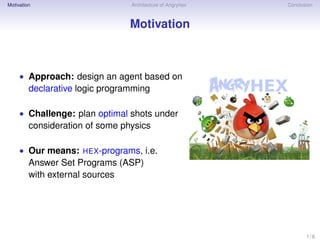
• Approach: design an agent based on
declarative logic programming
• Challenge: plan optimal shots under
consideration of some physics
• Our means: HEX-programs, i.e.
Answer Set Programs (ASP)
with external sources
1 / 6
Motivation Architecture of Angryhex Conclusion
HEX-programs
• HEX-program Π is a set of ASP rules,
where external atoms are allowed in rule bodies:
• &distance[O1, O2](D) is true iff
distance between O1 and O2 is D
• &canpush[ngobject](O1, O2) is true iff
O1 can push O2 given additional info
in the extention of ngobject
O1 O2
D
O2
O1
• Rule1 estimates the likelihood that object O2 falls when O1 is hit
Rule1 : pushDamage(O2, P1, P) ← pushDamage(O1, , P1), P1 > 0
&canpush[ngobject](O1, O2),
pushability(O2, P2), P = P1 ∗ P2/100.
2 / 6
Motivation Architecture of Angryhex Conclusion
Architecture of Angryhex
• We use the provided framework (browser plugin, vision module, . . . )
• Agent builds on tactics and strategy, both are realized declaratively
• Tactics: reasoning about the next shot is done in a HEX-program Π
• Input: scene info from the vision module (facts of Π)
• Output: desired target (models of Π)
• Strategy: next level to played is computed in an ASP program Π0
• Input: info about the number of times levels were played, best
scores achieved, scores of our agent (facts of Π0)
• Output: next optimal level to be played (models of Π0)
3 / 6
Motivation Architecture of Angryhex Conclusion
HEX Encoding for Tactics
• Physics simulation results are accessed via external atoms:
• decide which O0 intersect with trajectory of a bird after hitting O
• decide whether O1 falls whenever O2 falls . . .
• Tactics in details:
• Consider each shootable target
• Compute the estimated damage on each non-target object
• Rank the targets (=answer sets) using weak constraints
• Consider history: never play a level in the same way again!
4 / 6
Motivation Architecture of Angryhex Conclusion
ASP Encoding for Strategy
• Decides which level to play next based on info about:
• number of times each level was played
• best scores
• our agent’s scores . . .
• Strategy in details:
• First play each level once
• Second play levels in which our score
maximally differs from the best one
• Third play levels in which we played best
and the difference to the second best score is minimal
5 / 6
Motivation Architecture of Angryhex Conclusion
Conclusion and Future Work
• Wrap-up:
• Agent is realized using declarative programming means
• Vision module provided by the organizers is integrated
• Declarative strategy is realized (used to be in java)
• Fixes and improvements in comparison to previous version
• Possible improvements:
• Combine objects which behave like a single one
• Plan over multiple shots
• Improve object recognition and general precision of shots
6 / 6

angryhex_slides2014.pdf

  • 1.
    Motivation Architecture ofAngryhex Conclusion AngryHex: an Angry Birds-playing Agent based on HEX-programs Francesco Calimeri 1 Michael Fink 2 Stefano Germano 1 Andreas Humenberger 2 Giovambattista Ianni 1 Christoph Redl 2 Daria Stepanova 2 Andrea Tucci 1Università della Calabria, Dipartimento di Matematica e Informatica, 2Technische Universität Wien, Institut für Informationssysteme ECAI, Angry Birds Competition–August 19, 2014 1 / 6
  • 2.
    Motivation Architecture ofAngryhex Conclusion Motivation • Approach: design an agent based on declarative logic programming • Challenge: plan optimal shots under consideration of some physics • Our means: HEX-programs, i.e. Answer Set Programs (ASP) with external sources 1 / 6
  • 3.
    Motivation Architecture ofAngryhex Conclusion HEX-programs • HEX-program Π is a set of ASP rules, where external atoms are allowed in rule bodies: • &distance[O1, O2](D) is true iff distance between O1 and O2 is D • &canpush[ngobject](O1, O2) is true iff O1 can push O2 given additional info in the extention of ngobject O1 O2 D O2 O1 • Rule1 estimates the likelihood that object O2 falls when O1 is hit Rule1 : pushDamage(O2, P1, P) ← pushDamage(O1, , P1), P1 > 0 &canpush[ngobject](O1, O2), pushability(O2, P2), P = P1 ∗ P2/100. 2 / 6
  • 4.
    Motivation Architecture ofAngryhex Conclusion Architecture of Angryhex • We use the provided framework (browser plugin, vision module, . . . ) • Agent builds on tactics and strategy, both are realized declaratively • Tactics: reasoning about the next shot is done in a HEX-program Π • Input: scene info from the vision module (facts of Π) • Output: desired target (models of Π) • Strategy: next level to played is computed in an ASP program Π0 • Input: info about the number of times levels were played, best scores achieved, scores of our agent (facts of Π0) • Output: next optimal level to be played (models of Π0) 3 / 6
  • 5.
    Motivation Architecture ofAngryhex Conclusion HEX Encoding for Tactics • Physics simulation results are accessed via external atoms: • decide which O0 intersect with trajectory of a bird after hitting O • decide whether O1 falls whenever O2 falls . . . • Tactics in details: • Consider each shootable target • Compute the estimated damage on each non-target object • Rank the targets (=answer sets) using weak constraints • Consider history: never play a level in the same way again! 4 / 6
  • 6.
    Motivation Architecture ofAngryhex Conclusion ASP Encoding for Strategy • Decides which level to play next based on info about: • number of times each level was played • best scores • our agent’s scores . . . • Strategy in details: • First play each level once • Second play levels in which our score maximally differs from the best one • Third play levels in which we played best and the difference to the second best score is minimal 5 / 6
  • 7.
    Motivation Architecture ofAngryhex Conclusion Conclusion and Future Work • Wrap-up: • Agent is realized using declarative programming means • Vision module provided by the organizers is integrated • Declarative strategy is realized (used to be in java) • Fixes and improvements in comparison to previous version • Possible improvements: • Combine objects which behave like a single one • Plan over multiple shots • Improve object recognition and general precision of shots 6 / 6