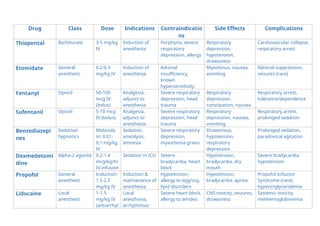
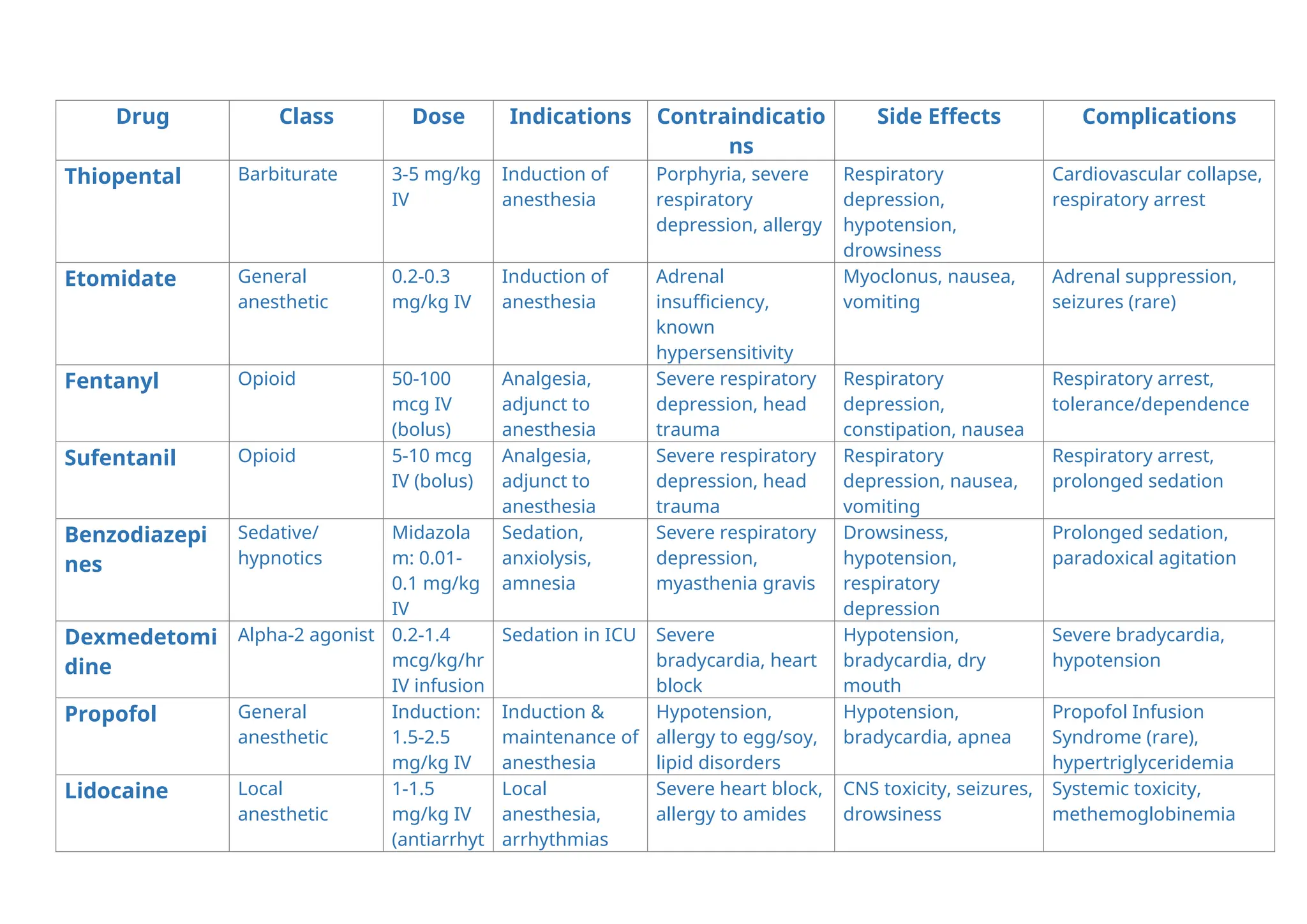
Drug Class Dose Indications Contraindicatio
ns
Side Effects Complications
Thiopental Barbiturate 3-5 mg/kg
IV
Induction of
anesthesia
Porphyria, severe
respiratory
depression, allergy
Respiratory
depression,
hypotension,
drowsiness
Cardiovascular collapse,
respiratory arrest
Etomidate General
anesthetic
0.2-0.3
mg/kg IV
Induction of
anesthesia
Adrenal
insufficiency,
known
hypersensitivity
Myoclonus, nausea,
vomiting
Adrenal suppression,
seizures (rare)
Fentanyl Opioid 50-100
mcg IV
(bolus)
Analgesia,
adjunct to
anesthesia
Severe respiratory
depression, head
trauma
Respiratory
depression,
constipation, nausea
Respiratory arrest,
tolerance/dependence
Sufentanil Opioid 5-10 mcg
IV (bolus)
Analgesia,
adjunct to
anesthesia
Severe respiratory
depression, head
trauma
Respiratory
depression, nausea,
vomiting
Respiratory arrest,
prolonged sedation
Benzodiazepi
nes
Sedative/
hypnotics
Midazola
m: 0.01-
0.1 mg/kg
IV
Sedation,
anxiolysis,
amnesia
Severe respiratory
depression,
myasthenia gravis
Drowsiness,
hypotension,
respiratory
depression
Prolonged sedation,
paradoxical agitation
Dexmedetomi
dine
Alpha-2 agonist 0.2-1.4
mcg/kg/hr
IV infusion
Sedation in ICU Severe
bradycardia, heart
block
Hypotension,
bradycardia, dry
mouth
Severe bradycardia,
hypotension
Propofol General
anesthetic
Induction:
1.5-2.5
mg/kg IV
Induction &
maintenance of
anesthesia
Hypotension,
allergy to egg/soy,
lipid disorders
Hypotension,
bradycardia, apnea
Propofol Infusion
Syndrome (rare),
hypertriglyceridemia
Lidocaine Local
anesthetic
1-1.5
mg/kg IV
(antiarrhyt
Local
anesthesia,
arrhythmias
Severe heart block,
allergy to amides
CNS toxicity, seizures,
drowsiness
Systemic toxicity,
methemoglobinemia
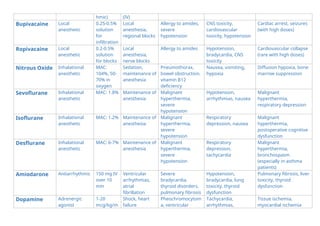
hmic) (IV)
Bupivacaine Local
anesthetic
0.25-0.5%
solution
for
infiltration
Local
anesthesia,
regional blocks
Allergy to amides,
severe
hypotension
CNS toxicity,
cardiovascular
toxicity, hypotension
Cardiac arrest, seizures
(with high doses)
Ropivacaine Local
anesthetic
0.2-0.5%
solution
for blocks
Local
anesthesia,
nerve blocks
Allergy to amides Hypotension,
bradycardia, CNS
toxicity
Cardiovascular collapse
(rare with high doses)
Nitrous Oxide Inhalational
anesthetic
MAC:
104%, 50-
70% in
oxygen
Sedation,
maintenance of
anesthesia
Pneumothorax,
bowel obstruction,
vitamin B12
deficiency
Nausea, vomiting,
hypoxia
Diffusion hypoxia, bone
marrow suppression
Sevoflurane Inhalational
anesthetic
MAC: 1.8% Maintenance of
anesthesia
Malignant
hyperthermia,
severe
hypotension
Hypotension,
arrhythmias, nausea
Malignant
hyperthermia,
respiratory depression
Isoflurane Inhalational
anesthetic
MAC: 1.2% Maintenance of
anesthesia
Malignant
hyperthermia,
severe
hypotension
Respiratory
depression, nausea
Malignant
hyperthermia,
postoperative cognitive
dysfunction
Desflurane Inhalational
anesthetic
MAC: 6-7% Maintenance of
anesthesia
Malignant
hyperthermia,
severe
hypotension
Respiratory
depression,
tachycardia
Malignant
hyperthermia,
bronchospasm
(especially in asthma
patients)
Amiodarone Antiarrhythmic 150 mg IV
over 10
min
Ventricular
arrhythmias,
atrial
fibrillation
Severe
bradycardia,
thyroid disorders,
pulmonary fibrosis
Hypotension,
bradycardia, lung
toxicity, thyroid
dysfunction
Pulmonary fibrosis, liver
toxicity, thyroid
dysfunction
Dopamine Adrenergic
agonist
1-20
mcg/kg/m
Shock, heart
failure
Pheochromocytom
a, ventricular
Tachycardia,
arrhythmias,
Tissue ischemia,
myocardial ischemia
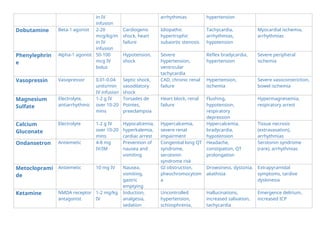
in IV
infusion
arrhythmias hypertension
Dobutamine Beta-1 agonist 2-20
mcg/kg/m
in IV
infusion
Cardiogenic
shock, heart
failure
Idiopathic
hypertrophic
subaortic stenosis
Tachycardia,
arrhythmias,
hypotension
Myocardial ischemia,
arrhythmias
Phenylephrin
e
Alpha-1 agonist 50-100
mcg IV
bolus
Hypotension,
shock
Severe
hypertension,
ventricular
tachycardia
Reflex bradycardia,
hypertension
Severe peripheral
ischemia
Vasopressin Vasopressor 0.01-0.04
units/min
IV infusion
Septic shock,
vasodilatory
shock
CAD, chronic renal
failure
Hypertension,
ischemia
Severe vasoconstriction,
bowel ischemia
Magnesium
Sulfate
Electrolyte,
antiarrhythmic
1-2 g IV
over 10-20
mins
Torsades de
Pointes,
preeclampsia
Heart block, renal
failure
Flushing,
hypotension,
respiratory
depression
Hypermagnesemia,
respiratory arrest
Calcium
Gluconate
Electrolyte 1-2 g IV
over 10-20
mins
Hypocalcemia,
hyperkalemia,
cardiac arrest
Hypercalcemia,
severe renal
impairment
Hypercalcemia,
bradycardia,
hypotension
Tissue necrosis
(extravasation),
arrhythmias
Ondansetron Antiemetic 4-8 mg
IV/IM
Prevention of
nausea and
vomiting
Congenital long QT
syndrome,
serotonin
syndrome risk
Headache,
constipation, QT
prolongation
Serotonin syndrome
(rare), arrhythmias
Metocloprami
de
Antiemetic 10 mg IV Nausea,
vomiting,
gastric
emptying
GI obstruction,
pheochromocytom
a
Drowsiness, dystonia,
akathisia
Extrapyramidal
symptoms, tardive
dyskinesia
Ketamine NMDA receptor
antagonist
1-2 mg/kg
IV
Induction,
analgesia,
sedation
Uncontrolled
hypertension,
schizophrenia,
Hallucinations,
increased salivation,
tachycardia
Emergence delirium,
increased ICP
raised ICP
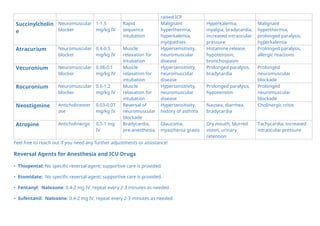
Succinylcholin
e
Neuromuscular
blocker
1-1.5
mg/kg IV
Rapid
sequence
intubation
Malignant
hyperthermia,
hyperkalemia,
myopathies
Hyperkalemia,
myalgia, bradycardia,
increased intraocular
pressure
Malignant
hyperthermia,
prolonged paralysis,
hyperkalemia
Atracurium Neuromuscular
blocker
0.4-0.5
mg/kg IV
Muscle
relaxation for
intubation
Hypersensitivity,
neuromuscular
disease
Histamine release,
hypotension,
bronchospasm
Prolonged paralysis,
allergic reactions
Vecuronium Neuromuscular
blocker
0.08-0.1
mg/kg IV
Muscle
relaxation for
intubation
Hypersensitivity,
neuromuscular
disease
Prolonged paralysis,
bradycardia
Prolonged
neuromuscular
blockade
Rocuronium Neuromuscular
blocker
0.6-1.2
mg/kg IV
Muscle
relaxation for
intubation
Hypersensitivity,
neuromuscular
disease
Prolonged paralysis,
hypotension
Prolonged
neuromuscular
blockade
Neostigmine Anticholinester
ase
0.03-0.07
mg/kg IV
Reversal of
neuromuscular
blockade
Hypersensitivity,
history of asthma
Nausea, diarrhea,
bradycardia
Cholinergic crisis
Atropine Anticholinergic 0.5-1 mg
IV
Bradycardia,
pre-anesthesia
Glaucoma,
myasthenia gravis
Dry mouth, blurred
vision, urinary
retention
Tachycardia, increased
intraocular pressure
Feel free to reach out if you need any further adjustments or assistance!
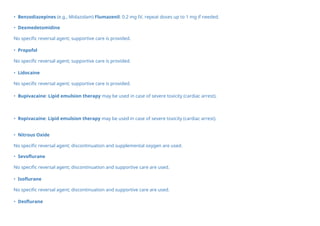
Reversal Agents for Anesthesia and ICU Drugs
• Thiopental: No specific reversal agent; supportive care is provided.
• Etomidate: No specific reversal agent; supportive care is provided.
• Fentanyl: Naloxone: 0.4-2 mg IV, repeat every 2-3 minutes as needed.
• Sufentanil: Naloxone: 0.4-2 mg IV, repeat every 2-3 minutes as needed.
• Benzodiazepines (e.g., Midazolam) Flumazenil: 0.2 mg IV, repeat doses up to 1 mg if needed.
• Dexmedetomidine
No specific reversal agent; supportive care is provided.
• Propofol
No specific reversal agent; supportive care is provided.
• Lidocaine
No specific reversal agent; supportive care is provided.
• Bupivacaine: Lipid emulsion therapy may be used in case of severe toxicity (cardiac arrest).
• Ropivacaine: Lipid emulsion therapy may be used in case of severe toxicity (cardiac arrest).
• Nitrous Oxide
No specific reversal agent; discontinuation and supplemental oxygen are used.
• Sevoflurane
No specific reversal agent; discontinuation and supportive care are used.
• Isoflurane
No specific reversal agent; discontinuation and supportive care are used.
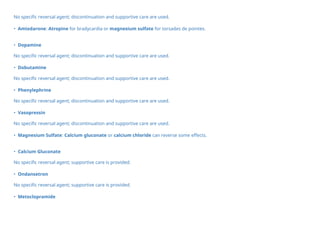
• Desflurane
No specific reversal agent; discontinuation and supportive care are used.
• Amiodarone: Atropine for bradycardia or magnesium sulfate for torsades de pointes.
• Dopamine
No specific reversal agent; discontinuation and supportive care are used.
• Dobutamine
No specific reversal agent; discontinuation and supportive care are used.
• Phenylephrine
No specific reversal agent; discontinuation and supportive care are used.
• Vasopressin
No specific reversal agent; discontinuation and supportive care are used.
• Magnesium Sulfate: Calcium gluconate or calcium chloride can reverse some effects.
• Calcium Gluconate
No specific reversal agent; supportive care is provided.
• Ondansetron
No specific reversal agent; supportive care is provided.
• Metoclopramide
No specific reversal agent; supportive care is provided.
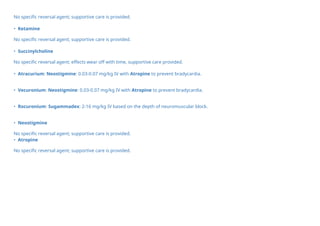
• Ketamine
No specific reversal agent; supportive care is provided.
• Succinylcholine
No specific reversal agent; effects wear off with time, supportive care provided.
• Atracurium: Neostigmine: 0.03-0.07 mg/kg IV with Atropine to prevent bradycardia.
• Vecuronium: Neostigmine: 0.03-0.07 mg/kg IV with Atropine to prevent bradycardia.
• Rocuronium: Sugammadex: 2-16 mg/kg IV based on the depth of neuromuscular block.
• Neostigmine
No specific reversal agent; supportive care is provided.
• Atropine
No specific reversal agent; supportive care is provided.
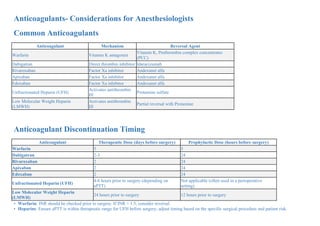
Anticoagulants- Considerations for Anesthesiologists
Common Anticoagulants
Anticoagulant Mechanism Reversal Agent
Warfarin Vitamin K antagonist
Vitamin K, Prothrombin complex concentrates
(PCC)
Dabigatran Direct thrombin inhibitor Idarucizumab
Rivaroxaban Factor Xa inhibitor Andexanet alfa
Apixaban Factor Xa inhibitor Andexanet alfa
Edoxaban Factor Xa inhibitor Andexanet alfa
Unfractionated Heparin (UFH)
Activates antithrombin
III
Protamine sulfate
Low Molecular Weight Heparin
(LMWH)
Activates antithrombin
III
Partial reversal with Protamine
Anticoagulant Discontinuation Timing
Anticoagulant Therapeutic Dose (days before surgery) Prophylactic Dose (hours before surgery)
Warfarin 5 5
Dabigatran 2-3 24
Rivaroxaban 2 24
Apixaban 2 24
Edoxaban 2 24
Unfractionated Heparin (UFH)
4-6 hours prior to surgery (depending on
aPTT)
Not applicable (often used in a perioperative
setting)
Low Molecular Weight Heparin
(LMWH)
24 hours prior to surgery 12 hours prior to surgery
• Warfarin: INR should be checked prior to surgery. If INR > 1.5, consider reversal.
• Heparins: Ensure aPTT is within therapeutic range for UFH before surgery; adjust timing based on the specific surgical procedure and patient risk.
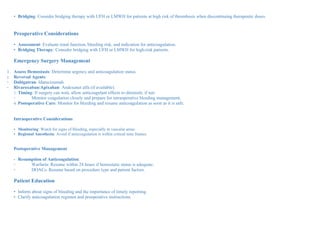
• Bridging: Consider bridging therapy with UFH or LMWH for patients at high risk of thrombosis when discontinuing therapeutic doses.
Preoperative Considerations
• Assessment: Evaluate renal function, bleeding risk, and indication for anticoagulation.
• Bridging Therapy: Consider bridging with UFH or LMWH for high-risk patients.
Emergency Surgery Management
1. Assess Hemostasis: Determine urgency and anticoagulation status.
2. Reversal Agents:
◦ Dabigatran: Idarucizumab.
◦ Rivaroxaban/Apixaban: Andexanet alfa (if available).
3. Timing: If surgery can wait, allow anticoagulant effects to diminish; if not:
◦ Monitor coagulation closely and prepare for intraoperative bleeding management.
4. Postoperative Care: Monitor for bleeding and resume anticoagulation as soon as it is safe.
Intraoperative Considerations
• Monitoring: Watch for signs of bleeding, especially in vascular areas.
• Regional Anesthesia: Avoid if anticoagulation is within critical time frames.
Postoperative Management
• Resumption of Anticoagulation:
◦ Warfarin: Resume within 24 hours if hemostatic status is adequate.
◦ DOACs: Resume based on procedure type and patient factors.
Patient Education
• Inform about signs of bleeding and the importance of timely reporting.
• Clarify anticoagulation regimen and preoperative instructions.
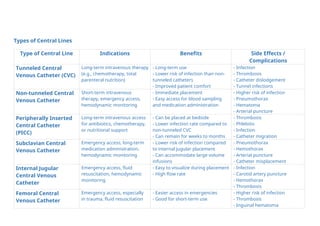
Types of Central Lines
Type of Central Line Indications Benefits Side Effects /
Complications
Tunneled Central
Venous Catheter (CVC)
Long-term intravenous therapy
(e.g., chemotherapy, total
parenteral nutrition)
- Long-term use
- Lower risk of infection than non-
tunneled catheters
- Improved patient comfort
- Infection
- Thrombosis
- Catheter dislodgement
- Tunnel infections
Non-tunneled Central
Venous Catheter
Short-term intravenous
therapy, emergency access,
hemodynamic monitoring
- Immediate placement
- Easy access for blood sampling
and medication administration
- Higher risk of infection
- Pneumothorax
- Hematoma
- Arterial puncture
Peripherally Inserted
Central Catheter
(PICC)
Long-term intravenous access
for antibiotics, chemotherapy,
or nutritional support
- Can be placed at bedside
- Lower infection rate compared to
non-tunneled CVC
- Can remain for weeks to months
- Thrombosis
- Phlebitis
- Infection
- Catheter migration
Subclavian Central
Venous Catheter
Emergency access, long-term
medication administration,
hemodynamic monitoring
- Lower risk of infection compared
to internal jugular placement
- Can accommodate large volume
infusions
- Pneumothorax
- Hemothorax
- Arterial puncture
- Catheter misplacement
Internal Jugular
Central Venous
Catheter
Emergency access, fluid
resuscitation, hemodynamic
monitoring
- Easy to visualize during placement
- High flow rate
- Infection
- Carotid artery puncture
- Hemothorax
- Thrombosis
Femoral Central
Venous Catheter
Emergency access, especially
in trauma, fluid resuscitation
- Easier access in emergencies
- Good for short-term use
- Higher risk of infection
- Thrombosis
- Inguinal hematoma
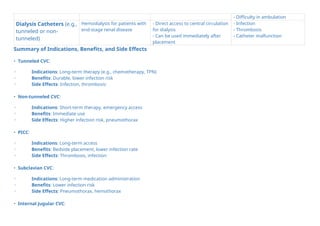
- Difficulty in ambulation
Dialysis Catheters (e.g.,
tunneled or non-
tunneled)
Hemodialysis for patients with
end-stage renal disease
- Direct access to central circulation
for dialysis
- Can be used immediately after
placement
- Infection
- Thrombosis
- Catheter malfunction
Summary of Indications, Benefits, and Side Effects
• Tunneled CVC:
◦ Indications: Long-term therapy (e.g., chemotherapy, TPN)
◦ Benefits: Durable, lower infection risk
◦ Side Effects: Infection, thrombosis
• Non-tunneled CVC:
◦ Indications: Short-term therapy, emergency access
◦ Benefits: Immediate use
◦ Side Effects: Higher infection risk, pneumothorax
• PICC:
◦ Indications: Long-term access
◦ Benefits: Bedside placement, lower infection rate
◦ Side Effects: Thrombosis, infection
• Subclavian CVC:
◦ Indications: Long-term medication administration
◦ Benefits: Lower infection risk
◦ Side Effects: Pneumothorax, hemothorax
• Internal Jugular CVC:
◦ Indications: Emergency access
◦ Benefits: High flow, easy visualization
◦ Side Effects: Infection, arterial puncture
• Femoral CVC:
◦ Indications: Emergency access, trauma
◦ Benefits: Easier access in emergencies
◦ Side Effects: Higher infection risk, thrombosis
• Dialysis Catheters:
◦ Indications: Hemodialysis
◦ Benefits: Direct access for dialysis
◦ Side Effects: Infection, thrombosis
OSA SCORE
Anesthesia  drugs pearls, important basic data.docx

Anesthesia drugs pearls, important basic data.docx

  • 1.
    Drug Class DoseIndications Contraindicatio ns Side Effects Complications Thiopental Barbiturate 3-5 mg/kg IV Induction of anesthesia Porphyria, severe respiratory depression, allergy Respiratory depression, hypotension, drowsiness Cardiovascular collapse, respiratory arrest Etomidate General anesthetic 0.2-0.3 mg/kg IV Induction of anesthesia Adrenal insufficiency, known hypersensitivity Myoclonus, nausea, vomiting Adrenal suppression, seizures (rare) Fentanyl Opioid 50-100 mcg IV (bolus) Analgesia, adjunct to anesthesia Severe respiratory depression, head trauma Respiratory depression, constipation, nausea Respiratory arrest, tolerance/dependence Sufentanil Opioid 5-10 mcg IV (bolus) Analgesia, adjunct to anesthesia Severe respiratory depression, head trauma Respiratory depression, nausea, vomiting Respiratory arrest, prolonged sedation Benzodiazepi nes Sedative/ hypnotics Midazola m: 0.01- 0.1 mg/kg IV Sedation, anxiolysis, amnesia Severe respiratory depression, myasthenia gravis Drowsiness, hypotension, respiratory depression Prolonged sedation, paradoxical agitation Dexmedetomi dine Alpha-2 agonist 0.2-1.4 mcg/kg/hr IV infusion Sedation in ICU Severe bradycardia, heart block Hypotension, bradycardia, dry mouth Severe bradycardia, hypotension Propofol General anesthetic Induction: 1.5-2.5 mg/kg IV Induction & maintenance of anesthesia Hypotension, allergy to egg/soy, lipid disorders Hypotension, bradycardia, apnea Propofol Infusion Syndrome (rare), hypertriglyceridemia Lidocaine Local anesthetic 1-1.5 mg/kg IV (antiarrhyt Local anesthesia, arrhythmias Severe heart block, allergy to amides CNS toxicity, seizures, drowsiness Systemic toxicity, methemoglobinemia
  • 2.
    hmic) (IV) Bupivacaine Local anesthetic 0.25-0.5% solution for infiltration Local anesthesia, regionalblocks Allergy to amides, severe hypotension CNS toxicity, cardiovascular toxicity, hypotension Cardiac arrest, seizures (with high doses) Ropivacaine Local anesthetic 0.2-0.5% solution for blocks Local anesthesia, nerve blocks Allergy to amides Hypotension, bradycardia, CNS toxicity Cardiovascular collapse (rare with high doses) Nitrous Oxide Inhalational anesthetic MAC: 104%, 50- 70% in oxygen Sedation, maintenance of anesthesia Pneumothorax, bowel obstruction, vitamin B12 deficiency Nausea, vomiting, hypoxia Diffusion hypoxia, bone marrow suppression Sevoflurane Inhalational anesthetic MAC: 1.8% Maintenance of anesthesia Malignant hyperthermia, severe hypotension Hypotension, arrhythmias, nausea Malignant hyperthermia, respiratory depression Isoflurane Inhalational anesthetic MAC: 1.2% Maintenance of anesthesia Malignant hyperthermia, severe hypotension Respiratory depression, nausea Malignant hyperthermia, postoperative cognitive dysfunction Desflurane Inhalational anesthetic MAC: 6-7% Maintenance of anesthesia Malignant hyperthermia, severe hypotension Respiratory depression, tachycardia Malignant hyperthermia, bronchospasm (especially in asthma patients) Amiodarone Antiarrhythmic 150 mg IV over 10 min Ventricular arrhythmias, atrial fibrillation Severe bradycardia, thyroid disorders, pulmonary fibrosis Hypotension, bradycardia, lung toxicity, thyroid dysfunction Pulmonary fibrosis, liver toxicity, thyroid dysfunction Dopamine Adrenergic agonist 1-20 mcg/kg/m Shock, heart failure Pheochromocytom a, ventricular Tachycardia, arrhythmias, Tissue ischemia, myocardial ischemia
  • 3.
    in IV infusion arrhythmias hypertension DobutamineBeta-1 agonist 2-20 mcg/kg/m in IV infusion Cardiogenic shock, heart failure Idiopathic hypertrophic subaortic stenosis Tachycardia, arrhythmias, hypotension Myocardial ischemia, arrhythmias Phenylephrin e Alpha-1 agonist 50-100 mcg IV bolus Hypotension, shock Severe hypertension, ventricular tachycardia Reflex bradycardia, hypertension Severe peripheral ischemia Vasopressin Vasopressor 0.01-0.04 units/min IV infusion Septic shock, vasodilatory shock CAD, chronic renal failure Hypertension, ischemia Severe vasoconstriction, bowel ischemia Magnesium Sulfate Electrolyte, antiarrhythmic 1-2 g IV over 10-20 mins Torsades de Pointes, preeclampsia Heart block, renal failure Flushing, hypotension, respiratory depression Hypermagnesemia, respiratory arrest Calcium Gluconate Electrolyte 1-2 g IV over 10-20 mins Hypocalcemia, hyperkalemia, cardiac arrest Hypercalcemia, severe renal impairment Hypercalcemia, bradycardia, hypotension Tissue necrosis (extravasation), arrhythmias Ondansetron Antiemetic 4-8 mg IV/IM Prevention of nausea and vomiting Congenital long QT syndrome, serotonin syndrome risk Headache, constipation, QT prolongation Serotonin syndrome (rare), arrhythmias Metocloprami de Antiemetic 10 mg IV Nausea, vomiting, gastric emptying GI obstruction, pheochromocytom a Drowsiness, dystonia, akathisia Extrapyramidal symptoms, tardive dyskinesia Ketamine NMDA receptor antagonist 1-2 mg/kg IV Induction, analgesia, sedation Uncontrolled hypertension, schizophrenia, Hallucinations, increased salivation, tachycardia Emergence delirium, increased ICP
  • 4.
    raised ICP Succinylcholin e Neuromuscular blocker 1-1.5 mg/kg IV Rapid sequence intubation Malignant hyperthermia, hyperkalemia, myopathies Hyperkalemia, myalgia,bradycardia, increased intraocular pressure Malignant hyperthermia, prolonged paralysis, hyperkalemia Atracurium Neuromuscular blocker 0.4-0.5 mg/kg IV Muscle relaxation for intubation Hypersensitivity, neuromuscular disease Histamine release, hypotension, bronchospasm Prolonged paralysis, allergic reactions Vecuronium Neuromuscular blocker 0.08-0.1 mg/kg IV Muscle relaxation for intubation Hypersensitivity, neuromuscular disease Prolonged paralysis, bradycardia Prolonged neuromuscular blockade Rocuronium Neuromuscular blocker 0.6-1.2 mg/kg IV Muscle relaxation for intubation Hypersensitivity, neuromuscular disease Prolonged paralysis, hypotension Prolonged neuromuscular blockade Neostigmine Anticholinester ase 0.03-0.07 mg/kg IV Reversal of neuromuscular blockade Hypersensitivity, history of asthma Nausea, diarrhea, bradycardia Cholinergic crisis Atropine Anticholinergic 0.5-1 mg IV Bradycardia, pre-anesthesia Glaucoma, myasthenia gravis Dry mouth, blurred vision, urinary retention Tachycardia, increased intraocular pressure Feel free to reach out if you need any further adjustments or assistance! Reversal Agents for Anesthesia and ICU Drugs • Thiopental: No specific reversal agent; supportive care is provided. • Etomidate: No specific reversal agent; supportive care is provided. • Fentanyl: Naloxone: 0.4-2 mg IV, repeat every 2-3 minutes as needed. • Sufentanil: Naloxone: 0.4-2 mg IV, repeat every 2-3 minutes as needed.
  • 5.
    • Benzodiazepines (e.g.,Midazolam) Flumazenil: 0.2 mg IV, repeat doses up to 1 mg if needed. • Dexmedetomidine No specific reversal agent; supportive care is provided. • Propofol No specific reversal agent; supportive care is provided. • Lidocaine No specific reversal agent; supportive care is provided. • Bupivacaine: Lipid emulsion therapy may be used in case of severe toxicity (cardiac arrest). • Ropivacaine: Lipid emulsion therapy may be used in case of severe toxicity (cardiac arrest). • Nitrous Oxide No specific reversal agent; discontinuation and supplemental oxygen are used. • Sevoflurane No specific reversal agent; discontinuation and supportive care are used. • Isoflurane No specific reversal agent; discontinuation and supportive care are used. • Desflurane
  • 6.
    No specific reversalagent; discontinuation and supportive care are used. • Amiodarone: Atropine for bradycardia or magnesium sulfate for torsades de pointes. • Dopamine No specific reversal agent; discontinuation and supportive care are used. • Dobutamine No specific reversal agent; discontinuation and supportive care are used. • Phenylephrine No specific reversal agent; discontinuation and supportive care are used. • Vasopressin No specific reversal agent; discontinuation and supportive care are used. • Magnesium Sulfate: Calcium gluconate or calcium chloride can reverse some effects. • Calcium Gluconate No specific reversal agent; supportive care is provided. • Ondansetron No specific reversal agent; supportive care is provided. • Metoclopramide
  • 7.
    No specific reversalagent; supportive care is provided. • Ketamine No specific reversal agent; supportive care is provided. • Succinylcholine No specific reversal agent; effects wear off with time, supportive care provided. • Atracurium: Neostigmine: 0.03-0.07 mg/kg IV with Atropine to prevent bradycardia. • Vecuronium: Neostigmine: 0.03-0.07 mg/kg IV with Atropine to prevent bradycardia. • Rocuronium: Sugammadex: 2-16 mg/kg IV based on the depth of neuromuscular block. • Neostigmine No specific reversal agent; supportive care is provided. • Atropine No specific reversal agent; supportive care is provided.
  • 8.
    Anticoagulants- Considerations forAnesthesiologists Common Anticoagulants Anticoagulant Mechanism Reversal Agent Warfarin Vitamin K antagonist Vitamin K, Prothrombin complex concentrates (PCC) Dabigatran Direct thrombin inhibitor Idarucizumab Rivaroxaban Factor Xa inhibitor Andexanet alfa Apixaban Factor Xa inhibitor Andexanet alfa Edoxaban Factor Xa inhibitor Andexanet alfa Unfractionated Heparin (UFH) Activates antithrombin III Protamine sulfate Low Molecular Weight Heparin (LMWH) Activates antithrombin III Partial reversal with Protamine Anticoagulant Discontinuation Timing Anticoagulant Therapeutic Dose (days before surgery) Prophylactic Dose (hours before surgery) Warfarin 5 5 Dabigatran 2-3 24 Rivaroxaban 2 24 Apixaban 2 24 Edoxaban 2 24 Unfractionated Heparin (UFH) 4-6 hours prior to surgery (depending on aPTT) Not applicable (often used in a perioperative setting) Low Molecular Weight Heparin (LMWH) 24 hours prior to surgery 12 hours prior to surgery • Warfarin: INR should be checked prior to surgery. If INR > 1.5, consider reversal. • Heparins: Ensure aPTT is within therapeutic range for UFH before surgery; adjust timing based on the specific surgical procedure and patient risk.
  • 9.
    • Bridging: Considerbridging therapy with UFH or LMWH for patients at high risk of thrombosis when discontinuing therapeutic doses. Preoperative Considerations • Assessment: Evaluate renal function, bleeding risk, and indication for anticoagulation. • Bridging Therapy: Consider bridging with UFH or LMWH for high-risk patients. Emergency Surgery Management 1. Assess Hemostasis: Determine urgency and anticoagulation status. 2. Reversal Agents: ◦ Dabigatran: Idarucizumab. ◦ Rivaroxaban/Apixaban: Andexanet alfa (if available). 3. Timing: If surgery can wait, allow anticoagulant effects to diminish; if not: ◦ Monitor coagulation closely and prepare for intraoperative bleeding management. 4. Postoperative Care: Monitor for bleeding and resume anticoagulation as soon as it is safe. Intraoperative Considerations • Monitoring: Watch for signs of bleeding, especially in vascular areas. • Regional Anesthesia: Avoid if anticoagulation is within critical time frames. Postoperative Management • Resumption of Anticoagulation: ◦ Warfarin: Resume within 24 hours if hemostatic status is adequate. ◦ DOACs: Resume based on procedure type and patient factors. Patient Education • Inform about signs of bleeding and the importance of timely reporting. • Clarify anticoagulation regimen and preoperative instructions.
  • 10.
    Types of CentralLines Type of Central Line Indications Benefits Side Effects / Complications Tunneled Central Venous Catheter (CVC) Long-term intravenous therapy (e.g., chemotherapy, total parenteral nutrition) - Long-term use - Lower risk of infection than non- tunneled catheters - Improved patient comfort - Infection - Thrombosis - Catheter dislodgement - Tunnel infections Non-tunneled Central Venous Catheter Short-term intravenous therapy, emergency access, hemodynamic monitoring - Immediate placement - Easy access for blood sampling and medication administration - Higher risk of infection - Pneumothorax - Hematoma - Arterial puncture Peripherally Inserted Central Catheter (PICC) Long-term intravenous access for antibiotics, chemotherapy, or nutritional support - Can be placed at bedside - Lower infection rate compared to non-tunneled CVC - Can remain for weeks to months - Thrombosis - Phlebitis - Infection - Catheter migration Subclavian Central Venous Catheter Emergency access, long-term medication administration, hemodynamic monitoring - Lower risk of infection compared to internal jugular placement - Can accommodate large volume infusions - Pneumothorax - Hemothorax - Arterial puncture - Catheter misplacement Internal Jugular Central Venous Catheter Emergency access, fluid resuscitation, hemodynamic monitoring - Easy to visualize during placement - High flow rate - Infection - Carotid artery puncture - Hemothorax - Thrombosis Femoral Central Venous Catheter Emergency access, especially in trauma, fluid resuscitation - Easier access in emergencies - Good for short-term use - Higher risk of infection - Thrombosis - Inguinal hematoma
  • 11.
    - Difficulty inambulation Dialysis Catheters (e.g., tunneled or non- tunneled) Hemodialysis for patients with end-stage renal disease - Direct access to central circulation for dialysis - Can be used immediately after placement - Infection - Thrombosis - Catheter malfunction Summary of Indications, Benefits, and Side Effects • Tunneled CVC: ◦ Indications: Long-term therapy (e.g., chemotherapy, TPN) ◦ Benefits: Durable, lower infection risk ◦ Side Effects: Infection, thrombosis • Non-tunneled CVC: ◦ Indications: Short-term therapy, emergency access ◦ Benefits: Immediate use ◦ Side Effects: Higher infection risk, pneumothorax • PICC: ◦ Indications: Long-term access ◦ Benefits: Bedside placement, lower infection rate ◦ Side Effects: Thrombosis, infection • Subclavian CVC: ◦ Indications: Long-term medication administration ◦ Benefits: Lower infection risk ◦ Side Effects: Pneumothorax, hemothorax • Internal Jugular CVC:
  • 12.
    ◦ Indications: Emergencyaccess ◦ Benefits: High flow, easy visualization ◦ Side Effects: Infection, arterial puncture • Femoral CVC: ◦ Indications: Emergency access, trauma ◦ Benefits: Easier access in emergencies ◦ Side Effects: Higher infection risk, thrombosis • Dialysis Catheters: ◦ Indications: Hemodialysis ◦ Benefits: Direct access for dialysis ◦ Side Effects: Infection, thrombosis OSA SCORE