Android + Training
  + Philippines
The job market for mobile applications is
  already huge and is growing at an
  enormous pace. People are using their
  mobile devices more than they are using
  their notebook or desktop computers,
  and Android based devices are being
  launched frequently.
As of May 2012, the number of apps that
  have been created and released for the
  android platform is
  over 500,000 (source: DISTIMO: Google
  Android Market). Considering that the
  Google Playstore started late in 2008, in
  a little over four years, there has been an
  explosion of mobile apps.
While IOS enjoyed an early lead in terms of
 number of apps, the IOS dominance is
 no longer secured (source:TechCrunch:
 Android overtakes IOS ...). It is plain to
 see that the momentum of mobile apps
 development is rapidly increasing. This
 creates a demand for programmers on
 the android platform. Excellent
 opportunities await those who are early
 and ready into this growing market.
There are many ways to learn android, you can
  read lots of books voraciously then practice;
  you can keep on reading tutorials available on
  the internet then practice; you can attend
  meetings of the local user groups, then
  practice; you can sign-up for workshops
  (hopefully this one) then practice some more.
  A combination of one, some or all of these
  things will ramp up your skills on android
  development but the fastest way is to attend a
  workshop because the materials have been
  prepared coherently and designed
  thoughtfully so that you can progress in a
  methodical and time-efficient way.
The learning material was painstakingly
  and carefully put together in a way that
  will let YOU grow into the direction of skill,
  the quickest possible time. The course
  material was written using the following
  philosophies:
Use of vocabulary - You need to be able
  to talk about the things you are learning
  and working on---either with your fellow
  attendees or co-workers or people within
  your on-line group. By stressing
  vocabulary your mental handle on the
  concepts increase rapidly
Cut the cruft, amplify what's important - The
 more esoteric parts of android
 programming has been downplayed.
 The material focused on key areas that
 are rich in concept and low on (less
 important) code acrobatics
Idea recursion - some concepts are more
  difficult than others. Some take time to
  sink in. These more difficult concepts are
  repeated throughout the workshop so
  that they maybe reinforced and YOU
  can remember them more effectively
Think like a programmer - To write a
  program, YOU need to understand how
  the algorithms works, see them in action
  and debug them. The workshop will
  force you to go through this workflow
The code samples used in the course
  material will be available for download
  as zipped files. They will also be publicly
  available either via git or google-code
  hosting so you can pull them into your
  dev environment either via git or svn.
Course
contents
Introduction   to the platform
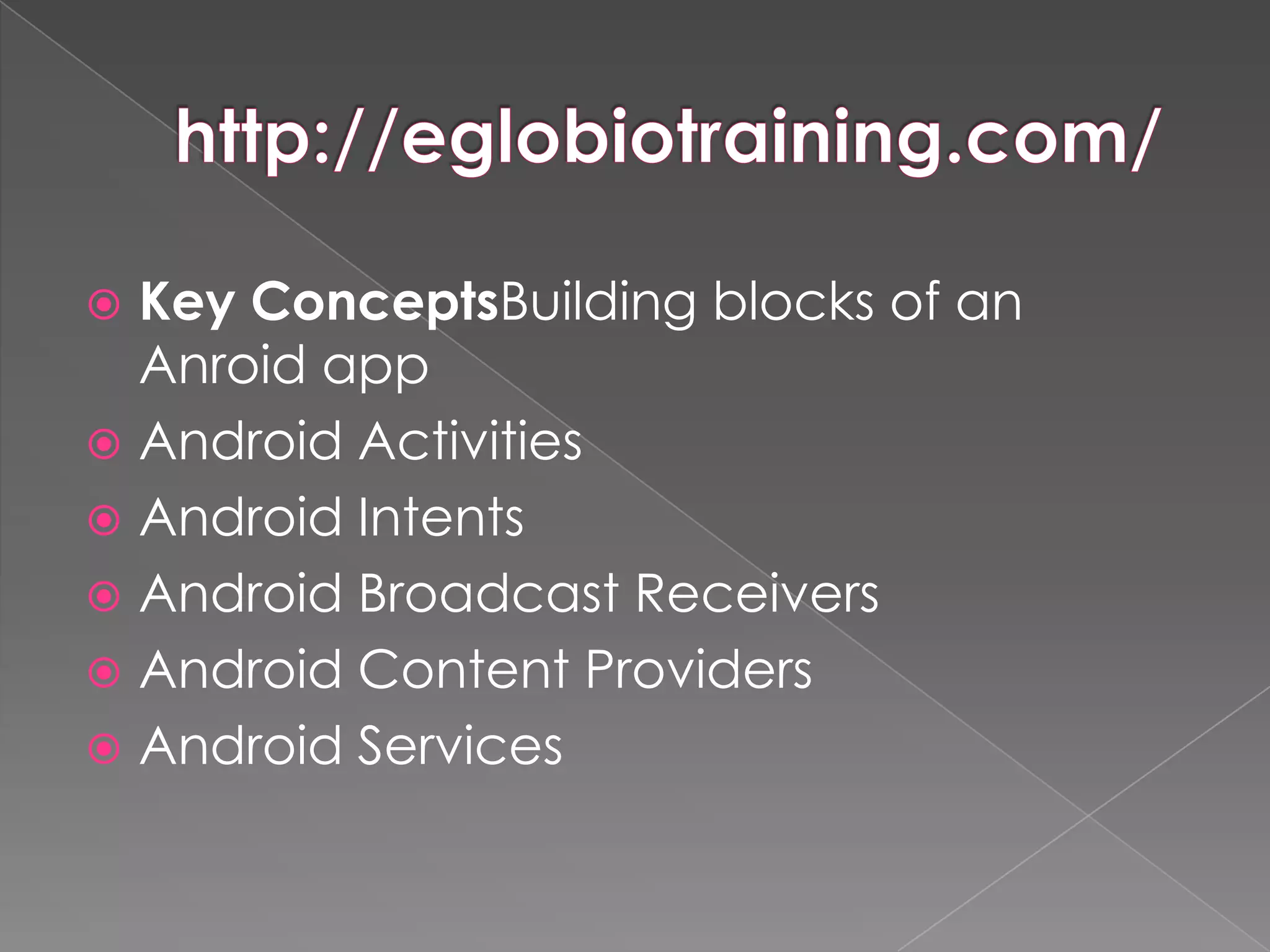
 Key ConceptsBuilding blocks of an
  Anroid app
 Android Activities
 Android Intents
 Android Broadcast Receivers
 Android Content Providers
 Android Services
Tools and other dev
 instruments
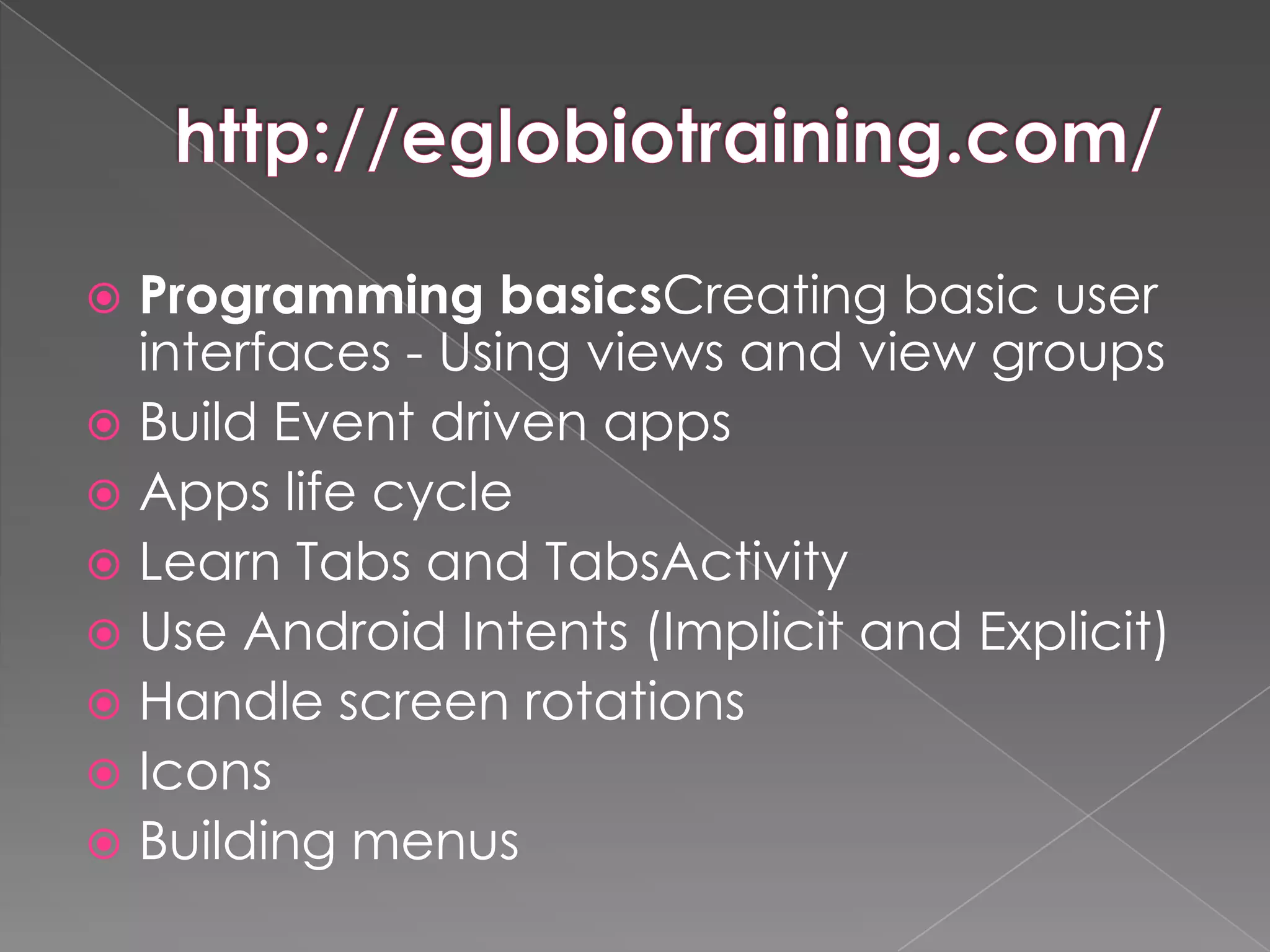
 Programming basicsCreating basic user
  interfaces - Using views and view groups
 Build Event driven apps
 Apps life cycle
 Learn Tabs and TabsActivity
 Use Android Intents (Implicit and Explicit)
 Handle screen rotations
 Icons
 Building menus
   Beyond basicsDatabase programming
    (SQLite)
   Using logcat and adb for testing and
    debugging
   Threads and AsyncTask
   Alerts
   Network programming
   2D and basic animation
   Using the camera
   Linkify
   Using the Preferences
 Which API level will we use
 We will use API level 8 (Froyo) and 9
  (Gingerbread). As of 2.July.2012
  Gingerbread and Froyo are the most
  dominant versions of android in the user's
  hands; 64% and 17% respectively.
Respectfully Submitted to
 Prof. Erwin M. Globio, MSIT

Androids

  • 2.
    Android + Training + Philippines
  • 3.
    The job marketfor mobile applications is already huge and is growing at an enormous pace. People are using their mobile devices more than they are using their notebook or desktop computers, and Android based devices are being launched frequently.
  • 4.
    As of May2012, the number of apps that have been created and released for the android platform is over 500,000 (source: DISTIMO: Google Android Market). Considering that the Google Playstore started late in 2008, in a little over four years, there has been an explosion of mobile apps.
  • 5.
    While IOS enjoyedan early lead in terms of number of apps, the IOS dominance is no longer secured (source:TechCrunch: Android overtakes IOS ...). It is plain to see that the momentum of mobile apps development is rapidly increasing. This creates a demand for programmers on the android platform. Excellent opportunities await those who are early and ready into this growing market.
  • 6.
    There are manyways to learn android, you can read lots of books voraciously then practice; you can keep on reading tutorials available on the internet then practice; you can attend meetings of the local user groups, then practice; you can sign-up for workshops (hopefully this one) then practice some more. A combination of one, some or all of these things will ramp up your skills on android development but the fastest way is to attend a workshop because the materials have been prepared coherently and designed thoughtfully so that you can progress in a methodical and time-efficient way.
  • 7.
    The learning materialwas painstakingly and carefully put together in a way that will let YOU grow into the direction of skill, the quickest possible time. The course material was written using the following philosophies:
  • 8.
    Use of vocabulary- You need to be able to talk about the things you are learning and working on---either with your fellow attendees or co-workers or people within your on-line group. By stressing vocabulary your mental handle on the concepts increase rapidly
  • 9.
    Cut the cruft,amplify what's important - The more esoteric parts of android programming has been downplayed. The material focused on key areas that are rich in concept and low on (less important) code acrobatics
  • 10.
    Idea recursion -some concepts are more difficult than others. Some take time to sink in. These more difficult concepts are repeated throughout the workshop so that they maybe reinforced and YOU can remember them more effectively
  • 11.
    Think like aprogrammer - To write a program, YOU need to understand how the algorithms works, see them in action and debug them. The workshop will force you to go through this workflow
  • 12.
    The code samplesused in the course material will be available for download as zipped files. They will also be publicly available either via git or google-code hosting so you can pull them into your dev environment either via git or svn.
  • 13.
  • 14.
    Introduction to the platform
  • 15.
     Key ConceptsBuildingblocks of an Anroid app  Android Activities  Android Intents  Android Broadcast Receivers  Android Content Providers  Android Services
  • 16.
    Tools and otherdev instruments
  • 17.
     Programming basicsCreatingbasic user interfaces - Using views and view groups  Build Event driven apps  Apps life cycle  Learn Tabs and TabsActivity  Use Android Intents (Implicit and Explicit)  Handle screen rotations  Icons  Building menus
  • 18.
    Beyond basicsDatabase programming (SQLite)  Using logcat and adb for testing and debugging  Threads and AsyncTask  Alerts  Network programming  2D and basic animation  Using the camera  Linkify  Using the Preferences
  • 19.
     Which APIlevel will we use  We will use API level 8 (Froyo) and 9 (Gingerbread). As of 2.July.2012 Gingerbread and Froyo are the most dominant versions of android in the user's hands; 64% and 17% respectively.
  • 20.
    Respectfully Submitted to Prof. Erwin M. Globio, MSIT