Music Industry Business Models in the Digital Millennium:
An Empirical Analysis of Streaming Music and Multi-Product Profits
A Thesis
Presented to
The Established Interdisciplinary Committee for Mathematics and Economics
Reed College
In Partial Fulfillment
of the Requirements for the Degree
Bachelor of Arts
Andrew C. Shapiro
May 2009
Approved for the Committee
(Mathematics and Economics)
Lon Peters Joe Roberts
Abstract
The music industry is undergoing a period of extreme flux. For most of the past
century, the high costs of producing, promoting and distributing music served as
massive barriers to entry into the music industry. In the last decade, however, new
technologies and the proliferation of the internet have all but completely dissolved
these barriers to entry. Among other developments, artists may now record and
produce their music with relatively inexpensive technologies, market and distribute
it via the internet, and incur low fixed costs and almost zero marginal costs in the
process. As a result, artists are now generally less dependent on record labels, and
more free to maximize their own multi-product profits. Profit-maximizing artists
must now choose how to best utilize the imperfectly substitutable forms in which
they may distribute their music, balancing the tradeo↵s among CD revenues, paid
digital download revenues, and the complementary revenues generated by free online
music. With industry CD revenues continuing to fall, and alternative sources of music-
related revenues growing and proliferating, one would expect a divergent shift in music
industry business models away from those designed to maximize CD revenues. The
relatively new technology of streaming music o↵ers a valuable vantage point from
which to survey these new business models empirically.
Controlling for past and current album sales and radio play, as well as determinants
of concert demand such as ticket pricing and previous years’ audiences, my thesis seeks
to explore the following hypotheses regarding multi-product profit-maximizing firm
behavior:
1. Artists that choose to supply more free streaming music are those that choose
to o↵er a larger yearly supply of tickets to their performances.
2. Artists that exhibit higher demand for their free streaming music are those that
choose to o↵er a larger yearly supply of tickets to their performances.
3. Artists that exhibit higher demand for their paid digital-downloads are those
that choose to supply less free streaming music.
4. Free streaming music and paid digital-downloads are substitutes, albeit imper-
fect. We expect the cross-price elasticity of an artist’s free streaming music
and paid digital-downloads to be positive, ceteris paribus. We also expect
the levels of demand for the two goods, across artists, to be inversely corre-
lated, though free streaming music may generate an opposing e↵ect, stimulating
digital-download sales by allowing consumers to sample.
Table of Contents
Chapter 1: Background . . . . . . . . . . . . . . . . . . . . . . . . . . . . 1
1.1 Traditional Music Industry Structure . . . . . . . . . . . . . . . . . . 1
1.1.1 Record Labels & the “Recording Industry” Subsector . . . . . 2
1.2 The Music Industry Enters the Digital Era . . . . . . . . . . . . . . . 4
1.2.1 CD Sales Displacement, Napster and the RIAA . . . . . . . . 4
1.2.2 New Sources of Digital Music . . . . . . . . . . . . . . . . . . 6
1.2.3 New Industry Business Models . . . . . . . . . . . . . . . . . . 7
Chapter 2: Review of Relevant Economic Literature . . . . . . . . . . 9
2.1 Illegal File-Sharing vs. RIAA CD Sales Displacement . . . . . . . . . 9
2.1.1 Rob & Waldfogel, Oberholzer & Strumpf . . . . . . . . . . . . 10
2.2 File-Sharing and Music Industry Profits . . . . . . . . . . . . . . . . 12
2.2.1 Peitz & Waelbroeck (2005) . . . . . . . . . . . . . . . . . . . . 13
2.2.2 Gayer and Shy (2006) . . . . . . . . . . . . . . . . . . . . . . 14
2.2.3 Grassi (2007) . . . . . . . . . . . . . . . . . . . . . . . . . . . 17
2.3 Trends in the Live Performance Subsector . . . . . . . . . . . . . . . 20
2.3.1 Mortimer & Sorensen (2005) . . . . . . . . . . . . . . . . . . . 20
2.3.2 Live Performance . . . . . . . . . . . . . . . . . . . . . . . . . 20
2.4 Summary . . . . . . . . . . . . . . . . . . . . . . . . . . . . . . . . . 21
Chapter 3: Theory . . . . . . . . . . . . . . . . . . . . . . . . . . . . . . . 23
3.1 The Artist Profit Function . . . . . . . . . . . . . . . . . . . . . . . . 23
3.2 Demand Functions . . . . . . . . . . . . . . . . . . . . . . . . . . . . 24
3.2.1 Consumers . . . . . . . . . . . . . . . . . . . . . . . . . . . . . 24
3.2.2 Live Performance & Ring Tones . . . . . . . . . . . . . . . . . 27
3.3 Behavior of the Model . . . . . . . . . . . . . . . . . . . . . . . . . . 27
3.3.1 Conclusions & Critiques . . . . . . . . . . . . . . . . . . . . . 29
Chapter 4: Data & Methods . . . . . . . . . . . . . . . . . . . . . . . . . 31
4.1 Sampling . . . . . . . . . . . . . . . . . . . . . . . . . . . . . . . . . . 31
4.2 Data Collection and Cleaning . . . . . . . . . . . . . . . . . . . . . . 31
4.2.1 RIAA Data . . . . . . . . . . . . . . . . . . . . . . . . . . . . 32
4.2.2 MySpace Data . . . . . . . . . . . . . . . . . . . . . . . . . . 32
4.2.3 YouTube Data . . . . . . . . . . . . . . . . . . . . . . . . . . 33
4.2.4 PollStarPro Data . . . . . . . . . . . . . . . . . . . . . . . . . 34
4.2.5 Billboard Data . . . . . . . . . . . . . . . . . . . . . . . . . . 35
4.2.6 Re-evaluation of the Sample . . . . . . . . . . . . . . . . . . . 36
4.3 Data Treatment . . . . . . . . . . . . . . . . . . . . . . . . . . . . . . 36
4.3.1 Period Structure . . . . . . . . . . . . . . . . . . . . . . . . . 36
4.3.2 Non-Lagged Variables . . . . . . . . . . . . . . . . . . . . . . 36
4.3.3 Lagged Variables and Decay Rates . . . . . . . . . . . . . . . 39
Chapter 5: Analysis . . . . . . . . . . . . . . . . . . . . . . . . . . . . . . . 43
5.1 Pairwise Correlations . . . . . . . . . . . . . . . . . . . . . . . . . . . 43
5.2 Choices Among Families of Variables . . . . . . . . . . . . . . . . . . 44
5.3 Regressions . . . . . . . . . . . . . . . . . . . . . . . . . . . . . . . . 45
5.3.1 System of Equations: 3SLS Estimation . . . . . . . . . . . . . 45
5.3.2 OLS Regressions on Sum Venue Capacity . . . . . . . . . . . . 47
5.3.3 OLS Regressions on MySpace Data . . . . . . . . . . . . . . . 50
Chapter 6: Conclusion . . . . . . . . . . . . . . . . . . . . . . . . . . . . . 57
6.1 Recommendations for Further Research . . . . . . . . . . . . . . . . . 57
6.2 Results and Implications . . . . . . . . . . . . . . . . . . . . . . . . . 59
Appendix A: Summary Statistics . . . . . . . . . . . . . . . . . . . . . . 61
Appendix B: Pairwise Variable Correlations . . . . . . . . . . . . . . . 63
Appendix C: 3SLS Regression Results . . . . . . . . . . . . . . . . . . . 67
Bibliography . . . . . . . . . . . . . . . . . . . . . . . . . . . . . . . . . . . 85
Chapter 1
Background
1.1 Traditional Music Industry Structure
The music industry is composed of a complex variety of players, goods and contracts.
Traditionally, four major types of firms have profited from the sales of music and
music-related goods. At the center of the industry are musicians. For the purposes of
this thesis, any individual or group of individuals that release, record or perform music
under a unified name shall be referred to as artists.1
These artists may write their own
music and lyrics, or may purchase them from outside composers. Once copyrighted,
compositions become the intellectual property of the musician(s) and/or composer(s)
who are their authors, and recordings become the collective intellectual property of the
artists that recorded them. The next two types of firms are concert promoters, who
organize concert tours primarily by securing concert venues and promoting events, and
record labels, which provide the means to produce and market albums. Furthermore,
for those artists that write their own music, performing rights organizations (PRO’s)
license and monitor all outside use of their compositions, such as by radio or television
stations, and collect royalties. Finally, there are a wide variety of additional players
scattered throughout the industry, such as venue owners and ticket distributors.
The music industry, however, may be more broadly construed as being comprised
not only of the markets for live and recorded music. Markets for recorded or live music
often generate a variety of ancillary markets for complementary, non-music goods, the
most traditional of which is artist-a liated merchandise, such as the concert t-shirt.
The supply side of the industry, therefore, may be viewed as the composite of not
only musical artists and composers, but also the variety of firms that together supply
1
The author would like to note that the designation of “artist” gives undue credit to many of the
individuals and groups that have released, recorded and performed music in the last century.
2 Chapter 1. Background
consumers with music and its ancillary goods.
1.1.1 Record Labels & the “Recording Industry” Subsector
Prior to the impact of digitalization, the costs of producing, distributing, and promot-
ing recorded music were su ciently high that most artists could not independently
record and promote their own music. These production and distribution costs re-
flected primarily the costs of physically producing and distributing each CD. A lesser
promotional cost of note, however, is represented by the common practice of record
labels paying radio stations for air play. This practice is legal according to US law2
if, and only if, the payment is acknowledged at the time of the broadcast. Consid-
erable weight, however, is generally given to the impact of the illegal variety of such
payments, the exchange of which has been termed “payola.”
Hence the development of the “record label.” A record label is essentially a firm
that amasses the means to record, distribute and promote albums. A label then o↵ers
to “sign” certain artists to its roster. If an artist agrees, the label will enable this
musical artist to record and promote an album, subject to a contractual agreement.
These contracts have traditionally provided much larger CD revenue shares for labels
than for musical artists. Such contracts, however, were at least partially necessitated
by the high costs of recording and promoting musical artists, combined with the low
likelihood that a new musical artist would generate significant revenue from album
sales.
Historically, only very few artists were able to adopt business models that gener-
ated profits without the support of, and contractual obligation to, record labels. Such
artists are epitomized by the Grateful Dead, who were able to generate demand for
their music and complementary goods primarily through live performance and with-
out initial label support. The remaining vast majority of artists, however, were able
to enter the music industry only under contract to labels. As such, most artists were
obligated to maximize their labels’ profits from album sales, rather than their own
multi-product profits. For this reason, the recording industry has long been the dom-
inant force in the music industry, so much so that the two were virtually synonymous
prior to the impact of digitalization.
2
47 U.S.C §317 (Announcement of payment for broadcast)
1.1. Traditional Music Industry Structure 3
Recording Industry Concentration
The high fixed costs of producing, distributing and promoting recorded music have
not only ensured artists’ dependence on record labels in the past, but they also
constituted significant barriers to new record label entry into the recording industry.
The industry, as a result, has long been highly concentrated. Alexander (1994) notes,
in fact, that the industry has been highly concentrated for most of the past century.
The only periods of exception were during the 1910’s and 1950’s, when the advent of
new technologies significantly lowered production costs and triggered waves of firm
entry.
As early as the 1960’s, however, a wave of horizontal mergers began in the record-
ing industry.3
At the same time, the industry began to shift from independent to
integrated distribution as the major firms began purchasing independent distribu-
tors. The resulting pressure began to drive the remaining independent distributors
to bankruptcy over the following decades, a trend that accelerated in the 1980’s.4
By the end of the decade, six major firms held dominant market shares as mea-
sured at the distributor level.5 6
Since then, the industry has not become any less
concentrated. Curien and Moreau (2005) noted in early 2005 that only four firms,
Sony/BMG, Universal Music, EMI, and Warner Music, accounted for 80% of mu-
sic revenues worldwide since a merger between Sony Music and Bertelsmann Music
Group (BMG) in November 2003.7
Record Labels & Pricing
As a result of its high concentration, the structure of the recording industry over the
past two decades has been unquestionably oligopolistic. Theoretical literature, how-
ever, generally assumes that record labels price as monopolists. Rob and Waldfogel
(2006) note that “because CD’s were easily transferable even in the absence of down-
loading, substantial price discrimination was impracticable. As a result, firms were
compelled to price as single price monopolists.”8
They later conclude that, “prior to
the advent of unpaid downloading . . . we view the seller of each album as a single-
price monopolist.”9
Curien & Moreau (2005) take this conclusion one step further,
3
Alexander (1994)
4
Black & Greer (1987)
5
Alexander (1994)
6
Business Week (1988)
7
Curien & Moreau (2005)
8
Rob & Waldfogel (2006)
9
Rob & Waldfogel (2006)
4 Chapter 1. Background
choosing to “consider the music industry as a monopoly, a sketchy representation of
the majors’ oligopoly.”10
Record labels are assumed to price as monopolists for two reasons. First, albums
are an extremely di↵erentiated product and, as such, albums by di↵erent artists are
very imperfect substitutes. A consumer who intends to purchase a specific album by
one artist will not easily be swayed to, instead, purchase a less expensive substitute
album by another artist. As technological progress allows more artists to promote
their music and consumers are presented with more venues through which to sample
music, however, it is worth noting that the likelihood of such substitution may very
well be increasing. Regardless, because musical artists have traditionally signed multi-
album contracts with record labels, each label essentially holds a monopoly over its
artists’ albums and are, therefore, generally assumed to price as monopolists.
The second reason that record labels are assumed to price as monopolists is slightly
more concrete. There is evidence that the major record labels have, at times, colluded
and acted as a cartel. The Universal, Warner, BMG, Sony and EMI record labels,
along with three major music retailers, were charged with price collusion over the pe-
riod 1995-2000.11
In 2002, these firms agreed to a $143 million settlement, indicating
that the major labels had likely colluded and behaved as a cartel. Presumably, it is
the combination of these factors that drive Curien & Moreau to view the “majors’
oligopoly” roughly as a monopoly.
1.2 The Music Industry Enters the Digital Era
1.2.1 CD Sales Displacement, Napster and the RIAA
In 1999, a college student brought online the most notorious peer-to-peer file-sharing
network to date. This network, called Napster, enabled users to share any file on
their computers, as well as to download any files shared by other users, and was
the first such network to gain widespread use. Exchange via the network was in no
way regulated, and many Napster users chose to share and/or download copyrighted
materials. The widespread appeal of this exchange would soon be evidenced by
massive growth in the network’s usage.
While Napster rose to prominence, however, the US recording industry was not
experiencing the same success. In 2000, US record sales, which had been growing an
10
Curien & Moreau (2005)
11
Curien & Moreau (2005)
1.2. The Music Industry Enters the Digital Era 5
average of 10% per year for seven consecutive years,12
began a sharp decline. Between
2000 and 2003, the number of CD’s shipped in the US fell by 20% to 750 million units
(RIAA, 2004). The Recording Industry Association of America (RIAA), composed
of the six major US record labels, immediately attributed this sales displacement
to the exchange of its copyrighted materials via peer-to-peer networks. The RIAA
launched a massive campaign against this perceived threat to its revenue, which it
termed “piracy.”
The RIAA finally began to make significant progress in its battle against Napster
in early 2001, when the appeal of a preliminary injunction against the network’s
online exchange of copyrighted material reached a federal appeals court. During
these proceedings, Napster estimated that it had 65 million users overall and 10
million users daily. The RIAA asserted that it held the copyrights to as much as 70%
of the materials being shared via Napster at the time. The appeals court upheld the
issuance of a preliminary injunction against Napster (albeit in a narrower form) in
February of 2001, but this was a small victory for the RIAA. The previous month,
Napster’s users had downloaded an estimated 3 billion songs and, even in the face
of the newly upheld injunction, the network remained online without any additional
regulation. Subsequently, however, as a result of the injunction, Napster was forced
to go o✏ine entirely.13
As Napster’s popularity grew, a number of similar networks began to appear.
Some of these networks, such as Kazaa, rose to great prominence in the wake of
the Napster shutdown. Kazaa, as well as other notable peer-to-peer networks such
as Morpheus and Grokster, operated using technology that arose from a venture
called FastTrack. Networks that operate using FastTrack technology, which had been
downloaded by an estimated 400 million users as of 2005, cannot be centrally shut
down in the same manner as Napster.14
In fact, many networks have been able to
sustain the exchange of copyrighted material long since Napster’s shutdown, as a
result of their structural di↵erences from Napster. In addition to its litigation against
peer-to-peer network operators, the RIAA has chosen to pursue an additional course
of action and, in 2002, began suing individual users of peer-to-peer programs directly
for copyright infringement.
12
Rob & Waldfogel (2006)
13
NYT, Richtel (2001)
14
Billboard, Butler (2005)
6 Chapter 1. Background
1.2.2 New Sources of Digital Music
iTunes
While the major US labels have busied themselves battling piracy via peer-to-peer
networks, new digital sources of recorded music are rising to prominence. Recent
years have seen drastically increasing sales of digital music downloads by Apple Inc.
through its “iTunes music store.” As early as March of 2004, 50 million songs had
been purchased through iTunes. By the end of 2006, downloads comprised 5% of US
music sales and iTunes’ average yearly sales reached $1 billion. Less than 2 years
later, in February of 2008, downloads comprised 10% of US music sales and iTunes
was ranked second only to Wal-Mart as the most popular music retailer in the US.
This growth is not particularly surprising. Online music sales not only o↵er con-
sumers a more convenient method of shopping and browsing, but they also allow
firms to forgo many of the costs associated with physically producing, distributing
and selling CDs. Furthermore, the iTunes store o↵ers most popular music at the price
of $0.99 per song or $9.99 per album, which are prices far less than those at which
CDs have ever been available.
Streaming Music
Since the initial rise of “piracy,” another form of free online music has gained promi-
nence. Streaming music is roughly to pirated recordings as radio play is to CD’s. Like
piracy, streaming music has made copyrighted music widely and easily available at
no cost. Music being streamed, however, must be listened to from an open internet
browser and hence, the listener is never in possession of a copy of the recording. Many
sources of streaming music online, such as “internet radio,” do not allow the user to
control entirely the music to which they listen. Two sources of free streaming mu-
sic, however, that do allow the user to select exactly the tracks to which they listen
are MySpace.com and YouTube.com. MySpace and YouTube are two of the most
tra cked websites on the internet. The former was developed and initially gained
popularity as a “social networking tool,” and the latter as host for videos that users
chose to upload (“user-generated content”).
YouTube has long exhibited the widespread usage and universal availability of
copyrighted materials that was characteristic of file-sharing in its heyday. Further-
more, as was true of Napster, recordings on YouTube, being user-uploaded, are of
variable quality and may, for example, be mislabeled. Furthermore, it seems as
though YouTube is finally succumbing to copyright law. If one now browses the
1.2. The Music Industry Enters the Digital Era 7
site for copyrighted music, one will eventually encounter the message that a song
has been removed at the request of the copyright holder. On a potentially related
note, YouTube has recently introduced o cial artist channels, which o↵er o cially
uploaded or endorsed videos through a main page where artists may post promotional
materials, such as updates and tour dates.
Though MySpace was initially developed as a social networking tool, much like
Facebook.com, most artists now have o cial MySpace pages on which they o↵er free
streaming music. Furthermore, the site recently introduced a new, standardized music
player. This player o↵ers a drop-down menu of playlists, which some artists use to
o↵er multiple albums. It initially opens by default, however, to each artist’s “featured
playlist.” The player, therefore, allows artists to choose the recordings to which
consumers will receive the greatest exposure and may serve as a useful promotional
tool for some artists. Furthermore, for each individual recording that musical artists
choose to stream via MySpace, they may choose whether to additionally o↵er it for
free or paid download.
1.2.3 New Industry Business Models
Declining Costs of Recording, Distribution & Promotion
With technological progress and the proliferation of the internet there now exist
means by which to digitally produce and distribute music and promote it via the
internet, with little fixed costs and essentially no marginal costs. Alexander (1994)
predicted well over a decade ago that a “digital delivery highway” for music products
would allow firms to distribute these goods, both as promotional samples and for
the purpose of sales. Furthermore, he predicted that these methods of promotion,
distribution and sales would be di↵erent from their traditional equivalent, such as
promotional radio airplay and the sales and distribution of music in physical formats,
in that these new methods would be less costly and non-exclusionary.
Alexander also hypothesized that the advent of digital media technologies would
facilitate firm entry into the music industry and erode the then-current market struc-
ture. This was quite astute. As a result of technological progress and the proliferation
of the internet, musical artists have little to no remaining need for record labels to
serve in their traditional capacity as an intermediary between musical artists and the
public. Unsurprisingly, many musical artists are adopting business models in which
they have no need for a record label and are choosing to leave their labels altogether.
Labels, meanwhile, are struggling in many cases to adapt their contracts with artists
8 Chapter 1. Background
to be more inclusive of alternative revenues.
Alternative Revenue Streams
In the current literature, revenues from music-related products other than recorded
music are considered to be “alternative revenue streams.” In fact, revenues from live
performances, and even digital-format recordings, are generally referred to as “alter-
native.” This terminology is misleading, as it is based on the antiquated notion that
CD’s and other physical recordings are the clear primary sources of revenue in the
music industry. In fact, while CD revenues are declining, music related revenues from
advertising, ringtone sales, digital-downloads and live performances are all increasing.
Furthermore, alternative revenue streams are diversifying as ancillary markets con-
tinue to appear. The band Radiohead, for example, recently introduced its own social
networking website, akin to the Facebook and MySpace sites. Such diversification is
indicative of larger developments in the music industry.
Conclusion
With the influence of record labels declining, and alternative revenue streams growing
and proliferating, the variety of multi-product music industry business models with
the potential for profits is also growing. This growth is evidenced by the appearance
of new and unique business models. These business models, in many cases, may
stand to increase their profits through the free distribution of digital music online.
Economists, in fact, have dedicated significant e↵ort to examining the developments
in the music industry over the last decade.
Chapter 2
Review of Relevant Economic
Literature
There is a wealth of economic literature pertaining to musical artists’ and record
labels’ respective multi-product profits in the presence of illegal file-sharing. Free
streaming music, like illegal file-sharing, is a source of free, low-quality, imperfect
substitutes for purchased music. This literature, therefore, can be generalized to fit
the framework of free streaming music.
2.1 Illegal File-Sharing vs.
RIAA CD Sales Displacement
Publication of the earliest literature to examine the e↵ects of file-sharing began in
2004. This literature was primarily focused on determining the extent to which con-
sumers substitute illegal downloads for CD purchases. This batch of literature arose
in response to the RIAA’s claim that illegal file-sharing was entirely responsible for its
CD sales displacement that began in 2000. Two of the earliest and most notable em-
pirical studies to investigate this claim were Rob & Waldfogel (2004) and Oberholzer
& Strumpf (2004). Rob & Waldfolgel gathered data from a sample of 412 students at
four Northeast US colleges and universities. The students were administered surveys
regarding their music purchases, illegal downloads and broadband internet access.
The study used both OLS and an instrumental variable approach, with broadband
access as a source of exogenous variations in downloading behavior, and the two ap-
proaches yielded consistent estimates. In the sample, each illegally downloaded album
was found to have displaced an estimated .2 album purchases. The subset of “hit al-
10 Chapter 2. Review of Relevant Economic Literature
bums released 1993-2003,” exhibited no significant sales displacement as a result of
illegal downloading.
2.1.1 Rob & Waldfogel, Oberholzer & Strumpf
Rob & Waldfogel also obtained additional data from a subsample of 92 students re-
garding their ex post and ex ante valuations of their music. In this subsample, the
amount of deadweight loss eliminated by illegal downloading exceeded the resulting
quantity of displaced album sales revenues. This social surplus, they argue, resulted
from socially beneficial transactions that occurred via illegal file-sharing, but which
otherwise would have been forgone due to record labels’ pricing as single-price monop-
olists. Given the monopolistic behavior of suppliers, therefore, illegal downloading is
arguably socially beneficial.
Unlike Rob & Waldfogel, Oberholzer & Strumpf approached the issue using na-
tional data. They drew a sample of albums from 2002 Billboard charts and obtained
detailed nationwide sales data for these albums from Nielsen SoundScan, the company
that gathers the raw data for the Billboard charts. They then gathered data regard-
ing the extent of the illegal downloading of these albums. This data came from two
peer-to-peer network servers, which they monitored for approximately four months.
Over the sample period they observed a total of 1.75 million downloads, which the
authors estimate comprised .01% of total worldwide file-sharing at the time. Fur-
thermore, the authors matched the data from their servers to that of a large sample
drawn from FastTrack/Kazaa networks, the most highly used network at the time,
and found the two sets to be highly correlated. Hence, they could use their results to
estimate file-sharing behavior at the national level.
Endogeneity and Album Sales Displacement
In order to estimate the negative correlation between album sales and levels of illegal
downloading, i.e., album sales displacement, one must control for their endogenous
relationship. Suppose that one were to simply regress sales of individual albums as
a dependent variable on their amounts of illegal downloading and radio airplay, as
two explanatory variables. Both illegal downloading and album sales should vary
positively with radio airplay. Hence, in this regression there is no way to di↵erentiate
a result with one estimated coe cient on radio airplay and a negative coe cient
on illegal downloads from another result with an appropriately smaller coe cient on
radio airplay and a coe cient on illegal downloads equal to zero. Because album sales
2.1. Illegal File-Sharing vs. RIAA CD Sales Displacement 11
and illegal downloading co-vary with many of the same explanatory variables, their
relationship is said to be endogenous, as are these explanatory variables. In order
to deal with the problem of endogeneity in a regression model, one must specify the
model with the proper number of exogenous instruments, i.e., variables that are not
endogenous.
The most notable, or at least unique, source of exogenous variation used in Ober-
holzer & Strumpf’s model came from German school holidays. Apparently, Germany
had the greatest rate of high speed internet access at the time, as well as the largest
internet population in Europe. As a result, one in six downloads from file-sharing
networks at the time came from German up-loaders. Such up-loaders were generally
schoolchildren, who did so not in school, but at home. Hence, German school hol-
idays, which conveniently have little overlap with American holidays, served as an
ideal source of exogenous variation in file-sharing behavior. Though the authors were
concerned particularly with downloading in the US, the downloading of materials via
peer-to-peer networks is, by nature, dependent on the amount of concurrent upload-
ing of these materials. In the end, this study found the e↵ect of illegal downloading
on CD sales to be statistically indistinguishable from zero.
Critiques
Rob & Waldfogel and Oberholzer & Strumpf discuss each other’s approaches in their
2006 and 2007 papers.1
Oberholzer & Strumpf had compared file-sharing and sales
data on a weekly basis, for example. Rob & Waldfogel note that CD’s are durable
goods and, as such, if substitution or displacement occurs, it may very well not occur
in the course of a single week. They also note that the correlation that Oberholzer
& Strumpf sought to estimate may not necessarily bear on the issue of sales dis-
placement from piracy at all. They construct a model in which consumers are either
downloaders or buyers, and choose exclusively one method of obtaining music. In this
framework, a negative correlation across albums between sales and illegal downloads
would merely indicate a significant di↵erence in musical taste between downloaders
and buyers. This seems to be a valid point. Downloaders and buyers may very well
be relatively distinct demographics, by age, for example. These demographics, in
turn, may have relatively distinct musical tastes. Suppose classical music exhibits
high levels of sales and low levels of downloads. Now, suppose that classical music is
simply more popular with older consumers than with younger consumers, and that
older consumers tend to download less and purchase more than younger consumers.
1
Rob & Waldfogel (2006), Oberholzer & Strumpf (2007)
12 Chapter 2. Review of Relevant Economic Literature
Finally, suppose that young consumers were to trend towards consuming more classi-
cal music, over time, while, over the same time period, older consumers were to trend
away from consuming classical music, due to general demographic shifts in musical
taste. In this scenario, the decrease in classical albums’ sales and the concurrent in-
crease in their level of downloads would represent a negative correlation attributable
to an omitted variable. A finding of an inverse correlation between album sales and
file-sharing over this period, therefore, would be inflated by, if not solely indicative
of, the demographic shift. Hence, Oberholzer & Strumpf’s findings may have been
biased by such unobserved e↵ects.
Oberholzer & Strumpf have less criticism of Rob & Waldfogel’s approach. They do
comment, however, on the latter’s finding of less sales displacement for “hit albums.”
They note that Rob & Waldfogel had examined only music that students had acquired
in 2003, and had defined “hit albums” as having sold more than 2 million copies since
1999. Hence these “hit albums,” compared to the average album acquired in 2003,
were more likely to have experienced more sales earlier in the 1999-2003 period. Since
illegal file-sharing was less prevalent earlier in this period, Rob & Walfogel’s finding
that these “hit albums” experienced less sales displacement may have resulted most
directly from a bias in their approach.
2.2 File-Sharing and Music Industry Profits
By 2005, the focus of the economic literature regarding file-sharing had shifted no-
tably. Much of this recent literature examines how file-sharing can be harnessed to
stimulate profits. The first step in this direction in 2004 was the introduction of the
concept of sampling. The essence of this concept is that when consumers are able to
sample music for free, they are able to find music that better suits their tastes. As
a result, consumers are more likely to purchase albums in the presence of sampling.
Hence, file-sharing could potentially stimulate album sales. There is a rough consen-
sus, however, that this sampling e↵ect did not prevail over the opposing substitution
e↵ect in the years 2000-2003, but theoretically this need not be the case.
2.2. File-Sharing and Music Industry Profits 13
2.2.1 Peitz & Waelbroeck (2005)
Why the Music Industry May Gain From
Free Downloading - the Role of Sampling
Peitz and Waelbroeck (2005) construct a model to demonstrate that, by allowing
consumers to more easily find music that suits their tastes, file-sharing yields the
potential for increased profits from album sales. They argue that “sampling appears
to be important in the market for recorded music” because, not only is music an ex-
perience good, but also “horizontal product di↵erentiation2
and taste heterogeneity”
are crucial components of the market for recorded music. By definition, consumers
cannot ascertain the quality or characteristics of an experience good without con-
suming it. Hence, in the absence of file-sharing, consumers can only identify music
that matches their tastes if they have previously heard it, on the radio or through
a friend, for example, and must otherwise choose their music purchases at random.
This information imperfection makes it di cult for consumers to find the products
that match their tastes, and this problem is exacerbated by the fact that both music
and musical tastes exist in a wide and distinct variety. Hence, the authors argue,
“music labels may actually gain from peer-to-peer networks (and other ways to listen
to recorded music for free) and use them to solve a two-sided asymmetric information
problem between buyers and sellers.”3
The essence of this argument is that the degree
of product di↵erentiation in the market for music does not only make it di cult for
consumers to locate the goods that match their tastes, it also makes it more di cult
for suppliers to locate the consumers to which their products are best suited. Hence,
this problem is “two-sided.” Music labels, therefore, in addition to consumers, stand
to benefit from solutions to this problem, such as sampling.
The paper begins by assuming that the recording industry consists of a single
multi-product monopolist. This treatment is appropriate, the authors argue, because
CD prices are generally uniform across albums and labels, as well as because the
industry is dominated by a tight oligopoly with a history of price collusion. This
monopolist o↵ers N products and incurs no marginal or fixed costs of production,
such that its profits are equal to its revenues. In order to “formalize product di↵eren-
tiation,” the authors introduce the structure of a “Salop circle,” a unit length circle
2
With regard to the market for recorded music, horizontal product di↵erentiation generally refers
to di↵erentiation among albums or musical artists, whereas vertical product di↵erentiation generally
refers to di↵erentiation among di↵erent formats, such as CD’s vs. digital downloads, of the same
album.
3
Peitz & Waelbroeck (2005), pg. 3
14 Chapter 2. Review of Relevant Economic Literature
along which all products are distributed evenly. Each product i located at point `i on
the circle, is equidistant from its neighboring products such that the distance between
each product is 1/N. Because all products are equidistant, they are all presumed to
sell for the same profit maximizing price p. Consumers with a total mass of 1 are uni-
formly distributed on the circle and will purchase no more than one product. Their
hypothetical ideal products are located at !, such that the product that best suits the
taste of consumer j is the `i located closest to !j. If a consumer located at ` chooses
the product located at `i, then this consumer’s gross surplus is r ⌧|!j `i|, where r
is the maximum possible surplus, which occurs if, and only if, the condition `i = !j
holds true. The parameter ⌧ is termed the “transport cost” and indicates the degree
of substitutability between products, such that the larger ⌧, the more di↵erentiated
the products. As in all other similar literature, purchased products are considered to
yield consumers higher utility than free downloads. In this model, a consumer who
chooses to purchase his or her product of choice receives a benefit that is greater than
the value of its copy by the factor ↵/2 .
Initially, consumers do not know where on the circle products are located, and are
presented with a two-stage decision. In stage one, they must choose whether or not to
download, denoted d = 1 if they do and d = 0 if they do not. Through downloading,
consumers can locate their ideal product, though this process has an opportunity cost
s as a result of the inconvenience of using file-sharing networks. In stage two, they
then choose whether to buy a product, in which case b = 1, or not to, in which case
b = 0. Each consumer’s action is denoted (b, d), and his or her expected utility at
stage one is denoted u(b, d). This function is normalized to zero such that u(0, 0) = 0.
The authors proceed to construct a similar function for consumers’ expected utility
at stage two. They then explore their model under varying parameter values.
The authors conclude that firm profits are increased by free downloading if con-
sumers’ tastes are su ciently heterogeneous and there is su cient product diversity
(N ). A significant consequence of this model is that consumers are willing to pay
more when free sampling is available, because they are able to locate products that
better suit their tastes.
2.2.2 Gayer and Shy (2006)
Publishers, Artists and Copyright Enforcement
Gayer and Shy (2006) construct a model in which the recording publisher, i.e., record
label, and the musical artist are separate firms. They begin by constructing con-
2.2. File-Sharing and Music Industry Profits 15
sumers’ demand for recorded media. Consumers may purchase a given recording for
price pr or may obtain an illegal copy for free. These consumers are indexed by
x 2 [0, +1], according to a declining preference for obtaining the given recording,
and their utility functions are given by:
max{↵(1 x) + N pr, (1 x) + N, 0}, (2.1)
where the first term is consumers’ utility from consuming a purchased recording, the
second from consuming an illegal copy, and the third from choosing not to consume.
↵ and are parameters for consumers’ utilities from obtaining the paid and illegal
copies of the recording. N is the total number of consumers in possession of the
recording, regardless of whether their copies are legal or illegal. The parameter
reflects the extent to which the potential utility from obtaining the recording increases
with N. Hence, this parameter represents the additional utility that results from a
network e↵ect as the recording becoming more popular. The authors assume that
legally and illegally-obtained recordings are vertically di↵erentiated such that ↵ >
> . The implication of this assumption is that, given that the set of all consumers
is continuously distributed along a number line, this continuum is partitioned into
three segments at two points, which represent two marginal consumers. One of these
consumers is indi↵erent between purchasing or downloading the recording and the
other is indi↵erent between downloading the recording or not obtaining it at all.
Hence, the set of all consumers is partitioned such that, if one imagines the continuum
of all consumers vertically, its upper segment contains all consumers who purchase
the recording, its middle segment contains all consumers who illegally download the
recording, and its bottom segment contains all consumers who do not obtain the
recording.
The authors then proceed to assume that live performance has a linear demand
function, though they note that they do so only for the sake of simplicity. This
demand is given by qp = max{ N pp, 0}, where, pp is the ticket price and the
parameter ( > 0) measures the extent to which the magnitude of N a↵ects live
performance demand. Next, the authors assume that musical artists price concert
tickets as monopolists, bear no costs and maximize their live performance profit
function, ⇡p = ppqp = pp( N pp). Ticket price and profits from live performance are
therefore given by:
pp =
N
2
) ⇡p = p2
p =
2
N2
4
(2.2)
Next the authors note that N is the single determinant of the location of the
16 Chapter 2. Review of Relevant Economic Literature
marginal consumer who is indi↵erent between consumption of the illegal download
and non-consumption. They conclude, therefore, that they may substitute x = N into
the condition for this marginal consumer, which yields (1 N)+ N = 0 ) N = .
Next they define ˆx as the total number of buyers, and substitute this variable into
the condition for the marginal consumer indi↵erent between downloading and buying.
The result is, ↵(1 ˆx) + N pr = (1 ˆx) + N, into which they substitute the
previous result for N, and solve for ˆx:
ˆx =
↵ pr
↵
(2.3)
The authors then introduce sales of a recorded medium that is priced by the record
label at pr, the profits from which are ⇡r. The parameter s (0 < s < 1) represents
the artist’s share of the profit from sales of the recorded medium, such that the
artists profits are s⇡r and the record label’s profits are the remaining (1 s)⇡r. The
authors also assume that the cost (c) of producing a copy of the recording for sale is
less than the increase in utility a consumer experiences from purchasing rather than
downloading. Mathematically, c < ↵ . They proceed to determine the price pr
that maximizes record label profits, and finally determine the musical artist’s profit
function:
⇡a = ⇡p + s⇡r =
2 2
4( )2
+ s
(↵ c)2
4(↵ )
(2.4)
The authors proceed to examine the behavior of the model under varying condi-
tions, i.e., di↵erent sets of values for the parameters ↵, , and . They conclude
that copyright enforcement is only profitable to musical artists when s > 2
, where
is an intricate function of ↵, and . These are musical artists whose shares of
revenues from recorded music, s, are su ciently large, and the demand for whose live
performances are su ciently una↵ected by variations in N. In most literature, how-
ever, there is a consensus that s is, in fact, almost universally small, as well as that,
since music is an experience good, N is perhaps the single largest determinant of the
demand for live performance. Hence, in most cases, copyright enforcement constrains
artist profits and, therefore, o↵ering free streaming music should be a profitable un-
dertaking. The authors also note that their model indicates a conflict of interest
between musical artists and record labels. Under all specifications of the model, the
presence of piracy diminishes profits from album sales and increases profits from live
performance. Hence, for the large majority of realistic parameter values, musical
artists’ profits are increased by piracy, whereas record labels’ profits are diminished.
2.2. File-Sharing and Music Industry Profits 17
2.2.3 Grassi (2007)
The Music Market in the Age of Download
Grassi (2007) closely parallels the work of Gayer & Shy (2006), though the variations
between the two papers are of great significance. Grassi begins by examining empirical
data from the Italian markets for music and home video. He discerns market trends
not only concurrent with increasing levels of file-sharing and internet access, but also
market trends concurrent with shifts in the dominant media format, such as those
that occurred with the emergence of the CD as the dominant format. He notes that
such shifts allow firms to increase their profits, since some consumers will repurchase
the same product in a new media format, which he refers to as a “replacement e↵ect.”
Grassi places consumers in essentially the same theoretical framework as that
of Gayer & Shy, however, the mathematical construction of his model is notably
di↵erent. Like Gayer & Shy, he assumes that the demand for music comes from a
uniformly distributed continuum of consumers. His indexation of these consumers
by ✓, however, is far more intuitive. Placing ✓ 2 [0, 1] and introducing one recording
available for purchase price p, which is set by a monopolist, consumers’ utility is given
U = max{✓ p, 0}. Grassi then introduces a pirated imperfect substitute good, the
utility from which is discounted by the factor , and which costs consumers some price
w, such that U = max{✓ p, ✓ w, 0}. The parameter w essentially represents the
opportunity cost of illegal downloading as presented in Peitz & Waelbroek (2005),
however, Grassi notes that a component of this opportunity cost is fear of litigation.
This model omits the network e↵ect on album sales presented by Gayer & Shy (2005),
which was N in their model. Also, where Gayer & Shy constructed a strict inequality,
Grassi explores the “corner solutions,” such as values of that annihilate the market
for legally purchased music.
Grassi also explores a number of extensions of Gayer & Shy’s model. He places the
sampling e↵ect in a simple, two-period, inter-temporal framework, for example. The
crucial aspect of this framework is the introduction of the parameter as the factor
by which the demand for illegal downloads in period one increases the demand for
CD’s in the following period, where clearly 0 < < 1. The model can be manipulated
to show that, for w = 0, record label profits are not diminished by file-sharing if and
only if 2 . File-sharing, therefore, inevitably diminishes record label profits if
the quality of pirate copies is greater than half that of CD’s. Grassi also extends the
model to include paid download sales of a digital-format good. This good is sold for
price q, by the same firm that sells the CD, and yields utility discounted by the factor
18 Chapter 2. Review of Relevant Economic Literature
↵. The paid download clearly must be of higher quality than its illegal equivalent in
order to sell, so ↵ > , and consumer utility is now given by:
U = max{✓ p, ↵✓ q, ✓ w, 0} (2.5)
Finally, Grassi integrates live performance into the model. The notable aspect of
this framework is the parameter , which is virtually identical to the parameter in
Gayer & Shy (2006). is the factor by which the demand for recorded music a↵ects
the demand for live music, and seems to equal the exact likelihood that a consumer
who has heard an artist’s music would choose to attend a free live performance by the
artist. In the absence of file-sharing, the demand for the CD is simply Dcd(p) = 1 p,
and the demand for a live performance, with ticket price pc, is given by Dc(pc) =
(1 p) pc. The model can be manipulated to show that, in the presence of file
sharing, the marginal consumer who is indi↵erent between the pirate copy and nothing
at all is located at the point w
, and the demand for live performance is given by:
Dc(pc) = (1
w
) pc (2.6)
In light of this previous result, Grassi responds to Gayer & Shy’s proposed artist-
label conflict. He notes that this conflict existed before the advent of digital media
and argues that it is, in fact, eliminated in the presence of file-sharing. His basis for
this argument is that, as previously demonstrated, the demand for live performance
is dependent upon CD pricing only in the absence of file-sharing. This argument,
however, is only somewhat valid. It is true that record labels’ monopolistic pricing of
CD’s has long constrained the demand for live performance and, therefore, prevented
most artists from maximizing their own profits. Furthermore, it is relatively intuitive
that the availability of low-quality pirate copies of recordings should diminish the
impact of CD pricing on the aggregate of consumers exposed to an artist’s music,
which should, in turn, diminish the extent to which musical artist’s and record label’s
incentives conflict. Grassi, however, neglects crucial implications of his model. Most
notably, when pirate copies are available, live performance profits in his model are
maximized by minimizing w
, the ratio of the costs of obtaining pirate recordings to
the quality of these recordings. Grassi demonstrated earlier in the paper that, when
pirate copies are available, Dcd(p) = 1 p w
1
. The respective demands for CD’s
and live performance, therefore, vary inversely with values of p and and, hence,
the artist-label conflict is reinstated if musical artists can control the quality and
2.2. File-Sharing and Music Industry Profits 19
availability of free digital copies of their recordings.
In the case of streaming music, pirated copies of most recordings are available
for streaming via YouTube. Via myspace, however, one may stream o cial copies
of recordings, though only those chosen at the artist’s discretion, which unlike pi-
rated copies are guaranteed to be full quality, properly labeled, and easily searchable.
artists, therefore, may decrease consumers’ opportunity costs from searching and mis-
labels, as well as potentially increase the average quality of their free streaming music
available online, and, therefore, diminish w
by o↵ering a larger proportion of their
catalog on MySpace. In accordance with Grassi’s model, this should increase live
performance revenues and overall profits for most artists, but diminish CD revenues
and record label profits.
Returning to his introduction, though Grassi discusses the topics of the “replace-
ment e↵ect” and shifts in dominant media formats only briefly and in passing, further
discussion of these topics is warranted. In the final paragraph of his paper, Grassi
comments that “industries that sold the machines used by the pirates have increased
their business, and for example the market of the MP3 players [sic] has been invented
from nothing. Probably the ‘big enemy’ of the recording industry is not the final
consumers, that occasionally can act as a pirate [sic], but the industries that are
cannibalizing music market profits.”4
Inferences
It appears that the major US record labels failed to anticipate the shift in dominant
format from CDs to mp3s. It is logical that the RIAA observed such a strong cor-
relation between CD sales displacement and piracy via Napster because, as the first
major source of pirated digital media, Napster served as an excellent proxy for the un-
observed shift in dominant formats. Clearly, if labels had not begun to o↵er music in
newer formats as vinyl or cassette tapes grew obsolete, they would have experienced
a similar sales displacement. Furthermore, physical media formats can deteriorate
over time, losing quality or breaking entirely. Not only do such phenomena increase
potential profits from the replacement e↵ect, but they will no longer occur with new
digital formats. The advent of digital media was an opportunity for record labels
to increase their profits, however, they failed to capitalize on the replacement e↵ect.
Furthermore, they allowed the Apple corporation to dominate the emerging market
and gradually absorb their target consumers: music purchasers.
4
Grassi (2007), pg. 23
20 Chapter 2. Review of Relevant Economic Literature
2.3 Trends in the Live Performance Subsector
2.3.1 Mortimer & Sorensen (2005)
Supply Responses to Digital Distribution:
Recorded Music and Live Performance
Mortimer and Sorensen (2005) carried out an empirical analysis of the e↵ects of
file-sharing on the supply of live music. Their data set contained CD sales and
touring data for the nearly 2,000 musical artists for which both Pollstar and Nielsen
SoundScan had data over the period 1993-2002. They verified the integrity of this
data set using data for RIAA album certifications as well as data drawn from artists’
discographies. They also compared their sample to the set of all musical artists listed
on Pollstar and found their sample to be unbiased, despite excluding all artists for
which SoundScan data was not available.
Upon first examination of the data, the authors concluded that both concert rev-
enues and the number of musical artists performing concerts have increased since the
introduction of file sharing. From this conclusion, they proceed to examine whether
this trend was, in fact, more pronounced in market segments in which file-sharing was
more likely to have had a significant impact. Their final conclusion is that file-sharing
has increased the profitability of live performances.
2.3.2 Live Performance
Krueger (2004) outlines a notably di↵erent set of trends in the live performance sub-
sector from those of Mortimer & Sorensen. Live performance revenues have continued
to increase and comprise the largest share of alternative revenues. While these rev-
enues are increasing, however, ticket sales for live performances are actually falling.
Over the period 1981-2003, concert ticket prices increased faster than inflation, and
significantly so from 1996 on. Krueger develops his “Bowie theory” to explain these
trends.
Krueger proposes that it was once more profitable for musical artists to underprice
live performances in order to generate demand for album sales. Consumer sampling,
however, made possible by new technologies, has significantly eroded the complemen-
tary nature of live performance to album sales. As a result, Krueger concludes, artists
have driven the trends in the subsector by choosing to price live performances more
like monopolists. It is this monopolistic pricing that has resulted in artists better
maximizing their profits, but has also diminished the quantity of tickets sold to live
2.4. Summary 21
performances.
2.4 Summary
Overall, the literature suggests that musical artists stand to benefit from the drastic
changes in the music industry. Even record labels stand to yield higher profits with
piracy than without it, if they adopt the proper business model. New technologies
and increasing internet access continue to allow an increasing number of music con-
sumers worldwide the opportunity to sample before they buy. Furthermore, firms
can increasingly control the nature of this sampling. At the industry level, revenues
not only from CD’s, but from recorded music in general, continue to fall. Meanwhile,
revenues from an increasing array of complementary products continue to increase.
With some economists questioning the current state of copyright laws, and the record
label now virtually obsolete, one would expect the emergence of new business models
in which musical artists utilize recorded music primarily to generate complementary
revenues.
Chapter 3
Theory
3.1 The Artist Profit Function
Let’s begin by considering the artist profit function. Suppose an artist has four
potential sources of revenue: the sales of CD-format recordings, the sales of downloads
of mp3-format recordings, the sales of tickets to live performances by the artist, and
the sales of cell phone ringtones based on recordings by the artist (master tones).
Let pcd, pmp3, ptic and prt denote the prices of CDs, mp3s, concert tickets and master
tones, respectively, where ptic may be manipulated at the artist’s discretion and all
other prices are constants fixed by industry standards. Suppose that music can be
recorded and distributed digitally at no cost. In this case, mp3s and ringtones may
be sold at no cost to the artist. In other words, the quantities of mp3s and master
tones sold have no e↵ect on the costs incurred by the artist. We shall consider the
production and distribution of CDs to have no fixed costs, only the marginal costs of
the physical distribution of each CD. Let this marginal cost be denoted ccd, a fixed
constant. Artists incur a variety of costs from supplying live performances, most
notably those costs associated with each individual performance. For each individual
performance supplied, an artist incurs variable costs of travel, accommodations, and
rental of the performance venue. Let the sum total of these costs associated with live
performance be denoted CTotLP .
Now, let Dcd, Dmp3, Dtic and Drt denote the total demand for CDs, mp3 down-
loads, live performance tickets and ringtones, respectively. Then the artist’s total
profit function is given by:
⇡ = pcdDcd ccd + pmp3Dmp3 + pticDtic CTotLP + prtDrt (3.1)
24 Chapter 3. Theory
3.2 Demand Functions
At this point, we return to the work of Grassi (2007) in order to derive the demand
functions on which the artist profit function is dependent. Assume that an artist has
one album of recorded music, which is made available to consumers in hardcopy CD,
downloadable mp3, and streaming formats. The demand for these goods comes from
a continuum of consumers with a uniform distribution, which is illustrated below.
This distribution is indexed by ✓ 2 [0, 1], according to a decreasing preference for
consumption.
3.2.1 Consumers
Suppose that every consumer in the world were given the CD for free, and each gave
a completely accurate rating of his or her enjoyment of the CD on a scale from zero
to one. Suppose the consumers were then placed in a line facing left (towards 0), such
that every consumer rated the CD more highly than the consumer behind him or her.
This would be a (discrete) representation of a continuum of consumers indexed by
✓ 2 [0, 1] according to decreasing preference. Each consumer represents a point on
the continuum. The value of ✓ corresponding to this point is equal to this consumer’s
rating of the CD. Now, ✓ indexes a “uniform distribution.” The implications of this
uniformity, returning to the image of the world’s consumers in a line (facing right),
are that the rating of the CD by the first consumer in line is 1, and of the last is
0. Furthermore, as one proceeds down the line from each consumer to the next,
the corresponding ratings decrease by a constant amount. In other words, no matter
which consumer one chooses to examine, the di↵erence between this consumer’s rating
and that of the consumer in front of him or her, will be the same.
Consumer Utility
Introducing all three goods and their associated prices and costs, we adapt equation
2.5 to the notation of this theory section. Hence, consumers’ utility is given by the
maximum value of:
UMAX(✓ pcd, 1✓ pmp3, 2✓ k, 0) (3.2)
where the first term represents the potential utility from consumption of the CD, the
second from consumption of the mp3, the third from streaming consumption of the
album, and the final from non-consumption.
Clearly pcd and pmp3 denote the price of the CD and the mp3, respectively. Hence,
3.2. Demand Functions 25
consumer i’s potential utility resulting from consumption of the CD is ✓i pcd. Now,
1 and 2 are discount factors, bounded by zero and one, which indicate the fraction
of the potential raw utility from consumption of the CD that consumers may enjoy
by consuming the album in mp3 or streaming format, respectively. Put simply and
ignoring prices for a moment, if 1 = 3
4
, then consumers enjoy consuming the album
in mp3 format seventy-five percent as much as they would consuming the album in
CD format. Hence, consumer i’s potential utility from consuming the mp3 is given by
1✓i pmp3. The third term, which represents the potential utility from consumption
of the album in streaming format, is essentially the same, except for the introduction
of the variable k in lieu of a price variable.
Streaming music is technically free, or is o↵ered at no price, however there are
costs to the consumer associated with the consumption of streaming music. Most
simply, streaming music o↵ered on YouTube is user uploaded and, hence, may be
mislabeled. As a result, a consumer may waste time searching for a desired track.
Hence, k represents consumers’ opportunity/search costs from finding their desired
music in streaming format. Unlike YouTube, streaming music on MySpace is properly
labeled, though artists must choose to upload and o↵er each track individually. An
artist, therefore can reduce k by o↵ering more music in streaming format via MySpace.
Returning to the consumer utility function, each consumer chooses only one form
of consumption, that which corresponds to the term of his or her utility function
that has the greatest value. The subsets of consumers that choose each form of
consumption, i.e., the demands for each good, partition the continuum of consumers.
The border between any two such subsets that are adjacent is the marginal consumer
who is indi↵erent between the two corresponding forms of consumption. Figure 3.1
illustrates, for an arbitrary set of parameters, the potential utility from each form
of consumption across the continuum of consumers, as well as where the marginal
consumers lie.
26 Chapter 3. Theory
Figure 3.1: Consumer Utility & Marginal Consumers
Marginal Consumers
The marginal consumer indi↵erent between the CD and the mp3 is located at the
point:
✓i pcd = 1✓i pmp3 ) ✓i =
pcd pmp3
1 1
(3.2a)
The marginal consumer indi↵erent between the mp3 and streaming is located at the
point:
1✓j pmp3 = 2✓j k ) ✓j =
pmp3 k
1 2
(3.2b)
And the marginal consumer indi↵erent between streaming and non-consumption is
located at the point:
2✓k k = 0 ) ✓k =
k
2
(3.2c)
Hence, the demand for CD’s is given by:
DCD(pcd, pmp3) = 1 ✓i =
1 1 pcd + pmp3
1 1
(3.3)
3.3. Behavior of the Model 27
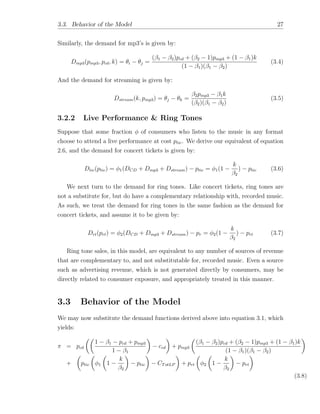
Similarly, the demand for mp3’s is given by:
Dmp3(pmp3, pcd, k) = ✓i ✓j =
( 1 2)pcd + ( 2 1)pmp3 + (1 1)k
(1 1)( 1 2)
(3.4)
And the demand for streaming is given by:
Dstream(k, pmp3) = ✓j ✓k =
2pmp3 1k
( 2)( 1 2)
(3.5)
3.2.2 Live Performance & Ring Tones
Suppose that some fraction of consumers who listen to the music in any format
choose to attend a live performance at cost ptic. We derive our equivalent of equation
2.6, and the demand for concert tickets is given by:
Dtic(ptic) = 1(DCD + Dmp3 + Dstream) ptic = 1(1
k
2
) ptic (3.6)
We next turn to the demand for ring tones. Like concert tickets, ring tones are
not a substitute for, but do have a complementary relationship with, recorded music.
As such, we treat the demand for ring tones in the same fashion as the demand for
concert tickets, and assume it to be given by:
Drt(prt) = 2(DCD + Dmp3 + Dstream) pr = 2(1
k
2
) prt (3.7)
Ring tone sales, in this model, are equivalent to any number of sources of revenue
that are complementary to, and not substitutable for, recorded music. Even a source
such as advertising revenue, which is not generated directly by consumers, may be
directly related to consumer exposure, and appropriately treated in this manner.
3.3 Behavior of the Model
We may now substitute the demand functions derived above into equation 3.1, which
yields:
⇡ = pcd
✓✓
1 1 pcd + pmp3
1 1
◆
ccd
◆
+ pmp3
✓
( 1 2)pcd + ( 2 1)pmp3 + (1 1)k
(1 1)( 1 2)
◆
+
✓
ptic
✓
1
✓
1
k
2
◆
ptic
◆
CTotLP
◆
+ prt
✓
2
✓
1
k
2
◆
prt
◆
(3.8)
28 Chapter 3. Theory
In order to examine the manner in which artist profits vary with the opportunity costs
of obtaining their music in a free streaming format, we take the partial derivative of
⇡ with respect to k, which yields:
@⇡
@k
=
pmp3
( 1 2)
1ptic + 2pmt
2
(3.9)
Here k represents the opportunity cost of obtaining free streaming music, which de-
clines with the availability of free streaming music. Note that @2⇡
@k2 = 0. Hence, artist
profits are either una↵ected by variations in k, or are strictly increasing or decreasing
with k. Profit maximizing artists, therefore, depending on the nature of their rev-
enues, should act either to minimize or to maximize consumers’ opportunity costs of
streaming. Returning to 3.9,
pmp3
( 1 2)
<, > or =
1ptic + 2pmt
2
governs whether artists should minimize, maximize, or are una↵ected by the oppor-
tunity costs of streaming, respectively. The natures of the numerators above are
completely intuitive, if one considers that streaming music is a complement to con-
cert tickets and ring tones, but a substitute for mp3 downloads. The likelihood that
ease of streaming will stimulate revenue is increasing with the prices of concert tickets
and ring tones, as well as with the proportions of consumers who choose to purchase
concert tickets or ring tones as a result of exposure to an artist’s music, but decreasing
with the price of mp3s. The denominators, however, are less intuitive. Apparently,
the likelihood that ease of streaming will stimulate profits decreases with the quality
of the streaming music, but increases with the quality of mp3 downloads ( 1 2).
While many of the variables in this model are arguably beyond the control of artists,
is is likely that artists may act to set ticket prices in order to maximize their profits.
The partial derivative of the artist profit function with respect to ptic is:
@⇡
@ptic
=
✓
1
k
2
◆
2ptic (3.10)
and hence the profit maximizing value of ptic is:
@⇡
@ptic
= 0 )
2
✓
k
2
1
◆
(3.10a)
3.3. Behavior of the Model 29
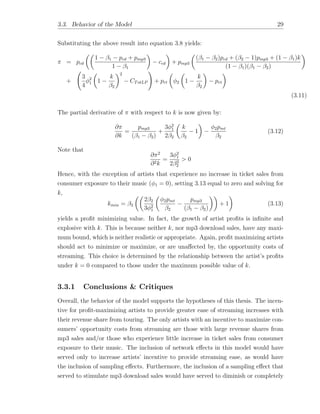
Substituting the above result into equation 3.8 yields:
⇡ = pcd
✓✓
1 1 pcd + pmp3
1 1
◆
ccd
◆
+ pmp3
✓
( 1 2)pcd + ( 2 1)pmp3 + (1 1)k
(1 1)( 1 2)
◆
+
3
4
2
1
✓
1
k
2
◆2
CTotLP
!
+ prt
✓
2
✓
1
k
2
◆
prt
◆
(3.11)
The partial derivative of ⇡ with respect to k is now given by:
@⇡
@k
=
pmp3
( 1 2)
+
3 2
1
2 2
✓
k
2
1
◆
2pmt
2
(3.12)
Note that
@⇡2
@2k
=
3 2
1
2 2
2
> 0
Hence, with the exception of artists that experience no increase in ticket sales from
consumer exposure to their music ( 1 = 0), setting 3.13 equal to zero and solving for
k,
kmin = 2
✓✓
2 2
3 2
1
✓
2pmt
2
pmp3
( 1 2)
◆◆
+ 1
◆
(3.13)
yields a profit minimizing value. In fact, the growth of artist profits is infinite and
explosive with k. This is because neither k, nor mp3 download sales, have any maxi-
mum bound, which is neither realistic or appropriate. Again, profit maximizing artists
should act to minimize or maximize, or are una↵ected by, the opportunity costs of
streaming. This choice is determined by the relationship between the artist’s profits
under k = 0 compared to those under the maximum possible value of k.
3.3.1 Conclusions & Critiques
Overall, the behavior of the model supports the hypotheses of this thesis. The incen-
tive for profit-maximizing artists to provide greater ease of streaming increases with
their revenue share from touring. The only artists with an incentive to maximize con-
sumers’ opportunity costs from streaming are those with large revenue shares from
mp3 sales and/or those who experience little increase in ticket sales from consumer
exposure to their music. The inclusion of network e↵ects in this model would have
served only to increase artists’ incentive to provide streaming ease, as would have
the inclusion of sampling e↵ects. Furthermore, the inclusion of a sampling e↵ect that
served to stimulate mp3 download sales would have served to diminish or completely
30 Chapter 3. Theory
annihilate the subsection of profit-maximizing artists with the incentive to diminish
ease of streaming. It is the opinion of the author that virtually all consistently tour-
ing bands with a relatively young, or internet savvy, target audience stand to benefit
from minimizing the opportunity costs of streaming, if not necessarily maximizing its
quality.
One weakness of this model is that streaming music does not a↵ect album sales
unless it annihilates the market for mp3s entirely. As discussed earlier in this thesis,
the empirical literature regarding this matter is inconclusive. This uncertainty is
definitely expected to influence artists’ behavior and diminish their incentive to o↵er
streaming music. The most simple means by which to integrate this uncertainty into
the model would be the inclusion of an unknown fraction of consumers who choose
only between CDs, streaming and non-consumption, i.e., those for whom 2 > 1.
Generally, a more realistic construction of the model would treat the various ’s and
’s not as constants, but as functions that that may be nonlinear, or may vary across
consumers.
MySpace & YouTube
The MySpace and YouTube websites are valuable and significant venues through
which to examine the theory presented in this thesis. MySpace o↵ers musical acts
both the freedom to control free o↵erings of their materials, as well as a venue for
digital download sales. YouTube, on the other hand, o↵ers neither, but does o↵er what
MySpace does not; user-generated content that may violate copyright law. MySpace,
furthermore, o↵ers its digital download sales through its MySpace player. The fact
that its sales apparatus, therefore, is nested within its free streaming player makes
MySpace an valuable venue through which to test the hypothesis that streaming music
can potentially serve as a complement to digital download sales via the sampling e↵ect.
Finally, the universality and standardization of these sites, in combination with the
wide variety of statistics for number of “hits” and linked sites which they o↵er, make
them ideal data sources from which to carry out empirical work, which until now
appear to be untapped.
Chapter 4
Data & Methods
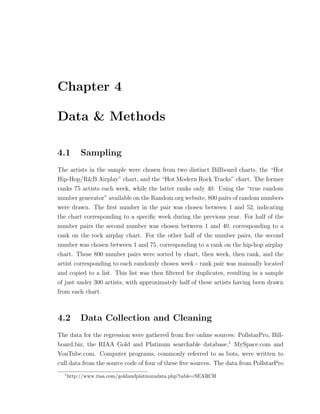
4.1 Sampling
The artists in the sample were chosen from two distinct Billboard charts, the “Hot
Hip-Hop/R&B Airplay” chart, and the “Hot Modern Rock Tracks” chart. The former
ranks 75 artists each week, while the latter ranks only 40. Using the “true random
number generator” available on the Random.org website, 800 pairs of random numbers
were drawn. The first number in the pair was chosen between 1 and 52, indicating
the chart corresponding to a specific week during the previous year. For half of the
number pairs the second number was chosen between 1 and 40, corresponding to a
rank on the rock airplay chart. For the other half of the number pairs, the second
number was chosen between 1 and 75, corresponding to a rank on the hip-hop airplay
chart. These 800 number pairs were sorted by chart, then week, then rank, and the
artist corresponding to each randomly chosen week - rank pair was manually located
and copied to a list. This list was then filtered for duplicates, resulting in a sample
of just under 300 artists, with approximately half of these artists having been drawn
from each chart.
4.2 Data Collection and Cleaning
The data for the regression were gathered from five online sources: PollstarPro, Bill-
board.biz, the RIAA Gold and Platinum searchable database,1
MySpace.com and
YouTube.com. Computer programs, commonly referred to as bots, were written to
cull data from the source code of four of these five sources. The data from PollstarPro
1
http://www.riaa.com/goldandplatinumdata.php?table=SEARCH
32 Chapter 4. Data & Methods
were gathered manually. The raw data required extensive cleaning and aggregating
before summary data were generated using Microsoft Excel pivot tables.
4.2.1 RIAA Data
The RIAA provides a free online searchable database of all historical gold and plat-
inum certifications. A bot was designed to enter each individual artist’s name in the
search field and return a spreadsheet containing the results of this search. Each line
in this spreadsheet indicates the certification, such as Gold, Platinum, 2 x Platinum,
etc., of an album or single corresponding to the artist. The adjacent columns indi-
cate the corresponding format (album or single), song or album title, and date of
the certification. Due to an unfixable problem with this bot, the first data point for
each artist had to be manually collected and entered into each spreadsheet. These
spreadsheets then had to be manually culled for inappropriate data points, such as a
certification for the artist “Nelly Furtado” returned by a search for the artist “Nelly.”
Such data points did not correspond to the artist of interest and were therefore re-
moved. All certifications corresponding to a format other than single or album, such
as music video, were also removed. Manual online searches were executed in order to
verify that every artist, for which the bots had returned no data, had not, in fact,
received any certifications. Furthermore, each individual certification was missing its
type (Standard, Digital or Master Tone) and this data had to be collected manually.
Once cleaned, the spreadsheets were then aggregated into one single spreadsheet.
This spreadsheet was sorted by RIAA certification, and a column was generated
containing the number of sales corresponding to each level of certification; gold =
half a million, Platinum = one million, 2 x Platinum = two million, etc. The data
were then sorted by title, format, type and date. Recurrences were flagged with
an indicator and previous sales were subtracted from the levels of sales indicated
by recurrences. For example, if an album was certified gold in 2006, then platinum
in 2007, this latter certification would be first flagged. From the one million sales
corresponding to the recurrent certification, the half a million sales corresponding to
the previous gold certification would be subtracted, yielding half a million sales.
4.2.2 MySpace Data
Another bot was designed to search the music category of MySpace.com for each
artist’s name and then navigate to the artist’s page. The bot then culled the page’s
source code for the code corresponding to the MySpace music player, and output a
4.2. Data Collection and Cleaning 33
“dump” of code in a single file for each artist. This “dump” contained the list of tracks
available on the player and their corresponding numbers of total hits and downloads.
The first step in treating this data was to properly import it into Microsoft Excel.
Titles containing certain characters, such as parentheses or dashes, would incorrectly
trigger Excel to split the title into two columns. Hence, the data had to be manually
culled for such titles and the error corrected.
The next problem was posed by duplicate track listings. The data was sorted
by artist, then by total hits, and then by total downloads. In a number of cases,
two or more tracks with similar titles had identical hit counts. These duplicate tracks
usually took the form of ‘Song A - Playlist A’ and ‘Song A - Playlist B’ or, particularly
for hip-hop artists, ‘Song A (censored)’ and ‘Song A (uncensored).’ This particular
aspect of the MySpace data was the most peculiar aspect of the whole data set. Since
duplicate songs listed identical hit counts, it would seem that such songs had a single
corresponding hit count, which increased when either of the tracks was clicked. The
sum total hit count for each artist, however, listed on the top of the MySpace player,
reflected that the hit counts for such duplicate tracks were, in fact, counted twice.
Presumably, this method of calculating artists’ sum total hit counts reflects an error
in the MySpace player’s code. This error, however, has an implication that may be
worth noting. Hip-hop artists in the sample tended to have more duplicate tracks than
rock artists, due to their preponderance of censored and uncensored versions of the
same title. Hence, the sum hit count listed on the MySpace player generally inflates
the sum hit count of hip-hop artists. Duplicate tracks on MySpace exhibited another
peculiarity. Their download counts were generally identical, however in many cases
they were not. The MySpace data was cleaned by deleting all but one data point
from each set of duplicate tracks and retaining the highest number of downloads
corresponding to that set.
4.2.3 YouTube Data
The next bot was designed to execute a search on YouTube for each artist’s name.
The bot output a spreadsheet for each artist, containing the top 25 results returned
by this search, with corresponding video titles and hit counts. This data also required
extensive manual cleaning. Consider the search for the artist “10 years after.” Of
the top 25 videos returned by this search, one was titled “10 years after Matthew
Shepard’s murder.” Clearly this video does not pertain to the artist “10 years after,”
and was therefore deleted from the data. Every datapoint was manually verified in
34 Chapter 4. Data & Methods
this fashion. After examination of the cleaned data, the data was reduced to the top
15 videos for each artist, according to hit count.
4.2.4 PollStarPro Data
The free online searchable database of concert dates, Pollstar, provides a paid online
service, PollstarPro. This service allows users to search an extensive database of
concert records dating as early as 1999. For each artist, a manual search for the
artist’s name was executed. Such searches direct the user to a summary page of the
artist’s tour history, at the center of which is a list of all of this artist’s historical
tour dates. Next to each date is listed the corresponding city and venue, as well as
an otherwise empty column, in which an “s” may indicate that on said date, the
artist played as a supporting act. In another otherwise empty column, a “bxo,”
which stands for box o ce report, may indicate that, for this tour date, the artist
reported corresponding box o ce statistics. These statistics include the number of
tickets sold and the gross receipts from ticket sales. In addition to tour dates, each
artist’s PollstarPro page contains a small table of summary statistics for tour dates
over the previous 36 months. These summary statistics include the artist’s number of
headline dates, number of box o ce reports, and the average number of tickets sold
and average gross receipts for all shows with box o ce reports.
For each artist, the tour date history and summary statistic data were manually
copied and pasted into an Excel spreadsheet. Next, manual searches for venues by
starting letter were executed, on PollstarPro, and the capacity of each venue was
copied into a new spreadsheet. This process was repeated until a spreadsheet had
been generated that contained the name of every venue contained in the PollstarPro
database and its corresponding city and capacity. This spreadsheet was aligned with
the master spreadsheet of all artists’ tour dates, sorted by venue and city, and the
capacity corresponding to each venue was copied into a new column of the master
spreadsheet. This process provided venue capacities for approximately 75% of the
tour dates in the data set. Manual Google searches for o cial venue websites even-
tually brought this statistic above 80%. Next, each of over 40,000 tour dates were
manually inspected and cleaned. For each tour date, a dummy variable equal to 1
or 0, respectively, was generated to indicate whether said tour date was inside the
US and Canada, or at a foreign location. Manual Google searches were executed to
rectify confusions regarding venues with multiple rooms of varying capacities. The
data was also sorted by venue, then date, and manually inspected for venues with
4.2. Data Collection and Cleaning 35
clustered dates. In most cases, Google searches for such “venues” verified that they
were, in fact, music festivals. The venue capacities listed for these festivals were gen-
erally estimated on the basis of weekend-long attendance. These values would have
inflated the sum headline venue capacities of artists that performed at more festivals,
and were therefore removed as inappropriate. Instead, an “s” was added in the corre-
sponding “support” column, in order to treat each such observation as akin to a date
as a supporting act. This treatment was appropriate because festival performances,
like supporting performances, generate exposure, but the capacities of these events
are not accurate representations of an artist’s “draw.”
4.2.5 Billboard Data
The final bot was written to execute searches of the chart archives available from
Billboard.biz. By artist name, the bot searched the Hot Hip-Hop/R&B Airplay and
the Hot Modern Rock Tracks singles charts, as appropriate. For each individual artist
in the sample, with the exception of quite a few artists for which it failed, the bot
output an individual spreadsheet with an observation for each appearance of a song by
the artist on any week’s chart since 1975. Each observation listed, in three columns,
the song title, song rank and chart week. These spreadsheets were manually cut and
pasted into an aggregate spreadsheet with two additional columns indicating chart
and artist name.
The aggregate spreadsheet was next sorted by artist, then song title. The song
title column was exported as a new file and run through a python routine designed
to indicate with a 1, in a new column, each row di↵erent from that above it, and all
others with a zero. This new column served to indicate one instance of each song,
such that it could be summed to determine an artist’s total number of songs, and was
inserted into the aggregate spreadsheet.
Next, a new column was generated equal to each rank subtracted from 76 for hip-
hop artists and from 41 for rock artists. These values of the “inverted rank” were now
such that 1 now represented the lowest rank, and 75 or 40 the highest, depending
on the chart. Values of the inverted rank normalized between 0 and 1 were then
generated in a new column by dividing the inverted rank by 75 for hip-hop artists
and by 40 for rock artists. Two final columns were then generated, one containing
the values of the inverted and normalized ranks squared, and the other containing
the square roots of these values.
36 Chapter 4. Data & Methods
4.2.6 Re-evaluation of the Sample
The artists in the sample were then re-examined. Many artists were missing data
from a specific source due to a bot failure. When possible, this data was manually
collected. Otherwise, these artists were removed from the sample. Similarly, all
artists not listed in the PollstarPro database were removed from the sample. Two
artists had to be removed from the sample due to typographical errors resulting in bot
failure. The PollstarPro data was examined, and any artist that had submitted no
box o ce reports, or had submitted only one report out of more than fifteen headlines,
was removed from the sample. Similarly, the YouTube data was examined, and all
artists, for which the YouTube search had returned less than 15 relevant videos, were
removed from the sample. Finally, two artists, “Janet” and “Bow Wow,” formerly
“Janet Jackson” and“Lil’ Bow Wow,” were removed from the sample due to their
confounding changes in artist names. The remaining sample contained 90 artists: 26
hip-hop artists and 64 rock artists.
4.3 Data Treatment
4.3.1 Period Structure
Once the data had been cleaned, it was then grouped by “period.” Each spreadsheet
of raw data was sorted by date, and an empty column was created to contain the
designated period number corresponding to each date. Period 0 was designated to
be the 36 months preceding data collection, 03/01/06 - 03/01/09. Period 1 was
designated to be the 12 months preceding period 0, 03/01/05 - 03/01/06, period 2
to be the 12 months preceding period 1, 03/01/04 - 03/01/05, and so forth in this
fashion. Two major factors motivated this period structure. First, period 0 was
designed to be the 36 months from which the Pollstar BXO summary statistics were
generated. Second, the period numbering was designed to be increasingly positive
as one moves back through time, in the interest of the ease of applying decay rate
functions, which will be discussed in a later section.
4.3.2 Non-Lagged Variables
Once the data had been grouped by period, Microsoft Excel pivot table reports were
used to generate statistics grouped by artist and period. For lack of a better means,
in order to format this output so it could be imported into STATA, all output data
4.3. Data Treatment 37
was manually cut and pasted, artist by artist and variable by variable, into a new
spreadsheet. The period 0 and non period-based data was then used to generate
variables corresponding to each artist. All such non-lagged variables are listed and
described in the tables 4.1 - 4.2 below. Summary statistics for these variables are
presented in Appendix A, tables A.1 - A.4.
Table 4.1: Non-Lagged Variables
Source Data: RIAA
Name Description
TotAlb0 The sum total sales of RIAA certified albums during period 0
NumAlb0 The total number of RIAA certified albums during period 0
TotDL0 The sum total sales of RIAA certified digital format downloads during
period 0
NumDL0 The total number of tracks that earned digital download format RIAA
certifications during period 0
TotSing0 The sum total sales of RIAA certified standard singles during period 0
NumSing0 The total number of standard singles that received RIAA certifications
during period 0
TotMT0 The sum total sales of RIAA certified “master tone” (Ring Tone) sales
during period 0, the only period during which the data set contained
RIAA master tone certifications
Source data: Billboard
Rock1 Indicator variable equal to 1 for rock artists and 0 for hip-hop artists,
determined by the Billboard chart from which the artist was drawn
SumInvRank- The period 0 sum total of the inverted Billboard Hip-Hop chart
BBHH0 ranks over all songs and all weeks
SumInvRank- The period 0 sum total of the inverted Billboard Rock chart ranks
BBRk0 over all songs and weeks
SumInvRank- The period 0 sum total of the inverted and normalized Billboard
Norm0 chart ranks over all songs and weeks
SumInvRank- The period 0 sum total of the inverted, normalized and squared
Norm0sq Billboard chart ranks
SumInvRank- The period 0 sum total of the square root of the inverted and
Norm0sqrt- normalized chart ranks
NumSongs- The total number of di↵erent songs to appear on the genre
BB0 appropriate Billboard chart during period 0
AvgSong- The average number of weeks each song appeared on a Billboard
WksBB0 chart during period 0, taken across all songs
38 Chapter 4. Data & Methods
Table 4.2: Non-Lagged Variables (cont.)
Source data: YouTube
Name Description
YTTotHits The sum total of the streaming hit counts of the top 15 videos returned
by a search for the artist’s name
YT The standard deviation of the streaming hit counts of the top 15
SDvHits videos returned by a search for the artist’s name
Source data: MySpace
MS TotHits The sum total of the streaming hit counts of all songs o↵ered on the
Hits artist’s MySpace player
MS SDv- The standard deviation of the streaming hit counts of all songs o↵ered
Hits on the artist’s MySpace player
MS Num- The total number of unique tracks o↵ered for streaming on the artist’s
Trax MySpace player
MS The sum total number of downloads purchased through the artist’s
TotDL MySpace player
MS The total number of unique tracks that had at least one instance of
NumDL being purchased for downloads through the artist’s MySpace player
Source data: PollstarPro
NumHdl- The total number of headline performances in the US or Canada
US0 during period 0
NumNoVC The total number of headline performances in the US or Canada
HdlUS0 during period 0 for which the data set had no venue capacity recorded
NumSup- The total number of non-headline performances in the US or
US0 Canada during period 0
NumFor- The total number of performances outside of the US and Canada
eign0 during period 0
SumVC0 The period 0 venue capacity sum total for all headline performances in
the US or Canada
AvgVC SumVC0/NumHdlUS0
HdlUS0
SumVC- SumV C0 + (NumNoV CHdlUS0) ⇤ (AvgV CHdlUS0)
adj100
SumVC SumVC0 + 0.75*(NumNoVC HdlUS0)*(AvgVC HdlUS0)
adj75
SumVC SumVC0 + 0.50*(NumNoVC HdlUS0)*(AvgVC HdlUS0)
adj50
NumBXO The number of Pollstar box o ce reports over the 36 months preceding
data collection
AvgTix The average number of tickets to performances sold as calculated from
Pollstar box o ce reports over the 36 months preceding data collection
PTicAvg The average price of tickets to performances as calculated from the
average ticket sales and average gross receipts corresponding to Pollstar
box o ce reports over the 36 months preceding data collection
4.3. Data Treatment 39
4.3.3 Lagged Variables and Decay Rates
The treatment of time-specific data is perhaps the most unique aspect of the regression
model in this thesis. The model is technically cross-sectional, however much of the
data is, in fact, longitudinal. The data on Billboard rankings, RIAA certifications
and tour dates are week or date specific over the past four decades. The observations
of this data, however, are far too sporadic to warrant time-series analysis in a sample
of this size. Hence, the question arises, how should one construct variables in order
to best represent longitudinal data in a cross-sectional model?
Consider a simplification of the regression model in which the RIAA certification
data is the only explanatory variable. The dependent variable remains the sum of live
performance ticket sales over the last three years. Now, suppose artist A received only
a platinum certification in 2006, whereas artist B received platinum certifications in
2006 and 1996, and artist C received only a platinum certification in 1996. If one were
to simply take the sum of the certifications with no respect for time, the magnitude
of the explanatory variable would be equal for artists A and C, and twice as great
for artist B. A linear model, therefore, would estimate artists A and C to have equal
touring popularity in 2007, and artist B to have double that. This estimate seems
highly unlikely. Given an average consumer who purchases, on a given date, a single
CD by an artist, the probability that this consumer will purchase a ticket to see a
performance by this artist is likely to be higher the following year than ten years
later. Hence, a reliable model should estimate the 2007 touring popularity of artist
A to be greater than that of artist C.
The converse of the above disregard for time-lapse would be the construction of a
variable that represents only recent CD sales. In this case, the model would estimate
the 2007 touring popularity of artist A and artist B to be equal, and that of artist C to
be equal to that of an artist with no historical CD sales whatsoever. These estimates
are no more realistic than the previous, though they represent the opposite end of
the spectrum. Clearly an accurate model must lie in the middle ground, and the
construction of variables from time-series data, in this model, must somehow adjust
for time-lapse.
Decay Rates
Functional forms that adjust for time-lapse are common not only in economics, but
throughout scientific modeling. In economics, the ‘discount rate’ adjusts the potential
utility from future consumption relative to that of current consumption. In chemistry
40 Chapter 4. Data & Methods
and physics, the ‘half-life’ functional form of decay rates was spawned by the expo-
nential increase in the rate at which radioactive particles decay. It has since found a
wide variety of applications.
The basis for such functional forms is the treatment of time as a series of peri-
ods, represented generally by the variable t. The value of t represents the number
corresponding to the present time period, where t = 0 represents the time period
during which particle decay began. Periods may be any constant length and, hence,
t = 1 may indicate that a second, minute, hour, day, week, decade, or 8.6 seconds has
elapsed since period 0. It should be apparent that this format is forward looking, so
to speak, in that period 1 occurs later than period 0. Hence, discount and decay rates
adjust for future time-lapse. The regression model being constructed, however, must
adjust in the same fashion for past time lapsed from the present period t = 0. The
period before t = 0 is conventionally notated as t = 1. This model, however, notates
the period before the present as t = 1. As previously mentioned, this period structure
was designed for the ease of applying decay rates. More specifically, this structure
automatically inverts forward-looking decay rates about the y-axis or, in other words,
inverts them with respect to time such that they become backwards-looking.
4.3. Data Treatment 41
Functions Applied
The following list presents the decay functions applied to the values of the lagged
data in this analysis, where x represents each lagged value, t, the corresponding
period number, and y, the variable generated.
Lin1 y =
X
t

x
✓
31 3t
28
◆
Lin2 y =
X
t

x
✓
15 t
14
◆
Lin3 y =
X
t

x
✓
29 t
28
◆
L1 y =
X
t

x
✓
95 2t
93
◆
L2 y =
X
t

x
✓
94 t
93
◆
L3 y =
X
t

x
✓
21 t
20
◆
INV1 y =
X
t

x
✓
1
t
◆
INV2 y =
X
t

x
✓
4
7t
+
3
7
◆
INV3 y =
X
t

x
✓
2
7t
+
5
7
◆
Cos1 y =
X
t

x
✓
1
3
✓
2 +
⇡(t 1)
31
◆◆
These functions were used to generate the variables listed in Table 4.3. They were
selected primarily based on the maximum value of t observed in the data to which
they were applied. For example, the maximum value of t observed in the Pollstar
data was 8. For t = 8, Lin1 = 3
4
, Lin2 = 1
2
, and Lin1 = 1
4
. These three functions
were, therefore, selected for application to the Pollstar data in order to preserve a
minimum of 75%, 50%, and 25% of lagged venue capacity observations, respectively.
42 Chapter 4. Data & Methods
Table 4.3: Lagged Variables
Function Applied Source Variable (x) Variable Name (y)
Lin1 SumAdj50 SumAdj50Lin1
SumAdj75 SumAdj75Lin1
SumAdj100 SumAdj100Lin1
Lin2 SumAdj50 SumAdj50Lin2
SumAdj75 SumAdj75Lin2
SumAdj100 SumAdj100Lin2
Lin3 SumAdj50 SumAdj50Lin3
SumAdj75 SumAdj75Lin3
SumAdj100 SumAdj100Lin3
L1 SumAlbSales SumAlbSalesL1
SumStSales SumStSalesL1
L2 SumAlbSales SumAlbSalesL2
SumStSales SumStSalesL2
L3 SumInverseRank SumIRL3
SumInverseRankNormSq SumIRNSqL3
SumInverseRankNormSqrt SumIRNSqrtL3
INV1 SumAdj50 SumAdj50INV1
SumAdj75 SumAdj75INV1
SumAdj100 SumAdj100INV1
INV2 SumAdj50 SumAdj50INV2
SumAdj75 SumAdj75INV2
SumAdj100 SumAdj100INV2
Lin3 SumAdj50 SumAdj50INV3
SumAdj75 SumAdj75INV3
SumAdj100 SumAdj100INV3
Cos1 SumAlbSales SumAlbSalesCos1
Chapter 5
Analysis
5.1 Pairwise Correlations
In order to construct the regression model in an informed fashion, the relationships
between the individual variables to be used in the regression were first examined.
Almost universally, the various groups of decayed or adjusted versions of the same
variable exhibited relationships with the other variables in the model of equal signifi-
cance and direction. Presented in Appendix B, Tables B.1 - B.4 are the basic pairwise
correlations between the variables in the model, with only one variable chosen to rep-
resent each such group. Each correlation printed is significant at the 10% level, with
a star indicating significance at the 5% level.
The data set exhibits many of the expected correlations of significance. Examine
the top left of table B.1, column 1, rows 2-5, for example. The Billboard rock chart
from which the data are drawn has only 40 positions, whereas the hip-hop chart has 75.
It is of no surprise, therefore, that rock artists exhibited, with 5% significance, lesser
numbers of songs and total song weeks than hip-hop artists. From this correlation,
it follows that rock artists, in turn, also exhibited significantly lesser summed chart
ranks, even with these ranks normalized.
Moving down this column, of greater interest is the fact that, during period 0, the
rock artists in the sample, compared to their hip-hop counterparts, exhibited signifi-
cantly greater numbers of period 0 support, foreign and US headline performances. In
turn, these rock artists also exhibited greater period 0 sum venue capacities, though
their average numbers of tickets sold did not exhibit significant deviation from the
sample as a whole. Furthermore, the fact that rock artists had significantly more tour
dates during period 0, but significantly lower ticket prices, exhibits basic microeco-
nomic theory. Considering the losses that artists incur if they do not su ciently
44 Chapter 5. Analysis
fill the venues they rent, one may view sum venue capacity not merely as a supply
quantity, but as a proxy for quantity exchanged.1
Hence, the facts that rock artists
in the sample exchanged a greater quantity of tickets but at a lower price go hand in
hand. Furthermore, hip-hop artists in the sample exhibited greater levels of MySpace
downloads and RIAA certified ring tone sales. Overall, these genre specific relation-
ships of significance are not unrelated, but indicate a significant cross-genre variation
in revenue structure.
5.2 Choices Among Families of Variables
The number of variables meant to be substituted for one another, such as the various
decayed versions of the same variable, is so large that the behavior of these di↵erent
variables in the variety of regressions that follow could not be rigorously explored
and presented in any practical manner. The choices of which such variables to use in
these regressions were not made at random, however. These choices were made based
on the author’s observations, after running a variety of regressions.
The period 0 sum venue capacity variable, for example, was initially replaced
by TotVCadj100 in an attempt to adjust for non-reported venue capacities. This
adjusted variable represents artists’ predicted sum period 0 venue capacity under the
assumption that the capacities of non-reported venues are equal to those of artists’
average performance. Regressions run using this adjusted variable, however, behaved
extremely di↵erently from those run using the unadjusted variable. Based on these
di↵erences, as well as intuition, the author concluded that the adjusted variable was
biased to inflate the sum venue capacities of artists with greater numbers of period 0
performances, for which no capacity was reported. Particularly, because many of the
venue capacity observations that were initially missing from the data set were filled
using Google searches, observations that remained missing at the time of analysis
were likely smaller venues. Hence, these venues were likely smaller than, not equal
to, the average venues at which artists performed. For this reason, the variables
TotVCadj75 and TotVCadj50 were generated in order to examine whether it might
be more appropriate to assume that non-reported venues had capacities equal to 75%
and 50%, respectively, of the average capacity of venues at which artists performed.
The author concluded TotVCadj50 to be most appropriate, though he acknowledges
1
Note: This treatment is not contrary to the lack of a significant pairwise relationship between
the genre indicator and AvgTix variables. The latter variable is constructed from Pollstar BXO
data, which is strongly dependent on artists’ reporting behavior and is, as a result, unreliable.
5.3. Regressions 45
that this variable may still exhibit a bias, and that smaller levels of adjustment may
be even more appropriate.
After similar examination of the lagged, decayed variables, the author selected cer-
tain variables for use in the regressions presented in this chapter. These variables did
not always exhibit significant di↵erences from their counterparts, however they were
chosen for the following reasons. SumAlbSalesL1 was chosen, rather than SumAlb-
SalesL2, for its greater level of decay. No di↵erence in the behavior of SumAlbSalesL1,
could be discerned from that of SumAlbSalesCos1, which had the same long term rate
of decay, so the former was selected in the interest of simplicity. SumAdj50Lin2 was
chosen for its mid-level rate of decay, compared to its counterparts, as well as in the
interest of simplicity, because no di↵erences could be discerned among this family of
lagged variables.
L3 was the only decay rate applied to the Billboard data. The intention of gener-
ating variables from the squared and square root values of the normalized rank was
to test whether the e↵ects of chart rank might not be linear, but might increase or be
diminished as one moves up the charts. SumIRNSqrt, which inflates the significance
of high chart rank relative to number of chart weeks, was deemed most appropriate in
early regressions. This choice, however, was later deemed indefensible, and variables
based on the unaltered values of inverse chart rank were used in later regressions.
5.3 Regressions
5.3.1 System of Equations: 3SLS Estimation
The demand for music and music related goods is dependent on the variety of ways in
which consumers may be exposed to an artist’s music. There is a complex endogenous
relationship, particularly over time, between the sizes of the populations that consume
an artist’s music through live performance, streaming, radio airplay and purchase of
recorded music. It was the original intention of this thesis to estimate a system of
equations treating these population sizes as dependent variables. Stata, however,
lacks the capacity to estimate non-linear systems of equations. Hence, the 3SLS
estimation in this thesis could not properly treat dependent variables with non-fixed
e↵ects.
Many of the sources of exogenous variation in this system should not be treated
as having fixed linear e↵ects. For example, consider a regression treating period 0
sum venue capacity as the dependent variable, and the number of period 0 headline
46 Chapter 5. Analysis
performances as an exogenous explanatory variable. Suppose this regression were
to estimate a significant coe cient on the number of headline performances, equal
to, say, five thousand. This estimation would imply that the period 0 sum venue
capacity corresponding to the average artist in the sample increased by five thousand
for every additional performance. Such an estimate would be too low for extremely
popular artists and too high for unpopular artists. Hence, the estimation of the other
dependent variables in the regression will be biased in order to compensate. Some
other coe cient will serve to deflate the predicted values of the dependent variables
for unpopular artists, and to inflate these predicted values for very popular artists. An
appropriate treatment of this regression would be to estimate the relationship between
a logarithmic value of sum venue capacity and the number of headline shows, such
that the coe cient on the latter would represent a percent increase in sum venue
capacity. Such treatment of the dependent variable, however, would be inappropriate
for those independent variables, such as total album sales, with which it is expected
to have a linear relationship.
Consider the bias of the number of headline shows, as illustrated above. Replacing
this variable with the size of the average show switches this bias to inflate predictions
for artists with a large number of headline shows, and to deflate predictions for artists
with a small number of headline shows. Coe cient estimates that remain relatively
consistent and significant as the biases of the model are shifted are more likely to
be accurate. For this reason, four otherwise identical systems of equations were
estimated, using as sources of exogenous variation the period 0 values of either the
number of headline shows or the average venue capacity, as well as either the number
of albums or the average album sales. These regressions were run over the entire
sample, then over the rock subsample, the results of which are presented in Appendix
C, Tables C.1 - C.8 and C.9 - C.16, respectively.
Analysis
These regression results are not particularly illuminating, however a few results are
worth note. In particular, MySpace and YouTube total streaming hits are, at best,
somewhat consistent in their significance as explanatory variables. With the excep-
tion of one sub-equation of one of the eight regressions, however, their coe cient
estimates are consistent with regard to sign (+ or -). These estimates are potentially
noteworthy because, while the coe cient estimates on MySpace are consistently pos-
itive, those on YouTube are consistently negative. Also, while extremely insignificant
when regressed over the entire sample, when regressed over the rock subsample, lagged
5.3. Regressions 47
album sales has consistent negative coe cient estimates, significant at the 7% level,
as an explanatory variable of MySpace total streaming hits. These estimates may
indicate, among other hypotheses, that consumers who stream rock music from
MySpace are of a particularly young age demographic, or that rock music has a longer
“shelf-life” than hip-hop music, and is therefore more likely to experience streaming
displacement as a result of previous album purchases. Tables 5.1 and 5.2 list the
dependent variables for which the coe cient estimates remained consistent through
all four regressions, with regard to direction and significance at the 5% level.
Table 5.1: Consistent 3SLS Estimates, Entire Sample
Dependent Variable Independent Variable Sign
TotAlb0 SumAdj5Lin2 +
SumVCadj50 SumAlbSalesL1 +
MSTotHits MSSDvHits +
SumInvRankNormSqrt0 +
YTTotHits YTSDvHits +
SumInvRankNormSqrt0 +
SumInvRankNormSqrt0 None
Table 5.2: Consistent 3SLS Estimates, Rock Subsample
Dependent Variable Independent Variable Sign
TotAlb0 None
SumVCadj50 SumAlbSalesL1 +
MSTotHits MSSDvHits +
SumInvRankNormSqrt0 +
YTTotHits YTSDvHits +
SumInvRankNormSqrt0 +
SumInvRankNormSqrt0 TotDL0 +
5.3.2 OLS Regressions on Sum Venue Capacity
Next, a variety of simple OLS regressions, treating adjusted period 0 sum venue
capacity as the dependent variable, were run over the entire sample, then over the
rock subsample, the results of which are presented in tables 5.3 and 5.4, respectively.
The most notable of these results, which follow, are the consistently positive and
significant coe cient estimates on MSTotHits. These estimates, in the presence of
a variety of control variables, appear to exhibit the complementarity of streaming
music and live performance hypothesized in this thesis.
48 Chapter 5. Analysis
Table 5.3: OLS Regression Results: Period 0 Sum Venue Capacity
(1) (2) (3) (4)
SumVC0adj50 SumVC0adj50 SumVC0adj50 SumVC0adj50
MS TotHits 0.00276⇤⇤
0.00245⇤⇤⇤
0.00162⇤⇤⇤
0.00163⇤⇤⇤
(2.96) (3.78) (3.92) (3.94)
TotDL0 -0.0613⇤⇤
-0.0631⇤⇤
-0.0531⇤⇤
-0.0503⇤⇤
(-2.96) (-3.18) (-2.84) (-2.72)
Alb0Rk -0.0361 -0.0301
(-0.94) (-0.82)
Alb0HH -0.0488 -0.0493
(-0.68) (-0.71)
MS TotDL -0.839
(-0.40)
SumInvRankBBHH0 -18.21 -15.47
(-1.10) (-1.05)
SumInvRankBBRk0 163.8⇤⇤⇤
165.0⇤⇤⇤
168.3⇤⇤⇤
152.6⇤⇤⇤
(5.24) (5.84) (6.05) (6.48)
SumAdj.5Lin2 0.302⇤
0.248⇤⇤
0.243⇤⇤
0.222⇤⇤
(2.51) (3.19) (3.28) (3.11)
AlbL1Rk 0.0637⇤⇤⇤
0.0665⇤⇤⇤
0.0609⇤⇤⇤
0.0623⇤⇤⇤
(3.50) (5.18) (4.95) (5.09)
AlbL1HH 0.00114
(0.04)
SumStSingSalesL1 -0.0672
(-0.39)
SumDLSalesPd1-2 -0.0791
(-0.77)
SumIR L3 -22.11 -25.92⇤
-22.89⇤
-17.90⇤
(-1.31) (-2.35) (-2.30) (-2.05)
Rock=1 -113278.7 -105152.1 -51872.2
(-1.79) (-1.83) (-1.05)
Constant 117937.5⇤
113342.6⇤
66662.3 35024.5
(2.30) (2.50) (1.74) (1.48)
Observations 89 89 89 89
t statistics in parentheses
⇤
p < 0.05, ⇤⇤
p < 0.01, ⇤⇤⇤
p < 0.001
5.3. Regressions 49
Table 5.4: OLS Regression Results: Period 0 Sum Venue Capacity,Rock Subsample
(1) (2) (3)
SumVC0adj50 SumVC0adj50 SumVC0adj50
TotAlb0 -0.0626 -0.0592
(-1.26) (-1.26)
TotDL0 -0.0726⇤
-0.0719⇤
-0.0808⇤⇤
(-2.33) (-2.37) (-3.02)
MS TotHits 0.00339⇤
0.00336⇤
0.00372⇤⇤
(2.42) (2.46) (3.27)
MS TotDL 2.500 2.419
(0.55) (0.55)
SumInvRankNorm0 6397.0⇤⇤⇤
6416.6⇤⇤⇤
5681.0⇤⇤⇤
(4.03) (4.19) (4.43)
SumAdj.5Lin2 0.318⇤
0.303⇤⇤
0.235⇤
(2.11) (2.80) (2.47)
SumAlbSalesL1 0.0613⇤
0.0613⇤⇤
0.0590⇤⇤⇤
(2.60) (3.19) (3.55)
SumStSingSalesL1 -0.0595
(-0.26)
SumDLSalesPd1-2 -0.0253
(-0.19)
SumIR L3 -27.93 -28.81
(-0.90) (-0.97)
Constant -8494.3 -9198.1 -14361.7
(-0.22) (-0.25) (-0.39)
Observations 61 61 61
t statistics in parentheses
⇤
p < 0.05, ⇤⇤
p < 0.01, ⇤⇤⇤
p < 0.001
50 Chapter 5. Analysis
5.3.3 OLS Regressions on MySpace Data
OLS regressions treating MSTotDL and MSNumTrax as dependent variables were
run using a variety of specifications. As previously discussed, MySpace is a prominent
source of free streaming music, over which artists have complete control. With regard
to informing artist behavior regarding multi-product profit maximization, therefore,
these regressions were potentially the most significant aspect of the empirical work in
this thesis. The regressions on MSNumTrax failed to yield significant results. The
regressions on MSTotDL, however, the results of which are presented in tables 5.5 -
5.7, were more successful.
After these OLS regressions were initially run, they were tested for heteroskedas-
ticity using the classic “White test.” The results of these tests indicated that all of
these regressions were, in fact, heteroskedastic. One of the assumptions underlying
the accuracy of OLS estimates is constant variance of the error term across observa-
tions, or homoskedasticity. Heteroskedasticity, or non-constant variance of the error
term, represents a violation of this assumption. Heteroskedasticity does not a↵ect the
magnitude of coe cient estimates. It does, however, tend to deflate the variance and,
therefore, standard error associated with variables, which in turn inflates their associ-
ated t-statistics and can cause insignificant coe cient estimates to appear significant.
For this reason, the regression results presented use “robust standard errors,” which
correct for heteroskedasticity.
Regressions 1-3 presented in tables 5.5 and 5.6 illustrate how the dependent vari-
ables behave as others are removed. Regression 1 includes all independent variables
deemed appropriate. Notice that SumAdj.5Lin2 loses its significance in regression 2,
once other insignificant variables are removed, and that when this variable is then re-
moved in regression 3, SumInvRankBBRk0 loses its significance as well. In regression
4, presented in table 5.7, only significant coe cient estimates remain.
5.3. Regressions 51
Table 5.5: OLS Regression Results (1-3): MySpace Downloads
(1) (2) (3)
MS TotDL MS TotDL MS TotDL
TotAlb0 0.00300
(1.44)
SumAlbSalesL1 0.00195⇤
0.00171⇤⇤
0.000952⇤⇤
(2.48) (2.68) (3.10)
TotDL0 0.00359⇤⇤⇤
0.00398⇤⇤⇤
0.00428⇤⇤⇤
(3.49) (4.98) (5.19)
SumDLSalesPd1-2 0.00399
(0.97)
SumStSingSalesL1 -0.00350
(-0.72)
SumVC0adj50 -0.00128
(-0.26)
SumAdj5Lin2 -0.0111⇤
-0.00546
(-2.11) (-1.18)
SumInvRankBBHH0 -3.233⇤
-2.859⇤⇤
-2.757⇤
(-2.31) (-2.64) (-2.56)
SumInvRankBBRk0 -3.152⇤
-2.730⇤
-2.232
(-2.25) (-2.43) (-1.86)
SumIRRkL3 -1.865⇤
-2.128⇤⇤
-2.489⇤⇤
(-2.43) (-3.05) (-3.24)
SumIRHHL3 -1.028 -1.072 -1.066
(-1.05) (-1.60) (-1.73)
52 Chapter 5. Analysis
Table 5.6: OLS Regression Results (1-3): MySpace Downloads (cont.)
YT TotHits 0.0000230
(0.48)
MS NumTrax 8.253
(0.30)
MS TotHits 0.000464⇤⇤⇤
0.000468⇤⇤⇤
0.000461⇤⇤⇤
(4.57) (5.81) (5.80)
MS SDvHits -0.00360⇤⇤⇤
-0.00350⇤⇤⇤
-0.00352⇤⇤⇤
(-3.72) (-5.34) (-5.54)
Rock1 -10586.8⇤
-10333.6⇤
-10746.7⇤
(-2.05) (-2.20) (-2.29)
Constant 12170.8⇤
12198.3⇤⇤
12172.7⇤⇤
(2.16) (2.78) (2.79)
Observations 89 89 89
t statistics in parentheses
⇤
p < 0.05, ⇤⇤
p < 0.01, ⇤⇤⇤
p < 0.001
5.3. Regressions 53
Table 5.7: OLS Regression Results (4-5): MySpace Downloads
(4) (5)
MS TotDL MS TotDL
TotDL0 0.00420⇤⇤⇤
0.00398⇤⇤⇤
(5.02) (5.52)
SumInvRankBBHH0 -2.882⇤⇤
-2.686⇤
(-2.64) (-2.17)
SumInvRankBBRk0 -3.309⇤⇤
-3.039⇤
(-2.80) (-2.59)
MS TotHits 0.000447⇤⇤⇤
0.000378⇤⇤⇤
(5.95) (3.56)
MS SDvHits -0.00324⇤⇤⇤
-0.00248⇤⇤
(-5.42) (-3.01)
Rock1 -9346.6⇤
-9748.5⇤
(-2.35) (-2.43)
MS NumDL 150.3
(1.97)
Constant 10850.5⇤⇤
9140.5⇤
(3.03) (2.17)
Observations 89 89
t statistics in parentheses
⇤
p < 0.05, ⇤⇤
p < 0.01, ⇤⇤⇤
p < 0.001
Regression 5 adds as an independent variable, MSNumDL, to the model in regres-
sion 4. Not all songs available for streaming via MySpace are available for download
via MySpace. The number of tracks available for download via MySpace represents
a significant omitted variable, on which MSTotDL is expected to be strongly de-
pendent. The number of di↵erent tracks downloaded from MySpace, MSNumDL,
should serve as a strong proxy for the number of tracks available for download via
MySpace. This proxy, however, is biased in that it is not representative of tracks that
are available for download, but have never been downloaded. As a result, coe cient
estimates on MSNumDL will inevitably be biased upwards, which, in turn, creates
a bias that decreases the coe cients estimated on other independent variables in the
regression. Nonetheless, all of the coe cient estimates in regression 4 remained con-
sistent with regard to significance and sign in the presence of the bias in regression
54 Chapter 5. Analysis
5. It should be noted that, while MSNumDL was not found to be significant at the
5% level, its associated p-value was 0.052.
Interpretations of the Results
In each of the previous regressions, MSTotHits, the total number of streaming hits on
MySpace, was found to be a significant positive predictor of the number of downloads
from MySpace. Its coe cient estimated in regression 4 indicates that, on average, one
download sale is associated with approximately every 2,240 (0.000447 1
) streaming
hits. Furthermore, the number of tracks available for streaming via MySpace was
not found to be as significant a predictor as the total number of streaming hits.
TotDL0 was expected to be the strongest control variable in this regression and, as
expected, its coe cient estimates were significant and positive. Regression 4 indicates
that one download sale via MySpace is associated with approximately every 238
(0.00420 1
) overall download sales. The coe cient estimate on Rock1 in regression 4
indicates that hip-hop artists sell an average of approximately 9,347 more downloads
via MySpace than equivalent rock artists. The coe cient estimates on the Billboard
variables in regression 4, however, indicate that holding the peak rank on the hip-
hop chart for one week is associated with an approximate decrease of 216 (2.882*75)
download sales via MySpace, whereas holding the peak rank on the rock chart for one
week is associated with an approximate decrease of only 132 (3.309*40) download sales
via MySpace. Finally, the significant negative coe cient estimates on the standard
deviation of MySpace streaming hits is relatively intuitive. The lower this standard
deviation, the greater the concentration of streaming hits by individual track. Since
only individual tracks are sold for download via MySpace, one would expect artists
with a greater concentration of hits to be more likely to sell the tracks on which their
streaming hits are concentrated, and to therefore exhibit greater overall sales than
artists with more di↵use streaming hits.2
Implications
These regressions yielded the most significant findings of the empirical work pre-
sented in this thesis. While the lack of significance of the number of tracks o↵ered for
streaming on MySpace represents a lack of artists’ control over their multi-product
profits derived from sampling, the coe cient estimates on MSTotHits tell a di↵erent
story. These coe cient estimates may represent the potential of the sampling e↵ect,
2
The converse would be expected, were albums sold via download to be examined.
5.3. Regressions 55
which has just begun to be tapped. Perhaps MySpace has succeeded in su ciently
nesting its download sales apparatus in the site’s streaming o↵erings, such that the
sampling e↵ect can overwhelm the strong substitution e↵ect, between free streaming
music and paid digital downloads, and generate revenues. Furthermore, the negative
coe cient estimates on the Billboard variables indicate that less popular, or more
obscure, artists are more likely to sell downloads via MySpace. Interestingly, hip-hop
artists, with whom greater levels of MySpace downloads are associated, exhibit this
aforementioned trend to a greater degree. Perhaps the results of these regressions in-
dicate that artists who lack mainstream promotion, particularly such hip-hop artists,
are utilizing MySpace both as a promotional tool and as a venue for sales. Such an
indication would exhibit the emergence of a new and unique business model, as hy-
pothesized in this thesis, made possible by technological progress and the proliferation
of the internet.
Chapter 6
Conclusion
Overall, there exist a wealth of economic principles evident in the music industry
today that warrant examination. The extreme changes in the industry over the
last decade, a↵ected by technological progress and the proliferation of the internet,
represent a veritable playground for econometricians. The implications of this thesis
bear not only on the music industry, but on all industries dependent on entertainment
media, if not on marketing and sales via the internet in general.
6.1 Recommendations for Further Research
The labor intensive nature of the data treatment necessary for the analysis presented
in this thesis prevented the wealth of information contained in the data set from being
fully utilized. This problem could clearly be overcome by greater resources. The labor
intensity of the data treatment, however, was caused primarily by a single problem,
the lack of any e cient means by which to aggregate Excel pivot table output into a
form that could be exported to Stata. Hence, one recommendation of this thesis is
that in similar empirical analysis in the future, the process of generating analyzable
data from the raw data should be automated to a greater extent.
Ideally, the Billboard data should be analyzed to generate additional variables,
such as debut, peak and exit ranks, and the number of weeks from debut to peak
rank. As explored in the empirical work of Bradlow and Fader (2001), such variables
reflect the “path” of a song through the charts over time, and are representative of
many characteristics of songs and artists that were not captured by the way manner
in which chart ranks were summed in this analysis. In fact, the Billboard.biz chart
archive search engine allows searches for debut and peak weeks. Many variables,
therefore, could be generated using far fewer observations of the Billboard charts
58 Chapter 6. Conclusion
than were used in this thesis. Conversely, however, the Billboard variables used in
this thesis could not have been generated without the observations for every week’s
chart on which artists’ songs appeared. Furthermore, as conceived in the treatment
of the normalized Billboard chart rank in this thesis, the nature of the e↵ects of chart
rank warrants further research.
The box o ce report aspect of the PollstarPro data also warrants further analysis.
Ideally, for each artist, the average number of tickets sold, as reported by PollstarPro,
should be divided by the average venue capacity corresponding to box o ce reports,
yielding a proxy variable for percentage concert attendance. The validity of this proxy
variable could be assessed by comparing the average box o ce reported venue capac-
ity to each artist’s actual period 0 average venue capacity, as well as by examining
the number and percent of headline shows with corresponding box o ce reports. Fur-
thermore, the analysis in this thesis would have been well served to better control for
artists’ touring behavior. This would be a complicated task, but, to begin with, the
geographic location and variation of performances represent valuable controls that
could generated from the Pollstar data.
Another source of untapped potential contained in this data set are the song and
album titles corresponding to the RIAA, Billboard, MySpace and YouTube data.
Tracing the behavior of songs and albums across the data sources would likely yield
interesting results, though such analysis would likely require extensive programming
and labor.
It was the intention of this thesis to gather data regarding the pricing and availabil-
ity of downloads on MySpace. In the end, this was not possible due to programming
problems and time constraints. In light of the significant results that arose from
the MySpace data, however, future collection and analysis of the data is definitely
warranted.
Finally, this data set warrants the application of regression types other than those
used in this thesis. Likely, the most accurate analysis would treat the data as panel
data. Such analysis could incorporate additional data, such as indicator variables
reflecting the emergence and shut down of Napster, variables reflecting the litigation
of peer-to-peer users, or variables reflecting CD prices as indicated by record label
price fixing settlements and the rise of iTunes and the $9.99 CD. Panel data techniques
could also better estimate the significance of decay rates, which would have valuable
bearing on economic concepts regarding consumer utility.
6.2. Results and Implications 59
6.2 Results and Implications
The results of the empirical analysis generally support the hypotheses explored in this
thesis. The sample exhibited significant divergence between rock and hip-hop artists.
Particularly, rock artists o↵ered a far greater supply of live performance, while hip-hop
artists exhibited greater ring tone sales and download sales via MySpace, as well as a
greater inverse correlation between radio airplay and MySpace downloads. Intuitively,
this divergence seems indicative of a larger cross-genre variation in dominant revenue
streams and business models. The sales of ring tones, as well as downloads via
MySpace, are both recent technological advents. As such, hip-hop artists in the
sample exhibit the departure from traditional revenue streams and business models
that was a central hypothesis of this thesis. Furthermore, the data from MySpace
bears strongly on two distinct hypotheses presented in this thesis. First, it supports
the complementarity of free streaming music and live performance. Second, while the
data overall did not bear particularly on the substitutability of free streaming music
and digital downloads, the MySpace data, in particular, yielded a far more significant
result.
The significant positive correlation between MySpace streaming hits and paid
downloads indicates that free streaming music, if properly harnessed, can serve to
stimulate paid downloads. This is a very pleasant result. The average overall period
0 download sales of artists in the sample, according to the RIAA data, was just
under 450,000. The average period 0 sales of downloads via MySpace by artists in
the sample was just under 7,500, comprising roughly 1.7% of overall download sales.
Hence, MySpace appears to be a relatively obscure source of paid digital downloads.
It seems safe to assume that consumers do not visit MySpace for the express purpose
of being diverted to Amazon.com in order to purchase music.1
On the other hand,
MySpace does not at all appear to be an obscure source of streaming music. The
average number of total MySpace streaming hits in the sample was well over 28
million. It seems likely, therefore, that download sales via MySpace were generated
by the sampling e↵ect, i.e., consumers, as a result of streaming free music, chose
to purchase music that they otherwise may not have. This hypothesis seems to
be supported by the inverse correlation between MySpace downloads and Billboard
chart rank. Consumers may be choosing to purchase, via MySpace, primarily music
by artists that receive less radio airplay, because they use MySpace to sample music
1
Based on spot checks, this appears to be the primary, if not the only, means of download via
MySpace.
60 Chapter 6. Conclusion
to which they would not have otherwise been exposed. MySpace, therefore, increases
consumer utility, allowing some consumers to match their tastes to music that they
otherwise may not have located, and also generates revenue for the obscure artists
who lack exposure and need this revenue the most. Furthermore, not only is the
MySpace player free, but it allows the user control over the music to which they
listen. Hence, MySpace allows many consumers simply to enjoy free music. O↵ering
free streaming music via MySpace, therefore, increases social surplus and represents
the potential for Pareto improvement. The only losers are traditional record labels.
More generally, it seems clear that, rather than using resources to battle free o↵erings
of their music, artists should take control of the situation. Instead, artists should o↵er
their music for free, in quality and quantity su cient to divert consumers from other
free sources of their music, and they should do so in a manner that maximizes their
profits from consumer sampling.
Appendix A
Summary Statistics
Table A.1: Summary Statistics: PollStarPro Data
62 Appendix A. Summary Statistics
Table A.2: Summary Statistics: RIAA Data
Table A.3: Summary Statistics: Billboard Data
Table A.4: Summary Statistics: YouTube & MySpace Data
Appendix B
Pairwise Variable Correlations
Table B.1: Pairwise Variable Correlations (part 1)
64 Appendix B. Pairwise Variable Correlations
Table B.2: Pairwise Variable Correlations (part 2)
Table B.3: Pairwise Variable Correlations (part 3)
65
Table B.4: Pairwise Variable Correlations (part 4)
Appendix C
3SLS Regression Results
68 Appendix C. 3SLS Regression Results
Table C.1: 3SLS Results: Entire Sample, Regression 1 (part 1)
69
Table C.2: 3SLS Results: Entire Sample, Regression 1 (part 2)
70 Appendix C. 3SLS Regression Results
Table C.3: 3SLS Results: Entire Sample, Regression 2 (part 1)
71
Table C.4: 3SLS Results: Entire Sample, Regression 2 (part 2)
72 Appendix C. 3SLS Regression Results
Table C.5: 3SLS Results: Entire Sample, Regression 3 (part 1)
73
Table C.6: 3SLS Results: Entire Sample, Regression 3 (part 2)
74 Appendix C. 3SLS Regression Results
Table C.7: 3SLS Results: Entire Sample, Regression 4 (part 1)
75
Table C.8: 3SLS Results: Entire Sample, Regression 4 (part 2)
76 Appendix C. 3SLS Regression Results
Table C.9: 3SLS Results: Rock Subsample, Regression 1 (part 1)
77
Table C.10: 3SLS Results: Rock Subsample, Regression 1 (part 2)
78 Appendix C. 3SLS Regression Results
Table C.11: 3SLS Results: Rock Subsample, Regression 2 (part 1)
79
Table C.12: 3SLS Results: Rock Subsample, Regression 2 (part 2)
80 Appendix C. 3SLS Regression Results
Table C.13: 3SLS Results: Rock Subsample, Regression 3 (part 1)
81
Table C.14: 3SLS Results: Rock Subsample, Regression 3 (part 2)
82 Appendix C. 3SLS Regression Results
Table C.15: 3SLS Results: Rock Subsample, Regression 4 (part 1)
83
Table C.16: 3SLS Results: Rock Subsample, Regression 4 (part 2)
Bibliography
Alexander, P. J. (1994). “Entry barriers, release behavior, and multi-product firms
in the music recording industry.” Review of Industrial Organization 9(1): 85-98.
Alexander, P. J. (1994). “New technology and market structure: Evidence from
the music recording industry.” Journal of Cultural Economics 18(2): 113-123.
Bhattacharjee, S., R. Gopal, et al. (2006). ”Whatever happened to payola? An
empirical analysis of online music sharing.” Decision Support Systems 42(1): 104-120.
Black, G. C., M. A. Fox, et al. (2007). “Concert tour success in North America:
An examination of the top 100 tours from 1997 to 2005.” Popular Music and Society
30(2): 149-172.
Bourreau, M. “An Economist’s Guide to Digital Music: A Comment on Peitz and
Waelbroeck.” CESifo Economic Studies 51(2-3): 429-33.
Bradlow, E. T. and P. S. Fader (2001). “A Bayesian lifetime model for the ”Hot
100” Billboard songs.” Journal of the American Statistical Association 96(454): 368-
381.
Butler, S. (2005). Kazaa Under Scrutiny. Billboard.
Connolly, M. and A. Krueger (2005). Rockonomics: The Economics of Popular
Music, Princeton University, Department of Economics, Industrial Relations Section.,
Working Papers: 499.pdf.
Courty, P. “An Economic Guide to Ticket Pricing in the Entertainment Industry.”
Recherches Economiques de Louvain 66(2): 167-92.
Earl, P. E. (2001). “Simon’s travel theorem and the demand for live music.”
Journal of Economic Psychology 22(3): 335-358.
86 Appendix C. Bibliography
Gayer, A. and O. Shy ”Copyright Enforcement in the Digital Era.“CESifo Eco-
nomic Studies 51(2-3): 477-89.
Gayer, A. and O. Shy (2006). “Publishers, Artists, and Copyright Enforcement.”
Information Economics and Policy 18(4): 374-84.
Gopal, R. D., S. Bhattacharjee, et al. (2006). “Do Artists Benefit from Online
Music Sharing?” Journal of Business 79(3): 1503-33.
Grassi, I. (2007). The Music Market in the Age of Download, Fondazione Eni
Enrico Mattei, Working Papers: 2007.80.
Krueger, A. B. (2005). “The economics of real superstars: The market for rock
concerts in the material world.” Journal of Labor Economics 23(1): 1-30.
Mixon, F. G. and R. W. Ressler (2000). “A Note on Elasticity and Price Dis-
persions in the Music Recording Industry.” Review of Industrial Organization 17(4):
465-470.
Moreau, N. C. F. (2004). Towards A New Business Model for the Music Industry:
Accomodating Piracy through Ancillary Products, Laboratoire dconomtrie Conser-
vatoire National des Arts et Mtiers.
Moreau, N. C. F. (2005). The Music Industry in the Digital Era: Towards New
Business Frontiers?, Laboratoire dEconomtrie, Conservatoire National des Arts et
Mtiers.
Mortimer, J. H. and A. Sorensen (2005). “Supply Responses to Digital Distri-
bution: Recorded Music and Live Performances.” Manuscript. Harvard University.
Oberholzer-Gee, F. and K. Strumpf (2007). “The E↵ect of File Sharing on Record
Sales: An Empirical Analysis.” Journal of Political Economy 115(1): 1-42.
Peitz, M. and P. Waelbroeck (2004). An Economist’s Guide to Digital Music,
CESifo GmbH, CESifo Working Paper Series: CESifo Working Paper No. 1333.
Peitz, M. and P. Waelbroeck (2006). “Why the Music Industry May Gain from
Free Downloading–The Role of Sampling.” International Journal of Industrial Orga-
nization 24(5): 907-13.
87
Richtel, M. (2001). Judge Orders Napster to Police Trading; Judge Orders Napster
to End Unauthorized File Trading. New York Times (1857-Current file). New York,
N.Y.: C1.
Rob, R. and J. Waldfogel (2006). “Piracy on the High C’s: Music Downloading,
Sales Displacement, and Social Welfare in a Sample of College Students.” Journal of
Law and Economics 49(1): 29-62.
AndrewShapiro-SeniorThesis-ReedCollege

AndrewShapiro-SeniorThesis-ReedCollege

  • 1.
    Music Industry BusinessModels in the Digital Millennium: An Empirical Analysis of Streaming Music and Multi-Product Profits A Thesis Presented to The Established Interdisciplinary Committee for Mathematics and Economics Reed College In Partial Fulfillment of the Requirements for the Degree Bachelor of Arts Andrew C. Shapiro May 2009
  • 2.
    Approved for theCommittee (Mathematics and Economics) Lon Peters Joe Roberts
  • 3.
    Abstract The music industryis undergoing a period of extreme flux. For most of the past century, the high costs of producing, promoting and distributing music served as massive barriers to entry into the music industry. In the last decade, however, new technologies and the proliferation of the internet have all but completely dissolved these barriers to entry. Among other developments, artists may now record and produce their music with relatively inexpensive technologies, market and distribute it via the internet, and incur low fixed costs and almost zero marginal costs in the process. As a result, artists are now generally less dependent on record labels, and more free to maximize their own multi-product profits. Profit-maximizing artists must now choose how to best utilize the imperfectly substitutable forms in which they may distribute their music, balancing the tradeo↵s among CD revenues, paid digital download revenues, and the complementary revenues generated by free online music. With industry CD revenues continuing to fall, and alternative sources of music- related revenues growing and proliferating, one would expect a divergent shift in music industry business models away from those designed to maximize CD revenues. The relatively new technology of streaming music o↵ers a valuable vantage point from which to survey these new business models empirically. Controlling for past and current album sales and radio play, as well as determinants of concert demand such as ticket pricing and previous years’ audiences, my thesis seeks to explore the following hypotheses regarding multi-product profit-maximizing firm behavior: 1. Artists that choose to supply more free streaming music are those that choose to o↵er a larger yearly supply of tickets to their performances. 2. Artists that exhibit higher demand for their free streaming music are those that choose to o↵er a larger yearly supply of tickets to their performances. 3. Artists that exhibit higher demand for their paid digital-downloads are those that choose to supply less free streaming music. 4. Free streaming music and paid digital-downloads are substitutes, albeit imper- fect. We expect the cross-price elasticity of an artist’s free streaming music and paid digital-downloads to be positive, ceteris paribus. We also expect the levels of demand for the two goods, across artists, to be inversely corre- lated, though free streaming music may generate an opposing e↵ect, stimulating digital-download sales by allowing consumers to sample.
  • 4.
    Table of Contents Chapter1: Background . . . . . . . . . . . . . . . . . . . . . . . . . . . . 1 1.1 Traditional Music Industry Structure . . . . . . . . . . . . . . . . . . 1 1.1.1 Record Labels & the “Recording Industry” Subsector . . . . . 2 1.2 The Music Industry Enters the Digital Era . . . . . . . . . . . . . . . 4 1.2.1 CD Sales Displacement, Napster and the RIAA . . . . . . . . 4 1.2.2 New Sources of Digital Music . . . . . . . . . . . . . . . . . . 6 1.2.3 New Industry Business Models . . . . . . . . . . . . . . . . . . 7 Chapter 2: Review of Relevant Economic Literature . . . . . . . . . . 9 2.1 Illegal File-Sharing vs. RIAA CD Sales Displacement . . . . . . . . . 9 2.1.1 Rob & Waldfogel, Oberholzer & Strumpf . . . . . . . . . . . . 10 2.2 File-Sharing and Music Industry Profits . . . . . . . . . . . . . . . . 12 2.2.1 Peitz & Waelbroeck (2005) . . . . . . . . . . . . . . . . . . . . 13 2.2.2 Gayer and Shy (2006) . . . . . . . . . . . . . . . . . . . . . . 14 2.2.3 Grassi (2007) . . . . . . . . . . . . . . . . . . . . . . . . . . . 17 2.3 Trends in the Live Performance Subsector . . . . . . . . . . . . . . . 20 2.3.1 Mortimer & Sorensen (2005) . . . . . . . . . . . . . . . . . . . 20 2.3.2 Live Performance . . . . . . . . . . . . . . . . . . . . . . . . . 20 2.4 Summary . . . . . . . . . . . . . . . . . . . . . . . . . . . . . . . . . 21 Chapter 3: Theory . . . . . . . . . . . . . . . . . . . . . . . . . . . . . . . 23 3.1 The Artist Profit Function . . . . . . . . . . . . . . . . . . . . . . . . 23 3.2 Demand Functions . . . . . . . . . . . . . . . . . . . . . . . . . . . . 24 3.2.1 Consumers . . . . . . . . . . . . . . . . . . . . . . . . . . . . . 24 3.2.2 Live Performance & Ring Tones . . . . . . . . . . . . . . . . . 27 3.3 Behavior of the Model . . . . . . . . . . . . . . . . . . . . . . . . . . 27 3.3.1 Conclusions & Critiques . . . . . . . . . . . . . . . . . . . . . 29 Chapter 4: Data & Methods . . . . . . . . . . . . . . . . . . . . . . . . . 31 4.1 Sampling . . . . . . . . . . . . . . . . . . . . . . . . . . . . . . . . . . 31 4.2 Data Collection and Cleaning . . . . . . . . . . . . . . . . . . . . . . 31 4.2.1 RIAA Data . . . . . . . . . . . . . . . . . . . . . . . . . . . . 32 4.2.2 MySpace Data . . . . . . . . . . . . . . . . . . . . . . . . . . 32 4.2.3 YouTube Data . . . . . . . . . . . . . . . . . . . . . . . . . . 33 4.2.4 PollStarPro Data . . . . . . . . . . . . . . . . . . . . . . . . . 34
  • 5.
    4.2.5 Billboard Data. . . . . . . . . . . . . . . . . . . . . . . . . . 35 4.2.6 Re-evaluation of the Sample . . . . . . . . . . . . . . . . . . . 36 4.3 Data Treatment . . . . . . . . . . . . . . . . . . . . . . . . . . . . . . 36 4.3.1 Period Structure . . . . . . . . . . . . . . . . . . . . . . . . . 36 4.3.2 Non-Lagged Variables . . . . . . . . . . . . . . . . . . . . . . 36 4.3.3 Lagged Variables and Decay Rates . . . . . . . . . . . . . . . 39 Chapter 5: Analysis . . . . . . . . . . . . . . . . . . . . . . . . . . . . . . . 43 5.1 Pairwise Correlations . . . . . . . . . . . . . . . . . . . . . . . . . . . 43 5.2 Choices Among Families of Variables . . . . . . . . . . . . . . . . . . 44 5.3 Regressions . . . . . . . . . . . . . . . . . . . . . . . . . . . . . . . . 45 5.3.1 System of Equations: 3SLS Estimation . . . . . . . . . . . . . 45 5.3.2 OLS Regressions on Sum Venue Capacity . . . . . . . . . . . . 47 5.3.3 OLS Regressions on MySpace Data . . . . . . . . . . . . . . . 50 Chapter 6: Conclusion . . . . . . . . . . . . . . . . . . . . . . . . . . . . . 57 6.1 Recommendations for Further Research . . . . . . . . . . . . . . . . . 57 6.2 Results and Implications . . . . . . . . . . . . . . . . . . . . . . . . . 59 Appendix A: Summary Statistics . . . . . . . . . . . . . . . . . . . . . . 61 Appendix B: Pairwise Variable Correlations . . . . . . . . . . . . . . . 63 Appendix C: 3SLS Regression Results . . . . . . . . . . . . . . . . . . . 67 Bibliography . . . . . . . . . . . . . . . . . . . . . . . . . . . . . . . . . . . 85
  • 7.
    Chapter 1 Background 1.1 TraditionalMusic Industry Structure The music industry is composed of a complex variety of players, goods and contracts. Traditionally, four major types of firms have profited from the sales of music and music-related goods. At the center of the industry are musicians. For the purposes of this thesis, any individual or group of individuals that release, record or perform music under a unified name shall be referred to as artists.1 These artists may write their own music and lyrics, or may purchase them from outside composers. Once copyrighted, compositions become the intellectual property of the musician(s) and/or composer(s) who are their authors, and recordings become the collective intellectual property of the artists that recorded them. The next two types of firms are concert promoters, who organize concert tours primarily by securing concert venues and promoting events, and record labels, which provide the means to produce and market albums. Furthermore, for those artists that write their own music, performing rights organizations (PRO’s) license and monitor all outside use of their compositions, such as by radio or television stations, and collect royalties. Finally, there are a wide variety of additional players scattered throughout the industry, such as venue owners and ticket distributors. The music industry, however, may be more broadly construed as being comprised not only of the markets for live and recorded music. Markets for recorded or live music often generate a variety of ancillary markets for complementary, non-music goods, the most traditional of which is artist-a liated merchandise, such as the concert t-shirt. The supply side of the industry, therefore, may be viewed as the composite of not only musical artists and composers, but also the variety of firms that together supply 1 The author would like to note that the designation of “artist” gives undue credit to many of the individuals and groups that have released, recorded and performed music in the last century.
  • 8.
    2 Chapter 1.Background consumers with music and its ancillary goods. 1.1.1 Record Labels & the “Recording Industry” Subsector Prior to the impact of digitalization, the costs of producing, distributing, and promot- ing recorded music were su ciently high that most artists could not independently record and promote their own music. These production and distribution costs re- flected primarily the costs of physically producing and distributing each CD. A lesser promotional cost of note, however, is represented by the common practice of record labels paying radio stations for air play. This practice is legal according to US law2 if, and only if, the payment is acknowledged at the time of the broadcast. Consid- erable weight, however, is generally given to the impact of the illegal variety of such payments, the exchange of which has been termed “payola.” Hence the development of the “record label.” A record label is essentially a firm that amasses the means to record, distribute and promote albums. A label then o↵ers to “sign” certain artists to its roster. If an artist agrees, the label will enable this musical artist to record and promote an album, subject to a contractual agreement. These contracts have traditionally provided much larger CD revenue shares for labels than for musical artists. Such contracts, however, were at least partially necessitated by the high costs of recording and promoting musical artists, combined with the low likelihood that a new musical artist would generate significant revenue from album sales. Historically, only very few artists were able to adopt business models that gener- ated profits without the support of, and contractual obligation to, record labels. Such artists are epitomized by the Grateful Dead, who were able to generate demand for their music and complementary goods primarily through live performance and with- out initial label support. The remaining vast majority of artists, however, were able to enter the music industry only under contract to labels. As such, most artists were obligated to maximize their labels’ profits from album sales, rather than their own multi-product profits. For this reason, the recording industry has long been the dom- inant force in the music industry, so much so that the two were virtually synonymous prior to the impact of digitalization. 2 47 U.S.C §317 (Announcement of payment for broadcast)
  • 9.
    1.1. Traditional MusicIndustry Structure 3 Recording Industry Concentration The high fixed costs of producing, distributing and promoting recorded music have not only ensured artists’ dependence on record labels in the past, but they also constituted significant barriers to new record label entry into the recording industry. The industry, as a result, has long been highly concentrated. Alexander (1994) notes, in fact, that the industry has been highly concentrated for most of the past century. The only periods of exception were during the 1910’s and 1950’s, when the advent of new technologies significantly lowered production costs and triggered waves of firm entry. As early as the 1960’s, however, a wave of horizontal mergers began in the record- ing industry.3 At the same time, the industry began to shift from independent to integrated distribution as the major firms began purchasing independent distribu- tors. The resulting pressure began to drive the remaining independent distributors to bankruptcy over the following decades, a trend that accelerated in the 1980’s.4 By the end of the decade, six major firms held dominant market shares as mea- sured at the distributor level.5 6 Since then, the industry has not become any less concentrated. Curien and Moreau (2005) noted in early 2005 that only four firms, Sony/BMG, Universal Music, EMI, and Warner Music, accounted for 80% of mu- sic revenues worldwide since a merger between Sony Music and Bertelsmann Music Group (BMG) in November 2003.7 Record Labels & Pricing As a result of its high concentration, the structure of the recording industry over the past two decades has been unquestionably oligopolistic. Theoretical literature, how- ever, generally assumes that record labels price as monopolists. Rob and Waldfogel (2006) note that “because CD’s were easily transferable even in the absence of down- loading, substantial price discrimination was impracticable. As a result, firms were compelled to price as single price monopolists.”8 They later conclude that, “prior to the advent of unpaid downloading . . . we view the seller of each album as a single- price monopolist.”9 Curien & Moreau (2005) take this conclusion one step further, 3 Alexander (1994) 4 Black & Greer (1987) 5 Alexander (1994) 6 Business Week (1988) 7 Curien & Moreau (2005) 8 Rob & Waldfogel (2006) 9 Rob & Waldfogel (2006)
  • 10.
    4 Chapter 1.Background choosing to “consider the music industry as a monopoly, a sketchy representation of the majors’ oligopoly.”10 Record labels are assumed to price as monopolists for two reasons. First, albums are an extremely di↵erentiated product and, as such, albums by di↵erent artists are very imperfect substitutes. A consumer who intends to purchase a specific album by one artist will not easily be swayed to, instead, purchase a less expensive substitute album by another artist. As technological progress allows more artists to promote their music and consumers are presented with more venues through which to sample music, however, it is worth noting that the likelihood of such substitution may very well be increasing. Regardless, because musical artists have traditionally signed multi- album contracts with record labels, each label essentially holds a monopoly over its artists’ albums and are, therefore, generally assumed to price as monopolists. The second reason that record labels are assumed to price as monopolists is slightly more concrete. There is evidence that the major record labels have, at times, colluded and acted as a cartel. The Universal, Warner, BMG, Sony and EMI record labels, along with three major music retailers, were charged with price collusion over the pe- riod 1995-2000.11 In 2002, these firms agreed to a $143 million settlement, indicating that the major labels had likely colluded and behaved as a cartel. Presumably, it is the combination of these factors that drive Curien & Moreau to view the “majors’ oligopoly” roughly as a monopoly. 1.2 The Music Industry Enters the Digital Era 1.2.1 CD Sales Displacement, Napster and the RIAA In 1999, a college student brought online the most notorious peer-to-peer file-sharing network to date. This network, called Napster, enabled users to share any file on their computers, as well as to download any files shared by other users, and was the first such network to gain widespread use. Exchange via the network was in no way regulated, and many Napster users chose to share and/or download copyrighted materials. The widespread appeal of this exchange would soon be evidenced by massive growth in the network’s usage. While Napster rose to prominence, however, the US recording industry was not experiencing the same success. In 2000, US record sales, which had been growing an 10 Curien & Moreau (2005) 11 Curien & Moreau (2005)
  • 11.
    1.2. The MusicIndustry Enters the Digital Era 5 average of 10% per year for seven consecutive years,12 began a sharp decline. Between 2000 and 2003, the number of CD’s shipped in the US fell by 20% to 750 million units (RIAA, 2004). The Recording Industry Association of America (RIAA), composed of the six major US record labels, immediately attributed this sales displacement to the exchange of its copyrighted materials via peer-to-peer networks. The RIAA launched a massive campaign against this perceived threat to its revenue, which it termed “piracy.” The RIAA finally began to make significant progress in its battle against Napster in early 2001, when the appeal of a preliminary injunction against the network’s online exchange of copyrighted material reached a federal appeals court. During these proceedings, Napster estimated that it had 65 million users overall and 10 million users daily. The RIAA asserted that it held the copyrights to as much as 70% of the materials being shared via Napster at the time. The appeals court upheld the issuance of a preliminary injunction against Napster (albeit in a narrower form) in February of 2001, but this was a small victory for the RIAA. The previous month, Napster’s users had downloaded an estimated 3 billion songs and, even in the face of the newly upheld injunction, the network remained online without any additional regulation. Subsequently, however, as a result of the injunction, Napster was forced to go o✏ine entirely.13 As Napster’s popularity grew, a number of similar networks began to appear. Some of these networks, such as Kazaa, rose to great prominence in the wake of the Napster shutdown. Kazaa, as well as other notable peer-to-peer networks such as Morpheus and Grokster, operated using technology that arose from a venture called FastTrack. Networks that operate using FastTrack technology, which had been downloaded by an estimated 400 million users as of 2005, cannot be centrally shut down in the same manner as Napster.14 In fact, many networks have been able to sustain the exchange of copyrighted material long since Napster’s shutdown, as a result of their structural di↵erences from Napster. In addition to its litigation against peer-to-peer network operators, the RIAA has chosen to pursue an additional course of action and, in 2002, began suing individual users of peer-to-peer programs directly for copyright infringement. 12 Rob & Waldfogel (2006) 13 NYT, Richtel (2001) 14 Billboard, Butler (2005)
  • 12.
    6 Chapter 1.Background 1.2.2 New Sources of Digital Music iTunes While the major US labels have busied themselves battling piracy via peer-to-peer networks, new digital sources of recorded music are rising to prominence. Recent years have seen drastically increasing sales of digital music downloads by Apple Inc. through its “iTunes music store.” As early as March of 2004, 50 million songs had been purchased through iTunes. By the end of 2006, downloads comprised 5% of US music sales and iTunes’ average yearly sales reached $1 billion. Less than 2 years later, in February of 2008, downloads comprised 10% of US music sales and iTunes was ranked second only to Wal-Mart as the most popular music retailer in the US. This growth is not particularly surprising. Online music sales not only o↵er con- sumers a more convenient method of shopping and browsing, but they also allow firms to forgo many of the costs associated with physically producing, distributing and selling CDs. Furthermore, the iTunes store o↵ers most popular music at the price of $0.99 per song or $9.99 per album, which are prices far less than those at which CDs have ever been available. Streaming Music Since the initial rise of “piracy,” another form of free online music has gained promi- nence. Streaming music is roughly to pirated recordings as radio play is to CD’s. Like piracy, streaming music has made copyrighted music widely and easily available at no cost. Music being streamed, however, must be listened to from an open internet browser and hence, the listener is never in possession of a copy of the recording. Many sources of streaming music online, such as “internet radio,” do not allow the user to control entirely the music to which they listen. Two sources of free streaming mu- sic, however, that do allow the user to select exactly the tracks to which they listen are MySpace.com and YouTube.com. MySpace and YouTube are two of the most tra cked websites on the internet. The former was developed and initially gained popularity as a “social networking tool,” and the latter as host for videos that users chose to upload (“user-generated content”). YouTube has long exhibited the widespread usage and universal availability of copyrighted materials that was characteristic of file-sharing in its heyday. Further- more, as was true of Napster, recordings on YouTube, being user-uploaded, are of variable quality and may, for example, be mislabeled. Furthermore, it seems as though YouTube is finally succumbing to copyright law. If one now browses the
  • 13.
    1.2. The MusicIndustry Enters the Digital Era 7 site for copyrighted music, one will eventually encounter the message that a song has been removed at the request of the copyright holder. On a potentially related note, YouTube has recently introduced o cial artist channels, which o↵er o cially uploaded or endorsed videos through a main page where artists may post promotional materials, such as updates and tour dates. Though MySpace was initially developed as a social networking tool, much like Facebook.com, most artists now have o cial MySpace pages on which they o↵er free streaming music. Furthermore, the site recently introduced a new, standardized music player. This player o↵ers a drop-down menu of playlists, which some artists use to o↵er multiple albums. It initially opens by default, however, to each artist’s “featured playlist.” The player, therefore, allows artists to choose the recordings to which consumers will receive the greatest exposure and may serve as a useful promotional tool for some artists. Furthermore, for each individual recording that musical artists choose to stream via MySpace, they may choose whether to additionally o↵er it for free or paid download. 1.2.3 New Industry Business Models Declining Costs of Recording, Distribution & Promotion With technological progress and the proliferation of the internet there now exist means by which to digitally produce and distribute music and promote it via the internet, with little fixed costs and essentially no marginal costs. Alexander (1994) predicted well over a decade ago that a “digital delivery highway” for music products would allow firms to distribute these goods, both as promotional samples and for the purpose of sales. Furthermore, he predicted that these methods of promotion, distribution and sales would be di↵erent from their traditional equivalent, such as promotional radio airplay and the sales and distribution of music in physical formats, in that these new methods would be less costly and non-exclusionary. Alexander also hypothesized that the advent of digital media technologies would facilitate firm entry into the music industry and erode the then-current market struc- ture. This was quite astute. As a result of technological progress and the proliferation of the internet, musical artists have little to no remaining need for record labels to serve in their traditional capacity as an intermediary between musical artists and the public. Unsurprisingly, many musical artists are adopting business models in which they have no need for a record label and are choosing to leave their labels altogether. Labels, meanwhile, are struggling in many cases to adapt their contracts with artists
  • 14.
    8 Chapter 1.Background to be more inclusive of alternative revenues. Alternative Revenue Streams In the current literature, revenues from music-related products other than recorded music are considered to be “alternative revenue streams.” In fact, revenues from live performances, and even digital-format recordings, are generally referred to as “alter- native.” This terminology is misleading, as it is based on the antiquated notion that CD’s and other physical recordings are the clear primary sources of revenue in the music industry. In fact, while CD revenues are declining, music related revenues from advertising, ringtone sales, digital-downloads and live performances are all increasing. Furthermore, alternative revenue streams are diversifying as ancillary markets con- tinue to appear. The band Radiohead, for example, recently introduced its own social networking website, akin to the Facebook and MySpace sites. Such diversification is indicative of larger developments in the music industry. Conclusion With the influence of record labels declining, and alternative revenue streams growing and proliferating, the variety of multi-product music industry business models with the potential for profits is also growing. This growth is evidenced by the appearance of new and unique business models. These business models, in many cases, may stand to increase their profits through the free distribution of digital music online. Economists, in fact, have dedicated significant e↵ort to examining the developments in the music industry over the last decade.
  • 15.
    Chapter 2 Review ofRelevant Economic Literature There is a wealth of economic literature pertaining to musical artists’ and record labels’ respective multi-product profits in the presence of illegal file-sharing. Free streaming music, like illegal file-sharing, is a source of free, low-quality, imperfect substitutes for purchased music. This literature, therefore, can be generalized to fit the framework of free streaming music. 2.1 Illegal File-Sharing vs. RIAA CD Sales Displacement Publication of the earliest literature to examine the e↵ects of file-sharing began in 2004. This literature was primarily focused on determining the extent to which con- sumers substitute illegal downloads for CD purchases. This batch of literature arose in response to the RIAA’s claim that illegal file-sharing was entirely responsible for its CD sales displacement that began in 2000. Two of the earliest and most notable em- pirical studies to investigate this claim were Rob & Waldfogel (2004) and Oberholzer & Strumpf (2004). Rob & Waldfolgel gathered data from a sample of 412 students at four Northeast US colleges and universities. The students were administered surveys regarding their music purchases, illegal downloads and broadband internet access. The study used both OLS and an instrumental variable approach, with broadband access as a source of exogenous variations in downloading behavior, and the two ap- proaches yielded consistent estimates. In the sample, each illegally downloaded album was found to have displaced an estimated .2 album purchases. The subset of “hit al-
  • 16.
    10 Chapter 2.Review of Relevant Economic Literature bums released 1993-2003,” exhibited no significant sales displacement as a result of illegal downloading. 2.1.1 Rob & Waldfogel, Oberholzer & Strumpf Rob & Waldfogel also obtained additional data from a subsample of 92 students re- garding their ex post and ex ante valuations of their music. In this subsample, the amount of deadweight loss eliminated by illegal downloading exceeded the resulting quantity of displaced album sales revenues. This social surplus, they argue, resulted from socially beneficial transactions that occurred via illegal file-sharing, but which otherwise would have been forgone due to record labels’ pricing as single-price monop- olists. Given the monopolistic behavior of suppliers, therefore, illegal downloading is arguably socially beneficial. Unlike Rob & Waldfogel, Oberholzer & Strumpf approached the issue using na- tional data. They drew a sample of albums from 2002 Billboard charts and obtained detailed nationwide sales data for these albums from Nielsen SoundScan, the company that gathers the raw data for the Billboard charts. They then gathered data regard- ing the extent of the illegal downloading of these albums. This data came from two peer-to-peer network servers, which they monitored for approximately four months. Over the sample period they observed a total of 1.75 million downloads, which the authors estimate comprised .01% of total worldwide file-sharing at the time. Fur- thermore, the authors matched the data from their servers to that of a large sample drawn from FastTrack/Kazaa networks, the most highly used network at the time, and found the two sets to be highly correlated. Hence, they could use their results to estimate file-sharing behavior at the national level. Endogeneity and Album Sales Displacement In order to estimate the negative correlation between album sales and levels of illegal downloading, i.e., album sales displacement, one must control for their endogenous relationship. Suppose that one were to simply regress sales of individual albums as a dependent variable on their amounts of illegal downloading and radio airplay, as two explanatory variables. Both illegal downloading and album sales should vary positively with radio airplay. Hence, in this regression there is no way to di↵erentiate a result with one estimated coe cient on radio airplay and a negative coe cient on illegal downloads from another result with an appropriately smaller coe cient on radio airplay and a coe cient on illegal downloads equal to zero. Because album sales
  • 17.
    2.1. Illegal File-Sharingvs. RIAA CD Sales Displacement 11 and illegal downloading co-vary with many of the same explanatory variables, their relationship is said to be endogenous, as are these explanatory variables. In order to deal with the problem of endogeneity in a regression model, one must specify the model with the proper number of exogenous instruments, i.e., variables that are not endogenous. The most notable, or at least unique, source of exogenous variation used in Ober- holzer & Strumpf’s model came from German school holidays. Apparently, Germany had the greatest rate of high speed internet access at the time, as well as the largest internet population in Europe. As a result, one in six downloads from file-sharing networks at the time came from German up-loaders. Such up-loaders were generally schoolchildren, who did so not in school, but at home. Hence, German school hol- idays, which conveniently have little overlap with American holidays, served as an ideal source of exogenous variation in file-sharing behavior. Though the authors were concerned particularly with downloading in the US, the downloading of materials via peer-to-peer networks is, by nature, dependent on the amount of concurrent upload- ing of these materials. In the end, this study found the e↵ect of illegal downloading on CD sales to be statistically indistinguishable from zero. Critiques Rob & Waldfogel and Oberholzer & Strumpf discuss each other’s approaches in their 2006 and 2007 papers.1 Oberholzer & Strumpf had compared file-sharing and sales data on a weekly basis, for example. Rob & Waldfogel note that CD’s are durable goods and, as such, if substitution or displacement occurs, it may very well not occur in the course of a single week. They also note that the correlation that Oberholzer & Strumpf sought to estimate may not necessarily bear on the issue of sales dis- placement from piracy at all. They construct a model in which consumers are either downloaders or buyers, and choose exclusively one method of obtaining music. In this framework, a negative correlation across albums between sales and illegal downloads would merely indicate a significant di↵erence in musical taste between downloaders and buyers. This seems to be a valid point. Downloaders and buyers may very well be relatively distinct demographics, by age, for example. These demographics, in turn, may have relatively distinct musical tastes. Suppose classical music exhibits high levels of sales and low levels of downloads. Now, suppose that classical music is simply more popular with older consumers than with younger consumers, and that older consumers tend to download less and purchase more than younger consumers. 1 Rob & Waldfogel (2006), Oberholzer & Strumpf (2007)
  • 18.
    12 Chapter 2.Review of Relevant Economic Literature Finally, suppose that young consumers were to trend towards consuming more classi- cal music, over time, while, over the same time period, older consumers were to trend away from consuming classical music, due to general demographic shifts in musical taste. In this scenario, the decrease in classical albums’ sales and the concurrent in- crease in their level of downloads would represent a negative correlation attributable to an omitted variable. A finding of an inverse correlation between album sales and file-sharing over this period, therefore, would be inflated by, if not solely indicative of, the demographic shift. Hence, Oberholzer & Strumpf’s findings may have been biased by such unobserved e↵ects. Oberholzer & Strumpf have less criticism of Rob & Waldfogel’s approach. They do comment, however, on the latter’s finding of less sales displacement for “hit albums.” They note that Rob & Waldfogel had examined only music that students had acquired in 2003, and had defined “hit albums” as having sold more than 2 million copies since 1999. Hence these “hit albums,” compared to the average album acquired in 2003, were more likely to have experienced more sales earlier in the 1999-2003 period. Since illegal file-sharing was less prevalent earlier in this period, Rob & Walfogel’s finding that these “hit albums” experienced less sales displacement may have resulted most directly from a bias in their approach. 2.2 File-Sharing and Music Industry Profits By 2005, the focus of the economic literature regarding file-sharing had shifted no- tably. Much of this recent literature examines how file-sharing can be harnessed to stimulate profits. The first step in this direction in 2004 was the introduction of the concept of sampling. The essence of this concept is that when consumers are able to sample music for free, they are able to find music that better suits their tastes. As a result, consumers are more likely to purchase albums in the presence of sampling. Hence, file-sharing could potentially stimulate album sales. There is a rough consen- sus, however, that this sampling e↵ect did not prevail over the opposing substitution e↵ect in the years 2000-2003, but theoretically this need not be the case.
  • 19.
    2.2. File-Sharing andMusic Industry Profits 13 2.2.1 Peitz & Waelbroeck (2005) Why the Music Industry May Gain From Free Downloading - the Role of Sampling Peitz and Waelbroeck (2005) construct a model to demonstrate that, by allowing consumers to more easily find music that suits their tastes, file-sharing yields the potential for increased profits from album sales. They argue that “sampling appears to be important in the market for recorded music” because, not only is music an ex- perience good, but also “horizontal product di↵erentiation2 and taste heterogeneity” are crucial components of the market for recorded music. By definition, consumers cannot ascertain the quality or characteristics of an experience good without con- suming it. Hence, in the absence of file-sharing, consumers can only identify music that matches their tastes if they have previously heard it, on the radio or through a friend, for example, and must otherwise choose their music purchases at random. This information imperfection makes it di cult for consumers to find the products that match their tastes, and this problem is exacerbated by the fact that both music and musical tastes exist in a wide and distinct variety. Hence, the authors argue, “music labels may actually gain from peer-to-peer networks (and other ways to listen to recorded music for free) and use them to solve a two-sided asymmetric information problem between buyers and sellers.”3 The essence of this argument is that the degree of product di↵erentiation in the market for music does not only make it di cult for consumers to locate the goods that match their tastes, it also makes it more di cult for suppliers to locate the consumers to which their products are best suited. Hence, this problem is “two-sided.” Music labels, therefore, in addition to consumers, stand to benefit from solutions to this problem, such as sampling. The paper begins by assuming that the recording industry consists of a single multi-product monopolist. This treatment is appropriate, the authors argue, because CD prices are generally uniform across albums and labels, as well as because the industry is dominated by a tight oligopoly with a history of price collusion. This monopolist o↵ers N products and incurs no marginal or fixed costs of production, such that its profits are equal to its revenues. In order to “formalize product di↵eren- tiation,” the authors introduce the structure of a “Salop circle,” a unit length circle 2 With regard to the market for recorded music, horizontal product di↵erentiation generally refers to di↵erentiation among albums or musical artists, whereas vertical product di↵erentiation generally refers to di↵erentiation among di↵erent formats, such as CD’s vs. digital downloads, of the same album. 3 Peitz & Waelbroeck (2005), pg. 3
  • 20.
    14 Chapter 2.Review of Relevant Economic Literature along which all products are distributed evenly. Each product i located at point `i on the circle, is equidistant from its neighboring products such that the distance between each product is 1/N. Because all products are equidistant, they are all presumed to sell for the same profit maximizing price p. Consumers with a total mass of 1 are uni- formly distributed on the circle and will purchase no more than one product. Their hypothetical ideal products are located at !, such that the product that best suits the taste of consumer j is the `i located closest to !j. If a consumer located at ` chooses the product located at `i, then this consumer’s gross surplus is r ⌧|!j `i|, where r is the maximum possible surplus, which occurs if, and only if, the condition `i = !j holds true. The parameter ⌧ is termed the “transport cost” and indicates the degree of substitutability between products, such that the larger ⌧, the more di↵erentiated the products. As in all other similar literature, purchased products are considered to yield consumers higher utility than free downloads. In this model, a consumer who chooses to purchase his or her product of choice receives a benefit that is greater than the value of its copy by the factor ↵/2 . Initially, consumers do not know where on the circle products are located, and are presented with a two-stage decision. In stage one, they must choose whether or not to download, denoted d = 1 if they do and d = 0 if they do not. Through downloading, consumers can locate their ideal product, though this process has an opportunity cost s as a result of the inconvenience of using file-sharing networks. In stage two, they then choose whether to buy a product, in which case b = 1, or not to, in which case b = 0. Each consumer’s action is denoted (b, d), and his or her expected utility at stage one is denoted u(b, d). This function is normalized to zero such that u(0, 0) = 0. The authors proceed to construct a similar function for consumers’ expected utility at stage two. They then explore their model under varying parameter values. The authors conclude that firm profits are increased by free downloading if con- sumers’ tastes are su ciently heterogeneous and there is su cient product diversity (N ). A significant consequence of this model is that consumers are willing to pay more when free sampling is available, because they are able to locate products that better suit their tastes. 2.2.2 Gayer and Shy (2006) Publishers, Artists and Copyright Enforcement Gayer and Shy (2006) construct a model in which the recording publisher, i.e., record label, and the musical artist are separate firms. They begin by constructing con-
  • 21.
    2.2. File-Sharing andMusic Industry Profits 15 sumers’ demand for recorded media. Consumers may purchase a given recording for price pr or may obtain an illegal copy for free. These consumers are indexed by x 2 [0, +1], according to a declining preference for obtaining the given recording, and their utility functions are given by: max{↵(1 x) + N pr, (1 x) + N, 0}, (2.1) where the first term is consumers’ utility from consuming a purchased recording, the second from consuming an illegal copy, and the third from choosing not to consume. ↵ and are parameters for consumers’ utilities from obtaining the paid and illegal copies of the recording. N is the total number of consumers in possession of the recording, regardless of whether their copies are legal or illegal. The parameter reflects the extent to which the potential utility from obtaining the recording increases with N. Hence, this parameter represents the additional utility that results from a network e↵ect as the recording becoming more popular. The authors assume that legally and illegally-obtained recordings are vertically di↵erentiated such that ↵ > > . The implication of this assumption is that, given that the set of all consumers is continuously distributed along a number line, this continuum is partitioned into three segments at two points, which represent two marginal consumers. One of these consumers is indi↵erent between purchasing or downloading the recording and the other is indi↵erent between downloading the recording or not obtaining it at all. Hence, the set of all consumers is partitioned such that, if one imagines the continuum of all consumers vertically, its upper segment contains all consumers who purchase the recording, its middle segment contains all consumers who illegally download the recording, and its bottom segment contains all consumers who do not obtain the recording. The authors then proceed to assume that live performance has a linear demand function, though they note that they do so only for the sake of simplicity. This demand is given by qp = max{ N pp, 0}, where, pp is the ticket price and the parameter ( > 0) measures the extent to which the magnitude of N a↵ects live performance demand. Next, the authors assume that musical artists price concert tickets as monopolists, bear no costs and maximize their live performance profit function, ⇡p = ppqp = pp( N pp). Ticket price and profits from live performance are therefore given by: pp = N 2 ) ⇡p = p2 p = 2 N2 4 (2.2) Next the authors note that N is the single determinant of the location of the
  • 22.
    16 Chapter 2.Review of Relevant Economic Literature marginal consumer who is indi↵erent between consumption of the illegal download and non-consumption. They conclude, therefore, that they may substitute x = N into the condition for this marginal consumer, which yields (1 N)+ N = 0 ) N = . Next they define ˆx as the total number of buyers, and substitute this variable into the condition for the marginal consumer indi↵erent between downloading and buying. The result is, ↵(1 ˆx) + N pr = (1 ˆx) + N, into which they substitute the previous result for N, and solve for ˆx: ˆx = ↵ pr ↵ (2.3) The authors then introduce sales of a recorded medium that is priced by the record label at pr, the profits from which are ⇡r. The parameter s (0 < s < 1) represents the artist’s share of the profit from sales of the recorded medium, such that the artists profits are s⇡r and the record label’s profits are the remaining (1 s)⇡r. The authors also assume that the cost (c) of producing a copy of the recording for sale is less than the increase in utility a consumer experiences from purchasing rather than downloading. Mathematically, c < ↵ . They proceed to determine the price pr that maximizes record label profits, and finally determine the musical artist’s profit function: ⇡a = ⇡p + s⇡r = 2 2 4( )2 + s (↵ c)2 4(↵ ) (2.4) The authors proceed to examine the behavior of the model under varying condi- tions, i.e., di↵erent sets of values for the parameters ↵, , and . They conclude that copyright enforcement is only profitable to musical artists when s > 2 , where is an intricate function of ↵, and . These are musical artists whose shares of revenues from recorded music, s, are su ciently large, and the demand for whose live performances are su ciently una↵ected by variations in N. In most literature, how- ever, there is a consensus that s is, in fact, almost universally small, as well as that, since music is an experience good, N is perhaps the single largest determinant of the demand for live performance. Hence, in most cases, copyright enforcement constrains artist profits and, therefore, o↵ering free streaming music should be a profitable un- dertaking. The authors also note that their model indicates a conflict of interest between musical artists and record labels. Under all specifications of the model, the presence of piracy diminishes profits from album sales and increases profits from live performance. Hence, for the large majority of realistic parameter values, musical artists’ profits are increased by piracy, whereas record labels’ profits are diminished.
  • 23.
    2.2. File-Sharing andMusic Industry Profits 17 2.2.3 Grassi (2007) The Music Market in the Age of Download Grassi (2007) closely parallels the work of Gayer & Shy (2006), though the variations between the two papers are of great significance. Grassi begins by examining empirical data from the Italian markets for music and home video. He discerns market trends not only concurrent with increasing levels of file-sharing and internet access, but also market trends concurrent with shifts in the dominant media format, such as those that occurred with the emergence of the CD as the dominant format. He notes that such shifts allow firms to increase their profits, since some consumers will repurchase the same product in a new media format, which he refers to as a “replacement e↵ect.” Grassi places consumers in essentially the same theoretical framework as that of Gayer & Shy, however, the mathematical construction of his model is notably di↵erent. Like Gayer & Shy, he assumes that the demand for music comes from a uniformly distributed continuum of consumers. His indexation of these consumers by ✓, however, is far more intuitive. Placing ✓ 2 [0, 1] and introducing one recording available for purchase price p, which is set by a monopolist, consumers’ utility is given U = max{✓ p, 0}. Grassi then introduces a pirated imperfect substitute good, the utility from which is discounted by the factor , and which costs consumers some price w, such that U = max{✓ p, ✓ w, 0}. The parameter w essentially represents the opportunity cost of illegal downloading as presented in Peitz & Waelbroek (2005), however, Grassi notes that a component of this opportunity cost is fear of litigation. This model omits the network e↵ect on album sales presented by Gayer & Shy (2005), which was N in their model. Also, where Gayer & Shy constructed a strict inequality, Grassi explores the “corner solutions,” such as values of that annihilate the market for legally purchased music. Grassi also explores a number of extensions of Gayer & Shy’s model. He places the sampling e↵ect in a simple, two-period, inter-temporal framework, for example. The crucial aspect of this framework is the introduction of the parameter as the factor by which the demand for illegal downloads in period one increases the demand for CD’s in the following period, where clearly 0 < < 1. The model can be manipulated to show that, for w = 0, record label profits are not diminished by file-sharing if and only if 2 . File-sharing, therefore, inevitably diminishes record label profits if the quality of pirate copies is greater than half that of CD’s. Grassi also extends the model to include paid download sales of a digital-format good. This good is sold for price q, by the same firm that sells the CD, and yields utility discounted by the factor
  • 24.
    18 Chapter 2.Review of Relevant Economic Literature ↵. The paid download clearly must be of higher quality than its illegal equivalent in order to sell, so ↵ > , and consumer utility is now given by: U = max{✓ p, ↵✓ q, ✓ w, 0} (2.5) Finally, Grassi integrates live performance into the model. The notable aspect of this framework is the parameter , which is virtually identical to the parameter in Gayer & Shy (2006). is the factor by which the demand for recorded music a↵ects the demand for live music, and seems to equal the exact likelihood that a consumer who has heard an artist’s music would choose to attend a free live performance by the artist. In the absence of file-sharing, the demand for the CD is simply Dcd(p) = 1 p, and the demand for a live performance, with ticket price pc, is given by Dc(pc) = (1 p) pc. The model can be manipulated to show that, in the presence of file sharing, the marginal consumer who is indi↵erent between the pirate copy and nothing at all is located at the point w , and the demand for live performance is given by: Dc(pc) = (1 w ) pc (2.6) In light of this previous result, Grassi responds to Gayer & Shy’s proposed artist- label conflict. He notes that this conflict existed before the advent of digital media and argues that it is, in fact, eliminated in the presence of file-sharing. His basis for this argument is that, as previously demonstrated, the demand for live performance is dependent upon CD pricing only in the absence of file-sharing. This argument, however, is only somewhat valid. It is true that record labels’ monopolistic pricing of CD’s has long constrained the demand for live performance and, therefore, prevented most artists from maximizing their own profits. Furthermore, it is relatively intuitive that the availability of low-quality pirate copies of recordings should diminish the impact of CD pricing on the aggregate of consumers exposed to an artist’s music, which should, in turn, diminish the extent to which musical artist’s and record label’s incentives conflict. Grassi, however, neglects crucial implications of his model. Most notably, when pirate copies are available, live performance profits in his model are maximized by minimizing w , the ratio of the costs of obtaining pirate recordings to the quality of these recordings. Grassi demonstrated earlier in the paper that, when pirate copies are available, Dcd(p) = 1 p w 1 . The respective demands for CD’s and live performance, therefore, vary inversely with values of p and and, hence, the artist-label conflict is reinstated if musical artists can control the quality and
  • 25.
    2.2. File-Sharing andMusic Industry Profits 19 availability of free digital copies of their recordings. In the case of streaming music, pirated copies of most recordings are available for streaming via YouTube. Via myspace, however, one may stream o cial copies of recordings, though only those chosen at the artist’s discretion, which unlike pi- rated copies are guaranteed to be full quality, properly labeled, and easily searchable. artists, therefore, may decrease consumers’ opportunity costs from searching and mis- labels, as well as potentially increase the average quality of their free streaming music available online, and, therefore, diminish w by o↵ering a larger proportion of their catalog on MySpace. In accordance with Grassi’s model, this should increase live performance revenues and overall profits for most artists, but diminish CD revenues and record label profits. Returning to his introduction, though Grassi discusses the topics of the “replace- ment e↵ect” and shifts in dominant media formats only briefly and in passing, further discussion of these topics is warranted. In the final paragraph of his paper, Grassi comments that “industries that sold the machines used by the pirates have increased their business, and for example the market of the MP3 players [sic] has been invented from nothing. Probably the ‘big enemy’ of the recording industry is not the final consumers, that occasionally can act as a pirate [sic], but the industries that are cannibalizing music market profits.”4 Inferences It appears that the major US record labels failed to anticipate the shift in dominant format from CDs to mp3s. It is logical that the RIAA observed such a strong cor- relation between CD sales displacement and piracy via Napster because, as the first major source of pirated digital media, Napster served as an excellent proxy for the un- observed shift in dominant formats. Clearly, if labels had not begun to o↵er music in newer formats as vinyl or cassette tapes grew obsolete, they would have experienced a similar sales displacement. Furthermore, physical media formats can deteriorate over time, losing quality or breaking entirely. Not only do such phenomena increase potential profits from the replacement e↵ect, but they will no longer occur with new digital formats. The advent of digital media was an opportunity for record labels to increase their profits, however, they failed to capitalize on the replacement e↵ect. Furthermore, they allowed the Apple corporation to dominate the emerging market and gradually absorb their target consumers: music purchasers. 4 Grassi (2007), pg. 23
  • 26.
    20 Chapter 2.Review of Relevant Economic Literature 2.3 Trends in the Live Performance Subsector 2.3.1 Mortimer & Sorensen (2005) Supply Responses to Digital Distribution: Recorded Music and Live Performance Mortimer and Sorensen (2005) carried out an empirical analysis of the e↵ects of file-sharing on the supply of live music. Their data set contained CD sales and touring data for the nearly 2,000 musical artists for which both Pollstar and Nielsen SoundScan had data over the period 1993-2002. They verified the integrity of this data set using data for RIAA album certifications as well as data drawn from artists’ discographies. They also compared their sample to the set of all musical artists listed on Pollstar and found their sample to be unbiased, despite excluding all artists for which SoundScan data was not available. Upon first examination of the data, the authors concluded that both concert rev- enues and the number of musical artists performing concerts have increased since the introduction of file sharing. From this conclusion, they proceed to examine whether this trend was, in fact, more pronounced in market segments in which file-sharing was more likely to have had a significant impact. Their final conclusion is that file-sharing has increased the profitability of live performances. 2.3.2 Live Performance Krueger (2004) outlines a notably di↵erent set of trends in the live performance sub- sector from those of Mortimer & Sorensen. Live performance revenues have continued to increase and comprise the largest share of alternative revenues. While these rev- enues are increasing, however, ticket sales for live performances are actually falling. Over the period 1981-2003, concert ticket prices increased faster than inflation, and significantly so from 1996 on. Krueger develops his “Bowie theory” to explain these trends. Krueger proposes that it was once more profitable for musical artists to underprice live performances in order to generate demand for album sales. Consumer sampling, however, made possible by new technologies, has significantly eroded the complemen- tary nature of live performance to album sales. As a result, Krueger concludes, artists have driven the trends in the subsector by choosing to price live performances more like monopolists. It is this monopolistic pricing that has resulted in artists better maximizing their profits, but has also diminished the quantity of tickets sold to live
  • 27.
    2.4. Summary 21 performances. 2.4Summary Overall, the literature suggests that musical artists stand to benefit from the drastic changes in the music industry. Even record labels stand to yield higher profits with piracy than without it, if they adopt the proper business model. New technologies and increasing internet access continue to allow an increasing number of music con- sumers worldwide the opportunity to sample before they buy. Furthermore, firms can increasingly control the nature of this sampling. At the industry level, revenues not only from CD’s, but from recorded music in general, continue to fall. Meanwhile, revenues from an increasing array of complementary products continue to increase. With some economists questioning the current state of copyright laws, and the record label now virtually obsolete, one would expect the emergence of new business models in which musical artists utilize recorded music primarily to generate complementary revenues.
  • 28.
    Chapter 3 Theory 3.1 TheArtist Profit Function Let’s begin by considering the artist profit function. Suppose an artist has four potential sources of revenue: the sales of CD-format recordings, the sales of downloads of mp3-format recordings, the sales of tickets to live performances by the artist, and the sales of cell phone ringtones based on recordings by the artist (master tones). Let pcd, pmp3, ptic and prt denote the prices of CDs, mp3s, concert tickets and master tones, respectively, where ptic may be manipulated at the artist’s discretion and all other prices are constants fixed by industry standards. Suppose that music can be recorded and distributed digitally at no cost. In this case, mp3s and ringtones may be sold at no cost to the artist. In other words, the quantities of mp3s and master tones sold have no e↵ect on the costs incurred by the artist. We shall consider the production and distribution of CDs to have no fixed costs, only the marginal costs of the physical distribution of each CD. Let this marginal cost be denoted ccd, a fixed constant. Artists incur a variety of costs from supplying live performances, most notably those costs associated with each individual performance. For each individual performance supplied, an artist incurs variable costs of travel, accommodations, and rental of the performance venue. Let the sum total of these costs associated with live performance be denoted CTotLP . Now, let Dcd, Dmp3, Dtic and Drt denote the total demand for CDs, mp3 down- loads, live performance tickets and ringtones, respectively. Then the artist’s total profit function is given by: ⇡ = pcdDcd ccd + pmp3Dmp3 + pticDtic CTotLP + prtDrt (3.1)
  • 29.
    24 Chapter 3.Theory 3.2 Demand Functions At this point, we return to the work of Grassi (2007) in order to derive the demand functions on which the artist profit function is dependent. Assume that an artist has one album of recorded music, which is made available to consumers in hardcopy CD, downloadable mp3, and streaming formats. The demand for these goods comes from a continuum of consumers with a uniform distribution, which is illustrated below. This distribution is indexed by ✓ 2 [0, 1], according to a decreasing preference for consumption. 3.2.1 Consumers Suppose that every consumer in the world were given the CD for free, and each gave a completely accurate rating of his or her enjoyment of the CD on a scale from zero to one. Suppose the consumers were then placed in a line facing left (towards 0), such that every consumer rated the CD more highly than the consumer behind him or her. This would be a (discrete) representation of a continuum of consumers indexed by ✓ 2 [0, 1] according to decreasing preference. Each consumer represents a point on the continuum. The value of ✓ corresponding to this point is equal to this consumer’s rating of the CD. Now, ✓ indexes a “uniform distribution.” The implications of this uniformity, returning to the image of the world’s consumers in a line (facing right), are that the rating of the CD by the first consumer in line is 1, and of the last is 0. Furthermore, as one proceeds down the line from each consumer to the next, the corresponding ratings decrease by a constant amount. In other words, no matter which consumer one chooses to examine, the di↵erence between this consumer’s rating and that of the consumer in front of him or her, will be the same. Consumer Utility Introducing all three goods and their associated prices and costs, we adapt equation 2.5 to the notation of this theory section. Hence, consumers’ utility is given by the maximum value of: UMAX(✓ pcd, 1✓ pmp3, 2✓ k, 0) (3.2) where the first term represents the potential utility from consumption of the CD, the second from consumption of the mp3, the third from streaming consumption of the album, and the final from non-consumption. Clearly pcd and pmp3 denote the price of the CD and the mp3, respectively. Hence,
  • 30.
    3.2. Demand Functions25 consumer i’s potential utility resulting from consumption of the CD is ✓i pcd. Now, 1 and 2 are discount factors, bounded by zero and one, which indicate the fraction of the potential raw utility from consumption of the CD that consumers may enjoy by consuming the album in mp3 or streaming format, respectively. Put simply and ignoring prices for a moment, if 1 = 3 4 , then consumers enjoy consuming the album in mp3 format seventy-five percent as much as they would consuming the album in CD format. Hence, consumer i’s potential utility from consuming the mp3 is given by 1✓i pmp3. The third term, which represents the potential utility from consumption of the album in streaming format, is essentially the same, except for the introduction of the variable k in lieu of a price variable. Streaming music is technically free, or is o↵ered at no price, however there are costs to the consumer associated with the consumption of streaming music. Most simply, streaming music o↵ered on YouTube is user uploaded and, hence, may be mislabeled. As a result, a consumer may waste time searching for a desired track. Hence, k represents consumers’ opportunity/search costs from finding their desired music in streaming format. Unlike YouTube, streaming music on MySpace is properly labeled, though artists must choose to upload and o↵er each track individually. An artist, therefore can reduce k by o↵ering more music in streaming format via MySpace. Returning to the consumer utility function, each consumer chooses only one form of consumption, that which corresponds to the term of his or her utility function that has the greatest value. The subsets of consumers that choose each form of consumption, i.e., the demands for each good, partition the continuum of consumers. The border between any two such subsets that are adjacent is the marginal consumer who is indi↵erent between the two corresponding forms of consumption. Figure 3.1 illustrates, for an arbitrary set of parameters, the potential utility from each form of consumption across the continuum of consumers, as well as where the marginal consumers lie.
  • 31.
    26 Chapter 3.Theory Figure 3.1: Consumer Utility & Marginal Consumers Marginal Consumers The marginal consumer indi↵erent between the CD and the mp3 is located at the point: ✓i pcd = 1✓i pmp3 ) ✓i = pcd pmp3 1 1 (3.2a) The marginal consumer indi↵erent between the mp3 and streaming is located at the point: 1✓j pmp3 = 2✓j k ) ✓j = pmp3 k 1 2 (3.2b) And the marginal consumer indi↵erent between streaming and non-consumption is located at the point: 2✓k k = 0 ) ✓k = k 2 (3.2c) Hence, the demand for CD’s is given by: DCD(pcd, pmp3) = 1 ✓i = 1 1 pcd + pmp3 1 1 (3.3)
  • 32.
    3.3. Behavior ofthe Model 27 Similarly, the demand for mp3’s is given by: Dmp3(pmp3, pcd, k) = ✓i ✓j = ( 1 2)pcd + ( 2 1)pmp3 + (1 1)k (1 1)( 1 2) (3.4) And the demand for streaming is given by: Dstream(k, pmp3) = ✓j ✓k = 2pmp3 1k ( 2)( 1 2) (3.5) 3.2.2 Live Performance & Ring Tones Suppose that some fraction of consumers who listen to the music in any format choose to attend a live performance at cost ptic. We derive our equivalent of equation 2.6, and the demand for concert tickets is given by: Dtic(ptic) = 1(DCD + Dmp3 + Dstream) ptic = 1(1 k 2 ) ptic (3.6) We next turn to the demand for ring tones. Like concert tickets, ring tones are not a substitute for, but do have a complementary relationship with, recorded music. As such, we treat the demand for ring tones in the same fashion as the demand for concert tickets, and assume it to be given by: Drt(prt) = 2(DCD + Dmp3 + Dstream) pr = 2(1 k 2 ) prt (3.7) Ring tone sales, in this model, are equivalent to any number of sources of revenue that are complementary to, and not substitutable for, recorded music. Even a source such as advertising revenue, which is not generated directly by consumers, may be directly related to consumer exposure, and appropriately treated in this manner. 3.3 Behavior of the Model We may now substitute the demand functions derived above into equation 3.1, which yields: ⇡ = pcd ✓✓ 1 1 pcd + pmp3 1 1 ◆ ccd ◆ + pmp3 ✓ ( 1 2)pcd + ( 2 1)pmp3 + (1 1)k (1 1)( 1 2) ◆ + ✓ ptic ✓ 1 ✓ 1 k 2 ◆ ptic ◆ CTotLP ◆ + prt ✓ 2 ✓ 1 k 2 ◆ prt ◆ (3.8)
  • 33.
    28 Chapter 3.Theory In order to examine the manner in which artist profits vary with the opportunity costs of obtaining their music in a free streaming format, we take the partial derivative of ⇡ with respect to k, which yields: @⇡ @k = pmp3 ( 1 2) 1ptic + 2pmt 2 (3.9) Here k represents the opportunity cost of obtaining free streaming music, which de- clines with the availability of free streaming music. Note that @2⇡ @k2 = 0. Hence, artist profits are either una↵ected by variations in k, or are strictly increasing or decreasing with k. Profit maximizing artists, therefore, depending on the nature of their rev- enues, should act either to minimize or to maximize consumers’ opportunity costs of streaming. Returning to 3.9, pmp3 ( 1 2) <, > or = 1ptic + 2pmt 2 governs whether artists should minimize, maximize, or are una↵ected by the oppor- tunity costs of streaming, respectively. The natures of the numerators above are completely intuitive, if one considers that streaming music is a complement to con- cert tickets and ring tones, but a substitute for mp3 downloads. The likelihood that ease of streaming will stimulate revenue is increasing with the prices of concert tickets and ring tones, as well as with the proportions of consumers who choose to purchase concert tickets or ring tones as a result of exposure to an artist’s music, but decreasing with the price of mp3s. The denominators, however, are less intuitive. Apparently, the likelihood that ease of streaming will stimulate profits decreases with the quality of the streaming music, but increases with the quality of mp3 downloads ( 1 2). While many of the variables in this model are arguably beyond the control of artists, is is likely that artists may act to set ticket prices in order to maximize their profits. The partial derivative of the artist profit function with respect to ptic is: @⇡ @ptic = ✓ 1 k 2 ◆ 2ptic (3.10) and hence the profit maximizing value of ptic is: @⇡ @ptic = 0 ) 2 ✓ k 2 1 ◆ (3.10a)
  • 34.
    3.3. Behavior ofthe Model 29 Substituting the above result into equation 3.8 yields: ⇡ = pcd ✓✓ 1 1 pcd + pmp3 1 1 ◆ ccd ◆ + pmp3 ✓ ( 1 2)pcd + ( 2 1)pmp3 + (1 1)k (1 1)( 1 2) ◆ + 3 4 2 1 ✓ 1 k 2 ◆2 CTotLP ! + prt ✓ 2 ✓ 1 k 2 ◆ prt ◆ (3.11) The partial derivative of ⇡ with respect to k is now given by: @⇡ @k = pmp3 ( 1 2) + 3 2 1 2 2 ✓ k 2 1 ◆ 2pmt 2 (3.12) Note that @⇡2 @2k = 3 2 1 2 2 2 > 0 Hence, with the exception of artists that experience no increase in ticket sales from consumer exposure to their music ( 1 = 0), setting 3.13 equal to zero and solving for k, kmin = 2 ✓✓ 2 2 3 2 1 ✓ 2pmt 2 pmp3 ( 1 2) ◆◆ + 1 ◆ (3.13) yields a profit minimizing value. In fact, the growth of artist profits is infinite and explosive with k. This is because neither k, nor mp3 download sales, have any maxi- mum bound, which is neither realistic or appropriate. Again, profit maximizing artists should act to minimize or maximize, or are una↵ected by, the opportunity costs of streaming. This choice is determined by the relationship between the artist’s profits under k = 0 compared to those under the maximum possible value of k. 3.3.1 Conclusions & Critiques Overall, the behavior of the model supports the hypotheses of this thesis. The incen- tive for profit-maximizing artists to provide greater ease of streaming increases with their revenue share from touring. The only artists with an incentive to maximize con- sumers’ opportunity costs from streaming are those with large revenue shares from mp3 sales and/or those who experience little increase in ticket sales from consumer exposure to their music. The inclusion of network e↵ects in this model would have served only to increase artists’ incentive to provide streaming ease, as would have the inclusion of sampling e↵ects. Furthermore, the inclusion of a sampling e↵ect that served to stimulate mp3 download sales would have served to diminish or completely
  • 35.
    30 Chapter 3.Theory annihilate the subsection of profit-maximizing artists with the incentive to diminish ease of streaming. It is the opinion of the author that virtually all consistently tour- ing bands with a relatively young, or internet savvy, target audience stand to benefit from minimizing the opportunity costs of streaming, if not necessarily maximizing its quality. One weakness of this model is that streaming music does not a↵ect album sales unless it annihilates the market for mp3s entirely. As discussed earlier in this thesis, the empirical literature regarding this matter is inconclusive. This uncertainty is definitely expected to influence artists’ behavior and diminish their incentive to o↵er streaming music. The most simple means by which to integrate this uncertainty into the model would be the inclusion of an unknown fraction of consumers who choose only between CDs, streaming and non-consumption, i.e., those for whom 2 > 1. Generally, a more realistic construction of the model would treat the various ’s and ’s not as constants, but as functions that that may be nonlinear, or may vary across consumers. MySpace & YouTube The MySpace and YouTube websites are valuable and significant venues through which to examine the theory presented in this thesis. MySpace o↵ers musical acts both the freedom to control free o↵erings of their materials, as well as a venue for digital download sales. YouTube, on the other hand, o↵ers neither, but does o↵er what MySpace does not; user-generated content that may violate copyright law. MySpace, furthermore, o↵ers its digital download sales through its MySpace player. The fact that its sales apparatus, therefore, is nested within its free streaming player makes MySpace an valuable venue through which to test the hypothesis that streaming music can potentially serve as a complement to digital download sales via the sampling e↵ect. Finally, the universality and standardization of these sites, in combination with the wide variety of statistics for number of “hits” and linked sites which they o↵er, make them ideal data sources from which to carry out empirical work, which until now appear to be untapped.
  • 36.
    Chapter 4 Data &Methods 4.1 Sampling The artists in the sample were chosen from two distinct Billboard charts, the “Hot Hip-Hop/R&B Airplay” chart, and the “Hot Modern Rock Tracks” chart. The former ranks 75 artists each week, while the latter ranks only 40. Using the “true random number generator” available on the Random.org website, 800 pairs of random numbers were drawn. The first number in the pair was chosen between 1 and 52, indicating the chart corresponding to a specific week during the previous year. For half of the number pairs the second number was chosen between 1 and 40, corresponding to a rank on the rock airplay chart. For the other half of the number pairs, the second number was chosen between 1 and 75, corresponding to a rank on the hip-hop airplay chart. These 800 number pairs were sorted by chart, then week, then rank, and the artist corresponding to each randomly chosen week - rank pair was manually located and copied to a list. This list was then filtered for duplicates, resulting in a sample of just under 300 artists, with approximately half of these artists having been drawn from each chart. 4.2 Data Collection and Cleaning The data for the regression were gathered from five online sources: PollstarPro, Bill- board.biz, the RIAA Gold and Platinum searchable database,1 MySpace.com and YouTube.com. Computer programs, commonly referred to as bots, were written to cull data from the source code of four of these five sources. The data from PollstarPro 1 http://www.riaa.com/goldandplatinumdata.php?table=SEARCH
  • 37.
    32 Chapter 4.Data & Methods were gathered manually. The raw data required extensive cleaning and aggregating before summary data were generated using Microsoft Excel pivot tables. 4.2.1 RIAA Data The RIAA provides a free online searchable database of all historical gold and plat- inum certifications. A bot was designed to enter each individual artist’s name in the search field and return a spreadsheet containing the results of this search. Each line in this spreadsheet indicates the certification, such as Gold, Platinum, 2 x Platinum, etc., of an album or single corresponding to the artist. The adjacent columns indi- cate the corresponding format (album or single), song or album title, and date of the certification. Due to an unfixable problem with this bot, the first data point for each artist had to be manually collected and entered into each spreadsheet. These spreadsheets then had to be manually culled for inappropriate data points, such as a certification for the artist “Nelly Furtado” returned by a search for the artist “Nelly.” Such data points did not correspond to the artist of interest and were therefore re- moved. All certifications corresponding to a format other than single or album, such as music video, were also removed. Manual online searches were executed in order to verify that every artist, for which the bots had returned no data, had not, in fact, received any certifications. Furthermore, each individual certification was missing its type (Standard, Digital or Master Tone) and this data had to be collected manually. Once cleaned, the spreadsheets were then aggregated into one single spreadsheet. This spreadsheet was sorted by RIAA certification, and a column was generated containing the number of sales corresponding to each level of certification; gold = half a million, Platinum = one million, 2 x Platinum = two million, etc. The data were then sorted by title, format, type and date. Recurrences were flagged with an indicator and previous sales were subtracted from the levels of sales indicated by recurrences. For example, if an album was certified gold in 2006, then platinum in 2007, this latter certification would be first flagged. From the one million sales corresponding to the recurrent certification, the half a million sales corresponding to the previous gold certification would be subtracted, yielding half a million sales. 4.2.2 MySpace Data Another bot was designed to search the music category of MySpace.com for each artist’s name and then navigate to the artist’s page. The bot then culled the page’s source code for the code corresponding to the MySpace music player, and output a
  • 38.
    4.2. Data Collectionand Cleaning 33 “dump” of code in a single file for each artist. This “dump” contained the list of tracks available on the player and their corresponding numbers of total hits and downloads. The first step in treating this data was to properly import it into Microsoft Excel. Titles containing certain characters, such as parentheses or dashes, would incorrectly trigger Excel to split the title into two columns. Hence, the data had to be manually culled for such titles and the error corrected. The next problem was posed by duplicate track listings. The data was sorted by artist, then by total hits, and then by total downloads. In a number of cases, two or more tracks with similar titles had identical hit counts. These duplicate tracks usually took the form of ‘Song A - Playlist A’ and ‘Song A - Playlist B’ or, particularly for hip-hop artists, ‘Song A (censored)’ and ‘Song A (uncensored).’ This particular aspect of the MySpace data was the most peculiar aspect of the whole data set. Since duplicate songs listed identical hit counts, it would seem that such songs had a single corresponding hit count, which increased when either of the tracks was clicked. The sum total hit count for each artist, however, listed on the top of the MySpace player, reflected that the hit counts for such duplicate tracks were, in fact, counted twice. Presumably, this method of calculating artists’ sum total hit counts reflects an error in the MySpace player’s code. This error, however, has an implication that may be worth noting. Hip-hop artists in the sample tended to have more duplicate tracks than rock artists, due to their preponderance of censored and uncensored versions of the same title. Hence, the sum hit count listed on the MySpace player generally inflates the sum hit count of hip-hop artists. Duplicate tracks on MySpace exhibited another peculiarity. Their download counts were generally identical, however in many cases they were not. The MySpace data was cleaned by deleting all but one data point from each set of duplicate tracks and retaining the highest number of downloads corresponding to that set. 4.2.3 YouTube Data The next bot was designed to execute a search on YouTube for each artist’s name. The bot output a spreadsheet for each artist, containing the top 25 results returned by this search, with corresponding video titles and hit counts. This data also required extensive manual cleaning. Consider the search for the artist “10 years after.” Of the top 25 videos returned by this search, one was titled “10 years after Matthew Shepard’s murder.” Clearly this video does not pertain to the artist “10 years after,” and was therefore deleted from the data. Every datapoint was manually verified in
  • 39.
    34 Chapter 4.Data & Methods this fashion. After examination of the cleaned data, the data was reduced to the top 15 videos for each artist, according to hit count. 4.2.4 PollStarPro Data The free online searchable database of concert dates, Pollstar, provides a paid online service, PollstarPro. This service allows users to search an extensive database of concert records dating as early as 1999. For each artist, a manual search for the artist’s name was executed. Such searches direct the user to a summary page of the artist’s tour history, at the center of which is a list of all of this artist’s historical tour dates. Next to each date is listed the corresponding city and venue, as well as an otherwise empty column, in which an “s” may indicate that on said date, the artist played as a supporting act. In another otherwise empty column, a “bxo,” which stands for box o ce report, may indicate that, for this tour date, the artist reported corresponding box o ce statistics. These statistics include the number of tickets sold and the gross receipts from ticket sales. In addition to tour dates, each artist’s PollstarPro page contains a small table of summary statistics for tour dates over the previous 36 months. These summary statistics include the artist’s number of headline dates, number of box o ce reports, and the average number of tickets sold and average gross receipts for all shows with box o ce reports. For each artist, the tour date history and summary statistic data were manually copied and pasted into an Excel spreadsheet. Next, manual searches for venues by starting letter were executed, on PollstarPro, and the capacity of each venue was copied into a new spreadsheet. This process was repeated until a spreadsheet had been generated that contained the name of every venue contained in the PollstarPro database and its corresponding city and capacity. This spreadsheet was aligned with the master spreadsheet of all artists’ tour dates, sorted by venue and city, and the capacity corresponding to each venue was copied into a new column of the master spreadsheet. This process provided venue capacities for approximately 75% of the tour dates in the data set. Manual Google searches for o cial venue websites even- tually brought this statistic above 80%. Next, each of over 40,000 tour dates were manually inspected and cleaned. For each tour date, a dummy variable equal to 1 or 0, respectively, was generated to indicate whether said tour date was inside the US and Canada, or at a foreign location. Manual Google searches were executed to rectify confusions regarding venues with multiple rooms of varying capacities. The data was also sorted by venue, then date, and manually inspected for venues with
  • 40.
    4.2. Data Collectionand Cleaning 35 clustered dates. In most cases, Google searches for such “venues” verified that they were, in fact, music festivals. The venue capacities listed for these festivals were gen- erally estimated on the basis of weekend-long attendance. These values would have inflated the sum headline venue capacities of artists that performed at more festivals, and were therefore removed as inappropriate. Instead, an “s” was added in the corre- sponding “support” column, in order to treat each such observation as akin to a date as a supporting act. This treatment was appropriate because festival performances, like supporting performances, generate exposure, but the capacities of these events are not accurate representations of an artist’s “draw.” 4.2.5 Billboard Data The final bot was written to execute searches of the chart archives available from Billboard.biz. By artist name, the bot searched the Hot Hip-Hop/R&B Airplay and the Hot Modern Rock Tracks singles charts, as appropriate. For each individual artist in the sample, with the exception of quite a few artists for which it failed, the bot output an individual spreadsheet with an observation for each appearance of a song by the artist on any week’s chart since 1975. Each observation listed, in three columns, the song title, song rank and chart week. These spreadsheets were manually cut and pasted into an aggregate spreadsheet with two additional columns indicating chart and artist name. The aggregate spreadsheet was next sorted by artist, then song title. The song title column was exported as a new file and run through a python routine designed to indicate with a 1, in a new column, each row di↵erent from that above it, and all others with a zero. This new column served to indicate one instance of each song, such that it could be summed to determine an artist’s total number of songs, and was inserted into the aggregate spreadsheet. Next, a new column was generated equal to each rank subtracted from 76 for hip- hop artists and from 41 for rock artists. These values of the “inverted rank” were now such that 1 now represented the lowest rank, and 75 or 40 the highest, depending on the chart. Values of the inverted rank normalized between 0 and 1 were then generated in a new column by dividing the inverted rank by 75 for hip-hop artists and by 40 for rock artists. Two final columns were then generated, one containing the values of the inverted and normalized ranks squared, and the other containing the square roots of these values.
  • 41.
    36 Chapter 4.Data & Methods 4.2.6 Re-evaluation of the Sample The artists in the sample were then re-examined. Many artists were missing data from a specific source due to a bot failure. When possible, this data was manually collected. Otherwise, these artists were removed from the sample. Similarly, all artists not listed in the PollstarPro database were removed from the sample. Two artists had to be removed from the sample due to typographical errors resulting in bot failure. The PollstarPro data was examined, and any artist that had submitted no box o ce reports, or had submitted only one report out of more than fifteen headlines, was removed from the sample. Similarly, the YouTube data was examined, and all artists, for which the YouTube search had returned less than 15 relevant videos, were removed from the sample. Finally, two artists, “Janet” and “Bow Wow,” formerly “Janet Jackson” and“Lil’ Bow Wow,” were removed from the sample due to their confounding changes in artist names. The remaining sample contained 90 artists: 26 hip-hop artists and 64 rock artists. 4.3 Data Treatment 4.3.1 Period Structure Once the data had been cleaned, it was then grouped by “period.” Each spreadsheet of raw data was sorted by date, and an empty column was created to contain the designated period number corresponding to each date. Period 0 was designated to be the 36 months preceding data collection, 03/01/06 - 03/01/09. Period 1 was designated to be the 12 months preceding period 0, 03/01/05 - 03/01/06, period 2 to be the 12 months preceding period 1, 03/01/04 - 03/01/05, and so forth in this fashion. Two major factors motivated this period structure. First, period 0 was designed to be the 36 months from which the Pollstar BXO summary statistics were generated. Second, the period numbering was designed to be increasingly positive as one moves back through time, in the interest of the ease of applying decay rate functions, which will be discussed in a later section. 4.3.2 Non-Lagged Variables Once the data had been grouped by period, Microsoft Excel pivot table reports were used to generate statistics grouped by artist and period. For lack of a better means, in order to format this output so it could be imported into STATA, all output data
  • 42.
    4.3. Data Treatment37 was manually cut and pasted, artist by artist and variable by variable, into a new spreadsheet. The period 0 and non period-based data was then used to generate variables corresponding to each artist. All such non-lagged variables are listed and described in the tables 4.1 - 4.2 below. Summary statistics for these variables are presented in Appendix A, tables A.1 - A.4. Table 4.1: Non-Lagged Variables Source Data: RIAA Name Description TotAlb0 The sum total sales of RIAA certified albums during period 0 NumAlb0 The total number of RIAA certified albums during period 0 TotDL0 The sum total sales of RIAA certified digital format downloads during period 0 NumDL0 The total number of tracks that earned digital download format RIAA certifications during period 0 TotSing0 The sum total sales of RIAA certified standard singles during period 0 NumSing0 The total number of standard singles that received RIAA certifications during period 0 TotMT0 The sum total sales of RIAA certified “master tone” (Ring Tone) sales during period 0, the only period during which the data set contained RIAA master tone certifications Source data: Billboard Rock1 Indicator variable equal to 1 for rock artists and 0 for hip-hop artists, determined by the Billboard chart from which the artist was drawn SumInvRank- The period 0 sum total of the inverted Billboard Hip-Hop chart BBHH0 ranks over all songs and all weeks SumInvRank- The period 0 sum total of the inverted Billboard Rock chart ranks BBRk0 over all songs and weeks SumInvRank- The period 0 sum total of the inverted and normalized Billboard Norm0 chart ranks over all songs and weeks SumInvRank- The period 0 sum total of the inverted, normalized and squared Norm0sq Billboard chart ranks SumInvRank- The period 0 sum total of the square root of the inverted and Norm0sqrt- normalized chart ranks NumSongs- The total number of di↵erent songs to appear on the genre BB0 appropriate Billboard chart during period 0 AvgSong- The average number of weeks each song appeared on a Billboard WksBB0 chart during period 0, taken across all songs
  • 43.
    38 Chapter 4.Data & Methods Table 4.2: Non-Lagged Variables (cont.) Source data: YouTube Name Description YTTotHits The sum total of the streaming hit counts of the top 15 videos returned by a search for the artist’s name YT The standard deviation of the streaming hit counts of the top 15 SDvHits videos returned by a search for the artist’s name Source data: MySpace MS TotHits The sum total of the streaming hit counts of all songs o↵ered on the Hits artist’s MySpace player MS SDv- The standard deviation of the streaming hit counts of all songs o↵ered Hits on the artist’s MySpace player MS Num- The total number of unique tracks o↵ered for streaming on the artist’s Trax MySpace player MS The sum total number of downloads purchased through the artist’s TotDL MySpace player MS The total number of unique tracks that had at least one instance of NumDL being purchased for downloads through the artist’s MySpace player Source data: PollstarPro NumHdl- The total number of headline performances in the US or Canada US0 during period 0 NumNoVC The total number of headline performances in the US or Canada HdlUS0 during period 0 for which the data set had no venue capacity recorded NumSup- The total number of non-headline performances in the US or US0 Canada during period 0 NumFor- The total number of performances outside of the US and Canada eign0 during period 0 SumVC0 The period 0 venue capacity sum total for all headline performances in the US or Canada AvgVC SumVC0/NumHdlUS0 HdlUS0 SumVC- SumV C0 + (NumNoV CHdlUS0) ⇤ (AvgV CHdlUS0) adj100 SumVC SumVC0 + 0.75*(NumNoVC HdlUS0)*(AvgVC HdlUS0) adj75 SumVC SumVC0 + 0.50*(NumNoVC HdlUS0)*(AvgVC HdlUS0) adj50 NumBXO The number of Pollstar box o ce reports over the 36 months preceding data collection AvgTix The average number of tickets to performances sold as calculated from Pollstar box o ce reports over the 36 months preceding data collection PTicAvg The average price of tickets to performances as calculated from the average ticket sales and average gross receipts corresponding to Pollstar box o ce reports over the 36 months preceding data collection
  • 44.
    4.3. Data Treatment39 4.3.3 Lagged Variables and Decay Rates The treatment of time-specific data is perhaps the most unique aspect of the regression model in this thesis. The model is technically cross-sectional, however much of the data is, in fact, longitudinal. The data on Billboard rankings, RIAA certifications and tour dates are week or date specific over the past four decades. The observations of this data, however, are far too sporadic to warrant time-series analysis in a sample of this size. Hence, the question arises, how should one construct variables in order to best represent longitudinal data in a cross-sectional model? Consider a simplification of the regression model in which the RIAA certification data is the only explanatory variable. The dependent variable remains the sum of live performance ticket sales over the last three years. Now, suppose artist A received only a platinum certification in 2006, whereas artist B received platinum certifications in 2006 and 1996, and artist C received only a platinum certification in 1996. If one were to simply take the sum of the certifications with no respect for time, the magnitude of the explanatory variable would be equal for artists A and C, and twice as great for artist B. A linear model, therefore, would estimate artists A and C to have equal touring popularity in 2007, and artist B to have double that. This estimate seems highly unlikely. Given an average consumer who purchases, on a given date, a single CD by an artist, the probability that this consumer will purchase a ticket to see a performance by this artist is likely to be higher the following year than ten years later. Hence, a reliable model should estimate the 2007 touring popularity of artist A to be greater than that of artist C. The converse of the above disregard for time-lapse would be the construction of a variable that represents only recent CD sales. In this case, the model would estimate the 2007 touring popularity of artist A and artist B to be equal, and that of artist C to be equal to that of an artist with no historical CD sales whatsoever. These estimates are no more realistic than the previous, though they represent the opposite end of the spectrum. Clearly an accurate model must lie in the middle ground, and the construction of variables from time-series data, in this model, must somehow adjust for time-lapse. Decay Rates Functional forms that adjust for time-lapse are common not only in economics, but throughout scientific modeling. In economics, the ‘discount rate’ adjusts the potential utility from future consumption relative to that of current consumption. In chemistry
  • 45.
    40 Chapter 4.Data & Methods and physics, the ‘half-life’ functional form of decay rates was spawned by the expo- nential increase in the rate at which radioactive particles decay. It has since found a wide variety of applications. The basis for such functional forms is the treatment of time as a series of peri- ods, represented generally by the variable t. The value of t represents the number corresponding to the present time period, where t = 0 represents the time period during which particle decay began. Periods may be any constant length and, hence, t = 1 may indicate that a second, minute, hour, day, week, decade, or 8.6 seconds has elapsed since period 0. It should be apparent that this format is forward looking, so to speak, in that period 1 occurs later than period 0. Hence, discount and decay rates adjust for future time-lapse. The regression model being constructed, however, must adjust in the same fashion for past time lapsed from the present period t = 0. The period before t = 0 is conventionally notated as t = 1. This model, however, notates the period before the present as t = 1. As previously mentioned, this period structure was designed for the ease of applying decay rates. More specifically, this structure automatically inverts forward-looking decay rates about the y-axis or, in other words, inverts them with respect to time such that they become backwards-looking.
  • 46.
    4.3. Data Treatment41 Functions Applied The following list presents the decay functions applied to the values of the lagged data in this analysis, where x represents each lagged value, t, the corresponding period number, and y, the variable generated. Lin1 y = X t  x ✓ 31 3t 28 ◆ Lin2 y = X t  x ✓ 15 t 14 ◆ Lin3 y = X t  x ✓ 29 t 28 ◆ L1 y = X t  x ✓ 95 2t 93 ◆ L2 y = X t  x ✓ 94 t 93 ◆ L3 y = X t  x ✓ 21 t 20 ◆ INV1 y = X t  x ✓ 1 t ◆ INV2 y = X t  x ✓ 4 7t + 3 7 ◆ INV3 y = X t  x ✓ 2 7t + 5 7 ◆ Cos1 y = X t  x ✓ 1 3 ✓ 2 + ⇡(t 1) 31 ◆◆ These functions were used to generate the variables listed in Table 4.3. They were selected primarily based on the maximum value of t observed in the data to which they were applied. For example, the maximum value of t observed in the Pollstar data was 8. For t = 8, Lin1 = 3 4 , Lin2 = 1 2 , and Lin1 = 1 4 . These three functions were, therefore, selected for application to the Pollstar data in order to preserve a minimum of 75%, 50%, and 25% of lagged venue capacity observations, respectively.
  • 47.
    42 Chapter 4.Data & Methods Table 4.3: Lagged Variables Function Applied Source Variable (x) Variable Name (y) Lin1 SumAdj50 SumAdj50Lin1 SumAdj75 SumAdj75Lin1 SumAdj100 SumAdj100Lin1 Lin2 SumAdj50 SumAdj50Lin2 SumAdj75 SumAdj75Lin2 SumAdj100 SumAdj100Lin2 Lin3 SumAdj50 SumAdj50Lin3 SumAdj75 SumAdj75Lin3 SumAdj100 SumAdj100Lin3 L1 SumAlbSales SumAlbSalesL1 SumStSales SumStSalesL1 L2 SumAlbSales SumAlbSalesL2 SumStSales SumStSalesL2 L3 SumInverseRank SumIRL3 SumInverseRankNormSq SumIRNSqL3 SumInverseRankNormSqrt SumIRNSqrtL3 INV1 SumAdj50 SumAdj50INV1 SumAdj75 SumAdj75INV1 SumAdj100 SumAdj100INV1 INV2 SumAdj50 SumAdj50INV2 SumAdj75 SumAdj75INV2 SumAdj100 SumAdj100INV2 Lin3 SumAdj50 SumAdj50INV3 SumAdj75 SumAdj75INV3 SumAdj100 SumAdj100INV3 Cos1 SumAlbSales SumAlbSalesCos1
  • 48.
    Chapter 5 Analysis 5.1 PairwiseCorrelations In order to construct the regression model in an informed fashion, the relationships between the individual variables to be used in the regression were first examined. Almost universally, the various groups of decayed or adjusted versions of the same variable exhibited relationships with the other variables in the model of equal signifi- cance and direction. Presented in Appendix B, Tables B.1 - B.4 are the basic pairwise correlations between the variables in the model, with only one variable chosen to rep- resent each such group. Each correlation printed is significant at the 10% level, with a star indicating significance at the 5% level. The data set exhibits many of the expected correlations of significance. Examine the top left of table B.1, column 1, rows 2-5, for example. The Billboard rock chart from which the data are drawn has only 40 positions, whereas the hip-hop chart has 75. It is of no surprise, therefore, that rock artists exhibited, with 5% significance, lesser numbers of songs and total song weeks than hip-hop artists. From this correlation, it follows that rock artists, in turn, also exhibited significantly lesser summed chart ranks, even with these ranks normalized. Moving down this column, of greater interest is the fact that, during period 0, the rock artists in the sample, compared to their hip-hop counterparts, exhibited signifi- cantly greater numbers of period 0 support, foreign and US headline performances. In turn, these rock artists also exhibited greater period 0 sum venue capacities, though their average numbers of tickets sold did not exhibit significant deviation from the sample as a whole. Furthermore, the fact that rock artists had significantly more tour dates during period 0, but significantly lower ticket prices, exhibits basic microeco- nomic theory. Considering the losses that artists incur if they do not su ciently
  • 49.
    44 Chapter 5.Analysis fill the venues they rent, one may view sum venue capacity not merely as a supply quantity, but as a proxy for quantity exchanged.1 Hence, the facts that rock artists in the sample exchanged a greater quantity of tickets but at a lower price go hand in hand. Furthermore, hip-hop artists in the sample exhibited greater levels of MySpace downloads and RIAA certified ring tone sales. Overall, these genre specific relation- ships of significance are not unrelated, but indicate a significant cross-genre variation in revenue structure. 5.2 Choices Among Families of Variables The number of variables meant to be substituted for one another, such as the various decayed versions of the same variable, is so large that the behavior of these di↵erent variables in the variety of regressions that follow could not be rigorously explored and presented in any practical manner. The choices of which such variables to use in these regressions were not made at random, however. These choices were made based on the author’s observations, after running a variety of regressions. The period 0 sum venue capacity variable, for example, was initially replaced by TotVCadj100 in an attempt to adjust for non-reported venue capacities. This adjusted variable represents artists’ predicted sum period 0 venue capacity under the assumption that the capacities of non-reported venues are equal to those of artists’ average performance. Regressions run using this adjusted variable, however, behaved extremely di↵erently from those run using the unadjusted variable. Based on these di↵erences, as well as intuition, the author concluded that the adjusted variable was biased to inflate the sum venue capacities of artists with greater numbers of period 0 performances, for which no capacity was reported. Particularly, because many of the venue capacity observations that were initially missing from the data set were filled using Google searches, observations that remained missing at the time of analysis were likely smaller venues. Hence, these venues were likely smaller than, not equal to, the average venues at which artists performed. For this reason, the variables TotVCadj75 and TotVCadj50 were generated in order to examine whether it might be more appropriate to assume that non-reported venues had capacities equal to 75% and 50%, respectively, of the average capacity of venues at which artists performed. The author concluded TotVCadj50 to be most appropriate, though he acknowledges 1 Note: This treatment is not contrary to the lack of a significant pairwise relationship between the genre indicator and AvgTix variables. The latter variable is constructed from Pollstar BXO data, which is strongly dependent on artists’ reporting behavior and is, as a result, unreliable.
  • 50.
    5.3. Regressions 45 thatthis variable may still exhibit a bias, and that smaller levels of adjustment may be even more appropriate. After similar examination of the lagged, decayed variables, the author selected cer- tain variables for use in the regressions presented in this chapter. These variables did not always exhibit significant di↵erences from their counterparts, however they were chosen for the following reasons. SumAlbSalesL1 was chosen, rather than SumAlb- SalesL2, for its greater level of decay. No di↵erence in the behavior of SumAlbSalesL1, could be discerned from that of SumAlbSalesCos1, which had the same long term rate of decay, so the former was selected in the interest of simplicity. SumAdj50Lin2 was chosen for its mid-level rate of decay, compared to its counterparts, as well as in the interest of simplicity, because no di↵erences could be discerned among this family of lagged variables. L3 was the only decay rate applied to the Billboard data. The intention of gener- ating variables from the squared and square root values of the normalized rank was to test whether the e↵ects of chart rank might not be linear, but might increase or be diminished as one moves up the charts. SumIRNSqrt, which inflates the significance of high chart rank relative to number of chart weeks, was deemed most appropriate in early regressions. This choice, however, was later deemed indefensible, and variables based on the unaltered values of inverse chart rank were used in later regressions. 5.3 Regressions 5.3.1 System of Equations: 3SLS Estimation The demand for music and music related goods is dependent on the variety of ways in which consumers may be exposed to an artist’s music. There is a complex endogenous relationship, particularly over time, between the sizes of the populations that consume an artist’s music through live performance, streaming, radio airplay and purchase of recorded music. It was the original intention of this thesis to estimate a system of equations treating these population sizes as dependent variables. Stata, however, lacks the capacity to estimate non-linear systems of equations. Hence, the 3SLS estimation in this thesis could not properly treat dependent variables with non-fixed e↵ects. Many of the sources of exogenous variation in this system should not be treated as having fixed linear e↵ects. For example, consider a regression treating period 0 sum venue capacity as the dependent variable, and the number of period 0 headline
  • 51.
    46 Chapter 5.Analysis performances as an exogenous explanatory variable. Suppose this regression were to estimate a significant coe cient on the number of headline performances, equal to, say, five thousand. This estimation would imply that the period 0 sum venue capacity corresponding to the average artist in the sample increased by five thousand for every additional performance. Such an estimate would be too low for extremely popular artists and too high for unpopular artists. Hence, the estimation of the other dependent variables in the regression will be biased in order to compensate. Some other coe cient will serve to deflate the predicted values of the dependent variables for unpopular artists, and to inflate these predicted values for very popular artists. An appropriate treatment of this regression would be to estimate the relationship between a logarithmic value of sum venue capacity and the number of headline shows, such that the coe cient on the latter would represent a percent increase in sum venue capacity. Such treatment of the dependent variable, however, would be inappropriate for those independent variables, such as total album sales, with which it is expected to have a linear relationship. Consider the bias of the number of headline shows, as illustrated above. Replacing this variable with the size of the average show switches this bias to inflate predictions for artists with a large number of headline shows, and to deflate predictions for artists with a small number of headline shows. Coe cient estimates that remain relatively consistent and significant as the biases of the model are shifted are more likely to be accurate. For this reason, four otherwise identical systems of equations were estimated, using as sources of exogenous variation the period 0 values of either the number of headline shows or the average venue capacity, as well as either the number of albums or the average album sales. These regressions were run over the entire sample, then over the rock subsample, the results of which are presented in Appendix C, Tables C.1 - C.8 and C.9 - C.16, respectively. Analysis These regression results are not particularly illuminating, however a few results are worth note. In particular, MySpace and YouTube total streaming hits are, at best, somewhat consistent in their significance as explanatory variables. With the excep- tion of one sub-equation of one of the eight regressions, however, their coe cient estimates are consistent with regard to sign (+ or -). These estimates are potentially noteworthy because, while the coe cient estimates on MySpace are consistently pos- itive, those on YouTube are consistently negative. Also, while extremely insignificant when regressed over the entire sample, when regressed over the rock subsample, lagged
  • 52.
    5.3. Regressions 47 albumsales has consistent negative coe cient estimates, significant at the 7% level, as an explanatory variable of MySpace total streaming hits. These estimates may indicate, among other hypotheses, that consumers who stream rock music from MySpace are of a particularly young age demographic, or that rock music has a longer “shelf-life” than hip-hop music, and is therefore more likely to experience streaming displacement as a result of previous album purchases. Tables 5.1 and 5.2 list the dependent variables for which the coe cient estimates remained consistent through all four regressions, with regard to direction and significance at the 5% level. Table 5.1: Consistent 3SLS Estimates, Entire Sample Dependent Variable Independent Variable Sign TotAlb0 SumAdj5Lin2 + SumVCadj50 SumAlbSalesL1 + MSTotHits MSSDvHits + SumInvRankNormSqrt0 + YTTotHits YTSDvHits + SumInvRankNormSqrt0 + SumInvRankNormSqrt0 None Table 5.2: Consistent 3SLS Estimates, Rock Subsample Dependent Variable Independent Variable Sign TotAlb0 None SumVCadj50 SumAlbSalesL1 + MSTotHits MSSDvHits + SumInvRankNormSqrt0 + YTTotHits YTSDvHits + SumInvRankNormSqrt0 + SumInvRankNormSqrt0 TotDL0 + 5.3.2 OLS Regressions on Sum Venue Capacity Next, a variety of simple OLS regressions, treating adjusted period 0 sum venue capacity as the dependent variable, were run over the entire sample, then over the rock subsample, the results of which are presented in tables 5.3 and 5.4, respectively. The most notable of these results, which follow, are the consistently positive and significant coe cient estimates on MSTotHits. These estimates, in the presence of a variety of control variables, appear to exhibit the complementarity of streaming music and live performance hypothesized in this thesis.
  • 53.
    48 Chapter 5.Analysis Table 5.3: OLS Regression Results: Period 0 Sum Venue Capacity (1) (2) (3) (4) SumVC0adj50 SumVC0adj50 SumVC0adj50 SumVC0adj50 MS TotHits 0.00276⇤⇤ 0.00245⇤⇤⇤ 0.00162⇤⇤⇤ 0.00163⇤⇤⇤ (2.96) (3.78) (3.92) (3.94) TotDL0 -0.0613⇤⇤ -0.0631⇤⇤ -0.0531⇤⇤ -0.0503⇤⇤ (-2.96) (-3.18) (-2.84) (-2.72) Alb0Rk -0.0361 -0.0301 (-0.94) (-0.82) Alb0HH -0.0488 -0.0493 (-0.68) (-0.71) MS TotDL -0.839 (-0.40) SumInvRankBBHH0 -18.21 -15.47 (-1.10) (-1.05) SumInvRankBBRk0 163.8⇤⇤⇤ 165.0⇤⇤⇤ 168.3⇤⇤⇤ 152.6⇤⇤⇤ (5.24) (5.84) (6.05) (6.48) SumAdj.5Lin2 0.302⇤ 0.248⇤⇤ 0.243⇤⇤ 0.222⇤⇤ (2.51) (3.19) (3.28) (3.11) AlbL1Rk 0.0637⇤⇤⇤ 0.0665⇤⇤⇤ 0.0609⇤⇤⇤ 0.0623⇤⇤⇤ (3.50) (5.18) (4.95) (5.09) AlbL1HH 0.00114 (0.04) SumStSingSalesL1 -0.0672 (-0.39) SumDLSalesPd1-2 -0.0791 (-0.77) SumIR L3 -22.11 -25.92⇤ -22.89⇤ -17.90⇤ (-1.31) (-2.35) (-2.30) (-2.05) Rock=1 -113278.7 -105152.1 -51872.2 (-1.79) (-1.83) (-1.05) Constant 117937.5⇤ 113342.6⇤ 66662.3 35024.5 (2.30) (2.50) (1.74) (1.48) Observations 89 89 89 89 t statistics in parentheses ⇤ p < 0.05, ⇤⇤ p < 0.01, ⇤⇤⇤ p < 0.001
  • 54.
    5.3. Regressions 49 Table5.4: OLS Regression Results: Period 0 Sum Venue Capacity,Rock Subsample (1) (2) (3) SumVC0adj50 SumVC0adj50 SumVC0adj50 TotAlb0 -0.0626 -0.0592 (-1.26) (-1.26) TotDL0 -0.0726⇤ -0.0719⇤ -0.0808⇤⇤ (-2.33) (-2.37) (-3.02) MS TotHits 0.00339⇤ 0.00336⇤ 0.00372⇤⇤ (2.42) (2.46) (3.27) MS TotDL 2.500 2.419 (0.55) (0.55) SumInvRankNorm0 6397.0⇤⇤⇤ 6416.6⇤⇤⇤ 5681.0⇤⇤⇤ (4.03) (4.19) (4.43) SumAdj.5Lin2 0.318⇤ 0.303⇤⇤ 0.235⇤ (2.11) (2.80) (2.47) SumAlbSalesL1 0.0613⇤ 0.0613⇤⇤ 0.0590⇤⇤⇤ (2.60) (3.19) (3.55) SumStSingSalesL1 -0.0595 (-0.26) SumDLSalesPd1-2 -0.0253 (-0.19) SumIR L3 -27.93 -28.81 (-0.90) (-0.97) Constant -8494.3 -9198.1 -14361.7 (-0.22) (-0.25) (-0.39) Observations 61 61 61 t statistics in parentheses ⇤ p < 0.05, ⇤⇤ p < 0.01, ⇤⇤⇤ p < 0.001
  • 55.
    50 Chapter 5.Analysis 5.3.3 OLS Regressions on MySpace Data OLS regressions treating MSTotDL and MSNumTrax as dependent variables were run using a variety of specifications. As previously discussed, MySpace is a prominent source of free streaming music, over which artists have complete control. With regard to informing artist behavior regarding multi-product profit maximization, therefore, these regressions were potentially the most significant aspect of the empirical work in this thesis. The regressions on MSNumTrax failed to yield significant results. The regressions on MSTotDL, however, the results of which are presented in tables 5.5 - 5.7, were more successful. After these OLS regressions were initially run, they were tested for heteroskedas- ticity using the classic “White test.” The results of these tests indicated that all of these regressions were, in fact, heteroskedastic. One of the assumptions underlying the accuracy of OLS estimates is constant variance of the error term across observa- tions, or homoskedasticity. Heteroskedasticity, or non-constant variance of the error term, represents a violation of this assumption. Heteroskedasticity does not a↵ect the magnitude of coe cient estimates. It does, however, tend to deflate the variance and, therefore, standard error associated with variables, which in turn inflates their associ- ated t-statistics and can cause insignificant coe cient estimates to appear significant. For this reason, the regression results presented use “robust standard errors,” which correct for heteroskedasticity. Regressions 1-3 presented in tables 5.5 and 5.6 illustrate how the dependent vari- ables behave as others are removed. Regression 1 includes all independent variables deemed appropriate. Notice that SumAdj.5Lin2 loses its significance in regression 2, once other insignificant variables are removed, and that when this variable is then re- moved in regression 3, SumInvRankBBRk0 loses its significance as well. In regression 4, presented in table 5.7, only significant coe cient estimates remain.
  • 56.
    5.3. Regressions 51 Table5.5: OLS Regression Results (1-3): MySpace Downloads (1) (2) (3) MS TotDL MS TotDL MS TotDL TotAlb0 0.00300 (1.44) SumAlbSalesL1 0.00195⇤ 0.00171⇤⇤ 0.000952⇤⇤ (2.48) (2.68) (3.10) TotDL0 0.00359⇤⇤⇤ 0.00398⇤⇤⇤ 0.00428⇤⇤⇤ (3.49) (4.98) (5.19) SumDLSalesPd1-2 0.00399 (0.97) SumStSingSalesL1 -0.00350 (-0.72) SumVC0adj50 -0.00128 (-0.26) SumAdj5Lin2 -0.0111⇤ -0.00546 (-2.11) (-1.18) SumInvRankBBHH0 -3.233⇤ -2.859⇤⇤ -2.757⇤ (-2.31) (-2.64) (-2.56) SumInvRankBBRk0 -3.152⇤ -2.730⇤ -2.232 (-2.25) (-2.43) (-1.86) SumIRRkL3 -1.865⇤ -2.128⇤⇤ -2.489⇤⇤ (-2.43) (-3.05) (-3.24) SumIRHHL3 -1.028 -1.072 -1.066 (-1.05) (-1.60) (-1.73)
  • 57.
    52 Chapter 5.Analysis Table 5.6: OLS Regression Results (1-3): MySpace Downloads (cont.) YT TotHits 0.0000230 (0.48) MS NumTrax 8.253 (0.30) MS TotHits 0.000464⇤⇤⇤ 0.000468⇤⇤⇤ 0.000461⇤⇤⇤ (4.57) (5.81) (5.80) MS SDvHits -0.00360⇤⇤⇤ -0.00350⇤⇤⇤ -0.00352⇤⇤⇤ (-3.72) (-5.34) (-5.54) Rock1 -10586.8⇤ -10333.6⇤ -10746.7⇤ (-2.05) (-2.20) (-2.29) Constant 12170.8⇤ 12198.3⇤⇤ 12172.7⇤⇤ (2.16) (2.78) (2.79) Observations 89 89 89 t statistics in parentheses ⇤ p < 0.05, ⇤⇤ p < 0.01, ⇤⇤⇤ p < 0.001
  • 58.
    5.3. Regressions 53 Table5.7: OLS Regression Results (4-5): MySpace Downloads (4) (5) MS TotDL MS TotDL TotDL0 0.00420⇤⇤⇤ 0.00398⇤⇤⇤ (5.02) (5.52) SumInvRankBBHH0 -2.882⇤⇤ -2.686⇤ (-2.64) (-2.17) SumInvRankBBRk0 -3.309⇤⇤ -3.039⇤ (-2.80) (-2.59) MS TotHits 0.000447⇤⇤⇤ 0.000378⇤⇤⇤ (5.95) (3.56) MS SDvHits -0.00324⇤⇤⇤ -0.00248⇤⇤ (-5.42) (-3.01) Rock1 -9346.6⇤ -9748.5⇤ (-2.35) (-2.43) MS NumDL 150.3 (1.97) Constant 10850.5⇤⇤ 9140.5⇤ (3.03) (2.17) Observations 89 89 t statistics in parentheses ⇤ p < 0.05, ⇤⇤ p < 0.01, ⇤⇤⇤ p < 0.001 Regression 5 adds as an independent variable, MSNumDL, to the model in regres- sion 4. Not all songs available for streaming via MySpace are available for download via MySpace. The number of tracks available for download via MySpace represents a significant omitted variable, on which MSTotDL is expected to be strongly de- pendent. The number of di↵erent tracks downloaded from MySpace, MSNumDL, should serve as a strong proxy for the number of tracks available for download via MySpace. This proxy, however, is biased in that it is not representative of tracks that are available for download, but have never been downloaded. As a result, coe cient estimates on MSNumDL will inevitably be biased upwards, which, in turn, creates a bias that decreases the coe cients estimated on other independent variables in the regression. Nonetheless, all of the coe cient estimates in regression 4 remained con- sistent with regard to significance and sign in the presence of the bias in regression
  • 59.
    54 Chapter 5.Analysis 5. It should be noted that, while MSNumDL was not found to be significant at the 5% level, its associated p-value was 0.052. Interpretations of the Results In each of the previous regressions, MSTotHits, the total number of streaming hits on MySpace, was found to be a significant positive predictor of the number of downloads from MySpace. Its coe cient estimated in regression 4 indicates that, on average, one download sale is associated with approximately every 2,240 (0.000447 1 ) streaming hits. Furthermore, the number of tracks available for streaming via MySpace was not found to be as significant a predictor as the total number of streaming hits. TotDL0 was expected to be the strongest control variable in this regression and, as expected, its coe cient estimates were significant and positive. Regression 4 indicates that one download sale via MySpace is associated with approximately every 238 (0.00420 1 ) overall download sales. The coe cient estimate on Rock1 in regression 4 indicates that hip-hop artists sell an average of approximately 9,347 more downloads via MySpace than equivalent rock artists. The coe cient estimates on the Billboard variables in regression 4, however, indicate that holding the peak rank on the hip- hop chart for one week is associated with an approximate decrease of 216 (2.882*75) download sales via MySpace, whereas holding the peak rank on the rock chart for one week is associated with an approximate decrease of only 132 (3.309*40) download sales via MySpace. Finally, the significant negative coe cient estimates on the standard deviation of MySpace streaming hits is relatively intuitive. The lower this standard deviation, the greater the concentration of streaming hits by individual track. Since only individual tracks are sold for download via MySpace, one would expect artists with a greater concentration of hits to be more likely to sell the tracks on which their streaming hits are concentrated, and to therefore exhibit greater overall sales than artists with more di↵use streaming hits.2 Implications These regressions yielded the most significant findings of the empirical work pre- sented in this thesis. While the lack of significance of the number of tracks o↵ered for streaming on MySpace represents a lack of artists’ control over their multi-product profits derived from sampling, the coe cient estimates on MSTotHits tell a di↵erent story. These coe cient estimates may represent the potential of the sampling e↵ect, 2 The converse would be expected, were albums sold via download to be examined.
  • 60.
    5.3. Regressions 55 whichhas just begun to be tapped. Perhaps MySpace has succeeded in su ciently nesting its download sales apparatus in the site’s streaming o↵erings, such that the sampling e↵ect can overwhelm the strong substitution e↵ect, between free streaming music and paid digital downloads, and generate revenues. Furthermore, the negative coe cient estimates on the Billboard variables indicate that less popular, or more obscure, artists are more likely to sell downloads via MySpace. Interestingly, hip-hop artists, with whom greater levels of MySpace downloads are associated, exhibit this aforementioned trend to a greater degree. Perhaps the results of these regressions in- dicate that artists who lack mainstream promotion, particularly such hip-hop artists, are utilizing MySpace both as a promotional tool and as a venue for sales. Such an indication would exhibit the emergence of a new and unique business model, as hy- pothesized in this thesis, made possible by technological progress and the proliferation of the internet.
  • 61.
    Chapter 6 Conclusion Overall, thereexist a wealth of economic principles evident in the music industry today that warrant examination. The extreme changes in the industry over the last decade, a↵ected by technological progress and the proliferation of the internet, represent a veritable playground for econometricians. The implications of this thesis bear not only on the music industry, but on all industries dependent on entertainment media, if not on marketing and sales via the internet in general. 6.1 Recommendations for Further Research The labor intensive nature of the data treatment necessary for the analysis presented in this thesis prevented the wealth of information contained in the data set from being fully utilized. This problem could clearly be overcome by greater resources. The labor intensity of the data treatment, however, was caused primarily by a single problem, the lack of any e cient means by which to aggregate Excel pivot table output into a form that could be exported to Stata. Hence, one recommendation of this thesis is that in similar empirical analysis in the future, the process of generating analyzable data from the raw data should be automated to a greater extent. Ideally, the Billboard data should be analyzed to generate additional variables, such as debut, peak and exit ranks, and the number of weeks from debut to peak rank. As explored in the empirical work of Bradlow and Fader (2001), such variables reflect the “path” of a song through the charts over time, and are representative of many characteristics of songs and artists that were not captured by the way manner in which chart ranks were summed in this analysis. In fact, the Billboard.biz chart archive search engine allows searches for debut and peak weeks. Many variables, therefore, could be generated using far fewer observations of the Billboard charts
  • 62.
    58 Chapter 6.Conclusion than were used in this thesis. Conversely, however, the Billboard variables used in this thesis could not have been generated without the observations for every week’s chart on which artists’ songs appeared. Furthermore, as conceived in the treatment of the normalized Billboard chart rank in this thesis, the nature of the e↵ects of chart rank warrants further research. The box o ce report aspect of the PollstarPro data also warrants further analysis. Ideally, for each artist, the average number of tickets sold, as reported by PollstarPro, should be divided by the average venue capacity corresponding to box o ce reports, yielding a proxy variable for percentage concert attendance. The validity of this proxy variable could be assessed by comparing the average box o ce reported venue capac- ity to each artist’s actual period 0 average venue capacity, as well as by examining the number and percent of headline shows with corresponding box o ce reports. Fur- thermore, the analysis in this thesis would have been well served to better control for artists’ touring behavior. This would be a complicated task, but, to begin with, the geographic location and variation of performances represent valuable controls that could generated from the Pollstar data. Another source of untapped potential contained in this data set are the song and album titles corresponding to the RIAA, Billboard, MySpace and YouTube data. Tracing the behavior of songs and albums across the data sources would likely yield interesting results, though such analysis would likely require extensive programming and labor. It was the intention of this thesis to gather data regarding the pricing and availabil- ity of downloads on MySpace. In the end, this was not possible due to programming problems and time constraints. In light of the significant results that arose from the MySpace data, however, future collection and analysis of the data is definitely warranted. Finally, this data set warrants the application of regression types other than those used in this thesis. Likely, the most accurate analysis would treat the data as panel data. Such analysis could incorporate additional data, such as indicator variables reflecting the emergence and shut down of Napster, variables reflecting the litigation of peer-to-peer users, or variables reflecting CD prices as indicated by record label price fixing settlements and the rise of iTunes and the $9.99 CD. Panel data techniques could also better estimate the significance of decay rates, which would have valuable bearing on economic concepts regarding consumer utility.
  • 63.
    6.2. Results andImplications 59 6.2 Results and Implications The results of the empirical analysis generally support the hypotheses explored in this thesis. The sample exhibited significant divergence between rock and hip-hop artists. Particularly, rock artists o↵ered a far greater supply of live performance, while hip-hop artists exhibited greater ring tone sales and download sales via MySpace, as well as a greater inverse correlation between radio airplay and MySpace downloads. Intuitively, this divergence seems indicative of a larger cross-genre variation in dominant revenue streams and business models. The sales of ring tones, as well as downloads via MySpace, are both recent technological advents. As such, hip-hop artists in the sample exhibit the departure from traditional revenue streams and business models that was a central hypothesis of this thesis. Furthermore, the data from MySpace bears strongly on two distinct hypotheses presented in this thesis. First, it supports the complementarity of free streaming music and live performance. Second, while the data overall did not bear particularly on the substitutability of free streaming music and digital downloads, the MySpace data, in particular, yielded a far more significant result. The significant positive correlation between MySpace streaming hits and paid downloads indicates that free streaming music, if properly harnessed, can serve to stimulate paid downloads. This is a very pleasant result. The average overall period 0 download sales of artists in the sample, according to the RIAA data, was just under 450,000. The average period 0 sales of downloads via MySpace by artists in the sample was just under 7,500, comprising roughly 1.7% of overall download sales. Hence, MySpace appears to be a relatively obscure source of paid digital downloads. It seems safe to assume that consumers do not visit MySpace for the express purpose of being diverted to Amazon.com in order to purchase music.1 On the other hand, MySpace does not at all appear to be an obscure source of streaming music. The average number of total MySpace streaming hits in the sample was well over 28 million. It seems likely, therefore, that download sales via MySpace were generated by the sampling e↵ect, i.e., consumers, as a result of streaming free music, chose to purchase music that they otherwise may not have. This hypothesis seems to be supported by the inverse correlation between MySpace downloads and Billboard chart rank. Consumers may be choosing to purchase, via MySpace, primarily music by artists that receive less radio airplay, because they use MySpace to sample music 1 Based on spot checks, this appears to be the primary, if not the only, means of download via MySpace.
  • 64.
    60 Chapter 6.Conclusion to which they would not have otherwise been exposed. MySpace, therefore, increases consumer utility, allowing some consumers to match their tastes to music that they otherwise may not have located, and also generates revenue for the obscure artists who lack exposure and need this revenue the most. Furthermore, not only is the MySpace player free, but it allows the user control over the music to which they listen. Hence, MySpace allows many consumers simply to enjoy free music. O↵ering free streaming music via MySpace, therefore, increases social surplus and represents the potential for Pareto improvement. The only losers are traditional record labels. More generally, it seems clear that, rather than using resources to battle free o↵erings of their music, artists should take control of the situation. Instead, artists should o↵er their music for free, in quality and quantity su cient to divert consumers from other free sources of their music, and they should do so in a manner that maximizes their profits from consumer sampling.
  • 65.
    Appendix A Summary Statistics TableA.1: Summary Statistics: PollStarPro Data
  • 66.
    62 Appendix A.Summary Statistics Table A.2: Summary Statistics: RIAA Data Table A.3: Summary Statistics: Billboard Data Table A.4: Summary Statistics: YouTube & MySpace Data
  • 67.
    Appendix B Pairwise VariableCorrelations Table B.1: Pairwise Variable Correlations (part 1)
  • 68.
    64 Appendix B.Pairwise Variable Correlations Table B.2: Pairwise Variable Correlations (part 2) Table B.3: Pairwise Variable Correlations (part 3)
  • 69.
    65 Table B.4: PairwiseVariable Correlations (part 4)
  • 70.
  • 71.
    68 Appendix C.3SLS Regression Results Table C.1: 3SLS Results: Entire Sample, Regression 1 (part 1)
  • 72.
    69 Table C.2: 3SLSResults: Entire Sample, Regression 1 (part 2)
  • 73.
    70 Appendix C.3SLS Regression Results Table C.3: 3SLS Results: Entire Sample, Regression 2 (part 1)
  • 74.
    71 Table C.4: 3SLSResults: Entire Sample, Regression 2 (part 2)
  • 75.
    72 Appendix C.3SLS Regression Results Table C.5: 3SLS Results: Entire Sample, Regression 3 (part 1)
  • 76.
    73 Table C.6: 3SLSResults: Entire Sample, Regression 3 (part 2)
  • 77.
    74 Appendix C.3SLS Regression Results Table C.7: 3SLS Results: Entire Sample, Regression 4 (part 1)
  • 78.
    75 Table C.8: 3SLSResults: Entire Sample, Regression 4 (part 2)
  • 79.
    76 Appendix C.3SLS Regression Results Table C.9: 3SLS Results: Rock Subsample, Regression 1 (part 1)
  • 80.
    77 Table C.10: 3SLSResults: Rock Subsample, Regression 1 (part 2)
  • 81.
    78 Appendix C.3SLS Regression Results Table C.11: 3SLS Results: Rock Subsample, Regression 2 (part 1)
  • 82.
    79 Table C.12: 3SLSResults: Rock Subsample, Regression 2 (part 2)
  • 83.
    80 Appendix C.3SLS Regression Results Table C.13: 3SLS Results: Rock Subsample, Regression 3 (part 1)
  • 84.
    81 Table C.14: 3SLSResults: Rock Subsample, Regression 3 (part 2)
  • 85.
    82 Appendix C.3SLS Regression Results Table C.15: 3SLS Results: Rock Subsample, Regression 4 (part 1)
  • 86.
    83 Table C.16: 3SLSResults: Rock Subsample, Regression 4 (part 2)
  • 87.
    Bibliography Alexander, P. J.(1994). “Entry barriers, release behavior, and multi-product firms in the music recording industry.” Review of Industrial Organization 9(1): 85-98. Alexander, P. J. (1994). “New technology and market structure: Evidence from the music recording industry.” Journal of Cultural Economics 18(2): 113-123. Bhattacharjee, S., R. Gopal, et al. (2006). ”Whatever happened to payola? An empirical analysis of online music sharing.” Decision Support Systems 42(1): 104-120. Black, G. C., M. A. Fox, et al. (2007). “Concert tour success in North America: An examination of the top 100 tours from 1997 to 2005.” Popular Music and Society 30(2): 149-172. Bourreau, M. “An Economist’s Guide to Digital Music: A Comment on Peitz and Waelbroeck.” CESifo Economic Studies 51(2-3): 429-33. Bradlow, E. T. and P. S. Fader (2001). “A Bayesian lifetime model for the ”Hot 100” Billboard songs.” Journal of the American Statistical Association 96(454): 368- 381. Butler, S. (2005). Kazaa Under Scrutiny. Billboard. Connolly, M. and A. Krueger (2005). Rockonomics: The Economics of Popular Music, Princeton University, Department of Economics, Industrial Relations Section., Working Papers: 499.pdf. Courty, P. “An Economic Guide to Ticket Pricing in the Entertainment Industry.” Recherches Economiques de Louvain 66(2): 167-92. Earl, P. E. (2001). “Simon’s travel theorem and the demand for live music.” Journal of Economic Psychology 22(3): 335-358.
  • 88.
    86 Appendix C.Bibliography Gayer, A. and O. Shy ”Copyright Enforcement in the Digital Era.“CESifo Eco- nomic Studies 51(2-3): 477-89. Gayer, A. and O. Shy (2006). “Publishers, Artists, and Copyright Enforcement.” Information Economics and Policy 18(4): 374-84. Gopal, R. D., S. Bhattacharjee, et al. (2006). “Do Artists Benefit from Online Music Sharing?” Journal of Business 79(3): 1503-33. Grassi, I. (2007). The Music Market in the Age of Download, Fondazione Eni Enrico Mattei, Working Papers: 2007.80. Krueger, A. B. (2005). “The economics of real superstars: The market for rock concerts in the material world.” Journal of Labor Economics 23(1): 1-30. Mixon, F. G. and R. W. Ressler (2000). “A Note on Elasticity and Price Dis- persions in the Music Recording Industry.” Review of Industrial Organization 17(4): 465-470. Moreau, N. C. F. (2004). Towards A New Business Model for the Music Industry: Accomodating Piracy through Ancillary Products, Laboratoire dconomtrie Conser- vatoire National des Arts et Mtiers. Moreau, N. C. F. (2005). The Music Industry in the Digital Era: Towards New Business Frontiers?, Laboratoire dEconomtrie, Conservatoire National des Arts et Mtiers. Mortimer, J. H. and A. Sorensen (2005). “Supply Responses to Digital Distri- bution: Recorded Music and Live Performances.” Manuscript. Harvard University. Oberholzer-Gee, F. and K. Strumpf (2007). “The E↵ect of File Sharing on Record Sales: An Empirical Analysis.” Journal of Political Economy 115(1): 1-42. Peitz, M. and P. Waelbroeck (2004). An Economist’s Guide to Digital Music, CESifo GmbH, CESifo Working Paper Series: CESifo Working Paper No. 1333. Peitz, M. and P. Waelbroeck (2006). “Why the Music Industry May Gain from Free Downloading–The Role of Sampling.” International Journal of Industrial Orga- nization 24(5): 907-13.
  • 89.
    87 Richtel, M. (2001).Judge Orders Napster to Police Trading; Judge Orders Napster to End Unauthorized File Trading. New York Times (1857-Current file). New York, N.Y.: C1. Rob, R. and J. Waldfogel (2006). “Piracy on the High C’s: Music Downloading, Sales Displacement, and Social Welfare in a Sample of College Students.” Journal of Law and Economics 49(1): 29-62.