Petya
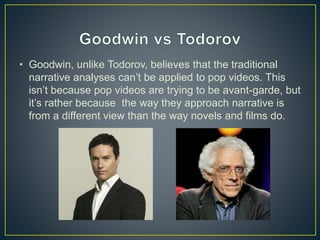
• Goodwin, unlike Todorov, believes that the traditional
narrative analyses can’t be applied to pop videos. This
isn’t because pop videos are trying to be avant-garde, but
it’s rather because the way they approach narrative is
from a different view than the way novels and films do.
• 1) Pop videos are built around songs, and songs don’t
usually pose traditional narrative structures
• 2) The pop video uses the singer both as a narrator
and as a character
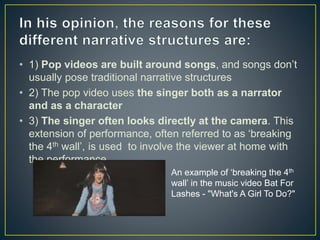
• 3) The singer often looks directly at the camera. This
extension of performance, often referred to as ‘breaking
the 4th wall’, is used to involve the viewer at home with
the performance.
An example of ‘breaking the 4th
wall’ in the music video Bat For
Lashes - "What's A Girl To Do?"
• Pop videos rely on repetition. Often the video repeats
images the same way the song repeats its choruses or
lines. Also, the use of intertextuality, created from one
song making reference to another media text (e.g. a song
repeating the rhythms of another song) helps us recognise
the genre and have certain expectation. Lastly, the song
will be played on the radio, the video will be played on TV
and there could be an advertising film or TV tie-in, making
the son very familiar through repetition.
• Pop songs, and therefore their videos, have a form of
closure and ending. The 3 minute single that a video is
based on must end and this is often reflected in the
structure of the music – it builds to a climax or to a
constant repetition before fading away.
• Pop songs, and therefore their
videos, have a form of closure
and ending. The 3 minute
single that a video is based on
must end and this is often
reflected in the structure of the
music – it builds to a climax
or to a constant repetition
before fading away.
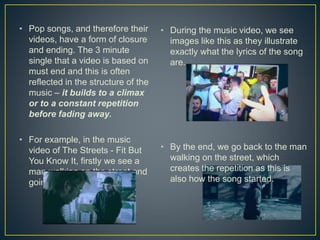
• For example, in the music
video of The Streets - Fit But
You Know It, firstly we see a
man walking on the street and
going in ‘Fotoswift’.
• During the music video, we see
images like this as they illustrate
exactly what the lyrics of the song
are.
• By the end, we go back to the man
walking on the street, which
creates the repetition as this is
also how the song started.
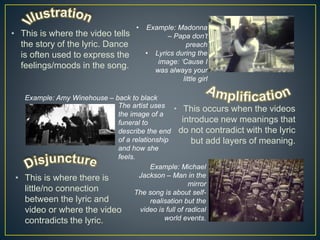
• This is where the video tells
the story of the lyric. Dance
is often used to express the
feelings/moods in the song.
• This occurs when the videos
introduce new meanings that
do not contradict with the lyric
but add layers of meaning.
• This is where there is
little/no connection
between the lyric and
video or where the video
contradicts the lyric.
• Example: Madonna
– Papa don’t
preach
• Lyrics during the
image: ‘Cause I
was always your
little girl
Example: Amy Winehouse – back to black
The artist uses
the image of a
funeral to
describe the end
of a relationship
and how she
feels.
Example: Michael
Jackson – Man in the
mirror
The song is about self-
realisation but the
video is full of radical
world events.
Andrew Goodwin

Andrew Goodwin

  • 1.
  • 2.
    • Goodwin, unlikeTodorov, believes that the traditional narrative analyses can’t be applied to pop videos. This isn’t because pop videos are trying to be avant-garde, but it’s rather because the way they approach narrative is from a different view than the way novels and films do.
  • 3.
    • 1) Popvideos are built around songs, and songs don’t usually pose traditional narrative structures • 2) The pop video uses the singer both as a narrator and as a character • 3) The singer often looks directly at the camera. This extension of performance, often referred to as ‘breaking the 4th wall’, is used to involve the viewer at home with the performance. An example of ‘breaking the 4th wall’ in the music video Bat For Lashes - "What's A Girl To Do?"
  • 4.
    • Pop videosrely on repetition. Often the video repeats images the same way the song repeats its choruses or lines. Also, the use of intertextuality, created from one song making reference to another media text (e.g. a song repeating the rhythms of another song) helps us recognise the genre and have certain expectation. Lastly, the song will be played on the radio, the video will be played on TV and there could be an advertising film or TV tie-in, making the son very familiar through repetition. • Pop songs, and therefore their videos, have a form of closure and ending. The 3 minute single that a video is based on must end and this is often reflected in the structure of the music – it builds to a climax or to a constant repetition before fading away.
  • 5.
    • Pop songs,and therefore their videos, have a form of closure and ending. The 3 minute single that a video is based on must end and this is often reflected in the structure of the music – it builds to a climax or to a constant repetition before fading away. • For example, in the music video of The Streets - Fit But You Know It, firstly we see a man walking on the street and going in ‘Fotoswift’. • During the music video, we see images like this as they illustrate exactly what the lyrics of the song are. • By the end, we go back to the man walking on the street, which creates the repetition as this is also how the song started.
  • 7.
    • This iswhere the video tells the story of the lyric. Dance is often used to express the feelings/moods in the song. • This occurs when the videos introduce new meanings that do not contradict with the lyric but add layers of meaning. • This is where there is little/no connection between the lyric and video or where the video contradicts the lyric. • Example: Madonna – Papa don’t preach • Lyrics during the image: ‘Cause I was always your little girl Example: Amy Winehouse – back to black The artist uses the image of a funeral to describe the end of a relationship and how she feels. Example: Michael Jackson – Man in the mirror The song is about self- realisation but the video is full of radical world events.