🎯 Learning Target
Atthe end of the lesson, students should be able to:
• Identify the rhythm, meter, tone, and mood of a
Haiku;
• Explain how these elements convey individual or
communal values;
• Compose a Haiku that reflects a personal or social
value.
3.
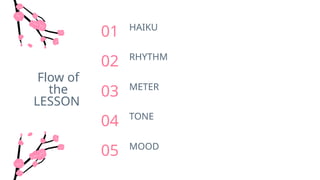
Flow of
the
LESSON
HAIKU
Du kannstdas Thema des Abschnitts hier beschreiben
01
RHYTHM
Du kannst das Thema des Abschnitts hier beschreiben
02
METER
Du kannst das Thema des Abschnitts hier beschreiben
03
TONE
Du kannst das Thema des Abschnitts hier beschreiben
04
MOOD
Du kannst das Thema des Abschnitts hier beschreiben
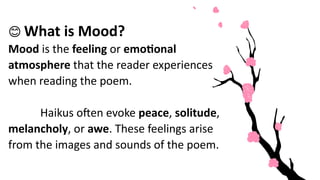
05
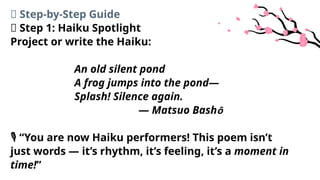
🧩 Step-by-Step Guide
📖Step 1: Haiku Spotlight
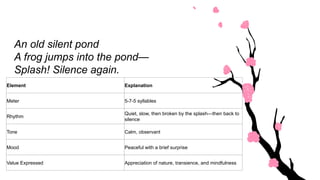
Project or write the Haiku:
An old silent pond
A frog jumps into the pond—
Splash! Silence again.
— Matsuo Bashō
“You are now Haiku performers! This poem isn’t
️
🎙️
just words — it’s rhythm, it’s feeling, it’s a moment in
time!”
6.
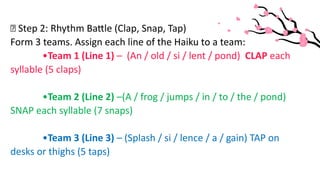
👏 Step 2:Rhythm Battle (Clap, Snap, Tap)
Form 3 teams. Assign each line of the Haiku to a team:
•Team 1 (Line 1) – (An / old / si / lent / pond) CLAP each
syllable (5 claps)
•Team 2 (Line 2) –(A / frog / jumps / in / to / the / pond)
SNAP each syllable (7 snaps)
•Team 3 (Line 3) – (Splash / si / lence / a / gain) TAP on
desks or thighs (5 taps)
7.
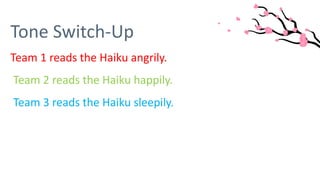
Tone Switch-Up
Team 1reads the Haiku angrily.
Team 2 reads the Haiku happily.
Team 3 reads the Haiku sleepily.
8.
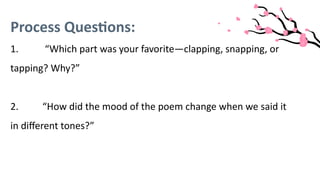
Process Questions:
1. “Whichpart was your favorite—clapping, snapping, or
tapping? Why?”
2. “How did the mood of the poem change when we said it
in different tones?”
9.
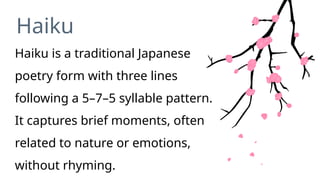
Haiku is atraditional Japanese
poetry form with three lines
following a 5–7–5 syllable pattern.
It captures brief moments, often
related to nature or emotions,
without rhyming.
Haiku
10.
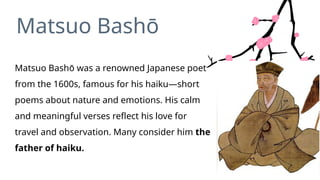
Matsuo Bashō wasa renowned Japanese poet
from the 1600s, famous for his haiku—short
poems about nature and emotions. His calm
and meaningful verses reflect his love for
travel and observation. Many consider him the
father of haiku.
Matsuo Bashō
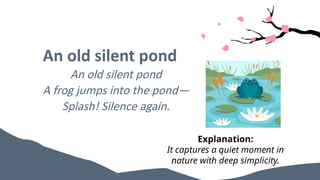
An old silentpond
An old silent pond
A frog jumps into the pond—
Splash! Silence again.
Explanation:
It captures a quiet moment in
nature with deep simplicity.
13.
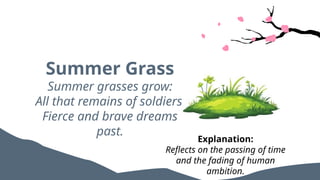
Summer Grass
Summer grassesgrow:
All that remains of soldiers’
Fierce and brave dreams
past.
Explanation:
Reflects on the passing of time
and the fading of human
ambition.
14.
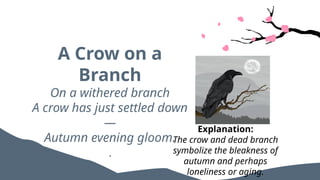
A Crow ona
Branch
On a withered branch
A crow has just settled down
—
Autumn evening gloom.
.
Explanation:
The crow and dead branch
symbolize the bleakness of
autumn and perhaps
loneliness or aging.
15.
Rhythm
refers to thepattern of stressed
and unstressed syllables or beats in
a poem.
16.
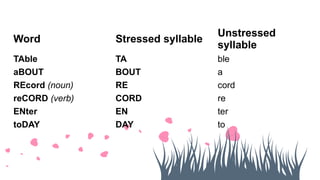
A syllable isa beat in a word.
Example:
👉 "apple" has 2
syllables: ap-ple
17.
✅ Stressed andUnstressed Syllables
A stressed syllable is the one we say
louder or with more force.
An unstressed syllable is softer or
quieter.
🎵 Why isRhythm Important?
• It makes a poem sound nice
• It helps us feel the mood (happy, sad, calm,
etc.)
• It makes the poem easier to read and
remember
20.
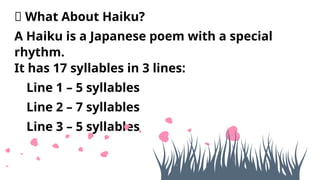
📝 What AboutHaiku?
A Haiku is a Japanese poem with a special
rhythm.
It has 17 syllables in 3 lines:
Line 1 – 5 syllables
Line 2 – 7 syllables
Line 3 – 5 syllables
21.
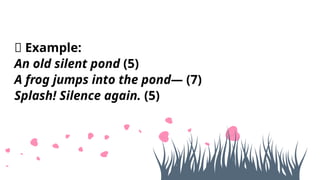
🌸 Example:
An oldsilent pond (5)
A frog jumps into the pond— (7)
Splash! Silence again. (5)
22.
Meter
refers to themeasured pattern of
syllables in a line. Haiku uses
syllabic meter — a strict count of
syllables per line.
23.
🧠 What isSyllabic Meter?
is a type of poetry rhythm where the number
of syllables in each line is counted, but the stressed
and unstressed syllables don’t matter.
📌 In simple words:
Syllabic meter = same number of syllables in each
line.
You only count the syllables, not the beat or stress.
24.
📌 Haiku hasa fixed syllabic meter:
➤ Line 1: 5 syllables
➤ Line 2: 7 syllables
➤ Line 3: 5 syllables
This structure helps express discipline,
simplicity, and harmony, values often
emphasized in Japanese culture.
25.
🎭 What isTone?
Tone is the author’s attitude toward the
subject or theme. It can be happy, sad,
angry, calm, or nostalgic.
In Haiku, tone is often gentle,
respectful, or thoughtful, as the poet
usually observes nature or life in a quiet,
meditative way.
26.
😊 What isMood?
Mood is the feeling or emotional
atmosphere that the reader experiences
when reading the poem.
Haikus often evoke peace, solitude,
melancholy, or awe. These feelings arise
from the images and sounds of the poem.
27.
🧭 6. Whydo Rhythm, Meter,
Tone, and Mood Matter?
These elements are not just
techniques. They help the poet
communicate values — personal
beliefs or shared cultural ideas.
.
28.
Hier kannst dueine kurze
Beschreibung des Themas
geben, über das du sprechen
möchtest
For example:
•A calm rhythm and gentle tone may reflect the
value of peacefulness.
•A slow-paced haiku about a snail might show
patience or perseverance.
•A haiku about falling leaves could express
acceptance, change, or impermanence — a key
idea in Japanese philosophy.
29.
Element Explanation
Meter 5-7-5syllables
Rhythm
Quiet, slow, then broken by the splash—then back to
silence
Tone Calm, observant
Mood Peaceful with a brief surprise
Value Expressed Appreciation of nature, transience, and mindfulness
An old silent pond
A frog jumps into the pond—
Splash! Silence again.
30.
🌟 Summary ofKey Concepts
A Haiku is a short Japanese poem with three
lines and a 5-7-5 syllable pattern. It doesn't rhyme but
uses carefully chosen words to capture a moment in
nature or human life.
•Rhythm is the sound pattern we feel as we read — in
Haiku, it's the gentle beat of 5-7-5 syllables.
•Meter is the structure or syllable count of each line.
31.
🌟 Summary ofKey Concepts
•Tone is the poet’s attitude, like calm, playful,
or thoughtful.
•Mood is the feeling the poem gives the reader,
like peace, sadness, or joy.
Together, these elements enable the poet
to express profound values such as mindfulness,
patience, and respect for nature, even in a few
words.
32.
CREDITS: Diese Präsentationsvorlagewurde
von Slidesgo erstellt, inklusive Icons von
Flaticon, Infografiken & Bilder von Freepik
Thank
you
Bitte lösche diese Folie nicht, es sei denn du
bist ein Premium Nutzer