1
Internship Project Report on
“Analytical Study on Income Tax Returns Filing Process.”
Submitted in partial fulfillment of the requirements for the degree of
Master in Business Administration- Digital Business (MBA-DB)
By
ABHIJEET NAGNATHRAO MATHWALE
PRN-20230305023
Under the guidance of
MS. PRIYANKA DHOTE.
Sector 29, Pradhikaran, Akurdi, Pune - Maharashtra, INDIA 411044
(Establishment by Maharashtra Act No. LXIII of 2017 Government of India)
2
STUDENT DECLARATION
This is to certify that I have completed the Internship Project titled “Analytical Study on
Income Tax Returns Filing Process” under the guidance of Dr Priyanka Dhote,
Assistant Professor-DYPIU, for the partial fulfillment of the requirement of the degree of
Master in Business Administration- Digital Business (MBA-DB) from School of Commerce
and Management, D Y Patil International University, Akurdi, Pune. This is an original piece
of work I have not submitted it earlier elsewhere.
Name: ABHIJEET NAGNATHRAO MATHWALE.
PRN: 20230305023.
Date: Place:
Signature:
3
Company Certificate
4
Sector 29, Pradhikaran, Akurdi, Pune - Maharashtra, INDIA 411044
(Establishment by Maharashtra Act No. LXIII of 2017 Government of India)
CERTIFICATE
This is to certify that Abhijeet Nagnathrao Mathwale (20230305023) is a bonafide student of
this university and has successfully completed his/ her internship project entitled “Analytical
Study on Income Tax Returns Filing Process.” for the partial fulfillment of the degree of
Master in Business Administration- Digital Business (MBA-DB) from School of Commerce
and Management, D Y Patil International University, Akurdi, Pune.
(Dr PRIYANKA DHOTE)
Assistant Professor-SCM, DYPIU.
ACKNOWLEDGEMENT
5
I am thankful DY PATIL INTERNATIONAL UNIVERSITY towards all those people who
helped me in this venture. I am highly indebted to (Dr. Madhavi Deshpande-SCM DYPIU)
for their guidance constant supervision as well as for providing necessary information
regarding the project & also for their support in completing the project. He was not only a
mentor but also guided us with the project and also provided help, motivation and learning's
that could work out for us in the professional and competitive environment.
It would not have been possible without the kind support and help of many Individuals and
Organizations. I would like to express my gratitude towards members of (CA PRAKSH A
PATIL & ASSOCIATES) for their kind co-operation and encouragement which helped me in
completion of this project. Discussions and deliberations with them have enriched my
knowledge to complete my project in a better way. I won't be able to continue in compiling this
text if they would not have supported me. I express my deepest thanks to my Faculty Mentor
(DR. Dr PRIYANKA DHOTE ) for his guidance and support. He supported me by showing
different methods of information consolidation and reaching out to prospective clients. He
helped whenever I needed guidance and given right direction towards the completion of the
project.
I am always thankful to my family for their all-time support and for putting up with all the
disruption in my life caused by my in this venture. My thanks and appreciations also go to my
colleagues in developing the project and people who have willingly helped me out with their
abilities.
I would not have succeeded in this process but for their help and support. I thank you all from
the bottom of my heart. I am really grateful to all of them in helping me throughout my
internship project which was completed successfully.
Executive Summary
6
In the current competitive landscape, customer satisfaction is paramount for Public
Sector in CA firm . This executive summary outlines the key factors influencing
customer satisfaction within the PSB sector.
High-quality customer service, including timely and efficient service, knowledgeable
staff, and effective problem resolution, is a cornerstone of satisfaction. The adoption of
modern technology, such as internet banking and mobile apps, enhances convenience
and accessibility, significantly impacting customer perception.
PSBs benefit from a reputation for trust and reliability, which is particularly valuable
during economic uncertainties. Clear and transparent communication regarding fees,
charges, and policies is crucial for fostering customer understanding and trust.
Government initiatives, such as financial inclusion programs, positively impact
customer satisfaction by extending banking services to underserved populations. The
extensive geographic reach of PSBs, particularly in rural and remote areas, enhances
accessibility and contributes to overall satisfaction.
To maintain and enhance customer satisfaction, PSBs must mitigate negative political
interference, ensure regulatory compliance, prioritize employee satisfaction through
training, and embrace competition as a driver for innovation and service improvement.
7
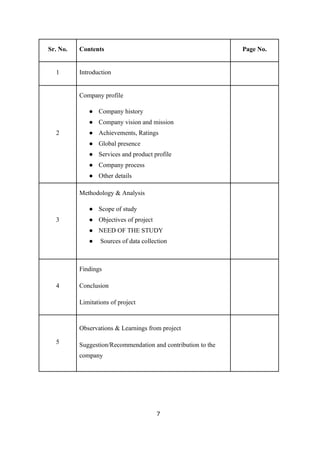
Sr. No. Contents Page No.
1 Introduction
2
Company profile
● Company history
● Company vision and mission
● Achievements, Ratings
● Global presence
● Services and product profile
● Company process
● Other details
3
Methodology & Analysis
● Scope of study
● Objectives of project
● NEED OF THE STUDY
● Sources of data collection
4
Findings
Conclusion
Limitations of project
5
Observations & Learnings from project
Suggestion/Recommendation and contribution to the
company
8
6
Appendix
● List of Tables
● List of Charts
● List of Graphs
● Bibliography
Annexure as required
9
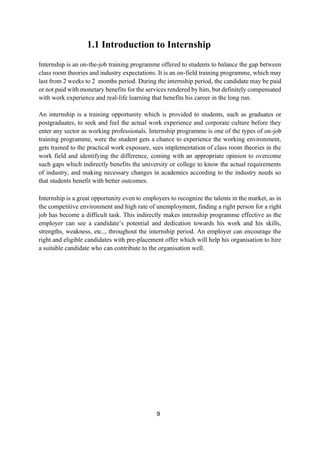
1.1 Introduction to Internship
Internship is an on-the-job training programme offered to students to balance the gap between
class room theories and industry expectations. It is an on-field training programme, which may
last from 2 weeks to 2 months period. During the internship period, the candidate may be paid
or not paid with monetary benefits for the services rendered by him, but definitely compensated
with work experience and real-life learning that benefits his career in the long run.
An internship is a training opportunity which is provided to students, such as graduates or
postgraduates, to seek and feel the actual work experience and corporate culture before they
enter any sector as working professionals. Internship programme is one of the types of on-job
training programme, were the student gets a chance to experience the working environment,
gets trained to the practical work exposure, sees implementation of class room theories in the
work field and identifying the difference, coming with an appropriate opinion to overcome
such gaps which indirectly benefits the university or college to know the actual requirements
of industry, and making necessary changes in academics according to the industry needs so
that students benefit with better outcomes.
Internship is a great opportunity even to employers to recognize the talents in the market, as in
the competitive environment and high rate of unemployment, finding a right person for a right
job has become a difficult task. This indirectly makes internship programme effective as the
employer can see a candidate’s potential and dedication towards his work and his skills,
strengths, weakness, etc.., throughout the internship period. An employer can encourage the
right and eligible candidates with pre-placement offer which will help his organisation to hire
a suitable candidate who can contribute to the organisation well.
10
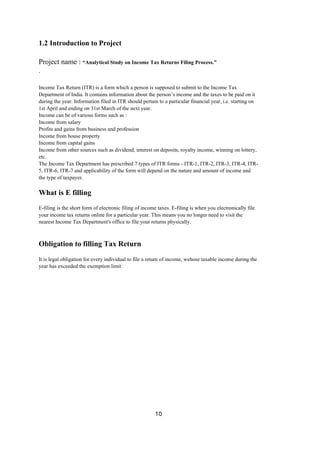
1.2 Introduction to Project
Project name : “Analytical Study on Income Tax Returns Filing Process.”
.
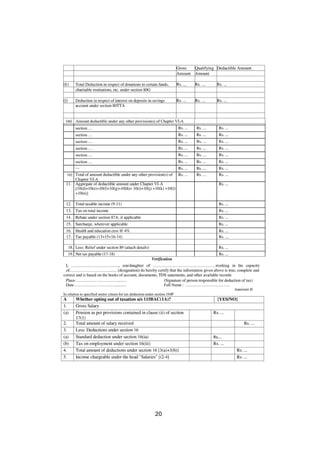
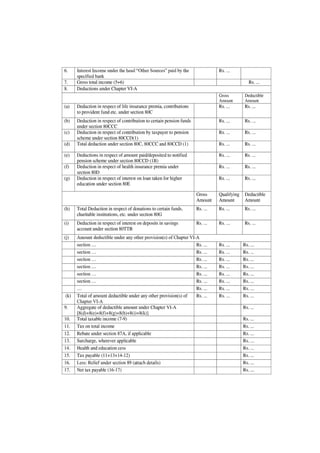
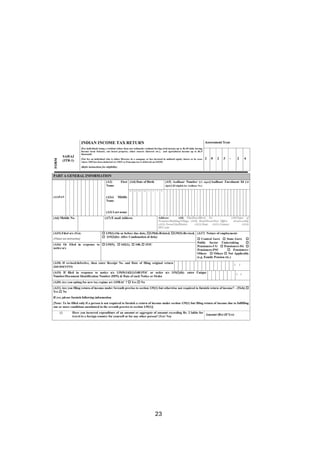
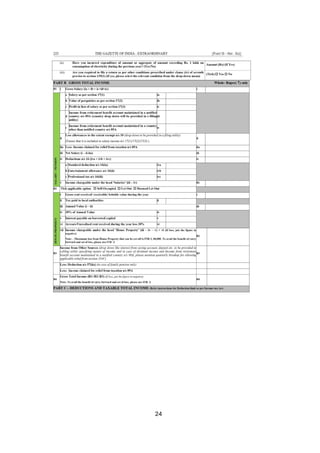
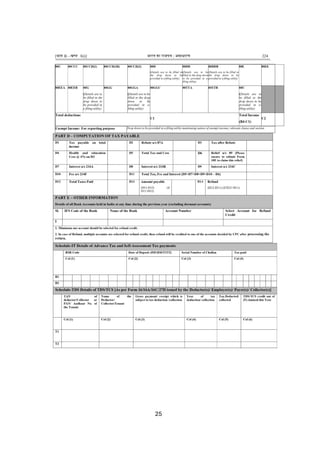
Income Tax Return (ITR) is a form which a person is supposed to submit to the Income Tax
Department of India. It contains information about the person’s income and the taxes to be paid on it
during the year. Information filed in ITR should pertain to a particular financial year, i.e. starting on
1st April and ending on 31st March of the next year.
Income can be of various forms such as :
Income from salary
Profits and gains from business and profession
Income from house property
Income from capital gains
Income from other sources such as dividend, interest on deposits, royalty income, winning on lottery,
etc.
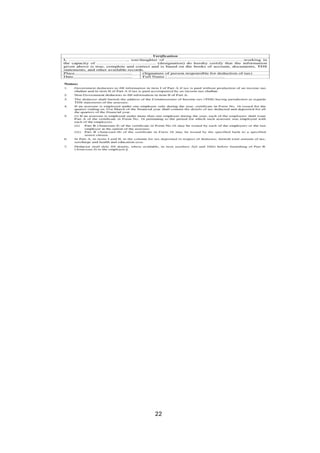
The Income Tax Department has prescribed 7 types of ITR forms - ITR-1, ITR-2, ITR-3, ITR-4, ITR-
5, ITR-6, ITR-7 and applicability of the form will depend on the nature and amount of income and
the type of taxpayer.
What is E filling
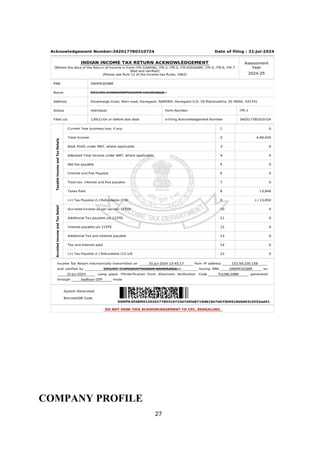
E-filing is the short form of electronic filing of income taxes. E-filing is when you electronically file
your income tax returns online for a particular year. This means you no longer need to visit the
nearest Income Tax Department's office to file your returns physically.
Obligation to filling Tax Return
It is legal obligation for every individual to file a return of income, wehose taxable income during the
year has exceeded the exemption limit
11
Forms of return prescribed under the Income -tax Law for the assessment
year
2023-24
Return form Brief description
ITR – 1
Also known as SAHAJ is applicable to a
ordinarily Resident individual having
salary or pension income or income from
one house property (not a case of
brought forward loss or loss to be carried
forward) or income from other sources
(not being lottery winnings and income
from race horses and income chargeable
to tax at special rates). However, an
individual who is a director in a company
or has held equity shares of an unlisted
company shall not be eligible to use
ITR -1. Further, the ITR-1 shall not be
available to a taxpayer in whose case the
tax has been deducted on cash
withdrawal under Section 194N or tax has
been deferred in respect of ESOPs
allotted by an eligible startup.
ITR – 2
It is applicable to an individual or an Hindu
Undivided Family not having income
chargeable to income-tax under the head
“Profits or gains of business or profession
ITR – 3
It is applicable to an individual or a Hindu
Undivided Family who has any income
chargeable to tax under the head business or
[A s amended by Finance Ac t, 2 021]
profession
ITR – 4
Also known as SUGAM is applicable to
individuals or Hindu Undivided Family or
partnership firm who have opted for the
presumptive taxation scheme of section
44AD/44ADA/44AE.
12
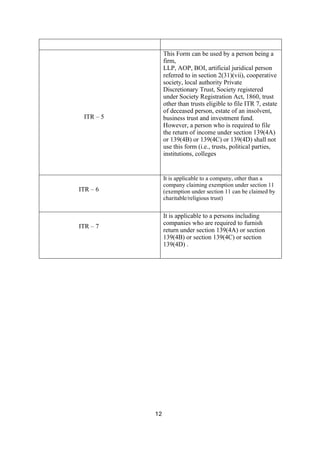
ITR – 5
This Form can be used by a person being a
firm,
LLP, AOP, BOI, artificial juridical person
referred to in section 2(31)(vii), cooperative
society, local authority Private
Discretionary Trust, Society registered
under Society Registration Act, 1860, trust
other than trusts eligible to file ITR 7, estate
of deceased person, estate of an insolvent,
business trust and investment fund.
However, a person who is required to file
the return of income under section 139(4A)
or 139(4B) or 139(4C) or 139(4D) shall not
use this form (i.e., trusts, political parties,
institutions, colleges
ITR – 6
It is applicable to a company, other than a
company claiming exemption under section 11
(exemption under section 11 can be claimed by
charitable/religious trust)
ITR – 7
It is applicable to a persons including
companies who are required to furnish
return under section 139(4A) or section
139(4B) or section 139(4C) or section
139(4D) .
13
Applicability of ITR – 1 (SAHAJ)
Return Form ITR – 1 (SAHAJ) can be used by a ordinarily resident individual
whose total income includes: (1) Income from salary/pension; or (2) Income from
one house property (excluding cases where loss is brought forward from previous
years or loss to be carried forward; or) (3) Income from other sources (excluding
winnings from lottery, income from race horses and income chargeable to tax at
special rates). Further, in a case where the income of another person like spouse,
minor child, etc., is to be clubbed with the income of the taxpayer, this return
form can be used only when such income falls in any of the above categories.
Non-applicability of ITR – 1 (SAHAJ)
1. Who is a Non-resident or Not Ordinarily Resident
2. Who is a Director of a company
3. Whose total income exceeds Rs. 50 lakhs
4. Who has income from more than 1 house property
5. Who has held unlisted equity shares at any time during the previous year
6. Who claims deduction under Section 80QQB or Section 80RRB in respect of royalty from
patents or books
7. Who claims deduction under Section 10AA or Part-C of Chapter VI-A
8. Who has brought forward loss or losses to be carried forward under any head [A s amended
by Finance A c t, 2 021]
9. Person claiming deduction under Section 57 from income taxable under the head 'Other
Sources'(other than deduction allowed from family pension)
10. Who wants to claim relief under Section 90 or 91
11. Who wants to claim credit of tax deducted at source in the hands of any other person.
12. Who has any assets (including Financial Interest in an entity) located outside India.
13. Who has signing authority in any account outside India
14. Who has any income to be apportioned in accordance with provisions of Section 5A
15. Who has any of the following income:
a) Income from Business or Profession
b) Capital Gains
c) Income taxable under the head 'Other sources' which is taxable at special rate
d) Dividend income exceeding Rs. 10 lakhs taxable under Section 115BBDA
e) Unexplained income (i.e., cash credit, unexplained investment, etc.) taxable at
60% under Section 115BBE
f) Agricultural Income exceeding Rs. 5,000
14
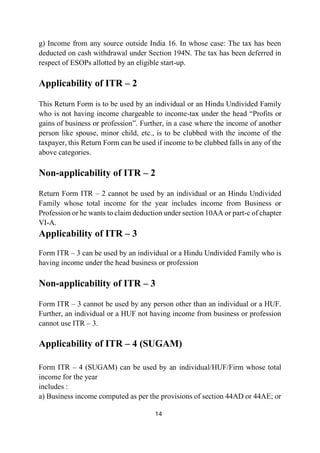
g) Income from any source outside India 16. In whose case: The tax has been
deducted on cash withdrawal under Section 194N. The tax has been deferred in
respect of ESOPs allotted by an eligible start-up.
Applicability of ITR – 2
This Return Form is to be used by an individual or an Hindu Undivided Family
who is not having income chargeable to income-tax under the head “Profits or
gains of business or profession”. Further, in a case where the income of another
person like spouse, minor child, etc., is to be clubbed with the income of the
taxpayer, this Return Form can be used if income to be clubbed falls in any of the
above categories.
Non-applicability of ITR – 2
Return Form ITR – 2 cannot be used by an individual or an Hindu Undivided
Family whose total income for the year includes income from Business or
Profession or he wants to claim deduction under section 10AA or part-c of chapter
VI-A.
Applicability of ITR – 3
Form ITR – 3 can be used by an individual or a Hindu Undivided Family who is
having income under the head business or profession
Non-applicability of ITR – 3
Form ITR – 3 cannot be used by any person other than an individual or a HUF.
Further, an individual or a HUF not having income from business or profession
cannot use ITR – 3.
Applicability of ITR – 4 (SUGAM)
Form ITR – 4 (SUGAM) can be used by an individual/HUF/Firm whose total
income for the year
includes :
a) Business income computed as per the provisions of section 44AD or 44AE; or
15
b) Income from profession computed as per the provisions of section 44ADA; or
c) Income from salary/pension; or
d) Income from one house property (excluding cases where loss is brought
forward from previous years or losses to be carried forward); or
e) Income from other sources (excluding winnings from lottery and income from
race horses).
Further, in a case where the income of another person like spouse, minor child,
etc., is to be clubbed with the income of the taxpayer, this return form can be used
where income to be clubbed falls in any of the above categories
Non-applicability of ITR – 4 (SUGAM)
Form ITR – 4 (SUGAM) cannot be used by a person:
1. Who is a Non-resident or Not Ordinarily Resident
2. Who is a Director of a company
3. Whose total income exceeds Rs. 50 lakhs
4. Who has income from more than one House Property
5. Who has held unlisted equity shares at any time during the previous year
6. Who claims deduction under section 80QQB or 80RRB in respect of royalty
from patent or books
7. Who claims deduction under section 10AA or Part-C of Chapter VI-A
8. Who has brought forward loss or losses to be carried forward under any head
9. Person claiming deduction under Section 57 from income taxable under the
head 'Other Sources' (other than deduction allowed from family pension)
10. Who wants to claim relief under Sections 90 or 91
11. Who wants to claim credit of tax deducted at source in the hands of any other
person.
12. Who has any assets (including Financial Interest in an entity) located outside
India.
13. Who has signing authority in any account outside India
14. Who has any income to be apportioned in accordance with provisions of
Section 5A [A s amended by Finance A c t, 2 021]
15. Who has any of the following income:
a) Income from Business or Profession
b) Capital Gains or Loss
c) Income taxable under the head 'Other sources' which is taxable at special rate
d) Dividend income exceeding Rs. 10 lakhs taxable under Section 115BBDA
16
e) Unexplained income (i.e., cash credit, unexplained investment, etc.) taxable at
60% under Section 115BBE
f) Agricultural Income exceeding Rs. 5,000
g) Income from any source outside India
h) Income from speculative business and other special incomes.
i) Income from agency business or commission or brokerage
16. Who has income of the nature specified in section 17(2)(vi) on which tax is
payable/deductible under section 192(2) or 192(1C).
In case the assesse keeps and maintains all books of accounts and other
documents referred to in section 44AA, and also gets his accounts audited and
obtains an audit report as per section 44AB, filling up the Form ITR-4 (Sugam)
is not mandatory. In such a case, other regular return forms viz.
ITR-3 or ITR-5, as applicable, should be used.
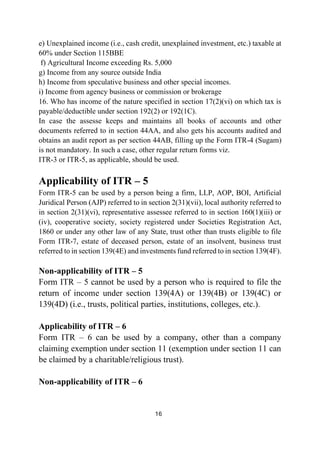
Applicability of ITR – 5
Form ITR-5 can be used by a person being a firm, LLP, AOP, BOI, Artificial
Juridical Person (AJP) referred to in section 2(31)(vii), local authority referred to
in section 2(31)(vi), representative assessee referred to in section 160(1)(iii) or
(iv), cooperative society, society registered under Societies Registration Act,
1860 or under any other law of any State, trust other than trusts eligible to file
Form ITR-7, estate of deceased person, estate of an insolvent, business trust
referred to in section 139(4E) and investments fund referred to in section 139(4F).
Non-applicability of ITR – 5
Form ITR – 5 cannot be used by a person who is required to file the
return of income under section 139(4A) or 139(4B) or 139(4C) or
139(4D) (i.e., trusts, political parties, institutions, colleges, etc.).
Applicability of ITR – 6
Form ITR – 6 can be used by a company, other than a company
claiming exemption under section 11 (exemption under section 11 can
be claimed by a charitable/religious trust).
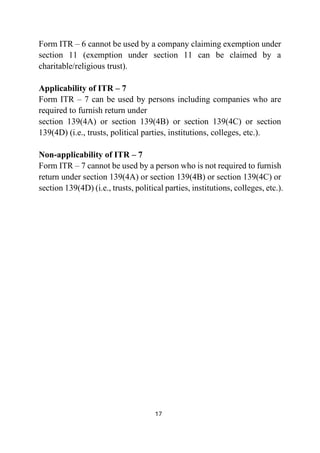
Non-applicability of ITR – 6
17
Form ITR – 6 cannot be used by a company claiming exemption under
section 11 (exemption under section 11 can be claimed by a
charitable/religious trust).
Applicability of ITR – 7
Form ITR – 7 can be used by persons including companies who are
required to furnish return under
section 139(4A) or section 139(4B) or section 139(4C) or section
139(4D) (i.e., trusts, political parties, institutions, colleges, etc.).
Non-applicability of ITR – 7
Form ITR – 7 cannot be used by a person who is not required to furnish
return under section 139(4A) or section 139(4B) or section 139(4C) or
section 139(4D) (i.e., trusts, political parties, institutions, colleges, etc.).
18
19
20
21
22
23
24
25
26
27
COMPANY PROFILE
28
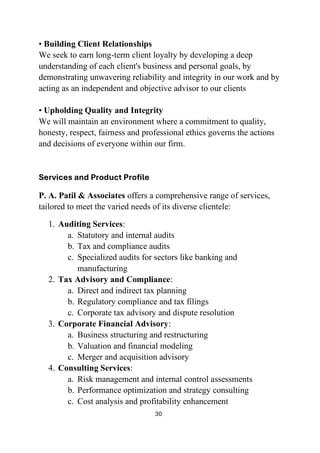
P. A. Patil & Associates is a renowned Chartered Accountant firm
established by Mr. Prakash A. Patil, a leading figure in corporate finance
and tax consultation in India. Known for its specialized and
comprehensive financial solutions, the firm comprises a team of highly
qualified Chartered Accountants, corporate financial advisors, and tax
consultants. Built on a foundation of integrity, client satisfaction, and
quality service, P. A. Patil & Associates has become synonymous with
professional excellence, offering sound financial solutions tailored to
meet the unique needs of its clients.
The firm provides services to a diverse range of industries, including
Software and Information Technology, Manufacturing, Education and
Welfare, Banking & Financial Services, and Retail and Wholesale
Trading. The organization brings together specialized skills and a
commitment to adding value to its clients, optimizing benefits across
financial, operational, and compliance landscapes.
Our service network includes Corporate House, Partnership firms. The clients
we serve span across various industries such as Software and Information
Technology, Manufacturing, Education and Welfare, Banking & Financial
Services, Trading (wholesalers & Retailers) etc. Our Work Culture
Company History
P. A. Patil & Associates was founded by Mr. Prakash A. Patil to offer
professional accounting and financial consulting services. With a dedication to
high-quality and objective advice, the firm quickly grew, extending its client
base across various sectors. Over the years, it has built a reputation for being a
reliable partner to businesses in India, helping them navigate complex financial
environments and achieve compliance with the highest standards. From a
single-office setup, the firm has expanded to develop a wide-reaching service
network, connecting with clients both locally and nationally.
Achievements and Ratings
29
• Client Satisfaction Recognition: Rated highly by clients for
exceptional commitment to accuracy, timeliness, and quality in all
engagements.
• Quality Assurance: Consistently upholds an environment of
professionalism and ethics, recognized in client testimonials and
partnerships.
• Industry-Specific Expertise: Successfully expanded services to
specialized industries, including hydro power and medical sectors,
gaining recognition as a leading advisor for industry-specific
financial needs.
• Client Loyalty: Maintained long-standing relationships with key
corporate clients, a testament to the firm’s client-centric approach.
Mission, vision, values
Mission:
P. A. Patil & Associates. exists to provide complete, reliable and
high quality auditing and consulting services to individuals and
institutions, be it manufacturing, trading, tourism, financial,
governmental, non-governmental, medical, hydro power, hotels, and
any other sectors.
Vision:
The firm's vision is to be the premier auditing, accounting, tax and
business consulting firm by every measure that matters.
Values:
We believe that our success depends first and foremost on people. By
respecting people in everything we do, we will develop and maintain
high quality, mutually beneficial relationships with our clients,
professional colleagues, referral sources, vendors, community
members and each other.
30
• Building Client Relationships
We seek to earn long-term client loyalty by developing a deep
understanding of each client's business and personal goals, by
demonstrating unwavering reliability and integrity in our work and by
acting as an independent and objective advisor to our clients
• Upholding Quality and Integrity
We will maintain an environment where a commitment to quality,
honesty, respect, fairness and professional ethics governs the actions
and decisions of everyone within our firm.
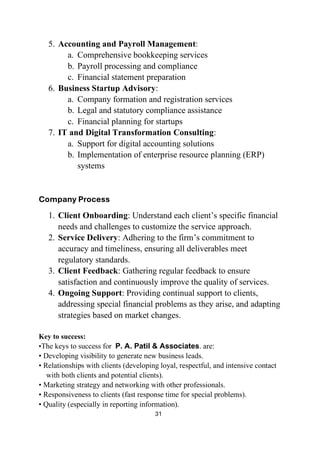
Services and Product Profile
P. A. Patil & Associates offers a comprehensive range of services,
tailored to meet the varied needs of its diverse clientele:
1. Auditing Services:
a. Statutory and internal audits
b. Tax and compliance audits
c. Specialized audits for sectors like banking and
manufacturing
2. Tax Advisory and Compliance:
a. Direct and indirect tax planning
b. Regulatory compliance and tax filings
c. Corporate tax advisory and dispute resolution
3. Corporate Financial Advisory:
a. Business structuring and restructuring
b. Valuation and financial modeling
c. Merger and acquisition advisory
4. Consulting Services:
a. Risk management and internal control assessments
b. Performance optimization and strategy consulting
c. Cost analysis and profitability enhancement
31
5. Accounting and Payroll Management:
a. Comprehensive bookkeeping services
b. Payroll processing and compliance
c. Financial statement preparation
6. Business Startup Advisory:
a. Company formation and registration services
b. Legal and statutory compliance assistance
c. Financial planning for startups
7. IT and Digital Transformation Consulting:
a. Support for digital accounting solutions
b. Implementation of enterprise resource planning (ERP)
systems
Company Process
1. Client Onboarding: Understand each client’s specific financial
needs and challenges to customize the service approach.
2. Service Delivery: Adhering to the firm’s commitment to
accuracy and timeliness, ensuring all deliverables meet
regulatory standards.
3. Client Feedback: Gathering regular feedback to ensure
satisfaction and continuously improve the quality of services.
4. Ongoing Support: Providing continual support to clients,
addressing special financial problems as they arise, and adapting
strategies based on market changes.
Key to success:
•The keys to success for P. A. Patil & Associates. are:
• Developing visibility to generate new business leads.
• Relationships with clients (developing loyal, respectful, and intensive contact
with both clients and potential clients).
• Marketing strategy and networking with other professionals.
• Responsiveness to clients (fast response time for special problems).
• Quality (especially in reporting information).
32
• Excellence in fulfilling the promise.
•Openness: languages and willpower for creating interregional and international
OTHER DATILS
Taxation : Taxation is the part of public Finance that deals with the means by
which the government raises revenue from the public by imposing taxes which
revenue is used by the government to provide goods and services to the public
or its citizens (to carry out government functions)
Types of taxes :
i) Direct:
Direct tax is the one paid directly to the Govt. By the persons on whom it is
imposed Income Tax, Property Tax, Capital Value Tax etc.
33
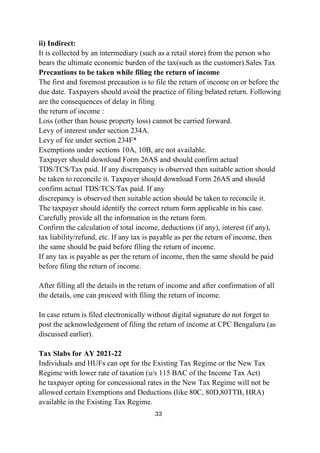
ii) Indirect:
It is collected by an intermediary (such as a retail store) from the person who
bears the ultimate economic burden of the tax(such as the customer).Sales Tax
Precautions to be taken while filing the return of income
The first and foremost precaution is to file the return of income on or before the
due date. Taxpayers should avoid the practice of filing belated return. Following
are the consequences of delay in filing
the return of income :
Loss (other than house property loss) cannot be carried forward.
Levy of interest under section 234A.
Levy of fee under section 234F*
Exemptions under sections 10A, 10B, are not available.
Taxpayer should download Form 26AS and should confirm actual
TDS/TCS/Tax paid. If any discrepancy is observed then suitable action should
be taken to reconcile it. Taxpayer should download Form 26AS and should
confirm actual TDS/TCS/Tax paid. If any
discrepancy is observed then suitable action should be taken to reconcile it.
The taxpayer should identify the correct return form applicable in his case.
Carefully provide all the information in the return form.
Confirm the calculation of total income, deductions (if any), interest (if any),
tax liability/refund, etc. If any tax is payable as per the return of income, then
the same should be paid before filing the return of income.
If any tax is payable as per the return of income, then the same should be paid
before filing the return of income.
After filling all the details in the return of income and after confirmation of all
the details, one can proceed with filing the return of income.
In case return is filed electronically without digital signature do not forget to
post the acknowledgement of filing the return of income at CPC Bengaluru (as
discussed earlier).
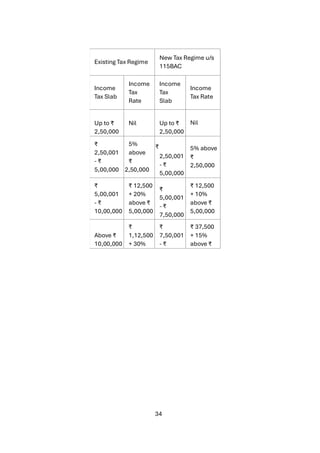
Tax Slabs for AY 2021-22
Individuals and HUFs can opt for the Existing Tax Regime or the New Tax
Regime with lower rate of taxation (u/s 115 BAC of the Income Tax Act)
he taxpayer opting for concessional rates in the New Tax Regime will not be
allowed certain Exemptions and Deductions (like 80C, 80D,80TTB, HRA)
available in the Existing Tax Regime.
34
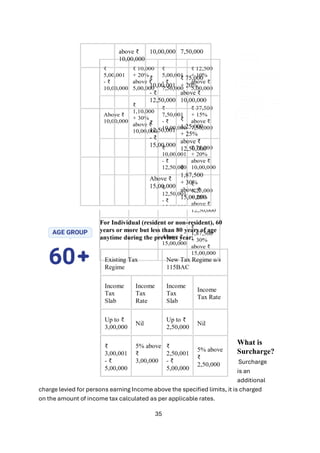
Existing Tax Regime
New Tax Regime u/s
115BAC
Income
Tax Slab
Income
Tax
Rate
Income
Tax
Slab
Income
Tax Rate
Up to ₹
2,50,000
Nil Up to ₹
2,50,000
Nil
₹
2,50,001
- ₹
5,00,000
5%
above
₹
2,50,000
₹
2,50,001
- ₹
5,00,000
5% above
₹
2,50,000
₹
5,00,001
- ₹
10,00,000
₹ 12,500
+ 20%
above ₹
5,00,000
₹
5,00,001
- ₹
7,50,000
₹ 12,500
+ 10%
above ₹
5,00,000
Above ₹
10,00,000
₹
1,12,500
+ 30%
₹
7,50,001
- ₹
₹ 37,500
+ 15%
above ₹
35
What is
Surcharge?
Surcharge
is an
additional
charge levied for persons earning Income above the specified limits, it is charged
on the amount of income tax calculated as per applicable rates.
36
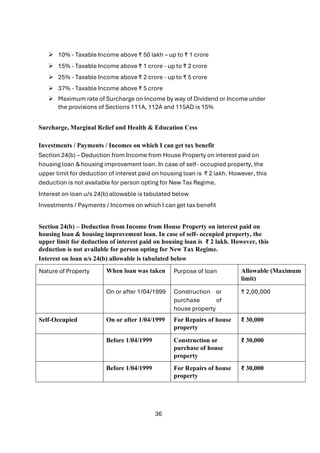
➢ 10% - Taxable Income above ₹ 50 lakh – up to ₹ 1 crore
➢ 15% - Taxable Income above ₹ 1 crore - up to ₹ 2 crore
➢ 25% - Taxable Income above ₹ 2 crore - up to ₹ 5 crore
➢ 37% - Taxable Income above ₹ 5 crore
➢ Maximum rate of Surcharge on Income by way of Dividend or Income under
the provisions of Sections 111A, 112A and 115AD is 15%
Surcharge, Marginal Relief and Health & Education Cess
Investments / Payments / Incomes on which I can get tax benefit
Section 24(b) – Deduction from Income from House Property on interest paid on
housing loan & housing improvement loan. In case of self- occupied property, the
upper limit for deduction of interest paid on housing loan is ₹ 2 lakh. However, this
deduction is not available for person opting for New Tax Regime.
Interest on loan u/s 24(b) allowable is tabulated below
Investments / Payments / Incomes on which I can get tax benefit
Section 24(b) – Deduction from Income from House Property on interest paid on
housing loan & housing improvement loan. In case of self- occupied property, the
upper limit for deduction of interest paid on housing loan is ₹ 2 lakh. However, this
deduction is not available for person opting for New Tax Regime.
Interest on loan u/s 24(b) allowable is tabulated below
Nature of Property When loan was taken Purpose of loan Allowable (Maximum
limit)
On or after 1/04/1999 Construction or
purchase of
house property
₹ 2,00,000
Self-Occupied On or after 1/04/1999 For Repairs of house
property
₹ 30,000
Before 1/04/1999 Construction or
purchase of house
property
₹ 30,000
Before 1/04/1999 For Repairs of house
property
₹ 30,000
37
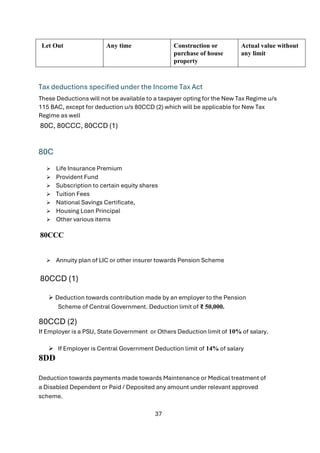
Let Out Any time Construction or
purchase of house
property
Actual value without
any limit
Tax deductions specified under the Income Tax Act
These Deductions will not be available to a taxpayer opting for the New Tax Regime u/s
115 BAC, except for deduction u/s 80CCD (2) which will be applicable for New Tax
Regime as well
80C, 80CCC, 80CCD (1)
80C
➢ Life Insurance Premium
➢ Provident Fund
➢ Subscription to certain equity shares
➢ Tuition Fees
➢ National Savings Certificate,
➢ Housing Loan Principal
➢ Other various items
80CCC
➢ Annuity plan of LIC or other insurer towards Pension Scheme
80CCD (1)
➢ Deduction towards contribution made by an employer to the Pension
Scheme of Central Government. Deduction limit of ₹ 50,000.
80CCD (2)
If Employer is a PSU, State Government or Others Deduction limit of 10% of salary.
➢ If Employer is Central Government Deduction limit of 14% of salary
8DD
Deduction towards payments made towards Maintenance or Medical treatment of
a Disabled Dependent or Paid / Deposited any amount under relevant approved
scheme.
38
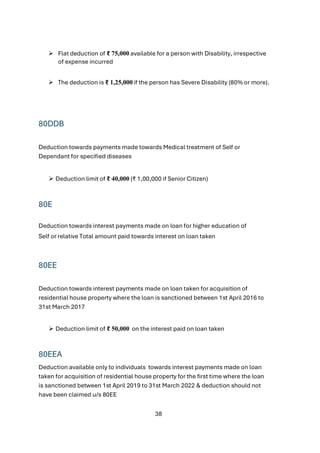
➢ Flat deduction of ₹ 75,000 available for a person with Disability, irrespective
of expense incurred
➢ The deduction is ₹ 1,25,000 if the person has Severe Disability (80% or more).
80DDB
Deduction towards payments made towards Medical treatment of Self or
Dependant for specified diseases
➢ Deduction limit of ₹ 40,000 (₹ 1,00,000 if Senior Citizen)
80E
Deduction towards interest payments made on loan for higher education of
Self or relative Total amount paid towards interest on loan taken
80EE
Deduction towards interest payments made on loan taken for acquisition of
residential house property where the loan is sanctioned between 1st April 2016 to
31st March 2017
➢ Deduction limit of ₹ 50,000 on the interest paid on loan taken
80EEA
Deduction available only to individuals towards interest payments made on loan
taken for acquisition of residential house property for the first time where the loan
is sanctioned between 1st April 2019 to 31st March 2022 & deduction should not
have been claimed u/s 80EE
39
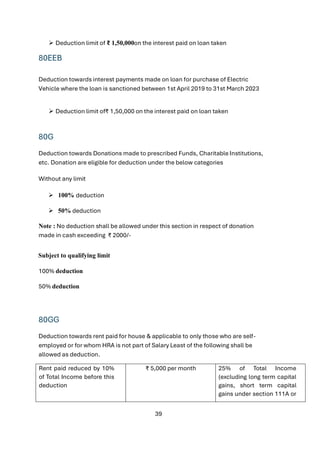
➢ Deduction limit of ₹ 1,50,000on the interest paid on loan taken
80EEB
Deduction towards interest payments made on loan for purchase of Electric
Vehicle where the loan is sanctioned between 1st April 2019 to 31st March 2023
➢ Deduction limit of₹ 1,50,000 on the interest paid on loan taken
80G
Deduction towards Donations made to prescribed Funds, Charitable Institutions,
etc. Donation are eligible for deduction under the below categories
Without any limit
➢ 100% deduction
➢ 50% deduction
Note : No deduction shall be allowed under this section in respect of donation
made in cash exceeding ₹ 2000/-
Subject to qualifying limit
100% deduction
50% deduction
80GG
Deduction towards rent paid for house & applicable to only those who are self-
employed or for whom HRA is not part of Salary Least of the following shall be
allowed as deduction.
Rent paid reduced by 10%
of Total Income before this
deduction
₹ 5,000 per month 25% of Total Income
(excluding long term capital
gains, short term capital
gains under section 111A or
40
income under section 115A
or 115D)
Note: Form 10BA to be filled for claiming this deduction.
80GGA
Deduction towards Donations made for Scientific Research or Rural Development
Donation are eligible for deduction under the below categories
Research Association or University, College or other Institution for
• Scientific Research
• Social Science or Statistical Research
Association or Institution for
• Rural Development
• Conservation of Natural Resources or for Afforestation
PSU or Local Authority or an association or institution approved by the
National Committee for carrying out any eligible project
Funds notified by Central Government for
• Afforestation
• Rural Development
Note: No deduction shall be allowed under this Section in respect of
donation made in cash exceeding ₹ 2000/- or if Gross Total Income
includes income from Profit / Gains of Business / Profession
80GGC
41
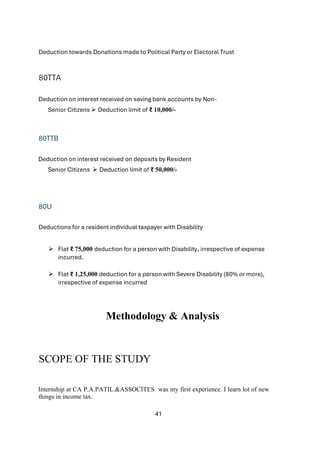
Deduction towards Donations made to Political Party or Electoral Trust
80TTA
Deduction on interest received on saving bank accounts by Non-
Senior Citizens ➢ Deduction limit of ₹ 10,000/-
80TTB
Deduction on interest received on deposits by Resident
Senior Citizens ➢ Deduction limit of ₹ 50,000/-
80U
Deductions for a resident individual taxpayer with Disability
➢ Flat ₹ 75,000 deduction for a person with Disability, irrespective of expense
incurred.
➢ Flat ₹ 1,25,000 deduction for a person with Severe Disability (80% or more),
irrespective of expense incurred
Methodology & Analysis
SCOPE OF THE STUDY
Internship at CA P.A.PATIL.&ASSOCITES was my first experience. I learn lot of new
things in income tax.
42
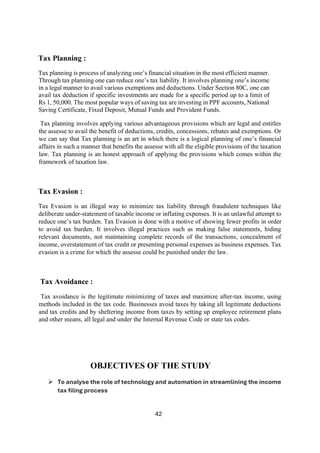
Tax Planning :
Tax planning is process of analyzing one’s financial situation in the most efficient manner.
Through tax planning one can reduce one’s tax liability. It involves planning one’s income
in a legal manner to avail various exemptions and deductions. Under Section 80C, one can
avail tax deduction if specific investments are made for a specific period up to a limit of
Rs 1, 50,000. The most popular ways of saving tax are investing in PPF accounts, National
Saving Certificate, Fixed Deposit, Mutual Funds and Provident Funds.
Tax planning involves applying various advantageous provisions which are legal and entitles
the assesse to avail the benefit of deductions, credits, concessions, rebates and exemptions. Or
we can say that Tax planning is an art in which there is a logical planning of one’s financial
affairs in such a manner that benefits the assesse with all the eligible provisions of the taxation
law. Tax planning is an honest approach of applying the provisions which comes within the
framework of taxation law.
Tax Evasion :
Tax Evasion is an illegal way to minimize tax liability through fraudulent techniques like
deliberate under-statement of taxable income or inflating expenses. It is an unlawful attempt to
reduce one’s tax burden. Tax Evasion is done with a motive of showing fewer profits in order
to avoid tax burden. It involves illegal practices such as making false statements, hiding
relevant documents, not maintaining complete records of the transactions, concealment of
income, overstatement of tax credit or presenting personal expenses as business expenses. Tax
evasion is a crime for which the assesse could be punished under the law.
Tax Avoidance :
Tax avoidance is the legitimate minimizing of taxes and maximize after-tax income, using
methods included in the tax code. Businesses avoid taxes by taking all legitimate deductions
and tax credits and by sheltering income from taxes by setting up employee retirement plans
and other means, all legal and under the Internal Revenue Code or state tax codes.
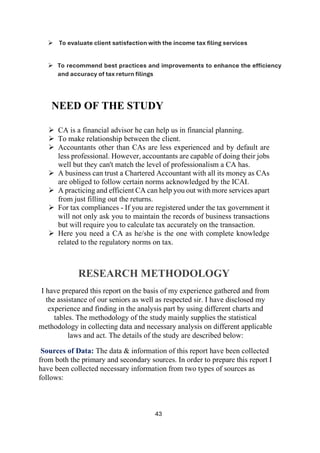
OBJECTIVES OF THE STUDY
➢ To analyse the role of technology and automation in streamlining the income
tax filing process
43
➢ To evaluate client satisfaction with the income tax filing services
➢ To recommend best practices and improvements to enhance the efficiency
and accuracy of tax return filings
NEED OF THE STUDY
➢ CA is a financial advisor he can help us in financial planning.
➢ To make relationship between the client.
➢ Accountants other than CAs are less experienced and by default are
less professional. However, accountants are capable of doing their jobs
well but they can't match the level of professionalism a CA has.
➢ A business can trust a Chartered Accountant with all its money as CAs
are obliged to follow certain norms acknowledged by the ICAI.
➢ A practicing and efficient CA can help you out with more services apart
from just filling out the returns.
➢ For tax compliances - If you are registered under the tax government it
will not only ask you to maintain the records of business transactions
but will require you to calculate tax accurately on the transaction.
➢ Here you need a CA as he/she is the one with complete knowledge
related to the regulatory norms on tax.
RESEARCH METHODOLOGY
I have prepared this report on the basis of my experience gathered and from
the assistance of our seniors as well as respected sir. I have disclosed my
experience and finding in the analysis part by using different charts and
tables. The methodology of the study mainly supplies the statistical
methodology in collecting data and necessary analysis on different applicable
laws and act. The details of the study are described below:
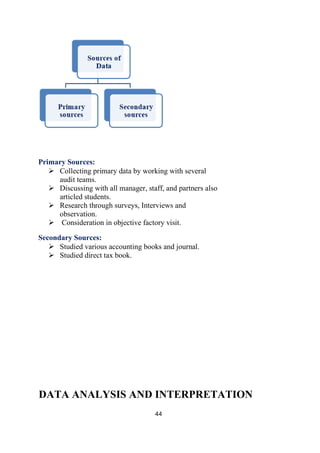
Sources of Data: The data & information of this report have been collected
from both the primary and secondary sources. In order to prepare this report I
have been collected necessary information from two types of sources as
follows:
44
Primary Sources:
➢ Collecting primary data by working with several
audit teams.
➢ Discussing with all manager, staff, and partners also
articled students.
➢ Research through surveys, Interviews and
observation.
➢ Consideration in objective factory visit.
Secondary Sources:
➢ Studied various accounting books and journal.
➢ Studied direct tax book.
DATA ANALYSIS AND INTERPRETATION
45
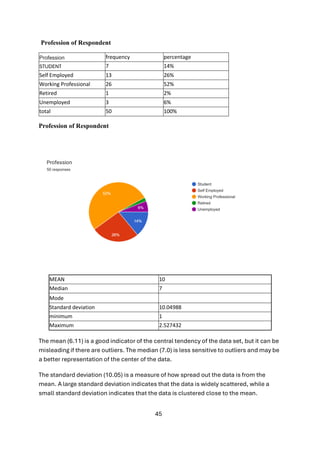
Profession of Respondent
Profession frequency percentage
STUDENT 7 14%
Self Employed 13 26%
Working Professional 26 52%
Retired 1 2%
Unemployed 3 6%
total 50 100%
Profession of Respondent
MEAN 10
Median 7
Mode
Standard deviation 10.04988
minimum 1
Maximum 2.527432
The mean (6.11) is a good indicator of the central tendency of the data set, but it can be
misleading if there are outliers. The median (7.0) is less sensitive to outliers and may be
a better representation of the center of the data.
The standard deviation (10.05) is a measure of how spread out the data is from the
mean. A large standard deviation indicates that the data is widely scattered, while a
small standard deviation indicates that the data is clustered close to the mean.
46
The data set has a range of 1.527 (from 1 to 2.527) which is relatively large compared to
the mean. This suggests that the data may be spread out.
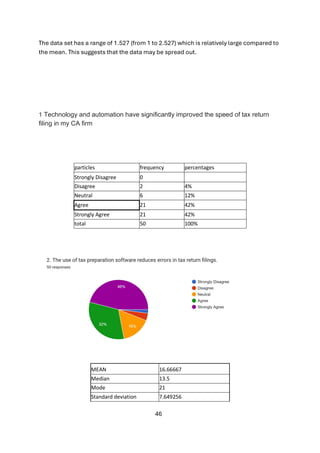
1 Technology and automation have significantly improved the speed of tax return
filing in my CA firm
particles frequency percentages
Strongly Disagree 0
Disagree 2 4%
Neutral 6 12%
Agree 21 42%
Strongly Agree 21 42%
total 50 100%
MEAN 16.66667
Median 13.5
Mode 21
Standard deviation 7.649256
47
minimum 0
maximum 50
The data is right-skewed, with the mean (16.67) higher than the median (13.5),
indicating that higher values are pulling the average up. The mode (21) is the most
frequent value. The standard deviation (7.65) shows moderate variability, and the
range (0 to 50) indicates a wide spread with some larger outliers influencing the
mean.
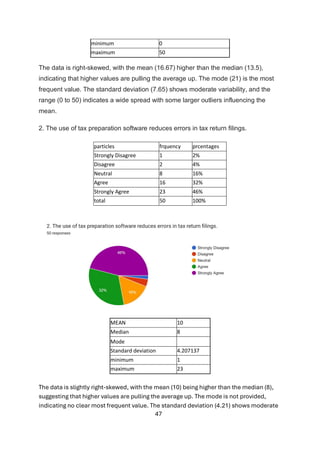
2. The use of tax preparation software reduces errors in tax return filings.
particles frquency prcentages
Strongly Disagree 1 2%
Disagree 2 4%
Neutral 8 16%
Agree 16 32%
Strongly Agree 23 46%
total 50 100%
MEAN 10
Median 8
Mode
Standard deviation 4.207137
minimum 1
maximum 23
The data is slightly right-skewed, with the mean (10) being higher than the median (8),
suggesting that higher values are pulling the average up. The mode is not provided,
indicating no clear most frequent value. The standard deviation (4.21) shows moderate
48
variability. The range (1 to 23) indicates a spread of values, with some higher values
contributing to the shift in the mean.
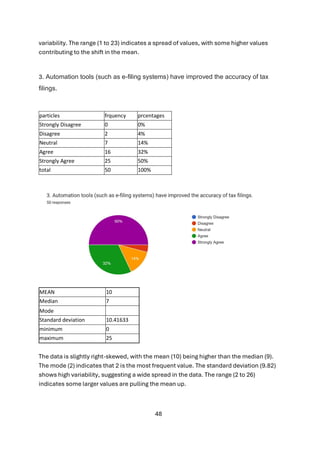
3. Automation tools (such as e-filing systems) have improved the accuracy of tax
filings.
particles frquency prcentages
Strongly Disagree 0 0%
Disagree 2 4%
Neutral 7 14%
Agree 16 32%
Strongly Agree 25 50%
total 50 100%
MEAN 10
Median 7
Mode
Standard deviation 10.41633
minimum 0
maximum 25
The data is slightly right-skewed, with the mean (10) being higher than the median (9).
The mode (2) indicates that 2 is the most frequent value. The standard deviation (9.82)
shows high variability, suggesting a wide spread in the data. The range (2 to 26)
indicates some larger values are pulling the mean up.
49
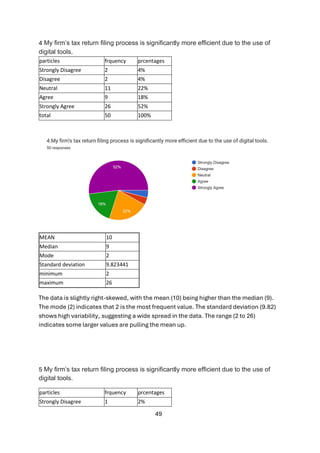
4 My firm’s tax return filing process is significantly more efficient due to the use of
digital tools.
particles frquency prcentages
Strongly Disagree 2 4%
Disagree 2 4%
Neutral 11 22%
Agree 9 18%
Strongly Agree 26 52%
total 50 100%
MEAN 10
Median 9
Mode 2
Standard deviation 9.823441
minimum 2
maximum 26
The data is slightly right-skewed, with the mean (10) being higher than the median (9).
The mode (2) indicates that 2 is the most frequent value. The standard deviation (9.82)
shows high variability, suggesting a wide spread in the data. The range (2 to 26)
indicates some larger values are pulling the mean up.
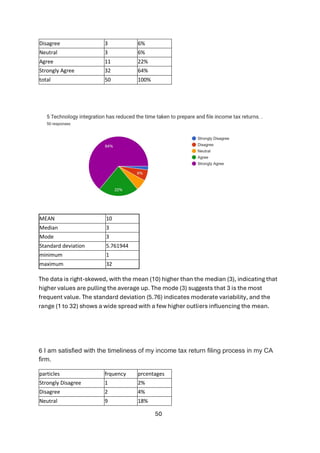
5 My firm’s tax return filing process is significantly more efficient due to the use of
digital tools.
particles frquency prcentages
Strongly Disagree 1 2%
50
Disagree 3 6%
Neutral 3 6%
Agree 11 22%
Strongly Agree 32 64%
total 50 100%
MEAN 10
Median 3
Mode 3
Standard deviation 5.761944
minimum 1
maximum 32
The data is right-skewed, with the mean (10) higher than the median (3), indicating that
higher values are pulling the average up. The mode (3) suggests that 3 is the most
frequent value. The standard deviation (5.76) indicates moderate variability, and the
range (1 to 32) shows a wide spread with a few higher outliers influencing the mean.
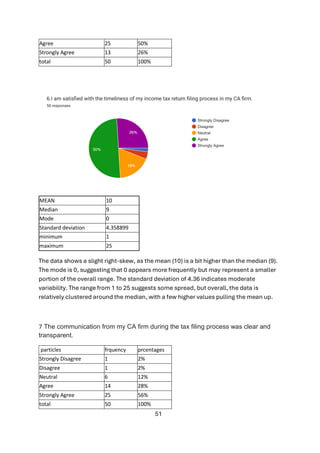
6 I am satisfied with the timeliness of my income tax return filing process in my CA
firm.
particles frquency prcentages
Strongly Disagree 1 2%
Disagree 2 4%
Neutral 9 18%
51
Agree 25 50%
Strongly Agree 13 26%
total 50 100%
MEAN 10
Median 9
Mode 0
Standard deviation 4.358899
minimum 1
maximum 25
The data shows a slight right-skew, as the mean (10) is a bit higher than the median (9).
The mode is 0, suggesting that 0 appears more frequently but may represent a smaller
portion of the overall range. The standard deviation of 4.36 indicates moderate
variability. The range from 1 to 25 suggests some spread, but overall, the data is
relatively clustered around the median, with a few higher values pulling the mean up.
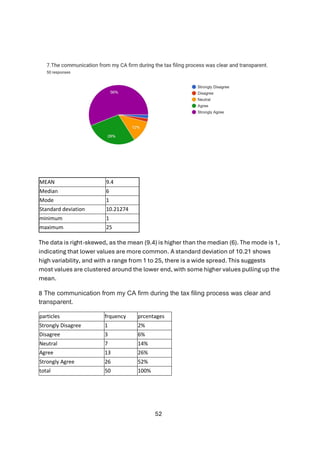
7 The communication from my CA firm during the tax filing process was clear and
transparent.
particles frquency prcentages
Strongly Disagree 1 2%
Disagree 1 2%
Neutral 6 12%
Agree 14 28%
Strongly Agree 25 56%
total 50 100%
52
MEAN 9.4
Median 6
Mode 1
Standard deviation 10.21274
minimum 1
maximum 25
The data is right-skewed, as the mean (9.4) is higher than the median (6). The mode is 1,
indicating that lower values are more common. A standard deviation of 10.21 shows
high variability, and with a range from 1 to 25, there is a wide spread. This suggests
most values are clustered around the lower end, with some higher values pulling up the
mean.
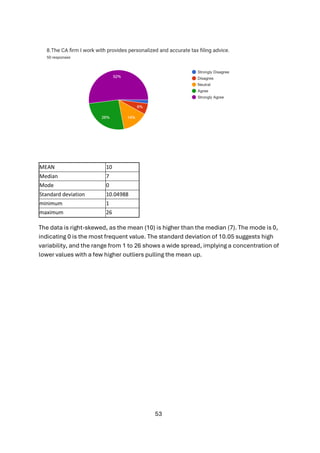
8 The communication from my CA firm during the tax filing process was clear and
transparent.
particles frquency prcentages
Strongly Disagree 1 2%
Disagree 3 6%
Neutral 7 14%
Agree 13 26%
Strongly Agree 26 52%
total 50 100%
53
MEAN 10
Median 7
Mode 0
Standard deviation 10.04988
minimum 1
maximum 26
The data is right-skewed, as the mean (10) is higher than the median (7). The mode is 0,
indicating 0 is the most frequent value. The standard deviation of 10.05 suggests high
variability, and the range from 1 to 26 shows a wide spread, implying a concentration of
lower values with a few higher outliers pulling the mean up.
54
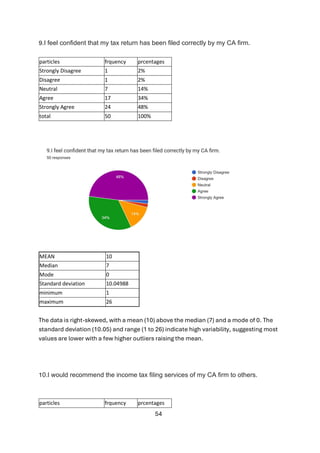
9.I feel confident that my tax return has been filed correctly by my CA firm.
particles frquency prcentages
Strongly Disagree 1 2%
Disagree 1 2%
Neutral 7 14%
Agree 17 34%
Strongly Agree 24 48%
total 50 100%
MEAN 10
Median 7
Mode 0
Standard deviation 10.04988
minimum 1
maximum 26
The data is right-skewed, with a mean (10) above the median (7) and a mode of 0. The
standard deviation (10.05) and range (1 to 26) indicate high variability, suggesting most
values are lower with a few higher outliers raising the mean.
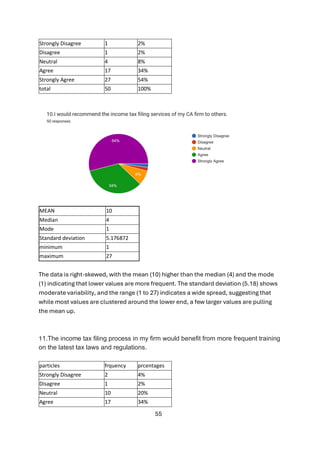
10.I would recommend the income tax filing services of my CA firm to others.
particles frquency prcentages
55
Strongly Disagree 1 2%
Disagree 1 2%
Neutral 4 8%
Agree 17 34%
Strongly Agree 27 54%
total 50 100%
MEAN 10
Median 4
Mode 1
Standard deviation 5.176872
minimum 1
maximum 27
The data is right-skewed, with the mean (10) higher than the median (4) and the mode
(1) indicating that lower values are more frequent. The standard deviation (5.18) shows
moderate variability, and the range (1 to 27) indicates a wide spread, suggesting that
while most values are clustered around the lower end, a few larger values are pulling
the mean up.
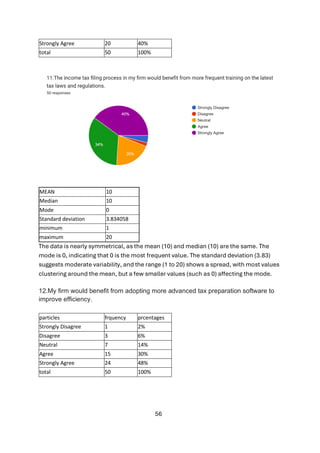
11.The income tax filing process in my firm would benefit from more frequent training
on the latest tax laws and regulations.
particles frquency prcentages
Strongly Disagree 2 4%
Disagree 1 2%
Neutral 10 20%
Agree 17 34%
56
Strongly Agree 20 40%
total 50 100%
MEAN 10
Median 10
Mode 0
Standard deviation 3.834058
minimum 1
maximum 20
The data is nearly symmetrical, as the mean (10) and median (10) are the same. The
mode is 0, indicating that 0 is the most frequent value. The standard deviation (3.83)
suggests moderate variability, and the range (1 to 20) shows a spread, with most values
clustering around the mean, but a few smaller values (such as 0) affecting the mode.
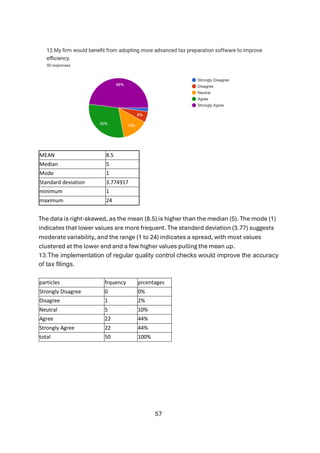
12.My firm would benefit from adopting more advanced tax preparation software to
improve efficiency.
particles frquency prcentages
Strongly Disagree 1 2%
Disagree 3 6%
Neutral 7 14%
Agree 15 30%
Strongly Agree 24 48%
total 50 100%
57
MEAN 8.5
Median 5
Mode 1
Standard deviation 3.774917
minimum 1
maximum 24
The data is right-skewed, as the mean (8.5) is higher than the median (5). The mode (1)
indicates that lower values are more frequent. The standard deviation (3.77) suggests
moderate variability, and the range (1 to 24) indicates a spread, with most values
clustered at the lower end and a few higher values pulling the mean up.
13.The implementation of regular quality control checks would improve the accuracy
of tax filings.
particles frquency prcentages
Strongly Disagree 0 0%
Disagree 1 2%
Neutral 5 10%
Agree 22 44%
Strongly Agree 22 44%
total 50 100%
58
MEAN 10
Median 5
Mode 22
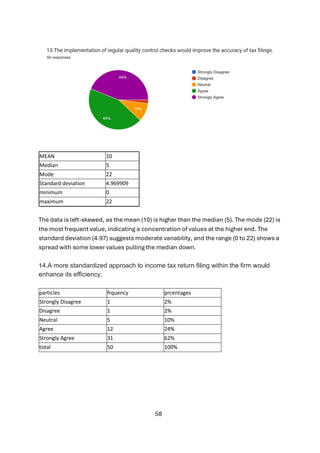
Standard deviation 4.969909
minimum 0
maximum 22
The data is left-skewed, as the mean (10) is higher than the median (5). The mode (22) is
the most frequent value, indicating a concentration of values at the higher end. The
standard deviation (4.97) suggests moderate variability, and the range (0 to 22) shows a
spread with some lower values pulling the median down.
14.A more standardized approach to income tax return filing within the firm would
enhance its efficiency.
particles frquency prcentages
Strongly Disagree 1 2%
Disagree 1 2%
Neutral 5 10%
Agree 12 24%
Strongly Agree 31 62%
total 50 100%
59
MEAN 10
Median 5
Mode 1
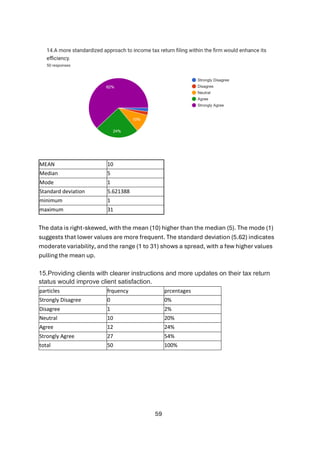
Standard deviation 5.621388
minimum 1
maximum 31
The data is right-skewed, with the mean (10) higher than the median (5). The mode (1)
suggests that lower values are more frequent. The standard deviation (5.62) indicates
moderate variability, and the range (1 to 31) shows a spread, with a few higher values
pulling the mean up.
15.Providing clients with clearer instructions and more updates on their tax return
status would improve client satisfaction.
particles frquency prcentages
Strongly Disagree 0 0%
Disagree 1 2%
Neutral 10 20%
Agree 12 24%
Strongly Agree 27 54%
total 50 100%
60
MEAN 10
Median 10
Mode 0
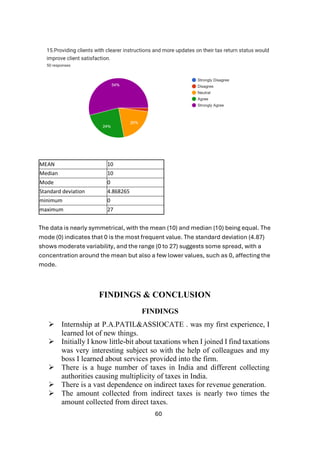
Standard deviation 4.868265
minimum 0
maximum 27
The data is nearly symmetrical, with the mean (10) and median (10) being equal. The
mode (0) indicates that 0 is the most frequent value. The standard deviation (4.87)
shows moderate variability, and the range (0 to 27) suggests some spread, with a
concentration around the mean but also a few lower values, such as 0, affecting the
mode.
FINDINGS & CONCLUSION
FINDINGS
➢ Internship at P.A.PATIL&ASSIOCATE . was my first experience, I
learned lot of new things.
➢ Initially I know little-bit about taxations when I joined I find taxations
was very interesting subject so with the help of colleagues and my
boss I learned about services provided into the firm.
➢ There is a huge number of taxes in India and different collecting
authorities causing multiplicity of taxes in India.
➢ There is a vast dependence on indirect taxes for revenue generation.
➢ The amount collected from indirect taxes is nearly two times the
amount collected from direct taxes.
61
➢ Both direct taxes and Indirect taxes take their own advantages and
disadvantages.
➢ Under direct taxes, the most important components of taxes are
corporation tax andtaxes on income.
➢ Under indirect taxes, the most important components are customs,
excise duty andservice taxes.
➢ The amount expended on collection of taxes is growing year on year.
CONCLUSION
Due to Multiplicity of taxes, there is unhappiness between citizens
of India regarding tax structure.
➢ Taxes by Union Government, State Governments and the local
governments have resulted in complications and harassment to the
tax payer.
➢ He has to connection several authorities and maintain separate
records for each of them.
➢ An Ideal Tax system must follow Adam smith’s canons of taxation
but due to over dependence on indirect taxes, the tax systems suffer
from the problems like Inequality, regressive, uneconomical,
inflationary, etc.
➢ The Tax System has failed to stop tax evasion and control the growth
of parallel economy.
➢ White paper issued by Indian government on black money in 2012
tells that parallel economy exist the same funds of Indian GDP.
LIMITATIONS
➢ The study is limited to vidharbha only.
➢ Sample size is of due to cost and time constricted.
➢ Answer or information given by respondents may or may not be accurate Due to
which result may influence.
62
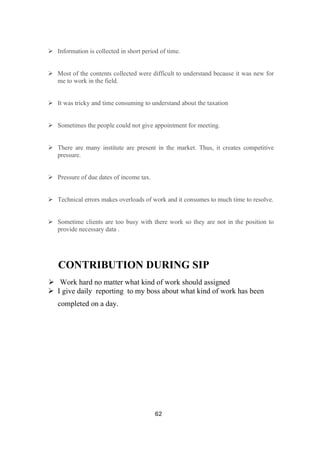
➢ Information is collected in short period of time.
➢ Most of the contents collected were difficult to understand because it was new for
me to work in the field.
➢ It was tricky and time consuming to understand about the taxation
➢ Sometimes the people could not give appointment for meeting.
➢ There are many institute are present in the market. Thus, it creates competitive
pressure.
➢ Pressure of due dates of income tax.
➢ Technical errors makes overloads of work and it consumes to much time to resolve.
➢ Sometime clients are too busy with there work so they are not in the position to
provide necessary data .
CONTRIBUTION DURING SIP
➢ Work hard no matter what kind of work should assigned
➢ I give daily reporting to my boss about what kind of work has been
completed on a day.
63
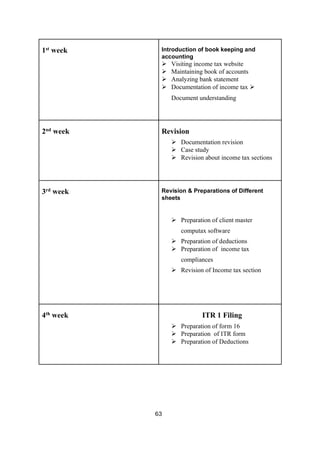
1st
week Introduction of book keeping and
accounting
➢ Visiting income tax website
➢ Maintaining book of accounts
➢ Analyzing bank statement
➢ Documentation of income tax ➢
Document understanding
2nd
week Revision
➢ Documentation revision
➢ Case study
➢ Revision about income tax sections
3rd
week Revision & Preparations of Different
sheets
➢ Preparation of client master
computax software
➢ Preparation of deductions
➢ Preparation of income tax
compliances
➢ Revision of Income tax section
4th week ITR 1 Filing
➢ Preparation of form 16
➢ Preparation of ITR form
➢ Preparation of Deductions
64
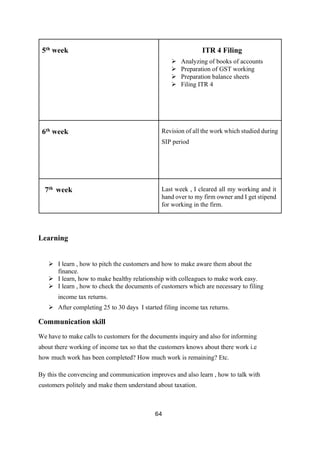
5th
week ITR 4 Filing
➢ Analyzing of books of accounts
➢ Preparation of GST working
➢ Preparation balance sheets
➢ Filing ITR 4
6th
week Revision of all the work which studied during
SIP period
7th
week Last week , I cleared all my working and it
hand over to my firm owner and I get stipend
for working in the firm.
Learning
➢ I learn , how to pitch the customers and how to make aware them about the
finance.
➢ I learn, how to make healthy relationship with colleagues to make work easy.
➢ I learn , how to check the documents of customers which are necessary to filing
income tax returns.
➢ After completing 25 to 30 days I started filing income tax returns.
Communication skill
We have to make calls to customers for the documents inquiry and also for informing
about there working of income tax so that the customers knows about there work i.e
how much work has been completed? How much work is remaining? Etc.
By this the convencing and communication improves and also learn , how to talk with
customers politely and make them understand about taxation.
65
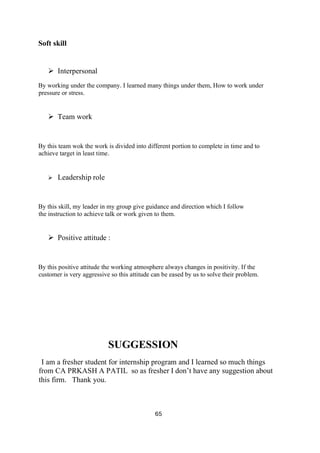
Soft skill
➢ Interpersonal
By working under the company. I learned many things under them, How to work under
pressure or stress.
➢ Team work
By this team wok the work is divided into different portion to complete in time and to
achieve target in least time.
➢ Leadership role
By this skill, my leader in my group give guidance and direction which I follow
the instruction to achieve talk or work given to them.
➢ Positive attitude :
By this positive attitude the working atmosphere always changes in positivity. If the
customer is very aggressive so this attitude can be eased by us to solve their problem.
SUGGESSION
I am a fresher student for internship program and I learned so much things
from CA PRKASH A PATIL so as fresher I don’t have any suggestion about
this firm. Thank you.
66
BIBLIOGRAPHY
www.acnabin-bd.com
www.google.com
www.incometaxindia.gov.in
www.wikipedia.org
www.scribd.com
www.academia.edu

Analytical Study on Income Tax Returns Filing Process

  • 1.
    1 Internship Project Reporton “Analytical Study on Income Tax Returns Filing Process.” Submitted in partial fulfillment of the requirements for the degree of Master in Business Administration- Digital Business (MBA-DB) By ABHIJEET NAGNATHRAO MATHWALE PRN-20230305023 Under the guidance of MS. PRIYANKA DHOTE. Sector 29, Pradhikaran, Akurdi, Pune - Maharashtra, INDIA 411044 (Establishment by Maharashtra Act No. LXIII of 2017 Government of India)
  • 2.
    2 STUDENT DECLARATION This isto certify that I have completed the Internship Project titled “Analytical Study on Income Tax Returns Filing Process” under the guidance of Dr Priyanka Dhote, Assistant Professor-DYPIU, for the partial fulfillment of the requirement of the degree of Master in Business Administration- Digital Business (MBA-DB) from School of Commerce and Management, D Y Patil International University, Akurdi, Pune. This is an original piece of work I have not submitted it earlier elsewhere. Name: ABHIJEET NAGNATHRAO MATHWALE. PRN: 20230305023. Date: Place: Signature:
  • 3.
  • 4.
    4 Sector 29, Pradhikaran,Akurdi, Pune - Maharashtra, INDIA 411044 (Establishment by Maharashtra Act No. LXIII of 2017 Government of India) CERTIFICATE This is to certify that Abhijeet Nagnathrao Mathwale (20230305023) is a bonafide student of this university and has successfully completed his/ her internship project entitled “Analytical Study on Income Tax Returns Filing Process.” for the partial fulfillment of the degree of Master in Business Administration- Digital Business (MBA-DB) from School of Commerce and Management, D Y Patil International University, Akurdi, Pune. (Dr PRIYANKA DHOTE) Assistant Professor-SCM, DYPIU. ACKNOWLEDGEMENT
  • 5.
    5 I am thankfulDY PATIL INTERNATIONAL UNIVERSITY towards all those people who helped me in this venture. I am highly indebted to (Dr. Madhavi Deshpande-SCM DYPIU) for their guidance constant supervision as well as for providing necessary information regarding the project & also for their support in completing the project. He was not only a mentor but also guided us with the project and also provided help, motivation and learning's that could work out for us in the professional and competitive environment. It would not have been possible without the kind support and help of many Individuals and Organizations. I would like to express my gratitude towards members of (CA PRAKSH A PATIL & ASSOCIATES) for their kind co-operation and encouragement which helped me in completion of this project. Discussions and deliberations with them have enriched my knowledge to complete my project in a better way. I won't be able to continue in compiling this text if they would not have supported me. I express my deepest thanks to my Faculty Mentor (DR. Dr PRIYANKA DHOTE ) for his guidance and support. He supported me by showing different methods of information consolidation and reaching out to prospective clients. He helped whenever I needed guidance and given right direction towards the completion of the project. I am always thankful to my family for their all-time support and for putting up with all the disruption in my life caused by my in this venture. My thanks and appreciations also go to my colleagues in developing the project and people who have willingly helped me out with their abilities. I would not have succeeded in this process but for their help and support. I thank you all from the bottom of my heart. I am really grateful to all of them in helping me throughout my internship project which was completed successfully. Executive Summary
  • 6.
    6 In the currentcompetitive landscape, customer satisfaction is paramount for Public Sector in CA firm . This executive summary outlines the key factors influencing customer satisfaction within the PSB sector. High-quality customer service, including timely and efficient service, knowledgeable staff, and effective problem resolution, is a cornerstone of satisfaction. The adoption of modern technology, such as internet banking and mobile apps, enhances convenience and accessibility, significantly impacting customer perception. PSBs benefit from a reputation for trust and reliability, which is particularly valuable during economic uncertainties. Clear and transparent communication regarding fees, charges, and policies is crucial for fostering customer understanding and trust. Government initiatives, such as financial inclusion programs, positively impact customer satisfaction by extending banking services to underserved populations. The extensive geographic reach of PSBs, particularly in rural and remote areas, enhances accessibility and contributes to overall satisfaction. To maintain and enhance customer satisfaction, PSBs must mitigate negative political interference, ensure regulatory compliance, prioritize employee satisfaction through training, and embrace competition as a driver for innovation and service improvement.
  • 7.
    7 Sr. No. ContentsPage No. 1 Introduction 2 Company profile ● Company history ● Company vision and mission ● Achievements, Ratings ● Global presence ● Services and product profile ● Company process ● Other details 3 Methodology & Analysis ● Scope of study ● Objectives of project ● NEED OF THE STUDY ● Sources of data collection 4 Findings Conclusion Limitations of project 5 Observations & Learnings from project Suggestion/Recommendation and contribution to the company
  • 8.
    8 6 Appendix ● List ofTables ● List of Charts ● List of Graphs ● Bibliography Annexure as required
  • 9.
    9 1.1 Introduction toInternship Internship is an on-the-job training programme offered to students to balance the gap between class room theories and industry expectations. It is an on-field training programme, which may last from 2 weeks to 2 months period. During the internship period, the candidate may be paid or not paid with monetary benefits for the services rendered by him, but definitely compensated with work experience and real-life learning that benefits his career in the long run. An internship is a training opportunity which is provided to students, such as graduates or postgraduates, to seek and feel the actual work experience and corporate culture before they enter any sector as working professionals. Internship programme is one of the types of on-job training programme, were the student gets a chance to experience the working environment, gets trained to the practical work exposure, sees implementation of class room theories in the work field and identifying the difference, coming with an appropriate opinion to overcome such gaps which indirectly benefits the university or college to know the actual requirements of industry, and making necessary changes in academics according to the industry needs so that students benefit with better outcomes. Internship is a great opportunity even to employers to recognize the talents in the market, as in the competitive environment and high rate of unemployment, finding a right person for a right job has become a difficult task. This indirectly makes internship programme effective as the employer can see a candidate’s potential and dedication towards his work and his skills, strengths, weakness, etc.., throughout the internship period. An employer can encourage the right and eligible candidates with pre-placement offer which will help his organisation to hire a suitable candidate who can contribute to the organisation well.
  • 10.
    10 1.2 Introduction toProject Project name : “Analytical Study on Income Tax Returns Filing Process.” . Income Tax Return (ITR) is a form which a person is supposed to submit to the Income Tax Department of India. It contains information about the person’s income and the taxes to be paid on it during the year. Information filed in ITR should pertain to a particular financial year, i.e. starting on 1st April and ending on 31st March of the next year. Income can be of various forms such as : Income from salary Profits and gains from business and profession Income from house property Income from capital gains Income from other sources such as dividend, interest on deposits, royalty income, winning on lottery, etc. The Income Tax Department has prescribed 7 types of ITR forms - ITR-1, ITR-2, ITR-3, ITR-4, ITR- 5, ITR-6, ITR-7 and applicability of the form will depend on the nature and amount of income and the type of taxpayer. What is E filling E-filing is the short form of electronic filing of income taxes. E-filing is when you electronically file your income tax returns online for a particular year. This means you no longer need to visit the nearest Income Tax Department's office to file your returns physically. Obligation to filling Tax Return It is legal obligation for every individual to file a return of income, wehose taxable income during the year has exceeded the exemption limit
  • 11.
    11 Forms of returnprescribed under the Income -tax Law for the assessment year 2023-24 Return form Brief description ITR – 1 Also known as SAHAJ is applicable to a ordinarily Resident individual having salary or pension income or income from one house property (not a case of brought forward loss or loss to be carried forward) or income from other sources (not being lottery winnings and income from race horses and income chargeable to tax at special rates). However, an individual who is a director in a company or has held equity shares of an unlisted company shall not be eligible to use ITR -1. Further, the ITR-1 shall not be available to a taxpayer in whose case the tax has been deducted on cash withdrawal under Section 194N or tax has been deferred in respect of ESOPs allotted by an eligible startup. ITR – 2 It is applicable to an individual or an Hindu Undivided Family not having income chargeable to income-tax under the head “Profits or gains of business or profession ITR – 3 It is applicable to an individual or a Hindu Undivided Family who has any income chargeable to tax under the head business or [A s amended by Finance Ac t, 2 021] profession ITR – 4 Also known as SUGAM is applicable to individuals or Hindu Undivided Family or partnership firm who have opted for the presumptive taxation scheme of section 44AD/44ADA/44AE.
  • 12.
    12 ITR – 5 ThisForm can be used by a person being a firm, LLP, AOP, BOI, artificial juridical person referred to in section 2(31)(vii), cooperative society, local authority Private Discretionary Trust, Society registered under Society Registration Act, 1860, trust other than trusts eligible to file ITR 7, estate of deceased person, estate of an insolvent, business trust and investment fund. However, a person who is required to file the return of income under section 139(4A) or 139(4B) or 139(4C) or 139(4D) shall not use this form (i.e., trusts, political parties, institutions, colleges ITR – 6 It is applicable to a company, other than a company claiming exemption under section 11 (exemption under section 11 can be claimed by charitable/religious trust) ITR – 7 It is applicable to a persons including companies who are required to furnish return under section 139(4A) or section 139(4B) or section 139(4C) or section 139(4D) .
  • 13.
    13 Applicability of ITR– 1 (SAHAJ) Return Form ITR – 1 (SAHAJ) can be used by a ordinarily resident individual whose total income includes: (1) Income from salary/pension; or (2) Income from one house property (excluding cases where loss is brought forward from previous years or loss to be carried forward; or) (3) Income from other sources (excluding winnings from lottery, income from race horses and income chargeable to tax at special rates). Further, in a case where the income of another person like spouse, minor child, etc., is to be clubbed with the income of the taxpayer, this return form can be used only when such income falls in any of the above categories. Non-applicability of ITR – 1 (SAHAJ) 1. Who is a Non-resident or Not Ordinarily Resident 2. Who is a Director of a company 3. Whose total income exceeds Rs. 50 lakhs 4. Who has income from more than 1 house property 5. Who has held unlisted equity shares at any time during the previous year 6. Who claims deduction under Section 80QQB or Section 80RRB in respect of royalty from patents or books 7. Who claims deduction under Section 10AA or Part-C of Chapter VI-A 8. Who has brought forward loss or losses to be carried forward under any head [A s amended by Finance A c t, 2 021] 9. Person claiming deduction under Section 57 from income taxable under the head 'Other Sources'(other than deduction allowed from family pension) 10. Who wants to claim relief under Section 90 or 91 11. Who wants to claim credit of tax deducted at source in the hands of any other person. 12. Who has any assets (including Financial Interest in an entity) located outside India. 13. Who has signing authority in any account outside India 14. Who has any income to be apportioned in accordance with provisions of Section 5A 15. Who has any of the following income: a) Income from Business or Profession b) Capital Gains c) Income taxable under the head 'Other sources' which is taxable at special rate d) Dividend income exceeding Rs. 10 lakhs taxable under Section 115BBDA e) Unexplained income (i.e., cash credit, unexplained investment, etc.) taxable at 60% under Section 115BBE f) Agricultural Income exceeding Rs. 5,000
  • 14.
    14 g) Income fromany source outside India 16. In whose case: The tax has been deducted on cash withdrawal under Section 194N. The tax has been deferred in respect of ESOPs allotted by an eligible start-up. Applicability of ITR – 2 This Return Form is to be used by an individual or an Hindu Undivided Family who is not having income chargeable to income-tax under the head “Profits or gains of business or profession”. Further, in a case where the income of another person like spouse, minor child, etc., is to be clubbed with the income of the taxpayer, this Return Form can be used if income to be clubbed falls in any of the above categories. Non-applicability of ITR – 2 Return Form ITR – 2 cannot be used by an individual or an Hindu Undivided Family whose total income for the year includes income from Business or Profession or he wants to claim deduction under section 10AA or part-c of chapter VI-A. Applicability of ITR – 3 Form ITR – 3 can be used by an individual or a Hindu Undivided Family who is having income under the head business or profession Non-applicability of ITR – 3 Form ITR – 3 cannot be used by any person other than an individual or a HUF. Further, an individual or a HUF not having income from business or profession cannot use ITR – 3. Applicability of ITR – 4 (SUGAM) Form ITR – 4 (SUGAM) can be used by an individual/HUF/Firm whose total income for the year includes : a) Business income computed as per the provisions of section 44AD or 44AE; or
  • 15.
    15 b) Income fromprofession computed as per the provisions of section 44ADA; or c) Income from salary/pension; or d) Income from one house property (excluding cases where loss is brought forward from previous years or losses to be carried forward); or e) Income from other sources (excluding winnings from lottery and income from race horses). Further, in a case where the income of another person like spouse, minor child, etc., is to be clubbed with the income of the taxpayer, this return form can be used where income to be clubbed falls in any of the above categories Non-applicability of ITR – 4 (SUGAM) Form ITR – 4 (SUGAM) cannot be used by a person: 1. Who is a Non-resident or Not Ordinarily Resident 2. Who is a Director of a company 3. Whose total income exceeds Rs. 50 lakhs 4. Who has income from more than one House Property 5. Who has held unlisted equity shares at any time during the previous year 6. Who claims deduction under section 80QQB or 80RRB in respect of royalty from patent or books 7. Who claims deduction under section 10AA or Part-C of Chapter VI-A 8. Who has brought forward loss or losses to be carried forward under any head 9. Person claiming deduction under Section 57 from income taxable under the head 'Other Sources' (other than deduction allowed from family pension) 10. Who wants to claim relief under Sections 90 or 91 11. Who wants to claim credit of tax deducted at source in the hands of any other person. 12. Who has any assets (including Financial Interest in an entity) located outside India. 13. Who has signing authority in any account outside India 14. Who has any income to be apportioned in accordance with provisions of Section 5A [A s amended by Finance A c t, 2 021] 15. Who has any of the following income: a) Income from Business or Profession b) Capital Gains or Loss c) Income taxable under the head 'Other sources' which is taxable at special rate d) Dividend income exceeding Rs. 10 lakhs taxable under Section 115BBDA
  • 16.
    16 e) Unexplained income(i.e., cash credit, unexplained investment, etc.) taxable at 60% under Section 115BBE f) Agricultural Income exceeding Rs. 5,000 g) Income from any source outside India h) Income from speculative business and other special incomes. i) Income from agency business or commission or brokerage 16. Who has income of the nature specified in section 17(2)(vi) on which tax is payable/deductible under section 192(2) or 192(1C). In case the assesse keeps and maintains all books of accounts and other documents referred to in section 44AA, and also gets his accounts audited and obtains an audit report as per section 44AB, filling up the Form ITR-4 (Sugam) is not mandatory. In such a case, other regular return forms viz. ITR-3 or ITR-5, as applicable, should be used. Applicability of ITR – 5 Form ITR-5 can be used by a person being a firm, LLP, AOP, BOI, Artificial Juridical Person (AJP) referred to in section 2(31)(vii), local authority referred to in section 2(31)(vi), representative assessee referred to in section 160(1)(iii) or (iv), cooperative society, society registered under Societies Registration Act, 1860 or under any other law of any State, trust other than trusts eligible to file Form ITR-7, estate of deceased person, estate of an insolvent, business trust referred to in section 139(4E) and investments fund referred to in section 139(4F). Non-applicability of ITR – 5 Form ITR – 5 cannot be used by a person who is required to file the return of income under section 139(4A) or 139(4B) or 139(4C) or 139(4D) (i.e., trusts, political parties, institutions, colleges, etc.). Applicability of ITR – 6 Form ITR – 6 can be used by a company, other than a company claiming exemption under section 11 (exemption under section 11 can be claimed by a charitable/religious trust). Non-applicability of ITR – 6
  • 17.
    17 Form ITR –6 cannot be used by a company claiming exemption under section 11 (exemption under section 11 can be claimed by a charitable/religious trust). Applicability of ITR – 7 Form ITR – 7 can be used by persons including companies who are required to furnish return under section 139(4A) or section 139(4B) or section 139(4C) or section 139(4D) (i.e., trusts, political parties, institutions, colleges, etc.). Non-applicability of ITR – 7 Form ITR – 7 cannot be used by a person who is not required to furnish return under section 139(4A) or section 139(4B) or section 139(4C) or section 139(4D) (i.e., trusts, political parties, institutions, colleges, etc.).
  • 18.
  • 19.
  • 20.
  • 21.
  • 22.
  • 23.
  • 24.
  • 25.
  • 26.
  • 27.
  • 28.
    28 P. A. Patil& Associates is a renowned Chartered Accountant firm established by Mr. Prakash A. Patil, a leading figure in corporate finance and tax consultation in India. Known for its specialized and comprehensive financial solutions, the firm comprises a team of highly qualified Chartered Accountants, corporate financial advisors, and tax consultants. Built on a foundation of integrity, client satisfaction, and quality service, P. A. Patil & Associates has become synonymous with professional excellence, offering sound financial solutions tailored to meet the unique needs of its clients. The firm provides services to a diverse range of industries, including Software and Information Technology, Manufacturing, Education and Welfare, Banking & Financial Services, and Retail and Wholesale Trading. The organization brings together specialized skills and a commitment to adding value to its clients, optimizing benefits across financial, operational, and compliance landscapes. Our service network includes Corporate House, Partnership firms. The clients we serve span across various industries such as Software and Information Technology, Manufacturing, Education and Welfare, Banking & Financial Services, Trading (wholesalers & Retailers) etc. Our Work Culture Company History P. A. Patil & Associates was founded by Mr. Prakash A. Patil to offer professional accounting and financial consulting services. With a dedication to high-quality and objective advice, the firm quickly grew, extending its client base across various sectors. Over the years, it has built a reputation for being a reliable partner to businesses in India, helping them navigate complex financial environments and achieve compliance with the highest standards. From a single-office setup, the firm has expanded to develop a wide-reaching service network, connecting with clients both locally and nationally. Achievements and Ratings
  • 29.
    29 • Client SatisfactionRecognition: Rated highly by clients for exceptional commitment to accuracy, timeliness, and quality in all engagements. • Quality Assurance: Consistently upholds an environment of professionalism and ethics, recognized in client testimonials and partnerships. • Industry-Specific Expertise: Successfully expanded services to specialized industries, including hydro power and medical sectors, gaining recognition as a leading advisor for industry-specific financial needs. • Client Loyalty: Maintained long-standing relationships with key corporate clients, a testament to the firm’s client-centric approach. Mission, vision, values Mission: P. A. Patil & Associates. exists to provide complete, reliable and high quality auditing and consulting services to individuals and institutions, be it manufacturing, trading, tourism, financial, governmental, non-governmental, medical, hydro power, hotels, and any other sectors. Vision: The firm's vision is to be the premier auditing, accounting, tax and business consulting firm by every measure that matters. Values: We believe that our success depends first and foremost on people. By respecting people in everything we do, we will develop and maintain high quality, mutually beneficial relationships with our clients, professional colleagues, referral sources, vendors, community members and each other.
  • 30.
    30 • Building ClientRelationships We seek to earn long-term client loyalty by developing a deep understanding of each client's business and personal goals, by demonstrating unwavering reliability and integrity in our work and by acting as an independent and objective advisor to our clients • Upholding Quality and Integrity We will maintain an environment where a commitment to quality, honesty, respect, fairness and professional ethics governs the actions and decisions of everyone within our firm. Services and Product Profile P. A. Patil & Associates offers a comprehensive range of services, tailored to meet the varied needs of its diverse clientele: 1. Auditing Services: a. Statutory and internal audits b. Tax and compliance audits c. Specialized audits for sectors like banking and manufacturing 2. Tax Advisory and Compliance: a. Direct and indirect tax planning b. Regulatory compliance and tax filings c. Corporate tax advisory and dispute resolution 3. Corporate Financial Advisory: a. Business structuring and restructuring b. Valuation and financial modeling c. Merger and acquisition advisory 4. Consulting Services: a. Risk management and internal control assessments b. Performance optimization and strategy consulting c. Cost analysis and profitability enhancement
  • 31.
    31 5. Accounting andPayroll Management: a. Comprehensive bookkeeping services b. Payroll processing and compliance c. Financial statement preparation 6. Business Startup Advisory: a. Company formation and registration services b. Legal and statutory compliance assistance c. Financial planning for startups 7. IT and Digital Transformation Consulting: a. Support for digital accounting solutions b. Implementation of enterprise resource planning (ERP) systems Company Process 1. Client Onboarding: Understand each client’s specific financial needs and challenges to customize the service approach. 2. Service Delivery: Adhering to the firm’s commitment to accuracy and timeliness, ensuring all deliverables meet regulatory standards. 3. Client Feedback: Gathering regular feedback to ensure satisfaction and continuously improve the quality of services. 4. Ongoing Support: Providing continual support to clients, addressing special financial problems as they arise, and adapting strategies based on market changes. Key to success: •The keys to success for P. A. Patil & Associates. are: • Developing visibility to generate new business leads. • Relationships with clients (developing loyal, respectful, and intensive contact with both clients and potential clients). • Marketing strategy and networking with other professionals. • Responsiveness to clients (fast response time for special problems). • Quality (especially in reporting information).
  • 32.
    32 • Excellence infulfilling the promise. •Openness: languages and willpower for creating interregional and international OTHER DATILS Taxation : Taxation is the part of public Finance that deals with the means by which the government raises revenue from the public by imposing taxes which revenue is used by the government to provide goods and services to the public or its citizens (to carry out government functions) Types of taxes : i) Direct: Direct tax is the one paid directly to the Govt. By the persons on whom it is imposed Income Tax, Property Tax, Capital Value Tax etc.
  • 33.
    33 ii) Indirect: It iscollected by an intermediary (such as a retail store) from the person who bears the ultimate economic burden of the tax(such as the customer).Sales Tax Precautions to be taken while filing the return of income The first and foremost precaution is to file the return of income on or before the due date. Taxpayers should avoid the practice of filing belated return. Following are the consequences of delay in filing the return of income : Loss (other than house property loss) cannot be carried forward. Levy of interest under section 234A. Levy of fee under section 234F* Exemptions under sections 10A, 10B, are not available. Taxpayer should download Form 26AS and should confirm actual TDS/TCS/Tax paid. If any discrepancy is observed then suitable action should be taken to reconcile it. Taxpayer should download Form 26AS and should confirm actual TDS/TCS/Tax paid. If any discrepancy is observed then suitable action should be taken to reconcile it. The taxpayer should identify the correct return form applicable in his case. Carefully provide all the information in the return form. Confirm the calculation of total income, deductions (if any), interest (if any), tax liability/refund, etc. If any tax is payable as per the return of income, then the same should be paid before filing the return of income. If any tax is payable as per the return of income, then the same should be paid before filing the return of income. After filling all the details in the return of income and after confirmation of all the details, one can proceed with filing the return of income. In case return is filed electronically without digital signature do not forget to post the acknowledgement of filing the return of income at CPC Bengaluru (as discussed earlier). Tax Slabs for AY 2021-22 Individuals and HUFs can opt for the Existing Tax Regime or the New Tax Regime with lower rate of taxation (u/s 115 BAC of the Income Tax Act) he taxpayer opting for concessional rates in the New Tax Regime will not be allowed certain Exemptions and Deductions (like 80C, 80D,80TTB, HRA) available in the Existing Tax Regime.
  • 34.
    34 Existing Tax Regime NewTax Regime u/s 115BAC Income Tax Slab Income Tax Rate Income Tax Slab Income Tax Rate Up to ₹ 2,50,000 Nil Up to ₹ 2,50,000 Nil ₹ 2,50,001 - ₹ 5,00,000 5% above ₹ 2,50,000 ₹ 2,50,001 - ₹ 5,00,000 5% above ₹ 2,50,000 ₹ 5,00,001 - ₹ 10,00,000 ₹ 12,500 + 20% above ₹ 5,00,000 ₹ 5,00,001 - ₹ 7,50,000 ₹ 12,500 + 10% above ₹ 5,00,000 Above ₹ 10,00,000 ₹ 1,12,500 + 30% ₹ 7,50,001 - ₹ ₹ 37,500 + 15% above ₹
  • 35.
    35 What is Surcharge? Surcharge is an additional chargelevied for persons earning Income above the specified limits, it is charged on the amount of income tax calculated as per applicable rates.
  • 36.
    36 ➢ 10% -Taxable Income above ₹ 50 lakh – up to ₹ 1 crore ➢ 15% - Taxable Income above ₹ 1 crore - up to ₹ 2 crore ➢ 25% - Taxable Income above ₹ 2 crore - up to ₹ 5 crore ➢ 37% - Taxable Income above ₹ 5 crore ➢ Maximum rate of Surcharge on Income by way of Dividend or Income under the provisions of Sections 111A, 112A and 115AD is 15% Surcharge, Marginal Relief and Health & Education Cess Investments / Payments / Incomes on which I can get tax benefit Section 24(b) – Deduction from Income from House Property on interest paid on housing loan & housing improvement loan. In case of self- occupied property, the upper limit for deduction of interest paid on housing loan is ₹ 2 lakh. However, this deduction is not available for person opting for New Tax Regime. Interest on loan u/s 24(b) allowable is tabulated below Investments / Payments / Incomes on which I can get tax benefit Section 24(b) – Deduction from Income from House Property on interest paid on housing loan & housing improvement loan. In case of self- occupied property, the upper limit for deduction of interest paid on housing loan is ₹ 2 lakh. However, this deduction is not available for person opting for New Tax Regime. Interest on loan u/s 24(b) allowable is tabulated below Nature of Property When loan was taken Purpose of loan Allowable (Maximum limit) On or after 1/04/1999 Construction or purchase of house property ₹ 2,00,000 Self-Occupied On or after 1/04/1999 For Repairs of house property ₹ 30,000 Before 1/04/1999 Construction or purchase of house property ₹ 30,000 Before 1/04/1999 For Repairs of house property ₹ 30,000
  • 37.
    37 Let Out Anytime Construction or purchase of house property Actual value without any limit Tax deductions specified under the Income Tax Act These Deductions will not be available to a taxpayer opting for the New Tax Regime u/s 115 BAC, except for deduction u/s 80CCD (2) which will be applicable for New Tax Regime as well 80C, 80CCC, 80CCD (1) 80C ➢ Life Insurance Premium ➢ Provident Fund ➢ Subscription to certain equity shares ➢ Tuition Fees ➢ National Savings Certificate, ➢ Housing Loan Principal ➢ Other various items 80CCC ➢ Annuity plan of LIC or other insurer towards Pension Scheme 80CCD (1) ➢ Deduction towards contribution made by an employer to the Pension Scheme of Central Government. Deduction limit of ₹ 50,000. 80CCD (2) If Employer is a PSU, State Government or Others Deduction limit of 10% of salary. ➢ If Employer is Central Government Deduction limit of 14% of salary 8DD Deduction towards payments made towards Maintenance or Medical treatment of a Disabled Dependent or Paid / Deposited any amount under relevant approved scheme.
  • 38.
    38 ➢ Flat deductionof ₹ 75,000 available for a person with Disability, irrespective of expense incurred ➢ The deduction is ₹ 1,25,000 if the person has Severe Disability (80% or more). 80DDB Deduction towards payments made towards Medical treatment of Self or Dependant for specified diseases ➢ Deduction limit of ₹ 40,000 (₹ 1,00,000 if Senior Citizen) 80E Deduction towards interest payments made on loan for higher education of Self or relative Total amount paid towards interest on loan taken 80EE Deduction towards interest payments made on loan taken for acquisition of residential house property where the loan is sanctioned between 1st April 2016 to 31st March 2017 ➢ Deduction limit of ₹ 50,000 on the interest paid on loan taken 80EEA Deduction available only to individuals towards interest payments made on loan taken for acquisition of residential house property for the first time where the loan is sanctioned between 1st April 2019 to 31st March 2022 & deduction should not have been claimed u/s 80EE
  • 39.
    39 ➢ Deduction limitof ₹ 1,50,000on the interest paid on loan taken 80EEB Deduction towards interest payments made on loan for purchase of Electric Vehicle where the loan is sanctioned between 1st April 2019 to 31st March 2023 ➢ Deduction limit of₹ 1,50,000 on the interest paid on loan taken 80G Deduction towards Donations made to prescribed Funds, Charitable Institutions, etc. Donation are eligible for deduction under the below categories Without any limit ➢ 100% deduction ➢ 50% deduction Note : No deduction shall be allowed under this section in respect of donation made in cash exceeding ₹ 2000/- Subject to qualifying limit 100% deduction 50% deduction 80GG Deduction towards rent paid for house & applicable to only those who are self- employed or for whom HRA is not part of Salary Least of the following shall be allowed as deduction. Rent paid reduced by 10% of Total Income before this deduction ₹ 5,000 per month 25% of Total Income (excluding long term capital gains, short term capital gains under section 111A or
  • 40.
    40 income under section115A or 115D) Note: Form 10BA to be filled for claiming this deduction. 80GGA Deduction towards Donations made for Scientific Research or Rural Development Donation are eligible for deduction under the below categories Research Association or University, College or other Institution for • Scientific Research • Social Science or Statistical Research Association or Institution for • Rural Development • Conservation of Natural Resources or for Afforestation PSU or Local Authority or an association or institution approved by the National Committee for carrying out any eligible project Funds notified by Central Government for • Afforestation • Rural Development Note: No deduction shall be allowed under this Section in respect of donation made in cash exceeding ₹ 2000/- or if Gross Total Income includes income from Profit / Gains of Business / Profession 80GGC
  • 41.
    41 Deduction towards Donationsmade to Political Party or Electoral Trust 80TTA Deduction on interest received on saving bank accounts by Non- Senior Citizens ➢ Deduction limit of ₹ 10,000/- 80TTB Deduction on interest received on deposits by Resident Senior Citizens ➢ Deduction limit of ₹ 50,000/- 80U Deductions for a resident individual taxpayer with Disability ➢ Flat ₹ 75,000 deduction for a person with Disability, irrespective of expense incurred. ➢ Flat ₹ 1,25,000 deduction for a person with Severe Disability (80% or more), irrespective of expense incurred Methodology & Analysis SCOPE OF THE STUDY Internship at CA P.A.PATIL.&ASSOCITES was my first experience. I learn lot of new things in income tax.
  • 42.
    42 Tax Planning : Taxplanning is process of analyzing one’s financial situation in the most efficient manner. Through tax planning one can reduce one’s tax liability. It involves planning one’s income in a legal manner to avail various exemptions and deductions. Under Section 80C, one can avail tax deduction if specific investments are made for a specific period up to a limit of Rs 1, 50,000. The most popular ways of saving tax are investing in PPF accounts, National Saving Certificate, Fixed Deposit, Mutual Funds and Provident Funds. Tax planning involves applying various advantageous provisions which are legal and entitles the assesse to avail the benefit of deductions, credits, concessions, rebates and exemptions. Or we can say that Tax planning is an art in which there is a logical planning of one’s financial affairs in such a manner that benefits the assesse with all the eligible provisions of the taxation law. Tax planning is an honest approach of applying the provisions which comes within the framework of taxation law. Tax Evasion : Tax Evasion is an illegal way to minimize tax liability through fraudulent techniques like deliberate under-statement of taxable income or inflating expenses. It is an unlawful attempt to reduce one’s tax burden. Tax Evasion is done with a motive of showing fewer profits in order to avoid tax burden. It involves illegal practices such as making false statements, hiding relevant documents, not maintaining complete records of the transactions, concealment of income, overstatement of tax credit or presenting personal expenses as business expenses. Tax evasion is a crime for which the assesse could be punished under the law. Tax Avoidance : Tax avoidance is the legitimate minimizing of taxes and maximize after-tax income, using methods included in the tax code. Businesses avoid taxes by taking all legitimate deductions and tax credits and by sheltering income from taxes by setting up employee retirement plans and other means, all legal and under the Internal Revenue Code or state tax codes. OBJECTIVES OF THE STUDY ➢ To analyse the role of technology and automation in streamlining the income tax filing process
  • 43.
    43 ➢ To evaluateclient satisfaction with the income tax filing services ➢ To recommend best practices and improvements to enhance the efficiency and accuracy of tax return filings NEED OF THE STUDY ➢ CA is a financial advisor he can help us in financial planning. ➢ To make relationship between the client. ➢ Accountants other than CAs are less experienced and by default are less professional. However, accountants are capable of doing their jobs well but they can't match the level of professionalism a CA has. ➢ A business can trust a Chartered Accountant with all its money as CAs are obliged to follow certain norms acknowledged by the ICAI. ➢ A practicing and efficient CA can help you out with more services apart from just filling out the returns. ➢ For tax compliances - If you are registered under the tax government it will not only ask you to maintain the records of business transactions but will require you to calculate tax accurately on the transaction. ➢ Here you need a CA as he/she is the one with complete knowledge related to the regulatory norms on tax. RESEARCH METHODOLOGY I have prepared this report on the basis of my experience gathered and from the assistance of our seniors as well as respected sir. I have disclosed my experience and finding in the analysis part by using different charts and tables. The methodology of the study mainly supplies the statistical methodology in collecting data and necessary analysis on different applicable laws and act. The details of the study are described below: Sources of Data: The data & information of this report have been collected from both the primary and secondary sources. In order to prepare this report I have been collected necessary information from two types of sources as follows:
  • 44.
    44 Primary Sources: ➢ Collectingprimary data by working with several audit teams. ➢ Discussing with all manager, staff, and partners also articled students. ➢ Research through surveys, Interviews and observation. ➢ Consideration in objective factory visit. Secondary Sources: ➢ Studied various accounting books and journal. ➢ Studied direct tax book. DATA ANALYSIS AND INTERPRETATION
  • 45.
    45 Profession of Respondent Professionfrequency percentage STUDENT 7 14% Self Employed 13 26% Working Professional 26 52% Retired 1 2% Unemployed 3 6% total 50 100% Profession of Respondent MEAN 10 Median 7 Mode Standard deviation 10.04988 minimum 1 Maximum 2.527432 The mean (6.11) is a good indicator of the central tendency of the data set, but it can be misleading if there are outliers. The median (7.0) is less sensitive to outliers and may be a better representation of the center of the data. The standard deviation (10.05) is a measure of how spread out the data is from the mean. A large standard deviation indicates that the data is widely scattered, while a small standard deviation indicates that the data is clustered close to the mean.
  • 46.
    46 The data sethas a range of 1.527 (from 1 to 2.527) which is relatively large compared to the mean. This suggests that the data may be spread out. 1 Technology and automation have significantly improved the speed of tax return filing in my CA firm particles frequency percentages Strongly Disagree 0 Disagree 2 4% Neutral 6 12% Agree 21 42% Strongly Agree 21 42% total 50 100% MEAN 16.66667 Median 13.5 Mode 21 Standard deviation 7.649256
  • 47.
    47 minimum 0 maximum 50 Thedata is right-skewed, with the mean (16.67) higher than the median (13.5), indicating that higher values are pulling the average up. The mode (21) is the most frequent value. The standard deviation (7.65) shows moderate variability, and the range (0 to 50) indicates a wide spread with some larger outliers influencing the mean. 2. The use of tax preparation software reduces errors in tax return filings. particles frquency prcentages Strongly Disagree 1 2% Disagree 2 4% Neutral 8 16% Agree 16 32% Strongly Agree 23 46% total 50 100% MEAN 10 Median 8 Mode Standard deviation 4.207137 minimum 1 maximum 23 The data is slightly right-skewed, with the mean (10) being higher than the median (8), suggesting that higher values are pulling the average up. The mode is not provided, indicating no clear most frequent value. The standard deviation (4.21) shows moderate
  • 48.
    48 variability. The range(1 to 23) indicates a spread of values, with some higher values contributing to the shift in the mean. 3. Automation tools (such as e-filing systems) have improved the accuracy of tax filings. particles frquency prcentages Strongly Disagree 0 0% Disagree 2 4% Neutral 7 14% Agree 16 32% Strongly Agree 25 50% total 50 100% MEAN 10 Median 7 Mode Standard deviation 10.41633 minimum 0 maximum 25 The data is slightly right-skewed, with the mean (10) being higher than the median (9). The mode (2) indicates that 2 is the most frequent value. The standard deviation (9.82) shows high variability, suggesting a wide spread in the data. The range (2 to 26) indicates some larger values are pulling the mean up.
  • 49.
    49 4 My firm’stax return filing process is significantly more efficient due to the use of digital tools. particles frquency prcentages Strongly Disagree 2 4% Disagree 2 4% Neutral 11 22% Agree 9 18% Strongly Agree 26 52% total 50 100% MEAN 10 Median 9 Mode 2 Standard deviation 9.823441 minimum 2 maximum 26 The data is slightly right-skewed, with the mean (10) being higher than the median (9). The mode (2) indicates that 2 is the most frequent value. The standard deviation (9.82) shows high variability, suggesting a wide spread in the data. The range (2 to 26) indicates some larger values are pulling the mean up. 5 My firm’s tax return filing process is significantly more efficient due to the use of digital tools. particles frquency prcentages Strongly Disagree 1 2%
  • 50.
    50 Disagree 3 6% Neutral3 6% Agree 11 22% Strongly Agree 32 64% total 50 100% MEAN 10 Median 3 Mode 3 Standard deviation 5.761944 minimum 1 maximum 32 The data is right-skewed, with the mean (10) higher than the median (3), indicating that higher values are pulling the average up. The mode (3) suggests that 3 is the most frequent value. The standard deviation (5.76) indicates moderate variability, and the range (1 to 32) shows a wide spread with a few higher outliers influencing the mean. 6 I am satisfied with the timeliness of my income tax return filing process in my CA firm. particles frquency prcentages Strongly Disagree 1 2% Disagree 2 4% Neutral 9 18%
  • 51.
    51 Agree 25 50% StronglyAgree 13 26% total 50 100% MEAN 10 Median 9 Mode 0 Standard deviation 4.358899 minimum 1 maximum 25 The data shows a slight right-skew, as the mean (10) is a bit higher than the median (9). The mode is 0, suggesting that 0 appears more frequently but may represent a smaller portion of the overall range. The standard deviation of 4.36 indicates moderate variability. The range from 1 to 25 suggests some spread, but overall, the data is relatively clustered around the median, with a few higher values pulling the mean up. 7 The communication from my CA firm during the tax filing process was clear and transparent. particles frquency prcentages Strongly Disagree 1 2% Disagree 1 2% Neutral 6 12% Agree 14 28% Strongly Agree 25 56% total 50 100%
  • 52.
    52 MEAN 9.4 Median 6 Mode1 Standard deviation 10.21274 minimum 1 maximum 25 The data is right-skewed, as the mean (9.4) is higher than the median (6). The mode is 1, indicating that lower values are more common. A standard deviation of 10.21 shows high variability, and with a range from 1 to 25, there is a wide spread. This suggests most values are clustered around the lower end, with some higher values pulling up the mean. 8 The communication from my CA firm during the tax filing process was clear and transparent. particles frquency prcentages Strongly Disagree 1 2% Disagree 3 6% Neutral 7 14% Agree 13 26% Strongly Agree 26 52% total 50 100%
  • 53.
    53 MEAN 10 Median 7 Mode0 Standard deviation 10.04988 minimum 1 maximum 26 The data is right-skewed, as the mean (10) is higher than the median (7). The mode is 0, indicating 0 is the most frequent value. The standard deviation of 10.05 suggests high variability, and the range from 1 to 26 shows a wide spread, implying a concentration of lower values with a few higher outliers pulling the mean up.
  • 54.
    54 9.I feel confidentthat my tax return has been filed correctly by my CA firm. particles frquency prcentages Strongly Disagree 1 2% Disagree 1 2% Neutral 7 14% Agree 17 34% Strongly Agree 24 48% total 50 100% MEAN 10 Median 7 Mode 0 Standard deviation 10.04988 minimum 1 maximum 26 The data is right-skewed, with a mean (10) above the median (7) and a mode of 0. The standard deviation (10.05) and range (1 to 26) indicate high variability, suggesting most values are lower with a few higher outliers raising the mean. 10.I would recommend the income tax filing services of my CA firm to others. particles frquency prcentages
  • 55.
    55 Strongly Disagree 12% Disagree 1 2% Neutral 4 8% Agree 17 34% Strongly Agree 27 54% total 50 100% MEAN 10 Median 4 Mode 1 Standard deviation 5.176872 minimum 1 maximum 27 The data is right-skewed, with the mean (10) higher than the median (4) and the mode (1) indicating that lower values are more frequent. The standard deviation (5.18) shows moderate variability, and the range (1 to 27) indicates a wide spread, suggesting that while most values are clustered around the lower end, a few larger values are pulling the mean up. 11.The income tax filing process in my firm would benefit from more frequent training on the latest tax laws and regulations. particles frquency prcentages Strongly Disagree 2 4% Disagree 1 2% Neutral 10 20% Agree 17 34%
  • 56.
    56 Strongly Agree 2040% total 50 100% MEAN 10 Median 10 Mode 0 Standard deviation 3.834058 minimum 1 maximum 20 The data is nearly symmetrical, as the mean (10) and median (10) are the same. The mode is 0, indicating that 0 is the most frequent value. The standard deviation (3.83) suggests moderate variability, and the range (1 to 20) shows a spread, with most values clustering around the mean, but a few smaller values (such as 0) affecting the mode. 12.My firm would benefit from adopting more advanced tax preparation software to improve efficiency. particles frquency prcentages Strongly Disagree 1 2% Disagree 3 6% Neutral 7 14% Agree 15 30% Strongly Agree 24 48% total 50 100%
  • 57.
    57 MEAN 8.5 Median 5 Mode1 Standard deviation 3.774917 minimum 1 maximum 24 The data is right-skewed, as the mean (8.5) is higher than the median (5). The mode (1) indicates that lower values are more frequent. The standard deviation (3.77) suggests moderate variability, and the range (1 to 24) indicates a spread, with most values clustered at the lower end and a few higher values pulling the mean up. 13.The implementation of regular quality control checks would improve the accuracy of tax filings. particles frquency prcentages Strongly Disagree 0 0% Disagree 1 2% Neutral 5 10% Agree 22 44% Strongly Agree 22 44% total 50 100%
  • 58.
    58 MEAN 10 Median 5 Mode22 Standard deviation 4.969909 minimum 0 maximum 22 The data is left-skewed, as the mean (10) is higher than the median (5). The mode (22) is the most frequent value, indicating a concentration of values at the higher end. The standard deviation (4.97) suggests moderate variability, and the range (0 to 22) shows a spread with some lower values pulling the median down. 14.A more standardized approach to income tax return filing within the firm would enhance its efficiency. particles frquency prcentages Strongly Disagree 1 2% Disagree 1 2% Neutral 5 10% Agree 12 24% Strongly Agree 31 62% total 50 100%
  • 59.
    59 MEAN 10 Median 5 Mode1 Standard deviation 5.621388 minimum 1 maximum 31 The data is right-skewed, with the mean (10) higher than the median (5). The mode (1) suggests that lower values are more frequent. The standard deviation (5.62) indicates moderate variability, and the range (1 to 31) shows a spread, with a few higher values pulling the mean up. 15.Providing clients with clearer instructions and more updates on their tax return status would improve client satisfaction. particles frquency prcentages Strongly Disagree 0 0% Disagree 1 2% Neutral 10 20% Agree 12 24% Strongly Agree 27 54% total 50 100%
  • 60.
    60 MEAN 10 Median 10 Mode0 Standard deviation 4.868265 minimum 0 maximum 27 The data is nearly symmetrical, with the mean (10) and median (10) being equal. The mode (0) indicates that 0 is the most frequent value. The standard deviation (4.87) shows moderate variability, and the range (0 to 27) suggests some spread, with a concentration around the mean but also a few lower values, such as 0, affecting the mode. FINDINGS & CONCLUSION FINDINGS ➢ Internship at P.A.PATIL&ASSIOCATE . was my first experience, I learned lot of new things. ➢ Initially I know little-bit about taxations when I joined I find taxations was very interesting subject so with the help of colleagues and my boss I learned about services provided into the firm. ➢ There is a huge number of taxes in India and different collecting authorities causing multiplicity of taxes in India. ➢ There is a vast dependence on indirect taxes for revenue generation. ➢ The amount collected from indirect taxes is nearly two times the amount collected from direct taxes.
  • 61.
    61 ➢ Both directtaxes and Indirect taxes take their own advantages and disadvantages. ➢ Under direct taxes, the most important components of taxes are corporation tax andtaxes on income. ➢ Under indirect taxes, the most important components are customs, excise duty andservice taxes. ➢ The amount expended on collection of taxes is growing year on year. CONCLUSION Due to Multiplicity of taxes, there is unhappiness between citizens of India regarding tax structure. ➢ Taxes by Union Government, State Governments and the local governments have resulted in complications and harassment to the tax payer. ➢ He has to connection several authorities and maintain separate records for each of them. ➢ An Ideal Tax system must follow Adam smith’s canons of taxation but due to over dependence on indirect taxes, the tax systems suffer from the problems like Inequality, regressive, uneconomical, inflationary, etc. ➢ The Tax System has failed to stop tax evasion and control the growth of parallel economy. ➢ White paper issued by Indian government on black money in 2012 tells that parallel economy exist the same funds of Indian GDP. LIMITATIONS ➢ The study is limited to vidharbha only. ➢ Sample size is of due to cost and time constricted. ➢ Answer or information given by respondents may or may not be accurate Due to which result may influence.
  • 62.
    62 ➢ Information iscollected in short period of time. ➢ Most of the contents collected were difficult to understand because it was new for me to work in the field. ➢ It was tricky and time consuming to understand about the taxation ➢ Sometimes the people could not give appointment for meeting. ➢ There are many institute are present in the market. Thus, it creates competitive pressure. ➢ Pressure of due dates of income tax. ➢ Technical errors makes overloads of work and it consumes to much time to resolve. ➢ Sometime clients are too busy with there work so they are not in the position to provide necessary data . CONTRIBUTION DURING SIP ➢ Work hard no matter what kind of work should assigned ➢ I give daily reporting to my boss about what kind of work has been completed on a day.
  • 63.
    63 1st week Introduction ofbook keeping and accounting ➢ Visiting income tax website ➢ Maintaining book of accounts ➢ Analyzing bank statement ➢ Documentation of income tax ➢ Document understanding 2nd week Revision ➢ Documentation revision ➢ Case study ➢ Revision about income tax sections 3rd week Revision & Preparations of Different sheets ➢ Preparation of client master computax software ➢ Preparation of deductions ➢ Preparation of income tax compliances ➢ Revision of Income tax section 4th week ITR 1 Filing ➢ Preparation of form 16 ➢ Preparation of ITR form ➢ Preparation of Deductions
  • 64.
    64 5th week ITR 4Filing ➢ Analyzing of books of accounts ➢ Preparation of GST working ➢ Preparation balance sheets ➢ Filing ITR 4 6th week Revision of all the work which studied during SIP period 7th week Last week , I cleared all my working and it hand over to my firm owner and I get stipend for working in the firm. Learning ➢ I learn , how to pitch the customers and how to make aware them about the finance. ➢ I learn, how to make healthy relationship with colleagues to make work easy. ➢ I learn , how to check the documents of customers which are necessary to filing income tax returns. ➢ After completing 25 to 30 days I started filing income tax returns. Communication skill We have to make calls to customers for the documents inquiry and also for informing about there working of income tax so that the customers knows about there work i.e how much work has been completed? How much work is remaining? Etc. By this the convencing and communication improves and also learn , how to talk with customers politely and make them understand about taxation.
  • 65.
    65 Soft skill ➢ Interpersonal Byworking under the company. I learned many things under them, How to work under pressure or stress. ➢ Team work By this team wok the work is divided into different portion to complete in time and to achieve target in least time. ➢ Leadership role By this skill, my leader in my group give guidance and direction which I follow the instruction to achieve talk or work given to them. ➢ Positive attitude : By this positive attitude the working atmosphere always changes in positivity. If the customer is very aggressive so this attitude can be eased by us to solve their problem. SUGGESSION I am a fresher student for internship program and I learned so much things from CA PRKASH A PATIL so as fresher I don’t have any suggestion about this firm. Thank you.
  • 66.