An Analysis of the Staphylococcus Aureus (SA) Decolonisation
Patient Group Direction (PGD) in Elective Spinal Surgery Patients
Authors: Annesha Archyangelio- Infection Prevention and Control Nurse and Amritpal Shakhon-Specialist Pharmacist Antimicrobials and Infection Control
Background
What is a Patient Group Directives (PGD)?
n A is written instruction for the supply and / or administration of a named licensed medicine for a defined clinical condition
n Allows a range of specified registered health care professionals to supply and / or administer a medicine directly to a patient with an identified clinical condition without them necessarily seeing a prescriber
n The health care professional working within the PGD is responsible for assessing that the patient fits the criteria set out in the PGD (Statutory Instrument, 2000).
Patient Group
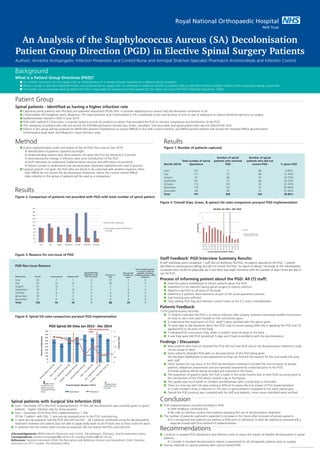
Spinal patients - identified as having a higher infection rate
n Capturing spinal patients seen through pre-operative assessment (POA) clinic to provide staphylococcus aureus (SA) decolonisation treatment to all
n Chlorhexidine 4% body/hair wash, Mupriocin 2% nasal ointment and Chlorhexidine 0.2% mouthwash to be used by prior to and on day of admission to reduce bacterial load prior to surgery
n Implementation started in POA in June 2014
n POA staff marked ICS (Electronic Computer System) records for patients to whom they provided the PGD to monitor compliance and distribution of the PGD
n The categories of patients who did not receive the PGD/decolonisation include hips, knees, shoulders, foot and ankle and spinal patient who did not attend POA clinic.
n Patient in this group will be screened for Methicillin-resistant Staphylococcus aureus (MRSA) in line with current practice, any MRSA positive patients will receive the standard MRSA decolonisation
(chlorhexdine body wash and Mupirocin nasal ointment only).
Method
n A post-implementation audit and review of the SA PGD from June to Dec 2014
n Identification of patients captured via Insight
n Understanding reasons why some patients not given the PGD by checking ICS records
n Ascertaining the change in infection rates since introduction of the PGD
n Staff interviews to understand implementation process and difficulties encountered
n Patient surveys to understand how decolonisation treatment explained and used in practice
n Surgical patients not given the PGD who are found to be colonised with another organism other
than MRSA do not receive the decolonisation treatment. Hence the current routine MRSA
data collected in this group of patients will be used as a comparison
Number of spinal Number of spinal
Total number of spinal patients who received patients who did not
Month (2014) Operations PGD receive PGD % given PGD
June 87 3 84 3.40%
July 111 25 86 22.50%
August 91 46 45 50.50%
September 85 37 48 43.50%
October 173 141 32 81.50%
November 176 151 25 85.80%
December 68 46 22 67.60%
Total 791 449 342 56.80%
Figure 1: Number of patients captured
Figure 2: Comparison of patients not provided with PGD with total number of spinal patient
Figure 5: Overall (hips, knees, & spines) SSI rates comparison pre/post PGD implementation
Figure 4: Spinal SSI rates comparison pre/post PGD implementation
Figure 3: Reasons for non-issue of PGD
Results
Results
Staff Feedback: PGD Interview Summary Results:
8 staff interviews were completed, 1 staff did not distribute the PGD, no patient objected to the PGD, 1 patient
identified as having peanut allergy and did not receive the PGD, no report of allergy / sensitivity to the chlorhexidine,
no patient who could not physically use it and there was slight confusion with the number of days / times per day to
use the PGD.
Process of informing patient about the PGD: All (7) staff;
n Used the patient leaflet/pack to inform patients about the PGD
n Explained it is for patients having spinal surgery to reduce infection
n Asked to use PGD on all areas of the body
n Determine if patients need assistance as part of the usual assessment process
n Said training was sufficient
n Okay adding PGD flag and infection control notes on the ICS and in notes/booklet
Patients Feedback:
11/30 Questionnaires returned;
n 11 Patients indicated the PGD is to reduce infection after surgery, received information leaflet/ instructions
on how to use it and used it based on the instructions given.
n 9 understand the importance of PGD, while 5 were satisfied with the advice given
n 10 were able to ask questions about the PGD, had no issues causing difficulty in applying the PGD and 10
applied PGD to all areas of the body
n 7 followed PGD instructions fully, while 3 couldn’t reach all areas of the back
n 9 said they were told PGD would last 5 days and 9 had no problems with the decolonisation
Findings / Discussion
n Most patients who had not received the PGD did not have POA and so the decolonisation treatment could
not be issued to them
n Some patients attended POA with no documentation of the PGD being given
this has been highlighted to pre-assessment so they can find out the reasons for this and tackle this issue
with staff
n Other reasons for non-issue of the PGD decolonisation treatment included the non-inclusion of private
patients, telephone assessments and pre-operative assessments conducted prior to the PGD
n Private patients will be being recorded and captured in the future
n The proportion of patients given the PGD is lower in the initial months due to their POA occurring prior to
the introduction of the PGD which created a lag in the figures.
n The uptake was much better in October and November with a small drop in December.
n There is a time lag with SSI rates making it difficult to assess the true impact of PGD implementation.
n Crude numbers show a reduction in SSI rates in spinal patients compared to the same period year.
n Overall the PGD protocol was complied with by staff and patients, minor issues identified were rectified
Conclusion
n PGD implementation occurred smoothly in POA
n Staff feedback confirmed this
n No calls to infection control from patients querying the use of decolonisation treatment
n The number of patients captured is expected to increase in the future after inclusion of private patients
n It is recognised that patients not without a POA prior to admission or who are telephone assessed will a
ways be missed with this method of implementation
Recommendations
n Continue to analyse PGD distribution and infection rates to assess the impact of blanket decolonisation in spinal
patients
n Consider if standard decolonisation regime is warranted for all orthopaedic patients prior to surgery
n Discuss methods to capture patients who cannot attend POA
June 20 7 1 0 55 1 0
July 29 15 4 7 30 1 0
August 23 16 1 0 2 2 1
September 18 7 16 0 1 6 0
October 12 8 4 0 0 8 0
November 19 1 2 0 0 3 0
December 8 0 6 0 0 8 0
Total 129 54 34 7 88 29 1
Spinal patients with Surgical Site Infection (SSI)
n June – December 2013 (Pre-PGD implementation)- 19 SSIs: No decolonisation was routinely given to spinal
patients – higher infection rate for these quarters.
n June – December 2014 (Post PGD implementation)- 7 SSIs:
Of the 7 patient with SSIs: 1- was pre-op assessed prior to the PGD commencing.
n 3- were pre-op assessed, had the PGD and still had SSIs - all 3 patients confirmed using the decolonisation
treatment however one patient was not able to apply body wash to all of back area as they could not reach
n 3- patients met the criteria were not pre-op assessed, did not receive the PDG and Had SSIs
Acknowledgements: RNOH Infection Prevention and Control, Microbiologist, Pharmacy, and Pre-assessment teams
Correspondence: annesha.archyangelio@rnoh.nhs.uk / amritpal.shakhon@rnoh.nhs.uk
References: Statutory Instrument (2000) The Prescription only Medicines (Human Use) Amendment Order. Statutory
Instrument no.1917, London: The Stationery Office.
15-71 RNOH Communications Department April 2015
POA of Paediatric patient
( <12 years) so PGD not
applicable (excluding
paediatric patients in other
categories)
POA attended
but PGD not
given
POA prior to
PGD
Anaesthetist POA
(NB initial months
PGD not issued)Telephone POAPrivate patientsNo POAMonth (2014)
PGD Non-issue Reasons

Analysis of Staph Aureus PGD Decolonisation

  • 1.
    An Analysis ofthe Staphylococcus Aureus (SA) Decolonisation Patient Group Direction (PGD) in Elective Spinal Surgery Patients Authors: Annesha Archyangelio- Infection Prevention and Control Nurse and Amritpal Shakhon-Specialist Pharmacist Antimicrobials and Infection Control Background What is a Patient Group Directives (PGD)? n A is written instruction for the supply and / or administration of a named licensed medicine for a defined clinical condition n Allows a range of specified registered health care professionals to supply and / or administer a medicine directly to a patient with an identified clinical condition without them necessarily seeing a prescriber n The health care professional working within the PGD is responsible for assessing that the patient fits the criteria set out in the PGD (Statutory Instrument, 2000). Patient Group Spinal patients - identified as having a higher infection rate n Capturing spinal patients seen through pre-operative assessment (POA) clinic to provide staphylococcus aureus (SA) decolonisation treatment to all n Chlorhexidine 4% body/hair wash, Mupriocin 2% nasal ointment and Chlorhexidine 0.2% mouthwash to be used by prior to and on day of admission to reduce bacterial load prior to surgery n Implementation started in POA in June 2014 n POA staff marked ICS (Electronic Computer System) records for patients to whom they provided the PGD to monitor compliance and distribution of the PGD n The categories of patients who did not receive the PGD/decolonisation include hips, knees, shoulders, foot and ankle and spinal patient who did not attend POA clinic. n Patient in this group will be screened for Methicillin-resistant Staphylococcus aureus (MRSA) in line with current practice, any MRSA positive patients will receive the standard MRSA decolonisation (chlorhexdine body wash and Mupirocin nasal ointment only). Method n A post-implementation audit and review of the SA PGD from June to Dec 2014 n Identification of patients captured via Insight n Understanding reasons why some patients not given the PGD by checking ICS records n Ascertaining the change in infection rates since introduction of the PGD n Staff interviews to understand implementation process and difficulties encountered n Patient surveys to understand how decolonisation treatment explained and used in practice n Surgical patients not given the PGD who are found to be colonised with another organism other than MRSA do not receive the decolonisation treatment. Hence the current routine MRSA data collected in this group of patients will be used as a comparison Number of spinal Number of spinal Total number of spinal patients who received patients who did not Month (2014) Operations PGD receive PGD % given PGD June 87 3 84 3.40% July 111 25 86 22.50% August 91 46 45 50.50% September 85 37 48 43.50% October 173 141 32 81.50% November 176 151 25 85.80% December 68 46 22 67.60% Total 791 449 342 56.80% Figure 1: Number of patients captured Figure 2: Comparison of patients not provided with PGD with total number of spinal patient Figure 5: Overall (hips, knees, & spines) SSI rates comparison pre/post PGD implementation Figure 4: Spinal SSI rates comparison pre/post PGD implementation Figure 3: Reasons for non-issue of PGD Results Results Staff Feedback: PGD Interview Summary Results: 8 staff interviews were completed, 1 staff did not distribute the PGD, no patient objected to the PGD, 1 patient identified as having peanut allergy and did not receive the PGD, no report of allergy / sensitivity to the chlorhexidine, no patient who could not physically use it and there was slight confusion with the number of days / times per day to use the PGD. Process of informing patient about the PGD: All (7) staff; n Used the patient leaflet/pack to inform patients about the PGD n Explained it is for patients having spinal surgery to reduce infection n Asked to use PGD on all areas of the body n Determine if patients need assistance as part of the usual assessment process n Said training was sufficient n Okay adding PGD flag and infection control notes on the ICS and in notes/booklet Patients Feedback: 11/30 Questionnaires returned; n 11 Patients indicated the PGD is to reduce infection after surgery, received information leaflet/ instructions on how to use it and used it based on the instructions given. n 9 understand the importance of PGD, while 5 were satisfied with the advice given n 10 were able to ask questions about the PGD, had no issues causing difficulty in applying the PGD and 10 applied PGD to all areas of the body n 7 followed PGD instructions fully, while 3 couldn’t reach all areas of the back n 9 said they were told PGD would last 5 days and 9 had no problems with the decolonisation Findings / Discussion n Most patients who had not received the PGD did not have POA and so the decolonisation treatment could not be issued to them n Some patients attended POA with no documentation of the PGD being given this has been highlighted to pre-assessment so they can find out the reasons for this and tackle this issue with staff n Other reasons for non-issue of the PGD decolonisation treatment included the non-inclusion of private patients, telephone assessments and pre-operative assessments conducted prior to the PGD n Private patients will be being recorded and captured in the future n The proportion of patients given the PGD is lower in the initial months due to their POA occurring prior to the introduction of the PGD which created a lag in the figures. n The uptake was much better in October and November with a small drop in December. n There is a time lag with SSI rates making it difficult to assess the true impact of PGD implementation. n Crude numbers show a reduction in SSI rates in spinal patients compared to the same period year. n Overall the PGD protocol was complied with by staff and patients, minor issues identified were rectified Conclusion n PGD implementation occurred smoothly in POA n Staff feedback confirmed this n No calls to infection control from patients querying the use of decolonisation treatment n The number of patients captured is expected to increase in the future after inclusion of private patients n It is recognised that patients not without a POA prior to admission or who are telephone assessed will a ways be missed with this method of implementation Recommendations n Continue to analyse PGD distribution and infection rates to assess the impact of blanket decolonisation in spinal patients n Consider if standard decolonisation regime is warranted for all orthopaedic patients prior to surgery n Discuss methods to capture patients who cannot attend POA June 20 7 1 0 55 1 0 July 29 15 4 7 30 1 0 August 23 16 1 0 2 2 1 September 18 7 16 0 1 6 0 October 12 8 4 0 0 8 0 November 19 1 2 0 0 3 0 December 8 0 6 0 0 8 0 Total 129 54 34 7 88 29 1 Spinal patients with Surgical Site Infection (SSI) n June – December 2013 (Pre-PGD implementation)- 19 SSIs: No decolonisation was routinely given to spinal patients – higher infection rate for these quarters. n June – December 2014 (Post PGD implementation)- 7 SSIs: Of the 7 patient with SSIs: 1- was pre-op assessed prior to the PGD commencing. n 3- were pre-op assessed, had the PGD and still had SSIs - all 3 patients confirmed using the decolonisation treatment however one patient was not able to apply body wash to all of back area as they could not reach n 3- patients met the criteria were not pre-op assessed, did not receive the PDG and Had SSIs Acknowledgements: RNOH Infection Prevention and Control, Microbiologist, Pharmacy, and Pre-assessment teams Correspondence: annesha.archyangelio@rnoh.nhs.uk / amritpal.shakhon@rnoh.nhs.uk References: Statutory Instrument (2000) The Prescription only Medicines (Human Use) Amendment Order. Statutory Instrument no.1917, London: The Stationery Office. 15-71 RNOH Communications Department April 2015 POA of Paediatric patient ( <12 years) so PGD not applicable (excluding paediatric patients in other categories) POA attended but PGD not given POA prior to PGD Anaesthetist POA (NB initial months PGD not issued)Telephone POAPrivate patientsNo POAMonth (2014) PGD Non-issue Reasons