Duel in the Antarctic


    María Benítez de la Fuente 3ºESO A
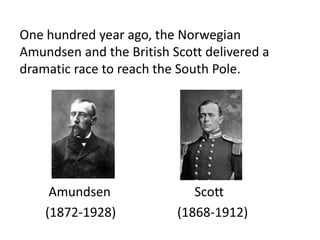
One hundred year ago, the Norwegian
Amundsen and the British Scott delivered a
dramatic race to reach the South Pole.


     Amundsen                Scott
    (1872-1928)           (1868-1912)
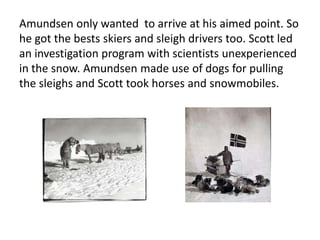
Amundsen only wanted to arrive at his aimed point. So
he got the bests skiers and sleigh drivers too. Scott led
an investigation program with scientists unexperienced
in the snow. Amundsen made use of dogs for pulling
the sleighs and Scott took horses and snowmobiles.
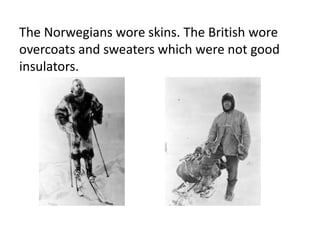
The Norwegians wore skins. The British wore
overcoats and sweaters which were not good
insulators.
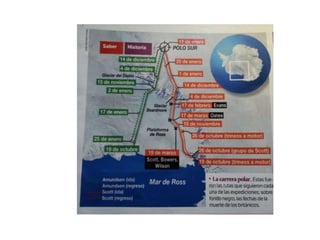
On the nineteenth of October in 1911, the
Norwegians left with five people in four sleighs
with fifty-five dogs.
One week later, Scott left with ten
horses, sixteen people and thirty- two dogs.
On the fifteenth of November, Amundsen left
for the “Trasantartics Mountains”. The
Norwegians were five hundred kilometers ahead
of the British.
On the fourth of December, when Scott arrived
at the foot of these mountains, Amundsen rose
to the tableland.
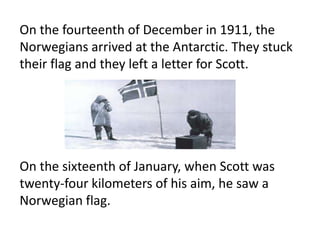
On the fourteenth of December in 1911, the
Norwegians arrived at the Antarctic. They stuck
their flag and they left a letter for Scott.


On the sixteenth of January, when Scott was
twenty-four kilometers of his aim, he saw a
Norwegian flag.
The British had to come back without victory.
On the seventeenth of February, Evans died due
to exhaustion and cold.
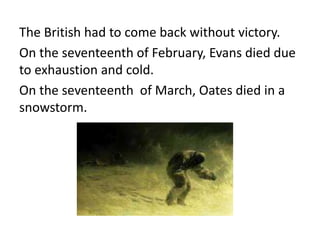
On the seventeenth of March, Oates died in a
snowstorm.
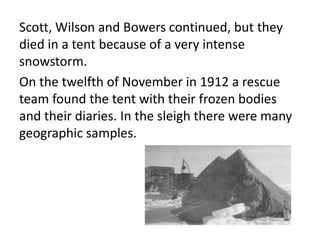
Scott, Wilson and Bowers continued, but they
died in a tent because of a very intense
snowstorm.
On the twelfth of November in 1912 a rescue
team found the tent with their frozen bodies
and their diaries. In the sleigh there were many
geographic samples.
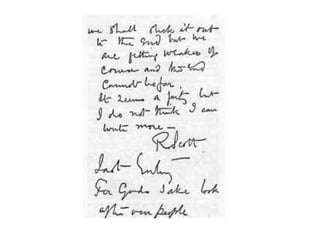
The last entry in the diary of Scott, on the
nineteenth March in 1912, was:
“We shall fight until the end but we are getting
weaker of course and the end cannot be far. It is
a pity but I do not think I can write more.
Robert Scott

For God’s sake, look after our people”
Amundsen

Amundsen

  • 1.
    Duel in theAntarctic María Benítez de la Fuente 3ºESO A
  • 2.
    One hundred yearago, the Norwegian Amundsen and the British Scott delivered a dramatic race to reach the South Pole. Amundsen Scott (1872-1928) (1868-1912)
  • 3.
    Amundsen only wantedto arrive at his aimed point. So he got the bests skiers and sleigh drivers too. Scott led an investigation program with scientists unexperienced in the snow. Amundsen made use of dogs for pulling the sleighs and Scott took horses and snowmobiles.
  • 4.
    The Norwegians woreskins. The British wore overcoats and sweaters which were not good insulators.
  • 5.
    On the nineteenthof October in 1911, the Norwegians left with five people in four sleighs with fifty-five dogs. One week later, Scott left with ten horses, sixteen people and thirty- two dogs. On the fifteenth of November, Amundsen left for the “Trasantartics Mountains”. The Norwegians were five hundred kilometers ahead of the British. On the fourth of December, when Scott arrived at the foot of these mountains, Amundsen rose to the tableland.
  • 7.
    On the fourteenthof December in 1911, the Norwegians arrived at the Antarctic. They stuck their flag and they left a letter for Scott. On the sixteenth of January, when Scott was twenty-four kilometers of his aim, he saw a Norwegian flag.
  • 8.
    The British hadto come back without victory. On the seventeenth of February, Evans died due to exhaustion and cold. On the seventeenth of March, Oates died in a snowstorm.
  • 9.
    Scott, Wilson andBowers continued, but they died in a tent because of a very intense snowstorm. On the twelfth of November in 1912 a rescue team found the tent with their frozen bodies and their diaries. In the sleigh there were many geographic samples.
  • 10.
    The last entryin the diary of Scott, on the nineteenth March in 1912, was: “We shall fight until the end but we are getting weaker of course and the end cannot be far. It is a pity but I do not think I can write more. Robert Scott For God’s sake, look after our people”