Head & Board Taking Care of the School
                AND
             Each Other
Introductions

• You meet me    • I meet you
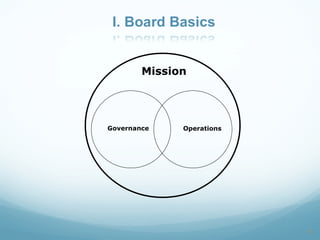
Mission


Governance    Operations


                           4
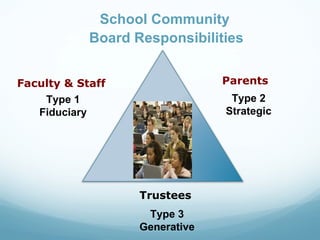
School Community
            Board Responsibilities


Faculty & Staff                 Parents
    Type 1                       Type 2
   Fiduciary                    Strategic


                   Trustees
                    Type 3
                   Generative
6
Board Structure
B


                  Bylaws & Policies
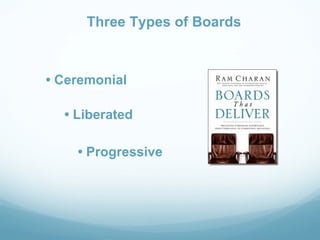
Three Types of Boards


• Ceremonial

  • Liberated

    • Progressive
Annual Board Documents


• Annual Board Agenda

  • Head’s Goals & Objectives

    • Annual Committee Structure
      & Membership
H
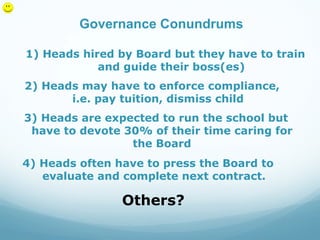
Governance Conundrums

1) Heads hired by Board but they have to train
            and guide their boss(es)
2) Heads may have to enforce compliance,
       i.e. pay tuition, dismiss child
3) Heads are expected to run the school but
 have to devote 30% of their time caring for
                 the Board
4) Heads often have to press the Board to
   evaluate and complete next contract.

                Others?
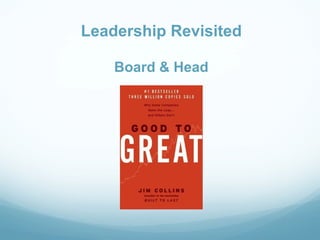
Leadership Revisited

    Board & Head
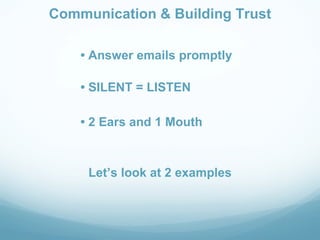
Communication & Building Trust

    • Answer emails promptly

    • SILENT = LISTEN

    • 2 Ears and 1 Mouth


     Let’s look at 2 examples
Communication with an attitude
An Example of Miscommunication
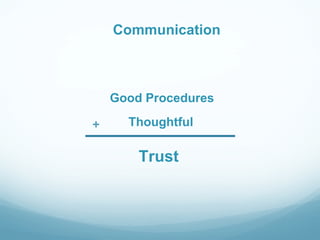
Communication


    Good Procedures

+     Thoughtful

        Trust
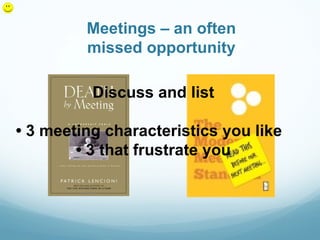
Meetings – an often
         missed opportunity

          Discuss and list

• 3 meeting characteristics you like
        • 3 that frustrate you
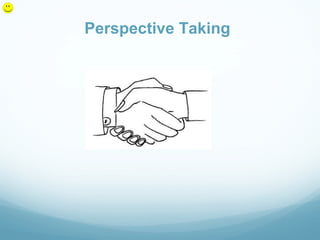
Perspective Taking
Recognition

Must work both ways
      • Head to Board

      • Board to Head & Staff
Clarkson Montessori School
“Terry, you have a call from the board chair on line 2.”

“Hello, Terry. How was your weekend?”

“Hi, Chris. I was just thinking that I can’t believe this is my fifteenth
year at Clarkson. We’ve seen so much progress in a short period of
time. What’s up?”

“Terry, I heard at drop-off this morning that Leslie will be leaving after
the holiday break. Is that true?”

“Oh, yes. I probably should have brought it up last week when we
had our weekly meeting.”

“Terry, I cannot believe this. Leslie has been with us over 25 years,
and is one of our most beloved teachers.”
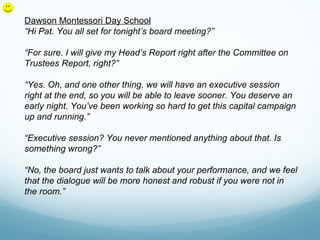
Dawson Montessori Day School
“Hi Pat. You all set for tonight’s board meeting?”
“For sure. I will give my Head’s Report right after the Committee on
Trustees Report, right?”

“Yes. Oh, and one other thing, we will have an executive session
right at the end, so you will be able to leave sooner. You deserve an
early night. You’ve been working so hard to get this capital campaign
up and running.”

“Executive session? You never mentioned anything about that. Is
something wrong?”

“No, the board just wants to talk about your performance, and we feel
that the dialogue will be more honest and robust if you were not in
the room.”
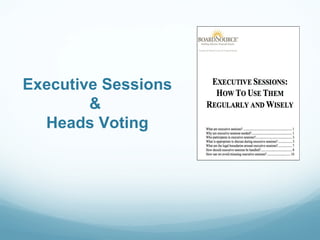
Executive Sessions
        &
  Heads Voting
Board/Head Partnership

     “Great schools house
outstanding faculty, but they are
    built through the strong
 leadership of solid head/board
         partnerships.”
How do the Board and Head
  do this in your school?
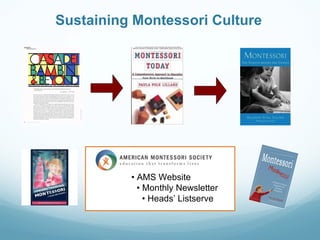
Sustaining Montessori Culture


          • AMS Website
            • Monthly Newsletter
              • Heads’ Listserve
What is not Montessori in our
          schools?
For Head & Board

• Develop your leadership

  • Support school mission
   • Promote professional development
      • Give Recognition
       • Do right
         • Care for the child
“When You’re a Parent and Board Member”


“When Parents Complain — what’s a board member to do?”
Beyond our own
    Montessori Schools
• Accreditation

• Professional Development

• Montessori Advocacy

• Montessori in the National Agenda

• Montessori Research

• Technology
Accreditation Process


    Manual on Evaluation & Accreditation
               (2006 Edition)

              IV. Governance


Manual on Evaluation & Accreditation
           (2011 Edition)

            II. Governance
Roles & Responsibilities

Major recommendation – 2003 accreditation report

“The fourth major recommendation is for all areas of the
  school to understand their roles and responsibilities. The
  leadership of the school and the Board have a deep
  understanding of this issue. The challenge is to change the
  culture of the faculty and parent body without losing their
  strong loyalty, generosity, and dedication. The change will
  take some time and may require some outside assistance
  from a facilitator along the lines of Dr. Robert Evans.
  Fortunately, the Board seems to be thinking strategically
  and can provide support to the administration.”
• Absolutely no surprises between the head and board chair!

• Always work towards building trust among school
constituencies, especially between the board chair and
head of school.
• Constant, regular communication between board chair and
head is essential. With email, messaging, and cell phones,
there is no excuse for lack of communication.

• Board executive sessions (those that exclude the head)
must be logical and anticipated by both the board and head,
i.e. discussing head’s compensation, head’s goals, and
head’s annual evaluation.
• Use the Committee on Trustees to help manage trustee
behavior. This committee can be a good support to the
board chair, particularly when it comes to helping best
governance practices prevail.
• Make provisions for and insist on succession planning for
board leadership.

• Make sure that the head shows appreciation for trustee
time and energy, always remembering that they are
volunteering their time.

• Make sure that the board shows its appreciation for the
work of the head and the staff.
• Keep all sensitive matters relating to governance,
operations, and treatment of one another ethical and
confidential.

• The Incumbent Rules:
   • It is incumbent upon the board chair and head to
      use the Executive Committee when sticky
      situations are beyond their purview.
   • It is incumbent upon the board chair to apprise the
      board as soon as possible when difficult situations
      arise beyond the scope of the board chair, head,
      and Executive Committee.
   • It is incumbent upon the head to keep the faculty
      and staff apprised as soon as practical of changes
      that affect the school.
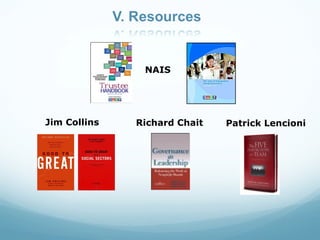
NAIS


Jim Collins   Richard Chait   Patrick Lencioni
www.boardsource.org   www.nais.org


 www.isminc.com       www.amshq.org


www.iscachairs.org    www.nysais.org
Tomorrow’s Child
Montessori Leadership
3 Final Points . . .     The Hs


             Hard Work

    Humility             Humor
Handouts & Resources – Session 5

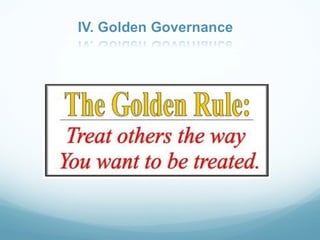
1.   “Golden Governance”
2.   “Casa Dei Bambini”
3.   “Recognition”
4.   “30%. . . No. Really?”
5.   “Whose Decision Is It?”
6.   “Board/Head Partnership” (from NAIS)
7.    Slides from this presentation
Fostering Relationships Between
        Heads of School
                &
       Boards of Trustees
Ams Heads-Boards Session 5 March 2012

Ams Heads-Boards Session 5 March 2012

  • 1.
    Head & BoardTaking Care of the School AND Each Other
  • 2.
    Introductions • You meetme • I meet you
  • 4.
    Mission Governance Operations 4
  • 5.
    School Community Board Responsibilities Faculty & Staff Parents Type 1 Type 2 Fiduciary Strategic Trustees Type 3 Generative
  • 6.
  • 7.
    Board Structure B Bylaws & Policies
  • 8.
    Three Types ofBoards • Ceremonial • Liberated • Progressive
  • 9.
    Annual Board Documents •Annual Board Agenda • Head’s Goals & Objectives • Annual Committee Structure & Membership
  • 10.
  • 11.
    Governance Conundrums 1) Headshired by Board but they have to train and guide their boss(es) 2) Heads may have to enforce compliance, i.e. pay tuition, dismiss child 3) Heads are expected to run the school but have to devote 30% of their time caring for the Board 4) Heads often have to press the Board to evaluate and complete next contract. Others?
  • 13.
  • 14.
    Communication & BuildingTrust • Answer emails promptly • SILENT = LISTEN • 2 Ears and 1 Mouth Let’s look at 2 examples
  • 15.
  • 16.
    An Example ofMiscommunication
  • 17.
    Communication Good Procedures + Thoughtful Trust
  • 18.
    Meetings – anoften missed opportunity Discuss and list • 3 meeting characteristics you like • 3 that frustrate you
  • 19.
  • 20.
    Recognition Must work bothways • Head to Board • Board to Head & Staff
  • 21.
    Clarkson Montessori School “Terry,you have a call from the board chair on line 2.” “Hello, Terry. How was your weekend?” “Hi, Chris. I was just thinking that I can’t believe this is my fifteenth year at Clarkson. We’ve seen so much progress in a short period of time. What’s up?” “Terry, I heard at drop-off this morning that Leslie will be leaving after the holiday break. Is that true?” “Oh, yes. I probably should have brought it up last week when we had our weekly meeting.” “Terry, I cannot believe this. Leslie has been with us over 25 years, and is one of our most beloved teachers.”
  • 22.
    Dawson Montessori DaySchool “Hi Pat. You all set for tonight’s board meeting?” “For sure. I will give my Head’s Report right after the Committee on Trustees Report, right?” “Yes. Oh, and one other thing, we will have an executive session right at the end, so you will be able to leave sooner. You deserve an early night. You’ve been working so hard to get this capital campaign up and running.” “Executive session? You never mentioned anything about that. Is something wrong?” “No, the board just wants to talk about your performance, and we feel that the dialogue will be more honest and robust if you were not in the room.”
  • 23.
    Executive Sessions & Heads Voting
  • 24.
    Board/Head Partnership “Great schools house outstanding faculty, but they are built through the strong leadership of solid head/board partnerships.”
  • 25.
    How do theBoard and Head do this in your school?
  • 26.
    Sustaining Montessori Culture • AMS Website • Monthly Newsletter • Heads’ Listserve
  • 27.
    What is notMontessori in our schools?
  • 28.
    For Head &Board • Develop your leadership • Support school mission • Promote professional development • Give Recognition • Do right • Care for the child
  • 29.
    “When You’re aParent and Board Member” “When Parents Complain — what’s a board member to do?”
  • 30.
    Beyond our own Montessori Schools • Accreditation • Professional Development • Montessori Advocacy • Montessori in the National Agenda • Montessori Research • Technology
  • 31.
    Accreditation Process Manual on Evaluation & Accreditation (2006 Edition) IV. Governance Manual on Evaluation & Accreditation (2011 Edition) II. Governance
  • 32.
    Roles & Responsibilities Majorrecommendation – 2003 accreditation report “The fourth major recommendation is for all areas of the school to understand their roles and responsibilities. The leadership of the school and the Board have a deep understanding of this issue. The challenge is to change the culture of the faculty and parent body without losing their strong loyalty, generosity, and dedication. The change will take some time and may require some outside assistance from a facilitator along the lines of Dr. Robert Evans. Fortunately, the Board seems to be thinking strategically and can provide support to the administration.”
  • 34.
    • Absolutely nosurprises between the head and board chair! • Always work towards building trust among school constituencies, especially between the board chair and head of school. • Constant, regular communication between board chair and head is essential. With email, messaging, and cell phones, there is no excuse for lack of communication. • Board executive sessions (those that exclude the head) must be logical and anticipated by both the board and head, i.e. discussing head’s compensation, head’s goals, and head’s annual evaluation.
  • 35.
    • Use theCommittee on Trustees to help manage trustee behavior. This committee can be a good support to the board chair, particularly when it comes to helping best governance practices prevail. • Make provisions for and insist on succession planning for board leadership. • Make sure that the head shows appreciation for trustee time and energy, always remembering that they are volunteering their time. • Make sure that the board shows its appreciation for the work of the head and the staff.
  • 36.
    • Keep allsensitive matters relating to governance, operations, and treatment of one another ethical and confidential. • The Incumbent Rules: • It is incumbent upon the board chair and head to use the Executive Committee when sticky situations are beyond their purview. • It is incumbent upon the board chair to apprise the board as soon as possible when difficult situations arise beyond the scope of the board chair, head, and Executive Committee. • It is incumbent upon the head to keep the faculty and staff apprised as soon as practical of changes that affect the school.
  • 37.
    NAIS Jim Collins Richard Chait Patrick Lencioni
  • 38.
    www.boardsource.org www.nais.org www.isminc.com www.amshq.org www.iscachairs.org www.nysais.org
  • 40.
  • 41.
    3 Final Points. . . The Hs Hard Work Humility Humor
  • 42.
    Handouts & Resources– Session 5 1. “Golden Governance” 2. “Casa Dei Bambini” 3. “Recognition” 4. “30%. . . No. Really?” 5. “Whose Decision Is It?” 6. “Board/Head Partnership” (from NAIS) 7. Slides from this presentation
  • 43.
    Fostering Relationships Between Heads of School & Boards of Trustees

Editor's Notes

  • #2 ----- Meeting Notes (3/14/12 07:24) ----- Here is the title I proposed
  • #3 Meet you ------- How many Trustees? Heads? Administrators? Teachers? Meeting Harvey is my way of saying “Let’s have some fun this morning.”
  • #4 Some of this material will be familiar but let’s reinforce what we may already now. You never know what lurks ahead. ----- Meeting Notes (3/14/12 07:36) -----
  • #5 Rehash article
  • #6 ----- Meeting Notes (3/14/12 07:36) ----- What is in center of triangle?
  • #8 Policies easier to change than bylaws, e.g. investment, conflict of interest, evaluation of the head, contract ----- Meeting Notes (3/14/12 07:36) ----- What is the difference between bylaws and policies?
  • #9 Finally, a book that brings the vision of truly good governance down to earth. Ram Charan, expert in corporate governance and best-selling author, packs this book with useful tools and techniques to take boards and their companies to a higher level of performance. Charan puts his finger on a growing problem for boards: the disconnect between directors; efforts and their results. The added time and attention boards invest is not translating into better governance — that is, governance that adds value to the business. Boards That Deliver gets beyond the rhetoric of corporate governance reform. It captures the tried-and-true practices used by high-performance boards. In contrast to experts who base prescriptions on number-crunching exercises, Charan identifies the real problems that drain directors' time and suppress their best judgments — and explains clearly and succinctly how boards can solve those problems. These battle-tested solutions help boards achieve what rules and regulations alone cannot — to get succession right, refine a winning strategy, and design a rational CEO compensation package. Good governance requires leadership. Boards That Deliver is the no-nonsense guide for directors and CEOs who are rising to the leadership challenge to make their boards a competitive advantage.
  • #10 Board and head establish before the first Board meeting. Strategic Plan drives Agenda, Head’s G&O, and what committees/task forces needed
  • #11 Balance of power
  • #12 Train new board chairs and new trustees CAN YOU THINK OF OTHERS?
  • #13 Remember conflict of interest
  • #14 Board Chair and Head leadership is key G to G – 1) Level 4 v. 5 leader 2) Executive leadership (Benevolent dictator) v. Legislative Leadership (Consensus builder)
  • #15 Let me leave you with 3 key points gleaned over my 20 yrs. As Head and Board member. Answer emails promptly even if it is to say, “I’ll get right back to you.” Don’t let issues fester Next 2 points I picked up from a workshop “Axis of Hope” helping teachers help students learn about communicating, conflict resolution, including compromising, and negotiating.
  • #16 Referee in NFL game
  • #17 Clear communication essential – German Coast guard video
  • #18 Let’s do the math . . . ----- Meeting Notes (3/14/12 07:46) ----- One way of ensuring good communication.
  • #19 *********** Hold book pictures until after group discusses questions • DISCUSSION QUESTION One of the best way to nurture your Board and administrative team – GOOD MEETINGS Perfect way to get to know one another. DISCUSS AND LIST 3 MEETING CHARACTERISTICS YOU LIKE & 3 THAT FRUSTRATE YOU • Tips 1) Establish meeting beginning and ending times 2) printed agenda 3) bring solutions to chew on rather than a what-are-going-to-do approach 4) take notes/minutes • Lencioni meetings -> Daily Check-in, Weekly Tactical, Monthly Strategic, Quarterly Off-site • Blog post with podcast interview author of “The Modern Meeting Standard”
  • #20 JoAnn Deak lecture in March – Do handshake exercise. Talk about “Mind in the Making” skill – Perspective Taking This is especially true when it comes to looking at problems for vantage point of parents, trustees, faculty, staff, and certainly kids
  • #21 When was the last time you can remember recognition in your school. How was it demonstrated? Independent Teacher article posted. Let’s practice . . .
  • #22 Present as a case study
  • #23 IF YOU WERE THE HEAD, HOW WOULD YOU RESPOND? >>>>>>>>>>>>>OR Set up as a role-play situation
  • #24 This is a good paper on understanding Executive Sessions 2 times when Boards should hold executive sessions – compensation and evaluation Can be a sore point: Should Heads have a vote on their Boards? On their committees?
  • #25 “ Board/Head Partnership_NAIS” is from NAIS and can be found with posted resources in support of this presentation.
  • #26 HOW DO THE BOARD AND HEAD DO THIS IN YOUR SCHOOL?
  • #27 Reading & Montessori resources.
  • #28 WHAT IS NOT MONTESSORI IN OUR SCHOOL? Wining a debate, a basketball game? Not allowing a student to return to school after the holiday break because tuition has not been paid to date? Suggesting that all families must provide baked goods for the bake sale? Children must call their teachers by their first name? Children are not given homework?
  • #29 Do right ----- from “Better: A Surgeon’ Notes on Performance” by Atul Gawande
  • #30 Rehash article
  • #31 Accreditation – AMS v. state, Middle States . . . Why?
  • #32 One of the best resources – Accreditation & Evaluation both AMS and State/Regional Association
  • #34 Article posted for you. Not published yet, but it will give you reference on what GG means.
  • #38 Rehash article
  • #39 Double click on each to bring up logo and URL at same time
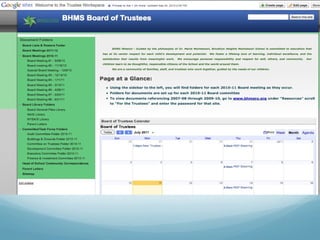
  • #40 Connect to website if possible and navigate around.
  • #41 Good publication resources
  • #42 Any guesses? Humility & Humor = 2 best ways to build trust and confidence in any relationship. Age Activated Deficit Disorder ----- Meeting Notes (3/14/12 07:46) ----- So much of our work as trustees and heads is about the 3 Hs Let's end with at least 2 of the Hs!!!
  • #43 Posted on AMS website.