Mark D. Groza
University of Massachusetts –Amherst
Joe Cobbs
Northern Kentucky University
A Portfolio Approach to Sponsorship Alliances: ChallengingA Portfolio Approach to Sponsorship Alliances: Challenging
Unilateral Brand Spillover EffectsUnilateral Brand Spillover Effects
Presentation Outline
Research Motivation
Theoretical Background and Hypotheses
Survey design and empirical results
Discussion and Implications
Research Motivation
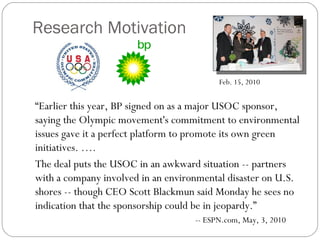
“Earlier this year, BP signed on as a major USOC sponsor,
saying the Olympic movement's commitment to environmental
issues gave it a perfect platform to promote its own green
initiatives. ….
The deal puts the USOC in an awkward situation -- partners
with a company involved in an environmental disaster on U.S.
shores -- though CEO Scott Blackmun said Monday he sees no
indication that the sponsorship could be in jeopardy.”
-- ESPN.com, May, 3, 2010
Feb. 15, 2010
Commercial Sponsorship
“Provision of assistance either financial or in kind to an
activity by a commercial organization for the purpose of
achieving commercial objectives” – Meenaghan, 1983
Top objectives: Build brand equity (Cliffe & Motion, 2005;
Thjømøe et al., 2002); Goodwill (Meenaghan, 2001)
Sponsoring
firm/brand
Popular [sports]
enterprise
$ VIK
Benefits
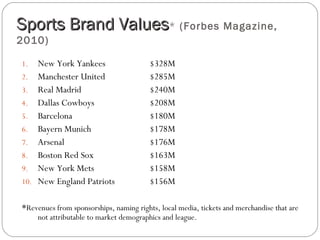
Sports Brand ValuesSports Brand Values* (Forbes Magazine,
2010)
1. New York Yankees $328M
2. Manchester United $285M
3. Real Madrid $240M
4. Dallas Cowboys $208M
5. Barcelona $180M
6. Bayern Munich $178M
7. Arsenal $176M
8. Boston Red Sox $163M
9. New York Mets $158M
10. New England Patriots $156M
*Revenues from sponsorships, naming rights, local media, tickets and merchandise that are
not attributable to market demographics and league.
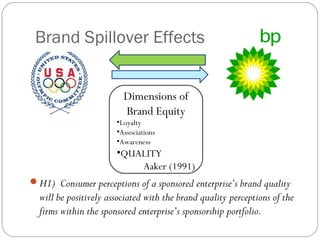
Brand Spillover Effects
H1) Consumer perceptions of a sponsored enterprise’s brand quality
will be positively associated with the brand quality perceptions of the
firms within the sponsored enterprise’s sponsorship portfolio.
Dimensions of
Brand Equity
•Loyalty
•Associations
•Awareness
•QUALITY
Aaker (1991)
Involvement
Elaboration Likelihood Model -- when evaluating
advertisements relevant to ones consumption interests
people pay closer attention -- Petty and Cacioppo 1981; Petty,
Cacioppo, and Schumann 1983
Involvement in the sponsorship domain —Gwinner and Swanson
2003
H2) A consumer’s involvement in the sponsored enterprise’s domain
will positively moderate the relationship between the perceived brand
quality of the sponsors within a portfolio and the perceived brand
quality of the sponsored enterprise.
Perceived Prestige
Social prestige influences consumer evaluations of brand
quality (Hellofs and Jacobson 1999)
H3) The level of prestige a consumer associates with a sponsored
enterprise will be positively related to the perceived brand quality of
the sponsored enterprise.
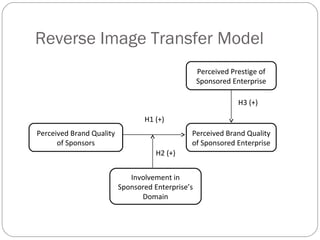
Reverse Image Transfer Model
Perceived Prestige of
Sponsored Enterprise
Perceived Brand Quality
of Sponsors
Involvement in
Sponsored Enterprise’s
Domain
Perceived Brand Quality
of Sponsored Enterprise
H1 (+)
H2 (+)
H3 (+)
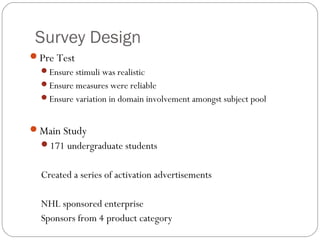
Survey Design
Pre Test
Ensure stimuli was realistic
Ensure measures were reliable
Ensure variation in domain involvement amongst subject pool
Main Study
171 undergraduate students
Created a series of activation advertisements
NHL sponsored enterprise
Sponsors from 4 product category
Four Constructs
Brand Quality of Sponsored Enterprise [i.e. NHL] (Yoo et al. 2000)
α = 0.93
Brand Quality of Sponsorship Portfolio (Yoo et al. 2000)
α(s) > 0.88
Domain Involvement (Gwinner and Swanson 2003)
α = 0.95
Perceived Prestige (Mael and Ashforth 1992; Gwinner and Swanson 2003)
α = 0.87
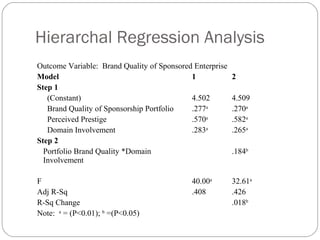
Hierarchal Regression Analysis
Outcome Variable: Brand Quality of Sponsored Enterprise
Model 1 2
Step 1
(Constant) 4.502 4.509
Brand Quality of Sponsorship Portfolio .277a
.270a
Perceived Prestige .570a
.582a
Domain Involvement .283a
.265a
Step 2
Portfolio Brand Quality *Domain
Involvement
.184b
F 40.00a
32.61a
Adj R-Sq .408 .426
R-Sq Change .018b
Note: a
= (P<0.01); b
=(P<0.05)
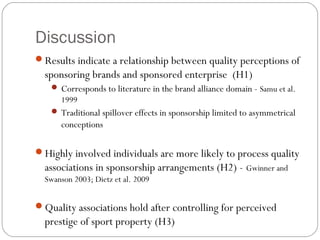
Discussion
Results indicate a relationship between quality perceptions of
sponsoring brands and sponsored enterprise (H1)
 Corresponds to literature in the brand alliance domain - Samu et al.
1999
 Traditional spillover effects in sponsorship limited to asymmetrical
conceptions
Highly involved individuals are more likely to process quality
associations in sponsorship arrangements (H2) - Gwinner and
Swanson 2003; Dietz et al. 2009
Quality associations hold after controlling for perceived
prestige of sport property (H3)
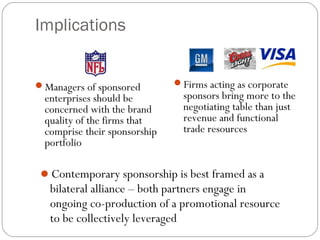
Implications
Managers of sponsored
enterprises should be
concerned with the brand
quality of the firms that
comprise their sponsorship
portfolio
Firms acting as corporate
sponsors bring more to the
negotiating table than just
revenue and functional
trade resources
Contemporary sponsorship is best framed as a
bilateral alliance – both partners engage in
ongoing co-production of a promotional resource
to be collectively leveraged
Next Steps
Survey sponsorship decision makers
Expand context to different domains [i.e.
causes, arts, events]
Questions?

Challenging unilateral brand spillover effects in sponsorship portfolios

  • 1.
    Mark D. Groza Universityof Massachusetts –Amherst Joe Cobbs Northern Kentucky University A Portfolio Approach to Sponsorship Alliances: ChallengingA Portfolio Approach to Sponsorship Alliances: Challenging Unilateral Brand Spillover EffectsUnilateral Brand Spillover Effects
  • 2.
    Presentation Outline Research Motivation TheoreticalBackground and Hypotheses Survey design and empirical results Discussion and Implications
  • 3.
    Research Motivation “Earlier thisyear, BP signed on as a major USOC sponsor, saying the Olympic movement's commitment to environmental issues gave it a perfect platform to promote its own green initiatives. …. The deal puts the USOC in an awkward situation -- partners with a company involved in an environmental disaster on U.S. shores -- though CEO Scott Blackmun said Monday he sees no indication that the sponsorship could be in jeopardy.” -- ESPN.com, May, 3, 2010 Feb. 15, 2010
  • 4.
    Commercial Sponsorship “Provision ofassistance either financial or in kind to an activity by a commercial organization for the purpose of achieving commercial objectives” – Meenaghan, 1983 Top objectives: Build brand equity (Cliffe & Motion, 2005; Thjømøe et al., 2002); Goodwill (Meenaghan, 2001) Sponsoring firm/brand Popular [sports] enterprise $ VIK Benefits
  • 5.
    Sports Brand ValuesSportsBrand Values* (Forbes Magazine, 2010) 1. New York Yankees $328M 2. Manchester United $285M 3. Real Madrid $240M 4. Dallas Cowboys $208M 5. Barcelona $180M 6. Bayern Munich $178M 7. Arsenal $176M 8. Boston Red Sox $163M 9. New York Mets $158M 10. New England Patriots $156M *Revenues from sponsorships, naming rights, local media, tickets and merchandise that are not attributable to market demographics and league.
  • 6.
    Brand Spillover Effects H1)Consumer perceptions of a sponsored enterprise’s brand quality will be positively associated with the brand quality perceptions of the firms within the sponsored enterprise’s sponsorship portfolio. Dimensions of Brand Equity •Loyalty •Associations •Awareness •QUALITY Aaker (1991)
  • 7.
    Involvement Elaboration Likelihood Model-- when evaluating advertisements relevant to ones consumption interests people pay closer attention -- Petty and Cacioppo 1981; Petty, Cacioppo, and Schumann 1983 Involvement in the sponsorship domain —Gwinner and Swanson 2003 H2) A consumer’s involvement in the sponsored enterprise’s domain will positively moderate the relationship between the perceived brand quality of the sponsors within a portfolio and the perceived brand quality of the sponsored enterprise.
  • 8.
    Perceived Prestige Social prestigeinfluences consumer evaluations of brand quality (Hellofs and Jacobson 1999) H3) The level of prestige a consumer associates with a sponsored enterprise will be positively related to the perceived brand quality of the sponsored enterprise.
  • 9.
    Reverse Image TransferModel Perceived Prestige of Sponsored Enterprise Perceived Brand Quality of Sponsors Involvement in Sponsored Enterprise’s Domain Perceived Brand Quality of Sponsored Enterprise H1 (+) H2 (+) H3 (+)
  • 10.
    Survey Design Pre Test Ensurestimuli was realistic Ensure measures were reliable Ensure variation in domain involvement amongst subject pool Main Study 171 undergraduate students Created a series of activation advertisements NHL sponsored enterprise Sponsors from 4 product category
  • 11.
    Four Constructs Brand Qualityof Sponsored Enterprise [i.e. NHL] (Yoo et al. 2000) α = 0.93 Brand Quality of Sponsorship Portfolio (Yoo et al. 2000) α(s) > 0.88 Domain Involvement (Gwinner and Swanson 2003) α = 0.95 Perceived Prestige (Mael and Ashforth 1992; Gwinner and Swanson 2003) α = 0.87
  • 12.
    Hierarchal Regression Analysis OutcomeVariable: Brand Quality of Sponsored Enterprise Model 1 2 Step 1 (Constant) 4.502 4.509 Brand Quality of Sponsorship Portfolio .277a .270a Perceived Prestige .570a .582a Domain Involvement .283a .265a Step 2 Portfolio Brand Quality *Domain Involvement .184b F 40.00a 32.61a Adj R-Sq .408 .426 R-Sq Change .018b Note: a = (P<0.01); b =(P<0.05)
  • 13.
    Discussion Results indicate arelationship between quality perceptions of sponsoring brands and sponsored enterprise (H1)  Corresponds to literature in the brand alliance domain - Samu et al. 1999  Traditional spillover effects in sponsorship limited to asymmetrical conceptions Highly involved individuals are more likely to process quality associations in sponsorship arrangements (H2) - Gwinner and Swanson 2003; Dietz et al. 2009 Quality associations hold after controlling for perceived prestige of sport property (H3)
  • 14.
    Implications Managers of sponsored enterprisesshould be concerned with the brand quality of the firms that comprise their sponsorship portfolio Firms acting as corporate sponsors bring more to the negotiating table than just revenue and functional trade resources Contemporary sponsorship is best framed as a bilateral alliance – both partners engage in ongoing co-production of a promotional resource to be collectively leveraged
  • 15.
    Next Steps Survey sponsorshipdecision makers Expand context to different domains [i.e. causes, arts, events] Questions?

Editor's Notes

  • #2 2 Objectives : investigate the relationship between sponsoring brands and the perception of the sponsored enterprise’s brand examine the role domain involvement NBA recently allowed “Hard Spirits” to be a corporate sponsors; Bacardi signed as an sponsor; does this affect the image of the NBA brand
  • #3 First 2 points  me Next two  mark
  • #4 If you’re the USOC, should you be concerned about your ‘partner’?
  • #5 Objectives: G&amp;E, ‘99; Thjomoe and colleagues 2002; Crowley 1991; Meenaghan &amp; Shipley (’99); O’Hagan &amp; Harvey (‘00); Crimmins &amp; Horne (‘05) Traditional representation Research focus on sponsoring firm This is important because… Sponsors offer more than $ and Value-in-kind Image transfer is not unidirectional Commonly sponsored enterprises have built their own valuable brands (Gladden &amp; Milne ‘03; Forbes Magazine)
  • #6 Commonly sponsored non-profit organizations also have valuable brands Susan G. Koman Foundation Life Strong March of dimes
  • #7 Theoretically based on  Associative Network Model (McCracken 89; Gwinner 97) G&amp;E ‘99 make assumption that primary focus of consumer is on sports event, which is more salient and thus image transferred from sports brand to sponsor. However, research (Crimmins &amp; Horn, ‘96; Quester &amp; Thompson ‘01) has also emphasized the importance of sponsor activation through leverage with other marketing resources. In an leveraging situation, the consumer’s focus is likely to be on the sponsoring brand and the assumption of unidirectional image transfer may not be valid.
  • #8 Theoretical grounded in ELM
  • #9 Theory has shown a strong relationship between perceptions of social prestige and assessments of brand quality
  • #11 Created a series of advertisement that highlighted a sport property and its portfolio of sponsors;
  • #12 After a distracter task we asked for brand
  • #14 We had distracter task between we asked for brand
  • #15 There are important Implications for both partners in the dyad