PHYSICAL AND OPTICAL
PROPERTIES
OF AMPHIBOLE
Shankar Lamani
223102024
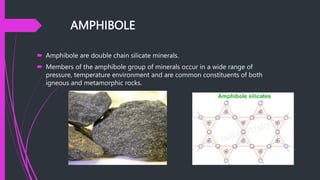
AMPHIBOLE
 Amphibole are double chain silicate minerals.
 Members of the amphibole group of minerals occur in a wide range of
pressure, temperature environment and are common constituents of both
igneous and metamorphic rocks.
General formula
 W 0-1 X2 Y5 Z8 O22 (OH)2 ➢ W = 𝑁𝑎+,𝐾+
 ➢ X = 𝐶𝑎2+, 𝑁𝑎2+, 𝐾+, 𝑀𝑔2+, 𝐹𝑒2+, 𝑀𝑛2+
 ➢ Y= 𝑀𝑔2+, 𝐹𝑒2+, 𝐹𝑒3+, 𝐴𝑙3+, 𝑇𝑖4+, 𝑀𝑛2+, 𝐶𝑟3+, 𝐿𝑖+,𝑍𝑛2+
 ➢ Z= 𝑆𝑖4+, 𝐴𝑙3+
 ➢ OH may be replaced by 𝐹−, 𝑂2−
 The amphiboles crystallise in one of the two crystal systems:
 ➢ Orthorhombic and
 ➢ Monoclinic.
 ➢ Those in which Ca and Na are almost absent may crystallise either in
orthorhombic or in the monoclinic system; but
 ➢ Those containing Ca, Na etc. are always monoclinic.
 ➢ The most prominent elements commonly constituting an amphibole
composition are Ca, Na, Si, Al, Mg, Fe2+, Fe3+ etc.
Physical Properties
 Habit: Prismatic
 Color: Black
 Streak: white
 Lusture: Vitreous
 Diaphinity: Translucent
 Cleavage: 2 Sets
 Fracture: Uneven
 Hardness: 5-6
 Specific gravity: 2.9-3.5
 Uses : Industrial uses
Optical Properties
PPL BXP
Relief: Medium Anisotropic
Pleochroism: Green to brown Oblique extinction
Cleavage: 1 set Birefringence: Moderate
Form: Elongated Interference: 2nd and 4rth order
Thank You

Amphibole.pptx

  • 1.
    PHYSICAL AND OPTICAL PROPERTIES OFAMPHIBOLE Shankar Lamani 223102024
  • 2.
    AMPHIBOLE  Amphibole aredouble chain silicate minerals.  Members of the amphibole group of minerals occur in a wide range of pressure, temperature environment and are common constituents of both igneous and metamorphic rocks.
  • 3.
    General formula  W0-1 X2 Y5 Z8 O22 (OH)2 ➢ W = 𝑁𝑎+,𝐾+  ➢ X = 𝐶𝑎2+, 𝑁𝑎2+, 𝐾+, 𝑀𝑔2+, 𝐹𝑒2+, 𝑀𝑛2+  ➢ Y= 𝑀𝑔2+, 𝐹𝑒2+, 𝐹𝑒3+, 𝐴𝑙3+, 𝑇𝑖4+, 𝑀𝑛2+, 𝐶𝑟3+, 𝐿𝑖+,𝑍𝑛2+  ➢ Z= 𝑆𝑖4+, 𝐴𝑙3+  ➢ OH may be replaced by 𝐹−, 𝑂2−
  • 4.
     The amphibolescrystallise in one of the two crystal systems:  ➢ Orthorhombic and  ➢ Monoclinic.  ➢ Those in which Ca and Na are almost absent may crystallise either in orthorhombic or in the monoclinic system; but  ➢ Those containing Ca, Na etc. are always monoclinic.  ➢ The most prominent elements commonly constituting an amphibole composition are Ca, Na, Si, Al, Mg, Fe2+, Fe3+ etc.
  • 5.
    Physical Properties  Habit:Prismatic  Color: Black  Streak: white  Lusture: Vitreous  Diaphinity: Translucent  Cleavage: 2 Sets  Fracture: Uneven  Hardness: 5-6  Specific gravity: 2.9-3.5  Uses : Industrial uses
  • 6.
    Optical Properties PPL BXP Relief:Medium Anisotropic Pleochroism: Green to brown Oblique extinction Cleavage: 1 set Birefringence: Moderate Form: Elongated Interference: 2nd and 4rth order
  • 7.

Editor's Notes