Alternative Accounting
Method
This presentation aims to discuss an alternative accounting method that
provides a sneak peak into the movement of finances, in and out of an
entity.
Topics To Be Covered
1. New Accounts System- Introduction
2. Example
3. How To Perform Accounting
4. Rules
5. Application in SWOT Analysis
New Accounts System- Introduction
• This alternative system changes how we record data for accounting.
• This simplistic approach is aimed to reduce the time taken to manage accounts.
• Even a person with no accounts background can understand these new accounts records and be aware of
the money flow of their entity.
• Hopefully these will also make tax filing much quicker and easier.
• Let’s see how the accounts process works through an example.
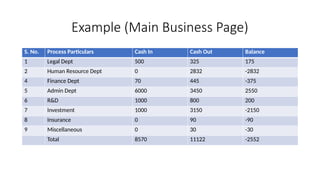
Example (Main Business Page)
S. No. Process Particulars Cash In Cash Out Balance
1 Legal Dept 500 325 175
2 Human Resource Dept 0 2832 -2832
4 Finance Dept 70 445 -375
5 Admin Dept 6000 3450 2550
6 R&D 1000 800 200
7 Investment 1000 3150 -2150
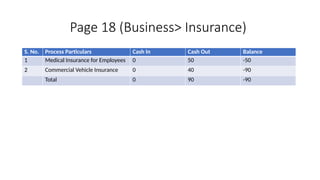
8 Insurance 0 90 -90
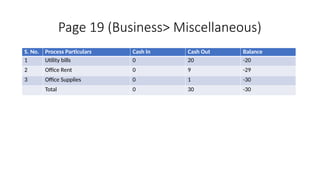
9 Miscellaneous 0 30 -30
Total 8570 11122 -2552
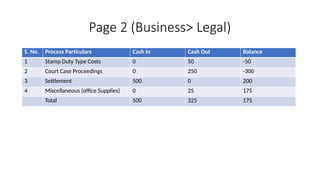
Page 2 (Business> Legal)
S. No. Process Particulars Cash In Cash Out Balance
1 Stamp Duty Type Costs 0 50 -50
2 Court Case Proceedings 0 250 -300
3 Settlement 500 0 200
4 Miscellaneous (office Supplies) 0 25 175
Total 500 325 175
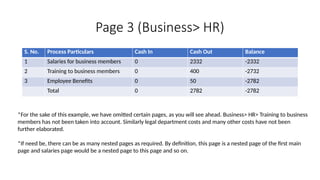
Page 3 (Business> HR)
S. No. Process Particulars Cash In Cash Out Balance
1 Salaries for business members 0 2332 -2332
2 Training to business members 0 400 -2732
3 Employee Benefits 0 50 -2782
Total 0 2782 -2782
*For the sake of this example, we have omitted certain pages, as you will see ahead. Business> HR> Training to business
members has not been taken into account. Similarly legal department costs and many other costs have not been
further elaborated.
*If need be, there can be as many nested pages as required. By definition, this page is a nested page of the first main
page and salaries page would be a nested page to this page and so on.
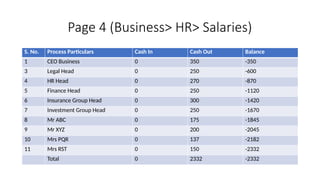
Page 4 (Business> HR> Salaries)
S. No. Process Particulars Cash In Cash Out Balance
1 CEO Business 0 350 -350
3 Legal Head 0 250 -600
4 HR Head 0 270 -870
5 Finance Head 0 250 -1120
6 Insurance Group Head 0 300 -1420
7 Investment Group Head 0 250 -1670
8 Mr ABC 0 175 -1845
9 Mr XYZ 0 200 -2045
10 Mrs PQR 0 137 -2182
11 Mrs RST 0 150 -2332
Total 0 2332 -2332
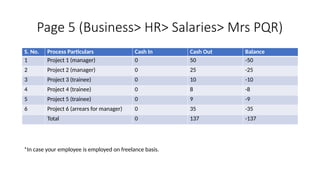
Page 5 (Business> HR> Salaries> Mrs PQR)
S. No. Process Particulars Cash In Cash Out Balance
1 Project 1 (manager) 0 50 -50
2 Project 2 (manager) 0 25 -25
3 Project 3 (trainee) 0 10 -10
4 Project 4 (trainee) 0 8 -8
5 Project 5 (trainee) 0 9 -9
6 Project 6 (arrears for manager) 0 35 -35
Total 0 137 -137
*In case your employee is employed on freelance basis.
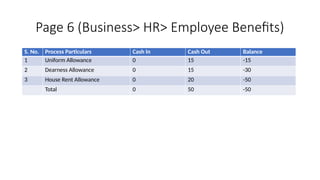
Page 6 (Business> HR> Employee Benefits)
S. No. Process Particulars Cash In Cash Out Balance
1 Uniform Allowance 0 15 -15
2 Dearness Allowance 0 15 -30
3 House Rent Allowance 0 20 -50
Total 0 50 -50
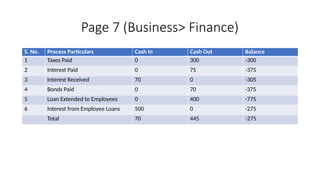
Page 7 (Business> Finance)
S. No. Process Particulars Cash In Cash Out Balance
1 Taxes Paid 0 300 -300
2 Interest Paid 0 75 -375
3 Interest Received 70 0 -305
4 Bonds Paid 0 70 -375
5 Loan Extended to Employees 0 400 -775
6 Interest from Employee Loans 500 0 -275
Total 70 445 -275
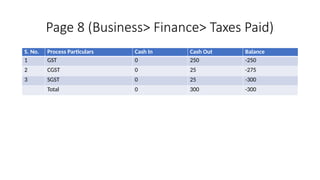
Page 8 (Business> Finance> Taxes Paid)
S. No. Process Particulars Cash In Cash Out Balance
1 GST 0 250 -250
2 CGST 0 25 -275
3 SGST 0 25 -300
Total 0 300 -300
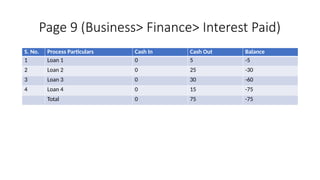
Page 9 (Business> Finance> Interest Paid)
S. No. Process Particulars Cash In Cash Out Balance
1 Loan 1 0 5 -5
2 Loan 2 0 25 -30
3 Loan 3 0 30 -60
4 Loan 4 0 15 -75
Total 0 75 -75
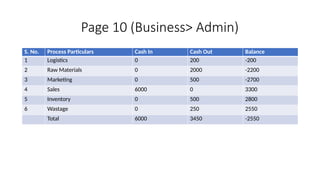
Page 10 (Business> Admin)
S. No. Process Particulars Cash In Cash Out Balance
1 Logistics 0 200 -200
2 Raw Materials 0 2000 -2200
3 Marketing 0 500 -2700
4 Sales 6000 0 3300
5 Inventory 0 500 2800
6 Wastage 0 250 2550
Total 6000 3450 -2550
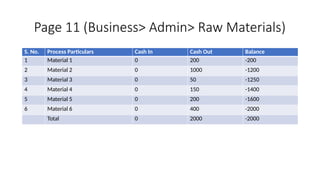
Page 11 (Business> Admin> Raw Materials)
S. No. Process Particulars Cash In Cash Out Balance
1 Material 1 0 200 -200
2 Material 2 0 1000 -1200
3 Material 3 0 50 -1250
4 Material 4 0 150 -1400
5 Material 5 0 200 -1600
6 Material 6 0 400 -2000
Total 0 2000 -2000
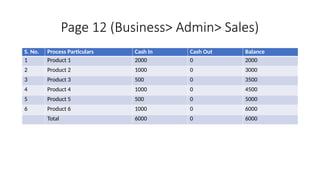
Page 12 (Business> Admin> Sales)
S. No. Process Particulars Cash In Cash Out Balance
1 Product 1 2000 0 2000
2 Product 2 1000 0 3000
3 Product 3 500 0 3500
4 Product 4 1000 0 4500
5 Product 5 500 0 5000
6 Product 6 1000 0 6000
Total 6000 0 6000
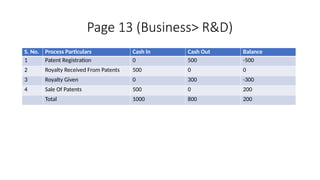
Page 13 (Business> R&D)
S. No. Process Particulars Cash In Cash Out Balance
1 Patent Registration 0 500 -500
2 Royalty Received From Patents 500 0 0
3 Royalty Given 0 300 -300
4 Sale Of Patents 500 0 200
Total 1000 800 200
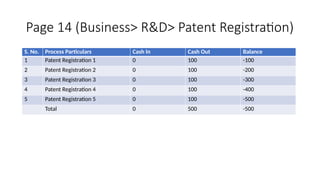
Page 14 (Business> R&D> Patent Registration)
S. No. Process Particulars Cash In Cash Out Balance
1 Patent Registration 1 0 100 -100
2 Patent Registration 2 0 100 -200
3 Patent Registration 3 0 100 -300
4 Patent Registration 4 0 100 -400
5 Patent Registration 5 0 100 -500
Total 0 500 -500
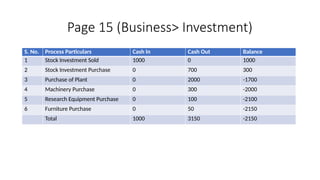
Page 15 (Business> Investment)
S. No. Process Particulars Cash In Cash Out Balance
1 Stock Investment Sold 1000 0 1000
2 Stock Investment Purchase 0 700 300
3 Purchase of Plant 0 2000 -1700
4 Machinery Purchase 0 300 -2000
5 Research Equipment Purchase 0 100 -2100
6 Furniture Purchase 0 50 -2150
Total 1000 3150 -2150
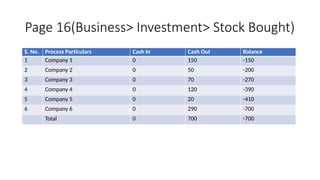
Page 16(Business> Investment> Stock Bought)
S. No. Process Particulars Cash In Cash Out Balance
1 Company 1 0 150 -150
2 Company 2 0 50 -200
3 Company 3 0 70 -270
4 Company 4 0 120 -390
5 Company 5 0 20 -410
6 Company 6 0 290 -700
Total 0 700 -700
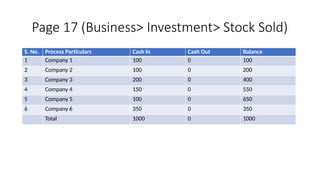
Page 17 (Business> Investment> Stock Sold)
S. No. Process Particulars Cash In Cash Out Balance
1 Company 1 100 0 100
2 Company 2 100 0 200
3 Company 3 200 0 400
4 Company 4 150 0 550
5 Company 5 100 0 650
6 Company 6 350 0 350
Total 1000 0 1000
Page 18 (Business> Insurance)
S. No. Process Particulars Cash In Cash Out Balance
1 Medical Insurance for Employees 0 50 -50
2 Commercial Vehicle Insurance 0 40 -90
Total 0 90 -90
Page 19 (Business> Miscellaneous)
S. No. Process Particulars Cash In Cash Out Balance
1 Utility bills 0 20 -20
2 Office Rent 0 9 -29
3 Office Supplies 0 1 -30
Total 0 30 -30
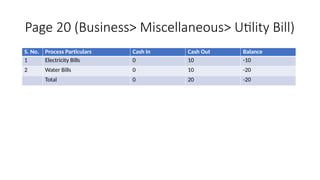
Page 20 (Business> Miscellaneous> Utility Bill)
S. No. Process Particulars Cash In Cash Out Balance
1 Electricity Bills 0 10 -10
2 Water Bills 0 10 -20
Total 0 20 -20
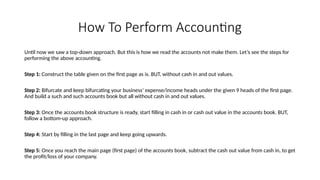
How To Perform Accounting
Until now we saw a top-down approach. But this is how we read the accounts not make them. Let’s see the steps for
performing the above accounting.
Step 1: Construct the table given on the first page as is. BUT, without cash in and out values.
Step 2: Bifurcate and keep bifurcating your business’ expense/income heads under the given 9 heads of the first page.
And build a such and such accounts book but all without cash in and out values.
Step 3: Once the accounts book structure is ready, start filling in cash in or cash out value in the accounts book. BUT,
follow a bottom-up approach.
Step 4: Start by filling in the last page and keep going upwards.
Step 5: Once you reach the main page (first page) of the accounts book, subtract the cash out value from cash in, to get
the profit/loss of your company.
Rules Of This Accounts System
Rule 1: An expense/income head can appear only once in the entire accounts book.
Rule 2: Their can only be a cash in value or a cash out value.
For example: Stock sold and stock purchased are two different entries. Either of the cash in or cash out value
has to be zero.
Rule 3: If there are various businesses within your business, let’s say in case of a conglomerate or venture
capitalist business, again follow the above approach.
For example: ABC parent company has two subsidiaries, then first the accounting for the subsidiaries will be
done, and then the cash in and cash out values from those two subsidiaries will be used in the parent
company’s accounting. This will be done in two stages. First parallelly for the subsidiaries and then for the
parent company in stage two.
Rules Of This Accounts System
Rule 4: One can also follow this two stage approach for businesses with various types of operations running
within the same business.
For example, a pharma company, that does both CDMO and branded formulations business, can also divide its
accounting book into two parts where they parallelly build both books and combine the final cash in and cash
out value to arrive at the final profit/loss of the company.
This will provide a further clarity into how the business is performing for both the segments.
Rule 5: Balance for every entry is arrived at by subtracting cash out from cash in.
Applications In SWOT Analysis
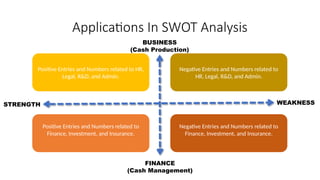
Positive Entries and Numbers related to HR,
Legal, R&D, and Admin.
Negative Entries and Numbers related to
Finance, Investment, and Insurance.
Positive Entries and Numbers related to
Finance, Investment, and Insurance.
Negative Entries and Numbers related to
HR, Legal, R&D, and Admin.
STRENGTH WEAKNESS
BUSINESS
(Cash Production)
FINANCE
(Cash Management)
Thank You!

alternative accounting method with SWOT analysis.pptx

  • 1.
    Alternative Accounting Method This presentationaims to discuss an alternative accounting method that provides a sneak peak into the movement of finances, in and out of an entity.
  • 2.
    Topics To BeCovered 1. New Accounts System- Introduction 2. Example 3. How To Perform Accounting 4. Rules 5. Application in SWOT Analysis
  • 3.
    New Accounts System-Introduction • This alternative system changes how we record data for accounting. • This simplistic approach is aimed to reduce the time taken to manage accounts. • Even a person with no accounts background can understand these new accounts records and be aware of the money flow of their entity. • Hopefully these will also make tax filing much quicker and easier. • Let’s see how the accounts process works through an example.
  • 4.
    Example (Main BusinessPage) S. No. Process Particulars Cash In Cash Out Balance 1 Legal Dept 500 325 175 2 Human Resource Dept 0 2832 -2832 4 Finance Dept 70 445 -375 5 Admin Dept 6000 3450 2550 6 R&D 1000 800 200 7 Investment 1000 3150 -2150 8 Insurance 0 90 -90 9 Miscellaneous 0 30 -30 Total 8570 11122 -2552
  • 5.
    Page 2 (Business>Legal) S. No. Process Particulars Cash In Cash Out Balance 1 Stamp Duty Type Costs 0 50 -50 2 Court Case Proceedings 0 250 -300 3 Settlement 500 0 200 4 Miscellaneous (office Supplies) 0 25 175 Total 500 325 175
  • 6.
    Page 3 (Business>HR) S. No. Process Particulars Cash In Cash Out Balance 1 Salaries for business members 0 2332 -2332 2 Training to business members 0 400 -2732 3 Employee Benefits 0 50 -2782 Total 0 2782 -2782 *For the sake of this example, we have omitted certain pages, as you will see ahead. Business> HR> Training to business members has not been taken into account. Similarly legal department costs and many other costs have not been further elaborated. *If need be, there can be as many nested pages as required. By definition, this page is a nested page of the first main page and salaries page would be a nested page to this page and so on.
  • 7.
    Page 4 (Business>HR> Salaries) S. No. Process Particulars Cash In Cash Out Balance 1 CEO Business 0 350 -350 3 Legal Head 0 250 -600 4 HR Head 0 270 -870 5 Finance Head 0 250 -1120 6 Insurance Group Head 0 300 -1420 7 Investment Group Head 0 250 -1670 8 Mr ABC 0 175 -1845 9 Mr XYZ 0 200 -2045 10 Mrs PQR 0 137 -2182 11 Mrs RST 0 150 -2332 Total 0 2332 -2332
  • 8.
    Page 5 (Business>HR> Salaries> Mrs PQR) S. No. Process Particulars Cash In Cash Out Balance 1 Project 1 (manager) 0 50 -50 2 Project 2 (manager) 0 25 -25 3 Project 3 (trainee) 0 10 -10 4 Project 4 (trainee) 0 8 -8 5 Project 5 (trainee) 0 9 -9 6 Project 6 (arrears for manager) 0 35 -35 Total 0 137 -137 *In case your employee is employed on freelance basis.
  • 9.
    Page 6 (Business>HR> Employee Benefits) S. No. Process Particulars Cash In Cash Out Balance 1 Uniform Allowance 0 15 -15 2 Dearness Allowance 0 15 -30 3 House Rent Allowance 0 20 -50 Total 0 50 -50
  • 10.
    Page 7 (Business>Finance) S. No. Process Particulars Cash In Cash Out Balance 1 Taxes Paid 0 300 -300 2 Interest Paid 0 75 -375 3 Interest Received 70 0 -305 4 Bonds Paid 0 70 -375 5 Loan Extended to Employees 0 400 -775 6 Interest from Employee Loans 500 0 -275 Total 70 445 -275
  • 11.
    Page 8 (Business>Finance> Taxes Paid) S. No. Process Particulars Cash In Cash Out Balance 1 GST 0 250 -250 2 CGST 0 25 -275 3 SGST 0 25 -300 Total 0 300 -300
  • 12.
    Page 9 (Business>Finance> Interest Paid) S. No. Process Particulars Cash In Cash Out Balance 1 Loan 1 0 5 -5 2 Loan 2 0 25 -30 3 Loan 3 0 30 -60 4 Loan 4 0 15 -75 Total 0 75 -75
  • 13.
    Page 10 (Business>Admin) S. No. Process Particulars Cash In Cash Out Balance 1 Logistics 0 200 -200 2 Raw Materials 0 2000 -2200 3 Marketing 0 500 -2700 4 Sales 6000 0 3300 5 Inventory 0 500 2800 6 Wastage 0 250 2550 Total 6000 3450 -2550
  • 14.
    Page 11 (Business>Admin> Raw Materials) S. No. Process Particulars Cash In Cash Out Balance 1 Material 1 0 200 -200 2 Material 2 0 1000 -1200 3 Material 3 0 50 -1250 4 Material 4 0 150 -1400 5 Material 5 0 200 -1600 6 Material 6 0 400 -2000 Total 0 2000 -2000
  • 15.
    Page 12 (Business>Admin> Sales) S. No. Process Particulars Cash In Cash Out Balance 1 Product 1 2000 0 2000 2 Product 2 1000 0 3000 3 Product 3 500 0 3500 4 Product 4 1000 0 4500 5 Product 5 500 0 5000 6 Product 6 1000 0 6000 Total 6000 0 6000
  • 16.
    Page 13 (Business>R&D) S. No. Process Particulars Cash In Cash Out Balance 1 Patent Registration 0 500 -500 2 Royalty Received From Patents 500 0 0 3 Royalty Given 0 300 -300 4 Sale Of Patents 500 0 200 Total 1000 800 200
  • 17.
    Page 14 (Business>R&D> Patent Registration) S. No. Process Particulars Cash In Cash Out Balance 1 Patent Registration 1 0 100 -100 2 Patent Registration 2 0 100 -200 3 Patent Registration 3 0 100 -300 4 Patent Registration 4 0 100 -400 5 Patent Registration 5 0 100 -500 Total 0 500 -500
  • 18.
    Page 15 (Business>Investment) S. No. Process Particulars Cash In Cash Out Balance 1 Stock Investment Sold 1000 0 1000 2 Stock Investment Purchase 0 700 300 3 Purchase of Plant 0 2000 -1700 4 Machinery Purchase 0 300 -2000 5 Research Equipment Purchase 0 100 -2100 6 Furniture Purchase 0 50 -2150 Total 1000 3150 -2150
  • 19.
    Page 16(Business> Investment>Stock Bought) S. No. Process Particulars Cash In Cash Out Balance 1 Company 1 0 150 -150 2 Company 2 0 50 -200 3 Company 3 0 70 -270 4 Company 4 0 120 -390 5 Company 5 0 20 -410 6 Company 6 0 290 -700 Total 0 700 -700
  • 20.
    Page 17 (Business>Investment> Stock Sold) S. No. Process Particulars Cash In Cash Out Balance 1 Company 1 100 0 100 2 Company 2 100 0 200 3 Company 3 200 0 400 4 Company 4 150 0 550 5 Company 5 100 0 650 6 Company 6 350 0 350 Total 1000 0 1000
  • 21.
    Page 18 (Business>Insurance) S. No. Process Particulars Cash In Cash Out Balance 1 Medical Insurance for Employees 0 50 -50 2 Commercial Vehicle Insurance 0 40 -90 Total 0 90 -90
  • 22.
    Page 19 (Business>Miscellaneous) S. No. Process Particulars Cash In Cash Out Balance 1 Utility bills 0 20 -20 2 Office Rent 0 9 -29 3 Office Supplies 0 1 -30 Total 0 30 -30
  • 23.
    Page 20 (Business>Miscellaneous> Utility Bill) S. No. Process Particulars Cash In Cash Out Balance 1 Electricity Bills 0 10 -10 2 Water Bills 0 10 -20 Total 0 20 -20
  • 24.
    How To PerformAccounting Until now we saw a top-down approach. But this is how we read the accounts not make them. Let’s see the steps for performing the above accounting. Step 1: Construct the table given on the first page as is. BUT, without cash in and out values. Step 2: Bifurcate and keep bifurcating your business’ expense/income heads under the given 9 heads of the first page. And build a such and such accounts book but all without cash in and out values. Step 3: Once the accounts book structure is ready, start filling in cash in or cash out value in the accounts book. BUT, follow a bottom-up approach. Step 4: Start by filling in the last page and keep going upwards. Step 5: Once you reach the main page (first page) of the accounts book, subtract the cash out value from cash in, to get the profit/loss of your company.
  • 25.
    Rules Of ThisAccounts System Rule 1: An expense/income head can appear only once in the entire accounts book. Rule 2: Their can only be a cash in value or a cash out value. For example: Stock sold and stock purchased are two different entries. Either of the cash in or cash out value has to be zero. Rule 3: If there are various businesses within your business, let’s say in case of a conglomerate or venture capitalist business, again follow the above approach. For example: ABC parent company has two subsidiaries, then first the accounting for the subsidiaries will be done, and then the cash in and cash out values from those two subsidiaries will be used in the parent company’s accounting. This will be done in two stages. First parallelly for the subsidiaries and then for the parent company in stage two.
  • 26.
    Rules Of ThisAccounts System Rule 4: One can also follow this two stage approach for businesses with various types of operations running within the same business. For example, a pharma company, that does both CDMO and branded formulations business, can also divide its accounting book into two parts where they parallelly build both books and combine the final cash in and cash out value to arrive at the final profit/loss of the company. This will provide a further clarity into how the business is performing for both the segments. Rule 5: Balance for every entry is arrived at by subtracting cash out from cash in.
  • 27.
    Applications In SWOTAnalysis Positive Entries and Numbers related to HR, Legal, R&D, and Admin. Negative Entries and Numbers related to Finance, Investment, and Insurance. Positive Entries and Numbers related to Finance, Investment, and Insurance. Negative Entries and Numbers related to HR, Legal, R&D, and Admin. STRENGTH WEAKNESS BUSINESS (Cash Production) FINANCE (Cash Management)
  • 28.