Information Literacy Lesson Plan
Lora Wendy Alligood
FRIT 7136
Spring 2013
Instructor: Dr. Repman

Pathfinder URL:http://famousamericanspathfinder.wikispaces.com/
GRADE: 3
Topic: Historical Figures of America
Media Specialist: Lora Alligood
Teacher(s): Smith, Jones, Stewart, Welborn, and Hensley
State Standards
WritingStandard
ELACC3W7:Research to Build and Present Knowledge: Conductshort research
projects that build knowledge about a topic.
Social Studies Standard
SS3H2:The student will discuss the lives of Americans who expanded people’s rights
and freedoms in a democracy.
a. Paul Revere (independence), Frederick Douglass (civil rights), Susan B.
Anthony (women’s rights), Mary McLeod Bethune (education), Franklin D.
Roosevelt (New Deal and World War II), Eleanor Roosevelt (United Nations
and human rights), Thurgood Marshall (civil rights), Lyndon B. Johnson
(Great Society and voting rights), and César Chávez (workers’ rights).
b. Explain social barriers, restrictions, and obstacles that these historical
figures had to overcome and describe how they overcame them.
American Association of School Librarian Standards for 21st Century Learners:
Standard 1: Inquire, think critically, and gain knowledge.
Skills:
1.1.1Follow an inquiry- based process in seeking knowledge in curricular
subjects, and make the real- world connection for using this process in own
life.
1.1.6 Read, view, and listen for information presented in any format (e.g.,
textual, visual, media, digital) in order to make inferences and gather
meaning.
1.1.9Collaborate with others to broaden and deepen understanding.
Responsibilities:
1.3.1Respect copyright/ intellectual property rights of creators and
producers.
1.3.4Contribute to the exchange of ideas within the learning community.
1.3.5Use information technology responsibly.
Self-Assessment:
1.4.1Monitor own information-seeking processes for effectiveness and
progress, and adapt as necessary.
1.4.2Use interaction with and feedback from teachers and peers to guide own
inquiry process.
1.4.4Seek appropriate help when it is needed.
Standard 2: Draw conclusions, make informed decisions, apply knowledge to new
situations, and create new knowledge.
Skills
2.1.4 Use technology and other information tools to analyze and organize
information.
2.1.5 Collaborate with others to exchange ideas, develop new
understandings, make decisions, and solve problems
2.1.6 Use the writing process, media and visual literacy, and technology skills
to create products that express new understandings.
Dispositions in Action:
2.2.4 Demonstrate personal productivity by completing products to express
learning.
Standard 3: Share knowledge and participate ethically and productively as members
of our democratic society.
Skills
3.1.2 Collaborate as members of a social and intellectual network of learners.
3.1.3 Use writing and speaking skills to communicate new understandings
effectively.
3.1.4 Use technology and other information tools to organize and display
knowledge and understanding in ways that others can view, use and assess.
3.1.6 Use information and technology ethically and responsibly
Dispositions in Action
3.2.3 Demonstrate teamwork by working productively with others
Self-Assessment:
3.4.2 Assess the quality and effectiveness of the learning product.
(2nd grade) Benchmarks:
1.1.6: Use simple note-taking strategies as demonstrated by SLMS
1.1.7: Summarize or retell key points
1.1.9: Listen to others with respect and
2.1.1: Find facts to answer questions in more than one source
2.1.5: work in groups to create, share and evaluate simple information products
2.1.6: Incorporate writing and oral skills to develop a product or performance
2.1.6: Revise work with peer or teacher guidance
3.1.1: Use simple rubrics to assess work
3.1.6: Credit sources by citing author and title
3.1.6: Follow school guidelines related to the acceptable use of technology
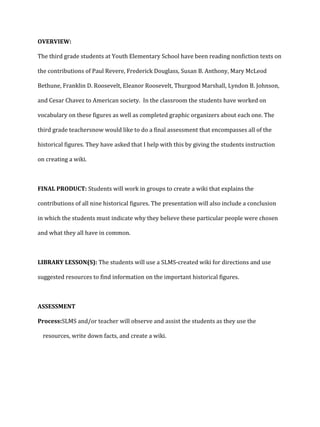
OVERVIEW:
The third grade students at Youth Elementary School have been reading nonfiction texts on
the contributions of Paul Revere, Frederick Douglass, Susan B. Anthony, Mary McLeod
Bethune, Franklin D. Roosevelt, Eleanor Roosevelt, Thurgood Marshall, Lyndon B. Johnson,
and Cesar Chavez to American society. In the classroom the students have worked on
vocabulary on these figures as well as completed graphic organizers about each one. The
third grade teachersnow would like to do a final assessment that encompasses all of the
historical figures. They have asked that I help with this by giving the students instruction
on creating a wiki.

FINAL PRODUCT: Students will work in groups to create a wiki that explains the
contributions of all nine historical figures. The presentation will also include a conclusion
in which the students must indicate why they believe these particular people were chosen
and what they all have in common.

LIBRARY LESSON(S): The students will use a SLMS-created wiki for directions and use
suggested resources to find information on the important historical figures.

ASSESSMENT
Process:SLMS and/or teacher will observe and assist the students as they use the
resources, write down facts, and create a wiki.
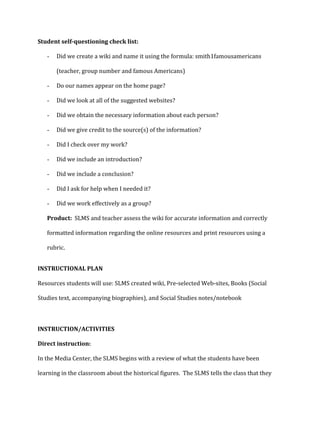
Student self-questioning check list:
-

Did we create a wiki and name it using the formula: smith1famousamericans
(teacher, group number and famous Americans)

-

Do our names appear on the home page?

-

Did we look at all of the suggested websites?

-

Did we obtain the necessary information about each person?

-

Did we give credit to the source(s) of the information?

-

Did I check over my work?

-

Did we include an introduction?

-

Did we include a conclusion?

-

Did I ask for help when I needed it?

-

Did we work effectively as a group?

Product: SLMS and teacher assess the wiki for accurate information and correctly
formatted information regarding the online resources and print resources using a
rubric.
INSTRUCTIONAL PLAN
Resources students will use: SLMS created wiki, Pre-selected Web-sites, Books (Social
Studies text, accompanying biographies), and Social Studies notes/notebook

INSTRUCTION/ACTIVITIES
Direct instruction:
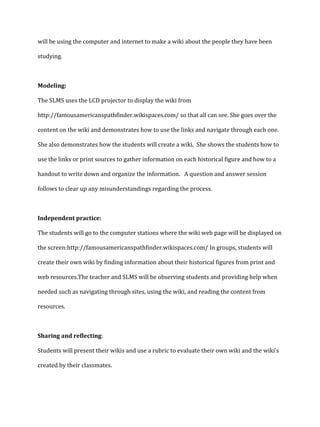
In the Media Center, the SLMS begins with a review of what the students have been
learning in the classroom about the historical figures. The SLMS tells the class that they
will be using the computer and internet to make a wiki about the people they have been
studying.

Modeling:
The SLMS uses the LCD projector to display the wiki from
http://famousamericanspathfinder.wikispaces.com/ so that all can see. She goes over the
content on the wiki and demonstrates how to use the links and navigate through each one.
She also demonstrates how the students will create a wiki. She shows the students how to
use the links or print sources to gather information on each historical figure and how to a
handout to write down and organize the information. A question and answer session
follows to clear up any misunderstandings regarding the process.

Independent practice:
The students will go to the computer stations where the wiki web page will be displayed on
the screen:http://famousamericanspathfinder.wikispaces.com/ In groups, students will
create their own wiki by finding information about their historical figures from print and
web resources.The teacher and SLMS will be observing students and providing help when
needed such as navigating through sites, using the wiki, and reading the content from
resources.

Sharing and reflecting:
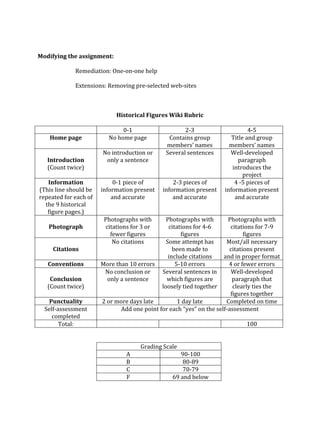
Students will present their wikis and use a rubric to evaluate their own wiki and the wiki’s
created by their classmates.
Modifying the assignment:
Remediation: One-on-one help
Extensions: Removing pre-selected web-sites

Historical Figures Wiki Rubric
Home page
Introduction
(Count twice)
Information
(This line should be
repeated for each of
the 9 historical
figure pages.)
Photograph
Citations
Conventions
Conclusion
(Count twice)
Punctuality
Self-assessment
completed
Total:

0-1
No home page
No introduction or
only a sentence

2-3
Contains group
members’ names
Several sentences

0-1 piece of
information present
and accurate

2-3 pieces of
information present
and accurate

Photographs with
citations for 3 or
fewer figures
No citations

4-5
Title and group
members’ names
Well-developed
paragraph
introduces the
project
4 -5 pieces of
information present
and accurate

Photographs with
citations for 4-6
figures
Some attempt has
been made to
include citations
5-10 errors
Several sentences in
which figures are
loosely tied together

Photographs with
citations for 7-9
figures
Most/all necessary
citations present
and in proper format
More than 10 errors
4 or fewer errors
No conclusion or
Well-developed
only a sentence
paragraph that
clearly ties the
figures together
2 or more days late
1 day late
Completed on time
Add one point for each “yes” on the self-assessment
100
Grading Scale
A
B
C
F

90-100
80-89
70-79
69 and below
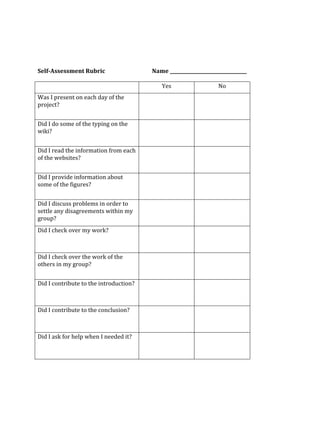
Self-Assessment Rubric

Name _________________________________
Yes

Was I present on each day of the
project?
Did I do some of the typing on the
wiki?
Did I read the information from each
of the websites?
Did I provide information about
some of the figures?
Did I discuss problems in order to
settle any disagreements within my
group?
Did I check over my work?

Did I check over the work of the
others in my group?
Did I contribute to the introduction?

Did I contribute to the conclusion?

Did I ask for help when I needed it?

No
Reflection
The collaboration went well because I have taught third grade for the past three
years and am well aware of the need for a cumulative assessment for this unit. It is the
longest unit in third grade; we allow a week and a half per historical figure which means it
takes about 13 weeks to get through all of them. Both social studies and reading time are
utilized. Although we give a test or some other type of assessment on each figure, we all felt
it was important to have the students tie them all together in a meaningful way.
In the past we have used a timeline as a big review right before CRCT. While this
does help the students to recall the information and get a better sense of context, it did
little to encourage deeper thinking. We all felt a summarizing activity was needed. Since I
currently teach third grade, it was not difficult to meet with the other teachers as we have
the same planning time. This has made me aware that should I become a media specialist, I
should ask for a floating planning period that coincides with a different grade level’s
planning time on each day of the week.
The media center has ten computer stations, so we can accommodate a class
working in groups. However, the stations are arranged in circles with each computer
station being a wedge which makes it a little difficult for groups to get around the monitors.
We do have two other computer labs that the teachers could utilize; however, the media
specialist would not be able to assist in that location since we currently have no Para in the
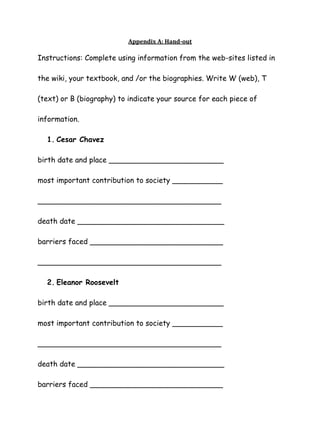
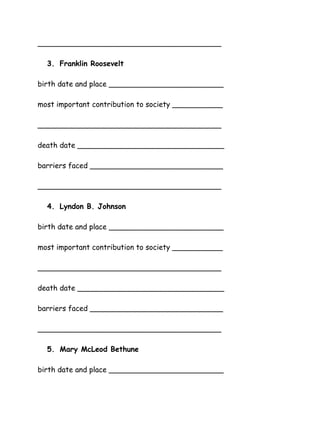
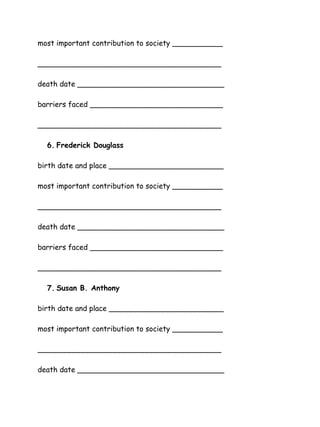
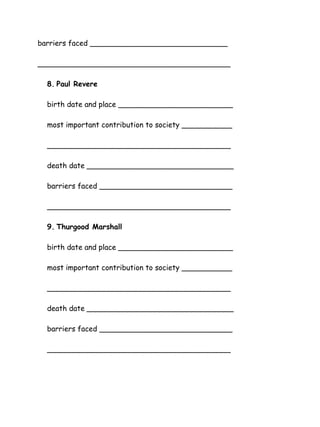
media center. In order to solve this problem, a handout (see appendix A)was created so
that students could work at the library tables when using print sources such as their notes,
textbook and the accompanying biographies on each person. This also ensured that
computer stations were available for other library patrons.
Group work is always a challenge. Some kids would prefer to work alone, some
would prefer not to work at all, and some would prefer a different partner. While working
with others is something the students must learn to do, we endeavored to make this as
enjoyable as possible. Each teacher was responsible for assigning partners or small groups
prior to coming to the media center. Classroom teachers know which students should or
should not be placed together.
The students love working with technology and are well aware of our county
policies regarding its misuse. They were able to use the wiki and navigate to the various
web-sites with minimal trouble and very little assistance. The information they had to
gather for the individual wiki pages was all review which made those parts relatively easy
for the students.
The most difficult part for the students and one of the most meaningful in terms of
learning was the final concluding paragraph in which they had to analyze why these
particular persons were chosen to be studied by third graders as well as to draw some
conclusions as to what they had in common. The teachers agreed that the students learned
most about the historical figures from this part of the activity. The use of technology, the
group work, and the citation requirements were also important 21st century skills. Asking
the students to analyze why these particular people may have been selected for study, led
the students to form connections such as “these people all had to overcome barriers” and
“all of the people we studied had certain character traits such as perseverance and
diligence”.
Using pre-selected web-sites meant that the students did not have to locate or
evaluate sources on their own. In the future this assignment could be made more
challenging and encompass more 21st century skills by requiring the students to choose
from more extensive lists of pre-selected web-sites or having the students find their own
sources. This would mean the SLMS would also teach the students how to evaluate a website to determine if it is appropriate and credible.
One aspect that I found difficult was narrowing my 21st century learner standards.
All or many of them seemed to apply to this activity. I think I included too many but was
not sure which to leave out.
One error that I made in pre-selecting the web-sites that I was unaware of until the
students began using them was that not all the links contained photographs. Since this was
a required element, the teachers and I had to assist them in finding appropriate sources.
This created confusion and reinforced the importance of pre-selecting web-sites. The websites will have to be checked and new ones added for next year when we will definitely do
this again. Hopefully, I will be the actual media specialist by then and not just acting like
one.
Appendix A: Hand-out

Instructions: Complete using information from the web-sites listed in
the wiki, your textbook, and /or the biographies. Write W (web), T
(text) or B (biography) to indicate your source for each piece of
information.
1. Cesar Chavez
birth date and place _________________________
most important contribution to society ___________
________________________________________
death date ________________________________
barriers faced _____________________________
________________________________________
2. Eleanor Roosevelt
birth date and place _________________________
most important contribution to society ___________
________________________________________
death date ________________________________
barriers faced _____________________________
________________________________________
3. Franklin Roosevelt
birth date and place _________________________
most important contribution to society ___________
________________________________________
death date ________________________________
barriers faced _____________________________
________________________________________
4. Lyndon B. Johnson
birth date and place _________________________
most important contribution to society ___________
________________________________________
death date ________________________________
barriers faced _____________________________
________________________________________
5. Mary McLeod Bethune
birth date and place _________________________
most important contribution to society ___________
________________________________________
death date ________________________________
barriers faced _____________________________
________________________________________
6. Frederick Douglass
birth date and place _________________________
most important contribution to society ___________
________________________________________
death date ________________________________
barriers faced _____________________________
________________________________________
7. Susan B. Anthony
birth date and place _________________________
most important contribution to society ___________
________________________________________
death date ________________________________
barriers faced ______________________________
__________________________________________
8. Paul Revere
birth date and place _________________________
most important contribution to society ___________
________________________________________
death date ________________________________
barriers faced _____________________________
________________________________________
9. Thurgood Marshall
birth date and place _________________________
most important contribution to society ___________
________________________________________
death date ________________________________
barriers faced _____________________________
________________________________________

Alligood l infolitlp

  • 1.
    Information Literacy LessonPlan Lora Wendy Alligood FRIT 7136 Spring 2013 Instructor: Dr. Repman Pathfinder URL:http://famousamericanspathfinder.wikispaces.com/
  • 2.
    GRADE: 3 Topic: HistoricalFigures of America Media Specialist: Lora Alligood Teacher(s): Smith, Jones, Stewart, Welborn, and Hensley State Standards WritingStandard ELACC3W7:Research to Build and Present Knowledge: Conductshort research projects that build knowledge about a topic. Social Studies Standard SS3H2:The student will discuss the lives of Americans who expanded people’s rights and freedoms in a democracy. a. Paul Revere (independence), Frederick Douglass (civil rights), Susan B. Anthony (women’s rights), Mary McLeod Bethune (education), Franklin D. Roosevelt (New Deal and World War II), Eleanor Roosevelt (United Nations and human rights), Thurgood Marshall (civil rights), Lyndon B. Johnson (Great Society and voting rights), and César Chávez (workers’ rights). b. Explain social barriers, restrictions, and obstacles that these historical figures had to overcome and describe how they overcame them. American Association of School Librarian Standards for 21st Century Learners: Standard 1: Inquire, think critically, and gain knowledge. Skills: 1.1.1Follow an inquiry- based process in seeking knowledge in curricular subjects, and make the real- world connection for using this process in own life. 1.1.6 Read, view, and listen for information presented in any format (e.g., textual, visual, media, digital) in order to make inferences and gather meaning. 1.1.9Collaborate with others to broaden and deepen understanding.
  • 3.
    Responsibilities: 1.3.1Respect copyright/ intellectualproperty rights of creators and producers. 1.3.4Contribute to the exchange of ideas within the learning community. 1.3.5Use information technology responsibly. Self-Assessment: 1.4.1Monitor own information-seeking processes for effectiveness and progress, and adapt as necessary. 1.4.2Use interaction with and feedback from teachers and peers to guide own inquiry process. 1.4.4Seek appropriate help when it is needed. Standard 2: Draw conclusions, make informed decisions, apply knowledge to new situations, and create new knowledge. Skills 2.1.4 Use technology and other information tools to analyze and organize information. 2.1.5 Collaborate with others to exchange ideas, develop new understandings, make decisions, and solve problems 2.1.6 Use the writing process, media and visual literacy, and technology skills to create products that express new understandings. Dispositions in Action: 2.2.4 Demonstrate personal productivity by completing products to express learning.
  • 4.
    Standard 3: Shareknowledge and participate ethically and productively as members of our democratic society. Skills 3.1.2 Collaborate as members of a social and intellectual network of learners. 3.1.3 Use writing and speaking skills to communicate new understandings effectively. 3.1.4 Use technology and other information tools to organize and display knowledge and understanding in ways that others can view, use and assess. 3.1.6 Use information and technology ethically and responsibly Dispositions in Action 3.2.3 Demonstrate teamwork by working productively with others Self-Assessment: 3.4.2 Assess the quality and effectiveness of the learning product. (2nd grade) Benchmarks: 1.1.6: Use simple note-taking strategies as demonstrated by SLMS 1.1.7: Summarize or retell key points 1.1.9: Listen to others with respect and 2.1.1: Find facts to answer questions in more than one source 2.1.5: work in groups to create, share and evaluate simple information products 2.1.6: Incorporate writing and oral skills to develop a product or performance 2.1.6: Revise work with peer or teacher guidance 3.1.1: Use simple rubrics to assess work 3.1.6: Credit sources by citing author and title 3.1.6: Follow school guidelines related to the acceptable use of technology
  • 5.
    OVERVIEW: The third gradestudents at Youth Elementary School have been reading nonfiction texts on the contributions of Paul Revere, Frederick Douglass, Susan B. Anthony, Mary McLeod Bethune, Franklin D. Roosevelt, Eleanor Roosevelt, Thurgood Marshall, Lyndon B. Johnson, and Cesar Chavez to American society. In the classroom the students have worked on vocabulary on these figures as well as completed graphic organizers about each one. The third grade teachersnow would like to do a final assessment that encompasses all of the historical figures. They have asked that I help with this by giving the students instruction on creating a wiki. FINAL PRODUCT: Students will work in groups to create a wiki that explains the contributions of all nine historical figures. The presentation will also include a conclusion in which the students must indicate why they believe these particular people were chosen and what they all have in common. LIBRARY LESSON(S): The students will use a SLMS-created wiki for directions and use suggested resources to find information on the important historical figures. ASSESSMENT Process:SLMS and/or teacher will observe and assist the students as they use the resources, write down facts, and create a wiki.
  • 6.
    Student self-questioning checklist: - Did we create a wiki and name it using the formula: smith1famousamericans (teacher, group number and famous Americans) - Do our names appear on the home page? - Did we look at all of the suggested websites? - Did we obtain the necessary information about each person? - Did we give credit to the source(s) of the information? - Did I check over my work? - Did we include an introduction? - Did we include a conclusion? - Did I ask for help when I needed it? - Did we work effectively as a group? Product: SLMS and teacher assess the wiki for accurate information and correctly formatted information regarding the online resources and print resources using a rubric. INSTRUCTIONAL PLAN Resources students will use: SLMS created wiki, Pre-selected Web-sites, Books (Social Studies text, accompanying biographies), and Social Studies notes/notebook INSTRUCTION/ACTIVITIES Direct instruction: In the Media Center, the SLMS begins with a review of what the students have been learning in the classroom about the historical figures. The SLMS tells the class that they
  • 7.
    will be usingthe computer and internet to make a wiki about the people they have been studying. Modeling: The SLMS uses the LCD projector to display the wiki from http://famousamericanspathfinder.wikispaces.com/ so that all can see. She goes over the content on the wiki and demonstrates how to use the links and navigate through each one. She also demonstrates how the students will create a wiki. She shows the students how to use the links or print sources to gather information on each historical figure and how to a handout to write down and organize the information. A question and answer session follows to clear up any misunderstandings regarding the process. Independent practice: The students will go to the computer stations where the wiki web page will be displayed on the screen:http://famousamericanspathfinder.wikispaces.com/ In groups, students will create their own wiki by finding information about their historical figures from print and web resources.The teacher and SLMS will be observing students and providing help when needed such as navigating through sites, using the wiki, and reading the content from resources. Sharing and reflecting: Students will present their wikis and use a rubric to evaluate their own wiki and the wiki’s created by their classmates.
  • 8.
    Modifying the assignment: Remediation:One-on-one help Extensions: Removing pre-selected web-sites Historical Figures Wiki Rubric Home page Introduction (Count twice) Information (This line should be repeated for each of the 9 historical figure pages.) Photograph Citations Conventions Conclusion (Count twice) Punctuality Self-assessment completed Total: 0-1 No home page No introduction or only a sentence 2-3 Contains group members’ names Several sentences 0-1 piece of information present and accurate 2-3 pieces of information present and accurate Photographs with citations for 3 or fewer figures No citations 4-5 Title and group members’ names Well-developed paragraph introduces the project 4 -5 pieces of information present and accurate Photographs with citations for 4-6 figures Some attempt has been made to include citations 5-10 errors Several sentences in which figures are loosely tied together Photographs with citations for 7-9 figures Most/all necessary citations present and in proper format More than 10 errors 4 or fewer errors No conclusion or Well-developed only a sentence paragraph that clearly ties the figures together 2 or more days late 1 day late Completed on time Add one point for each “yes” on the self-assessment 100 Grading Scale A B C F 90-100 80-89 70-79 69 and below
  • 9.
    Self-Assessment Rubric Name _________________________________ Yes WasI present on each day of the project? Did I do some of the typing on the wiki? Did I read the information from each of the websites? Did I provide information about some of the figures? Did I discuss problems in order to settle any disagreements within my group? Did I check over my work? Did I check over the work of the others in my group? Did I contribute to the introduction? Did I contribute to the conclusion? Did I ask for help when I needed it? No
  • 10.
    Reflection The collaboration wentwell because I have taught third grade for the past three years and am well aware of the need for a cumulative assessment for this unit. It is the longest unit in third grade; we allow a week and a half per historical figure which means it takes about 13 weeks to get through all of them. Both social studies and reading time are utilized. Although we give a test or some other type of assessment on each figure, we all felt it was important to have the students tie them all together in a meaningful way. In the past we have used a timeline as a big review right before CRCT. While this does help the students to recall the information and get a better sense of context, it did little to encourage deeper thinking. We all felt a summarizing activity was needed. Since I currently teach third grade, it was not difficult to meet with the other teachers as we have the same planning time. This has made me aware that should I become a media specialist, I should ask for a floating planning period that coincides with a different grade level’s planning time on each day of the week. The media center has ten computer stations, so we can accommodate a class working in groups. However, the stations are arranged in circles with each computer station being a wedge which makes it a little difficult for groups to get around the monitors. We do have two other computer labs that the teachers could utilize; however, the media specialist would not be able to assist in that location since we currently have no Para in the media center. In order to solve this problem, a handout (see appendix A)was created so that students could work at the library tables when using print sources such as their notes,
  • 11.
    textbook and theaccompanying biographies on each person. This also ensured that computer stations were available for other library patrons. Group work is always a challenge. Some kids would prefer to work alone, some would prefer not to work at all, and some would prefer a different partner. While working with others is something the students must learn to do, we endeavored to make this as enjoyable as possible. Each teacher was responsible for assigning partners or small groups prior to coming to the media center. Classroom teachers know which students should or should not be placed together. The students love working with technology and are well aware of our county policies regarding its misuse. They were able to use the wiki and navigate to the various web-sites with minimal trouble and very little assistance. The information they had to gather for the individual wiki pages was all review which made those parts relatively easy for the students. The most difficult part for the students and one of the most meaningful in terms of learning was the final concluding paragraph in which they had to analyze why these particular persons were chosen to be studied by third graders as well as to draw some conclusions as to what they had in common. The teachers agreed that the students learned most about the historical figures from this part of the activity. The use of technology, the group work, and the citation requirements were also important 21st century skills. Asking the students to analyze why these particular people may have been selected for study, led the students to form connections such as “these people all had to overcome barriers” and “all of the people we studied had certain character traits such as perseverance and diligence”.
  • 12.
    Using pre-selected web-sitesmeant that the students did not have to locate or evaluate sources on their own. In the future this assignment could be made more challenging and encompass more 21st century skills by requiring the students to choose from more extensive lists of pre-selected web-sites or having the students find their own sources. This would mean the SLMS would also teach the students how to evaluate a website to determine if it is appropriate and credible. One aspect that I found difficult was narrowing my 21st century learner standards. All or many of them seemed to apply to this activity. I think I included too many but was not sure which to leave out. One error that I made in pre-selecting the web-sites that I was unaware of until the students began using them was that not all the links contained photographs. Since this was a required element, the teachers and I had to assist them in finding appropriate sources. This created confusion and reinforced the importance of pre-selecting web-sites. The websites will have to be checked and new ones added for next year when we will definitely do this again. Hopefully, I will be the actual media specialist by then and not just acting like one.
  • 13.
    Appendix A: Hand-out Instructions:Complete using information from the web-sites listed in the wiki, your textbook, and /or the biographies. Write W (web), T (text) or B (biography) to indicate your source for each piece of information. 1. Cesar Chavez birth date and place _________________________ most important contribution to society ___________ ________________________________________ death date ________________________________ barriers faced _____________________________ ________________________________________ 2. Eleanor Roosevelt birth date and place _________________________ most important contribution to society ___________ ________________________________________ death date ________________________________ barriers faced _____________________________
  • 14.
    ________________________________________ 3. Franklin Roosevelt birthdate and place _________________________ most important contribution to society ___________ ________________________________________ death date ________________________________ barriers faced _____________________________ ________________________________________ 4. Lyndon B. Johnson birth date and place _________________________ most important contribution to society ___________ ________________________________________ death date ________________________________ barriers faced _____________________________ ________________________________________ 5. Mary McLeod Bethune birth date and place _________________________
  • 15.
    most important contributionto society ___________ ________________________________________ death date ________________________________ barriers faced _____________________________ ________________________________________ 6. Frederick Douglass birth date and place _________________________ most important contribution to society ___________ ________________________________________ death date ________________________________ barriers faced _____________________________ ________________________________________ 7. Susan B. Anthony birth date and place _________________________ most important contribution to society ___________ ________________________________________ death date ________________________________
  • 16.
    barriers faced ______________________________ __________________________________________ 8.Paul Revere birth date and place _________________________ most important contribution to society ___________ ________________________________________ death date ________________________________ barriers faced _____________________________ ________________________________________ 9. Thurgood Marshall birth date and place _________________________ most important contribution to society ___________ ________________________________________ death date ________________________________ barriers faced _____________________________ ________________________________________