Algae Dual
Product
BE 2120 - Fall 2018
Pa-Sweet Betancourt, Karli
King, Alec Popichak, Jacob
Simmons
https://www.youtube.com/watch?v=aAekE-7_Wrs
Introduction
❖ Problem/Need:
➢ Global Climate Change/Carbon Capture system
❖ Goals:
➢ 25 kg algae/day
➢ Pigment Extractions
➢ Paper
➢ Usable
❖ Constraints:
➢ Time
❖ Considerations:
➢ Algae growth
➢ Tree issues
➢ Environmental impact
Fig.1: Filamentous green algae
https://www.swnewsmedia.com/eden_prairie_news/news/local/filamentous-algae-not-
significant-problem/article_dd9efd52-f611-512e-9519-12c667a472c6.html
Literature Review
❖ Pigment extraction from algae
Evaluation of Pigment Extraction Methods and a
Recommended Protocol for Periphyton Chlorophyll
aDetermination and Chemotaxonomic Assessment-
Hagerthey and others- 2006
➢ Solvent
■ Four solvents combinations
➢ The effects of grinding, and freeze‐drying
Literature Review
❖ Bleaching and Pulping
Red algae and their use in papermaking- Seo YB-2010
➢ Carbohydrate extraction at 120 deg. C
➢ Bleaching
■ First Stage- Chlorine Dioxide
■ Second Stage- Hydrogen Peroxide
➢ Paper Production
■ 60g/m2 handsheets
Design Methodology
Harvesting approx. 25 kg algae per day,
how much paper and pigment can be produced?
❖ Wet weight- 10 g
❖ Dry weight- 0.5 g
((10-0.5)/10)*100= 95% wet weight
Sheets of Paper= 25(kg/day)*0.025kg/0.0045(kg/sheet)= 138 sheets per
day
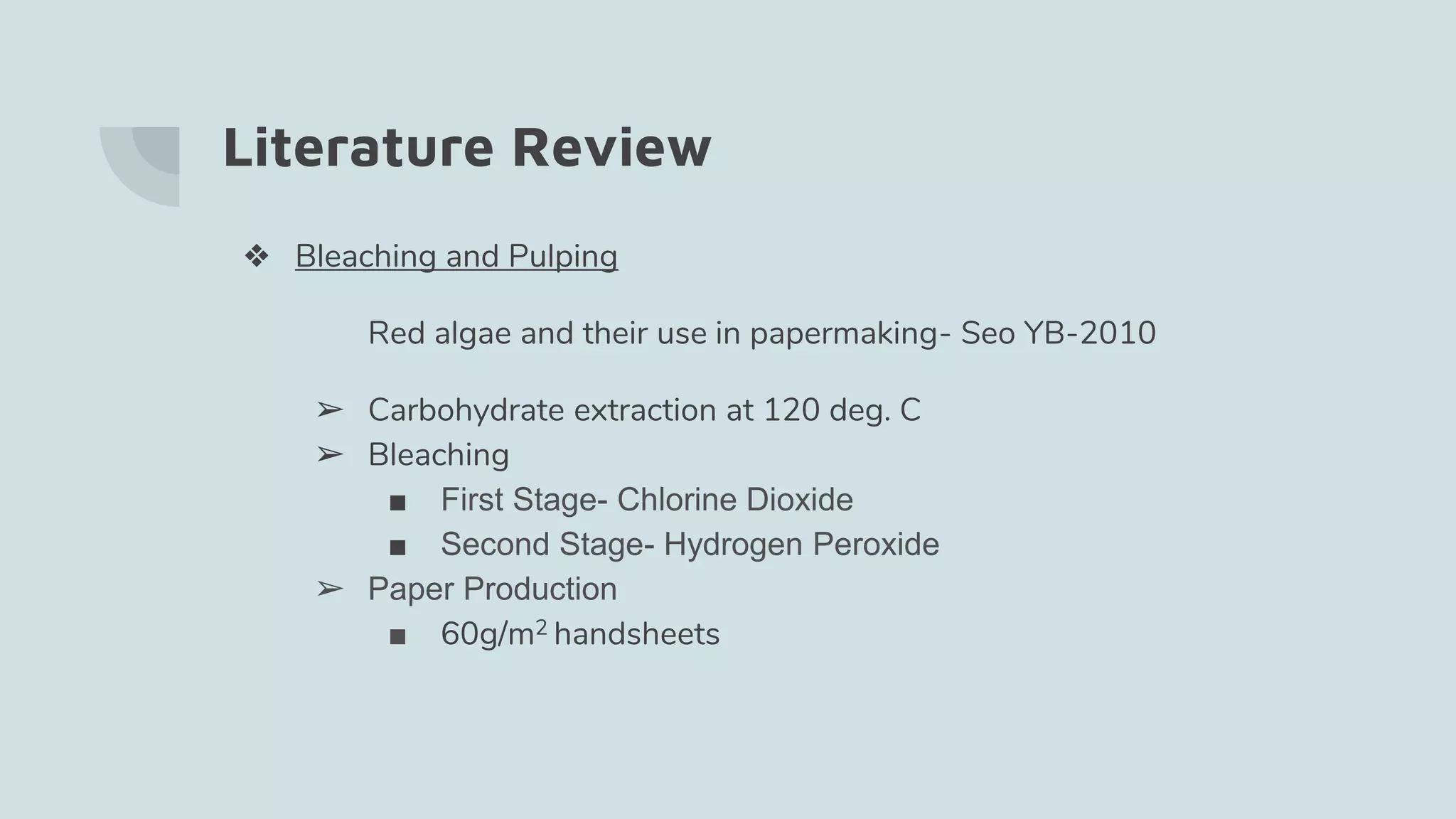
Fig 2: Example of final
product
http://naruseiya.net/colored-sheets/colored-sheets-high-
quality-colored-paper-sheets-at-rs-40-kilogram-paper-
sheets-templates/
Design Methodology
❖ Process Flow: Method 1- with
hydrogen peroxide bleaching
Stage
❖ Process Flow: Method 2- without
hydrogen peroxide bleaching
Stage
Materials
❖ Method 1
➢ Filamentous Algae
➢ Hydrogen peroxide- 3%
conc.
➢ Acetone- 99% conc.
➢ 3 liter pot
➢ 200 mL beakers
➢ Stir rod
➢ Oven
➢ Blender
➢ Coffee Filters
➢ Granite Slabs
➢ Tin Foil
❖ Method 2
➢ Filamentous
Algae
➢ 800 micron
nylon screen
➢ Vacuum
funnels
➢ Blender
➢ Granite slabs
➢ Paper towels
➢ 250 mL
beakers
➢ Acetone-
99% conc.
Fig 3: 25.0 g filamentous algae
sample
Photo by: Pa-Sweet
Methods
Pigment Extraction
1. Weight samples of
a. Algae - 20g
b. Carrots - 72g
c. Turmeric - 3.0g
d. Coffee - 20g
e. Beets - 32g
2. Put into solution with 100 ml acetone
3. Blend until adequately processed
4. Stir for 1.5 hours
5. Filter solution
6. Dry at 180°F
Paint Mixing
1. Combine dry pigments,
glycerin, and white clay
Fig. 4: Carrot sample for
orange pigment
Photo by: Jacob
Fig. 5: Algae sample for
green pigment
Photo by: Jacob
Methods Cont.
Pulp Processing Method 1
1. 10:1 water/algae
2. Blend
3. 120°C for 1 hour
4. Peroxide Treatment
5. 80°C for 1 hour
Paper Production Method 1
1. Filter
2. Squeeze out liquid
3. Granite slabs
4. 90°C until dry
Fig.6: Blended algae/water solution
Photo by: Pa-Sweet
Fig.7: Filtered algae ready to be flattened
Photo by: Pa-Sweet
Methods Cont.
Pulp Processing Method 2
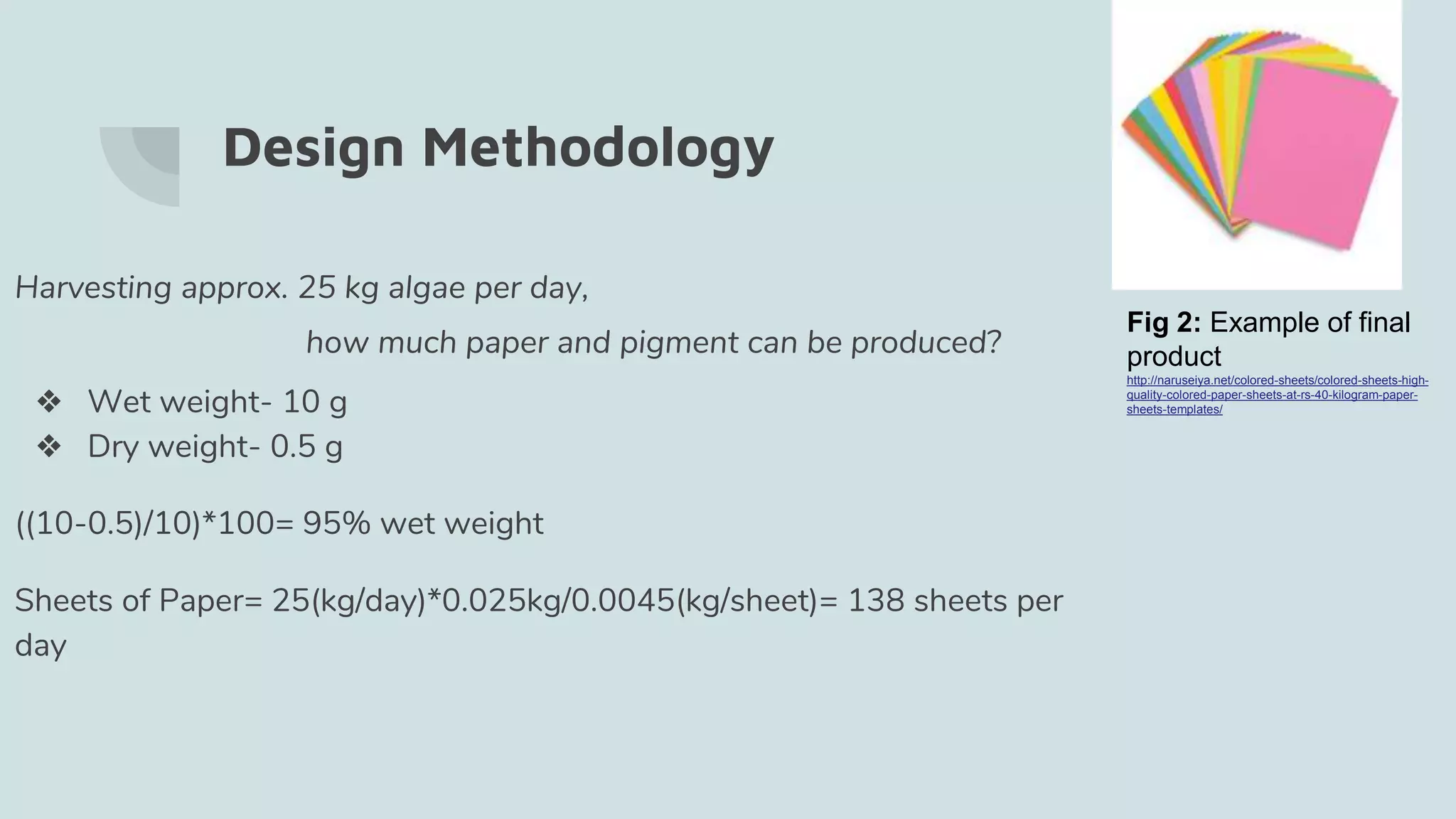
1. 1:2 solutions of
algae/water
2. Blend 15 seconds
3. Pigment extraction
Paper Production Method 2
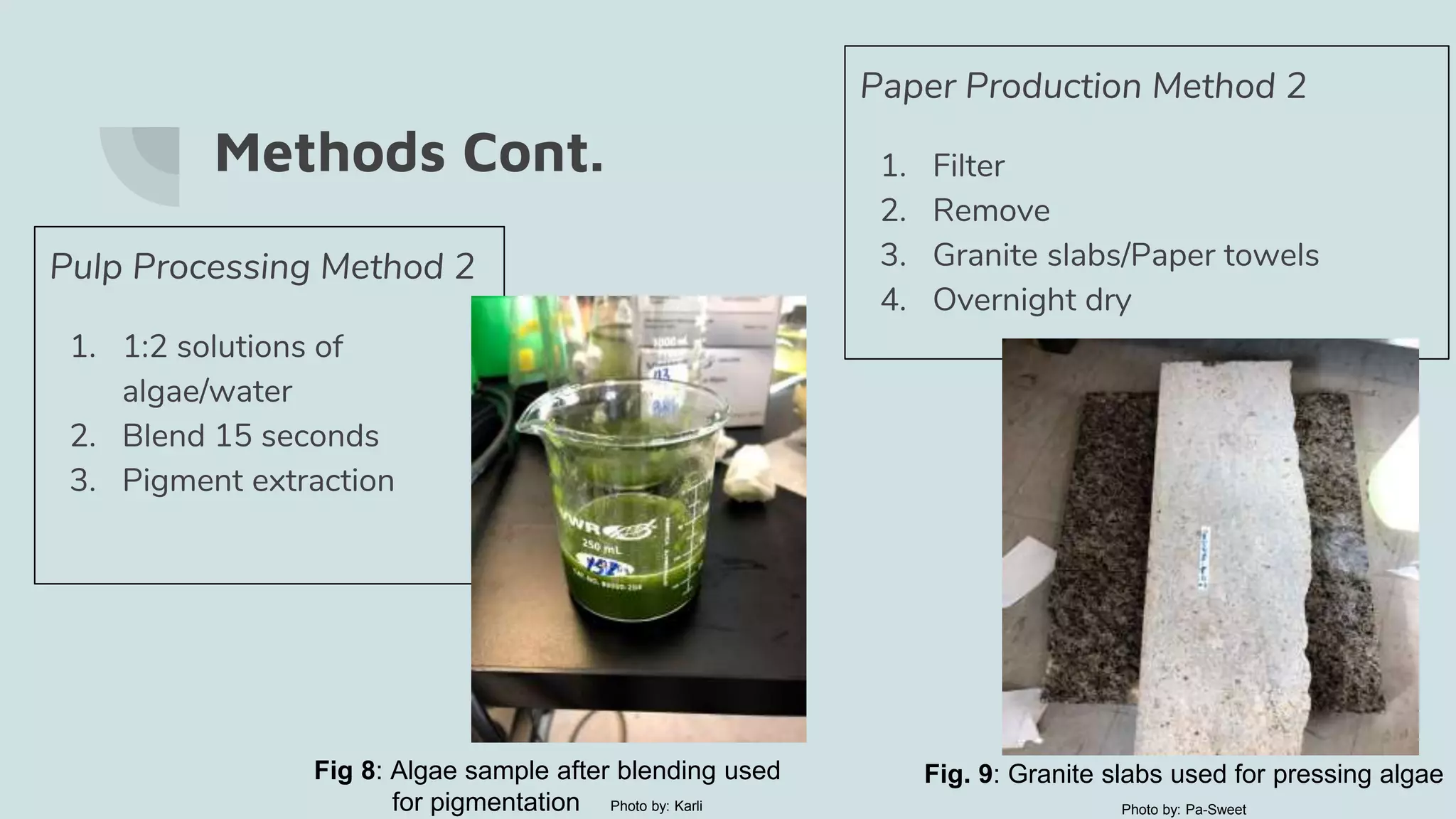
1. Filter
2. Remove
3. Granite slabs/Paper towels
4. Overnight dry
Fig. 9: Granite slabs used for pressing algae
Photo by: Pa-Sweet
Fig 8: Algae sample after blending used
for pigmentation Photo by: Karli
Results
❖ Pigment Extraction
➢ Adequate pigments extracted
➢ Application for waste material
Fig. 10: Extracted Pigments
Photo by: Jacob
Graph 1: Pigment extraction comparison
Results
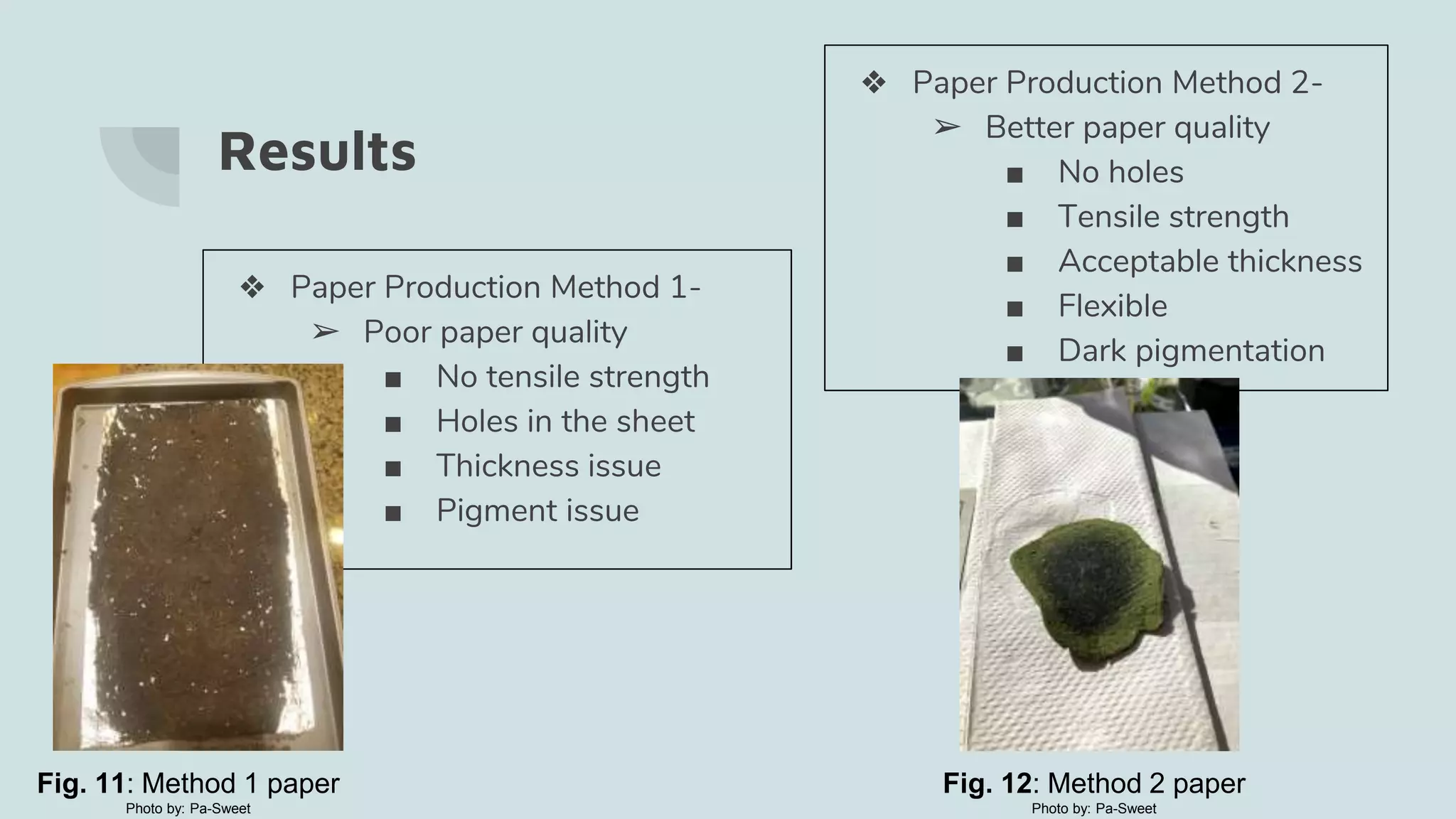
❖ Paper Production Method 1-
➢ Poor paper quality
■ No tensile strength
■ Holes in the sheet
■ Thickness issue
■ Pigment issue
❖ Paper Production Method 2-
➢ Better paper quality
■ No holes
■ Tensile strength
■ Acceptable thickness
■ Flexible
■ Dark pigmentation
Fig. 11: Method 1 paper
Photo by: Pa-Sweet
Fig. 12: Method 2 paper
Photo by: Pa-Sweet
Discussion
❖ Pigment extraction
➢ Other substances extracted
❖ Method 1- Including hydrogen peroxide bleaching
➢ pH control
➢ Hydrogen peroxide amount
➢ Baked at a low temperature
➢ Flattening issue
❖ Method 2- Without bleaching
➢ Flattening technique
➢ Sun bleaching
➢ Sample size
Fig. 13: Method 2 paper
Photo by: Pa-Sweet
Conclusion
❖ Many applications
❖ Natural vs synthetic dyes
❖ Pigments successfully
extracted
❖ Unknown pigment lifespan
Fig. 14: Various Natural
Pigments
http://www.almetcolours.com/en/contents/4543.html
Conclusion
❖ No desirable qualities of standard paper
➢ No current research
➢ Dual product attempt
❖ Many errors in the procedure
❖ Current market
➢ Future research- increase in quality of
product
❖ More sustainable and lower energy
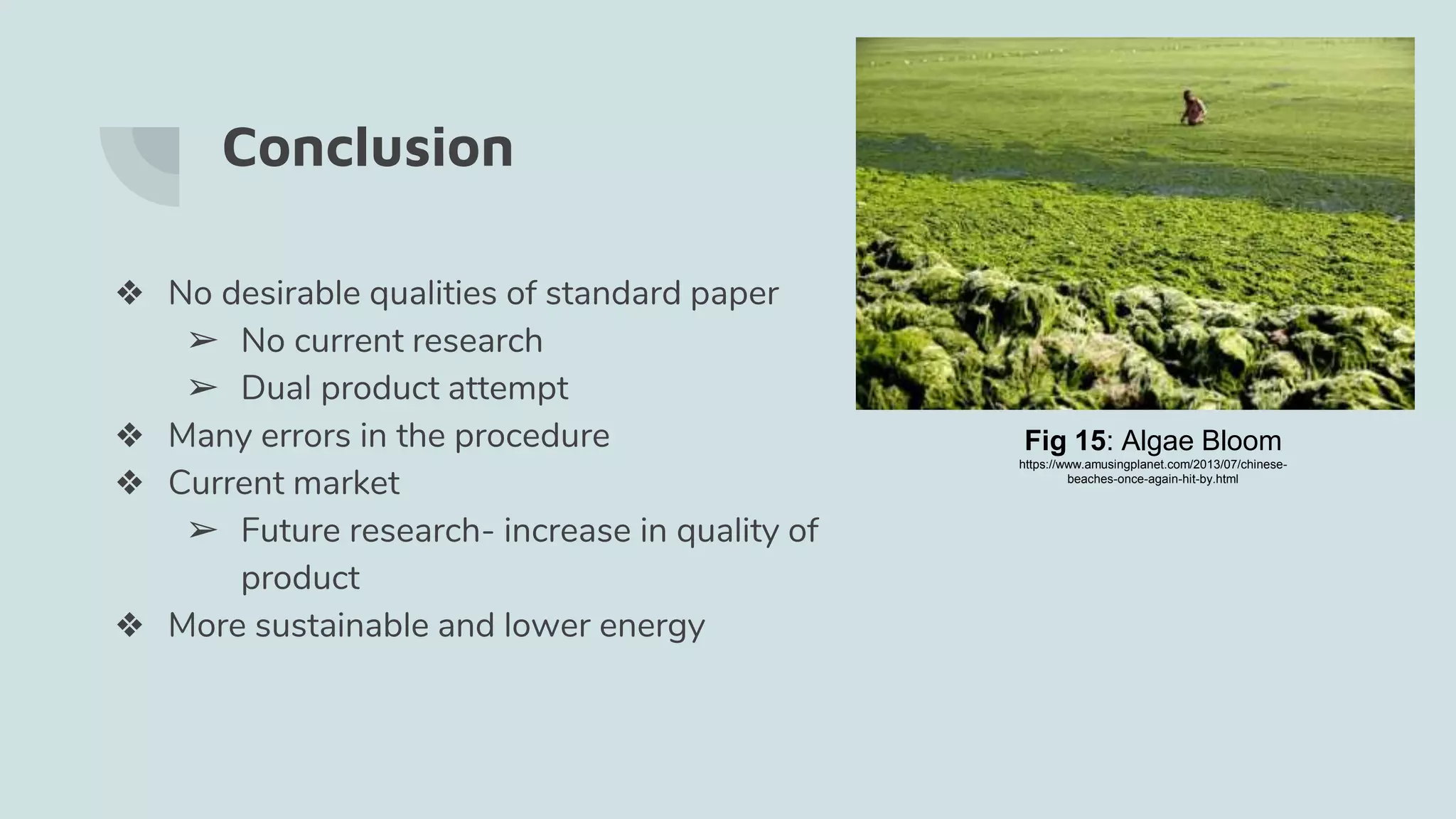
Fig 15: Algae Bloom
https://www.amusingplanet.com/2013/07/chinese-
beaches-once-again-hit-by.html
References
❖ Hagerthey, S. E., Louda, J. W., & Mongkronsri, P. (2006, March 03). EVALUATION OF PIGMENT
EXTRACTION METHODS AND A RECOMMENDED PROTOCOL FOR PERIPHYTON
CHLOROPHYLL a DETERMINATION AND CHEMOTAXONOMIC ASSESSMENT1. Retrieved
from https://onlinelibrary.wiley.com/doi/full/10.1111/j.1529-8817.2006.00257.x
❖ Seo, Y. B., Lee, Y. W., Lee, C. H., & You, H. C. (2009, December 9). Red algae and their use in
papermaking. Retrieved November 15, 2018, from https://www.ncbi.nlm.nih.gov/pubmed/20022488
❖ Prajapati, C. (2013, July 02). Synthetic dyes: Environment & human risk. Retrieved from
https://www.omicsonline.org/proceedings/synthetic-dyes-environment--human-risk-5860.html
Appendices
Method 1 Method 2
Algae wet
weight
2 kg 50 g
Acetone
amount
N/A 50 ml
Hydrogen
Peroxide
1 liter N/A
Sample Mass Before
Extraction (g)
Mass Extract
(g)
Algae 20.0 0.05
Turmeric 3.0 0.06
Carrots 71.9 0.98
Beets 31.6 0.40
Coffee 20.0 0.61

Algae product

  • 1.
    Algae Dual Product BE 2120- Fall 2018 Pa-Sweet Betancourt, Karli King, Alec Popichak, Jacob Simmons https://www.youtube.com/watch?v=aAekE-7_Wrs
  • 2.
    Introduction ❖ Problem/Need: ➢ GlobalClimate Change/Carbon Capture system ❖ Goals: ➢ 25 kg algae/day ➢ Pigment Extractions ➢ Paper ➢ Usable ❖ Constraints: ➢ Time ❖ Considerations: ➢ Algae growth ➢ Tree issues ➢ Environmental impact Fig.1: Filamentous green algae https://www.swnewsmedia.com/eden_prairie_news/news/local/filamentous-algae-not- significant-problem/article_dd9efd52-f611-512e-9519-12c667a472c6.html
  • 3.
    Literature Review ❖ Pigmentextraction from algae Evaluation of Pigment Extraction Methods and a Recommended Protocol for Periphyton Chlorophyll aDetermination and Chemotaxonomic Assessment- Hagerthey and others- 2006 ➢ Solvent ■ Four solvents combinations ➢ The effects of grinding, and freeze‐drying
  • 4.
    Literature Review ❖ Bleachingand Pulping Red algae and their use in papermaking- Seo YB-2010 ➢ Carbohydrate extraction at 120 deg. C ➢ Bleaching ■ First Stage- Chlorine Dioxide ■ Second Stage- Hydrogen Peroxide ➢ Paper Production ■ 60g/m2 handsheets
  • 5.
    Design Methodology Harvesting approx.25 kg algae per day, how much paper and pigment can be produced? ❖ Wet weight- 10 g ❖ Dry weight- 0.5 g ((10-0.5)/10)*100= 95% wet weight Sheets of Paper= 25(kg/day)*0.025kg/0.0045(kg/sheet)= 138 sheets per day Fig 2: Example of final product http://naruseiya.net/colored-sheets/colored-sheets-high- quality-colored-paper-sheets-at-rs-40-kilogram-paper- sheets-templates/
  • 6.
    Design Methodology ❖ ProcessFlow: Method 1- with hydrogen peroxide bleaching Stage ❖ Process Flow: Method 2- without hydrogen peroxide bleaching Stage
  • 7.
    Materials ❖ Method 1 ➢Filamentous Algae ➢ Hydrogen peroxide- 3% conc. ➢ Acetone- 99% conc. ➢ 3 liter pot ➢ 200 mL beakers ➢ Stir rod ➢ Oven ➢ Blender ➢ Coffee Filters ➢ Granite Slabs ➢ Tin Foil ❖ Method 2 ➢ Filamentous Algae ➢ 800 micron nylon screen ➢ Vacuum funnels ➢ Blender ➢ Granite slabs ➢ Paper towels ➢ 250 mL beakers ➢ Acetone- 99% conc. Fig 3: 25.0 g filamentous algae sample Photo by: Pa-Sweet
  • 8.
    Methods Pigment Extraction 1. Weightsamples of a. Algae - 20g b. Carrots - 72g c. Turmeric - 3.0g d. Coffee - 20g e. Beets - 32g 2. Put into solution with 100 ml acetone 3. Blend until adequately processed 4. Stir for 1.5 hours 5. Filter solution 6. Dry at 180°F Paint Mixing 1. Combine dry pigments, glycerin, and white clay Fig. 4: Carrot sample for orange pigment Photo by: Jacob Fig. 5: Algae sample for green pigment Photo by: Jacob
  • 9.
    Methods Cont. Pulp ProcessingMethod 1 1. 10:1 water/algae 2. Blend 3. 120°C for 1 hour 4. Peroxide Treatment 5. 80°C for 1 hour Paper Production Method 1 1. Filter 2. Squeeze out liquid 3. Granite slabs 4. 90°C until dry Fig.6: Blended algae/water solution Photo by: Pa-Sweet Fig.7: Filtered algae ready to be flattened Photo by: Pa-Sweet
  • 10.
    Methods Cont. Pulp ProcessingMethod 2 1. 1:2 solutions of algae/water 2. Blend 15 seconds 3. Pigment extraction Paper Production Method 2 1. Filter 2. Remove 3. Granite slabs/Paper towels 4. Overnight dry Fig. 9: Granite slabs used for pressing algae Photo by: Pa-Sweet Fig 8: Algae sample after blending used for pigmentation Photo by: Karli
  • 11.
    Results ❖ Pigment Extraction ➢Adequate pigments extracted ➢ Application for waste material Fig. 10: Extracted Pigments Photo by: Jacob Graph 1: Pigment extraction comparison
  • 12.
    Results ❖ Paper ProductionMethod 1- ➢ Poor paper quality ■ No tensile strength ■ Holes in the sheet ■ Thickness issue ■ Pigment issue ❖ Paper Production Method 2- ➢ Better paper quality ■ No holes ■ Tensile strength ■ Acceptable thickness ■ Flexible ■ Dark pigmentation Fig. 11: Method 1 paper Photo by: Pa-Sweet Fig. 12: Method 2 paper Photo by: Pa-Sweet
  • 13.
    Discussion ❖ Pigment extraction ➢Other substances extracted ❖ Method 1- Including hydrogen peroxide bleaching ➢ pH control ➢ Hydrogen peroxide amount ➢ Baked at a low temperature ➢ Flattening issue ❖ Method 2- Without bleaching ➢ Flattening technique ➢ Sun bleaching ➢ Sample size Fig. 13: Method 2 paper Photo by: Pa-Sweet
  • 14.
    Conclusion ❖ Many applications ❖Natural vs synthetic dyes ❖ Pigments successfully extracted ❖ Unknown pigment lifespan Fig. 14: Various Natural Pigments http://www.almetcolours.com/en/contents/4543.html
  • 15.
    Conclusion ❖ No desirablequalities of standard paper ➢ No current research ➢ Dual product attempt ❖ Many errors in the procedure ❖ Current market ➢ Future research- increase in quality of product ❖ More sustainable and lower energy Fig 15: Algae Bloom https://www.amusingplanet.com/2013/07/chinese- beaches-once-again-hit-by.html
  • 16.
    References ❖ Hagerthey, S.E., Louda, J. W., & Mongkronsri, P. (2006, March 03). EVALUATION OF PIGMENT EXTRACTION METHODS AND A RECOMMENDED PROTOCOL FOR PERIPHYTON CHLOROPHYLL a DETERMINATION AND CHEMOTAXONOMIC ASSESSMENT1. Retrieved from https://onlinelibrary.wiley.com/doi/full/10.1111/j.1529-8817.2006.00257.x ❖ Seo, Y. B., Lee, Y. W., Lee, C. H., & You, H. C. (2009, December 9). Red algae and their use in papermaking. Retrieved November 15, 2018, from https://www.ncbi.nlm.nih.gov/pubmed/20022488 ❖ Prajapati, C. (2013, July 02). Synthetic dyes: Environment & human risk. Retrieved from https://www.omicsonline.org/proceedings/synthetic-dyes-environment--human-risk-5860.html
  • 17.
    Appendices Method 1 Method2 Algae wet weight 2 kg 50 g Acetone amount N/A 50 ml Hydrogen Peroxide 1 liter N/A Sample Mass Before Extraction (g) Mass Extract (g) Algae 20.0 0.05 Turmeric 3.0 0.06 Carrots 71.9 0.98 Beets 31.6 0.40 Coffee 20.0 0.61

Editor's Notes

  • #3 Problem Need Global climate change has led to the need to develop carbon capture systems. While trees are a net zero carbon source, they take much longer to capture carbon, require more chemicals to process, and their harvesting affects the health of the soil which is perpetual carbon capture system when properly maintained Goals 25 kg determined by the size of the aquaculture and the max rate of algae growth per unit area Develop a process of paper production that has minimal environmental impact in terms of chemicals used and process waste Create full size paper sheets- 8.25 in X 11.7 in Usable- Flexible and good tensile strength, will the pigments maintian brightness over time
  • #4 Extractability of four solvents- acetone, methanol, methanol/acetone, and methanol/acetone/N,N‐dimethylformamide Extractability- The best overall extraction was obtained using freeze‐dried samples extracted with methanol/acetone/DMF/water Acetone was used to reduce chemical requirements and environmental effects Formaldahide highly toxic Freezing Improved the extraction of both polar and non‐polar (lipophilic/hydrophobic) pigments Freezing-Not done to reduce energy requirement and to effect Grinding- not done to increase pigment extraction but still was done as it was part of the pulping procedure
  • #5 Mucilaginous carbohydrate extraction at 120 deg. C with no chemicals water to algae ratio of 10:1 Leaving a mush of endofibers that are normally discarded in the both at 60 min. and 80 deg. C (5% active hydrogen peroxide) Only hydrogen peroxide was used to have a chlorine free process as chlorine dioxide is of mild toxicity
  • #6 -talk about specific goal -we have aq her at clemson -from the area of this aq, we derived we could get 25kg a day -tested wet vr dry weight...so that would yield (not including weight lost during pigment extraction) -we looked at the weight of a sheet of paper
  • #7 -we created method from literature-attempted but did not achieve-so here’s our flow chart for method 1 -method 2 we got from lab from other students-here’s flow chart for that
  • #8 -no chemicals -difference: hydrogen peroxide vs none
  • #9 Sample size to to algae ratio were arbitrarily decided by the intensity of the color displayed in the samples. Other pigments were extracted to increase the variety of colors for the proposed painting -we dont know the concentration in these substance 20 g algae 72 g carrots -given we are making duel product-first step is extracting pigments 3.00g turmeric 32 g beets 20g coffee Mixing was done by hand every 5 minutes Acetone/ pigment solution was filtered using a 20 micron coffee filter -reason for other samples-intended on painting, wanting more colors -Combine dry pigments with glycerin and white clay until ideal color and texture is achieved
  • #10 Why 1 L?, why 3%?-3% is all we could get our hands on Create solution of 10:1 water/algae Blend solution until adequately processed Boil at 120°C for 1 hour Add 1 L 3% hydrogen peroxide Boil at 80°C for 1 hour Paper-800 micron filter Pour pulp solution onto filter screen Squeeze out liquid Press pulp into sheets using granite slabs Bake at 90°C until dry
  • #11  Window screen is 800 microns Pigment extraction- was outlined earlier Created 2 solutions to test pigment extraction vs non-extraction Procedure originally outlined in lab but we modified Create 2, 1:2 solutions of algae and water Blend 15 seconds Perform pigment extraction Pour pulp through window screen Remove algae from screen Press pulp between several layers of paper towels and granite slabs Allow paper to dry overnight
  • #12 Adequate pigments extracted Non-algae waste material can be dried and composted
  • #13 Method 1 - including hydrogen peroxide Paper strength- average bursting strength of office paper 250-300 kpa Average thickness- 0.05 mm, our thickness- 3 mm
  • #14 Pigment extraction- other substances were also extracted besides pigments, these may include things like lipids, antioxidants- in the future a smaller filter could be used to reduce the infiltration of these things- or a procedure for seperating these valuable substances can be used The research on red algae paper production used sodium hydroxide to control the pH. Perhaps the large amount of hydrogen peroxide added reduced the pH and interfered with the quality of the pulp Brightness measures the amount of reflectance of a specific wavelength of blue light and iis measured on a scale of 0 to 100 The research indicated that the bleaching step done with the hydrogen peroxide was repeated until the brightness reached 80% but does not state how much hydrogen peroxide this equated to Paper was baked at 190 deg. because of the size of the sample Due to issues with the filtering process, the algae had to be hand spread,resulting in inconsistent thickness The paper only had 1 day to sun dry, if we had more time, the paper may have reached a more acceptable brightness Method 1- Including hydrogen peroxide bleaching No pH control was implemented Hydrogen peroxide lower conc. and lower volume Paper was baked at a low temperature Method 2- Without bleaching Better flattening technique Longer sun bleaching Red algae paper went through multiple rounds of bleaching, as we only did one, we might have not used enough h202. Paper was baked at a low temperature to dry, this for certain darkened our pigment. Wanted bigger scale Flatten more efficiently Time for sun bleaching
  • #15 Perhaps waste material can be used for pigment extraction Synthetic dyes have lots of documented environmental and consumption health risks- those include tumors, various cancers, and lung disease to name a few Natural dyes do not have the same documented health effects and are a worthy substitutes despite a current greater cost of production Food dyes, drink dyes, clothing products
  • #16 Paper created has no desirable qualities of standard paper Dual product attempt was of no lower quality than the basic paper process Future research- quality of product will increase